Starter
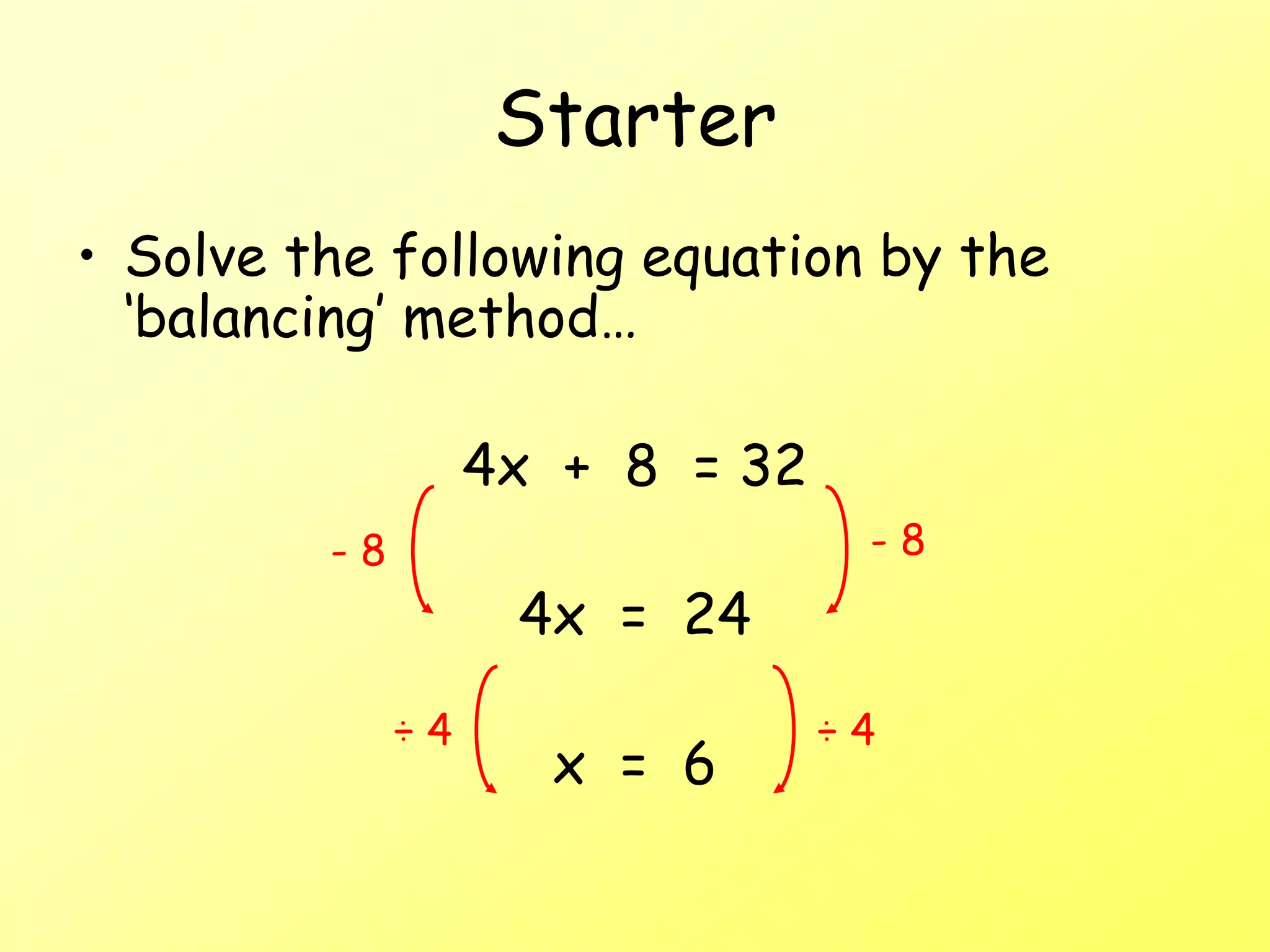
• Solve the following equation by the
‘balancing’ method…
4x + 8 = 32
4x = 24
x = 6
- 8 - 8
÷ 4
÷ 4
Equations with x on both sides
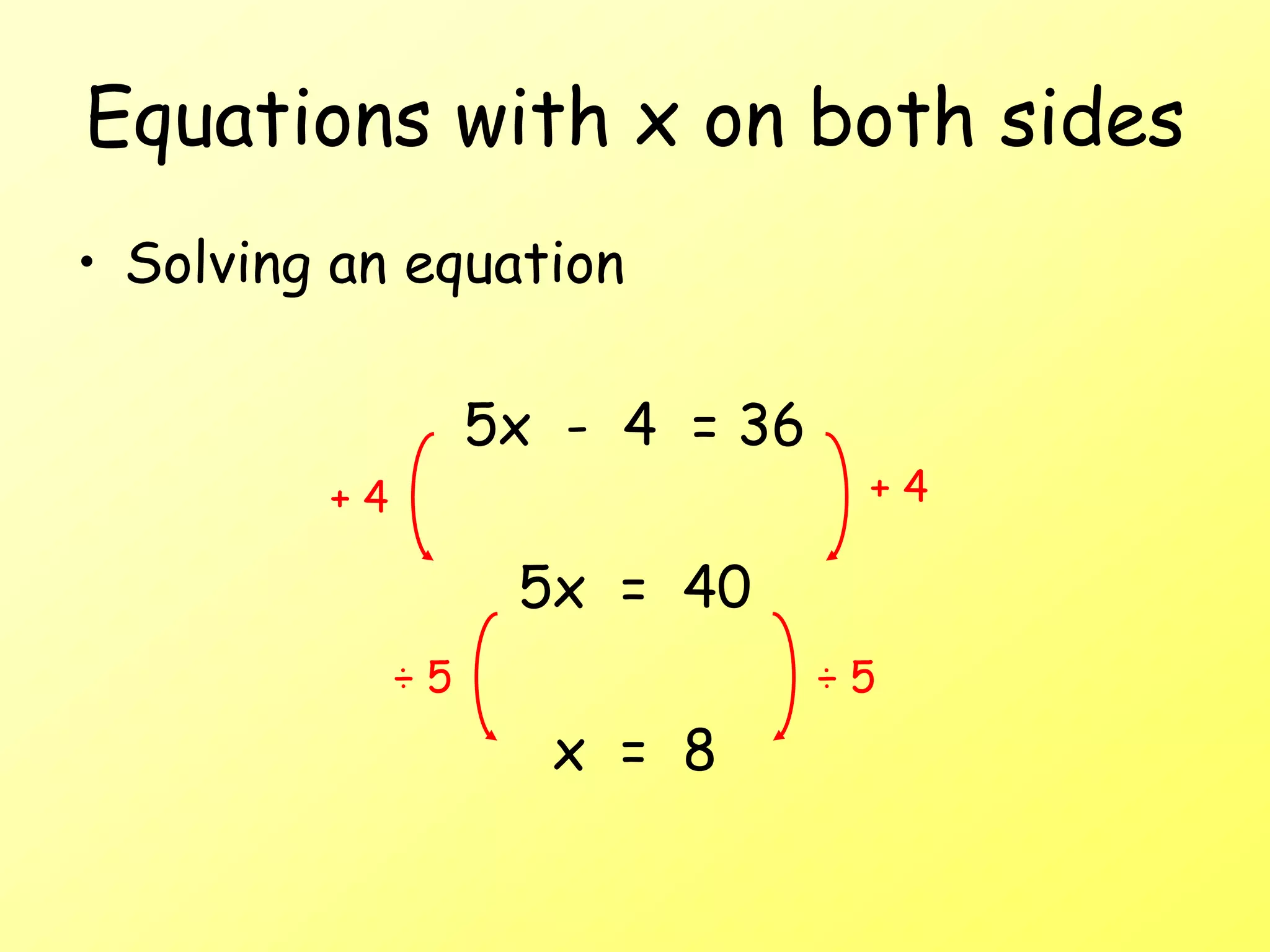
• Solving an equation
5x - 4 = 36
5x = 40
x = 8
+ 4 + 4
÷ 5
÷ 5
Equations with x on both sides
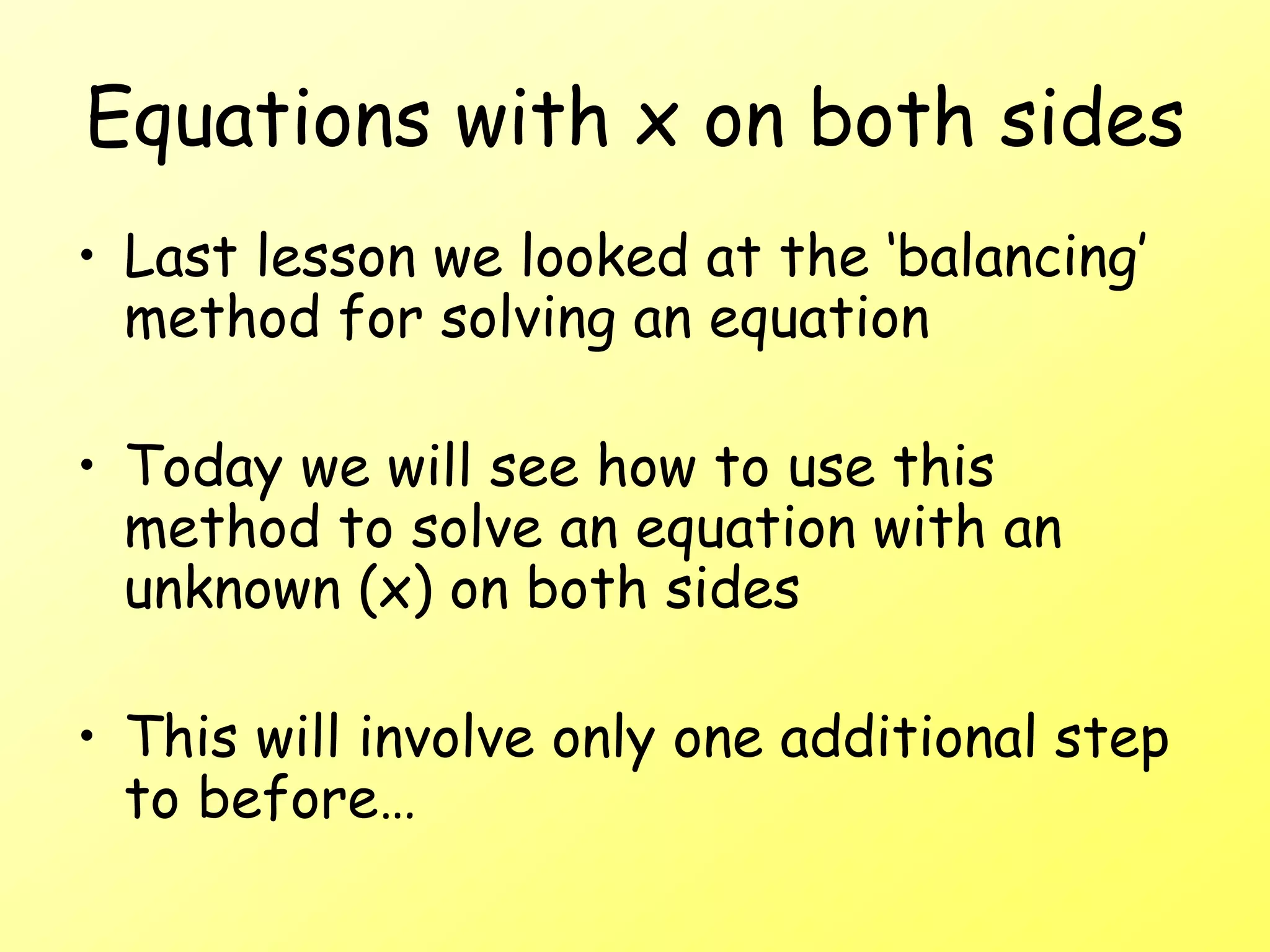
• Last lesson we looked at the ‘balancing’
method for solving an equation
• Today we will see how to use this
method to solve an equation with an
unknown (x) on both sides
• This will involve only one additional step
to before…
Equations with x on both sides
• Solving an equation
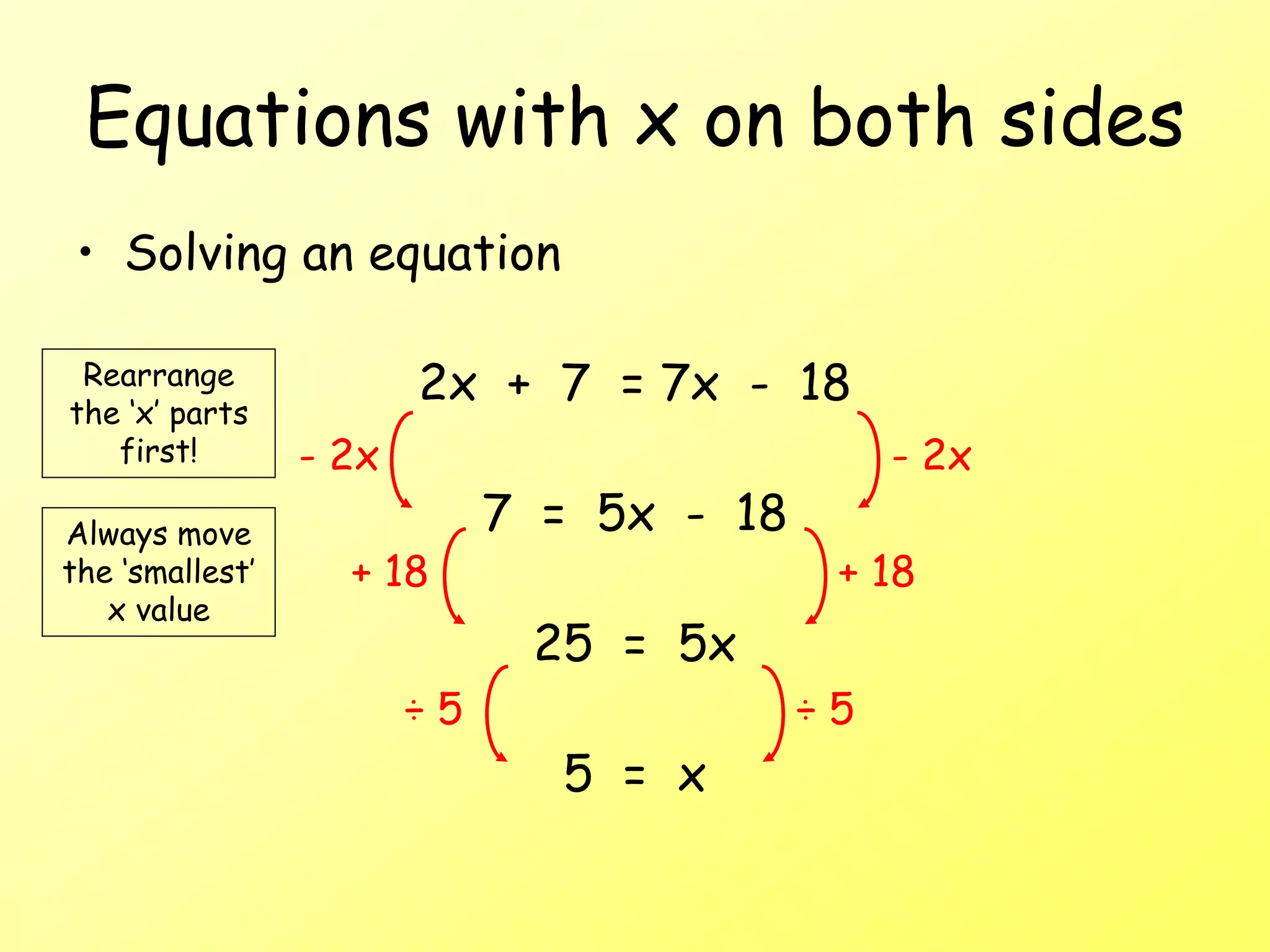
2x + 7 = 7x - 18
7 = 5x - 18
25 = 5x
5 = x
- 2x - 2x
+ 18
+ 18
÷ 5 ÷ 5
Rearrange
the ‘x’ parts
first!
Always move
the ‘smallest’
x value
Equations with x on both sides
• Solving an equation
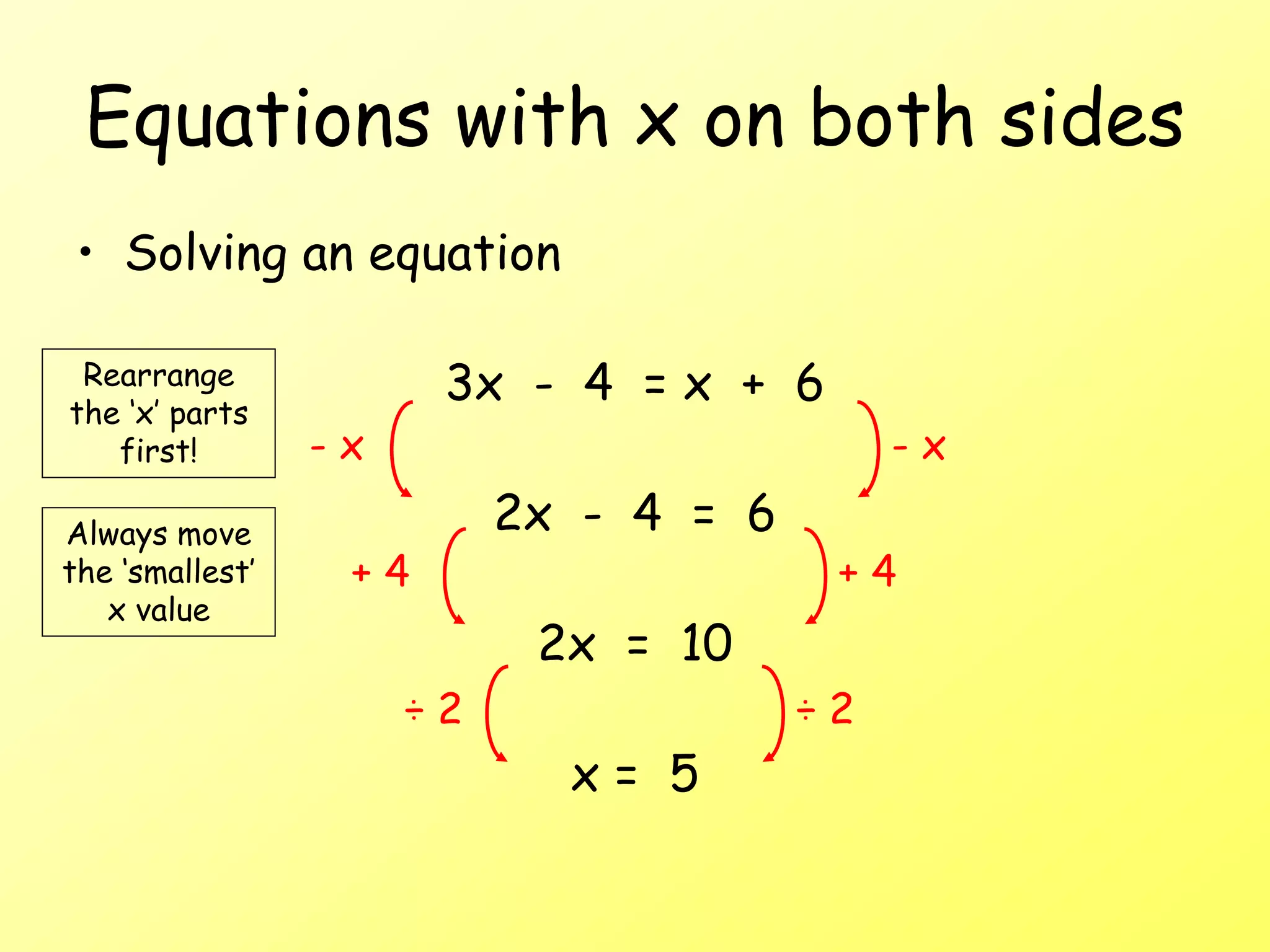
3x - 4 = x + 6
2x - 4 = 6
2x = 10
x = 5
- x - x
+ 4
+ 4
÷ 2 ÷ 2
Rearrange
the ‘x’ parts
first!
Always move
the ‘smallest’
x value
Equations with x on both sides
• Solving an equation
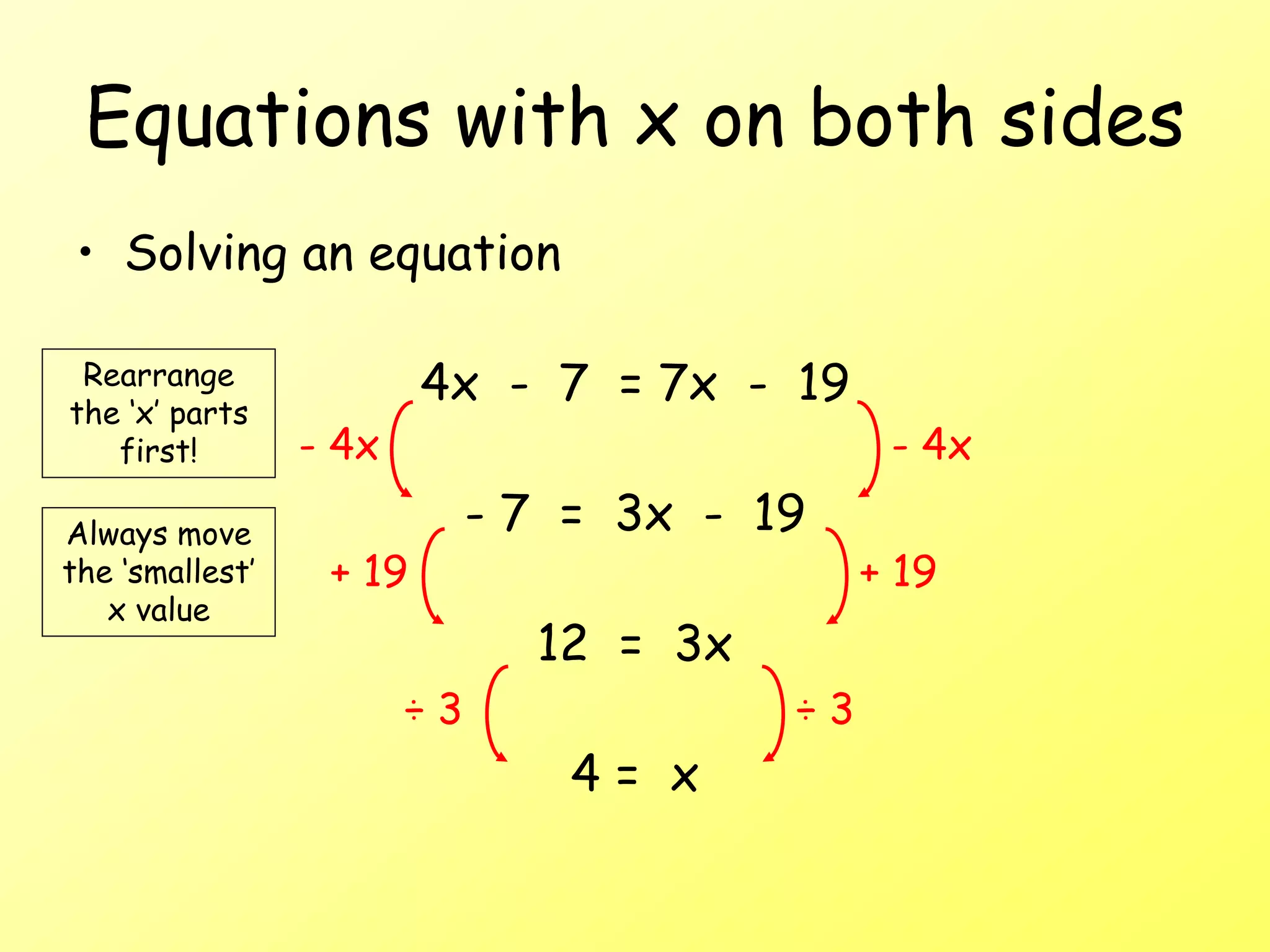
4x - 7 = 7x - 19
- 7 = 3x - 19
12 = 3x
4 = x
- 4x - 4x
+ 19
+ 19
÷ 3 ÷ 3
Rearrange
the ‘x’ parts
first!
Always move
the ‘smallest’
x value
Equations with x on both sides
• Solving an equation
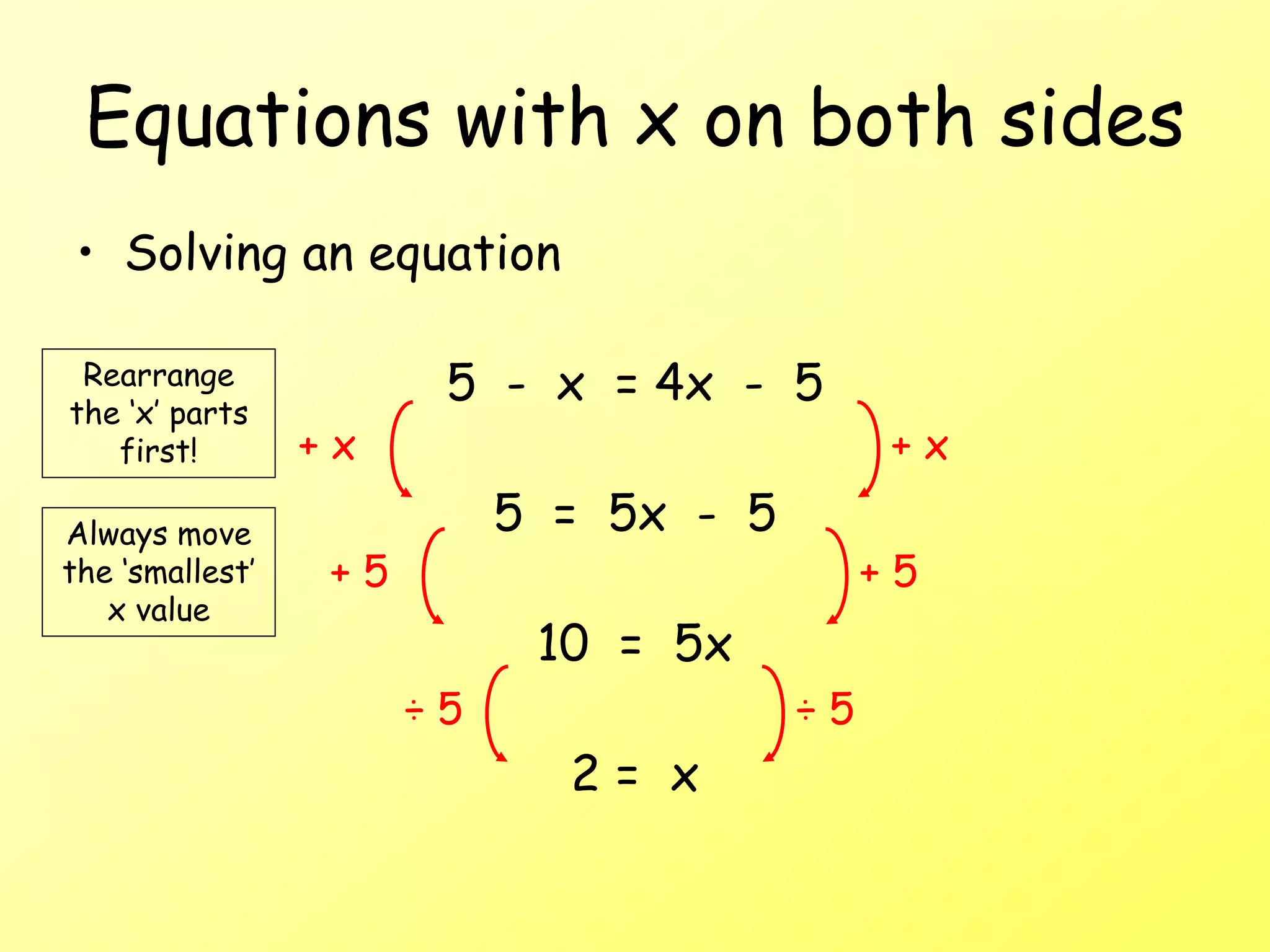
5 - x = 4x - 5
5 = 5x - 5
10 = 5x
2 = x
+ x + x
+ 5
+ 5
÷ 5 ÷ 5
Rearrange
the ‘x’ parts
first!
Always move
the ‘smallest’
x value
Equations with x on both sides
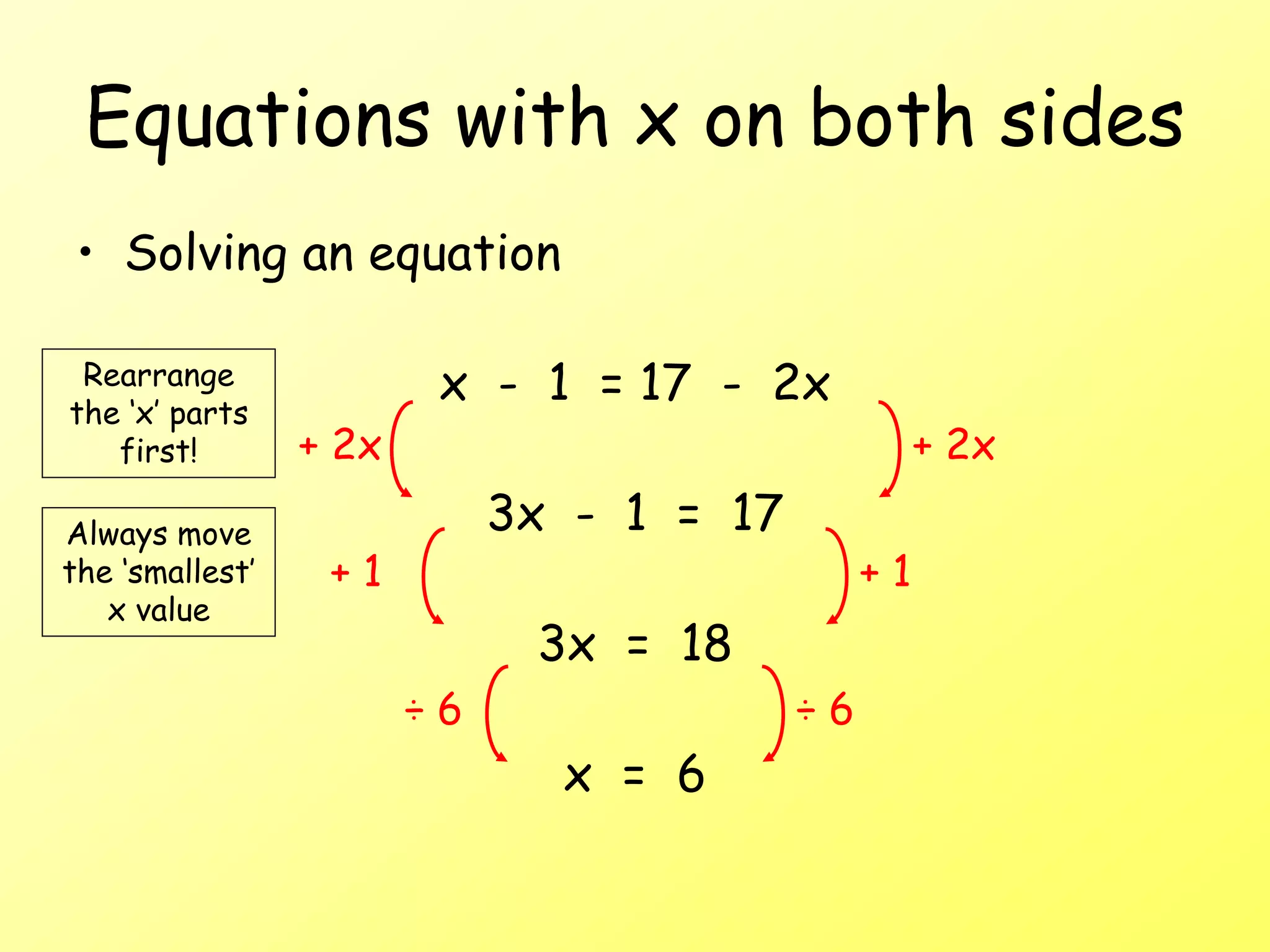
• Solving an equation
x - 1 = 17 - 2x
3x - 1 = 17
3x = 18
x = 6
+ 2x + 2x
+ 1
+ 1
÷ 6 ÷ 6
Rearrange
the ‘x’ parts
first!
Always move
the ‘smallest’
x value
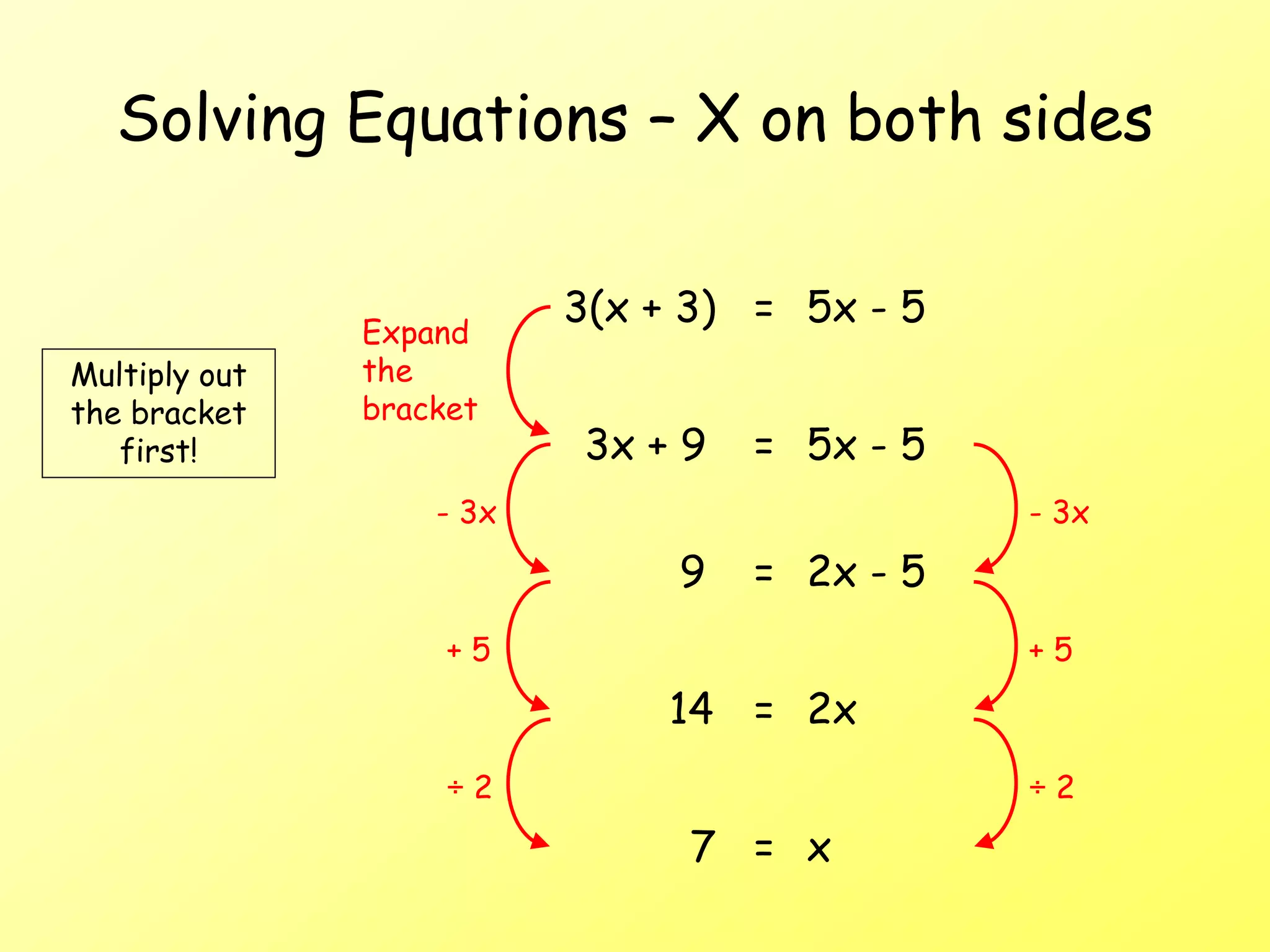
Solving Equations – X on both sides
3(x + 3) = 5x - 5
3x + 9 = 5x - 5
Expand
the
bracket
9 = 2x - 5
- 3x
- 3x
14 = 2x
+ 5
+ 5
7 = x
÷ 2
÷ 2
Multiply out
the bracket
first!
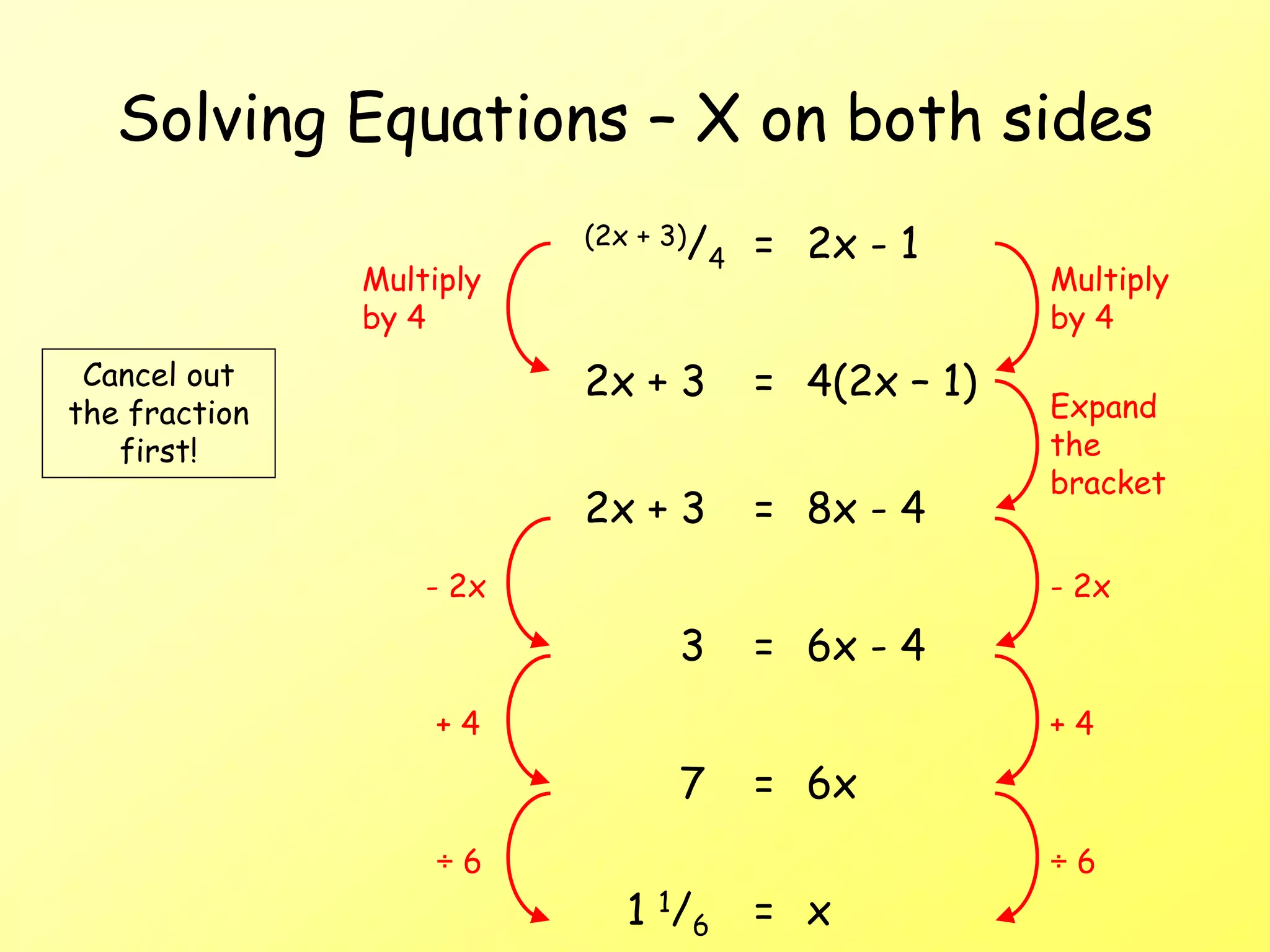
Solving Equations – X on both sides
(2x + 3)/4 = 2x - 1
2x + 3 = 4(2x – 1)
Multiply
by 4
= 8x - 4
Expand
the
bracket
3 = 6x - 4
- 2x
- 2x
7 = 6x
+ 4
+ 4
2x + 3
÷ 6
÷ 6
1 1/6 = x
Multiply
by 4
Cancel out
the fraction
first!
Summary
• We have recapped solving equations
• We have extended this knowledge to
include equations with x on both sides
• Again, we have seen that the easiest
way to do this is by the ‘balancing’
method

8) Equations with X on both sides (Higher).ppt

  • 2.
    Starter • Solve thefollowing equation by the ‘balancing’ method… 4x + 8 = 32 4x = 24 x = 6 - 8 - 8 ÷ 4 ÷ 4
  • 3.
    Equations with xon both sides • Solving an equation 5x - 4 = 36 5x = 40 x = 8 + 4 + 4 ÷ 5 ÷ 5
  • 4.
    Equations with xon both sides • Last lesson we looked at the ‘balancing’ method for solving an equation • Today we will see how to use this method to solve an equation with an unknown (x) on both sides • This will involve only one additional step to before…
  • 5.
    Equations with xon both sides • Solving an equation 2x + 7 = 7x - 18 7 = 5x - 18 25 = 5x 5 = x - 2x - 2x + 18 + 18 ÷ 5 ÷ 5 Rearrange the ‘x’ parts first! Always move the ‘smallest’ x value
  • 6.
    Equations with xon both sides • Solving an equation 3x - 4 = x + 6 2x - 4 = 6 2x = 10 x = 5 - x - x + 4 + 4 ÷ 2 ÷ 2 Rearrange the ‘x’ parts first! Always move the ‘smallest’ x value
  • 7.
    Equations with xon both sides • Solving an equation 4x - 7 = 7x - 19 - 7 = 3x - 19 12 = 3x 4 = x - 4x - 4x + 19 + 19 ÷ 3 ÷ 3 Rearrange the ‘x’ parts first! Always move the ‘smallest’ x value
  • 8.
    Equations with xon both sides • Solving an equation 5 - x = 4x - 5 5 = 5x - 5 10 = 5x 2 = x + x + x + 5 + 5 ÷ 5 ÷ 5 Rearrange the ‘x’ parts first! Always move the ‘smallest’ x value
  • 9.
    Equations with xon both sides • Solving an equation x - 1 = 17 - 2x 3x - 1 = 17 3x = 18 x = 6 + 2x + 2x + 1 + 1 ÷ 6 ÷ 6 Rearrange the ‘x’ parts first! Always move the ‘smallest’ x value
  • 10.
    Solving Equations –X on both sides 3(x + 3) = 5x - 5 3x + 9 = 5x - 5 Expand the bracket 9 = 2x - 5 - 3x - 3x 14 = 2x + 5 + 5 7 = x ÷ 2 ÷ 2 Multiply out the bracket first!
  • 11.
    Solving Equations –X on both sides (2x + 3)/4 = 2x - 1 2x + 3 = 4(2x – 1) Multiply by 4 = 8x - 4 Expand the bracket 3 = 6x - 4 - 2x - 2x 7 = 6x + 4 + 4 2x + 3 ÷ 6 ÷ 6 1 1/6 = x Multiply by 4 Cancel out the fraction first!
  • 12.
    Summary • We haverecapped solving equations • We have extended this knowledge to include equations with x on both sides • Again, we have seen that the easiest way to do this is by the ‘balancing’ method