New blood from old
      stones

   A tale in five or six steps
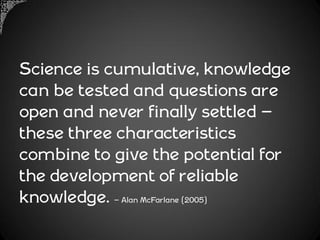
Science is cumulative, knowledge
can be tested and questions are
open and never finally settled –
these three characteristics
combine to give the potential for
the development of reliable
knowledge. – Alan McFarlane (2005)
About me
The journey
The big picture
Building
relationships
Show of hands
1.   You want advice on how to go about
     analysing old data
2.   Help build long term research
     relationships
3.   Interesting talk to see how a CX
     design practice within a big org works
4.   Couldn’t find a seat next door, or
     thought Iain’s topic wasn’t as
     interesting?
Where it all began
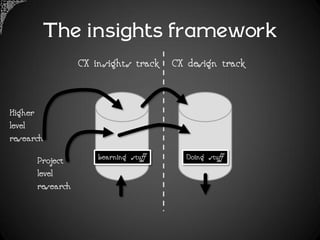
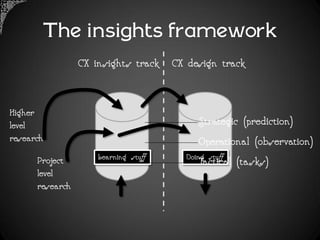
The insights framework
                 CX insights track    CX design track


Higher
level
research

      Project        Learning stuff     Doing stuff
      level
      research
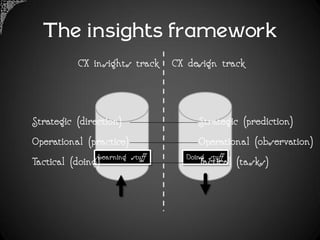
The insights framework
                 CX insights track    CX design track


Higher
level                                      Strategic (prediction)
research                                   Operational (observation)
      Project        Learning stuff     Doing stuff
                                           Tactical (tasks)
      level
      research
The insights framework
           CX insights track       CX design track


Strategic (direction)                   Strategic (prediction)
Operational (practice)                  Operational (observation)
Tactical (doing)Learning   stuff     Doing stuff
                                        Tactical (tasks)
Opening the door
Step 1 – find your questions
• How have people’s perception
  of online banking changed
  over time?
• Have we seen behavioural
  changes, what were they and
  can we predict any that are
  coming up?
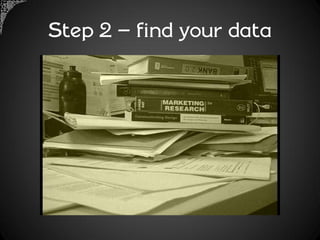
Step 2 – find your data
Step 3 - Triage
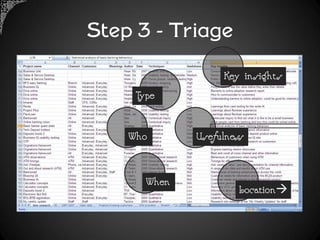
Step 3 - Triage
                   Key insights
     Type


    Who       Usefulness


       When
                      Location
Step 4 – rest and review
What we learnt
We aren’t good at record
keeping
What we learnt
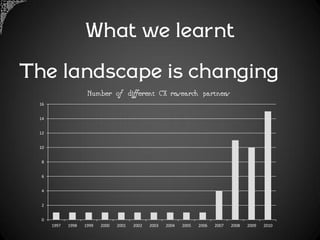
The landscape is changing
                     Number of different CX research partners
 16


 14


 12


 10


  8


  6


  4


  2


  0
      1997   1998   1999   2000   2001   2002   2003   2004   2005   2006   2007   2008   2009   2010
What we learnt
Where the gaps are
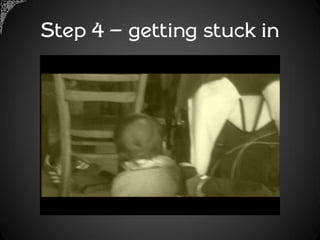
Step 4 – getting stuck in
Start with the big questions
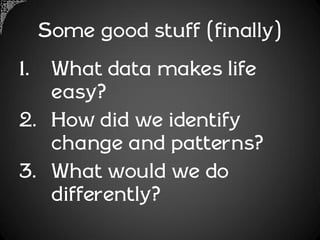
Some good stuff (finally)
1. What data makes life
   easy?
2. How did we identify
   change and patterns?
3. What would we do
   differently?
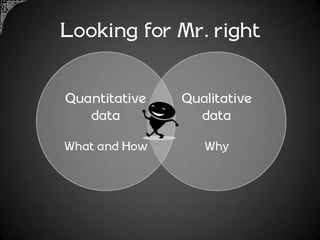
Looking for Mr. right


Quantitative   Qualitative
   data          data

What and How      Why
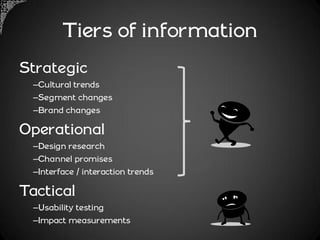
Tiers of information
Strategic
 –Cultural trends
 –Segment changes
 –Brand changes

Operational
 –Design research
 –Channel promises
 –Interface / interaction trends

Tactical
 –Usability testing
 –Impact measurements
Raw data For The Win (FTW)
• Raw data is well worth the effort to
  review
• Framed in the context of a timeline
  it makes your interpretation of data
  different
• We are asking for more raw data
  from our providers so we can
  reframe responses in the future
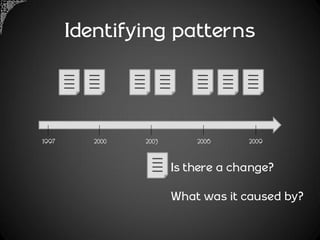
Identifying patterns


1997      2000   2003       2006     2009


                        Is there a change?

                        What was it caused by?
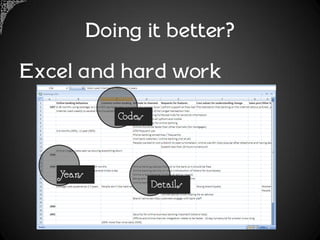
Doing it better?
Excel and hard work
              Codes


   Years
                      Details
Doing it better?
How we should have done it
Social science research apps
   e.g. Atlas.ti
Benefits
Learning what you don’t know

All gaps are…


            opportunities!
Setting the way forward
What longitudinal studies
could you be doing NOW?
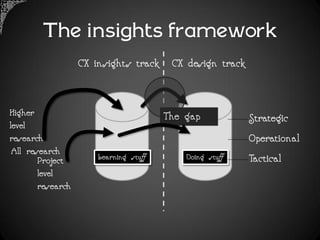
The insights framework
                   CX insights track     CX design track


Higher                                  The gap            Strategic
level
research                                                   Operational
 All research
        Project        Learning stuff       Doing stuff    Tactical
        level
        research
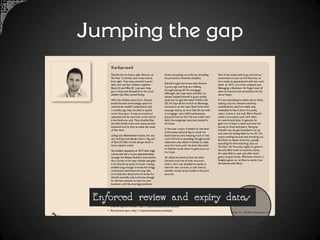
Jumping the gap


 Enforced review and expiry dates
Collaboration
Did we get new blood?
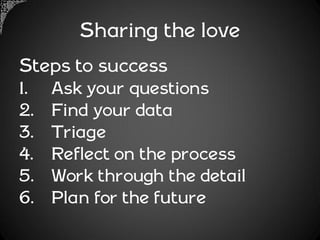
Sharing the love
Steps to success
1.   Ask your questions
2.   Find your data
3.   Triage
4.   Reflect on the process
5.   Work through the detail
6.   Plan for the future
Science is cumulative, knowledge
can be tested and questions are
open and never finally settled –
these three characteristics
combine to give the potential for
the development of reliable
knowledge. – Alan McFarlane (2005)
Thanks
                 Donna and Lilly
                Natalie, Jodie, Ruth
Ian, Anthony, the other guys & gals in Westpac CX


           Everyone for coming along
                 (enjoy lunch!)

                  UX Australia

                  Stephen Cox
                    @S_Cox

          A Westpac production MMX

Getting new blood from old stones: How to get new insights from old data

  • 1.
    New blood fromold stones A tale in five or six steps
  • 2.
    Science is cumulative,knowledge can be tested and questions are open and never finally settled – these three characteristics combine to give the potential for the development of reliable knowledge. – Alan McFarlane (2005)
  • 3.
  • 4.
  • 5.
  • 6.
  • 7.
    Show of hands 1. You want advice on how to go about analysing old data 2. Help build long term research relationships 3. Interesting talk to see how a CX design practice within a big org works 4. Couldn’t find a seat next door, or thought Iain’s topic wasn’t as interesting?
  • 8.
  • 9.
    The insights framework CX insights track CX design track Higher level research Project Learning stuff Doing stuff level research
  • 10.
    The insights framework CX insights track CX design track Higher level Strategic (prediction) research Operational (observation) Project Learning stuff Doing stuff Tactical (tasks) level research
  • 11.
    The insights framework CX insights track CX design track Strategic (direction) Strategic (prediction) Operational (practice) Operational (observation) Tactical (doing)Learning stuff Doing stuff Tactical (tasks)
  • 12.
  • 13.
    Step 1 –find your questions • How have people’s perception of online banking changed over time? • Have we seen behavioural changes, what were they and can we predict any that are coming up?
  • 14.
    Step 2 –find your data
  • 15.
    Step 3 -Triage
  • 16.
    Step 3 -Triage Key insights Type Who Usefulness When Location
  • 17.
    Step 4 –rest and review
  • 18.
    What we learnt Wearen’t good at record keeping
  • 19.
    What we learnt Thelandscape is changing Number of different CX research partners 16 14 12 10 8 6 4 2 0 1997 1998 1999 2000 2001 2002 2003 2004 2005 2006 2007 2008 2009 2010
  • 20.
  • 21.
    Step 4 –getting stuck in
  • 22.
    Start with thebig questions
  • 23.
    Some good stuff(finally) 1. What data makes life easy? 2. How did we identify change and patterns? 3. What would we do differently?
  • 24.
    Looking for Mr.right Quantitative Qualitative data data What and How Why
  • 25.
    Tiers of information Strategic –Cultural trends –Segment changes –Brand changes Operational –Design research –Channel promises –Interface / interaction trends Tactical –Usability testing –Impact measurements
  • 26.
    Raw data ForThe Win (FTW) • Raw data is well worth the effort to review • Framed in the context of a timeline it makes your interpretation of data different • We are asking for more raw data from our providers so we can reframe responses in the future
  • 27.
    Identifying patterns 1997 2000 2003 2006 2009 Is there a change? What was it caused by?
  • 28.
    Doing it better? Exceland hard work Codes Years Details
  • 29.
    Doing it better? Howwe should have done it Social science research apps e.g. Atlas.ti
  • 30.
  • 31.
    Learning what youdon’t know All gaps are… opportunities!
  • 32.
    Setting the wayforward What longitudinal studies could you be doing NOW?
  • 33.
    The insights framework CX insights track CX design track Higher The gap Strategic level research Operational All research Project Learning stuff Doing stuff Tactical level research
  • 34.
    Jumping the gap Enforced review and expiry dates
  • 35.
  • 36.
    Did we getnew blood?
  • 37.
    Sharing the love Stepsto success 1. Ask your questions 2. Find your data 3. Triage 4. Reflect on the process 5. Work through the detail 6. Plan for the future
  • 38.
    Science is cumulative,knowledge can be tested and questions are open and never finally settled – these three characteristics combine to give the potential for the development of reliable knowledge. – Alan McFarlane (2005)
  • 39.
    Thanks Donna and Lilly Natalie, Jodie, Ruth Ian, Anthony, the other guys & gals in Westpac CX Everyone for coming along (enjoy lunch!) UX Australia Stephen Cox @S_Cox A Westpac production MMX