SOCIAL SCIENCE
Social and
Political Life–II
TEXTBOOK
FOR CLASSVII
SOCIAL SCIENCE
Social and
Political Life–II
TEXTBOOK FOR CLASSVII
Jammu & Kashmir Board Of School Education
First Edition
November 2019
# No part of this book may be reproduced,
stored in a retrieval system or transmitted,
in any form or by any means, electronic,
mechanical, photocopying, recording or
otherwise without the prior permission of
the publisher.
# This book is sold subject to the condition
that it shall not, by way of trade, be lent, re-
sold, hired out or otherwise disposed of in
any form of binding or cover other than that
in which it is published without the written
consent of the publisher.
Cover and Layout
Showkat A Baba
Professional Graphics Srinagar / 9419974394
SOCIAL SCIENCE
Social and
Political Life–II
TEXTBOOK
FOR CLASSVII
FOREWORD
Curriculum updating is a continuous process and hence
the Jammu and Kashmir Board of School Education has
brought out the revised curricula for different classes.
Social Science is of crucial importance because it helps learners
in understanding environment and socio Political scenario in a
broaderperspectiveandareasonableoutlook.
The present Textbook has been developed in the light of
NCF-2005 guidelines. The Textbook developed on the basis of
NCF signi ies an attempt to discourage rote learning. The
attempt has also been made to link children's life at school and
life outside the school. This Textbook of Social Science aims at
enabling students to develop critical understanding of society
to lay foundation for an analytical and creative mindset relating
to political developments. Change in the text book entails the
change in the content and pedagogical practice of curriculum.
Main objective of this change is to enable the children to
understand the society and the world in which we live, as well
as,tocomprehendsocio-politicaladvancements.
I appreciate the hard work done by the Academic
Division and textbook development committee responsible for
development of this book. I acknowledge and place on record
my deep appreciation to the Director NCERT and Head
curriculum Division, NCERT for their support and cooperation.
The contents in this book have been adopted completely from
the NCERT textbook of Social Science for class VII titled “Social
and Political Life-II” and one chapter on local speci ic content
pertaining to Jammu Kashmir and Ladakh has been
incorporated. The book has been contextualized and presented
in an interesting manner to attract the attention and to create a
senseofbelongingnessamongthelearners.
As an organization committed to systematic reform and
continuousimprovementinthequalityofitstextbooks,JKBOSE
welcomes comments and suggestions which will enable us to
undertake further revision and re inement. I hope this textbook
of Social Science shall sensitize learners about the Political
perspectiveinanexplicitmanner.
(Prof.Veena Pandita)
Chairperson
SOCIAL SCIENCE
Social and
Political Life–II
TEXTBOOK
FOR CLASSVII
CHAIRPERSON, ADVISORY COMMITTEE FOR SOCIAL SCIENCE TEXTBOOKS
AT THE UPPER PRIMARY LEVEL
Hari Vasudevan, Professor, Department of History, University of Calcutta, Kolkata
CHIEF ADVISOR
Sarada Balagopalan, Centre for the Study of Developing Societies (CSDS), Rajpur
Road, Delhi
ADVISOR
Arvind Sardana, Eklavya–Institute for Educational Research and Innovative
Action, Madhya Pradesh
MEMBERS
Anjali Monteiro, Professor, Tata Institute of Social Sciences (TISS), Mumbai
Anjali Noronha, Eklavya – Institute for Educational Research and Innovative
Action, Madhya Pradesh
Anuradha Sen, H-701, Som Vihar, R.K. Puram, New Delhi
Dipta Bhog, Nirantar – Centre for Gender and Education, New Delhi
Krishna Menon, Reader, Lady Shri Ram College, New Delhi
Latika Gupta, Consultant, Department of Elementary Education (DEE), NCERT
M.V. Srinivasan, Lecturer, Department of Education in Social Sciences and
Humanities (DESSH), NCERT
Malini Ghose, Nirantar – Centre for Gender and Education, New Delhi
Mary E. John, Director, Centre for Women’s Development Studies (CWDS),
New Delhi
N.B. Sarojini, Sama – Resource Group for Women and Health, New Delhi
Rangan Chakravarty, A 4/7, Golf Green Urban Complex, Phase 1, Kolkata
Sanjay Dubey, Reader, DESSH, NCERT
Shobha Bajpai, Government Middle School, Uda, District Harda, Madhya Pradesh
Sukanya Bose, Eklavya Research Fellow, 66 F Sector 8, Jasola Vihar, New Delhi
MEMBER-COORDINATOR
Malla V.S.V. Prasad, Lecturer, DESSH, NCERT
TEXTBOOK DEVELOPMENT COMMITTEE OF NCERT
SOCIAL SCIENCE
Social and
Political Life–II
TEXTBOOK
FOR CLASSVII
TheJammu&KashmirBoardofSchoolEducationisgratefulto
the following subject experts for their hard work, dedication
and contribution in developing the local content of this
textbook.
1. Dr.AftabKhan,Ex.PrincipalGDCKangan,Kashmir
2. Mr. Paramjeet Singh, Asstt. Professor(Political Science)
GDC,Jandrah
3. Mr.Rakesh Chowdhary, Asstt. Professor(Political Science)
GDC,Udhampur
4. Dr.Avineet,LecturerinPol.Science,SRMLHSSJammu
5. Ms.Yamini Atrey, Lecturer in Pol Science Boys HSS Gandhi
Nagar
6. Mr.Manoj Raina,Ex.Lecturer in Pol.Science,School Education
Department
Member Coordinators
SyedFayaz,AcademicOfficer-KD
Mr.SureshGouria,AcademicOfficer-JD
The J&K Board of School Education gratefully acknowledges
the use of content from NCERT textbook of Political Science for class
VIIinthedevelopmentofthistextbook.
I express my gratitude to Prof Veena Pandita (Chairperson) for
her support and help in development of this textbook. She has been a
source of inspiration for all of us and without her guidance, this
endeavourwouldhavebeenimpossible.
I also extend my thanks to Prof. Abdul Wahid Makhdoomi
(JointSecretary)Publication.
My sincere gratitude is due to the Curriculum Development &
Research wing JD & KD for their untiring efforts for making this
textbookavailableforthestudentsofclassVII.
Suggestions from the stakeholders for the improvement of the
Textbookshallbehighlyappreciated.
(Dr. Farooq Ahmad Peer)
Director Academics
ACKNOWLEDGEMENT
SOCIAL SCIENCE
Social and
Political Life–II
TEXTBOOK
FOR CLASSVII
SOCIAL SCIENCE
Social and
Political Life–II
TEXTBOOK
FOR CLASSVII
1
Contents
Unit One: Equality in Indian Democracy ...................... 2
Chapter 1: On Equality ................................................... 4
Unit Two: State Government ..................................... 16
Chapter 2: Role of the Government in Health ................ 18
Chapter 3: How the State Government Works ................ 30
Unit Three: Gender .................................................... 42
Chapter 4: Growing up as Boys and Girls ...................... 44
Chapter 5: Women Change the World ........................... 54
Unit Four: Media ....................................................... 68
Chapter 6: Understanding Media .................................. 70
Unit Five: Markets .................................................... 80
Chapter 7: Markets Around Us ...................................... 82
Chapter 8: A Shirt in the Market ................................... 92
Equality in Indian Democracy (continued)
Chapter 9: Struggles for Equality ................................ 102
Unit Six : Governance in Jammu and Kashmir
Chapter 10: Structures of the Governance in J&K ......... 113
2
UNIT
ONE
3
Equality in Indian Democracy
Teacher’s note
This Unit introduces the learner to the
critical role of equality in democracy, with
specific reference to India. The Constitution
of India guarantees equality to all citizens.
Despite this, the daily lives of people in
India are far from equal. Earlier
discussions on equality in Civics textbooks
most often reiterated certain provisions of
the Constitution without adequately
considering the reality of these in people’s
lives. This Unit adopts a different approach.
It discusses the need for equality through
highlighting the inequalities that continue
to be practised and experienced by various
communities.
The first chapter introduces the learner
to Kanta, Omprakash Valmiki and the
Ansaris, all of whom experience inequality
in different ways. It is through their
experiences that we introduce the concept
of dignity. The government’s role in passing
laws and instituting policies is discussed
to show that commitment to the alleviation
of existing inequalities is a major part of
the work that governments undertake. The
chapter also briefly introduces an issue of
inequality in the United States of America
to highlight that this is a global phenomenon
and a feature of many democratic countries.
The second chapter of this Unit is
Chapter 9 of this book. It ties together the
main ideas on equality raised throughout
the text. A significant portion of the last
chapter is devoted to discussing people’s
contribution to the fight for equality.
This is achieved through focusing on one
social movement as well as highlighting
creative (writings, songs, poems) ways
through which people express their
demands for equality.
Both chapters aim to help the learner
understand that equality and democracy
are dynamic and not static concepts. This
dynamism is reflected in the government’s
passing of new laws and programmes, and
in people’s movements around various
social and economic issues.
Kanta, Omprakash, the Ansaris, and the
Tawa Matsya Sangh all have diverse local
equivalents. Local situations should be
used as a practical reference to make the
discussion on underlying concepts more
relevant and appropriate. A discussion on
equality in the classroom requires empathy
as well as a firm commitment on the
teacher’s part to ensuring that the dignity
of all learners be respected.
3
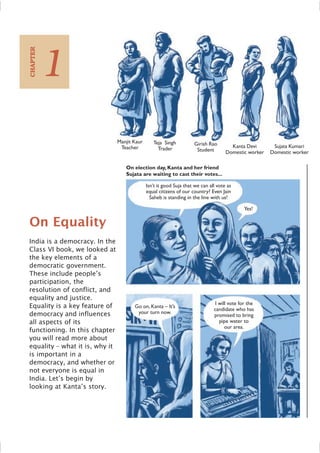
On Equality
India is a democracy. In the
Class VI book, we looked at
the key elements of a
democratic government.
These include people’s
participation, the
resolution of conflict, and
equality and justice.
Equality is a key feature of
democracy and influences
all aspects of its
functioning. In this chapter
you will read more about
equality – what it is, why it
is important in a
democracy, and whether or
not everyone is equal in
India. Let’s begin by
looking at Kanta’s story.
Isn’t it good Suja that we can all vote as
equal citizens of our country? Even Jain
Saheb is standing in the line with us!
Yes!
Go on, Kanta – It’s
your turn now.
I will vote for the
candidate who has
promised to bring
pipe water to
our area.
Manjit Kaur
Teacher
Teja Singh
Trader
Girish Rao
Student
Kanta Devi
Domestic worker
Sujata Kumari
Domestic worker
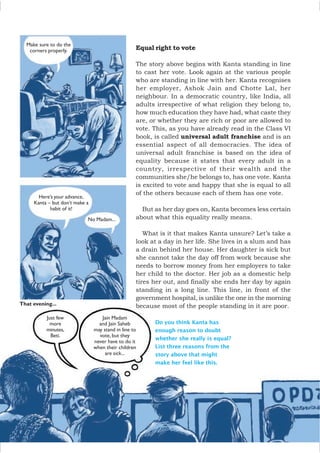
On election day, Kanta and her friend
Sujata are waiting to cast their votes...
1
CHAPTER
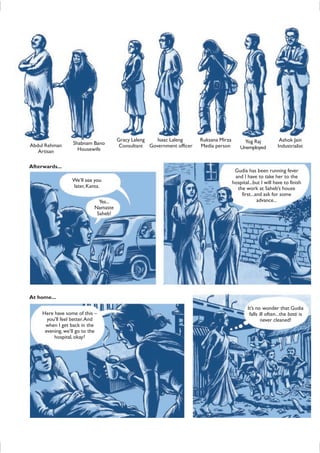
Afterwards...
We’ll see you
later,Kanta.
Yes...
Namaste
Saheb!
Gudia has been running fever
and I have to take her to the
hospital...but I will have to finish
the work at Saheb’s house
first...and ask for some
advance...
At home...
Here have some of this –
you’ll feel better.And
when I get back in the
evening, we’ll go to the
hospital,okay?
It’s no wonder that Gudia
falls ill often...the basti is
never cleaned!
Abdul Rehman
Artisan
Shabnam Bano
Housewife
Gracy Laleng
Consultant
Isaac Laleng
Government officer
Ruksana Mirza
Media person
Yog Raj
Unemployed
Ashok Jain
Industrialist
Equal right to vote
The story above begins with Kanta standing in line
to cast her vote. Look again at the various people
who are standing in line with her. Kanta recognises
her employer, Ashok Jain and Chotte Lal, her
neighbour. In a democratic country, like India, all
adults irrespective of what religion they belong to,
how much education they have had, what caste they
are, or whether they are rich or poor are allowed to
vote. This, as you have already read in the Class VI
book, is called universal adult franchise and is an
essential aspect of all democracies. The idea of
universal adult franchise is based on the idea of
equality because it states that every adult in a
country, irrespective of their wealth and the
communities she/he belongs to, has one vote. Kanta
is excited to vote and happy that she is equal to all
of the others because each of them has one vote.
But as her day goes on, Kanta becomes less certain
about what this equality really means.
What is it that makes Kanta unsure? Let’s take a
look at a day in her life. She lives in a slum and has
a drain behind her house. Her daughter is sick but
she cannot take the day off from work because she
needs to borrow money from her employers to take
her child to the doctor. Her job as a domestic help
tires her out, and finally she ends her day by again
standing in a long line. This line, in front of the
government hospital, is unlike the one in the morning
because most of the people standing in it are poor.
Do you think Kanta has
enough reason to doubt
whether she really is equal?
List three reasons from the
story above that might
make her feel like this.
Make sure to do the
corners properly.
Here’s your advance,
Kanta – but don’t make a
habit of it!
No Madam...
That evening...
Just few
more
minutes,
Beti.
Jain Madam
and Jain Saheb
may stand in line to
vote, but they
never have to do it
when their children
are sick...
Other kinds of equality
Kanta is one of many people who live in democratic
India and who have the right to vote but whose daily
living and working conditions are far from equal.
Apart from being poor, people in India experience
inequality in different ways. Let us see what this
means by reading the two stories given below. Each
of these is based on real incidents in people’s lives
and reflects the different kinds of inequalities that
exist in India.
One of the more common forms of inequality in
India is the caste system. If you live in rural India
your caste identity is something that you probably
learned or experienced very young. If you live in
urban India some of you might think that people no
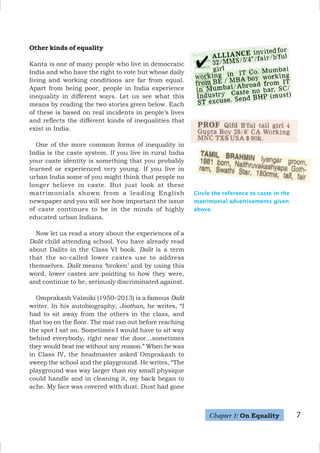
longer believe in caste. But just look at these
matrimonials shown from a leading English
newspaper and you will see how important the issue
of caste continues to be in the minds of highly
educated urban Indians.
Now let us read a story about the experiences of a
Dalit child attending school. You have already read
about Dalits in the Class VI book. Dalit is a term
that the so-called lower castes use to address
themselves. Dalit means ‘broken’ and by using this
word, lower castes are pointing to how they were,
and continue to be, seriously discriminated against.
Omprakash Valmiki (1950–2013) is a famous Dalit
writer. In his autobiography, Joothan, he writes, “I
had to sit away from the others in the class, and
that too on the floor. The mat ran out before reaching
the spot I sat on. Sometimes I would have to sit way
behind everybody, right near the door…sometimes
they would beat me without any reason.” When he was
in Class IV, the headmaster asked Omprakash to
sweep the school and the playground. He writes, “The
playground was way larger than my small physique
could handle and in cleaning it, my back began to
ache. My face was covered with dust. Dust had gone
Circle the reference to caste in the
matrimonial advertisements given
above.
Chapter 1: On Equality 7
8 Social and Political Life
inside my mouth. The other children in my class
were studying and I was sweeping. Headmaster was
sitting in his room and watching me. I was not even
allowed to get a drink of water. I swept the whole
day,…From the doors and windows of the school
rooms, the eyes of the teachers and the boys saw
this spectacle.” Omprakash was made to sweep the
school and the playground for the next couple of
days and this only came to an end when his father,
who happened to be passing by, saw his son
sweeping. He confronted the teachers and then
walking away from the school holding Omprakash’s
hand, he said loudly for all of them to hear, “You are
a teacher…So I am leaving now. But remember this
much Master…(He) will study right here…in this
school. And not just him, but there will be more
coming after him.”
The second story is based on an incident that
took place in one of India’s larger cities and is
common practice in most parts of the country. It is
a story about Mr and Mrs Ansari who were looking
to rent an apartment in the city. They had the money
and so paying the rent was no problem. They went
to a property dealer for help to find a place. The
dealer informed them that he knew about quite a
few apartments that were available for rent. They
visited the first apartment and the Ansaris liked it
very much and decided to take it. However, when
the landlady found out their names, she made an
excuse about how she could not rent the house to
someone who ate meat because the building did
not have any non-vegetarian residents. Both the
Ansaris and the property dealer were surprised to
hear this because they could smell fish being cooked
in the neighbour’s house. The same excuse was
repeated in the second and the third apartments.
Finally, the property dealer told them that they
might want to change their names and call
themselves Mr and Mrs Kumar. The Ansaris were
reluctant to do this and decided to look some more.
In the end, it took a whole month of looking at
apartments before they found a landlady who was
willing to give them a place on rent.
Why do you think Omprakash
Valmiki was being treated unequally
by his teacher and his classmates?
Imagine yourself as Omprakash
Valmiki and write four lines about
how you would feel if you were in
the same situation as him.
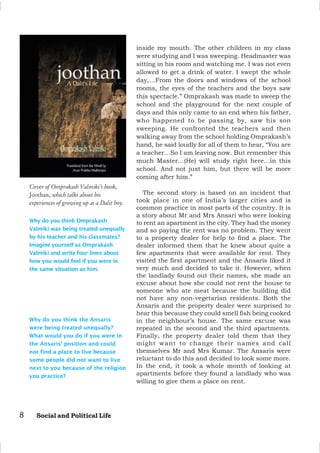
Cover of Omprakash Valmiki’s book,
Joothan, which talks about his
experiences of growing up as a Dalit boy.
Why do you think the Ansaris
were being treated unequally?
What would you do if you were in
the Ansaris’ position and could
not find a place to live because
some people did not want to live
next to you because of the religion
you practice?
9
Recognising dignity
You have understood by now that the caste we are
born into, the religion we practice, the class
background we come from, whether we are male or
female – these are often the things that determine
why some people are treated unequally. Omprakash
Valmiki and the Ansaris are being treated unequally
on the basis of differences of caste and religion.
When persons are treated unequally, their dignity
is violated. The dignity of both Omprakash Valmiki
and the Ansaris was violated because of the way in
which they were treated. By picking on him and
making him sweep the school, because of his caste,
Omprakash Valmiki’s schoolmates and teachers hurt
his dignity badly and made him feel as if he was less
than equal to all other students in the school. Being
a child, Omprakash Valmiki could do very little about
the situation that he was in. It was his father who,
on seeing his son sweep, felt angry by this unequal
treatment and confronted the teachers. The Ansaris’
dignity was also hurt when persons refused to lease
their apartments to them. However, when the
property dealer suggested that they change their
name, it was their dignity or self-respect that made
them refuse this suggestion.
Omprakash and the Ansaris do not deserve to be
treated like this. They deserve the same respect and
dignity as anyone else.
Equality in Indian democracy
The Indian Constitution recognises every person as
equal. This means that every individual in the
country, including male and female persons from
all castes, religions, tribes, educational and economic
backgrounds are recognised as equal. This is not to
say that inequality ceases to exist. It doesn’t. But
atleast, in democratic India, the principle of the
equality of all persons is recognised. While earlier
If you were one of the Ansaris
how would you have responded to
the suggestion that you change
your name?
Can you think of an incident in
your life in which your dignity was
violated? How did this make you
feel?
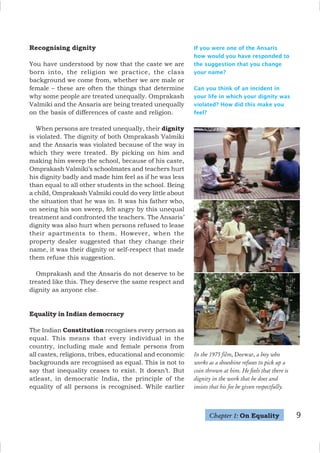
In the 1975 film, Deewar, a boy who
works as a shoeshine refuses to pick up a
coin thrown at him. He feels that there is
dignity in the work that he does and
insists that his fee be given respectfully.
Chapter 1: On Equality
10 Social and Political Life
no law existed to protect people from discrimination
and ill-treatment, now there are several that work to
see that people are treated with dignity and as equals.
This recognition of equality includes some of the
following provisions in the Constitution: first that
every person is equal before the law. What this means
is that every person, from the President of the country
to Kanta, a domestic worker, has to obey the same
laws. Second, no person can be discriminated against
on the basis of their religion, race, caste, place of
birth or whether they are female or male. Third, every
person has access to all public places including
playgrounds, hotels, shops and markets. All persons
can use publicly available wells, roads and bathing
ghats. Fourth, untouchability has been abolished.
The two ways in which the government has tried
to implement the equality that is guaranteed in the
Constitution is first through laws and second through
government programmes or schemes to help
disadvantaged communities. There are several laws
in India that protect every person’s right to be treated
equally. In addition to laws, the government has also
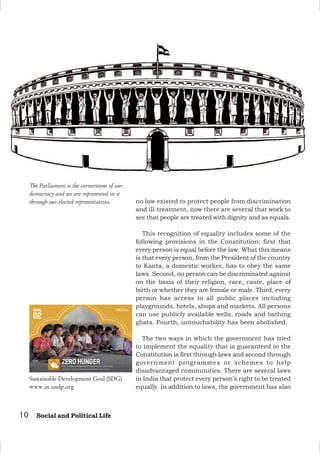
The Parliament is the cornerstone of our
democracy and we are represented in it
through our elected representatives.
Sustainable Development Goal (SDG)
www.in.undp.org
11
set up several schemes to improve the lives of
communities and individuals who have been treated
unequally for several centuries. These schemes are
to ensure greater opportunity for people who have
not had this in the past.
One of the steps taken by the government includes
the midday meal scheme. This refers to the
programme introduced in all government elementary
schools to provide children with cooked lunch. Tamil
Nadu was the first state in India to introduce this
scheme, and in 2001, the Supreme Court asked all
state governments to begin this programme in their
schools within six months. This programme has had
many positive effects. These include the fact that
more poor children have begun enrolling and
regularly attending school. Teachers reported that
earlier children would often go home for lunch and
then not return to school but now with the midday
meal being provided in school, their attendance has
improved. Their mothers, who earlier had to interrupt
their work to feed their children at home during the
day, now no longer need to do so. This programme
has also helped reduce caste prejudices because both
lower and upper caste children in the school eat this
meal together, and in quite a few places, Dalit women
have been employed to cook the meal. The midday
meal programme also helps reduce the hunger of
poor students who often come to school and cannot
concentrate because their stomachs are empty.
While government programmes play an important
role in increasing equality of opportunity, there is
much that still needs to be done. While the midday
meal programme has helped increase the enrolment
and attendance of poor children in school, there
continues to be big differences in our country
between schools that the rich attend and those that
the poor attend. Even today there are several schools
in the country in which Dalit children, like
Omprakash Valmiki, are discriminated against and
treated unequally. These children are forced into
unequal situations in which their dignity is not
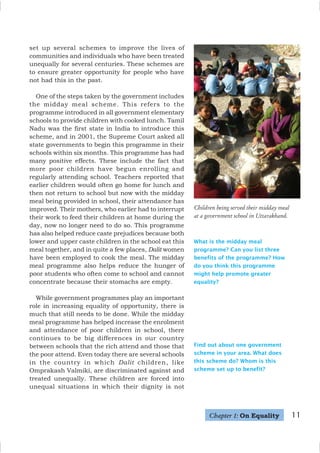
Children being served their midday meal
at a government school in Uttarakhand.
What is the midday meal
programme? Can you list three
benefits of the programme? How
do you think this programme
might help promote greater
equality?
Find out about one government
scheme in your area. What does
this scheme do? Whom is this
scheme set up to benefit?
Chapter 1: On Equality
12 Social and Political Life
respected. This is because people refuse to think of
them as equal even though the law requires it.
One of the main reasons for this is that attitudes
change very slowly. Even though persons are aware
that discrimination is against the law, they continue
to treat people unequally on the basis of their caste,
religion, disability, economic status and because they
are women. It is only when people begin to believe
that no one is inferior, and that every person deserves
to be treated with dignity, that present attitudes can
change. Establishing equality in a democratic society
is a continuous struggle and one in which individuals
as well as various communities in India contribute
to and you will read more about this in this book.
Issues of equality in other democracies
You are probably wondering whether India is the
only democratic country in which there is inequality
and where the struggle for equality continues to
exist. The truth is that in many democratic countries
around the world, the issue of equality continues to
be the key issue around which communities struggle.
So, for example, in the United States of America,
the African–Americans whose ancestors were the
slaves who were brought over from Africa, continue
to describe their lives today as largely unequal. This,
despite the fact that there was a movement in the
late 1950s to push for equal rights for African–
Americans. Prior to this, African–Americans were
treated extremely unequally in the United States
and denied equality through law. For example, when
travelling by bus, they either had to sit at the back
of the bus or get up from their seat whenever a
white person wished to sit.
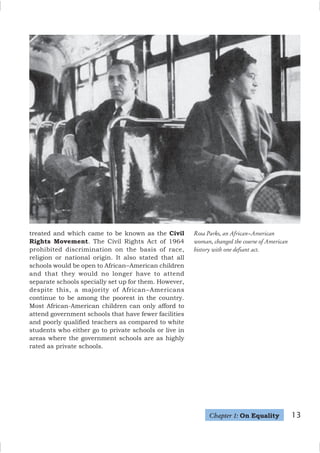
Rosa Parks (1913–2005) was an African–American
woman. Tired from a long day at work she refused to give
upherseatonabustoawhitemanon1December 1955.
Her refusal that day started a huge agitation against
the unequal ways in which African–Americans were
“It is disgraceful to live at the cost of one's
self-respect. Self-respect is the most vital
factor in life. Without it, man is a cipher.
To live worthily with self-respect, one has
to overcome difficulties. It is out of hard
and ceaseless struggle alone that one
derives strength, confidence and
recognition.
“Man is mortal. Everyone has to die some
day or the other. But one must resolve to
lay down one's life in enriching the noble
ideals of self-respect and in bettering one's
human life... Nothing is more disgraceful
for a brave man than to live life devoid
of self-respect.”
– B.R. Ambedkar
13
treated and which came to be known as the Civil
Rights Movement. The Civil Rights Act of 1964
prohibited discrimination on the basis of race,
religion or national origin. It also stated that all
schools would be open to African–American children
and that they would no longer have to attend
separate schools specially set up for them. However,
despite this, a majority of African–Americans
continue to be among the poorest in the country.
Most African-American children can only afford to
attend government schools that have fewer facilities
and poorly qualified teachers as compared to white
students who either go to private schools or live in
areas where the government schools are as highly
rated as private schools.
Rosa Parks, an African–American
woman, changed the course of American
history with one defiant act.
Chapter 1: On Equality
14 Social and Political Life
Challenge of democracy
No country can be described as being completely
democratic. There are always communities and
individuals trying to expand the idea of democracy
and push for a greater recognition of equality on
existing as well as new issues. Central to this is the
struggle for the recognition of all persons as equal
and for their dignity to be maintained. In this book
you will read about how this issue of equality affects
various aspects of our daily lives in democratic India.
As you read these chapters, think about whether
the equality of all persons and their being able to
maintain their dignity is upheld.
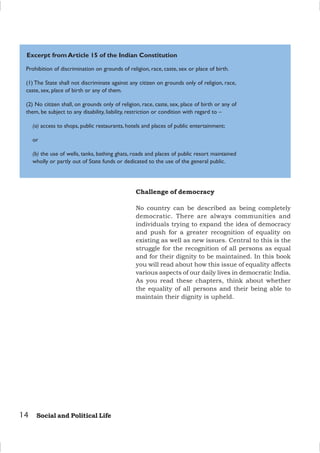
Prohibition of discrimination on grounds of religion, race, caste, sex or place of birth.
(1) The State shall not discriminate against any citizen on grounds only of religion, race,
caste, sex, place of birth or any of them.
(2) No citizen shall, on grounds only of religion, race, caste, sex, place of birth or any of
them, be subject to any disability, liability, restriction or condition with regard to –
(a) access to shops, public restaurants, hotels and places of public entertainment;
or
(b) the use of wells, tanks, bathing ghats, roads and places of public resort maintained
wholly or partly out of State funds or dedicated to the use of the general public.
Excerpt from Article 15 of the Indian Constitution
15
EXERCISES
1. In a democracy why is universal adult franchise important?
2. Re-read the box on Article 15 and state two ways in which
this Article addresses inequality?
3. In what ways was Omprakash Valmiki’s experience similar
to that of the Ansaris?
4. What do you understand by the term “all persons are
equal before the law”? Why do you think it is important in
a democracy?
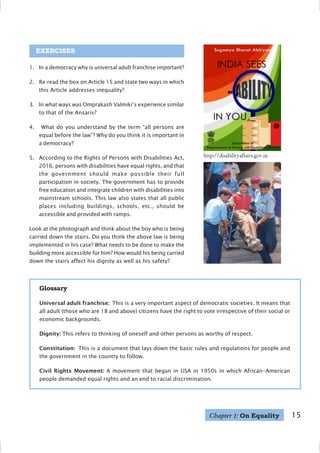
5. According to the Rights of Persons with Disabilities Act,
2016, persons with disabilities have equal rights, and that
the government should make possible their full
participation in society. The government has to provide
free education and integrate children with disabilities into
mainstream schools. This law also states that all public
places including buildings, schools, etc., should be
accessible and provided with ramps.
Look at the photograph and think about the boy who is being
carried down the stairs. Do you think the above law is being
implemented in his case? What needs to be done to make the
building more accessible for him? How would his being carried
down the stairs affect his dignity as well as his safety?
Glossary
Universal adult franchise: This is a very important aspect of democratic societies. It means that
all adult (those who are 18 and above) citizens have the right to vote irrespective of their social or
economic backgrounds.
Dignity: This refers to thinking of oneself and other persons as worthy of respect.
Constitution: This is a document that lays down the basic rules and regulations for people and
the government in the country to follow.
Civil Rights Movement: A movement that began in USA in 1950s in which African–American
people demanded equal rights and an end to racial discrimination.
Chapter 1: On Equality
http://disabilityaffairs.gov.in
16
UNIT
TWO
17
State Government
Teacher’s note
These two chapters (Chapters 2 and 3) on
State Government are an attempt to
discuss the functions and structure of
government through concrete situations.
We have chosen ‘health’ as an example;
there could have been other, equally
important, choices.
Chapter 2 discusses ‘health’ as an
important issue for people. There are both
public and private aspects of health
provisioning. Healthcare in India is not
available to all. While the Constitution
supports a view that the right to health is
an aspect of our fundamental rights, its
provisioning is rather unequal. Through
the accounts provided, learners will begin
to visualise the ideal or desired role of
government, and the meanings behind its
structures. Some ways in which this
situation can be changed are also
discussed.
Chapter 3 focuses on how the
government functions, and discusses ideas
of representation, accountability and
public welfare. Though both the executive
and the legislature are presented, one
should not expect students to retain fine
distinctions. It would be best to patiently
encourage them to ask questions such as,
“Who is the most powerful person?”, “Why
can’t the MLA solve the problem?”, etc.
Such queries will enable them to construct
a sense of the government apparatus.
It is important that learners acquire the
confidence to express their views on public
issues and understand the role of
government through the exercises given in
the chapters. You could choose familiar
issues such as water, transport, school-
fees, books, child-labour, etc., for them to
discuss and arrive at how these problems
need to be tackled. Allow them to express
these ideas through wall charts. Given that
discussions on the government and its
functioning often lead to boredom and
cynicism, we need to be able to make
the classroom session less didactic and
more interactive while teaching these
lessons.
17
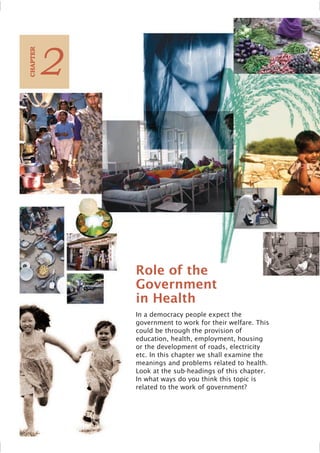
18 Social and Political Life
In a democracy people expect the
government to work for their welfare. This
could be through the provision of
education, health, employment, housing
or the development of roads, electricity
etc. In this chapter we shall examine the
meanings and problems related to health.
Look at the sub-headings of this chapter.
In what ways do you think this topic is
related to the work of government?
2
C
HAPTER
Role of the
Government
in Health
19
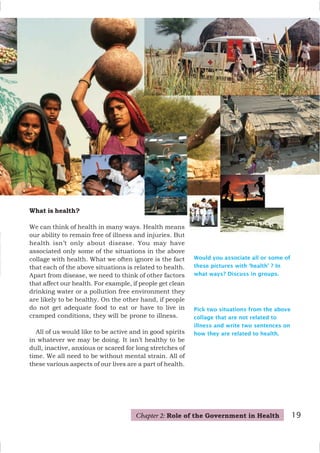
What is health?
We can think of health in many ways. Health means
our ability to remain free of illness and injuries. But
health isn’t only about disease. You may have
associated only some of the situations in the above
collage with health. What we often ignore is the fact
that each of the above situations is related to health.
Apart from disease, we need to think of other factors
that affect our health. For example, if people get clean
drinking water or a pollution free environment they
are likely to be healthy. On the other hand, if people
do not get adequate food to eat or have to live in
cramped conditions, they will be prone to illness.
All of us would like to be active and in good spirits
in whatever we may be doing. It isn’t healthy to be
dull, inactive, anxious or scared for long stretches of
time. We all need to be without mental strain. All of
these various aspects of our lives are a part of health.
Pick two situations from the above
collage that are not related to
illness and write two sentences on
how they are related to health.
Would you associate all or some of
these pictures with ‘health’ ? In
what ways? Discuss in groups.
19
Chapter 2: Role of the Government in Health
20 Social and Political Life
In India, it is often said that we
are unable to provide health
services for all because the
government does not have enough
money and facilities. After reading
the above left hand column, do
you think this is true? Discuss.
Can you provide a title to these
columns?
India has the largest number of medical Most doctors settle in urban areas.
colleges in the world and is among the People in rural areas have to travel long
largest producers of doctors. distances to reach a doctor. The number
Approximately15,000 new doctors qualify of doctors with respect to the population is
every year. much less in rural areas.
Healthcare facilities have grown About five lakh people die from tuberculosis
substantially over the years. In 1950, every year. This number is almost
there were only 2,717 hospitals in India. unchanged since Independence!
In 1991, there were 11,174 hospitals. In Almost two million cases of malaria are
2000, the number grew to 18,218. reported every year and this number isn’t
decreasing.
India gets a large number of medical We are not able to provide clean drinking
tourists from many countries.They come water to all. 21per cent of all
for treatment in some of the hospitals in communicable diseases are water borne.
India that compare with the best in the world. For example,diarrhoea,worms,hepatitis,etc.
India is the third largest producer of Half of all children in India do not
medicines in the world and is also a large get adequate food to eat and are
exporter of medicines. undernourished.
Healthcare in India
Let us examine some of the aspects of healthcare
in India. Compare and contrast the situation
expressed in the first and second columns.
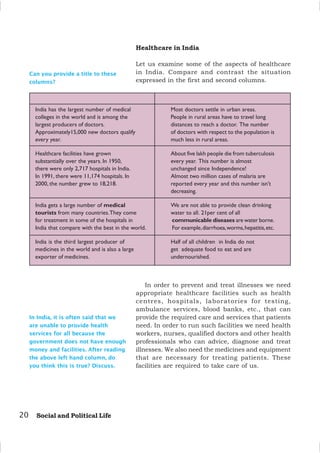
In order to prevent and treat illnesses we need
appropriate healthcare facilities such as health
centres, hospitals, laboratories for testing,
ambulance services, blood banks, etc., that can
provide the required care and services that patients
need. In order to run such facilities we need health
workers, nurses, qualified doctors and other health
professionals who can advice, diagnose and treat
illnesses. We also need the medicines and equipment
that are necessary for treating patients. These
facilities are required to take care of us.
21
Hakim Seikh was a member of the Paschim Banga Khet Mazdoor Samity (PBKMS), an organisation
of agricultural labourers in West Bengal. One evening in 1992, he accidentally fell off a running
train and suffered head injuries. He was in a very serious condition and needed immediate
treatment.
He was taken to a government hospital in Kolkata but they refused to admit him because they
did not have a spare bed.Another hospital did not have the facility or the specialised doctors
necessary for his treatment. In this way he spent 14 hours in a critical state and was taken to
eight different government hospitals, but none of them admitted him.
Finally, he was admitted in a private hospital, where he received treatment. He spent a lot of
money on his treatment.Angry and upset over the indifferent attitude of all the hospitals that
refused to admit him, Hakim Seikh and PBKMS filed a case in the court.
The story of Hakim Seikh
Read the story given above. Then
imagine that you are a Judge in the
court. What would you say to
Hakim Seikh?
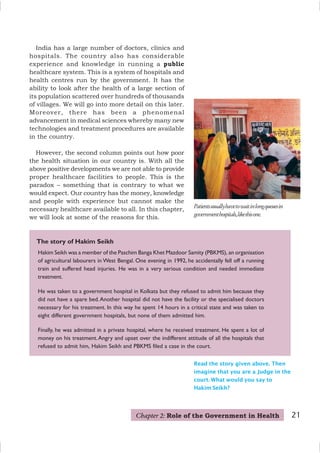
Patientsusuallyhavetowaitinlongqueuesin
governmenthospitals,likethisone.
India has a large number of doctors, clinics and
hospitals. The country also has considerable
experience and knowledge in running a public
healthcare system. This is a system of hospitals and
health centres run by the government. It has the
ability to look after the health of a large section of
its population scattered over hundreds of thousands
of villages. We will go into more detail on this later.
Moreover, there has been a phenomenal
advancement in medical sciences whereby many new
technologies and treatment procedures are available
in the country.
However, the second column points out how poor
the health situation in our country is. With all the
above positive developments we are not able to provide
proper healthcare facilities to people. This is the
paradox – something that is contrary to what we
would expect. Our country has the money, knowledge
and people with experience but cannot make the
necessary healthcare available to all. In this chapter,
we will look at some of the reasons for this.
Chapter 2: Role of the Government in Health
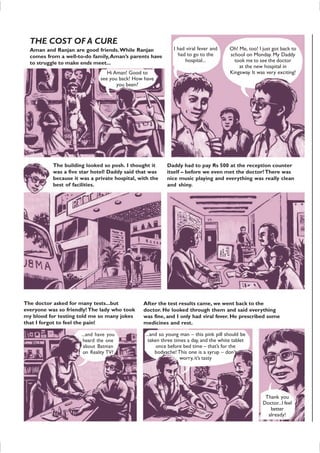
THE COST OF A CURE
Aman and Ranjan are good friends.While Ranjan
comes from a well-to-do family,Aman’s parents have
to struggle to make ends meet...
Hi Aman! Good to
see you back! How have
you been?
I had viral fever and
had to go to the
hospital...
Oh! Me, too! I just got back to
school on Monday. My Daddy
took me to see the doctor
at the new hospital in
Kingsway. It was very exciting!
The building looked so posh. I thought it
was a five star hotel! Daddy said that was
because it was a private hospital, with the
best of facilities.
Daddy had to pay Rs 500 at the reception counter
itself – before we even met the doctor!There was
nice music playing and everything was really clean
and shiny.
The doctor asked for many tests...but
everyone was so friendly! The lady who took
my blood for testing told me so many jokes
that I forgot to feel the pain!
...and have you
heard the one
about Batman
on Reality TV?
After the test results came, we went back to the
doctor. He looked through them and said everything
was fine, and I only had viral fever. He prescribed some
medicines and rest.
...and so young man – this pink pill should be
taken three times a day, and the white tablet
once before bed time – that’s for the
bodyache! This one is a syrup – don’t
worry,it’s tasty
Thank you
Doctor...I feel
better
already!
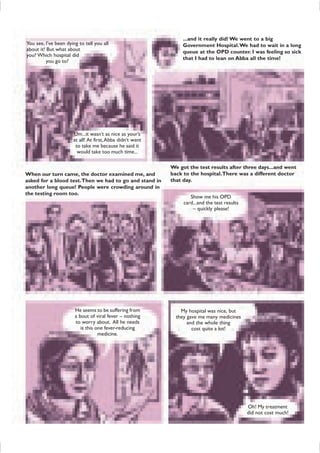
You see, I’ve been dying to tell you all
about it! But what about
you? Which hospital did
you go to?
Um...it wasn’t as nice as your’s
at all! At first,Abba didn’t want
to take me because he said it
would take too much time...
When our turn came, the doctor examined me, and
asked for a blood test.Then we had to go and stand in
another long queue! People were crowding around in
the testing room too.
We got the test results after three days...and went
back to the hospital.There was a different doctor
that day.
Show me his OPD
card...and the test results
– quickly please!
He seems to be suffering from
a bout of viral fever – nothing
to worry about. All he needs
is this one fever-reducing
medicine.
My hospital was nice, but
they gave me many medicines
and the whole thing
cost quite a lot!
Oh! My treatment
did not cost much!
...and it really did! We went to a big
Government Hospital.We had to wait in a long
queue at the OPD counter. I was feeling so sick
that I had to lean on Abba all the time!
24 Social and Political Life
Where do you go when you are ill?
Are there any problems that you
face? Write a paragraph based on
your experience.
What problems did Aman face in
the government hospital? How do
you think the hospital can work in
a better manner? Discuss.
Why did Ranjan have to spend so
much money? Give reasons.
What problems do we face in
private hospitals? Discuss.
Public and private health care services
From the above story, you must have understood
that we can roughly divide up various health care
facilities in two categories –
(a) Public health services and
(b) Private health facilities.
Public health services
The public health service is a chain of health centres
and hospitals run by the government. They are
linked together so that they cover both rural and
urban areas and can also provide treatment to all
kinds of problems – from common illnesses to special
services. At the village level there are health centres
where there is usually a nurse and a village health
worker. They are trained in dealing with common
illnesses and work under the supervision of doctors
at the Primary Health Centre (PHC). Such a centre
covers many villages in a rural area. At the district
level is the District Hospital that also supervises all
the health centres. Large cities have many
government hospitals such as the one where Aman
was taken and also specialised government hospitals
such as the ones in Hakim Seikh’s story.
The health service is called ‘public’ for many
reasons. In order to fulfil its commitment of providing
health care to all citizens, the government has
established these hospitals and health centres. Also,
the resources needed to run these services are
obtained from the money that we, the public, pay to
the government as taxes. Hence, such facilities are
meant for everyone. One of the most important
aspects of the public health system is that it is meant
to provide quality health care services either free or
at a low cost, so that even the poor can seek
treatment. Another important function of public
health is to take action to prevent the spread of
diseases such as TB, malaria, jaundice, cholera,
Why pay taxes to the government?
Government uses tax money for
providing many public services for
the benefit of all citizens. Some
services such as defence, police,
judicial system, highways etc.
benefit all citizens. Otherwise, the
citizens cannot organise these
services for themselves.
Taxes fund developmental
programmes and services such as
education, health care,
employment, social welfare,
vocational training etc. required for
needy citizens. Tax money is
utilised for relief and rehabilitation
in case of natural disasters such as
floods, earthquakes, tsunami etc.
Space, nuclear, and missile
programmes are also funded from
the revenues collected as taxes.
Government provides some
services especially for the poor
who cannot afford to purchase
them from the market. One
example is health care. Can you
give other examples?
25
In what ways is the public health
system meant for everyone?
List some Primary Health Centres
(PHCs) or hospitals near your place.
From your experience (or by
visiting any one of them), find out
the facilities provided and people
who run the centre.
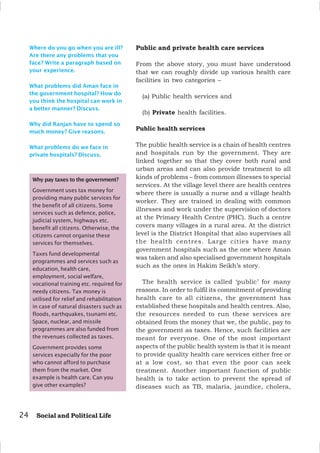
Adoctorinaruralhealthcarecentregiving
medicinestoapatient.
diarrhoea, chikungunya, etc. This has to be
organised by the government with the participation
of people otherwise it is not effective. For example,
when taking up a campaign to see that mosquitoes
do not breed in water coolers, rooftops, etc., this
has to be done for all houses in the area.
Recall the case of Hakim Seikh. Would you like to
know what the court said in this case?
According to our Constitution, it is the primary
duty of the government to ensure the welfare of the
people and provide health care facilities to all.
The government must safeguard the Right to Life
of every person. The Court said that the difficulty
that Hakim Seikh had to face could have cost him
his life. If a hospital cannot provide timely medical
treatment to a person, it means that this protection
of life is not being given.
The Court also said that it was the duty of the
government to provide the necessary health services,
including treatment in emergency situations.
Hospitals and medical staff must fulfil their duty of
providing the necessary treatment. Hakim Seikh was
denied treatment at various government hospitals.
Therefore, the Court asked the State Government
to give him the money that he had spent on his
treatment.
Private health facilities
There is a wide range of private health facilities that
exist in our country. A large number of doctors run
their own private clinics. In the rural areas, one
finds Registered Medical Practitioners (RMPs). Urban
areas have a large number of doctors, many of them
providing specialised services. There are hospitals
and nursing homes that are privately owned. There
are many laboratories that do tests and offer special
facilities such as X-ray, ultrasound, etc. There are
also shops from where we buy medicines.
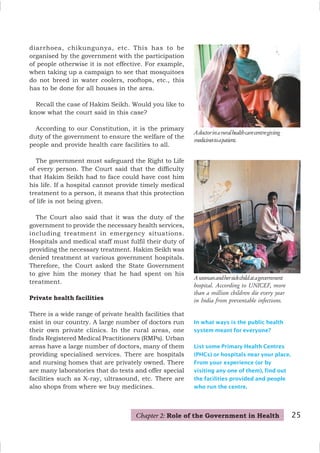
Awomanandhersickchildatagovernment
hospital. According to UNICEF, more
than a million children die every year
in India from preventable infections.
Chapter 2: Role of the Government in Health
As the name suggests, private health facilities
are not owned or controlled by the government.
Unlike the public health services, in private
facilities, patients have to pay a lot of money for
every service that they use.
Today the presence of private facilities can be seen
all around. In fact now there are large companies
that run hospitals and some are engaged in
manufacturing and selling medicines. Medical shops
are found in every corner of the country.
Healthcare and equality:
Is adequate healthcare available to all?
In India, we face a situation where private services
are increasing but public services are not. What is
then available to people are mainly private services.
These are concentrated in urban areas. The cost of
these services is rather high. Medicines are
expensive. Many people cannot afford them or have
to borrow money when there is an illness in the
family.
Some private services encourage incorrect
practices to earn more. At times inexpensive
alternatives, though available, may not be used. For
example, some medical practitioners are found to
prescribe superfluous medicines, injections or saline
when simple medication may suffice.
In fact, barely 20 per cent of the population can
afford all the medicines that they require during an
26 Social and Political Life
Private health facilities can mean
many things. Explain with the help
of some examples from your area.
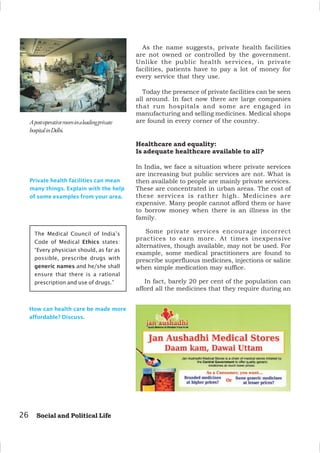
Apost-operativeroominaleadingprivate
hospitalinDelhi.
The Medical Council of India’s
Code of Medical Ethics states:
“Every physician should, as far as
possible, prescribe drugs with
generic names and he/she shall
ensure that there is a rational
prescription and use of drugs.”
How can health care be made more
affordable? Discuss.
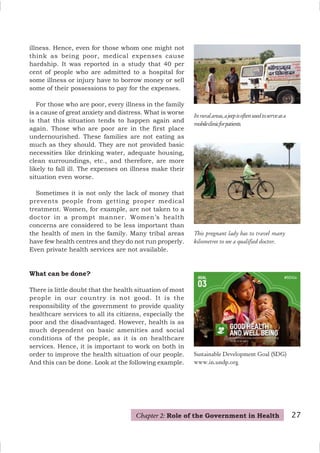
This pregnant lady has to travel many
kilometres to see a qualified doctor.
illness. Hence, even for those whom one might not
think as being poor, medical expenses cause
hardship. It was reported in a study that 40 per
cent of people who are admitted to a hospital for
some illness or injury have to borrow money or sell
some of their possessions to pay for the expenses.
For those who are poor, every illness in the family
is a cause of great anxiety and distress. What is worse
is that this situation tends to happen again and
again. Those who are poor are in the first place
undernourished. These families are not eating as
much as they should. They are not provided basic
necessities like drinking water, adequate housing,
clean surroundings, etc., and therefore, are more
likely to fall ill. The expenses on illness make their
situation even worse.
Sometimes it is not only the lack of money that
prevents people from getting proper medical
treatment. Women, for example, are not taken to a
doctor in a prompt manner. Women’s health
concerns are considered to be less important than
the health of men in the family. Many tribal areas
have few health centres and they do not run properly.
Even private health services are not available.
What can be done?
There is little doubt that the health situation of most
people in our country is not good. It is the
responsibility of the government to provide quality
healthcare services to all its citizens, especially the
poor and the disadvantaged. However, health is as
much dependent on basic amenities and social
conditions of the people, as it is on healthcare
services. Hence, it is important to work on both in
order to improve the health situation of our people.
And this can be done. Look at the following example.
Chapter 2: Role of the Government in Health 27
Inruralareas,ajeepisoftenusedtoserveasa
mobileclinicforpatients.
Sustainable Development Goal (SDG)
www.in.undp.org
28 Social and Political Life
The Kerala experience
In 1996, the Kerala government made some major
changes in the state. Forty per cent of the entire state
budget was given to panchayats. They could plan
and provide for their requirements. This made it
possible for a village to make sure that proper
planning was done for water, food, women’s
development and education. This meant that water
supply schemes were checked, the working of schools
and anganwadis was ensured and specific problems
of the village were taken up. Health centres were
also improved. All of this helped to improve the
situation. Despite these efforts, however, some
problems – such as shortage of medicines,
insufficient hospital beds, not enough doctors –
remained, and these needed to be addressed.
For more details, visit http:/
/lsgkerala.gov.in/en
Let us look at an example of another country and
its approach to issues of health.
The Costa Rican approach
Costa Rica is considered to be one of the healthiest
countries in Central America. The main reason for
this can be found in the Costa Rican Constitution.
Several years ago, Costa Rica took a very important
decision and decided not to have an army. This
helped the Costa Rican government to spend the
money that the army would have used, on health,
education and other basic needs of the people. The
Costa Rican government believes that a country has
to be healthy for its development and pays a lot of
attention to the health of its people. The Costa Rican
government provides basic services and amenities
to all Costa Ricans. For example, it provides safe
drinking water, sanitation, nutrition and housing.
Health education is also considered very important
and knowledge about health is an essential part of
education at all levels.
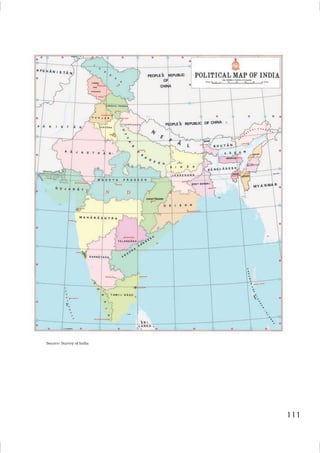
The above map of India shows the state of
Kerala in light green.
Page 111 of this book has a map of India.
UsingyourpenciloutlinethestateofKeralaon
this map.
29
Chapter 2: Role of the Government in Health
1. In this chapter you have read that health is a wider concept
than illness. Look at this quote from the Constitution and
explain the terms ‘living standard’ and ‘public health’ in
your own words.
2. What are the different ways through which the government
can take steps to provide healthcare for all? Discuss.
3. What differences do you find between private and public
health services in your area? Use the following table to
compare and contrast these.
EXERCISES
An important part of the
Constitution says it is the “duty of
the State to raise the level of
nutrition and the standard of living
and to improve public health.”
4. ‘Improvement in water and sanitation can control many
diseases.’ Explain with the help of examples.
Glossary
Public: An activity or service that is meant for all people in the country and is mainly organised by the
government. This includes schools, hospitals, telephone services, etc. People can demand these
services and also raise questions about their non-functioning.
Private: An activity or service that is organised by an individual or company for their own gain.
Medical tourists: This refers to foreigners who come to this country specifically for medical treatment
at hospitals that offer world–class facilities at a lower cost than what they would have to pay in their
own countries.
Communicable diseases: These are diseases that are spread from one person to another in many
ways such as through water, food , air, etc.
OPD: This is the short form for ‘Out Patient Department’. This is where people are first brought in
and treated in a hospital without being admitted to any special ward.
Ethics: Moral principles that influence a person’s behaviour
Generic names: These are chemical names of the drugs. They help in identifying the ingredients.
They are globally recognised. For example, acetyl salicylic acid is the generic name of Aspirin.
Facility Affordability Availability Quality
Private
Public
Sustainable Development Goal (SDG)
www.in.undp.org
How
the State
Government
Works
Last year, we discussed the
fact that government works at
three levels – local, state and
national – and looked at the
work of local government in
some detail. In this chapter,
we examine the work of the
government at the state
level. How does this take
place in a democracy?
What is the role of a
Member of the
Legislative Assembly
(MLA) and Ministers? How
do people express their
views or demand action from
government? We look at these
questions through the example
of health.
3
C
HAPTER
WHOSE RESPONSIBILITY?
Hey,look at this...it says that
there is a water shortage in
our state,and people are
falling sick!
“...In many villages, people were found to be
drinking unclean water. Streams have dried up, and
so have tanks. In the worst-affected areas, villagers
have been carrying water across great distances.”
“People at the district HQ Patalpuram receive water
supply once in three days.The District Hospital here is
overflowing with patients – a large number of whom
are children with acute diarrhoea...”
Who is an MLA?
In the above section, you have read about some
events in Patalpuram. You may be familiar with some
official names such as Collector, Medical Officer, etc.
But have you heard of an MLA and the Legislative
Assembly? Do you know the MLA of your area? Can
you identify which party she or he belongs to?
Members of the Legislative Assembly (MLAs) are
elected by the people. They then become members
of the legislative assembly and also form the
On the TV news, they said ten people
have died from diarrhoea! Is that
possible? Can one really die from it?
Who knows? Just
hope I don’t get it!
Ha ha!
My mother said not to have any iced
drinks from the market. She gave one of
her lectures this morning,“You have to
be responsible for your health,
Shirin!”
Suddenly...
STOP!
Really!Why? Has
he done something? Shh...I saw him onTV
too. He is a member of
the Opposition!
What a loud voice he has...he must be
a leader or something...
...and we demand that the
authorities take immediate action to
bring the public health situation
under control! Our MLA must take
the responsibility for this!
This road is blocked due to the rally.
They have gheraoed the MLA’s residence.
Ha ha – they
seem more angry
about what he
hasn’t done!
What is happening in Patalpuram ?
Why is this problem serious?
What action do you think can be
taken in the above situation and
who do you think should take this
action? Discuss.
That afternoon...
31
Chapter 3: How the State Government Works
32 Social and Political Life
Discuss the following terms with
your teacher–public meeting,
States in India, constituency,
majority, ruling party and
opposition.
Can you explain the following
terms–majority, ruling party,
opposition with reference to your
Union Territory.
government. In this way we say that the MLAs
represent people. The example below will help us
understand this better.
Every state in India has a Legislative Assembly.
Each state is divided into different areas or
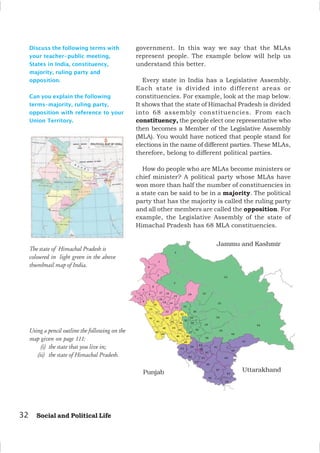
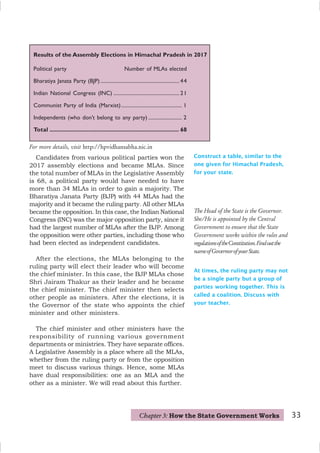
constituencies. For example, look at the map below.
It shows that the state of Himachal Pradesh is divided
into 68 assembly constituencies. From each
constituency, the people elect one representative who
then becomes a Member of the Legislative Assembly
(MLA). You would have noticed that people stand for
elections in the name of different parties. These MLAs,
therefore, belong to different political parties.
How do people who are MLAs become ministers or
chief minister? A political party whose MLAs have
won more than half the number of constituencies in
a state can be said to be in a majority. The political
party that has the majority is called the ruling party
and all other members are called the opposition. For
example, the Legislative Assembly of the state of
Himachal Pradesh has 68 MLA constituencies.
The state of Himachal Pradesh is
coloured in light green in the above
thumbnail map of India.
Using a pencil outline the following on the
map given on page 111:
(i) the state that you live in;
(ii) the state of Himachal Pradesh.
Jammu and Kashmir
Punjab Uttarakhand
33
Construct a table, similar to the
one given for Himachal Pradesh,
for your state.
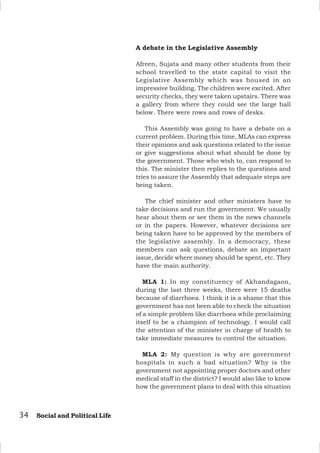
Results of the Assembly Elections in Himachal Pradesh in 2017
Political party Number of MLAs elected
Bharatiya Janata Party (BJP) ............................................................. 44
Indian National Congress (INC) ................................................... 21
Communist Party of India (Marxist)............................................... 1
Independents (who don’t belong to any party) .......................... 2
Total ................................................................................ 68
The Head of the State is the Governor.
She/He is appointed by the Central
Government to ensure that the State
Government works within the rules and
regulationsoftheConstitution.Findoutthe
nameofGovernorofyourState.
At times, the ruling party may not
be a single party but a group of
parties working together. This is
called a coalition. Discuss with
your teacher.
Candidates from various political parties won the
2017 assembly elections and became MLAs. Since
the total number of MLAs in the Legislative Assembly
is 68, a political party would have needed to have
more than 34 MLAs in order to gain a majority. The
Bharatiya Janata Party (BJP) with 44 MLAs had the
majority and it became the ruling party. All other MLAs
became the opposition. In this case, the Indian National
Congress (INC) was the major opposition party, since it
had the largest number of MLAs after the BJP. Among
the opposition were other parties, including those who
had been elected as independent candidates.
After the elections, the MLAs belonging to the
ruling party will elect their leader who will become
the chief minister. In this case, the BJP MLAs chose
Shri Jairam Thakur as their leader and he became
the chief minister. The chief minister then selects
other people as ministers. After the elections, it is
the Governor of the state who appoints the chief
minister and other ministers.
The chief minister and other ministers have the
responsibility of running various government
departments or ministries. They have separate offices.
A Legislative Assembly is a place where all the MLAs,
whether from the ruling party or from the opposition
meet to discuss various things. Hence, some MLAs
have dual responsibilities: one as an MLA and the
other as a minister. We will read about this further.
Chapter 3: How the State Government Works
For more details, visit http://hpvidhansabha.nic.in
A debate in the Legislative Assembly
Afreen, Sujata and many other students from their
school travelled to the state capital to visit the
Legislative Assembly which was housed in an
impressive building. The children were excited. After
security checks, they were taken upstairs. There was
a gallery from where they could see the large hall
below. There were rows and rows of desks.
This Assembly was going to have a debate on a
current problem. During this time, MLAs can express
their opinions and ask questions related to the issue
or give suggestions about what should be done by
the government. Those who wish to, can respond to
this. The minister then replies to the questions and
tries to assure the Assembly that adequate steps are
being taken.
The chief minister and other ministers have to
take decisions and run the government. We usually
hear about them or see them in the news channels
or in the papers. However, whatever decisions are
being taken have to be approved by the members of
the legislative assembly. In a democracy, these
members can ask questions, debate an important
issue, decide where money should be spent, etc. They
have the main authority.
MLA 1: In my constituency of Akhandagaon,
during the last three weeks, there were 15 deaths
because of diarrhoea. I think it is a shame that this
government has not been able to check the situation
of a simple problem like diarrhoea while proclaiming
itself to be a champion of technology. I would call
the attention of the minister in charge of health to
take immediate measures to control the situation.
MLA 2: My question is why are government
hospitals in such a bad situation? Why is the
government not appointing proper doctors and other
medical staff in the district? I would also like to know
how the government plans to deal with this situation
34 Social and Political Life
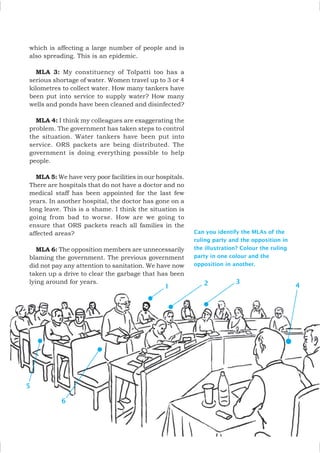
Can you identify the MLAs of the
ruling party and the opposition in
the illustration? Colour the ruling
party in one colour and the
opposition in another.
which is affecting a large number of people and is
also spreading. This is an epidemic.
MLA 3: My constituency of Tolpatti too has a
serious shortage of water. Women travel up to 3 or 4
kilometres to collect water. How many tankers have
been put into service to supply water? How many
wells and ponds have been cleaned and disinfected?
MLA 4: I think my colleagues are exaggerating the
problem. The government has taken steps to control
the situation. Water tankers have been put into
service. ORS packets are being distributed. The
government is doing everything possible to help
people.
MLA 5: We have very poor facilities in our hospitals.
There are hospitals that do not have a doctor and no
medical staff has been appointed for the last few
years. In another hospital, the doctor has gone on a
long leave. This is a shame. I think the situation is
going from bad to worse. How are we going to
ensure that ORS packets reach all families in the
affected areas?
MLA 6: The opposition members are unnecessarily
blaming the government. The previous government
did not pay any attention to sanitation. We have now
taken up a drive to clear the garbage that has been
lying around for years.
1 2
5
3
4
6
36 Social and Political Life
What were the main arguments
put forward by different MLAs
who thought that the government
was not taking the situation in a
serious manner?
If you were the health minister,
how would you respond to the
above discussion?
Do you think the above debate
would have been useful in some
ways? How? Discuss.
In the working of the government,
explain the difference between
being an MLA and an MLA who is
also a minister.
In the earlier section you have read about a debate
in the Legislative Assembly. The members were
debating the action taken or not taken by the
government. This is because the MLAs are together
responsible for the work of the government. In
common usage the word ‘government’ refers to
government departments and various ministers who
head them. The overall head is the chief minister.
More correctly, this is called the executive part of
the government. All the MLAs who gather together
(assemble) in the legislative assembly are called the
Legislature. They are the ones who authorise and
supervise their work. As we saw in the earlier section,
it is from among them that the head of the executive,
or the chief minister is formed.
Working of the government
The Legislative Assembly is not the only place where
opinions are expressed about the work of the
government and action is demanded. You will find
newspapers, TV channels and other organisations
regularly talking about the government. In a
democracy, there are various ways through which
people express their views and also take action. Let
us look at one such way.
Soon after the discussion in the assembly, there
was a press conference organised by the health
minister. Large numbers of people from different
newspapers were present. The minister and some
government officials were also present. The minister
explained the steps the government had taken.
Reporters asked many questions at this meeting.
These discussions were then reported in different
newspapers. The following page has one such report.
During the next week, the chief minister and the
minister for health visited Patalpuram district. They
went to visit the families who had lost their relatives
and also visited people in the hospitals. The
government announced a compensation for these
37
Write two measures that the
goverment undertook for
controlling diarrhoea?
What is the purpose of a
press conference? How does
the press conference help you
get information on what the
goverment is doing?
families. The chief minister also said that he thought
the problem was not only one of sanitation but also
of a lack of clean drinking water. He said that a high-
level enquiry committee will be asked to look into
the needs of the district to provide sanitation facilities
and would request the minister for Public Works to
take care of the needs of proper water supply in the
region.
As you saw above, the people in power like the
chief minister and the minister have to take action.
They do so through various departments like the
Public Works Department, the Agriculture
Department, the Health Department, the Education
Department and so on. They also have to answer
questions that are asked in the Legislative Assembly
and convince people asking the questions that proper
steps are being taken. At the same time, newspapers
and the media widely discuss the issue and the
government has to respond, for example, by holding
the press conferences.
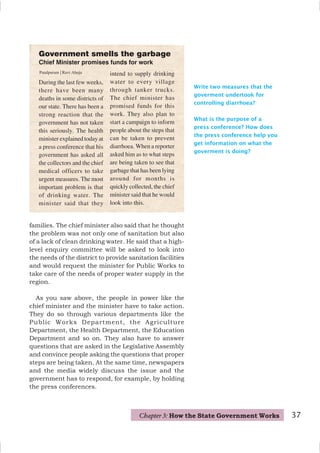
During the last few weeks,
there have been many
deaths in some districts of
our state. There has been a
strong reaction that the
government has not taken
this seriously. The health
minister explained today at
a press conference that his
government has asked all
the collectors and the chief
medical officers to take
urgent measures. The most
important problem is that
of drinking water. The
minister said that they
Government smells the garbage
Chief Minister promises funds for work
intend to supply drinking
water to every village
through tanker trucks.
The chief minister has
promised funds for this
work. They also plan to
start a campaign to inform
people about the steps that
can be taken to prevent
diarrhoea. When a reporter
asked him as to what steps
are being taken to see that
garbage that has been lying
around for months is
quickly collected, the chief
minister said that he would
look into this.
Patalpuram | Ravi Ahuja
Chapter 3: How the State Government Works
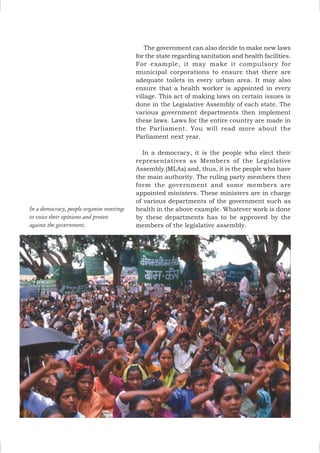
In a democracy, people organise meetings
to voice their opinions and protest
against the government.
The government can also decide to make new laws
for the state regarding sanitation and health facilities.
For example, it may make it compulsory for
municipal corporations to ensure that there are
adequate toilets in every urban area. It may also
ensure that a health worker is appointed in every
village. This act of making laws on certain issues is
done in the Legislative Assembly of each state. The
various government departments then implement
these laws. Laws for the entire country are made in
the Parliament. You will read more about the
Parliament next year.
In a democracy, it is the people who elect their
representatives as Members of the Legislative
Assembly (MLAs) and, thus, it is the people who have
the main authority. The ruling party members then
form the government and some members are
appointed ministers. These ministers are in charge
of various departments of the government such as
health in the above example. Whatever work is done
by these departments has to be approved by the
members of the legislative assembly.
Find out with the help of your
teacher, the work done by the
government departments
mentioned above, and fill in the
table.
Name of department Examples of their work
School Education
Public Works Department
Agriculture
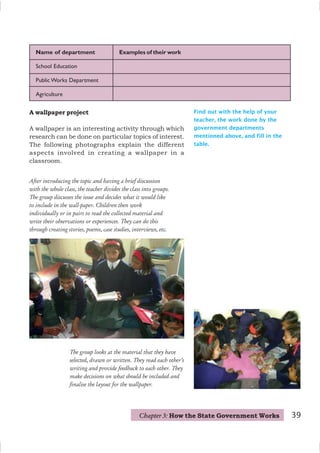
After introducing the topic and having a brief discussion
with the whole class, the teacher divides the class into groups.
The group discusses the issue and decides what it would like
to include in the wall-paper. Children then work
individually or in pairs to read the collected material and
write their observations or experiences. They can do this
through creating stories, poems, case studies, interviews, etc.
The group looks at the material that they have
selected, drawn or written. They read each other’s
writing and provide feedback to each other. They
make decisions on what should be included and
finalise the layout for the wallpaper.
A wallpaper project
A wallpaper is an interesting activity through which
research can be done on particular topics of interest.
The following photographs explain the different
aspects involved in creating a wallpaper in a
classroom.
Chapter 3: How the State Government Works 39
Each group then presents the wallpaper to the entire class. It is important that
more than one member of the group is asked to present and that each group is
allotted the same amount of time to discuss their work. After each group has
presented, it would be a good idea to have a feedback session on the following–
What more could they do on their own? How could their work be organised
better? How could writing and presentation be improved upon?
Do a similar wallpaper project
about any issue connected with
the working of your State
Government like an education
programme, any law and order
issue, midday meal scheme, etc.
This wallpaper about the 2006
dengue epidemic was prepared by
children of Class VI B of Kendriya
Vidyalaya II, Hindon, Ghaziabad,
Uttar Pradesh.
40 Social and Political Life
1. Use the terms ‘constituency’ and ‘represent’ to explain
who an MLA is and how is the person elected?
2. How did some MLAs become Ministers? Explain.
3. Why should decisions taken by the Chief Minister and
other ministers be debated in the Legislative Assembly?
4. What was the problem in Patalpuram? What discussion/
action was taken by the following? Fill in the table.
EXERCISES
Public meeting
Legislative Assembly
Press conference
Chief Minister
Glossary
Constituency: A particular area from which all the voters living there choose their representatives.
This could be, for example, a panchayat ward or an area that chooses an MLA.
Majority: This is a situation when more than half the number in a group supports a decision or an
idea. This is also called a simple majority.
Opposition: This refers to elected representatives who are not members of the ruling party and
who play the role of questioning government decisions and actions as well as raise new issues for
consideration in the Assembly.
Press Conference: A gathering of journalists from the media who are invited to hear about and
ask questions on a particular issue and are then expected to report on this to the larger public.
5. What is the difference between the work that MLAs do in
the Assembly and the work done by government
departments?
Chapter 3: How the State Government Works 41
UNIT
THREE
Gender
Teacher’s note
Gender is a term that you may often have
heard. It is a term, however, that is not
easily understood. It tends to remain
distant from our lives and restricted to
discussions during training programmes.
In fact, it is something that all of us
experience in our lives on a daily basis. It
determines, for example, who we are and
what we will become, where we can go and
where not, the life choices available to us
and those we eventually make. Our
understanding of gender is often based on
the family and society that we live in. This
leads us to think that the roles we see men
and women around us play are fixed and
natural. In fact, these roles differ across
communities around the world. By gender,
then, we mean the many social values and
stereotypes our cultures attach to the
biological distinction ‘male’ and ‘female’. It
is a term that helps us to understand many
of the inequalities and power relations
between men and women in society.
The following two chapters explore the
concept of gender without actually using
the term. Instead, through different
pedagogic tools like case studies, stories,
classroom activities, data analysis and
photographs, students are encouraged to
question and think about their own lives
and the society around them. Gender is
often mistakenly thought to be something
that concerns women or girls alone. Thus,
care has been taken in these chapters to
draw boys into the discussion as well.
Chapter 4 uses two case studies, situated
in different places and points in time to
show how girls and boys are brought up
or socialised differently. This enables them
to understand that the process of
socialisation is not uniform; instead it is
socially determined and changes
continuously over time. The chapter also
addresses the fact that societies assign
different values to the roles men and
women play and the work they do, which
becomes a basis for inequality and
discrimination. Through a storyboard,
students discuss the issue of housework.
Done primarily by women, housework is
often not considered ‘work’ and, therefore
made invisible and devalued.
Chapter 5 further develops ideas around
gender inequalities in the world of work and
describes women’s struggles for equality.
Through a classroom activity, students
begin questioning existing stereotypes
regarding work and career choices. The
chapter also points out that opportunities
like education are not equally available to
boys and girls. By reading about the lives
of two Indian women, from the ninteenth
and twentieth centuries, students see how
women struggled to change their lives by
learning to read and write. Change on a
large scale usually takes place through
collective struggles. The chapter concludes
with a photo-essay that gives examples of
different strategies the women’s movement
has used to fight for change.
43
Growing up as
Boys and Girls
Being a boy or a girl is an
important part of one’s identity. The
society we grow up in teaches us
what kind of behaviour is
acceptable for girls and boys, what
boys and girls can or cannot do.
We often grow up thinking that
these things are exactly the same
everywhere. But do all societies
look at boys and girls in the same
way? We will try and answer this
question in this chapter. We will
also look at how the different roles
assigned to boys and girls prepare
them for their future roles as men
and women. We will learn that
most societies value men and
women differently. The roles
women play and the work they do
are usually valued less than the
roles men play and the work they
do. This chapter will also examine
how inequalities between men and
women emerge in the area of work.
4
C
HAPTER
In what ways do the experiences
of Samoan children and teenagers
differ from your own experiences
of growing up? Is there anything
in this experience that you wish
was part of your growing up?
AClassVIISamoanchild
inhisschooluniform.
Whydogirlsliketogotoschool
togetheringroups?
Growing up in Samoa in the 1920s
The Samoan Islands are part of a large group of small
islands in the southern part of the Pacific Ocean. In
the 1920s, according to research reports on Samoan
society, children did not go to school. They learnt
many things, such as how to take care of children or
do household work from older children and from
adults. Fishing was a very important activity on the
islands. Young people, therefore, learnt to undertake
long fishing expeditions. But they learnt these things
at different points in their childhood.
As soon as babies could walk, their mothers or
other adults no longer looked after them. Older
children, often as young as five years old, took over
this responsibility. Both boys and girls looked after
their younger siblings. But, by the time a boy was
about nine years old, he joined the older boys in
learning outdoor jobs like fishing and planting
coconuts. Girls had to continue looking after small
children or do errands for adults till they were
teenagers. But, once they became teenagers they had
much more freedom. After the age of fourteen or so,
girls also went on fishing trips, worked in the
plantations, learnt how to weave baskets. Cooking
was done in special cooking-houses, where boys were
supposed to do most of the work while girls helped
with the preparations.
Growing up male in
Madhya Pradesh in the 1960s
The following is adapted from an account of
experiences of being in a small town in Madhya
Pradesh in the 1960s.
From Class VI onwards, boys and girls went to
separate schools. The girls’ school was designed very
differently from the boys’ school. They had a central
courtyard where they played in total seclusion and
45
Chapter 4: Growing up as Boys and Girls
Make a drawing of a street or a
park in your neighbourhood. Show
the different kinds of activities
young boys and girls may be
engaged in. You could do this
individually or in groups.
Are there as many girls as boys in
your drawing? Most probably you
would have drawn fewer girls. Can
you think of reasons why there
are fewer women and girls in your
neighbourhood streets, parks and
markets in the late evenings or at
night?
Are girls and boys doing different
activities? Can you think of
reasons why this might be so?
What would happen if you
replaced the girls with the boys
and vice-versa?
safety from the outside world. The boys’ school had
no such courtyard and our playground was just a
big space attached to the school. Every evening, once
school was over, the boys watched as hundreds of
school girls crowded the narrow streets. As these
girls walked on the streets, they looked so purposeful.
This was unlike the boys who used the streets as a
place to stand around idling, to play, to try out tricks
with their bicycles. For the girls, the street was simply
a place to get straight home. The girls always went
in groups, perhaps because they also carried fears
of being teased or attacked.
After reading the two examples above, we realise
that there are many different ways of growing up.
Often we think that there is only one way in which
children grow up. This is because we are most
familiar with our own experiences. If we talk to elders
in our family, we will see that their childhoods were
probably very different from ours.
We also realise that societies make clear
distinctions between boys and girls. This begins from
a very young age. We are for example, given different
toys to play with. Boys are usually given cars to play
with and girls dolls. Both toys can be a lot of fun to
play with. Why are girls then given dolls and boys
cars? Toys become a way of telling children that they
will have different futures when they become men
and women. If we think about it, this difference is
created in the smallest and most everyday things.
How girls must dress, what games boys should play,
how girls need to talk softly or boys need to be tough.
All these are ways of telling children that they have
specific roles to play when they grow up to be men
and women. Later in life this affects the subjects we
can study or the careers we can choose.
In most societies, including our own, the roles men
and women play or the work they do, are not valued
equally. Men and women do not have the same
status. Let us look at how this difference exists in
the work done by men and women.
46 Social and Political Life
Ma, we are going on a
school excursion. Rosie Ma’am
needs volunteers. Can’t you
take a holiday from office
and volunteer?
‘MY MOTHER
DOES NOT WORK’
Harmeet’s mother
always comes for
excursions, beause
she doesn’t work.
Shonali, how can
you say that!You
know that Jaspreet
aunty is up at 5 a.m.
everyday doing all
the housework!
Yes, but that’s not real
work, it’s just house work!
Oh!That’s what you
think, do you? Let’s go over
to their house and ask
Jaspreet what she thinks!
Harsharan, Shonali
thinks that your wife
is not a working
person!
But isn’t that correct aunty?
My mother is a housewife –
she does not work!
Then Jaspreet, why don’t
you just relax and let them
manage everything for a
change?
Great idea!
OK, I’ll go on strike
tomorrow!
What fun!We’ll take care
of everything tomorrow
– with Papa!
Oh God! Look at the time!
Where’s my breakfast?Why aren’t
the children ready?
Ha, ha!
How would I know?
I’m on strike,remember?
Besides, Mangala has also
taken leave today.
Oh-ho!That’s
the school bus! I’ll
have to drop
them in the car.
Hurry, hurry! And
ask Harmeet to switch
on the pump!
At the Singh’s house
Next morning, 7:30 a.m.
HONK
HONK
48 Social and Political Life
But,what about the kids’ lunch boxes?
Oh no! Forgot
about that!
I’ll give you some money. Just
buy something from the
canteen today...
Ma already gave us
money for that!
Evening,6.00 p.m.
I’m exhausted! How about
some tea? Oh,I forgot...your
strike...I’ll make some myself.
The house looks like it
was hit by a hurricane!
Did you expect it to remain in exactly the
same condition in which you left it this
morning, dear?
Harmeet, where
on earth are the
tea leaves?
Hee hee...
I wonder if they
still believe I don’t
work?...and now I have
to remind them that
Chachaji and Chachiji
are coming
for dinner.
DING
DING
Valuing housework
Harmeet’s family did not think that the work Jaspreet
did within the house was real work. This feeling is
not unique to their families. Across the world, the
main responsibility for housework and care-giving
tasks, like looking after the family, especially
children, the elderly and sick members, lies with
women. Yet, as we have seen, the work that women
do within the home is not recognised as work. It is
also assumed that this is something that comes
naturally to women. It, therefore, does not have to
be paid for. And society devalues this work.
49
Melani with her daughter.
Were Harmeet and Shonali correct
in saying that Harmeet’s mother
did not work?
What do you think would happen
if your mother or those involved
in doing the work at home went
on a strike for a day?
Why do you think that men and
boys generally do not do
housework? Do you think they
should?
Lives of domestic workers
In the story above, Harmeet’s mother was not the
only one who did the housework. A lot of the work
was done by Mangala, their domestic helper.
Many homes, particularly in towns and cities,
employ domestic workers. They do a lot of work –
sweeping and cleaning, washing clothes and
dishes, cooking, looking after young children or
the elderly. Most domestic workers are women.
Sometimes, even young boys or girls are employed
to do this work. Wages are low, as domestic work
does not have much value. A domestic worker’s
day can begin as early as five in the morning and
end as late as twelve at night! Despite the hard
work they do, their employers often do not show
them much respect. This is what Melani, a
domestic worker had to say about her experience
of working in Delhi – “My first job was with a rich
family that lived in a three-storeyed house. The
memsahib was very strange as she would shout
to get any work done. My work was in the kitchen.
There were two other girls who did the cleaning.
Our day would begin at 5 o’clock. For breakfast
we would get a cup of tea and two dry rotis. We
could never get a third roti. In the evening, when
I cooked the food, the two other girls would beg
me to give them an extra roti. I would secretly
give it to them and make an extra one for myself.
We were so hungry after working through the day!
We could not wear chappals in the house. In the
winter, our feet would swell up with the cold. I
used to feel scared of the memsahib but also felt
angry and humiliated. Did we not work all day?
Did we not deserve to be treated with some
respect?”
In fact, what we commonly term as housework
actually involves many different tasks. A number
of these tasks require heavy physical work. In
both rural and urban areas women and girls have
to fetch water. In rural areas women and girls
carry heavy headloads of firewood. Tasks like
Chapter 4: Growing up as Boys and Girls
50 Social and Political Life
State Women Paid Women Unpaid Women Men Paid Men Unpaid Men
(Work hours (Housework (Total) (Work hours (Housework (Total)
per week) hours per week) per week) hours per week)
Haryana 23 30 ? 38 2 ?
Tamil Nadu 19 35 ? 40 4 ?
Many women like Shonali’s mother in
the story and the women in Tamil Nadu
and Haryana who were surveyed work
both inside and outside the home. This is
often referred to as the double burden of
women’s work.
washing clothes, cleaning, sweeping and picking up
loads require bending, lifting and carrying. Many
chores, like cooking, involve standing for long hours
in front of hot stoves. The work women do is
strenuous and physically demanding — words that
we normally associate with men.
Another aspect of housework and care-giving that
we do not recognise is that it is very time consuming.
In fact, if we add up the housework and the work,
women do outside the home, we find that women
spend much more time working than men and have
much less time for leisure.
Below is some data from a special study done
by the Central Statistical Organization of India
(1998-1999). See if you can fill in the blanks.
Women’s work and equality
As we have seen the low value attached to women’s
household and care-giving work is not an individual
or family matter. It is part of a larger system of
inequality between men and women. It, therefore,
has to be dealt with through actions not just at the
level of the individual or the family but also by the
government. As we now know, equality is an
important principle of our Constitution. The
Constitution says that being male or female should
not become a reason for discrimination. In reality,
inequality between the sexes exists. The government
is, therefore, committed to understanding the reasons
for this and taking positive steps to remedy the
situation. For example, it recognises that burden of
child-care and housework falls on women and girls.
What are the total number of work
hours spent by women in Haryana
and Tamil Nadu each week?
How does this compare with the
total number of work hours spent
by men?
51
Children at an Anganwadi centre in a
village in Madhya Pradesh.
This naturally has an impact on whether
girls can attend school. It determines
whether women can work outside the
house and what kind of jobs and careers
they can have. The government has set up
anganwadis or child-care centres in several
villages in the country. The government
has passed laws that make it mandatory
for organisations that have more than 30
women employees to provide crèche
facilities. The provision of crèches helps
many women to take up employment
outside the home. It also makes it possible
for more girls to attend schools.
Chapter 4: Growing up as Boys and Girls
Sustainable Development Goal (SDG)
www.in.undp.org
52 Social and Political Life
This poster was created by a women’s group in
Bengal. Can you write an interesting slogan for
the poster?
What do you think this poster is trying to say?
53
EXERCISES
1. Are the statements given alongside true or false. Support
your answer with the use of an example –
2. Housework is invisible and unpaid work.
Housework is physically demanding.
Housework is time consuming.
Write in your own words what is meant by the terms
‘invisible’, ‘physically demanding’, and ‘time consuming’?
Give one example of each based on the household tasks
undertaken by women in your home.
3. Make a list of toys and games that boys typically play and
another for girls. If there is a difference between the two
lists, can you think of some reasons why this is so? Does
this have any relationship to the roles children have to
play as adults?
4. If you have someone working as a domestic help in your
house or locality talk to her and find out a little bit more
about her life – Who are her family members? Where is
her home? How many hours does she work? How much
does she get paid? Write a small story based on these
details.
a. All societies do not think
similarly about the roles that boys
and girls play.
b. Our society does not make
distinctions between boys and
girls when they are growing up.
c. Women who stay at home do
not work.
d. The work that women do is less
valued than that of men.
Glossary
Identity: Identity is a sense of self-awareness of who one is. Typically, a person can have several
identities. For example, a person can be a girl, a sister and a musician.
Double-burden: Literally means a double load. This term is commonly used to describe the women’s
work situation. It has emerged from a recognition that women typically labour both inside the
home (housework) and outside.
Care-giving: Care-giving refers to a range of tasks related to looking after and nurturing. Besides
physical tasks, they also involve a strong emotional aspect.
De-valued: When someone is not given due recognition for a task or job they have done, they can
feel de-valued. For example, if a boy has put in a lot of effort into making a special birthday gift for
his friend and this friend does not say anything about this, then the boy may feel de-valued.
Chapter 4: Growing up as Boys and Girls
Women Change
the World
In the previous chapter, we saw how women’s
work in the home is not recognised as work. We
also read how doing household work and taking
care of family members is a full time job and
there are no specific hours at which it begins or
ends. In this chapter, we will look at work
outside the home, and understand how some
occupations are seen to be more suitable for
men than for women. We will also learn about
how women struggle for equality. Getting an
education was, and still is, one way in which new
opportunities were created for women. This
chapter will also briefly trace the different types
of efforts made by the women’s movement to
challenge discrimination in more recent
years.
5
C
HAPTER
A farmer A factory worker A nurse
A scientist A pilot A teacher
Are there more images of men
than women?
In what kinds of jobs were there
more images of men than women?
Have all the nurses been drawn as
females? Why?
Are there fewer images of female
farmers? If so, why?
Category Male image Female image
Teacher
Farmer
Factory worker
Nurse
Scientist
Pilot
Who does what work?
Draw images of the following –
See what images your class drew by filling in the
table below. Add up the number of male and female
images separately for each occupation.
55
Chapter 5: Women Change the World
56 Social and Political Life
83.6 per cent of working women in India
are engaged in agricultural work. Their
work includes planting, weeding,
harvesting and threshing. Yet, when we
think of a farmer we only think of a
man.
Source: NSS 61st Round (2004-05)
Category Male image Female image
Teacher 5 25
Farmer 30 0
Factory worker 25 5
Nurse 0 30
Scientist 25 5
Pilot 27 3
How does your class exercise
compare with Rosie Ma’am’s
class exercise?
Rosie Ma’am’s class has 30 children. She did the
same exercise in her class and here is the result.
57
Breaking stereotypes
Engine drivers are men. But 27-year-old Laxmi Lakra, from a
poor tribal family in Jharkhand has begun to change things.
She is the first woman engine driver for Northern Railways.
Laxmi’s parents are not literate but they struggled and
overcame many hardships to make sure their children got an
education.Laxmi studied in a government school.Even in school,
Laxmi helped with the housework and did odd jobs.She studied
hard and did well and then went on to get a diploma in
electronics. She then took the railway board exam and passed
it on her first attempt.
Laxmi says,“I love challenges and the moment somebody says it
is not for girls,I make sure I go ahead and do it.” Laxmi has had
to do this several times in her life – when she wanted to take electronics; when she rode
motorcycles at the polytechnic; and when she decided to become an engine driver.
Her philosophy is simple –“As long as I am having fun without harming anyone,as long as I am
doing well and helping my parents, why should I not lead a lifestyle of my choice?”
(Adapted from Driving Her Train by Neeta Lal, Women’s Features Service)
Fewer opportunities and rigid expectations
A lot of the children in Rosie Ma’am’s class drew
women as nurses and men as army officers. The
reason they did this is because they feel that outside
the home too, women are good at only certain jobs.
For example, many people believe that women make
better nurses because they are more patient and
gentle. This is linked to women’s roles within the
family. Similarly, it is believed that science requires
a technical mind and girls and women are not capable
of dealing with technical things.
Because so many people believe in these
stereotypes, many girls do not get the same support
that boys do to study and train to become doctors
and engineers. In most families, once girls finish
school, they are encouraged by their families to see
marriage as their main aim in life.
Chapter 5: Women Change the World
58 Social and Political Life
Read the story below and answer
the questions –
If you were Xavier, what subject
would you choose and why?
In your experience, what are some
of the other pressures that boys
experience?
Xavier was happy with the results of his Class X
board exams.Though his marks in Science and
Maths were not high, he had done well in his
favourite subjects – History and Languages. When
his parents saw his report card, however, they did
not look pleased at all...
My Goodness! Xavier, you have
managed only 65% in Maths.Your marks
in Physics are low too...
I know Mama, but it’s
okay, because I don’t
want to take Maths or
Science. I want to
study History.
Why do you want to take History?
Think about your future.
You have to get a good job!
History will not help. It has no scope!
But, but, I don’t like
Maths or Science!
Be sensible, son.Take Maths, and you can
study computers side by side.The job market
for computers is very good.
It is important to understand that we live in a
society in which all children face pressures from the
world around them. Sometimes, these come in the
form of demands from adults. At other times, they
can just be because of unfair teasing by our own
friends. Boys are pressurised to think about getting
a job that will pay a good salary. They are also teased
and bullied if they do not behave like other boys.
You may remember that in your Class VI book you
read about how boys at an early age are encouraged
not to cry in front of others.
59
Ramabai (1858–1922), shown above
with her daughter, championed the cause
of women’s education. She never went to
school but learnt to read and write from
her parents. She was given the title
‘Pandita’ because she could read and
write Sanskrit, a remarkable
achievement as women then were not
allowed such knowledge. She went on to
set up a Mission in Khedgaon near Pune
in 1898, where widows and poor women
were encouraged not only to become
literate but to be independent. They were
taught a variety of skills from carpentry
to running a printing press, skills that
are not usually taught to girls even today.
The printing press can be seen in the
picture on the top left corner. Ramabai’s
Mission is still active today.
Learning for change
Going to school is an extremely important part of
your life. As more and more children enter school
every year, we begin to think that it is normal for all
children to go to school. Today, it is difficult for us
to imagine that school and learning could be seen
as “out of bounds” or not appropriate for some
children. But in the past, the skill of reading and
writing was known to only a few. Most children learnt
the work their families or elders did. For girls, the
situation was worse. In communities that taught sons
to read and write, daughters were not allowed to learn
the alphabet. Even in families where skills like
pottery, weaving and craft were taught, the
contribution of daughters and women was only seen
as supportive. For example, in the pottery trade,
women collected the mud and prepared the earth
for the pots. But since they did not operate the wheel,
they were not seen as potters.
In the nineteenth century, many new ideas about
education and learning emerged. Schools became
more common and communities that had never
learnt reading and writing started sending their
children to school. But there was a lot of opposition
to educating girls even then. Yet many women and
men made efforts to open schools for girls. Women
struggled to learn to read and write.
Chapter 5: Women Change the World
Rokeya Sakhawat Hossain and her dreams about ‘Ladyland’
Rokeya Sakhawat Hossain (1880–1932) was born into a rich family who owned a lot of land. Though
she knew how to read and write Urdu, she was stopped from learning Bangla and English. In those
days, English was seen as a language that would expose girls to new ideas, which people thought were
not correct for them.Therefore, it was mostly boys who were taught English. Rokeya learnt
to read and write Bangla and English with the support of her elder brother and an elder
sister. She went on to become a writer. She wrote a remarkable story titled
Sultana’s Dream in 1905 to practise her English skills when she was merely 25
years old.This story imagined a woman called Sultana who reaches a place
called Ladyland. Ladyland is a place where women had the freedom to study,
work, and create inventions like controlling rain from the clouds and
flying air cars. In this Ladyland, the men had been sent into seclusion –
their aggressive guns and other weapons of war defeated by the brain-
power of women. As Sultana travels in Ladyland with Sister Sarah,
she awakes to realise that she was only dreaming.
As you can see, Rokeya Sakhawat Hossain was dreaming of
women flying planes and cars even before girls were being
allowed to go to school!This was the way in which education
and learning had changed Rokeya’s own life. Rokeya did not
stop at getting education just for herself. Her education gave
her the power not only to dream and write, but also to do
more – to help other girls go to school and to build their
own dreams. In 1910,she started a school for girls in Kolkata,
and to this day, the school is still functioning.
Learning to read and write led some
women to question the situation of
women in society. They wrote stories,
letters and autobiographies describing
their own experiences of inequality. In
their writings, they also imagined new
ways of thinking and living for both
men and women.
Let us read about the experience of Rashsundari
Devi (1800–1890), who was born in West Bengal,
some 200 years ago. At the age of 60, she wrote her
autobiography in Bangla. Her book titled Amar Jiban
is the first known autobiography written by an Indian
woman. Rashsundari Devi was a housewife from a
rich landlord’s family. At that time, it was believed
that if a woman learnt to read and write, she would
bring bad luck to her husband and become a widow!
Despite this, she taught herself how to read and write
in secret, well after her marriage.
“I would start working at dawn, and I would still
be at it until well beyond midnight. I had no rest in
between. I was only fourteen years old at the time. I
came to nurture a great longing: I would learn to
read and I would read a religious manuscript. I was
Unlike Rashsundari Devi and Rokeya
Hossain, who were not allowed to learn
to read and write, large numbers of girls
attend school in India today. Despite this,
there continue to be many girls who leave
school for reasons of poverty, inadequate
schooling facilities and discrimination.
Providing equal schooling facilities to
children from all communities and class
backgrounds, and particularly girls,
continues to be a challenge in India.
unlucky, in those days women were not educated.
Later, I began to resent my own thoughts. What is
wrong with me? Women do not read, how will I do
it? Then I had a dream: I was reading the manuscript
of Chaitanya Bhagabat (the life of a saint)… Later in
the day, as I sat cooking in the kitchen, I heard my
husband say to my eldest son: “Bepin, I have left my
Chaitanya Bhagabat here. When I ask for it, bring it
in.” He left the book there and went away. When the
book had been taken inside, I secretly took out a
page and hid it carefully. It was a job hiding it, for
nobody must find it in my hands. My eldest son was
practising his alphabets at that time. I hid one of
them as well. At times, I went over that, trying to
match letters from that page with the letters that I
remembered. I also tried to match the words with
those that I would hear in the course of my days.
With tremendous care and effort, and over a long
period of time, I learnt how to read…”
After learning the alphabet, Rashsundari Devi was
able to read the Chaitanya Bhagabat. Through her
own writing she also gave the world an opportunity
to read about women’s lives in those days.
Rashsundari Devi wrote about her everyday life
experiences in details. There were days when she
did not have a moment’s rest, no time even to sit
down and eat!
Schooling and education today
Today, both boys and girls attend school in large
numbers. Yet, as we will see, there still remain
differences between the education of boys and girls.
India has a census every 10 years, which counts the
whole population of the country. It also gathers
detailed information about the people living in
India – their age, schooling, what work they do, and
so on. We use this information to measure many
things, like the number of literate people, and the
ratio of men and women. According to the 1961
census, about 40 per cent of all boys and men
Chapter 5: Women Change the World 61
Sustainable Development Goal (SDG)
www.in.undp.org
62 Social and Political Life
Level All SC ST
Boys Girls Total Boys Girls Total Boy Girls Total
Primary (Classes 1-5) 4.36 3.88 4.13 4.71 4.20 4.46 7.02 6.84 6.93
Upper Primary (Classes 6-8) 3.49 4.60 4.03 5.00 6.03 5.51 8.48 8.71 8.59
Secondary (Classes 9-10) 17.21 16.88 17.06 19.64 19.05 19.36 24.94 24.40 24.68
Source: Educational Statistics at a Glance, MHRD, 2018
What percentage of children leave
school at the upper primary level?
At which level of education do you
see the highest percentage of
children leaving?
Why do you think that the
percentage of Adivasi girls and
boys leaving school is higher than
that of any other group?
(7 years old and above) were literate (that is, they
could at least write their names) compared to just
15 per cent of all girls and women. In the most recent
census of 2011, these figures have grown to 82 per
cent for boys and men, and 65 per cent for girls and
women. This means that the proportion of both men
and women who are now able to read and have at
least some amount of schooling has increased. But,
as you can also see, the percentage of the male
group is still higher than the female group. The gap
has not gone away.
Here is a table that shows the percentage of girls
and boys who leave schools from different social
groups including Scheduled Caste (SC) and
Scheduled Tribe (ST).
(in percentage)
You have probably noticed in the above table that
SC and ST girls leave school at a rate that is higher
than the category ‘All Girls’. This means that girls
who are from Dalit (SC) and Adivasi (ST) backgrounds
are less likely to remain in school. The 2011 census
also found that Muslim girls are less likely, than SC
and ST girls, to complete primary school. While a
Muslim girl is likely to stay in school for around
three years, girls from other communities spend
around four years in school.
There are several reasons why children from Dalit,
Adivasi and Muslim communities leave school. In
many parts of the country, especially in rural and
poor areas, there may not even be proper schools
nor teachers who teach on a regular basis. If a school
Average Annual Drop-out Rate in School Education (2014–15)
63
From the given table, convert the
figures of primary class children
who leave school into a bar
diagram. Two percentages have
already been converted for you in
the bar diagram on the left.
is not close to people’s homes, and there is no
transport like buses or vans, parents may not be
willing to send their girls to school. Many families
are too poor and unable to bear the cost of educating
all their children. Boys may get preference in this
situation. Many children also leave school because
they are discriminated against by their teacher and
classmates, just like Omprakash Valmiki was.
Women’s movement
Women and girls now have the right to study and go
to school. There are other spheres – like legal reform,
violence and health – where the situation of women
and girls has improved. These changes have not
happened automatically. Women individually, and
collectively have struggled to bring about these
changes. This struggle is known as the Women’s
Movement. Individual women and women’s
organisations from different parts of the country are
part of the movement. Many men support the women’s
movement as well. The diversity, passion and efforts
of those involved makes it a very vibrant movement.
Different strategies have been used to spread
awareness, fight discrimination and seek justice.
Here are some glimpses of this struggle.
Chapter 5: Women Change the World
Findoutaboutthe‘BetiBachaoBetiPadhao’
campaignlaunchedin2014.
Boys and girls
Percentage
2
4
6
8
10
0
All
boys
4.36%
ST
boys
7.02%
Campaigning
Campaigns to fight discrimination
and violence against women are an
important part of the women’s
movement. Campaigns have also led
to new laws being passed. A law was
made in 2006 to give women who face
physical and mental violence within
their homes, also called domestic
violence, some legal protection.
Similarly, efforts made by the
women’s movement led the Supreme
Court to formulate guidelines in 1997
to protect women against sexual
harassment at the workplace and
within educational institutions.
In the 1980s, for example, women’s
groups across the country spoke out
against ‘dowry deaths’ — cases of
young brides being murdered by their
in-laws or husbands, greedy for more
dowry. Women’s groups spoke out
against the failure to bring these
cases to justice. They did so by
coming on to the streets, approaching
the courts, and by sharing
information. Eventually, this became
a public issue in the newspapers and
society, and the dowry laws were
changed to punish families who seek
dowry.
Satyarani, an active member of the women’s movement,
sitting on the steps of the Supreme Court surrounded by legal
files gathered during the course of a long legal battle to seek
justice for her daughter who was murdered for dowry.
Raising Awareness
An important part of the women’s
movements’ work is to raise public
awareness on women’s rights issues.
Their message has been spread through
street plays, songs and public meetings.
Protesting
The women’s movement raises its voice when violations against women take place or
for example, when a law or policy acts against their interests. Public rallies and
demonstrations are a very powerful way of drawing attention to injustices.
Showing Solidarity
The women’s movement is also about showing
solidarity with other women and causes.
Above: Women are holding up
candles to demonstrate the
solidarity between the people of
India and Pakistan. Every year, on
14 August, several thousand people
gather at Wagah on the border of
India and Pakistan and hold a
cultural programme.
Below: On 8 March, International Women’s Day, women all over
the world come together to celebrate and renew their struggles.
1. How do you think stereotypes, about what women can or
cannot do, affect women’s right to equality?
2. List one reason why learning the alphabet was so
important to women like Rashsundari Devi, Ramabai and
Rokeya.
3. “Poor girls drop out of school because they are not interested
in getting an education.” Re-read the last paragraph on page
62 and explain why this statement is not true.
4. Can you describe two methods of struggle that the
women’s movement used to raise issues? If you had to
organise a struggle against stereotypes, about what
women can or cannot do, what method would you employ
from the ones that you have read about? Why would you
choose this particular method?
EXERCISES
Glossary
Stereotype: When we believe that people belonging to particular groups based on religion, wealth,
language are bound to have certain fixed characteristics or can only do a certain type of work, we
create a stereotype. For example, in this chapter, we saw how boys and girls are made to take
certain subjects not because he or she has an aptitude for it, but because they are either boys or
girls. Stereotypes prevent us from looking at people as unique individuals.
Discrimination: When we do not treat people equally or with respect we are indulging in
discrimination. It happens when people or organisations act on their prejudices. Discrimination
usually takes place when we treat some one differently or make a distinction.
Violation: When someone forcefully breaks the law or a rule or openly shows disrespect, we can
say that he or she has committed a violation.
Sexual harassment: This refers to physical or verbal behaviour that is of a sexual nature and
against the wishes of a woman.
Chapter 5: Women Change the World 67
68
UNIT
FOUR
69
Media
Teacher’s note
Today, the media and advertising are a
pervasive presence in the lives of young
people, who may or may not have taken
the opportunity to seriously reflect upon
this fact. This Unit offers some ways by
which we can begin to think about these.
The focus is on explaining the strong
links between media and technology and
media and big business. It explains how
the media ‘sets the agenda’ through
influencing our perception of issues
worth devoting time and attention to,
and issues that are neglected or
overridden.
Chapter 6 foregrounds the widespread
effects of the media, and attempts to
connect the issues under discussion to the
learner’s own lives. At the end of the
chapter, we expect the learner to recognise
the role of big business in the media
coverage of events — the way ‘news’ is
selected for coverage, and the explicit/
implicit dimensions of that coverage. We
use two fictitious news reports to
demonstrate that there is seldom just one
version of a story or an event. Building on
this, we expect the learner to develop the
skills required to critically analyse a
newspaper report or a TV story through
scrutinising the information provided, as
well as understanding the logic behind the
exclusion of certain perspectives.
These ideas can be strengthened by
selecting examples from actual
advertisements and structuring similar
questions around them.
This chapter concludes by linking its
contents to the idea of democracy. It
emphasises, through using examples of
local media as well as social advertising,
how mainstream media and advertising
tend to favour those who have greater
financial as well as social resources. This
point can be reinforced in the classroom
by using local examples of media stories,
as well as posing questions about the ways
in which advertising is changing what is
locally available as well as locally valued.
69
Understanding Media
What is your favourite TV programme? What do you like listening to on
the radio? Which newspaper or magazine do you usually read? Do you
surf the internet and what have you found most useful about it? Did you
know that there is one word that is often used to collectively refer to
the radio, TV, newspapers, Internet and several other forms of
communication. This word is ‘media’. In this chapter, you will read
more about the media. You will find out what is required to make it
work, as well as the ways in which the media affects our daily lives. Can
you think of one thing that you have learnt from the media this week?
6
C
HAPTER
Look at the collage on the left and
list six various kinds of media that
you see.
An artist’s impression of Gutenberg
printing the first sheet of the Bible.
Ask older members of your family
about what they used to listen to
on the radio when there was no
TV around. Find out from them
when the first TV came to your
area. When was cable TV
introduced?
How many people in your
neighbourhood use the Internet?
List three things that you know
about some other part of the
world from watching television?
Everything ranging from the stall at the local fair to
the programme that you see on TV can be called
media. Media is the plural form of the word ‘medium’
and it describes the various ways through which we
communicate in society. Because media refers to all
means of communication, everything ranging from
a phone call to the evening news on TV can be called
media. TV, radio and newspapers are a form of media
that reaches millions of people, or the masses, across
the country and the world and, thus, they are called
mass media.
Media and technology
It would probably be difficult for you to imagine your
life without the media. But cable television and the
widespread use of the Internet is a recent
phenomenon. These have been around for less than
twenty years. The technology that mass media uses
keeps changing.
Newspapers, television and radio can reach
millions of people because they use certain
technologies. We also tend to discuss newspapers
and magazines as the print media; and TV and radio
as the electronic media. Why do you think
newspapers are called print media? As you read
further, you will find that this naming is related to
the different technologies that these media use. The
following photographs will give you a sense of the
ways in which technology that mass media uses has
changed over the years and continues to change.
Changing technology, or machines, and making
technology more modern, helps media to reach more
people. It also improves the quality of sound and the
images that you see. But technology does more than
this. It also changes the ways in which we think about
our lives. For example, today it is quite difficult for
us to think of our lives without television. Television
has enabled us to think of ourselves as members of
a larger global world. Television images travel huge
71
Chapter 6: Understanding Media
72 Social and Political Life
Can you list three different
products that are advertised
during your favourite TV
programme?
Take a newspaper and count the
number of advertisements in it.
Some people say that newspapers
have too many advertisements. Do
you think this is true and why?
John L. Baird sits in front of the
apparatus with which he demonstrated to
the Royal Institute, his invention, the
‘televisor’, an early television.
With electronic typerwriters, journalism
underwent a sea-change in the 1940s.
distances through satellites and cables. This allows
us to view news and entertainment channels from
other parts of the world. Most of the cartoons that
you see on television are mostly from Japan or the
United States. We can now be sitting in Chennai or
Jammu and can see images of a storm that has hit
the coast of Florida in the United States. Television
has brought the world closer to us.
Media and money
The different technologies that mass media use are
expensive. Just think about the TV studio in which
the newsreader sits – it has lights, cameras, sound
recorders, transmission satellites, etc., all of which
cost a lot of money.
In a news studio, it is not only the newsreader
who needs to be paid but also a number of other
people who help put the broadcast together. This
includes those who look after the cameras and lights.
Also, as you read earlier the technologies that mass
media use keep changing and so a lot of money is
spent on getting the latest technology. Due to these
costs, the mass media needs a great deal of money
to do its work. As a result, most television channels
and newspapers are part of big business houses.
Mass media is constantly thinking of ways to make
money. One way in which the mass media earns
money is by advertising different things like cars,
chocolates, clothes, mobile phones, etc. You must
have noticed the number of advertisements that you
have to see while watching your favourite television
show. While watching a cricket match on TV, the
same advertisements are shown repeatedly between
each over and so you are often watching the same
image over and over again. As you will read in the
following chapter, advertisements are repeated in the
hope that you will go out and buy what is advertised.
73
The cost to advertise on a TV channel
varies from ` 1,000 to ` 1,00,000 per
10 seconds depending on the popularity
of the channel and time.
Media and democracy
In a democracy, the media plays a very important
role in providing news and discussing events taking
place in the country and the world. It is on the basis
of this information that citizens can, for example,
learn how government works. And often, if they wish
to, they can take action on the basis of these news
stories. Some of the ways in which they can do this
is by writing letters to the concerned minister,
organising a public protest, starting a signature
campaign, asking the government to rethink its
programme, etc.
Given the role that the media plays in providing
information, it is important that the information be
balanced. Let us understand what we mean by a
balanced media report by reading two versions of
the same news event given on the next page.
Chapter 6: Understanding Media
The print media offers a large variety of
information to suit the tastes of different
readers.
74 Social and Political Life
Are the above stories in the two
newspapers similar? And if not,
why not? What, in your view, are
the similarities and the
differences?
If you read the story in the News
of India, what would you think
about the issue?
The closure of one lakh factories in the
city’s residential areas is likely to become
a serious issue. On Monday, thousands of factory
owners and workers took to the streets to strongly
protest this closure. They said that their
livelihoods would be lost. They say that the fault
lies with the municipal corporation because it
continued to issue licenses for new factories to
be set up in residential areas.They also say that
there were no adequate relocation efforts. The
owners and workers plan a one-day city bandh
to protest against this closure. Mr. Sharma, one
of the factory owners said, “The government says
that it has done a lot to relocate us. But the areas
they have sent us to have no facilities and have
not been developed for the last five years.”
Closure of factories causes unrest
Daily News Service
News of India Report
India Daily Report
The fact is that if you had read either newspaper
you would only know one side of the story. If you
had read the News of India, you would most likely
think of the protestors as a nuisance. Their
disrupting traffic and continually polluting the city
with their factories leaves you with a bad impression
about them. But on the other hand, if you had read
the story in the India Daily, you would know that
the protests are because a lot of livelihoods will be
lost if the factories close because the relocation efforts
have not been adequate. Neither of these stories is a
balanced report. A balanced report is one that
discusses all points of view of a particular story and
then leaves it to the readers to make up their minds.
Writing a balanced report, however, depends on
the media being independent. An independent media
means that no one should control and influence its
coverage of news. No one should tell the media what
Violent protests by owners
and workers brought the
city to a standstill today.
People getting to work
could not do so on time
because of huge traffic
jams. The owners and
workers are protesting the
government’s decision to
close down polluting
factory units. Although the
government did take this
decision rather hastily, the
protestors have known for
quite some time that their
units are not legal.
Crackdown on polluting factories
Protestors block roads and disrupt traffic
Moreover the levels of
pollution in the city will be
greatly reduced by this
closure. Mr. Jain a well-
known figure in the city
said, “With our city
gradually becoming
Indias’s new business hub,
it is important that it be a
clean and green city.
Polluting factories should
be moved. The factory
owners and workers
should accept the
relocation being offered by
the government instead of
protesting.”
Radhika Malik | INN
75
In many of our homes,TV is on a lot of the time. In many ways, a lot of our impressions
about the world around us are formed by what we see onTV: it is like a ‘window on the
world’. How do you think it influences us? TV has different types of programmes, soap
operas, like Saas Bhi Kabhi Bahu Thi, game shows, like Kaun Banega Crorepati, reality TV
shows like Big Boss, news, sports and cartoons.
Before, in between and after each programme
are advertisements.SinceTV time costs so much
money, only those programmes that can attract
the maximum number of viewers are shown.Can
you think of what such programmes might be?
Think of what are the kinds of things that TV
shows and what it does not. Does it show us
more about the lives of the rich or the poor?
We need to think about what TV does to us,
how it shapes our views of the world,our beliefs,
attitudes and values.We need to realise that it gives us a partial view of the world.While
we enjoy our favourite programmes, we should always be aware of the large exciting
world beyond our TV screens.There is so much happening out there that TV ignores. A
world beyond film stars, celebrities and rich lifestyles, a world that all of us need to reach
out to and respond to in various ways. We need to be active viewers, who question
whatever we see and hear, while we may enjoy it too!
What doesTV do to us and what can we do withTV?
Do you think it is important to
know both sides of the story?
Why?
Pretend that you are a journalist
for a newspaper and write a
balanced story from the two news
reports.
can be included and what should not be included in
a news story. An independent media is important in
a democracy. As you read above, it is on the basis of
the information that the media provides that we take
action as citizens, so it is important that this
information is reliable and not biased.
However, the reality is that media is far from
independent. This is mainly because of two reasons.
The first is the control that the government has on
the media. When the government prevents either a
news item, or scenes from a movie, or the lyrics of a
song from being shared with the larger public, this
is referred to as censorship. There have been periods
in Indian history when the government censored the
media. The worst of these was the Emergency
between 1975-1977.
Chapter 6: Understanding Media
76 Social and Political Life
While the government does continue to censor
films, it does not really censor the media’s coverage
of news. Despite the absence of censorship by the
government, most newspapers nowadays still fail to
provide a balanced story. The reasons for this are
complicated. Persons who research the media have
said that this happens because business houses
control the media. At times, it is in the interest of
these businesses to focus on only one side of the
story. Media’s continual need for money and its links
to advertising means that it becomes difficult for
media to be reporting against people who give them
advertisements. Media is, thus, no longer considered
independent because of its close links to business.
Besides the above, the media also tends to focus
on a particular aspect of a story because they believe
this makes the story interesting. Also, if they want
to increase public support for an issue, they often
do this by focusing on one side of a story.
Setting agendas
The media also plays an important role in deciding
what stories to focus on, and therefore, decides on
what is newsworthy. For example, the annual
function at your school is unlikely to make the news.
But if a famous actor is invited as the Chief Guest,
then the media might be interested in covering it. By
focusing on particular issues, the media influences
our thoughts, feelings and actions, and brings those
issues to our attention. Due to the significant
influence it plays in our lives and in shaping our
thoughts, it is commonly said that the media ‘sets
the agenda’.
Very recently, the media drew our attention to
alarming levels of pesticides in cola drinks. They
published reports that indicated the high level of
pesticides and, thus, made us aware of the need to
regularly monitor these colas according to
international quality and safety standards. They did
77
Recognising that the media will not be interested in
covering‘small’ issues that involve ordinary people and
their daily lives,several local groups have come forward
to start their own media.Several people use community
radio to tell farmers about the prices of different crops
and advise them on the use of seeds and fertilisers.
Others make documentary films with fairly cheap and
easily available video cameras on real-life conditions
faced by different poor communities,and,at times,have
even given the poor these video cameras to make films
on their own lives.
Another example is a newspaper called Khabar Lahriya which is a fortnightly that is run by
eight Dalit women in Chitrakoot district in Uttar Pradesh.Written in the local language,
Bundeli, this eight-page newspaper reports on Dalit issues and cases of violence against
women and political corruption.The newspaper reaches farmers, shopkeepers, panchayat
members, school teachers and women who have recently learnt to read and write.
Local media
Fashion shows are very popular with the
media.
What is the consequence of the
media ‘setting the agenda’ by
reporting on the Fashion Week
rather than the slum demolitions?
Can you think of an issue that
does not seem important to you
because it is never featured in the
media?
this despite the government’s resistance by boldly
declaring that colas were unsafe. In covering this
story, the media positively helped us focus on an
issue that affects our lives and one that we might
not even have been aware of it had it not been for
media reporting.
There are several instances when the media fails
to focus on issues that are significant in our lives.
For example, drinking water is a major problem in
the country. Every year, thousands of people suffer
and die because they do not get safe drinking water.
However, we seldom find the media discussing this
issue. A well-known Indian journalist wrote of how
the Fashion Week, in which clothes designers show
their new creations to rich people, formed the front
page headlines of all the newspapers while several
slums were being demolished in Mumbai, the very
same week, and this was not even noticed!
As citizens of a democracy, the media has a very
important role to play in our lives because it is
through the media that we hear about issues related
Chapter 6: Understanding Media
78 Social and Political Life
to the working of the government. The media decides
what to focus on and in this way it ‘sets the agenda’.
The government can, at times, prevent the media
from publishing a story and this is called censorship.
Nowadays, media’s close relationship with business
often means that a balanced report is difficult to come
by. Given this, it is important for us to be aware that
the ‘factual information’ that a news report provides
is often not complete and can be one-sided. We,
therefore, need to analyse the news by asking the
following questions: what is the information I am
learning from this report? What information is not
being provided? From whose point of view is the
article being written? Whose point of view is being
left out and why?
Social advertising
Social advertisements
refer to advertisements
made by the Government
or private agencies that
have a larger message
for society. The following
is a social advertisement
regarding crossing of
manned/unmanned
level crossings.
79
EXERCISES
1. In what ways does the media play an important role in a
democracy?
2. Can you give this diagram a title? What do you understand
about the link between media and big business from this
diagram?
3. You have read about the ways in which the media ‘sets
the agenda’. What kind of effect does this have in a
democracy? Provide two examples to support your point
of view.
4. As a class project, decide to focus on a particular news
topic and cut out stories from different newspapers on
this. Also watch the coverage of this topic on TV news.
Compare two newspapers and write down the similarity
and differences in their reports. It might help to ask the
following questions–
a. What information is this article providing?
b. What information is it leaving out?
c. From whose point of view is the article being written?
d. Whose point of view is being left out and why?
Glossary
Publish: This refers to newsreports, articles, interviews, stories, etc., that are printed in newspapers,
magazines and books for a wide audience to read.
Censorship: This refers to the powers that government has to disallow media from publishing or
showing certain stories.
Broadcast: In this chapter this word is used to refer to a TV or radio programme that is widely
transmitted.
Public protest: When a large number of people come together and openly state their opposition to
some issue. Organising a rally, starting a signature campaign, blocking roads etc. are some of the
ways in which this is done.
Chapter 6: Understanding Media
BIG BUSINESS HOUSES
READERS,
VIEWERS,
LISTENERS
advertise
their
products
MEDIA
promotes
products
through
advertisements
People buy
products
seen in the
media.
Money,
therefore,
flows back to
big business
houses
Some own radio,
TV, newspaper
5. Do projects (solo, pair or group) about types of advertisements. Create commercial advertisements
about some products and social advertisements about public health, road safety and the need to
save water and energy.
80
UNIT
FIVE
81
Markets
Teacher’s note
These two chapters focus on aspects of
life and commercial cycles associated with
markets. While some of these processes
may be visible and, therefore, easily
observable, there are also others that are
relatively unfamiliar.
Chapter 7 discusses ‘Markets Around
Us’. At one level, we study different market
sites: a weekly market, neighbourhood
shops, a shopping complex, etc. At another
level, we explore the intricate question,
‘how do goods reach these markets?’ We
examine how a chain of markets operates
and the role of wholesale markets within
this, through the case study of a wholesale
vegetable market. We usually associate
‘market’ with marketplaces, but buying and
selling takes place in diverse ways and the
chapter discusses how all of this falls
within a larger understanding of markets.
Chapter 8 looks at how markets offer
people different opportunities. This is done
through the ‘story of a shirt’, and the chain
of markets involved in the process. Together
with understanding each step of the
manufacture and circulation of a shirt, we
realise that some people stand to gain in
the market transaction whereas others do
not gain as much, or none at all. The
opportunities are highly unequal. Ways do
exist, such as those of cooperative
marketing, which can provide a better
return to the producers. However, we need
to find many more viable avenues for
equitable distribution.
These chapters offer an opportunity of
bringing in the experience of local markets
for discussion in the classroom. A visit to
a wholesale market would be of interest,
and would allow the learner to find out the
profit margins and details of daily earnings
so that those inequalities can be directly
examined. The experiences of markets are
varied and also quite rich. Hence, one
should allocate time for some questions,
not addressed in the text, which students
may wish to discuss.
81
Markets Around Us
We go to the market to buy many things – vegetables, soap, toothpaste, masala,
bread, rice, dal, clothes, notebooks, biscuits, etc. If we make a list of the goods
that we purchase, it would be really long. There are many kinds of markets that
we may visit for our everyday needs: these can include shops, hawker’s stalls in
our neighbourhood, a weekly market, a large shopping complex, perhaps even a
mall. In this chapter, we look at some of these markets and try to understand
how the goods that are sold there reach buyers, who these buyers are, who these
sellers are, and the sorts of problems they face.
7
C
HAPTER
83
84 Social and Political Life
Why do people go to a weekly
market? Give three reasons.
Who are the sellers in a weekly
market? Why don’t we find big
business persons in these
markets?
Why are things cheap in the
weekly market?
Explain with an example how
people bargain in the market. Can
you think of a situation where the
bargain would be unfair?
Sameer is a small trader in the weekly
market. He buys clothes from a large
trader in the town and sells them in six
different markets in a week. He and
other cloth sellers move in groups.They
hire a mini van for this. His customers
are from villages that are near the
marketplace. At festival times, such as
during Deepavali or Pongal, he does
good business.
Sameer: Seller of clothes
Weekly market
A weekly market is so called because it is held on a
specific day of the week. Weekly markets do not have
permanent shops. Traders set up shops for the day
and then close them up in the evening. Then they
may set up at a different place the next day. There
are thousands of such markets in India. People come
here for their everyday requirements.
Many things in weekly markets are available at
cheaper rates. This is because when shops are in
permanent buildings, they incur a lot of expenditure
– they have to pay rent, electricity, fees to the
government. They also have to pay wages to their
workers. In weekly markets, these shop owners store
the things they sell at home. Most of them are helped
by their family members and, hence, do not need to
hire workers. Weekly markets also have a large
number of shops selling the same goods which means
there is competition among them. If some trader were
to charge a high price, people would move to another
shop where the same thing may be available more
cheaply or where the buyer can bargain and bring
the price down.
One of the advantages of weekly markets is that
most things you need are available at one place.
Whether you want vegetables, groceries or cloth
items, utensils – all of them can be found here. You
do not have to go to different areas to buy different
things. People also prefer going to a market where
they have a choice and a variety of goods.
Shops in the neighbourhood
We have seen that the weekly markets offer a variety
of goods. However, we also buy things from other
kinds of markets. There are many shops that sell
goods and services in our neighbourhoods. We may
buy milk from the dairy, groceries from departmental
stores, stationery, eatables or medicines from other
85
Sujata and Kavita were sent to buy
groceries from their neighbourhood
shop.This was the shop they usually
went to. It was crowded today.The
shop owner managed the shop
herself with two helpers.When they
managed to get into the shop,Sujata
dictated a list to her. She in turn
began asking her helpers to weigh
and pack the items. Meanwhile
Kavita looked around…
On the top left shelf there were
different brands of detergent cakes.
Another shelf had toothpastes,
talcum powder, shampoo, hair oil.
The different brands and different
colours looked so attractive. On the
floor lay a few sacks.
It took almost 20 minutes to weigh
and pack all the groceries. Then
Sujata showed her“notebook.” The
woman noted the amount of
` 3000 in the notebook and gave it
back. She also noted the amount
in her big register. Then Sujata took the heavy bags out of the shop. Her family will pay for the
purchases in the first week of next month.
Why did Sujata carry a notebook?
Do you think this system is
useful? Can there be problems?
What are the different kinds of
shops that you find in your
neighbourhood? What do you
purchase from them?
Why are goods sold in permanent
shops costlier than those sold in
the weekly markets or by roadside
hawkers?
Chapter 7: Markets Around Us
shops. Many of these are permanent shops, while
others are roadside stalls such as that of the
vegetable hawker, the fruit vendor, the mechanic,
etc.
Shops in the neighbourhood are useful in many
ways. They are near our home and we can go there
on any day of the week. Usually, the buyer and seller
know each other and these shops also provide goods
on credit. This means that you can pay for the
purchases later, as we saw in Sujata’s case, for
example.
86 Social and Political Life
Why do you think the guard
wanted to stop Kavita and Sujata
from entering the shop? What
would you say if someone stops
you from entering a shop in a
market?
You might have noticed that there are different
kinds of sellers even in the neighbourhood markets.
Some of them have permanent shops and others sell
their goods on the roadside.
Anzal Mall is a five-floor shopping
complex. Kavita and Sujata were
enjoying going up and down in
the lift. It seemed as if it was
made of glass and they were able
to see outside as they went up.
It was fascinating to see so many
different kinds of shops such as
the ice-cream, burger, pizza and
other food shops; shops full of
home appliances; footwear and
leather items as well as
bookshops.
While wandering about on the
third floor they entered a shop
that was selling branded ready-
made clothes.The security guard
looked at them as if he wanted
to stop them but he did not say
anything. They looked at some
dresses and then looked at the
price tag. None of them was less
than ` 3,000, almost five times the weekly market price! Sujata whispered to Kavita, “I’ll take you to
another shop which has good quality ready-made clothes at more reasonable prices”.
Shopping complexes and malls
So far we have seen two kinds of marketplaces –
weekly markets and markets in our neighbourhood.
There are other markets in the urban area that have
many shops, popularly called shopping complexes.
These days, in many urban areas, you also have large
multi-storeyed air-conditioned buildings with shops
on different floors, known as malls. In these urban
markets, you get both branded and non-branded
goods. As you have read in the chapter on advertising,
87
How do you think your
neighbourhood shop gets its
goods? Find out and explain with
some examples.
Why is a wholesale trader
necessary?
branded goods are expensive, often promoted by
advertising and claims of better quality. The
companies producing these products sell them
through shops in large urban markets and, at times,
through special showrooms. As compared to non-
branded goods, fewer people can afford to buy
branded ones.
Chain of markets
In the previous sections, you have read about
different markets from where we buy goods. From
where do you think shop-owners procure their goods?
Goods are produced in factories, on farms and in
homes. However, we don’t buy directly from the
factory or from the farm. Nor would the producers
be interested in selling us small quantities such as
one kilo of vegetables or one plastic mug.
The people in between the producer and the final
consumer are the traders. The wholesale trader first
buys goods in large quantities. For example, the
vegetable wholesale trader will not buy a few kilos of
vegetables, but will buy in large lots of 25 to 100
kilos. These will then be sold to other traders. In
these markets, buying and selling takes place
between traders. It is through these links of traders
that goods reach faraway places. The trader who
finally sells this to the consumer, is the retailer. This
could be a trader in a weekly market, a hawker in
the neighbourhood or a shop in a shopping complex.
We can understand this with the help of the
following examples –
Every city has areas for wholesale markets. This
is where goods first reach and are then supplied to
other traders. The roadside hawker whom you read
about earlier would have purchased a large quantity
of plastic items from a wholesale trader in the town.
He, in turn, might have bought these from another,
even bigger wholesale trader in the city. The city
Chapter 7: Markets Around Us
Why do people not bargain in
shops located in malls whereas
they bargain in weekly markets?
The above map of Delhi shows four of the
10 wholesale markets in the city.
Keshopur
Azadpur
Daryaganj
Okhla
88 Social and Political Life
Aftab is one of the wholesale traders who purchases in bulk. His
business starts around 2 o’clock in the morning when vegetables
reach the market. This is the time when the vegetable market or
mandi starts buzzing with activity.The vegetables come in trucks,
matadors, tractor trolleys from farms both near and far. Soon the
process of auctions begins. Aftab participates in this auction and
decides what he will buy. Today,for example,he bought 5 quintals of
cauliflower,10 quintals of onions.He has a shop in the market where
he stores the vegetables that he has bought. From here he sells to
hawkers and shopkeepers who start coming to the market around
six in the morning.They have to organise their purchases so that
they can start their shop for the day around ten in the morning.
Aftab –The wholesaler in the city
wholesale trader would have bought a large quantity
of plastic items from the factory and stored them in
a godown. In this way, a chain of markets is set up.
When we purchase, we may not be aware of the chain
of markets through which these goods travel before
they reach us.
Markets everywhere
So far we have seen different marketplaces where
people buy and sell a variety of goods and services.
All these markets are in a specific locality and work
in a particular manner and time. However, it is not
always necessary that one has to go to the market to
purchase goods. You can place orders for a variety
of things through the phone and these days through
the Internet, and the goods are delivered at your
home. In clinics and nursing homes, you may have
noticed sales representatives waiting for doctors.
Such persons are also engaged in the selling of goods.
Thus, buying and selling takes place in different
ways, not necessarily through shops in the market.
The markets that we looked at above are the ones
that we recognise easily. However, there are markets
that we may not be so aware of. This is because a
89
People in urban areas can enter markets
without stepping out of their homes via
the Internet. They use their credit cards to
make ‘online purchases’.
large number of goods are bought and sold that we
don’t use directly. For example, a farmer uses
fertilisers to grow crops that he purchases from
special shops in the city and they, in turn get them
from factories. A car factory purchases engine, gears,
petrol tanks, axles, wheels, etc. from various other
factories. We don’t usually see all the buying and
selling, but only the final product – the car in the
showroom. The story is similar for any other good.
Markets and equality
In this chapter, we have looked at shop owners in a
weekly market and those in a shopping complex.
They are very different people. One is a small trader
with little money to run the shop whereas the other
is able to spend a lot of money to set up the shop.
They also earn unequal amounts. The weekly market
trader earns little compared to the profit of a regular
shop owner in a shopping complex. Similarly, buyers
are differently placed. There are many who are not
able to afford the cheapest of goods while others are
busy shopping in malls. Thus, whether we can be
buyers or sellers in these different markets depends,
among other things, on the money that we have.
We have also examined the chain of markets that
is formed before goods can reach us. It is through
A car being put together in a factory.
Chapter 7: Markets Around Us
90 Social and Political Life
Malls, like the one above, sell expensive
and branded goods.
this chain that what is produced in one place reaches
people everywhere. When things are sold, it
encourages production and new opportunities are
created for people to earn. However, do they offer
equal opportunities? We will try to understand this
through the story of a shirt in the next chapter.
Sustainable Development Goal (SDG)
www.in.undp.org
91
EXERCISES
1. In what ways is a hawker different from a shop owner?
2. Compare and contrast a weekly market and a shopping
complex on the following:
Market Kind of goods sold Prices of goods Sellers Buyers
Weekly market
Shopping complex
Glossary
Weekly market: These markets are not daily markets but are to be found at a particular place on
one or maybe two days of the week. These markets most often sell everything that a household
needs ranging from vegetables to clothes to utensils.
Mall: This is an enclosed shopping space. This is usually a large building with many floors that has
shops, restaurants and, at times, even a cinema theatre. These shops most often sell branded
products.
Wholesale: This refers to buying and selling in large quantities. Most products, including vegetables,
fruits and flowers have special wholesale markets.
Chain of markets: A series of markets that are connected like links in a chain because products
pass from one market to another.
3. Explain how a chain of markets is formed. What purpose
does it serve?
4. ‘All persons have equal rights to visit any shop in a
marketplace.’ Do you think this is true of shops with
expensive products? Explain with examples.
5. ‘Buying and selling can take place without going to a
marketplace.’ Explain this statement with the help of
examples.
Chapter 7: Markets Around Us
A Shirt in
the Market
This chapter tells us the story
of a shirt ! It begins with the
production of cotton and ends
with the sale of the shirt. We
shall see that a chain of
markets links the producer of
cotton to the buyer of the
shirt in the supermarket.
Buying and selling takes place
at every step in the chain.
Does everyone benefit equally
from this? Or do some people
benefit more than others? We
shall find out.
8
C
HAPTER
Did Swapna get a fair price on the
cotton?
Why did the trader pay Swapna
a low price?
Where do you think large farmers
would sell their cotton? How is
their situation different from
Swapna?
A cotton farmer in Kurnool
Swapna, a small farmer in Kurnool (Andhra Pradesh)
grows cotton on her small piece of land. The bolls of
the cotton plant are ripe and some have already
burst, so Swapna is busy picking cotton. The bolls,
which carry the cotton in them, do not burst open
all at once so it takes several days to harvest the
cotton.
Once the cotton is collected, instead of selling it at
Kurnool cotton market, Swapna and her husband
take the harvest to the local trader. At the beginning
of the cropping season, Swapna had borrowed
` 2,500 from the trader at a very high interest rate
to buy seeds, fertilisers, pesticides for cultivation.
At that time, the local trader made Swapna agree to
another condition. He made her promise to sell all
her cotton to him.
Cultivation of cotton requires high levels of inputs
such as fertilisers and pesticides and the farmers
have to incur heavy expenses on account of these.
Most often, the small farmers need to borrow money
to meet these expenses.
At the trader’s yard, two of his men weigh the
bags of cotton. At a price of ` 1,500 per quintal, the
cotton fetches ` 6,000. The trader deducts
` 3,000 for repayment of loan and interest and pays
Swapna ` 3,000.
Swapna: ` 3,000 only!
Trader: Cotton is selling cheap. There is a lot of
cotton in the market.
Swapna: I have toiled so hard for four months to
grow this cotton. You can see how fine and clean the
cotton is this time. I had hoped to get a much better
price.
2. Ginning mill
buys the cotton.
1.Trader sells the
cotton at the Kurnool
cotton market.
3. Ginning mill removes
the seeds and presses
the cotton into bales.
4. Spinning
mill buys
the bales.
6. Spinning
mill sells the
yarn to yarn
dealers.
5. Spinning
mill spins the
cotton into
yarn.
Chapter 8: A Shirt in the Market 93
94 Social and Political Life
A shop in Erode.
Trader: Amma, I am giving you a good price. Other
traders are not even paying this much. You can check
at the Kurnool market, if you do not believe me.
Swapna: Don’t be angry. How can I doubt you? I had
only hoped that we would earn enough from the
cotton crop to last us a few months.
Though Swapna knows that cotton will sell for at
least ` 1,800 per quintal, she doesn’t argue further.
The trader is a powerful man in the village and the
farmers have to depend on him for loans not only for
cultivation, but also to meet other exigencies such
as illnesses, children’s school fees. Also, there are
times in the year when there is no work and no
income for the farmers, so borrowing money is the
only means of survival.
Swapna’s earning from cotton cultivation is barely
more than what she might have earned as a wage
labourer.
The cloth market of Erode
Erode’s bi-weekly cloth market in Tamil Nadu is one
of the largest cloth markets in the world. A large
variety of cloth is sold in this market. Cloth that is
made by weavers in the villages around is also
brought here for sale. Around the market are offices
of cloth merchants who buy this cloth. Other traders
from many south Indian towns also come and
purchase cloth in this market.
On market days, you would also find weavers
bringing cloth that has been made on order from the
merchant. These merchants supply cloth on order
to garment manufacturers and exporters around the
country. They purchase the yarn and give
instructions to the weavers about the kind of cloth
that is to be made. In the following example, we can
see how this is done.
95
1.This is a merchant’s shop in the bazaar.
Over the years, these traders have
developed extensive contacts with
garment firms around the country from
whom they get orders. These traders
purchase the yarn (thread) from others.
2. The weavers live in villages around
and take the yarn supplied by these
traders to their homes where the looms
are located in sheds adjacent to their
houses. This photograph shows a
powerloom in one such home.
The weavers and their families spend
long hours working on these looms.
Most weaving units have about 2–8
powerlooms on which the yarn is woven
into cloth. A variety of sarees, towels,
shirting, ladies dress material and
bedsheets are produced in these looms.
3. They then bring back the finished cloth
to the traders. Here, they can be seen
getting ready to go to the merchant in the
town. The trader keeps an account of the
yarn given and pays them money for
weaving this into cloth.
1 2
3
What are the following people
doing at the Erode cloth market–
merchants, weavers, exporters?
In what ways are weavers
dependent on cloth merchants?
Putting-out system–weavers producing
cloth at home
The merchant distributes work among the weavers
based on the orders he has received for cloth. The
weavers get the yarn from the merchant and supply
him the cloth. For the weavers, this arrangement
seemingly has two advantages. The weavers do not
have to spend their money on purchase of yarn. Also,
the problem of selling the finished cloth is taken care
of. Weavers know from the outset what cloth they
should make and how much of it is to be woven.
However, this dependence on the merchants both
for raw materials and markets means that the
merchants have a lot of power. They give orders for
what is to be made and they pay a very low price for
making the cloth. The weavers have no way of
Chapter 8: A Shirt in the Market
96 Social and Political Life
Weaver’s cooperative
We have seen that the weavers are paid very little by the
merchant under the putting out system.Weaver’s cooperatives
are one way to reduce the dependence on the merchant and to
earn a higher income for the weavers. In a cooperative, people
with common interests come together and work for their mutual
benefit.In a weaver’s cooperative,the weavers form a group and
take up certain activities collectively. They procure yarn from
the yarn dealer and distribute it among the weavers. The
cooperative also does the marketing.So,the role of the merchant
is reduced, and weavers get a fair price on the cloth.
At times, the government helps the cooperatives by buying cloth from them at a reasonable
price. For instance, the Tamil Nadu government runs a Free School Uniform programme in
the state.The government procures the cloth for this programme from the powerloom weaver’s
cooperatives. Similarly,the government buys cloth from the handloom weaver’s cooperatives
and sells it through stores known as Co-optex.You might have come across one of these
stores in your town.
If the weavers were to buy yarn on
their own and sell cloth, they
would probably earn three times
more. Do you think this is
possible? How? Discuss.
Do you find similar ‘putting-out’
arrangements in making papads,
masalas, beedis? Find out about
this in your area and discuss in
class.
You might have heard of
cooperatives in your area. It could
be in milk, provisions, paddy, etc.
Find out for whose benefit they
were set up?
knowing who they are making the cloth for or at
what price it will be sold. At the cloth market, the
merchants sell the cloth to the garment factories. In
this way, the market works more in favour of the
merchants.
Weavers invest all their savings or borrow money
at high interest rates to buy looms. Each loom costs
` 20,000, so a small weaver with two looms has to
invest ` 40,000. The work on these looms cannot be
done alone. The weaver and another adult member
of his family work upto 12 hours a day to produce
cloth. For all this work, they earn about
` 3,500 per month.
The arrangement between the merchant and the
weavers is an example of putting-out system,
whereby the merchant supplies the raw material and
receives the finished product. It is prevalent in the
weaving industry in most regions of India.
97
What are the demands foreign
buyers make on the garment
exporters? Why do the garment
exporters agree to these
demands?
How do the garment exporters
meet the conditions set by the
foreign buyers?
The garment exporting factory near Delhi
The Erode merchant supplies the cotton cloth
produced by the weavers to a garment exporting
factory near Delhi. The garment exporting factory
will use the cloth to make shirts. The shirts will be
exported to foreign buyers. Among the foreign buyers
are businesspersons from the US and Europe who
run a chain of stores. These large stores do business
strictly on their own terms. They demand the lowest
prices from the supplier. In addition, they set high
standards for quality of production and timely
delivery. Any defects or delay in delivery is dealt with
strictly. So, the exporter tries his best to meet the
conditions set by these powerful buyers.
Faced with such pressures from the buyers, the
garment exporting factories, in turn, try to cut costs.
They get the maximum work out of the workers at
the lowest possible wages. This way they can
maximise their own profits and also supply the
garments to foreign buyers at a cheap price.
Women workers sewing buttons in a
garment factory.
Chapter 8: A Shirt in the Market
98 Social and Political Life
Payment to workers (per month)
Tailoring .......................................................` 3,000
Ironing..........................................................` 1.50 (per piece)
Checking .....................................................` 2,000
Thread cutting
and buttoning.............................................` 1,500
Write a letter to the Minister
asking for what you think would
be proper payment to the workers.
The Impex garment factory has 70 workers. Most
of them are women. Most of these workers are
employed on a temporary basis. This means that
whenever the employer feels that a worker is not
needed, the worker can be asked to leave. Workers’
wages are fixed according to their skills. The highest
paid among the workers are the tailors who get about
` 3,000 per month. Women are employed as helpers
for thread cutting, buttoning, ironing and packaging.
These jobs have the lowest wages.
The shirt in the United States
A number of shirts are on display at a large clothes
shop in the United States, and are priced at $26.
That is, each shirt sells for $26 or around ` 1,800.
Use the diagram shown in the margin to fill
in the blanks below.
The businessperson purchased the shirts from
the garment exporter in Delhi for ` _______ per shirt.
He then spent ` _______ for advertising in the media,
and another ` _______ per shirt on storage, display
and all other charges. Thus, the cost to this person
is ` 900 while he sells the shirt for ` 1,800.
` __________ is his profit on one shirt! If he is able to
sell a large number of shirts, his profit will be higher.
The garment exporter sold the shirt at ` 300 per
piece. The cloth and other raw materials cost him
` 100 per shirt. The workers’ wages cost another
Why do you think more women are
employed in the Impex garment
factory? Discuss.
Purchase
`
`
`
`
` 300
Storage, etc.
`
`
`
`
` 200
Advertising
`
`
`
`
` 400
Profit
`
`
`
`
` 900
The shirt below shows the profit
made by the businessperson, and
the various costs that he had to
pay. Find out from the diagram
below, what the cost price
includes.
99
Compare the earnings per shirt of
the worker in the garment factory,
the garment exporter and the
businessperson in the market
abroad. What do you find?
What are the reasons that the
businessperson is able to make a
huge profit in the market?
You have read the chapter on
advertising. Why does the
businessperson spend Rs 300 per
shirt on advertising? Discuss.
People who gained in the market
People who didn’t gain
as much in the market
1. ________________________
2. ________________________
3. ________________________
1. ________________________
2. ________________________
3. ________________________
` 25 per shirt. The cost of running his office came to
` 25 per shirt. Can you calculate the profit per shirt
for the garment exporter?
Who are the gainers in the market?
A chain of markets links the producer of cotton to
the buyer at the supermarket. Buying and selling
takes place at every step in the chain. Let us recall
who were the people who were involved in this
process of buying and selling. Did they all gain as
much? There were people who made profits in the
market and there were some who did not gain as
much from this buying and selling. Despite their
having toiled very hard, they earned little. Can you
place them in the table shown here?
Market and equality
The foreign businessperson made huge profits in the
market. Compared to this, the garment exporter
made only moderate profits. On the other hand, the
earnings of the workers at the garment export factory
are barely enough to cover their day-to-day needs.
Similarly, we saw the small cotton farmer and the
weaver at Erode put in long hours of hard work. But
they did not get a fair price in the market for what
they produced. The merchants or traders are
somewhere in between. Compared to the weavers,
they have earned more but it is still much less than
the exporter. Thus, not everyone gains equally in
the market. Democracy is also about getting a fair
wage in the market. Whether it is Kanta or Swapna,
if families don’t earn enough how would they think
of themselves as equal to others?
On one hand, the market offers people
opportunities for work and to be able to sell things
that they grow or produce. It could be the farmer
selling cotton or the weaver producing cloth. On the
other hand, it is usually the rich and the powerful
Chapter 8: A Shirt in the Market
100 Social and Political Life
Did you know that the readymade clothes
that you buy require the work of so many
different persons?
that get the maximum earnings from the market.
These are the people who have money and own the
factories, the large shops, large land holdings, etc.
The poor have to depend on the rich and the powerful
for various things. They have to depend for loans (as
in the case of Swapna, the small farmer), for raw
materials and marketing of their goods (weavers in
the putting out system), and most often for
employment (workers at the garment factory).
Because of this dependence, the poor are exploited
in the market. There are ways to overcome these such
as forming cooperatives of producers and ensuring
that laws are followed strictly. In the last chapter,
we will read about how one such fish-workers’
cooperative was started on the Tawa river.
Sustainable Development Goal (SDG)
www.in.undp.org
101
EXERCISES
1. What made Swapna sell the cotton to the trader instead
of selling at the Kurnool cotton market?
2. Describe the conditions of employment as well as the
wages of workers in the garment exporting factory. Do
you think the workers get a fair deal?
3. Think of something common that we use. It could be
sugar, tea, milk, pen, paper, pencil, etc. Discuss through
what chain of markets this reaches you. Can you think of
the people that help in the production or trade?
4. Arrange the statements given alongside in the correct
order and then fill in the numbers in the cotton bolls
accordingly. The first two have already been done for you.
1
ê ê
ê
ê
ê
3
ê
1. Swapna sells the cotton to the trader.
2. Customers buy these shirts in a
supermarket.
3. Trader sells cotton to the Ginning Mill.
4. Garment exporters buy the cloth from
merchants for making shirts.
5. Yarn dealers or merchants give the
yarn to the weavers.
6. The exporter sells shirts to the
businessperson from the USA.
7.Spinning mill buys the cotton and sells
yarn to the yarn dealers.
8.Weavers return with the cloth.
9. Ginning mill cleans the cotton and
makes it into bales.
ê
Glossary
Ginning mill: A factory where seeds are removed from cotton bolls. The cotton is pressed into
bales to be sent for spinning into thread.
Exporter: A person who sells goods abroad.
Profit: The amount that is left or gained from earnings after deducting all the costs. If the costs are
more than the earnings, it would lead to a loss.
ê
ê
Chapter 8: A Shirt in the Market
Struggles for
Equality
In this book, you have read
about people like Kanta, the
Ansaris, Melani and Swapna.
The thread that connects all
of these lives is that they have
been treated unequally. What
do people do when they face
such inequalities? History is
full of examples of persons
who have come together to
fight against inequality and
for issues of justice. Do you
recall the story of Rosa Parks
in Chapter 1? Do you
remember the photo-essay on
the women’s movement in
Chapter 5? In this chapter you
will learn about some of the
ways in which people have
struggled against inequality.
9
CHAPTER
What do you think is meant by the
expression ‘power over the ballot
box’? Discuss.
As you have already read in this book, the Indian
Constitution recognises all Indians as equal before
the law and states that no person can be
discriminated against because of their religion, sex,
caste or whether they are rich or poor. All adults in
India have the equal right to vote during elections
and this ‘power over the ballot box’ has been used
by people to elect or replace their representatives.
But this feeling of equality that the ballot box
provides, because the vote of one person is as good
as that of another, does not extend to most people’s
lives. As you have read, the increasing privatisation
of health services and the neglect of government
hospitals have made it difficult for most poor people
like Kanta, Hakim Sheik and Aman to get good
quality health care. These people do not have the
resources to afford expensive private health services.
Similarly, the man who sells juice does not have
the resources to compete with all of the major
companies who sell branded drinks through
expensive advertising. Swapna does not have
sufficient resources to grow cotton and, so, has to
take a loan from the trader to grow her crop. This
forces her to sell her cotton at a lower price. Melani,
like the millions of domestic workers across the
country, is forced to endure the insults and hardship
of working as a domestic help because she has no
resources to set up something on her own. Poverty
and the lack of resources continue to be a key reason
why so many people’s lives in India are highly
unequal.
On the other hand, the Ansaris were discriminated
against not because they did not have the resources.
In fact, despite having the money to pay the required
rent, they were not able to find an apartment for
over a month. People were reluctant to lease them
an apartment because of their religion. Similarly, the
main reason that the teachers forced Omprakash
Valmiki to sweep the school yard was because he
was Dalit. You’ve also read that the work women do
103
Chapter 9: Struggles for Equality
Sustainable Development Goal (SDG)
www.in.undp.org
According to the 2011 Census data
women form 48.5 per cent of the
population, Muslims form 14.2 per cent
of the population, SCs form 16.6 per
cent and STs 8.6 per cent.
Can you think of one person in
your family, community, village,
town or city whom you respect
because of their fight for equality
and justice?
is often considered of less value than that done by
the men. All of these persons are discriminated
against primarily because of their social and cultural
background as well as because they are women.
Discrimination on the basis of a person’s religion,
caste and sex is another significant factor for why
people are treated unequally in India.
Often, poverty and lack of dignity and respect for
certain communities and groups come together in
such powerful ways that it is difficult to identify where
one aspect of inequality ends and the other begins.
As you have read, Dalit, Adivasi and Muslim girls
drop out of school in large numbers. This is a
combined outcome of poverty, social discrimination
and the lack of good quality school facilities for these
communities.
Struggles for equality
Throughout the world – in every community, village,
city and town–you will find that there are some people
who are known and respected because of their fight
for equality. These people may have stood up against
an act of discrimination that they faced or which
they witnessed. Or they may be well-respected
because they treat all persons with dignity and are,
therefore, trusted and called upon to resolve issues
in the community.
Often, some of these persons become more widely
recognised because they have the support or
represent large numbers of people who have united
to address a particular issue of inequality. In India,
there are several struggles in which people have come
together to fight for issues that they believe are
important. In Chapter 5, you read about the methods
used by the women’s movement to raise issues of
equality. The Tawa Matsya Sangh in Madhya Pradesh
is another example of people coming together to fight
for an issue. There are many such struggles such as
those among beedi workers, fisherfolk, agricultural
In India, it is the case that the poor
consist of a majority of members of Dalit,
Adivasi and Muslim communities and
are often women.
104 Social and Political Life
Sustainable Development Goal (SDG)
www.in.undp.org
labourers, slum dwellers and each group is struggling
for justice in its own way. There are also many
attempts to form cooperatives or other collective ways
by which people can have more control over
resources.
Tawa Matsya Sangh
When dams are built or forest areas declared
sanctuaries for animals, thousands of people are
displaced. Whole villages are uprooted and people
are forced to go and build new homes, start new lives
elsewhere. Most of these people are poor.
In urban areas too, bastis in which poor people live
are often uprooted. Some of them are relocated to
areas outside the city. Their work as well as their
children’s schooling is severely disrupted because
of the distance from the outskirts of the city to these
locations.
This displacement of people and communities is a
problem that has become quite widespread in our The reservoir of the Tawa river.
106 Social and Political Life
What issue is the Tawa Matsya
Sangh (TMS) fighting for?
Why did the villagers set up this
organisation?
Do you think that the large-scale
participation of villagers has
contributed to the success of the
TMS? Write two lines on why you
think so.
country. People usually come together to fight against
this. There are several organisations across the
country fighting for the rights of the displaced. In
this chapter we will read about the Tawa Matsya
Sangh – a federation of Fisherworker’s cooperatives
– an organisation fighting for the rights of the
displaced forest dwellers of the Satpura forest in
Madhya Pradesh.
Originating in the Mahadeo hills of Chindwara
district, the Tawa flows through Betul, before joining
the Narmada in Hoshangabad. The Tawa dam began
to be built in 1958 and was completed in 1978. It
submerged large areas of forest and agricultural land.
The forest dwellers were left with nothing. Some of
the displaced people settled around the reservoir and
apart from their meagre farms found a livelihood in
fishing. They earned very little.
A dam is built across a river at sites where one can collect
a lot of water. This forms a reservoir and as the water
collects it submerges vast areas of land.This is because the
wall of the dam across the river is high and the water
spreads over a large area.This is a photo of the submergence
caused by theTehri dam in Uttarakhand.The oldTehri town
and 100 villages, some totally and some partially, were
submerged by this dam. Nearly one lakh people were
displaced.
In 1994, the government gave the rights for fishing
in the Tawa reservoir to private contractors. These
contractors drove the local people away and got cheap
labour from outside. The contractors began to
threaten the villagers, who did not want to leave, by
bringing in hoodlums. The villagers stood united and
decided that it was time to set up an organisation
and do something to protect their rights.
The newly formed Tawa Matsya Sangh (TMS)
organised rallies and a chakka jam (road blockade),
demanding their right to continue fishing for their
107
livelihood. In response to their protests, the
government created a committee to assess the issue.
The committee recommended that fishing rights be
granted to the villagers for their livelihood. In 1996,
the Madhya Pradesh government decided to give to
the people displaced by the Tawa dam the fishing
rights for the reservoir. A five-year lease agreement
was signed two months later. On January 2, 1997,
people from 33 villages of Tawa started the new year
with the first catch.
With the TMS taking over the fishworkers were
able to increase their earnings substantially. This
was because they set up the cooperative which would
buy the catch from them at a fair price. The
cooperative would then arrange to transport and sell
this in markets where they would get a good price.
They have now begun to earn three times more than
they earned earlier. The TMS has also begun giving
the fishworkers loans for repair and the buying of
new nets. By managing to earn a higher wage as
well as preserving the fish in the reservoir, the TMS
has shown that when people’s organisations get their
rights to livelihood, they can be good managers.
Top: Members of the TMS protesting at a
rally. Above: A member of the
cooperative weighing the fish.
Can you think of an incident in
your life in which one person or a
group of people came together to
change an unequal situation.
Chapter 9: Struggles for Equality
108 Social and Political Life
Adaptation of a song written as part of the
Right to Information campaign by Vinay
Mahajan:
The Right To Know
My dreams have the right to know
Why for centuries they have been
breaking
Why don’t they ever come true
My hands have the right to know
Why do they remain without work all
along
Why do they have nothing to do
My feet have the right to know
Why from village to village they walk
on their own
Why are there no signs of a bus yet
My hunger has the right to know
Why grain rots in godowns
While I don’t even get a fistful of rice
My old mother has the right to know
Why are there no medicines
Needles, dispensaries or bandages
My children have the right to know
Why do they labour day and night
Why is there no school in sight
What is your favourite line in the
above song?
What does the poet mean when he
says, “My hunger has the right to
know”?
Can you share with your class a
local song or a poem on dignity
that is from your area?
While some join protest movements to fight inequality,
others might use their pen,or their voice,or their ability to
dance to draw attention to issues of inequality. Writers,
singers, dancers and artists have also been very active in
the fight against inequality. Often, poems, songs and stories
can also inspire us and make us believe strongly in an issue
and influence our efforts to correct the situation.
Creative expression against inequality
The Indian Constitution as a living document
The foundation of all movements for justice and the
inspiration for all the poetry and songs on equality
is the recognition that all people are equal. As you
know, the Indian Constitution recognises the equality
of all persons. Movements and struggles for equality
in India continuously refer to the Indian Constitution
to make their point about equality and justice for
all. The fishworkers in the Tawa Matsya Sangh hope
that the provisions of the Constitution will become a
reality through their participation in this movement.
By constantly referring to the Constitution they use
it as a ‘living document’, i.e., something that has
real meaning in our lives. In a democracy, there are
always communities and individuals trying to expand
the idea of democracy and push for a greater
recognition of equality on existing as well as
new issues.
109
Can you make up a social
advertisement on equality? You
can do this in small groups.
Issues of equality are central to a democracy. In
this book, we have tried to highlight issues that pose
a challenge to this idea of equality in a democracy.
These, as you have read, include the privatisation of
health services in the country, the increasing control
that business houses exert on the media, the low
value given to women and their work, and the low
earnings made by small farmers who grow cotton.
These issues substantially affect poor and
marginalised communities, and therefore, concern
economic and social equality in the country.
This is the core of the struggle for equality in a
democracy. The dignity and self-respect of each
person and their community can only be realised if
they have adequate resources to support and nurture
their families and if they are not discriminated
against.
What role does the Constitution
play in people’s struggles for
equality?
Chapter 9: Struggles for Equality
Over 1,500 persons attended a public
hearing in Lucknow in 2001 to protest
violence against women. Over 15 cases of
violence against women were heard by a
jury of eminent women who played the
role of judges. This people's jury helped
highlight the lack of support in the legal
system for women who seek justice in
such cases.
110 Social and Political Life
References
u Dreze, Jean and Aparajita Goyal. 2003. ‘Future of Mid-day Meals’.
In Economic and Political Weekly.
u Hossain, Sakhawat Rokeya. 1905. (reprint) 1988. Sultana’s Dream.
Feminist Press, New York.
u Kumar. Krishna. 1986. “Growing Up Male” in Seminar 318.
u Mazumdar, Indrani. 2007. Women and Globalization: The Impact on Women
Workers in the Formal and Informal Sectors in India. Stree, Kolkata.
u Mead, Margaret. 1928, 1973. (edition) Growing Up In Samoa.
American Museum of Natural History, Washington D.C.
u Medical Council of India, http://www.mciindia.org/Rules-and-
Regulation/Ethics%20Regulations-2002.pdf
u Parks, Rosa. 2000. Quiet Strength. Grand Rapids, Zondervan, Michigan.
u Rashsundari Devi. 1999. Words to Win. Translated and with an introduction
by Tanika Sarkar. Zubaan, New Delhi.
u Roy, Tirthankar. 1999. ‘Growth and Recession in Small-Scale Industry: A
Study of Tamil Nadu Powerlooms’ Economic and Political Weekly.
u Supreme Court of India, Paschim Banga Khet Mazdoor Samity of Ors. Vs.
State of West Bengal & Anr. (Hakim Seikh case, date of judgment: 6 May
1996, http://judis.nic.in/supremecourt/imgs1.aspx?filename=15597)
u Valmiki, Omprakash. 2003. Joothan: A Dalit’s Life. SAMYA, Kolkata.
u World Health Organization, Essential medicines and health products,
http://www.who.int/medicines/services/inn/en/
u www.cehat.org/rthc/policybrieffinal.pdf
u www.in.undp.org (Sustainable Development Goals – SDGs)
u www.infochangeindia.org
u Zubaan. 1996. Poster Women: A Visual History of the Women’s Movement in
India. Zubaan, New Delhi.
111
Source: Survey of India
112 Social and Political Life
Have you participated in any event related to school road safety?
For materials about road safety education, log on to http://delhitrafficpolice.nic.in
Ministry of Road Transport and Highways, http://morth-roadsafety.nic.in
For short films on road safety, log on to http://transport.telangana.gov.in
TheRepublicofIndiacomprises
of 28 states and 9 union
territories. The constitution
of India states that India is
a union of states. The Union
and the States have their own
Governments. However, the
union territories are directly
placed under the control and
supervision of the Central
Government. The union
territory of J&K and union
territory of Ladakh came into
existence on 9th
August 2019
by the Act of Parliament.
CHAPTER
10
Structures of the
Governance in
Jammu and Kashmir
Union Territory of
Jammu and
Kashmir
After the re-organization of
Jammu and Kashmir on 9th
of August 2019, the state was
divided into two Union Territories-
Ladakh (without legislative
assembly) and Jammu & Kashmir
(with legislative assembly). The
legislative assembly of Jammu &
Kashmir consists of 107 members
including 24 reserved for Pakistan
Occupied Jammu and Kashmir
(PoJK). It has a term of Five years.
To be a member of legislative
assembly, a person must be a
citizen of India having an age
of 25 years or above. The Re-
organization, act of 2019 provides
Chief Minister’s Office, Legislative
Assembly and a Speaker/Deputy
Speaker elected among it’s elected
members. The Chief Minster
should enjoy majority in the
existing 83 member assembly.
The Reorganization Act came into
effect from 31st
October 2019.
Chapter 10: Structures of the Governance in J&K
Social and Political Life
The Administrative Structure of the Government in the Union Territory
of Jammu & Kashmir
UT with Legislative Assembly:
It means that territory will be
administered by Lieutenant
Governor along-with elected
Assembly. Commissioner/Secretary
Chief Minister
Lieutenant Governor
Others
President of India
UT without Legislative
Assembly:
It means that territory will be
administered by Lieutenant
Governor aided by Bureaucrats.
Council of Ministers
114
Girish Chandra Murmu Radha Krishna Mathur
First L. G - UT of J&K First L. G - UT of Ladakh
Union Territory is administered by the Lieutenant
Governor. He is appointed by the President of India
on the recommendation of Prime Minister and
his Cabinet. Chief Minister aids and advises the
Lieutenant Governor for the smooth functioning of
the union territory.
The executive functions of the Government are
divided into several departments. Each department
is placed under the charge of a Minister. The Chief
Minister is the Political Head of the Departments.
Each department has a secretary who is the Principal
Advisor to the minister on administrative matters of
the department.
The secretary is normally a senior officer from
the Indian Administrative Service (IAS). He/she
is responsible for carrying out the policies and
decisions made by the government. The office of these
secretaries is called Secretariat.
Each district is headed by a district authority called
as Deputy Commissioner (District Magistrate). The
district is divided into sub-divisions. Each sub-
division is placed under a Sub Divisional Officer. The
sub-divisions are further divided into Tehsils and
each Tehsil is headed by a Tehsildar. Tehsil is divided
into Niabats which are headed by Naib Tehsildars. A
Niabat is further divided into villages that are looked
after by the Patwaris.
Do You Know?
• An officer of the Indian
Administrative Services (IAS)
is selected through Union
Public Service Commission
(UPSC).
Union Territory
Administration
Union Territory
Secretariat
District
Administration
115
Chapter 10: Structures of the Governance in J&K
Social and Political Life
District Administration
(District is a unit of administration; on an average a District has a population of
about 2 million)
District Authority
Deputy Commissioner District Development Commissioner
Sub Divisional Officer (Magistrate)
Tehsildar
Naib Tehsildar
Patwari
Activity
Make a list of District Collectors or Deputy Commissioners of your
Union Territory.
Deputy Commissioner
The head of the District Administration is called
the Deputy Commissioner (DC). The DC functions
in different capacities as District Collector, District
Magistrate and District Development Commissioner.
He/She responsible for the collection of the land
revenue, maintenance of the law and order and
implementation of all other activities at district level.
116
Administrative set up of District
Official Functionaries Administrative Jurisdictions
District Development Commissioner
or Deputy Commissioner
Districts
Sub-Divisional Magistrate
Sub-Division
Tehsildar Tehsil
Naib Tehsildar Niabat
Block Development Officer (BDO) Block
Patwari Village
Sub Divisional Officer (Magistrate)
The sub-divisions of the District are under the charge of a Sub-Divisional Magistrate
who belongs to the Administrative Service. The Sub-Divisional Magistrate performs
almost the same functions in his/her sub-divisions that a District collector or Deputy
Commissioner performs at the District level. He/she aids the Deputy Commissioner
and is an integral part of the District Administration.
Tehsildar
The sub-divisions are further divided into Tehsils. Tehsils are placed under the charge
of Tehsildars. Naib Tehsildars and other Tehsil officials assist Tehsildars in their work
and conduct.
Block Development Officer (BDO)
A Block is headed by a BDO who is responsible for all the developmental works of the
block.
Patwaris:
Patwaris are the officials of Revenue Department. They maintain revenue records of the
villages and help in the collection of revenues and other necessary data.
117
Source: Website of CEO J&K
Chapter 10: Structures of the Governance in J&K
Social and Political Life
List of Districts & Tehsils in Union Territory of
Jammu and Kashmir
S No District Tehsils
01 Anantnag
1. Anantnag
2.Anantnag East (Mat-
tan)
3.Kokernag
4.Shangus
5.Pahalgam
6.Bijbehara
7.Srigufwara
8.Shahbad Bala
9. Qazigund
10.Sallar
11.Laroo
12.Dooru
02 Baramulla
1.Baramulla
2.Uri
3.Sopore
4.Tangmarg
5.Pattan
6.Boniyar
7.Kreeri
8.Dangerpora
9.Khoie
10.Watergam
11.Wagoora
12.Kwarhama
13.Kunzer
14.Dangiwacha
15.Zaingeer
16.Rafiabad
03 Bandipora
1. Bandipora
2.Gurez
3.Sonawari
4.Ajas
5.Aloosa
6.Hajin
7.Tulail
118
04 Budgam
1.Budgam
2.Beerwah
3.Khag
4.Chadoora
5.Khansahib
6.Narbal
7. B.K. Pura
8.Magam
9.Char-i-Sharief
05 Ganderbal
1.Ganderbal
2. Lar
3.Kangan
4.Gund
5.Wakoora
6.Tulmulla
06 Kulgam
1. Kulgam
2.D.H. Pora
3.Frisal
4.Pahloo
5.Yaripora
6.Qaimoh
7.Devsar
07 Kupwara
1.Kupwara
2.Handwara
3.Karnah
4.Trehgam
5.Langate
6.Keran
7.Lalpora
8. Zachaldara
9.Dragmulla
10.Kralapora
11.Sogam
12.Machil
13.Ramhal
14.Qaziabad
119
Chapter 10: Structures of the Governance in J&K
Social and Political Life
08 Pulwama
1.Pulwama
2. Tral
3.Pampore
4. Kakapore
5.Aripal
6.Rajpora
7.Shahoora
8.Awantipora
09 Shopian
1.Shopian
2.Barbugh Imam Sahib
3.Keegam
4.Chitragam
5.Kellar
6.Zainapora
7.Harmain
10 Srinagar
1.Srinagar South
2.Srinagar North
3.Srinagar Central
4. Eidgah
5.Khanyar
6.Panthachowk
7.Channapora
11 Doda
1. Bhaderwah
2.Thathri
3.Doda
4.Gandoh
5.Assar
6.Bhalla
7.Kahra
8.Bharat Bagla
9.Chilli Pingal
10.Bhagwa
11.Chiralla
12.Figsoo
13.Mohalla
14.Gundna
15.Kastigarh
16.Marmat
120
12 Jammu
1. Akhnoor
2. Arnia
3. Bahu
4. Bhalwal
5. Bishnah
6. Chowki Choura
7. Dansal
8. Jammu
9. Jammu North
10. Jammu South
11. Jammu West
12. Jourian
13. Kharah Balli
14. Khour
15. Maira Mandrian
16. Mandal
17. Marh
18. Nagrota
19. Pargwal
20. Ranbir Singh Pura
21. Suchetgarh
13 Kathua
1. Kathua
2. Hiranagar
3. Billawar
4. Basohli
5. Bani
6. Lohai Malhar
7. Nagri Parole
8. Dinga Amb
9. Marheen
10. Mahanpur
11. Ramkot
121
Chapter 10: Structures of the Governance in J&K
Social and Political Life
14 Kishtwar
1. Kishtwar
2. Nagseni
3. Drabshalla
4. Chatroo
5. Mughal Maidan
6. Machail
7. Dachan
8. Wadwan
9. Bunjwah
10. Paddar
11. Marwah
15 Poonch
1. Haveli
2. Mandi
3. Mandhar
4. Surankote
5. Mankote
6. Balakote
16 Rajouri
1. Budhal (Koteranka)
2. Kalakote
3. Nowshera
4. Rajouri
5. Sunderbani
6. Thana Mandi
7. Darhal
8. Taryath
9.Qila Darhal-Laroke
10. Sayote
11. Beri Pattan
12. Khwas
13. Manja Kote
17 Ramban
1. Ramban
2. Banihal
3. Khari
4. Rajgarh
5. Batote
6. Gool
7. Pogal Paristan
122
18 Reasi
1. Reasi
2. Chassana
3. Thuroo
4. Thakra Kote
5. Arnas
6. Bhomag
7. Katra
8. Pouni
9. Mahore
19 Samba
1. Samba
2. Vijaypur
3. Rajpura
4. Baribrahmna
5. Ghagwal
6. Ramgarh
20 Udhampur
1. Chenani
2. Ramnagar
3. Majalta
4. Udhampur
5. Latti Marothi
6. Moungri
7. Dudu Basantgarh
8. Panchari
123
Chapter 10: Structures of the Governance in J&K
Social and Political Life
List of Districts and Tehsils in Union Territory of Ladakh
District Tehsils
1. Leh
1.Leh
2. Samoor
3. Khalsi
4. Kharu
5. Durbuk
6. Nyoma
7. Saspol
8. Diskit
2. Kargil
1. Kargil
2. Zanskar
3. Shergole
4. Tai-suru
5. Drass
6. Shakar Chiktan
7. Sankoo
PMSSS (Prime Minister Special Scholarship Scheme): it is scholarship scheme for the students of
Jammu & Kashmir and Ladakh UTs. The scholarship is introduced to build capabilities of youth of
the J&K and Ladakh.
UDAAN; The Special Industry Initiative (SII) for J&K and Ladakh is funded by Ministry of
Home Affairs and implemented by National Skill Development Corporation (NSDC). The pro-
gramme is a part of the overall initiative for addressing economic issues in J&K.UDAAN programme is
a special initiative to address the needs of the educated, unemployed in J&K and Ladakh.
Udaan has two objectives:
• To provide exposure to the graduates and post graduates of J&K and Ladakh to the
best of Corporate India and
• To provide Corporate India with exposure to the rich talent available in the UTs
of J&K and Ladakh.
Activity:
Find out the names of Cheif Medical Officer and Cheif Education
Officer of your District.
124
SAMAGRA SHIKSHA
Recently the Centrally Sponsored Schemes SSA, RMSA and Teacher Education have
been merged into one scheme named as SAMAGRA with an objective of univerlising
quality education upto senior secondary level.
Glossary
Lieutenant Governor: An Administrator appointed by Union Government of India to
run the administration of Union Territory.
Collector: An administrator responsible for collection of land revenue and to carry-out
all other administrative activities at District Level.
District Magistrate: An official responsible for maintenance of law and order.
125
Chapter 10: Structures of the Governance in J&K
Social and Political Life
Exercise
1. ANSWER THE FOLLOWING QUESTIONS IN BRIEF:
I. In how many Union Territories and States, India is divided
into?
II. How Lieutenant Governor is appointed?
III. What are the functions of Lieutenant Governor?
IV. Write briefly the functions of a District Collector.
2. FILL IN THE BLANKS:
I. The principle unit of administration in a Union Territory is
the district and its head is known as _____________.
II. The Head of administration in the Sub-division is known as
_______________.
III. The Head of administration at Tehsil level is known as
_______________.
3. ACTIVITY:
Collect information regarding Lieutenant Governors of all the
UTs of India.
4. PROJECT WORK:
Collect information about any centrally sponsored scheme of
Education and discuss it in your clas.
126
127
Jammu & Kashmir Board Of School Education

7TH CIVICS.pdf

  • 1.
    SOCIAL SCIENCE Social and PoliticalLife–II TEXTBOOK FOR CLASSVII
  • 2.
    SOCIAL SCIENCE Social and PoliticalLife–II TEXTBOOK FOR CLASSVII Jammu & Kashmir Board Of School Education
  • 3.
    First Edition November 2019 #No part of this book may be reproduced, stored in a retrieval system or transmitted, in any form or by any means, electronic, mechanical, photocopying, recording or otherwise without the prior permission of the publisher. # This book is sold subject to the condition that it shall not, by way of trade, be lent, re- sold, hired out or otherwise disposed of in any form of binding or cover other than that in which it is published without the written consent of the publisher. Cover and Layout Showkat A Baba Professional Graphics Srinagar / 9419974394
  • 4.
    SOCIAL SCIENCE Social and PoliticalLife–II TEXTBOOK FOR CLASSVII FOREWORD Curriculum updating is a continuous process and hence the Jammu and Kashmir Board of School Education has brought out the revised curricula for different classes. Social Science is of crucial importance because it helps learners in understanding environment and socio Political scenario in a broaderperspectiveandareasonableoutlook. The present Textbook has been developed in the light of NCF-2005 guidelines. The Textbook developed on the basis of NCF signi ies an attempt to discourage rote learning. The attempt has also been made to link children's life at school and life outside the school. This Textbook of Social Science aims at enabling students to develop critical understanding of society to lay foundation for an analytical and creative mindset relating to political developments. Change in the text book entails the change in the content and pedagogical practice of curriculum. Main objective of this change is to enable the children to understand the society and the world in which we live, as well as,tocomprehendsocio-politicaladvancements. I appreciate the hard work done by the Academic Division and textbook development committee responsible for development of this book. I acknowledge and place on record my deep appreciation to the Director NCERT and Head curriculum Division, NCERT for their support and cooperation. The contents in this book have been adopted completely from the NCERT textbook of Social Science for class VII titled “Social and Political Life-II” and one chapter on local speci ic content pertaining to Jammu Kashmir and Ladakh has been incorporated. The book has been contextualized and presented in an interesting manner to attract the attention and to create a senseofbelongingnessamongthelearners. As an organization committed to systematic reform and continuousimprovementinthequalityofitstextbooks,JKBOSE welcomes comments and suggestions which will enable us to undertake further revision and re inement. I hope this textbook of Social Science shall sensitize learners about the Political perspectiveinanexplicitmanner. (Prof.Veena Pandita) Chairperson
  • 5.
    SOCIAL SCIENCE Social and PoliticalLife–II TEXTBOOK FOR CLASSVII CHAIRPERSON, ADVISORY COMMITTEE FOR SOCIAL SCIENCE TEXTBOOKS AT THE UPPER PRIMARY LEVEL Hari Vasudevan, Professor, Department of History, University of Calcutta, Kolkata CHIEF ADVISOR Sarada Balagopalan, Centre for the Study of Developing Societies (CSDS), Rajpur Road, Delhi ADVISOR Arvind Sardana, Eklavya–Institute for Educational Research and Innovative Action, Madhya Pradesh MEMBERS Anjali Monteiro, Professor, Tata Institute of Social Sciences (TISS), Mumbai Anjali Noronha, Eklavya – Institute for Educational Research and Innovative Action, Madhya Pradesh Anuradha Sen, H-701, Som Vihar, R.K. Puram, New Delhi Dipta Bhog, Nirantar – Centre for Gender and Education, New Delhi Krishna Menon, Reader, Lady Shri Ram College, New Delhi Latika Gupta, Consultant, Department of Elementary Education (DEE), NCERT M.V. Srinivasan, Lecturer, Department of Education in Social Sciences and Humanities (DESSH), NCERT Malini Ghose, Nirantar – Centre for Gender and Education, New Delhi Mary E. John, Director, Centre for Women’s Development Studies (CWDS), New Delhi N.B. Sarojini, Sama – Resource Group for Women and Health, New Delhi Rangan Chakravarty, A 4/7, Golf Green Urban Complex, Phase 1, Kolkata Sanjay Dubey, Reader, DESSH, NCERT Shobha Bajpai, Government Middle School, Uda, District Harda, Madhya Pradesh Sukanya Bose, Eklavya Research Fellow, 66 F Sector 8, Jasola Vihar, New Delhi MEMBER-COORDINATOR Malla V.S.V. Prasad, Lecturer, DESSH, NCERT TEXTBOOK DEVELOPMENT COMMITTEE OF NCERT
  • 6.
    SOCIAL SCIENCE Social and PoliticalLife–II TEXTBOOK FOR CLASSVII TheJammu&KashmirBoardofSchoolEducationisgratefulto the following subject experts for their hard work, dedication and contribution in developing the local content of this textbook. 1. Dr.AftabKhan,Ex.PrincipalGDCKangan,Kashmir 2. Mr. Paramjeet Singh, Asstt. Professor(Political Science) GDC,Jandrah 3. Mr.Rakesh Chowdhary, Asstt. Professor(Political Science) GDC,Udhampur 4. Dr.Avineet,LecturerinPol.Science,SRMLHSSJammu 5. Ms.Yamini Atrey, Lecturer in Pol Science Boys HSS Gandhi Nagar 6. Mr.Manoj Raina,Ex.Lecturer in Pol.Science,School Education Department Member Coordinators SyedFayaz,AcademicOfficer-KD Mr.SureshGouria,AcademicOfficer-JD The J&K Board of School Education gratefully acknowledges the use of content from NCERT textbook of Political Science for class VIIinthedevelopmentofthistextbook. I express my gratitude to Prof Veena Pandita (Chairperson) for her support and help in development of this textbook. She has been a source of inspiration for all of us and without her guidance, this endeavourwouldhavebeenimpossible. I also extend my thanks to Prof. Abdul Wahid Makhdoomi (JointSecretary)Publication. My sincere gratitude is due to the Curriculum Development & Research wing JD & KD for their untiring efforts for making this textbookavailableforthestudentsofclassVII. Suggestions from the stakeholders for the improvement of the Textbookshallbehighlyappreciated. (Dr. Farooq Ahmad Peer) Director Academics ACKNOWLEDGEMENT
  • 7.
    SOCIAL SCIENCE Social and PoliticalLife–II TEXTBOOK FOR CLASSVII
  • 8.
    SOCIAL SCIENCE Social and PoliticalLife–II TEXTBOOK FOR CLASSVII
  • 9.
    1 Contents Unit One: Equalityin Indian Democracy ...................... 2 Chapter 1: On Equality ................................................... 4 Unit Two: State Government ..................................... 16 Chapter 2: Role of the Government in Health ................ 18 Chapter 3: How the State Government Works ................ 30 Unit Three: Gender .................................................... 42 Chapter 4: Growing up as Boys and Girls ...................... 44 Chapter 5: Women Change the World ........................... 54 Unit Four: Media ....................................................... 68 Chapter 6: Understanding Media .................................. 70 Unit Five: Markets .................................................... 80 Chapter 7: Markets Around Us ...................................... 82 Chapter 8: A Shirt in the Market ................................... 92 Equality in Indian Democracy (continued) Chapter 9: Struggles for Equality ................................ 102 Unit Six : Governance in Jammu and Kashmir Chapter 10: Structures of the Governance in J&K ......... 113
  • 10.
  • 11.
    3 Equality in IndianDemocracy Teacher’s note This Unit introduces the learner to the critical role of equality in democracy, with specific reference to India. The Constitution of India guarantees equality to all citizens. Despite this, the daily lives of people in India are far from equal. Earlier discussions on equality in Civics textbooks most often reiterated certain provisions of the Constitution without adequately considering the reality of these in people’s lives. This Unit adopts a different approach. It discusses the need for equality through highlighting the inequalities that continue to be practised and experienced by various communities. The first chapter introduces the learner to Kanta, Omprakash Valmiki and the Ansaris, all of whom experience inequality in different ways. It is through their experiences that we introduce the concept of dignity. The government’s role in passing laws and instituting policies is discussed to show that commitment to the alleviation of existing inequalities is a major part of the work that governments undertake. The chapter also briefly introduces an issue of inequality in the United States of America to highlight that this is a global phenomenon and a feature of many democratic countries. The second chapter of this Unit is Chapter 9 of this book. It ties together the main ideas on equality raised throughout the text. A significant portion of the last chapter is devoted to discussing people’s contribution to the fight for equality. This is achieved through focusing on one social movement as well as highlighting creative (writings, songs, poems) ways through which people express their demands for equality. Both chapters aim to help the learner understand that equality and democracy are dynamic and not static concepts. This dynamism is reflected in the government’s passing of new laws and programmes, and in people’s movements around various social and economic issues. Kanta, Omprakash, the Ansaris, and the Tawa Matsya Sangh all have diverse local equivalents. Local situations should be used as a practical reference to make the discussion on underlying concepts more relevant and appropriate. A discussion on equality in the classroom requires empathy as well as a firm commitment on the teacher’s part to ensuring that the dignity of all learners be respected. 3
  • 12.
    On Equality India isa democracy. In the Class VI book, we looked at the key elements of a democratic government. These include people’s participation, the resolution of conflict, and equality and justice. Equality is a key feature of democracy and influences all aspects of its functioning. In this chapter you will read more about equality – what it is, why it is important in a democracy, and whether or not everyone is equal in India. Let’s begin by looking at Kanta’s story. Isn’t it good Suja that we can all vote as equal citizens of our country? Even Jain Saheb is standing in the line with us! Yes! Go on, Kanta – It’s your turn now. I will vote for the candidate who has promised to bring pipe water to our area. Manjit Kaur Teacher Teja Singh Trader Girish Rao Student Kanta Devi Domestic worker Sujata Kumari Domestic worker On election day, Kanta and her friend Sujata are waiting to cast their votes... 1 CHAPTER
  • 13.
    Afterwards... We’ll see you later,Kanta. Yes... Namaste Saheb! Gudiahas been running fever and I have to take her to the hospital...but I will have to finish the work at Saheb’s house first...and ask for some advance... At home... Here have some of this – you’ll feel better.And when I get back in the evening, we’ll go to the hospital,okay? It’s no wonder that Gudia falls ill often...the basti is never cleaned! Abdul Rehman Artisan Shabnam Bano Housewife Gracy Laleng Consultant Isaac Laleng Government officer Ruksana Mirza Media person Yog Raj Unemployed Ashok Jain Industrialist
  • 14.
    Equal right tovote The story above begins with Kanta standing in line to cast her vote. Look again at the various people who are standing in line with her. Kanta recognises her employer, Ashok Jain and Chotte Lal, her neighbour. In a democratic country, like India, all adults irrespective of what religion they belong to, how much education they have had, what caste they are, or whether they are rich or poor are allowed to vote. This, as you have already read in the Class VI book, is called universal adult franchise and is an essential aspect of all democracies. The idea of universal adult franchise is based on the idea of equality because it states that every adult in a country, irrespective of their wealth and the communities she/he belongs to, has one vote. Kanta is excited to vote and happy that she is equal to all of the others because each of them has one vote. But as her day goes on, Kanta becomes less certain about what this equality really means. What is it that makes Kanta unsure? Let’s take a look at a day in her life. She lives in a slum and has a drain behind her house. Her daughter is sick but she cannot take the day off from work because she needs to borrow money from her employers to take her child to the doctor. Her job as a domestic help tires her out, and finally she ends her day by again standing in a long line. This line, in front of the government hospital, is unlike the one in the morning because most of the people standing in it are poor. Do you think Kanta has enough reason to doubt whether she really is equal? List three reasons from the story above that might make her feel like this. Make sure to do the corners properly. Here’s your advance, Kanta – but don’t make a habit of it! No Madam... That evening... Just few more minutes, Beti. Jain Madam and Jain Saheb may stand in line to vote, but they never have to do it when their children are sick...
  • 15.
    Other kinds ofequality Kanta is one of many people who live in democratic India and who have the right to vote but whose daily living and working conditions are far from equal. Apart from being poor, people in India experience inequality in different ways. Let us see what this means by reading the two stories given below. Each of these is based on real incidents in people’s lives and reflects the different kinds of inequalities that exist in India. One of the more common forms of inequality in India is the caste system. If you live in rural India your caste identity is something that you probably learned or experienced very young. If you live in urban India some of you might think that people no longer believe in caste. But just look at these matrimonials shown from a leading English newspaper and you will see how important the issue of caste continues to be in the minds of highly educated urban Indians. Now let us read a story about the experiences of a Dalit child attending school. You have already read about Dalits in the Class VI book. Dalit is a term that the so-called lower castes use to address themselves. Dalit means ‘broken’ and by using this word, lower castes are pointing to how they were, and continue to be, seriously discriminated against. Omprakash Valmiki (1950–2013) is a famous Dalit writer. In his autobiography, Joothan, he writes, “I had to sit away from the others in the class, and that too on the floor. The mat ran out before reaching the spot I sat on. Sometimes I would have to sit way behind everybody, right near the door…sometimes they would beat me without any reason.” When he was in Class IV, the headmaster asked Omprakash to sweep the school and the playground. He writes, “The playground was way larger than my small physique could handle and in cleaning it, my back began to ache. My face was covered with dust. Dust had gone Circle the reference to caste in the matrimonial advertisements given above. Chapter 1: On Equality 7
  • 16.
    8 Social andPolitical Life inside my mouth. The other children in my class were studying and I was sweeping. Headmaster was sitting in his room and watching me. I was not even allowed to get a drink of water. I swept the whole day,…From the doors and windows of the school rooms, the eyes of the teachers and the boys saw this spectacle.” Omprakash was made to sweep the school and the playground for the next couple of days and this only came to an end when his father, who happened to be passing by, saw his son sweeping. He confronted the teachers and then walking away from the school holding Omprakash’s hand, he said loudly for all of them to hear, “You are a teacher…So I am leaving now. But remember this much Master…(He) will study right here…in this school. And not just him, but there will be more coming after him.” The second story is based on an incident that took place in one of India’s larger cities and is common practice in most parts of the country. It is a story about Mr and Mrs Ansari who were looking to rent an apartment in the city. They had the money and so paying the rent was no problem. They went to a property dealer for help to find a place. The dealer informed them that he knew about quite a few apartments that were available for rent. They visited the first apartment and the Ansaris liked it very much and decided to take it. However, when the landlady found out their names, she made an excuse about how she could not rent the house to someone who ate meat because the building did not have any non-vegetarian residents. Both the Ansaris and the property dealer were surprised to hear this because they could smell fish being cooked in the neighbour’s house. The same excuse was repeated in the second and the third apartments. Finally, the property dealer told them that they might want to change their names and call themselves Mr and Mrs Kumar. The Ansaris were reluctant to do this and decided to look some more. In the end, it took a whole month of looking at apartments before they found a landlady who was willing to give them a place on rent. Why do you think Omprakash Valmiki was being treated unequally by his teacher and his classmates? Imagine yourself as Omprakash Valmiki and write four lines about how you would feel if you were in the same situation as him. Cover of Omprakash Valmiki’s book, Joothan, which talks about his experiences of growing up as a Dalit boy. Why do you think the Ansaris were being treated unequally? What would you do if you were in the Ansaris’ position and could not find a place to live because some people did not want to live next to you because of the religion you practice?
  • 17.
    9 Recognising dignity You haveunderstood by now that the caste we are born into, the religion we practice, the class background we come from, whether we are male or female – these are often the things that determine why some people are treated unequally. Omprakash Valmiki and the Ansaris are being treated unequally on the basis of differences of caste and religion. When persons are treated unequally, their dignity is violated. The dignity of both Omprakash Valmiki and the Ansaris was violated because of the way in which they were treated. By picking on him and making him sweep the school, because of his caste, Omprakash Valmiki’s schoolmates and teachers hurt his dignity badly and made him feel as if he was less than equal to all other students in the school. Being a child, Omprakash Valmiki could do very little about the situation that he was in. It was his father who, on seeing his son sweep, felt angry by this unequal treatment and confronted the teachers. The Ansaris’ dignity was also hurt when persons refused to lease their apartments to them. However, when the property dealer suggested that they change their name, it was their dignity or self-respect that made them refuse this suggestion. Omprakash and the Ansaris do not deserve to be treated like this. They deserve the same respect and dignity as anyone else. Equality in Indian democracy The Indian Constitution recognises every person as equal. This means that every individual in the country, including male and female persons from all castes, religions, tribes, educational and economic backgrounds are recognised as equal. This is not to say that inequality ceases to exist. It doesn’t. But atleast, in democratic India, the principle of the equality of all persons is recognised. While earlier If you were one of the Ansaris how would you have responded to the suggestion that you change your name? Can you think of an incident in your life in which your dignity was violated? How did this make you feel? In the 1975 film, Deewar, a boy who works as a shoeshine refuses to pick up a coin thrown at him. He feels that there is dignity in the work that he does and insists that his fee be given respectfully. Chapter 1: On Equality
  • 18.
    10 Social andPolitical Life no law existed to protect people from discrimination and ill-treatment, now there are several that work to see that people are treated with dignity and as equals. This recognition of equality includes some of the following provisions in the Constitution: first that every person is equal before the law. What this means is that every person, from the President of the country to Kanta, a domestic worker, has to obey the same laws. Second, no person can be discriminated against on the basis of their religion, race, caste, place of birth or whether they are female or male. Third, every person has access to all public places including playgrounds, hotels, shops and markets. All persons can use publicly available wells, roads and bathing ghats. Fourth, untouchability has been abolished. The two ways in which the government has tried to implement the equality that is guaranteed in the Constitution is first through laws and second through government programmes or schemes to help disadvantaged communities. There are several laws in India that protect every person’s right to be treated equally. In addition to laws, the government has also The Parliament is the cornerstone of our democracy and we are represented in it through our elected representatives. Sustainable Development Goal (SDG) www.in.undp.org
  • 19.
    11 set up severalschemes to improve the lives of communities and individuals who have been treated unequally for several centuries. These schemes are to ensure greater opportunity for people who have not had this in the past. One of the steps taken by the government includes the midday meal scheme. This refers to the programme introduced in all government elementary schools to provide children with cooked lunch. Tamil Nadu was the first state in India to introduce this scheme, and in 2001, the Supreme Court asked all state governments to begin this programme in their schools within six months. This programme has had many positive effects. These include the fact that more poor children have begun enrolling and regularly attending school. Teachers reported that earlier children would often go home for lunch and then not return to school but now with the midday meal being provided in school, their attendance has improved. Their mothers, who earlier had to interrupt their work to feed their children at home during the day, now no longer need to do so. This programme has also helped reduce caste prejudices because both lower and upper caste children in the school eat this meal together, and in quite a few places, Dalit women have been employed to cook the meal. The midday meal programme also helps reduce the hunger of poor students who often come to school and cannot concentrate because their stomachs are empty. While government programmes play an important role in increasing equality of opportunity, there is much that still needs to be done. While the midday meal programme has helped increase the enrolment and attendance of poor children in school, there continues to be big differences in our country between schools that the rich attend and those that the poor attend. Even today there are several schools in the country in which Dalit children, like Omprakash Valmiki, are discriminated against and treated unequally. These children are forced into unequal situations in which their dignity is not Children being served their midday meal at a government school in Uttarakhand. What is the midday meal programme? Can you list three benefits of the programme? How do you think this programme might help promote greater equality? Find out about one government scheme in your area. What does this scheme do? Whom is this scheme set up to benefit? Chapter 1: On Equality
  • 20.
    12 Social andPolitical Life respected. This is because people refuse to think of them as equal even though the law requires it. One of the main reasons for this is that attitudes change very slowly. Even though persons are aware that discrimination is against the law, they continue to treat people unequally on the basis of their caste, religion, disability, economic status and because they are women. It is only when people begin to believe that no one is inferior, and that every person deserves to be treated with dignity, that present attitudes can change. Establishing equality in a democratic society is a continuous struggle and one in which individuals as well as various communities in India contribute to and you will read more about this in this book. Issues of equality in other democracies You are probably wondering whether India is the only democratic country in which there is inequality and where the struggle for equality continues to exist. The truth is that in many democratic countries around the world, the issue of equality continues to be the key issue around which communities struggle. So, for example, in the United States of America, the African–Americans whose ancestors were the slaves who were brought over from Africa, continue to describe their lives today as largely unequal. This, despite the fact that there was a movement in the late 1950s to push for equal rights for African– Americans. Prior to this, African–Americans were treated extremely unequally in the United States and denied equality through law. For example, when travelling by bus, they either had to sit at the back of the bus or get up from their seat whenever a white person wished to sit. Rosa Parks (1913–2005) was an African–American woman. Tired from a long day at work she refused to give upherseatonabustoawhitemanon1December 1955. Her refusal that day started a huge agitation against the unequal ways in which African–Americans were “It is disgraceful to live at the cost of one's self-respect. Self-respect is the most vital factor in life. Without it, man is a cipher. To live worthily with self-respect, one has to overcome difficulties. It is out of hard and ceaseless struggle alone that one derives strength, confidence and recognition. “Man is mortal. Everyone has to die some day or the other. But one must resolve to lay down one's life in enriching the noble ideals of self-respect and in bettering one's human life... Nothing is more disgraceful for a brave man than to live life devoid of self-respect.” – B.R. Ambedkar
  • 21.
    13 treated and whichcame to be known as the Civil Rights Movement. The Civil Rights Act of 1964 prohibited discrimination on the basis of race, religion or national origin. It also stated that all schools would be open to African–American children and that they would no longer have to attend separate schools specially set up for them. However, despite this, a majority of African–Americans continue to be among the poorest in the country. Most African-American children can only afford to attend government schools that have fewer facilities and poorly qualified teachers as compared to white students who either go to private schools or live in areas where the government schools are as highly rated as private schools. Rosa Parks, an African–American woman, changed the course of American history with one defiant act. Chapter 1: On Equality
  • 22.
    14 Social andPolitical Life Challenge of democracy No country can be described as being completely democratic. There are always communities and individuals trying to expand the idea of democracy and push for a greater recognition of equality on existing as well as new issues. Central to this is the struggle for the recognition of all persons as equal and for their dignity to be maintained. In this book you will read about how this issue of equality affects various aspects of our daily lives in democratic India. As you read these chapters, think about whether the equality of all persons and their being able to maintain their dignity is upheld. Prohibition of discrimination on grounds of religion, race, caste, sex or place of birth. (1) The State shall not discriminate against any citizen on grounds only of religion, race, caste, sex, place of birth or any of them. (2) No citizen shall, on grounds only of religion, race, caste, sex, place of birth or any of them, be subject to any disability, liability, restriction or condition with regard to – (a) access to shops, public restaurants, hotels and places of public entertainment; or (b) the use of wells, tanks, bathing ghats, roads and places of public resort maintained wholly or partly out of State funds or dedicated to the use of the general public. Excerpt from Article 15 of the Indian Constitution
  • 23.
    15 EXERCISES 1. In ademocracy why is universal adult franchise important? 2. Re-read the box on Article 15 and state two ways in which this Article addresses inequality? 3. In what ways was Omprakash Valmiki’s experience similar to that of the Ansaris? 4. What do you understand by the term “all persons are equal before the law”? Why do you think it is important in a democracy? 5. According to the Rights of Persons with Disabilities Act, 2016, persons with disabilities have equal rights, and that the government should make possible their full participation in society. The government has to provide free education and integrate children with disabilities into mainstream schools. This law also states that all public places including buildings, schools, etc., should be accessible and provided with ramps. Look at the photograph and think about the boy who is being carried down the stairs. Do you think the above law is being implemented in his case? What needs to be done to make the building more accessible for him? How would his being carried down the stairs affect his dignity as well as his safety? Glossary Universal adult franchise: This is a very important aspect of democratic societies. It means that all adult (those who are 18 and above) citizens have the right to vote irrespective of their social or economic backgrounds. Dignity: This refers to thinking of oneself and other persons as worthy of respect. Constitution: This is a document that lays down the basic rules and regulations for people and the government in the country to follow. Civil Rights Movement: A movement that began in USA in 1950s in which African–American people demanded equal rights and an end to racial discrimination. Chapter 1: On Equality http://disabilityaffairs.gov.in
  • 24.
  • 25.
    17 State Government Teacher’s note Thesetwo chapters (Chapters 2 and 3) on State Government are an attempt to discuss the functions and structure of government through concrete situations. We have chosen ‘health’ as an example; there could have been other, equally important, choices. Chapter 2 discusses ‘health’ as an important issue for people. There are both public and private aspects of health provisioning. Healthcare in India is not available to all. While the Constitution supports a view that the right to health is an aspect of our fundamental rights, its provisioning is rather unequal. Through the accounts provided, learners will begin to visualise the ideal or desired role of government, and the meanings behind its structures. Some ways in which this situation can be changed are also discussed. Chapter 3 focuses on how the government functions, and discusses ideas of representation, accountability and public welfare. Though both the executive and the legislature are presented, one should not expect students to retain fine distinctions. It would be best to patiently encourage them to ask questions such as, “Who is the most powerful person?”, “Why can’t the MLA solve the problem?”, etc. Such queries will enable them to construct a sense of the government apparatus. It is important that learners acquire the confidence to express their views on public issues and understand the role of government through the exercises given in the chapters. You could choose familiar issues such as water, transport, school- fees, books, child-labour, etc., for them to discuss and arrive at how these problems need to be tackled. Allow them to express these ideas through wall charts. Given that discussions on the government and its functioning often lead to boredom and cynicism, we need to be able to make the classroom session less didactic and more interactive while teaching these lessons. 17
  • 26.
    18 Social andPolitical Life In a democracy people expect the government to work for their welfare. This could be through the provision of education, health, employment, housing or the development of roads, electricity etc. In this chapter we shall examine the meanings and problems related to health. Look at the sub-headings of this chapter. In what ways do you think this topic is related to the work of government? 2 C HAPTER Role of the Government in Health
  • 27.
    19 What is health? Wecan think of health in many ways. Health means our ability to remain free of illness and injuries. But health isn’t only about disease. You may have associated only some of the situations in the above collage with health. What we often ignore is the fact that each of the above situations is related to health. Apart from disease, we need to think of other factors that affect our health. For example, if people get clean drinking water or a pollution free environment they are likely to be healthy. On the other hand, if people do not get adequate food to eat or have to live in cramped conditions, they will be prone to illness. All of us would like to be active and in good spirits in whatever we may be doing. It isn’t healthy to be dull, inactive, anxious or scared for long stretches of time. We all need to be without mental strain. All of these various aspects of our lives are a part of health. Pick two situations from the above collage that are not related to illness and write two sentences on how they are related to health. Would you associate all or some of these pictures with ‘health’ ? In what ways? Discuss in groups. 19 Chapter 2: Role of the Government in Health
  • 28.
    20 Social andPolitical Life In India, it is often said that we are unable to provide health services for all because the government does not have enough money and facilities. After reading the above left hand column, do you think this is true? Discuss. Can you provide a title to these columns? India has the largest number of medical Most doctors settle in urban areas. colleges in the world and is among the People in rural areas have to travel long largest producers of doctors. distances to reach a doctor. The number Approximately15,000 new doctors qualify of doctors with respect to the population is every year. much less in rural areas. Healthcare facilities have grown About five lakh people die from tuberculosis substantially over the years. In 1950, every year. This number is almost there were only 2,717 hospitals in India. unchanged since Independence! In 1991, there were 11,174 hospitals. In Almost two million cases of malaria are 2000, the number grew to 18,218. reported every year and this number isn’t decreasing. India gets a large number of medical We are not able to provide clean drinking tourists from many countries.They come water to all. 21per cent of all for treatment in some of the hospitals in communicable diseases are water borne. India that compare with the best in the world. For example,diarrhoea,worms,hepatitis,etc. India is the third largest producer of Half of all children in India do not medicines in the world and is also a large get adequate food to eat and are exporter of medicines. undernourished. Healthcare in India Let us examine some of the aspects of healthcare in India. Compare and contrast the situation expressed in the first and second columns. In order to prevent and treat illnesses we need appropriate healthcare facilities such as health centres, hospitals, laboratories for testing, ambulance services, blood banks, etc., that can provide the required care and services that patients need. In order to run such facilities we need health workers, nurses, qualified doctors and other health professionals who can advice, diagnose and treat illnesses. We also need the medicines and equipment that are necessary for treating patients. These facilities are required to take care of us.
  • 29.
    21 Hakim Seikh wasa member of the Paschim Banga Khet Mazdoor Samity (PBKMS), an organisation of agricultural labourers in West Bengal. One evening in 1992, he accidentally fell off a running train and suffered head injuries. He was in a very serious condition and needed immediate treatment. He was taken to a government hospital in Kolkata but they refused to admit him because they did not have a spare bed.Another hospital did not have the facility or the specialised doctors necessary for his treatment. In this way he spent 14 hours in a critical state and was taken to eight different government hospitals, but none of them admitted him. Finally, he was admitted in a private hospital, where he received treatment. He spent a lot of money on his treatment.Angry and upset over the indifferent attitude of all the hospitals that refused to admit him, Hakim Seikh and PBKMS filed a case in the court. The story of Hakim Seikh Read the story given above. Then imagine that you are a Judge in the court. What would you say to Hakim Seikh? Patientsusuallyhavetowaitinlongqueuesin governmenthospitals,likethisone. India has a large number of doctors, clinics and hospitals. The country also has considerable experience and knowledge in running a public healthcare system. This is a system of hospitals and health centres run by the government. It has the ability to look after the health of a large section of its population scattered over hundreds of thousands of villages. We will go into more detail on this later. Moreover, there has been a phenomenal advancement in medical sciences whereby many new technologies and treatment procedures are available in the country. However, the second column points out how poor the health situation in our country is. With all the above positive developments we are not able to provide proper healthcare facilities to people. This is the paradox – something that is contrary to what we would expect. Our country has the money, knowledge and people with experience but cannot make the necessary healthcare available to all. In this chapter, we will look at some of the reasons for this. Chapter 2: Role of the Government in Health
  • 30.
    THE COST OFA CURE Aman and Ranjan are good friends.While Ranjan comes from a well-to-do family,Aman’s parents have to struggle to make ends meet... Hi Aman! Good to see you back! How have you been? I had viral fever and had to go to the hospital... Oh! Me, too! I just got back to school on Monday. My Daddy took me to see the doctor at the new hospital in Kingsway. It was very exciting! The building looked so posh. I thought it was a five star hotel! Daddy said that was because it was a private hospital, with the best of facilities. Daddy had to pay Rs 500 at the reception counter itself – before we even met the doctor!There was nice music playing and everything was really clean and shiny. The doctor asked for many tests...but everyone was so friendly! The lady who took my blood for testing told me so many jokes that I forgot to feel the pain! ...and have you heard the one about Batman on Reality TV? After the test results came, we went back to the doctor. He looked through them and said everything was fine, and I only had viral fever. He prescribed some medicines and rest. ...and so young man – this pink pill should be taken three times a day, and the white tablet once before bed time – that’s for the bodyache! This one is a syrup – don’t worry,it’s tasty Thank you Doctor...I feel better already!
  • 31.
    You see, I’vebeen dying to tell you all about it! But what about you? Which hospital did you go to? Um...it wasn’t as nice as your’s at all! At first,Abba didn’t want to take me because he said it would take too much time... When our turn came, the doctor examined me, and asked for a blood test.Then we had to go and stand in another long queue! People were crowding around in the testing room too. We got the test results after three days...and went back to the hospital.There was a different doctor that day. Show me his OPD card...and the test results – quickly please! He seems to be suffering from a bout of viral fever – nothing to worry about. All he needs is this one fever-reducing medicine. My hospital was nice, but they gave me many medicines and the whole thing cost quite a lot! Oh! My treatment did not cost much! ...and it really did! We went to a big Government Hospital.We had to wait in a long queue at the OPD counter. I was feeling so sick that I had to lean on Abba all the time!
  • 32.
    24 Social andPolitical Life Where do you go when you are ill? Are there any problems that you face? Write a paragraph based on your experience. What problems did Aman face in the government hospital? How do you think the hospital can work in a better manner? Discuss. Why did Ranjan have to spend so much money? Give reasons. What problems do we face in private hospitals? Discuss. Public and private health care services From the above story, you must have understood that we can roughly divide up various health care facilities in two categories – (a) Public health services and (b) Private health facilities. Public health services The public health service is a chain of health centres and hospitals run by the government. They are linked together so that they cover both rural and urban areas and can also provide treatment to all kinds of problems – from common illnesses to special services. At the village level there are health centres where there is usually a nurse and a village health worker. They are trained in dealing with common illnesses and work under the supervision of doctors at the Primary Health Centre (PHC). Such a centre covers many villages in a rural area. At the district level is the District Hospital that also supervises all the health centres. Large cities have many government hospitals such as the one where Aman was taken and also specialised government hospitals such as the ones in Hakim Seikh’s story. The health service is called ‘public’ for many reasons. In order to fulfil its commitment of providing health care to all citizens, the government has established these hospitals and health centres. Also, the resources needed to run these services are obtained from the money that we, the public, pay to the government as taxes. Hence, such facilities are meant for everyone. One of the most important aspects of the public health system is that it is meant to provide quality health care services either free or at a low cost, so that even the poor can seek treatment. Another important function of public health is to take action to prevent the spread of diseases such as TB, malaria, jaundice, cholera, Why pay taxes to the government? Government uses tax money for providing many public services for the benefit of all citizens. Some services such as defence, police, judicial system, highways etc. benefit all citizens. Otherwise, the citizens cannot organise these services for themselves. Taxes fund developmental programmes and services such as education, health care, employment, social welfare, vocational training etc. required for needy citizens. Tax money is utilised for relief and rehabilitation in case of natural disasters such as floods, earthquakes, tsunami etc. Space, nuclear, and missile programmes are also funded from the revenues collected as taxes. Government provides some services especially for the poor who cannot afford to purchase them from the market. One example is health care. Can you give other examples?
  • 33.
    25 In what waysis the public health system meant for everyone? List some Primary Health Centres (PHCs) or hospitals near your place. From your experience (or by visiting any one of them), find out the facilities provided and people who run the centre. Adoctorinaruralhealthcarecentregiving medicinestoapatient. diarrhoea, chikungunya, etc. This has to be organised by the government with the participation of people otherwise it is not effective. For example, when taking up a campaign to see that mosquitoes do not breed in water coolers, rooftops, etc., this has to be done for all houses in the area. Recall the case of Hakim Seikh. Would you like to know what the court said in this case? According to our Constitution, it is the primary duty of the government to ensure the welfare of the people and provide health care facilities to all. The government must safeguard the Right to Life of every person. The Court said that the difficulty that Hakim Seikh had to face could have cost him his life. If a hospital cannot provide timely medical treatment to a person, it means that this protection of life is not being given. The Court also said that it was the duty of the government to provide the necessary health services, including treatment in emergency situations. Hospitals and medical staff must fulfil their duty of providing the necessary treatment. Hakim Seikh was denied treatment at various government hospitals. Therefore, the Court asked the State Government to give him the money that he had spent on his treatment. Private health facilities There is a wide range of private health facilities that exist in our country. A large number of doctors run their own private clinics. In the rural areas, one finds Registered Medical Practitioners (RMPs). Urban areas have a large number of doctors, many of them providing specialised services. There are hospitals and nursing homes that are privately owned. There are many laboratories that do tests and offer special facilities such as X-ray, ultrasound, etc. There are also shops from where we buy medicines. Awomanandhersickchildatagovernment hospital. According to UNICEF, more than a million children die every year in India from preventable infections. Chapter 2: Role of the Government in Health
  • 34.
    As the namesuggests, private health facilities are not owned or controlled by the government. Unlike the public health services, in private facilities, patients have to pay a lot of money for every service that they use. Today the presence of private facilities can be seen all around. In fact now there are large companies that run hospitals and some are engaged in manufacturing and selling medicines. Medical shops are found in every corner of the country. Healthcare and equality: Is adequate healthcare available to all? In India, we face a situation where private services are increasing but public services are not. What is then available to people are mainly private services. These are concentrated in urban areas. The cost of these services is rather high. Medicines are expensive. Many people cannot afford them or have to borrow money when there is an illness in the family. Some private services encourage incorrect practices to earn more. At times inexpensive alternatives, though available, may not be used. For example, some medical practitioners are found to prescribe superfluous medicines, injections or saline when simple medication may suffice. In fact, barely 20 per cent of the population can afford all the medicines that they require during an 26 Social and Political Life Private health facilities can mean many things. Explain with the help of some examples from your area. Apost-operativeroominaleadingprivate hospitalinDelhi. The Medical Council of India’s Code of Medical Ethics states: “Every physician should, as far as possible, prescribe drugs with generic names and he/she shall ensure that there is a rational prescription and use of drugs.” How can health care be made more affordable? Discuss.
  • 35.
    This pregnant ladyhas to travel many kilometres to see a qualified doctor. illness. Hence, even for those whom one might not think as being poor, medical expenses cause hardship. It was reported in a study that 40 per cent of people who are admitted to a hospital for some illness or injury have to borrow money or sell some of their possessions to pay for the expenses. For those who are poor, every illness in the family is a cause of great anxiety and distress. What is worse is that this situation tends to happen again and again. Those who are poor are in the first place undernourished. These families are not eating as much as they should. They are not provided basic necessities like drinking water, adequate housing, clean surroundings, etc., and therefore, are more likely to fall ill. The expenses on illness make their situation even worse. Sometimes it is not only the lack of money that prevents people from getting proper medical treatment. Women, for example, are not taken to a doctor in a prompt manner. Women’s health concerns are considered to be less important than the health of men in the family. Many tribal areas have few health centres and they do not run properly. Even private health services are not available. What can be done? There is little doubt that the health situation of most people in our country is not good. It is the responsibility of the government to provide quality healthcare services to all its citizens, especially the poor and the disadvantaged. However, health is as much dependent on basic amenities and social conditions of the people, as it is on healthcare services. Hence, it is important to work on both in order to improve the health situation of our people. And this can be done. Look at the following example. Chapter 2: Role of the Government in Health 27 Inruralareas,ajeepisoftenusedtoserveasa mobileclinicforpatients. Sustainable Development Goal (SDG) www.in.undp.org
  • 36.
    28 Social andPolitical Life The Kerala experience In 1996, the Kerala government made some major changes in the state. Forty per cent of the entire state budget was given to panchayats. They could plan and provide for their requirements. This made it possible for a village to make sure that proper planning was done for water, food, women’s development and education. This meant that water supply schemes were checked, the working of schools and anganwadis was ensured and specific problems of the village were taken up. Health centres were also improved. All of this helped to improve the situation. Despite these efforts, however, some problems – such as shortage of medicines, insufficient hospital beds, not enough doctors – remained, and these needed to be addressed. For more details, visit http:/ /lsgkerala.gov.in/en Let us look at an example of another country and its approach to issues of health. The Costa Rican approach Costa Rica is considered to be one of the healthiest countries in Central America. The main reason for this can be found in the Costa Rican Constitution. Several years ago, Costa Rica took a very important decision and decided not to have an army. This helped the Costa Rican government to spend the money that the army would have used, on health, education and other basic needs of the people. The Costa Rican government believes that a country has to be healthy for its development and pays a lot of attention to the health of its people. The Costa Rican government provides basic services and amenities to all Costa Ricans. For example, it provides safe drinking water, sanitation, nutrition and housing. Health education is also considered very important and knowledge about health is an essential part of education at all levels. The above map of India shows the state of Kerala in light green. Page 111 of this book has a map of India. UsingyourpenciloutlinethestateofKeralaon this map.
  • 37.
    29 Chapter 2: Roleof the Government in Health 1. In this chapter you have read that health is a wider concept than illness. Look at this quote from the Constitution and explain the terms ‘living standard’ and ‘public health’ in your own words. 2. What are the different ways through which the government can take steps to provide healthcare for all? Discuss. 3. What differences do you find between private and public health services in your area? Use the following table to compare and contrast these. EXERCISES An important part of the Constitution says it is the “duty of the State to raise the level of nutrition and the standard of living and to improve public health.” 4. ‘Improvement in water and sanitation can control many diseases.’ Explain with the help of examples. Glossary Public: An activity or service that is meant for all people in the country and is mainly organised by the government. This includes schools, hospitals, telephone services, etc. People can demand these services and also raise questions about their non-functioning. Private: An activity or service that is organised by an individual or company for their own gain. Medical tourists: This refers to foreigners who come to this country specifically for medical treatment at hospitals that offer world–class facilities at a lower cost than what they would have to pay in their own countries. Communicable diseases: These are diseases that are spread from one person to another in many ways such as through water, food , air, etc. OPD: This is the short form for ‘Out Patient Department’. This is where people are first brought in and treated in a hospital without being admitted to any special ward. Ethics: Moral principles that influence a person’s behaviour Generic names: These are chemical names of the drugs. They help in identifying the ingredients. They are globally recognised. For example, acetyl salicylic acid is the generic name of Aspirin. Facility Affordability Availability Quality Private Public Sustainable Development Goal (SDG) www.in.undp.org
  • 38.
    How the State Government Works Last year,we discussed the fact that government works at three levels – local, state and national – and looked at the work of local government in some detail. In this chapter, we examine the work of the government at the state level. How does this take place in a democracy? What is the role of a Member of the Legislative Assembly (MLA) and Ministers? How do people express their views or demand action from government? We look at these questions through the example of health. 3 C HAPTER WHOSE RESPONSIBILITY? Hey,look at this...it says that there is a water shortage in our state,and people are falling sick! “...In many villages, people were found to be drinking unclean water. Streams have dried up, and so have tanks. In the worst-affected areas, villagers have been carrying water across great distances.” “People at the district HQ Patalpuram receive water supply once in three days.The District Hospital here is overflowing with patients – a large number of whom are children with acute diarrhoea...”
  • 39.
    Who is anMLA? In the above section, you have read about some events in Patalpuram. You may be familiar with some official names such as Collector, Medical Officer, etc. But have you heard of an MLA and the Legislative Assembly? Do you know the MLA of your area? Can you identify which party she or he belongs to? Members of the Legislative Assembly (MLAs) are elected by the people. They then become members of the legislative assembly and also form the On the TV news, they said ten people have died from diarrhoea! Is that possible? Can one really die from it? Who knows? Just hope I don’t get it! Ha ha! My mother said not to have any iced drinks from the market. She gave one of her lectures this morning,“You have to be responsible for your health, Shirin!” Suddenly... STOP! Really!Why? Has he done something? Shh...I saw him onTV too. He is a member of the Opposition! What a loud voice he has...he must be a leader or something... ...and we demand that the authorities take immediate action to bring the public health situation under control! Our MLA must take the responsibility for this! This road is blocked due to the rally. They have gheraoed the MLA’s residence. Ha ha – they seem more angry about what he hasn’t done! What is happening in Patalpuram ? Why is this problem serious? What action do you think can be taken in the above situation and who do you think should take this action? Discuss. That afternoon... 31 Chapter 3: How the State Government Works
  • 40.
    32 Social andPolitical Life Discuss the following terms with your teacher–public meeting, States in India, constituency, majority, ruling party and opposition. Can you explain the following terms–majority, ruling party, opposition with reference to your Union Territory. government. In this way we say that the MLAs represent people. The example below will help us understand this better. Every state in India has a Legislative Assembly. Each state is divided into different areas or constituencies. For example, look at the map below. It shows that the state of Himachal Pradesh is divided into 68 assembly constituencies. From each constituency, the people elect one representative who then becomes a Member of the Legislative Assembly (MLA). You would have noticed that people stand for elections in the name of different parties. These MLAs, therefore, belong to different political parties. How do people who are MLAs become ministers or chief minister? A political party whose MLAs have won more than half the number of constituencies in a state can be said to be in a majority. The political party that has the majority is called the ruling party and all other members are called the opposition. For example, the Legislative Assembly of the state of Himachal Pradesh has 68 MLA constituencies. The state of Himachal Pradesh is coloured in light green in the above thumbnail map of India. Using a pencil outline the following on the map given on page 111: (i) the state that you live in; (ii) the state of Himachal Pradesh. Jammu and Kashmir Punjab Uttarakhand
  • 41.
    33 Construct a table,similar to the one given for Himachal Pradesh, for your state. Results of the Assembly Elections in Himachal Pradesh in 2017 Political party Number of MLAs elected Bharatiya Janata Party (BJP) ............................................................. 44 Indian National Congress (INC) ................................................... 21 Communist Party of India (Marxist)............................................... 1 Independents (who don’t belong to any party) .......................... 2 Total ................................................................................ 68 The Head of the State is the Governor. She/He is appointed by the Central Government to ensure that the State Government works within the rules and regulationsoftheConstitution.Findoutthe nameofGovernorofyourState. At times, the ruling party may not be a single party but a group of parties working together. This is called a coalition. Discuss with your teacher. Candidates from various political parties won the 2017 assembly elections and became MLAs. Since the total number of MLAs in the Legislative Assembly is 68, a political party would have needed to have more than 34 MLAs in order to gain a majority. The Bharatiya Janata Party (BJP) with 44 MLAs had the majority and it became the ruling party. All other MLAs became the opposition. In this case, the Indian National Congress (INC) was the major opposition party, since it had the largest number of MLAs after the BJP. Among the opposition were other parties, including those who had been elected as independent candidates. After the elections, the MLAs belonging to the ruling party will elect their leader who will become the chief minister. In this case, the BJP MLAs chose Shri Jairam Thakur as their leader and he became the chief minister. The chief minister then selects other people as ministers. After the elections, it is the Governor of the state who appoints the chief minister and other ministers. The chief minister and other ministers have the responsibility of running various government departments or ministries. They have separate offices. A Legislative Assembly is a place where all the MLAs, whether from the ruling party or from the opposition meet to discuss various things. Hence, some MLAs have dual responsibilities: one as an MLA and the other as a minister. We will read about this further. Chapter 3: How the State Government Works For more details, visit http://hpvidhansabha.nic.in
  • 42.
    A debate inthe Legislative Assembly Afreen, Sujata and many other students from their school travelled to the state capital to visit the Legislative Assembly which was housed in an impressive building. The children were excited. After security checks, they were taken upstairs. There was a gallery from where they could see the large hall below. There were rows and rows of desks. This Assembly was going to have a debate on a current problem. During this time, MLAs can express their opinions and ask questions related to the issue or give suggestions about what should be done by the government. Those who wish to, can respond to this. The minister then replies to the questions and tries to assure the Assembly that adequate steps are being taken. The chief minister and other ministers have to take decisions and run the government. We usually hear about them or see them in the news channels or in the papers. However, whatever decisions are being taken have to be approved by the members of the legislative assembly. In a democracy, these members can ask questions, debate an important issue, decide where money should be spent, etc. They have the main authority. MLA 1: In my constituency of Akhandagaon, during the last three weeks, there were 15 deaths because of diarrhoea. I think it is a shame that this government has not been able to check the situation of a simple problem like diarrhoea while proclaiming itself to be a champion of technology. I would call the attention of the minister in charge of health to take immediate measures to control the situation. MLA 2: My question is why are government hospitals in such a bad situation? Why is the government not appointing proper doctors and other medical staff in the district? I would also like to know how the government plans to deal with this situation 34 Social and Political Life
  • 43.
    Can you identifythe MLAs of the ruling party and the opposition in the illustration? Colour the ruling party in one colour and the opposition in another. which is affecting a large number of people and is also spreading. This is an epidemic. MLA 3: My constituency of Tolpatti too has a serious shortage of water. Women travel up to 3 or 4 kilometres to collect water. How many tankers have been put into service to supply water? How many wells and ponds have been cleaned and disinfected? MLA 4: I think my colleagues are exaggerating the problem. The government has taken steps to control the situation. Water tankers have been put into service. ORS packets are being distributed. The government is doing everything possible to help people. MLA 5: We have very poor facilities in our hospitals. There are hospitals that do not have a doctor and no medical staff has been appointed for the last few years. In another hospital, the doctor has gone on a long leave. This is a shame. I think the situation is going from bad to worse. How are we going to ensure that ORS packets reach all families in the affected areas? MLA 6: The opposition members are unnecessarily blaming the government. The previous government did not pay any attention to sanitation. We have now taken up a drive to clear the garbage that has been lying around for years. 1 2 5 3 4 6
  • 44.
    36 Social andPolitical Life What were the main arguments put forward by different MLAs who thought that the government was not taking the situation in a serious manner? If you were the health minister, how would you respond to the above discussion? Do you think the above debate would have been useful in some ways? How? Discuss. In the working of the government, explain the difference between being an MLA and an MLA who is also a minister. In the earlier section you have read about a debate in the Legislative Assembly. The members were debating the action taken or not taken by the government. This is because the MLAs are together responsible for the work of the government. In common usage the word ‘government’ refers to government departments and various ministers who head them. The overall head is the chief minister. More correctly, this is called the executive part of the government. All the MLAs who gather together (assemble) in the legislative assembly are called the Legislature. They are the ones who authorise and supervise their work. As we saw in the earlier section, it is from among them that the head of the executive, or the chief minister is formed. Working of the government The Legislative Assembly is not the only place where opinions are expressed about the work of the government and action is demanded. You will find newspapers, TV channels and other organisations regularly talking about the government. In a democracy, there are various ways through which people express their views and also take action. Let us look at one such way. Soon after the discussion in the assembly, there was a press conference organised by the health minister. Large numbers of people from different newspapers were present. The minister and some government officials were also present. The minister explained the steps the government had taken. Reporters asked many questions at this meeting. These discussions were then reported in different newspapers. The following page has one such report. During the next week, the chief minister and the minister for health visited Patalpuram district. They went to visit the families who had lost their relatives and also visited people in the hospitals. The government announced a compensation for these
  • 45.
    37 Write two measuresthat the goverment undertook for controlling diarrhoea? What is the purpose of a press conference? How does the press conference help you get information on what the goverment is doing? families. The chief minister also said that he thought the problem was not only one of sanitation but also of a lack of clean drinking water. He said that a high- level enquiry committee will be asked to look into the needs of the district to provide sanitation facilities and would request the minister for Public Works to take care of the needs of proper water supply in the region. As you saw above, the people in power like the chief minister and the minister have to take action. They do so through various departments like the Public Works Department, the Agriculture Department, the Health Department, the Education Department and so on. They also have to answer questions that are asked in the Legislative Assembly and convince people asking the questions that proper steps are being taken. At the same time, newspapers and the media widely discuss the issue and the government has to respond, for example, by holding the press conferences. During the last few weeks, there have been many deaths in some districts of our state. There has been a strong reaction that the government has not taken this seriously. The health minister explained today at a press conference that his government has asked all the collectors and the chief medical officers to take urgent measures. The most important problem is that of drinking water. The minister said that they Government smells the garbage Chief Minister promises funds for work intend to supply drinking water to every village through tanker trucks. The chief minister has promised funds for this work. They also plan to start a campaign to inform people about the steps that can be taken to prevent diarrhoea. When a reporter asked him as to what steps are being taken to see that garbage that has been lying around for months is quickly collected, the chief minister said that he would look into this. Patalpuram | Ravi Ahuja Chapter 3: How the State Government Works
  • 46.
    In a democracy,people organise meetings to voice their opinions and protest against the government. The government can also decide to make new laws for the state regarding sanitation and health facilities. For example, it may make it compulsory for municipal corporations to ensure that there are adequate toilets in every urban area. It may also ensure that a health worker is appointed in every village. This act of making laws on certain issues is done in the Legislative Assembly of each state. The various government departments then implement these laws. Laws for the entire country are made in the Parliament. You will read more about the Parliament next year. In a democracy, it is the people who elect their representatives as Members of the Legislative Assembly (MLAs) and, thus, it is the people who have the main authority. The ruling party members then form the government and some members are appointed ministers. These ministers are in charge of various departments of the government such as health in the above example. Whatever work is done by these departments has to be approved by the members of the legislative assembly.
  • 47.
    Find out withthe help of your teacher, the work done by the government departments mentioned above, and fill in the table. Name of department Examples of their work School Education Public Works Department Agriculture After introducing the topic and having a brief discussion with the whole class, the teacher divides the class into groups. The group discusses the issue and decides what it would like to include in the wall-paper. Children then work individually or in pairs to read the collected material and write their observations or experiences. They can do this through creating stories, poems, case studies, interviews, etc. The group looks at the material that they have selected, drawn or written. They read each other’s writing and provide feedback to each other. They make decisions on what should be included and finalise the layout for the wallpaper. A wallpaper project A wallpaper is an interesting activity through which research can be done on particular topics of interest. The following photographs explain the different aspects involved in creating a wallpaper in a classroom. Chapter 3: How the State Government Works 39
  • 48.
    Each group thenpresents the wallpaper to the entire class. It is important that more than one member of the group is asked to present and that each group is allotted the same amount of time to discuss their work. After each group has presented, it would be a good idea to have a feedback session on the following– What more could they do on their own? How could their work be organised better? How could writing and presentation be improved upon? Do a similar wallpaper project about any issue connected with the working of your State Government like an education programme, any law and order issue, midday meal scheme, etc. This wallpaper about the 2006 dengue epidemic was prepared by children of Class VI B of Kendriya Vidyalaya II, Hindon, Ghaziabad, Uttar Pradesh. 40 Social and Political Life
  • 49.
    1. Use theterms ‘constituency’ and ‘represent’ to explain who an MLA is and how is the person elected? 2. How did some MLAs become Ministers? Explain. 3. Why should decisions taken by the Chief Minister and other ministers be debated in the Legislative Assembly? 4. What was the problem in Patalpuram? What discussion/ action was taken by the following? Fill in the table. EXERCISES Public meeting Legislative Assembly Press conference Chief Minister Glossary Constituency: A particular area from which all the voters living there choose their representatives. This could be, for example, a panchayat ward or an area that chooses an MLA. Majority: This is a situation when more than half the number in a group supports a decision or an idea. This is also called a simple majority. Opposition: This refers to elected representatives who are not members of the ruling party and who play the role of questioning government decisions and actions as well as raise new issues for consideration in the Assembly. Press Conference: A gathering of journalists from the media who are invited to hear about and ask questions on a particular issue and are then expected to report on this to the larger public. 5. What is the difference between the work that MLAs do in the Assembly and the work done by government departments? Chapter 3: How the State Government Works 41
  • 50.
  • 51.
    Gender Teacher’s note Gender isa term that you may often have heard. It is a term, however, that is not easily understood. It tends to remain distant from our lives and restricted to discussions during training programmes. In fact, it is something that all of us experience in our lives on a daily basis. It determines, for example, who we are and what we will become, where we can go and where not, the life choices available to us and those we eventually make. Our understanding of gender is often based on the family and society that we live in. This leads us to think that the roles we see men and women around us play are fixed and natural. In fact, these roles differ across communities around the world. By gender, then, we mean the many social values and stereotypes our cultures attach to the biological distinction ‘male’ and ‘female’. It is a term that helps us to understand many of the inequalities and power relations between men and women in society. The following two chapters explore the concept of gender without actually using the term. Instead, through different pedagogic tools like case studies, stories, classroom activities, data analysis and photographs, students are encouraged to question and think about their own lives and the society around them. Gender is often mistakenly thought to be something that concerns women or girls alone. Thus, care has been taken in these chapters to draw boys into the discussion as well. Chapter 4 uses two case studies, situated in different places and points in time to show how girls and boys are brought up or socialised differently. This enables them to understand that the process of socialisation is not uniform; instead it is socially determined and changes continuously over time. The chapter also addresses the fact that societies assign different values to the roles men and women play and the work they do, which becomes a basis for inequality and discrimination. Through a storyboard, students discuss the issue of housework. Done primarily by women, housework is often not considered ‘work’ and, therefore made invisible and devalued. Chapter 5 further develops ideas around gender inequalities in the world of work and describes women’s struggles for equality. Through a classroom activity, students begin questioning existing stereotypes regarding work and career choices. The chapter also points out that opportunities like education are not equally available to boys and girls. By reading about the lives of two Indian women, from the ninteenth and twentieth centuries, students see how women struggled to change their lives by learning to read and write. Change on a large scale usually takes place through collective struggles. The chapter concludes with a photo-essay that gives examples of different strategies the women’s movement has used to fight for change. 43
  • 52.
    Growing up as Boysand Girls Being a boy or a girl is an important part of one’s identity. The society we grow up in teaches us what kind of behaviour is acceptable for girls and boys, what boys and girls can or cannot do. We often grow up thinking that these things are exactly the same everywhere. But do all societies look at boys and girls in the same way? We will try and answer this question in this chapter. We will also look at how the different roles assigned to boys and girls prepare them for their future roles as men and women. We will learn that most societies value men and women differently. The roles women play and the work they do are usually valued less than the roles men play and the work they do. This chapter will also examine how inequalities between men and women emerge in the area of work. 4 C HAPTER
  • 53.
    In what waysdo the experiences of Samoan children and teenagers differ from your own experiences of growing up? Is there anything in this experience that you wish was part of your growing up? AClassVIISamoanchild inhisschooluniform. Whydogirlsliketogotoschool togetheringroups? Growing up in Samoa in the 1920s The Samoan Islands are part of a large group of small islands in the southern part of the Pacific Ocean. In the 1920s, according to research reports on Samoan society, children did not go to school. They learnt many things, such as how to take care of children or do household work from older children and from adults. Fishing was a very important activity on the islands. Young people, therefore, learnt to undertake long fishing expeditions. But they learnt these things at different points in their childhood. As soon as babies could walk, their mothers or other adults no longer looked after them. Older children, often as young as five years old, took over this responsibility. Both boys and girls looked after their younger siblings. But, by the time a boy was about nine years old, he joined the older boys in learning outdoor jobs like fishing and planting coconuts. Girls had to continue looking after small children or do errands for adults till they were teenagers. But, once they became teenagers they had much more freedom. After the age of fourteen or so, girls also went on fishing trips, worked in the plantations, learnt how to weave baskets. Cooking was done in special cooking-houses, where boys were supposed to do most of the work while girls helped with the preparations. Growing up male in Madhya Pradesh in the 1960s The following is adapted from an account of experiences of being in a small town in Madhya Pradesh in the 1960s. From Class VI onwards, boys and girls went to separate schools. The girls’ school was designed very differently from the boys’ school. They had a central courtyard where they played in total seclusion and 45 Chapter 4: Growing up as Boys and Girls
  • 54.
    Make a drawingof a street or a park in your neighbourhood. Show the different kinds of activities young boys and girls may be engaged in. You could do this individually or in groups. Are there as many girls as boys in your drawing? Most probably you would have drawn fewer girls. Can you think of reasons why there are fewer women and girls in your neighbourhood streets, parks and markets in the late evenings or at night? Are girls and boys doing different activities? Can you think of reasons why this might be so? What would happen if you replaced the girls with the boys and vice-versa? safety from the outside world. The boys’ school had no such courtyard and our playground was just a big space attached to the school. Every evening, once school was over, the boys watched as hundreds of school girls crowded the narrow streets. As these girls walked on the streets, they looked so purposeful. This was unlike the boys who used the streets as a place to stand around idling, to play, to try out tricks with their bicycles. For the girls, the street was simply a place to get straight home. The girls always went in groups, perhaps because they also carried fears of being teased or attacked. After reading the two examples above, we realise that there are many different ways of growing up. Often we think that there is only one way in which children grow up. This is because we are most familiar with our own experiences. If we talk to elders in our family, we will see that their childhoods were probably very different from ours. We also realise that societies make clear distinctions between boys and girls. This begins from a very young age. We are for example, given different toys to play with. Boys are usually given cars to play with and girls dolls. Both toys can be a lot of fun to play with. Why are girls then given dolls and boys cars? Toys become a way of telling children that they will have different futures when they become men and women. If we think about it, this difference is created in the smallest and most everyday things. How girls must dress, what games boys should play, how girls need to talk softly or boys need to be tough. All these are ways of telling children that they have specific roles to play when they grow up to be men and women. Later in life this affects the subjects we can study or the careers we can choose. In most societies, including our own, the roles men and women play or the work they do, are not valued equally. Men and women do not have the same status. Let us look at how this difference exists in the work done by men and women. 46 Social and Political Life
  • 55.
    Ma, we aregoing on a school excursion. Rosie Ma’am needs volunteers. Can’t you take a holiday from office and volunteer? ‘MY MOTHER DOES NOT WORK’ Harmeet’s mother always comes for excursions, beause she doesn’t work. Shonali, how can you say that!You know that Jaspreet aunty is up at 5 a.m. everyday doing all the housework! Yes, but that’s not real work, it’s just house work! Oh!That’s what you think, do you? Let’s go over to their house and ask Jaspreet what she thinks! Harsharan, Shonali thinks that your wife is not a working person! But isn’t that correct aunty? My mother is a housewife – she does not work! Then Jaspreet, why don’t you just relax and let them manage everything for a change? Great idea! OK, I’ll go on strike tomorrow! What fun!We’ll take care of everything tomorrow – with Papa! Oh God! Look at the time! Where’s my breakfast?Why aren’t the children ready? Ha, ha! How would I know? I’m on strike,remember? Besides, Mangala has also taken leave today. Oh-ho!That’s the school bus! I’ll have to drop them in the car. Hurry, hurry! And ask Harmeet to switch on the pump! At the Singh’s house Next morning, 7:30 a.m. HONK HONK
  • 56.
    48 Social andPolitical Life But,what about the kids’ lunch boxes? Oh no! Forgot about that! I’ll give you some money. Just buy something from the canteen today... Ma already gave us money for that! Evening,6.00 p.m. I’m exhausted! How about some tea? Oh,I forgot...your strike...I’ll make some myself. The house looks like it was hit by a hurricane! Did you expect it to remain in exactly the same condition in which you left it this morning, dear? Harmeet, where on earth are the tea leaves? Hee hee... I wonder if they still believe I don’t work?...and now I have to remind them that Chachaji and Chachiji are coming for dinner. DING DING Valuing housework Harmeet’s family did not think that the work Jaspreet did within the house was real work. This feeling is not unique to their families. Across the world, the main responsibility for housework and care-giving tasks, like looking after the family, especially children, the elderly and sick members, lies with women. Yet, as we have seen, the work that women do within the home is not recognised as work. It is also assumed that this is something that comes naturally to women. It, therefore, does not have to be paid for. And society devalues this work.
  • 57.
    49 Melani with herdaughter. Were Harmeet and Shonali correct in saying that Harmeet’s mother did not work? What do you think would happen if your mother or those involved in doing the work at home went on a strike for a day? Why do you think that men and boys generally do not do housework? Do you think they should? Lives of domestic workers In the story above, Harmeet’s mother was not the only one who did the housework. A lot of the work was done by Mangala, their domestic helper. Many homes, particularly in towns and cities, employ domestic workers. They do a lot of work – sweeping and cleaning, washing clothes and dishes, cooking, looking after young children or the elderly. Most domestic workers are women. Sometimes, even young boys or girls are employed to do this work. Wages are low, as domestic work does not have much value. A domestic worker’s day can begin as early as five in the morning and end as late as twelve at night! Despite the hard work they do, their employers often do not show them much respect. This is what Melani, a domestic worker had to say about her experience of working in Delhi – “My first job was with a rich family that lived in a three-storeyed house. The memsahib was very strange as she would shout to get any work done. My work was in the kitchen. There were two other girls who did the cleaning. Our day would begin at 5 o’clock. For breakfast we would get a cup of tea and two dry rotis. We could never get a third roti. In the evening, when I cooked the food, the two other girls would beg me to give them an extra roti. I would secretly give it to them and make an extra one for myself. We were so hungry after working through the day! We could not wear chappals in the house. In the winter, our feet would swell up with the cold. I used to feel scared of the memsahib but also felt angry and humiliated. Did we not work all day? Did we not deserve to be treated with some respect?” In fact, what we commonly term as housework actually involves many different tasks. A number of these tasks require heavy physical work. In both rural and urban areas women and girls have to fetch water. In rural areas women and girls carry heavy headloads of firewood. Tasks like Chapter 4: Growing up as Boys and Girls
  • 58.
    50 Social andPolitical Life State Women Paid Women Unpaid Women Men Paid Men Unpaid Men (Work hours (Housework (Total) (Work hours (Housework (Total) per week) hours per week) per week) hours per week) Haryana 23 30 ? 38 2 ? Tamil Nadu 19 35 ? 40 4 ? Many women like Shonali’s mother in the story and the women in Tamil Nadu and Haryana who were surveyed work both inside and outside the home. This is often referred to as the double burden of women’s work. washing clothes, cleaning, sweeping and picking up loads require bending, lifting and carrying. Many chores, like cooking, involve standing for long hours in front of hot stoves. The work women do is strenuous and physically demanding — words that we normally associate with men. Another aspect of housework and care-giving that we do not recognise is that it is very time consuming. In fact, if we add up the housework and the work, women do outside the home, we find that women spend much more time working than men and have much less time for leisure. Below is some data from a special study done by the Central Statistical Organization of India (1998-1999). See if you can fill in the blanks. Women’s work and equality As we have seen the low value attached to women’s household and care-giving work is not an individual or family matter. It is part of a larger system of inequality between men and women. It, therefore, has to be dealt with through actions not just at the level of the individual or the family but also by the government. As we now know, equality is an important principle of our Constitution. The Constitution says that being male or female should not become a reason for discrimination. In reality, inequality between the sexes exists. The government is, therefore, committed to understanding the reasons for this and taking positive steps to remedy the situation. For example, it recognises that burden of child-care and housework falls on women and girls. What are the total number of work hours spent by women in Haryana and Tamil Nadu each week? How does this compare with the total number of work hours spent by men?
  • 59.
    51 Children at anAnganwadi centre in a village in Madhya Pradesh. This naturally has an impact on whether girls can attend school. It determines whether women can work outside the house and what kind of jobs and careers they can have. The government has set up anganwadis or child-care centres in several villages in the country. The government has passed laws that make it mandatory for organisations that have more than 30 women employees to provide crèche facilities. The provision of crèches helps many women to take up employment outside the home. It also makes it possible for more girls to attend schools. Chapter 4: Growing up as Boys and Girls Sustainable Development Goal (SDG) www.in.undp.org
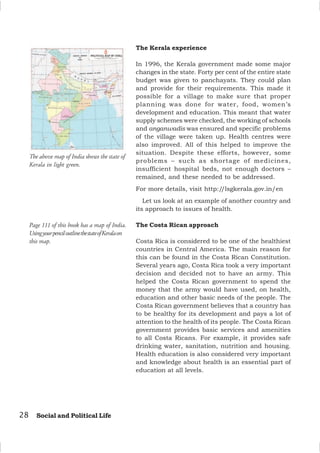
  • 60.
    52 Social andPolitical Life This poster was created by a women’s group in Bengal. Can you write an interesting slogan for the poster? What do you think this poster is trying to say?
  • 61.
    53 EXERCISES 1. Are thestatements given alongside true or false. Support your answer with the use of an example – 2. Housework is invisible and unpaid work. Housework is physically demanding. Housework is time consuming. Write in your own words what is meant by the terms ‘invisible’, ‘physically demanding’, and ‘time consuming’? Give one example of each based on the household tasks undertaken by women in your home. 3. Make a list of toys and games that boys typically play and another for girls. If there is a difference between the two lists, can you think of some reasons why this is so? Does this have any relationship to the roles children have to play as adults? 4. If you have someone working as a domestic help in your house or locality talk to her and find out a little bit more about her life – Who are her family members? Where is her home? How many hours does she work? How much does she get paid? Write a small story based on these details. a. All societies do not think similarly about the roles that boys and girls play. b. Our society does not make distinctions between boys and girls when they are growing up. c. Women who stay at home do not work. d. The work that women do is less valued than that of men. Glossary Identity: Identity is a sense of self-awareness of who one is. Typically, a person can have several identities. For example, a person can be a girl, a sister and a musician. Double-burden: Literally means a double load. This term is commonly used to describe the women’s work situation. It has emerged from a recognition that women typically labour both inside the home (housework) and outside. Care-giving: Care-giving refers to a range of tasks related to looking after and nurturing. Besides physical tasks, they also involve a strong emotional aspect. De-valued: When someone is not given due recognition for a task or job they have done, they can feel de-valued. For example, if a boy has put in a lot of effort into making a special birthday gift for his friend and this friend does not say anything about this, then the boy may feel de-valued. Chapter 4: Growing up as Boys and Girls
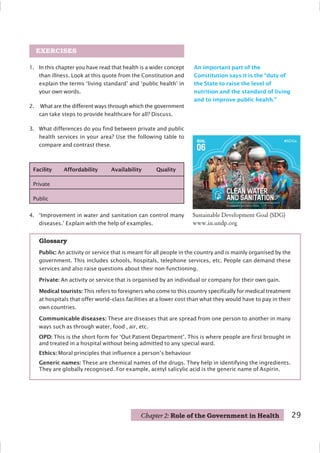
  • 62.
    Women Change the World Inthe previous chapter, we saw how women’s work in the home is not recognised as work. We also read how doing household work and taking care of family members is a full time job and there are no specific hours at which it begins or ends. In this chapter, we will look at work outside the home, and understand how some occupations are seen to be more suitable for men than for women. We will also learn about how women struggle for equality. Getting an education was, and still is, one way in which new opportunities were created for women. This chapter will also briefly trace the different types of efforts made by the women’s movement to challenge discrimination in more recent years. 5 C HAPTER
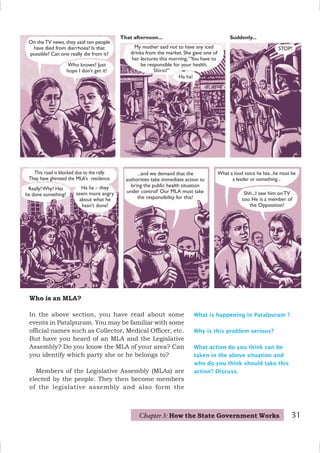
  • 63.
    A farmer Afactory worker A nurse A scientist A pilot A teacher Are there more images of men than women? In what kinds of jobs were there more images of men than women? Have all the nurses been drawn as females? Why? Are there fewer images of female farmers? If so, why? Category Male image Female image Teacher Farmer Factory worker Nurse Scientist Pilot Who does what work? Draw images of the following – See what images your class drew by filling in the table below. Add up the number of male and female images separately for each occupation. 55 Chapter 5: Women Change the World
  • 64.
    56 Social andPolitical Life 83.6 per cent of working women in India are engaged in agricultural work. Their work includes planting, weeding, harvesting and threshing. Yet, when we think of a farmer we only think of a man. Source: NSS 61st Round (2004-05) Category Male image Female image Teacher 5 25 Farmer 30 0 Factory worker 25 5 Nurse 0 30 Scientist 25 5 Pilot 27 3 How does your class exercise compare with Rosie Ma’am’s class exercise? Rosie Ma’am’s class has 30 children. She did the same exercise in her class and here is the result.
  • 65.
    57 Breaking stereotypes Engine driversare men. But 27-year-old Laxmi Lakra, from a poor tribal family in Jharkhand has begun to change things. She is the first woman engine driver for Northern Railways. Laxmi’s parents are not literate but they struggled and overcame many hardships to make sure their children got an education.Laxmi studied in a government school.Even in school, Laxmi helped with the housework and did odd jobs.She studied hard and did well and then went on to get a diploma in electronics. She then took the railway board exam and passed it on her first attempt. Laxmi says,“I love challenges and the moment somebody says it is not for girls,I make sure I go ahead and do it.” Laxmi has had to do this several times in her life – when she wanted to take electronics; when she rode motorcycles at the polytechnic; and when she decided to become an engine driver. Her philosophy is simple –“As long as I am having fun without harming anyone,as long as I am doing well and helping my parents, why should I not lead a lifestyle of my choice?” (Adapted from Driving Her Train by Neeta Lal, Women’s Features Service) Fewer opportunities and rigid expectations A lot of the children in Rosie Ma’am’s class drew women as nurses and men as army officers. The reason they did this is because they feel that outside the home too, women are good at only certain jobs. For example, many people believe that women make better nurses because they are more patient and gentle. This is linked to women’s roles within the family. Similarly, it is believed that science requires a technical mind and girls and women are not capable of dealing with technical things. Because so many people believe in these stereotypes, many girls do not get the same support that boys do to study and train to become doctors and engineers. In most families, once girls finish school, they are encouraged by their families to see marriage as their main aim in life. Chapter 5: Women Change the World
  • 66.
    58 Social andPolitical Life Read the story below and answer the questions – If you were Xavier, what subject would you choose and why? In your experience, what are some of the other pressures that boys experience? Xavier was happy with the results of his Class X board exams.Though his marks in Science and Maths were not high, he had done well in his favourite subjects – History and Languages. When his parents saw his report card, however, they did not look pleased at all... My Goodness! Xavier, you have managed only 65% in Maths.Your marks in Physics are low too... I know Mama, but it’s okay, because I don’t want to take Maths or Science. I want to study History. Why do you want to take History? Think about your future. You have to get a good job! History will not help. It has no scope! But, but, I don’t like Maths or Science! Be sensible, son.Take Maths, and you can study computers side by side.The job market for computers is very good. It is important to understand that we live in a society in which all children face pressures from the world around them. Sometimes, these come in the form of demands from adults. At other times, they can just be because of unfair teasing by our own friends. Boys are pressurised to think about getting a job that will pay a good salary. They are also teased and bullied if they do not behave like other boys. You may remember that in your Class VI book you read about how boys at an early age are encouraged not to cry in front of others.
  • 67.
    59 Ramabai (1858–1922), shownabove with her daughter, championed the cause of women’s education. She never went to school but learnt to read and write from her parents. She was given the title ‘Pandita’ because she could read and write Sanskrit, a remarkable achievement as women then were not allowed such knowledge. She went on to set up a Mission in Khedgaon near Pune in 1898, where widows and poor women were encouraged not only to become literate but to be independent. They were taught a variety of skills from carpentry to running a printing press, skills that are not usually taught to girls even today. The printing press can be seen in the picture on the top left corner. Ramabai’s Mission is still active today. Learning for change Going to school is an extremely important part of your life. As more and more children enter school every year, we begin to think that it is normal for all children to go to school. Today, it is difficult for us to imagine that school and learning could be seen as “out of bounds” or not appropriate for some children. But in the past, the skill of reading and writing was known to only a few. Most children learnt the work their families or elders did. For girls, the situation was worse. In communities that taught sons to read and write, daughters were not allowed to learn the alphabet. Even in families where skills like pottery, weaving and craft were taught, the contribution of daughters and women was only seen as supportive. For example, in the pottery trade, women collected the mud and prepared the earth for the pots. But since they did not operate the wheel, they were not seen as potters. In the nineteenth century, many new ideas about education and learning emerged. Schools became more common and communities that had never learnt reading and writing started sending their children to school. But there was a lot of opposition to educating girls even then. Yet many women and men made efforts to open schools for girls. Women struggled to learn to read and write. Chapter 5: Women Change the World
  • 68.
    Rokeya Sakhawat Hossainand her dreams about ‘Ladyland’ Rokeya Sakhawat Hossain (1880–1932) was born into a rich family who owned a lot of land. Though she knew how to read and write Urdu, she was stopped from learning Bangla and English. In those days, English was seen as a language that would expose girls to new ideas, which people thought were not correct for them.Therefore, it was mostly boys who were taught English. Rokeya learnt to read and write Bangla and English with the support of her elder brother and an elder sister. She went on to become a writer. She wrote a remarkable story titled Sultana’s Dream in 1905 to practise her English skills when she was merely 25 years old.This story imagined a woman called Sultana who reaches a place called Ladyland. Ladyland is a place where women had the freedom to study, work, and create inventions like controlling rain from the clouds and flying air cars. In this Ladyland, the men had been sent into seclusion – their aggressive guns and other weapons of war defeated by the brain- power of women. As Sultana travels in Ladyland with Sister Sarah, she awakes to realise that she was only dreaming. As you can see, Rokeya Sakhawat Hossain was dreaming of women flying planes and cars even before girls were being allowed to go to school!This was the way in which education and learning had changed Rokeya’s own life. Rokeya did not stop at getting education just for herself. Her education gave her the power not only to dream and write, but also to do more – to help other girls go to school and to build their own dreams. In 1910,she started a school for girls in Kolkata, and to this day, the school is still functioning. Learning to read and write led some women to question the situation of women in society. They wrote stories, letters and autobiographies describing their own experiences of inequality. In their writings, they also imagined new ways of thinking and living for both men and women. Let us read about the experience of Rashsundari Devi (1800–1890), who was born in West Bengal, some 200 years ago. At the age of 60, she wrote her autobiography in Bangla. Her book titled Amar Jiban is the first known autobiography written by an Indian woman. Rashsundari Devi was a housewife from a rich landlord’s family. At that time, it was believed that if a woman learnt to read and write, she would bring bad luck to her husband and become a widow! Despite this, she taught herself how to read and write in secret, well after her marriage. “I would start working at dawn, and I would still be at it until well beyond midnight. I had no rest in between. I was only fourteen years old at the time. I came to nurture a great longing: I would learn to read and I would read a religious manuscript. I was
  • 69.
    Unlike Rashsundari Deviand Rokeya Hossain, who were not allowed to learn to read and write, large numbers of girls attend school in India today. Despite this, there continue to be many girls who leave school for reasons of poverty, inadequate schooling facilities and discrimination. Providing equal schooling facilities to children from all communities and class backgrounds, and particularly girls, continues to be a challenge in India. unlucky, in those days women were not educated. Later, I began to resent my own thoughts. What is wrong with me? Women do not read, how will I do it? Then I had a dream: I was reading the manuscript of Chaitanya Bhagabat (the life of a saint)… Later in the day, as I sat cooking in the kitchen, I heard my husband say to my eldest son: “Bepin, I have left my Chaitanya Bhagabat here. When I ask for it, bring it in.” He left the book there and went away. When the book had been taken inside, I secretly took out a page and hid it carefully. It was a job hiding it, for nobody must find it in my hands. My eldest son was practising his alphabets at that time. I hid one of them as well. At times, I went over that, trying to match letters from that page with the letters that I remembered. I also tried to match the words with those that I would hear in the course of my days. With tremendous care and effort, and over a long period of time, I learnt how to read…” After learning the alphabet, Rashsundari Devi was able to read the Chaitanya Bhagabat. Through her own writing she also gave the world an opportunity to read about women’s lives in those days. Rashsundari Devi wrote about her everyday life experiences in details. There were days when she did not have a moment’s rest, no time even to sit down and eat! Schooling and education today Today, both boys and girls attend school in large numbers. Yet, as we will see, there still remain differences between the education of boys and girls. India has a census every 10 years, which counts the whole population of the country. It also gathers detailed information about the people living in India – their age, schooling, what work they do, and so on. We use this information to measure many things, like the number of literate people, and the ratio of men and women. According to the 1961 census, about 40 per cent of all boys and men Chapter 5: Women Change the World 61 Sustainable Development Goal (SDG) www.in.undp.org
  • 70.
    62 Social andPolitical Life Level All SC ST Boys Girls Total Boys Girls Total Boy Girls Total Primary (Classes 1-5) 4.36 3.88 4.13 4.71 4.20 4.46 7.02 6.84 6.93 Upper Primary (Classes 6-8) 3.49 4.60 4.03 5.00 6.03 5.51 8.48 8.71 8.59 Secondary (Classes 9-10) 17.21 16.88 17.06 19.64 19.05 19.36 24.94 24.40 24.68 Source: Educational Statistics at a Glance, MHRD, 2018 What percentage of children leave school at the upper primary level? At which level of education do you see the highest percentage of children leaving? Why do you think that the percentage of Adivasi girls and boys leaving school is higher than that of any other group? (7 years old and above) were literate (that is, they could at least write their names) compared to just 15 per cent of all girls and women. In the most recent census of 2011, these figures have grown to 82 per cent for boys and men, and 65 per cent for girls and women. This means that the proportion of both men and women who are now able to read and have at least some amount of schooling has increased. But, as you can also see, the percentage of the male group is still higher than the female group. The gap has not gone away. Here is a table that shows the percentage of girls and boys who leave schools from different social groups including Scheduled Caste (SC) and Scheduled Tribe (ST). (in percentage) You have probably noticed in the above table that SC and ST girls leave school at a rate that is higher than the category ‘All Girls’. This means that girls who are from Dalit (SC) and Adivasi (ST) backgrounds are less likely to remain in school. The 2011 census also found that Muslim girls are less likely, than SC and ST girls, to complete primary school. While a Muslim girl is likely to stay in school for around three years, girls from other communities spend around four years in school. There are several reasons why children from Dalit, Adivasi and Muslim communities leave school. In many parts of the country, especially in rural and poor areas, there may not even be proper schools nor teachers who teach on a regular basis. If a school Average Annual Drop-out Rate in School Education (2014–15)
  • 71.
    63 From the giventable, convert the figures of primary class children who leave school into a bar diagram. Two percentages have already been converted for you in the bar diagram on the left. is not close to people’s homes, and there is no transport like buses or vans, parents may not be willing to send their girls to school. Many families are too poor and unable to bear the cost of educating all their children. Boys may get preference in this situation. Many children also leave school because they are discriminated against by their teacher and classmates, just like Omprakash Valmiki was. Women’s movement Women and girls now have the right to study and go to school. There are other spheres – like legal reform, violence and health – where the situation of women and girls has improved. These changes have not happened automatically. Women individually, and collectively have struggled to bring about these changes. This struggle is known as the Women’s Movement. Individual women and women’s organisations from different parts of the country are part of the movement. Many men support the women’s movement as well. The diversity, passion and efforts of those involved makes it a very vibrant movement. Different strategies have been used to spread awareness, fight discrimination and seek justice. Here are some glimpses of this struggle. Chapter 5: Women Change the World Findoutaboutthe‘BetiBachaoBetiPadhao’ campaignlaunchedin2014. Boys and girls Percentage 2 4 6 8 10 0 All boys 4.36% ST boys 7.02%
  • 72.
    Campaigning Campaigns to fightdiscrimination and violence against women are an important part of the women’s movement. Campaigns have also led to new laws being passed. A law was made in 2006 to give women who face physical and mental violence within their homes, also called domestic violence, some legal protection. Similarly, efforts made by the women’s movement led the Supreme Court to formulate guidelines in 1997 to protect women against sexual harassment at the workplace and within educational institutions. In the 1980s, for example, women’s groups across the country spoke out against ‘dowry deaths’ — cases of young brides being murdered by their in-laws or husbands, greedy for more dowry. Women’s groups spoke out against the failure to bring these cases to justice. They did so by coming on to the streets, approaching the courts, and by sharing information. Eventually, this became a public issue in the newspapers and society, and the dowry laws were changed to punish families who seek dowry. Satyarani, an active member of the women’s movement, sitting on the steps of the Supreme Court surrounded by legal files gathered during the course of a long legal battle to seek justice for her daughter who was murdered for dowry.
  • 73.
    Raising Awareness An importantpart of the women’s movements’ work is to raise public awareness on women’s rights issues. Their message has been spread through street plays, songs and public meetings. Protesting The women’s movement raises its voice when violations against women take place or for example, when a law or policy acts against their interests. Public rallies and demonstrations are a very powerful way of drawing attention to injustices.
  • 74.
    Showing Solidarity The women’smovement is also about showing solidarity with other women and causes. Above: Women are holding up candles to demonstrate the solidarity between the people of India and Pakistan. Every year, on 14 August, several thousand people gather at Wagah on the border of India and Pakistan and hold a cultural programme. Below: On 8 March, International Women’s Day, women all over the world come together to celebrate and renew their struggles.
  • 75.
    1. How doyou think stereotypes, about what women can or cannot do, affect women’s right to equality? 2. List one reason why learning the alphabet was so important to women like Rashsundari Devi, Ramabai and Rokeya. 3. “Poor girls drop out of school because they are not interested in getting an education.” Re-read the last paragraph on page 62 and explain why this statement is not true. 4. Can you describe two methods of struggle that the women’s movement used to raise issues? If you had to organise a struggle against stereotypes, about what women can or cannot do, what method would you employ from the ones that you have read about? Why would you choose this particular method? EXERCISES Glossary Stereotype: When we believe that people belonging to particular groups based on religion, wealth, language are bound to have certain fixed characteristics or can only do a certain type of work, we create a stereotype. For example, in this chapter, we saw how boys and girls are made to take certain subjects not because he or she has an aptitude for it, but because they are either boys or girls. Stereotypes prevent us from looking at people as unique individuals. Discrimination: When we do not treat people equally or with respect we are indulging in discrimination. It happens when people or organisations act on their prejudices. Discrimination usually takes place when we treat some one differently or make a distinction. Violation: When someone forcefully breaks the law or a rule or openly shows disrespect, we can say that he or she has committed a violation. Sexual harassment: This refers to physical or verbal behaviour that is of a sexual nature and against the wishes of a woman. Chapter 5: Women Change the World 67
  • 76.
  • 77.
    69 Media Teacher’s note Today, themedia and advertising are a pervasive presence in the lives of young people, who may or may not have taken the opportunity to seriously reflect upon this fact. This Unit offers some ways by which we can begin to think about these. The focus is on explaining the strong links between media and technology and media and big business. It explains how the media ‘sets the agenda’ through influencing our perception of issues worth devoting time and attention to, and issues that are neglected or overridden. Chapter 6 foregrounds the widespread effects of the media, and attempts to connect the issues under discussion to the learner’s own lives. At the end of the chapter, we expect the learner to recognise the role of big business in the media coverage of events — the way ‘news’ is selected for coverage, and the explicit/ implicit dimensions of that coverage. We use two fictitious news reports to demonstrate that there is seldom just one version of a story or an event. Building on this, we expect the learner to develop the skills required to critically analyse a newspaper report or a TV story through scrutinising the information provided, as well as understanding the logic behind the exclusion of certain perspectives. These ideas can be strengthened by selecting examples from actual advertisements and structuring similar questions around them. This chapter concludes by linking its contents to the idea of democracy. It emphasises, through using examples of local media as well as social advertising, how mainstream media and advertising tend to favour those who have greater financial as well as social resources. This point can be reinforced in the classroom by using local examples of media stories, as well as posing questions about the ways in which advertising is changing what is locally available as well as locally valued. 69
  • 78.
    Understanding Media What isyour favourite TV programme? What do you like listening to on the radio? Which newspaper or magazine do you usually read? Do you surf the internet and what have you found most useful about it? Did you know that there is one word that is often used to collectively refer to the radio, TV, newspapers, Internet and several other forms of communication. This word is ‘media’. In this chapter, you will read more about the media. You will find out what is required to make it work, as well as the ways in which the media affects our daily lives. Can you think of one thing that you have learnt from the media this week? 6 C HAPTER
  • 79.
    Look at thecollage on the left and list six various kinds of media that you see. An artist’s impression of Gutenberg printing the first sheet of the Bible. Ask older members of your family about what they used to listen to on the radio when there was no TV around. Find out from them when the first TV came to your area. When was cable TV introduced? How many people in your neighbourhood use the Internet? List three things that you know about some other part of the world from watching television? Everything ranging from the stall at the local fair to the programme that you see on TV can be called media. Media is the plural form of the word ‘medium’ and it describes the various ways through which we communicate in society. Because media refers to all means of communication, everything ranging from a phone call to the evening news on TV can be called media. TV, radio and newspapers are a form of media that reaches millions of people, or the masses, across the country and the world and, thus, they are called mass media. Media and technology It would probably be difficult for you to imagine your life without the media. But cable television and the widespread use of the Internet is a recent phenomenon. These have been around for less than twenty years. The technology that mass media uses keeps changing. Newspapers, television and radio can reach millions of people because they use certain technologies. We also tend to discuss newspapers and magazines as the print media; and TV and radio as the electronic media. Why do you think newspapers are called print media? As you read further, you will find that this naming is related to the different technologies that these media use. The following photographs will give you a sense of the ways in which technology that mass media uses has changed over the years and continues to change. Changing technology, or machines, and making technology more modern, helps media to reach more people. It also improves the quality of sound and the images that you see. But technology does more than this. It also changes the ways in which we think about our lives. For example, today it is quite difficult for us to think of our lives without television. Television has enabled us to think of ourselves as members of a larger global world. Television images travel huge 71 Chapter 6: Understanding Media
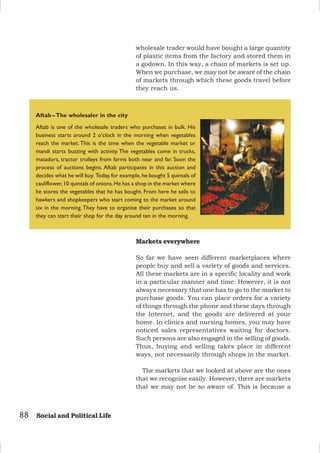
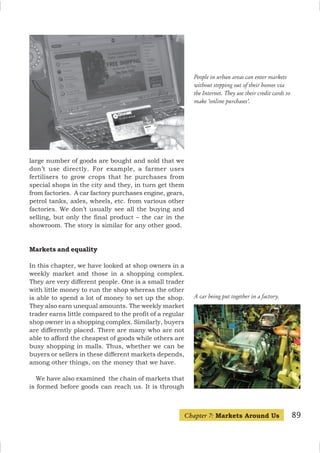
  • 80.
    72 Social andPolitical Life Can you list three different products that are advertised during your favourite TV programme? Take a newspaper and count the number of advertisements in it. Some people say that newspapers have too many advertisements. Do you think this is true and why? John L. Baird sits in front of the apparatus with which he demonstrated to the Royal Institute, his invention, the ‘televisor’, an early television. With electronic typerwriters, journalism underwent a sea-change in the 1940s. distances through satellites and cables. This allows us to view news and entertainment channels from other parts of the world. Most of the cartoons that you see on television are mostly from Japan or the United States. We can now be sitting in Chennai or Jammu and can see images of a storm that has hit the coast of Florida in the United States. Television has brought the world closer to us. Media and money The different technologies that mass media use are expensive. Just think about the TV studio in which the newsreader sits – it has lights, cameras, sound recorders, transmission satellites, etc., all of which cost a lot of money. In a news studio, it is not only the newsreader who needs to be paid but also a number of other people who help put the broadcast together. This includes those who look after the cameras and lights. Also, as you read earlier the technologies that mass media use keep changing and so a lot of money is spent on getting the latest technology. Due to these costs, the mass media needs a great deal of money to do its work. As a result, most television channels and newspapers are part of big business houses. Mass media is constantly thinking of ways to make money. One way in which the mass media earns money is by advertising different things like cars, chocolates, clothes, mobile phones, etc. You must have noticed the number of advertisements that you have to see while watching your favourite television show. While watching a cricket match on TV, the same advertisements are shown repeatedly between each over and so you are often watching the same image over and over again. As you will read in the following chapter, advertisements are repeated in the hope that you will go out and buy what is advertised.
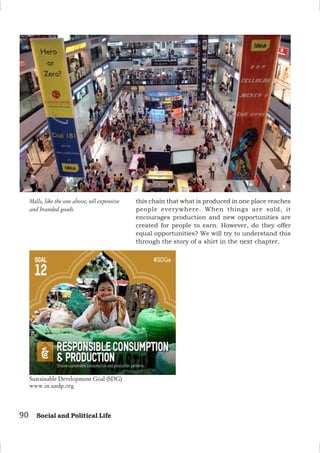
  • 81.
    73 The cost toadvertise on a TV channel varies from ` 1,000 to ` 1,00,000 per 10 seconds depending on the popularity of the channel and time. Media and democracy In a democracy, the media plays a very important role in providing news and discussing events taking place in the country and the world. It is on the basis of this information that citizens can, for example, learn how government works. And often, if they wish to, they can take action on the basis of these news stories. Some of the ways in which they can do this is by writing letters to the concerned minister, organising a public protest, starting a signature campaign, asking the government to rethink its programme, etc. Given the role that the media plays in providing information, it is important that the information be balanced. Let us understand what we mean by a balanced media report by reading two versions of the same news event given on the next page. Chapter 6: Understanding Media The print media offers a large variety of information to suit the tastes of different readers.
  • 82.
    74 Social andPolitical Life Are the above stories in the two newspapers similar? And if not, why not? What, in your view, are the similarities and the differences? If you read the story in the News of India, what would you think about the issue? The closure of one lakh factories in the city’s residential areas is likely to become a serious issue. On Monday, thousands of factory owners and workers took to the streets to strongly protest this closure. They said that their livelihoods would be lost. They say that the fault lies with the municipal corporation because it continued to issue licenses for new factories to be set up in residential areas.They also say that there were no adequate relocation efforts. The owners and workers plan a one-day city bandh to protest against this closure. Mr. Sharma, one of the factory owners said, “The government says that it has done a lot to relocate us. But the areas they have sent us to have no facilities and have not been developed for the last five years.” Closure of factories causes unrest Daily News Service News of India Report India Daily Report The fact is that if you had read either newspaper you would only know one side of the story. If you had read the News of India, you would most likely think of the protestors as a nuisance. Their disrupting traffic and continually polluting the city with their factories leaves you with a bad impression about them. But on the other hand, if you had read the story in the India Daily, you would know that the protests are because a lot of livelihoods will be lost if the factories close because the relocation efforts have not been adequate. Neither of these stories is a balanced report. A balanced report is one that discusses all points of view of a particular story and then leaves it to the readers to make up their minds. Writing a balanced report, however, depends on the media being independent. An independent media means that no one should control and influence its coverage of news. No one should tell the media what Violent protests by owners and workers brought the city to a standstill today. People getting to work could not do so on time because of huge traffic jams. The owners and workers are protesting the government’s decision to close down polluting factory units. Although the government did take this decision rather hastily, the protestors have known for quite some time that their units are not legal. Crackdown on polluting factories Protestors block roads and disrupt traffic Moreover the levels of pollution in the city will be greatly reduced by this closure. Mr. Jain a well- known figure in the city said, “With our city gradually becoming Indias’s new business hub, it is important that it be a clean and green city. Polluting factories should be moved. The factory owners and workers should accept the relocation being offered by the government instead of protesting.” Radhika Malik | INN
  • 83.
    75 In many ofour homes,TV is on a lot of the time. In many ways, a lot of our impressions about the world around us are formed by what we see onTV: it is like a ‘window on the world’. How do you think it influences us? TV has different types of programmes, soap operas, like Saas Bhi Kabhi Bahu Thi, game shows, like Kaun Banega Crorepati, reality TV shows like Big Boss, news, sports and cartoons. Before, in between and after each programme are advertisements.SinceTV time costs so much money, only those programmes that can attract the maximum number of viewers are shown.Can you think of what such programmes might be? Think of what are the kinds of things that TV shows and what it does not. Does it show us more about the lives of the rich or the poor? We need to think about what TV does to us, how it shapes our views of the world,our beliefs, attitudes and values.We need to realise that it gives us a partial view of the world.While we enjoy our favourite programmes, we should always be aware of the large exciting world beyond our TV screens.There is so much happening out there that TV ignores. A world beyond film stars, celebrities and rich lifestyles, a world that all of us need to reach out to and respond to in various ways. We need to be active viewers, who question whatever we see and hear, while we may enjoy it too! What doesTV do to us and what can we do withTV? Do you think it is important to know both sides of the story? Why? Pretend that you are a journalist for a newspaper and write a balanced story from the two news reports. can be included and what should not be included in a news story. An independent media is important in a democracy. As you read above, it is on the basis of the information that the media provides that we take action as citizens, so it is important that this information is reliable and not biased. However, the reality is that media is far from independent. This is mainly because of two reasons. The first is the control that the government has on the media. When the government prevents either a news item, or scenes from a movie, or the lyrics of a song from being shared with the larger public, this is referred to as censorship. There have been periods in Indian history when the government censored the media. The worst of these was the Emergency between 1975-1977. Chapter 6: Understanding Media
  • 84.
    76 Social andPolitical Life While the government does continue to censor films, it does not really censor the media’s coverage of news. Despite the absence of censorship by the government, most newspapers nowadays still fail to provide a balanced story. The reasons for this are complicated. Persons who research the media have said that this happens because business houses control the media. At times, it is in the interest of these businesses to focus on only one side of the story. Media’s continual need for money and its links to advertising means that it becomes difficult for media to be reporting against people who give them advertisements. Media is, thus, no longer considered independent because of its close links to business. Besides the above, the media also tends to focus on a particular aspect of a story because they believe this makes the story interesting. Also, if they want to increase public support for an issue, they often do this by focusing on one side of a story. Setting agendas The media also plays an important role in deciding what stories to focus on, and therefore, decides on what is newsworthy. For example, the annual function at your school is unlikely to make the news. But if a famous actor is invited as the Chief Guest, then the media might be interested in covering it. By focusing on particular issues, the media influences our thoughts, feelings and actions, and brings those issues to our attention. Due to the significant influence it plays in our lives and in shaping our thoughts, it is commonly said that the media ‘sets the agenda’. Very recently, the media drew our attention to alarming levels of pesticides in cola drinks. They published reports that indicated the high level of pesticides and, thus, made us aware of the need to regularly monitor these colas according to international quality and safety standards. They did
  • 85.
    77 Recognising that themedia will not be interested in covering‘small’ issues that involve ordinary people and their daily lives,several local groups have come forward to start their own media.Several people use community radio to tell farmers about the prices of different crops and advise them on the use of seeds and fertilisers. Others make documentary films with fairly cheap and easily available video cameras on real-life conditions faced by different poor communities,and,at times,have even given the poor these video cameras to make films on their own lives. Another example is a newspaper called Khabar Lahriya which is a fortnightly that is run by eight Dalit women in Chitrakoot district in Uttar Pradesh.Written in the local language, Bundeli, this eight-page newspaper reports on Dalit issues and cases of violence against women and political corruption.The newspaper reaches farmers, shopkeepers, panchayat members, school teachers and women who have recently learnt to read and write. Local media Fashion shows are very popular with the media. What is the consequence of the media ‘setting the agenda’ by reporting on the Fashion Week rather than the slum demolitions? Can you think of an issue that does not seem important to you because it is never featured in the media? this despite the government’s resistance by boldly declaring that colas were unsafe. In covering this story, the media positively helped us focus on an issue that affects our lives and one that we might not even have been aware of it had it not been for media reporting. There are several instances when the media fails to focus on issues that are significant in our lives. For example, drinking water is a major problem in the country. Every year, thousands of people suffer and die because they do not get safe drinking water. However, we seldom find the media discussing this issue. A well-known Indian journalist wrote of how the Fashion Week, in which clothes designers show their new creations to rich people, formed the front page headlines of all the newspapers while several slums were being demolished in Mumbai, the very same week, and this was not even noticed! As citizens of a democracy, the media has a very important role to play in our lives because it is through the media that we hear about issues related Chapter 6: Understanding Media
  • 86.
    78 Social andPolitical Life to the working of the government. The media decides what to focus on and in this way it ‘sets the agenda’. The government can, at times, prevent the media from publishing a story and this is called censorship. Nowadays, media’s close relationship with business often means that a balanced report is difficult to come by. Given this, it is important for us to be aware that the ‘factual information’ that a news report provides is often not complete and can be one-sided. We, therefore, need to analyse the news by asking the following questions: what is the information I am learning from this report? What information is not being provided? From whose point of view is the article being written? Whose point of view is being left out and why? Social advertising Social advertisements refer to advertisements made by the Government or private agencies that have a larger message for society. The following is a social advertisement regarding crossing of manned/unmanned level crossings.
  • 87.
    79 EXERCISES 1. In whatways does the media play an important role in a democracy? 2. Can you give this diagram a title? What do you understand about the link between media and big business from this diagram? 3. You have read about the ways in which the media ‘sets the agenda’. What kind of effect does this have in a democracy? Provide two examples to support your point of view. 4. As a class project, decide to focus on a particular news topic and cut out stories from different newspapers on this. Also watch the coverage of this topic on TV news. Compare two newspapers and write down the similarity and differences in their reports. It might help to ask the following questions– a. What information is this article providing? b. What information is it leaving out? c. From whose point of view is the article being written? d. Whose point of view is being left out and why? Glossary Publish: This refers to newsreports, articles, interviews, stories, etc., that are printed in newspapers, magazines and books for a wide audience to read. Censorship: This refers to the powers that government has to disallow media from publishing or showing certain stories. Broadcast: In this chapter this word is used to refer to a TV or radio programme that is widely transmitted. Public protest: When a large number of people come together and openly state their opposition to some issue. Organising a rally, starting a signature campaign, blocking roads etc. are some of the ways in which this is done. Chapter 6: Understanding Media BIG BUSINESS HOUSES READERS, VIEWERS, LISTENERS advertise their products MEDIA promotes products through advertisements People buy products seen in the media. Money, therefore, flows back to big business houses Some own radio, TV, newspaper 5. Do projects (solo, pair or group) about types of advertisements. Create commercial advertisements about some products and social advertisements about public health, road safety and the need to save water and energy.
  • 88.
  • 89.
    81 Markets Teacher’s note These twochapters focus on aspects of life and commercial cycles associated with markets. While some of these processes may be visible and, therefore, easily observable, there are also others that are relatively unfamiliar. Chapter 7 discusses ‘Markets Around Us’. At one level, we study different market sites: a weekly market, neighbourhood shops, a shopping complex, etc. At another level, we explore the intricate question, ‘how do goods reach these markets?’ We examine how a chain of markets operates and the role of wholesale markets within this, through the case study of a wholesale vegetable market. We usually associate ‘market’ with marketplaces, but buying and selling takes place in diverse ways and the chapter discusses how all of this falls within a larger understanding of markets. Chapter 8 looks at how markets offer people different opportunities. This is done through the ‘story of a shirt’, and the chain of markets involved in the process. Together with understanding each step of the manufacture and circulation of a shirt, we realise that some people stand to gain in the market transaction whereas others do not gain as much, or none at all. The opportunities are highly unequal. Ways do exist, such as those of cooperative marketing, which can provide a better return to the producers. However, we need to find many more viable avenues for equitable distribution. These chapters offer an opportunity of bringing in the experience of local markets for discussion in the classroom. A visit to a wholesale market would be of interest, and would allow the learner to find out the profit margins and details of daily earnings so that those inequalities can be directly examined. The experiences of markets are varied and also quite rich. Hence, one should allocate time for some questions, not addressed in the text, which students may wish to discuss. 81
  • 90.
    Markets Around Us Wego to the market to buy many things – vegetables, soap, toothpaste, masala, bread, rice, dal, clothes, notebooks, biscuits, etc. If we make a list of the goods that we purchase, it would be really long. There are many kinds of markets that we may visit for our everyday needs: these can include shops, hawker’s stalls in our neighbourhood, a weekly market, a large shopping complex, perhaps even a mall. In this chapter, we look at some of these markets and try to understand how the goods that are sold there reach buyers, who these buyers are, who these sellers are, and the sorts of problems they face. 7 C HAPTER
  • 91.
  • 92.
    84 Social andPolitical Life Why do people go to a weekly market? Give three reasons. Who are the sellers in a weekly market? Why don’t we find big business persons in these markets? Why are things cheap in the weekly market? Explain with an example how people bargain in the market. Can you think of a situation where the bargain would be unfair? Sameer is a small trader in the weekly market. He buys clothes from a large trader in the town and sells them in six different markets in a week. He and other cloth sellers move in groups.They hire a mini van for this. His customers are from villages that are near the marketplace. At festival times, such as during Deepavali or Pongal, he does good business. Sameer: Seller of clothes Weekly market A weekly market is so called because it is held on a specific day of the week. Weekly markets do not have permanent shops. Traders set up shops for the day and then close them up in the evening. Then they may set up at a different place the next day. There are thousands of such markets in India. People come here for their everyday requirements. Many things in weekly markets are available at cheaper rates. This is because when shops are in permanent buildings, they incur a lot of expenditure – they have to pay rent, electricity, fees to the government. They also have to pay wages to their workers. In weekly markets, these shop owners store the things they sell at home. Most of them are helped by their family members and, hence, do not need to hire workers. Weekly markets also have a large number of shops selling the same goods which means there is competition among them. If some trader were to charge a high price, people would move to another shop where the same thing may be available more cheaply or where the buyer can bargain and bring the price down. One of the advantages of weekly markets is that most things you need are available at one place. Whether you want vegetables, groceries or cloth items, utensils – all of them can be found here. You do not have to go to different areas to buy different things. People also prefer going to a market where they have a choice and a variety of goods. Shops in the neighbourhood We have seen that the weekly markets offer a variety of goods. However, we also buy things from other kinds of markets. There are many shops that sell goods and services in our neighbourhoods. We may buy milk from the dairy, groceries from departmental stores, stationery, eatables or medicines from other
  • 93.
    85 Sujata and Kavitawere sent to buy groceries from their neighbourhood shop.This was the shop they usually went to. It was crowded today.The shop owner managed the shop herself with two helpers.When they managed to get into the shop,Sujata dictated a list to her. She in turn began asking her helpers to weigh and pack the items. Meanwhile Kavita looked around… On the top left shelf there were different brands of detergent cakes. Another shelf had toothpastes, talcum powder, shampoo, hair oil. The different brands and different colours looked so attractive. On the floor lay a few sacks. It took almost 20 minutes to weigh and pack all the groceries. Then Sujata showed her“notebook.” The woman noted the amount of ` 3000 in the notebook and gave it back. She also noted the amount in her big register. Then Sujata took the heavy bags out of the shop. Her family will pay for the purchases in the first week of next month. Why did Sujata carry a notebook? Do you think this system is useful? Can there be problems? What are the different kinds of shops that you find in your neighbourhood? What do you purchase from them? Why are goods sold in permanent shops costlier than those sold in the weekly markets or by roadside hawkers? Chapter 7: Markets Around Us shops. Many of these are permanent shops, while others are roadside stalls such as that of the vegetable hawker, the fruit vendor, the mechanic, etc. Shops in the neighbourhood are useful in many ways. They are near our home and we can go there on any day of the week. Usually, the buyer and seller know each other and these shops also provide goods on credit. This means that you can pay for the purchases later, as we saw in Sujata’s case, for example.
  • 94.
    86 Social andPolitical Life Why do you think the guard wanted to stop Kavita and Sujata from entering the shop? What would you say if someone stops you from entering a shop in a market? You might have noticed that there are different kinds of sellers even in the neighbourhood markets. Some of them have permanent shops and others sell their goods on the roadside. Anzal Mall is a five-floor shopping complex. Kavita and Sujata were enjoying going up and down in the lift. It seemed as if it was made of glass and they were able to see outside as they went up. It was fascinating to see so many different kinds of shops such as the ice-cream, burger, pizza and other food shops; shops full of home appliances; footwear and leather items as well as bookshops. While wandering about on the third floor they entered a shop that was selling branded ready- made clothes.The security guard looked at them as if he wanted to stop them but he did not say anything. They looked at some dresses and then looked at the price tag. None of them was less than ` 3,000, almost five times the weekly market price! Sujata whispered to Kavita, “I’ll take you to another shop which has good quality ready-made clothes at more reasonable prices”. Shopping complexes and malls So far we have seen two kinds of marketplaces – weekly markets and markets in our neighbourhood. There are other markets in the urban area that have many shops, popularly called shopping complexes. These days, in many urban areas, you also have large multi-storeyed air-conditioned buildings with shops on different floors, known as malls. In these urban markets, you get both branded and non-branded goods. As you have read in the chapter on advertising,
  • 95.
    87 How do youthink your neighbourhood shop gets its goods? Find out and explain with some examples. Why is a wholesale trader necessary? branded goods are expensive, often promoted by advertising and claims of better quality. The companies producing these products sell them through shops in large urban markets and, at times, through special showrooms. As compared to non- branded goods, fewer people can afford to buy branded ones. Chain of markets In the previous sections, you have read about different markets from where we buy goods. From where do you think shop-owners procure their goods? Goods are produced in factories, on farms and in homes. However, we don’t buy directly from the factory or from the farm. Nor would the producers be interested in selling us small quantities such as one kilo of vegetables or one plastic mug. The people in between the producer and the final consumer are the traders. The wholesale trader first buys goods in large quantities. For example, the vegetable wholesale trader will not buy a few kilos of vegetables, but will buy in large lots of 25 to 100 kilos. These will then be sold to other traders. In these markets, buying and selling takes place between traders. It is through these links of traders that goods reach faraway places. The trader who finally sells this to the consumer, is the retailer. This could be a trader in a weekly market, a hawker in the neighbourhood or a shop in a shopping complex. We can understand this with the help of the following examples – Every city has areas for wholesale markets. This is where goods first reach and are then supplied to other traders. The roadside hawker whom you read about earlier would have purchased a large quantity of plastic items from a wholesale trader in the town. He, in turn, might have bought these from another, even bigger wholesale trader in the city. The city Chapter 7: Markets Around Us Why do people not bargain in shops located in malls whereas they bargain in weekly markets? The above map of Delhi shows four of the 10 wholesale markets in the city. Keshopur Azadpur Daryaganj Okhla
  • 96.
    88 Social andPolitical Life Aftab is one of the wholesale traders who purchases in bulk. His business starts around 2 o’clock in the morning when vegetables reach the market. This is the time when the vegetable market or mandi starts buzzing with activity.The vegetables come in trucks, matadors, tractor trolleys from farms both near and far. Soon the process of auctions begins. Aftab participates in this auction and decides what he will buy. Today,for example,he bought 5 quintals of cauliflower,10 quintals of onions.He has a shop in the market where he stores the vegetables that he has bought. From here he sells to hawkers and shopkeepers who start coming to the market around six in the morning.They have to organise their purchases so that they can start their shop for the day around ten in the morning. Aftab –The wholesaler in the city wholesale trader would have bought a large quantity of plastic items from the factory and stored them in a godown. In this way, a chain of markets is set up. When we purchase, we may not be aware of the chain of markets through which these goods travel before they reach us. Markets everywhere So far we have seen different marketplaces where people buy and sell a variety of goods and services. All these markets are in a specific locality and work in a particular manner and time. However, it is not always necessary that one has to go to the market to purchase goods. You can place orders for a variety of things through the phone and these days through the Internet, and the goods are delivered at your home. In clinics and nursing homes, you may have noticed sales representatives waiting for doctors. Such persons are also engaged in the selling of goods. Thus, buying and selling takes place in different ways, not necessarily through shops in the market. The markets that we looked at above are the ones that we recognise easily. However, there are markets that we may not be so aware of. This is because a
  • 97.
    89 People in urbanareas can enter markets without stepping out of their homes via the Internet. They use their credit cards to make ‘online purchases’. large number of goods are bought and sold that we don’t use directly. For example, a farmer uses fertilisers to grow crops that he purchases from special shops in the city and they, in turn get them from factories. A car factory purchases engine, gears, petrol tanks, axles, wheels, etc. from various other factories. We don’t usually see all the buying and selling, but only the final product – the car in the showroom. The story is similar for any other good. Markets and equality In this chapter, we have looked at shop owners in a weekly market and those in a shopping complex. They are very different people. One is a small trader with little money to run the shop whereas the other is able to spend a lot of money to set up the shop. They also earn unequal amounts. The weekly market trader earns little compared to the profit of a regular shop owner in a shopping complex. Similarly, buyers are differently placed. There are many who are not able to afford the cheapest of goods while others are busy shopping in malls. Thus, whether we can be buyers or sellers in these different markets depends, among other things, on the money that we have. We have also examined the chain of markets that is formed before goods can reach us. It is through A car being put together in a factory. Chapter 7: Markets Around Us
  • 98.
    90 Social andPolitical Life Malls, like the one above, sell expensive and branded goods. this chain that what is produced in one place reaches people everywhere. When things are sold, it encourages production and new opportunities are created for people to earn. However, do they offer equal opportunities? We will try to understand this through the story of a shirt in the next chapter. Sustainable Development Goal (SDG) www.in.undp.org
  • 99.
    91 EXERCISES 1. In whatways is a hawker different from a shop owner? 2. Compare and contrast a weekly market and a shopping complex on the following: Market Kind of goods sold Prices of goods Sellers Buyers Weekly market Shopping complex Glossary Weekly market: These markets are not daily markets but are to be found at a particular place on one or maybe two days of the week. These markets most often sell everything that a household needs ranging from vegetables to clothes to utensils. Mall: This is an enclosed shopping space. This is usually a large building with many floors that has shops, restaurants and, at times, even a cinema theatre. These shops most often sell branded products. Wholesale: This refers to buying and selling in large quantities. Most products, including vegetables, fruits and flowers have special wholesale markets. Chain of markets: A series of markets that are connected like links in a chain because products pass from one market to another. 3. Explain how a chain of markets is formed. What purpose does it serve? 4. ‘All persons have equal rights to visit any shop in a marketplace.’ Do you think this is true of shops with expensive products? Explain with examples. 5. ‘Buying and selling can take place without going to a marketplace.’ Explain this statement with the help of examples. Chapter 7: Markets Around Us
  • 100.
    A Shirt in theMarket This chapter tells us the story of a shirt ! It begins with the production of cotton and ends with the sale of the shirt. We shall see that a chain of markets links the producer of cotton to the buyer of the shirt in the supermarket. Buying and selling takes place at every step in the chain. Does everyone benefit equally from this? Or do some people benefit more than others? We shall find out. 8 C HAPTER
  • 101.
    Did Swapna geta fair price on the cotton? Why did the trader pay Swapna a low price? Where do you think large farmers would sell their cotton? How is their situation different from Swapna? A cotton farmer in Kurnool Swapna, a small farmer in Kurnool (Andhra Pradesh) grows cotton on her small piece of land. The bolls of the cotton plant are ripe and some have already burst, so Swapna is busy picking cotton. The bolls, which carry the cotton in them, do not burst open all at once so it takes several days to harvest the cotton. Once the cotton is collected, instead of selling it at Kurnool cotton market, Swapna and her husband take the harvest to the local trader. At the beginning of the cropping season, Swapna had borrowed ` 2,500 from the trader at a very high interest rate to buy seeds, fertilisers, pesticides for cultivation. At that time, the local trader made Swapna agree to another condition. He made her promise to sell all her cotton to him. Cultivation of cotton requires high levels of inputs such as fertilisers and pesticides and the farmers have to incur heavy expenses on account of these. Most often, the small farmers need to borrow money to meet these expenses. At the trader’s yard, two of his men weigh the bags of cotton. At a price of ` 1,500 per quintal, the cotton fetches ` 6,000. The trader deducts ` 3,000 for repayment of loan and interest and pays Swapna ` 3,000. Swapna: ` 3,000 only! Trader: Cotton is selling cheap. There is a lot of cotton in the market. Swapna: I have toiled so hard for four months to grow this cotton. You can see how fine and clean the cotton is this time. I had hoped to get a much better price. 2. Ginning mill buys the cotton. 1.Trader sells the cotton at the Kurnool cotton market. 3. Ginning mill removes the seeds and presses the cotton into bales. 4. Spinning mill buys the bales. 6. Spinning mill sells the yarn to yarn dealers. 5. Spinning mill spins the cotton into yarn. Chapter 8: A Shirt in the Market 93
  • 102.
    94 Social andPolitical Life A shop in Erode. Trader: Amma, I am giving you a good price. Other traders are not even paying this much. You can check at the Kurnool market, if you do not believe me. Swapna: Don’t be angry. How can I doubt you? I had only hoped that we would earn enough from the cotton crop to last us a few months. Though Swapna knows that cotton will sell for at least ` 1,800 per quintal, she doesn’t argue further. The trader is a powerful man in the village and the farmers have to depend on him for loans not only for cultivation, but also to meet other exigencies such as illnesses, children’s school fees. Also, there are times in the year when there is no work and no income for the farmers, so borrowing money is the only means of survival. Swapna’s earning from cotton cultivation is barely more than what she might have earned as a wage labourer. The cloth market of Erode Erode’s bi-weekly cloth market in Tamil Nadu is one of the largest cloth markets in the world. A large variety of cloth is sold in this market. Cloth that is made by weavers in the villages around is also brought here for sale. Around the market are offices of cloth merchants who buy this cloth. Other traders from many south Indian towns also come and purchase cloth in this market. On market days, you would also find weavers bringing cloth that has been made on order from the merchant. These merchants supply cloth on order to garment manufacturers and exporters around the country. They purchase the yarn and give instructions to the weavers about the kind of cloth that is to be made. In the following example, we can see how this is done.
  • 103.
    95 1.This is amerchant’s shop in the bazaar. Over the years, these traders have developed extensive contacts with garment firms around the country from whom they get orders. These traders purchase the yarn (thread) from others. 2. The weavers live in villages around and take the yarn supplied by these traders to their homes where the looms are located in sheds adjacent to their houses. This photograph shows a powerloom in one such home. The weavers and their families spend long hours working on these looms. Most weaving units have about 2–8 powerlooms on which the yarn is woven into cloth. A variety of sarees, towels, shirting, ladies dress material and bedsheets are produced in these looms. 3. They then bring back the finished cloth to the traders. Here, they can be seen getting ready to go to the merchant in the town. The trader keeps an account of the yarn given and pays them money for weaving this into cloth. 1 2 3 What are the following people doing at the Erode cloth market– merchants, weavers, exporters? In what ways are weavers dependent on cloth merchants? Putting-out system–weavers producing cloth at home The merchant distributes work among the weavers based on the orders he has received for cloth. The weavers get the yarn from the merchant and supply him the cloth. For the weavers, this arrangement seemingly has two advantages. The weavers do not have to spend their money on purchase of yarn. Also, the problem of selling the finished cloth is taken care of. Weavers know from the outset what cloth they should make and how much of it is to be woven. However, this dependence on the merchants both for raw materials and markets means that the merchants have a lot of power. They give orders for what is to be made and they pay a very low price for making the cloth. The weavers have no way of Chapter 8: A Shirt in the Market
  • 104.
    96 Social andPolitical Life Weaver’s cooperative We have seen that the weavers are paid very little by the merchant under the putting out system.Weaver’s cooperatives are one way to reduce the dependence on the merchant and to earn a higher income for the weavers. In a cooperative, people with common interests come together and work for their mutual benefit.In a weaver’s cooperative,the weavers form a group and take up certain activities collectively. They procure yarn from the yarn dealer and distribute it among the weavers. The cooperative also does the marketing.So,the role of the merchant is reduced, and weavers get a fair price on the cloth. At times, the government helps the cooperatives by buying cloth from them at a reasonable price. For instance, the Tamil Nadu government runs a Free School Uniform programme in the state.The government procures the cloth for this programme from the powerloom weaver’s cooperatives. Similarly,the government buys cloth from the handloom weaver’s cooperatives and sells it through stores known as Co-optex.You might have come across one of these stores in your town. If the weavers were to buy yarn on their own and sell cloth, they would probably earn three times more. Do you think this is possible? How? Discuss. Do you find similar ‘putting-out’ arrangements in making papads, masalas, beedis? Find out about this in your area and discuss in class. You might have heard of cooperatives in your area. It could be in milk, provisions, paddy, etc. Find out for whose benefit they were set up? knowing who they are making the cloth for or at what price it will be sold. At the cloth market, the merchants sell the cloth to the garment factories. In this way, the market works more in favour of the merchants. Weavers invest all their savings or borrow money at high interest rates to buy looms. Each loom costs ` 20,000, so a small weaver with two looms has to invest ` 40,000. The work on these looms cannot be done alone. The weaver and another adult member of his family work upto 12 hours a day to produce cloth. For all this work, they earn about ` 3,500 per month. The arrangement between the merchant and the weavers is an example of putting-out system, whereby the merchant supplies the raw material and receives the finished product. It is prevalent in the weaving industry in most regions of India.
  • 105.
    97 What are thedemands foreign buyers make on the garment exporters? Why do the garment exporters agree to these demands? How do the garment exporters meet the conditions set by the foreign buyers? The garment exporting factory near Delhi The Erode merchant supplies the cotton cloth produced by the weavers to a garment exporting factory near Delhi. The garment exporting factory will use the cloth to make shirts. The shirts will be exported to foreign buyers. Among the foreign buyers are businesspersons from the US and Europe who run a chain of stores. These large stores do business strictly on their own terms. They demand the lowest prices from the supplier. In addition, they set high standards for quality of production and timely delivery. Any defects or delay in delivery is dealt with strictly. So, the exporter tries his best to meet the conditions set by these powerful buyers. Faced with such pressures from the buyers, the garment exporting factories, in turn, try to cut costs. They get the maximum work out of the workers at the lowest possible wages. This way they can maximise their own profits and also supply the garments to foreign buyers at a cheap price. Women workers sewing buttons in a garment factory. Chapter 8: A Shirt in the Market
  • 106.
    98 Social andPolitical Life Payment to workers (per month) Tailoring .......................................................` 3,000 Ironing..........................................................` 1.50 (per piece) Checking .....................................................` 2,000 Thread cutting and buttoning.............................................` 1,500 Write a letter to the Minister asking for what you think would be proper payment to the workers. The Impex garment factory has 70 workers. Most of them are women. Most of these workers are employed on a temporary basis. This means that whenever the employer feels that a worker is not needed, the worker can be asked to leave. Workers’ wages are fixed according to their skills. The highest paid among the workers are the tailors who get about ` 3,000 per month. Women are employed as helpers for thread cutting, buttoning, ironing and packaging. These jobs have the lowest wages. The shirt in the United States A number of shirts are on display at a large clothes shop in the United States, and are priced at $26. That is, each shirt sells for $26 or around ` 1,800. Use the diagram shown in the margin to fill in the blanks below. The businessperson purchased the shirts from the garment exporter in Delhi for ` _______ per shirt. He then spent ` _______ for advertising in the media, and another ` _______ per shirt on storage, display and all other charges. Thus, the cost to this person is ` 900 while he sells the shirt for ` 1,800. ` __________ is his profit on one shirt! If he is able to sell a large number of shirts, his profit will be higher. The garment exporter sold the shirt at ` 300 per piece. The cloth and other raw materials cost him ` 100 per shirt. The workers’ wages cost another Why do you think more women are employed in the Impex garment factory? Discuss. Purchase ` ` ` ` ` 300 Storage, etc. ` ` ` ` ` 200 Advertising ` ` ` ` ` 400 Profit ` ` ` ` ` 900 The shirt below shows the profit made by the businessperson, and the various costs that he had to pay. Find out from the diagram below, what the cost price includes.
  • 107.
    99 Compare the earningsper shirt of the worker in the garment factory, the garment exporter and the businessperson in the market abroad. What do you find? What are the reasons that the businessperson is able to make a huge profit in the market? You have read the chapter on advertising. Why does the businessperson spend Rs 300 per shirt on advertising? Discuss. People who gained in the market People who didn’t gain as much in the market 1. ________________________ 2. ________________________ 3. ________________________ 1. ________________________ 2. ________________________ 3. ________________________ ` 25 per shirt. The cost of running his office came to ` 25 per shirt. Can you calculate the profit per shirt for the garment exporter? Who are the gainers in the market? A chain of markets links the producer of cotton to the buyer at the supermarket. Buying and selling takes place at every step in the chain. Let us recall who were the people who were involved in this process of buying and selling. Did they all gain as much? There were people who made profits in the market and there were some who did not gain as much from this buying and selling. Despite their having toiled very hard, they earned little. Can you place them in the table shown here? Market and equality The foreign businessperson made huge profits in the market. Compared to this, the garment exporter made only moderate profits. On the other hand, the earnings of the workers at the garment export factory are barely enough to cover their day-to-day needs. Similarly, we saw the small cotton farmer and the weaver at Erode put in long hours of hard work. But they did not get a fair price in the market for what they produced. The merchants or traders are somewhere in between. Compared to the weavers, they have earned more but it is still much less than the exporter. Thus, not everyone gains equally in the market. Democracy is also about getting a fair wage in the market. Whether it is Kanta or Swapna, if families don’t earn enough how would they think of themselves as equal to others? On one hand, the market offers people opportunities for work and to be able to sell things that they grow or produce. It could be the farmer selling cotton or the weaver producing cloth. On the other hand, it is usually the rich and the powerful Chapter 8: A Shirt in the Market
  • 108.
    100 Social andPolitical Life Did you know that the readymade clothes that you buy require the work of so many different persons? that get the maximum earnings from the market. These are the people who have money and own the factories, the large shops, large land holdings, etc. The poor have to depend on the rich and the powerful for various things. They have to depend for loans (as in the case of Swapna, the small farmer), for raw materials and marketing of their goods (weavers in the putting out system), and most often for employment (workers at the garment factory). Because of this dependence, the poor are exploited in the market. There are ways to overcome these such as forming cooperatives of producers and ensuring that laws are followed strictly. In the last chapter, we will read about how one such fish-workers’ cooperative was started on the Tawa river. Sustainable Development Goal (SDG) www.in.undp.org
  • 109.
    101 EXERCISES 1. What madeSwapna sell the cotton to the trader instead of selling at the Kurnool cotton market? 2. Describe the conditions of employment as well as the wages of workers in the garment exporting factory. Do you think the workers get a fair deal? 3. Think of something common that we use. It could be sugar, tea, milk, pen, paper, pencil, etc. Discuss through what chain of markets this reaches you. Can you think of the people that help in the production or trade? 4. Arrange the statements given alongside in the correct order and then fill in the numbers in the cotton bolls accordingly. The first two have already been done for you. 1 ê ê ê ê ê 3 ê 1. Swapna sells the cotton to the trader. 2. Customers buy these shirts in a supermarket. 3. Trader sells cotton to the Ginning Mill. 4. Garment exporters buy the cloth from merchants for making shirts. 5. Yarn dealers or merchants give the yarn to the weavers. 6. The exporter sells shirts to the businessperson from the USA. 7.Spinning mill buys the cotton and sells yarn to the yarn dealers. 8.Weavers return with the cloth. 9. Ginning mill cleans the cotton and makes it into bales. ê Glossary Ginning mill: A factory where seeds are removed from cotton bolls. The cotton is pressed into bales to be sent for spinning into thread. Exporter: A person who sells goods abroad. Profit: The amount that is left or gained from earnings after deducting all the costs. If the costs are more than the earnings, it would lead to a loss. ê ê Chapter 8: A Shirt in the Market
  • 110.
    Struggles for Equality In thisbook, you have read about people like Kanta, the Ansaris, Melani and Swapna. The thread that connects all of these lives is that they have been treated unequally. What do people do when they face such inequalities? History is full of examples of persons who have come together to fight against inequality and for issues of justice. Do you recall the story of Rosa Parks in Chapter 1? Do you remember the photo-essay on the women’s movement in Chapter 5? In this chapter you will learn about some of the ways in which people have struggled against inequality. 9 CHAPTER
  • 111.
    What do youthink is meant by the expression ‘power over the ballot box’? Discuss. As you have already read in this book, the Indian Constitution recognises all Indians as equal before the law and states that no person can be discriminated against because of their religion, sex, caste or whether they are rich or poor. All adults in India have the equal right to vote during elections and this ‘power over the ballot box’ has been used by people to elect or replace their representatives. But this feeling of equality that the ballot box provides, because the vote of one person is as good as that of another, does not extend to most people’s lives. As you have read, the increasing privatisation of health services and the neglect of government hospitals have made it difficult for most poor people like Kanta, Hakim Sheik and Aman to get good quality health care. These people do not have the resources to afford expensive private health services. Similarly, the man who sells juice does not have the resources to compete with all of the major companies who sell branded drinks through expensive advertising. Swapna does not have sufficient resources to grow cotton and, so, has to take a loan from the trader to grow her crop. This forces her to sell her cotton at a lower price. Melani, like the millions of domestic workers across the country, is forced to endure the insults and hardship of working as a domestic help because she has no resources to set up something on her own. Poverty and the lack of resources continue to be a key reason why so many people’s lives in India are highly unequal. On the other hand, the Ansaris were discriminated against not because they did not have the resources. In fact, despite having the money to pay the required rent, they were not able to find an apartment for over a month. People were reluctant to lease them an apartment because of their religion. Similarly, the main reason that the teachers forced Omprakash Valmiki to sweep the school yard was because he was Dalit. You’ve also read that the work women do 103 Chapter 9: Struggles for Equality Sustainable Development Goal (SDG) www.in.undp.org
  • 112.
    According to the2011 Census data women form 48.5 per cent of the population, Muslims form 14.2 per cent of the population, SCs form 16.6 per cent and STs 8.6 per cent. Can you think of one person in your family, community, village, town or city whom you respect because of their fight for equality and justice? is often considered of less value than that done by the men. All of these persons are discriminated against primarily because of their social and cultural background as well as because they are women. Discrimination on the basis of a person’s religion, caste and sex is another significant factor for why people are treated unequally in India. Often, poverty and lack of dignity and respect for certain communities and groups come together in such powerful ways that it is difficult to identify where one aspect of inequality ends and the other begins. As you have read, Dalit, Adivasi and Muslim girls drop out of school in large numbers. This is a combined outcome of poverty, social discrimination and the lack of good quality school facilities for these communities. Struggles for equality Throughout the world – in every community, village, city and town–you will find that there are some people who are known and respected because of their fight for equality. These people may have stood up against an act of discrimination that they faced or which they witnessed. Or they may be well-respected because they treat all persons with dignity and are, therefore, trusted and called upon to resolve issues in the community. Often, some of these persons become more widely recognised because they have the support or represent large numbers of people who have united to address a particular issue of inequality. In India, there are several struggles in which people have come together to fight for issues that they believe are important. In Chapter 5, you read about the methods used by the women’s movement to raise issues of equality. The Tawa Matsya Sangh in Madhya Pradesh is another example of people coming together to fight for an issue. There are many such struggles such as those among beedi workers, fisherfolk, agricultural In India, it is the case that the poor consist of a majority of members of Dalit, Adivasi and Muslim communities and are often women. 104 Social and Political Life Sustainable Development Goal (SDG) www.in.undp.org
  • 113.
    labourers, slum dwellersand each group is struggling for justice in its own way. There are also many attempts to form cooperatives or other collective ways by which people can have more control over resources. Tawa Matsya Sangh When dams are built or forest areas declared sanctuaries for animals, thousands of people are displaced. Whole villages are uprooted and people are forced to go and build new homes, start new lives elsewhere. Most of these people are poor. In urban areas too, bastis in which poor people live are often uprooted. Some of them are relocated to areas outside the city. Their work as well as their children’s schooling is severely disrupted because of the distance from the outskirts of the city to these locations. This displacement of people and communities is a problem that has become quite widespread in our The reservoir of the Tawa river.
  • 114.
    106 Social andPolitical Life What issue is the Tawa Matsya Sangh (TMS) fighting for? Why did the villagers set up this organisation? Do you think that the large-scale participation of villagers has contributed to the success of the TMS? Write two lines on why you think so. country. People usually come together to fight against this. There are several organisations across the country fighting for the rights of the displaced. In this chapter we will read about the Tawa Matsya Sangh – a federation of Fisherworker’s cooperatives – an organisation fighting for the rights of the displaced forest dwellers of the Satpura forest in Madhya Pradesh. Originating in the Mahadeo hills of Chindwara district, the Tawa flows through Betul, before joining the Narmada in Hoshangabad. The Tawa dam began to be built in 1958 and was completed in 1978. It submerged large areas of forest and agricultural land. The forest dwellers were left with nothing. Some of the displaced people settled around the reservoir and apart from their meagre farms found a livelihood in fishing. They earned very little. A dam is built across a river at sites where one can collect a lot of water. This forms a reservoir and as the water collects it submerges vast areas of land.This is because the wall of the dam across the river is high and the water spreads over a large area.This is a photo of the submergence caused by theTehri dam in Uttarakhand.The oldTehri town and 100 villages, some totally and some partially, were submerged by this dam. Nearly one lakh people were displaced. In 1994, the government gave the rights for fishing in the Tawa reservoir to private contractors. These contractors drove the local people away and got cheap labour from outside. The contractors began to threaten the villagers, who did not want to leave, by bringing in hoodlums. The villagers stood united and decided that it was time to set up an organisation and do something to protect their rights. The newly formed Tawa Matsya Sangh (TMS) organised rallies and a chakka jam (road blockade), demanding their right to continue fishing for their
  • 115.
    107 livelihood. In responseto their protests, the government created a committee to assess the issue. The committee recommended that fishing rights be granted to the villagers for their livelihood. In 1996, the Madhya Pradesh government decided to give to the people displaced by the Tawa dam the fishing rights for the reservoir. A five-year lease agreement was signed two months later. On January 2, 1997, people from 33 villages of Tawa started the new year with the first catch. With the TMS taking over the fishworkers were able to increase their earnings substantially. This was because they set up the cooperative which would buy the catch from them at a fair price. The cooperative would then arrange to transport and sell this in markets where they would get a good price. They have now begun to earn three times more than they earned earlier. The TMS has also begun giving the fishworkers loans for repair and the buying of new nets. By managing to earn a higher wage as well as preserving the fish in the reservoir, the TMS has shown that when people’s organisations get their rights to livelihood, they can be good managers. Top: Members of the TMS protesting at a rally. Above: A member of the cooperative weighing the fish. Can you think of an incident in your life in which one person or a group of people came together to change an unequal situation. Chapter 9: Struggles for Equality
  • 116.
    108 Social andPolitical Life Adaptation of a song written as part of the Right to Information campaign by Vinay Mahajan: The Right To Know My dreams have the right to know Why for centuries they have been breaking Why don’t they ever come true My hands have the right to know Why do they remain without work all along Why do they have nothing to do My feet have the right to know Why from village to village they walk on their own Why are there no signs of a bus yet My hunger has the right to know Why grain rots in godowns While I don’t even get a fistful of rice My old mother has the right to know Why are there no medicines Needles, dispensaries or bandages My children have the right to know Why do they labour day and night Why is there no school in sight What is your favourite line in the above song? What does the poet mean when he says, “My hunger has the right to know”? Can you share with your class a local song or a poem on dignity that is from your area? While some join protest movements to fight inequality, others might use their pen,or their voice,or their ability to dance to draw attention to issues of inequality. Writers, singers, dancers and artists have also been very active in the fight against inequality. Often, poems, songs and stories can also inspire us and make us believe strongly in an issue and influence our efforts to correct the situation. Creative expression against inequality The Indian Constitution as a living document The foundation of all movements for justice and the inspiration for all the poetry and songs on equality is the recognition that all people are equal. As you know, the Indian Constitution recognises the equality of all persons. Movements and struggles for equality in India continuously refer to the Indian Constitution to make their point about equality and justice for all. The fishworkers in the Tawa Matsya Sangh hope that the provisions of the Constitution will become a reality through their participation in this movement. By constantly referring to the Constitution they use it as a ‘living document’, i.e., something that has real meaning in our lives. In a democracy, there are always communities and individuals trying to expand the idea of democracy and push for a greater recognition of equality on existing as well as new issues.
  • 117.
    109 Can you makeup a social advertisement on equality? You can do this in small groups. Issues of equality are central to a democracy. In this book, we have tried to highlight issues that pose a challenge to this idea of equality in a democracy. These, as you have read, include the privatisation of health services in the country, the increasing control that business houses exert on the media, the low value given to women and their work, and the low earnings made by small farmers who grow cotton. These issues substantially affect poor and marginalised communities, and therefore, concern economic and social equality in the country. This is the core of the struggle for equality in a democracy. The dignity and self-respect of each person and their community can only be realised if they have adequate resources to support and nurture their families and if they are not discriminated against. What role does the Constitution play in people’s struggles for equality? Chapter 9: Struggles for Equality Over 1,500 persons attended a public hearing in Lucknow in 2001 to protest violence against women. Over 15 cases of violence against women were heard by a jury of eminent women who played the role of judges. This people's jury helped highlight the lack of support in the legal system for women who seek justice in such cases.
  • 118.
    110 Social andPolitical Life References u Dreze, Jean and Aparajita Goyal. 2003. ‘Future of Mid-day Meals’. In Economic and Political Weekly. u Hossain, Sakhawat Rokeya. 1905. (reprint) 1988. Sultana’s Dream. Feminist Press, New York. u Kumar. Krishna. 1986. “Growing Up Male” in Seminar 318. u Mazumdar, Indrani. 2007. Women and Globalization: The Impact on Women Workers in the Formal and Informal Sectors in India. Stree, Kolkata. u Mead, Margaret. 1928, 1973. (edition) Growing Up In Samoa. American Museum of Natural History, Washington D.C. u Medical Council of India, http://www.mciindia.org/Rules-and- Regulation/Ethics%20Regulations-2002.pdf u Parks, Rosa. 2000. Quiet Strength. Grand Rapids, Zondervan, Michigan. u Rashsundari Devi. 1999. Words to Win. Translated and with an introduction by Tanika Sarkar. Zubaan, New Delhi. u Roy, Tirthankar. 1999. ‘Growth and Recession in Small-Scale Industry: A Study of Tamil Nadu Powerlooms’ Economic and Political Weekly. u Supreme Court of India, Paschim Banga Khet Mazdoor Samity of Ors. Vs. State of West Bengal & Anr. (Hakim Seikh case, date of judgment: 6 May 1996, http://judis.nic.in/supremecourt/imgs1.aspx?filename=15597) u Valmiki, Omprakash. 2003. Joothan: A Dalit’s Life. SAMYA, Kolkata. u World Health Organization, Essential medicines and health products, http://www.who.int/medicines/services/inn/en/ u www.cehat.org/rthc/policybrieffinal.pdf u www.in.undp.org (Sustainable Development Goals – SDGs) u www.infochangeindia.org u Zubaan. 1996. Poster Women: A Visual History of the Women’s Movement in India. Zubaan, New Delhi.
  • 119.
  • 120.
    112 Social andPolitical Life Have you participated in any event related to school road safety? For materials about road safety education, log on to http://delhitrafficpolice.nic.in Ministry of Road Transport and Highways, http://morth-roadsafety.nic.in For short films on road safety, log on to http://transport.telangana.gov.in
  • 121.
    TheRepublicofIndiacomprises of 28 statesand 9 union territories. The constitution of India states that India is a union of states. The Union and the States have their own Governments. However, the union territories are directly placed under the control and supervision of the Central Government. The union territory of J&K and union territory of Ladakh came into existence on 9th August 2019 by the Act of Parliament. CHAPTER 10 Structures of the Governance in Jammu and Kashmir Union Territory of Jammu and Kashmir After the re-organization of Jammu and Kashmir on 9th of August 2019, the state was divided into two Union Territories- Ladakh (without legislative assembly) and Jammu & Kashmir (with legislative assembly). The legislative assembly of Jammu & Kashmir consists of 107 members including 24 reserved for Pakistan Occupied Jammu and Kashmir (PoJK). It has a term of Five years. To be a member of legislative assembly, a person must be a citizen of India having an age of 25 years or above. The Re- organization, act of 2019 provides Chief Minister’s Office, Legislative Assembly and a Speaker/Deputy Speaker elected among it’s elected members. The Chief Minster should enjoy majority in the existing 83 member assembly. The Reorganization Act came into effect from 31st October 2019.
  • 122.
    Chapter 10: Structuresof the Governance in J&K Social and Political Life The Administrative Structure of the Government in the Union Territory of Jammu & Kashmir UT with Legislative Assembly: It means that territory will be administered by Lieutenant Governor along-with elected Assembly. Commissioner/Secretary Chief Minister Lieutenant Governor Others President of India UT without Legislative Assembly: It means that territory will be administered by Lieutenant Governor aided by Bureaucrats. Council of Ministers 114 Girish Chandra Murmu Radha Krishna Mathur First L. G - UT of J&K First L. G - UT of Ladakh
  • 123.
    Union Territory isadministered by the Lieutenant Governor. He is appointed by the President of India on the recommendation of Prime Minister and his Cabinet. Chief Minister aids and advises the Lieutenant Governor for the smooth functioning of the union territory. The executive functions of the Government are divided into several departments. Each department is placed under the charge of a Minister. The Chief Minister is the Political Head of the Departments. Each department has a secretary who is the Principal Advisor to the minister on administrative matters of the department. The secretary is normally a senior officer from the Indian Administrative Service (IAS). He/she is responsible for carrying out the policies and decisions made by the government. The office of these secretaries is called Secretariat. Each district is headed by a district authority called as Deputy Commissioner (District Magistrate). The district is divided into sub-divisions. Each sub- division is placed under a Sub Divisional Officer. The sub-divisions are further divided into Tehsils and each Tehsil is headed by a Tehsildar. Tehsil is divided into Niabats which are headed by Naib Tehsildars. A Niabat is further divided into villages that are looked after by the Patwaris. Do You Know? • An officer of the Indian Administrative Services (IAS) is selected through Union Public Service Commission (UPSC). Union Territory Administration Union Territory Secretariat District Administration 115
  • 124.
    Chapter 10: Structuresof the Governance in J&K Social and Political Life District Administration (District is a unit of administration; on an average a District has a population of about 2 million) District Authority Deputy Commissioner District Development Commissioner Sub Divisional Officer (Magistrate) Tehsildar Naib Tehsildar Patwari Activity Make a list of District Collectors or Deputy Commissioners of your Union Territory. Deputy Commissioner The head of the District Administration is called the Deputy Commissioner (DC). The DC functions in different capacities as District Collector, District Magistrate and District Development Commissioner. He/She responsible for the collection of the land revenue, maintenance of the law and order and implementation of all other activities at district level. 116
  • 125.
    Administrative set upof District Official Functionaries Administrative Jurisdictions District Development Commissioner or Deputy Commissioner Districts Sub-Divisional Magistrate Sub-Division Tehsildar Tehsil Naib Tehsildar Niabat Block Development Officer (BDO) Block Patwari Village Sub Divisional Officer (Magistrate) The sub-divisions of the District are under the charge of a Sub-Divisional Magistrate who belongs to the Administrative Service. The Sub-Divisional Magistrate performs almost the same functions in his/her sub-divisions that a District collector or Deputy Commissioner performs at the District level. He/she aids the Deputy Commissioner and is an integral part of the District Administration. Tehsildar The sub-divisions are further divided into Tehsils. Tehsils are placed under the charge of Tehsildars. Naib Tehsildars and other Tehsil officials assist Tehsildars in their work and conduct. Block Development Officer (BDO) A Block is headed by a BDO who is responsible for all the developmental works of the block. Patwaris: Patwaris are the officials of Revenue Department. They maintain revenue records of the villages and help in the collection of revenues and other necessary data. 117 Source: Website of CEO J&K
  • 126.
    Chapter 10: Structuresof the Governance in J&K Social and Political Life List of Districts & Tehsils in Union Territory of Jammu and Kashmir S No District Tehsils 01 Anantnag 1. Anantnag 2.Anantnag East (Mat- tan) 3.Kokernag 4.Shangus 5.Pahalgam 6.Bijbehara 7.Srigufwara 8.Shahbad Bala 9. Qazigund 10.Sallar 11.Laroo 12.Dooru 02 Baramulla 1.Baramulla 2.Uri 3.Sopore 4.Tangmarg 5.Pattan 6.Boniyar 7.Kreeri 8.Dangerpora 9.Khoie 10.Watergam 11.Wagoora 12.Kwarhama 13.Kunzer 14.Dangiwacha 15.Zaingeer 16.Rafiabad 03 Bandipora 1. Bandipora 2.Gurez 3.Sonawari 4.Ajas 5.Aloosa 6.Hajin 7.Tulail 118
  • 127.
    04 Budgam 1.Budgam 2.Beerwah 3.Khag 4.Chadoora 5.Khansahib 6.Narbal 7. B.K.Pura 8.Magam 9.Char-i-Sharief 05 Ganderbal 1.Ganderbal 2. Lar 3.Kangan 4.Gund 5.Wakoora 6.Tulmulla 06 Kulgam 1. Kulgam 2.D.H. Pora 3.Frisal 4.Pahloo 5.Yaripora 6.Qaimoh 7.Devsar 07 Kupwara 1.Kupwara 2.Handwara 3.Karnah 4.Trehgam 5.Langate 6.Keran 7.Lalpora 8. Zachaldara 9.Dragmulla 10.Kralapora 11.Sogam 12.Machil 13.Ramhal 14.Qaziabad 119
  • 128.
    Chapter 10: Structuresof the Governance in J&K Social and Political Life 08 Pulwama 1.Pulwama 2. Tral 3.Pampore 4. Kakapore 5.Aripal 6.Rajpora 7.Shahoora 8.Awantipora 09 Shopian 1.Shopian 2.Barbugh Imam Sahib 3.Keegam 4.Chitragam 5.Kellar 6.Zainapora 7.Harmain 10 Srinagar 1.Srinagar South 2.Srinagar North 3.Srinagar Central 4. Eidgah 5.Khanyar 6.Panthachowk 7.Channapora 11 Doda 1. Bhaderwah 2.Thathri 3.Doda 4.Gandoh 5.Assar 6.Bhalla 7.Kahra 8.Bharat Bagla 9.Chilli Pingal 10.Bhagwa 11.Chiralla 12.Figsoo 13.Mohalla 14.Gundna 15.Kastigarh 16.Marmat 120
  • 129.
    12 Jammu 1. Akhnoor 2.Arnia 3. Bahu 4. Bhalwal 5. Bishnah 6. Chowki Choura 7. Dansal 8. Jammu 9. Jammu North 10. Jammu South 11. Jammu West 12. Jourian 13. Kharah Balli 14. Khour 15. Maira Mandrian 16. Mandal 17. Marh 18. Nagrota 19. Pargwal 20. Ranbir Singh Pura 21. Suchetgarh 13 Kathua 1. Kathua 2. Hiranagar 3. Billawar 4. Basohli 5. Bani 6. Lohai Malhar 7. Nagri Parole 8. Dinga Amb 9. Marheen 10. Mahanpur 11. Ramkot 121
  • 130.
    Chapter 10: Structuresof the Governance in J&K Social and Political Life 14 Kishtwar 1. Kishtwar 2. Nagseni 3. Drabshalla 4. Chatroo 5. Mughal Maidan 6. Machail 7. Dachan 8. Wadwan 9. Bunjwah 10. Paddar 11. Marwah 15 Poonch 1. Haveli 2. Mandi 3. Mandhar 4. Surankote 5. Mankote 6. Balakote 16 Rajouri 1. Budhal (Koteranka) 2. Kalakote 3. Nowshera 4. Rajouri 5. Sunderbani 6. Thana Mandi 7. Darhal 8. Taryath 9.Qila Darhal-Laroke 10. Sayote 11. Beri Pattan 12. Khwas 13. Manja Kote 17 Ramban 1. Ramban 2. Banihal 3. Khari 4. Rajgarh 5. Batote 6. Gool 7. Pogal Paristan 122
  • 131.
    18 Reasi 1. Reasi 2.Chassana 3. Thuroo 4. Thakra Kote 5. Arnas 6. Bhomag 7. Katra 8. Pouni 9. Mahore 19 Samba 1. Samba 2. Vijaypur 3. Rajpura 4. Baribrahmna 5. Ghagwal 6. Ramgarh 20 Udhampur 1. Chenani 2. Ramnagar 3. Majalta 4. Udhampur 5. Latti Marothi 6. Moungri 7. Dudu Basantgarh 8. Panchari 123
  • 132.
    Chapter 10: Structuresof the Governance in J&K Social and Political Life List of Districts and Tehsils in Union Territory of Ladakh District Tehsils 1. Leh 1.Leh 2. Samoor 3. Khalsi 4. Kharu 5. Durbuk 6. Nyoma 7. Saspol 8. Diskit 2. Kargil 1. Kargil 2. Zanskar 3. Shergole 4. Tai-suru 5. Drass 6. Shakar Chiktan 7. Sankoo PMSSS (Prime Minister Special Scholarship Scheme): it is scholarship scheme for the students of Jammu & Kashmir and Ladakh UTs. The scholarship is introduced to build capabilities of youth of the J&K and Ladakh. UDAAN; The Special Industry Initiative (SII) for J&K and Ladakh is funded by Ministry of Home Affairs and implemented by National Skill Development Corporation (NSDC). The pro- gramme is a part of the overall initiative for addressing economic issues in J&K.UDAAN programme is a special initiative to address the needs of the educated, unemployed in J&K and Ladakh. Udaan has two objectives: • To provide exposure to the graduates and post graduates of J&K and Ladakh to the best of Corporate India and • To provide Corporate India with exposure to the rich talent available in the UTs of J&K and Ladakh. Activity: Find out the names of Cheif Medical Officer and Cheif Education Officer of your District. 124
  • 133.
    SAMAGRA SHIKSHA Recently theCentrally Sponsored Schemes SSA, RMSA and Teacher Education have been merged into one scheme named as SAMAGRA with an objective of univerlising quality education upto senior secondary level. Glossary Lieutenant Governor: An Administrator appointed by Union Government of India to run the administration of Union Territory. Collector: An administrator responsible for collection of land revenue and to carry-out all other administrative activities at District Level. District Magistrate: An official responsible for maintenance of law and order. 125
  • 134.
    Chapter 10: Structuresof the Governance in J&K Social and Political Life Exercise 1. ANSWER THE FOLLOWING QUESTIONS IN BRIEF: I. In how many Union Territories and States, India is divided into? II. How Lieutenant Governor is appointed? III. What are the functions of Lieutenant Governor? IV. Write briefly the functions of a District Collector. 2. FILL IN THE BLANKS: I. The principle unit of administration in a Union Territory is the district and its head is known as _____________. II. The Head of administration in the Sub-division is known as _______________. III. The Head of administration at Tehsil level is known as _______________. 3. ACTIVITY: Collect information regarding Lieutenant Governors of all the UTs of India. 4. PROJECT WORK: Collect information about any centrally sponsored scheme of Education and discuss it in your clas. 126
  • 135.
  • 136.
    Jammu & KashmirBoard Of School Education