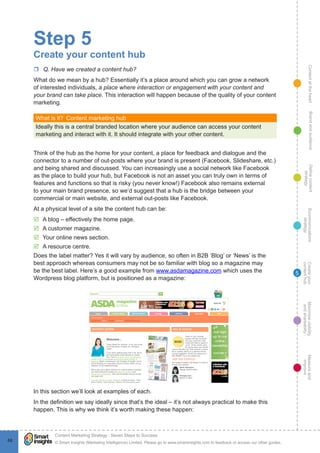
CONTENT MARKETING
STRATEGY GUIDE
Create a structured plan to reach and convert
more using the power of online content
Authors: Dan Bosomworth and Stephen Bateman
Edited: Dr Dave Chaffey
ContentattheheartMaximisevisibility
andshareabilty
Measureand
improve
Createyour
contenthub
Ecommunications
strategy
Definecontent
strategy
Brandandaudience
© Smart Insights (Marketing Intelligence) Limited. Please go to www.smartinsights.com to feedback or access our other guides.
Content Marketing Strategy : Seven Steps to Success
!
Content Marketing Strategy
Seven Steps to Success Guide
Contents
3 Introduction. What is content marketing strategy?
12 Step 1. Put content at the heart of your future marketing direction
24 Step 2. Find the intersection between your brand and your audience content
needs
40 Step 3. Define your content marketing strategy
47 Step 4. Plan to continuously create great content through your e-communica-
tions strategy
68 Step 5. Create your content hub
78 Step 6. Maximise content visibility and shareability through SMO
85 Step 7. Measure and improve using analytics
ContentattheheartMaximisevisibility
andshareabilty
Measureand
improve
Createyour
contenthub
Ecommunications
strategy
Definecontent
strategy
Brandandaudience
© Smart Insights (Marketing Intelligence) Limited. Please go to www.smartinsights.com to feedback or access our other guides.
Content Marketing Strategy : Seven Steps to Success
!
3
Introduction
What is content marketing strategy?
We think the definition from Joe Pulizzi, author of ‘Get Content, Get Customers’ is hard to
beat. He defines content marketing as:
‘How a brand creates, delivers and governs original or curated content to attract and retain
customers, positioning the brand as a credible expert and, ultimately, motivating a change in
behaviour.’
What is it?  Content marketing
Managing content as an asset to achieve marketing goals of reaching, converting and
engaging target audiences.
For us, content marketing is the way to cut through and be more relevant to your customers
compared with your competition. The key to igniting sales is to be visible, to have optimised
content in search results and everywhere your consumers and audience are researching and
discussing their problems and interests. Of course the quality of your content is also essential
to drive conversion to lead and sale on your website and social presences.
Why does content marketing matter?
Your colleagues may still be in the narrow mindset that content strategy is just about product
content – it’s now far broader than that. In fact, we see it as a way of unifying ALL digital
marketing communications to support customer acquisition, retention and growth goals.
What’s the difference between content marketing and social media?
For many brands getting into digital marketing, social media marketing is often the first most
natural step for several reasons: platforms are free, ubiquitous and easy to use and link
directly to users, whilst the content on the platforms is short and easy to publish and share.
With content marketing the challenge for brands is to produce longer-form, authoritative
content that builds their position as thought leaders and attracts and retains audiences on
their own websites.
The ability to establish a definition of what is performed with content marketing relative to
social media marketing is critical to content marketing success, and despite the overlaps
between the two disciplines, content marketing and social media marketing are distinct
practices with different focal points, goals, and processes.
To help establish a clear definition of the terms relative to one another, it’s helpful to be
reminded of the following differences:
1. The Turf
In social media marketing the turf on which communities connect belongs to someone else.
Facebook, LinkedIn, Google+ and Twitter each belong to someone else, and the focus of the
marketing activity is therefore located within the social networks themselves.
In contrast, the turf for content marketing is the brand’s own content hub, whether it be a
branded URL like AmericanExpress.com or a microsite for a brand’s specific product, like
Amex’s Open Forum.
ContentattheheartMaximisevisibility
andshareabilty
Measureand
improve
Createyour
contenthub
Ecommunications
strategy
Definecontent
strategy
Brandandaudience
© Smart Insights (Marketing Intelligence) Limited. Please go to www.smartinsights.com to feedback or access our other guides.
Content Marketing Strategy : Seven Steps to Success
!
4
In a reader’s response to a post by Toby Murdock, co-founder and CEO of Kapost, it was
remarked that ‘content marketing is like organising a party in your own house’. In other words
content marketing is done on your own turf and you can party for as long as you like, and
choose the music and the drinks. Social media marketing is more like organising a party in
the village hall. If the pub owner (or Mark Zuckerberg) decides that tonight is alcohol-free,
what can you do? If the pub owner shuts the pub you have nowhere to go. Content marketing
is a longer-term investment in high-quality content, but it’s on your own turf!
And because the party is on your own turf, you get to know your audience better and faster,
what they want and what they need, and your focus is on satisfying those wants and needs
with quality, strategically aligned content marketing, from which other decisions flow more
easily, naturally and organically, into, for instance, choosing the best social media channels
for distribution.
Social networks are vital to content marketing success, but in content marketing social
networks are the vehicles to help distribute links and attract prospects back to your branded
content hub, not the containers for the content itself.
2. The Focus
Social media marketing and content marketing can be used for a multitude of purposes, but
social media marketing generally tends to focus on two main objectives. First, it’s used for
brand awareness, generating activity and discussion around a brand. Second, social media
marketing most often takes place in open forums for direct dialogues with customers around
issues they might have, with a view to improving customer satisfaction and retention.
In contrast, content marketing’s website-based focus enables the marketing activity to
concentrate on each stage of the customer journey, from awareness to conversion, and is,
therefore, directed at demand generation.
3. The Barriers
The barriers to entry into social networks are relatively low and anyone can start a Facebook
page or Twitter account. Conversely, content marketing is underpinned by a rigorous editorial
discipline that needs to be learned.
When brands struggle with social media marketing it’s not usually because they struggle
with the social media platforms, but because they have insufficient big logs to fire their social
media engines.
As brands become more familiar with their evolving roles as publishers, content marketing
will become the main ingredient for social marketing success.
We provide practical suggestions for integrating content marketing and social media
marketing in our section below on ‘Content types (formats) to fuel content campfires’.
Content marketing supports marketing goals
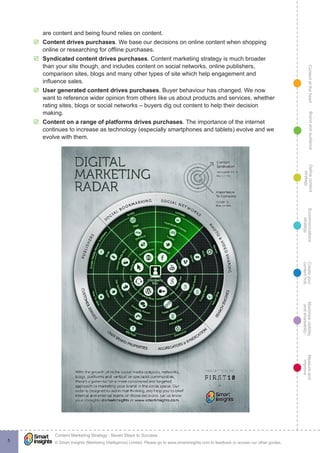
Our Digital Marketing Radar shows why content marketing is so important today. The Radar
shows all the different types of site we use that are driven by content. Increasingly, it’s
content that’s the currency to give you visibility. Content marketing covers all of these.
For us, these are the reasons why content marketing is central to success online:
þþ Share-worthy content creates awareness for your brand. If your content engages
readers they will share it via their social accounts, email or word-of-mouth as a
recommendation. Everyone is an influencer today!
þþ Content drives results from search engine optimisation (SEO). Google has made this
important since 1998 when it launched. Content became, and still is, king since websites
ContentattheheartMaximisevisibility
andshareabilty
Measureand
improve
Createyour
contenthub
Ecommunications
strategy
Definecontent
strategy
Brandandaudience
© Smart Insights (Marketing Intelligence) Limited. Please go to www.smartinsights.com to feedback or access our other guides.
Content Marketing Strategy : Seven Steps to Success
!
5
are content and being found relies on content.
þþ Content drives purchases. We base our decisions on online content when shopping
online or researching for offline purchases.
þþ Syndicated content drives purchases. Content marketing strategy is much broader
than your site though, and includes content on social networks, online publishers,
comparison sites, blogs and many other types of site which help engagement and
influence sales.
þþ User generated content drives purchases. Buyer behaviour has changed. We now
want to reference wider opinion from others like us about products and services, whether
rating sites, blogs or social networks – buyers dig out content to help their decision
making.
þþ Content on a range of platforms drives purchases. The importance of the internet
continues to increase as technology (especially smartphones and tablets) evolve and we
evolve with them.
ContentattheheartMaximisevisibility
andshareabilty
Measureand
improve
Createyour
contenthub
Ecommunications
strategy
Definecontent
strategy
Brandandaudience
© Smart Insights (Marketing Intelligence) Limited. Please go to www.smartinsights.com to feedback or access our other guides.
Content Marketing Strategy : Seven Steps to Success
!
6
Content marketing supports customer management
Another way of showing colleagues the power of content marketing is how it supports
marketing objectives across all the stages of the customer lifecycle as defined by the RACE
framework which we have developed to help create integrated digital plans.
þþ Stage 1 Reach involves building awareness of a brand, its products and services on
other sites and in offline media, and building traffic by driving visits to web presences.
þþ Stage 2 Act stands for interact. Your aim is to achieve the initial engagement of your
visitors when they enter your site. Key performance indicators (KPIs) include bounce
rates, time spent on site and page views. High page views, long dwell times and low
bounce rates are all signs that your audience is engaged.
þþ Stage 3 Convert. Achieve conversion to marketing goals such as new fans, leads or
sales on web presences and offline.
þþ Stage 4 Engage. Build customer relationships through time to achieve retention goals.
Google is less satisfactory in this area since it doesn’t have suitable metrics and you may
have to derive these through your sales systems.
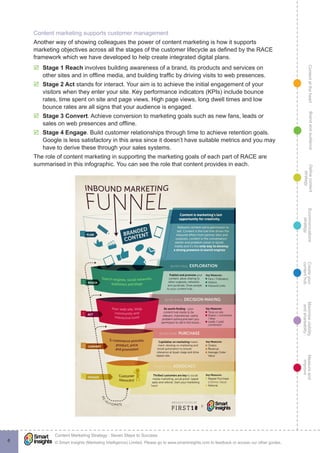
The role of content marketing in supporting the marketing goals of each part of RACE are
summarised in this infographic. You can see the role that content provides in each.
ContentattheheartMaximisevisibility
andshareabilty
Measureand
improve
Createyour
contenthub
Ecommunications
strategy
Definecontent
strategy
Brandandaudience
© Smart Insights (Marketing Intelligence) Limited. Please go to www.smartinsights.com to feedback or access our other guides.
Content Marketing Strategy : Seven Steps to Success
!
7
Content marketing supports and integrates all the core digital media channels
Another way to explain the power of content marketing is simply through the digital
channels it supports. For each channel we link to our hub page where you can gain a quick
explanation or download a detailed 7 Step Guide.
þþ 1. Natural search. Content on your own site is core to supporting SEO, one of the key
sources of new visitors to a site. The relevance of keywords and quality of content is what
attracts visitors and perhaps more importantly links from other sites which help you site
outrank competitors.
þþ 2. Paid search (e.g. AdWords). It’s also important to give relevant content on paid search
landing pages to gain a better quality score in Google and to gain conversions. Both are
important to get return on investment (ROI) from AdWords.
þþ 3. Online PR. The stories you share via other sites are ultimately content and increasingly
link back to content on a site, for example in a social media newsroom.
þþ 4. Social media marketing. The status updates you share through social networks and
other sites are micro-content too and typically will link back to content on your site or
blog. So they should be part of a unified content marketing strategy to engage different
audiences.
þþ 5. Online advertising. Display ad formats like banners and skyscrapers need to engage
and link to deeper content on site like the other channels in this list. There are also great
opportunities to engage through retargeting or AdWords remarketing.
þþ 6. Email marketing. Email marketing is perhaps the Grandaddy, the most established
of all these digital communications techniques. Enewsletters have always required
quality content to engage and this is even more true today with inbox competition and
competition from the social status updates. The content and offers and emails need to be
integrated with all these other channels.
þþ 7. Mobile marketing. Mobile marketing has new options for delivering communications
via each of the channels above. Since smartphone or tablet platforms are often used
in different contexts this implies new types and formats of content may be needed to
engage mobile users.
Strategy Recommendation 1  Show the power of content marketing by relating to other
digital media channels
Demonstrate to colleagues how content marketing supports and integrates many core
digital marketing activities enabling it to be managed as a whole.
To complete the picture of content marketing you are painting for colleagues, we recommend
you stress the importance of creating a content marketing hub and a rigorous editorial
process to create a sustained stream of engaging quality content.
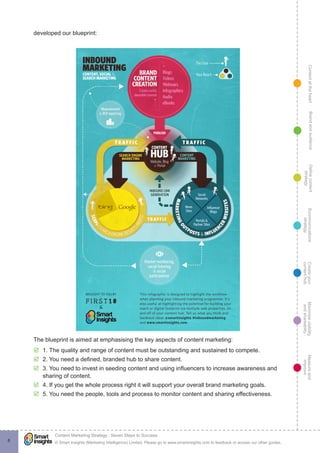
What is it?  Content marketing hub
A blueprint for content or inbound marketing, this shows how content, social and search
marketing can be integrated through the creation of a content hub such as a blog or online
customer magazine with a planned editorial calendar and resourcing.
View and share introduction post: The content marketing hub: A blueprint for content
marketing
We will talk a lot about how to create and manage content hubs, plus examples of them in
this guide, in particular in Step 5 Create your content hub. To help introduce the concept we
ContentattheheartMaximisevisibility
andshareabilty
Measureand
improve
Createyour
contenthub
Ecommunications
strategy
Definecontent
strategy
Brandandaudience
© Smart Insights (Marketing Intelligence) Limited. Please go to www.smartinsights.com to feedback or access our other guides.
Content Marketing Strategy : Seven Steps to Success
!
8
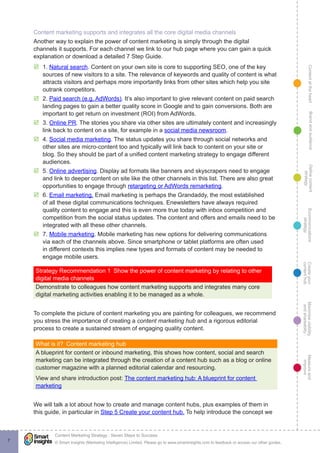
developed our blueprint:
The blueprint is aimed at emphasising the key aspects of content marketing:
þþ 1. The quality and range of content must be outstanding and sustained to compete.
þþ 2. You need a defined, branded hub to share content.
þþ 3. You need to invest in seeding content and using influencers to increase awareness and
sharing of content.
þþ 4. If you get the whole process right it will support your overall brand marketing goals.
þþ 5. You need the people, tools and process to monitor content and sharing effectiveness.
ContentattheheartMaximisevisibility
andshareabilty
Measureand
improve
Createyour
contenthub
Ecommunications
strategy
Definecontent
strategy
Brandandaudience
© Smart Insights (Marketing Intelligence) Limited. Please go to www.smartinsights.com to feedback or access our other guides.
Content Marketing Strategy : Seven Steps to Success
!
9
About this guide
Who is this guide for?
This guide is for anyone who is responsible for the quality of content for their organisation
or their clients. You will naturally be interested in making content work harder for you to
compete more effectively when gaining new customers or deepening relationships with
your online audience. You will want to approach content marketing in a less ad hoc, more
structured way. To have a strategy in fact! We want to help you advance how you personally,
or your company or clients approach content marketing. A great way of reviewing your
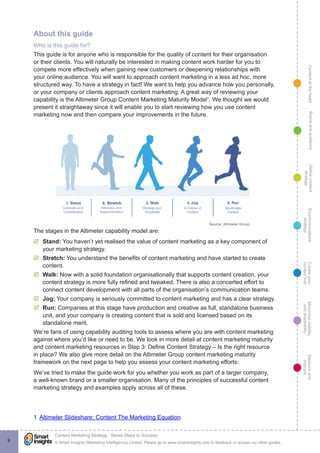
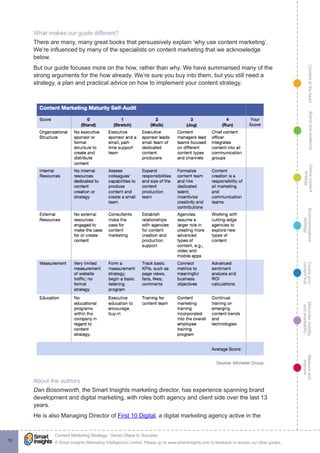
capability is the Altimeter Group Content Marketing Maturity Model1
. We thought we would
present it straightaway since it will enable you to start reviewing how you use content
marketing now and then compare your improvements in the future.
The stages in the Altimeter capability model are:
þþ Stand: You haven’t yet realised the value of content marketing as a key component of
your marketing strategy.
þþ Stretch: You understand the benefits of content marketing and have started to create
content.
þþ Walk: Now with a solid foundation organisationally that supports content creation, your
content strategy is more fully refined and tweaked. There is also a concerted effort to
connect content development with all parts of the organisation’s communication teams.
þþ Jog: Your company is seriously committed to content marketing and has a clear strategy.
þþ Run: Companies at this stage have production and creative as full, standalone business
unit, and your company is creating content that is sold and licensed based on its
standalone merit.
We’re fans of using capability auditing tools to assess where you are with content marketing
against where you’d like or need to be. We look in more detail at content marketing maturity
and content marketing resources in Step 3: Define Content Strategy – Is the right resource
in place? We also give more detail on the Altimeter Group content marketing maturity
framework on the next page to help you assess your content marketing efforts:
We’ve tried to make the guide work for you whether you work as part of a larger company,
a well-known brand or a smaller organisation. Many of the principles of successful content
marketing strategy and examples apply across all of these.
1  Altimeter Slideshare: Content The Marketing Equation
ContentattheheartMaximisevisibility
andshareabilty
Measureand
improve
Createyour
contenthub
Ecommunications
strategy
Definecontent
strategy
Brandandaudience
© Smart Insights (Marketing Intelligence) Limited. Please go to www.smartinsights.com to feedback or access our other guides.
Content Marketing Strategy : Seven Steps to Success
!
10
What makes our guide different?
There are many, many great books that persuasively explain ‘why use content marketing’.
We’re influenced by many of the specialists on content marketing that we acknowledge
below. 

But our guide focuses more on the how, rather than why. We have summarised many of the
strong arguments for the how already. We’re sure you buy into them, but you still need a
strategy, a plan and practical advice on how to implement your content strategy.
About the authors
Dan Bosomworth, the Smart Insights marketing director, has experience spanning brand
development and digital marketing, with roles both agency and client side over the last 13
years.
He is also Managing Director of First 10 Digital, a digital marketing agency active in the
ContentattheheartMaximisevisibility
andshareabilty
Measureand
improve
Createyour
contenthub
Ecommunications
strategy
Definecontent
strategy
Brandandaudience
© Smart Insights (Marketing Intelligence) Limited. Please go to www.smartinsights.com to feedback or access our other guides.
Content Marketing Strategy : Seven Steps to Success
!
11
creation and marketing of Smart Insights.
Stephen Bateman is director and co-founder of Wise Up Media (part of GreenWise Business)
and Concentric Dots (www.concentricdots.co.uk), both specialist content marketing agencies,
and the co-founder and MD of iGlimpse, a leading educational mobile apps publisher.
His strengths are in content planning, content creation and digital delivery, with specialist
knowledge of the sustainable business sector. He offers expert training and hard-working
actionable content marketing advice and social media training to ambitious businesses. He’s
a scholar of the Chartered Institute of Marketing: DipM MCIM. You can connect with Stephen
through any of these social networks Twitter LinkedIn Google using his profile / post page on
Smart Insights.
Acknowledgments – who inspires us?
This guide is our advice rooted and inspired from a number of influential and leading experts
on content marketing as well as our own experience. We’ve listed the best, if you’re looking
for alternative perspectives. We’re sure you know many of these already, but if not check
them out.
þþ Joe Pulizzi (www.junta42.com), author of ‘Get Content, Get Customers’.
þþ David Meerman-Scott (www.davidmeermanscott.com), author of ‘The New Rules of
Marketing & PR’.
þþ Ann Handley (www.marketingprofs.com), a co-author of ‘Content Rules’.
þþ Lee Odden of the TopRankBlog.com.
þþ Jay Baer (www.ConvinceandConvert.com), author of ‘The Now Revolution’.
þþ Seth Godin (www.sethgodin.com), author of way too many books to mention!
þþ Kristina Halvorson (www.contentstrategy.com), author of ‘Content Strategy for the Web’.
þþ Brian Solis (www.briansolis.com), author of ‘Engage’.
þþ Chris Brogan (www.chrisbrogan.com), author of ‘Trust Agents’.
þþ Michael Seltzner, author of ‘Launch’ and founder of the Social Media Examiner website
(www.socialmediaexaminer.com).
About the 2013 updates
To help previous readers of this guide, the main updates include:
þþ This Introduction. Added the Altimeter content marketing capability framework to help you
review your progress.
þþ Introduction to include the infographics we have developed to help explain content
marketing principles
þþ Step 1. Overcoming barriers to change using the content marketing mission statement.
þþ Step 4. Content marketing matrix added - a core tool we have developed to brainstorm
and select relevant content.
þþ Step 4. The concept of Primary and Nuclear content to show how you need regular and
exceptional, sharable content.
þþ Step 4. Express content planner worksheet. Devising relevant content to support persona
buying decisions using Roger C. Parker’s Express Content Planner.
þþ Step 7. Jay Baer’s 4 content marketing metrics referenced to the Smart Insights RACE
framework.
This guide focuses on strategy rather than implementation, remember we also have a new
2013 practical guide to managing content marketing by James Carson.
ContentattheheartMaximisevisibility
andshareabilty
Measureand
improve
Createyour
contenthub
Ecommunications
strategy
Definecontent
strategy
Brandandaudience
© Smart Insights (Marketing Intelligence) Limited. Please go to www.smartinsights.com to feedback or access our other guides.
Content Marketing Strategy : Seven Steps to Success
!
12
1
Step 1
Put content at the heart of your future marketing di-
rection
rr Q. Is content a key part of our future marketing strategy?
‘Content is the only marketing left’, suggests Seth Godin. We think that statement has
never been truer, if marketing is about respecting and teaching your customers to believe
in you over other brands. I’d say it is, these days. Seth has argued for years that this is
the basis of new marketing, a wave of other thought leaders have backed this too: David
Meerman-Scott and Gary Vaynerchuck being just two of them. Someone becomes a fan,
follower, lead, customer and potential advocate for your brand because you help them feel
better about their world, it makes more sense and they are able to make decisions about
something.
To excel in content marketing will need a step change in thinking in most organisations. If
you’re reading this guide and you understand the basic and irreversible trends driving a
content-based approach to marketing, you’re most likely going to need to be a change agent
too. This means that you’re going to need to develop the content mindset first, before your
organisation can. It’s most likely a big re-think, changing from broadcaster mindset to an
influencer and publisher hybrid is not easy, but nonetheless essential.
So, in this step of our guide, we look at how you can help be a change agent by painting a
picture of how content marketing will contribute to the future of your business. This starts with
defining a vision for the future and then specifying more specific goals which will set goals
and targets to improve your marketing performance. We’ll also show you how to audit your
content.
Strategy Recommendation 1  Create and communicate a vision for content marketing
A focus on content marketing requires a change of direction in many organisations. To
help lead this change and show the future, you need to communicate it to colleagues who
may not get it.
Recommended approaches to help increase buy-in to content marketing
rr Q. Have our approaches to overcome barriers to internal change been reviewed?
For most companies, a change towards content marketing is a big ask. It often needs a
fundamental shift in the marketing communications process. It’s going to require some
level of a cultural shift within the organisation that can be daunting, especially for larger
organisations where getting stakeholders around a table is not so easy. So at an early stage
you need to find out, what are the main blocks to change, you whether you can overcome
them.
The content marketing mission statement
In almost every one of his keynote presentations, Joe Puliizi covers the content marketing
mission statement, because content marketing is not about what you sell but what you stand
for and ‘the why must come before the what’. His other tips include:
rr Posting it: Include the mission statement where it can be found easily.
rr Spread it: Make sure everyone involved in your content marketing process has the
ContentattheheartMaximisevisibility
andshareabilty
Measureand
improve
Createyour
contenthub
Ecommunications
strategy
Definecontent
strategy
Brandandaudience
© Smart Insights (Marketing Intelligence) Limited. Please go to www.smartinsights.com to feedback or access our other guides.
Content Marketing Strategy : Seven Steps to Success
!
13
1
mission statement. Encourage them to print it out and pin it up on the wall.
rr The litmus test: Use the mission statement to decide what content you will and won’t
create.
Often, a bad judgment in content creation can be fixed by running it by the mission
statement.
Here are some problems to watch for:
ýý ‘We can’t do that – it’s not what we do’: This is the feeling of fear, or vertigo that many
organisations get when they move from the firm ground of the tried and tested (I use that
word loosely) to what Seth Godin once called the anti-gravity that comes from leaping
into change. It’s strange because such companies are not really blowing anyone away
with the buyer experience they create, yet it feels safe to be like everybody else and to do
‘what we’ve always done’ and not move into unproven or uncharted territories.
ýý ‘We’ve always done it like this’: With current employees or teams, suppliers, partners or
vendor relationships, it can be hard to deviate from the well-worn marketing path, carved
by years of doing things the old way. It’s like turning a supertanker, even with the best will
in the world. Often, in this instance there isn’t someone whose job it is to ‘own’ content
internally, let alone use it for marketing, so it’s not on anybody’s agenda. It is also a
compounded issue because measuring what content marketing is and is not working has
to be done first, to create the stage for a new approach.
ýý ‘What we do now works just fine...’: This is the worst hurdle to overcome and more often
sits with both of the above. It’s ignorant to the volume of change in marketing.
We think these strategies from the Content Marketing Institute2
are also useful guidelines to
base your management of change upon:
1.	 Respect the current culture. Leadership guru and pioneer Dr Warren Bennis talks about
‘Contextual Intelligence’, highlighting that to truly implement change, ‘you’ve got to
know the territory’. Marketers acting as change agents need to make the time and effort
to understand the history and traditions that have created the organisation’s culture.
Marketers should consider inventing new content and values that support new content
marketing programmes in the context of what was or is.
2.	 Get buy-in. In almost all cases, culture shift starts with a leader and their vision. The
CMI’s B2B content marketing research found that one of the biggest differentiators
between effective and less effective content marketing is senior management buy-in: 23
percent of the least effective marketers cite this as a challenge whereas this is an issue
for only seven percent of effective marketers. You’ll need to offer strong leadership with
the ability to tap into all levels of the organisation and enable collaboration.
3.	 Empower change. Creating a culture that supports content marketing is critical in that
content creation and online conversations are viewed as a core competency, at least
within marketing. That process might look something like this:
þþ Team managers or supervisors give each of their team members objectives to meet
within a shared 90-day time frame.
þþ Each team member develops their own unique plan and processes that will allow them to
achieve those outcomes.
þþ Each plan is required to include a list of resources and support that the supervisor will
provide, to help the report meet their objectives.
þþ Manager, supervisor and report are held mutually accountable for delivering on their
2  CMI: Content marketing culture.
ContentattheheartMaximisevisibility
andshareabilty
Measureand
improve
Createyour
contenthub
Ecommunications
strategy
Definecontent
strategy
Brandandaudience
© Smart Insights (Marketing Intelligence) Limited. Please go to www.smartinsights.com to feedback or access our other guides.
Content Marketing Strategy : Seven Steps to Success
!
14
1
commitments, weekly productive conversations help maintain momentum going toward
the objectives.
The whole team needs to appreciate that what got us here, will not get us there. Once this
happens then the grounds for change are in place – everybody is facing in the same direction
and wondering ‘what, how and when?’ Not ‘if or why?’
Making the business case
rr Q. Has the business case for change been defined?
Once you have thought through some of the barriers to implementing a content strategy, then
you’re in a position to make the business case.
Strategy Recommendation 2	Demonstrate the power of content marketing to convince
colleagues
To help buy-in, we recommend three main techniques: showing changes in consumer
behaviour, improvements to competitor and internal results.
We’ll look at the business case for content marketing from two points of view. Use which
work best when talking to your budget holders. First we’ll look at the soft reasons and then a
more quantitative approach.
Best Practice Tip 1  Combine the soft arguments for content marketing with the hard
measures
The soft arguments can win hearts, but to win minds we’ll show how to develop quantitative
arguments.
Using the soft arguments to make the business case for more investment in content
marketing, you need to clearly show the linkage to other channels like social media
marketing and SEO plus conversion, which are better known as drivers of performance.
These are the arguments we use to show why quality content is crucial:
Reason 1. Little content = little conversation
We know that developing a marketing plan is about firstly understanding your audience’s
unmet needs. Whether customers, potential customers or influencers. Content allows you
to offer solutions to those challenges in a multitude of places. If you cannot contribute to the
conversation there is little chance of becoming a trusted source of information, let alone be
visible in search engine listings or leverage social networks like Facebook.
Reason 2. Marketing is publishing
It’s well documented. If we’ve learned anything over the past few years, even from a
search optimisation perspective, it’s that the majority of new marketing efforts rely on an
understanding of publishing information to your audiences. So, marketers need to think more
like a publisher, and less like sales and marketing folk. We need to give people content that
people want to read, not what we want to say. More about ‘inspire me’, less about features
and benefits. There’s another pay-off here too – you differentiate in the process, your
competitors are most likely banging the sales drum and turning people off.
Reason 3. You need clear goals for social media activity and SEO
Being ‘active’ in social media is not a marketing goal, just like ‘more natural search traffic’
can lead to distraction about what matters – getting the right traffic – thinking about the types
ContentattheheartMaximisevisibility
andshareabilty
Measureand
improve
Createyour
contenthub
Ecommunications
strategy
Definecontent
strategy
Brandandaudience
© Smart Insights (Marketing Intelligence) Limited. Please go to www.smartinsights.com to feedback or access our other guides.
Content Marketing Strategy : Seven Steps to Success
!
15
1
of people you want to communicate with. This is why you need a considered and integrated
content strategy. Questions you must answer include: What is the purpose of your content
(and social media marketing)? What are your key messages vs. what do I (the customer)
want to hear? What content assets do you have and what do you need to originate or gather
from third parties?
All the social media participation in the world won’t address these questions. When the
questions are answered you can consider the Smart Insights digital radar to figure out where
best to publish and share your content to power link-building and drive conversation in the
right places.
Reason 4. Content is currency
Fascinating, useful, educational and entertaining content is shared through social media.
It’s the currency, the firewood – whatever you want to call it. So many of us have rushed
into social media only to wonder why our Facebook Pages have no comments, there are no
‘Likes’, no blog interactions, and why we don’t have the right kind of Twitter followers. The
same applies to SEO – if content is not relevant it’s not likely to contain the right keywords,
therefore you’re not going to rank for the search terms that you really need to.
Reason 5. Social media = I hear you + I’m listening to you + I understand
Brian Solis said this. He also said that you can replace ‘social media’ with ‘publishing’ or
‘content strategy’ in that same equation. Be clear that you are producing this content, not
only to be shared by your customers and prospects, but to accomplish tangible objectives
that can be measured back to sales.
Online interactions have to be fuelled by something. It’s about creating valuable, relevant and
compelling content on a consistent basis in order that your brand is not only well placed to
be trusted (or simply just ‘Liked’) but even just to be visible, on a customer’s Facebook News
Feed or an influencer’s blog, for example.
Social media and search results form the cart, the functional tool(s) we use to share our story
and interact. Consider content as the horse, doing all upfront work, in order that we get to join
the ride.
Some of the approaches that we have found effective to highlight the business opportunity
and/or the threat are, in order of effectiveness:
rr 1. Demonstrating success through a pilot or existing activity. This shows real-world
results specifically for your company so tends to work best, if you have demonstrable
success.
You may already have examples of success across different areas:
þþ Sales increases through SEO.
þþ New visitors acquired through social media activity.
þþ Conversion increases through reviews and ratings.
þþ Increased existing customer engagement and sales through content shared through
email marketing or social media.
rr 2. Showing how competitors have changed and what they have achieved. Successful
competitor activity can strike fear into colleagues or show the opportunity. Find case
studies or presentations produced by competitors or benchmark their performance
against yours in terms of visits, engagement or sales.
rr 3. Model improved results through a cost-benefit. If you can create a model to show how
you will increase sales through improvements to visits or conversion this can work well if
ContentattheheartMaximisevisibility
andshareabilty
Measureand
improve
Createyour
contenthub
Ecommunications
strategy
Definecontent
strategy
Brandandaudience
© Smart Insights (Marketing Intelligence) Limited. Please go to www.smartinsights.com to feedback or access our other guides.
Content Marketing Strategy : Seven Steps to Success
!
16
1
you can substantiate it.
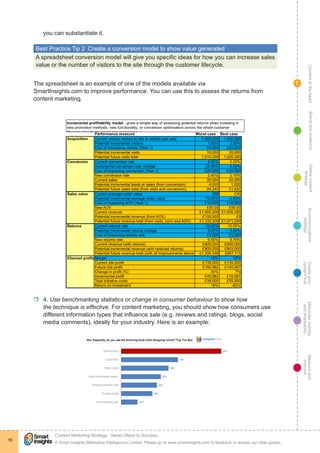
Best Practice Tip 2  Create a conversion model to show value generated
A spreadsheet conversion model will give you specific ideas for how you can increase sales
value or the number of visitors to the site through the customer lifecycle.
The spreadsheet is an example of one of the models available via
SmartInsights.com to improve performance. You can use this to assess the returns from
content marketing.
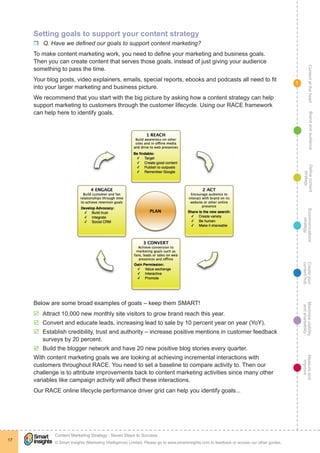
rr 4. Use benchmarking statistics or change in consumer behaviour to show how
the technique is effective. For content marketing, you should show how consumers use
different information types that influence sale (e.g. reviews and ratings, blogs, social
media comments), ideally for your industry. Here is an example:
ContentattheheartMaximisevisibility
andshareabilty
Measureand
improve
Createyour
contenthub
Ecommunications
strategy
Definecontent
strategy
Brandandaudience
© Smart Insights (Marketing Intelligence) Limited. Please go to www.smartinsights.com to feedback or access our other guides.
Content Marketing Strategy : Seven Steps to Success
!
17
1
Setting goals to support your content strategy
rr Q. Have we defined our goals to support content marketing?
To make content marketing work, you need to define your marketing and business goals.
Then you can create content that serves those goals, instead of just giving your audience
something to pass the time.
Your blog posts, video explainers, emails, special reports, ebooks and podcasts all need to fit
into your larger marketing and business picture.
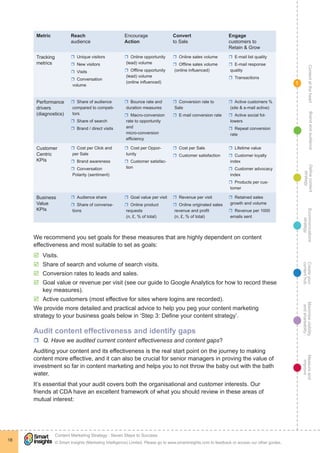
We recommend that you start with the big picture by asking how a content strategy can help
support marketing to customers through the customer lifecycle. Using our RACE framework
can help here to identify goals.
Below are some broad examples of goals – keep them SMART!
þþ Attract 10,000 new monthly site visitors to grow brand reach this year.
þþ Convert and educate leads, increasing lead to sale by 10 percent year on year (YoY).
þþ Establish credibility, trust and authority – increase positive mentions in customer feedback
surveys by 20 percent.
þþ Build the blogger network and have 20 new positive blog stories every quarter.
With content marketing goals we are looking at achieving incremental interactions with
customers throughout RACE. You need to set a baseline to compare activity to. Then our
challenge is to attribute improvements back to content marketing activities since many other
variables like campaign activity will affect these interactions.
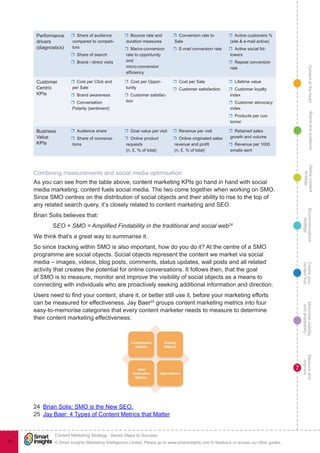
Our RACE online lifecycle performance driver grid can help you identify goals...
ContentattheheartMaximisevisibility
andshareabilty
Measureand
improve
Createyour
contenthub
Ecommunications
strategy
Definecontent
strategy
Brandandaudience
© Smart Insights (Marketing Intelligence) Limited. Please go to www.smartinsights.com to feedback or access our other guides.
Content Marketing Strategy : Seven Steps to Success
!
18
1
Metric Reach
audience
Encourage
Action
Convert
to Sale
Engage
customers to
Retain & Grow
Tracking
metrics
rr Unique visitors
rr New visitors
rr Visits
rr Conversation
volume
rr Online opportunity
(lead) volume
rr Offline opportunity
(lead) volume
(online influenced)
rr Online sales volume
rr Offline sales volume
(online influenced)
rr E-mail list quality
rr E-mail response
quality
rr Transactions
Performance
drivers
(diagnostics)
rr Share of audience
compared to competi-
tors
rr Share of search
rr Brand / direct visits
rr Bounce rate and
duration measures
rr Macro-conversion
rate to opportunity
and
micro-conversion
efficiency
rr Conversion rate to
Sale
rr E-mail conversion rate
rr Active customers %
(site & e-mail active)
rr Active social fol-
lowers
rr Repeat conversion
rate
Customer
Centric
KPIs
rr Cost per Click and
per Sale
rr Brand awareness
rr Conversation
Polarity (sentiment)
rr Cost per Oppor-
tunity
rr Customer satisfac-
tion
rr Cost per Sale
rr Customer satisfaction
rr Lifetime value
rr Customer loyalty
index
rr Customer advocacy
index
rr Products per cus-
tomer
Business
Value
KPIs
rr Audience share
rr Share of conversa-
tions
rr Goal value per visit
rr Online product
requests
(n, £, % of total)
rr Revenue per visit
rr Online originated sales
revenue and profit
(n, £, % of total)
rr Retained sales
growth and volume
rr Revenue per 1000
emails sent
We recommend you set goals for these measures that are highly dependent on content
effectiveness and most suitable to set as goals:
þþ Visits.
þþ Share of search and volume of search visits.
þþ Conversion rates to leads and sales.
þþ Goal value or revenue per visit (see our guide to Google Analytics for how to record these
key measures).
þþ Active customers (most effective for sites where logins are recorded).
We provide more detailed and practical advice to help you peg your content marketing
strategy to your business goals below in ‘Step 3: Define your content strategy’.
Audit content effectiveness and identify gaps
rr Q. Have we audited current content effectiveness and content gaps?
Auditing your content and its effectiveness is the real start point on the journey to making
content more effective, and it can also be crucial for senior managers in proving the value of
investment so far in content marketing and helps you to not throw the baby out with the bath
water.
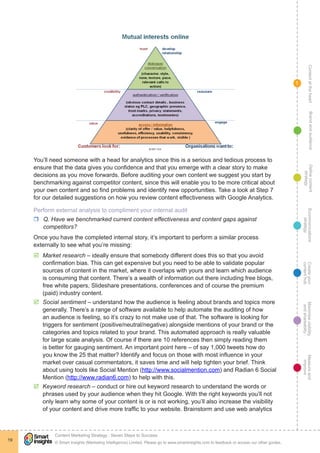
It’s essential that your audit covers both the organisational and customer interests. Our
friends at CDA have an excellent framework of what you should review in these areas of
mutual interest:
ContentattheheartMaximisevisibility
andshareabilty
Measureand
improve
Createyour
contenthub
Ecommunications
strategy
Definecontent
strategy
Brandandaudience
© Smart Insights (Marketing Intelligence) Limited. Please go to www.smartinsights.com to feedback or access our other guides.
Content Marketing Strategy : Seven Steps to Success
!
19
1
You’ll need someone with a head for analytics since this is a serious and tedious process to
ensure that the data gives you confidence and that you emerge with a clear story to make
decisions as you move forwards. Before auditing your own content we suggest you start by
benchmarking against competitor content, since this will enable you to be more critical about
your own content and so find problems and identify new opportunities. Take a look at Step 7
for our detailed suggestions on how you review content effectiveness with Google Analytics.
Perform external analysis to compliment your internal audit
rr Q. Have we benchmarked current content effectiveness and content gaps against
competitors?
Once you have the completed internal story, it’s important to perform a similar process
externally to see what you’re missing:
þþ Market research – ideally ensure that somebody different does this so that you avoid
confirmation bias. This can get expensive but you need to be able to validate popular
sources of content in the market, where it overlaps with yours and learn which audience
is consuming that content. There’s a wealth of information out there including free blogs,
free white papers, Slideshare presentations, conferences and of course the premium
(paid) industry content.
þþ Social sentiment – understand how the audience is feeling about brands and topics more
generally. There’s a range of software available to help automate the auditing of how
an audience is feeling, so it’s crazy to not make use of that. The software is looking for
triggers for sentiment (positive/neutral/negative) alongside mentions of your brand or the
categories and topics related to your brand. This automated approach is really valuable
for large scale analysis. Of course if there are 10 references then simply reading them
is better for gauging sentiment. An important point here – of say 1,000 tweets how do
you know the 25 that matter? Identify and focus on those with most influence in your
market over casual commentators, it saves time and will help tighten your brief. Think
about using tools like Social Mention (http://www.socialmention.com) and Radian 6 Social
Mention (http://www.radian6.com) to help with this.
þþ Keyword research – conduct or hire out keyword research to understand the words or
phrases used by your audience when they hit Google. With the right keywords you’ll not
only learn why some of your content is or is not working, you’ll also increase the visibility
of your content and drive more traffic to your website. Brainstorm and use web analytics
ContentattheheartMaximisevisibility
andshareabilty
Measureand
improve
Createyour
contenthub
Ecommunications
strategy
Definecontent
strategy
Brandandaudience
© Smart Insights (Marketing Intelligence) Limited. Please go to www.smartinsights.com to feedback or access our other guides.
Content Marketing Strategy : Seven Steps to Success
!
20
1
tools to identify valuable keywords sending traffic already to you or known others.
Best Practice Tip 3  Use top keyphrases to identify your content marketing competitors
and opportunities
Once you have found the highest volume keyphrases in your market using the Google
Keyword Tool, check out the competition and then identify the gaps – which are the
niches you can compete in?
Once you have the list bring in to discovery tools to learn what’s most popular:
þþ Google (https://adwords.google.com/select/KeywordToolExternal)
þþ Google Trends (http://www.google.com/trends)
þþ UberSuggest (http://www.ubersuggest.com)
þþ SEMRush (http://www.semrush.com)
þþ Wordtracker (http://www.wordtracker.com)
þþ WordStream (http://www.wordstream.com)
þþ Keyword Discovery (http://www.keyworddiscovery.com)
We recommend the Google Keyword Tool as your starting point. Here’s an example of how
you could use it to gain ideas. When you use this tool make sure you tick the ‘Exact’ match
type to get a more realistic idea (by default it gives a broad match which overestimates the
number of searches). It’s best to start broad, with your category, here ‘seo’.
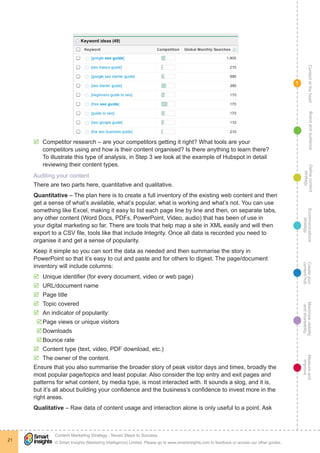
As an example of the thinking that the keyword tool can prompt, notice that people are
looking for ‘seo service’, so maybe a guide or blog post could be titled ‘Choosing an SEO
service’ rather than ‘Choosing an SEO company’. Of course it will be hard to compete on
this term, but when people browsing the web see your guide mentioned in social media or
on other sites it will resonate better with them. Also notice the use of qualifiers like ‘tips and
tools’.
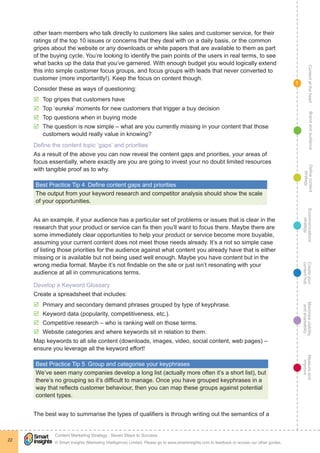
Once you have some ideas at this top-level, get more specific. If we’re writing a guide to
SEO, it’s clear from the keywords that people are looking for a basic guide (although here the
‘starter guide’ is a specific guide from Google – we recommend it).
ContentattheheartMaximisevisibility
andshareabilty
Measureand
improve
Createyour
contenthub
Ecommunications
strategy
Definecontent
strategy
Brandandaudience
© Smart Insights (Marketing Intelligence) Limited. Please go to www.smartinsights.com to feedback or access our other guides.
Content Marketing Strategy : Seven Steps to Success
!
21
1
þþ Competitor research – are your competitors getting it right? What tools are your
competitors using and how is their content organised? Is there anything to learn there?
To illustrate this type of analysis, in Step 3 we look at the example of Hubspot in detail
reviewing their content types.
Auditing your content
There are two parts here, quantitative and qualitative.
Quantitative – The plan here is to create a full inventory of the existing web content and then
get a sense of what’s available, what’s popular, what is working and what’s not. You can use
something like Excel, making it easy to list each page line by line and then, on separate tabs,
any other content (Word Docs, PDFs, PowerPoint, Video, audio) that has been of use in
your digital marketing so far. There are tools that help map a site in XML easily and will then
export to a CSV file, tools like that include Integrity. Once all data is recorded you need to
organise it and get a sense of popularity.
Keep it simple so you can sort the data as needed and then summarise the story in
PowerPoint so that it’s easy to cut and paste and for others to digest. The page/document
inventory will include columns:
þþ Unique identifier (for every document, video or web page)
þþ URL/document name
þþ Page title
þþ Topic covered
þþ An indicator of popularity:
þþPage views or unique visitors
þþDownloads
þþBounce rate
þþ Content type (text, video, PDF download, etc.)
þþ The owner of the content.
Ensure that you also summarise the broader story of peak visitor days and times, broadly the
most popular page/topics and least popular. Also consider the top entry and exit pages and
patterns for what content, by media type, is most interacted with. It sounds a slog, and it is,
but it’s all about building your confidence and the business’s confidence to invest more in the
right areas.
Qualitative – Raw data of content usage and interaction alone is only useful to a point. Ask
ContentattheheartMaximisevisibility
andshareabilty
Measureand
improve
Createyour
contenthub
Ecommunications
strategy
Definecontent
strategy
Brandandaudience
© Smart Insights (Marketing Intelligence) Limited. Please go to www.smartinsights.com to feedback or access our other guides.
Content Marketing Strategy : Seven Steps to Success
!
22
1
other team members who talk directly to customers like sales and customer service, for their
ratings of the top 10 issues or concerns that they deal with on a daily basis, or the common
gripes about the website or any downloads or white papers that are available to them as part
of the buying cycle. You’re looking to identify the pain points of the users in real terms, to see
what backs up the data that you’ve garnered. With enough budget you would logically extend
this into simple customer focus groups, and focus groups with leads that never converted to
customer (more importantly!). Keep the focus on content though.
Consider these as ways of questioning:
þþ Top gripes that customers have
þþ Top ‘eureka’ moments for new customers that trigger a buy decision
þþ Top questions when in buying mode
þþ The question is now simple – what are you currently missing in your content that those
customers would really value in knowing?
Define the content topic ‘gaps’ and priorities
As a result of the above you can now reveal the content gaps and priorities, your areas of
focus essentially, where exactly are you are going to invest your no doubt limited resources
with tangible proof as to why.
Best Practice Tip 4  Define content gaps and priorities
The output from your keyword research and competitor analysis should show the scale
of your opportunities.
As an example, if your audience has a particular set of problems or issues that is clear in the
research that your product or service can fix then you’ll want to focus there. Maybe there are
some immediately clear opportunities to help your product or service become more buyable,
assuming your current content does not meet those needs already. It’s a not so simple case
of listing those priorities for the audience against what content you already have that is either
missing or is available but not being used well enough. Maybe you have content but in the
wrong media format. Maybe it’s not findable on the site or just isn’t resonating with your
audience at all in communications terms.
Develop a Keyword Glossary
Create a spreadsheet that includes:
þþ Primary and secondary demand phrases grouped by type of keyphrase.
þþ Keyword data (popularity, competitiveness, etc.).
þþ Competitive research – who is ranking well on those terms.
þþ Website categories and where keywords sit in relation to them.
Map keywords to all site content (downloads, images, video, social content, web pages) –
ensure you leverage all the keyword effort!
Best Practice Tip 5  Group and categorise your keyphrases
We’ve seen many companies develop a long list (actually more often it’s a short list), but
there’s no grouping so it’s difficult to manage. Once you have grouped keyphrases in a
way that reflects customer behaviour, then you can map these groups against potential
content types.
The best way to summarise the types of qualifiers is through writing out the semantics of a
ContentattheheartMaximisevisibility
andshareabilty
Measureand
improve
Createyour
contenthub
Ecommunications
strategy
Definecontent
strategy
Brandandaudience
© Smart Insights (Marketing Intelligence) Limited. Please go to www.smartinsights.com to feedback or access our other guides.
Content Marketing Strategy : Seven Steps to Success
!
23
1
sentence like this:
<qualifier> + <core term> + <post modifier>
Common qualifiers for content marketing are:
þþ How to
þþ Guide to
þþ Tips
Common post-modifiers are:
þþ Ebook
þþ Download
þþ Calculator
Good luck with trying this approach for your content!
ContentattheheartMaximisevisibility
andshareabilty
Measureand
improve
Createyour
contenthub
Ecommunications
strategy
Definecontent
strategy
Brandandaudience
© Smart Insights (Marketing Intelligence) Limited. Please go to www.smartinsights.com to feedback or access our other guides.
Content Marketing Strategy : Seven Steps to Success
!
24
2
Step 2
Find the intersection between your brand and your
audience content needs
rr Q. Have we defined how content supports our brand and audience needs?
This step flows immediately on from Step 1, since with your content auditing and goal-setting
done and topic gaps identified, the next step is to identify and create the sweet spot to
engage your audience. So, in a brand communications sense, it’s heavily related to the topic
gaps that you’ve now already highlighted.
We think defining how content enhances your brand’s ability to engage different types of
audiences is one of the most important parts in this guide strategically, and probably the most
overlooked in our rush to tell an audience what we know and think, as fast and as cheaply as
possible!
Review your online brand features
rr Q. Have we assessed how key brand features could be enhanced through content
marketing?
First up, you need to know who you are as a brand in order to align your communications,
and content, with it. Naturally, you will already have considered this, but developing a content
strategy gives an opportunity to re-examine and possibly refine this.
The complex bit is that your brand is initially defined by you but is eventually defined by your
audience – since what is brand if not the bit that the consumer emotionally connects with?
That’s why this process is about finding the intersection between what your audience wants,
what they believe you’re about and what you define as your purpose.
How to integrate your brand values into your content marketing? To start, you need to answer
these questions:
rr Q. Do we have an overriding purpose for our content to deliver commercial goals through
delivering relevance for the audience?
rr Q. How do we differentiate from the bland pack by having a perspective, a position or, if
appropriate, a real attitude?
rr Q. Can we develop a personality that can shine through our online content, but really
engages irrespective of the media. This one is a key opportunity to engage your audience
to comment and share your content. A great reference is Rohit Bhargava’s book
‘Personality not included’.3
Create personas for content marketing
rr Q. Have personas been created to review content effectiveness of brand?
Experts increasingly emphasise the importance of knowing who your consumers are to
increase relevance of products. Traditionally, buyer persona profiling enables marketing and
sales functions to better know who their buyers are and maintain focus on the needs that
they must attend to.
The concept also applies well to understand customer content needs and assess the
relevance of content to different audiences.
3  Personality Not Included site.
ContentattheheartMaximisevisibility
andshareabilty
Measureand
improve
Createyour
contenthub
Ecommunications
strategy
Definecontent
strategy
Brandandaudience
© Smart Insights (Marketing Intelligence) Limited. Please go to www.smartinsights.com to feedback or access our other guides.
Content Marketing Strategy : Seven Steps to Success
!
25
2
Strategy Recommendation 3	Develop customer personas to support content marketing
Personas are valuable to support all aspects of your web and social presence including
content marketing.
We have covered the value and process of creating personas in more depth in our 7 Steps
to Improving Results from your website guide.4
In this guide, we will briefly describe how
they can be refined to relate to content strategy. This is how we define personas in the other
guide.
What is it?  Web design personas
A thumbnail summary of the characteristics, needs, motivations and environment of typical
site users.
In applying personas to content marketing, we naturally need to know who we’re creating
content for since our consumers are searching for information. We need to develop personas
that also reflect the searching and evaluation that our consumers are doing pre-purchase,
to align business goals with customer needs, guide keyword research, and encourage more
relevant and effective content plans.
In short, the personas will define:
rr Who are the audience?
rr What are the customers’ content preferences?
rr How do they discover, consume and share content?
rr What are they looking for on search engines and what are they discussing on the social
web?
rr What does this persona do on a daily basis?
rr What’s the persona’s belief or life mantra?
rr What’s this persona’s unspoken question regarding this product?
rr What does she expect from this product?
rr What information will this persona need to be persuaded to take action?
rr Why is she motivated to take this action?
rr What actions do you want this persona to take, and how will you persuade her to take
them?
A five-step process for effective persona creation
Here are some more detailed guidelines and tools to help you develop personas:
Step 1: Collate and append your market research data
Get hold of as much knowledge of the users as possible.
You will often have a lot of information about the audience. Just dig for it, reports from
marketing, call centres, etc. This is raw data only and has a limited story. Here are other
sources:
þþ Customer surveys (http://www.surveymonkey.com).
4  Conversion Optimisation 7 Steps Guide.
ContentattheheartMaximisevisibility
andshareabilty
Measureand
improve
Createyour
contenthub
Ecommunications
strategy
Definecontent
strategy
Brandandaudience
© Smart Insights (Marketing Intelligence) Limited. Please go to www.smartinsights.com to feedback or access our other guides.
Content Marketing Strategy : Seven Steps to Success
!
26
2
þþ Web analytics and conversion data (http://www.google.com/analytics).
þþ Social media listening tools (http://www.socialmention.com).
þþ Demographic information from sites such as Google Ad Planner and Compete (http://
www.compete.com).
þþ Keyword information from Google (https://adwords.google.com/select/KeywordToolExter-
nal).
þþ Google Insights for Search (http://www.google.com/insights/search) to gather intelligence,
pick up on trends, and see where your market is heading.
þþ Social Technographics Ladder (six types of social media participation) from Forrester
Research, Inc. A really useful tool to understand what kind of engagement you have, first.
þþ Social Media Profile Tool from Forrester Research, Inc.
Step 2: Cut the cake – define the personas that work for you
The most difficult task in persona creation is ‘how to cut the cake’ – coming from data to a
decision of how many persona descriptions to include. This involves more than a group of
consultants or project members just handing over some descriptions.
This process is about finding data that supports the initial patterns and at the same
time supports the persona descriptions and the scenario writing. This will help generate
engagement in the descriptions and support scenario writing e.g. what do the users value
and ignore? What is their attitude towards the brand/site/content? In what situation will they
use our content? Each persona needs to be different enough, and also have a representative
sample size to warrant your focus – after all you cannot create a persona for everyone. My
experience is that six to eight is almost always sufficient, indeed three or four may be fine.
Step 3: Constructing personas
The typical output is a summary of the needs and wants of a fictional character5
. For us,
these are five key areas to the description. You may not mention each area specifically, but
make it clear for any reader to understand based on your description.
I’ve found that the more human this is, the more value you’ll get from it. Ultimately the
organisation buy-in will be easier.
þþ Body: a photo or a description of how the person looks creates a feeling of the person as
a human being. Posture and clothing tells a lot about the person.
þþ Psyche: we all have an overall attitude towards life and our surroundings which also
influences the way we meet technology e.g. is the persona introvert or extrovert.
þþ Background: we all have a social background, education, upbringing which influences our
abilities, attitudes and understanding of the world.
þþ Emotions and attitudes towards technology including platforms such as browsers, mobile
and social media tools.
þþ Personal traits: this one is tricky, in fictional writing there is a distinction between flat
characters and rounded characters. The flat character is characterised by having only
one character trait and is difficult to engage in. The rounded character has more than one
character trait, is not predictable and is easier to engage with.
Few organisations allow for team members to be part of the writing process, more often
using external consultants or the usability department to write the descriptions. I think it’s too
important to be outsourced completely. The persona method should rather be perceived as
a process where everybody should understand how the descriptions came about and what
they can be used for. If you allow different team members to be part of the writing process
5  Smart Insights: Persona toolkit has examples and advice on creating personas
ContentattheheartMaximisevisibility
andshareabilty
Measureand
improve
Createyour
contenthub
Ecommunications
strategy
Definecontent
strategy
Brandandaudience
© Smart Insights (Marketing Intelligence) Limited. Please go to www.smartinsights.com to feedback or access our other guides.
Content Marketing Strategy : Seven Steps to Success
!
27
2
they will feel ownership for the personas they create. Personas will of course benefit from
being finalised by a single person to ensure homogeneity in writing and presentation.
Step 4: Develop scenarios
Personas are nothing in isolation. The real purpose of personas is to create scenarios from
the descriptions. The scenarios serve to describe in which situations the persona will use and
interact with our site or content. Each need or situation is the beginning of a scenario.
A scenario is like a story. It has a main character (the persona), a setting (somewhere the
action takes place), a goal (what the persona wants to achieve), actions that lead to the goal
(interactions with the site/content) and obstacles that block the way to the goal. All scenarios
are not necessarily happy ones, and often centre on pain points.
What are your customers’ content preferences?
þþ How do they discover, consume and share content?
þþ What are they looking for on search engines and discussing on the social web?
þþ Can they be grouped into audience segments based on their preferences and content
discovery and consumption behaviours?
Step 5: Generate profiles, share and get team buy-in
Develop a completed profile format that you can consistently build for each profile. Here’s a
very short example with content marketing in mind:
þþ Demo: Male, 30–35, college, senior management, high earner.
þþ Attitude and behaviours: Read, share, moderate interaction, introvert.
þþ Preferences: Tips, opinion gathering, graphic-rich content.
þþ Publish/share: Comments, status updates, bookmarks.
þþ Top searching keywords: CRM software, social CRM.
þþ Social sites: Twitter, Facebook, StumbleUpon, Blogs.
þþ Participation: Join, collect.
Often the persona method is viewed as a means for communication to others but as you may
imagine it can be as much a process that ensures a customer-centred approach across the
entire business – a valuable by-product here?
Don’t let your effort date. We would recommend always updating information on the personas
since technology changes so fast. Consider a personas ambassador, the marketing manager
maybe, someone who looks into the descriptions now and then, and who project participants
can contact if they find anomalies in the descriptions.
Define the purpose of your content
rr Q. Has the content’s purpose been defined?
Armed with these customer profiles, we now define an intersection between brand and
content that Joe Pulizzi talks about in his book ‘Get Content, Get Customers’. Armed with
this, you can define the topics, create a brand story and ensure that the subject matter will
enable your content marketing to come alive. In short you will have a real purpose for your
audience.
Here are the key questions to ask based on Joe’s book, to help you develop a purpose for
your content:
þþ Q. What do our buyers really need to know about our products, about information and
about anything relevant to what we have to offer? There’s what you want to say (or sell)
and what the audience are looking for to make a decision.
ContentattheheartMaximisevisibility
andshareabilty
Measureand
improve
Createyour
contenthub
Ecommunications
strategy
Definecontent
strategy
Brandandaudience
© Smart Insights (Marketing Intelligence) Limited. Please go to www.smartinsights.com to feedback or access our other guides.
Content Marketing Strategy : Seven Steps to Success
!
28
2
þþ Q. What’s the intersection between our expertise around the products or services and
the information or entertainment needs of our consumer? Map them to reveal the sweet
spots.
þþ Q. How does what they need to know align with our unique expertise to create the best
content? What are the priority areas where there’s a really great fit?
þþ Q. How do we position content for maximum impact and what media types will be most
relevant? Think back to personality and being authentic in how you communicate. It has
to be natural too.
þþ Q. What will provide our consumer most benefit personally or professionally? Your aim is
to add maximum value.
We think it’s interesting that to answer these questions satisfactorily, requires varied types of
quality content which support product purchase decisions, customer service and customer
engagement.
Recommended resource?  Personas toolkit
See our Personas toolkit showing key issues to consider when creating personas and with
examples of different styles of personas.
Content types (formats) to fuel content campfires
rr Q. Have different potential content types been reviewed?
Before we get into the strategy in Step 3, let’s take a quick look at the different types of
content that are available to engage different personas.
Content formats vary and it’s dependent on your story and the position that you want to take
and, of course, how your target market would find it easiest to consume as to what can work
for your brand. Logically, it’s best to have content in a range of formats – we have referred to
this in the last section as ‘atomising’ your content, to try things and see what works. The key
really is to be efficient with the media chosen and start with tangible and useful topics that
your audience can understand.
Rather than simply re-posting content across several platforms, re-create fresh,
supplemental content that answers questions and/or spurs discussion on a topic or idea in
new ways. In her book ‘Content Rules’, Ann Handley talks about Content Campfires, Chris
Brogan also uses this analogy and it’s useful in visualising the challenge. You layer on the
twigs, sticks and logs only when the fire is burning on tinder. It’s a useful metaphor to keep in
mind when planning.
Seed interest in your content where the discussion is happening
rr Q. Has an approach for seeding interest in content been reviewed?
Anne talks about finding tinder off-site in other blogs and Twitter. LinkedIn discussion groups
and Q&A sites like Quora, enable you to interact and leave comments and invite readers to
check out your (relevant, awe-inspiring) content too. Then, create tinder on your site as well,
something shareable and easy to comment on or maybe even interact with (not just text), this
is where the social object concept comes into play of course – it could be an interactive tool
or video. In the most part this on-site tinder is exactly the role that your blog should cover.
ContentattheheartMaximisevisibility
andshareabilty
Measureand
improve
Createyour
contenthub
Ecommunications
strategy
Definecontent
strategy
Brandandaudience
© Smart Insights (Marketing Intelligence) Limited. Please go to www.smartinsights.com to feedback or access our other guides.
Content Marketing Strategy : Seven Steps to Success
!
29
2
Best Practice Tip 4  Light your content marketing fire with tinder
Spark interest in your content by engaging in conversations on other blogs or in your owned
media and pointing back to your content, adding something to the conversation at the same
time, not just posting a link.
The goal is to get traction and raise awareness for your content in a multitude of places
without being annoying and link-baiting – so ‘fanning the fire’ with a purpose to add value to
conversation over blatantly trying to poach traffic. It’s common sense really.
Twigs and logs – With the tinder in place, you can then lay the twigs and logs onto that
campfire. Here are the major content formats that we’d recommend:
1.	 Webinars and live broadcast video as well as recorded webinars or streamed media.
2.	 Ebooks or shorter guides including article content (web page or short documents) and
white papers.
3.	 Recorded and edited video including animated or explainer videos.
4.	 Podcast and audio shared for iPod or mp3 player consumption. Think about the audio
from videos for mp3 consumption as well as turning the audio to transcripts.
5.	 Q&As and FAQs.
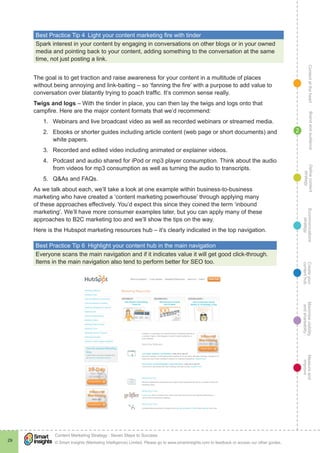
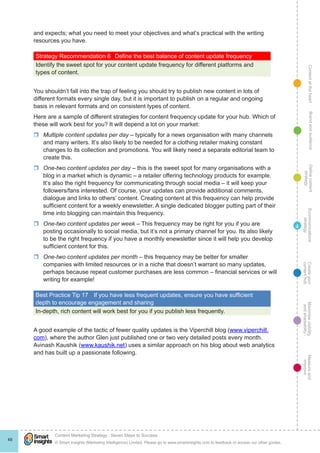
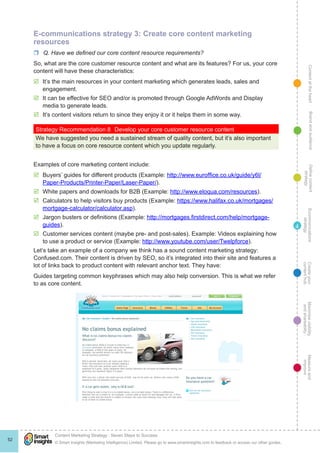
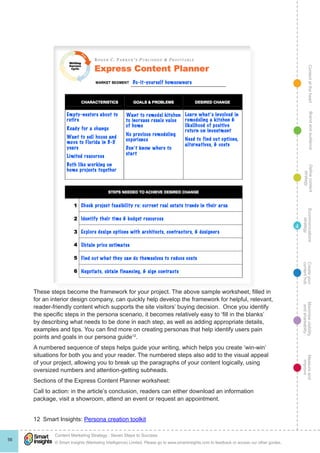
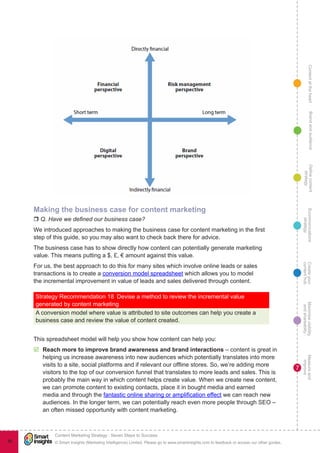
As we talk about each, we’ll take a look at one example within business-to-business
marketing who have created a ‘content marketing powerhouse’ through applying many
of these approaches effectively. You’d expect this since they coined the term ‘inbound
marketing’. We’ll have more consumer examples later, but you can apply many of these
approaches to B2C marketing too and we’ll show the tips on the way.
Here is the Hubspot marketing resources hub – it’s clearly indicated in the top navigation.
Best Practice Tip 6  Highlight your content hub in the main navigation
Everyone scans the main navigation and if it indicates value it will get good click-through.
Items in the main navigation also tend to perform better for SEO too.
ContentattheheartMaximisevisibility
andshareabilty
Measureand
improve
Createyour
contenthub
Ecommunications
strategy
Definecontent
strategy
Brandandaudience
© Smart Insights (Marketing Intelligence) Limited. Please go to www.smartinsights.com to feedback or access our other guides.
Content Marketing Strategy : Seven Steps to Success
!
30
2
Notice that there are sub-hubs for each major area of interest. That’s a good tip we can learn
from them right there…
Best Practice Tip 7  Create sub-hubs under your main content hub
Sub-hubs can appeal to an audience who are only interested in a niche topic and can
also help with SEO since they have anchor text linking to other articles to help them rank
better and they can rank in their own right.
1. Webinars and streamed media
The idea of people consuming live content is not new. Webinars have been around for years.
The quality and practicality of it is rocketing now that broadband penetration is so high.
Hubspot example: http://www.hubspot.com/marketing-webinars. Notice how they integrate
with business goals through the panels in the left sidebar and clear call to action in the main
navigation. They ‘sweat their assets’ through making it easy to see webinars on demand and
accessing them on iTunes.
ContentattheheartMaximisevisibility
andshareabilty
Measureand
improve
Createyour
contenthub
Ecommunications
strategy
Definecontent
strategy
Brandandaudience
© Smart Insights (Marketing Intelligence) Limited. Please go to www.smartinsights.com to feedback or access our other guides.
Content Marketing Strategy : Seven Steps to Success
!
31
2
And, of course, they practise permission marketing through profiling all webinar attendees.
It’s nice they ask the softer question of ‘what is your biggest marketing challenge?’ Good for
follow-up phone calls.
Best Practice Tip 8  Practise permission marketing
Make sure you encourage sign-up in return for your most valuable content and use this to
profile your audience and follow-up by email or phone.
Here’s an example of the email follow-up – nicely personalised:
Hubspot also make all of their content highly shareable – before and after use.
Best Practice Tip 9  Make each item of content shareable
Use hand-crafted icons to Twitter or Facebook, or services like www.addthis.com
and www.shareservices.com to add buttons in the relevant places right next to your
content.
Webinars in particular are due for a revival, we believe. They can often look poor but the
principle of them makes sense for people wanting an efficient way to consume information.
ContentattheheartMaximisevisibility
andshareabilty
Measureand
improve
Createyour
contenthub
Ecommunications
strategy
Definecontent
strategy
Brandandaudience
© Smart Insights (Marketing Intelligence) Limited. Please go to www.smartinsights.com to feedback or access our other guides.
Content Marketing Strategy : Seven Steps to Success
!
32
2
They’re very presentation orientated, just like a conference and so allow PowerPoint, screen
sharing and video to be broadcast to multiple, registered attendees. Why do they work? It’s
really efficiency, anyone at a PC can attend a ‘lunchtime briefing on lead generation’, for
example.
It doesn’t matter where you are or where the business is the costs and time required to
attend are vastly reduced. Importantly – done right – they’re interactive and social (otherwise
it’s a video presentation!) in the sense of any conference or classroom with the ability to
message or talk with the speaker. Just as with real world events we’re seeing people use
Twitter now as well, as a means to message other event attendees and this stream being
used as a backdrop to the webinar or event.
As with any content, focus on what content is best communicated through a webinar
presentation and combine that with what is keeping your customers awake at night.
Here are our top tips for webinars:
1.	 First – be clear what you need out of it – leads most likely or new subscribers. Maybe
you want your content shared for traffic generation? The ‘r’ in ROI must be clear.
Design that in to the process from sign-up and the last slide in the presentation. How
will you follow up with attendees?
2.	 Have a good speaker and presenter! They are going to make this work ultimately – go
ContentattheheartMaximisevisibility
andshareabilty
Measureand
improve
Createyour
contenthub
Ecommunications
strategy
Definecontent
strategy
Brandandaudience
© Smart Insights (Marketing Intelligence) Limited. Please go to www.smartinsights.com to feedback or access our other guides.
Content Marketing Strategy : Seven Steps to Success
!
33
2
find new talent with big ideas that fits your thinking and will be motivated to work for
free. Remember that being good in webinars requires additional skills to being good
in a real conference.
3.	 Like any presentation, show don’t tell, this is visual so mix up content, share stories,
use case studies – you want it to be compelling, totally different to reading an ebook
or blog article. Map the story of the webinar out in advance, just as you would a
PowerPoint presentation.
4.	 Choose a moderator to work with the speaker; this is a deal-breaker as well as you
want to keep attendees enjoying the experience. This person will get everyone ready,
moderate comments and any Q&A at the end of the webinar – what’s the question the
user is asking, get it out quickly so everyone understands.
5.	 This is obvious – but practise! Make sure the tech works, everyone involved is
comfortable and the connection is good. Plan for things going wrong – it will be more
likely it will falter at the speakers’ side, web connection issues maybe so plan how
you will keep things going.
6.	 Encourage interaction within the platform and across social networks whilst the
webinar runs. Message attendees – are they happy – and also consider polls to
get people involved and illicit responses (social objects within the webinar). Event
organisers love Twitter. Think about creating a short, searchable hashtag for your
event to collate a useful stream for users.
7.	 Re-create your content from webinars – there will be blog posts and articles in
the attendee questions or from key concepts in the webinar, a podcast summary
afterward as well as a playback (on-demand) version of the full show for everyone
that missed out.
2. Ebooks, guides, white papers and infographics
These are all on a theme – they’re based on ideas, or research, customer success stories
even. They all seek to solve a problem for the reader, to aid in a decision about something.
They contain text, images and charts. The broad difference is that white papers tend to be
authoritative, very often co-created to add credibility with a focus on a particular subject.
Ebooks epitomise the idea of content atomisation (write a bigger piece and then break it
down to a multitude of pieces and re-create/re-work for a new context). They are the high
end of what you might produce and differ in that they are longer, concept centric and a mix of
text and visuals, they’re also more conversational than white papers and are readily made up
of guides when you consider the chapter format in advance.
Hubspot example: Hubspot’s ebooks have sufficient depth to be useful and they always
feature appealing headlines and cover.
Best Practice Tip 10  Make your ebook content as appealing as possible through
headlines and graphics
It’s worth investing in these and the design to help engage and share.
ContentattheheartMaximisevisibility
andshareabilty
Measureand
improve
Createyour
contenthub
Ecommunications
strategy
Definecontent
strategy
Brandandaudience
© Smart Insights (Marketing Intelligence) Limited. Please go to www.smartinsights.com to feedback or access our other guides.
Content Marketing Strategy : Seven Steps to Success
!
34
2
Notice that Hubspot also have kits where they group content together. For example, this
marketing kit6is a great way of adding value to visitors with relatively little work.
Best Practice Tip 11  Bundle content
Grouping content of different types can add to its appeal and can expand reach through
attracting visitors with different needs through search or different scent trails on the site.
A good consumer example of an ebook is this example guide7
from i-to-i TEFL who sell TEFL
courses. Their guide helps the user understand TEFL and if it’s for them, using two authors
paid to do that for them. I helped manage the creation of this page, so hope you like it – it
certainly worked well for us!
6  Hubspot: Inbound marketing kit.
7  Online TEFL example.
ContentattheheartMaximisevisibility
andshareabilty
Measureand
improve
Createyour
contenthub
Ecommunications
strategy
Definecontent
strategy
Brandandaudience
© Smart Insights (Marketing Intelligence) Limited. Please go to www.smartinsights.com to feedback or access our other guides.
Content Marketing Strategy : Seven Steps to Success
!
35
2
Either way, ebooks and white papers are great for brands with products and services that
require thought before purchase – that is their real strong point. They can be rich and written
for multiple audience types involved in the sale. They are shareable and naturally err towards
purchases based on quality and innovation, less so on convenience or price. Here are our
top tips for ebook and white paper creation:
1.	 You’re teeing up your brand as a reliable source of information, so just as with webinars,
start with what keeps your audience awake at night. You might take different perspectives
on that topic in the same guide.
2.	 Simplify the complex – ‘save me time’. Break it down and make it easy for me to
consume. You’re creating great, atomisable content in the process as well.
3.	 Add credibility where possible. Seek out people to involve for casual comments as more
serious co-authors. If they don’t conflict it will lighten the load and provide a win-win in
both credibility and more reach within their network.
4.	 Aim for fun and intriguing as well as educational, wherever possible. Why? Simply
because it’s more shareable than something that is just informative – you get to bring
your uniqueness to the table as well. You’re building your brand.
5.	 Design it – it’s well worth the fee to turn great content into a great looking ebook that
brings the story to life visually – more engaging and more shareable.
6.	 Encourage sharing of the content, ensure it’s Creative Commons licensed and embed
share icons into the PDF since most will browse on-screen and it reminds them to share
it like they might a web page with the same benefits of populating the tweet for them, for
example.
7.	 Promote and have a strong landing page to download the guide from. Incorporate
social proof of the ebook’s success if you can. Again, ensure that visitors can share the
page via social networks and email. You then have to consider, whether you will require
registration to access the ebook, maybe just giving the first chapter free, or will you give
it freely as recommended by David Meerman-Scott? What’s the right call? It depends, on
your priorities right now and your goals in the short- to medium-term. If you ‘want leads’
then the answer is there. However if you want to build a brand to generate interested
ContentattheheartMaximisevisibility
andshareabilty
Measureand
improve
Createyour
contenthub
Ecommunications
strategy
Definecontent
strategy
Brandandaudience
© Smart Insights (Marketing Intelligence) Limited. Please go to www.smartinsights.com to feedback or access our other guides.
Content Marketing Strategy : Seven Steps to Success
!
36
2
traffic in the medium term…you decide!
3. The importance of video
The cost and ease of creating videos has never been more favourable. In addition your users
are creating them as well – and, we’ve already mentioned that YouTube is the second largest
search engine. Video, like text, is now a tool in your arsenal, you just need to get playing with
it and see how it feels. All video is not the same, so consider:
þþ User generated video that you edit together or just share – maybe create a contest based
on video entries.
þþ Shoot your own video to help communicate an idea or concept succinctly.
þþ Think about the new Explainer video trend pioneered by Common Craft where complex
concepts are broken down in a visual and animated way – remember the quality of the
narrative and voice over is 50 per cent of the success.
Hubspot example: http://www.youtube.com/watch?v=Q3yCB7AvvAk which is worth a watch.
They now also have a YouTube channel.
Best Practice Tip 12  Group your YouTube content within a YouTube channel and use
video to support the learning and sales process
You likely won’t get as any many views or subscribers from your YouTube channel, but
some prefer to learn or decide on products this way, so conversion may well be higher.
Our perspective is that as far as the ability to view on multiple platforms or devices, ensure
shareability and inspire a valuable moment of engagement with the consumer, video is hard
to beat. Here are some recommended resources for creating videos:
þþ YouTube (http://www.youtube.com/my_webcam): Use your webcam to record directly to
the YouTube site.
þþ Facebook (http://www.facebook.com/VideoApp?v=info): Use your webcam and the
Facebook Video application to record directly to your Facebook Profile or Page. Quickly
access this feature via the Video tab on your Profile/Page.
þþ Ustream (http://www.ustream.tv): Record live streaming video from this site. Share via a
unique URL and embed codes. Ustream applications are also available for downloading
ContentattheheartMaximisevisibility
andshareabilty
Measureand
improve
Createyour
contenthub
Ecommunications
strategy
Definecontent
strategy
Brandandaudience
© Smart Insights (Marketing Intelligence) Limited. Please go to www.smartinsights.com to feedback or access our other guides.
Content Marketing Strategy : Seven Steps to Success
!
37
2
to your computer and mobile phone.
þþ Livestream (http://www.livestream.com): Record live streaming video from this site.
Share via a unique URL and embed codes. A Livestream application is also available to
download to your computer.
þþ qik (http://qik.com) Download this mobile application to record live streaming video on
the go using your mobile phone’s integrated video camera and upload to your YouTube
account. This app also allows for automated Tweets and live chat.
þþ VYou (http://vyou.com): Video Q&A site, where you can record video answers to the
questions other users ask.
þþ Wetoku (http://www.wetoku.com): Create side-by-side video interviews to embed across
the web.
4. Audio, podcasts and video podcasts
Audio podcasts have certainly lost appeal as video has risen but for ease they’re well
worth trying out and are well suited to people in a place to listen to conventional radio – like
commuters, for example, even phones have mp3 players now. Our recommendation is to
focus on audio content being a supplemental radio show to your other content marketing.
It’s the easiest media since you have the equipment and material ready-made to do it – you
can form audio content from blog posts, articles, enewsletters and even take the audio from
video. Audio also lends itself perfectly to interview-based content, too.
Editing is straightforward and important too. You can cut the waffle and have well formatted
10–30 second sound bites. Consider branding you audio and position it as commute- or
break-based material for people on the move.
Of course – don’t forget iTunes – the premier directory for podcast material. Go to iTunes and
from there submit a podcast.
Hubspot example: As you might expect, Hubspot don’t offer audio podcasts, but they do
have a regular Hubpot.tv spot:
These are regular weekly updates which helps the stream of content.
ContentattheheartMaximisevisibility
andshareabilty
Measureand
improve
Createyour
contenthub
Ecommunications
strategy
Definecontent
strategy
Brandandaudience
© Smart Insights (Marketing Intelligence) Limited. Please go to www.smartinsights.com to feedback or access our other guides.
Content Marketing Strategy : Seven Steps to Success
!
38
2
Best Practice Tip 13  Deliver a regular content stream through your hub
Regular updates delivered at a regular time can help engage your audience through
‘setting their alarm clock’.
Another feature of the audio approach which is common to all of their content marketing is
that they attract top quality speakers which is relatively easy given their reach.
Best Practice Tip 14  Include authoritative celebrity or industry figures to endorse or
contribute to your content
You may not be able to afford the best, but afford the best you can.
5. Q&As and FAQs
We believe this area is a seriously hot place to invest your time and money. The popularity of
Yahoo! Answers shows there has always been a demand for this and growth of Quora.com
gives a more social spin to this approach.
There is a difference between the two since FAQs are based upon commonly asked
questions that you write ideal answers to from your understanding. They typically save time
for you and the consumer so long as you stick to direct and simple answers.
They naturally edge towards people in buying mode who don’t want to, or cannot, speak
to someone. Done well and categorised for easy dissemination across product pages the
FAQs section is a valuable tool, though its down-side is that it’s still linear and does not take
advantage of the constant new questions or thoughts that the consumer may have. Enter the
Q&A.
Q&As are similar in that it’s questions and answers, but the difference is that it’s live,
crowd-sourced and largely user generated. Similar to a forum but with specific positioning,
functionality and designed to be Q&A based. Your brand can earn the opportunity to be a
resource pre, during and post purchase and so connecting customers with potential buyers.
Jay Baer refers to this as a ‘social FAQ’ where those Q&As can be set free across the
internet. That is the value of a Q&A over a FAQ, it’s inherently about ‘me’ and so way more
shareable. With a blog you are further building community alongside more static web content
whilst gaining an opportunity for your internal experts to play a role in the Q&A as well.
There a number of tools helping achieve this to varying extents. Check out http://www.osqa.
net and also http://www.wordpressqa.com. Both are site plugins so a little harder to integrate.
Either way running a FAQ or a Q&A is a commitment to develop and keep up to date, but well
worth the value for the consumer.
Hubspot example: Hubspot bills these as ‘communities’ on different platforms – either
owned ‘inbound.org’ or independent – such as the LinkedIn group for Hubsport
ContentattheheartMaximisevisibility
andshareabilty
Measureand
improve
Createyour
contenthub
Ecommunications
strategy
Definecontent
strategy
Brandandaudience
© Smart Insights (Marketing Intelligence) Limited. Please go to www.smartinsights.com to feedback or access our other guides.
Content Marketing Strategy : Seven Steps to Success
!
39
2
Best Practice Tip 15	 Understand common user questions and answer them
Answer them either through the content on your hub, FAQs or a social network group.
ContentattheheartMaximisevisibility
andshareabilty
Measureand
improve
Createyour
contenthub
Ecommunications
strategy
Definecontent
strategy
Brandandaudience
© Smart Insights (Marketing Intelligence) Limited. Please go to www.smartinsights.com to feedback or access our other guides.
Content Marketing Strategy : Seven Steps to Success
!
40
3
Step 3
Define your content marketing strategy
rr Q. Have we developed our content strategy?
All sites have content, but how many have a content strategy that has backing across a
company? There’s a big risk that content projects living outside of marketing and the overall
strategic goals of the company will not be successful or even get started. To be successful,
a content strategy needs to tell your story as it relates to your customers, and as a part of
the wider marketing strategy. Don’t let something as important as content live in a vacuum. It
also needs to be rooted in delivering on the business goals we covered in Step 1.
The key thing to remember is that a content strategy is about defining a purpose for the
content not its placement (i.e. a blog or on Facebook) or the media format (i.e. text or video)
or the frequency.
So, in this Step we focus on the content itself, then in Steps 4 and 5 we have a lot more
detail and examples on what we think is even more important, that’s an overall e-communica-
tions strategy and hub to make your content shareable and encourage participation.
Define the key parts of your content strategy
rr Q. Have the content strategy components been defined?
These are what we see as the key elements of a content strategy:
þþ Define purpose of content to support strategic business goals. How will content help meet
these broader requirements – for example growing a certain market or launching a new
product? Keep these in mind so that you prioritise effort and resource.
þþ Define what customer value your content types should deliver. Using the personas, as
described in Step 2, to define the problems and opportunities that your content is going to
address.
þþ Define content type priorities. What are the topics that you’ll need to cover in your content
and, importantly, what are the priorities within those where effort should be weighted? For
example, with the Open Forum portal their content focuses on innovation, marketing and
finance though it can cover health and lifestyle too.
þþ Differentiation. How are we creating the necessary differentiation? There are so many
ways to approach content generation and aiming to be original and relevant can only help
you stand out from the crowd.
þþ Core brand messages. What are the core brand messages communicated through those
defined topics or conveyed through the content?
þþ Content sources. How will we design and manage the content mix across curated,
aggregated, user-generated, co-created, original and even (possible) licensed content?
We’ll come onto this in the next step, but the point is that there are many sources of
content creation so knowing what suits your strategy, budget and resource is important.
Link your strategy to goals
rr Q. Has our strategy been linked to SMART goals?
In the first section, we recommended that you use the RACE framework to set SMART goals.
Since your strategy must support your goals, let’s return to RACE to suggest strategies to
consider to support your content marketing goals.
ContentattheheartMaximisevisibility
andshareabilty
Measureand
improve
Createyour
contenthub
Ecommunications
strategy
Definecontent
strategy
Brandandaudience
© Smart Insights (Marketing Intelligence) Limited. Please go to www.smartinsights.com to feedback or access our other guides.
Content Marketing Strategy : Seven Steps to Success
!
41
3
Reach – be visible online
Approaches to use to improve your reach through content marketing are:
þþ Target – ask ‘who is listening to you already?’ Make something for them, ideally
something that makes their life a little easier. Inspire them to want to talk about you to
others. Be targeted in your approach above all else – the first question is not how many,
but ‘who?’ Who are your key influencers?
þþ Create good stuff – ask not what helps spread your message but what content does your
audience need or enjoy. Where is the intersection of value for your brand (what you want
to say) and your audience (what they are trying to solve)? The more that content is based
on their needs, the more it’s going to be perceived as valuable – use social listening tools,
blog researching and search engine keyword research to quickly define those audience
pain points.
þþ Publish to outposts – make your content visible in places where your audience already
is. Success comes from employing online listening to the market and doing the hard work
too.
Act – encourage participation and sharing of your content
At this stage we are looking to encourage visitors to interact with and share our content, so
we need to know the content types that are effective. Approaches to use are to:
þþ Create variety – with a range of persona types and devices on which content is
consumed, varying how content manifests is important in itself. Consider the difference
of mobile smartphones to desktop PCs – what is it that fits your audience? There are
so many ways to share content – including a daily blog post, a weekly video series on
YouTube, quarterly webinars with guest speakers or a bi-annual ebook. You can even go
interactive with quizzes and contests, it’s all content.
þþ Be human – when a user hits your website does it make sense, is it organised ‘for
me’ and my needs or is it a re-brand of how every other site operates in your market?
Using a language that sounds human and is well structured offers a huge advantage in
introducing your ideas to others so you can be quickly understood. Is content in a format
that makes sense and does it hang together under topics or categories that speak to the
audience, allowing them to find more of the same.
þþ Make it shareable – having content that is easy to share matters. There are a wealth
of tools that you can use to make it easy for users to pass your story forward into their
social networks, the Facebook Like/Send button on Tweet Meme are the most obvious.
And, don’t forget enabling syndication and bookmarking of your quality information and
content. Anyone who is expressing an interest should be encouraged to share it.
Convert – gain permission
At this stage we are building a relationship, converting to a lead or a sale. To help with this
you need to:
þþ Value – demonstrate value. What do you want me to do, and why would I sign up, follow
or connect with you on an ongoing basis? Keep the calls to action appealing, relevant and
valuable. What do I need to do? Is it offline (attend an event or visit a store) or online (go
to your customer community service or Facebook page)?
þþ Interact – the more interactive content is, the better. Can I ask questions, vote on
something, take a quiz, use a diagnostic that helps me make a decision or enter a fun
contest that entertains? Help ‘me’ get involved with the content and with the subject
matter in new ways, teach me something. Consider interaction from your brand’s
perspective too, encourage the human to human interaction through commenting on your
ContentattheheartMaximisevisibility
andshareabilty
Measureand
improve
Createyour
contenthub
Ecommunications
strategy
Definecontent
strategy
Brandandaudience
© Smart Insights (Marketing Intelligence) Limited. Please go to www.smartinsights.com to feedback or access our other guides.
Content Marketing Strategy : Seven Steps to Success
!
42
3
blog, in a forum or maybe a webinar about a meaty subject area.
þþ Promote – selling, at the right time, it’s ultimately why we are in business. Make
promotional offers natural and convenient, demonstrate the value exchange. Create
social media-only offers – for example vouchers or special notifications only available via
Twitter or Facebook – and promote access to those in emails or in brochures, Starbucks
are masters of this.
Engage – develop advocacy and referral
This is the long-term engagement. Key approaches to guide your work here include:
þþ Build trust – work hard to gain customer comments and feedback from all sources
including social media – then pool and present them to consumers to help engender
trust. Pulling feeds from external sources, like Twitter, as social proof that people like your
brand is particularly powerful, though don’t forget to simply ask and reward customers for
coming back to your site to share their product story.
þþ Integrate – share content through extended services that marry marketing with that value
exchange – special deals and timely reminders and updates are important for this, think
of an ISP reminding you of domain name renewals via email at the exact moment you
need to know and appending an offer to that for hosting effective promotional content at
the right time.
þþ Social CRM – social tools are just that, a means to build a better business because we’re
now afforded the ability to cost-effectively listen and serve the customer better. After years
of paying research companies and chasing insight we find it here, right on our doorstep if
we’re open to employ it as a process within the business. Only one benefit of that is our
ability to continually improve content and communications.
So, for us, content marketing success requires an adoption and integration of simple, but still
new, processes. Behaving like a publisher over a broadcaster to create an inbound effect
of interested prospects and customers is something that still feels pretty new to marketers.
Yet we can see that it’s authentic marketing, meeting market needs and helping consumers
make decisions over looking to interrupt and persuade. Having a process in place to create
and re-create content in multiple forms for distribution in multiple channels like email,
outposts like Facebook or LinkedIn and, of course, your own web services, will help you
scale up and meet these new demands.
This is extremely important for getting senior team members on board, and more importantly
bought in, so that the necessary budget is made available. Here are some key questions to
help set those goals:
rr Q. What are the core audience types? There’s likely more than one, for example the
consumer of the product or service, and also key influencers like industry bloggers and
journalists.
rr Q. What is the story or the crucial messages that the content must communicate?
rr Q. What must your content enable the audience to do that helps achieve your goals?
rr Q. How will the content show success? What are the key measurements at the simplest
level, for example blog subscribers, newsletter sign-up, or data capture from an ebook
download?
Define the value you will offer your audience through your content
rr Q. Have we defined the content value?
The need to REALLY understand what customers value is similar to wider digital and
marketing planning of course. But here it’s content value. You should refer back and
ContentattheheartMaximisevisibility
andshareabilty
Measureand
improve
Createyour
contenthub
Ecommunications
strategy
Definecontent
strategy
Brandandaudience
© Smart Insights (Marketing Intelligence) Limited. Please go to www.smartinsights.com to feedback or access our other guides.
Content Marketing Strategy : Seven Steps to Success
!
43
3
summarise each of the persona profiles in clear statements that everybody in the team can
understand, for example:
‘The potential customer needs evidence that we understand their problem well before they’ll
buy, share or recommend us.’
Then, summarise the solution, for example: ‘Thought Leadership’.
This is an example of the intersection that Joe Pulizzi talks about, along with an approach of
how to address it.
A good example of this particular scenario is the American Express Open Forum (http://www.
openforum.com) web portal, where they garner experts across a range of topics with the sole
objective of ‘helping you grow your business’.
Though the example here is B2B, it works just the same for B2C since we want our content
to meet a requirement or solve a problem that in its simplest sense leaves the consumer able
to make a decision about something.
The key element of a strategy is to decide where you will focus your efforts, so make sure
your analysis is sufficiently in-depth.
‘When you start looking at a problem and see a simple solution, you don’t understand the
problem. You keep looking and you are halfway there. The really great person will keep going
and find the underlying principle of the problem, [to] come up with a beautiful elegant solution
that works.’
Steve Jobs
Specifying the value your content offers
rr Q. Do we get the sell-inform-entertain-share balance right?
Next, get more specific about the content value. We think the sell-inform-entertain balance
is useful here, because it reflects different content needs for different types of customers in
different markets.
Best Practice Tip 16  Review sell-inform-entertain-share balance of your content
There’s a tendency to focus on one type of content, but you should review a balance.
For example, consumer audiences don’t just want entertainment, and business audiences
may want to be entertained as well as informed. There’s not such a difference between them:
B2B Proposition B2C Proposition
Make my work easier Make my life easier
Help me develop Help me learn/have fun
Make me look good Make me look good
Give me a great deal Give me a great deal
Get effective governance in place
rr Q. Do we have effective governance in place?
To get to the level of quality needed to make your content marketing work requires a major
commitment. You can see that this commitment needs not only a major investment in
content, but also people resources to manage the publication and promotion of this content.
ContentattheheartMaximisevisibility
andshareabilty
Measureand
improve
Createyour
contenthub
Ecommunications
strategy
Definecontent
strategy
Brandandaudience
© Smart Insights (Marketing Intelligence) Limited. Please go to www.smartinsights.com to feedback or access our other guides.
Content Marketing Strategy : Seven Steps to Success
!
44
3
Strategy Recommendation 4	 Get senior management commitment to an ongoing content
management initiative
How you achieve this will vary according to the type of company, but we think this is one
of the most important strategy recommendations in this guide.
As with supporting all major change in a business getting senior managers to support the
initiative is probably the biggest driver of success. If you don’t get this it’s like other business
activities will always take priority and quality of content will suffer.
The questions to ask here are:
rr Q. Do we have executive support for this content strategy?
rr Q. Who is the ultimate authority on your content strategy, and what are the criteria for
making changes?
rr Q. How will we sustain and evolve your content strategy to achieve your business
strategy?
rr Q. Which policies, guidelines and standards should be implemented (as simply as
possible) and policed to assure all content is aligned with any existing internal and
external requirements?
rr Q. What are the measures we will use to review content effectiveness and show how
content development is supporting the business?
rr Q. Are the right resources and structures in place to support content development?
Once you have developed this information, and the executive team buys into this essential
background information for your content strategy, then you can start developing the
execution plan.
The final area we will look at in this step is the need for the right management of content
marketing, starting with measurement and then looking at the resources needed to run the
show.
Check measurement approaches
rr Q. Do we have measurement approaches in place?
rr The key evaluation questions to ask are:
rr Q. How will we measure return and what are the measurements that tell the return on
content spend? How will we illustrate the value clearly to the wider business?
rr Q. What actions do we want our customers to take as a result of interacting with content?
rr Q. How will we measure audience behaviour in order to know how we will make changes
to navigation and content to help them along the way?
rr Q. How will we (at the right time) put them on the path to purchase, and what is the
conversion point?
rr Q. What is our process for content marketing optimisation and how does this relate to
content marketing optimisation?
Is the right resource in place?
rr Q. Has a resource for content marketing been identified including responsibilities, roles,
structures and process?
So many different inputs are needed for content management that having the right resource
ContentattheheartMaximisevisibility
andshareabilty
Measureand
improve
Createyour
contenthub
Ecommunications
strategy
Definecontent
strategy
Brandandaudience
© Smart Insights (Marketing Intelligence) Limited. Please go to www.smartinsights.com to feedback or access our other guides.
Content Marketing Strategy : Seven Steps to Success
!
45
3
in place is almost always a challenge. It’s not just web content either. The remit must be
broad enough to cover all content, on and off your website. It all depends on the size of your
organisation – you might need a small team or it could be formally a part of someone’s role.
Another way of looking at the resource is reviewing your existing skills. We’re fans of using
capability audits to assess where you are against where you’d like or need to be. We think
this a great way to think through your capabilities8
from Anne Caborn of CDA.
Notice that with maturity, more skills are developed in-house and collaboration increases
across the organisation.
Responsibilities
rr Q. Have the responsibilities for content marketing been defined?
Below are the broad responsibilities for content marketing to think about:
rr Strategy development and leadership. Leads the web content strategy with the wider
team, and turning this into a budgets plan with the resource needed.
rr Standards development. Leads standards creation (maybe working with others in
marketing) developing ideas like voice, tone, being relevant.
rr Editorial control. Deciding the who, what, how, where and when of what gets published,
and ensuring this ties back to the wider organisation (especially marketing).
rr Managing content creators. Managing and organising content creators against the plan.
rr Measurement, evaluation and improvement. Specifying the right KPIs and reports to
review and improve (see Step 7). Also relates to social media optimisation (see Step 6).
So these are a selection of the main roles. There is not necessarily a single person in each
role. In a small content marketing set-up, these roles will be covered by just one or two
people.
8  CDA Content Lab.
ContentattheheartMaximisevisibility
andshareabilty
Measureand
improve
Createyour
contenthub
Ecommunications
strategy
Definecontent
strategy
Brandandaudience
© Smart Insights (Marketing Intelligence) Limited. Please go to www.smartinsights.com to feedback or access our other guides.
Content Marketing Strategy : Seven Steps to Success
!
46
3
Roles
rr Q. Have the roles for content marketing been defined?
When you build or review a team consider these role types:
þþ Listening analysts – ideally before, but even once your start sharing content, it’s
necessary to get a handle on what your audience is talking about in order to add fuel to
that conversation, so listening to the market using free or paid software is important. You
want to keep close to the audience and their issues.
þþ Content creators – these skills may be quite diverse including copywriting or even video
animation skills. You will need the most often used skill within your reach and at a low
cost. Advanced business will need a dedicated content creator(s) with multiple skills, of
course.
þþ Journalists – this role specifically refers to creating fresh content for a new section, blog
or social media presence. I’m a big proponent of David Meerman-Scott’s suggestion of
the importance of journalism skills being brought into marketing, after all isn’t modern
marketing based around storytelling, good research and well executed communications?
Particularly since the requirement will be to curate, co-create and originate content across
pre-agreed topics, that’s a skill in itself.
þþ Content reviewers – these are the managers within brand or marketing who sign-off the
content. You need a good workflow system to alert them to what needs to be reviewed so
they can suggest modifications and make sign-off rapidly.
þþ Conversation agents – or more commonly ‘community managers’, are a unique mix of all
of the above with the added ability to interact meaningfully with your audience wherever
they reside online. One of their key goals is to develop user-originated content as a part
of those conversations.
þþ Team leader – someone has to be able to captain and coordinate this content army
internally and also ensure that it delivers to the strategy. The leader will also manage ad
hoc external requirements. This role is sometimes known as a content strategist. This
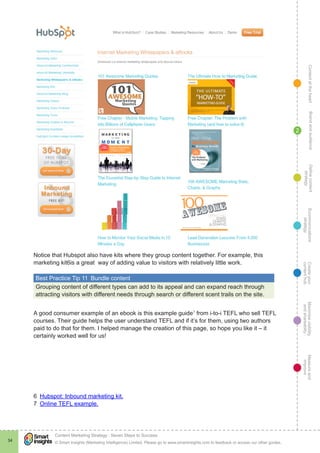
example from a job description from Logitech gives an idea of the scope of this role.9
The person in the lead role would ideally be an ‘embedded journalist’, someone who
understands the audience and has a nose for (and ability to write) a story.
Beyond roles, recognise that good content often needs commissioning. That might be
article writing, ebook typesetting or video filming and editing. It may be beyond the resource
available internally, so plan for those costs.
Think about the tools needed to help with process flow – whether that’s Yammer.com to
enable a big or disparate team connect and share internal ideas or Basecamp for practical
project management and workflow – you will need tools that make collaboration and
coordination as easy as possible. Ease is important to get buy-in.
9  Smart Insights: Essentials of a content strategy.
ContentattheheartMaximisevisibility
andshareabilty
Measureand
improve
Createyour
contenthub
Ecommunications
strategy
Definecontent
strategy
Brandandaudience
© Smart Insights (Marketing Intelligence) Limited. Please go to www.smartinsights.com to feedback or access our other guides.
Content Marketing Strategy : Seven Steps to Success
!
47
4
Step 4
Plan to continuously create great content through
your e-communications strategy
rr Q. Do we have a communications strategy in place to deliver quality content and
dialogue?
So, you have your content hub in place, now you need to power it with regularly updated
quality content. To do this you need a communications strategy that will be very familiar to
marketers. One key difference is that you will be communicating much more frequently than
with traditional press releases or enewsletters, so you will have to source more content.
Strategy Recommendation 5	Update your e-communications strategy to manage
sustained content sharing and dialogue
To maintain a strong voice online requires commitment to continuous creation and
distribution of content. But there is also a need to encourage conversation and dialogue
to maintain interest and sharing.
Another key difference is that communications are two-way – so your communications
strategy needs to consider how to encourage and sustain a two-way dialogue. Yet another
key difference is that you are not only publishing content on your own site or paying for ad
placements, you are syndicating it to third-party sites and encouraging sharing. This third
difference requires Social Media Optimisation (SMO) which we will cover in Step 6.
All strategies must be driven by goals and an e-communications strategy is no exception.
Make sure your goals are modelled and measured as described in previous sections. The
key elements of the content marketing e-communications strategy we’ll cover in this section
are:
þþ 1. Guidelines for regular content update frequency.
þþ 2. Guidelines for content types and formats.
þþ 3. Create core content marketing resources.
þþ 4. Review options for creating and sourcing content.
þþ 5. Content atomisation, re-purposing and syndication.
þþ 6. Create and update your editorial calendar.
þþ 7. Communicate your content marketing proposition.
You can see that the first three steps help you work towards the creation of the editorial
calendar.
E-communications strategy 1:
Define guidelines for regular content update frequency
rr Q. Have we defined the frequency for updating content?
We start our discussion of e-communications strategy with frequency since once you have
decided on this, you can then think of the types of content to support this, but you may want
to start with content types.
Deciding the frequency of content updates on your social media hub is a difficult challenge.
You will decide the right frequency based on a balance of what your audience needs
ContentattheheartMaximisevisibility
andshareabilty
Measureand
improve
Createyour
contenthub
Ecommunications
strategy
Definecontent
strategy
Brandandaudience
© Smart Insights (Marketing Intelligence) Limited. Please go to www.smartinsights.com to feedback or access our other guides.
Content Marketing Strategy : Seven Steps to Success
!
48
4
and expects; what you need to meet your objectives and what’s practical with the writing
resources you have.
Strategy Recommendation 6	 Define the best balance of content update frequency
Identify the sweet spot for your content update frequency for different platforms and
types of content.
You shouldn’t fall into the trap of feeling you should try to publish new content in lots of
different formats every single day, but it is important to publish on a regular and ongoing
basis in relevant formats and on consistent types of content.
Here are a sample of different strategies for content frequency update for your hub. Which of
these will work best for you? It will depend a lot on your market:
rr Multiple content updates per day – typically for a news organisation with many channels
and many writers. It’s also likely to be needed for a clothing retailer making constant
changes to its collection and promotions. You will likely need a separate editorial team to
create this.
rr One-two content updates per day – this is the sweet spot for many organisations with a
blog in a market which is dynamic – a retailer offering technology products for example.
It’s also the right frequency for communicating through social media – it will keep your
followers/fans interested. Of course, your updates can provide additional comments,
dialogue and links to others’ content. Creating content at this frequency can help provide
sufficient content for a weekly enewsletter. A single dedicated blogger putting part of their
time into blogging can maintain this frequency.
rr One-two content updates per week – This frequency may be right for you if you are
posting occasionally to social media, but it’s not a primary channel for you. Its also likely
to be the right frequency if you have a monthly enewsletter since it will help you develop
sufficient content for this.
rr One-two content updates per month – this frequency may be better for smaller
companies with limited resources or in a niche that doesn’t warrant so many updates,
perhaps because repeat customer purchases are less common – financial services or will
writing for example!
Best Practice Tip 17	 If you have less frequent updates, ensure you have sufficient
depth to encourage engagement and sharing
In-depth, rich content will work best for you if you publish less frequently.
A good example of the tactic of fewer quality updates is the Viperchill blog (www.viperchill.
com), where the author Glen just published one or two very detailed posts every month.
Avinash Kaushik (www.kaushik.net) uses a similar approach on his blog about web analytics
and has built up a passionate following.
ContentattheheartMaximisevisibility
andshareabilty
Measureand
improve
Createyour
contenthub
Ecommunications
strategy
Definecontent
strategy
Brandandaudience
© Smart Insights (Marketing Intelligence) Limited. Please go to www.smartinsights.com to feedback or access our other guides.
Content Marketing Strategy : Seven Steps to Success
!
49
4
Strategy Recommendation 7	 Ensure content update frequency is sufficiently high to
meet your goals for reach and growth
Higher frequencies of content publication will help you reach more people more rapidly
since each piece of content has the potential to reach more people.
If you adopt one of the shorter frequencies, remember that there is less potential for your
content to be amplified. Higher frequencies tend to be best for growth of reach. However,
there is a maximum frequency. Research by Dan Zarrella shows that optimum content
frequency for Facebook seems to be about once per day.
E-communications strategy 2: Define content types and formats
rr Q. Have we reviewed our content formats?
The next step in developing your e-communications strategy is to work through what are the
right types of content for you.
There is a tendency to get stuck in the rut of one format, but this works well for some who
become known for the format such as long-form or video blogs. But it can limit the appeal
of the publisher. For example ClickZ.com tends to focus on short, limited length posts. The
Digital Buzz Blog just publishes case studies. These will engage, sure, and it’s useful to have
a format you’re known for, but it may not appeal to a range of audiences, so could limit your
reach.
Best Practice Tip 18	 Use a range of formats or become known for repeating one format
well
A range of types and content and format have the potential to engage different types of
people. However, a single format can have more impact and will be more memorable.
Suitable formats to consider, with examples you can learn from within the digital marketing
content area, are:
þþ Short-form news updates or opinion pieces (www.clickz.com or www.sethgodin.com).
þþ Long-form blog posts giving ‘expert’ guidance (www.viperchill.com or www.kaushik.net).
þþ Video blog posts (www.bannerblog.au, www.garyvaynerchuk.com).
þþ Image posts with statistics (www.wearesocial.net).
þþ Infographics (www.kissmetrics.com).
þþ Compilations aggregating other sites’ content as a useful summary of statistics or tools
(www.wearesocial.net, www.smartinsights.com).
þþ Ebooks, white papers and guides (www.hubspot.com and www.eloqua.com).
þþ Podcasts (www.boagworld.com).
þþ Surveys and polls (www.econsultancy.com and www.smartinsights.com).
þþ Questions and answers (www.linkedin.com).
Of course these are just some of the most common formats and you may also find it useful to
separate out the types of content or topics you have. One of the most enjoyable aspects of
content marketing is that opportunities for creativity are sparked through learning from others.
Here are some more ideas from Eloqua and a good example10
of a widely shared infographic
to boot. It’s so good we’ll share it full screen for ease of printing!
10 The Eloqua content grid.
ContentattheheartMaximisevisibility
andshareabilty
Measureand
improve
Createyour
contenthub
Ecommunications
strategy
Definecontent
strategy
Brandandaudience
© Smart Insights (Marketing Intelligence) Limited. Please go to www.smartinsights.com to feedback or access our other guides.
Content Marketing Strategy : Seven Steps to Success
!
50
4
ContentattheheartMaximisevisibility
andshareabilty
Measureand
improve
Createyour
contenthub
Ecommunications
strategy
Definecontent
strategy
Brandandaudience
© Smart Insights (Marketing Intelligence) Limited. Please go to www.smartinsights.com to feedback or access our other guides.
Content Marketing Strategy : Seven Steps to Success
!
51
4
Through running workshops we have developed our own content marketing matrix. We
recommend the content marketing matrix as a key technique to review current use of content
marketing and to identify new types of content.
Our matrix is structured to help you think through the dimensions of different content based
on how your audience might think and what you’re trying to achieve as a business:
þþ Q. What will work where your audience are more or less impulsive or rational?
þþ Q. How does content in each sector support your content creation and marketing goals?
Depending on the quadrant(s) that you feel drawn to for your audience, it offers a starting
point for your ideas generation.
þþ Q. What is the potential for content to attract inbound links to your site to help with SEO?
The process we use for applying this matrix to companies or brands is:
þþ Step 1. Review how you assess the value of different types of content.
þþ Step 2. Review current use of content within company through plotting on the grid.
þþ Step 3. Review competitor use of these content types through plotting on the grid.
þþ Step 4. Brainstorm future content types possible.
þþ Step 5. Use your criteria from Step 1 to select new content types to trial in content
campaigns.
ContentattheheartMaximisevisibility
andshareabilty
Measureand
improve
Createyour
contenthub
Ecommunications
strategy
Definecontent
strategy
Brandandaudience
© Smart Insights (Marketing Intelligence) Limited. Please go to www.smartinsights.com to feedback or access our other guides.
Content Marketing Strategy : Seven Steps to Success
!
52
4
E-communications strategy 3: Create core content marketing
resources
rr Q. Have we defined our core content resource requirements?
So, what are the core customer resource content and what are its features? For us, your core
content will have these characteristics:
þþ It’s the main resources in your content marketing which generates leads, sales and
engagement.
þþ It can be effective for SEO and/or is promoted through Google AdWords and Display
media to generate leads.
þþ It’s content visitors return to since they enjoy it or it helps them in some way.
Strategy Recommendation 8	 Develop your core customer resource content
We have suggested you need a sustained stream of quality content, but it’s also important
to have a focus on core resource content which you update regularly.
Examples of core marketing content include:
þþ Buyers’ guides for different products (Example: http://www.euroffice.co.uk/guide/y6l/
Paper-Products/Printer-Paper/Laser-Paper/).
þþ White papers and downloads for B2B (Example: http://www.eloqua.com/resources).
þþ Calculators to help visitors buy products (Example: https://www.halifax.co.uk/mortgages/
mortgage-calculator/calculator.asp).
þþ Jargon busters or definitions (Example: http://mortgages.firstdirect.com/help/mortgage-
guides).
þþ Customer services content (maybe pre- and post-sales). Example: Videos explaining how
to use a product or service (Example: http://www.youtube.com/user/Twelpforce).
Let’s take an example of a company we think has a sound content marketing strategy:
Confused.com. Their content is driven by SEO, so it’s integrated into their site and features a
lot of links back to product content with relevant anchor text. They have:
Guides targeting common keyphrases which may also help conversion. This is what we refer
to as core content.
ContentattheheartMaximisevisibility
andshareabilty
Measureand
improve
Createyour
contenthub
Ecommunications
strategy
Definecontent
strategy
Brandandaudience
© Smart Insights (Marketing Intelligence) Limited. Please go to www.smartinsights.com to feedback or access our other guides.
Content Marketing Strategy : Seven Steps to Success
!
53
4
þþ Featured articles and news intended to engage on social networks:
þþ Top tips – practical tips to compete with sites like MoneySaving Expert:
þþ A content hub and sub-hubs we saw in Step 2 – the screen capture above shows how
they group their core content categories on a single page, here: http://www.confused.
com/info/insurance, to help give focus for users and SEO they have a separate hub for
each category. Here is another: http://www.confused.com/info/money.
E-communications strategy 4: Review options for creating and
sourcing content
rr Q. Have we reviewed our options for creating and sourcing content?
You will see that some of the content types above involve creation of original content and
some are adding value to existing content by summarising and/or aggregating it.
Best Practice Tip 19  Balance creation of original content and content curation
You can create engagement through content curation, but original content tends to be
most engaging and most shared.
ContentattheheartMaximisevisibility
andshareabilty
Measureand
improve
Createyour
contenthub
Ecommunications
strategy
Definecontent
strategy
Brandandaudience
© Smart Insights (Marketing Intelligence) Limited. Please go to www.smartinsights.com to feedback or access our other guides.
Content Marketing Strategy : Seven Steps to Success
!
54
4
Let’s now look at what’s involved in content creation, content co-creation and curation.
Content creation
rr Q. Have our options of sources for original content creation been reviewed?
Originating your own content is the most effective and most expensive way to create content.
It should really represent an absolute minimum of 20 percent of what you generate, and in
time become the majority of the content that you create.
Primary fuel and Nuclear fuel
In his book ‘Launch’ Michael Seltzner, founder of the Social Media Examiner website,
attributes his marketing success to two forms of content that he created and gave away to
attract customers: ‘Primary fuel’, content he created to keep his business moving forward and
‘Nuclear fuel’, the special content he used to attract the hundreds of thousands of visitors
per month, many of whom later gladly purchased his services (to create a $3 million turnover
business).
At its core Michael’s process – The Elevation Principle – is all about focusing on the needs of
people with content. His formula is simple: great content plus other people minus marketing
messages equals growth. The number one reason creating and sharing great content helped
Michael grow his business is because it established him as the trusted resource for writing
white papers. Winning that trust was his biggest marketing obstacle. His lesson: create
primary and nuclear fuel. Don’t expect anything in return.
Strategy Recommendation 9  Combine Nuclear and Primary fuel
Primary fuel costs more to create, but is significantly more shareable and supportive of
your brand, so make sure you get the balance right
As a strategy creating your own content is much more proactive, focused on being
the resource – giving your brand the best chance in both SEO and social marketing
programmes. The reason we say this is that you are establishing yourself as the source, not
only for your audience, but other influencers seeking content that they can curate and share
– so it’s so powerful for reach. Also, the more content you create, the more content you have
to atomise and share across marketing in different formats, but more on that shortly. The
most obvious response when I hear people talk about content origination is ‘we have nothing
to say’.
It’s more likely that they’ve not identified the pain points or problems that their audience has.
However, if we were to draw a list of random ideas to illustrate you’ll see that there’s always
something to say.
What is it?  Primary fuel
Primary fuel is regularly published, free content that meets the needs of your audience.
The goal of your primary fuel is to help solve your readers’ problems so they will become
fans and advocates.
Stelzner advises that the lifespan of primary fuel is about three days. The types of primary
fuel include:
þþ How-to articles
þþ Expert interviews
þþ Reviews
ContentattheheartMaximisevisibility
andshareabilty
Measureand
improve
Createyour
contenthub
Ecommunications
strategy
Definecontent
strategy
Brandandaudience
© Smart Insights (Marketing Intelligence) Limited. Please go to www.smartinsights.com to feedback or access our other guides.
Content Marketing Strategy : Seven Steps to Success
!
55
4
þþ News stories
þþ Case studies
þþ Contrarian stories
What is it?  Nuclear fuel
Nuclear fuel is carefully designed content that has a lasting impact on significant numbers
of your ideal reader base and possibly experts.
This type of content has a lifespan easily exceeding that of primary fuel. It can sometimes be
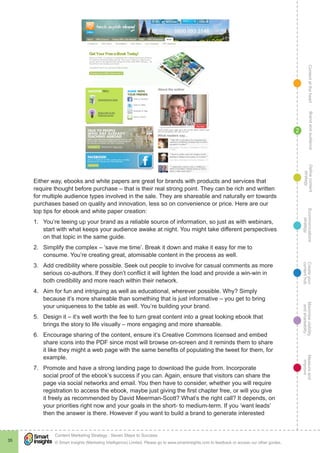
relevant for years. Nuclear fuel should always be free and includes:
þþ Reports based on surveys
þþ White papers
þþ Top 10 contests
þþ Micro events (webinars, videos, podcasts)
You can see that nuclear fuel is harder to produce, but can potentially has a bigger impact.
From a B2B point-of-view, your nuclear fuel is important for lead generation, so if you don’t
invest in it, because you’re focusing your efforts on primary fuel, then your content marketing
results will be more limited.
Overcome procrastination to jump-start your content marketing productivity
In Linchpin, Seth Godin named resistance your Lizard Brain, pointing out that ‘the higher the
stakes, the more objections your Lizard Brain will raise’. Empty pages and blank screens
invite doubt and uncertainty, which is the number one enemy standing in the way of content
marketing production.
To overcome this form of resistance the brain needs to focus on clear answers to questions
about your goals, your audiences and their problems. Roger C. Parker, founder and CEO of
Published And Profitable provides an Express Content Planner worksheet11
, which addresses
the hardest part of any content marketing project, namely, overcoming inertia and getting
started.
Here’s how it works: the faster you choose a topic and identify an approach, the sooner you
can begin to write. The sooner you begin to write, the more time you’ll have for editing and
revision, which is where the bulk of your content production time will be required.
Adapted from a work sheet Parker created for a book on coaching clients, the Express
Content Planner works equally well for all types of content marketing projects, including
articles, blog posts, ebooks, presentations, list-building reports, speeches and white papers.
On a single sheet of paper, the worksheet combines a reader persona and space to help you
identify a logical series of steps that readers can take to solve a problem or achieve a goal.
11 Download PDF from Roger C. Parker’s Published and Profitable
ContentattheheartMaximisevisibility
andshareabilty
Measureand
improve
Createyour
contenthub
Ecommunications
strategy
Definecontent
strategy
Brandandaudience
© Smart Insights (Marketing Intelligence) Limited. Please go to www.smartinsights.com to feedback or access our other guides.
Content Marketing Strategy : Seven Steps to Success
!
56
4
These steps become the framework for your project. The above sample worksheet, filled in
for an interior design company, can quickly help develop the framework for helpful, relevant,
reader-friendly content which supports the site visitors’ buying decision. Once you identify
the specific steps in the persona scenario, it becomes relatively easy to ‘fill in the blanks’
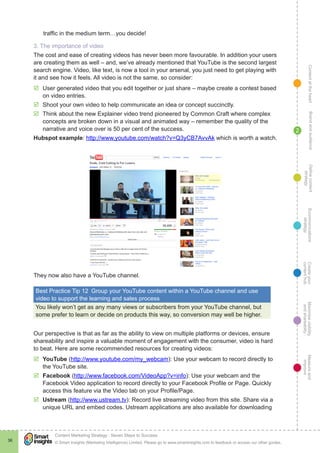
by describing what needs to be done in each step, as well as adding appropriate details,
examples and tips. You can find more on creating personas that help identify users pain
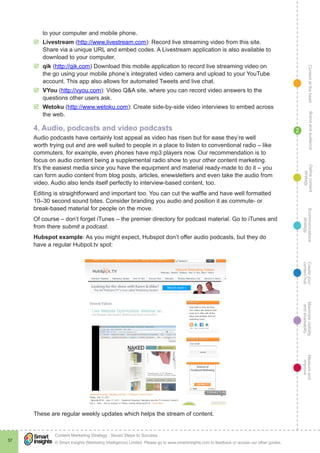
points and goals in our persona guide12
.
A numbered sequence of steps helps guide your writing, which helps you create ‘win-win’
situations for both you and your reader. The numbered steps also add to the visual appeal
of your project, allowing you to break up the paragraphs of your content logically, using
oversized numbers and attention-getting subheads.
Sections of the Express Content Planner worksheet:
Call to action: in the article’s conclusion, readers can either download an information
package, visit a showroom, attend an event or request an appointment.
12  Smart Insights: Persona creation toolkit
ContentattheheartMaximisevisibility
andshareabilty
Measureand
improve
Createyour
contenthub
Ecommunications
strategy
Definecontent
strategy
Brandandaudience
© Smart Insights (Marketing Intelligence) Limited. Please go to www.smartinsights.com to feedback or access our other guides.
Content Marketing Strategy : Seven Steps to Success
!
57
4
Characteristics: this section provides a context for creating an engaging story describing the
prospects and the context of their home remodelling in more detail (e.g., improving their living
space and, hopefully, increasing their home’s resale price for possible sale in three to five
years).
Goals and problems: this gives you space to add more details and to narrow the topic
from the broad ‘home remodelling’ topic to a specific aspect of remodelling (i.e., ‘kitchen
remodelling’). This section also provides space to describe the reader’s experience and
knowledge.
Desired change: in most cases, once the reader’s characteristics and goals have been
identified, the desired change often becomes obvious (i.e., what’s the best way to achieve
the goal?) At this point, all that’s needed is to create a title that restates the reader’s goal and
how the content is going to help him or her achieve it.
Steps needed to achieve desired goal: once the content’s purpose and title have been
identified, it’s simply a matter of identifying the steps – or necessary actions – to take the
readers on a journey from where they are now (confused, uncertain, owning outdated
appliances) to where they want to be (enjoying a new kitchen and, potentially, a higher home
resale value.)
For more creative ways to use the Express Content Planner worksheet visit the author’s
website www.publishedandprofitable.com.
Content co-creation
rr Q. Have our options for co-creation of content been reviewed?
Co-created content is worth mentioning here. It’s a little different and a great option for
quick or first tentative steps into content marketing. Although it’s used differently in different
contexts, for us, this is where a number of contributors come together under one brand to
publish for mutual gain. You could say ‘that’s just guest blogging’ and you’d be right. But it’s a
more systematic way of doing this.
What is it?  Content co-curation
Creation of a content resource using different authors from across different companies or
departments.
Two of the best examples are Mashable or the American Express OpenForum.com website.
The brand is leveraging lots of experts to create a site that benefits everyone in terms of
business and personal brand building. It really requires one lead in the project, someone with
reach or the content who wants to find someone missing (or whom would simply value) more
of one of those two things. Of course you’re relinquishing some control over message, but it’s
overall a good win.
You could say content co-creation also involves getting customers to create long-form
user-generated content, so this is worth considering too.
Best Practice Tip 20	 Identify trusted partners and customers who can support you in
your content generation efforts
Through having a range of authors you can add variety and reach as they promote their
content. But you may have issues of managing content consistency and quality.
ContentattheheartMaximisevisibility
andshareabilty
Measureand
improve
Createyour
contenthub
Ecommunications
strategy
Definecontent
strategy
Brandandaudience
© Smart Insights (Marketing Intelligence) Limited. Please go to www.smartinsights.com to feedback or access our other guides.
Content Marketing Strategy : Seven Steps to Success
!
58
4
Content curation
Content curation is the act of continually identifying, selecting and sharing the most relevant
online content or resources that match the needs of your audience. It is a proven way to help
position your organisation as the go-to resource, for both your content and that which you
curate.
What is it?  Content curation
Creation of new content based on other sources. Through summarising, aggregating or
distilling information you can still add value for your audience and it’s less time-consuming
than original content creation.
A good example of a site that when launched was entirely curated content is CMO.com –
created by Omniture to increase awareness of its business reporting services which is now
owned by Adobe.
Curation itself is not new, especially using RSS aggregators that have been around forever,
but adding the crucial human element – the embedded journalist – and armed with some free
or cheap software, you are able to select, filter and judge the truly useful stuff and interweave
your own original content.
So, you’re still adding value though strategically it’s more about being a news destination.
The upside is that you can employ this approach along with co-creation and licensed content
when you’ve got limited resources in the creation department.
Curation benefits:
þþ Build an element of trust and authority in your market.
þþ Speed to get up and going if you use RSS, for example.
þþ SEO benefits.
þþ Hard to get wrong if you know your market (but conversely easy to copy).
Content curation is still hard work – not least because you still need to generate your own
ContentattheheartMaximisevisibility
andshareabilty
Measureand
improve
Createyour
contenthub
Ecommunications
strategy
Definecontent
strategy
Brandandaudience
© Smart Insights (Marketing Intelligence) Limited. Please go to www.smartinsights.com to feedback or access our other guides.
Content Marketing Strategy : Seven Steps to Success
!
59
4
original work too but because it still costs – it’s people doing work. The worst bit of curated
content is that there’s usually a LOT of people doing (or potentially able to do) the same
thing, it’s one of the easier options which is why it should be packaged with original work.
Licensed content
rr Q. Have we reviewed our options for licensing content creation?
This content type is very popular in a wide range of industries and has proven to be very
successful for many brands. If your content requirements run deeper than your full-time
resources, third-party help to create all the content required for the project could be the
solution.
Articles, images, videos and audio are all widely available for licensing purposes online and
can be used to support your original or curated options. Alternatively you can outsource
content completely.
Outsourced content creation
rr Q. Have we reviewed our options for outsourcing content creation?
This is a deceptively attractive option where you can outsource your content marketing
completely. You agree an editorial calendar of content, the products or services you’re
looking to promote and the keyphrases you’re targeting with SEO. Providers offering this
service include:
þþ Direct News (www.directnews.com).
þþ Content Vox (www.contentvox.com).
þþ Sticky content (www.stickycontent.com).
It’s not the case that you can outsource and forget though. Licensed content still requires
a certain amount of editorial oversight and guidance as your company’s standards and
guidelines must be met. After experiencing engagement with this type of content we think
it’s probably best used sparingly in terms of the long-term cost/benefit. The disadvantages of
outsourcing content generation are:
ýý Understanding of customer needs or market is poor giving problems of relevance.
ýý Can lack passion to give an authentic brand voice.
ýý Quality of content is poor, so fails to engage or deliver sharing.
ýý Return-on-investment may be poor if it doesn’t deliver for the reasons above!
User-generated content (UGC)
rr Q. Have we reviewed our options for outsourcing content?
Though this idea sounds fantastic (free content from users) it’s no magic bullet and does
need careful management. User-generated content is the hardest since you are garnering it
from people who visit your website.
That said UGC is exciting, varied and often very rich in its breadth, it also ‘speaks’ to
other users since UGC is ‘people like me’. Varieties of UGC to consider as part of content
marketing include:
þþ Product reviews and ratings. Important for retail sites where systems like www.
bazaarvoice.com provide an infrastructure. Think about how you can leverage reviews
and ratings in other channels – a trick that is often missed.
ContentattheheartMaximisevisibility
andshareabilty
Measureand
improve
Createyour
contenthub
Ecommunications
strategy
Definecontent
strategy
Brandandaudience
© Smart Insights (Marketing Intelligence) Limited. Please go to www.smartinsights.com to feedback or access our other guides.
Content Marketing Strategy : Seven Steps to Success
!
60
4
Best Practice Tip 21	 Use product reviews and ratings through other channels
Opportunities to incorporate ‘top-rated’ or interesting tips from reviews and ratings into
email marketing, blogs and social channels are often missed.
þþ Curated UGC. Spinebreakers is a great, if extreme, example of this featured on our
blog.13
Anna Rafferty of Penguin explains the approach: ‘During the website development
Penguin recruited hundreds of teenagers from every area and background for focus
groups and usability testing. The teenagers made every decision, choosing the URL and
the nature of the brand themselves. We decided not to make any assumptions. The site
is now run by three tiers of teenagers, or “crews” as they elected to be called, who have
varying levels of control over the site.’
þþ Crowd-sourced ideas. Asking for new product or content ideas can create content. You
can use a crowd-sourcing platform like Uservoice (www.uservoice.com) or you can ask
more informally. For example Tee-shirt vendor Howies asked the question ‘What would
you want Howies to do for you?’ which attracted over 60 responses.
þþ UGC campaigns which encourage writing of content or upload. For examples
brands have encouraged users to upload images or media upload, often from mobiles.
Vauxhall encouraged drivers to describe their favourite drive and then locate it on Google
Maps (a classic mashup). Princess Cruises used a classic ‘blog to win’ or ‘share to win’
campaign14
asking readers about their favourite travel destination.
13 Penguin crowdsourcing example.
14  Smart Insights: E-permission marketing.
ContentattheheartMaximisevisibility
andshareabilty
Measureand
improve
Createyour
contenthub
Ecommunications
strategy
Definecontent
strategy
Brandandaudience
© Smart Insights (Marketing Intelligence) Limited. Please go to www.smartinsights.com to feedback or access our other guides.
Content Marketing Strategy : Seven Steps to Success
!
61
4
The campaign engaged the audience through their interest in travel destinations and used
Facebook as the heart of this, but encouraging participation through seeding using other digital
marketing channels like blogs and email.
With UGC you need to resource to not only build your platform but also to encourage
interaction, respond and moderate. You also need to take the rough with the smooth since a
small percentage will be negative. The point with negativity is that it’s happening already so
better that you can interact and ensure your own perspective, and rally your fans to share their
perspective too.
E-communications strategy 5: Content atomisation, re-purposing
and syndication
Now you’re in a place where you know who you are talking to and what content you’re
creating.
What is it?  Content atomisation
Breaking down content into smaller chunks and re-purposing them to distribute your
messages across the web and social platforms.
You should think about how you can make use of this content beyond your site. To ‘sweat your
content assets’. You’ll need to think about:
ContentattheheartMaximisevisibility
andshareabilty
Measureand
improve
Createyour
contenthub
Ecommunications
strategy
Definecontent
strategy
Brandandaudience
© Smart Insights (Marketing Intelligence) Limited. Please go to www.smartinsights.com to feedback or access our other guides.
Content Marketing Strategy : Seven Steps to Success
!
62
4
þþ The right partner sites or networks to share content?
þþ How to incentivise partners to take your content?
þþ Whether repurposing or creation of different formats is required – for articles it may just
need a change of post title or perhaps an infographic can be produced summarising a
survey?
þþ Whether advertising can be used to seed and share your content?
The challenge then is how do you maximise the efficiency of it all? With ebooks, blogs,
videos, photos, webinars, podcasts and apps all up for grabs you want to be open to it
all – everything that you do needs to work as a part of a whole – avoiding focusing on one
thing (just a text based blog) is therefore important, treat these content types as parts of an
ecosystem.
Content atomisation or the re-purposing of content is an obvious strategy in sharing your
story and making content go further – Jay Baer calls this idea ‘getting more bait in the water’
- a word of caution though, we don’t want to literally re-purpose, we’re about re-developing
content appropriate for different media so this is planned and not an afterthought to simply
‘get that blog post onto our Facebook page’.
E-communications strategy 6: create and update your editorial
calendar
An editorial calendar helps both develop the right types of content and schedules content
production. Without an effective editorial calendar and a person to control it, content
quality will definitely suffer. Since this can be a more junior role in some organisations it’s
often difficult to get others to write when this isn’t their main role. Think of the power of a
newspaper or magazine editor like Meryl Streep in The Devil Wears Prada – this type of
power is needed!
Strategy Recommendation 10  Create a sound editorial calendar and a person to
manage with sufficient authority
An editorial calendar is essential to an effective content strategy to plan for future quality
resources from a range of writers. This person managing the challenge to deliver against
publication deadlines will need sufficient resource and power within the organisation to
deliver it.
This can get complex, so do sit and think this through first. You need to decide whether to
include social content creation and re-purposing as well as re-purposing of other content in
the overall editorial schedule.
Often editors and writers are more interested in writing than in social media marketing and
search keywords, so make sure that at least some of the content is targeting the keyphrases
and types of searches that customers make. We’ve found this depends on the presence of
internal or external search specialists making their voice heard!
Best Practice Tip 22  Ensure coverage of target keyphrases within the editorial calendar
An idea of target keyphrases should be specified for articles where this is one of the main
purposes of writing.
An integrated editorial calendar
Here are some tips to help you get organised to produce your content marketing engine to
ContentattheheartMaximisevisibility
andshareabilty
Measureand
improve
Createyour
contenthub
Ecommunications
strategy
Definecontent
strategy
Brandandaudience
© Smart Insights (Marketing Intelligence) Limited. Please go to www.smartinsights.com to feedback or access our other guides.
Content Marketing Strategy : Seven Steps to Success
!
63
4
keep your audience engaged. These are not rules or an example calendar, just ideas to see
what might work for you. The content ideas for different time periods should be overlaid with
specific themes or topics which you think will work best to engage your audience:
Daily
þþ At least one (ideally three) new blog posts.
þþ Tweet updates and ideas.
þþ As above, for Facebook if that’s relevant.
þþ Respond to others’ blog posts and comments on your own.
þþ Keep up to date with the news.
þþ An article, maybe a how-to.
þþ Get involved off-site somewhere (at Smart Insights we use LinkedIn for that).
þþ Maintain any outposts or web assets you use in your marketing.
þþ Summarise key news and updates in an enewsletter.
Monthly
þþ Produce a webinar.
þþ Create two how-to or interview-based videos from an event.
þþ Write a meatier blog post, maybe two or three if you can.
þþ Create several strong customer case studies.
þþ Most importantly – produce create third-party content, maybe a guest blog post on an
influential third-party website.
þþ Create and post presentations to Slideshare.
Quarterly
þþ Publish an ebook, guide or white paper (distribute it!)
þþ Attend one big event and interview people.
þþ Produce a video series of four to five items.
þþ Tie in a promotional mechanic, maybe a simple contest where UGC might feature heavily.
E-communications strategy 7: Communicate your content
marketing proposition
Great content solves problems for your audience, largely so they can make a decision about
something (you likely want the decision to relate to future purchase of something from you,
at some point). This should be self-evident from a visit to your hub or reading your content,
but to drive people to the hub from elsewhere on the web or offline it helps if you have well
thought through messaging explaining how the content will help solve problems.
Strategy Recommendation 11  Communicate your content marketing proposition
Once you have your content types identified develop messaging which shows the benefits
it gives. In reality, this should be iterative, starting with your content marketing goals.
You have to prove you have great content when communicating your proposition. So this
begs the question…
What is great content?
Great content is your unique story, well executed across all content formats.
ContentattheheartMaximisevisibility
andshareabilty
Measureand
improve
Createyour
contenthub
Ecommunications
strategy
Definecontent
strategy
Brandandaudience
© Smart Insights (Marketing Intelligence) Limited. Please go to www.smartinsights.com to feedback or access our other guides.
Content Marketing Strategy : Seven Steps to Success
!
64
4
You have things to say, and there are people that you now know want to hear it, so the thing
now is the angle you’re going to take in creating your story.
Great content starts with creating your story, and to paraphrase Seth Godin in his book ‘All
Marketers Are Liars’, you need to create your story based on the beliefs of your audience
and then find creative and relevant ways to frame your story in the form of fantastic content
that is aligned to your brand.
1.	 Demonstrate uniqueness. It must be your story, something that no one else could tell.
Work your story to create a distinct ‘voice’ and point of view – your personality is your
differentiator. Don’t aim to be the same since you are then a part of the noise. Think
about what your ideal product story sounds like – the components that make it a good
story for your business – then figure out how you build on that. Stand for something,
polarise the market and above all be honest and genuine. People buy that.
2.	 Keep it relevant. Relate back to your audience, their perspective, what they talk about,
and what they’re anxious about. Address those concerns by demonstrating that you ‘get
it’. Tell stories of ways your products relieved customer anxieties and demonstrate social
proof where you can.
3.	 Demonstrate value. Incorporate specifics to make your story credible and believable.
Discuss results and benefits that are directly relevant to your target audience’s needs.
4.	 Make it memorable. Connect with the target audience on an emotional level. Be
remarkable, inspiring even. Create something that is easy and fun to gossip about and,
importantly, shareable. Remarkable can be as simple as changing to a video blog for
valuable expert interviews once each month, it can be that you’re co-creating content with
a non-conflicting super-brand or celebrity, who knows.
5.	 Incorporate your brand. Be sure to build on top of your brand tone of voice. Brand is a
bit vague so specifically: your core promise, expectation, personality and how you aim to
make people feel – the bit they have the relationship with.
6.	 Be human. The Cluetrain Manifesto stated this over 10 years ago. We’re all human, so
be that way. Be a little controversial, polarise the market, avoid jargon, break a few rules.
You are also serving and solving problems in order to sell, so become a reliable and
valuable resource. Of course, we have to be appropriate for your own audience, just push
the boundaries – write differently, since words matter.
Here’s a great example of a human brand voice. Not for all by any means, but it makes for a
powerful message:
Hinge content around a ‘big idea’
The concept of atomising content is that these are all a part of a bigger whole, an ecosystem,
the small parts all form the whole – in this case they form the ‘big idea’. The big idea concept
ContentattheheartMaximisevisibility
andshareabilty
Measureand
improve
Createyour
contenthub
Ecommunications
strategy
Definecontent
strategy
Brandandaudience
© Smart Insights (Marketing Intelligence) Limited. Please go to www.smartinsights.com to feedback or access our other guides.
Content Marketing Strategy : Seven Steps to Success
!
65
4
comes from David Ogilvy back in the 60s advertising when he suggested marketing needed
a single core message, or big idea, in order to be understood by and motivating to the
consumer. Content marketing needs the big idea, or core message, to be powerful enough to
fuel a number of different content ideas at the tactical level, so as an example:
Based around a big idea, a 60 page white paper or ebook can be atomised and re-developed
for:
þþ 20 blog posts, all referencing the white paper.
þþ Several webinars.
þþ Video on key concepts or how-tos (with a related audio podcast version for mp3).
þþ Articles (probably with a third-party site).
The thinking here is that a key piece of content based upon your big idea (like an ebook)
provides the basis for a lot more content in different shapes and sizes, not cut and pasted
directly but with some simple re-development along a theme. And, each piece of atomised
content, used on or off of your website, provides a reason to link back to the main piece, the
original ebook.
It may be easier and less daunting to maintain the big idea but start small when implementing
it, so develop the blog posts first, run some interviews or webinars and then grow into the
bigger piece. The advantage is you keep costs low and test your messages and concepts,
this can only be sensible. There isn’t a right or wrong here, only what makes sense. In a
larger business already running a big idea in marketing (that’s working) it makes more sense
to jump straight in.
Be creative
Remember this is an ecosystem – so different content sparks new life and ideas elsewhere.
Let those ideas run free and don’t see everything silo’d – this is problem enough already in
wider digital marketing with marketers obsessing about tactics over having a wider purpose.
Blog posts are as easily created from a great question you saw asked on a webinar as much
as summarising key take-aways from an ebook. Just remember to tie it back to the big idea,
the core message, that is helping solve a problem or aid a decision in the mind of the person
consuming it.
Atomising your content - 25 tactical ideas to tell your brand story now:
1.	 Create a customer FAQ and also answer audience questions in forums or Q&As – simple
and immediately valuable. If you can, film talking with them at events, just generally be
close to your customer – they’re the gold source for your ideas!
2.	 Conversations are taking place across the Internet, so listen in and learn more about your
brand, competitors and market – this will give you ideas for content in the process and
improve the story you are telling.
3.	 Demonstrate your knowledge – tie your story to hot topics, profile new products and
services, and provide insight and ideas via your blog.
4.	 You might also provide industry secrets, ‘behind the scenes’ in articles – a short guide or
ebook – and do that by attending industry events and summarising the main take-aways.
5.	 Ask other team members who deal with customers, sales agents and customer
operatives – what are the common questions, pain-points and praise that your
organisation picks up on?
6.	 Monitor the referring keywords to your website and blog – it will reveal or at least allude
to what your customers are looking for, some of the more odd search terms might even
ContentattheheartMaximisevisibility
andshareabilty
Measureand
improve
Createyour
contenthub
Ecommunications
strategy
Definecontent
strategy
Brandandaudience
© Smart Insights (Marketing Intelligence) Limited. Please go to www.smartinsights.com to feedback or access our other guides.
Content Marketing Strategy : Seven Steps to Success
!
66
4
give you an idea for a blog post.
7.	 Do some research in Google, and using the AdWords Keyword tool to see a broader view
of what’s going on. Of course, look at industry news and blogs.
8.	 Delve deep in social networks like Facebook, Twitter, Slideshare and LinkedIn – they
provide rich sources of information as well as content that you can share with your
network.
9.	 Review others’ content – books, ebooks, presentations.
10.	Tackle the ‘Top 10’ or ‘7 steps’ on topics of real interest – consider making these available
in Slideshare.
11.	Opt for other opinions such as staff or customer ‘picks’ related to products, services or
advice in your industry.
12.	Develop an interesting or topical slant on a topic or idea to breakthrough the generic
mass of information. See our Editorial planner for examples around health and sport15
.
13.	Involve your community directly. This may be as simple as highlighting consistent
contributors on your blog or maybe you can create a contest to garner interaction and a
wealth of UGC (videos, photos, comments).
14.	Develop guides on specific areas of ‘best practice’ – just as Smart Insights does – these
are great for giving it structure. Upload selected documents (including how-tos, guides or
articles to Scribd (http://www.scribd.com).
15.	Write ebooks – imagine several guides combined to form one ebook, let alone a lot of
blog posts. Ebooks epitomise the idea of content atomisation.
16.	Create templates and simple tools that your audience might use to speed up a part of
their job, or make better decisions – maybe an accountant might pre-configure an Excel
sheet to attract new clients.
17.	Expert interviews with influential figures – staff or external experts in video format, with
an accompanying transcript in your blog. Think about live videos and interviews using
Ustream (http://www.ustream.tv).
18.	Explainer videos, like text in blogs, or guides, are a great way to cover a series of
‘How-tos’ – these can give valuable context to your product or service. Common Craft
(http://www.commoncraft.com) have pioneered this.
19.	Invite guest content form other experts who are independent – guest blog posts are the
classic way to do it easily and quickly. You can do this on other blogs as well, of course.
20.	Open up internal process, explain your product development cycle or supply chain
process through photos or graphics.
21.	Humanise your business by curating content of staff and team members – the tweets of
everyone in your team.
22.	Develop curated feeds of content from others – be the go-to source for industry relevant
news. This could be a feed you manage from multiple sources using RSS feeds or tools
like Curata (http:// http://www.getcurata.com/), Eqentia (http://www.eqentia.com/) and
Loud3r (http://www.loud3r.com/).
23.	Post photos (ideally real time) of events attended and new products on Flickr (http://www.
flickr.com) and pull the Flickr feed to you website or blog.
15  Smart Insights: Editorial planner spreadsheet
ContentattheheartMaximisevisibility
andshareabilty
Measureand
improve
Createyour
contenthub
Ecommunications
strategy
Definecontent
strategy
Brandandaudience
© Smart Insights (Marketing Intelligence) Limited. Please go to www.smartinsights.com to feedback or access our other guides.
Content Marketing Strategy : Seven Steps to Success
!
67
4
24.	Update the Wikipedia (http://www.wikipedia.org) pages for your company and products –
and if you can topics in your market.
25.	Create a Squidoo (http://www.squidoo.com) lens about your product, development
process, etc.
ContentattheheartMaximisevisibility
andshareabilty
Measureand
improve
Createyour
contenthub
Ecommunications
strategy
Definecontent
strategy
Brandandaudience
© Smart Insights (Marketing Intelligence) Limited. Please go to www.smartinsights.com to feedback or access our other guides.
Content Marketing Strategy : Seven Steps to Success
!
68
5
Step 5
Create your content hub
rr Q. Have we created a content hub?
What do we mean by a hub? Essentially it’s a place around which you can grow a network
of interested individuals, a place where interaction or engagement with your content and
your brand can take place. This interaction will happen because of the quality of your content
marketing.
What is it?  Content marketing hub
Ideally this is a central branded location where your audience can access your content
marketing and interact with it. It should integrate with your other content.
Think of the hub as the home for your content, a place for feedback and dialogue and the
connector to a number of out-posts where your brand is present (Facebook, Slideshare, etc.)
and being shared and discussed. You can increasingly use a social network like Facebook
as the place to build your hub, but Facebook is not an asset you can truly own in terms of
features and functions so that is risky (you never know!) Facebook also remains external
to your main brand presence, so we’d suggest that a hub is the bridge between your
commercial or main website, and external out-posts like Facebook.
At a physical level of a site the content hub can be:
þþ A blog – effectively the home page.
þþ A customer magazine.
þþ Your online news section.
þþ A resource centre.
Does the label matter? Yes it will vary by audience, so often in B2B ‘Blog’ or ‘News’ is the
best approach whereas consumers may not be so familiar with blog so a magazine may
be the best label. Here’s a good example from www.asdamagazine.com which uses the
Wordpress blog platform, but is positioned as a magazine:
In this section we’ll look at examples of each.
In the definition we say ideally since that’s the ideal – it’s not always practical to make this
happen. This is why we think it’s worth making these happen:
ContentattheheartMaximisevisibility
andshareabilty
Measureand
improve
Createyour
contenthub
Ecommunications
strategy
Definecontent
strategy
Brandandaudience
© Smart Insights (Marketing Intelligence) Limited. Please go to www.smartinsights.com to feedback or access our other guides.
Content Marketing Strategy : Seven Steps to Success
!
69
5
rr Q1. Do we have a central branded content resources location? If the efforts of your
content marketing are distributed across different parts of your site or hidden away on a
separate microsite you’re missing an opportunity to create a destination that visitors will
return to.
Strategy Recommendation 12  Create a central branded hub
A hub gives you a focus for your audience to find and share your content and to
participate.
Now, here’s a great business-to-business example which pre-dates social media but is used
by hundreds of thousands of engineers worldwide.
rr Q2. Does our content hub encourage conversation?
Next, think about how your hub can encourage conversation.
Strategy Recommendation 13  Ensure hub encourages conversation
While your hub can still work as a static resource, it’s best if it also encourages
conversation.
You can encourage conversation (or UGC) through:
þþ Clear messaging encouraging this – the Dell example is a great one.
þþ Examples of conversation – most shared and most commented tabs on a blog, for
example.
þþ Prizes and incentivisation for the best examples – used often for reviews, for example.
Here’s a more familiar, up-to-date example where the focus is on community and
conversation rather than just resources:
ContentattheheartMaximisevisibility
andshareabilty
Measureand
improve
Createyour
contenthub
Ecommunications
strategy
Definecontent
strategy
Brandandaudience
© Smart Insights (Marketing Intelligence) Limited. Please go to www.smartinsights.com to feedback or access our other guides.
Content Marketing Strategy : Seven Steps to Success
!
70
5
Dell also has separate social hubs. This one for Twitter:
rr Q3. Does our content hub encourage sharing?
You can also think of your hub as a central place for sharing content.
So when new content is created it is automagically syndicated to the different social channels
using the tools shown here:16
16  Smart Insights: Content syndication.
ContentattheheartMaximisevisibility
andshareabilty
Measureand
improve
Createyour
contenthub
Ecommunications
strategy
Definecontent
strategy
Brandandaudience
© Smart Insights (Marketing Intelligence) Limited. Please go to www.smartinsights.com to feedback or access our other guides.
Content Marketing Strategy : Seven Steps to Success
!
71
5
You could add Google+ to this as an additional key channel.
Strategy Recommendation 14  Use tools to automatically syndicate your content
to the main networks
Use tools to distribute your content, but ensure you have personal participation too. We use
and recommend HootSuite for this.
Although we’re advocating saving time here by syndicating, we need to be careful not
just to push or SHOUT – the beauty of social media is that it’s a two-way street enabling
conversations and dialogue. So manual interactions with each of the social networks to ask
and answer questions is also recommended as we’ve said before.
Although the hub should encourage sharing best at the level of an individual piece of content
as shown in the syndication lifecycle, you can also encourage sharing of the entire hub,
perhaps this is a trick that companies miss. As an example, ESP EmailVision encourages
sharing of its blog in the right sidebar.
rr Q4. Is our hub integrated?
Having used EmailVision as an example of good practice, it also shows a failure to integrate
in the example below.
ContentattheheartMaximisevisibility
andshareabilty
Measureand
improve
Createyour
contenthub
Ecommunications
strategy
Definecontent
strategy
Brandandaudience
© Smart Insights (Marketing Intelligence) Limited. Please go to www.smartinsights.com to feedback or access our other guides.
Content Marketing Strategy : Seven Steps to Success
!
72
5
Strategy Recommendation 15  Integrate social hub with your main product and service
information
Often blogs are developed using separate technology hosted on a separate domain or
subdomain and don’t integrate effectively. Although this can help develop brand awareness
and brand preference, it doesn’t help support customer journeys because the right
signposts aren’t in place.
The main website on the left is good in that it has a resources section, highlighting valuable
content, but it also has a separate news section which doesn’t reference the blog clearly. The
blog, developed on a different platform is on the right below and is better at integration since
it has the company brand information. It does link back to the main site, but doesn’t give a
‘reason to click’.
http://www.emailvision.co.uk/resources-
email-marketing/success-stories
http://blog.emailvision.com
Because of separate technology platforms this is difficult to get right; the Asda example also
shows a failure to integrate. Here’s a nice simple example of good integration from Paul
Rouke the Smart Insights Expert Commentator on Usability.
Notice how the About is prominent on every page and links with the right anchor text to the
main services which is good for SEO which brings us nicely onto…
ContentattheheartMaximisevisibility
andshareabilty
Measureand
improve
Createyour
contenthub
Ecommunications
strategy
Definecontent
strategy
Brandandaudience
© Smart Insights (Marketing Intelligence) Limited. Please go to www.smartinsights.com to feedback or access our other guides.
Content Marketing Strategy : Seven Steps to Success
!
73
5
Your content hub and SEO
rr Q. Have we selected the best location for our blog?
If you get this decision wrong, you may fail to get the hoped for SEO benefits you have
worked hard to convince your colleagues about. But, if you get it right you can almost
immediately see new, incremental visits you wouldn’t have attracted without the blog.
The three main blog hosting options
The three options are straightforward. Let’s take some examples:
1. Subfolder – http://www.domain.com/blog e.g. http://www.econsultancy.com/blog
2. Subdomain – http://blog.domain.com e.g. http://blog.zopa.com
3. Separate domain – http://www.newdomain.com
Our post17
explains the pros and cons in more detail, but we would advise that an integrated
sub-folder approach is best in most cases.
Best Practice Tip 23  Carefully consider whether you host your blog as a subfolder,
subdomain or separate domain
A subfolder of your main domain is best if you want incremental traffic straightaway
while a subdomain or separate domain can be best for SEO if you wait a long time to
create links and then link back to the main site.
Guidance on using a blogging platform as your content hub
rr Q. Has a suitable blogging platform been selected?
Our suggestion is that everything in this guide can be most easily built up from a blog or a
similar method of grouping and sharing content. Blogs are the front line for content marketing
– everything else can be added over time in terms of richer features, functionality and of
course deeper variations of content. A blog can and should be the place where your brand
can share thoughts, words, ideas and information with the world. There are also a myriad
tools that make this cheap, if not free: Wordpress, TypePad, Blogger and Moveable Type.
Here are some issues to consider in using a blogging platform for SEO.18
The benefits to making your content efforts blog-orientated are numerous:
þþ You have one repository to manage and tie content together from other channels or social
networks.
þþ You can listen and interact, and garner feedback from your audience.
þþ You can inspire and capture comments about the content that you share.
þþ You have a place to build a schedule and process it.
þþ Blogs have categories and specialist tags that can help with SEO and help users find
interesting topics.
þþ You’re easy to share with others through many free plugins (we recommend Wordpress
for the best plugins).
þþ You are increasingly more findable in search engines with fresh blog content.
17  Smart Insights: Which is best for Blog SEO – subfolder, subdomain or seprate domain.
18  Smart Insights: Choosing the best blogging platform.
ContentattheheartMaximisevisibility
andshareabilty
Measureand
improve
Createyour
contenthub
Ecommunications
strategy
Definecontent
strategy
Brandandaudience
© Smart Insights (Marketing Intelligence) Limited. Please go to www.smartinsights.com to feedback or access our other guides.
Content Marketing Strategy : Seven Steps to Success
!
74
5
Best Practice Tip 24  Use blog categories and topics to help with SEO and findability of
content
Carefully define a taxonomy of preferred categories and topics that content writers are
aware of (if you don’t they may create their own).
Remember the intersection between brand and audience
It’s important that the hub epitomises your brand story, that core message or big idea, and
that in the out-posts you have a connection back to your story and the wider narrative. A
great example is Eloqua.com. They centred their brand story, their narrative targeted at
marketers, to be all about revenue the word ‘revenue’. So, in turn you’ll see that the ‘revenue’
word is used across their marketing:
þþ ‘It’s all about the revenue’ – their blog.
þþ ‘The revenue stream’ – their Twitter page.
þþ ‘The revenue hub’ – their Slideshare page.
It’s also more natural to see how that tight positioning influences Eloqua’s content choices,
curated or otherwise – using considered and tight positioning will naturally help keep you on
track.
Social objects and content marketing for interaction
The concept of ‘social objects’ came about in 2005, coined by Jyri Engestrom, an
anthropologist studying human interactions online, who said that those objects are ‘the
reason people connect with each particular other and not something else’. The concept has
been well popularised by Hugh Macleod at The Gaping Void.19
He suggested that you might
more easily call a social object a ‘sharing device’ instead. Hugh’s material is great to inform
understanding of where marketing has come from, and subsequently where it has moved to
– and how content marketing fits into the picture.
The problem is that nobody cares about your Brand X, they care about themselves. And,
as we know, that issue is compounded by how cluttered the Internet is which in turn makes
gaining traction or cut-through so hard in digital marketing. Brands no longer have that first
communication (broadcast) advantage to steer the conversation like they possibly did 20 or
more years ago – though in truth there was more likely just less choice.
years ago – though in truth there was more likely just less choice.
The simple point is that humans require ‘objects’ to interact around, they always have. These
19  Gaping void: Social Objects for beginners.
ContentattheheartMaximisevisibility
andshareabilty
Measureand
improve
Createyour
contenthub
Ecommunications
strategy
Definecontent
strategy
Brandandaudience
© Smart Insights (Marketing Intelligence) Limited. Please go to www.smartinsights.com to feedback or access our other guides.
Content Marketing Strategy : Seven Steps to Success
!
75
5
objects specifically aid in conversation and so sharing with other people, whether that’s
talking about the latest iPhone, Harry Potter movie or the weather yesterday. The interesting
thing about the social object is not the object itself, but the conversations that happen around
them that ultimately form social networks. Smart marketers now need to learn how to develop
and use social objects in order to be a part of the conversation, to fuel sharing and form
networks of people that are interested in their brand.
Social objects, content marketing and your hub
1.	 You can use valuable information as an effective social object – brands need to
provide information to the consumer who wants to learn, make a choice about or
discuss something. Blogs are an obvious way to do this.
2.	 You can be worth talking about. Ideally the product/service should be but then
we don’t all work for Apple, in which case we need to create an object to fuel
conversation or word of mouth. Content can do this particularly well when it’s hinged
around a big idea. Look at Old Spice guy as a great example, or the Lynx Fallen
Angels campaign.
3.	 Ensure that your content, the social object, is inherently shareable so that the network
can easily form around it. The more comments, Likes, shares you can illicit, the
better.
Remember, the person that you want to be talking about your brand is not doing it for the
money. People will only talk about you if it serves as a social object, a hook to move the
conversation along, after all people don’t just talk – they talk about something, they don’t just
share – they share something that they perceive to be of value.
Running an effective blog or content hub
So, your hub is up and running, what’s next? There are two main areas to review. First
an internal point-of-view looking at managing the blog or content hub to meet business
communications goals. Second, and arguably most important to the future of your content
initiative, an external approach looking at how to engage your audience.
Managing the blog to meet business communications goals
rr Q. Has our approach to managing the blog to meet communications goals been
reviewed?
There are numerous great guides on blogging so we won’t dig deep in this area. Suffice
to say there are basics that work. We’ve listed these blog strategy issues here to consider
against your current or future blog:
þþ 1. Blog purpose. Connect back to that brand intersection between your content and the
audience – the core message - the big idea. The blog has to have a real purpose.
þþ 2. Plan for outcomes. What action do you want your visitor to take? It’s better to create
the path for people to consume more with well placed calls to action – all a part of
effective blog design.
þþ 3. Blog position. Have a position. What topics will you cover and what voice and tone
will you employ? We’d suggest that you write as you speak and generally be human
though in some instances (a technical blog maybe) that wouldn’t be so effective.
Generally, don’t over think this, be natural.
þþ 4. Maintain the ‘big idea’. Always focus on that intersection, the ‘big idea’, issue, cause
or core message that is bigger than you and your product, the one that your audience
is passionate about and can get behind. Illustrate your impact in relation to this idea or
ContentattheheartMaximisevisibility
andshareabilty
Measureand
improve
Createyour
contenthub
Ecommunications
strategy
Definecontent
strategy
Brandandaudience
© Smart Insights (Marketing Intelligence) Limited. Please go to www.smartinsights.com to feedback or access our other guides.
Content Marketing Strategy : Seven Steps to Success
!
76
5
cause. When you talk about how your products and services are connected to the big
idea, make sure the focus remains on that big idea.
þþ 5. Be consistent. Stick to your guns. There’s little worse than a blog that starts
out great and as you browse it you find that the last post was 60 days ago, or worse
two years. Be reliable and factor blogging in every other day as a part of the editorial
schedule we cover in Step 4.
þþ 6. Keep it fresh. Consider a range of topics within the big idea as well as formats –
whether it’s polls, how-tos or interviews. And, of course, a blog post does not have to be
text based.
þþ 7. Be interesting. This approach motivates sharing and really requires the creative and
journo types in your team to step up. There are proven formats like ‘10 steps to…’, but
there’s the controversial and creative too – which will most likely help in a more viral
nature.
þþ 8. Categorise and tag. Ensure this is done for every post, it makes your content easy to
browse and Google loves it too. Append posts with tags too.
Managing the blog to engage your audience
rr Q. Have we reviewed our approach to audience engagement?
There’s a tendency to put the bulk of your personal time and the bulk of your budget and
resource into your site but reaching outwards is more important and more challenging.
Strategy Recommendation 16  Practise outreach to your audience and influencers to
maintain engagement with the blog
Ensure you spend sufficient time interacting with your community outside your blog.
Consider these outreach approaches to use both within your content hub and beyond and on
other sites:
þþ Become part of the community. Find ways to interact with the audience you want to
reach. Monitor their online conversations and (crucially) identify the influential active
members that are on your hub. Go to other sites that are active, participate in their
conversations, and even comment on their blogs. Develop a blogging persona with whom
they can connect and relate. Address their experiences and the issues they’re facing.
Assist them through your content. Talk about your brand, product and service only in
the context of that larger topic, demonstrate how your offering is a practical part of the
solution.
þþ Shift control to your fans. Help them expose others to your content, social objects
and ultimately your brand. Provide them with the understanding, tools and inspiration
to create content with you. Let them comment and write in their own voices, and let that
independent perspective shine through. Give them ownership, and trust them to create
good content that will resonate with the community. Promote their content, and help them
be successful through integrating free tools such as the Facebook Comments plugin or
paid versions such as Gigya.com.
þþ Feed your fans. Give them an incentive to be a fan and to evangelise. Make them
feel good about being a fan. Listen to them, interact with them, and relate to their
experiences. Use social media tools to converse in real time. Create community,
identity and connection. Hear and implement their ideas and requests, and make good
use of their contributions. Give them a sense of ownership in your successes. Show
appreciation, and make big gestures. Demonstrate that you are thinking about them and
their needs.
ContentattheheartMaximisevisibility
andshareabilty
Measureand
improve
Createyour
contenthub
Ecommunications
strategy
Definecontent
strategy
Brandandaudience
© Smart Insights (Marketing Intelligence) Limited. Please go to www.smartinsights.com to feedback or access our other guides.
Content Marketing Strategy : Seven Steps to Success
!
77
5
þþ It’s a team job. Disperse the responsibility for content creation among several individuals
internally, even motivate individuals within your organisation to contribute to the company
blog by casually discussing potential ideas/topics with them, running contests and getting
key stakeholders (like the CEO) involved. Hire freelance talent to produce a volume of
content more quickly on a regular basis – this may be important for a new launch or
campaign.
þþ Optimise your content. It’s important to remember why you’re doing this, the
commercial reasons. So ensure that you’re tracking what works. Pay attention to open
and click rates to maintain a pulse on whether the content is resonating with your
audience and influencing tangible outcomes like reach, fan, follower, lead and customer
volumes that you can attribute back to all the content efforts. Link to your content from
your various social media profiles to draw people back to your hub and build SEO. At the
end of the day we’re still marketing.
As well as encouraging sharing and participation within your own community, it’s also really
important to identify key influencers as we describe in our 7 Step Guide to Social Media
Marketing. See our screencast on tools to identify influencers for more on the tools available
for this.20
20  Smart Insights: Screencast on tools for finding influencers.
ContentattheheartMaximisevisibility
andshareabilty
Measureand
improve
Createyour
contenthub
Ecommunications
strategy
Definecontent
strategy
Brandandaudience
© Smart Insights (Marketing Intelligence) Limited. Please go to www.smartinsights.com to feedback or access our other guides.
Content Marketing Strategy : Seven Steps to Success
!
6
78
Step 6
Maximise content visibility and shareability through
SMO
‘Your awesome site is not awesome. Getting your story into the hands of the people who
need them is awesome’ Chris Brogan
Making social media optimisation (SMO) work for you
rr Q. Is our social media optimisation (SMO) approach effective?
Once you have your content marketing up and running or when you’re creating a plan
for content marketing, we think it’s worth thinking carefully about SMO. Social media
optimisation or SMO isn’t a new term or a new approach, far from it.
The term SMO was first coined in 2006 when the search engine marketer Danny Sullivan
first used it. But once you have social media marketing in place, SMO is a logical next step to
improve the effectiveness of social media marketing. So what is SMO? People have different
views on what SMO involves depending on whether their background is more in SEO or
social media marketing. We prefer a broad definition involving a structured approach to
improving social media through a ‘test-learn-refine’ approach. We need to use social media
to help people find our content, participate in conversations about it and then share it.
What is it?  Social media optimisation (SMO)
A systematic approach to improving content effectiveness in attracting visitors and leads
and engaging existing audiences through testing techniques to increase the visibility,
participation and shareability of content.
Since social media marketing is relatively new and an ongoing activity, there is a risk that it
won’t be managed in an integrated way to improve effectiveness, that’s why we think SMO is
a key activity which needs management as part of content strategy.
Strategy Recommendation 17  Make sure you practice social media optimisation
If you follow an SMO approach you’ll get the best from your content marketing, but this
requires commitment and the right approach to test-learn and refine.
Review the key social media optimisation activities
r Q. Have we reviewed our main SMO activities?
So what does SMO involve, what activities need to happen? We think it’s useful here to look
at the five new rules of SMO21
developed by Rohit Bhargava of Ogilvy New York.
These are:
þþ 1. Create shareable content. As we have said before in this guide, this is fundamental
content marketing, so in SMO it’s about determining the content that your audience
prefers to share across different social media platforms.
þþ 2. Make sharing easy. This is the embedding of buttons and other widgets to encourage
21  Rohit Bharvaga: 5 New Rules for SMO.
ContentattheheartMaximisevisibility
andshareabilty
Measureand
improve
Createyour
contenthub
Ecommunications
strategy
Definecontent
strategy
Brandandaudience
© Smart Insights (Marketing Intelligence) Limited. Please go to www.smartinsights.com to feedback or access our other guides.
Content Marketing Strategy : Seven Steps to Success
!
6
79
sharing, recommending or bookmarking within your site and blog. Social media
optimisation analyses the best placements, formats and messages to do this – think
about how you can improve your social sharing.
þþ 3. Reward engagement. It’s commonplace now to reward ‘Liking’ or ‘Tweeting’ through a
promotional or content offer, so this can look at the best offers to do this. Rohit also says
this should look at a longer-term of encouraging deeper engagement and conversations.
þþ 4. Proactively share content. This covers the process and format for sharing beyond
your central hub. This can include syndicating articles to other partners or platforms
like Slideshare or Scribd. Some also create their own widgets or use ad widgets for
embedding or sharing on other sites (atomisation).
þþ 5. Encourage the ‘mashup’. Rohit says that this is encouraging folks to take and remix
your content, so it becomes UGC. This activity can effectively be built into campaigns.
We think these rules are really useful for reviewing your approach to integrating social media
marketing into a website, but think there’s more to it. So, what’s not included in the five rules?
Other options to test and refine content through analytics and AB/multivariate testing include:
þþ 1. Test effectiveness of sharing and content types on business outcomes. Ask
which sharing activities and types of promotions lead to business results, leads, sales or
changes in brand preference? We show how to do this in Step 7.
þþ 2. Review how well your content marketing supports SEO. This is determining how
content marketing and social media can support SEO activities since it’s a ranking signal
and through encouraging backlinks.
þþ 3. Review preferences of different audiences using different social media platforms
to convert and share different type of content and offers. Some content and offers
will naturally work best for different audiences, so it’s good to have an understanding of
what works and what doesn’t. You can also demonstrate the relative effectiveness of how
different social and digital marketing channels combine with content marketing through
looking at relative propensities to convert. For example, the Financial Times reported in
2011 in New Media Age that its analytics showed that Facebook users are three times as
likely to subscribe compared to those from other sources such as search. LinkedIn users
were six times as likely to subscribe.
þþ 4. Optimum frequency for initiating sharing. Determine how often you should share
content. This will vary on different platforms – you should engage more frequently on
Twitter than Facebook for example.
þþ 5. Best methods for identifying influencers and seeding content. Reaching out to
other sites and influencers is a key success factor for content marketing, so it’s good to
examine how effective you are in this.
þþ 6. Approaches to integrate sharing of content through different social platforms,
web, mobile and email channels. This is working out how you can engage your
audience across different channels by linking between them.
Ensure that you are visible
Content is the base for getting a good position in the search engine results pages (SERPs)
and content is what is shared in social and ultimately also appears in search results. The
more relevant content you have, in the more relevant places, the more likely you are to be
found by prospective buyers at the right time. The important part about being findable is to
think multiple touch point, multiple websites and at multiple times.
Content is the core for natural search results and content is what is shared in social and
ultimately that also appears in search results in Google. It also converts better than any
ContentattheheartMaximisevisibility
andshareabilty
Measureand
improve
Createyour
contenthub
Ecommunications
strategy
Definecontent
strategy
Brandandaudience
© Smart Insights (Marketing Intelligence) Limited. Please go to www.smartinsights.com to feedback or access our other guides.
Content Marketing Strategy : Seven Steps to Success
!
6
80
other traffic – so we want more of it. Search engine optimisation is an integrated process
not a stand-alone set of tasks – it’s certainly too important to be left to SEO experts.
Fundamentally, content connects with search and social.
There are a lot of ways in how people can view your content. The marketing model has
shifted from a pure, ‘How do we push messages to drive more traffic’ to, ‘How do we publish
and become findable in more places including SERPs’.
You’re seeking to not only optimise site content but also off-site content on third-party
websites and social networks that have better potential to rank highly in the SERPs than you
do – as well as increasing your reach to a much wider audience in the process – this includes
image and video search, not just text. Links back from other sites and social networks are
hugely important.
Manage your content with blog software, use posts that link back to relevant pages
(especially product pages) – this is good for users and for Google, add content to categories,
to product pages, optimise it (think keywords).
How do you make content go viral?
I position this question alongside ‘How do I get to number 1 in Google?’ There just isn’t a
straight answer since it’s the result of doing a lot of things right, like natural search too of
course. Viral is worse in fact. It’s a happy accident because you cannot make people fall
in love with your content. You can focus on creating great content in the right format – the
rest is up to the consumer of the content. So, the question is now what’s wrong here – the
question is ‘How do I make my content awe-inspiring and then shareable in order it has the
best chance to go viral?’
‘The most important word on the internet is not “Search”. The most important word on the
internet is “Share”. Sharing is the driver. Sharing is the DNA. We use Social Objects to share
ourselves with other people. We’re primates. We like to groom each other. It’s in our nature.’
Hugh Macleod
Make your content shareable
We now appreciate that having targeted, awe-inspiring content is the secret to success with
content marketing, but if you stop there you’re missing a lot of opportunity. You cannot just
rely on your content to be findable in Google and that be enough as it will only get you so far,
even if you can compete in SEO which is far from easy. The power, or maybe the necessity,
of making your content shareable is evidenced by the growth of audience sizes in social
networks like LinkedIn and Twitter.
Shareable content is important for two reasons – first, for natural search and link-building
(a prominent KPI in social media marketing is number of quality inbound links, right?), and
second, because the way people are finding and consuming content (product, entertainment,
news, learning information) is fast changing. Optimising for both search and social is now
equally important. Think of your website as the hub or heart of your marketing pumping
content outwards but with a backflow of comments and interactions.
We still want traffic coming to our websites, of course, and if we do it right then visitors will
come. But, if we value the creation of more entry points to connect with our brand across the
Internet then we must increase the reach of our content in and beyond the SERPs and into
social referral traffic.
ContentattheheartMaximisevisibility
andshareabilty
Measureand
improve
Createyour
contenthub
Ecommunications
strategy
Definecontent
strategy
Brandandaudience
© Smart Insights (Marketing Intelligence) Limited. Please go to www.smartinsights.com to feedback or access our other guides.
Content Marketing Strategy : Seven Steps to Success
!
6
81
How can you increase sharing and social referral traffic?
We believe that there are three key factors at play here:
þþ How fascinating, valuable, informative or entertaining your content is.
þþ How easily shareable you have made it (hint: not just for Facebook!).
þþ How much time you are spending interacting on third-party sites and social networks
sharing your story and interacting with your current and potential current audience.
If you can inspire someone then their friends are more likely to be interested in the same
thing (‘birds of a feather fly together’), so you’re likely reaching and then leveraging a
well-targeted audience.
First, we believe that it’s important to remember that great marketing is born from great
ideas, not tactics, tools, widgets or technology platforms – so with that in mind, here are our
five tips:
1. Tagging, bookmarking and sharing
þþ Before Facebook’s became so ubiquitous, widgets were the primary tool that allowed
others to grab your content and share it on their blogs, Facebook profiles and social
bookmarking sites. Examples of these widgets include the Share This or Add This
plugins.
þþ Each social media site has its own range of share buttons and badges. They are very
similar to widgets though focus on one application of course, for example Facebook’s
‘Share’ or StumbleUpon’s ‘Stumble’22
– and the button du jour – ReTweet!
þþ According to social sharing plugin AddThis, Facebook is far and away the number one
place where people share content through their widget, taking 39 percent of the pie,
Gigya recently claimed it was 44 percent on their blog as well. The point is to consider
that around 60 percent of shares are being made outside of Facebook – so at least
include Twitter and maybe two others.
þþ Here are the full stats showing the popularity for sharing services in 2010 which show the
rising popularity of StumbleUpon which has search benefits too.
þþ The ‘AddThis’ data shows that its toolbor (which displays just the major networks)
performs 40 percent better than its regular widget. The AddThis widget has functionality
that shows different buttons for each visitor based on what sites they share to the most.
þþ Gigya, which I am increasingly interested in, has this tool that allows people to share to
multiple networks at once without leaving your site.
þþ Remember that Google see the value of those links and activity from those social
networks.
2. Enable others to help your content travel further
þþ The fact is that great content gets shared – back in the day it was pretty much forwarding
by email – now it’s wider: RSS subscribers, content syndication, email newsletters, status
updates, social bookmarks, Facebook promotions and tweets – they all improve reach
and need to be employed with the big idea in mind, and as you create the content.
þþ You will have heard no doubt the idea of encouraging people to mash-up, or augment and
curate, your content – this further increases the reach and appeal of what you’ve done
and drives traffic back. The classic example here is YouTube’s cut and paste web code to
embed video (your video) into any web page. So, encourage re-use and sharing – it will
all flow back to you, the originator.
þþ How far your content travels will, logically, be related to how well it meets the needs of the
22  Smart Insights: Is Stumbleupon worth another look.
ContentattheheartMaximisevisibility
andshareabilty
Measureand
improve
Createyour
contenthub
Ecommunications
strategy
Definecontent
strategy
Brandandaudience
© Smart Insights (Marketing Intelligence) Limited. Please go to www.smartinsights.com to feedback or access our other guides.
Content Marketing Strategy : Seven Steps to Success
!
6
82
audience.
3. Form a connection
þþ You want to attract visitors and you really want the visitor to register in some way – why?
Connected visitors tend to engage more than anonymous visitors and they’ve already
engaged once by registering. You will most likely see more time on site, more page views,
lower bounce rate and, if you’re operating an e-commerce site, increased sales.
þþ However that traditional long and cluttered registration form is a bit of a pain in the neck
for users, and most may not really know you. Step up social sign-in as an option to help
solve this.
þþ Social sign-in can cause duplicate records on larger sites already capturing user data,
advanced implementations can check when a registrant may already have a conventional
account, and asking those users to sync the accounts with Facebook or Twitter, for
example.
þþ Gigya reports that 46 percent of users sign in with Facebook, beating out Google as
the preferred social profile for making connections to other sites. Echo, a multi-platform
sign-in module you can use, reports that Yahoo is number one (34 percent) for sign in,
ahead of Facebook (25 percent) on the top 10 sites they serve.
þþ Whatever the data, it’s clear that providing choices for just the major networks can
increase your chances of registration success.
4. Encourage interaction
þþ A user leaving a comment on your site is great, sharing that comment with their social
network is going to drive traffic. Today, through software like Echo, Facebook, Gigya and
Disqus, you can easily encourage people to share their comments more broadly.
þþ Since Facebook ‘Likes’ show up as one line of text, and ‘Shares’ show up as a link
with a comment, advanced marketers are seen encouraging ‘Shares’ immediately after
someone presses the ‘Like’ button.
þþ It’s more obvious how to do this for a news site or a blog, for other site types it’s a case
of figuring out where to implement social commenting and where to implement social
plugins such as the Facebook ‘Like’ button. Get it right, test it. It can drive traffic whilst
providing social proof that your content might be for ‘me’, too.
þþ Ensure content as ‘handles’ according to Chris Brogan, so others can pick it up and
use it, this harks back to the notion of social objects. For example, this might include an
interactive quiz widget, a game or maybe just a simple PDF or Slideshare presentation.
5. Remember the real purpose
þþ What are you setting out to do at the business level? Build sales, influence or credibility
maybe?
þþ Align those business goals with the customer needs and ensure that manifests as
relevant content, specifically for your audience (not everybody).
þþ Get involved, online conversation is at the heart of social, not just ‘listening’.
þþ Take on new challenges to keep fresh, test new tools and help spark interest with your
user base.
þþ Be the go-to resource, even link to competitors and cement your position as a trusted and
valued reference.
Think of it like some kind of content/social karma, you’ve got to give to get so just
concentrate on doing an honest to good job of providing what your market really, really
values. Is this not what you wish some brands would do for you? Of course be real and even
a bit humble in the process – most of us value that authenticity.
ContentattheheartMaximisevisibility
andshareabilty
Measureand
improve
Createyour
contenthub
Ecommunications
strategy
Definecontent
strategy
Brandandaudience
© Smart Insights (Marketing Intelligence) Limited. Please go to www.smartinsights.com to feedback or access our other guides.
Content Marketing Strategy : Seven Steps to Success
!
6
83
Use this purpose to employ relevant strategies, tools and tactics (not all of them – as even
the free ones cost in some shape or form).
Think small for accessibility and mobile content
With the smartphone market growing at a prolific rate and tablets like the iPad currently
the gadget to have, the concept of accessible content for devices beyond a desktop PC is
important for broadening reach and maintaining brand relevance. So, design your content for
a busy and mobile lifestyle:
þþ Less is more for mobile:
þþ Consider media choice. Select content that makes best use of mobile
phones’ small screen size. Use alternate content formats such as video and audio to
conserve space.
þþ Take a short cut. Create shorter ‘content bursts’ from your existing long-form
content, and cut the jargon in the process: keep copy tight and to the point.
þþ Create content for mobile needs. Consider what types of information your audience
wants and needs to access, especially when they’re out and about.
þþ Lighten file size: images and other large files can impact accessibility and
download times, so use them wisely and in moderation.
þþ Encourage sharing: mobile audiences are tech savvy and avid sharers, so
make it easy for users to involve their friends and share content.
þþ Design for finger surfing: remember that users are navigating the screen by
pinching and zooming, rather than clicking.
þþ Opt for longer pages: scrolling is much faster than waiting for multiple pages
to load, so limit the number of clicks required to fully engage with your content.
þþ Choose one size fits all. Different devices have different screen sizes and resolutions,
so create an interface that ‘scales to fit’ different devices.
þþ Seamlessly route users to the right site. Auto-detect for devices and serve up the
appropriate interface so that the experience is smooth whether a laptop, smartphone or
tablet is used.
þþ Know the limits. Be mindful of technologies that aren’t recognised by certain mobile
platforms (e.g., Flash on the Apple iPhone/iPad).
Listening for improvement
After all of this effort you need to be able to keep the content campfire burning, right? As
Chris Brogan noted, content is the campfire around which conversation takes place – you
don’t want to lose this community so it’s important that you maintain relevance and build
ideas to grow your content. That’s where the listening comes in.
þþ First – be active on your own blog. After all of that effort and expense, the people
to focus on are the ones who have take the time to not only consume your content but
also comment and feedback. Make them your priority by responding and thanking them.
Be sincere, be yourself. If you get particularly active commenters then be sure to build
bridges with them and be open to learning.
þþ Second – set up a listening dashboard. There are many software options available,
some paid and many free. Free will often suffice and you can always try some of the paid
services for size, such as Lithium, Social Mention and Radian 6, and curated RSS feeds
like Eqentia and Loud3r. The key free options are well known:
þþ Google Alerts – simple and effective alerts to newly ‘read’ content that Google
has noticed. All you have to do is set the terms (maybe competitor names, industry terms)
ContentattheheartMaximisevisibility
andshareabilty
Measureand
improve
Createyour
contenthub
Ecommunications
strategy
Definecontent
strategy
Brandandaudience
© Smart Insights (Marketing Intelligence) Limited. Please go to www.smartinsights.com to feedback or access our other guides.
Content Marketing Strategy : Seven Steps to Success
!
6
84
and the settings.
þþ Google Reader – a great RSS reader, perfect for pulling all the blog feeds that
you want to follow into one place. You can even apply PostRank software to show you
which are most popular, a great time saver.
þþ Twitter Search – the ‘canary in the coal mine’ – you can collate search queries
easily into an RSS feed and add that to your Google Reader account as well.
þþ Third – be contactable. This sounds obvious but surprisingly many companies don’t
think about the different types of enquiries beyond sales or customer service. Make it
(a) obvious and (b) easy for me to get in touch about your amazing content and social
objects!
ContentattheheartMaximisevisibility
andshareabilty
Measureand
improve
Createyour
contenthub
Ecommunications
strategy
Definecontent
strategy
Brandandaudience
© Smart Insights (Marketing Intelligence) Limited. Please go to www.smartinsights.com to feedback or access our other guides.
Content Marketing Strategy : Seven Steps to Success
!
7
85
Step 7
Measure and improve using analytics
rr Q. Have we designed an approach to measure and improve content marketing
effectiveness?
For many business managers, content marketing is not a given. If you don’t make the
business case effectively then it’s likely…
ýý You won’t have enough resource to manage content marketing.
ýý You won’t have a regular stream of engaging, relevant content.
ýý You’re content marketing efforts will wither and die.
So in this step we start by reviewing your approach to establish the business case and
determine ROI.
We then look at which measures and tracking systems you need to review your content
marketing effectiveness.
How to measure ROI for content marketing
rr Q. Have we reviewed our return on investment for content marketing?
So what is the ‘R’ in ROI for content marketing? Well, the ‘R’ in ROI is not the same for
everybody – both the purpose and objectives differ drastically not only by organisation, but by
purpose.
I remember a client telling me that they wanted to show an increase in Facebook ‘Likes’, and
whether I agreed or not that is their ‘R’ for that particular campaign. That’s what mattered to
their team, at least initially since that’s how they’ll be judged.
Looking at the wrong type of non-financial return has been described by Brian Solis
as Return on Ignorance, but he acknowledges that other forms of Return may be useful to
build into the business case:
þþ Return on Engagement.
þþ Return on Participation.
þþ Return on Involvement.
þþ Return on Attention.
þþ Return on Trust.
Augie Ray has also written about approaches to measuring the ROI of social media which
can also be applied to content marketing. He describes a Social Media Marketing Balanced
Scorecard that considers metrics from four different perspectives:
þþ Financial: Has revenue or profit increased or costs decreased?
þþ Brand: Have consumer attitudes about the brand improved?
þþ Risk Management: Is the organisation better prepared to note and respond to attacks or
problems that affect reputation?
þþ Digital: Has the company enhanced its owned and earned digital assets? We think this is
a great way to think about how you get returns.
ContentattheheartMaximisevisibility
andshareabilty
Measureand
improve
Createyour
contenthub
Ecommunications
strategy
Definecontent
strategy
Brandandaudience
© Smart Insights (Marketing Intelligence) Limited. Please go to www.smartinsights.com to feedback or access our other guides.
Content Marketing Strategy : Seven Steps to Success
!
7
86
Making the business case for content marketing
r Q. Have we defined our business case?
We introduced approaches to making the business case for content marketing in the first
step of this guide, so you may also want to check back there for advice.
The business case has to show directly how content can potentially generate marketing
value. This means putting a $, £, € amount against this value.
For us, the best approach to do this for many sites which involve online leads or sales
transactions is to create a conversion model spreadsheet which allows you to model
the incremental improvement in value of leads and sales delivered through content.
Strategy Recommendation 18  Devise a method to review the incremental value
generated by content marketing
A conversion model where value is attributed to site outcomes can help you create a
business case and review the value of content created.
This spreadsheet model will help you show how content can help you:
þþ Reach more to improve brand awareness and brand interactions – content is great in
helping us increase awareness into new audiences which potentially translates into more
visits to a site, social platforms and if relevant our offline stores. So, we’re adding more
visitors to the top of our conversion funnel that translates to more leads and sales. This is
probably the main way in which content helps create value. When we create new content,
we can promote content to existing contacts, place it in bought media and earned
media and through the fantastic online sharing or amplification effect we can reach new
audiences. In the longer term, we can potentially reach even more people through SEO –
an often missed opportunity with content marketing.
ContentattheheartMaximisevisibility
andshareabilty
Measureand
improve
Createyour
contenthub
Ecommunications
strategy
Definecontent
strategy
Brandandaudience
© Smart Insights (Marketing Intelligence) Limited. Please go to www.smartinsights.com to feedback or access our other guides.
Content Marketing Strategy : Seven Steps to Success
!
7
87
þþ Convert more through improving brand familiarity and favourability – some types of
content can help increase conversion rates since the content may influence perceptions
of a brand. For example, in B2B marketing, thought-leadership white papers may
showcase the expertise of staff or show the quality of a service. In consumer marketing,
content showing how to use products or services and the benefits can increase
conversion rate. Often, we expect the increase in conversion will be much smaller than
the benefit of reaching more and harder to estimate!
So how can we model this in practice? This is a spreadsheet we mentioned in Step 1 which
was originally created to help create a business case for conversion rate optimisation
projects, but is also looks at incremental visitors, so it can be applied to content marketing
projects also.
Models like this are all well and good, but they are only as good as your estimates of how
conversion will be increased, so how do you calibrate them initially? How well you can
specify the worst and best case depends on how active you have been in content marketing
already AND how good you are at tracking. If you know the visits, views and leads generated
through previous content marketing efforts then this will enable you to create more accurate
business case models in future.
Another point to consider is the time period to assess returns. The time over which you
measure some pieces of content is of crucial importance! The content on a landing page or
product page may only warrant a short test to check you’re getting the result that you need
and not murdering conversion rate.
At the same time, evaluating the value of a new video or ebook that’s maybe cost a few
ContentattheheartMaximisevisibility
andshareabilty
Measureand
improve
Createyour
contenthub
Ecommunications
strategy
Definecontent
strategy
Brandandaudience
© Smart Insights (Marketing Intelligence) Limited. Please go to www.smartinsights.com to feedback or access our other guides.
Content Marketing Strategy : Seven Steps to Success
!
7
88
thousand pounds warrants a much longer time frame – or at least you’ll focus on the softer
metrics initially like view v bounce rate.
The beauty of content marketing of course is that the return should last for months if not
years!
Of course you’ll see some content types being more popular than others – like videos or
ebooks maybe – so checking where the investment in content turns more of the dials above
makes good sense – it goes without saying to do more of what works.
A full business case will include a range of other factors that make up the cost-benefit
analysis. To help think through these Dave has this from his e-business and e-commerce
Management book which was developed to help a client in the automotive market with many
competing projects. This also has a scoring system to rate different content marketing or
digital marketing projects more generally where there is a lot of competition for new digital
platform projects.
Using Google Analytics: Actionable analytics for content marketing
rr Q. Are we using our analytics effectively to review content marketing?
Measuring cost
rr Q. Have we reviewed our full range of costs of content marketing?
Of course, you also need to factor in the not inconsiderable costs of producing, promoting
and distributing the content assets. Online content can also produce cost savings through
web-self service as people download promotional material or access support information. If
these are important for your type of content these should be modelled too.
Strategy Recommendation 19  Ensure the full range of costs are reviewed when assessing
ROI
ContentattheheartMaximisevisibility
andshareabilty
Measureand
improve
Createyour
contenthub
Ecommunications
strategy
Definecontent
strategy
Brandandaudience
© Smart Insights (Marketing Intelligence) Limited. Please go to www.smartinsights.com to feedback or access our other guides.
Content Marketing Strategy : Seven Steps to Success
!
7
89
Content has many direct and hidden costs across creation, syndication and maintenance,
so make sure you use the range of content.
So, don’t forget the hidden costs. With content marketing you have:
ýý Planning costs
ýý Authoring costs – staff time or agencies
ýý Design and other production costs
ýý Syndication costs
ýý Bought media costs for paid-for placements
ýý Moderation and curation costs.
Setting KPIs for content marketing
rr Q. Have we set KPIs set for content marketing?
To help you select your KPIs, we’ve taken the full range of measures covered, from hard
sales to softer engagement metrics, and combined them into the table below.
þþ Commercial measures: These are the harder business or commercial measures and
what usually takes the longest to be demonstrable. These are the measures for the
senior managers although they may well also need to know about Likes! Think audience
share, sales, leads or at least clear indicators from people such as satisfaction ratings
or percentage that fed back. Remember that these need to be incremental and ideally
attributable to your content marketing.
þþ Tactical measures: These include the views, clicks and interactions with your content
– so involves the social shares such as Likes and Tweets. You might also use link
shortening tools to help measure. At Smart Insights we use PostRank rating and also
metrics from Facebook Insights. These are hard indicators that your content is visible and
worth sharing – so very key.
þþ Brand measures: These are easier for bigger brands or where there’s less competition,
simply because the tools seem to work better in that space. Think brand or keyphrase
mentions, sentiment, share of market mentions over competitors and certainly site traffic.
These are the bigger needles to get moving and often require a bit more momentum.
Here’s the table – mark the ones which are most relevant for you. You’ll see that since the
measures are commercial they apply across the whole customer lifecycle and across digital
marketing activities. That’s why we provide blank templates for this tool within our digital
marketing strategy toolkit.23
Metric Reach
audience
Encourage
Action
Convert
to Sale
Engage
customers to
Retain & Grow
Tracking
metrics
rr Unique visitors
rr New visitors
rr Visits
rr Conversation
volume
rr Online opportunity
(lead) volume
rr Offline opportunity
(lead) volume
(online influenced)
rr Online sales volume
rr Offline sales volume
(online influenced)
rr E-mail list quality
rr E-mail response
quality
rr Transactions
23  Smart Insights: Digital Marketing Strategy Toolkit.
ContentattheheartMaximisevisibility
andshareabilty
Measureand
improve
Createyour
contenthub
Ecommunications
strategy
Definecontent
strategy
Brandandaudience
© Smart Insights (Marketing Intelligence) Limited. Please go to www.smartinsights.com to feedback or access our other guides.
Content Marketing Strategy : Seven Steps to Success
!
7
90
Performance
drivers
(diagnostics)
rr Share of audience
compared to competi-
tors
rr Share of search
rr Brand / direct visits
rr Bounce rate and
duration measures
rr Macro-conversion
rate to opportunity
and
micro-conversion
efficiency
rr Conversion rate to
Sale
rr E-mail conversion rate
rr Active customers %
(site & e-mail active)
rr Active social fol-
lowers
rr Repeat conversion
rate
Customer
Centric
KPIs
rr Cost per Click and
per Sale
rr Brand awareness
rr Conversation
Polarity (sentiment)
rr Cost per Oppor-
tunity
rr Customer satisfac-
tion
rr Cost per Sale
rr Customer satisfaction
rr Lifetime value
rr Customer loyalty
index
rr Customer advocacy
index
rr Products per cus-
tomer
Business
Value
KPIs
rr Audience share
rr Share of conversa-
tions
rr Goal value per visit
rr Online product
requests
(n, £, % of total)
rr Revenue per visit
rr Online originated sales
revenue and profit
(n, £, % of total)
rr Retained sales
growth and volume
rr Revenue per 1000
emails sent
Combining measurements and social media optimisation
As you can see from the table above, content marketing KPIs go hand in hand with social
media marketing; content fuels social media. The two come together when working on SMO.
Since SMO centres on the distribution of social objects and their ability to rise to the top of
any related search query, it’s closely related to content marketing and SEO.
Brian Solis believes that:
	SEO + SMO = Amplified Findability in the traditional and social web24
We think that’s a great way to summarise it.
So since tracking within SMO is also important, how do you do it? At the centre of a SMO
programme are social objects. Social objects represent the content we market via social
media – images, videos, blog posts, comments, status updates, wall posts and all related
activity that creates the potential for online conversations. It follows then, that the goal
of SMO is to measure, monitor and improve the visibility of social objects as a means to
connecting with individuals who are proactively seeking additional information and direction.
Users need to find your content, share it, or better still use it, before your marketing efforts
can be measured for effectiveness. Jay Baer25
groups content marketing metrics into four
easy-to-memorise categories that every content marketer needs to measure to determine
their content marketing effectiveness:
24  Brian Solis: SMO is the New SEO.
25  Jay Baer: 4 Types of Content Metrics that Matter
ContentattheheartMaximisevisibility
andshareabilty
Measureand
improve
Createyour
contenthub
Ecommunications
strategy
Definecontent
strategy
Brandandaudience
© Smart Insights (Marketing Intelligence) Limited. Please go to www.smartinsights.com to feedback or access our other guides.
Content Marketing Strategy : Seven Steps to Success
!
7
91
þþ 1. Consumption metrics. This fundamental data point is easy to derive through Google
Analytics, YouTube insights or similar. The metric tells you how many people consumed
your content, measured as page views, downloads or views.
þþ 2. Sharing metrics. This metric tells you how successful your content is at getting
consumers to share it with others through social sharing like tweets, Retweets,
‘Likes’, LinkedIn shares, Google+ shares, etc. Free social sharing monitors like www.
sharedcount.com will provide with an accurate real-time measure of how often your
content is shared with others across all social networks.
þþ 3. Lead generation metrics. Whether you require registration before allowing people
to read/watch/download your content, or whether you’re measuring leads generated
after content is consumed, this is the metric that determines whether or not your content
marketing effort is making financial sense.
If you host a lead form on your site, you can measure this by determining how many
people went to the lead form immediately after consuming your content. You can also
set a browser cookie and track when someone fills out that lead form after viewing your
content, even if there is a 30- or 60-day interval between those events. If your leads are
handled via phone, you can install a simple script that shows a different (trackable) phone
number when people have first watched a video, downloaded a presentation, etc. This
metric tells you many content consumers on your website turn into leads.
þþ 4. Sales metrics. This metric will tell you how often your content consumers turn into
customers. If you’re using a customer and prospect database, such as Salesforce, you’ll
want to note in the prospect record that the potential customer consumed content pieces
X, Y and Z. Then, when your sales team turns that prospect into a sale, determine the
projected revenue and profit (lifetime value if you can) of that customer, and assign it to
the content pieces that drove the sale.
Sales are the ultimate goal of most businesses, and you can you find examples of specific
outstanding content pieces that have helped businesses convert prospects into sales, by
searching the stories of content marketing agencies that have written about their successes
online.
One such content marketing agency success story is provided by Lee Odden (TopRank) on
SlideShare26
. The success story details the effectiveness of a piece entitled
Using Google Analytics: Actionable analytics for content marketing
rr Q. Are we using our analytics effectively to review content marketing?
Here are our recommendations on some of the key questions to ask for which you need to
review the analytics to answer the value of content marketing:
rr Q. Which keyphrases related to content are most effective at driving visits and
outcomes? Ensure that you have an idea of what audience personas or segments those
keywords relate to so you know who you’re writing content for. When you identify high
bouncing keywords try surveying those users on exit or placing calls to action directly on
the page to ask for feedback. Tools like Kampyle can help with that.
26  29 Secrets About Content Marketing & The Underground Agents Who Shared Them.
ContentattheheartMaximisevisibility
andshareabilty
Measureand
improve
Createyour
contenthub
Ecommunications
strategy
Definecontent
strategy
Brandandaudience
© Smart Insights (Marketing Intelligence) Limited. Please go to www.smartinsights.com to feedback or access our other guides.
Content Marketing Strategy : Seven Steps to Success
!
7
92
Best Practice Tip 25	 Use advanced segments to assess value of content
If you create an advanced segment for the landing pages of grouped content assets like
blog posts or a resource centre you can see referring keywords and value generated.
There is an example later in this section.
rr Q. Which referring partner sites or social networks have helped with link generation
and measurement (for SEO) and the driving of traffic, referenced above as a part of
SMO? Check for traffic volumes from those domains and how those users (segmented
by referring domain) bounce and click through the site – are their needs being met?  Of
course, you want more of the traffic that’s generating results and to understand how you
might also improve journeys for those that bounce highest, starting with landing pages.
From an SEO perspective you should review the number and quality of links that your
content generates using these types of backlink benchmarking software.
rr Q. How does content viewed on click-paths or journeys affect marketing outcomes? This
reviews the value that a user is finding on your website and whether it’s influencing leads
or sales.
Best Practice Tip 26	 Use the Navigation summary to review content impact
You can use a Forward path from a content-related landing page to see how it impacted
next steps or a reverse path analysis from a lead or sales related page to see which
content assets drove the most leads.
rr Q. Are we increasing the percentage of engaged users? Engagement can be short or
longer term – it might be that someone has viewed more than three pages on the site,
per session, this is better than time on site. You can consider improving that by designing
site journeys that are for specific audiences and creating multiple routes to the important
content.
rr Q. What are the satisfaction ratings for our content? Use different customer feedback
software27
 like 4Q and Kampyle so you get overall ratings of your content and feedback
on specific content. 4Q is great since it shows you what people were looking for against
whether they were successful and how satisfied they were.
Best Practice Tip 27	 Assess satisfaction levels with content
Don’t forget to assess the value of content through asking customers how they rate your
content – you can only tell so much from analytics systems.
The general rule of optimisation is to monitor and test and don’t stop! Websites and
web-based content are not brochures, they’re never ‘done’. Focus on testing and trying new
things where the analytics and customer feedback data indicates the best opportunity to
improve.
27  Smart Insights: Web site feedback tools.
ContentattheheartMaximisevisibility
andshareabilty
Measureand
improve
Createyour
contenthub
Ecommunications
strategy
Definecontent
strategy
Brandandaudience
© Smart Insights (Marketing Intelligence) Limited. Please go to www.smartinsights.com to feedback or access our other guides.
Content Marketing Strategy : Seven Steps to Success
!
7
93
Some examples of how to review content marketing effectiveness in
Google Analytics
To assess the effectiveness of our content marketing, we need to isolate the effect of
particular content you have invested in in creating incremental leads or sales. To help do
this, it’s best if your site structure is setup right to measure effectively - I use the engineering
term DFA “Design for Analysis” to prompt site designers to think about this. I’ll take some
examples from ClickThrough Marketing who I have helped provide content for – we created a
series of printed 101 guides introducing search marketing concepts.
To separate your content marketing content from other product or service content you can
use these approaches:
þþ 1. Setup your content on a separate content marketing campaign domain or
subdomain. This can be the quickest way to get up and running with content marketing,
if you want to use a funky design or a simple landing page which isn’t possible through
your main content management system. At ClickThrough we setup a separate domain
initially http://www.101guideseries.com with its own Google Analytics tags.
Generally though, the next approach of grouping your content for content marketing in a
subfolder is better since then your content is integrated with your main site content and
users can view your content marketing and browse and return to view information about
your products and services. It’s also easier to track with a single domain although you can
ContentattheheartMaximisevisibility
andshareabilty
Measureand
improve
Createyour
contenthub
Ecommunications
strategy
Definecontent
strategy
Brandandaudience
© Smart Insights (Marketing Intelligence) Limited. Please go to www.smartinsights.com to feedback or access our other guides.
Content Marketing Strategy : Seven Steps to Success
!
7
94
call the Google Analytics “SetAllowLinker” function to link tracking with.
þþ 2. Use sub-folder(s) on your main site to group your content. This is probably
the most common approach for content marketing where you group all your content
marketing like PDFs in one or more folders. In a moment I’ll show you how to use
Advanced Segments to track how this content influences leads and sales.
You can also use this approach if you want to evaluate the contribution of the content
of your blog to leads and sales if you have it in a separate folder (/blog/) of your main
site. This is the approach that we now use at ClickThrough where we have a /resources/
folder. This folder has sub-folders /resources/blog/, /resources/downloads/, etc. This
has the benefit you can easily review the popularity of the different content types using
the Google Analytics Content Drilldown approach and use the GA $Index value to see
which content is generating most value through “Assists”. But to do this you need to put
a nominal value against each content type , e.g. article download = $1, Webinar = $2 or
simply set them to $1. See our post on creating goals in Google Analytics.
Best Practice Tip 28  Group content marketing resources to help users
and for trackability
Through grouping content marketing resources you can both highlight the value to users
and measure it more effectively.
ContentattheheartMaximisevisibility
andshareabilty
Measureand
improve
Createyour
contenthub
Ecommunications
strategy
Definecontent
strategy
Brandandaudience
© Smart Insights (Marketing Intelligence) Limited. Please go to www.smartinsights.com to feedback or access our other guides.
Content Marketing Strategy : Seven Steps to Success
!
7
95
þþ 3. Use custom variables to define content value. This is a more advanced technique,
which can work best if your content marketing content is distributed around the site.
You can use a function call on a content page to set page-level custom variables28
to record a visit to section or group of content. You can also set Visitor-level custom
variables to record when content has been viewed across sessions and influenced a lead
or purchase.
Using Google Analytics Advanced Segments to determine the value generated through con-
tent
So, how do we use Advanced Segments to determine how the content affects conversion
and value generated? The method is to specify the page or pages of our content within
a Content Marketing Advanced Segment and then compare the value generated to other
content on the site. See our post on using Advanced Segments in Google Analytics29
 for
more detail.
Best Practice Tip 29	 Use advanced segments to determine the value of your content
Create advanced segments for your different groups of content so you can more easily see
how they contribute to site outcomes.
We’ll use a different example here, the content marketing content in this example is a website
28  Google Analytics: Tracking with custom variables
29  Smart Insights: Advanced segments in Google Analytics
ContentattheheartMaximisevisibility
andshareabilty
Measureand
improve
Createyour
contenthub
Ecommunications
strategy
Definecontent
strategy
Brandandaudience
© Smart Insights (Marketing Intelligence) Limited. Please go to www.smartinsights.com to feedback or access our other guides.
Content Marketing Strategy : Seven Steps to Success
!
7
96
conversion calculator we made available as a free download on SmartInsights.com with
optional signup to our e-newsletter. We can assess the number of conversions generated
by this through creating an advanced segment specifying the page as «/conversion-mod-
el-spreadsheets/» (this could equally be all pages within a subfolder) as shown below.
Effectively this gives us a segment which only shows visits which included a visit to this page
(or folder) - so we can isolate the impact on visitors who viewed this content.
You can see that this page has around 600 visits in this period. Creating the segment also
lets us see variation through time of people visiting the subfolder, although we can see that
through the Top Content or better the Content Drilldown approach also.
The final step is to see what proportion of goals are delivered in visits which included a vist
to the spreadsheets page. To do this, simply go to the goals report available from the left
sidebar in Google Analytics and then compared the Viewed Spreadsheets segment to All
Visits. Here we can see that at the time (a couple of years ago) c38% of goal completions
are generated through the spreadsheet so it is effective in generating a fair proportion of goal
completions.  You can also see the value this equates to if you have goal tracking setup.
ContentattheheartMaximisevisibility
andshareabilty
Measureand
improve
Createyour
contenthub
Ecommunications
strategy
Definecontent
strategy
Brandandaudience
© Smart Insights (Marketing Intelligence) Limited. Please go to www.smartinsights.com to feedback or access our other guides.
Content Marketing Strategy : Seven Steps to Success
!
7
97
First interaction analysis
Since content may attract visitors to a site through social media that convert on a later
visitor it’s worth considering attribution to help prove the full value of your content. Himanshu
Sharma has written an in-depth approach explaining how to do this30
.
Finally... A note on testing
With analytics data helping highlight what’s happening, what might you measure and test to
aid in the optimisation process? There are two broad areas:
þþ Home, landing or product page optimisation – this is a big one since these are typically
about getting the next action. It’s improving the performance of one page at a time.
Testing one page is usually easiest with A/B testing.
þþ Sales or lead conversion optimisation – these are funnels essentially as the user is
entering data or checking out so it’s a series of pages of one, that’s the main difference
here, so a multivariate testing method is better placed over A/B.
The methods of testing you would use are A/B and multivariate testing. Whereas A/B testing
is randomly presenting and measures two pages up against valid sample size. These
approaches are described in more detail in our Website design ebook.
So, that’s the end of this edition of the content marketing guide. We hope you have found it
useful in developing your content strategy. Please let us know how you found it so we can
improve in future versions.
30  Smart Insights: Building a content marketing dashboard in Google Analytics

7 steps-content-marketing-strategy-guide-smart-insights

  • 1.
    CONTENT MARKETING STRATEGY GUIDE Createa structured plan to reach and convert more using the power of online content Authors: Dan Bosomworth and Stephen Bateman Edited: Dr Dave Chaffey
  • 2.
    ContentattheheartMaximisevisibility andshareabilty Measureand improve Createyour contenthub Ecommunications strategy Definecontent strategy Brandandaudience © Smart Insights(Marketing Intelligence) Limited. Please go to www.smartinsights.com to feedback or access our other guides. Content Marketing Strategy : Seven Steps to Success ! Content Marketing Strategy Seven Steps to Success Guide Contents 3 Introduction. What is content marketing strategy? 12 Step 1. Put content at the heart of your future marketing direction 24 Step 2. Find the intersection between your brand and your audience content needs 40 Step 3. Define your content marketing strategy 47 Step 4. Plan to continuously create great content through your e-communica- tions strategy 68 Step 5. Create your content hub 78 Step 6. Maximise content visibility and shareability through SMO 85 Step 7. Measure and improve using analytics
  • 3.
    ContentattheheartMaximisevisibility andshareabilty Measureand improve Createyour contenthub Ecommunications strategy Definecontent strategy Brandandaudience © Smart Insights(Marketing Intelligence) Limited. Please go to www.smartinsights.com to feedback or access our other guides. Content Marketing Strategy : Seven Steps to Success ! 3 Introduction What is content marketing strategy? We think the definition from Joe Pulizzi, author of ‘Get Content, Get Customers’ is hard to beat. He defines content marketing as: ‘How a brand creates, delivers and governs original or curated content to attract and retain customers, positioning the brand as a credible expert and, ultimately, motivating a change in behaviour.’ What is it?  Content marketing Managing content as an asset to achieve marketing goals of reaching, converting and engaging target audiences. For us, content marketing is the way to cut through and be more relevant to your customers compared with your competition. The key to igniting sales is to be visible, to have optimised content in search results and everywhere your consumers and audience are researching and discussing their problems and interests. Of course the quality of your content is also essential to drive conversion to lead and sale on your website and social presences. Why does content marketing matter? Your colleagues may still be in the narrow mindset that content strategy is just about product content – it’s now far broader than that. In fact, we see it as a way of unifying ALL digital marketing communications to support customer acquisition, retention and growth goals. What’s the difference between content marketing and social media? For many brands getting into digital marketing, social media marketing is often the first most natural step for several reasons: platforms are free, ubiquitous and easy to use and link directly to users, whilst the content on the platforms is short and easy to publish and share. With content marketing the challenge for brands is to produce longer-form, authoritative content that builds their position as thought leaders and attracts and retains audiences on their own websites. The ability to establish a definition of what is performed with content marketing relative to social media marketing is critical to content marketing success, and despite the overlaps between the two disciplines, content marketing and social media marketing are distinct practices with different focal points, goals, and processes. To help establish a clear definition of the terms relative to one another, it’s helpful to be reminded of the following differences: 1. The Turf In social media marketing the turf on which communities connect belongs to someone else. Facebook, LinkedIn, Google+ and Twitter each belong to someone else, and the focus of the marketing activity is therefore located within the social networks themselves. In contrast, the turf for content marketing is the brand’s own content hub, whether it be a branded URL like AmericanExpress.com or a microsite for a brand’s specific product, like Amex’s Open Forum.
  • 4.
    ContentattheheartMaximisevisibility andshareabilty Measureand improve Createyour contenthub Ecommunications strategy Definecontent strategy Brandandaudience © Smart Insights(Marketing Intelligence) Limited. Please go to www.smartinsights.com to feedback or access our other guides. Content Marketing Strategy : Seven Steps to Success ! 4 In a reader’s response to a post by Toby Murdock, co-founder and CEO of Kapost, it was remarked that ‘content marketing is like organising a party in your own house’. In other words content marketing is done on your own turf and you can party for as long as you like, and choose the music and the drinks. Social media marketing is more like organising a party in the village hall. If the pub owner (or Mark Zuckerberg) decides that tonight is alcohol-free, what can you do? If the pub owner shuts the pub you have nowhere to go. Content marketing is a longer-term investment in high-quality content, but it’s on your own turf! And because the party is on your own turf, you get to know your audience better and faster, what they want and what they need, and your focus is on satisfying those wants and needs with quality, strategically aligned content marketing, from which other decisions flow more easily, naturally and organically, into, for instance, choosing the best social media channels for distribution. Social networks are vital to content marketing success, but in content marketing social networks are the vehicles to help distribute links and attract prospects back to your branded content hub, not the containers for the content itself. 2. The Focus Social media marketing and content marketing can be used for a multitude of purposes, but social media marketing generally tends to focus on two main objectives. First, it’s used for brand awareness, generating activity and discussion around a brand. Second, social media marketing most often takes place in open forums for direct dialogues with customers around issues they might have, with a view to improving customer satisfaction and retention. In contrast, content marketing’s website-based focus enables the marketing activity to concentrate on each stage of the customer journey, from awareness to conversion, and is, therefore, directed at demand generation. 3. The Barriers The barriers to entry into social networks are relatively low and anyone can start a Facebook page or Twitter account. Conversely, content marketing is underpinned by a rigorous editorial discipline that needs to be learned. When brands struggle with social media marketing it’s not usually because they struggle with the social media platforms, but because they have insufficient big logs to fire their social media engines. As brands become more familiar with their evolving roles as publishers, content marketing will become the main ingredient for social marketing success. We provide practical suggestions for integrating content marketing and social media marketing in our section below on ‘Content types (formats) to fuel content campfires’. Content marketing supports marketing goals Our Digital Marketing Radar shows why content marketing is so important today. The Radar shows all the different types of site we use that are driven by content. Increasingly, it’s content that’s the currency to give you visibility. Content marketing covers all of these. For us, these are the reasons why content marketing is central to success online: þþ Share-worthy content creates awareness for your brand. If your content engages readers they will share it via their social accounts, email or word-of-mouth as a recommendation. Everyone is an influencer today! þþ Content drives results from search engine optimisation (SEO). Google has made this important since 1998 when it launched. Content became, and still is, king since websites
  • 5.
    ContentattheheartMaximisevisibility andshareabilty Measureand improve Createyour contenthub Ecommunications strategy Definecontent strategy Brandandaudience © Smart Insights(Marketing Intelligence) Limited. Please go to www.smartinsights.com to feedback or access our other guides. Content Marketing Strategy : Seven Steps to Success ! 5 are content and being found relies on content. þþ Content drives purchases. We base our decisions on online content when shopping online or researching for offline purchases. þþ Syndicated content drives purchases. Content marketing strategy is much broader than your site though, and includes content on social networks, online publishers, comparison sites, blogs and many other types of site which help engagement and influence sales. þþ User generated content drives purchases. Buyer behaviour has changed. We now want to reference wider opinion from others like us about products and services, whether rating sites, blogs or social networks – buyers dig out content to help their decision making. þþ Content on a range of platforms drives purchases. The importance of the internet continues to increase as technology (especially smartphones and tablets) evolve and we evolve with them.
  • 6.
    ContentattheheartMaximisevisibility andshareabilty Measureand improve Createyour contenthub Ecommunications strategy Definecontent strategy Brandandaudience © Smart Insights(Marketing Intelligence) Limited. Please go to www.smartinsights.com to feedback or access our other guides. Content Marketing Strategy : Seven Steps to Success ! 6 Content marketing supports customer management Another way of showing colleagues the power of content marketing is how it supports marketing objectives across all the stages of the customer lifecycle as defined by the RACE framework which we have developed to help create integrated digital plans. þþ Stage 1 Reach involves building awareness of a brand, its products and services on other sites and in offline media, and building traffic by driving visits to web presences. þþ Stage 2 Act stands for interact. Your aim is to achieve the initial engagement of your visitors when they enter your site. Key performance indicators (KPIs) include bounce rates, time spent on site and page views. High page views, long dwell times and low bounce rates are all signs that your audience is engaged. þþ Stage 3 Convert. Achieve conversion to marketing goals such as new fans, leads or sales on web presences and offline. þþ Stage 4 Engage. Build customer relationships through time to achieve retention goals. Google is less satisfactory in this area since it doesn’t have suitable metrics and you may have to derive these through your sales systems. The role of content marketing in supporting the marketing goals of each part of RACE are summarised in this infographic. You can see the role that content provides in each.
  • 7.
    ContentattheheartMaximisevisibility andshareabilty Measureand improve Createyour contenthub Ecommunications strategy Definecontent strategy Brandandaudience © Smart Insights(Marketing Intelligence) Limited. Please go to www.smartinsights.com to feedback or access our other guides. Content Marketing Strategy : Seven Steps to Success ! 7 Content marketing supports and integrates all the core digital media channels Another way to explain the power of content marketing is simply through the digital channels it supports. For each channel we link to our hub page where you can gain a quick explanation or download a detailed 7 Step Guide. þþ 1. Natural search. Content on your own site is core to supporting SEO, one of the key sources of new visitors to a site. The relevance of keywords and quality of content is what attracts visitors and perhaps more importantly links from other sites which help you site outrank competitors. þþ 2. Paid search (e.g. AdWords). It’s also important to give relevant content on paid search landing pages to gain a better quality score in Google and to gain conversions. Both are important to get return on investment (ROI) from AdWords. þþ 3. Online PR. The stories you share via other sites are ultimately content and increasingly link back to content on a site, for example in a social media newsroom. þþ 4. Social media marketing. The status updates you share through social networks and other sites are micro-content too and typically will link back to content on your site or blog. So they should be part of a unified content marketing strategy to engage different audiences. þþ 5. Online advertising. Display ad formats like banners and skyscrapers need to engage and link to deeper content on site like the other channels in this list. There are also great opportunities to engage through retargeting or AdWords remarketing. þþ 6. Email marketing. Email marketing is perhaps the Grandaddy, the most established of all these digital communications techniques. Enewsletters have always required quality content to engage and this is even more true today with inbox competition and competition from the social status updates. The content and offers and emails need to be integrated with all these other channels. þþ 7. Mobile marketing. Mobile marketing has new options for delivering communications via each of the channels above. Since smartphone or tablet platforms are often used in different contexts this implies new types and formats of content may be needed to engage mobile users. Strategy Recommendation 1  Show the power of content marketing by relating to other digital media channels Demonstrate to colleagues how content marketing supports and integrates many core digital marketing activities enabling it to be managed as a whole. To complete the picture of content marketing you are painting for colleagues, we recommend you stress the importance of creating a content marketing hub and a rigorous editorial process to create a sustained stream of engaging quality content. What is it?  Content marketing hub A blueprint for content or inbound marketing, this shows how content, social and search marketing can be integrated through the creation of a content hub such as a blog or online customer magazine with a planned editorial calendar and resourcing. View and share introduction post: The content marketing hub: A blueprint for content marketing We will talk a lot about how to create and manage content hubs, plus examples of them in this guide, in particular in Step 5 Create your content hub. To help introduce the concept we
  • 8.
    ContentattheheartMaximisevisibility andshareabilty Measureand improve Createyour contenthub Ecommunications strategy Definecontent strategy Brandandaudience © Smart Insights(Marketing Intelligence) Limited. Please go to www.smartinsights.com to feedback or access our other guides. Content Marketing Strategy : Seven Steps to Success ! 8 developed our blueprint: The blueprint is aimed at emphasising the key aspects of content marketing: þþ 1. The quality and range of content must be outstanding and sustained to compete. þþ 2. You need a defined, branded hub to share content. þþ 3. You need to invest in seeding content and using influencers to increase awareness and sharing of content. þþ 4. If you get the whole process right it will support your overall brand marketing goals. þþ 5. You need the people, tools and process to monitor content and sharing effectiveness.
  • 9.
    ContentattheheartMaximisevisibility andshareabilty Measureand improve Createyour contenthub Ecommunications strategy Definecontent strategy Brandandaudience © Smart Insights(Marketing Intelligence) Limited. Please go to www.smartinsights.com to feedback or access our other guides. Content Marketing Strategy : Seven Steps to Success ! 9 About this guide Who is this guide for? This guide is for anyone who is responsible for the quality of content for their organisation or their clients. You will naturally be interested in making content work harder for you to compete more effectively when gaining new customers or deepening relationships with your online audience. You will want to approach content marketing in a less ad hoc, more structured way. To have a strategy in fact! We want to help you advance how you personally, or your company or clients approach content marketing. A great way of reviewing your capability is the Altimeter Group Content Marketing Maturity Model1 . We thought we would present it straightaway since it will enable you to start reviewing how you use content marketing now and then compare your improvements in the future. The stages in the Altimeter capability model are: þþ Stand: You haven’t yet realised the value of content marketing as a key component of your marketing strategy. þþ Stretch: You understand the benefits of content marketing and have started to create content. þþ Walk: Now with a solid foundation organisationally that supports content creation, your content strategy is more fully refined and tweaked. There is also a concerted effort to connect content development with all parts of the organisation’s communication teams. þþ Jog: Your company is seriously committed to content marketing and has a clear strategy. þþ Run: Companies at this stage have production and creative as full, standalone business unit, and your company is creating content that is sold and licensed based on its standalone merit. We’re fans of using capability auditing tools to assess where you are with content marketing against where you’d like or need to be. We look in more detail at content marketing maturity and content marketing resources in Step 3: Define Content Strategy – Is the right resource in place? We also give more detail on the Altimeter Group content marketing maturity framework on the next page to help you assess your content marketing efforts: We’ve tried to make the guide work for you whether you work as part of a larger company, a well-known brand or a smaller organisation. Many of the principles of successful content marketing strategy and examples apply across all of these. 1  Altimeter Slideshare: Content The Marketing Equation
  • 10.
    ContentattheheartMaximisevisibility andshareabilty Measureand improve Createyour contenthub Ecommunications strategy Definecontent strategy Brandandaudience © Smart Insights(Marketing Intelligence) Limited. Please go to www.smartinsights.com to feedback or access our other guides. Content Marketing Strategy : Seven Steps to Success ! 10 What makes our guide different? There are many, many great books that persuasively explain ‘why use content marketing’. We’re influenced by many of the specialists on content marketing that we acknowledge below. 
 But our guide focuses more on the how, rather than why. We have summarised many of the strong arguments for the how already. We’re sure you buy into them, but you still need a strategy, a plan and practical advice on how to implement your content strategy. About the authors Dan Bosomworth, the Smart Insights marketing director, has experience spanning brand development and digital marketing, with roles both agency and client side over the last 13 years. He is also Managing Director of First 10 Digital, a digital marketing agency active in the
  • 11.
    ContentattheheartMaximisevisibility andshareabilty Measureand improve Createyour contenthub Ecommunications strategy Definecontent strategy Brandandaudience © Smart Insights(Marketing Intelligence) Limited. Please go to www.smartinsights.com to feedback or access our other guides. Content Marketing Strategy : Seven Steps to Success ! 11 creation and marketing of Smart Insights. Stephen Bateman is director and co-founder of Wise Up Media (part of GreenWise Business) and Concentric Dots (www.concentricdots.co.uk), both specialist content marketing agencies, and the co-founder and MD of iGlimpse, a leading educational mobile apps publisher. His strengths are in content planning, content creation and digital delivery, with specialist knowledge of the sustainable business sector. He offers expert training and hard-working actionable content marketing advice and social media training to ambitious businesses. He’s a scholar of the Chartered Institute of Marketing: DipM MCIM. You can connect with Stephen through any of these social networks Twitter LinkedIn Google using his profile / post page on Smart Insights. Acknowledgments – who inspires us? This guide is our advice rooted and inspired from a number of influential and leading experts on content marketing as well as our own experience. We’ve listed the best, if you’re looking for alternative perspectives. We’re sure you know many of these already, but if not check them out. þþ Joe Pulizzi (www.junta42.com), author of ‘Get Content, Get Customers’. þþ David Meerman-Scott (www.davidmeermanscott.com), author of ‘The New Rules of Marketing & PR’. þþ Ann Handley (www.marketingprofs.com), a co-author of ‘Content Rules’. þþ Lee Odden of the TopRankBlog.com. þþ Jay Baer (www.ConvinceandConvert.com), author of ‘The Now Revolution’. þþ Seth Godin (www.sethgodin.com), author of way too many books to mention! þþ Kristina Halvorson (www.contentstrategy.com), author of ‘Content Strategy for the Web’. þþ Brian Solis (www.briansolis.com), author of ‘Engage’. þþ Chris Brogan (www.chrisbrogan.com), author of ‘Trust Agents’. þþ Michael Seltzner, author of ‘Launch’ and founder of the Social Media Examiner website (www.socialmediaexaminer.com). About the 2013 updates To help previous readers of this guide, the main updates include: þþ This Introduction. Added the Altimeter content marketing capability framework to help you review your progress. þþ Introduction to include the infographics we have developed to help explain content marketing principles þþ Step 1. Overcoming barriers to change using the content marketing mission statement. þþ Step 4. Content marketing matrix added - a core tool we have developed to brainstorm and select relevant content. þþ Step 4. The concept of Primary and Nuclear content to show how you need regular and exceptional, sharable content. þþ Step 4. Express content planner worksheet. Devising relevant content to support persona buying decisions using Roger C. Parker’s Express Content Planner. þþ Step 7. Jay Baer’s 4 content marketing metrics referenced to the Smart Insights RACE framework. This guide focuses on strategy rather than implementation, remember we also have a new 2013 practical guide to managing content marketing by James Carson.
  • 12.
    ContentattheheartMaximisevisibility andshareabilty Measureand improve Createyour contenthub Ecommunications strategy Definecontent strategy Brandandaudience © Smart Insights(Marketing Intelligence) Limited. Please go to www.smartinsights.com to feedback or access our other guides. Content Marketing Strategy : Seven Steps to Success ! 12 1 Step 1 Put content at the heart of your future marketing di- rection rr Q. Is content a key part of our future marketing strategy? ‘Content is the only marketing left’, suggests Seth Godin. We think that statement has never been truer, if marketing is about respecting and teaching your customers to believe in you over other brands. I’d say it is, these days. Seth has argued for years that this is the basis of new marketing, a wave of other thought leaders have backed this too: David Meerman-Scott and Gary Vaynerchuck being just two of them. Someone becomes a fan, follower, lead, customer and potential advocate for your brand because you help them feel better about their world, it makes more sense and they are able to make decisions about something. To excel in content marketing will need a step change in thinking in most organisations. If you’re reading this guide and you understand the basic and irreversible trends driving a content-based approach to marketing, you’re most likely going to need to be a change agent too. This means that you’re going to need to develop the content mindset first, before your organisation can. It’s most likely a big re-think, changing from broadcaster mindset to an influencer and publisher hybrid is not easy, but nonetheless essential. So, in this step of our guide, we look at how you can help be a change agent by painting a picture of how content marketing will contribute to the future of your business. This starts with defining a vision for the future and then specifying more specific goals which will set goals and targets to improve your marketing performance. We’ll also show you how to audit your content. Strategy Recommendation 1  Create and communicate a vision for content marketing A focus on content marketing requires a change of direction in many organisations. To help lead this change and show the future, you need to communicate it to colleagues who may not get it. Recommended approaches to help increase buy-in to content marketing rr Q. Have our approaches to overcome barriers to internal change been reviewed? For most companies, a change towards content marketing is a big ask. It often needs a fundamental shift in the marketing communications process. It’s going to require some level of a cultural shift within the organisation that can be daunting, especially for larger organisations where getting stakeholders around a table is not so easy. So at an early stage you need to find out, what are the main blocks to change, you whether you can overcome them. The content marketing mission statement In almost every one of his keynote presentations, Joe Puliizi covers the content marketing mission statement, because content marketing is not about what you sell but what you stand for and ‘the why must come before the what’. His other tips include: rr Posting it: Include the mission statement where it can be found easily. rr Spread it: Make sure everyone involved in your content marketing process has the
  • 13.
    ContentattheheartMaximisevisibility andshareabilty Measureand improve Createyour contenthub Ecommunications strategy Definecontent strategy Brandandaudience © Smart Insights(Marketing Intelligence) Limited. Please go to www.smartinsights.com to feedback or access our other guides. Content Marketing Strategy : Seven Steps to Success ! 13 1 mission statement. Encourage them to print it out and pin it up on the wall. rr The litmus test: Use the mission statement to decide what content you will and won’t create. Often, a bad judgment in content creation can be fixed by running it by the mission statement. Here are some problems to watch for: ýý ‘We can’t do that – it’s not what we do’: This is the feeling of fear, or vertigo that many organisations get when they move from the firm ground of the tried and tested (I use that word loosely) to what Seth Godin once called the anti-gravity that comes from leaping into change. It’s strange because such companies are not really blowing anyone away with the buyer experience they create, yet it feels safe to be like everybody else and to do ‘what we’ve always done’ and not move into unproven or uncharted territories. ýý ‘We’ve always done it like this’: With current employees or teams, suppliers, partners or vendor relationships, it can be hard to deviate from the well-worn marketing path, carved by years of doing things the old way. It’s like turning a supertanker, even with the best will in the world. Often, in this instance there isn’t someone whose job it is to ‘own’ content internally, let alone use it for marketing, so it’s not on anybody’s agenda. It is also a compounded issue because measuring what content marketing is and is not working has to be done first, to create the stage for a new approach. ýý ‘What we do now works just fine...’: This is the worst hurdle to overcome and more often sits with both of the above. It’s ignorant to the volume of change in marketing. We think these strategies from the Content Marketing Institute2 are also useful guidelines to base your management of change upon: 1. Respect the current culture. Leadership guru and pioneer Dr Warren Bennis talks about ‘Contextual Intelligence’, highlighting that to truly implement change, ‘you’ve got to know the territory’. Marketers acting as change agents need to make the time and effort to understand the history and traditions that have created the organisation’s culture. Marketers should consider inventing new content and values that support new content marketing programmes in the context of what was or is. 2. Get buy-in. In almost all cases, culture shift starts with a leader and their vision. The CMI’s B2B content marketing research found that one of the biggest differentiators between effective and less effective content marketing is senior management buy-in: 23 percent of the least effective marketers cite this as a challenge whereas this is an issue for only seven percent of effective marketers. You’ll need to offer strong leadership with the ability to tap into all levels of the organisation and enable collaboration. 3. Empower change. Creating a culture that supports content marketing is critical in that content creation and online conversations are viewed as a core competency, at least within marketing. That process might look something like this: þþ Team managers or supervisors give each of their team members objectives to meet within a shared 90-day time frame. þþ Each team member develops their own unique plan and processes that will allow them to achieve those outcomes. þþ Each plan is required to include a list of resources and support that the supervisor will provide, to help the report meet their objectives. þþ Manager, supervisor and report are held mutually accountable for delivering on their 2  CMI: Content marketing culture.
  • 14.
    ContentattheheartMaximisevisibility andshareabilty Measureand improve Createyour contenthub Ecommunications strategy Definecontent strategy Brandandaudience © Smart Insights(Marketing Intelligence) Limited. Please go to www.smartinsights.com to feedback or access our other guides. Content Marketing Strategy : Seven Steps to Success ! 14 1 commitments, weekly productive conversations help maintain momentum going toward the objectives. The whole team needs to appreciate that what got us here, will not get us there. Once this happens then the grounds for change are in place – everybody is facing in the same direction and wondering ‘what, how and when?’ Not ‘if or why?’ Making the business case rr Q. Has the business case for change been defined? Once you have thought through some of the barriers to implementing a content strategy, then you’re in a position to make the business case. Strategy Recommendation 2 Demonstrate the power of content marketing to convince colleagues To help buy-in, we recommend three main techniques: showing changes in consumer behaviour, improvements to competitor and internal results. We’ll look at the business case for content marketing from two points of view. Use which work best when talking to your budget holders. First we’ll look at the soft reasons and then a more quantitative approach. Best Practice Tip 1  Combine the soft arguments for content marketing with the hard measures The soft arguments can win hearts, but to win minds we’ll show how to develop quantitative arguments. Using the soft arguments to make the business case for more investment in content marketing, you need to clearly show the linkage to other channels like social media marketing and SEO plus conversion, which are better known as drivers of performance. These are the arguments we use to show why quality content is crucial: Reason 1. Little content = little conversation We know that developing a marketing plan is about firstly understanding your audience’s unmet needs. Whether customers, potential customers or influencers. Content allows you to offer solutions to those challenges in a multitude of places. If you cannot contribute to the conversation there is little chance of becoming a trusted source of information, let alone be visible in search engine listings or leverage social networks like Facebook. Reason 2. Marketing is publishing It’s well documented. If we’ve learned anything over the past few years, even from a search optimisation perspective, it’s that the majority of new marketing efforts rely on an understanding of publishing information to your audiences. So, marketers need to think more like a publisher, and less like sales and marketing folk. We need to give people content that people want to read, not what we want to say. More about ‘inspire me’, less about features and benefits. There’s another pay-off here too – you differentiate in the process, your competitors are most likely banging the sales drum and turning people off. Reason 3. You need clear goals for social media activity and SEO Being ‘active’ in social media is not a marketing goal, just like ‘more natural search traffic’ can lead to distraction about what matters – getting the right traffic – thinking about the types
  • 15.
    ContentattheheartMaximisevisibility andshareabilty Measureand improve Createyour contenthub Ecommunications strategy Definecontent strategy Brandandaudience © Smart Insights(Marketing Intelligence) Limited. Please go to www.smartinsights.com to feedback or access our other guides. Content Marketing Strategy : Seven Steps to Success ! 15 1 of people you want to communicate with. This is why you need a considered and integrated content strategy. Questions you must answer include: What is the purpose of your content (and social media marketing)? What are your key messages vs. what do I (the customer) want to hear? What content assets do you have and what do you need to originate or gather from third parties? All the social media participation in the world won’t address these questions. When the questions are answered you can consider the Smart Insights digital radar to figure out where best to publish and share your content to power link-building and drive conversation in the right places. Reason 4. Content is currency Fascinating, useful, educational and entertaining content is shared through social media. It’s the currency, the firewood – whatever you want to call it. So many of us have rushed into social media only to wonder why our Facebook Pages have no comments, there are no ‘Likes’, no blog interactions, and why we don’t have the right kind of Twitter followers. The same applies to SEO – if content is not relevant it’s not likely to contain the right keywords, therefore you’re not going to rank for the search terms that you really need to. Reason 5. Social media = I hear you + I’m listening to you + I understand Brian Solis said this. He also said that you can replace ‘social media’ with ‘publishing’ or ‘content strategy’ in that same equation. Be clear that you are producing this content, not only to be shared by your customers and prospects, but to accomplish tangible objectives that can be measured back to sales. Online interactions have to be fuelled by something. It’s about creating valuable, relevant and compelling content on a consistent basis in order that your brand is not only well placed to be trusted (or simply just ‘Liked’) but even just to be visible, on a customer’s Facebook News Feed or an influencer’s blog, for example. Social media and search results form the cart, the functional tool(s) we use to share our story and interact. Consider content as the horse, doing all upfront work, in order that we get to join the ride. Some of the approaches that we have found effective to highlight the business opportunity and/or the threat are, in order of effectiveness: rr 1. Demonstrating success through a pilot or existing activity. This shows real-world results specifically for your company so tends to work best, if you have demonstrable success. You may already have examples of success across different areas: þþ Sales increases through SEO. þþ New visitors acquired through social media activity. þþ Conversion increases through reviews and ratings. þþ Increased existing customer engagement and sales through content shared through email marketing or social media. rr 2. Showing how competitors have changed and what they have achieved. Successful competitor activity can strike fear into colleagues or show the opportunity. Find case studies or presentations produced by competitors or benchmark their performance against yours in terms of visits, engagement or sales. rr 3. Model improved results through a cost-benefit. If you can create a model to show how you will increase sales through improvements to visits or conversion this can work well if
  • 16.
    ContentattheheartMaximisevisibility andshareabilty Measureand improve Createyour contenthub Ecommunications strategy Definecontent strategy Brandandaudience © Smart Insights(Marketing Intelligence) Limited. Please go to www.smartinsights.com to feedback or access our other guides. Content Marketing Strategy : Seven Steps to Success ! 16 1 you can substantiate it. Best Practice Tip 2  Create a conversion model to show value generated A spreadsheet conversion model will give you specific ideas for how you can increase sales value or the number of visitors to the site through the customer lifecycle. The spreadsheet is an example of one of the models available via SmartInsights.com to improve performance. You can use this to assess the returns from content marketing. rr 4. Use benchmarking statistics or change in consumer behaviour to show how the technique is effective. For content marketing, you should show how consumers use different information types that influence sale (e.g. reviews and ratings, blogs, social media comments), ideally for your industry. Here is an example:
  • 17.
    ContentattheheartMaximisevisibility andshareabilty Measureand improve Createyour contenthub Ecommunications strategy Definecontent strategy Brandandaudience © Smart Insights(Marketing Intelligence) Limited. Please go to www.smartinsights.com to feedback or access our other guides. Content Marketing Strategy : Seven Steps to Success ! 17 1 Setting goals to support your content strategy rr Q. Have we defined our goals to support content marketing? To make content marketing work, you need to define your marketing and business goals. Then you can create content that serves those goals, instead of just giving your audience something to pass the time. Your blog posts, video explainers, emails, special reports, ebooks and podcasts all need to fit into your larger marketing and business picture. We recommend that you start with the big picture by asking how a content strategy can help support marketing to customers through the customer lifecycle. Using our RACE framework can help here to identify goals. Below are some broad examples of goals – keep them SMART! þþ Attract 10,000 new monthly site visitors to grow brand reach this year. þþ Convert and educate leads, increasing lead to sale by 10 percent year on year (YoY). þþ Establish credibility, trust and authority – increase positive mentions in customer feedback surveys by 20 percent. þþ Build the blogger network and have 20 new positive blog stories every quarter. With content marketing goals we are looking at achieving incremental interactions with customers throughout RACE. You need to set a baseline to compare activity to. Then our challenge is to attribute improvements back to content marketing activities since many other variables like campaign activity will affect these interactions. Our RACE online lifecycle performance driver grid can help you identify goals...
  • 18.
    ContentattheheartMaximisevisibility andshareabilty Measureand improve Createyour contenthub Ecommunications strategy Definecontent strategy Brandandaudience © Smart Insights(Marketing Intelligence) Limited. Please go to www.smartinsights.com to feedback or access our other guides. Content Marketing Strategy : Seven Steps to Success ! 18 1 Metric Reach audience Encourage Action Convert to Sale Engage customers to Retain & Grow Tracking metrics rr Unique visitors rr New visitors rr Visits rr Conversation volume rr Online opportunity (lead) volume rr Offline opportunity (lead) volume (online influenced) rr Online sales volume rr Offline sales volume (online influenced) rr E-mail list quality rr E-mail response quality rr Transactions Performance drivers (diagnostics) rr Share of audience compared to competi- tors rr Share of search rr Brand / direct visits rr Bounce rate and duration measures rr Macro-conversion rate to opportunity and micro-conversion efficiency rr Conversion rate to Sale rr E-mail conversion rate rr Active customers % (site & e-mail active) rr Active social fol- lowers rr Repeat conversion rate Customer Centric KPIs rr Cost per Click and per Sale rr Brand awareness rr Conversation Polarity (sentiment) rr Cost per Oppor- tunity rr Customer satisfac- tion rr Cost per Sale rr Customer satisfaction rr Lifetime value rr Customer loyalty index rr Customer advocacy index rr Products per cus- tomer Business Value KPIs rr Audience share rr Share of conversa- tions rr Goal value per visit rr Online product requests (n, £, % of total) rr Revenue per visit rr Online originated sales revenue and profit (n, £, % of total) rr Retained sales growth and volume rr Revenue per 1000 emails sent We recommend you set goals for these measures that are highly dependent on content effectiveness and most suitable to set as goals: þþ Visits. þþ Share of search and volume of search visits. þþ Conversion rates to leads and sales. þþ Goal value or revenue per visit (see our guide to Google Analytics for how to record these key measures). þþ Active customers (most effective for sites where logins are recorded). We provide more detailed and practical advice to help you peg your content marketing strategy to your business goals below in ‘Step 3: Define your content strategy’. Audit content effectiveness and identify gaps rr Q. Have we audited current content effectiveness and content gaps? Auditing your content and its effectiveness is the real start point on the journey to making content more effective, and it can also be crucial for senior managers in proving the value of investment so far in content marketing and helps you to not throw the baby out with the bath water. It’s essential that your audit covers both the organisational and customer interests. Our friends at CDA have an excellent framework of what you should review in these areas of mutual interest:
  • 19.
    ContentattheheartMaximisevisibility andshareabilty Measureand improve Createyour contenthub Ecommunications strategy Definecontent strategy Brandandaudience © Smart Insights(Marketing Intelligence) Limited. Please go to www.smartinsights.com to feedback or access our other guides. Content Marketing Strategy : Seven Steps to Success ! 19 1 You’ll need someone with a head for analytics since this is a serious and tedious process to ensure that the data gives you confidence and that you emerge with a clear story to make decisions as you move forwards. Before auditing your own content we suggest you start by benchmarking against competitor content, since this will enable you to be more critical about your own content and so find problems and identify new opportunities. Take a look at Step 7 for our detailed suggestions on how you review content effectiveness with Google Analytics. Perform external analysis to compliment your internal audit rr Q. Have we benchmarked current content effectiveness and content gaps against competitors? Once you have the completed internal story, it’s important to perform a similar process externally to see what you’re missing: þþ Market research – ideally ensure that somebody different does this so that you avoid confirmation bias. This can get expensive but you need to be able to validate popular sources of content in the market, where it overlaps with yours and learn which audience is consuming that content. There’s a wealth of information out there including free blogs, free white papers, Slideshare presentations, conferences and of course the premium (paid) industry content. þþ Social sentiment – understand how the audience is feeling about brands and topics more generally. There’s a range of software available to help automate the auditing of how an audience is feeling, so it’s crazy to not make use of that. The software is looking for triggers for sentiment (positive/neutral/negative) alongside mentions of your brand or the categories and topics related to your brand. This automated approach is really valuable for large scale analysis. Of course if there are 10 references then simply reading them is better for gauging sentiment. An important point here – of say 1,000 tweets how do you know the 25 that matter? Identify and focus on those with most influence in your market over casual commentators, it saves time and will help tighten your brief. Think about using tools like Social Mention (http://www.socialmention.com) and Radian 6 Social Mention (http://www.radian6.com) to help with this. þþ Keyword research – conduct or hire out keyword research to understand the words or phrases used by your audience when they hit Google. With the right keywords you’ll not only learn why some of your content is or is not working, you’ll also increase the visibility of your content and drive more traffic to your website. Brainstorm and use web analytics
  • 20.
    ContentattheheartMaximisevisibility andshareabilty Measureand improve Createyour contenthub Ecommunications strategy Definecontent strategy Brandandaudience © Smart Insights(Marketing Intelligence) Limited. Please go to www.smartinsights.com to feedback or access our other guides. Content Marketing Strategy : Seven Steps to Success ! 20 1 tools to identify valuable keywords sending traffic already to you or known others. Best Practice Tip 3  Use top keyphrases to identify your content marketing competitors and opportunities Once you have found the highest volume keyphrases in your market using the Google Keyword Tool, check out the competition and then identify the gaps – which are the niches you can compete in? Once you have the list bring in to discovery tools to learn what’s most popular: þþ Google (https://adwords.google.com/select/KeywordToolExternal) þþ Google Trends (http://www.google.com/trends) þþ UberSuggest (http://www.ubersuggest.com) þþ SEMRush (http://www.semrush.com) þþ Wordtracker (http://www.wordtracker.com) þþ WordStream (http://www.wordstream.com) þþ Keyword Discovery (http://www.keyworddiscovery.com) We recommend the Google Keyword Tool as your starting point. Here’s an example of how you could use it to gain ideas. When you use this tool make sure you tick the ‘Exact’ match type to get a more realistic idea (by default it gives a broad match which overestimates the number of searches). It’s best to start broad, with your category, here ‘seo’. As an example of the thinking that the keyword tool can prompt, notice that people are looking for ‘seo service’, so maybe a guide or blog post could be titled ‘Choosing an SEO service’ rather than ‘Choosing an SEO company’. Of course it will be hard to compete on this term, but when people browsing the web see your guide mentioned in social media or on other sites it will resonate better with them. Also notice the use of qualifiers like ‘tips and tools’. Once you have some ideas at this top-level, get more specific. If we’re writing a guide to SEO, it’s clear from the keywords that people are looking for a basic guide (although here the ‘starter guide’ is a specific guide from Google – we recommend it).
  • 21.
    ContentattheheartMaximisevisibility andshareabilty Measureand improve Createyour contenthub Ecommunications strategy Definecontent strategy Brandandaudience © Smart Insights(Marketing Intelligence) Limited. Please go to www.smartinsights.com to feedback or access our other guides. Content Marketing Strategy : Seven Steps to Success ! 21 1 þþ Competitor research – are your competitors getting it right? What tools are your competitors using and how is their content organised? Is there anything to learn there? To illustrate this type of analysis, in Step 3 we look at the example of Hubspot in detail reviewing their content types. Auditing your content There are two parts here, quantitative and qualitative. Quantitative – The plan here is to create a full inventory of the existing web content and then get a sense of what’s available, what’s popular, what is working and what’s not. You can use something like Excel, making it easy to list each page line by line and then, on separate tabs, any other content (Word Docs, PDFs, PowerPoint, Video, audio) that has been of use in your digital marketing so far. There are tools that help map a site in XML easily and will then export to a CSV file, tools like that include Integrity. Once all data is recorded you need to organise it and get a sense of popularity. Keep it simple so you can sort the data as needed and then summarise the story in PowerPoint so that it’s easy to cut and paste and for others to digest. The page/document inventory will include columns: þþ Unique identifier (for every document, video or web page) þþ URL/document name þþ Page title þþ Topic covered þþ An indicator of popularity: þþPage views or unique visitors þþDownloads þþBounce rate þþ Content type (text, video, PDF download, etc.) þþ The owner of the content. Ensure that you also summarise the broader story of peak visitor days and times, broadly the most popular page/topics and least popular. Also consider the top entry and exit pages and patterns for what content, by media type, is most interacted with. It sounds a slog, and it is, but it’s all about building your confidence and the business’s confidence to invest more in the right areas. Qualitative – Raw data of content usage and interaction alone is only useful to a point. Ask
  • 22.
    ContentattheheartMaximisevisibility andshareabilty Measureand improve Createyour contenthub Ecommunications strategy Definecontent strategy Brandandaudience © Smart Insights(Marketing Intelligence) Limited. Please go to www.smartinsights.com to feedback or access our other guides. Content Marketing Strategy : Seven Steps to Success ! 22 1 other team members who talk directly to customers like sales and customer service, for their ratings of the top 10 issues or concerns that they deal with on a daily basis, or the common gripes about the website or any downloads or white papers that are available to them as part of the buying cycle. You’re looking to identify the pain points of the users in real terms, to see what backs up the data that you’ve garnered. With enough budget you would logically extend this into simple customer focus groups, and focus groups with leads that never converted to customer (more importantly!). Keep the focus on content though. Consider these as ways of questioning: þþ Top gripes that customers have þþ Top ‘eureka’ moments for new customers that trigger a buy decision þþ Top questions when in buying mode þþ The question is now simple – what are you currently missing in your content that those customers would really value in knowing? Define the content topic ‘gaps’ and priorities As a result of the above you can now reveal the content gaps and priorities, your areas of focus essentially, where exactly are you are going to invest your no doubt limited resources with tangible proof as to why. Best Practice Tip 4  Define content gaps and priorities The output from your keyword research and competitor analysis should show the scale of your opportunities. As an example, if your audience has a particular set of problems or issues that is clear in the research that your product or service can fix then you’ll want to focus there. Maybe there are some immediately clear opportunities to help your product or service become more buyable, assuming your current content does not meet those needs already. It’s a not so simple case of listing those priorities for the audience against what content you already have that is either missing or is available but not being used well enough. Maybe you have content but in the wrong media format. Maybe it’s not findable on the site or just isn’t resonating with your audience at all in communications terms. Develop a Keyword Glossary Create a spreadsheet that includes: þþ Primary and secondary demand phrases grouped by type of keyphrase. þþ Keyword data (popularity, competitiveness, etc.). þþ Competitive research – who is ranking well on those terms. þþ Website categories and where keywords sit in relation to them. Map keywords to all site content (downloads, images, video, social content, web pages) – ensure you leverage all the keyword effort! Best Practice Tip 5  Group and categorise your keyphrases We’ve seen many companies develop a long list (actually more often it’s a short list), but there’s no grouping so it’s difficult to manage. Once you have grouped keyphrases in a way that reflects customer behaviour, then you can map these groups against potential content types. The best way to summarise the types of qualifiers is through writing out the semantics of a
  • 23.
    ContentattheheartMaximisevisibility andshareabilty Measureand improve Createyour contenthub Ecommunications strategy Definecontent strategy Brandandaudience © Smart Insights(Marketing Intelligence) Limited. Please go to www.smartinsights.com to feedback or access our other guides. Content Marketing Strategy : Seven Steps to Success ! 23 1 sentence like this: <qualifier> + <core term> + <post modifier> Common qualifiers for content marketing are: þþ How to þþ Guide to þþ Tips Common post-modifiers are: þþ Ebook þþ Download þþ Calculator Good luck with trying this approach for your content!
  • 24.
    ContentattheheartMaximisevisibility andshareabilty Measureand improve Createyour contenthub Ecommunications strategy Definecontent strategy Brandandaudience © Smart Insights(Marketing Intelligence) Limited. Please go to www.smartinsights.com to feedback or access our other guides. Content Marketing Strategy : Seven Steps to Success ! 24 2 Step 2 Find the intersection between your brand and your audience content needs rr Q. Have we defined how content supports our brand and audience needs? This step flows immediately on from Step 1, since with your content auditing and goal-setting done and topic gaps identified, the next step is to identify and create the sweet spot to engage your audience. So, in a brand communications sense, it’s heavily related to the topic gaps that you’ve now already highlighted. We think defining how content enhances your brand’s ability to engage different types of audiences is one of the most important parts in this guide strategically, and probably the most overlooked in our rush to tell an audience what we know and think, as fast and as cheaply as possible! Review your online brand features rr Q. Have we assessed how key brand features could be enhanced through content marketing? First up, you need to know who you are as a brand in order to align your communications, and content, with it. Naturally, you will already have considered this, but developing a content strategy gives an opportunity to re-examine and possibly refine this. The complex bit is that your brand is initially defined by you but is eventually defined by your audience – since what is brand if not the bit that the consumer emotionally connects with? That’s why this process is about finding the intersection between what your audience wants, what they believe you’re about and what you define as your purpose. How to integrate your brand values into your content marketing? To start, you need to answer these questions: rr Q. Do we have an overriding purpose for our content to deliver commercial goals through delivering relevance for the audience? rr Q. How do we differentiate from the bland pack by having a perspective, a position or, if appropriate, a real attitude? rr Q. Can we develop a personality that can shine through our online content, but really engages irrespective of the media. This one is a key opportunity to engage your audience to comment and share your content. A great reference is Rohit Bhargava’s book ‘Personality not included’.3 Create personas for content marketing rr Q. Have personas been created to review content effectiveness of brand? Experts increasingly emphasise the importance of knowing who your consumers are to increase relevance of products. Traditionally, buyer persona profiling enables marketing and sales functions to better know who their buyers are and maintain focus on the needs that they must attend to. The concept also applies well to understand customer content needs and assess the relevance of content to different audiences. 3  Personality Not Included site.
  • 25.
    ContentattheheartMaximisevisibility andshareabilty Measureand improve Createyour contenthub Ecommunications strategy Definecontent strategy Brandandaudience © Smart Insights(Marketing Intelligence) Limited. Please go to www.smartinsights.com to feedback or access our other guides. Content Marketing Strategy : Seven Steps to Success ! 25 2 Strategy Recommendation 3 Develop customer personas to support content marketing Personas are valuable to support all aspects of your web and social presence including content marketing. We have covered the value and process of creating personas in more depth in our 7 Steps to Improving Results from your website guide.4 In this guide, we will briefly describe how they can be refined to relate to content strategy. This is how we define personas in the other guide. What is it?  Web design personas A thumbnail summary of the characteristics, needs, motivations and environment of typical site users. In applying personas to content marketing, we naturally need to know who we’re creating content for since our consumers are searching for information. We need to develop personas that also reflect the searching and evaluation that our consumers are doing pre-purchase, to align business goals with customer needs, guide keyword research, and encourage more relevant and effective content plans. In short, the personas will define: rr Who are the audience? rr What are the customers’ content preferences? rr How do they discover, consume and share content? rr What are they looking for on search engines and what are they discussing on the social web? rr What does this persona do on a daily basis? rr What’s the persona’s belief or life mantra? rr What’s this persona’s unspoken question regarding this product? rr What does she expect from this product? rr What information will this persona need to be persuaded to take action? rr Why is she motivated to take this action? rr What actions do you want this persona to take, and how will you persuade her to take them? A five-step process for effective persona creation Here are some more detailed guidelines and tools to help you develop personas: Step 1: Collate and append your market research data Get hold of as much knowledge of the users as possible. You will often have a lot of information about the audience. Just dig for it, reports from marketing, call centres, etc. This is raw data only and has a limited story. Here are other sources: þþ Customer surveys (http://www.surveymonkey.com). 4  Conversion Optimisation 7 Steps Guide.
  • 26.
    ContentattheheartMaximisevisibility andshareabilty Measureand improve Createyour contenthub Ecommunications strategy Definecontent strategy Brandandaudience © Smart Insights(Marketing Intelligence) Limited. Please go to www.smartinsights.com to feedback or access our other guides. Content Marketing Strategy : Seven Steps to Success ! 26 2 þþ Web analytics and conversion data (http://www.google.com/analytics). þþ Social media listening tools (http://www.socialmention.com). þþ Demographic information from sites such as Google Ad Planner and Compete (http:// www.compete.com). þþ Keyword information from Google (https://adwords.google.com/select/KeywordToolExter- nal). þþ Google Insights for Search (http://www.google.com/insights/search) to gather intelligence, pick up on trends, and see where your market is heading. þþ Social Technographics Ladder (six types of social media participation) from Forrester Research, Inc. A really useful tool to understand what kind of engagement you have, first. þþ Social Media Profile Tool from Forrester Research, Inc. Step 2: Cut the cake – define the personas that work for you The most difficult task in persona creation is ‘how to cut the cake’ – coming from data to a decision of how many persona descriptions to include. This involves more than a group of consultants or project members just handing over some descriptions. This process is about finding data that supports the initial patterns and at the same time supports the persona descriptions and the scenario writing. This will help generate engagement in the descriptions and support scenario writing e.g. what do the users value and ignore? What is their attitude towards the brand/site/content? In what situation will they use our content? Each persona needs to be different enough, and also have a representative sample size to warrant your focus – after all you cannot create a persona for everyone. My experience is that six to eight is almost always sufficient, indeed three or four may be fine. Step 3: Constructing personas The typical output is a summary of the needs and wants of a fictional character5 . For us, these are five key areas to the description. You may not mention each area specifically, but make it clear for any reader to understand based on your description. I’ve found that the more human this is, the more value you’ll get from it. Ultimately the organisation buy-in will be easier. þþ Body: a photo or a description of how the person looks creates a feeling of the person as a human being. Posture and clothing tells a lot about the person. þþ Psyche: we all have an overall attitude towards life and our surroundings which also influences the way we meet technology e.g. is the persona introvert or extrovert. þþ Background: we all have a social background, education, upbringing which influences our abilities, attitudes and understanding of the world. þþ Emotions and attitudes towards technology including platforms such as browsers, mobile and social media tools. þþ Personal traits: this one is tricky, in fictional writing there is a distinction between flat characters and rounded characters. The flat character is characterised by having only one character trait and is difficult to engage in. The rounded character has more than one character trait, is not predictable and is easier to engage with. Few organisations allow for team members to be part of the writing process, more often using external consultants or the usability department to write the descriptions. I think it’s too important to be outsourced completely. The persona method should rather be perceived as a process where everybody should understand how the descriptions came about and what they can be used for. If you allow different team members to be part of the writing process 5  Smart Insights: Persona toolkit has examples and advice on creating personas
  • 27.
    ContentattheheartMaximisevisibility andshareabilty Measureand improve Createyour contenthub Ecommunications strategy Definecontent strategy Brandandaudience © Smart Insights(Marketing Intelligence) Limited. Please go to www.smartinsights.com to feedback or access our other guides. Content Marketing Strategy : Seven Steps to Success ! 27 2 they will feel ownership for the personas they create. Personas will of course benefit from being finalised by a single person to ensure homogeneity in writing and presentation. Step 4: Develop scenarios Personas are nothing in isolation. The real purpose of personas is to create scenarios from the descriptions. The scenarios serve to describe in which situations the persona will use and interact with our site or content. Each need or situation is the beginning of a scenario. A scenario is like a story. It has a main character (the persona), a setting (somewhere the action takes place), a goal (what the persona wants to achieve), actions that lead to the goal (interactions with the site/content) and obstacles that block the way to the goal. All scenarios are not necessarily happy ones, and often centre on pain points. What are your customers’ content preferences? þþ How do they discover, consume and share content? þþ What are they looking for on search engines and discussing on the social web? þþ Can they be grouped into audience segments based on their preferences and content discovery and consumption behaviours? Step 5: Generate profiles, share and get team buy-in Develop a completed profile format that you can consistently build for each profile. Here’s a very short example with content marketing in mind: þþ Demo: Male, 30–35, college, senior management, high earner. þþ Attitude and behaviours: Read, share, moderate interaction, introvert. þþ Preferences: Tips, opinion gathering, graphic-rich content. þþ Publish/share: Comments, status updates, bookmarks. þþ Top searching keywords: CRM software, social CRM. þþ Social sites: Twitter, Facebook, StumbleUpon, Blogs. þþ Participation: Join, collect. Often the persona method is viewed as a means for communication to others but as you may imagine it can be as much a process that ensures a customer-centred approach across the entire business – a valuable by-product here? Don’t let your effort date. We would recommend always updating information on the personas since technology changes so fast. Consider a personas ambassador, the marketing manager maybe, someone who looks into the descriptions now and then, and who project participants can contact if they find anomalies in the descriptions. Define the purpose of your content rr Q. Has the content’s purpose been defined? Armed with these customer profiles, we now define an intersection between brand and content that Joe Pulizzi talks about in his book ‘Get Content, Get Customers’. Armed with this, you can define the topics, create a brand story and ensure that the subject matter will enable your content marketing to come alive. In short you will have a real purpose for your audience. Here are the key questions to ask based on Joe’s book, to help you develop a purpose for your content: þþ Q. What do our buyers really need to know about our products, about information and about anything relevant to what we have to offer? There’s what you want to say (or sell) and what the audience are looking for to make a decision.
  • 28.
    ContentattheheartMaximisevisibility andshareabilty Measureand improve Createyour contenthub Ecommunications strategy Definecontent strategy Brandandaudience © Smart Insights(Marketing Intelligence) Limited. Please go to www.smartinsights.com to feedback or access our other guides. Content Marketing Strategy : Seven Steps to Success ! 28 2 þþ Q. What’s the intersection between our expertise around the products or services and the information or entertainment needs of our consumer? Map them to reveal the sweet spots. þþ Q. How does what they need to know align with our unique expertise to create the best content? What are the priority areas where there’s a really great fit? þþ Q. How do we position content for maximum impact and what media types will be most relevant? Think back to personality and being authentic in how you communicate. It has to be natural too. þþ Q. What will provide our consumer most benefit personally or professionally? Your aim is to add maximum value. We think it’s interesting that to answer these questions satisfactorily, requires varied types of quality content which support product purchase decisions, customer service and customer engagement. Recommended resource?  Personas toolkit See our Personas toolkit showing key issues to consider when creating personas and with examples of different styles of personas. Content types (formats) to fuel content campfires rr Q. Have different potential content types been reviewed? Before we get into the strategy in Step 3, let’s take a quick look at the different types of content that are available to engage different personas. Content formats vary and it’s dependent on your story and the position that you want to take and, of course, how your target market would find it easiest to consume as to what can work for your brand. Logically, it’s best to have content in a range of formats – we have referred to this in the last section as ‘atomising’ your content, to try things and see what works. The key really is to be efficient with the media chosen and start with tangible and useful topics that your audience can understand. Rather than simply re-posting content across several platforms, re-create fresh, supplemental content that answers questions and/or spurs discussion on a topic or idea in new ways. In her book ‘Content Rules’, Ann Handley talks about Content Campfires, Chris Brogan also uses this analogy and it’s useful in visualising the challenge. You layer on the twigs, sticks and logs only when the fire is burning on tinder. It’s a useful metaphor to keep in mind when planning. Seed interest in your content where the discussion is happening rr Q. Has an approach for seeding interest in content been reviewed? Anne talks about finding tinder off-site in other blogs and Twitter. LinkedIn discussion groups and Q&A sites like Quora, enable you to interact and leave comments and invite readers to check out your (relevant, awe-inspiring) content too. Then, create tinder on your site as well, something shareable and easy to comment on or maybe even interact with (not just text), this is where the social object concept comes into play of course – it could be an interactive tool or video. In the most part this on-site tinder is exactly the role that your blog should cover.
  • 29.
    ContentattheheartMaximisevisibility andshareabilty Measureand improve Createyour contenthub Ecommunications strategy Definecontent strategy Brandandaudience © Smart Insights(Marketing Intelligence) Limited. Please go to www.smartinsights.com to feedback or access our other guides. Content Marketing Strategy : Seven Steps to Success ! 29 2 Best Practice Tip 4  Light your content marketing fire with tinder Spark interest in your content by engaging in conversations on other blogs or in your owned media and pointing back to your content, adding something to the conversation at the same time, not just posting a link. The goal is to get traction and raise awareness for your content in a multitude of places without being annoying and link-baiting – so ‘fanning the fire’ with a purpose to add value to conversation over blatantly trying to poach traffic. It’s common sense really. Twigs and logs – With the tinder in place, you can then lay the twigs and logs onto that campfire. Here are the major content formats that we’d recommend: 1. Webinars and live broadcast video as well as recorded webinars or streamed media. 2. Ebooks or shorter guides including article content (web page or short documents) and white papers. 3. Recorded and edited video including animated or explainer videos. 4. Podcast and audio shared for iPod or mp3 player consumption. Think about the audio from videos for mp3 consumption as well as turning the audio to transcripts. 5. Q&As and FAQs. As we talk about each, we’ll take a look at one example within business-to-business marketing who have created a ‘content marketing powerhouse’ through applying many of these approaches effectively. You’d expect this since they coined the term ‘inbound marketing’. We’ll have more consumer examples later, but you can apply many of these approaches to B2C marketing too and we’ll show the tips on the way. Here is the Hubspot marketing resources hub – it’s clearly indicated in the top navigation. Best Practice Tip 6  Highlight your content hub in the main navigation Everyone scans the main navigation and if it indicates value it will get good click-through. Items in the main navigation also tend to perform better for SEO too.
  • 30.
    ContentattheheartMaximisevisibility andshareabilty Measureand improve Createyour contenthub Ecommunications strategy Definecontent strategy Brandandaudience © Smart Insights(Marketing Intelligence) Limited. Please go to www.smartinsights.com to feedback or access our other guides. Content Marketing Strategy : Seven Steps to Success ! 30 2 Notice that there are sub-hubs for each major area of interest. That’s a good tip we can learn from them right there… Best Practice Tip 7  Create sub-hubs under your main content hub Sub-hubs can appeal to an audience who are only interested in a niche topic and can also help with SEO since they have anchor text linking to other articles to help them rank better and they can rank in their own right. 1. Webinars and streamed media The idea of people consuming live content is not new. Webinars have been around for years. The quality and practicality of it is rocketing now that broadband penetration is so high. Hubspot example: http://www.hubspot.com/marketing-webinars. Notice how they integrate with business goals through the panels in the left sidebar and clear call to action in the main navigation. They ‘sweat their assets’ through making it easy to see webinars on demand and accessing them on iTunes.
  • 31.
    ContentattheheartMaximisevisibility andshareabilty Measureand improve Createyour contenthub Ecommunications strategy Definecontent strategy Brandandaudience © Smart Insights(Marketing Intelligence) Limited. Please go to www.smartinsights.com to feedback or access our other guides. Content Marketing Strategy : Seven Steps to Success ! 31 2 And, of course, they practise permission marketing through profiling all webinar attendees. It’s nice they ask the softer question of ‘what is your biggest marketing challenge?’ Good for follow-up phone calls. Best Practice Tip 8  Practise permission marketing Make sure you encourage sign-up in return for your most valuable content and use this to profile your audience and follow-up by email or phone. Here’s an example of the email follow-up – nicely personalised: Hubspot also make all of their content highly shareable – before and after use. Best Practice Tip 9  Make each item of content shareable Use hand-crafted icons to Twitter or Facebook, or services like www.addthis.com and www.shareservices.com to add buttons in the relevant places right next to your content. Webinars in particular are due for a revival, we believe. They can often look poor but the principle of them makes sense for people wanting an efficient way to consume information.
  • 32.
    ContentattheheartMaximisevisibility andshareabilty Measureand improve Createyour contenthub Ecommunications strategy Definecontent strategy Brandandaudience © Smart Insights(Marketing Intelligence) Limited. Please go to www.smartinsights.com to feedback or access our other guides. Content Marketing Strategy : Seven Steps to Success ! 32 2 They’re very presentation orientated, just like a conference and so allow PowerPoint, screen sharing and video to be broadcast to multiple, registered attendees. Why do they work? It’s really efficiency, anyone at a PC can attend a ‘lunchtime briefing on lead generation’, for example. It doesn’t matter where you are or where the business is the costs and time required to attend are vastly reduced. Importantly – done right – they’re interactive and social (otherwise it’s a video presentation!) in the sense of any conference or classroom with the ability to message or talk with the speaker. Just as with real world events we’re seeing people use Twitter now as well, as a means to message other event attendees and this stream being used as a backdrop to the webinar or event. As with any content, focus on what content is best communicated through a webinar presentation and combine that with what is keeping your customers awake at night. Here are our top tips for webinars: 1. First – be clear what you need out of it – leads most likely or new subscribers. Maybe you want your content shared for traffic generation? The ‘r’ in ROI must be clear. Design that in to the process from sign-up and the last slide in the presentation. How will you follow up with attendees? 2. Have a good speaker and presenter! They are going to make this work ultimately – go
  • 33.
    ContentattheheartMaximisevisibility andshareabilty Measureand improve Createyour contenthub Ecommunications strategy Definecontent strategy Brandandaudience © Smart Insights(Marketing Intelligence) Limited. Please go to www.smartinsights.com to feedback or access our other guides. Content Marketing Strategy : Seven Steps to Success ! 33 2 find new talent with big ideas that fits your thinking and will be motivated to work for free. Remember that being good in webinars requires additional skills to being good in a real conference. 3. Like any presentation, show don’t tell, this is visual so mix up content, share stories, use case studies – you want it to be compelling, totally different to reading an ebook or blog article. Map the story of the webinar out in advance, just as you would a PowerPoint presentation. 4. Choose a moderator to work with the speaker; this is a deal-breaker as well as you want to keep attendees enjoying the experience. This person will get everyone ready, moderate comments and any Q&A at the end of the webinar – what’s the question the user is asking, get it out quickly so everyone understands. 5. This is obvious – but practise! Make sure the tech works, everyone involved is comfortable and the connection is good. Plan for things going wrong – it will be more likely it will falter at the speakers’ side, web connection issues maybe so plan how you will keep things going. 6. Encourage interaction within the platform and across social networks whilst the webinar runs. Message attendees – are they happy – and also consider polls to get people involved and illicit responses (social objects within the webinar). Event organisers love Twitter. Think about creating a short, searchable hashtag for your event to collate a useful stream for users. 7. Re-create your content from webinars – there will be blog posts and articles in the attendee questions or from key concepts in the webinar, a podcast summary afterward as well as a playback (on-demand) version of the full show for everyone that missed out. 2. Ebooks, guides, white papers and infographics These are all on a theme – they’re based on ideas, or research, customer success stories even. They all seek to solve a problem for the reader, to aid in a decision about something. They contain text, images and charts. The broad difference is that white papers tend to be authoritative, very often co-created to add credibility with a focus on a particular subject. Ebooks epitomise the idea of content atomisation (write a bigger piece and then break it down to a multitude of pieces and re-create/re-work for a new context). They are the high end of what you might produce and differ in that they are longer, concept centric and a mix of text and visuals, they’re also more conversational than white papers and are readily made up of guides when you consider the chapter format in advance. Hubspot example: Hubspot’s ebooks have sufficient depth to be useful and they always feature appealing headlines and cover. Best Practice Tip 10  Make your ebook content as appealing as possible through headlines and graphics It’s worth investing in these and the design to help engage and share.
  • 34.
    ContentattheheartMaximisevisibility andshareabilty Measureand improve Createyour contenthub Ecommunications strategy Definecontent strategy Brandandaudience © Smart Insights(Marketing Intelligence) Limited. Please go to www.smartinsights.com to feedback or access our other guides. Content Marketing Strategy : Seven Steps to Success ! 34 2 Notice that Hubspot also have kits where they group content together. For example, this marketing kit6is a great way of adding value to visitors with relatively little work. Best Practice Tip 11  Bundle content Grouping content of different types can add to its appeal and can expand reach through attracting visitors with different needs through search or different scent trails on the site. A good consumer example of an ebook is this example guide7 from i-to-i TEFL who sell TEFL courses. Their guide helps the user understand TEFL and if it’s for them, using two authors paid to do that for them. I helped manage the creation of this page, so hope you like it – it certainly worked well for us! 6  Hubspot: Inbound marketing kit. 7  Online TEFL example.
  • 35.
    ContentattheheartMaximisevisibility andshareabilty Measureand improve Createyour contenthub Ecommunications strategy Definecontent strategy Brandandaudience © Smart Insights(Marketing Intelligence) Limited. Please go to www.smartinsights.com to feedback or access our other guides. Content Marketing Strategy : Seven Steps to Success ! 35 2 Either way, ebooks and white papers are great for brands with products and services that require thought before purchase – that is their real strong point. They can be rich and written for multiple audience types involved in the sale. They are shareable and naturally err towards purchases based on quality and innovation, less so on convenience or price. Here are our top tips for ebook and white paper creation: 1. You’re teeing up your brand as a reliable source of information, so just as with webinars, start with what keeps your audience awake at night. You might take different perspectives on that topic in the same guide. 2. Simplify the complex – ‘save me time’. Break it down and make it easy for me to consume. You’re creating great, atomisable content in the process as well. 3. Add credibility where possible. Seek out people to involve for casual comments as more serious co-authors. If they don’t conflict it will lighten the load and provide a win-win in both credibility and more reach within their network. 4. Aim for fun and intriguing as well as educational, wherever possible. Why? Simply because it’s more shareable than something that is just informative – you get to bring your uniqueness to the table as well. You’re building your brand. 5. Design it – it’s well worth the fee to turn great content into a great looking ebook that brings the story to life visually – more engaging and more shareable. 6. Encourage sharing of the content, ensure it’s Creative Commons licensed and embed share icons into the PDF since most will browse on-screen and it reminds them to share it like they might a web page with the same benefits of populating the tweet for them, for example. 7. Promote and have a strong landing page to download the guide from. Incorporate social proof of the ebook’s success if you can. Again, ensure that visitors can share the page via social networks and email. You then have to consider, whether you will require registration to access the ebook, maybe just giving the first chapter free, or will you give it freely as recommended by David Meerman-Scott? What’s the right call? It depends, on your priorities right now and your goals in the short- to medium-term. If you ‘want leads’ then the answer is there. However if you want to build a brand to generate interested
  • 36.
    ContentattheheartMaximisevisibility andshareabilty Measureand improve Createyour contenthub Ecommunications strategy Definecontent strategy Brandandaudience © Smart Insights(Marketing Intelligence) Limited. Please go to www.smartinsights.com to feedback or access our other guides. Content Marketing Strategy : Seven Steps to Success ! 36 2 traffic in the medium term…you decide! 3. The importance of video The cost and ease of creating videos has never been more favourable. In addition your users are creating them as well – and, we’ve already mentioned that YouTube is the second largest search engine. Video, like text, is now a tool in your arsenal, you just need to get playing with it and see how it feels. All video is not the same, so consider: þþ User generated video that you edit together or just share – maybe create a contest based on video entries. þþ Shoot your own video to help communicate an idea or concept succinctly. þþ Think about the new Explainer video trend pioneered by Common Craft where complex concepts are broken down in a visual and animated way – remember the quality of the narrative and voice over is 50 per cent of the success. Hubspot example: http://www.youtube.com/watch?v=Q3yCB7AvvAk which is worth a watch. They now also have a YouTube channel. Best Practice Tip 12  Group your YouTube content within a YouTube channel and use video to support the learning and sales process You likely won’t get as any many views or subscribers from your YouTube channel, but some prefer to learn or decide on products this way, so conversion may well be higher. Our perspective is that as far as the ability to view on multiple platforms or devices, ensure shareability and inspire a valuable moment of engagement with the consumer, video is hard to beat. Here are some recommended resources for creating videos: þþ YouTube (http://www.youtube.com/my_webcam): Use your webcam to record directly to the YouTube site. þþ Facebook (http://www.facebook.com/VideoApp?v=info): Use your webcam and the Facebook Video application to record directly to your Facebook Profile or Page. Quickly access this feature via the Video tab on your Profile/Page. þþ Ustream (http://www.ustream.tv): Record live streaming video from this site. Share via a unique URL and embed codes. Ustream applications are also available for downloading
  • 37.
    ContentattheheartMaximisevisibility andshareabilty Measureand improve Createyour contenthub Ecommunications strategy Definecontent strategy Brandandaudience © Smart Insights(Marketing Intelligence) Limited. Please go to www.smartinsights.com to feedback or access our other guides. Content Marketing Strategy : Seven Steps to Success ! 37 2 to your computer and mobile phone. þþ Livestream (http://www.livestream.com): Record live streaming video from this site. Share via a unique URL and embed codes. A Livestream application is also available to download to your computer. þþ qik (http://qik.com) Download this mobile application to record live streaming video on the go using your mobile phone’s integrated video camera and upload to your YouTube account. This app also allows for automated Tweets and live chat. þþ VYou (http://vyou.com): Video Q&A site, where you can record video answers to the questions other users ask. þþ Wetoku (http://www.wetoku.com): Create side-by-side video interviews to embed across the web. 4. Audio, podcasts and video podcasts Audio podcasts have certainly lost appeal as video has risen but for ease they’re well worth trying out and are well suited to people in a place to listen to conventional radio – like commuters, for example, even phones have mp3 players now. Our recommendation is to focus on audio content being a supplemental radio show to your other content marketing. It’s the easiest media since you have the equipment and material ready-made to do it – you can form audio content from blog posts, articles, enewsletters and even take the audio from video. Audio also lends itself perfectly to interview-based content, too. Editing is straightforward and important too. You can cut the waffle and have well formatted 10–30 second sound bites. Consider branding you audio and position it as commute- or break-based material for people on the move. Of course – don’t forget iTunes – the premier directory for podcast material. Go to iTunes and from there submit a podcast. Hubspot example: As you might expect, Hubspot don’t offer audio podcasts, but they do have a regular Hubpot.tv spot: These are regular weekly updates which helps the stream of content.
  • 38.
    ContentattheheartMaximisevisibility andshareabilty Measureand improve Createyour contenthub Ecommunications strategy Definecontent strategy Brandandaudience © Smart Insights(Marketing Intelligence) Limited. Please go to www.smartinsights.com to feedback or access our other guides. Content Marketing Strategy : Seven Steps to Success ! 38 2 Best Practice Tip 13  Deliver a regular content stream through your hub Regular updates delivered at a regular time can help engage your audience through ‘setting their alarm clock’. Another feature of the audio approach which is common to all of their content marketing is that they attract top quality speakers which is relatively easy given their reach. Best Practice Tip 14  Include authoritative celebrity or industry figures to endorse or contribute to your content You may not be able to afford the best, but afford the best you can. 5. Q&As and FAQs We believe this area is a seriously hot place to invest your time and money. The popularity of Yahoo! Answers shows there has always been a demand for this and growth of Quora.com gives a more social spin to this approach. There is a difference between the two since FAQs are based upon commonly asked questions that you write ideal answers to from your understanding. They typically save time for you and the consumer so long as you stick to direct and simple answers. They naturally edge towards people in buying mode who don’t want to, or cannot, speak to someone. Done well and categorised for easy dissemination across product pages the FAQs section is a valuable tool, though its down-side is that it’s still linear and does not take advantage of the constant new questions or thoughts that the consumer may have. Enter the Q&A. Q&As are similar in that it’s questions and answers, but the difference is that it’s live, crowd-sourced and largely user generated. Similar to a forum but with specific positioning, functionality and designed to be Q&A based. Your brand can earn the opportunity to be a resource pre, during and post purchase and so connecting customers with potential buyers. Jay Baer refers to this as a ‘social FAQ’ where those Q&As can be set free across the internet. That is the value of a Q&A over a FAQ, it’s inherently about ‘me’ and so way more shareable. With a blog you are further building community alongside more static web content whilst gaining an opportunity for your internal experts to play a role in the Q&A as well. There a number of tools helping achieve this to varying extents. Check out http://www.osqa. net and also http://www.wordpressqa.com. Both are site plugins so a little harder to integrate. Either way running a FAQ or a Q&A is a commitment to develop and keep up to date, but well worth the value for the consumer. Hubspot example: Hubspot bills these as ‘communities’ on different platforms – either owned ‘inbound.org’ or independent – such as the LinkedIn group for Hubsport
  • 39.
    ContentattheheartMaximisevisibility andshareabilty Measureand improve Createyour contenthub Ecommunications strategy Definecontent strategy Brandandaudience © Smart Insights(Marketing Intelligence) Limited. Please go to www.smartinsights.com to feedback or access our other guides. Content Marketing Strategy : Seven Steps to Success ! 39 2 Best Practice Tip 15 Understand common user questions and answer them Answer them either through the content on your hub, FAQs or a social network group.
  • 40.
    ContentattheheartMaximisevisibility andshareabilty Measureand improve Createyour contenthub Ecommunications strategy Definecontent strategy Brandandaudience © Smart Insights(Marketing Intelligence) Limited. Please go to www.smartinsights.com to feedback or access our other guides. Content Marketing Strategy : Seven Steps to Success ! 40 3 Step 3 Define your content marketing strategy rr Q. Have we developed our content strategy? All sites have content, but how many have a content strategy that has backing across a company? There’s a big risk that content projects living outside of marketing and the overall strategic goals of the company will not be successful or even get started. To be successful, a content strategy needs to tell your story as it relates to your customers, and as a part of the wider marketing strategy. Don’t let something as important as content live in a vacuum. It also needs to be rooted in delivering on the business goals we covered in Step 1. The key thing to remember is that a content strategy is about defining a purpose for the content not its placement (i.e. a blog or on Facebook) or the media format (i.e. text or video) or the frequency. So, in this Step we focus on the content itself, then in Steps 4 and 5 we have a lot more detail and examples on what we think is even more important, that’s an overall e-communica- tions strategy and hub to make your content shareable and encourage participation. Define the key parts of your content strategy rr Q. Have the content strategy components been defined? These are what we see as the key elements of a content strategy: þþ Define purpose of content to support strategic business goals. How will content help meet these broader requirements – for example growing a certain market or launching a new product? Keep these in mind so that you prioritise effort and resource. þþ Define what customer value your content types should deliver. Using the personas, as described in Step 2, to define the problems and opportunities that your content is going to address. þþ Define content type priorities. What are the topics that you’ll need to cover in your content and, importantly, what are the priorities within those where effort should be weighted? For example, with the Open Forum portal their content focuses on innovation, marketing and finance though it can cover health and lifestyle too. þþ Differentiation. How are we creating the necessary differentiation? There are so many ways to approach content generation and aiming to be original and relevant can only help you stand out from the crowd. þþ Core brand messages. What are the core brand messages communicated through those defined topics or conveyed through the content? þþ Content sources. How will we design and manage the content mix across curated, aggregated, user-generated, co-created, original and even (possible) licensed content? We’ll come onto this in the next step, but the point is that there are many sources of content creation so knowing what suits your strategy, budget and resource is important. Link your strategy to goals rr Q. Has our strategy been linked to SMART goals? In the first section, we recommended that you use the RACE framework to set SMART goals. Since your strategy must support your goals, let’s return to RACE to suggest strategies to consider to support your content marketing goals.
  • 41.
    ContentattheheartMaximisevisibility andshareabilty Measureand improve Createyour contenthub Ecommunications strategy Definecontent strategy Brandandaudience © Smart Insights(Marketing Intelligence) Limited. Please go to www.smartinsights.com to feedback or access our other guides. Content Marketing Strategy : Seven Steps to Success ! 41 3 Reach – be visible online Approaches to use to improve your reach through content marketing are: þþ Target – ask ‘who is listening to you already?’ Make something for them, ideally something that makes their life a little easier. Inspire them to want to talk about you to others. Be targeted in your approach above all else – the first question is not how many, but ‘who?’ Who are your key influencers? þþ Create good stuff – ask not what helps spread your message but what content does your audience need or enjoy. Where is the intersection of value for your brand (what you want to say) and your audience (what they are trying to solve)? The more that content is based on their needs, the more it’s going to be perceived as valuable – use social listening tools, blog researching and search engine keyword research to quickly define those audience pain points. þþ Publish to outposts – make your content visible in places where your audience already is. Success comes from employing online listening to the market and doing the hard work too. Act – encourage participation and sharing of your content At this stage we are looking to encourage visitors to interact with and share our content, so we need to know the content types that are effective. Approaches to use are to: þþ Create variety – with a range of persona types and devices on which content is consumed, varying how content manifests is important in itself. Consider the difference of mobile smartphones to desktop PCs – what is it that fits your audience? There are so many ways to share content – including a daily blog post, a weekly video series on YouTube, quarterly webinars with guest speakers or a bi-annual ebook. You can even go interactive with quizzes and contests, it’s all content. þþ Be human – when a user hits your website does it make sense, is it organised ‘for me’ and my needs or is it a re-brand of how every other site operates in your market? Using a language that sounds human and is well structured offers a huge advantage in introducing your ideas to others so you can be quickly understood. Is content in a format that makes sense and does it hang together under topics or categories that speak to the audience, allowing them to find more of the same. þþ Make it shareable – having content that is easy to share matters. There are a wealth of tools that you can use to make it easy for users to pass your story forward into their social networks, the Facebook Like/Send button on Tweet Meme are the most obvious. And, don’t forget enabling syndication and bookmarking of your quality information and content. Anyone who is expressing an interest should be encouraged to share it. Convert – gain permission At this stage we are building a relationship, converting to a lead or a sale. To help with this you need to: þþ Value – demonstrate value. What do you want me to do, and why would I sign up, follow or connect with you on an ongoing basis? Keep the calls to action appealing, relevant and valuable. What do I need to do? Is it offline (attend an event or visit a store) or online (go to your customer community service or Facebook page)? þþ Interact – the more interactive content is, the better. Can I ask questions, vote on something, take a quiz, use a diagnostic that helps me make a decision or enter a fun contest that entertains? Help ‘me’ get involved with the content and with the subject matter in new ways, teach me something. Consider interaction from your brand’s perspective too, encourage the human to human interaction through commenting on your
  • 42.
    ContentattheheartMaximisevisibility andshareabilty Measureand improve Createyour contenthub Ecommunications strategy Definecontent strategy Brandandaudience © Smart Insights(Marketing Intelligence) Limited. Please go to www.smartinsights.com to feedback or access our other guides. Content Marketing Strategy : Seven Steps to Success ! 42 3 blog, in a forum or maybe a webinar about a meaty subject area. þþ Promote – selling, at the right time, it’s ultimately why we are in business. Make promotional offers natural and convenient, demonstrate the value exchange. Create social media-only offers – for example vouchers or special notifications only available via Twitter or Facebook – and promote access to those in emails or in brochures, Starbucks are masters of this. Engage – develop advocacy and referral This is the long-term engagement. Key approaches to guide your work here include: þþ Build trust – work hard to gain customer comments and feedback from all sources including social media – then pool and present them to consumers to help engender trust. Pulling feeds from external sources, like Twitter, as social proof that people like your brand is particularly powerful, though don’t forget to simply ask and reward customers for coming back to your site to share their product story. þþ Integrate – share content through extended services that marry marketing with that value exchange – special deals and timely reminders and updates are important for this, think of an ISP reminding you of domain name renewals via email at the exact moment you need to know and appending an offer to that for hosting effective promotional content at the right time. þþ Social CRM – social tools are just that, a means to build a better business because we’re now afforded the ability to cost-effectively listen and serve the customer better. After years of paying research companies and chasing insight we find it here, right on our doorstep if we’re open to employ it as a process within the business. Only one benefit of that is our ability to continually improve content and communications. So, for us, content marketing success requires an adoption and integration of simple, but still new, processes. Behaving like a publisher over a broadcaster to create an inbound effect of interested prospects and customers is something that still feels pretty new to marketers. Yet we can see that it’s authentic marketing, meeting market needs and helping consumers make decisions over looking to interrupt and persuade. Having a process in place to create and re-create content in multiple forms for distribution in multiple channels like email, outposts like Facebook or LinkedIn and, of course, your own web services, will help you scale up and meet these new demands. This is extremely important for getting senior team members on board, and more importantly bought in, so that the necessary budget is made available. Here are some key questions to help set those goals: rr Q. What are the core audience types? There’s likely more than one, for example the consumer of the product or service, and also key influencers like industry bloggers and journalists. rr Q. What is the story or the crucial messages that the content must communicate? rr Q. What must your content enable the audience to do that helps achieve your goals? rr Q. How will the content show success? What are the key measurements at the simplest level, for example blog subscribers, newsletter sign-up, or data capture from an ebook download? Define the value you will offer your audience through your content rr Q. Have we defined the content value? The need to REALLY understand what customers value is similar to wider digital and marketing planning of course. But here it’s content value. You should refer back and
  • 43.
    ContentattheheartMaximisevisibility andshareabilty Measureand improve Createyour contenthub Ecommunications strategy Definecontent strategy Brandandaudience © Smart Insights(Marketing Intelligence) Limited. Please go to www.smartinsights.com to feedback or access our other guides. Content Marketing Strategy : Seven Steps to Success ! 43 3 summarise each of the persona profiles in clear statements that everybody in the team can understand, for example: ‘The potential customer needs evidence that we understand their problem well before they’ll buy, share or recommend us.’ Then, summarise the solution, for example: ‘Thought Leadership’. This is an example of the intersection that Joe Pulizzi talks about, along with an approach of how to address it. A good example of this particular scenario is the American Express Open Forum (http://www. openforum.com) web portal, where they garner experts across a range of topics with the sole objective of ‘helping you grow your business’. Though the example here is B2B, it works just the same for B2C since we want our content to meet a requirement or solve a problem that in its simplest sense leaves the consumer able to make a decision about something. The key element of a strategy is to decide where you will focus your efforts, so make sure your analysis is sufficiently in-depth. ‘When you start looking at a problem and see a simple solution, you don’t understand the problem. You keep looking and you are halfway there. The really great person will keep going and find the underlying principle of the problem, [to] come up with a beautiful elegant solution that works.’ Steve Jobs Specifying the value your content offers rr Q. Do we get the sell-inform-entertain-share balance right? Next, get more specific about the content value. We think the sell-inform-entertain balance is useful here, because it reflects different content needs for different types of customers in different markets. Best Practice Tip 16  Review sell-inform-entertain-share balance of your content There’s a tendency to focus on one type of content, but you should review a balance. For example, consumer audiences don’t just want entertainment, and business audiences may want to be entertained as well as informed. There’s not such a difference between them: B2B Proposition B2C Proposition Make my work easier Make my life easier Help me develop Help me learn/have fun Make me look good Make me look good Give me a great deal Give me a great deal Get effective governance in place rr Q. Do we have effective governance in place? To get to the level of quality needed to make your content marketing work requires a major commitment. You can see that this commitment needs not only a major investment in content, but also people resources to manage the publication and promotion of this content.
  • 44.
    ContentattheheartMaximisevisibility andshareabilty Measureand improve Createyour contenthub Ecommunications strategy Definecontent strategy Brandandaudience © Smart Insights(Marketing Intelligence) Limited. Please go to www.smartinsights.com to feedback or access our other guides. Content Marketing Strategy : Seven Steps to Success ! 44 3 Strategy Recommendation 4 Get senior management commitment to an ongoing content management initiative How you achieve this will vary according to the type of company, but we think this is one of the most important strategy recommendations in this guide. As with supporting all major change in a business getting senior managers to support the initiative is probably the biggest driver of success. If you don’t get this it’s like other business activities will always take priority and quality of content will suffer. The questions to ask here are: rr Q. Do we have executive support for this content strategy? rr Q. Who is the ultimate authority on your content strategy, and what are the criteria for making changes? rr Q. How will we sustain and evolve your content strategy to achieve your business strategy? rr Q. Which policies, guidelines and standards should be implemented (as simply as possible) and policed to assure all content is aligned with any existing internal and external requirements? rr Q. What are the measures we will use to review content effectiveness and show how content development is supporting the business? rr Q. Are the right resources and structures in place to support content development? Once you have developed this information, and the executive team buys into this essential background information for your content strategy, then you can start developing the execution plan. The final area we will look at in this step is the need for the right management of content marketing, starting with measurement and then looking at the resources needed to run the show. Check measurement approaches rr Q. Do we have measurement approaches in place? rr The key evaluation questions to ask are: rr Q. How will we measure return and what are the measurements that tell the return on content spend? How will we illustrate the value clearly to the wider business? rr Q. What actions do we want our customers to take as a result of interacting with content? rr Q. How will we measure audience behaviour in order to know how we will make changes to navigation and content to help them along the way? rr Q. How will we (at the right time) put them on the path to purchase, and what is the conversion point? rr Q. What is our process for content marketing optimisation and how does this relate to content marketing optimisation? Is the right resource in place? rr Q. Has a resource for content marketing been identified including responsibilities, roles, structures and process? So many different inputs are needed for content management that having the right resource
  • 45.
    ContentattheheartMaximisevisibility andshareabilty Measureand improve Createyour contenthub Ecommunications strategy Definecontent strategy Brandandaudience © Smart Insights(Marketing Intelligence) Limited. Please go to www.smartinsights.com to feedback or access our other guides. Content Marketing Strategy : Seven Steps to Success ! 45 3 in place is almost always a challenge. It’s not just web content either. The remit must be broad enough to cover all content, on and off your website. It all depends on the size of your organisation – you might need a small team or it could be formally a part of someone’s role. Another way of looking at the resource is reviewing your existing skills. We’re fans of using capability audits to assess where you are against where you’d like or need to be. We think this a great way to think through your capabilities8 from Anne Caborn of CDA. Notice that with maturity, more skills are developed in-house and collaboration increases across the organisation. Responsibilities rr Q. Have the responsibilities for content marketing been defined? Below are the broad responsibilities for content marketing to think about: rr Strategy development and leadership. Leads the web content strategy with the wider team, and turning this into a budgets plan with the resource needed. rr Standards development. Leads standards creation (maybe working with others in marketing) developing ideas like voice, tone, being relevant. rr Editorial control. Deciding the who, what, how, where and when of what gets published, and ensuring this ties back to the wider organisation (especially marketing). rr Managing content creators. Managing and organising content creators against the plan. rr Measurement, evaluation and improvement. Specifying the right KPIs and reports to review and improve (see Step 7). Also relates to social media optimisation (see Step 6). So these are a selection of the main roles. There is not necessarily a single person in each role. In a small content marketing set-up, these roles will be covered by just one or two people. 8  CDA Content Lab.
  • 46.
    ContentattheheartMaximisevisibility andshareabilty Measureand improve Createyour contenthub Ecommunications strategy Definecontent strategy Brandandaudience © Smart Insights(Marketing Intelligence) Limited. Please go to www.smartinsights.com to feedback or access our other guides. Content Marketing Strategy : Seven Steps to Success ! 46 3 Roles rr Q. Have the roles for content marketing been defined? When you build or review a team consider these role types: þþ Listening analysts – ideally before, but even once your start sharing content, it’s necessary to get a handle on what your audience is talking about in order to add fuel to that conversation, so listening to the market using free or paid software is important. You want to keep close to the audience and their issues. þþ Content creators – these skills may be quite diverse including copywriting or even video animation skills. You will need the most often used skill within your reach and at a low cost. Advanced business will need a dedicated content creator(s) with multiple skills, of course. þþ Journalists – this role specifically refers to creating fresh content for a new section, blog or social media presence. I’m a big proponent of David Meerman-Scott’s suggestion of the importance of journalism skills being brought into marketing, after all isn’t modern marketing based around storytelling, good research and well executed communications? Particularly since the requirement will be to curate, co-create and originate content across pre-agreed topics, that’s a skill in itself. þþ Content reviewers – these are the managers within brand or marketing who sign-off the content. You need a good workflow system to alert them to what needs to be reviewed so they can suggest modifications and make sign-off rapidly. þþ Conversation agents – or more commonly ‘community managers’, are a unique mix of all of the above with the added ability to interact meaningfully with your audience wherever they reside online. One of their key goals is to develop user-originated content as a part of those conversations. þþ Team leader – someone has to be able to captain and coordinate this content army internally and also ensure that it delivers to the strategy. The leader will also manage ad hoc external requirements. This role is sometimes known as a content strategist. This example from a job description from Logitech gives an idea of the scope of this role.9 The person in the lead role would ideally be an ‘embedded journalist’, someone who understands the audience and has a nose for (and ability to write) a story. Beyond roles, recognise that good content often needs commissioning. That might be article writing, ebook typesetting or video filming and editing. It may be beyond the resource available internally, so plan for those costs. Think about the tools needed to help with process flow – whether that’s Yammer.com to enable a big or disparate team connect and share internal ideas or Basecamp for practical project management and workflow – you will need tools that make collaboration and coordination as easy as possible. Ease is important to get buy-in. 9  Smart Insights: Essentials of a content strategy.
  • 47.
    ContentattheheartMaximisevisibility andshareabilty Measureand improve Createyour contenthub Ecommunications strategy Definecontent strategy Brandandaudience © Smart Insights(Marketing Intelligence) Limited. Please go to www.smartinsights.com to feedback or access our other guides. Content Marketing Strategy : Seven Steps to Success ! 47 4 Step 4 Plan to continuously create great content through your e-communications strategy rr Q. Do we have a communications strategy in place to deliver quality content and dialogue? So, you have your content hub in place, now you need to power it with regularly updated quality content. To do this you need a communications strategy that will be very familiar to marketers. One key difference is that you will be communicating much more frequently than with traditional press releases or enewsletters, so you will have to source more content. Strategy Recommendation 5 Update your e-communications strategy to manage sustained content sharing and dialogue To maintain a strong voice online requires commitment to continuous creation and distribution of content. But there is also a need to encourage conversation and dialogue to maintain interest and sharing. Another key difference is that communications are two-way – so your communications strategy needs to consider how to encourage and sustain a two-way dialogue. Yet another key difference is that you are not only publishing content on your own site or paying for ad placements, you are syndicating it to third-party sites and encouraging sharing. This third difference requires Social Media Optimisation (SMO) which we will cover in Step 6. All strategies must be driven by goals and an e-communications strategy is no exception. Make sure your goals are modelled and measured as described in previous sections. The key elements of the content marketing e-communications strategy we’ll cover in this section are: þþ 1. Guidelines for regular content update frequency. þþ 2. Guidelines for content types and formats. þþ 3. Create core content marketing resources. þþ 4. Review options for creating and sourcing content. þþ 5. Content atomisation, re-purposing and syndication. þþ 6. Create and update your editorial calendar. þþ 7. Communicate your content marketing proposition. You can see that the first three steps help you work towards the creation of the editorial calendar. E-communications strategy 1: Define guidelines for regular content update frequency rr Q. Have we defined the frequency for updating content? We start our discussion of e-communications strategy with frequency since once you have decided on this, you can then think of the types of content to support this, but you may want to start with content types. Deciding the frequency of content updates on your social media hub is a difficult challenge. You will decide the right frequency based on a balance of what your audience needs
  • 48.
    ContentattheheartMaximisevisibility andshareabilty Measureand improve Createyour contenthub Ecommunications strategy Definecontent strategy Brandandaudience © Smart Insights(Marketing Intelligence) Limited. Please go to www.smartinsights.com to feedback or access our other guides. Content Marketing Strategy : Seven Steps to Success ! 48 4 and expects; what you need to meet your objectives and what’s practical with the writing resources you have. Strategy Recommendation 6 Define the best balance of content update frequency Identify the sweet spot for your content update frequency for different platforms and types of content. You shouldn’t fall into the trap of feeling you should try to publish new content in lots of different formats every single day, but it is important to publish on a regular and ongoing basis in relevant formats and on consistent types of content. Here are a sample of different strategies for content frequency update for your hub. Which of these will work best for you? It will depend a lot on your market: rr Multiple content updates per day – typically for a news organisation with many channels and many writers. It’s also likely to be needed for a clothing retailer making constant changes to its collection and promotions. You will likely need a separate editorial team to create this. rr One-two content updates per day – this is the sweet spot for many organisations with a blog in a market which is dynamic – a retailer offering technology products for example. It’s also the right frequency for communicating through social media – it will keep your followers/fans interested. Of course, your updates can provide additional comments, dialogue and links to others’ content. Creating content at this frequency can help provide sufficient content for a weekly enewsletter. A single dedicated blogger putting part of their time into blogging can maintain this frequency. rr One-two content updates per week – This frequency may be right for you if you are posting occasionally to social media, but it’s not a primary channel for you. Its also likely to be the right frequency if you have a monthly enewsletter since it will help you develop sufficient content for this. rr One-two content updates per month – this frequency may be better for smaller companies with limited resources or in a niche that doesn’t warrant so many updates, perhaps because repeat customer purchases are less common – financial services or will writing for example! Best Practice Tip 17 If you have less frequent updates, ensure you have sufficient depth to encourage engagement and sharing In-depth, rich content will work best for you if you publish less frequently. A good example of the tactic of fewer quality updates is the Viperchill blog (www.viperchill. com), where the author Glen just published one or two very detailed posts every month. Avinash Kaushik (www.kaushik.net) uses a similar approach on his blog about web analytics and has built up a passionate following.
  • 49.
    ContentattheheartMaximisevisibility andshareabilty Measureand improve Createyour contenthub Ecommunications strategy Definecontent strategy Brandandaudience © Smart Insights(Marketing Intelligence) Limited. Please go to www.smartinsights.com to feedback or access our other guides. Content Marketing Strategy : Seven Steps to Success ! 49 4 Strategy Recommendation 7 Ensure content update frequency is sufficiently high to meet your goals for reach and growth Higher frequencies of content publication will help you reach more people more rapidly since each piece of content has the potential to reach more people. If you adopt one of the shorter frequencies, remember that there is less potential for your content to be amplified. Higher frequencies tend to be best for growth of reach. However, there is a maximum frequency. Research by Dan Zarrella shows that optimum content frequency for Facebook seems to be about once per day. E-communications strategy 2: Define content types and formats rr Q. Have we reviewed our content formats? The next step in developing your e-communications strategy is to work through what are the right types of content for you. There is a tendency to get stuck in the rut of one format, but this works well for some who become known for the format such as long-form or video blogs. But it can limit the appeal of the publisher. For example ClickZ.com tends to focus on short, limited length posts. The Digital Buzz Blog just publishes case studies. These will engage, sure, and it’s useful to have a format you’re known for, but it may not appeal to a range of audiences, so could limit your reach. Best Practice Tip 18 Use a range of formats or become known for repeating one format well A range of types and content and format have the potential to engage different types of people. However, a single format can have more impact and will be more memorable. Suitable formats to consider, with examples you can learn from within the digital marketing content area, are: þþ Short-form news updates or opinion pieces (www.clickz.com or www.sethgodin.com). þþ Long-form blog posts giving ‘expert’ guidance (www.viperchill.com or www.kaushik.net). þþ Video blog posts (www.bannerblog.au, www.garyvaynerchuk.com). þþ Image posts with statistics (www.wearesocial.net). þþ Infographics (www.kissmetrics.com). þþ Compilations aggregating other sites’ content as a useful summary of statistics or tools (www.wearesocial.net, www.smartinsights.com). þþ Ebooks, white papers and guides (www.hubspot.com and www.eloqua.com). þþ Podcasts (www.boagworld.com). þþ Surveys and polls (www.econsultancy.com and www.smartinsights.com). þþ Questions and answers (www.linkedin.com). Of course these are just some of the most common formats and you may also find it useful to separate out the types of content or topics you have. One of the most enjoyable aspects of content marketing is that opportunities for creativity are sparked through learning from others. Here are some more ideas from Eloqua and a good example10 of a widely shared infographic to boot. It’s so good we’ll share it full screen for ease of printing! 10 The Eloqua content grid.
  • 50.
    ContentattheheartMaximisevisibility andshareabilty Measureand improve Createyour contenthub Ecommunications strategy Definecontent strategy Brandandaudience © Smart Insights(Marketing Intelligence) Limited. Please go to www.smartinsights.com to feedback or access our other guides. Content Marketing Strategy : Seven Steps to Success ! 50 4
  • 51.
    ContentattheheartMaximisevisibility andshareabilty Measureand improve Createyour contenthub Ecommunications strategy Definecontent strategy Brandandaudience © Smart Insights(Marketing Intelligence) Limited. Please go to www.smartinsights.com to feedback or access our other guides. Content Marketing Strategy : Seven Steps to Success ! 51 4 Through running workshops we have developed our own content marketing matrix. We recommend the content marketing matrix as a key technique to review current use of content marketing and to identify new types of content. Our matrix is structured to help you think through the dimensions of different content based on how your audience might think and what you’re trying to achieve as a business: þþ Q. What will work where your audience are more or less impulsive or rational? þþ Q. How does content in each sector support your content creation and marketing goals? Depending on the quadrant(s) that you feel drawn to for your audience, it offers a starting point for your ideas generation. þþ Q. What is the potential for content to attract inbound links to your site to help with SEO? The process we use for applying this matrix to companies or brands is: þþ Step 1. Review how you assess the value of different types of content. þþ Step 2. Review current use of content within company through plotting on the grid. þþ Step 3. Review competitor use of these content types through plotting on the grid. þþ Step 4. Brainstorm future content types possible. þþ Step 5. Use your criteria from Step 1 to select new content types to trial in content campaigns.
  • 52.
    ContentattheheartMaximisevisibility andshareabilty Measureand improve Createyour contenthub Ecommunications strategy Definecontent strategy Brandandaudience © Smart Insights(Marketing Intelligence) Limited. Please go to www.smartinsights.com to feedback or access our other guides. Content Marketing Strategy : Seven Steps to Success ! 52 4 E-communications strategy 3: Create core content marketing resources rr Q. Have we defined our core content resource requirements? So, what are the core customer resource content and what are its features? For us, your core content will have these characteristics: þþ It’s the main resources in your content marketing which generates leads, sales and engagement. þþ It can be effective for SEO and/or is promoted through Google AdWords and Display media to generate leads. þþ It’s content visitors return to since they enjoy it or it helps them in some way. Strategy Recommendation 8 Develop your core customer resource content We have suggested you need a sustained stream of quality content, but it’s also important to have a focus on core resource content which you update regularly. Examples of core marketing content include: þþ Buyers’ guides for different products (Example: http://www.euroffice.co.uk/guide/y6l/ Paper-Products/Printer-Paper/Laser-Paper/). þþ White papers and downloads for B2B (Example: http://www.eloqua.com/resources). þþ Calculators to help visitors buy products (Example: https://www.halifax.co.uk/mortgages/ mortgage-calculator/calculator.asp). þþ Jargon busters or definitions (Example: http://mortgages.firstdirect.com/help/mortgage- guides). þþ Customer services content (maybe pre- and post-sales). Example: Videos explaining how to use a product or service (Example: http://www.youtube.com/user/Twelpforce). Let’s take an example of a company we think has a sound content marketing strategy: Confused.com. Their content is driven by SEO, so it’s integrated into their site and features a lot of links back to product content with relevant anchor text. They have: Guides targeting common keyphrases which may also help conversion. This is what we refer to as core content.
  • 53.
    ContentattheheartMaximisevisibility andshareabilty Measureand improve Createyour contenthub Ecommunications strategy Definecontent strategy Brandandaudience © Smart Insights(Marketing Intelligence) Limited. Please go to www.smartinsights.com to feedback or access our other guides. Content Marketing Strategy : Seven Steps to Success ! 53 4 þþ Featured articles and news intended to engage on social networks: þþ Top tips – practical tips to compete with sites like MoneySaving Expert: þþ A content hub and sub-hubs we saw in Step 2 – the screen capture above shows how they group their core content categories on a single page, here: http://www.confused. com/info/insurance, to help give focus for users and SEO they have a separate hub for each category. Here is another: http://www.confused.com/info/money. E-communications strategy 4: Review options for creating and sourcing content rr Q. Have we reviewed our options for creating and sourcing content? You will see that some of the content types above involve creation of original content and some are adding value to existing content by summarising and/or aggregating it. Best Practice Tip 19  Balance creation of original content and content curation You can create engagement through content curation, but original content tends to be most engaging and most shared.
  • 54.
    ContentattheheartMaximisevisibility andshareabilty Measureand improve Createyour contenthub Ecommunications strategy Definecontent strategy Brandandaudience © Smart Insights(Marketing Intelligence) Limited. Please go to www.smartinsights.com to feedback or access our other guides. Content Marketing Strategy : Seven Steps to Success ! 54 4 Let’s now look at what’s involved in content creation, content co-creation and curation. Content creation rr Q. Have our options of sources for original content creation been reviewed? Originating your own content is the most effective and most expensive way to create content. It should really represent an absolute minimum of 20 percent of what you generate, and in time become the majority of the content that you create. Primary fuel and Nuclear fuel In his book ‘Launch’ Michael Seltzner, founder of the Social Media Examiner website, attributes his marketing success to two forms of content that he created and gave away to attract customers: ‘Primary fuel’, content he created to keep his business moving forward and ‘Nuclear fuel’, the special content he used to attract the hundreds of thousands of visitors per month, many of whom later gladly purchased his services (to create a $3 million turnover business). At its core Michael’s process – The Elevation Principle – is all about focusing on the needs of people with content. His formula is simple: great content plus other people minus marketing messages equals growth. The number one reason creating and sharing great content helped Michael grow his business is because it established him as the trusted resource for writing white papers. Winning that trust was his biggest marketing obstacle. His lesson: create primary and nuclear fuel. Don’t expect anything in return. Strategy Recommendation 9  Combine Nuclear and Primary fuel Primary fuel costs more to create, but is significantly more shareable and supportive of your brand, so make sure you get the balance right As a strategy creating your own content is much more proactive, focused on being the resource – giving your brand the best chance in both SEO and social marketing programmes. The reason we say this is that you are establishing yourself as the source, not only for your audience, but other influencers seeking content that they can curate and share – so it’s so powerful for reach. Also, the more content you create, the more content you have to atomise and share across marketing in different formats, but more on that shortly. The most obvious response when I hear people talk about content origination is ‘we have nothing to say’. It’s more likely that they’ve not identified the pain points or problems that their audience has. However, if we were to draw a list of random ideas to illustrate you’ll see that there’s always something to say. What is it?  Primary fuel Primary fuel is regularly published, free content that meets the needs of your audience. The goal of your primary fuel is to help solve your readers’ problems so they will become fans and advocates. Stelzner advises that the lifespan of primary fuel is about three days. The types of primary fuel include: þþ How-to articles þþ Expert interviews þþ Reviews
  • 55.
    ContentattheheartMaximisevisibility andshareabilty Measureand improve Createyour contenthub Ecommunications strategy Definecontent strategy Brandandaudience © Smart Insights(Marketing Intelligence) Limited. Please go to www.smartinsights.com to feedback or access our other guides. Content Marketing Strategy : Seven Steps to Success ! 55 4 þþ News stories þþ Case studies þþ Contrarian stories What is it?  Nuclear fuel Nuclear fuel is carefully designed content that has a lasting impact on significant numbers of your ideal reader base and possibly experts. This type of content has a lifespan easily exceeding that of primary fuel. It can sometimes be relevant for years. Nuclear fuel should always be free and includes: þþ Reports based on surveys þþ White papers þþ Top 10 contests þþ Micro events (webinars, videos, podcasts) You can see that nuclear fuel is harder to produce, but can potentially has a bigger impact. From a B2B point-of-view, your nuclear fuel is important for lead generation, so if you don’t invest in it, because you’re focusing your efforts on primary fuel, then your content marketing results will be more limited. Overcome procrastination to jump-start your content marketing productivity In Linchpin, Seth Godin named resistance your Lizard Brain, pointing out that ‘the higher the stakes, the more objections your Lizard Brain will raise’. Empty pages and blank screens invite doubt and uncertainty, which is the number one enemy standing in the way of content marketing production. To overcome this form of resistance the brain needs to focus on clear answers to questions about your goals, your audiences and their problems. Roger C. Parker, founder and CEO of Published And Profitable provides an Express Content Planner worksheet11 , which addresses the hardest part of any content marketing project, namely, overcoming inertia and getting started. Here’s how it works: the faster you choose a topic and identify an approach, the sooner you can begin to write. The sooner you begin to write, the more time you’ll have for editing and revision, which is where the bulk of your content production time will be required. Adapted from a work sheet Parker created for a book on coaching clients, the Express Content Planner works equally well for all types of content marketing projects, including articles, blog posts, ebooks, presentations, list-building reports, speeches and white papers. On a single sheet of paper, the worksheet combines a reader persona and space to help you identify a logical series of steps that readers can take to solve a problem or achieve a goal. 11 Download PDF from Roger C. Parker’s Published and Profitable
  • 56.
    ContentattheheartMaximisevisibility andshareabilty Measureand improve Createyour contenthub Ecommunications strategy Definecontent strategy Brandandaudience © Smart Insights(Marketing Intelligence) Limited. Please go to www.smartinsights.com to feedback or access our other guides. Content Marketing Strategy : Seven Steps to Success ! 56 4 These steps become the framework for your project. The above sample worksheet, filled in for an interior design company, can quickly help develop the framework for helpful, relevant, reader-friendly content which supports the site visitors’ buying decision. Once you identify the specific steps in the persona scenario, it becomes relatively easy to ‘fill in the blanks’ by describing what needs to be done in each step, as well as adding appropriate details, examples and tips. You can find more on creating personas that help identify users pain points and goals in our persona guide12 . A numbered sequence of steps helps guide your writing, which helps you create ‘win-win’ situations for both you and your reader. The numbered steps also add to the visual appeal of your project, allowing you to break up the paragraphs of your content logically, using oversized numbers and attention-getting subheads. Sections of the Express Content Planner worksheet: Call to action: in the article’s conclusion, readers can either download an information package, visit a showroom, attend an event or request an appointment. 12  Smart Insights: Persona creation toolkit
  • 57.
    ContentattheheartMaximisevisibility andshareabilty Measureand improve Createyour contenthub Ecommunications strategy Definecontent strategy Brandandaudience © Smart Insights(Marketing Intelligence) Limited. Please go to www.smartinsights.com to feedback or access our other guides. Content Marketing Strategy : Seven Steps to Success ! 57 4 Characteristics: this section provides a context for creating an engaging story describing the prospects and the context of their home remodelling in more detail (e.g., improving their living space and, hopefully, increasing their home’s resale price for possible sale in three to five years). Goals and problems: this gives you space to add more details and to narrow the topic from the broad ‘home remodelling’ topic to a specific aspect of remodelling (i.e., ‘kitchen remodelling’). This section also provides space to describe the reader’s experience and knowledge. Desired change: in most cases, once the reader’s characteristics and goals have been identified, the desired change often becomes obvious (i.e., what’s the best way to achieve the goal?) At this point, all that’s needed is to create a title that restates the reader’s goal and how the content is going to help him or her achieve it. Steps needed to achieve desired goal: once the content’s purpose and title have been identified, it’s simply a matter of identifying the steps – or necessary actions – to take the readers on a journey from where they are now (confused, uncertain, owning outdated appliances) to where they want to be (enjoying a new kitchen and, potentially, a higher home resale value.) For more creative ways to use the Express Content Planner worksheet visit the author’s website www.publishedandprofitable.com. Content co-creation rr Q. Have our options for co-creation of content been reviewed? Co-created content is worth mentioning here. It’s a little different and a great option for quick or first tentative steps into content marketing. Although it’s used differently in different contexts, for us, this is where a number of contributors come together under one brand to publish for mutual gain. You could say ‘that’s just guest blogging’ and you’d be right. But it’s a more systematic way of doing this. What is it?  Content co-curation Creation of a content resource using different authors from across different companies or departments. Two of the best examples are Mashable or the American Express OpenForum.com website. The brand is leveraging lots of experts to create a site that benefits everyone in terms of business and personal brand building. It really requires one lead in the project, someone with reach or the content who wants to find someone missing (or whom would simply value) more of one of those two things. Of course you’re relinquishing some control over message, but it’s overall a good win. You could say content co-creation also involves getting customers to create long-form user-generated content, so this is worth considering too. Best Practice Tip 20 Identify trusted partners and customers who can support you in your content generation efforts Through having a range of authors you can add variety and reach as they promote their content. But you may have issues of managing content consistency and quality.
  • 58.
    ContentattheheartMaximisevisibility andshareabilty Measureand improve Createyour contenthub Ecommunications strategy Definecontent strategy Brandandaudience © Smart Insights(Marketing Intelligence) Limited. Please go to www.smartinsights.com to feedback or access our other guides. Content Marketing Strategy : Seven Steps to Success ! 58 4 Content curation Content curation is the act of continually identifying, selecting and sharing the most relevant online content or resources that match the needs of your audience. It is a proven way to help position your organisation as the go-to resource, for both your content and that which you curate. What is it?  Content curation Creation of new content based on other sources. Through summarising, aggregating or distilling information you can still add value for your audience and it’s less time-consuming than original content creation. A good example of a site that when launched was entirely curated content is CMO.com – created by Omniture to increase awareness of its business reporting services which is now owned by Adobe. Curation itself is not new, especially using RSS aggregators that have been around forever, but adding the crucial human element – the embedded journalist – and armed with some free or cheap software, you are able to select, filter and judge the truly useful stuff and interweave your own original content. So, you’re still adding value though strategically it’s more about being a news destination. The upside is that you can employ this approach along with co-creation and licensed content when you’ve got limited resources in the creation department. Curation benefits: þþ Build an element of trust and authority in your market. þþ Speed to get up and going if you use RSS, for example. þþ SEO benefits. þþ Hard to get wrong if you know your market (but conversely easy to copy). Content curation is still hard work – not least because you still need to generate your own
  • 59.
    ContentattheheartMaximisevisibility andshareabilty Measureand improve Createyour contenthub Ecommunications strategy Definecontent strategy Brandandaudience © Smart Insights(Marketing Intelligence) Limited. Please go to www.smartinsights.com to feedback or access our other guides. Content Marketing Strategy : Seven Steps to Success ! 59 4 original work too but because it still costs – it’s people doing work. The worst bit of curated content is that there’s usually a LOT of people doing (or potentially able to do) the same thing, it’s one of the easier options which is why it should be packaged with original work. Licensed content rr Q. Have we reviewed our options for licensing content creation? This content type is very popular in a wide range of industries and has proven to be very successful for many brands. If your content requirements run deeper than your full-time resources, third-party help to create all the content required for the project could be the solution. Articles, images, videos and audio are all widely available for licensing purposes online and can be used to support your original or curated options. Alternatively you can outsource content completely. Outsourced content creation rr Q. Have we reviewed our options for outsourcing content creation? This is a deceptively attractive option where you can outsource your content marketing completely. You agree an editorial calendar of content, the products or services you’re looking to promote and the keyphrases you’re targeting with SEO. Providers offering this service include: þþ Direct News (www.directnews.com). þþ Content Vox (www.contentvox.com). þþ Sticky content (www.stickycontent.com). It’s not the case that you can outsource and forget though. Licensed content still requires a certain amount of editorial oversight and guidance as your company’s standards and guidelines must be met. After experiencing engagement with this type of content we think it’s probably best used sparingly in terms of the long-term cost/benefit. The disadvantages of outsourcing content generation are: ýý Understanding of customer needs or market is poor giving problems of relevance. ýý Can lack passion to give an authentic brand voice. ýý Quality of content is poor, so fails to engage or deliver sharing. ýý Return-on-investment may be poor if it doesn’t deliver for the reasons above! User-generated content (UGC) rr Q. Have we reviewed our options for outsourcing content? Though this idea sounds fantastic (free content from users) it’s no magic bullet and does need careful management. User-generated content is the hardest since you are garnering it from people who visit your website. That said UGC is exciting, varied and often very rich in its breadth, it also ‘speaks’ to other users since UGC is ‘people like me’. Varieties of UGC to consider as part of content marketing include: þþ Product reviews and ratings. Important for retail sites where systems like www. bazaarvoice.com provide an infrastructure. Think about how you can leverage reviews and ratings in other channels – a trick that is often missed.
  • 60.
    ContentattheheartMaximisevisibility andshareabilty Measureand improve Createyour contenthub Ecommunications strategy Definecontent strategy Brandandaudience © Smart Insights(Marketing Intelligence) Limited. Please go to www.smartinsights.com to feedback or access our other guides. Content Marketing Strategy : Seven Steps to Success ! 60 4 Best Practice Tip 21 Use product reviews and ratings through other channels Opportunities to incorporate ‘top-rated’ or interesting tips from reviews and ratings into email marketing, blogs and social channels are often missed. þþ Curated UGC. Spinebreakers is a great, if extreme, example of this featured on our blog.13 Anna Rafferty of Penguin explains the approach: ‘During the website development Penguin recruited hundreds of teenagers from every area and background for focus groups and usability testing. The teenagers made every decision, choosing the URL and the nature of the brand themselves. We decided not to make any assumptions. The site is now run by three tiers of teenagers, or “crews” as they elected to be called, who have varying levels of control over the site.’ þþ Crowd-sourced ideas. Asking for new product or content ideas can create content. You can use a crowd-sourcing platform like Uservoice (www.uservoice.com) or you can ask more informally. For example Tee-shirt vendor Howies asked the question ‘What would you want Howies to do for you?’ which attracted over 60 responses. þþ UGC campaigns which encourage writing of content or upload. For examples brands have encouraged users to upload images or media upload, often from mobiles. Vauxhall encouraged drivers to describe their favourite drive and then locate it on Google Maps (a classic mashup). Princess Cruises used a classic ‘blog to win’ or ‘share to win’ campaign14 asking readers about their favourite travel destination. 13 Penguin crowdsourcing example. 14  Smart Insights: E-permission marketing.
  • 61.
    ContentattheheartMaximisevisibility andshareabilty Measureand improve Createyour contenthub Ecommunications strategy Definecontent strategy Brandandaudience © Smart Insights(Marketing Intelligence) Limited. Please go to www.smartinsights.com to feedback or access our other guides. Content Marketing Strategy : Seven Steps to Success ! 61 4 The campaign engaged the audience through their interest in travel destinations and used Facebook as the heart of this, but encouraging participation through seeding using other digital marketing channels like blogs and email. With UGC you need to resource to not only build your platform but also to encourage interaction, respond and moderate. You also need to take the rough with the smooth since a small percentage will be negative. The point with negativity is that it’s happening already so better that you can interact and ensure your own perspective, and rally your fans to share their perspective too. E-communications strategy 5: Content atomisation, re-purposing and syndication Now you’re in a place where you know who you are talking to and what content you’re creating. What is it?  Content atomisation Breaking down content into smaller chunks and re-purposing them to distribute your messages across the web and social platforms. You should think about how you can make use of this content beyond your site. To ‘sweat your content assets’. You’ll need to think about:
  • 62.
    ContentattheheartMaximisevisibility andshareabilty Measureand improve Createyour contenthub Ecommunications strategy Definecontent strategy Brandandaudience © Smart Insights(Marketing Intelligence) Limited. Please go to www.smartinsights.com to feedback or access our other guides. Content Marketing Strategy : Seven Steps to Success ! 62 4 þþ The right partner sites or networks to share content? þþ How to incentivise partners to take your content? þþ Whether repurposing or creation of different formats is required – for articles it may just need a change of post title or perhaps an infographic can be produced summarising a survey? þþ Whether advertising can be used to seed and share your content? The challenge then is how do you maximise the efficiency of it all? With ebooks, blogs, videos, photos, webinars, podcasts and apps all up for grabs you want to be open to it all – everything that you do needs to work as a part of a whole – avoiding focusing on one thing (just a text based blog) is therefore important, treat these content types as parts of an ecosystem. Content atomisation or the re-purposing of content is an obvious strategy in sharing your story and making content go further – Jay Baer calls this idea ‘getting more bait in the water’ - a word of caution though, we don’t want to literally re-purpose, we’re about re-developing content appropriate for different media so this is planned and not an afterthought to simply ‘get that blog post onto our Facebook page’. E-communications strategy 6: create and update your editorial calendar An editorial calendar helps both develop the right types of content and schedules content production. Without an effective editorial calendar and a person to control it, content quality will definitely suffer. Since this can be a more junior role in some organisations it’s often difficult to get others to write when this isn’t their main role. Think of the power of a newspaper or magazine editor like Meryl Streep in The Devil Wears Prada – this type of power is needed! Strategy Recommendation 10  Create a sound editorial calendar and a person to manage with sufficient authority An editorial calendar is essential to an effective content strategy to plan for future quality resources from a range of writers. This person managing the challenge to deliver against publication deadlines will need sufficient resource and power within the organisation to deliver it. This can get complex, so do sit and think this through first. You need to decide whether to include social content creation and re-purposing as well as re-purposing of other content in the overall editorial schedule. Often editors and writers are more interested in writing than in social media marketing and search keywords, so make sure that at least some of the content is targeting the keyphrases and types of searches that customers make. We’ve found this depends on the presence of internal or external search specialists making their voice heard! Best Practice Tip 22  Ensure coverage of target keyphrases within the editorial calendar An idea of target keyphrases should be specified for articles where this is one of the main purposes of writing. An integrated editorial calendar Here are some tips to help you get organised to produce your content marketing engine to
  • 63.
    ContentattheheartMaximisevisibility andshareabilty Measureand improve Createyour contenthub Ecommunications strategy Definecontent strategy Brandandaudience © Smart Insights(Marketing Intelligence) Limited. Please go to www.smartinsights.com to feedback or access our other guides. Content Marketing Strategy : Seven Steps to Success ! 63 4 keep your audience engaged. These are not rules or an example calendar, just ideas to see what might work for you. The content ideas for different time periods should be overlaid with specific themes or topics which you think will work best to engage your audience: Daily þþ At least one (ideally three) new blog posts. þþ Tweet updates and ideas. þþ As above, for Facebook if that’s relevant. þþ Respond to others’ blog posts and comments on your own. þþ Keep up to date with the news. þþ An article, maybe a how-to. þþ Get involved off-site somewhere (at Smart Insights we use LinkedIn for that). þþ Maintain any outposts or web assets you use in your marketing. þþ Summarise key news and updates in an enewsletter. Monthly þþ Produce a webinar. þþ Create two how-to or interview-based videos from an event. þþ Write a meatier blog post, maybe two or three if you can. þþ Create several strong customer case studies. þþ Most importantly – produce create third-party content, maybe a guest blog post on an influential third-party website. þþ Create and post presentations to Slideshare. Quarterly þþ Publish an ebook, guide or white paper (distribute it!) þþ Attend one big event and interview people. þþ Produce a video series of four to five items. þþ Tie in a promotional mechanic, maybe a simple contest where UGC might feature heavily. E-communications strategy 7: Communicate your content marketing proposition Great content solves problems for your audience, largely so they can make a decision about something (you likely want the decision to relate to future purchase of something from you, at some point). This should be self-evident from a visit to your hub or reading your content, but to drive people to the hub from elsewhere on the web or offline it helps if you have well thought through messaging explaining how the content will help solve problems. Strategy Recommendation 11  Communicate your content marketing proposition Once you have your content types identified develop messaging which shows the benefits it gives. In reality, this should be iterative, starting with your content marketing goals. You have to prove you have great content when communicating your proposition. So this begs the question… What is great content? Great content is your unique story, well executed across all content formats.
  • 64.
    ContentattheheartMaximisevisibility andshareabilty Measureand improve Createyour contenthub Ecommunications strategy Definecontent strategy Brandandaudience © Smart Insights(Marketing Intelligence) Limited. Please go to www.smartinsights.com to feedback or access our other guides. Content Marketing Strategy : Seven Steps to Success ! 64 4 You have things to say, and there are people that you now know want to hear it, so the thing now is the angle you’re going to take in creating your story. Great content starts with creating your story, and to paraphrase Seth Godin in his book ‘All Marketers Are Liars’, you need to create your story based on the beliefs of your audience and then find creative and relevant ways to frame your story in the form of fantastic content that is aligned to your brand. 1. Demonstrate uniqueness. It must be your story, something that no one else could tell. Work your story to create a distinct ‘voice’ and point of view – your personality is your differentiator. Don’t aim to be the same since you are then a part of the noise. Think about what your ideal product story sounds like – the components that make it a good story for your business – then figure out how you build on that. Stand for something, polarise the market and above all be honest and genuine. People buy that. 2. Keep it relevant. Relate back to your audience, their perspective, what they talk about, and what they’re anxious about. Address those concerns by demonstrating that you ‘get it’. Tell stories of ways your products relieved customer anxieties and demonstrate social proof where you can. 3. Demonstrate value. Incorporate specifics to make your story credible and believable. Discuss results and benefits that are directly relevant to your target audience’s needs. 4. Make it memorable. Connect with the target audience on an emotional level. Be remarkable, inspiring even. Create something that is easy and fun to gossip about and, importantly, shareable. Remarkable can be as simple as changing to a video blog for valuable expert interviews once each month, it can be that you’re co-creating content with a non-conflicting super-brand or celebrity, who knows. 5. Incorporate your brand. Be sure to build on top of your brand tone of voice. Brand is a bit vague so specifically: your core promise, expectation, personality and how you aim to make people feel – the bit they have the relationship with. 6. Be human. The Cluetrain Manifesto stated this over 10 years ago. We’re all human, so be that way. Be a little controversial, polarise the market, avoid jargon, break a few rules. You are also serving and solving problems in order to sell, so become a reliable and valuable resource. Of course, we have to be appropriate for your own audience, just push the boundaries – write differently, since words matter. Here’s a great example of a human brand voice. Not for all by any means, but it makes for a powerful message: Hinge content around a ‘big idea’ The concept of atomising content is that these are all a part of a bigger whole, an ecosystem, the small parts all form the whole – in this case they form the ‘big idea’. The big idea concept
  • 65.
    ContentattheheartMaximisevisibility andshareabilty Measureand improve Createyour contenthub Ecommunications strategy Definecontent strategy Brandandaudience © Smart Insights(Marketing Intelligence) Limited. Please go to www.smartinsights.com to feedback or access our other guides. Content Marketing Strategy : Seven Steps to Success ! 65 4 comes from David Ogilvy back in the 60s advertising when he suggested marketing needed a single core message, or big idea, in order to be understood by and motivating to the consumer. Content marketing needs the big idea, or core message, to be powerful enough to fuel a number of different content ideas at the tactical level, so as an example: Based around a big idea, a 60 page white paper or ebook can be atomised and re-developed for: þþ 20 blog posts, all referencing the white paper. þþ Several webinars. þþ Video on key concepts or how-tos (with a related audio podcast version for mp3). þþ Articles (probably with a third-party site). The thinking here is that a key piece of content based upon your big idea (like an ebook) provides the basis for a lot more content in different shapes and sizes, not cut and pasted directly but with some simple re-development along a theme. And, each piece of atomised content, used on or off of your website, provides a reason to link back to the main piece, the original ebook. It may be easier and less daunting to maintain the big idea but start small when implementing it, so develop the blog posts first, run some interviews or webinars and then grow into the bigger piece. The advantage is you keep costs low and test your messages and concepts, this can only be sensible. There isn’t a right or wrong here, only what makes sense. In a larger business already running a big idea in marketing (that’s working) it makes more sense to jump straight in. Be creative Remember this is an ecosystem – so different content sparks new life and ideas elsewhere. Let those ideas run free and don’t see everything silo’d – this is problem enough already in wider digital marketing with marketers obsessing about tactics over having a wider purpose. Blog posts are as easily created from a great question you saw asked on a webinar as much as summarising key take-aways from an ebook. Just remember to tie it back to the big idea, the core message, that is helping solve a problem or aid a decision in the mind of the person consuming it. Atomising your content - 25 tactical ideas to tell your brand story now: 1. Create a customer FAQ and also answer audience questions in forums or Q&As – simple and immediately valuable. If you can, film talking with them at events, just generally be close to your customer – they’re the gold source for your ideas! 2. Conversations are taking place across the Internet, so listen in and learn more about your brand, competitors and market – this will give you ideas for content in the process and improve the story you are telling. 3. Demonstrate your knowledge – tie your story to hot topics, profile new products and services, and provide insight and ideas via your blog. 4. You might also provide industry secrets, ‘behind the scenes’ in articles – a short guide or ebook – and do that by attending industry events and summarising the main take-aways. 5. Ask other team members who deal with customers, sales agents and customer operatives – what are the common questions, pain-points and praise that your organisation picks up on? 6. Monitor the referring keywords to your website and blog – it will reveal or at least allude to what your customers are looking for, some of the more odd search terms might even
  • 66.
    ContentattheheartMaximisevisibility andshareabilty Measureand improve Createyour contenthub Ecommunications strategy Definecontent strategy Brandandaudience © Smart Insights(Marketing Intelligence) Limited. Please go to www.smartinsights.com to feedback or access our other guides. Content Marketing Strategy : Seven Steps to Success ! 66 4 give you an idea for a blog post. 7. Do some research in Google, and using the AdWords Keyword tool to see a broader view of what’s going on. Of course, look at industry news and blogs. 8. Delve deep in social networks like Facebook, Twitter, Slideshare and LinkedIn – they provide rich sources of information as well as content that you can share with your network. 9. Review others’ content – books, ebooks, presentations. 10. Tackle the ‘Top 10’ or ‘7 steps’ on topics of real interest – consider making these available in Slideshare. 11. Opt for other opinions such as staff or customer ‘picks’ related to products, services or advice in your industry. 12. Develop an interesting or topical slant on a topic or idea to breakthrough the generic mass of information. See our Editorial planner for examples around health and sport15 . 13. Involve your community directly. This may be as simple as highlighting consistent contributors on your blog or maybe you can create a contest to garner interaction and a wealth of UGC (videos, photos, comments). 14. Develop guides on specific areas of ‘best practice’ – just as Smart Insights does – these are great for giving it structure. Upload selected documents (including how-tos, guides or articles to Scribd (http://www.scribd.com). 15. Write ebooks – imagine several guides combined to form one ebook, let alone a lot of blog posts. Ebooks epitomise the idea of content atomisation. 16. Create templates and simple tools that your audience might use to speed up a part of their job, or make better decisions – maybe an accountant might pre-configure an Excel sheet to attract new clients. 17. Expert interviews with influential figures – staff or external experts in video format, with an accompanying transcript in your blog. Think about live videos and interviews using Ustream (http://www.ustream.tv). 18. Explainer videos, like text in blogs, or guides, are a great way to cover a series of ‘How-tos’ – these can give valuable context to your product or service. Common Craft (http://www.commoncraft.com) have pioneered this. 19. Invite guest content form other experts who are independent – guest blog posts are the classic way to do it easily and quickly. You can do this on other blogs as well, of course. 20. Open up internal process, explain your product development cycle or supply chain process through photos or graphics. 21. Humanise your business by curating content of staff and team members – the tweets of everyone in your team. 22. Develop curated feeds of content from others – be the go-to source for industry relevant news. This could be a feed you manage from multiple sources using RSS feeds or tools like Curata (http:// http://www.getcurata.com/), Eqentia (http://www.eqentia.com/) and Loud3r (http://www.loud3r.com/). 23. Post photos (ideally real time) of events attended and new products on Flickr (http://www. flickr.com) and pull the Flickr feed to you website or blog. 15  Smart Insights: Editorial planner spreadsheet
  • 67.
    ContentattheheartMaximisevisibility andshareabilty Measureand improve Createyour contenthub Ecommunications strategy Definecontent strategy Brandandaudience © Smart Insights(Marketing Intelligence) Limited. Please go to www.smartinsights.com to feedback or access our other guides. Content Marketing Strategy : Seven Steps to Success ! 67 4 24. Update the Wikipedia (http://www.wikipedia.org) pages for your company and products – and if you can topics in your market. 25. Create a Squidoo (http://www.squidoo.com) lens about your product, development process, etc.
  • 68.
    ContentattheheartMaximisevisibility andshareabilty Measureand improve Createyour contenthub Ecommunications strategy Definecontent strategy Brandandaudience © Smart Insights(Marketing Intelligence) Limited. Please go to www.smartinsights.com to feedback or access our other guides. Content Marketing Strategy : Seven Steps to Success ! 68 5 Step 5 Create your content hub rr Q. Have we created a content hub? What do we mean by a hub? Essentially it’s a place around which you can grow a network of interested individuals, a place where interaction or engagement with your content and your brand can take place. This interaction will happen because of the quality of your content marketing. What is it?  Content marketing hub Ideally this is a central branded location where your audience can access your content marketing and interact with it. It should integrate with your other content. Think of the hub as the home for your content, a place for feedback and dialogue and the connector to a number of out-posts where your brand is present (Facebook, Slideshare, etc.) and being shared and discussed. You can increasingly use a social network like Facebook as the place to build your hub, but Facebook is not an asset you can truly own in terms of features and functions so that is risky (you never know!) Facebook also remains external to your main brand presence, so we’d suggest that a hub is the bridge between your commercial or main website, and external out-posts like Facebook. At a physical level of a site the content hub can be: þþ A blog – effectively the home page. þþ A customer magazine. þþ Your online news section. þþ A resource centre. Does the label matter? Yes it will vary by audience, so often in B2B ‘Blog’ or ‘News’ is the best approach whereas consumers may not be so familiar with blog so a magazine may be the best label. Here’s a good example from www.asdamagazine.com which uses the Wordpress blog platform, but is positioned as a magazine: In this section we’ll look at examples of each. In the definition we say ideally since that’s the ideal – it’s not always practical to make this happen. This is why we think it’s worth making these happen:
  • 69.
    ContentattheheartMaximisevisibility andshareabilty Measureand improve Createyour contenthub Ecommunications strategy Definecontent strategy Brandandaudience © Smart Insights(Marketing Intelligence) Limited. Please go to www.smartinsights.com to feedback or access our other guides. Content Marketing Strategy : Seven Steps to Success ! 69 5 rr Q1. Do we have a central branded content resources location? If the efforts of your content marketing are distributed across different parts of your site or hidden away on a separate microsite you’re missing an opportunity to create a destination that visitors will return to. Strategy Recommendation 12  Create a central branded hub A hub gives you a focus for your audience to find and share your content and to participate. Now, here’s a great business-to-business example which pre-dates social media but is used by hundreds of thousands of engineers worldwide. rr Q2. Does our content hub encourage conversation? Next, think about how your hub can encourage conversation. Strategy Recommendation 13  Ensure hub encourages conversation While your hub can still work as a static resource, it’s best if it also encourages conversation. You can encourage conversation (or UGC) through: þþ Clear messaging encouraging this – the Dell example is a great one. þþ Examples of conversation – most shared and most commented tabs on a blog, for example. þþ Prizes and incentivisation for the best examples – used often for reviews, for example. Here’s a more familiar, up-to-date example where the focus is on community and conversation rather than just resources:
  • 70.
    ContentattheheartMaximisevisibility andshareabilty Measureand improve Createyour contenthub Ecommunications strategy Definecontent strategy Brandandaudience © Smart Insights(Marketing Intelligence) Limited. Please go to www.smartinsights.com to feedback or access our other guides. Content Marketing Strategy : Seven Steps to Success ! 70 5 Dell also has separate social hubs. This one for Twitter: rr Q3. Does our content hub encourage sharing? You can also think of your hub as a central place for sharing content. So when new content is created it is automagically syndicated to the different social channels using the tools shown here:16 16  Smart Insights: Content syndication.
  • 71.
    ContentattheheartMaximisevisibility andshareabilty Measureand improve Createyour contenthub Ecommunications strategy Definecontent strategy Brandandaudience © Smart Insights(Marketing Intelligence) Limited. Please go to www.smartinsights.com to feedback or access our other guides. Content Marketing Strategy : Seven Steps to Success ! 71 5 You could add Google+ to this as an additional key channel. Strategy Recommendation 14  Use tools to automatically syndicate your content to the main networks Use tools to distribute your content, but ensure you have personal participation too. We use and recommend HootSuite for this. Although we’re advocating saving time here by syndicating, we need to be careful not just to push or SHOUT – the beauty of social media is that it’s a two-way street enabling conversations and dialogue. So manual interactions with each of the social networks to ask and answer questions is also recommended as we’ve said before. Although the hub should encourage sharing best at the level of an individual piece of content as shown in the syndication lifecycle, you can also encourage sharing of the entire hub, perhaps this is a trick that companies miss. As an example, ESP EmailVision encourages sharing of its blog in the right sidebar. rr Q4. Is our hub integrated? Having used EmailVision as an example of good practice, it also shows a failure to integrate in the example below.
  • 72.
    ContentattheheartMaximisevisibility andshareabilty Measureand improve Createyour contenthub Ecommunications strategy Definecontent strategy Brandandaudience © Smart Insights(Marketing Intelligence) Limited. Please go to www.smartinsights.com to feedback or access our other guides. Content Marketing Strategy : Seven Steps to Success ! 72 5 Strategy Recommendation 15  Integrate social hub with your main product and service information Often blogs are developed using separate technology hosted on a separate domain or subdomain and don’t integrate effectively. Although this can help develop brand awareness and brand preference, it doesn’t help support customer journeys because the right signposts aren’t in place. The main website on the left is good in that it has a resources section, highlighting valuable content, but it also has a separate news section which doesn’t reference the blog clearly. The blog, developed on a different platform is on the right below and is better at integration since it has the company brand information. It does link back to the main site, but doesn’t give a ‘reason to click’. http://www.emailvision.co.uk/resources- email-marketing/success-stories http://blog.emailvision.com Because of separate technology platforms this is difficult to get right; the Asda example also shows a failure to integrate. Here’s a nice simple example of good integration from Paul Rouke the Smart Insights Expert Commentator on Usability. Notice how the About is prominent on every page and links with the right anchor text to the main services which is good for SEO which brings us nicely onto…
  • 73.
    ContentattheheartMaximisevisibility andshareabilty Measureand improve Createyour contenthub Ecommunications strategy Definecontent strategy Brandandaudience © Smart Insights(Marketing Intelligence) Limited. Please go to www.smartinsights.com to feedback or access our other guides. Content Marketing Strategy : Seven Steps to Success ! 73 5 Your content hub and SEO rr Q. Have we selected the best location for our blog? If you get this decision wrong, you may fail to get the hoped for SEO benefits you have worked hard to convince your colleagues about. But, if you get it right you can almost immediately see new, incremental visits you wouldn’t have attracted without the blog. The three main blog hosting options The three options are straightforward. Let’s take some examples: 1. Subfolder – http://www.domain.com/blog e.g. http://www.econsultancy.com/blog 2. Subdomain – http://blog.domain.com e.g. http://blog.zopa.com 3. Separate domain – http://www.newdomain.com Our post17 explains the pros and cons in more detail, but we would advise that an integrated sub-folder approach is best in most cases. Best Practice Tip 23  Carefully consider whether you host your blog as a subfolder, subdomain or separate domain A subfolder of your main domain is best if you want incremental traffic straightaway while a subdomain or separate domain can be best for SEO if you wait a long time to create links and then link back to the main site. Guidance on using a blogging platform as your content hub rr Q. Has a suitable blogging platform been selected? Our suggestion is that everything in this guide can be most easily built up from a blog or a similar method of grouping and sharing content. Blogs are the front line for content marketing – everything else can be added over time in terms of richer features, functionality and of course deeper variations of content. A blog can and should be the place where your brand can share thoughts, words, ideas and information with the world. There are also a myriad tools that make this cheap, if not free: Wordpress, TypePad, Blogger and Moveable Type. Here are some issues to consider in using a blogging platform for SEO.18 The benefits to making your content efforts blog-orientated are numerous: þþ You have one repository to manage and tie content together from other channels or social networks. þþ You can listen and interact, and garner feedback from your audience. þþ You can inspire and capture comments about the content that you share. þþ You have a place to build a schedule and process it. þþ Blogs have categories and specialist tags that can help with SEO and help users find interesting topics. þþ You’re easy to share with others through many free plugins (we recommend Wordpress for the best plugins). þþ You are increasingly more findable in search engines with fresh blog content. 17  Smart Insights: Which is best for Blog SEO – subfolder, subdomain or seprate domain. 18  Smart Insights: Choosing the best blogging platform.
  • 74.
    ContentattheheartMaximisevisibility andshareabilty Measureand improve Createyour contenthub Ecommunications strategy Definecontent strategy Brandandaudience © Smart Insights(Marketing Intelligence) Limited. Please go to www.smartinsights.com to feedback or access our other guides. Content Marketing Strategy : Seven Steps to Success ! 74 5 Best Practice Tip 24  Use blog categories and topics to help with SEO and findability of content Carefully define a taxonomy of preferred categories and topics that content writers are aware of (if you don’t they may create their own). Remember the intersection between brand and audience It’s important that the hub epitomises your brand story, that core message or big idea, and that in the out-posts you have a connection back to your story and the wider narrative. A great example is Eloqua.com. They centred their brand story, their narrative targeted at marketers, to be all about revenue the word ‘revenue’. So, in turn you’ll see that the ‘revenue’ word is used across their marketing: þþ ‘It’s all about the revenue’ – their blog. þþ ‘The revenue stream’ – their Twitter page. þþ ‘The revenue hub’ – their Slideshare page. It’s also more natural to see how that tight positioning influences Eloqua’s content choices, curated or otherwise – using considered and tight positioning will naturally help keep you on track. Social objects and content marketing for interaction The concept of ‘social objects’ came about in 2005, coined by Jyri Engestrom, an anthropologist studying human interactions online, who said that those objects are ‘the reason people connect with each particular other and not something else’. The concept has been well popularised by Hugh Macleod at The Gaping Void.19 He suggested that you might more easily call a social object a ‘sharing device’ instead. Hugh’s material is great to inform understanding of where marketing has come from, and subsequently where it has moved to – and how content marketing fits into the picture. The problem is that nobody cares about your Brand X, they care about themselves. And, as we know, that issue is compounded by how cluttered the Internet is which in turn makes gaining traction or cut-through so hard in digital marketing. Brands no longer have that first communication (broadcast) advantage to steer the conversation like they possibly did 20 or more years ago – though in truth there was more likely just less choice. years ago – though in truth there was more likely just less choice. The simple point is that humans require ‘objects’ to interact around, they always have. These 19  Gaping void: Social Objects for beginners.
  • 75.
    ContentattheheartMaximisevisibility andshareabilty Measureand improve Createyour contenthub Ecommunications strategy Definecontent strategy Brandandaudience © Smart Insights(Marketing Intelligence) Limited. Please go to www.smartinsights.com to feedback or access our other guides. Content Marketing Strategy : Seven Steps to Success ! 75 5 objects specifically aid in conversation and so sharing with other people, whether that’s talking about the latest iPhone, Harry Potter movie or the weather yesterday. The interesting thing about the social object is not the object itself, but the conversations that happen around them that ultimately form social networks. Smart marketers now need to learn how to develop and use social objects in order to be a part of the conversation, to fuel sharing and form networks of people that are interested in their brand. Social objects, content marketing and your hub 1. You can use valuable information as an effective social object – brands need to provide information to the consumer who wants to learn, make a choice about or discuss something. Blogs are an obvious way to do this. 2. You can be worth talking about. Ideally the product/service should be but then we don’t all work for Apple, in which case we need to create an object to fuel conversation or word of mouth. Content can do this particularly well when it’s hinged around a big idea. Look at Old Spice guy as a great example, or the Lynx Fallen Angels campaign. 3. Ensure that your content, the social object, is inherently shareable so that the network can easily form around it. The more comments, Likes, shares you can illicit, the better. Remember, the person that you want to be talking about your brand is not doing it for the money. People will only talk about you if it serves as a social object, a hook to move the conversation along, after all people don’t just talk – they talk about something, they don’t just share – they share something that they perceive to be of value. Running an effective blog or content hub So, your hub is up and running, what’s next? There are two main areas to review. First an internal point-of-view looking at managing the blog or content hub to meet business communications goals. Second, and arguably most important to the future of your content initiative, an external approach looking at how to engage your audience. Managing the blog to meet business communications goals rr Q. Has our approach to managing the blog to meet communications goals been reviewed? There are numerous great guides on blogging so we won’t dig deep in this area. Suffice to say there are basics that work. We’ve listed these blog strategy issues here to consider against your current or future blog: þþ 1. Blog purpose. Connect back to that brand intersection between your content and the audience – the core message - the big idea. The blog has to have a real purpose. þþ 2. Plan for outcomes. What action do you want your visitor to take? It’s better to create the path for people to consume more with well placed calls to action – all a part of effective blog design. þþ 3. Blog position. Have a position. What topics will you cover and what voice and tone will you employ? We’d suggest that you write as you speak and generally be human though in some instances (a technical blog maybe) that wouldn’t be so effective. Generally, don’t over think this, be natural. þþ 4. Maintain the ‘big idea’. Always focus on that intersection, the ‘big idea’, issue, cause or core message that is bigger than you and your product, the one that your audience is passionate about and can get behind. Illustrate your impact in relation to this idea or
  • 76.
    ContentattheheartMaximisevisibility andshareabilty Measureand improve Createyour contenthub Ecommunications strategy Definecontent strategy Brandandaudience © Smart Insights(Marketing Intelligence) Limited. Please go to www.smartinsights.com to feedback or access our other guides. Content Marketing Strategy : Seven Steps to Success ! 76 5 cause. When you talk about how your products and services are connected to the big idea, make sure the focus remains on that big idea. þþ 5. Be consistent. Stick to your guns. There’s little worse than a blog that starts out great and as you browse it you find that the last post was 60 days ago, or worse two years. Be reliable and factor blogging in every other day as a part of the editorial schedule we cover in Step 4. þþ 6. Keep it fresh. Consider a range of topics within the big idea as well as formats – whether it’s polls, how-tos or interviews. And, of course, a blog post does not have to be text based. þþ 7. Be interesting. This approach motivates sharing and really requires the creative and journo types in your team to step up. There are proven formats like ‘10 steps to…’, but there’s the controversial and creative too – which will most likely help in a more viral nature. þþ 8. Categorise and tag. Ensure this is done for every post, it makes your content easy to browse and Google loves it too. Append posts with tags too. Managing the blog to engage your audience rr Q. Have we reviewed our approach to audience engagement? There’s a tendency to put the bulk of your personal time and the bulk of your budget and resource into your site but reaching outwards is more important and more challenging. Strategy Recommendation 16  Practise outreach to your audience and influencers to maintain engagement with the blog Ensure you spend sufficient time interacting with your community outside your blog. Consider these outreach approaches to use both within your content hub and beyond and on other sites: þþ Become part of the community. Find ways to interact with the audience you want to reach. Monitor their online conversations and (crucially) identify the influential active members that are on your hub. Go to other sites that are active, participate in their conversations, and even comment on their blogs. Develop a blogging persona with whom they can connect and relate. Address their experiences and the issues they’re facing. Assist them through your content. Talk about your brand, product and service only in the context of that larger topic, demonstrate how your offering is a practical part of the solution. þþ Shift control to your fans. Help them expose others to your content, social objects and ultimately your brand. Provide them with the understanding, tools and inspiration to create content with you. Let them comment and write in their own voices, and let that independent perspective shine through. Give them ownership, and trust them to create good content that will resonate with the community. Promote their content, and help them be successful through integrating free tools such as the Facebook Comments plugin or paid versions such as Gigya.com. þþ Feed your fans. Give them an incentive to be a fan and to evangelise. Make them feel good about being a fan. Listen to them, interact with them, and relate to their experiences. Use social media tools to converse in real time. Create community, identity and connection. Hear and implement their ideas and requests, and make good use of their contributions. Give them a sense of ownership in your successes. Show appreciation, and make big gestures. Demonstrate that you are thinking about them and their needs.
  • 77.
    ContentattheheartMaximisevisibility andshareabilty Measureand improve Createyour contenthub Ecommunications strategy Definecontent strategy Brandandaudience © Smart Insights(Marketing Intelligence) Limited. Please go to www.smartinsights.com to feedback or access our other guides. Content Marketing Strategy : Seven Steps to Success ! 77 5 þþ It’s a team job. Disperse the responsibility for content creation among several individuals internally, even motivate individuals within your organisation to contribute to the company blog by casually discussing potential ideas/topics with them, running contests and getting key stakeholders (like the CEO) involved. Hire freelance talent to produce a volume of content more quickly on a regular basis – this may be important for a new launch or campaign. þþ Optimise your content. It’s important to remember why you’re doing this, the commercial reasons. So ensure that you’re tracking what works. Pay attention to open and click rates to maintain a pulse on whether the content is resonating with your audience and influencing tangible outcomes like reach, fan, follower, lead and customer volumes that you can attribute back to all the content efforts. Link to your content from your various social media profiles to draw people back to your hub and build SEO. At the end of the day we’re still marketing. As well as encouraging sharing and participation within your own community, it’s also really important to identify key influencers as we describe in our 7 Step Guide to Social Media Marketing. See our screencast on tools to identify influencers for more on the tools available for this.20 20  Smart Insights: Screencast on tools for finding influencers.
  • 78.
    ContentattheheartMaximisevisibility andshareabilty Measureand improve Createyour contenthub Ecommunications strategy Definecontent strategy Brandandaudience © Smart Insights(Marketing Intelligence) Limited. Please go to www.smartinsights.com to feedback or access our other guides. Content Marketing Strategy : Seven Steps to Success ! 6 78 Step 6 Maximise content visibility and shareability through SMO ‘Your awesome site is not awesome. Getting your story into the hands of the people who need them is awesome’ Chris Brogan Making social media optimisation (SMO) work for you rr Q. Is our social media optimisation (SMO) approach effective? Once you have your content marketing up and running or when you’re creating a plan for content marketing, we think it’s worth thinking carefully about SMO. Social media optimisation or SMO isn’t a new term or a new approach, far from it. The term SMO was first coined in 2006 when the search engine marketer Danny Sullivan first used it. But once you have social media marketing in place, SMO is a logical next step to improve the effectiveness of social media marketing. So what is SMO? People have different views on what SMO involves depending on whether their background is more in SEO or social media marketing. We prefer a broad definition involving a structured approach to improving social media through a ‘test-learn-refine’ approach. We need to use social media to help people find our content, participate in conversations about it and then share it. What is it?  Social media optimisation (SMO) A systematic approach to improving content effectiveness in attracting visitors and leads and engaging existing audiences through testing techniques to increase the visibility, participation and shareability of content. Since social media marketing is relatively new and an ongoing activity, there is a risk that it won’t be managed in an integrated way to improve effectiveness, that’s why we think SMO is a key activity which needs management as part of content strategy. Strategy Recommendation 17  Make sure you practice social media optimisation If you follow an SMO approach you’ll get the best from your content marketing, but this requires commitment and the right approach to test-learn and refine. Review the key social media optimisation activities r Q. Have we reviewed our main SMO activities? So what does SMO involve, what activities need to happen? We think it’s useful here to look at the five new rules of SMO21 developed by Rohit Bhargava of Ogilvy New York. These are: þþ 1. Create shareable content. As we have said before in this guide, this is fundamental content marketing, so in SMO it’s about determining the content that your audience prefers to share across different social media platforms. þþ 2. Make sharing easy. This is the embedding of buttons and other widgets to encourage 21  Rohit Bharvaga: 5 New Rules for SMO.
  • 79.
    ContentattheheartMaximisevisibility andshareabilty Measureand improve Createyour contenthub Ecommunications strategy Definecontent strategy Brandandaudience © Smart Insights(Marketing Intelligence) Limited. Please go to www.smartinsights.com to feedback or access our other guides. Content Marketing Strategy : Seven Steps to Success ! 6 79 sharing, recommending or bookmarking within your site and blog. Social media optimisation analyses the best placements, formats and messages to do this – think about how you can improve your social sharing. þþ 3. Reward engagement. It’s commonplace now to reward ‘Liking’ or ‘Tweeting’ through a promotional or content offer, so this can look at the best offers to do this. Rohit also says this should look at a longer-term of encouraging deeper engagement and conversations. þþ 4. Proactively share content. This covers the process and format for sharing beyond your central hub. This can include syndicating articles to other partners or platforms like Slideshare or Scribd. Some also create their own widgets or use ad widgets for embedding or sharing on other sites (atomisation). þþ 5. Encourage the ‘mashup’. Rohit says that this is encouraging folks to take and remix your content, so it becomes UGC. This activity can effectively be built into campaigns. We think these rules are really useful for reviewing your approach to integrating social media marketing into a website, but think there’s more to it. So, what’s not included in the five rules? Other options to test and refine content through analytics and AB/multivariate testing include: þþ 1. Test effectiveness of sharing and content types on business outcomes. Ask which sharing activities and types of promotions lead to business results, leads, sales or changes in brand preference? We show how to do this in Step 7. þþ 2. Review how well your content marketing supports SEO. This is determining how content marketing and social media can support SEO activities since it’s a ranking signal and through encouraging backlinks. þþ 3. Review preferences of different audiences using different social media platforms to convert and share different type of content and offers. Some content and offers will naturally work best for different audiences, so it’s good to have an understanding of what works and what doesn’t. You can also demonstrate the relative effectiveness of how different social and digital marketing channels combine with content marketing through looking at relative propensities to convert. For example, the Financial Times reported in 2011 in New Media Age that its analytics showed that Facebook users are three times as likely to subscribe compared to those from other sources such as search. LinkedIn users were six times as likely to subscribe. þþ 4. Optimum frequency for initiating sharing. Determine how often you should share content. This will vary on different platforms – you should engage more frequently on Twitter than Facebook for example. þþ 5. Best methods for identifying influencers and seeding content. Reaching out to other sites and influencers is a key success factor for content marketing, so it’s good to examine how effective you are in this. þþ 6. Approaches to integrate sharing of content through different social platforms, web, mobile and email channels. This is working out how you can engage your audience across different channels by linking between them. Ensure that you are visible Content is the base for getting a good position in the search engine results pages (SERPs) and content is what is shared in social and ultimately also appears in search results. The more relevant content you have, in the more relevant places, the more likely you are to be found by prospective buyers at the right time. The important part about being findable is to think multiple touch point, multiple websites and at multiple times. Content is the core for natural search results and content is what is shared in social and ultimately that also appears in search results in Google. It also converts better than any
  • 80.
    ContentattheheartMaximisevisibility andshareabilty Measureand improve Createyour contenthub Ecommunications strategy Definecontent strategy Brandandaudience © Smart Insights(Marketing Intelligence) Limited. Please go to www.smartinsights.com to feedback or access our other guides. Content Marketing Strategy : Seven Steps to Success ! 6 80 other traffic – so we want more of it. Search engine optimisation is an integrated process not a stand-alone set of tasks – it’s certainly too important to be left to SEO experts. Fundamentally, content connects with search and social. There are a lot of ways in how people can view your content. The marketing model has shifted from a pure, ‘How do we push messages to drive more traffic’ to, ‘How do we publish and become findable in more places including SERPs’. You’re seeking to not only optimise site content but also off-site content on third-party websites and social networks that have better potential to rank highly in the SERPs than you do – as well as increasing your reach to a much wider audience in the process – this includes image and video search, not just text. Links back from other sites and social networks are hugely important. Manage your content with blog software, use posts that link back to relevant pages (especially product pages) – this is good for users and for Google, add content to categories, to product pages, optimise it (think keywords). How do you make content go viral? I position this question alongside ‘How do I get to number 1 in Google?’ There just isn’t a straight answer since it’s the result of doing a lot of things right, like natural search too of course. Viral is worse in fact. It’s a happy accident because you cannot make people fall in love with your content. You can focus on creating great content in the right format – the rest is up to the consumer of the content. So, the question is now what’s wrong here – the question is ‘How do I make my content awe-inspiring and then shareable in order it has the best chance to go viral?’ ‘The most important word on the internet is not “Search”. The most important word on the internet is “Share”. Sharing is the driver. Sharing is the DNA. We use Social Objects to share ourselves with other people. We’re primates. We like to groom each other. It’s in our nature.’ Hugh Macleod Make your content shareable We now appreciate that having targeted, awe-inspiring content is the secret to success with content marketing, but if you stop there you’re missing a lot of opportunity. You cannot just rely on your content to be findable in Google and that be enough as it will only get you so far, even if you can compete in SEO which is far from easy. The power, or maybe the necessity, of making your content shareable is evidenced by the growth of audience sizes in social networks like LinkedIn and Twitter. Shareable content is important for two reasons – first, for natural search and link-building (a prominent KPI in social media marketing is number of quality inbound links, right?), and second, because the way people are finding and consuming content (product, entertainment, news, learning information) is fast changing. Optimising for both search and social is now equally important. Think of your website as the hub or heart of your marketing pumping content outwards but with a backflow of comments and interactions. We still want traffic coming to our websites, of course, and if we do it right then visitors will come. But, if we value the creation of more entry points to connect with our brand across the Internet then we must increase the reach of our content in and beyond the SERPs and into social referral traffic.
  • 81.
    ContentattheheartMaximisevisibility andshareabilty Measureand improve Createyour contenthub Ecommunications strategy Definecontent strategy Brandandaudience © Smart Insights(Marketing Intelligence) Limited. Please go to www.smartinsights.com to feedback or access our other guides. Content Marketing Strategy : Seven Steps to Success ! 6 81 How can you increase sharing and social referral traffic? We believe that there are three key factors at play here: þþ How fascinating, valuable, informative or entertaining your content is. þþ How easily shareable you have made it (hint: not just for Facebook!). þþ How much time you are spending interacting on third-party sites and social networks sharing your story and interacting with your current and potential current audience. If you can inspire someone then their friends are more likely to be interested in the same thing (‘birds of a feather fly together’), so you’re likely reaching and then leveraging a well-targeted audience. First, we believe that it’s important to remember that great marketing is born from great ideas, not tactics, tools, widgets or technology platforms – so with that in mind, here are our five tips: 1. Tagging, bookmarking and sharing þþ Before Facebook’s became so ubiquitous, widgets were the primary tool that allowed others to grab your content and share it on their blogs, Facebook profiles and social bookmarking sites. Examples of these widgets include the Share This or Add This plugins. þþ Each social media site has its own range of share buttons and badges. They are very similar to widgets though focus on one application of course, for example Facebook’s ‘Share’ or StumbleUpon’s ‘Stumble’22 – and the button du jour – ReTweet! þþ According to social sharing plugin AddThis, Facebook is far and away the number one place where people share content through their widget, taking 39 percent of the pie, Gigya recently claimed it was 44 percent on their blog as well. The point is to consider that around 60 percent of shares are being made outside of Facebook – so at least include Twitter and maybe two others. þþ Here are the full stats showing the popularity for sharing services in 2010 which show the rising popularity of StumbleUpon which has search benefits too. þþ The ‘AddThis’ data shows that its toolbor (which displays just the major networks) performs 40 percent better than its regular widget. The AddThis widget has functionality that shows different buttons for each visitor based on what sites they share to the most. þþ Gigya, which I am increasingly interested in, has this tool that allows people to share to multiple networks at once without leaving your site. þþ Remember that Google see the value of those links and activity from those social networks. 2. Enable others to help your content travel further þþ The fact is that great content gets shared – back in the day it was pretty much forwarding by email – now it’s wider: RSS subscribers, content syndication, email newsletters, status updates, social bookmarks, Facebook promotions and tweets – they all improve reach and need to be employed with the big idea in mind, and as you create the content. þþ You will have heard no doubt the idea of encouraging people to mash-up, or augment and curate, your content – this further increases the reach and appeal of what you’ve done and drives traffic back. The classic example here is YouTube’s cut and paste web code to embed video (your video) into any web page. So, encourage re-use and sharing – it will all flow back to you, the originator. þþ How far your content travels will, logically, be related to how well it meets the needs of the 22  Smart Insights: Is Stumbleupon worth another look.
  • 82.
    ContentattheheartMaximisevisibility andshareabilty Measureand improve Createyour contenthub Ecommunications strategy Definecontent strategy Brandandaudience © Smart Insights(Marketing Intelligence) Limited. Please go to www.smartinsights.com to feedback or access our other guides. Content Marketing Strategy : Seven Steps to Success ! 6 82 audience. 3. Form a connection þþ You want to attract visitors and you really want the visitor to register in some way – why? Connected visitors tend to engage more than anonymous visitors and they’ve already engaged once by registering. You will most likely see more time on site, more page views, lower bounce rate and, if you’re operating an e-commerce site, increased sales. þþ However that traditional long and cluttered registration form is a bit of a pain in the neck for users, and most may not really know you. Step up social sign-in as an option to help solve this. þþ Social sign-in can cause duplicate records on larger sites already capturing user data, advanced implementations can check when a registrant may already have a conventional account, and asking those users to sync the accounts with Facebook or Twitter, for example. þþ Gigya reports that 46 percent of users sign in with Facebook, beating out Google as the preferred social profile for making connections to other sites. Echo, a multi-platform sign-in module you can use, reports that Yahoo is number one (34 percent) for sign in, ahead of Facebook (25 percent) on the top 10 sites they serve. þþ Whatever the data, it’s clear that providing choices for just the major networks can increase your chances of registration success. 4. Encourage interaction þþ A user leaving a comment on your site is great, sharing that comment with their social network is going to drive traffic. Today, through software like Echo, Facebook, Gigya and Disqus, you can easily encourage people to share their comments more broadly. þþ Since Facebook ‘Likes’ show up as one line of text, and ‘Shares’ show up as a link with a comment, advanced marketers are seen encouraging ‘Shares’ immediately after someone presses the ‘Like’ button. þþ It’s more obvious how to do this for a news site or a blog, for other site types it’s a case of figuring out where to implement social commenting and where to implement social plugins such as the Facebook ‘Like’ button. Get it right, test it. It can drive traffic whilst providing social proof that your content might be for ‘me’, too. þþ Ensure content as ‘handles’ according to Chris Brogan, so others can pick it up and use it, this harks back to the notion of social objects. For example, this might include an interactive quiz widget, a game or maybe just a simple PDF or Slideshare presentation. 5. Remember the real purpose þþ What are you setting out to do at the business level? Build sales, influence or credibility maybe? þþ Align those business goals with the customer needs and ensure that manifests as relevant content, specifically for your audience (not everybody). þþ Get involved, online conversation is at the heart of social, not just ‘listening’. þþ Take on new challenges to keep fresh, test new tools and help spark interest with your user base. þþ Be the go-to resource, even link to competitors and cement your position as a trusted and valued reference. Think of it like some kind of content/social karma, you’ve got to give to get so just concentrate on doing an honest to good job of providing what your market really, really values. Is this not what you wish some brands would do for you? Of course be real and even a bit humble in the process – most of us value that authenticity.
  • 83.
    ContentattheheartMaximisevisibility andshareabilty Measureand improve Createyour contenthub Ecommunications strategy Definecontent strategy Brandandaudience © Smart Insights(Marketing Intelligence) Limited. Please go to www.smartinsights.com to feedback or access our other guides. Content Marketing Strategy : Seven Steps to Success ! 6 83 Use this purpose to employ relevant strategies, tools and tactics (not all of them – as even the free ones cost in some shape or form). Think small for accessibility and mobile content With the smartphone market growing at a prolific rate and tablets like the iPad currently the gadget to have, the concept of accessible content for devices beyond a desktop PC is important for broadening reach and maintaining brand relevance. So, design your content for a busy and mobile lifestyle: þþ Less is more for mobile: þþ Consider media choice. Select content that makes best use of mobile phones’ small screen size. Use alternate content formats such as video and audio to conserve space. þþ Take a short cut. Create shorter ‘content bursts’ from your existing long-form content, and cut the jargon in the process: keep copy tight and to the point. þþ Create content for mobile needs. Consider what types of information your audience wants and needs to access, especially when they’re out and about. þþ Lighten file size: images and other large files can impact accessibility and download times, so use them wisely and in moderation. þþ Encourage sharing: mobile audiences are tech savvy and avid sharers, so make it easy for users to involve their friends and share content. þþ Design for finger surfing: remember that users are navigating the screen by pinching and zooming, rather than clicking. þþ Opt for longer pages: scrolling is much faster than waiting for multiple pages to load, so limit the number of clicks required to fully engage with your content. þþ Choose one size fits all. Different devices have different screen sizes and resolutions, so create an interface that ‘scales to fit’ different devices. þþ Seamlessly route users to the right site. Auto-detect for devices and serve up the appropriate interface so that the experience is smooth whether a laptop, smartphone or tablet is used. þþ Know the limits. Be mindful of technologies that aren’t recognised by certain mobile platforms (e.g., Flash on the Apple iPhone/iPad). Listening for improvement After all of this effort you need to be able to keep the content campfire burning, right? As Chris Brogan noted, content is the campfire around which conversation takes place – you don’t want to lose this community so it’s important that you maintain relevance and build ideas to grow your content. That’s where the listening comes in. þþ First – be active on your own blog. After all of that effort and expense, the people to focus on are the ones who have take the time to not only consume your content but also comment and feedback. Make them your priority by responding and thanking them. Be sincere, be yourself. If you get particularly active commenters then be sure to build bridges with them and be open to learning. þþ Second – set up a listening dashboard. There are many software options available, some paid and many free. Free will often suffice and you can always try some of the paid services for size, such as Lithium, Social Mention and Radian 6, and curated RSS feeds like Eqentia and Loud3r. The key free options are well known: þþ Google Alerts – simple and effective alerts to newly ‘read’ content that Google has noticed. All you have to do is set the terms (maybe competitor names, industry terms)
  • 84.
    ContentattheheartMaximisevisibility andshareabilty Measureand improve Createyour contenthub Ecommunications strategy Definecontent strategy Brandandaudience © Smart Insights(Marketing Intelligence) Limited. Please go to www.smartinsights.com to feedback or access our other guides. Content Marketing Strategy : Seven Steps to Success ! 6 84 and the settings. þþ Google Reader – a great RSS reader, perfect for pulling all the blog feeds that you want to follow into one place. You can even apply PostRank software to show you which are most popular, a great time saver. þþ Twitter Search – the ‘canary in the coal mine’ – you can collate search queries easily into an RSS feed and add that to your Google Reader account as well. þþ Third – be contactable. This sounds obvious but surprisingly many companies don’t think about the different types of enquiries beyond sales or customer service. Make it (a) obvious and (b) easy for me to get in touch about your amazing content and social objects!
  • 85.
    ContentattheheartMaximisevisibility andshareabilty Measureand improve Createyour contenthub Ecommunications strategy Definecontent strategy Brandandaudience © Smart Insights(Marketing Intelligence) Limited. Please go to www.smartinsights.com to feedback or access our other guides. Content Marketing Strategy : Seven Steps to Success ! 7 85 Step 7 Measure and improve using analytics rr Q. Have we designed an approach to measure and improve content marketing effectiveness? For many business managers, content marketing is not a given. If you don’t make the business case effectively then it’s likely… ýý You won’t have enough resource to manage content marketing. ýý You won’t have a regular stream of engaging, relevant content. ýý You’re content marketing efforts will wither and die. So in this step we start by reviewing your approach to establish the business case and determine ROI. We then look at which measures and tracking systems you need to review your content marketing effectiveness. How to measure ROI for content marketing rr Q. Have we reviewed our return on investment for content marketing? So what is the ‘R’ in ROI for content marketing? Well, the ‘R’ in ROI is not the same for everybody – both the purpose and objectives differ drastically not only by organisation, but by purpose. I remember a client telling me that they wanted to show an increase in Facebook ‘Likes’, and whether I agreed or not that is their ‘R’ for that particular campaign. That’s what mattered to their team, at least initially since that’s how they’ll be judged. Looking at the wrong type of non-financial return has been described by Brian Solis as Return on Ignorance, but he acknowledges that other forms of Return may be useful to build into the business case: þþ Return on Engagement. þþ Return on Participation. þþ Return on Involvement. þþ Return on Attention. þþ Return on Trust. Augie Ray has also written about approaches to measuring the ROI of social media which can also be applied to content marketing. He describes a Social Media Marketing Balanced Scorecard that considers metrics from four different perspectives: þþ Financial: Has revenue or profit increased or costs decreased? þþ Brand: Have consumer attitudes about the brand improved? þþ Risk Management: Is the organisation better prepared to note and respond to attacks or problems that affect reputation? þþ Digital: Has the company enhanced its owned and earned digital assets? We think this is a great way to think about how you get returns.
  • 86.
    ContentattheheartMaximisevisibility andshareabilty Measureand improve Createyour contenthub Ecommunications strategy Definecontent strategy Brandandaudience © Smart Insights(Marketing Intelligence) Limited. Please go to www.smartinsights.com to feedback or access our other guides. Content Marketing Strategy : Seven Steps to Success ! 7 86 Making the business case for content marketing r Q. Have we defined our business case? We introduced approaches to making the business case for content marketing in the first step of this guide, so you may also want to check back there for advice. The business case has to show directly how content can potentially generate marketing value. This means putting a $, £, € amount against this value. For us, the best approach to do this for many sites which involve online leads or sales transactions is to create a conversion model spreadsheet which allows you to model the incremental improvement in value of leads and sales delivered through content. Strategy Recommendation 18  Devise a method to review the incremental value generated by content marketing A conversion model where value is attributed to site outcomes can help you create a business case and review the value of content created. This spreadsheet model will help you show how content can help you: þþ Reach more to improve brand awareness and brand interactions – content is great in helping us increase awareness into new audiences which potentially translates into more visits to a site, social platforms and if relevant our offline stores. So, we’re adding more visitors to the top of our conversion funnel that translates to more leads and sales. This is probably the main way in which content helps create value. When we create new content, we can promote content to existing contacts, place it in bought media and earned media and through the fantastic online sharing or amplification effect we can reach new audiences. In the longer term, we can potentially reach even more people through SEO – an often missed opportunity with content marketing.
  • 87.
    ContentattheheartMaximisevisibility andshareabilty Measureand improve Createyour contenthub Ecommunications strategy Definecontent strategy Brandandaudience © Smart Insights(Marketing Intelligence) Limited. Please go to www.smartinsights.com to feedback or access our other guides. Content Marketing Strategy : Seven Steps to Success ! 7 87 þþ Convert more through improving brand familiarity and favourability – some types of content can help increase conversion rates since the content may influence perceptions of a brand. For example, in B2B marketing, thought-leadership white papers may showcase the expertise of staff or show the quality of a service. In consumer marketing, content showing how to use products or services and the benefits can increase conversion rate. Often, we expect the increase in conversion will be much smaller than the benefit of reaching more and harder to estimate! So how can we model this in practice? This is a spreadsheet we mentioned in Step 1 which was originally created to help create a business case for conversion rate optimisation projects, but is also looks at incremental visitors, so it can be applied to content marketing projects also. Models like this are all well and good, but they are only as good as your estimates of how conversion will be increased, so how do you calibrate them initially? How well you can specify the worst and best case depends on how active you have been in content marketing already AND how good you are at tracking. If you know the visits, views and leads generated through previous content marketing efforts then this will enable you to create more accurate business case models in future. Another point to consider is the time period to assess returns. The time over which you measure some pieces of content is of crucial importance! The content on a landing page or product page may only warrant a short test to check you’re getting the result that you need and not murdering conversion rate. At the same time, evaluating the value of a new video or ebook that’s maybe cost a few
  • 88.
    ContentattheheartMaximisevisibility andshareabilty Measureand improve Createyour contenthub Ecommunications strategy Definecontent strategy Brandandaudience © Smart Insights(Marketing Intelligence) Limited. Please go to www.smartinsights.com to feedback or access our other guides. Content Marketing Strategy : Seven Steps to Success ! 7 88 thousand pounds warrants a much longer time frame – or at least you’ll focus on the softer metrics initially like view v bounce rate. The beauty of content marketing of course is that the return should last for months if not years! Of course you’ll see some content types being more popular than others – like videos or ebooks maybe – so checking where the investment in content turns more of the dials above makes good sense – it goes without saying to do more of what works. A full business case will include a range of other factors that make up the cost-benefit analysis. To help think through these Dave has this from his e-business and e-commerce Management book which was developed to help a client in the automotive market with many competing projects. This also has a scoring system to rate different content marketing or digital marketing projects more generally where there is a lot of competition for new digital platform projects. Using Google Analytics: Actionable analytics for content marketing rr Q. Are we using our analytics effectively to review content marketing? Measuring cost rr Q. Have we reviewed our full range of costs of content marketing? Of course, you also need to factor in the not inconsiderable costs of producing, promoting and distributing the content assets. Online content can also produce cost savings through web-self service as people download promotional material or access support information. If these are important for your type of content these should be modelled too. Strategy Recommendation 19  Ensure the full range of costs are reviewed when assessing ROI
  • 89.
    ContentattheheartMaximisevisibility andshareabilty Measureand improve Createyour contenthub Ecommunications strategy Definecontent strategy Brandandaudience © Smart Insights(Marketing Intelligence) Limited. Please go to www.smartinsights.com to feedback or access our other guides. Content Marketing Strategy : Seven Steps to Success ! 7 89 Content has many direct and hidden costs across creation, syndication and maintenance, so make sure you use the range of content. So, don’t forget the hidden costs. With content marketing you have: ýý Planning costs ýý Authoring costs – staff time or agencies ýý Design and other production costs ýý Syndication costs ýý Bought media costs for paid-for placements ýý Moderation and curation costs. Setting KPIs for content marketing rr Q. Have we set KPIs set for content marketing? To help you select your KPIs, we’ve taken the full range of measures covered, from hard sales to softer engagement metrics, and combined them into the table below. þþ Commercial measures: These are the harder business or commercial measures and what usually takes the longest to be demonstrable. These are the measures for the senior managers although they may well also need to know about Likes! Think audience share, sales, leads or at least clear indicators from people such as satisfaction ratings or percentage that fed back. Remember that these need to be incremental and ideally attributable to your content marketing. þþ Tactical measures: These include the views, clicks and interactions with your content – so involves the social shares such as Likes and Tweets. You might also use link shortening tools to help measure. At Smart Insights we use PostRank rating and also metrics from Facebook Insights. These are hard indicators that your content is visible and worth sharing – so very key. þþ Brand measures: These are easier for bigger brands or where there’s less competition, simply because the tools seem to work better in that space. Think brand or keyphrase mentions, sentiment, share of market mentions over competitors and certainly site traffic. These are the bigger needles to get moving and often require a bit more momentum. Here’s the table – mark the ones which are most relevant for you. You’ll see that since the measures are commercial they apply across the whole customer lifecycle and across digital marketing activities. That’s why we provide blank templates for this tool within our digital marketing strategy toolkit.23 Metric Reach audience Encourage Action Convert to Sale Engage customers to Retain & Grow Tracking metrics rr Unique visitors rr New visitors rr Visits rr Conversation volume rr Online opportunity (lead) volume rr Offline opportunity (lead) volume (online influenced) rr Online sales volume rr Offline sales volume (online influenced) rr E-mail list quality rr E-mail response quality rr Transactions 23  Smart Insights: Digital Marketing Strategy Toolkit.
  • 90.
    ContentattheheartMaximisevisibility andshareabilty Measureand improve Createyour contenthub Ecommunications strategy Definecontent strategy Brandandaudience © Smart Insights(Marketing Intelligence) Limited. Please go to www.smartinsights.com to feedback or access our other guides. Content Marketing Strategy : Seven Steps to Success ! 7 90 Performance drivers (diagnostics) rr Share of audience compared to competi- tors rr Share of search rr Brand / direct visits rr Bounce rate and duration measures rr Macro-conversion rate to opportunity and micro-conversion efficiency rr Conversion rate to Sale rr E-mail conversion rate rr Active customers % (site & e-mail active) rr Active social fol- lowers rr Repeat conversion rate Customer Centric KPIs rr Cost per Click and per Sale rr Brand awareness rr Conversation Polarity (sentiment) rr Cost per Oppor- tunity rr Customer satisfac- tion rr Cost per Sale rr Customer satisfaction rr Lifetime value rr Customer loyalty index rr Customer advocacy index rr Products per cus- tomer Business Value KPIs rr Audience share rr Share of conversa- tions rr Goal value per visit rr Online product requests (n, £, % of total) rr Revenue per visit rr Online originated sales revenue and profit (n, £, % of total) rr Retained sales growth and volume rr Revenue per 1000 emails sent Combining measurements and social media optimisation As you can see from the table above, content marketing KPIs go hand in hand with social media marketing; content fuels social media. The two come together when working on SMO. Since SMO centres on the distribution of social objects and their ability to rise to the top of any related search query, it’s closely related to content marketing and SEO. Brian Solis believes that: SEO + SMO = Amplified Findability in the traditional and social web24 We think that’s a great way to summarise it. So since tracking within SMO is also important, how do you do it? At the centre of a SMO programme are social objects. Social objects represent the content we market via social media – images, videos, blog posts, comments, status updates, wall posts and all related activity that creates the potential for online conversations. It follows then, that the goal of SMO is to measure, monitor and improve the visibility of social objects as a means to connecting with individuals who are proactively seeking additional information and direction. Users need to find your content, share it, or better still use it, before your marketing efforts can be measured for effectiveness. Jay Baer25 groups content marketing metrics into four easy-to-memorise categories that every content marketer needs to measure to determine their content marketing effectiveness: 24  Brian Solis: SMO is the New SEO. 25  Jay Baer: 4 Types of Content Metrics that Matter
  • 91.
    ContentattheheartMaximisevisibility andshareabilty Measureand improve Createyour contenthub Ecommunications strategy Definecontent strategy Brandandaudience © Smart Insights(Marketing Intelligence) Limited. Please go to www.smartinsights.com to feedback or access our other guides. Content Marketing Strategy : Seven Steps to Success ! 7 91 þþ 1. Consumption metrics. This fundamental data point is easy to derive through Google Analytics, YouTube insights or similar. The metric tells you how many people consumed your content, measured as page views, downloads or views. þþ 2. Sharing metrics. This metric tells you how successful your content is at getting consumers to share it with others through social sharing like tweets, Retweets, ‘Likes’, LinkedIn shares, Google+ shares, etc. Free social sharing monitors like www. sharedcount.com will provide with an accurate real-time measure of how often your content is shared with others across all social networks. þþ 3. Lead generation metrics. Whether you require registration before allowing people to read/watch/download your content, or whether you’re measuring leads generated after content is consumed, this is the metric that determines whether or not your content marketing effort is making financial sense. If you host a lead form on your site, you can measure this by determining how many people went to the lead form immediately after consuming your content. You can also set a browser cookie and track when someone fills out that lead form after viewing your content, even if there is a 30- or 60-day interval between those events. If your leads are handled via phone, you can install a simple script that shows a different (trackable) phone number when people have first watched a video, downloaded a presentation, etc. This metric tells you many content consumers on your website turn into leads. þþ 4. Sales metrics. This metric will tell you how often your content consumers turn into customers. If you’re using a customer and prospect database, such as Salesforce, you’ll want to note in the prospect record that the potential customer consumed content pieces X, Y and Z. Then, when your sales team turns that prospect into a sale, determine the projected revenue and profit (lifetime value if you can) of that customer, and assign it to the content pieces that drove the sale. Sales are the ultimate goal of most businesses, and you can you find examples of specific outstanding content pieces that have helped businesses convert prospects into sales, by searching the stories of content marketing agencies that have written about their successes online. One such content marketing agency success story is provided by Lee Odden (TopRank) on SlideShare26 . The success story details the effectiveness of a piece entitled Using Google Analytics: Actionable analytics for content marketing rr Q. Are we using our analytics effectively to review content marketing? Here are our recommendations on some of the key questions to ask for which you need to review the analytics to answer the value of content marketing: rr Q. Which keyphrases related to content are most effective at driving visits and outcomes? Ensure that you have an idea of what audience personas or segments those keywords relate to so you know who you’re writing content for. When you identify high bouncing keywords try surveying those users on exit or placing calls to action directly on the page to ask for feedback. Tools like Kampyle can help with that. 26  29 Secrets About Content Marketing & The Underground Agents Who Shared Them.
  • 92.
    ContentattheheartMaximisevisibility andshareabilty Measureand improve Createyour contenthub Ecommunications strategy Definecontent strategy Brandandaudience © Smart Insights(Marketing Intelligence) Limited. Please go to www.smartinsights.com to feedback or access our other guides. Content Marketing Strategy : Seven Steps to Success ! 7 92 Best Practice Tip 25 Use advanced segments to assess value of content If you create an advanced segment for the landing pages of grouped content assets like blog posts or a resource centre you can see referring keywords and value generated. There is an example later in this section. rr Q. Which referring partner sites or social networks have helped with link generation and measurement (for SEO) and the driving of traffic, referenced above as a part of SMO? Check for traffic volumes from those domains and how those users (segmented by referring domain) bounce and click through the site – are their needs being met?  Of course, you want more of the traffic that’s generating results and to understand how you might also improve journeys for those that bounce highest, starting with landing pages. From an SEO perspective you should review the number and quality of links that your content generates using these types of backlink benchmarking software. rr Q. How does content viewed on click-paths or journeys affect marketing outcomes? This reviews the value that a user is finding on your website and whether it’s influencing leads or sales. Best Practice Tip 26 Use the Navigation summary to review content impact You can use a Forward path from a content-related landing page to see how it impacted next steps or a reverse path analysis from a lead or sales related page to see which content assets drove the most leads. rr Q. Are we increasing the percentage of engaged users? Engagement can be short or longer term – it might be that someone has viewed more than three pages on the site, per session, this is better than time on site. You can consider improving that by designing site journeys that are for specific audiences and creating multiple routes to the important content. rr Q. What are the satisfaction ratings for our content? Use different customer feedback software27  like 4Q and Kampyle so you get overall ratings of your content and feedback on specific content. 4Q is great since it shows you what people were looking for against whether they were successful and how satisfied they were. Best Practice Tip 27 Assess satisfaction levels with content Don’t forget to assess the value of content through asking customers how they rate your content – you can only tell so much from analytics systems. The general rule of optimisation is to monitor and test and don’t stop! Websites and web-based content are not brochures, they’re never ‘done’. Focus on testing and trying new things where the analytics and customer feedback data indicates the best opportunity to improve. 27  Smart Insights: Web site feedback tools.
  • 93.
    ContentattheheartMaximisevisibility andshareabilty Measureand improve Createyour contenthub Ecommunications strategy Definecontent strategy Brandandaudience © Smart Insights(Marketing Intelligence) Limited. Please go to www.smartinsights.com to feedback or access our other guides. Content Marketing Strategy : Seven Steps to Success ! 7 93 Some examples of how to review content marketing effectiveness in Google Analytics To assess the effectiveness of our content marketing, we need to isolate the effect of particular content you have invested in in creating incremental leads or sales. To help do this, it’s best if your site structure is setup right to measure effectively - I use the engineering term DFA “Design for Analysis” to prompt site designers to think about this. I’ll take some examples from ClickThrough Marketing who I have helped provide content for – we created a series of printed 101 guides introducing search marketing concepts. To separate your content marketing content from other product or service content you can use these approaches: þþ 1. Setup your content on a separate content marketing campaign domain or subdomain. This can be the quickest way to get up and running with content marketing, if you want to use a funky design or a simple landing page which isn’t possible through your main content management system. At ClickThrough we setup a separate domain initially http://www.101guideseries.com with its own Google Analytics tags. Generally though, the next approach of grouping your content for content marketing in a subfolder is better since then your content is integrated with your main site content and users can view your content marketing and browse and return to view information about your products and services. It’s also easier to track with a single domain although you can
  • 94.
    ContentattheheartMaximisevisibility andshareabilty Measureand improve Createyour contenthub Ecommunications strategy Definecontent strategy Brandandaudience © Smart Insights(Marketing Intelligence) Limited. Please go to www.smartinsights.com to feedback or access our other guides. Content Marketing Strategy : Seven Steps to Success ! 7 94 call the Google Analytics “SetAllowLinker” function to link tracking with. þþ 2. Use sub-folder(s) on your main site to group your content. This is probably the most common approach for content marketing where you group all your content marketing like PDFs in one or more folders. In a moment I’ll show you how to use Advanced Segments to track how this content influences leads and sales. You can also use this approach if you want to evaluate the contribution of the content of your blog to leads and sales if you have it in a separate folder (/blog/) of your main site. This is the approach that we now use at ClickThrough where we have a /resources/ folder. This folder has sub-folders /resources/blog/, /resources/downloads/, etc. This has the benefit you can easily review the popularity of the different content types using the Google Analytics Content Drilldown approach and use the GA $Index value to see which content is generating most value through “Assists”. But to do this you need to put a nominal value against each content type , e.g. article download = $1, Webinar = $2 or simply set them to $1. See our post on creating goals in Google Analytics. Best Practice Tip 28  Group content marketing resources to help users and for trackability Through grouping content marketing resources you can both highlight the value to users and measure it more effectively.
  • 95.
    ContentattheheartMaximisevisibility andshareabilty Measureand improve Createyour contenthub Ecommunications strategy Definecontent strategy Brandandaudience © Smart Insights(Marketing Intelligence) Limited. Please go to www.smartinsights.com to feedback or access our other guides. Content Marketing Strategy : Seven Steps to Success ! 7 95 þþ 3. Use custom variables to define content value. This is a more advanced technique, which can work best if your content marketing content is distributed around the site. You can use a function call on a content page to set page-level custom variables28 to record a visit to section or group of content. You can also set Visitor-level custom variables to record when content has been viewed across sessions and influenced a lead or purchase. Using Google Analytics Advanced Segments to determine the value generated through con- tent So, how do we use Advanced Segments to determine how the content affects conversion and value generated? The method is to specify the page or pages of our content within a Content Marketing Advanced Segment and then compare the value generated to other content on the site. See our post on using Advanced Segments in Google Analytics29  for more detail. Best Practice Tip 29 Use advanced segments to determine the value of your content Create advanced segments for your different groups of content so you can more easily see how they contribute to site outcomes. We’ll use a different example here, the content marketing content in this example is a website 28  Google Analytics: Tracking with custom variables 29  Smart Insights: Advanced segments in Google Analytics
  • 96.
    ContentattheheartMaximisevisibility andshareabilty Measureand improve Createyour contenthub Ecommunications strategy Definecontent strategy Brandandaudience © Smart Insights(Marketing Intelligence) Limited. Please go to www.smartinsights.com to feedback or access our other guides. Content Marketing Strategy : Seven Steps to Success ! 7 96 conversion calculator we made available as a free download on SmartInsights.com with optional signup to our e-newsletter. We can assess the number of conversions generated by this through creating an advanced segment specifying the page as «/conversion-mod- el-spreadsheets/» (this could equally be all pages within a subfolder) as shown below. Effectively this gives us a segment which only shows visits which included a visit to this page (or folder) - so we can isolate the impact on visitors who viewed this content. You can see that this page has around 600 visits in this period. Creating the segment also lets us see variation through time of people visiting the subfolder, although we can see that through the Top Content or better the Content Drilldown approach also. The final step is to see what proportion of goals are delivered in visits which included a vist to the spreadsheets page. To do this, simply go to the goals report available from the left sidebar in Google Analytics and then compared the Viewed Spreadsheets segment to All Visits. Here we can see that at the time (a couple of years ago) c38% of goal completions are generated through the spreadsheet so it is effective in generating a fair proportion of goal completions.  You can also see the value this equates to if you have goal tracking setup.
  • 97.
    ContentattheheartMaximisevisibility andshareabilty Measureand improve Createyour contenthub Ecommunications strategy Definecontent strategy Brandandaudience © Smart Insights(Marketing Intelligence) Limited. Please go to www.smartinsights.com to feedback or access our other guides. Content Marketing Strategy : Seven Steps to Success ! 7 97 First interaction analysis Since content may attract visitors to a site through social media that convert on a later visitor it’s worth considering attribution to help prove the full value of your content. Himanshu Sharma has written an in-depth approach explaining how to do this30 . Finally... A note on testing With analytics data helping highlight what’s happening, what might you measure and test to aid in the optimisation process? There are two broad areas: þþ Home, landing or product page optimisation – this is a big one since these are typically about getting the next action. It’s improving the performance of one page at a time. Testing one page is usually easiest with A/B testing. þþ Sales or lead conversion optimisation – these are funnels essentially as the user is entering data or checking out so it’s a series of pages of one, that’s the main difference here, so a multivariate testing method is better placed over A/B. The methods of testing you would use are A/B and multivariate testing. Whereas A/B testing is randomly presenting and measures two pages up against valid sample size. These approaches are described in more detail in our Website design ebook. So, that’s the end of this edition of the content marketing guide. We hope you have found it useful in developing your content strategy. Please let us know how you found it so we can improve in future versions. 30  Smart Insights: Building a content marketing dashboard in Google Analytics