Group 1
Group Members
 Hussain Maqbool
 Zia Ul Haq
 Asfand Yar (Ko Ko)
 Rizwan Ullah
 Aizaz Hussain
Introducton
• Book Name: The 7 Habits of Highly Effective
People
• Author: Stephen R. Covey
• Published On: Augut 15, 1989
• Copy Sold: 15 Million
• Printed in: 18 Lauguages
What Exactly the Habit Is?
An automatic behaviour that
forms by regular repetition of
an activity in a similar way.
How to Develop a
New Habit and to get
rid of bad ones?
Habit Formation
Knowledge
Desire
Skill
Habit Creation
Importance of Habits
“You don’t decide your future
but you decide your habits and
your habits will decide your
future”.
Habit One -
Begin With the
End in Mind
Habit One - Begin With the End in
Mind
Habit One - Begin With the End in
Mind
If you don’t know
where you are going,
then you can follow
any path, It doesn’t
matter, You will never
reach the destination!
One Habit is common among
all these
Mission Statement
 A powerful statement that expresses your
personal sense of purpose and meaning of life.
 It act as a governing constitutions by which
you evaluate decisions and choose behaviours.
 To begin with the end in mind is to begin with
the image of end of your life as a frame of
reference by which everything else is
measured.
 Mission Statement an expression of what you want your life to be about.
 Write it out
 Use it and stay on the track
Mission Statement
Ask this Question from yourself
 What you want from your friends to think
about you after Degree Completion?
What you are doing for this now?
Mission Statement
For using mission statement it is
Necessary that:
 Don’t announce it.
 Don’t rush it.
 Don’t forget it.
Follow your
dreams Otherwise,
people will hire
you for their
dreams.
Habit Two – Put First Things First
Habit Two – Put Fist Things First
Simple to understand but difficult to
implement
We should use our goals and priorities to
schedule our time.
Caution – time should be managed in
week chunks instead of daily chunks to
allow for variance.
Weekly Matrix (Continue)
I I
I I I IV
I
Important
Not Important
Weekly Matrix (Continue)
I I
I I I IV
I
Urgent Not Urgent
Important
Not
Important
Quadrant I (Important but
Urgent)
Pressing Problems
Critical Deadlines
Weekly Matrix (Continue)
I I
I I I IV
I
Urgent Not Urgent
Important
Not
Important
Quadrant I V (Important but not
Urgent)
Unproductive Activities
Pleasant Activities
Weekly Matrix (Continue)
I I
I I I IV
I
Urgent Not Urgent
Important
Not
Important
Quadrant I I I
(Not Important but Urgent)
Meeting With Friends
Some Phone Calls
Weekly Matrix (Continue)
I I
I I I IV
I
Urgent Not Urgent
Important
Not
Important
Quadrant I I I
(Important but not Urgent)
Basic Needs
Recreation
Which Quadrant
is Important?
I I
I I I IV
I
Urgent Not Urgent
Important
Not
Important
Which Quadrant is Important?
I I
Not Urgent
Important
Reason
By staying in second Quadrant we
can do our work in a more
satisfactory way.
 Tension Free
 Higher Efficiency
Example: FM-|| (CEP) , Lab Reports etc
 Quadrant II activities are very powerful,
because they are lead to success.
 To say yes to important things requires you to learn
to say No to other activities.
Key Points
We don’t manage
time We can only I
manage ourselves
Habit Three – Be
Proactive
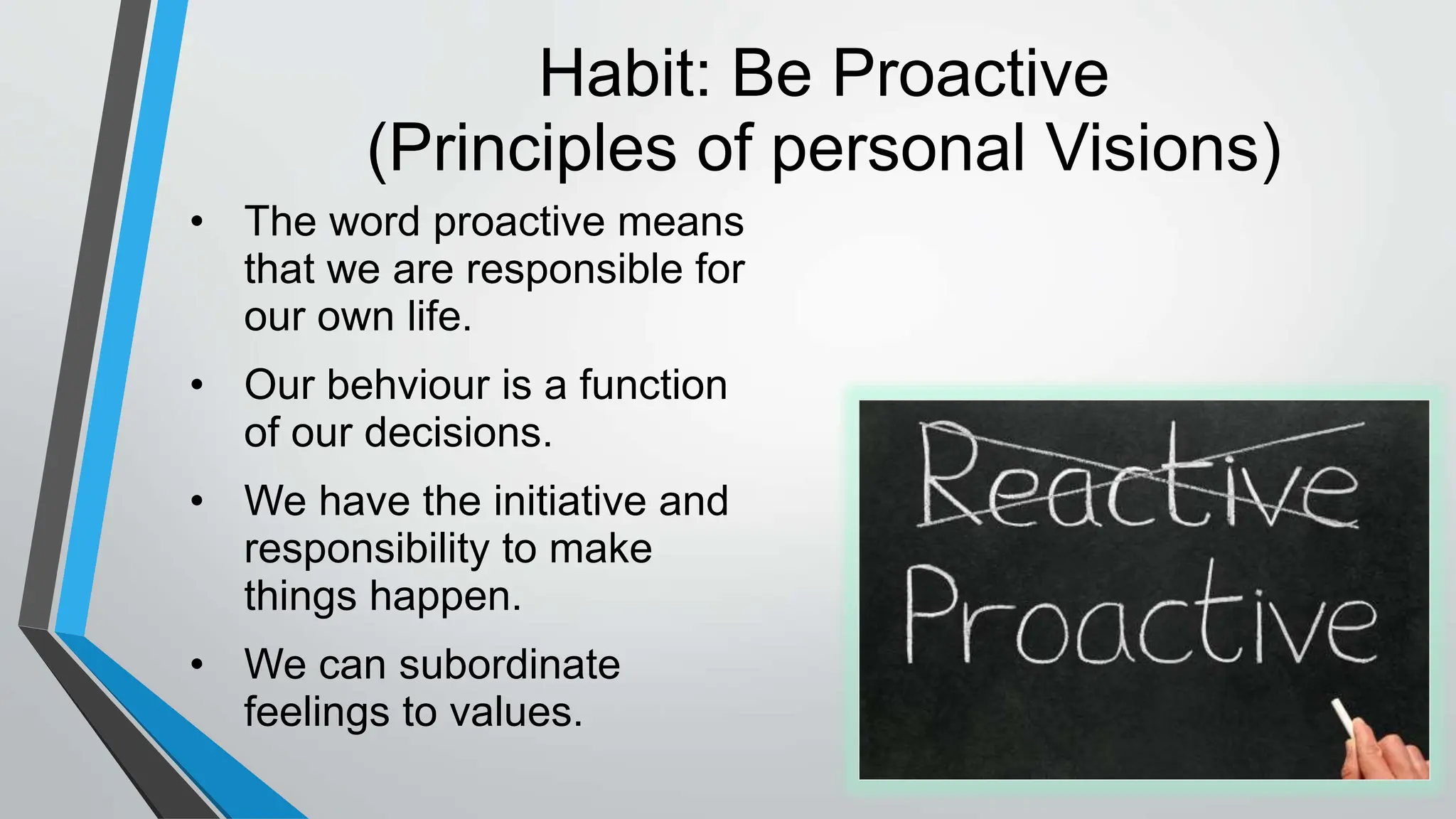
Habit: Be Proactive
(Principles of personal Visions)
• The word proactive means
that we are responsible for
our own life.
• Our behviour is a function
of our decisions.
• We have the initiative and
responsibility to make
things happen.
• We can subordinate
feelings to values.
Highly proactive people
• Highly proactive people
recognized that
resposibility.
• They do not blame
circumstances and
conditions.
• Their behavour is their
own concus choice.
• proactive people are
still influenced. 11/27/22
• Be proactive rather than reactive.
• Reactive people alyways blame the system.
• Reactive people never thanks to Allah Almighty.
Habit four think win-win
Habit four-Think win-win
• Things win/win means that
everyone can win. Not only
me and you.
• Preferable to the
alternative where pne or
more parties lose.
• Not readily visible.
• Develop a deep
understanding of the
situation nd individual.
• WIN/WIN is a belief in a
third alternative.
• It’s not your way or my
way; it’s a better way.
• And if a solution can’t be
found to benefit both
parties they agree to
disagree agreeably no
ideal.
• If you can’t reach a true
WIN/WIN,you’re very often
better off to go for no Deal.
11/27/22
Habit Five –
Sharpen the saw
Habit Five - SharpenThe Saw
The habit of daily self-renewal
Sharpen the saw means
preserving and enhancing
the greatest assets you
have-you
 Self-renewal in four areas
of life
“Everyday ProvidesA NewOpportunity”
Invest time in yourself
Cultivate the greatest assets you
have
“ G
ivem
esixhourstochopdownatreeandI
will spendthefirst four sharpeningtheaxe.”
Abraham Lincoln
Habit six –
First to understand than to
understood
Seek FirstTo Understand,
ThenTo Be Understood
Listen to other
people ideas
Create an emotional
bank account
Feel the opponent
The Concept Of Empathic listening
Ignoring
Pretending
Selective listening
Attentive listening
Lead to misunderstanding
Habit seven - synergy
• Synergy in human beings.
• Synergy in animals.
Money heist: Professor Team work in ants.
• The secrets behind the success of
entrepreneurs.
Tesla employees Elon Musk
Conclusion
• A quick review ofThe 7 Habits of Highly Effective People.
1. Begin with the end in mind.
2. Put first thing first.
3. Be proactive.
4. Think win-win.
5. Seek first to understand than to understood.
6. Sharpen the saw.
7. Synergize.
“Sow a thought, reap an action;
sow an action, reap a habit;
sow a habit, reap a character;
sow a character, reap a
destiny.”
― Stephen Covey
Any Question
Please?

7 Habits of Highly Effective People.pptx

  • 2.
    Group 1 Group Members Hussain Maqbool  Zia Ul Haq  Asfand Yar (Ko Ko)  Rizwan Ullah  Aizaz Hussain
  • 3.
    Introducton • Book Name:The 7 Habits of Highly Effective People • Author: Stephen R. Covey • Published On: Augut 15, 1989 • Copy Sold: 15 Million • Printed in: 18 Lauguages
  • 4.
    What Exactly theHabit Is? An automatic behaviour that forms by regular repetition of an activity in a similar way.
  • 7.
    How to Developa New Habit and to get rid of bad ones?
  • 8.
  • 9.
    Importance of Habits “Youdon’t decide your future but you decide your habits and your habits will decide your future”.
  • 10.
    Habit One - BeginWith the End in Mind
  • 11.
    Habit One -Begin With the End in Mind
  • 12.
    Habit One -Begin With the End in Mind If you don’t know where you are going, then you can follow any path, It doesn’t matter, You will never reach the destination!
  • 13.
    One Habit iscommon among all these
  • 15.
    Mission Statement  Apowerful statement that expresses your personal sense of purpose and meaning of life.  It act as a governing constitutions by which you evaluate decisions and choose behaviours.  To begin with the end in mind is to begin with the image of end of your life as a frame of reference by which everything else is measured.
  • 16.
     Mission Statementan expression of what you want your life to be about.  Write it out  Use it and stay on the track Mission Statement Ask this Question from yourself  What you want from your friends to think about you after Degree Completion? What you are doing for this now?
  • 17.
    Mission Statement For usingmission statement it is Necessary that:  Don’t announce it.  Don’t rush it.  Don’t forget it.
  • 18.
    Follow your dreams Otherwise, peoplewill hire you for their dreams.
  • 19.
    Habit Two –Put First Things First
  • 20.
    Habit Two –Put Fist Things First
  • 21.
    Simple to understandbut difficult to implement We should use our goals and priorities to schedule our time. Caution – time should be managed in week chunks instead of daily chunks to allow for variance.
  • 22.
    Weekly Matrix (Continue) II I I I IV I Important Not Important
  • 23.
    Weekly Matrix (Continue) II I I I IV I Urgent Not Urgent Important Not Important Quadrant I (Important but Urgent) Pressing Problems Critical Deadlines
  • 24.
    Weekly Matrix (Continue) II I I I IV I Urgent Not Urgent Important Not Important Quadrant I V (Important but not Urgent) Unproductive Activities Pleasant Activities
  • 25.
    Weekly Matrix (Continue) II I I I IV I Urgent Not Urgent Important Not Important Quadrant I I I (Not Important but Urgent) Meeting With Friends Some Phone Calls
  • 26.
    Weekly Matrix (Continue) II I I I IV I Urgent Not Urgent Important Not Important Quadrant I I I (Important but not Urgent) Basic Needs Recreation
  • 27.
    Which Quadrant is Important? II I I I IV I Urgent Not Urgent Important Not Important
  • 28.
    Which Quadrant isImportant? I I Not Urgent Important Reason By staying in second Quadrant we can do our work in a more satisfactory way.  Tension Free  Higher Efficiency Example: FM-|| (CEP) , Lab Reports etc
  • 29.
     Quadrant IIactivities are very powerful, because they are lead to success.  To say yes to important things requires you to learn to say No to other activities. Key Points
  • 30.
    We don’t manage timeWe can only I manage ourselves
  • 31.
    Habit Three –Be Proactive
  • 32.
    Habit: Be Proactive (Principlesof personal Visions) • The word proactive means that we are responsible for our own life. • Our behviour is a function of our decisions. • We have the initiative and responsibility to make things happen. • We can subordinate feelings to values.
  • 33.
    Highly proactive people •Highly proactive people recognized that resposibility. • They do not blame circumstances and conditions. • Their behavour is their own concus choice. • proactive people are still influenced. 11/27/22
  • 34.
    • Be proactiverather than reactive. • Reactive people alyways blame the system. • Reactive people never thanks to Allah Almighty.
  • 35.
  • 36.
    Habit four-Think win-win •Things win/win means that everyone can win. Not only me and you. • Preferable to the alternative where pne or more parties lose. • Not readily visible. • Develop a deep understanding of the situation nd individual.
  • 37.
    • WIN/WIN isa belief in a third alternative. • It’s not your way or my way; it’s a better way. • And if a solution can’t be found to benefit both parties they agree to disagree agreeably no ideal. • If you can’t reach a true WIN/WIN,you’re very often better off to go for no Deal. 11/27/22
  • 38.
  • 39.
    Habit Five -SharpenThe Saw The habit of daily self-renewal Sharpen the saw means preserving and enhancing the greatest assets you have-you  Self-renewal in four areas of life
  • 40.
    “Everyday ProvidesA NewOpportunity” Investtime in yourself Cultivate the greatest assets you have “ G ivem esixhourstochopdownatreeandI will spendthefirst four sharpeningtheaxe.” Abraham Lincoln
  • 41.
    Habit six – Firstto understand than to understood
  • 42.
    Seek FirstTo Understand, ThenToBe Understood Listen to other people ideas Create an emotional bank account Feel the opponent
  • 43.
    The Concept OfEmpathic listening Ignoring Pretending Selective listening Attentive listening Lead to misunderstanding
  • 44.
  • 46.
    • Synergy inhuman beings. • Synergy in animals. Money heist: Professor Team work in ants.
  • 47.
    • The secretsbehind the success of entrepreneurs. Tesla employees Elon Musk
  • 48.
    Conclusion • A quickreview ofThe 7 Habits of Highly Effective People. 1. Begin with the end in mind. 2. Put first thing first. 3. Be proactive. 4. Think win-win. 5. Seek first to understand than to understood. 6. Sharpen the saw. 7. Synergize.
  • 49.
    “Sow a thought,reap an action; sow an action, reap a habit; sow a habit, reap a character; sow a character, reap a destiny.” ― Stephen Covey
  • 50.