Power Grid Model Meet-up
21 May 2025
Alliander N.V. | powergridmodel@lists.lfenergy.org
This session is being recorded.
Safety First
● In case of emergency
- follow signs of emergency exit
● Don't drive and call, also not hands-free
● This session will be recorded and photographed
● Online participants can post questions in the chat
Peter Salemink
● Chair of the power-grid-model project
● Senior scientific software engineer at Alliander
● Guest lecturer at Eindhoven University of Technology
Project Governance by LF Energy
• Technical steering committee
- Peter Salemink (chair)
- Werner van Westering, Tony Xiang (power system consultant)
- Jonas van den Bogaard (open-source consultant)
• Maintainers
- Nitish Bharambe / Martijn Govers / Zhen Wang / Jerry Guo / Santiago Figueroa Manrique / Laurynas Jagutis
• Power Grid Model DS Maintainers
- Thijs Baaijen / Jaap Schouten / Vincent Koppen / Sven van der Voort
• Developers/Contributors
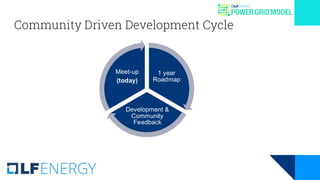
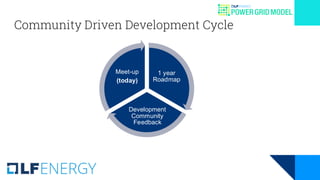
Community Driven Development Cycle
1 year
Roadmap
Development &
Community
Feedback
Meet-up
(today)
Roadmap input
• Suggestions for new features can be put on the "feature board" during the day
• Online: post your ideas in the chat
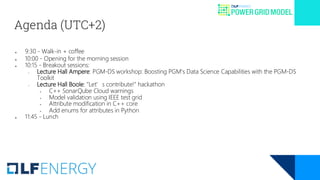
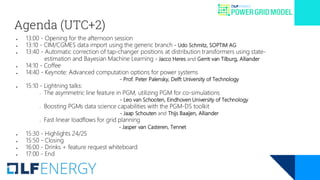
Agenda (UTC+2)
● 9:30 - Walk-in + coffee
● 10:00 - Opening for the morning session
● 10:15 - Breakout sessions:
○ Lecture Hall Ampere: PGM-DS workshop: Boosting PGM's Data Science Capabilities with the PGM-DS
Toolkit
○ Lecture Hall Boole: "Let’s contribute!" hackathon
▪ C++ SonarQube Cloud warnings
▪ Model validation using IEEE test grid
▪ Attribute modification in C++ core
▪ Add enums for attributes in Python
● 11:45 - Lunch
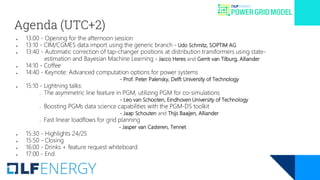
Agenda (UTC+2)
● 13:00 - Opening for the afternoon session
● 13:10 - CIM/CGMES data import using the generic branch - Udo Schmitz, SOPTIM AG
● 13:40 - Automatic correction of tap-changer positions at distribution transformers using state-
estimation and Bayesian Machine Learning - Jacco Heres and Gerrit van Tilburg, Alliander
● 14:10 - Coffee
● 14:40 - Keynote: Advanced computation options for power systems
- Prof. Peter Palensky, Delft University of Technology
● 15:10 - Lightning talks:
○ The asymmetric line feature in PGM, utilizing PGM for co-simulations
- Leo van Schooten, Eindhoven University of Technology
○ Boosting PGMs data science capabilities with the PGM-DS toolkit
- Jaap Schouten and Thijs Baaijen, Alliander
○ Fast linear loadflows for grid planning
- Jasper van Casteren, Tennet
● 15:30 - Highlights 24/25
● 15:50 - Closing
● 16:00 - Drinks + feature request whiteboard
● 17:00 - End
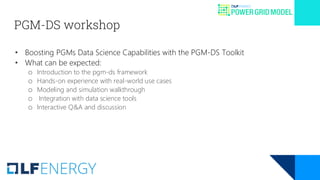
PGM-DS workshop
• Boosting PGMs Data Science Capabilities with the PGM-DS Toolkit
• What can be expected:
o Introduction to the pgm-ds framework
o Hands-on experience with real-world use cases
o Modeling and simulation walkthrough
o Integration with data science tools
o Interactive Q&A and discussion
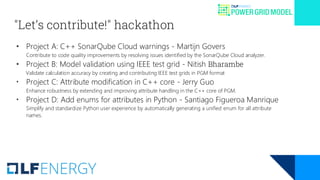
"Let’s contribute!" hackathon
• Project A: C++ SonarQube Cloud warnings - Martijn Govers
Contribute to code quality improvements by resolving issues identified by the SonarQube Cloud analyzer.
• Project B: Model validation using IEEE test grid - Nitish Bharambe
Validate calculation accuracy by creating and contributing IEEE test grids in PGM format
• Project C: Attribute modification in C++ core - Jerry Guo
Enhance robustness by extending and improving attribute handling in the C++ core of PGM.
• Project D: Add enums for attributes in Python - Santiago Figueroa Manrique
Simplify and standardize Python user experience by automatically generating a unified enum for all attribute
names.
"Let’s contribute!" hackathon
• Getting started:
o Fork the repository from the following issue:
[Feature] PGM Meet-up 2025-05-21 Hackatons · Issue #977 ·
PowerGridModel/power-grid-model
o Set up signed commits in Git
o Follow the setup instructions outlined in the issue linked above
Power Grid Model Meet-up
21 May 2025
Alliander N.V. | powergridmodel@lists.lfenergy.org
This session is being recorded.
Safety First
● In case of emergency
- follow signs of emergency exit
● Don't drive and call, also not hands-free
● This session will be recorded and photographed
● Online participants can post questions in the chat
Peter Salemink
● Chair of the power-grid-model project
● Senior scientific software engineer at Alliander
● Guest lecturer at Eindhoven University of Technology
Project Governance by LF Energy
• Technical steering committee
- Peter Salemink (chair)
- Werner van Westering, Tony Xiang (power system consultant)
- Jonas van den Bogaard (open-source consultant)
• Maintainers
- Nitish Bharambe / Martijn Govers / Zhen Wang / Jerry Guo / Santiago Figueroa Manrique / Laurynas Jagutis
• Power Grid Model DS Maintainers
- Thijs Baaijen / Jaap Schouten / Vincent Koppen / Sven van der Voort
• Developers/Contributors
Community Driven Development Cycle
1 year
Roadmap
Development
Community
Feedback
Meet-up
(today)
Roadmap input
• Suggestions for new features can be put on the “feature board” during the event
• Online: post your ideas in the chat
Agenda (UTC+2)
● 13:00 - Opening for the afternoon session
● 13:10 - CIM/CGMES data import using the generic branch - Udo Schmitz, SOPTIM AG
● 13:40 - Automatic correction of tap-changer positions at distribution transformers using state-
estimation and Bayesian Machine Learning - Jacco Heres and Gerrit van Tilburg, Alliander
● 14:10 - Coffee
● 14:40 - Keynote: Advanced computation options for power systems
- Prof. Peter Palensky, Delft University of Technology
● 15:10 - Lightning talks:
○ The asymmetric line feature in PGM, utilizing PGM for co-simulations
- Leo van Schooten, Eindhoven University of Technology
○ Boosting PGMs data science capabilities with the PGM-DS toolkit
- Jaap Schouten and Thijs Baaijen, Alliander
○ Fast linear loadflows for grid planning
- Jasper van Casteren, Tennet
● 15:30 - Highlights 24/25
● 15:50 - Closing
● 16:00 - Drinks + feature request whiteboard
● 17:00 - End
1
21.5.2025, Udo Schmitz
CIM/CGMES data import using the
generic branch
2
Agenda
| © SOPTIM AG |
• Introduction
• Motivation
• Generic Branch
• CGMES2PGM converter
3
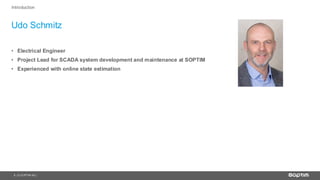
Udo Schmitz
| © SOPTIM AG |
Introduction
• Electrical Engineer
• Project Lead for SCADA system development and maintenance at SOPTIM
• Experienced with online state estimation
4
ZENTRALE AACHEN
SOPTIM AG
Im Süsterfeld 5–7
52072 Aachen
NIEDERLASSUNG ESSEN
SOPTIM AG
Dietrich-Oppenberg-Platz 1
45127 Essen
| © SOPTIM AG |
SOPTIM, software for the energy sector
Introduction
Public Limited Company,
400 employees
Software Solutions for the Energy
Market: trading, redispatch and grid
management
Standard Products & Custom
Solutions
Headquarters Aachen Branch Office Essen
5
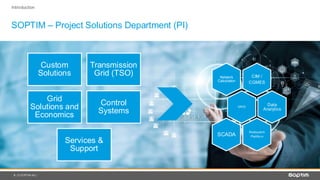
SOPTIM – Project Solutions Department (PI)
| © SOPTIM AG |
Custom
Solutions
Transmission
Grid (TSO)
Grid
Solutions and
Economics
Control
Systems
Services &
Support
Introduction
CIM /
CGMES
Network
Calculation
GRID
Data
Analytics
Redispatch
Plattform
SCADA
6
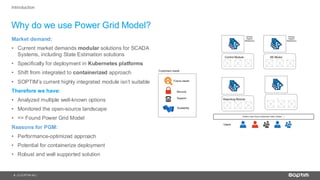
Why do we use Power Grid Model?
| © SOPTIM AG |
Market demand:
• Current market demands modular solutions for SCADA
Systems, including State Estimation solutions
• Specifically for deployment in Kubernetes platforms
• Shift from integrated to containerized approach
• SOPTIM’s current highly integrated module isn’t suitable
Therefore we have:
• Analyzed multiple well-known options
• Monitored the open-source landscape
• => Found Power Grid Model
Reasons for PGM:
• Performance-optimized approach
• Potential for containerize deployment
• Robust and well supported solution
Introduction
7
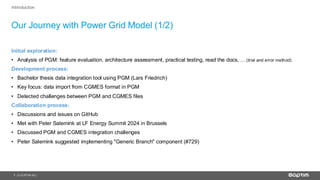
Our Journey with Power Grid Model (1/2)
| © SOPTIM AG |
Introduction
Initial exploration:
• Analysis of PGM: feature evaluation, architecture assessment, practical testing, read the docs, …(trial and error method)
Development process:
• Bachelor thesis data integration tool using PGM (Lars Friedrich)
• Key focus: data import from CGMES format in PGM
• Detected challenges between PGM and CGMES files
Collaboration process:
• Discussions and issues on GitHub
• Met with Peter Salemink at LF Energy Summit 2024 in Brussels
• Discussed PGM and CGMES integration challenges
• Peter Salemink suggested implementing "Generic Branch" component (#729)
8
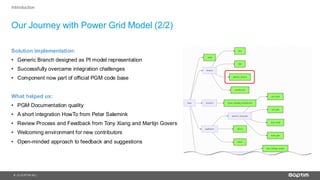
Our Journey with Power Grid Model (2/2)
| © SOPTIM AG |
Introduction
Solution implementation:
• Generic Branch designed as PI model representation
• Successfully overcame integration challenges
• Component now part of official PGM code base
What helped us:
• PGM Documentation quality
• A short integration HowTo from Peter Salemink
• Review Process and Feedback from Tony Xiang and Martijn Govers
• Welcoming environment for new contributors
• Open-minded approach to feedback and suggestions
9
references
has
Po er System omponents and elationships Standardi ation
CIM
| © SOPTIM AG |
Motivation
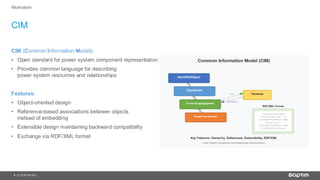
CIM (Common Information Model):
• Open standard for power system component representation
• Provides common language for describing
power system resources and relationships
Features:
• Object-oriented design
• Reference-based associations between objects
instead of embedding
• Extensible design maintaining backward compatibility
• Exchange via RDF/XML format
10
CGMES
| © SOPTIM AG |
Motivation
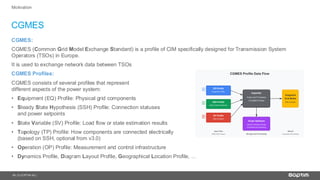
CGMES:
CGMES (Common Grid Model Exchange Standard) is a profile of CIM specifically designed for Transmission System
Operators (TSOs) in Europe.
It is used to exchange network data between TSOs
CGMES Profiles:
CGMES consists of several profiles that represent
different aspects of the power system:
• Equipment (EQ) Profile: Physical grid components
• Steady State Hypothesis (SSH) Profile: Connection statuses
and power setpoints
• State Variable (SV) Profile: Load flow or state estimation results
• Topology (TP) Profile: How components are connected electrically
(based on SSH, optional from v3.0)
• Operation (OP) Profile: Measurement and control infrastructure
• Dynamics Profile, Diagram Layout Profile, Geographical Location Profile, …
uipment Profile
Steady State ypothesis
State ariables
Import and Processing
of GM S Profiles
et or Topology Storage
and elationship Modeling
IM compliant
Input iles
M IM ormat Storage and Processing
esult
omplete Grid Model
11
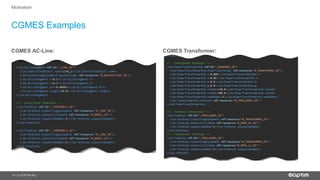
CGMES Examples
| © SOPTIM AG |
CGMES AC-Line: CGMES Transformer:
Motivation
12
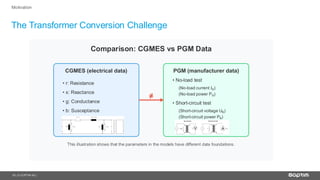
The Transformer Conversion Challenge
| © SOPTIM AG |
Motivation
• r: esistance
• : eactance
• g: onductance
• b: Susceptance
• o load test
o load current Io
o load po er Po
• Short circuit test
Short circuit voltage
Short circuit po er P
This illustration sho s that the parameters in the models have different data foundations
13
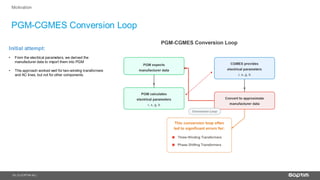
PGM-CGMES Conversion Loop
| © SOPTIM AG |
Motivation
Initial attempt:
• From the electrical parameters, we derived the
manufacturer data to import them into PGM
• This approach worked well for two-winding transformers
and AC lines, but not for other components.
14
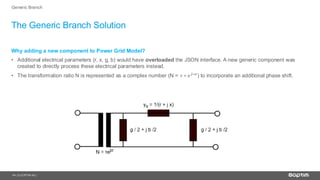
The Generic Branch Solution
| © SOPTIM AG |
Generic Branch
Why adding a new component to Power Grid Model?
• Additional electrical parameters (r, x, g, b) would have overloaded the JSON interface. A new generic component was
created to directly process these electrical parameters instead.
• The transformation ratio N is represented as a complex number (N = 𝜏 ∗ 𝑒𝑗∗𝜎) to incorporate an additional phase shift.
15
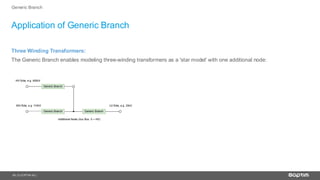
Application of Generic Branch
| © SOPTIM AG |
Generic Branch
Three Winding Transformers:
The Generic Branch enables modeling three-winding transformers as a 'star model' with one additional node:
16
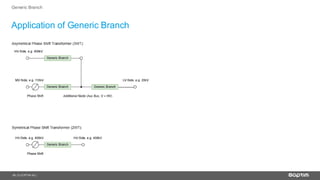
Application of Generic Branch
| © SOPTIM AG |
Generic Branch
17
Application of Generic Branch
| © SOPTIM AG |
Generic Branch
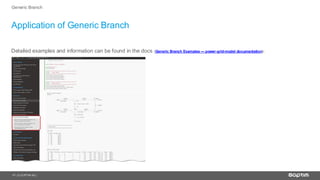
Detailed examples and information can be found in the docs (Generic Branch Examples — power-grid-model documentation):
):
18
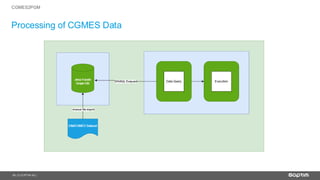
Processing of CGMES Data
| © SOPTIM AG |
CGMES2PGM
19
Processing of CGMES Data
| © SOPTIM AG |
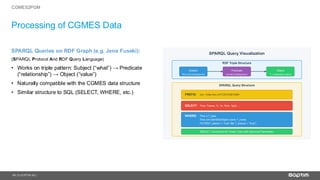
SPARQL Queries on RDF Graph (e.g. Jena Fuseki):
(SPARQL Protocol And RDF Query Language)
• Wor s on triple pattern: Subject “ hat” → Predicate
“relationship” → Object “value”
• Naturally compatible with the CGMES data structure
• Similar structure to SQL (SELECT, WHERE, etc.)
CGMES2PGM
Subject
line A ineSegment
Predicate
cim:A ineSegment r
Object
r resistance value
cim: http: iec ch T IM
line, name, r, , bch, gch,
line a type
line cim:IdentifiedObject name name
I T status true status true
S T: onnected A Po er ines ith lectrical Parameters
20
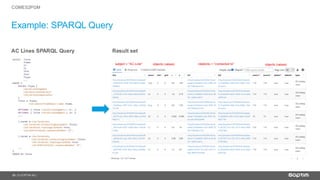
Example: SPARQL Query
| © SOPTIM AG |
AC Lines SPARQL Query Result set
CGMES2PGM
21
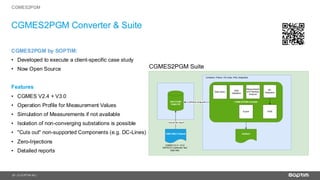
CGMES2PGM Converter & Suite
| © SOPTIM AG |
CGMES2PGM by SOPTIM:
• Developed to execute a client-specific case study
• Now Open Source
Features
• CGMES V2.4 + V3.0
• Operation Profile for Measurement Values
• Simulation of Measurements if not available
• Isolation of non-converging substations is possible
• "Cuts out" non-supported Components (e.g. DC-Lines)
• Zero-Injections
• Detailed reports
CGMES2PGM
22
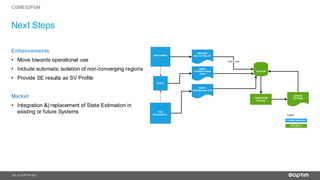
Next Steps
| © SOPTIM AG |
CGMES2PGM
Enhancements
• Move towards operational use
• Include automatic isolation of non-converging regions
• Provide SE results as SV Profile
Market
• Integration &| replacement of State Estimation in
existing or future Systems
23
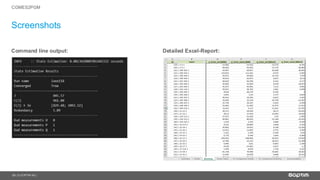
Screenshots
| © SOPTIM AG |
Command line output: Detailed Excel-Report:
CGMES2PGM
24
Acknowlegements
| © SOPTIM AG |
Thank you for your excellent work on the CGMES2PGM converter:
• Lars Friedrich
• Eduard Fried
25 | © SOPTIM AG |
Thank you for your attention
Automatic correction of tap-changer positions
at distribution transformers using state-
estimation and Bayesian Machine Learning
Alliander - 21 May 2025
Gerrit van Tilburg
Jacco Heres
Introduction
2
Is 'garbage in - garbage out'?
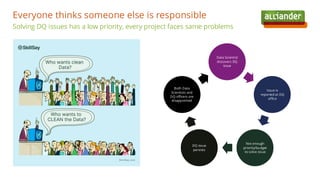
Everyone thinks someone else is responsible
Solving DQ issues has a low priority, every project faces same problems
Data Scientist
discovers DQ
issue
Issue is
reported at DQ
office
Not enough
priority/budget
to solve issue
DQ issue
persists
Both Data
Scientists and
DQ officers are
disappointed
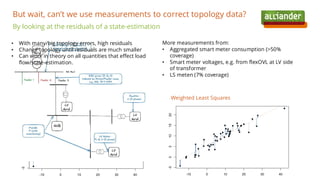
By looking at the residuals of a state-estimation
But wait, can’t we use measurements to correct topology data?
Ordinary Least Squares Weighted Least Squares
More measurements from:
• Aggregated smart meter consumption (>50%
coverage)
• Smart meter voltages, e.g. from flexOVL at LV side
of transformer
• LS meten (7% coverage)
• With many/big topology errors, high residuals
• Change topology until residuals are much smaller
• Can work in theory on all quantities that effect load
flow/state-estimation.
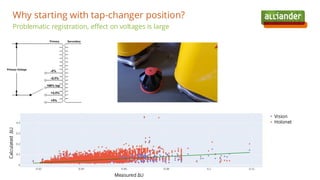
Why starting with tap-changer position?
Problematic registration, effect on voltages is large
Measured ΔU
Calculated
ΔU
Vision
Holonet
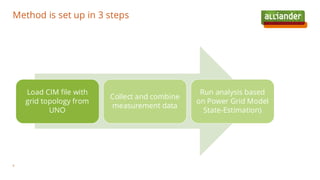
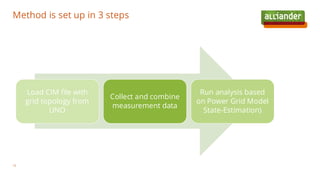
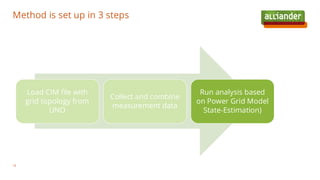
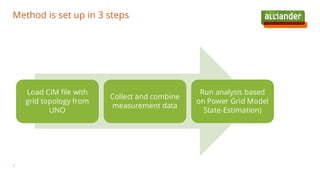
Method is set up in 3 steps
7
Load CIM file with
grid topology from
UNO
Collect and combine
measurement data
Run analysis based
on Power Grid Model
State-Estimation)
Conversion to PGM-DS and
adding measurements
Method is set up in 3 steps
9
Load CIM file with
grid topology from
UNO
Collect and combine
measurement data
Run analysis based
on Power Grid Model
State-Estimation)
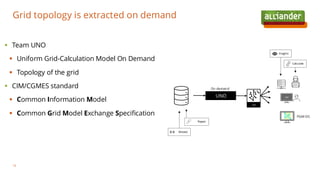
Grid topology is extracted on demand
10
UNO
CIM
On demand
Insights
Calculate
Repair
Mutate
VNF
PGM-DS
▪ Team UNO
▪ Uniform Grid-Calculation Model On Demand
▪ Topology of the grid
▪ CIM/CGMES standard
▪ Common Information Model
▪ Common Grid Model Exchange Specification
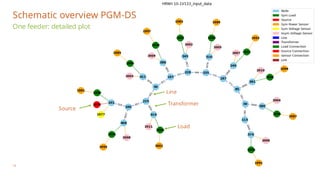
• Schematic overview
• Do calculations
• Loadflow in specific scenario’s
• Short circuit calculations
• Used for:
• Integration of customers
• Design the grid
• Prevent faults and congestion
Network Analists & Architects
Main use of models: Vision & Gaia
11
Basic Network
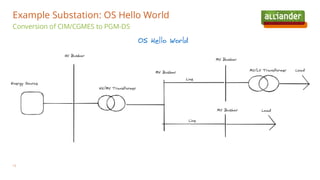
Example Substation: OS Hello World
12
Conversion of CIM/CGMES to PGM-DS
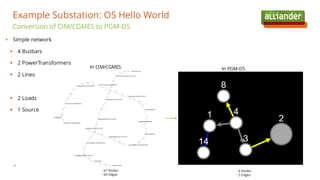
Example Substation: OS Hello World
13
In PGM-DS
▪ Simple network
▪ 4 Busbars
▪ 2 PowerTransformers
▪ 2 Lines
▪ 2 Loads
▪ 1 Source
- 67 Nodes
- 66 Edges
- 6 Nodes
- 5 Edges
In CIM/CGMES
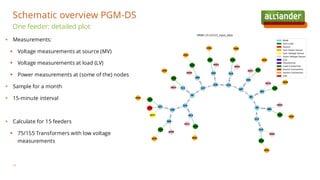
One feeder: detailed plot
Schematic overview PGM-DS
14
Transformer
Source
Load
Line
Method is set up in 3 steps
15
Load CIM file with
grid topology from
UNO
Collect and combine
measurement data
Run analysis based
on Power Grid Model
State-Estimation)
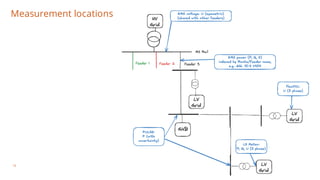
Measurement locations
16
One feeder: detailed plot
Schematic overview PGM-DS
17
▪ Measurements:
▪ Voltage measurements at source (MV)
▪ Voltage measurements at load (LV)
▪ Power measurements at (some of the) nodes
▪ Sample for a month
▪ 15-minute interval
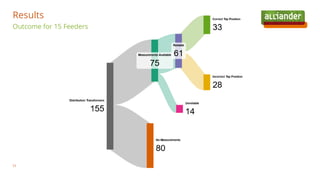
▪ Calculate for 15 feeders
▪ 75/155 Transformers with low voltage
measurements
Method is set up in 3 steps
18
Load CIM file with
grid topology from
UNO
Collect and combine
measurement data
Run analysis based
on Power Grid Model
State-Estimation)
Inference
algorithms
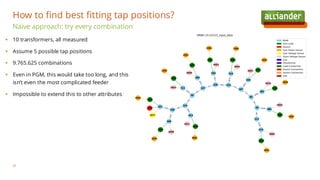
Naïve approach: try every combination
How to find best fitting tap positions?
20
▪ 10 transformers, all measured
▪ Assume 5 possible tap positions
▪ 9.765.625 combinations
▪ Even in PGM, this would take too long, and this
isn’t even the most complicated feeder
▪ Impossible to extend this to other attributes
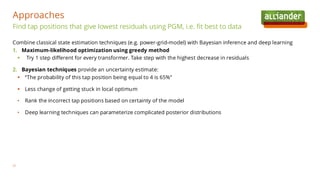
Combine classical state estimation techniques (e.g. power-grid-model) with Bayesian inference and deep learning
1. Maximum-likelihood optimization using greedy method
▪ Try 1 step different for every transformer. Take step with the highest decrease in residuals
2. Bayesian techniques provide an uncertainty estimate:
▪ “The probability of this tap position being equal to 4 is 65%”
▪ Less change of getting stuck in local optimum
• Rank the incorrect tap positions based on certainty of the model
• Deep learning techniques can parameterize complicated posterior distributions
Find tap positions that give lowest residuals using PGM, i.e. fit best to data
Approaches
21
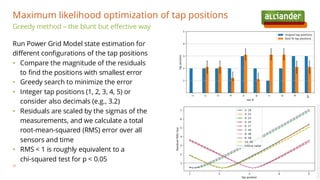
Greedy method – the blunt but effective way
Run Power Grid Model state estimation for
different configurations of the tap positions
• Compare the magnitude of the residuals
to find the positions with smallest error
• Greedy search to minimize the error
• Integer tap positions (1, 2, 3, 4, 5) or
consider also decimals (e.g., 3.2)
• Residuals are scaled by the sigmas of the
measurements, and we calculate a total
root-mean-squared (RMS) error over all
sensors and time
• RMS < 1 is roughly equivalent to a
chi-squared test for p < 0.05
Maximum likelihood optimization of tap positions
22
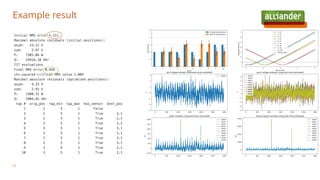
Example result
23
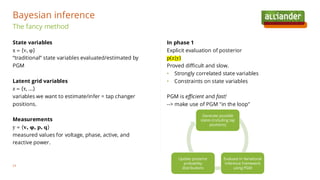
State variables
x = {v, φ}
“traditional” state variables evaluated/estimated by
PGM
Latent grid variables
z = {τ, ...}
variables we want to estimate/infer = tap changer
positions.
Measurements
y = {v, φ, p, q}
measured values for voltage, phase, active, and
reactive power.
The fancy method
Bayesian inference
24
In phase 1
Explicit evaluation of posterior
p(z|y)
Proved difficult and slow.
• Strongly correlated state variables
• Constraints on state variables
PGM is efficient and fast!
--> make use of PGM "in the loop"
Generate possible
states (including tap
positions)
Evaluate in Variational
Inference framework
using PGM
Update posterior
probability
distributions
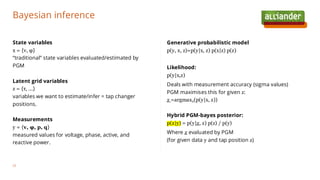
State variables
x = {v, φ}
“traditional” state variables evaluated/estimated by
PGM
Latent grid variables
z = {τ, ...}
variables we want to estimate/infer = tap changer
positions.
Measurements
y = {v, φ, p, q}
measured values for voltage, phase, active, and
reactive power.
Bayesian inference
25
Generative probabilistic model
p(y, x, z)=p(y|x, z) p(x|z) p(z)
Likelihood:
p(y|x,z)
Deals with measurement accuracy (sigma values)
PGM maximises this for given z:
x =argmaxx(p(y|x, z))
Hybrid PGM-bayes posterior:
p(z|y) = p(y|x, z) p(z) / p(y)
Where x evaluated by PGM
(for given data y and tap position z)
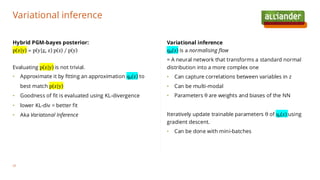
Hybrid PGM-bayes posterior:
p(z|y) = p(y|x, z) p(z) / p(y)
Evaluating p(z|y) is not trivial.
• Approximate it by fitting an approximation qθ(z) to
best match p(z|y)
• Goodness of fit is evaluated using KL-divergence
• lower KL-div = better fit
• Aka Variatonal Inference
Variational inference
26
Variational inference
qθ(z) is a normalising flow
= A neural network that transforms a standard normal
distribution into a more complex one
• Can capture correlations between variables in z
• Can be multi-modal
• Parameters θ are weights and biases of the NN
Iteratively update trainable parameters θ of qθ(z) using
gradient descent.
• Can be done with mini-batches
• Since PGM calculates state variables, automatic
differentiation (e.g. using Pytorch) will not work
▪ Use importance sampling to fit qθ(z) to samples
of p(z|y)
• p(z|y) is very "peaky"
▪ Leads to most samples not being informative (low
value for p(z|y))
▪ Leads to very erratic/noisy objective signal
• Solution: "Annealing strategy"
• Use f(z|y) instead of p(z|y). Where f(z|y) is less
peaky version of p(z|y).
• Easier to iteratively fit with fewer samples
Difficulties
Variational inference
Plaats hier uw voettekst
27
Example
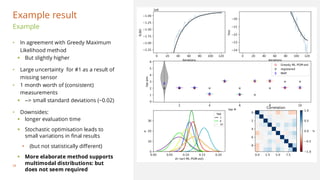
• In agreement with Greedy Maximum
Likelihood method
▪ But slightly higher
• Large uncertainty for #1 as a result of
missing sensor
• 1 month worth of (consistent)
measurements
▪ --> small standard deviations (~0.02)
• Downsides:
▪ longer evaluation time
▪ Stochastic optimisation leads to
small variations in final results
• (but not statistically different)
▪ More elaborate method supports
multimodal distributions: but
does not seem required
Example result
28
Results
Transformer
Focus on one Feeder: HRNH 10-1V133
Results
30
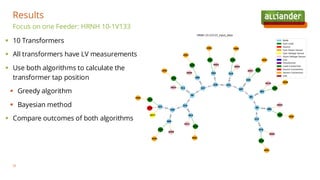
▪ 10 Transformers
▪ All transformers have LV measurements
▪ Use both algorithms to calculate the
transformer tap position
▪ Greedy algorithm
▪ Bayesian method
▪ Compare outcomes of both algorithms
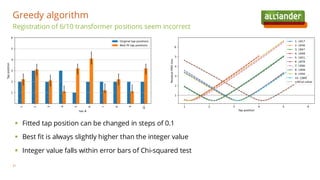
Registration of 6/10 transformer positions seem incorrect
Greedy algorithm
31
▪ Fitted tap position can be changed in steps of 0.1
▪ Best fit is always slightly higher than the integer value
▪ Integer value falls within error bars of Chi-squared test
Both algorithms
32
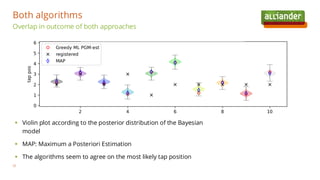
▪ Violin plot according to the posterior distribution of the Bayesian
model
▪ MAP: Maximum a Posteriori Estimation
▪ The algorithms seem to agree on the most likely tap position
Overlap in outcome of both approaches
Results
33
Outcome for 15 Feeders
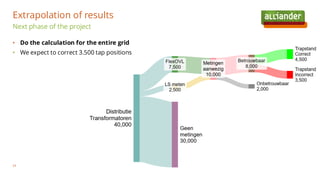
Extrapolation of results
34
• Do the calculation for the entire grid
• We expect to correct 3.500 tap positions
Next phase of the project
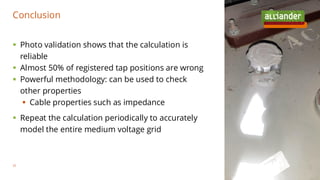
▪ Photo validation shows that the calculation is
reliable
▪ Almost 50% of registered tap positions are wrong
▪ Powerful methodology: can be used to check
other properties
▪ Cable properties such as impedance
▪ Repeat the calculation periodically to accurately
model the entire medium voltage grid
Conclusion
35
Agenda (UTC+2)
● 13:00 - Opening for the afternoon session
● 13:10 - CIM/CGMES data import using the generic branch - Udo Schmitz, SOPTIM AG
● 13:40 - Automatic correction of tap-changer positions at distribution transformers using state-
estimation and Bayesian Machine Learning - Jacco Heres and Gerrit van Tilburg, Alliander
● 14:10 - Coffee
● 14:40 - Keynote: Advanced computation options for power systems
- Prof. Peter Palensky, Delft University of Technology
● 15:10 - Lightning talks:
○ The asymmetric line feature in PGM, utilizing PGM for co-simulations
- Leo van Schooten, Eindhoven University of Technology
○ Boosting PGMs data science capabilities with the PGM-DS toolkit
- Jaap Schouten and Thijs Baaijen, Alliander
○ Fast linear loadflows for grid planning
- Jasper van Casteren, Tennet
● 15:30 - Highlights 24/25
● 15:50 - Closing
● 16:00 - Drinks + feature request whiteboard
● 17:00 - End
Asym-Line Feature Power Grid Model
A NEW FEATURE REQUIRED FOR THE DOTS PLATFORM
Leo van Schooten, PhD Candidate
Electrical Engineering (EE), Electrical Energy Systems (EES)
Motivation
• In DOTs we have the ambition to simulate big energy systems with electricity grids
consisting of a medium voltage ring and a low voltage grid
• An obvious requirement for this is that we need to do loadflow calculations
• Previously this was achieved with OpenDSS
• However, with the outlook to the future we would like to have optimal performance
and support
• Hence, the wish to migrate to PGM was born
• However, PGM was lacking the feature to supply line parameters per phase, which is
possible in OpenDSS.
• So, we decided to implement this ourselves
Asym-Line Feature
2
What is the Asym-Line feature?
• The Asym-Line feature allows us to model a cable with (self)-resistances, reactance's
and capacitances between conductors
• These will be used in asymmetric calculations
• Enhances the capabilities of analyzing voltage drops, power flow, and transient
behavior in multi-phase systems
Asym-Line Feature
3
Mathematical model
• Input for the resistance, reactance and capacitance
• The neutral phase for the resistance and reactance i.e. na – nn is optional
• The neutral phase can for now be provided in the resistance and reactance
parameters
Asym-Line Feature
4
Input with neutral phase
• First the impedance matrix is calculated
• Followed by a Kron Reduction
Asym-Line Feature
5
Cooperation went very smoothly
Asym-Line Feature
6
“Hi co-pilot can you create a comic about a very smooth coorperation in an open source project with one new contributor and 2 senior contributors”
Demo Time
Asym-Line Feature
7
Questions?
• Documentation
• Example notebook
Asym-Line Feature
8
Power Grid Model DS
A Data Science Extension for Power Grid Model
Introduction
Thijs Baaijen
Python Software Engineer
Jaap Schouten
Product Owner Data Science
Power Grid Model - Data Science Toolkit
Built upon the PGM Suite, PGM-DS integrates data science into power grid
analysis, empowering operators, researchers, and scientists to simulate,
analyze, and optimize power grids more effectively.
- Object oriented Grid approach to interact with the PGM Core
- Grid analysis tools for preparing input and analysing results
- Grid modification to simulate solutions on the Grid
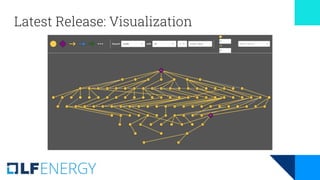
- Visualisation, because seeing is believing
Power Grid Model - Data Science Toolkit
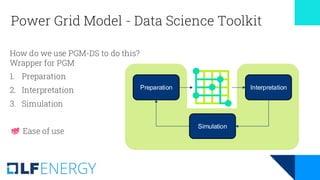
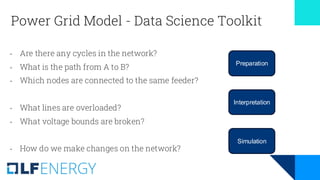
How do we use PGM-DS to do this?
Wrapper for PGM
1. Preparation
2. Interpretation
3. Simulation
Ease of use
Preparation Interpretation
Simulation
Power Grid Model - Data Science Toolkit
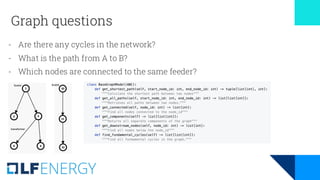
- Are there any cycles in the network?
- What is the path from A to B?
- Which nodes are connected to the same feeder?
- What lines are overloaded?
- What voltage bounds are broken?
- How do we make changes on the network?
Preparation
Interpretation
Simulation
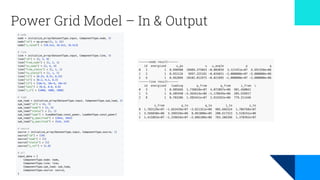
Power Grid Model – In & Output
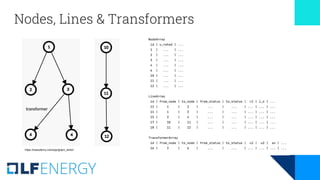
Nodes, Lines & Transformers
https://csacademy.com/app/graph_editor/
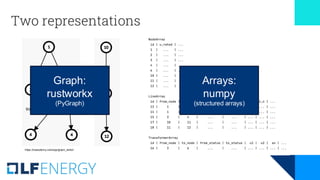
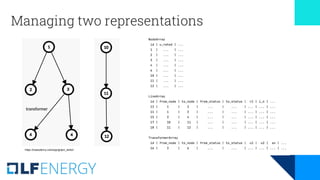
Two representations
https://csacademy.com/app/graph_editor/
Graph:
rustworkx
(PyGraph)
Arrays:
numpy
(structured arrays)
Graph questions
- Are there any cycles in the network?
- What is the path from A to B?
- Which nodes are connected to the same feeder?
Graph questions
feeder feeder
- Are there any cycles in the network?
- What is the path from A to B?
- Which nodes are connected to the same feeder?
Array questions
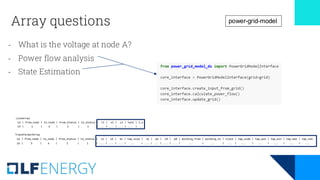
- What is the voltage at node A?
- Power flow analysis
- State Estimation
power-grid-model
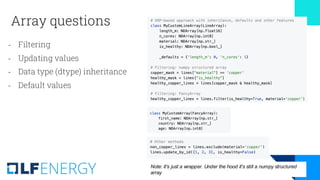
Note: it's just a wrapper. Under the hood it's still a numpy structured
array
Array questions
- Filtering
- Updating values
- Data type (dtype) inheritance
- Default values
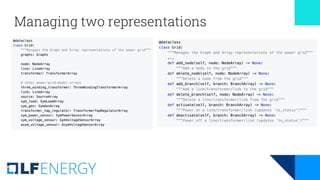
Managing two representations
https://csacademy.com/app/graph_editor/
Managing two representations
Latest Release: Visualization
Wrap Up
As developers at Alliander we are excited to share these extensions with the
community.
They have helped us a lot in building smart solutions for the energy transition,
and hope it will strengthen collaboration such that we can build even stronger
software with you, as an open source collaboration.
Fast Linear
Loadflow for Grid
Planning
Jasper van Casteren
ODINA scientific software development team
20 May 2025
We also draw attention to the following safety measures in case
of evacuation of the premises.
A moment
for safety
Together we provide a safe
working environment. We learn
from mistakes and sharing
ideas, concerns and asking
questions are a matter of course.
Follow the escape
route as indicated
Use the stairs
instead of the lift
Go to the
assembly point
Follow the instructions
of the in-company
emergency responder
2
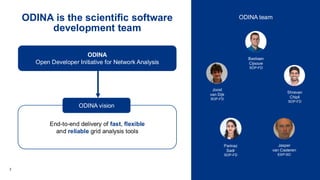
ODINA is the scientific software
development team
ODINA
Open Developer Initiative for Network Analysis
End-to-end delivery of fast, flexible
and reliable grid analysis tools
ODINA vision
Jasper
van Casteren
ESP-SO
Bastiaan
Cijsouw
SOP-FD
Joost
van Dijk
SOP-FD
Shravan
Chipli
SOP-FD
Parinaz
Sadr
SOP-FD
ODINA team
3
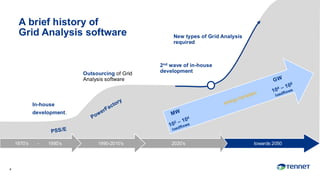
A brief history of
Grid Analysis software
In-house
development.
Outsourcing of Grid
Analysis software
2nd wave of in-house
development
towards 2050
2020’s
1990-2010’s
1970’s - 1990’s
New types of Grid Analysis
required
4
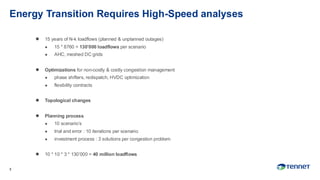
Energy Transition Requires High-Speed analyses
● 15 years of N-k loadflows (planned & unplanned outages)
● 15 * 8760 > 130’000 loadflows per scenario
● AHC, meshed DC grids
● Optimizations for non-costly & costly congestion management
● phase shifters, redispatch, HVDC optimization
● flexibility contracts
● Topological changes
● Planning process
● 10 scenario’s
● trial and error : 10 iterations per scenario
● investment process : 3 solutions per congestion problem
● 10 * 10 * 3 * 130’000 = 40 million loadflows
5
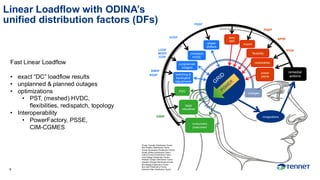
Linear Loadflow with ODINA’s
unified distribution factors (DFs)
large
industries
consumers
prosumers
P2G
congestions
remedial
actions
phase
shifters
(meshed)
HVDC
(un)planned
outages
changes
switching &
topological
adjustments
PSDF
LODF
MODF
IODF
DCDF
PGDF
DSDF
PTDF
BSDF
NPDF
BMDF
power
plants
renewables
import
AHC
MPI
flexibility
Fast Linear Loadflow
• exact “DC” loadflow results
• unplanned & planned outages
• optimizations
• PST, (meshed) HVDC,
flexibilities, redispatch, topology
• Interoperability
• PowerFactory, PSSE,
CIM-CGMES
Power Transfer Distribution Factor
Net Position Distribution Factor
Power Generation Distribution Factor
Phase Shifter Distribution Factor
Direct Current Distribution Factor
Line Outage Distribution Factor
Multiple Outage Distribution Factor
Injection Outage Distribution Factor
Bus Merge Distribution Factor
Bus Split Distribution Factor
Demand Side Distribution Factor
6
Conclusion
7
Linear Loadflows for Planning?
Yes, we can.
TenneT is a leading European grid operator. We are committed to providing a secure
and reliable supply of electricity 24 hours a day, 365 days a year, while helping to
drive the energy transition in our pursuit of a brighter energy future – more
sustainable, reliable and affordable than ever before. In our role as the first cross-
border Transmission System Operator (TSO) we design, build, maintain
and operate 25,000 kilometres of high-voltage electricity grid in the Netherlands and
large parts of Germany, and facilitate the European energy market through
our 17 interconnectors to neighbouring countries. We are one of the largest investors
in national and international onshore and offshore electricity grids, with
a turnover of EUR 9.2 billion and a total asset value of EUR 45 billion.
Every day our 8,300 employees take ownership, show courage and make and
maintain connections to ensure that the supply and demand of electricity is balanced
for over 43 million people.
Lighting the way ahead together
8
Disclaimer
This presentation is offered to you by TenneT TSO B.V. (‘TenneT’). The content of the
presentation – including all texts, images and audio fragments – is protected by copyright
laws. No part of the content of the presentation may be copied, unless TenneT has expressly
offered possibilities to do so, and no changes whatsoever may be made to the content.
TenneT endeavours to ensure the provision of correct and up-to-date information, but makes
no representations regarding correctness, accuracy or completeness.
TenneT declines any and all liability for any (alleged) damage arising from this presentation
and for any consequences of activities undertaken on the strength of data or information
contained therein.
9
Highlights 2024 Q3Q4 - 2025 Q1Q2
● 3 millions download reached!
● Automatic tap changer algorithm v1.8.x
● Columnar data v1.10.x
● Current sensor for Iterative Linear State Estimation (Experimental)
● Community events
● PGM meta data enums
● Numerically more stable method to calculate source injection in PF
● Bug fixed: LU solver bug
● Enable type hinting for all users
● Optional id for update data
● Full observability check for radial grid
● Self test in Python API
● Contributions by the community
● Internal improvements and bug fixes
● Improvements in documentation
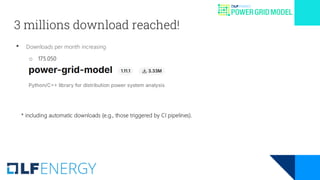
3 millions download reached!
• Downloads per month increasing
o 175.050
* including automatic downloads (e.g., those triggered by CI pipelines).
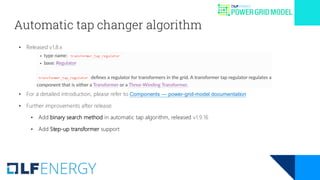
Automatic tap changer algorithm
• Released v1.8.x
• For a detailed introduction, please refer to Components — power-grid-model documentation
• Further improvements after release:
• Add binary search method in automatic tap algorithm, released v1.9.16
• Add Step-up transformer support
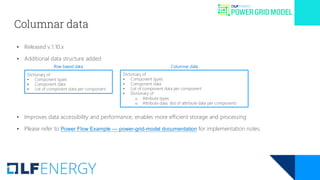
Columnar data
• Released v.1.10.x
• Additional data structure added
• Improves data accessibility and performance, enables more efficient storage and processing
• Please refer to Power Flow Example — power-grid-model documentation for implementation notes.
Dictionary of
• Component types
• Component data
• List of component data per component
• Dictionary of
o Attribute types
o Attribute data (list of attribute data per component)
Dictionary of
• Component types
• Component data
• List of component data per component
Row based data Columnar data
Current sensor for Iterative Linear State Estimation
• Released as an experimental feature in v.1.10.x (to be fully released soon).
• Global and local current sensors are introduced.
• The current sensor is only implemented for Iterative Linear State Estimation for now; support for Newton Raphson
state estimation will come soon.
• Please refer to Components — power-grid-model documentation for detailed documentation.
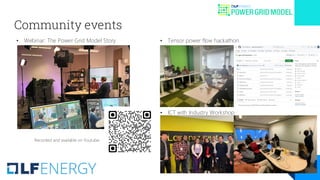
Community events
• ICT with Industry Workshop
• Tensor power flow hackathon
• Webinar: The Power Grid Model Story
Recorded and available on Youtube:
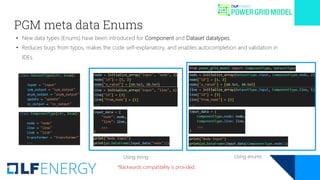
PGM meta data Enums
Using string Using enums
• New data types (Enums) have been introduced for Component and Dataset datatypes.
• Reduces bugs from typos, makes the code self-explanatory, and enables autocompletion and validation in
IDEs.
*Backwards compatibility is provided.
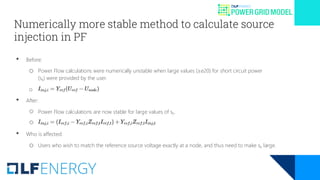
Numerically more stable method to calculate source
injection in PF
• Before:
o Power Flow calculations were numerically unstable when large values (≥e20) for short circuit power
(sk) were provided by the user.
o
• After:
○ Power Flow calculations are now stable for large values of sk.
○
• Who is affected:
o Users who wish to match the reference source voltage exactly at a node, and thus need to make sk large.
LU solver bug fixed
• What
o A bug was caused by an incorrect assumption in the core logic of the LU solver.
• Impact
o Resulted in SparseMatrixErrors for some cases, where calculation should be possible
• Resolution
o Bug fixed; behavior and error handling are now consistent.
• Documentation publicly available:
LU Solver — power-grid-model documentation
Enable type hinting for all users
• Type hinting support has been enabled across the Power Grid Model, making it fully compatible with mypy.
• Impact
o Catches bugs before runtime
o Improves code quality
• Example
Run mypy to validate type usage and catch issues early.
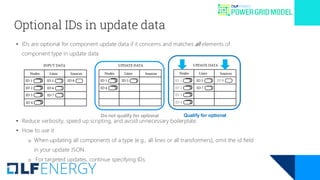
• IDs are optional for component update data if it concerns and matches all elements of
component type in update data
• Reduce verbosity, speed up scripting, and avoid unnecessary boilerplate.
• How to use it
o When updating all components of a type (e.g., all lines or all transformers), omit the id field
in your update JSON.
o For targeted updates, continue specifying IDs.
Optional IDs in update data
Do not qualify for optional Qualify for optional
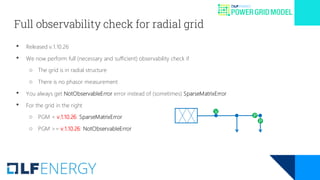
Full observability check for radial grid
• Released v.1.10.26
• We now perform full (necessary and sufficient) observability check if
○ The grid is in radial structure
○ There is no phasor measurement
• You always get NotObservableError error instead of (sometimes) SparseMatrixError
• For the grid in the right
○ PGM < v.1.10.26: SparseMatrixError
○ PGM >= v.1.10.26: NotObservableError
V
P
P
Self test in Python API
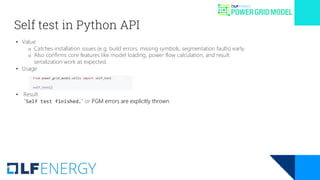
• Value
o Catches installation issues (e.g. build errors, missing symbols, segmentation faults) early.
o Also confirms core features like model loading, power flow calculation, and result
serialization work as expected.
• Usage
• Result
"Self test finished." or PGM errors are explicitly thrown.
Highlights 2024 Q3Q4 - 2025 Q1Q2
● 3 millions download reached!
● Automatic tap changer algorithm v1.8.x
● Columnar data v1.10.x
● Current sensor for Iterative Linear State Estimation
● Community events
● PGM meta data enums
● Numerically more stable method to calculate source injection in PF
● Bug fixed: LU solver bug
● Enable type hinting for all users
● Optional id for update data
● Full observability check for radial grid
● Self test in Python API
● Contributions by the community
● Internal improvements and bug fixes
● Improvements in documentation
Deprecation of Python versions
• Long term release strategy: 3 supported Python versions
- New Python version released in October -> drop oldest supported version in January
• Currently supported: Python >=3.11
- July 2024 drop Python 3.9 (extra deprecation, dropped)
- January 2025 drop Python 3.10 (dropped)
- January 2026 drop Python 3.11 (expected)
- …
Platform support
● The following platforms were dropped
● Platforms supporting glibc < 2.28 (dropped in v1.10.66; result of dropping pypa - manylinux_2_24 build environment)
○ Some known dropped platforms: Amazon Linux 2, Debian 9, Ubuntu 18.04, Fedora 28, CentOS 7, RHEL 7
● macOS < 13.3 (backwards-compatible version v1.10.66, dropped in v1.10.67).
○ Major: macOS 12 (Monterey; EOL 2024), macOS 11 (Big Sur; EOL 2023) and macOS 10.x (EOL 2022).
▪ Already EOL
○ Early macOS 13 (Ventura) versions also dropped
Dropping numpy 1.x
• Drop in Q3 2025
• As recommended by: https://scientific-python.org/specs/spec-0000/#drop-schedule
• https://github.com/PowerGridModel/power-grid-model/issues/654
Features/Improvements Requests
• Please write it on the whiteboard (or in the chat)
Closing
• Our Goal: Community-driven Ecosystem
• Think Big!
- Working Groups
- Hackathons
- Brainstorms
- Tutorials/Workshops
- Consultancy
- Webinar
Communications
• Mailing list (Announcement)
- https://lists.lfenergy.org/g/powergridmodel
• Road map
- https://github.com/orgs/PowerGridModel/projects/1
• Issues and discussion
- https://github.com/orgs/PowerGridModel/discussions
- Please post issues in relevant repository
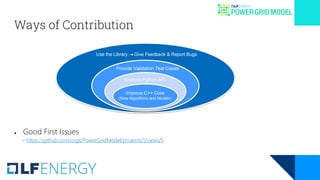
Ways of Contribution
● Good First Issues
- https://github.com/orgs/PowerGridModel/projects/1/views/5
Use the Library Give Feedback & Report Bugs
Improve C++ Core
(New Algorithms and Models)
Improve Python API
Provide Validation Test Cases
Thanks!

6th Power Grid Model Meetup - 21 May 2025

  • 1.
    Power Grid ModelMeet-up 21 May 2025 Alliander N.V. | powergridmodel@lists.lfenergy.org This session is being recorded.
  • 2.
    Safety First ● Incase of emergency - follow signs of emergency exit ● Don't drive and call, also not hands-free ● This session will be recorded and photographed ● Online participants can post questions in the chat
  • 3.
    Peter Salemink ● Chairof the power-grid-model project ● Senior scientific software engineer at Alliander ● Guest lecturer at Eindhoven University of Technology
  • 4.
    Project Governance byLF Energy • Technical steering committee - Peter Salemink (chair) - Werner van Westering, Tony Xiang (power system consultant) - Jonas van den Bogaard (open-source consultant) • Maintainers - Nitish Bharambe / Martijn Govers / Zhen Wang / Jerry Guo / Santiago Figueroa Manrique / Laurynas Jagutis • Power Grid Model DS Maintainers - Thijs Baaijen / Jaap Schouten / Vincent Koppen / Sven van der Voort • Developers/Contributors
  • 5.
    Community Driven DevelopmentCycle 1 year Roadmap Development & Community Feedback Meet-up (today)
  • 6.
    Roadmap input • Suggestionsfor new features can be put on the "feature board" during the day • Online: post your ideas in the chat
  • 7.
    Agenda (UTC+2) ● 9:30- Walk-in + coffee ● 10:00 - Opening for the morning session ● 10:15 - Breakout sessions: ○ Lecture Hall Ampere: PGM-DS workshop: Boosting PGM's Data Science Capabilities with the PGM-DS Toolkit ○ Lecture Hall Boole: "Let’s contribute!" hackathon ▪ C++ SonarQube Cloud warnings ▪ Model validation using IEEE test grid ▪ Attribute modification in C++ core ▪ Add enums for attributes in Python ● 11:45 - Lunch
  • 8.
    Agenda (UTC+2) ● 13:00- Opening for the afternoon session ● 13:10 - CIM/CGMES data import using the generic branch - Udo Schmitz, SOPTIM AG ● 13:40 - Automatic correction of tap-changer positions at distribution transformers using state- estimation and Bayesian Machine Learning - Jacco Heres and Gerrit van Tilburg, Alliander ● 14:10 - Coffee ● 14:40 - Keynote: Advanced computation options for power systems - Prof. Peter Palensky, Delft University of Technology ● 15:10 - Lightning talks: ○ The asymmetric line feature in PGM, utilizing PGM for co-simulations - Leo van Schooten, Eindhoven University of Technology ○ Boosting PGMs data science capabilities with the PGM-DS toolkit - Jaap Schouten and Thijs Baaijen, Alliander ○ Fast linear loadflows for grid planning - Jasper van Casteren, Tennet ● 15:30 - Highlights 24/25 ● 15:50 - Closing ● 16:00 - Drinks + feature request whiteboard ● 17:00 - End
  • 9.
    PGM-DS workshop • BoostingPGMs Data Science Capabilities with the PGM-DS Toolkit • What can be expected: o Introduction to the pgm-ds framework o Hands-on experience with real-world use cases o Modeling and simulation walkthrough o Integration with data science tools o Interactive Q&A and discussion
  • 10.
    "Let’s contribute!" hackathon •Project A: C++ SonarQube Cloud warnings - Martijn Govers Contribute to code quality improvements by resolving issues identified by the SonarQube Cloud analyzer. • Project B: Model validation using IEEE test grid - Nitish Bharambe Validate calculation accuracy by creating and contributing IEEE test grids in PGM format • Project C: Attribute modification in C++ core - Jerry Guo Enhance robustness by extending and improving attribute handling in the C++ core of PGM. • Project D: Add enums for attributes in Python - Santiago Figueroa Manrique Simplify and standardize Python user experience by automatically generating a unified enum for all attribute names.
  • 11.
    "Let’s contribute!" hackathon •Getting started: o Fork the repository from the following issue: [Feature] PGM Meet-up 2025-05-21 Hackatons · Issue #977 · PowerGridModel/power-grid-model o Set up signed commits in Git o Follow the setup instructions outlined in the issue linked above
  • 12.
    Power Grid ModelMeet-up 21 May 2025 Alliander N.V. | powergridmodel@lists.lfenergy.org This session is being recorded.
  • 13.
    Safety First ● Incase of emergency - follow signs of emergency exit ● Don't drive and call, also not hands-free ● This session will be recorded and photographed ● Online participants can post questions in the chat
  • 14.
    Peter Salemink ● Chairof the power-grid-model project ● Senior scientific software engineer at Alliander ● Guest lecturer at Eindhoven University of Technology
  • 15.
    Project Governance byLF Energy • Technical steering committee - Peter Salemink (chair) - Werner van Westering, Tony Xiang (power system consultant) - Jonas van den Bogaard (open-source consultant) • Maintainers - Nitish Bharambe / Martijn Govers / Zhen Wang / Jerry Guo / Santiago Figueroa Manrique / Laurynas Jagutis • Power Grid Model DS Maintainers - Thijs Baaijen / Jaap Schouten / Vincent Koppen / Sven van der Voort • Developers/Contributors
  • 16.
    Community Driven DevelopmentCycle 1 year Roadmap Development Community Feedback Meet-up (today)
  • 17.
    Roadmap input • Suggestionsfor new features can be put on the “feature board” during the event • Online: post your ideas in the chat
  • 18.
    Agenda (UTC+2) ● 13:00- Opening for the afternoon session ● 13:10 - CIM/CGMES data import using the generic branch - Udo Schmitz, SOPTIM AG ● 13:40 - Automatic correction of tap-changer positions at distribution transformers using state- estimation and Bayesian Machine Learning - Jacco Heres and Gerrit van Tilburg, Alliander ● 14:10 - Coffee ● 14:40 - Keynote: Advanced computation options for power systems - Prof. Peter Palensky, Delft University of Technology ● 15:10 - Lightning talks: ○ The asymmetric line feature in PGM, utilizing PGM for co-simulations - Leo van Schooten, Eindhoven University of Technology ○ Boosting PGMs data science capabilities with the PGM-DS toolkit - Jaap Schouten and Thijs Baaijen, Alliander ○ Fast linear loadflows for grid planning - Jasper van Casteren, Tennet ● 15:30 - Highlights 24/25 ● 15:50 - Closing ● 16:00 - Drinks + feature request whiteboard ● 17:00 - End
  • 19.
    1 21.5.2025, Udo Schmitz CIM/CGMESdata import using the generic branch
  • 20.
    2 Agenda | © SOPTIMAG | • Introduction • Motivation • Generic Branch • CGMES2PGM converter
  • 21.
    3 Udo Schmitz | ©SOPTIM AG | Introduction • Electrical Engineer • Project Lead for SCADA system development and maintenance at SOPTIM • Experienced with online state estimation
  • 22.
    4 ZENTRALE AACHEN SOPTIM AG ImSüsterfeld 5–7 52072 Aachen NIEDERLASSUNG ESSEN SOPTIM AG Dietrich-Oppenberg-Platz 1 45127 Essen | © SOPTIM AG | SOPTIM, software for the energy sector Introduction Public Limited Company, 400 employees Software Solutions for the Energy Market: trading, redispatch and grid management Standard Products & Custom Solutions Headquarters Aachen Branch Office Essen
  • 23.
    5 SOPTIM – ProjectSolutions Department (PI) | © SOPTIM AG | Custom Solutions Transmission Grid (TSO) Grid Solutions and Economics Control Systems Services & Support Introduction CIM / CGMES Network Calculation GRID Data Analytics Redispatch Plattform SCADA
  • 24.
    6 Why do weuse Power Grid Model? | © SOPTIM AG | Market demand: • Current market demands modular solutions for SCADA Systems, including State Estimation solutions • Specifically for deployment in Kubernetes platforms • Shift from integrated to containerized approach • SOPTIM’s current highly integrated module isn’t suitable Therefore we have: • Analyzed multiple well-known options • Monitored the open-source landscape • => Found Power Grid Model Reasons for PGM: • Performance-optimized approach • Potential for containerize deployment • Robust and well supported solution Introduction
  • 25.
    7 Our Journey withPower Grid Model (1/2) | © SOPTIM AG | Introduction Initial exploration: • Analysis of PGM: feature evaluation, architecture assessment, practical testing, read the docs, …(trial and error method) Development process: • Bachelor thesis data integration tool using PGM (Lars Friedrich) • Key focus: data import from CGMES format in PGM • Detected challenges between PGM and CGMES files Collaboration process: • Discussions and issues on GitHub • Met with Peter Salemink at LF Energy Summit 2024 in Brussels • Discussed PGM and CGMES integration challenges • Peter Salemink suggested implementing "Generic Branch" component (#729)
  • 26.
    8 Our Journey withPower Grid Model (2/2) | © SOPTIM AG | Introduction Solution implementation: • Generic Branch designed as PI model representation • Successfully overcame integration challenges • Component now part of official PGM code base What helped us: • PGM Documentation quality • A short integration HowTo from Peter Salemink • Review Process and Feedback from Tony Xiang and Martijn Govers • Welcoming environment for new contributors • Open-minded approach to feedback and suggestions
  • 27.
    9 references has Po er Systemomponents and elationships Standardi ation CIM | © SOPTIM AG | Motivation CIM (Common Information Model): • Open standard for power system component representation • Provides common language for describing power system resources and relationships Features: • Object-oriented design • Reference-based associations between objects instead of embedding • Extensible design maintaining backward compatibility • Exchange via RDF/XML format
  • 28.
    10 CGMES | © SOPTIMAG | Motivation CGMES: CGMES (Common Grid Model Exchange Standard) is a profile of CIM specifically designed for Transmission System Operators (TSOs) in Europe. It is used to exchange network data between TSOs CGMES Profiles: CGMES consists of several profiles that represent different aspects of the power system: • Equipment (EQ) Profile: Physical grid components • Steady State Hypothesis (SSH) Profile: Connection statuses and power setpoints • State Variable (SV) Profile: Load flow or state estimation results • Topology (TP) Profile: How components are connected electrically (based on SSH, optional from v3.0) • Operation (OP) Profile: Measurement and control infrastructure • Dynamics Profile, Diagram Layout Profile, Geographical Location Profile, … uipment Profile Steady State ypothesis State ariables Import and Processing of GM S Profiles et or Topology Storage and elationship Modeling IM compliant Input iles M IM ormat Storage and Processing esult omplete Grid Model
  • 29.
    11 CGMES Examples | ©SOPTIM AG | CGMES AC-Line: CGMES Transformer: Motivation
  • 30.
    12 The Transformer ConversionChallenge | © SOPTIM AG | Motivation • r: esistance • : eactance • g: onductance • b: Susceptance • o load test o load current Io o load po er Po • Short circuit test Short circuit voltage Short circuit po er P This illustration sho s that the parameters in the models have different data foundations
  • 31.
    13 PGM-CGMES Conversion Loop |© SOPTIM AG | Motivation Initial attempt: • From the electrical parameters, we derived the manufacturer data to import them into PGM • This approach worked well for two-winding transformers and AC lines, but not for other components.
  • 32.
    14 The Generic BranchSolution | © SOPTIM AG | Generic Branch Why adding a new component to Power Grid Model? • Additional electrical parameters (r, x, g, b) would have overloaded the JSON interface. A new generic component was created to directly process these electrical parameters instead. • The transformation ratio N is represented as a complex number (N = 𝜏 ∗ 𝑒𝑗∗𝜎) to incorporate an additional phase shift.
  • 33.
    15 Application of GenericBranch | © SOPTIM AG | Generic Branch Three Winding Transformers: The Generic Branch enables modeling three-winding transformers as a 'star model' with one additional node:
  • 34.
    16 Application of GenericBranch | © SOPTIM AG | Generic Branch
  • 35.
    17 Application of GenericBranch | © SOPTIM AG | Generic Branch Detailed examples and information can be found in the docs (Generic Branch Examples — power-grid-model documentation): ):
  • 36.
    18 Processing of CGMESData | © SOPTIM AG | CGMES2PGM
  • 37.
    19 Processing of CGMESData | © SOPTIM AG | SPARQL Queries on RDF Graph (e.g. Jena Fuseki): (SPARQL Protocol And RDF Query Language) • Wor s on triple pattern: Subject “ hat” → Predicate “relationship” → Object “value” • Naturally compatible with the CGMES data structure • Similar structure to SQL (SELECT, WHERE, etc.) CGMES2PGM Subject line A ineSegment Predicate cim:A ineSegment r Object r resistance value cim: http: iec ch T IM line, name, r, , bch, gch, line a type line cim:IdentifiedObject name name I T status true status true S T: onnected A Po er ines ith lectrical Parameters
  • 38.
    20 Example: SPARQL Query |© SOPTIM AG | AC Lines SPARQL Query Result set CGMES2PGM
  • 39.
    21 CGMES2PGM Converter &Suite | © SOPTIM AG | CGMES2PGM by SOPTIM: • Developed to execute a client-specific case study • Now Open Source Features • CGMES V2.4 + V3.0 • Operation Profile for Measurement Values • Simulation of Measurements if not available • Isolation of non-converging substations is possible • "Cuts out" non-supported Components (e.g. DC-Lines) • Zero-Injections • Detailed reports CGMES2PGM
  • 40.
    22 Next Steps | ©SOPTIM AG | CGMES2PGM Enhancements • Move towards operational use • Include automatic isolation of non-converging regions • Provide SE results as SV Profile Market • Integration &| replacement of State Estimation in existing or future Systems
  • 41.
    23 Screenshots | © SOPTIMAG | Command line output: Detailed Excel-Report: CGMES2PGM
  • 42.
    24 Acknowlegements | © SOPTIMAG | Thank you for your excellent work on the CGMES2PGM converter: • Lars Friedrich • Eduard Fried
  • 43.
    25 | ©SOPTIM AG | Thank you for your attention
  • 44.
    Automatic correction oftap-changer positions at distribution transformers using state- estimation and Bayesian Machine Learning Alliander - 21 May 2025 Gerrit van Tilburg Jacco Heres
  • 45.
  • 46.
    Is 'garbage in- garbage out'?
  • 47.
    Everyone thinks someoneelse is responsible Solving DQ issues has a low priority, every project faces same problems Data Scientist discovers DQ issue Issue is reported at DQ office Not enough priority/budget to solve issue DQ issue persists Both Data Scientists and DQ officers are disappointed
  • 48.
    By looking atthe residuals of a state-estimation But wait, can’t we use measurements to correct topology data? Ordinary Least Squares Weighted Least Squares More measurements from: • Aggregated smart meter consumption (>50% coverage) • Smart meter voltages, e.g. from flexOVL at LV side of transformer • LS meten (7% coverage) • With many/big topology errors, high residuals • Change topology until residuals are much smaller • Can work in theory on all quantities that effect load flow/state-estimation.
  • 49.
    Why starting withtap-changer position? Problematic registration, effect on voltages is large Measured ΔU Calculated ΔU Vision Holonet
  • 50.
    Method is setup in 3 steps 7 Load CIM file with grid topology from UNO Collect and combine measurement data Run analysis based on Power Grid Model State-Estimation)
  • 51.
    Conversion to PGM-DSand adding measurements
  • 52.
    Method is setup in 3 steps 9 Load CIM file with grid topology from UNO Collect and combine measurement data Run analysis based on Power Grid Model State-Estimation)
  • 53.
    Grid topology isextracted on demand 10 UNO CIM On demand Insights Calculate Repair Mutate VNF PGM-DS ▪ Team UNO ▪ Uniform Grid-Calculation Model On Demand ▪ Topology of the grid ▪ CIM/CGMES standard ▪ Common Information Model ▪ Common Grid Model Exchange Specification
  • 54.
    • Schematic overview •Do calculations • Loadflow in specific scenario’s • Short circuit calculations • Used for: • Integration of customers • Design the grid • Prevent faults and congestion Network Analists & Architects Main use of models: Vision & Gaia 11
  • 55.
    Basic Network Example Substation:OS Hello World 12 Conversion of CIM/CGMES to PGM-DS
  • 56.
    Conversion of CIM/CGMESto PGM-DS Example Substation: OS Hello World 13 In PGM-DS ▪ Simple network ▪ 4 Busbars ▪ 2 PowerTransformers ▪ 2 Lines ▪ 2 Loads ▪ 1 Source - 67 Nodes - 66 Edges - 6 Nodes - 5 Edges In CIM/CGMES
  • 57.
    One feeder: detailedplot Schematic overview PGM-DS 14 Transformer Source Load Line
  • 58.
    Method is setup in 3 steps 15 Load CIM file with grid topology from UNO Collect and combine measurement data Run analysis based on Power Grid Model State-Estimation)
  • 59.
  • 60.
    One feeder: detailedplot Schematic overview PGM-DS 17 ▪ Measurements: ▪ Voltage measurements at source (MV) ▪ Voltage measurements at load (LV) ▪ Power measurements at (some of the) nodes ▪ Sample for a month ▪ 15-minute interval ▪ Calculate for 15 feeders ▪ 75/155 Transformers with low voltage measurements
  • 61.
    Method is setup in 3 steps 18 Load CIM file with grid topology from UNO Collect and combine measurement data Run analysis based on Power Grid Model State-Estimation)
  • 62.
  • 63.
    Naïve approach: tryevery combination How to find best fitting tap positions? 20 ▪ 10 transformers, all measured ▪ Assume 5 possible tap positions ▪ 9.765.625 combinations ▪ Even in PGM, this would take too long, and this isn’t even the most complicated feeder ▪ Impossible to extend this to other attributes
  • 64.
    Combine classical stateestimation techniques (e.g. power-grid-model) with Bayesian inference and deep learning 1. Maximum-likelihood optimization using greedy method ▪ Try 1 step different for every transformer. Take step with the highest decrease in residuals 2. Bayesian techniques provide an uncertainty estimate: ▪ “The probability of this tap position being equal to 4 is 65%” ▪ Less change of getting stuck in local optimum • Rank the incorrect tap positions based on certainty of the model • Deep learning techniques can parameterize complicated posterior distributions Find tap positions that give lowest residuals using PGM, i.e. fit best to data Approaches 21
  • 65.
    Greedy method –the blunt but effective way Run Power Grid Model state estimation for different configurations of the tap positions • Compare the magnitude of the residuals to find the positions with smallest error • Greedy search to minimize the error • Integer tap positions (1, 2, 3, 4, 5) or consider also decimals (e.g., 3.2) • Residuals are scaled by the sigmas of the measurements, and we calculate a total root-mean-squared (RMS) error over all sensors and time • RMS < 1 is roughly equivalent to a chi-squared test for p < 0.05 Maximum likelihood optimization of tap positions 22
  • 66.
  • 67.
    State variables x ={v, φ} “traditional” state variables evaluated/estimated by PGM Latent grid variables z = {τ, ...} variables we want to estimate/infer = tap changer positions. Measurements y = {v, φ, p, q} measured values for voltage, phase, active, and reactive power. The fancy method Bayesian inference 24 In phase 1 Explicit evaluation of posterior p(z|y) Proved difficult and slow. • Strongly correlated state variables • Constraints on state variables PGM is efficient and fast! --> make use of PGM "in the loop" Generate possible states (including tap positions) Evaluate in Variational Inference framework using PGM Update posterior probability distributions
  • 68.
    State variables x ={v, φ} “traditional” state variables evaluated/estimated by PGM Latent grid variables z = {τ, ...} variables we want to estimate/infer = tap changer positions. Measurements y = {v, φ, p, q} measured values for voltage, phase, active, and reactive power. Bayesian inference 25 Generative probabilistic model p(y, x, z)=p(y|x, z) p(x|z) p(z) Likelihood: p(y|x,z) Deals with measurement accuracy (sigma values) PGM maximises this for given z: x =argmaxx(p(y|x, z)) Hybrid PGM-bayes posterior: p(z|y) = p(y|x, z) p(z) / p(y) Where x evaluated by PGM (for given data y and tap position z)
  • 69.
    Hybrid PGM-bayes posterior: p(z|y)= p(y|x, z) p(z) / p(y) Evaluating p(z|y) is not trivial. • Approximate it by fitting an approximation qθ(z) to best match p(z|y) • Goodness of fit is evaluated using KL-divergence • lower KL-div = better fit • Aka Variatonal Inference Variational inference 26 Variational inference qθ(z) is a normalising flow = A neural network that transforms a standard normal distribution into a more complex one • Can capture correlations between variables in z • Can be multi-modal • Parameters θ are weights and biases of the NN Iteratively update trainable parameters θ of qθ(z) using gradient descent. • Can be done with mini-batches
  • 70.
    • Since PGMcalculates state variables, automatic differentiation (e.g. using Pytorch) will not work ▪ Use importance sampling to fit qθ(z) to samples of p(z|y) • p(z|y) is very "peaky" ▪ Leads to most samples not being informative (low value for p(z|y)) ▪ Leads to very erratic/noisy objective signal • Solution: "Annealing strategy" • Use f(z|y) instead of p(z|y). Where f(z|y) is less peaky version of p(z|y). • Easier to iteratively fit with fewer samples Difficulties Variational inference Plaats hier uw voettekst 27
  • 71.
    Example • In agreementwith Greedy Maximum Likelihood method ▪ But slightly higher • Large uncertainty for #1 as a result of missing sensor • 1 month worth of (consistent) measurements ▪ --> small standard deviations (~0.02) • Downsides: ▪ longer evaluation time ▪ Stochastic optimisation leads to small variations in final results • (but not statistically different) ▪ More elaborate method supports multimodal distributions: but does not seem required Example result 28
  • 72.
  • 73.
    Focus on oneFeeder: HRNH 10-1V133 Results 30 ▪ 10 Transformers ▪ All transformers have LV measurements ▪ Use both algorithms to calculate the transformer tap position ▪ Greedy algorithm ▪ Bayesian method ▪ Compare outcomes of both algorithms
  • 74.
    Registration of 6/10transformer positions seem incorrect Greedy algorithm 31 ▪ Fitted tap position can be changed in steps of 0.1 ▪ Best fit is always slightly higher than the integer value ▪ Integer value falls within error bars of Chi-squared test
  • 75.
    Both algorithms 32 ▪ Violinplot according to the posterior distribution of the Bayesian model ▪ MAP: Maximum a Posteriori Estimation ▪ The algorithms seem to agree on the most likely tap position Overlap in outcome of both approaches
  • 76.
  • 77.
    Extrapolation of results 34 •Do the calculation for the entire grid • We expect to correct 3.500 tap positions Next phase of the project
  • 78.
    ▪ Photo validationshows that the calculation is reliable ▪ Almost 50% of registered tap positions are wrong ▪ Powerful methodology: can be used to check other properties ▪ Cable properties such as impedance ▪ Repeat the calculation periodically to accurately model the entire medium voltage grid Conclusion 35
  • 79.
    Agenda (UTC+2) ● 13:00- Opening for the afternoon session ● 13:10 - CIM/CGMES data import using the generic branch - Udo Schmitz, SOPTIM AG ● 13:40 - Automatic correction of tap-changer positions at distribution transformers using state- estimation and Bayesian Machine Learning - Jacco Heres and Gerrit van Tilburg, Alliander ● 14:10 - Coffee ● 14:40 - Keynote: Advanced computation options for power systems - Prof. Peter Palensky, Delft University of Technology ● 15:10 - Lightning talks: ○ The asymmetric line feature in PGM, utilizing PGM for co-simulations - Leo van Schooten, Eindhoven University of Technology ○ Boosting PGMs data science capabilities with the PGM-DS toolkit - Jaap Schouten and Thijs Baaijen, Alliander ○ Fast linear loadflows for grid planning - Jasper van Casteren, Tennet ● 15:30 - Highlights 24/25 ● 15:50 - Closing ● 16:00 - Drinks + feature request whiteboard ● 17:00 - End
  • 80.
    Asym-Line Feature PowerGrid Model A NEW FEATURE REQUIRED FOR THE DOTS PLATFORM Leo van Schooten, PhD Candidate Electrical Engineering (EE), Electrical Energy Systems (EES)
  • 81.
    Motivation • In DOTswe have the ambition to simulate big energy systems with electricity grids consisting of a medium voltage ring and a low voltage grid • An obvious requirement for this is that we need to do loadflow calculations • Previously this was achieved with OpenDSS • However, with the outlook to the future we would like to have optimal performance and support • Hence, the wish to migrate to PGM was born • However, PGM was lacking the feature to supply line parameters per phase, which is possible in OpenDSS. • So, we decided to implement this ourselves Asym-Line Feature 2
  • 82.
    What is theAsym-Line feature? • The Asym-Line feature allows us to model a cable with (self)-resistances, reactance's and capacitances between conductors • These will be used in asymmetric calculations • Enhances the capabilities of analyzing voltage drops, power flow, and transient behavior in multi-phase systems Asym-Line Feature 3
  • 83.
    Mathematical model • Inputfor the resistance, reactance and capacitance • The neutral phase for the resistance and reactance i.e. na – nn is optional • The neutral phase can for now be provided in the resistance and reactance parameters Asym-Line Feature 4
  • 84.
    Input with neutralphase • First the impedance matrix is calculated • Followed by a Kron Reduction Asym-Line Feature 5
  • 85.
    Cooperation went verysmoothly Asym-Line Feature 6 “Hi co-pilot can you create a comic about a very smooth coorperation in an open source project with one new contributor and 2 senior contributors”
  • 86.
  • 87.
    Questions? • Documentation • Examplenotebook Asym-Line Feature 8
  • 88.
    Power Grid ModelDS A Data Science Extension for Power Grid Model
  • 89.
    Introduction Thijs Baaijen Python SoftwareEngineer Jaap Schouten Product Owner Data Science
  • 90.
    Power Grid Model- Data Science Toolkit Built upon the PGM Suite, PGM-DS integrates data science into power grid analysis, empowering operators, researchers, and scientists to simulate, analyze, and optimize power grids more effectively. - Object oriented Grid approach to interact with the PGM Core - Grid analysis tools for preparing input and analysing results - Grid modification to simulate solutions on the Grid - Visualisation, because seeing is believing
  • 91.
    Power Grid Model- Data Science Toolkit How do we use PGM-DS to do this? Wrapper for PGM 1. Preparation 2. Interpretation 3. Simulation Ease of use Preparation Interpretation Simulation
  • 92.
    Power Grid Model- Data Science Toolkit - Are there any cycles in the network? - What is the path from A to B? - Which nodes are connected to the same feeder? - What lines are overloaded? - What voltage bounds are broken? - How do we make changes on the network? Preparation Interpretation Simulation
  • 93.
    Power Grid Model– In & Output
  • 94.
    Nodes, Lines &Transformers https://csacademy.com/app/graph_editor/
  • 95.
  • 96.
    Graph questions - Arethere any cycles in the network? - What is the path from A to B? - Which nodes are connected to the same feeder?
  • 97.
    Graph questions feeder feeder -Are there any cycles in the network? - What is the path from A to B? - Which nodes are connected to the same feeder?
  • 98.
    Array questions - Whatis the voltage at node A? - Power flow analysis - State Estimation power-grid-model
  • 99.
    Note: it's justa wrapper. Under the hood it's still a numpy structured array Array questions - Filtering - Updating values - Data type (dtype) inheritance - Default values
  • 100.
  • 101.
  • 102.
  • 103.
    Wrap Up As developersat Alliander we are excited to share these extensions with the community. They have helped us a lot in building smart solutions for the energy transition, and hope it will strengthen collaboration such that we can build even stronger software with you, as an open source collaboration.
  • 104.
    Fast Linear Loadflow forGrid Planning Jasper van Casteren ODINA scientific software development team 20 May 2025
  • 105.
    We also drawattention to the following safety measures in case of evacuation of the premises. A moment for safety Together we provide a safe working environment. We learn from mistakes and sharing ideas, concerns and asking questions are a matter of course. Follow the escape route as indicated Use the stairs instead of the lift Go to the assembly point Follow the instructions of the in-company emergency responder 2
  • 106.
    ODINA is thescientific software development team ODINA Open Developer Initiative for Network Analysis End-to-end delivery of fast, flexible and reliable grid analysis tools ODINA vision Jasper van Casteren ESP-SO Bastiaan Cijsouw SOP-FD Joost van Dijk SOP-FD Shravan Chipli SOP-FD Parinaz Sadr SOP-FD ODINA team 3
  • 107.
    A brief historyof Grid Analysis software In-house development. Outsourcing of Grid Analysis software 2nd wave of in-house development towards 2050 2020’s 1990-2010’s 1970’s - 1990’s New types of Grid Analysis required 4
  • 108.
    Energy Transition RequiresHigh-Speed analyses ● 15 years of N-k loadflows (planned & unplanned outages) ● 15 * 8760 > 130’000 loadflows per scenario ● AHC, meshed DC grids ● Optimizations for non-costly & costly congestion management ● phase shifters, redispatch, HVDC optimization ● flexibility contracts ● Topological changes ● Planning process ● 10 scenario’s ● trial and error : 10 iterations per scenario ● investment process : 3 solutions per congestion problem ● 10 * 10 * 3 * 130’000 = 40 million loadflows 5
  • 109.
    Linear Loadflow withODINA’s unified distribution factors (DFs) large industries consumers prosumers P2G congestions remedial actions phase shifters (meshed) HVDC (un)planned outages changes switching & topological adjustments PSDF LODF MODF IODF DCDF PGDF DSDF PTDF BSDF NPDF BMDF power plants renewables import AHC MPI flexibility Fast Linear Loadflow • exact “DC” loadflow results • unplanned & planned outages • optimizations • PST, (meshed) HVDC, flexibilities, redispatch, topology • Interoperability • PowerFactory, PSSE, CIM-CGMES Power Transfer Distribution Factor Net Position Distribution Factor Power Generation Distribution Factor Phase Shifter Distribution Factor Direct Current Distribution Factor Line Outage Distribution Factor Multiple Outage Distribution Factor Injection Outage Distribution Factor Bus Merge Distribution Factor Bus Split Distribution Factor Demand Side Distribution Factor 6
  • 110.
    Conclusion 7 Linear Loadflows forPlanning? Yes, we can.
  • 111.
    TenneT is aleading European grid operator. We are committed to providing a secure and reliable supply of electricity 24 hours a day, 365 days a year, while helping to drive the energy transition in our pursuit of a brighter energy future – more sustainable, reliable and affordable than ever before. In our role as the first cross- border Transmission System Operator (TSO) we design, build, maintain and operate 25,000 kilometres of high-voltage electricity grid in the Netherlands and large parts of Germany, and facilitate the European energy market through our 17 interconnectors to neighbouring countries. We are one of the largest investors in national and international onshore and offshore electricity grids, with a turnover of EUR 9.2 billion and a total asset value of EUR 45 billion. Every day our 8,300 employees take ownership, show courage and make and maintain connections to ensure that the supply and demand of electricity is balanced for over 43 million people. Lighting the way ahead together 8
  • 112.
    Disclaimer This presentation isoffered to you by TenneT TSO B.V. (‘TenneT’). The content of the presentation – including all texts, images and audio fragments – is protected by copyright laws. No part of the content of the presentation may be copied, unless TenneT has expressly offered possibilities to do so, and no changes whatsoever may be made to the content. TenneT endeavours to ensure the provision of correct and up-to-date information, but makes no representations regarding correctness, accuracy or completeness. TenneT declines any and all liability for any (alleged) damage arising from this presentation and for any consequences of activities undertaken on the strength of data or information contained therein. 9
  • 113.
    Highlights 2024 Q3Q4- 2025 Q1Q2 ● 3 millions download reached! ● Automatic tap changer algorithm v1.8.x ● Columnar data v1.10.x ● Current sensor for Iterative Linear State Estimation (Experimental) ● Community events ● PGM meta data enums ● Numerically more stable method to calculate source injection in PF ● Bug fixed: LU solver bug ● Enable type hinting for all users ● Optional id for update data ● Full observability check for radial grid ● Self test in Python API ● Contributions by the community ● Internal improvements and bug fixes ● Improvements in documentation
  • 114.
    3 millions downloadreached! • Downloads per month increasing o 175.050 * including automatic downloads (e.g., those triggered by CI pipelines).
  • 115.
    Automatic tap changeralgorithm • Released v1.8.x • For a detailed introduction, please refer to Components — power-grid-model documentation • Further improvements after release: • Add binary search method in automatic tap algorithm, released v1.9.16 • Add Step-up transformer support
  • 116.
    Columnar data • Releasedv.1.10.x • Additional data structure added • Improves data accessibility and performance, enables more efficient storage and processing • Please refer to Power Flow Example — power-grid-model documentation for implementation notes. Dictionary of • Component types • Component data • List of component data per component • Dictionary of o Attribute types o Attribute data (list of attribute data per component) Dictionary of • Component types • Component data • List of component data per component Row based data Columnar data
  • 117.
    Current sensor forIterative Linear State Estimation • Released as an experimental feature in v.1.10.x (to be fully released soon). • Global and local current sensors are introduced. • The current sensor is only implemented for Iterative Linear State Estimation for now; support for Newton Raphson state estimation will come soon. • Please refer to Components — power-grid-model documentation for detailed documentation.
  • 118.
    Community events • ICTwith Industry Workshop • Tensor power flow hackathon • Webinar: The Power Grid Model Story Recorded and available on Youtube:
  • 119.
    PGM meta dataEnums Using string Using enums • New data types (Enums) have been introduced for Component and Dataset datatypes. • Reduces bugs from typos, makes the code self-explanatory, and enables autocompletion and validation in IDEs. *Backwards compatibility is provided.
  • 120.
    Numerically more stablemethod to calculate source injection in PF • Before: o Power Flow calculations were numerically unstable when large values (≥e20) for short circuit power (sk) were provided by the user. o • After: ○ Power Flow calculations are now stable for large values of sk. ○ • Who is affected: o Users who wish to match the reference source voltage exactly at a node, and thus need to make sk large.
  • 121.
    LU solver bugfixed • What o A bug was caused by an incorrect assumption in the core logic of the LU solver. • Impact o Resulted in SparseMatrixErrors for some cases, where calculation should be possible • Resolution o Bug fixed; behavior and error handling are now consistent. • Documentation publicly available: LU Solver — power-grid-model documentation
  • 122.
    Enable type hintingfor all users • Type hinting support has been enabled across the Power Grid Model, making it fully compatible with mypy. • Impact o Catches bugs before runtime o Improves code quality • Example Run mypy to validate type usage and catch issues early.
  • 123.
    • IDs areoptional for component update data if it concerns and matches all elements of component type in update data • Reduce verbosity, speed up scripting, and avoid unnecessary boilerplate. • How to use it o When updating all components of a type (e.g., all lines or all transformers), omit the id field in your update JSON. o For targeted updates, continue specifying IDs. Optional IDs in update data Do not qualify for optional Qualify for optional
  • 124.
    Full observability checkfor radial grid • Released v.1.10.26 • We now perform full (necessary and sufficient) observability check if ○ The grid is in radial structure ○ There is no phasor measurement • You always get NotObservableError error instead of (sometimes) SparseMatrixError • For the grid in the right ○ PGM < v.1.10.26: SparseMatrixError ○ PGM >= v.1.10.26: NotObservableError V P P
  • 125.
    Self test inPython API • Value o Catches installation issues (e.g. build errors, missing symbols, segmentation faults) early. o Also confirms core features like model loading, power flow calculation, and result serialization work as expected. • Usage • Result "Self test finished." or PGM errors are explicitly thrown.
  • 126.
    Highlights 2024 Q3Q4- 2025 Q1Q2 ● 3 millions download reached! ● Automatic tap changer algorithm v1.8.x ● Columnar data v1.10.x ● Current sensor for Iterative Linear State Estimation ● Community events ● PGM meta data enums ● Numerically more stable method to calculate source injection in PF ● Bug fixed: LU solver bug ● Enable type hinting for all users ● Optional id for update data ● Full observability check for radial grid ● Self test in Python API ● Contributions by the community ● Internal improvements and bug fixes ● Improvements in documentation
  • 127.
    Deprecation of Pythonversions • Long term release strategy: 3 supported Python versions - New Python version released in October -> drop oldest supported version in January • Currently supported: Python >=3.11 - July 2024 drop Python 3.9 (extra deprecation, dropped) - January 2025 drop Python 3.10 (dropped) - January 2026 drop Python 3.11 (expected) - …
  • 128.
    Platform support ● Thefollowing platforms were dropped ● Platforms supporting glibc < 2.28 (dropped in v1.10.66; result of dropping pypa - manylinux_2_24 build environment) ○ Some known dropped platforms: Amazon Linux 2, Debian 9, Ubuntu 18.04, Fedora 28, CentOS 7, RHEL 7 ● macOS < 13.3 (backwards-compatible version v1.10.66, dropped in v1.10.67). ○ Major: macOS 12 (Monterey; EOL 2024), macOS 11 (Big Sur; EOL 2023) and macOS 10.x (EOL 2022). ▪ Already EOL ○ Early macOS 13 (Ventura) versions also dropped
  • 129.
    Dropping numpy 1.x •Drop in Q3 2025 • As recommended by: https://scientific-python.org/specs/spec-0000/#drop-schedule • https://github.com/PowerGridModel/power-grid-model/issues/654
  • 130.
    Features/Improvements Requests • Pleasewrite it on the whiteboard (or in the chat)
  • 131.
    Closing • Our Goal:Community-driven Ecosystem • Think Big! - Working Groups - Hackathons - Brainstorms - Tutorials/Workshops - Consultancy - Webinar
  • 132.
    Communications • Mailing list(Announcement) - https://lists.lfenergy.org/g/powergridmodel • Road map - https://github.com/orgs/PowerGridModel/projects/1 • Issues and discussion - https://github.com/orgs/PowerGridModel/discussions - Please post issues in relevant repository
  • 133.
    Ways of Contribution ●Good First Issues - https://github.com/orgs/PowerGridModel/projects/1/views/5 Use the Library Give Feedback & Report Bugs Improve C++ Core (New Algorithms and Models) Improve Python API Provide Validation Test Cases
  • 134.