What is RNA splicing?
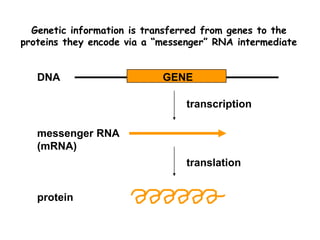
Genetic information is transferred from genes to the
proteins they encode via a “messenger” RNA intermediate
DNA GENE
messenger RNA
(mRNA)
protein
transcription
translation
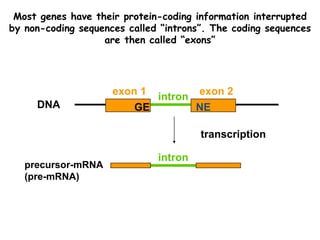
Most genes have their protein-coding information interrupted
by non-coding sequences called “introns”. The coding sequences
are then called “exons”
DNA GE NE
intron
exon 1 exon 2
transcription
precursor-mRNA
(pre-mRNA)
intron
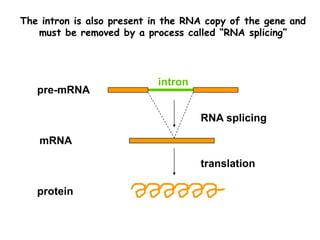
The intron is also present in the RNA copy of the gene and
must be removed by a process called “RNA splicing”
protein
translation
mRNA
RNA splicing
pre-mRNA
intron
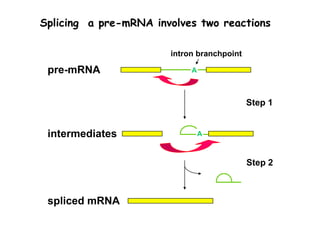
Splicing a pre-mRNA involves two reactions
pre-mRNA
intron branchpoint
A
spliced mRNA
Step 2
intermediates
Step 1
A
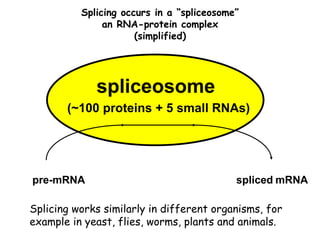
Splicing occurs in a “spliceosome”
an RNA-protein complex
(simplified)
pre-mRNA spliced mRNA
spliceosome
(~100 proteins + 5 small RNAs)
Splicing works similarly in different organisms, for
example in yeast, flies, worms, plants and animals.
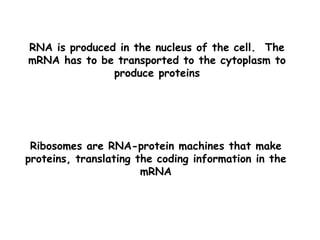
RNA is produced in the nucleus of the cell. The
mRNA has to be transported to the cytoplasm to
produce proteins
Ribosomes are RNA-protein machines that make
proteins, translating the coding information in the
mRNA
Pre-messenger RNA Processing
cytoplasm
nucleus
mRNA
RNA splicing
M7G AAAAAAA200
pre-mRNA
intron
exon exon
AAAAAAA200
M7G
transport
M7G AAAAAAA200
ribosomes
protein
cap poly(A) tail
Alternative splicing
In humans, many genes contain multiple introns
3 4 5
1 2
1 2 3 5
4
intron 2 intron 3 intron 4
intron 1
Usually all introns must be removed before the
mRNA can be translated to produce protein
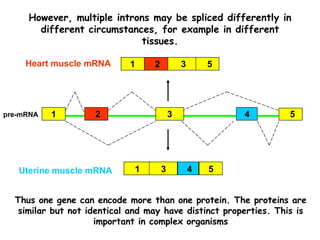
However, multiple introns may be spliced differently in
different circumstances, for example in different
tissues.
1 2 3 5
Heart muscle mRNA
1 4
3 5
Uterine muscle mRNA
Thus one gene can encode more than one protein. The proteins are
similar but not identical and may have distinct properties. This is
important in complex organisms
3 5
4
2
1
pre-mRNA
Different signals in the pre-mRNA and different proteins
cause spliceosomes to form in particular positions to give
alternative splicing
7
6
5
7
5
6
5 7
Fas pre-mRNA
APOPTOSIS
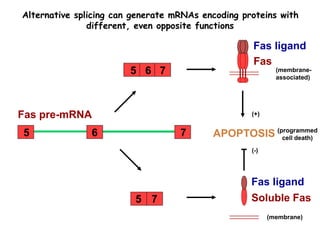
Alternative splicing can generate mRNAs encoding proteins with
different, even opposite functions
(programmed
cell death)
Fas ligand
Soluble Fas
(membrane)
Fas
Fas ligand
(membrane-
associated)
(+)
(-)
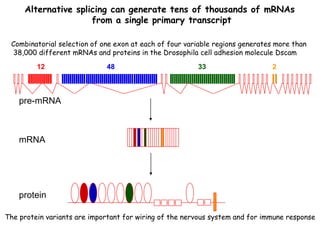
Alternative splicing can generate tens of thousands of mRNAs
from a single primary transcript
12 48 33 2
Combinatorial selection of one exon at each of four variable regions generates more than
38,000 different mRNAs and proteins in the Drosophila cell adhesion molecule Dscam
The protein variants are important for wiring of the nervous system and for immune response
protein
mRNA
pre-mRNA
The Genetic Code
• Describes how nucleotide sequence is
converted to protein sequence
• Unit of three nucleotides = a codon
• A codon codes for a specific amino
acid (structural component of protein)
• The four bases can
form 64 different
codons
• 20 amino acids are
found from the
nature
• Regulatory codons
The Nature of the Genetic Code
• A group of three bases codes for one amino
acid
• The code is not overlapping
• The base sequence is read from a fixed
starting point, with no punctuation
• The code is degenerate (in most cases, each
amino acid can be designated by any of
several triplets
Features of the Genetic Code
• All the codons have meaning: 61 specify amino acids,
and the other 3 are "nonsense" or "stop" codons
• The code is unambiguous - only one amino acid is
indicated by each of the 61 codons
• The code is degenerate - except for Trp and Met, each
amino acid is coded by two or more codons
• Codons representing the same or similar amino acids
are similar in sequence

6-splicing-1-1.ppt

  • 1.
    What is RNAsplicing?
  • 2.
    Genetic information istransferred from genes to the proteins they encode via a “messenger” RNA intermediate DNA GENE messenger RNA (mRNA) protein transcription translation
  • 3.
    Most genes havetheir protein-coding information interrupted by non-coding sequences called “introns”. The coding sequences are then called “exons” DNA GE NE intron exon 1 exon 2 transcription precursor-mRNA (pre-mRNA) intron
  • 4.
    The intron isalso present in the RNA copy of the gene and must be removed by a process called “RNA splicing” protein translation mRNA RNA splicing pre-mRNA intron
  • 5.
    Splicing a pre-mRNAinvolves two reactions pre-mRNA intron branchpoint A spliced mRNA Step 2 intermediates Step 1 A
  • 6.
    Splicing occurs ina “spliceosome” an RNA-protein complex (simplified) pre-mRNA spliced mRNA spliceosome (~100 proteins + 5 small RNAs) Splicing works similarly in different organisms, for example in yeast, flies, worms, plants and animals.
  • 7.
    RNA is producedin the nucleus of the cell. The mRNA has to be transported to the cytoplasm to produce proteins Ribosomes are RNA-protein machines that make proteins, translating the coding information in the mRNA
  • 8.
    Pre-messenger RNA Processing cytoplasm nucleus mRNA RNAsplicing M7G AAAAAAA200 pre-mRNA intron exon exon AAAAAAA200 M7G transport M7G AAAAAAA200 ribosomes protein cap poly(A) tail
  • 9.
    Alternative splicing In humans,many genes contain multiple introns 3 4 5 1 2 1 2 3 5 4 intron 2 intron 3 intron 4 intron 1 Usually all introns must be removed before the mRNA can be translated to produce protein
  • 10.
    However, multiple intronsmay be spliced differently in different circumstances, for example in different tissues. 1 2 3 5 Heart muscle mRNA 1 4 3 5 Uterine muscle mRNA Thus one gene can encode more than one protein. The proteins are similar but not identical and may have distinct properties. This is important in complex organisms 3 5 4 2 1 pre-mRNA
  • 11.
    Different signals inthe pre-mRNA and different proteins cause spliceosomes to form in particular positions to give alternative splicing
  • 12.
    7 6 5 7 5 6 5 7 Fas pre-mRNA APOPTOSIS Alternativesplicing can generate mRNAs encoding proteins with different, even opposite functions (programmed cell death) Fas ligand Soluble Fas (membrane) Fas Fas ligand (membrane- associated) (+) (-)
  • 13.
    Alternative splicing cangenerate tens of thousands of mRNAs from a single primary transcript 12 48 33 2 Combinatorial selection of one exon at each of four variable regions generates more than 38,000 different mRNAs and proteins in the Drosophila cell adhesion molecule Dscam The protein variants are important for wiring of the nervous system and for immune response protein mRNA pre-mRNA
  • 14.
    The Genetic Code •Describes how nucleotide sequence is converted to protein sequence • Unit of three nucleotides = a codon • A codon codes for a specific amino acid (structural component of protein)
  • 15.
    • The fourbases can form 64 different codons • 20 amino acids are found from the nature • Regulatory codons
  • 16.
    The Nature ofthe Genetic Code • A group of three bases codes for one amino acid • The code is not overlapping • The base sequence is read from a fixed starting point, with no punctuation • The code is degenerate (in most cases, each amino acid can be designated by any of several triplets
  • 17.
    Features of theGenetic Code • All the codons have meaning: 61 specify amino acids, and the other 3 are "nonsense" or "stop" codons • The code is unambiguous - only one amino acid is indicated by each of the 61 codons • The code is degenerate - except for Trp and Met, each amino acid is coded by two or more codons • Codons representing the same or similar amino acids are similar in sequence