The Word of God • 13
The Focus of the Scriptures
The Bible reveals God and exposes humanity. It exposes our predica-
ment and reveals His solution. It presents us as lost, estranged from God,
and reveals Jesus as the one who finds us and brings us back to God.
Jesus Christ is the focus of Scripture. The Old Testament sets forth the
Son of God as the Messiah, the world’s Redeemer; the New Testament re-
veals Him as Jesus Christ, the Saviour. Every book, either through symbol
or reality, reveals some phase of His work and character. Jesus’ death on
the cross is the ultimate revelation of God’s character.
The cross makes this ultimate revelation because it brings together two
extremes: man’s unfathomable evil and God’s inexhaustible love. What
could give us greater insight into human fallibility? What could better re-
veal sin? The cross reveals a God who allowed His only Son to be killed.
What a sacrifice! What greater revelation of love could He have made? In-
deed, the focus of the Bible is Jesus Christ. He is at the center stage of the
cosmic drama. Soon His triumph at Calvary will culminate in the elimina-
tion of evil. Human beings and God will be reunited.
The theme of God’s love, particularly as seen in Christ’s sacrificial death
on Calvary—the grandest truth of the universe—is the focus of the Bible.
All major Bible truths, therefore, should be studied from this perspective.
Authorship of the Scriptures
The Bible’s authority for faith and practice rises from its origin. Its writ-
ers viewed the Bible as distinct from other literature. They referred to it as
“Holy Scriptures” (Rom. 1:2), “sacred writings” (2 Tim. 3:15, RSV), and the
“oracles of God” (Rom. 3:2; Heb. 5:12).
The uniqueness of the Scriptures is based on their origin and source.
The Bible writers claimed they did not originate their messages but re-
ceived them from divine sources. It was through divine revelation that
they were able “to see” the truths they passed on (see Isa. 1:1; Amos 1:1;
Micah 1:1; Hab. 1:1; Jer. 38:21).
These writers pointed to the Holy Spirit as the One who communicated
through the prophets to the people (Neh. 9:30; cf. Zech. 7:12). David said,
“The Spirit of the Lord spoke by me, and His word was on my tongue” (2
Sam. 23:2). Ezekiel wrote, “the Spirit entered me,” “the Spirit of the Lord
fell upon me,” “the Spirit took me up” (Eze. 2:2; 11:5, 24). And Micah testi-
fied, “I am full of power by the Spirit of the Lord” (Micah 3:8).
The New Testament recognized the role of the Holy Spirit in the produc-
tion of the Old Testament. Jesus said that David was inspired by the Holy
Spirit (Mark 12:36). Paul believed that the Holy Spirit spoke “through Isa-
iah” (Acts 28:25). Peter revealed that the Holy Spirit guided all the proph-
ets, not just a few (1 Peter 1:10, 11; 2 Peter 1:21). At times the writer faded
14 • SEVENTH-DAY ADVENTISTS BELIEVE . . .
completely into the background, and only the real author—the Holy Spir-
it—was acknowledged: “The Holy Spirit says…” “By this the Holy Spirit in-
dicates…” (Heb. 3:7; 9:8, RSV).
The New Testament writers recognized the Holy Spirit as the source
of their own messages also. Paul explained, “Now the Spirit expressly says
that in latter times some will depart from the faith” (1 Tim. 4:1). John spoke
of being “in the Spirit on the Lord’s day” (Rev. 1:10). And Jesus commis-
sioned His apostles through the agency of the Holy Spirit (Acts 1:2; cf. Eph.
3:3-5).
So God, in the person of the Holy Spirit, has revealed Himself through
the Holy Scriptures. He wrote them, not with His hands, but with other
hands—about forty pairs—over a period of more than 1,500 years. And
since God the Holy Spirit inspired the writers, God, then, is its author.
Inspiration of the Scriptures
“All Scripture,” Paul says, “is given by inspiration of God” (2 Tim. 3:16).
The Greek word theopneustos, translated as “inspiration,” literally means,
“God-breathed.” God “breathed” truth into men’s minds. They, in turn, ex-
pressed it in the words found in the Scriptures. Inspiration, therefore, is
the process through which God communicates His eternal truth.
The Process of Inspiration. Divine revelation was given by inspiration
of God to “holy men of God” who were “moved by the Holy Spirit” (2 Pe-
ter 1:21). These revelations were embodied in human language with all its
limitations and imperfections, yet they remained God’s testimony. God in-
spired men—not words.
Were the prophets as passive as tape recorders that replay exactly what
is recorded? In some instances writers were commanded to express the
exact words of God, but in most cases God instructed them to describe to
the best of their ability what they saw or heard. In these latter cases, the
writers used their own language, patterns, and style.
Paul observed that “the spirits of the prophets are subject to the proph-
ets” (1 Cor. 14:32). Genuine inspiration does not obliterate the prophet’s
individuality, reason, integrity, or personality. To some degree, Moses and
Aaron’s relationship illustrates that between the Holy Spirit and the writ-
er. God said to Moses, “I have made you as God to Pharaoh, and Aaron
your brother shall be your prophet” (Ex. 7:1; cf. 4:15, 16). Moses informed
Aaron of God’s messages, and, in turn, Aaron communicated them in his
own vocabulary and style to Pharaoh. Likewise, Bible writers conveyed di-
vine commands, thoughts, and ideas in their own style of language. It is
because God communicates in this way that the vocabulary of the differ-
ent books of the Bible varied and reflects the education and culture of the
writers.
16 • SEVENTH-DAY ADVENTISTS BELIEVE . . .
viduals feared to proclaim an inspired message, and some even debated
with God (Habakkuk 1; Jonah 1:1-3; 4:1-11).
The Method and Content of Revelation. Frequently, the Holy Spirit
communicated divine knowledge by means of visions and dreams (Num.
12:6). Sometimes He spoke audibly or to the inner senses. God spoke to
Samuel “in his ear” (1 Sam. 9:15). Zechariah received symbolic represen-
tations with explanations (Zechariah 4). The visions of heaven that Paul
and John received were accompanied by oral instructions (2 Cor. 12:1-4,
Revelation 4, 5). Ezekiel observed events transpiring in another location
(Ezekiel 8). Some writers participated in their visions, performing certain
functions as part of the vision itself (Revelation 10).
As to contents, to some the Spirit revealed events yet to occur (Daniel
2, 7, 8, 12). Other writers recorded historical events, either on the basis of
personal experience or through selecting materials from existing historical
records (Judges, 1 Samuel, 2 Chronicles, the Gospels, Acts).
Inspiration and History. The biblical assertion that “All Scripture is in-
spired by God” or “God-breathed,” profitable and authoritative for moral
and spiritual living (2 Tim. 3:15, 16, RSV; NIV) leaves no question about
divine guidance in the selection process. Whether the information came
from personal observation, oral or written sources, or direct revelation, it
all came to the writer through the Holy Spirit’s guidance. This guarantees
the Bible’s trustworthiness.
The Bible reveals God’s plan in His dynamic interaction with the human
race, not in a collection of abstract doctrines. His self-revelation stands
rooted in real events that occurred in a definite time and place. The reli-
ability of the historical accounts is extremely important because they form
the framework of our understanding of God’s character and His purpose
for us. An accurate understanding leads to eternal life, but an incorrect
view leads to confusion and death.
God commanded certain men to write a history of His dealings with Is-
rael. These historical narratives, written from a viewpoint different from
that of secular history, comprise an important part of the Bible (cf. Num.
33:1, 2; Joshua 24:25, 26; Eze. 24:2). They provide us with accurate, objec-
tive history, from a divine perspective. The Holy Spirit gave the writers
special insights so that they could record events in the controversy be-
tween good and evil that demonstrate the character of God and guide peo-
ple in their quest for salvation.
These historical incidents are “types” or “examples” “written for our ad-
monition, on whom the ends of the ages have come” (1 Cor. 10:11). Paul
says, “For everything that was written in the past was written to teach us,
so that through endurance and the encouragement of the Scriptures we
38 • SEVENTH-DAY ADVENTISTS BELIEVE . . .
me away from Your presence, and do not take Your Holy Spirit from me”
(Ps. 51:1, 11). He was comforted by the assurance that God is wonderfully
merciful. “For as the heavens are high above the earth, so great is His mer-
cy toward those who fear Him; as far as the east is from the west, so far
has He removed our transgressions from us. As a father pities those who
fear Him. For He knows our frame; He remembers that we are dust” (Ps.
103:11-14).
A God of Goodness. God is the One who “executes justice for the op-
pressed, who gives food to the hungry. The Lord gives freedom to the pris-
oners. The Lord opens the eyes of the blind; the Lord raises those who
are bowed down; the Lord loves the righteous. The Lord watches over the
strangers; He relieves the fatherless and widow” (Ps. 146:7-9). What a great
picture of God is given in the Psalms!
A God of Faithfulness. In spite of God’s greatness, Israel wandered
away from Him most of the time (Leviticus 26, Deuteronomy 28). God is
depicted as loving Israel as a husband loves his wife. The book of Hosea
poignantly illustrates God’s faithfulness in the face of flagrant unfaithful-
ness and rejection. God’s continuing forgiveness reveals His character of

unconditional love.
Though God permitted her to experience the calamities caused by her
unfaithfulness—attempting to correct Israel’s ways—He still embraced her
with His mercy. He assured her, “You are My servant, I have chosen you
and have not cast you away: Fear not, for I am with you; be not dismayed,
for I am your God. I will strengthen you, yes, I will help you, I will uphold
you with My righteous right hand” (Isa. 41:9, 10). In spite of their unfaith-
fulness, He tenderly promised, “If they confess their iniquity and the iniq-
uity of their fathers, with their unfaithfulness in which they were unfaith-
ful to Me,… if their uncircumcised hearts are humbled, and they accept
their guilt—then I will remember My covenant with Jacob…with Isaac…
with Abraham” (Lev. 26:40-42; cf. Jer. 3:12).
God reminds His people of His redemptive attitude: “O Israel, you will
not be forgotten by Me! I have blotted out, like a thick cloud, your trans-
gressions, and like a cloud, your sins. Return to Me, for I have redeemed
you” (Isa. 44:21, 22). No wonder He could say, “Look to Me, and be saved,
all you ends of the earth! For I am God, and there is no other” (Isa. 45:22).
A God of Salvation and Vengeance. The Old Testament description of
God as a God of vengeance must be seen in the context of the destruction
of His faithful people by the wicked. Through “the day of the Lord” theme
the prophets reveal God’s actions on behalf of His people at the end of
time. It is a day of salvation for His people, but a day of vengeance on their
44 • SEVENTH-DAY ADVENTISTS BELIEVE . . .
yard. Hundreds lay dying. Realizing their predicament, terrorized parents hur-
ried to Moses’ tent, pleading for help. “Moses prayed for the people” (Num.
21:7).
God’s answer? Mold a serpent and lift it high—and all who looked on it
would live. “So Moses made a bronze serpent, and put it on a pole; and …
if a serpent had bitten anyone, when he looked at the bronze serpent, he
lived” (Num. 21:9).
The serpent has always been Satan’s symbol (Genesis 3; Revelation 12), rep-
resenting sin. The camp had been plunged into Satan’s hands. God’s remedy?
Not looking at a lamb on the sanctuary altar, but beholding a bronze serpent.
It was a strange symbol of Christ. Just as the likeness of the serpents
that stung was lifted up on a pole, Jesus, made in the likeness of the
serpents that stung, was lifted up on a pole. Jesus, made “in the likeness of
sinful flesh” (Rom. 8:3), was to be lifted up on the shameful cross (John 3:14,
15). He became sin, taking upon Himself all the sins of everyone who has
lived or will live. “For He made Him who knew no sin to be sin for us, that
we might become the righteousness of God in Him” (2 Cor. 5:21). By looking
to Christ, hopeless humanity can find life.
How could the incarnation bring salvation to humanity? What effect
did it have on the Son? How could God become a human being, and why
was it necessary?
The Incarnation: Predictions and Fulfillment
God’s plan to rescue those who strayed from His all-wise counsel (John
3:16; 1 John 4:9) convincingly demonstrates His love. In this plan His Son
was “foreordained before the foundation of the world” as the sacrifice for
sin, to be the hope of the human race (1 Peter 1:19, 20). He was to bring us
back to God and provide deliverance from sin through the destruction of
the works of the devil (1 Peter 3:18; Matt. 1:21; 1 John 3:8).
Sin had severed Adam and Eve from the source of life and should have
resulted in their immediate death. But in accordance with the plan laid be-
fore the foundation of the world (1 Peter 1:20, 21), the “counsel of peace”
(Zech. 6:13), God the Son stepped between them and divine justice, bridg-
ing the gulf and restraining death. Even before the cross, then, His grace
kept sinners alive and assured them of salvation. But to restore us fully as

sons and daughters of God, He had to become a man.
Immediately after Adam and Eve sinned, God gave them hope by prom-
ising to introduce a supernatural enmity between the serpent and the
woman—between his seed and hers. In the cryptic statement of Genesis
3:15 the serpent and its offspring represent Satan and his followers; the
woman and her seed symbolize God’s people and the Saviour of the world.
This statement was the first assurance that the controversy between good
and evil would end in victory for God’s Son.
46 • SEVENTH-DAY ADVENTISTS BELIEVE . . .
the Anointed One—would come through Abraham’s line: “In your seed all
the nations of the earth shall be blessed” (Gen. 22:18; cf. 12:3).
Isaiah prophesied that the Saviour would come as a male child and
would be both human and divine: “For unto us a Child is born, unto us
a Son is given; and the government will be upon His shoulder. And His
name will be called Wonderful, Counselor, Mighty God, Everlasting Fa-
ther, Prince of Peace” (Isa. 9:6). This Redeemer would ascend the throne of
David and establish an everlasting government of peace (Isa. 9:7). Bethle-
hem would be His birthplace (Micah 5:2).
The birth of this divine-human person would be supernatural. Citing
Isaiah 7:14, the New Testament states, “Behold, a virgin shall be with child,
and bear a Son, and they shall call His name Immanuel, which is translat-
ed, ‘God with us”’ (Matt. 1:23).
The Saviour’s mission is expressed in these words: “The Spirit of the
Lord God is upon Me, because the Lord has anointed Me to preach good
tidings to the poor; He has sent Me to heal the broken-hearted, to pro-
claim liberty to the captives, and opening of the prison to those who are
bound; to proclaim the acceptable year of the Lord” (Isa. 61:1, 2; cf. Luke
4:18, 19).
Amazingly, the Messiah would suffer rejection. He would be perceived
as “a root out of dry ground.” “He has no form or comeliness, and when we
see Him, there is no beauty that we should desire Him….Despised and re-
jected by men, a man of sorrows and acquainted with grief….We did not
esteem Him” (Isa. 53:2-4).
A close friend would betray Him (Ps. 41:9) for thirty pieces of silver
(Zech. 11:12). During His trial He would be spat upon and beaten (Isa.
50:6). Those who executed Him would gamble for the very clothes He
wore (Ps. 22:18). None of His bones were to be broken (Ps. 34:20), but His
side was to be pierced (Zech. 12:10). In His afflictions He would not resist,
but “as a sheep before its shearers is silent, so He opened not His mouth”
(Isa. 53:7).
The innocent Saviour would suffer immensely for sinners. “Surely He
has borne our griefs and carried our sorrows;…He was wounded for our
transgressions, He was bruised for our iniquities; the chastisement for
our peace was upon Him and by His stripes we are healed….And the
Lord has laid on Him the iniquity of us all….He was cut off from the land
of the living; for the transgressions of My people He was stricken” (Isa.
53:4-8).
The Saviour Identified. Only Jesus Christ has fulfilled these prophe-
cies. Scriptures trace His genealogy to Abraham, calling Him the Son of
Abraham (Matt. 1:1), and Paul affirms that the promise to Abraham and
his seed was fulfilled in Christ (Gal. 3:16). The Messianic title Son of David
48 • SEVENTH-DAY ADVENTISTS BELIEVE . . .
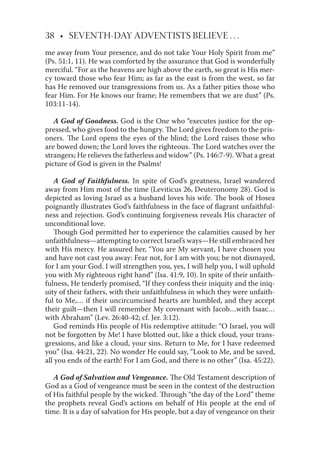
During this time, by repenting and preparing themselves for the Messi-
ah’s coming, the Jewish nation was to fulfill God’s purpose for them.
Daniel also wrote of “reconciliation for iniquity” and a bringing in
of “everlasting righteousness” as marking this period. These Messianic
activities indicate that the Saviour was to come within this time (Dan.
9:24).
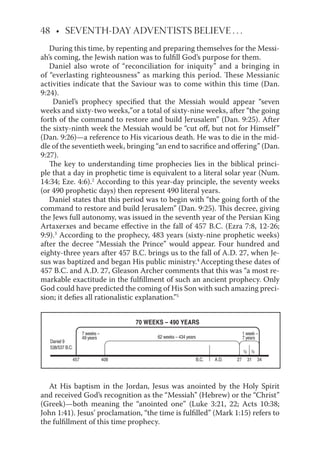
Daniel’s prophecy specified that the Messiah would appear “seven
forth of the command to restore and build Jerusalem” (Dan. 9:25). After
the sixty-ninth week the Messiah would be “cut off, but not for Himself”
(Dan. 9:26)—a reference to His vicarious death. He was to die in the mid-
dle of the seventieth week, bringing “an end to sacrifice and offering” (Dan.
9:27).
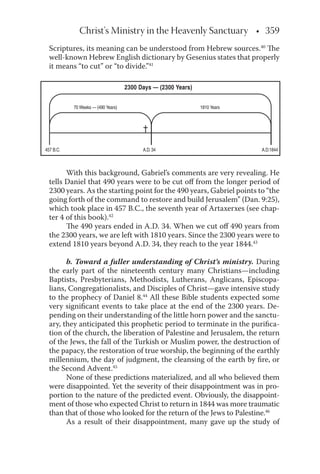
The key to understanding time prophecies lies in the biblical princi-
ple that a day in prophetic time is equivalent to a literal solar year (Num.
14:34; Eze. 4:6).2
According to this year-day principle, the seventy weeks
(or 490 prophetic days) then represent 490 literal years.
Daniel states that this period was to begin with “the going forth of the
command to restore and build Jerusalem” (Dan. 9:25). This decree, giving
the Jews full autonomy, was issued in the seventh year of the Persian King
Artaxerxes and became effective in the fall of 457 B.C. (Ezra 7:8, 12-26;
9:9).3
According to the prophecy, 483 years (sixty-nine prophetic weeks)
after the decree “Messiah the Prince” would appear. Four hundred and
eighty-three years after 457 B.C. brings us to the fall of A.D. 27, when Je-
sus was baptized and began His public ministry.4
Accepting these dates of
457 B.C. and A.D. 27, Gleason Archer comments that this was “a most re-
markable exactitude in the fulfillment of such an ancient prophecy. Only
God could have predicted the coming of His Son with such amazing preci-
sion; it defies all rationalistic explanation.”5
At His baptism in the Jordan, Jesus was anointed by the Holy Spirit
and received God’s recognition as the “Messiah” (Hebrew) or the “Christ”
(Greek)—both meaning the “anointed one” (Luke 3:21, 22; Acts 10:38;
John 1:41). Jesus’ proclamation, “the time is fulfilled” (Mark 1:15) refers to
the fulfillment of this time prophecy.
���
��������
������������
���������
��������
��������
���������������������������
��������������������
� �
��� �� �� ������ ����
weeks and sixty-two weeks,”or a total of sixty-nine weeks, after “the going
God the Son • 49
In the middle of the seventieth week, in the spring of A.D. 31, exact-
ly three and one-half years after Christ’s baptism, the Messiah brought
the system of sacrifices to an end by giving His life. At the moment of His
death the veil of the Temple was supernaturally “torn in two from top to
bottom” (Matt. 27:51), indicating the divine abolition of all Temple servic-
es.
All the offerings and sacrifices had pointed forward to the all-sufficient
sacrifice of the Messiah. When Jesus Christ, the true Lamb of God, was
sacrificed at Calvary as a ransom for our sins (1 Peter 1:19), type met anti-
type, and shadow melded into reality. The earthly sanctuary services were
no longer necessary.
At the exact time prophesied during the Passover festival, He died. “In-
deed,” Paul said, “Christ, our Passover, was sacrificed for us” (1 Cor. 5:7).
This amazingly accurate time prophecy gives one of the strongest evidenc-
es of the fundamental historic truth that Jesus Christ is the long-predicted
Saviour of the world.
The Resurrection of the Saviour. The Bible predicted not only the Sav-
iour’s death but also His resurrection. David prophesied “that His soul
was not left in Hades, nor did His flesh see corruption” (Acts 2:31; cf. Ps.
16:10). Although Christ had raised others from the dead (Mark 5:35-42;
Luke 7:11-17; John 11), His own resurrection demonstrated the power be-
hind His claim to be Saviour of the world: “I am the resurrection and the
life. He who believes in Me, though he may die, he shall live. And whoever
lives and believes in Me shall never die” (John 11:25, 26).
After His resurrection He proclaimed, “Do not be afraid; I am the First
and the Last. I am He who lives, and was dead, and behold, I am alive for-
evermore. Amen. And I have the keys of Hades and of Death” (Rev. 1:17,
18).
The Two Natures of Jesus Christ
In stating, “The Word became flesh and dwelt among us” (John 1:14),
John set forth a profound truth. The incarnation of God the Son is a mys-
tery. Scripture calls God’s being manifested in the flesh “the mystery of
godliness” (1 Tim 3:16).
The Creator of worlds, He in whom was the fullness of the Godhead
became the helpless babe in the manger. Far superior to any of the angels,
equal with the Father in dignity and glory, He yet condescended to wear
the garb of humanity!
One can barely grasp the meaning of this sacred mystery, and then only
by calling on the Holy Spirit for enlightenment. In trying to comprehend
the incarnation it is well to remember that “the secret things which are re-
vealed belong to us and to our children” (Deut. 29:29).
God the Son • 61
1. Christ’s earthly priesthood. The priest’s role at the altar of burnt of-
fering symbolized Jesus’ earthly ministry. Jesus qualified perfectly for the
office of priest: He was truly man, and He was “called by God” and acted
“in things pertaining to God” with the special task of offering “gifts and
sacrifices for sins” (Heb. 5:1, 4, 10).
The priest was to reconcile the worshipers to God through the sacrifi-
cial system, which represented the provision of atonement for sin (Lev. 1:4;
4:29, 31, 35: 5:10; 16:6; 17:11). Thus the continual sacrifices at the altar of
burnt offering symbolized the availability of continual atonement.
These sacrifices were not sufficient. They could not make the offerer
perfect, take away sins, or produce a clear conscience (Heb. 10:1-4; 9:9).
They were simply a shadow of the good things to come (Heb. 10:1; cf. 9:9,
23, 24). The Old Testament said that the Messiah Himself would take the
place of these animal sacrifices (Ps. 40:6-8; Heb. 10:5-9). These sacrific-
es, then, pointed to the vicarious sufferings and atoning death of Christ
the Saviour. He, the Lamb of God, became sin for us, a curse for us; His
blood cleanses us from all sins (2 Cor. 5:21; Gal. 3:13; 1 John 1:7; cf. 1 Cor.
15:3).
So during His earthly ministry Christ was both priest and offering. His
death on the cross was part of His priestly work. After His sacrifice at Gol-
gotha, His priestly intercession centered in the heavenly sanctuary.
2. Christ’s heavenly priesthood. The priestly ministry Jesus began on
earth, He completes in heaven. His humiliation on earth as God’s suffer-
ing servant qualified Him to be our High Priest in heaven (Heb. 2:17; 18;
4:15; 5:2). Prophecy reveals that the Messiah was to be a priest on God’s
throne (Zech. 6:13). After His resurrection the humiliated Christ was ex-
alted. Now our High Priest sits “at the right hand of the throne of the Maj-
esty in the heavens,” ministering in the heavenly sanctuary (Heb. 8:1, 2; cf.
1:3; 9:24).
Christ began His intercessory work immediately following His ascen-
sion. The ascending cloud of incense in the holy place of the Temple typi-
fies Christ’s merits, prayers, and righteousness, which makes our worship
and prayers acceptable to God. Incense could be offered only on coals tak-
en from the altar of burnt offering, which reveals an intimate connection
between intercession and the atoning sacrifice of the altar. Thus Christ’s
intercessory work is built on the merits of His completed sacrificial atone-
ment.
Christ’s intercession offers encouragement to His people: He is “able to
save to the uttermost those who come to God through Him, since He ever
lives to make intercession for them” (Heb. 7:25). Because Christ mediates
for His people, all of Satan’s accusations have lost their legal basis (1 John
2:1; cf. Zech. 3:1). Paul asked rhetorically, “Who is he who condemns?”
God the Son • 65
5. Gleason L. Archer, Encyclopedia of Bible Difficulties (Grand Rapids, MI:
Zondervan, 1982), p. 291.
6. White, The Desire of Ages (Mountain View, CA: Pacific Press, 1940), p. 530.
7. That Scripture alludes to Jesus as the “only begotten” and the “first born” and
speaking of the day of His begetting does not deny His divine nature and
eternal existence. The term only begotten (John 1:14; 1:18; 3:16; 1 John 4:9)
comes from the Greek word monogenes and reveals that its range of mean-
ing extends to “only” or “unique,” depicting a special relationship, not an
event in time. Isaac, for example, is called Abraham’s “only begotten son,” al-
though he was not Abraham’s only son or even his firstborn son (Gen. 16:16;
21:1-21; 25:1-6). Isaac was the unique son, the only one of his kind, destined
to become Abraham’s successor. “Jesus Christ, the pre-existent God, the di-
vine creative Word, at His incarnation became in a unique sense the Son of
God—which is why He is designated ‘monogenes,’ the only one of His kind,
altogether unique in many aspects of His being and life. No other child of
the human race was so compacted in his being, had so unequaled a rela-
tion to the Godhead, or did such a work as is true of Him. So ‘monogenes’
describes a relation between God the Father and Jesus Christ the Son as
separate Persons of the Godhead. This is a relation that belongs to Christ’s
complex, divine-human personality, in connection with the economy of the
plan of salvation.” (Committee on Problems in Bible Translation, Problems
in Bible Translation [Washington, D.C.: Review and Herald, 1954], p. 202).
Likewise, when Christ is called the firstborn (Heb. 1:6; Rom. 8:29; Col. 1:15,
18; Rev. 1:5), the term does not refer to a point of time. Rather, it emphasiz-
es importance or priority (cf. Heb. 12:23). In Hebrew culture, the firstborn
received the family privileges. So Jesus, as the firstborn among men, won
back all the privileges man had lost. He became the new Adam, the new
“firstborn” or head of the human race. The biblical reference to the day in
which Jesus was begotten is based on a similar concept to those of the only
begotten and the firstborn. Depending on its context, the Messianic predic-
tion, “You are My Son, today I have begotten you” (Ps. 2:7), refers to Jesus’:
incarnation (Heb. 1:6), resurrection (Acts. 13:33, cf. v. 30), or enthronement
(Heb. 1:3, 5).
8. Additional evidence is found in laws of Greek grammar. (1) The anarthrous
use of “Lord” (used without a definite article). The LXX translates YHWH
with an anarthrous kurios. Very often, when one finds an anarthrous kurios
in the New Testament, it indicates God (e. g. Matt. 7:21; 8:2, 6, 25). (2) A sin-
gle article qualifies two substantives. Thus, e.g., Christ is described as God
in the phrases “our great God and Saviour Jesus Christ” (Titus 2:13), “the
righteousness of our God and Saviour Jesus Christ” (2 Peter 1:1). (3) When
there are two substantives and the second is in the genitive case without an
article, for either substantive, the quality of the one is attributed to the other.
Thus in the same way that Rom. 1:17, 18 speaks of “righteousness of God”
and “wrath of God,” so Jesus is described as “Son of God” (Luke 1:35).
9. White, “The True Sheep Respond to the Voice of the Shepherd,” Signs of the
Times, Nov. 27, 1893, p. 54.
86 • SEVENTH-DAY ADVENTISTS BELIEVE . . .
The Remedy for Pessimism, Loneliness, and Meaninglessness. The
Creation narrative reveals that, rather than coming into existence because
of chance evolution, everything was created with a purpose. The human
race was designed for an everlasting relationship with the Creator Him-
self. When we understand that we were created for a reason, life becomes
meaningful and rich, and the painful emptiness and dissatisfaction that so
many express vanishes, replaced by the love of God.
The Holiness of God’s Law. God’s law existed before the Fall. In their
unfallen state human beings were subject to it. It was to warn against self-
destruction, to reveal the limits of freedom (Gen. 2:17), and to safeguard
the happiness and peace of the subjects of God’s kingdom (Gen. 3:22-24—
see chapter 19 of this book).
The Sacredness of Life. The Creator of life continues to be involved
in the formation of human life, thereby making life sacred. David praises
God because of His involvement in his birth: “You have formed my inward
parts; You have covered me in my mother’s womb. I will praise You, for I
am fearfully and wonderfully made; …my frame was not hidden from You,
when I was made in secret, and skillfully wrought in the lowest parts of the
earth. Your eyes saw my substance, being yet unformed. And in Your book
they all were written” (Ps. 139: 13-16). In Isaiah the Lord identifies Him-
self as the One “who formed you from the womb” (Isa. 44:24). Because life
is a gift of God, we must respect it; in fact, we have a moral duty to pre-
serve it.
God’s Creative Work Continues
Has God finished His Creation? The Creation narrative ends with the
statement, “Thus the heavens and the earth, and all the host of them, were
finished” (Gen. 2:1). The New Testament affirms that God’s Creation was
completed at the “foundation of the world” (Heb. 4:3). Does this mean that
Christ’s creative energy is no longer in operation? Not at all. The creative
word still operates in various ways.
1. Christ and His creative word. Four thousand years after Creation
a centurion said to Christ, “Only speak a word, and my servant will be
healed” (Matt. 8:8). Just as He had done at Creation, Jesus spoke—and
the servant was healed. Throughout Jesus’ earthly ministry the same cre-
ative energy that brought life to Adam’s lifeless body raised the dead and
brought new life to the afflicted who requested His help.
2. The creative word today. Neither this world nor the universe oper-
ates on any inherent power of its own. The God who created them pre-
91
SEVENTH-DAY ADVENTISTS BELIEVE . . .
Man and woman were made in the
image of God with individuality, the
power and freedom to think and to do.
Though created free beings, each is an
indivisible unity of body, mind, and spirit,
dependent upon God for life and breath and all else.
When our first parents disobeyed God, they denied their
dependence upon Him and fell from their high position
under God. The image of God in them was marred and
they became subject to death. Their descendants share
this fallen nature and its consequences. They are born
with weaknesses and tendencies to evil. But God in Christ
reconciled the world to Himself and by His Spirit restores
in penitent mortals the image of their Maker. Created
for the glory of God, they are called to love Him and one
another, and to care for their environment. (Gen. 1:26-28;
2:7; Ps. 8:4-8; Acts 17:24-28; Gen. 3; Ps. 51:5; Rom. 5:12-
17; 2 Cor. 5:19, 20; Ps. 51:10; 1 John 4:7, 8, 11, 20; Gen.
2:15.)
AND GOD SAID, “LET US MAKE MAN in Our image, according to
Our likeness.” God did not speak into existence His crowning creation.
Instead, He lovingly stooped to shape this new creature from the dust of
the earth.
The Nature of Man
96 • SEVENTH-DAY ADVENTISTS BELIEVE . . .
disposition (Isa. 54:6), moral character (Eze. 11:19), and the seat of the
emotions (1 Sam. 1:15).
“In the sense of breath, the ruach of men is identical with the ruach of
animals (Eccl. 3:19). The ruach of man leaves the body at death (Ps. 146:4)
and returns to God (Eccl. 12:7; cf. Job 34:14). Ruach is used frequently of
the Spirit of God, as in Isaiah 63:10. Never in the Old Testament, with re-
spect to man, does ruach denote an intelligent entity capable of sentient
existence apart from a physical body.
“The New Testament equivalent of ruach is pneuma, ‘spirit,’ from pneo,
‘to blow,’ or ‘to breathe.’ As with ruach, there is nothing inherent in the
word pneuma denoting an entity in man capable of conscious existence
apart from the body, nor does New Testament usage with respect to man
in any way imply such a concept. In such passages as Romans 8:15; 1 Cor-
inthians 4:21; 2 Timothy 1:7; 1 John 4:6 pneuma denotes ‘mood,’ ‘attitude,’
or ‘state of feeling.’ It is also used of various aspects of the personality, as in
Galatians 6:1; Romans 12:11; etc. As with ruach, the pneuma is yielded to
the Lord at death (Luke 23:46; Acts 7:59). Like ruach, pneuma is also used
of the Spirit of God (1 Cor. 2:11, 14; Eph. 4:30; Heb. 2:4; 1 Peter 1:12; 2 Pe-
ter 1:21; etc.).”5
3. Unity of body, soul, and spirit. What is the relationship between
body, soul, and spirit? What is the influence of this relationship on the uni-
ty of man?
a. A twofold union. Although the Bible views the nature of man as
a unity, it does not precisely define the relationship among body, soul,
and spirit. At times soul and spirit are used interchangeably. Notice
their parallelism in Mary’s expression of joy following the annuncia-
tion: “My soul magnifies the Lord, and my spirit has rejoiced in God my
Saviour” (Luke 1:46, 47).
In one instance man is characterized by Jesus as body and soul (Matt.
10:28) and in another instance by Paul as body and spirit (1 Cor. 7:34).
In the former, soul refers to the higher faculty of man, presumably the
mind through which he communicates with God. In the latter, spirit re-
fers to this higher faculty. In both instances the body includes the physi-
cal, as well as the emotional, aspects of a person.
b. A threefold union. There is one exception to the general charac-
terization of man as comprising a twofold union of body and spirit, also
spoken of in terms of a threefold union. He states, “Now may the God
of peace Himself sanctify you completely; and may your whole spirit,
soul, and body be preserved blameless at the coming of our Lord Je-
sus Christ” (1 Thess. 5:23). This passage conveys Paul’s desire that none
The Nature of Man • 97
of these aspects of the person be excluded from the sanctification pro-
cess.
In this instance spirit may be understood as the higher principle of
intelligence and thought with which man is endowed, and with which
God can communicate by His Spirit (see Rom. 8:16). It is by the renew-
ing of the mind through the activities of the Holy Spirit that the individ-
ual is transformed into Christ’s likeness (see Rom. 12:1, 2).
“By ‘soul’…when distinguished from spirit, may be understood that
part of man’s nature that finds expression through the instincts, emo-
tions, and desires. This part of one’s nature can be sanctified, too. When,
through the working of the Holy Spirit, the mind is brought into confor-
mity with God’s mind, and sanctified reason bears sway over the lower
nature, the impulses, which would otherwise be contrary to God, be-
come subject to His will.”6
The body, which is controlled by either the higher or the lower na-
ture, is the physical constitution—the flesh, blood, and bones.
Paul’s sequence of first the spirit, then the soul, and finally the body
is no coincidence. When the spirit is sanctified, the mind is under di-
vine control. The sanctified mind, in turn, will have a sanctifying influ-
ence on the soul, i.e., the desires, feelings, and emotions. The person
in whom this sanctification takes place will not abuse his body, so his
physical health will flourish. Thus, the body becomes the sanctified in-
strument through which the Christian can serve His Lord and Saviour.
Paul’s call for sanctification is clearly rooted in the concept of the unity
of human nature and reveals that effective preparation for Christ’s sec-
ond advent necessitates the preparation of the whole person—spirit,
soul, and body.
c. An indivisible, sympathetic union. It is clear that each human
being is an indivisible unit. The body, soul, and spirit function in close
cooperation, revealing an intensely sympathetic relationship among
a person’s spiritual, mental and physical faculties. Deficiencies in one
area will hamper the other two. A sick, impure, confused spirit or mind
will have a detrimental effect on one’s emotional and physical health,
as well. The reverse is also true. A weak, sick, or suffering physical con-
stitution will generally impair one’s emotional and spiritual health. The
impact the faculties have on each other means that each individual has
a God-given responsibility to maintain the faculties in the best possible
condition. Doing so is a vital part of being restored into the image of the
Creator.
Man in the Image of God
The living beings that God created on the sixth day of Creation were
104 • SEVENTH-DAY ADVENTISTS BELIEVE . . .
“I have made my heart clean, I am pure from my sin?” (Prov. 20:9; Eccl.
7:20). The New Testament is equally clear, stating that “all have sinned
and fall short of the glory of God” (Rom. 3:23) and that “if we say we have
no sin, we deceive ourselves, and the truth is not in us” (1 John 1:8).
b. Is sinfulness inherited or acquired? Paul said, “In Adam all die”
(1 Cor. 15:22). In another place he noted, “Through one man sin en-
tered the world, and death through sin, and thus death spread to all
men, because all sinned” (Rom. 5:12).
The human heart’s corruption affects the total person. In this light
Job exclaims, “Who can bring a clean thing out of an unclean? No one!”
(Job 14:4). David said, “Behold, I was brought forth in iniquity, and in
sin my mother conceived me” (Ps. 51:5). And Paul stated that “the car-
nal mind is enmity against God; for it is not subject to the law of God,
nor indeed can be. So then, those who are in the flesh cannot please
God” (Rom. 8:7, 8). Before conversion, he pointed out, believers were
“by nature children of wrath,” just like the rest of humanity (Eph. 2:3).
Although as children we acquire sinful behavior through imitation,
the above text affirms that we inherit our basic sinfulness. The universal
sinfulness of humanity is evidence that by nature we tend toward evil,
not good.
c. The eradication of sinful behavior. How successful are people in
removing sin from their lives and from society?
Every effort to achieve a righteous life through one’s own strength
is doomed. Christ said that everyone who has sinned is “a slave of sin.”
Only divine power can emancipate us from this slavery. But Christ has
assured us, “If the Son make you free, you shall be free indeed” (John
8:36). You can only produce righteousness, He said, if “you abide in Me”
because “without Me you can do nothing” (John 15:4, 5).
Even the apostle Paul failed to live a righteous life on his own. He
knew the perfect standard of God’s law but he was not able to achieve
it. Recounting his efforts, he said, “I do not understand my own ac-
tions. For I do not do what I want, but I do the very thing I hate.” “I do
not do the good I want, but the evil I do not want is what I do.” Then he
pointed to the impact of sin in his life: “Now if I do what I do not want,
it is no longer I that do it, but sin which dwells within me.” In spite of his
failures he admired God’s perfect standard, saying, “I delight in the law
of God, in my inmost self, but I see in my members another law at war
with the law of my mind and making me captive to the law of sin which
dwells in my members. Wretched man that I am! Who will deliver me
from this body of death?” (Rom. 7:15, 19, 20, 22-24, RSV).
Paul finally acknowledged that he needed divine power to be victori-
The Great Controversy • 117
prepared Him to be “a merciful and faithful High Priest” (Heb. 2:17), He
met in single combat a deadly foe. In the wilderness after Christ fasted for-
ty days, Satan tempted Him to change stones to bread to prove He really
was the Son of God (Matt. 4:3). As Satan had tempted Eve to doubt God’s
word in Eden, so now he tried to cause Christ to doubt the validity of what
God had said at His baptism: “This is My beloved Son, in whom I am well
pleased” (Matt. 3:17). Had Christ taken matters into His own hands, creat-
ing bread out of stones to prove His divine sonship, He would have, like Eve,
revealed a lack of trust in God. His mission would have ended in failure.
But Christ’s highest priority was to live by His Father’s word. In spite
of His great hunger, He answered Satan’s temptation with “Man shall not
live by bread alone, by every word that proceeds from the mouth of God”
(Matt. 4:4).
In another attempt to defeat Christ, Satan gave Him a panoramic view
of the kingdoms of the world, promising, “All these things I will give You
if You will fall down and worship me” (Matt. 4:9). He implied that by do-
ing so Christ could regain the world thus completing His mission without
enduring the agony of Calvary. Without a moment’s hesitation, and in ab-
solute loyalty to God, Jesus commanded, “Away with you, Satan!” Then,
using Scripture, the most effective weapon in the great controversy, He
said, “You shall worship the Lord your God, and Him only you shall serve”
(Matt. 4:10). His words ended the battle. Through retaining His total de-
pendence on the Father, Christ had defeated Satan.
Showdown at Calvary. This cosmic controversy comes into its clear-
est focus at Calvary. Satan intensified his efforts to abort Jesus’ mission as
the time approached for it to close. Satan was especially successful in using
the religious leaders of the time, whose jealousy over Christ’s popularity
caused such trouble that He had to end His public ministry (John 11:45-
54). Through betrayal by one of His disciples and perjured testimony, Je-
sus was arrested, tried, condemned to death (Matt. 26:63, 64; John 19:7).
In absolute obedience to His Father’s will, Jesus remained faithful until
death.
The benefits of both Christ’s life and His death reach beyond the lim-
ited world of the human race. Speaking of the cross, Christ said, “Now the
prince of this world [Satan] will be driven out” (John 12:31, NIV).
The cosmic controversy came to its climax at the cross. The love and
faithful obedience Christ demonstrated there in the face of Satan’s cruelty
undermined Prince Satan’s position, assuring his ultimate downfall.
Controversy About Truth as It Is in Jesus
Today the great controversy raging furiously around Christ’s author-
ity involves not only His law but His word—the Scriptures. Approaches
The Experience of Salvation • 145
who are “partakers of the Holy Spirit” have in actuality tasted “the powers
of the age to come” (Heb. 6:4, 5). By contemplating the Lord’s glory and fix-
ing our eyes on the attractive loveliness of Christ’s character, we “are be-
ing transformed into his likeness with ever-increasing glory” (2 Cor. 3:18,
NIV)—we are being prepared for the transformation we will experience at
the Second Advent.
Our final redemption and adoption as a child of God takes place in the
future. Paul says, “The creation eagerly waits for the revealing of the sons
of God,” adding that “even we ourselves groan within ourselves, eagerly
waiting for the adoption, the redemption of our body” (Rom. 8:19, 23; cf.
Eph. 4:30).
This climactic event takes place at “the times of restoration of all things”
(Acts 3:21). Christ calls it “the regeneration” (Matt. 19:28; “renewal of
all things,” NIV). Then “the creation itself also will be delivered from the
bondage of corruption into the glorious liberty of the children of God”
(Rom. 8:21).
The scriptural view that in one sense adoption and redemption—or sal-
vation—have “already” been accomplished and that in another sense they
have not yet been accomplished has confused some. A study of the full
scope of Christ’s work as Saviour provides the answer. “Paul related our
present salvation to the first coming of Christ. In the historic cross, resur-
rection, and heavenly ministry of Christ our justification and sanctifica-
tion are secured once and for all. Our future salvation, the glorification of
our bodies, Paul related, however, to the second coming of Christ.
“For this reason Paul can say simultaneously: ‘We are saved,’ in view of
the cross and resurrection of Christ in the past; and ‘we are not yet saved,’
in view of the future return of Christ to redeem our bodies.”12
To emphasize our present salvation to the exclusion of our future salva-
tion creates an incorrect, unfortunate understanding of Christ’s complete
salvation.
Glorification and Perfection. Some incorrectly believe that the ulti-
mate perfection that glorification will bring is already available to humans.
But of himself, Paul, that dedicated man of God, wrote near the end of his
life, “Not that I have already attained, or am already perfected; but I press
on, that I may lay hold of that for which Christ Jesus has also laid hold of
me. Brethern, I do not count myself to have apprehended; but one thing
I do, forgetting those things which are behind and reaching forward to
those things which are ahead, I press toward the goal for the prize of the
upward call of God in Christ Jesus” (Phil. 3:12-14).
Sanctification is a lifelong process. Perfection now is ours only in Christ,
but the ultimate, all-comprehensive transformation of our lives into the
image of God will take place at the Second Advent. Paul cautions: “Let him
162 • SEVENTH-DAY ADVENTISTS BELIEVE . . .
References
1. Ellen G. White, The Desire of Ages, pp. 746, 749.
2. Ibid., p. 758.
3. Ibid., p. 687.
4. Ibid., p. 25.
5. Ibid., p. 172.
6. Dietrich Bonhoeffer, The Cost of Discipleship (New York: The Macmillan
Company, 1959), pp. 78, 79.
7. Ibid., p. 47.
8. White, The Desire of Ages, p. 173.
9. Ibid., p. 503.
10. Ibid., p. 120.
11. White, Testimonies for the Church, vol. 2, p. 313.
12. ________, The Ministry of Healing, p. 453.
13. ________, Testimonies, vol. 5, p. 491.
182 • SEVENTH-DAY ADVENTISTS BELIEVE . . .
The dragon pounces, but its efforts to kill the Child are in vain. Instead,
the Child is “caught up to God and to His throne.” Enraged, the dragon
turns its wrath against the mother, who is miraculously given wings and
is taken to a remote place specially prepared by God, where He nourish-
es her for a time and time and half a time—three and a half years, or 1260
prophetic days (Rev. 12:1-6, 13, 14).
In biblical prophecy, a pure woman represents God’s faithful church.1
A
woman depicted as a fornicator or adulteress represents God’s people who
have apostasized (Ezekiel 16; Isa. 57:8; Jer. 31:4, 5; Hosea 1-3; Rev. 17:1-5).
The dragon, the “serpent of old, called the Devil and Satan,” was waiting
to devour the male Child, the long-expected Messiah, Jesus Christ. Satan,
warring against his archenemy Jesus, used as his instrument the Roman
empire. Nothing, not even death on the cross, could deter Jesus from His
mission as Saviour of humanity.
At the cross, Christ defeated Satan. Speaking of the crucifixion, Christ
said, “Now is the judgment of this world; now the ruler of this world will
be cast out” (John 12:31). Revelation describes heaven’s hymn of victory:
“Now salvation, and strength, and the kingdom of our God, and the pow-
er of His Christ have come, for the accuser of our brethren, who accused
them before our God day and night, has been cast down….Therefore re-
joice, O heavens, and you who dwell in them!” (Rev. 12:10-12). Satan’s ex-
pulsion from heaven restricted his works. No longer could Satan accuse
God’s people before the heavenly beings.
But while heaven rejoices, earth must take warning: “Woe to the in-
habitants of the earth and the sea! For the devil has come down to you,
having great wrath, because he knows that he has a short time” (Rev.
12:12).
To vent his anger Satan began persecuting the woman—the church (Rev.
12:13), which, though it suffered greatly, nevertheless survived. Sparsely
populated areas of the earth—“the wilderness”—provided refuge for God’s
faithful during the 1260 prophetic days or 1260 literal years (Rev. 12:14-
16—see chapter 4 on the year-day principle.)2
At the end of this wilderness experience God’s people emerge in re-
sponse to signs of the soon return of Christ. John identifies this faithful
group as “the remnant…which keep the commandments of God, and have
the testimony of Jesus Christ.” The devil particularly hates this remnant
(Rev. 12:17, KJV).
When and where did this persecution take place? How did it come
about? When did the remnant begin to appear? What is its mission? The
answer to these questions requires a review of both Scripture and history.
The Great Apostasy
The persecution of the Christian church was brought about at first by
204 • SEVENTH-DAY ADVENTISTS BELIEVE . . .
tion.Doesthismeanthatmembersshouldhaveidenticalfeelings,thoughts,
and actions? Does biblical unity imply uniformity?
Unity in Diversity. Biblical unity does not mean uniformity. The bibli-
cal metaphor of the human body demonstrates that the church’s unity ex-
ists in diversity.
The body has many organs, all contributing to the optimal performance
of the body. Each fulfills a vital, though different, task; none is useless.
This same principle operates in the church. God distributes His gifts “to
each one individually as He wills” (1 Cor. 12:11), creating a healthy diversi-
ty that benefits the congregation. Not all members think alike, nor are they
qualified to perform the same work. All, however, function under the di-
rection of the same Spirit, building up the church to the best of their God-
given abilities.
To accomplish its mission, the church needs the contributions of all the
gifts. Together, they provide a total evangelistic thrust. The success of the
church does not depend on each member’s being the same and doing the
same as every other member; rather, it depends on all the members per-
forming their God-assigned tasks.
In nature the vine with its branches provides an illustration of unity
in diversity. Jesus used the metaphor of the vine to depict the believer’s
union with Himself (John 15:1-6). The branches, the believers, are the ex-
tensions of the True Vine—Christ. Like every branch and leaf, each indi-
vidual Christian differs from the others, yet a oneness exists, since all re-
ceive their nourishment from the same source, the Vine. The branches of
the vine are individually separate and do not blend into each other: yet
each branch will be in fellowship with the others if they are joined to the
same parent stalk. They all receive nourishment from the same source: as-
similating the same life-giving properties.
So Christian unity depends on the grafting of the members into Christ.
From Him comes the power that vitalizes Christian life. He is the source
of the talent and power necessary to accomplish the church’s task. Be-
ing linked to Him shapes the tastes, habits, and lifestyles of all Christians.
Through Him, all members are linked to one another, and joined in a com-
mon mission. As the members abide in Him, selfishness is driven away and
Christian unity is established, enabling them to accomplish His mission.
So while there are different temperaments in the church, all work under
one Head. While there are many gifts, there is but one Spirit. Though the
gifts differ, there is harmonious action. “It is the same God who works all
in all” (1 Cor. 12:6).
Unity of Faith. Diversity of gifts does not mean a diversity of beliefs,
however. In the last days God’s church will be composed of a people who
206 • SEVENTH-DAY ADVENTISTS BELIEVE . . .
poised, ready to perform as he directs. Following the conductor’s leading
the orchestra produces beautiful, harmonious music.
“Unity in the body of Christ means blending the instrument of my
life in the great orchestra of the called-out ones, under the baton of the
divine Conductor. At His downbeat, following creation’s original score,
we have the privilege of performing for mankind the symphony of God’s
love.”1
The Achievement of Unity
If the church is to experience unity, both the Godhead and believers
must be involved in bringing it about. What is the source of unity—how
can it be obtained? What role do believers play?
The Source of Unity. Scripture points out that unity finds its sources in
(1) the keeping power of the Father (John 17:11), (2) the Father’s glory that
Christ gave to His followers (John 17:22), and (3) Christ’s indwelling in the
believers (John 17:23). The Holy Spirit, the “Spirit of Christ” in the midst
of the body of Christ, is the cohesive power and presence that keeps each
segment united.
Like the hub and spokes of a wheel, the closer church members (the
spokes) come to Christ (the hub) the closer they come to each other. “The
secret of true unity in the church and in the family is not diplomacy, not
management, not a superhuman effort to overcome difficulties—though
there will be much of this to do—but union with Christ.”2
The Holy Spirit as Unifier. As the “Spirit of Christ” and the “Spirit of
truth,” the Holy Spirit brings about unity.
1. The focus of unity. As the Spirit enters believers, He causes them to
transcend human prejudices of culture, race, sex, color, nationality, and
status (see Gal. 3:26-28). He accomplishes this by bringing Christ within
the heart. Those whom He inhabits will focus on Jesus, not themselves.
Their union with Christ establishes the bond of unity among themselves—
the fruit of the indwelling Spirit. They will then minimize their differences
and unite in mission to glorify Jesus.
2. The role of the spiritual gifts in achieving unity. How attainable is
the goal of church unity? When Christ began His mediatorial work at the
side of His Father in heaven, He made certain that the goal of having His
people united was not an illusion. Through the Holy Spirit He gave special
gifts particularly intended to establish “the unity of the faith” among be-
lievers.
In discussing these gifts, Paul said, Christ “gave some to be apostles,
216 • SEVENTH-DAY ADVENTISTS BELIEVE . . .
“Come out from among them and be separate, says the Lord. Do not touch
what is unclean” (2 Cor. 6:17), candidates make public their forsaking of
Satan’s service and their receiving of Christ into their lives.
In the apostolic church the call to repentance included the call to baptism
(Acts 2:38). Thus baptism also marks true repentance. Believers die to their
transgressing of the law and obtain forgiveness of sin through the cleansing
blood of Jesus Christ. The baptismal ceremony is a demonstration of an in-
ner cleansing—the washing away of sins that have been confessed.
2. Alive to God. Christ’s resurrection power goes to work in our lives.
It enables us to walk in newness of life (Rom. 6:4)—dead now to sin, “but
alive to God in Christ Jesus our Lord” (Rom. 6:11). We testify that the only
hope of a life victorious over the old nature is in the grace of a risen Lord
who has provided a new spiritual life through the energizing power of the
Holy Spirit. This new life lifts us to a higher plateau of human experience,
giving us new values, aspirations, and desires that focus on a commitment
to Jesus Christ. We are new disciples of our Saviour, and baptism is the
sign of our discipleship.
Symbol of a Covenant Relationship. In Old Testament times circum-
cision marked the covenantal relationship between God and Abraham
(Gen. 17:1-11).
The Abrahamic covenant had both spiritual and national aspects. Cir-
cumcision was a mark of national identity. Abraham himself and all the
males of his family eight days old and older were to be circumcised (Gen.
17:10-14; 25-27). Any male not circumcised was to be “cut off” from God’s
people because he had broken the covenant (Gen. 17:14).
That the covenant was made between God and Abraham, an adult, re-
veals its spiritual dimension. Abraham’s circumcision signified and con-
firmed his previous experience of justification by faith. His circumcision
was “a seal of the righteousness of the faith which he had while still uncir-
cumcised” (Rom. 4:11).
But circumcision alone did not guarantee entrance into the true spir-
itual dimension of the covenant. Frequently, God’s spokesmen warned
that nothing less than spiritual circumcision would suffice. “Circumcise
the foreskin of your heart, and be stiff-necked no longer” (Deut. 10:16; cf.
30:6; Jer. 4:4). The “uncircumcised in the heart” were to be punished with
the Gentiles (Jer. 9:25, 26).
When the Jews rejected Jesus as the Messiah, they broke their covenant
relationship with God, terminating their special status as His chosen peo-
ple (Dan. 9:24-27—see chapter 4 of this book). Although God’s covenant
and His promises remained the same, He chose a new people. Spiritual Is-
rael replaced the Jewish nation (Ga. 3:27-29; 6:15, 16).
Baptism • 219
commandments. In preparing for baptism they ought to have surrendered
erroneous beliefs and practices. The fruits of the Spirit displayed in their
lives will reveal that the Lord abides in them and they in Him (John 15:1-
8). Unless they give this evidence of their relationship with Christ, they are
not yet ready to join the church.22
Examination of Candidates. Becoming a church member involves tak-
ing a spiritual step—it is not simply a matter of having one’s name recorded
in a book. Those administering baptism are responsible for determining the
readiness of candidates for baptism. They must ascertain the candidate’s un-
derstanding of the principles for which the church stands and give evidence
of a new creation and an enjoyable experience in the Lord Jesus.23
Yet they must be careful not to judge the motives of those seeking bap-
tism. “When a person presents himself as a candidate for church member-
ship, we are to examine the fruit of his life, and leave the responsibility of
his motive with himself.”24
Some have been buried alive in the water of baptism. Self did not die.
These did not receive a new life in Christ. Those who have joined the
church in this way have brought with them the seeds of weakness and
apostasy. Their “unsanctified” influence confuses those within and without
the church and jeopardizes its witness.
Should Infants and Children Be Baptized? Baptism incorporates new
believers into the church within the context of “being born again.” Their
conversion qualified them for baptism and church membership. Incorpo-
ration takes place at the “new birth,” not at “infant birth.” This is why be-
lievers were baptized—“both men and women” (Acts 8:12, 13, 29-38; 9:17,
18; 1 Cor. 1:14). “Nowhere in the New Testament,” Karl Barth admitted, “is
infant baptism either permitted or commanded.”25
G. R. Beasley-Murray
confessed, “I find myself unable to recognize in infant baptism the baptism
of the New Testament Church.”26
Because infants and little children cannot experience conversion, they
do not qualify for baptism. Does that mean that they are excluded from
the new covenant community? Certainly not! Jesus did not exclude them
from His kingdom of grace. “Let the little children come to Me, and do not
forbid them,” He said, “for of such is the kingdom of heaven.’ And He laid
His hands on them” (Matt. 19:14, 15). Believing parents fulfill a vital role
in guiding their children into a relationship with Christ that will eventually
lead them to baptism.
Jesus’ positive response to the mothers who brought their children to
Him to be blessed has led to the practice of child dedication. For this ser-
vice parents bring their children to church to be presented or dedicated to
God.
224 • SEVENTH-DAY ADVENTISTS BELIEVE . . .
ard, “Baptism for the Dead: A Study of 1 Corinthians 15:29, Evangelical
Quarterly, ed. F. F. Bruce [Exeter, Eng.: Paternoster Press], July – September,
1965, p. 141).
22. Cf. Damsteegt, “Reaping the Harvest,” Adventist Review, October 22, 1987,
p. 15.
23. See SDA Church Manual, p. 41.
24. White, Evangelism, p. 313.
25. Karl Barth, Church Dogmatics, trans. G. W. Bromiley (Edinburgh: T. & T.
Clark, 1969), vol. 4/4, p. 179.
26. G. R. Beasley-Murray, Baptism in the New Testament (Grand Rapids, MI:
Wm. B. Eerdmans, 1973), p. 392.
27. See Edwards, “Baptism.”
226 • SEVENTH-DAY ADVENTISTS BELIEVE . . .
The jealousy the disciples harbored against one another filled Jesus’
heart with sadness. He realized they were still contending as to who
should be considered the greatest in His kingdom (Luke 22:24; Matt.
18:1; 20:21). It was their maneuvering for position, their pride and self-
esteem, that prevented the disciples from humbling themselves, from
substituting for the servant and washing the feet of others. Would they
ever learn that in God’s kingdom true greatness is revealed by humility
and loving service?
“During supper” (John 13:2, 4, RSV)1
Jesus quietly arose, took the ser-
vant’s towel, poured water into the basin, knelt down, and began to wash
the disciples’ feet. The Master as servant! Understanding the unspoken re-
buke, the disciples were filled with shame. When He had completed His
work and returned to His place, He said, “If I then, your Lord and Teach-
er, have washed your feet, you also ought to wash one another’s feet. For I
have given you an example, that you should do as I have done to you. Truly,
truly, I say to you, a servant is not greater than his master; nor is he who
is sent greater than he who sent him. If you know these things, blessed are
you if you do them” (John 13:14-17, RSV).
Jesus then instituted, in place of the Passover, the service that was to
memorialize His great sacrifice: the Lord’s Supper. Taking the unleavened
bread, He “blessed it and broke it, and gave it to the disciples” and said,
“Take, eat; this is My body which is broken for you; do this in remem-
brance of Me.” Then He took the cup of blessing and “gave thanks, and
gave it to them, saying, ‘Drink from it, all of you. For this is My blood of the
new covenant, which is shed for the remission of sins.... This do, as often
as you drink it, in remembrance of Me.’ For as often as you eat this bread
and drink this cup, you proclaim the Lord’s death till He comes” (see Matt.
26:26-28; 1 Cor. 11:24-26; 10:16).
The ordinances of foot washing and the Lord’s Supper make up the
Communion service. Thus, Christ instituted both of these ordinances to
assist us with entering into communion with Him.
The Ordinance of Foot Washing
Custom demanded that in celebrating the Passover Jewish families re-
move all leaven, representing sin, from their homes before the first day of
the Week of Unleavened Bread (Ex. 12:15, 19, 20). So believers must con-
fess and repent of all sin—including pride, rivalry, jealousy, resentful feel-
ings, and selfishness—before they can be in the right spirit to have com-
munion with Christ at this deepest level.
To this end Christ instituted the ordinance of foot washing. Not only
did He set an example but stated they ought to do the same, and promised
them a blessing: “If you know these things, happy are you if you do them”
(John 13:17). This ordinance, preceding the Lord’s Supper, fulfills the in-
The Lord's Supper • 229
A Buddhist monk once asked a missionary to suggest a scene that would
represent Christianity. Artists were to decorate a hall on the monastery
grounds with murals and reliefs that depicted major world religions. Af-
ter some reflection the missionary began to share the account in John 13.
The monk “said nothing as I read,” the missionary recounted, “but I felt a
strange, awesome quietness and power as the passage described Jesus’ act
of washing the disciples’ feet.” In that culture, discussing in public any-
thing having to do with matters of the feet is considered very poor eti-
quette.
“When I finished reading, there was a moment of silence. He looked at
me with incredulity and said, ‘Do you mean to say that the Founder of your
religion washed His students’ feet?’
“Yes,” I replied. The usually placid moon face with shaved eyebrows and
head wrinkled up in shock and amazement. He was speechless—and so
was I. I swallowed very hard several times, and we were both caught up
in the drama of the scene. As I gazed at him, the look of incredulity on
his face changed to a reverent awe. Jesus, the Founder of Christianity, had
touched and washed dirty fishermen’s feet! After a few moments he gained
control of himself and rose to his feet. ‘I see now the essence of Christian-
ity.”’5
The Celebration of the Lord’s Supper
Among Protestants the most common name for the Communion ser-
vice is the “Lord’s Supper” (1 Cor. 11:20). Other names are “the table of the
Lord” (1 Cor. 10:21, RSV), “the breaking of bread” (cf. Acts 20:7; 2:42),6
and
the Eucharist—a reference to the thanksgiving and blessing aspect of the
service (Matt. 26:26, 27; 1 Cor. 10:16; 11:24).
The Lord’s Supper is to be a joyful season, not a time of sorrow. The pre-
ceding foot washing service provides an opportunity for self-examination,
confession of sins, reconciliation of differences, and forgiveness. Having
received the assurance of being cleansed by the blood of the Saviour, be-
lievers are ready to enter into special communion with their Lord. They
turn to His table with joy, standing in the saving light, not the shadow, of
the cross, ready to celebrate the redemptive victory of Christ.
The Meaning of the Lord’s Supper. The Lord’s Supper replaces the
Passover festival of the old-covenant era. The Passover met its fulfillment
when Christ the Paschal Lamb gave His life. Before His death Christ Him-
self instituted the replacement, the great festival of spiritual Israel under
the new covenant. Thus, the roots of much of the symbolism of the Lord’s
Supper extend back into the Passover service.
1. Commemoration of the deliverance from sin. As the Passover fes-
230 • SEVENTH-DAY ADVENTISTS BELIEVE . . .
tival commemorated Israel’s deliverance from slavery in Egypt, the Lord’s
Supper commemorates deliverance from spiritual Egypt, the bondage of
sin.
The Passover lamb’s blood applied to the lintel and doorposts protect-
ed the inhabitants from death; the nourishment its flesh provided gave
them the strength to escape from Egypt (Ex. 12:3-8). So Christ’s sacrifice
brings liberation from death; believers are saved through partaking of both
His body and blood (John 6:54). The Lord’s Supper proclaims that Christ’s
death on the cross provided our salvation, provided forgiveness, and guar-
anteed eternal life.
Jesus said, “Do this in remembrance of Me” (1 Cor. 11:24). This ordi-
nance emphasizes the substitutionary dimension of Christ’s atonement.
“This is My body,” Jesus said, “which is broken for you” (1 Cor. 11:24; cf.
53:4-12). At the cross the Innocent was substituted for the guilty, the Righ-
teous for the unrighteous. This magnanimous act satisfied the demands of
the law for the death of the sinner, providing forgiveness, peace, and the
assurance of eternal life to repentant sinners. The cross removed our con-
demnation and provided us with the robe of Christ’s righteousness and
with the power to overcome evil.
a. The bread and the fruit of the vine. Jesus used many meta-
phors to teach different truths about Himself. He said, “I am the door”
(John 10:7), “I am the way” (John 14:6), “I am the true vine” (John 15:1),
and “I am the bread of life” (John 6:35). We cannot take any of these ex-
pressions literally, for He is not present in every door, way, or vine. In-
stead, they illustrate deeper truths.
At the time He miraculously fed the 5,000, Jesus revealed the deep-
er significance of His body and blood. As the true bread, He said, “ ‘Mo-
ses did not give you the bread from heaven, but My Father gives you the
true bread from heaven. For the bread of God is He who comes down
from heaven and gives life to the world.’ Then they said to Him, ‘Lord,
give us this bread always,’ And Jesus said to them, ‘I am the bread of life.
He who comes to Me shall never hunger, and he who believes in Me shall
never thirst’ ” (John 6:32-35). He offered His body and blood to satisfy the
hunger and thirst of our deepest needs and desires (John 6:50-54).
The Passover bread Jesus ate was unleavened, and the fruit of the
vine unfermented.7
Leaven (yeast), which produces fermentation that
causes bread to rise, was considered a symbol of sin (1 Cor. 5:7, 8), so
it was unfit to represent the Lamb “without blemish and without spot”
(1 Peter 1:19).8
Only unleavened or “unfermented” bread could sym-
bolize the sinless body of Christ. Likewise, only the unspoiled fruit of
the vine—the unfermented wine—appropriately symbolizes the spot-
less perfection of the cleansing blood of the Saviour.9
The Gift of Prophecy • 249• 249
plains, “Formerly in Israel, when a man went to inquire of God, he spoke
thus: ‘Come let us go to the seer’; for he who is now called a prophet was
formerly called a seer” (1 Sam. 9:9). The designation seer emphasized
the prophets’ reception of a divine message. God opened to the “eyes,” or
minds, of the prophets information He wanted them to transmit to His
people.
Through the years, God has given revelations of His will for His peo-
ple through persons with the gift of prophecy. “Surely the Lord God does
nothing, unless He reveals His secret to His servants the prophets” (Amos
3:7, cf. Heb. 1:1).
The Functions of the Prophetic Gift in the New Testament. The New
Testament gives prophecy a prominent place among the gifts of the Holy
Spirit, once ranking it first and twice second among the ministries most
useful to the church (see Rom. 12:6; 1 Cor. 12:28; Eph. 4:11). It encourages
believers to desire especially this gift (1 Cor. 14:1, 39).
The New Testament suggests that prophets had the following func-
tions:4
1. They assisted in founding of the church. The church was “built on
the foundation of the apostles and prophets, Jesus Christ Himself being
the chief cornerstone” (Eph. 2:20, 21).
2. They initiated the church’s mission outreach. It was through proph-
ets that the Holy Spirit selected Paul and Barnabas for their first mission-
ary journeys (Acts 13:1, 2) and gave direction as to where missionaries
should labor (Acts 16:6-10).
3. They edified the church. “He who prophesies,” Paul said, “edifies the
church.” Prophecies are spoken “to men for their upbuilding, and encour-
agement and consolation” (1 Cor. 14:, 3, 4, RSV). Along with other gifts,
God gave prophecy to the church to prepare believers “for the work of
ministry, for the edifying of the body of Christ” (Eph. 4:12).
4. They united and protected the church. Prophets helped to bring
about “the unity of the faith,” protect the church against false doctrines so
believers would “no longer be infants tossed back and forth by the waves,
and blown here and there by every wind of teaching and by the cunning
and craftiness of men in their deceitful scheming” (Eph. 4:13, 14, NIV).
5. They warned of future difficulties. One New Testament prophet
warned of an approaching famine. In response the church initiated a relief
program to assist those who suffered because of that famine (Acts 11:27-
The Gift of Prophecy • 259
the words of inspiration which you had neglected to obey, and urging you
to fashion your lives in accordance with its pure and elevated teachings.”25
2. A guide to the Bible. She saw her work as that of leading people back
to the Bible. “Little heed is given to the Bible,” she said, therefore “the Lord
has given a lesser light to lead men and women to the greater light.”26
“The
Word of God,” she wrote, “is sufficient to enlighten the most beclouded
mind and may be understood by those who have any desire to understand
it. But notwithstanding all this, some who profess to make the Word of
God their study are found living in direct opposition to its plainest teach-
ings. Then, to leave men and women without excuse, God gives plain and
pointed testimonies, bringing them back to the word that they have ne-
glected to follow.”27
3. A guide in understanding the Bible. Ellen White considered her
writings a guide to a clearer understanding of the Bible. “Additional truth
is not brought out; but God has through the Testimonies, simplified the
great truths already given and in His own chosen way brought them before
the people to awaken and impress the mind with them, that all may be left
without excuse.” “The written testimonies are not given to give new light,
but to impress vividly upon the heart the truths of inspiration already re-
vealed.”28
4. A guide to apply Bible principles. Much of her writings apply the
biblical counsels to everyday life. Ellen White said that she was “direct-
ed to bring out general principles, in speaking and in writing, and at the
same time specify the dangers, errors, and sins of some individuals, that
all might be warned, reproved, and counseled.”29
Christ had promised such
prophetic guidance to His church. As Ellen White noted, “The fact that
God has revealed His will to men through His Word, has not rendered
needless the continued presence and guiding of the Holy Spirit. On the
contrary, the Spirit was promised by our Saviour, to open the Word to His
servants, to illuminate and apply its teachings.”30
The Challenge to the Believer. Revelation’s prophecy that the “testimo-
ny of Jesus” would manifest itself through the “spirit of prophecy” in the
last days of earth’s history challenges everyone not to take an attitude of
indifference or disbelief, but to “test everything” and “hold on to the good.”
There is much to gain—or lose—depending on whether we carry out this
biblically mandated investigation. Jehoshaphat said, “Believe in the Lord
your God, and you shall be established; believe His prophets, and you shall
prosper” (2 Chron. 20:20). His words ring true today, as well.
284 • SEVENTH-DAY ADVENTISTS BELIEVE . . .
2. The Sabbath and the law. God placed the Sabbath command in the
center of the Decalogue. It reads as follows:
“Remember the Sabbath day, to keep it holy. Six days you shall labor and
do all your work, but the seventh day is the Sabbath of the Lord your God.
In it you shall do no work: you, nor your son, nor your daughter, nor your
manservant, nor your maidservant, nor your cattle, nor your stranger who
is within your gates. For in six days the Lord made the heavens and the
earth, the sea, and all that is in them, and rested the seventh day. Therefore
the Lord blessed the Sabbath day and hallowed it” (Ex. 20:8-11).
All of the commandments of the Decalogue are vital, and none are to be
neglected (James 2:10), yet God distinguished the Sabbath command from
all others. Regarding it, He commanded, “Remember,” alerting humanity
to the danger of forgetting its importance.
The words with which the commandment begins—“Remember the Sab-
bath day, to keep it holy” –show that the Sabbath was not first instituted at
Sinai. Those words indicated that it had originated earlier—in fact, at Cre-
ation, as the rest of the commandment reveals. God intended that we ob-
serve the Sabbath as His memorial of Creation. It defines the time for rest
and worship, directing us to contemplate God and His works.
As the memorial of Creation, Sabbath observance is an antidote for
idolatry. By reminding us that God created heaven and earth, it distin-
guishes Him from all false gods. Keeping the Sabbath, then, becomes the
sign of our allegiance to the true God—a sign that we acknowledge His
sovereignty as Creator and King.
The Sabbath commandment functions as the seal of God’s law.4
Gener-
ally, seals contain three elements: the name of the owner of the seal, his ti-
tle, and jurisdiction. Official seals are used to validate documents of great
import. The document takes on the authority of the official whose seal is
placed upon it. The seal implies that the official himself approved of the
legislation and that all the power of his office stands behind it.
Among the Ten Commandments, it is the Sabbath command that con-
tains the vital elements of a seal. It is the only one of the ten that identifies
the true God by giving His name: “the Lord your God;” His title: the One
who made—the Creator; and His territory: “the heavens and the earth”
(Ex. 20:10, 11). Since only the fourth commandment shows by whose au-
thority the Ten Commandments were given, it therefore “contains the seal
of God,” attached to His law as evidence of its authenticity and binding
force.5
Indeed, God made the Sabbath as “a reminder or sign of His power and
authority in a world unspotted by sin and rebellion. It was to be an institu-
tion of perpetual personal obligation enjoined by the admonition ‘remem-
ber the Sabbath day, to keep it holy’ (Ex. 20:8).”6
This commandment divides the week into two parts. God gave human-
290 • SEVENTH-DAY ADVENTISTS BELIEVE . . .
Many people can see the reason for a weekly day of rest, but they often
have a difficult time understanding why work that, when done on any oth-
er day of the week would be right and commendable, is a sin when done
on the seventh day. Nature does not offer any ground for keeping the sev-
enth day. Planets move in their respective orbits, vegetation grows, rain
and sunshine alternate, and beasts carry on as if every day were the same.
Why, then, should humans keep the seventh-day Sabbath? “To the Chris-
tian there is only one reason, and no other; but that reason is enough: God
has spoken.”21
Only on the basis of God’s special revelation can people understand the
reasonableness of observing the seventh day. Those who keep the seventh
day, then, do so out of faith and implicit trust in Christ, who has enjoined
its observance. By observing the Sabbath, believers reveal a willingness to
accept God’s will for their lives instead of depending on their own judg-
ment.
In keeping the seventh day, believers are not trying to make themselves
righteous. Rather, they observe the Sabbath as the result of their relation-
ship with Christ the Creator and Redeemer.22
Sabbathkeeping is the prod-
uct of His righteousness in justification and sanctification, signifying that
they have been delivered from the bondage of sin and have received His
perfect righteousness.
“An apple tree does not become an apple tree by bearing apples. It first
has to be an apple tree. Then the apples come as a natural fruitage. So
the true Christian does not keep the Sabbath or the other nine precepts
to make himself righteous. Rather, this is the natural fruitage of the righ-
teousness Christ shares with him. He who keeps the Sabbath in this way is
not a legalist, for the outward keeping of the seventh day betokens the be-
liever’s inner experience in justification and sanctification. Hence, the true
Sabbathkeeper does not refrain from forbidden actions on the Sabbath in
order to win God’s favor but because he loves God and wants to make the
Sabbath count for the most for closer fellowship with [Him].”23
Sabbathkeeping reveals that we have ceased depending on our own
works—that we realize that only Christ the Creator can save us. Indeed,
“the spirit of true Sabbathkeeping reveals a supreme love for Jesus Christ,
the Creator and Saviour, who is making us into new persons. It makes
the keeping of the right day in the right way a sign of righteousness by
faith.”24
7. A symbol of resting in Christ. The Sabbath, a memorial of God’s de-
livering Israel from Egypt to the rest of the earthly Canaan, distinguished
the redeemed of that time from the surrounding nations. In a similar way
the Sabbath is a sign of the deliverance from sin to God’s rest, setting the
redeemed apart from the world.
The Sabbath • 291
All who enter into the rest to which God invites them “have ceased
from…[their] works as God did from His” (Heb. 4:10). “This rest is a spiri-
tual rest, a rest from our ‘own works,’ a ceasing from sin. It is into this rest
that God calls His people, and it is of this rest that both the Sabbath and
Canaan are symbols.”25
When God completed His work of Creation and rested on the seventh
day, He provided Adam and Eve, in the Sabbath, an opportunity to rest in
Him. Though they failed, God’s original purpose of offering that rest to hu-
manity remains unchanged. After the Fall the Sabbath continued as a re-
minder of that rest. “The observance of the seventh-day Sabbath thus tes-
tifies not only to faith in God as the Creator of all things, but also to faith
in His power to transform the life and qualify men and women for en-
tering that eternal ‘rest’ He originally intended for the inhabitants of this
earth.”26
God had promised this spiritual rest to literal Israel. Despite their fail-
ure to enter it, God’s invitation still stands: “There remains, then, a Sab-
bath-rest for the people of God” (Heb. 4:9, NIV). All who desire to enter
that rest “must first enter, by faith, into His spiritual ‘rest,’ the rest of the
soul from sin and from its own efforts at salvation.”27
The New Testament appeals for the Christian not to wait to experience
this rest of grace and faith, for “today” is the opportune time to enter it
(Heb. 4:7; 3:13). All who have entered this rest—the saving grace received
by faith in Jesus Christ—have ceased every effort to achieve righteousness
by their own works. In this way, observing the seventh-day Sabbath is a
symbol of the believer’s entering into the gospel rest.
Attempts to Change the Day of Worship
Since the Sabbath plays a vital role in the worship of God as Creator and
Redeemer, it should not be surprising that Satan has waged an all-out war
to overthrow this sacred institution.
Nowhere does the Bible authorize a change from the day of worship
God made in Eden and restated on Sinai. Other Christians, Sundaykeepers
themselves, have recognized this. Catholic Cardinal James Gibbons once
wrote, “You may read the Bible from Genesis to Revelation, and you will
not find a single line authorizing the sanctification of Sunday. The Scrip-
tures enforce the religious observance of Saturday.”28
A. T. Lincoln, a Protestant, admitted that “it cannot be argued that the
New Testament itself provides warrant for the belief that since the Resur-
rection God appointed the first day to be observed as the Sabbath.”29
He
acknowledged: “To become a seventh-day Sabbatarian is the only consis-
tent course of action for anyone who holds that the whole Decalogue is
binding as moral law.”30
If there is no biblical evidence that Christ or His disciples changed the
The Sabbath • 295
In his best seller, The Faith of Millions (1974), the Roman Catholic
scholar John A. O’Brien came to this compelling conclusion: “Since Sat-
urday, not Sunday, is specified in the Bible, isn’t it curious that non-Cath-
olics who profess to take their religion directly from the Bible and not
from the Church, observe Sunday instead of Saturday? Yes, of course, it
is inconsistent.” The custom of Sunday observance, he said, “rests upon
the authority of the Catholic Church and not upon an explicit text in
the Bible. That observance remains as a reminder of the Mother Church
from which the non-Catholic sects broke away—like a boy running away
from home but still carrying in his pocket a picture of his mother or a
lock of her hair.”46
The claims to these prerogatives fulfill prophecy and contribute to the
identification of the little-horn power.
The Restoration of the Sabbath. In Isaiah 56 and 58 God calls Israel to
a Sabbath reform. Revealing the glories of the future gathering of the Gen-
tiles into His fold (Isa. 56:8), He associates the success of this mission of
salvation with keeping the Sabbath holy (Isa. 56:1, 2, 6, 7).
He carefully outlines the specific work of His people. Though their mis-
sion is worldwide, it is especially directed to a class of people who profess
to be believers but who have in reality departed from His precepts (Isa.
58:1, 2). He expresses their mission to those professed believers in these
terms: “You shall raise up the foundations of many generations; and you
shall be called the Repairer of the Breach, the Restorer of Streets to Dwell
In. If you turn away your foot from the Sabbath, from doing your pleasure
on My holy day, and call the Sabbath a delight, the holy day of the Lord
honorable, and shall honor Him, not doing your own ways, nor finding
your own pleasure, nor speaking your own words, then you shall delight
yourself in the Lord” (Isa. 58:12-14).
The mission of spiritual Israel parallels that of ancient Israel. God’s law
was breached when the little-horn power changed the Sabbath. Just as the
downtrodden Sabbath was to be restored in Israel, so in modern times the
divine institution of the Sabbath is to be restored and the breach in the
wall of God’s law repaired.47
The proclamation of the message of Revelation 14:6-12 in connection
with the everlasting gospel accomplishes this work of restoring and magni-
fying the law. And the proclaiming of this message is the mission of God’s
church at the time of the Second Advent (see chapter 13 of this book). This
message is to arouse the world, inviting everyone to prepare for the judg-
ment.
The wording of the summons to worship the Creator, “Him who made
heaven and earth, the sea and springs of water” (Rev. 14:7), is a direct refer-
ence to the fourth commandment of God’s eternal law. Its inclusion in this
Stewardship • 303• 303
Stewardship of the Body. God’s people are stewards of themselves. We
are to love God with all our heart, and with all our soul, and with all our
strength, and with all our mind (Luke 10:27).
Christians are privileged to develop their physical and mental powers
to the best of their ability and opportunities. In so doing they bring honor
to God and can prove a greater blessing to their fellow beings (see chapter
22).
Stewardship of Abilities. Each person has special aptitudes. One may
be talented in the musical realm; another in manual trades such as sewing
or auto mechanics. Some may make friends easily and mingle well with
others, while others may naturally tend toward more solitary pursuits.
Every talent can be used to glorify either the one who possesses it or its
original Bestower. A person can diligently perfect a talent for God’s glo-
ry—or for personal selfishness.
We ought to cultivate the gifts the Holy Spirit gives each of us in order
to multiply these gifts (Matt. 25). Good stewards use their gifts liberally in
order to bring fuller benefit to their master.
Stewardship of Time. As faithful stewards, we glorify God by a wise
use of time. “Whatever you do, work at it with all your heart, as working
for the Lord, not for men, since you know that you will receive an inheri-
tance from the Lord as a reward. It is the Lord Christ you are serving” (Col.
3:23, 24, NIV).
The Bible admonishes us not to behave “as fools but as wise, redeeming
the time, because the days are evil” (Eph. 5:15, 16). Like Jesus, we must be
about our Father’s business (Luke 2:49). Because time is God’s gift, each
moment is precious. It is given to form character for eternal life. Faithful
stewardship of our time means using it to get to know our Lord, to help
our fellowmen, and to share the gospel.
When, at Creation, God gave time to us, He reserved the seventh-day
Sabbath as holy time for communion with Him. But six days were provid-
ed for the human family to engage in useful employment.
Stewardship of Material Possessions. God gave our first parents the
responsibility of subduing the earth, governing the animal kingdom, and
caring for the Garden of Eden (Gen. 1:28; 2:15). All this was theirs not only
to enjoy but to manage.
One restriction was placed on them. They were not to eat of the Tree of
the Knowledge of Good and Evil. This tree provided a constant reminder
that God was the owner and final authority over the earth. Respecting this
restriction, the first pair demonstrated their faith in and loyalty to Him.
After the Fall, God could no longer test through the Tree of Knowledge.
304 • SEVENTH-DAY ADVENTISTS BELIEVE . . .
But humanity still needed a constant reminder that God is the source of
every good and perfect gift (James 1:17) and that it is He who provides
us with the power to get wealth (Deut. 8:18). To remind us that He is the
source of every blessing, God instituted a system of tithes and offerings.
This system eventually provided the financial means for supporting the
priesthood of the Israelite temple. Seventh-day Adventists have adopted
the Levitical model as a sound, biblical method for financing a worldwide
outreach of the gospel. God has ordained that sharing the good news is to
be dependent on the efforts and offerings of His people. He calls them to
become unselfish co-laborers with Him by giving tithes and offerings to
Him.
1. Tithes. As one seventh of our time (the Sabbath) belongs to God,
so does one tenth of all material things we acquire. Scripture tells us that
the tithe is “holy to the Lord,” symbolizing God’s ownership of everything
(Lev. 27:30, 32). It is to be returned to Him as His own.
The tithing system is beautiful in its simplicity. Its equity is revealed in
its proportional claim on the rich and on the poor. In proportion as God
has given us the use of His property, so we are to return to Him a tithe.
When God calls for the tithe (Mal. 3:10), He makes no appeal to grati-
tude or generosity. Although gratitude should be a part of all our expres-
sions to God, we tithe because God has commanded it. The tithe belongs
to the Lord, and He requests that we return it to Him.
a. Examples of tithing. Tithing is an accepted practice throughout
Scripture. Abraham gave Melchizedek, the priest of God Most High, “a
tithe of all” (Gen. 14:20). By doing so, he acknowledged Melchizadek’s
divine priesthood and showed that he was well acquainted with this sa-
cred institution. This casual reference to tithing indicates that it was al-
ready an established custom at that early date.
Evidently, Jacob also understood the tithing requirement. As an
exile and fugitive, he vowed to the Lord, “Of all that You give me I will
surely give a tenth to You” (Gen. 28:22). And after the Exodus, when Is-
rael was established as a nation, God reaffirmed the law of tithing as a
divine institution on which Israel’s prosperity depended (Lev. 27:30-32;
Num. 18:24, 26, 28; Deut. 12:6, 11, 17).
Far from abrogating this institution, the New Testament assumes
its validity. Jesus approved of tithing and condemned those who violate
its spirit (Matt. 23:23). While the ceremonial laws regulating the sacrifi-
cial offerings symbolizing Christ’s atoning sacrifice ended at His death,
the tithing law did not.
Because Abraham is the father of all believers, he is the model for
tithe paying for Christians. As Abraham paid tithe to Melchizedek, the
306 • SEVENTH-DAY ADVENTISTS BELIEVE . . .
Should we give as much as did the Israelites, or are their patterns of giv-
ing no longer applicable? In the New Testament Christ laid down the prin-
ciple of true stewardship—that our gifts to God should be in proportion to
the light and privileges we have enjoyed. He said, “For everyone to whom
much is given, from him much will be required; and to whom much has
been committed, of him they will ask more” (Luke 12:48). When Christ
sent His followers on a mission, He said, “Freely you have received, free-
ly give” (Matt. 10:8). This principle applies to the sharing of our financial
blessings as well.
Nowhere does the New Testament repeal or relax this system. As we
compare our privileges and blessings with those of the Israelites, we see
that in Jesus our share has clearly been greater. Our gratitude will find a
corresponding expression through a greater liberality so that the gospel of
salvation can be extended to others.9
The more widely the gospel is pro-
claimed, the greater support it needs.
3. The remaining principle. The principle of stewardship applies to
what we retain as well as to what we give. While the tithe is the basic test of
our stewardship of our temporal material possessions,10
the use we make
of the remaining principal tests us as well.
Our use of material goods reveals how much we love God and our
neighbors. Money can be a power for good: in our hands it can provide
food for the hungry, drink for the thirsty, and clothing for the naked
(Matt. 25:34-40). From God’s perspective money has value mainly as it is
used to provide the necessities of life, to bless others, and to support His
work.
4. Unfaithfulness in tithe and offerings. Generally speaking, people are
ignorant of and neglect the divine principles of stewardship. Even among
Christians few acknowledge their role as stewards. God’s response to Is-
rael’s unfaithfulness gives a clear insight into how He regards this matter.
When they used the tithes and offerings for their own benefit, He warned
that it amounted to theft (Mal. 3:8) and attributed their lack of prosper-
ity to their fiscal unfaithfulness: “You are cursed with a curse, for you have
robbed Me, even this whole nation” (Mal. 3:9).
The Lord revealed His patience, love, and mercy by prefacing His warn-
ing with an offer of grace: “Return to Me, and I will return to you” (Mal.
3:7). He offered them abundant blessing and challenged them to test His
faithfulness. “Bring the whole tithe into the storehouse, that there may be
food in my house. Test me in this,’ says the Lord Almighty, ‘and see if I will
not throw open the floodgates of heaven and pour out so much blessing
that you will not have room enough for it. I will prevent pests from de-
vouring your crops, and the vines in your fields will not cast their fruit,’
Stewardship • 307
says the Lord Almighty. ‘Then all the nations will call you blessed, for yours
will be a delightful land,’ says the Lord Almighty” (Mal. 3:10-12, NIV).
Stewardship of the Earth. Modern science has made Earth one vast
laboratory for research and experimentation. Such research yields many
benefits, but the industrial revolution has also resulted in air, water, and
land pollution. Technology, in some instances, has manipulated nature
rather than managing it wisely.
We are stewards of this world and should do everything to maintain life
on all levels by keeping the ecological balance intact. In His coming ad-
vent, Christ will “destroy those who destroy the earth” (Rev. 11:18). From
this perspective Christian stewards are responsible not only for their own
possessions but for the world around them.
Christ as Steward
Proper stewardship is selflessness—complete self-giving to God and
service to humanity. Because of His love for us Christ endured the cruel-
ty of the cross, the even deeper pain of rejection by His own, and abysmal
God-forsakenness. In comparison to this gift, what could we ever give? His
was a gift, not of what He had—even though He had everything—but of
Himself. Such is stewardship. To gaze on that greatest gift is to be drawn
out of ourselves—to become like Him. It will move us to become the car-
ing church, caring for both those within the communion of believers and
those without. Since Christ died for the world, stewardship, in its broadest
sense, is for the world.
The Blessings of Stewardship
God has placed us in the role of stewards for our benefit, not for His.
A Personal Blessing. One reason God asks us continually to consecrate
to Him our entire life—time, abilities, body, and material possessions—is
to encourage our own spiritual growth and character development. As we
are kept aware of God’s ownership of everything and the ceaseless love He
bestows on us, our love and gratitude are nurtured.
Faithful stewardship also assists us in gaining victory over covetous-
ness and selfishness. Covetousness, one of man’s greatest enemies, is con-
demned in the Decalogue. Jesus also warned of it: “Take heed and beware
of covetousness, for one’s life does not consist in the abundance of the
things he possesses” (Luke 12:15). Our giving on a regular basis helps root
out covetousness and selfishness from our lives.
Stewardship leads to the development of habits of economy and ef-
ficiency. Having “crucified the flesh with its passions and desires” (Gal.
5:24), we will use nothing for selfish gratification. “When the principles of
320 • SEVENTH-DAY ADVENTISTS BELIEVE . . .
will avoid clothing styles that do not adequately protect the body or that
constrict it or otherwise affect it in such ways as to cause the health to de-
teriorate.
5. Characterized by grace and natural beauty. Christians understand
the warning against “the pride of life” (1 John 2:16). Referring to the lil-
ies, Christ said, “even Solomon in all his glory was not arrayed like one of
these” (Matt. 6:29). Thus He illustrated that Heaven’s perception of beauty
is characterized by grace, simplicity, purity, and natural beauty. Worldly
display, as seen in transient fashions, has no value in God’s eyes (1 Tim.
2:9).
Christians win unbelievers, not by looking and behaving like the world,
but by revealing an attractive and refreshing difference. Peter said unbe-
lieving spouses “may be won by the conduct of their wives, when they ob-
serve your chaste conduct accompanied by fear.” Instead of adorning the
exterior, he counseled, let believers concentrate on developing “the hidden
person of the heart, with the incorruptible ornament of a gentle and quiet
spirit, which is very precious in the sight of God” (1 Pet. 3:1-4). Scripture
teaches that:
a. The character shows forth one’s true beauty. Both Peter and
Paul set forth the basic principle for guiding Christian men and women
in the area of adornment: “Your beauty should not come from outward
adornment such as…the wearing of gold jewelry and fine clothes” (1 Pe-
ter 3:3, NIV). “I also want women to dress modestly with decency and
propriety, not with braided hair or gold or pearls or expensive clothes,
but with good deeds, appropriate for women who profess to worship
God” (1 Tim. 2:9, 10, NIV).
b. Simplicity harmonizes with reformation and revival. When
Jacob called his family to dedicate themselves to God, they gave up “all
the foreign gods which were in their hands, and all their earrings which
were in their ears,” and Jacob buried them (Gen. 35:2, 4).31
After Israel’s apostasy with the golden calf, God commanded them,
“Take off your ornaments, that I may know what to do to you.” In peni-
tence they “stripped themselves of their ornaments” (Ex. 33:5, 6). Paul
clearly states that Scripture records this apostasy “as warnings for us, on
whom the fulfillment of the ages has come” (1 Cor. 10:11, NIV).
c. Good stewardship requires sacrificial living. While much of
the world is undernourished, materialism lays before Christians temp-
tations ranging from expensive clothes, cars, and jewelry to luxurious
homes. Simplicity of lifestyle and appearance sets Christians in stark
322 • SEVENTH-DAY ADVENTISTS BELIEVE . . .
Living to Praise and Glorify God. God has done so much for us. One
way in which we can show our gratitude is through the praise that we give
Him.
The Psalms strongly emphasize this side of the spiritual life: “I have seen
you in the sanctuary and beheld your power and your glory. Because your
love is better than life, my lips will glorify you. I will praise you as long as
I live, and in your name I will lift up my hands. My soul will be satisfied as
with the richest of foods; with singing lips my mouth will praise you” (Ps.
63:2-5, NIV).
For the Christian, such an attitude of praise will keep life’s other affairs
in appropriate perspective. In looking upon our crucified Saviour who re-
deemed us from the penalty and delivers us from the power of sin, we are
motivated to do only “those things that are pleasing in His sight” (1 John
3:22; cf. Eph. 5:10, NIV). Christians “live no longer for themselves but for
Him who died for them and rose again” (2 Cor. 5:15). Every true Christian
puts God first in all he does, in all he thinks, in all he speaks, and in all that
he desires. He has no other gods before His Redeemer (1 Cor. 10:31).
Living to Be an Example. Paul said to “give no offense” to anyone (1
Cor. 10:32). “I myself always strive to have a conscience without offense
toward God and men” (Acts 24:16). If our example leads others to sin, we
become stumblingblocks to those for whom Christ died. “Whoever claims
to live in him must walk as Jesus did” (1 John 2:6, NIV).
Living to Minister. A major reason Christians live as they do is to save
lost men and women. Said Paul, “I try to please everybody in every way.
For I am not seeking my own good but the good of many, so that they may
be saved” (1 Cor. 10:33, NIV; cf. Matt. 20:28).
Requirements and Guidelines
Because of the impact a person’s lifestyle makes upon his spiritual ex-
perience and his witness, as a church organization we have set certain life-
style standards as minimal requirements for becoming members. These
standards include abstention from tobacco, alcoholic beverages, mind-al-
tering chemicals, unclean flesh foods and a growing Christian experience
in matters of dress and the use of leisure time. These minimal standards
do not comprehend all of God’s ideal for the believer. They simply signify
essential first steps in developing a growing, radiant Christian experience.
Such standards also provide the foundation essential to unity within the
community of believers.
The development of Christian behavior—“God-likeness”—is progres-
sive, involving a lifelong union with Christ. Holy living is nothing less than
a daily yielding of the will to Christ’s control and a daily conformity to His
Christian Behavior • 325
12. See Chapter 16, footnote 8 for a discussion of wine at the Lord’s Supper.
13. In the Old Testament, the general term for wine is yayin. This term desig-
nates the juice of the grape in all its stages from unfermented to fermented,
though it is frequently used for fully aged wine that contains alcohol. The
usual word for unfermented wine is tirosh. It is frequently translated as “new
wine,” which is freshly pressed grape juice. Both terms are rendered oinos in
the Septuagint Greek translation of the Old Testament (LXX). Oinos is the
term generally used for wine in the New Testament and refers to both fer-
mented and unfermented wine, depending on the context. (For the Old Tes-
tament see Robert P. Teachout, “The Use of ‘Wine’ in the Old Testament”
(Th.D. dissertation, 1979, available through University Microfilms Interna-
tional, Ann Arbor, MI); Lael O. Caesar, “The Meaning of Yayin” (unpub-
lished M.A. thesis, Andrews University, Berrien Springs, MI, 1986; William
Patton, Bible Wines (Oklahoma City, OK: Sane Press, n.d.), pp. 54-64.
The same expression “strong drink” (shekar in Hebrew) signifies a sweet
drink, usually fermented, and generally made from sources other than
grapes. It includes products like beer (from barley, millet, or wheat), and
date or palm wine. The expression does not refer to distilled liquors because
distillation was unknown to the Israelites (Patton, pp. 57, 58, 62).
Fermented wine. Scripture condemns alcoholic wine because it brings vi-
olence, misery, and destruction (Prov. 4:17; 23:29, 35). It causes religious
leaders to be oppressive (Isa. 56:10-12) and was associated with the perver-
sion of judgment of Israel’s leaders (Isa. 28:7) and of King Belshazzar (Dan.
5:1-30).
Unfermented wine. The Bible speaks favorably of unfermented wine or juice
and recommends it as a great blessing. It is to be presented as an offering to
God (Num. 18:12, 13; Neh. 10:37-39; 13:12, 13). It is one of God’s blessings
(Gen. 27:28, NIV “new wine”; Deut. 7:13, 11:14; Prov. 3:10; Isa. 65:8; Joel
3:18), “cheers both God and men” (Judges 9:13), and symbolizes spiritual
blessings (Isa. 55:1, 2; Prov. 9:2, 3). It also is a healthful drink (1 Tim. 5:23).
14. See, e.g., Drug Enforcement Administration, Drugs of Abuse, 3rd
ed. (Wash-
ington, D.C.: United States Department of Justice, n.d.); Dan Sperling, “Drug
Roundup,” Adventist Review, Apr. 9, 1987, pp. 12, 13.
15. SDA Church Manual, p. 147.
16. Ibid.
17. Ibid., p. 148. For examples of degradation in much modern music and en-
tertainment, see Tipper Gore, Raising PG Kids in an X-rated Society, (Nash-
ville, TN: Abingdon Press, 1987).
18. “Another form of amusement that has an evil influence is social dancing.
“The amusement of dancing, as conducted at the present day, is a school
of depravity, a fearful curse to society.”—Messages to Young People, p. 399
(See also p. 192). (See 2 Cor. 6:15-18; 1 John 2:15-17; James 4:4; 2 Tim. 2:19-
22; Eph. 5:8-11; Col. 3:5-10.)” In view of these influences to sin, Christians
326 • SEVENTH-DAY ADVENTISTS BELIEVE . . .
would do well not to “patronize the commercialized amusements, joining
with the worldly, careless, pleasure-loving multitudes who are ‘lovers of
pleasures more than lovers of God’ [2 Tim. 3:4]” (SDA Church Manual, p.
148).
19. Ibid., pp. 146, 147.
20. On the adequacy of a vegetarian diet, see S. Havala, J. Dwyer, “Position of
the American Dietetic Association: Vegetarian Diets—Technical Support
Paper,” Journal of American Dietetic Association, March 1988, pp. 352-355;
Terry D. Shultz, Winston J. Craig, et al, “Vegetarianism and Health” in Nu-
trition Update, vol. 2, 1985, pp. 131-141; U. D. Register and L. M. Sonnen-
berg, “The Vegetarian Diet,” Journal of the American Dietetic Association,
March 1973, pp. 253-261.
21. See Committee on the Scientific Basis of the Nation’s Meat and Poultry In-
spection Program, Meat and Poultry Inspection, (Washington, D.C.: Na-
tional Academy Press, 1985), pp. 21-42; John A. Scharffenberg, Problems
With Meat (Santa Barbara, CA: Woodbridge Press, 1979), pp. 32-35.
22. See, e.g., Committee on Meat and Poultry Inspection, Meat and Poultry
Inspection, pp. 68-123; Robert M. Andrews, “Meat Inspector: ‘Eat at Own
Risk,’ Washington Post, May 16, 1987.
23. Frank Young, Commissioner of the Food and Drug Administration and San-
ford Miller, director of the FDA’s Center for Food Safety and Applied Nutri-
tion, as quoted by Carole Sugarman, “Rising Fears Over Food Safety,” Wash-
ington Post, July 23, 1986. Cf. White, Counsels on Diet and Foods (Washing-
ton, D.C.: Review and Herald, 1946), pp. 384, 385.
24. Scharffenberg, Problems With Meat, pp. 12-58.
25. See Shea, “Clean and Unclean Meats.” (unpublished manuscript, Biblical
Research Institute, General Conference of SDA).
26. Winston J. Craig, “Pork and Shellfish—How Safe Are They?” Health and
Healing 12, No. 1, (1988): pp. 10-12.
27. The New Testament concern for holiness is consistent with that of the Old
Testament. There is a spiritual as well as a physical interest in people’s well-
being (Matt. 4:23; 1 Thess. 5:23; 1 Peter 1:15, 16).
Mark’s statement that Jesus “declared all foods clean” (Mark 7:19, RSV)
does not mean that He abolished the distinction between clean and un-
clean foods. The discussion between Jesus and the Pharisees and scribes had
nothing to do with the kind of food, but with the manner in which the dis-
ciples ate. The issue was whether or not the ritual washing of hands before
meals was necessary (Mark 7:2-5). In effect, Jesus said what defiles a per-
son is not the food eaten with unwashed hands but the wicked things from
the heart (Mark 7:20-23), because the food “does not enter his heart but his
stomach, and is eliminated.” Thus Jesus declared that all foods eaten with
unwashed hands are “clean” (Mark 7:19). The Greek word for “food” (bro-
mata) used here is the general term for food that refers to all kinds of foods
348 • SEVENTH-DAY ADVENTISTS BELIEVE . . .
therefore, are ready for translation into His everlasting
kingdom. This judgment vindicates the justice of God
in saving those who believe in Jesus. It declares that
those who have remained loyal to God shall receive the
kingdom. The completion of this ministry of Christ will
mark the close of human probation before the Second
Advent. (Heb. 8:1-5; 4:14-16; 9:11-28; 10:19-22; 1:3; 2:16,
17; Dan. 7:9-27; 8:13, 14; 9:24-27; Num. 14:34; Ezek. 4:6;
Lev. 16; Rev. 14:6, 7; 20:12; 14:12; 22:12.)
THE HOUR OF THE EVENING SACRIFICE ARRIVES. The priest stands
in the court of the Temple in Jerusalem ready to offer the lamb as sacrifice.
As he raises the knife to kill the victim, the earth convulses. Terrified, he
drops the knife, and the lamb escapes. Over the din of the earthquake he
hears a loud ripping noise as an unseen hand rends the veil of the Temple
from top to bottom.
Across town, black clouds enshroud a cross. When Jesus, the Passover
Lamb of God, calls out, “It is finished!” He dies for the sins of the world.
Type has met antitype. The very event the Temple services have pointed
to through the centuries has taken place. The Saviour has completed His
atoning sacrifice, and because symbol has met reality, the rituals foreshad-
owing this sacrifice have been superceded. Thus the rent veil, the dropped
knife, the escaped lamb.
But there is more to salvation history. It reaches beyond the cross. Jesus’
resurrection and ascension direct our attention to the heavenly sanctuary,
where, no longer the Lamb, He ministers as Priest. The once-for-all sacri-
fice has been offered (Heb. 9:28); now He makes available to all the benefits
of this atoning sacrifice.
The Sanctuary in Heaven
God instructed Moses to build, as His earthly dwelling place (Ex. 25:8),
the first sanctuary that functioned under the first (old) covenant (Heb. 9:1).
This was a place where people were taught the way of salvation. About 400
years later the permanent Temple in Jerusalem built by King Solomon re-
placed Moses’ portable tabernacle. After Nebuchadnezzar destroyed that
Temple, the exiles who returned from Babylonian captivity built the sec-
ond Temple, which Herod the Great beautified and which the Romans de-
stroyed in A.D. 70.
350 • SEVENTH-DAY ADVENTISTS BELIEVE . . .
1. God’s judgment on sin. Because sin is a deep-seated rebellion against
all that is good, pure, and true, it cannot be ignored. “The wages of sin is
death” (Rom. 6:23).
2. Christ’s substitutionary death. “All we like sheep have gone astray;…
and the Lord has laid on Him the iniquity of us all” (Isa. 53:6). “Christ died
for our sins according to the Scriptures” (1 Cor. 15:3).
3. God provides the atoning sacrifice. That sacrifice is “Christ Je-
sus, whom God set forth to be a propitiation by His blood, through faith”
(Rom. 3:24, 25). “For He [God] made Him [Christ] who knew no sin to be
sin for us, that we might become the righteousness of God in Him” (2 Cor.
5:21). Christ the Redeemer took the judgment of sin upon Himself. There-
fore, “Christ was treated as we deserve, that we might be treated as He de-
serves. He was condemned for our sins, in which He had no share, that we
might be justified by His righteousness, in which we had no share. He suf-
fered the death which was ours, that we might receive the life which was
His. ‘With his stripes we are healed’ (Isa. 53:5).”6
The sacrifices of the earthly sanctuary were repetitive. Like a story, this
ritual parable of redemption was told and retold year after year. By con-
trast, the Antitype—the actual atoning death of our Lord—took place at
Calvary once for all time (Heb. 9:26-28; 10:10-14).
On the cross the penalty for human sin was fully paid. Divine justice
was satisfied. From a legal perspective the world was restored to favor with
God (Rom. 5:18). The atonement, or reconciliation, was completed on the
cross as foreshadowed by the sacrifices, and the penitent believer can trust
in this finished work of our Lord.7
The Priestly Mediator. If the sacrifice atoned for sin, why was a priest
necessary?
The priest’s role drew attention to the need for mediation between sin-
ners and a holy God. Priestly mediation reveals the seriousness of sin and
the estrangement it brought between a sinless God and a sinful creature.
“Just as every sacrifice foreshadowed Christ’s death, so every priest fore-
shadowed Christ’s mediatorial ministry as high priest in the heavenly sanc-
tuary. ‘For there is one God, and one Mediator between God and men, the
Man Christ Jesus’ (1 Tim. 2:5).”8
1. Mediator and atonement. The application of the atoning blood dur-
ing the mediatorial ministry of the priest was also seen as a form of atone-
ment (Lev. 4:35). The English term atonement implies a reconciliation be-
tween two estranged parties. As the atoning death of Christ reconciled
the world to God, so His mediation, or the application of the merits of His
Christ's Ministry in the Heavenly Sanctuary • 353
Next, representing Christ as mediator, the high priest took upon himself
the sins that had polluted the sanctuary and transferred them to the live
goat, Azazel, which was then led away from the camp of God’s people. This
action removed the sins of the people that had been symbolically trans-
ferred from the repentant believers to the sanctuary through the blood or
flesh of the sacrifices of the daily ministry of forgiveness. In this way the
sanctuary was cleansed and prepared for another year’s work of ministry
(Lev. 16:16-20, 30-33).17
And thus all things were set right between God
and His people.18
The Day of Atonement, then, illustrates the judgment process that deals
with the eradication of sin. The atonement performed on this day “fore-
shadowed the final application of the merits of Christ to banish the pres-
ence of sin for all eternity and to accomplish the full reconciliation of the
universe into one harmonious government under God.”19
2. Azazel, the scapegoat. The translation “scapegoat” (escape goat) of
the Hebrew azazel comes from the Vulgate caper emissaries, “goat sent
away” (Lev. 16:8, RSV, KJV, margin).20
A careful examination of Leviticus
16 reveals that Azazel represents Satan, not Christ, as some have thought.
The arguments supporting this interpretation are: “(1) the scapegoat was
not slain as a sacrifice and thus could not be used as a means of bringing
forgiveness. For ‘without shedding of blood is no remission’ (Heb. 9:22);
(2) the sanctuary was entirely cleansed by the blood of the Lord’s goat be-
fore the scapegoat was introduced into the ritual (Lev. 16:20); (3) the pas-
sage treats the scapegoat as a personal being who is the opposite of, and
opposed to, God (Leviticus 16:8 reads literally, ‘One to Yahweh and the
other to Azazel’). Therefore, in the setting of the sanctuary parable, it is
Most Holy Place
Holy Place
Courtyard
Tabernacle
Ark With
Mercy Seat
Altar
of Incense
Lampstand
Laver
Altar of Burnt
Offering
Table of
Showbread
PLAN OF THE HEBREW SANCTUARY
Christ's Ministry in the Heavenly Sanctuary • 359
Scriptures, its meaning can be understood from Hebrew sources.40
The
well-known Hebrew English dictionary by Gesenius states that properly
it means “to cut” or “to divide.”41
With this background, Gabriel’s comments are very revealing. He
tells Daniel that 490 years were to be cut off from the longer period of
2300 years. As the starting point for the 490 years, Gabriel points to “the
going forth of the command to restore and build Jerusalem” (Dan. 9:25),
which took place in 457 B.C., the seventh year of Artaxerxes (see chap-
ter 4 of this book).42
The 490 years ended in A.D. 34. When we cut off 490 years from
the 2300 years, we are left with 1810 years. Since the 2300 years were to
extend 1810 years beyond A.D. 34, they reach to the year 1844.43
b. Toward a fuller understanding of Christ’s ministry. During
the early part of the nineteenth century many Christians—including
Baptists, Presbyterians, Methodists, Lutherans, Anglicans, Episcopa-
lians, Congregationalists, and Disciples of Christ—gave intensive study
to the prophecy of Daniel 8.44
All these Bible students expected some
very significant events to take place at the end of the 2300 years. De-
pending on their understanding of the little horn power and the sanctu-
ary, they anticipated this prophetic period to terminate in the purifica-
tion of the church, the liberation of Palestine and Jerusalem, the return
of the Jews, the fall of the Turkish or Muslim power, the destruction of
the papacy, the restoration of true worship, the beginning of the earthly
millennium, the day of judgment, the cleansing of the earth by fire, or
the Second Advent.45
None of these predictions materialized, and all who believed them
were disappointed. Yet the severity of their disappointment was in pro-
portion to the nature of the predicted event. Obviously, the disappoint-
ment of those who expected Christ to return in 1844 was more traumatic
than that of those who looked for the return of the Jews to Palestine.46
As a result of their disappointment, many gave up the study of
457 B.C.
70 Weeks — (490 Years) 1810 Years
A.D.34 A.D.1844
2300 Days — (2300 Years)
360 • SEVENTH-DAY ADVENTISTS BELIEVE . . .
prophecy or turned from the historicist method of interpreting proph-
ecy, which had led to these conclusions.47
Some, however, continued to
study this prophecy and the subject of the sanctuary with much prayer
and intensity, continuing to look to Christ’s ministry in the heavenly
sanctuary on their behalf. Rich new insights into that ministry reward-
ed their efforts. They discovered that the historic prophetic faith of the
early church and of the Reformation was still valid. The prophetic time
calculations was indeed correct. The 2300 years had ended in 1844.
Their mistake—and that of all interpreters of that time—was in their
understanding of what event was to take place at the end of that pro-
phetic period. New light from Christ’s sanctuary ministry turned their
disappointment into hope and joy.48
Their study of biblical teachings on the sanctuary revealed that in
1844 Christ came to the Ancient of Days and began the final phase of
His high-priestly ministry in the heavenly sanctuary. This ministry was
the antitype of the Day of Atonement cleansing of the sanctuary that
Daniel 7 depicts as the pre-Advent investigative judgment.
This new insight into Christ’s heavenly ministry “is not a depar-
ture from the historic Christian faith. It is, instead, the logical comple-
tion and inevitable consummation of that faith. It is simply the last-
day appearance and fulfillment of the prophesied emphasis character-
izing the everlasting gospel—in the closing segment of its witness to the
world.”49
The Significance Within the Great Controversy
The prophecies of Daniel 7 and 8 disclose the broader perspectives of
the final outcome of the great controversy between God and Satan.
The Vindication of God’s Character. Through the activities of the little
horn, Satan has attempted to challenge God’s authority. The acts of that
power have reproached and trampled upon the heavenly sanctuary, the
center of God’s government. Daniel’s visions point to a pre-Advent judg-
ment in which God will secure a verdict of condemnation upon the lit-
tle horn, and thus upon Satan himself. In the light of Calvary all Satan’s
challenges will be refuted. All come to understand and agree that God is
right—that He has no responsibility for the sin problem. His character will
emerge unassailable, and His government of love will be reaffirmed.
The Vindication of God’s People. While the judgment brings condem-
nation upon the apostate little horn power, it is “made in favor of the saints
of the Most High” (Dan. 7:22). Indeed, this judgment not only vindicated
God before the universe but His people, as well. Though the saints have
been despised and persecuted for their faith in Christ as they may have
362 • SEVENTH-DAY ADVENTISTS BELIEVE . . .
righteousness so generously offered in the gospel invitation are accepted
as genuine believers. Those who profess to be followers of God but who
are living in disobedience and are not covered by Christ’s righteousness
will be blotted from the book of life (see Ex. 32:33).
The concept of an investigative judgment of all who profess faith in
Christ does not contradict the biblical teaching of salvation by faith
through grace.
Paul knew that one day he would face the judgment. He therefore ex-
pressed the desire to “be found in Him, not having my own righteousness,
which is from the law, but that which is through faith in Christ, the righ-
teousness which is from God by faith” (Phil. 3:9). All who are united with
Christ are assured of salvation. In the pre-Advent phase of the last judg-
ment genuine believers, those who have a saving relationship with Christ
are affirmed before the unfallen universe.
Christ, however, cannot assure salvation for those who only profess to
be Christians on the basis of how many good deeds they have performed
(see Matt. 7:21-23). The heavenly records, therefore, are more than just a
tool for sifting the genuine from the false. They also are the foundation for
confirming the genuine believers before the angels.
“Far from robbing the believer of his assurance with Christ, the doctrine
of the sanctuary sustains it. It illustrates and clarifies to his mind the plan
of salvation. His penitent heart rejoices to grasp the reality of Christ’s sub-
stitutionary death for his sins as prefigured in its sacrifices. Furthermore,
his faith reaches upward to find its meaning in a living Christ, his priestly
Advocate in the very presence of the holy God.”52
A Time to Be Ready. God intends this good news of Christ’s closing
ministry of salvation to go to all the world before Christ’s return. Central
to this message is the everlasting gospel, which is to be proclaimed with
a sense of urgency because “the hour of His [God’s] judgment has come”
(Rev. 14:7). This call warns the world that God’s judgment is taking place
now.
Today we are living in the great antitypical Day of Atonement. As the
Israelites were called to afflict their souls on that day (Lev. 23:27), so God
calls upon all His people to experience heartfelt repentance. All who
wish to retain their names in the Book of Life must make things right
with God and their fellow man during this time of God’s judgment (Rev.
14:7).
Christ’s work as High Priest is nearing its completion. The years of hu-
man probation53
are slipping away. No one knows just when God’s voice
will proclaim, “It is finished.” “Take heed,” Christ said, “watch and pray, for
you do not know when the time is” (Mark 13:33).
Although we live in the awesome time of the antitypical Day of Atone-
Christ's Ministry in the Heavenly Sanctuary • 363
ment, we have no need to fear. Jesus Christ, in His twofold capacity of Sac-
rifice and Priest, ministers in the heavenly sanctuary on our behalf. Be-
cause “we have a great High Priest who has passed through the heavens,
Jesus the Son of God, let us hold fast our confession. For we do not have
a High Priest who cannot sympathize with our weaknesses, but was in all
points tempted as we are, yet without sin. Let us therefore come boldly to
the throne of grace, that we may obtain mercy and find grace to help in
time of need” (Heb. 4:14-16).
References
1. The book of Hebrews reveals a real sanctuary in heaven. In Hebrews 8:2 the
word sanctuary is a translation of the Greek ta hagia—plural form of the
holy place (thing). Additional usages of this plural term can be found, e.g.,
in Hebrews 9:8, 12, 24, 25; 10:19; 13:11. The various translations give the
impression that Christ ministers only in the Most Holy Place or the holy
place (see KJV, NKJV, NIV, and NASB), not the sanctuary. This is because
the translators consider ta hagia an intensive plural, translatable as a singu-
lar. But a study of the Septuagint and Josephus shows that the term ta hagia
does consistently refer to “holy things” or the “holy places”—i.e., to the sanc-
tuary itself. It is the general term used to refer to the entire sanctuary, with
its Holy and Most Holy places.
That Hebrew uses ta hagia to refer to the entire sanctuary has strong exe-
getical support in the epistle itself. The first use of ta hagia in Hebrews oc-
curs in 8:2 and is in apposition to “the true tent.” Since it is clear from 8:5
that “tent” (skene) indicates the entire sanctuary, in Hebrews 8:2 ta hagia
likewise must designate the entire heavenly sanctuary. There is no reason to
translate the plural ta hagia in Hebrews as the Most Holy Place. In most cas-
es the context favors the translation of ta hagia as “the sanctuary” (“Christ
and His High Priestly Ministry,” Ministry, October 1980, p. 49).
From their study of the earthly sanctuary and ta hagia, the Adventist pio-
neers concluded that the heavenly sanctuary also has two apartments. This
understanding was basic to the development of their teachings on the sanc-
tuary (Damsteegt, “The Historical Development of the Sanctuary Doctrine
in Early Adventist Thought” [unpublished manuscript, Biblical Research
Institute of the General Conference of Seventh-day Adventists, 1983]; cf.
White, The Great Controversy, pp. 413-415, 423-432).
2. See The SDA Bible Commentary, rev. ed., Ellen G. White Comments, vol. 6,
p. 1082.
3. Ancient Jewish writings reveal that some rabbis also believed in a real heav-
enly sanctuary. Commenting on Exodus 15:17, one rabbi said, “The [po-
sition of the terrestrial] Sanctuary corresponds with that of the heavenly
Sanctuary and the [position of the] ark with that of the heavenly Throne”
370 • SEVENTH-DAY ADVENTISTS BELIEVE . . .
Babylon
Medo-Persia
Grecia
Divisionsof
Rome(Pagan)
Romedivided
(Europe)
Rome(Papal)
KingdomofGod
CHRIST’S
SECONDADVENT
Lion
Bear
Leopard
4heads
Fourthbeast
10horns
Littlehorn
KingdomofGod
-------
Ram
Goat
4horns
Littlehorn
Littlehorn
1260years
[KingdomofGod]
A.D.1844
457B.C.
A.D.538
A.D.1798
Christ’s
priestly
ministryin
heavenly
sanctuary,
Dan.9:24;
Heb.8-9.
JUDGMENT
(inheaven)
SANCTUARY
CLEANSED
(inheaven)
Gold
Silver
Bronze
Iron
Iron/clay
BecomesMountain
Stone
INTERPRETATIONCHAPTER2CHAPTER7
CHRIST’SFIRSTADVENT—BEGINNINGOFCHRISTIANERA
CHAPTER8
2300YEARS
457B.C.—A.D.1844
TIMEELEMENT
(CHAPTER7)
TIMEELEMENT
(CHAPTERS8,9)
BOOKOFDANIEL
390 • SEVENTH-DAY ADVENTISTS BELIEVE . . .
The Receiving of Immortality. The moment of the bestowal of the gift
of immortality is described by Paul: “Behold, I tell you a mystery: We shall
not all sleep, but we shall all be changed—in a moment, in the twinkling of
an eye, at the last trumpet. For the trumpet will sound, and the dead will
be raised incorruptible, and we shall be changed. For this corruptible must
put on incorruption, and this mortal must put on immortality. So when
this corruptible has put on incorruption, and this mortal has put on im-
mortality, then shall be brought to pass the saying that is written: ‘Death is
swallowed up in victory’” (1 Cor. 15:51-54). This makes very clear that God
does not bestow immortality upon the believer at death but at the resur-
rection, when “the last trumpet” sounds. Then “this mortal” shall “put on
immortality.” While John points out that we receive the gift of eternal life
when we accept Jesus Christ as personal Saviour (1 John 5:11-13), the ac-
tual realization of this gift will take place when Christ returns. Only then
will we be changed from mortal to immortal, from corruptible to incor-
ruptible.
The Nature of Death
If death is the cessation of life, what does the Bible say about a person’s
condition in death? What makes it important that Christians understand
this biblical teaching?
Death Is a Sleep. Death is not complete annihilation—it is only a state
of temporary unconsciousness while the person awaits the resurrection.
The Bible repeatedly calls this intermediate state a sleep.
Referring to their deaths, the Old Testament describes David, Solomon,
and the other kings of Israel and Judah as sleeping with their forefathers
(1 Kings 2:10; 11:43; 14:20, 31; 15:8; 2 Chron. 21:1; 26:23; etc.). Job called
death a sleep (Job 14:10-12), as did David (Ps. 13:3), Jeremiah (Jer. 51:39,
57), and Daniel (Dan. 12:2).
The New Testament uses the same imagery. In describing the condition
of Jairus’ daughter, who was dead, Christ said that she was sleeping (Matt.
9:24; Mark 5:39). He referred to the deceased Lazarus in a similar manner
(John 11:11-14). Matthew wrote that many “saints who had fallen asleep
were raised” after Christ’s resurrection (Matt. 27:52), and in recording Ste-
phen’s martyrdom, Luke wrote that “he fell asleep” (Acts 7:60). Both Paul
and Peter also called death a sleep (1 Cor. 15:51, 52; 1 Thess. 4:13-17; 2 Pe-
ter 3:4).
The biblical representation of death as a sleep clearly fits its nature, as
the following comparisons demonstrate: 1. Those who sleep are uncon-
scious. “The dead know nothing” (Eccl. 9:5). 2. In sleep, conscious think-
ing ceases. “His breath goeth forth,…in that very day his thoughts perish”
(Ps. 146:4, KJV). 3. Sleep brings an end to all the day’s activities. “There
The Millennium and the End of Sin • 405• 405
Christ’s Enemies Are Slain. Christ compared His return to what hap-
pened at the Flood and in the destruction of Sodom and Gomorrah (Matt.
24:37-39; Luke 17:28-30). His comparison makes two points: first, that
the destruction that came caught the wicked by surprise; and second, that
what came was destruction—the Flood “took them all away” (Matt. 24:39).
The fire and brimstone that rained down upon Sodom “destroyed them
all” (Luke 17:29; see also Matt. 13:38-40). At the Second Advent Christ
will descend from heaven with His armies as the rider on the white horse
whose name is “King of Kings and Lord of Lords” and strike the rebellious
nations of the world. After the beast and the false prophet are destroyed,
“the rest” of Satan’s followers will die, and there will be no survivors, for
they “were killed with the sword which proceeded from the mouth of Him
who sat on the horse. And all the birds were filled with their flesh” (Rev.
19:21).3
Describing this scene, Scripture has said, “The Lord comes out of His
place to punish the inhabitants of the earth for their iniquity; the earth will
also disclose her blood, and will no more cover her slain” (Isa. 26:21).
The Earth Becomes Desolate. Since the righteous ascend to be with the
Lord, and the wicked are destroyed at His appearing, the earth stands for a
time without human inhabitants. Scripture points to such a situation. Jer-
emiah said, “I beheld the earth, and indeed it was without form, and void;
and the heavens, they had no light. I beheld the mountains, and indeed
Christ Returns
Saints Taken to Heaven
(both the resurrected dead
and the living) Saints Reign With Christ
(in Heaven)
Engage in Review Phase of Judgment
Christ, Saints, City Descend
Wicked Resurrected
Satan Loosed
(organizes attack on Holy City)
Executive Phase of Judgment
Satan, Sinners, Effects of Sin
Are Destroyed
Earth Renewed As Eternal
Home of Saints
Living Wicked Slain
(wicked dead remain
in graves)
Earth Desolated
(last plagues; earthquake;
impact of second advent)
Satan Bound
(confined to earth)
LAST DAYS
1st
Resurrection
ETERNITY1000 YEARS
(Millennium)
2nd
Resurrection
Earth Remains Desolate for 1,000 Years
432 • SEVENTH-DAY ADVENTISTS BELIEVE . . .
persecution of 183
for 1260 years 184
persecution of, in the wilderness 182
roots of 165
the suffering church 184
visible 171
Church and state 173, 382
united in unholy alliance 184
Church discipline. See Church, the;
Discipline
Church of Rome
as spiritual Babylon 194
Church ordinances 221
baptism and Lord’s Supper 221
foot washing 226
Lord’s Supper 226
sacraments and 221
Communion service 225. See al-
so Lord’s Supper
includes foot washing and Lord’s
Supper 226
Confession 134, 135, 137
Constantine. emperor
and Sunday law 293
Conversion 135, 268
Council of Laodicea
enjoined honoring of Sunday 293
Council of Orleans
and Sunday legislation 293
Council of Trent 294
Counter-Reformation, Catholic 185
Covenant 36, 38, 107, 108, 109, 111,
273, 278, 285. See also Grace;
Covenant of
Abrahamic covenant 109
circumcision as symbol of covenant
relationship 216
covenant relationship 45
first covenant 109
given at the Fall 107
God’s law the basis for 268
new 109, 349
old 110, 111, 348
renewed through Abraham 108
Sinaitic covenant 109, 110
Creation 36, 39, 40, 69, 71, 79–90, 93,
94, 97, 99, 106, 107, 108, 194,
281, 282, 284, 285, 286, 287,
288, 291, 296, 298, 300, 388
6,000 years since 81, 82, 87
and preexisting matter 80
and salvation 87
completed in six days 79, 87
days of 80, 81
literal, 24-hour days 81
God’s creative Word in 80
God rested on seventh day 79
purpose of 83
to populate the world 84
to reveal God’s glory 83
significance of 84
antidote to idolatry 84
basis for true fellowship 85
basis for true self-worth 85
basis of personal stewardship 85
emphasized the sacredness of life
86
foundation of true worship 84
marriage as a divine institution 85
memorial of Creation 84
provided remedy for pessimism,
loneliness, and meaningless-
ness 86
revealed holiness of God’s Law 86
showed the dignity of manual labor
85
showed worth of the physical uni-
verse 85
the Bible account of 81
D
Daniel 47, 48, 98, 355, 356, 357, 358,
359, 360, 365, 366, 367, 368
Dark day of May 19, 1780 379
Darwin, Charles 194
Origin of Species 194
David 37, 76, 99, 103, 104, 106, 107,
122, 135, 144, 146, 164, 390,
391, 398
throne of 63
Day of Atonement 347, 352, 353, 354,
355, 360, 362, 365, 366, 406
Death. See Death and resurrection
Death and resurrection 387–402
immortality and death 388. See
also Immortality
Index • 433
conditional immortality 388
death: the wages of sin 389
hope for humanity 389
immortality 388
the receiving of immortality 390
resurrection 395
Christ’s resurrection 395. See
also Jesus Christ; Resurrection
of
a bodily resurrection 396
its impact 396
its importance 395
the two resurrections 396
the resurrection of condemna-
tion 397
the resurrection of life 397
the nature of death 390
death is a sleep 390
harmony throughout the Scrip-
tures 392
spiritualism 392
manifestations of spiritualism
394
the basis of spiritualism 392
the final delusion 394
warning against spiritualism 393
the abode of the dead 391
the person returns to dust 391
the spirit returns to God 392
Decalogue. See Law of God
Destruction of the wicked 405, 411
De Ancharano, Petrus 294
De Fosso, Gaspare 294
Divine nature, the
partaking of 140
Dragon 382, 404, 406
Dwight, Timothy 379
E
Eck, John 294
Edom 412
Edwards, Jonathon 286
Egypt 36, 45
Elihu 71
Elijah 19, 64, 118, 398, 399
Emmaus 421
Enoch 373
Esau 28
Eternal life 389
gift of 139
Europe
divided nations of 376
Eve 92, 93, 98, 100, 101, 102, 103, 105,
113, 115, 117
Evolution 105, 106
theistic 105
Evolution, theory of 194
Exodus, the 36, 37
Experience of salvation, the 133–148
and the future 144
and the past 134
and the present 139
Extreme unction, Catholic practice of
188
Ezekiel 13, 16, 18
F
Faith
and works 136, 137
based on evidence 25
in Christ’s sacrifice 45
salvation by 144
that works 137
False prophet 382, 404
Farrar, Frederic W. 189
Fellowship 163, 169, 173
Flood, the 17, 103, 373, 375, 376, 385,
405
Foot washing 225
an ordinance of the Church 226
example of Jesus in washing dis-
ciples’ feet 226
Jesus washed disciples’ feet 202
meaning of the ordinance 227
a fellowship of forgiveness 228
a fellowship with Christ and believ-
ers 228
a type of higher cleansing 227
memorial of Christ’s condescen-
sion 227
spiritual preparation for 226
Forgiveness 37, 38, 45, 121, 125, 127,
134, 135, 137, 152, 273, 349, 351
French Revolution 192
Index • 435
God the Father 35–42
Ancient of Days, the 35, 98
views of 35
in the Old Testament 36
God the Holy Spirit 69–78
creative and re-creative work of 71
fulfills role of executor 71
God the Son 43–68
oneness of 29, 30
plurality Within 29
relationship Within 29
Gog and Magog 414
Gospel, the 273
Gospel commission 238
Grace
cheap grace 155
covenant of 107, 108, 109, 110
free, but costly 155
God’s saving 122
Grant, Robert M. 189
Great Controversy, the 44, 113–120,
356, 360, 426
as revealed in, Book of Job 116
central issue of 116
Christ and obedience to the Law
116
God’s Law and government 116
Earth, the theater of the universe
115
impact on human race 115
moved from Heaven to Earth 115
origin of 114
angelic rebellion 114
rebellion of Lucifer 114
war in Heaven 114
over the truth as it is in Jesus 117
showdown at Calvary 117
significance of doctrine of 119
displays Christ’s present loving
concern for world 120
explains mystery of suffering 119
produces a constant state of watch-
fulness 119
reveals cosmic significance of the
Cross 120
Growing in Christ 149–162
Christian life begins with death 154
death to self 153
hallmarks of 155
a life of fruit bearing 159
a life of love and unity 156
a life of prayer 158
a life of Spirit 155
a life of spiritual warfare 160
a life of study 158
a life of worship, witness, and hope
161
living the new life 154
H
Hades 391, 410
Hallelujah Chorus 426
Heaven 122, 424
Hell 403, 410
do wicked burn forever in? 411
Herod the Great 348
Holy Ghost. See Holy Spirit
Holy See 184
Holy Spirit 11, 13, 14, 15, 16, 18, 19,
20, 23, 24, 25, 29, 30, 31, 35, 38,
39, 43, 47, 48, 49, 50, 52, 56, 63,
92, 97, 109, 202, 203, 206, 207,
210, 373, 381, 384, 421, 424, 425
as Paraclete: Comforter, Advocate,
Helper 74
baptism of 72, 76, 238
bestows spiritual gifts 75
brings presence of Christ 74
brings truth of Christ 74
guides operation of Church 75
infilling of. See Baptism of
is a person, not a force 70
is truly God 70
mission of 73
to bring conviction of sin 73
to lead to repentance 74
to urge acceptance of Christ’s righ-
teousness 73
to warn of judgment 73
outpouring of 238, 251
Spirit-filled life 139, 142
true Vicar of Christ on earth 75
walking in the Spirit 210
Holy water, Catholic use of 188
Howard, J. K. 214
Huss 188
I
Immortality 99, 140, 146, 189, 387,
388, 389
conditional 99, 388, 397
erroneous doctrine of natural im-
mortality 393
God alone has 388
man is mortal 388
Imparted righteousness. See Righ-
teousness; Imparted
Imputed righteousness. See Righteous-
ness; Imputed
Incarnation 44
Indulgences 187
Infallibility, doctrine of papal 186, 198
Inquisition, the 188
Isaac 137, 421
J
Jacob 28, 29, 59, 62, 421
dream of the ladder 59
Jahaziel 248
Jairus, daughter of 390
James 136, 137, 143
Jehoshaphat 247, 248, 259
Jeremiah 18, 19, 118
Jerome 188
Jerusalem 47, 48, 63, 64
God’s city 194
Jesus Christ
and temptation 54
ascension of 63, 174, 238, 286, 355,
356, 372
as our Ransom 127, 128
baptism of 30
betrayal of 47, 222
Bridegroom 384
Creator 49, 118
active agent in Creation 83
Cross of 13, 31, 32, 43, 44, 63, 83,
106, 108, 126, 135, 149, 150,
151, 152, 153, 166, 182, 208,
232, 274
Christ’s promise to thief on the
cross 400
Crucifixion of 47, 69, 72, 88, 182,
222, 423
equal with the Father 49
experienced temptation as a human
being 43
first Advent of 29
forty-day fast in the wilderness 117
High priestly ministry of 186
His ministry of reconciliation 124
Immanuel 47, 51
incarnation of 30, 44, 49, 59, 69, 75,
106, 140, 254
is a mystery 49
Lamb of God 49, 61, 122, 196, 278,
348, 389
life, death, and resurrection of
121–132
Mediator 30, 31, 61, 350, 353, 358,
369
meditating on His life 140
Messiah 13, 43, 45, 46, 47, 48, 49,
57, 60, 61, 62, 63, 164, 166, 182,
191, 216, 274
ministry of 47
miracles of 43
never performed for Himself 52
offices of 60
King 62
kingdom of glory 64
kingdom of grace 62, 63, 64
Priest 60
earthly priesthood 61
heavenly priesthood 61
Prophet 60
omnipresent through Holy Spirit 75
Only-begotten Son 65
our Example 57, 58, 133
our High Priest 57, 61, 125, 186, 349,
351, 355, 356, 358, 362, 363, 369
our Intercessor 356
our Mediator 188
our Substitute 133, 137
our vicarious sin-bearer 126
parables of 41
lost coin 41
lost sheep 41
prodigal son 41
rich man and Lazarus 222, 399
talents 238
ten virgins 384
wedding garment 129, 361
wheat and tares 170
Paschal Lamb 229
Promised One 45
Redeemer 13, 45, 46, 264, 286, 349,
423
resurrection of 43, 49, 69, 71, 72,
121, 129, 130, 166, 391, 395
reveals the Father 39
righteousness of 126, 129, 137, 143,
146, 361
role of His blood 127
saving life and death of 128, 129
saving ministry of 130
brings justification 131
brings reconciliation throughout
universe 130
motivates for mission 131
provides a new relationship with
God 131
shows futility of salvation by works
131
vindicates God’s Law 130
Saviour 45, 49
predictions concerning 45
Second Adam 53, 54, 57, 58, 88, 106,
128
Son of David 46
Son of Man 53
Suffering Servant 61
supernatural birth of 46
temptations in the wilderness 117
the Center of Bible doctrines 118
the propitiation for sin 126, 132
the Representative of humanity 128
the Rock 164
transfiguration of 142
trial of 63
triumphal entry 63
two Natures of 49
truly and fully God 50
divine attributes 50
divine names 51
divine nature cannot die 57
divine powers and prerogratives
50
truly and fully man 52
‘the likeness of sinful flesh” 53
divinity clothed with humanity
54
evidences of Christ’s humanity
52
no evil propensities or inclina-
tions 57, 66, 67
one with human race except in
sin 56
sinlessness of His humanity 54,
56, 66
union of 58
Word of God 51, 65, 80
Jewish nation 48, 166
Job 142
Joel 251
John 12, 14, 15, 16, 17, 19, 70, 71, 72,
73, 74, 75, 76, 122, 124, 126,
127, 131, 182, 183, 188, 190,
191, 193, 195, 198
John the Baptist 72, 380
Jonah 16, 17, 18
Josephus 363
Joshua 137
Judah 247, 248
Judas 47, 227, 234
Judgment, Day of 35
Judgment, the 133, 193, 263, 352, 361
executive judgment 352, 354
investigative judgment 352, 354,
358, 360, 361, 362
also called pre-Advent or premi-
llennial judgment 352
millennial judgment 352, 354
Justification 133, 134, 135, 136, 137,
138, 139, 144, 145, 188, 197, 352
by faith 137
daily 144
defined 136
experience of 137
Justinian 184, 198
Code of 184
K
Kingdom of Glory 64, 376, 404
of grace 62, 63, 219
Koinonia (fellowship) 169
L
Ladd, G. E. 124
Latter rain, the 251
Law and grace. See Law of God; and
God’s grace
Law of God 263–280, 352, 393
and God’s grace 275
and the Cross of Christ 274
a reflection of God’s character 270
blessings of obeying 277
Christ and 276
He did not destroy, but fulfilled the
law 276
Christ has removed curse of 275
law and the gospel 272
after the Cross 274
at Sinai 273
before Sinai 272
nature of 265
a delightful law 267
a law of principles 266
a moral law 265
a positive law 265
a simple law 266
a spiritual law 265
a unique law 267
reflection of Lawgiver’s character
265
never abolished 275
perpetuity of 270
law at Sinai 270
law before Christ’s return 271
God’s judgments and the law 272
saints defend the law 271
the law under attack 271
law before Sinai 270
purpose of 267
basis of God’s covenant 268
is an agent in conversion 268
points out sin 268
provides true freedom 269
restrains evil and brings blessings
269
reveals God’s will for humanity
267
two divisions of 266
Lazarus 390, 399
Levitical priesthood 351
Lewis, C. S. 425
Lincoln, A. T. 291
Lisbon earthquake of 1755 378
Little-horn power 293, 295, 357, 360
Bible identifies as papacy 294
sought to change times and laws
294
Lord’s Supper 163, 186, 225–236
and the question of fermented wine
235
celebration of 229
frequency of observing 235
meaning of 229
anticipation of the Second Advent
232
commemoration of deliverance
from sin 225
corporate communion with Christ
231
symbolism of bread and fruit of the
vine 229
qualifications for participating in
233
for believing Christians 233
relationship to baptism 23
self-examination prior to 234
Love
defined in 1 Corinthians 13 30
God’s, displayed in Creation 83
Jesus is 202
ours in response to God’s 124
Lucifer 100, 114, 120
Luther, Martin 141, 188
his ninety-five theses 141
M
Man
created for relationships 98
creation of 92
a little lower than the angels 98
dust plus breath = living soul 94,
388, 391
from dust of the ground 92
God breathed into Adam the
breath of life 93
in God’s image 91, 93, 97, 98, 99
doctrine of 109
fall of 100, 105, 106, 107, 115, 355
free will of 28, 98, 388
Man, nature of 91–112
biblical meaning of soul 94
biblical meaning of spirit 95
Greek word pneuma 96
Greek word psuche 95
Hebrew word nephesh 95
Hebrew word ruach 95, 96
unity of 94, 96, 97, 98
Mark of the Beast. See Beast, the;
Mark of
Marriage and the family 329–346
marriage
as God designed it from the begin-
ning 330
becoming one flesh 332
cleaving 332
covenanting 332
leaving 332
male and female, in the image of
God 330
deviations from God’s ideal 335
divorce 337
fornication and adultery 336
homosexuality 338
impurity of thought 336
incest 337
polygamy 335
effects of the Fall on 334
institution of 84, 85
marital intimacy 333
marital love 334
marriage in the New Earth 421
the family 338
children 341
a priority 341
commitment 341
constancy 341
gender identity 342
learning obedience 342
learning values 343
love 341
socialization and language devel-
opment 342
parents 339
the father 339
the mother 340
the extended family 343
the turning of hearts 343
Mary 30, 43, 47, 50, 52, 62, 71, 75, 96,
187, 188, 421
Melchizedek 304, 305
Michelangelo 92
Millennium and the end of sin, the 28,
64, 354, 396, 403–416
events at the beginning of the mil-
lennium 404
Christ’s enemies are slain 405
Satan is bound 406
the earth becomes desolate 405
the first resurrection 404
the righteous go to heaven 404
the Second Advent 404
events at the end of the millennium
408
Christ, the saints, and the City
descend 408
everlasting punishment 411
hell 410
Satan’s captivity ends 408
the attack on the City 408
the cleansing of the earth 413
the fate of the wicked 410
the great white throne judgment
409
the principle of punishment 412
the resurrection of condemnation
408
tormented forever and ever 411
events during the millennium 406
Christ in heaven with the re-
deemed 406
Satan’s time for reflection 408
the judgment of the wicked 407
the saints reign with Christ 407
Mishnah 368
Moses 14, 17, 19, 21, 44, 45, 60, 64,
98, 123, 164, 264, 267, 268, 270,
272, 273, 278, 348, 349, 398,
399, 407
Most Holy Place 351, 352, 363, 366
Mount Gilboa 387
Mount of Transfiguration 64, 399
Mount Sinai 264, 271, 273, 349
Mount Zion 190, 196
N
Nadab 98
Napoleon 185
Nazareth 212
Nebuchadnezzar 348, 376, 415
New birth 62, 105, 133, 134, 155
New Earth, the 417–428
forever new 426
life in the New Earth 420
intellectual life in the New Earth
422
mental restoration 422
spiritual pursuits in the New
Earth 422
unlimited potential 422
physical activities in the New Earth
420
reigning with God and Christ 420
social life in the New Earth 421
friends and family 421
marriage in 421
our eternal home 419
at home with God and Christ 420
city home 420
country homes 420
there shall be no more . . . 423
every evil eradicated 423
the former shall not be remem-
bered 424
the nature of the New Earth 417
a tangible reality 417
continuity and difference 418
the New Jerusalem 418
a connecting link 418
the physical description 418
its construction 419
its food and water supply 419
its light 419
value of belief in a new creation 424
it brings the joys and certainty of a
reward 424
it draws us to God 425
it gives an incentive to endure 424
it gives strength against temptation
424
it leads to greater effectiveness 425
it provides a foretaste of Heaven
424
it reveals God’s character 425
New Jerusalem 64. See also New
Earth, the; The New Jerusalem
New Testament 12, 13, 14, 18, 21, 36,
39, 41, 45, 46, 94, 95, 96, 104,
110, 126, 127, 132, 142, 147
Ninevah 394
Noah 37, 94, 115, 142, 165, 213, 375,
385
O
O’Brien, John A. 295
Obedience 28, 31, 263, 266, 267, 269,
270, 273, 275, 276, 277
of faith 263
Offerings 305
Onesimus 412
Ordinances. See Church ordinances
Origin of sin. See Sin; Origin of
Orr, James 105
Ostrogoths 184
P
Palestine 166
Papacy 184, 382
claims of 199
deadly wound of 198, 382
Papal system 189
reformers identified as man of sin,
mystery of iniquity, and little
horn 189
Paradise 400, 418
Pardon from sin 137, 138
Passover 49, 225, 226, 229, 230, 234,
235, 348
Penance, Catholic doctrine of 187,
188
Pentecost 71, 72, 75, 134, 251
our own internal 134
Perfection 143, 145
biblical 142
in Christ 143
of Christ 142
Pharaoh 14, 28, 394
Philemon 412
Pilate 63
Plan of redemption 62
Plato 393
Pneuma 392
Pope 184
Pope, Alexander 106
Prayer 141, 144
Prayers for the dead, Catholic doctrine
of 188
Predestination 27, 33
and human freedom (free will) 27
God’s foreknowledge and 28, 29
our, to adoption by Christ 107
Priesthood of all believers 172
Probation 369
Promised Land 164
Prophecy, gift of 191
Prophecy of Daniel 2 376
great image of 357
Prophecy of Daniel 7
four beasts of 357
ten horns of the fourth beast 357
Prophecy of Daniel 8 356
goat representing Greece 356
Alexander the Great 356
his kingdom divided into four
kingdoms 356
ram representing Medo-Persia 356
Prophecy of Daniel 9. See 2300-day
prophecy
Protestantism 256, 261
departure of, from Reformation
truths 195
Protestant Reformation. See Reforma-
tion, the
Purgatory, Catholic doctrine of 185,
187, 188
Purification from sin 139
R
Rachel 398
Rafael 141
his painting of the Transfiguration
141
Reconciliation 350, 351, 352, 353
Redemption 134, 138, 143, 145, 273,
286, 288, 374, 406
Reformation, the 141, 185, 256, 358,
360
birth of 185
doctrinal issues of 185
eclipse of Christ’s high-priestly
mediatorial ministry 186
head of the church on earth is the
vicar of Christ 185
infallibility of the church and its
head 186
meritorious nature of good works
186
penance and indulgences 187
ultimate authority resides in the
church 187
doctrine of Bible and Bible only 189
stagnated 189
uncovered long-forgotten truths 188
Religious liberty 189, 382
Remnant, the 190
characteristics of 190
defined 190
emergence in last days 191
have faith of Jesus 191
have testimony of Jesus 191
keep commandments of God 191
mission of 192
origin of 199
proclaim a message to prepare world
for Christ’s return 197
Remnant and its mission, the 181–200
Repentance 133, 134, 138, 369
defined 135
motivation for 135
qualification for baptism 218
the gift of God 135
Restoration
to the image of God 140
Resurrection
first 404
Return of Jesus Christ. See Second
Advent of Jesus Christ
Rich man and Lazarus 399
Righteousness
imparted 138
our fitness for heaven 138
imputed 137
our title to heaven 138
robe of 143
Righteousness by faith 193, 196, 279,
289
Roman Catholic Church 185
celibacy of the priesthood 188
the mass 186, 188
substituted for Lord’s Supper 186
Rome
Bible prophecies concerning 357
pagan and papal 357
Rosary, Catholic use of 188
Ruach 392
S
Sabbath 79, 81, 82, 84, 281–300
as seal of God’s law 284
attempts to change day of worship
291
Catholic catechism and change of
the Sabbath to Sunday 294
nowhere does Bible authorize 291
rise of Sunday observance 292
the change prophesied 293
ceremonial Sabbaths 285
change of 199
fourth of Ten Commandments 281
God sanctified at Creation 84
meaning of
perpetual memorial of Creation
287
sign of loyalty 289
sign of righteousness by faith 289
sign of sanctification 281, 288
symbol of redemption 288
symbol of resting in Christ 290
time of fellowship 289
memorial of Creation 84, 281
observance of 296. See also Sabbath-
keeping
from sunset Friday to sunset Satur-
day 296
restoration of true 295
seventh-day 79, 81, 84, 189
throughout the Bible 282
at Creation 282
God blessed the Sabbath 282
God rested on the Sabbath 282
God sanctified the Sabbath 283
at Sinai 283
Sabbath and the covenant 285
Sabbath and the Law 284
Sabbath and the manna 283
the annual Sabbaths 285
Sabbath and Christ 285
Christ’s custom was to worship
on Sabbath 286
Christ is Lord of the Sabbath 286
Christ rested on Sabbath, after
Creation and after His death
286
Sabbath and the apostles 286
to be observed throughout eternity
287
Sabbathkeeping 290, 296, 300
is not legalism 298
Sabbath rest 291
Sacrificial offerings 45
Saints, Cathlic doctrine of veneration
of 188
Salvation 38, 43, 44, 47, 59, 65, 70, 71,
122, 123, 124, 127, 128, 129,
130, 131, 133, 145, 191, 312,
348, 349, 351, 358, 361, 362
assurance of 133, 138
dramatized in prophecy 45
plan of 141, 150, 374
Samaritan woman 202
Samuel 16, 387, 388, 394, 398
Sanctification 133, 134, 137, 139, 143,
144, 352
a lifelong process 145
defined 138
holy living 139
is progressive 141
living a sanctified life 139, 143
Sabbath as sign of 288
three phases of 138
Sanctuary
cleansing of 352, 353, 355, 356
earthly 44, 45, 49, 127, 186, 273
altar of burnt offering 61, 351
altar of incense 351, 352
a gospel-parable 349
daily and yearly ministries of 351
Most Holy Place 351
patterned after the heavenly sanc-
tuary 349
sacrificial system 49, 61, 127, 273,
274
began in Eden 279
type and antitype in 274
services of 45, 127, 273
heavenly 43, 64, 172, 272, 374, 406.
See also Christ’s ministry in the
heavenly sanctuary
Most Holy Place 355
throne room of 356
Sanhedrin 63, 396
Satan 44, 45, 58, 59, 61, 100, 101, 102,
105, 107, 113, 114, 115, 116,
117, 118, 119, 120, 122, 124,
137, 142, 146, 182–200, 353,
354, 355, 360, 361, 365, 373,
382, 389, 392, 393, 394, 395,
403, 404, 405, 406, 407, 408,
409, 411, 412, 413, 414
final delusions of
signs and miracles 395
first lie of 392
the accuser 137
the dragon 181
Saul 387, 388, 394
Schaff, Philip 56, 130
Scriptures. See Bible
Scroll with seven seals 122
Seal of God
contains three elements 284
Sabbath as 284
Second Advent of Jesus Christ 28,41,
64, 139, 140, 144, 170, 232, 250,
251, 253, 271, 354, 355, 357,
369, 373, 374, 376, 377, 378,
380, 385, 404
signs of its nearness 73, 192, 378
Second coming of Christ, the 371–
386. See also Second Advent of
Jesus Christ
be ready at all times 384
biblical description of 372
the “Blessed Hope” 371
the certainty of Christ’s return 373
Christ’s heavenly ministry 374
the guarantee the first advent pro-
vides 373
the testimony of Scripture 373
the manner of Christ’s return 374
an audible return 375
a cataclysmic event 376
a glorious return 375
a literal and personal return 374
a sudden, unexpected return 375
a visible return 374
the Second Advent and the human
race 376
the death of the unbelievers 377
the gathering of the elect 377
the resurrection of the dead in
Christ 377
the translation of the living be-
lievers 377
the signs of Christ’s soon return 378
increase of wickedness 382
sexual revolution 383
surge in world crime 383
Lisbon earthquake, Dark day, Fall-
ing of the stars 378
signs in the natural world 378
the witness of the earth 378
the witness of the stars 379
the witness of the sun and moon
378
signs in the religious world 380
a great religious awakening 380
a resurgence of the papacy 382
decline of religious freedom 382
preaching of the gospel 381
religious decline 381
wars and calamities 383
famines 384
natural disasters 383
wars 383
Second death, the 413
Septuagint 363, 365, 367
Serpent 44, 53, 105
bronze 44
Satan in form of 101, 102, 115
seed of 44
symbol of Satan 44
tempted Eve 82
Seth 165
Seventh-day Adventist Church 381
statistics concerning 381
Seventy-week prophecy. See 2300-day
prophecy
Seventy elders, the 98
Seventy weeks 47, 48
seventieth week 48
sixty-nine weeks 48
Seven last plagues 196, 272, 369, 406
Shem 165
Sheol 391, 398
Shepherd of Hermas 133, 140
Sin 350
and guilt 103
character of 102
consequences of man’s 101
blaming 101
fear 101
shame 101
death the wages of 387, 389
definition of 102
deliverance from, through Christ 44
effects of on humanity 103
eradication of sinful behavior 104
heart as control center of 103
inherited or acquired? 104
involves thoughts, as well as actions
102
nature of 152
origin of 100
is God author of sin? 100
penalty of 45, 135
separates us from God 30, 72
the end of 403
transgression of God’s Law 45
Sinai 36, 123, 264, 269, 270, 271, 272,
273, 276, 283, 284, 285, 291
Sin offering 351, 355, 366
Smith, Wilbur M. 130
Sodom and Gomorrah 405, 411
Sola Scriptura 294
Solomon 103, 146, 348, 390, 392
Song of Moses and the Lamb 407
Sozomen 292, 299
Special revelation 12
Spiritualism 392
familiar spirits 393
spiritualistic mediums 393
Spiritual gifts 69, 70, 71, 206, 237
and the Body of Christ 239
bestowed by Holy Spirit 237
Bible listing of 241
discovering 243
confirmation from the body 244
openness to providential guidance
244
spiritual preparaion for 243
study of Scripture 244
implications of 242
a common ministry 242
failure to use 243
for gifts and mission 242
for the role of the clergy 242
unity in diversity, not uniformity
243
witnessing: The purpose for the
gifts 243
purpose of 239
growth of the Church 241
to bring harmony in the Church
239
Spiritual gifts and ministries 237–246
Spiritual maturity 143
Spiritual transformation 139, 140,
141, 145, 146
Spirit of God. See Holy Spirit
Spirit of prophecy 253, 258. See
also Gift of prophecy, the
Stars, falling of, on November 13, 1833
379
Stewardship 301–310
areas of 302
abilities or talents 303
material possessions 303
the body 303
time 303
blessings of 307
defined 302
man given stewardship of environ-
ment at Creation 99
tithes
how to calculate 309
tithing in Israel 310
Study of the Word 141
T
Tabernacle
Old Testament 45
Taylor, Vincent 125
Temple, Old Testament 274, 348, 357
veil of, torn in two at Christ’s death
274
Temple, William 412
Temple of the Holy Spirit
body as 193
Ten Commandments 15, 81, 194, 263,
264, 265, 266, 267, 268, 269,
270, 272, 273, 275, 278, 283,
284, 287, 299, 352
quoted from Exodus 264
Testimony of Jesus Christ 190, 253,
260
Theology
function of 118
Thief on the cross 400
Thomas 421
Three angels’ messages 190
first angel’s message 192, 380
call to worship the Creator 193
everlasting gospel to the world 192
judgment-hour message 193
second angel’s message 194
Babylon is fallen 194
message repeated in Revelation
18 195
third angel’s message 195, 362
sets forth issue of true and false
worship 196
warning against worshipping beast
and his image 195
Time of trouble 382
Time prophecy 48, 49
Tithes 304, 305
examples of tithing 304
one-tenth of all that we acquire 304
use of 305
Torrance, T. F. 134
Tower of Babel 115
Tradition, Catholic doctrine of 188
Translation 144
Transubstatiation, Catholic doctrine
of 188
Tree of Knowledge of Good and Evil
92, 100, 101
Tree of Life 92, 99, 102, 389, 419, 423
Trinity 29, 31, 32
Tyre, king of 114
U
Ullman, Karl 56
Unfaithfulness in tithes and offerings
306
Unity in the Body of Christ 201–210
achievement of unity 206
Christ’s commandment to love 207
Holy Spirit as Source of unity 206
role of spiritual gifts in 206
steps to 208
unity at the Cross 208
Bible unity and the Church 202
the extent of unity 203
unity in diversity 204
many gifts, one Spirit 204
unity is not uniformity 204
vine and branches 204
unity of faith 204
unity of the Spirit 202
Christ’s prayer for 202
importance of 205
unity makes the Church’s efforts
effective 205
unity reveals reality of God’s king-
dom 205
unity shows strength of the Church
205
seven-fold “one-ness” 203
Unpardonable sin, the 70, 369
Use of remainder after tithes and of-
ferings 306
V
Vatican II Council 256
Verduin, Leonard 105
Victorious living 59, 138, 139
Vulgate 353, 367
W
Wesley, Susannah 313
Westcott, B. F. 355
Wheat, Ed 334
White, Ellen G. 247. See also Gift of
prophecy, the
Books by
Five-volume Conflict of the Ages
series 257
Steps to Christ 256, 257
Testimonies for the Church 258
The Desire of Ages 256
wrote more than 80 titles 257
brief overview of her life 255
brief sketch of her accomplishments
257
known as “the Lord’s messenger”
247
Will, the 142
Williams, Samuel 379
Woman
representing God’s true church 134,
182
representing people of God 44, 181
Seed of 44, 107, 273
Woman, wicked
representing apostate religion 194
Word of God 11–22
World Council of Churches 256
Worship 163, 173
Wycliffe, John 188
Morning Star of the Reformation
188
Y
Year-day principle 48, 64, 358
Yom Kippur 366
Z
Zechariah 16, 137
Seventh-day Adventist Believe and Contextualizing

Seventh-day Adventist Believe and Contextualizing

  • 13.
    The Word ofGod • 13 The Focus of the Scriptures The Bible reveals God and exposes humanity. It exposes our predica- ment and reveals His solution. It presents us as lost, estranged from God, and reveals Jesus as the one who finds us and brings us back to God. Jesus Christ is the focus of Scripture. The Old Testament sets forth the Son of God as the Messiah, the world’s Redeemer; the New Testament re- veals Him as Jesus Christ, the Saviour. Every book, either through symbol or reality, reveals some phase of His work and character. Jesus’ death on the cross is the ultimate revelation of God’s character. The cross makes this ultimate revelation because it brings together two extremes: man’s unfathomable evil and God’s inexhaustible love. What could give us greater insight into human fallibility? What could better re- veal sin? The cross reveals a God who allowed His only Son to be killed. What a sacrifice! What greater revelation of love could He have made? In- deed, the focus of the Bible is Jesus Christ. He is at the center stage of the cosmic drama. Soon His triumph at Calvary will culminate in the elimina- tion of evil. Human beings and God will be reunited. The theme of God’s love, particularly as seen in Christ’s sacrificial death on Calvary—the grandest truth of the universe—is the focus of the Bible. All major Bible truths, therefore, should be studied from this perspective. Authorship of the Scriptures The Bible’s authority for faith and practice rises from its origin. Its writ- ers viewed the Bible as distinct from other literature. They referred to it as “Holy Scriptures” (Rom. 1:2), “sacred writings” (2 Tim. 3:15, RSV), and the “oracles of God” (Rom. 3:2; Heb. 5:12). The uniqueness of the Scriptures is based on their origin and source. The Bible writers claimed they did not originate their messages but re- ceived them from divine sources. It was through divine revelation that they were able “to see” the truths they passed on (see Isa. 1:1; Amos 1:1; Micah 1:1; Hab. 1:1; Jer. 38:21). These writers pointed to the Holy Spirit as the One who communicated through the prophets to the people (Neh. 9:30; cf. Zech. 7:12). David said, “The Spirit of the Lord spoke by me, and His word was on my tongue” (2 Sam. 23:2). Ezekiel wrote, “the Spirit entered me,” “the Spirit of the Lord fell upon me,” “the Spirit took me up” (Eze. 2:2; 11:5, 24). And Micah testi- fied, “I am full of power by the Spirit of the Lord” (Micah 3:8). The New Testament recognized the role of the Holy Spirit in the produc- tion of the Old Testament. Jesus said that David was inspired by the Holy Spirit (Mark 12:36). Paul believed that the Holy Spirit spoke “through Isa- iah” (Acts 28:25). Peter revealed that the Holy Spirit guided all the proph- ets, not just a few (1 Peter 1:10, 11; 2 Peter 1:21). At times the writer faded
  • 14.
    14 • SEVENTH-DAYADVENTISTS BELIEVE . . . completely into the background, and only the real author—the Holy Spir- it—was acknowledged: “The Holy Spirit says…” “By this the Holy Spirit in- dicates…” (Heb. 3:7; 9:8, RSV). The New Testament writers recognized the Holy Spirit as the source of their own messages also. Paul explained, “Now the Spirit expressly says that in latter times some will depart from the faith” (1 Tim. 4:1). John spoke of being “in the Spirit on the Lord’s day” (Rev. 1:10). And Jesus commis- sioned His apostles through the agency of the Holy Spirit (Acts 1:2; cf. Eph. 3:3-5). So God, in the person of the Holy Spirit, has revealed Himself through the Holy Scriptures. He wrote them, not with His hands, but with other hands—about forty pairs—over a period of more than 1,500 years. And since God the Holy Spirit inspired the writers, God, then, is its author. Inspiration of the Scriptures “All Scripture,” Paul says, “is given by inspiration of God” (2 Tim. 3:16). The Greek word theopneustos, translated as “inspiration,” literally means, “God-breathed.” God “breathed” truth into men’s minds. They, in turn, ex- pressed it in the words found in the Scriptures. Inspiration, therefore, is the process through which God communicates His eternal truth. The Process of Inspiration. Divine revelation was given by inspiration of God to “holy men of God” who were “moved by the Holy Spirit” (2 Pe- ter 1:21). These revelations were embodied in human language with all its limitations and imperfections, yet they remained God’s testimony. God in- spired men—not words. Were the prophets as passive as tape recorders that replay exactly what is recorded? In some instances writers were commanded to express the exact words of God, but in most cases God instructed them to describe to the best of their ability what they saw or heard. In these latter cases, the writers used their own language, patterns, and style. Paul observed that “the spirits of the prophets are subject to the proph- ets” (1 Cor. 14:32). Genuine inspiration does not obliterate the prophet’s individuality, reason, integrity, or personality. To some degree, Moses and Aaron’s relationship illustrates that between the Holy Spirit and the writ- er. God said to Moses, “I have made you as God to Pharaoh, and Aaron your brother shall be your prophet” (Ex. 7:1; cf. 4:15, 16). Moses informed Aaron of God’s messages, and, in turn, Aaron communicated them in his own vocabulary and style to Pharaoh. Likewise, Bible writers conveyed di- vine commands, thoughts, and ideas in their own style of language. It is because God communicates in this way that the vocabulary of the differ- ent books of the Bible varied and reflects the education and culture of the writers.
  • 16.
    16 • SEVENTH-DAYADVENTISTS BELIEVE . . . viduals feared to proclaim an inspired message, and some even debated with God (Habakkuk 1; Jonah 1:1-3; 4:1-11). The Method and Content of Revelation. Frequently, the Holy Spirit communicated divine knowledge by means of visions and dreams (Num. 12:6). Sometimes He spoke audibly or to the inner senses. God spoke to Samuel “in his ear” (1 Sam. 9:15). Zechariah received symbolic represen- tations with explanations (Zechariah 4). The visions of heaven that Paul and John received were accompanied by oral instructions (2 Cor. 12:1-4, Revelation 4, 5). Ezekiel observed events transpiring in another location (Ezekiel 8). Some writers participated in their visions, performing certain functions as part of the vision itself (Revelation 10). As to contents, to some the Spirit revealed events yet to occur (Daniel 2, 7, 8, 12). Other writers recorded historical events, either on the basis of personal experience or through selecting materials from existing historical records (Judges, 1 Samuel, 2 Chronicles, the Gospels, Acts). Inspiration and History. The biblical assertion that “All Scripture is in- spired by God” or “God-breathed,” profitable and authoritative for moral and spiritual living (2 Tim. 3:15, 16, RSV; NIV) leaves no question about divine guidance in the selection process. Whether the information came from personal observation, oral or written sources, or direct revelation, it all came to the writer through the Holy Spirit’s guidance. This guarantees the Bible’s trustworthiness. The Bible reveals God’s plan in His dynamic interaction with the human race, not in a collection of abstract doctrines. His self-revelation stands rooted in real events that occurred in a definite time and place. The reli- ability of the historical accounts is extremely important because they form the framework of our understanding of God’s character and His purpose for us. An accurate understanding leads to eternal life, but an incorrect view leads to confusion and death. God commanded certain men to write a history of His dealings with Is- rael. These historical narratives, written from a viewpoint different from that of secular history, comprise an important part of the Bible (cf. Num. 33:1, 2; Joshua 24:25, 26; Eze. 24:2). They provide us with accurate, objec- tive history, from a divine perspective. The Holy Spirit gave the writers special insights so that they could record events in the controversy be- tween good and evil that demonstrate the character of God and guide peo- ple in their quest for salvation. These historical incidents are “types” or “examples” “written for our ad- monition, on whom the ends of the ages have come” (1 Cor. 10:11). Paul says, “For everything that was written in the past was written to teach us, so that through endurance and the encouragement of the Scriptures we
  • 38.
    38 • SEVENTH-DAYADVENTISTS BELIEVE . . . me away from Your presence, and do not take Your Holy Spirit from me” (Ps. 51:1, 11). He was comforted by the assurance that God is wonderfully merciful. “For as the heavens are high above the earth, so great is His mer- cy toward those who fear Him; as far as the east is from the west, so far has He removed our transgressions from us. As a father pities those who fear Him. For He knows our frame; He remembers that we are dust” (Ps. 103:11-14). A God of Goodness. God is the One who “executes justice for the op- pressed, who gives food to the hungry. The Lord gives freedom to the pris- oners. The Lord opens the eyes of the blind; the Lord raises those who are bowed down; the Lord loves the righteous. The Lord watches over the strangers; He relieves the fatherless and widow” (Ps. 146:7-9). What a great picture of God is given in the Psalms! A God of Faithfulness. In spite of God’s greatness, Israel wandered away from Him most of the time (Leviticus 26, Deuteronomy 28). God is depicted as loving Israel as a husband loves his wife. The book of Hosea poignantly illustrates God’s faithfulness in the face of flagrant unfaithful- ness and rejection. God’s continuing forgiveness reveals His character of unconditional love. Though God permitted her to experience the calamities caused by her unfaithfulness—attempting to correct Israel’s ways—He still embraced her with His mercy. He assured her, “You are My servant, I have chosen you and have not cast you away: Fear not, for I am with you; be not dismayed, for I am your God. I will strengthen you, yes, I will help you, I will uphold you with My righteous right hand” (Isa. 41:9, 10). In spite of their unfaith- fulness, He tenderly promised, “If they confess their iniquity and the iniq- uity of their fathers, with their unfaithfulness in which they were unfaith- ful to Me,… if their uncircumcised hearts are humbled, and they accept their guilt—then I will remember My covenant with Jacob…with Isaac… with Abraham” (Lev. 26:40-42; cf. Jer. 3:12). God reminds His people of His redemptive attitude: “O Israel, you will not be forgotten by Me! I have blotted out, like a thick cloud, your trans- gressions, and like a cloud, your sins. Return to Me, for I have redeemed you” (Isa. 44:21, 22). No wonder He could say, “Look to Me, and be saved, all you ends of the earth! For I am God, and there is no other” (Isa. 45:22). A God of Salvation and Vengeance. The Old Testament description of God as a God of vengeance must be seen in the context of the destruction of His faithful people by the wicked. Through “the day of the Lord” theme the prophets reveal God’s actions on behalf of His people at the end of time. It is a day of salvation for His people, but a day of vengeance on their
  • 44.
    44 • SEVENTH-DAYADVENTISTS BELIEVE . . . yard. Hundreds lay dying. Realizing their predicament, terrorized parents hur- ried to Moses’ tent, pleading for help. “Moses prayed for the people” (Num. 21:7). God’s answer? Mold a serpent and lift it high—and all who looked on it would live. “So Moses made a bronze serpent, and put it on a pole; and … if a serpent had bitten anyone, when he looked at the bronze serpent, he lived” (Num. 21:9). The serpent has always been Satan’s symbol (Genesis 3; Revelation 12), rep- resenting sin. The camp had been plunged into Satan’s hands. God’s remedy? Not looking at a lamb on the sanctuary altar, but beholding a bronze serpent. It was a strange symbol of Christ. Just as the likeness of the serpents that stung was lifted up on a pole, Jesus, made in the likeness of the serpents that stung, was lifted up on a pole. Jesus, made “in the likeness of sinful flesh” (Rom. 8:3), was to be lifted up on the shameful cross (John 3:14, 15). He became sin, taking upon Himself all the sins of everyone who has lived or will live. “For He made Him who knew no sin to be sin for us, that we might become the righteousness of God in Him” (2 Cor. 5:21). By looking to Christ, hopeless humanity can find life. How could the incarnation bring salvation to humanity? What effect did it have on the Son? How could God become a human being, and why was it necessary? The Incarnation: Predictions and Fulfillment God’s plan to rescue those who strayed from His all-wise counsel (John 3:16; 1 John 4:9) convincingly demonstrates His love. In this plan His Son was “foreordained before the foundation of the world” as the sacrifice for sin, to be the hope of the human race (1 Peter 1:19, 20). He was to bring us back to God and provide deliverance from sin through the destruction of the works of the devil (1 Peter 3:18; Matt. 1:21; 1 John 3:8). Sin had severed Adam and Eve from the source of life and should have resulted in their immediate death. But in accordance with the plan laid be- fore the foundation of the world (1 Peter 1:20, 21), the “counsel of peace” (Zech. 6:13), God the Son stepped between them and divine justice, bridg- ing the gulf and restraining death. Even before the cross, then, His grace kept sinners alive and assured them of salvation. But to restore us fully as sons and daughters of God, He had to become a man. Immediately after Adam and Eve sinned, God gave them hope by prom- ising to introduce a supernatural enmity between the serpent and the woman—between his seed and hers. In the cryptic statement of Genesis 3:15 the serpent and its offspring represent Satan and his followers; the woman and her seed symbolize God’s people and the Saviour of the world. This statement was the first assurance that the controversy between good and evil would end in victory for God’s Son.
  • 46.
    46 • SEVENTH-DAYADVENTISTS BELIEVE . . . the Anointed One—would come through Abraham’s line: “In your seed all the nations of the earth shall be blessed” (Gen. 22:18; cf. 12:3). Isaiah prophesied that the Saviour would come as a male child and would be both human and divine: “For unto us a Child is born, unto us a Son is given; and the government will be upon His shoulder. And His name will be called Wonderful, Counselor, Mighty God, Everlasting Fa- ther, Prince of Peace” (Isa. 9:6). This Redeemer would ascend the throne of David and establish an everlasting government of peace (Isa. 9:7). Bethle- hem would be His birthplace (Micah 5:2). The birth of this divine-human person would be supernatural. Citing Isaiah 7:14, the New Testament states, “Behold, a virgin shall be with child, and bear a Son, and they shall call His name Immanuel, which is translat- ed, ‘God with us”’ (Matt. 1:23). The Saviour’s mission is expressed in these words: “The Spirit of the Lord God is upon Me, because the Lord has anointed Me to preach good tidings to the poor; He has sent Me to heal the broken-hearted, to pro- claim liberty to the captives, and opening of the prison to those who are bound; to proclaim the acceptable year of the Lord” (Isa. 61:1, 2; cf. Luke 4:18, 19). Amazingly, the Messiah would suffer rejection. He would be perceived as “a root out of dry ground.” “He has no form or comeliness, and when we see Him, there is no beauty that we should desire Him….Despised and re- jected by men, a man of sorrows and acquainted with grief….We did not esteem Him” (Isa. 53:2-4). A close friend would betray Him (Ps. 41:9) for thirty pieces of silver (Zech. 11:12). During His trial He would be spat upon and beaten (Isa. 50:6). Those who executed Him would gamble for the very clothes He wore (Ps. 22:18). None of His bones were to be broken (Ps. 34:20), but His side was to be pierced (Zech. 12:10). In His afflictions He would not resist, but “as a sheep before its shearers is silent, so He opened not His mouth” (Isa. 53:7). The innocent Saviour would suffer immensely for sinners. “Surely He has borne our griefs and carried our sorrows;…He was wounded for our transgressions, He was bruised for our iniquities; the chastisement for our peace was upon Him and by His stripes we are healed….And the Lord has laid on Him the iniquity of us all….He was cut off from the land of the living; for the transgressions of My people He was stricken” (Isa. 53:4-8). The Saviour Identified. Only Jesus Christ has fulfilled these prophe- cies. Scriptures trace His genealogy to Abraham, calling Him the Son of Abraham (Matt. 1:1), and Paul affirms that the promise to Abraham and his seed was fulfilled in Christ (Gal. 3:16). The Messianic title Son of David
  • 48.
    48 • SEVENTH-DAYADVENTISTS BELIEVE . . . During this time, by repenting and preparing themselves for the Messi- ah’s coming, the Jewish nation was to fulfill God’s purpose for them. Daniel also wrote of “reconciliation for iniquity” and a bringing in of “everlasting righteousness” as marking this period. These Messianic activities indicate that the Saviour was to come within this time (Dan. 9:24). Daniel’s prophecy specified that the Messiah would appear “seven forth of the command to restore and build Jerusalem” (Dan. 9:25). After the sixty-ninth week the Messiah would be “cut off, but not for Himself” (Dan. 9:26)—a reference to His vicarious death. He was to die in the mid- dle of the seventieth week, bringing “an end to sacrifice and offering” (Dan. 9:27). The key to understanding time prophecies lies in the biblical princi- ple that a day in prophetic time is equivalent to a literal solar year (Num. 14:34; Eze. 4:6).2 According to this year-day principle, the seventy weeks (or 490 prophetic days) then represent 490 literal years. Daniel states that this period was to begin with “the going forth of the command to restore and build Jerusalem” (Dan. 9:25). This decree, giving the Jews full autonomy, was issued in the seventh year of the Persian King Artaxerxes and became effective in the fall of 457 B.C. (Ezra 7:8, 12-26; 9:9).3 According to the prophecy, 483 years (sixty-nine prophetic weeks) after the decree “Messiah the Prince” would appear. Four hundred and eighty-three years after 457 B.C. brings us to the fall of A.D. 27, when Je- sus was baptized and began His public ministry.4 Accepting these dates of 457 B.C. and A.D. 27, Gleason Archer comments that this was “a most re- markable exactitude in the fulfillment of such an ancient prophecy. Only God could have predicted the coming of His Son with such amazing preci- sion; it defies all rationalistic explanation.”5 At His baptism in the Jordan, Jesus was anointed by the Holy Spirit and received God’s recognition as the “Messiah” (Hebrew) or the “Christ” (Greek)—both meaning the “anointed one” (Luke 3:21, 22; Acts 10:38; John 1:41). Jesus’ proclamation, “the time is fulfilled” (Mark 1:15) refers to the fulfillment of this time prophecy. ��� �������� ������������ ��������� �������� �������� ��������������������������� �������������������� � � ��� �� �� ������ ���� weeks and sixty-two weeks,”or a total of sixty-nine weeks, after “the going
  • 49.
    God the Son• 49 In the middle of the seventieth week, in the spring of A.D. 31, exact- ly three and one-half years after Christ’s baptism, the Messiah brought the system of sacrifices to an end by giving His life. At the moment of His death the veil of the Temple was supernaturally “torn in two from top to bottom” (Matt. 27:51), indicating the divine abolition of all Temple servic- es. All the offerings and sacrifices had pointed forward to the all-sufficient sacrifice of the Messiah. When Jesus Christ, the true Lamb of God, was sacrificed at Calvary as a ransom for our sins (1 Peter 1:19), type met anti- type, and shadow melded into reality. The earthly sanctuary services were no longer necessary. At the exact time prophesied during the Passover festival, He died. “In- deed,” Paul said, “Christ, our Passover, was sacrificed for us” (1 Cor. 5:7). This amazingly accurate time prophecy gives one of the strongest evidenc- es of the fundamental historic truth that Jesus Christ is the long-predicted Saviour of the world. The Resurrection of the Saviour. The Bible predicted not only the Sav- iour’s death but also His resurrection. David prophesied “that His soul was not left in Hades, nor did His flesh see corruption” (Acts 2:31; cf. Ps. 16:10). Although Christ had raised others from the dead (Mark 5:35-42; Luke 7:11-17; John 11), His own resurrection demonstrated the power be- hind His claim to be Saviour of the world: “I am the resurrection and the life. He who believes in Me, though he may die, he shall live. And whoever lives and believes in Me shall never die” (John 11:25, 26). After His resurrection He proclaimed, “Do not be afraid; I am the First and the Last. I am He who lives, and was dead, and behold, I am alive for- evermore. Amen. And I have the keys of Hades and of Death” (Rev. 1:17, 18). The Two Natures of Jesus Christ In stating, “The Word became flesh and dwelt among us” (John 1:14), John set forth a profound truth. The incarnation of God the Son is a mys- tery. Scripture calls God’s being manifested in the flesh “the mystery of godliness” (1 Tim 3:16). The Creator of worlds, He in whom was the fullness of the Godhead became the helpless babe in the manger. Far superior to any of the angels, equal with the Father in dignity and glory, He yet condescended to wear the garb of humanity! One can barely grasp the meaning of this sacred mystery, and then only by calling on the Holy Spirit for enlightenment. In trying to comprehend the incarnation it is well to remember that “the secret things which are re- vealed belong to us and to our children” (Deut. 29:29).
  • 61.
    God the Son• 61 1. Christ’s earthly priesthood. The priest’s role at the altar of burnt of- fering symbolized Jesus’ earthly ministry. Jesus qualified perfectly for the office of priest: He was truly man, and He was “called by God” and acted “in things pertaining to God” with the special task of offering “gifts and sacrifices for sins” (Heb. 5:1, 4, 10). The priest was to reconcile the worshipers to God through the sacrifi- cial system, which represented the provision of atonement for sin (Lev. 1:4; 4:29, 31, 35: 5:10; 16:6; 17:11). Thus the continual sacrifices at the altar of burnt offering symbolized the availability of continual atonement. These sacrifices were not sufficient. They could not make the offerer perfect, take away sins, or produce a clear conscience (Heb. 10:1-4; 9:9). They were simply a shadow of the good things to come (Heb. 10:1; cf. 9:9, 23, 24). The Old Testament said that the Messiah Himself would take the place of these animal sacrifices (Ps. 40:6-8; Heb. 10:5-9). These sacrific- es, then, pointed to the vicarious sufferings and atoning death of Christ the Saviour. He, the Lamb of God, became sin for us, a curse for us; His blood cleanses us from all sins (2 Cor. 5:21; Gal. 3:13; 1 John 1:7; cf. 1 Cor. 15:3). So during His earthly ministry Christ was both priest and offering. His death on the cross was part of His priestly work. After His sacrifice at Gol- gotha, His priestly intercession centered in the heavenly sanctuary. 2. Christ’s heavenly priesthood. The priestly ministry Jesus began on earth, He completes in heaven. His humiliation on earth as God’s suffer- ing servant qualified Him to be our High Priest in heaven (Heb. 2:17; 18; 4:15; 5:2). Prophecy reveals that the Messiah was to be a priest on God’s throne (Zech. 6:13). After His resurrection the humiliated Christ was ex- alted. Now our High Priest sits “at the right hand of the throne of the Maj- esty in the heavens,” ministering in the heavenly sanctuary (Heb. 8:1, 2; cf. 1:3; 9:24). Christ began His intercessory work immediately following His ascen- sion. The ascending cloud of incense in the holy place of the Temple typi- fies Christ’s merits, prayers, and righteousness, which makes our worship and prayers acceptable to God. Incense could be offered only on coals tak- en from the altar of burnt offering, which reveals an intimate connection between intercession and the atoning sacrifice of the altar. Thus Christ’s intercessory work is built on the merits of His completed sacrificial atone- ment. Christ’s intercession offers encouragement to His people: He is “able to save to the uttermost those who come to God through Him, since He ever lives to make intercession for them” (Heb. 7:25). Because Christ mediates for His people, all of Satan’s accusations have lost their legal basis (1 John 2:1; cf. Zech. 3:1). Paul asked rhetorically, “Who is he who condemns?”
  • 65.
    God the Son• 65 5. Gleason L. Archer, Encyclopedia of Bible Difficulties (Grand Rapids, MI: Zondervan, 1982), p. 291. 6. White, The Desire of Ages (Mountain View, CA: Pacific Press, 1940), p. 530. 7. That Scripture alludes to Jesus as the “only begotten” and the “first born” and speaking of the day of His begetting does not deny His divine nature and eternal existence. The term only begotten (John 1:14; 1:18; 3:16; 1 John 4:9) comes from the Greek word monogenes and reveals that its range of mean- ing extends to “only” or “unique,” depicting a special relationship, not an event in time. Isaac, for example, is called Abraham’s “only begotten son,” al- though he was not Abraham’s only son or even his firstborn son (Gen. 16:16; 21:1-21; 25:1-6). Isaac was the unique son, the only one of his kind, destined to become Abraham’s successor. “Jesus Christ, the pre-existent God, the di- vine creative Word, at His incarnation became in a unique sense the Son of God—which is why He is designated ‘monogenes,’ the only one of His kind, altogether unique in many aspects of His being and life. No other child of the human race was so compacted in his being, had so unequaled a rela- tion to the Godhead, or did such a work as is true of Him. So ‘monogenes’ describes a relation between God the Father and Jesus Christ the Son as separate Persons of the Godhead. This is a relation that belongs to Christ’s complex, divine-human personality, in connection with the economy of the plan of salvation.” (Committee on Problems in Bible Translation, Problems in Bible Translation [Washington, D.C.: Review and Herald, 1954], p. 202). Likewise, when Christ is called the firstborn (Heb. 1:6; Rom. 8:29; Col. 1:15, 18; Rev. 1:5), the term does not refer to a point of time. Rather, it emphasiz- es importance or priority (cf. Heb. 12:23). In Hebrew culture, the firstborn received the family privileges. So Jesus, as the firstborn among men, won back all the privileges man had lost. He became the new Adam, the new “firstborn” or head of the human race. The biblical reference to the day in which Jesus was begotten is based on a similar concept to those of the only begotten and the firstborn. Depending on its context, the Messianic predic- tion, “You are My Son, today I have begotten you” (Ps. 2:7), refers to Jesus’: incarnation (Heb. 1:6), resurrection (Acts. 13:33, cf. v. 30), or enthronement (Heb. 1:3, 5). 8. Additional evidence is found in laws of Greek grammar. (1) The anarthrous use of “Lord” (used without a definite article). The LXX translates YHWH with an anarthrous kurios. Very often, when one finds an anarthrous kurios in the New Testament, it indicates God (e. g. Matt. 7:21; 8:2, 6, 25). (2) A sin- gle article qualifies two substantives. Thus, e.g., Christ is described as God in the phrases “our great God and Saviour Jesus Christ” (Titus 2:13), “the righteousness of our God and Saviour Jesus Christ” (2 Peter 1:1). (3) When there are two substantives and the second is in the genitive case without an article, for either substantive, the quality of the one is attributed to the other. Thus in the same way that Rom. 1:17, 18 speaks of “righteousness of God” and “wrath of God,” so Jesus is described as “Son of God” (Luke 1:35). 9. White, “The True Sheep Respond to the Voice of the Shepherd,” Signs of the Times, Nov. 27, 1893, p. 54.
  • 86.
    86 • SEVENTH-DAYADVENTISTS BELIEVE . . . The Remedy for Pessimism, Loneliness, and Meaninglessness. The Creation narrative reveals that, rather than coming into existence because of chance evolution, everything was created with a purpose. The human race was designed for an everlasting relationship with the Creator Him- self. When we understand that we were created for a reason, life becomes meaningful and rich, and the painful emptiness and dissatisfaction that so many express vanishes, replaced by the love of God. The Holiness of God’s Law. God’s law existed before the Fall. In their unfallen state human beings were subject to it. It was to warn against self- destruction, to reveal the limits of freedom (Gen. 2:17), and to safeguard the happiness and peace of the subjects of God’s kingdom (Gen. 3:22-24— see chapter 19 of this book). The Sacredness of Life. The Creator of life continues to be involved in the formation of human life, thereby making life sacred. David praises God because of His involvement in his birth: “You have formed my inward parts; You have covered me in my mother’s womb. I will praise You, for I am fearfully and wonderfully made; …my frame was not hidden from You, when I was made in secret, and skillfully wrought in the lowest parts of the earth. Your eyes saw my substance, being yet unformed. And in Your book they all were written” (Ps. 139: 13-16). In Isaiah the Lord identifies Him- self as the One “who formed you from the womb” (Isa. 44:24). Because life is a gift of God, we must respect it; in fact, we have a moral duty to pre- serve it. God’s Creative Work Continues Has God finished His Creation? The Creation narrative ends with the statement, “Thus the heavens and the earth, and all the host of them, were finished” (Gen. 2:1). The New Testament affirms that God’s Creation was completed at the “foundation of the world” (Heb. 4:3). Does this mean that Christ’s creative energy is no longer in operation? Not at all. The creative word still operates in various ways. 1. Christ and His creative word. Four thousand years after Creation a centurion said to Christ, “Only speak a word, and my servant will be healed” (Matt. 8:8). Just as He had done at Creation, Jesus spoke—and the servant was healed. Throughout Jesus’ earthly ministry the same cre- ative energy that brought life to Adam’s lifeless body raised the dead and brought new life to the afflicted who requested His help. 2. The creative word today. Neither this world nor the universe oper- ates on any inherent power of its own. The God who created them pre-
  • 91.
    91 SEVENTH-DAY ADVENTISTS BELIEVE. . . Man and woman were made in the image of God with individuality, the power and freedom to think and to do. Though created free beings, each is an indivisible unity of body, mind, and spirit, dependent upon God for life and breath and all else. When our first parents disobeyed God, they denied their dependence upon Him and fell from their high position under God. The image of God in them was marred and they became subject to death. Their descendants share this fallen nature and its consequences. They are born with weaknesses and tendencies to evil. But God in Christ reconciled the world to Himself and by His Spirit restores in penitent mortals the image of their Maker. Created for the glory of God, they are called to love Him and one another, and to care for their environment. (Gen. 1:26-28; 2:7; Ps. 8:4-8; Acts 17:24-28; Gen. 3; Ps. 51:5; Rom. 5:12- 17; 2 Cor. 5:19, 20; Ps. 51:10; 1 John 4:7, 8, 11, 20; Gen. 2:15.) AND GOD SAID, “LET US MAKE MAN in Our image, according to Our likeness.” God did not speak into existence His crowning creation. Instead, He lovingly stooped to shape this new creature from the dust of the earth. The Nature of Man
  • 96.
    96 • SEVENTH-DAYADVENTISTS BELIEVE . . . disposition (Isa. 54:6), moral character (Eze. 11:19), and the seat of the emotions (1 Sam. 1:15). “In the sense of breath, the ruach of men is identical with the ruach of animals (Eccl. 3:19). The ruach of man leaves the body at death (Ps. 146:4) and returns to God (Eccl. 12:7; cf. Job 34:14). Ruach is used frequently of the Spirit of God, as in Isaiah 63:10. Never in the Old Testament, with re- spect to man, does ruach denote an intelligent entity capable of sentient existence apart from a physical body. “The New Testament equivalent of ruach is pneuma, ‘spirit,’ from pneo, ‘to blow,’ or ‘to breathe.’ As with ruach, there is nothing inherent in the word pneuma denoting an entity in man capable of conscious existence apart from the body, nor does New Testament usage with respect to man in any way imply such a concept. In such passages as Romans 8:15; 1 Cor- inthians 4:21; 2 Timothy 1:7; 1 John 4:6 pneuma denotes ‘mood,’ ‘attitude,’ or ‘state of feeling.’ It is also used of various aspects of the personality, as in Galatians 6:1; Romans 12:11; etc. As with ruach, the pneuma is yielded to the Lord at death (Luke 23:46; Acts 7:59). Like ruach, pneuma is also used of the Spirit of God (1 Cor. 2:11, 14; Eph. 4:30; Heb. 2:4; 1 Peter 1:12; 2 Pe- ter 1:21; etc.).”5 3. Unity of body, soul, and spirit. What is the relationship between body, soul, and spirit? What is the influence of this relationship on the uni- ty of man? a. A twofold union. Although the Bible views the nature of man as a unity, it does not precisely define the relationship among body, soul, and spirit. At times soul and spirit are used interchangeably. Notice their parallelism in Mary’s expression of joy following the annuncia- tion: “My soul magnifies the Lord, and my spirit has rejoiced in God my Saviour” (Luke 1:46, 47). In one instance man is characterized by Jesus as body and soul (Matt. 10:28) and in another instance by Paul as body and spirit (1 Cor. 7:34). In the former, soul refers to the higher faculty of man, presumably the mind through which he communicates with God. In the latter, spirit re- fers to this higher faculty. In both instances the body includes the physi- cal, as well as the emotional, aspects of a person. b. A threefold union. There is one exception to the general charac- terization of man as comprising a twofold union of body and spirit, also spoken of in terms of a threefold union. He states, “Now may the God of peace Himself sanctify you completely; and may your whole spirit, soul, and body be preserved blameless at the coming of our Lord Je- sus Christ” (1 Thess. 5:23). This passage conveys Paul’s desire that none
  • 97.
    The Nature ofMan • 97 of these aspects of the person be excluded from the sanctification pro- cess. In this instance spirit may be understood as the higher principle of intelligence and thought with which man is endowed, and with which God can communicate by His Spirit (see Rom. 8:16). It is by the renew- ing of the mind through the activities of the Holy Spirit that the individ- ual is transformed into Christ’s likeness (see Rom. 12:1, 2). “By ‘soul’…when distinguished from spirit, may be understood that part of man’s nature that finds expression through the instincts, emo- tions, and desires. This part of one’s nature can be sanctified, too. When, through the working of the Holy Spirit, the mind is brought into confor- mity with God’s mind, and sanctified reason bears sway over the lower nature, the impulses, which would otherwise be contrary to God, be- come subject to His will.”6 The body, which is controlled by either the higher or the lower na- ture, is the physical constitution—the flesh, blood, and bones. Paul’s sequence of first the spirit, then the soul, and finally the body is no coincidence. When the spirit is sanctified, the mind is under di- vine control. The sanctified mind, in turn, will have a sanctifying influ- ence on the soul, i.e., the desires, feelings, and emotions. The person in whom this sanctification takes place will not abuse his body, so his physical health will flourish. Thus, the body becomes the sanctified in- strument through which the Christian can serve His Lord and Saviour. Paul’s call for sanctification is clearly rooted in the concept of the unity of human nature and reveals that effective preparation for Christ’s sec- ond advent necessitates the preparation of the whole person—spirit, soul, and body. c. An indivisible, sympathetic union. It is clear that each human being is an indivisible unit. The body, soul, and spirit function in close cooperation, revealing an intensely sympathetic relationship among a person’s spiritual, mental and physical faculties. Deficiencies in one area will hamper the other two. A sick, impure, confused spirit or mind will have a detrimental effect on one’s emotional and physical health, as well. The reverse is also true. A weak, sick, or suffering physical con- stitution will generally impair one’s emotional and spiritual health. The impact the faculties have on each other means that each individual has a God-given responsibility to maintain the faculties in the best possible condition. Doing so is a vital part of being restored into the image of the Creator. Man in the Image of God The living beings that God created on the sixth day of Creation were
  • 104.
    104 • SEVENTH-DAYADVENTISTS BELIEVE . . . “I have made my heart clean, I am pure from my sin?” (Prov. 20:9; Eccl. 7:20). The New Testament is equally clear, stating that “all have sinned and fall short of the glory of God” (Rom. 3:23) and that “if we say we have no sin, we deceive ourselves, and the truth is not in us” (1 John 1:8). b. Is sinfulness inherited or acquired? Paul said, “In Adam all die” (1 Cor. 15:22). In another place he noted, “Through one man sin en- tered the world, and death through sin, and thus death spread to all men, because all sinned” (Rom. 5:12). The human heart’s corruption affects the total person. In this light Job exclaims, “Who can bring a clean thing out of an unclean? No one!” (Job 14:4). David said, “Behold, I was brought forth in iniquity, and in sin my mother conceived me” (Ps. 51:5). And Paul stated that “the car- nal mind is enmity against God; for it is not subject to the law of God, nor indeed can be. So then, those who are in the flesh cannot please God” (Rom. 8:7, 8). Before conversion, he pointed out, believers were “by nature children of wrath,” just like the rest of humanity (Eph. 2:3). Although as children we acquire sinful behavior through imitation, the above text affirms that we inherit our basic sinfulness. The universal sinfulness of humanity is evidence that by nature we tend toward evil, not good. c. The eradication of sinful behavior. How successful are people in removing sin from their lives and from society? Every effort to achieve a righteous life through one’s own strength is doomed. Christ said that everyone who has sinned is “a slave of sin.” Only divine power can emancipate us from this slavery. But Christ has assured us, “If the Son make you free, you shall be free indeed” (John 8:36). You can only produce righteousness, He said, if “you abide in Me” because “without Me you can do nothing” (John 15:4, 5). Even the apostle Paul failed to live a righteous life on his own. He knew the perfect standard of God’s law but he was not able to achieve it. Recounting his efforts, he said, “I do not understand my own ac- tions. For I do not do what I want, but I do the very thing I hate.” “I do not do the good I want, but the evil I do not want is what I do.” Then he pointed to the impact of sin in his life: “Now if I do what I do not want, it is no longer I that do it, but sin which dwells within me.” In spite of his failures he admired God’s perfect standard, saying, “I delight in the law of God, in my inmost self, but I see in my members another law at war with the law of my mind and making me captive to the law of sin which dwells in my members. Wretched man that I am! Who will deliver me from this body of death?” (Rom. 7:15, 19, 20, 22-24, RSV). Paul finally acknowledged that he needed divine power to be victori-
  • 117.
    The Great Controversy• 117 prepared Him to be “a merciful and faithful High Priest” (Heb. 2:17), He met in single combat a deadly foe. In the wilderness after Christ fasted for- ty days, Satan tempted Him to change stones to bread to prove He really was the Son of God (Matt. 4:3). As Satan had tempted Eve to doubt God’s word in Eden, so now he tried to cause Christ to doubt the validity of what God had said at His baptism: “This is My beloved Son, in whom I am well pleased” (Matt. 3:17). Had Christ taken matters into His own hands, creat- ing bread out of stones to prove His divine sonship, He would have, like Eve, revealed a lack of trust in God. His mission would have ended in failure. But Christ’s highest priority was to live by His Father’s word. In spite of His great hunger, He answered Satan’s temptation with “Man shall not live by bread alone, by every word that proceeds from the mouth of God” (Matt. 4:4). In another attempt to defeat Christ, Satan gave Him a panoramic view of the kingdoms of the world, promising, “All these things I will give You if You will fall down and worship me” (Matt. 4:9). He implied that by do- ing so Christ could regain the world thus completing His mission without enduring the agony of Calvary. Without a moment’s hesitation, and in ab- solute loyalty to God, Jesus commanded, “Away with you, Satan!” Then, using Scripture, the most effective weapon in the great controversy, He said, “You shall worship the Lord your God, and Him only you shall serve” (Matt. 4:10). His words ended the battle. Through retaining His total de- pendence on the Father, Christ had defeated Satan. Showdown at Calvary. This cosmic controversy comes into its clear- est focus at Calvary. Satan intensified his efforts to abort Jesus’ mission as the time approached for it to close. Satan was especially successful in using the religious leaders of the time, whose jealousy over Christ’s popularity caused such trouble that He had to end His public ministry (John 11:45- 54). Through betrayal by one of His disciples and perjured testimony, Je- sus was arrested, tried, condemned to death (Matt. 26:63, 64; John 19:7). In absolute obedience to His Father’s will, Jesus remained faithful until death. The benefits of both Christ’s life and His death reach beyond the lim- ited world of the human race. Speaking of the cross, Christ said, “Now the prince of this world [Satan] will be driven out” (John 12:31, NIV). The cosmic controversy came to its climax at the cross. The love and faithful obedience Christ demonstrated there in the face of Satan’s cruelty undermined Prince Satan’s position, assuring his ultimate downfall. Controversy About Truth as It Is in Jesus Today the great controversy raging furiously around Christ’s author- ity involves not only His law but His word—the Scriptures. Approaches
  • 145.
    The Experience ofSalvation • 145 who are “partakers of the Holy Spirit” have in actuality tasted “the powers of the age to come” (Heb. 6:4, 5). By contemplating the Lord’s glory and fix- ing our eyes on the attractive loveliness of Christ’s character, we “are be- ing transformed into his likeness with ever-increasing glory” (2 Cor. 3:18, NIV)—we are being prepared for the transformation we will experience at the Second Advent. Our final redemption and adoption as a child of God takes place in the future. Paul says, “The creation eagerly waits for the revealing of the sons of God,” adding that “even we ourselves groan within ourselves, eagerly waiting for the adoption, the redemption of our body” (Rom. 8:19, 23; cf. Eph. 4:30). This climactic event takes place at “the times of restoration of all things” (Acts 3:21). Christ calls it “the regeneration” (Matt. 19:28; “renewal of all things,” NIV). Then “the creation itself also will be delivered from the bondage of corruption into the glorious liberty of the children of God” (Rom. 8:21). The scriptural view that in one sense adoption and redemption—or sal- vation—have “already” been accomplished and that in another sense they have not yet been accomplished has confused some. A study of the full scope of Christ’s work as Saviour provides the answer. “Paul related our present salvation to the first coming of Christ. In the historic cross, resur- rection, and heavenly ministry of Christ our justification and sanctifica- tion are secured once and for all. Our future salvation, the glorification of our bodies, Paul related, however, to the second coming of Christ. “For this reason Paul can say simultaneously: ‘We are saved,’ in view of the cross and resurrection of Christ in the past; and ‘we are not yet saved,’ in view of the future return of Christ to redeem our bodies.”12 To emphasize our present salvation to the exclusion of our future salva- tion creates an incorrect, unfortunate understanding of Christ’s complete salvation. Glorification and Perfection. Some incorrectly believe that the ulti- mate perfection that glorification will bring is already available to humans. But of himself, Paul, that dedicated man of God, wrote near the end of his life, “Not that I have already attained, or am already perfected; but I press on, that I may lay hold of that for which Christ Jesus has also laid hold of me. Brethern, I do not count myself to have apprehended; but one thing I do, forgetting those things which are behind and reaching forward to those things which are ahead, I press toward the goal for the prize of the upward call of God in Christ Jesus” (Phil. 3:12-14). Sanctification is a lifelong process. Perfection now is ours only in Christ, but the ultimate, all-comprehensive transformation of our lives into the image of God will take place at the Second Advent. Paul cautions: “Let him
  • 162.
    162 • SEVENTH-DAYADVENTISTS BELIEVE . . . References 1. Ellen G. White, The Desire of Ages, pp. 746, 749. 2. Ibid., p. 758. 3. Ibid., p. 687. 4. Ibid., p. 25. 5. Ibid., p. 172. 6. Dietrich Bonhoeffer, The Cost of Discipleship (New York: The Macmillan Company, 1959), pp. 78, 79. 7. Ibid., p. 47. 8. White, The Desire of Ages, p. 173. 9. Ibid., p. 503. 10. Ibid., p. 120. 11. White, Testimonies for the Church, vol. 2, p. 313. 12. ________, The Ministry of Healing, p. 453. 13. ________, Testimonies, vol. 5, p. 491.
  • 182.
    182 • SEVENTH-DAYADVENTISTS BELIEVE . . . The dragon pounces, but its efforts to kill the Child are in vain. Instead, the Child is “caught up to God and to His throne.” Enraged, the dragon turns its wrath against the mother, who is miraculously given wings and is taken to a remote place specially prepared by God, where He nourish- es her for a time and time and half a time—three and a half years, or 1260 prophetic days (Rev. 12:1-6, 13, 14). In biblical prophecy, a pure woman represents God’s faithful church.1 A woman depicted as a fornicator or adulteress represents God’s people who have apostasized (Ezekiel 16; Isa. 57:8; Jer. 31:4, 5; Hosea 1-3; Rev. 17:1-5). The dragon, the “serpent of old, called the Devil and Satan,” was waiting to devour the male Child, the long-expected Messiah, Jesus Christ. Satan, warring against his archenemy Jesus, used as his instrument the Roman empire. Nothing, not even death on the cross, could deter Jesus from His mission as Saviour of humanity. At the cross, Christ defeated Satan. Speaking of the crucifixion, Christ said, “Now is the judgment of this world; now the ruler of this world will be cast out” (John 12:31). Revelation describes heaven’s hymn of victory: “Now salvation, and strength, and the kingdom of our God, and the pow- er of His Christ have come, for the accuser of our brethren, who accused them before our God day and night, has been cast down….Therefore re- joice, O heavens, and you who dwell in them!” (Rev. 12:10-12). Satan’s ex- pulsion from heaven restricted his works. No longer could Satan accuse God’s people before the heavenly beings. But while heaven rejoices, earth must take warning: “Woe to the in- habitants of the earth and the sea! For the devil has come down to you, having great wrath, because he knows that he has a short time” (Rev. 12:12). To vent his anger Satan began persecuting the woman—the church (Rev. 12:13), which, though it suffered greatly, nevertheless survived. Sparsely populated areas of the earth—“the wilderness”—provided refuge for God’s faithful during the 1260 prophetic days or 1260 literal years (Rev. 12:14- 16—see chapter 4 on the year-day principle.)2 At the end of this wilderness experience God’s people emerge in re- sponse to signs of the soon return of Christ. John identifies this faithful group as “the remnant…which keep the commandments of God, and have the testimony of Jesus Christ.” The devil particularly hates this remnant (Rev. 12:17, KJV). When and where did this persecution take place? How did it come about? When did the remnant begin to appear? What is its mission? The answer to these questions requires a review of both Scripture and history. The Great Apostasy The persecution of the Christian church was brought about at first by
  • 204.
    204 • SEVENTH-DAYADVENTISTS BELIEVE . . . tion.Doesthismeanthatmembersshouldhaveidenticalfeelings,thoughts, and actions? Does biblical unity imply uniformity? Unity in Diversity. Biblical unity does not mean uniformity. The bibli- cal metaphor of the human body demonstrates that the church’s unity ex- ists in diversity. The body has many organs, all contributing to the optimal performance of the body. Each fulfills a vital, though different, task; none is useless. This same principle operates in the church. God distributes His gifts “to each one individually as He wills” (1 Cor. 12:11), creating a healthy diversi- ty that benefits the congregation. Not all members think alike, nor are they qualified to perform the same work. All, however, function under the di- rection of the same Spirit, building up the church to the best of their God- given abilities. To accomplish its mission, the church needs the contributions of all the gifts. Together, they provide a total evangelistic thrust. The success of the church does not depend on each member’s being the same and doing the same as every other member; rather, it depends on all the members per- forming their God-assigned tasks. In nature the vine with its branches provides an illustration of unity in diversity. Jesus used the metaphor of the vine to depict the believer’s union with Himself (John 15:1-6). The branches, the believers, are the ex- tensions of the True Vine—Christ. Like every branch and leaf, each indi- vidual Christian differs from the others, yet a oneness exists, since all re- ceive their nourishment from the same source, the Vine. The branches of the vine are individually separate and do not blend into each other: yet each branch will be in fellowship with the others if they are joined to the same parent stalk. They all receive nourishment from the same source: as- similating the same life-giving properties. So Christian unity depends on the grafting of the members into Christ. From Him comes the power that vitalizes Christian life. He is the source of the talent and power necessary to accomplish the church’s task. Be- ing linked to Him shapes the tastes, habits, and lifestyles of all Christians. Through Him, all members are linked to one another, and joined in a com- mon mission. As the members abide in Him, selfishness is driven away and Christian unity is established, enabling them to accomplish His mission. So while there are different temperaments in the church, all work under one Head. While there are many gifts, there is but one Spirit. Though the gifts differ, there is harmonious action. “It is the same God who works all in all” (1 Cor. 12:6). Unity of Faith. Diversity of gifts does not mean a diversity of beliefs, however. In the last days God’s church will be composed of a people who
  • 206.
    206 • SEVENTH-DAYADVENTISTS BELIEVE . . . poised, ready to perform as he directs. Following the conductor’s leading the orchestra produces beautiful, harmonious music. “Unity in the body of Christ means blending the instrument of my life in the great orchestra of the called-out ones, under the baton of the divine Conductor. At His downbeat, following creation’s original score, we have the privilege of performing for mankind the symphony of God’s love.”1 The Achievement of Unity If the church is to experience unity, both the Godhead and believers must be involved in bringing it about. What is the source of unity—how can it be obtained? What role do believers play? The Source of Unity. Scripture points out that unity finds its sources in (1) the keeping power of the Father (John 17:11), (2) the Father’s glory that Christ gave to His followers (John 17:22), and (3) Christ’s indwelling in the believers (John 17:23). The Holy Spirit, the “Spirit of Christ” in the midst of the body of Christ, is the cohesive power and presence that keeps each segment united. Like the hub and spokes of a wheel, the closer church members (the spokes) come to Christ (the hub) the closer they come to each other. “The secret of true unity in the church and in the family is not diplomacy, not management, not a superhuman effort to overcome difficulties—though there will be much of this to do—but union with Christ.”2 The Holy Spirit as Unifier. As the “Spirit of Christ” and the “Spirit of truth,” the Holy Spirit brings about unity. 1. The focus of unity. As the Spirit enters believers, He causes them to transcend human prejudices of culture, race, sex, color, nationality, and status (see Gal. 3:26-28). He accomplishes this by bringing Christ within the heart. Those whom He inhabits will focus on Jesus, not themselves. Their union with Christ establishes the bond of unity among themselves— the fruit of the indwelling Spirit. They will then minimize their differences and unite in mission to glorify Jesus. 2. The role of the spiritual gifts in achieving unity. How attainable is the goal of church unity? When Christ began His mediatorial work at the side of His Father in heaven, He made certain that the goal of having His people united was not an illusion. Through the Holy Spirit He gave special gifts particularly intended to establish “the unity of the faith” among be- lievers. In discussing these gifts, Paul said, Christ “gave some to be apostles,
  • 216.
    216 • SEVENTH-DAYADVENTISTS BELIEVE . . . “Come out from among them and be separate, says the Lord. Do not touch what is unclean” (2 Cor. 6:17), candidates make public their forsaking of Satan’s service and their receiving of Christ into their lives. In the apostolic church the call to repentance included the call to baptism (Acts 2:38). Thus baptism also marks true repentance. Believers die to their transgressing of the law and obtain forgiveness of sin through the cleansing blood of Jesus Christ. The baptismal ceremony is a demonstration of an in- ner cleansing—the washing away of sins that have been confessed. 2. Alive to God. Christ’s resurrection power goes to work in our lives. It enables us to walk in newness of life (Rom. 6:4)—dead now to sin, “but alive to God in Christ Jesus our Lord” (Rom. 6:11). We testify that the only hope of a life victorious over the old nature is in the grace of a risen Lord who has provided a new spiritual life through the energizing power of the Holy Spirit. This new life lifts us to a higher plateau of human experience, giving us new values, aspirations, and desires that focus on a commitment to Jesus Christ. We are new disciples of our Saviour, and baptism is the sign of our discipleship. Symbol of a Covenant Relationship. In Old Testament times circum- cision marked the covenantal relationship between God and Abraham (Gen. 17:1-11). The Abrahamic covenant had both spiritual and national aspects. Cir- cumcision was a mark of national identity. Abraham himself and all the males of his family eight days old and older were to be circumcised (Gen. 17:10-14; 25-27). Any male not circumcised was to be “cut off” from God’s people because he had broken the covenant (Gen. 17:14). That the covenant was made between God and Abraham, an adult, re- veals its spiritual dimension. Abraham’s circumcision signified and con- firmed his previous experience of justification by faith. His circumcision was “a seal of the righteousness of the faith which he had while still uncir- cumcised” (Rom. 4:11). But circumcision alone did not guarantee entrance into the true spir- itual dimension of the covenant. Frequently, God’s spokesmen warned that nothing less than spiritual circumcision would suffice. “Circumcise the foreskin of your heart, and be stiff-necked no longer” (Deut. 10:16; cf. 30:6; Jer. 4:4). The “uncircumcised in the heart” were to be punished with the Gentiles (Jer. 9:25, 26). When the Jews rejected Jesus as the Messiah, they broke their covenant relationship with God, terminating their special status as His chosen peo- ple (Dan. 9:24-27—see chapter 4 of this book). Although God’s covenant and His promises remained the same, He chose a new people. Spiritual Is- rael replaced the Jewish nation (Ga. 3:27-29; 6:15, 16).
  • 219.
    Baptism • 219 commandments.In preparing for baptism they ought to have surrendered erroneous beliefs and practices. The fruits of the Spirit displayed in their lives will reveal that the Lord abides in them and they in Him (John 15:1- 8). Unless they give this evidence of their relationship with Christ, they are not yet ready to join the church.22 Examination of Candidates. Becoming a church member involves tak- ing a spiritual step—it is not simply a matter of having one’s name recorded in a book. Those administering baptism are responsible for determining the readiness of candidates for baptism. They must ascertain the candidate’s un- derstanding of the principles for which the church stands and give evidence of a new creation and an enjoyable experience in the Lord Jesus.23 Yet they must be careful not to judge the motives of those seeking bap- tism. “When a person presents himself as a candidate for church member- ship, we are to examine the fruit of his life, and leave the responsibility of his motive with himself.”24 Some have been buried alive in the water of baptism. Self did not die. These did not receive a new life in Christ. Those who have joined the church in this way have brought with them the seeds of weakness and apostasy. Their “unsanctified” influence confuses those within and without the church and jeopardizes its witness. Should Infants and Children Be Baptized? Baptism incorporates new believers into the church within the context of “being born again.” Their conversion qualified them for baptism and church membership. Incorpo- ration takes place at the “new birth,” not at “infant birth.” This is why be- lievers were baptized—“both men and women” (Acts 8:12, 13, 29-38; 9:17, 18; 1 Cor. 1:14). “Nowhere in the New Testament,” Karl Barth admitted, “is infant baptism either permitted or commanded.”25 G. R. Beasley-Murray confessed, “I find myself unable to recognize in infant baptism the baptism of the New Testament Church.”26 Because infants and little children cannot experience conversion, they do not qualify for baptism. Does that mean that they are excluded from the new covenant community? Certainly not! Jesus did not exclude them from His kingdom of grace. “Let the little children come to Me, and do not forbid them,” He said, “for of such is the kingdom of heaven.’ And He laid His hands on them” (Matt. 19:14, 15). Believing parents fulfill a vital role in guiding their children into a relationship with Christ that will eventually lead them to baptism. Jesus’ positive response to the mothers who brought their children to Him to be blessed has led to the practice of child dedication. For this ser- vice parents bring their children to church to be presented or dedicated to God.
  • 224.
    224 • SEVENTH-DAYADVENTISTS BELIEVE . . . ard, “Baptism for the Dead: A Study of 1 Corinthians 15:29, Evangelical Quarterly, ed. F. F. Bruce [Exeter, Eng.: Paternoster Press], July – September, 1965, p. 141). 22. Cf. Damsteegt, “Reaping the Harvest,” Adventist Review, October 22, 1987, p. 15. 23. See SDA Church Manual, p. 41. 24. White, Evangelism, p. 313. 25. Karl Barth, Church Dogmatics, trans. G. W. Bromiley (Edinburgh: T. & T. Clark, 1969), vol. 4/4, p. 179. 26. G. R. Beasley-Murray, Baptism in the New Testament (Grand Rapids, MI: Wm. B. Eerdmans, 1973), p. 392. 27. See Edwards, “Baptism.”
  • 226.
    226 • SEVENTH-DAYADVENTISTS BELIEVE . . . The jealousy the disciples harbored against one another filled Jesus’ heart with sadness. He realized they were still contending as to who should be considered the greatest in His kingdom (Luke 22:24; Matt. 18:1; 20:21). It was their maneuvering for position, their pride and self- esteem, that prevented the disciples from humbling themselves, from substituting for the servant and washing the feet of others. Would they ever learn that in God’s kingdom true greatness is revealed by humility and loving service? “During supper” (John 13:2, 4, RSV)1 Jesus quietly arose, took the ser- vant’s towel, poured water into the basin, knelt down, and began to wash the disciples’ feet. The Master as servant! Understanding the unspoken re- buke, the disciples were filled with shame. When He had completed His work and returned to His place, He said, “If I then, your Lord and Teach- er, have washed your feet, you also ought to wash one another’s feet. For I have given you an example, that you should do as I have done to you. Truly, truly, I say to you, a servant is not greater than his master; nor is he who is sent greater than he who sent him. If you know these things, blessed are you if you do them” (John 13:14-17, RSV). Jesus then instituted, in place of the Passover, the service that was to memorialize His great sacrifice: the Lord’s Supper. Taking the unleavened bread, He “blessed it and broke it, and gave it to the disciples” and said, “Take, eat; this is My body which is broken for you; do this in remem- brance of Me.” Then He took the cup of blessing and “gave thanks, and gave it to them, saying, ‘Drink from it, all of you. For this is My blood of the new covenant, which is shed for the remission of sins.... This do, as often as you drink it, in remembrance of Me.’ For as often as you eat this bread and drink this cup, you proclaim the Lord’s death till He comes” (see Matt. 26:26-28; 1 Cor. 11:24-26; 10:16). The ordinances of foot washing and the Lord’s Supper make up the Communion service. Thus, Christ instituted both of these ordinances to assist us with entering into communion with Him. The Ordinance of Foot Washing Custom demanded that in celebrating the Passover Jewish families re- move all leaven, representing sin, from their homes before the first day of the Week of Unleavened Bread (Ex. 12:15, 19, 20). So believers must con- fess and repent of all sin—including pride, rivalry, jealousy, resentful feel- ings, and selfishness—before they can be in the right spirit to have com- munion with Christ at this deepest level. To this end Christ instituted the ordinance of foot washing. Not only did He set an example but stated they ought to do the same, and promised them a blessing: “If you know these things, happy are you if you do them” (John 13:17). This ordinance, preceding the Lord’s Supper, fulfills the in-
  • 229.
    The Lord's Supper• 229 A Buddhist monk once asked a missionary to suggest a scene that would represent Christianity. Artists were to decorate a hall on the monastery grounds with murals and reliefs that depicted major world religions. Af- ter some reflection the missionary began to share the account in John 13. The monk “said nothing as I read,” the missionary recounted, “but I felt a strange, awesome quietness and power as the passage described Jesus’ act of washing the disciples’ feet.” In that culture, discussing in public any- thing having to do with matters of the feet is considered very poor eti- quette. “When I finished reading, there was a moment of silence. He looked at me with incredulity and said, ‘Do you mean to say that the Founder of your religion washed His students’ feet?’ “Yes,” I replied. The usually placid moon face with shaved eyebrows and head wrinkled up in shock and amazement. He was speechless—and so was I. I swallowed very hard several times, and we were both caught up in the drama of the scene. As I gazed at him, the look of incredulity on his face changed to a reverent awe. Jesus, the Founder of Christianity, had touched and washed dirty fishermen’s feet! After a few moments he gained control of himself and rose to his feet. ‘I see now the essence of Christian- ity.”’5 The Celebration of the Lord’s Supper Among Protestants the most common name for the Communion ser- vice is the “Lord’s Supper” (1 Cor. 11:20). Other names are “the table of the Lord” (1 Cor. 10:21, RSV), “the breaking of bread” (cf. Acts 20:7; 2:42),6 and the Eucharist—a reference to the thanksgiving and blessing aspect of the service (Matt. 26:26, 27; 1 Cor. 10:16; 11:24). The Lord’s Supper is to be a joyful season, not a time of sorrow. The pre- ceding foot washing service provides an opportunity for self-examination, confession of sins, reconciliation of differences, and forgiveness. Having received the assurance of being cleansed by the blood of the Saviour, be- lievers are ready to enter into special communion with their Lord. They turn to His table with joy, standing in the saving light, not the shadow, of the cross, ready to celebrate the redemptive victory of Christ. The Meaning of the Lord’s Supper. The Lord’s Supper replaces the Passover festival of the old-covenant era. The Passover met its fulfillment when Christ the Paschal Lamb gave His life. Before His death Christ Him- self instituted the replacement, the great festival of spiritual Israel under the new covenant. Thus, the roots of much of the symbolism of the Lord’s Supper extend back into the Passover service. 1. Commemoration of the deliverance from sin. As the Passover fes-
  • 230.
    230 • SEVENTH-DAYADVENTISTS BELIEVE . . . tival commemorated Israel’s deliverance from slavery in Egypt, the Lord’s Supper commemorates deliverance from spiritual Egypt, the bondage of sin. The Passover lamb’s blood applied to the lintel and doorposts protect- ed the inhabitants from death; the nourishment its flesh provided gave them the strength to escape from Egypt (Ex. 12:3-8). So Christ’s sacrifice brings liberation from death; believers are saved through partaking of both His body and blood (John 6:54). The Lord’s Supper proclaims that Christ’s death on the cross provided our salvation, provided forgiveness, and guar- anteed eternal life. Jesus said, “Do this in remembrance of Me” (1 Cor. 11:24). This ordi- nance emphasizes the substitutionary dimension of Christ’s atonement. “This is My body,” Jesus said, “which is broken for you” (1 Cor. 11:24; cf. 53:4-12). At the cross the Innocent was substituted for the guilty, the Righ- teous for the unrighteous. This magnanimous act satisfied the demands of the law for the death of the sinner, providing forgiveness, peace, and the assurance of eternal life to repentant sinners. The cross removed our con- demnation and provided us with the robe of Christ’s righteousness and with the power to overcome evil. a. The bread and the fruit of the vine. Jesus used many meta- phors to teach different truths about Himself. He said, “I am the door” (John 10:7), “I am the way” (John 14:6), “I am the true vine” (John 15:1), and “I am the bread of life” (John 6:35). We cannot take any of these ex- pressions literally, for He is not present in every door, way, or vine. In- stead, they illustrate deeper truths. At the time He miraculously fed the 5,000, Jesus revealed the deep- er significance of His body and blood. As the true bread, He said, “ ‘Mo- ses did not give you the bread from heaven, but My Father gives you the true bread from heaven. For the bread of God is He who comes down from heaven and gives life to the world.’ Then they said to Him, ‘Lord, give us this bread always,’ And Jesus said to them, ‘I am the bread of life. He who comes to Me shall never hunger, and he who believes in Me shall never thirst’ ” (John 6:32-35). He offered His body and blood to satisfy the hunger and thirst of our deepest needs and desires (John 6:50-54). The Passover bread Jesus ate was unleavened, and the fruit of the vine unfermented.7 Leaven (yeast), which produces fermentation that causes bread to rise, was considered a symbol of sin (1 Cor. 5:7, 8), so it was unfit to represent the Lamb “without blemish and without spot” (1 Peter 1:19).8 Only unleavened or “unfermented” bread could sym- bolize the sinless body of Christ. Likewise, only the unspoiled fruit of the vine—the unfermented wine—appropriately symbolizes the spot- less perfection of the cleansing blood of the Saviour.9
  • 249.
    The Gift ofProphecy • 249• 249 plains, “Formerly in Israel, when a man went to inquire of God, he spoke thus: ‘Come let us go to the seer’; for he who is now called a prophet was formerly called a seer” (1 Sam. 9:9). The designation seer emphasized the prophets’ reception of a divine message. God opened to the “eyes,” or minds, of the prophets information He wanted them to transmit to His people. Through the years, God has given revelations of His will for His peo- ple through persons with the gift of prophecy. “Surely the Lord God does nothing, unless He reveals His secret to His servants the prophets” (Amos 3:7, cf. Heb. 1:1). The Functions of the Prophetic Gift in the New Testament. The New Testament gives prophecy a prominent place among the gifts of the Holy Spirit, once ranking it first and twice second among the ministries most useful to the church (see Rom. 12:6; 1 Cor. 12:28; Eph. 4:11). It encourages believers to desire especially this gift (1 Cor. 14:1, 39). The New Testament suggests that prophets had the following func- tions:4 1. They assisted in founding of the church. The church was “built on the foundation of the apostles and prophets, Jesus Christ Himself being the chief cornerstone” (Eph. 2:20, 21). 2. They initiated the church’s mission outreach. It was through proph- ets that the Holy Spirit selected Paul and Barnabas for their first mission- ary journeys (Acts 13:1, 2) and gave direction as to where missionaries should labor (Acts 16:6-10). 3. They edified the church. “He who prophesies,” Paul said, “edifies the church.” Prophecies are spoken “to men for their upbuilding, and encour- agement and consolation” (1 Cor. 14:, 3, 4, RSV). Along with other gifts, God gave prophecy to the church to prepare believers “for the work of ministry, for the edifying of the body of Christ” (Eph. 4:12). 4. They united and protected the church. Prophets helped to bring about “the unity of the faith,” protect the church against false doctrines so believers would “no longer be infants tossed back and forth by the waves, and blown here and there by every wind of teaching and by the cunning and craftiness of men in their deceitful scheming” (Eph. 4:13, 14, NIV). 5. They warned of future difficulties. One New Testament prophet warned of an approaching famine. In response the church initiated a relief program to assist those who suffered because of that famine (Acts 11:27-
  • 259.
    The Gift ofProphecy • 259 the words of inspiration which you had neglected to obey, and urging you to fashion your lives in accordance with its pure and elevated teachings.”25 2. A guide to the Bible. She saw her work as that of leading people back to the Bible. “Little heed is given to the Bible,” she said, therefore “the Lord has given a lesser light to lead men and women to the greater light.”26 “The Word of God,” she wrote, “is sufficient to enlighten the most beclouded mind and may be understood by those who have any desire to understand it. But notwithstanding all this, some who profess to make the Word of God their study are found living in direct opposition to its plainest teach- ings. Then, to leave men and women without excuse, God gives plain and pointed testimonies, bringing them back to the word that they have ne- glected to follow.”27 3. A guide in understanding the Bible. Ellen White considered her writings a guide to a clearer understanding of the Bible. “Additional truth is not brought out; but God has through the Testimonies, simplified the great truths already given and in His own chosen way brought them before the people to awaken and impress the mind with them, that all may be left without excuse.” “The written testimonies are not given to give new light, but to impress vividly upon the heart the truths of inspiration already re- vealed.”28 4. A guide to apply Bible principles. Much of her writings apply the biblical counsels to everyday life. Ellen White said that she was “direct- ed to bring out general principles, in speaking and in writing, and at the same time specify the dangers, errors, and sins of some individuals, that all might be warned, reproved, and counseled.”29 Christ had promised such prophetic guidance to His church. As Ellen White noted, “The fact that God has revealed His will to men through His Word, has not rendered needless the continued presence and guiding of the Holy Spirit. On the contrary, the Spirit was promised by our Saviour, to open the Word to His servants, to illuminate and apply its teachings.”30 The Challenge to the Believer. Revelation’s prophecy that the “testimo- ny of Jesus” would manifest itself through the “spirit of prophecy” in the last days of earth’s history challenges everyone not to take an attitude of indifference or disbelief, but to “test everything” and “hold on to the good.” There is much to gain—or lose—depending on whether we carry out this biblically mandated investigation. Jehoshaphat said, “Believe in the Lord your God, and you shall be established; believe His prophets, and you shall prosper” (2 Chron. 20:20). His words ring true today, as well.
  • 284.
    284 • SEVENTH-DAYADVENTISTS BELIEVE . . . 2. The Sabbath and the law. God placed the Sabbath command in the center of the Decalogue. It reads as follows: “Remember the Sabbath day, to keep it holy. Six days you shall labor and do all your work, but the seventh day is the Sabbath of the Lord your God. In it you shall do no work: you, nor your son, nor your daughter, nor your manservant, nor your maidservant, nor your cattle, nor your stranger who is within your gates. For in six days the Lord made the heavens and the earth, the sea, and all that is in them, and rested the seventh day. Therefore the Lord blessed the Sabbath day and hallowed it” (Ex. 20:8-11). All of the commandments of the Decalogue are vital, and none are to be neglected (James 2:10), yet God distinguished the Sabbath command from all others. Regarding it, He commanded, “Remember,” alerting humanity to the danger of forgetting its importance. The words with which the commandment begins—“Remember the Sab- bath day, to keep it holy” –show that the Sabbath was not first instituted at Sinai. Those words indicated that it had originated earlier—in fact, at Cre- ation, as the rest of the commandment reveals. God intended that we ob- serve the Sabbath as His memorial of Creation. It defines the time for rest and worship, directing us to contemplate God and His works. As the memorial of Creation, Sabbath observance is an antidote for idolatry. By reminding us that God created heaven and earth, it distin- guishes Him from all false gods. Keeping the Sabbath, then, becomes the sign of our allegiance to the true God—a sign that we acknowledge His sovereignty as Creator and King. The Sabbath commandment functions as the seal of God’s law.4 Gener- ally, seals contain three elements: the name of the owner of the seal, his ti- tle, and jurisdiction. Official seals are used to validate documents of great import. The document takes on the authority of the official whose seal is placed upon it. The seal implies that the official himself approved of the legislation and that all the power of his office stands behind it. Among the Ten Commandments, it is the Sabbath command that con- tains the vital elements of a seal. It is the only one of the ten that identifies the true God by giving His name: “the Lord your God;” His title: the One who made—the Creator; and His territory: “the heavens and the earth” (Ex. 20:10, 11). Since only the fourth commandment shows by whose au- thority the Ten Commandments were given, it therefore “contains the seal of God,” attached to His law as evidence of its authenticity and binding force.5 Indeed, God made the Sabbath as “a reminder or sign of His power and authority in a world unspotted by sin and rebellion. It was to be an institu- tion of perpetual personal obligation enjoined by the admonition ‘remem- ber the Sabbath day, to keep it holy’ (Ex. 20:8).”6 This commandment divides the week into two parts. God gave human-
  • 290.
    290 • SEVENTH-DAYADVENTISTS BELIEVE . . . Many people can see the reason for a weekly day of rest, but they often have a difficult time understanding why work that, when done on any oth- er day of the week would be right and commendable, is a sin when done on the seventh day. Nature does not offer any ground for keeping the sev- enth day. Planets move in their respective orbits, vegetation grows, rain and sunshine alternate, and beasts carry on as if every day were the same. Why, then, should humans keep the seventh-day Sabbath? “To the Chris- tian there is only one reason, and no other; but that reason is enough: God has spoken.”21 Only on the basis of God’s special revelation can people understand the reasonableness of observing the seventh day. Those who keep the seventh day, then, do so out of faith and implicit trust in Christ, who has enjoined its observance. By observing the Sabbath, believers reveal a willingness to accept God’s will for their lives instead of depending on their own judg- ment. In keeping the seventh day, believers are not trying to make themselves righteous. Rather, they observe the Sabbath as the result of their relation- ship with Christ the Creator and Redeemer.22 Sabbathkeeping is the prod- uct of His righteousness in justification and sanctification, signifying that they have been delivered from the bondage of sin and have received His perfect righteousness. “An apple tree does not become an apple tree by bearing apples. It first has to be an apple tree. Then the apples come as a natural fruitage. So the true Christian does not keep the Sabbath or the other nine precepts to make himself righteous. Rather, this is the natural fruitage of the righ- teousness Christ shares with him. He who keeps the Sabbath in this way is not a legalist, for the outward keeping of the seventh day betokens the be- liever’s inner experience in justification and sanctification. Hence, the true Sabbathkeeper does not refrain from forbidden actions on the Sabbath in order to win God’s favor but because he loves God and wants to make the Sabbath count for the most for closer fellowship with [Him].”23 Sabbathkeeping reveals that we have ceased depending on our own works—that we realize that only Christ the Creator can save us. Indeed, “the spirit of true Sabbathkeeping reveals a supreme love for Jesus Christ, the Creator and Saviour, who is making us into new persons. It makes the keeping of the right day in the right way a sign of righteousness by faith.”24 7. A symbol of resting in Christ. The Sabbath, a memorial of God’s de- livering Israel from Egypt to the rest of the earthly Canaan, distinguished the redeemed of that time from the surrounding nations. In a similar way the Sabbath is a sign of the deliverance from sin to God’s rest, setting the redeemed apart from the world.
  • 291.
    The Sabbath •291 All who enter into the rest to which God invites them “have ceased from…[their] works as God did from His” (Heb. 4:10). “This rest is a spiri- tual rest, a rest from our ‘own works,’ a ceasing from sin. It is into this rest that God calls His people, and it is of this rest that both the Sabbath and Canaan are symbols.”25 When God completed His work of Creation and rested on the seventh day, He provided Adam and Eve, in the Sabbath, an opportunity to rest in Him. Though they failed, God’s original purpose of offering that rest to hu- manity remains unchanged. After the Fall the Sabbath continued as a re- minder of that rest. “The observance of the seventh-day Sabbath thus tes- tifies not only to faith in God as the Creator of all things, but also to faith in His power to transform the life and qualify men and women for en- tering that eternal ‘rest’ He originally intended for the inhabitants of this earth.”26 God had promised this spiritual rest to literal Israel. Despite their fail- ure to enter it, God’s invitation still stands: “There remains, then, a Sab- bath-rest for the people of God” (Heb. 4:9, NIV). All who desire to enter that rest “must first enter, by faith, into His spiritual ‘rest,’ the rest of the soul from sin and from its own efforts at salvation.”27 The New Testament appeals for the Christian not to wait to experience this rest of grace and faith, for “today” is the opportune time to enter it (Heb. 4:7; 3:13). All who have entered this rest—the saving grace received by faith in Jesus Christ—have ceased every effort to achieve righteousness by their own works. In this way, observing the seventh-day Sabbath is a symbol of the believer’s entering into the gospel rest. Attempts to Change the Day of Worship Since the Sabbath plays a vital role in the worship of God as Creator and Redeemer, it should not be surprising that Satan has waged an all-out war to overthrow this sacred institution. Nowhere does the Bible authorize a change from the day of worship God made in Eden and restated on Sinai. Other Christians, Sundaykeepers themselves, have recognized this. Catholic Cardinal James Gibbons once wrote, “You may read the Bible from Genesis to Revelation, and you will not find a single line authorizing the sanctification of Sunday. The Scrip- tures enforce the religious observance of Saturday.”28 A. T. Lincoln, a Protestant, admitted that “it cannot be argued that the New Testament itself provides warrant for the belief that since the Resur- rection God appointed the first day to be observed as the Sabbath.”29 He acknowledged: “To become a seventh-day Sabbatarian is the only consis- tent course of action for anyone who holds that the whole Decalogue is binding as moral law.”30 If there is no biblical evidence that Christ or His disciples changed the
  • 295.
    The Sabbath •295 In his best seller, The Faith of Millions (1974), the Roman Catholic scholar John A. O’Brien came to this compelling conclusion: “Since Sat- urday, not Sunday, is specified in the Bible, isn’t it curious that non-Cath- olics who profess to take their religion directly from the Bible and not from the Church, observe Sunday instead of Saturday? Yes, of course, it is inconsistent.” The custom of Sunday observance, he said, “rests upon the authority of the Catholic Church and not upon an explicit text in the Bible. That observance remains as a reminder of the Mother Church from which the non-Catholic sects broke away—like a boy running away from home but still carrying in his pocket a picture of his mother or a lock of her hair.”46 The claims to these prerogatives fulfill prophecy and contribute to the identification of the little-horn power. The Restoration of the Sabbath. In Isaiah 56 and 58 God calls Israel to a Sabbath reform. Revealing the glories of the future gathering of the Gen- tiles into His fold (Isa. 56:8), He associates the success of this mission of salvation with keeping the Sabbath holy (Isa. 56:1, 2, 6, 7). He carefully outlines the specific work of His people. Though their mis- sion is worldwide, it is especially directed to a class of people who profess to be believers but who have in reality departed from His precepts (Isa. 58:1, 2). He expresses their mission to those professed believers in these terms: “You shall raise up the foundations of many generations; and you shall be called the Repairer of the Breach, the Restorer of Streets to Dwell In. If you turn away your foot from the Sabbath, from doing your pleasure on My holy day, and call the Sabbath a delight, the holy day of the Lord honorable, and shall honor Him, not doing your own ways, nor finding your own pleasure, nor speaking your own words, then you shall delight yourself in the Lord” (Isa. 58:12-14). The mission of spiritual Israel parallels that of ancient Israel. God’s law was breached when the little-horn power changed the Sabbath. Just as the downtrodden Sabbath was to be restored in Israel, so in modern times the divine institution of the Sabbath is to be restored and the breach in the wall of God’s law repaired.47 The proclamation of the message of Revelation 14:6-12 in connection with the everlasting gospel accomplishes this work of restoring and magni- fying the law. And the proclaiming of this message is the mission of God’s church at the time of the Second Advent (see chapter 13 of this book). This message is to arouse the world, inviting everyone to prepare for the judg- ment. The wording of the summons to worship the Creator, “Him who made heaven and earth, the sea and springs of water” (Rev. 14:7), is a direct refer- ence to the fourth commandment of God’s eternal law. Its inclusion in this
  • 303.
    Stewardship • 303•303 Stewardship of the Body. God’s people are stewards of themselves. We are to love God with all our heart, and with all our soul, and with all our strength, and with all our mind (Luke 10:27). Christians are privileged to develop their physical and mental powers to the best of their ability and opportunities. In so doing they bring honor to God and can prove a greater blessing to their fellow beings (see chapter 22). Stewardship of Abilities. Each person has special aptitudes. One may be talented in the musical realm; another in manual trades such as sewing or auto mechanics. Some may make friends easily and mingle well with others, while others may naturally tend toward more solitary pursuits. Every talent can be used to glorify either the one who possesses it or its original Bestower. A person can diligently perfect a talent for God’s glo- ry—or for personal selfishness. We ought to cultivate the gifts the Holy Spirit gives each of us in order to multiply these gifts (Matt. 25). Good stewards use their gifts liberally in order to bring fuller benefit to their master. Stewardship of Time. As faithful stewards, we glorify God by a wise use of time. “Whatever you do, work at it with all your heart, as working for the Lord, not for men, since you know that you will receive an inheri- tance from the Lord as a reward. It is the Lord Christ you are serving” (Col. 3:23, 24, NIV). The Bible admonishes us not to behave “as fools but as wise, redeeming the time, because the days are evil” (Eph. 5:15, 16). Like Jesus, we must be about our Father’s business (Luke 2:49). Because time is God’s gift, each moment is precious. It is given to form character for eternal life. Faithful stewardship of our time means using it to get to know our Lord, to help our fellowmen, and to share the gospel. When, at Creation, God gave time to us, He reserved the seventh-day Sabbath as holy time for communion with Him. But six days were provid- ed for the human family to engage in useful employment. Stewardship of Material Possessions. God gave our first parents the responsibility of subduing the earth, governing the animal kingdom, and caring for the Garden of Eden (Gen. 1:28; 2:15). All this was theirs not only to enjoy but to manage. One restriction was placed on them. They were not to eat of the Tree of the Knowledge of Good and Evil. This tree provided a constant reminder that God was the owner and final authority over the earth. Respecting this restriction, the first pair demonstrated their faith in and loyalty to Him. After the Fall, God could no longer test through the Tree of Knowledge.
  • 304.
    304 • SEVENTH-DAYADVENTISTS BELIEVE . . . But humanity still needed a constant reminder that God is the source of every good and perfect gift (James 1:17) and that it is He who provides us with the power to get wealth (Deut. 8:18). To remind us that He is the source of every blessing, God instituted a system of tithes and offerings. This system eventually provided the financial means for supporting the priesthood of the Israelite temple. Seventh-day Adventists have adopted the Levitical model as a sound, biblical method for financing a worldwide outreach of the gospel. God has ordained that sharing the good news is to be dependent on the efforts and offerings of His people. He calls them to become unselfish co-laborers with Him by giving tithes and offerings to Him. 1. Tithes. As one seventh of our time (the Sabbath) belongs to God, so does one tenth of all material things we acquire. Scripture tells us that the tithe is “holy to the Lord,” symbolizing God’s ownership of everything (Lev. 27:30, 32). It is to be returned to Him as His own. The tithing system is beautiful in its simplicity. Its equity is revealed in its proportional claim on the rich and on the poor. In proportion as God has given us the use of His property, so we are to return to Him a tithe. When God calls for the tithe (Mal. 3:10), He makes no appeal to grati- tude or generosity. Although gratitude should be a part of all our expres- sions to God, we tithe because God has commanded it. The tithe belongs to the Lord, and He requests that we return it to Him. a. Examples of tithing. Tithing is an accepted practice throughout Scripture. Abraham gave Melchizedek, the priest of God Most High, “a tithe of all” (Gen. 14:20). By doing so, he acknowledged Melchizadek’s divine priesthood and showed that he was well acquainted with this sa- cred institution. This casual reference to tithing indicates that it was al- ready an established custom at that early date. Evidently, Jacob also understood the tithing requirement. As an exile and fugitive, he vowed to the Lord, “Of all that You give me I will surely give a tenth to You” (Gen. 28:22). And after the Exodus, when Is- rael was established as a nation, God reaffirmed the law of tithing as a divine institution on which Israel’s prosperity depended (Lev. 27:30-32; Num. 18:24, 26, 28; Deut. 12:6, 11, 17). Far from abrogating this institution, the New Testament assumes its validity. Jesus approved of tithing and condemned those who violate its spirit (Matt. 23:23). While the ceremonial laws regulating the sacrifi- cial offerings symbolizing Christ’s atoning sacrifice ended at His death, the tithing law did not. Because Abraham is the father of all believers, he is the model for tithe paying for Christians. As Abraham paid tithe to Melchizedek, the
  • 306.
    306 • SEVENTH-DAYADVENTISTS BELIEVE . . . Should we give as much as did the Israelites, or are their patterns of giv- ing no longer applicable? In the New Testament Christ laid down the prin- ciple of true stewardship—that our gifts to God should be in proportion to the light and privileges we have enjoyed. He said, “For everyone to whom much is given, from him much will be required; and to whom much has been committed, of him they will ask more” (Luke 12:48). When Christ sent His followers on a mission, He said, “Freely you have received, free- ly give” (Matt. 10:8). This principle applies to the sharing of our financial blessings as well. Nowhere does the New Testament repeal or relax this system. As we compare our privileges and blessings with those of the Israelites, we see that in Jesus our share has clearly been greater. Our gratitude will find a corresponding expression through a greater liberality so that the gospel of salvation can be extended to others.9 The more widely the gospel is pro- claimed, the greater support it needs. 3. The remaining principle. The principle of stewardship applies to what we retain as well as to what we give. While the tithe is the basic test of our stewardship of our temporal material possessions,10 the use we make of the remaining principal tests us as well. Our use of material goods reveals how much we love God and our neighbors. Money can be a power for good: in our hands it can provide food for the hungry, drink for the thirsty, and clothing for the naked (Matt. 25:34-40). From God’s perspective money has value mainly as it is used to provide the necessities of life, to bless others, and to support His work. 4. Unfaithfulness in tithe and offerings. Generally speaking, people are ignorant of and neglect the divine principles of stewardship. Even among Christians few acknowledge their role as stewards. God’s response to Is- rael’s unfaithfulness gives a clear insight into how He regards this matter. When they used the tithes and offerings for their own benefit, He warned that it amounted to theft (Mal. 3:8) and attributed their lack of prosper- ity to their fiscal unfaithfulness: “You are cursed with a curse, for you have robbed Me, even this whole nation” (Mal. 3:9). The Lord revealed His patience, love, and mercy by prefacing His warn- ing with an offer of grace: “Return to Me, and I will return to you” (Mal. 3:7). He offered them abundant blessing and challenged them to test His faithfulness. “Bring the whole tithe into the storehouse, that there may be food in my house. Test me in this,’ says the Lord Almighty, ‘and see if I will not throw open the floodgates of heaven and pour out so much blessing that you will not have room enough for it. I will prevent pests from de- vouring your crops, and the vines in your fields will not cast their fruit,’
  • 307.
    Stewardship • 307 saysthe Lord Almighty. ‘Then all the nations will call you blessed, for yours will be a delightful land,’ says the Lord Almighty” (Mal. 3:10-12, NIV). Stewardship of the Earth. Modern science has made Earth one vast laboratory for research and experimentation. Such research yields many benefits, but the industrial revolution has also resulted in air, water, and land pollution. Technology, in some instances, has manipulated nature rather than managing it wisely. We are stewards of this world and should do everything to maintain life on all levels by keeping the ecological balance intact. In His coming ad- vent, Christ will “destroy those who destroy the earth” (Rev. 11:18). From this perspective Christian stewards are responsible not only for their own possessions but for the world around them. Christ as Steward Proper stewardship is selflessness—complete self-giving to God and service to humanity. Because of His love for us Christ endured the cruel- ty of the cross, the even deeper pain of rejection by His own, and abysmal God-forsakenness. In comparison to this gift, what could we ever give? His was a gift, not of what He had—even though He had everything—but of Himself. Such is stewardship. To gaze on that greatest gift is to be drawn out of ourselves—to become like Him. It will move us to become the car- ing church, caring for both those within the communion of believers and those without. Since Christ died for the world, stewardship, in its broadest sense, is for the world. The Blessings of Stewardship God has placed us in the role of stewards for our benefit, not for His. A Personal Blessing. One reason God asks us continually to consecrate to Him our entire life—time, abilities, body, and material possessions—is to encourage our own spiritual growth and character development. As we are kept aware of God’s ownership of everything and the ceaseless love He bestows on us, our love and gratitude are nurtured. Faithful stewardship also assists us in gaining victory over covetous- ness and selfishness. Covetousness, one of man’s greatest enemies, is con- demned in the Decalogue. Jesus also warned of it: “Take heed and beware of covetousness, for one’s life does not consist in the abundance of the things he possesses” (Luke 12:15). Our giving on a regular basis helps root out covetousness and selfishness from our lives. Stewardship leads to the development of habits of economy and ef- ficiency. Having “crucified the flesh with its passions and desires” (Gal. 5:24), we will use nothing for selfish gratification. “When the principles of
  • 320.
    320 • SEVENTH-DAYADVENTISTS BELIEVE . . . will avoid clothing styles that do not adequately protect the body or that constrict it or otherwise affect it in such ways as to cause the health to de- teriorate. 5. Characterized by grace and natural beauty. Christians understand the warning against “the pride of life” (1 John 2:16). Referring to the lil- ies, Christ said, “even Solomon in all his glory was not arrayed like one of these” (Matt. 6:29). Thus He illustrated that Heaven’s perception of beauty is characterized by grace, simplicity, purity, and natural beauty. Worldly display, as seen in transient fashions, has no value in God’s eyes (1 Tim. 2:9). Christians win unbelievers, not by looking and behaving like the world, but by revealing an attractive and refreshing difference. Peter said unbe- lieving spouses “may be won by the conduct of their wives, when they ob- serve your chaste conduct accompanied by fear.” Instead of adorning the exterior, he counseled, let believers concentrate on developing “the hidden person of the heart, with the incorruptible ornament of a gentle and quiet spirit, which is very precious in the sight of God” (1 Pet. 3:1-4). Scripture teaches that: a. The character shows forth one’s true beauty. Both Peter and Paul set forth the basic principle for guiding Christian men and women in the area of adornment: “Your beauty should not come from outward adornment such as…the wearing of gold jewelry and fine clothes” (1 Pe- ter 3:3, NIV). “I also want women to dress modestly with decency and propriety, not with braided hair or gold or pearls or expensive clothes, but with good deeds, appropriate for women who profess to worship God” (1 Tim. 2:9, 10, NIV). b. Simplicity harmonizes with reformation and revival. When Jacob called his family to dedicate themselves to God, they gave up “all the foreign gods which were in their hands, and all their earrings which were in their ears,” and Jacob buried them (Gen. 35:2, 4).31 After Israel’s apostasy with the golden calf, God commanded them, “Take off your ornaments, that I may know what to do to you.” In peni- tence they “stripped themselves of their ornaments” (Ex. 33:5, 6). Paul clearly states that Scripture records this apostasy “as warnings for us, on whom the fulfillment of the ages has come” (1 Cor. 10:11, NIV). c. Good stewardship requires sacrificial living. While much of the world is undernourished, materialism lays before Christians temp- tations ranging from expensive clothes, cars, and jewelry to luxurious homes. Simplicity of lifestyle and appearance sets Christians in stark
  • 322.
    322 • SEVENTH-DAYADVENTISTS BELIEVE . . . Living to Praise and Glorify God. God has done so much for us. One way in which we can show our gratitude is through the praise that we give Him. The Psalms strongly emphasize this side of the spiritual life: “I have seen you in the sanctuary and beheld your power and your glory. Because your love is better than life, my lips will glorify you. I will praise you as long as I live, and in your name I will lift up my hands. My soul will be satisfied as with the richest of foods; with singing lips my mouth will praise you” (Ps. 63:2-5, NIV). For the Christian, such an attitude of praise will keep life’s other affairs in appropriate perspective. In looking upon our crucified Saviour who re- deemed us from the penalty and delivers us from the power of sin, we are motivated to do only “those things that are pleasing in His sight” (1 John 3:22; cf. Eph. 5:10, NIV). Christians “live no longer for themselves but for Him who died for them and rose again” (2 Cor. 5:15). Every true Christian puts God first in all he does, in all he thinks, in all he speaks, and in all that he desires. He has no other gods before His Redeemer (1 Cor. 10:31). Living to Be an Example. Paul said to “give no offense” to anyone (1 Cor. 10:32). “I myself always strive to have a conscience without offense toward God and men” (Acts 24:16). If our example leads others to sin, we become stumblingblocks to those for whom Christ died. “Whoever claims to live in him must walk as Jesus did” (1 John 2:6, NIV). Living to Minister. A major reason Christians live as they do is to save lost men and women. Said Paul, “I try to please everybody in every way. For I am not seeking my own good but the good of many, so that they may be saved” (1 Cor. 10:33, NIV; cf. Matt. 20:28). Requirements and Guidelines Because of the impact a person’s lifestyle makes upon his spiritual ex- perience and his witness, as a church organization we have set certain life- style standards as minimal requirements for becoming members. These standards include abstention from tobacco, alcoholic beverages, mind-al- tering chemicals, unclean flesh foods and a growing Christian experience in matters of dress and the use of leisure time. These minimal standards do not comprehend all of God’s ideal for the believer. They simply signify essential first steps in developing a growing, radiant Christian experience. Such standards also provide the foundation essential to unity within the community of believers. The development of Christian behavior—“God-likeness”—is progres- sive, involving a lifelong union with Christ. Holy living is nothing less than a daily yielding of the will to Christ’s control and a daily conformity to His
  • 325.
    Christian Behavior •325 12. See Chapter 16, footnote 8 for a discussion of wine at the Lord’s Supper. 13. In the Old Testament, the general term for wine is yayin. This term desig- nates the juice of the grape in all its stages from unfermented to fermented, though it is frequently used for fully aged wine that contains alcohol. The usual word for unfermented wine is tirosh. It is frequently translated as “new wine,” which is freshly pressed grape juice. Both terms are rendered oinos in the Septuagint Greek translation of the Old Testament (LXX). Oinos is the term generally used for wine in the New Testament and refers to both fer- mented and unfermented wine, depending on the context. (For the Old Tes- tament see Robert P. Teachout, “The Use of ‘Wine’ in the Old Testament” (Th.D. dissertation, 1979, available through University Microfilms Interna- tional, Ann Arbor, MI); Lael O. Caesar, “The Meaning of Yayin” (unpub- lished M.A. thesis, Andrews University, Berrien Springs, MI, 1986; William Patton, Bible Wines (Oklahoma City, OK: Sane Press, n.d.), pp. 54-64. The same expression “strong drink” (shekar in Hebrew) signifies a sweet drink, usually fermented, and generally made from sources other than grapes. It includes products like beer (from barley, millet, or wheat), and date or palm wine. The expression does not refer to distilled liquors because distillation was unknown to the Israelites (Patton, pp. 57, 58, 62). Fermented wine. Scripture condemns alcoholic wine because it brings vi- olence, misery, and destruction (Prov. 4:17; 23:29, 35). It causes religious leaders to be oppressive (Isa. 56:10-12) and was associated with the perver- sion of judgment of Israel’s leaders (Isa. 28:7) and of King Belshazzar (Dan. 5:1-30). Unfermented wine. The Bible speaks favorably of unfermented wine or juice and recommends it as a great blessing. It is to be presented as an offering to God (Num. 18:12, 13; Neh. 10:37-39; 13:12, 13). It is one of God’s blessings (Gen. 27:28, NIV “new wine”; Deut. 7:13, 11:14; Prov. 3:10; Isa. 65:8; Joel 3:18), “cheers both God and men” (Judges 9:13), and symbolizes spiritual blessings (Isa. 55:1, 2; Prov. 9:2, 3). It also is a healthful drink (1 Tim. 5:23). 14. See, e.g., Drug Enforcement Administration, Drugs of Abuse, 3rd ed. (Wash- ington, D.C.: United States Department of Justice, n.d.); Dan Sperling, “Drug Roundup,” Adventist Review, Apr. 9, 1987, pp. 12, 13. 15. SDA Church Manual, p. 147. 16. Ibid. 17. Ibid., p. 148. For examples of degradation in much modern music and en- tertainment, see Tipper Gore, Raising PG Kids in an X-rated Society, (Nash- ville, TN: Abingdon Press, 1987). 18. “Another form of amusement that has an evil influence is social dancing. “The amusement of dancing, as conducted at the present day, is a school of depravity, a fearful curse to society.”—Messages to Young People, p. 399 (See also p. 192). (See 2 Cor. 6:15-18; 1 John 2:15-17; James 4:4; 2 Tim. 2:19- 22; Eph. 5:8-11; Col. 3:5-10.)” In view of these influences to sin, Christians
  • 326.
    326 • SEVENTH-DAYADVENTISTS BELIEVE . . . would do well not to “patronize the commercialized amusements, joining with the worldly, careless, pleasure-loving multitudes who are ‘lovers of pleasures more than lovers of God’ [2 Tim. 3:4]” (SDA Church Manual, p. 148). 19. Ibid., pp. 146, 147. 20. On the adequacy of a vegetarian diet, see S. Havala, J. Dwyer, “Position of the American Dietetic Association: Vegetarian Diets—Technical Support Paper,” Journal of American Dietetic Association, March 1988, pp. 352-355; Terry D. Shultz, Winston J. Craig, et al, “Vegetarianism and Health” in Nu- trition Update, vol. 2, 1985, pp. 131-141; U. D. Register and L. M. Sonnen- berg, “The Vegetarian Diet,” Journal of the American Dietetic Association, March 1973, pp. 253-261. 21. See Committee on the Scientific Basis of the Nation’s Meat and Poultry In- spection Program, Meat and Poultry Inspection, (Washington, D.C.: Na- tional Academy Press, 1985), pp. 21-42; John A. Scharffenberg, Problems With Meat (Santa Barbara, CA: Woodbridge Press, 1979), pp. 32-35. 22. See, e.g., Committee on Meat and Poultry Inspection, Meat and Poultry Inspection, pp. 68-123; Robert M. Andrews, “Meat Inspector: ‘Eat at Own Risk,’ Washington Post, May 16, 1987. 23. Frank Young, Commissioner of the Food and Drug Administration and San- ford Miller, director of the FDA’s Center for Food Safety and Applied Nutri- tion, as quoted by Carole Sugarman, “Rising Fears Over Food Safety,” Wash- ington Post, July 23, 1986. Cf. White, Counsels on Diet and Foods (Washing- ton, D.C.: Review and Herald, 1946), pp. 384, 385. 24. Scharffenberg, Problems With Meat, pp. 12-58. 25. See Shea, “Clean and Unclean Meats.” (unpublished manuscript, Biblical Research Institute, General Conference of SDA). 26. Winston J. Craig, “Pork and Shellfish—How Safe Are They?” Health and Healing 12, No. 1, (1988): pp. 10-12. 27. The New Testament concern for holiness is consistent with that of the Old Testament. There is a spiritual as well as a physical interest in people’s well- being (Matt. 4:23; 1 Thess. 5:23; 1 Peter 1:15, 16). Mark’s statement that Jesus “declared all foods clean” (Mark 7:19, RSV) does not mean that He abolished the distinction between clean and un- clean foods. The discussion between Jesus and the Pharisees and scribes had nothing to do with the kind of food, but with the manner in which the dis- ciples ate. The issue was whether or not the ritual washing of hands before meals was necessary (Mark 7:2-5). In effect, Jesus said what defiles a per- son is not the food eaten with unwashed hands but the wicked things from the heart (Mark 7:20-23), because the food “does not enter his heart but his stomach, and is eliminated.” Thus Jesus declared that all foods eaten with unwashed hands are “clean” (Mark 7:19). The Greek word for “food” (bro- mata) used here is the general term for food that refers to all kinds of foods
  • 348.
    348 • SEVENTH-DAYADVENTISTS BELIEVE . . . therefore, are ready for translation into His everlasting kingdom. This judgment vindicates the justice of God in saving those who believe in Jesus. It declares that those who have remained loyal to God shall receive the kingdom. The completion of this ministry of Christ will mark the close of human probation before the Second Advent. (Heb. 8:1-5; 4:14-16; 9:11-28; 10:19-22; 1:3; 2:16, 17; Dan. 7:9-27; 8:13, 14; 9:24-27; Num. 14:34; Ezek. 4:6; Lev. 16; Rev. 14:6, 7; 20:12; 14:12; 22:12.) THE HOUR OF THE EVENING SACRIFICE ARRIVES. The priest stands in the court of the Temple in Jerusalem ready to offer the lamb as sacrifice. As he raises the knife to kill the victim, the earth convulses. Terrified, he drops the knife, and the lamb escapes. Over the din of the earthquake he hears a loud ripping noise as an unseen hand rends the veil of the Temple from top to bottom. Across town, black clouds enshroud a cross. When Jesus, the Passover Lamb of God, calls out, “It is finished!” He dies for the sins of the world. Type has met antitype. The very event the Temple services have pointed to through the centuries has taken place. The Saviour has completed His atoning sacrifice, and because symbol has met reality, the rituals foreshad- owing this sacrifice have been superceded. Thus the rent veil, the dropped knife, the escaped lamb. But there is more to salvation history. It reaches beyond the cross. Jesus’ resurrection and ascension direct our attention to the heavenly sanctuary, where, no longer the Lamb, He ministers as Priest. The once-for-all sacri- fice has been offered (Heb. 9:28); now He makes available to all the benefits of this atoning sacrifice. The Sanctuary in Heaven God instructed Moses to build, as His earthly dwelling place (Ex. 25:8), the first sanctuary that functioned under the first (old) covenant (Heb. 9:1). This was a place where people were taught the way of salvation. About 400 years later the permanent Temple in Jerusalem built by King Solomon re- placed Moses’ portable tabernacle. After Nebuchadnezzar destroyed that Temple, the exiles who returned from Babylonian captivity built the sec- ond Temple, which Herod the Great beautified and which the Romans de- stroyed in A.D. 70.
  • 350.
    350 • SEVENTH-DAYADVENTISTS BELIEVE . . . 1. God’s judgment on sin. Because sin is a deep-seated rebellion against all that is good, pure, and true, it cannot be ignored. “The wages of sin is death” (Rom. 6:23). 2. Christ’s substitutionary death. “All we like sheep have gone astray;… and the Lord has laid on Him the iniquity of us all” (Isa. 53:6). “Christ died for our sins according to the Scriptures” (1 Cor. 15:3). 3. God provides the atoning sacrifice. That sacrifice is “Christ Je- sus, whom God set forth to be a propitiation by His blood, through faith” (Rom. 3:24, 25). “For He [God] made Him [Christ] who knew no sin to be sin for us, that we might become the righteousness of God in Him” (2 Cor. 5:21). Christ the Redeemer took the judgment of sin upon Himself. There- fore, “Christ was treated as we deserve, that we might be treated as He de- serves. He was condemned for our sins, in which He had no share, that we might be justified by His righteousness, in which we had no share. He suf- fered the death which was ours, that we might receive the life which was His. ‘With his stripes we are healed’ (Isa. 53:5).”6 The sacrifices of the earthly sanctuary were repetitive. Like a story, this ritual parable of redemption was told and retold year after year. By con- trast, the Antitype—the actual atoning death of our Lord—took place at Calvary once for all time (Heb. 9:26-28; 10:10-14). On the cross the penalty for human sin was fully paid. Divine justice was satisfied. From a legal perspective the world was restored to favor with God (Rom. 5:18). The atonement, or reconciliation, was completed on the cross as foreshadowed by the sacrifices, and the penitent believer can trust in this finished work of our Lord.7 The Priestly Mediator. If the sacrifice atoned for sin, why was a priest necessary? The priest’s role drew attention to the need for mediation between sin- ners and a holy God. Priestly mediation reveals the seriousness of sin and the estrangement it brought between a sinless God and a sinful creature. “Just as every sacrifice foreshadowed Christ’s death, so every priest fore- shadowed Christ’s mediatorial ministry as high priest in the heavenly sanc- tuary. ‘For there is one God, and one Mediator between God and men, the Man Christ Jesus’ (1 Tim. 2:5).”8 1. Mediator and atonement. The application of the atoning blood dur- ing the mediatorial ministry of the priest was also seen as a form of atone- ment (Lev. 4:35). The English term atonement implies a reconciliation be- tween two estranged parties. As the atoning death of Christ reconciled the world to God, so His mediation, or the application of the merits of His
  • 353.
    Christ's Ministry inthe Heavenly Sanctuary • 353 Next, representing Christ as mediator, the high priest took upon himself the sins that had polluted the sanctuary and transferred them to the live goat, Azazel, which was then led away from the camp of God’s people. This action removed the sins of the people that had been symbolically trans- ferred from the repentant believers to the sanctuary through the blood or flesh of the sacrifices of the daily ministry of forgiveness. In this way the sanctuary was cleansed and prepared for another year’s work of ministry (Lev. 16:16-20, 30-33).17 And thus all things were set right between God and His people.18 The Day of Atonement, then, illustrates the judgment process that deals with the eradication of sin. The atonement performed on this day “fore- shadowed the final application of the merits of Christ to banish the pres- ence of sin for all eternity and to accomplish the full reconciliation of the universe into one harmonious government under God.”19 2. Azazel, the scapegoat. The translation “scapegoat” (escape goat) of the Hebrew azazel comes from the Vulgate caper emissaries, “goat sent away” (Lev. 16:8, RSV, KJV, margin).20 A careful examination of Leviticus 16 reveals that Azazel represents Satan, not Christ, as some have thought. The arguments supporting this interpretation are: “(1) the scapegoat was not slain as a sacrifice and thus could not be used as a means of bringing forgiveness. For ‘without shedding of blood is no remission’ (Heb. 9:22); (2) the sanctuary was entirely cleansed by the blood of the Lord’s goat be- fore the scapegoat was introduced into the ritual (Lev. 16:20); (3) the pas- sage treats the scapegoat as a personal being who is the opposite of, and opposed to, God (Leviticus 16:8 reads literally, ‘One to Yahweh and the other to Azazel’). Therefore, in the setting of the sanctuary parable, it is Most Holy Place Holy Place Courtyard Tabernacle Ark With Mercy Seat Altar of Incense Lampstand Laver Altar of Burnt Offering Table of Showbread PLAN OF THE HEBREW SANCTUARY
  • 359.
    Christ's Ministry inthe Heavenly Sanctuary • 359 Scriptures, its meaning can be understood from Hebrew sources.40 The well-known Hebrew English dictionary by Gesenius states that properly it means “to cut” or “to divide.”41 With this background, Gabriel’s comments are very revealing. He tells Daniel that 490 years were to be cut off from the longer period of 2300 years. As the starting point for the 490 years, Gabriel points to “the going forth of the command to restore and build Jerusalem” (Dan. 9:25), which took place in 457 B.C., the seventh year of Artaxerxes (see chap- ter 4 of this book).42 The 490 years ended in A.D. 34. When we cut off 490 years from the 2300 years, we are left with 1810 years. Since the 2300 years were to extend 1810 years beyond A.D. 34, they reach to the year 1844.43 b. Toward a fuller understanding of Christ’s ministry. During the early part of the nineteenth century many Christians—including Baptists, Presbyterians, Methodists, Lutherans, Anglicans, Episcopa- lians, Congregationalists, and Disciples of Christ—gave intensive study to the prophecy of Daniel 8.44 All these Bible students expected some very significant events to take place at the end of the 2300 years. De- pending on their understanding of the little horn power and the sanctu- ary, they anticipated this prophetic period to terminate in the purifica- tion of the church, the liberation of Palestine and Jerusalem, the return of the Jews, the fall of the Turkish or Muslim power, the destruction of the papacy, the restoration of true worship, the beginning of the earthly millennium, the day of judgment, the cleansing of the earth by fire, or the Second Advent.45 None of these predictions materialized, and all who believed them were disappointed. Yet the severity of their disappointment was in pro- portion to the nature of the predicted event. Obviously, the disappoint- ment of those who expected Christ to return in 1844 was more traumatic than that of those who looked for the return of the Jews to Palestine.46 As a result of their disappointment, many gave up the study of 457 B.C. 70 Weeks — (490 Years) 1810 Years A.D.34 A.D.1844 2300 Days — (2300 Years)
  • 360.
    360 • SEVENTH-DAYADVENTISTS BELIEVE . . . prophecy or turned from the historicist method of interpreting proph- ecy, which had led to these conclusions.47 Some, however, continued to study this prophecy and the subject of the sanctuary with much prayer and intensity, continuing to look to Christ’s ministry in the heavenly sanctuary on their behalf. Rich new insights into that ministry reward- ed their efforts. They discovered that the historic prophetic faith of the early church and of the Reformation was still valid. The prophetic time calculations was indeed correct. The 2300 years had ended in 1844. Their mistake—and that of all interpreters of that time—was in their understanding of what event was to take place at the end of that pro- phetic period. New light from Christ’s sanctuary ministry turned their disappointment into hope and joy.48 Their study of biblical teachings on the sanctuary revealed that in 1844 Christ came to the Ancient of Days and began the final phase of His high-priestly ministry in the heavenly sanctuary. This ministry was the antitype of the Day of Atonement cleansing of the sanctuary that Daniel 7 depicts as the pre-Advent investigative judgment. This new insight into Christ’s heavenly ministry “is not a depar- ture from the historic Christian faith. It is, instead, the logical comple- tion and inevitable consummation of that faith. It is simply the last- day appearance and fulfillment of the prophesied emphasis character- izing the everlasting gospel—in the closing segment of its witness to the world.”49 The Significance Within the Great Controversy The prophecies of Daniel 7 and 8 disclose the broader perspectives of the final outcome of the great controversy between God and Satan. The Vindication of God’s Character. Through the activities of the little horn, Satan has attempted to challenge God’s authority. The acts of that power have reproached and trampled upon the heavenly sanctuary, the center of God’s government. Daniel’s visions point to a pre-Advent judg- ment in which God will secure a verdict of condemnation upon the lit- tle horn, and thus upon Satan himself. In the light of Calvary all Satan’s challenges will be refuted. All come to understand and agree that God is right—that He has no responsibility for the sin problem. His character will emerge unassailable, and His government of love will be reaffirmed. The Vindication of God’s People. While the judgment brings condem- nation upon the apostate little horn power, it is “made in favor of the saints of the Most High” (Dan. 7:22). Indeed, this judgment not only vindicated God before the universe but His people, as well. Though the saints have been despised and persecuted for their faith in Christ as they may have
  • 362.
    362 • SEVENTH-DAYADVENTISTS BELIEVE . . . righteousness so generously offered in the gospel invitation are accepted as genuine believers. Those who profess to be followers of God but who are living in disobedience and are not covered by Christ’s righteousness will be blotted from the book of life (see Ex. 32:33). The concept of an investigative judgment of all who profess faith in Christ does not contradict the biblical teaching of salvation by faith through grace. Paul knew that one day he would face the judgment. He therefore ex- pressed the desire to “be found in Him, not having my own righteousness, which is from the law, but that which is through faith in Christ, the righ- teousness which is from God by faith” (Phil. 3:9). All who are united with Christ are assured of salvation. In the pre-Advent phase of the last judg- ment genuine believers, those who have a saving relationship with Christ are affirmed before the unfallen universe. Christ, however, cannot assure salvation for those who only profess to be Christians on the basis of how many good deeds they have performed (see Matt. 7:21-23). The heavenly records, therefore, are more than just a tool for sifting the genuine from the false. They also are the foundation for confirming the genuine believers before the angels. “Far from robbing the believer of his assurance with Christ, the doctrine of the sanctuary sustains it. It illustrates and clarifies to his mind the plan of salvation. His penitent heart rejoices to grasp the reality of Christ’s sub- stitutionary death for his sins as prefigured in its sacrifices. Furthermore, his faith reaches upward to find its meaning in a living Christ, his priestly Advocate in the very presence of the holy God.”52 A Time to Be Ready. God intends this good news of Christ’s closing ministry of salvation to go to all the world before Christ’s return. Central to this message is the everlasting gospel, which is to be proclaimed with a sense of urgency because “the hour of His [God’s] judgment has come” (Rev. 14:7). This call warns the world that God’s judgment is taking place now. Today we are living in the great antitypical Day of Atonement. As the Israelites were called to afflict their souls on that day (Lev. 23:27), so God calls upon all His people to experience heartfelt repentance. All who wish to retain their names in the Book of Life must make things right with God and their fellow man during this time of God’s judgment (Rev. 14:7). Christ’s work as High Priest is nearing its completion. The years of hu- man probation53 are slipping away. No one knows just when God’s voice will proclaim, “It is finished.” “Take heed,” Christ said, “watch and pray, for you do not know when the time is” (Mark 13:33). Although we live in the awesome time of the antitypical Day of Atone-
  • 363.
    Christ's Ministry inthe Heavenly Sanctuary • 363 ment, we have no need to fear. Jesus Christ, in His twofold capacity of Sac- rifice and Priest, ministers in the heavenly sanctuary on our behalf. Be- cause “we have a great High Priest who has passed through the heavens, Jesus the Son of God, let us hold fast our confession. For we do not have a High Priest who cannot sympathize with our weaknesses, but was in all points tempted as we are, yet without sin. Let us therefore come boldly to the throne of grace, that we may obtain mercy and find grace to help in time of need” (Heb. 4:14-16). References 1. The book of Hebrews reveals a real sanctuary in heaven. In Hebrews 8:2 the word sanctuary is a translation of the Greek ta hagia—plural form of the holy place (thing). Additional usages of this plural term can be found, e.g., in Hebrews 9:8, 12, 24, 25; 10:19; 13:11. The various translations give the impression that Christ ministers only in the Most Holy Place or the holy place (see KJV, NKJV, NIV, and NASB), not the sanctuary. This is because the translators consider ta hagia an intensive plural, translatable as a singu- lar. But a study of the Septuagint and Josephus shows that the term ta hagia does consistently refer to “holy things” or the “holy places”—i.e., to the sanc- tuary itself. It is the general term used to refer to the entire sanctuary, with its Holy and Most Holy places. That Hebrew uses ta hagia to refer to the entire sanctuary has strong exe- getical support in the epistle itself. The first use of ta hagia in Hebrews oc- curs in 8:2 and is in apposition to “the true tent.” Since it is clear from 8:5 that “tent” (skene) indicates the entire sanctuary, in Hebrews 8:2 ta hagia likewise must designate the entire heavenly sanctuary. There is no reason to translate the plural ta hagia in Hebrews as the Most Holy Place. In most cas- es the context favors the translation of ta hagia as “the sanctuary” (“Christ and His High Priestly Ministry,” Ministry, October 1980, p. 49). From their study of the earthly sanctuary and ta hagia, the Adventist pio- neers concluded that the heavenly sanctuary also has two apartments. This understanding was basic to the development of their teachings on the sanc- tuary (Damsteegt, “The Historical Development of the Sanctuary Doctrine in Early Adventist Thought” [unpublished manuscript, Biblical Research Institute of the General Conference of Seventh-day Adventists, 1983]; cf. White, The Great Controversy, pp. 413-415, 423-432). 2. See The SDA Bible Commentary, rev. ed., Ellen G. White Comments, vol. 6, p. 1082. 3. Ancient Jewish writings reveal that some rabbis also believed in a real heav- enly sanctuary. Commenting on Exodus 15:17, one rabbi said, “The [po- sition of the terrestrial] Sanctuary corresponds with that of the heavenly Sanctuary and the [position of the] ark with that of the heavenly Throne”
  • 370.
    370 • SEVENTH-DAYADVENTISTS BELIEVE . . . Babylon Medo-Persia Grecia Divisionsof Rome(Pagan) Romedivided (Europe) Rome(Papal) KingdomofGod CHRIST’S SECONDADVENT Lion Bear Leopard 4heads Fourthbeast 10horns Littlehorn KingdomofGod ------- Ram Goat 4horns Littlehorn Littlehorn 1260years [KingdomofGod] A.D.1844 457B.C. A.D.538 A.D.1798 Christ’s priestly ministryin heavenly sanctuary, Dan.9:24; Heb.8-9. JUDGMENT (inheaven) SANCTUARY CLEANSED (inheaven) Gold Silver Bronze Iron Iron/clay BecomesMountain Stone INTERPRETATIONCHAPTER2CHAPTER7 CHRIST’SFIRSTADVENT—BEGINNINGOFCHRISTIANERA CHAPTER8 2300YEARS 457B.C.—A.D.1844 TIMEELEMENT (CHAPTER7) TIMEELEMENT (CHAPTERS8,9) BOOKOFDANIEL
  • 390.
    390 • SEVENTH-DAYADVENTISTS BELIEVE . . . The Receiving of Immortality. The moment of the bestowal of the gift of immortality is described by Paul: “Behold, I tell you a mystery: We shall not all sleep, but we shall all be changed—in a moment, in the twinkling of an eye, at the last trumpet. For the trumpet will sound, and the dead will be raised incorruptible, and we shall be changed. For this corruptible must put on incorruption, and this mortal must put on immortality. So when this corruptible has put on incorruption, and this mortal has put on im- mortality, then shall be brought to pass the saying that is written: ‘Death is swallowed up in victory’” (1 Cor. 15:51-54). This makes very clear that God does not bestow immortality upon the believer at death but at the resur- rection, when “the last trumpet” sounds. Then “this mortal” shall “put on immortality.” While John points out that we receive the gift of eternal life when we accept Jesus Christ as personal Saviour (1 John 5:11-13), the ac- tual realization of this gift will take place when Christ returns. Only then will we be changed from mortal to immortal, from corruptible to incor- ruptible. The Nature of Death If death is the cessation of life, what does the Bible say about a person’s condition in death? What makes it important that Christians understand this biblical teaching? Death Is a Sleep. Death is not complete annihilation—it is only a state of temporary unconsciousness while the person awaits the resurrection. The Bible repeatedly calls this intermediate state a sleep. Referring to their deaths, the Old Testament describes David, Solomon, and the other kings of Israel and Judah as sleeping with their forefathers (1 Kings 2:10; 11:43; 14:20, 31; 15:8; 2 Chron. 21:1; 26:23; etc.). Job called death a sleep (Job 14:10-12), as did David (Ps. 13:3), Jeremiah (Jer. 51:39, 57), and Daniel (Dan. 12:2). The New Testament uses the same imagery. In describing the condition of Jairus’ daughter, who was dead, Christ said that she was sleeping (Matt. 9:24; Mark 5:39). He referred to the deceased Lazarus in a similar manner (John 11:11-14). Matthew wrote that many “saints who had fallen asleep were raised” after Christ’s resurrection (Matt. 27:52), and in recording Ste- phen’s martyrdom, Luke wrote that “he fell asleep” (Acts 7:60). Both Paul and Peter also called death a sleep (1 Cor. 15:51, 52; 1 Thess. 4:13-17; 2 Pe- ter 3:4). The biblical representation of death as a sleep clearly fits its nature, as the following comparisons demonstrate: 1. Those who sleep are uncon- scious. “The dead know nothing” (Eccl. 9:5). 2. In sleep, conscious think- ing ceases. “His breath goeth forth,…in that very day his thoughts perish” (Ps. 146:4, KJV). 3. Sleep brings an end to all the day’s activities. “There
  • 405.
    The Millennium andthe End of Sin • 405• 405 Christ’s Enemies Are Slain. Christ compared His return to what hap- pened at the Flood and in the destruction of Sodom and Gomorrah (Matt. 24:37-39; Luke 17:28-30). His comparison makes two points: first, that the destruction that came caught the wicked by surprise; and second, that what came was destruction—the Flood “took them all away” (Matt. 24:39). The fire and brimstone that rained down upon Sodom “destroyed them all” (Luke 17:29; see also Matt. 13:38-40). At the Second Advent Christ will descend from heaven with His armies as the rider on the white horse whose name is “King of Kings and Lord of Lords” and strike the rebellious nations of the world. After the beast and the false prophet are destroyed, “the rest” of Satan’s followers will die, and there will be no survivors, for they “were killed with the sword which proceeded from the mouth of Him who sat on the horse. And all the birds were filled with their flesh” (Rev. 19:21).3 Describing this scene, Scripture has said, “The Lord comes out of His place to punish the inhabitants of the earth for their iniquity; the earth will also disclose her blood, and will no more cover her slain” (Isa. 26:21). The Earth Becomes Desolate. Since the righteous ascend to be with the Lord, and the wicked are destroyed at His appearing, the earth stands for a time without human inhabitants. Scripture points to such a situation. Jer- emiah said, “I beheld the earth, and indeed it was without form, and void; and the heavens, they had no light. I beheld the mountains, and indeed Christ Returns Saints Taken to Heaven (both the resurrected dead and the living) Saints Reign With Christ (in Heaven) Engage in Review Phase of Judgment Christ, Saints, City Descend Wicked Resurrected Satan Loosed (organizes attack on Holy City) Executive Phase of Judgment Satan, Sinners, Effects of Sin Are Destroyed Earth Renewed As Eternal Home of Saints Living Wicked Slain (wicked dead remain in graves) Earth Desolated (last plagues; earthquake; impact of second advent) Satan Bound (confined to earth) LAST DAYS 1st Resurrection ETERNITY1000 YEARS (Millennium) 2nd Resurrection Earth Remains Desolate for 1,000 Years
  • 432.
    432 • SEVENTH-DAYADVENTISTS BELIEVE . . . persecution of 183 for 1260 years 184 persecution of, in the wilderness 182 roots of 165 the suffering church 184 visible 171 Church and state 173, 382 united in unholy alliance 184 Church discipline. See Church, the; Discipline Church of Rome as spiritual Babylon 194 Church ordinances 221 baptism and Lord’s Supper 221 foot washing 226 Lord’s Supper 226 sacraments and 221 Communion service 225. See al- so Lord’s Supper includes foot washing and Lord’s Supper 226 Confession 134, 135, 137 Constantine. emperor and Sunday law 293 Conversion 135, 268 Council of Laodicea enjoined honoring of Sunday 293 Council of Orleans and Sunday legislation 293 Council of Trent 294 Counter-Reformation, Catholic 185 Covenant 36, 38, 107, 108, 109, 111, 273, 278, 285. See also Grace; Covenant of Abrahamic covenant 109 circumcision as symbol of covenant relationship 216 covenant relationship 45 first covenant 109 given at the Fall 107 God’s law the basis for 268 new 109, 349 old 110, 111, 348 renewed through Abraham 108 Sinaitic covenant 109, 110 Creation 36, 39, 40, 69, 71, 79–90, 93, 94, 97, 99, 106, 107, 108, 194, 281, 282, 284, 285, 286, 287, 288, 291, 296, 298, 300, 388 6,000 years since 81, 82, 87 and preexisting matter 80 and salvation 87 completed in six days 79, 87 days of 80, 81 literal, 24-hour days 81 God’s creative Word in 80 God rested on seventh day 79 purpose of 83 to populate the world 84 to reveal God’s glory 83 significance of 84 antidote to idolatry 84 basis for true fellowship 85 basis for true self-worth 85 basis of personal stewardship 85 emphasized the sacredness of life 86 foundation of true worship 84 marriage as a divine institution 85 memorial of Creation 84 provided remedy for pessimism, loneliness, and meaningless- ness 86 revealed holiness of God’s Law 86 showed the dignity of manual labor 85 showed worth of the physical uni- verse 85 the Bible account of 81 D Daniel 47, 48, 98, 355, 356, 357, 358, 359, 360, 365, 366, 367, 368 Dark day of May 19, 1780 379 Darwin, Charles 194 Origin of Species 194 David 37, 76, 99, 103, 104, 106, 107, 122, 135, 144, 146, 164, 390, 391, 398 throne of 63 Day of Atonement 347, 352, 353, 354, 355, 360, 362, 365, 366, 406 Death. See Death and resurrection Death and resurrection 387–402 immortality and death 388. See also Immortality
  • 433.
    Index • 433 conditionalimmortality 388 death: the wages of sin 389 hope for humanity 389 immortality 388 the receiving of immortality 390 resurrection 395 Christ’s resurrection 395. See also Jesus Christ; Resurrection of a bodily resurrection 396 its impact 396 its importance 395 the two resurrections 396 the resurrection of condemna- tion 397 the resurrection of life 397 the nature of death 390 death is a sleep 390 harmony throughout the Scrip- tures 392 spiritualism 392 manifestations of spiritualism 394 the basis of spiritualism 392 the final delusion 394 warning against spiritualism 393 the abode of the dead 391 the person returns to dust 391 the spirit returns to God 392 Decalogue. See Law of God Destruction of the wicked 405, 411 De Ancharano, Petrus 294 De Fosso, Gaspare 294 Divine nature, the partaking of 140 Dragon 382, 404, 406 Dwight, Timothy 379 E Eck, John 294 Edom 412 Edwards, Jonathon 286 Egypt 36, 45 Elihu 71 Elijah 19, 64, 118, 398, 399 Emmaus 421 Enoch 373 Esau 28 Eternal life 389 gift of 139 Europe divided nations of 376 Eve 92, 93, 98, 100, 101, 102, 103, 105, 113, 115, 117 Evolution 105, 106 theistic 105 Evolution, theory of 194 Exodus, the 36, 37 Experience of salvation, the 133–148 and the future 144 and the past 134 and the present 139 Extreme unction, Catholic practice of 188 Ezekiel 13, 16, 18 F Faith and works 136, 137 based on evidence 25 in Christ’s sacrifice 45 salvation by 144 that works 137 False prophet 382, 404 Farrar, Frederic W. 189 Fellowship 163, 169, 173 Flood, the 17, 103, 373, 375, 376, 385, 405 Foot washing 225 an ordinance of the Church 226 example of Jesus in washing dis- ciples’ feet 226 Jesus washed disciples’ feet 202 meaning of the ordinance 227 a fellowship of forgiveness 228 a fellowship with Christ and believ- ers 228 a type of higher cleansing 227 memorial of Christ’s condescen- sion 227 spiritual preparation for 226 Forgiveness 37, 38, 45, 121, 125, 127, 134, 135, 137, 152, 273, 349, 351 French Revolution 192
  • 435.
    Index • 435 Godthe Father 35–42 Ancient of Days, the 35, 98 views of 35 in the Old Testament 36 God the Holy Spirit 69–78 creative and re-creative work of 71 fulfills role of executor 71 God the Son 43–68 oneness of 29, 30 plurality Within 29 relationship Within 29 Gog and Magog 414 Gospel, the 273 Gospel commission 238 Grace cheap grace 155 covenant of 107, 108, 109, 110 free, but costly 155 God’s saving 122 Grant, Robert M. 189 Great Controversy, the 44, 113–120, 356, 360, 426 as revealed in, Book of Job 116 central issue of 116 Christ and obedience to the Law 116 God’s Law and government 116 Earth, the theater of the universe 115 impact on human race 115 moved from Heaven to Earth 115 origin of 114 angelic rebellion 114 rebellion of Lucifer 114 war in Heaven 114 over the truth as it is in Jesus 117 showdown at Calvary 117 significance of doctrine of 119 displays Christ’s present loving concern for world 120 explains mystery of suffering 119 produces a constant state of watch- fulness 119 reveals cosmic significance of the Cross 120 Growing in Christ 149–162 Christian life begins with death 154 death to self 153 hallmarks of 155 a life of fruit bearing 159 a life of love and unity 156 a life of prayer 158 a life of Spirit 155 a life of spiritual warfare 160 a life of study 158 a life of worship, witness, and hope 161 living the new life 154 H Hades 391, 410 Hallelujah Chorus 426 Heaven 122, 424 Hell 403, 410 do wicked burn forever in? 411 Herod the Great 348 Holy Ghost. See Holy Spirit Holy See 184 Holy Spirit 11, 13, 14, 15, 16, 18, 19, 20, 23, 24, 25, 29, 30, 31, 35, 38, 39, 43, 47, 48, 49, 50, 52, 56, 63, 92, 97, 109, 202, 203, 206, 207, 210, 373, 381, 384, 421, 424, 425 as Paraclete: Comforter, Advocate, Helper 74 baptism of 72, 76, 238 bestows spiritual gifts 75 brings presence of Christ 74 brings truth of Christ 74 guides operation of Church 75 infilling of. See Baptism of is a person, not a force 70 is truly God 70 mission of 73 to bring conviction of sin 73 to lead to repentance 74 to urge acceptance of Christ’s righ- teousness 73 to warn of judgment 73 outpouring of 238, 251 Spirit-filled life 139, 142 true Vicar of Christ on earth 75 walking in the Spirit 210 Holy water, Catholic use of 188 Howard, J. K. 214 Huss 188
  • 436.
    I Immortality 99, 140,146, 189, 387, 388, 389 conditional 99, 388, 397 erroneous doctrine of natural im- mortality 393 God alone has 388 man is mortal 388 Imparted righteousness. See Righ- teousness; Imparted Imputed righteousness. See Righteous- ness; Imputed Incarnation 44 Indulgences 187 Infallibility, doctrine of papal 186, 198 Inquisition, the 188 Isaac 137, 421 J Jacob 28, 29, 59, 62, 421 dream of the ladder 59 Jahaziel 248 Jairus, daughter of 390 James 136, 137, 143 Jehoshaphat 247, 248, 259 Jeremiah 18, 19, 118 Jerome 188 Jerusalem 47, 48, 63, 64 God’s city 194 Jesus Christ and temptation 54 ascension of 63, 174, 238, 286, 355, 356, 372 as our Ransom 127, 128 baptism of 30 betrayal of 47, 222 Bridegroom 384 Creator 49, 118 active agent in Creation 83 Cross of 13, 31, 32, 43, 44, 63, 83, 106, 108, 126, 135, 149, 150, 151, 152, 153, 166, 182, 208, 232, 274 Christ’s promise to thief on the cross 400 Crucifixion of 47, 69, 72, 88, 182, 222, 423 equal with the Father 49 experienced temptation as a human being 43 first Advent of 29 forty-day fast in the wilderness 117 High priestly ministry of 186 His ministry of reconciliation 124 Immanuel 47, 51 incarnation of 30, 44, 49, 59, 69, 75, 106, 140, 254 is a mystery 49 Lamb of God 49, 61, 122, 196, 278, 348, 389 life, death, and resurrection of 121–132 Mediator 30, 31, 61, 350, 353, 358, 369 meditating on His life 140 Messiah 13, 43, 45, 46, 47, 48, 49, 57, 60, 61, 62, 63, 164, 166, 182, 191, 216, 274 ministry of 47 miracles of 43 never performed for Himself 52 offices of 60 King 62 kingdom of glory 64 kingdom of grace 62, 63, 64 Priest 60 earthly priesthood 61 heavenly priesthood 61 Prophet 60 omnipresent through Holy Spirit 75 Only-begotten Son 65 our Example 57, 58, 133 our High Priest 57, 61, 125, 186, 349, 351, 355, 356, 358, 362, 363, 369 our Intercessor 356 our Mediator 188 our Substitute 133, 137 our vicarious sin-bearer 126 parables of 41 lost coin 41 lost sheep 41 prodigal son 41 rich man and Lazarus 222, 399 talents 238 ten virgins 384
  • 437.
    wedding garment 129,361 wheat and tares 170 Paschal Lamb 229 Promised One 45 Redeemer 13, 45, 46, 264, 286, 349, 423 resurrection of 43, 49, 69, 71, 72, 121, 129, 130, 166, 391, 395 reveals the Father 39 righteousness of 126, 129, 137, 143, 146, 361 role of His blood 127 saving life and death of 128, 129 saving ministry of 130 brings justification 131 brings reconciliation throughout universe 130 motivates for mission 131 provides a new relationship with God 131 shows futility of salvation by works 131 vindicates God’s Law 130 Saviour 45, 49 predictions concerning 45 Second Adam 53, 54, 57, 58, 88, 106, 128 Son of David 46 Son of Man 53 Suffering Servant 61 supernatural birth of 46 temptations in the wilderness 117 the Center of Bible doctrines 118 the propitiation for sin 126, 132 the Representative of humanity 128 the Rock 164 transfiguration of 142 trial of 63 triumphal entry 63 two Natures of 49 truly and fully God 50 divine attributes 50 divine names 51 divine nature cannot die 57 divine powers and prerogratives 50 truly and fully man 52 ‘the likeness of sinful flesh” 53 divinity clothed with humanity 54 evidences of Christ’s humanity 52 no evil propensities or inclina- tions 57, 66, 67 one with human race except in sin 56 sinlessness of His humanity 54, 56, 66 union of 58 Word of God 51, 65, 80 Jewish nation 48, 166 Job 142 Joel 251 John 12, 14, 15, 16, 17, 19, 70, 71, 72, 73, 74, 75, 76, 122, 124, 126, 127, 131, 182, 183, 188, 190, 191, 193, 195, 198 John the Baptist 72, 380 Jonah 16, 17, 18 Josephus 363 Joshua 137 Judah 247, 248 Judas 47, 227, 234 Judgment, Day of 35 Judgment, the 133, 193, 263, 352, 361 executive judgment 352, 354 investigative judgment 352, 354, 358, 360, 361, 362 also called pre-Advent or premi- llennial judgment 352 millennial judgment 352, 354 Justification 133, 134, 135, 136, 137, 138, 139, 144, 145, 188, 197, 352 by faith 137 daily 144 defined 136 experience of 137 Justinian 184, 198 Code of 184 K Kingdom of Glory 64, 376, 404 of grace 62, 63, 219 Koinonia (fellowship) 169
  • 438.
    L Ladd, G. E.124 Latter rain, the 251 Law and grace. See Law of God; and God’s grace Law of God 263–280, 352, 393 and God’s grace 275 and the Cross of Christ 274 a reflection of God’s character 270 blessings of obeying 277 Christ and 276 He did not destroy, but fulfilled the law 276 Christ has removed curse of 275 law and the gospel 272 after the Cross 274 at Sinai 273 before Sinai 272 nature of 265 a delightful law 267 a law of principles 266 a moral law 265 a positive law 265 a simple law 266 a spiritual law 265 a unique law 267 reflection of Lawgiver’s character 265 never abolished 275 perpetuity of 270 law at Sinai 270 law before Christ’s return 271 God’s judgments and the law 272 saints defend the law 271 the law under attack 271 law before Sinai 270 purpose of 267 basis of God’s covenant 268 is an agent in conversion 268 points out sin 268 provides true freedom 269 restrains evil and brings blessings 269 reveals God’s will for humanity 267 two divisions of 266 Lazarus 390, 399 Levitical priesthood 351 Lewis, C. S. 425 Lincoln, A. T. 291 Lisbon earthquake of 1755 378 Little-horn power 293, 295, 357, 360 Bible identifies as papacy 294 sought to change times and laws 294 Lord’s Supper 163, 186, 225–236 and the question of fermented wine 235 celebration of 229 frequency of observing 235 meaning of 229 anticipation of the Second Advent 232 commemoration of deliverance from sin 225 corporate communion with Christ 231 symbolism of bread and fruit of the vine 229 qualifications for participating in 233 for believing Christians 233 relationship to baptism 23 self-examination prior to 234 Love defined in 1 Corinthians 13 30 God’s, displayed in Creation 83 Jesus is 202 ours in response to God’s 124 Lucifer 100, 114, 120 Luther, Martin 141, 188 his ninety-five theses 141 M Man created for relationships 98 creation of 92 a little lower than the angels 98 dust plus breath = living soul 94, 388, 391 from dust of the ground 92 God breathed into Adam the breath of life 93 in God’s image 91, 93, 97, 98, 99 doctrine of 109 fall of 100, 105, 106, 107, 115, 355
  • 439.
    free will of28, 98, 388 Man, nature of 91–112 biblical meaning of soul 94 biblical meaning of spirit 95 Greek word pneuma 96 Greek word psuche 95 Hebrew word nephesh 95 Hebrew word ruach 95, 96 unity of 94, 96, 97, 98 Mark of the Beast. See Beast, the; Mark of Marriage and the family 329–346 marriage as God designed it from the begin- ning 330 becoming one flesh 332 cleaving 332 covenanting 332 leaving 332 male and female, in the image of God 330 deviations from God’s ideal 335 divorce 337 fornication and adultery 336 homosexuality 338 impurity of thought 336 incest 337 polygamy 335 effects of the Fall on 334 institution of 84, 85 marital intimacy 333 marital love 334 marriage in the New Earth 421 the family 338 children 341 a priority 341 commitment 341 constancy 341 gender identity 342 learning obedience 342 learning values 343 love 341 socialization and language devel- opment 342 parents 339 the father 339 the mother 340 the extended family 343 the turning of hearts 343 Mary 30, 43, 47, 50, 52, 62, 71, 75, 96, 187, 188, 421 Melchizedek 304, 305 Michelangelo 92 Millennium and the end of sin, the 28, 64, 354, 396, 403–416 events at the beginning of the mil- lennium 404 Christ’s enemies are slain 405 Satan is bound 406 the earth becomes desolate 405 the first resurrection 404 the righteous go to heaven 404 the Second Advent 404 events at the end of the millennium 408 Christ, the saints, and the City descend 408 everlasting punishment 411 hell 410 Satan’s captivity ends 408 the attack on the City 408 the cleansing of the earth 413 the fate of the wicked 410 the great white throne judgment 409 the principle of punishment 412 the resurrection of condemnation 408 tormented forever and ever 411 events during the millennium 406 Christ in heaven with the re- deemed 406 Satan’s time for reflection 408 the judgment of the wicked 407 the saints reign with Christ 407 Mishnah 368 Moses 14, 17, 19, 21, 44, 45, 60, 64, 98, 123, 164, 264, 267, 268, 270, 272, 273, 278, 348, 349, 398, 399, 407 Most Holy Place 351, 352, 363, 366 Mount Gilboa 387 Mount of Transfiguration 64, 399 Mount Sinai 264, 271, 273, 349 Mount Zion 190, 196
  • 440.
    N Nadab 98 Napoleon 185 Nazareth212 Nebuchadnezzar 348, 376, 415 New birth 62, 105, 133, 134, 155 New Earth, the 417–428 forever new 426 life in the New Earth 420 intellectual life in the New Earth 422 mental restoration 422 spiritual pursuits in the New Earth 422 unlimited potential 422 physical activities in the New Earth 420 reigning with God and Christ 420 social life in the New Earth 421 friends and family 421 marriage in 421 our eternal home 419 at home with God and Christ 420 city home 420 country homes 420 there shall be no more . . . 423 every evil eradicated 423 the former shall not be remem- bered 424 the nature of the New Earth 417 a tangible reality 417 continuity and difference 418 the New Jerusalem 418 a connecting link 418 the physical description 418 its construction 419 its food and water supply 419 its light 419 value of belief in a new creation 424 it brings the joys and certainty of a reward 424 it draws us to God 425 it gives an incentive to endure 424 it gives strength against temptation 424 it leads to greater effectiveness 425 it provides a foretaste of Heaven 424 it reveals God’s character 425 New Jerusalem 64. See also New Earth, the; The New Jerusalem New Testament 12, 13, 14, 18, 21, 36, 39, 41, 45, 46, 94, 95, 96, 104, 110, 126, 127, 132, 142, 147 Ninevah 394 Noah 37, 94, 115, 142, 165, 213, 375, 385 O O’Brien, John A. 295 Obedience 28, 31, 263, 266, 267, 269, 270, 273, 275, 276, 277 of faith 263 Offerings 305 Onesimus 412 Ordinances. See Church ordinances Origin of sin. See Sin; Origin of Orr, James 105 Ostrogoths 184 P Palestine 166 Papacy 184, 382 claims of 199 deadly wound of 198, 382 Papal system 189 reformers identified as man of sin, mystery of iniquity, and little horn 189 Paradise 400, 418 Pardon from sin 137, 138 Passover 49, 225, 226, 229, 230, 234, 235, 348 Penance, Catholic doctrine of 187, 188 Pentecost 71, 72, 75, 134, 251 our own internal 134 Perfection 143, 145 biblical 142 in Christ 143 of Christ 142 Pharaoh 14, 28, 394 Philemon 412 Pilate 63 Plan of redemption 62 Plato 393
  • 441.
    Pneuma 392 Pope 184 Pope,Alexander 106 Prayer 141, 144 Prayers for the dead, Catholic doctrine of 188 Predestination 27, 33 and human freedom (free will) 27 God’s foreknowledge and 28, 29 our, to adoption by Christ 107 Priesthood of all believers 172 Probation 369 Promised Land 164 Prophecy, gift of 191 Prophecy of Daniel 2 376 great image of 357 Prophecy of Daniel 7 four beasts of 357 ten horns of the fourth beast 357 Prophecy of Daniel 8 356 goat representing Greece 356 Alexander the Great 356 his kingdom divided into four kingdoms 356 ram representing Medo-Persia 356 Prophecy of Daniel 9. See 2300-day prophecy Protestantism 256, 261 departure of, from Reformation truths 195 Protestant Reformation. See Reforma- tion, the Purgatory, Catholic doctrine of 185, 187, 188 Purification from sin 139 R Rachel 398 Rafael 141 his painting of the Transfiguration 141 Reconciliation 350, 351, 352, 353 Redemption 134, 138, 143, 145, 273, 286, 288, 374, 406 Reformation, the 141, 185, 256, 358, 360 birth of 185 doctrinal issues of 185 eclipse of Christ’s high-priestly mediatorial ministry 186 head of the church on earth is the vicar of Christ 185 infallibility of the church and its head 186 meritorious nature of good works 186 penance and indulgences 187 ultimate authority resides in the church 187 doctrine of Bible and Bible only 189 stagnated 189 uncovered long-forgotten truths 188 Religious liberty 189, 382 Remnant, the 190 characteristics of 190 defined 190 emergence in last days 191 have faith of Jesus 191 have testimony of Jesus 191 keep commandments of God 191 mission of 192 origin of 199 proclaim a message to prepare world for Christ’s return 197 Remnant and its mission, the 181–200 Repentance 133, 134, 138, 369 defined 135 motivation for 135 qualification for baptism 218 the gift of God 135 Restoration to the image of God 140 Resurrection first 404 Return of Jesus Christ. See Second Advent of Jesus Christ Rich man and Lazarus 399 Righteousness imparted 138 our fitness for heaven 138 imputed 137 our title to heaven 138 robe of 143 Righteousness by faith 193, 196, 279, 289
  • 442.
    Roman Catholic Church185 celibacy of the priesthood 188 the mass 186, 188 substituted for Lord’s Supper 186 Rome Bible prophecies concerning 357 pagan and papal 357 Rosary, Catholic use of 188 Ruach 392 S Sabbath 79, 81, 82, 84, 281–300 as seal of God’s law 284 attempts to change day of worship 291 Catholic catechism and change of the Sabbath to Sunday 294 nowhere does Bible authorize 291 rise of Sunday observance 292 the change prophesied 293 ceremonial Sabbaths 285 change of 199 fourth of Ten Commandments 281 God sanctified at Creation 84 meaning of perpetual memorial of Creation 287 sign of loyalty 289 sign of righteousness by faith 289 sign of sanctification 281, 288 symbol of redemption 288 symbol of resting in Christ 290 time of fellowship 289 memorial of Creation 84, 281 observance of 296. See also Sabbath- keeping from sunset Friday to sunset Satur- day 296 restoration of true 295 seventh-day 79, 81, 84, 189 throughout the Bible 282 at Creation 282 God blessed the Sabbath 282 God rested on the Sabbath 282 God sanctified the Sabbath 283 at Sinai 283 Sabbath and the covenant 285 Sabbath and the Law 284 Sabbath and the manna 283 the annual Sabbaths 285 Sabbath and Christ 285 Christ’s custom was to worship on Sabbath 286 Christ is Lord of the Sabbath 286 Christ rested on Sabbath, after Creation and after His death 286 Sabbath and the apostles 286 to be observed throughout eternity 287 Sabbathkeeping 290, 296, 300 is not legalism 298 Sabbath rest 291 Sacrificial offerings 45 Saints, Cathlic doctrine of veneration of 188 Salvation 38, 43, 44, 47, 59, 65, 70, 71, 122, 123, 124, 127, 128, 129, 130, 131, 133, 145, 191, 312, 348, 349, 351, 358, 361, 362 assurance of 133, 138 dramatized in prophecy 45 plan of 141, 150, 374 Samaritan woman 202 Samuel 16, 387, 388, 394, 398 Sanctification 133, 134, 137, 139, 143, 144, 352 a lifelong process 145 defined 138 holy living 139 is progressive 141 living a sanctified life 139, 143 Sabbath as sign of 288 three phases of 138 Sanctuary cleansing of 352, 353, 355, 356 earthly 44, 45, 49, 127, 186, 273 altar of burnt offering 61, 351 altar of incense 351, 352 a gospel-parable 349 daily and yearly ministries of 351 Most Holy Place 351 patterned after the heavenly sanc- tuary 349 sacrificial system 49, 61, 127, 273, 274
  • 443.
    began in Eden279 type and antitype in 274 services of 45, 127, 273 heavenly 43, 64, 172, 272, 374, 406. See also Christ’s ministry in the heavenly sanctuary Most Holy Place 355 throne room of 356 Sanhedrin 63, 396 Satan 44, 45, 58, 59, 61, 100, 101, 102, 105, 107, 113, 114, 115, 116, 117, 118, 119, 120, 122, 124, 137, 142, 146, 182–200, 353, 354, 355, 360, 361, 365, 373, 382, 389, 392, 393, 394, 395, 403, 404, 405, 406, 407, 408, 409, 411, 412, 413, 414 final delusions of signs and miracles 395 first lie of 392 the accuser 137 the dragon 181 Saul 387, 388, 394 Schaff, Philip 56, 130 Scriptures. See Bible Scroll with seven seals 122 Seal of God contains three elements 284 Sabbath as 284 Second Advent of Jesus Christ 28,41, 64, 139, 140, 144, 170, 232, 250, 251, 253, 271, 354, 355, 357, 369, 373, 374, 376, 377, 378, 380, 385, 404 signs of its nearness 73, 192, 378 Second coming of Christ, the 371– 386. See also Second Advent of Jesus Christ be ready at all times 384 biblical description of 372 the “Blessed Hope” 371 the certainty of Christ’s return 373 Christ’s heavenly ministry 374 the guarantee the first advent pro- vides 373 the testimony of Scripture 373 the manner of Christ’s return 374 an audible return 375 a cataclysmic event 376 a glorious return 375 a literal and personal return 374 a sudden, unexpected return 375 a visible return 374 the Second Advent and the human race 376 the death of the unbelievers 377 the gathering of the elect 377 the resurrection of the dead in Christ 377 the translation of the living be- lievers 377 the signs of Christ’s soon return 378 increase of wickedness 382 sexual revolution 383 surge in world crime 383 Lisbon earthquake, Dark day, Fall- ing of the stars 378 signs in the natural world 378 the witness of the earth 378 the witness of the stars 379 the witness of the sun and moon 378 signs in the religious world 380 a great religious awakening 380 a resurgence of the papacy 382 decline of religious freedom 382 preaching of the gospel 381 religious decline 381 wars and calamities 383 famines 384 natural disasters 383 wars 383 Second death, the 413 Septuagint 363, 365, 367 Serpent 44, 53, 105 bronze 44 Satan in form of 101, 102, 115 seed of 44 symbol of Satan 44 tempted Eve 82 Seth 165 Seventh-day Adventist Church 381 statistics concerning 381 Seventy-week prophecy. See 2300-day prophecy Seventy elders, the 98
  • 444.
    Seventy weeks 47,48 seventieth week 48 sixty-nine weeks 48 Seven last plagues 196, 272, 369, 406 Shem 165 Sheol 391, 398 Shepherd of Hermas 133, 140 Sin 350 and guilt 103 character of 102 consequences of man’s 101 blaming 101 fear 101 shame 101 death the wages of 387, 389 definition of 102 deliverance from, through Christ 44 effects of on humanity 103 eradication of sinful behavior 104 heart as control center of 103 inherited or acquired? 104 involves thoughts, as well as actions 102 nature of 152 origin of 100 is God author of sin? 100 penalty of 45, 135 separates us from God 30, 72 the end of 403 transgression of God’s Law 45 Sinai 36, 123, 264, 269, 270, 271, 272, 273, 276, 283, 284, 285, 291 Sin offering 351, 355, 366 Smith, Wilbur M. 130 Sodom and Gomorrah 405, 411 Sola Scriptura 294 Solomon 103, 146, 348, 390, 392 Song of Moses and the Lamb 407 Sozomen 292, 299 Special revelation 12 Spiritualism 392 familiar spirits 393 spiritualistic mediums 393 Spiritual gifts 69, 70, 71, 206, 237 and the Body of Christ 239 bestowed by Holy Spirit 237 Bible listing of 241 discovering 243 confirmation from the body 244 openness to providential guidance 244 spiritual preparaion for 243 study of Scripture 244 implications of 242 a common ministry 242 failure to use 243 for gifts and mission 242 for the role of the clergy 242 unity in diversity, not uniformity 243 witnessing: The purpose for the gifts 243 purpose of 239 growth of the Church 241 to bring harmony in the Church 239 Spiritual gifts and ministries 237–246 Spiritual maturity 143 Spiritual transformation 139, 140, 141, 145, 146 Spirit of God. See Holy Spirit Spirit of prophecy 253, 258. See also Gift of prophecy, the Stars, falling of, on November 13, 1833 379 Stewardship 301–310 areas of 302 abilities or talents 303 material possessions 303 the body 303 time 303 blessings of 307 defined 302 man given stewardship of environ- ment at Creation 99 tithes how to calculate 309 tithing in Israel 310 Study of the Word 141 T Tabernacle Old Testament 45 Taylor, Vincent 125 Temple, Old Testament 274, 348, 357 veil of, torn in two at Christ’s death 274
  • 445.
    Temple, William 412 Templeof the Holy Spirit body as 193 Ten Commandments 15, 81, 194, 263, 264, 265, 266, 267, 268, 269, 270, 272, 273, 275, 278, 283, 284, 287, 299, 352 quoted from Exodus 264 Testimony of Jesus Christ 190, 253, 260 Theology function of 118 Thief on the cross 400 Thomas 421 Three angels’ messages 190 first angel’s message 192, 380 call to worship the Creator 193 everlasting gospel to the world 192 judgment-hour message 193 second angel’s message 194 Babylon is fallen 194 message repeated in Revelation 18 195 third angel’s message 195, 362 sets forth issue of true and false worship 196 warning against worshipping beast and his image 195 Time of trouble 382 Time prophecy 48, 49 Tithes 304, 305 examples of tithing 304 one-tenth of all that we acquire 304 use of 305 Torrance, T. F. 134 Tower of Babel 115 Tradition, Catholic doctrine of 188 Translation 144 Transubstatiation, Catholic doctrine of 188 Tree of Knowledge of Good and Evil 92, 100, 101 Tree of Life 92, 99, 102, 389, 419, 423 Trinity 29, 31, 32 Tyre, king of 114 U Ullman, Karl 56 Unfaithfulness in tithes and offerings 306 Unity in the Body of Christ 201–210 achievement of unity 206 Christ’s commandment to love 207 Holy Spirit as Source of unity 206 role of spiritual gifts in 206 steps to 208 unity at the Cross 208 Bible unity and the Church 202 the extent of unity 203 unity in diversity 204 many gifts, one Spirit 204 unity is not uniformity 204 vine and branches 204 unity of faith 204 unity of the Spirit 202 Christ’s prayer for 202 importance of 205 unity makes the Church’s efforts effective 205 unity reveals reality of God’s king- dom 205 unity shows strength of the Church 205 seven-fold “one-ness” 203 Unpardonable sin, the 70, 369 Use of remainder after tithes and of- ferings 306 V Vatican II Council 256 Verduin, Leonard 105 Victorious living 59, 138, 139 Vulgate 353, 367 W Wesley, Susannah 313 Westcott, B. F. 355 Wheat, Ed 334 White, Ellen G. 247. See also Gift of prophecy, the Books by Five-volume Conflict of the Ages series 257 Steps to Christ 256, 257 Testimonies for the Church 258 The Desire of Ages 256
  • 446.
    wrote more than80 titles 257 brief overview of her life 255 brief sketch of her accomplishments 257 known as “the Lord’s messenger” 247 Will, the 142 Williams, Samuel 379 Woman representing God’s true church 134, 182 representing people of God 44, 181 Seed of 44, 107, 273 Woman, wicked representing apostate religion 194 Word of God 11–22 World Council of Churches 256 Worship 163, 173 Wycliffe, John 188 Morning Star of the Reformation 188 Y Year-day principle 48, 64, 358 Yom Kippur 366 Z Zechariah 16, 137