Addressing labour exploitation in
supply chains – guidelines for business
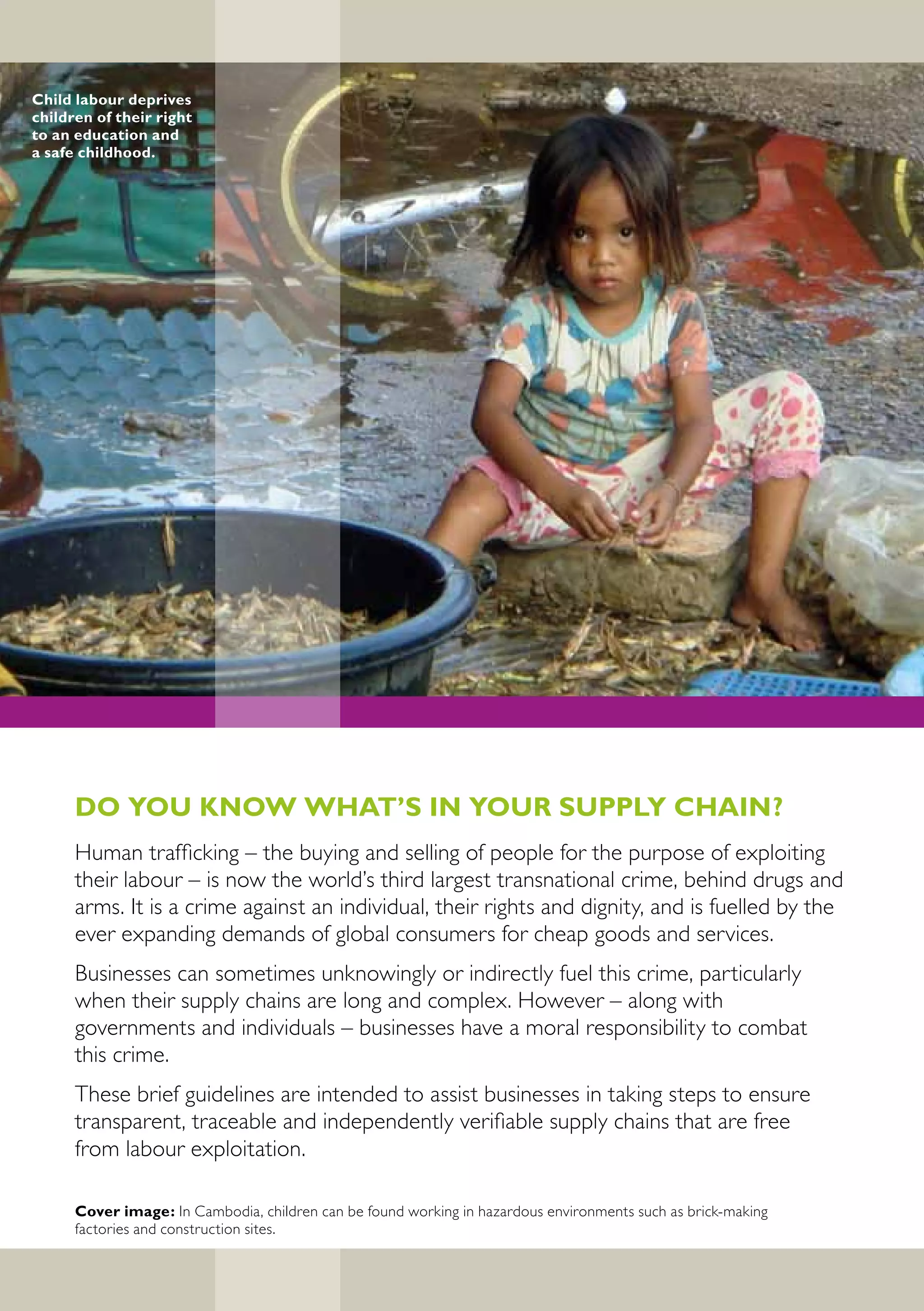
Child labour deprives
children of their right
to an education and
a safe childhood.


      DO YOU KNOW WHAT’S IN YOUR SUPPLY CHAIN?
      Human trafficking – the buying and selling of people for the purpose of exploiting
      their labour – is now the world’s third largest transnational crime, behind drugs and
      arms. It is a crime against an individual, their rights and dignity, and is fuelled by the
      ever expanding demands of global consumers for cheap goods and services.
      Businesses can sometimes unknowingly or indirectly fuel this crime, particularly
      when their supply chains are long and complex. However – along with
      governments and individuals – businesses have a moral responsibility to combat
      this crime.
      These brief guidelines are intended to assist businesses in taking steps to ensure
      transparent, traceable and independently verifiable supply chains that are free
      from labour exploitation.

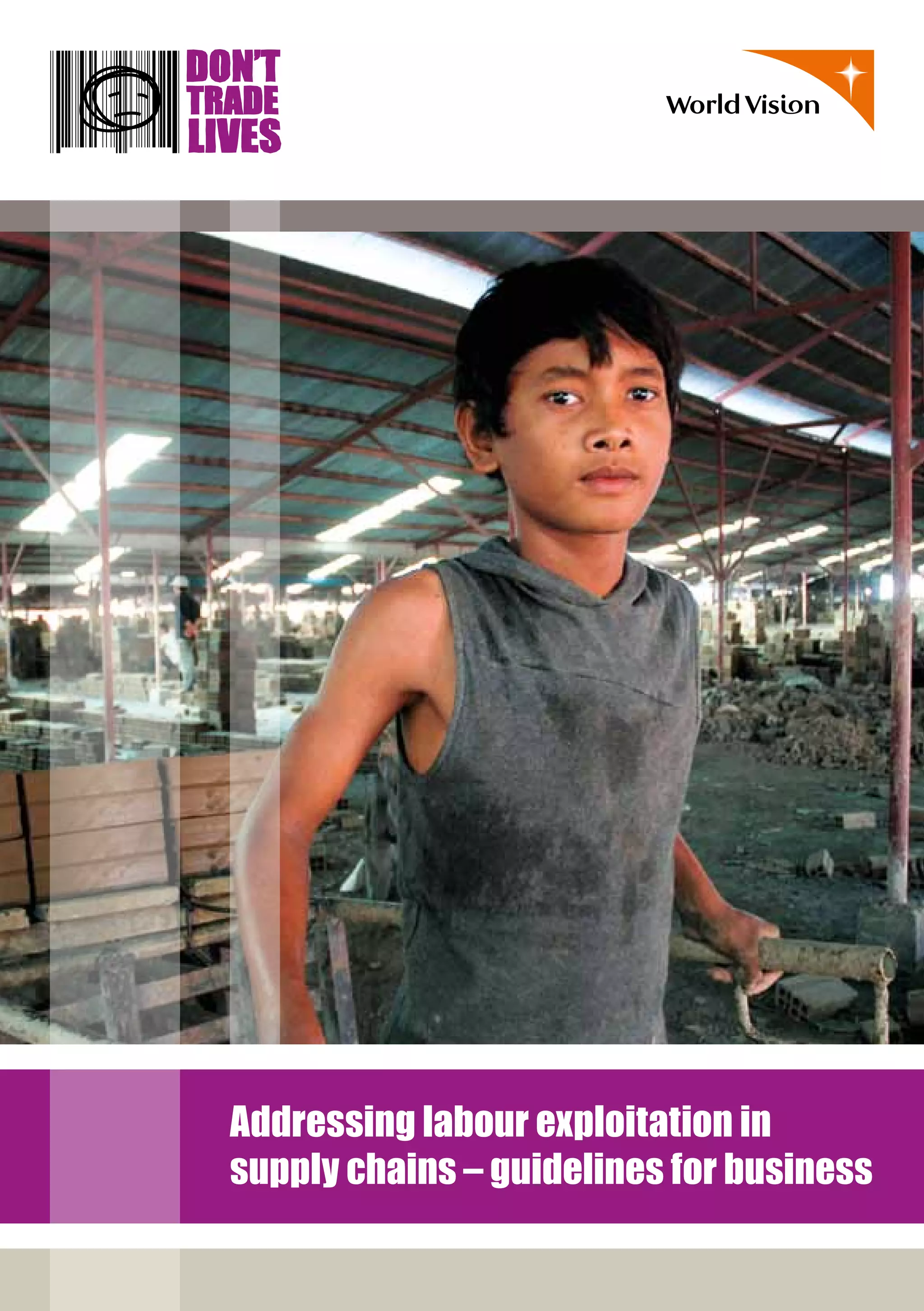
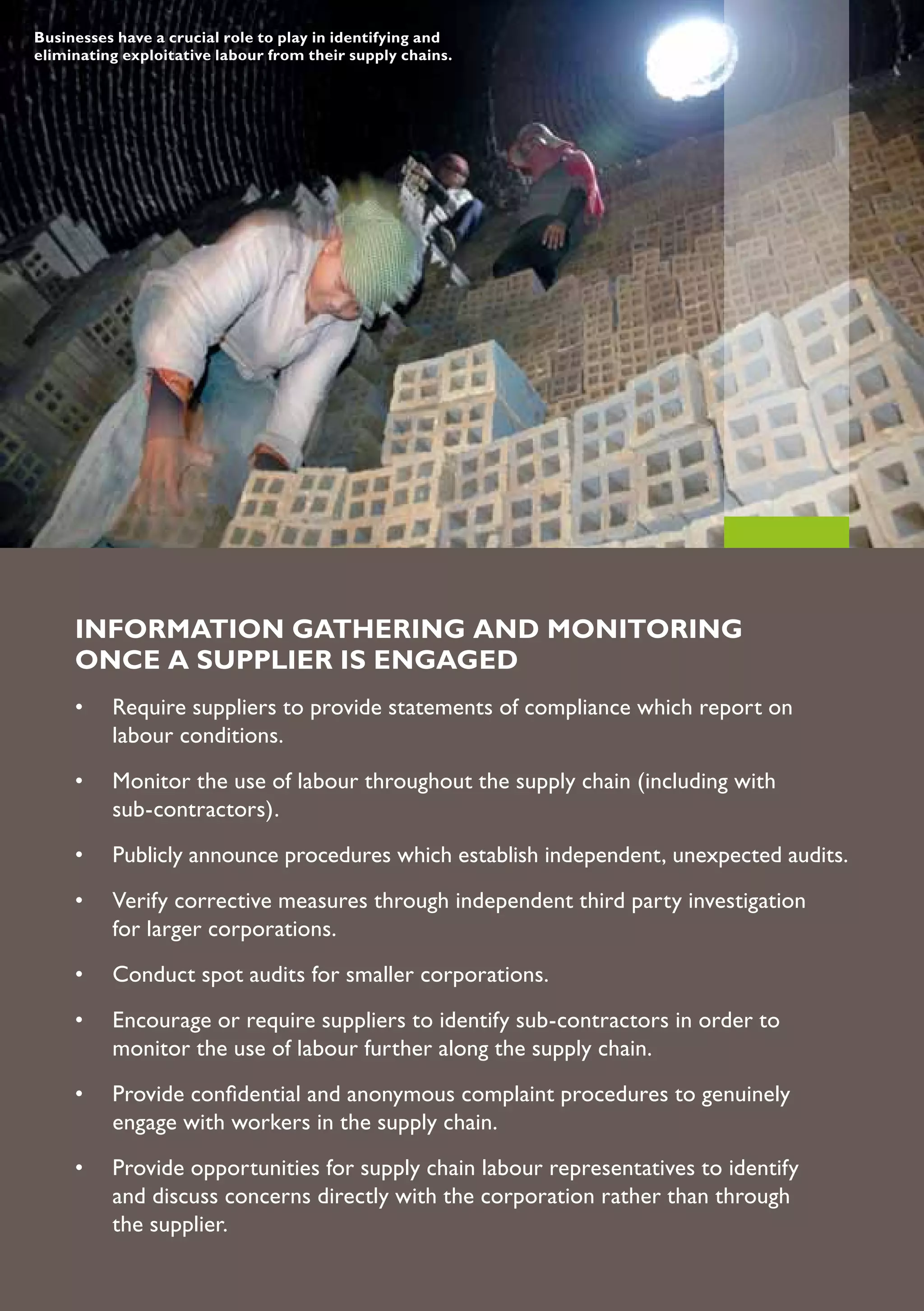
      Cover image: In Cambodia, children can be found working in hazardous environments such as brick-making
      factories and construction sites.
Businesses can manage the risks of infringing human rights by undertaking human
rights due diligence. This is a useful tool to identify and eliminate slavery, trafficked
or forced labour in a supply chain.


   TO UNDERTAKE HUMAN RIGHTS DUE DILIGENCE,
   A CORPORATION SHOULD:
   1. produce a statement of policy outlining its commitment to human rights;
   2. periodically assess the actual and potential human rights impact of its
      activities and relationships;
   3. incorporate the policy commitments and impact assessments into its
      internal control and oversight procedures;
   4. report on its performance; and
   5. provide appropriate grievance mechanisms.


The essence of the human rights due diligence approach – commit, assess,
implement and report – is similar to other core business activities, for example
in relation to consumer protection or environmental laws.


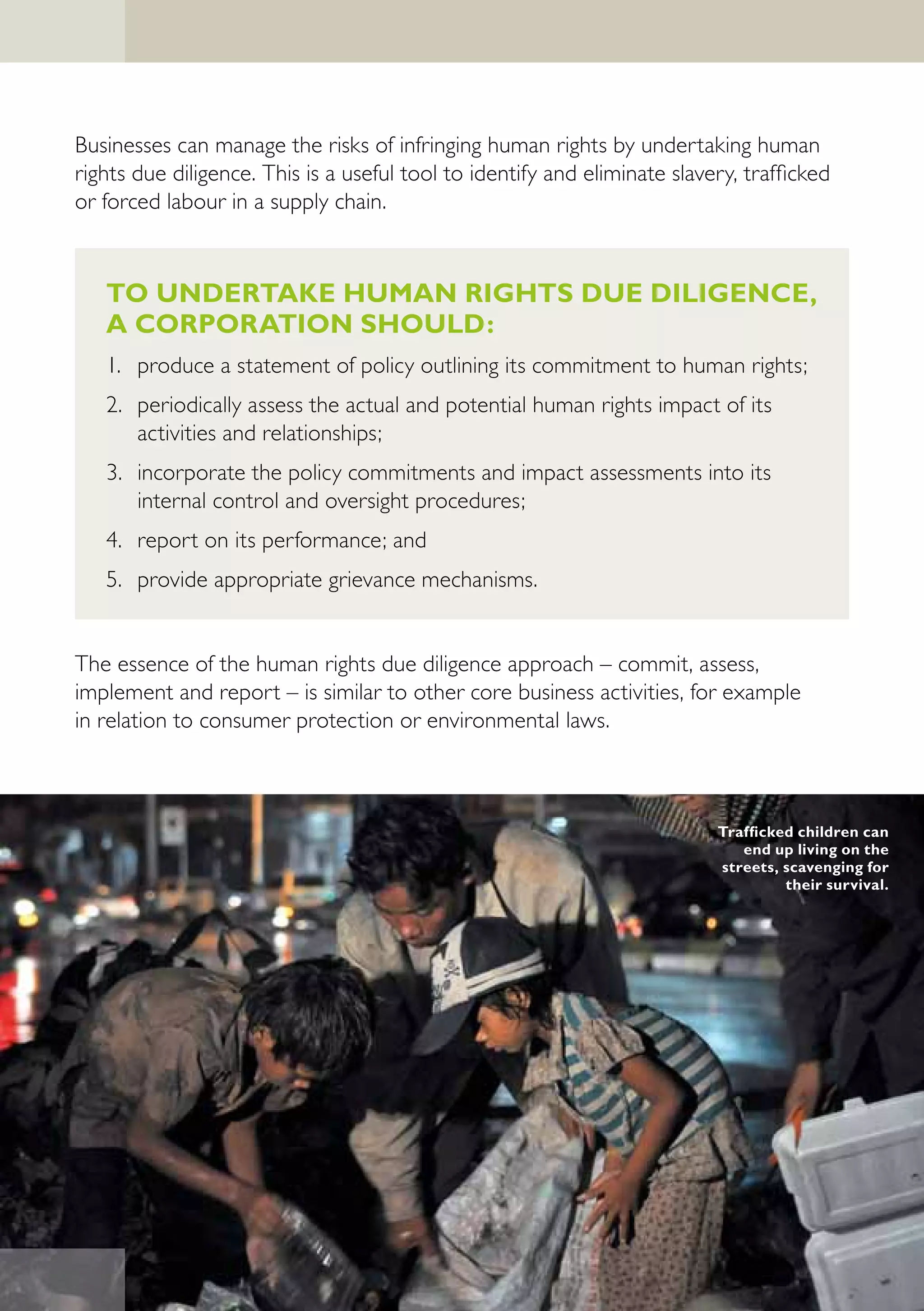
                                                                           Trafficked children can
                                                                              end up living on the
                                                                           streets, scavenging for
                                                                                    their survival.
DETAILED BEST PRACTICE RECOMMENDATIONS
Businesses that are at the forefront of eliminating slavery, trafficked and forced
labour from their supply chains accept that simply monitoring compliance with
codes of conduct is not sufficient. While these actions are important, it is equally
important to attempt to identify and prevent the underlying causes of the problem.

There are a number of policies and actions that corporations can adopt to address
the use of slavery, trafficked or forced labour in their supply chain.


PRIOR TO ENGAGING A SUPPLIER
•       Publish a policy or code of conduct which establishes that slavery, trafficked and
        forced labour will not be tolerated.

•       Impose prohibitions on the use of slavery, trafficked or forced labour by
        suppliers in supply contracts.

•       Undertake due diligence on potential suppliers in order to determine whether
        they use, or are likely to use slavery, trafficked or forced labour.

•       Undertake country- or sector-risk assessments to determine the likelihood
        of improper labour practices.

•       Investigate recruitment practices and the general standards of suppliers.
        For example, seek to identify practices which might enable labour abuse, such
        as paying recruitment fees or the retention of identity documents.

•       Participate in, and require a supplier to participate in, the negotiation of an
        International Framework Agreement (IFA).1

•       Establish policies which set out when to work with a supplier to improve labour
        standards and when to cease placing orders with a supplier.


1
    IFAs are a tool negotiated at an international level between the corporation and the Global Union Federation.
    They are similar to collective bargaining agreements and codes of conduct.
Businesses have a crucial role to play in identifying and
eliminating exploitative labour from their supply chains.


     INFORMATION GATHERING AND MONITORING
     ONCE A SUPPLIER IS ENGAGED
     •	 Require	suppliers	to	provide	statements	of	compliance	which	report	on		
     	 labour	conditions.
     •	 Monitor	the	use	of	labour	throughout	the	supply	chain	(including	with			
     	 sub-contractors).
     •	 Publicly	announce	procedures	which	establish	independent,	unexpected	audits.
     •	 Verify	corrective	measures	through	independent	third	party	investigation	
     	 for	larger	corporations.
     •	 Conduct	spot	audits	for	smaller	corporations.
     •	 Encourage	or	require	suppliers	to	identify	sub-contractors	in	order	to		
     	 monitor	the	use	of	labour	further	along	the	supply	chain.
     •	 Provide	confidential	and	anonymous	complaint	procedures	to	genuinely		
     	 engage	with	workers	in	the	supply	chain.
     •	 Provide	opportunities	for	supply	chain	labour	representatives	to	identify	
     	 and	discuss	concerns	directly	with	the	corporation	rather	than	through	
     	 the	supplier.
RESPONSE IF IMPROPER LABOUR PRACTICES OCCUR
•   Require suppliers to provide compensation and support for victims.

•   Require corrective measures if labour abuses are found so that they do
    not continue.

•   Establish connections with existing local support networks so as to enable
    victims to access existing services.

•   Depending upon the level and extent of labour abuse, work with the supplier
    to improve conditions or remove the supplier from the supply chain.


BYPASSING THE SUPPLIER
•   Provide community education programs to empower workers and the
    community. These programs can focus on building support systems for
    workers, raising community awareness about slavery, trafficked or forced
    labour, and supporting exploitation reporting mechanisms.

•   Identify the root causes of particular vulnerabilities of workers, such as
    poverty, debt and poor education and create programs which address these
    problems directly.


COLLECTIVE ENGAGEMENT
•   Develop partnerships with other stakeholders, including the business sector,
    NGOs, trade unions and international organisations, to share information,
    approaches and solutions to stop unacceptable labour practices.


INTERNAL PRACTICES
•   Address the extent to which internal practices contribute to supply chain
    pressures which in turn contribute to improper labour practices. For example,
    the timing of a changed order can place pressure on a supplier’s factory to
    meet its production deadline. This may in turn necessitate increased working
    hours in order to deliver the product.
THE “PROTECT, RESPECT AND REMEDY” FRAMEWORK
     In 2008, the United Nations Special Representative on business and human rights,
     Professor John Ruggie, presented a conceptual framework to anchor the business
     and human rights debate. The framework was adopted by the Human Rights
     Council unanimously and the Australian Senate passed a parliamentary motion
     which took note of the framework and called on the government to “encourage
     Australian companies to respect the rights of members of the communities in
     which they operate and to develop rights-compliant grievance mechanisms,
     whether acting in Australia or overseas”.
     The framework comprises the following three core principles:
     •    the state duty to protect against human rights abuses by third parties,
          including business;
     •    the corporate responsibility to respect human rights; and
     •    greater access by victims to effective remedy, both judicial and non-judicial.
     The corporate responsibility to respect human rights is a standard of conduct
     which is adopted by almost every voluntary and soft-law corporate responsibility
     related instrument, including the UN Global Compact, the International Labour
     Organisation’s (ILO) Tripartite Declaration and the OECD Guidelines for
     Multinational Enterprises. The framework states that the human rights outlined
     in the International Bill of Human Rights form a baseline for this corporate
     responsibility to respect.


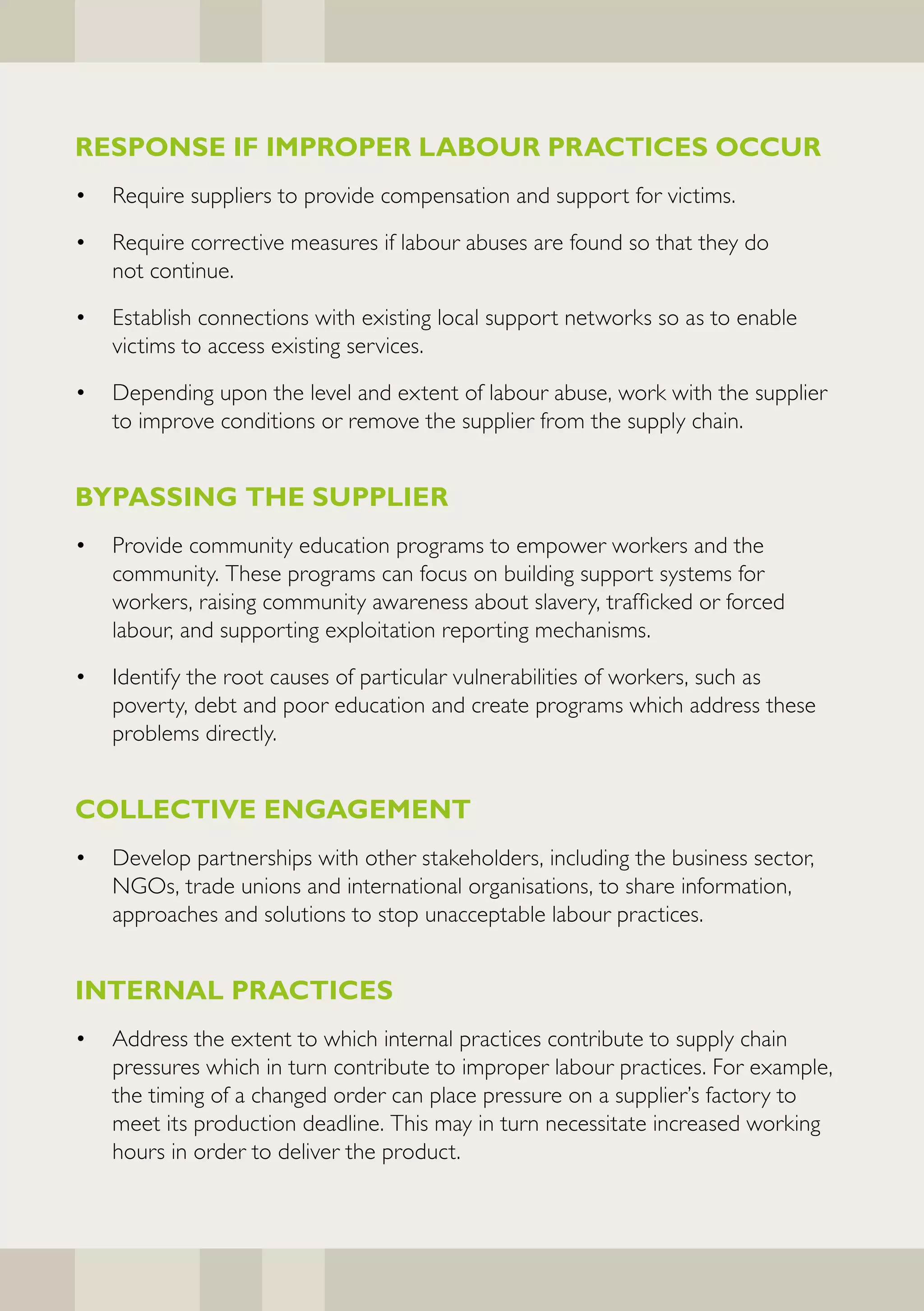
Isolation from community or lack of
language skills makes it hard for trafficked
victims to understand their rights.
SUPPLEMENTARY RESOURCES
There	are	some	practical	tools	and		
resources	that	can	help	businesses	to	align	
their	operations	with	principles	contained	
in	international	labour	standards,	which	are		
available	online.	These	include:
•	 Combating	forced	labour:	A	handbook		
	 for	employers	and	business	(ILO)
•	 Strengthening	Employers’	Activities		
	 against	Forced	Labour		(ILO)
•	    Human	Trafficking	and	Business:	Good	
	     practices	to	prevent	and	combat	human	
	     trafficking		(UN	Global	Initiative	to	Fight		
	     Human	Trafficking	Guide)
•	 How	to	Combat	Forced	Labour	and		 	
	 Trafficking	(International	Trade	Union		
	 Confederation	Guide)	
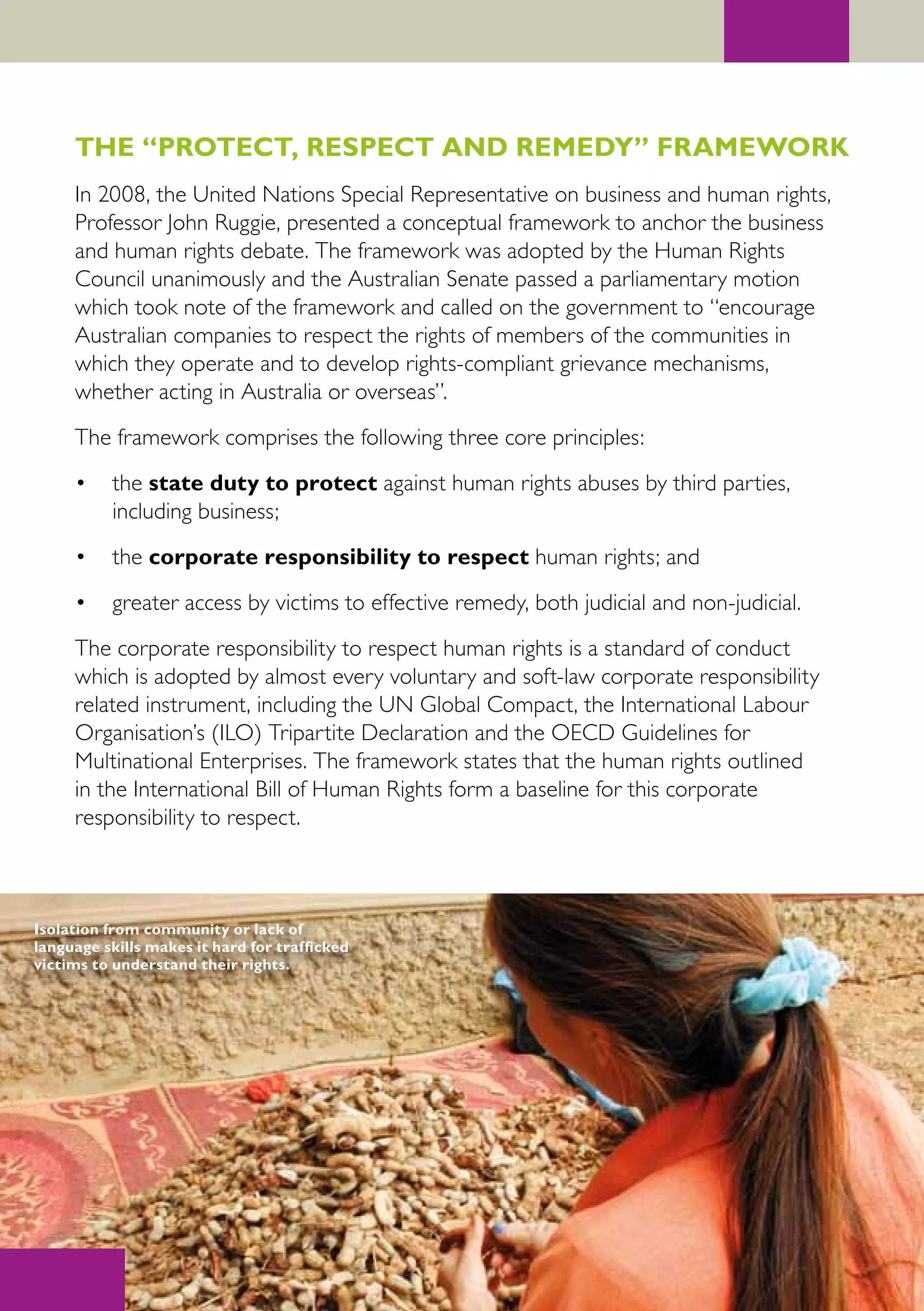
                                                                                              The demand for cheap labour exposes
•	 Support	for	Supply	Chains	(Global		 	                                                      tens of thousands of Myanmar migrant
                                                                                              workers to exploitation in the fishing
	 Reporting	Initiative)                                                                       industry.


DON’T TRADE LIVES
World Vision’s Don’t Trade Lives campaign calls for individuals, governments and
the private sector to combat human trafficking and slavery by addressing the supply
of and demand for exploited labour, and
by challenging the attitudes, systems and
structures that allow it to happen.
For more information,
visit donttradelives.com.au
© 2011 World Vision Australia. World Vision Australia ABN 28 004 778 081 is a Christian relief, development and advocacy organisation dedicated
to working with children, families and communities to overcome poverty and injustice. Ref #6446

Eradicating labour exploitation from your supply chain: Guidelines for business

  • 1.
    Addressing labour exploitationin supply chains – guidelines for business
  • 2.
    Child labour deprives childrenof their right to an education and a safe childhood. DO YOU KNOW WHAT’S IN YOUR SUPPLY CHAIN? Human trafficking – the buying and selling of people for the purpose of exploiting their labour – is now the world’s third largest transnational crime, behind drugs and arms. It is a crime against an individual, their rights and dignity, and is fuelled by the ever expanding demands of global consumers for cheap goods and services. Businesses can sometimes unknowingly or indirectly fuel this crime, particularly when their supply chains are long and complex. However – along with governments and individuals – businesses have a moral responsibility to combat this crime. These brief guidelines are intended to assist businesses in taking steps to ensure transparent, traceable and independently verifiable supply chains that are free from labour exploitation. Cover image: In Cambodia, children can be found working in hazardous environments such as brick-making factories and construction sites.
  • 3.
    Businesses can managethe risks of infringing human rights by undertaking human rights due diligence. This is a useful tool to identify and eliminate slavery, trafficked or forced labour in a supply chain. TO UNDERTAKE HUMAN RIGHTS DUE DILIGENCE, A CORPORATION SHOULD: 1. produce a statement of policy outlining its commitment to human rights; 2. periodically assess the actual and potential human rights impact of its activities and relationships; 3. incorporate the policy commitments and impact assessments into its internal control and oversight procedures; 4. report on its performance; and 5. provide appropriate grievance mechanisms. The essence of the human rights due diligence approach – commit, assess, implement and report – is similar to other core business activities, for example in relation to consumer protection or environmental laws. Trafficked children can end up living on the streets, scavenging for their survival.
  • 4.
    DETAILED BEST PRACTICERECOMMENDATIONS Businesses that are at the forefront of eliminating slavery, trafficked and forced labour from their supply chains accept that simply monitoring compliance with codes of conduct is not sufficient. While these actions are important, it is equally important to attempt to identify and prevent the underlying causes of the problem. There are a number of policies and actions that corporations can adopt to address the use of slavery, trafficked or forced labour in their supply chain. PRIOR TO ENGAGING A SUPPLIER • Publish a policy or code of conduct which establishes that slavery, trafficked and forced labour will not be tolerated. • Impose prohibitions on the use of slavery, trafficked or forced labour by suppliers in supply contracts. • Undertake due diligence on potential suppliers in order to determine whether they use, or are likely to use slavery, trafficked or forced labour. • Undertake country- or sector-risk assessments to determine the likelihood of improper labour practices. • Investigate recruitment practices and the general standards of suppliers. For example, seek to identify practices which might enable labour abuse, such as paying recruitment fees or the retention of identity documents. • Participate in, and require a supplier to participate in, the negotiation of an International Framework Agreement (IFA).1 • Establish policies which set out when to work with a supplier to improve labour standards and when to cease placing orders with a supplier. 1 IFAs are a tool negotiated at an international level between the corporation and the Global Union Federation. They are similar to collective bargaining agreements and codes of conduct.
  • 5.
    Businesses have acrucial role to play in identifying and eliminating exploitative labour from their supply chains. INFORMATION GATHERING AND MONITORING ONCE A SUPPLIER IS ENGAGED • Require suppliers to provide statements of compliance which report on labour conditions. • Monitor the use of labour throughout the supply chain (including with sub-contractors). • Publicly announce procedures which establish independent, unexpected audits. • Verify corrective measures through independent third party investigation for larger corporations. • Conduct spot audits for smaller corporations. • Encourage or require suppliers to identify sub-contractors in order to monitor the use of labour further along the supply chain. • Provide confidential and anonymous complaint procedures to genuinely engage with workers in the supply chain. • Provide opportunities for supply chain labour representatives to identify and discuss concerns directly with the corporation rather than through the supplier.
  • 6.
    RESPONSE IF IMPROPERLABOUR PRACTICES OCCUR • Require suppliers to provide compensation and support for victims. • Require corrective measures if labour abuses are found so that they do not continue. • Establish connections with existing local support networks so as to enable victims to access existing services. • Depending upon the level and extent of labour abuse, work with the supplier to improve conditions or remove the supplier from the supply chain. BYPASSING THE SUPPLIER • Provide community education programs to empower workers and the community. These programs can focus on building support systems for workers, raising community awareness about slavery, trafficked or forced labour, and supporting exploitation reporting mechanisms. • Identify the root causes of particular vulnerabilities of workers, such as poverty, debt and poor education and create programs which address these problems directly. COLLECTIVE ENGAGEMENT • Develop partnerships with other stakeholders, including the business sector, NGOs, trade unions and international organisations, to share information, approaches and solutions to stop unacceptable labour practices. INTERNAL PRACTICES • Address the extent to which internal practices contribute to supply chain pressures which in turn contribute to improper labour practices. For example, the timing of a changed order can place pressure on a supplier’s factory to meet its production deadline. This may in turn necessitate increased working hours in order to deliver the product.
  • 7.
    THE “PROTECT, RESPECTAND REMEDY” FRAMEWORK In 2008, the United Nations Special Representative on business and human rights, Professor John Ruggie, presented a conceptual framework to anchor the business and human rights debate. The framework was adopted by the Human Rights Council unanimously and the Australian Senate passed a parliamentary motion which took note of the framework and called on the government to “encourage Australian companies to respect the rights of members of the communities in which they operate and to develop rights-compliant grievance mechanisms, whether acting in Australia or overseas”. The framework comprises the following three core principles: • the state duty to protect against human rights abuses by third parties, including business; • the corporate responsibility to respect human rights; and • greater access by victims to effective remedy, both judicial and non-judicial. The corporate responsibility to respect human rights is a standard of conduct which is adopted by almost every voluntary and soft-law corporate responsibility related instrument, including the UN Global Compact, the International Labour Organisation’s (ILO) Tripartite Declaration and the OECD Guidelines for Multinational Enterprises. The framework states that the human rights outlined in the International Bill of Human Rights form a baseline for this corporate responsibility to respect. Isolation from community or lack of language skills makes it hard for trafficked victims to understand their rights.
  • 8.
    SUPPLEMENTARY RESOURCES There are some practical tools and resources that can help businesses to align their operations with principles contained in international labour standards, which are available online. These include: • Combating forced labour: A handbook for employers and business (ILO) • Strengthening Employers’ Activities against Forced Labour (ILO) • Human Trafficking and Business: Good practices to prevent and combat human trafficking (UN Global Initiative to Fight Human Trafficking Guide) • How to Combat Forced Labour and Trafficking (International Trade Union Confederation Guide) The demand for cheap labour exposes • Support for Supply Chains (Global tens of thousands of Myanmar migrant workers to exploitation in the fishing Reporting Initiative) industry. DON’T TRADE LIVES World Vision’s Don’t Trade Lives campaign calls for individuals, governments and the private sector to combat human trafficking and slavery by addressing the supply of and demand for exploited labour, and by challenging the attitudes, systems and structures that allow it to happen. For more information, visit donttradelives.com.au © 2011 World Vision Australia. World Vision Australia ABN 28 004 778 081 is a Christian relief, development and advocacy organisation dedicated to working with children, families and communities to overcome poverty and injustice. Ref #6446