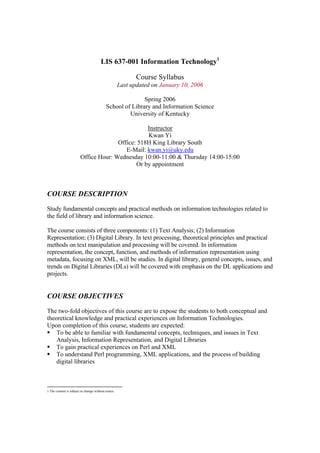
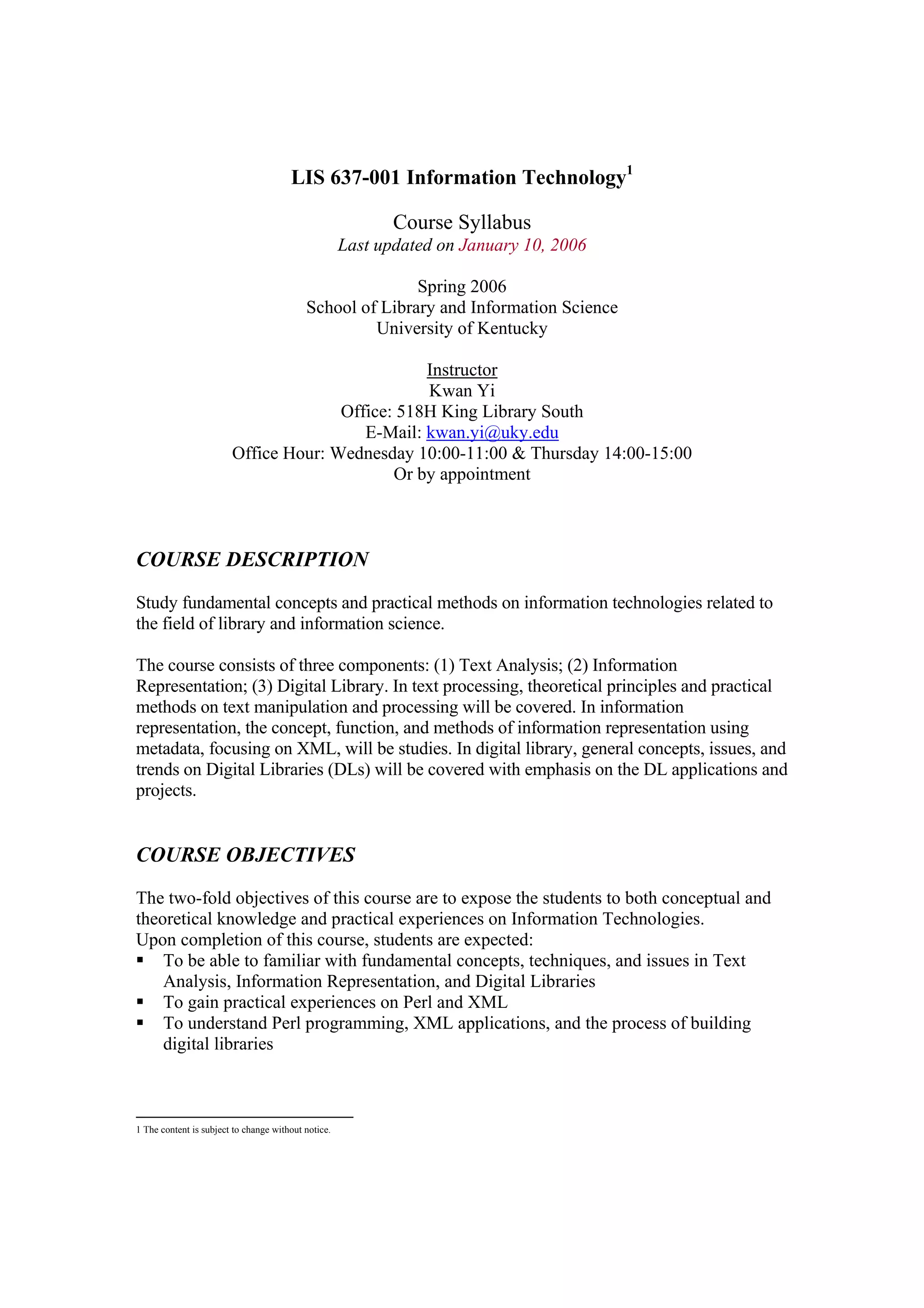
LIS 637-001 Information Technology1

                                                            Course Syllabus
                                                     Last updated on January 10, 2006

                                                          Spring 2006
                                           School of Library and Information Science
                                                    University of Kentucky

                                                 Instructor
                                                 Kwan Yi
                                      Office: 518H King Library South
                                         E-Mail: kwan.yi@uky.edu
                        Office Hour: Wednesday 10:00-11:00 & Thursday 14:00-15:00
                                             Or by appointment


COURSE DESCRIPTION
Study fundamental concepts and practical methods on information technologies related to
the field of library and information science.

The course consists of three components: (1) Text Analysis; (2) Information
Representation; (3) Digital Library. In text processing, theoretical principles and practical
methods on text manipulation and processing will be covered. In information
representation, the concept, function, and methods of information representation using
metadata, focusing on XML, will be studies. In digital library, general concepts, issues, and
trends on Digital Libraries (DLs) will be covered with emphasis on the DL applications and
projects.


COURSE OBJECTIVES
The two-fold objectives of this course are to expose the students to both conceptual and
theoretical knowledge and practical experiences on Information Technologies.
Upon completion of this course, students are expected:
    To be able to familiar with fundamental concepts, techniques, and issues in Text
    Analysis, Information Representation, and Digital Libraries
    To gain practical experiences on Perl and XML
    To understand Perl programming, XML applications, and the process of building
    digital libraries


1 The content is subject to change without notice.
COURSE CONTENT

Overview of Topics & Assignments
 Date                                       Topics                                 Quiz & Due
Jan. 11      Module 1. Course Introduction - Perl 1: Data Type
Jan. 18      Module 2. Characteristics of Text - Perl 2: Data Operator; Function
Jan. 25      Module 3. Text Indexing - Perl 3: Data structure                      PA#1
Feb. 01      Module 4. Text Representation - Perl 4: Control structure
Feb. 08      Module 5. Text Applications - Perl 5: Regular Expression              PA#2
Feb. 15      Module 6. Perl 6: Subroutine & File I/O                                   Quiz 1.
Feb. 22      Module 7. Introduction to Metadata - XML 1: XML Fundamentals          PA#3
Mar. 01      Module 8. Metadata: DC - XML 2: Document Type Definition
Mar. 08      Module 9. Metadata: SGML family - XML 3: XML Schemas                  XA#1
Mar. 15      Academic Holiday (Spring Vacation)
Mar. 22      Module 10. Metadata: TEI/RDF - XML 4: CSS                             XA#2
Mar. 29      Module 11. Introduction to Digital Library (DL) - Greenstone 1            Quiz 2.
Apr. 05      Module 12. Development of DL - Greenstone 2                           XA#3
Apr. 12      Module 13. DL Projects - Greenstone 3
Apr. 19      Module 14. Special topic or Guest Speaker
Apr. 26      Project Presentations                                                 Group Project


Weekly Schedule of Topics, Reading, & Assignments
Jan. 11          Course Introduction
                 Perl 1: Introduction to Perl; Data Type
          Required Reading:
                 [PerlTutorial] Chapter 1; Chapter 2; Chapter 3.1.1-3.1.3

Jan. 18          Characteristics of Text: Compression; Collocations; Zipf’s Law
                 Perl 2: Data Operator; Function
          Required Reading:
                 http://en.wikipedia.org/wiki/Zipf%27s_law
                 http://en.wikipedia.org/wiki/Heaps%27_law
                 [Korfhage] Chapter 2.5-2.7
                 [Meadow03] Chapter 3.1-3.3
                 [PerlTutorial] Chapter 4.1-4.3
          Reference:
                 [Baeza-Yates99] Chapter 6.1-6.3; 7.4-7.5

Jan. 25          Text Indexing & Operation: Term Weighting; Lexical Analysis
                 Perl 3: Data structure
          Required Reading:
                 [Harter]
                 [Korfhage] Chapter 5.1-5.9
                 [Meadow03] Chapter 9.2, 9.4
                 [PerlTutorial] Chapter 3.2-3.3
          Reference:
[Baeza-Yates99] Chapter 7.1-7.2


Feb. 01          Text Representation: Attribute/Value; Data Structure; File Structure
                 Perl 4: Control structure
          Required Reading:
                 [Korfhage] Appendix B
                 [Meadow03] Chapter 6.1-6.4
                 [Pao89]
                 [PerlTutorial] Chapter 5.6-5.7

Feb. 08          Text Applications
                 Perl 5: Regular Expression
          Required Reading:
                 [Meadow03] Chapter 9
                 [Lesk97] Chapter 2.7 & 5.2
                 [PerlTutorial] Chapter 9.1-9.3

Feb. 15          Quiz 1.
                 Perl 6: Subroutine & File I/O
          Required Reading:
                  [PerlTutorial] Chapter 5.3; Chapter 8.1-8.3

Feb. 22          Introduction to Metadata: Fundamental Concepts; History; Examples
                 XML 1: XML Fundamentals
          Required Reading:
                 [Gilliland-Swetland98]
                 [Witten03] Chapter 5.4-5.6; Pp. 431-450
                 [Ray03] Chapter 1-2
          Reference:
                 [Galnares]

Mar. 01          Metadata: Dublin Core
                 XML 2: Document Type Definition (DTD)
          Required Reading:
                 [DCMES]
                 [Ray03] Chapter 3-4
                 [Weibel99]
          Reference:
                 [DTD1]
                 [DTD2]

Mar. 08          Metadata: SGML Family
                 XML 3: XML Schemas
          Required Reading:
                 [Flynn97]
                 [Marcoux97]
                 [Pfaffenberger98] Pp. 53-75 & 173-189
                 [Ray03] Chapter 4
                 [Witten03] Chapter 5.1-5.3
Mar. 15           Academic Holiday (Spring Vacation)

Mar. 22          Metadata: TEI/RDF
                 XML 4: Cascading Style Sheets (CSS)
          Required Reading:
                 [Barnard97]
                 [Ray03] Chapter 5
                 [RDFprimer]

Mar. 29          Quiz 2
                 Introduction to Digital Library (DL)
                 Greenstone 1: Introduction; Installation
          Required Reading:
                 [Lesk97] Pp. 1-25.
                 [Borgman99]
                 [Coffman99]
                 [Witten03] Chapter 1.1, 1.2, 1.4, Chapter 2, 6.1-6.2

Apr. 05          Development of DL: Architectural and Design Challenges; Issues of Library
                 Resources and Services in DL
                 Greenstone 2: Building collection; Importing
          Required Reading:
                 [Garrett93]
                 [Witten03] Chapter 6.3-6.4
          Reference:
                 [Bates98]

Apr. 12          DL Projects: DL Initiative Projects; Digitalization in LC
                 Greenstone 3: Archived documents; Configuration
          Required Reading:
                 [Witten03] Chapter 6.5-6.8
          Reference:
                 [DLI2]
                 [IFLA]
                 [LoC]

Apr. 19           Special topic or Guest Speaker

Apr. 26           Project Presentations

PERL Resources
[PerlDoc] used as a reference
[PerlInstall] for installing a Perl program
[PerlCD] 6 Perl books available through the Internet
[PerlQuickRef] Perl Regular Expression Quick Reference
[PerlTutorial] used as a supplementary to lecture

XML Resources
[Ray03] used as a supplementary and reference to lecture
[XMLTutorial_1] used as a supplementary to lecture
[XMLTutorial_all] used as a supplementary to lecture
Greenstone Resources
[Greenstone] for the installation of the GREENSTONE software and the supporting documents
[Witten03] introduction to how to build using the Greenstone
Referenced Texts
         2-Hour Reserved in the Young Library:
             [Ray03] Ray, Erik T. (2003). Learning XML. Sebastopol, CA: O’Reilly.

Referenced Articles and Resources
         Freely available online:
             [Barnard97] Barnard, David T., & Ide, Nancy M. (1997). The Text Encoding
             Initiative: Flexible and extensible document encoding. Journal of the American
             Society for Information Science, 48, 622-28.
             [Bates98] Bates, Marcia J. (1998). Indexing and access for digital libraries and
             the Internet: Human, database, and domain factors. Journal of the American
             Society for Information Science, 49, 1185-1205.
             [Coffman99] Coffman, S. (1999). Building Earth’s Largest Library: Diving into
             the future. Searcher, 7 (3). Available:
             http://www.infotoday.com/searcher/mar99/coffman.htm.
             [Baca98] Baca, Murtha, ed. Introduction to Metadata: Pathways to Digital
             Information. (Los Angeles, CA: Getty Research Institute, 1998). Available:
             http://www.getty.edu/research/conducting_research/standards/intrometadata/ind
             ex.html.
             [DCMES] Dublin Core Metadata Element Set (DCMES). Available:
             http://dublincore.org/documents/dces/.
             [DLI2] DLI2 -- Digital Libraries Initiative Phase 2. Available:
             http://www.nsf.gov/pubs/1998/nsf9863/nsf9863.htm.
             [DTD1] Available: http://www.xmlfiles.com/dtd.
             [DTD2] Available: http://www.w3schools.com/dtd/default.asp.
             [EAD] Available: http://www.loc.gov/ead.
             [Galnares] Available: http://www.cs.njit.edu/~galnares/Metadata.html.
             [Garrett93] Garrett, John. “Digital Libraries: The Grand Challenges.” EDUCOM
             Review, Jyly/August 1993, 28 (4). Available:
             http://www.ifla.org/documents/libraries/net/garrett.txt.
             [Gilliland-Swetland98] Gilliland-Swetland, Anne. J. “Setting the Stage.” In
             [Baca98].
             [Greenstone] Greenstone Digital Library Software. Available:
             Http://www.greenstone.org.
             [IFLA] IFLA -- Digital Libraries: Cataloging and Indexing of Electronic
             Resources. Available: Http://www.ifla.org/II/catalog.htm
             [LoC] Library of Congress -- American Memory: Historical Collections for the
             National Digital Library. Available: Http://memory.loc.gov/
             [NISO04] Understanding Metadata. National Information Standards
             Organization. (2004). Available:
             http://www.niso.org/standards/resources/UnderstandingMetadata.pdf.
             [PerlDoc] Available: http://www.perldoc.com
             [PerlInstall] Available: http://www.perl.com/download.csp
             [PerlCD] Available: http://www.unix.org.ua/orelly/perl/index.htm
             [PerlQuickRef] Available: http://www.erudil.com/pdf/preqr.pdf
             [PerlTutorial] Available: http://www.cbkihong.com/download/perltut.pdf
             [RDFprimer] Available: http://www.w3.org/TR/rdf-primer
             [Weibel99] Weibel, Stuart. The State of the Dublin Core Metadata Initiative. D-
             Lib Magazine 5, 4 (April 1999). Available:
             http://www.dlib.org/dlib/april99/04weibel.html
[XMLTutorial_1] Available:
    http://www.spiderpro.com/ebooks/kickstart_tutorial_xml.pdf
    [XMLTutorial_all] Available: http://www.w3schools.com/xml/default.asp

Available at the course folder in the IT lab:
    [Baeza-Yates99] Baeza-Yates, Ricardo, & Berthier Ribeiro-Neto. (1999).
    Modern Information Retrieval. New York: ACM Press.
    [Borgman99] Borgman, Christine L. (1999). What are digital libraries?
    Information Processing and Management, 35, 227-243.
    [Flynn97] Flynn, Peter. (1997). W[h]ither the Web? The extension or
    replacement of HTML. Journal of the American Society for Information
    Science, 48, 614-21.
    [Harter] Harter, Stephen P. (1988). Statistical Approaches to Automatic
    Indexing. In ‘Document Retrieval Systems’ London, UK: Taylor Graham
    Publishing. Pp. 81-98.
    [Marcoux97] Marcoux, Yves, & Sevigny, Martin. (1997). Why SGML? Why
    now? Journal of the American Society for Information Science, 48, 584-92.
    [Korfhage] Korfhage, Robert R. (1997). Information Storage and Retrieval. New
    York: John Wiley & Sons.
    [Lesk97] Lesk, M. (1997). Practical Digital Libraries: Books, Bytes & Bucks.
    San Francisco: Morgan Kaufmann.
    [Meadow03] Meadow, C. T., R. B. Boyce, & D. H. Kraft. (2003). Text
    Information Retrieval Systems. San Diego: Academic Press.
    [Pao89] Pao, M.L. (1989). Database Systems. In: Concepts of Information
    Retrieval. Englewood, CO: Libraries Unlimited. Pp 146-159.
    [Pfaffenberger98] Pfaffenberger, Bryan. (1998). Web Publishing with XML in
    Six Easy Steps. San Francisco: Morgan Kaufmann. Pp. 53-75 & 173-189
    [Witten03] Witten, I. H. & David Bainbridge. (2003). How To Build a Digital
    Library. San Francisco: Morgan Kaufmann.
    [Witten99] Witten, I. H., A. Moffat, & T. C. Bell. (1999). Managing Gigabytes:
    compressing and indexing documents and images. San Francisco: Morgan
    Kaufmann. Chapter 3.2
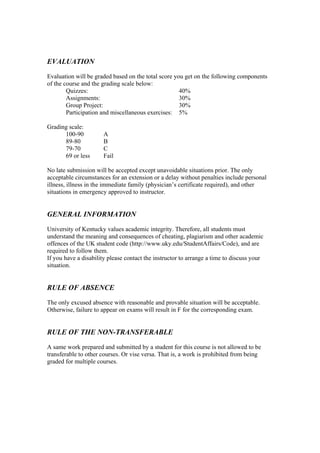
EVALUATION
Evaluation will be graded based on the total score you get on the following components
of the course and the grading scale below:
        Quizzes:                                     40%
        Assignments:                                 30%
        Group Project:                               30%
        Participation and miscellaneous exercises: 5%

Grading scale:
      100-90          A
      89-80           B
      79-70           C
      69 or less      Fail

No late submission will be accepted except unavoidable situations prior. The only
acceptable circumstances for an extension or a delay without penalties include personal
illness, illness in the immediate family (physician’s certificate required), and other
situations in emergency approved to instructor.


GENERAL INFORMATION
University of Kentucky values academic integrity. Therefore, all students must
understand the meaning and consequences of cheating, plagiarism and other academic
offences of the UK student code (http://www.uky.edu/StudentAffairs/Code), and are
required to follow them.
If you have a disability please contact the instructor to arrange a time to discuss your
situation.


RULE OF ABSENCE
The only excused absence with reasonable and provable situation will be acceptable.
Otherwise, failure to appear on exams will result in F for the corresponding exam.


RULE OF THE NON-TRANSFERABLE
A same work prepared and submitted by a student for this course is not allowed to be
transferable to other courses. Or vise versa. That is, a work is prohibited from being
graded for multiple courses.

637_ky

  • 1.
    LIS 637-001 InformationTechnology1 Course Syllabus Last updated on January 10, 2006 Spring 2006 School of Library and Information Science University of Kentucky Instructor Kwan Yi Office: 518H King Library South E-Mail: kwan.yi@uky.edu Office Hour: Wednesday 10:00-11:00 & Thursday 14:00-15:00 Or by appointment COURSE DESCRIPTION Study fundamental concepts and practical methods on information technologies related to the field of library and information science. The course consists of three components: (1) Text Analysis; (2) Information Representation; (3) Digital Library. In text processing, theoretical principles and practical methods on text manipulation and processing will be covered. In information representation, the concept, function, and methods of information representation using metadata, focusing on XML, will be studies. In digital library, general concepts, issues, and trends on Digital Libraries (DLs) will be covered with emphasis on the DL applications and projects. COURSE OBJECTIVES The two-fold objectives of this course are to expose the students to both conceptual and theoretical knowledge and practical experiences on Information Technologies. Upon completion of this course, students are expected: To be able to familiar with fundamental concepts, techniques, and issues in Text Analysis, Information Representation, and Digital Libraries To gain practical experiences on Perl and XML To understand Perl programming, XML applications, and the process of building digital libraries 1 The content is subject to change without notice.
  • 2.
    COURSE CONTENT Overview ofTopics & Assignments Date Topics Quiz & Due Jan. 11 Module 1. Course Introduction - Perl 1: Data Type Jan. 18 Module 2. Characteristics of Text - Perl 2: Data Operator; Function Jan. 25 Module 3. Text Indexing - Perl 3: Data structure PA#1 Feb. 01 Module 4. Text Representation - Perl 4: Control structure Feb. 08 Module 5. Text Applications - Perl 5: Regular Expression PA#2 Feb. 15 Module 6. Perl 6: Subroutine & File I/O Quiz 1. Feb. 22 Module 7. Introduction to Metadata - XML 1: XML Fundamentals PA#3 Mar. 01 Module 8. Metadata: DC - XML 2: Document Type Definition Mar. 08 Module 9. Metadata: SGML family - XML 3: XML Schemas XA#1 Mar. 15 Academic Holiday (Spring Vacation) Mar. 22 Module 10. Metadata: TEI/RDF - XML 4: CSS XA#2 Mar. 29 Module 11. Introduction to Digital Library (DL) - Greenstone 1 Quiz 2. Apr. 05 Module 12. Development of DL - Greenstone 2 XA#3 Apr. 12 Module 13. DL Projects - Greenstone 3 Apr. 19 Module 14. Special topic or Guest Speaker Apr. 26 Project Presentations Group Project Weekly Schedule of Topics, Reading, & Assignments Jan. 11 Course Introduction Perl 1: Introduction to Perl; Data Type Required Reading: [PerlTutorial] Chapter 1; Chapter 2; Chapter 3.1.1-3.1.3 Jan. 18 Characteristics of Text: Compression; Collocations; Zipf’s Law Perl 2: Data Operator; Function Required Reading: http://en.wikipedia.org/wiki/Zipf%27s_law http://en.wikipedia.org/wiki/Heaps%27_law [Korfhage] Chapter 2.5-2.7 [Meadow03] Chapter 3.1-3.3 [PerlTutorial] Chapter 4.1-4.3 Reference: [Baeza-Yates99] Chapter 6.1-6.3; 7.4-7.5 Jan. 25 Text Indexing & Operation: Term Weighting; Lexical Analysis Perl 3: Data structure Required Reading: [Harter] [Korfhage] Chapter 5.1-5.9 [Meadow03] Chapter 9.2, 9.4 [PerlTutorial] Chapter 3.2-3.3 Reference:
  • 3.
    [Baeza-Yates99] Chapter 7.1-7.2 Feb.01 Text Representation: Attribute/Value; Data Structure; File Structure Perl 4: Control structure Required Reading: [Korfhage] Appendix B [Meadow03] Chapter 6.1-6.4 [Pao89] [PerlTutorial] Chapter 5.6-5.7 Feb. 08 Text Applications Perl 5: Regular Expression Required Reading: [Meadow03] Chapter 9 [Lesk97] Chapter 2.7 & 5.2 [PerlTutorial] Chapter 9.1-9.3 Feb. 15 Quiz 1. Perl 6: Subroutine & File I/O Required Reading: [PerlTutorial] Chapter 5.3; Chapter 8.1-8.3 Feb. 22 Introduction to Metadata: Fundamental Concepts; History; Examples XML 1: XML Fundamentals Required Reading: [Gilliland-Swetland98] [Witten03] Chapter 5.4-5.6; Pp. 431-450 [Ray03] Chapter 1-2 Reference: [Galnares] Mar. 01 Metadata: Dublin Core XML 2: Document Type Definition (DTD) Required Reading: [DCMES] [Ray03] Chapter 3-4 [Weibel99] Reference: [DTD1] [DTD2] Mar. 08 Metadata: SGML Family XML 3: XML Schemas Required Reading: [Flynn97] [Marcoux97] [Pfaffenberger98] Pp. 53-75 & 173-189 [Ray03] Chapter 4 [Witten03] Chapter 5.1-5.3
  • 4.
    Mar. 15 Academic Holiday (Spring Vacation) Mar. 22 Metadata: TEI/RDF XML 4: Cascading Style Sheets (CSS) Required Reading: [Barnard97] [Ray03] Chapter 5 [RDFprimer] Mar. 29 Quiz 2 Introduction to Digital Library (DL) Greenstone 1: Introduction; Installation Required Reading: [Lesk97] Pp. 1-25. [Borgman99] [Coffman99] [Witten03] Chapter 1.1, 1.2, 1.4, Chapter 2, 6.1-6.2 Apr. 05 Development of DL: Architectural and Design Challenges; Issues of Library Resources and Services in DL Greenstone 2: Building collection; Importing Required Reading: [Garrett93] [Witten03] Chapter 6.3-6.4 Reference: [Bates98] Apr. 12 DL Projects: DL Initiative Projects; Digitalization in LC Greenstone 3: Archived documents; Configuration Required Reading: [Witten03] Chapter 6.5-6.8 Reference: [DLI2] [IFLA] [LoC] Apr. 19 Special topic or Guest Speaker Apr. 26 Project Presentations PERL Resources [PerlDoc] used as a reference [PerlInstall] for installing a Perl program [PerlCD] 6 Perl books available through the Internet [PerlQuickRef] Perl Regular Expression Quick Reference [PerlTutorial] used as a supplementary to lecture XML Resources [Ray03] used as a supplementary and reference to lecture [XMLTutorial_1] used as a supplementary to lecture [XMLTutorial_all] used as a supplementary to lecture
  • 5.
    Greenstone Resources [Greenstone] forthe installation of the GREENSTONE software and the supporting documents [Witten03] introduction to how to build using the Greenstone
  • 6.
    Referenced Texts 2-Hour Reserved in the Young Library: [Ray03] Ray, Erik T. (2003). Learning XML. Sebastopol, CA: O’Reilly. Referenced Articles and Resources Freely available online: [Barnard97] Barnard, David T., & Ide, Nancy M. (1997). The Text Encoding Initiative: Flexible and extensible document encoding. Journal of the American Society for Information Science, 48, 622-28. [Bates98] Bates, Marcia J. (1998). Indexing and access for digital libraries and the Internet: Human, database, and domain factors. Journal of the American Society for Information Science, 49, 1185-1205. [Coffman99] Coffman, S. (1999). Building Earth’s Largest Library: Diving into the future. Searcher, 7 (3). Available: http://www.infotoday.com/searcher/mar99/coffman.htm. [Baca98] Baca, Murtha, ed. Introduction to Metadata: Pathways to Digital Information. (Los Angeles, CA: Getty Research Institute, 1998). Available: http://www.getty.edu/research/conducting_research/standards/intrometadata/ind ex.html. [DCMES] Dublin Core Metadata Element Set (DCMES). Available: http://dublincore.org/documents/dces/. [DLI2] DLI2 -- Digital Libraries Initiative Phase 2. Available: http://www.nsf.gov/pubs/1998/nsf9863/nsf9863.htm. [DTD1] Available: http://www.xmlfiles.com/dtd. [DTD2] Available: http://www.w3schools.com/dtd/default.asp. [EAD] Available: http://www.loc.gov/ead. [Galnares] Available: http://www.cs.njit.edu/~galnares/Metadata.html. [Garrett93] Garrett, John. “Digital Libraries: The Grand Challenges.” EDUCOM Review, Jyly/August 1993, 28 (4). Available: http://www.ifla.org/documents/libraries/net/garrett.txt. [Gilliland-Swetland98] Gilliland-Swetland, Anne. J. “Setting the Stage.” In [Baca98]. [Greenstone] Greenstone Digital Library Software. Available: Http://www.greenstone.org. [IFLA] IFLA -- Digital Libraries: Cataloging and Indexing of Electronic Resources. Available: Http://www.ifla.org/II/catalog.htm [LoC] Library of Congress -- American Memory: Historical Collections for the National Digital Library. Available: Http://memory.loc.gov/ [NISO04] Understanding Metadata. National Information Standards Organization. (2004). Available: http://www.niso.org/standards/resources/UnderstandingMetadata.pdf. [PerlDoc] Available: http://www.perldoc.com [PerlInstall] Available: http://www.perl.com/download.csp [PerlCD] Available: http://www.unix.org.ua/orelly/perl/index.htm [PerlQuickRef] Available: http://www.erudil.com/pdf/preqr.pdf [PerlTutorial] Available: http://www.cbkihong.com/download/perltut.pdf [RDFprimer] Available: http://www.w3.org/TR/rdf-primer [Weibel99] Weibel, Stuart. The State of the Dublin Core Metadata Initiative. D- Lib Magazine 5, 4 (April 1999). Available: http://www.dlib.org/dlib/april99/04weibel.html
  • 7.
    [XMLTutorial_1] Available: http://www.spiderpro.com/ebooks/kickstart_tutorial_xml.pdf [XMLTutorial_all] Available: http://www.w3schools.com/xml/default.asp Available at the course folder in the IT lab: [Baeza-Yates99] Baeza-Yates, Ricardo, & Berthier Ribeiro-Neto. (1999). Modern Information Retrieval. New York: ACM Press. [Borgman99] Borgman, Christine L. (1999). What are digital libraries? Information Processing and Management, 35, 227-243. [Flynn97] Flynn, Peter. (1997). W[h]ither the Web? The extension or replacement of HTML. Journal of the American Society for Information Science, 48, 614-21. [Harter] Harter, Stephen P. (1988). Statistical Approaches to Automatic Indexing. In ‘Document Retrieval Systems’ London, UK: Taylor Graham Publishing. Pp. 81-98. [Marcoux97] Marcoux, Yves, & Sevigny, Martin. (1997). Why SGML? Why now? Journal of the American Society for Information Science, 48, 584-92. [Korfhage] Korfhage, Robert R. (1997). Information Storage and Retrieval. New York: John Wiley & Sons. [Lesk97] Lesk, M. (1997). Practical Digital Libraries: Books, Bytes & Bucks. San Francisco: Morgan Kaufmann. [Meadow03] Meadow, C. T., R. B. Boyce, & D. H. Kraft. (2003). Text Information Retrieval Systems. San Diego: Academic Press. [Pao89] Pao, M.L. (1989). Database Systems. In: Concepts of Information Retrieval. Englewood, CO: Libraries Unlimited. Pp 146-159. [Pfaffenberger98] Pfaffenberger, Bryan. (1998). Web Publishing with XML in Six Easy Steps. San Francisco: Morgan Kaufmann. Pp. 53-75 & 173-189 [Witten03] Witten, I. H. & David Bainbridge. (2003). How To Build a Digital Library. San Francisco: Morgan Kaufmann. [Witten99] Witten, I. H., A. Moffat, & T. C. Bell. (1999). Managing Gigabytes: compressing and indexing documents and images. San Francisco: Morgan Kaufmann. Chapter 3.2
  • 8.
    EVALUATION Evaluation will begraded based on the total score you get on the following components of the course and the grading scale below: Quizzes: 40% Assignments: 30% Group Project: 30% Participation and miscellaneous exercises: 5% Grading scale: 100-90 A 89-80 B 79-70 C 69 or less Fail No late submission will be accepted except unavoidable situations prior. The only acceptable circumstances for an extension or a delay without penalties include personal illness, illness in the immediate family (physician’s certificate required), and other situations in emergency approved to instructor. GENERAL INFORMATION University of Kentucky values academic integrity. Therefore, all students must understand the meaning and consequences of cheating, plagiarism and other academic offences of the UK student code (http://www.uky.edu/StudentAffairs/Code), and are required to follow them. If you have a disability please contact the instructor to arrange a time to discuss your situation. RULE OF ABSENCE The only excused absence with reasonable and provable situation will be acceptable. Otherwise, failure to appear on exams will result in F for the corresponding exam. RULE OF THE NON-TRANSFERABLE A same work prepared and submitted by a student for this course is not allowed to be transferable to other courses. Or vise versa. That is, a work is prohibited from being graded for multiple courses.