63ISSUE 15.9 HRMASIA.COM
CORPORATE LEARNING
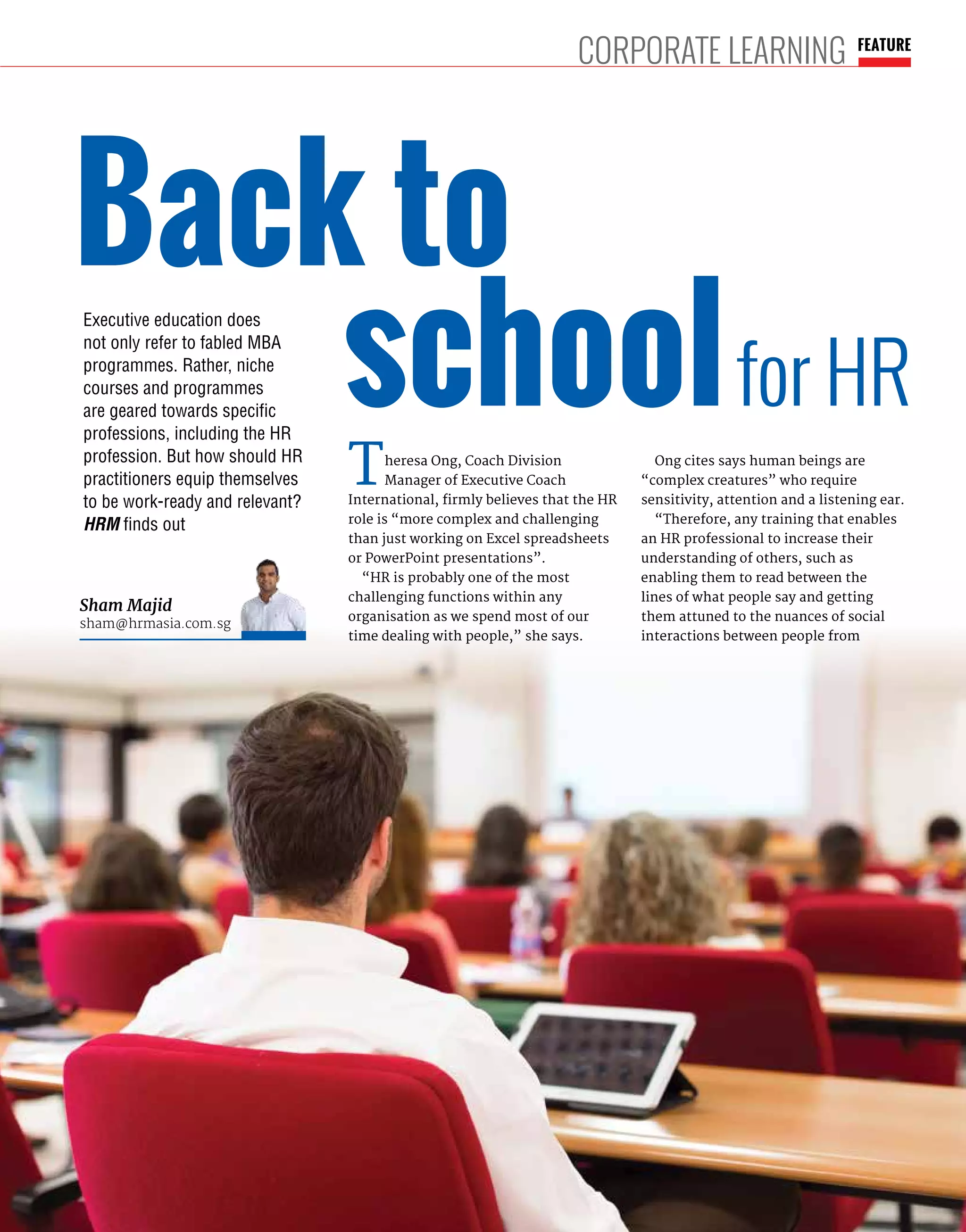
Back toExecutive education does
not only refer to fabled MBA
programmes. Rather, niche
courses and programmes
are geared towards specific
professions, including the HR
profession. But how should HR
practitioners equip themselves
to be work-ready and relevant?
HRM finds out
for HR
Sham Majid
sham@hrmasia.com.sg
Ong cites says human beings are
“complex creatures” who require
sensitivity, attention and a listening ear.
“Therefore, any training that enables
an HR professional to increase their
understanding of others, such as
enabling them to read between the
lines of what people say and getting
them attuned to the nuances of social
interactions between people from
school
Theresa Ong, Coach Division
Manager of Executive Coach
International, firmly believes that the HR
role is “more complex and challenging
than just working on Excel spreadsheets
or PowerPoint presentations”.
“HR is probably one of the most
challenging functions within any
organisation as we spend most of our
time dealing with people,” she says.
64 65ISSUE 15.9 HRMASIA.COM ISSUE 15.9 HRMASIA.COM
CORPORATE LEARNING CORPORATE LEARNING
However, she says it should be as
practical as possible, and not just
theoretical.
“As directors will also need to deal with
other staff members, their leadership
development should be completed by an
emphasis on growing their emotional
intelligence (EQ) as well,” elaborates Ong.
“Numerous studies conducted by entities
such as the Harvard Business School and
Stanford University have shown that the
difference between a successful leader
and one that is struggling is how much
they have developed their EQ.”
Ong further explains HR professionals
can gain a better understanding of what
really motivates their colleagues and how
to handle conflicts in a more effective
way by not being drawn in by other
people’s emotions.
“More likely than not, it will also bring
them more clarity about how to prioritise
tasks as they will have better control over
their own emotions and a cooler head when
it comes to making decisions,” she says.
“Last but not least, by attending such
programmes, they will be dealing with
people they might not usually meet at
work, thereby expanding the range of their
expertise when it comes to managing HR.”
Vincent Yeo, Director of Operations
and Service Support at SIM Professional
Development says the core skills
and competencies required by every
professional are “personal mastery”,
people management, business alignment
and organisational alignment.
“It is very important for HR to align
their strategies with the business
and organisation needs because HR
professionals are key drivers of staff’s
capability development in most
organisations,” he explains.
“They have to be competent at
managing culture and nurturing strong
values that enable teams to work towards
common goals – especially so as the teams
are more diverse in composition today.”
Yeo says talent management is another
key area, with today’s workforce being
increasingly mobile.
“Relevant areas include employee
retention, talent development, developing
Plugging the HR skill gaps
Ong says while there are many common
programmes that can help both HR
professionals and directors, the needs of
HR professionals may be different.
“An HR professional is also often
expected to effectively pass on their
knowledge and experience to their
juniors. For all these reasons, an
ambitious HR professional needs to hone
their coaching skills: by doing so, they
will have a better understanding of what
people really want and how to handle or
avoid potential disputes. They will also
have a clearer vision of what motivates
their colleagues,” she explains.
“Finding a good coach training
programme is not easy and I recommend
choosing one that is internationally
recognised, where the backgrounds of
the participants are diverse and where
the trainers are certified and easily
approachable.”
“The more challenging the programme
is, the more you will benefit from it at
work,” she says.
When it comes to directors, Ong is
“convinced” that leadership development
can further benefit their careers.
Along with a national push to enhance
the skillsets of HR professionals in
Singapore, executive education is also
increasingly becoming another avenue
for learning and development.
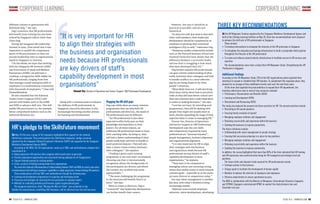
At the HR Manpower Seminar organised by the Singapore Workforce Development Agency and
held at the Lifelong Learning Institute on May 26, three key recommendations were proposed
to enhance the skill sets of HR professionals in Singapore.
These include:
•	 To develop interventions to champion the interests of the HR profession in Singapore
•	 To strengthen the education and training infrastructure to build a sustainable skills pipeline
throughout the lifecycle of the HR professional
•	 To create and enhance shared industry infrastructure to facilitate access to HR services and
expertise
The recommendations arose from a study titled HR Manpower Study: Strengthening the HR
Profession in Singapore.
Additional findings
According to the HR Manpower Study, 23% of the 831 organisations polled signalled their
intentions to expand or establish their HR function. To complement the expansion plans, they
planned for an average of three additional recruits each over the next three years.
Of the firms that signalled they had ambitions to expand their HR departments, the
functions which were most in need of new resources included:
•	 Performance, Remuneration and Benefits (65%)
•	 Learning and Development (64%)
•	 Recruitment and Resourcing (62%)
The study also deduced the present and future priorities for HR. The present priorities include:
•	 Recruiting to fill vacant positions
•	 Ensuring timely execution of payroll
•	 Managing employee relations and engagement
•	 Retaining crucial skills and experience within the business
•	 Enabling the business to improve productivity
The future initiatives include:
•	 Collaborating with senior management on people strategy
•	 Ensuring that succession planning is in place for key positions
•	 Managing employee relations and engagement
•	 Retaining crucial skills and experience within the business
•	 Enabling the business to improve productivity
In addition, the survey highlighted that more than 80% of the firms indicated that HR training
and HR experience were preferred when hiring for HR managerial and strategic level job
positions.
The future skills and character traits required for HR professionals include:
•	 Strategic partner to the business
•	 Change agent to facilitate the development of human capital
•	 Mediator to balance the interests of employers and employees.
•	 Effective administrator to ensure operational success.
The WDA in collaboration with the Ministry of Manpower, International Enterprise Singapore
and SPRING Singapore commissioned KPMG to conduct the study between June and
December last year.
HR’s pledge to the SkillsFuture movement
On May 20 this year, a group of 50 companies highlighted their support for the national
SkillsFuture movement. They participated in the SkillsFuture employers’ pledge ceremony
organised by the Singapore National Employers Federation (SNEF) and supported by the Singapore
Workforce Development Agency (WDA).
According to the WDA, the 50 organisations, made up of SMEs and multinationals, pledged their
commitment to:
•	 Adopt progressive HR practices that recognise skills-based career progression
•	 Provide employment opportunities and structured training pathways for all Singaporeans
•	 Support lifelong learning for existing workers
•	 Foster a culture of lifelong learning within their organisations
The event also featured a Memorandum of Understanding between SNEF and WDA to unveil a new series
of masterclasses that will boost employers’ capabilities to adopt progressive, forward-looking HR practices.
These masterclasses will help SMEs and multinationals through the following ways:
•	 Learning and development programmes for acquiring and developing talent
•	 Processes and strategies for nurturing the next generation of company leaders
•	 Methods for evaluating individual performance against organisational goals
The inaugural masterclass, titled “Winning the War for Talent”, was conducted in July.
Another five masterclasses, benefitting 300 employers, will be rolled out over the next two years.
different cultures or generations will
definitely help,” she says.
Ong’s assertion that HR professionals
will benefit from training has also been
echoed by Singapore Labour chief Chan
Chun Sing.
During the inaugural HR Leadership
Summit in June, Chan noted that it was
imperative to upskill the competency
levels of HR practitioners so they can
assume leadership roles in organisations
based in Singapore or overseas.
“On the whole, we hope that working
with the Singapore HR Institute (SHRI)
and Association of Small and Medium
Enterprises (ASME), we will have a
roadmap, a progressive skills ladder for
HR professionals, ranging from how
they manage a small enterprise with 10
employees to a multinational corporation
with thousands of employees,” Chan told
ChannelNewsAsia.
He also revealed that the National
Trades Union Congress (NTUC) will
partner with bodies such as the ASME
and SHRI to advance skill sets. This will
enable HR practitioners to, for example,
better comprehend matters such as the
Industrial Relations Act.
“It is very important for HR
to align their strategies with
the business and organisation
needs because HR professionals
are key drivers of staff’s
capability development in most
organisations”
Vincent Yeo, Director of Operations and Service Support, SIM Professional Development
THREE KEY RECOMMENDATIONS
66 ISSUE 15.9 HRMASIA.COM
CORPORATE LEARNING
learning interventions, performance
management and helping individuals
find alignment between their personal
career aspirations and career paths in the
organisation,” he adds.
Show me the courses
For those who are interested in
developing their coaching skills, Ong
says Executive Coach International
has formulated the Professional
Coach Training Programme that is
internationally accredited by the
International Coach Federation.
“This programme equips people with
superior coaching and mentoring skills.
We have trained hundreds of people
since our company was founded more
than a decade ago,” she states.
“We have also developed a brand
new programme that adds leadership
development to coach training, which is
currently going through the process of
being internationally accredited by the
International Coach Federation.”
Ong says this programme aims to help
people in leadership positions who often
have to make quick decisions in complex
situations.
Both programmes are guaranteed to
stretch their participants’ knowledge
and skills, which will prepare them well
for the most challenging situations they
might face at work in the future, she adds.
Meanwhile, Yeo says SIM Professional
Development’s HR programmes
are divided into two categories: HR
Development and HR Management.
HR Development programmes like
the SIM Competent Trainer Programme
and Training the Trainer help companies
and organisations to develop and grow
internal training capability.
Among the HR Management
programmes are “Aligning HR with
Business Strategy, HR Best Practices and
Policies, Interviewing Skills to Managing
Compensation, and Performance
Appraisal – Engaging and Harnessing
the Best from your Staff.” “These
programmes will equip HR professionals
with the essential knowledge and
skillsets needed to oversee all aspects
of workforce development and
management,” explains Yeo.
Making a case for HR executive education
From Ong’s perspective, if HR
professionals do not acquire new skills
or knowledge, they face the risk of
becoming obsolete, sooner or later.
“This is not limited to the HR sphere
but the whole working world: everything
goes faster and faster at work, HR
professionals are asked to make quick
decisions with limited information and
deal with all kinds of people in their
jobs,” she highlights.
“This can be quite stressful and
definitely requires some skills that are
not usually taught at university. When
it comes to dealing with people, coach
training has the highest return on
investment. That is why CEOs such as
Larry Page, Jeff Bezos and even Steve
Jobs have used coaching to get better at
what they do.”
Ong says HR professionals are the ones
spending the most time dealing with
people and therefore need to be fully
equipped with all the relevant skills to
handle such complex interactions in the
most effective way.
In addition, with globalisation
affecting all professional organisations,
Ong highlights that teams are bound to
become more multicultural.
“As a HR professional, being able to
deal with colleagues whose ages might
range from 25 to 65 is a huge challenge
– something that you cannot just study
in traditional education courses,” she
explains.
“The more complex the workplace
becomes, the more clarity HR
professionals need to be able to
perform and meet their organisations’
expectations. Furthermore, any
training needs to have a high return
on investment (ROI) and also a lasting
effect. As multinationals such as IBM
discovered some time ago, coach
training is highly relevant to the HR
professionals, immediately applicable
and offers an unmatched ROI.”
Yeo also acknowledges the role and
function of HR have evolved significantly
over the years.
“No longer are they taking on the
traditional functions of staffing,
recruitment and payroll administration,”
he says.
“Instead, today’s HR play a significant
and strategic role in helping the
organisation achieve its mission, vision,
strategy, and goals. This involves
recognising that the link between
helping an individual employee, and
helping their team, their department,
and their company to perform better.”
Furthermore, Yeo stresses that HR
professionals must ensure there is a
direct connection between the policies,
procedures, programmes and services
they offer and the organisation’s larger
purposes.
“As such, HR professionals must
keep pace with new human capital
development knowledge by attending
relevant programmes so that they can
help the organisation to leverage on the
employees’ full potential. At the end
of the day, HR must play the strategic
partner role to the CEO – helping the
senior management team in harnessing
human potential and channelling it in
the right direction,” he adds.
HR set for
certification
The HR sector in Singapore will be guided by
a new framework to further groom talent and
foster more career and professional development
opportunities for professionals within the field.
The framework was unveiled by Manpower
Minister Lim Swee Say on July 10 during the
Singapore HR Institute’s 50th anniversary dinner.
Lim said the new blueprint was being
formulated by a taskforce with representatives
from the government, employers and unions.
The scheme falls under the Sectoral
Manpower Plan for HR, which will be
established by a tripartite committee featuring
representatives from the government,
employers and unions.
HRM Asia Readers Choice Awards would like to thank all of you for voting to recognise exceptional
vendor organisations and to showcase the very best Corporate Service Providers in Singapore.
Thank you for the overwhelming response and for taking the time and effort – we hope you had fun!
We will unveil the Winners of HRM Asia Readers Choice Awards for 2015 in our October Issue,
so stay tuned for the results!
www.hrmreaderschoice.com
proudly owned by
Award Nominees
WINSLAND SERVICED RESIDENCES
Official Venue Partner

63-67_Corporate Learning_15.09

  • 1.
    63ISSUE 15.9 HRMASIA.COM CORPORATELEARNING Back toExecutive education does not only refer to fabled MBA programmes. Rather, niche courses and programmes are geared towards specific professions, including the HR profession. But how should HR practitioners equip themselves to be work-ready and relevant? HRM finds out for HR Sham Majid sham@hrmasia.com.sg Ong cites says human beings are “complex creatures” who require sensitivity, attention and a listening ear. “Therefore, any training that enables an HR professional to increase their understanding of others, such as enabling them to read between the lines of what people say and getting them attuned to the nuances of social interactions between people from school Theresa Ong, Coach Division Manager of Executive Coach International, firmly believes that the HR role is “more complex and challenging than just working on Excel spreadsheets or PowerPoint presentations”. “HR is probably one of the most challenging functions within any organisation as we spend most of our time dealing with people,” she says.
  • 2.
    64 65ISSUE 15.9HRMASIA.COM ISSUE 15.9 HRMASIA.COM CORPORATE LEARNING CORPORATE LEARNING However, she says it should be as practical as possible, and not just theoretical. “As directors will also need to deal with other staff members, their leadership development should be completed by an emphasis on growing their emotional intelligence (EQ) as well,” elaborates Ong. “Numerous studies conducted by entities such as the Harvard Business School and Stanford University have shown that the difference between a successful leader and one that is struggling is how much they have developed their EQ.” Ong further explains HR professionals can gain a better understanding of what really motivates their colleagues and how to handle conflicts in a more effective way by not being drawn in by other people’s emotions. “More likely than not, it will also bring them more clarity about how to prioritise tasks as they will have better control over their own emotions and a cooler head when it comes to making decisions,” she says. “Last but not least, by attending such programmes, they will be dealing with people they might not usually meet at work, thereby expanding the range of their expertise when it comes to managing HR.” Vincent Yeo, Director of Operations and Service Support at SIM Professional Development says the core skills and competencies required by every professional are “personal mastery”, people management, business alignment and organisational alignment. “It is very important for HR to align their strategies with the business and organisation needs because HR professionals are key drivers of staff’s capability development in most organisations,” he explains. “They have to be competent at managing culture and nurturing strong values that enable teams to work towards common goals – especially so as the teams are more diverse in composition today.” Yeo says talent management is another key area, with today’s workforce being increasingly mobile. “Relevant areas include employee retention, talent development, developing Plugging the HR skill gaps Ong says while there are many common programmes that can help both HR professionals and directors, the needs of HR professionals may be different. “An HR professional is also often expected to effectively pass on their knowledge and experience to their juniors. For all these reasons, an ambitious HR professional needs to hone their coaching skills: by doing so, they will have a better understanding of what people really want and how to handle or avoid potential disputes. They will also have a clearer vision of what motivates their colleagues,” she explains. “Finding a good coach training programme is not easy and I recommend choosing one that is internationally recognised, where the backgrounds of the participants are diverse and where the trainers are certified and easily approachable.” “The more challenging the programme is, the more you will benefit from it at work,” she says. When it comes to directors, Ong is “convinced” that leadership development can further benefit their careers. Along with a national push to enhance the skillsets of HR professionals in Singapore, executive education is also increasingly becoming another avenue for learning and development. At the HR Manpower Seminar organised by the Singapore Workforce Development Agency and held at the Lifelong Learning Institute on May 26, three key recommendations were proposed to enhance the skill sets of HR professionals in Singapore. These include: • To develop interventions to champion the interests of the HR profession in Singapore • To strengthen the education and training infrastructure to build a sustainable skills pipeline throughout the lifecycle of the HR professional • To create and enhance shared industry infrastructure to facilitate access to HR services and expertise The recommendations arose from a study titled HR Manpower Study: Strengthening the HR Profession in Singapore. Additional findings According to the HR Manpower Study, 23% of the 831 organisations polled signalled their intentions to expand or establish their HR function. To complement the expansion plans, they planned for an average of three additional recruits each over the next three years. Of the firms that signalled they had ambitions to expand their HR departments, the functions which were most in need of new resources included: • Performance, Remuneration and Benefits (65%) • Learning and Development (64%) • Recruitment and Resourcing (62%) The study also deduced the present and future priorities for HR. The present priorities include: • Recruiting to fill vacant positions • Ensuring timely execution of payroll • Managing employee relations and engagement • Retaining crucial skills and experience within the business • Enabling the business to improve productivity The future initiatives include: • Collaborating with senior management on people strategy • Ensuring that succession planning is in place for key positions • Managing employee relations and engagement • Retaining crucial skills and experience within the business • Enabling the business to improve productivity In addition, the survey highlighted that more than 80% of the firms indicated that HR training and HR experience were preferred when hiring for HR managerial and strategic level job positions. The future skills and character traits required for HR professionals include: • Strategic partner to the business • Change agent to facilitate the development of human capital • Mediator to balance the interests of employers and employees. • Effective administrator to ensure operational success. The WDA in collaboration with the Ministry of Manpower, International Enterprise Singapore and SPRING Singapore commissioned KPMG to conduct the study between June and December last year. HR’s pledge to the SkillsFuture movement On May 20 this year, a group of 50 companies highlighted their support for the national SkillsFuture movement. They participated in the SkillsFuture employers’ pledge ceremony organised by the Singapore National Employers Federation (SNEF) and supported by the Singapore Workforce Development Agency (WDA). According to the WDA, the 50 organisations, made up of SMEs and multinationals, pledged their commitment to: • Adopt progressive HR practices that recognise skills-based career progression • Provide employment opportunities and structured training pathways for all Singaporeans • Support lifelong learning for existing workers • Foster a culture of lifelong learning within their organisations The event also featured a Memorandum of Understanding between SNEF and WDA to unveil a new series of masterclasses that will boost employers’ capabilities to adopt progressive, forward-looking HR practices. These masterclasses will help SMEs and multinationals through the following ways: • Learning and development programmes for acquiring and developing talent • Processes and strategies for nurturing the next generation of company leaders • Methods for evaluating individual performance against organisational goals The inaugural masterclass, titled “Winning the War for Talent”, was conducted in July. Another five masterclasses, benefitting 300 employers, will be rolled out over the next two years. different cultures or generations will definitely help,” she says. Ong’s assertion that HR professionals will benefit from training has also been echoed by Singapore Labour chief Chan Chun Sing. During the inaugural HR Leadership Summit in June, Chan noted that it was imperative to upskill the competency levels of HR practitioners so they can assume leadership roles in organisations based in Singapore or overseas. “On the whole, we hope that working with the Singapore HR Institute (SHRI) and Association of Small and Medium Enterprises (ASME), we will have a roadmap, a progressive skills ladder for HR professionals, ranging from how they manage a small enterprise with 10 employees to a multinational corporation with thousands of employees,” Chan told ChannelNewsAsia. He also revealed that the National Trades Union Congress (NTUC) will partner with bodies such as the ASME and SHRI to advance skill sets. This will enable HR practitioners to, for example, better comprehend matters such as the Industrial Relations Act. “It is very important for HR to align their strategies with the business and organisation needs because HR professionals are key drivers of staff’s capability development in most organisations” Vincent Yeo, Director of Operations and Service Support, SIM Professional Development THREE KEY RECOMMENDATIONS
  • 3.
    66 ISSUE 15.9HRMASIA.COM CORPORATE LEARNING learning interventions, performance management and helping individuals find alignment between their personal career aspirations and career paths in the organisation,” he adds. Show me the courses For those who are interested in developing their coaching skills, Ong says Executive Coach International has formulated the Professional Coach Training Programme that is internationally accredited by the International Coach Federation. “This programme equips people with superior coaching and mentoring skills. We have trained hundreds of people since our company was founded more than a decade ago,” she states. “We have also developed a brand new programme that adds leadership development to coach training, which is currently going through the process of being internationally accredited by the International Coach Federation.” Ong says this programme aims to help people in leadership positions who often have to make quick decisions in complex situations. Both programmes are guaranteed to stretch their participants’ knowledge and skills, which will prepare them well for the most challenging situations they might face at work in the future, she adds. Meanwhile, Yeo says SIM Professional Development’s HR programmes are divided into two categories: HR Development and HR Management. HR Development programmes like the SIM Competent Trainer Programme and Training the Trainer help companies and organisations to develop and grow internal training capability. Among the HR Management programmes are “Aligning HR with Business Strategy, HR Best Practices and Policies, Interviewing Skills to Managing Compensation, and Performance Appraisal – Engaging and Harnessing the Best from your Staff.” “These programmes will equip HR professionals with the essential knowledge and skillsets needed to oversee all aspects of workforce development and management,” explains Yeo. Making a case for HR executive education From Ong’s perspective, if HR professionals do not acquire new skills or knowledge, they face the risk of becoming obsolete, sooner or later. “This is not limited to the HR sphere but the whole working world: everything goes faster and faster at work, HR professionals are asked to make quick decisions with limited information and deal with all kinds of people in their jobs,” she highlights. “This can be quite stressful and definitely requires some skills that are not usually taught at university. When it comes to dealing with people, coach training has the highest return on investment. That is why CEOs such as Larry Page, Jeff Bezos and even Steve Jobs have used coaching to get better at what they do.” Ong says HR professionals are the ones spending the most time dealing with people and therefore need to be fully equipped with all the relevant skills to handle such complex interactions in the most effective way. In addition, with globalisation affecting all professional organisations, Ong highlights that teams are bound to become more multicultural. “As a HR professional, being able to deal with colleagues whose ages might range from 25 to 65 is a huge challenge – something that you cannot just study in traditional education courses,” she explains. “The more complex the workplace becomes, the more clarity HR professionals need to be able to perform and meet their organisations’ expectations. Furthermore, any training needs to have a high return on investment (ROI) and also a lasting effect. As multinationals such as IBM discovered some time ago, coach training is highly relevant to the HR professionals, immediately applicable and offers an unmatched ROI.” Yeo also acknowledges the role and function of HR have evolved significantly over the years. “No longer are they taking on the traditional functions of staffing, recruitment and payroll administration,” he says. “Instead, today’s HR play a significant and strategic role in helping the organisation achieve its mission, vision, strategy, and goals. This involves recognising that the link between helping an individual employee, and helping their team, their department, and their company to perform better.” Furthermore, Yeo stresses that HR professionals must ensure there is a direct connection between the policies, procedures, programmes and services they offer and the organisation’s larger purposes. “As such, HR professionals must keep pace with new human capital development knowledge by attending relevant programmes so that they can help the organisation to leverage on the employees’ full potential. At the end of the day, HR must play the strategic partner role to the CEO – helping the senior management team in harnessing human potential and channelling it in the right direction,” he adds. HR set for certification The HR sector in Singapore will be guided by a new framework to further groom talent and foster more career and professional development opportunities for professionals within the field. The framework was unveiled by Manpower Minister Lim Swee Say on July 10 during the Singapore HR Institute’s 50th anniversary dinner. Lim said the new blueprint was being formulated by a taskforce with representatives from the government, employers and unions. The scheme falls under the Sectoral Manpower Plan for HR, which will be established by a tripartite committee featuring representatives from the government, employers and unions. HRM Asia Readers Choice Awards would like to thank all of you for voting to recognise exceptional vendor organisations and to showcase the very best Corporate Service Providers in Singapore. Thank you for the overwhelming response and for taking the time and effort – we hope you had fun! We will unveil the Winners of HRM Asia Readers Choice Awards for 2015 in our October Issue, so stay tuned for the results! www.hrmreaderschoice.com proudly owned by Award Nominees WINSLAND SERVICED RESIDENCES Official Venue Partner