INTRODUCTION TO ART
Goals Of Antiretroviral Therapy
• Reduce HIV-related morbidity and mortality
• Improve quality of life of infected persons
• Reduce viral load to undetectable level for as long
as possible
• Revitalize the immune system by increasing the
CD4 level
• Provide an antiretroviral regimen which:
– High likelihood of success
– Preserve future therapeutic option
– Has relatively few side effects
– Is tailored to individual need
The HIV viral load
• A count of the number of HIV RNA molecules in 1
ml of plasma (copies/ml)
• A direct measure of the level of HIV infection
• A predictor of disease symptoms and of the rate of
CD4+ T cell decline
• What’s a good viral load for a patient on
treatment? An undetectable viral load (<50
copies/ml)!
– If viral load is this low, patients are unlikely to have
disease progression, resistance, or to pass HIV through
MTCT and sexual transmission.
THE CD4 CELLS
• A count of the T-helper cells in the blood
• It is a subset of the lymphocytes
• It gives a reflection of the
strength/weakness of the immune system in
the body
• Predictor of the rate of development of
opportunistic infections (OIs) in the body
ARV MEDICATION GROUPS
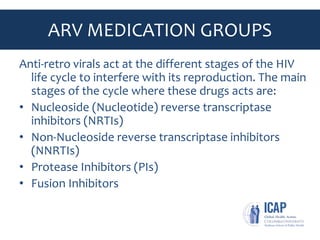
Anti-retro virals act at the different stages of the HIV
life cycle to interfere with its reproduction. The main
stages of the cycle where these drugs acts are:
• Nucleoside (Nucleotide) reverse transcriptase
inhibitors (NRTIs)
• Non-Nucleoside reverse transcriptase inhibitors
(NNRTIs)
• Protease Inhibitors (PIs)
• Fusion Inhibitors
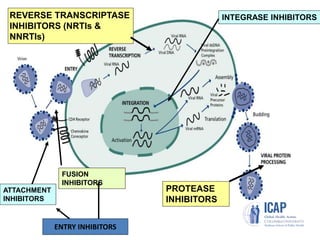
REVERSE TRANSCRIPTASE
INHIBITORS (NRTIs &
NNRTIs)
PROTEASE
INHIBITORS
ATTACHMENT
INHIBITORS
INTEGRASE INHIBITORS
FUSION
INHIBITORS
HIV DRUG TARGETS: CURRENT AND FUTURE
ENTRY INHIBITORS
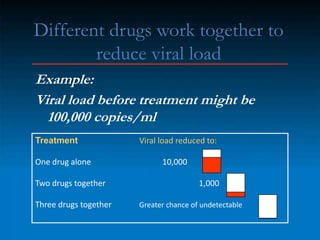
Different drugs work together to
reduce viral load
Example:
Viral load before treatment might be
100,000 copies/ml
Treatment Viral load reduced to:
One drug alone 10,000
Two drugs together 1,000
Three drugs together Greater chance of undetectable
HIGHLY ACTIVE ANTIRETROVIRAL
THERAPY (HAART)
• The use of ≥3 drugs from at least 2 classes
to achieve effective viral suppression
• Any antiretroviral that will:
– Prevent disease progression
– Optimize opportunity for recovery
– Prevent selection for drug resistance
In practice, must maintain viral load to < 50
copies/ml of blood
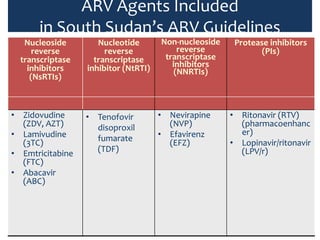
ARV Agents Included
in South Sudan’s ARV Guidelines
Nucleoside
reverse
transcriptase
inhibitors
(NsRTIs)
Nucleotide
reverse
transcriptase
inhibitor (NtRTI)
Non-nucleoside
reverse
transcriptase
inhibitors
(NNRTIs)
Protease inhibitors
(PIs)
• Zidovudine
(ZDV, AZT)
• Lamivudine
(3TC)
• Emtricitabine
(FTC)
• Abacavir
(ABC)
• Tenofovir
disoproxil
fumarate
(TDF)
• Nevirapine
(NVP)
• Efavirenz
(EFZ)
• Ritonavir (RTV)
(pharmacoenhanc
er)
• Lopinavir/ritonavir
(LPV/r)
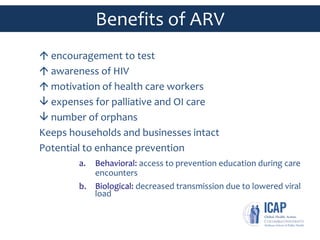
Benefits of ARV
 encouragement to test
 awareness of HIV
 motivation of health care workers
 expenses for palliative and OI care
 number of orphans
Keeps households and businesses intact
Potential to enhance prevention
a. Behavioral: access to prevention education during care
encounters
b. Biological: decreased transmission due to lowered viral
load
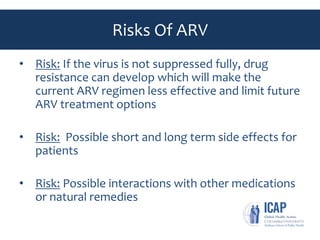
Risks Of ARV
• Risk: If the virus is not suppressed fully, drug
resistance can develop which will make the
current ARV regimen less effective and limit future
ARV treatment options
• Risk: Possible short and long term side effects for
patients
• Risk: Possible interactions with other medications
or natural remedies
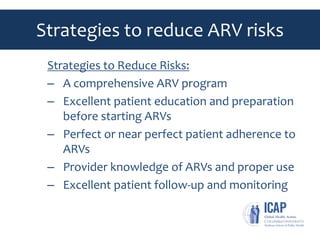
Strategies to reduce ARV risks
Strategies to Reduce Risks:
– A comprehensive ARV program
– Excellent patient education and preparation
before starting ARVs
– Perfect or near perfect patient adherence to
ARVs
– Provider knowledge of ARVs and proper use
– Excellent patient follow-up and monitoring
Prerequisites for a Successful ARV
Program
 Adequate infrastructure
 Lab facilities for patient diag. & monitoring
 Access to OI/symptomatic treatment
 Continuous supply of ARVs
 Informed communities
 Counseled patients
 Trained ART team members
 ARV treatment guidelines in place
 Political will & view for sustainable program
-Limited resources
-Procurement of affordable ARVs
-Ensuring ARV supply
-Security of ARV storage
-Limited physical infrastructure
-Providing necessary laboratory monitoring
-Need for trained doctors and nurses
-Staff turnover
Challenges for ART Programs in
Resource-Constrained Countries
The 3 most important things to know
about HIV treatment
1. Resistance will evolve if virus grows in the
presence of drug
2. Treatment must be potent enough to stop virus
from growing and must present a high genetic
barrier to resistance
3. All drugs must be taken every day or all drugs
must be stopped (but can later be restarted).
Accomplishing successful treatment requires that the
patient and HIV care team work together.
IMPORTANCE OF ADHERENCE
• ARVs, when taken correctly, can tremendously
enhance a patient’s life and dramatically halt
progression of disease
• However, in order to derive the most benefit from
the medications, adherence must be EXCELLENT
– Should work with the patient to develop adherence
strategy
– If ARVS are taken improperly, problems may occur on
a personal and public health level
• Implications on resistance, cross resistance, spreading
resistant virus and cost
Summary
• Antiretroviral therapy should reduce morbidity
and mortality from HIV/AIDS
• While there are risks of drug resistance and
anticipated side effects from medications,
antiretroviral therapy’s benefits outweigh the
risks
• Monitoring patients on therapy is critical
• Adherence to therapy is the key to success
• ART programs should address programmatic
challenges to ensure success in scaling up ART
THANK YOU

6. Introduction to ART ICAPRev.presentation ptx

  • 1.
  • 2.
    Goals Of AntiretroviralTherapy • Reduce HIV-related morbidity and mortality • Improve quality of life of infected persons • Reduce viral load to undetectable level for as long as possible • Revitalize the immune system by increasing the CD4 level • Provide an antiretroviral regimen which: – High likelihood of success – Preserve future therapeutic option – Has relatively few side effects – Is tailored to individual need
  • 3.
    The HIV viralload • A count of the number of HIV RNA molecules in 1 ml of plasma (copies/ml) • A direct measure of the level of HIV infection • A predictor of disease symptoms and of the rate of CD4+ T cell decline • What’s a good viral load for a patient on treatment? An undetectable viral load (<50 copies/ml)! – If viral load is this low, patients are unlikely to have disease progression, resistance, or to pass HIV through MTCT and sexual transmission.
  • 4.
    THE CD4 CELLS •A count of the T-helper cells in the blood • It is a subset of the lymphocytes • It gives a reflection of the strength/weakness of the immune system in the body • Predictor of the rate of development of opportunistic infections (OIs) in the body
  • 5.
    ARV MEDICATION GROUPS Anti-retrovirals act at the different stages of the HIV life cycle to interfere with its reproduction. The main stages of the cycle where these drugs acts are: • Nucleoside (Nucleotide) reverse transcriptase inhibitors (NRTIs) • Non-Nucleoside reverse transcriptase inhibitors (NNRTIs) • Protease Inhibitors (PIs) • Fusion Inhibitors
  • 6.
    REVERSE TRANSCRIPTASE INHIBITORS (NRTIs& NNRTIs) PROTEASE INHIBITORS ATTACHMENT INHIBITORS INTEGRASE INHIBITORS FUSION INHIBITORS HIV DRUG TARGETS: CURRENT AND FUTURE ENTRY INHIBITORS
  • 7.
    Different drugs worktogether to reduce viral load Example: Viral load before treatment might be 100,000 copies/ml Treatment Viral load reduced to: One drug alone 10,000 Two drugs together 1,000 Three drugs together Greater chance of undetectable
  • 8.
    HIGHLY ACTIVE ANTIRETROVIRAL THERAPY(HAART) • The use of ≥3 drugs from at least 2 classes to achieve effective viral suppression • Any antiretroviral that will: – Prevent disease progression – Optimize opportunity for recovery – Prevent selection for drug resistance In practice, must maintain viral load to < 50 copies/ml of blood
  • 9.
    ARV Agents Included inSouth Sudan’s ARV Guidelines Nucleoside reverse transcriptase inhibitors (NsRTIs) Nucleotide reverse transcriptase inhibitor (NtRTI) Non-nucleoside reverse transcriptase inhibitors (NNRTIs) Protease inhibitors (PIs) • Zidovudine (ZDV, AZT) • Lamivudine (3TC) • Emtricitabine (FTC) • Abacavir (ABC) • Tenofovir disoproxil fumarate (TDF) • Nevirapine (NVP) • Efavirenz (EFZ) • Ritonavir (RTV) (pharmacoenhanc er) • Lopinavir/ritonavir (LPV/r)
  • 10.
    Benefits of ARV encouragement to test  awareness of HIV  motivation of health care workers  expenses for palliative and OI care  number of orphans Keeps households and businesses intact Potential to enhance prevention a. Behavioral: access to prevention education during care encounters b. Biological: decreased transmission due to lowered viral load
  • 11.
    Risks Of ARV •Risk: If the virus is not suppressed fully, drug resistance can develop which will make the current ARV regimen less effective and limit future ARV treatment options • Risk: Possible short and long term side effects for patients • Risk: Possible interactions with other medications or natural remedies
  • 12.
    Strategies to reduceARV risks Strategies to Reduce Risks: – A comprehensive ARV program – Excellent patient education and preparation before starting ARVs – Perfect or near perfect patient adherence to ARVs – Provider knowledge of ARVs and proper use – Excellent patient follow-up and monitoring
  • 13.
    Prerequisites for aSuccessful ARV Program  Adequate infrastructure  Lab facilities for patient diag. & monitoring  Access to OI/symptomatic treatment  Continuous supply of ARVs  Informed communities  Counseled patients  Trained ART team members  ARV treatment guidelines in place  Political will & view for sustainable program
  • 14.
    -Limited resources -Procurement ofaffordable ARVs -Ensuring ARV supply -Security of ARV storage -Limited physical infrastructure -Providing necessary laboratory monitoring -Need for trained doctors and nurses -Staff turnover Challenges for ART Programs in Resource-Constrained Countries
  • 15.
    The 3 mostimportant things to know about HIV treatment 1. Resistance will evolve if virus grows in the presence of drug 2. Treatment must be potent enough to stop virus from growing and must present a high genetic barrier to resistance 3. All drugs must be taken every day or all drugs must be stopped (but can later be restarted). Accomplishing successful treatment requires that the patient and HIV care team work together.
  • 16.
    IMPORTANCE OF ADHERENCE •ARVs, when taken correctly, can tremendously enhance a patient’s life and dramatically halt progression of disease • However, in order to derive the most benefit from the medications, adherence must be EXCELLENT – Should work with the patient to develop adherence strategy – If ARVS are taken improperly, problems may occur on a personal and public health level • Implications on resistance, cross resistance, spreading resistant virus and cost
  • 17.
    Summary • Antiretroviral therapyshould reduce morbidity and mortality from HIV/AIDS • While there are risks of drug resistance and anticipated side effects from medications, antiretroviral therapy’s benefits outweigh the risks • Monitoring patients on therapy is critical • Adherence to therapy is the key to success • ART programs should address programmatic challenges to ensure success in scaling up ART
  • 18.

Editor's Notes

  • #3 morbidity and mortality: Optimal ART leads to rapid improvement of clinical indices, pre-existing OIs are more amenable to antimicrobial agents and patients become less susceptible to new infections. However, following the introduction of HAART, many more people live long and productive lives. Improve quality of life of infected persons: The absence of symptomatic HIV and HIV-related illness means that persons infected with HIV are able to carry on a normal existence and fend for themselves and their families unlike in the past when they were largely bedridden and dependent on others for support. Achieve rapid and sustained suppression of viral load: Administration of ART should lead to rapid and sustained suppression of viral load. Usually by week 24 following initiation of treatment, patient’s viral load should be at the least < 400 copies /ml. Rapid and sustained viral load suppression is necessary to prevent or delay the development of ARV drug resistance and allow for restoration of CD4 cells. The ideal is sustained viral suppression at 50cells/ml for as long as possible to halt, prevent or delay disease progression. Enhance immunity by increasing CD4+ cell count: Potent and effective ART leads to an increase in CD4 cells and recovery of immune functions. Under optimal conditions patients should be able to achieve a CD4 cell count increase of 50 to 100 cells/ml / year.
  • #6 Remind the trainees on the virus life-cycle video presented in introductory talks, and highlight where the ARV medications work: preventing viral reverse transcription; inhibiting protease; Integrase inhibition; preventing viral fusion to CD4 cell surface.
  • #10 There are now fixed dose combinations making adherence to ARVs better, reduction in pill burden etc and very common for pediatric clients
  • #12 Risk 1: will be further discussed in Treatment failure Risk 2 & 3: will be further discussed in Common ARV drug interactions & Pharmacovigilance, Adverse drug reaction
  • #13 Program: Strong, cohesive MDT Education: Quality adherence counselling sessions Patient: Adhering to agreed upon protocol Provider: deep understanding and participation in ongoing training, commitment to services provision Follow-up: tracking, appointment scheduling, documentation etc
  • #16 Stop & Restart must be guided