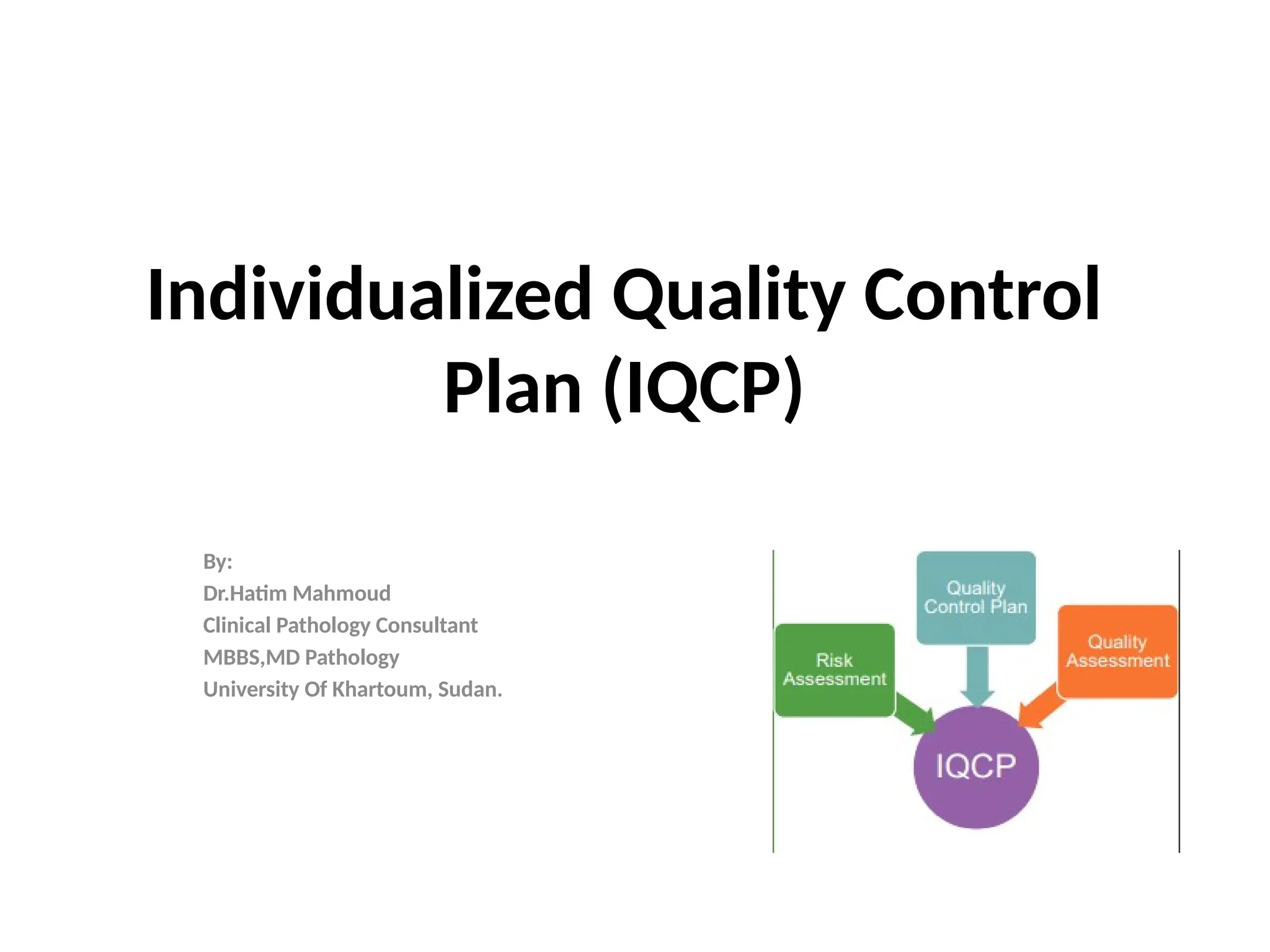
Individualized Quality Control
Plan (IQCP)
By:
Dr.Hatim Mahmoud
Clinical Pathology Consultant
MBBS,MD Pathology
University Of Khartoum, Sudan.
Objectives:
What is IQCP
What are the component of IQCP.
How you can make IQCP
How to performed risk assessment
What are impacts and benefits of IQCP
 IQCP is an exceptions to
the rule of using daily
controls, it permits the
laboratory to customize
its QC plan according
to:
i. Test method
ii. Environment
iii. Personnel competency
To make an IQCP, you need to:
i. Examine each of the steps in the testing process
to determine the possible problems at each step.
ii. Determine the likelihood of these potential
problems occurring, the degree of risk to patient
care and determine if there is any way to prevent
these potential problems from occurring.
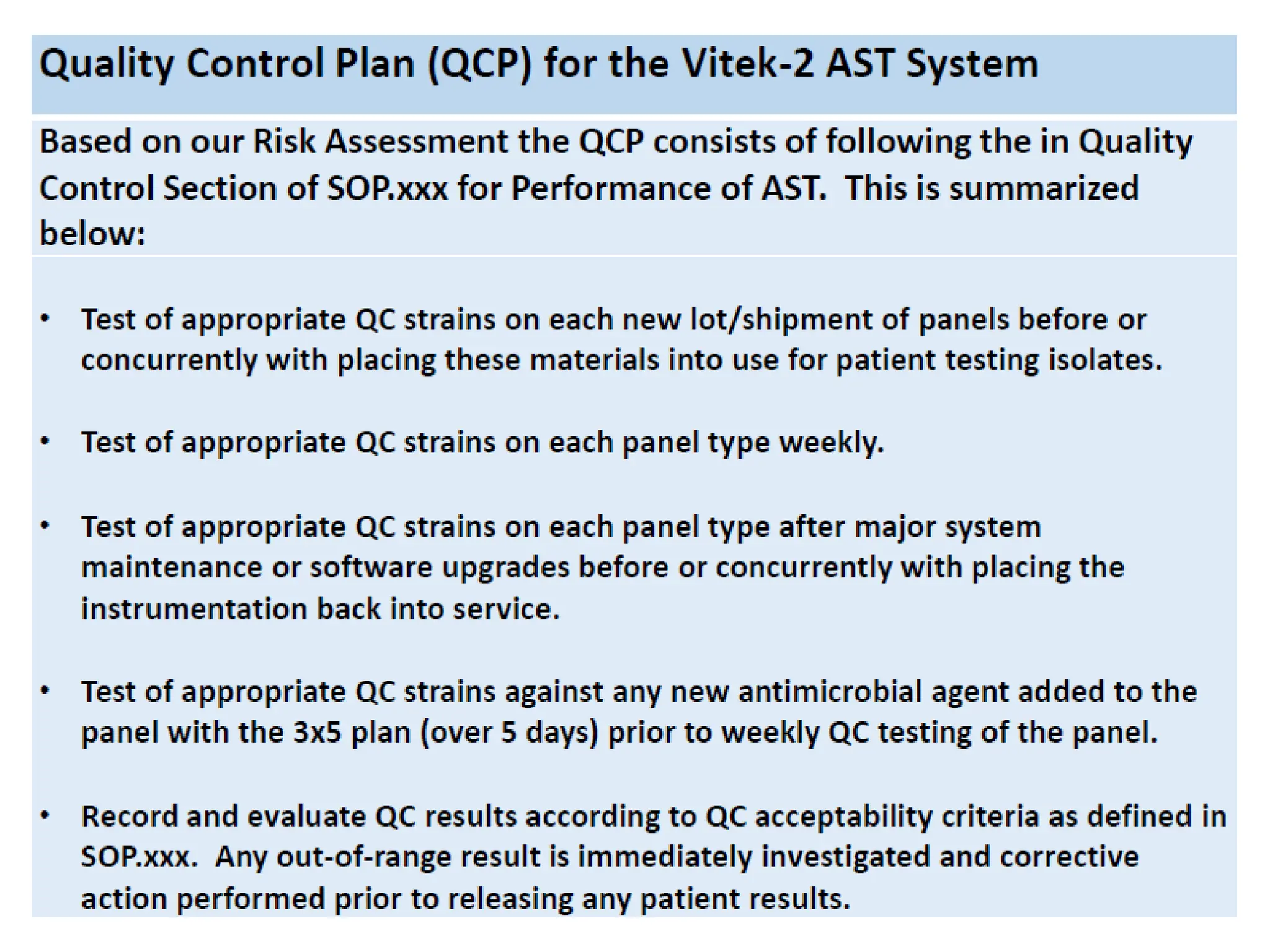
iii. Make a Quality Control Plan (QCP).
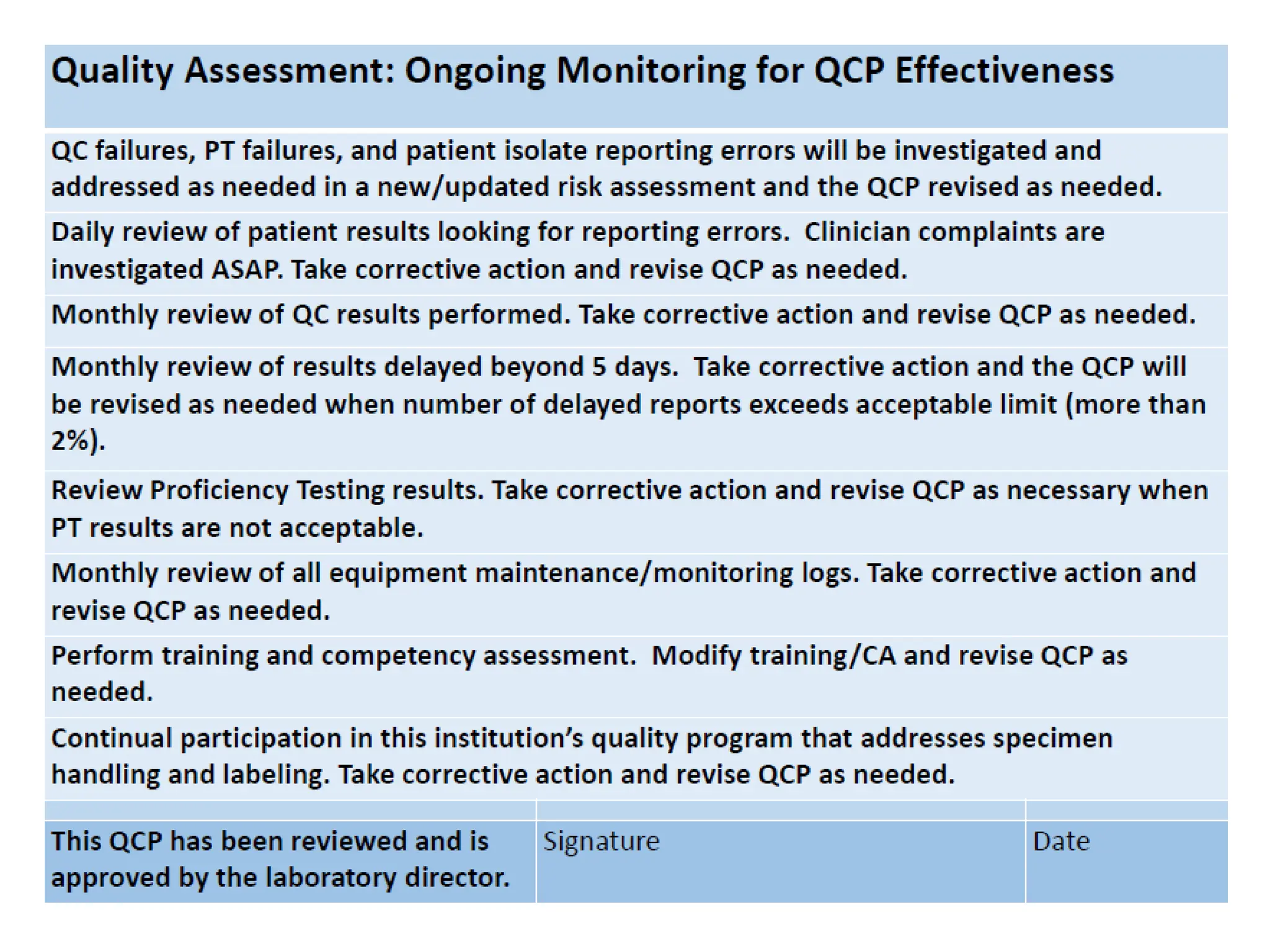
iv. Developed ongoing assessment for your (QCP)
How to make IQCP:
 The easy option is to buy
a computer program
that can make IQCP's.
 Report detailing your
risk. The computer
program will grade you
as a low, intermediate or
high risk of having
problems if you use IQCP.
 If the computer program
assesses a “low risk”, all
you have to do is print
out the IQCP Summary
Report detailing your
risk, signed by Lab
Director the statement
that the risk is acceptable
and file this at the back
of the procedure manual.
 Then reduce the
external QC to the
manufacturer's
minimum requirement
or to weekly or to once
every 30 days or on
opening a new lot,
whichever comes first,
etc.
 If the computer
program assesses you a
“moderate risk” or
“high risk” you should
look over the data
entered into the
program to make sure it
is correct and there are
no transcription errors.
 If the entered information
is correct and the
computer program
assesses you a “moderate
risk” or “high risk” this
would indicate you are not
doing things optimally in
your laboratory.
 Go down the list of
questions and determine
what can be optimized.
 Repeat the process until
such time as the
computer program
reports “low risk”.
 If you don't have access
to any computer
programs that can make
an IQCP, you can make
the IQCP yourself.
Re-call …
Work sheet
Work sheet
Work` sheet2
The impact of IQCP:
 If you are using IQCP, it
could take up to 30
days to find out if your
test goes out of control
and begins to fail
external controls.
 It would be possible to
turn out a large
number of erroneous
test results.

 You have to bring it
back into control
 You have to re-test any
remaining specimens
examined since the last
external QC thirty days
ago.
Benefits of IQCP:
References:
1) How to be a Lab Director by Philip A. Dauterman, MD with graphs by Steven Matthew R. Dauterman
2018 edition
2) Laboratory quality management system: handbook. World Health Organization 2011
3) A Step-by-Step Guide Developing an IQCP, U.S. Department of Health and Human Services
4) Individualized Quality Control Plan (IQCP) Frequently Asked Questions ;
CAP ;May 5, 2015 (last updated 09/16/2019)

6.Individualized_Quality_Control_Plan_(IQCP).pptx

  • 1.
    Individualized Quality Control Plan(IQCP) By: Dr.Hatim Mahmoud Clinical Pathology Consultant MBBS,MD Pathology University Of Khartoum, Sudan.
  • 2.
    Objectives: What is IQCP Whatare the component of IQCP. How you can make IQCP How to performed risk assessment What are impacts and benefits of IQCP
  • 3.
     IQCP isan exceptions to the rule of using daily controls, it permits the laboratory to customize its QC plan according to: i. Test method ii. Environment iii. Personnel competency
  • 4.
    To make anIQCP, you need to: i. Examine each of the steps in the testing process to determine the possible problems at each step. ii. Determine the likelihood of these potential problems occurring, the degree of risk to patient care and determine if there is any way to prevent these potential problems from occurring. iii. Make a Quality Control Plan (QCP). iv. Developed ongoing assessment for your (QCP)
  • 5.
    How to makeIQCP:  The easy option is to buy a computer program that can make IQCP's.  Report detailing your risk. The computer program will grade you as a low, intermediate or high risk of having problems if you use IQCP.  If the computer program assesses a “low risk”, all you have to do is print out the IQCP Summary Report detailing your risk, signed by Lab Director the statement that the risk is acceptable and file this at the back of the procedure manual.
  • 6.
     Then reducethe external QC to the manufacturer's minimum requirement or to weekly or to once every 30 days or on opening a new lot, whichever comes first, etc.  If the computer program assesses you a “moderate risk” or “high risk” you should look over the data entered into the program to make sure it is correct and there are no transcription errors.
  • 7.
     If theentered information is correct and the computer program assesses you a “moderate risk” or “high risk” this would indicate you are not doing things optimally in your laboratory.  Go down the list of questions and determine what can be optimized.  Repeat the process until such time as the computer program reports “low risk”.  If you don't have access to any computer programs that can make an IQCP, you can make the IQCP yourself.
  • 9.
  • 18.
  • 21.
  • 22.
    The impact ofIQCP:  If you are using IQCP, it could take up to 30 days to find out if your test goes out of control and begins to fail external controls.  It would be possible to turn out a large number of erroneous test results.   You have to bring it back into control  You have to re-test any remaining specimens examined since the last external QC thirty days ago.
  • 23.
  • 24.
    References: 1) How tobe a Lab Director by Philip A. Dauterman, MD with graphs by Steven Matthew R. Dauterman 2018 edition 2) Laboratory quality management system: handbook. World Health Organization 2011 3) A Step-by-Step Guide Developing an IQCP, U.S. Department of Health and Human Services 4) Individualized Quality Control Plan (IQCP) Frequently Asked Questions ; CAP ;May 5, 2015 (last updated 09/16/2019)