CHRONIC RESPIRATORY DISEASE
(CRD, MG INFECTION)
(CRD, MG INFECTION)
INTRODUCTION
INTRODUCTION
CRD is a slow spreading chronic upper and lower
respiratory tract infection of chickens, turkeys
(infectious sinusitis) and other birds
 Characterized by:
Characterized by:
• Abnormal respiratory sounds
Abnormal respiratory sounds
• Coughing, gasping, nasal discharge
Coughing, gasping, nasal discharge
• Foamy & Cheesy air-sacculitis
Foamy & Cheesy air-sacculitis
• Razor blade keel bone appearance
Razor blade keel bone appearance
• Keel bursitis
Keel bursitis
• Arthritis
Arthritis
ETIOLOGY
ETIOLOGY
Mycoplasma gallisepticum
Characteristics:
Characteristics:
– Smallest self replicating prokaryote
Smallest self replicating prokaryote
– 300 – 800 nm in size
300 – 800 nm in size
– Lacks rigid cell wall, bounded by plasma
Lacks rigid cell wall, bounded by plasma
membrane
membrane
– Highly pleomorphic
Highly pleomorphic
– Coccoid, coccobaccillus and filamentous
Coccoid, coccobaccillus and filamentous
– G –ve
G –ve
PATHOGENESIS
PATHOGENESIS
 Organism enters through respiratory tract,
Organism enters through respiratory tract,
conjunctiva or via infected embryo
 Localizes in epithelium of respiratory tract
Localizes in epithelium of respiratory tract
 Irritation and damage of tracheal lining
Irritation and damage of tracheal lining
 Destruction of cilia
Destruction of cilia
 Infection to air sacs and lungs
Infection to air sacs and lungs
 Infection spreads to reproductive organs
Infection spreads to reproductive organs
i.e oviduct and ovary
 Secondary infection (bacterial & viral
Secondary infection (bacterial & viral
infections) CRD complex
CLINICAL SIGNS
CLINICAL SIGNS
 Abnormal respiratory gurgling sounds
Abnormal respiratory gurgling sounds
 Nasal discharge, coughing, gasping and
Nasal discharge, coughing, gasping and
sneezing
sneezing
 Shaking of head
Shaking of head
 Thin & weak birds with razor blade
Thin & weak birds with razor blade
breasts
breasts
 Poor carcass quality (Stunting) and
Poor carcass quality (Stunting) and
weight gain
weight gain
 CRD COMPLEX: Mixed infection with E.
CRD COMPLEX: Mixed infection with E.
coli, ND,IB,ILT,IC cause serious losses
Gasping
Gasping
Head swelling
Head swelling
POSTMORTEM LESIONS
POSTMORTEM LESIONS
 Keel bursitis
Keel bursitis
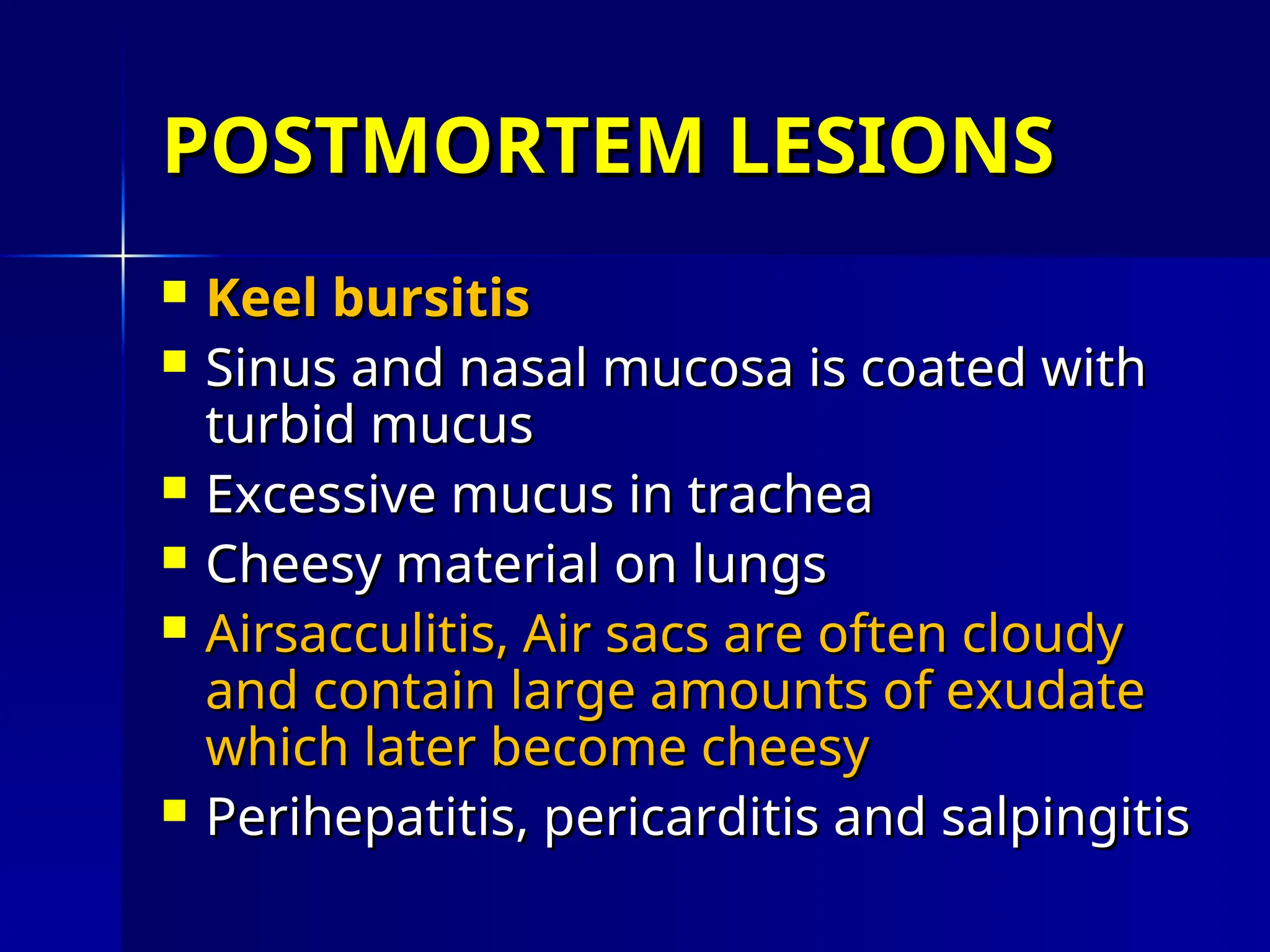
 Sinus and nasal mucosa is coated with
Sinus and nasal mucosa is coated with
turbid mucus
turbid mucus
 Excessive mucus in trachea
Excessive mucus in trachea
 Cheesy material on lungs
Cheesy material on lungs
 Airsacculitis, Air sacs are often cloudy
Airsacculitis, Air sacs are often cloudy
and contain large amounts of exudate
which later become cheesy
 Perihepatitis, pericarditis and salpingitis
Perihepatitis, pericarditis and salpingitis
Inflammation of periorbital
sinuses
sinuses
Acute foamy air sacculitis
Cloudy air sacs
Cloudy air sacs
Cheesy pus in the thoracic
air sacs
air sacs
Airsacculitis with cheesy
material
material
White cheesy exudates on lungs
Air sacculitis
Air sacculitis
Cheesy exudate in air sacs
CCRD (CRD+ colibacillosis
complex)
complex)
Tracheitis
Cauliflower
appearance
of Ova
Cheesy
material in
air sacs
DIAGNOSIS
DIAGNOSIS
 Field
Field
Clinical signs and lesions
 Isolation and identification of organism
Isolation and identification of organism
 Sampling site:
Sampling site: Upper respiratory tract (trachea)
Upper respiratory tract (trachea)
 Primary inoculation:
Primary inoculation:
• Frey’s medium, PPLO broth.
Frey’s medium, PPLO broth.
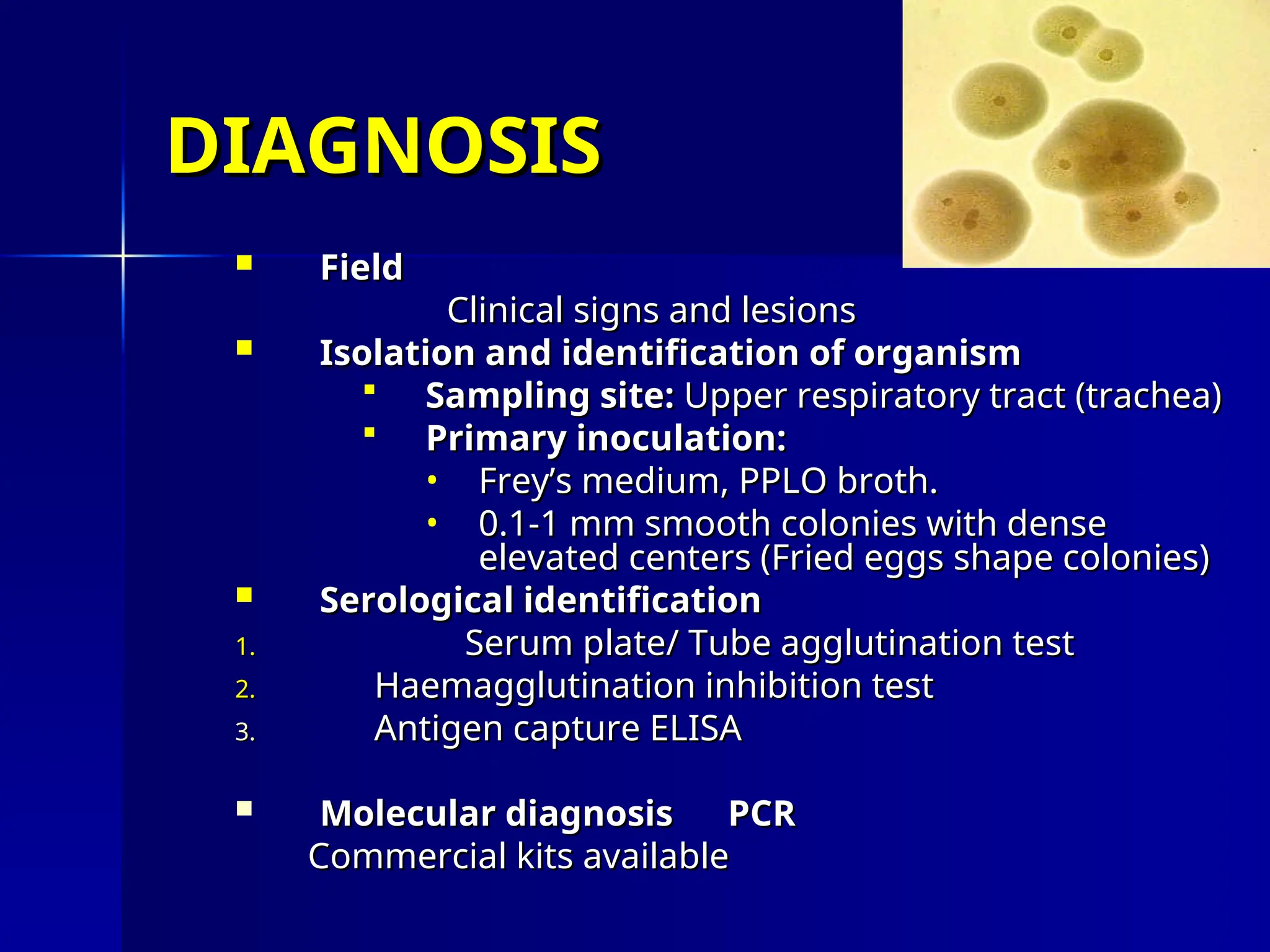
• 0.1-1 mm smooth colonies with dense
0.1-1 mm smooth colonies with dense
elevated centers (Fried eggs shape colonies)
 Serological identification
Serological identification
1.
1. Serum plate/ Tube agglutination test
Serum plate/ Tube agglutination test
2.
2. Haemagglutination inhibition test
Haemagglutination inhibition test
3.
3. Antigen capture ELISA
Antigen capture ELISA
 Molecular diagnosis PCR
Molecular diagnosis PCR
Commercial kits available
Serum plate agglutination test
MYCOPLASMA SYNOVIAE
MYCOPLASMA SYNOVIAE
 Chronic subclinical upper respiratory
Chronic subclinical upper respiratory
infection
infection
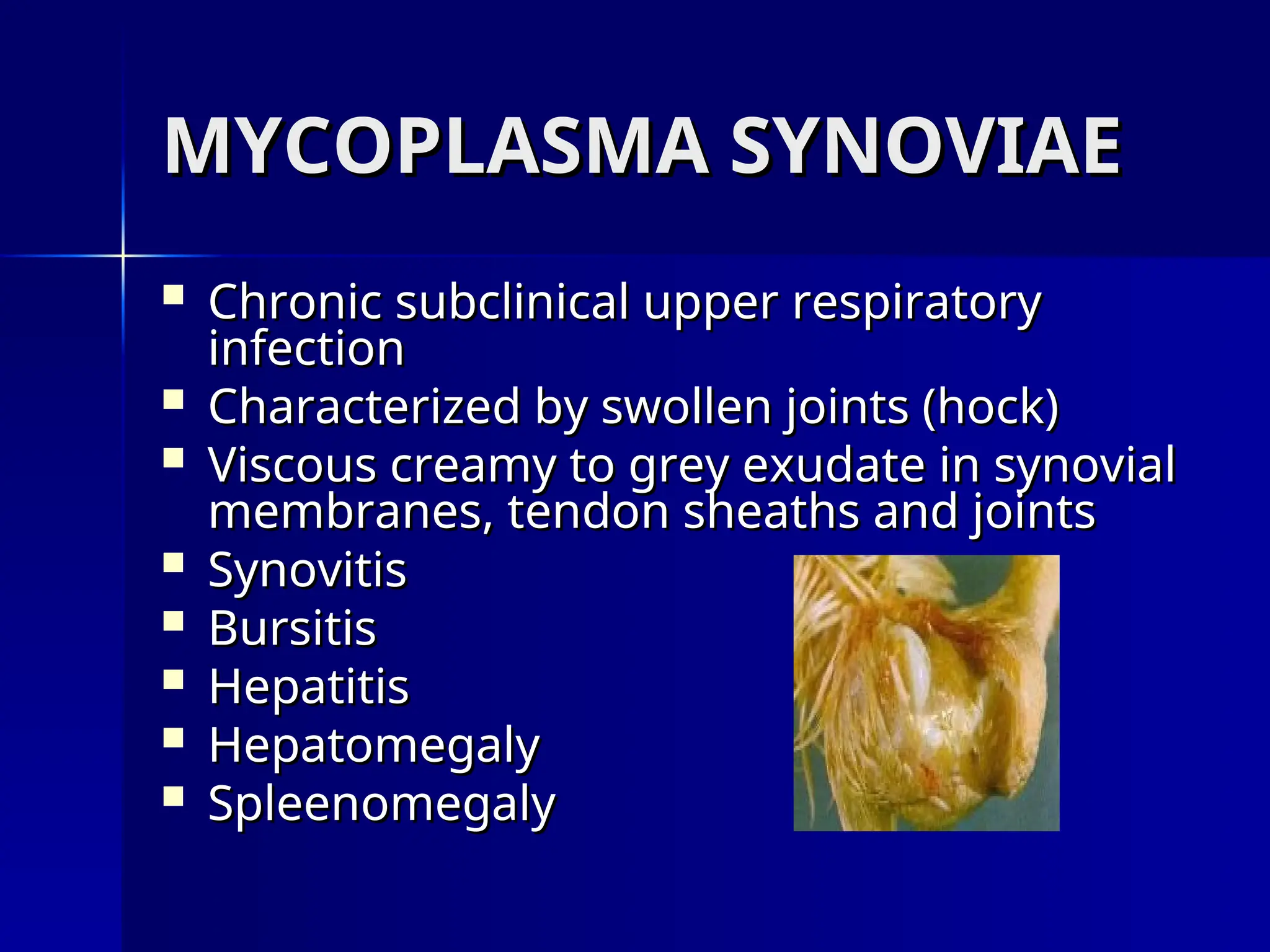
 Characterized by swollen joints (hock)
Characterized by swollen joints (hock)
 Viscous creamy to grey exudate in synovial
Viscous creamy to grey exudate in synovial
membranes, tendon sheaths and joints
 Synovitis
Synovitis
 Bursitis
Bursitis
 Hepatitis
Hepatitis
 Hepatomegaly
Hepatomegaly
 Spleenomegaly
Spleenomegaly
Arthritis
Arthritis
DIFFERENTIAL DIAGNOSIS
• Newcastle disease
Newcastle disease
• Infectious bronchitis
Infectious bronchitis
• Infectious
Infectious
laryngotracheitis
laryngotracheitis
• Infectious coryza
Infectious coryza
CONTROL
CONTROL
1.
1. Ideally maintain Mycoplasma-free flock
Ideally maintain Mycoplasma-free flock
2.
2. Medications of breeders to eliminate egg
Medications of breeders to eliminate egg
transmission.
transmission.
3. Before purchasing chicks from a hatchery, it should
be confirmed that they are free from CRD
4.
4. Blood serum testing of breeder chickens for MG
Blood serum testing of breeder chickens for MG
antibodies has become a routine to test flocks for a
MG infection
MG infection
5. Before coming in contact with flocks, workmen
should take shower and put on special clothes
6. Strict biosecurity measures should be adopted
7.
7. Egg dipping in antibiotic solutions e g,
Egg dipping in antibiotic solutions e g, Tylosin
8.
8. Antibiotic therapy to chicks (Tetracyclines)
Antibiotic therapy to chicks (Tetracyclines)
9.
9. Disposing of dead birds by incineration, deep burial
Disposing of dead birds by incineration, deep burial
or by means of special disposal pits.

6-Chronic Respiratory chronic Disease 2017.ppt

  • 1.
    CHRONIC RESPIRATORY DISEASE CHRONICRESPIRATORY DISEASE (CRD, MG INFECTION) (CRD, MG INFECTION)
  • 2.
    INTRODUCTION INTRODUCTION CRD is aslow spreading chronic upper and lower CRD is a slow spreading chronic upper and lower respiratory tract infection of chickens, turkeys respiratory tract infection of chickens, turkeys (infectious sinusitis) and other birds (infectious sinusitis) and other birds  Characterized by: Characterized by: • Abnormal respiratory sounds Abnormal respiratory sounds • Coughing, gasping, nasal discharge Coughing, gasping, nasal discharge • Foamy & Cheesy air-sacculitis Foamy & Cheesy air-sacculitis • Razor blade keel bone appearance Razor blade keel bone appearance • Keel bursitis Keel bursitis • Arthritis Arthritis
  • 3.
    ETIOLOGY ETIOLOGY Mycoplasma gallisepticum Mycoplasma gallisepticum Characteristics: Characteristics: –Smallest self replicating prokaryote Smallest self replicating prokaryote – 300 – 800 nm in size 300 – 800 nm in size – Lacks rigid cell wall, bounded by plasma Lacks rigid cell wall, bounded by plasma membrane membrane – Highly pleomorphic Highly pleomorphic – Coccoid, coccobaccillus and filamentous Coccoid, coccobaccillus and filamentous – G –ve G –ve
  • 6.
    PATHOGENESIS PATHOGENESIS  Organism entersthrough respiratory tract, Organism enters through respiratory tract, conjunctiva or via infected embryo conjunctiva or via infected embryo  Localizes in epithelium of respiratory tract Localizes in epithelium of respiratory tract  Irritation and damage of tracheal lining Irritation and damage of tracheal lining  Destruction of cilia Destruction of cilia  Infection to air sacs and lungs Infection to air sacs and lungs  Infection spreads to reproductive organs Infection spreads to reproductive organs i.e oviduct and ovary i.e oviduct and ovary  Secondary infection (bacterial & viral Secondary infection (bacterial & viral infections) CRD complex infections) CRD complex
  • 7.
    CLINICAL SIGNS CLINICAL SIGNS Abnormal respiratory gurgling sounds Abnormal respiratory gurgling sounds  Nasal discharge, coughing, gasping and Nasal discharge, coughing, gasping and sneezing sneezing  Shaking of head Shaking of head  Thin & weak birds with razor blade Thin & weak birds with razor blade breasts breasts  Poor carcass quality (Stunting) and Poor carcass quality (Stunting) and weight gain weight gain  CRD COMPLEX: Mixed infection with E. CRD COMPLEX: Mixed infection with E. coli, ND,IB,ILT,IC cause serious losses coli, ND,IB,ILT,IC cause serious losses
  • 8.
  • 9.
  • 10.
    POSTMORTEM LESIONS POSTMORTEM LESIONS Keel bursitis Keel bursitis  Sinus and nasal mucosa is coated with Sinus and nasal mucosa is coated with turbid mucus turbid mucus  Excessive mucus in trachea Excessive mucus in trachea  Cheesy material on lungs Cheesy material on lungs  Airsacculitis, Air sacs are often cloudy Airsacculitis, Air sacs are often cloudy and contain large amounts of exudate and contain large amounts of exudate which later become cheesy which later become cheesy  Perihepatitis, pericarditis and salpingitis Perihepatitis, pericarditis and salpingitis
  • 11.
    Inflammation of periorbital Inflammationof periorbital sinuses sinuses
  • 12.
    Acute foamy airsacculitis Acute foamy air sacculitis
  • 13.
  • 14.
    Cheesy pus inthe thoracic Cheesy pus in the thoracic air sacs air sacs
  • 15.
    Airsacculitis with cheesy Airsacculitiswith cheesy material material
  • 16.
    White cheesy exudateson lungs White cheesy exudates on lungs
  • 17.
  • 18.
    Cheesy exudate inair sacs Cheesy exudate in air sacs
  • 19.
    CCRD (CRD+ colibacillosis CCRD(CRD+ colibacillosis complex) complex)
  • 20.
  • 21.
  • 22.
    DIAGNOSIS DIAGNOSIS  Field Field Clinical signsand lesions Clinical signs and lesions  Isolation and identification of organism Isolation and identification of organism  Sampling site: Sampling site: Upper respiratory tract (trachea) Upper respiratory tract (trachea)  Primary inoculation: Primary inoculation: • Frey’s medium, PPLO broth. Frey’s medium, PPLO broth. • 0.1-1 mm smooth colonies with dense 0.1-1 mm smooth colonies with dense elevated centers (Fried eggs shape colonies) elevated centers (Fried eggs shape colonies)  Serological identification Serological identification 1. 1. Serum plate/ Tube agglutination test Serum plate/ Tube agglutination test 2. 2. Haemagglutination inhibition test Haemagglutination inhibition test 3. 3. Antigen capture ELISA Antigen capture ELISA  Molecular diagnosis PCR Molecular diagnosis PCR Commercial kits available Commercial kits available
  • 23.
    Serum plate agglutinationtest Serum plate agglutination test
  • 24.
    MYCOPLASMA SYNOVIAE MYCOPLASMA SYNOVIAE Chronic subclinical upper respiratory Chronic subclinical upper respiratory infection infection  Characterized by swollen joints (hock) Characterized by swollen joints (hock)  Viscous creamy to grey exudate in synovial Viscous creamy to grey exudate in synovial membranes, tendon sheaths and joints membranes, tendon sheaths and joints  Synovitis Synovitis  Bursitis Bursitis  Hepatitis Hepatitis  Hepatomegaly Hepatomegaly  Spleenomegaly Spleenomegaly
  • 27.
  • 28.
    DIFFERENTIAL DIAGNOSIS DIFFERENTIAL DIAGNOSIS •Newcastle disease Newcastle disease • Infectious bronchitis Infectious bronchitis • Infectious Infectious laryngotracheitis laryngotracheitis • Infectious coryza Infectious coryza
  • 29.
    CONTROL CONTROL 1. 1. Ideally maintainMycoplasma-free flock Ideally maintain Mycoplasma-free flock 2. 2. Medications of breeders to eliminate egg Medications of breeders to eliminate egg transmission. transmission. 3. Before purchasing chicks from a hatchery, it should be confirmed that they are free from CRD 4. 4. Blood serum testing of breeder chickens for MG Blood serum testing of breeder chickens for MG antibodies has become a routine to test flocks for a antibodies has become a routine to test flocks for a MG infection MG infection 5. Before coming in contact with flocks, workmen should take shower and put on special clothes 6. Strict biosecurity measures should be adopted 7. 7. Egg dipping in antibiotic solutions e g, Egg dipping in antibiotic solutions e g, Tylosin 8. 8. Antibiotic therapy to chicks (Tetracyclines) Antibiotic therapy to chicks (Tetracyclines) 9. 9. Disposing of dead birds by incineration, deep burial Disposing of dead birds by incineration, deep burial or by means of special disposal pits. or by means of special disposal pits.