Akilananda Chellapermal & Aurelie Hermans,
       Commonwealth IAESD Group
Context
 The paper represents the consensus reached by SIDS
  officials attending the Commonwealth course on the
  International Architecture for Environment and
  sustainable development (Pacific – 8; Caribbean-11;
  AIMS-29; ComSec -4)
 It outlines the institutional framework at the global
  and regional level to support SIDS
 The political and policy context for the proposal
 The reasons for a technical regional mechanism in
  each SIDS region
Background
 Prior to 1992 (Adoption of Agenda 21 by the UNGA)
  small islands issues were marginal to international
  environmental diplomacy
 Call by Barbados August 1989 at the 1st Preparatory
  Committee session for UNCED
 Resulted in Chapter 17 (G) in Agenda 21 – Sustainable
  Development of small islands – recognition that SIDS
  are special case both for environment and
  development
 First UNGCSD of SIDS April-May 1994 in Barbados;
  landmark event and milestone for SIDS
Output of the Barbados
Conference
 Declaration of Barbados: confirm some of the basic
  elements for the foundation for the sustainable
  development of SIDS
 BPOA for the sustainable development of SIDS
  (Outlines 15 programmes areas as a framework for
  implementing actions to facilitate the sustainable
  development of SIDS)
High Level International
Meeting(BPOA + 10), Mauritius
 January 2005 International Review meeting in
    Mauritius
   Mauritius Declaration
   Mauritius Strategy for the Further Implementation of
    the Barbados Programme of Action (MS/BPOA)
-   Further strengthens the social and economic
    dimension of the BPOA;
-   More targeted emphasis on issues such as culture,
    knowledge management, education for sustainable
    development, consumption & production,
    implications of globalisation & trade liberalisation
The Triangular Approach
 Three levels of Implementation: National, Regional &
    International
   Regional components of the BPOA need to be
    effectively coordinated through the preparation of a
    “regional implementation strategy”,
   Supported by an effective inter-governmental
    mechanism to advance the ideas of the POA and SD
    in general.
   Limited Resources (UN Resolution 21 January 2011)
   Same Resolution recognised the need for ‘timely
    action for the effective implementation of and follow
    up of MS/BPOA
Implementation structure and Status of
Implementation of the BPOA and MS/BPOA
  At global level:
     SIDS Unit (institutional output of the first United Nations
      Conference on sustainable development of SIDS)

  At regional level: situation differs; implementation entities
   are:
     For AIMS region: Indian Ocean Commission (IOC)
    Constraint: Not all the AIMS member states are members of
     the IOC (Maldives & Singapore - Indian Ocean; Sao Tomé &
     Principe, Cape Verde, Guinea – Atlantic Ocean)

     For Pacific region: South Pacific Regional Environment
      Programme, relatively one of the effective region.
 For Caribbean region: different approaches were experimented.
     May 1995 Joint coordinating mechanism of the secretariats of CARICOM and
     ECLAC/CDCC was established.
     2006 Regional Coordinating Mechanism (RCM) established

 General constraints: Implementation at regional level remains weak.
- Lack of strong regional technical mechanism with specific mandate for
  implementing BPOA & MS/BPOA; a major constraint to promoting
  inter- and intra-regional action;
- Current institutional structure for sustainable development of SIDS
  insufficiently equipped to implement range of actions particularly at
  the regional level;
- Cannot provide a more structured, systematic technical & legal analysis
  inputs at international level through AOSIS;

 UN Resolution 65/156 recognises these weaknesses and recommends
  the needs for timely action,, cooperation among SIDS, urgent need to
  increase the level of resources and the mainstreaming and integration
  of the MS/BPOA by the UN system
Rio + 20: An Opportunity Time for
Reviewing the Institutional Framework for the

Sustainable Development of SIDS.

   Issues surrounding the institutional framework for
   sustainable development provide opportunities to
   rethink the way the international environment and
   sustainable architecture deals with and makes
   provision for the most vulnerable nations which are
   special case for environment & development
Evolution of SIDS participation in international
environmental and sustainable development
negotiations
 Use of continuum in order to show the evolution of SIDS in
   the negotiations:
 Four Phases: (i) Obscurity (ii) Recognition and Acceptance (iii)
   Consolidation (iv) Designation
  Phase One: Pre-1992 Era
  Phase Two: Recognition & Acceptance
 - Chapter 17 (G) in Agenda 21
 - Consolidated through the Barbados Conference (1994)
 - 1994- 2012: SIDS have remained in this phase
Phase III: Consolidation
 Rio + 20: An opportunity for SIDS to lay the groundwork
    & propel to the next stage
   Characteristics of this phase:
-   More coherent UN Institutional Structure which caters
    for the needs of SIDS with stability and predictability;
-   Structure that adequately reflects the sustainable
    development priorities of SIDS;
-   Concrete actions based on national & regional priorities
-   Provision of adequate & predictable ‘support’ of financial
    resources to facilitate transition to sustainable green
    economies
Characteristics (Cont)
- Sound Scientific basis
- Credible commitment to capacity development &
 technology transfer
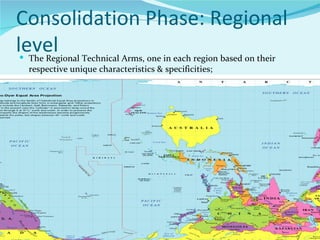
Consolidation Phase: Regional
level
 The Regional Technical Arms, one in each region based on their
  respective unique characteristics & specificities;
Focus of the proposed Regional
Mechanism
 Programme Implementation
 Technical Advisory Services
 Inter & Intra-Regional Collaboration & Coordination
 Formulation of Common Positions & Bridging the
  Gap between the Regional & International Levels
 Public Awareness & Education
 Resource Mobilisation
 Monitoring & Evaluation
Aims of the regional mechanism
 Aims:
    to provide an inter-governmental structure for the
     implementation of the BPOA and MS/BPOA
    to provide a platform for inter and intra regional
     collaboration between the SIDS in the various SIDS
     regions.
Form of the Regional
Mechanism
 The regional mechanisms nested in existing regional
 institutions:
   In the AIMS region: consideration is given to IOC or the
    Universities in the region
   In the Pacific region: SPREP considered as the most
    appropriate institution
   In the Caribbean region: the Caribbean Community
    Secretariat or the Institute for Sustainable
    Development, University of Mona, Jamaica.
 Must function as autonomous entities.
Financing
 On a cost sharing basis
 Hosting institution provide the physical space
 Percentage of programmatic costs provided through
  the regular budget of the UN as part of the funding
  for the operations of the SIDS secretariat
 Establishment of Regional Funding Mechanisms
Global Level
There is a need for:
   the strengthening of the SIDS international negotiating
    mechanism –AOSIS
   The establishment of a SIDS/AOSIS Secretariat to
    support operations of OASIS & structured inputs
    directly from SIDS Regions in support of SIDS
    negotiating positions
   Support from three autonomous technical arms from
    each SID region
The Way Forward
 Framework respond to deficiencies highlighted in
  UNGA Resolution 65/156 concerning the effective
  implementation of BPOA & MS/BPOA;
 First attempt since Barbados Conference(1994) to
  propose a design of a regional framework;
 Provide the guidance under Rio 2012 agenda area of
  ‘institutional framework for sustainable development’,
  one of the priority areas for consideration at the
  Conference
 Phase Four: Designation; one of the strategic targets
  of Barbados+ 20 for SIDS in 2014

6. Chellapermal

  • 1.
    Akilananda Chellapermal &Aurelie Hermans, Commonwealth IAESD Group
  • 2.
    Context  The paperrepresents the consensus reached by SIDS officials attending the Commonwealth course on the International Architecture for Environment and sustainable development (Pacific – 8; Caribbean-11; AIMS-29; ComSec -4)  It outlines the institutional framework at the global and regional level to support SIDS  The political and policy context for the proposal  The reasons for a technical regional mechanism in each SIDS region
  • 3.
    Background  Prior to1992 (Adoption of Agenda 21 by the UNGA) small islands issues were marginal to international environmental diplomacy  Call by Barbados August 1989 at the 1st Preparatory Committee session for UNCED  Resulted in Chapter 17 (G) in Agenda 21 – Sustainable Development of small islands – recognition that SIDS are special case both for environment and development  First UNGCSD of SIDS April-May 1994 in Barbados; landmark event and milestone for SIDS
  • 4.
    Output of theBarbados Conference  Declaration of Barbados: confirm some of the basic elements for the foundation for the sustainable development of SIDS  BPOA for the sustainable development of SIDS (Outlines 15 programmes areas as a framework for implementing actions to facilitate the sustainable development of SIDS)
  • 5.
    High Level International Meeting(BPOA+ 10), Mauritius  January 2005 International Review meeting in Mauritius  Mauritius Declaration  Mauritius Strategy for the Further Implementation of the Barbados Programme of Action (MS/BPOA) - Further strengthens the social and economic dimension of the BPOA; - More targeted emphasis on issues such as culture, knowledge management, education for sustainable development, consumption & production, implications of globalisation & trade liberalisation
  • 6.
    The Triangular Approach Three levels of Implementation: National, Regional & International  Regional components of the BPOA need to be effectively coordinated through the preparation of a “regional implementation strategy”,  Supported by an effective inter-governmental mechanism to advance the ideas of the POA and SD in general.  Limited Resources (UN Resolution 21 January 2011)  Same Resolution recognised the need for ‘timely action for the effective implementation of and follow up of MS/BPOA
  • 7.
    Implementation structure andStatus of Implementation of the BPOA and MS/BPOA  At global level:  SIDS Unit (institutional output of the first United Nations Conference on sustainable development of SIDS)  At regional level: situation differs; implementation entities are:  For AIMS region: Indian Ocean Commission (IOC) Constraint: Not all the AIMS member states are members of the IOC (Maldives & Singapore - Indian Ocean; Sao Tomé & Principe, Cape Verde, Guinea – Atlantic Ocean)  For Pacific region: South Pacific Regional Environment Programme, relatively one of the effective region.
  • 8.
     For Caribbeanregion: different approaches were experimented. May 1995 Joint coordinating mechanism of the secretariats of CARICOM and ECLAC/CDCC was established. 2006 Regional Coordinating Mechanism (RCM) established  General constraints: Implementation at regional level remains weak. - Lack of strong regional technical mechanism with specific mandate for implementing BPOA & MS/BPOA; a major constraint to promoting inter- and intra-regional action; - Current institutional structure for sustainable development of SIDS insufficiently equipped to implement range of actions particularly at the regional level; - Cannot provide a more structured, systematic technical & legal analysis inputs at international level through AOSIS;  UN Resolution 65/156 recognises these weaknesses and recommends the needs for timely action,, cooperation among SIDS, urgent need to increase the level of resources and the mainstreaming and integration of the MS/BPOA by the UN system
  • 9.
    Rio + 20:An Opportunity Time for Reviewing the Institutional Framework for the Sustainable Development of SIDS.  Issues surrounding the institutional framework for sustainable development provide opportunities to rethink the way the international environment and sustainable architecture deals with and makes provision for the most vulnerable nations which are special case for environment & development
  • 10.
    Evolution of SIDSparticipation in international environmental and sustainable development negotiations Use of continuum in order to show the evolution of SIDS in the negotiations: Four Phases: (i) Obscurity (ii) Recognition and Acceptance (iii) Consolidation (iv) Designation  Phase One: Pre-1992 Era  Phase Two: Recognition & Acceptance - Chapter 17 (G) in Agenda 21 - Consolidated through the Barbados Conference (1994) - 1994- 2012: SIDS have remained in this phase
  • 11.
    Phase III: Consolidation Rio + 20: An opportunity for SIDS to lay the groundwork & propel to the next stage  Characteristics of this phase: - More coherent UN Institutional Structure which caters for the needs of SIDS with stability and predictability; - Structure that adequately reflects the sustainable development priorities of SIDS; - Concrete actions based on national & regional priorities - Provision of adequate & predictable ‘support’ of financial resources to facilitate transition to sustainable green economies
  • 12.
    Characteristics (Cont) - SoundScientific basis - Credible commitment to capacity development & technology transfer
  • 13.
    Consolidation Phase: Regional level The Regional Technical Arms, one in each region based on their respective unique characteristics & specificities;
  • 15.
    Focus of theproposed Regional Mechanism  Programme Implementation  Technical Advisory Services  Inter & Intra-Regional Collaboration & Coordination  Formulation of Common Positions & Bridging the Gap between the Regional & International Levels  Public Awareness & Education  Resource Mobilisation  Monitoring & Evaluation
  • 16.
    Aims of theregional mechanism  Aims:  to provide an inter-governmental structure for the implementation of the BPOA and MS/BPOA  to provide a platform for inter and intra regional collaboration between the SIDS in the various SIDS regions.
  • 17.
    Form of theRegional Mechanism  The regional mechanisms nested in existing regional institutions:  In the AIMS region: consideration is given to IOC or the Universities in the region  In the Pacific region: SPREP considered as the most appropriate institution  In the Caribbean region: the Caribbean Community Secretariat or the Institute for Sustainable Development, University of Mona, Jamaica.  Must function as autonomous entities.
  • 18.
    Financing  On acost sharing basis  Hosting institution provide the physical space  Percentage of programmatic costs provided through the regular budget of the UN as part of the funding for the operations of the SIDS secretariat  Establishment of Regional Funding Mechanisms
  • 19.
    Global Level There isa need for:  the strengthening of the SIDS international negotiating mechanism –AOSIS  The establishment of a SIDS/AOSIS Secretariat to support operations of OASIS & structured inputs directly from SIDS Regions in support of SIDS negotiating positions  Support from three autonomous technical arms from each SID region
  • 20.
    The Way Forward Framework respond to deficiencies highlighted in UNGA Resolution 65/156 concerning the effective implementation of BPOA & MS/BPOA;  First attempt since Barbados Conference(1994) to propose a design of a regional framework;  Provide the guidance under Rio 2012 agenda area of ‘institutional framework for sustainable development’, one of the priority areas for consideration at the Conference  Phase Four: Designation; one of the strategic targets of Barbados+ 20 for SIDS in 2014

Editor's Notes

  • #3 IOC Support in the context of the programme Islands for the AIMS Region
  • #7 ‘ SIDS have mobilised their limited resources at the national and regional levels’ (UN Resolution 21 January 2011)
  • #9 Caribbean region: Interim arrangement This mechanism became known as “the Carribean Model for the Implementation of the SIDS POA” RCM for the implementation of the Mauritius Strategy in the Caribbean
  • #11 Using this as a contextual background, the Commonwealth IAESD Group examined this issue in the SIDS regions- AIMS, Caribbean and Pacific.
  • #12 Paper called rethinking the Institutional Framework for the Implementation of the POA for the SD of SIDS (BPOA) and the MS for further implementation of the BPOA (MS/BPOA). It outlines a proposal for an…
  • #14 Why enhancing institutional framework for the SD of SIDS at the global and regional levels is a necessity?
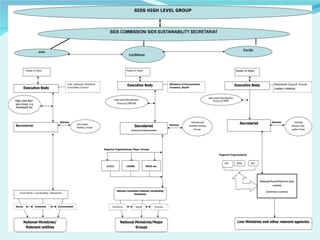
  • #15 Regional Institutional Form: An Executive Body A High Level Advisory Group A Secretariat Ad Hoc Technical & Scientific Working Groups Regional Organisations National Coordinator/National Coordinating mechanism
  • #20 Organizational structure of AOSIS weak; A loosely connected coalition