Written by
Brandon Smith
5 tips for CFOs in Fashion
Industry
2
White paper
5 tips for CFOs in Fashion Industry www.kantox.com
When discussing numbers in a US$ 3 trillion industry (of
which more than US$ 300 billion is from exports), advice
matters. The singularities of the fashion business (China
being the country which receives the most payments as
it produces 54% of the world’s total textile demand) and
its constant trend rotation gives any fashion company’s
finance department a challenge in its quest to becoming
more agile and cost-savvy in the company’s overall results.
With 75% of its market in Europe, the US, China and Japan,
fashion companies now face the decision whether to
compete in the same markets as big brands like LVMH
(with a total valuation of around US$ 23 billion) or take the
international path - with procedures structured towards
opening operations in other countries in the remaining
25% of the market or simply by managing an ecommerce
strategy with a lean logistics and distribution process to
fulfill demand across different markets.
Fashion is still trendy worldwide
3
White paper
5 tips for CFOs in Fashion Industry www.kantox.com
It is essential to have
a solid and structured
plan with your suppliers
in FX area.
Having to determine the main route for your company
in an industry as international as fashion broadens the
finance department’s work by having to manage different
suppliers in different currencies and, additionally, fulfill
their obligations via generally short payment plans which
are not always structured.
At Kantox, we want to to assist you in building a solid
and structured plan with your suppliers in the area of
FX exchange and international payments, and so have
worked with our local experts on the following 5 tips for
embracing new strategies in fashion finance departments.
4
White paper
5 tips for CFOs in Fashion Industry www.kantox.com
1. Define the right plan
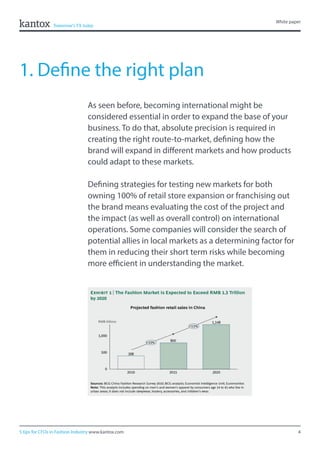
As seen before, becoming international might be
considered essential in order to expand the base of your
business. To do that, absolute precision is required in
creating the right route-to-market, defining how the
brand will expand in different markets and how products
could adapt to these markets.
Defining strategies for testing new markets for both
owning 100% of retail store expansion or franchising out
the brand means evaluating the cost of the project and
the impact (as well as overall control) on international
operations. Some companies will consider the search of
potential allies in local markets as a determining factor for
them in reducing their short term risks while becoming
more efficient in understanding the market.
5
White paper
5 tips for CFOs in Fashion Industry www.kantox.com
2. Manage your risks
Despite international tension and economic woes in
certain regions, fashion has always been a product so
influenced by emotions that it has defied any current
international problems and is estimated to grow in double
digits until 2025.
Despite that unusual behaviour, dealing with international
suppliers increases the risks of loss of control in the supply
chain while making it harder to determine all the possible
risks from performing analysis on an international basis.
If you are working with international providers, you need
to determine the potential risks and plan B’s for the whole
process in order to be able to determine alternative
solutions for your operations.
Determine potential
risks and manage them
by providing alternative
solutions for your
operations.
6
White paper
5 tips for CFOs in Fashion Industry www.kantox.com
3. Don’t be a tech divorced
department
The security and procedures in a finance department
often restrain CFOs in testing new tools that could make
the delivery, analysis and overall results simpler in terms of
automation and management as well as enhancing data
analysis and cost-savvy procedures (such as your FX and
international payments operations).
Solutions for finance departments include Fintech
operations to assist companies in becoming more cost-
savvy and providing data trends and market analysis and
a host of solutions specialised in boosting the CFO’s role in
the company.
7
White paper
5 tips for CFOs in Fashion Industry www.kantox.com
4. Organise payments with your
international suppliers
As previously mentioned, the fashion industry sees
manufacturing largely conducted in China, with more
than 50% of total product produced there, and distributed
throughout the rest of the globe. Having said that, when
working with Chinese suppliers, and with the yuan
constantly reaching a new high in value, payments must
be conducted under a structured plan that responds to
the company’s demands but also takes into consideration
regular developments in working with your usual Chinese
suppliers (time difference, currency valuation, days-to-
payment considerations etc.).
8
White paper
5 tips for CFOs in Fashion Industry www.kantox.com
5. Pay attention to your
currencies
The FX market is a key part of the overall results in the
supply chain when you mostly work with international
suppliers. With the yuan currently on a high against the
USD, and with the dollar approaching euro parity, the
purchase of goods from Asia is getting more expensive,
making it necessary for organisations to seek out new
ways of reducing costs without sacrificing quality in their
apparel.
Having a well structured plan, as mentioned in point
one, and knowing the importance of currencies to your
overall results will prepare you in managing your KPIs and
having more alternative solutions towards achieving cost
optimisation.
At Kantox, we want to help companies to boost their
overall results whilst they become more efficient in the
finance department. As experts in payment management
with international providers, we want to work side-by-side
with you in order to develop the best structured solution
for you to work on clear and transparent terms with your
suppliers, just as we at Kantox work with our clients.

5_tips_for_CFOs_in_Fashion_Industry

  • 1.
    Written by Brandon Smith 5tips for CFOs in Fashion Industry
  • 2.
    2 White paper 5 tipsfor CFOs in Fashion Industry www.kantox.com When discussing numbers in a US$ 3 trillion industry (of which more than US$ 300 billion is from exports), advice matters. The singularities of the fashion business (China being the country which receives the most payments as it produces 54% of the world’s total textile demand) and its constant trend rotation gives any fashion company’s finance department a challenge in its quest to becoming more agile and cost-savvy in the company’s overall results. With 75% of its market in Europe, the US, China and Japan, fashion companies now face the decision whether to compete in the same markets as big brands like LVMH (with a total valuation of around US$ 23 billion) or take the international path - with procedures structured towards opening operations in other countries in the remaining 25% of the market or simply by managing an ecommerce strategy with a lean logistics and distribution process to fulfill demand across different markets. Fashion is still trendy worldwide
  • 3.
    3 White paper 5 tipsfor CFOs in Fashion Industry www.kantox.com It is essential to have a solid and structured plan with your suppliers in FX area. Having to determine the main route for your company in an industry as international as fashion broadens the finance department’s work by having to manage different suppliers in different currencies and, additionally, fulfill their obligations via generally short payment plans which are not always structured. At Kantox, we want to to assist you in building a solid and structured plan with your suppliers in the area of FX exchange and international payments, and so have worked with our local experts on the following 5 tips for embracing new strategies in fashion finance departments.
  • 4.
    4 White paper 5 tipsfor CFOs in Fashion Industry www.kantox.com 1. Define the right plan As seen before, becoming international might be considered essential in order to expand the base of your business. To do that, absolute precision is required in creating the right route-to-market, defining how the brand will expand in different markets and how products could adapt to these markets. Defining strategies for testing new markets for both owning 100% of retail store expansion or franchising out the brand means evaluating the cost of the project and the impact (as well as overall control) on international operations. Some companies will consider the search of potential allies in local markets as a determining factor for them in reducing their short term risks while becoming more efficient in understanding the market.
  • 5.
    5 White paper 5 tipsfor CFOs in Fashion Industry www.kantox.com 2. Manage your risks Despite international tension and economic woes in certain regions, fashion has always been a product so influenced by emotions that it has defied any current international problems and is estimated to grow in double digits until 2025. Despite that unusual behaviour, dealing with international suppliers increases the risks of loss of control in the supply chain while making it harder to determine all the possible risks from performing analysis on an international basis. If you are working with international providers, you need to determine the potential risks and plan B’s for the whole process in order to be able to determine alternative solutions for your operations. Determine potential risks and manage them by providing alternative solutions for your operations.
  • 6.
    6 White paper 5 tipsfor CFOs in Fashion Industry www.kantox.com 3. Don’t be a tech divorced department The security and procedures in a finance department often restrain CFOs in testing new tools that could make the delivery, analysis and overall results simpler in terms of automation and management as well as enhancing data analysis and cost-savvy procedures (such as your FX and international payments operations). Solutions for finance departments include Fintech operations to assist companies in becoming more cost- savvy and providing data trends and market analysis and a host of solutions specialised in boosting the CFO’s role in the company.
  • 7.
    7 White paper 5 tipsfor CFOs in Fashion Industry www.kantox.com 4. Organise payments with your international suppliers As previously mentioned, the fashion industry sees manufacturing largely conducted in China, with more than 50% of total product produced there, and distributed throughout the rest of the globe. Having said that, when working with Chinese suppliers, and with the yuan constantly reaching a new high in value, payments must be conducted under a structured plan that responds to the company’s demands but also takes into consideration regular developments in working with your usual Chinese suppliers (time difference, currency valuation, days-to- payment considerations etc.).
  • 8.
    8 White paper 5 tipsfor CFOs in Fashion Industry www.kantox.com 5. Pay attention to your currencies The FX market is a key part of the overall results in the supply chain when you mostly work with international suppliers. With the yuan currently on a high against the USD, and with the dollar approaching euro parity, the purchase of goods from Asia is getting more expensive, making it necessary for organisations to seek out new ways of reducing costs without sacrificing quality in their apparel. Having a well structured plan, as mentioned in point one, and knowing the importance of currencies to your overall results will prepare you in managing your KPIs and having more alternative solutions towards achieving cost optimisation. At Kantox, we want to help companies to boost their overall results whilst they become more efficient in the finance department. As experts in payment management with international providers, we want to work side-by-side with you in order to develop the best structured solution for you to work on clear and transparent terms with your suppliers, just as we at Kantox work with our clients.