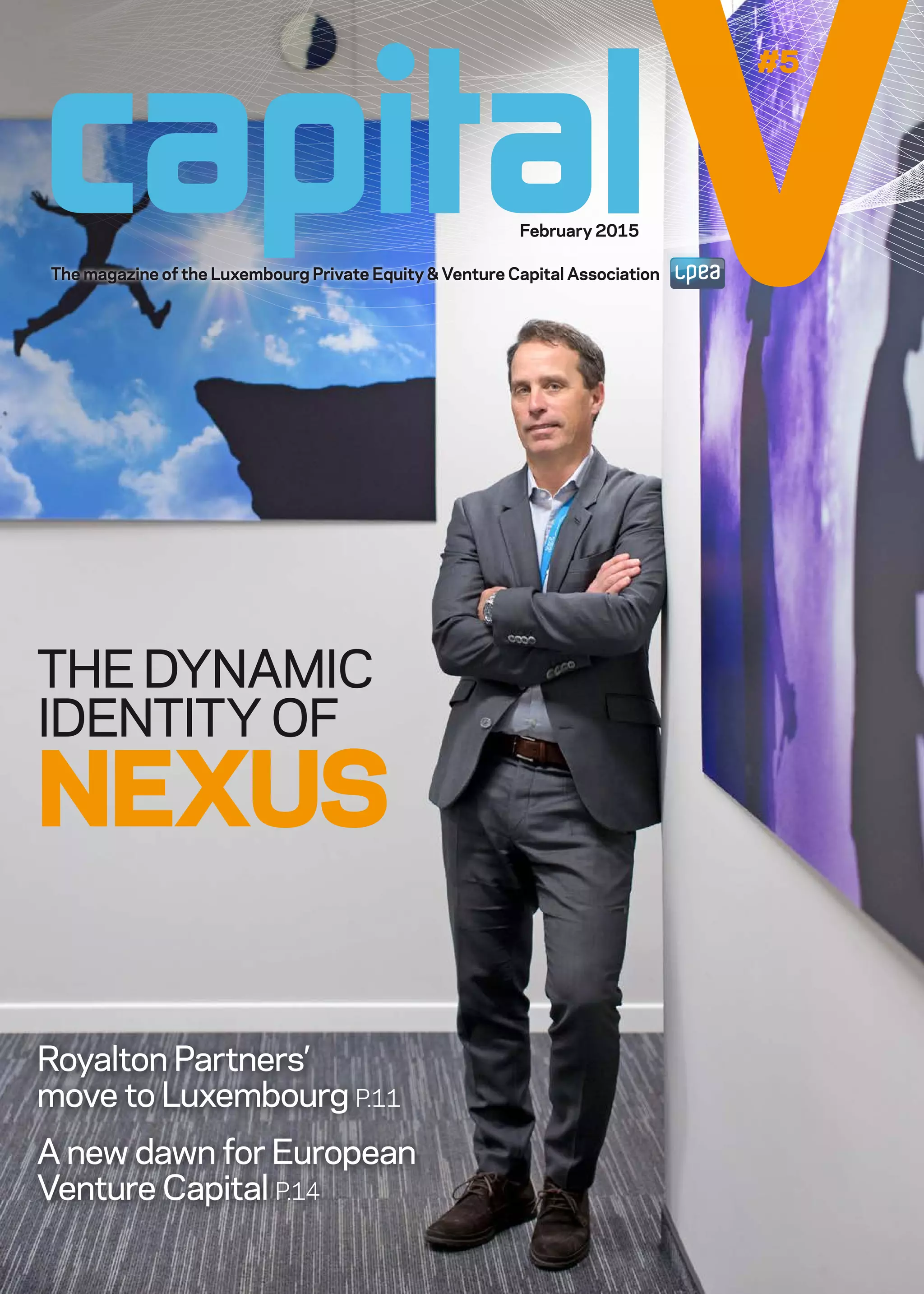
V#5
capitalThe magazine of the Luxembourg Private Equity & Venture Capital Association
February 2015
THEDYNAMIC
IDENTITY OF
A new dawn for European
Venture Capital P.14
Royalton Partners’
move to Luxembourg P.11
NEXUS
Your
Independent AIFM
in Luxembourg
Luxembourg Investment Solutions S.A.
Airport Center Luxembourg · 5, rue Heienhaff · L-1736 Senningerberg · T: +352 26 34 56-1 · F: +352 26 34 56-66
info@investment-solutions.lu · www.investment-solutions.lu
• Portfolio Management Services
• Risk Management
• Valuation
• Regulatory Reporting
• Distribution Platform
Specialists in Private Equity, Real Estate and Debt
#5 – capitalV – 3
Content
The magazine of LPEA

Editorial: Nicolas Bernhardt, Luís Galveias,
Anja Grenner, Paul Junck, Salla Komulainen,
Catherine Pogorzelski, Helena Quinn,
Valerie Tixier, Jane Wilkinson, Jérôme Wittamer
Conception & coordination: 360Crossmedia
Artistic Director: Franck Widling
Cover photo: © LPEA
capitalV
Disclaimer : To the fullest extent permissible under applicable law, LPEA does not
accept any responsibility or liability of any kind, with respect to the accuracy or
completeness of the information and data from this documentation. The
information and data provided in this documentation are for general information
purposes. It is not investment advice nor can it take account of your own particular
circumstances. If you require any advice, you should contact a financial or other
professional adviser. No material in this documentation is an offer or solicitation
to buy or sell any professional services, financial products or investments.
5. Editorial
Welcome to capitalV
7. Interview
Private Equity in Luxembourg: Stability is our number
one strength
11. Profile
Royalton Partners’ Move to Luxembourg: First Hand
Testimonial
14. Opinion
A new dawn for European Venture Capital
16. Interview
The Dynamic Identity of neXus
20. Equity Bridge Financing
Equity Bridge Financing: Key Takeaways
22. Limited Partnership
Luxembourg Limited Partnership, a success story?
24. Securitisation Vehicles
Securitisation Vehicles – AIFMD Impact
26. Trends
Circular Economy or How to Upcycle your Business
28. Initiative
Stanford University’s legendary Startup course lands
in Luxembourg
30. Event Calendar
What, When, Where
31. Event
New year’s event
By Jérôme Wittamer, Chairman of LPEA
LPEA is a relatively young organisation created by a small group of leading players
in the Luxembourg private equity and venture capital (PE/VC) industry. As we cel-
ebrate the association’s fifth anniversary in 2015 we can only be proud of the
successful path we have set. Counting over 120 members today, recognised by
national and European peers and considered amongst the country’s highest
instancesasthereferencerepresentativefortheindustry,LPEAhascertainlymet
the most demanding expectations for an emerging trade association.
Armed with the credibility and visibility earned over the years, LPEA is now in a
strong position to defend and support the growth of its industry. Over the course
of 2014, the association’s members conducted a strategy exercise with this in
mind, which the association is now executing. Here is an overview of the key items
the strategy implies:
ENHANCED DIALOGUE
LPEA actively promotes a deeper dialogue between general partners, service
providers, government, political constituencies and the Luxembourg Regulator
CSSF. In addition, LPEA demonstrates it cares for local business development
through its involvement in the real economy (eg. business, academia, innovation
centres, trade associations, etc.) and foreign counterparts.
THOUGHT LEADERSHIP & BEYOND
The unique expertise LPEA’s members contribute to our technical committees
can be seen in the high quality of our publications, events and other initiatives.
LPEA intends to further strengthen its thought leadership on all PE/VC related
developments, namely by actively contributing and proposing new and improved
policiesforanattractiveanddynamiclegal,tax,judiciaryandregulatoryframework.
LUXEMBOURG, THE EUROPEAN PRIVATE EQUITY HUB
Luxembourg is an early adopter of the highest international standards. As demon-
strated with UCITS, this has proven to be the country’s best tool to not only posi-
tionitselfattheforefrontofthemostcompetitivenationshostingPE/VCactivities
but also to showcase its compliance leadership vis-à-vis international regulations.
It is an established fact that few jurisdictions, if any, can match the combination of
advantages that Luxembourg offers. Few have reached a critical size of AIFMs
allowing the regulator and professional services firms to reach a level of under-
standing and expertise necessary to deliver outstanding service. While we will
always aim at improving and never accept the status quo, Luxembourg is clearly
attheveryedge.Therefore,weintendtocarryonandfurtherdeployourmarketing
efforts with a view to attracting new players to the market.
We thank you for your support and would be delighted to see you join our efforts
building together Europe’s leading PE/VC hub!
4 – capitalV – #5
LPEA:
FROM AN IDEA
TO A REFERENCE
Focus
#5 – capitalV – 5
DEAR PRIVATE
EQUITY
PROFESSIONALS,
L
uxembourg Private Equity and Venture
Capital Association (LPEA) is celebrating
its 5th anniversary this February
amid a community that keeps growing
steadily in a market rich with potential.
On the back of a small group of actors in 2010,
our industry was able to build a reputable
representative body which is now heard
in the country’s highest instances.
Capital V is a window on Luxembourg’s
private equity and venture capital
industry. The four previous editions
illustrated part of the common story we
have been building over the past 5 years.
We will never thank enough our
members for their contribution to the
current issue, as well as to all those
that keep supporting LPEA’s work on
a regular basis, making Luxembourg
Europe’s leading private equity hub.
Enjoy the reading.
Cordially,
Jérôme Wittamer, Chairman
Paul Junck, Managing Director
Luxembourg Private Equity
and Venture Capital Association
Editorial
©360Crossmedia/LPEA
A global player in asset servicing...
Offering leading value in investor services demands constant
evolution. At CACEIS, our strategy of sustained growth is
helping customers meet competitive challenges on a global
scale. Find out how our highly adapted investor services can
keep you a leap ahead.
CACEIS, your comprehensive asset servicing partner.
... and climbing.
Private Equity
Real Estate
Securitization
www.caceis.com
www.munier-bbn.com
Interview
#5 – capitalV – 7
WITH 2014 ENDING, HOW DO YOU SEE THIS LAST
YEAR FOR THE PRIVATE EQUITY INDUSTRY, IN
GENERAL TERMS AND IN LUXEMBOURG IN
PARTICULAR?
Globally, the Private Equity industry had a good year. Despite
divergent growth levels across developed economies, key
performance indicators of the industry such as fundraising,
M&A and IPO market activity showed very positive trends
for 2014. As a fund centre and an acquisition platform for
the Private Equity industry, Luxembourg benefited from
these positive trends with robust activity throughout the
various levels of the PE value chain. One should not ignore
the impact of the AIFM regulation which brought consider-
able new business to the market place.
FROM AN ECONOMIC POINT OF VIEW, THE EU IS
STILL SUFFERING FROM LOW ECONOMIC GROWTH.
WHAT WAS THE IMPACT ON THE PE INDUSTRY AND
HOW IS IT RESPONDING TO THE CHALLENGES OF
THIS LOW-GROWTH ENVIRONMENT?
The EU economy is clearly struggling to gain traction, due
PRIVATE EQUITY IN
LUXEMBOURG
STABILITY IS
OUR NUMBER
ONE STRENGTH©DR
INTERVIEW WITH
OLIVIER COEKELBERGS*,
LPEA MEMBER.
to the slowness to implement the reforms needed and an
overall lack of agility. Besides the indirect impact that a slow
economic growth has on investor confidence and other
stakeholders within the economy, it has a direct effect on
the ability of the PE funds to make profitable investments
in the EU and generate good returns. Low economic growth
results in fewer opportunities to improve profitability in
portfolio companies. Consequently, it becomes more diffi-
cult and takes longer to increase the value of portfolio com-
panies to bring them to the right stage for exit. There is
unfortunately no magic solution to this issue. The ability to
identify those companies that will be the winners of tomor-
row and deploy actions improving their earnings has histori-
cally been the unique route to succeed. This is also true in
a low-growth environment, but requires even more patience
and focus.
AIFMD FUNDAMENTALLY CHANGED THE PE
INDUSTRY IN THE WAY IT OPERATES. HOW WAS
LUXEMBOURG AFFECTED SINCE IT IS HOME TO
MANY PE FUNDS AND UNREGULATED ENTITIES?
WHAT CHANGES CAN YOU SEE SINCE ITS
INTRODUCTION IN 2013?
Firstly, I do not believe that AIFMD has greatly altered the
fundamentals under which the PE industry operates.
Acquiring a company at a good price, developing it and sell-
ing it at a higher price was, in the past and will continue to
©DR
8 – capitalV – #5
Interview
BY NOW, LUXEMBOURG HAS BEEN EVOLVING INTO A
WELL-ESTABLISHED PLACE FOR PE FUNDS, SIMILAR
TO UCITS FUNDS WHEN THEY WERE INTRODUCED IN
1988. IS THERE STILL ROOM FOR IMPROVEMENT?
As long as there will be PE Funds incorporated in another
country, there will indeed be room for improvement for
Luxembourg! …
be in the future, the way PE funds work; AIFMD has not and
will not change that. I would rather say that AIFMD has
changed the way PE firms and their funds are structured.
We have seen a large number of managers reengineering
their operations through Luxembourg with additional people
and structures. Overall, we see a positive trend with more
PE business in Luxembourg, in particular from PE houses
resident in non-EU countries with existing or potential lim-
ited partners in the EU. I however believe it is probably too
early to conclude whether Luxembourg will be the big winner
from AIFMD as i) some key questions are still open, ii) other
countries also want to attract new business from this regu-
lation and are massively investing to make it happen and iii)
the tax aspects are also going through major changes which
will also impact the final outcome.
WHICH ADVANTAGES DOES LUXEMBOURG HAVE
VIS-À-VIS ITS COMPETITOR JURISDICTIONS AS A
DOMICILE FOR PE FUNDS?
In my view, there is one really tangible advantage that nobody
could dispute: the stability of the country. Over the years we
have seen that political elections and other external factors
have not fundamentally changed the landscape for the PE
industry or impaired the rating of the country. Luxembourg is
a stable and safe place to run Private Equity activities and
there are few countries that can boast such stability, espe-
cially in the on-shore and regulated world of today.
WITH AIFMD, LUXEMBOURG INTRODUCED THE
SPECIAL LIMITED PARTNERSHIP STRUCTURE, THE
“SLP”, WITH THE OBJECTIVE TO MAKE LUXEMBOURG
MORE ATTRACTIVE FOR PE HOUSES FROM THE
ANGLO-SAXON COUNTRIES. THESE COUNTRIES ARE
MORE FAMILIAR WITH PARTNERSHIP CONTRACTS
THAN FUNDS IN THE LEGAL FORM OF COMPANIES.
WERE EXPECTATIONS MET SO FAR?
There is no doubt that the SLP was the missing part of the
puzzle to attract more Private Equity funds and we can
clearly state that the SLP is a success for the country. Going
forward, for the success story to be complete, we would need
a couple of the largest Private Equity houses structuring
their flagship funds with a master incorporated as an SLP in
Luxembourg. The Luxembourg PE community is working at
this and I am optimistic to see concrete results soon.
“AIFMD HAS CHANGED
THE WAY PE FIRMS AND THEIR
FUNDS ARE STRUCTURED,
NOT THE BUSINESS ITSELF.”
#5 – capitalV – 9
munity to which the LPEA, my competitors and I belong
already is a strong catalyst to strengthen the position of the
country globally.
*Olivier Coekelbergs is Partner and Private Equity
Leader at EY Luxembourg.
IN A NUTSHELL, WHAT ARE LUXEMBOURG’S
KEY STRENGTHS IN RELATION TO PRIVATE EQUITY
FOR YOU?
As I said, stability is the number one strength. The possibil-
ity that Luxembourg offers to structure funds, AIFM and the
acquisition structures in one country is also a major strength
that we should not ignore. Finally, the Luxembourg PE com-
©DR
10 – capitalV – #5
#5 – capitalV – 11
THE REASON ROYALTON
PARTNERS MOVED TO
LUXEMBOURG WAS THE
INTRODUCTION OF THE
AIFMD REGULATORY
FRAMEWORK.
close of our latest, third fund in the fourth quarter of 2009.
Many of the transitional exceptions were scheduled to be
over by this time. We therefore believed that, we were faced
with a stark choice – apply to become an AIFM, or plan to
run off the firm. Off course, the advent of the third party
AIFM platforms, such as the one offered by Royalton
Partners, meant that there was a third option. But at that
time, we had not yet seen this opportunity.
Back in 2010, a few days after the European Parliament
passed the AIFMD, the EVCA organized a conference at
short notice in Brussels at which Commissioner Barnier
spoke. He stressed that the aim of the new legislation was
to bring the European alternative investment fund industry
on shore, so that EU investors invested in EU funds, man-
aged by EU managers, under the oversight of EU regulators.
He compared the EU to the US where to be an alternative
fund advisor, a registration with the SEC is required and
most domestic funds are domiciled locally, in such places
as Delaware. He made it clear, that if the legislation did not
have the desired effect, further measures would be taken
to make sure the alternative fund industry came on shore
to the EU.
After Commissioner Barnier had left the conference, a num-
ber of major EU institutional investors deliberated and many
declared that once the new AIFMD regulatory arrange-
ments were in place, they would only commit to funds man-
aged by regulated AIFMs.
Hence, my partners and I looked at each other and
Royalton Partners migrated to Luxembourg from Cayman
in May of 2014 and became an authorized AIFM. This
authorization encompasses the performance of both the
portfolio and risk management functions for private equity
AIFs. Moreover, Royalton Partners currently has an applica-
tion to extend the authorization to manage real estate AIFs
pending with the CSSF, the Luxembourg regulator.
WHY BECOME AN AIFM?
Simply put – to gain the EU wide marketing passport!
Although there are transitional arrangements in place, post-
2018 without access to an AIFM authorization, the market-
ing of an alternative investment fund in the EU will be
virtually impossible.
Our expectation at Royalton Partners in 2010 was that we
would next go fund raising in 2014/15, having had a final
ROYALTON PARTNERS’ MOVE
TO LUXEMBOURG:
FIRST HAND TESTIMONIAL
Nigel Williams,
Chairman of Royalton Partners
©DR
Profile
©DR
12 – capitalV – #5
Try a partner that offers you them all
Many partners can offer you one service
DownloaD The
brochure here
INGLuxembourg,SociétéAnonyme–52,routed’EschL-2965Luxembourg–R.C.S.LuxembourgB.6041
www.ing.lu/business
ING, the only bank in Luxembourg that can meet all your needs with one team:
fund’s paying agent and depositary, corporate account, AIFM and cash accounts
for underlying holding companies. Want to save time and improve efficiency?
Go on, just try us.
oped a robust regulatory framework, which strikes the right
balance between effective supervision of market partici-
pants and practicalities of day-to-day operations.
Luxembourg transposed AIFMD as one of the first coun-
tries in Europe.
Secondly, the new SCSp partnership structure is available,
which resembles the Anglo-Saxon limited partnership.
Thirdly, there is no VAT charged on management services
in Luxembourg, which would otherwise be charged to
investors.
Fourthly, our expectation was that our next fund would be
a Lux AIF.
HOW DID THIS CHANGE OUR FIRM?
Royalton Partners moved from an unregulated to a fully
regulated environment and this will obviously raise the level
of protection for LPs. We have separated the investment
decision process and risk management, set aside regulatory
capital and implemented transparent internal policies and
procedures. Notably, we are also able to offer AIFM solu-
tions under our Third Party AIFM Platform to non-EU alter-
native asset managers, and smaller EU managers.
THE RIGHT CHOICE
In conclusion, we believe that Royalton Partners made the
right choice by becoming an authorized AIFM; we are pre-
paring to raise our next CEE fund and building our third
party manco business.
thought we had little choice but to seek to become an
AIFM. We realised that the days of a Cayman management
company, with a main investment office in Warsaw, manag-
ing a Guernsey fund being marketed into the EU where
numbered.
Later, we realised that once we had an AIFM license, we
could effectively rent this license to non EU alternative
managers and smaller EU managers who would need
access to the AIFM passport to raise funds in the EU but
who had decided not to seek a license themselves.
WHY LUXEMBOURG?
Once we had done our homework, Luxembourg was the
clear choice.
In the course of our investment history, the funds we have
managed have owned a bank, specialising in real estate
mortgages and we currently own an insurance company. So,
we have experience with financial regulators in the CEE
region. Prior to moving to Prague, in 1990, I had been a co-
founder and the CEO of Williams Cook Lott and Kissack one
of the UK government bond brokers regulated by the Bank
of England. In short, as firm we have a certain level of regula-
tory experience.
Royalton Partners was and is a PE firm focusing on the
Central and Eastern European (CEE) region. The firm was
founded in Prague where Roman Babka, now our Chief Risk
Officer, Ivan Vohlmuth and I stated working together in
October 1990. As the firm developed, we grew our Warsaw
office as Poland is the largest country in our investment
region. Naturally, we might have sought a license in Poland
or the Czech Republic. But Poland has not yet transposed
the AIFMD into local law and the Czech financial regulator,
similarly to most CEE countries, through no fault of its own,
just has not had the long experience of regulating alterna-
tive fund managers. In addition, since we invest throughout
the region we did not want to be perceived as regulated by
any individual country and be subject to its changing priori-
ties. We could have set up in London, but there is some
uncertainty about the UK’s membership in the EU - to
migrate the firm, only to migrate it again did not make sense.
So if not in our investment region and not in Europe’s finan-
cial capital, then where? Luxembourg was the obvious
choice.
Firstly, one thing was clear – the CSSF has the experience
in overseeing the second largest fund domicile in the world,
after the US. The country has long decided to make financial
services one of the cornerstones of its economy and devel-
“WITH THE INTRODUCTION OF
THE AIFMD WE REALISED THAT
THE DAYS OF A CAYMAN
MANAGEMENT COMPANY,
WITH A MAIN INVESTMENT
OFFICE IN WARSAW,
MANAGING A GUERNSEY
FUND BEING MARKETED INTO
THE EU WERE NUMBERED.”
Profile
#5 – capitalV – 13
14 – capitalV – #5
Opinion
A DECADE AND A HALF HAVE PASSED SINCE EUROPEAN
VENTURE CAPITAL HAS BEEN HIT BY THE TECHNOLOGY
CRASH IN 2000, WHEN THIS MARKET SEGMENT WAS WHIPPED
OUT LIKE THE FLAME OF A TINY CANDLE IN THE WIND.
EVER SINCE, EUROPEAN VENTURE CAPITAL WAS ANALYSED
FOR ITS MANIFOLD DISEASES, RANGING FROM UNAMBITIOUS
ENTREPRENEURS, TO UNDERFUNDED VENTURE CAPITAL
FUNDS, RISK AVERSE GPs, SUBCRITICAL SIZE AS AN
ASSET CLASS, AND UNATTRACTIVE PHILANTHROPY-LIKE
RETURNS… TO NAME JUST A FEW.
multiple Venture Capital-backed companies that have
made it into the league of unicorns and global leaders in
their market segments; we have general partners that
have returned serious money, perfectly capable of com-
peting with the buy-out segment on a risk-adjusted
return basis.
One would think that it ought to be time to party for the
Venture Capital industry in Europe and to enjoy, if not an
easy ride, then at least manageable fundraising challenges.
One would also think that an industry that, against all odds,
has proven its right to exist would at least be entitled to an
operational and regulatory environment that recognises
its value for the European economy.
Alas, this is not the case. Whilst entrepreneurs and Venture
Capital firms have taken on a true battle for survival, the
lip services on the political front proclaiming how impor-
tant venture capital is for Europe’s knowledge-based
economy have unfortunately been left without action on
the regulatory front.
Since then, numerous attempts have been made to bring
Venture Capital back to the European landscape of Private
Equity. Industry organisations, policy makers and Member
States have multiplied their certainly well-intended efforts
to reanimate this ailing link in the chain of the financial mar-
ket segments.
Over these years, the stakeholders struggling for a func-
tioning European Venture Capital market have been relent-
lessly called to provide evidence that this is indeed a viable
asset class. An almost impossible task to complete if one
considers that before having emerged from the ashes of
the technology crash on 2000, Venture Capital was first
bull-dozed by the buyout segment with artificial and pre-
dominantly leverage-fuelled return benchmarks and took
the next hit as a non-material collateral damage in the out-
burst of the global financial crisis in 2008.
Despite all that, European Venture Capital has lived up
to the challenge: Today we do have successful serial
entrepreneurs in Europe; Europe has brought forward
A NEW DAWN FOR
EUROPEAN VENTURE
CAPITAL
Uli Grabenwarter,
Head of Venture Capital, European
Investment Fund
©DR
#5 – capitalV – 15
For that purpose, it may be useful to reconsider the per-
spective with which we look at policy action. If we provide
policy support to a given market segment, we shouldn’t
expect that very market segment to be fainting in grati-
tude for the generosity of policy action. If policy support
for a market segment is put in place, it is because we as a
society are to be thankful for the benefit we can derive
from such market segment’s impact on the economic pros-
pects of our continent. In the case of Venture Capital, we
have sufficient proof that without a functioning Venture
Capital ecosystem, there is no way we can retain world-
class research in Europe, there is no way we will be able to
maintain any competitiveness in a knowledge-based global
economy, there is no way we will be able to retain corporate
activity in Europe because the purchase power of the
European continent will vanish with the economic decline
we will face.
New governance for a united Europe which promises to
grasp Europe’s last chance to succeed has been put in
place a few months ago. May it embrace what is at the
heart of a successful Venture Capital investment: taking
risks in order to succeed!
Instead, we have entered an equity-investment-hostile
regulatory environment in Europe that has pushed institu-
tional investors out of the market and has reduced the size
of the European Venture Capital industry to some 3bn
EUR p.a. of funds raised, half of which is basically public
money.
The regulation of the alternative investment markets has
loaded the Venture Capital market segment with require-
ments eroding the net IRRs of funds through dispropor-
tionate cost levels, to which the threshold exemptions for
smaller fund managers in reality make little difference.
In the vast majority of Member States within the European
Union, Venture Capital funds still can’t rely on suitable fund
structures that work for cross-border fund raising.
Policy action supposed to foster the development of a
flourishing European Venture Capital space has not
become more market compatible since the 2000 crisis
but has instead increased its focus on preventing the
abuse of policy support rather than seeking to maximise
the market impact of policy action.
And who knows, with the abolishment of the private place-
ment regime debated for 2018, it may well be that funds
in Europe soon won’t even be able to market themselves
and may instead need to wait for investors that are willing
to “force” their money on them.
It is time to rethink where we want to go from here. Europe
is struggling on all fronts of economic development: unem-
ployment remains at historic peaks, state finances are in
distress, economic growth lingers around stagnation,
investment levels and consumer spending are at historic
lows. While we are debating ways of pouring money into
the system through policy action for stimulating economic
growth, we should be spending an equal amount of time
looking at how it can be used.
“AN INDUSTRY THAT, AGAINST
ALL ODDS, HAS PROVEN ITS
RIGHT TO EXIST WOULD AT
LEAST BE ENTITLED TO
AN OPERATIONAL AND
REGULATORY ENVIRONMENT
THAT RECOGNISES ITS
VALUE FOR THE EUROPEAN
ECONOMY.”
16 – capitalV – #5
Interview
LPEA TALKED WITH PETER GILLE, CEO OF NEXUS, WHO HAS RECENTLY MOVED TO
LUXEMBOURG COMMITTED TO PUT THE COUNTRY IN THE SPOTLIGHT OF PHYSICAL
AND DIGITAL CONVERGENCE.
and provides security to the information shared.
Like many of us, Peter Gille carries a plastic badge which gives
him access to the building he works in and to his office. Behind
thisstandardcardthereareendpointssuchastheperson,the
building and the administrator of the building. NeXus’ technol-
ogy goes a step further by adopting a holistic approach and
offering all necessary formats, standards, protocols and algo-
rithms from a centralised platform. The difference between
yours and Gille’s ID badge is that his can also book a hotel
room, check in at his next flight to Stockholm, unlock a rented
car and much more. All this by providing to each instance the
One can say a company is committed to grow in Luxembourg
when its CEO moves in with his wife and three daughters.
That’s what happened with neXus and its leader Peter Gille.
After spending 8 years as CEO of this Swedish-based com-
pany he decided Luxembourg was the place to grow the three
decades-old business.
NeXus business today is significantly different from the one
that saw this spin-off emerge from the Uppsala University.
Initially focused in technology for the automotive and defense
industry, the company surfs today the wave of big data and
security by developing services that fall in the pure concept of
“Industry 4.0”.
BRIDGING PHYSICAL AND DIGITAL WORLDS
Aswayofintroduction,“Industry4.0”isbymanyconsideredas
the 4th industrial revolution and is expected to be a reality in
the next 10-20 years. NeXus could seem to be ahead of its
time but that’s how first movers take leading positions. The
factistechnologyisthereandclients,eithermanufacturersor
service providers, are eager to use it.
Working today with 30.000 customers in Europe and India
from the automotive, pharmaceutical and financial services
sectors among others, neXus is in the edge of Dynamic
Identities.Inanutshell,NeXus’providesaplatformthatbridges
the digital and the physical worlds towards greater conver-
gence in a framework of increased security (see graphic). With
objects, people and data in constant move, neXus creates a
dynamicidentityforeachendpointandkeepstrack,connects
THE DYNAMIC
IDENTITY OF
NEXUS
#5 – capitalV – 17
data it is authorised to receive by the platform, disregarding
the different systems all these services may be using.
WHY LUXEMBOURG?
Surely neXus would not need to move to Luxembourg to find
a central location in Europe, especially knowing many of its
clients and partner companies are based in Germany. What
brought Peter Gilles, his family and his team (already six staff
in Luxembourg) was the ambition to create the company’s
cloud services centre in Luxembourg.
The business goes hand in hand with research and it’s easy to
understand why the existing partnership with the University
of Luxembourg was one of the key factors contributing to this
change.AccordingtotheCEO,“thecountry’sdigitalinfrastruc-
ture also played a key role as did the advanced legislation on
data and digital security and the easy access one can find in a
cooperative government committed to the digital economy”.
GROWING IN LUXEMBOURG
NeXus’ history goes back to 1984 when it disconnected from
UppsalaUniversityandquicklygrewtobecomelistedin1999.
The internet boom however impacted the company and was
©DR
“WITH OBJECTS, PEOPLE
AND DATA IN CONSTANT
MOVE, NEXUS CREATES A
DYNAMIC IDENTITY FOR EACH
END POINT AND KEEPS
TRACK, CONNECTS AND
PROVIDES SECURITY TO THE
INFORMATION SHARED.”
again made private in 2009 by three Swedish investors
Michael Olsson (Chairman of neXus’ Board), Kenth Eriksson
(ViceChairman)andLeifJohanssonwhoinvestedthroughthe
joint venture Itum Invest.
After hiring Peter Gille, coming from Oracle, in 2006, the com-
pany recognised it had only 25% of the technology
#5 – capitalV – 19
Interview
©DR
needed to reach its objectives. Leveraging on banking
loans and cashflows the company entered into an acquisition
stage from 2010 to 2014. During this period the company
saw its revenues increase by 150% as it welcomed PortWise
(Sweden, 2010), Cortego (Sweden, 2012), vps (Sweden,
2012), PAS Card (Sweden, 2012), INTRAPROC (Germany,
2013), SE46 (Sweden, 2014) and INTEGID (Germany, 2014)
to the group.
Today, Gille recognises “technology driven acquisitions are a
closed chapter” and stresses the need to penetrate new mar-
kets. With 90% of business coming from the Nordics and
Germany,plansareto“targetDACHcountries,stilltheNordics
but also France and India”. Further expansion will then come
from North Africa, Eastern European countries and Southern
Europe.
It’s from Luxembourg that the company wants to find new
investments but also new investors to fund this expansion
stage. Supported by the PwC Accelerator, neXus has already
beenprovidedwithaccesstokeyinvestorsinLuxembourgand
abroad and is committed to finding new partners to grow.
PeterGilleisalreadyfeelingathomeinLuxembourgandenjoy-
ingtheeasylifeofacosmopolitancitywherespeakingEnglish
poses no problem. Surrounded by countryside and somewhat
“close to the Alps”, this is the place where he intends to settle
for some time and to watch both his kids and business grow.
*Interview conducted by Luís Galveias, LPEA.
“IT’S FROM LUXEMBOURG
THAT THE COMPANY WANTS
TO FIND NEW INVESTMENTS
BUT ALSO NEW INVESTORS
TO FUND ITS EXPANSION
STAGE.”
20 – capitalV – #5
Equity Bridge Financing
EQUITY BRIDGE FACILITIES – ALSO KNOWN AS SUBSCRIPTION
LINE FACILITIES OR CAPITAL CALL FACILITIES - ARE SHORT-
TERM LOANS, SECURED ON THE LIMITED PARTNERS’
COMMITMENTS OF INFRASTRUCTURE, PRIVATE EQUITY, REAL
ESTATE OR OTHER FUNDS, USUALLY TAKING THE FORM OF
REVOLVING FACILITIES.
The facility is granted the fund’s level (subject to legal and
regulatory limitations applicable to the fund) or a special pur-
pose finance vehicle held by the fund, with a guarantee from
the fund. In this short note, we explore a number of key fea-
tures of equity bridge facilities.
Why is Bridge Financing attractive? Capital calls are
delayed,providinggreaterflexibilitytothefund’smanagement
company to control profitability. The equity bridge facility is
used by the fund for the purpose of financing one or several
projects or, if necessary, paying the costs (advice or others)
that can appear if the acquisition failed. The delay to call capi-
tal from investors improves the IRR at exit as the cost of the
equitybridgefacilityislowerthantherateanticipatedbyinves-
tors, as provided in the example below:
EQUITY BRIDGE FINANCING:
KEY TAKEAWAYS
How much do funds borrow? Lenders generally
compute the maximum amount to be made available to the
borrower as a percentage of the commitments of qualifying
investors (e.g., 80% of AAA rated investors’ commitments)
subject to a haircut (e.g., 20% standardly applied to those
investors with a participation greater than 20% of the
total commitments). Qualifying investors include financial
institutions, corporate or public pensions plans, investors
with assets superior to an amount as determined by the
lender, investors approved as meeting rating agency require-
ments set-out in the facility agreement and such investors
considered as qualifying investor at the discretion of
the lender.
What are the key finance terms? The illustrative table
below provides a sample of equity bridge facilities we have
worked on in October and November 2014:
Financial covenants are frequently set with a debt to quali-
fying investor undrawn commitment of 1:1.1/1.5, debt to
aggregated NAV and qualifying investor undrawn commit-
ment of 1:2.0/2.5, with the facility to be covered at all times
by 1.5x the unfunded commitments of the fund’s
investors.
Alexandrine Armstrong-
Cerfontaine, LPEA Member*
©DR
Acquisition
(Valuation 100)
1 2
5 years
4 years
IRR without Equity Bridge
(200-100) : 5 =20% peryear
IRR without Equity Bridge
[(200-100)-5] : 4 =23,75% peryear
1year
Equity bridge
3 4 5
Sale
(Valuation 200)
Specific representations and undertakings4
Borrowers/
guarantors (if any) will represent that the excused undrawn
commitmentoftheinvestorsdonotexceedtheundrawncom-
mitments of investors and that there are no other creditors of
the fund/borrower SPV other than the manager. Furthermore,
specific covenants include:
I. themanager/fund’sobligationtocallaminimumamountfrom
thefund’sinvestorsonanagreedfrequency,informationonthe
investors’ commitments (e.g., failure to pay, exclusion events,
keymanevents,excusedinvestors)andsubjecttothesecurity
package, all information necessary to allow the lender to issue
drawdown notices (e.g., amount of undrawn commitments by
investor, address details, copies of applications);
II. no distribution by the fund while amounts are outstanding
under the facility and/or if an event of default has occurred;
III. noborrowingduringakeymaneventandwhereachangeof
control of the manager occurs;
IV. a negative pledge over the undrawn commitment of the
investors; and
V. anobligationforpaymentsoftheundrawncommitmentson
a pledged bank account and an obligation to pursue defaulting
investors and to request payment of the shortfall to the other
non-defaulting investors.
Specific events of default5
As for the representations and
warranties, events of default always depend on the type of
fund, and they generally include:
I. the removal of the manager, its insolvency;
II. the termination of the fund;
III. a cancellation threshold (usually 5-20% of undrawn com-
mitments cancelled);
IV. an insolvency threshold (usually 5-20% of investors
become insolvent);
V. a defaulting investor threshold (investors fail to comply with
their obligations to fund their undrawn commitments);
VI. a transfer threshold (undrawn commitments transferred to
a third party after the execution of the facility agreement); and
VII. an excused investor threshold (investors excused from
complying with a drawdown notice).
Conclusion A detailed analysis of the investment structure
and the context relating to the investors is always crucial in
determiningthekeytermsoftheequitybridgetobegrantedto
a fund, especially in light of the potential impact on the third-
party lender’s capital costs (e.g., separation of risks and recov-
eryandresolutionplanningforcreditinstitutions).Inaddition,a
regulatory due diligence is also necessary on the fund and its
investors to assess whether bridge finance is to be preferred
to investment finance, to define the duration of the financing,
and generally review the impact of the financing on the fund’s
investors (e.g., Solvency II on the fund’s financing and current
insurance regulations).
1. Capital calls are generally sent to the fund’s investors 10 to 20 days
prior to the repayment date of the facility.
2. 1, 2 or 3 months interest period, or any other period as agreed with
the lender, payable at the end of the interest period or capitalised.
3. Borrowers generally prefer an uncommitted facility to limit borrowing
costs.
4. In addition to the standard LMA representations and warranties.
5. In addition to the standard LMA events of default.
* Alexandrine Armstrong-Cerfontaine is Partner of
King & Wood Mallesons
#5 – capitalV – 21
Facility / commitment and duration1
Margin2
Commitment fee3
Arrangement fee
£100m Facility/ 3 years 1.7% 0.35% 0.75%
$15m Revolving Facility and Documentary Credit Issuance Facility / 3 years 2.25% 0.50% 1.00%
€500m Multi-Currency Revolving Facility / 1 year 2.25% N/A 0.35%
€75m Multicurrency Revolving Facility / 2 years 2.25% 0.50% 0.50%
€250m revolving facility / 3 years 1.80% 0.25% 0.20%
€130m Uncommitted and €170m (parallel funds) / 2 years 1.85% and 1.85% N/A and 0.50% 0.25% and 0.45%
€200m revolving facility / 3 years 1.65% 0.35% 0.60%
$75m revolving facility / 364 days 1.50% 0.45% 0.50%
22 – capitalV – #5
Limited Partnership
A YEAR AND A HALF AFTER THE DATE OF
CREATION OF THE NEW LUXEMBOURG
LIMITED PARTNERSHIP, THE SUCCESS
OF THIS NEW STRUCTURE IN THE
LUXEMBOURG TOOLBOX HAS SHOWN
CLEAR SUCCESS.
This is first a valuable solution for main onshore EU fund
structure with a SIF wrapper or without product wrapper.
With an EU AIF, it is the gateway to AIFMD passport for
distribution, private placement route proving more and more
to be burdensome and only temporary solution.
SLPs are also set up as feeder funds. The high legal flexibility
and the tax transparency also make it a first choice for carry
and management pooling vehicles. A number of SLPs set up
as of today are also joint-venture vehicles not falling under
the definition of AIFs.
The confidentiality for limited partners, the absence of mini-
mum general partner profit shares requirement, the limita-
tion of cases of claw-back on capital repayment and
distribution, the management safe harbour rules are exam-
ples of features placing the Luxembourg SLP ahead of or at
As of 31 December 2014, 419 special limited partnerships
(“SLP”) have been set up. Over the last 2 months of the year,
around 40 new SLPs have been created per month. This are
the second highest number in one month since the creation
of the SLP in July 2013 (48 were created in December
2013). Growth in number of SLPs is constant and 2 digits
number per month. These numbers do not take into account
common limited partnerships with legal personality.
SLPs have been set up by diverse market players. Private
equity and venture capital players represent a material part
of international actors who already choose using the SLP in
the set-up of their funds.
As on-shore twin brother of the UK LPs, the SLP is indeed
addressing various needs of Private equity and Venture capi-
tal players.
LUXEMBOURG
LIMITED
PARTNERSHIP,
A SUCCESS
STORY?
Christine Casanova,
LPEA Member*
Valérie Tixier,
LPEA Member*
©DR
#5 – capitalV – 23
may certainly make 2015 an even more successful year for
the Luxembourg Limited Partnership.
1. An administrative circular issued on 9 January 2015 confirmed the tax
treatment of SLPs falling under the definition of AIFs and set up without
productwrapper.Thiscircularthusremovesthepreviousuncertaintyrelat-
ingtotheLuxembourgtaxtreatmentoffundssetupasun-regulatedSLPs.
*Christine Casanova is PwC Director
and Valérie Tixier PwC Partner and PE Funds Leader.
least on the same line as its Anglo-Saxon competitors.
Based on publicly available information, we observe that
SLPs are used by large alternative investments houses,
including PE houses, mainly coming from the US, UK,
Germany and Luxembourg. While most structures created
in the first year are more designed for specific purposes,
the latest activity demonstrate that more and more fund
managers are using the vehicle for their new fund
structure.
Numerous new SLPs are in pipeline for the coming months
with a notable increase of interest demonstrated by non EU
actors including large players from the US.
Experience gained by all actors involved, clarification to
come on few uncertainties remaining on practical applica-
tion of the new law1
and increasing number of precedents
FOR MORE INFORMATION
on Luxembourg LPs, you can also consult LPEA’s
“Limited Partnership in Luxembourg – A Comprehensive
Q&A for all practitioners” available in www.lpea.lu
“SLPs ARE USED TODAY
BY LARGE ALTERNATIVE
INVESTMENTS HOUSES,
INCLUDING PE HOUSES, MAINLY
COMING FROM THE US, UK,
GERMANY AND LUXEMBOURG.”
©DR
24 – capitalV – #5
Securitisation Vehicles
SUPPORTEDBYANINNOVATIVELEGISLATIVE
FRAMEWORKFORSECURITISATION,
SECURITISATIONVEHICLESSUBJECT
TOTHESECURITISATIONLAWDATED
22MARCH2004HAVEBEENINCREASINGLY
USED,PARTICULARLYINTHECONTEXT
OFTHECONTINUEDSUCCESSOFPRIVATE
DEBTFUNDS.
According to Regulation EC/24/2009, “securitisation”
means a transaction or scheme whereby an asset or pool
of assets is transferred to an entity that is separate from
the originator and is created for or serves the purpose of
the securitisation and/or the credit risk of an asset or pool
of assets, or part thereof, is transferred to the investors in
the securities, securitisation fund units, other debt instru-
ments and/or financial derivatives issued by an entity that
is separate from the originator and is created for or serves
the purpose of the securitisation, and:
a. in case of transfer of credit risk, the transfer is achieved
by the economic transfer of the assets being securi-
tised to an entity separate from the originator created
for or serving the purpose of the securitisation. This is
accomplished by the transfer of ownership of the
securitised assets from the originator or through
sub-participation, or the transfer is accomplished by the
use of credit derivatives, guarantees or any similar
mechanism; and
b. where such securities, securitisation fund units, debt
instruments and/or financial derivatives are issued, they
do not represent the originator’s payment obligations.
The same regulation defines “originator” as the transferor
of the assets, or a pool of assets, and/or the credit risk of
the asset or pool of assets to the securitisation structure.
The AIFM Law dated 12 July 2013 which transposed the
AIFMD in Luxembourg regulates AIFMs and prohibits such
managers from: (i) managing any AIF in the EU, or (ii) market-
ing instruments in AIFs to investors in the EU, unless
authorisation is granted to the AIFM. The AIFMD defines an
AIF as a “collective investment undertaking, including
investment compartment thereof, which raises capital from
a number of investors, with a view to investing it in accord-
ance with a defined investment policy for the benefit of
those investors”.
The AIFMD and the AIFM Law do not apply to securitisation
special purpose entities (SSPE). This note will cover the
meaning of SSPE under the AIFMD and provide an outline on
the scope of the securitisation exemption under the AIFMD.
SECURITISATION SPECIAL PURPOSE ENTITIES
SSPEs are defined as entities whose sole purpose is to
carry on a securitisation or securitisations within the mean-
ing of Regulation EC/24/2009 of the European Central
Bank (ECB), and other activities which are appropriate to
accomplish that purpose. The EU Commission has empha-
sized that the reference to an SSPE should be interpreted
narrowly. Given the risk of misuse of this exemption, the EU
Commission supported the idea of the development of
guidelines by ESMA to avoid circumvention of the AIFMD.
As a result, it cannot be excluded that new more restrictive
guidelines may be adopted.
SECURITISATION VEHICLES
AIFMD IMPACT
Marc Meyers,
LPEA Member*
Vassiliyan Zanev,
LPEA Member*
©DR
#5 – capitalV – 25
to be considered as an SSPE for the purpose of the AIFMD
exemption.
Independently from the qualification as an SSPE for the
purpose of the AIFMD, the CSSF considers that securitisa-
tion undertakings which issue only debt securities should
not constitute AIFs for the purpose of the AIFM Law.
According to the CSSF FAQ concerning the AIFM Law, each
collective investment vehicle should perform a self-assess-
ment to determine whether or not it falls within the defini-
tion of an AIF within the meaning of the AIFM Law. It is the
responsibility of the management body of any collective
investment vehicle to self-assess whether or not it is to be
considered as an AIFM under the AIFM Law.
*Marc Meyers and Vassiliyan Zanev are Partners of
Loyens  Loeff Luxembourg S.à r.l.
SCOPE OF THE SECURITISATION EXEMPTION
Both the ECB and the CSSF have provided useful guidance
for assessing the concept of an SSPE.
Transactions in which a securitisation vehicle uses the pro-
ceeds derived from the issuance of securities to grant a loan
to a third party may fall outside the definition of “securitisa-
tion” in terms of Regulation EC/24/2009. In addition, the
definition of a securitisation undertaking used in the
Securitisation Law is different from the definition of an SSPE
in the AIFMD, the AIFM Law and Regulation EC/24/2009.
According to the ECB Guidance Note and the CSSF FAQ
on securitisation, entities which primarily act as a “first”
lender (originating new loans) are not considered as being
engaged in securitisation transactions within the meaning
of Regulation EC/24/2009. Accordingly, loan origination(s)
may affect the possibility for a securitisation undertaking
©DR
“BOTH THE ECB AND THE CSSF
HAVE PROVIDED USEFUL
GUIDANCE FOR ASSESSING
THE CONCEPT OF AN SSPE.”
26 – capitalV – #5
Trends
THE CIRCULAR ECONOMY HAS ALWAYS BEEN AROUND AND HARDLY UNNOTICED.
SINCE LONG AGO, AGRICULTURE’S BIOLOGICAL PROCESSES HAVE BEEN
EXPLOITED IN THE RESOURCES CYCLE FROM SEED TO CROP, THEN TO CATTLE
AND BACK TO COMPOST  SEEDS. TODAY THOSE PROCESSES ARE RE-
DISCOVERED AND ADAPTED BY OTHER INDUSTRIES.
Internationale Umweltforschung, which co-developed the
service with Steinbeis, says we have long passed the con-
cept stage and “Circular Economy is today a success story
for business. We see it in the marketplace, often at the hands
of big businesses applying it at scale.
Circularity goes beyond Corporate Social Responsibility,
Recycling, Ecology or even Servicizing. It primarily focuses
on positive economic impacts and using materials as ser-
vices so that residual value is maximised, even after the
product or service has been rendered. By implementing a
circular service approach, companies aim at managing the
full usage cycle of a given product so that by the end of its
For example, a German paper mill is applying the circular
concept with a service and technology driven approach.
Steinbeis’ Returnity Cycle provides clients with high-quality
office and magazine papers which are often made from the
same recycled paper it sold to the same clients in a previous
order. Steinbeis converted a standard paper recycling busi-
ness into a closed-loop customer cycle of disposal, recovery
and reutilisation as a basis to supply customers – who
become simultaneously suppliers – with savings across the
board and without using primary raw materials.
Douglas Mulhall, business developer on circular economy
implementation with the Hamburg based EPEA
CIRCULAR ECONOMY
OR HOW TO UPCYCLE
YOUR BUSINESS
#5 – capitalV – 27
So what’s the opportunity for Luxembourg’s private equity
industry? According to Mulhall, “in addition to equity firms
investing in pioneering businesses already optimizing their
resources, our institute is co-developing with the equity
industry a New Balance Sheet’ for business. Valuable assets
that are now written off as garbage costs can be revalorised
in many business offerings and recognised in a company’s
balance sheet”. With under-recognised assets lying in GP’s
portfolios, investors can find new grounds to realise value in
businesses.
Luxembourg can play an even greater role in the implementa-
tion of circularity. Mulhall and Katja Hansen, also from EPEA,
are currently working with the Luxembourg EcoInnovation
Cluster for a national strategy to make Luxembourg a prov-
ing ground for scaling up circular businesses. To support
that, they say “Luxembourg’s high-performance financial
industry, has an underlying opportunity to host an interna-
tional matchmaking platform for circular businesses and
investors”. Our readers will be among the first to learn more
about those initiatives through LPEA updates.
first use its components can be re-used, re-purposed, or up-
cycled to their original form.
The re-usage of raw materials at their full quality has posi-
tive economic impacts and a security advantage. Designing
materials for multiple uses and cycles leads to major sav-
ings and new business cases, but it also protects busi-
nesses dependent on rare materials they otherwise don’t
control.
Tarkett is a leading example of circular economy on our door
step. The flooring production business has its Research
Center in Luxembourg and a high commitment to sustaina-
ble products as a business case. It works on the basis of
“Cradle to Cradle” product design methods and has today
several programmes in place to collect used and non-used
flooring to return it to its original granular form. The private
equity backed firm which is also listed in Euronext Paris has
recently acquired DESSO, another flooring player with simi-
lar circularity concerns in what can be a sign of businesses
gaining increased conscience of the economic potential to
be realised with effective resource re-use.
Douglas Mulhall
Researcher at Rotterdam
School of Management
“VALUABLE ASSETS
THAT ARE NOW WRITTEN
OFF AS GARBAGE COSTS
CAN BE REVALORISED
IN MANY BUSINESS
OFFERINGS AND
RECOGNISED IN A
COMPANY’S BALANCE
SHEET.”
©DR
©DR
28 – capitalV – #5
Initiative
WHAT WOULD YOU DO IF SILICON VALLEY’S BRIGHTEST ENTREPRENEURS AND
INVESTORS CAME TO LUXEMBOURG TO SHARE THEIR BEST TIPS ON HOW TO START
YOUR COMPANY?
nation is key, competence and skills can always be enhanced
by learning from others the lessons that have proven some
degree of relevance and replicability across businesses and
regions.
With the first session scheduled for March 18th in the new
premises of Lux Future Lab entrepreneurs and students will
be able to following the lecture’s videos and have the oppor-
tunity to have an interactive session on the subject with
guests from Luxembourg’s innovation and investment
ecosystem.
JeromeWittamer,theinitiatoroftheprojectasboardmember
of JEL and LPEA will be the first guest speaker - as technol-
ogy investor and entrepreneur in the last 20 years, of a series
of meetings aimed at contributing to a better preparation of
the nation’s entrepreneurs. A number of investors, entrepre-
neurs and innovation facilitators will join the open class in the
following sessions. Access to the sessions is free of charge
and can be booked through www.luxinnovation.lu.
This is exactly what is going to happen, thanks to technology
and Stanford University’s openess. Sam Altman, President of
YCombinator,hasbeendealingwithstartupssincehefounded
Loopt in 2005 at the age of 20. Through Y Combinator alone,
over 500 companies have received investment and coaching
such as Scribd, Reddit, Airbnb or Dropbox. With such cumu-
lated experience on how to start – and grow – global startups,
Altman converted his lecture at Stanford University into the
world’s most famous online class for entrepreneurs.
Together with some of the most successful startup entrepre-
neursofthisgenerationsuchasPeterThiel(Paypal,Facebook,
LinkedIn,Yelp,Palantir),ReidHoffman(LinkedIn),BrianChesky
(Airbnb) and Alfred Lin (Sequoia Capital) among many others,
Altman delivers this brilliant course called “CS183B”. The
course takes you on a journey where successful product/ser-
vice ideation are explained, how to best assemble your team
and execute your billion dollar idea.
HOW TO “START A STARTUP” IN LUXEMBOURG
Jonk Entrepreneuren Luxembourg (JEL) and the Luxembourg
Private Equity  Venture Capital Association (LPEA) decided
to bring the course to Luxembourg with the help of
LuxInnovation - The National Agency for Innovation and
Research,theChamberofCommerceandtheLuxFutureLab,
The objective is to make it possible for entrepreneurs based
inLuxembourgtolearnfromtheverybestandfurtherimprove
their chance of success. Research has shown that if determi-
LANDS IN LUXEMBOURG
HOW TO START A STARTUP SESSIONS
Venue: Lux Future Lab
Sessions dates :
• 18/03/2015, 17:30
• 25/03/2015, 17:30
• 01/04/2015, 17:30
Registration: www.luxinnovation.lu
STANFORD UNIVERSITY’S LEGENDARY
STARTUP COURSE
©DR
#5 – capitalV – 29
LPEA in Brief
ABOUT LPEA
EXECUTIVE COMMITTEE
TECHNICAL COMMITTEE LEADERS
T
he Luxembourg Private Equity and Venture Capital Association (LPEA) is
a member-based, non-profit trade association established in 2010. LPEA
represents, promotes and protects the interests of the Luxembourg pri-
vate equity and venture capital industry.
LPEA’s role includes representing the interests of the industry to regulators and
standard setters; developing professional standards; providing industry research;
professional development and forums, facilitating interaction between its members
and key industry participants including institutional investors, entrepreneurs,
policymakers and academics.
LPEA is a member of Luxembourg for Finance and the European Venture Capital
Association (EVCA).
Hans-Jürgen
Schmitz
Honorary
President
Gilles
Dusemon
Technical
Committee
Leader
Tax Committee: Marianne Spanos, Patrick Mischo
Promotion Committee: Stéphanie Delperdange, Alexandre Prost-Gargoz
Legal Committee: Marie Amet-Hermes, Xavier Le Sourne
Accounting  Valuation Committee: David Harrison, Yves Courtois
Market Intelligence  Training Committee: Maarten Verjans
Alain Kinsch
Vice-Chairman
Benoît
Cheron
Treasurer
Jérôme
Wittamer
President
Christoph
Lanz
Member
Emanuela
Brero
Vice-Chairman
Patrick
Mischo
Secretary
Paul Junck
Managing
Director
Antoine
Clauzel
Member
Super Return International
LPEA Roadshow
How to Start a Startup
Breakfast Conference on Transfer Pricing
LPEA Roadshow
Breakfast Conference on PE  Insurance
LPEA Roadshow
LPEA Roadshow
LPEA Roadshow
LPEA Roadshow
LPEA Roadshow
24-26 February
5 March
18 March, 25 March, 1 April
19 March
20-21 April
April
May
2 June
September
October
November
Berlin
Zurich
Luxembourg
Luxembourg
London
Luxembourg
Stockholm
New York
Paris
New York
Frankfurt
WHAT WHEN WHERE
©DR
30 – capitalV – #5
Event Calendar
EVENT
CALENDAR
©DR
#5 – capitalV – 31
NEW YEAR’S
EVENT
LPEA hosted its New Year’s Event on Monday 26 January in Luxembourg to an
audience of members and friends of the association. In addition to the annual
meeting which every year gathers the association’s community over a networking
event, this was also the occasion to celebrate LPEA’s 5th anniversary and to
update on the past and future initiatives of the association.
The event gathered many of the founding members and was hosted by Jérôme
Wittamer, President of LPEA and Paul Junck, Managing Director, who invited the
co-founder and former President Hans-Jürgen Schmitz on stage to cut the cake
celebrating the first five years of the association.
Event
“Hogan Lovells” is an international legal practice that includes Hogan Lovells (Luxembourg) LLP, which is registered with the Luxembourg bar.
www.hoganlovells.com
© Hogan Lovells 2015. All rights reserved.
A different perspective
Approximately 2,500 lawyers / 45+ offices / 25 countries
www.hoganlovells.com
Globalization, new competitors from growing economies, massive shifts in the availability and sources of capital,
deregulation and reregulation, and the impact of new technologies are just some of the factors that are radically
altering the business landscape.
Hogan Lovells is a global legal practice. We listen to our clients, tailoring our advice based on a deep understanding
of their needs. An understanding that is founded on our knowledge of their markets and industry sectors.
Hogan Lovells exists to help clients with all their most important matters – worldwide. We believe that our ability
to see business from different perspectives enables us to help clients effectively in today’s and tomorrow’s
challenging business climate.
Ask us to look at your business from a different perspective.
The Luxembourg office of Hogan Lovells was launched in August 2013. The three Luxembourg partners are
experts in the area of investment funds, tax, corporate, finance, capital markets as well as insolvency law, and have
among others a thorough experience in the private equity sector.
The 2,400 year old ancient book of Chinese ceremonies, called Zhou Li
(The Rites of Zhou), is one of the oldest sources referencing parasols.

Capital V #5 The Dynamic Identity of Nexus

  • 1.
    V#5 capitalThe magazine ofthe Luxembourg Private Equity & Venture Capital Association February 2015 THEDYNAMIC IDENTITY OF A new dawn for European Venture Capital P.14 Royalton Partners’ move to Luxembourg P.11 NEXUS
  • 2.
    Your Independent AIFM in Luxembourg LuxembourgInvestment Solutions S.A. Airport Center Luxembourg · 5, rue Heienhaff · L-1736 Senningerberg · T: +352 26 34 56-1 · F: +352 26 34 56-66 info@investment-solutions.lu · www.investment-solutions.lu • Portfolio Management Services • Risk Management • Valuation • Regulatory Reporting • Distribution Platform Specialists in Private Equity, Real Estate and Debt
  • 3.
    #5 – capitalV– 3 Content The magazine of LPEA
 Editorial: Nicolas Bernhardt, Luís Galveias, Anja Grenner, Paul Junck, Salla Komulainen, Catherine Pogorzelski, Helena Quinn, Valerie Tixier, Jane Wilkinson, Jérôme Wittamer Conception & coordination: 360Crossmedia Artistic Director: Franck Widling Cover photo: © LPEA capitalV Disclaimer : To the fullest extent permissible under applicable law, LPEA does not accept any responsibility or liability of any kind, with respect to the accuracy or completeness of the information and data from this documentation. The information and data provided in this documentation are for general information purposes. It is not investment advice nor can it take account of your own particular circumstances. If you require any advice, you should contact a financial or other professional adviser. No material in this documentation is an offer or solicitation to buy or sell any professional services, financial products or investments. 5. Editorial Welcome to capitalV 7. Interview Private Equity in Luxembourg: Stability is our number one strength 11. Profile Royalton Partners’ Move to Luxembourg: First Hand Testimonial 14. Opinion A new dawn for European Venture Capital 16. Interview The Dynamic Identity of neXus 20. Equity Bridge Financing Equity Bridge Financing: Key Takeaways 22. Limited Partnership Luxembourg Limited Partnership, a success story? 24. Securitisation Vehicles Securitisation Vehicles – AIFMD Impact 26. Trends Circular Economy or How to Upcycle your Business 28. Initiative Stanford University’s legendary Startup course lands in Luxembourg 30. Event Calendar What, When, Where 31. Event New year’s event
  • 4.
    By Jérôme Wittamer,Chairman of LPEA LPEA is a relatively young organisation created by a small group of leading players in the Luxembourg private equity and venture capital (PE/VC) industry. As we cel- ebrate the association’s fifth anniversary in 2015 we can only be proud of the successful path we have set. Counting over 120 members today, recognised by national and European peers and considered amongst the country’s highest instancesasthereferencerepresentativefortheindustry,LPEAhascertainlymet the most demanding expectations for an emerging trade association. Armed with the credibility and visibility earned over the years, LPEA is now in a strong position to defend and support the growth of its industry. Over the course of 2014, the association’s members conducted a strategy exercise with this in mind, which the association is now executing. Here is an overview of the key items the strategy implies: ENHANCED DIALOGUE LPEA actively promotes a deeper dialogue between general partners, service providers, government, political constituencies and the Luxembourg Regulator CSSF. In addition, LPEA demonstrates it cares for local business development through its involvement in the real economy (eg. business, academia, innovation centres, trade associations, etc.) and foreign counterparts. THOUGHT LEADERSHIP & BEYOND The unique expertise LPEA’s members contribute to our technical committees can be seen in the high quality of our publications, events and other initiatives. LPEA intends to further strengthen its thought leadership on all PE/VC related developments, namely by actively contributing and proposing new and improved policiesforanattractiveanddynamiclegal,tax,judiciaryandregulatoryframework. LUXEMBOURG, THE EUROPEAN PRIVATE EQUITY HUB Luxembourg is an early adopter of the highest international standards. As demon- strated with UCITS, this has proven to be the country’s best tool to not only posi- tionitselfattheforefrontofthemostcompetitivenationshostingPE/VCactivities but also to showcase its compliance leadership vis-à-vis international regulations. It is an established fact that few jurisdictions, if any, can match the combination of advantages that Luxembourg offers. Few have reached a critical size of AIFMs allowing the regulator and professional services firms to reach a level of under- standing and expertise necessary to deliver outstanding service. While we will always aim at improving and never accept the status quo, Luxembourg is clearly attheveryedge.Therefore,weintendtocarryonandfurtherdeployourmarketing efforts with a view to attracting new players to the market. We thank you for your support and would be delighted to see you join our efforts building together Europe’s leading PE/VC hub! 4 – capitalV – #5 LPEA: FROM AN IDEA TO A REFERENCE Focus
  • 5.
    #5 – capitalV– 5 DEAR PRIVATE EQUITY PROFESSIONALS, L uxembourg Private Equity and Venture Capital Association (LPEA) is celebrating its 5th anniversary this February amid a community that keeps growing steadily in a market rich with potential. On the back of a small group of actors in 2010, our industry was able to build a reputable representative body which is now heard in the country’s highest instances. Capital V is a window on Luxembourg’s private equity and venture capital industry. The four previous editions illustrated part of the common story we have been building over the past 5 years. We will never thank enough our members for their contribution to the current issue, as well as to all those that keep supporting LPEA’s work on a regular basis, making Luxembourg Europe’s leading private equity hub. Enjoy the reading. Cordially, Jérôme Wittamer, Chairman Paul Junck, Managing Director Luxembourg Private Equity and Venture Capital Association Editorial ©360Crossmedia/LPEA
  • 6.
    A global playerin asset servicing... Offering leading value in investor services demands constant evolution. At CACEIS, our strategy of sustained growth is helping customers meet competitive challenges on a global scale. Find out how our highly adapted investor services can keep you a leap ahead. CACEIS, your comprehensive asset servicing partner. ... and climbing. Private Equity Real Estate Securitization www.caceis.com www.munier-bbn.com
  • 7.
    Interview #5 – capitalV– 7 WITH 2014 ENDING, HOW DO YOU SEE THIS LAST YEAR FOR THE PRIVATE EQUITY INDUSTRY, IN GENERAL TERMS AND IN LUXEMBOURG IN PARTICULAR? Globally, the Private Equity industry had a good year. Despite divergent growth levels across developed economies, key performance indicators of the industry such as fundraising, M&A and IPO market activity showed very positive trends for 2014. As a fund centre and an acquisition platform for the Private Equity industry, Luxembourg benefited from these positive trends with robust activity throughout the various levels of the PE value chain. One should not ignore the impact of the AIFM regulation which brought consider- able new business to the market place. FROM AN ECONOMIC POINT OF VIEW, THE EU IS STILL SUFFERING FROM LOW ECONOMIC GROWTH. WHAT WAS THE IMPACT ON THE PE INDUSTRY AND HOW IS IT RESPONDING TO THE CHALLENGES OF THIS LOW-GROWTH ENVIRONMENT? The EU economy is clearly struggling to gain traction, due PRIVATE EQUITY IN LUXEMBOURG STABILITY IS OUR NUMBER ONE STRENGTH©DR INTERVIEW WITH OLIVIER COEKELBERGS*, LPEA MEMBER. to the slowness to implement the reforms needed and an overall lack of agility. Besides the indirect impact that a slow economic growth has on investor confidence and other stakeholders within the economy, it has a direct effect on the ability of the PE funds to make profitable investments in the EU and generate good returns. Low economic growth results in fewer opportunities to improve profitability in portfolio companies. Consequently, it becomes more diffi- cult and takes longer to increase the value of portfolio com- panies to bring them to the right stage for exit. There is unfortunately no magic solution to this issue. The ability to identify those companies that will be the winners of tomor- row and deploy actions improving their earnings has histori- cally been the unique route to succeed. This is also true in a low-growth environment, but requires even more patience and focus. AIFMD FUNDAMENTALLY CHANGED THE PE INDUSTRY IN THE WAY IT OPERATES. HOW WAS LUXEMBOURG AFFECTED SINCE IT IS HOME TO MANY PE FUNDS AND UNREGULATED ENTITIES? WHAT CHANGES CAN YOU SEE SINCE ITS INTRODUCTION IN 2013? Firstly, I do not believe that AIFMD has greatly altered the fundamentals under which the PE industry operates. Acquiring a company at a good price, developing it and sell- ing it at a higher price was, in the past and will continue to ©DR
  • 8.
    8 – capitalV– #5 Interview BY NOW, LUXEMBOURG HAS BEEN EVOLVING INTO A WELL-ESTABLISHED PLACE FOR PE FUNDS, SIMILAR TO UCITS FUNDS WHEN THEY WERE INTRODUCED IN 1988. IS THERE STILL ROOM FOR IMPROVEMENT? As long as there will be PE Funds incorporated in another country, there will indeed be room for improvement for Luxembourg! … be in the future, the way PE funds work; AIFMD has not and will not change that. I would rather say that AIFMD has changed the way PE firms and their funds are structured. We have seen a large number of managers reengineering their operations through Luxembourg with additional people and structures. Overall, we see a positive trend with more PE business in Luxembourg, in particular from PE houses resident in non-EU countries with existing or potential lim- ited partners in the EU. I however believe it is probably too early to conclude whether Luxembourg will be the big winner from AIFMD as i) some key questions are still open, ii) other countries also want to attract new business from this regu- lation and are massively investing to make it happen and iii) the tax aspects are also going through major changes which will also impact the final outcome. WHICH ADVANTAGES DOES LUXEMBOURG HAVE VIS-À-VIS ITS COMPETITOR JURISDICTIONS AS A DOMICILE FOR PE FUNDS? In my view, there is one really tangible advantage that nobody could dispute: the stability of the country. Over the years we have seen that political elections and other external factors have not fundamentally changed the landscape for the PE industry or impaired the rating of the country. Luxembourg is a stable and safe place to run Private Equity activities and there are few countries that can boast such stability, espe- cially in the on-shore and regulated world of today. WITH AIFMD, LUXEMBOURG INTRODUCED THE SPECIAL LIMITED PARTNERSHIP STRUCTURE, THE “SLP”, WITH THE OBJECTIVE TO MAKE LUXEMBOURG MORE ATTRACTIVE FOR PE HOUSES FROM THE ANGLO-SAXON COUNTRIES. THESE COUNTRIES ARE MORE FAMILIAR WITH PARTNERSHIP CONTRACTS THAN FUNDS IN THE LEGAL FORM OF COMPANIES. WERE EXPECTATIONS MET SO FAR? There is no doubt that the SLP was the missing part of the puzzle to attract more Private Equity funds and we can clearly state that the SLP is a success for the country. Going forward, for the success story to be complete, we would need a couple of the largest Private Equity houses structuring their flagship funds with a master incorporated as an SLP in Luxembourg. The Luxembourg PE community is working at this and I am optimistic to see concrete results soon. “AIFMD HAS CHANGED THE WAY PE FIRMS AND THEIR FUNDS ARE STRUCTURED, NOT THE BUSINESS ITSELF.”
  • 9.
    #5 – capitalV– 9 munity to which the LPEA, my competitors and I belong already is a strong catalyst to strengthen the position of the country globally. *Olivier Coekelbergs is Partner and Private Equity Leader at EY Luxembourg. IN A NUTSHELL, WHAT ARE LUXEMBOURG’S KEY STRENGTHS IN RELATION TO PRIVATE EQUITY FOR YOU? As I said, stability is the number one strength. The possibil- ity that Luxembourg offers to structure funds, AIFM and the acquisition structures in one country is also a major strength that we should not ignore. Finally, the Luxembourg PE com- ©DR
  • 10.
  • 11.
    #5 – capitalV– 11 THE REASON ROYALTON PARTNERS MOVED TO LUXEMBOURG WAS THE INTRODUCTION OF THE AIFMD REGULATORY FRAMEWORK. close of our latest, third fund in the fourth quarter of 2009. Many of the transitional exceptions were scheduled to be over by this time. We therefore believed that, we were faced with a stark choice – apply to become an AIFM, or plan to run off the firm. Off course, the advent of the third party AIFM platforms, such as the one offered by Royalton Partners, meant that there was a third option. But at that time, we had not yet seen this opportunity. Back in 2010, a few days after the European Parliament passed the AIFMD, the EVCA organized a conference at short notice in Brussels at which Commissioner Barnier spoke. He stressed that the aim of the new legislation was to bring the European alternative investment fund industry on shore, so that EU investors invested in EU funds, man- aged by EU managers, under the oversight of EU regulators. He compared the EU to the US where to be an alternative fund advisor, a registration with the SEC is required and most domestic funds are domiciled locally, in such places as Delaware. He made it clear, that if the legislation did not have the desired effect, further measures would be taken to make sure the alternative fund industry came on shore to the EU. After Commissioner Barnier had left the conference, a num- ber of major EU institutional investors deliberated and many declared that once the new AIFMD regulatory arrange- ments were in place, they would only commit to funds man- aged by regulated AIFMs. Hence, my partners and I looked at each other and Royalton Partners migrated to Luxembourg from Cayman in May of 2014 and became an authorized AIFM. This authorization encompasses the performance of both the portfolio and risk management functions for private equity AIFs. Moreover, Royalton Partners currently has an applica- tion to extend the authorization to manage real estate AIFs pending with the CSSF, the Luxembourg regulator. WHY BECOME AN AIFM? Simply put – to gain the EU wide marketing passport! Although there are transitional arrangements in place, post- 2018 without access to an AIFM authorization, the market- ing of an alternative investment fund in the EU will be virtually impossible. Our expectation at Royalton Partners in 2010 was that we would next go fund raising in 2014/15, having had a final ROYALTON PARTNERS’ MOVE TO LUXEMBOURG: FIRST HAND TESTIMONIAL Nigel Williams, Chairman of Royalton Partners ©DR Profile ©DR
  • 12.
    12 – capitalV– #5 Try a partner that offers you them all Many partners can offer you one service DownloaD The brochure here INGLuxembourg,SociétéAnonyme–52,routed’EschL-2965Luxembourg–R.C.S.LuxembourgB.6041 www.ing.lu/business ING, the only bank in Luxembourg that can meet all your needs with one team: fund’s paying agent and depositary, corporate account, AIFM and cash accounts for underlying holding companies. Want to save time and improve efficiency? Go on, just try us.
  • 13.
    oped a robustregulatory framework, which strikes the right balance between effective supervision of market partici- pants and practicalities of day-to-day operations. Luxembourg transposed AIFMD as one of the first coun- tries in Europe. Secondly, the new SCSp partnership structure is available, which resembles the Anglo-Saxon limited partnership. Thirdly, there is no VAT charged on management services in Luxembourg, which would otherwise be charged to investors. Fourthly, our expectation was that our next fund would be a Lux AIF. HOW DID THIS CHANGE OUR FIRM? Royalton Partners moved from an unregulated to a fully regulated environment and this will obviously raise the level of protection for LPs. We have separated the investment decision process and risk management, set aside regulatory capital and implemented transparent internal policies and procedures. Notably, we are also able to offer AIFM solu- tions under our Third Party AIFM Platform to non-EU alter- native asset managers, and smaller EU managers. THE RIGHT CHOICE In conclusion, we believe that Royalton Partners made the right choice by becoming an authorized AIFM; we are pre- paring to raise our next CEE fund and building our third party manco business. thought we had little choice but to seek to become an AIFM. We realised that the days of a Cayman management company, with a main investment office in Warsaw, manag- ing a Guernsey fund being marketed into the EU where numbered. Later, we realised that once we had an AIFM license, we could effectively rent this license to non EU alternative managers and smaller EU managers who would need access to the AIFM passport to raise funds in the EU but who had decided not to seek a license themselves. WHY LUXEMBOURG? Once we had done our homework, Luxembourg was the clear choice. In the course of our investment history, the funds we have managed have owned a bank, specialising in real estate mortgages and we currently own an insurance company. So, we have experience with financial regulators in the CEE region. Prior to moving to Prague, in 1990, I had been a co- founder and the CEO of Williams Cook Lott and Kissack one of the UK government bond brokers regulated by the Bank of England. In short, as firm we have a certain level of regula- tory experience. Royalton Partners was and is a PE firm focusing on the Central and Eastern European (CEE) region. The firm was founded in Prague where Roman Babka, now our Chief Risk Officer, Ivan Vohlmuth and I stated working together in October 1990. As the firm developed, we grew our Warsaw office as Poland is the largest country in our investment region. Naturally, we might have sought a license in Poland or the Czech Republic. But Poland has not yet transposed the AIFMD into local law and the Czech financial regulator, similarly to most CEE countries, through no fault of its own, just has not had the long experience of regulating alterna- tive fund managers. In addition, since we invest throughout the region we did not want to be perceived as regulated by any individual country and be subject to its changing priori- ties. We could have set up in London, but there is some uncertainty about the UK’s membership in the EU - to migrate the firm, only to migrate it again did not make sense. So if not in our investment region and not in Europe’s finan- cial capital, then where? Luxembourg was the obvious choice. Firstly, one thing was clear – the CSSF has the experience in overseeing the second largest fund domicile in the world, after the US. The country has long decided to make financial services one of the cornerstones of its economy and devel- “WITH THE INTRODUCTION OF THE AIFMD WE REALISED THAT THE DAYS OF A CAYMAN MANAGEMENT COMPANY, WITH A MAIN INVESTMENT OFFICE IN WARSAW, MANAGING A GUERNSEY FUND BEING MARKETED INTO THE EU WERE NUMBERED.” Profile #5 – capitalV – 13
  • 14.
    14 – capitalV– #5 Opinion A DECADE AND A HALF HAVE PASSED SINCE EUROPEAN VENTURE CAPITAL HAS BEEN HIT BY THE TECHNOLOGY CRASH IN 2000, WHEN THIS MARKET SEGMENT WAS WHIPPED OUT LIKE THE FLAME OF A TINY CANDLE IN THE WIND. EVER SINCE, EUROPEAN VENTURE CAPITAL WAS ANALYSED FOR ITS MANIFOLD DISEASES, RANGING FROM UNAMBITIOUS ENTREPRENEURS, TO UNDERFUNDED VENTURE CAPITAL FUNDS, RISK AVERSE GPs, SUBCRITICAL SIZE AS AN ASSET CLASS, AND UNATTRACTIVE PHILANTHROPY-LIKE RETURNS… TO NAME JUST A FEW. multiple Venture Capital-backed companies that have made it into the league of unicorns and global leaders in their market segments; we have general partners that have returned serious money, perfectly capable of com- peting with the buy-out segment on a risk-adjusted return basis. One would think that it ought to be time to party for the Venture Capital industry in Europe and to enjoy, if not an easy ride, then at least manageable fundraising challenges. One would also think that an industry that, against all odds, has proven its right to exist would at least be entitled to an operational and regulatory environment that recognises its value for the European economy. Alas, this is not the case. Whilst entrepreneurs and Venture Capital firms have taken on a true battle for survival, the lip services on the political front proclaiming how impor- tant venture capital is for Europe’s knowledge-based economy have unfortunately been left without action on the regulatory front. Since then, numerous attempts have been made to bring Venture Capital back to the European landscape of Private Equity. Industry organisations, policy makers and Member States have multiplied their certainly well-intended efforts to reanimate this ailing link in the chain of the financial mar- ket segments. Over these years, the stakeholders struggling for a func- tioning European Venture Capital market have been relent- lessly called to provide evidence that this is indeed a viable asset class. An almost impossible task to complete if one considers that before having emerged from the ashes of the technology crash on 2000, Venture Capital was first bull-dozed by the buyout segment with artificial and pre- dominantly leverage-fuelled return benchmarks and took the next hit as a non-material collateral damage in the out- burst of the global financial crisis in 2008. Despite all that, European Venture Capital has lived up to the challenge: Today we do have successful serial entrepreneurs in Europe; Europe has brought forward A NEW DAWN FOR EUROPEAN VENTURE CAPITAL Uli Grabenwarter, Head of Venture Capital, European Investment Fund ©DR
  • 15.
    #5 – capitalV– 15 For that purpose, it may be useful to reconsider the per- spective with which we look at policy action. If we provide policy support to a given market segment, we shouldn’t expect that very market segment to be fainting in grati- tude for the generosity of policy action. If policy support for a market segment is put in place, it is because we as a society are to be thankful for the benefit we can derive from such market segment’s impact on the economic pros- pects of our continent. In the case of Venture Capital, we have sufficient proof that without a functioning Venture Capital ecosystem, there is no way we can retain world- class research in Europe, there is no way we will be able to maintain any competitiveness in a knowledge-based global economy, there is no way we will be able to retain corporate activity in Europe because the purchase power of the European continent will vanish with the economic decline we will face. New governance for a united Europe which promises to grasp Europe’s last chance to succeed has been put in place a few months ago. May it embrace what is at the heart of a successful Venture Capital investment: taking risks in order to succeed! Instead, we have entered an equity-investment-hostile regulatory environment in Europe that has pushed institu- tional investors out of the market and has reduced the size of the European Venture Capital industry to some 3bn EUR p.a. of funds raised, half of which is basically public money. The regulation of the alternative investment markets has loaded the Venture Capital market segment with require- ments eroding the net IRRs of funds through dispropor- tionate cost levels, to which the threshold exemptions for smaller fund managers in reality make little difference. In the vast majority of Member States within the European Union, Venture Capital funds still can’t rely on suitable fund structures that work for cross-border fund raising. Policy action supposed to foster the development of a flourishing European Venture Capital space has not become more market compatible since the 2000 crisis but has instead increased its focus on preventing the abuse of policy support rather than seeking to maximise the market impact of policy action. And who knows, with the abolishment of the private place- ment regime debated for 2018, it may well be that funds in Europe soon won’t even be able to market themselves and may instead need to wait for investors that are willing to “force” their money on them. It is time to rethink where we want to go from here. Europe is struggling on all fronts of economic development: unem- ployment remains at historic peaks, state finances are in distress, economic growth lingers around stagnation, investment levels and consumer spending are at historic lows. While we are debating ways of pouring money into the system through policy action for stimulating economic growth, we should be spending an equal amount of time looking at how it can be used. “AN INDUSTRY THAT, AGAINST ALL ODDS, HAS PROVEN ITS RIGHT TO EXIST WOULD AT LEAST BE ENTITLED TO AN OPERATIONAL AND REGULATORY ENVIRONMENT THAT RECOGNISES ITS VALUE FOR THE EUROPEAN ECONOMY.”
  • 16.
    16 – capitalV– #5 Interview LPEA TALKED WITH PETER GILLE, CEO OF NEXUS, WHO HAS RECENTLY MOVED TO LUXEMBOURG COMMITTED TO PUT THE COUNTRY IN THE SPOTLIGHT OF PHYSICAL AND DIGITAL CONVERGENCE. and provides security to the information shared. Like many of us, Peter Gille carries a plastic badge which gives him access to the building he works in and to his office. Behind thisstandardcardthereareendpointssuchastheperson,the building and the administrator of the building. NeXus’ technol- ogy goes a step further by adopting a holistic approach and offering all necessary formats, standards, protocols and algo- rithms from a centralised platform. The difference between yours and Gille’s ID badge is that his can also book a hotel room, check in at his next flight to Stockholm, unlock a rented car and much more. All this by providing to each instance the One can say a company is committed to grow in Luxembourg when its CEO moves in with his wife and three daughters. That’s what happened with neXus and its leader Peter Gille. After spending 8 years as CEO of this Swedish-based com- pany he decided Luxembourg was the place to grow the three decades-old business. NeXus business today is significantly different from the one that saw this spin-off emerge from the Uppsala University. Initially focused in technology for the automotive and defense industry, the company surfs today the wave of big data and security by developing services that fall in the pure concept of “Industry 4.0”. BRIDGING PHYSICAL AND DIGITAL WORLDS Aswayofintroduction,“Industry4.0”isbymanyconsideredas the 4th industrial revolution and is expected to be a reality in the next 10-20 years. NeXus could seem to be ahead of its time but that’s how first movers take leading positions. The factistechnologyisthereandclients,eithermanufacturersor service providers, are eager to use it. Working today with 30.000 customers in Europe and India from the automotive, pharmaceutical and financial services sectors among others, neXus is in the edge of Dynamic Identities.Inanutshell,NeXus’providesaplatformthatbridges the digital and the physical worlds towards greater conver- gence in a framework of increased security (see graphic). With objects, people and data in constant move, neXus creates a dynamicidentityforeachendpointandkeepstrack,connects THE DYNAMIC IDENTITY OF NEXUS
  • 17.
    #5 – capitalV– 17 data it is authorised to receive by the platform, disregarding the different systems all these services may be using. WHY LUXEMBOURG? Surely neXus would not need to move to Luxembourg to find a central location in Europe, especially knowing many of its clients and partner companies are based in Germany. What brought Peter Gilles, his family and his team (already six staff in Luxembourg) was the ambition to create the company’s cloud services centre in Luxembourg. The business goes hand in hand with research and it’s easy to understand why the existing partnership with the University of Luxembourg was one of the key factors contributing to this change.AccordingtotheCEO,“thecountry’sdigitalinfrastruc- ture also played a key role as did the advanced legislation on data and digital security and the easy access one can find in a cooperative government committed to the digital economy”. GROWING IN LUXEMBOURG NeXus’ history goes back to 1984 when it disconnected from UppsalaUniversityandquicklygrewtobecomelistedin1999. The internet boom however impacted the company and was ©DR “WITH OBJECTS, PEOPLE AND DATA IN CONSTANT MOVE, NEXUS CREATES A DYNAMIC IDENTITY FOR EACH END POINT AND KEEPS TRACK, CONNECTS AND PROVIDES SECURITY TO THE INFORMATION SHARED.” again made private in 2009 by three Swedish investors Michael Olsson (Chairman of neXus’ Board), Kenth Eriksson (ViceChairman)andLeifJohanssonwhoinvestedthroughthe joint venture Itum Invest. After hiring Peter Gille, coming from Oracle, in 2006, the com- pany recognised it had only 25% of the technology
  • 19.
    #5 – capitalV– 19 Interview ©DR needed to reach its objectives. Leveraging on banking loans and cashflows the company entered into an acquisition stage from 2010 to 2014. During this period the company saw its revenues increase by 150% as it welcomed PortWise (Sweden, 2010), Cortego (Sweden, 2012), vps (Sweden, 2012), PAS Card (Sweden, 2012), INTRAPROC (Germany, 2013), SE46 (Sweden, 2014) and INTEGID (Germany, 2014) to the group. Today, Gille recognises “technology driven acquisitions are a closed chapter” and stresses the need to penetrate new mar- kets. With 90% of business coming from the Nordics and Germany,plansareto“targetDACHcountries,stilltheNordics but also France and India”. Further expansion will then come from North Africa, Eastern European countries and Southern Europe. It’s from Luxembourg that the company wants to find new investments but also new investors to fund this expansion stage. Supported by the PwC Accelerator, neXus has already beenprovidedwithaccesstokeyinvestorsinLuxembourgand abroad and is committed to finding new partners to grow. PeterGilleisalreadyfeelingathomeinLuxembourgandenjoy- ingtheeasylifeofacosmopolitancitywherespeakingEnglish poses no problem. Surrounded by countryside and somewhat “close to the Alps”, this is the place where he intends to settle for some time and to watch both his kids and business grow. *Interview conducted by Luís Galveias, LPEA. “IT’S FROM LUXEMBOURG THAT THE COMPANY WANTS TO FIND NEW INVESTMENTS BUT ALSO NEW INVESTORS TO FUND ITS EXPANSION STAGE.”
  • 20.
    20 – capitalV– #5 Equity Bridge Financing EQUITY BRIDGE FACILITIES – ALSO KNOWN AS SUBSCRIPTION LINE FACILITIES OR CAPITAL CALL FACILITIES - ARE SHORT- TERM LOANS, SECURED ON THE LIMITED PARTNERS’ COMMITMENTS OF INFRASTRUCTURE, PRIVATE EQUITY, REAL ESTATE OR OTHER FUNDS, USUALLY TAKING THE FORM OF REVOLVING FACILITIES. The facility is granted the fund’s level (subject to legal and regulatory limitations applicable to the fund) or a special pur- pose finance vehicle held by the fund, with a guarantee from the fund. In this short note, we explore a number of key fea- tures of equity bridge facilities. Why is Bridge Financing attractive? Capital calls are delayed,providinggreaterflexibilitytothefund’smanagement company to control profitability. The equity bridge facility is used by the fund for the purpose of financing one or several projects or, if necessary, paying the costs (advice or others) that can appear if the acquisition failed. The delay to call capi- tal from investors improves the IRR at exit as the cost of the equitybridgefacilityislowerthantherateanticipatedbyinves- tors, as provided in the example below: EQUITY BRIDGE FINANCING: KEY TAKEAWAYS How much do funds borrow? Lenders generally compute the maximum amount to be made available to the borrower as a percentage of the commitments of qualifying investors (e.g., 80% of AAA rated investors’ commitments) subject to a haircut (e.g., 20% standardly applied to those investors with a participation greater than 20% of the total commitments). Qualifying investors include financial institutions, corporate or public pensions plans, investors with assets superior to an amount as determined by the lender, investors approved as meeting rating agency require- ments set-out in the facility agreement and such investors considered as qualifying investor at the discretion of the lender. What are the key finance terms? The illustrative table below provides a sample of equity bridge facilities we have worked on in October and November 2014: Financial covenants are frequently set with a debt to quali- fying investor undrawn commitment of 1:1.1/1.5, debt to aggregated NAV and qualifying investor undrawn commit- ment of 1:2.0/2.5, with the facility to be covered at all times by 1.5x the unfunded commitments of the fund’s investors. Alexandrine Armstrong- Cerfontaine, LPEA Member* ©DR Acquisition (Valuation 100) 1 2 5 years 4 years IRR without Equity Bridge (200-100) : 5 =20% peryear IRR without Equity Bridge [(200-100)-5] : 4 =23,75% peryear 1year Equity bridge 3 4 5 Sale (Valuation 200)
  • 21.
    Specific representations andundertakings4 Borrowers/ guarantors (if any) will represent that the excused undrawn commitmentoftheinvestorsdonotexceedtheundrawncom- mitments of investors and that there are no other creditors of the fund/borrower SPV other than the manager. Furthermore, specific covenants include: I. themanager/fund’sobligationtocallaminimumamountfrom thefund’sinvestorsonanagreedfrequency,informationonthe investors’ commitments (e.g., failure to pay, exclusion events, keymanevents,excusedinvestors)andsubjecttothesecurity package, all information necessary to allow the lender to issue drawdown notices (e.g., amount of undrawn commitments by investor, address details, copies of applications); II. no distribution by the fund while amounts are outstanding under the facility and/or if an event of default has occurred; III. noborrowingduringakeymaneventandwhereachangeof control of the manager occurs; IV. a negative pledge over the undrawn commitment of the investors; and V. anobligationforpaymentsoftheundrawncommitmentson a pledged bank account and an obligation to pursue defaulting investors and to request payment of the shortfall to the other non-defaulting investors. Specific events of default5 As for the representations and warranties, events of default always depend on the type of fund, and they generally include: I. the removal of the manager, its insolvency; II. the termination of the fund; III. a cancellation threshold (usually 5-20% of undrawn com- mitments cancelled); IV. an insolvency threshold (usually 5-20% of investors become insolvent); V. a defaulting investor threshold (investors fail to comply with their obligations to fund their undrawn commitments); VI. a transfer threshold (undrawn commitments transferred to a third party after the execution of the facility agreement); and VII. an excused investor threshold (investors excused from complying with a drawdown notice). Conclusion A detailed analysis of the investment structure and the context relating to the investors is always crucial in determiningthekeytermsoftheequitybridgetobegrantedto a fund, especially in light of the potential impact on the third- party lender’s capital costs (e.g., separation of risks and recov- eryandresolutionplanningforcreditinstitutions).Inaddition,a regulatory due diligence is also necessary on the fund and its investors to assess whether bridge finance is to be preferred to investment finance, to define the duration of the financing, and generally review the impact of the financing on the fund’s investors (e.g., Solvency II on the fund’s financing and current insurance regulations). 1. Capital calls are generally sent to the fund’s investors 10 to 20 days prior to the repayment date of the facility. 2. 1, 2 or 3 months interest period, or any other period as agreed with the lender, payable at the end of the interest period or capitalised. 3. Borrowers generally prefer an uncommitted facility to limit borrowing costs. 4. In addition to the standard LMA representations and warranties. 5. In addition to the standard LMA events of default. * Alexandrine Armstrong-Cerfontaine is Partner of King & Wood Mallesons #5 – capitalV – 21 Facility / commitment and duration1 Margin2 Commitment fee3 Arrangement fee £100m Facility/ 3 years 1.7% 0.35% 0.75% $15m Revolving Facility and Documentary Credit Issuance Facility / 3 years 2.25% 0.50% 1.00% €500m Multi-Currency Revolving Facility / 1 year 2.25% N/A 0.35% €75m Multicurrency Revolving Facility / 2 years 2.25% 0.50% 0.50% €250m revolving facility / 3 years 1.80% 0.25% 0.20% €130m Uncommitted and €170m (parallel funds) / 2 years 1.85% and 1.85% N/A and 0.50% 0.25% and 0.45% €200m revolving facility / 3 years 1.65% 0.35% 0.60% $75m revolving facility / 364 days 1.50% 0.45% 0.50%
  • 22.
    22 – capitalV– #5 Limited Partnership A YEAR AND A HALF AFTER THE DATE OF CREATION OF THE NEW LUXEMBOURG LIMITED PARTNERSHIP, THE SUCCESS OF THIS NEW STRUCTURE IN THE LUXEMBOURG TOOLBOX HAS SHOWN CLEAR SUCCESS. This is first a valuable solution for main onshore EU fund structure with a SIF wrapper or without product wrapper. With an EU AIF, it is the gateway to AIFMD passport for distribution, private placement route proving more and more to be burdensome and only temporary solution. SLPs are also set up as feeder funds. The high legal flexibility and the tax transparency also make it a first choice for carry and management pooling vehicles. A number of SLPs set up as of today are also joint-venture vehicles not falling under the definition of AIFs. The confidentiality for limited partners, the absence of mini- mum general partner profit shares requirement, the limita- tion of cases of claw-back on capital repayment and distribution, the management safe harbour rules are exam- ples of features placing the Luxembourg SLP ahead of or at As of 31 December 2014, 419 special limited partnerships (“SLP”) have been set up. Over the last 2 months of the year, around 40 new SLPs have been created per month. This are the second highest number in one month since the creation of the SLP in July 2013 (48 were created in December 2013). Growth in number of SLPs is constant and 2 digits number per month. These numbers do not take into account common limited partnerships with legal personality. SLPs have been set up by diverse market players. Private equity and venture capital players represent a material part of international actors who already choose using the SLP in the set-up of their funds. As on-shore twin brother of the UK LPs, the SLP is indeed addressing various needs of Private equity and Venture capi- tal players. LUXEMBOURG LIMITED PARTNERSHIP, A SUCCESS STORY? Christine Casanova, LPEA Member* Valérie Tixier, LPEA Member* ©DR
  • 23.
    #5 – capitalV– 23 may certainly make 2015 an even more successful year for the Luxembourg Limited Partnership. 1. An administrative circular issued on 9 January 2015 confirmed the tax treatment of SLPs falling under the definition of AIFs and set up without productwrapper.Thiscircularthusremovesthepreviousuncertaintyrelat- ingtotheLuxembourgtaxtreatmentoffundssetupasun-regulatedSLPs. *Christine Casanova is PwC Director and Valérie Tixier PwC Partner and PE Funds Leader. least on the same line as its Anglo-Saxon competitors. Based on publicly available information, we observe that SLPs are used by large alternative investments houses, including PE houses, mainly coming from the US, UK, Germany and Luxembourg. While most structures created in the first year are more designed for specific purposes, the latest activity demonstrate that more and more fund managers are using the vehicle for their new fund structure. Numerous new SLPs are in pipeline for the coming months with a notable increase of interest demonstrated by non EU actors including large players from the US. Experience gained by all actors involved, clarification to come on few uncertainties remaining on practical applica- tion of the new law1 and increasing number of precedents FOR MORE INFORMATION on Luxembourg LPs, you can also consult LPEA’s “Limited Partnership in Luxembourg – A Comprehensive Q&A for all practitioners” available in www.lpea.lu “SLPs ARE USED TODAY BY LARGE ALTERNATIVE INVESTMENTS HOUSES, INCLUDING PE HOUSES, MAINLY COMING FROM THE US, UK, GERMANY AND LUXEMBOURG.” ©DR
  • 24.
    24 – capitalV– #5 Securitisation Vehicles SUPPORTEDBYANINNOVATIVELEGISLATIVE FRAMEWORKFORSECURITISATION, SECURITISATIONVEHICLESSUBJECT TOTHESECURITISATIONLAWDATED 22MARCH2004HAVEBEENINCREASINGLY USED,PARTICULARLYINTHECONTEXT OFTHECONTINUEDSUCCESSOFPRIVATE DEBTFUNDS. According to Regulation EC/24/2009, “securitisation” means a transaction or scheme whereby an asset or pool of assets is transferred to an entity that is separate from the originator and is created for or serves the purpose of the securitisation and/or the credit risk of an asset or pool of assets, or part thereof, is transferred to the investors in the securities, securitisation fund units, other debt instru- ments and/or financial derivatives issued by an entity that is separate from the originator and is created for or serves the purpose of the securitisation, and: a. in case of transfer of credit risk, the transfer is achieved by the economic transfer of the assets being securi- tised to an entity separate from the originator created for or serving the purpose of the securitisation. This is accomplished by the transfer of ownership of the securitised assets from the originator or through sub-participation, or the transfer is accomplished by the use of credit derivatives, guarantees or any similar mechanism; and b. where such securities, securitisation fund units, debt instruments and/or financial derivatives are issued, they do not represent the originator’s payment obligations. The same regulation defines “originator” as the transferor of the assets, or a pool of assets, and/or the credit risk of the asset or pool of assets to the securitisation structure. The AIFM Law dated 12 July 2013 which transposed the AIFMD in Luxembourg regulates AIFMs and prohibits such managers from: (i) managing any AIF in the EU, or (ii) market- ing instruments in AIFs to investors in the EU, unless authorisation is granted to the AIFM. The AIFMD defines an AIF as a “collective investment undertaking, including investment compartment thereof, which raises capital from a number of investors, with a view to investing it in accord- ance with a defined investment policy for the benefit of those investors”. The AIFMD and the AIFM Law do not apply to securitisation special purpose entities (SSPE). This note will cover the meaning of SSPE under the AIFMD and provide an outline on the scope of the securitisation exemption under the AIFMD. SECURITISATION SPECIAL PURPOSE ENTITIES SSPEs are defined as entities whose sole purpose is to carry on a securitisation or securitisations within the mean- ing of Regulation EC/24/2009 of the European Central Bank (ECB), and other activities which are appropriate to accomplish that purpose. The EU Commission has empha- sized that the reference to an SSPE should be interpreted narrowly. Given the risk of misuse of this exemption, the EU Commission supported the idea of the development of guidelines by ESMA to avoid circumvention of the AIFMD. As a result, it cannot be excluded that new more restrictive guidelines may be adopted. SECURITISATION VEHICLES AIFMD IMPACT Marc Meyers, LPEA Member* Vassiliyan Zanev, LPEA Member* ©DR
  • 25.
    #5 – capitalV– 25 to be considered as an SSPE for the purpose of the AIFMD exemption. Independently from the qualification as an SSPE for the purpose of the AIFMD, the CSSF considers that securitisa- tion undertakings which issue only debt securities should not constitute AIFs for the purpose of the AIFM Law. According to the CSSF FAQ concerning the AIFM Law, each collective investment vehicle should perform a self-assess- ment to determine whether or not it falls within the defini- tion of an AIF within the meaning of the AIFM Law. It is the responsibility of the management body of any collective investment vehicle to self-assess whether or not it is to be considered as an AIFM under the AIFM Law. *Marc Meyers and Vassiliyan Zanev are Partners of Loyens Loeff Luxembourg S.à r.l. SCOPE OF THE SECURITISATION EXEMPTION Both the ECB and the CSSF have provided useful guidance for assessing the concept of an SSPE. Transactions in which a securitisation vehicle uses the pro- ceeds derived from the issuance of securities to grant a loan to a third party may fall outside the definition of “securitisa- tion” in terms of Regulation EC/24/2009. In addition, the definition of a securitisation undertaking used in the Securitisation Law is different from the definition of an SSPE in the AIFMD, the AIFM Law and Regulation EC/24/2009. According to the ECB Guidance Note and the CSSF FAQ on securitisation, entities which primarily act as a “first” lender (originating new loans) are not considered as being engaged in securitisation transactions within the meaning of Regulation EC/24/2009. Accordingly, loan origination(s) may affect the possibility for a securitisation undertaking ©DR “BOTH THE ECB AND THE CSSF HAVE PROVIDED USEFUL GUIDANCE FOR ASSESSING THE CONCEPT OF AN SSPE.”
  • 26.
    26 – capitalV– #5 Trends THE CIRCULAR ECONOMY HAS ALWAYS BEEN AROUND AND HARDLY UNNOTICED. SINCE LONG AGO, AGRICULTURE’S BIOLOGICAL PROCESSES HAVE BEEN EXPLOITED IN THE RESOURCES CYCLE FROM SEED TO CROP, THEN TO CATTLE AND BACK TO COMPOST SEEDS. TODAY THOSE PROCESSES ARE RE- DISCOVERED AND ADAPTED BY OTHER INDUSTRIES. Internationale Umweltforschung, which co-developed the service with Steinbeis, says we have long passed the con- cept stage and “Circular Economy is today a success story for business. We see it in the marketplace, often at the hands of big businesses applying it at scale. Circularity goes beyond Corporate Social Responsibility, Recycling, Ecology or even Servicizing. It primarily focuses on positive economic impacts and using materials as ser- vices so that residual value is maximised, even after the product or service has been rendered. By implementing a circular service approach, companies aim at managing the full usage cycle of a given product so that by the end of its For example, a German paper mill is applying the circular concept with a service and technology driven approach. Steinbeis’ Returnity Cycle provides clients with high-quality office and magazine papers which are often made from the same recycled paper it sold to the same clients in a previous order. Steinbeis converted a standard paper recycling busi- ness into a closed-loop customer cycle of disposal, recovery and reutilisation as a basis to supply customers – who become simultaneously suppliers – with savings across the board and without using primary raw materials. Douglas Mulhall, business developer on circular economy implementation with the Hamburg based EPEA CIRCULAR ECONOMY OR HOW TO UPCYCLE YOUR BUSINESS
  • 27.
    #5 – capitalV– 27 So what’s the opportunity for Luxembourg’s private equity industry? According to Mulhall, “in addition to equity firms investing in pioneering businesses already optimizing their resources, our institute is co-developing with the equity industry a New Balance Sheet’ for business. Valuable assets that are now written off as garbage costs can be revalorised in many business offerings and recognised in a company’s balance sheet”. With under-recognised assets lying in GP’s portfolios, investors can find new grounds to realise value in businesses. Luxembourg can play an even greater role in the implementa- tion of circularity. Mulhall and Katja Hansen, also from EPEA, are currently working with the Luxembourg EcoInnovation Cluster for a national strategy to make Luxembourg a prov- ing ground for scaling up circular businesses. To support that, they say “Luxembourg’s high-performance financial industry, has an underlying opportunity to host an interna- tional matchmaking platform for circular businesses and investors”. Our readers will be among the first to learn more about those initiatives through LPEA updates. first use its components can be re-used, re-purposed, or up- cycled to their original form. The re-usage of raw materials at their full quality has posi- tive economic impacts and a security advantage. Designing materials for multiple uses and cycles leads to major sav- ings and new business cases, but it also protects busi- nesses dependent on rare materials they otherwise don’t control. Tarkett is a leading example of circular economy on our door step. The flooring production business has its Research Center in Luxembourg and a high commitment to sustaina- ble products as a business case. It works on the basis of “Cradle to Cradle” product design methods and has today several programmes in place to collect used and non-used flooring to return it to its original granular form. The private equity backed firm which is also listed in Euronext Paris has recently acquired DESSO, another flooring player with simi- lar circularity concerns in what can be a sign of businesses gaining increased conscience of the economic potential to be realised with effective resource re-use. Douglas Mulhall Researcher at Rotterdam School of Management “VALUABLE ASSETS THAT ARE NOW WRITTEN OFF AS GARBAGE COSTS CAN BE REVALORISED IN MANY BUSINESS OFFERINGS AND RECOGNISED IN A COMPANY’S BALANCE SHEET.” ©DR ©DR
  • 28.
    28 – capitalV– #5 Initiative WHAT WOULD YOU DO IF SILICON VALLEY’S BRIGHTEST ENTREPRENEURS AND INVESTORS CAME TO LUXEMBOURG TO SHARE THEIR BEST TIPS ON HOW TO START YOUR COMPANY? nation is key, competence and skills can always be enhanced by learning from others the lessons that have proven some degree of relevance and replicability across businesses and regions. With the first session scheduled for March 18th in the new premises of Lux Future Lab entrepreneurs and students will be able to following the lecture’s videos and have the oppor- tunity to have an interactive session on the subject with guests from Luxembourg’s innovation and investment ecosystem. JeromeWittamer,theinitiatoroftheprojectasboardmember of JEL and LPEA will be the first guest speaker - as technol- ogy investor and entrepreneur in the last 20 years, of a series of meetings aimed at contributing to a better preparation of the nation’s entrepreneurs. A number of investors, entrepre- neurs and innovation facilitators will join the open class in the following sessions. Access to the sessions is free of charge and can be booked through www.luxinnovation.lu. This is exactly what is going to happen, thanks to technology and Stanford University’s openess. Sam Altman, President of YCombinator,hasbeendealingwithstartupssincehefounded Loopt in 2005 at the age of 20. Through Y Combinator alone, over 500 companies have received investment and coaching such as Scribd, Reddit, Airbnb or Dropbox. With such cumu- lated experience on how to start – and grow – global startups, Altman converted his lecture at Stanford University into the world’s most famous online class for entrepreneurs. Together with some of the most successful startup entrepre- neursofthisgenerationsuchasPeterThiel(Paypal,Facebook, LinkedIn,Yelp,Palantir),ReidHoffman(LinkedIn),BrianChesky (Airbnb) and Alfred Lin (Sequoia Capital) among many others, Altman delivers this brilliant course called “CS183B”. The course takes you on a journey where successful product/ser- vice ideation are explained, how to best assemble your team and execute your billion dollar idea. HOW TO “START A STARTUP” IN LUXEMBOURG Jonk Entrepreneuren Luxembourg (JEL) and the Luxembourg Private Equity Venture Capital Association (LPEA) decided to bring the course to Luxembourg with the help of LuxInnovation - The National Agency for Innovation and Research,theChamberofCommerceandtheLuxFutureLab, The objective is to make it possible for entrepreneurs based inLuxembourgtolearnfromtheverybestandfurtherimprove their chance of success. Research has shown that if determi- LANDS IN LUXEMBOURG HOW TO START A STARTUP SESSIONS Venue: Lux Future Lab Sessions dates : • 18/03/2015, 17:30 • 25/03/2015, 17:30 • 01/04/2015, 17:30 Registration: www.luxinnovation.lu STANFORD UNIVERSITY’S LEGENDARY STARTUP COURSE ©DR
  • 29.
    #5 – capitalV– 29 LPEA in Brief ABOUT LPEA EXECUTIVE COMMITTEE TECHNICAL COMMITTEE LEADERS T he Luxembourg Private Equity and Venture Capital Association (LPEA) is a member-based, non-profit trade association established in 2010. LPEA represents, promotes and protects the interests of the Luxembourg pri- vate equity and venture capital industry. LPEA’s role includes representing the interests of the industry to regulators and standard setters; developing professional standards; providing industry research; professional development and forums, facilitating interaction between its members and key industry participants including institutional investors, entrepreneurs, policymakers and academics. LPEA is a member of Luxembourg for Finance and the European Venture Capital Association (EVCA). Hans-Jürgen Schmitz Honorary President Gilles Dusemon Technical Committee Leader Tax Committee: Marianne Spanos, Patrick Mischo Promotion Committee: Stéphanie Delperdange, Alexandre Prost-Gargoz Legal Committee: Marie Amet-Hermes, Xavier Le Sourne Accounting Valuation Committee: David Harrison, Yves Courtois Market Intelligence Training Committee: Maarten Verjans Alain Kinsch Vice-Chairman Benoît Cheron Treasurer Jérôme Wittamer President Christoph Lanz Member Emanuela Brero Vice-Chairman Patrick Mischo Secretary Paul Junck Managing Director Antoine Clauzel Member
  • 30.
    Super Return International LPEARoadshow How to Start a Startup Breakfast Conference on Transfer Pricing LPEA Roadshow Breakfast Conference on PE Insurance LPEA Roadshow LPEA Roadshow LPEA Roadshow LPEA Roadshow LPEA Roadshow 24-26 February 5 March 18 March, 25 March, 1 April 19 March 20-21 April April May 2 June September October November Berlin Zurich Luxembourg Luxembourg London Luxembourg Stockholm New York Paris New York Frankfurt WHAT WHEN WHERE ©DR 30 – capitalV – #5 Event Calendar EVENT CALENDAR
  • 31.
    ©DR #5 – capitalV– 31 NEW YEAR’S EVENT LPEA hosted its New Year’s Event on Monday 26 January in Luxembourg to an audience of members and friends of the association. In addition to the annual meeting which every year gathers the association’s community over a networking event, this was also the occasion to celebrate LPEA’s 5th anniversary and to update on the past and future initiatives of the association. The event gathered many of the founding members and was hosted by Jérôme Wittamer, President of LPEA and Paul Junck, Managing Director, who invited the co-founder and former President Hans-Jürgen Schmitz on stage to cut the cake celebrating the first five years of the association. Event
  • 32.
    “Hogan Lovells” isan international legal practice that includes Hogan Lovells (Luxembourg) LLP, which is registered with the Luxembourg bar. www.hoganlovells.com © Hogan Lovells 2015. All rights reserved. A different perspective Approximately 2,500 lawyers / 45+ offices / 25 countries www.hoganlovells.com Globalization, new competitors from growing economies, massive shifts in the availability and sources of capital, deregulation and reregulation, and the impact of new technologies are just some of the factors that are radically altering the business landscape. Hogan Lovells is a global legal practice. We listen to our clients, tailoring our advice based on a deep understanding of their needs. An understanding that is founded on our knowledge of their markets and industry sectors. Hogan Lovells exists to help clients with all their most important matters – worldwide. We believe that our ability to see business from different perspectives enables us to help clients effectively in today’s and tomorrow’s challenging business climate. Ask us to look at your business from a different perspective. The Luxembourg office of Hogan Lovells was launched in August 2013. The three Luxembourg partners are experts in the area of investment funds, tax, corporate, finance, capital markets as well as insolvency law, and have among others a thorough experience in the private equity sector. The 2,400 year old ancient book of Chinese ceremonies, called Zhou Li (The Rites of Zhou), is one of the oldest sources referencing parasols.