5S – Workplace
Organization
Training Module
Aadya L&D Solutions URL
Objective of the training
• To understand what 5S is & its origin
• To understand the problems need to be
focused
• To understand 5S techniques
• To know the benefits of implementing 5S in
their workplace
• To implement 5S in the workplace
successfully
Aadya L&D Solutions URL
What 5S is.. 5S comes from Toyota, Japan.
5S is the methodology for the Work place
Organization.
5S is the five steps explained in Japanese
words.
5S comes from Lean Manufacturing
concepts and it is the first step towards
Lean.
Aadya L&D Solutions URL
What 5S is..
1. Seiri – Sorting or Separating
2. Seiton – Systematic Arrangement
3. Seiso – Shining
4. Seiketsu – Standardization
5. Shitsuke – Self-discipline or Sustenance
Aadya L&D Solutions URL
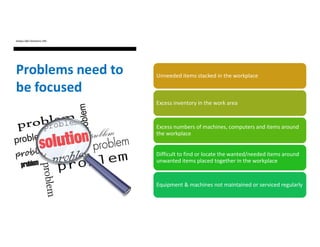
Problems need to
be focused
Unneeded items stacked in the workplace
Excess inventory in the work area
Excess numbers of machines, computers and items around
the workplace
Difficult to find or locate the wanted/needed items around
unwanted items placed together in the workplace
Equipment & machines not maintained or serviced regularly
Aadya L&D Solutions URL
1st S
Seiri – Sort Out/Separate
Aadya L&D Solutions URL
1st S
Seiri – Sort Out/Separate
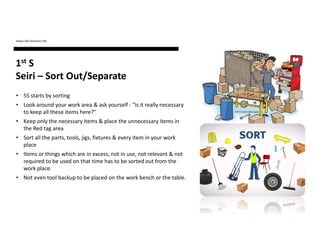
• 5S starts by sorting
• Look around your work area & ask yourself - "Is it really necessary
to keep all these items here?"
• Keep only the necessary items & place the unnecessary items in
the Red tag area
• Sort all the parts, tools, jigs, fixtures & every item in your work
place
• Items or things which are in excess, not in use, not relevant & not
required to be used on that time has to be sorted out from the
work place.
• Not even tool backup to be placed on the work bench or the table.
Aadya L&D Solutions URL
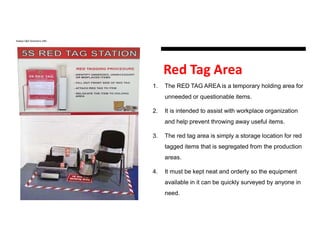
Red Tag Area
1. The RED TAG AREA is a temporary holding area for
unneeded or questionable items.
2. It is intended to assist with workplace organization
and help prevent throwing away useful items.
3. The red tag area is simply a storage location for red
tagged items that is segregated from the production
areas.
4. It must be kept neat and orderly so the equipment
available in it can be quickly surveyed by anyone in
need.
Aadya L&D Solutions URL
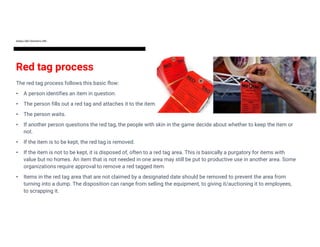
Red tag process
The red tag process follows this basic flow:
• A person identifies an item in question.
• The person fills out a red tag and attaches it to the item.
• The person waits.
• If another person questions the red tag, the people with skin in the game decide about whether to keep the item or
not.
• If the item is to be kept, the red tag is removed.
• If the item is not to be kept, it is disposed of, often to a red tag area. This is basically a purgatory for items with
value but no homes. An item that is not needed in one area may still be put to productive use in another area. Some
organizations require approval to remove a red tagged item.
• Items in the red tag area that are not claimed by a designated date should be removed to prevent the area from
turning into a dump. The disposition can range from selling the equipment, to giving it/auctioning it to employees,
to scrapping it.
Aadya L&D Solutions URL
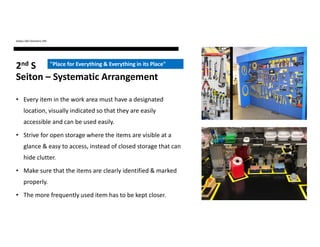
2nd S
Seiton – Systematic Arrangement
• Every item in the work area must have a designated
location, visually indicated so that they are easily
accessible and can be used easily.
• Strive for open storage where the items are visible at a
glance & easy to access, instead of closed storage that can
hide clutter.
• Make sure that the items are clearly identified & marked
properly.
• The more frequently used item has to be kept closer.
"Place for Everything & Everything in its Place"
Aadya L&D Solutions URL
2nd S
Seiton – Systematic
Arrangement
Aadya L&D Solutions URL
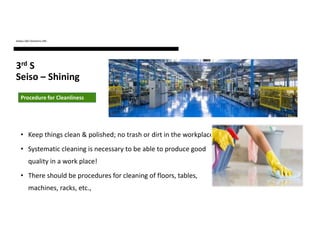
3rd S
Seiso – Shining
• Keep things clean & polished; no trash or dirt in the workplace
• Systematic cleaning is necessary to be able to produce good
quality in a work place!
• There should be procedures for cleaning of floors, tables,
machines, racks, etc.,
Procedure for Cleanliness
Aadya L&D Solutions URL
3rd S
Seiso – Shining
What
has to be
cleaned:
Work Bench/Table
Machines & Equipment
Tools and Jigs/Fixtures
Floor & Pillars
Walls & Windows
Ceilings, Lightings & AC
Pipe lines
Document racks
Consumable racks
Aadya L&D Solutions URL
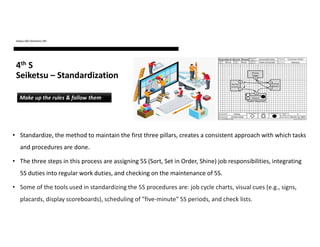
4th S
Seiketsu – Standardization
• Standardize, the method to maintain the first three pillars, creates a consistent approach with which tasks
and procedures are done.
• The three steps in this process are assigning 5S (Sort, Set in Order, Shine) job responsibilities, integrating
5S duties into regular work duties, and checking on the maintenance of 5S.
• Some of the tools used in standardizing the 5S procedures are: job cycle charts, visual cues (e.g., signs,
placards, display scoreboards), scheduling of "five-minute" 5S periods, and check lists.
Make up the rules & follow them
Aadya L&D Solutions URL
4th S - Seiketsu
What has to
be
standardized:
Work area Layout
Cycle time of work
Sequence of work
Materials & Tools used
Machines/Equipment and their process parameters
Quality Parameters
Methods of measuring Quality Parameters
What, When, Where, Who & How the work has to be standardized
Aadya L&D Solutions URL
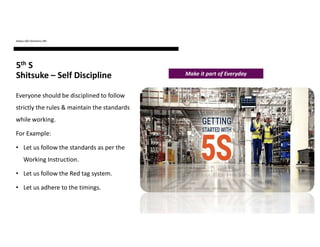
5th S
Shitsuke – Self Discipline
Everyone should be disciplined to follow
strictly the rules & maintain the standards
while working.
For Example:
• Let us follow the standards as per the
Working Instruction.
• Let us follow the Red tag system.
• Let us adhere to the timings.
Make it part of Everyday
Aadya L&D Solutions URL
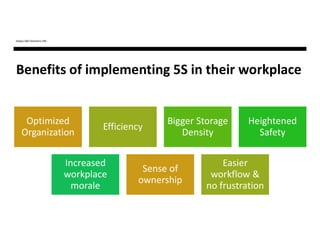
Benefits of implementing 5S in their workplace
Optimized
Organization
Efficiency
Bigger Storage
Density
Heightened
Safety
Increased
workplace
morale
Sense of
ownership
Easier
workflow &
no frustration
Aadya L&D Solutions URL
Thank you
Aadya L&D Solutions URL

5S Workplace Organization Techniques Training module

  • 1.
    5S – Workplace Organization TrainingModule Aadya L&D Solutions URL
  • 2.
    Objective of thetraining • To understand what 5S is & its origin • To understand the problems need to be focused • To understand 5S techniques • To know the benefits of implementing 5S in their workplace • To implement 5S in the workplace successfully Aadya L&D Solutions URL
  • 3.
    What 5S is..5S comes from Toyota, Japan. 5S is the methodology for the Work place Organization. 5S is the five steps explained in Japanese words. 5S comes from Lean Manufacturing concepts and it is the first step towards Lean. Aadya L&D Solutions URL
  • 4.
    What 5S is.. 1.Seiri – Sorting or Separating 2. Seiton – Systematic Arrangement 3. Seiso – Shining 4. Seiketsu – Standardization 5. Shitsuke – Self-discipline or Sustenance Aadya L&D Solutions URL
  • 5.
    Problems need to befocused Unneeded items stacked in the workplace Excess inventory in the work area Excess numbers of machines, computers and items around the workplace Difficult to find or locate the wanted/needed items around unwanted items placed together in the workplace Equipment & machines not maintained or serviced regularly Aadya L&D Solutions URL
  • 6.
    1st S Seiri –Sort Out/Separate Aadya L&D Solutions URL
  • 7.
    1st S Seiri –Sort Out/Separate • 5S starts by sorting • Look around your work area & ask yourself - "Is it really necessary to keep all these items here?" • Keep only the necessary items & place the unnecessary items in the Red tag area • Sort all the parts, tools, jigs, fixtures & every item in your work place • Items or things which are in excess, not in use, not relevant & not required to be used on that time has to be sorted out from the work place. • Not even tool backup to be placed on the work bench or the table. Aadya L&D Solutions URL
  • 8.
    Red Tag Area 1.The RED TAG AREA is a temporary holding area for unneeded or questionable items. 2. It is intended to assist with workplace organization and help prevent throwing away useful items. 3. The red tag area is simply a storage location for red tagged items that is segregated from the production areas. 4. It must be kept neat and orderly so the equipment available in it can be quickly surveyed by anyone in need. Aadya L&D Solutions URL
  • 9.
    Red tag process Thered tag process follows this basic flow: • A person identifies an item in question. • The person fills out a red tag and attaches it to the item. • The person waits. • If another person questions the red tag, the people with skin in the game decide about whether to keep the item or not. • If the item is to be kept, the red tag is removed. • If the item is not to be kept, it is disposed of, often to a red tag area. This is basically a purgatory for items with value but no homes. An item that is not needed in one area may still be put to productive use in another area. Some organizations require approval to remove a red tagged item. • Items in the red tag area that are not claimed by a designated date should be removed to prevent the area from turning into a dump. The disposition can range from selling the equipment, to giving it/auctioning it to employees, to scrapping it. Aadya L&D Solutions URL
  • 10.
    2nd S Seiton –Systematic Arrangement • Every item in the work area must have a designated location, visually indicated so that they are easily accessible and can be used easily. • Strive for open storage where the items are visible at a glance & easy to access, instead of closed storage that can hide clutter. • Make sure that the items are clearly identified & marked properly. • The more frequently used item has to be kept closer. "Place for Everything & Everything in its Place" Aadya L&D Solutions URL
  • 11.
    2nd S Seiton –Systematic Arrangement Aadya L&D Solutions URL
  • 12.
    3rd S Seiso –Shining • Keep things clean & polished; no trash or dirt in the workplace • Systematic cleaning is necessary to be able to produce good quality in a work place! • There should be procedures for cleaning of floors, tables, machines, racks, etc., Procedure for Cleanliness Aadya L&D Solutions URL
  • 13.
    3rd S Seiso –Shining What has to be cleaned: Work Bench/Table Machines & Equipment Tools and Jigs/Fixtures Floor & Pillars Walls & Windows Ceilings, Lightings & AC Pipe lines Document racks Consumable racks Aadya L&D Solutions URL
  • 14.
    4th S Seiketsu –Standardization • Standardize, the method to maintain the first three pillars, creates a consistent approach with which tasks and procedures are done. • The three steps in this process are assigning 5S (Sort, Set in Order, Shine) job responsibilities, integrating 5S duties into regular work duties, and checking on the maintenance of 5S. • Some of the tools used in standardizing the 5S procedures are: job cycle charts, visual cues (e.g., signs, placards, display scoreboards), scheduling of "five-minute" 5S periods, and check lists. Make up the rules & follow them Make up the rules & follow them Aadya L&D Solutions URL
  • 15.
    4th S -Seiketsu What has to be standardized: Work area Layout Cycle time of work Sequence of work Materials & Tools used Machines/Equipment and their process parameters Quality Parameters Methods of measuring Quality Parameters What, When, Where, Who & How the work has to be standardized Aadya L&D Solutions URL
  • 16.
    5th S Shitsuke –Self Discipline Everyone should be disciplined to follow strictly the rules & maintain the standards while working. For Example: • Let us follow the standards as per the Working Instruction. • Let us follow the Red tag system. • Let us adhere to the timings. Make it part of Everyday Aadya L&D Solutions URL
  • 17.
    Benefits of implementing5S in their workplace Optimized Organization Efficiency Bigger Storage Density Heightened Safety Increased workplace morale Sense of ownership Easier workflow & no frustration Aadya L&D Solutions URL
  • 18.
    Thank you Aadya L&DSolutions URL