Differential Leveling
4. Theinitial backsight (BS) is taken to a point of
known elevation
5. The backsight reading is added to the elevation of
the known point to compute the height of the
instrument (HI)
6. The level may be moved to a temporary point called a
turning point (TP)
7. The elevation of a point is the height of the
instrument (HI) minus the foresight (FS)
2.
Differential Leveling
Computation ofElevations - Group Problem
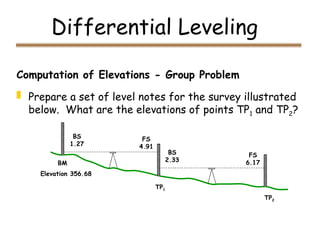
Prepare a set of level notes for the survey illustrated
below. What are the elevations of points TP1 and TP2?
BS
1.27
FS
4.91
TP1
BM
BS
2.33
FS
6.17
TP2
Elevation 356.68
3.
Differential Leveling
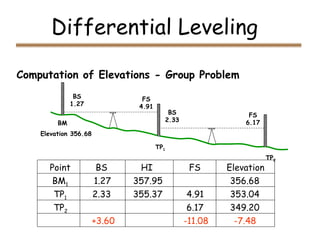
Computation ofElevations - Group Problem
BS
1.27
FS
4.91
TP1
BM
BS
2.33
FS
6.17
TP2
Elevation 356.68
1.27 357.95
4.91 353.04
2.33 355.37
6.17
Point
BM1
TP1
Elevation
BS HI FS
TP2 349.20
356.68
+3.60 -11.08 -7.48
4.
Differential Leveling
E. CommonMistakes
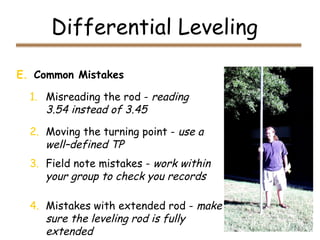
1. Misreading the rod - reading
3.54 instead of 3.45
2. Moving the turning point - use a
well–defined TP
3. Field note mistakes - work within
your group to check you records
4. Mistakes with extended rod - make
sure the leveling rod is fully
extended
5.
Differential Leveling
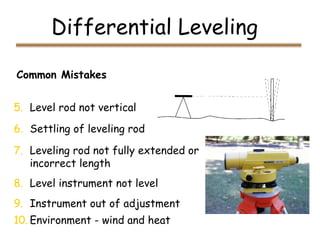
Common Mistakes
5.Level rod not vertical
6. Settling of leveling rod
7. Leveling rod not fully extended or
incorrect length
8. Level instrument not level
9. Instrument out of adjustment
10. Environment - wind and heat
6.
Differential Leveling
F. Suggestionsfor Good Leveling
1. Anchor tripod legs firmly
2. Check the bubble level before and after each reading
3. Take as little time as possible between BS and FS
4. Try to keep the distance to the BS and the FS equal
5. Provide the rodperson with a level for the rod
Differential Leveling Review
1.Why is differential leveling called
differential?
2. What does B.M. , B.S., H.I., and F.S. stand for
in surveying?
3. If you know the starting elevation and the
B.S., how do you calculate the H.I.?
4. How do you calculate the evaluation of a T.P.?
5. What common error of leveling do you think
will be made the most in this class and why?