Use of Multimeter
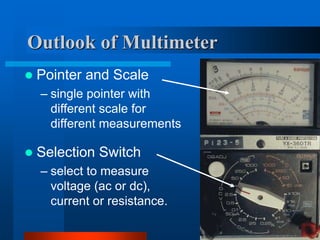
Outlook of Multimeter
 Pointer and Scale
– single pointer with
different scale for
different measurements
 Selection Switch
– select to measure
voltage (ac or dc),
current or resistance.
Reading from
Multimeter
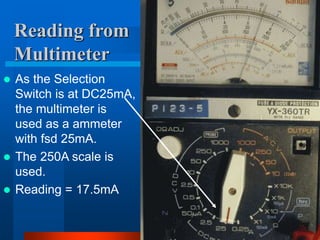
 As the Selection
Switch is at DC25mA,
the multimeter is
used as a ammeter
with fsd 25mA.
 The 250A scale is
used.
 Reading = 17.5mA
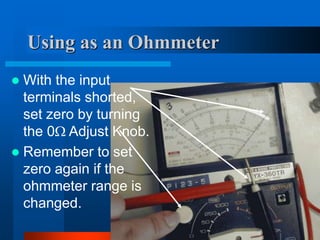
Using as an Ohmmeter
 With the input
terminals shorted,
set zero by turning
the 0 Adjust Knob.
 Remember to set
zero again if the
ohmmeter range is
changed.
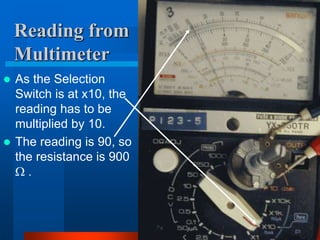
Reading from
Multimeter
 As the Selection
Switch is at x10, the
reading has to be
multiplied by 10.
 The reading is 90, so
the resistance is 900
 .
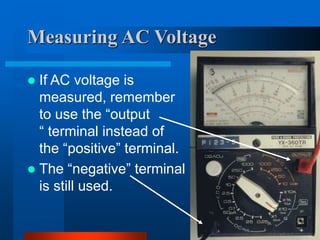
Measuring AC Voltage
 If AC voltage is
measured, remember
to use the “output
“ terminal instead of
the “positive” terminal.
 The “negative” terminal
is still used.
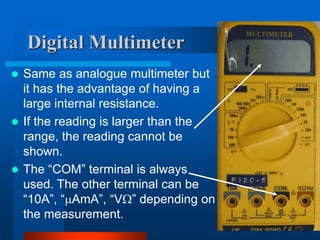
Digital Multimeter
 Same as analogue multimeter but
it has the advantage of having a
large internal resistance.
 If the reading is larger than the
range, the reading cannot be
shown.
 The “COM” terminal is always
used. The other terminal can be
“10A”, “AmA”, “V” depending on
the measurement.
Digital Ohmmeter
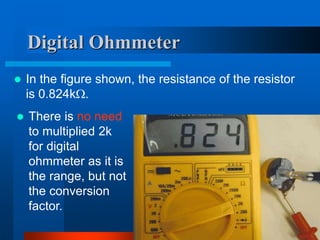
 In the figure shown, the resistance of the resistor
is 0.824k.
 There is no need
to multiplied 2k
for digital
ohmmeter as it is
the range, but not
the conversion
factor.
Measuring AC/DC
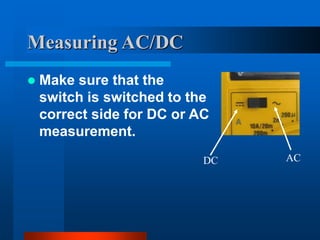
 Make sure that the
switch is switched to the
correct side for DC or AC
measurement.
DC AC

5.1.Multimeter.ppt

  • 1.
  • 2.
    Outlook of Multimeter Pointer and Scale – single pointer with different scale for different measurements  Selection Switch – select to measure voltage (ac or dc), current or resistance.
  • 3.
    Reading from Multimeter  Asthe Selection Switch is at DC25mA, the multimeter is used as a ammeter with fsd 25mA.  The 250A scale is used.  Reading = 17.5mA
  • 4.
    Using as anOhmmeter  With the input terminals shorted, set zero by turning the 0 Adjust Knob.  Remember to set zero again if the ohmmeter range is changed.
  • 5.
    Reading from Multimeter  Asthe Selection Switch is at x10, the reading has to be multiplied by 10.  The reading is 90, so the resistance is 900  .
  • 6.
    Measuring AC Voltage If AC voltage is measured, remember to use the “output “ terminal instead of the “positive” terminal.  The “negative” terminal is still used.
  • 7.
    Digital Multimeter  Sameas analogue multimeter but it has the advantage of having a large internal resistance.  If the reading is larger than the range, the reading cannot be shown.  The “COM” terminal is always used. The other terminal can be “10A”, “AmA”, “V” depending on the measurement.
  • 8.
    Digital Ohmmeter  Inthe figure shown, the resistance of the resistor is 0.824k.  There is no need to multiplied 2k for digital ohmmeter as it is the range, but not the conversion factor.
  • 9.
    Measuring AC/DC  Makesure that the switch is switched to the correct side for DC or AC measurement. DC AC