Measuring Business Strategy Through Balance Scorecard
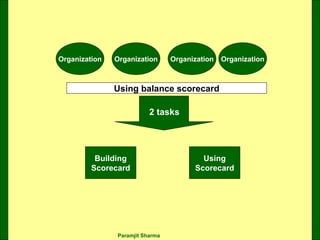
Organization Using balance scorecard 2 tasks Building Scorecard Using Scorecard Organization Organization Organization
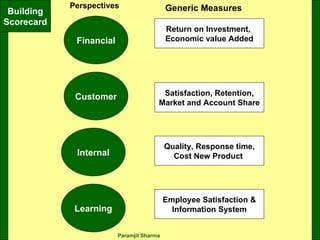
Building Scorecard Financial Customer Internal Learning Return on Investment,  Economic value Added Satisfaction, Retention, Market and Account Share Quality, Response time, Cost New Product  Employee Satisfaction & Information System Perspectives Generic Measures
Financial Perspective
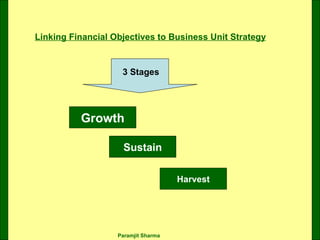
Linking Financial Objectives to Business Unit Strategy 3 Stages Growth Sustain Harvest
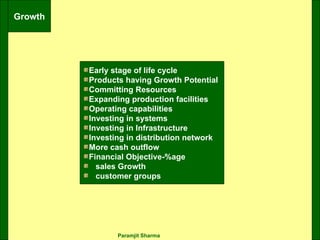
Growth Early stage of life cycle Products having Growth Potential Committing Resources Expanding production facilities Operating capabilities Investing in systems Investing in Infrastructure Investing in distribution network More cash outflow Financial Objective-%age sales Growth customer groups
Sustain Stage Attract investments Required extra return Maintain existing markets Growth is expected Enhancing improvements Profitability Return on Investment Economic Value Added
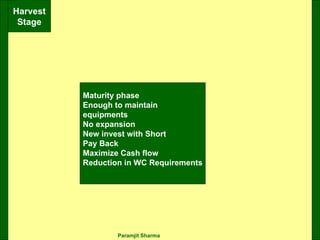
Harvest Stage Maturity phase Enough to maintain  equipments No expansion New invest with Short  Pay Back Maximize Cash flow Reduction in WC Requirements
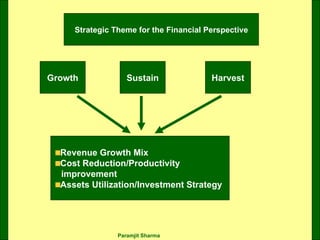
Strategic Theme for the Financial Perspective Growth Sustain Harvest Revenue Growth Mix Cost Reduction/Productivity  improvement Assets Utilization/Investment Strategy
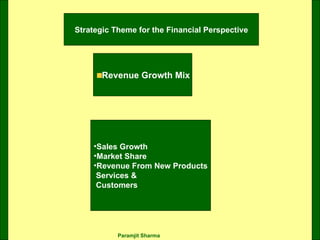
Strategic Theme for the Financial Perspective Revenue Growth Mix Sales Growth Market Share Revenue From New Products Services & Customers
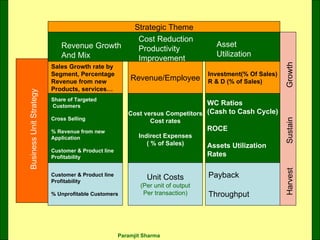
Strategic Theme Sales Growth rate by Segment, Percentage Revenue from new Products, services… Revenue/Employee Investment(% Of Sales) R & D (% of Sales) Share of Targeted Customers Cross Selling % Revenue from new  Application Customer & Product line Profitability Customer & Product line Profitability % Unprofitable Customers Cost versus Competitors Cost rates Indirect Expenses ( % of Sales) WC Ratios (Cash to Cash Cycle) ROCE Assets Utilization Rates Unit Costs (Per unit of output Per transaction) Payback Throughput Revenue Growth And Mix Cost Reduction Productivity Improvement Asset Utilization Business Unit Strategy Growth Sustain Harvest
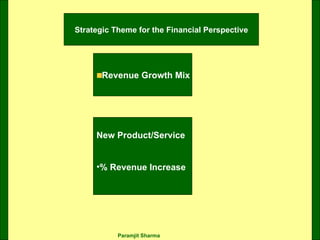
Strategic Theme for the Financial Perspective Revenue Growth Mix New Product/Service % Revenue Increase
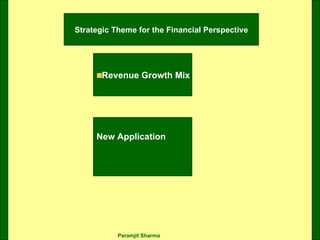
Strategic Theme for the Financial Perspective Revenue Growth Mix New Application
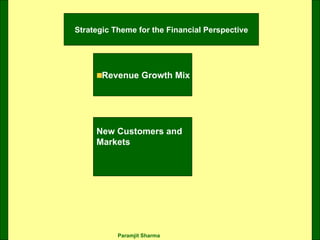
Strategic Theme for the Financial Perspective Revenue Growth Mix New Customers and  Markets
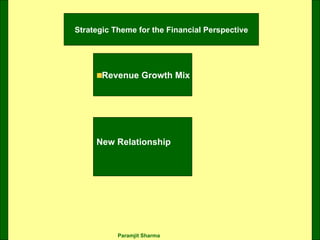
Strategic Theme for the Financial Perspective Revenue Growth Mix New Relationship
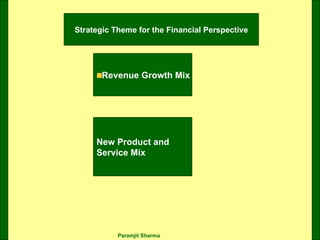
Strategic Theme for the Financial Perspective Revenue Growth Mix New Product and Service Mix
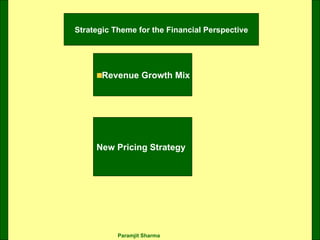
Strategic Theme for the Financial Perspective Revenue Growth Mix New Pricing Strategy
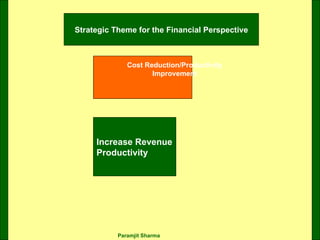
Strategic Theme for the Financial Perspective Cost Reduction/Productivity Improvement Increase Revenue Productivity
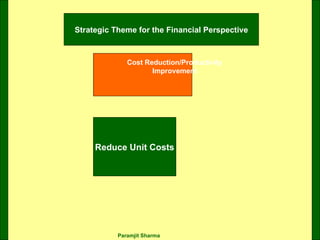
Strategic Theme for the Financial Perspective Cost Reduction/Productivity Improvement Reduce Unit Costs
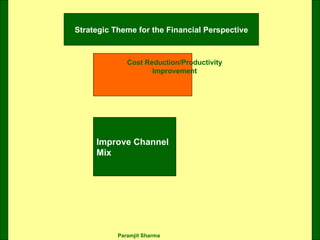
Strategic Theme for the Financial Perspective Cost Reduction/Productivity Improvement Improve Channel  Mix
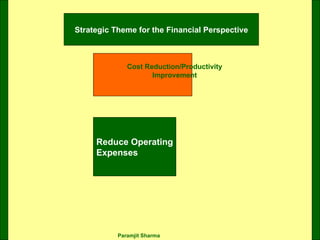
Strategic Theme for the Financial Perspective Cost Reduction/Productivity Improvement Reduce Operating Expenses
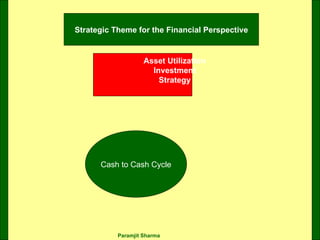
Strategic Theme for the Financial Perspective Asset Utilization Investment Strategy Cash to Cash Cycle
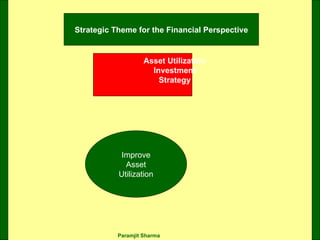
Strategic Theme for the Financial Perspective Asset Utilization Investment Strategy Improve Asset Utilization
Questions

5032771 Balanced Scorecardfinancial Perspective

  • 1.
    Measuring Business StrategyThrough Balance Scorecard
  • 2.
    Organization Using balancescorecard 2 tasks Building Scorecard Using Scorecard Organization Organization Organization
  • 3.
    Building Scorecard FinancialCustomer Internal Learning Return on Investment, Economic value Added Satisfaction, Retention, Market and Account Share Quality, Response time, Cost New Product Employee Satisfaction & Information System Perspectives Generic Measures
  • 4.
  • 5.
    Linking Financial Objectivesto Business Unit Strategy 3 Stages Growth Sustain Harvest
  • 6.
    Growth Early stageof life cycle Products having Growth Potential Committing Resources Expanding production facilities Operating capabilities Investing in systems Investing in Infrastructure Investing in distribution network More cash outflow Financial Objective-%age sales Growth customer groups
  • 7.
    Sustain Stage Attractinvestments Required extra return Maintain existing markets Growth is expected Enhancing improvements Profitability Return on Investment Economic Value Added
  • 8.
    Harvest Stage Maturityphase Enough to maintain equipments No expansion New invest with Short Pay Back Maximize Cash flow Reduction in WC Requirements
  • 9.
    Strategic Theme forthe Financial Perspective Growth Sustain Harvest Revenue Growth Mix Cost Reduction/Productivity improvement Assets Utilization/Investment Strategy
  • 10.
    Strategic Theme forthe Financial Perspective Revenue Growth Mix Sales Growth Market Share Revenue From New Products Services & Customers
  • 11.
    Strategic Theme SalesGrowth rate by Segment, Percentage Revenue from new Products, services… Revenue/Employee Investment(% Of Sales) R & D (% of Sales) Share of Targeted Customers Cross Selling % Revenue from new Application Customer & Product line Profitability Customer & Product line Profitability % Unprofitable Customers Cost versus Competitors Cost rates Indirect Expenses ( % of Sales) WC Ratios (Cash to Cash Cycle) ROCE Assets Utilization Rates Unit Costs (Per unit of output Per transaction) Payback Throughput Revenue Growth And Mix Cost Reduction Productivity Improvement Asset Utilization Business Unit Strategy Growth Sustain Harvest
  • 12.
    Strategic Theme forthe Financial Perspective Revenue Growth Mix New Product/Service % Revenue Increase
  • 13.
    Strategic Theme forthe Financial Perspective Revenue Growth Mix New Application
  • 14.
    Strategic Theme forthe Financial Perspective Revenue Growth Mix New Customers and Markets
  • 15.
    Strategic Theme forthe Financial Perspective Revenue Growth Mix New Relationship
  • 16.
    Strategic Theme forthe Financial Perspective Revenue Growth Mix New Product and Service Mix
  • 17.
    Strategic Theme forthe Financial Perspective Revenue Growth Mix New Pricing Strategy
  • 18.
    Strategic Theme forthe Financial Perspective Cost Reduction/Productivity Improvement Increase Revenue Productivity
  • 19.
    Strategic Theme forthe Financial Perspective Cost Reduction/Productivity Improvement Reduce Unit Costs
  • 20.
    Strategic Theme forthe Financial Perspective Cost Reduction/Productivity Improvement Improve Channel Mix
  • 21.
    Strategic Theme forthe Financial Perspective Cost Reduction/Productivity Improvement Reduce Operating Expenses
  • 22.
    Strategic Theme forthe Financial Perspective Asset Utilization Investment Strategy Cash to Cash Cycle
  • 23.
    Strategic Theme forthe Financial Perspective Asset Utilization Investment Strategy Improve Asset Utilization
  • 24.