Plot Analysis
Lauren Barrett
A2 Media Studies
Music Video Plot Analysis
When writing/creating my 500-word basic plot, I used
the lyrics of the song as my basic starting point as I
want the plot to link in with the plot so the two can
move forward together. Before I started the plot, I
researched into Narrative Theories to ensure that my
plot was going to conform to the general rule which is
followed by most media texts. If I hadn’t have based
my plot on Narrative Theories, my end result would
probably end up looking unprofessional, whereas I
want to create a music video which could almost pass
as a professional, top-quality product.
Music Video Plot Analysis
Whilst I want the music video to conform to Narrative
Theories, I think it applies more to films and film trailers,
as with music videos, there may not always necessarily be
a disequilibrium, due to the different genres of music
videos. For example, if I was creating a completely
performance-based music video, there wouldn’t really be
an ‘equilibrium’ as such, nor would there be a
disequilibrium, and the same is likely to apply to
conceptual-based music videos too. However the
majority of my music video is going to be Narrativebased, and as it says in the title of this specific genre,
there are going to be narrative elements involved, which
is why I had to follow and research narrative theories.
Music Video Plot Analysis
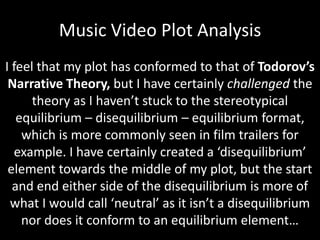
I feel that my plot has conformed to that of Todorov’s
Narrative Theory, but I have certainly challenged the
theory as I haven’t stuck to the stereotypical
equilibrium – disequilibrium – equilibrium format,
which is more commonly seen in film trailers for
example. I have certainly created a ‘disequilibrium’
element towards the middle of my plot, but the start
and end either side of the disequilibrium is more of
what I would call ‘neutral’ as it isn’t a disequilibrium
nor does it conform to an equilibrium element…
Neutral Scene

Music Video Plot Analysis
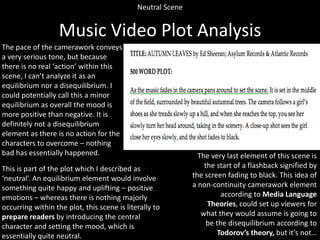
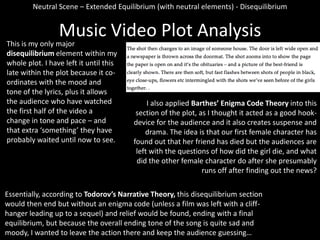
The pace of the camerawork conveys
a very serious tone, but because
there is no real ‘action’ within this
scene, I can’t analyze it as an
equilibrium nor a disequilibrium. I
could potentially call this a minor
equilibrium as overall the mood is
more positive than negative. It is
definitely not a disequilibrium
element as there is no action for the
characters to overcome – nothing
bad has essentially happened.
This is part of the plot which I described as
‘neutral’. An equilibrium element would involve
something quite happy and uplifting – positive
emotions – whereas there is nothing majorly
occurring within the plot, this scene is literally to
prepare readers by introducing the central
character and setting the mood, which is
essentially quite neutral.

The very last element of this scene is
the start of a flashback signified by
the screen fading to black. This idea of
a non-continuity camerawork element
according to Media Language
Theories, could set up viewers for
what they would assume is going to
be the disequilibrium according to
Todorov’s theory, but it’s not…
Neutral Scene - Equilibrium

Music Video Plot Analysis
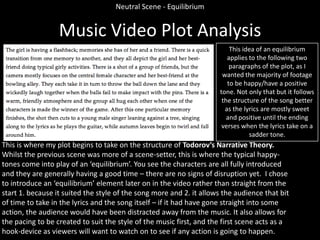
This idea of an equilibrium
applies to the following two
paragraphs of the plot, as I
wanted the majority of footage
to be happy/have a positive
tone. Not only that but it follows
the structure of the song better
as the lyrics are mostly sweet
and positive until the ending
verses when the lyrics take on a
sadder tone.

This is where my plot begins to take on the structure of Todorov’s Narrative Theory.
Whilst the previous scene was more of a scene-setter, this is where the typical happytones come into play of an ‘equilibrium’. You see the characters are all fully introduced
and they are generally having a good time – there are no signs of disruption yet. I chose
to introduce an ‘equilibrium’ element later on in the video rather than straight from the
start 1. because it suited the style of the song more and 2. it allows the audience that bit
of time to take in the lyrics and the song itself – if it had have gone straight into some
action, the audience would have been distracted away from the music. It also allows for
the pacing to be created to suit the style of the music first, and the first scene acts as a
hook-device as viewers will want to watch on to see if any action is going to happen.
Neutral Scene – Extended Equilibrium (with neutral elements)

Music Video Plot Analysis
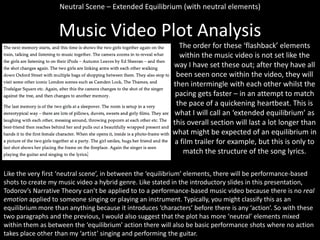
The order for these ‘flashback’ elements
within the music video is not set like the
way I have set these out; after they have all
been seen once within the video, they will
then intermingle with each other whilst the
pacing gets faster – in an attempt to match
the pace of a quickening heartbeat. This is
what I will call an ‘extended equilibrium’ as
this overall section will last a lot longer than
what might be expected of an equilibrium in
a film trailer for example, but this is only to
match the structure of the song lyrics.
Like the very first ‘neutral scene’, in between the ‘equilibrium’ elements, there will be performance-based
shots to create my music video a hybrid genre. Like stated in the introductory slides in this presentation,
Todorov’s Narrative Theory can’t be applied to to a performance-based music video because there is no real
emotion applied to someone singing or playing an instrument. Typically, you might classify this as an
equilibrium more than anything because it introduces ‘characters’ before there is any ‘action’. So with these
two paragraphs and the previous, I would also suggest that the plot has more ‘neutral’ elements mixed
within them as between the ‘equilibrium’ action there will also be basic performance shots where no action
takes place other than my ‘artist’ singing and performing the guitar.
Neutral Scene – Extended Equilibrium (with neutral elements) - Disequilibrium

Music Video Plot Analysis

This is my only major
disequilibrium element within my
whole plot. I have left it until this
late within the plot because it coordinates with the mood and
tone of the lyrics, plus it allows
the audience who have watched
the first half of the video a
change in tone and pace – and
that extra ‘something’ they have
probably waited until now to see.

I also applied Barthes’ Enigma Code Theory into this
section of the plot, as I thought it acted as a good hookdevice for the audience and it also creates suspense and
drama. The idea is that our first female character has
found out that her friend has died but the audiences are
left with the questions of how did the girl die, and what
did the other female character do after she presumably
runs off after finding out the news?

Essentially, according to Todorov’s Narrative Theory, this disequilibrium section
would then end but without an enigma code (unless a film was left with a cliffhanger leading up to a sequel) and relief would be found, ending with a final
equilibrium, but because the overall ending tone of the song is quite sad and
moody, I wanted to leave the action there and keep the audience guessing…
Neutral Scene – Extended Equilibrium (with neutral elements) – Disequilibrium – Final Neutral
Scene/Equilibrium

Music Video Plot Analysis

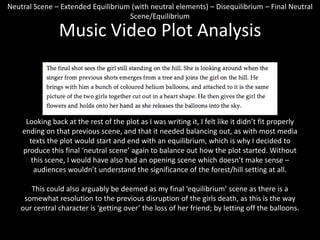
Looking back at the rest of the plot as I was writing it, I felt like it didn’t fit properly
ending on that previous scene, and that it needed balancing out, as with most media
texts the plot would start and end with an equilibrium, which is why I decided to
produce this final ‘neutral scene’ again to balance out how the plot started. Without
this scene, I would have also had an opening scene which doesn’t make sense –
audiences wouldn’t understand the significance of the forest/hill setting at all.
This could also arguably be deemed as my final ‘equilibrium’ scene as there is a
somewhat resolution to the previous disruption of the girls death, as this is the way
our central character is ‘getting over’ the loss of her friend; by letting off the balloons.

500 word plot analysis

  • 1.
  • 2.
    Music Video PlotAnalysis When writing/creating my 500-word basic plot, I used the lyrics of the song as my basic starting point as I want the plot to link in with the plot so the two can move forward together. Before I started the plot, I researched into Narrative Theories to ensure that my plot was going to conform to the general rule which is followed by most media texts. If I hadn’t have based my plot on Narrative Theories, my end result would probably end up looking unprofessional, whereas I want to create a music video which could almost pass as a professional, top-quality product.
  • 3.
    Music Video PlotAnalysis Whilst I want the music video to conform to Narrative Theories, I think it applies more to films and film trailers, as with music videos, there may not always necessarily be a disequilibrium, due to the different genres of music videos. For example, if I was creating a completely performance-based music video, there wouldn’t really be an ‘equilibrium’ as such, nor would there be a disequilibrium, and the same is likely to apply to conceptual-based music videos too. However the majority of my music video is going to be Narrativebased, and as it says in the title of this specific genre, there are going to be narrative elements involved, which is why I had to follow and research narrative theories.
  • 4.
    Music Video PlotAnalysis I feel that my plot has conformed to that of Todorov’s Narrative Theory, but I have certainly challenged the theory as I haven’t stuck to the stereotypical equilibrium – disequilibrium – equilibrium format, which is more commonly seen in film trailers for example. I have certainly created a ‘disequilibrium’ element towards the middle of my plot, but the start and end either side of the disequilibrium is more of what I would call ‘neutral’ as it isn’t a disequilibrium nor does it conform to an equilibrium element…
  • 5.
    Neutral Scene Music VideoPlot Analysis The pace of the camerawork conveys a very serious tone, but because there is no real ‘action’ within this scene, I can’t analyze it as an equilibrium nor a disequilibrium. I could potentially call this a minor equilibrium as overall the mood is more positive than negative. It is definitely not a disequilibrium element as there is no action for the characters to overcome – nothing bad has essentially happened. This is part of the plot which I described as ‘neutral’. An equilibrium element would involve something quite happy and uplifting – positive emotions – whereas there is nothing majorly occurring within the plot, this scene is literally to prepare readers by introducing the central character and setting the mood, which is essentially quite neutral. The very last element of this scene is the start of a flashback signified by the screen fading to black. This idea of a non-continuity camerawork element according to Media Language Theories, could set up viewers for what they would assume is going to be the disequilibrium according to Todorov’s theory, but it’s not…
  • 6.
    Neutral Scene -Equilibrium Music Video Plot Analysis This idea of an equilibrium applies to the following two paragraphs of the plot, as I wanted the majority of footage to be happy/have a positive tone. Not only that but it follows the structure of the song better as the lyrics are mostly sweet and positive until the ending verses when the lyrics take on a sadder tone. This is where my plot begins to take on the structure of Todorov’s Narrative Theory. Whilst the previous scene was more of a scene-setter, this is where the typical happytones come into play of an ‘equilibrium’. You see the characters are all fully introduced and they are generally having a good time – there are no signs of disruption yet. I chose to introduce an ‘equilibrium’ element later on in the video rather than straight from the start 1. because it suited the style of the song more and 2. it allows the audience that bit of time to take in the lyrics and the song itself – if it had have gone straight into some action, the audience would have been distracted away from the music. It also allows for the pacing to be created to suit the style of the music first, and the first scene acts as a hook-device as viewers will want to watch on to see if any action is going to happen.
  • 7.
    Neutral Scene –Extended Equilibrium (with neutral elements) Music Video Plot Analysis The order for these ‘flashback’ elements within the music video is not set like the way I have set these out; after they have all been seen once within the video, they will then intermingle with each other whilst the pacing gets faster – in an attempt to match the pace of a quickening heartbeat. This is what I will call an ‘extended equilibrium’ as this overall section will last a lot longer than what might be expected of an equilibrium in a film trailer for example, but this is only to match the structure of the song lyrics. Like the very first ‘neutral scene’, in between the ‘equilibrium’ elements, there will be performance-based shots to create my music video a hybrid genre. Like stated in the introductory slides in this presentation, Todorov’s Narrative Theory can’t be applied to to a performance-based music video because there is no real emotion applied to someone singing or playing an instrument. Typically, you might classify this as an equilibrium more than anything because it introduces ‘characters’ before there is any ‘action’. So with these two paragraphs and the previous, I would also suggest that the plot has more ‘neutral’ elements mixed within them as between the ‘equilibrium’ action there will also be basic performance shots where no action takes place other than my ‘artist’ singing and performing the guitar.
  • 8.
    Neutral Scene –Extended Equilibrium (with neutral elements) - Disequilibrium Music Video Plot Analysis This is my only major disequilibrium element within my whole plot. I have left it until this late within the plot because it coordinates with the mood and tone of the lyrics, plus it allows the audience who have watched the first half of the video a change in tone and pace – and that extra ‘something’ they have probably waited until now to see. I also applied Barthes’ Enigma Code Theory into this section of the plot, as I thought it acted as a good hookdevice for the audience and it also creates suspense and drama. The idea is that our first female character has found out that her friend has died but the audiences are left with the questions of how did the girl die, and what did the other female character do after she presumably runs off after finding out the news? Essentially, according to Todorov’s Narrative Theory, this disequilibrium section would then end but without an enigma code (unless a film was left with a cliffhanger leading up to a sequel) and relief would be found, ending with a final equilibrium, but because the overall ending tone of the song is quite sad and moody, I wanted to leave the action there and keep the audience guessing…
  • 9.
    Neutral Scene –Extended Equilibrium (with neutral elements) – Disequilibrium – Final Neutral Scene/Equilibrium Music Video Plot Analysis Looking back at the rest of the plot as I was writing it, I felt like it didn’t fit properly ending on that previous scene, and that it needed balancing out, as with most media texts the plot would start and end with an equilibrium, which is why I decided to produce this final ‘neutral scene’ again to balance out how the plot started. Without this scene, I would have also had an opening scene which doesn’t make sense – audiences wouldn’t understand the significance of the forest/hill setting at all. This could also arguably be deemed as my final ‘equilibrium’ scene as there is a somewhat resolution to the previous disruption of the girls death, as this is the way our central character is ‘getting over’ the loss of her friend; by letting off the balloons.