50 WORDS FOR SNOW
The construction of natural phenomena in science
John S. Wilkins
What are phenomena?
Hobbes: “… such things as appear, or are shown to us by nature,
we call phenomena or appearances” [De Corpore, IV, ch XXV.]
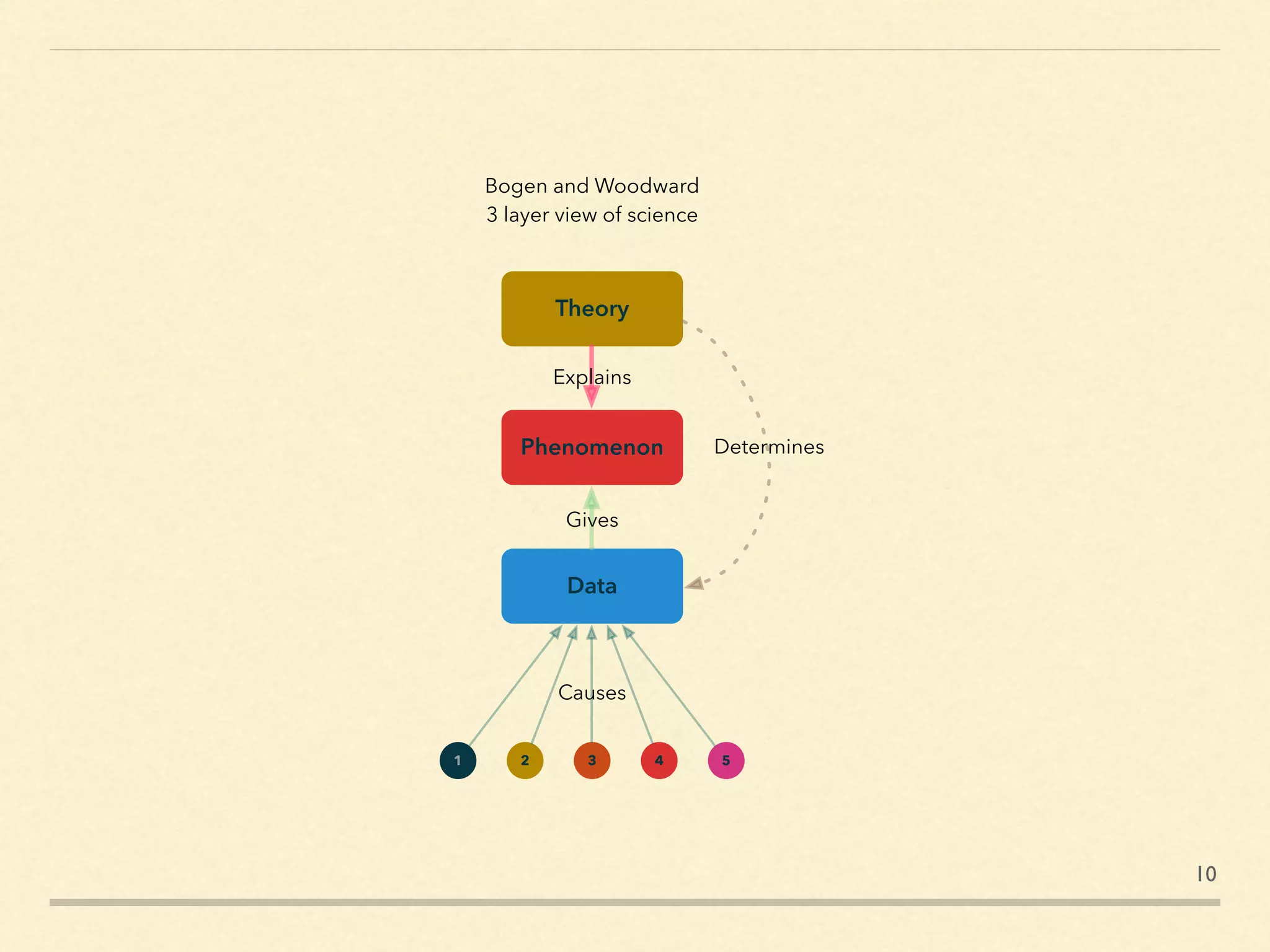
Bogen and Woodward hold that phenomena are derived from
data, which are recorded measurements
They speak of “phenomena of interest”
Phenomena are (acc. to B&W) stable interactions with
repeatable characteristics, and of a limited set of variables/
causes
2
But how do we identify phenomena?
Hacking: “Undoubtedly people tend to notice things that are
interesting, surprising, and so forth, and such expectations and
interests are influenced by theories they may hold – not that we
should play down the possibility of the gifted ‘pure’ observer either.”

[Representing and Intervening p179]
It is the noticing of phenomena I wish to discuss today
Are phenomena self-presenting?
Are they theory-based?
Are they just patterns in data? If so, which patterns?
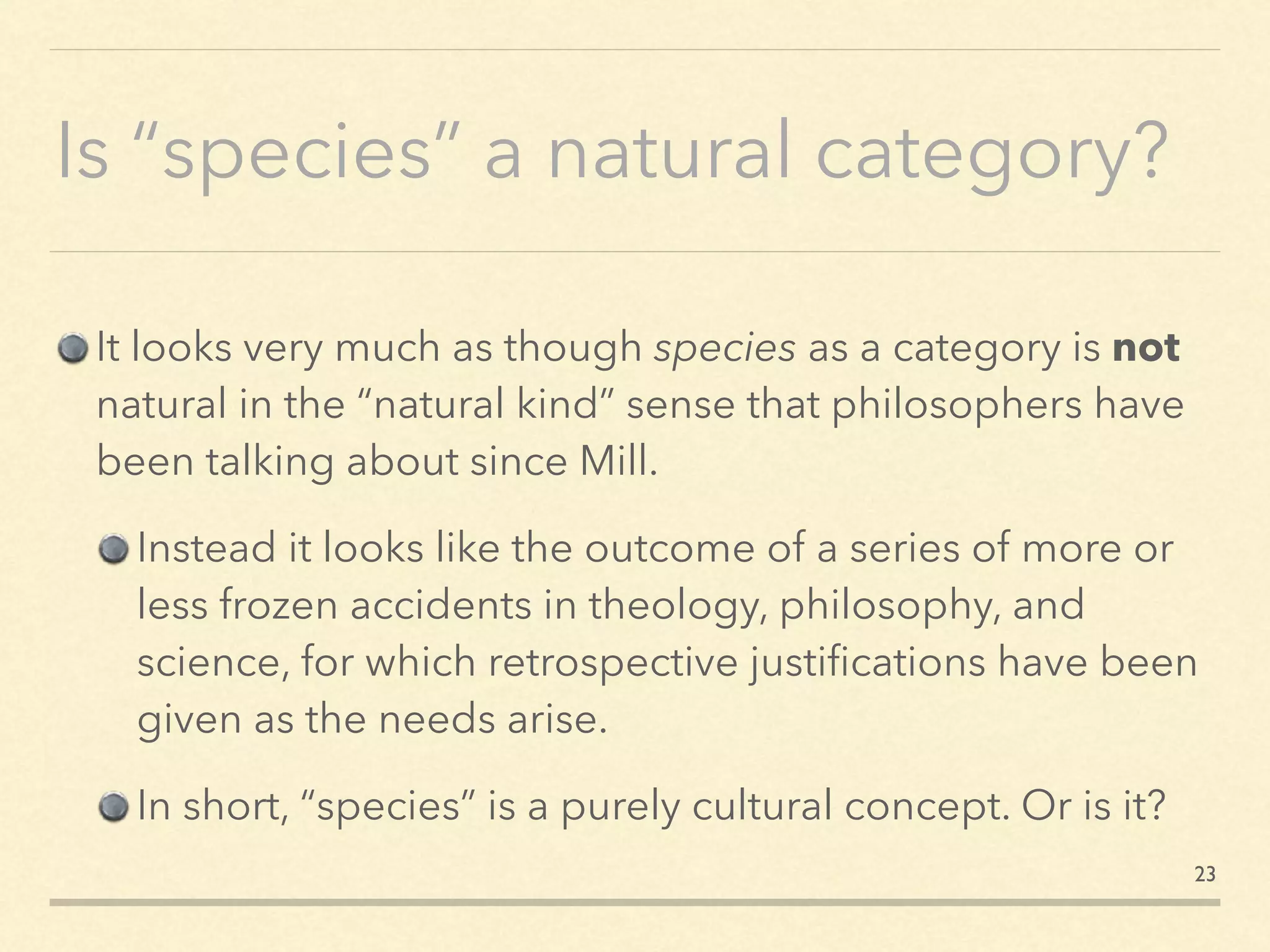
3
4The sliding stones of Death Valley
Hacking said it first, of course
“A phenomenon is noteworthy. A phenomenon is
discernible. A phenomenon is commonly an event of a
certain type that occurs regularly under certain
circumstances. The word can also denote a unique event
that we single out as particularly important. When we
know the regularity exhibited in a phenomenon we
express it in a law-like generalization. The very fact of such
a regularity is sometimes called the phenomenon.”

[Representing and Intervening, p221 ]
5
6Fast as a speeding bullet, with Navier Stokes equations
Linguistic determinism and
theory-dependence
Phenomena such as many types of snow call for many types; that is, many
categories
But linguistic determinism states that our language determines our categories
(in varying degrees of strength from weak to strong) – Sapir-Whorf thesis
Similarly, theory-dependence of observation indicates that our very
observations depend upon prior categories
Many scientific terms – species, gene, electron, individual, niche – seem to
depend on prior linguistic categories
But are they “just” phenomena? How do we come by these “natural
categories”?
7
Bogen and Woodward’s thesis
Bogen and Woodward 1988 argued persuasively that
data are not phenomena until they are arrayed in patterns
Observations are particular measurements
Observations are the evidentiary foundation for
phenomena
Phenomena are explained by theories
Data are not explained by theories
8
James F. Woodward, Synthese, [2011] 182:165–179 [emphasis added]
[We] advocated a three-level picture of scientific
theory or, more accurately, of those theories that were in the
business of providing systematic explanations. Explanatory
theories such as classical mechanics, general relativity, and the
electroweak theory that unifies electromagnetic and weak
nuclear forces were understood as providing explanations of
what we called phenomena—features of the world that in
principle could recur under different contexts or conditions. …
Data are public records produced by measurement and
experiment that serve as evidence for the existence or features
of phenomena
9
10
Data
Phenomenon
Theory
1 2 3 4 5
Explains
Gives
Causes
Bogen and Woodward
3 layer view of science
Determines
11Lightning caused by volcanic eruption
The Starting Problem
If there are no data protocols*, how do we delineate
phenomena?
Are data protocols theory-dependent?
Are phenomena, and their categorical specifications,
theory-dependent too?
How do we start in a de novo domain of inquiry?
12
* I am taking a data protocol to include the metrics, measuring systems, and
procedures of investigation in a field or domain, but not to include analytic
and statistical post-observational techniques.
Theory-based accounts
Observation requires either prior or ancillary theory
“However diverse its structure, the physical phenomenon is not simple but
complex. Usually a mass of previously acquired theoretical knowledge and
experience with apparatus is already incorporated in its description.” 

[Wolfgang Pauli 1957]
So, either
1. There is no way to start a de novo investigation, or
2. Our evolved dispositions to perceive certain things (our Umwelt), count
as theory
1. must be false; 2. beggars the meaning of “theory” in science
13
Empiricist accounts
Naive empiricism: What to attend to?
Abductive phenomena: from observations to best hypothesis
What observations need hypotheses?
Constructive empiricism: empirically adequate, to which empirical
observations?
“a theory is empirically adequate exactly if what it says about the
observable things and events in the world is true—exactly if it ‘saves
the phenomena.’” [van Fraassen 1980, 12]
And so on…
14
What do we make phenomena out
of?
Phenomena are
Observational
Regularities, with
Salience
So the first two are fairly clear, enough for now
What makes a regularity salient? Why do we attend to this
regularity and not one or more of a very large number of others?
15
16Monarch butterfly migration
Species: A case study
All classificatory terms are impossible of exact definition. Their use
always has and always will depend upon the consensus of opinion of
those best qualified by wisdom, experience and natural good sense.
They will never become stable; we shall never cease to amend, to
change, to repudiate old and propose new, because we shall never
reach the final summation of science. [Samuel W. Williston, “What is a
species?”, American Naturalist, (Williston 1908, 184–194)]
The term ‘species’ refers to a concrete phenomenon of nature and
this fact severely constrains the number and kinds of possible
[species] definitions. [Mayr 1996, 263]
17
18
Iridescent starling species
Species: A case study
Over 28 distinct conceptions/definitions of species in play, and 4 replacement
conceptions [Wilkins 2018, Appendix 2]
Scientists do not at all agree on what species are. Nor do they agree on what
counts as sufficient evidence that two organisms are in different species; at least,
not all of the time.
And yet, the standard view is that species are fundamental units of evolution,
ecology, and the other ways that we deal with the biological world.
The very notion of a “level” of biological taxa such as species is itself the outcome
of sociocultural factors—to wit, the need to work out what “kinds” meant in the
Noah’s Ark story so the logistics could be rationalized [Wilkins 2018, p56–62].
If that is the origin, why does species persist among scientists as a category?
19
20
Noah leaving the Ark
Giulio Bonasone (Italian, active Rome and Bologna, 1531–after 1576)
The reality of species
A distinction between CATEGORY REALISM and ENTITY REALISM about species:
CATEGORY SPECIES REALISM is the view that the category is real as well as the
individual entities that fall within it, and it is that which I take aim at here (see
Mishler and Wilkins 2018).
ENTITY SPECIES REALISM is the view that, individually, the entities (as populations,
lineages, etc.) that get called species are real, but the category is not natural.
We can refer to individual species like Homo sapiens, Mesoneura opaca, and
Alchorena ilicifolia (Ereshefsky 1998), even if they are not all of the same
category or type. I can have diverse things in my pocket: a coin, a lighter, and
a ticket. They do not need to be a natural kind to get referred to as “pocketed
items”.
21
22
THE MANY FACES OF CORA LICHENS. CREDIT: LUCKING ET AL, 2014. PNAS.
Is “species” a natural category?
It looks very much as though species as a category is not
natural in the “natural kind” sense that philosophers have
been talking about since Mill.
Instead it looks like the outcome of a series of more or
less frozen accidents in theology, philosophy, and
science, for which retrospective justifications have been
given as the needs arise.
In short, “species” is a purely cultural concept. Or is it?
23
24
Red Wolf, Canis rufus [gray wolf × coyote hybrid]
Is “species” something real?
Several things mitigate this rabid reductionism.
One is that species are often named and retained for centuries, no matter
how the science progresses. Many of the species identified in the
medieval period remain “good” species, for example, although their
nomenclature and arrangement in relation to other species have changed
a lot.
It seems that good observers can identify things in the unconstructed
world even in the absence of theory and method held to be essential to
good science.
Another is that humans tend to find levels of categorization of the
unconstructed world fairly consistently and across cultures and times.
25
26
Positron track, CERN Gargamelle Bubble Chamber, 1973

https://home.cern/about/updates/2015/06/seeing-invisible-event-displays-particle-physics
Species are phenomena
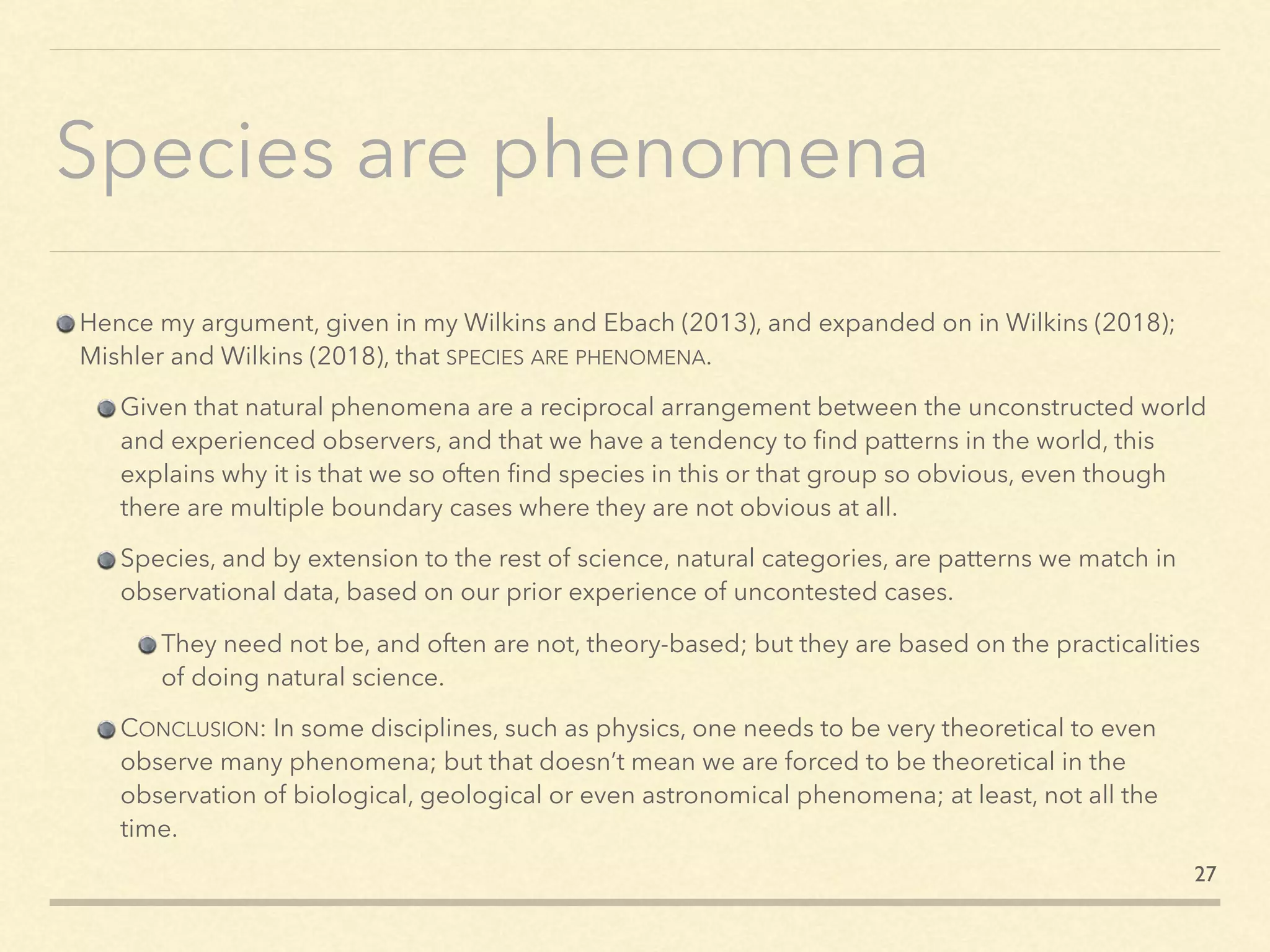
Hence my argument, given in my Wilkins and Ebach (2013), and expanded on in Wilkins (2018);
Mishler and Wilkins (2018), that SPECIES ARE PHENOMENA.
Given that natural phenomena are a reciprocal arrangement between the unconstructed world
and experienced observers, and that we have a tendency to find patterns in the world, this
explains why it is that we so often find species in this or that group so obvious, even though
there are multiple boundary cases where they are not obvious at all.
Species, and by extension to the rest of science, natural categories, are patterns we match in
observational data, based on our prior experience of uncontested cases.
They need not be, and often are not, theory-based; but they are based on the practicalities
of doing natural science.
CONCLUSION: In some disciplines, such as physics, one needs to be very theoretical to even
observe many phenomena; but that doesn’t mean we are forced to be theoretical in the
observation of biological, geological or even astronomical phenomena; at least, not all the
time.
27
28Crab migration on Christmas Island
Let us begin with the naive empiricist.
He says that in observing the world, certain phenomena are
ready-made and call for explanation.
But the Kantian [Massimi 2004–2011] replies that the naive
empiricist must choose what patterns in the data to include in the
phenomenon, and what to exclude as irrelevant or noisy.
Hence, she will say, the naive empiricist has no access to
phenomena until he has a theory of causality, relevance, and
explanation in that (the phenomena’s) domain.
29
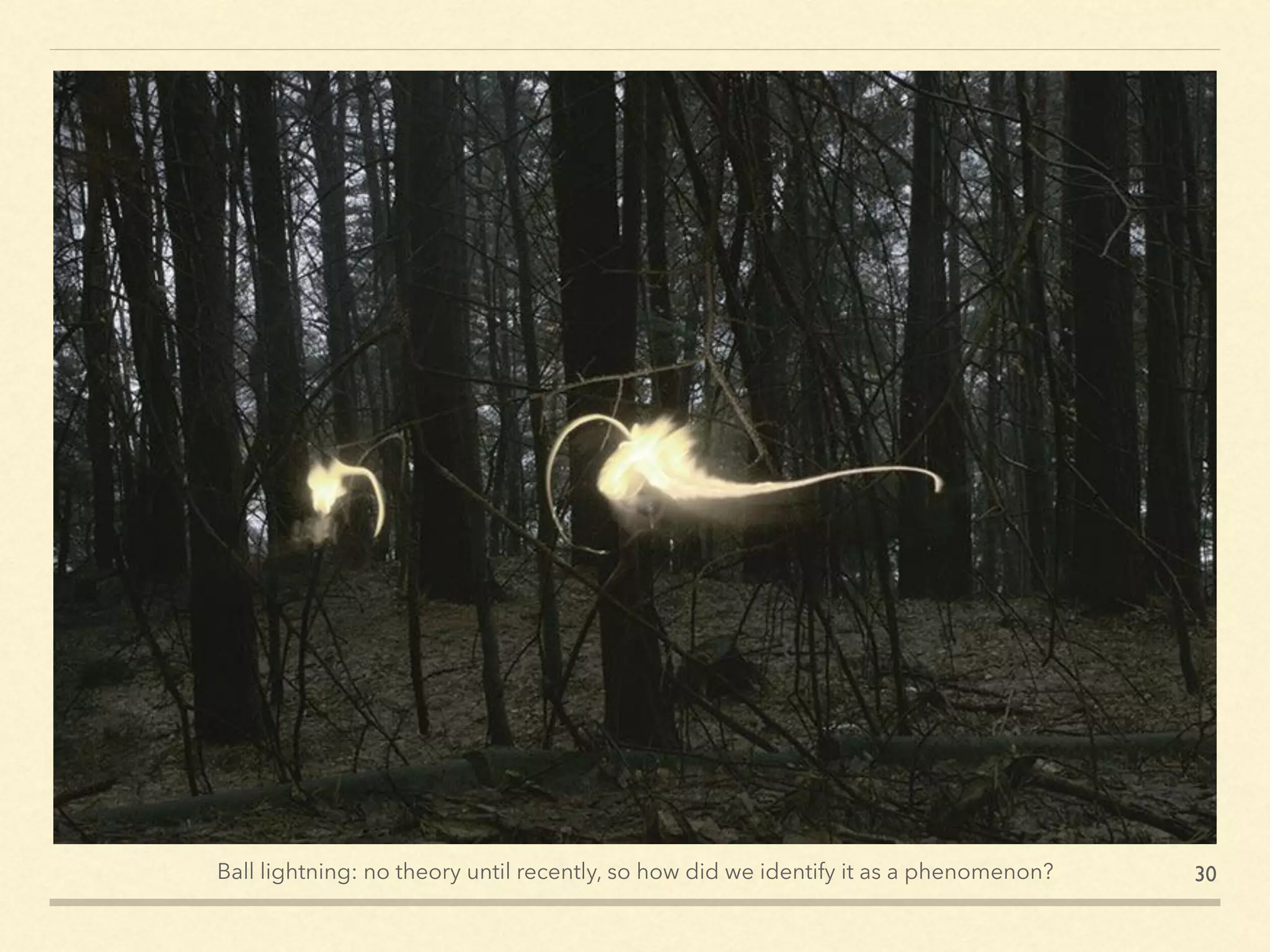
30Ball lightning: no theory until recently, so how did we identify it as a phenomenon?
The Starting Problem again
This leaves us with the Starting Problem
Bayesian logic will deal with this by an iterative process of refining the prior
probabilities based on new data, (asymptotically?) approaching the correct
patterns.
But the naive first investigator (not necessarily a naive empiricist) faces a field that
has no scientific theory on which to draw; no prior probabilities for that domain.
How to commence?
What should she pay attention to?
Bayes suggests an answer, and it has to do with how we extrapolate from the
general knowledge we have of the world to specialized domains.
31
The Precession of Mercury: A case
study
Consider a phenomenon: the PRECESSION OF MERCURY
It is as clear a phenomenon as you can find in science, but it would not have been a
phenomenon to the Ptolemaic astronomers for the simple reason that they could
not observe it without previously having adopted a heliocentric (or perhaps
Tychonic) model of the solar system, and Newtonian physics (as opposed to, say,
Descartes’ vortex physics).
Yet the observation of the precession of Mercury’s perihelion could be done
without very much in the way of theoretical knowledge, using measuring
instruments that in no way depended upon either theory.
It simply was not an anomaly worth noting until the Newtonian/Copernican model
had been adopted, and it deviated from the expectations of that model.
And even then, it took around 150 years to show up as an anomaly [Le Verrier 1859]
32
33The phenomenon of apsidal precession of Mercury – 43 arc seconds missing
How observational is this?
Back to observation
If “theory” has any meaning in science, it must not be watered down to include our disposition to
notice mesoscale phenomena that we might eat, navigate, fear or copulate with.
And yet, that set of sensory dispositions is what does underpin scientific investigations
Most of our measuring tools are ways to represent at mesoscale what we cannot otherwise
see or notice.
A telescope and a microscope both present phenomena in ways we can use our evolved
sensory apparatus to observe.
However, as anyone who has used either of these devices knows, some experience is
required to interpret what is seen, and the more a measuring device abstracts the microscale
or macroscale, the more training it takes to be able to interpret what is measured.
So, observation must be done by trained, experienced experts [i.e., include both cultural
scaffolding and personal trial and error learning]
34
Newton’s phenomena
35
Phenomenon 1 The circumjovial planets, by radii drawn to the centre of Jupiter, describe areas proportional to the times,
and their periodic times – the fixed stars being at rest – are as the 3/2 powers of their distances from that
centre.
Phenomenon 2 The circumsaturnian planets, by radii drawn to the centre of Saturn, describe areas proportional to the times,
and their periodic times – the fixed stars being at rest – are as the 3/2 powers of their distances from that
centre.
Phenomenon 3 The orbits of the five primary planets – Mercury,Venus, Mars, Jupiter, and Saturn – encircle the sun.
Phenomenon 4 The periodic times of the five primary planets and of either the sun about the earth or the earth about the
sun – the fixed stars being at rest – are as the 3/2 powers of their mean distances from the sun.
Phenomenon 5 The primary planets, by radii drawn to the earth, describe areas in no way proportional to the times but, by
radii drawn to the sun, traverse areas proportional to the times.
Phenomenon 6 The moon, by a radius drawn to the centre of the earth, describes areas proportional to the times.
Phenomena from Principia [Walsh 2014]
Despite what might be suggested by their title, [Newton’s] ‘Phenomena’ are not directly observed, but
rather are conclusions based on observations… They invoke not just observations, but planetary theory
in current use by the astronomers of his time (Densmore, 1995: 307).
A definition of Phenomena
PHENOMENA ARE SETS OF OBSERVATIONS IN SOME RELEVANT DOMAIN, THAT CONTRAST WITH
OUR PRIOR EXPECTATIONS, AND SO CALL FOR EXPLANATION
Those prior commitments may include theory, to be sure, but often they do not
They do not need to involve theories in the domain under investigation
We all have theories of this or that which set our expectations, or something that
might, with sufficient effort, be cast as theories, but most of what we expect
comes from the exigencies of interacting with the environment, both social and
extrasocial, in order to make a living
That is to say, trial and error, leading to success or failure in some motivated goal
Phenomena are relative to what we expect
36
This is historical, too
Quotes from Walsh 2014:
“ Phænomenon, in Natural Philosophy, signifies any Appearance, Effect, or Operation of a
Natural Body, which offers its self to the Consideration and Solution of an Enquirer
into Nature (Harris, 1708).
“ Phænomenon [...] is in Physicks an extraordinary Appearance in the Heavens or on Earth;
discovered by the observation of the Celestial Bodies, or by Physical Experiments the
Cause of which is not obvious (Harris, 1736)
“ Phænomenon, in philosophy, denotes any remarkable appearance, whether in the
heavens or on earth; and whether discovered by observation or experiments (Macfarquhar
& Bell, 1771).
“ Phenomena I call whatever can be perceived, either things external which become known
through the five senses, or things internal which we contemplate in our minds by thinking.
[Newton, Draft of Principia]
37
38
In a space of principle component axes, PCA1. . .PCA3, theory T explains observations only in a viability space. Where
observations indicate unresolved regularities outside that space, a phenomenon P is constructed. It calls for explanation. Once
explained (i.e., once T has been revised to include P in the viability space), it remains a phenomenon of T, but is resolved.
39
Data
Phenomenon
Theory
1 2 3 4 5
Explains
Gives
Causes
Bogen and Woodward
3 layer view of science
Determines
Observations
Phenomenon
Theory
1 2 3 4 5
Explains
Give
Multiplicity of Causes
My view of science
Influences
Observational
dispositions
Made salient by
Prior experience
Evolved dispositions
Cultural scaffolding
May be heterogenous
May be technical or naive
May be “natural”
or “constructed”
In the absence of Theory
40
Observations
Phenomenon
1 2 3 4 5
Give
Multiplicity of Causes
Observational
dispositions
Made salient by
Prior experience
Evolved dispositions
Cultural scaffolding
Phenomena can be constructed in
the absence of a domain-relevant
theory
Hence, the Starting Problem is
resolveable
This, of course, doesn’t resolve
the source of explanations/
theories
Conclusions
There is no necessity that observation and phenomena are
either determined by linguistic or theoretical categories
But they can be and often are
To resolve starting problems, either of science in general
or in a specific domain, we need to be able to construct
phenomena in the absence of theory
Phenomena call for explanation, but only when contrasted
with expectations, either of theory or experience
41
References
Bogen, James, and James Woodward. 1988.“Saving the Phenomena.” The
Philosophical Review 67 (3): 303–352.
Ereshefsky, Marc. 1998.“Species Pluralism and Anti-Realism.” Philosophy of
Science 65 (1): 103–120.
Hacking, Ian. 1983. Representing and Intervening: IntroductoryTopics in the
Philosophy of Natural Science. Cambridge UK: Cambridge University Press.
Lücking, Robert, Manuela Dal-Forno, Masoumeh Sikaroodi, Patrick M.
Gillevet, Frank Bungartz, Bibiana Moncada,AlbaYánez-Ayabaca, José Luis
Chaves, Luis Fernando Coca, and James D. Lawrey. 2014.“A Single
Macrolichen Constitutes Hundreds of Unrecognized Species.”
Proceedings of the National Academy of Sciences 111 (30): 11091. https://
doi.org/10/gc6xf8.
Massimi, Michela. 2004.“Non-Defensible Middle Ground for
Experimental Realism:Why We Are Justified to Believe in Colored
Quarks.” British Journal for the Philosophy of Science 71 (1): 36–60.
———. 2007.“Saving Unobservable Phenomena.” The British Journal for
the Philosophy of Science 58 (2): 235–62. https://doi.org/10.1093/bjps/
axm013.
———. 2008.“Why There Are No Ready-Made Phenomena:What
Philosophers of Science Should Learn from Kant.” Kant and Philosophy of
ScienceToday, Royal Institute of Philosophy Supplement 63: 1–35. https://
doi.org/10.1017/S1358246108000027.
———. 2011.“From Data to Phenomena:A Kantian Stance.” Synthese
182 (1): 101–116. https://doi.org/10.1007/s11229-009-9611-z.
Mayr, Ernst. 1996.What is a species, and what is not? Philosophy of Science
2, 262–277.
Mishler, Brent D., and John S.Wilkins. 2018.“The Hunting of the SNaRC:
A Snarky Solution to the Species Problem.” Philosophy,Theory, and Practice
in Biology.
Pauli,Wolfgang. 1994.“Phenomenon and Physical Reality.” In Writings on
Physics and Philosophy, edited by Charles P. Enz and Karl von Meyenn,
127–135. Berlin, Heidelberg: Springer.
Van Fraassen, Bas C. 1980. The Scientific Image. Oxford: Clarendon Press.
Walsh, Kirsten. 2014.“Phenomena in Newton’s Principia.” Chicago,
Illinois, PSA Meeting.
Wilkins, John S. 2018. Species:The Evolution of the Idea. 2nd ed. Boca
Raton, FL: CRC Press.
Williston, Samuel W. 1908.What is a species? The American Naturalist
42(495), 184–194.
Woodward, James F. 2011.“Data and Phenomena:A Restatement and
Defense.” Synthese 182 (1): 165–179.
42
Buy my book!
43

50 words for snow: constructing scientific phenomena

  • 1.
    50 WORDS FORSNOW The construction of natural phenomena in science John S. Wilkins
  • 2.
    What are phenomena? Hobbes:“… such things as appear, or are shown to us by nature, we call phenomena or appearances” [De Corpore, IV, ch XXV.] Bogen and Woodward hold that phenomena are derived from data, which are recorded measurements They speak of “phenomena of interest” Phenomena are (acc. to B&W) stable interactions with repeatable characteristics, and of a limited set of variables/ causes 2
  • 3.
    But how dowe identify phenomena? Hacking: “Undoubtedly people tend to notice things that are interesting, surprising, and so forth, and such expectations and interests are influenced by theories they may hold – not that we should play down the possibility of the gifted ‘pure’ observer either.”
 [Representing and Intervening p179] It is the noticing of phenomena I wish to discuss today Are phenomena self-presenting? Are they theory-based? Are they just patterns in data? If so, which patterns? 3
  • 4.
    4The sliding stonesof Death Valley
  • 5.
    Hacking said itfirst, of course “A phenomenon is noteworthy. A phenomenon is discernible. A phenomenon is commonly an event of a certain type that occurs regularly under certain circumstances. The word can also denote a unique event that we single out as particularly important. When we know the regularity exhibited in a phenomenon we express it in a law-like generalization. The very fact of such a regularity is sometimes called the phenomenon.”
 [Representing and Intervening, p221 ] 5
  • 6.
    6Fast as aspeeding bullet, with Navier Stokes equations
  • 7.
    Linguistic determinism and theory-dependence Phenomenasuch as many types of snow call for many types; that is, many categories But linguistic determinism states that our language determines our categories (in varying degrees of strength from weak to strong) – Sapir-Whorf thesis Similarly, theory-dependence of observation indicates that our very observations depend upon prior categories Many scientific terms – species, gene, electron, individual, niche – seem to depend on prior linguistic categories But are they “just” phenomena? How do we come by these “natural categories”? 7
  • 8.
    Bogen and Woodward’sthesis Bogen and Woodward 1988 argued persuasively that data are not phenomena until they are arrayed in patterns Observations are particular measurements Observations are the evidentiary foundation for phenomena Phenomena are explained by theories Data are not explained by theories 8
  • 9.
    James F. Woodward,Synthese, [2011] 182:165–179 [emphasis added] [We] advocated a three-level picture of scientific theory or, more accurately, of those theories that were in the business of providing systematic explanations. Explanatory theories such as classical mechanics, general relativity, and the electroweak theory that unifies electromagnetic and weak nuclear forces were understood as providing explanations of what we called phenomena—features of the world that in principle could recur under different contexts or conditions. … Data are public records produced by measurement and experiment that serve as evidence for the existence or features of phenomena 9
  • 10.
    10 Data Phenomenon Theory 1 2 34 5 Explains Gives Causes Bogen and Woodward 3 layer view of science Determines
  • 11.
    11Lightning caused byvolcanic eruption
  • 12.
    The Starting Problem Ifthere are no data protocols*, how do we delineate phenomena? Are data protocols theory-dependent? Are phenomena, and their categorical specifications, theory-dependent too? How do we start in a de novo domain of inquiry? 12 * I am taking a data protocol to include the metrics, measuring systems, and procedures of investigation in a field or domain, but not to include analytic and statistical post-observational techniques.
  • 13.
    Theory-based accounts Observation requireseither prior or ancillary theory “However diverse its structure, the physical phenomenon is not simple but complex. Usually a mass of previously acquired theoretical knowledge and experience with apparatus is already incorporated in its description.” 
 [Wolfgang Pauli 1957] So, either 1. There is no way to start a de novo investigation, or 2. Our evolved dispositions to perceive certain things (our Umwelt), count as theory 1. must be false; 2. beggars the meaning of “theory” in science 13
  • 14.
    Empiricist accounts Naive empiricism:What to attend to? Abductive phenomena: from observations to best hypothesis What observations need hypotheses? Constructive empiricism: empirically adequate, to which empirical observations? “a theory is empirically adequate exactly if what it says about the observable things and events in the world is true—exactly if it ‘saves the phenomena.’” [van Fraassen 1980, 12] And so on… 14
  • 15.
    What do wemake phenomena out of? Phenomena are Observational Regularities, with Salience So the first two are fairly clear, enough for now What makes a regularity salient? Why do we attend to this regularity and not one or more of a very large number of others? 15
  • 16.
  • 17.
    Species: A casestudy All classificatory terms are impossible of exact definition. Their use always has and always will depend upon the consensus of opinion of those best qualified by wisdom, experience and natural good sense. They will never become stable; we shall never cease to amend, to change, to repudiate old and propose new, because we shall never reach the final summation of science. [Samuel W. Williston, “What is a species?”, American Naturalist, (Williston 1908, 184–194)] The term ‘species’ refers to a concrete phenomenon of nature and this fact severely constrains the number and kinds of possible [species] definitions. [Mayr 1996, 263] 17
  • 18.
  • 19.
    Species: A casestudy Over 28 distinct conceptions/definitions of species in play, and 4 replacement conceptions [Wilkins 2018, Appendix 2] Scientists do not at all agree on what species are. Nor do they agree on what counts as sufficient evidence that two organisms are in different species; at least, not all of the time. And yet, the standard view is that species are fundamental units of evolution, ecology, and the other ways that we deal with the biological world. The very notion of a “level” of biological taxa such as species is itself the outcome of sociocultural factors—to wit, the need to work out what “kinds” meant in the Noah’s Ark story so the logistics could be rationalized [Wilkins 2018, p56–62]. If that is the origin, why does species persist among scientists as a category? 19
  • 20.
    20 Noah leaving theArk Giulio Bonasone (Italian, active Rome and Bologna, 1531–after 1576)
  • 21.
    The reality ofspecies A distinction between CATEGORY REALISM and ENTITY REALISM about species: CATEGORY SPECIES REALISM is the view that the category is real as well as the individual entities that fall within it, and it is that which I take aim at here (see Mishler and Wilkins 2018). ENTITY SPECIES REALISM is the view that, individually, the entities (as populations, lineages, etc.) that get called species are real, but the category is not natural. We can refer to individual species like Homo sapiens, Mesoneura opaca, and Alchorena ilicifolia (Ereshefsky 1998), even if they are not all of the same category or type. I can have diverse things in my pocket: a coin, a lighter, and a ticket. They do not need to be a natural kind to get referred to as “pocketed items”. 21
  • 22.
    22 THE MANY FACESOF CORA LICHENS. CREDIT: LUCKING ET AL, 2014. PNAS.
  • 23.
    Is “species” anatural category? It looks very much as though species as a category is not natural in the “natural kind” sense that philosophers have been talking about since Mill. Instead it looks like the outcome of a series of more or less frozen accidents in theology, philosophy, and science, for which retrospective justifications have been given as the needs arise. In short, “species” is a purely cultural concept. Or is it? 23
  • 24.
    24 Red Wolf, Canisrufus [gray wolf × coyote hybrid]
  • 25.
    Is “species” somethingreal? Several things mitigate this rabid reductionism. One is that species are often named and retained for centuries, no matter how the science progresses. Many of the species identified in the medieval period remain “good” species, for example, although their nomenclature and arrangement in relation to other species have changed a lot. It seems that good observers can identify things in the unconstructed world even in the absence of theory and method held to be essential to good science. Another is that humans tend to find levels of categorization of the unconstructed world fairly consistently and across cultures and times. 25
  • 26.
    26 Positron track, CERNGargamelle Bubble Chamber, 1973
 https://home.cern/about/updates/2015/06/seeing-invisible-event-displays-particle-physics
  • 27.
    Species are phenomena Hencemy argument, given in my Wilkins and Ebach (2013), and expanded on in Wilkins (2018); Mishler and Wilkins (2018), that SPECIES ARE PHENOMENA. Given that natural phenomena are a reciprocal arrangement between the unconstructed world and experienced observers, and that we have a tendency to find patterns in the world, this explains why it is that we so often find species in this or that group so obvious, even though there are multiple boundary cases where they are not obvious at all. Species, and by extension to the rest of science, natural categories, are patterns we match in observational data, based on our prior experience of uncontested cases. They need not be, and often are not, theory-based; but they are based on the practicalities of doing natural science. CONCLUSION: In some disciplines, such as physics, one needs to be very theoretical to even observe many phenomena; but that doesn’t mean we are forced to be theoretical in the observation of biological, geological or even astronomical phenomena; at least, not all the time. 27
  • 28.
    28Crab migration onChristmas Island
  • 29.
    Let us beginwith the naive empiricist. He says that in observing the world, certain phenomena are ready-made and call for explanation. But the Kantian [Massimi 2004–2011] replies that the naive empiricist must choose what patterns in the data to include in the phenomenon, and what to exclude as irrelevant or noisy. Hence, she will say, the naive empiricist has no access to phenomena until he has a theory of causality, relevance, and explanation in that (the phenomena’s) domain. 29
  • 30.
    30Ball lightning: notheory until recently, so how did we identify it as a phenomenon?
  • 31.
    The Starting Problemagain This leaves us with the Starting Problem Bayesian logic will deal with this by an iterative process of refining the prior probabilities based on new data, (asymptotically?) approaching the correct patterns. But the naive first investigator (not necessarily a naive empiricist) faces a field that has no scientific theory on which to draw; no prior probabilities for that domain. How to commence? What should she pay attention to? Bayes suggests an answer, and it has to do with how we extrapolate from the general knowledge we have of the world to specialized domains. 31
  • 32.
    The Precession ofMercury: A case study Consider a phenomenon: the PRECESSION OF MERCURY It is as clear a phenomenon as you can find in science, but it would not have been a phenomenon to the Ptolemaic astronomers for the simple reason that they could not observe it without previously having adopted a heliocentric (or perhaps Tychonic) model of the solar system, and Newtonian physics (as opposed to, say, Descartes’ vortex physics). Yet the observation of the precession of Mercury’s perihelion could be done without very much in the way of theoretical knowledge, using measuring instruments that in no way depended upon either theory. It simply was not an anomaly worth noting until the Newtonian/Copernican model had been adopted, and it deviated from the expectations of that model. And even then, it took around 150 years to show up as an anomaly [Le Verrier 1859] 32
  • 33.
    33The phenomenon ofapsidal precession of Mercury – 43 arc seconds missing How observational is this?
  • 34.
    Back to observation If“theory” has any meaning in science, it must not be watered down to include our disposition to notice mesoscale phenomena that we might eat, navigate, fear or copulate with. And yet, that set of sensory dispositions is what does underpin scientific investigations Most of our measuring tools are ways to represent at mesoscale what we cannot otherwise see or notice. A telescope and a microscope both present phenomena in ways we can use our evolved sensory apparatus to observe. However, as anyone who has used either of these devices knows, some experience is required to interpret what is seen, and the more a measuring device abstracts the microscale or macroscale, the more training it takes to be able to interpret what is measured. So, observation must be done by trained, experienced experts [i.e., include both cultural scaffolding and personal trial and error learning] 34
  • 35.
    Newton’s phenomena 35 Phenomenon 1The circumjovial planets, by radii drawn to the centre of Jupiter, describe areas proportional to the times, and their periodic times – the fixed stars being at rest – are as the 3/2 powers of their distances from that centre. Phenomenon 2 The circumsaturnian planets, by radii drawn to the centre of Saturn, describe areas proportional to the times, and their periodic times – the fixed stars being at rest – are as the 3/2 powers of their distances from that centre. Phenomenon 3 The orbits of the five primary planets – Mercury,Venus, Mars, Jupiter, and Saturn – encircle the sun. Phenomenon 4 The periodic times of the five primary planets and of either the sun about the earth or the earth about the sun – the fixed stars being at rest – are as the 3/2 powers of their mean distances from the sun. Phenomenon 5 The primary planets, by radii drawn to the earth, describe areas in no way proportional to the times but, by radii drawn to the sun, traverse areas proportional to the times. Phenomenon 6 The moon, by a radius drawn to the centre of the earth, describes areas proportional to the times. Phenomena from Principia [Walsh 2014] Despite what might be suggested by their title, [Newton’s] ‘Phenomena’ are not directly observed, but rather are conclusions based on observations… They invoke not just observations, but planetary theory in current use by the astronomers of his time (Densmore, 1995: 307).
  • 36.
    A definition ofPhenomena PHENOMENA ARE SETS OF OBSERVATIONS IN SOME RELEVANT DOMAIN, THAT CONTRAST WITH OUR PRIOR EXPECTATIONS, AND SO CALL FOR EXPLANATION Those prior commitments may include theory, to be sure, but often they do not They do not need to involve theories in the domain under investigation We all have theories of this or that which set our expectations, or something that might, with sufficient effort, be cast as theories, but most of what we expect comes from the exigencies of interacting with the environment, both social and extrasocial, in order to make a living That is to say, trial and error, leading to success or failure in some motivated goal Phenomena are relative to what we expect 36
  • 37.
    This is historical,too Quotes from Walsh 2014: “ Phænomenon, in Natural Philosophy, signifies any Appearance, Effect, or Operation of a Natural Body, which offers its self to the Consideration and Solution of an Enquirer into Nature (Harris, 1708). “ Phænomenon [...] is in Physicks an extraordinary Appearance in the Heavens or on Earth; discovered by the observation of the Celestial Bodies, or by Physical Experiments the Cause of which is not obvious (Harris, 1736) “ Phænomenon, in philosophy, denotes any remarkable appearance, whether in the heavens or on earth; and whether discovered by observation or experiments (Macfarquhar & Bell, 1771). “ Phenomena I call whatever can be perceived, either things external which become known through the five senses, or things internal which we contemplate in our minds by thinking. [Newton, Draft of Principia] 37
  • 38.
    38 In a spaceof principle component axes, PCA1. . .PCA3, theory T explains observations only in a viability space. Where observations indicate unresolved regularities outside that space, a phenomenon P is constructed. It calls for explanation. Once explained (i.e., once T has been revised to include P in the viability space), it remains a phenomenon of T, but is resolved.
  • 39.
    39 Data Phenomenon Theory 1 2 34 5 Explains Gives Causes Bogen and Woodward 3 layer view of science Determines Observations Phenomenon Theory 1 2 3 4 5 Explains Give Multiplicity of Causes My view of science Influences Observational dispositions Made salient by Prior experience Evolved dispositions Cultural scaffolding May be heterogenous May be technical or naive May be “natural” or “constructed”
  • 40.
    In the absenceof Theory 40 Observations Phenomenon 1 2 3 4 5 Give Multiplicity of Causes Observational dispositions Made salient by Prior experience Evolved dispositions Cultural scaffolding Phenomena can be constructed in the absence of a domain-relevant theory Hence, the Starting Problem is resolveable This, of course, doesn’t resolve the source of explanations/ theories
  • 41.
    Conclusions There is nonecessity that observation and phenomena are either determined by linguistic or theoretical categories But they can be and often are To resolve starting problems, either of science in general or in a specific domain, we need to be able to construct phenomena in the absence of theory Phenomena call for explanation, but only when contrasted with expectations, either of theory or experience 41
  • 42.
    References Bogen, James, andJames Woodward. 1988.“Saving the Phenomena.” The Philosophical Review 67 (3): 303–352. Ereshefsky, Marc. 1998.“Species Pluralism and Anti-Realism.” Philosophy of Science 65 (1): 103–120. Hacking, Ian. 1983. Representing and Intervening: IntroductoryTopics in the Philosophy of Natural Science. Cambridge UK: Cambridge University Press. Lücking, Robert, Manuela Dal-Forno, Masoumeh Sikaroodi, Patrick M. Gillevet, Frank Bungartz, Bibiana Moncada,AlbaYánez-Ayabaca, José Luis Chaves, Luis Fernando Coca, and James D. Lawrey. 2014.“A Single Macrolichen Constitutes Hundreds of Unrecognized Species.” Proceedings of the National Academy of Sciences 111 (30): 11091. https:// doi.org/10/gc6xf8. Massimi, Michela. 2004.“Non-Defensible Middle Ground for Experimental Realism:Why We Are Justified to Believe in Colored Quarks.” British Journal for the Philosophy of Science 71 (1): 36–60. ———. 2007.“Saving Unobservable Phenomena.” The British Journal for the Philosophy of Science 58 (2): 235–62. https://doi.org/10.1093/bjps/ axm013. ———. 2008.“Why There Are No Ready-Made Phenomena:What Philosophers of Science Should Learn from Kant.” Kant and Philosophy of ScienceToday, Royal Institute of Philosophy Supplement 63: 1–35. https:// doi.org/10.1017/S1358246108000027. ———. 2011.“From Data to Phenomena:A Kantian Stance.” Synthese 182 (1): 101–116. https://doi.org/10.1007/s11229-009-9611-z. Mayr, Ernst. 1996.What is a species, and what is not? Philosophy of Science 2, 262–277. Mishler, Brent D., and John S.Wilkins. 2018.“The Hunting of the SNaRC: A Snarky Solution to the Species Problem.” Philosophy,Theory, and Practice in Biology. Pauli,Wolfgang. 1994.“Phenomenon and Physical Reality.” In Writings on Physics and Philosophy, edited by Charles P. Enz and Karl von Meyenn, 127–135. Berlin, Heidelberg: Springer. Van Fraassen, Bas C. 1980. The Scientific Image. Oxford: Clarendon Press. Walsh, Kirsten. 2014.“Phenomena in Newton’s Principia.” Chicago, Illinois, PSA Meeting. Wilkins, John S. 2018. Species:The Evolution of the Idea. 2nd ed. Boca Raton, FL: CRC Press. Williston, Samuel W. 1908.What is a species? The American Naturalist 42(495), 184–194. Woodward, James F. 2011.“Data and Phenomena:A Restatement and Defense.” Synthese 182 (1): 165–179. 42
  • 43.