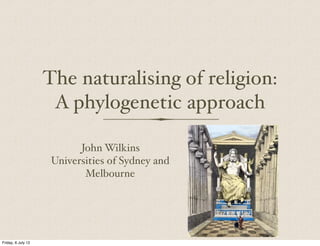
The naturalising of religion:
A phylogenetic approach
John Wilkins
Universities of Sydney and
Melbourne
Friday, 6 July 12
2
Warning: work in progress!
1. Sociobiology 3.0
2. Religion as an adaptation to the environment
3. Methodological concerns
–Homology versus analogy
4. Evolution and religion
–A principled definition of religion as social institutions
5. A behavioural foundation for institutional religion
6. Dominance
7. Euhemerism
Conclusion: Institutional religion is one among many social
coordination solutions in large-scale societies that
exceed kin relations
Friday, 6 July 12
Introduction
• The explanatory target: the social role
and structure of religion
• The research question: Is religion an
adaptation to the environment?
How can we answer this? I suggest
the best way is not to look for
adaptive explanations, but rather
to use phylogenetic inference
This indicates a difference between
analogical and homological
inferences in biology
Friday, 6 July 12
4
Sociobiology
• Born-Again Sociobiologist
• V. 3!
• Version 1: Analogy by impression
• Exporting European and American culture to animals and
back
• Inappropriate metaphors
• Version 2: The Mythical EEA
• We stopped evolving in the Pleistocene
• We have modules to do special tasks that are shaped by
selection
• Exporting assumptions about evolution and adaptation
• Version 3: Inference by homology and comparative psychology
• What do humans as apes have as species-typical?
• What do we have that varies from the “ape-norm”?
Friday, 6 July 12
5
Naturalising Religion
• Recent publications:
• Dan Dennett, Breaking the spe$
2006
• Pascal Boyer, Religion explained
2001
• Justin Barrett, Why would
anyone believe in God? 2004
• Scott Atran, In gods we trust
2002
• Richard Dawkins, The God
delusion 2006
Friday, 6 July 12
6
Varieties of Naturalisms
about religion
Existential/Psychological Naturalism
–Fear of death/uncertainty
–Control illusion
–Cognitive propensities (Atran/Boyer/Barrett)
Socioeconomic Naturalism
–Weberian/Marxian
Evolutionary Naturalism
–Kin selectionist accounts
–Group selectionist accounts (Sloan Wilson)
–Individual adaptationist accounts
–Cultural adaptationist accounts (Dennett)
Friday, 6 July 12
•To begin, let us consider a claim:
•Religion is an adaptation to the
environment
•How to proceed?
•We need to
•Define the explanandum (what do we
mean by religion?)
•Work out what sort of adaptation and
fitness bearers (what is evolving?)
•Decide if it actually is adaptive (or is a
spandrel/byproduct)
•And what it is an adaption to (what is the
ecology?)
Friday, 6 July 12
8
Religion is an adaptation to
the environment
What sort of adaptive?
– Is religion something that was directly selected for,
or non-religious selection of?
– Biological,
– Psychological, or
– Cultural adaptation?
•What is the fitness bearer?
– Confusing cultural and biological lineages and
reproducing entities
•“Memetic” fitness is borne by cultural agents or entities
•Biological fitness is borne by genetic, organismic or trait
lineages
Friday, 6 July 12
9
Religion is an adaptation to
the environment
Why adaptationism?
– Natural selection is a powerful
theory
– Limitations:
•We find what we seek (Just So-ism)
•We draw careless analogies between
unrelated traits
(Sociobiology and “stamping
grounds”)
•Convergent evolution loses
phylogenetic information
Perhaps religion is a side effect,
or spandrel
– MCI: Minimal Counter Intuitive
agency
– HADD: Hyperactive Agency
Detection Device
Friday, 6 July 12
10
Religion is an adaptation to
the environment
What is “the” environment for religion?
– Brains “infected” by religious memes
•This is at best question begging and normatively judgmental
– Social ecology
•Nationalism, imperialism, capitalism
– Biological environment
•Environment of Evolutionary Adaptation
•Agriculture? Cities? Modern medicine (eugenics fears)?
– We are now, and always have
been, in our natural environment
•Niche construction the norm
– Modularity is not useful for cognition
• Dispositions, “devices”
Friday, 6 July 12
11
Methodological concerns
• Naturalising religion as evolutionary investigation
• We have to identify the things that are informative about the
process, but we do not have direct access to the process
• Analogical reasoning can lead to some problems and limitations:
• Inappropriate analogies, based on prior biases and expectations,
often from a cultural bias
• An analogy adds nothing more than the similarity relations used in
drawing the analogy in the first place
• This has been around for a while: Homo homini aut deus aut
lupus [Erasmus]
• We should instead use homology first, before analogy, to properly
identify the analogies
• Analogies with apes more relevant than analogies with gazelles
or dogs or ants
Friday, 6 July 12
12
Phylogenetic inference
What could we predict if all we knew was
– Humans are apes
– Humans use symbolic communication
– Humans sometimes live in high density populations?
Could we use phylogenetic inference?
– Look at our nearest relatives for clues
•what we share as apes
• what we differ in as derived humans?
Adaptationist thinking : phylogenetic thinking ::
argument by analogy : argument by homology
Phylogenetic inference is inductively projectible
– Adaptive inference is only deductive (that is, you get out what you put
in, with certainty)
– Phylogeny delivers inductive license (you get out much more than you
put in, defeasibly)
Friday, 6 July 12
13
Analogy versus homology
The notion of homology is pre-Darwinian, coined by Richard
Owen in 1843, based on “affinity”
– Homology is derived from the
observational fact that there is a
strong isomorphism between parts of
distantly related organisms; e.g.,
pigeon and human skeleton (Belon
1555)
– The same organ or part under all transformations of form
and function
The relation between analogies is one of similarity (ratio)
The relation between homologies is of identity (Brigandt and
Griffiths 2007)
Friday, 6 July 12
14
The epistemic warrant
of homology and analogy
If you have an analogous class, you know nothing more about its
members than what is implicit in the class definition
– A predator may have teeth or claws or mouthparts or stingers…
If you have a homologous class, you know a lot about its members
– If I tell you an organism is a raptor, you know about its properties
from knowing any other member of the clade: beaks, claws,
feathers, physiology, life cycle, etc.
Inference by homology licenses further induction (which may be
defeasibly wrong)
Inference by analogy licenses no further inference
– Adaptive analogies will turn out to be limited to the “free floating
rationale”
– Your motivation for applying analogies depends on what
abstractions you are prepared to make away from the gritty detail
Friday, 6 July 12
15
Evolution and religion
• Evolutionary biology as a way to naturalise religion[i]
• Biological aspects of religion in general:
• Evolved species-typical psychology, especially cognitive and social
psychology
• Predictions about one member of the “great ape” clade (Hominoidea)
from a knowledge of plesiomorphies (primitive or underived characters) of
the clade
• Behavioural homologies that are unique to humans
• Phylogeny provides a “null hypothesis” for any great ape
• The autapomorphies (derived characters) of humans contrast with the
symplesiomorphies (shared underived characters) of the great ape clade
• All apes are dominance-driven, and have sexual dimorphism
• Humans have a special (literally, of the species) derived form of dominance
and sexual dimorphism
• [Project: map social organisation onto phylogenetic tree]
• But we can safely say: we are dominance-driven for reproductive reasons
Friday, 6 July 12
16
A principled distinction:
institutional religion
Any ritual (religion[r]) or belief (religion[b]) that is indistinguishable from
general social structures and behaviours is not religion[i] (hence animism
or shamanism are not considered institutional religions)
– Gods, etiologies and rituals precede religion[i]
Religion[i] binds …
– Religare, from the Latin root ligare, to bind or unite
… members of an ethnically diverse society
– Hence is post-agriculture
– A social coordination solution when
kin-group relations fail
Not the only solution!
– Military
– Political
– Cultural (tribal markers)
Friday, 6 July 12
17
The behavioural foundation for
religion[i] in humans
Humans are social apes
– So religion[i] will either contribute to or be a cultural adaptation
of our social nature (or both)
– Humans have particular social biologies that are unique to them
•For a start we communicate symbolically
•Since Mesopotamian times we communicate in writing
•We are long distance traders
– But we also have unique versions of ape homologies
(autapomorphies)
•Social dominance (we do it our way; probably four or five hierarchies
in each society)
•Empathy (we, and possibly the chimps and gorillas, can put ourselves
in the other guy’s shoes)
•Technological and cultural transmission (we, and chimps, can
teach cultural variants and technologies)
Friday, 6 July 12
18
Hierarchies
Friday, 6 July 12
19
My hypothesis (GodsAbove!)
Humans have a species-typical form of social dominance behaviour
• that leads us to venerate cultural heroes as high status individuals
(kings, warriors, inventors, law givers)
–High status individuals are MCI
–Ancestors are MCI
–Gods are MCI
•In sedentary societies permitted by agriculture, we have cross-kin
group social allegiances in high density populations
•Social dominance is expressed in such cases by allegiance to absent
individuals via subordinates
•Gods are a way of reinforcing dominance and social cohesion in
such societies
Need phylogenetic and further research on human social
dominance (Sidanius and Pratto 1999)
Friday, 6 July 12
20
Dominance and nation building
Friday, 6 July 12
21
Dominance Euhemerism
•Deities act as super-alpha individuals reinforcing and
punishing defection from social alliances
Conjecture: Many gods begin “life” as social heroes, kings, and
cultural innovators; often as tribal leaders
•Religions and gods represent “tribal markers” that identify
in-group (to whom reciprocal altruism is owed and expected
from) from outgroup (excluded from community support)
•There were gods before agriculture, and rituals devoted to
them, but no distinction between religion and social structure
•Religion ties groups that are bigger than kin-groups together
It is one solution to that social problem
–It is not the only solution; adaptive but not the adaptation
Friday, 6 July 12
Thank you
Thanks to Paul Griffiths and the University of Sydney
Friday, 6 July 12

Phylogenetic_method_religion.pdf

  • 1.
    The naturalising ofreligion: A phylogenetic approach John Wilkins Universities of Sydney and Melbourne Friday, 6 July 12
  • 2.
    2 Warning: work inprogress! 1. Sociobiology 3.0 2. Religion as an adaptation to the environment 3. Methodological concerns –Homology versus analogy 4. Evolution and religion –A principled definition of religion as social institutions 5. A behavioural foundation for institutional religion 6. Dominance 7. Euhemerism Conclusion: Institutional religion is one among many social coordination solutions in large-scale societies that exceed kin relations Friday, 6 July 12
  • 3.
    Introduction • The explanatorytarget: the social role and structure of religion • The research question: Is religion an adaptation to the environment? How can we answer this? I suggest the best way is not to look for adaptive explanations, but rather to use phylogenetic inference This indicates a difference between analogical and homological inferences in biology Friday, 6 July 12
  • 4.
    4 Sociobiology • Born-Again Sociobiologist •V. 3! • Version 1: Analogy by impression • Exporting European and American culture to animals and back • Inappropriate metaphors • Version 2: The Mythical EEA • We stopped evolving in the Pleistocene • We have modules to do special tasks that are shaped by selection • Exporting assumptions about evolution and adaptation • Version 3: Inference by homology and comparative psychology • What do humans as apes have as species-typical? • What do we have that varies from the “ape-norm”? Friday, 6 July 12
  • 5.
    5 Naturalising Religion • Recentpublications: • Dan Dennett, Breaking the spe$ 2006 • Pascal Boyer, Religion explained 2001 • Justin Barrett, Why would anyone believe in God? 2004 • Scott Atran, In gods we trust 2002 • Richard Dawkins, The God delusion 2006 Friday, 6 July 12
  • 6.
    6 Varieties of Naturalisms aboutreligion Existential/Psychological Naturalism –Fear of death/uncertainty –Control illusion –Cognitive propensities (Atran/Boyer/Barrett) Socioeconomic Naturalism –Weberian/Marxian Evolutionary Naturalism –Kin selectionist accounts –Group selectionist accounts (Sloan Wilson) –Individual adaptationist accounts –Cultural adaptationist accounts (Dennett) Friday, 6 July 12
  • 7.
    •To begin, letus consider a claim: •Religion is an adaptation to the environment •How to proceed? •We need to •Define the explanandum (what do we mean by religion?) •Work out what sort of adaptation and fitness bearers (what is evolving?) •Decide if it actually is adaptive (or is a spandrel/byproduct) •And what it is an adaption to (what is the ecology?) Friday, 6 July 12
  • 8.
    8 Religion is anadaptation to the environment What sort of adaptive? – Is religion something that was directly selected for, or non-religious selection of? – Biological, – Psychological, or – Cultural adaptation? •What is the fitness bearer? – Confusing cultural and biological lineages and reproducing entities •“Memetic” fitness is borne by cultural agents or entities •Biological fitness is borne by genetic, organismic or trait lineages Friday, 6 July 12
  • 9.
    9 Religion is anadaptation to the environment Why adaptationism? – Natural selection is a powerful theory – Limitations: •We find what we seek (Just So-ism) •We draw careless analogies between unrelated traits (Sociobiology and “stamping grounds”) •Convergent evolution loses phylogenetic information Perhaps religion is a side effect, or spandrel – MCI: Minimal Counter Intuitive agency – HADD: Hyperactive Agency Detection Device Friday, 6 July 12
  • 10.
    10 Religion is anadaptation to the environment What is “the” environment for religion? – Brains “infected” by religious memes •This is at best question begging and normatively judgmental – Social ecology •Nationalism, imperialism, capitalism – Biological environment •Environment of Evolutionary Adaptation •Agriculture? Cities? Modern medicine (eugenics fears)? – We are now, and always have been, in our natural environment •Niche construction the norm – Modularity is not useful for cognition • Dispositions, “devices” Friday, 6 July 12
  • 11.
    11 Methodological concerns • Naturalisingreligion as evolutionary investigation • We have to identify the things that are informative about the process, but we do not have direct access to the process • Analogical reasoning can lead to some problems and limitations: • Inappropriate analogies, based on prior biases and expectations, often from a cultural bias • An analogy adds nothing more than the similarity relations used in drawing the analogy in the first place • This has been around for a while: Homo homini aut deus aut lupus [Erasmus] • We should instead use homology first, before analogy, to properly identify the analogies • Analogies with apes more relevant than analogies with gazelles or dogs or ants Friday, 6 July 12
  • 12.
    12 Phylogenetic inference What couldwe predict if all we knew was – Humans are apes – Humans use symbolic communication – Humans sometimes live in high density populations? Could we use phylogenetic inference? – Look at our nearest relatives for clues •what we share as apes • what we differ in as derived humans? Adaptationist thinking : phylogenetic thinking :: argument by analogy : argument by homology Phylogenetic inference is inductively projectible – Adaptive inference is only deductive (that is, you get out what you put in, with certainty) – Phylogeny delivers inductive license (you get out much more than you put in, defeasibly) Friday, 6 July 12
  • 13.
    13 Analogy versus homology Thenotion of homology is pre-Darwinian, coined by Richard Owen in 1843, based on “affinity” – Homology is derived from the observational fact that there is a strong isomorphism between parts of distantly related organisms; e.g., pigeon and human skeleton (Belon 1555) – The same organ or part under all transformations of form and function The relation between analogies is one of similarity (ratio) The relation between homologies is of identity (Brigandt and Griffiths 2007) Friday, 6 July 12
  • 14.
    14 The epistemic warrant ofhomology and analogy If you have an analogous class, you know nothing more about its members than what is implicit in the class definition – A predator may have teeth or claws or mouthparts or stingers… If you have a homologous class, you know a lot about its members – If I tell you an organism is a raptor, you know about its properties from knowing any other member of the clade: beaks, claws, feathers, physiology, life cycle, etc. Inference by homology licenses further induction (which may be defeasibly wrong) Inference by analogy licenses no further inference – Adaptive analogies will turn out to be limited to the “free floating rationale” – Your motivation for applying analogies depends on what abstractions you are prepared to make away from the gritty detail Friday, 6 July 12
  • 15.
    15 Evolution and religion •Evolutionary biology as a way to naturalise religion[i] • Biological aspects of religion in general: • Evolved species-typical psychology, especially cognitive and social psychology • Predictions about one member of the “great ape” clade (Hominoidea) from a knowledge of plesiomorphies (primitive or underived characters) of the clade • Behavioural homologies that are unique to humans • Phylogeny provides a “null hypothesis” for any great ape • The autapomorphies (derived characters) of humans contrast with the symplesiomorphies (shared underived characters) of the great ape clade • All apes are dominance-driven, and have sexual dimorphism • Humans have a special (literally, of the species) derived form of dominance and sexual dimorphism • [Project: map social organisation onto phylogenetic tree] • But we can safely say: we are dominance-driven for reproductive reasons Friday, 6 July 12
  • 16.
    16 A principled distinction: institutionalreligion Any ritual (religion[r]) or belief (religion[b]) that is indistinguishable from general social structures and behaviours is not religion[i] (hence animism or shamanism are not considered institutional religions) – Gods, etiologies and rituals precede religion[i] Religion[i] binds … – Religare, from the Latin root ligare, to bind or unite … members of an ethnically diverse society – Hence is post-agriculture – A social coordination solution when kin-group relations fail Not the only solution! – Military – Political – Cultural (tribal markers) Friday, 6 July 12
  • 17.
    17 The behavioural foundationfor religion[i] in humans Humans are social apes – So religion[i] will either contribute to or be a cultural adaptation of our social nature (or both) – Humans have particular social biologies that are unique to them •For a start we communicate symbolically •Since Mesopotamian times we communicate in writing •We are long distance traders – But we also have unique versions of ape homologies (autapomorphies) •Social dominance (we do it our way; probably four or five hierarchies in each society) •Empathy (we, and possibly the chimps and gorillas, can put ourselves in the other guy’s shoes) •Technological and cultural transmission (we, and chimps, can teach cultural variants and technologies) Friday, 6 July 12
  • 18.
  • 19.
    19 My hypothesis (GodsAbove!) Humanshave a species-typical form of social dominance behaviour • that leads us to venerate cultural heroes as high status individuals (kings, warriors, inventors, law givers) –High status individuals are MCI –Ancestors are MCI –Gods are MCI •In sedentary societies permitted by agriculture, we have cross-kin group social allegiances in high density populations •Social dominance is expressed in such cases by allegiance to absent individuals via subordinates •Gods are a way of reinforcing dominance and social cohesion in such societies Need phylogenetic and further research on human social dominance (Sidanius and Pratto 1999) Friday, 6 July 12
  • 20.
    20 Dominance and nationbuilding Friday, 6 July 12
  • 21.
    21 Dominance Euhemerism •Deities actas super-alpha individuals reinforcing and punishing defection from social alliances Conjecture: Many gods begin “life” as social heroes, kings, and cultural innovators; often as tribal leaders •Religions and gods represent “tribal markers” that identify in-group (to whom reciprocal altruism is owed and expected from) from outgroup (excluded from community support) •There were gods before agriculture, and rituals devoted to them, but no distinction between religion and social structure •Religion ties groups that are bigger than kin-groups together It is one solution to that social problem –It is not the only solution; adaptive but not the adaptation Friday, 6 July 12
  • 22.
    Thank you Thanks toPaul Griffiths and the University of Sydney Friday, 6 July 12