4/20/2020 S. Parsa, Associate Professor (www.parsa.iust.ac.ir) 1
4/20/2020 S. Parsa, Associate Professor (www.parsa.iust.ac.ir) 2
4/20/2020 S. Parsa, Associate Professor (www.parsa.iust.ac.ir) 3
4/20/2020 S. Parsa, Associate Professor (www.parsa.iust.ac.ir) 4
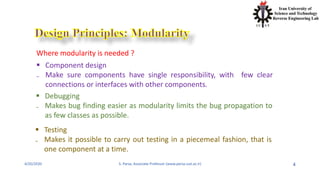
Where modularity is needed ?
 Component design
₋ Make sure components have single responsibility, with few clear
connections or interfaces with other components.
 Debugging
₋ Makes bug finding easier as modularity limits the bug propagation to
as few classes as possible.
 Testing
₋ Makes it possible to carry out testing in a piecemeal fashion, that is
one component at a time.
4/20/2020 S. Parsa, Associate Professor (www.parsa.iust.ac.ir) 5
How ? Hierarchical decomposition design with different level of abstraction:
 Decompose into components:
- with clearly defined input and output and well identified purpose,
- from higher more abstraction level to lower more detailed level,
- with minimum possible interactions.
 Balance the size of the components:
₋ Small size components will require relatively more connections, while
₋ Large size components will require relatively less connections but
more complexity.
4/20/2020 S. Parsa, Associate Professor (www.parsa.iust.ac.ir) 6
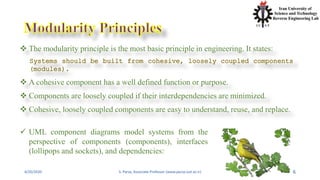
 The modularity principle is the most basic principle in engineering. It states:
 A cohesive component has a well defined function or purpose.
 Components are loosely coupled if their interdependencies are minimized.
 Cohesive, loosely coupled components are easy to understand, reuse, and replace.
 UML component diagrams model systems from the
perspective of components (components), interfaces
(lollipops and sockets), and dependencies:
4/20/2020 S. Parsa, Associate Professor (www.parsa.iust.ac.ir) 7
 Modularity is a part of our life
 According to Bertrand Meyer modularity principles are:
1. Modular Decomposability
2. Modular Composability
3. Modular Understandability
4. Modular Continuity
5. Modular Protection
4/20/2020 S. Parsa, Associate Professor (www.parsa.iust.ac.ir) 8
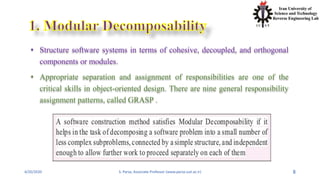
• Structure software systems in terms of cohesive, decoupled, and orthogonal
components or modules.
• Appropriate separation and assignment of responsibilities are one of the
critical skills in object-oriented design. There are nine general responsibility
assignment patterns, called GRASP .
4/20/2020 S. Parsa, Associate Professor (www.parsa.iust.ac.ir) 9
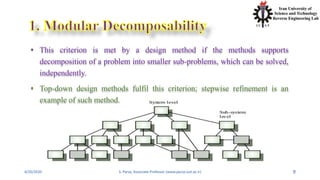
• This criterion is met by a design method if the methods supports
decomposition of a problem into smaller sub-problems, which can be solved,
independently.
• Top-down design methods fulfil this criterion; stepwise refinement is an
example of such method.
4/20/2020 S. Parsa, Associate Professor (www.parsa.iust.ac.ir) 10
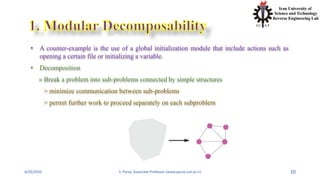
• A counter-example is the use of a global initialization module that include actions such as
opening a certain file or initializing a variable.
• Decomposition
» Break a problem into sub-problems connected by simple structures
> minimize communication between sub-problems
> permit further work to proceed separately on each subproblem
4/20/2020 S. Parsa, Associate Professor (www.parsa.iust.ac.ir) 11
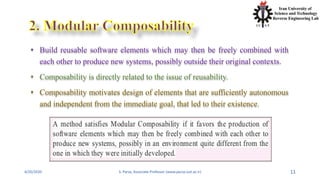
• Build reusable software elements which may then be freely combined with
each other to produce new systems, possibly outside their original contexts.
• Composability is directly related to the issue of reusability.
• Composability motivates design of elements that are sufficiently autonomous
and independent from the immediate goal, that led to their existence.
4/20/2020 S. Parsa, Associate Professor (www.parsa.iust.ac.ir) 12
• Composition
» Produce software from reusable plug and play modules
» Composed software is itself a reusable module
» Reusable modules work in environments different from the ones in
which they were developed
» Examples
> using pipe in the Unix shell to combine Unix commands
> using abstract data types and bottom-up design
4/20/2020 S. Parsa, Associate Professor (www.parsa.iust.ac.ir) 13
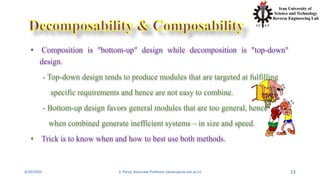
• Composition is "bottom-up" design while decomposition is "top-down"
design.
- Top-down design tends to produce modules that are targeted at fulfilling
specific requirements and hence are not easy to combine.
- Bottom-up design favors general modules that are too general, hence
when combined generate inefficient systems – in size and speed.
• Trick is to know when and how to best use both methods.
4/20/2020 S. Parsa, Associate Professor (www.parsa.iust.ac.ir) 14
 Structuring software architecture in such a way that a slight change in the
problem specification triggers a change of just one module or a small number
of modules.
 In large software systems, the most challenging part of making changes is
not the change itself, but making the change in a way that does not regress
any other important behavior.
 This criterion is is directly connected to the goal of extensibility.
4/20/2020 S. Parsa, Associate Professor (www.parsa.iust.ac.ir) 15
 Each module, or in other words, the unit of software should be
understandable without the need for knowing the others.
 This principle leads to the heuristic that control structure related to a
particular functionality are preferably assigned to one class rather than being
distributed over several classes.
4/20/2020 S. Parsa, Associate Professor (www.parsa.iust.ac.ir) 16
 Runtime error in a module confines to that module, or at worst propagates to
a few neighboring modules.
 In effect, processing error side-effects are should be minimized.
 This feature enhances the testability because the bug localization process will
be confounded to the module in which the fault is observed.

5-modular-design

  • 1.
    4/20/2020 S. Parsa,Associate Professor (www.parsa.iust.ac.ir) 1
  • 2.
    4/20/2020 S. Parsa,Associate Professor (www.parsa.iust.ac.ir) 2
  • 3.
    4/20/2020 S. Parsa,Associate Professor (www.parsa.iust.ac.ir) 3
  • 4.
    4/20/2020 S. Parsa,Associate Professor (www.parsa.iust.ac.ir) 4 Where modularity is needed ?  Component design ₋ Make sure components have single responsibility, with few clear connections or interfaces with other components.  Debugging ₋ Makes bug finding easier as modularity limits the bug propagation to as few classes as possible.  Testing ₋ Makes it possible to carry out testing in a piecemeal fashion, that is one component at a time.
  • 5.
    4/20/2020 S. Parsa,Associate Professor (www.parsa.iust.ac.ir) 5 How ? Hierarchical decomposition design with different level of abstraction:  Decompose into components: - with clearly defined input and output and well identified purpose, - from higher more abstraction level to lower more detailed level, - with minimum possible interactions.  Balance the size of the components: ₋ Small size components will require relatively more connections, while ₋ Large size components will require relatively less connections but more complexity.
  • 6.
    4/20/2020 S. Parsa,Associate Professor (www.parsa.iust.ac.ir) 6  The modularity principle is the most basic principle in engineering. It states:  A cohesive component has a well defined function or purpose.  Components are loosely coupled if their interdependencies are minimized.  Cohesive, loosely coupled components are easy to understand, reuse, and replace.  UML component diagrams model systems from the perspective of components (components), interfaces (lollipops and sockets), and dependencies:
  • 7.
    4/20/2020 S. Parsa,Associate Professor (www.parsa.iust.ac.ir) 7  Modularity is a part of our life  According to Bertrand Meyer modularity principles are: 1. Modular Decomposability 2. Modular Composability 3. Modular Understandability 4. Modular Continuity 5. Modular Protection
  • 8.
    4/20/2020 S. Parsa,Associate Professor (www.parsa.iust.ac.ir) 8 • Structure software systems in terms of cohesive, decoupled, and orthogonal components or modules. • Appropriate separation and assignment of responsibilities are one of the critical skills in object-oriented design. There are nine general responsibility assignment patterns, called GRASP .
  • 9.
    4/20/2020 S. Parsa,Associate Professor (www.parsa.iust.ac.ir) 9 • This criterion is met by a design method if the methods supports decomposition of a problem into smaller sub-problems, which can be solved, independently. • Top-down design methods fulfil this criterion; stepwise refinement is an example of such method.
  • 10.
    4/20/2020 S. Parsa,Associate Professor (www.parsa.iust.ac.ir) 10 • A counter-example is the use of a global initialization module that include actions such as opening a certain file or initializing a variable. • Decomposition » Break a problem into sub-problems connected by simple structures > minimize communication between sub-problems > permit further work to proceed separately on each subproblem
  • 11.
    4/20/2020 S. Parsa,Associate Professor (www.parsa.iust.ac.ir) 11 • Build reusable software elements which may then be freely combined with each other to produce new systems, possibly outside their original contexts. • Composability is directly related to the issue of reusability. • Composability motivates design of elements that are sufficiently autonomous and independent from the immediate goal, that led to their existence.
  • 12.
    4/20/2020 S. Parsa,Associate Professor (www.parsa.iust.ac.ir) 12 • Composition » Produce software from reusable plug and play modules » Composed software is itself a reusable module » Reusable modules work in environments different from the ones in which they were developed » Examples > using pipe in the Unix shell to combine Unix commands > using abstract data types and bottom-up design
  • 13.
    4/20/2020 S. Parsa,Associate Professor (www.parsa.iust.ac.ir) 13 • Composition is "bottom-up" design while decomposition is "top-down" design. - Top-down design tends to produce modules that are targeted at fulfilling specific requirements and hence are not easy to combine. - Bottom-up design favors general modules that are too general, hence when combined generate inefficient systems – in size and speed. • Trick is to know when and how to best use both methods.
  • 14.
    4/20/2020 S. Parsa,Associate Professor (www.parsa.iust.ac.ir) 14  Structuring software architecture in such a way that a slight change in the problem specification triggers a change of just one module or a small number of modules.  In large software systems, the most challenging part of making changes is not the change itself, but making the change in a way that does not regress any other important behavior.  This criterion is is directly connected to the goal of extensibility.
  • 15.
    4/20/2020 S. Parsa,Associate Professor (www.parsa.iust.ac.ir) 15  Each module, or in other words, the unit of software should be understandable without the need for knowing the others.  This principle leads to the heuristic that control structure related to a particular functionality are preferably assigned to one class rather than being distributed over several classes.
  • 16.
    4/20/2020 S. Parsa,Associate Professor (www.parsa.iust.ac.ir) 16  Runtime error in a module confines to that module, or at worst propagates to a few neighboring modules.  In effect, processing error side-effects are should be minimized.  This feature enhances the testability because the bug localization process will be confounded to the module in which the fault is observed.