5 Estonian recipes
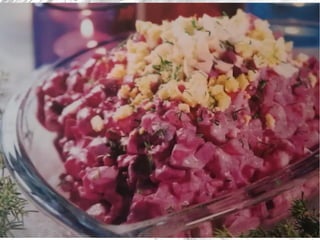
Pink potato salad (Rosolje)

The glory days of this salad were between the
1930`s and 1960`s when it was on every party`s
menu. However, there was a time when rosolje
was pushed aside by potato salad because
potato was easier to make and had simple
ingredients. To get a true taste of this party
pleaser, homemade rosolje is the way to go. Just
follow the recipe carefully.
Pink potato salad (Rosolje)

400g cooked beets
400g cooked potatoes
200g cooked carrots
2 herring fillets
2 pickles
2 tart apples
200g cooked pork or beef
3 hard-boiled eggs
Pink potato salad (Rosolje)
Dressing:
 2,5 cups sour cream
 1 tsp salt
 0,5 tsp Dijon mustard
 a pinch of sugar

Cut all ingredients into small cubes. To prepare
dressing, mix together sour cream, salt, mustard
and sugar. Pour dressing over cubed
ingredients, leaving some of the chopped eggs
for garnish. Lets stand for a few hours. Just
before serving, garnish with chopped eggs.
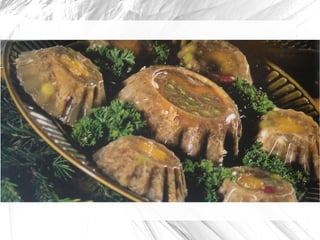
Head cheese estonian style (sült)


This dish, uniquely Estonian, resembles head
cheese and was traditionally served at Christmas
time; now it is served throughout year as an
appetizer or when served with boiled potatoes,
as a meal. Some codiments used to flavor sült
are hot mustard, horseradish and vinegar.
Head cheese estonian style (sült)

2,5 bone-in pork (shanks, hocks or head) and veal
2 onions, chopped
2 carrots, chopped
10 black peppercorns
5 dried whole all-spice
3 bay leaves
1 tbsp salt
Head cheese estonian style (sült)
Rinse meat and place it in a large pot. Fill pot with
enough cold water to cover meat, and bring it to a
quick boil. Boil rapidly for a few minutes. Drain and
discard water. Rinse froth off of meat and pot.
Return pieces of meat to the pot, placing them
tightly together. Pour boiling water over meat to fill
pot to a couple of centimeters over the meat.
Simmer uncovered until meat falls off the bones –
for about 3-4 hours. It is important to maintain a
gentle boil to make sure the meat jelly turns out
clear. After the first hour of simmering add salt,
chopped carrots and onions.
Head cheese estonian style (sült)
Ten minutes before the end of cooking time add
whole all-spice. Remove meat with slotted spoon,
cool, and cut it into small pieces. Strain broth
throught double-folded cheesecloth. Return the
broth and meat pieces to the pot. Add a generous
amount of salt to broth since the taste weakens as
the dish cools. Rinse the molds with cold water and
place at bottom of each mold slices of carrots and
some green peas, if desired. Lay the pieces of meat
on top of the carrots and green peas, and then add
broth. Store molds in refrigerator.
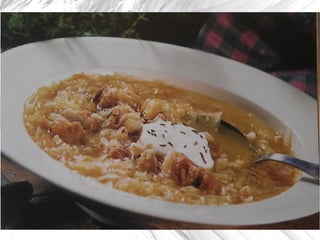
Sauerkraut soup (hapukapsasupp)

Estonians loves sauerkraut so much that they
not only use it in the main course, but also in
soups. Furthermore sauerkraut soup keeps so
well that reheating it only enhances its taste.
Thus, when making this soup, it is usually made
with the idea of having lots left-over soup in mind
– even small families make this soup with at
least 2 kilograms of sauerkraut.
Sauerkraut soup (hapukapsasupp)

1 kg sauerkraut
1 kg pork
8-12 cups water
2 carrots, grated
2 tbsp sugar
2 tsp salt
0,5 cup barley (optional)
sour cream for garnish
Sauerkraut soup (hapukapsasupp)
In a large pot combine cold water, sauerkraut
and pork (and barely, if using). Bring to a boil,
lower the heat and let it simmer for 2-3 hours. 30
minutes before the end of cooking time, add
grated carrots and season with salt and sugar.
Sugar helps to make the sour taste milder. At the
very end of cooking or just before serving, add
some cubed boiled potatoes to the soup, if
desired.
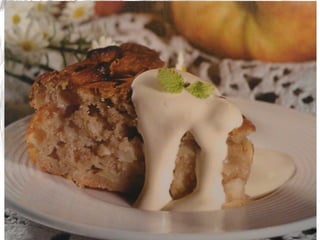
Easy apple pie (lihtne õunakook)


From midsummer until late fall, loads and loads
 of juicy apples riven in gardens throughout
 Estonia. A significant amount of them are
 used in a variety of pastries.
Easy apple pie (lihtne õunakook)
 125 g butter, melted and cooled
 2 eggs, separated
 1 cup sugar
 0,5 cup milk, at room temperature
 1,75 cups all-purpose flour
 2 tsp baking powder
 1 tsp cinnamon
 1 kg apples, chopped

Preheat oven to 200 C.
Easy apple pie (lihtne õunakook)
Beat egg yolks and sugar. Add milk and butter. In
a separate bowl, mix together flour and baking
powder, then add them to the milk and egg-yolk
mixture. Stir in chopped apples. In a separate
bowl beat egg whites until frotht and gently fold
them into batter. Butter a 26 cm round baking
dish and sprinkle some fine breadcrumbs on the
bottom and sides. Pour apple mixture into baking
dish. Bake for 30-40 minutes. Serve with vanilla
ice cream or custard.
Mashed potatoes with cracked barley
          (mulgipuder)
Mulgipuder, a meal cooked with potatoes and
barley, and mulgikapsad, a meal cooked with
sauerkraut, pork and barley, are two popular
dishes that originate from Viljandimaa, a
prosperous county in southern Estonia.

 1 kg potatoes, peeled
 4 cups water
 100 g cracked barley
 salt to taste
Mashed potatoes with cracked barley
          (mulgipuder)


Gravy:
 1 large onion, finely chopped
 100 g fatty pork
 salt
Mashed potatoes with cracked barley
          (mulgipuder)
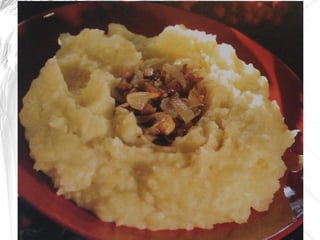
Wash barley; drain. In a large pot, combine
potatoes, salt and water. Sprinkle barley on top
of potatoes. Cover and simmer on low heat for
about 1 to 1,5 hours or until barley is tender. Mix
potatoes and barley with wooden spoon until
more or less smooth. Adjust taste by adding
more salt, if necessary. For the gravy, brown
pork in frying pan – do not drain fat. Add onions
and salt. Put potato and barley meal into bowls.
Make a pit in the center of each serving and fill it
with gravy. Serve with a cup of cold milk.
5 Estonian recipes

5 Estonian recipes

  • 1.
  • 2.
    Pink potato salad(Rosolje) The glory days of this salad were between the 1930`s and 1960`s when it was on every party`s menu. However, there was a time when rosolje was pushed aside by potato salad because potato was easier to make and had simple ingredients. To get a true taste of this party pleaser, homemade rosolje is the way to go. Just follow the recipe carefully.
  • 3.
    Pink potato salad(Rosolje) 400g cooked beets 400g cooked potatoes 200g cooked carrots 2 herring fillets 2 pickles 2 tart apples 200g cooked pork or beef 3 hard-boiled eggs
  • 4.
    Pink potato salad(Rosolje) Dressing: 2,5 cups sour cream 1 tsp salt 0,5 tsp Dijon mustard a pinch of sugar Cut all ingredients into small cubes. To prepare dressing, mix together sour cream, salt, mustard and sugar. Pour dressing over cubed ingredients, leaving some of the chopped eggs for garnish. Lets stand for a few hours. Just before serving, garnish with chopped eggs.
  • 6.
    Head cheese estonianstyle (sült) This dish, uniquely Estonian, resembles head cheese and was traditionally served at Christmas time; now it is served throughout year as an appetizer or when served with boiled potatoes, as a meal. Some codiments used to flavor sült are hot mustard, horseradish and vinegar.
  • 7.
    Head cheese estonianstyle (sült) 2,5 bone-in pork (shanks, hocks or head) and veal 2 onions, chopped 2 carrots, chopped 10 black peppercorns 5 dried whole all-spice 3 bay leaves 1 tbsp salt
  • 8.
    Head cheese estonianstyle (sült) Rinse meat and place it in a large pot. Fill pot with enough cold water to cover meat, and bring it to a quick boil. Boil rapidly for a few minutes. Drain and discard water. Rinse froth off of meat and pot. Return pieces of meat to the pot, placing them tightly together. Pour boiling water over meat to fill pot to a couple of centimeters over the meat. Simmer uncovered until meat falls off the bones – for about 3-4 hours. It is important to maintain a gentle boil to make sure the meat jelly turns out clear. After the first hour of simmering add salt, chopped carrots and onions.
  • 9.
    Head cheese estonianstyle (sült) Ten minutes before the end of cooking time add whole all-spice. Remove meat with slotted spoon, cool, and cut it into small pieces. Strain broth throught double-folded cheesecloth. Return the broth and meat pieces to the pot. Add a generous amount of salt to broth since the taste weakens as the dish cools. Rinse the molds with cold water and place at bottom of each mold slices of carrots and some green peas, if desired. Lay the pieces of meat on top of the carrots and green peas, and then add broth. Store molds in refrigerator.
  • 11.
    Sauerkraut soup (hapukapsasupp) Estoniansloves sauerkraut so much that they not only use it in the main course, but also in soups. Furthermore sauerkraut soup keeps so well that reheating it only enhances its taste. Thus, when making this soup, it is usually made with the idea of having lots left-over soup in mind – even small families make this soup with at least 2 kilograms of sauerkraut.
  • 12.
    Sauerkraut soup (hapukapsasupp) 1kg sauerkraut 1 kg pork 8-12 cups water 2 carrots, grated 2 tbsp sugar 2 tsp salt 0,5 cup barley (optional) sour cream for garnish
  • 13.
    Sauerkraut soup (hapukapsasupp) Ina large pot combine cold water, sauerkraut and pork (and barely, if using). Bring to a boil, lower the heat and let it simmer for 2-3 hours. 30 minutes before the end of cooking time, add grated carrots and season with salt and sugar. Sugar helps to make the sour taste milder. At the very end of cooking or just before serving, add some cubed boiled potatoes to the soup, if desired.
  • 15.
    Easy apple pie(lihtne õunakook) From midsummer until late fall, loads and loads of juicy apples riven in gardens throughout Estonia. A significant amount of them are used in a variety of pastries.
  • 16.
    Easy apple pie(lihtne õunakook) 125 g butter, melted and cooled 2 eggs, separated 1 cup sugar 0,5 cup milk, at room temperature 1,75 cups all-purpose flour 2 tsp baking powder 1 tsp cinnamon 1 kg apples, chopped Preheat oven to 200 C.
  • 17.
    Easy apple pie(lihtne õunakook) Beat egg yolks and sugar. Add milk and butter. In a separate bowl, mix together flour and baking powder, then add them to the milk and egg-yolk mixture. Stir in chopped apples. In a separate bowl beat egg whites until frotht and gently fold them into batter. Butter a 26 cm round baking dish and sprinkle some fine breadcrumbs on the bottom and sides. Pour apple mixture into baking dish. Bake for 30-40 minutes. Serve with vanilla ice cream or custard.
  • 19.
    Mashed potatoes withcracked barley (mulgipuder) Mulgipuder, a meal cooked with potatoes and barley, and mulgikapsad, a meal cooked with sauerkraut, pork and barley, are two popular dishes that originate from Viljandimaa, a prosperous county in southern Estonia. 1 kg potatoes, peeled 4 cups water 100 g cracked barley salt to taste
  • 20.
    Mashed potatoes withcracked barley (mulgipuder) Gravy: 1 large onion, finely chopped 100 g fatty pork salt
  • 21.
    Mashed potatoes withcracked barley (mulgipuder) Wash barley; drain. In a large pot, combine potatoes, salt and water. Sprinkle barley on top of potatoes. Cover and simmer on low heat for about 1 to 1,5 hours or until barley is tender. Mix potatoes and barley with wooden spoon until more or less smooth. Adjust taste by adding more salt, if necessary. For the gravy, brown pork in frying pan – do not drain fat. Add onions and salt. Put potato and barley meal into bowls. Make a pit in the center of each serving and fill it with gravy. Serve with a cup of cold milk.