5 attack vectors behind
3000+ breaches.
How do attackers navigate to your valuable
assets and what can you do about it?
Fundamental Shift is taking place….
Key Insights from Modern Science
1 Wave Particle Duality…
Attacks can penetrate Fixed Walls and Structures….
2. Heisenberg Uncertainty Principle…
Defending and Catching Attackers not possible….
3. Space & Time Wrap, Speed of Light
Fundamental Limit on Defending anything
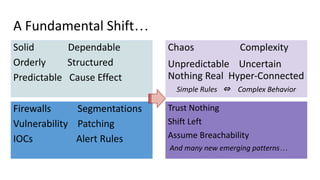
A Fundamental Shift…
Solid Dependable
Orderly Structured
Predictable Cause Effect
Chaos Complexity
Unpredictable Uncertain
Nothing Real Hyper-Connected
Simple Rules ⇔ Complex Behavior
Firewalls Segmentations
Vulnerability Patching
IOCs Alert Rules
Trust Nothing
Shift Left
Assume Breachability
And many new emerging patterns…
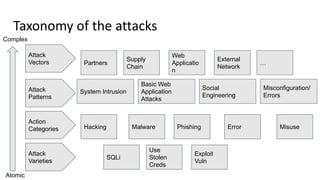
Taxonomy of the attacks
System Intrusion
Basic Web
Application
Attacks
Social
Engineering
Misconfiguration/
Errors
Hacking Malware Phishing Error Misuse
Partners
Supply
Chain
Web
Applicatio
n
External
Network
…
SQLi
Use
Stolen
Creds
Exploit
Vuln
Attack
Patterns
Action
Categories
Attack
Vectors
Attack
Varieties
Complex
Atomic
System Intrusion: JMX Remote Code Execution
Domain
[demobank.co
m]
Subdomain
Discovery
[telesales.demo
bank.com]
Web App Endpoint
Discovery
[https://telesales.demoban
k.com:8080/index.html]
Technology
Detection
[Jboss 3.x]
Active Scanning
specific to
Jboss
JMX Console
[/jmx_console]
Default
Credentials
+
JMX
Console
Admin
Access
Remote
Code
Execution
Multi Stage Attack: Mobile Portal Access
Domain
[demobank.co
m]
Mobile App
Discovery
[ozone app]
API Endpoints
[https://services.demoban
k.com/AdStringO/info]
Directory
Traversal
Vulnerability
Log Files
Discovery
High Entropy
Strings
Detection
Plaintext
Credentials
Internal Web
Application
Endpoint
[mobile.demoba
nk.com]
+
Internal Web
Application
Admin Access
Multi Stage Attack: AWS Admin Access
Domain
[demobank.co
m]
Subdomain
Discovery
[telesales.demo
bank.com]
S3 Bucket Discovery
[https://telesales-prod.s3.a
mazonaws.com]
S3 Content
Download &
Analysis
Dev Mobile APK
Discovery
[dev-telesales.a
pk]
Web App
Endpoint
Discovery
[https://profile.d
emobank.com]
SSRF
Vulnerability
Detection [ Url
Param]
Low Privilege
AWS Keys
AWS Resources
Discovery
Internal S3
Bucket
Discovery
[internal-demob
ank]
S3 Content
Download &
Analysis
Remote
Code
Execution
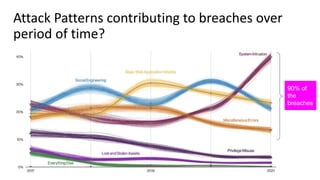
Attack Patterns contributing to breaches over
period of time?
90% of
the
breaches
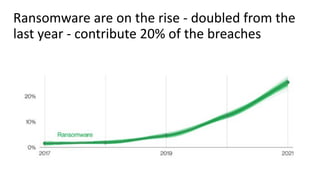
Ransomware are on the rise - doubled from the
last year - contribute 20% of the breaches
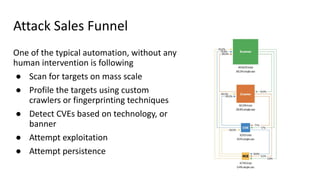
Attack Sales Funnel
One of the typical automation, without any
human intervention is following
● Scan for targets on mass scale
● Profile the targets using custom
crawlers or fingerprinting techniques
● Detect CVEs based on technology, or
banner
● Attempt exploitation
● Attempt persistence
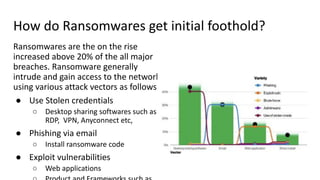
How do Ransomwares get initial foothold?
Ransomwares are the on the rise
increased above 20% of the all major
breaches. Ransomware generally
intrude and gain access to the network
using various attack vectors as follows:
● Use Stolen credentials
○ Desktop sharing softwares such as
RDP, VPN, Anyconnect etc,
● Phishing via email
○ Install ransomware code
● Exploit vulnerabilities
○ Web applications
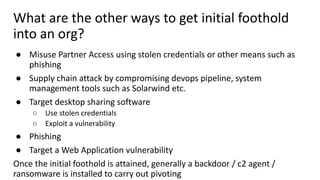
What are the other ways to get initial foothold
into an org?
● Misuse Partner Access using stolen credentials or other means such as
phishing
● Supply chain attack by compromising devops pipeline, system
management tools such as Solarwind etc.
● Target desktop sharing software
○ Use stolen credentials
○ Exploit a vulnerability
● Phishing
● Target a Web Application vulnerability
Once the initial foothold is attained, generally a backdoor / c2 agent /
ransomware is installed to carry out pivoting
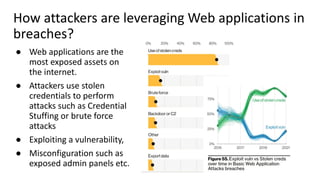
How attackers are leveraging Web applications in
breaches?
● Web applications are the
most exposed assets on
the internet.
● Attackers use stolen
credentials to perform
attacks such as Credential
Stuffing or brute force
attacks
● Exploiting a vulnerability,
● Misconfiguration such as
exposed admin panels etc.
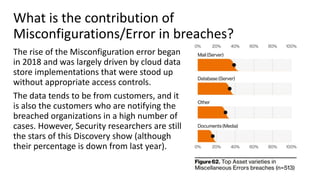
What is the contribution of
Misconfigurations/Error in breaches?
The rise of the Misconfiguration error began
in 2018 and was largely driven by cloud data
store implementations that were stood up
without appropriate access controls.
The data tends to be from customers, and it
is also the customers who are notifying the
breached organizations in a high number of
cases. However, Security researchers are still
the stars of this Discovery show (although
their percentage is down from last year).
Q/A
Taxonomy of the attacks
Taxonomy consists of multiple concepts such as attack patterns, attack
vectors and attack varieties etc.
● Attack Patterns are the complex form of attacks such as system intrusion.
An example of system intrusion is multi stage attacks from outside to
inside the network
○ System Intrusion - Multi Stage attacks to gain access to systems via one or more
attack vectors to install backdoors and ransomware.
○ Basic Web App Attacks - such as Web vulnerabilities, Credential Stuffing using
stolen credentials
○ Social Engineering - Phishing to lure users to submit sensitive information or
download and install malicious code
○ Misconfiguration - Exposed Panels, Exposed Keys, Public Cloud Buckets etc.
● Attack categories are the group of attack Actions/Varieties such as
A time for action items ….
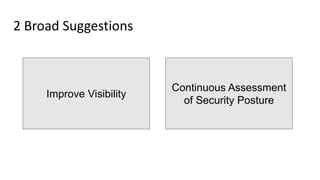
2 Broad Suggestions
Improve Visibility
Continuous Assessment
of Security Posture
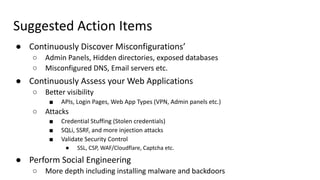
Suggested Action Items
● Continuously Discover Misconfigurations’
○ Admin Panels, Hidden directories, exposed databases
○ Misconfigured DNS, Email servers etc.
● Continuously Assess your Web Applications
○ Better visibility
■ APIs, Login Pages, Web App Types (VPN, Admin panels etc.)
○ Attacks
■ Credential Stuffing (Stolen credentials)
■ SQLi, SSRF, and more injection attacks
■ Validate Security Control
● SSL, CSP, WAF/Cloudflare, Captcha etc.
● Perform Social Engineering
○ More depth including installing malware and backdoors
Suggested Action Items
● Continuously Assess your Desktop Sharing Applications
○ VPN, Anyconnect, RDP, etc.
● Continuous Credential Stuffing attacks
○ Org specific credentials
● Malwares are the second most common action category in breaches.
Perform Assumed Breached Scenarios
○ Install agent/malware on users workstation
○ Exposed Cloud Secret Keys
● Build playbooks to emulate supply chain attacks
Q/A

5 attack vectors behind 3000+ breaches.pdf

  • 1.
    5 attack vectorsbehind 3000+ breaches. How do attackers navigate to your valuable assets and what can you do about it?
  • 2.
    Fundamental Shift istaking place….
  • 3.
    Key Insights fromModern Science 1 Wave Particle Duality… Attacks can penetrate Fixed Walls and Structures…. 2. Heisenberg Uncertainty Principle… Defending and Catching Attackers not possible…. 3. Space & Time Wrap, Speed of Light Fundamental Limit on Defending anything
  • 4.
    A Fundamental Shift… SolidDependable Orderly Structured Predictable Cause Effect Chaos Complexity Unpredictable Uncertain Nothing Real Hyper-Connected Simple Rules ⇔ Complex Behavior Firewalls Segmentations Vulnerability Patching IOCs Alert Rules Trust Nothing Shift Left Assume Breachability And many new emerging patterns…
  • 5.
    Taxonomy of theattacks System Intrusion Basic Web Application Attacks Social Engineering Misconfiguration/ Errors Hacking Malware Phishing Error Misuse Partners Supply Chain Web Applicatio n External Network … SQLi Use Stolen Creds Exploit Vuln Attack Patterns Action Categories Attack Vectors Attack Varieties Complex Atomic
  • 6.
    System Intrusion: JMXRemote Code Execution Domain [demobank.co m] Subdomain Discovery [telesales.demo bank.com] Web App Endpoint Discovery [https://telesales.demoban k.com:8080/index.html] Technology Detection [Jboss 3.x] Active Scanning specific to Jboss JMX Console [/jmx_console] Default Credentials + JMX Console Admin Access Remote Code Execution
  • 7.
    Multi Stage Attack:Mobile Portal Access Domain [demobank.co m] Mobile App Discovery [ozone app] API Endpoints [https://services.demoban k.com/AdStringO/info] Directory Traversal Vulnerability Log Files Discovery High Entropy Strings Detection Plaintext Credentials Internal Web Application Endpoint [mobile.demoba nk.com] + Internal Web Application Admin Access
  • 8.
    Multi Stage Attack:AWS Admin Access Domain [demobank.co m] Subdomain Discovery [telesales.demo bank.com] S3 Bucket Discovery [https://telesales-prod.s3.a mazonaws.com] S3 Content Download & Analysis Dev Mobile APK Discovery [dev-telesales.a pk] Web App Endpoint Discovery [https://profile.d emobank.com] SSRF Vulnerability Detection [ Url Param] Low Privilege AWS Keys AWS Resources Discovery Internal S3 Bucket Discovery [internal-demob ank] S3 Content Download & Analysis Remote Code Execution
  • 9.
    Attack Patterns contributingto breaches over period of time? 90% of the breaches
  • 10.
    Ransomware are onthe rise - doubled from the last year - contribute 20% of the breaches
  • 11.
    Attack Sales Funnel Oneof the typical automation, without any human intervention is following ● Scan for targets on mass scale ● Profile the targets using custom crawlers or fingerprinting techniques ● Detect CVEs based on technology, or banner ● Attempt exploitation ● Attempt persistence
  • 12.
    How do Ransomwaresget initial foothold? Ransomwares are the on the rise increased above 20% of the all major breaches. Ransomware generally intrude and gain access to the network using various attack vectors as follows: ● Use Stolen credentials ○ Desktop sharing softwares such as RDP, VPN, Anyconnect etc, ● Phishing via email ○ Install ransomware code ● Exploit vulnerabilities ○ Web applications
  • 13.
    What are theother ways to get initial foothold into an org? ● Misuse Partner Access using stolen credentials or other means such as phishing ● Supply chain attack by compromising devops pipeline, system management tools such as Solarwind etc. ● Target desktop sharing software ○ Use stolen credentials ○ Exploit a vulnerability ● Phishing ● Target a Web Application vulnerability Once the initial foothold is attained, generally a backdoor / c2 agent / ransomware is installed to carry out pivoting
  • 14.
    How attackers areleveraging Web applications in breaches? ● Web applications are the most exposed assets on the internet. ● Attackers use stolen credentials to perform attacks such as Credential Stuffing or brute force attacks ● Exploiting a vulnerability, ● Misconfiguration such as exposed admin panels etc.
  • 15.
    What is thecontribution of Misconfigurations/Error in breaches? The rise of the Misconfiguration error began in 2018 and was largely driven by cloud data store implementations that were stood up without appropriate access controls. The data tends to be from customers, and it is also the customers who are notifying the breached organizations in a high number of cases. However, Security researchers are still the stars of this Discovery show (although their percentage is down from last year).
  • 16.
  • 17.
    Taxonomy of theattacks Taxonomy consists of multiple concepts such as attack patterns, attack vectors and attack varieties etc. ● Attack Patterns are the complex form of attacks such as system intrusion. An example of system intrusion is multi stage attacks from outside to inside the network ○ System Intrusion - Multi Stage attacks to gain access to systems via one or more attack vectors to install backdoors and ransomware. ○ Basic Web App Attacks - such as Web vulnerabilities, Credential Stuffing using stolen credentials ○ Social Engineering - Phishing to lure users to submit sensitive information or download and install malicious code ○ Misconfiguration - Exposed Panels, Exposed Keys, Public Cloud Buckets etc. ● Attack categories are the group of attack Actions/Varieties such as
  • 18.
    A time foraction items ….
  • 19.
    2 Broad Suggestions ImproveVisibility Continuous Assessment of Security Posture
  • 20.
    Suggested Action Items ●Continuously Discover Misconfigurations’ ○ Admin Panels, Hidden directories, exposed databases ○ Misconfigured DNS, Email servers etc. ● Continuously Assess your Web Applications ○ Better visibility ■ APIs, Login Pages, Web App Types (VPN, Admin panels etc.) ○ Attacks ■ Credential Stuffing (Stolen credentials) ■ SQLi, SSRF, and more injection attacks ■ Validate Security Control ● SSL, CSP, WAF/Cloudflare, Captcha etc. ● Perform Social Engineering ○ More depth including installing malware and backdoors
  • 21.
    Suggested Action Items ●Continuously Assess your Desktop Sharing Applications ○ VPN, Anyconnect, RDP, etc. ● Continuous Credential Stuffing attacks ○ Org specific credentials ● Malwares are the second most common action category in breaches. Perform Assumed Breached Scenarios ○ Install agent/malware on users workstation ○ Exposed Cloud Secret Keys ● Build playbooks to emulate supply chain attacks
  • 22.