ПЕРША ЧВЕРТЬ
УРОК 1
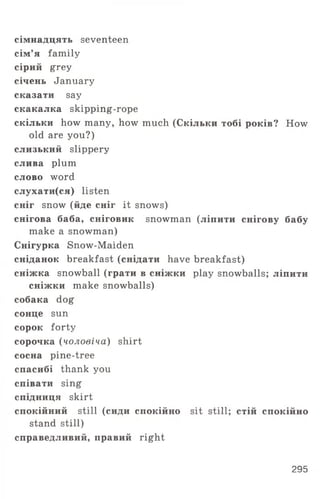
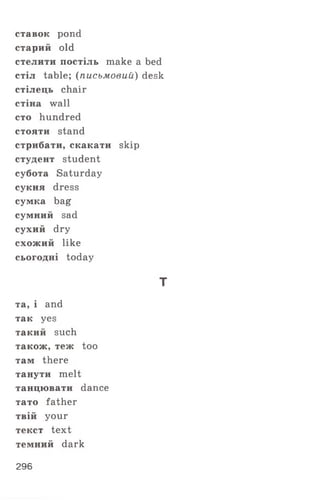
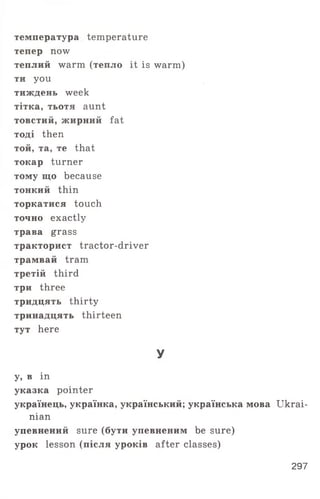
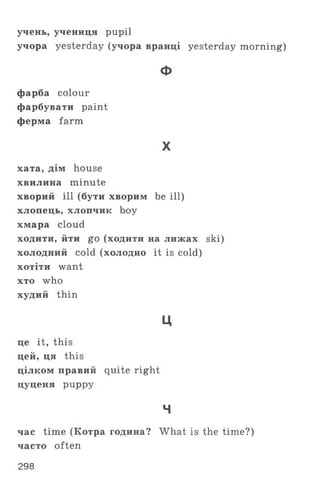
1.Назви англійською мовою іграшки, які ти бачиш на малюнку,
використовуючи слова «it» або «this».
5.
2. У цихклітинках «заховані» назви чотирьох іграшок англій
ською мовою. Виграє той, хто відшукає їх і запише у свій зошит
ь q d r u m
п w с j k 1
d b d о 1 1
f a g t h X
е 1 P 0 u z
U 1 s p k a
3. Озвуч букви і прочитай слова:
Аа, Оо, Yy, Ее, Uu, Іі;
in, on, at, it, pin, pen, ten, bed, pond, top, not, bell,
nut, and, dog, ball, cat, egg, hen, pig.
4. а) Прочитай слова англійською мовою:
1 . a ball
2. a bell
3. a doll
4. a pen
5. а ріп
6. a top
7. a drum
8. a nut
9. a pond
10. ten
м ’яч
дзвінок
лялька
ручка
шпилька
дзиґа
барабан
горіх
ставок
десять
б) Закрий праву частину вправи і переклади слова на українську
мову.
в) Закрий ліву частину вправи і переклади слова на англійську
мову.
5. Скажи, якого кольору олівці на малюнку на початку наступної
сторінки, і полічи їх.
4
6.
6 . Прочитайтекст і переклади
його на українську мову:
This is Murka. Murka is
a cat. It is a little black cat.
Murka is in the box. I have
a cat and Nina has a dog.
7. Закінчіть слова буквою «t>> або «d». Виграє той, хто протягом
двох хвилин правильно напише всі слова.
no-; nu-; be-; роп-; і-; an-;
fia-; са-; ra-; ba-; ha-; re-.
~&| * Виконай вправу 4а за 10 секунд, 4в — за 12 секунд.
Допиши слова:
do...; кепка — са...;
do...; ліжко — be...;
са...; дзвінок — be___
* Тут і далі вправи, номер яких розміщений у квадраті, призначені
для домашніх завдань.
лялька
собака
кіт
5
7.
УРОК 2
1. Згадайлічилку, яку ти розучив у першому класі:
1, 1, 1.
Little dogs run.
2, 2 , 2 .
Cats see you ...
2. Назви, англійською мовою предмети, що знаходяться на столі
3. Озвуч букви і прочитай слова:
Nn, Zz, Bb, Mm, Cc, Хх, LI, Dd, Pp, Ww, Kk, Qq, Jj,
Vv, Ff, Rr,Gg, Ss, Hh, Tt;
big, egg, bad, cat, cap, duck, cock, red, dress, man, hand,
flat, fresh, lorry, happy, very, rabbit, apple, plum,
cherry, chick, fish.
8.
4. Доповни назвипід малюнками. Виграє той, хто правильно
запише всі слова за 40 секунд.
•■ ...encil, bo..., bä. і• .
ЗАПАМ'ЯТАЙ!
Неозначений артикль a (an) вживається перед
іменниками в однині, які можна полічити:
а — перед іменниками, що починаються на
приголосний звук; an — перед іменниками, що
починаються на голосний звук.
Наприклад: a pen, an egg,
a cock, an apple
5. Прочитайте спочатку хором за вчителем, а потім самостійно
словосполучення. Стежте за правильним наголосом та інто
нацією:
a 'fox and a j cock a 'duck and a J chick
a 'cat and a j d o g a 'rat and a J rabbit
a 'tram and o j bus a 'plum and a ^cherry
a 'cap and a J hat a 'hand and a J leg
6.* Напиши англійською мовою під диктовку вчителя такі
словосполучення:
ліва нога, велике порося, червона сукня.
* Тут і далі подібні завдання вчитель диктує англійською мовою.
7
9.
7. а) Прочитайсловосполучення та речення англійською мовою:
1 . a hen and a chick курка і курча
2. a pig and a duck свиня і качка
3. a rabbit and a cock кролик і півень
4. an apple and a plum яблуко і слива
5. a fat rat and жирний пацюк і
a fat cat гладкий кіт
6. a sad man and сумна людина і
a sad dog сумний собака
7. a bad egg and погане яйце
a bad fish і погана риба
8. a big bag and великий портфель і
a little pen маленька ручка
9. I have a dog У мене є собака
and a cat. і кіт.
10. Nick has an apple У Ніка є яблуко
and a plum. і слива.
11. Ann has a red dress Енн має червону сукню
and a red hat. і червоного капелюшка.
12. They have a big Вони мають великого
dog and a little puppy. собаку і мале цуценя.
б) Закрий ліву частину вправи і переклади на англійську мову.
І 8.| Виконай вправу 7а за ЗО секунд, 76 — за 35 секунд.
І9.| Перепиши слова, вставивши пропущені букви:
1і..1е, ар.le, r.bbit, pl.m, dres., cher.y, ha.d, fl.t.
УРОК 3
1. Прочитай скоромовку за 5 секунд:
A black cat
Sat on a mat sat on a mat — сидів на килимку
And ate a fat rat. ate — їв
8
10.
2. Покажи намалюнках тварин, яких називає учитель.
3. Назви англійською мовою спочатку диких, а потім свійських
(домашніх) тварин.
9
11.
4. Озвуч буквосполученняі прочитай слова:
th, sh, ch, ck, ar, er, or, ir;
cock, short, this, that, chick, park, sister, doctor, thick,
thin, farm, bench, fork, girl, shirt, skirt.
5. Виконай команди вчителя:
Stand up! Stand still!
Sit down! Sit still!
6. Прочитай і переклади на українську мову:
а) This pen and that pencil.
This dog and that cat.
This car and that lorry.
б) This is a map and that is a wall.
This is a desk and that is a lamp.
This is a bus and that's a tram.
Напиши англійською мовою під диктовку вчителя:
Ця лялька і той м'яч.
Це півень, а то курка.
Це велика квартира, а то маленька лампа,
а) Прочитай словосполучення за 15 секунд:
1 . a bad pen
2. a black hat
3. six pencils
4. ten apples
5. in the shop
6. in the kitchen
7. in the yard
8. at the bed
9. on the map
10. under the desk
погана ручка
чорний капелюх
шість олівців
десять яблук
у крамниці
на кухні
на подвір'ї
біля ліжка
на карті
під партою
б) Закрий ліву частину вправи і напиши словосполучення
7 — 10 англійською мовою. Потім перевір себе.
10
12.
УРОК 4
1. Скажи,які предмети ти бачиш у класній кімнаті. Пам'ятай
про наголос та інтонацію.
Зразок: I J see a j desk.
2. а) Прочитай слова за 20 секунд:
a duster — a floor — а шар;
a desk— a bed — a door;
a pen — a shelf — a box;
a lamp — a pencil-box — a cat;
a room — a pencil — a wall;
a bag — a cock — a clock.
б) Прочитай слова, що означають назви предметів, які є у класі.
3. Скажи англійською мовою:
Це стілець. Це картина. Це лінійка. Це лампа. Це
двері. Це вікно.
11
13.
Це ручка? —Так. Це олівець? — Ні.
Це указка? — Так. Це книжка? — Ні.
4. Відгадай, яке слово задумав учитель, вживаючи запитання
Is this...?
5. Прочитайте хором з правильною інтонацією:
а / pen, а / pencil and a J bag;
а /тар, a /la m p and a ^desk;
a ./d o g , a /puppy and a J box;
a bag on the J bench;
a ’pen in the J bag;
a 'desk at the J wall.
6. Напиши, де знаходяться предмети або тварини, зображені на
малюнках. Простав знаки іптонацій.
Зразок: a 'doll on the J bed.
7. Скажи, які ти маєш предмети з тих, що знаходяться в класній кімнаті.
Зразок: I 'have aJ pen.
12
14.
Ірочитай слова за25 секунд:
press, sent, test, fill, bus, doll, log, map, number, mis
ter, kept, brick, duck, dig, pot, clap, hand, brag, must,
hock, vest, rabbit, wall, copy, fox.
[~97jІз поданих букв правильно напиши слова до малюнків. Прочи
тай слова в тому ж порядку, що й малюнки:
apm, oby, odor, palm, ligr, gafl
УРОК 5
. Озвуч усі букви алфавіту:
А, В, С, Б, Е, Г, С, Н, І, Л, К, Ь, М, N. О, Р, <3, И, в,
Т, и, V, X, У, г; q, 2,і, х, у, V, w, к, г, и, с, її, пі,
є, і, 1, а, g, Ь, d, р, е, п, о, і, t.
2. Передайте розмову чергового з учителем:
Хто сьогодні черговий? — Я.
13
15.
Як тебе звуть?— Сашко.
Хто сьогодні відсутній? — Всі присутні (або Віра
відсутня. Вона хвора).
3. Прочитай, виконай дії, називаючи предмети.
Зразок: Show те a pen!
This is a pen.
Show me a door!
(a floor! a lamp! a map! a desk! a wall! a corner!
a pencil-box! a shelf! a duster!)
ЗАПАМ’ЯТАЙ!
Дієслово «мати» в англійській мові має дві форми
— have, has.
Форма has вживається лише із займенниками he,
she, it та з іменниками в однині. У всіх інших
випадках вживається have.
І (я)
You (ти, ви)
We (ми)
They (вони)
Наприклад:
:have
Не (він)
She (вона)
It (воно)
We have many apples.
Roman has a rabbit.
has
4. а) Склади якомога більше речень і вимов їх уголос:
Охапа
Ivan
Nina
I
Не
She
Roman
big
black
have a
short
has little
red
bad
apple.
cat.
pencil.
doll.
bag.
lamp.
flat.
б) Напиши по два речення з дієсловами «have», «has».
14
16.
5. Назви днітижня. Скажи, який сьогодні день.
6. Назви англійською мовою те, що зображено на малюнках, а
потім підбери до кожного малюнка рими зі слів, поданих унизу.
Виграє той, хто виконає завдання за 50 секунд.
Зразок: cap — тар.
ten, flag, map, clock, hat, and, doll
|7.|a) Прочитай словосполучення
20 секунд:
1 . a black sock
2. a red carpet
3. a happy family
4. a big text
5. a big town
6. a bad fox
7. a very old dog
8. It's a very big box.
9. Tom is tall.
10. Ann is small.
і речення англійською мовою за
чорна шкарпетка
червоний килим
щаслива сім'я
великий текст
велике місто
погана лисиця
дуже старий собака
Це дуже велика коробка.
Хом високий.
Енн маленька.
15
17.
б) Закрий правучастину вправи і переклади на українську мову
за 25 секунд.
в) Закрий ліву частину вправи і переклади на англійську мову
за 25 секунд.
І8.|Перепиши речення, вставивши замість пропусків займенники
he або she:
1. This is Taras ... is in the park.
2. That is Ira ... is a little girl.
3. This is Bohdan ... is very happy.
4. This is Lida ... has a black kitten.
_______________________________________ УРОК 6
1. Вимов слова орфографічно:
bird, chair, they, like, when, Chernihiv, skirt, under,
quick.
2. Опиши малюнок "Осінь". Використай слова: осінь, погода, небо,
сонце, тепло, листя, квіти, птахи.
16
18.
3. Розкажи, якасьогодні погода.
4. Скажи, що твої однокласники також мають такі предмети.
Зразок: I have a big apple.
Dima has a big apple too.
I have a big doll (a red dress, a little car, a black bag,
a big clock, many nuts).
5. Прочитай речення і переклади їх
1. This is a lorry. 5.
What's this?
It's a lorry.
2. That's a bus. 6.
What's that?
It’s a bus.
3. This is a big park. 7.
What's this?
It's a big park.
4. That’s a small yard. 8.
What's that?
It's a small yard.
на українську мову:
I have a nut.
What have you?
Oleh has a drum.
What has Oleh?
Olena has a red kitten.
What has she?
We have a big flat.
What have you?
ЗАПАМ’ЯТАЙ!
В англійській мові прикметник завжди стоїть
перед іменником. Артикль, який відноситься до
іменника, також ставиться перед прикметником.
Наприклад: a lamp — a red lamp
a box — a big box
6. Склади словосполучення, користуючись таблицею. Прочитай
їх і переклади:
а
thin
thick
pen, pencil, hand, puppy,
bag, lip, leg, wood, man
17
19.
7. Напиши поодному запитанню до кожного речення:
1. This is a big bench.
2. That’s a brown carpet.
3. Kindrat has a little cock.
|8.|a) Прочитай словосполучення англійською мовою за 25 секунд.
б) Закрий ліву частину вправи і переклади на англійську мову
за 25 секунд:
1 . a thin hand
2. a thick grass
3. a thin pen
4. a thick bag
5. this red hen
6. that old tram
7. a thin puppy and
a thick dog
8. a big lorry and
a little car
9. this yard and
that park
10. a red scarf and
a black hat
худа рука
густа трава
тонка ручка
товстий портфель
ця руда курка
той старий трамвай
худе цуценя і
гладкий собака
велика вантажівка і
маленька автомашина
цей двір і
той парк
червоний шарф і
чорний капелюшок
Перепиши речення, вставивши пропущені слова:
1. Olha ... a scarf. It ... red.
2. Makar ... a brown cap too. He ... happy.
УРОК 7
1. Прочитай слова:
get, give, go, grass, girl, glad; ten, text, top, town, tall,
tree; that, they, this, there, them, then; thin, thick,
think, thank, three, thresh.
2. Скажи англійською мовою:
1. У мене є олівець.
18
2. Я маю три ляльки.
20.
3. У ньогоє ручка. 4. Вона має два м'ячі.
5. Настя має велике яблуко. 6. У Тараса є багато слив.
3. Запитайте один одного про предмети, що оточують вас, за
допомогою таких запитань:
W hat’s this? W hat’s that? What have you?
4. Напиши англійською мовою слова в тому ж порядку, що й
малюнки.
5. а) Прочитай словосполучення і речення англійською мовою:
1 . a man and a dog
2. a big cat and a
little kitten
3. a good friend
4. a fresh fish and
a fresh milk
5. this flag and
that drum
чоловік і собака
великий кіт і
мале кошеня
гарний товариш
свіжа риба і
свіже молоко
цей прапор і
той барабан
19
21.
6. Ostap isa big boy.
7. Katya is a little girl.
8. Nina, sit still!
9. Children, stand still!
10. They have many
Остап великий хлопець.
Катя маленька дівчинка.
Ніно, сиди спокійно!
Діти, стійте спокійно!
Вони мають багато
pencils. олівців.
б) Закрий праву частину вправи і переклади словосполучення і
речення на українську мову.
в) Закрий ліву частину вправи і переклади на англійську мову.
6. Виконай фізичні вправи під вірш "Hands up", який ти розучив
у першому класі.
І7.1а) Прочитай і переклади на українську мову текст:
I like animals. I have a dog. It is Rex. Rex is a very
good dog. He is my friend.
When I go to the park Rex goes with me. It is a very big
park. There are many trees, flowers and birds there. In the
park we play and run.
an animal — тварина; good — гарний; a friend —друг;
with me — зі мною; a flower — квітка; play — гратися
б) Письмово дай відповіді на запитання:
1. Прочитай слова за 25 секунд:
form, fork, or, short, doctor, corner, door, floor, sum
mer, winter, supper, butter, number, dinner, runner, never,
her, under, mister, girl, bird, shirt, skirt, dirty, colour.
REX
1. Is Rex a dog or a cat?
2. Is Rex a bad dog?
3. Is it a big park?
УРОК 8
20
22.
2. Прочитай реченняі переклади їх на українську мову:
1. I can see many flowers in the yard.
2. He has a very good friend.
3. His little sister likes to play with her doll.
4. What animals have you?
3. Розглянь малюнки. Скажи англійською мовою, котра година:
4. На малюнку ти бачиш дівчину Мальвіну. Опиши
її зовнішність.
5. Прочитай речення і пере
клади їх на українську мову:
1. This shirt is brown.
What colour is this shirt?
It's brown.
2. That skirt is black.
What colour is that skirt?
It's black.
21
23.
6. Напиши піддиктовку вчителя англійською мовою:
Це Том. Йому шість років. У Тома в руці (є) чорний
кіт. Він щасливий.
|7.|а) Прочитай словосполучення англійською мовою за 20 секунд:
1 . a door and a floor
2. a skirt and a shirt
3. a girl or a boy
4. a form or a dress
5. a wet duck
6. a sad dog
7. a short pencil
8. a dirty floor
9. a little bird
10. a hot summer
двері і підлога
спідниця і сорочка
дівчина чи хлопець
форма чи сукня
мокра качка
сумний собака
короткий олівець
брудна підлога
маленька пташка
спекотне літо
б) Закрий ліву частину вправи і переклади на англійську мову
за 25 секунд.
8.|Спочатку напиши англійською мовою слова в тому ж порядку,
що й малюнки. Потім склади перші літери всіх слів, і утвориться
нове слово. Яке? Запиши його.
22
24.
УРОК 9
1. Озвучбукви. Допоможуть тобі у цьому транскрипційні знаки.
а [ае], b [b], с [k], d [d], е [е], f [f], g [g], h [h],
і [i], j [d3j, k [k], 1 [I], m [m], n [n], o [o], p [p], q [kw],
r [r], s [s], t [t], u [л], v [v], w [w], x [ks], у [i], z [zj.
2. Прочитай слова:
pen, sit, but, end, cup, bell, pin, dog, sun, rest, in, bench,
spot, pig, nut, doll, cock, it, duck, hot.
3. Скажи, чиї це предмети.
Зразок: Це Ірин портфель.
This is Iras bag.
1. Це Романів пенал. 5, ц е Катрусина книга.
2. Це Наталчина дзиґа. 0, ц е Ганнусині санчата.
3. Це Петрові лижі. 7. Це мамина сукня.
4. Це Олегові ковзани. 8. Це дідусів капелюх.
4. Виконай фізичні вправи під знайомий тобі вірш "Hands on
your hips!"
5. Розглянь малюнки. Прочитай речення і дай відповіді на
запитання англійською мовою:
1. It's Ann. Ann has a red
dress and a red hat.
1. Хто це?
2. Щ о є в Енн?
2. It's Pete. Pete has a
black cap and a brown bag.
1. Хто це?
2. Щ о має Піт?
ЗАПАМ'ЯТАЙ!
Множина іменників утворюється за допомогою
закінчення -я, яке читається [г] після голосних і
дзвінких приголосних звуків і [б] — після глухих
приголосних звуків.
23
25.
Наприклад: [z] [s]
abed — beds a desk — desks
a pen — pens a cat — cats
a tree — trees a chick — chicks
Множина іменників, що закінчуються на приго
лосні s, ss, ch, sh, х, утворюється за допомогою
закінчення — es, яке читається [iz].
Наприклад: a box — boxes
a dress — dresses
a bus — buses
До іменників, які закінчуються на у, додається
закінчення -es і буква у замінюється на і.
Наприклад: a puppy — puppies
a cherry — cherries
Множина деяких іменників утворюється не за
правилами. їх слід запам'ятати.
1 . a man — men
2. a child — children
З іменниками множини неозначений артикль а
(an) не вживається.
6. Прочитай і переклади па українську мову:
a pen — pens; a cock — cocks; a fox — foxes;
an egg — eggs; a lamp — lamps; a family — families;
an apple — apples; a flat — flats; a bench — benches;
a tram — trams; a desk — desks; a scarf — scarves.
7. Скажи, що цих предметів багато.
Зразок: a hat — many hats
a door a pencil-box a yard
a wall a text a park
a lamp a town a shelf
24
26.
а) Прочитай словосполученняі речення за 15 секунд:
1 . a small ball маленький м'яч
2. a big pond великий ставок
3. a happy boy щасливий хлопчик
4. a dirty dress брудна сукня
5. many children багато дітей
6. ten windows десять вікон
7. six shelves шість поличок
8. I have six apples. У мене є шість яблук.
9. Rita has seven cherries. Ріта має сім вишень.
10. He likes plums. Він любить сливи.
б) Закрий ліву частину вправи і переклади на англійську мову
за 20 секунд.
І9,[ Напиши спочатку слова, які закінчуються на дзвінкий
приголосний звук [z], а потім на глухий приголосний [s].
Зразок: [z] balls,
[s] cups,
tops, drums, beds, shirts, walls, desks, arms, bells, flags,
flats, girls, hats, maps, parks, rooms, texts.
_______________________________ УРОКИ 10-11*
1. а) Озвуч буквосполученнл:
th [6], [0], sh [J], ch [tj], ck [k], qu [kw].
б) Назви знайомі тобі слова, в яких є ці буквосполученпя.
2. Скажи, яких тварин ти любиш, а яких не любиш.
Зразок: I like dogs.
I don't like cats.
* Розподіл матеріалу здвоєних уроків здійснює учитель на власний
розсуд.
25
27.
ЗАПАМ'ЯТАЙ
Українському слову «є»відповідають англійські
слова is — для однини і are — для множини.
Вживання is або are є обов'язковим.
Наприклад: The ball is small. — М'яч ( є )
маленький.
The balls are on the floor. —
М'ячі ( є ) на підлозі.
3. Прочитай, порівняй і переклади на українську мову:
а) 1. The desk is brown. — The desks are brown.
2. The cherry is red. — The cherries are red.
3. The ball is big. — The balls are big.
4. The fork is dirty. — The forks are dirty.
5. The girl is on the bench. — The girls are on the bench.
6. The man is in the room. — The men are in the room.
7. The child is in the park. — The children are in the
park.
б) 1. There is a doll on the bed. — There are dolls on the
bed.
2. There is a cat under the bed. — There are cats under
the bed.
3. There is a shelf on the wall. — There are many shelves
on the wall.
4. There is a fish in the pond. — There are many fishes
in the pond.
5. There is a pen in the pencil-box. — There are pens in
the pencil-box.
6. There is a kitten in the box. — There are kittens in
the box.
7. There is a car in the yard. — There are many cars in
the yard.
4. Склади по одному реченню із словами is, are, there is, there
are.
26
28.
5. Запитайте однеодного, як звуть вас, ваших братів, сестер,
батьків, і дайте відповідь.
Зразок: What is your name? — M y name is Pavlo.
What is your sister s name? — Her name is Odarka.
6. На малюнку ти бачиш Буратіно. Опиши його зовнішність.
Розкажи все, що ти про нього знаєш.
7. Напиши англійською мовою:
1. У мене є багато ручок.
2. Яблуко червоне. — Яблука червоні.
3. На парті шість олівців.
8. а) Прочитай речення англійською й українською мовами:
1. The map is on the wall.
2. The boy is in the car.
3. The ducks are in the pond.
4. The birds are in the park.
Карта (є) на стіні.
Хлопець (є) у машині.
Качки (є) у ставку.
Птахи (є) в парку.
27
29.
5. There isa lamp in the flat.
6. There are many
children in the yard.
7. Nina has six fishes.
8. Oleh has many letters.
У квартирі (є) лампа.
У дворі (є) багато дітей.
У Ніни є шість рибок.
У Олега є багато листів.
б) Закрий ліву частину вправи і переклади речення на
англійську мову за 20 секунд.
] Перемалюй табличку в свій зошит. Напиши під кожним із
поданих нижче слів 3— 4 знайомих тобі слова, кожне з яких
повинно бути довшим на одну літеру. В кожному слові, крім
«Ье», «Ье», «сіо», «go», дозволяється замінювати будь-яку
літеру, крім першої. Приклад наведено в першому стовпчику:
be he do go
bag
bell
bench
butter
|10. |Напиши англійською мовою:
1. Лисиця руда. 3. У кімнаті червоний килим.
2. Парти чорні. 4. У портфелі три книжки.
УРОК 12
1. Озвуч транскрипційні знаки:
[а], [о], [ае], [е], [v], [w], [b] [d], [s], [z], [д], [d3], [б], [0], [J], [tj],
[kw], [t], [I], [mj, fn], [ks].
2. Прочитай:
[pen], [it], [big], [aepl], [as], [0in], [öis], [buk], [wont], [tjeri], [klok],
[Jip], [kwik],
3. а) Скажи англійською мовою:
1. Я хочу читати книгу. 2. Я хочу писати листа.
28
30.
3. Я хочумалювати квітку. 4. Я хочу гратися з м ’ячем.
5. Він хоче бігати з другом. 6. Дівчинка хоче співати.
б) Скажи ці самі речення в заперечній формі.
ЗАПАМ'ЯТАЙ!
Якщо перед словом стоїть «по», то артикль не
вживається.
Наприклад: I have an apple. — У мене є яблуко.
I have no apple. — У мене нема яблука.
5. Скажи ці речення в заперечній формі:
1. I have a pencil-box in my bag.
2. I have a kitten in the box.
3. We have fishes in the room.
4. Vira has a doll in her hand.
5. He has a drum on his desk.
6. They have a clock on the wall.
6. Прочитай текст, дай відповіді на запитання.
We have many animals. We have a dog and a cat. We
have a cock, six hens, seven ducks and many chicks. We
have ten rabbits but we have no pig. We have no kittens
and puppies. We like animals.
1. Have you many animals?
2. What animals have you?
3. How many hens and ducks have you?
4. Have you six or ten rabbits?
5. Have you a pig?
6. Have you a kitten and a puppy?
7. Do you like animals?
7. Дай відповіді на запитання. У цьому тобі допоможе малюнок
на початку наступної сторінки.
29
31.
1. Is thisa classroom or a kitchen?
2. What can you see in this classroom?
3. Whom can you see in the classroom?
4. Do you see a man in the classroom?
5. Do you see boys and girls?
6 . How many desks are there?
7. Can you see a lamp?
8. What do you see on the wall?
9. Whom do you see at the map?
10. What is her name?
11. Have they animals in the classroom?
12. Is it hot or cold?
13. What have children on the desks?
14. Where is the duster?
15. Do you like this classroom?
8.1а) Прочитай і переклади текст:
This is Tom. Tom is a big boy. He is ten. He lives in
30
32.
London. London isa big town. Tom likes animals. He has a
dog, a cat and a bird. He has many fishes too. Tom has no
rabbit. His cat likes milk and his dog likes fishes. Tom
likes to play and run with his dog in the yard or in the
park. The dog is Tom's friend,
б) Письмово дай відповіді на запитання:
1. Who is this? 2. How old is Tom?
3. Where does he live? 4. What animals has Tom?
5. Who is Tom's friend?
_____________________________________ УРОК 13
1. Виконай завдання 86 з попереднього уроку.
2. Озвуч букви, буквосполучення і транскрипційні знаки:
q, r, w, d, f, b, v, s, a, c; ck, th, sh, ch, qu, or, ar, oo;
[u:], [А], [ав]. [e], Ш. [8], WJ, [9], [fl], [a:], [o:], [ks], [d3], [z],
31
33.
3. Постав запитаннядо речень, прочитай їх і переклади на
українську мову.
Зразок: The car is in the yard.
Where is the car?
The children are on the carpet.
Where are the children?
1. The clock is on the wall.
2. The dog is under the bench.
3. Vita is at the door.
4. The men are in the park.
ЗАПАМ’ЯТАЙ!
Означений артикль the вживається з іменниками
однини і множини тоді, коли в українській мові
перед цими іменниками можна поставити слова:
цей (ця, це), той (та, те).
Наприклад: This is a pen. — Це ручка.
The pen is black. — (Ця) ручка чорна.
I have a doll. — У мене є лялька.
It's on the bed. — Вона на (тому) ліжку.
4. Прочитай спочатку всі речення, а потім лише ті, де дається
правильна відповідь на запитання відповідно до малюнків:
1. Where is the map?
The map is at the wall.
The map is on the wall.
The map is under the wall,
32
34.
2. Where arethe pencils?
The pencils are under the pen
cil-box.
The pencils are on the pencil-
box.
The pencils are in the pencil-box.
3. Where is the kitten?
The kitten is on the bed.
The kitten is at the bed.
The kitten is under the bed.
5. а) Прочитай речення англійською
1. What is your name?
— My name is Dima.
2. How old are you?
— I am seven.
3. Do you live in Poltava?
— No, I do not.
4. Where do you live?
— I live in Kyiv.
5. Where does your
sister live?
— She lives in Lviv.
6. Does your brother
live in Lviv?
— Yes, he does.
7. Where do they live?
— They live in a big
flat.
и українською мовами:
Як тебе звуть?
— Мене звуть Діма.
Скільки тобі років?
— Мені сім років.
Ти живеш у Полтаві?
— Ні.
Де ти живеш?
— Я живу в Києві.
Де живе твоя сестра?
— Вона живе у Львові.
Т вій брат ж иве у
Львові?
— Так.
Де вони живуть?
— Вони живуть у вели
кій квартирі.
33
35.
б) Закрий лівучастину вправи і переклади речення на англій
ську мову.
6. Письмово дай відповіді на запитання:
1. What is your name?
2. Have you a sister or a brother?
3. Where do you live?
|7.| Виконай вправу 56 за ЗО секунд.
І 8.| Перепиши речення, вставивши необхідні слова:
1. There (is, are) many desks in the classroom.
2. Roman (live, lives) in Ternopil.
3. (Do, does) she like butter?
4. How old (is, are) Pavlo?
5. They (have, has) many apples.
УРОК 14
book, exercise book, school,
zoo, broom, looking glass,
schoolboy, schoolgirl, good,
to look.
Good afternoon!
You look well.
1. Вимов звуки і напиши відповідні їм букви.
Зразок: [n] — Nn.
[і], [m], [V], [t], [s], [а:], [ав], [d], [І], [р].
2. Прочитай речення. Дай відповіді на запитання.
1. I live in Lutsk. 2. Stepan lives in Uman.
Do you live in Odesa? Does he live in Kyiv?
Where do you live? Where does Stepan live?
3. Bob and Sam live in London.
W ho lives in London?
What town do they live in?
34
36.
ЗАПАМ'ЯТАЙ!
Буквосполучення оо читається[и] або [и:].
Наприклад: [и] [и:]
a book a school
a room too
3. Прочитай слова:
[U] [и:]
look hook spoon boot
good brook moon foot
cook shook root goose
foot wood tool pool
took wool soon fool
4. Прочитай слова з перекладом і запиши їх у словник:
a school [sku:I] a looking-glass
школа дзеркало
35
37.
a broom azoo [zu:]
мітла, віник
a schoolboy
зоопарк
a schoolgirl
школяр школярка
good — гарний (-a, -e, -і), добрий (-a, -e, -i); Good after
noon! — Добридень! ( при зустрічі у другій половині дня);
to look — дивитися; You look well. — Ти добре виглядаєш.
5. а) Прочитай словосполучення і речення і переклади їх на
українську мову:
A big book, a little book, a good book, a bad book, a thin
book, a thick book, this book, Ann’s book. It's a very good
book. His book is on the desk.
A thin exercise-book, a thick exercise-book, that exer-
cise-book, her exercise-book, many exercise-books, an ex
ercise-book and a pen. I have a red exercise-book. Her exer
cise-book is in the bag.
A big school, a little school, an old school, my school, in
36
38.
this school, atthe school. There are many classrooms in
this school. I like to go to school.
A big looking-glass, a little looking-glass, a bad look
ing-glass, Olha's looking-glass. There is a big looking-glass
in this room. Give me your looking-glass.
A big zoo, a little zoo, a very good zoo, in the zoo, at the
zoo. Many animals live in the zoo. We like to go to the zoo.
б) Склади із кожним виділеним словом якомога більше слово
сполучень.
6. Відтворіть діалог англійською мовою:
— Добридень, Ніно!
— Добридень, Віро!
— Я рада тебе бачити.
— Я теж. Ти добре виглядаєш.
— Дякую. Ти також добре виглядаєш.
7. Прочитай текст і дай відповіді на запитання:
My name is Sasha. I am seven. I am a schoolboy. I have
a sister. Her name is Nina. She is ten. She is a schoolgirl
too. We have many books and exercise-books. We like to
go to school. The school is old and good. There are many
classrooms in the school.
1. What is the boy's name? 3. Who is a schoolgirl?
2. Is he a schoolboy? 4. How old is Nina?
5. Have they many books and exercise-books?
6. Is this school good or bad?
8.[ а) Прочитай усі речення за 50
секунд:
1. Where is the broom?
The broom is on the floor.
The broom is under the desk.
The broom is in the corner of the
room.
37
39.
2. Where arethe books and the
exercise-books?
The books and the exercise-
books are in the bag.
The books and the exercise-
books are on the desk.
The books and the exercise-
books are under the bag.
3. Where are the schoolboys
and the schoolgirls?
The schoolboys and the school
girls are in the park.
The schoolboys and the school
girls are at the pond.
The schoolboys and the school
girls are at the school.
4. Who likes to go to the zoo?
The men like to go to the zoo.
The children like to go to the
zoo.
The animals like to go to the
zoo.
б) Напиши лише ті речення, де дається правильна відповідь на
запитання до малюнків.
УРОК 15
about
1. Виконай вправу 86.
2. Запиши і запам'ятай слово about [a'baut] — про.
38
40.
3. Доповни іпрочитай словосполучення.
Зразок: a book about dogs — книга про собак.
4. Скажи, які книги тобі подобаються. Стеж за правильною
інтонацією.
Зразок: I 'like 'books about J cocks.
39
41.
5. Напиши англійськоюмовою під диктовку
вчителя:
1. Мені подобаються книжки про собак.
2. У нього є багато книжок про тварин.
3. Це книжка про кішок.
6. Подивись на малюнок. Це Чіполліно. Опиши
його зовнішність і розкажи все, що ти про
нього знаєш.
7. Прочитай і переклади текст:
IN THE ROOM
This is a room. This is children’s room. Ann and Nick
are in the room. A big cat and a little kitten are in the
room too.
Look at Ann! She has a doll in her hand. Ann is a little
girl. She does not go to school.
Look at Nick! He has a book in his hands. Nick is a good
schoolboy. He likes books about birds but they have no
birds. Nick likes the book "Сіра шийка". It is a book about
a fox and a bird.
Look at the big cat and the little kitten. The big cat is
on the carpet. It looks at the kitten. The little kitten is on
the broom.
40
42.
[~87|а) Прочитай словосполученняі
1 . a good book
2. his exercise-book
3. an old school
4. a book and an
exercise-book
5. many schoolboys
and many schoolgirls
6. a broom in the corner
of the room
7. a looking-glass
on the wall
8. There are many animals
in the zoo.
9. Good afternoon, Tom!
You look well.
10. Nina has ten books
about animals.«
речення за 25 секунд:
хороша книжка
його зошит
стара школа
книжка і зошит
багато школярів
і багато школярок
віник у кутку кімнати
дзеркало на стіні
У зоопарку (є) багато
тварин.
Добридень, Томе!
Ти добре виглядаєш.
У Ніни є десять книжок
про тварин.
б) Закрий ліву частину вправи й переклади словосполучення і
речення на англійську мову за 30 секунд.
19.|Письмово дай відповіді на запитання:
1. Are you a schoolboy or a schoolgirl?
2. Have you a looking-glass in your room?
3. Do you like books about dogs?
УРОК 16
Sunday, Monday, Tuesday,
Wednesday, Thursday, Friday,
Saturday
1. Прочитай вірш і переклади його на українську мову:
43.
I have acat.
I have a dog.
I have a big coodoo.
Dan has a cat.
Dan has a dog.
Dan has a coodoo, too.
Sam has a pig.
Sam has a frog.
Sam has a red coodoo.
I have a pig.
I have a frog.
I have a coodoo, too.
a coodoo [ku:'du:] — антилопа
2. Розкажи про свій робочий день, використовуючи такі слова:
a book, an exercise-book, a school, a schoolboy, a schoolgirl, а
room, good.
3. а) Скажи англійською мовою:
хто, черговий, сьогодні, я, ти, відсутній, хворий, ніхто,
ім'я, твоє, як, де, дякую, я живу, у Києві.
б) Відтворіть діалог англійською мовою:
Хто сьогодні черговий? Де ти живеш?
4. Напиши, які з перелічених предметів є у твоїх однокласників.
Зразок: Olena has a good book.
5. Розглянь малюнки на початку наступної сторінки. Прочитай
підписи під ними. Здогадайся про значення виділених слів.
Як тебе звуть?
— Тарас.
Ти добре виглядаєш.
— Дякую.
— Я. — У Києві.
Хто сьогодні відсутній?
— Наталка.
Хто хворий?
— Ніхто.
a red exercise-book
a good pencil-box
many books about dogs.
42
44.
The boys likeThe girls like The men like to
to play football. to play tennis. play basketball.
6. а) Згадай назви днів тижня англійською мовою.
б) Прочитай і запиши їх у свій словник. Запам’ятай, що в
англійській мові ці назви пишуться з великої букви:
Sunday ['sAndi] — неділя, Thursday [*0a:zdi] — четвер,
Monday ['mAndi] — понеділок, Friday [’fraidi] — п'ятниця,
Tuesday [*tju:zdi] — вівторок, Saturday [’saetadi] — субота.
Wednesday ['wenzdi] — середа,
в) Скажи англійською мовою, які дні тобі подобаються най
більше, і поясни чому.
17. |Прочитай текст, письмово дай відповіді на запитання.
LIDA'S SCHOOLBAG
Lida is a schoolgirl. She has a good red schoolbag. It is
on the desk.
45.
— What haveyou in your schoolbag, Lida?
— I have many books and exercise-books in it.
Lida has many things in her schoolbag. She has a pen, a
pencil-box and six pencils. She has toys in her schoolbag
too.
1. W ho is Lida?
2. What has Lida?
3. Is her schoolbag black or brown?
_______ 4. Has she many books on the desk?
a thing [Bin] — річ, предмет
a toy — іграшка
______________________________________УРОК 17
horse, dark, second, far from.
What form are you in?
1. Прочитай:
44
46.
а) [Г)]: ring,bring, sing, spring, long, song, strong, gong;
[r]k]: ink, pink, bank, tank, trunk, drink.
б) ['fra id i], [’sAndi], [’wsenzdi], [' tj u :z d i], ['mAndi],
['0a:zdi], ['saetadi],
2. Скажи англійською мовою, що тобі подобається робити кожного
дня тижня.
Зразок: On Sunday I like to go to the zoo.
On Monday ... On Thursday ...
On Tuesday ... On Friday ...
On Wednesday ... On Saturday ...
3. а) Прочитай слова з буквосполученнями «ог» і «аг». Переклади
на українську мову ті слова, які ти вже знаєш.
or [o:] ar [a:]
or born park far
form horse dark bar
fork sport arm scarf
sort fort art card
corn lord part start
б) Запиши у свій словник і запам’ятай:
dark — темний (-а, -е, -і); second ['sekand] — другий (-а,
-е, -і); far from — далеко від; What form are you in? — В
якому ти класі?
45
47.
4. а) Прочитайсловосполучення і речення, переклади їх на
українську мову:
a big horse, an old horse, a black horse, a good horse, his
horse. A horse is an animal. He has a book about horses.
A dark room, a dark yard, a dark car, in the dark box. My
bag is black, it is dark. My sister's bag is brown, it is dark
too.
Far from school, far from the park, not far from Kyiv.
Oleh lives far from his school. Ivan lives not far from me.
б) Склади по два речення з виділеними словами і словосполучен
нями.
5. Розкажи англійською мовою, яка погода буває у вересні.
6. Прочитай запитання і відповіді з перекладом:
1. Have you a horse?
— No. I have not.
У тебе є кінь?
— Ні.
46
48.
2. Does yourfather like
horses?
— Yes, he does.
3. Is your classroom dark?
— No, it isn't.
4. Do you see a cat in the
dark corner?
— No, I don’t. I see a
little kitten there.
5. Who lives far from
school?
— Taras and Oxana.
6. Is your desk far from
the door?
— Yes, it is.
7. What form are you in?
— I am in the second form.
8. What form is Zina in?
— Zina is in the second
form too.
9. When do you get up
on Monday?
— On Monday I get up
at seven o'clock.
10. Do you go to school
on Sunday?
— No, I don't.
Твій батько любить коней?
— Так.
Ваш клас темний?
— Ні.
Ти бачиш кота в темному
кутку?
— Ні. Я бачу там маленьке
кошеня.
Хто живе далеко від
школи?
— Тарас і Оксана.
Твоя парта далеко
від дверей?
— Так.
В якому ти класі?
— Я в другому класі.
В якому класі Зіна?
— Зіна також у другом у
класі.
Коли ти встаєш у понеділок?
— У понеділок я встаю
о сьомій годині.
Ти ходиш до школи
в неділю?
— Ні.
|~77|а) Прочитай ліву частину вправи 6 за 50 секунд.
б) Закрий ліву частину вправи 6 і переклади речення на україн
ську мову.
47
49.
І8 .1Запитай своїхрідних і друзів, чи знають вони, що сім днів
тижня названі у латинській мові на честь Сонця, Місяця і п'яти
інших планет: Меркурія, Венери, Марса, Сатурна та Юпітера.
Неділя — день Сонця.
Понеділок — день Місяця.
Вівторок — день Марса.
Середа — день Меркурія.
Четвер — день Юпітера.
П'ятниця — день Венери.
Субота — день Сатурна.
А як ти гадаєш, якби люди у давнину знали про існування ще
таких планет, як Уран, Нептун і Плутон, скільки б днів тижня
ми мали — сім чи десять?
УРОК 18
As for те ...
1. Прочитай за 25 секунд:
cut, tell, fall, bad, spoon, lip, cherry, sun, ill, good, play,
girl, dog, like, bag, long, pink, brown, form, arm, far,
second, horse, apple, milk.
2. Склади якомога більше речень:
I
Не
She
We
They
Antin
Vira
Children
His sister
3. а) Запиши у свій словник і запам’ятай вислів:
as [az] for me ... — щодо мене .
am
are
is
in the second form.
48
50.
б) Прочитай іпереклади на українську мову:
1. I like dogs. — As for me I like horses.
2. I like books about animals. — As for me I like books
about children.
3. I want to go to the park today. — As for me I want to
go to the pond.
4. I would like to go to the zoo on Saturday. — As for
me I would like to play in the yard.
4. Скажи англійською мовою:
1. У неділю я встаю о дев'ятій годині.
2. У понеділок моя сестра встає о сьомій годині.
3. У суботу він лягає спати о десятій годині.
4. У середу вони обідають о другій годині.
5. У вівторок діти йдуть до школи о восьмій годині.
6. У четвер ми вечеряємо о сьомій годині.
7. Вона хоче піти до зоопарку в п'ятницю.
5. Відтворіть діалог англійською мовою:
— Добридень, Лідо!
— Добридень, Миколко!
— У якому ти класі?
— Я в другому класі. А ти?
— Я теж у другому класі.
— Скільки тобі років?
— Мені 7. А тобі?
— Мені 8.
6. Напиши англійською мовою під диктовку вчителя такі речення:
1. Мені подобаються коні, але у мене немає книжки
про коней.
2. Ми живемо далеко від школи.
49
51.
7. Що тизнаєш про персонажів, зображених на малюнках? З
яких вони казок?
8. Прочитай імена:
Ivan, Taras, Stepan, Oleh, Ihor, Nina, Maria, Zina, Lida,
Vira, Roman, Ostap, Fedir, Yura, Ruslan, Nadia, Olena,
Oxana, Tamara, Natalka, Bohdan, Polina, Antin, Petro,
Katya.
52.
I9.|Перепиши речення, переклавшина англійську мову слова, взяті
в дужки:
1. My sister is (у другому класі).
2. (У неділю) I go to bed at ten o ’clock.
3. Ihor's school is not (далеко від) his flat.
4. Nina likes apples. (Щодо мне) I like plums.
______________________________________УРОК 19
table, eraser, name, sur
name, to take, to skate
1. Прочитай транскрипцію слів:
[it], [fo:], [sou], [tu:], [rum], [gould], [boks], [Ьгл/], [flaet], [belt],
[tjes], [a:m], [rouz], [wirj].
ЗАПАМ'ЯТАЙ!
а) Буква «а» у відкритому наголошеному складі
читається [еі].
Наприклад: а пате, а cake, take
б) Буквосполучення «all» читається [о:І].
Наприклад: a ball, a wall, small
2. а) Прочитай слідом за вчителем:
lake came ball
plate gave call
plane late tall
table skate fall
date make small
б) Прочитай самостійно:
fame pane all
game pale wall
fate slave hall
tale save stall
face lady spall
51
53.
3. Прочитай словаз перекладом, запиши їх у свій словник і
запам’ятай:
an eraser [YreizaJ — гумка; a table — стіл;
a name — ім'я; a surname ['sa:neim] — прізвище; to ta
ke — брати; to skate — кататися на ковзанах
4. а) Прочитай словосполучення і речення англійською й україн
ською мовами за 25 секунд:
1. a desk and a table
2. a good table
3. a big table and
a little eraser
4. an eraser on the table
5. a short name
6. a good name
7. His name is Ivan.
8. Her surname is Petrenko.
9. What is your name?
10. What is his surname?
11. Ann likes to skate.
12. Tom! Take a book!
парта і стіл
хороший стіл
великий стіл і
мала гумка
гумка на столі
коротке ім'я
гарне ім'я
Його звуть Іван.
Її прізвище Петренко.
Як тебе звати?
Як його прізвище?
Енн любить кататися на
ковзанах.
Томе! Візьми книгу!
б) Закрий ліву частину вправи, переклади словосполучення і
речення на англійську мову за ЗО секунд.
52
54.
5. Відтворіть діалоганглійською мовою:
— Добридень!
— Добридень!
— Як тебе звати?
— Мене звати Сашко. А як тебе?
— Мене звати Юрко. Як твоє прізвище?
— Моє прізвище Шевченко. А твоє?
— Моє прізвище Бойко.
— У якому ти класі?
— Я в другому класі. А ти?
— Я теж у другому.
6. Перепиши речення, вставивши необхідні слова:
1. There is a big brown (bed, table) in the classroom.
2. My sister's name is (Petro, Maria).
3. His surname is (Moskalenko, Ivan).
4. I like (to play football, to skate) in winter.
7. а) Назви англійською мовою дні тижня в тому ж порядку, що
й аркуші календаря на малюнку.
б) Назви дні тижня по порядку. Пам’ятай, що в англійській
мові тиждень розпочинається з неділі.
53
55.
8. Прочитай текст,переклади його на українську мову і дай
письмові відповіді на запитання.
КАТЕ
My sister's name is Kate. Kate is a little girl. She is six.
She likes apples and cakes. Kate likes to play with her dolls
at the table.
1. What is your sister’s name?
2. Is Kate six or ten?
3. Does she like cakes?
4. Where does Kate like to
play?
a cake [keik] — тістечко
УРОК 20
day, day book, today,
grey, gay, eight, may,
to want
1. а) Повтори читання букви «а» в різних складах:
[Єї] [эе] [a:] [o:] [o]
same tram class ball what
face cat grass salt want
tale map task warm wash
navy bag fast small watch
wake stand park chalk was
б) Склади до кожного стовпчика по одному реченню із знайомим
тобі словом.
2. Подивись на малюнок на початку наступної сторінки. Спочатку
скажи, хто це, а потім розкажи все, що ти знаєш про нього,
його друзів і ворогів.
54
56.
3. Прочитай словаіз різними буквосполученнями, які передаються
одним звуком [еі]:
еі ey ai ay
eight [t] hey tail day
feign [n] grey pain gay
seiner sley paint may
reign they mail pay
beige trey drain play
deign prey rain stay
4. Запиши у словник і запам'ятай слова:
a day-book — щоденник; eight — вісім;
57.
a day —день; today — сьогодні; grey — сірий (-а, -е, -і);
gay — веселий (-а, -е, -і); тау — могти; to want — хотіти
5. а) Прочитай словосполучення і речення й переклади їх на
українську мову:
This day, that day, a gay day, a dark day, a short day.
My sister likes winter days. As for me I like summer days.
My day-book, his day-book, a red day-book, a day-book
on the desk. Nick, take your day-book! Olya’s day-book is
in her bag.
Today is Monday. Today is Wednesday. Today I want to
go to the zoo. Today is Sunday and we don't go to school.
A grey cat, a grey horse, a grey dress. I have a little
grey kitten. Nina, take a grey exercise-book!
A gay boy, a gay girl, gay children, a gay puppy. I like
gay children. His sister is a gay girl.
Eight books, eight schoolboys, eight cars, eight day
books. Bohdan is eight. Vira has eight books about animals.
I want to play with Ihor in the yard. Taras wants to go
to the pond on Sunday. She wants to take toys to school.
May I take this book? Yes, you may. May I take your
pencil-box? May I go to the table?
б) Склади по одному реченню із виділеними словами.
6. Склади речення з поданих нижче слів і запиши їх. У цьому
56
58.
1. eight, I,table,
can, on, see,
pencils, the.
2. Taras, with,
to play, wants,
a kitten, grey.
[ 7.|a) Прочитай словосполучення і речення англійською та україн
ською мовами за ЗО секунд:
3. is, gay, Yura,
a boy, but, sad,
is, Nina, girl, a.
1. a pencil and an eraser
2. a grey bird
3. an eraser under
the table
4. a short name and
a short surname
5. a gay boy and
a sad girl
6. a happy day
7. a thick day-book
8. eight books and
ten exercise-books
9. Today is Friday.
10. We want to go to
the zoo on Saturday.
11. May I take this eraser?
12. It is cold today.
Lida, take a scarf!
8.
олівець і гумка
сіра пташка
гумка під столом
коротке ім'я і
коротке прізвище
веселий хлопчик і
сумна дівчинка
щасливий день
товстий щоденник
вісім книжок і
десять зошитів
Сьогодні п'ятниця.
Ми хочемо піти до
зоопарку в суботу.
Можу я взяти цю гумку?
Сьогодні холодно.
Лідо, візьми шарф!
б) Закрий ліву частину вправи і переклади словосполучення та
речення на англійську мову за 35 секунд.
Напиши англійською мовою:
1. У мене немає сірого олівця.
2. Мені вісім років, а твоїй сестричці — шість.
3. Том і Сем — веселі хлопчики.
УРОК 21
1. Прочитай:
a) take, cage, bag, table, camp, lamp, gap, play, yard,
pay, paint, hey, day, eight, tail, last, what, warm;
57
59.
б) [беї], [aed],['kofi], [fij], [hel0], [peil], [ska:f], [swim], [swon],
[zu:j, [’tikit], [wad], [tu:], [boks] .
2. Запитайте англійською мовою одне одного, як вас звати, як ваше
прізвище, скільки вам років, в якому ви класі, де ви живете.
3. а) Прочитай текст і переклади його на українську мову:
RAIN
"Rain! Rain!" says Bobby. "I like to see the rain".
"I like the rain too", says Nelly.
"Let us go and play "Rain".
"W hat are you, Bobby?"
"I am a frog", says Bobby."I am a gay green frog. I like
to jump. I like the rain. And what are you, Nelly?"
"I am a duck", says Nelly. "I like the rain. I want to
swim. I am a big grey duck".
And the children play "Rain".
rain — дощ; say — говорити; let us — давай
б) Дай відповіді на запитання до тексту:
1. What are the children's names?
2. W ho is a frog and who is a duck?
3. Does the duck like to run or to swim?
4. What does the frog like to do?
в) Відтворіть англійською мовою діалог між Боббі і Неллі.
4. Прочитай початок речень і заверши їх. Зверни увагу на закін
чення дієслів у третій особі однини:
а) I have ... б) I want ... в) I go ...
You have ... You want ... You go ...
He (she) has ... He (she) wants He (she) goes ...
We h a v e ........... We want ... We go ...
You have ... You want ... You go ...
They have ... They want ... They go ...
5. Склади по одному реченню із словами «today», «eight», «table»
і запиши їх.
58
60.
Ira Koval, 6
1.This is a little ...
2. Her name is ...
3. Her surname is ...
4. Ira is ...
5. She likes to play
with her ...
Pavlo Savchuk, 8
1. This is a ...
2. His name is ...
3. His surname is ...
4. Pavlo is ...
5. Pavlo has a book,
... and ...
6. Скажи англійською мовою:
1. У мене є книжка, але у мене немає щоденника.
2. Сьогодні холодно, і я не хочу йти до зоопарку.
3. Це кошеня — сіре і веселе.
4. На подвір'ї восьмеро дітей.
5. Хто хоче піти до ставка в неділю?
6. Який сьогодні день?
7. Костю, покажи мені свою гумку!
8. Його звати Богдан, а його прізвище — Ковальчук.
І7.| Перепиши речення, дописавши необхідні слова. У цьому тобі
допоможуть малюнки.
8. Розкажи англійською мовою про себе своїм рідним (ім'я,
прізвище, вік, клас, де ти живеш, що любиш робити в суботу і
неділю).
59
61.
УРОК 22
rosy, athome. Go home!
Go to bed! Go to school!
1. Прочитайте вірш. Переможе той, хто швидше вивчить його
напам'ять.
WHAT IS GREY?
What is grey?
What is grey?
Can you say?
Yes, I can.
My cat is grey.
ЗАПАМ'ЯТАЙ!
Буква «о» у відкритому наголошеному складі
читається [ои].
Наприклад: a rose[rouz]; no [nou]
2. а) Прочитай слова:
go, no, bone, home, nose, rose, hope, note, close, role, tone,
robe, toe, stone, lone.
б) Прочитай слова і вислови з перекладом, запиши їх у свій
словник і запам'ятай:
rosy [rouzi] — рожевий (-а, -е, -і), рум'яний (-а, -е, -і); at
home — вдома; Go home! — Йди (йдіть) додому! Go to
bed! — Лягай (лягайте) спати! Go to school! — Йди (йдіть)
до школи!
3. а) Прочитай словосполучення і речення та переклади їх на
українську мову:
A rosy pen, a rosy dress, a rosy eraser, a rosy pig, a rosy
scarf, a rosy lamp. Nina has a rosy skirt. I have a red dress
and a rosy scarf.
I have a little kitten at home. Stepan has a big dog at
home. His sister has many books at home.
60
62.
Nick! Go home!
Children,it is very cold today. Go home!
Pete, it's ten o'clock. Go to bed!
Vira, take your bag and go to school!
б) Склади по одному реченню з виділеними словами.
4. Скажи англійською мовою:
1. Цей зошит червоний, а той — рожевий.
2. У мене немає рожевої сукні.
3. Марійка має вдома шість кроликів.
4. Петрику, забирай свою сестричку і йдіть додому!
5. Ганнусю, бери ляльку і лягай спати!
6. Діти, беріть свої портфелі і йдіть до школи!
5. Пригадай вірш, який ти вивчив у першому класі. Прочитай
його і переклади на українську мову.
MY DOLL
My doll is so pretty.
Her eyes are so blue.
Her cheeks are so rosy.
Her dress is so new.
so — такий (-a, -e, -i); pretty
— чарівний (-a, -e, -i); eye
[аі] — о к о; blue [bIu:] —
синій, голубий; cheek [tji:k]
— щока; new [nju:] — новий
(-а, -e, -і)
6. Напиши англійською мовою під диктовку вчителя:
1. Мені подобається це рожеве яблуко.
2. Ми маємо вдома багато горіхів.
3. Діти, беріть книги й зошити і йдіть додому!
17.1Склади по одному реченню зі словами «rose», «go» і запиши
їх.
[ЇГ] Вивчи напам’ять вірш "My Doll".
63.
УРОКИ 23-24
window, windowsill,
yellow, flower, house,
to water flowers
1. Розкажи напам'ять вірш "My Doll".
ЗАПАМ'ЯТАЙ!
Б у к в о с п о л у ч е н н я «ои» ч и та є ть с я [au], а
буквосполучення «ow» — [au] або [ои].
Наприклад: house [haus]; how [hau]; grow [grou]
2. Прочитай слова:
ou [au]
loud sound blouse
cloud count house
ground round mouse
found pound about
[a u ]------- ow - [ou]
now down town row low blow
cow gown owl sow bowl crow
bow brown flower show yellow slow
how clown crown snow window know
3. Прочитай слова з перекладом, запиши їх у свій словник
запам'ятай.
a window [’windou] — вікно; a window-sill — підвіконня;
62
64.
a flower [’flaua]— квітка; a house [haus] — дім, будинок;
yellow ['jelou] — жовтий (-а, -e, -і); to water flowers —
поливати квіти
4. а) Прочитай словосполучення й речення і переклади їх на
українську мову:
A big window, a dark window, on the window, at the
window, six windows. I have a big window in my room. His
desk is at the window.
A good window-sill, a bad window-sill, under the win
dow-sill, at the window-sill. This window has no window
sill. There are many flowers on the window-sill.
A big flower, a red flower, a yellow flower, this flower,
that flower. I can see many flowers on the window-sill.
Maria has many flowers in her hands.
A big house, a little house, an old house, a good house,
a bad house, my house, in the house. This house has many
windows and doors. Her house is far from school.
A yellow dress, a yellow shirt, a yellow flower, a yellow
car, a yellow pencil. My sister likes yellow flowers. There
are many yellow chicks and ducks in the yard.
б) Склади по одному реченню із виділеними словами.
5. Напиши англійською мовою:
Дімин будинок, ця квітка, жовтий портфель, сіре
підвіконня, вісім вікон.
63
65.
6. Подивись намалюнок і дай відповіді на запитання:
1. What do you see?
2. Who waters flowers?
3. What is the girl's name?
4. How old is she?
5. Do you see yellow flowers?
6. Do you like to water flowers?
7. Прочитай, переклади і відгадай загадку:
WHAT FLOWER?
Red or rosy.
In summer I grow
I'm a fine flower
As you all know.
to grow — рости; fine —
чудова; as [az] — як
8. а) Прочитай словосполучення і речення англійською мовою за
ЗО секунд:
1. a big house
2. a big town
великии дім
велике місто
64
66.
3. a windowand a door
4. a good window-sill
5. a yellow flower
6. many trees and many
flowers
7. her day-book
8. eight tables
9. Where do you live?
— I live in a big house.
10. Who waters flowers
in your room?
— My sister waters
flowers in my room.
11. Do the boys like
to water flowers?
— No, they don't.
12. Are there yellow
flowers in the park?
— Yes, there are.
вікно і двері
гарне підвіконня
жовта квітка
багато дерев і багато
квітів
її щоденник
вісім столів
Де ти живеш?
— Я живу у великому
будинку.
Хто поливає квіти
в твоїй кімнаті?
— Моя сестра поливає
квіти в моїй кімнаті.
Хлопчики люблять
поливати квіти?
— Ні.
У парку є жовті квіти?
— Так.
б) Закрий ліву частину вправи і переклади словосполучення й
речення на англійську мову за 35 секунд.
9. Перепиши речення, розкривши дужки.
I live in a (little, big) house.
I have a (classroom, room).
My bed is at the (window, door).
There is a (red, yellow) shelf on the wall.
There are many (books, flowers) on the window-sill.
10. Письмово опиши малюнок до вправи 6.
65
67.
УРОК 25
mouse, cow,snow, snowball,
snowman, to make snow
balls, to make a snowman,
to play snowballs
1. Прочитай:
а) how, town, now, cow, flower, loud, round, about;
б) slow, row, know, snow, low, window, yellow, blow;
в) [daun], [aul], [gaun], [braun], [kraun], [sou], [Jou], [boul],
2. Прочитай слова і вислови, запиши їх у свій словник і запам’ятай:
а mouse [maus] — миша; а cow [kau] — корова;
snow [snou] а snowman a snowball
— сніг; — сніговик; — сніжка;
to make snowballs — ліпити сніжки; to make a snowman
— ліпити сніговика; to play snowballs — грати в сніжки
66
68.
3. а) Прочитайсловосполучення і речення за 45 секунд:
1. A big mouse, a little mouse, a grey mouse, this mouse,
that mouse.
2. A big cow, a good cow, a red cow, a black cow, a dark
cow, this cow, his cow.
3. This snow, cold snow, grey snow, dark snow, good
snow, bad snow, wet snow, dirty snow, thick snow.
4. A big snowball, a big snowman, many snowballs, a
good snowman, this snowman, a gay snowman.
5. I like to play snowballs in winter. When do you make
a snowman? Do the girls make snowballs? In winter
we can see many snowmen in the yard.
б) Переклади ці словосполучення і речення на українську мову.
ЗАПАМ'ЯТАЙ!
Множина від іменника a mouse — mice [mais].
Наприклад: Many grey mice live in our yard.
4. Скажи англійською мовою:
1. Мій кіт любить мишей. 3. Ці миші сірі і веселі.
2. Собаки не люблять 4. У нашому будинку
мишей. немає мишей.
5. Напиши англійською мовою під диктовку вчителя:
1. Корови не живуть у місті.
2. Моє маленьке кошеня любить гратися з мишами.
6. Запитайте одне одного англійською мовою, скільки у вас є
таких предметів.
67
69.
I7.|a) Прочитай словосполученняі речення англійською мовою за
25 секунд:
1. a grey mouse
2. a little mouse
and a big cat
3. a red cow
4. a cow in the yard
5. a cow and a horse
6. many yellow flowers
7. Do you like
this snowman?
— Yes, I do.
8. Can you make snowballs
in summer?
— No, I can't.
9. Nick, let us play
snowballs!
10. There is no snow
сіра миша
маленька миша
і великий кіт
руда корова
корова на подвір'ї
корова і кінь
багато жовтих квітів
Тобі подобається
цей сніговик?
— Так.
Ти можеш ліпити
сніжки влітку?
— Ні.
Ніку, давай грати
в сніжки!
Влітку немає снігу.
in summer.
б) Закрий ліву частину вправи і переклади ці словосполучення
й речення на англійську мову за ЗО секунд.
І8 .1Дай письмові відповіді на запитання:
1. W ho likes mice? 2. Have you a book about cows?
3. Do you like to play snowballs?
____________ УРОКИ 26-28 (РЕЗЕРВНІ)
68
70.
ДРУГА ЧВЕРТЬ
УРОК 29
1.Прочитай вірш і переклади його на українську мову:
HOW MANY HANDS?
How many hands How many hands
Has a boy, say? Has a girl, say?
How many hands How many hands
For work and play? For work and play?
for work — для роботи
2. Передайте англійською мовою розмову вчителя і чергового.
3. Хором прочитайте знайомі вам дієслова. Зверніть увагу на ви
мову закінчення -s:
М [S]
to see — sees to like — likes
to play — plays to look — looks
to stand — stands to take — takes
to know — knows to want — wants
to come — comes to put — puts
to give — gives to get — gets
to run — runs to sit — sits
ЗАПАМ'ЯТАЙ!
Теперішній неозначений час (The Present Indefi
nite Tense) вживається для вираження дій, що
відбуваються постійно або йдуть одна за дру
гою.
Теперішній неозначений час утворюється за
допомогою додавання закінчень -s або -es лише
до дієслів третьої особи однини.
Наприклад: I see a dog. They see a dog.
We see a dog. He sees a dog.
You see a dog. She sees a dog.
69
71.
Закінчення -s або-es вимовляються [s], [z] або [iz]
залежно від звука, на який закінчується дієслово,
до якого ці закінчення додаються.
Наприклад: I take [teik] — he takes [teiks]
I sing [sir)] — he sings [sirjz]
I rise [raiz] — he rises [raiziz]
Дієслова to do — «робити», to say — «говорити»,
to have — «мати» у третій особі однини мають
форми does [dAz], says [sez], has [haez].
Наприклад: I do — he (she) does.
I say — he (she) says.
I have — he (she) has.
Дієслова can, may — «могти» у третій особі од
нини не мають закінчень.
Наприклад: I can — he (she) can.
I may — he (she) may.
4. Скажи ці речення в 3-й особі однини:
1. We play football in the yard.
2. I see a lamp on the table.
3. I like yellow and red flowers.
4. I go to bed at ten o'clock.
5. I have many books about dogs.
6. They live in a big town.
7. We want to go to the zoo.
8. I can help you to water flowers.
9. I know this little boy.
10. I get up at seven o'clock.
5. Перепиши речення, поставивши дієслова, взяті в дужки, у
третій особі однини:
1. Oleh (have) supper at seven o'clock.
2. Nina (go) to school at eight o'clock.
70
72.
3. Nadya (like)apples and cherries.
4. Nick (can) make a snowman on Sunday.
|6.|а) Прочитай вірш і переклади на українську мову:
MOUSE
Little grey mouse
Where is your house?
«I can show you my flat.
If you don't tell the cat.
I live under the floor.
My flat has no door».
if — якщо; to tell — говорити, розповідати
б) Склади по одному реченню з підкресленими дієсловами, поста
вивши їх у третій особі однини, і запиши у свій зошит.
_____________________________________ УРОК зо
one, two, three, four, five, six,
seven, eight, nine, ten, every
1. Прочитай:
71
73.
а) comes, goes,looks, does, says, takes, gets, stands,
sits, plays, knows, grows, sees, has, runs.
б) [rein], [bentj], [wul], [mu:n] [bbk], [spo:t], [dAk], [pa:k],
[’haepi], [leik], [wdJ], [Gas], [milk], [sirj], [d3 aem],
2. Прочитай слова з перекладом, запиши у свій словник і
запам'ятай їх:
one [WAn]
1
ОДИН
two {tu:]
2
два
three [9ri:]
3
три
four [fo:]
4
чотири
five [faiv]
5
п'ять
six [siks]
6
шість
seven [sevn]
7
сім
eight [eit]
8
вісім
nine Q дев’ять
[nain] мГ [ten] 10 ДЄСЯТЬ
every ['evri] — кожний (-а, -е, -і)
3. Скажи, скільки предметів ти маєш і скільки має твій друг.
Зразок: I have one bag. Petro has one bag too.
5 книжок, 4 м'ячі,
10 зошитів, 8 горіхів,
2 ручки, 4 яблука,
7 олівців, 9 слив,
1 гумка, 6 квіток.
4. а) Прочитай словосполучення й речення і переклади їх на
українську мову:
1. One girl, one boy, one man, one hand, one leg.
2. Two pens, two trees, two cars, two pencil-boxes.
72
74.
3. Three books,three dolls, three doors, three tables.
4. Four pencils, four men, four horses, four days.
5. Five mice, five flowers, five schoolgirls, five chicks.
6. Six snowmen, six looking-glasses, six boxes, six flats.
7. Seven lorries, seven pigs, seven cows, seven rooms.
8. Eight children, eight ducks, eight tops, eight towns.
9. Nine trams, nine schoolboys, nine bags, nine pencils.
10. Ten clocks, ten cups, ten forks, ten classrooms.
11. I go to school every day. Tanya plays in the yard
every day. We go to the park every Sunday.
б) Склади по одному реченню з виділеними словами.
Заперечна форма теперішнього неозначеного часу
(The Present Indefinite Tense) утворюється за
допомогою дієслова do або does і частки not.
Наприклад: I (we, they) do not (don't) go to school on
Saturday and on Sunday. He (she) does not (doesn't)
go to school on Saturday and on Sunday.
5. Склади якомога більше речень за таблицею:
ЗАПАМ’ЯТАЙ!
My sister
Taras
We
Tanya
They
I play football
go to school
don't water flowers
doesn't Р1аУ snowballs every day.
go to the zoo
play in the yard
skate
6. Напиши речення в заперечній формі:
1. My sister likes dogs and cats.
2. I play tennis every day.
3. They go to the pond every Sunday.
75.
1. two pensand
three pencils
2. one table and
four windows
3. five books in
the bag
4. ten birds on
the bench
5. six exercise-books
and one day-book
6. seven days
7. eight schoolboys and
nine schoolgirls
8. We don't make a snow
man in summer.
9. Ira doesn’t like
to water flowers.
10. The boys don't play
football in the park.
б) Закрий ліву частину вправи
за 25 секунд.
дві ручки і
три олівці
один стіл і
чотири вікна
п'ять книж ок у
портфелі
десять пташок на
лавці
ш ість зошитів
і один щоденник
сім днів
вісім ш колярів і
дев'ять ш колярок
М и не ліпимо снігови-
ка влітку.
Іра не любить
поливати квіти.
Хлопці не грають у
футбол у парку,
і переклади на англійську мову
8 Напиши речення в заперечній формі:
1. Ann wants to have her dinner.
2. We get up at six o ’clock.
3. They like to play snowballs in the park.
4. Pete goes to school every day.
УРОК 31
1. Прочитайте вірш і перекладіть його на українську мову. Пере
може той, хто швидше вивчить його напам'ять.
I am a boy (a girl),
A little one.
I like to play,
I like to run.
74
76.
2. Розкажи, якасьогодні погода.
ЗАПАМ'ЯТАЙ!
У питальній формі теперішнього неозначеного
часу (The Present Indefinite Tense) дієслово do
(does) ставиться на початку речення.
Наприклад: 1. Do you live in Kyiv? — Yes, I
do. (No, I don't).
2. Do they live in Kyiv? — Yes, they do. (No, they
don't).
3. Does he (she) live in Kyiv? — Yes, he (she) does.
(No, he (she) doesn't).
Із дієсловами to be, can дієслово do не в ж и
вається.
Наприклад: 1. Is he a schoolboy? — Yes, he
is. (No, he isn't).
2. Are you a schoolgirl? — Yes, 1 am. (No, I'm
not).
3. Can you help me? — Yes, I can. (No, I can't).
3. Постав запитання до речень за допомогою do (does) і дай на
них коротку відповідь:
1. Taras lives in Lviv.
2. My sister goes to school every day.
3. He gets up at seven o'clock.
4. They go to the park every day.
5. I play with my dog every day.
4. Прочитай текст і переклади його на українську мову:
WHAT CHILDREN CAN DO ON A RAINY DAY
Peter is a big boy. He is ten. Bobby is his brother. He is
seven. Ann is their sister. She is only five.
They are gay and happy children, but today they are not
gay. Today is a rainy day. Oh, what a rainy day is today!
75
77.
What can theydo on a rainy day? They like to play and
run in the yard but today they cannot go out.
Bobby begins to cry. Ann looks at him and begins to cry
too.
Peter says, "Oh, Bobby, don’t cry. Oh, Ann, don’t cry.
We have many toys, let us play with them".
But Bobby says, "I don't want to play with toys, I want
to play in the yard".
And Ann says, "I want to play in the yard". And begins
to cry again.
76
78.
Then Peter says,"Oh, Bobby, oh, Ann, let us go to the
kitchen. The cat lives in the kitchen and it has five nice
little kittens. Let us play with them".
Bobby says, "I want to see the five little kittens” .
Ann says, "I want to see the five little kittens, too".
Now she does not cry. And they go to the kitchen. They
come up to the box and see five little kittens.
Ann takes one kitten. "It is my kitten", she says.
Bobby takes one kitten. "It is my kitten" he says.
Now the children are happy again. They play with the
nice little kittens. And only Mother Cat is not very happy.
It looks at her little kittens. It wants to have them back in
her box.
on a rainy day — у дощовий день; their [без]— їх н я ;
only — лише; to go out — виходити; to cry [krai] —
плакати; to begin [bi'gin] — починати; again [a'gein] —
знову; nice — гарний; to come up — підходити; now —
тепер; a mother ['тдбэ] — мама; back — назад
I5.j Дай відповіді на запитання до тексту "What Children Can Do
on a Rainy Day":
1. What are the children's names?
2. Why do they cry?
3. Do they want to play with the toys?
4. What do they want to do?
5. Who lives in the kitchen?
6. How many kittens are there in the box?
7. Do Bobby and Ann want to play with the kittens?
8. How many kittens do they take?
9. Are the children gay and happy now?
10. Who is not very happy and why?
[б7]Напигаи англійською мовою:
1. Віра живе у Полтаві? — Так.
2. Тед живе в Одесі? — Н і.
3. Вони ж ивуть у Львові? — Так.
4. Іван — школяр? — Н і.
77
79.
УРОК 32
1. Прочитайтелічилку "One, two...” і перекладіть її на українську
мову. Переможе той, хто швидше вивчить її напам’ять.
ONE, TWO...
One, two, Five, six,
Look at the shoe. Look at the bricks.
Three, four, Seven, eight,
Look at the floor. Look at the plate.
Nine, ten,
Look at the pen.
a shoe [Ju:] — черевик; a brick — кубик; a plate —
тарілка
2. Дай відповіді на запитання:
1. What day is it today?
2. Is it cold today?
3. Is it summer now?
4. Do you like rain?
5. Can you skate today?
6. What do you want to do on Sunday?
3. Уважно роздивись малюнки і вислов здивування у зв'язку з
написаним. Скажи правильно.
Зразок: Tom lives in Lviv.
Does Tom live in Lviv? — He lives in London.
Nina lives in Poltava.
78
They have dinner at five o
80.
It is summernow. The flowers are yellow.
The cat plays with the mice. The boys play football in
the room.
4. Склади якомога більше речень за таблицею:
І
We
Ann and Pete
Lida
Dima
don't
doesn’t
at 10 o'clock,
at 5 o'clock,
at 11 o'clock,
every day.
in summer,
на українську
have dinner
get up
go to school
skate
play in the yard
5. а) Прочитайте текст у парах. Перекладіть його
мову:
THE GAME "I LIKE"
Ted and Sid are friends. They like to play games to
gether.
Ted: Sid, let's play the game "I like".
Sid: Oh, it’s a good game. Let's play it. You begin, Ted.
Ted: I like apples. And what do you like, Sid?
79
81.
Sid: I likeapples and cherries. Now you, Ted.
Ted: I like apples, cherries and plums. It's your turn
now, Sid.
Sid: I like apples, cherries, plums and cakes. And what
about you, Ted?
Ted: I like apples, cherries, plums, cakes and milk. Then
again you, Sid.
Sid: I like apples, cherries, plums, cakes, milk and ...
and ...
Ted: Oh, I see. You cannot say it now.
Then I win the game. Do I?
Sid: Yes, you do, Ted.
a game — гра; a friend — друг, приятель; together —
[ta'ge6a] — разом; it's your turn [ta:n ] — твоя черга; to
win — виграти
б) Спробуйте самі зіграти в цю гру.
І6 .1а) Прочитай і перекажи текст:
A WELL-BRED BOY
Nick is ten. He is a well-bred boy. He helps little girls
and boys. He plays with his little sister. Her name is Ann.
She is three. When he goes into the yard he takes his sister
with him. He doesn't jump and run in the room.
well-bred — добре вихований, ґречний
б) Дай письмові відповіді на запитання:
1. Is Nick a well-bred boy?
2. Does he help little boys and girls?
3. What is his sister's name?
4. Does Nick play with Ann?
5. Does he jump and run in the room?
80
82.
УРОК 33
season, week,leaf,
teacher, green, clean
1. Прочитай за 15 секунд:
[pm], [kaet], [big], ['лпсіа], [lou], [gein], [keid3], [bai], [Ь1авг)к], [зи:],
[blok], [ka:], ['hju:man], [’рісізіп], [wa:k], [ta:sk], [ski:], [’pleiful],
[a'bAv], [’belou].
ЗАПАМ’ЯТАЙ!
а) Буква «е» у відкритому наголошеному складі
читається [і:].
Наприклад: be, we.
б) Буквосполучення «ее», «еа» також читається [і:].
Наприклад: see, clean.
2. Прочитай слова:
he, me, she, fee, sweet, greet, these, Pete, mete, eat,meat,
seat, bee, free, tree, leaf, tea, peace, green, sleep, deep,
speak, read, wsak.
3. Прочитай слова з перекладом, запиши їх у свій словник і
запам'ятай:
81
83.
a season [si:zn]— пора року; a week [wi:k] — тиждень;
clean [kli:n] — чистий (-a, -e, -i)
Множина від іменника a leaf — leaves
4. а) Прочитай словосполучення й речення і переклади їх на
українську мову:
A big leaf, a yellow leaf, a brown leaf, a green leaf,
many leaves, under the leaf, on the leaf.
This teacher, my teacher, Olya's teacher, a good teacher,
an old teacher, a teacher at the table, many teachers.
A green pencil, a green car, a green apple, a green frog,
a green skirt, many green leaves.
A clean dress, a clean shirt, a clean exercise-book, a
clean room, a clean cup, clean hands.
This week, one week, three weeks. A week has seven
days. Tuesday is the second day of the week.
This season, a good season, a bad season, a cold season,
four seasons. What season do you like? I know four sea
sons.
б) Склади по одному реченню з підкресленими словами.
5. а) Скажи англійською мовою:
п'ятниця, вівторок, неділя, четвер, середа, субота,
понеділок.
б) Назви дні тижня по порядку. Пам'ятай, що в Англії першим
днем тижня є неділя, а у нас — понеділок.
6. Дай відповіді на запитання:
1. Do you like red and yellow leaves on the trees?
2. What is your teacher's name?
3. W ho has a green dress?
4. What season is it now?
5. How many days has a week?
6. Are your books clean?
7. Запитайте одне одного і дайте відповіді, що ви бачите:
82
84.
у класі
на столі
упарку
на парті
У дворі
на підвіконні
Зразок: — Oleh, what can you see in the room?
— I can see a bed, a table, a carpet and a
lamp in the room.
8. а) Прочитай текст і переклади його на українську мову:
THE DAYS OF THE WEEK
There are seven days in a week. They are Monday, Tues
day, Wednesday, Thursday, Friday, Saturday and Sunday.
83
85.
Monday, Tuesday, Wednesday,Thursday and Friday are
working days. Saturday and Sunday are rest-days.
Children and teachers do not go to school on Saturday
and Sunday. They can go to the park, to the pond or to the
zoo. Children can run, jump, play football, basketball or
tennis. They can swim in summer and skate in winter.
a working [’wa:kirj] day — робочий день; a rest-day —
вихідний день; to swim — плавати
б) Дай письмові відповіді на запитання:
1. How many days are there in a week?
2. What days are rest-days?
3. What day of the week is it today?
4. What do you do on your rest-days?
______________________________________УРОК 34
seat, to read, to speak, to
repeat, please, to take a
seat. Excuse me, please!
1. Розкажи, які дні тижня ти знаєш, скільки їх, які з них робочі
дні, а які вихідні. Які дні тижня тобі подобаються, а які — ні,
поясни чому.
2. Скажи англійською мовою:
1. На деревах багато червоного і жовтого листя.
2. Я не люблю зелених вишень і слив.
3. Це вікно дуже чисте.
4. Зима — холодна пора року.
5. Олена Петрівна — дуже хороша вчителька.
6. Кожен тиждень має сім днів.
3. Прочитай. Запиши у свій словник і запам’ятай:
a seat — місце; to read — читати; to speak — розмовляти;
to repeat [ri'pi:t] — повторювати; please [pli:z] — будь ласка;
Excuse me, please! [iks'kju :z] — Вибач(те) мені, будь ласка!;
to take a seat — сідати.
84
86.
4. а) Прочитайслова, словосполучення і речення з перекладом:
1. to read
2. to read a book
3. a seat
4. my seat
5. please
6. Take your seat, please!
7. to excuse
8. Excuse me, please!
9. to speak
10. Children, don’t speak!
11. to repeat
12. Repeat after me!
13. He does not read books
every day.
б) Закрий ліву частину вправи
читати
читати книгу
місце
моє місце
будь ласка
Сядь, будь ласка!
вибачити
Вибач, будь ласка!
говорити, розмовляти
Діти, не розмовляйте!
повторювати
Повторюй(те) за мною!
Він не читає книги
щодня,
і переклади на англійську мову.
5. а) Прочитайте словосполучення і речення за вказаний час:
25 секунд
This seat, my seat, Nick’ s seat, Ann’ s seat, a teacher’ s
seat, a good seat, a bad seat, a seat at the table, a seat at
the window. Tom, go to your seat! May I take my seat? I
like my seat at the desk. Children, take your seats!
15 секунд
to read a book, to read this book, to read a big book, to
read a book about dogs. I like to read books about animals.
I want to read but I have no book. Lida, read this text,
please!
12 секунд
Children, don’t speak! Roman, repeat it! Vira, stand up,
please! Ivan, show me your hands, please! Excuse me, please!
May I take your pen?
б) Переклади ці словосполучення і речення на українську мову.
6. Напиши англійською мовою під диктовку вчителя:
85
87.
1. У Тарасазелений пенал.
2. Ніна любить читати книги про квіти.
3. Моя сестра дуже маленька дівчинка.
4. Вона не вміє розмовляти і читати.
7. а) Виконай команди вчителя:
Stand up!
Stand still!
Sit down!
Sit still!
Take a pen!
Take an eraser!
Give me a pencil-box!
Give me a book!
Go to the table!
Go to the door!
Show me your bag!
Show me your day-book!
Look at the window!
Look at the table!
Read a text!
Clean a desk!
б) А тепер виконай ці команди лише тоді, коли до них буде
додано слово «please». Той, хто помилиться і виконає команду
без слова «please», вибуває з гри.
Зразок: Petro! Stand up, please! Show me your left hand,
please!
або
Halya! Come up to me, please! Take this book, please!
Take your seat!
(Галя вибуває з гри, якщо виконає останню команду).
І8.| а) Прочитай текст:
LITTLE APPLES AND BIG APPLES
Little Ann likes apples. She likes to look at them, she
likes to play with them and she likes to eat them. Her
mother gives her apples every day. But today the little
girl’ s mother has no apples. She can’t give Ann an apple.
But Ann wants to have an apple. She goes up to her mother.
Ann. Mummy, I want an apple. Give me an apple, please.
Mother. It is evening now, my girl. Apples sleep in the
evening. You must go and sleep, too.
86
88.
Ann. Oh, noMummy. Only little apples sleep, big apples
do not sleep. Give me a big apple, please, Mummy.
at them — на них; to eat [i:t} — їсти; an evening ['і:vnir]]
— вечір; to sleep — спати; must — повинен
б) Випиши з тексту такі речення англійською мовою:
1. Але сьогодні у мами маленької дівчинки немає яблук.
2. Дай мені, будь ласка, яблуко.
3. Яблука сплять увечері.
УРОК 35
English, Ukrainian.
Thank you. Here you are.
1.Прочитай за 20 секунд:
me, tea, she, tree, need, deed, read, speak, street, clean,
team, peal, meat, feat, deal, mean, feel, keep, sleep, dene,
mete, peach, beach.
2. Дай відповіді на запитання до тексту “Little Apples an
Apples” :
1. Who likes apples?
2. Who gives Ann apples every day?
3. Has Ann’ s mother apples today?
87
89.
4. Do applessleep in the evening?
5. Does the mother give Ann a big apple?
3. Прочитай слова і вислови з перекладом, запиши їх у словник
і запам’ятай:
Ukrainian [jui'kreinjan] — українець, український,
українська мова.
English [’iqglij] — англійська мова, англійський.
Thank you. — Дякую.
Here [hia] you are. — Ось, будь ласка (Прошу).
4. а) Прочитай словосполучення і речення англійською мовою за
ЗО секунд:
розмовляти українською
мовою
розмовляти англійською
мовою
читати українською мовою
читати англійською мовою
англійські школярі
українські школярі
Ніна — дівчинка. Вона
українка.
Том — англійський хлопчик.
Я вмію (можу) розмовляти
і читати українською мовою.
Мій учитель вміє розмовля
ти і читати англійською
мовою.
Ти вмієш розмовляти
англійською мовою?
— Так.
Боб знає українську мову?
1. to speak Ukrainian
2. to speak English
3. to read Ukrainian
4. to read English
5. English schoolchildren
6. Ukrainian schoolchildren
7. Nina is a girl. She is
Ukrainian.
8. Tom is an English boy.
9. I can speak and read
Ukrainian.
10. My teacher can speak
and read English.
11. Can you speak English?
— Yes, I can.
12. Does Bob know
Ukrainian?
— No, he doesn’t. — Hi.
б) Закрий праву частину вправи й переклади словосполучення
і речення на .українську мову.
88
90.
в) Закрий лівучастину вправи і переклади словосполучення та
речення па англійську мову.
5. Напиши, що ти вмієш робити:
1. I can speak (English, Ukrainian).
2. I can read (English, Ukrainian) books.
3. I can play (Ukrainian, English) games.
6. а) Прочитайте діалоги англійською мовою в парах:
1. — I want to read but I
have no book. Give me a
book, please.
— Here you are.
— Thank you.
2. — Excuse me, please!
May I take my seat?
— Yes, you may.
— Thank you.
— Я хочу читати, але у мене
немає книжки. Дай мені
книжку, будь ласка.
— Прошу.
— Дякую.
— Вибачте мені, будь ласка!
Можна я сяду на своє місце?
— Так.
— Дякую.
б) Закрийте ліву частину вправи і відтворіть діалоги англійською
мовою.
17.|Виконай вправу 4а за 25 секунд; 4в — за ЗО секунд.
18.1Напиши англійською мовою:
1. Я хочу розмовляти і читати англійською мовою.
2. Рівне — українське місто, Оксфорд — англійське
місто.
3. Дай мені, будь ласка, твій зелений олівець.
УРОК 36
pointer, morning, evening,
in the morning, in the evening
1. Ти запізнився на урок. Поясни причину, вибачся і попроси
дозволу сісти на своє місце. Подякуй.
89
91.
ЗАПАМ’ЯТАЙ !
Буквосполучення «оі»,«оу» читаються [оі].
Наприклад: a soil [soil]; a boy [boi]
2. Прочитай слова:
oil, soil, toil, point, boil, roil, coin, moist, boy, toy, coy,
hoy, soy, joy, ploy, annoy.
3. Прочитай слова з перекладом, запиши їх у свій словник і
запам’ятай:
a pointer [pointa] morning fmo:mr]] evening ['i:vnirj]
— указка; — ранок; — вечір;
in the morning — вранці; in the evening — ввечері
4. а) Прочитай словосполучення й речення і переклади їх на
українську мову:
A big pointer, a little pointer, a brown pointer, a good
pointer; a pointer and a map; a teacher with a pointer; a
pointer in his hand.
A good morning, a cold morning, in the morning, every
morning, at seven o ’clock in the morning. Good morning!
I go to school in the morning.
This evening, that evening, a chilly evening, every
evening, in the evening, at ten o ’clock in the evening. Good
evening! I have supper at eight o ’clock in the evening.
90
92.
б) Склади поодному реченню з кожним із виділених слів.
5. Скажи англійською мовою:
1. Я не бачу указки біля карти.
2. Доброго ранку, Михайлику!
— Доброго ранку, Ніно Іванівно!
3. Моя сестра встає о сьомій годині ранку.
4. Петрик лягає спати о восьмій годині вечора.
5. Добрий вечір, Костику!
6. а) Прочитай словосполучення і речення англійською мовою:
1. a short pointer
2. an old pointer
3. a pointer at the map
4. in the morning
5. in the afternoon
6. in the evening
7. at six o ’clock in the
morning
8. at two o ’clock in the
afternoon
9. at nine o ’clock in the
evening
10. We go to school
in the morning.
11. Yurko plays in the
yard in the afternoon.
12.1 read books in the
evening.
коротка указка
стара указка
указка біля карти
вранці
вдень
ввечері
о шостій годині ранку
о другій годині дня
о дев’ятій годині вечора
Ми ходимо до школи
вранці.
Юрко грається у дворі вдень.
Я читаю книжки ввечері.
б) Закрий ліву частину вправи і скажи ці словосполучення й
речення англійською мовою.
[^Виконай вправу 6а за 25 секунд; 66 — за ЗО секунд.
І8.1Напиши по одному реченню з такими словами: pointer, morn
ing, evening.
91
93.
УРОКИ 37-38
yesterday, year,last,
last night
1. Прочитай за 20 секунд:
[winta], [Ьавд], [pointa], [0ir)], [it], [’ja:lou], [zu:], [6as], [help],
[twinz], [ja:d], ['mo:mr]], [ i:vmr]], [ga:l], [iks'kjuiz], [di:p], [wa:k],
[saiti], [la:st], [film].
2. Уявіть, що зараз день (вечір, ранок). Привітайтесь одне з одним.
3. а) Прочитай вірш і переклади його на українську мову:
Good morning, good morning,
Good morning to you!
Good morning, dear children,
I am glad to see you.
Good morning, good morning,
Good morning to you!
Good morning, dear teacher,
We are glad to see you.
dear [dia] — дорогий (-a, -e, -i); to be glad — бути радим
б) А тепер прочитай цей самий вірш, замінивши слово «morn
ing» на «evening».
4. Прочитай слова з перекладом, запиши їх у свій словник і
запам’ятай:
a year [ja:] — рік; yesterday [’jestadi] — вчора; last —
минулий(-а, -е, -і); last night [nait] — учора ввечері
5. а) Прочитай словосполучення англійською й українською мова-
ми:
1. this year
2. last year
3. last night
4. last winter
5. last Friday
6. yesterday in the morning
7. yesterday after dinner
цього року
минулого року
вчора увечері
минулої зими
минулої п’ятниці
вчора вранці
вчора після обіду
92
94.
8. yesterday at8 o ’clock вчора o 8-й годині вечора
in the evening
9. yesterday at 7 o ’clock вчора o 7-й годині ранку
in the morning
б) Закрий ліву частину вправи і скажи ці словосполучення
англійською мовою.
6. Прочитай речення і їхній переклад. Зверни увагу на закінчення
дієслів у правій частині вправи.
Every day (щодня) Yesterday (вчора)
1. I clean the desk 1. I cleaned the desk
every day. yesterday.
Я витираю парту щодня. Я витер парту вчора.
2. She plays in the 2. She played in the yard
yard every day. yesterday.
Вона грається у дворі Вона гралася у дворі
щодня. вчора.
3. We water flowers 3. We watered flowers
in the room every day. in the room yesterday.
Ми поливаємо квіти Ми полили квіти в кімнаті
в кімнаті щодня. вчора.
4.Ann skates every day. 4. Ann skated yesterday.
Енн катається на Енн каталася на ковзанах
ковзанах щодня. вчора.
ЗАПАМ’ЯТАЙ!
Щоб показати, що дія відбувалася або відбулася
в минулому, вживається минулий неозначений
час (The Past Indefinite Tense).
М инулий неозначений час у тв ор ю ється за
допомогою закінчення -ed, яке додається до
дієслів (без to).
Наприклад: to water — watered
I (you, he, she, we, they) watered
flowers yesterday.
93
95.
У дієслів, щозакінчуються на «е», при додаванні
закінчення -ed «е» випадає.
Наприклад: to like — liked; to live — lived
7. Прочитай дієслова у минулому неозначеному часі. Зверни увагу
на різне читання закінчення -есі.
[t]
після глухих
приголосних,
крім «t»
[d]
після голосних і
дзвінких приго
лосних, крім «d»
[id]
після при
голосних
«t » і «d »
helped played wanted
liked lived skated
looked cleaned pointed
dressed watered visited
8. Напиши дієслова у минулому неозначеному часі.
Зразок: to love — loved.
to open, to dress, to clean, to want,to look, to skate
IT] Виконай вправу 56 за 25 секунд.
10.1Напиши, що ти робив це вчора.
Зразок: I help ту mother every day. — I helped my
mother yesterday.
1. I clean my room every day.
2. I play tennis every day.
3. I water flowers on the window-sill every day.
11.|Склади три речення в Past Indefinite ї запиши їх.
______________________________________УРОК 39
1. Прочитай слова, зверни увагу на правильне читання дієслів у
минулому часі:
[t]
to dress — dressed
to jump — jumped
to like — liked
to look — looked
[d]
to live — lived
to open — opened
to play — played
to show — showed
[Id]
to skate — skated
to point — pointed
to visit — visited
to land — landed
to wash — washed to water — watered to plant — planted
94
96.
2. Скажи англійськоюмовою:
а) минулого тиж ня, вчора, минулого понеділка,
минулої середи, минулої суботи, минулого року, вчора
ввечері, вчора вранці, вчора після обіду, вчора об 11-й
годині вечора;
б) Ми жили в Одесі минулого літа. Віта поливала квіти
вчора ввечері. Андрій відчинив вікно вранці. Діти грали
у футбол минулої суботи. Я катався на ковзанах минулої
зими. Вони прибирали класну кімнату.
3. Розкажіть одне одному про те, що ви робили вчора (прибирали,
допомагали, стрибали, показували, поливали, грались).
4. а) Прочитай текст і переклади його:
LITTLE DOG SNIP
Snip is a little dog. Snip lives in a little dog-house. One
day Snip says, “I want to run, I want to play” . And he runs
out of his house.
He runs in the street and sees two little kittens.
“ Bow-wow” , he says. The little kittens run from him.
95
97.
Snip runs afterthem. “ Bow-wow” , he says. “ This is good. I
am big and the little kittens run from me” .
Snip runs and runs. He meets five little chicks. “ Bow
wow” , he says. The little chicks run from him. Snip runs
after them. “ Bow-wow” , he says. “ This is good. I am big
and the little chicks run from me” .
And Snip runs and runs. He meets Mother Hen.
“ Bow-wow” , he says. But Mother Hen does not run from
him. She runs after Snip. “ Bow-wow” , says Snip. “ This is
not good. I am not very big. Mother Her does not run from
me” . And he runs back to his dog-house.
to run out — вибігати; a street — вулиця; from him —
від нього; after them — за ними; to meet —зустрічати;
Mother Hen — квочка; to run back — бігти назад
б) Напиши виділені речення у минулому неозначеному часі.
Ш Склади якомога більше речень за таблицею:
96
98.
Petryk
Nina
They
I
lived
cleaned
jumped
showed
opened
played
in Poltava
the desks
inthe yard
a book
in Lviv
last summer,
last winter,
yesterday,
last Sunday,
in the morning,
last year.the window
1Г]Дай письмові відповіді на запитання до тексту “ Little Dog Snip
1. What is the dog’ s name?
2. Where does he live?
3. Does he like to run and to play?
4. Who runs from Snip?
5. Who runs after Snip?
УРОК 40
night, white, tim e,
light, to write, picture
What is the time?
1. Прочитай:
а) day, gray, pain, trey, they, great, steak, eight, reign,
spoil, void, coil, doily, foil, hoist, royal, joyful, loyal,
toyshop, toyman;
б) [mi:t], [bel], [du:], [a:m], [fo:s], [lot], [влп], [keim], [kau],
[soil], [bout], [jes], [zu:], [Jeip], [hasnd], [ga:l], [aua], [puj],
['lori], [Oaerjk].
2. Згадай усіх героїв оповідання “ Little Dog Snip” і відгадай, кого
з них задумав учитель, за допомогою запитання «Is it...?» Учень,
який відгадає слово, стає ведучим.
Зразок: Is it a cat?
No, it isn’ t.
Is it a dog?
No, it isn’ t.
Is it a Mother Hen?
Yes, it is.
97
99.
ЗАПАМ’ЯТАЙ!
а) Букви «і»та «у» у відкритому наголошеному
складі читаються [аі].
Наприклад: nine [nain], my [mai]
б) Буквосполучення «igh» також читається [ai].
Наприклад: sigh [sai], light [lait]
3. Прочитай слова:
I, tie, lie, pie, kite, mine, time, life, by, sky, type, fly.
4. Прочитай слова з перекладом, запиши їх у свій словник і
запам’ятай:
а time [taim] — час; light [lait] — світлий (-а, -е, -і); to
write [rait] — писати; What is the time? (або What time is
it?) — Котра година?
5. а) Прочитай словосполучення й речення і переклади їх на
українську мову:
This night, a dark night, a light night, a cold night, a
day and a night. It is night. We go to bed at night.
A white pen, a white hen, a white rabbit, a white dress,
black and white, yellow and white. My sister likes white
flowers. I have no white pencil.
98
100.
This picture, thatpicture, his picture, a good picture, a
bad picture; a picture on the wall, in the picture.
I like this picture. There are two pictures in the room.
To have a good time, to have no time, to be in time, at
what time. It’ s time to have dinner. At what time do you
go to school? I have no time to help you.
A light room, a light classroom, a light dress, in the
light room. Is it light at night? This children’ s room is
very light.
To write a letter, to write English, to write Ukrainian,
to write with a pen. Children, write the exercise, please!
Tom, write the letter, please!
б) Склади по одному реченню з кожним із виділених слів.
6. Скажи англійською мовою:
1. У Каті є білий шарф.
2. Мені подобається день, а моєму котові — ніч.
3. У нас у кімнаті немає картин.
4. Котра зараз година?
5. Ця кухня дуже світла.
6. Дімо, не пиши на книжці!
І7.|а) Прочитай словосполучення і речення англійською мовою за
20 секунд:
1. a dark night
2. a chilly night
3. a white shirt
4. a white snowman
5. in the picture
6. many good pictures
7. in time
8. to have a good time
9. a light room
10. What is the time?—
It’ s two o ’clock.
11. It’ s dark at night.
12. My sister can’t
write English.
13. Good night!
темна ніч
прохолодна ніч
біла сорочка
білий сніговик
на картині
багато гарних картин
вчасно
добре провести час
світла кімната
Котра година? — Друга го
дина.
Темно вночі.
Моя сестра не вміє писати
по-англійському.
На добраніч!
99
101.
б) Закрий лівучастину вправи і переклади словосполучення й
речення на англійську мову за 25 секунд.
8. Напиши речення у минулому неозначеному часі:
1. My sister lives in Lutsk.
2. I clean my room every day.
3. We skate in winter.
УРОКИ 41-42
fine, dry, right, polite,
impolite, weather_______
1. Прочитайте вірш. Переможе той, хто швидше вивчить його
напам’ять.
I LOVE LEARNING ENGLISH
I can read, I can write,
I can speak English, too.
I love learning English!
And what about you?
I love learning ['la:nirj] English — Я люблю вчити
англійську мову.
2. Передайте діалог учителя і чергового.
3. Прочитай слова з перекладом, запиши у свій словник і вивчи:
right [rait] — правий (-а, -е, -і); polite [pa'lait] — ввічливий
(-а, -е, -і), чемний (-а, -е, -і); im polite [impa'lait] —
неввічливий (-а, -е, -і), нечемний (-а, -е, -і); the weather
['weda] — погода; fine — прекрасний (-а, -е, -і), чудовий
(-а, -е, -і); dry — сухий (-а, -е, -і)
4. а) Прочитай словосполучення й речення і переклади їх на
українську мову:
A right hand, a right leg, in my right hand, in her right
hand. You are right. You are not right.
A polite child, a polite boy, a polite girl, a polite man.
This letter is very polite.
An impolite boy, an impolite girl, impolite children.
Ostap is impolite.
100
102.
A fine day,a fine picture, a fine park, a fine night, a
fine book. The weather is fine today.
A dry duster, dry weather, dry hands, dry and wet.
Don’t clean the table with a dry duster! Give me a dry
duster, please!
б) Склади по одному реченню з підкресленими словами.
ЗАПАМ’ЯТАЙ!
Дієслово to be — «бути» у минулому неозначе
ному часі має дві форми: was [woz] — для однини
і were [wa] — для множини.
Наприклад: I was seven last year. — Мені було
сім років минулого року.
They were children at that time. — Вони були
дітьми на той час.
5. а) Прочитай слова, словосполучення і речення англійською
мовою за 25 секунд:
1. a right hand
2. a right hand and a left
hand
3. polite
4. a very polite girl
5. impolite
6. impolite children
7. a fine day
8. a dry leaf
9. the weather
10. The weather is bad
today.
11. You are right.
12. You are not right.
13. The weather is fine today.
Let’ s go to the park!
14. Tolya, show me your
right hand, please!
15. Vira, clean this looking-
glass with a dry duster!
права рука
права рука і ліва
рука
ввічливий
дуже ввічлива дівчинка
неввічливий
неввічливі діти
чудовий день
сухий листок
погода
Погода погана
сьогодні.
Ти правий.
Ти неправий.
Погода чудова сьогодні.
Давай підемо в парк!
Толю, покажи мені
праву руку, будь ласка!
Віро, витри це дзеркало
сухою ганчіркою!
101
103.
б) Закрий лівучастину вправи і переклади ці слова, словоспо
лучення і речення на англійську мову.
6. а) Прочитай речення з перекладом:
I was at school.
You were at school.
He (she) was at school.
We were at school.
They were at school,
б) Скажи ці самі речення
Я був (була) у школі.
Ти (ви) був (були) у школі.
Він (вона) був (була) у школі.
Ми були у школі.
Вони були у школі,
замінивши словосполучення «аі
I at the zoo
Не (She) in Poltava
We was at school
They were at home
Roman in the park
Zina at the pond
school» на «at home», «in the park».
7. а) Склади якомога більше речень за таблицею:
yesterday,
last year,
last week,
last summer,
last Sunday,
last winter.
б) Напиши по два речення з дієсловами «was» і «were».
8. Розкажи своїм однокласникам, що ти робив минулої неділі.
Використай такі словосполучення:
1. cleaned my room 6. played snowballs
2. watered flowers 7- plaved football (tennis)
3. helped my mother 8. was at the zoo
4. played in the yard 9. was in the park
5. skated 10- was at the Pond
9. Перепиши речення, напиши дієслова, взяті в дужки, у
минулому неозначеному часі:
1. We (були) in Luhansk last year.
2. І (була) at home last night.
3. Oleh (був) at the zoo last Saturday.
10. Виконай вправу 56 за 35 секунд.
102
104.
УРОК 43
1. Прочитайслова в транскрипції:
[gei], [bau], [pi:], [tu:], [Ьеа], [Ьіа], [dua], [eit], [ho:l], [luk], [red],
[vois], [sir]], [клр], [kaet], [a'wei], [vi3n], [jes], [sau0], [d3Ag].
2. а) Прочитай текст і переклади його на українську мову:
It was Sunday yesterday. In the morning I cleaned my
room. Then I helped my mother to water flowers. The
weather was fine yesterday. I played football and tennis in
the yard. My little sister played with her dolls. We were
happy.
б) Передай зміст тексту англійською мовою.
3. Розглянь малюнки, прочитай підписи під ними. Напиши
правильно.
Ann has a doll Look at the picture! Nick is a polite boy,
in her left hand. The weather is bad. Kate is an impolite
girl.
4. Склади якомога більше речень за таблицею.
Зразок: We were schoolchildren at that time.
— Ми були школярами на той час.
103
105.
I
We
Ostap
Maria
They
was
were
a schoolboy (schoolboys)
aschoolgirl (schoolgirls)
a child (children)
a teacher (teachers)
a doctor (doctors)
at that time.
5. Прочитай речення і переклади їх на українську мову. Зверни
увагу на вживання виразів there is, there are у минулому
неозначеному часі.
There are — there wereThere is — there was
Зразок:
There is an exercise-book
on the desk
На парті (є ) зошит..
There was an exercise-
book on tne desk.
На парті був зошит.
1. There is a book on the
table.
There was a book on the
table.
2. There is a picture on the
wall.
There was a picture on the
wall.
3. There is a ball in the box.
There was a ball in the box.
4. There is a flower on the
window-sill.
There was a flower on the
window-sill.
5. There is a dog in the yard.
There was a dog in the yard.
104
There are exercise-books
on the desk.
На парті (є ) зошити.
There were exercise-books on
the desk.
На парті були зошити.
1. There are books on the
table.
There were books on the
table.
2. There are pictures on the
wall.
There were pictures on the
wall.
3. There are balls in the box.
There were balls in the box.
4. There are flowers on the
window-sill.
There were flow ers on the
window-sill.
5. There are dogs in the yard.
There were dogs in the yard.
106.
6. Скажи, щона парті був один предмет, а твій товариш по парті
має тобі заперечити і сказати, що їх було багато.
Зразок: There was a pen on the desk.
— No, you are not right. There were many pens
on the desk.
Олівець, зошит, гумка, щоденник, книжка, пенал,
а) Прочитай текст:
It was hot in summer. The weather was fine. The trees
were green. There were many birds and flowers in the park.
The flowers were red, white and yellow. There were many
children at the pond.
б) Розкажи своїм батькам, яке було літо цього року.
~8І Напиши англійською мовою по одному реченню про те, де ти
був учора, у неділю, влітку.
_____________________________________ УРОК 44
pupil, student, ruler, sun, number,
blue, to shine, bottle of glue. The
sun shines brightly
1. Прочитай слова:
in, big, milk, six, pick, pit, sit, tin, finish, dish; lorry,
funny, many, puppy, happy, twenty, forty, Teddy, daily,
pygmy.
ЗАПАМ ’ЯТАЙ!
Буква «и» у відкритому наголошеному складі
читається [ju:]
Наприклад: a tube [tju:b]; duty [ dju:ti]
2. а) Прочитай слова вслід за учителем:
tube, tune, duke, mule, pupil, tulip, due, student, cube,
unite, dutiful, institute, fugle, hue, human, puny.
б) Прочитай слова самостійно.
3. Повтори читання букви «и» в різних складах.
105
107.
[A] [U] [u:]0u;]
bus put blue tumid
cup push true humid
plum full truth super
club pull ruler tulip
fun bull glue Ukraine
sun bush rule during
4. Прочитай слова з перекладом, запиши їх у свій словник і
запам’ятай:
a pupil [pju:pl]
— учень;
the sun a number a bottle of glue blue
[sAn] — [’плтЬа] — [botl av glu:] — [blu:] —
сонце; номер; пляшка клею; синій (-я, -є,
-і), голубий
(-а, -е, -і);
a student [stju :dant] a ruler ['ru:la]
— студент; — лінійка;
106
108.
to shine [Jam]— світити, сяяти; The sun shines brightly.
— Сонце світить яскраво.
5. а) Прочитай словосполучення й речення і переклади їх на
українську мову:
This pupil, that pupil, a good pupil, a bad pupil, many
pupils.Nina is a pupil of the second form . Are you a pupil
or a student?
A good student, a happy student, a sad student, a pupil
and a student, two students. My sister is a student. Pavlo
is a good student.
This ruler, his ruler, a short ruler, a red ruler, a ruler
and a pencil, a ruler in the bag. I have two rulers at home.
We can see many rulers on the desks.
Under the sun, in the sun. There is no sun today. The
sun shines brightly. In summer the sun is very hot.
Number one, number three, number six, number eight,
the number of my school, the number of this bus. The num
ber of my flat is nine. My sister’ s school is number 3.
A bottle of glue, two bottles of glue, a bottle of glue on
the shelf. Do you have a bottle of glue in your bag? Give
me a bottle of glue, pleasse!
A blue pen, a blue pencil, a blue dress, a blue bag, a blue
ball. I have a blue dress and a blue scarf. I can see a blue
ball under the table.
To shine brightly. The sun doesn’t shine at night. The
lamp shines in the room.
б) Склади по одному реченню з кожним із виділених слів.
6. а) Прочитай текст:
IN THE YARD
It was summer. It was hot. Nina was in the yard. Her
black cat was in the yard too. It was on the bench. Nina’ s
doll and ball were under the bench.
107
109.
There were manychildren in the yard. They played foot
ball.
б) Опиши малюнок, не заглядаючи в текст.
І7.1а) Прочитай слова і словосполучення за 25 секунд:
1. a pupil
2. a good pupil
3. a student
4. a happy student
5. many pupils and
many students
6. A ntin’ s ruler
7. a ruler on the desk
8. the sun
9. the hot sun
10. a number
11. number 10
12. a bottle of glue
13. a blue flower
14. to shine
15. to shine brightly
учень
хороший учень
студент
щасливий студент
багато учнів і
багато студентів
Антонова лінійка
лінійка на парті
сонце
гаряче сонце
номер
номер 10
пляшка клею
голуба квітка
світити
світити яскраво
б) Закрий ліву частину вправи і переклади слова та словосполу
чення на англійську мову за ЗО секунд.
108
110.
Напиши англійською мовою:
1.Біля школи було багато учнів.
2. Марія — хороша студентка.
3. Номер його школи — 5.
4. Покажи мені свою лінійку, будь ласка.
______________________________________УРОК 45
fir tree, pine tree, poem, new,
around, to sing, to dance, to re
cite a poem, to decorate, New
Year. Happy New Year to you!
1. Прочитай загадку за 15 секунд і відгадай її:
What Season Is It ?
This is the season,
When days are cool,
When we eat apples
________ And go to school.
cool [ku:I] — прохолодний; to eat [i:t] — їсти
2. а) Прочитай і переклади текст на українську мову:
WHY HARES ARE WHITE IN WINTER
Ann and Lena are little girls. Ann is four. Lena is five.
Ann: Lena! Do you know why hares are white in winter?
Lena: Yes, I do. Hares are white in winter because they
________ eat snow.
hare [hea] — заєць; because [bi'koz] — тому що; to eat
[i:t] — їсти
б) Відтворіть діалог дівчаток у парах.
3. Опиши малюнок, використовуючи слова:
winter, season, cold, sun, sky, snow, much, park, yard,
children, skate, snowman, snowballs, happy.
109
111.
4. Прочитай словаі вислови, напиши у свій словник і запам’ятай:
a fir-tree [’fa:tri:]— ялина;
a pine-tree [paintri:] — сосна;
to sing [sir]]
— співати;
to dance [da:ns]
— танцювати;
a poem [’pouim] — вірш ; to recite a poem [ri'sait] —
розповідати, читати напам’ять вірш; to decorate [ dekareit]
— прикрашати; new [nju:] — новий (-a, -e, -i); New Year
— Новий рік; Happy New Year to you! — 3 Новим роком!;
around [a'raund] — навколо.
5. а) Прочитай слова, словосполучення і речення англійською
мовою за ЗО секунд:
1. a pine-tree
2. a fir-tree
3. a green pine-tree and
a green fir-tree
сосна
ялина
зелена сосна і
зелена ялина
110
112.
4. a poem
5.a good poem
6. to recite a poem
7. to read a poem
8. new and old
9. a new dress
10. New Year
11. New Year tree
12. Happy New Year to you!
13. to decorate
14. to decorate the
New Year tree
15. to sing
16. to dance
17. around
18. to sing and dance
around the New Year tree
вірш
гарний вірш
розповідати вірш
читати вірш
новий і старий
нова сукня
Новий рік
новорічна ялинка
З Новим роком вас (тебе)!
прикрашати
прикрашати новорічну
ялинку
співати
танцювати
навколо
співати і танцювати нав
коло новорічного дерева
(ялинки)
б) Закрий праву частину вправи і переклади на українську мову.
в) Закрий ліву частину вправи і переклади на англійську мову.
6. Прочитай текст, дай відповіді на запитання.
THE NEW YEAR TREE
This is the New Year Tree. It is a fir-tree. It is very big
and fine. The New Year Tree is in the children’ s room.
Children decorated it with many toys. We can see many
red, yellow and blue flags and balls. We can see a toy fox,
a toy bird, a toy dog, a toy horse, a toy car and a toy
rabbit. There are apples, nuts and many, many bright little
lights on the New Year Tree.
Children like to dance and sing around the New Year
Tree. They recite poems near it. They are happy and gay.
111
113.
Happy New Yearto you!
lights [laits] — лампочки, свічки
1. What do you see in the picture?
2. Is it a pine-tree or a fir-tree?
3. Where is this New Year Tree?
4. W ho decorated this New Year Tree?
5. What are there on the New Year Tree ?
6. What do children like to do around
the New Year Tree?
7. Are they happy and gay?
|7.1 Прочитай вірші. Вивчи напам’ять той, який тобі найбільше
сподобався.
1) Sing a song of winter,
Be happy and gay,
Dance around the snowman,
Come out and play,
a song [sorj] — пісня;
to come out [aut] — виходити;
3) Santa Claus, Santa Claus,
Come to our house.
The New Year is near.
Come quickly here.
112
2)In winter, in summer,
In autumn, in spring,
The pretty fir-tree
Is always green,
pretty [ priti] — чарівна;
always ['o:lwaz] — завжди
Santa Claus [saenta'kb:z] —
різдвяний дід, Дід Мороз,
Санта Клаус;
quickly [’kwikli] — швидко
114.
8. Напиши англійськоюмовою:
1. У цьому парку багато ялин і сосен.
2. Віра любить декламувати (розказувати) вірші.
3. Я люблю прикрашати новорічну ялинку.
4. Вони хочуть танцювати і співати навколо ялинки.
УРОК 46
Father Frost, Snow
Maiden, present
1. Виконай завдання 7 попереднього уроку.
2. Назви англійською мовою слова, які починаються із заданої
букви. Переможе той, хто виконає це завдання за 40 секунд.
а) Зразок: «р» ввічливий — polite
1) сосна 4) указка 7) будь ласка
2) пенал 5) картина 8) парк 10) вірш
3) гратися 6) учень 9 ) ставок
б) Зразок: «s» сестра — sister
1) сім 4) співати 7) школа
2) літо 5) сонце 8) порароку 10) весна
3) вечеря 6) небо 9) сніг
3. Прочитай слова з перекладом і запам’ятай їх:
Father Frost, Santa Claus Snow-Maiden a present
['fa:6a frost], [saenta'kloiz] — [meidn] — ['preznt] —
Дід Мороз; Снігурка; подарунок.
113
115.
4. а) Прочитайслова, словосполучення й речення і переклади їх
на українську мову:
Father Frost, a good Father Frost, a gay Father Frost, a
white Father Frost, many Santa Clauses.
Father Frost comes on the New Year Day. Santa Claus
gives many presents to children.
Snow-Maiden, a good Snow-Maiden, a gay Snow-Maiden,
a small Snow-Maiden, a fine Snow-Maiden, Father Frost
and Snow-Maiden, Snow-Maiden and children. Snow-Maiden
likes to sing and dance with children around the New Year
Tree. Snow-Maiden has many fine presents for boys and
girls.
A present, his present, a good present, a present for
Dima, many presents. There are many presents for chil
dren under the New Year Tree. We have many presents
from Father Frost and Snow-Maiden on the New Year Day.
б) Склади по одному реченню з виділеними словами.
5. Скажи англійською мовою:
1. Дід Мороз допомагає Снігурці роздавати (давати)
дітям подарунки.
2. У Снігурки є багато подарунків для хорош их
хлопчиків і дівчаток.
3. Минулого року я розповідала вірш біля ялинки.
4. Ти любиш танцювати чи співати?
6. Прочитайте текст пісні “Happy New Year!” і заспівайте її разом
з учителем:
HAPPY NEW YEAR!
Happy New Year,
Happy New Year,
And a Happy,
Happy New Year!
(повторюється двічі)
7. Дай відповіді на запитання:
1. Do you like to decorate the New Year tree?
2. Do you like a pine-tree or a fir-tree?
114
116.
3. Do youwant to be Santa Claus or Snow-Maiden?
4. What can you do near the New Year tree?
5. Do you want to have many presents on the New Year
Day?
6. What presents do you want to have?
7. Do you like the New Year Day?
8. Запиши у свій зошит вислови, якими ти можеш привітати своїх
друзів, батьків, рідних і знайомих з Новим роком:
1. Happy New Year! — 3 Новим роком!
2. Best wishes [ wijiz] for the New Year! — Найкращі
побажання з Новим роком!
3. I wish you happiness! — Бажаю вам (тобі) щастя!
4. I wish you luck! [Ілк] — Бажаю вам (тобі) успіхів!
5. I wish you good health! [haelG] — Бажаю вам (тобі)
доброго здоров’я!
6. I wish you all the best! — Бажаю вам (тобі) усього
найкращого!
7. May all your dreams [dri:mz] come true! — Хай
здійсняться всі ваші (твої) мрії!
8. Merry Christmas! [ kristmas] — Щ асливого Різдва!
УРОКИ 47-49 (РЕЗЕРВН І)
115
117.
ТРЕТЯ ЧВЕРТЬ
УРОК 50
holiday,village, to spend
1. Прочитай слова за ЗО секунд:
Fir-tree, pine-tree, New Year, decorate, poem, play,
dance, sing, snow, sun, week, year, winter, summer, cold,
chilly, shine, around, present, Father Frost, Santa Claus,
Snow-Maiden, snowball, snowman, small, big, gey, clean.
2. а) Прочитайте діалоги англійською мовою у парах:
1) — What is the weather
like in winter?
— It is cold.
— Is it cold today?
— No, it isn’t. It is chilly
today.
2) — Is it cold today?
— No, it isn’t.
— What is the weather like
today?
— The weather is fine. The
sun shines brightly. Snow is
wet. Let’ s play snowballs.
— All right. Let’ s play
snowballs and make a
snowman.
— Яка погода взимку?
— Холодно.
— Сьогодні холодно?
— Ні. Сьогодні прохолодно.
— Сьогодні холодно?
— Ні.
— Яка сьогодні погода?
— Погода чудова. Яскраво
світить сонце. Сніг мокрий.
Давай пограємо в сніжки.
— Гаразд. Давай пограємо в
сніжки і зліпимо снігови-
ка.
б) Закрийте ліву частину вправи і відтворіть діалоги англій
ською мовою.
3. Прочитай слова з перекладом, запиши їх у словник і запам’ятай:
a holiday [’holadi] — свято, день відпочинку, відпустка;
holidays — канікули; a village [ vilid3] — село; to spend
— проводити (час).
4. а) Прочитай слова, словосполучення й речення і переклади їх
на українську мову:
116
118.
1. a holiday— свято, день відпочинку, відпустка.
A big holiday, his holiday, a happy holiday, the New
Year holiday, a month’s holiday. Sunday is a holiday. Christ
mas is a holiday. My sister had a week’ s holiday last month.
2. holidays — канікули.
winter holidays, summer holidays, my holidays, short
holidays, fine holidays. Ira likes summer holidays and Lida
likes winter holidays. On my summer holidays I was in
Dnipropetrovsk.
3. a village — село.
A big village, a small village, a green village, in the
village, near the village, far from the village. W e like to
go to the village on our holidays. Vira lives in the village.
4. to spend — проводити.
He likes to spend his holiday in the zoo. I want to spend
my summer holidays in a village.
б) Склади по одному реченню з кожним із виділених слів.
5. а) Прочитай запитання англійською мовою й дай відповіді на
них:
1. Do you have a New
Year tree at home?
2. Is it big or small?
3. Is it a fir-tree or
a pine-tree?
4. What is there on the
New Year tree?
5. W ho decorated the
New Year tree?
6. Is there a New Year
tree in your school?
117
У тебе є ялинка вдома?
Вона велика чи маленька?
Це ялинка чи сосна?
Щ о (є) на ялинці?
Хто прикрашав ялинку?
У вашій школі є ялинка?
119.
7. What dochildren do
around the fir-tree?
8. W ho gives you presents
on the New Year?
9. Do you like the
New Year holiday?
10. Where do you spend
your winter holidays?
11. Do you go to town or
to a village on your holidays?
12. What do you do on your
winter holidays?
Щ о роблять діти навко
ло ялинки?
Хто дає тобі подарунки
на Новий рік?
Тобі подобається ново
річне свято?
Де ти проводиш зимові
канікули?
Ти їздиш до міста чи до
села на канікули?
Щ о ти робиш на зимові
канікули?
б) Закрий ліву частину вправи, переклади запитання на англій
ську мову і попроси свого однокласника відповісти на них.
6. Розкажи англійською мовою, як ти провів зимові канікули. У
цьому тобі допоможуть такі слова і словосполучення:
to spend holidays, winter, cold, snow, in a village, in town,
to skate, to make a snowman, to play snowballs, to play
hockey, to read books, a fir-tree, a present, to sing, to
dance, to recite a poem, happy.
J7T] Прочитай текст і дай письмові відповіді на запитання.
HOLIDAYS
Every year has many happy months. Happy months are
the months when we have our holidays.
January is a happy month for Kate. Her birthday is on
the second of January. She is six. It is a big holiday for
Kate and her family.
Kate has a new dress on. There is a big birthday cake
on the table. Kate has guests on her birthday. They have
many good presents for her: toys, books and flowers. Chil-
118
120.
dren dance andplay together with Kate. They sing her the
song «Happy Birthday».
every [ evn] — кожний; month [тлп9] — місяць; Janu
ary [d3 aenjuari] — січень; a birthday ['ba:0dei] — день
народження;; a cake — торт; a guest [gest] — гість; to
gether [ta'ge6a] — разом; a song [sor]] — пісня; Happy Birth
day! — 3 днем народження!
1. When is Kate’ s birthday?
2. Is it a holiday for Kate?
3. What presents do children have for Kate?
______________________________________УРОК 51
usually
1. Прочитайте пісню “Happy Birthday” і заспівайте її разом з
учителем:
HAPPY BIRTHDAY
Happy birthday to you.
Happy birthday to you.
Happy birthday, dear Kate (N ick...),
________ Happy birthday to you.
dear [dia] — дорогий (-a, -e, -i)
119
121.
2. а) Запишиу свій словник і запам’ятай слово:
usually ['ju:зиаІі] — звичайно.
б) Прочитай речення:
1. I usually get up at
seven o ’clock.
2. Girls usually don’t
play football.
3. Taras usually has
dinner at two o ’clock.
4. W e usually go to
the zoo on Sunday.
5. What do you usually
do in summer?
6. W ho usually waters
flowers in your room?
Я звичайно встаю о сьомій
годині.
Дівчата звичайно не гра
ють у футбол.
Тарас звичайно обідає о
другій годині.
Ми звичайно ходимо до
зоопарку в неділю.
Щ о ти звичайно робиш
влітку?
Хто звичайно поливає кві
ти у твоїй кімнаті?
в) Закрий ліву частину вправи і переклади речення на англій-
ську мову.__________________________________________________________
ЗАПАМ ’ЯТАЙ!
Дієслова, які утворюють Past Indefinite (минулий
неозначений час) за допомогою закінчення -ed,
називаються правильними.
Багато дієслів мають особливу форму в минулому
неозначеному часі, яку необхідно запам’ятати.
Такі дієслова називаються неправильними.
Наприклад: to go — went; to have — had
3. а) Прочитай і запам’ятай форми неправильних дієслів:
І форма II форма
бути to be was, were
приходити to come came
робити to do did
вставати to get up got up
давати to give gave
ходити, їхати to go went
мати to have had
120
122.
І форма IIформа
робити, готувати to make made
читати to read read [red]
бачити to see saw [so:]
сидіти to sit sat
говорити to speak spoke
проводити to spend spent
писати to write wrote
брати to take took
б) Закрии праву частину вправи (І і II форми) і назви англій
ською мовою дві форми дієслів.
4. а) Прочитай речення англійською й українською мовами:
1.He was six last year.
2. I came to school at
eight o ’clock.
3. She had five apples
yesterday.
4. We went to the village
last Saturday.
5. The children made
a snowman in the park.
6. Nina read a book
last night.
7. We saw many birds
in the park yesterday.
8. This student spoke
English very well.
9. Natalka spent her
winter holidays in Lutsk.
10. The pupils wrote this
exercise yesterday.
б) Закрий ліву частину вправи
мову.
Йому було шість років ми
нулого року.
Я прийшла до ш коли о
восьмій годині.
У неї було п ’ ять яблук
вчора.
Ми їздили в село минулої
суботи.
Діти ліпили сніговика в
парку.
Ніна читала книжку вчо
ра ввечері.
Ми бачили багато птахів
у парку вчора.
Цей студент говорив по-
англійськи дуже добре.
Наталка провела зимові
канікули в Луцьку.
Учні писали цю вправу
вчора.
і переклади речення на англійську
121
123.
6. Прочитай реченняв Present Indefinite (теперішній неозначений
час). Скажи їх в Past Indefinite.
Зразок: Larysa is a student. — Larysa was a student.
1. I have two pens and six pencils.
2. He is a pupil.
3. The children make snowballs in the yard.
4. Lida sees a fox in the zoo.
5. My teacher speaks English and Ukrainian very well.
|7.| Скажи своїм рідним, що ти робив учора, використовуючи в
минулому неозначеному часі такі дієслова:
to read to get up
d° to write to take
£° to see to make
8. Напиши англійською мовою:
1. Світлані було 8 років минулої п'ятниці.
2. Вони пішли додому о п'ятій годині вечора.
3. Остап написав листа вчора вранці.
УРОК 52
to do morning exercises, to make a bed,
to wash, to wash up, to dress, to have
breakfast, to do lessons, to watch TV,
to help about the house, now, then
1. Розкажи, яка погода була вчора.
2. Прочитай, запиши і запам’ятай слова і словосполучення:
to make a bed — стелити постіль; to do morning exercises
— робити ранкову зарядку; to wash [w oj] — мити,
вм и вати ся ; to wash up — мити посуд; to dress —
одягатися; to have breakfast [ brekfast] — снідати; to do
lessons [lesnz] — готувати уроки; to help about the house
— допомагати по господарству; to watch TV [wotj] —
122
124.
дивитися телевізор; now[пай] — тепер, зараз; then [Sen]
— потім.
3. Прочитай речення і переклади їх на українську мову:
1. I do my morning exercises every day.
2. Pete doesn’t like to make his bed.
3. Ann, wash your hands and take this apple!
4. Nina, it’ s seven o ’clock. Get up and dress!
5. We have breakfast at eight o ’clock.
6. I do my lessons at five o ’clock.
7. She likes to help her mother about the house.
8. My family doesn’t watch TV now.
9. Slava doesn’t like to wash up.
10. Taras washes his hands. Then he has supper.
4. Розкажи своїм однокласникам, що ти робив:
in the morning; in the afternoon; in the evening.
Використай подані нижче слова і словосполучення:
Morning Afternoon Evening
1. got up 1. had dinner 1. helped about
2. did morning 2. did my the house
exercises lessons 2. watered flow
3. made my bed 3. went to ers
4. washed and the park 3. clea n ed the
dressed 4. played in room
5. had breakfast the yard 4. read a book
6. took my bag 5. skated 5. wrote a letter
7. went to school 6. played football 6. played with my
8. came to school 7. made a sister (dog, cat)
9. read, wrote snowman 7. had supper
and spoke English 8. played tennis 8. washed up
9. watched TV 9. went to bed
5. Напиши англійською мовою під диктовку вчителя:
1. Йому було 7 років минулого року.
2. Ми ходили до зоопарку минулої неділі.
3. Вона гралася у парку ввечері.
123
125.
MY DAY
I getup at 7 o ’clock. I do my morning exercises, make
my bed, wash, dress and have breakfast. Then I take my
bag and go to school. I speak, read and write at school.
I go home at one o ’clock. I have dinner and play in the
yard. I do my lessons at 5 o ’clock. Then I read books and
watch TV.
In the evening I help my mother about the house. I clean
my room , water flowers and wash up. I play with my sis
ter. W e have supper at 7 o ’clock. I go to bed at 9 o ’clock.
б) Дай відповіді на запитання:
1. When do you get up?
2. What do you do in the morning?
3. W ho makes your bed?
4. When do you have breakfast?
5. What do you do at school?
6. When do you do your lessons?
7. What do you do in the evening?
8. When do you go to bed?
[7Т]Допиши речення:
1. I do my morning exercises and (стелю постіль).
2. Nick (йде до школи) at 8 o ’clock.
3. Tanya (готує уроки) at 4 o ’clock.
4. In the evening they (дивляться телевізор) and read
books.
______________________________________УРОК 53
1. Прочитай слова за 20 секунд:
went, made, gave, got, came, saw, showed, sat, spoke, was,
were, began, did, had, wrote, took, cleaned, skated, played,
snowed.
I6 .[а) Прочитай текст:
124
126.
2. Розкажи просвій день у теперішньому неозначеному часі.
3. Прочитай текст та розкажи про свій учорашній ранок.
YESTERDAY IN THE MORNING
It was Monday. Kate got She opened the window and
up at 7 o ’clock. did her morning exercises.
Then she made her bed. She washed and dressed.
125
127.
She had breakfastThen she took her bag and
at 8 o ’clock. went to school.
4. Закінчи речення, вживаючи Past Indefinite.
Зразок: Ann gets up at 7 o’clock but yesterday... —
Ann gets up at 7 o’clock but yesterday she
got up at 8 o’clock.
1. We have breakfast at 9 o ’clock but yesterday...
2. Roman lives in Uman but last summer...
3. The weather is fine today but last Sunday...
4. I watch TV in the evening but yesterday...
5. Dima goes to bed at 9 o ’clock but yesterday...
ЗАПАМ ’ЯТАЙ!
Питальна і заперечна форми Past Indefinite як
правильних, так і неправильних дієслів утво
рюються за допомогою дієслова to do в минулому
неозначеному часі — did.
Наприклад: I skated in the park yesterday.
Did you skate in the park yesterday?
Yes, I did. (No, I did not (didn’t).
126
128.
Із дієсловами «was»,«were» did не вживається.
Наприклад: She was at school yesterday.
W as she at school yesterday?
Yes, she was. (No, she wasn’t).
They were at home last night.
W ere they at home last night?
__________________ Yes, they were. (No, they weren’t).
5. Прочитай і порівняй:
Present Indefinite
1. I (you, we, they) go to
school every day.
He (she) goes to school
every day.
2. I (you,we, they) don’t
go to school every day.
He (she) doesn’t go to
school every day.
3. Do you (I, we, they) go
to school every day?
Does he (she) go to school
every day?
4. Yes, I (we, you, they) do.
Yes, he (she) does.
No, I (we, you, they) don’t.
No, he (she) doesn’t.
5. What do you (we, they, I)
do every day?
What does he (she) do every
day?
1. I am at school now.
He (she) is at school now.
We (you, they) are at school
now.
2. I am not at school now.
He (she) isn’t at school now.
We (you, they) are not at
school now.
Past Indefinite
1. I (you, he, she, we, they)
went to school yesterday.
2. I (you, he, she, we, they)
did not (didn’t) go to school
yesterday.
3. Did you (I, he, she, we,
they) go to school yesterday?
4. Yes, I (you, he, she, we,
they) did.
No, I (you, he, she, we,
they) didn’t.
5. What did you (I, he,
she, we, they) do yesterday?
1. I (he, she) was at school
yesterday.
We (you, they) were at
school yesterday.
2. I (he, she) was not (wasn’t)
at school yesterday.
We (you, they) were not
(weren’t) at school yesterday.
127
129.
3. Are you(we, they) at
school now?
Yes, I am.
No, I am not.
Yes, they (we) are.
No, they (we) are not.
Is he (she) at school now?
Yes, he (she) is.
No, he (she) isn’t.
4. Where are you (they,
we) now?
I am at school now.
They (we) are at school
now.
5. Where is he (she) now?
He (she) is at school now.
3.W ere you (they, we) at
school yesterday?
Yes, we (they) were.
No, we (they) were
not (weren’t).
Was he (she) at school
yesterday?
Yes, he (she) was.
No, he (she) wasn’t.
4. Where were you (they)
yesterday?
I was at school yesterday.
They were at school yester
day.
5. Where was he (she)
yesterday?
He (she) was at school
yesterday.
| 6.1 Склади по два речення на питальну і заперечну форми Past
Indefinite і запиши їх.
І 7.| Прочитай текст. Розкажи своїм рідним, що ти робив учора
вдень (після обіду).
YESTERDAY IN THE AFTERNOON
Kate came home at one
o ’clock.
128
She washed her hands
and had dinner.
130.
Then Kate playedin the She did her lessons,
yard with her puppy.
She cleaned the room and Then Kate wrote a letter,
watered flowers.
УРОК 54
should like
1. Згадай усі слова, які містять у собі звуки:
[г]. [d], [w], [g], [р].
Зразок: [г] — red, ruler, green, eraser...; [w] — when, white, what...
129
131.
2. Прочитай реченняі переклади їх на українську мову:
1. I didn’t go to school yesterday.
2. My sister didn’t skate in the yard yesterday.
3. W e didn’t play football last night.
4. I wasn’t at home at that time.
5. Nick wasn't at home at that time.
6. The children weren’t in the park in the morning.
3. а) Прочитай запитання і дай
1. When did you get up
yesterday?
2. When did you go
to school?
3. Did you speak English
at school?
4. Did you have dinner
at 2 o ’clock?
5. Did you play in the
yard or in the park?
6. Where were you
last night?
7. W hen did you have
supper?
8. W hat did you do in
the evening?
на них відповідь:
Коли ти встав (встала)
учора?
Коли ти пішов (пішла) до
школи?
Ти розмовляв (розмовляла)
по-англійськи у школі?
Ти обідав (обідала) о 2-й
годині?
Ти грався (гралась) у дворі
чи в парку?
Де ти був (була) учора
ввечері?
Коли ти вечеряв (вече
ряла)?
Щ о ти робив (робила)
ввечері?
б) Закрий ліву частину вправи, переклади запитання на англій
ську мову і попроси свого товариша по парті відповісти на них.
4. а) Прочитай слова із буквосполученням «ои»:
________________ _________ ___
[и] — - ' ------- [и:]
could soup
should group
would coupon
б) Прочитай вірш за 25 секунд:
130
132.
I would, ifI could,
If I couldn’t how could I?
I couldn’t, without I could, could I?
Could you, without you could, could you?
Could you? Could you?
Could you, without you could, could yon?
5. Прочитай і запиши у словник:
should like — хотів би, хотіла б, хотіли б.
6. а) Прочитай речення англійською мовою:
Я хочу покататися на
ковзанах.
1. I want to skate.
2. I should like to skate.
3. Ann wants to read.
4. Ann should like to read
but she doesn’t have a book.
5. They want to play football.
6. They should like to play
football but they don’t
have a ball.
Я хотів би покататися на
ковзанах.
Енн хоче читати.
Енн хотіла б читати, але
у неї немає книжки.
Вони хочуть пограти у
футбол.
Вони хотіли б пограти у
футбол, але у них немає
м ’яча.
б) Закрий ліву частину вправи і переклади речення на
англійську мову.
7. Скажи англійською мовою:
1. Він хоче пограти у теніс.
2. Вони хочуть розмовляти англійською мовою.
3. Я хотіла б піти до ставка.
4. Вітя хотів би погратися у дворі, але сьогодні
холодно.
5. Діти хотіли б прибрати в класі, але у них немає
ганчірки.
131
133.
8. Роздивись малюнкиі розкажи англійською мовою, що робила
Кейт увечері (last night):
[97]Виконай вправу 6а за 15 секунд; 66 — за 20 секунд.
|Ю.| Напиши речення в заперечній і запитальній формах:
132
134.
1. Kostya didhis lessons in the morning.
2. The boys played football last night.
3. I was at school last Sunday.
4. They were at home at 1 o ’clock.
УРОК 55
curtain, first, third, long
1. Розкажи про сьогоднішню погоду. Обґрунтуй, чому вона тобі
подобається або не подобається.
2. а) Утвори заперечну форму від дієслів у Past Indefinite і
переклади на українську мову.
Зразок: lived — didn’ t live — не жив(жила);
wrote — didn’t write — не писав(писала).
1) played, wanted, skated, helped, cleaned;
2) went, gave, had, got up, took.
б) Утвори стверджувальну форму дієслів у Past Indefinite від
заперечної форми і переклади її на українську мову.
Зразок: didn’ t open — opened — відкрив(відкрила);
didn’t speak — spoke — говорив (говорила).
1) didn’t wash, didn’t dress, didn’t help, didn’t play, didn’t
water;
2) didn’t sit, didn’t read, didn’t see, didn’t do, didn’t come.
3. Склади запитання за таблицею. Попроси своїх однокласників
відповісти на них.
а)
Is
Are
you
she
his sister
they
Ann and Pete
at home
at school
at the zoo
in the yard
in the park
now?
6)
Was
Were
you at home
she at the zoo
his mother in the park
they at school
Tom and Sam at the pond
last Sunday?
133
135.
4. Пригадай читаннябуквосполучень «іг» та «ег»:
[а:]
іг ег
b ird -
girl
skirt
shirt
first
her
serf
serve
term
pert
ЗАПАМ ’ЯТАЙ!
Буквосполучення «иг» також читається [а:].
Наприклад: fur, burn
5. Прочитай слова:
bur, curb, burl, furl, burn, curl, hurl, hurt, nurse, purr,
turn, purge, turf, lurk, surf, murky, surge.
6. Напиши транскрипцію слів:
7. Прочитай слова з перекладом, запиши їх у свій словник і
запам’ятай:
a curtain [ka:tn] — занавіска;
first [fa:st] — перший (-a, -e, -і); third [9a:d] — третій (-я,
-є, -і); long [lorj] — довгий (-a, -e, -і).
8. Прочитай слова, словосполучення і речення з перекладом:
girl, her, first, burn, curly, nurse.
1. a curtain
2. a blue curtain
3. long
занавіска
голуба занавіска
довгии
134
136.
4. a longpointer
5. first
6. at the first desk
7. third
8. in the third form
9. I was in the first form
last year.
10. Are you in the second
or in the third form now?
— I am in the second
form now.
довга указка
перший
за першою партою
третій
у третьому класі
Я був у першому класі
минулого року.
Ти в другому чи в тре
тьому класі зараз?
— Я в другому класі
зараз.
б) Закрий ліву частину вправи і переклади на англійську мову.
9. а) Прочитай текст і переклади його на українську мову:
WHO ARE YOU?
A big Owl sat in a tree. A grey Cat sat under the tree.
The Cat looked up at the Owl. The Owl looked down at the
Cat.
“ W ho are you?” asked the Owl. “ W ho are you?” asked
the Cat.
‘What can you do?” asked the Owl.
‘I can catch a mouse” , said the Cat. “ I can catch a mouse«1
135
137.
“ I cansee in the dark” , said the Cat. “ I can see in the
dark too” , said the Owl.
“ Can you say M IAOW ?” asked the Cat.
“ No, I cannot” , said the Owl.
“ Then you are not a cat” , said the Cat.
“ Can you say WHO, W HO?” asked the Owl.
“ No, I cannot” , said the Cat.
“Then you are not an owl” , said the Owl.
“ I cannot guess who are you” , said the Cat.
“ I cannot guess who you are” , said the Owl and flew
away.
The Cat looked at the Owl and ran away too.
an owl [auI] — сова; up — вгору; down — вниз; to ask
— запитувати; to catch [kaetj] — ловити; said [sed] —
сказав(сказала); in the dark — у темряві; to guess [ges]
— здогадуватися; flew away [flu:] — полетіла геть; ran
away — побіг геть
б) Знайди у тексті і напиши англійською мовою такі слово
сполучення і речення:
сиділа на дереві, запитала Сова,
сказав Кіт, полетіла геть.
Сірий Кіт сидів під деревом.
Сова подивилася вниз на Кота.
“ Щ о ти вмієш робити?” — запитала Сова.
Кіт подивився на Сову і побіг геть.
______________________________________УРОК 56
autumn, spring, month,
changeable, warm.
It is warm.
1. Скажи англійською мовою:
перший учень, перша парта, перше вікно; третя дівчина,
третій будинок, третя машина.
У мене на вікнах світлі занавіски. Взимку ночі довгі,
а дні короткі.
136
138.
2. а) Подивисьна малюнки і скажи спочатку, що там учора
був (була) ти, а потім що там були Мар’яна і Денис.
б) Скажи це саме в заперечній фчрмі.
3. Прочитай слова з перекладом, запиши їх у свій словник і
запам’ятай:
autumn [’o:tam] — осінь; spring [spnrj] — весна;
a month [тлп0] — місяць; changeable [ tjemd3abl] —
мінливий (-а, -е, -і); warm [wo:m] — теплий (-а, -е, -і); It
is warm. — Тепло.
137
139.
4. а) Прочитайслова, словосполучення й речення і переклади їх
на українську мову:
This autumn, last autumn, dry autumn, good autumn,
bad autumn, in autumn. Is it autumn now? — No, it isn’t.
It is winter. In autumn the apples are red.
In autumn the sun shines brightly. It is warm in au
tumn.
This spring, last spring, green spring, fine spring, cold
spring, warm spring, in spring. Spring is a fine season.
There are many flowers in spring.
The weather is changeable in spring. The weather is
changeable in autumn.
This month, last month, one month, two months. There
are 12 months in a year. W inter has three months.
My dress is warm. This scarf is warm. It was warm in
the room. The weather is warm. Summer is a warm season.
б) Склади по одному реченню із виділеними словами.
5. Прочитай текст і дай відповіді на запитання.
WINTER
It is winter now. W inter has three months. It is cold in
winter. The days are short and the nights are long. There
are no flowers in the park and leaves on the trees in win
ter. Children can skate and play snowballs. They can make
a snowman. Children like winter.
1. Is it autumn now?
2. What season is it now?
3. Is it warm in winter?
4. What are the days in winter?
5. Are the nights long or short in winter?
6. Are there many green leaves on the trees? .
7. What can children do in winter?
8. Do you like winter?
138
140.
6. Напиши англійськоюмовою під диктовку вчителя:
1. Цієї осені було прохолодно.
2. Влітку ми їздили до Одеси.
3. Минулого року вони були в першому класі.
І7.)Розкажи своїм батькам, братам, сестрам, яка була погода цієї
осені, використовуючи слова:
autumn, season, good, bad, changeable, birds, flowers,
grass, red, brown, yellow, leaves, weather, park, cold, hot,
warm, chilly, short, long, days, nights, sun, play, like.
|8.|3апиши у зошит назви пір року англійською мовою. Біля кожної
пори року познач номери речень, які відповідають цим малюн
кам.
Зразок: spring: 2; summer: 7; autumn: 9; winter: 1.
1. З Новим роком!
2. Знову цвітуть каштани.
3. Ура! Найдовші канікули.
139
141.
4. Час копатиморкву і буряки.
5. Мій день народження.
6. Мамине свято.
7. Святкуємо День Незалежності України.
8. Як мороз розмалював вікна!
9. Починається навчання у школі.
10. Яка спека! Ходімо швидше до річки!
______________________________________УРОК 57
sky, rain, much, sometimes.
It snows. It rains.
1. Прочитай знайомий тобі вірш “Seasons”. Виграє той, хто швидше
вивчить його напам’ять.
SEASONS
Spring is green,
Summer is bright,
Autumn is yellow,
W inter is white.
bright [brait] — ясний (-а, -e, -і), яскравий (-а, -е, -і)
2. Розкажи, яка сьогодні погода.
3. Запиши у свій словник і запам’ятай такі слова і вислови:
rain [rein] —дощ; the sky [fekai] — небо;
140
142.
much [rriAtJ] —багато; sometimes [’sAmtaimz] — іноді,
інколи; It snows — Йде сніг. It snowed — Йшов сніг. It
rains — Йде дощ. It rained — Йшов дощ.
ЗАПАМ’ЯТАЙ!
а) many — багато — вживається з іменниками у
множині, які можна полічити.
Наприклад: many pens — багато ручок;
many apples — багато яблук.
б) much — багато — вживається з іменниками в
однині, які не можна полічити.
Наприклад: much milk — багато молока;
much snow — багато снігу.
4. а) Прочитай слова, словосполучення й речення і переклади їх
на українську мову:
Cold rain, warm rain, spring rain, autumn rain, much
rain.
It rains in autumn. We had much rain last summer. It
snows in winter. We didn't have much snow last winter.
The sky is grey. The sun shines brightly and the sky is
blue. I can see many birds in the sky.
Much milk, much rain, much snow, much time, much
butter. I have much time and I can help you. There is much
wet snow in the yard and we can play snowballs.
I usually have dinner at one o ’clock but sometimes I
have dinner at two o ’clock. Sometimes it rains in winter.
б) Склади по одному реченню із виділеними словами і запиши
їх у свій зошит.
5. Дай відповіді на запитання:
1. Is the weather changeable in winter?
2. Is there much snow now?
3. Does it rain in winter?
4. What seasons are cold and what seasons are warm?
141
143.
5. When arethe nights long?
6. What colour is the sky when it snows?
6. Відтворіть діалог попарно англійською мовою:
— Які пори року тобі подобаються?
— Мені подобаються літо і зима.
— Чому тобі подобається зима?
— Взимку (є) багато снігу. Я мож у кататися на
ковзанах і ліпити сніжки.
— Тобі подобається дощ взимку?
— Ні. Погода погана, і я не можу гратися на подвір’ї.
І 7.| а) Прочитай слова, словосполучення і речення англійською
мовою за 35 секунд:
1. autumn and spring
2. in winter
3. last summer
4. a month
5. three winter months
6. changeable
7. It is warm.
8. It is chilly.
9. Is it cold in winter?
— Yes, it is.
10. It snowed yesterday.
11. Sometimes it rains
in winter.
12. Look at the sky! It is
blue.
J3. There is much milk
in this cup.
14. The weather was very
changeable last autumn.
15. A season has three
months.
осінь і весна
взимку
минулого літа
місяць
три зимових місяці
мінлива
Тепло.
Прохолодно.
Взимку холодно?
— Так.
Учора йшов сніг.
Іноді йде дощ взимку.
Подивись на небо. Воно го
лубе.
У цій чаш ці (є) багато
молока.
Погода була дуже мінли
вою минулої осені.
Одна пора року має три
місяці.
б) Закрий ліву частину вправи і переклади слова, словосполу
чення і речення на англійську мову за 40 секунд.
142
144.
8. Напиши англійськоюмовою:
1. Мені не сподобалась ця книга.
2. Він не читав Томового листа.
3. Ніна була у школі в середу.
4. Вони їздили до Рівного минулої весни.
УРОК 58
chair, bear, teddy-bear,
hair, pear, fair, near
1. Прочитай слова:
[n] - [Г]]
win — wing
ban — bang
thin — thing
sin — sing
tan — tang
W —tnl
think — thing
bank — bang
rink — ring
brink — bring
sink — sing
ЗАПАМ ’ЯТАЙ!
Буквосполучення «аіг», «ear» читається [єа].
Наприклад: chair [tjea], pear [pea]
2. Прочитай слова:
air: air, fair, pair, hair, chair, stair, lair, dairy;
ear: tear, bear, pear, swear, wear, wearer, wearing,
bearing.
3. Запиши слова у свій словник і запам’ятай їх:
a chair — стілець; a bear — ведмідь; a teddy-bear — ведмедик
(іграшка);
143
145.
hair — волосся;a pear — груша;
fair — білявий (-a, -e, -i); near — біля.
4. а) Прочитай слова і словосполучення й переклади їх на україн-
ську мову:
A big chair, a little chair, a good chair, a bad chair, an
old chair, on the chair, under the chair, at the chair, many
chairs.
A big bear, a little bear, a brown bear, a white bear, an
old bear, many bears, a bear in the picture, a bear in the
zoo, a bird on the bear.
A good teddy-bear, a yellow teddy-bear, my teddy-bear,
three teddy-bears, a teddy-bear in the box, a teddy-bear on
the bed.
Long hair, short hair, dark hair, fair hair, clean hair,
dirty hair, thick hair, thin hair, grey hair.
A big pear, a little pear, a red pear, a good pear, a pear-
tree. He did not like pears. There is a big pear-tree in the
yard.
Near my school, near his house, near the park, near the
zoo, far from my school, far from her house,
б) Склади по одному реченню з виділеними словами.
5. Дай відповіді на запитання:
1. How many chairs are there in your classroom?
2. Do you have books about bears?
3. W ho likes to play with a teddy-bear?
4. Does your friend live near the school?
5. Has your teacher long or short hair?
144
146.
6. W hohas fair hair?
7. Do you like apples or pears?
6. Складіть речення із заданими учителем словами. Переможе
той ряд, який складе більше речень з такими словами: chair,
hair, bear, pear, near.
Зразок: a teddy bear
1. I have a teddy-bear.
2. This is a teddy bear.
3. There is a teddy bear in this box.
7. Напиши під диктовку вчителя англійською мовою:
1. Трава зелена навесні.
2. Мені подобається тепла осінь.
3. Погода дуже мінлива весною.
8. а) Прочитай текст і розкажи його зміст українською мовою
батькам, братові чи сестрі:
THE LITTLE FIR-TREE
A little fir-tree stood near an old oak. It was a fine little
tree, but it was sad. One day it said, “ The oak-tree has
leaves. I have only needles. The birds do not make nests in
a fir-tree. I want to have leaves, not needles” .
The next day it had green leaves and was happy. But a
goat came to the tree and ate up all the green leaves.
The fir-tree was sad again and said, “ I want to have
gold leaves” . The next day it had gold leaves and was happy.
But a man came and took all the gold leaves.
The fir-tree was sad again and said, “ I want glass leaves” .
The next day it had glass leaves and was happy again. But
145
147.
Goats eat them.I do not like glass leaves. The wind breaks
them. I want to have my needles again. Goats do not eat
them, men do not take them, the wind cannot break them” .
The next morning it had all its needles again.
an oak [ouk] — дуб; a needle [ni:dl] — голка; a nest —
гніздо; next — наступний; a goat — коза; ate [et] up —
the wind blew and broke all the glass leaves.
The little fir-tree was very sad and said,
gold leaves. Men take them. I do not like
‘I do not like
leaves.
'/in'
146
148.
з’їла; again [a'gein]— знову; gold [gould] — золотий; all
[o:l] — весь, усі; glass — скляний; the wind [wind] — вітер;
blew [blu:] — подув; broke — розбив; them — їх; to eat
[i:t] — їсти; to break — розбивати, ламати; its — її, його
б) Випиши з тексту всі дієслова, які ти знаєш у Past Indefinite
(минулому неозначеному часі), і постав їх у Present Indefinite
(теперішньому неозначеному часі).
Зразок: stood — to stand.
в) Випиши з тексту дієслова у Present Indefinite і напиши їх у
Past Indefinite.
Зразок: has — had.
_____________________________________ УРОК 59
friend, ground, ski,
sledge, best of all
1. Передайте діалог учителя і чергового.
2. Прочитай слова з перекладом, запиши їх у свій словник і
запам’ятай:
a ski [ski:] — лижа; a sledge [sled3] — сани;
147
149.
a friend [frend]— друг, приятель, подруга; the ground
[graund] — ґрунт, земля; to ski — ходити на лижах; to
sledge — кататися на санях; best of all — найбільше,
краще за всіх.
3. а) Прочитай слова, словосполучення і речення англійською
мовою:
1. a friend
2. his best friend
3. on the ground
4. to ski
5. two skis
6. to sledge
7. a sledge
8. best of all
9. Roman reads well but
Pavlo reads best of all.
10. She has many good
friends.
11. The ground was white
with snow.
12. In winter children like
to skate, sledge and ski.
друг, подруга
його найкращий друг
на землі
ходити на лижах
дві лижі
катати(ся) на санях
сани
найбільше, краще за всіх
Роман читає добре, але
Павло читає краще за всіх.
У неї багато хороших
друзів.
Земля була біла від снігу.
В зи м ку д іти л ю бл я ть
кататися на ковзанах, са
нях і ходити на лижах.
б) Закрий праву частину вправи і переклади слова, словосполу
чення і речення на українську мову.
в) Попроси свого товариша за партою закрити ліву частину
вправи і перекласти слова, словосполучення і речення на
англійську мову. Контролюй правильність виконання.
4. Напиши під диктовку вчителя англійською мовою:
1. Мій друг живе в селі.
2. Роман любить яблука і груші, але найбільше він
любить вишні.
3. На землі багато червоного, жовтого і коричневого
листя.
4. Віра хоче ходити на лижах і кататися на санях,
але їх у неї немає.
148
150.
5. Прочитайте діалогі відтворіть його в парах:
— Hello, Lida!
— Hello, Antin!
— Do you like to skate?
— No, I don’t. But I like to
sledge. And what about you?
— As for me I like to skate.
But I like to ski best of
all.
— Привіт, Лідо!
— Привіт, Антоне!
— Ти любиш кататися на
ковзанах?
— Ні. Але я люблю ката
тися на санях. А ти?
— Щ одо мене, то я люб
лю кататися на ковзанах.
Але найбільше мені подо
бається ходити на лижах.
6. Дай відповіді на запитання:
1. Do you have a friend in your form (class)?
2. What is your friend’ s name?
3. How old is your friend?
4. Does your friend live in town or in a village?
5. Is he (she) a good friend?
6. Do you ski or sledge with your friend?
7. Do you spend holidays with your friend?
8. W hy do you like your friend?
[7^Виконай вправу За за 25 секунд, Зв — за ЗО секунд.
[Напиши про свого друга (подругу) англійською мовою (ім’я,
вік, у якому класі вчиться, де живе, що любить робити, як ви
проводите час разом).
УРОК 60
frosty, slippery, often,
such, settled
1. Прочитай транскрипцію слів:
[ten], [si:], [hæt], [a:m], [клр], [toi], [so:], [put], [pin], [gu:s], [weit],
[jes], [vois], [Öen], [Giq], [ofis], [’beta], [taun], [vilid3].
2. Розкажи про свого друга чи подругу. Використай вправу із
домашнього завдання.
149
151.
3. Скажи англійськоюмовою:
1. Я люблю кішок і собак, але найбільше я люблю птахів.
2. Мені хотілося б мати друга в Лондоні.
3. Не сиди на землі. Сьогодні холодно.
4. Ніні подобається кататися на санях у селі.
5. Я хочу покататися на лижах у парку в неділю.
6. Йде дощ. Ти не можеш кататися на ковзанах у дворі.
7. Копилів — це село. Воно недалеко від Києва.
4. Прочитай слова з перекладом, запиши їх у свій словник і
запам’ятай:
frosty — морозний (-а, -е, -і), крижаний (-а, -е, -і), холод
ний (-а, -е, -і); slippery — слизький (-а, -е, -і); often [’o:fn]
— часто; such [sAtJ] — такий (-а, -е, -і); settled [setld] —
стійкий (-а, -е, -і).
5. а) Прочитай слова, словосполучення і речення англійською й
українською мовами:
1. frosty
2. a frosty winter
3. frosty days
4. slippery
5. a slippery ground
6. often
7. very often
8. such
9. such a fine day
10. settled
11. settled weather
12. The weather is settled.
13. It is frosty today.
14. It was slippery yesterday.
15. It often rains in autumn.
16. Rita is such a gay girl.
морознии
морозна зима
морозні дні
слизький
слизька земля
часто
дуже часто
такий
такий чудовий день
стійкий, сталий
стала погода
Погода встановилася.
Сьогодні морозно.
Вчора було слизько.
Восени часто йде дощ.
Ріта така весела дівчинка.
б) Закрий ліву частину вправи і переклади ці слова, словоспо
лучення і речення на англійську мову.
150
152.
6. Опиши малюнкианглійською мовою.
7. Підбери словосполучення, протилежні за значенням, і напиши
їх.
Зразок: A clean сир — a dirty сир.
A white shirt, a long ruler, a good pupil, an old house,
a small village, a dry duster, a polite boy.
ЗВиконай вправу 56 за 40 секунд.
Г]Склади по одному реченню з поданими словами і запиши їх:
frosty, slippery, often, sledge.
УРОК 61
January, February, March, April,
May, June, July, August, Septem
ber, October, November, December
1. Прочитай слова за 25 секунд:
books, clocks, desks, lamps, seats, weeks, nights, students,
maps, presents, rooms, girls, dusters, windows, flowers,
poems, seasons, teachers, hairs, chairs, houses, benches,
horses, dresses, buses, fishes, foxes, exercises, glasses.
2. Дай відповіді на запитання:
1. Is it frosty or slippery today?
151
153.
2. What weatherdo you like best of all?
3. W ho is your best friend?
4. Do you often write letters to your friends?
5. Do you have skis, sledges or skates at home?
3. Прочитайте діалог і відтворіть його в парах англійською мовою:
— W hat is the weather like
today?
— The weather is bad today.
— W hy do you think so?
— I think so because it
rains. The sky is grey. The
snow is wet and dirty.
— I agree with you. I don’t
like such weather in winter.
And you?
— I don’t like such a bad
weather too.
— Яка сьогодні погода?
— Сьогодні погана погода.
— Чому ти так думаєш?
— Я думаю так, бо йде
дощ. Небо сіре. Сніг мок
рий і брудний.
— Я погоджуюся з тобою.
Мені не подобається така
погода взимку. А тобі?
— Мені також не подоба
ється така погана погода.
4. а) Пригадай назви всіх місяців року українською та англійською
мовами.
б) Прочитай англійською мовою, запиши у свій словник і за
пам’ятай:
1) January ['d3aenjuari] — січень;
2) February ['februari] — лютий;
3) March [ma:tj] — березень;
4) April ['еіргаї] — квітень;
5) May [mei] — травень;
6) June [d3u:n] — червень;
7) July [d3u:'lai] — липень;
8) August [ o:gast] — серпень;
9) September [sep'temba] — вересень;
10) October [ok'touba] — жовтень;
11) November [no'vemba] — листопад;
_______ 12) December [di'sembaj — грудень.________
ЗАПАМ’ЯТАЙ!
Назви місяців року пишуться англійською мовою
з великої букви.
152
154.
5. Прочитай реченняі переклади їх на українську мову:
1. January is the first month of the year.
2. It is very cold in February.
3. It often snows in March.
4. April is the second month of spring.
5. May is a spring month too.
6. In June we have our summer holidays.
7. In July the sun is very hot.
8. The weather is changeable in August.
9. In September schoolchildren go to school.
10. October is the second autumn month.
11. The weather is chilly in November.
12. December is the last month of the year.
6. а) Назви і покажи місяці по порядку, починаючи з січня, за 20
секунд:
September, January, December, October, July, March,
April, August, February, June, November, May.
б) Один із місяців року названий на честь римського бога війни
Марса, другий — на честь імператора Юлія Цезаря, третій —
на честь імператора Августа. Здогадайся, які це місяці, і випиши
їх у свій зошит.
[~7І Прочитай текст і дай письмові відповіді на запитання.
A week has seven days. Sunday, Monday, Tuesday,
Wednesday, Thursday, Friday, Saturday are the days of
the week.
A month has four weeks. A year has twelve months.
They are: January, February, March, April, May, June,
July, August, September, October, November, December.
A year has four seasons. The seasons of the year are:
spring, summer, autumn and winter. The spring months
are: March, April and May. The summer months are: June,
July and August. The three autumn months are: Septem
ber, October and November. The three winter months are:
December, January and February.
twelve [twelv] — дванадцять
153
155.
1. How manydays are there in a week?
2. How many weeks does a month have?
3. How many months are there in a year?
4. What are the winter months?
______________________________________УРОК 62
1. Прочитай спочатку слова по вертикалі, а потім по горизонталі.
[і:] ['] [e] [ae]
beat bit bet bat
peak pick peck pack
lead lid led lad
peel pill pell pal
dean din den Dan
teen tin ten tan
bead bid bed bad
peat pit pet pat
2. Розкажи, яка сьогодні погода. Обґрунтуй, чому вона тобі подо
бається або не подобається.
3. Назви спочатку зимові місяці, потім весняні, літні й осінні.
4. Дай відповіді на запитання:
1. What day is it today?
2. What month is it now?
3. On which days do you go to school?
4. On which days do you have holidays (rest-days — дні
відпочинку)?
5. How many seasons does a year have?
6. W hat are the spring months?
7. How many months does summer have?
8. Can you name the autumn months?
5. Скажи англійською мовою:
1. Зима — найкраща пора року.
2. Парки і вулиці були білі від снігу.
3. Тарас міг кататися на ковзанах і ходити на лижах.
154
156.
4. Березень, квітеньі травень — весняні місяці.
5. Весна — найкраща пора року.
6. Весною співали пташки.
7. Тарас міг грати у футбол навесні.
8. Як гарно взимку (навесні)!
6. Прочитай речення і запереч, якщо вони не відповідають
дійсності.
Зразок: The birds don’t sing in spring.
You are not right. The birds sing in spring.
1. It is very warm in winter.
2. It is very cold in spring.
3. Taras plays football in winter.
4. The fields are white with snow in winter.
5. He can make a snowman in spring.
6. There are many flowers in the parks in spring.
7. We can ski and skate in spring.
|7 .[Розкажи своїм рідним англійською мовою, яка пора року і які
місяці тобі подобаються найбільше, і поясни чому.
[1Г]Напиши, коли у тебе зимові, весняні, літні й осінні канікули.
Зразок: I have ту spring holidays in March.
зимові канікули — грудень, січень;
весняні — березень;
літні — травень, червень, липень, серпень;
осінні — листопад.
______________________________________УРОК 63
tomorrow, next
1. Прочитай слова за 17 секунд:
lived, cleaned, played, showed, watched, jumped, looked,
liked, dressed, washed, helped, skated, watered, wanted,
visited, pointed, planted, recited, decorated, sledged.
2. Запиши у свій словник і запам’ятай слова:
tomorrow [ta'morou] — завтра; next [nekst] — наступний
(-а, -е, -і), сусідній (-я, -є, -і).
155
157.
3. а) Прочитайслова, словосполучення і речення англійською
мовою:
1 . tomorrow morning
2. tomorrow night
3. the day after tomorrow
4. next day
5. next month
6. next year
7. I should like to go to
the zoo tomorrow.
8. Nina wants to go to the
village next Saturday.
9. Victor lives in the
next house.
10. Let us go to the park
the day after tomorrow.
завтра вранці
завтра ввечері
післязавтра
наступного дня
наступного місяця
наступного року
Мені хотілося б піти до
зоопарку завтра.
Ніна хоче поїхати до села
наступної суботи.
Віктор живе в сусідньому
будинку.
Давай підемо в парк після
завтра.
б) Закрий ліву частину вправи і переклади слова, словосполу
чення і речення на англійську мову.
4. Прочитай речення з перекладом. Зверни увагу, як передається
майбутній час.
1 . I shall go to school to
morrow.
2. We shall go to Odesa in
summer.
3. He (she) will read this
book in the evening.
4. You will play football
after school.
5. They will do lessons at
five o ’clock.
Я піду до школи завтра.
Влітку ми поїдемо до Одеси.
Він (вона) буде читати (чита
тиме) цю книжку ввечері.
Ви будете грати у футбол
після школи.
Вони будуть готувати уроки
о п’ ятій годині.
156
158.
The Future Іг
наченийчас) в
відбудеться аС
ньому. Future
могою допоміж
ОДНИНИ І МНОЗї
які додаються
Наприклад:
w sha11
v 8 J read
You ) this
book
He will
She f read
They J
ЗАПАМ’ЯТАЙ!
Ldefinite Tense (майбутній неоз-
живається для вираження дії, яка
ю буде здійснюватися у майбут-
Indefinite утворюється за допо-
:них дієслів shall (для першої особи
сини) і will (для всіх інших осіб),
до відмінюваного дієслова (без to).
Я буду читати (прочитаю)
Ми будемо читати (прочитаємо)
Ти будеш читати (прочитаєш)
Ви будете читати (прочитаєте) цю
Він буде читати (прочитає) книж-
Вона буде читати (прочитає) КУ’
Вони будуть читати (прочитають)
Скорочена форма дієслів shall, will — ‘11.
Наприклад: I shall read. I’ll [ail] read.
They will read. They’ll [беїі] read.
І do lessons
We
shall
dance
Nadia
will
sledge
Dima ski
The children watch TV
5. Склади якомога більше речень за допомогою таблиці:
tomorrow,
in the evening,
next day.
on Sunday,
at four o ’clock,
at seven o ’clock,
tomorrow night.
6. Напиши англійською мовою під диктовку вчителя:
1. Я буду вечеряти о сьомій годині.
2. Вони поїдуть у село влітку.
3. Ми поллємо квіти завтра вранці.
4. Він помиє руки після обіду.
[77]Виконай вправу За за 25 секунд, 36 — за ЗО секунд.
157
159.
8. Перепиши речення,вставивши необхідні слова. Письмово
переклади їх на українську мову:
1. We (shall, will) have a good time in the village.
2. I (will, shall) go to Rivne on my spring holidays.
3. The children (shall, will) sledge, ski and skate on Sun
day.
4. Roman (will, shall) write a letter to his friend in the
evening.
_____________________________________________________УРОК 64
absent, present, nobody,
to be ill, to be on duty
It
The weather
cold
warm
hot
will be chilly
fine
rain
snow
1. Склади якомога більше речень про погоду за таблицею:
today,
tomorrow,
in spring,
in summer,
in April,
in March,
next month,
in the evening.
2. Скажи, що ти робитимеш сьогодні після уроків, увечері, завтр
у вихідні дні.
3. Прочитай слова і словосполучення, запиши у словник і
запам’ятай:
absent [asbsent] — відсутній (-я, -є, -і); present [’preznt] —
присутній (-я, -є, -і); nobody ['noubadi] — ніхто; to be ill
— бути хворим; to be on duty ['dju:ti] — бути черговим; it
seems to me — здається мені.
4. Прочитай речення і переклади їх на українську мову:
1. Lida is absent today.
2. W hy were you absent today?
3. Ivan was absent yesterday but he is present today.
4. All are present today.
158
160.
5. Nobody isabsent.
6. Nobody came to help Nina.
7. Maria is absent. It seems to me she is ill.
8. He is on duty today.
Прочитайте діалоги, потім відтворіть їх у парах:
a) — Who is on duty today?
— I am.
— Who is absent?
— Natalka is.
— Why is she absent?
— It seems to me she is ill.
6) — Who is on duty today?
— I am on duty today.
— Who is absent?
— Nobody is. All are
present.
— It’ s good. Thank you.
ЗАПАМ ’ЯТАЙ!
Заперечна форма Future Indefinite (майбутнього
неозначеного часу) утворюється за допомогою
частки not, яка ставиться між допоміжним діє
словом (shall або will) і відмінюваним дієсловом.
Наприклад: I shall not read this book.
They will not read this book.
Скорочена форма shall not — shan’t [Ja:nt];
will not — won’t [wount].
Наприклад: I shan’t go to school on Sunday.
He won’t play football today.
6. Прочитай речення і переклади їх на українську мову:
1. I shall not get up at eight o ’clock tomorrow morning.
2. We shall not play tennis in the yard next day.
3. She will not spend her summer holidays in town.
4. They will not go to the park in the evening.
5. You will not have supper at ten o ’clock.
7. Напиши речення у заперечній формі:
1. Nina and Petro will be on duty tomorrow.
2. I shall sledge in the park next day.
3. My sister will read this text in the evening.
4. We shall clean our classroom on Friday.
159
161.
18.|a) Прочитай тексті переклади його на українську мову:
THE RABBIT AND THE FOX
Once upon a time there lived a rabbit in the forest. There
lived a fox in that forest too. The rabbit knew that the fox
wanted to eat him up. So he tried never to come near the
fox.
One winter morning the rabbit met the fox near a fir-
tree in the forest.
“ Good morning, Mr.Rabbit!”
“ Good morning, Mr.Fox!”
“ It is frosty and you can catch cold.”
“ Thank you, Mr.Fox. It’ s really very cold and I have no
house.”
“ Let’ s be friends. Come to me and we shall live in my
house.”
“ Thank you, Mr.Fox” , said the rabbit and ran away. He
knew that the fox wanted to eat him up.
160
162.
The fox wasvery angry with the rabbit because he was
very, very hungry and he could not catch the rabbit.
a forest — ліс; knew [nju:] — знав; to eat up [i:t ,лр] —
з’їсти; tried — намагався; never — ніколи; met — зустрів;
Mr. [’mista] — м істер, пан; to catch [kaetj] cold —
простудитися; really ['nail] — справді; said — сказав; ran
away — побіг геть (утік); to be angry [ sengri] with —
сердитись на; because [bi'koz] — тому що; hungry —
голодний; could — міг
б) Напиши англійською мовою:
1. Лис хотів з’їсти кролика.
2. Кролик зустрів лиса біля ялинки.
3. Ходімо до мене і будемо жити в моєму домі.
4. Лис був дуже сердитий на кролика.
_____________________________________________________________УРОК 65
to know, to add, to think,
because, may be; What is
the matter with ... ?
1. Прочитай транскрипцію і напиши відповідні слова:
['holadi], [vilid3], [spend], [frend], [graund], [ski.:], [sled3], [o:fn],
[sAtJ], [nekst].
161
163.
2. Скажи англійськоюмовою:
1. Я не піду до школи в неділю.
2. Він не буде робити зарядку ввечері.
3. Вона не буде обідати о 10-й годині.
4. Ми не будемо гратися у дворі сьогодні ввечері.
5. Вони не підуть до ставка завтра вранці.
6 . Ви не будете дивитись телевізор у школі.
7. Завтра не буде тепло.
8. Діти не будуть готувати уроки на канікулах.
ЗАПАМ ’ЯТАЙ!
Питальна форма Future Indefinite (майбутнього
неозначеного часу) утворюється за загальним
правилом: допоміжне дієслово (shall або will)
ставиться перед підметом.
Наприклад: Shall I read this book?
— Yes, I shall.
— No, I shall not (shan’t).
W ill you read this book?
— Yes, you will.
— No, you will not (won’t).
3. Прочитай запитання і дай на них відповіді:
1. What day will it be tomorrow?
2. W ill your friend be on duty tomorrow?
3. When will you get up on Saturday?
4. When will you go to the park?
5. Will you skate today?
4. Прочитай слова і словосполучення, запиши їх у свій словник і
запам’ятай:
to know [nou] — знати; to add [aed] — додавати, доповню
вати; to think [0ir)k] — думати; because [bi'koz] — тому
що, бо; may be — можливо, мабуть; W hat’s the matter?
— У чому річ? Щ о трапилося?
162
164.
ЗАПАМ’ЯТАЙ!
Past Indefinite віддієслова to know — knew [nju:],
від дієслова to think — thought [0o:t].
5. Прочитай речення і переклади їх на українську мову:
1. I don’t know the name of this girl.
2. Vira knows the number of her house.
3. Add two to five. It will be seven.
4. Who wants to add? I want to add.
5. I think the weather is bad today.
6. I think you are right.
7. Dima is absent. May be he is ill.
8. May be he will help you.
9. What is the matter with you?
10. Antin is absent. We don’t know what’ s the matter
with him.
11. It is warm because the sun shines brightly.
12. They played in the room because it rained.
6. а) Прочитайте діалог англійською мовою в парах:
— Who is on duty today?
— I am.
— W ho is absent?
— Oksana is.
— What is the matter with
her?
— May be she is ill.
— Why do you think she is
ill?
— I think Oksana is ill because
she was absent yesterday too.
— Who can add?
— I know she is ill.
— Хто сьогодні черговий?
— Я.
— Хто відсутній?
— Оксана.
— Щ о з нею трапилося?
— Можливо, вона хвора.
— Чому ти думаєш, що
вона хвора?
— Я думаю, що Оксана хво
ра, бо її не було вчора теж.
— Хто може доповнити?
— Я знаю, що вона хвора.
б) Закрийте ліву частину вправи і відтворіть діалог англійською
мовою.
163
165.
I7 .1Прочитай текст.Дай письмові відповіді на запитання.
It will be Sunday tomorrow. I shall not get up at seven
o ’clock. I’ ll get up at eight o ’clock. Then I shall wash, dress
and have my breakfast. I shall not clean my room and do
my lessons. I’ll do it today.
My friend Yura will come to me at ten o ’clock and we
shall go to the zoo. I want to go to the zoo very much. I
want to see birds and animals there.
A fter dinner I shan’t go to the yard to play with my
friends. I shall read a book about dogs and I’ll help my
mother about the house. In the evening I shall watch TV.
At nine o ’clock I’ ll go to bed.
I think I shall have a good time tomorrow.
1. What will you do next Sunday?
2. Where will you go?
3. Will you go to school on Sunday?
4. Will you go to the village?
5. What will you do in the evening?
_____________________________________________________УРОКИ 66-67
eleven, twelve, thirteen, fourteen, fif
teen, sixteen, seventeen, eighteen, nine
teen, twenty, thirty, forty, fifty, sixty,
seventy, eighty, ninety, hundred
1. Прочитайте вірш і перекладіть його на українську мову. Пере
може той, хто швидше вивчить його напам’ять.
WHEN THE WEATHER IS WET
When the weather is wet,
We must not fret.
When the weather is cold,
We must not scold.
When the weather is warm,
We must not storm.
But be thankful together
Whatever the weather.
164
166.
must — повинен;to fret — дратуватися; to scold —
лаяти(ся); to storm [sto:m] — галасувати; thankful —
вдячний; together [ta'geQa] — разом; whatever [wot'eva] —
хоч би який, будь-який
2. Розпитайте одне одного, хто сьогодні черговий, хто відсутній і
чому.
3. Прочитай, порівняй і переклади ці речення на українську мову:
1. I usually get up at seven o ’clock in the morning.
I got up at seven o ’clock yesterday morning.
I shall get up at seven o ’clock tomorrow morning.
2. My family usually watch TV in the evening.
My family watched TV last night.
My family will watch TV tomorrow evening.
3. They often go to the park on Sunday.
They went to the park last Sunday.
They will go to the park next Sunday.
4. We usually spend our summer holidays in the village.
We spent our summer holidays in the village last year.
We shall spend our summer holidays in the village
this year.
4. Прочитай речення, постав їх у питальній та заперечній формах.
Зразок: It will snow tomorrow. I shall read this text.
Will it snow tomorrow? Shull I read this text?
No, it will not ( won’ t). No, I shall not ( shan’t).
1. Nina will play in the yard in the morning.
2. Stepan will play snowballs in the room.
3. They will go to the village on Wednesday.
4. It will be frosty tomorrow.
5. I shall do my morning exercises in the evening.
6. We shall clean our classroom at ten o ’clock.
5. а) Полічи від одного до двадцяти.
165
eighty ['eiti]
80
вісімдесят
ninety ['nainti]
90
дев’яносто
ahundred [’hAndred]
100
CTO
ЗАПАМ’ЯТАЙ!
Числівники від 13 до 19 мають закінчення -teen,
а від 20 до 9 0 -----ty. Зверни увагу на числівники:
13 — thirteen, 15 — fifteen, ЗО — thirty, 50 —
fifty.
1 — 11 — 100
2 — 12 — 20
3 — 13 — 30
4 — 14 — 40
5 — 15 — 50
6 — 16 — 60
7 — 17 — 70
8 — 18 — 80
9 — 19 — 90
10 - - 100
6. а) Прочитай числівники, написані словами:
1 . one — eleven — a hundred
2. two — twelve — twenty
3. three — thirteen — thirty
4. four — fourteen — forty
5. five — fifteen — fifty
6. six — sixteen — sixty
7. seven — seventeen — seventy
8. eight — eighteen — eighty
9. nine — nineteen — ninety
10. ten — a hundred
б) Закрий ліву частину вправи і назви англійською мовою чис
лівники, написані цифрами.
7. Прочитай числівники:
21 — twenty-one, 22 — twenty-two, 23 — twenty-three, 24
— twenty-four, 25 — twenty-five, 26 — twenty-six, 27 —
twenty-seven, 29 — twenty-nine, 30 — thirty, 32 — thirty-
two, 36 — thirty-six, 43 — forty-three, 47 — forty-seven,
55 — fifty-five, 58 — fifty-eight, 69 — sixty-nine, 61 —
sixty-one, 73 — seventy-three, 77 — seventy-seven, 84 —
eighty-four, 89 — eighty-nine, 92 — ninety-two, 96 —
ninety-six, 100 — a hundred.
167
169.
8. Полічи:
від 1до 10, від 10 до 20, від 20 до ЗО, від ЗО до 40, від
40 до 50, від 50 до 60, від 60 до 70, від 70 до 80, від 80
до 90, від 90 до 100.
9. Увага! Гра.
а) Учитель або ведучий із школярів називає якесь число, а учень
швидко має сказати наступне:
Зразок: ведучий — twenty one
учень — twenty two
б) Ведучий називає число, а учень швидко говорить попереднє.
Зразок: ведучий — twelve
учень — eleven
в) Швидко полічити до 20, пропустивши, наприклад, число 5.
Зразок: one, two, three, four, six, seven, eight ...
10-1 Прочитай і переклади на українську мову текст своїм батькам.
Спробуй зіграти з ними в цю гру. Лічити слід обов’язково
англійською мовою.
A GAME
This is a box of matches. We take twenty matches out
of the box — one, two, three, four, five, six, seven, eight,
nine, ten, eleven, twelve, thirteen, fourteen, fifteen, six
teen, seventeen, eighteen, nineteen, twenty.
The “Bank” is on the table. We put these matches into
the Bank.
Taras: I begin. I take some matches out of the Bank, I
168
170.
shut them inmy hand and ask you: “ Guess how many
matches do I have in my hand?”
Roman'. You have five matches in your hand.
Taras: One, two, three, four, five — you are right. I
have five matches. So I must give these matches to you,
you can keep them. It is your turn now.
Roman: Guess how many matches do I have in my hand?
Taras: You have seven matches in your hand.
Roman: No, no, I have no matches in my hand. You
must give seven matches to me, Taras.
Who has more matches? Who wins the game? Roman
has more matches than Taras. Roman wins the game.
a game — гра; a match [maetj] — сірник; out of — з; a
bank [baeqk] — банк; to put — класти; to begin — почина
ти; some [said] — декілька; to shut — затискати; to ask
— запитувати; to guess [ges] — відгадувати; so — отже;
must — повинен; to keep — зберігати; a turn [ta:n] — чер
га; more [mo:] — більше; to win — виграти; than — ніж, як
111.1Напиши цифри англійською мовою:
22, 31, 43, 56, 64, 78, 11, 97, 85, 100.
12.[ Напиши числівники в порядку їх зростання:
forty, thirty, one, ninety, twenty, ten, eighty, hundred,
seventy, fifty, sixty.
УРОК 68
plus, minus, together;
How much is ...
1. Прочитай за 15 секунд слова:
a hundred, ninety, eighty, seventy, sixty, fifty, forty,
thirty, twenty, nineteen, eighteen, seventeen, sixteen, fif
teen, thirteen, twelve, eleven, ten.
2. Скажи англійською мовою:
11 хлопчиків, 13 дівчаток, 15 олівців, 20 парт, 2 вікна,
20 дерев, 34 вишні, 40 ялин, 58 зошитів, 63 книжки, 76
учнів, 89 листків (дерева), 90 міст, 100 горіхів.
169
171.
3. а) Прочитайтедіалог у парах:
— Good afternoon!
— Good afternoon!
— How are you?
— Thank you, well. And
what about you?
— Not so well.
— W hat’ s the matter
with you?
— I think I am ill.
— Добридень!
— Добридень!
— Як ти поживаєш?
— Дякую, добре. А ти?
— Не дуже добре.
— Що з тобою трапилося?
— Д умаю , що я захворів
(захворіла).
б) Закрийте ліву частину вправи і відтворіть діалог англійською
мовою.
4. Скажи англійською мовою, хто зображений на малюнках і
скільки кожному років.
Зразок: This is a boy. Не is six.
172.
5. Запиши словау свій словник і запам’ятай їх:
plus [рIas] — плюс; minus ['mamas] — мінус; together
[ta'gefla] — разом, укупі; How much is ... ? — Скільки
буде ... ?
6. а) Прочитай речення англійською мовою:
1. Four plus eight is twelve.
2. Eighteen plus twelve is thirty.
3. Seventeen minus three is fourteen.
4. Twenty five minus fifteen is ten.
5. How much is seven plus two?
Seven plus two is nine.
6. How much is twenty minus six?
4 + 8 = 12
18 + 12 = 30
17 — 3 = 14
25 — 15 = 10
Скільки буде
7 + 2 = ?
7 + 2 = 9
Скільки буде
20 — 6 = ?
20 — 6 = 14Twenty minus six is fourteen,
б) Закрий ліву частину вправи і переклади на англійську мову.
7. Прочитай задачі й усно розв’яжи їх:
1. There are four books on the desk and three books in
the bag. How many books are there together?
2. There is one pencil in the red pencil-box and two
pencils in the green pencil-box. How many pencils are there
in two pencil-boxes?
3. Ann has one doll. Kate has three dolls. How many
dolls do they have together?
4. There are twenty-eight pupils in the first form and
thirty-two in the second form. How many pupils are there
in two forms?
[IT] Запитай себе «Скільки буде ... ?» і дай відповіді.
Зразок: How much is fourteen plus seventeen?
14 + 17 = 31.
Fourteen plus seventeen is thirty one.
1 + 8 = 34 + 17 = 100 — 50 = 20 — 13 =
13 + 9 = 72 + 19 = 83 — 23 = 10 — 4 =
171
173.
19. [Спочатку напишиподані цифри англійською мовою. Потім із
перших букв цих слів утвори нові слова і запиши їх.
Зразок: 100, 8, 19 —
hundred + eight + nineteen —
hen.
1) 12, 11, 9; 2) 9, 1, 12.
_____________________________________________________________УРОК 69
between, behind, above, below
1. Прочитай і переклади на українську мову вірш:
THE MONTHS
Thirty days has September,
April, June and November;
February has twenty-eight alone,
And the rest have thirty-one,
Excepting leap-year, that’ s the time,
When February days are twenty-nine.
alone [a'loun] — один; the rest — останні (місяці); except
ing leap-year [ik'septirj li:p] — за винятком високосного року
2. Прочитай словосполучення, переклади їх на українську мову і
склади по одному словосполученню з виділеними словами:
twelve pens — twenty pens; twelve books — twenty books;
thirteen pupils — thirty pupils; thirteen students — thirty
students;
fourteen bags — forty bags; fourteen pencil-boxes — forty
pencil-boxes;
fifteen dogs — fifty dogs; fifteen cats — fifty cats;
sixteen cars — sixty cars; sixteen trams — sixty trams;
seventeen tables — seventy tables; seventeen chairs — sev
enty chairs;
eighteen trees — eighty trees; eighteen fir-trees — eighty
fir-trees;
nineteen apples — ninety apples; nineteen cherries — ninety
cherries.
172
174.
3. Прочитай прикладианглійською мовою:
13 + 4 = 17
2 + 7 = 9
14 + 6 = 20
23 + 8 = 31
4. Прочитай слова з
запам’ятай
35 + 9 = 44
40 + 15 = 55
62 + 11 = 73
89 + 5 = 94
100 — 18 = 82
75 — 20 = 55
44 _ 13 = з і
27 — 9 = 18
перекладом, запиши їх у свій словник і
between [bi'twi:n] — м іж , серед behind [bi'haind] — за, позаду;
ч>
above [з'Ьлу] — над, вище; below [bl'lou] — • під, нижче
5. а) Прочитай слова, словосполучення і речення за вказаний
час:
15 секунд
Between the trees, between two windows, between the
table and the chair, between the school and the house, be
tween the window and the door. I can see a red apple be
tween two cups. The picture is between two windows.
173
175.
12 секунд
Behind theball, behind the house, behind the school,
behind this seat. The kitten is behind the door. There is a
big park behind my school.
12 секунд
Above the shelf, above the bed, above the picture, above
the door, above the window. There is a lamp above the
table. The sun is above the trees.
15 секунд
Below the window, below the picture, below the shelf,
below the window-sill, below the pond. I want to write my
name below this exercise. Can you see a surname below
this picture?
13 секунд
Under the table, under the book, under the bed, under
the carpet, under the bench. The dog and the cat were un
der the bench. Nina’ s toys are under the table.
14 секунд
Near the school, near the farm, near the park, near the
desk, near the window. There is a small pond near my house.
There are many trees and flowers near our school.
10 секунд
In the book, in the box, in the classroom, in the corner
of the room, in my bag. Rex lives in this box. We like to
play in the yard.
10 секунд
On the window-sill, on the desk, on the floor, on the
bed, on the ground. There was no lamp on the table. Don’ t
sit on the grass, it is wet.
б) Переклади ці слова, словосполучення і речення на українську
мову.
6. Переклади словосполучення на англійську мову і напиши їх:
між вікном і дверима; нижче картини; за ліжком; у
пеналі; над підлогою; на карті; під партою; біля зоопарку.
174
176.
I7.[а) Прочитай тексті переклади його на українську мову:
BOBBY’S NEW SKATES
Bobby wanted to skate but he had no skates. One day he
got up and saw new skates near his bed.
After breakfast he put on his cap, took his new skates
and ran to the skating-rink.
The ice was very good. Bobby took a stick in one hand
and began to skate. But he fell and fell. A big schoolboy in
a red cap wanted to help him.
“ Do you want to skate with me?” he asked.
And they began to skate. Now Bobby did not fall. Then
the boys began to play hockey. One of the boys struck the
ball with his hockey stick, and the game began. The boys
ran after the ball and struck it with their hockey sticks.
Bobby ran after the ball too. When the ball was far from
the boys, he took it and gave it to the boys.
175
177.
When Bobby camehome, he said to his mother, “Oh,
Mother, now I can skate and I can play hockey!”
after — після; put on — одягнув; ran — побіг; a skat-
ing-rink — каток; the ice [ais] — лід; a stick — палиця,
ц іпок; began — почав; fell — падав; to ask — запитувати;
struck — вдаряв, бив; hockey stick — клю чка; after —
за; gave — давав; said — сказав
б) Випиши з тексту п’ять дієслів, які ти знаєш, у Past Indefinite
(минулому неозначеному часі) і напиши їх у Present Indefinite
(теперішньому неозначеному часі).
Зразок: came — to соте.
в) Випиши з тексту п’ять дієслів у Present Indefinite і напиши їх
у Past Indefinite.
Зразок: to begin — began.
_____________________________________________________________ УРОК 70
temperature, degree, zero
1. Прочитай пари слів:
[k] - [g]
crow — grow pick — pig
creed — greed dock — dog
craft — graft back — bag
crate — great cockle goggle
cram — gram pecking — pegging
crab — grab lacking lagging
176
178.
2. Дай відповідіна запитання до тексту “Bobby’s New Skates” :
1. When did Bobby see his new skates?
2. Where did he go after breakfast?
3. Could Bobby skate on the ice?
4. Who helped Bobby to skate?
5. Did the boys play hockey on the skating-rink?
6. Did Bobby play hockey with the boys?
7. What did he say to his mother at home?
3. Опиши малюнок, використовуючи слова:
in, on, under, near, behind, between, above, below.
4. Прочитай слова і словосполучення з перекладом, запиши у
словник і запам’ятай:
р; » о
о
10 Н
zero [ziarou] —
нуль;
n »u-
LШш m
33 :
h °яЛ
iojI -10■ ■ m
below zero —
нижче нуля
above zero —
вище нуля;
a temperature [tempntfa] — температура; a degree [di'gri:] — градус.
177
179.
5. а) Прочитайзапитання і відповіді на них, переклади їх на
українську мову:
ао-=
15-|
ю-|
5-Е
о 4
5 -і
10_=
154
2 0 -Е
|— 2°
|—15
1-Ю
Ь 5
=- о
1-5
Е-Ю
І—15
§-20
ао-і
15—1
Ю-І
5-І
о-4
5 4
Ю-І
15-4
20-4
What is the temperature in
picture one?
What is the temperature in
picture two?
What is the temperature in
picture three?
20-І І - 20
15-| і - 15
Ю-4 1-ю
5-І Е- 5
0-1 о
5-І Я 1“ 5
Ю-І |-Ю
15—і 1-15
20-І г—20
ш ~
|— 20
|—15
1-Ю
-5
■ O
E- 5
1-Ю
-15
■20
20-E
15—|
Ю-І
5-=
0-1
5-І
Ю—§
15-
20—E
|—20
|-15
1-Ю
E- 5
ь-О
I" 5
Е-Ю
1-15
E—20
The temperature in picture
one is zero. It is zero.
It is five degrees above zero.
The temperature is twenty
degrees above zero.
аз4 | - 20
15-1 |—15
ю-ї Е-Ю
5 -І h5
о 4 Е- О
5-= h 5
Ю-І
П 1-Ю
15-= І—15
20-А =—20
Z
What is the temperature in
picture four?
What is the temperature in
picture five?
The temperature in picture
four is three degrees below
zero.
It is ten degrees below zero.
б) Закрий праву частину вправи і дай відповіді на запитання
за малюнками.
6. Скажи англійською мовою:
+ 2°, + 13°, 0°, + 40°, — 8°, — 15°, — 50°.
178
180.
7. Відгадай, якатемпература повітря в класі (на вулиці). У цьому
тобі допоможе діалог. Якщо ти не знаєш, яка температура, тобі
підкаже учитель.
— What is the temperature in the classroom?
— I think it is twenty degrees above zero.
— And what about you?
— As for me I think it is seventeen degrees above zero.
— And you?
— I don’t know but I think the temperature is eighteen
degrees above zero.
— You are right. It is eighteen degrees above zero (You
are not right. It is twenty-two degrees above zero).
8. Напиши англійською мовою під диктовку вчителя:
1. Наша школа між високими будинками.
2. Сніг мокрий. Нуль градусів.
3. Сьогодні дуже холодно. Температура 25 градусів
нижче нуля.
4. У кімнаті тепло. 22 градуси вище нуля.
І9.|Виконай вправу 56 за ЗО секунд. Запитання читай до кожного
малюнка.
І 10.1Перепиши речення, вставивши слова below або above:
1. The sun shines brightly but it is very cold. The tem
perature is twenty-four degrees ... zero.
2. The sun was hot last summer. It was thirty degrees
... zero.
3. It will be warm in spring. The temperature will be
fifteen or twenty degrees ... zero.
_____________________________________________________________УРОК 71
always, I agree with ...
1. Бесіда з черговим.
2. Дай відповіді на запитання:
1. What day is it today?
2. How many days does a week have?
179
181.
3. What monthis it today?
4. Do you know how many days does this month have?
5. What season is it now?
6. Is it the first or the last month of the season?
7. Do you like this season?
8. W hy do (don’t) you like this season?
9. What is the weather like this month?
10. What is the temperature now?
3. Дай письмові відповіді на запитання «Where is ... ?», використо
вуючи такі слова: under, behind, between, above, below, in, on.
Зразок: Where is a doll?
A doll is on the chair.
1. Where is Pete? 5. Where is a teddy-bear?
2. Where is a red balloon[ba'lu:n]? 6. Where is a kitten?
3. Where is a yellow balloon? 7. Where is a car?
4. Where is a box?
180
182.
4. а) Прочитай,запиши у словник і запам’ятай слово і вислів:
always ['o:lwez] — завжди; I agree with ... [а'дгі:] — Я
погоджуюся з ... Я згоден (згодна) з ...
б) Прочитай речення і переклади їх на українську мову:
1. I always get up at seven o ’clock.
2. He always comes to school in time.
3. She is always good to her little sister.
4. I agree with you.
5. I don’t agree with him.
6. The weather is fine. Do you agree with me? — Yes, I
agree with you.
5. Погодься або не погодься з учителем і поясни чому.
Зразок:
1 )— Ira likes to play football.
— I don't agree with you. The girls usually don’ t play
football. I know that Ira likes to play tennis.
2) — Roman is a good pupil.
— I agree with you. Roman likes to read, write and
recite poems. He is very polite and he always does his les
sons.
1. The weather is bad today.
2. It is cold in spring.
3. Our school is very old.
4. You speak English well.
5. We live in the village.
6. Прочитай знайомий тобі вірш і поясни, чому весну називають
зеленою, літо — яскравим, осінь — жовтою, а зиму — білою:
Spring is green,
Summer is bright,
Autumn is yellow,
Winter is white.
Зразок: Summer is bright because the sun shines brightly.
The sky is blue. There are many fine flowers in the parks.
181
183.
17. |Прочитай тексті дай письмові відповіді на запитання.
A STORY ABOUT A CLEVER DOG
An old woman had a clever dog. She had a big arm-chair
too and she liked to sit in it and read the newspaper. But
the old dog liked the arm-chair too. Very often the woman
found the dog in the arm-chair when she wanted to sit
down. And the dog was angry when she told him to get up.
One day the woman came into her room and saw the dog
in her arm-chair. She went to the window and said, “Cats!”
The dog ran to the window and the woman went to her
182
184.
arm-chair and satdown. The next day the dog came into
the room and saw the old woman in the arm-chair. He ran
to the window and began to bark. “ Who can it be?” the old
woman thought and went to the window.
The dog went to the arm-chair and sat down.
a story — оповідання; clever — розумний; a woman
[ wuman] — жінка; an arm-chair — крісло; a newspaper
[’nju:speipa] — газета; found — знаходила; angry —
сердитий; told — казала; said — сказала; ran — побіг;
began — почав; to bark — гавкати
1. Who had a clever dog?
2. Who liked to sit in the arm-chair?
3. Was the dog angry when the old woman told
him to get up?
4. Why did the dog begin to bark near the window?
5. Do you like this dog?
_____________________________________________________________УРОК 72
clock, watch, quarter,
past, half, minute
1. Прочитай слова за 20 секунд:
а) ck [k]: clock, black, cock, duck, sock, Nick, stick,
track, pick, rock, huck, neck;
б) qu [kw]: quick, quid, quip, quill, quod, quest, quack,
quail, quint, quit, quiz, quell.
2. Прочитайте діалог і відтворіть його в парах:
— Who is on duty today?
— I am on duty today. My name is Ira and my surname
is Petrenko.
— Who is absent?
— Kyrylo is absent.
— W hat’ s the matter with him?
— I don’t know.
183
185.
— Who knows?May be you know, Oleh?
— I think he is ill.
— And what about you, Nina?
— I agree with Oleh. He is always right.
3. Прочитай слова з перекладом, запиши їх у свій словник і
запам’ятай:
a watch [wotj] — годинник
(кишеньковий, наручний);
a clock [klok] — годинник
(настінний, настільний,
баштовий);
a minute [’mimt] — хвилина; past — після; half [ha:f] —
половина; а quarter [ kwDita] — чверть (четверта частина).
4. а) Прочитай слова, словосполучення і речення англійською
мовою:
1 . a clock on the wall
2. a small watch
3. fifteen minutes
4. past seven
5. half past one
6. a quarter to seven
7. There is a big clock in
the corner of the room.
8. I have no watch.
годинник на стіні
маленький годинник
п’ятнадцять хвилин
по сьомій годині
пів на другу
за 15 хвилин сьома година
(6.45)
У к у тк у к ім н а ти (є)
великий годинник.
У мене немає наручного
годинника.
186.
9. It ishalf past three.
10. It is a quarter past
twelve.
11. It is a quarter to six.
12. It is ten minutes past
nine.
3.30 (половина після
третьої години, пів на
четверту).
12.15 (дванадцята го
дина 15 хв., або чверть
на першу).
5.45 (п ’ ята година 45
хв.,або за чверть шоста).
9.10 (10 хвилин на деся
ту).
б) Закрий ліву частину вправи і переклади слова, словосполу
чення і речення на англійську мову.
5. Прочитай підписи під малюнками і переклади їх на українську
мову:
W HAT TIME IS IT?
a quarter
185
187.
It is twelveo ’clock. It is two o ’clock. It is half past three.
It is a quarter It is a quarter It is five minutes
past one. to eleven. past four.
It is twenty minutes It is five minutes It is six o’clock,
past six. to eight.
6. Склади по одному реченню зі словами «а clock», «а watch»,
«o’clock» і напиши їх.
7. Виконай вправу 4а за 25 секунд, 46 — за ЗО секунд.
186
188.
8. Напиши, котругодину показують усі вісім годинників:
Зразок: It is two o’clock.
УРОК 73
I t ’s a pity ...
Прочитай вірш за 10 секунд:
Hickory, Dickory, Dock,
The mouse ran up the clock.
The clock struck one,
The mouse ran down.
Hickory, Dickory, Dock.
struck — пробив
2. Скажи англійською мовою:
перша година, третя година, шоста година, восьма
година, одинадцята година;
187
189.
пів на першу,пів на третю, пів на сьому, пів на десяту,
пів на дванадцяту;
чверть на другу, чверть на четверту, чверть на шосту,
чверть на дев’яту, чверть на одинадцяту;
за чверть дванадцята, за чверть перша, за чверть третя,
за чверть п’ята, за чверть сьома;
п ’ять хвилин на третю, десять хвилин на четверту,
сімнадцять хвилин на шосту, двадцять хвилин на дев’яту,
двадцять вісім хвилин на дванадцяту;
за п’ ять хвилин третя, за десять хвилин п’ята, за
вісімнадцять хвилин сьома, за двадцять хвилин дев’ята,
за двадцять п’ять хвилин десята.
3. Прочитай текст і переклади його на українську мову:
A CLOCK
Look at the clock. A clock tells you the time. It ticks off
the minutes and the hours. A watch does the same.
a small hand
A clock has a face and two hands: a small hand or an
hour-hand and a big hand or a minute-hand. A small hand
points the hours, a big hand points the minutes. Many clocks
and watches have three hands: an hour-hand, a minute-
hand and a second-hand. A second-hand points the seconds.
188
190.
On the faceof the clock there are twelve numoers: one,
two, three, four, five, six, seven, eight, nine, ten, eleven,
twelve.
There are twenty-four hours in a day. There are sixty
minutes in an hour. There are sixty seconds in a minute.
Thirty minutes make half an hour. Fifteen minutes make a
quarter of an hour.
to tick off — вицокувати; an hour [aua] — година; the
same — те саме; a face — циферблат; a hand — стрілка;
to point [point] — показувати; a second [ sekand] — секунда
4. а) Запиши у свій словник і запам’ятай вислови:
It’s a pity ... — Жаль ... Шкода ...
What a pity! — Який жаль! Як шкода!
б) Прочитай і переклади речення:
1. It’ s a pity that it rains today.
2. It’ s a pity she is ill.
3. It’ s a pity he is absent.
4. What a pity you can’t come with us.
5. It’ s a pity I don’t know English.
5. Вислов жаль з приводу почутого.
Зразок: Kate can't skate. I t’s a pity (that) Kate
can’ t skate.
1. The weather is bad today.
2. Taras wants to play football but he has no ball.
3. Nina doesn’t like to do morning exercises.
4. Bohdan is an impolite boy.
5. I didn’t read this book.
6. Напиши англійською мовою під диктовку вчителя:
1. Я йду до школи о 8.15.
2. 11 + 15 = 26.
3. Його сестрі 34 роки.
4. Віра була в парку між третьою і четвертою годинами.
[^] Вивчи вірш напам’ять:
189
191.
WHAT THE CLOCKSAYS
«Tick», the clock says, «Tick, tick, tick!»
What you have to do, do quick:
Time is gliding fast away;
Let us act, and act today.
says [sez] — говорить; tick — цок; quick [kwik] — швидко;
Time is gliding [’glaidirj] fast away. — Час спливає швидко;
to act [aekt] — діяти
1 . Жаль, що я маленький хлопчик (маленька дівчинка).
2. Жаль, що Діма не живе у селі.
3. Який жаль, що у мене немає наручного годинника.
4. Жаль, що моя сестра не студентка.
cloud, exactly, to cover
1. Розкажи напам’ять вірш “What the Clock Says” .
2. Дай відповіді на запитання:
1. Do you have a watch?
2. W ho has a watch?
3. What time is it now?
4. Do you have a clock on the wall at home?
5. Is there a clock in our classroom?
3. Прочитай слова з перекладом, запиши їх у словник і запам’ятай:
8. Напиши англійською мовою:
УРОК 74
a cloud [klaud] — хмара
190
192.
exactly [ig'zaektli] —точно; to cover [kAva] — покривати,
вкривати; to be covered (with) — бути покритим (чимось).
4. а) Прочитай словосполучення і речення з перекладом:
1 . a big cloud
2. a grey cloud
3. a cloud in the sky
4. to cover the ground
5. to be covered with snow
6. to be covered with clouds
7. There is not a cloud in thei
sky.
8. The ground is covered with
red, yellow and brown leaves.
9. I know exactly she is ill.
10. I don’t know exactly but
I think he has a dog.
велика хмара
сіра хмара
хмара на небі
покривати землю
бути покритим снігом
бути покритим хмарами
На небі ні хмаринки.
Земля покрита червоним,
жовтим і коричневим лис
тям.
Я точно знаю, що вона
хвора.
Я точно не знаю, але ду
маю, що у нього є собака.
б) Закрий ліву частину вправи і переклади словосполучення і
речення на англійську мову.
5. а) Прочитайте діалог у парах і перекладіть його на українську
мову:
— Does Nick have a bag?
— I don’ t know exactly but I think he does.
— Why do you think so?
— I think so because I saw him with a bag.
б) Відтворіть діалог у парах англійською мовою:
— Як її звати?
— Оля.
— Скільки їй років?
— 10.
— Чому ти так думаєш?
— Я знаю це точно, бо вона моя сестра.
191
193.
6. Перепиши речення,вставивши необхідні слова, які ти сьогодні
вивчив:
1. It rains. The sky is covered with ...
2. In winter the ground is ... with white snow.
3. I don’t know ... but I think he is a good pupil.
7. Опиши малюнок. У цьому тобі допоможуть запитання
1. Do you know exactly what season is it in the picture?
2. Is it February or March?
3. What is the weather like in this picture?
4. Is it warm or chilly?
5. Is there much snow on the ground?
6. Where is the sun?
7. What colour are the clouds?
8. Can the boys skate?
9. Are they happy or sad? Why do you think so?
8. а) Прочитай текст і переклади його на українську мову:
THE MICE AND THE CAT
Long, long ago there lived many mice in an old house.
There lived a cat in that house too. The cat killed many
mice every day. The mice were afraid of the cat but they
did not know what to do.
192
194.
So one daythey all came to the old clever mouse and
began to talk about the cat.
“ I know what to do,” said one little mouse. “ The cat
kills us because we don’ t hear her. Let’ s put a bell round
her neck. Then we’ll hear her before she comes into the
room.”
They were all very glad and they began to laugh and
dance. Suddenly the clever old mouse said, “ I want to ask
one question. Who will put the bell round the cat’ s neck?”
long ago — дуже давно, за сивої давнини; to kill —
убивати, знищувати; every [evri] — кожен; to be afraid
[a'freid] — боятися; all — yci; clever — розумний; began
— почали; to talk — говорити, розмовляти; us — нас; to
hear [hia] — чути; round — навколо; neck — шия; before
[bi'fo:] — перед, до; to be glad — бути задоволеним; to
laugh [la:f] — сміятися; suddenly ['sAdanli] — раптом; to
ask — запитувати; a question ['kwestjan] — запитання
б) Напиши англійською мовою:
1. Кішка щодня знищувала багато мишей.
2. Давайте прив’яжемо дзвінок до шиї.
3. Вони почали сміятися і танцювати.
____________________________________________________________ УРОК 75
fa th er, m other, brother,
grandfather, grandmother,
aunt, uncle
1. Прочитай слова:
[0]: third, thin, thick, month, think, three, thing;
[Q]: this, that, with, weather, them, then, they.
2. Опиши сьогоднішню погоду, використовуючи слова:
cold, warm, the sun, the sky, a cloud, to cover, the tem
perature, exactly, rain, snow.
193
195.
3. Прочитай словаз перекладом, запиши їх у свій словник і
запам’ятай:
a father ['fa:6a] — батько, тато; а mother [’тлбэ] — мати,
мама; а brother [Ьглба] — брат; а grandfather ['graend ,fa:6a]
— дід, дідусь; а grandmother ['дгаеп .тлбэ] — баба, бабуся;
an aunt [a:nt] — тітка, тьотя; an uncle [лг)кІ] — д я д ь к о ,
ДЯДЯ.
4. а) Прочитай словосполучення і речення англійською мовою:
1 . my father
2. her mother
3. Vira’ s brother
4. his sister
5. an old grandfather
6. a good grandmother
7-. an aunt and an uncle
8. My father is a doctor.
9. Roman’ s mother is 31.
10. Lida’ s grandfather and
grandmother live in the vil
lage.
11. Her aunt and uncle live
in Lviv.
мій батько
її мати
Вірин брат
його сестра
старий дідусь
хороша бабуся
тітка і дядько
Мій тато лікар.
Романовій мамі 31 рік.
Л ідині дідусь і бабуся
живуть у селі.
Її тітка і дядько живуть у
Львові.
б) Закрий ліву частину вправи і переклади словосполучення і
речення на англійську мову.
5. Розкажи англійською мовою про свою сім’ю. Яка вона: велика
чи мала. Назви усіх членів сім’ї. Як їх звати, скільки їм років,
де вони живуть.
6. Прочитайте вірш. Переможе той, хто швидше вивчить його
напам’ять.
I love my father,
I love my mother,
I love my sister
And my big brother.
194
196.
7. Правильно розмістибукви і напиши слова до теми «Сім’я»:
omther, therfa, isters, borerth, taun, uclen, mograndther,
thergranfad.
|8 .|Прочитай текст і розкажи його зміст англійською мовою:
In this picture we can see a big apple-tree. There are
many red apples there. Dima is picking apples from the
apple-tree. Dima has five apples for his family in the bas
ket: one apple is for his father, one is for his mother, one
is for his grandmother, one is for his sister.
“ Come, Rex, come here!” he says to his dog. There is
something for you. Not an apple! This is a big, big bone for
you!”
is picking — рве; a basket [ ba:skit] — кошик, корзина;
something [ sAmGirj] — щось; a bone — кістка
I 9.| Напиши англійською мовою:
1. Мої тато і мама вчителі.
2. Його брат студент.
3. Романові тітка й дядько живуть у великому селі.
4. У Оксани два дідусі і дві бабусі.
195
197.
УРОК 76
а) Прочитайтевірш за 15 секунд:
MY FAMILY
This is my father, This is my uncle,
This is my mother, This is my aunt Lily,
This is my sister, This is my cousin,
This is my brother, And this is me.
a cousin [клгп] — двоюрідний брат чи двоюрідна сестра
б) Переможе той, хто швидше вивчить його напам’ять.
2. Повтори за вчителем і додай нове слово по темі «Сім’я». Виграє
той, хто назве найбільше слів.
Зразок: — A father.
— A father and a mother.
— A father, a mother and а ...
3. Дай відповіді на запитання:
1. Have you a brother or a sister?
2. What is his (her) name?
3. How old is he (she)?
4. Is he (she) a pupil or a student?
5. Where does your brother (sister) live?
6. Is he (she) a good brother (sister)?
7. Do you play with your brother (sister)?
8. Do you help your brother (sister) about the house?
4. а) Прочитай діалоги англійською й українською мовами. Зверни
увагу на значення висловів And yours? And you?
1. — What is your name?
— My name is Tanya.
And yours?
— Lida. What are you?
— I am a pupil. And you?
— I am a pupil too.
— Як тебе звати?
— Мене звати Таня. А
тебе?
— Ліда. Хто ти?
— Я учениця. А ти?
— Я теж учениця.
196
198.
2. — Whatis your brother’ s
name?
— His name is Pavlo. And
yours?
— Victor. What is your bro
ther?
— My brother is a student.
And yours?
— My brother is a pupil.
— Як звати твого брата?
— Його звати Павло. А
твого?
— Віктор. Хто твій брат?
— Мій брат студент. А
твій?
— Мій брат учень.
б) Закрий ліву частину вправи і переклади діалоги на англійську
мову.
в) Запитайте одне одного про ваших батьків, братів, сестер,
родичів.
5. Напиши англійською мовою під диктовку вчителя:
1 . Його тато і мама лікарі.
2. Її сестра студентка, а брат учень.
3. Іванові дідусь і бабуся не старі.
4. Моїй тьоті 35 років, а дяді 37.
6. Придумай імена Віриним батькам та родичам і скажи, скільки
їм років.
Зразок: H er aunt's name is Lida. She is forty one.
VIRA’S FAMILY.
Віра, 8 брат, 5 тато, 35 мама, 32
197
199.
дідусь, 67 бабуся,65 тьотя, 41 дядя, 43
І7 .1Прочитай текст і дай письмові відповіді на запитання.
JIMMY’S FAMILY
My name is Bohdan. My friend lives in London. His
name is Jimmy. He often writes to me and I know very
much about his family.
Jimmy has a sister. Her name is Betty. She is two years
younger than Jimmy.
Their parents are young. Their father is a doctor. The
children call him Daddy. Their mother is a doctor too. The
children call her Mummy.
198
200.
Jimmy’ s grandfatherand grandmother are not old, they
live on a farm near the sea. Jimmy and Betty like to stay
at the farm in summer.
Jimmy is a good swimmer. He can swim in the sea very
well. Sometimes the children help their grandfather and
grandmother to work in the garden. They have a very good
time at the farm in summer.
London ['lAndan] — Лондон; younger ['jArjga] — молодша;
parents [’pearants] — батьки; to call — звати, називати;
daddy — татусь; mummy [ тлті] — матуся; a sea [si:] —
199
201.
море; to stay[stei] — залишатися; a swimmer — плавець;
to work [wa:k] — працювати; a garden [ga:dn] — сад, город
1. Where does Jimmy live?
2. What are his parents?
3. How old is Betty?
4. Where do Jimmy’s grandfather and grandmother live?
5. Do the children have a good time at the farm in sum
mer?
200
УРОКИ 77-79 (РЕЗЕРВН І
202.
ЧЕТВЕРТА ЧВЕРТЬ
УРОК 80
1.Прочитай вірш. За допомогою малюнка здогадайся про значення
слів «ир» і «down».
See, saw, see, saw,
Up and down,
Up and down,
This is the way
To London town.
a way [wei] — шлях, дорога
down
2. Передайте діалог учителя і чергового.
3. Дай відповіді на запитання:
1. Where did you spend your spring holidays?
2. Did you go to the village or to town?
3. What was the weather on your holidays?
4. Did you play football or tennis?
5. Did you skate, ski or sledge?
6. What book did you read?
7. Did you help your mother or grandmother about the
house?
201
203.
8. Did yougo to the park or to the zoo?
9. W ho reads English books during the holidays?
10. Did you like your spring holidays? Why?
4. а) Прочитайте діалог англійською мовою в парах. Зверніть
увагу на значення висловів: What else [els] ... і Whom else ...:
1. — What can you see in
the classrom?
— I can see a window in the
classroom.
— What else can you see in
the classroom?
— I can see many desks
there.
— Whom can you see in the
classroom?
— I can see a teacher in the
classroom.
— Whom else can you see
there?
— I can see many pupils
there.
— Що ти бачиш (можеш
бачити) у класі?
— Я бачу вікно в класі.
— Що ще ти бачиш у
класі?
— Я бачу там багато парт.
— Кого ти бачиш у класі?
— Я бачу вчителя в класі.
— Кого ще ти там бачиш?
— Я бачу там багато уч
нів.
б) Закрийте ліву частину вправи і відтворіть діалог англійською
мовою в парах.
5. Прочитайте діалог в парах, заповнюючи пропуски:
— What did you see in the park?
— I saw ... in the park.
— What else did you see there?
— I saw ... there.
— Whom did you see in the park?
— I saw ... in the park.
— Whom else did you see there?
— I saw ... there.
202
204.
6. Напиши реченняанглійською мовою, вставивши необхідні
слова:
1. Моя сім ’я ... (велика, мала).
2. У мене є ... (тато, мама, брат, сестра, дідусь, бабуся).
3. Моєму татові ... років, мамі ... років.
4. Мої дідусь і бабуся живуть у ... (селі, місті).
7. Розкажи про сім’ ю свого друга чи подруги.
[~В7|а) Прочитай текст і переклади його на українську мову:
THE WONDERFUL BASKET
A mother and her little boy lived in a little house. They
were very poor. All they had was a horse. One day the
mother said, “ We have no money, you must go and sell the
horse.”
The boy took the horse and went to the town. He met a
farmer with a big green basket in his hands.
“ Sell me your horse” , said the farmer. “ I can give you
this basket” .
203
205.
“What good isthis basket for me?” said the boy. “ What
can I put into it?”
“ Take me, take me” , said the basket, “ I am a wonderful
basket.”
The boy took the basket and went home. When he came
home, he put the basket on the table and showed it to his
mother.
The mother looked at the basket and said, “ What good
is this basket for us, what can we put in it?”
But the basket jumped from the table and ran out of the
house.
When it came back to the poor boy’ s house, it was full
of good things. Now the mother and her boy had dinner.
Every morning the wonderful basket jumped from the
table and ran out of the house. And every day it came back
full of good things.
204
206.
Now the motherand her boy had their breakfast, dinner
and supper every day.
wonderful [ wAndaful] — прекрасний, чудовий; a basket
[’ba:skit] — кошик; poor [pua] — бідний; all — все; said
[sed] — сказала; money [’тлпі] — гроші; must — повинен;
to sell — продавати; took — взяв; met — зустрів; a farmer
— фермер, селянин; what good — яка користь; to put —
класти; to show — показувати; for us — для нас; ran out
of — вибіг із; back — назад; full — повний; a thing [0ir]]
— річ
б) Випиши з тексту знайомі тобі дієслова у Past Indefinite і постав
їх у Present Indefinite.
Зразок: were — are.
УРОК 81
worker, turner, builder,
driver, engineer
1. Прочитай слова за 17 секунд:
[a:]: car, park, scarf, yard, farm, dark, arm, bar, cart, lark;
[o:]: or, fork, form, ford, lord, corn, short, force, sport,
horse.
205
207.
2. Дай відповідіна запитання до тексту “The Wonderful Basket”:
1. Where did a mother and her little boy live?
2. W hy did the mother want to sell the horse?
3. What did the farmer give him for the horse?
4. Was it a wonderful basket?
5. What did the mother and her little boy have every
day?
3. Запитайте одне одного, що і кого ви бачите на малюнку.
Використайте вислови What else ..., Whom else ...
4. Відтворіть діалог англійською мовою в парах, описавши
сьогоднішню погоду:
— Яка сьогодні погода?
— Сьогодні чудова (погана) погода.
— Чому ти так думаєш?
— Я так думаю, бо сонце світить яскраво. Небо голубе
(сонце не світить, небо вкрите сірими хмарами).
— Щ о ще ти можеш сказати про сьогоднішню погоду?
— Сьогодні тепло (холодно, прохолодно).
— Тобі подобається така погода?
— Так (ні).
5. Прочитай слова з перекладом, запиши їх у свій словник і
запам’ятай:
206
208.
a worker [’wa:ka]a turner [ta:na] a builder [ bilda]
робітник; токар; будівельник;
a driver [draiva] an engineer [ end3i'ma]
шофер; інженер.
6. а) Прочитай словосполучення й речення і переклади їх на
українську мову:
A good worker, a bad worker, a happy worker, two work
ers, many good workers. His father was a worker.
A good turner, a sad turner, a tall turner, three turn
ers, a worker and a turner, many happy turners. Vasyl’ s
father is a turner.
A good builder, a bad builder, many builders, a builder
near the house. My uncle is a builder.
A gay driver, a good driver, many good drivers, a driver
at the lorry, a bus-driver, a tram-driver. There is a driver
in the car.
A good engineer, a polite engineer, a happy engineer,
207
209.
five engineers, aworker and an engineer. Oleh wants to be
an engineer.
б) Склади по одному реченню з кожним підкресленим словом.
7. Переклади словосполучення на англійську мову і запиши їх:
високий робітник, хороший токар, щасливий будівель
ник, поганий шофер, багато хороших інженерів.
8. Розучіть пісню і заспівайте її разом з учителем:
THE FAMILY
This is our mother,
This is our father,
This is our brother tall,
This is our sister,
This is our baby,
Oh, how we love them all!
a baby [ beibi] — немовля; Oh, how we love them all! —
О, як ми їх усіх любимо!
9. а) Прочитай текст і переклади його на українську мову.
Здогадайся про значення виділених слів.
WHAT AM I?
Ted: Can you guess, Fred, what I am?
Fred: Do you work at school?
Ted: No, Fred, I am not a teacher.
Fred: Do you work at the factory?
Ted: No, Fred, I am not a worker.
Fred: Do you write books?
Ted: No, Fred, I am not a writer.
Fred: Then what do you do?
Ted: I plant flowers and trees.
Fred: Then you are a gardener.
Ted: Yes, Fred, I am a gardener.
to guess [ges] — здогадуватися; factory ['fsektan] —
фабрика; then — тоді; to plant — садити; a gardener
['ga:dna] — садівник
208
210.
б) Знайди утексті відповідні речення англійською мовою і
напиши їх:
1. Ти працюєш у школі?3. Я саджаю квіти і дерева.
2. Я не письменник. 4. Ти — садівник.
____________________________________________________ УРОКИ 82-83
collective farmer, tractor
driver, combine operator,
milkmaid, pensioner
1. Прочитай транскрипцію і напиши відповідні слова:
['ti:tja], [’dokta], [wa:ka], [draiva], [ end3i'ma], [ta:na], [’bilda],
[’stju:dant], [pju:pi].
2. Прочитайте діалог “What Am І?” у парах.
3. Дай відповіді на запитання:
1. Who works at school?
2. Who works at the factory?
3. Who writes books?
4. Who plants flowers and trees?
4. Переклади речення на англійську мову за ЗО секунд.
Зразок: Твоя сестра студентка? — Так. (Н і.)
Is your sister a student? — Yes, she is. (No, she isn’ t.)
1. Твоя мама вчителька? — Так.
2. Твоя тьотя лікар? — Ні.
3. Твій тато токар? — Ні.
4. Твій брат учень? — Так.
5. Твій дядя інженер? — Так.
6. Твій дідусь шофер? — Ні.
7. Твоя бабуся робітниця? — Ні.
8. Твій друг будівельник? — Ні.
5. Прочитай слова з перекладом, запиши їх у свій словник і
запам’ятай:
209
211.
a milkmaid [milkmeid]
доярка;
apensioner ['penjana]
пенсіонер(ка).
a collective-farmer
[ka'lektiv ’fa:ma]
колгоспник;
a tractor-driver
['traekta .draiva]
тракторист;
a combine-operator
[kam'bain ,opareita]
комбайнер;
6. Прочитай словосполучення й речення і переклади їх на
українську мову:
A good collective-farmer, a happy collective-farmer,
many collective-farmers, a collective-farmer in the village.
My father is a collective-farmer.
A good tractor-driver, a bad tractor-driver, a sad trac-
tor-driver, two tractor-drivers. Victor’ s uncle is a tractor-
driver.
A tall combine-operator, a happy combine-operator, a
good combine-operator, a tractor-driver and a combine-op
erator. Volodya wants to be a combine-operator.
210
212.
A good milkmaid,an old milkmaid, a gay milkmaid,
many good milkmaids. My aunt Lida is a milkmaid. She
likes her cows very much.
A happy pensioner, an old pensioner, many pensioners,
a sad pensioner. His grandfather and grandmother are pen
sioners.
б) Склади по одному реченню з кожним виділеним словом.
7. Склади якомога більше речень за таблицею:
a doctor.
My father
Ann’ s mother
Roman’ s sister
His brother
Her aunt
Our uncle
We
Vira’ s grandfather
and grandmother
Tanya
Taras
They
is
are
workers.
a collective-farmer.
pensioners,
a teacher,
a student,
a driver,
pupils,
a builder,
a tractor-driver,
a milkmaid,
a turner,
builders,
an engineer,
a combine-operator.
8. а) Прочитай запитання англійською мовою і дай на них від-
n o B i A i :
1. What are you?
2. What is your father?
3. What is your mother?
4. What is your sister?
5. What is your brother?
6. What is your grandfather?
7. What is your grandmother?
8. What is your uncle?
9. What is your aunt?
10. What is your friend?
Хто ти?
Хто твій тато?
Хто твоя мама?
Хто твоя сестра?
Хто твій брат?
Хто твій дідусь?
Хто твоя бабуся?
Хто твій дядя?
Хто твоя тьотя?
Хто твій друг (подруга)?
211
213.
б) Закрий лівучастину вправи, переклади запитання на
англійську мову і попроси свого сусіда за партою відповісти на
них.
9. Напиши, хто твої батьки і родичі за професією.
Зразок: M y aunt is a milkmaid.
Ю.| а) Прочитай словосполучення і речення англійською мовою:
1 . a happy pupil
2. a tall student
3. a good doctor
4. our teacher
5. a worker and a collective-
farmer
6 . one engineer and three
turners
7. a bad builder
8 . a tractor-driver in the
tractor
9. a tall combine-operator
10. a gay driver
1 1 . two milkmaids
1 2 . an old pensioner
13. I am a pupil of the se
cond form.
14. His sister is a student.
15. Myshko wants to be a
turner.
16.1 saw many builders near
the new house.
17. My mother is a doctor
and my father is a tractor-
driver.
18. Zina’ s grandfather and
grandmother are pensioners.
19. Her aunt is a milkmaid
and her uncle is a combine-
operator.
щасливий учень
високий студент
хороший лікар
наш учитель
робітник і колгоспник
один інженер і три токарі
поганий будівельник
тракторист у тракторі
високий комбайнер
веселий шофер
дві доярки
старий пенсіонер
Я учень (учениця) другого
класу.
Його сестра студентка.
Мишко хоче бути (стати)
токарем.
Я бачив багато будівель
ників біля нового будинку.
Моя мама лікар, а тато
тракторист.
Зінині дідусь і бабуся пен
сіонери.
Її тьотя доярка, а дядя
комбайнер.
212
214.
20. Olha Petrivnais an En
glish teacher.
21. Jura’ s father is an en
gineer.
22. This d r iv e r is my
father’ s friend.
23. What is this man? He
is a worker.
24. W here do collective-
farmers live? They live in
Ольга Петрівна — вчитель
ка англійської мови.
Юрин тато інженер.
Цей шофер — друг мого
батька.
Х то цей ч о л о в ік ? Він
робітник.
Де живуть колгоспники?
Вони живуть у селі.
the village.
б) Закрий ліву частину вправи і переклади словосполучення і
речення на англійську мову.
111 .|Напиши англійською мовою:
1. Моя мама — вчителька української мови.
2. У цьому селі є п’ять трактористів і два комбайнери.
3. Мої дідусь і бабуся не старі пенсіонери.
4. Його тьотя доярка. їй 40 років.
5. Наталка хоче стати дитячим лікарем.
6. Її тато хороший токар.
УРОК 84
institute, hospital, plant, col
lective farm, to work, to study
1. а) Прочитай скоромовку за 7 секунд:
RUB-A-DUB-DUB
Rub-A-Dub-Dub
Three men in a tub:
The butcher, the baker,
The candlestick maker.
213
215.
a tub [tAb]— д іж ка; a butcher ['butja] — м’ясник; a baker
[’beika] — пекар; a candlestick maker ['ksendIstik] — свічкар
(той, хто робить свічки)
б) Переклади її на українську мову.
2. Запитайте одне одного, хто ваші батьки і родичі за професією.
Зразок: — What is your father?
— He is an engineer. And yours?
— M y father is a driver.
— And what about your sister?
— Oh, she is a student ...
3. Знайди серед букв алфавіту «заховані» слова, що означають
професії. їх тут шість. Переможе той, хто виконає це завдання
за ЗО секунд.
abictodriverhashenvy
bonghmilkmaidrjoncew
wigstgorstudenterhik
dunj oirkturnershryym
yimchbuildermyshovel
frikodoctorauocimpab
4. Прочитай слова з перекладом, запиши їх у свій словник і
запам’ятай:
214
216.
r - ~. 1
an institute [’mstitju :t] —
інститут;
a hospital [’hospitl] —
лікарня;
a collective-farm —
колгосп;
to study [stAdi] — навчатися,
завод;
to work[wa:k] — працювати;
вчитися.
a plant [plaint] —
5. Прочитай словосполучення і переклади їх на українську мову.
Зверни увагу на виділені слова.
A big institute, а new institute, an old institute, many
institutes; to work at the institute, to study at the insti
tute.
A big hospital, a small hospital, a new hospital, an old
hospital, a hospital in town, a hospital in the village; at
the hospital, to work at the hospital.
A big plant, a small plant, a new plant, his plant, near
the plant, at the plant, to work at the plant.
A big collective-farm, a small collective-farm, a good
215
217.
collective-farm, on thecollective-farm, to work on the col-
lective-farm.
To work at school, to study at school, to work in the
shop, to live in town, to live in the village.
6. Склади якомога більше речень за таблицею. Переклади їх на
українську мову:
at school,
at the plant,
at the institute,
on the collective-farm.
in town,
in the shop,
at the hospital,
in the village.
My father
His mother
Her brother
A ntin’ s sister works
Our uncle studies
Maria’ s aunt lives
My friend
Lida’ s grandfather
Ivan’ s grandmother
7. Запитайте одне одного, де працюють, навчаються і живуть ваші
батьки і родичі.
Зразок: Where does your aunt work?
She works at the hospital.
Where does your brother study?
M y brother studies at school.
Where does your grandfather live?
He lives in the village.
8. а) Прочитай текст і розкажи його.
MY FRIEND’S FAMILY
Makar is my friend. He is a pupil of the third form. His
father is an engineer. He works at the big plant. His mother
is a teacher. All pupils love her very much.
Makar has a sister. Her name is Tanya. Tanya doesn’t
study at school. She is a little girl. Their grandfather and
grandmother are pensioners. They live in Ternopil. Makar’ s
aunt and uncle are collective-farmers. They live in the vil
lage and work on the collective-farm.
to love [Iav] — любити
216
218.
б) Дай письмовівідповіді на запитання:
1. What is Makar’ s father?
2. Where does his mother work?
3. Does Tanya study at school?
4. What are their grandfather and grandmother?
5. Where do their uncle and aunt live and work?
____________________________________________________ УРОКИ 85-86
1. Прочитай слова за 18 секунд:
builder, engineer, teacher, worker, doctor, turner, student,
driver, pensioner, pupil, tractor-driver, milkmaid, combine-
operator, collective-farmer, hospital, school, institute, plant,
shop.
2. Бесіда про чергування.
3. а) Прочитайте діалоги в парах:
1. — I should like to play
but I don’t have a ball. Do
you have a ball?
— Yes, I do. Here you are.
— Thank you.
— Not at all.
2. — I want to play but I
don’t have a car. Do you
have a car?
— I am sorry but I don’ t.
— It’ s a pity.
— Мені хотілося б погра
тись, але у мене немає
м’яча. У тебе є м ’ яч?
— Так. Ось, будь ласка.
— Дякую.
— Не варто (Нема за що).
— Я хотів би погратися,
але у мене немає автомо
біля. У тебе є автомобіль?
— Вибач, але я не маю.
— Шкода.
б) Самостійно складіть подібні діалоги.
4. Прочитай текст і переклади його на українську мову:
MY FAMILY
My name is Nina. I am eight. I am a pupil of the second
form. I live with my family in the village. Our family is
big. I have a father, a mother, a brother, a sister, a grand
mother and a grandfather.
217
219.
My father’ sname is Pavlo Stepanovych. He is forty-
eight. My father is a driver. He works on the collective-
farm. My mother’ s name is Olha Ivanivna. She is forty-
five. She works in the shop. She is very good. We love our
mother very much.
My brother Roman is twenty. He is a student. Roman
lives in Vinnytsya and studies at the institute. He is a very
good brother.
My sister Natalka is fifteen. She is a pupil too. She stud
ies at the village school. She is a good pupil and sister. She
helps our mother about the house. Sometimes she helps me
to do my lessons.
My grandfather and grandmother are pensioners but they
still work at the hospital. They are doctors. They live with
our family and we love them very much.
I have an aunt and an uncle too. But they do not live in
the village. They live in town. My aunt Larysa is a teacher
and my uncle Dmytro is a builder. Their daughter Vika is
a pupil of the first form. Their son Maksym is a little boy.
He is four and he doesn’t study at school.
Our family is very friendly. I like our family very much.
to love — любити; still — все ще, досі; a daughter
['do:ta] — дочка; a son [sAn] — син
5. а) Прочитай запитання англійською мовою і дай па них відпо
віді про себе і свою сім’ю:
1. W hat’ s your name?
2. How old are you?
3. What are you?
4. What form are you in?
5. Where do you live?
6 . Whom do you live with?
7. Is your family big?
8. W hat’ s your father’ s na
me?
Як тебе звати?
Скільки тобі років?
Хто ти?
В якому ти класі?
Де ти живеш?
З ким ти живеш?
Ваша сім’я велика?
Як звати твого тата?
218
220.
9. How oldis he?
10. What is your father?
11. Where does he work?
12. What is your mother’ s
name?
13. How old is she?
14. What is your mother?
15. Where does she work?
16. Have you a sister or a
brother?
17. W h at’ s your sister’ s
(brother’ s) name?
18. How old is your sister
(brother)?
19. What is she (he)?
20. Where does she (he)
study or work?
21. Have you a grandfather
and a grandmother?
22. What are their names?
23. How old are they?
24. What are they?
25. Where do they live?
26. Have you an uncle and
an aunt?
27. What are they?
28. Where do they live and
work?
29. Is your family friendly?
30. Do you like your fami
ly?
С кільки йому років?
Хто твій тато?
Де він працює?
Я к звати твою маму?
С кільки їй років?
Хто твоя мама?
Де вона працює?
У тебе є сестра чи брат?
Як звати твою сестру (бра
та)?
С кільки років твоїй сестрі
(братові)?
Хто вона (він)?
Де вона (він ) навчається
або працює?
Ти маєш дідуся і бабусю?
Я к їх звати?
С кільки їм років?
Хто вони?
Де вони живуть?
У тебе є дядя і тьотя?
Хто вони?
Де вони ж ивуть і працю
ють?
Ваша сім ’я дружна?
Ти любиш свою сім ’ю?
б) Закрий ліву частину вправи, переклади запитання на англій
ську мову і попроси свого сусіда за партою відповісти на них.
219
221.
6. Напиши англійськоюмовою під диктовку вчителя:
1. Петро студент. Він навчається в інституті.
2. Мої батьки лікарі. Вони працюють у лікарні.
3. Його дідусь і бабуся пенсіонери. Вони живуть у селі.
7. Прочитай вірш і переклади його на українську мову:
MY FAMILY
This is my father.
This is my mother.
This is my sister.
This is my brother.
Father, Mother, Sister, Brother,
Hand in hand with one another.
Hand in hand with one another [а'плба]. — Пліч-о-пліч,
одне з одним (Живуть дружно).
8. Вивчи вірш "Му Family" напам’ять.
_9J Прочитай текст і переклади його на українську мову:
MY BUSY DAD
I have a father. My father is usually very busy. He doesn’t
have time to play with me. When I ask him to play with me
he usually says, “ I’m sorry I can’t. I’ m very busy...”
220
222.
It’ s nineo ’clock in the evening. It’ s time to go to bed. I
open my father’ s room and say, “ Excuse me, Dad...”
“Shut the door. Can’t you see I am busy? Go and play
with your sister or with your friends.”
“ Oh, Dad, I want to say good-night to you.”
“ Can’t you say it to me in the morning? I am busy now.”
busy [ bizi] — зайнятий; dad — тато; to ask — просити;
to say — говорити, казати; to open [oupn] — відчиняти;
to shut — зачиняти; good-night — на добраніч
11Q.| Напиши про себе і свою сім’ ю.
УРОК 87
puddle, street, people,
muddy, to melt, colour
1. Прочитай слова за 17 секунд:
[tj]: bench, cherry, chick, chilly, children, chair, chess,
child, fetch, watch;
[J]: fish, shelf, dish, finish, fresh, shop, shirt, wash, shell,
ship.
2. Розкажи про свою сім’ ю.
221
223.
3. Скажи, хтоці люди за професією і де вони працюють чи
навчаються.
4. Прочитай слова з перекладом, запиши їх у свій словник і
запам’ятай:
222
224.
a puddle [рлсІІ]— калюжа; a street [stri:t] — вулиця;
people [pi:pl] — muddy [ тлсії] — to melt —
люди; брудний (-a, -e, -і); танути;
colour [кліа] — колір.
5. а) Прочитай словосполучення й речення і переклади їх на
українську мову:
1. This puddle, a big puddle, a small puddle, many
puddles, in the puddle, near the puddle. It rained yester
day. There were many puddles in the yard.
2. A long street, a short street, a clean street, a dirty
street, in the street, between the streets, many streets. We
can see many cars, lorries, trams and buses in the streets
of big towns.
3. Good people, happy people, gay people, many people,
Ukrainian people, English people. I saw many people in the
park on Sunday.
223
225.
4. A muddystreet, a muddy floor, a muddy window-sill,
a muddy table. The street was very muddy. Sometimes it is
muddy, sometimes it is slippery in March.
5. When the spring comes the snow melts. The snow
melts in our hands. At what temperature does the snow
melt?
6. A red colour, a grey colour, a black colour. I don’t
like this colour. Blue, green and yellow are colours. What
colour is this pencil? — It is brown.
б) Склади по одному реченню з виділеними словами.
6. Запитайте одне одного, на якій вулиці ви живете, і дайте
відповіді.
Зразок: — What street do you live in?
— I live in Khreshchatic street. And you?
— As for me I live in Lisna street.
І 7.|Прочитай текст і дай письмові відповіді на запитання про свою сім’ю.
My name is Leonid. I live in Kirovohrad. It is a big
town. I live in Shevchenko street. My street is long. There
are many trees and flowers in our street. You can see many
big houses and shops in this street. I live not far from the
institute. In Shevchenko street you can see many cars, buses
and people. My street is clean. I like it very much.
1. Do you live in town or in
the village?
2. What street do you live
in?
3. Is your street long or
short?
4. What is there in your
street?
5. Are the houses in your
street big or small?
6. Are there many people in
your street?
7. Is your street clean?
8. Do you like your street?
W h y?'
224
Ти живеш у місті чи в селі?
На якій вулиці ти живеш?
Твоя вулиця довга чи к о
ротка?
Щ о знаходиться на твоїй
вулиці?
Будинки на твоїй вулиці
великі чи малі?
На твоїй вулиці багато лю
дей?
Твоя вулиця чиста?
Тобі подобається твоя вули
ця? Чому?
226.
УРОК 88
corridor, skippingrope, to skip,
after classes, during the break
1. Прочитай вірш і переклади його на українську мову:
IN THE STREETS
In the streets
The buses run,
Two by two,
________ Or one by one.
to run — бігати; two by two — по два в ряд; one by one
— no одному в ряд
2. Розкажи про свою вулицю.
3. Запитайте одне одного, якого кольору предмети, що вас оточу
ють. Ваш співрозмовник має відповісти.
Зразок: — What colour is the wall?
— The wall is white.
4. Прочитай слова і словосполучення з перекладом, запиши їх у
свій словник і запам’ятай:
a corridor [korido:] — коридор; a skipping-rope — скакалка;
to skip — стрибати, скакати; after classes — після уроків;
during the break [djuarir] .Qa'breik] — під час перерви.
5. а) Прочитай словосполучення і речення англійською мовою:
225
227.
1 . along corridor
2. in the corridor
3. Nina’ s skipping-rope
4. to skip in the yard
5. after classes
6 . during the break
7. There are many big and
small corridors in our
house.
8. The girls skip every day
in summer.
9. Vira has a long black
skipping-rope.
10. I like to play in the park
after classes.
11. Pupils on duty clean the
classroom after classes.
12. We have a good time
during the breaks.
б) Закрий ліву частину вправи
речення на англійську мову.
довгии коридор
у коридорі
Нінина скакалка
стрибати на подвір’ї
після уроків (школи)
під час перерви
У нашому будинку багато
великих і маленьких кори
дорів.
Дівчатка стрибають через
скакалку щодня влітку.
У Віри є довга чорна ска
калка.
Я люблю гратися в парку
після уроків.
Чергові прибирають клас
після уроків.
Ми добре проводимо час
під час перерв.
і переклади словосполучення й
6. Склади по одному реченню з поданими нижче словами й
словосполученнями і запиши їх:
a corridor, a skipping-rope, after classes, during the break.
7. Дай відповіді на запитання:
1. Does your dog (cat) live in the corridor?
2. Do you have a skipping-rope?
3. Where do you like to skip?
4. What do you usually do after classes?
5. What does a pupil on duty do during the breaks?
8. Відтворіть діалоги англійською мовою в парах:
а) — Мені хотілося б поскакати, але у мене немає
скакалки. У тебе є скакалка?
— Так.
— Дай мені свою скакалку, будь ласка.
— Ось, прошу.
226
228.
— Дякую.
— Неварто.
б) — Я хочу пострибати на подвір’ї, але у мене немає
скакалки. У тебе є скакалка?
— Вибач, але у мене нема.
— Жаль.
— Але у мене є м ’яч. Давай пограємося з м ’ ячем.
— Гаразд. Давай пограємось.
І9.1а) Прочитай текст і переклади його на українську мову:
LITTLE ALEC
Little Alec and his father are in the street. In this street
they see many cars, trams and buses.
“ Look, Alec!” said the boy’ s father. “ Do you see that
nice dog?” Alec looks at the dog. He likes the dog and runs
after it. The dog crosses the street. Alec wants to cross the
street too. But the father runs after him and stops him.
“You must not cross the street when the light is red, my
boy,” he said. “ We must cross the street when the light is
green.”
“ Then, why does the dog cross the street when the light
is red?” asked Alec.
227
229.
“ The dogdoes not know the street lights,” said Alec’ s
father.
said [sed] — сказав; nice — гарний; to run — бігти;
after — за; to cross — переходити; to stop — зупинятися;
must — повинен; light [lait] — світло; lights — світлофор
б) Випиши з тексту речення, які відповідають українським:
1 . Йому подобається собака, і він біжить за ним.
2. Собака переходить вулицю.
3. Ми повинні переходити вулицю на зелене світло.
4. Собака не знає вуличного світлофора.
УРОК 89
victory, great, to celebrate
1. Розкажи про сьогоднішню погоду.
2. Дай відповіді на запитання:
1. How many lessons did you have yesterday?
2. How many lessons do you have today?
3. How many lessons will you have tomorrow?
4. What day was it yesterday?
5. What day is it today?
6. What day will it be tomorrow?
3. Запитай свого сусіда за партою, що він робив учора після уроків
і що збирається (буде) робити сьогодні. Він має відповісти. Потім
поміняйтеся ролями.
4. Прочитай слова з перекладом, запиши у свій словник і за
пам’ятай:
a victory ['viktan] — перемога; great [greit] — великий
(-а, -е, -і); to celebrate [ selibreit] — святкувати.
5. а) Прочитай слова, словосполучення і речення з перекладом:
1 . a big victory
2. a great holiday
3. Victory Day
велика перемога
велике свято
День Перемоги
228
230.
4. Mother’ sDay
5. I like to celebrate Mo
ther’ s Day.
6. Does your grandfather
like to celebrate Victory
Day? — Yes, he does.
7. When do we celebrate
Victory Day?
8. We celebrate Victory Day
on the ninth of May?
9. When do we celebrate
Mother’ s Day?
10. We celebrate Mother’ s
Day on the second Sun
day in May.
б) Закрий праву частину вправи і
речення на українську мову.
в) Закрий ліву частину вправи і
речення на англійську мову.
День Матері
Я люблю святкувати День
Матері.
Твій дідусь любить свят
кувати День Перемоги?
— Так.
Коли ми святкуємо День
Перемоги?
Ми святкуємо День Пере
моги 9 травня.
Коли ми святкуємо День
Матері?
Ми святкуємо День Матері
другої неділі травня.
переклади словосполучення й
переклади словосполучення й
6. а) Прочитай текст і переклади його на українську мову:
VICTORY DAY
The ninth of May is Victory Day. It is a great holiday.
The people do not work on the 9th of May and the school
children don’t go to school. They celebrate this holiday in
the streets and in the parks. The people have many flags
and flowers in their hands. They are happy and gay.
б) Дай відповіді на запитання.
1. What holidays do we celebrate in May?
2. When is Victory Day?
3. Do you go to school on that day?
4. Do your father and mother work on the ninth of May?
5. Where do people go on Victory Day?
6. What do you usually do on the 9th of May?
7. Do you like this holiday? Why?
229
231.
7. Опиши малюнок“День Перемоги” .
I8.1 Вивчи напам’ять вірш “ Mother’s Day” :
MOTHER’S DAY
I like the way you look,
I like the way you cook;
Now what I really want to say
________ Is: «Happy Mother’ s Day!»
the way you look — як ти виглядаєш; the way you cook
[kuk] — як ти готуєш (вариш); really ['nail] — дійсно
[9 .1Допиши запитання до речення:
We celebrate Victory Day on the ninth of May.
1. Do we...
2. W ho...
3. What holiday...
4. When...
_____________________________________________________________ УРОК 90
1. Розкажи напам’ять вірш “Mother’s Day” .
2. Прочитайте діалог і відтворіть його в парах:
— What holiday do we have in May?
— We have Victory Day and Mother’ s Day.
— When do we celebrate Victory Day?
230
232.
— We celebrateVictory Day on the ninth of May.
— Do you like this holiday?
— Yes, I do. I like Victory Day because it is a great
holiday. And what about you?
— I like this holiday too. I like to see many happy people
in the streets on that day. And what do you usually do on
that day?
— I usually go to the Park of Slava with my grandfa
ther. There are many old people and children in this park.
They come with flowers in their hands.
3. Прочитай речення і їх переклад. Запам’ятай, які у нас є свята
і коли ми їх відзначаємо.
1. New Year’ s Day is on the
first of January.
2. Christmas [ knsmas] is on
the seventh of January.
3. Easter [’i:sta] is in March
or April.
4. Mother’ s Day is on the
second Sunday of May.
5. Victory Day is on the
ninth of May.
6 . Day o f Independence
[ ,indi'pendans] of Ukraine is
on the tw enty-fourth of
August.
7. Day of Knowledge [’nolid3]
is on the first of September.
8. Day of National [’naejnal]
Guards [ga:dz] of Ukraine is
on the fourth of November.
9. A rm ed [a:md] Forces
[foisiz] Day is on the sixth
of December.
10. Militia [mi'lija] Day is on
the twentieth of December.
Новий рік — 1 січня.
Різдво — 7 січня.
Пасха (Великдень) — в
березні або квітні.
День М атері — д р у го ї
неділі травня.
День П ер ем оги — 9
травня.
День Н е за л е ж н о сті
України — 24 серпня.
День Знань — 1 вересня.
День Національної гвардії
України — 4 листопада.
День З б р ой н и х сил
України — 6 грудня.
День міліції — 20 грудня.
231
233.
4. Вибери зправої колонки закінчення речень, прочитай їх уголос
і переклади на українську мову:
Day of Independence of
Ukraine
New Year’ s Day
Day of Knowledge
Christmas
Militia Day
Victory Day
Day of National Guards of
Ukraine
Armed Forces Day
Easter
Mother’ s Day
is
on the 9th of May.
in March or April,
on the 4th of November,
on the 24th of August,
on the 6th of December,
on the 1st of January,
on the 1st of September,
on the 20th of December,
on the second Sunday of
May.
on the 7th of January.
5. Запитайте одне одного і дайте відповіді, коли ми святкуємо
наші свята.
Зразок: — When do we celebrate Independence Day
of Ukraine?
— We celebrate Independence Day on the
24th of August.
6. Напиши англійською мовою, коли:
Новий рік, День Перемоги, Різдво, День Незалежності
України, День Знань.
7. Назви ці свята і дати їх відзначення.
232
234.
Хайживе вільна Україна
8.Розкажи своїм батькам англійською мовою, які свята відзна
чаються в Україні.
Напиши спочатку, які свята ми відзначаємо взимку, потім
весною, літом і восени.
Зразок: In winter we celebrate New Year’s Day and
Christmas.
233
235.
УРОКИ 91-92
word, few,
tosay, to listen
1. Прочитай транскрипцію слів:
[kla:s], [breik], [best], ['a:fta], [’djuarirj], [skip], [’korido:], [stri:t],
[pa:k], [ja:d], [kli:n], [da:ti]. [’mAdi], [pAdl], [’кліа], [pi:pl], [laits],
[глп], [kros], [stop].
2. а) Дай відповіді на запитання до малюнка:
1. What season is it in this picture?
2. Does the sun shine brightly?
3. What is the temperature?
4. Does the snow melt?
5. Are there many puddles on the ground?
6. Is it clean or muddy in the streets?
7. What colour are the trees?
8. Whom do you see in the picture?
3. Прочитай кількісні і порядкові числівники з перекладом,
зверни увагу на закінчення порядкових числівників:
one — один — first — перший;
two — два — second — другий;
three — три — third — третій;
four — чотири — fourth [fo:9] — четвертий;
five — п’ять — fifth [Ш] — п’ятий;
234
При додаванні закінчення-th змінюються вимова
і написання у таких числівників:
five — fifth
twelve — twelfth
nine — ninth
eight — eighth
4. а) Скажи англійською мовою, в яких класах навчаються діти.
Зразок: in the first form, in the fourth form.
б) Переклади па англійську мову:
2-й, 5-й, 9-й, 12-й, 15-й, 21-й, 24-й, 33-й, 46-й, 57-й,
68-й, 79-й, 80-й, 95-й, 100-й.
5. Прочитай слова з перекладом, запиши їх у свій словник і
запам’ятай:
a word [wa:d] — слово; a few [fju:] — декілька; to say [sei]
— говорити, сказати; to listen [lisn] — слухати, слухатися.
ЗАПАМ ’ЯТАЙ!
Past Indefinite від дієслова to say — said [sed]
6. а) Прочитай слова, словосполучення і речення англійською
мовою:
1 . a word
2. a long word
3. many good words
4. a few
5. a few nuts
6. a few words
7. to say
8. to say a few words
9. to listen
10. Listen to me!
слово
довге слово
багато добрих слів
декілька
декілька горіхів
декілька слів
говорити, сказати
сказати декілька слів
слухати, слухатися
Слухай(те) мене!
237
239.
11. He doesn’tlisten to his
sister.
1 2 . I want to say a few
words about our family.
13. I should like to say a
few words about today’ s
weather.
14. Victor knows many En
glish words.
15. W ho said you this?
16. I shall give you this
book in a few days.
Він не слухається своєї
сестри.
Я хочу сказати декілька
слів про нашу сім ’ю.
Я хотів би сказати декіль
ка слів про сьогоднішню
погоду.
Віктор знає багато англій
ських слів.
Хто тобі сказав це?
Я дам тобі цю книжку че
рез декілька днів.
б) Закрий праву частину вправи і переклади слова, словосполу
чення і речення на українську мову.
в) Закрий ліву частину вправи і переклади слова, словосполу
чення і речення на англійську мову.
7. Скажи декілька слів про кожну пору року. Розпочинай свою
розповідь фразою:
I want to say a few words about...
або
I should like to say a few words about...
8. Напиши англійською мовою під диктовку вчителя:
1. Мій брат у п’ятому класі.
2. Я хочу сказати багато гарних слів своїй мамі.
3. Не слухай його. Він поганий хлопець.
9. Розучіть пісню “The Cuckoo” і заспівайте її разом з учителем.
THE CUCKOO
The winter days are over,
And the spring is here at last
The sky is blue and cloudless,
And loud the cuckoo calls:
238
240.
Cuckoo! Cuckoo! Andloud the cuckoo calls.
The sky is blue and cloudless,
And loud the cuckoo calls.
cuckoo [’kuku:] — зозуля; are over [’ouva] — закінчилися;
at last — нарешті; cloudless — безхмарне; loud [laud] —
гучний; to call — гукати (тут — кує)
110.| Виконай вправу 6а за 35 секунд, 6в — за 40 секунд.
111.| Напиши подані кількісні числівники англійською мовою і
утвори від них порядкові числівники.
Зразок: і — one — first,
25 — twenty-five — twenty fifth...
3 — 20 — 76 —
9 — 32 — 99 —
12 — 54 — 100 —
УРОК 93
to open, to shut, to put, to
touch, to point, to hold up
1. Прочитай вірш за 7 секунд:
Nick nack, paddy pack,
Give the dog a bone.
Nick nack, paddy pack,
Put it on a stone.
a bone — кістка; to put — класти; a stone — камінь
2. Назвіть по черзі кількісні і порядкові числівники від 1 до 10, від 11 до
20, 21—30, 31—40, 41— 50, 51—60, 61— 70, 71—80, 81—90, 91— 100.
Зразок: eleven — eleventh, twelve — twelfth,
thirteen — thirteenth...
3. Розкажи про сьогоднішню погоду, починаючи розповідь фразою
“I would like (want) to say a few words about...”
239
241.
4. Прочитай слова
запам’ятай:
зперекладом, запиши їх у свій словник і
to open [oupn] — to shut [JAt] — to put —
відкривати, відчиняти; закривати, зачиняти; класти;
to touch [tAtJ] to point [point] to hold up [hould ,лр]
— торкатися — показувати пальцем, — піднімати
доторкатися; вказувати;
ЗАПАМ ’ЯТАЙ!
Past Indefinite від дієслів to shut — shut, to put
— put, to hold — held
240
242.
5. а) Прочитайсловосполучення й речення і переклади їх на
українську мову:
То open a book, to open a window, to open a door, to
open a box, to open a bag.
Pupils on duty open the window every day. Children,
open your English books!
To shut a window, to shut a door, to shut a book, to
shut an exercise-book.
It is hot in the room. Don’t shut the window! Nina, shut
the book!
To put a book, to put a doll, to put a pointer, to put an
eraser, to put a watch. Put your books on your desks!
Don’t put your dress on the bed!
To touch a lamp, to touch a table, to touch a flower, to
touch a boy, to touch a hand.
Don’t touch the door, it is dirty.
Touch this teddy-bear, it is fine.
To point to a house, to point to a tree, to point to a
park. Dima, point to the red pencil! Don’t point to the people.
To hold up a pen, to hold up a ruler, to hold up a bottle
of glue.
Children, hold up your right hand! Denys holds up his
little puppy.
б) Склади по одному реченню з кожним із виділених слів.
6. а) Виконайте команди вчителя:
Stand up! Go to the table! Take the book! Open the book!
Shut the book! Put the book on the table! Touch the pen!
Point to the window! Hold up the pointer! Take your seat!
Sit still! Listen to the teacher! Read the text! W rite the
words! Repeat the words!
б) Дайте подібні розпорядження одне одному і виконайте їх.
241
243.
I7 .1Прочитай тексті переклади його на українську мову:
THE HARE AND THE FOX
The Hare lived in a little house in the forest. He liked
to sit in the grass near the house.
One day the Hare saw a Red Fox.
“ Hello, Fox!” , said the Hare. “ Where are you going?”
“ I am going to the shop” , said the Fox. “ I want to buy a
nice tail.”
“ Please, buy a tail for me too” , said the Hare.
But in the shop the Fox forgot about the Hare. The Fox
bought one red tail and ran away.
The Hare was offended. He wanted to have a nice tail
too.
Suddenly the Hare saw a cat. A big dog was running
after him. The dog ran to the cat and bit off a piece of the
cat’ s tail. He dropped it and ran away.
242
244.
The Hare tookthe little piece of the cat’ s tail. That’ s
why hares have little tails.
a hare [hea] —заєць; a forest — ліс; hello [he'lou] —
привіт, здоров; Where are you going? — Куди ти йдеш?;
to buy [bai] — купувати; nice — гарний; a tail [teil] —
хвіст; forgot [fa'got] — забула; bought [bo:t] — купила;
ran away — втекла; was offended — образився; suddenly
['sac!nil] — раптом; ran — підбіг; bit off a piece [pi:s] —
відкусив шматок; to drop — губити
8. Напиши англійською мовою:
1. Він відчинив вікно і зробив ранкову зарядку.
2. Вона закрила книжку і лягла спати.
3. Енн поклала свої іграшки в коробку.
4. Покажи мені, будь ласка, свою парту.
243
245.
УРОК 94
certainly, Iam sure
1. Прочитай слова:
[e]: best, pet, men, end, bell, sell, tell, felt, left, neck;
[ae]: bag, map, lab, add, pan, shall, happy, marry, batch,
hat;
[a:]: her, first, girl, hurl, under, supper, letter, sister,
butter, winter.
2. Прочитай і запиши у свій словник:
certainly [ sa:tnli] — звичайно, напевно, неодмінно;
I am sure [Jua] — я впевнений(впевнена), переконаний
(переконана).
3. а) Прочитай слова, словосполучення і речення англійською
мовою:
1 . certainly
2. He will certainly like this
book.
3. May I take your pen?
Certainly.
4. I am sure...
5. I am sure she will help
you.
6. I am not sure Oleh will
be present tomorrow.
7. Are you sure of it?
Yes, I am.
No, I am not.
8. exactly
9. Do you know it exactly?
Yes, I do. (No, I do not).
10. I know it exactly
because she is my sister.
244
звичайно, напевно
Й ому неодм інно сп о д о
бається ця книжка.
Можна взяти твою ручку?
Звичайно.
Я впевнений, я переко
наний...
Я вп евн ен и й , щ о вона
допоможе тобі.
Я не впевнена, що Олег
буде завтра.
Ви впевнені в цьому?
Так.
Ні.
точно
Ти знаєш це точно?
Так. (Ні).
Я знаю це точно, тому що
вона моя сестра.
246.
б) Закрий правучастину вправи і переклади слова, словоспо
лучення й речення на українську мову.
в) Закрий ліву частину вправи і переклади слова, словоспо
лучення й речення на англійську мову.
4. а) Прочитайте діалоги в парах:
1) — I should like, to skip
but I don’t have a skipping-
rope. Do you have a skip
ping-rope?
— Certainly, I do.
— Give me your skipping-
rope, please.
— Here you are.
— Thank you very much.
— Not at all.
2) — What is her name?
— Her name is Maryna.
— How old is she?
— She is twelve.
— Are you sure?
— Yes, I am. I know it ex
actly because she is my sis
ter.
б) Закрийте ліву частину вправи і відтворіть діалоги англійською
мовою.
5. Прочитай словосполучення і переклади їх на українську мову.
Зверни увагу на закінчення та їх вимову:
My sister’s [z] book, Kate’s [s] brother, Ann’s [z] dog,
the teacher’s [z] pen, the car’s [z] number, Taras’ [iz] ball,
Rex’ [iz] house, his sisters’ [z] friends.
ЗАПАМ ’ЯТАЙ!
— Я хотіла б поскакати,
але у мене немає скакалки.
У тебе є скакалка?
— Звичайно, є.
— Дай мені, будь ласка,
свою скакалку.
— Ось, прошу.
— Щиро вдячна.
— Не варто.
— Як її звати?
— Її звати Марина.
— Скільки їй років?
— їй 12 років.
— Ти впевнений?
— Так. Я знаю це точно,
бо вона моя сестра.
Щоб показати належність предмета або особи до ко
гось, необхідно до іменника додати закінчення -’э
(апостроф і букву э), яке вимовляється [б], [г] або [іг].
245
247.
Наприклад: [s] Nick’s pencil-box — Ніків
пенал або пенал Ніка;
[z] Oksana’ s bag — Оксанин
портфель (портфель Оксани);
[iz] the horse’ s house — дім коня
Якщо іменник закінчується на -s [s], -ss [s] або
-x [ks], то додається лише один апостроф (’ ), який
вимовляється [iz].
Наприклад: Denys’ [de'msiz] exercise-book —
Денисів зошит (зошит Дениса);
R ex’ [ reksiz] tail — Рексів хвіст
(хвіст Рекса).
До ім енн и ків у м нож ині додається тільки
апостроф (’ ).
Наприклад: the teachers’ room (учительська,
кімната вчителів);
the pupils’ books (учнівські
книжки, книжки учнів)
6. Напиши англійською мовою:
Романів батько, будинок моєї бабусі, Панасів годин
ник, Остапова сім ’я, м ’яч хлопців.
І 7.1 Виконай вправу За за 25 секунд, Зв — за ЗО секунд.
Напиши, кому належать предмети, назви яких написано під
малюнками.
Зразок: a teacher’s pointer.
a pointer a bag a doll
248.
а саг аіоу сошв
apples
УРОК 95
a plant
А іб £ог арріе.
1. а) Прочитай букви англійського алфавіту по порядку:
А, В, С, Б, Е, Г, О, Н, І, J, К, Ь, М, ]*, О, Р, <3, Н, 8, Т,
и , V, W, X, У, 7,.
б) Назви спочатку голосні, а потім приголосні. Скажи, скільки
голосних і скільки приголос
них в англійському алфавіті.
в) Прочитай слова на кожну
букву алфавіту і переклади
їх на українську мову.
247
249.
248
В is forball.
С is for cock.
D is for dog.
E is for egg.
250.
F is forfox.
G is for girl.
H is for hat.
H
I is for institute.
251.
J is forjug.
K is for kitten.
L is for lamp.
M is for map.
250
252.
N is fornut.
0 is for October.
P is for pencil.
Q is for quarter.
253.
R is forruler.
S is for scarf.
T is for top.
U is for Ukraine.
252
Z is forzoo.
Ukraine [jui'krein] — Україна; a xylophone ['zailafoun]
ксилофон (музичний інструмент)
2. Опиши малюнок. (Яка пора року, який місяць, яка погода:
тепло чи холодно, яка температура; чому ти так думаєш. Що і
кого ти бачиш?)
3. Розучіть пісню "The ABC" і заспівайте її разом з учителем.
THE ABC
А В С D Е F G
H I J K L M N O P
Q R S and Т U V
W and X Y Z
254
256.
This is calledthe Alphabet,
Which we never must forget.
Letters twenty-six in all,
Backwards now we’ll sing them all:
Z Y X and W V
U T S and R Q P
O N M and L K J
I H G F E D C B A .
is called [ko:ld] — називається; an alphabet ['aelfabit] —
алфавіт, абетка; never — ніколи; to forget — забувати;
a letter — буква; backwards [baekwadz] — навпаки, в
зворотному напрямі
4. Увага! Гра.
Клас ділиться на дві команди. Кожна команда отримує
набір карток з буквами англійського алфавіту. Коли
вчитель вимовляє англійське слово, наприклад «pencil»,
учні з відповідними буквами біжать до дошки і стають
так, щоб вийшло це слово. Команда, яка правильно складе
слово першою, отримує кількість очок за числом букв
у слові (6). Переможе команда, яка отримає більше
очок.
5JВивчи англійський алфавіт напам’ять.
6. Напиши слова в алфавітному порядку:
Plant, autumn, zero, hospital, room, yellow, brother,
leaf, window, children, twenty, often, driver, under,
kitchen, night.
____________________________________________________________ УРОК 96
1. Розкажи напам'ять англійську абетку.
255
257.
2. Прочитай вірш.Переможе той, хто швидше скаже, скільки
учнів у класі.
HOW MANY PUPILS?
Our class has two Bellas,
Two Jims and two Stellas,
Three Anns and three Dicks,
Five Kates and three Nicks,
Eight Sams and four Bills,
Five Nells and two Jills,
But we have only one Paul,
Can you count them all?
only — лише; count them all — полічити їх усіх
3. Скажи, коли народились ти, твій брат, сестра, батьки, друзі.
Зразок: Я народився 3 жовтня. — I was born [bo:n] on
the third of October. Моя мама народилася 17 квітня —
M y mother was born on the seventeenth of April.
4. Прочитайте і проінсценуйте казку "A House in the W ood".
A HOUSE IN THE WOOD
C h a r a c t e r s :
The Mouse
The Frog
The Cock
The Fox
Scene
A house in the wood. The Mouse comes up to the house.
M o u s e . Who lives in this house?
(No answer). Then I shall live here.
F r o g (coming to the house). Who lives in this house?
M o u s e. I do. I am a mouse and I live in this house.
F r o g . And I am a frog. May I live in your house?
M o u s e . Yes, you may. Come in, please!
256
258.
C o ck . Who lives in this house?
M o u s e a n d F r o g (together). We do.
F r o g. I am a frog.
M o u s e . And I am a mouse.
(Together): And who are you?
C o c k. I am a cock. May I live in your house?
F r o g a n d M o u s e (together). Yes, you may. Come
in, please!
F r o g. I am a frog, frog, frog!
C o c k. I am a cock, cock, cock!
M o u s e. I am a mouse, mouse, mouse!
(Together): We live in this house, house, house!
(The Fox appears.)
F o x . Who lives in this house?
Mouse, Cock and Frog: We do.
— A mouse,
— a cock
— and a frog.
(Together): And who are you?
257
259.
F o x.I am a fox. May I live in your house?
M o u s e , C o c k a n d F r o g (together). Oh, you bad
fox, go away!
The Fox runs away. The Mouse, the Frog and the Cock pursue him.
a wood [wud] — ліс; characters [kaeriktaz] — герої, дійові
особи; a scene [si:n] — сцена; no answer [ a:nsa] — нема
відповіді; here [hia] — тут; com ing to the house —
підходячи до будинку; together [ta'geQa] — разом; to ap
pear [a'pia] — появлятися; to go away — йти геть; to run
away — тікати; to pursue [pa'sju:] — переслідувати
5. Розкажи, як ти плануєш провести свої літні канікули (куди
поїдеш, коли, з ким, що будеш робити).
6. Увага! Гра "Хто більше знає англійських віршів і пісень?".
Клас ділиться на дві команди і кожна обирає капітана.
Команда №1 хором читає напам’ ять знайомий вірш
англійською мовою. Як тільки вірш закінчено, капітан
цієї ж команди починає лічити до десяти по-англійському.
У цей час команда №2 повинна почати читати інший
вірш, і т.д. Якщо одна з команд не встигає почати новий
вірш, доки капітан не долічив до десяти, один із гравців
цієї команди вибуває з гри. Так триває доти, поки не
з'ясується, яка команда виграє. Вірші можна замінювати
піснями.
УРОКИ 97-102 (РЕЗЕРВНІ)
260.
АНГЛІЙСЬКИЙ АЛФАВІТ
1. Аа — ^ а [еі]
2. В Ь — [Ьі:]
3. С с — ^9 С [зі:]
4. б а — 2)</ [сіі:]
5. Е е — & є [і:]
6 . Г f — [еЦ
7 . G g - (Ь [сізі:]
8 . Н Ь — Ж к [еіШ
9. І і — [а.]
10. 3 І — X/ [сізеї]
11. К к — Ж І [кеі]
12. Ь 1 — [еі]
13. М ш — *УІ/1т [ет]
14. N п — п [еп]
15. 0 о — € о [ои]
16. Р р — &/>, [рі-]
и . Ц с і - 21</, [к]и:]
18. В, г — £И * [а:]
19. в 8 — [ЄЄ]
20. Т і — [Іі:]
2 1 . и и — 41 а Ои:]
22. V V — 7> [VI:]
23. ¥ у - - (ЩҐт ['сІлЬУи:]
24. X х — Ж х [екБ]
25. У у - У у
[zvai]
26. Z г —
% [геб]
А, В, С, О, Е, Е, О,
Н, І, <Т, К, Ь, М, N. О, Р, Я, и,
б , т , и , V , ¥ , х , у , г .
261.
АНГЛО-УКРАЇНСЬКИЙ СЛОВНИК
А
а [а]неозначений артикль (перед приголосними)
about [a'baut] про
above [a'bAv] над, вище
absent [aebsant] відсутній (be absent бути відсутнім)
add [aed] додавати, доповнювати
after [a:fta] після (after classes [’kla:siz] після уроків)
afternoon ['a:fta'nu:n] час після полудня (Good afternoon!
Добридень!)
agree [a'gri:] погоджуватися
all [о:І] всі
always ['o:lwaz] завжди
am [aem] (was) є (для однини)
an [an] неозначений артикль (перед голосними)
and [aend] і, та
apple [ аері] яблуко
April [ еіргаї] квітень
are [а:] є (для множини)
arm [а :т] рука (від кисті до плеча)
around [a'raund] навкруги, навколо
as for т е [az'fo:'mi:] щодо мене
at [aet] в, біля, при
August ['o:gast] серпень
aunt [а:nt] т ь о т я , тітка
autumn ['o:tam] осінь
260
262.
в
bad [baed] поганий
bag[basg] портфель, сумка
ball [bo:l] м ’яч
be [bi:] (was, were) бути
bear [Ьєа] ведмідь
because [bi'koz] тому що, бо
bed [bed] л іж ко
behind [bi'haind] ззаду, позаду
bell [bel] дзвінок
below [bl'lou] під, нижче
bench [bentj] лава
best [best] найкращ ий (best of all найбільше)
between [bi'twi:n] м іж
big [big] великий
bird [ba:d] пташка
black [blaek] чорний
blue [blu:] синій, голубий
book [buk] книж ка
bottle of glue [ botl av'glu:] пляш ка клею
box [boks] ящ ик, коробка
boy [boi] хлопець, хлопчик
break [breik] перерва
breakfast ['brekfast] сніданок (have breakfast снідати)
brightly ['braitli] яскраво
broom [brum] мітла, віник
brother ['Ьглба] брат
brown [ braun] коричневий
builder ['bilda] будівельник
bus [Ьлб] автобус
261
263.
but [bAt] але
butter[’bAta] масло
c
can [kaen] (could) могти
cap [kaep] кепка, каш кет
car [ka:] автомобіль, машина
carpet [' ka:pit] килим
cat [keet] к іт , кіш ка
celebrate ['selibreit] святкувати
certainly [sa:tnli] звичайно, неодмінно, напевно
chair [tjea] стілець
changeable [Ч/еіпсІзаЬІ] мінливий
cherry [tje n ] виш ня
chick [tjik] пташеня
chicken ['tjikin] курча
ch ild [tjaild] дитина
children [’tji Idran] діти
chilly [ tjili] прохолодний (It is chilly. Прохолодно.)
class [kla:s] клас
classroom ['kla:s ,rum] класна кімната
clean [klі:n] чистий, охайний
clock [klok] годинник (стінний, настільний, баштовий)
cloud [klaud] хмара
cock [kok] півень
cold [kould] холодний (It is cold. Холодно.)
collective-farm [ka'lektiv ,fa:m] колгосп
collective-farmer [ka'lektiv ,fa:ma] колгоспник, колгосп
ниця
colour ['кліа] колір, фарба; фарбувати
262
264.
combine-operator [kam'bain'opareita] комбайнер
come[клт] (came) приходити
corner ['ko:na] кут, куток
corridor [’korido:] коридор
cover [ kAva] покривати
cow [kau] корова
cup [клр] чашка
curtain [ ka:tn] завіса, занавіска
D
dance [da:ns] танцювати
dark [da:k] темний
day [del] день
day-book [ deibuk] щоденник
December [di'semba] грудень
decorate [ dekareit] прикрашати
degree [di'gri:] градус
desk [desk] парта, письмовий стіл
dinner [ dina] обід (have dinner обідати)
dirty [’da:ti] брудний
do [du:] (did) робити; допоміжне дієслово (do lessons [lesnz]
го ту в а ти (р о б и ти ) у р о к и ; do morning exercises
['mo:mr) eksasaiziz] робити ранкову зарядку)
doctor [’dokta] лікар
dog [dog] собака, пес
doll [dol] лялька
door [do:] двері
down [daun] вниз, донизу
dress [dres] сукня, одягати
driver [’draiva] шофер
263
265.
drum [сіглт] барабан
duck[сілк] качка
during [’djuarirj] протягом, під час (during the break під
час перерви)
duster [ dASta] ганчірка
duty [ dju:ti] обов’язок (be on duty бути черговим,
чергувати)
dry [drai] сухий
E
egg [eg] яйце
eight [eit] вісім
eighteen [ ei'ti.n] вісімнадцять
eighty [ eiti] вісімдесят
eleven [1'levn] одинадцять
engineer [ ,end3i'nia] інженер
English [’ irjg liJ] а н г л ій с ь к и й ; а н г л ій с ь к а мова
(speak [sp і:k] English розм овляти а н гл ій с ь к о ю
мовою)
eraser [I'reiza] гумка
evening [ i:vmr]] вечір (in the evening ввечері)
every [evri] кож ний
exactly [ig'zaektli] точно
excuse me, please [iks'kju:z ,mi:'pli:z] вибач(те) мені, будь
ласка
exercise [’eksasaiz] вправа
exercise-book ['eksasaiz .buk] зошит
F
fair [fea] світлий, білявий
264
266.
family ['faemili] сім’я
far [fa:] далеко (far from [from] далеко від)
farm [fa:m] ферма, господарство
fat [fset] ж ирний, гладкий
father [ fa:Qa] батько, тато
Father Frost [frost] Дід Мороз
February [ februan] лютий
few [fj u:] декілька
fifteen [ fifti:n] п ’ятнадцять
fifty [fiftl] п ’ятдесят
fine [fain] прекрасний, чудовий
fir-tree [fa:tri:] ялина
first [fa:st] перший
fish [fij] риба
five [faiv] п ’ять
flag [flasg] прапор
flat [flaet] квартира
floor [flo:] підлога
flower ['flaua] квітка
for [fo:] для
fork [fo:k] виделка
form [fo:m] клас (What form are you in? В якому ти
класі?)
forty ['fo:ti] сорок
four [fo:] чотири
fourteen [’fo.'ti:n] чотирнадцять
fox [foks] лисиця, лис
fresh [frej] свіж ий
friend [frend] друг, приятель, подруга
Friday [’fraidi] п ’ятниця
265
267.
frog [frog] жаба
frosty[ frosti] морозний, холодний
G
gay [gei] веселий
get up [ get ,лр] (got) вставати (з ліж ка)
g irl [ga:І] дівчина, дівчинка
give [giv] (gave) давати
go [gou] (went) ходити, іти (go home [houm] йти додому;
go to bed лягати спати)
good [gud] гарний, добрий (Good afternoon! Добридень!)
grandfather ['graend ,fa:5a] дідусь
grandmother ['graen ,тлба] бабуся
grass [gra:s] трава
great [greit] великий
green [gri:n] зелений
grey [дгеї] сірий
ground [graund] земля
H
hair [hea] волосся
half [ha:f] половина
hand [haend] рука (кисть)
happy ['haepi] щасливий (Happy New Year ['nju:ja:] to you!
З Новим роком!)
has [haez] (had) має
hat [haet] капелюх
have [haev] (had) мати (маю, маєш, маємо, маєте, мають)
(have dinner обідати; have supper [ sApa] вечеряти)
266
268.
he [hi:] він
help[help] допомагати (help about the house [haus]
допомагати по господарству)
hen [hen] курка
her [ha:] її
here [hia] тут, ось (Here you are [hia ju :a :] Ось, будь ласка;
прошу)
his [hiz] його
hold up [' houId ,лр] піднімати
holiday ['holadі] свято, вихідний день
holidays [’holadiz] канікули
home [houm] дім, житло (at home вдома)
horse [ho:s] кін ь
hospital [’hospitl] лікарня
hot [hot] гарячий, спекотний (It is hot. Ж арко.)
house [haus] дім, будинок, хата
how [hau] як (how many [’maem] скільки; how much [rriAtJ]
скільки)
hundred [’hAndrad] сто
I
I [ai] я
ill [il] хворий (be ill бути хворим)
ill-bred [ il’bred] погано вихований, невихований
impolite [impa’lait] неввічливий, нечемний
in [in] у, в, на
institute ['institju:t] інститут
is [iz] (was) є (для однини)
it [it] це; він, вона, воно
267
269.
J
January ['d3aBnjuan] січень
job[d3ob] робота
jug [d3Ag] глечик
July [d3u:'lai] липень
June [d3u:n] червень
K
kitchen ['kitjm] кухня
kitten [' kitn] кошеня
know [nou] (knew) знати
L
lamp [laemp] лампа
last [la:st] м инулий, останній (last night [nait] вчора
ввечері)
leaf [li:f] (множина leaves) листок, лист (дерева)
leg [leg] нога
lesson [lesn] урок
letter [ leta] лист; буква
light [lait] світло; світлий
like [laik] схож ий; подобатися
lip [lip] губа
listen [lisn] слухати(ся)
little [litl] маленький
live [liv] ж ити
long [lor]] довгий
look [luk] дивитися; мати вигляд (You look well. Ти добре
виглядаєш .)
268
270.
looking-glass [ lukir)gla:s]дзеркало, люстро
lorry [ Ion] вантажівка
м
make [meik] (made) робити (make a bed стелити постіль;
make snowballs л іп и ти с н іж к и ; make a snowman
ліпити снігову бабу)
man [maen] (множина men) людина, чоловік
many [’mem] багато
map [maep] карта
March [ma:tj] березень
May [mei] травень
may [mei] могти (maybe ['meibi:] можливо, мабуть)
me [mi:] мені
melt [melt] танути
milk [milk] молоко
milkmaid ['milkmeid] доярка
minute ['mimt] хвилина
minus [’mamas] мінус
Monday ['mAndi] понеділок
month [тлп0] місяць
morning ['то:піГ)] ранок (in the morning вранці)
mother [’тлба] мама, мати
mouse [’mails] (множина mice) миша
much [mAtJ] багато
muddy ['mAdi] брудний
N
name [neim] ім ’я
near [та] біля
269
271.
new [nju:] новий(New Year [ja:] Новий рік)
next [nekst] наступний
night [nait] ніч
nine [nam] дев’ять
nineteen ['nain'ti:n] дев’ятнадцять
ninety [ nainti] дев’ яносто
no [nou] н і
nobody ['noubadi] ніхто
not [not] не
November [no'vemba] листопад
now [nau] зараз, тепер
number ['плтЬа] число, номер
nut [паї] горіх
О
October [ok'touba] жовтень
often [o:fn] часто
old [ould] старий
on [on] на
one [wAn] один
open [oupn] відкривати, відчиняти, розкривати
or [о:] або, чи
Р
park [pa:k] парк
past [pa:st] минулий
pear [pea] груш а
270
272.
pen [pen] ручка,перо
pencil [pensl] олівець
pencil-box ['penslboks] пенал
pensioner ['penjana] пенсіонер, пенсіонерка
people [pi:pi] люди
picture [ piktja] картина, малюнок (in the picture на
картині)
pig [pig] порося, свиня
pin [pin] шпилька
pine-tree ['paintri:] сосна
It’s a pity ['piti]. Жаль. Шкода,
plant [plaint] саджати
play [plei] грати(ся) (play hockey [hoki] грати у хокей;
play football [’futbo:l] грати у футбол; play tennis [’terns]
грати у теніс; play snowballs грати в сніжки)
plum [рілт] слива
plus [plAs] плюс
poem ['pouim] вірш (to recite [ri'sait] a poem декламувати
(розказувати) вірш)
point [point] показувати пальцем, вказувати
pointer [’pointa] указка
polite [pa'lait] ввічливий, чемний
pond [pond] ставок
present [’preznt] присутній; подарунок (be present бути
присутнім)
puddle [pAdl] калюжа
pupil ['pju:pl] учень, учениця
puppy [’рлрі] цуценя
put [put] (put) класти, покласти
271
273.
Q
quarter [kwo:ta] чверть(15 хвилин)
quite right [ kwait ,rait] абсолютно (цілком) правий
R
rabbit [’raebit] кролик
rain [rein] дощ (It rains. Йде дощ.)
rat [raet] пацюк, щур
read [ri:d] (read) читати
red [red] червоний, рудий
repeat [ri'pi:t] повторювати
right [rait] правий, справедливий; правий (що знаходиться
праворуч)
room [ru:m] кімната
rosy ['rouzi] рожевий, рум’яний
ruler ['rula] лінійка
s
sad [saed] сумний
Santa Claus [ .saenta'kb:z] Різдвяний Дід, Дід Мороз, Санта
Клаус
Saturday [’saetadi] субота
say [sei] (said) говорити, сказати
scarf [ska:f] шарф, галстук, краватка
school [sku:І] школа
schoolboy ['sku:lboi] школяр
schoolgirl [ sku:їда:І] школярка
season [si:zn] пора року
seat [si:t] місце (take a seat сідати на місце)
272
274.
second [sekand] другий;секунда
see [si:] (saw) бачити
September [sap'temba] вересень
settled [setld] встановлюватися (про погоду)
seven ['sevn] сім
seventeen [’sevn'ti:n] сімнадцять
seventy ['sevnti] сімдесят
she [Ji:] вона
shelf [Jelf] полиця
shine [Jain] (shone) світити, сяяти
shirt [Ja:t] сорочка, блуза
shop [Jop] крамниця
short [jo:t] короткий
should like [Jud] хотіти
show [Jou] показувати
shut [jAt] (shut) закривати, зачиняти
sing [sir]] (sang) співати
sister [ sista] сестра
sit [sit] (sat) сидіти (Sit down! Сядь! Sit still! Сиди
спокійно!)
six [siks] шість
sixteen [ siks‘ti:n] шістнадцять
sixty [ siksti] шістдесят
skate [skeit] кататися на ковзанах
ski [ski:] (skied) ходити на лижах
skip [skip] стрибати, скакати
skipping-rope [skipirjroup] скакалка
skirt [ska:t] спідниця
sky [skai] небо
sledge [sled3] кататися на санях
273
275.
slippery [’slipari] слизький
small[smo:l] малий, маленький
snow [snou] сніг (It snows. Йде сніг.)
snowball ['snoubo:l] сніжка (make snowballs ліпити
сніжки; play snowballs грати в сніжки)
Snow-Maiden ['snoumeidn] Снігурка
snowman [snoumsen] сніговик, снігова баба (make a
snowman ліпити снігову бабу)
sock [sok] шкарпетка
sometimes [’sAmtaimz] іноді, інколи
I am sorry [ son]. Мені шкода (жаль),
speak [spi:k] (spoke) говорити, розмовляти
spend [spend] (spent) проводити {час)
spring [sprir]] весна
spot [spot] пляма
stand [staend] (stood) стояти (Stand still! Стій спокійно!
Stand up! Встань!)
still [Stll] спокійний
street [stri :t] вулиця
student [’stju:dant] студент
study [’stAdi] навчатися, вчитися
such [sAtJ] такий
summer [sAma] літо
sun [sAn] сонце
Sunday ['sAndi] неділя
supper [ sApa] вечеря (have supper вечеряти)
sure [Jua] впевнений (be sure бути впевненим (переко
наним)
surname ['sa:neim] прізвище
274
276.
т
table [teibl] стіл
take[teik] (took) брати
tall [to:І] високий
teacher [ti:tja] учитель
teddy-bear [’tedi'bea] ведмедик (іграшка)
temperature [’tempritja] температура
ten [ten] десять
text [tekst] текст
thank you [ Baerjkju:] дякую, спасибі
that [6aet] той, та, те
the [ба], [5i:] означений артикль
them [бет] їм, їх
then [беп] тоді
there [без] там
there are [бєаг'а:] є (для множини)
there is [6ear'iz] є (для однини)
they [беї] вони
thick [вік] товстий
thin [віп] тонкий, худий
think [віг)к] (thought) думати
third [0a:d] третій
thirteen ['0a:'ti:n] тринадцять
thirty [ 0a:ti] тридцять
this [6iz] цей, ця, це
three [вгі:] три
Thursday [’0a:zdi] четвер
time [taim] час (What is the time? Котра година?)
today [ta'dei] сьогодні
together [ta'ge6a] разом
275
277.
tomorrow [ta'morou] завтра
too[tu:] також, теж
top [top] дзиґа
touch [tAtJ] (до)торкатися
town [taun] місто
tractor-driver ['traekta ,draiva] тракторист
tram [traem] трамвай
tree [tri:] дерево
Tuesday [ tju:zd і] вівторок
turner [Ча:па] токар
twelve [twelv] дванадцять
twenty [’twentl] двадцять
two [tu:] два
u
Ukrainian [ju:'kreinjan] український; українець, україн
ка; українська мова (speak Ukrainian розмовляти
українською мовою)
uncle [ ЛГ)кІ] ДЯДЬКО, дядя
under [’Anda] під
up [лр] вгорі, вгору, нагору
usually ['ju:зиаІі] звичайно
V
very [ ven] дуже
victory [viktari] перемога (Victory Day День Перемоги)
village [vilid3] село
276
278.
w
wall [wo:І] стіна
want[wont] хотіти, бажати
warm [wo:m] теплий (It is warm. Тепло.)
was [woz] був, була
wash [woj] мити(ся), вмивати(ся) (wash up мити посуд)
w atch [wotj] годинник ( к и ш ен ьк ови й , пару чний);
дивитися, спостерігати (watch TV дивитися телеві
зор)
water [wo:ta] вода; поливати (water flowers поливати
квіти)
we [wi:] ми
weather [ weQa] погода
Wednesday [’wenzdi] середа
week [wi:k] тиждень
well [wel] добре, гарно (very well дуже добре, чудово)
were [wa:], [wa] були
wet [wet] мокрий
what [wot] що, який (what else [els] що ще)
when [wen] коли
where [wea] де, куди
white [wait] білий
who [hu:] хто
whom [hu:m] кого (whom else кого ще)
why [wai] чому
window [ windou] вікно
window-sill [ windousil] підвіконня
winter [’winta] зима
word [wa:d] слово
work [wa:k] робота; працювати
277
279.
worker [’wa:ka] робітник
write[rait] (wrote) писати
Y
yard [ja:d] двір, подвір’я
year [ja:] рік (New Year Новий рік)
yellow [jelou] жовтий
yes [jes] так
Yesterday [jestadi] вчора (yesterday morning учора вранці)
you [ju:] ти, ви
your [jo:] твій, ваш
z
zero [ ziarou] нуль (below zero нижче нуля; above zero
вище нуля)
zoo [zu:] зоопарк
280.
УКРАЇНСЬКИЙ АЛФАВІТ
А аН н
Б б 0 о
В в П п
Г г Р р
Ґ ґ С с
Д д Т т
Е е У у
Є є ф ф
Ж ж X х
3 з Ц ц
И и Ч ч
І і Ш ш
ї ї Щ Щ
Й й Ь Б
К к Ю ю
Л л Я я
М м
281.
УКРАЇНСЬКО-АНГЛІЙСЬКИЙ
СЛОВНИК
А
або or
абсолютно правийquite right
автобус bus
автомобіль саг, (вантажівка) lorry
але but
англійський E nglish; (англійська мова English;
розмовляти англійською мовою speak English)
Б
баба снігова snowman ( л і п и т и снігову бабу make а
snowman)
бабуся, баба grandmother
багато many, much
бажати want
барабан drum
батько, тато father
бачити see
березень March
білий white
біля at, near
білявий fair
блуза, сорочка (чол.) shirt
бо because
брат brother
брати take
280
282.
брудний dirty, (провулицю, дорогу) muddy
будинок house
будівельник builder
будь ласка please
буква letter
бути be (бути відсутнім be absent; бути присутнім be
present; бути впевненим be sure; бути готовим be
read y; бути задоволеним ( к и м о с ь , чим ось) be
satisfied with; бути хворим be ill; бути черговим be
on duty)
В
в, біля, при at, in
вантажівка lorry
ваш your
ввічливий polite
вгорі, вгору up
вдома at home
ведмедик (іграшка) teddy-bear
ведмідь bear
великий big, great
вересень September
веселий gay
весна spring, весною in spring
вечеря supper (вечеряти have supper)
вечір evening (ввечері in the evening)
ви you
вибач(те) мені, будь ласка excuse me, please!
виглядати (мати вигляд) look (ти добре виглядаєш you
look well)
281
283.
виделка fork
високий tall
вихіднийдень holiday
вишня cherry
вище, над above (вище нуля above zero)
вівторок Tuesday
від from (далеко від far from)
відмінно, дуже добре very well
відсутній absent (бути відсутнім be absent)
відкривати, відчиняти open
вікно window
він he; (про тварин, неживі предмети, явища) it
віник broom
вірш poem (декламувати вірш recite a poem)
вісім eight
вісімдесят eighty
вісімнадцять eighteen
вказувати, показувати пальцем point
вмивати(ся) wash
вниз, донизу down
вона she; (про тварин, неживі предмети, явища) it
вода water
волосся hair
вони they
впевнений sure (бути впевненим be sure)
вправа exercise
вранці in the morning
всі all
вставати («з ліжка) get up; (на ноги stand up; Іїстань!
Stand up!)
282
284.
встановлюватися (про погоду)settle
вулиця street
вчитися study
вчора yesterday; (вчора ввечері last night; вчора вранці
yesterday morning)
Г
галстук, шарф scarf
ганчірка duster
гарний, добрий good; гарно (добре) well (ти гарно
виглядаєш you look well)
гарячий hot (жарко it is hot)
глечик jug
говорити (сказати) say; (розмовляти) speak
годинник (стінний, настінний, баштовий) clock; (ки
шеньковий, наручний) watch
голубий blue
горіх nut
господарство (ферма) farm
готувати (робити) уроки do lessons
градус degree
грати(ся) play (грати в хокей play hockey; грати у футбол
play football; грати у теніс play tennis; грати в сніжки
play snowballs)
грудень December
груша pear
губа lip
гумка eraser
283
285.
д
давати give
далеко far(далеко від far from)
два two
дванадцять twelve
двадцять twenty
двері door
двір yard
де where
дев’яносто ninety
дев’ятнадцять nineteen
дев’ять nine
декілька few
декламувати вірш recite a poem
день day (День Перемоги Victory day; Добрий день! Good
afternoon!)
дерево tree
десять ten
дзвінок bell
дзеркало (люстро) looking-glass
дзиґа top
дивитися look
дивитися (спостерігати) watch (дивитися телевізор watch
TV)
дитина child
дівчина, дівчинка girl
дідусь, дід grandfather (Дід Мороз Father Frost, Santa
Claus)
дім (житло) home; будинок, хата house (вдома at home)
діти children
284
286.
для for
добре well;good (дуже добре very well)
добре вихований well-bred
добрий good
добрий день! good afternoon!
довгий long
додавати, доповнювати add
донизу, вниз down
допомагати help; (допомагати по господарству help about
the house)
доторкнутися touch
дощ rain (йде дощ it rains)
доярка milkmaid
друг, приятель friend
другий second
дуже very (дуже добре very well)
думати think
дядько, дядя uncle
є
є am, is, are; there is, there are
Ж
жаба frog
жаль It’ s a pity (мені жаль I am sorry)
жарко it is hot
жирний, гладкий fat
жити live
285
287.
житло, дім home
жовтеньOctober
жовтий yellow
з
завжди always
завіса, занавіска curtain
завтра tomorrow
закривати, зачиняти shut
зараз now
зарядка (ранкова) morning exercises (робити зарядку do
morning exercises)
звичайно certainly, usually
зелений green
земля (поверхня) ground
ззаду, позаду behind
зима winter
знати know
зоопарк zoo
I
і and
ім’я name
інженер engineer
інколи, іноді sometimes
інститут institute
іти go (іде дощ it rains; іде сніг it snows)
286
288.
і
її her
їм them
їхthem
й
його his
йти go (йти додому go home; йде дощ it rains; йде сніг
it snows)
к
калюжа puddle
канікули holidays
капелюх hat
карта тар
картина picture (на картині in the picture)
кататися на ковзанах skate; кататися на санях sledge
качка duck
квартира flat
квітень April
квітка flower (поливати квіти water flowers)
кепка, кашкет cap
килим carpet
кімната room
кінь horse
кіт, кішка cat
клас form, class (В якому ти класі? What form are you
in?)
287
289.
класна кімната classroom
кластиput
клей glue (пляшка клею bottle of glue)
книжка book
кого whom (кого ще whom else)
кожний every
колгосп collective-farm
колгоспник, колгоспниця collective-farmer
коли when
колір colour
комбайнер combine-operator
коридор corridor
коричневий brown
коробка box
корова cow
короткий short
котрий which, what, who (Котра година? What is the time?)
кошеня kitten
краватка, галстук, шарф scarf
крамниця shop
кролик rabbit
куди where
курка hen
курча chicken
кут, куток corner
кухня kitchen
л
лава bench
лампа lamp
288
290.
лижа ski; (ходитина лижах ski)
липень July
лисиця fox
лист letter
листок leaf (множина leaves)
листопад November
ліжко bed
лікар doctor
лікарня hospital
лінійка ruler
ліпити сніговика (снігову бабу) make a snowman
ліпити сніжки make snowballs
літо summer
люди (народ) people
людина man (множина men)
лютий February
люстро, дзеркало looking-glass
лягати спати go to bed
лялька doll
м
малий, маленький small, little
малюнок picture (на малюнку in the picture)
мама, мати mother
масло butter
мати have, has (мати вигляд, виглядати look; Ти добре
виглядаєш. You look well.)
машина (легкова) саг; (вантажна) lorry
мені т е (Мені шкода (жаль). I am sorry.)
289
291.
ми we
минулий past,last
мити, вмиватися wash (мити посуд wash up)
миша mouse (множина mice)
між between
мінливий changeable
мінус minus
місто town
місце seat (сідати на місце take a seat)
місяць month
мітла broom
могти can, т а у (можливо, мабуть may be)
мокрий wet
молоко milk
морозний frosty
м’яч ball
н
на in, on
навкруги, навколо around
навчатися study
нагору, вгору up
над, вище above
найбільше best of all
найкращий best
наступний next
не not
небо sky
неввічливий, нечемний impolite
невихований, погано вихований ill-bred
290
292.
неділя Sunday
неодмінно, напевноcertainly
нижче, під below; (нижче нуля below zero)
ні по
ніхто nobody
ніч night
новий new (Новий рік New Year; 3 Новим роком! Happy
New Year!)
нога leg
номер number
нуль zero; (нижче нуля below zero; вище нуля above
zero)
о
обідати have dinner
один one
одинадцять eleven
одягати dress
олівець pencil
осінь autumn
П
парк park
парта, письмовий стіл desk
пацюк, щур rat
пенал pencil-box
пенсіонер pensioner
переконаний sure; (бути переконаним be sure)
перемога victory; (День Перемоги Victory Day)
291
293.
перерва break; (підчас перерви during the break)
перший first
пес, собака dog
писати write
півень cock
під under; (нижче) below; (під час during; під час перерви
during the break)
підвіконня window-sill
підлога floor
піднімати hold up
після after (після уроків after classes)
плюс plus
пляма spot
пляшка клею bottle of glue
повторювати repeat
поганий bad (погано вихований, невихований ill-bred)
погода weather
погоджуватися agree
подарунок present
подвір’я yard
подруга, друг friend
позаду behind
показувати (пальцем) point; show
покласти, класти put
покривати cover
поливати water (поливати квіти water flowers)
полиця shelf
половина half
понеділок Monday
пора року season
292
294.
порося, свиня pig
портфельbag
правий (справедливий; що знаходиться праворуч) right
(ти правий you are right)
прапор flag
працювати work
прекрасний, чудовий fine
при at
прикрашати decorate
присутній present (бути присутнім be present)
приходити come
приятель, друг friend
прізвище surname
про about
проводити (час) spend
протягом, упродовж, під час during; (під час перерви
during the break)
прохолодний chilly; (прохолодно it is chilly)
прошу (ось, будь ласка) Here are you
пташеня, курча chick
пташка bird
п’ятдесят fifty
п’ятнадцять fifteen
п’ятниця Friday
п’ять five
Р
разом together
ранок morning (вранці in the morning)
рік year (Новий рік New Year)
риба fish
293
295.
робити do; make(робити уроки do lessons; робити
ранкову зарядку do morning exercises)
робітник worker
робота work, job
рожевий, рум’яний rosy
розкривати, відкривати open
розмовляти speak
рудий red
рука (від кисті до плеча) arm; (кисть) hand
с
саджати, садити plant
сани sledge (кататися на санях sledge)
свиня pig
свіжий fresh
світити, сяяти shine
світлий fair, light
світло light
святкувати celebrate
свято holiday
секунда second
село village (у селі in the village)
середа Wednesday
серпень August
сестра sister
сидіти sit (сиди спокійно sit still; сядь sit down)
синій blue
сідати на місце take a seat
сім seven
сімдесят seventy
294
296.
сімнадцять seventeen
сім’я family
сірийgrey
січень January
сказати say
скакалка skipping-rope
скільки how many, how much (Скільки тобі років? How
old are you?)
слизький slippery
слива plum
слово word
слухати(ся) listen
сніг snow (йде сніг it snows)
снігова баба, сніговик snowman (ліпити снігову бабу
make a snowman)
Снігурка Snow-Maiden
сніданок breakfast (снідати have breakfast)
сніжка snowball (грати в сніжки play snowballs; ліпити
сніжки make snowballs)
собака dog
сонце sun
сорок forty
сорочка (чоловіча) shirt
сосна pine-tree
спасибі thank you
співати sing
спідниця skirt
спокійний still (сиди спокійно sit still; стій спокійно
stand still)
справедливий, правий right
295
297.
ставок pond
старий old
стелитипостіль make a bed
стіл table; (письмовий) desk
стілець chair
стіна wall
сто hundred
стояти stand
стрибати, скакати skip
студент student
субота Saturday
сукня dress
сумка bag
сумний sad
сухий dry
схожий like
сьогодні today
т
та, і and
так yes
такий such
також, теж too
там there
танути melt
танцювати dance
тато father
твій your
текст text
темний dark
296
298.
температура temperature
тепер now
теплийwarm (тепло it is warm)
ти you
тиждень week
тітка, тьотя aunt
товстий, жирний fat
тоді then
той, та, те that
токар turner
тому що because
тонкий thin
торкатися touch
точно exactly
трава grass
тракторист tractor-driver
трамвай tram
третій third
три three
тридцять thirty
тринадцять thirteen
тут here
У
у, в in
указка pointer
українець, українка, український; українська мова Ukrai
nian
упевнений sure (бути упевненим be sure)
урок lesson (після уроків after classes)
297
299.
учень, учениця pupil
учораyesterday (учора вранці yesterday morning)
Ф
фарба colour
фарбувати paint
ферма farm
X
хата, дім house
хвилина minute
хворий ill (бути хворим be ill)
хлопець, хлопчик boy
хмара cloud
ходити, йти go (ходити на лижах ski)
холодний cold (холодно it is cold)
хотіти want
хто who
худий thin
ц
це it, this
цей, ця this
цілком правий quite right
цуценя puppy
н
час time (Котра година? What is the time?)
часто often
298
300.
чашка cup
чверть quarter
чемнийpolite
червень June
червоний red
чергувати, бути черговим be on duty
четвер Thursday
чи or
число number
чистий clean
читати read
чоловік man (множина men)
чому why
чорний black
чотири four
чотирнадцять fourteen
чудовий fine
ш
шарф scarf
шість six
шістдесят sixty
шістнадцять sixteen
шкарпетка sock
шкода it’ s a pity
школа school
школяр schoolboy; школярка schoolgirl
шофер driver
шпилька ріп
299
301.
щ
щасливий happy
що what(що ще what else)
щоденник day-book
щодо мене as for me
щур rat
Я
я І
яблуко apple
яйце egg
як how
ялина fir-tree
яскраво brightly
ящик box
The ABC
Moderato
É H
1.A B
2. Let - ters
C D
tw en - ty
1 H - T ?
E F
six in
* M• •
*
G
ail.
î
J ? * = 4 — v~ S—v -v - -----*----
r J1. H I
2. b a c k - w a rd s
/Lp i>t-----------1 "" i—
—«
J
ne
---- 0
K
>W W€>ii
- r
sin
-î-,
M
9
-c
th€
0
»m
— «
p
al
-----
:
U :,= £ = -
•
►
I H
p----
•
l
l - A
»
* <
2
----------------- -------~4 — ■ -------------- w—
X - ’ i ---------------- - — 1 - 1 - 1 - 4 = 1 = 1
■ g ' r
1 . c
= 1 = l
i R S a n d
* r * 1
T u
— J — * —
V
Y
----------------- * -------------
X a n d
h 4 ------------------------
w
— d ------------------- t —
V
w — « ----------------- > -------------
a .
‘ *
t <
•
g j --------------------
1y
•
• , m . .
•
•
--------- Z t--------------------------
302
304.
| M J=1 F=!t = H — 1 "> 1•[h} V
=
і Ш ----m -------J----- — à — <—
1. W and X Y Z
2. U T S and R Q P
Ш
4 - - Э
т 5 * ?
U
= ( = ! =
. -i - . . .
*
303
305.
The Cuckoo
b -a -------------------------- r —
— ‘r - ------------- 1-------------- 1 -------------L -----------------------------
№ 1 j ) - J «
L ---------« ---------- S - -------------
— J ) --------------------- ------
The win- ter days are o- ver, And
I $
-d± ~0tFF^F
mspring is here at last. The sky is blue and
f i r * t1 t L L • f I ; * --------------------------
1 > = *
J - 7 1 1— i —
cloud- less, And loud the cuck- oo cails. Cuck
----- |~J '-i T 1 T ff # jp“ - = 5 =
----- ? -p * -J* J —
oo! Cuck- oo! And loud the cuck- oo cails. The
^ J’ j>lj. j jLm i1
sky is blue and cloud- less, And loud the cuck- oo cails.
304
306.
The Kangar oo
BRIGHTLYI
Drum x
- - i T f - - 4
A
k —
A 1
i . t t , ■
— m
- = t
Come with me to the zoo, zoo, zoo, To
i m m
Watch him walk with a jamp, jamp, )amp! As he
305
307.
The Family
HAPPILY
£ ^r - 8 --------- --J-----J— ^ 1— "
H = ^ = N =
«3 f7*
This is our
p — 1
moth- er, rThis is our
J *
fa- ther,
~tn
This is our troth- er tall,—
^ I J J J |J J
+ * I
This is our sis- ter,
= 1
— i—
= 1 -------------— = F -
' S P -
TNis is our
k
' t
•
a- by,
* ■ * ‘ 1 f J
Oh, how we loive therr all! -
j y r 1
Happ y Bi r t hday
Ha- ppy birth- day to you, ha- ppy birth- day to you, ha- ppy
a
birth- day, dear Ka- te, ha ppy birth- flay to you!
306
308.
Happy New Year!
HAPPILY
Triangle
mi f- * î»—*— ----------1—
Hap- py New Year, And aHap- py New Year,
D7
-O-l---------; ----------------
— ^ 1 - f
«J— * î I • J— t - » «
Hap- py, Hap- py New Year! Hap- py New Year, Hap- py
New Year, And a Hap- py, Hap- py New Year!
Урок 94 .......................................................................................244
Урок95 .......................................................................................247
Урок 96 .......................................................................................255
Уроки 97-102 (резервні)....................................................... 258
АНГЛІЙСЬКИЙ АЛ Ф АВІТ..................................................259
АНГЛО-УКРАЇНСЬКИЙ СЛОВНИК................................260
УКРАЇНСЬКИЙ АЛ Ф АВІТ..................................................279
УКРАЇНСЬКО-АНГЛІЙСЬКИЙ СЛОВНИК.................. 280
НОТИ ........................................................................................... 301
313.
Н авчальне видання
ІІлахотникВасиль Макарович
ІІолонська Тамара Костянтинівна
ENGLISH
Підручник для 2-го класу
2-ге видання, стереотипне
Відповідальна за випуск
С. В. Федченко
Редактори Д. Г. Мартіна, Ю. М. Набока
Комп’ютерна верстка І. М. Законя
Редактор-коректор С. І. Германова
Координатори поліграфічного виконання
В. Д. Ковальчук, Т. А. Якимець
Підп. до друку 18.05.06. Формат 70x100/16.
Папір офсетний. Друк офсетний. Гарнітура шкільна.
Ум. друк. арк. 25,16. Ум. фарбовідб. 101,88. Обл.-вид. арк. 28,08.
Зам. № 6-378 .
Видавничо-торгова фірма «Ііерун».
08200 Ірпінь, вул. Київська, 73-а.
Свідоцтво про внесення до державного реєстру: серія ДК Ке 18 від 20.03.2000 р.
Видано коштом видавництва ВТФ «Перун».
Віддруковано у ВАТ «Поліграфкнига».
03057 Київ, вул. О. Довженка, 3.
Видрукувано в Україні. Printed in Ukraine.

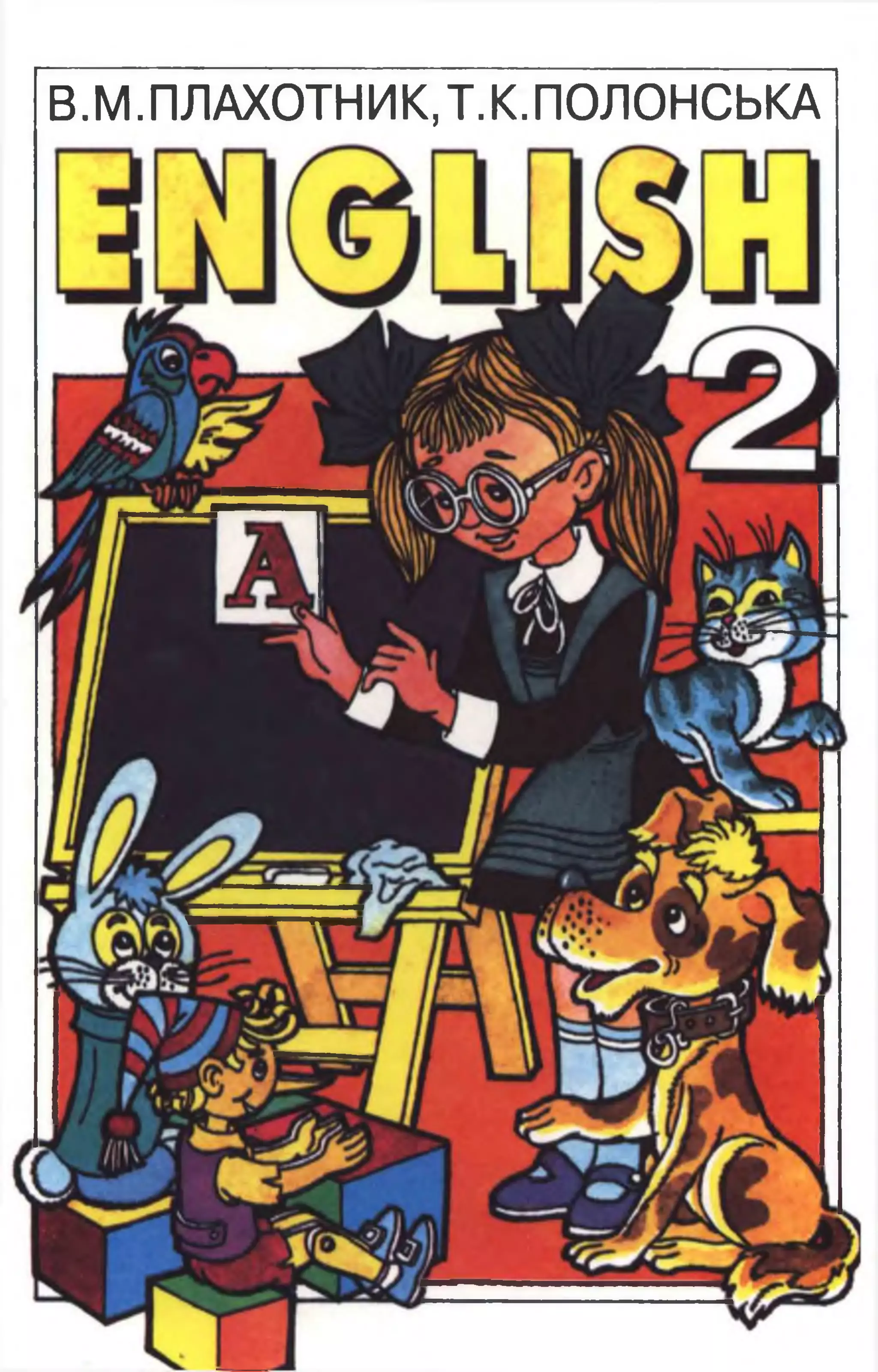
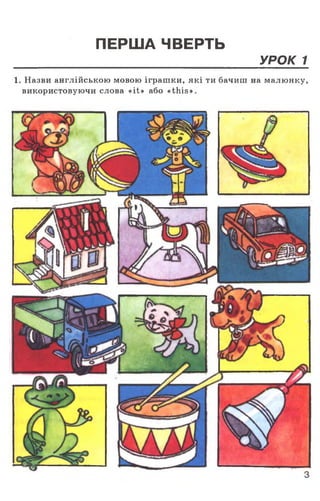
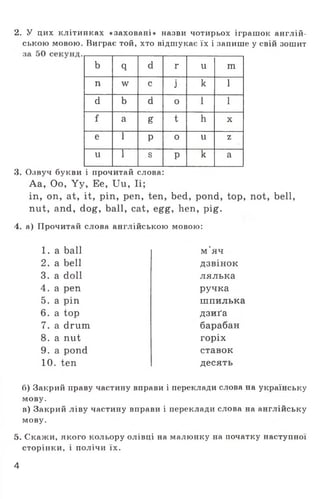
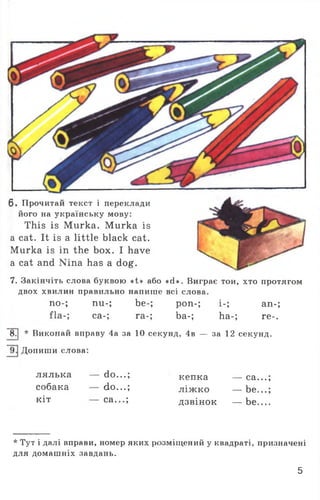
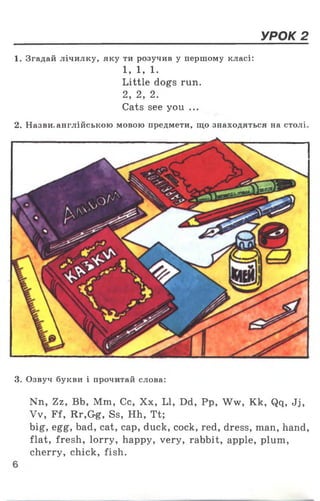
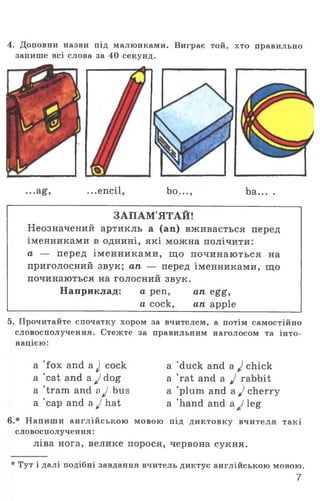
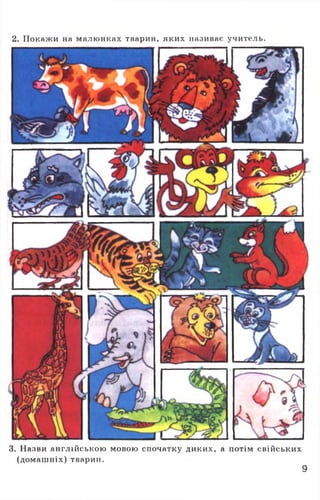
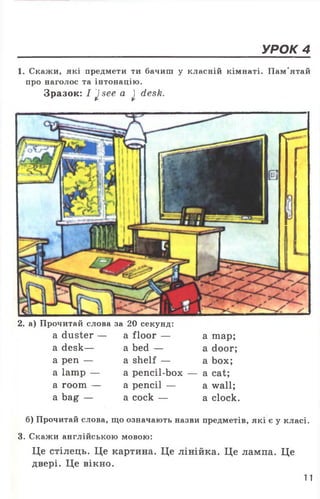
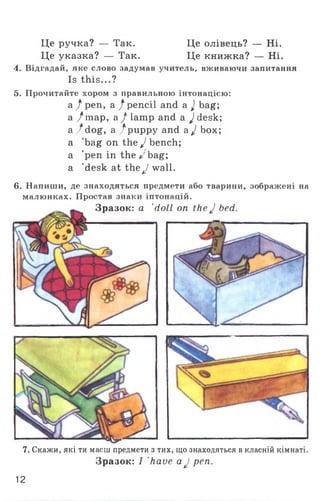
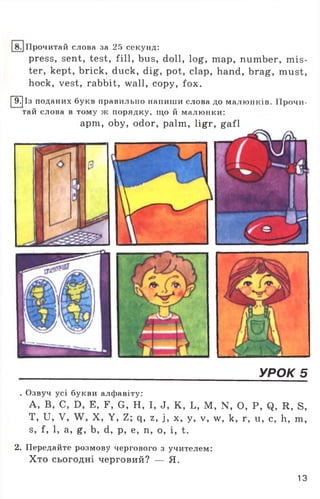
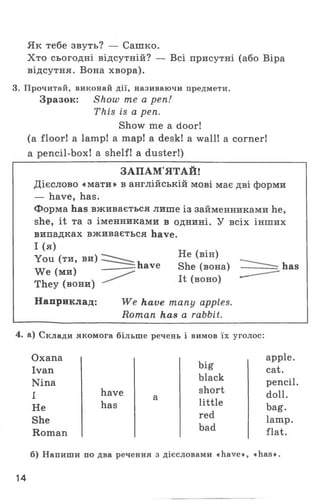
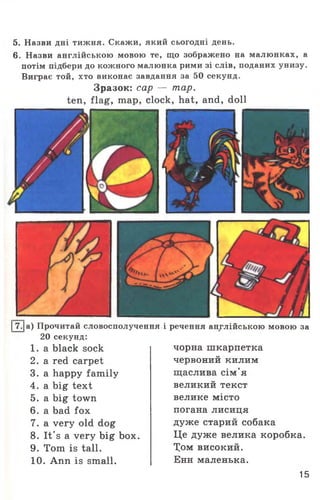
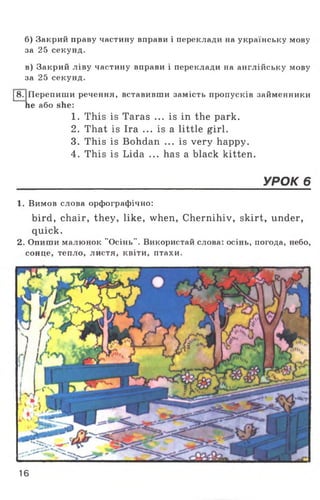
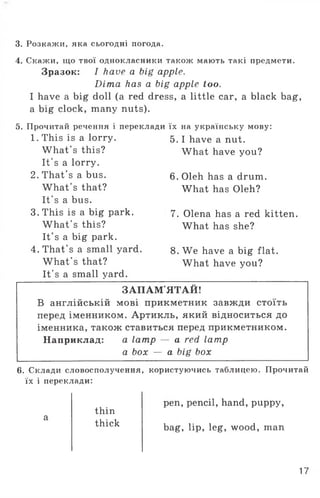
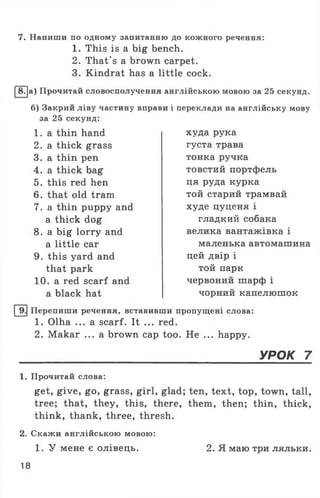
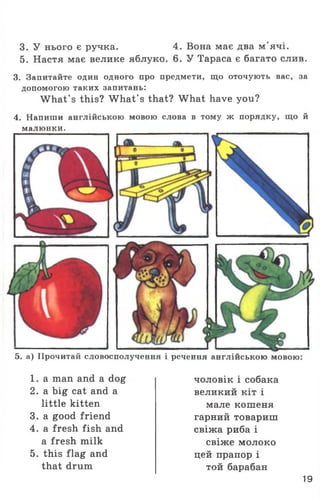
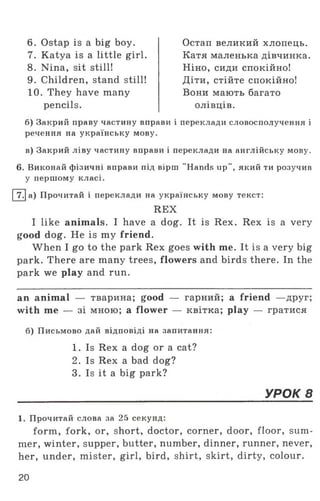
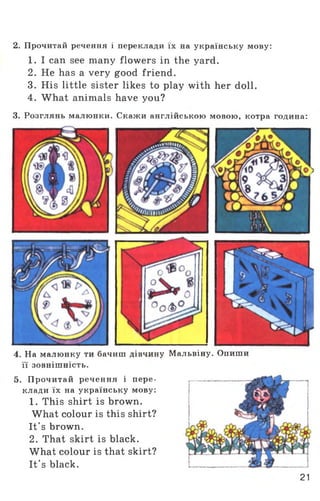
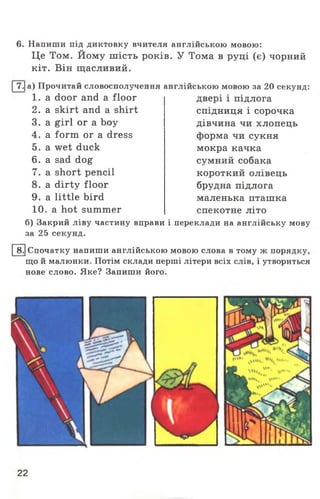
![УРОК 9
1. Озвуч букви. Допоможуть тобі у цьому транскрипційні знаки.
а [ае], b [b], с [k], d [d], е [е], f [f], g [g], h [h],
і [i], j [d3j, k [k], 1 [I], m [m], n [n], o [o], p [p], q [kw],
r [r], s [s], t [t], u [л], v [v], w [w], x [ks], у [i], z [zj.
2. Прочитай слова:
pen, sit, but, end, cup, bell, pin, dog, sun, rest, in, bench,
spot, pig, nut, doll, cock, it, duck, hot.
3. Скажи, чиї це предмети.
Зразок: Це Ірин портфель.
This is Iras bag.
1. Це Романів пенал. 5, ц е Катрусина книга.
2. Це Наталчина дзиґа. 0, ц е Ганнусині санчата.
3. Це Петрові лижі. 7. Це мамина сукня.
4. Це Олегові ковзани. 8. Це дідусів капелюх.
4. Виконай фізичні вправи під знайомий тобі вірш "Hands on
your hips!"
5. Розглянь малюнки. Прочитай речення і дай відповіді на
запитання англійською мовою:
1. It's Ann. Ann has a red
dress and a red hat.
1. Хто це?
2. Щ о є в Енн?
2. It's Pete. Pete has a
black cap and a brown bag.
1. Хто це?
2. Щ о має Піт?
ЗАПАМ'ЯТАЙ!
Множина іменників утворюється за допомогою
закінчення -я, яке читається [г] після голосних і
дзвінких приголосних звуків і [б] — після глухих
приголосних звуків.
23](https://image.slidesharecdn.com/22006-160519143032/85/2-_-_2006_-24-320.jpg)
![Наприклад: [z] [s]
a bed — beds a desk — desks
a pen — pens a cat — cats
a tree — trees a chick — chicks
Множина іменників, що закінчуються на приго
лосні s, ss, ch, sh, х, утворюється за допомогою
закінчення — es, яке читається [iz].
Наприклад: a box — boxes
a dress — dresses
a bus — buses
До іменників, які закінчуються на у, додається
закінчення -es і буква у замінюється на і.
Наприклад: a puppy — puppies
a cherry — cherries
Множина деяких іменників утворюється не за
правилами. їх слід запам'ятати.
1 . a man — men
2. a child — children
З іменниками множини неозначений артикль а
(an) не вживається.
6. Прочитай і переклади па українську мову:
a pen — pens; a cock — cocks; a fox — foxes;
an egg — eggs; a lamp — lamps; a family — families;
an apple — apples; a flat — flats; a bench — benches;
a tram — trams; a desk — desks; a scarf — scarves.
7. Скажи, що цих предметів багато.
Зразок: a hat — many hats
a door a pencil-box a yard
a wall a text a park
a lamp a town a shelf
24](https://image.slidesharecdn.com/22006-160519143032/85/2-_-_2006_-25-320.jpg)
![а) Прочитай словосполучення і речення за 15 секунд:
1 . a small ball маленький м'яч
2. a big pond великий ставок
3. a happy boy щасливий хлопчик
4. a dirty dress брудна сукня
5. many children багато дітей
6. ten windows десять вікон
7. six shelves шість поличок
8. I have six apples. У мене є шість яблук.
9. Rita has seven cherries. Ріта має сім вишень.
10. He likes plums. Він любить сливи.
б) Закрий ліву частину вправи і переклади на англійську мову
за 20 секунд.
І9,[ Напиши спочатку слова, які закінчуються на дзвінкий
приголосний звук [z], а потім на глухий приголосний [s].
Зразок: [z] balls,
[s] cups,
tops, drums, beds, shirts, walls, desks, arms, bells, flags,
flats, girls, hats, maps, parks, rooms, texts.
_______________________________ УРОКИ 10-11*
1. а) Озвуч буквосполученнл:
th [6], [0], sh [J], ch [tj], ck [k], qu [kw].
б) Назви знайомі тобі слова, в яких є ці буквосполученпя.
2. Скажи, яких тварин ти любиш, а яких не любиш.
Зразок: I like dogs.
I don't like cats.
* Розподіл матеріалу здвоєних уроків здійснює учитель на власний
розсуд.
25](https://image.slidesharecdn.com/22006-160519143032/85/2-_-_2006_-26-320.jpg)
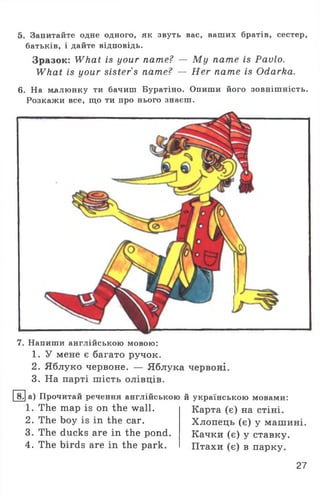
![5. There is a lamp in the flat.
6. There are many
children in the yard.
7. Nina has six fishes.
8. Oleh has many letters.
У квартирі (є) лампа.
У дворі (є) багато дітей.
У Ніни є шість рибок.
У Олега є багато листів.
б) Закрий ліву частину вправи і переклади речення на
англійську мову за 20 секунд.
] Перемалюй табличку в свій зошит. Напиши під кожним із
поданих нижче слів 3— 4 знайомих тобі слова, кожне з яких
повинно бути довшим на одну літеру. В кожному слові, крім
«Ье», «Ье», «сіо», «go», дозволяється замінювати будь-яку
літеру, крім першої. Приклад наведено в першому стовпчику:
be he do go
bag
bell
bench
butter
|10. |Напиши англійською мовою:
1. Лисиця руда. 3. У кімнаті червоний килим.
2. Парти чорні. 4. У портфелі три книжки.
УРОК 12
1. Озвуч транскрипційні знаки:
[а], [о], [ае], [е], [v], [w], [b] [d], [s], [z], [д], [d3], [б], [0], [J], [tj],
[kw], [t], [I], [mj, fn], [ks].
2. Прочитай:
[pen], [it], [big], [aepl], [as], [0in], [öis], [buk], [wont], [tjeri], [klok],
[Jip], [kwik],
3. а) Скажи англійською мовою:
1. Я хочу читати книгу. 2. Я хочу писати листа.
28](https://image.slidesharecdn.com/22006-160519143032/85/2-_-_2006_-29-320.jpg)
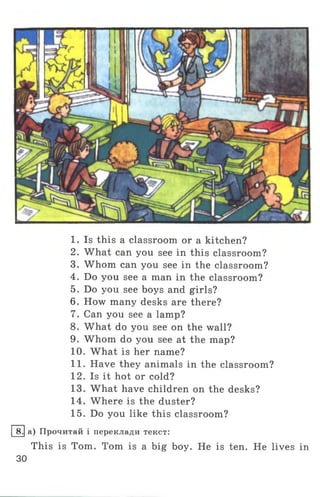
![London. London is a big town. Tom likes animals. He has a
dog, a cat and a bird. He has many fishes too. Tom has no
rabbit. His cat likes milk and his dog likes fishes. Tom
likes to play and run with his dog in the yard or in the
park. The dog is Tom's friend,
б) Письмово дай відповіді на запитання:
1. Who is this? 2. How old is Tom?
3. Where does he live? 4. What animals has Tom?
5. Who is Tom's friend?
_____________________________________ УРОК 13
1. Виконай завдання 86 з попереднього уроку.
2. Озвуч букви, буквосполучення і транскрипційні знаки:
q, r, w, d, f, b, v, s, a, c; ck, th, sh, ch, qu, or, ar, oo;
[u:], [А], [ав]. [e], Ш. [8], WJ, [9], [fl], [a:], [o:], [ks], [d3], [z],
31](https://image.slidesharecdn.com/22006-160519143032/85/2-_-_2006_-32-320.jpg)
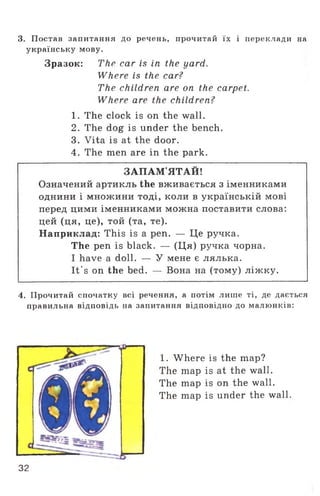
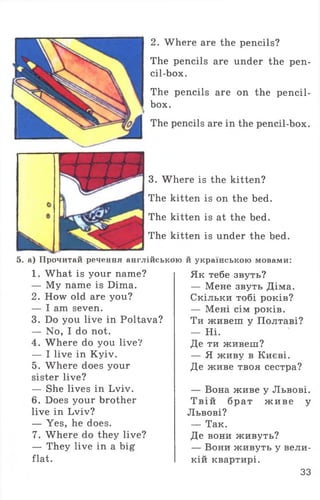
![б) Закрий ліву частину вправи і переклади речення на англій
ську мову.
6. Письмово дай відповіді на запитання:
1. What is your name?
2. Have you a sister or a brother?
3. Where do you live?
|7.| Виконай вправу 56 за ЗО секунд.
І 8.| Перепиши речення, вставивши необхідні слова:
1. There (is, are) many desks in the classroom.
2. Roman (live, lives) in Ternopil.
3. (Do, does) she like butter?
4. How old (is, are) Pavlo?
5. They (have, has) many apples.
УРОК 14
book, exercise book, school,
zoo, broom, looking glass,
schoolboy, schoolgirl, good,
to look.
Good afternoon!
You look well.
1. Вимов звуки і напиши відповідні їм букви.
Зразок: [n] — Nn.
[і], [m], [V], [t], [s], [а:], [ав], [d], [І], [р].
2. Прочитай речення. Дай відповіді на запитання.
1. I live in Lutsk. 2. Stepan lives in Uman.
Do you live in Odesa? Does he live in Kyiv?
Where do you live? Where does Stepan live?
3. Bob and Sam live in London.
W ho lives in London?
What town do they live in?
34](https://image.slidesharecdn.com/22006-160519143032/85/2-_-_2006_-35-320.jpg)
![ЗАПАМ'ЯТАЙ!
Буквосполучення оо читається [и] або [и:].
Наприклад: [и] [и:]
a book a school
a room too
3. Прочитай слова:
[U] [и:]
look hook spoon boot
good brook moon foot
cook shook root goose
foot wood tool pool
took wool soon fool
4. Прочитай слова з перекладом і запиши їх у словник:
a school [sku:I] a looking-glass
школа дзеркало
35](https://image.slidesharecdn.com/22006-160519143032/85/2-_-_2006_-36-320.jpg)
![a broom a zoo [zu:]
мітла, віник
a schoolboy
зоопарк
a schoolgirl
школяр школярка
good — гарний (-a, -e, -і), добрий (-a, -e, -i); Good after
noon! — Добридень! ( при зустрічі у другій половині дня);
to look — дивитися; You look well. — Ти добре виглядаєш.
5. а) Прочитай словосполучення і речення і переклади їх на
українську мову:
A big book, a little book, a good book, a bad book, a thin
book, a thick book, this book, Ann’s book. It's a very good
book. His book is on the desk.
A thin exercise-book, a thick exercise-book, that exer-
cise-book, her exercise-book, many exercise-books, an ex
ercise-book and a pen. I have a red exercise-book. Her exer
cise-book is in the bag.
A big school, a little school, an old school, my school, in
36](https://image.slidesharecdn.com/22006-160519143032/85/2-_-_2006_-37-320.jpg)
![2. Where are the books and the
exercise-books?
The books and the exercise-
books are in the bag.
The books and the exercise-
books are on the desk.
The books and the exercise-
books are under the bag.
3. Where are the schoolboys
and the schoolgirls?
The schoolboys and the school
girls are in the park.
The schoolboys and the school
girls are at the pond.
The schoolboys and the school
girls are at the school.
4. Who likes to go to the zoo?
The men like to go to the zoo.
The children like to go to the
zoo.
The animals like to go to the
zoo.
б) Напиши лише ті речення, де дається правильна відповідь на
запитання до малюнків.
УРОК 15
about
1. Виконай вправу 86.
2. Запиши і запам'ятай слово about [a'baut] — про.
38](https://image.slidesharecdn.com/22006-160519143032/85/2-_-_2006_-39-320.jpg)
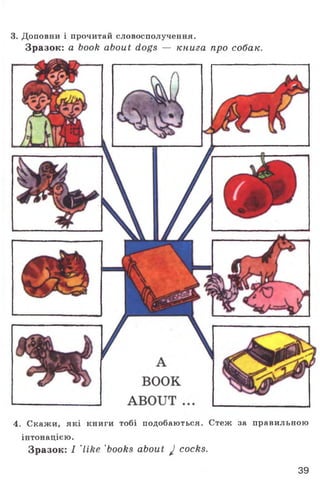
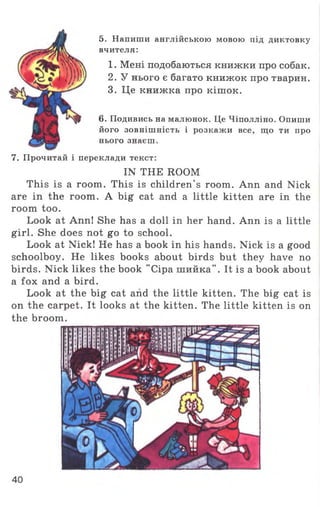
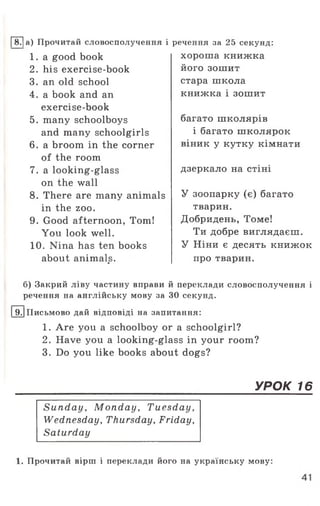
![I have a cat.
I have a dog.
I have a big coodoo.
Dan has a cat.
Dan has a dog.
Dan has a coodoo, too.
Sam has a pig.
Sam has a frog.
Sam has a red coodoo.
I have a pig.
I have a frog.
I have a coodoo, too.
a coodoo [ku:'du:] — антилопа
2. Розкажи про свій робочий день, використовуючи такі слова:
a book, an exercise-book, a school, a schoolboy, a schoolgirl, а
room, good.
3. а) Скажи англійською мовою:
хто, черговий, сьогодні, я, ти, відсутній, хворий, ніхто,
ім'я, твоє, як, де, дякую, я живу, у Києві.
б) Відтворіть діалог англійською мовою:
Хто сьогодні черговий? Де ти живеш?
4. Напиши, які з перелічених предметів є у твоїх однокласників.
Зразок: Olena has a good book.
5. Розглянь малюнки на початку наступної сторінки. Прочитай
підписи під ними. Здогадайся про значення виділених слів.
Як тебе звуть?
— Тарас.
Ти добре виглядаєш.
— Дякую.
— Я. — У Києві.
Хто сьогодні відсутній?
— Наталка.
Хто хворий?
— Ніхто.
a red exercise-book
a good pencil-box
many books about dogs.
42](https://image.slidesharecdn.com/22006-160519143032/85/2-_-_2006_-43-320.jpg)
![The boys like The girls like The men like to
to play football. to play tennis. play basketball.
6. а) Згадай назви днів тижня англійською мовою.
б) Прочитай і запиши їх у свій словник. Запам’ятай, що в
англійській мові ці назви пишуться з великої букви:
Sunday ['sAndi] — неділя, Thursday [*0a:zdi] — четвер,
Monday ['mAndi] — понеділок, Friday [’fraidi] — п'ятниця,
Tuesday [*tju:zdi] — вівторок, Saturday [’saetadi] — субота.
Wednesday ['wenzdi] — середа,
в) Скажи англійською мовою, які дні тобі подобаються най
більше, і поясни чому.
17. |Прочитай текст, письмово дай відповіді на запитання.
LIDA'S SCHOOLBAG
Lida is a schoolgirl. She has a good red schoolbag. It is
on the desk.](https://image.slidesharecdn.com/22006-160519143032/85/2-_-_2006_-44-320.jpg)
![— What have you in your schoolbag, Lida?
— I have many books and exercise-books in it.
Lida has many things in her schoolbag. She has a pen, a
pencil-box and six pencils. She has toys in her schoolbag
too.
1. W ho is Lida?
2. What has Lida?
3. Is her schoolbag black or brown?
_______ 4. Has she many books on the desk?
a thing [Bin] — річ, предмет
a toy — іграшка
______________________________________УРОК 17
horse, dark, second, far from.
What form are you in?
1. Прочитай:
44](https://image.slidesharecdn.com/22006-160519143032/85/2-_-_2006_-45-320.jpg)
![а) [Г)]: ring, bring, sing, spring, long, song, strong, gong;
[r]k]: ink, pink, bank, tank, trunk, drink.
б) ['fra id i], [’sAndi], [’wsenzdi], [' tj u :z d i], ['mAndi],
['0a:zdi], ['saetadi],
2. Скажи англійською мовою, що тобі подобається робити кожного
дня тижня.
Зразок: On Sunday I like to go to the zoo.
On Monday ... On Thursday ...
On Tuesday ... On Friday ...
On Wednesday ... On Saturday ...
3. а) Прочитай слова з буквосполученнями «ог» і «аг». Переклади
на українську мову ті слова, які ти вже знаєш.
or [o:] ar [a:]
or born park far
form horse dark bar
fork sport arm scarf
sort fort art card
corn lord part start
б) Запиши у свій словник і запам’ятай:
dark — темний (-а, -е, -і); second ['sekand] — другий (-а,
-е, -і); far from — далеко від; What form are you in? — В
якому ти класі?
45](https://image.slidesharecdn.com/22006-160519143032/85/2-_-_2006_-46-320.jpg)
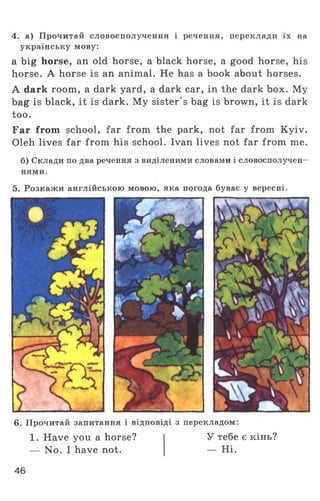
![І8 .1Запитай своїх рідних і друзів, чи знають вони, що сім днів
тижня названі у латинській мові на честь Сонця, Місяця і п'яти
інших планет: Меркурія, Венери, Марса, Сатурна та Юпітера.
Неділя — день Сонця.
Понеділок — день Місяця.
Вівторок — день Марса.
Середа — день Меркурія.
Четвер — день Юпітера.
П'ятниця — день Венери.
Субота — день Сатурна.
А як ти гадаєш, якби люди у давнину знали про існування ще
таких планет, як Уран, Нептун і Плутон, скільки б днів тижня
ми мали — сім чи десять?
УРОК 18
As for те ...
1. Прочитай за 25 секунд:
cut, tell, fall, bad, spoon, lip, cherry, sun, ill, good, play,
girl, dog, like, bag, long, pink, brown, form, arm, far,
second, horse, apple, milk.
2. Склади якомога більше речень:
I
Не
She
We
They
Antin
Vira
Children
His sister
3. а) Запиши у свій словник і запам’ятай вислів:
as [az] for me ... — щодо мене .
am
are
is
in the second form.
48](https://image.slidesharecdn.com/22006-160519143032/85/2-_-_2006_-49-320.jpg)
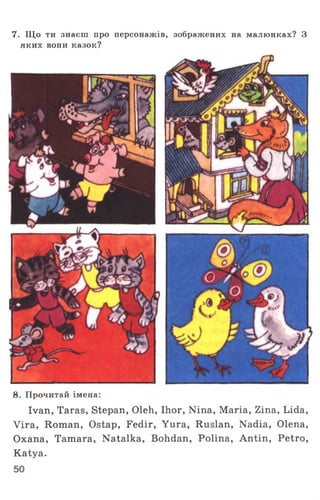
![I9.|Перепиши речення, переклавши на англійську мову слова, взяті
в дужки:
1. My sister is (у другому класі).
2. (У неділю) I go to bed at ten o ’clock.
3. Ihor's school is not (далеко від) his flat.
4. Nina likes apples. (Щодо мне) I like plums.
______________________________________УРОК 19
table, eraser, name, sur
name, to take, to skate
1. Прочитай транскрипцію слів:
[it], [fo:], [sou], [tu:], [rum], [gould], [boks], [Ьгл/], [flaet], [belt],
[tjes], [a:m], [rouz], [wirj].
ЗАПАМ'ЯТАЙ!
а) Буква «а» у відкритому наголошеному складі
читається [еі].
Наприклад: а пате, а cake, take
б) Буквосполучення «all» читається [о:І].
Наприклад: a ball, a wall, small
2. а) Прочитай слідом за вчителем:
lake came ball
plate gave call
plane late tall
table skate fall
date make small
б) Прочитай самостійно:
fame pane all
game pale wall
fate slave hall
tale save stall
face lady spall
51](https://image.slidesharecdn.com/22006-160519143032/85/2-_-_2006_-52-320.jpg)
![3. Прочитай слова з перекладом, запиши їх у свій словник і
запам’ятай:
an eraser [YreizaJ — гумка; a table — стіл;
a name — ім'я; a surname ['sa:neim] — прізвище; to ta
ke — брати; to skate — кататися на ковзанах
4. а) Прочитай словосполучення і речення англійською й україн
ською мовами за 25 секунд:
1. a desk and a table
2. a good table
3. a big table and
a little eraser
4. an eraser on the table
5. a short name
6. a good name
7. His name is Ivan.
8. Her surname is Petrenko.
9. What is your name?
10. What is his surname?
11. Ann likes to skate.
12. Tom! Take a book!
парта і стіл
хороший стіл
великий стіл і
мала гумка
гумка на столі
коротке ім'я
гарне ім'я
Його звуть Іван.
Її прізвище Петренко.
Як тебе звати?
Як його прізвище?
Енн любить кататися на
ковзанах.
Томе! Візьми книгу!
б) Закрий ліву частину вправи, переклади словосполучення і
речення на англійську мову за ЗО секунд.
52](https://image.slidesharecdn.com/22006-160519143032/85/2-_-_2006_-53-320.jpg)
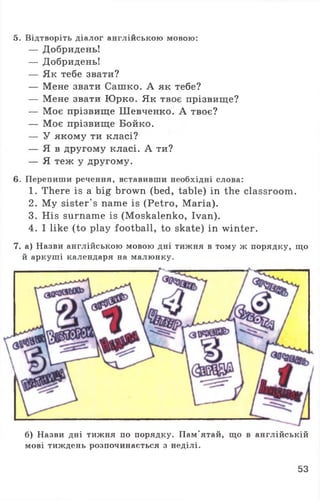
![8. Прочитай текст, переклади його на українську мову і дай
письмові відповіді на запитання.
КАТЕ
My sister's name is Kate. Kate is a little girl. She is six.
She likes apples and cakes. Kate likes to play with her dolls
at the table.
1. What is your sister’s name?
2. Is Kate six or ten?
3. Does she like cakes?
4. Where does Kate like to
play?
a cake [keik] — тістечко
УРОК 20
day, day book, today,
grey, gay, eight, may,
to want
1. а) Повтори читання букви «а» в різних складах:
[Єї] [эе] [a:] [o:] [o]
same tram class ball what
face cat grass salt want
tale map task warm wash
navy bag fast small watch
wake stand park chalk was
б) Склади до кожного стовпчика по одному реченню із знайомим
тобі словом.
2. Подивись на малюнок на початку наступної сторінки. Спочатку
скажи, хто це, а потім розкажи все, що ти знаєш про нього,
його друзів і ворогів.
54](https://image.slidesharecdn.com/22006-160519143032/85/2-_-_2006_-55-320.jpg)
![3. Прочитай слова із різними буквосполученнями, які передаються
одним звуком [еі]:
еі ey ai ay
eight [t] hey tail day
feign [n] grey pain gay
seiner sley paint may
reign they mail pay
beige trey drain play
deign prey rain stay
4. Запиши у словник і запам'ятай слова:
a day-book — щоденник; eight — вісім;](https://image.slidesharecdn.com/22006-160519143032/85/2-_-_2006_-56-320.jpg)
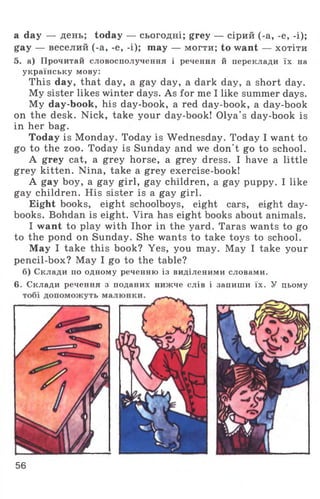
![б) [беї], [aed], ['kofi], [fij], [hel0], [peil], [ska:f], [swim], [swon],
[zu:j, [’tikit], [wad], [tu:], [boks] .
2. Запитайте англійською мовою одне одного, як вас звати, як ваше
прізвище, скільки вам років, в якому ви класі, де ви живете.
3. а) Прочитай текст і переклади його на українську мову:
RAIN
"Rain! Rain!" says Bobby. "I like to see the rain".
"I like the rain too", says Nelly.
"Let us go and play "Rain".
"W hat are you, Bobby?"
"I am a frog", says Bobby."I am a gay green frog. I like
to jump. I like the rain. And what are you, Nelly?"
"I am a duck", says Nelly. "I like the rain. I want to
swim. I am a big grey duck".
And the children play "Rain".
rain — дощ; say — говорити; let us — давай
б) Дай відповіді на запитання до тексту:
1. What are the children's names?
2. W ho is a frog and who is a duck?
3. Does the duck like to run or to swim?
4. What does the frog like to do?
в) Відтворіть англійською мовою діалог між Боббі і Неллі.
4. Прочитай початок речень і заверши їх. Зверни увагу на закін
чення дієслів у третій особі однини:
а) I have ... б) I want ... в) I go ...
You have ... You want ... You go ...
He (she) has ... He (she) wants He (she) goes ...
We h a v e ........... We want ... We go ...
You have ... You want ... You go ...
They have ... They want ... They go ...
5. Склади по одному реченню із словами «today», «eight», «table»
і запиши їх.
58](https://image.slidesharecdn.com/22006-160519143032/85/2-_-_2006_-59-320.jpg)
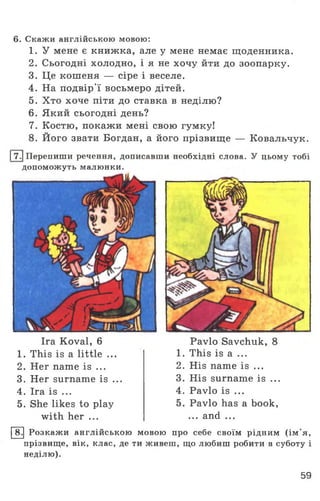
![УРОК 22
rosy, at home. Go home!
Go to bed! Go to school!
1. Прочитайте вірш. Переможе той, хто швидше вивчить його
напам'ять.
WHAT IS GREY?
What is grey?
What is grey?
Can you say?
Yes, I can.
My cat is grey.
ЗАПАМ'ЯТАЙ!
Буква «о» у відкритому наголошеному складі
читається [ои].
Наприклад: a rose[rouz]; no [nou]
2. а) Прочитай слова:
go, no, bone, home, nose, rose, hope, note, close, role, tone,
robe, toe, stone, lone.
б) Прочитай слова і вислови з перекладом, запиши їх у свій
словник і запам'ятай:
rosy [rouzi] — рожевий (-а, -е, -і), рум'яний (-а, -е, -і); at
home — вдома; Go home! — Йди (йдіть) додому! Go to
bed! — Лягай (лягайте) спати! Go to school! — Йди (йдіть)
до школи!
3. а) Прочитай словосполучення і речення та переклади їх на
українську мову:
A rosy pen, a rosy dress, a rosy eraser, a rosy pig, a rosy
scarf, a rosy lamp. Nina has a rosy skirt. I have a red dress
and a rosy scarf.
I have a little kitten at home. Stepan has a big dog at
home. His sister has many books at home.
60](https://image.slidesharecdn.com/22006-160519143032/85/2-_-_2006_-61-320.jpg)
![Nick! Go home!
Children, it is very cold today. Go home!
Pete, it's ten o'clock. Go to bed!
Vira, take your bag and go to school!
б) Склади по одному реченню з виділеними словами.
4. Скажи англійською мовою:
1. Цей зошит червоний, а той — рожевий.
2. У мене немає рожевої сукні.
3. Марійка має вдома шість кроликів.
4. Петрику, забирай свою сестричку і йдіть додому!
5. Ганнусю, бери ляльку і лягай спати!
6. Діти, беріть свої портфелі і йдіть до школи!
5. Пригадай вірш, який ти вивчив у першому класі. Прочитай
його і переклади на українську мову.
MY DOLL
My doll is so pretty.
Her eyes are so blue.
Her cheeks are so rosy.
Her dress is so new.
so — такий (-a, -e, -i); pretty
— чарівний (-a, -e, -i); eye
[аі] — о к о; blue [bIu:] —
синій, голубий; cheek [tji:k]
— щока; new [nju:] — новий
(-а, -e, -і)
6. Напиши англійською мовою під диктовку вчителя:
1. Мені подобається це рожеве яблуко.
2. Ми маємо вдома багато горіхів.
3. Діти, беріть книги й зошити і йдіть додому!
17.1Склади по одному реченню зі словами «rose», «go» і запиши
їх.
[ЇГ] Вивчи напам’ять вірш "My Doll".](https://image.slidesharecdn.com/22006-160519143032/85/2-_-_2006_-62-320.jpg)
![УРОКИ 23-24
window, window sill,
yellow, flower, house,
to water flowers
1. Розкажи напам'ять вірш "My Doll".
ЗАПАМ'ЯТАЙ!
Б у к в о с п о л у ч е н н я «ои» ч и та є ть с я [au], а
буквосполучення «ow» — [au] або [ои].
Наприклад: house [haus]; how [hau]; grow [grou]
2. Прочитай слова:
ou [au]
loud sound blouse
cloud count house
ground round mouse
found pound about
[a u ]------- ow - [ou]
now down town row low blow
cow gown owl sow bowl crow
bow brown flower show yellow slow
how clown crown snow window know
3. Прочитай слова з перекладом, запиши їх у свій словник
запам'ятай.
a window [’windou] — вікно; a window-sill — підвіконня;
62](https://image.slidesharecdn.com/22006-160519143032/85/2-_-_2006_-63-320.jpg)
![a flower [’flaua] — квітка; a house [haus] — дім, будинок;
yellow ['jelou] — жовтий (-а, -e, -і); to water flowers —
поливати квіти
4. а) Прочитай словосполучення й речення і переклади їх на
українську мову:
A big window, a dark window, on the window, at the
window, six windows. I have a big window in my room. His
desk is at the window.
A good window-sill, a bad window-sill, under the win
dow-sill, at the window-sill. This window has no window
sill. There are many flowers on the window-sill.
A big flower, a red flower, a yellow flower, this flower,
that flower. I can see many flowers on the window-sill.
Maria has many flowers in her hands.
A big house, a little house, an old house, a good house,
a bad house, my house, in the house. This house has many
windows and doors. Her house is far from school.
A yellow dress, a yellow shirt, a yellow flower, a yellow
car, a yellow pencil. My sister likes yellow flowers. There
are many yellow chicks and ducks in the yard.
б) Склади по одному реченню із виділеними словами.
5. Напиши англійською мовою:
Дімин будинок, ця квітка, жовтий портфель, сіре
підвіконня, вісім вікон.
63](https://image.slidesharecdn.com/22006-160519143032/85/2-_-_2006_-64-320.jpg)
![6. Подивись на малюнок і дай відповіді на запитання:
1. What do you see?
2. Who waters flowers?
3. What is the girl's name?
4. How old is she?
5. Do you see yellow flowers?
6. Do you like to water flowers?
7. Прочитай, переклади і відгадай загадку:
WHAT FLOWER?
Red or rosy.
In summer I grow
I'm a fine flower
As you all know.
to grow — рости; fine —
чудова; as [az] — як
8. а) Прочитай словосполучення і речення англійською мовою за
ЗО секунд:
1. a big house
2. a big town
великии дім
велике місто
64](https://image.slidesharecdn.com/22006-160519143032/85/2-_-_2006_-65-320.jpg)
![УРОК 25
mouse, cow, snow, snowball,
snowman, to make snow
balls, to make a snowman,
to play snowballs
1. Прочитай:
а) how, town, now, cow, flower, loud, round, about;
б) slow, row, know, snow, low, window, yellow, blow;
в) [daun], [aul], [gaun], [braun], [kraun], [sou], [Jou], [boul],
2. Прочитай слова і вислови, запиши їх у свій словник і запам’ятай:
а mouse [maus] — миша; а cow [kau] — корова;
snow [snou] а snowman a snowball
— сніг; — сніговик; — сніжка;
to make snowballs — ліпити сніжки; to make a snowman
— ліпити сніговика; to play snowballs — грати в сніжки
66](https://image.slidesharecdn.com/22006-160519143032/85/2-_-_2006_-67-320.jpg)
![3. а) Прочитай словосполучення і речення за 45 секунд:
1. A big mouse, a little mouse, a grey mouse, this mouse,
that mouse.
2. A big cow, a good cow, a red cow, a black cow, a dark
cow, this cow, his cow.
3. This snow, cold snow, grey snow, dark snow, good
snow, bad snow, wet snow, dirty snow, thick snow.
4. A big snowball, a big snowman, many snowballs, a
good snowman, this snowman, a gay snowman.
5. I like to play snowballs in winter. When do you make
a snowman? Do the girls make snowballs? In winter
we can see many snowmen in the yard.
б) Переклади ці словосполучення і речення на українську мову.
ЗАПАМ'ЯТАЙ!
Множина від іменника a mouse — mice [mais].
Наприклад: Many grey mice live in our yard.
4. Скажи англійською мовою:
1. Мій кіт любить мишей. 3. Ці миші сірі і веселі.
2. Собаки не люблять 4. У нашому будинку
мишей. немає мишей.
5. Напиши англійською мовою під диктовку вчителя:
1. Корови не живуть у місті.
2. Моє маленьке кошеня любить гратися з мишами.
6. Запитайте одне одного англійською мовою, скільки у вас є
таких предметів.
67](https://image.slidesharecdn.com/22006-160519143032/85/2-_-_2006_-68-320.jpg)
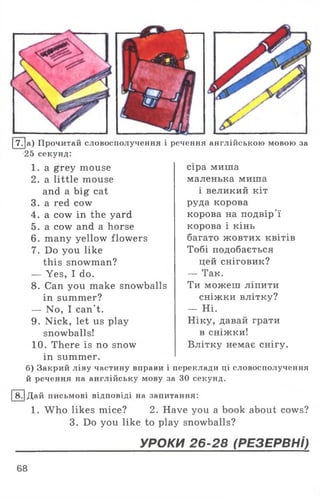
![ДРУГА ЧВЕРТЬ
УРОК 29
1. Прочитай вірш і переклади його на українську мову:
HOW MANY HANDS?
How many hands How many hands
Has a boy, say? Has a girl, say?
How many hands How many hands
For work and play? For work and play?
for work — для роботи
2. Передайте англійською мовою розмову вчителя і чергового.
3. Хором прочитайте знайомі вам дієслова. Зверніть увагу на ви
мову закінчення -s:
М [S]
to see — sees to like — likes
to play — plays to look — looks
to stand — stands to take — takes
to know — knows to want — wants
to come — comes to put — puts
to give — gives to get — gets
to run — runs to sit — sits
ЗАПАМ'ЯТАЙ!
Теперішній неозначений час (The Present Indefi
nite Tense) вживається для вираження дій, що
відбуваються постійно або йдуть одна за дру
гою.
Теперішній неозначений час утворюється за
допомогою додавання закінчень -s або -es лише
до дієслів третьої особи однини.
Наприклад: I see a dog. They see a dog.
We see a dog. He sees a dog.
You see a dog. She sees a dog.
69](https://image.slidesharecdn.com/22006-160519143032/85/2-_-_2006_-70-320.jpg)
![Закінчення -s або -es вимовляються [s], [z] або [iz]
залежно від звука, на який закінчується дієслово,
до якого ці закінчення додаються.
Наприклад: I take [teik] — he takes [teiks]
I sing [sir)] — he sings [sirjz]
I rise [raiz] — he rises [raiziz]
Дієслова to do — «робити», to say — «говорити»,
to have — «мати» у третій особі однини мають
форми does [dAz], says [sez], has [haez].
Наприклад: I do — he (she) does.
I say — he (she) says.
I have — he (she) has.
Дієслова can, may — «могти» у третій особі од
нини не мають закінчень.
Наприклад: I can — he (she) can.
I may — he (she) may.
4. Скажи ці речення в 3-й особі однини:
1. We play football in the yard.
2. I see a lamp on the table.
3. I like yellow and red flowers.
4. I go to bed at ten o'clock.
5. I have many books about dogs.
6. They live in a big town.
7. We want to go to the zoo.
8. I can help you to water flowers.
9. I know this little boy.
10. I get up at seven o'clock.
5. Перепиши речення, поставивши дієслова, взяті в дужки, у
третій особі однини:
1. Oleh (have) supper at seven o'clock.
2. Nina (go) to school at eight o'clock.
70](https://image.slidesharecdn.com/22006-160519143032/85/2-_-_2006_-71-320.jpg)
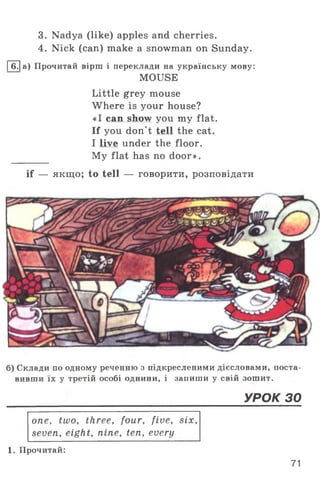
![а) comes, goes, looks, does, says, takes, gets, stands,
sits, plays, knows, grows, sees, has, runs.
б) [rein], [bentj], [wul], [mu:n] [bbk], [spo:t], [dAk], [pa:k],
[’haepi], [leik], [wdJ], [Gas], [milk], [sirj], [d3 aem],
2. Прочитай слова з перекладом, запиши у свій словник і
запам'ятай їх:
one [WAn]
1
ОДИН
two {tu:]
2
два
three [9ri:]
3
три
four [fo:]
4
чотири
five [faiv]
5
п'ять
six [siks]
6
шість
seven [sevn]
7
сім
eight [eit]
8
вісім
nine Q дев’ять
[nain] мГ [ten] 10 ДЄСЯТЬ
every ['evri] — кожний (-а, -е, -і)
3. Скажи, скільки предметів ти маєш і скільки має твій друг.
Зразок: I have one bag. Petro has one bag too.
5 книжок, 4 м'ячі,
10 зошитів, 8 горіхів,
2 ручки, 4 яблука,
7 олівців, 9 слив,
1 гумка, 6 квіток.
4. а) Прочитай словосполучення й речення і переклади їх на
українську мову:
1. One girl, one boy, one man, one hand, one leg.
2. Two pens, two trees, two cars, two pencil-boxes.
72](https://image.slidesharecdn.com/22006-160519143032/85/2-_-_2006_-73-320.jpg)
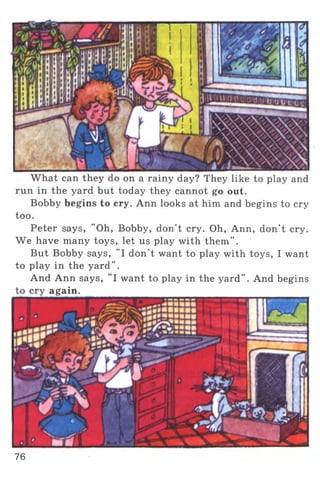
![Then Peter says, "Oh, Bobby, oh, Ann, let us go to the
kitchen. The cat lives in the kitchen and it has five nice
little kittens. Let us play with them".
Bobby says, "I want to see the five little kittens” .
Ann says, "I want to see the five little kittens, too".
Now she does not cry. And they go to the kitchen. They
come up to the box and see five little kittens.
Ann takes one kitten. "It is my kitten", she says.
Bobby takes one kitten. "It is my kitten" he says.
Now the children are happy again. They play with the
nice little kittens. And only Mother Cat is not very happy.
It looks at her little kittens. It wants to have them back in
her box.
on a rainy day — у дощовий день; their [без]— їх н я ;
only — лише; to go out — виходити; to cry [krai] —
плакати; to begin [bi'gin] — починати; again [a'gein] —
знову; nice — гарний; to come up — підходити; now —
тепер; a mother ['тдбэ] — мама; back — назад
I5.j Дай відповіді на запитання до тексту "What Children Can Do
on a Rainy Day":
1. What are the children's names?
2. Why do they cry?
3. Do they want to play with the toys?
4. What do they want to do?
5. Who lives in the kitchen?
6. How many kittens are there in the box?
7. Do Bobby and Ann want to play with the kittens?
8. How many kittens do they take?
9. Are the children gay and happy now?
10. Who is not very happy and why?
[б7]Напигаи англійською мовою:
1. Віра живе у Полтаві? — Так.
2. Тед живе в Одесі? — Н і.
3. Вони ж ивуть у Львові? — Так.
4. Іван — школяр? — Н і.
77](https://image.slidesharecdn.com/22006-160519143032/85/2-_-_2006_-78-320.jpg)
![УРОК 32
1. Прочитайте лічилку "One, two...” і перекладіть її на українську
мову. Переможе той, хто швидше вивчить її напам’ять.
ONE, TWO...
One, two, Five, six,
Look at the shoe. Look at the bricks.
Three, four, Seven, eight,
Look at the floor. Look at the plate.
Nine, ten,
Look at the pen.
a shoe [Ju:] — черевик; a brick — кубик; a plate —
тарілка
2. Дай відповіді на запитання:
1. What day is it today?
2. Is it cold today?
3. Is it summer now?
4. Do you like rain?
5. Can you skate today?
6. What do you want to do on Sunday?
3. Уважно роздивись малюнки і вислов здивування у зв'язку з
написаним. Скажи правильно.
Зразок: Tom lives in Lviv.
Does Tom live in Lviv? — He lives in London.
Nina lives in Poltava.
78
They have dinner at five o](https://image.slidesharecdn.com/22006-160519143032/85/2-_-_2006_-79-320.jpg)
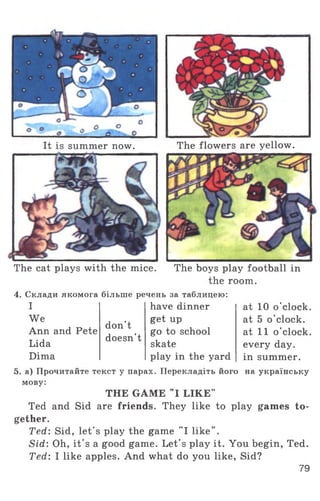
![Sid: I like apples and cherries. Now you, Ted.
Ted: I like apples, cherries and plums. It's your turn
now, Sid.
Sid: I like apples, cherries, plums and cakes. And what
about you, Ted?
Ted: I like apples, cherries, plums, cakes and milk. Then
again you, Sid.
Sid: I like apples, cherries, plums, cakes, milk and ...
and ...
Ted: Oh, I see. You cannot say it now.
Then I win the game. Do I?
Sid: Yes, you do, Ted.
a game — гра; a friend — друг, приятель; together —
[ta'ge6a] — разом; it's your turn [ta:n ] — твоя черга; to
win — виграти
б) Спробуйте самі зіграти в цю гру.
І6 .1а) Прочитай і перекажи текст:
A WELL-BRED BOY
Nick is ten. He is a well-bred boy. He helps little girls
and boys. He plays with his little sister. Her name is Ann.
She is three. When he goes into the yard he takes his sister
with him. He doesn't jump and run in the room.
well-bred — добре вихований, ґречний
б) Дай письмові відповіді на запитання:
1. Is Nick a well-bred boy?
2. Does he help little boys and girls?
3. What is his sister's name?
4. Does Nick play with Ann?
5. Does he jump and run in the room?
80](https://image.slidesharecdn.com/22006-160519143032/85/2-_-_2006_-81-320.jpg)
![УРОК 33
season, week, leaf,
teacher, green, clean
1. Прочитай за 15 секунд:
[pm], [kaet], [big], ['лпсіа], [lou], [gein], [keid3], [bai], [Ь1авг)к], [зи:],
[blok], [ka:], ['hju:man], [’рісізіп], [wa:k], [ta:sk], [ski:], [’pleiful],
[a'bAv], [’belou].
ЗАПАМ’ЯТАЙ!
а) Буква «е» у відкритому наголошеному складі
читається [і:].
Наприклад: be, we.
б) Буквосполучення «ее», «еа» також читається [і:].
Наприклад: see, clean.
2. Прочитай слова:
he, me, she, fee, sweet, greet, these, Pete, mete, eat,meat,
seat, bee, free, tree, leaf, tea, peace, green, sleep, deep,
speak, read, wsak.
3. Прочитай слова з перекладом, запиши їх у свій словник і
запам'ятай:
81](https://image.slidesharecdn.com/22006-160519143032/85/2-_-_2006_-82-320.jpg)
![a season [si:zn] — пора року; a week [wi:k] — тиждень;
clean [kli:n] — чистий (-a, -e, -i)
Множина від іменника a leaf — leaves
4. а) Прочитай словосполучення й речення і переклади їх на
українську мову:
A big leaf, a yellow leaf, a brown leaf, a green leaf,
many leaves, under the leaf, on the leaf.
This teacher, my teacher, Olya's teacher, a good teacher,
an old teacher, a teacher at the table, many teachers.
A green pencil, a green car, a green apple, a green frog,
a green skirt, many green leaves.
A clean dress, a clean shirt, a clean exercise-book, a
clean room, a clean cup, clean hands.
This week, one week, three weeks. A week has seven
days. Tuesday is the second day of the week.
This season, a good season, a bad season, a cold season,
four seasons. What season do you like? I know four sea
sons.
б) Склади по одному реченню з підкресленими словами.
5. а) Скажи англійською мовою:
п'ятниця, вівторок, неділя, четвер, середа, субота,
понеділок.
б) Назви дні тижня по порядку. Пам'ятай, що в Англії першим
днем тижня є неділя, а у нас — понеділок.
6. Дай відповіді на запитання:
1. Do you like red and yellow leaves on the trees?
2. What is your teacher's name?
3. W ho has a green dress?
4. What season is it now?
5. How many days has a week?
6. Are your books clean?
7. Запитайте одне одного і дайте відповіді, що ви бачите:
82](https://image.slidesharecdn.com/22006-160519143032/85/2-_-_2006_-83-320.jpg)
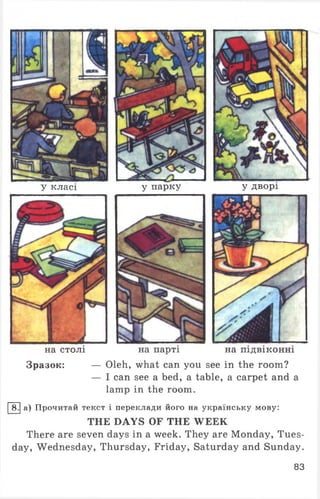
![Monday, Tuesday, Wednesday, Thursday and Friday are
working days. Saturday and Sunday are rest-days.
Children and teachers do not go to school on Saturday
and Sunday. They can go to the park, to the pond or to the
zoo. Children can run, jump, play football, basketball or
tennis. They can swim in summer and skate in winter.
a working [’wa:kirj] day — робочий день; a rest-day —
вихідний день; to swim — плавати
б) Дай письмові відповіді на запитання:
1. How many days are there in a week?
2. What days are rest-days?
3. What day of the week is it today?
4. What do you do on your rest-days?
______________________________________УРОК 34
seat, to read, to speak, to
repeat, please, to take a
seat. Excuse me, please!
1. Розкажи, які дні тижня ти знаєш, скільки їх, які з них робочі
дні, а які вихідні. Які дні тижня тобі подобаються, а які — ні,
поясни чому.
2. Скажи англійською мовою:
1. На деревах багато червоного і жовтого листя.
2. Я не люблю зелених вишень і слив.
3. Це вікно дуже чисте.
4. Зима — холодна пора року.
5. Олена Петрівна — дуже хороша вчителька.
6. Кожен тиждень має сім днів.
3. Прочитай. Запиши у свій словник і запам’ятай:
a seat — місце; to read — читати; to speak — розмовляти;
to repeat [ri'pi:t] — повторювати; please [pli:z] — будь ласка;
Excuse me, please! [iks'kju :z] — Вибач(те) мені, будь ласка!;
to take a seat — сідати.
84](https://image.slidesharecdn.com/22006-160519143032/85/2-_-_2006_-85-320.jpg)
![Ann. Oh, no Mummy. Only little apples sleep, big apples
do not sleep. Give me a big apple, please, Mummy.
at them — на них; to eat [i:t} — їсти; an evening ['і:vnir]]
— вечір; to sleep — спати; must — повинен
б) Випиши з тексту такі речення англійською мовою:
1. Але сьогодні у мами маленької дівчинки немає яблук.
2. Дай мені, будь ласка, яблуко.
3. Яблука сплять увечері.
УРОК 35
English, Ukrainian.
Thank you. Here you are.
1.Прочитай за 20 секунд:
me, tea, she, tree, need, deed, read, speak, street, clean,
team, peal, meat, feat, deal, mean, feel, keep, sleep, dene,
mete, peach, beach.
2. Дай відповіді на запитання до тексту “Little Apples an
Apples” :
1. Who likes apples?
2. Who gives Ann apples every day?
3. Has Ann’ s mother apples today?
87](https://image.slidesharecdn.com/22006-160519143032/85/2-_-_2006_-88-320.jpg)
![4. Do apples sleep in the evening?
5. Does the mother give Ann a big apple?
3. Прочитай слова і вислови з перекладом, запиши їх у словник
і запам’ятай:
Ukrainian [jui'kreinjan] — українець, український,
українська мова.
English [’iqglij] — англійська мова, англійський.
Thank you. — Дякую.
Here [hia] you are. — Ось, будь ласка (Прошу).
4. а) Прочитай словосполучення і речення англійською мовою за
ЗО секунд:
розмовляти українською
мовою
розмовляти англійською
мовою
читати українською мовою
читати англійською мовою
англійські школярі
українські школярі
Ніна — дівчинка. Вона
українка.
Том — англійський хлопчик.
Я вмію (можу) розмовляти
і читати українською мовою.
Мій учитель вміє розмовля
ти і читати англійською
мовою.
Ти вмієш розмовляти
англійською мовою?
— Так.
Боб знає українську мову?
1. to speak Ukrainian
2. to speak English
3. to read Ukrainian
4. to read English
5. English schoolchildren
6. Ukrainian schoolchildren
7. Nina is a girl. She is
Ukrainian.
8. Tom is an English boy.
9. I can speak and read
Ukrainian.
10. My teacher can speak
and read English.
11. Can you speak English?
— Yes, I can.
12. Does Bob know
Ukrainian?
— No, he doesn’t. — Hi.
б) Закрий праву частину вправи й переклади словосполучення
і речення на .українську мову.
88](https://image.slidesharecdn.com/22006-160519143032/85/2-_-_2006_-89-320.jpg)
![ЗАПАМ’ЯТАЙ !
Буквосполучення «оі», «оу» читаються [оі].
Наприклад: a soil [soil]; a boy [boi]
2. Прочитай слова:
oil, soil, toil, point, boil, roil, coin, moist, boy, toy, coy,
hoy, soy, joy, ploy, annoy.
3. Прочитай слова з перекладом, запиши їх у свій словник і
запам’ятай:
a pointer [pointa] morning fmo:mr]] evening ['i:vnirj]
— указка; — ранок; — вечір;
in the morning — вранці; in the evening — ввечері
4. а) Прочитай словосполучення й речення і переклади їх на
українську мову:
A big pointer, a little pointer, a brown pointer, a good
pointer; a pointer and a map; a teacher with a pointer; a
pointer in his hand.
A good morning, a cold morning, in the morning, every
morning, at seven o ’clock in the morning. Good morning!
I go to school in the morning.
This evening, that evening, a chilly evening, every
evening, in the evening, at ten o ’clock in the evening. Good
evening! I have supper at eight o ’clock in the evening.
90](https://image.slidesharecdn.com/22006-160519143032/85/2-_-_2006_-91-320.jpg)
![УРОКИ 37-38
yesterday, year, last,
last night
1. Прочитай за 20 секунд:
[winta], [Ьавд], [pointa], [0ir)], [it], [’ja:lou], [zu:], [6as], [help],
[twinz], [ja:d], ['mo:mr]], [ i:vmr]], [ga:l], [iks'kjuiz], [di:p], [wa:k],
[saiti], [la:st], [film].
2. Уявіть, що зараз день (вечір, ранок). Привітайтесь одне з одним.
3. а) Прочитай вірш і переклади його на українську мову:
Good morning, good morning,
Good morning to you!
Good morning, dear children,
I am glad to see you.
Good morning, good morning,
Good morning to you!
Good morning, dear teacher,
We are glad to see you.
dear [dia] — дорогий (-a, -e, -i); to be glad — бути радим
б) А тепер прочитай цей самий вірш, замінивши слово «morn
ing» на «evening».
4. Прочитай слова з перекладом, запиши їх у свій словник і
запам’ятай:
a year [ja:] — рік; yesterday [’jestadi] — вчора; last —
минулий(-а, -е, -і); last night [nait] — учора ввечері
5. а) Прочитай словосполучення англійською й українською мова-
ми:
1. this year
2. last year
3. last night
4. last winter
5. last Friday
6. yesterday in the morning
7. yesterday after dinner
цього року
минулого року
вчора увечері
минулої зими
минулої п’ятниці
вчора вранці
вчора після обіду
92](https://image.slidesharecdn.com/22006-160519143032/85/2-_-_2006_-93-320.jpg)
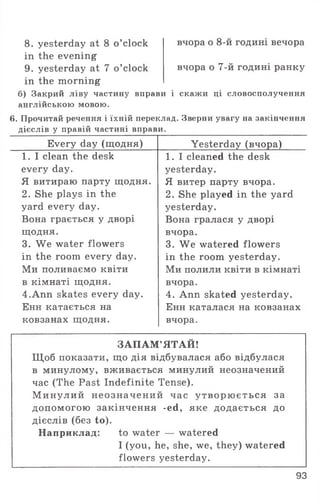
![У дієслів, що закінчуються на «е», при додаванні
закінчення -ed «е» випадає.
Наприклад: to like — liked; to live — lived
7. Прочитай дієслова у минулому неозначеному часі. Зверни увагу
на різне читання закінчення -есі.
[t]
після глухих
приголосних,
крім «t»
[d]
після голосних і
дзвінких приго
лосних, крім «d»
[id]
після при
голосних
«t » і «d »
helped played wanted
liked lived skated
looked cleaned pointed
dressed watered visited
8. Напиши дієслова у минулому неозначеному часі.
Зразок: to love — loved.
to open, to dress, to clean, to want,to look, to skate
IT] Виконай вправу 56 за 25 секунд.
10.1Напиши, що ти робив це вчора.
Зразок: I help ту mother every day. — I helped my
mother yesterday.
1. I clean my room every day.
2. I play tennis every day.
3. I water flowers on the window-sill every day.
11.|Склади три речення в Past Indefinite ї запиши їх.
______________________________________УРОК 39
1. Прочитай слова, зверни увагу на правильне читання дієслів у
минулому часі:
[t]
to dress — dressed
to jump — jumped
to like — liked
to look — looked
[d]
to live — lived
to open — opened
to play — played
to show — showed
[Id]
to skate — skated
to point — pointed
to visit — visited
to land — landed
to wash — washed to water — watered to plant — planted
94](https://image.slidesharecdn.com/22006-160519143032/85/2-_-_2006_-95-320.jpg)
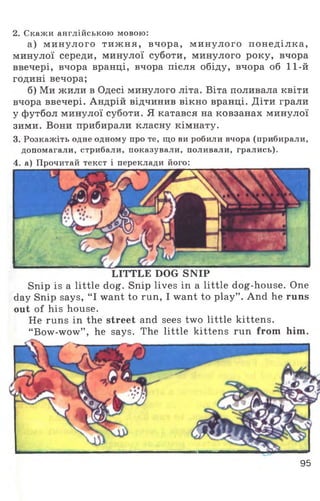
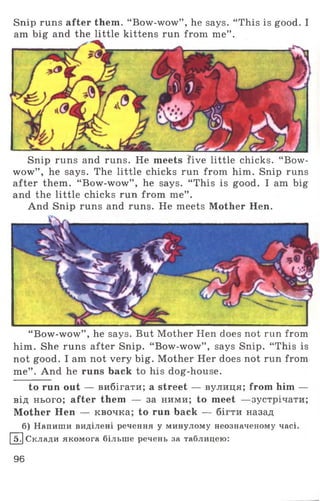
![Petryk
Nina
They
I
lived
cleaned
jumped
showed
opened
played
in Poltava
the desks
in the yard
a book
in Lviv
last summer,
last winter,
yesterday,
last Sunday,
in the morning,
last year.the window
1Г]Дай письмові відповіді на запитання до тексту “ Little Dog Snip
1. What is the dog’ s name?
2. Where does he live?
3. Does he like to run and to play?
4. Who runs from Snip?
5. Who runs after Snip?
УРОК 40
night, white, tim e,
light, to write, picture
What is the time?
1. Прочитай:
а) day, gray, pain, trey, they, great, steak, eight, reign,
spoil, void, coil, doily, foil, hoist, royal, joyful, loyal,
toyshop, toyman;
б) [mi:t], [bel], [du:], [a:m], [fo:s], [lot], [влп], [keim], [kau],
[soil], [bout], [jes], [zu:], [Jeip], [hasnd], [ga:l], [aua], [puj],
['lori], [Oaerjk].
2. Згадай усіх героїв оповідання “ Little Dog Snip” і відгадай, кого
з них задумав учитель, за допомогою запитання «Is it...?» Учень,
який відгадає слово, стає ведучим.
Зразок: Is it a cat?
No, it isn’ t.
Is it a dog?
No, it isn’ t.
Is it a Mother Hen?
Yes, it is.
97](https://image.slidesharecdn.com/22006-160519143032/85/2-_-_2006_-98-320.jpg)
![ЗАПАМ’ЯТАЙ!
а) Букви «і» та «у» у відкритому наголошеному
складі читаються [аі].
Наприклад: nine [nain], my [mai]
б) Буквосполучення «igh» також читається [ai].
Наприклад: sigh [sai], light [lait]
3. Прочитай слова:
I, tie, lie, pie, kite, mine, time, life, by, sky, type, fly.
4. Прочитай слова з перекладом, запиши їх у свій словник і
запам’ятай:
а time [taim] — час; light [lait] — світлий (-а, -е, -і); to
write [rait] — писати; What is the time? (або What time is
it?) — Котра година?
5. а) Прочитай словосполучення й речення і переклади їх на
українську мову:
This night, a dark night, a light night, a cold night, a
day and a night. It is night. We go to bed at night.
A white pen, a white hen, a white rabbit, a white dress,
black and white, yellow and white. My sister likes white
flowers. I have no white pencil.
98](https://image.slidesharecdn.com/22006-160519143032/85/2-_-_2006_-99-320.jpg)
![б) Закрий ліву частину вправи і переклади словосполучення й
речення на англійську мову за 25 секунд.
8. Напиши речення у минулому неозначеному часі:
1. My sister lives in Lutsk.
2. I clean my room every day.
3. We skate in winter.
УРОКИ 41-42
fine, dry, right, polite,
impolite, weather_______
1. Прочитайте вірш. Переможе той, хто швидше вивчить його
напам’ять.
I LOVE LEARNING ENGLISH
I can read, I can write,
I can speak English, too.
I love learning English!
And what about you?
I love learning ['la:nirj] English — Я люблю вчити
англійську мову.
2. Передайте діалог учителя і чергового.
3. Прочитай слова з перекладом, запиши у свій словник і вивчи:
right [rait] — правий (-а, -е, -і); polite [pa'lait] — ввічливий
(-а, -е, -і), чемний (-а, -е, -і); im polite [impa'lait] —
неввічливий (-а, -е, -і), нечемний (-а, -е, -і); the weather
['weda] — погода; fine — прекрасний (-а, -е, -і), чудовий
(-а, -е, -і); dry — сухий (-а, -е, -і)
4. а) Прочитай словосполучення й речення і переклади їх на
українську мову:
A right hand, a right leg, in my right hand, in her right
hand. You are right. You are not right.
A polite child, a polite boy, a polite girl, a polite man.
This letter is very polite.
An impolite boy, an impolite girl, impolite children.
Ostap is impolite.
100](https://image.slidesharecdn.com/22006-160519143032/85/2-_-_2006_-101-320.jpg)
![A fine day, a fine picture, a fine park, a fine night, a
fine book. The weather is fine today.
A dry duster, dry weather, dry hands, dry and wet.
Don’t clean the table with a dry duster! Give me a dry
duster, please!
б) Склади по одному реченню з підкресленими словами.
ЗАПАМ’ЯТАЙ!
Дієслово to be — «бути» у минулому неозначе
ному часі має дві форми: was [woz] — для однини
і were [wa] — для множини.
Наприклад: I was seven last year. — Мені було
сім років минулого року.
They were children at that time. — Вони були
дітьми на той час.
5. а) Прочитай слова, словосполучення і речення англійською
мовою за 25 секунд:
1. a right hand
2. a right hand and a left
hand
3. polite
4. a very polite girl
5. impolite
6. impolite children
7. a fine day
8. a dry leaf
9. the weather
10. The weather is bad
today.
11. You are right.
12. You are not right.
13. The weather is fine today.
Let’ s go to the park!
14. Tolya, show me your
right hand, please!
15. Vira, clean this looking-
glass with a dry duster!
права рука
права рука і ліва
рука
ввічливий
дуже ввічлива дівчинка
неввічливий
неввічливі діти
чудовий день
сухий листок
погода
Погода погана
сьогодні.
Ти правий.
Ти неправий.
Погода чудова сьогодні.
Давай підемо в парк!
Толю, покажи мені
праву руку, будь ласка!
Віро, витри це дзеркало
сухою ганчіркою!
101](https://image.slidesharecdn.com/22006-160519143032/85/2-_-_2006_-102-320.jpg)
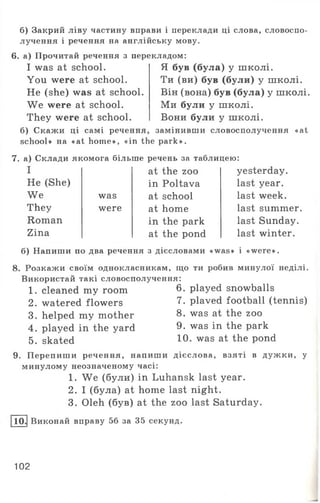
![УРОК 43
1. Прочитай слова в транскрипції:
[gei], [bau], [pi:], [tu:], [Ьеа], [Ьіа], [dua], [eit], [ho:l], [luk], [red],
[vois], [sir]], [клр], [kaet], [a'wei], [vi3n], [jes], [sau0], [d3Ag].
2. а) Прочитай текст і переклади його на українську мову:
It was Sunday yesterday. In the morning I cleaned my
room. Then I helped my mother to water flowers. The
weather was fine yesterday. I played football and tennis in
the yard. My little sister played with her dolls. We were
happy.
б) Передай зміст тексту англійською мовою.
3. Розглянь малюнки, прочитай підписи під ними. Напиши
правильно.
Ann has a doll Look at the picture! Nick is a polite boy,
in her left hand. The weather is bad. Kate is an impolite
girl.
4. Склади якомога більше речень за таблицею.
Зразок: We were schoolchildren at that time.
— Ми були школярами на той час.
103](https://image.slidesharecdn.com/22006-160519143032/85/2-_-_2006_-104-320.jpg)
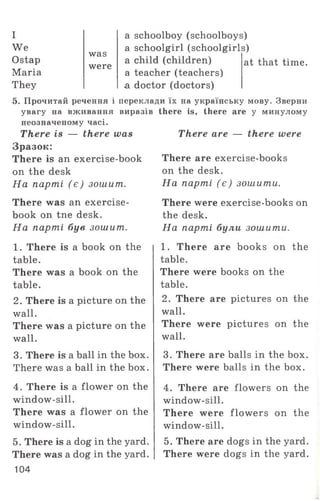
![6. Скажи, що на парті був один предмет, а твій товариш по парті
має тобі заперечити і сказати, що їх було багато.
Зразок: There was a pen on the desk.
— No, you are not right. There were many pens
on the desk.
Олівець, зошит, гумка, щоденник, книжка, пенал,
а) Прочитай текст:
It was hot in summer. The weather was fine. The trees
were green. There were many birds and flowers in the park.
The flowers were red, white and yellow. There were many
children at the pond.
б) Розкажи своїм батькам, яке було літо цього року.
~8І Напиши англійською мовою по одному реченню про те, де ти
був учора, у неділю, влітку.
_____________________________________ УРОК 44
pupil, student, ruler, sun, number,
blue, to shine, bottle of glue. The
sun shines brightly
1. Прочитай слова:
in, big, milk, six, pick, pit, sit, tin, finish, dish; lorry,
funny, many, puppy, happy, twenty, forty, Teddy, daily,
pygmy.
ЗАПАМ ’ЯТАЙ!
Буква «и» у відкритому наголошеному складі
читається [ju:]
Наприклад: a tube [tju:b]; duty [ dju:ti]
2. а) Прочитай слова вслід за учителем:
tube, tune, duke, mule, pupil, tulip, due, student, cube,
unite, dutiful, institute, fugle, hue, human, puny.
б) Прочитай слова самостійно.
3. Повтори читання букви «и» в різних складах.
105](https://image.slidesharecdn.com/22006-160519143032/85/2-_-_2006_-106-320.jpg)
![[A] [U] [u:] 0u;]
bus put blue tumid
cup push true humid
plum full truth super
club pull ruler tulip
fun bull glue Ukraine
sun bush rule during
4. Прочитай слова з перекладом, запиши їх у свій словник і
запам’ятай:
a pupil [pju:pl]
— учень;
the sun a number a bottle of glue blue
[sAn] — [’плтЬа] — [botl av glu:] — [blu:] —
сонце; номер; пляшка клею; синій (-я, -є,
-і), голубий
(-а, -е, -і);
a student [stju :dant] a ruler ['ru:la]
— студент; — лінійка;
106](https://image.slidesharecdn.com/22006-160519143032/85/2-_-_2006_-107-320.jpg)
![to shine [Jam] — світити, сяяти; The sun shines brightly.
— Сонце світить яскраво.
5. а) Прочитай словосполучення й речення і переклади їх на
українську мову:
This pupil, that pupil, a good pupil, a bad pupil, many
pupils.Nina is a pupil of the second form . Are you a pupil
or a student?
A good student, a happy student, a sad student, a pupil
and a student, two students. My sister is a student. Pavlo
is a good student.
This ruler, his ruler, a short ruler, a red ruler, a ruler
and a pencil, a ruler in the bag. I have two rulers at home.
We can see many rulers on the desks.
Under the sun, in the sun. There is no sun today. The
sun shines brightly. In summer the sun is very hot.
Number one, number three, number six, number eight,
the number of my school, the number of this bus. The num
ber of my flat is nine. My sister’ s school is number 3.
A bottle of glue, two bottles of glue, a bottle of glue on
the shelf. Do you have a bottle of glue in your bag? Give
me a bottle of glue, pleasse!
A blue pen, a blue pencil, a blue dress, a blue bag, a blue
ball. I have a blue dress and a blue scarf. I can see a blue
ball under the table.
To shine brightly. The sun doesn’t shine at night. The
lamp shines in the room.
б) Склади по одному реченню з кожним із виділених слів.
6. а) Прочитай текст:
IN THE YARD
It was summer. It was hot. Nina was in the yard. Her
black cat was in the yard too. It was on the bench. Nina’ s
doll and ball were under the bench.
107](https://image.slidesharecdn.com/22006-160519143032/85/2-_-_2006_-108-320.jpg)
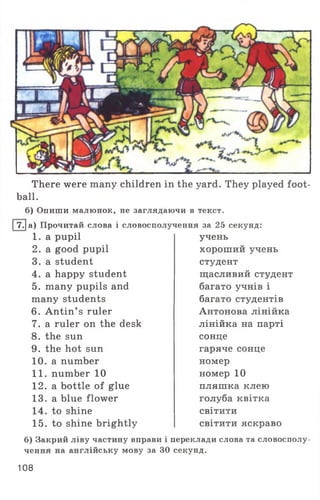
![Напиши англійською мовою:
1. Біля школи було багато учнів.
2. Марія — хороша студентка.
3. Номер його школи — 5.
4. Покажи мені свою лінійку, будь ласка.
______________________________________УРОК 45
fir tree, pine tree, poem, new,
around, to sing, to dance, to re
cite a poem, to decorate, New
Year. Happy New Year to you!
1. Прочитай загадку за 15 секунд і відгадай її:
What Season Is It ?
This is the season,
When days are cool,
When we eat apples
________ And go to school.
cool [ku:I] — прохолодний; to eat [i:t] — їсти
2. а) Прочитай і переклади текст на українську мову:
WHY HARES ARE WHITE IN WINTER
Ann and Lena are little girls. Ann is four. Lena is five.
Ann: Lena! Do you know why hares are white in winter?
Lena: Yes, I do. Hares are white in winter because they
________ eat snow.
hare [hea] — заєць; because [bi'koz] — тому що; to eat
[i:t] — їсти
б) Відтворіть діалог дівчаток у парах.
3. Опиши малюнок, використовуючи слова:
winter, season, cold, sun, sky, snow, much, park, yard,
children, skate, snowman, snowballs, happy.
109](https://image.slidesharecdn.com/22006-160519143032/85/2-_-_2006_-110-320.jpg)
![4. Прочитай слова і вислови, напиши у свій словник і запам’ятай:
a fir-tree [’fa:tri:]— ялина;
a pine-tree [paintri:] — сосна;
to sing [sir]]
— співати;
to dance [da:ns]
— танцювати;
a poem [’pouim] — вірш ; to recite a poem [ri'sait] —
розповідати, читати напам’ять вірш; to decorate [ dekareit]
— прикрашати; new [nju:] — новий (-a, -e, -i); New Year
— Новий рік; Happy New Year to you! — 3 Новим роком!;
around [a'raund] — навколо.
5. а) Прочитай слова, словосполучення і речення англійською
мовою за ЗО секунд:
1. a pine-tree
2. a fir-tree
3. a green pine-tree and
a green fir-tree
сосна
ялина
зелена сосна і
зелена ялина
110](https://image.slidesharecdn.com/22006-160519143032/85/2-_-_2006_-111-320.jpg)
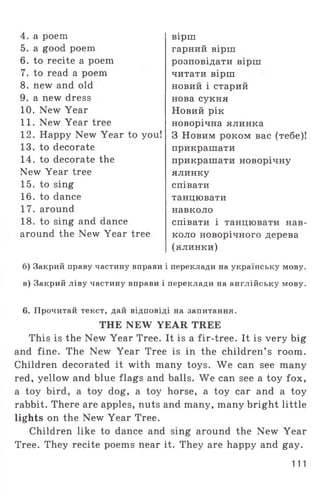
![Happy New Year to you!
lights [laits] — лампочки, свічки
1. What do you see in the picture?
2. Is it a pine-tree or a fir-tree?
3. Where is this New Year Tree?
4. W ho decorated this New Year Tree?
5. What are there on the New Year Tree ?
6. What do children like to do around
the New Year Tree?
7. Are they happy and gay?
|7.1 Прочитай вірші. Вивчи напам’ять той, який тобі найбільше
сподобався.
1) Sing a song of winter,
Be happy and gay,
Dance around the snowman,
Come out and play,
a song [sorj] — пісня;
to come out [aut] — виходити;
3) Santa Claus, Santa Claus,
Come to our house.
The New Year is near.
Come quickly here.
112
2)In winter, in summer,
In autumn, in spring,
The pretty fir-tree
Is always green,
pretty [ priti] — чарівна;
always ['o:lwaz] — завжди
Santa Claus [saenta'kb:z] —
різдвяний дід, Дід Мороз,
Санта Клаус;
quickly [’kwikli] — швидко](https://image.slidesharecdn.com/22006-160519143032/85/2-_-_2006_-113-320.jpg)
![8. Напиши англійською мовою:
1. У цьому парку багато ялин і сосен.
2. Віра любить декламувати (розказувати) вірші.
3. Я люблю прикрашати новорічну ялинку.
4. Вони хочуть танцювати і співати навколо ялинки.
УРОК 46
Father Frost, Snow
Maiden, present
1. Виконай завдання 7 попереднього уроку.
2. Назви англійською мовою слова, які починаються із заданої
букви. Переможе той, хто виконає це завдання за 40 секунд.
а) Зразок: «р» ввічливий — polite
1) сосна 4) указка 7) будь ласка
2) пенал 5) картина 8) парк 10) вірш
3) гратися 6) учень 9 ) ставок
б) Зразок: «s» сестра — sister
1) сім 4) співати 7) школа
2) літо 5) сонце 8) порароку 10) весна
3) вечеря 6) небо 9) сніг
3. Прочитай слова з перекладом і запам’ятай їх:
Father Frost, Santa Claus Snow-Maiden a present
['fa:6a frost], [saenta'kloiz] — [meidn] — ['preznt] —
Дід Мороз; Снігурка; подарунок.
113](https://image.slidesharecdn.com/22006-160519143032/85/2-_-_2006_-114-320.jpg)
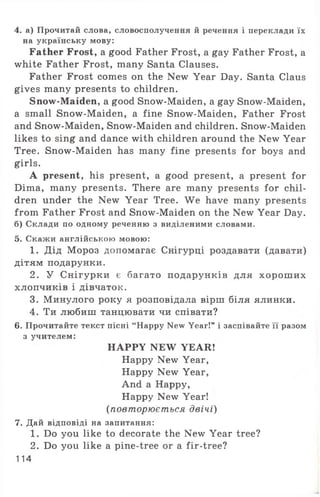
![3. Do you want to be Santa Claus or Snow-Maiden?
4. What can you do near the New Year tree?
5. Do you want to have many presents on the New Year
Day?
6. What presents do you want to have?
7. Do you like the New Year Day?
8. Запиши у свій зошит вислови, якими ти можеш привітати своїх
друзів, батьків, рідних і знайомих з Новим роком:
1. Happy New Year! — 3 Новим роком!
2. Best wishes [ wijiz] for the New Year! — Найкращі
побажання з Новим роком!
3. I wish you happiness! — Бажаю вам (тобі) щастя!
4. I wish you luck! [Ілк] — Бажаю вам (тобі) успіхів!
5. I wish you good health! [haelG] — Бажаю вам (тобі)
доброго здоров’я!
6. I wish you all the best! — Бажаю вам (тобі) усього
найкращого!
7. May all your dreams [dri:mz] come true! — Хай
здійсняться всі ваші (твої) мрії!
8. Merry Christmas! [ kristmas] — Щ асливого Різдва!
УРОКИ 47-49 (РЕЗЕРВН І)
115](https://image.slidesharecdn.com/22006-160519143032/85/2-_-_2006_-116-320.jpg)
![ТРЕТЯ ЧВЕРТЬ
УРОК 50
holiday, village, to spend
1. Прочитай слова за ЗО секунд:
Fir-tree, pine-tree, New Year, decorate, poem, play,
dance, sing, snow, sun, week, year, winter, summer, cold,
chilly, shine, around, present, Father Frost, Santa Claus,
Snow-Maiden, snowball, snowman, small, big, gey, clean.
2. а) Прочитайте діалоги англійською мовою у парах:
1) — What is the weather
like in winter?
— It is cold.
— Is it cold today?
— No, it isn’t. It is chilly
today.
2) — Is it cold today?
— No, it isn’t.
— What is the weather like
today?
— The weather is fine. The
sun shines brightly. Snow is
wet. Let’ s play snowballs.
— All right. Let’ s play
snowballs and make a
snowman.
— Яка погода взимку?
— Холодно.
— Сьогодні холодно?
— Ні. Сьогодні прохолодно.
— Сьогодні холодно?
— Ні.
— Яка сьогодні погода?
— Погода чудова. Яскраво
світить сонце. Сніг мокрий.
Давай пограємо в сніжки.
— Гаразд. Давай пограємо в
сніжки і зліпимо снігови-
ка.
б) Закрийте ліву частину вправи і відтворіть діалоги англій
ською мовою.
3. Прочитай слова з перекладом, запиши їх у словник і запам’ятай:
a holiday [’holadi] — свято, день відпочинку, відпустка;
holidays — канікули; a village [ vilid3] — село; to spend
— проводити (час).
4. а) Прочитай слова, словосполучення й речення і переклади їх
на українську мову:
116](https://image.slidesharecdn.com/22006-160519143032/85/2-_-_2006_-117-320.jpg)
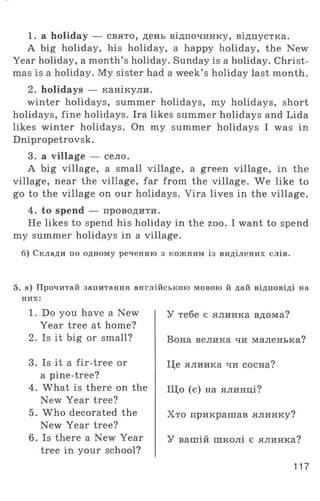
![7. What do children do
around the fir-tree?
8. W ho gives you presents
on the New Year?
9. Do you like the
New Year holiday?
10. Where do you spend
your winter holidays?
11. Do you go to town or
to a village on your holidays?
12. What do you do on your
winter holidays?
Щ о роблять діти навко
ло ялинки?
Хто дає тобі подарунки
на Новий рік?
Тобі подобається ново
річне свято?
Де ти проводиш зимові
канікули?
Ти їздиш до міста чи до
села на канікули?
Щ о ти робиш на зимові
канікули?
б) Закрий ліву частину вправи, переклади запитання на англій
ську мову і попроси свого однокласника відповісти на них.
6. Розкажи англійською мовою, як ти провів зимові канікули. У
цьому тобі допоможуть такі слова і словосполучення:
to spend holidays, winter, cold, snow, in a village, in town,
to skate, to make a snowman, to play snowballs, to play
hockey, to read books, a fir-tree, a present, to sing, to
dance, to recite a poem, happy.
J7T] Прочитай текст і дай письмові відповіді на запитання.
HOLIDAYS
Every year has many happy months. Happy months are
the months when we have our holidays.
January is a happy month for Kate. Her birthday is on
the second of January. She is six. It is a big holiday for
Kate and her family.
Kate has a new dress on. There is a big birthday cake
on the table. Kate has guests on her birthday. They have
many good presents for her: toys, books and flowers. Chil-
118](https://image.slidesharecdn.com/22006-160519143032/85/2-_-_2006_-119-320.jpg)
![dren dance and play together with Kate. They sing her the
song «Happy Birthday».
every [ evn] — кожний; month [тлп9] — місяць; Janu
ary [d3 aenjuari] — січень; a birthday ['ba:0dei] — день
народження;; a cake — торт; a guest [gest] — гість; to
gether [ta'ge6a] — разом; a song [sor]] — пісня; Happy Birth
day! — 3 днем народження!
1. When is Kate’ s birthday?
2. Is it a holiday for Kate?
3. What presents do children have for Kate?
______________________________________УРОК 51
usually
1. Прочитайте пісню “Happy Birthday” і заспівайте її разом з
учителем:
HAPPY BIRTHDAY
Happy birthday to you.
Happy birthday to you.
Happy birthday, dear Kate (N ick...),
________ Happy birthday to you.
dear [dia] — дорогий (-a, -e, -i)
119](https://image.slidesharecdn.com/22006-160519143032/85/2-_-_2006_-120-320.jpg)
![2. а) Запиши у свій словник і запам’ятай слово:
usually ['ju:зиаІі] — звичайно.
б) Прочитай речення:
1. I usually get up at
seven o ’clock.
2. Girls usually don’t
play football.
3. Taras usually has
dinner at two o ’clock.
4. W e usually go to
the zoo on Sunday.
5. What do you usually
do in summer?
6. W ho usually waters
flowers in your room?
Я звичайно встаю о сьомій
годині.
Дівчата звичайно не гра
ють у футбол.
Тарас звичайно обідає о
другій годині.
Ми звичайно ходимо до
зоопарку в неділю.
Щ о ти звичайно робиш
влітку?
Хто звичайно поливає кві
ти у твоїй кімнаті?
в) Закрий ліву частину вправи і переклади речення на англій-
ську мову.__________________________________________________________
ЗАПАМ ’ЯТАЙ!
Дієслова, які утворюють Past Indefinite (минулий
неозначений час) за допомогою закінчення -ed,
називаються правильними.
Багато дієслів мають особливу форму в минулому
неозначеному часі, яку необхідно запам’ятати.
Такі дієслова називаються неправильними.
Наприклад: to go — went; to have — had
3. а) Прочитай і запам’ятай форми неправильних дієслів:
І форма II форма
бути to be was, were
приходити to come came
робити to do did
вставати to get up got up
давати to give gave
ходити, їхати to go went
мати to have had
120](https://image.slidesharecdn.com/22006-160519143032/85/2-_-_2006_-121-320.jpg)
![І форма II форма
робити, готувати to make made
читати to read read [red]
бачити to see saw [so:]
сидіти to sit sat
говорити to speak spoke
проводити to spend spent
писати to write wrote
брати to take took
б) Закрии праву частину вправи (І і II форми) і назви англій
ською мовою дві форми дієслів.
4. а) Прочитай речення англійською й українською мовами:
1.He was six last year.
2. I came to school at
eight o ’clock.
3. She had five apples
yesterday.
4. We went to the village
last Saturday.
5. The children made
a snowman in the park.
6. Nina read a book
last night.
7. We saw many birds
in the park yesterday.
8. This student spoke
English very well.
9. Natalka spent her
winter holidays in Lutsk.
10. The pupils wrote this
exercise yesterday.
б) Закрий ліву частину вправи
мову.
Йому було шість років ми
нулого року.
Я прийшла до ш коли о
восьмій годині.
У неї було п ’ ять яблук
вчора.
Ми їздили в село минулої
суботи.
Діти ліпили сніговика в
парку.
Ніна читала книжку вчо
ра ввечері.
Ми бачили багато птахів
у парку вчора.
Цей студент говорив по-
англійськи дуже добре.
Наталка провела зимові
канікули в Луцьку.
Учні писали цю вправу
вчора.
і переклади речення на англійську
121](https://image.slidesharecdn.com/22006-160519143032/85/2-_-_2006_-122-320.jpg)
![6. Прочитай речення в Present Indefinite (теперішній неозначений
час). Скажи їх в Past Indefinite.
Зразок: Larysa is a student. — Larysa was a student.
1. I have two pens and six pencils.
2. He is a pupil.
3. The children make snowballs in the yard.
4. Lida sees a fox in the zoo.
5. My teacher speaks English and Ukrainian very well.
|7.| Скажи своїм рідним, що ти робив учора, використовуючи в
минулому неозначеному часі такі дієслова:
to read to get up
d° to write to take
£° to see to make
8. Напиши англійською мовою:
1. Світлані було 8 років минулої п'ятниці.
2. Вони пішли додому о п'ятій годині вечора.
3. Остап написав листа вчора вранці.
УРОК 52
to do morning exercises, to make a bed,
to wash, to wash up, to dress, to have
breakfast, to do lessons, to watch TV,
to help about the house, now, then
1. Розкажи, яка погода була вчора.
2. Прочитай, запиши і запам’ятай слова і словосполучення:
to make a bed — стелити постіль; to do morning exercises
— робити ранкову зарядку; to wash [w oj] — мити,
вм и вати ся ; to wash up — мити посуд; to dress —
одягатися; to have breakfast [ brekfast] — снідати; to do
lessons [lesnz] — готувати уроки; to help about the house
— допомагати по господарству; to watch TV [wotj] —
122](https://image.slidesharecdn.com/22006-160519143032/85/2-_-_2006_-123-320.jpg)
![дивитися телевізор; now [пай] — тепер, зараз; then [Sen]
— потім.
3. Прочитай речення і переклади їх на українську мову:
1. I do my morning exercises every day.
2. Pete doesn’t like to make his bed.
3. Ann, wash your hands and take this apple!
4. Nina, it’ s seven o ’clock. Get up and dress!
5. We have breakfast at eight o ’clock.
6. I do my lessons at five o ’clock.
7. She likes to help her mother about the house.
8. My family doesn’t watch TV now.
9. Slava doesn’t like to wash up.
10. Taras washes his hands. Then he has supper.
4. Розкажи своїм однокласникам, що ти робив:
in the morning; in the afternoon; in the evening.
Використай подані нижче слова і словосполучення:
Morning Afternoon Evening
1. got up 1. had dinner 1. helped about
2. did morning 2. did my the house
exercises lessons 2. watered flow
3. made my bed 3. went to ers
4. washed and the park 3. clea n ed the
dressed 4. played in room
5. had breakfast the yard 4. read a book
6. took my bag 5. skated 5. wrote a letter
7. went to school 6. played football 6. played with my
8. came to school 7. made a sister (dog, cat)
9. read, wrote snowman 7. had supper
and spoke English 8. played tennis 8. washed up
9. watched TV 9. went to bed
5. Напиши англійською мовою під диктовку вчителя:
1. Йому було 7 років минулого року.
2. Ми ходили до зоопарку минулої неділі.
3. Вона гралася у парку ввечері.
123](https://image.slidesharecdn.com/22006-160519143032/85/2-_-_2006_-124-320.jpg)
![MY DAY
I get up at 7 o ’clock. I do my morning exercises, make
my bed, wash, dress and have breakfast. Then I take my
bag and go to school. I speak, read and write at school.
I go home at one o ’clock. I have dinner and play in the
yard. I do my lessons at 5 o ’clock. Then I read books and
watch TV.
In the evening I help my mother about the house. I clean
my room , water flowers and wash up. I play with my sis
ter. W e have supper at 7 o ’clock. I go to bed at 9 o ’clock.
б) Дай відповіді на запитання:
1. When do you get up?
2. What do you do in the morning?
3. W ho makes your bed?
4. When do you have breakfast?
5. What do you do at school?
6. When do you do your lessons?
7. What do you do in the evening?
8. When do you go to bed?
[7Т]Допиши речення:
1. I do my morning exercises and (стелю постіль).
2. Nick (йде до школи) at 8 o ’clock.
3. Tanya (готує уроки) at 4 o ’clock.
4. In the evening they (дивляться телевізор) and read
books.
______________________________________УРОК 53
1. Прочитай слова за 20 секунд:
went, made, gave, got, came, saw, showed, sat, spoke, was,
were, began, did, had, wrote, took, cleaned, skated, played,
snowed.
I6 .[а) Прочитай текст:
124](https://image.slidesharecdn.com/22006-160519143032/85/2-_-_2006_-125-320.jpg)
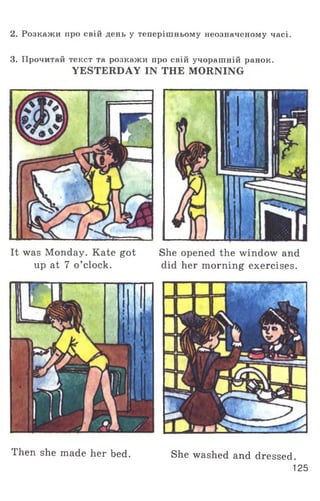
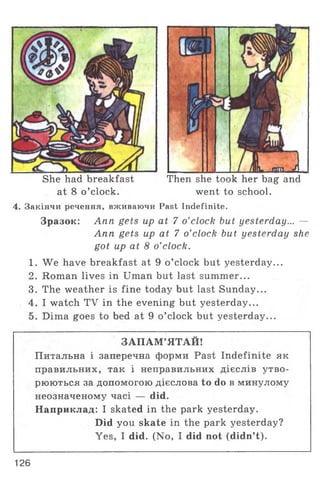
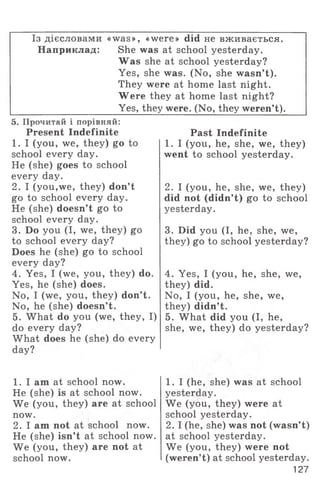
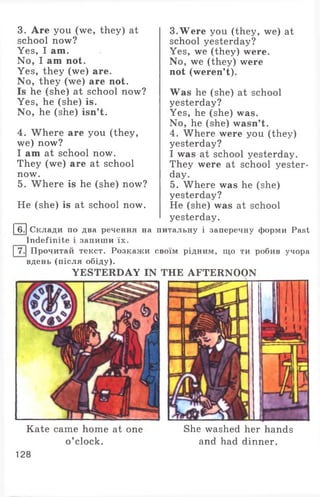
![Then Kate played in the She did her lessons,
yard with her puppy.
She cleaned the room and Then Kate wrote a letter,
watered flowers.
УРОК 54
should like
1. Згадай усі слова, які містять у собі звуки:
[г]. [d], [w], [g], [р].
Зразок: [г] — red, ruler, green, eraser...; [w] — when, white, what...
129](https://image.slidesharecdn.com/22006-160519143032/85/2-_-_2006_-130-320.jpg)
![2. Прочитай речення і переклади їх на українську мову:
1. I didn’t go to school yesterday.
2. My sister didn’t skate in the yard yesterday.
3. W e didn’t play football last night.
4. I wasn’t at home at that time.
5. Nick wasn't at home at that time.
6. The children weren’t in the park in the morning.
3. а) Прочитай запитання і дай
1. When did you get up
yesterday?
2. When did you go
to school?
3. Did you speak English
at school?
4. Did you have dinner
at 2 o ’clock?
5. Did you play in the
yard or in the park?
6. Where were you
last night?
7. W hen did you have
supper?
8. W hat did you do in
the evening?
на них відповідь:
Коли ти встав (встала)
учора?
Коли ти пішов (пішла) до
школи?
Ти розмовляв (розмовляла)
по-англійськи у школі?
Ти обідав (обідала) о 2-й
годині?
Ти грався (гралась) у дворі
чи в парку?
Де ти був (була) учора
ввечері?
Коли ти вечеряв (вече
ряла)?
Щ о ти робив (робила)
ввечері?
б) Закрий ліву частину вправи, переклади запитання на англій
ську мову і попроси свого товариша по парті відповісти на них.
4. а) Прочитай слова із буквосполученням «ои»:
________________ _________ ___
[и] — - ' ------- [и:]
could soup
should group
would coupon
б) Прочитай вірш за 25 секунд:
130](https://image.slidesharecdn.com/22006-160519143032/85/2-_-_2006_-131-320.jpg)
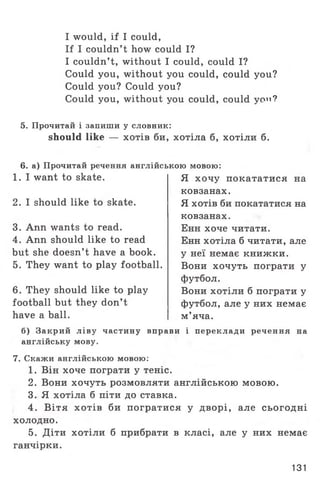
![8. Роздивись малюнки і розкажи англійською мовою, що робила
Кейт увечері (last night):
[97]Виконай вправу 6а за 15 секунд; 66 — за 20 секунд.
|Ю.| Напиши речення в заперечній і запитальній формах:
132](https://image.slidesharecdn.com/22006-160519143032/85/2-_-_2006_-133-320.jpg)
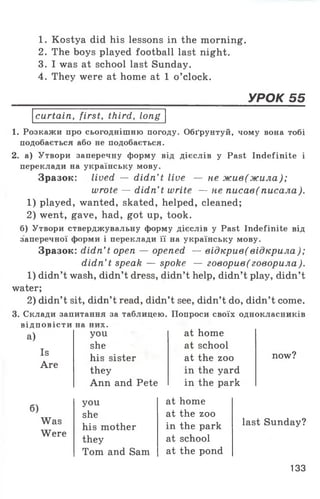
![4. Пригадай читання буквосполучень «іг» та «ег»:
[а:]
іг ег
b ird -
girl
skirt
shirt
first
her
serf
serve
term
pert
ЗАПАМ ’ЯТАЙ!
Буквосполучення «иг» також читається [а:].
Наприклад: fur, burn
5. Прочитай слова:
bur, curb, burl, furl, burn, curl, hurl, hurt, nurse, purr,
turn, purge, turf, lurk, surf, murky, surge.
6. Напиши транскрипцію слів:
7. Прочитай слова з перекладом, запиши їх у свій словник і
запам’ятай:
a curtain [ka:tn] — занавіска;
first [fa:st] — перший (-a, -e, -і); third [9a:d] — третій (-я,
-є, -і); long [lorj] — довгий (-a, -e, -і).
8. Прочитай слова, словосполучення і речення з перекладом:
girl, her, first, burn, curly, nurse.
1. a curtain
2. a blue curtain
3. long
занавіска
голуба занавіска
довгии
134](https://image.slidesharecdn.com/22006-160519143032/85/2-_-_2006_-135-320.jpg)
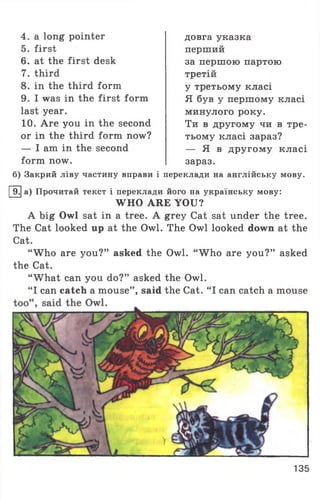
![“ I can see in the dark” , said the Cat. “ I can see in the
dark too” , said the Owl.
“ Can you say M IAOW ?” asked the Cat.
“ No, I cannot” , said the Owl.
“ Then you are not a cat” , said the Cat.
“ Can you say WHO, W HO?” asked the Owl.
“ No, I cannot” , said the Cat.
“Then you are not an owl” , said the Owl.
“ I cannot guess who are you” , said the Cat.
“ I cannot guess who you are” , said the Owl and flew
away.
The Cat looked at the Owl and ran away too.
an owl [auI] — сова; up — вгору; down — вниз; to ask
— запитувати; to catch [kaetj] — ловити; said [sed] —
сказав(сказала); in the dark — у темряві; to guess [ges]
— здогадуватися; flew away [flu:] — полетіла геть; ran
away — побіг геть
б) Знайди у тексті і напиши англійською мовою такі слово
сполучення і речення:
сиділа на дереві, запитала Сова,
сказав Кіт, полетіла геть.
Сірий Кіт сидів під деревом.
Сова подивилася вниз на Кота.
“ Щ о ти вмієш робити?” — запитала Сова.
Кіт подивився на Сову і побіг геть.
______________________________________УРОК 56
autumn, spring, month,
changeable, warm.
It is warm.
1. Скажи англійською мовою:
перший учень, перша парта, перше вікно; третя дівчина,
третій будинок, третя машина.
У мене на вікнах світлі занавіски. Взимку ночі довгі,
а дні короткі.
136](https://image.slidesharecdn.com/22006-160519143032/85/2-_-_2006_-137-320.jpg)
![2. а) Подивись на малюнки і скажи спочатку, що там учора
був (була) ти, а потім що там були Мар’яна і Денис.
б) Скажи це саме в заперечній фчрмі.
3. Прочитай слова з перекладом, запиши їх у свій словник і
запам’ятай:
autumn [’o:tam] — осінь; spring [spnrj] — весна;
a month [тлп0] — місяць; changeable [ tjemd3abl] —
мінливий (-а, -е, -і); warm [wo:m] — теплий (-а, -е, -і); It
is warm. — Тепло.
137](https://image.slidesharecdn.com/22006-160519143032/85/2-_-_2006_-138-320.jpg)
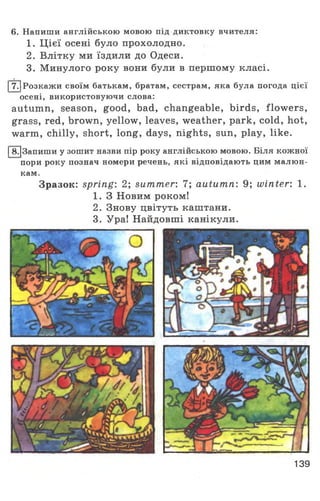
![4. Час копати моркву і буряки.
5. Мій день народження.
6. Мамине свято.
7. Святкуємо День Незалежності України.
8. Як мороз розмалював вікна!
9. Починається навчання у школі.
10. Яка спека! Ходімо швидше до річки!
______________________________________УРОК 57
sky, rain, much, sometimes.
It snows. It rains.
1. Прочитай знайомий тобі вірш “Seasons”. Виграє той, хто швидше
вивчить його напам’ять.
SEASONS
Spring is green,
Summer is bright,
Autumn is yellow,
W inter is white.
bright [brait] — ясний (-а, -e, -і), яскравий (-а, -е, -і)
2. Розкажи, яка сьогодні погода.
3. Запиши у свій словник і запам’ятай такі слова і вислови:
rain [rein] —дощ; the sky [fekai] — небо;
140](https://image.slidesharecdn.com/22006-160519143032/85/2-_-_2006_-141-320.jpg)
![much [rriAtJ] — багато; sometimes [’sAmtaimz] — іноді,
інколи; It snows — Йде сніг. It snowed — Йшов сніг. It
rains — Йде дощ. It rained — Йшов дощ.
ЗАПАМ’ЯТАЙ!
а) many — багато — вживається з іменниками у
множині, які можна полічити.
Наприклад: many pens — багато ручок;
many apples — багато яблук.
б) much — багато — вживається з іменниками в
однині, які не можна полічити.
Наприклад: much milk — багато молока;
much snow — багато снігу.
4. а) Прочитай слова, словосполучення й речення і переклади їх
на українську мову:
Cold rain, warm rain, spring rain, autumn rain, much
rain.
It rains in autumn. We had much rain last summer. It
snows in winter. We didn't have much snow last winter.
The sky is grey. The sun shines brightly and the sky is
blue. I can see many birds in the sky.
Much milk, much rain, much snow, much time, much
butter. I have much time and I can help you. There is much
wet snow in the yard and we can play snowballs.
I usually have dinner at one o ’clock but sometimes I
have dinner at two o ’clock. Sometimes it rains in winter.
б) Склади по одному реченню із виділеними словами і запиши
їх у свій зошит.
5. Дай відповіді на запитання:
1. Is the weather changeable in winter?
2. Is there much snow now?
3. Does it rain in winter?
4. What seasons are cold and what seasons are warm?
141](https://image.slidesharecdn.com/22006-160519143032/85/2-_-_2006_-142-320.jpg)
![8. Напиши англійською мовою:
1. Мені не сподобалась ця книга.
2. Він не читав Томового листа.
3. Ніна була у школі в середу.
4. Вони їздили до Рівного минулої весни.
УРОК 58
chair, bear, teddy-bear,
hair, pear, fair, near
1. Прочитай слова:
[n] - [Г]]
win — wing
ban — bang
thin — thing
sin — sing
tan — tang
W —tnl
think — thing
bank — bang
rink — ring
brink — bring
sink — sing
ЗАПАМ ’ЯТАЙ!
Буквосполучення «аіг», «ear» читається [єа].
Наприклад: chair [tjea], pear [pea]
2. Прочитай слова:
air: air, fair, pair, hair, chair, stair, lair, dairy;
ear: tear, bear, pear, swear, wear, wearer, wearing,
bearing.
3. Запиши слова у свій словник і запам’ятай їх:
a chair — стілець; a bear — ведмідь; a teddy-bear — ведмедик
(іграшка);
143](https://image.slidesharecdn.com/22006-160519143032/85/2-_-_2006_-144-320.jpg)
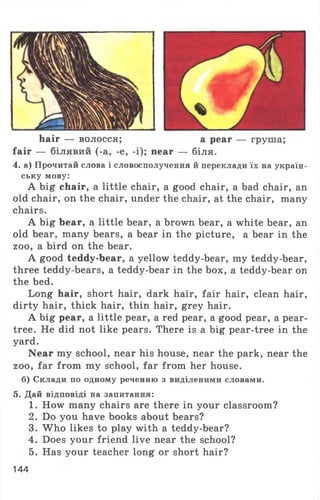
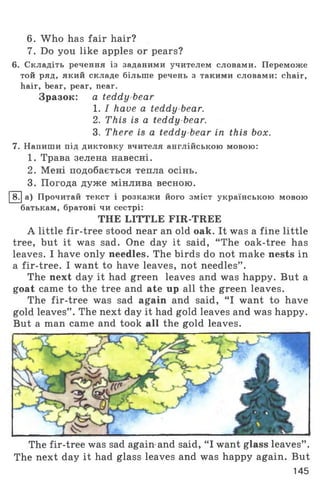
![Goats eat them. I do not like glass leaves. The wind breaks
them. I want to have my needles again. Goats do not eat
them, men do not take them, the wind cannot break them” .
The next morning it had all its needles again.
an oak [ouk] — дуб; a needle [ni:dl] — голка; a nest —
гніздо; next — наступний; a goat — коза; ate [et] up —
the wind blew and broke all the glass leaves.
The little fir-tree was very sad and said,
gold leaves. Men take them. I do not like
‘I do not like
leaves.
'/in'
146](https://image.slidesharecdn.com/22006-160519143032/85/2-_-_2006_-147-320.jpg)
![з’їла; again [a'gein] — знову; gold [gould] — золотий; all
[o:l] — весь, усі; glass — скляний; the wind [wind] — вітер;
blew [blu:] — подув; broke — розбив; them — їх; to eat
[i:t] — їсти; to break — розбивати, ламати; its — її, його
б) Випиши з тексту всі дієслова, які ти знаєш у Past Indefinite
(минулому неозначеному часі), і постав їх у Present Indefinite
(теперішньому неозначеному часі).
Зразок: stood — to stand.
в) Випиши з тексту дієслова у Present Indefinite і напиши їх у
Past Indefinite.
Зразок: has — had.
_____________________________________ УРОК 59
friend, ground, ski,
sledge, best of all
1. Передайте діалог учителя і чергового.
2. Прочитай слова з перекладом, запиши їх у свій словник і
запам’ятай:
a ski [ski:] — лижа; a sledge [sled3] — сани;
147](https://image.slidesharecdn.com/22006-160519143032/85/2-_-_2006_-148-320.jpg)
![a friend [frend] — друг, приятель, подруга; the ground
[graund] — ґрунт, земля; to ski — ходити на лижах; to
sledge — кататися на санях; best of all — найбільше,
краще за всіх.
3. а) Прочитай слова, словосполучення і речення англійською
мовою:
1. a friend
2. his best friend
3. on the ground
4. to ski
5. two skis
6. to sledge
7. a sledge
8. best of all
9. Roman reads well but
Pavlo reads best of all.
10. She has many good
friends.
11. The ground was white
with snow.
12. In winter children like
to skate, sledge and ski.
друг, подруга
його найкращий друг
на землі
ходити на лижах
дві лижі
катати(ся) на санях
сани
найбільше, краще за всіх
Роман читає добре, але
Павло читає краще за всіх.
У неї багато хороших
друзів.
Земля була біла від снігу.
В зи м ку д іти л ю бл я ть
кататися на ковзанах, са
нях і ходити на лижах.
б) Закрий праву частину вправи і переклади слова, словосполу
чення і речення на українську мову.
в) Попроси свого товариша за партою закрити ліву частину
вправи і перекласти слова, словосполучення і речення на
англійську мову. Контролюй правильність виконання.
4. Напиши під диктовку вчителя англійською мовою:
1. Мій друг живе в селі.
2. Роман любить яблука і груші, але найбільше він
любить вишні.
3. На землі багато червоного, жовтого і коричневого
листя.
4. Віра хоче ходити на лижах і кататися на санях,
але їх у неї немає.
148](https://image.slidesharecdn.com/22006-160519143032/85/2-_-_2006_-149-320.jpg)
![5. Прочитайте діалог і відтворіть його в парах:
— Hello, Lida!
— Hello, Antin!
— Do you like to skate?
— No, I don’t. But I like to
sledge. And what about you?
— As for me I like to skate.
But I like to ski best of
all.
— Привіт, Лідо!
— Привіт, Антоне!
— Ти любиш кататися на
ковзанах?
— Ні. Але я люблю ката
тися на санях. А ти?
— Щ одо мене, то я люб
лю кататися на ковзанах.
Але найбільше мені подо
бається ходити на лижах.
6. Дай відповіді на запитання:
1. Do you have a friend in your form (class)?
2. What is your friend’ s name?
3. How old is your friend?
4. Does your friend live in town or in a village?
5. Is he (she) a good friend?
6. Do you ski or sledge with your friend?
7. Do you spend holidays with your friend?
8. W hy do you like your friend?
[7^Виконай вправу За за 25 секунд, Зв — за ЗО секунд.
[Напиши про свого друга (подругу) англійською мовою (ім’я,
вік, у якому класі вчиться, де живе, що любить робити, як ви
проводите час разом).
УРОК 60
frosty, slippery, often,
such, settled
1. Прочитай транскрипцію слів:
[ten], [si:], [hæt], [a:m], [клр], [toi], [so:], [put], [pin], [gu:s], [weit],
[jes], [vois], [Öen], [Giq], [ofis], [’beta], [taun], [vilid3].
2. Розкажи про свого друга чи подругу. Використай вправу із
домашнього завдання.
149](https://image.slidesharecdn.com/22006-160519143032/85/2-_-_2006_-150-320.jpg)
![3. Скажи англійською мовою:
1. Я люблю кішок і собак, але найбільше я люблю птахів.
2. Мені хотілося б мати друга в Лондоні.
3. Не сиди на землі. Сьогодні холодно.
4. Ніні подобається кататися на санях у селі.
5. Я хочу покататися на лижах у парку в неділю.
6. Йде дощ. Ти не можеш кататися на ковзанах у дворі.
7. Копилів — це село. Воно недалеко від Києва.
4. Прочитай слова з перекладом, запиши їх у свій словник і
запам’ятай:
frosty — морозний (-а, -е, -і), крижаний (-а, -е, -і), холод
ний (-а, -е, -і); slippery — слизький (-а, -е, -і); often [’o:fn]
— часто; such [sAtJ] — такий (-а, -е, -і); settled [setld] —
стійкий (-а, -е, -і).
5. а) Прочитай слова, словосполучення і речення англійською й
українською мовами:
1. frosty
2. a frosty winter
3. frosty days
4. slippery
5. a slippery ground
6. often
7. very often
8. such
9. such a fine day
10. settled
11. settled weather
12. The weather is settled.
13. It is frosty today.
14. It was slippery yesterday.
15. It often rains in autumn.
16. Rita is such a gay girl.
морознии
морозна зима
морозні дні
слизький
слизька земля
часто
дуже часто
такий
такий чудовий день
стійкий, сталий
стала погода
Погода встановилася.
Сьогодні морозно.
Вчора було слизько.
Восени часто йде дощ.
Ріта така весела дівчинка.
б) Закрий ліву частину вправи і переклади ці слова, словоспо
лучення і речення на англійську мову.
150](https://image.slidesharecdn.com/22006-160519143032/85/2-_-_2006_-151-320.jpg)
![6. Опиши малюнки англійською мовою.
7. Підбери словосполучення, протилежні за значенням, і напиши
їх.
Зразок: A clean сир — a dirty сир.
A white shirt, a long ruler, a good pupil, an old house,
a small village, a dry duster, a polite boy.
ЗВиконай вправу 56 за 40 секунд.
Г]Склади по одному реченню з поданими словами і запиши їх:
frosty, slippery, often, sledge.
УРОК 61
January, February, March, April,
May, June, July, August, Septem
ber, October, November, December
1. Прочитай слова за 25 секунд:
books, clocks, desks, lamps, seats, weeks, nights, students,
maps, presents, rooms, girls, dusters, windows, flowers,
poems, seasons, teachers, hairs, chairs, houses, benches,
horses, dresses, buses, fishes, foxes, exercises, glasses.
2. Дай відповіді на запитання:
1. Is it frosty or slippery today?
151](https://image.slidesharecdn.com/22006-160519143032/85/2-_-_2006_-152-320.jpg)
![2. What weather do you like best of all?
3. W ho is your best friend?
4. Do you often write letters to your friends?
5. Do you have skis, sledges or skates at home?
3. Прочитайте діалог і відтворіть його в парах англійською мовою:
— W hat is the weather like
today?
— The weather is bad today.
— W hy do you think so?
— I think so because it
rains. The sky is grey. The
snow is wet and dirty.
— I agree with you. I don’t
like such weather in winter.
And you?
— I don’t like such a bad
weather too.
— Яка сьогодні погода?
— Сьогодні погана погода.
— Чому ти так думаєш?
— Я думаю так, бо йде
дощ. Небо сіре. Сніг мок
рий і брудний.
— Я погоджуюся з тобою.
Мені не подобається така
погода взимку. А тобі?
— Мені також не подоба
ється така погана погода.
4. а) Пригадай назви всіх місяців року українською та англійською
мовами.
б) Прочитай англійською мовою, запиши у свій словник і за
пам’ятай:
1) January ['d3aenjuari] — січень;
2) February ['februari] — лютий;
3) March [ma:tj] — березень;
4) April ['еіргаї] — квітень;
5) May [mei] — травень;
6) June [d3u:n] — червень;
7) July [d3u:'lai] — липень;
8) August [ o:gast] — серпень;
9) September [sep'temba] — вересень;
10) October [ok'touba] — жовтень;
11) November [no'vemba] — листопад;
_______ 12) December [di'sembaj — грудень.________
ЗАПАМ’ЯТАЙ!
Назви місяців року пишуться англійською мовою
з великої букви.
152](https://image.slidesharecdn.com/22006-160519143032/85/2-_-_2006_-153-320.jpg)
![5. Прочитай речення і переклади їх на українську мову:
1. January is the first month of the year.
2. It is very cold in February.
3. It often snows in March.
4. April is the second month of spring.
5. May is a spring month too.
6. In June we have our summer holidays.
7. In July the sun is very hot.
8. The weather is changeable in August.
9. In September schoolchildren go to school.
10. October is the second autumn month.
11. The weather is chilly in November.
12. December is the last month of the year.
6. а) Назви і покажи місяці по порядку, починаючи з січня, за 20
секунд:
September, January, December, October, July, March,
April, August, February, June, November, May.
б) Один із місяців року названий на честь римського бога війни
Марса, другий — на честь імператора Юлія Цезаря, третій —
на честь імператора Августа. Здогадайся, які це місяці, і випиши
їх у свій зошит.
[~7І Прочитай текст і дай письмові відповіді на запитання.
A week has seven days. Sunday, Monday, Tuesday,
Wednesday, Thursday, Friday, Saturday are the days of
the week.
A month has four weeks. A year has twelve months.
They are: January, February, March, April, May, June,
July, August, September, October, November, December.
A year has four seasons. The seasons of the year are:
spring, summer, autumn and winter. The spring months
are: March, April and May. The summer months are: June,
July and August. The three autumn months are: Septem
ber, October and November. The three winter months are:
December, January and February.
twelve [twelv] — дванадцять
153](https://image.slidesharecdn.com/22006-160519143032/85/2-_-_2006_-154-320.jpg)
![1. How many days are there in a week?
2. How many weeks does a month have?
3. How many months are there in a year?
4. What are the winter months?
______________________________________УРОК 62
1. Прочитай спочатку слова по вертикалі, а потім по горизонталі.
[і:] ['] [e] [ae]
beat bit bet bat
peak pick peck pack
lead lid led lad
peel pill pell pal
dean din den Dan
teen tin ten tan
bead bid bed bad
peat pit pet pat
2. Розкажи, яка сьогодні погода. Обґрунтуй, чому вона тобі подо
бається або не подобається.
3. Назви спочатку зимові місяці, потім весняні, літні й осінні.
4. Дай відповіді на запитання:
1. What day is it today?
2. What month is it now?
3. On which days do you go to school?
4. On which days do you have holidays (rest-days — дні
відпочинку)?
5. How many seasons does a year have?
6. W hat are the spring months?
7. How many months does summer have?
8. Can you name the autumn months?
5. Скажи англійською мовою:
1. Зима — найкраща пора року.
2. Парки і вулиці були білі від снігу.
3. Тарас міг кататися на ковзанах і ходити на лижах.
154](https://image.slidesharecdn.com/22006-160519143032/85/2-_-_2006_-155-320.jpg)
![4. Березень, квітень і травень — весняні місяці.
5. Весна — найкраща пора року.
6. Весною співали пташки.
7. Тарас міг грати у футбол навесні.
8. Як гарно взимку (навесні)!
6. Прочитай речення і запереч, якщо вони не відповідають
дійсності.
Зразок: The birds don’t sing in spring.
You are not right. The birds sing in spring.
1. It is very warm in winter.
2. It is very cold in spring.
3. Taras plays football in winter.
4. The fields are white with snow in winter.
5. He can make a snowman in spring.
6. There are many flowers in the parks in spring.
7. We can ski and skate in spring.
|7 .[Розкажи своїм рідним англійською мовою, яка пора року і які
місяці тобі подобаються найбільше, і поясни чому.
[1Г]Напиши, коли у тебе зимові, весняні, літні й осінні канікули.
Зразок: I have ту spring holidays in March.
зимові канікули — грудень, січень;
весняні — березень;
літні — травень, червень, липень, серпень;
осінні — листопад.
______________________________________УРОК 63
tomorrow, next
1. Прочитай слова за 17 секунд:
lived, cleaned, played, showed, watched, jumped, looked,
liked, dressed, washed, helped, skated, watered, wanted,
visited, pointed, planted, recited, decorated, sledged.
2. Запиши у свій словник і запам’ятай слова:
tomorrow [ta'morou] — завтра; next [nekst] — наступний
(-а, -е, -і), сусідній (-я, -є, -і).
155](https://image.slidesharecdn.com/22006-160519143032/85/2-_-_2006_-156-320.jpg)
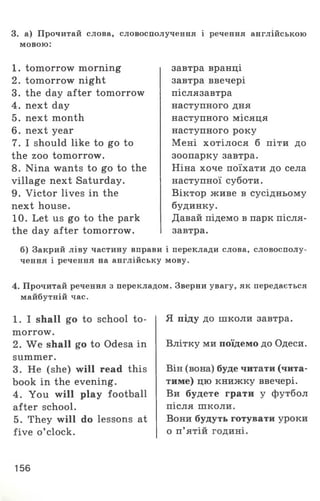
![The Future Іг
начений час) в
відбудеться аС
ньому. Future
могою допоміж
ОДНИНИ І МНОЗї
які додаються
Наприклад:
w sha11
v 8 J read
You ) this
book
He will
She f read
They J
ЗАПАМ’ЯТАЙ!
Ldefinite Tense (майбутній неоз-
живається для вираження дії, яка
ю буде здійснюватися у майбут-
Indefinite утворюється за допо-
:них дієслів shall (для першої особи
сини) і will (для всіх інших осіб),
до відмінюваного дієслова (без to).
Я буду читати (прочитаю)
Ми будемо читати (прочитаємо)
Ти будеш читати (прочитаєш)
Ви будете читати (прочитаєте) цю
Він буде читати (прочитає) книж-
Вона буде читати (прочитає) КУ’
Вони будуть читати (прочитають)
Скорочена форма дієслів shall, will — ‘11.
Наприклад: I shall read. I’ll [ail] read.
They will read. They’ll [беїі] read.
І do lessons
We
shall
dance
Nadia
will
sledge
Dima ski
The children watch TV
5. Склади якомога більше речень за допомогою таблиці:
tomorrow,
in the evening,
next day.
on Sunday,
at four o ’clock,
at seven o ’clock,
tomorrow night.
6. Напиши англійською мовою під диктовку вчителя:
1. Я буду вечеряти о сьомій годині.
2. Вони поїдуть у село влітку.
3. Ми поллємо квіти завтра вранці.
4. Він помиє руки після обіду.
[77]Виконай вправу За за 25 секунд, 36 — за ЗО секунд.
157](https://image.slidesharecdn.com/22006-160519143032/85/2-_-_2006_-158-320.jpg)
![8. Перепиши речення, вставивши необхідні слова. Письмово
переклади їх на українську мову:
1. We (shall, will) have a good time in the village.
2. I (will, shall) go to Rivne on my spring holidays.
3. The children (shall, will) sledge, ski and skate on Sun
day.
4. Roman (will, shall) write a letter to his friend in the
evening.
_____________________________________________________УРОК 64
absent, present, nobody,
to be ill, to be on duty
It
The weather
cold
warm
hot
will be chilly
fine
rain
snow
1. Склади якомога більше речень про погоду за таблицею:
today,
tomorrow,
in spring,
in summer,
in April,
in March,
next month,
in the evening.
2. Скажи, що ти робитимеш сьогодні після уроків, увечері, завтр
у вихідні дні.
3. Прочитай слова і словосполучення, запиши у словник і
запам’ятай:
absent [asbsent] — відсутній (-я, -є, -і); present [’preznt] —
присутній (-я, -є, -і); nobody ['noubadi] — ніхто; to be ill
— бути хворим; to be on duty ['dju:ti] — бути черговим; it
seems to me — здається мені.
4. Прочитай речення і переклади їх на українську мову:
1. Lida is absent today.
2. W hy were you absent today?
3. Ivan was absent yesterday but he is present today.
4. All are present today.
158](https://image.slidesharecdn.com/22006-160519143032/85/2-_-_2006_-159-320.jpg)
![5. Nobody is absent.
6. Nobody came to help Nina.
7. Maria is absent. It seems to me she is ill.
8. He is on duty today.
Прочитайте діалоги, потім відтворіть їх у парах:
a) — Who is on duty today?
— I am.
— Who is absent?
— Natalka is.
— Why is she absent?
— It seems to me she is ill.
6) — Who is on duty today?
— I am on duty today.
— Who is absent?
— Nobody is. All are
present.
— It’ s good. Thank you.
ЗАПАМ ’ЯТАЙ!
Заперечна форма Future Indefinite (майбутнього
неозначеного часу) утворюється за допомогою
частки not, яка ставиться між допоміжним діє
словом (shall або will) і відмінюваним дієсловом.
Наприклад: I shall not read this book.
They will not read this book.
Скорочена форма shall not — shan’t [Ja:nt];
will not — won’t [wount].
Наприклад: I shan’t go to school on Sunday.
He won’t play football today.
6. Прочитай речення і переклади їх на українську мову:
1. I shall not get up at eight o ’clock tomorrow morning.
2. We shall not play tennis in the yard next day.
3. She will not spend her summer holidays in town.
4. They will not go to the park in the evening.
5. You will not have supper at ten o ’clock.
7. Напиши речення у заперечній формі:
1. Nina and Petro will be on duty tomorrow.
2. I shall sledge in the park next day.
3. My sister will read this text in the evening.
4. We shall clean our classroom on Friday.
159](https://image.slidesharecdn.com/22006-160519143032/85/2-_-_2006_-160-320.jpg)
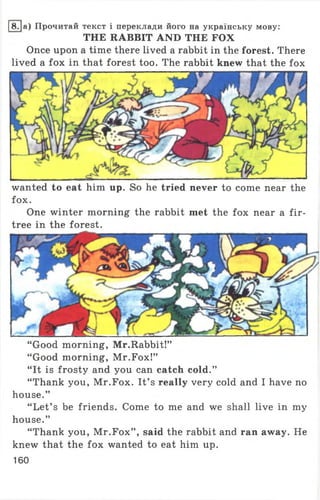
![The fox was very angry with the rabbit because he was
very, very hungry and he could not catch the rabbit.
a forest — ліс; knew [nju:] — знав; to eat up [i:t ,лр] —
з’їсти; tried — намагався; never — ніколи; met — зустрів;
Mr. [’mista] — м істер, пан; to catch [kaetj] cold —
простудитися; really ['nail] — справді; said — сказав; ran
away — побіг геть (утік); to be angry [ sengri] with —
сердитись на; because [bi'koz] — тому що; hungry —
голодний; could — міг
б) Напиши англійською мовою:
1. Лис хотів з’їсти кролика.
2. Кролик зустрів лиса біля ялинки.
3. Ходімо до мене і будемо жити в моєму домі.
4. Лис був дуже сердитий на кролика.
_____________________________________________________________УРОК 65
to know, to add, to think,
because, may be; What is
the matter with ... ?
1. Прочитай транскрипцію і напиши відповідні слова:
['holadi], [vilid3], [spend], [frend], [graund], [ski.:], [sled3], [o:fn],
[sAtJ], [nekst].
161](https://image.slidesharecdn.com/22006-160519143032/85/2-_-_2006_-162-320.jpg)
![2. Скажи англійською мовою:
1. Я не піду до школи в неділю.
2. Він не буде робити зарядку ввечері.
3. Вона не буде обідати о 10-й годині.
4. Ми не будемо гратися у дворі сьогодні ввечері.
5. Вони не підуть до ставка завтра вранці.
6 . Ви не будете дивитись телевізор у школі.
7. Завтра не буде тепло.
8. Діти не будуть готувати уроки на канікулах.
ЗАПАМ ’ЯТАЙ!
Питальна форма Future Indefinite (майбутнього
неозначеного часу) утворюється за загальним
правилом: допоміжне дієслово (shall або will)
ставиться перед підметом.
Наприклад: Shall I read this book?
— Yes, I shall.
— No, I shall not (shan’t).
W ill you read this book?
— Yes, you will.
— No, you will not (won’t).
3. Прочитай запитання і дай на них відповіді:
1. What day will it be tomorrow?
2. W ill your friend be on duty tomorrow?
3. When will you get up on Saturday?
4. When will you go to the park?
5. Will you skate today?
4. Прочитай слова і словосполучення, запиши їх у свій словник і
запам’ятай:
to know [nou] — знати; to add [aed] — додавати, доповню
вати; to think [0ir)k] — думати; because [bi'koz] — тому
що, бо; may be — можливо, мабуть; W hat’s the matter?
— У чому річ? Щ о трапилося?
162](https://image.slidesharecdn.com/22006-160519143032/85/2-_-_2006_-163-320.jpg)
![ЗАПАМ’ЯТАЙ!
Past Indefinite від дієслова to know — knew [nju:],
від дієслова to think — thought [0o:t].
5. Прочитай речення і переклади їх на українську мову:
1. I don’t know the name of this girl.
2. Vira knows the number of her house.
3. Add two to five. It will be seven.
4. Who wants to add? I want to add.
5. I think the weather is bad today.
6. I think you are right.
7. Dima is absent. May be he is ill.
8. May be he will help you.
9. What is the matter with you?
10. Antin is absent. We don’t know what’ s the matter
with him.
11. It is warm because the sun shines brightly.
12. They played in the room because it rained.
6. а) Прочитайте діалог англійською мовою в парах:
— Who is on duty today?
— I am.
— W ho is absent?
— Oksana is.
— What is the matter with
her?
— May be she is ill.
— Why do you think she is
ill?
— I think Oksana is ill because
she was absent yesterday too.
— Who can add?
— I know she is ill.
— Хто сьогодні черговий?
— Я.
— Хто відсутній?
— Оксана.
— Щ о з нею трапилося?
— Можливо, вона хвора.
— Чому ти думаєш, що
вона хвора?
— Я думаю, що Оксана хво
ра, бо її не було вчора теж.
— Хто може доповнити?
— Я знаю, що вона хвора.
б) Закрийте ліву частину вправи і відтворіть діалог англійською
мовою.
163](https://image.slidesharecdn.com/22006-160519143032/85/2-_-_2006_-164-320.jpg)
![must — повинен; to fret — дратуватися; to scold —
лаяти(ся); to storm [sto:m] — галасувати; thankful —
вдячний; together [ta'geQa] — разом; whatever [wot'eva] —
хоч би який, будь-який
2. Розпитайте одне одного, хто сьогодні черговий, хто відсутній і
чому.
3. Прочитай, порівняй і переклади ці речення на українську мову:
1. I usually get up at seven o ’clock in the morning.
I got up at seven o ’clock yesterday morning.
I shall get up at seven o ’clock tomorrow morning.
2. My family usually watch TV in the evening.
My family watched TV last night.
My family will watch TV tomorrow evening.
3. They often go to the park on Sunday.
They went to the park last Sunday.
They will go to the park next Sunday.
4. We usually spend our summer holidays in the village.
We spent our summer holidays in the village last year.
We shall spend our summer holidays in the village
this year.
4. Прочитай речення, постав їх у питальній та заперечній формах.
Зразок: It will snow tomorrow. I shall read this text.
Will it snow tomorrow? Shull I read this text?
No, it will not ( won’ t). No, I shall not ( shan’t).
1. Nina will play in the yard in the morning.
2. Stepan will play snowballs in the room.
3. They will go to the village on Wednesday.
4. It will be frosty tomorrow.
5. I shall do my morning exercises in the evening.
6. We shall clean our classroom at ten o ’clock.
5. а) Полічи від одного до двадцяти.
165](https://image.slidesharecdn.com/22006-160519143032/85/2-_-_2006_-166-320.jpg)
![б) Прочитай, запиши у свій словник і запам’ятай такі числівники:
eleven [t'levn] twelve [twelv] thirteen ['0a:'ti:n]
11 12 13
одинадцять дванадцять тринадцять
fourteen [’fo:'ti:n] fifteen [fifti:n] sixteen ['siks'ti:n]
14 15 16
чотирнадцять п’ ятнадцять шістнадцять
seventeen [’sevn'ti:n] eighteen ['ei'ti:n] nineteen ['nain'ti:n]
17 18 19
сімнадцять вісімнадцять дев’ятнадцять
twenty [ twenti] thirty ['9a:ti] forty ['fo:ti]
20 30 40
двадцять тридцять сорок
fifty [flftl] sixty ['siksti] seventy ['sevnti]
50 60 70
п’ ятдесят шістдесят сімдесят
166](https://image.slidesharecdn.com/22006-160519143032/85/2-_-_2006_-167-320.jpg)
![eighty ['eiti]
80
вісімдесят
ninety ['nainti]
90
дев’яносто
a hundred [’hAndred]
100
CTO
ЗАПАМ’ЯТАЙ!
Числівники від 13 до 19 мають закінчення -teen,
а від 20 до 9 0 -----ty. Зверни увагу на числівники:
13 — thirteen, 15 — fifteen, ЗО — thirty, 50 —
fifty.
1 — 11 — 100
2 — 12 — 20
3 — 13 — 30
4 — 14 — 40
5 — 15 — 50
6 — 16 — 60
7 — 17 — 70
8 — 18 — 80
9 — 19 — 90
10 - - 100
6. а) Прочитай числівники, написані словами:
1 . one — eleven — a hundred
2. two — twelve — twenty
3. three — thirteen — thirty
4. four — fourteen — forty
5. five — fifteen — fifty
6. six — sixteen — sixty
7. seven — seventeen — seventy
8. eight — eighteen — eighty
9. nine — nineteen — ninety
10. ten — a hundred
б) Закрий ліву частину вправи і назви англійською мовою чис
лівники, написані цифрами.
7. Прочитай числівники:
21 — twenty-one, 22 — twenty-two, 23 — twenty-three, 24
— twenty-four, 25 — twenty-five, 26 — twenty-six, 27 —
twenty-seven, 29 — twenty-nine, 30 — thirty, 32 — thirty-
two, 36 — thirty-six, 43 — forty-three, 47 — forty-seven,
55 — fifty-five, 58 — fifty-eight, 69 — sixty-nine, 61 —
sixty-one, 73 — seventy-three, 77 — seventy-seven, 84 —
eighty-four, 89 — eighty-nine, 92 — ninety-two, 96 —
ninety-six, 100 — a hundred.
167](https://image.slidesharecdn.com/22006-160519143032/85/2-_-_2006_-168-320.jpg)
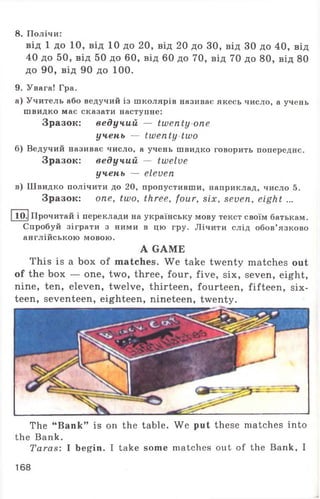
![shut them in my hand and ask you: “ Guess how many
matches do I have in my hand?”
Roman'. You have five matches in your hand.
Taras: One, two, three, four, five — you are right. I
have five matches. So I must give these matches to you,
you can keep them. It is your turn now.
Roman: Guess how many matches do I have in my hand?
Taras: You have seven matches in your hand.
Roman: No, no, I have no matches in my hand. You
must give seven matches to me, Taras.
Who has more matches? Who wins the game? Roman
has more matches than Taras. Roman wins the game.
a game — гра; a match [maetj] — сірник; out of — з; a
bank [baeqk] — банк; to put — класти; to begin — почина
ти; some [said] — декілька; to shut — затискати; to ask
— запитувати; to guess [ges] — відгадувати; so — отже;
must — повинен; to keep — зберігати; a turn [ta:n] — чер
га; more [mo:] — більше; to win — виграти; than — ніж, як
111.1Напиши цифри англійською мовою:
22, 31, 43, 56, 64, 78, 11, 97, 85, 100.
12.[ Напиши числівники в порядку їх зростання:
forty, thirty, one, ninety, twenty, ten, eighty, hundred,
seventy, fifty, sixty.
УРОК 68
plus, minus, together;
How much is ...
1. Прочитай за 15 секунд слова:
a hundred, ninety, eighty, seventy, sixty, fifty, forty,
thirty, twenty, nineteen, eighteen, seventeen, sixteen, fif
teen, thirteen, twelve, eleven, ten.
2. Скажи англійською мовою:
11 хлопчиків, 13 дівчаток, 15 олівців, 20 парт, 2 вікна,
20 дерев, 34 вишні, 40 ялин, 58 зошитів, 63 книжки, 76
учнів, 89 листків (дерева), 90 міст, 100 горіхів.
169](https://image.slidesharecdn.com/22006-160519143032/85/2-_-_2006_-170-320.jpg)
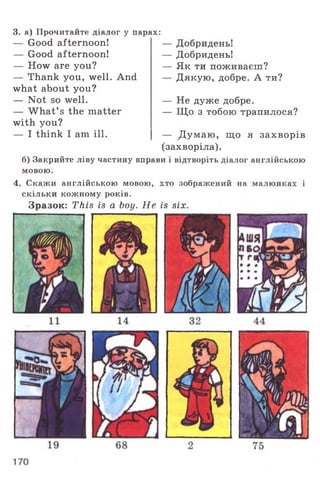
![5. Запиши слова у свій словник і запам’ятай їх:
plus [рIas] — плюс; minus ['mamas] — мінус; together
[ta'gefla] — разом, укупі; How much is ... ? — Скільки
буде ... ?
6. а) Прочитай речення англійською мовою:
1. Four plus eight is twelve.
2. Eighteen plus twelve is thirty.
3. Seventeen minus three is fourteen.
4. Twenty five minus fifteen is ten.
5. How much is seven plus two?
Seven plus two is nine.
6. How much is twenty minus six?
4 + 8 = 12
18 + 12 = 30
17 — 3 = 14
25 — 15 = 10
Скільки буде
7 + 2 = ?
7 + 2 = 9
Скільки буде
20 — 6 = ?
20 — 6 = 14Twenty minus six is fourteen,
б) Закрий ліву частину вправи і переклади на англійську мову.
7. Прочитай задачі й усно розв’яжи їх:
1. There are four books on the desk and three books in
the bag. How many books are there together?
2. There is one pencil in the red pencil-box and two
pencils in the green pencil-box. How many pencils are there
in two pencil-boxes?
3. Ann has one doll. Kate has three dolls. How many
dolls do they have together?
4. There are twenty-eight pupils in the first form and
thirty-two in the second form. How many pupils are there
in two forms?
[IT] Запитай себе «Скільки буде ... ?» і дай відповіді.
Зразок: How much is fourteen plus seventeen?
14 + 17 = 31.
Fourteen plus seventeen is thirty one.
1 + 8 = 34 + 17 = 100 — 50 = 20 — 13 =
13 + 9 = 72 + 19 = 83 — 23 = 10 — 4 =
171](https://image.slidesharecdn.com/22006-160519143032/85/2-_-_2006_-172-320.jpg)
![19. [Спочатку напиши подані цифри англійською мовою. Потім із
перших букв цих слів утвори нові слова і запиши їх.
Зразок: 100, 8, 19 —
hundred + eight + nineteen —
hen.
1) 12, 11, 9; 2) 9, 1, 12.
_____________________________________________________________УРОК 69
between, behind, above, below
1. Прочитай і переклади на українську мову вірш:
THE MONTHS
Thirty days has September,
April, June and November;
February has twenty-eight alone,
And the rest have thirty-one,
Excepting leap-year, that’ s the time,
When February days are twenty-nine.
alone [a'loun] — один; the rest — останні (місяці); except
ing leap-year [ik'septirj li:p] — за винятком високосного року
2. Прочитай словосполучення, переклади їх на українську мову і
склади по одному словосполученню з виділеними словами:
twelve pens — twenty pens; twelve books — twenty books;
thirteen pupils — thirty pupils; thirteen students — thirty
students;
fourteen bags — forty bags; fourteen pencil-boxes — forty
pencil-boxes;
fifteen dogs — fifty dogs; fifteen cats — fifty cats;
sixteen cars — sixty cars; sixteen trams — sixty trams;
seventeen tables — seventy tables; seventeen chairs — sev
enty chairs;
eighteen trees — eighty trees; eighteen fir-trees — eighty
fir-trees;
nineteen apples — ninety apples; nineteen cherries — ninety
cherries.
172](https://image.slidesharecdn.com/22006-160519143032/85/2-_-_2006_-173-320.jpg)
![3. Прочитай приклади англійською мовою:
13 + 4 = 17
2 + 7 = 9
14 + 6 = 20
23 + 8 = 31
4. Прочитай слова з
запам’ятай
35 + 9 = 44
40 + 15 = 55
62 + 11 = 73
89 + 5 = 94
100 — 18 = 82
75 — 20 = 55
44 _ 13 = з і
27 — 9 = 18
перекладом, запиши їх у свій словник і
between [bi'twi:n] — м іж , серед behind [bi'haind] — за, позаду;
ч>
above [з'Ьлу] — над, вище; below [bl'lou] — • під, нижче
5. а) Прочитай слова, словосполучення і речення за вказаний
час:
15 секунд
Between the trees, between two windows, between the
table and the chair, between the school and the house, be
tween the window and the door. I can see a red apple be
tween two cups. The picture is between two windows.
173](https://image.slidesharecdn.com/22006-160519143032/85/2-_-_2006_-174-320.jpg)
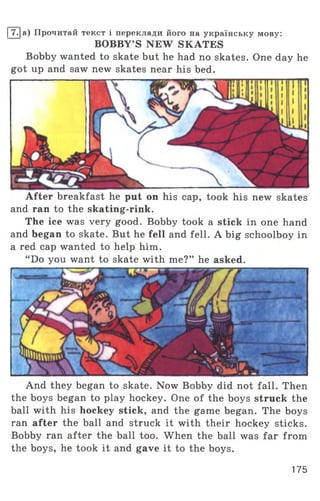
![When Bobby came home, he said to his mother, “Oh,
Mother, now I can skate and I can play hockey!”
after — після; put on — одягнув; ran — побіг; a skat-
ing-rink — каток; the ice [ais] — лід; a stick — палиця,
ц іпок; began — почав; fell — падав; to ask — запитувати;
struck — вдаряв, бив; hockey stick — клю чка; after —
за; gave — давав; said — сказав
б) Випиши з тексту п’ять дієслів, які ти знаєш, у Past Indefinite
(минулому неозначеному часі) і напиши їх у Present Indefinite
(теперішньому неозначеному часі).
Зразок: came — to соте.
в) Випиши з тексту п’ять дієслів у Present Indefinite і напиши їх
у Past Indefinite.
Зразок: to begin — began.
_____________________________________________________________ УРОК 70
temperature, degree, zero
1. Прочитай пари слів:
[k] - [g]
crow — grow pick — pig
creed — greed dock — dog
craft — graft back — bag
crate — great cockle goggle
cram — gram pecking — pegging
crab — grab lacking lagging
176](https://image.slidesharecdn.com/22006-160519143032/85/2-_-_2006_-177-320.jpg)
![2. Дай відповіді на запитання до тексту “Bobby’s New Skates” :
1. When did Bobby see his new skates?
2. Where did he go after breakfast?
3. Could Bobby skate on the ice?
4. Who helped Bobby to skate?
5. Did the boys play hockey on the skating-rink?
6. Did Bobby play hockey with the boys?
7. What did he say to his mother at home?
3. Опиши малюнок, використовуючи слова:
in, on, under, near, behind, between, above, below.
4. Прочитай слова і словосполучення з перекладом, запиши у
словник і запам’ятай:
р; » о
о
10 Н
zero [ziarou] —
нуль;
n »u-
LШш m
33 :
h °яЛ
iojI -10■ ■ m
below zero —
нижче нуля
above zero —
вище нуля;
a temperature [tempntfa] — температура; a degree [di'gri:] — градус.
177](https://image.slidesharecdn.com/22006-160519143032/85/2-_-_2006_-178-320.jpg)
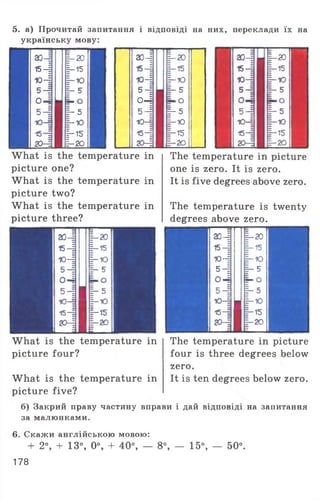
![3. What month is it today?
4. Do you know how many days does this month have?
5. What season is it now?
6. Is it the first or the last month of the season?
7. Do you like this season?
8. W hy do (don’t) you like this season?
9. What is the weather like this month?
10. What is the temperature now?
3. Дай письмові відповіді на запитання «Where is ... ?», використо
вуючи такі слова: under, behind, between, above, below, in, on.
Зразок: Where is a doll?
A doll is on the chair.
1. Where is Pete? 5. Where is a teddy-bear?
2. Where is a red balloon[ba'lu:n]? 6. Where is a kitten?
3. Where is a yellow balloon? 7. Where is a car?
4. Where is a box?
180](https://image.slidesharecdn.com/22006-160519143032/85/2-_-_2006_-181-320.jpg)
![4. а) Прочитай, запиши у словник і запам’ятай слово і вислів:
always ['o:lwez] — завжди; I agree with ... [а'дгі:] — Я
погоджуюся з ... Я згоден (згодна) з ...
б) Прочитай речення і переклади їх на українську мову:
1. I always get up at seven o ’clock.
2. He always comes to school in time.
3. She is always good to her little sister.
4. I agree with you.
5. I don’t agree with him.
6. The weather is fine. Do you agree with me? — Yes, I
agree with you.
5. Погодься або не погодься з учителем і поясни чому.
Зразок:
1 )— Ira likes to play football.
— I don't agree with you. The girls usually don’ t play
football. I know that Ira likes to play tennis.
2) — Roman is a good pupil.
— I agree with you. Roman likes to read, write and
recite poems. He is very polite and he always does his les
sons.
1. The weather is bad today.
2. It is cold in spring.
3. Our school is very old.
4. You speak English well.
5. We live in the village.
6. Прочитай знайомий тобі вірш і поясни, чому весну називають
зеленою, літо — яскравим, осінь — жовтою, а зиму — білою:
Spring is green,
Summer is bright,
Autumn is yellow,
Winter is white.
Зразок: Summer is bright because the sun shines brightly.
The sky is blue. There are many fine flowers in the parks.
181](https://image.slidesharecdn.com/22006-160519143032/85/2-_-_2006_-182-320.jpg)
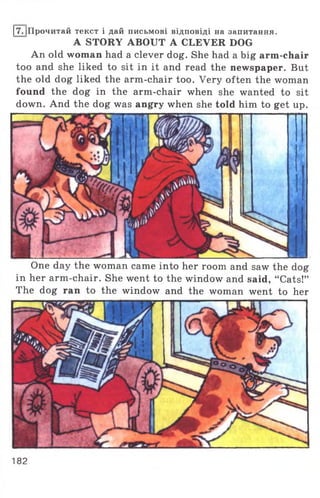
![arm-chair and sat down. The next day the dog came into
the room and saw the old woman in the arm-chair. He ran
to the window and began to bark. “ Who can it be?” the old
woman thought and went to the window.
The dog went to the arm-chair and sat down.
a story — оповідання; clever — розумний; a woman
[ wuman] — жінка; an arm-chair — крісло; a newspaper
[’nju:speipa] — газета; found — знаходила; angry —
сердитий; told — казала; said — сказала; ran — побіг;
began — почав; to bark — гавкати
1. Who had a clever dog?
2. Who liked to sit in the arm-chair?
3. Was the dog angry when the old woman told
him to get up?
4. Why did the dog begin to bark near the window?
5. Do you like this dog?
_____________________________________________________________УРОК 72
clock, watch, quarter,
past, half, minute
1. Прочитай слова за 20 секунд:
а) ck [k]: clock, black, cock, duck, sock, Nick, stick,
track, pick, rock, huck, neck;
б) qu [kw]: quick, quid, quip, quill, quod, quest, quack,
quail, quint, quit, quiz, quell.
2. Прочитайте діалог і відтворіть його в парах:
— Who is on duty today?
— I am on duty today. My name is Ira and my surname
is Petrenko.
— Who is absent?
— Kyrylo is absent.
— W hat’ s the matter with him?
— I don’t know.
183](https://image.slidesharecdn.com/22006-160519143032/85/2-_-_2006_-184-320.jpg)
![— Who knows? May be you know, Oleh?
— I think he is ill.
— And what about you, Nina?
— I agree with Oleh. He is always right.
3. Прочитай слова з перекладом, запиши їх у свій словник і
запам’ятай:
a watch [wotj] — годинник
(кишеньковий, наручний);
a clock [klok] — годинник
(настінний, настільний,
баштовий);
a minute [’mimt] — хвилина; past — після; half [ha:f] —
половина; а quarter [ kwDita] — чверть (четверта частина).
4. а) Прочитай слова, словосполучення і речення англійською
мовою:
1 . a clock on the wall
2. a small watch
3. fifteen minutes
4. past seven
5. half past one
6. a quarter to seven
7. There is a big clock in
the corner of the room.
8. I have no watch.
годинник на стіні
маленький годинник
п’ятнадцять хвилин
по сьомій годині
пів на другу
за 15 хвилин сьома година
(6.45)
У к у тк у к ім н а ти (є)
великий годинник.
У мене немає наручного
годинника.](https://image.slidesharecdn.com/22006-160519143032/85/2-_-_2006_-185-320.jpg)
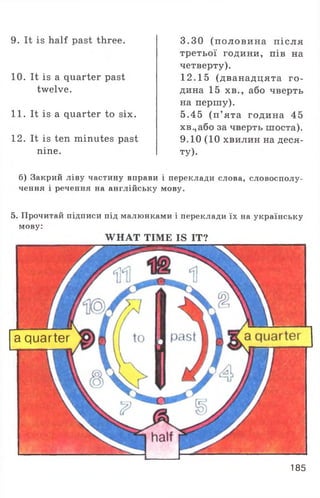
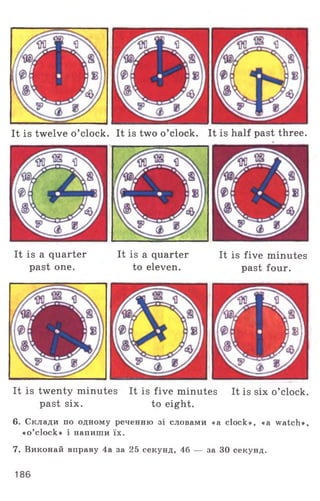
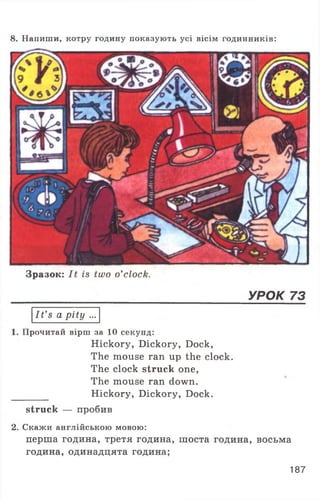
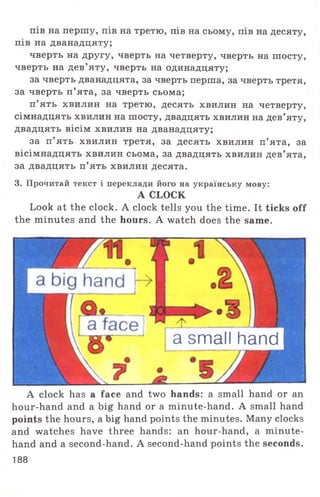
![On the face of the clock there are twelve numoers: one,
two, three, four, five, six, seven, eight, nine, ten, eleven,
twelve.
There are twenty-four hours in a day. There are sixty
minutes in an hour. There are sixty seconds in a minute.
Thirty minutes make half an hour. Fifteen minutes make a
quarter of an hour.
to tick off — вицокувати; an hour [aua] — година; the
same — те саме; a face — циферблат; a hand — стрілка;
to point [point] — показувати; a second [ sekand] — секунда
4. а) Запиши у свій словник і запам’ятай вислови:
It’s a pity ... — Жаль ... Шкода ...
What a pity! — Який жаль! Як шкода!
б) Прочитай і переклади речення:
1. It’ s a pity that it rains today.
2. It’ s a pity she is ill.
3. It’ s a pity he is absent.
4. What a pity you can’t come with us.
5. It’ s a pity I don’t know English.
5. Вислов жаль з приводу почутого.
Зразок: Kate can't skate. I t’s a pity (that) Kate
can’ t skate.
1. The weather is bad today.
2. Taras wants to play football but he has no ball.
3. Nina doesn’t like to do morning exercises.
4. Bohdan is an impolite boy.
5. I didn’t read this book.
6. Напиши англійською мовою під диктовку вчителя:
1. Я йду до школи о 8.15.
2. 11 + 15 = 26.
3. Його сестрі 34 роки.
4. Віра була в парку між третьою і четвертою годинами.
[^] Вивчи вірш напам’ять:
189](https://image.slidesharecdn.com/22006-160519143032/85/2-_-_2006_-190-320.jpg)
![WHAT THE CLOCK SAYS
«Tick», the clock says, «Tick, tick, tick!»
What you have to do, do quick:
Time is gliding fast away;
Let us act, and act today.
says [sez] — говорить; tick — цок; quick [kwik] — швидко;
Time is gliding [’glaidirj] fast away. — Час спливає швидко;
to act [aekt] — діяти
1 . Жаль, що я маленький хлопчик (маленька дівчинка).
2. Жаль, що Діма не живе у селі.
3. Який жаль, що у мене немає наручного годинника.
4. Жаль, що моя сестра не студентка.
cloud, exactly, to cover
1. Розкажи напам’ять вірш “What the Clock Says” .
2. Дай відповіді на запитання:
1. Do you have a watch?
2. W ho has a watch?
3. What time is it now?
4. Do you have a clock on the wall at home?
5. Is there a clock in our classroom?
3. Прочитай слова з перекладом, запиши їх у словник і запам’ятай:
8. Напиши англійською мовою:
УРОК 74
a cloud [klaud] — хмара
190](https://image.slidesharecdn.com/22006-160519143032/85/2-_-_2006_-191-320.jpg)
![exactly [ig'zaektli] — точно; to cover [kAva] — покривати,
вкривати; to be covered (with) — бути покритим (чимось).
4. а) Прочитай словосполучення і речення з перекладом:
1 . a big cloud
2. a grey cloud
3. a cloud in the sky
4. to cover the ground
5. to be covered with snow
6. to be covered with clouds
7. There is not a cloud in thei
sky.
8. The ground is covered with
red, yellow and brown leaves.
9. I know exactly she is ill.
10. I don’t know exactly but
I think he has a dog.
велика хмара
сіра хмара
хмара на небі
покривати землю
бути покритим снігом
бути покритим хмарами
На небі ні хмаринки.
Земля покрита червоним,
жовтим і коричневим лис
тям.
Я точно знаю, що вона
хвора.
Я точно не знаю, але ду
маю, що у нього є собака.
б) Закрий ліву частину вправи і переклади словосполучення і
речення на англійську мову.
5. а) Прочитайте діалог у парах і перекладіть його на українську
мову:
— Does Nick have a bag?
— I don’ t know exactly but I think he does.
— Why do you think so?
— I think so because I saw him with a bag.
б) Відтворіть діалог у парах англійською мовою:
— Як її звати?
— Оля.
— Скільки їй років?
— 10.
— Чому ти так думаєш?
— Я знаю це точно, бо вона моя сестра.
191](https://image.slidesharecdn.com/22006-160519143032/85/2-_-_2006_-192-320.jpg)
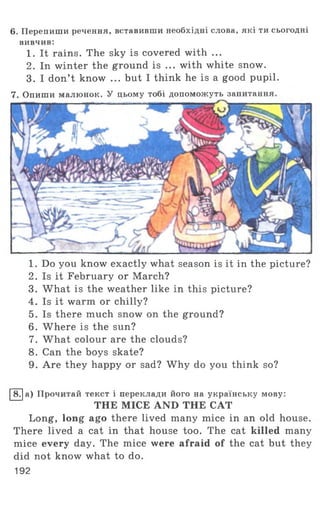
![So one day they all came to the old clever mouse and
began to talk about the cat.
“ I know what to do,” said one little mouse. “ The cat
kills us because we don’ t hear her. Let’ s put a bell round
her neck. Then we’ll hear her before she comes into the
room.”
They were all very glad and they began to laugh and
dance. Suddenly the clever old mouse said, “ I want to ask
one question. Who will put the bell round the cat’ s neck?”
long ago — дуже давно, за сивої давнини; to kill —
убивати, знищувати; every [evri] — кожен; to be afraid
[a'freid] — боятися; all — yci; clever — розумний; began
— почали; to talk — говорити, розмовляти; us — нас; to
hear [hia] — чути; round — навколо; neck — шия; before
[bi'fo:] — перед, до; to be glad — бути задоволеним; to
laugh [la:f] — сміятися; suddenly ['sAdanli] — раптом; to
ask — запитувати; a question ['kwestjan] — запитання
б) Напиши англійською мовою:
1. Кішка щодня знищувала багато мишей.
2. Давайте прив’яжемо дзвінок до шиї.
3. Вони почали сміятися і танцювати.
____________________________________________________________ УРОК 75
fa th er, m other, brother,
grandfather, grandmother,
aunt, uncle
1. Прочитай слова:
[0]: third, thin, thick, month, think, three, thing;
[Q]: this, that, with, weather, them, then, they.
2. Опиши сьогоднішню погоду, використовуючи слова:
cold, warm, the sun, the sky, a cloud, to cover, the tem
perature, exactly, rain, snow.
193](https://image.slidesharecdn.com/22006-160519143032/85/2-_-_2006_-194-320.jpg)
![3. Прочитай слова з перекладом, запиши їх у свій словник і
запам’ятай:
a father ['fa:6a] — батько, тато; а mother [’тлбэ] — мати,
мама; а brother [Ьглба] — брат; а grandfather ['graend ,fa:6a]
— дід, дідусь; а grandmother ['дгаеп .тлбэ] — баба, бабуся;
an aunt [a:nt] — тітка, тьотя; an uncle [лг)кІ] — д я д ь к о ,
ДЯДЯ.
4. а) Прочитай словосполучення і речення англійською мовою:
1 . my father
2. her mother
3. Vira’ s brother
4. his sister
5. an old grandfather
6. a good grandmother
7-. an aunt and an uncle
8. My father is a doctor.
9. Roman’ s mother is 31.
10. Lida’ s grandfather and
grandmother live in the vil
lage.
11. Her aunt and uncle live
in Lviv.
мій батько
її мати
Вірин брат
його сестра
старий дідусь
хороша бабуся
тітка і дядько
Мій тато лікар.
Романовій мамі 31 рік.
Л ідині дідусь і бабуся
живуть у селі.
Її тітка і дядько живуть у
Львові.
б) Закрий ліву частину вправи і переклади словосполучення і
речення на англійську мову.
5. Розкажи англійською мовою про свою сім’ю. Яка вона: велика
чи мала. Назви усіх членів сім’ї. Як їх звати, скільки їм років,
де вони живуть.
6. Прочитайте вірш. Переможе той, хто швидше вивчить його
напам’ять.
I love my father,
I love my mother,
I love my sister
And my big brother.
194](https://image.slidesharecdn.com/22006-160519143032/85/2-_-_2006_-195-320.jpg)
![7. Правильно розмісти букви і напиши слова до теми «Сім’я»:
omther, therfa, isters, borerth, taun, uclen, mograndther,
thergranfad.
|8 .|Прочитай текст і розкажи його зміст англійською мовою:
In this picture we can see a big apple-tree. There are
many red apples there. Dima is picking apples from the
apple-tree. Dima has five apples for his family in the bas
ket: one apple is for his father, one is for his mother, one
is for his grandmother, one is for his sister.
“ Come, Rex, come here!” he says to his dog. There is
something for you. Not an apple! This is a big, big bone for
you!”
is picking — рве; a basket [ ba:skit] — кошик, корзина;
something [ sAmGirj] — щось; a bone — кістка
I 9.| Напиши англійською мовою:
1. Мої тато і мама вчителі.
2. Його брат студент.
3. Романові тітка й дядько живуть у великому селі.
4. У Оксани два дідусі і дві бабусі.
195](https://image.slidesharecdn.com/22006-160519143032/85/2-_-_2006_-196-320.jpg)
![УРОК 76
а) Прочитайте вірш за 15 секунд:
MY FAMILY
This is my father, This is my uncle,
This is my mother, This is my aunt Lily,
This is my sister, This is my cousin,
This is my brother, And this is me.
a cousin [клгп] — двоюрідний брат чи двоюрідна сестра
б) Переможе той, хто швидше вивчить його напам’ять.
2. Повтори за вчителем і додай нове слово по темі «Сім’я». Виграє
той, хто назве найбільше слів.
Зразок: — A father.
— A father and a mother.
— A father, a mother and а ...
3. Дай відповіді на запитання:
1. Have you a brother or a sister?
2. What is his (her) name?
3. How old is he (she)?
4. Is he (she) a pupil or a student?
5. Where does your brother (sister) live?
6. Is he (she) a good brother (sister)?
7. Do you play with your brother (sister)?
8. Do you help your brother (sister) about the house?
4. а) Прочитай діалоги англійською й українською мовами. Зверни
увагу на значення висловів And yours? And you?
1. — What is your name?
— My name is Tanya.
And yours?
— Lida. What are you?
— I am a pupil. And you?
— I am a pupil too.
— Як тебе звати?
— Мене звати Таня. А
тебе?
— Ліда. Хто ти?
— Я учениця. А ти?
— Я теж учениця.
196](https://image.slidesharecdn.com/22006-160519143032/85/2-_-_2006_-197-320.jpg)
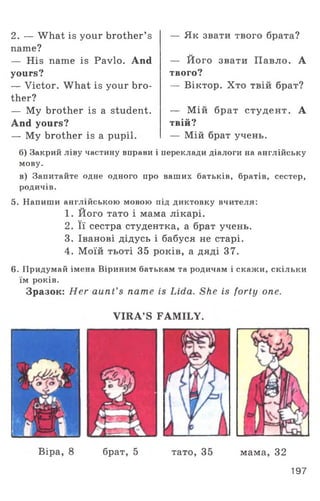
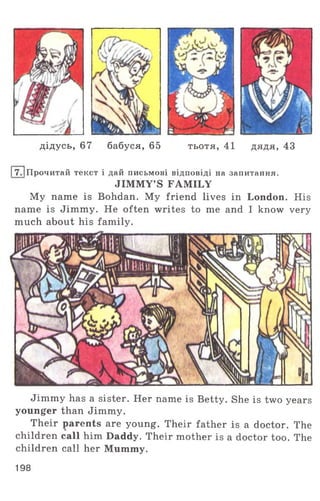
![Jimmy’ s grandfather and grandmother are not old, they
live on a farm near the sea. Jimmy and Betty like to stay
at the farm in summer.
Jimmy is a good swimmer. He can swim in the sea very
well. Sometimes the children help their grandfather and
grandmother to work in the garden. They have a very good
time at the farm in summer.
London ['lAndan] — Лондон; younger ['jArjga] — молодша;
parents [’pearants] — батьки; to call — звати, називати;
daddy — татусь; mummy [ тлті] — матуся; a sea [si:] —
199](https://image.slidesharecdn.com/22006-160519143032/85/2-_-_2006_-200-320.jpg)
![море; to stay [stei] — залишатися; a swimmer — плавець;
to work [wa:k] — працювати; a garden [ga:dn] — сад, город
1. Where does Jimmy live?
2. What are his parents?
3. How old is Betty?
4. Where do Jimmy’s grandfather and grandmother live?
5. Do the children have a good time at the farm in sum
mer?
200
УРОКИ 77-79 (РЕЗЕРВН І](https://image.slidesharecdn.com/22006-160519143032/85/2-_-_2006_-201-320.jpg)
![ЧЕТВЕРТА ЧВЕРТЬ
УРОК 80
1. Прочитай вірш. За допомогою малюнка здогадайся про значення
слів «ир» і «down».
See, saw, see, saw,
Up and down,
Up and down,
This is the way
To London town.
a way [wei] — шлях, дорога
down
2. Передайте діалог учителя і чергового.
3. Дай відповіді на запитання:
1. Where did you spend your spring holidays?
2. Did you go to the village or to town?
3. What was the weather on your holidays?
4. Did you play football or tennis?
5. Did you skate, ski or sledge?
6. What book did you read?
7. Did you help your mother or grandmother about the
house?
201](https://image.slidesharecdn.com/22006-160519143032/85/2-_-_2006_-202-320.jpg)
![8. Did you go to the park or to the zoo?
9. W ho reads English books during the holidays?
10. Did you like your spring holidays? Why?
4. а) Прочитайте діалог англійською мовою в парах. Зверніть
увагу на значення висловів: What else [els] ... і Whom else ...:
1. — What can you see in
the classrom?
— I can see a window in the
classroom.
— What else can you see in
the classroom?
— I can see many desks
there.
— Whom can you see in the
classroom?
— I can see a teacher in the
classroom.
— Whom else can you see
there?
— I can see many pupils
there.
— Що ти бачиш (можеш
бачити) у класі?
— Я бачу вікно в класі.
— Що ще ти бачиш у
класі?
— Я бачу там багато парт.
— Кого ти бачиш у класі?
— Я бачу вчителя в класі.
— Кого ще ти там бачиш?
— Я бачу там багато уч
нів.
б) Закрийте ліву частину вправи і відтворіть діалог англійською
мовою в парах.
5. Прочитайте діалог в парах, заповнюючи пропуски:
— What did you see in the park?
— I saw ... in the park.
— What else did you see there?
— I saw ... there.
— Whom did you see in the park?
— I saw ... in the park.
— Whom else did you see there?
— I saw ... there.
202](https://image.slidesharecdn.com/22006-160519143032/85/2-_-_2006_-203-320.jpg)
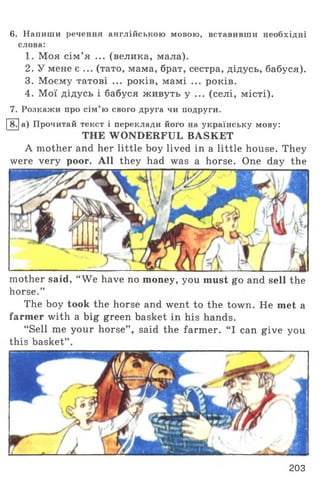
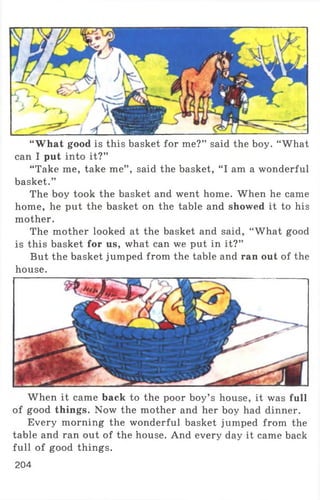
![Now the mother and her boy had their breakfast, dinner
and supper every day.
wonderful [ wAndaful] — прекрасний, чудовий; a basket
[’ba:skit] — кошик; poor [pua] — бідний; all — все; said
[sed] — сказала; money [’тлпі] — гроші; must — повинен;
to sell — продавати; took — взяв; met — зустрів; a farmer
— фермер, селянин; what good — яка користь; to put —
класти; to show — показувати; for us — для нас; ran out
of — вибіг із; back — назад; full — повний; a thing [0ir]]
— річ
б) Випиши з тексту знайомі тобі дієслова у Past Indefinite і постав
їх у Present Indefinite.
Зразок: were — are.
УРОК 81
worker, turner, builder,
driver, engineer
1. Прочитай слова за 17 секунд:
[a:]: car, park, scarf, yard, farm, dark, arm, bar, cart, lark;
[o:]: or, fork, form, ford, lord, corn, short, force, sport,
horse.
205](https://image.slidesharecdn.com/22006-160519143032/85/2-_-_2006_-206-320.jpg)
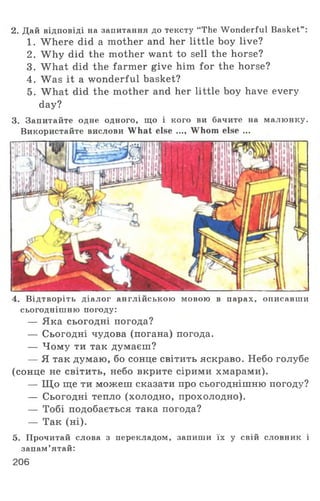
![a worker [’wa:ka] a turner [ta:na] a builder [ bilda]
робітник; токар; будівельник;
a driver [draiva] an engineer [ end3i'ma]
шофер; інженер.
6. а) Прочитай словосполучення й речення і переклади їх на
українську мову:
A good worker, a bad worker, a happy worker, two work
ers, many good workers. His father was a worker.
A good turner, a sad turner, a tall turner, three turn
ers, a worker and a turner, many happy turners. Vasyl’ s
father is a turner.
A good builder, a bad builder, many builders, a builder
near the house. My uncle is a builder.
A gay driver, a good driver, many good drivers, a driver
at the lorry, a bus-driver, a tram-driver. There is a driver
in the car.
A good engineer, a polite engineer, a happy engineer,
207](https://image.slidesharecdn.com/22006-160519143032/85/2-_-_2006_-208-320.jpg)
![five engineers, a worker and an engineer. Oleh wants to be
an engineer.
б) Склади по одному реченню з кожним підкресленим словом.
7. Переклади словосполучення на англійську мову і запиши їх:
високий робітник, хороший токар, щасливий будівель
ник, поганий шофер, багато хороших інженерів.
8. Розучіть пісню і заспівайте її разом з учителем:
THE FAMILY
This is our mother,
This is our father,
This is our brother tall,
This is our sister,
This is our baby,
Oh, how we love them all!
a baby [ beibi] — немовля; Oh, how we love them all! —
О, як ми їх усіх любимо!
9. а) Прочитай текст і переклади його на українську мову.
Здогадайся про значення виділених слів.
WHAT AM I?
Ted: Can you guess, Fred, what I am?
Fred: Do you work at school?
Ted: No, Fred, I am not a teacher.
Fred: Do you work at the factory?
Ted: No, Fred, I am not a worker.
Fred: Do you write books?
Ted: No, Fred, I am not a writer.
Fred: Then what do you do?
Ted: I plant flowers and trees.
Fred: Then you are a gardener.
Ted: Yes, Fred, I am a gardener.
to guess [ges] — здогадуватися; factory ['fsektan] —
фабрика; then — тоді; to plant — садити; a gardener
['ga:dna] — садівник
208](https://image.slidesharecdn.com/22006-160519143032/85/2-_-_2006_-209-320.jpg)
![б) Знайди у тексті відповідні речення англійською мовою і
напиши їх:
1. Ти працюєш у школі?3. Я саджаю квіти і дерева.
2. Я не письменник. 4. Ти — садівник.
____________________________________________________ УРОКИ 82-83
collective farmer, tractor
driver, combine operator,
milkmaid, pensioner
1. Прочитай транскрипцію і напиши відповідні слова:
['ti:tja], [’dokta], [wa:ka], [draiva], [ end3i'ma], [ta:na], [’bilda],
[’stju:dant], [pju:pi].
2. Прочитайте діалог “What Am І?” у парах.
3. Дай відповіді на запитання:
1. Who works at school?
2. Who works at the factory?
3. Who writes books?
4. Who plants flowers and trees?
4. Переклади речення на англійську мову за ЗО секунд.
Зразок: Твоя сестра студентка? — Так. (Н і.)
Is your sister a student? — Yes, she is. (No, she isn’ t.)
1. Твоя мама вчителька? — Так.
2. Твоя тьотя лікар? — Ні.
3. Твій тато токар? — Ні.
4. Твій брат учень? — Так.
5. Твій дядя інженер? — Так.
6. Твій дідусь шофер? — Ні.
7. Твоя бабуся робітниця? — Ні.
8. Твій друг будівельник? — Ні.
5. Прочитай слова з перекладом, запиши їх у свій словник і
запам’ятай:
209](https://image.slidesharecdn.com/22006-160519143032/85/2-_-_2006_-210-320.jpg)
![a milkmaid [milkmeid]
доярка;
a pensioner ['penjana]
пенсіонер(ка).
a collective-farmer
[ka'lektiv ’fa:ma]
колгоспник;
a tractor-driver
['traekta .draiva]
тракторист;
a combine-operator
[kam'bain ,opareita]
комбайнер;
6. Прочитай словосполучення й речення і переклади їх на
українську мову:
A good collective-farmer, a happy collective-farmer,
many collective-farmers, a collective-farmer in the village.
My father is a collective-farmer.
A good tractor-driver, a bad tractor-driver, a sad trac-
tor-driver, two tractor-drivers. Victor’ s uncle is a tractor-
driver.
A tall combine-operator, a happy combine-operator, a
good combine-operator, a tractor-driver and a combine-op
erator. Volodya wants to be a combine-operator.
210](https://image.slidesharecdn.com/22006-160519143032/85/2-_-_2006_-211-320.jpg)
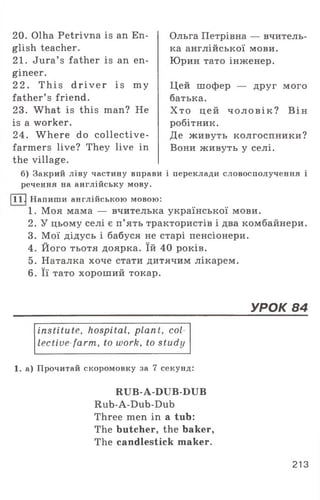
![a tub [tAb] — д іж ка; a butcher ['butja] — м’ясник; a baker
[’beika] — пекар; a candlestick maker ['ksendIstik] — свічкар
(той, хто робить свічки)
б) Переклади її на українську мову.
2. Запитайте одне одного, хто ваші батьки і родичі за професією.
Зразок: — What is your father?
— He is an engineer. And yours?
— M y father is a driver.
— And what about your sister?
— Oh, she is a student ...
3. Знайди серед букв алфавіту «заховані» слова, що означають
професії. їх тут шість. Переможе той, хто виконає це завдання
за ЗО секунд.
abictodriverhashenvy
bonghmilkmaidrjoncew
wigstgorstudenterhik
dunj oirkturnershryym
yimchbuildermyshovel
frikodoctorauocimpab
4. Прочитай слова з перекладом, запиши їх у свій словник і
запам’ятай:
214](https://image.slidesharecdn.com/22006-160519143032/85/2-_-_2006_-215-320.jpg)
![r - ~ . 1
an institute [’mstitju :t] —
інститут;
a hospital [’hospitl] —
лікарня;
a collective-farm —
колгосп;
to study [stAdi] — навчатися,
завод;
to work[wa:k] — працювати;
вчитися.
a plant [plaint] —
5. Прочитай словосполучення і переклади їх на українську мову.
Зверни увагу на виділені слова.
A big institute, а new institute, an old institute, many
institutes; to work at the institute, to study at the insti
tute.
A big hospital, a small hospital, a new hospital, an old
hospital, a hospital in town, a hospital in the village; at
the hospital, to work at the hospital.
A big plant, a small plant, a new plant, his plant, near
the plant, at the plant, to work at the plant.
A big collective-farm, a small collective-farm, a good
215](https://image.slidesharecdn.com/22006-160519143032/85/2-_-_2006_-216-320.jpg)
![collective-farm, on the collective-farm, to work on the col-
lective-farm.
To work at school, to study at school, to work in the
shop, to live in town, to live in the village.
6. Склади якомога більше речень за таблицею. Переклади їх на
українську мову:
at school,
at the plant,
at the institute,
on the collective-farm.
in town,
in the shop,
at the hospital,
in the village.
My father
His mother
Her brother
A ntin’ s sister works
Our uncle studies
Maria’ s aunt lives
My friend
Lida’ s grandfather
Ivan’ s grandmother
7. Запитайте одне одного, де працюють, навчаються і живуть ваші
батьки і родичі.
Зразок: Where does your aunt work?
She works at the hospital.
Where does your brother study?
M y brother studies at school.
Where does your grandfather live?
He lives in the village.
8. а) Прочитай текст і розкажи його.
MY FRIEND’S FAMILY
Makar is my friend. He is a pupil of the third form. His
father is an engineer. He works at the big plant. His mother
is a teacher. All pupils love her very much.
Makar has a sister. Her name is Tanya. Tanya doesn’t
study at school. She is a little girl. Their grandfather and
grandmother are pensioners. They live in Ternopil. Makar’ s
aunt and uncle are collective-farmers. They live in the vil
lage and work on the collective-farm.
to love [Iav] — любити
216](https://image.slidesharecdn.com/22006-160519143032/85/2-_-_2006_-217-320.jpg)
![My father’ s name is Pavlo Stepanovych. He is forty-
eight. My father is a driver. He works on the collective-
farm. My mother’ s name is Olha Ivanivna. She is forty-
five. She works in the shop. She is very good. We love our
mother very much.
My brother Roman is twenty. He is a student. Roman
lives in Vinnytsya and studies at the institute. He is a very
good brother.
My sister Natalka is fifteen. She is a pupil too. She stud
ies at the village school. She is a good pupil and sister. She
helps our mother about the house. Sometimes she helps me
to do my lessons.
My grandfather and grandmother are pensioners but they
still work at the hospital. They are doctors. They live with
our family and we love them very much.
I have an aunt and an uncle too. But they do not live in
the village. They live in town. My aunt Larysa is a teacher
and my uncle Dmytro is a builder. Their daughter Vika is
a pupil of the first form. Their son Maksym is a little boy.
He is four and he doesn’t study at school.
Our family is very friendly. I like our family very much.
to love — любити; still — все ще, досі; a daughter
['do:ta] — дочка; a son [sAn] — син
5. а) Прочитай запитання англійською мовою і дай па них відпо
віді про себе і свою сім’ю:
1. W hat’ s your name?
2. How old are you?
3. What are you?
4. What form are you in?
5. Where do you live?
6 . Whom do you live with?
7. Is your family big?
8. W hat’ s your father’ s na
me?
Як тебе звати?
Скільки тобі років?
Хто ти?
В якому ти класі?
Де ти живеш?
З ким ти живеш?
Ваша сім’я велика?
Як звати твого тата?
218](https://image.slidesharecdn.com/22006-160519143032/85/2-_-_2006_-219-320.jpg)
![6. Напиши англійською мовою під диктовку вчителя:
1. Петро студент. Він навчається в інституті.
2. Мої батьки лікарі. Вони працюють у лікарні.
3. Його дідусь і бабуся пенсіонери. Вони живуть у селі.
7. Прочитай вірш і переклади його на українську мову:
MY FAMILY
This is my father.
This is my mother.
This is my sister.
This is my brother.
Father, Mother, Sister, Brother,
Hand in hand with one another.
Hand in hand with one another [а'плба]. — Пліч-о-пліч,
одне з одним (Живуть дружно).
8. Вивчи вірш "Му Family" напам’ять.
_9J Прочитай текст і переклади його на українську мову:
MY BUSY DAD
I have a father. My father is usually very busy. He doesn’t
have time to play with me. When I ask him to play with me
he usually says, “ I’m sorry I can’t. I’ m very busy...”
220](https://image.slidesharecdn.com/22006-160519143032/85/2-_-_2006_-221-320.jpg)
![It’ s nine o ’clock in the evening. It’ s time to go to bed. I
open my father’ s room and say, “ Excuse me, Dad...”
“Shut the door. Can’t you see I am busy? Go and play
with your sister or with your friends.”
“ Oh, Dad, I want to say good-night to you.”
“ Can’t you say it to me in the morning? I am busy now.”
busy [ bizi] — зайнятий; dad — тато; to ask — просити;
to say — говорити, казати; to open [oupn] — відчиняти;
to shut — зачиняти; good-night — на добраніч
11Q.| Напиши про себе і свою сім’ ю.
УРОК 87
puddle, street, people,
muddy, to melt, colour
1. Прочитай слова за 17 секунд:
[tj]: bench, cherry, chick, chilly, children, chair, chess,
child, fetch, watch;
[J]: fish, shelf, dish, finish, fresh, shop, shirt, wash, shell,
ship.
2. Розкажи про свою сім’ ю.
221](https://image.slidesharecdn.com/22006-160519143032/85/2-_-_2006_-222-320.jpg)
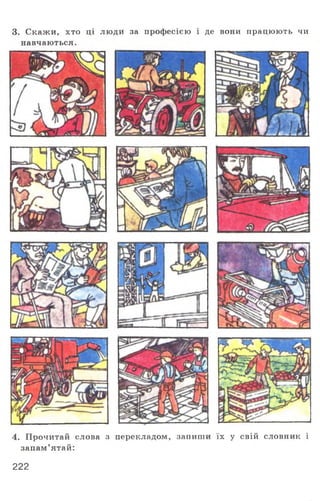
![a puddle [рлсІІ] — калюжа; a street [stri:t] — вулиця;
people [pi:pl] — muddy [ тлсії] — to melt —
люди; брудний (-a, -e, -і); танути;
colour [кліа] — колір.
5. а) Прочитай словосполучення й речення і переклади їх на
українську мову:
1. This puddle, a big puddle, a small puddle, many
puddles, in the puddle, near the puddle. It rained yester
day. There were many puddles in the yard.
2. A long street, a short street, a clean street, a dirty
street, in the street, between the streets, many streets. We
can see many cars, lorries, trams and buses in the streets
of big towns.
3. Good people, happy people, gay people, many people,
Ukrainian people, English people. I saw many people in the
park on Sunday.
223](https://image.slidesharecdn.com/22006-160519143032/85/2-_-_2006_-224-320.jpg)
![УРОК 88
corridor, skipping rope, to skip,
after classes, during the break
1. Прочитай вірш і переклади його на українську мову:
IN THE STREETS
In the streets
The buses run,
Two by two,
________ Or one by one.
to run — бігати; two by two — по два в ряд; one by one
— no одному в ряд
2. Розкажи про свою вулицю.
3. Запитайте одне одного, якого кольору предмети, що вас оточу
ють. Ваш співрозмовник має відповісти.
Зразок: — What colour is the wall?
— The wall is white.
4. Прочитай слова і словосполучення з перекладом, запиши їх у
свій словник і запам’ятай:
a corridor [korido:] — коридор; a skipping-rope — скакалка;
to skip — стрибати, скакати; after classes — після уроків;
during the break [djuarir] .Qa'breik] — під час перерви.
5. а) Прочитай словосполучення і речення англійською мовою:
225](https://image.slidesharecdn.com/22006-160519143032/85/2-_-_2006_-226-320.jpg)
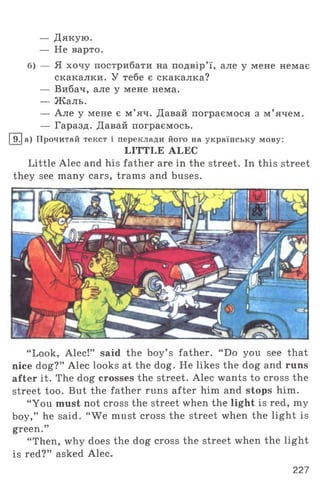
![“ The dog does not know the street lights,” said Alec’ s
father.
said [sed] — сказав; nice — гарний; to run — бігти;
after — за; to cross — переходити; to stop — зупинятися;
must — повинен; light [lait] — світло; lights — світлофор
б) Випиши з тексту речення, які відповідають українським:
1 . Йому подобається собака, і він біжить за ним.
2. Собака переходить вулицю.
3. Ми повинні переходити вулицю на зелене світло.
4. Собака не знає вуличного світлофора.
УРОК 89
victory, great, to celebrate
1. Розкажи про сьогоднішню погоду.
2. Дай відповіді на запитання:
1. How many lessons did you have yesterday?
2. How many lessons do you have today?
3. How many lessons will you have tomorrow?
4. What day was it yesterday?
5. What day is it today?
6. What day will it be tomorrow?
3. Запитай свого сусіда за партою, що він робив учора після уроків
і що збирається (буде) робити сьогодні. Він має відповісти. Потім
поміняйтеся ролями.
4. Прочитай слова з перекладом, запиши у свій словник і за
пам’ятай:
a victory ['viktan] — перемога; great [greit] — великий
(-а, -е, -і); to celebrate [ selibreit] — святкувати.
5. а) Прочитай слова, словосполучення і речення з перекладом:
1 . a big victory
2. a great holiday
3. Victory Day
велика перемога
велике свято
День Перемоги
228](https://image.slidesharecdn.com/22006-160519143032/85/2-_-_2006_-229-320.jpg)
![7. Опиши малюнок “День Перемоги” .
I8.1 Вивчи напам’ять вірш “ Mother’s Day” :
MOTHER’S DAY
I like the way you look,
I like the way you cook;
Now what I really want to say
________ Is: «Happy Mother’ s Day!»
the way you look — як ти виглядаєш; the way you cook
[kuk] — як ти готуєш (вариш); really ['nail] — дійсно
[9 .1Допиши запитання до речення:
We celebrate Victory Day on the ninth of May.
1. Do we...
2. W ho...
3. What holiday...
4. When...
_____________________________________________________________ УРОК 90
1. Розкажи напам’ять вірш “Mother’s Day” .
2. Прочитайте діалог і відтворіть його в парах:
— What holiday do we have in May?
— We have Victory Day and Mother’ s Day.
— When do we celebrate Victory Day?
230](https://image.slidesharecdn.com/22006-160519143032/85/2-_-_2006_-231-320.jpg)
![— We celebrate Victory Day on the ninth of May.
— Do you like this holiday?
— Yes, I do. I like Victory Day because it is a great
holiday. And what about you?
— I like this holiday too. I like to see many happy people
in the streets on that day. And what do you usually do on
that day?
— I usually go to the Park of Slava with my grandfa
ther. There are many old people and children in this park.
They come with flowers in their hands.
3. Прочитай речення і їх переклад. Запам’ятай, які у нас є свята
і коли ми їх відзначаємо.
1. New Year’ s Day is on the
first of January.
2. Christmas [ knsmas] is on
the seventh of January.
3. Easter [’i:sta] is in March
or April.
4. Mother’ s Day is on the
second Sunday of May.
5. Victory Day is on the
ninth of May.
6 . Day o f Independence
[ ,indi'pendans] of Ukraine is
on the tw enty-fourth of
August.
7. Day of Knowledge [’nolid3]
is on the first of September.
8. Day of National [’naejnal]
Guards [ga:dz] of Ukraine is
on the fourth of November.
9. A rm ed [a:md] Forces
[foisiz] Day is on the sixth
of December.
10. Militia [mi'lija] Day is on
the twentieth of December.
Новий рік — 1 січня.
Різдво — 7 січня.
Пасха (Великдень) — в
березні або квітні.
День М атері — д р у го ї
неділі травня.
День П ер ем оги — 9
травня.
День Н е за л е ж н о сті
України — 24 серпня.
День Знань — 1 вересня.
День Національної гвардії
України — 4 листопада.
День З б р ой н и х сил
України — 6 грудня.
День міліції — 20 грудня.
231](https://image.slidesharecdn.com/22006-160519143032/85/2-_-_2006_-232-320.jpg)
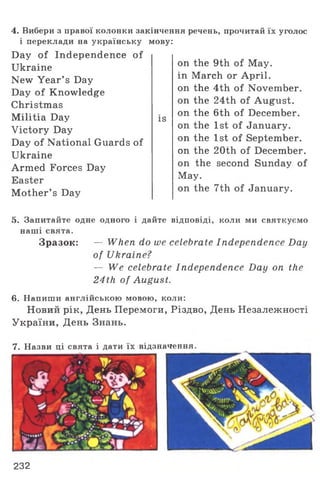
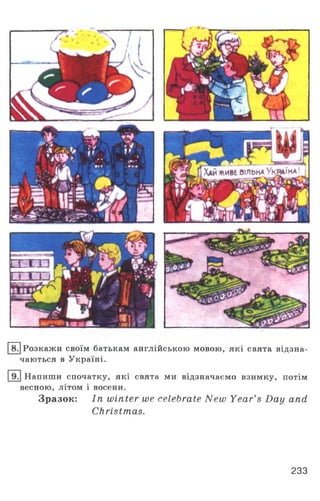
![УРОКИ 91-92
word, few,
to say, to listen
1. Прочитай транскрипцію слів:
[kla:s], [breik], [best], ['a:fta], [’djuarirj], [skip], [’korido:], [stri:t],
[pa:k], [ja:d], [kli:n], [da:ti]. [’mAdi], [pAdl], [’кліа], [pi:pl], [laits],
[глп], [kros], [stop].
2. а) Дай відповіді на запитання до малюнка:
1. What season is it in this picture?
2. Does the sun shine brightly?
3. What is the temperature?
4. Does the snow melt?
5. Are there many puddles on the ground?
6. Is it clean or muddy in the streets?
7. What colour are the trees?
8. Whom do you see in the picture?
3. Прочитай кількісні і порядкові числівники з перекладом,
зверни увагу на закінчення порядкових числівників:
one — один — first — перший;
two — два — second — другий;
three — три — third — третій;
four — чотири — fourth [fo:9] — четвертий;
five — п’ять — fifth [Ш] — п’ятий;
234](https://image.slidesharecdn.com/22006-160519143032/85/2-_-_2006_-235-320.jpg)
![six — шість — sixth [siks0] — шостий;
seven — сім — seventh [sevn0] — сьомий;
eight — вісім — eighth [eitO] — восьмий;
nine — дев’ ять— ninth [nain0] — дев’ятий
ten — десять — tenth [ten0] — десятий;
eleven — одинадцять — eleventh [I'levnO]
— одинадцятий;
twelve — дванадцять — twelfth [twelf0]
— дванадцятий;
thirteen — тринадцять — thirteenth [’0a:'ti:n0]
— тринадцятий;
fourteen — чотирнадцять — fourteenth
— чотирнадцятий;
fifteen — п’ятнадцять — fifteenth
— п’ятнадцятий;
sixteen — шістнадцять — sixteenth
— шістнадцятий;
seventeen — сімнадцять — seventeenth
— сімнадцятий;
eighteen — вісімнадцять — eighteenth
— вісімнадцятий;
nineteen — дев’ятнадцять — nineteenth
— дев’ятнадцятий;
twenty — двадцять — twentieth [ twentn0]
— двадцятий;
twenty-one — двадцять один — tvtenty-first
— двадцять перший;
twenty-two — двадцять два — twenty-second
— двадцять другий;
twenty-three — двадцять три — twenty-third
— двадцять третій;
twenty-four — двадцять чотири — twenty-fourth
— двадцять четвертий;
thirty — тридцять — thirtieth [’0a:tn0]
— тридцятий;](https://image.slidesharecdn.com/22006-160519143032/85/2-_-_2006_-236-320.jpg)
![forty — сорок — fortieth [fo:tu0]
— сороковий;
fifty — п ’ятдесят — fiftieth ['fifti10]
— п’ ятдесятий;
sixty — шістдесят — sixtieth [’sikstn0]
— шістдесятий;
seventy — сімдесят — seventieth [sevntii©]
— сімдесятий;
eighty — вісімдесят — eightieth [ eitn0]
— вісімдесятий;
ninety — дев’ яносто — ninetieth ['namtn0]
—дев’ яностий;
hundred — сто — hundredth ['hAndnd0]
— сотий.
ЗАПАМ ’ЯТАЙ!
Порядкові числівники, крім first, second і third,
утворюються за допомогою закінчень -th [0] або
-eth [|0].
Закінчення -eth додається до числівників, які
закінчуються на -ty.
При цьому буква у замінюється на і.
Наприклад: thirty — thirtieth, sixty — sixtieth.
До всіх інших числівників додається закінчення
-th.
Наприклад: six — sixth, seven — seventh, hun
dred — hundredth.
У числівників, які складаються з кількох слів,
замінюється лише останній числівник.
Наприклад: twenty-one — twenty-first
fifty-four — fifty-fourth
236](https://image.slidesharecdn.com/22006-160519143032/85/2-_-_2006_-237-320.jpg)
![При додаванні закінчення -th змінюються вимова
і написання у таких числівників:
five — fifth
twelve — twelfth
nine — ninth
eight — eighth
4. а) Скажи англійською мовою, в яких класах навчаються діти.
Зразок: in the first form, in the fourth form.
б) Переклади па англійську мову:
2-й, 5-й, 9-й, 12-й, 15-й, 21-й, 24-й, 33-й, 46-й, 57-й,
68-й, 79-й, 80-й, 95-й, 100-й.
5. Прочитай слова з перекладом, запиши їх у свій словник і
запам’ятай:
a word [wa:d] — слово; a few [fju:] — декілька; to say [sei]
— говорити, сказати; to listen [lisn] — слухати, слухатися.
ЗАПАМ ’ЯТАЙ!
Past Indefinite від дієслова to say — said [sed]
6. а) Прочитай слова, словосполучення і речення англійською
мовою:
1 . a word
2. a long word
3. many good words
4. a few
5. a few nuts
6. a few words
7. to say
8. to say a few words
9. to listen
10. Listen to me!
слово
довге слово
багато добрих слів
декілька
декілька горіхів
декілька слів
говорити, сказати
сказати декілька слів
слухати, слухатися
Слухай(те) мене!
237](https://image.slidesharecdn.com/22006-160519143032/85/2-_-_2006_-238-320.jpg)
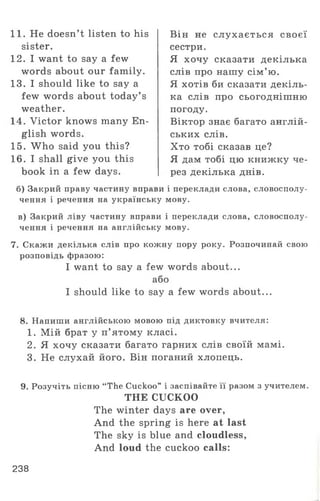
![Cuckoo! Cuckoo! And loud the cuckoo calls.
The sky is blue and cloudless,
And loud the cuckoo calls.
cuckoo [’kuku:] — зозуля; are over [’ouva] — закінчилися;
at last — нарешті; cloudless — безхмарне; loud [laud] —
гучний; to call — гукати (тут — кує)
110.| Виконай вправу 6а за 35 секунд, 6в — за 40 секунд.
111.| Напиши подані кількісні числівники англійською мовою і
утвори від них порядкові числівники.
Зразок: і — one — first,
25 — twenty-five — twenty fifth...
3 — 20 — 76 —
9 — 32 — 99 —
12 — 54 — 100 —
УРОК 93
to open, to shut, to put, to
touch, to point, to hold up
1. Прочитай вірш за 7 секунд:
Nick nack, paddy pack,
Give the dog a bone.
Nick nack, paddy pack,
Put it on a stone.
a bone — кістка; to put — класти; a stone — камінь
2. Назвіть по черзі кількісні і порядкові числівники від 1 до 10, від 11 до
20, 21—30, 31—40, 41— 50, 51—60, 61— 70, 71—80, 81—90, 91— 100.
Зразок: eleven — eleventh, twelve — twelfth,
thirteen — thirteenth...
3. Розкажи про сьогоднішню погоду, починаючи розповідь фразою
“I would like (want) to say a few words about...”
239](https://image.slidesharecdn.com/22006-160519143032/85/2-_-_2006_-240-320.jpg)
![4. Прочитай слова
запам’ятай:
з перекладом, запиши їх у свій словник і
to open [oupn] — to shut [JAt] — to put —
відкривати, відчиняти; закривати, зачиняти; класти;
to touch [tAtJ] to point [point] to hold up [hould ,лр]
— торкатися — показувати пальцем, — піднімати
доторкатися; вказувати;
ЗАПАМ ’ЯТАЙ!
Past Indefinite від дієслів to shut — shut, to put
— put, to hold — held
240](https://image.slidesharecdn.com/22006-160519143032/85/2-_-_2006_-241-320.jpg)
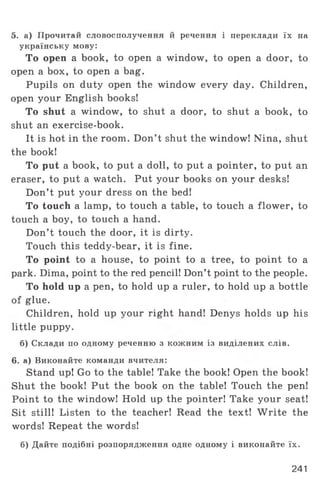
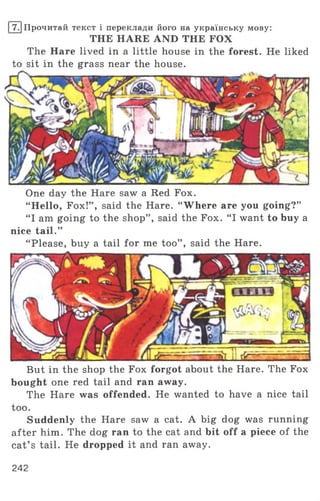
![The Hare took the little piece of the cat’ s tail. That’ s
why hares have little tails.
a hare [hea] —заєць; a forest — ліс; hello [he'lou] —
привіт, здоров; Where are you going? — Куди ти йдеш?;
to buy [bai] — купувати; nice — гарний; a tail [teil] —
хвіст; forgot [fa'got] — забула; bought [bo:t] — купила;
ran away — втекла; was offended — образився; suddenly
['sac!nil] — раптом; ran — підбіг; bit off a piece [pi:s] —
відкусив шматок; to drop — губити
8. Напиши англійською мовою:
1. Він відчинив вікно і зробив ранкову зарядку.
2. Вона закрила книжку і лягла спати.
3. Енн поклала свої іграшки в коробку.
4. Покажи мені, будь ласка, свою парту.
243](https://image.slidesharecdn.com/22006-160519143032/85/2-_-_2006_-244-320.jpg)
![УРОК 94
certainly, I am sure
1. Прочитай слова:
[e]: best, pet, men, end, bell, sell, tell, felt, left, neck;
[ae]: bag, map, lab, add, pan, shall, happy, marry, batch,
hat;
[a:]: her, first, girl, hurl, under, supper, letter, sister,
butter, winter.
2. Прочитай і запиши у свій словник:
certainly [ sa:tnli] — звичайно, напевно, неодмінно;
I am sure [Jua] — я впевнений(впевнена), переконаний
(переконана).
3. а) Прочитай слова, словосполучення і речення англійською
мовою:
1 . certainly
2. He will certainly like this
book.
3. May I take your pen?
Certainly.
4. I am sure...
5. I am sure she will help
you.
6. I am not sure Oleh will
be present tomorrow.
7. Are you sure of it?
Yes, I am.
No, I am not.
8. exactly
9. Do you know it exactly?
Yes, I do. (No, I do not).
10. I know it exactly
because she is my sister.
244
звичайно, напевно
Й ому неодм інно сп о д о
бається ця книжка.
Можна взяти твою ручку?
Звичайно.
Я впевнений, я переко
наний...
Я вп евн ен и й , щ о вона
допоможе тобі.
Я не впевнена, що Олег
буде завтра.
Ви впевнені в цьому?
Так.
Ні.
точно
Ти знаєш це точно?
Так. (Ні).
Я знаю це точно, тому що
вона моя сестра.](https://image.slidesharecdn.com/22006-160519143032/85/2-_-_2006_-245-320.jpg)
![б) Закрий праву частину вправи і переклади слова, словоспо
лучення й речення на українську мову.
в) Закрий ліву частину вправи і переклади слова, словоспо
лучення й речення на англійську мову.
4. а) Прочитайте діалоги в парах:
1) — I should like, to skip
but I don’t have a skipping-
rope. Do you have a skip
ping-rope?
— Certainly, I do.
— Give me your skipping-
rope, please.
— Here you are.
— Thank you very much.
— Not at all.
2) — What is her name?
— Her name is Maryna.
— How old is she?
— She is twelve.
— Are you sure?
— Yes, I am. I know it ex
actly because she is my sis
ter.
б) Закрийте ліву частину вправи і відтворіть діалоги англійською
мовою.
5. Прочитай словосполучення і переклади їх на українську мову.
Зверни увагу на закінчення та їх вимову:
My sister’s [z] book, Kate’s [s] brother, Ann’s [z] dog,
the teacher’s [z] pen, the car’s [z] number, Taras’ [iz] ball,
Rex’ [iz] house, his sisters’ [z] friends.
ЗАПАМ ’ЯТАЙ!
— Я хотіла б поскакати,
але у мене немає скакалки.
У тебе є скакалка?
— Звичайно, є.
— Дай мені, будь ласка,
свою скакалку.
— Ось, прошу.
— Щиро вдячна.
— Не варто.
— Як її звати?
— Її звати Марина.
— Скільки їй років?
— їй 12 років.
— Ти впевнений?
— Так. Я знаю це точно,
бо вона моя сестра.
Щоб показати належність предмета або особи до ко
гось, необхідно до іменника додати закінчення -’э
(апостроф і букву э), яке вимовляється [б], [г] або [іг].
245](https://image.slidesharecdn.com/22006-160519143032/85/2-_-_2006_-246-320.jpg)
![Наприклад: [s] Nick’ s pencil-box — Ніків
пенал або пенал Ніка;
[z] Oksana’ s bag — Оксанин
портфель (портфель Оксани);
[iz] the horse’ s house — дім коня
Якщо іменник закінчується на -s [s], -ss [s] або
-x [ks], то додається лише один апостроф (’ ), який
вимовляється [iz].
Наприклад: Denys’ [de'msiz] exercise-book —
Денисів зошит (зошит Дениса);
R ex’ [ reksiz] tail — Рексів хвіст
(хвіст Рекса).
До ім енн и ків у м нож ині додається тільки
апостроф (’ ).
Наприклад: the teachers’ room (учительська,
кімната вчителів);
the pupils’ books (учнівські
книжки, книжки учнів)
6. Напиши англійською мовою:
Романів батько, будинок моєї бабусі, Панасів годин
ник, Остапова сім ’я, м ’яч хлопців.
І 7.1 Виконай вправу За за 25 секунд, Зв — за ЗО секунд.
Напиши, кому належать предмети, назви яких написано під
малюнками.
Зразок: a teacher’s pointer.
a pointer a bag a doll](https://image.slidesharecdn.com/22006-160519143032/85/2-_-_2006_-247-320.jpg)
![а саг а іоу сошв
apples
УРОК 95
a plant
А іб £ог арріе.
1. а) Прочитай букви англійського алфавіту по порядку:
А, В, С, Б, Е, Г, О, Н, І, J, К, Ь, М, ]*, О, Р, <3, Н, 8, Т,
и , V, W, X, У, 7,.
б) Назви спочатку голосні, а потім приголосні. Скажи, скільки
голосних і скільки приголос
них в англійському алфавіті.
в) Прочитай слова на кожну
букву алфавіту і переклади
їх на українську мову.
247](https://image.slidesharecdn.com/22006-160519143032/85/2-_-_2006_-248-320.jpg)
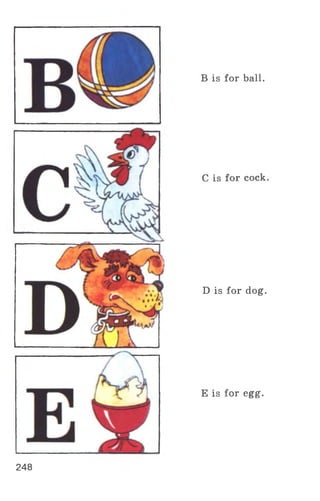
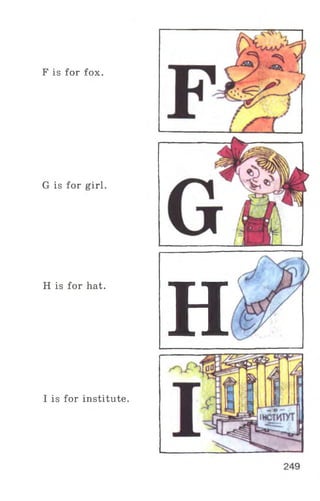
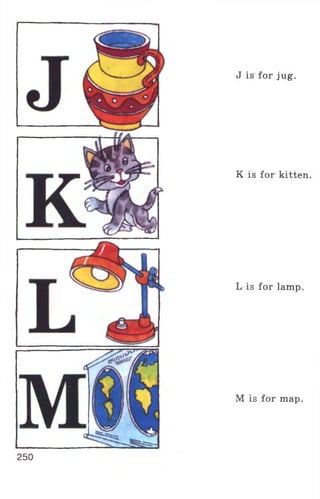
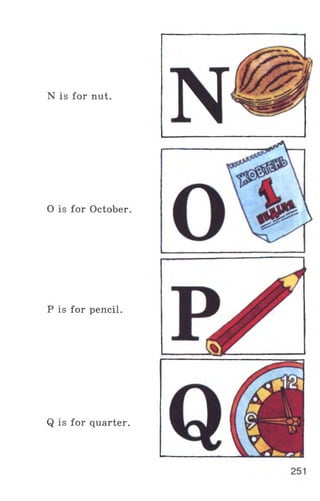
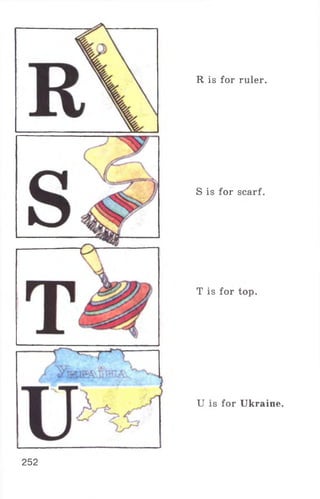
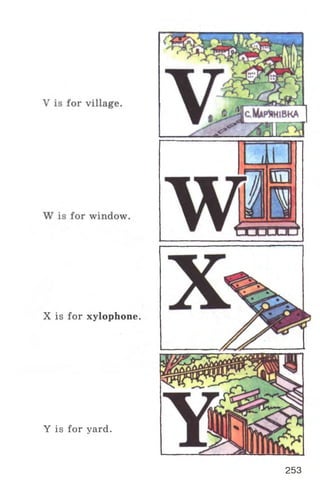
![Z is for zoo.
Ukraine [jui'krein] — Україна; a xylophone ['zailafoun]
ксилофон (музичний інструмент)
2. Опиши малюнок. (Яка пора року, який місяць, яка погода:
тепло чи холодно, яка температура; чому ти так думаєш. Що і
кого ти бачиш?)
3. Розучіть пісню "The ABC" і заспівайте її разом з учителем.
THE ABC
А В С D Е F G
H I J K L M N O P
Q R S and Т U V
W and X Y Z
254](https://image.slidesharecdn.com/22006-160519143032/85/2-_-_2006_-255-320.jpg)
![This is called the Alphabet,
Which we never must forget.
Letters twenty-six in all,
Backwards now we’ll sing them all:
Z Y X and W V
U T S and R Q P
O N M and L K J
I H G F E D C B A .
is called [ko:ld] — називається; an alphabet ['aelfabit] —
алфавіт, абетка; never — ніколи; to forget — забувати;
a letter — буква; backwards [baekwadz] — навпаки, в
зворотному напрямі
4. Увага! Гра.
Клас ділиться на дві команди. Кожна команда отримує
набір карток з буквами англійського алфавіту. Коли
вчитель вимовляє англійське слово, наприклад «pencil»,
учні з відповідними буквами біжать до дошки і стають
так, щоб вийшло це слово. Команда, яка правильно складе
слово першою, отримує кількість очок за числом букв
у слові (6). Переможе команда, яка отримає більше
очок.
5JВивчи англійський алфавіт напам’ять.
6. Напиши слова в алфавітному порядку:
Plant, autumn, zero, hospital, room, yellow, brother,
leaf, window, children, twenty, often, driver, under,
kitchen, night.
____________________________________________________________ УРОК 96
1. Розкажи напам'ять англійську абетку.
255](https://image.slidesharecdn.com/22006-160519143032/85/2-_-_2006_-256-320.jpg)
![2. Прочитай вірш. Переможе той, хто швидше скаже, скільки
учнів у класі.
HOW MANY PUPILS?
Our class has two Bellas,
Two Jims and two Stellas,
Three Anns and three Dicks,
Five Kates and three Nicks,
Eight Sams and four Bills,
Five Nells and two Jills,
But we have only one Paul,
Can you count them all?
only — лише; count them all — полічити їх усіх
3. Скажи, коли народились ти, твій брат, сестра, батьки, друзі.
Зразок: Я народився 3 жовтня. — I was born [bo:n] on
the third of October. Моя мама народилася 17 квітня —
M y mother was born on the seventeenth of April.
4. Прочитайте і проінсценуйте казку "A House in the W ood".
A HOUSE IN THE WOOD
C h a r a c t e r s :
The Mouse
The Frog
The Cock
The Fox
Scene
A house in the wood. The Mouse comes up to the house.
M o u s e . Who lives in this house?
(No answer). Then I shall live here.
F r o g (coming to the house). Who lives in this house?
M o u s e. I do. I am a mouse and I live in this house.
F r o g . And I am a frog. May I live in your house?
M o u s e . Yes, you may. Come in, please!
256](https://image.slidesharecdn.com/22006-160519143032/85/2-_-_2006_-257-320.jpg)
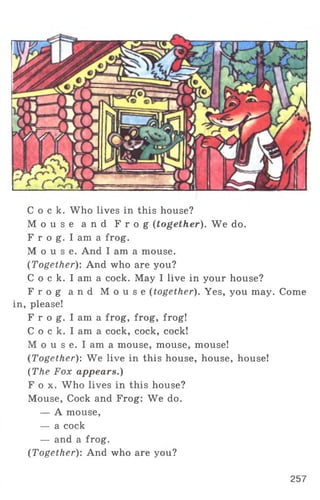
![F o x. I am a fox. May I live in your house?
M o u s e , C o c k a n d F r o g (together). Oh, you bad
fox, go away!
The Fox runs away. The Mouse, the Frog and the Cock pursue him.
a wood [wud] — ліс; characters [kaeriktaz] — герої, дійові
особи; a scene [si:n] — сцена; no answer [ a:nsa] — нема
відповіді; here [hia] — тут; com ing to the house —
підходячи до будинку; together [ta'geQa] — разом; to ap
pear [a'pia] — появлятися; to go away — йти геть; to run
away — тікати; to pursue [pa'sju:] — переслідувати
5. Розкажи, як ти плануєш провести свої літні канікули (куди
поїдеш, коли, з ким, що будеш робити).
6. Увага! Гра "Хто більше знає англійських віршів і пісень?".
Клас ділиться на дві команди і кожна обирає капітана.
Команда №1 хором читає напам’ ять знайомий вірш
англійською мовою. Як тільки вірш закінчено, капітан
цієї ж команди починає лічити до десяти по-англійському.
У цей час команда №2 повинна почати читати інший
вірш, і т.д. Якщо одна з команд не встигає почати новий
вірш, доки капітан не долічив до десяти, один із гравців
цієї команди вибуває з гри. Так триває доти, поки не
з'ясується, яка команда виграє. Вірші можна замінювати
піснями.
УРОКИ 97-102 (РЕЗЕРВНІ)](https://image.slidesharecdn.com/22006-160519143032/85/2-_-_2006_-259-320.jpg)
![АНГЛІЙСЬКИЙ АЛФАВІТ
1. А а — ^ а [еі]
2. В Ь — [Ьі:]
3. С с — ^9 С [зі:]
4. б а — 2)</ [сіі:]
5. Е е — & є [і:]
6 . Г f — [еЦ
7 . G g - (Ь [сізі:]
8 . Н Ь — Ж к [еіШ
9. І і — [а.]
10. 3 І — X/ [сізеї]
11. К к — Ж І [кеі]
12. Ь 1 — [еі]
13. М ш — *УІ/1т [ет]
14. N п — п [еп]
15. 0 о — € о [ои]
16. Р р — &/>, [рі-]
и . Ц с і - 21</, [к]и:]
18. В, г — £И * [а:]
19. в 8 — [ЄЄ]
20. Т і — [Іі:]
2 1 . и и — 41 а Ои:]
22. V V — 7> [VI:]
23. ¥ у - - (ЩҐт ['сІлЬУи:]
24. X х — Ж х [екБ]
25. У у - У у
[zvai]
26. Z г —
% [геб]
А, В, С, О, Е, Е, О,
Н, І, <Т, К, Ь, М, N. О, Р, Я, и,
б , т , и , V , ¥ , х , у , г .](https://image.slidesharecdn.com/22006-160519143032/85/2-_-_2006_-260-320.jpg)
![АНГЛО-УКРАЇНСЬКИЙ СЛОВНИК
А
а [а] неозначений артикль (перед приголосними)
about [a'baut] про
above [a'bAv] над, вище
absent [aebsant] відсутній (be absent бути відсутнім)
add [aed] додавати, доповнювати
after [a:fta] після (after classes [’kla:siz] після уроків)
afternoon ['a:fta'nu:n] час після полудня (Good afternoon!
Добридень!)
agree [a'gri:] погоджуватися
all [о:І] всі
always ['o:lwaz] завжди
am [aem] (was) є (для однини)
an [an] неозначений артикль (перед голосними)
and [aend] і, та
apple [ аері] яблуко
April [ еіргаї] квітень
are [а:] є (для множини)
arm [а :т] рука (від кисті до плеча)
around [a'raund] навкруги, навколо
as for т е [az'fo:'mi:] щодо мене
at [aet] в, біля, при
August ['o:gast] серпень
aunt [а:nt] т ь о т я , тітка
autumn ['o:tam] осінь
260](https://image.slidesharecdn.com/22006-160519143032/85/2-_-_2006_-261-320.jpg)
![в
bad [baed] поганий
bag [basg] портфель, сумка
ball [bo:l] м ’яч
be [bi:] (was, were) бути
bear [Ьєа] ведмідь
because [bi'koz] тому що, бо
bed [bed] л іж ко
behind [bi'haind] ззаду, позаду
bell [bel] дзвінок
below [bl'lou] під, нижче
bench [bentj] лава
best [best] найкращ ий (best of all найбільше)
between [bi'twi:n] м іж
big [big] великий
bird [ba:d] пташка
black [blaek] чорний
blue [blu:] синій, голубий
book [buk] книж ка
bottle of glue [ botl av'glu:] пляш ка клею
box [boks] ящ ик, коробка
boy [boi] хлопець, хлопчик
break [breik] перерва
breakfast ['brekfast] сніданок (have breakfast снідати)
brightly ['braitli] яскраво
broom [brum] мітла, віник
brother ['Ьглба] брат
brown [ braun] коричневий
builder ['bilda] будівельник
bus [Ьлб] автобус
261](https://image.slidesharecdn.com/22006-160519143032/85/2-_-_2006_-262-320.jpg)
![but [bAt] але
butter [’bAta] масло
c
can [kaen] (could) могти
cap [kaep] кепка, каш кет
car [ka:] автомобіль, машина
carpet [' ka:pit] килим
cat [keet] к іт , кіш ка
celebrate ['selibreit] святкувати
certainly [sa:tnli] звичайно, неодмінно, напевно
chair [tjea] стілець
changeable [Ч/еіпсІзаЬІ] мінливий
cherry [tje n ] виш ня
chick [tjik] пташеня
chicken ['tjikin] курча
ch ild [tjaild] дитина
children [’tji Idran] діти
chilly [ tjili] прохолодний (It is chilly. Прохолодно.)
class [kla:s] клас
classroom ['kla:s ,rum] класна кімната
clean [klі:n] чистий, охайний
clock [klok] годинник (стінний, настільний, баштовий)
cloud [klaud] хмара
cock [kok] півень
cold [kould] холодний (It is cold. Холодно.)
collective-farm [ka'lektiv ,fa:m] колгосп
collective-farmer [ka'lektiv ,fa:ma] колгоспник, колгосп
ниця
colour ['кліа] колір, фарба; фарбувати
262](https://image.slidesharecdn.com/22006-160519143032/85/2-_-_2006_-263-320.jpg)
![combine-operator [kam'bain'opareita] комбайнер
come [клт] (came) приходити
corner ['ko:na] кут, куток
corridor [’korido:] коридор
cover [ kAva] покривати
cow [kau] корова
cup [клр] чашка
curtain [ ka:tn] завіса, занавіска
D
dance [da:ns] танцювати
dark [da:k] темний
day [del] день
day-book [ deibuk] щоденник
December [di'semba] грудень
decorate [ dekareit] прикрашати
degree [di'gri:] градус
desk [desk] парта, письмовий стіл
dinner [ dina] обід (have dinner обідати)
dirty [’da:ti] брудний
do [du:] (did) робити; допоміжне дієслово (do lessons [lesnz]
го ту в а ти (р о б и ти ) у р о к и ; do morning exercises
['mo:mr) eksasaiziz] робити ранкову зарядку)
doctor [’dokta] лікар
dog [dog] собака, пес
doll [dol] лялька
door [do:] двері
down [daun] вниз, донизу
dress [dres] сукня, одягати
driver [’draiva] шофер
263](https://image.slidesharecdn.com/22006-160519143032/85/2-_-_2006_-264-320.jpg)
![drum [сіглт] барабан
duck [сілк] качка
during [’djuarirj] протягом, під час (during the break під
час перерви)
duster [ dASta] ганчірка
duty [ dju:ti] обов’язок (be on duty бути черговим,
чергувати)
dry [drai] сухий
E
egg [eg] яйце
eight [eit] вісім
eighteen [ ei'ti.n] вісімнадцять
eighty [ eiti] вісімдесят
eleven [1'levn] одинадцять
engineer [ ,end3i'nia] інженер
English [’ irjg liJ] а н г л ій с ь к и й ; а н г л ій с ь к а мова
(speak [sp і:k] English розм овляти а н гл ій с ь к о ю
мовою)
eraser [I'reiza] гумка
evening [ i:vmr]] вечір (in the evening ввечері)
every [evri] кож ний
exactly [ig'zaektli] точно
excuse me, please [iks'kju:z ,mi:'pli:z] вибач(те) мені, будь
ласка
exercise [’eksasaiz] вправа
exercise-book ['eksasaiz .buk] зошит
F
fair [fea] світлий, білявий
264](https://image.slidesharecdn.com/22006-160519143032/85/2-_-_2006_-265-320.jpg)
![family ['faemili] сім ’я
far [fa:] далеко (far from [from] далеко від)
farm [fa:m] ферма, господарство
fat [fset] ж ирний, гладкий
father [ fa:Qa] батько, тато
Father Frost [frost] Дід Мороз
February [ februan] лютий
few [fj u:] декілька
fifteen [ fifti:n] п ’ятнадцять
fifty [fiftl] п ’ятдесят
fine [fain] прекрасний, чудовий
fir-tree [fa:tri:] ялина
first [fa:st] перший
fish [fij] риба
five [faiv] п ’ять
flag [flasg] прапор
flat [flaet] квартира
floor [flo:] підлога
flower ['flaua] квітка
for [fo:] для
fork [fo:k] виделка
form [fo:m] клас (What form are you in? В якому ти
класі?)
forty ['fo:ti] сорок
four [fo:] чотири
fourteen [’fo.'ti:n] чотирнадцять
fox [foks] лисиця, лис
fresh [frej] свіж ий
friend [frend] друг, приятель, подруга
Friday [’fraidi] п ’ятниця
265](https://image.slidesharecdn.com/22006-160519143032/85/2-_-_2006_-266-320.jpg)
![frog [frog] жаба
frosty [ frosti] морозний, холодний
G
gay [gei] веселий
get up [ get ,лр] (got) вставати (з ліж ка)
g irl [ga:І] дівчина, дівчинка
give [giv] (gave) давати
go [gou] (went) ходити, іти (go home [houm] йти додому;
go to bed лягати спати)
good [gud] гарний, добрий (Good afternoon! Добридень!)
grandfather ['graend ,fa:5a] дідусь
grandmother ['graen ,тлба] бабуся
grass [gra:s] трава
great [greit] великий
green [gri:n] зелений
grey [дгеї] сірий
ground [graund] земля
H
hair [hea] волосся
half [ha:f] половина
hand [haend] рука (кисть)
happy ['haepi] щасливий (Happy New Year ['nju:ja:] to you!
З Новим роком!)
has [haez] (had) має
hat [haet] капелюх
have [haev] (had) мати (маю, маєш, маємо, маєте, мають)
(have dinner обідати; have supper [ sApa] вечеряти)
266](https://image.slidesharecdn.com/22006-160519143032/85/2-_-_2006_-267-320.jpg)
![he [hi:] він
help [help] допомагати (help about the house [haus]
допомагати по господарству)
hen [hen] курка
her [ha:] її
here [hia] тут, ось (Here you are [hia ju :a :] Ось, будь ласка;
прошу)
his [hiz] його
hold up [' houId ,лр] піднімати
holiday ['holadі] свято, вихідний день
holidays [’holadiz] канікули
home [houm] дім, житло (at home вдома)
horse [ho:s] кін ь
hospital [’hospitl] лікарня
hot [hot] гарячий, спекотний (It is hot. Ж арко.)
house [haus] дім, будинок, хата
how [hau] як (how many [’maem] скільки; how much [rriAtJ]
скільки)
hundred [’hAndrad] сто
I
I [ai] я
ill [il] хворий (be ill бути хворим)
ill-bred [ il’bred] погано вихований, невихований
impolite [impa’lait] неввічливий, нечемний
in [in] у, в, на
institute ['institju:t] інститут
is [iz] (was) є (для однини)
it [it] це; він, вона, воно
267](https://image.slidesharecdn.com/22006-160519143032/85/2-_-_2006_-268-320.jpg)
![J
January ['d3aBnjuan] січень
job [d3ob] робота
jug [d3Ag] глечик
July [d3u:'lai] липень
June [d3u:n] червень
K
kitchen ['kitjm] кухня
kitten [' kitn] кошеня
know [nou] (knew) знати
L
lamp [laemp] лампа
last [la:st] м инулий, останній (last night [nait] вчора
ввечері)
leaf [li:f] (множина leaves) листок, лист (дерева)
leg [leg] нога
lesson [lesn] урок
letter [ leta] лист; буква
light [lait] світло; світлий
like [laik] схож ий; подобатися
lip [lip] губа
listen [lisn] слухати(ся)
little [litl] маленький
live [liv] ж ити
long [lor]] довгий
look [luk] дивитися; мати вигляд (You look well. Ти добре
виглядаєш .)
268](https://image.slidesharecdn.com/22006-160519143032/85/2-_-_2006_-269-320.jpg)
![looking-glass [ lukir)gla:s] дзеркало, люстро
lorry [ Ion] вантажівка
м
make [meik] (made) робити (make a bed стелити постіль;
make snowballs л іп и ти с н іж к и ; make a snowman
ліпити снігову бабу)
man [maen] (множина men) людина, чоловік
many [’mem] багато
map [maep] карта
March [ma:tj] березень
May [mei] травень
may [mei] могти (maybe ['meibi:] можливо, мабуть)
me [mi:] мені
melt [melt] танути
milk [milk] молоко
milkmaid ['milkmeid] доярка
minute ['mimt] хвилина
minus [’mamas] мінус
Monday ['mAndi] понеділок
month [тлп0] місяць
morning ['то:піГ)] ранок (in the morning вранці)
mother [’тлба] мама, мати
mouse [’mails] (множина mice) миша
much [mAtJ] багато
muddy ['mAdi] брудний
N
name [neim] ім ’я
near [та] біля
269](https://image.slidesharecdn.com/22006-160519143032/85/2-_-_2006_-270-320.jpg)
![new [nju:] новий (New Year [ja:] Новий рік)
next [nekst] наступний
night [nait] ніч
nine [nam] дев’ять
nineteen ['nain'ti:n] дев’ятнадцять
ninety [ nainti] дев’ яносто
no [nou] н і
nobody ['noubadi] ніхто
not [not] не
November [no'vemba] листопад
now [nau] зараз, тепер
number ['плтЬа] число, номер
nut [паї] горіх
О
October [ok'touba] жовтень
often [o:fn] часто
old [ould] старий
on [on] на
one [wAn] один
open [oupn] відкривати, відчиняти, розкривати
or [о:] або, чи
Р
park [pa:k] парк
past [pa:st] минулий
pear [pea] груш а
270](https://image.slidesharecdn.com/22006-160519143032/85/2-_-_2006_-271-320.jpg)
![pen [pen] ручка, перо
pencil [pensl] олівець
pencil-box ['penslboks] пенал
pensioner ['penjana] пенсіонер, пенсіонерка
people [pi:pi] люди
picture [ piktja] картина, малюнок (in the picture на
картині)
pig [pig] порося, свиня
pin [pin] шпилька
pine-tree ['paintri:] сосна
It’s a pity ['piti]. Жаль. Шкода,
plant [plaint] саджати
play [plei] грати(ся) (play hockey [hoki] грати у хокей;
play football [’futbo:l] грати у футбол; play tennis [’terns]
грати у теніс; play snowballs грати в сніжки)
plum [рілт] слива
plus [plAs] плюс
poem ['pouim] вірш (to recite [ri'sait] a poem декламувати
(розказувати) вірш)
point [point] показувати пальцем, вказувати
pointer [’pointa] указка
polite [pa'lait] ввічливий, чемний
pond [pond] ставок
present [’preznt] присутній; подарунок (be present бути
присутнім)
puddle [pAdl] калюжа
pupil ['pju:pl] учень, учениця
puppy [’рлрі] цуценя
put [put] (put) класти, покласти
271](https://image.slidesharecdn.com/22006-160519143032/85/2-_-_2006_-272-320.jpg)
![Q
quarter [kwo:ta] чверть (15 хвилин)
quite right [ kwait ,rait] абсолютно (цілком) правий
R
rabbit [’raebit] кролик
rain [rein] дощ (It rains. Йде дощ.)
rat [raet] пацюк, щур
read [ri:d] (read) читати
red [red] червоний, рудий
repeat [ri'pi:t] повторювати
right [rait] правий, справедливий; правий (що знаходиться
праворуч)
room [ru:m] кімната
rosy ['rouzi] рожевий, рум’яний
ruler ['rula] лінійка
s
sad [saed] сумний
Santa Claus [ .saenta'kb:z] Різдвяний Дід, Дід Мороз, Санта
Клаус
Saturday [’saetadi] субота
say [sei] (said) говорити, сказати
scarf [ska:f] шарф, галстук, краватка
school [sku:І] школа
schoolboy ['sku:lboi] школяр
schoolgirl [ sku:їда:І] школярка
season [si:zn] пора року
seat [si:t] місце (take a seat сідати на місце)
272](https://image.slidesharecdn.com/22006-160519143032/85/2-_-_2006_-273-320.jpg)
![second [sekand] другий; секунда
see [si:] (saw) бачити
September [sap'temba] вересень
settled [setld] встановлюватися (про погоду)
seven ['sevn] сім
seventeen [’sevn'ti:n] сімнадцять
seventy ['sevnti] сімдесят
she [Ji:] вона
shelf [Jelf] полиця
shine [Jain] (shone) світити, сяяти
shirt [Ja:t] сорочка, блуза
shop [Jop] крамниця
short [jo:t] короткий
should like [Jud] хотіти
show [Jou] показувати
shut [jAt] (shut) закривати, зачиняти
sing [sir]] (sang) співати
sister [ sista] сестра
sit [sit] (sat) сидіти (Sit down! Сядь! Sit still! Сиди
спокійно!)
six [siks] шість
sixteen [ siks‘ti:n] шістнадцять
sixty [ siksti] шістдесят
skate [skeit] кататися на ковзанах
ski [ski:] (skied) ходити на лижах
skip [skip] стрибати, скакати
skipping-rope [skipirjroup] скакалка
skirt [ska:t] спідниця
sky [skai] небо
sledge [sled3] кататися на санях
273](https://image.slidesharecdn.com/22006-160519143032/85/2-_-_2006_-274-320.jpg)
![slippery [’slipari] слизький
small [smo:l] малий, маленький
snow [snou] сніг (It snows. Йде сніг.)
snowball ['snoubo:l] сніжка (make snowballs ліпити
сніжки; play snowballs грати в сніжки)
Snow-Maiden ['snoumeidn] Снігурка
snowman [snoumsen] сніговик, снігова баба (make a
snowman ліпити снігову бабу)
sock [sok] шкарпетка
sometimes [’sAmtaimz] іноді, інколи
I am sorry [ son]. Мені шкода (жаль),
speak [spi:k] (spoke) говорити, розмовляти
spend [spend] (spent) проводити {час)
spring [sprir]] весна
spot [spot] пляма
stand [staend] (stood) стояти (Stand still! Стій спокійно!
Stand up! Встань!)
still [Stll] спокійний
street [stri :t] вулиця
student [’stju:dant] студент
study [’stAdi] навчатися, вчитися
such [sAtJ] такий
summer [sAma] літо
sun [sAn] сонце
Sunday ['sAndi] неділя
supper [ sApa] вечеря (have supper вечеряти)
sure [Jua] впевнений (be sure бути впевненим (переко
наним)
surname ['sa:neim] прізвище
274](https://image.slidesharecdn.com/22006-160519143032/85/2-_-_2006_-275-320.jpg)
![т
table [teibl] стіл
take [teik] (took) брати
tall [to:І] високий
teacher [ti:tja] учитель
teddy-bear [’tedi'bea] ведмедик (іграшка)
temperature [’tempritja] температура
ten [ten] десять
text [tekst] текст
thank you [ Baerjkju:] дякую, спасибі
that [6aet] той, та, те
the [ба], [5i:] означений артикль
them [бет] їм, їх
then [беп] тоді
there [без] там
there are [бєаг'а:] є (для множини)
there is [6ear'iz] є (для однини)
they [беї] вони
thick [вік] товстий
thin [віп] тонкий, худий
think [віг)к] (thought) думати
third [0a:d] третій
thirteen ['0a:'ti:n] тринадцять
thirty [ 0a:ti] тридцять
this [6iz] цей, ця, це
three [вгі:] три
Thursday [’0a:zdi] четвер
time [taim] час (What is the time? Котра година?)
today [ta'dei] сьогодні
together [ta'ge6a] разом
275](https://image.slidesharecdn.com/22006-160519143032/85/2-_-_2006_-276-320.jpg)
![tomorrow [ta'morou] завтра
too [tu:] також, теж
top [top] дзиґа
touch [tAtJ] (до)торкатися
town [taun] місто
tractor-driver ['traekta ,draiva] тракторист
tram [traem] трамвай
tree [tri:] дерево
Tuesday [ tju:zd і] вівторок
turner [Ча:па] токар
twelve [twelv] дванадцять
twenty [’twentl] двадцять
two [tu:] два
u
Ukrainian [ju:'kreinjan] український; українець, україн
ка; українська мова (speak Ukrainian розмовляти
українською мовою)
uncle [ ЛГ)кІ] ДЯДЬКО, дядя
under [’Anda] під
up [лр] вгорі, вгору, нагору
usually ['ju:зиаІі] звичайно
V
very [ ven] дуже
victory [viktari] перемога (Victory Day День Перемоги)
village [vilid3] село
276](https://image.slidesharecdn.com/22006-160519143032/85/2-_-_2006_-277-320.jpg)
![w
wall [wo:І] стіна
want [wont] хотіти, бажати
warm [wo:m] теплий (It is warm. Тепло.)
was [woz] був, була
wash [woj] мити(ся), вмивати(ся) (wash up мити посуд)
w atch [wotj] годинник ( к и ш ен ьк ови й , пару чний);
дивитися, спостерігати (watch TV дивитися телеві
зор)
water [wo:ta] вода; поливати (water flowers поливати
квіти)
we [wi:] ми
weather [ weQa] погода
Wednesday [’wenzdi] середа
week [wi:k] тиждень
well [wel] добре, гарно (very well дуже добре, чудово)
were [wa:], [wa] були
wet [wet] мокрий
what [wot] що, який (what else [els] що ще)
when [wen] коли
where [wea] де, куди
white [wait] білий
who [hu:] хто
whom [hu:m] кого (whom else кого ще)
why [wai] чому
window [ windou] вікно
window-sill [ windousil] підвіконня
winter [’winta] зима
word [wa:d] слово
work [wa:k] робота; працювати
277](https://image.slidesharecdn.com/22006-160519143032/85/2-_-_2006_-278-320.jpg)
![worker [’wa:ka] робітник
write [rait] (wrote) писати
Y
yard [ja:d] двір, подвір’я
year [ja:] рік (New Year Новий рік)
yellow [jelou] жовтий
yes [jes] так
Yesterday [jestadi] вчора (yesterday morning учора вранці)
you [ju:] ти, ви
your [jo:] твій, ваш
z
zero [ ziarou] нуль (below zero нижче нуля; above zero
вище нуля)
zoo [zu:] зоопарк](https://image.slidesharecdn.com/22006-160519143032/85/2-_-_2006_-279-320.jpg)