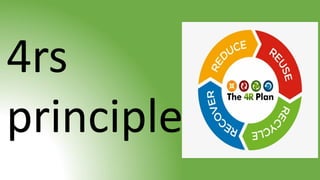
4rs
principle
Importance of the 4RPrinciple
Some importances of the 4R principle are:
• Toutilize the waste materials.
• Tomaintain environmental health.
• Tominimize land and water pollution.
• Toreduce consumption of needless items.
• Topromote the use of degradable products.
• Toutilize products to their maximum life
4R Principle | Reduce, Reuse, Recycle & Recover
• The useless materials which arise from various human
activities (such as domestic trash, garbage, metal scrap, etc.)
are solid waste materials.
• They directly affect the environment and cause land
pollution as well as water pollution.
• Due to the increase in industrialization and urbanization,
many waste materials coming from it are being directly
exposed in nature and are harming living plants and animals
Reduce:
▪ We can reduce the solid waste in our community by considering the followings points:
o We should choose durable items while buying.
o We should change our habit of using things i.e. use washable clothes, napkins
instead of napkins paper.
o Use washable containers for lunches
o Sacks instead of using non-reusable plastic bags.
o We should buy recycled products.
o It is better to use cotton bags for shopping.
Reuse:
➢ The usage of any product itself without changing its form and composition is called Reuse
➢ It is the act of re-claiming the product by using it for different purposes.
➢ Reuse increases the life of waste and reduces the production of waste so that it preserves the environment & its resources.
➢ Reusing products not only contributes to the protection of nature but also saves our money.
➢ The initial cost of reusable products is high but is highly beneficial from a long-term view.
❑We can reuse solid waste by considering the following points:
• Use reusable plastic bags or cotton bags for shopping.
• We should donate our old clothes & other items to charitable organizations.
• Use plastic gallons to store water & oil.
• Use old (second-hand) books, DVDs & CDs, etc.
• Buy a rechargeable battery.
• Reuse electronics devices after repairing.
Recycle:
• Recycle means re-covering a previously used object and giving it a secondlife.
• The use of waste by processing & modifying it into another form is called recycling.
• It is done when it is not possible to reuse andreduce.
• Paper & cardboard, glass, metal, debris from construction & demolition, etc. can also be recycled
and used again.
Eg:
o Paper is recycled to cardboard, toilet paper, tissue paper, etc.
o The newspaper is recycled into egg cartons, shoe boxes, etc.
Recover:
❑Most of the materials thrown in the garbage can be used & processed in
ways other than being destroyed. Such a process is recovering.
Eg:
▪ Methane gas can be recovered from decomposing organic matters.
▪ If there is still plastic waste left over after being reduced, reused, and
recycled. It can be used to make energy. It is the process to convert waste
products into resources (such as fuel, heat, etc.) through biological means.
4R principles to sustainable development

4R principles to sustainable development

  • 1.
  • 2.
    Importance of the4RPrinciple Some importances of the 4R principle are: • Toutilize the waste materials. • Tomaintain environmental health. • Tominimize land and water pollution. • Toreduce consumption of needless items. • Topromote the use of degradable products. • Toutilize products to their maximum life
  • 3.
    4R Principle |Reduce, Reuse, Recycle & Recover • The useless materials which arise from various human activities (such as domestic trash, garbage, metal scrap, etc.) are solid waste materials. • They directly affect the environment and cause land pollution as well as water pollution. • Due to the increase in industrialization and urbanization, many waste materials coming from it are being directly exposed in nature and are harming living plants and animals
  • 4.
    Reduce: ▪ We canreduce the solid waste in our community by considering the followings points: o We should choose durable items while buying. o We should change our habit of using things i.e. use washable clothes, napkins instead of napkins paper. o Use washable containers for lunches o Sacks instead of using non-reusable plastic bags. o We should buy recycled products. o It is better to use cotton bags for shopping.
  • 5.
    Reuse: ➢ The usageof any product itself without changing its form and composition is called Reuse ➢ It is the act of re-claiming the product by using it for different purposes. ➢ Reuse increases the life of waste and reduces the production of waste so that it preserves the environment & its resources. ➢ Reusing products not only contributes to the protection of nature but also saves our money. ➢ The initial cost of reusable products is high but is highly beneficial from a long-term view. ❑We can reuse solid waste by considering the following points: • Use reusable plastic bags or cotton bags for shopping. • We should donate our old clothes & other items to charitable organizations. • Use plastic gallons to store water & oil. • Use old (second-hand) books, DVDs & CDs, etc. • Buy a rechargeable battery. • Reuse electronics devices after repairing.
  • 6.
    Recycle: • Recycle meansre-covering a previously used object and giving it a secondlife. • The use of waste by processing & modifying it into another form is called recycling. • It is done when it is not possible to reuse andreduce. • Paper & cardboard, glass, metal, debris from construction & demolition, etc. can also be recycled and used again. Eg: o Paper is recycled to cardboard, toilet paper, tissue paper, etc. o The newspaper is recycled into egg cartons, shoe boxes, etc.
  • 7.
    Recover: ❑Most of thematerials thrown in the garbage can be used & processed in ways other than being destroyed. Such a process is recovering. Eg: ▪ Methane gas can be recovered from decomposing organic matters. ▪ If there is still plastic waste left over after being reduced, reused, and recycled. It can be used to make energy. It is the process to convert waste products into resources (such as fuel, heat, etc.) through biological means.