By Gachana M.
Health Communication
Learning objectives
At the end of this chapter the students are expected to:
• Define communication and health communication
• Models of communication
• Components of the Communication Process
• Functions, Stages and Types of Communication
• Methods and Means of Communication
• Communication Barriers
• Principles of communications
7/21/2022 GMS
Definition
• The word communication is the process by which two or more people exchange
ideas, facts, feelings or impressions in ways that each gains a common or mutual
understanding of the meaning and the use of the message.
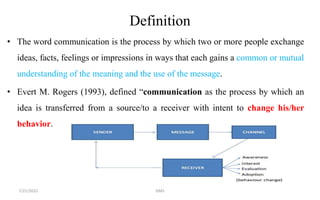
• Evert M. Rogers (1993), defined “communication as the process by which an
idea is transferred from a source/to a receiver with intent to change his/her
behavior.
7/21/2022 GMS
Definition …
• Health communication is the art and technique of informing,
influencing, and motivating individuals, institutions, and large
public audiences about important health issues based on sound
scientific and ethical consideration.
7/21/2022 GMS
Function of HC
Health Communications can:
– Increase awareness or knowledge
– Influence perceptions, attitudes, and social norms
– Advocate for a health issue
– Demonstrate skills
– Demonstrate a demand for health services
– Show the benefit of behavior change
– Refute myths
GMS
7/21/2022
What communication can/t do?
Communication can:
– Increase knowledge and awareness of problems.
– Influence and reinforce perceptions, beliefs, and attitudes.
– Prompt action.
Communication cannot:
– Compensate for inadequate or inaccessible services.
– Produce sustained change in absence of parallel changes in
services, technology, and policy.
7/21/2022 GMS
Common communication theories/ models
1. Aristotle’s Model of communication:
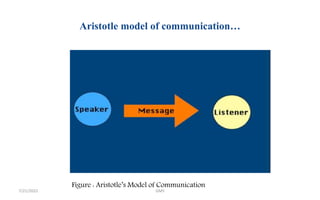
– Aristotle (384-322 B.C.) represented communication as an
orator who speaks to large audiences.
– It is the speaker centered model and incorporates few
elements which include speaker, message and listener.
7/21/2022 GMS
Aristotle model of communication…
Figure : Aristotle’s Model of Communication
7/21/2022 GMS
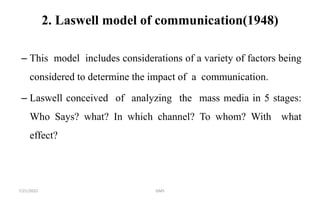
2. Laswell model of communication(1948)
– This model includes considerations of a variety of factors being
considered to determine the impact of a communication.
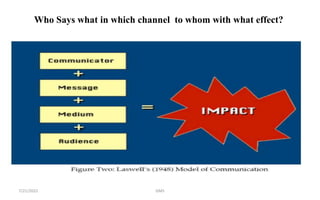
– Laswell conceived of analyzing the mass media in 5 stages:
Who Says? what? In which channel? To whom? With what
effect?
7/21/2022 GMS
Who Says what in which channel to whom with what effect?
7/21/2022 GMS
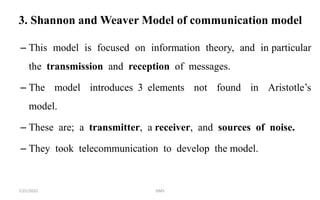
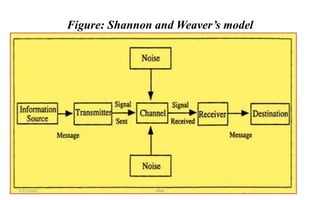
3. Shannon and Weaver Model of communication model
– This model is focused on information theory, and in particular
the transmission and reception of messages.
– The model introduces 3 elements not found in Aristotle’s
model.
– These are; a transmitter, a receiver, and sources of noise.
– They took telecommunication to develop the model.
7/21/2022 GMS
Figure: Shannon and Weaver’s model
7/21/2022 GMS
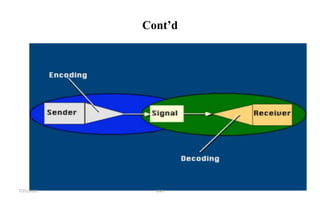
4. Schramm’s Model of communication
• Schramm provided the additional notion of a field of
experience, or the psychological frame of reference;
• Included Feedback
– Communication is reciprocal, two-way, even though the feedback
may be delayed.
• Included Context
– A message may have different meanings, depending upon the
specific context or setting.
7/21/2022 GMS
Cont’d
• Included Culture
– A message may have different meanings associated with the culture or
society.
– Communication systems, thus, operate within the confines of cultural rules
and expectations to which we all have been educated.
• However
– Schramm’s model, while less linear, still accounts only for bilateral
communication between two parties.
7/21/2022 GMS
Cont’d
7/21/2022 GMS
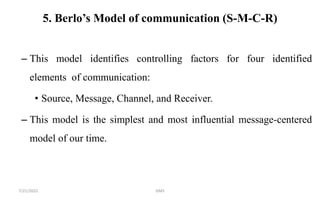
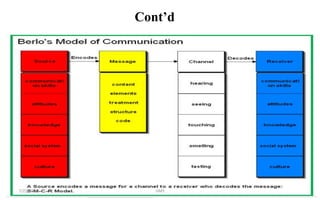
5. Berlo’s Model of communication (S-M-C-R)
– This model identifies controlling factors for four identified
elements of communication:
• Source, Message, Channel, and Receiver.
– This model is the simplest and most influential message-centered
model of our time.
7/21/2022 GMS
Cont’d
7/21/2022 GMS
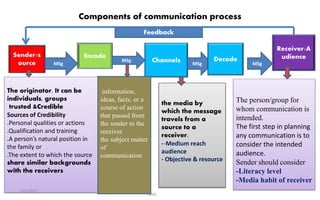
Components of communication process
GMS
Encode
Receiver/A
udience
Channels
Feedback
The originator. It can be
individuals, groups
trusted &Credible
Sources of Credibility
.Personal qualities or actions
.Qualification and training
.A person’s natural position in
the family or
.The extent to which the source
share similar backgrounds
with the receivers
The person/group for
whom communication is
intended.
The first step in planning
any communication is to
consider the intended
audience.
Sender should consider
-Literacy level
-Media habit of receiver
information,
ideas, facts, or a
course of action
that passed from
the sender to the
receiver.
the subject matter
of
communication
the media by
which the message
travels from a
source to a
receiver.
--Medium reach
audience
- Objective & resource
MSg
MSg
MSg
Decode
MSg
7/21/2022
Components…
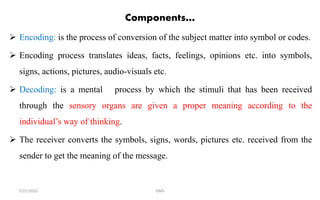
 Encoding: is the process of conversion of the subject matter into symbol or codes.
 Encoding process translates ideas, facts, feelings, opinions etc. into symbols,
signs, actions, pictures, audio-visuals etc.
 Decoding: is a mental process by which the stimuli that has been received
through the sensory organs are given a proper meaning according to the
individual’s way of thinking.
 The receiver converts the symbols, signs, words, pictures etc. received from the
sender to get the meaning of the message.
GMS
7/21/2022
Components…
Effect and feedback
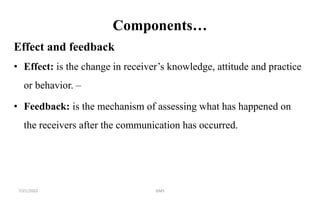
• Effect: is the change in receiver’s knowledge, attitude and practice
or behavior. –
• Feedback: is the mechanism of assessing what has happened on
the receivers after the communication has occurred.
7/21/2022 GMS
Components…
Message: It is what to say, the subject matter of communication.
(key idea, piece of information)
It is pre-requisites of communication.
The content of the message could be organized in different
ways so that it can persuade or convince people.
These are called appeals.
7/21/2022 GMS
Types of appeals in health communication
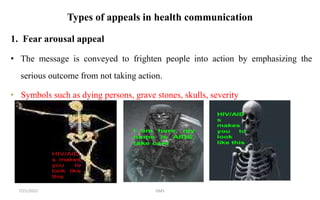
1. Fear arousal appeal
• The message is conveyed to frighten people into action by emphasizing the
serious outcome from not taking action.
• Symbols such as dying persons, grave stones, skulls, severity
GMS
7/21/2022
Appeals…
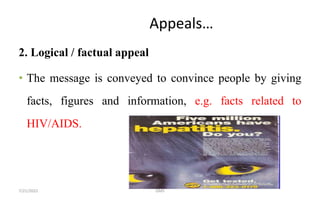
2. Logical / factual appeal
• The message is conveyed to convince people by giving
facts, figures and information, e.g. facts related to
HIV/AIDS.
7/21/2022 GMS
Factual
7/21/2022 GMS
3. One sided message
• Only presents the advantages of taking action & does not mention
any possible disadvantages
4. Two sided message
• Presents both the advantages & disadvantages (pros’ & cons’) of
taking action. Appropriate if the audiences are literates.
Appeals…
5. Humors
• The message is conveyed in a funny way such as cartoon.
• Humor is very good way of attracting interest & attention.
• It can also serve a useful role to lighten the tension when dealing
with serious subjects.
• Enjoyment & entertainment can result in highly effective in
remembering and learning.
7/21/2022 GMS
Appeals…
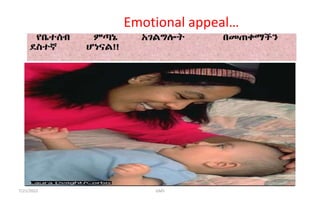
6. Emotional appeal
• The massage is conveyed to convince people by arousing
emotions, images & feelings rather than giving facts & figures,
• e.g. by showing smiling babies, wealthy families with latrine etc,
and associating with FP education.
• More influence a persons with less education.
7/21/2022 GMS
Emotional appeal…
7/21/2022 GMS
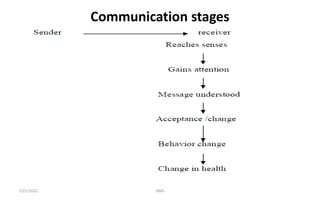
Communication stages
7/21/2022 GMS
Communication stages
Stage1. Reaching the intended audience
• Communication cannot be effective unless it is seen or heard by its
intended audience
• A common cause of failure in this stage is preaching the converted
e.g. posters placed at the clinic or health talks given at antenatal clinics.
– only reach the people who attend the services and are already motivated.
– the groups you are trying to reach may not attend clinics, nor have radios or
newspapers.
7/21/2022 GMS
Communication stages
Stage2. Attracting the audiences attention
• Any communication must attract attention so that people will
make the effort to listen and read it
Examples of failure at this stage are:
• Walking past the poster with out bothering to look at it;
• Turning off the radio programs or switching over.
7/21/2022 GMS
Communication stages…
Stage 3. Understanding the massage /perception
• Once the person pays attention to a message, he/she then tries to
understand it
 Examples of failures at this stage can take place when;
Complex language & unfamiliar technical words are used;
Pictures containing complicated diagrams and distracting details or
unfamiliar/strange subjects.
Too much information is presented and people can not absorb it at all.
7/21/2022 GMS
Stage 4: Promoting change (acceptance)
• A communication should not only be received and understood – it
should be believed & accepted
• It is usually easier to promote a change when its effects can be
easily demonstrated.
• For example, it is easier to promote change if,
– ventilated improved pit latrines do not smell,
– people become green in color when they get HIV/AIDS
7/21/2022 GMS
Stage 5. Producing behavior changes
 A communication may result in a change in beliefs and attitudes but still not
influence behavior/action
 e.g. A person may have favorable attitude & want to carry out the action e.g.
using FP but the people around may prevent from doing it or no means
(enabling factor) such as money, skill and availability of the service to do (no
behavior change).
Stage 6. Improvement in health
 If the behaviors have been carefully selected so that they really influence health.
 If your messages are based on outdated & incorrect ideas, people could follow
your advice but their health would not improve.
7/21/2022 GMS
one –way vs two –way Communication model
A) Linear (one –way) model
• The flow of information is from the sender (source) to the receiver -
unidirectional.
• The communication is dominated by the “sender’s knowledge”.
“Information is poured out”.
• This model does not consider feedback and interaction with the sender.
• Meaning is controlled by receiver.
• A familiar example is the lecture method in class rooms
GMS
7/21/2022
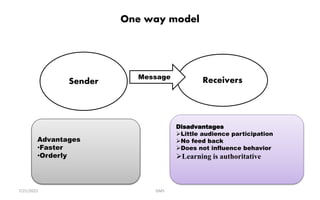
One way model
GMS
Sender Receivers
Advantages
•Faster
•Orderly
Disadvantages
Little audience participation
No feed back
Does not influence behavior
Learning is authoritative
Message
7/21/2022
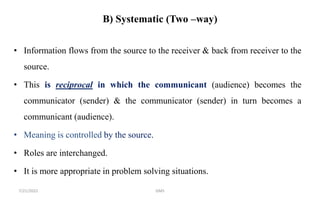
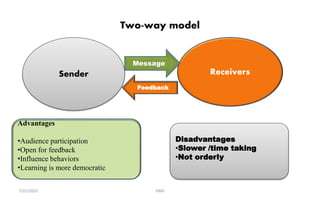
B) Systematic (Two –way)
• Information flows from the source to the receiver & back from receiver to the
source.
• This is reciprocal in which the communicant (audience) becomes the
communicator (sender) & the communicator (sender) in turn becomes a
communicant (audience).
• Meaning is controlled by the source.
• Roles are interchanged.
• It is more appropriate in problem solving situations.
GMS
7/21/2022
Two-way model
GMS
Sender Receivers
Advantages
•Audience participation
•Open for feedback
•Influence behaviors
•Learning is more democratic
Disadvantages
•Slower /time taking
•Not orderly
Message
Feedback
7/21/2022
Types of communication
There are two main types of communication
1. Interpersonal/face to face :
2. Mass communication (mass media).
GMS
7/21/2022
A) Interpersonal (mostly face-to-face)
• include all forms of communication involving direct interaction
between the source & receiver.
• Communication at the same time and/or place.
Main = changes in attitude and behavior
GMS
7/21/2022
Advantages
1. Dynamic or bi-directional
2. Feed back
3. Multisensory (channel)
4. Useful when the topic is taboo or sensitive.
5. Can fit to local needs
GMS
7/21/2022
B) Mass media communication
• MMC is a means of transmitting messages, on an electronic or
print media to a large segment of a population.
• The powerful advantage of mass media over face-to-face is rapid
spread of simple facts to a large population at a low cost.
GMS
7/21/2022
Mass media
Main effect of mass media communication.
– Increased knowledge/awareness
– Influence behaviors at the early stages.
– Useful to communicate new ideas to early adopters (opinion
leaders).
GMS
7/21/2022
Mass…
Advantages
1. They can reach many people quickly.
2. They are accurate and believable
e.g. article on a newspaper, or “voice” of highly respected person.
3. They can provide continuing reminders and reinforcement.
GMS
7/21/2022
Mass media…
Limitations
1. One sided /no feedback
2. Selective perception
3. Does not differentiates the target
GMS
7/21/2022
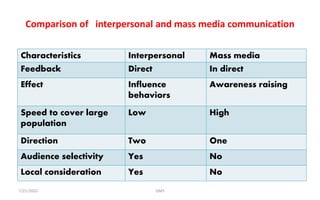
Comparison of interpersonal and mass media communication
Characteristics Interpersonal Mass media
Feedback Direct In direct
Effect Influence
behaviors
Awareness raising
Speed to cover large
population
Low High
Direction Two One
Audience selectivity Yes No
Local consideration Yes No
GMS
7/21/2022
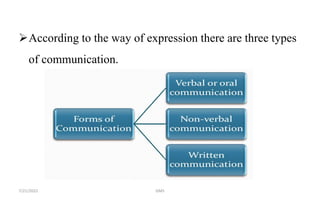
According to the way of expression there are three types
of communication.
GMS
7/21/2022
Oral or Verbal communication
• It is communication by Word of mouth.
• speech or talk is the widely adopted tool of oral
communication.
• The message is received through our ear.
• May also use mechanical devices such as telephone, radio etc.
GMS
7/21/2022
When to use Verbal communication
• The receiver is not particularly interested in receiving the message.
• It is important to get feedback.
• The receiver is too busy or preoccupied to read.
• The sender wants to persuade or convince
• When discussion is needed.
• When criticism of the receiver is involved.
• When the receiver prefers one-to-one contact.
7/21/2022 GMS
Written communication
• It involves the exchange of facts, ideas, and opinions through a
written instrument /materials.
• Individuals or groups come in touch with each other and share
meaning and understanding with each other through written
materials such as letters, leaflets, reports, handouts, bulletins,
newspaper.
GMS
7/21/2022
When to use written communication
• The sender wants a record for future references.
• The message is complex and requires study by the receiver.
• The message includes a step by step procedure.
• people are not in the same place at the same time.
• There are many receivers.
• The receiver prefers written.
7/21/2022 GMS
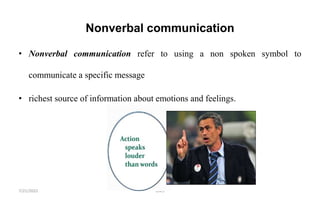
Nonverbal communication
• Nonverbal communication refer to using a non spoken symbol to
communicate a specific message
• richest source of information about emotions and feelings.
GMS
7/21/2022
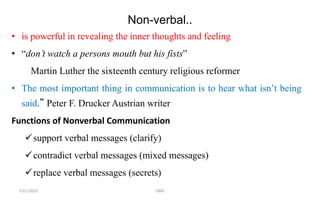
Non-verbal..
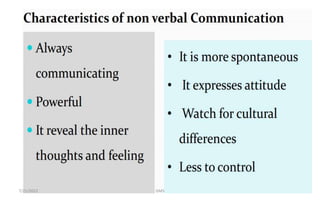
• is powerful in revealing the inner thoughts and feeling
• “don’t watch a persons mouth but his fists”
Martin Luther the sixteenth century religious reformer
• The most important thing in communication is to hear what isn’t being
said.” Peter F. Drucker Austrian writer
Functions of Nonverbal Communication
support verbal messages (clarify)
contradict verbal messages (mixed messages)
replace verbal messages (secrets)
7/21/2022 GMS
7/21/2022 GMS
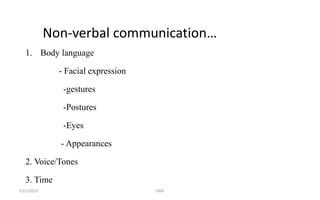
Non-verbal communication…
1. Body language
- Facial expression
-gestures
-Postures
-Eyes
- Appearances
2. Voice/Tones
3. Time
7/21/2022 GMS
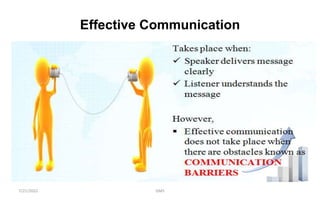
Effective Communication
7/21/2022 GMS
Barriers to effective communication
Barriers are any obstacles or difficulties that come in the way of communication
1.Physical
 Difficulties in hearing, seeing
 In appropriate physical facilities(High tem., poor ventilation…)
2. Intellectual
 The natural ability, home background, schooling
 The ability of the facilitator/ education/ instructor.
3. Emotional
 Readiness, willingness or eagerness of the receiver
 Emotional status of the educator
7/21/2022 GMS
Barriers to effective communication
4. Environmental
 Noise, invisibility, congestion
Noise is a major distraction during communication.
a. Physical noise – avoidable
b. Internal noise - any physiological or psychological state that could
undermine a person’s ability to communicate effectively:
 Being ill
 Overworked
 Upset by personal problems.
7/21/2022 GMS
Barriers to effective communication
5. Cultural
Customs he beliefs, religion, attitudes, economic and social class
differences, language/vocabulary variation.
6. Status of the source
Status of the source either too high or too low as compared to the
audience
7. Inconsistencies between verbal & non- verbal communication
7/21/2022 GMS
Principles of communications
1.Perception: For communication to be effective the perception of the sender should
be as close as possible to the perception of the receiver.
2. Sensory involvement: The more sensory organs involved in a communication the
more is its effectiveness from their cumulative effect.
3.Face to face: The more communication takes place face-to-face the more it is
effective.
4.Feedback (two-way): Any communication without two-way process is less
effective
GMS
7/21/2022
Principles ….
5.Clarity: Ideas to be communicated should be direct, simple, in easily
understandable language.
6.Completeness: the subject matter to be communicated must be
adequate, which enable the receiver to understand the central theme
or idea of message.
Incomplete message may result in misunderstandings.
GMS
7/21/2022
Generally for Effective H/communication use;
GMS
7/21/2022
7/21/2022 GMS
Quiz (5%)
1. Write the five components of communication(1.5%)
2. Write at least four barriers to effective communication and
provide at least one example for each(2%)
3. Mention at least five Principles of communications (1.5%)
7/21/2022 GMS

4.Health communication.pptx

  • 1.
    By Gachana M. HealthCommunication
  • 2.
    Learning objectives At theend of this chapter the students are expected to: • Define communication and health communication • Models of communication • Components of the Communication Process • Functions, Stages and Types of Communication • Methods and Means of Communication • Communication Barriers • Principles of communications 7/21/2022 GMS
  • 3.
    Definition • The wordcommunication is the process by which two or more people exchange ideas, facts, feelings or impressions in ways that each gains a common or mutual understanding of the meaning and the use of the message. • Evert M. Rogers (1993), defined “communication as the process by which an idea is transferred from a source/to a receiver with intent to change his/her behavior. 7/21/2022 GMS
  • 4.
    Definition … • Healthcommunication is the art and technique of informing, influencing, and motivating individuals, institutions, and large public audiences about important health issues based on sound scientific and ethical consideration. 7/21/2022 GMS
  • 5.
    Function of HC HealthCommunications can: – Increase awareness or knowledge – Influence perceptions, attitudes, and social norms – Advocate for a health issue – Demonstrate skills – Demonstrate a demand for health services – Show the benefit of behavior change – Refute myths GMS 7/21/2022
  • 6.
    What communication can/tdo? Communication can: – Increase knowledge and awareness of problems. – Influence and reinforce perceptions, beliefs, and attitudes. – Prompt action. Communication cannot: – Compensate for inadequate or inaccessible services. – Produce sustained change in absence of parallel changes in services, technology, and policy. 7/21/2022 GMS
  • 7.
    Common communication theories/models 1. Aristotle’s Model of communication: – Aristotle (384-322 B.C.) represented communication as an orator who speaks to large audiences. – It is the speaker centered model and incorporates few elements which include speaker, message and listener. 7/21/2022 GMS
  • 8.
    Aristotle model ofcommunication… Figure : Aristotle’s Model of Communication 7/21/2022 GMS
  • 9.
    2. Laswell modelof communication(1948) – This model includes considerations of a variety of factors being considered to determine the impact of a communication. – Laswell conceived of analyzing the mass media in 5 stages: Who Says? what? In which channel? To whom? With what effect? 7/21/2022 GMS
  • 10.
    Who Says whatin which channel to whom with what effect? 7/21/2022 GMS
  • 11.
    3. Shannon andWeaver Model of communication model – This model is focused on information theory, and in particular the transmission and reception of messages. – The model introduces 3 elements not found in Aristotle’s model. – These are; a transmitter, a receiver, and sources of noise. – They took telecommunication to develop the model. 7/21/2022 GMS
  • 12.
    Figure: Shannon andWeaver’s model 7/21/2022 GMS
  • 13.
    4. Schramm’s Modelof communication • Schramm provided the additional notion of a field of experience, or the psychological frame of reference; • Included Feedback – Communication is reciprocal, two-way, even though the feedback may be delayed. • Included Context – A message may have different meanings, depending upon the specific context or setting. 7/21/2022 GMS
  • 14.
    Cont’d • Included Culture –A message may have different meanings associated with the culture or society. – Communication systems, thus, operate within the confines of cultural rules and expectations to which we all have been educated. • However – Schramm’s model, while less linear, still accounts only for bilateral communication between two parties. 7/21/2022 GMS
  • 15.
  • 16.
    5. Berlo’s Modelof communication (S-M-C-R) – This model identifies controlling factors for four identified elements of communication: • Source, Message, Channel, and Receiver. – This model is the simplest and most influential message-centered model of our time. 7/21/2022 GMS
  • 17.
  • 18.
    Components of communicationprocess GMS Encode Receiver/A udience Channels Feedback The originator. It can be individuals, groups trusted &Credible Sources of Credibility .Personal qualities or actions .Qualification and training .A person’s natural position in the family or .The extent to which the source share similar backgrounds with the receivers The person/group for whom communication is intended. The first step in planning any communication is to consider the intended audience. Sender should consider -Literacy level -Media habit of receiver information, ideas, facts, or a course of action that passed from the sender to the receiver. the subject matter of communication the media by which the message travels from a source to a receiver. --Medium reach audience - Objective & resource MSg MSg MSg Decode MSg 7/21/2022
  • 19.
    Components…  Encoding: isthe process of conversion of the subject matter into symbol or codes.  Encoding process translates ideas, facts, feelings, opinions etc. into symbols, signs, actions, pictures, audio-visuals etc.  Decoding: is a mental process by which the stimuli that has been received through the sensory organs are given a proper meaning according to the individual’s way of thinking.  The receiver converts the symbols, signs, words, pictures etc. received from the sender to get the meaning of the message. GMS 7/21/2022
  • 20.
    Components… Effect and feedback •Effect: is the change in receiver’s knowledge, attitude and practice or behavior. – • Feedback: is the mechanism of assessing what has happened on the receivers after the communication has occurred. 7/21/2022 GMS
  • 21.
    Components… Message: It iswhat to say, the subject matter of communication. (key idea, piece of information) It is pre-requisites of communication. The content of the message could be organized in different ways so that it can persuade or convince people. These are called appeals. 7/21/2022 GMS
  • 22.
    Types of appealsin health communication 1. Fear arousal appeal • The message is conveyed to frighten people into action by emphasizing the serious outcome from not taking action. • Symbols such as dying persons, grave stones, skulls, severity GMS 7/21/2022
  • 23.
    Appeals… 2. Logical /factual appeal • The message is conveyed to convince people by giving facts, figures and information, e.g. facts related to HIV/AIDS. 7/21/2022 GMS
  • 24.
    Factual 7/21/2022 GMS 3. Onesided message • Only presents the advantages of taking action & does not mention any possible disadvantages 4. Two sided message • Presents both the advantages & disadvantages (pros’ & cons’) of taking action. Appropriate if the audiences are literates.
  • 25.
    Appeals… 5. Humors • Themessage is conveyed in a funny way such as cartoon. • Humor is very good way of attracting interest & attention. • It can also serve a useful role to lighten the tension when dealing with serious subjects. • Enjoyment & entertainment can result in highly effective in remembering and learning. 7/21/2022 GMS
  • 26.
    Appeals… 6. Emotional appeal •The massage is conveyed to convince people by arousing emotions, images & feelings rather than giving facts & figures, • e.g. by showing smiling babies, wealthy families with latrine etc, and associating with FP education. • More influence a persons with less education. 7/21/2022 GMS
  • 27.
  • 28.
  • 29.
    Communication stages Stage1. Reachingthe intended audience • Communication cannot be effective unless it is seen or heard by its intended audience • A common cause of failure in this stage is preaching the converted e.g. posters placed at the clinic or health talks given at antenatal clinics. – only reach the people who attend the services and are already motivated. – the groups you are trying to reach may not attend clinics, nor have radios or newspapers. 7/21/2022 GMS
  • 30.
    Communication stages Stage2. Attractingthe audiences attention • Any communication must attract attention so that people will make the effort to listen and read it Examples of failure at this stage are: • Walking past the poster with out bothering to look at it; • Turning off the radio programs or switching over. 7/21/2022 GMS
  • 31.
    Communication stages… Stage 3.Understanding the massage /perception • Once the person pays attention to a message, he/she then tries to understand it  Examples of failures at this stage can take place when; Complex language & unfamiliar technical words are used; Pictures containing complicated diagrams and distracting details or unfamiliar/strange subjects. Too much information is presented and people can not absorb it at all. 7/21/2022 GMS
  • 32.
    Stage 4: Promotingchange (acceptance) • A communication should not only be received and understood – it should be believed & accepted • It is usually easier to promote a change when its effects can be easily demonstrated. • For example, it is easier to promote change if, – ventilated improved pit latrines do not smell, – people become green in color when they get HIV/AIDS 7/21/2022 GMS
  • 33.
    Stage 5. Producingbehavior changes  A communication may result in a change in beliefs and attitudes but still not influence behavior/action  e.g. A person may have favorable attitude & want to carry out the action e.g. using FP but the people around may prevent from doing it or no means (enabling factor) such as money, skill and availability of the service to do (no behavior change). Stage 6. Improvement in health  If the behaviors have been carefully selected so that they really influence health.  If your messages are based on outdated & incorrect ideas, people could follow your advice but their health would not improve. 7/21/2022 GMS
  • 34.
    one –way vstwo –way Communication model A) Linear (one –way) model • The flow of information is from the sender (source) to the receiver - unidirectional. • The communication is dominated by the “sender’s knowledge”. “Information is poured out”. • This model does not consider feedback and interaction with the sender. • Meaning is controlled by receiver. • A familiar example is the lecture method in class rooms GMS 7/21/2022
  • 35.
    One way model GMS SenderReceivers Advantages •Faster •Orderly Disadvantages Little audience participation No feed back Does not influence behavior Learning is authoritative Message 7/21/2022
  • 36.
    B) Systematic (Two–way) • Information flows from the source to the receiver & back from receiver to the source. • This is reciprocal in which the communicant (audience) becomes the communicator (sender) & the communicator (sender) in turn becomes a communicant (audience). • Meaning is controlled by the source. • Roles are interchanged. • It is more appropriate in problem solving situations. GMS 7/21/2022
  • 37.
    Two-way model GMS Sender Receivers Advantages •Audienceparticipation •Open for feedback •Influence behaviors •Learning is more democratic Disadvantages •Slower /time taking •Not orderly Message Feedback 7/21/2022
  • 38.
    Types of communication Thereare two main types of communication 1. Interpersonal/face to face : 2. Mass communication (mass media). GMS 7/21/2022
  • 39.
    A) Interpersonal (mostlyface-to-face) • include all forms of communication involving direct interaction between the source & receiver. • Communication at the same time and/or place. Main = changes in attitude and behavior GMS 7/21/2022
  • 40.
    Advantages 1. Dynamic orbi-directional 2. Feed back 3. Multisensory (channel) 4. Useful when the topic is taboo or sensitive. 5. Can fit to local needs GMS 7/21/2022
  • 41.
    B) Mass mediacommunication • MMC is a means of transmitting messages, on an electronic or print media to a large segment of a population. • The powerful advantage of mass media over face-to-face is rapid spread of simple facts to a large population at a low cost. GMS 7/21/2022
  • 42.
    Mass media Main effectof mass media communication. – Increased knowledge/awareness – Influence behaviors at the early stages. – Useful to communicate new ideas to early adopters (opinion leaders). GMS 7/21/2022
  • 43.
    Mass… Advantages 1. They canreach many people quickly. 2. They are accurate and believable e.g. article on a newspaper, or “voice” of highly respected person. 3. They can provide continuing reminders and reinforcement. GMS 7/21/2022
  • 44.
    Mass media… Limitations 1. Onesided /no feedback 2. Selective perception 3. Does not differentiates the target GMS 7/21/2022
  • 45.
    Comparison of interpersonaland mass media communication Characteristics Interpersonal Mass media Feedback Direct In direct Effect Influence behaviors Awareness raising Speed to cover large population Low High Direction Two One Audience selectivity Yes No Local consideration Yes No GMS 7/21/2022
  • 46.
    According to theway of expression there are three types of communication. GMS 7/21/2022
  • 47.
    Oral or Verbalcommunication • It is communication by Word of mouth. • speech or talk is the widely adopted tool of oral communication. • The message is received through our ear. • May also use mechanical devices such as telephone, radio etc. GMS 7/21/2022
  • 48.
    When to useVerbal communication • The receiver is not particularly interested in receiving the message. • It is important to get feedback. • The receiver is too busy or preoccupied to read. • The sender wants to persuade or convince • When discussion is needed. • When criticism of the receiver is involved. • When the receiver prefers one-to-one contact. 7/21/2022 GMS
  • 49.
    Written communication • Itinvolves the exchange of facts, ideas, and opinions through a written instrument /materials. • Individuals or groups come in touch with each other and share meaning and understanding with each other through written materials such as letters, leaflets, reports, handouts, bulletins, newspaper. GMS 7/21/2022
  • 50.
    When to usewritten communication • The sender wants a record for future references. • The message is complex and requires study by the receiver. • The message includes a step by step procedure. • people are not in the same place at the same time. • There are many receivers. • The receiver prefers written. 7/21/2022 GMS
  • 51.
    Nonverbal communication • Nonverbalcommunication refer to using a non spoken symbol to communicate a specific message • richest source of information about emotions and feelings. GMS 7/21/2022
  • 52.
    Non-verbal.. • is powerfulin revealing the inner thoughts and feeling • “don’t watch a persons mouth but his fists” Martin Luther the sixteenth century religious reformer • The most important thing in communication is to hear what isn’t being said.” Peter F. Drucker Austrian writer Functions of Nonverbal Communication support verbal messages (clarify) contradict verbal messages (mixed messages) replace verbal messages (secrets) 7/21/2022 GMS
  • 53.
  • 54.
    Non-verbal communication… 1. Bodylanguage - Facial expression -gestures -Postures -Eyes - Appearances 2. Voice/Tones 3. Time 7/21/2022 GMS
  • 55.
  • 56.
    Barriers to effectivecommunication Barriers are any obstacles or difficulties that come in the way of communication 1.Physical  Difficulties in hearing, seeing  In appropriate physical facilities(High tem., poor ventilation…) 2. Intellectual  The natural ability, home background, schooling  The ability of the facilitator/ education/ instructor. 3. Emotional  Readiness, willingness or eagerness of the receiver  Emotional status of the educator 7/21/2022 GMS
  • 57.
    Barriers to effectivecommunication 4. Environmental  Noise, invisibility, congestion Noise is a major distraction during communication. a. Physical noise – avoidable b. Internal noise - any physiological or psychological state that could undermine a person’s ability to communicate effectively:  Being ill  Overworked  Upset by personal problems. 7/21/2022 GMS
  • 58.
    Barriers to effectivecommunication 5. Cultural Customs he beliefs, religion, attitudes, economic and social class differences, language/vocabulary variation. 6. Status of the source Status of the source either too high or too low as compared to the audience 7. Inconsistencies between verbal & non- verbal communication 7/21/2022 GMS
  • 59.
    Principles of communications 1.Perception:For communication to be effective the perception of the sender should be as close as possible to the perception of the receiver. 2. Sensory involvement: The more sensory organs involved in a communication the more is its effectiveness from their cumulative effect. 3.Face to face: The more communication takes place face-to-face the more it is effective. 4.Feedback (two-way): Any communication without two-way process is less effective GMS 7/21/2022
  • 60.
    Principles …. 5.Clarity: Ideasto be communicated should be direct, simple, in easily understandable language. 6.Completeness: the subject matter to be communicated must be adequate, which enable the receiver to understand the central theme or idea of message. Incomplete message may result in misunderstandings. GMS 7/21/2022
  • 61.
    Generally for EffectiveH/communication use; GMS 7/21/2022
  • 62.
  • 63.
    Quiz (5%) 1. Writethe five components of communication(1.5%) 2. Write at least four barriers to effective communication and provide at least one example for each(2%) 3. Mention at least five Principles of communications (1.5%) 7/21/2022 GMS