4Cs And21st Century Skills
Introduction
Skills for the 21st Century Students must have formal education, but to be
successful in the 21st century, students also need to learn important skills
that apply to all subjects and all careers. We call them The 4C’s.
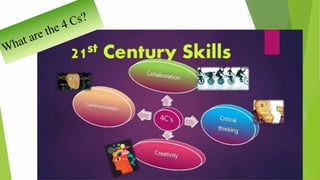
These fundamental skills are gained through experience, and they include
Collaboration
Communication
Creativity
Critical Thinking.
Why the 4 Cs?
A focus on collaboration, communication, creativity
and critical thinking is essential to prepare students
for increasingly complex life and work environments
in the 21st century.
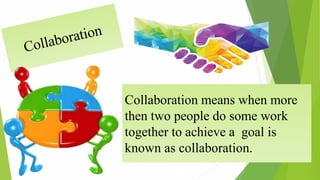
Collaboration means when more
then two people do some work
together to achieve a goal is
known as collaboration.
In the classroom
To build good team collaboration skills, students must learn to:
 Work effectively with different groups of people, including people from
diverse cultures.
 Be flexible and willing to compromise with team members to reach a
common goal.
 Demonstrate responsibility as a team member working toward a shared
goal.
COMMON COLLABORATIVE ABILITIES
 Allocating resources and responsibilities ensures that all
members of a team can work optimally.
 Brainstorming ideas in a group involves rapidly suggesting
and writing down ideas without pausing to critique them.
 Decision-making requires sorting through the many options
provided to the group and arriving at a single option to move
forward.
 Delegating means assigning duties to members of the group
and expecting them to fulfill their parts of the task.
 Evaluating the products, processes, and members of the
group provides a clear sense of what is working well and
what improvements could be made.
 Goal setting requires the group to analyze the situation,
decide what outcome is desired, and clearly state an
achievable objective.
 Leading a group means creating an environment in which
all members can contribute according to their abilities.
 Managing time involves matching up a list of tasks to a
schedule and tracking the progress toward goals.
 Resolving conflicts occurs from using one of the following
strategies: asserting, cooperating, compromising,
competing, or deferring.
 Team building means cooperatively working overtime to
achieve a common goal.
What does that mean for our students?
To build good Collaboration Skills, students must learn to:
• Work effectively with different groups of people, including
people from diverse cultures.
• Be flexible and willing to compromise with team members to
reach a common goal.
• Demonstrate responsibility as a team member working
toward a shared goal.
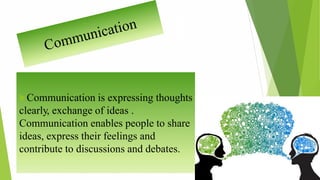
Communication is expressing thoughts
clearly, exchange of ideas .
Communication enables people to share
ideas, express their feelings and
contribute to discussions and debates.
What does that mean for our students?
To build effective Communication Skills students must learn to:
• Communicate using digital media and environments
to support personal and group learning.
• Share information efficiently and effectively using
appropriate digital media and environments.
• Communicate thoughts and ideas clearly and
effectively to different audiences using various media
and formats.
COMMON COMMUNICATION ABILITIES:
 Analyzing the situation means thinking about the subject, purpose,
sender, receiver, medium, and context of a message.
 Choosing a medium involves deciding the most appropriate way to
deliver a message, ranging from a face-to-face chat to a 400-page
report.
 Evaluating messages means deciding whether they are correct,
complete, reliable, authoritative, and up-to-date.
 Listening actively requires carefully paying attention, taking notes,
asking questions, and otherwise engaging in the ideas being
communicated.
 Read tone of voice, body language, gestures, facial expressions, and
visual aids in order to convey ideas.
 Turn taking means effectively switching from receiving ideas to
providing ideas, back and forth between those in the communication
situation.ng is decoding written words and images in order to understand
what their originator is trying to communicate.
 Using technology requires understanding the abilities and limitations of
any technological communication, from phone calls to e-mails to instant
messages.
 Writing involves encoding messages into words, sentences, and paragraphs
for the purpose of communicating to a person who is removed by distance,
time, or both.
 Speaking involves using spoken words.
Following conventions means communicating using the expected norms for
the medium chosen.
Importance of communication
 Students must be able to effectively analyze and process the
overwhelming amount of communication in their lives today.
 Which information sources are accurate?
 Which ones are not?
 How can they be used or leveraged effectively?
 The power of modern media and the ubiquity of communication
technologies in all aspects of life make teaching strong
communication skills even more important.
Effective Communication Skills for Students:
 Communicate using digital media and environments to
support personal and group learning.
 Share information efficiently and effectively using
appropriate digital media and environments.
 Communicate thoughts and ideas clearly and effectively
to different audiences using various media and formats.
 These skills are at the core of every organization.
 It is crucial that we as teachers help students build this vital set
of 21st century skills.
 Effective communication skills are important in many walks of
life.
 Today’s employers look for individuals with
effective communication skills in reading, writing,
speaking, and listening skills. After graduation
students will realize that these basic communication
skills are essential in attaining their life’s goals.
 It is imperative that tomorrow’s graduates
communicate clearly and effectively in a variety of
languages.
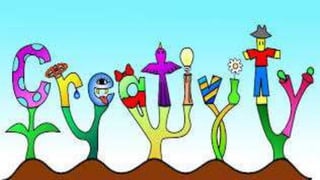
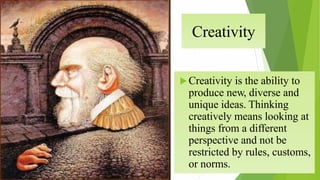
Creativity
Creativity is the ability to
produce new, diverse and
unique ideas. Thinking
creatively means looking at
things from a different
perspective and not be
restricted by rules, customs,
or norms.
Main creative abilities
 Brainstorming ideas involves asking a question and
rapidly listing all answers, even those that are far- fetched,
impractical, or impossible.
 Creating something requires forming it by combining
materials, perhaps according to a plan or perhaps based on
the impulse of the moment.
 Designing something means finding the conjunction
between form and function and shaping materials for a
specific purpose.
 Entertaining others involves telling stories, making jokes,
singing songs, playing games, acting out parts, and making
conversation.
 Imagining ideas involves reaching into the unknown and impossible,
perhaps idly or with great focus, as Einstein did with his thought
experiments.
 Improvising a solution involves using something in a novel way to
solve a problem.
 Innovating is creating something that hasn’t existed before, whether
an object, a procedure, or an idea.
 Overturning something means flipping it to get a new perspective,
perhaps by redefining givens, reversing cause and effect, or looking
at something in a brand new way.
 Problem solving requires using many of the creative abilities
listed here to figure out possible solutions and putting one or
more of them into action.
 Questioning actively reaches into what is unknown to make
it known, seeking information or a new way to do
something.
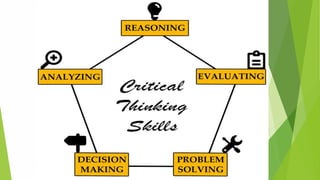
Critical thinking involves logical
thinking and reasoning including
skills such as comparison,
classification, sequencing,
cause/effect, patterning, webbing,
analogies, deductive and inductive
reasoning, forecasting, planning,
hypothesizing, and critiquing.
Common Critical Thinking Abilities:
 Critical thinking is focused, careful analysis of something
to better understand it. When people speak of “left brain”
activity, they are usually referring to critical thinking. Here
are some of the main critical-thinking abilities:
 Analyzing is breaking something down into its parts,
examining each part, and noting how the parts fit together.
 Arguing is using a series of statements connected logically
together, backed by evidence, to reach a conclusion.
 Classifying is identifying the types or groups of something,
showing how each category is distinct from the others.
 Comparing and contrasting is pointing out the similarities
and differences between two or more subjects.
 Defining is explaining the meaning of a term using
denotation, connotation, example, etymology, synonyms,
and antonyms.
 Describing is explaining the traits of something, such as
size, shape, weight, color, use, origin, value, condition,
location, and so on.
 Evaluating is deciding on the worth of something by
comparing it against an accepted standard of value.
 Explaining is telling what something is or how it works so
that others can understand it.
 Problem solving is analyzing the causes and effects of a
problem and finding a way to stop the causes or the effects.
 Tracking cause and effect is determining why something is
happening and what results from it.
 Critical thinking is quite compatible with thinking
"out-of-the-box", challenging consensus and
pursuing less popular approaches. If anything,
critical thinking is an essential part of creativity
because we need critical thinking to evaluate and
improve our creative ideas.
Today’s citizens must be active critical thinkers if
they are to compare evidence, evaluate competing
claims, and make sensible decisions. In everyday
work, employees must employ critical thinking to
better serve customers, develop better products,
and continuously improve themselves within an
ever-changing global economy.
Remember!  It is clear that the “Four C’s” need to be fully
integrated into classrooms, schools, and districts
around the country to produce citizens and
employees adequately prepared for the 21st
century.
 The teaching of collaboration, communication,
creativity, and critical thinking are not new
concepts for educators. In fact, they are the basis
of great teaching, and most teachers aspire to
teach in a manner that incorporates these
strategies.
What does that mean for our students?
Today’s students need to develop Critical Thinking skills by learning to:
• Use different kinds of reasoning, such as deductive and inductive,
to understand a situation.
• Analyze complex systems and understand how their interconnected
parts support the systems.
• Gather relevant information.
• Ask important questions that clarify points of view and help solve
problems.
• Make decisions by selecting appropriate criteria and identifying
alternatives to make reliable choices.
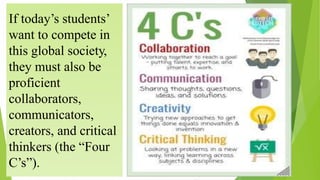
If today’s students’
want to compete in
this global society,
they must also be
proficient
collaborators,
communicators,
creators, and critical
thinkers (the “Four
C’s”).

4cs

  • 2.
  • 3.
    Introduction Skills for the21st Century Students must have formal education, but to be successful in the 21st century, students also need to learn important skills that apply to all subjects and all careers. We call them The 4C’s. These fundamental skills are gained through experience, and they include Collaboration Communication Creativity Critical Thinking.
  • 4.
    Why the 4Cs? A focus on collaboration, communication, creativity and critical thinking is essential to prepare students for increasingly complex life and work environments in the 21st century.
  • 6.
    Collaboration means whenmore then two people do some work together to achieve a goal is known as collaboration.
  • 7.
    In the classroom Tobuild good team collaboration skills, students must learn to:  Work effectively with different groups of people, including people from diverse cultures.  Be flexible and willing to compromise with team members to reach a common goal.  Demonstrate responsibility as a team member working toward a shared goal.
  • 8.
    COMMON COLLABORATIVE ABILITIES Allocating resources and responsibilities ensures that all members of a team can work optimally.  Brainstorming ideas in a group involves rapidly suggesting and writing down ideas without pausing to critique them.  Decision-making requires sorting through the many options provided to the group and arriving at a single option to move forward.  Delegating means assigning duties to members of the group and expecting them to fulfill their parts of the task.
  • 9.
     Evaluating theproducts, processes, and members of the group provides a clear sense of what is working well and what improvements could be made.  Goal setting requires the group to analyze the situation, decide what outcome is desired, and clearly state an achievable objective.  Leading a group means creating an environment in which all members can contribute according to their abilities.
  • 10.
     Managing timeinvolves matching up a list of tasks to a schedule and tracking the progress toward goals.  Resolving conflicts occurs from using one of the following strategies: asserting, cooperating, compromising, competing, or deferring.  Team building means cooperatively working overtime to achieve a common goal.
  • 11.
    What does thatmean for our students? To build good Collaboration Skills, students must learn to: • Work effectively with different groups of people, including people from diverse cultures. • Be flexible and willing to compromise with team members to reach a common goal. • Demonstrate responsibility as a team member working toward a shared goal.
  • 13.
    Communication is expressingthoughts clearly, exchange of ideas . Communication enables people to share ideas, express their feelings and contribute to discussions and debates.
  • 14.
    What does thatmean for our students? To build effective Communication Skills students must learn to: • Communicate using digital media and environments to support personal and group learning. • Share information efficiently and effectively using appropriate digital media and environments. • Communicate thoughts and ideas clearly and effectively to different audiences using various media and formats.
  • 15.
    COMMON COMMUNICATION ABILITIES: Analyzing the situation means thinking about the subject, purpose, sender, receiver, medium, and context of a message.  Choosing a medium involves deciding the most appropriate way to deliver a message, ranging from a face-to-face chat to a 400-page report.  Evaluating messages means deciding whether they are correct, complete, reliable, authoritative, and up-to-date.
  • 16.
     Listening activelyrequires carefully paying attention, taking notes, asking questions, and otherwise engaging in the ideas being communicated.  Read tone of voice, body language, gestures, facial expressions, and visual aids in order to convey ideas.  Turn taking means effectively switching from receiving ideas to providing ideas, back and forth between those in the communication situation.ng is decoding written words and images in order to understand what their originator is trying to communicate.
  • 17.
     Using technologyrequires understanding the abilities and limitations of any technological communication, from phone calls to e-mails to instant messages.  Writing involves encoding messages into words, sentences, and paragraphs for the purpose of communicating to a person who is removed by distance, time, or both.  Speaking involves using spoken words. Following conventions means communicating using the expected norms for the medium chosen.
  • 18.
    Importance of communication Students must be able to effectively analyze and process the overwhelming amount of communication in their lives today.  Which information sources are accurate?  Which ones are not?  How can they be used or leveraged effectively?  The power of modern media and the ubiquity of communication technologies in all aspects of life make teaching strong communication skills even more important.
  • 19.
    Effective Communication Skillsfor Students:  Communicate using digital media and environments to support personal and group learning.  Share information efficiently and effectively using appropriate digital media and environments.  Communicate thoughts and ideas clearly and effectively to different audiences using various media and formats.
  • 20.
     These skillsare at the core of every organization.  It is crucial that we as teachers help students build this vital set of 21st century skills.  Effective communication skills are important in many walks of life.
  • 21.
     Today’s employerslook for individuals with effective communication skills in reading, writing, speaking, and listening skills. After graduation students will realize that these basic communication skills are essential in attaining their life’s goals.  It is imperative that tomorrow’s graduates communicate clearly and effectively in a variety of languages.
  • 23.
    Creativity Creativity is theability to produce new, diverse and unique ideas. Thinking creatively means looking at things from a different perspective and not be restricted by rules, customs, or norms.
  • 24.
    Main creative abilities Brainstorming ideas involves asking a question and rapidly listing all answers, even those that are far- fetched, impractical, or impossible.  Creating something requires forming it by combining materials, perhaps according to a plan or perhaps based on the impulse of the moment.  Designing something means finding the conjunction between form and function and shaping materials for a specific purpose.  Entertaining others involves telling stories, making jokes, singing songs, playing games, acting out parts, and making conversation.
  • 25.
     Imagining ideasinvolves reaching into the unknown and impossible, perhaps idly or with great focus, as Einstein did with his thought experiments.  Improvising a solution involves using something in a novel way to solve a problem.  Innovating is creating something that hasn’t existed before, whether an object, a procedure, or an idea.  Overturning something means flipping it to get a new perspective, perhaps by redefining givens, reversing cause and effect, or looking at something in a brand new way.
  • 26.
     Problem solvingrequires using many of the creative abilities listed here to figure out possible solutions and putting one or more of them into action.  Questioning actively reaches into what is unknown to make it known, seeking information or a new way to do something.
  • 28.
    Critical thinking involveslogical thinking and reasoning including skills such as comparison, classification, sequencing, cause/effect, patterning, webbing, analogies, deductive and inductive reasoning, forecasting, planning, hypothesizing, and critiquing.
  • 30.
    Common Critical ThinkingAbilities:  Critical thinking is focused, careful analysis of something to better understand it. When people speak of “left brain” activity, they are usually referring to critical thinking. Here are some of the main critical-thinking abilities:  Analyzing is breaking something down into its parts, examining each part, and noting how the parts fit together.  Arguing is using a series of statements connected logically together, backed by evidence, to reach a conclusion.
  • 31.
     Classifying isidentifying the types or groups of something, showing how each category is distinct from the others.  Comparing and contrasting is pointing out the similarities and differences between two or more subjects.  Defining is explaining the meaning of a term using denotation, connotation, example, etymology, synonyms, and antonyms.  Describing is explaining the traits of something, such as size, shape, weight, color, use, origin, value, condition, location, and so on.
  • 32.
     Evaluating isdeciding on the worth of something by comparing it against an accepted standard of value.  Explaining is telling what something is or how it works so that others can understand it.  Problem solving is analyzing the causes and effects of a problem and finding a way to stop the causes or the effects.  Tracking cause and effect is determining why something is happening and what results from it.
  • 34.
     Critical thinkingis quite compatible with thinking "out-of-the-box", challenging consensus and pursuing less popular approaches. If anything, critical thinking is an essential part of creativity because we need critical thinking to evaluate and improve our creative ideas.
  • 35.
    Today’s citizens mustbe active critical thinkers if they are to compare evidence, evaluate competing claims, and make sensible decisions. In everyday work, employees must employ critical thinking to better serve customers, develop better products, and continuously improve themselves within an ever-changing global economy.
  • 36.
    Remember!  Itis clear that the “Four C’s” need to be fully integrated into classrooms, schools, and districts around the country to produce citizens and employees adequately prepared for the 21st century.  The teaching of collaboration, communication, creativity, and critical thinking are not new concepts for educators. In fact, they are the basis of great teaching, and most teachers aspire to teach in a manner that incorporates these strategies.
  • 37.
    What does thatmean for our students? Today’s students need to develop Critical Thinking skills by learning to: • Use different kinds of reasoning, such as deductive and inductive, to understand a situation. • Analyze complex systems and understand how their interconnected parts support the systems. • Gather relevant information. • Ask important questions that clarify points of view and help solve problems. • Make decisions by selecting appropriate criteria and identifying alternatives to make reliable choices.
  • 38.
    If today’s students’ wantto compete in this global society, they must also be proficient collaborators, communicators, creators, and critical thinkers (the “Four C’s”).