Hello!
We are group 2
We are here because We want some marks.
Learnings from
Vedas
Presented by
Anmol
Arpit
Shantanu
Vaibhav
Prajwal
Aniket
Deeptanshu
Neha
Hemant
The Vedas are a collection of hymns and other religious
texts composed in India between about 1500 and 1000
BCE. It includes elements such as liturgical material as well
as mythological accounts, poems, prayers, and formulas
considered to be sacred by the Vedic religion.
3
The Vedas Sanskrit: वेद véda, "knowledge") are a
large body of knowledge texts originating in the
ancient Indian subcontinent. Composed in Vedic
Sanskrit, the texts constitute the oldest layer of
Sanskrit literature and the oldest scriptures of
Hinduism. Hindus consider the Vedas to be
apauruṣeya, which means "not of a man,
superhuman" and "impersonal, authorless"
4
Violent times
The Aryans came into north-west India as pastoral, semi-
nomadic tribes led by warrior chieftains. Once in India, they
settled down as rulers over the native Dravidian populations
they found there, and formed tribal kingdoms.
The different kingdoms were often at war with one another,
and echoes of these violent times can still be heard in one of
the greatest epics of ancient India, the "Mahabharata", which
has come down to us from this period of history.
5
The Vedic Age in World History
The place of the Vedic Age in World History is as the
period of ancient India which gave birth to Indian
civilization - one of the great civilizations of the world.
The fact that Vedic society gave pride of place to the
priestly caste of Brahmins is directly related to the
emergence of a religious culture which, in the following
period of India's history, would lead to the appearance
of three distinct but closely-related religions - mature
Hinduism, Buddhism and Jainism. Together, these
religions claim the allegiance of billions of people in the
world today.
6
Essence
of
each
Veda
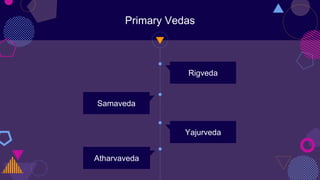
Primary Vedas
Rigveda
Yajurveda
Samaveda
Atharvaveda
1.
Rigveda
The oldest text in any Indo-Europian language originated as
early as 1700 BC, before the existence of most religions
THE RIG VEDA :
THE BOOK OF MANTRA
◍The Rig Veda is a collection of inspired songs or hymns
and is a main source of information on the Rig Vedic
civilization.
◍The Rig-Vedic ‘samhita’ or collection of mantras consists of
1,017 hymns or ‘suktas’, covering about 10,600 stanzas,
divided into eight ‘astakas,’ each having eight ‘adhayayas’
or chapters, which are sub-divided into various groups.
◍There are seven primary seers identified: Atri, Kanwa,
Vashistha, Vishwamitra, Jamadagni, Gotama and
Bharadwaja
2.
Samaveda
The Samaveda is the oldest musical arrangement and
earliest human literature on music in the world.
The SamaVeda:
The Book of Song
◍Samaveda is purely a liturgical collection of melodies
(‘saman’).
◍The hymns in the Samaveda, used as musical notes, were
almost completely drawn from the Rig Veda and have no
distinctive lessons of their own. Hence, its text is a reduced
version of the Rig Veda.
◍As Vedic Scholar David Frawley puts it, if the Rig Veda is
the word, Samaveda is the song or the meaning; if Rig
Veda is the knowledge, Samaveda is its realization.
3.
Yujurveda
There are at least six complete recessions of Yajurveda.
The Yajur Veda:
The Book of Ritual
◍The Yajur Veda is also a liturgical collection and was made
to meet the demands of a ceremonial religion.
◍The Yajur Veda served as a practical guidebook for the
priests who execute sacrificial acts while muttering
simultaneously the prose prayers and the sacrificial formulae
(‘yajus’).
◍Yajur Veda has 6 main segmets -Madyandina, Kanva,
Taittiriya, Kathaka, Maitrayani and Kapishthala.
4.
Atharveda
It consists of 20 books of hymns and prose, many of which
reflect the religious concerns of everyday life.
The Atharva Veda:
The Book of Spell
◍The last of the Vedas, this is completely different from the
other three Vedas and is next in importance to the Rig Veda
with regard to history and sociology.
◍ A different spirit pervades this Veda. Its hymns are of a
more diverse character than the Rig Veda and are also
simpler in language.
◍In fact, many scholars do not consider it part of the Vedas
at all. The Atharva Veda consists of spells and charms
prevalent at its time, and portrays a clearer picture of the
Vedic society.
What do the Vedas
say about women
empowerment?
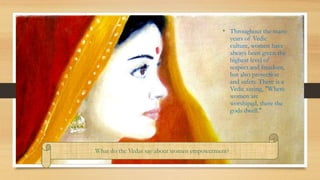
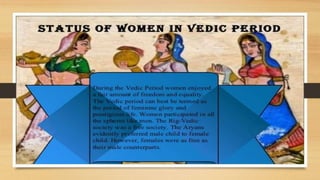
• Throughout the many
years of Vedic
culture, women have
always been given the
highest level of
respect and freedom,
but also protection
and safety. There is a
Vedic saying, "Where
women are
worshiped, there the
gods dwell."
What do the Vedas say about women empowerment?
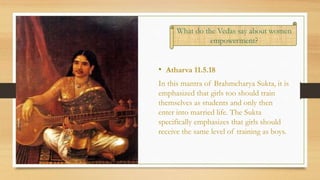
• Atharva 11.5.18
In this mantra of Brahmcharya Sukta, it is
emphasized that girls too should train
themselves as students and only then
enter into married life. The Sukta
specifically emphasizes that girls should
receive the same level of training as boys.
.
What do the Vedas say about women
empowerment?
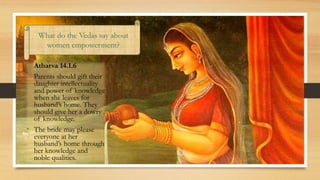
• Atharva 14.1.6
• Parents should gift their
daughter intellectuality
and power of knowledge
when she leaves for
husband’s home. They
should give her a dowry
of knowledge.
• The bride may please
everyone at her
husband’s home through
her knowledge and
noble qualities.
What do the Vedas say about
women empowerment?
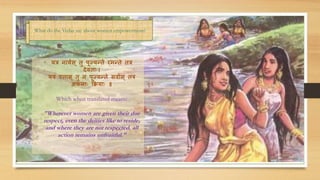
• यत्र नाययस् तु पूज्यन्ते रमन्ते तत्र
देवतााः।
यत्र एतास ् तु न पूज्यन्ते सवायस् तत्र
अफलााः क्रियााः ॥
Which when translated means:
"Wherever women are given their due
respect, even the deities like to reside,
and where they are not respected, all
action remains unfruitful."
What do the Vedas say about women empowerment?
STRESS MANAGEMENT
(VEDIC APPROACH)
WHAT IS THE ROOT CAUSE OF THE STRESS?
1. Belief system: My own thinking. How healthy is
my thinking?
2. Lifestyle: The way we manage our life. Is our
lifestyle conducive to our goals in life?
3. Situations - External and Internal. Whatever that
was external eventually becomes an internal
experience.
4. Genetic/Hormonal- It is good to get medical
attention where necessary and not depend on yoga
entirely. Does Yoga help? Definitely.
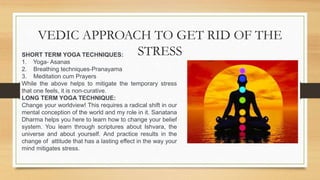
VEDIC APPROACH TO GET RID OF THE
STRESSSHORT TERM YOGA TECHNIQUES:
1. Yoga- Asanas
2. Breathing techniques-Pranayama
3. Meditation cum Prayers
While the above helps to mitigate the temporary stress
that one feels, it is non-curative.
LONG TERM YOGA TECHNIQUE:
Change your worldview! This requires a radical shift in our
mental conception of the world and my role in it. Sanatana
Dharma helps you here to learn how to change your belief
system. You learn through scriptures about Ishvara, the
universe and about yourself. And practice results in the
change of attitude that has a lasting effect in the way your
mind mitigates stress.
CONFLICT MANAGEMENT THROUGH VEDAS
• Vedic literature is religious in nature and as such tends to reflect
the worldview, spiritual preoccupations, and social attitudes of the
Brahmans or priestly class of ancient India.
• The Vedas were first composed sometime around 1500-1000 BCE
in the north-western region of the Indian subcontinent - present
day Pakistan and northwest India
• they were transmitted orally over many generations before
eventually being committed to writing.
• Like the Homeric epics, parts of the Vedas were composed in
different periods. The oldest of these texts is the Rig-Veda, but it is
not possible to establish precise dates for its composition. It is
believed that the entire collection was completed by the end of the
second millennium BCE.
Impact of vedas on our society
The basic Vedic texts are the Samhita “Collections” of the four Vedas:
Rig-Veda “Knowledge of the Hymns of Praise”, for recitation.
Sama-Veda “Knowledge of the Melodies”, for chanting.
Yajur-Veda “Knowledge of the Sacrificial formulas”, for liturgy.
Atharva-Veda “Knowledge of the Magic formulas”, named after a kind of group of priests.
In general, the Vedas have a strong priestly bias, as the priestly class had the monopoly in the
edition and transmission of these texts.
STRUCTURE & CONTENT OF THE VEDAS
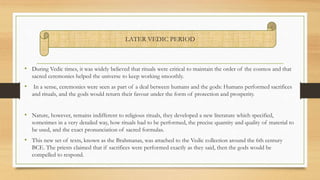
• During Vedic times, it was widely believed that rituals were critical to maintain the order of the cosmos and that
sacred ceremonies helped the universe to keep working smoothly.
• In a sense, ceremonies were seen as part of a deal between humans and the gods: Humans performed sacrifices
and rituals, and the gods would return their favour under the form of protection and prosperity.
• Nature, however, remains indifferent to religious rituals, they developed a new literature which specified,
sometimes in a very detailed way, how rituals had to be performed, the precise quantity and quality of material to
be used, and the exact pronunciation of sacred formulas.
• This new set of texts, known as the Brahmanas, was attached to the Vedic collection around the 6th century
BCE. The priests claimed that if sacrifices were performed exactly as they said, then the gods would be
compelled to respond.
LATER VEDIC PERIOD
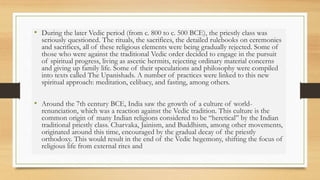
• During the later Vedic period (from c. 800 to c. 500 BCE), the priestly class was
seriously questioned. The rituals, the sacrifices, the detailed rulebooks on ceremonies
and sacrifices, all of these religious elements were being gradually rejected. Some of
those who were against the traditional Vedic order decided to engage in the pursuit
of spiritual progress, living as ascetic hermits, rejecting ordinary material concerns
and giving up family life. Some of their speculations and philosophy were compiled
into texts called The Upanishads. A number of practices were linked to this new
spiritual approach: meditation, celibacy, and fasting, among others.
• Around the 7th century BCE, India saw the growth of a culture of world-
renunciation, which was a reaction against the Vedic tradition. This culture is the
common origin of many Indian religions considered to be “heretical” by the Indian
traditional priestly class. Charvaka, Jainism, and Buddhism, among other movements,
originated around this time, encouraged by the gradual decay of the priestly
orthodoxy. This would result in the end of the Vedic hegemony, shifting the focus of
religious life from external rites and
Philosophy
of Vedas
Prajwal
• In the beginning, it seems that the Vedas propagate the
philosophy of polytheism. This illusion gradually disappears as
one approaches the Upanishadic period. The Upanishads
inconspicuously pronounce the philosophical thoughts that may
lead one to the realization of the Ultimate Truth.
• After all, the Vedic Rishis are in search of the Ultimate Truth.
What they are seeking is knowledge par excellence. They have set
out in the quest of Divine Truth. Their search intensifies as they
enter the era of the Upanishads. As Shri Aurobindo says: “The
Upanishadic hymns are the epic hymns of self-knowledge, world-
knowledge and God-knowledge.”
• The Rishis are inquisitive and they pose diverse questions:
What is the Ultimate Truth? What is the Srishti? Who is
the creator? How and why is the Samsara (Jagat) created?
What is the Brahman? What is the jiva or the jivatma? Is
there any relationship between the Brahman and
the jivatma? What is life? What is death? What is moksha?
• The Vedic philosophical thoughts reach the peak in the
Upanishads. The Upanishads unveil the Ultimate Truth.
The philosophy expressed in the Upanishads is referred
to as the Vedanta.
• Truly speaking, the Upanishads reflect the sublime
knowledge and wisdom of man in its most exalted form. But
the significance of the other parts of the Vedas - with their
seemingly cryptic statements expressing esoteric truth and
profound philosophy-should not be undermined.
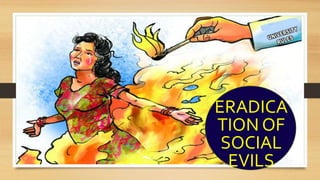
ERADICA
TION OF
SOCIAL
EVILS
BRIEF EXPLAINATION
• Indian society is one of the oldest societies.
• It has got its own customs and traditions. Some of them are very old. They
do not suit the present times.
• Some of our customs are not only useless but are also obstacles in the way
of social progress.
• It is, therefore, essential that they must be changed.
PREVAILING SOCIAL EVILS
• CHILD LABOUR
• DOWRY
• CASTE SYSTEM
• FEMALE INFANTICIDE
• HUMAN TRAFFICKING
• WITCHCRAFT & SORCERY
• CORRUPTION
• POVERTY
• SATI
• ILLITERACY
• GENDER INEQUALITY
• RELIGIOUS CONFLICTS
• SUBSTANCE ABUSE
• CHILD MARRIAGE
SOLUTION
• RIGHT EDUCATION AND EDUCATION ABOUT RIGHTS TO THE
YOUTH AND THE ILLITERATE.
• MOTIVATING SOCIETY TO HELP BRING THE CHANGE.
• AWARENESS THROUGH MEDIA.
• STRONG LAW ENFORCEMENT.
• NEW REFORMS.
• TRANSPARENT GOVERNMENT.
How can we use
vedas to teach others
indian traditions and
promote positive
values

Learnings from vedas and today's problems

  • 1.
    Hello! We are group2 We are here because We want some marks.
  • 2.
  • 3.
    The Vedas area collection of hymns and other religious texts composed in India between about 1500 and 1000 BCE. It includes elements such as liturgical material as well as mythological accounts, poems, prayers, and formulas considered to be sacred by the Vedic religion. 3
  • 4.
    The Vedas Sanskrit:वेद véda, "knowledge") are a large body of knowledge texts originating in the ancient Indian subcontinent. Composed in Vedic Sanskrit, the texts constitute the oldest layer of Sanskrit literature and the oldest scriptures of Hinduism. Hindus consider the Vedas to be apauruṣeya, which means "not of a man, superhuman" and "impersonal, authorless" 4
  • 5.
    Violent times The Aryanscame into north-west India as pastoral, semi- nomadic tribes led by warrior chieftains. Once in India, they settled down as rulers over the native Dravidian populations they found there, and formed tribal kingdoms. The different kingdoms were often at war with one another, and echoes of these violent times can still be heard in one of the greatest epics of ancient India, the "Mahabharata", which has come down to us from this period of history. 5
  • 6.
    The Vedic Agein World History The place of the Vedic Age in World History is as the period of ancient India which gave birth to Indian civilization - one of the great civilizations of the world. The fact that Vedic society gave pride of place to the priestly caste of Brahmins is directly related to the emergence of a religious culture which, in the following period of India's history, would lead to the appearance of three distinct but closely-related religions - mature Hinduism, Buddhism and Jainism. Together, these religions claim the allegiance of billions of people in the world today. 6
  • 7.
  • 8.
  • 9.
    1. Rigveda The oldest textin any Indo-Europian language originated as early as 1700 BC, before the existence of most religions
  • 10.
    THE RIG VEDA: THE BOOK OF MANTRA ◍The Rig Veda is a collection of inspired songs or hymns and is a main source of information on the Rig Vedic civilization. ◍The Rig-Vedic ‘samhita’ or collection of mantras consists of 1,017 hymns or ‘suktas’, covering about 10,600 stanzas, divided into eight ‘astakas,’ each having eight ‘adhayayas’ or chapters, which are sub-divided into various groups. ◍There are seven primary seers identified: Atri, Kanwa, Vashistha, Vishwamitra, Jamadagni, Gotama and Bharadwaja
  • 11.
    2. Samaveda The Samaveda isthe oldest musical arrangement and earliest human literature on music in the world.
  • 12.
    The SamaVeda: The Bookof Song ◍Samaveda is purely a liturgical collection of melodies (‘saman’). ◍The hymns in the Samaveda, used as musical notes, were almost completely drawn from the Rig Veda and have no distinctive lessons of their own. Hence, its text is a reduced version of the Rig Veda. ◍As Vedic Scholar David Frawley puts it, if the Rig Veda is the word, Samaveda is the song or the meaning; if Rig Veda is the knowledge, Samaveda is its realization.
  • 13.
    3. Yujurveda There are atleast six complete recessions of Yajurveda.
  • 14.
    The Yajur Veda: TheBook of Ritual ◍The Yajur Veda is also a liturgical collection and was made to meet the demands of a ceremonial religion. ◍The Yajur Veda served as a practical guidebook for the priests who execute sacrificial acts while muttering simultaneously the prose prayers and the sacrificial formulae (‘yajus’). ◍Yajur Veda has 6 main segmets -Madyandina, Kanva, Taittiriya, Kathaka, Maitrayani and Kapishthala.
  • 15.
    4. Atharveda It consists of20 books of hymns and prose, many of which reflect the religious concerns of everyday life.
  • 16.
    The Atharva Veda: TheBook of Spell ◍The last of the Vedas, this is completely different from the other three Vedas and is next in importance to the Rig Veda with regard to history and sociology. ◍ A different spirit pervades this Veda. Its hymns are of a more diverse character than the Rig Veda and are also simpler in language. ◍In fact, many scholars do not consider it part of the Vedas at all. The Atharva Veda consists of spells and charms prevalent at its time, and portrays a clearer picture of the Vedic society.
  • 17.
    What do theVedas say about women empowerment?
  • 18.
    • Throughout themany years of Vedic culture, women have always been given the highest level of respect and freedom, but also protection and safety. There is a Vedic saying, "Where women are worshiped, there the gods dwell." What do the Vedas say about women empowerment?
  • 19.
    • Atharva 11.5.18 Inthis mantra of Brahmcharya Sukta, it is emphasized that girls too should train themselves as students and only then enter into married life. The Sukta specifically emphasizes that girls should receive the same level of training as boys. . What do the Vedas say about women empowerment?
  • 20.
    • Atharva 14.1.6 •Parents should gift their daughter intellectuality and power of knowledge when she leaves for husband’s home. They should give her a dowry of knowledge. • The bride may please everyone at her husband’s home through her knowledge and noble qualities. What do the Vedas say about women empowerment?
  • 21.
    • यत्र नाययस्तु पूज्यन्ते रमन्ते तत्र देवतााः। यत्र एतास ् तु न पूज्यन्ते सवायस् तत्र अफलााः क्रियााः ॥ Which when translated means: "Wherever women are given their due respect, even the deities like to reside, and where they are not respected, all action remains unfruitful." What do the Vedas say about women empowerment?
  • 26.
    STRESS MANAGEMENT (VEDIC APPROACH) WHATIS THE ROOT CAUSE OF THE STRESS? 1. Belief system: My own thinking. How healthy is my thinking? 2. Lifestyle: The way we manage our life. Is our lifestyle conducive to our goals in life? 3. Situations - External and Internal. Whatever that was external eventually becomes an internal experience. 4. Genetic/Hormonal- It is good to get medical attention where necessary and not depend on yoga entirely. Does Yoga help? Definitely.
  • 27.
    VEDIC APPROACH TOGET RID OF THE STRESSSHORT TERM YOGA TECHNIQUES: 1. Yoga- Asanas 2. Breathing techniques-Pranayama 3. Meditation cum Prayers While the above helps to mitigate the temporary stress that one feels, it is non-curative. LONG TERM YOGA TECHNIQUE: Change your worldview! This requires a radical shift in our mental conception of the world and my role in it. Sanatana Dharma helps you here to learn how to change your belief system. You learn through scriptures about Ishvara, the universe and about yourself. And practice results in the change of attitude that has a lasting effect in the way your mind mitigates stress.
  • 28.
  • 31.
  • 38.
    • Vedic literatureis religious in nature and as such tends to reflect the worldview, spiritual preoccupations, and social attitudes of the Brahmans or priestly class of ancient India. • The Vedas were first composed sometime around 1500-1000 BCE in the north-western region of the Indian subcontinent - present day Pakistan and northwest India • they were transmitted orally over many generations before eventually being committed to writing. • Like the Homeric epics, parts of the Vedas were composed in different periods. The oldest of these texts is the Rig-Veda, but it is not possible to establish precise dates for its composition. It is believed that the entire collection was completed by the end of the second millennium BCE. Impact of vedas on our society
  • 39.
    The basic Vedictexts are the Samhita “Collections” of the four Vedas: Rig-Veda “Knowledge of the Hymns of Praise”, for recitation. Sama-Veda “Knowledge of the Melodies”, for chanting. Yajur-Veda “Knowledge of the Sacrificial formulas”, for liturgy. Atharva-Veda “Knowledge of the Magic formulas”, named after a kind of group of priests. In general, the Vedas have a strong priestly bias, as the priestly class had the monopoly in the edition and transmission of these texts. STRUCTURE & CONTENT OF THE VEDAS
  • 40.
    • During Vedictimes, it was widely believed that rituals were critical to maintain the order of the cosmos and that sacred ceremonies helped the universe to keep working smoothly. • In a sense, ceremonies were seen as part of a deal between humans and the gods: Humans performed sacrifices and rituals, and the gods would return their favour under the form of protection and prosperity. • Nature, however, remains indifferent to religious rituals, they developed a new literature which specified, sometimes in a very detailed way, how rituals had to be performed, the precise quantity and quality of material to be used, and the exact pronunciation of sacred formulas. • This new set of texts, known as the Brahmanas, was attached to the Vedic collection around the 6th century BCE. The priests claimed that if sacrifices were performed exactly as they said, then the gods would be compelled to respond. LATER VEDIC PERIOD
  • 41.
    • During thelater Vedic period (from c. 800 to c. 500 BCE), the priestly class was seriously questioned. The rituals, the sacrifices, the detailed rulebooks on ceremonies and sacrifices, all of these religious elements were being gradually rejected. Some of those who were against the traditional Vedic order decided to engage in the pursuit of spiritual progress, living as ascetic hermits, rejecting ordinary material concerns and giving up family life. Some of their speculations and philosophy were compiled into texts called The Upanishads. A number of practices were linked to this new spiritual approach: meditation, celibacy, and fasting, among others. • Around the 7th century BCE, India saw the growth of a culture of world- renunciation, which was a reaction against the Vedic tradition. This culture is the common origin of many Indian religions considered to be “heretical” by the Indian traditional priestly class. Charvaka, Jainism, and Buddhism, among other movements, originated around this time, encouraged by the gradual decay of the priestly orthodoxy. This would result in the end of the Vedic hegemony, shifting the focus of religious life from external rites and
  • 42.
  • 43.
    • In thebeginning, it seems that the Vedas propagate the philosophy of polytheism. This illusion gradually disappears as one approaches the Upanishadic period. The Upanishads inconspicuously pronounce the philosophical thoughts that may lead one to the realization of the Ultimate Truth. • After all, the Vedic Rishis are in search of the Ultimate Truth. What they are seeking is knowledge par excellence. They have set out in the quest of Divine Truth. Their search intensifies as they enter the era of the Upanishads. As Shri Aurobindo says: “The Upanishadic hymns are the epic hymns of self-knowledge, world- knowledge and God-knowledge.”
  • 44.
    • The Rishisare inquisitive and they pose diverse questions: What is the Ultimate Truth? What is the Srishti? Who is the creator? How and why is the Samsara (Jagat) created? What is the Brahman? What is the jiva or the jivatma? Is there any relationship between the Brahman and the jivatma? What is life? What is death? What is moksha? • The Vedic philosophical thoughts reach the peak in the Upanishads. The Upanishads unveil the Ultimate Truth. The philosophy expressed in the Upanishads is referred to as the Vedanta.
  • 45.
    • Truly speaking,the Upanishads reflect the sublime knowledge and wisdom of man in its most exalted form. But the significance of the other parts of the Vedas - with their seemingly cryptic statements expressing esoteric truth and profound philosophy-should not be undermined.
  • 46.
  • 47.
    BRIEF EXPLAINATION • Indiansociety is one of the oldest societies. • It has got its own customs and traditions. Some of them are very old. They do not suit the present times. • Some of our customs are not only useless but are also obstacles in the way of social progress. • It is, therefore, essential that they must be changed.
  • 48.
    PREVAILING SOCIAL EVILS •CHILD LABOUR • DOWRY • CASTE SYSTEM • FEMALE INFANTICIDE • HUMAN TRAFFICKING • WITCHCRAFT & SORCERY • CORRUPTION • POVERTY • SATI • ILLITERACY • GENDER INEQUALITY • RELIGIOUS CONFLICTS • SUBSTANCE ABUSE • CHILD MARRIAGE
  • 49.
    SOLUTION • RIGHT EDUCATIONAND EDUCATION ABOUT RIGHTS TO THE YOUTH AND THE ILLITERATE. • MOTIVATING SOCIETY TO HELP BRING THE CHANGE. • AWARENESS THROUGH MEDIA. • STRONG LAW ENFORCEMENT. • NEW REFORMS. • TRANSPARENT GOVERNMENT.
  • 50.
    How can weuse vedas to teach others indian traditions and promote positive values