MUSCULOSKELETAL
SYSTEM
MODULE I
NURSING 105: ADULT NURSING
Myrna Williamson, MSN, RN,
OCN
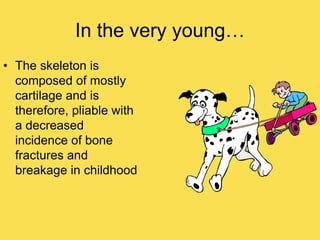
In the very young…
• The skeleton is
composed of mostly
cartilage and is
therefore, pliable with
a decreased
incidence of bone
fractures and
breakage in childhood
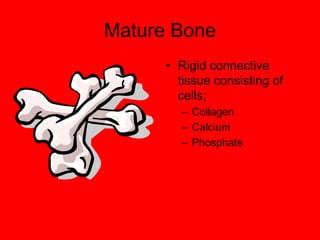
Mature Bone
• Rigid connective
tissue consisting of
cells;
– Collagen
– Calcium
– Phosphate
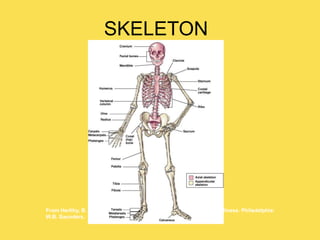
SKELETON
From Herlihy, B. & Maebius, N. (2000). The human body in health and illness. Philadelphia:
W.B. Saunders.
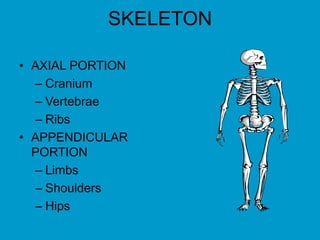
SKELETON
• AXIAL PORTION
– Cranium
– Vertebrae
– Ribs
• APPENDICULAR
PORTION
– Limbs
– Shoulders
– Hips
ANATOMY & PHYSIOLOGY
REVIEW
• Structure & Function
– Skeletal System
• Bone Formation, Maintenance, Healing
– Articular System
• Joints – synarthrosis, amphiarthrosis, & diarthrosis
– Skeletal Muscle System
• Contraction
• Tone
• Actions
• Exercise, Disuse, & Repair
Bone Cells
Osteogenic Cells
Osteoblasts
Osteocytes
Osteoclasts
Bone Formation & Maintenance
• Ossification
• Resorption &
Formation
– Local stress
– Vit. D
– Parathyroid hormone
– Calcitonin
– Blood supply
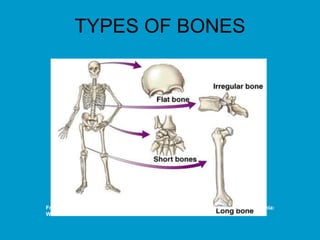
TYPES OF BONES
From Herlihy, B. & Maebius, N. (2000). The human body in health and illness. Philadelphia:
W.B. Saunders.
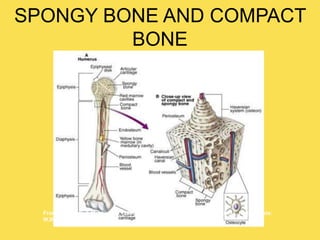
SPONGY BONE
• Located in the ends of long bones and the
center of flat and irregular bones
• Can withstand forces applied in many
directions
DENSE (COMPACT) BONE
• Covers spongy bone
• Cylinder around a central marrow cavity
• Can withstand force predominantly in one
direction
SPONGY BONE AND COMPACT
BONE
From Herlihy, B. & Maebius, N. (2000). The human body in health and illness. Philadelphia:
W.B. Saunders.
FUNCTIONS OF BONE
• Framework
• Support
• Movement
• Shape
• Maintain Position
• Attachment of
Muscles
• Protects Organs
• Storage
• Hematopoiesis
• Remodeling
• Reformation
• Movable Joints
CHARACTERISTICS OF
JOINTS
• Allow the movement
between bones
• Formed where two
bones join
• Surfaces are covered
with cartilage
• Enclosed in a capsule
Classification of Joints
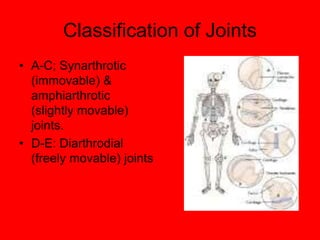
• A-C; Synarthrotic
(immovable) &
amphiarthrotic
(slightly movable)
joints.
• D-E: Diarthrodial
(freely movable) joints
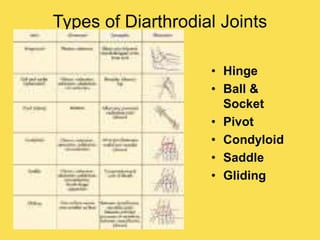
Types of Diarthrodial Joints
• Hinge
• Ball &
Socket
• Pivot
• Condyloid
• Saddle
• Gliding
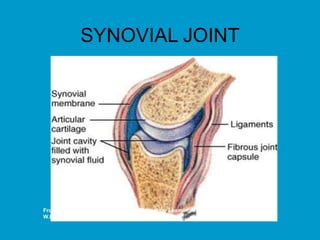
SYNOVIAL JOINT
From Applegate E: The Anatomy and Physiology Learning System, ed. 2, Philadelphia, 2000,
W.B. Saunders.
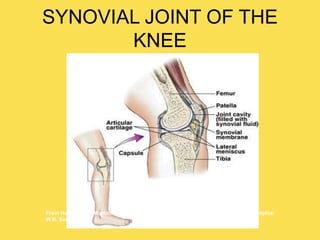
SYNOVIAL JOINT OF THE
KNEE
From Herlihy, B. & Maebius, N. (2000). The human body in health and illness. Philadelphia:
W.B. Saunders.
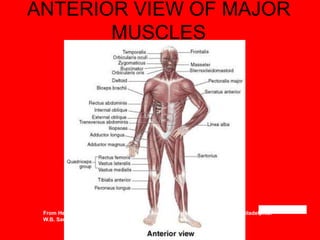
ANTERIOR VIEW OF MAJOR
MUSCLES
From Herlihy, B. & Maebius, N. (2000). The human body in health and illness. Philadelphia:
W.B. Saunders.
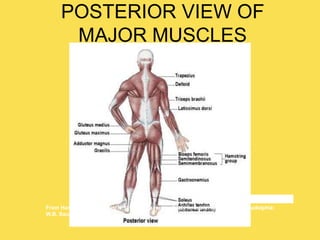
POSTERIOR VIEW OF
MAJOR MUSCLES
From Herlihy, B. & Maebius, N. (2000). The human body in health and illness. Philadelphia:
W.B. Saunders.
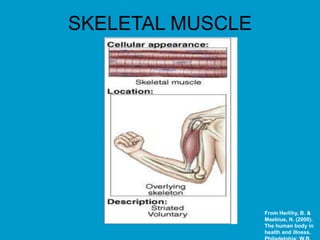
SKELETAL MUSCLE
From Herlihy, B. &
Maebius, N. (2000).
The human body in
health and illness.
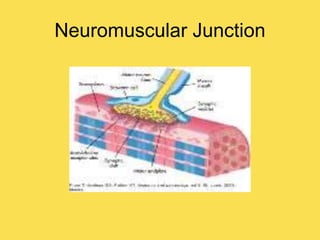
Neuromuscular Junction
CHARACTERISTICS OF
MUSCLES
• Made up of bundles of muscle fibers
• Provide the force to move bones
• Assist in maintaining posture
• Assist with heat production
4 Steps of Muscle Contraction
• Excitation
• Coupling
• Contraction
• Relaxation
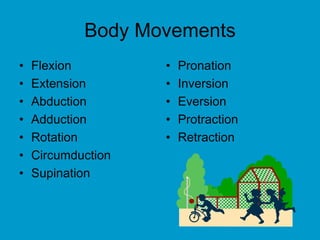
Body Movements
• Flexion
• Extension
• Abduction
• Adduction
• Rotation
• Circumduction
• Supination
• Pronation
• Inversion
• Eversion
• Protraction
• Retraction
Age Related Changes of
Musculoskeletal System
• Bones
• Muscles
• Joints
• Ligaments
Nursing Assessment
• Health History
–Initial Interview
–Assessment Data
• Pain
• Altered Sensations
Nursing Assessment
• Physical Assessment
– Posture
– Gait
– Bone Integrity
– Joint Function
– Muscle Strength & Size
– Skin
– Neurovascular Status
RISK FACTORS
• Autoimmune disorders
• Calcium deficiency
• Degenerative conditions
• Falls
• Hyperuricemia
• Infection
RISK FACTORS (Continued)
• Medications
• Metabolic disorders
• Neoplastic disorders
• Obesity
• Postmenopausal
states
• Trauma and injury
Diagnostic Evaluation
• Imaging Procedures
– X-ray
– Computed Tomography
(CT)
– Magnetic Resonance
Imaging (MRI)
– Arthrography
– Bone Densitometry
Diagnostic Evaluation
• Nuclear Studies
– Bone Scan
• Endoscopic Studies
– Arthroscopy
• Other Studies
– Arthrocentesis
– Electromyography
– Biopsy
• Laboratory Studies
– (CBC)
– Urinalysis (Calcium)
– Blood Chemistry
– Serum Calcium
– Serum Phosphate
– Uric Acid
– Serum Creatinine
– LDH, SGOT, CPK
X-RAYS
• DESCRIPTION
• IMPLEMENTATION
ARTHROCENTESIS
• DESCRIPTION
• IMPLEMENTATION
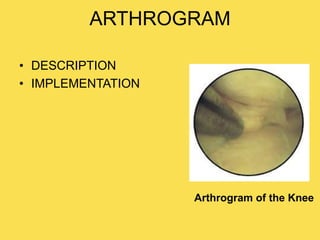
ARTHROGRAM
• DESCRIPTION
• IMPLEMENTATION
Arthrogram of the Knee
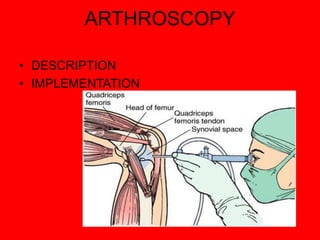
ARTHROSCOPY
• DESCRIPTION
• IMPLEMENTATION
BONE SCAN
• DESCRIPTION
• IMPLEMENTATION
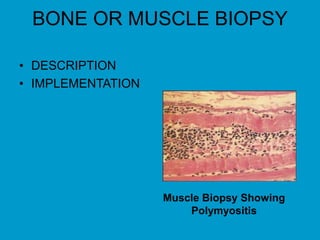
BONE OR MUSCLE BIOPSY
• DESCRIPTION
• IMPLEMENTATION
Muscle Biopsy Showing
Polymyositis
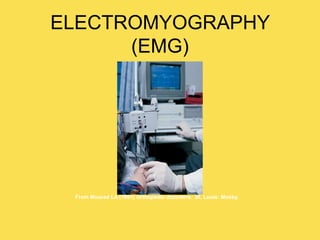
ELECTROMYOGRAPHY
(EMG)
From Mourad LA (1991) Orthopedic disorders. St. Louis: Mosby.
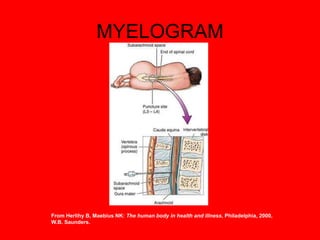
MYELOGRAM
From Herlihy B, Maebius NK: The human body in health and illness, Philadelphia, 2000,
W.B. Saunders.
MUSCULOSKELETAL INJURIES
• Skeletal Trauma
• Injuries to Support
Structures
Fractures
• Described according
to location and type
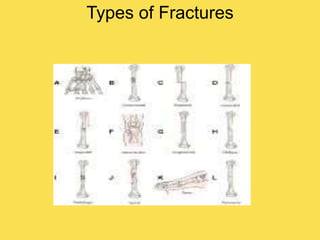
Types of Fractures
• Complete or
Incomplete
• Open (formerly
referred to as
compound)
• Closed (formerly
referred to as simple)
Complete Fractures
• Linear
• Oblique
• Transverse
• Spiral
Complete Fractures
• Comminuted
• Impacted
• Pathologic
• Avulsion
Complete Fractures
• Compression
• Displaced
• Extracapsular
• Intracapsular
Incomplete Fractures
• Greenstick
• Torus
• Bowing fracture
• Transchondral fracture
• Stress Fractures
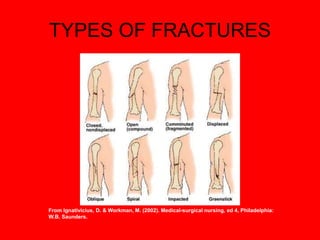
TYPES OF FRACTURES
From Ignativicius, D. & Workman, M. (2002). Medical-surgical nursing, ed 4, Philadelphia:
W.B. Saunders.
Types of Fractures
Pathophysiology of a Fracture
• Tissue Disrupted
• Bleeding Occurs
• Hematoma Forms
• Bone Tissue
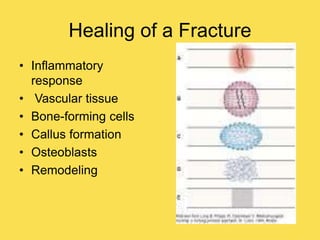
Healing of a Fracture
• Inflammatory
response
• Vascular tissue
• Bone-forming cells
• Callus formation
• Osteoblasts
• Remodeling
Speed of Healing
• Hematoma formation – within hours
• Procallus – within days
• Callus formation – within weeks
• Replacement and remodeling – up
to 4 years
Fractures – Clinical Manifestations
• Impaired function
• Deformity (unnatural
alignment)
• Swelling
• Muscle spasm
• Tenderness
• Pain
• Impaired sensation
FRACTURE OF AN
EXTREMITY
• ASSESSMENT
• INITIAL CARE
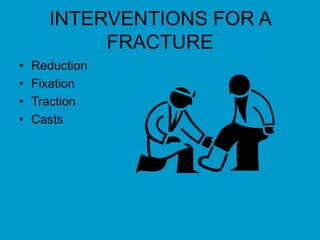
INTERVENTIONS FOR A
FRACTURE
• Reduction
• Fixation
• Traction
• Casts
Fractures - Treatment
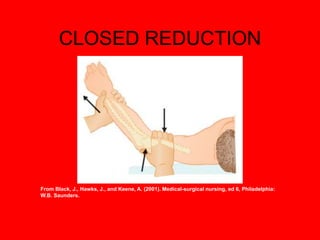
• Reduction
– Closed manipulation
– Traction (skin or skeletal)
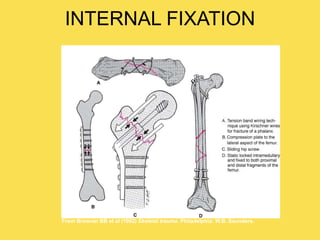
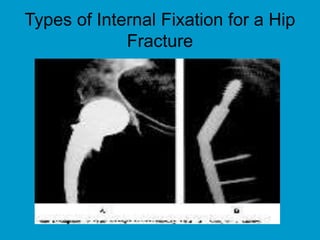
– Open reduction and internal fixation (ORIF),
(insertion of prosthesis, screw, plate, nail or
wire).
CLOSED REDUCTION
From Black, J., Hawks, J., and Keene, A. (2001). Medical-surgical nursing, ed 6, Philadelphia:
W.B. Saunders.
INTERNAL FIXATION
From Browner BB et al (1992) Skeletal trauma. Philadelphia: W.B. Saunders.
Types of Internal Fixation for a Hip
Fracture
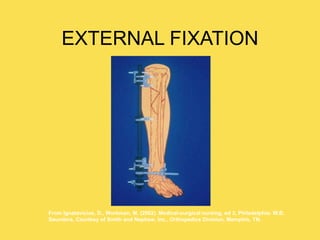
EXTERNAL FIXATION
From Ignatavicius, D., Workman, M. (2002). Medical-surgical nursing, ed 3, Philadelphia: W.B.
Saunders. Courtesy of Smith and Nephew, Inc., Orthopedics Division, Memphis, TN.
TYPES OF HIP FRACTURES
• Intracapsular
• Extracapsular
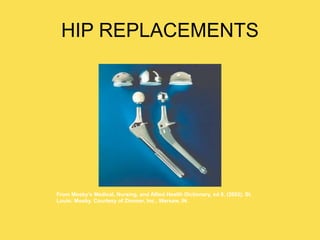
HIP REPLACEMENTS
From Mosby’s Medical, Nursing, and Allied Health Dictionary, ed 6, (2002). St.
Louis: Mosby. Courtesy of Zimmer, Inc., Warsaw, IN.
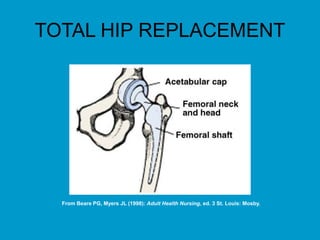
TOTAL HIP REPLACEMENT
From Beare PG, Myers JL (1998): Adult Health Nursing, ed. 3 St. Louis: Mosby.
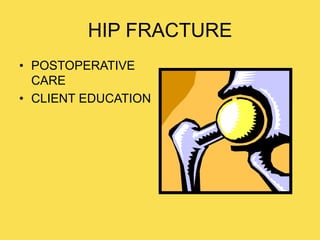
HIP FRACTURE
• POSTOPERATIVE
CARE
• CLIENT EDUCATION
TOTAL KNEE REPLACEMENT
• DESCRIPTION
• POSTOPERATIVE
CARE
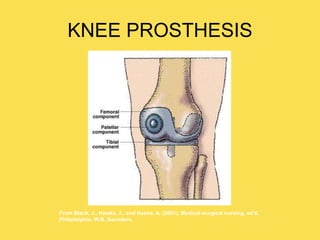
KNEE PROSTHESIS
From Black, J., Hawks, J., and Keene, A. (2001). Medical-surgical nursing, ed 6,
Philadelphia: W.B. Saunders.
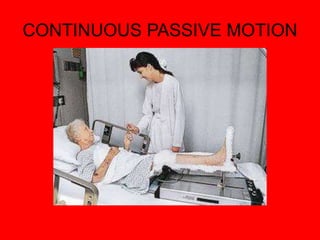
CONTINUOUS PASSIVE MOTION
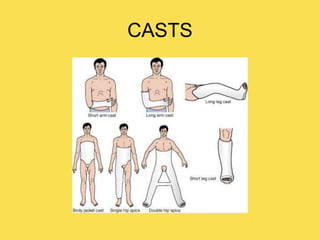
CASTS
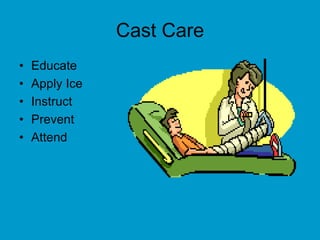
Cast Care
• Educate
• Apply Ice
• Instruct
• Prevent
• Attend
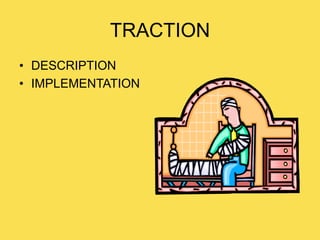
TRACTION
• DESCRIPTION
• IMPLEMENTATION
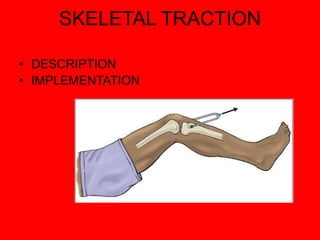
SKELETAL TRACTION
• DESCRIPTION
• IMPLEMENTATION
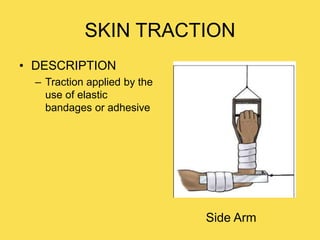
SKIN TRACTION
• DESCRIPTION
– Traction applied by the
use of elastic
bandages or adhesive
Side Arm
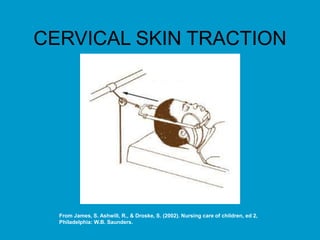
CERVICAL SKIN TRACTION
From James, S. Ashwill, R., & Droske, S. (2002). Nursing care of children, ed 2,
Philadelphia: W.B. Saunders.
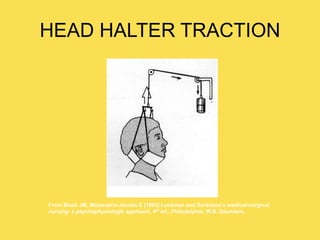
HEAD HALTER TRACTION
From Black JM, Matassarin-Jacobs E (1993) Luckman and Sorensen’s medical-surgical
nursing: a psychophysiologic approach, 4th ed., Philadelphia: W.B. Saunders.
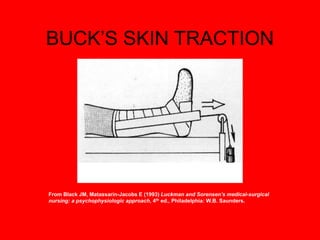
BUCK’S SKIN TRACTION
From Black JM, Matassarin-Jacobs E (1993) Luckman and Sorensen’s medical-surgical
nursing: a psychophysiologic approach, 4th ed., Philadelphia: W.B. Saunders.
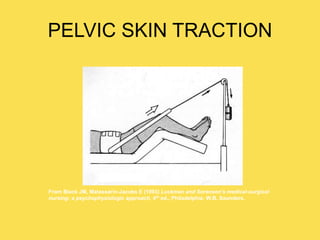
PELVIC SKIN TRACTION
From Black JM, Matassarin-Jacobs E (1993) Luckman and Sorensen’s medical-surgical
nursing: a psychophysiologic approach, 4th ed., Philadelphia: W.B. Saunders.
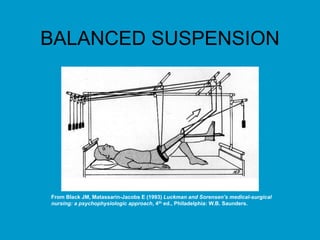
BALANCED SUSPENSION
From Black JM, Matassarin-Jacobs E (1993) Luckman and Sorensen’s medical-surgical
nursing: a psychophysiologic approach, 4th ed., Philadelphia: W.B. Saunders.
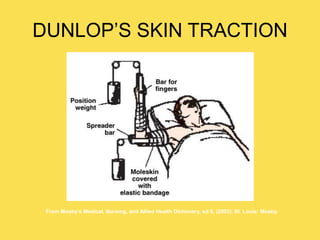
DUNLOP’S SKIN TRACTION
From Mosby’s Medical, Nursing, and Allied Health Dictionary, ed 6, (2002). St. Louis: Mosby.
COMPLICATIONS OF
FRACTURES
• Fat embolism
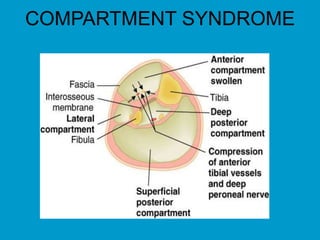
• Compartment syndrome
• Infection and osteomyelitis
• Avascular necrosis
• Pulmonary emboli
• Venous thrombosis
• Delayed union & nonunion
FAT EMBOLISM
• DESCRIPTION
• ASSESSMENT
• IMPLEMENTATION
COMPARTMENT SYNDROME
INFECTION AND
OSTEOMYELITIS
• DESCRIPTION
• ASSESSMENT
• IMPLEMENTATION
AVASCULAR NECROSIS
• DESCRIPTION
• ASSESSMENT
• IMPLEMENTATION
PULMONARY EMBOLISM
• DESCRIPTION
– Caused by immobility precipitated by a
fracture
Venous Thrombosis
• Description
• Assessment
• Implementation
Delayed Union & Nonunion
• Description
• Assessment
• Implementation
Other Skeletal Trauma
• Dislocation
• Subluxation
• Injuries to Support Structures
– Tendon tear
– Ligament tear
– Strain
– Sprain
– Avulsion
– Tendonitis
– Bursitis
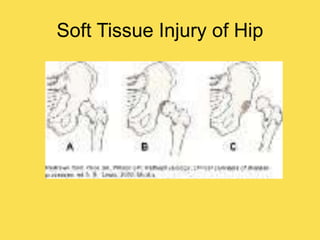
Soft Tissue Injury of Hip
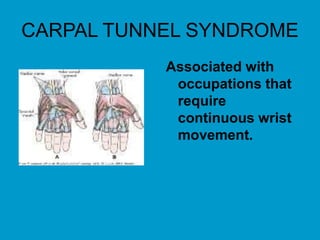
CARPAL TUNNEL SYNDROME
Associated with
occupations that
require
continuous wrist
movement.
Sports-Related Injuries
• Rotator Cuff Tears
• Epicondylitis (Tennis Elbow)
• Lateral & Medial Collateral Ligament Injury
• Anterior & Posterior Cruciate Ligament
Injury
• Meniscal Injuries
• Rupture of Achilles Tendon
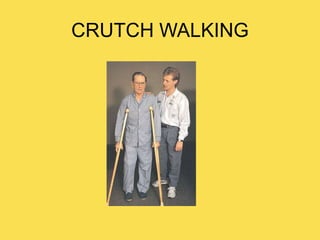
CRUTCH WALKING
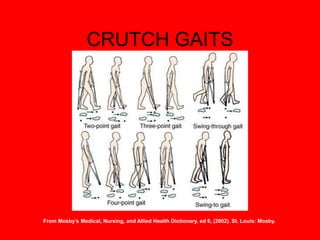
CRUTCH GAITS
From Mosby’s Medical, Nursing, and Allied Health Dictionary, ed 6, (2002). St. Louis: Mosby.
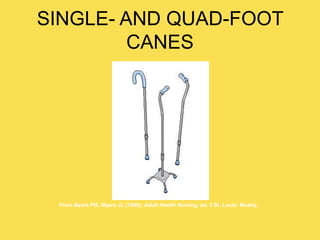
SINGLE- AND QUAD-FOOT
CANES
From Beare PG, Myers JL (1998): Adult Health Nursing, ed. 3 St. Louis: Mosby.
WALKERS
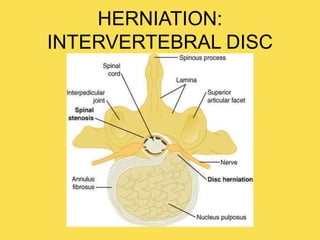
HERNIATION:
INTERVERTEBRAL DISC
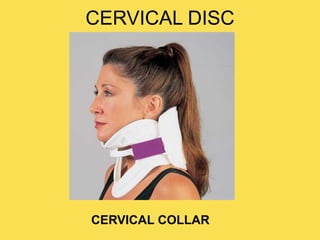
CERVICAL DISC
CERVICAL COLLAR
LUMBAR DISC
• DESCRIPTION
• IMPLEMENTATION
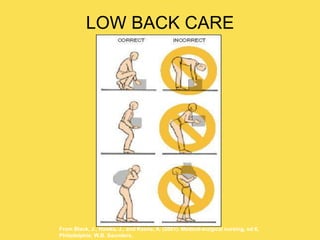
LOW BACK CARE
From Black, J., Hawks, J., and Keene, A. (2001). Medical-surgical nursing, ed 6,
Philadelphia: W.B. Saunders.
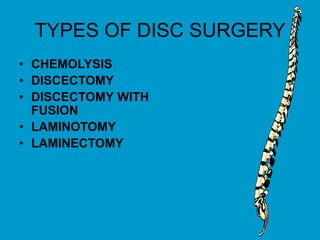
TYPES OF DISC SURGERY
• CHEMOLYSIS
• DISCECTOMY
• DISCECTOMY WITH
FUSION
• LAMINOTOMY
• LAMINECTOMY
DISC SURGERY
• PREOPERATIVE
• POSTOPERATIVE: CERVICAL DISC
• POSTOPERATIVE: LUMBAR DISC
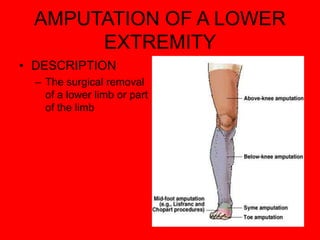
AMPUTATION OF A LOWER
EXTREMITY
• DESCRIPTION
– The surgical removal
of a lower limb or part
of the limb
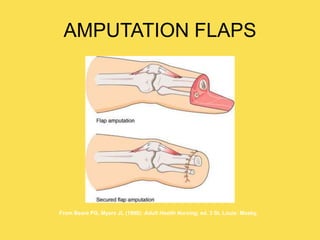
AMPUTATION FLAPS
From Beare PG, Myers JL (1998): Adult Health Nursing, ed. 3 St. Louis: Mosby.
AMPUTATION OF A LOWER
EXTREMITY
• POSTOPERATIVE
– Monitor vital signs
– Monitor for infection and hemorrhage
– Mark bleeding and drainage on the dressing if
it occurs
– Keep a tourniquet at the bedside
– Monitor for pulmonary emboli
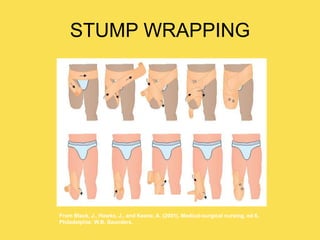
STUMP WRAPPING
From Black, J., Hawks, J., and Keene, A. (2001). Medical-surgical nursing, ed 6,
Philadelphia: W.B. Saunders.
BELOW-THE-KNEE AMPUTATION
• POSTOPERATIVE
– Prevent edema
– Do not allow the stump to hang over the edge
of the bed
– Do not allow the client to sit for long periods of
time to prevent contractures
ABOVE-THE-KNEE
AMPUTATION
• POSTOPERATIVE
– Prevent internal or external rotation of the
limb
– Place a sandbag or rolled towel along the
outside of the thigh to prevent rotation
DISORDERS OF BONE
• Metabolic Bones Diseases
• Infectious Bone Disease
• Bone Tumors
Infectious Bone Disease:
Osteomyelitis
• Difficult to treat
• Physical disability
• Bacteria
– Exogenous
– Endogenous
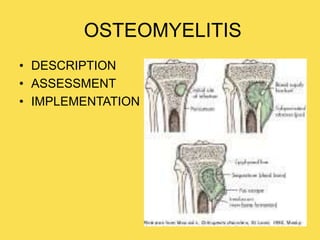
OSTEOMYELITIS
• DESCRIPTION
• ASSESSMENT
• IMPLEMENTATION
Bone Tumors
• Incidence
• Signs & Symptoms
• Diagnosis
DISORDERS OF JOINTS
• Noninflammatory joint
disease
• Inflammatory joint
disease
INFLAMMATORY JOINT DISEASE
• Rheumatoid arthritis
• Ankylosing
Spondylitis
• Gouty arthritis
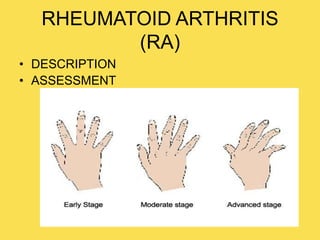
RHEUMATOID ARTHRITIS
(RA)
• DESCRIPTION
• ASSESSMENT
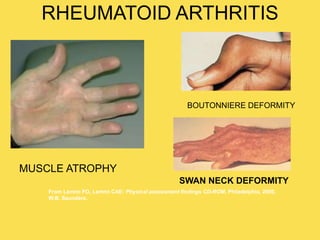
RHEUMATOID ARTHRITIS
From Lemmi FO, Lemmi CAE: Physical assessment findings CD-ROM, Philadelphia, 2000,
W.B. Saunders.
MUSCLE ATROPHY
BOUTONNIERE DEFORMITY
SWAN NECK DEFORMITY
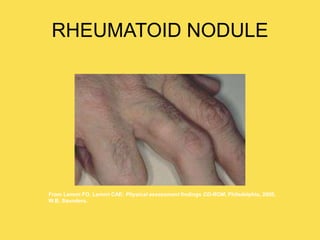
RHEUMATOID NODULE
From Lemmi FO, Lemmi CAE: Physical assessment findings CD-ROM, Philadelphia, 2000,
W.B. Saunders.
RHEUMATOID ARTHRITIS
(RA)
• NONSTEROIDAL
ANTIINFLAMMATORY
DRUGS (NSAIDs)
• CORTICOSTEROIDS
• ANTINEOPLASTIC
MEDICATIONS
• GOLD SALTS
RHEUMATOID ARTHRITIS
(RA)
• PHYSICAL MOBILITY
• SELF-CARE
RHEUMATOID ARTHRITIS
(RA)
• FATIGUE
• BODY IMAGE
DISTURBANCE
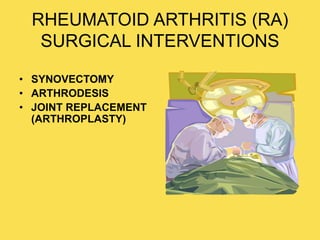
RHEUMATOID ARTHRITIS (RA)
SURGICAL INTERVENTIONS
• SYNOVECTOMY
• ARTHRODESIS
• JOINT REPLACEMENT
(ARTHROPLASTY)
Ankylosing Spondylitis
• Chronic Inflammatory Disease
• Systemic autoimmune disease
• Differs from RA
• Signs & Symptoms
• Treatment
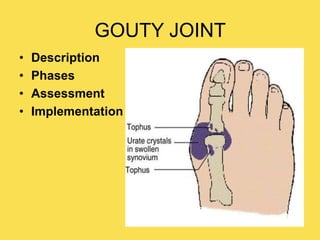
GOUTY JOINT
• Description
• Phases
• Assessment
• Implementation
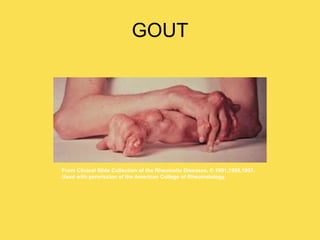
GOUT
From Clinical Slide Collection of the Rheumatic Diseases, © 1991,1995,1997.
Used with permission of the American College of Rheumatology.
Noninflammatory Joint Disease
• Degenerative joint
disease
(osteoarthritis) is the
most common
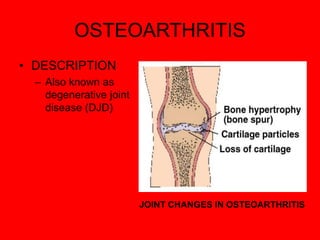
OSTEOARTHRITIS
• DESCRIPTION
– Also known as
degenerative joint
disease (DJD)
JOINT CHANGES IN OSTEOARTHRITIS
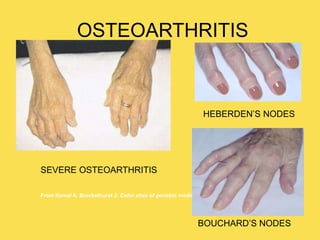
OSTEOARTHRITIS
From Kamal A, Brockelhurst J: Color atlas of geriatric medicine, ed. 2, St. Louis, 1991, Mosby.
SEVERE OSTEOARTHRITIS
HEBERDEN’S NODES
BOUCHARD’S NODES
OSTEOARTHRITIS
• PHYSICAL MOBILITY
OSTEOARTHRITIS
SURGICAL INTERVENTIONS
• OSTEOTOMY
• TOTAL JOINT
REPLACEMENT
(TJR)
RHEUMATOID ARTHRITIS
AND OSTEOARTHRITIS
CLIENT EDUCATION
• Assist
• Instruct
• Review
Metabolic Bone Diseases
• Osteoporosis
• Osteomalacia
• Paget’s Disease
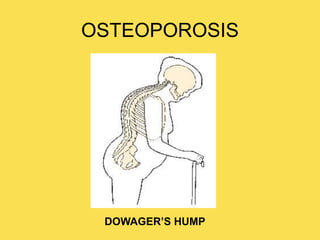
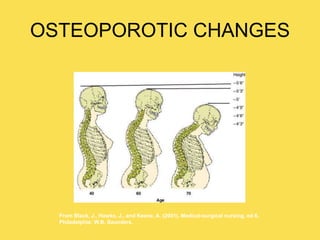
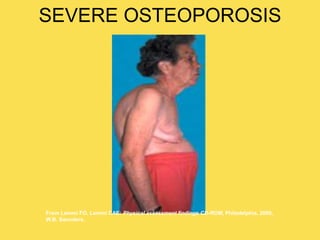
OSTEOPOROSIS
DOWAGER’S HUMP
OSTEOPOROTIC CHANGES
From Black, J., Hawks, J., and Keene, A. (2001). Medical-surgical nursing, ed 6,
Philadelphia: W.B. Saunders.
SEVERE OSTEOPOROSIS
From Lemmi FO, Lemmi CAE: Physical assessment findings CD-ROM, Philadelphia, 2000,
W.B. Saunders.
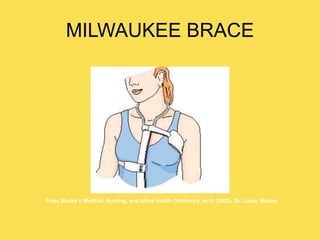
MILWAUKEE BRACE
From Mosby’s Medical, Nursing, and Allied Health Dictionary, ed 6, (2002). St. Louis: Mosby.
OSTEOMALACIA
• Metabolic disease
• Bone volume unchanged
• Osteomalacia – adults
• Rickets - children
Paget’s Disease
• Osteitis Deformans
• Increased metabolic activity
• Usually no TX
• Affects men and women equally
Nursing Diagnoses
• Knowledge Deficit
• Impaired Physical Mobility
• Self-care Deficit
• Risk for Infection
• Impaired Skin Integrity
• Imbalanced Nutrition
• Acute/Chronic Pain
THE END OF MUSCULOSKELETAL

46e9b35d-9965-44c7-9272-5740b934ef2d.ppt