1
Center for Advancing Research
in Transportation Emissions,
Energy, and Health
A USDOT University Transportation Center
www.carteeh.org
2
Lecture #43: Transportation Decision Making—
Overview and Process
Dr. Carlos Chang
UNIVERSITY OF TEXAS AT EL PASO
Phone Number: 915-747-8301
The author declares that there is no conflict of interest
The author reserves the rights to use this lecture for education purposes
E-mail: cchangalbitres2@utep.edu
Lecture Track(s): HT/TT/PPT
3
Introduction
The Transportation Decision Making process is
performed at different interactive levels: strategic,
network, project selection, and project level.
This lecture focusses on Transportation Asset
Management (TAM) concepts and applications to make
cost-effective strategic decisions to achieve
environmental, social, and economic goals for
sustainable healthy communities.
4
“ Transportation Asset Management is a strategic and
systematic process of operating, maintaining, upgrading and
expanding physical assets effectively throughout their
lifecycle. It focuses on business and engineering practices for
resource allocation and utilization, with the objective of better
decision making based upon quality information and well
defined objectives.”
(NCHRP, 2009)
What is Transportation Asset Management (TAM) ?
5
• Strategic (Asset) – Planning, Programming & Allocation for
all Systems
• Network - Planning & Programming for Entire Set of Type
Facility Managed
• Project Selection - Programming a Subset
• Project - Designing a Specific Section
Responsibilities: Management Levels
6
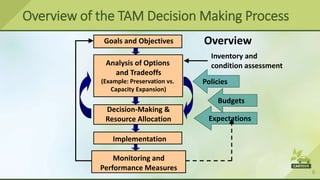
Overview of the TAM Decision Making Process
Expectations
Decision-Making &
Resource Allocation
Goals and Objectives
Analysis of Options
and Tradeoffs
(Example: Preservation vs.
Capacity Expansion)
Implementation
Monitoring and
Performance Measures
Budgets
Policies
Inventory and
condition assessment
Overview
7
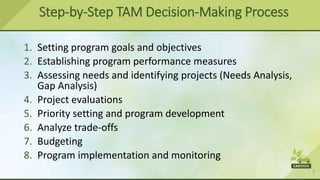
Step-by-Step TAM Decision-Making Process
1. Setting program goals and objectives
2. Establishing program performance measures
3. Assessing needs and identifying projects (Needs Analysis,
Gap Analysis)
4. Project evaluations
5. Priority setting and program development
6. Analyze trade-offs
7. Budgeting
8. Program implementation and monitoring
8
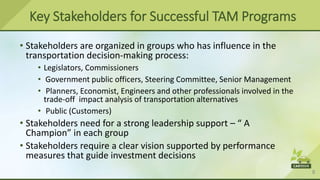
• Stakeholders are organized in groups who has influence in the
transportation decision-making process:
• Legislators, Commissioners
• Government public officers, Steering Committee, Senior Management
• Planners, Economist, Engineers and other professionals involved in the
trade-off impact analysis of transportation alternatives
• Public (Customers)
• Stakeholders need for a strong leadership support – “ A
Champion” in each group
• Stakeholders require a clear vision supported by performance
measures that guide investment decisions
Key Stakeholders for Successful TAM Programs
9
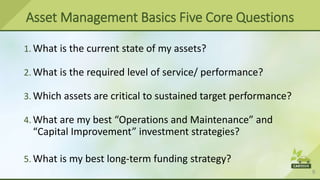
Asset Management Basics Five Core Questions
1. What is the current state of my assets?
2. What is the required level of service/ performance?
3. Which assets are critical to sustained target performance?
4. What are my best “Operations and Maintenance” and
“Capital Improvement” investment strategies?
5. What is my best long-term funding strategy?
10
Network Management Level Elements
• Inventory
• Condition Assessment
• Determination of Needed Work and Funds
• Identification of Candidate Projects
• Determination of Impacts of Funding Alternatives
• Feedback
11
Management Technical Aspects
• Set Target Level of Service /Performance Goals (Economics, Social,
Environment)
• Develop Asset Inventory
• Condition Assessment, Failure Modes
• Determine Remaining Service Life
• Determine Life Cycle and Replacement Costs (Example: LCCA)
Business (Financial) Analysis
• Determine Business Risk (Example: B/C Analysis)
• Optimize Operation and Maintenance
• Optimize Capital Investment
• Determine Funding Strategy
How to Develop and Implement a Transportation
Asset Management Program?
12
• What are the necessary attributes of each of the assets and how
to register and maintain the data?
• What assets in the infrastructure network require immediate
attention based on needs analysis?
• What are cost effective data collection procedures and what
accuracy and frequency of data collection is recommended?
• What is the impact of short and log term asset management
plans in the network condition?
Checklist for the Implementation of Asset Management
13
• How to allocate limited funds among assets based on
location and priorities set by the agency?
• What are the results of trade off analysis in the different
types of assets managed by the agency?
• How performance metrics will evolve due to the
implementation of an asset management strategy?
• How to better communicate funding need using tools to
visualize the results of gap analysis?
Checklist for the Implementation of Asset Management
Cont…
14
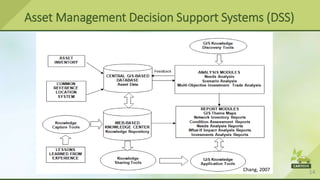
Asset Management Decision Support Systems (DSS)
Chang, 2007
15
• To improve communication across departments when working in
multidisciplinary team projects with different types of assets.
• To enhance the decision making process when developing
management plans through better communication and analysis
tools.
• To maximize cost savings resulting from greater efficiency in
management operations.
Benefits of Implementing Asset Management Practices
16
Role of the Environment and Human Health in
Transportation Decision Making
• TAM focusses on the strategic goals of the agency, performance
measures, and system performance, and those should considered
metrics for the environment and human health.
• Asses the performance of the transportation system with desired
performance measures as targets and demonstrate how
transportation decisions affect the environment and human health.
• Monetary impact of the decisions and whole life
performance/investment analysis to optimize investments on a long
term basis used to support decision making
• Need to model in the transportation decision making process
“sustainability performance measures toward reaching agency goals
in safety, mobility and the environment.” (Chang, 2017)
17
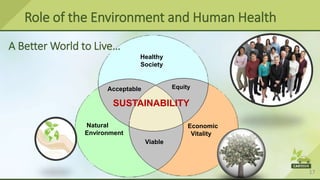
SUSTAINABILITY
Healthy
Society
Acceptable Equity
Natural
Environment
Viable
Economic
Vitality
Role of the Environment and Human Health
A Better World to Live…
18
Topics for Discussion
• How to manage effectively along the whole-life cycle of
the transportation assets?
• What performance measures related to the environment
and human health can be used for investment decisions?
• How to implement an investment strategy that are based
on life cycle cost and benefit/cost ratio analysis
incorporating environment and human health?
• How to prepare transportation decision making champions
in an organization?
19
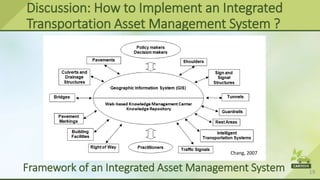
Framework of an Integrated Asset Management System
Discussion: How to Implement an Integrated
Transportation Asset Management System ?
Chang, 2007
20
Research Gaps and Future Directions
• How to integrate new data collection techniques combined with
artificial intelligence to enhance the transportation decision-making
process?
• How to deal with the uncertainty of social, economical, changes in
future decision-making scenarios?
• What performance models and metrics can be used to quantify the
impact of transportation decisions in the environmental, social, and
economic aspects of sustainability?
• What methods to apply to minimize the risk of the investments over
the whole life cycle of the transportation assets?
21
Take-Home Messages
1. TAM emphasizes the strategic view of the decision-making process
• Policy driven
• Investment analysis
• Data supported
• Performance-based Oriented
2. TAM decision-making cross impacts through all types of
infrastructure assets
3. People making transportation decisions at different level about:
• Goals/Policies
• Funding Levels
• Alternative Solutions and Project Selection
• Funding Allocation and Prioritization
22
• B/C : Benefit / Cost Ratio
• DSS : Decision-support Systems
• LCCA: Life Cycle Cost Analysis
• TAM : Transportation Asset Management
List of Abbreviations
23
• AASHTO. 2002. Transportation Asset Management Guide. American
Association of State Highway and Transportation Officials (AASHTO),
Washington, D.C..
• Cambridge Systematics Inc. 2009. An Asset-Management Framework
for the Interstate Highway System. National Cooperative Highway
Research Program Report 632. The National Academies of Science.
Washington, D.C.
• Chang C., Nazarian, S., Vavrova, M., Yapp, M., Pierce, L., Robert, W.,
Smith, R. 2017. Consequences of Delayed Maintenance of Highway
Assets. National Cooperative Highway Research Program Report 859.
The National Academies of Science. Washington, D.C.
References
24
• Chang-Albitres, C. 2007. Development of a Multi-Objective Strategic
Management Approach to Improve Decisions for Pavement
Management Practices in Local Agencies. Dissertation. Texas A&M,
College Station, Texas.
References
25
• AASHTO TAM Portal ( http://www.tam-portal.com/ )
• Chang, C. 2020. CE 6301 Infrastructure Management, Class Notes.
University of Texas at El Paso. El Paso, Texas.
• FHWA. 1999. Asset Management Primer. Federal Highway
Administration (FHWA). U.S. Department of Transportation.
Washington, D.C.
• FHWA Asset Management website ( http://www.fhwa.dot.gov/asset/)
Reading List
26
A deep sense of gratitude is owed to Dr. Roger E. Smith who
introduced me to Asset Management and for his mentoring
throughout my academic career.
Acknowledgements

43.-Transportation-Decision-Making—Overview-and-Process_23Sep2020 (2).pptx

  • 1.
    1 Center for AdvancingResearch in Transportation Emissions, Energy, and Health A USDOT University Transportation Center www.carteeh.org
  • 2.
    2 Lecture #43: TransportationDecision Making— Overview and Process Dr. Carlos Chang UNIVERSITY OF TEXAS AT EL PASO Phone Number: 915-747-8301 The author declares that there is no conflict of interest The author reserves the rights to use this lecture for education purposes E-mail: cchangalbitres2@utep.edu Lecture Track(s): HT/TT/PPT
  • 3.
    3 Introduction The Transportation DecisionMaking process is performed at different interactive levels: strategic, network, project selection, and project level. This lecture focusses on Transportation Asset Management (TAM) concepts and applications to make cost-effective strategic decisions to achieve environmental, social, and economic goals for sustainable healthy communities.
  • 4.
    4 “ Transportation AssetManagement is a strategic and systematic process of operating, maintaining, upgrading and expanding physical assets effectively throughout their lifecycle. It focuses on business and engineering practices for resource allocation and utilization, with the objective of better decision making based upon quality information and well defined objectives.” (NCHRP, 2009) What is Transportation Asset Management (TAM) ?
  • 5.
    5 • Strategic (Asset)– Planning, Programming & Allocation for all Systems • Network - Planning & Programming for Entire Set of Type Facility Managed • Project Selection - Programming a Subset • Project - Designing a Specific Section Responsibilities: Management Levels
  • 6.
    6 Overview of theTAM Decision Making Process Expectations Decision-Making & Resource Allocation Goals and Objectives Analysis of Options and Tradeoffs (Example: Preservation vs. Capacity Expansion) Implementation Monitoring and Performance Measures Budgets Policies Inventory and condition assessment Overview
  • 7.
    7 Step-by-Step TAM Decision-MakingProcess 1. Setting program goals and objectives 2. Establishing program performance measures 3. Assessing needs and identifying projects (Needs Analysis, Gap Analysis) 4. Project evaluations 5. Priority setting and program development 6. Analyze trade-offs 7. Budgeting 8. Program implementation and monitoring
  • 8.
    8 • Stakeholders areorganized in groups who has influence in the transportation decision-making process: • Legislators, Commissioners • Government public officers, Steering Committee, Senior Management • Planners, Economist, Engineers and other professionals involved in the trade-off impact analysis of transportation alternatives • Public (Customers) • Stakeholders need for a strong leadership support – “ A Champion” in each group • Stakeholders require a clear vision supported by performance measures that guide investment decisions Key Stakeholders for Successful TAM Programs
  • 9.
    9 Asset Management BasicsFive Core Questions 1. What is the current state of my assets? 2. What is the required level of service/ performance? 3. Which assets are critical to sustained target performance? 4. What are my best “Operations and Maintenance” and “Capital Improvement” investment strategies? 5. What is my best long-term funding strategy?
  • 10.
    10 Network Management LevelElements • Inventory • Condition Assessment • Determination of Needed Work and Funds • Identification of Candidate Projects • Determination of Impacts of Funding Alternatives • Feedback
  • 11.
    11 Management Technical Aspects •Set Target Level of Service /Performance Goals (Economics, Social, Environment) • Develop Asset Inventory • Condition Assessment, Failure Modes • Determine Remaining Service Life • Determine Life Cycle and Replacement Costs (Example: LCCA) Business (Financial) Analysis • Determine Business Risk (Example: B/C Analysis) • Optimize Operation and Maintenance • Optimize Capital Investment • Determine Funding Strategy How to Develop and Implement a Transportation Asset Management Program?
  • 12.
    12 • What arethe necessary attributes of each of the assets and how to register and maintain the data? • What assets in the infrastructure network require immediate attention based on needs analysis? • What are cost effective data collection procedures and what accuracy and frequency of data collection is recommended? • What is the impact of short and log term asset management plans in the network condition? Checklist for the Implementation of Asset Management
  • 13.
    13 • How toallocate limited funds among assets based on location and priorities set by the agency? • What are the results of trade off analysis in the different types of assets managed by the agency? • How performance metrics will evolve due to the implementation of an asset management strategy? • How to better communicate funding need using tools to visualize the results of gap analysis? Checklist for the Implementation of Asset Management Cont…
  • 14.
    14 Asset Management DecisionSupport Systems (DSS) Chang, 2007
  • 15.
    15 • To improvecommunication across departments when working in multidisciplinary team projects with different types of assets. • To enhance the decision making process when developing management plans through better communication and analysis tools. • To maximize cost savings resulting from greater efficiency in management operations. Benefits of Implementing Asset Management Practices
  • 16.
    16 Role of theEnvironment and Human Health in Transportation Decision Making • TAM focusses on the strategic goals of the agency, performance measures, and system performance, and those should considered metrics for the environment and human health. • Asses the performance of the transportation system with desired performance measures as targets and demonstrate how transportation decisions affect the environment and human health. • Monetary impact of the decisions and whole life performance/investment analysis to optimize investments on a long term basis used to support decision making • Need to model in the transportation decision making process “sustainability performance measures toward reaching agency goals in safety, mobility and the environment.” (Chang, 2017)
  • 17.
  • 18.
    18 Topics for Discussion •How to manage effectively along the whole-life cycle of the transportation assets? • What performance measures related to the environment and human health can be used for investment decisions? • How to implement an investment strategy that are based on life cycle cost and benefit/cost ratio analysis incorporating environment and human health? • How to prepare transportation decision making champions in an organization?
  • 19.
    19 Framework of anIntegrated Asset Management System Discussion: How to Implement an Integrated Transportation Asset Management System ? Chang, 2007
  • 20.
    20 Research Gaps andFuture Directions • How to integrate new data collection techniques combined with artificial intelligence to enhance the transportation decision-making process? • How to deal with the uncertainty of social, economical, changes in future decision-making scenarios? • What performance models and metrics can be used to quantify the impact of transportation decisions in the environmental, social, and economic aspects of sustainability? • What methods to apply to minimize the risk of the investments over the whole life cycle of the transportation assets?
  • 21.
    21 Take-Home Messages 1. TAMemphasizes the strategic view of the decision-making process • Policy driven • Investment analysis • Data supported • Performance-based Oriented 2. TAM decision-making cross impacts through all types of infrastructure assets 3. People making transportation decisions at different level about: • Goals/Policies • Funding Levels • Alternative Solutions and Project Selection • Funding Allocation and Prioritization
  • 22.
    22 • B/C :Benefit / Cost Ratio • DSS : Decision-support Systems • LCCA: Life Cycle Cost Analysis • TAM : Transportation Asset Management List of Abbreviations
  • 23.
    23 • AASHTO. 2002.Transportation Asset Management Guide. American Association of State Highway and Transportation Officials (AASHTO), Washington, D.C.. • Cambridge Systematics Inc. 2009. An Asset-Management Framework for the Interstate Highway System. National Cooperative Highway Research Program Report 632. The National Academies of Science. Washington, D.C. • Chang C., Nazarian, S., Vavrova, M., Yapp, M., Pierce, L., Robert, W., Smith, R. 2017. Consequences of Delayed Maintenance of Highway Assets. National Cooperative Highway Research Program Report 859. The National Academies of Science. Washington, D.C. References
  • 24.
    24 • Chang-Albitres, C.2007. Development of a Multi-Objective Strategic Management Approach to Improve Decisions for Pavement Management Practices in Local Agencies. Dissertation. Texas A&M, College Station, Texas. References
  • 25.
    25 • AASHTO TAMPortal ( http://www.tam-portal.com/ ) • Chang, C. 2020. CE 6301 Infrastructure Management, Class Notes. University of Texas at El Paso. El Paso, Texas. • FHWA. 1999. Asset Management Primer. Federal Highway Administration (FHWA). U.S. Department of Transportation. Washington, D.C. • FHWA Asset Management website ( http://www.fhwa.dot.gov/asset/) Reading List
  • 26.
    26 A deep senseof gratitude is owed to Dr. Roger E. Smith who introduced me to Asset Management and for his mentoring throughout my academic career. Acknowledgements

Editor's Notes

  • #3 Health Track (HT)—mainly targeted at urban planners, transportation planners, and engineers with limited knowledge of public health-related concepts; Transportation Track (TT)—mainly targeted at environmental epidemiologists and public health professionals with limited knowledge of transportation-related concepts; and; Planning and Policy Track (PPT)—mainly targeted at planners, civil servants, and policy and decision makers with particular interest in the science-policy link.
  • #4 Notes: The entire lecture is oriented to Transportation Asset Management (TAM) concepts, elements and recommendations.
  • #5 Note: TAM formal definition
  • #6 Note: Distinction of the management levels
  • #7 This flow chart shows a typical Transportation Asset Management process (Asset Management is important and this is what it means in practice): · Policy Goals and Objectives - Policies in Asset Management have to be realistic, they have to be clear, and have to have the “buy-in” from all who are responsible for implementing them. They are supported by quantifiable performance measures and service levels used to guide the overall resource allocation and program delivery processes. · Analysis of Options and Tradeoffs - This includes examination of options within each investment area, as well as tradeoffs across different investment areas which support the agency’s policies, goals and objectives. The definition of investment areas is flexible and needs to be tailored to how an individual agency does business. Option analysis and tradeoff analysis are often facilitated by economic analysis methods. · Decision Making and Resource Allocation - These decisions are the critical allocations of dollars, staff, equipment, materials, and other resources to different strategies, programs, projects, or asset classes within the organization. They are always based on the results of the proactive analysis of the options and tradeoffs and cover all investment areas and focus directly on performance goals and service levels with life-cycle performance considerations. Customer expectations can not be forgotten.  · Implementation and Program Delivery - The critical issue here is that programs need to be accomplished in the most cost-effective manner that can meet the performance targets. It may involve consideration of different delivery options, such as using contractors, interagency agreements, or design-build projects. Program delivery also means having a systematic way to monitor actions taken, costs, efficiency, and lessons learned to guide future decisions and analyses. (On time and within budget.) · Monitoring System Conditions and Performance Measures - This is the monitoring and the all important feedback portion of Asset Management that measures the extent to which established performance objectives are being addressed. This information has to be objective, current, and targeted toward the goals, objectives, and priorities set by the agency. Analysis is needed to Optimize Operation and Maintenance and Optimize Capital Investment. As a result Funding Strategy needs to be developed as part of an Asset Management Plan.
  • #8 Notes: The previous slide show the overview of the TAM Decision Making Process. This slide list the steps for the TAM process.
  • #10 Note: Essential questions to define Asset Management with focus on implementation.
  • #12 Note: key aspects to implement TAM
  • #13 Note: Questions to ask by the agency to prepare a program to implement TAM.
  • #15 Note: To implement TAM there is a need of DSS with GIS and a Knowledge Database
  • #16 Note: To foster communication, TAM benefits must be highlighted.
  • #17 Note: The need to have performance measures to connect TAM with environment and human health. Also modeling TAM decision making process to reach agency goals.
  • #18 Note: Look for the equilibrium of a “Healthy Society” , “Natural Environment” and “Economic Vitality”. Major focus should be on the people with “people oriented” management approach.
  • #19 Notes: Key topics for TAM successful implementation.
  • #20 NOTES: Diagram that emphasizes the need to have an integrated approach across transportation assets.
  • #21 Notes: Key topics that require further attention for TAM future development.
  • #22 Notes: Summary of important TAM topics described before in the slides.
  • #23 Notes: Acronyms mentioned in the slides
  • #26 Notes: Addition recommended sources of information for TAM