4.3 Logarithmic
Functions
Definition of the Logarithmic
Function pg. 344
Let 𝑎 be a positive number with 𝑎 ≠ 1. The
logarithmic function with base 𝒂, denoted
log𝑎, is defined by
log𝑎 𝑥 = 𝑦 ↔ 𝑎𝑦
= 𝑥
So log𝑎 𝑥 is the exponent to which the base
𝑎 must be raised to give 𝑥
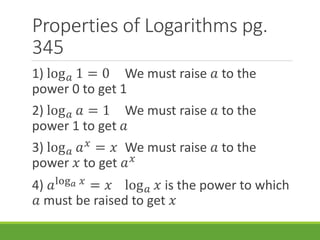
Properties of Logarithms pg.
345
1) log𝑎 1 = 0 We must raise 𝑎 to the
power 0 to get 1
2) log𝑎 𝑎 = 1 We must raise 𝑎 to the
power 1 to get 𝑎
3) log𝑎 𝑎𝑥
= 𝑥 We must raise 𝑎 to the
power 𝑥 to get 𝑎𝑥
4) 𝑎log𝑎 𝑥
= 𝑥 log𝑎 𝑥 is the power to which
𝑎 must be raised to get 𝑥
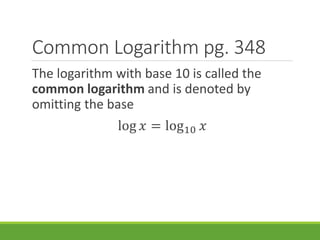
Common Logarithm pg. 348
The logarithm with base 10 is called the
common logarithm and is denoted by
omitting the base
log 𝑥 = log10 𝑥
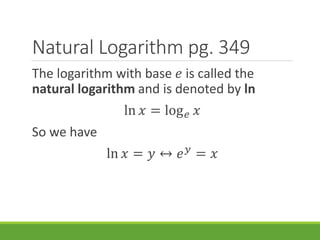
Natural Logarithm pg. 349
The logarithm with base 𝑒 is called the
natural logarithm and is denoted by ln
ln 𝑥 = log𝑒 𝑥
So we have
ln 𝑥 = 𝑦 ↔ 𝑒𝑦
= 𝑥
Properties of Natural
Logarithm pg. 349
1) ln 1 = 0 We must raise 𝑒 to the
power 0 to get 1
2) ln 𝑒 = 1 We must raise 𝑒 to the
power 1 to get 𝑒
3) ln 𝑒𝑥
= 𝑥 We must raise 𝑒 to the
power 𝑥 to get 𝑒𝑥
4) 𝑒ln 𝑥
= 𝑥 ln 𝑥 is the power to which 𝑒
must be raised to get 𝑥

4.3 Logarithmic Functions.pptx

  • 1.
  • 2.
    Definition of theLogarithmic Function pg. 344 Let 𝑎 be a positive number with 𝑎 ≠ 1. The logarithmic function with base 𝒂, denoted log𝑎, is defined by log𝑎 𝑥 = 𝑦 ↔ 𝑎𝑦 = 𝑥 So log𝑎 𝑥 is the exponent to which the base 𝑎 must be raised to give 𝑥
  • 3.
    Properties of Logarithmspg. 345 1) log𝑎 1 = 0 We must raise 𝑎 to the power 0 to get 1 2) log𝑎 𝑎 = 1 We must raise 𝑎 to the power 1 to get 𝑎 3) log𝑎 𝑎𝑥 = 𝑥 We must raise 𝑎 to the power 𝑥 to get 𝑎𝑥 4) 𝑎log𝑎 𝑥 = 𝑥 log𝑎 𝑥 is the power to which 𝑎 must be raised to get 𝑥
  • 4.
    Common Logarithm pg.348 The logarithm with base 10 is called the common logarithm and is denoted by omitting the base log 𝑥 = log10 𝑥
  • 5.
    Natural Logarithm pg.349 The logarithm with base 𝑒 is called the natural logarithm and is denoted by ln ln 𝑥 = log𝑒 𝑥 So we have ln 𝑥 = 𝑦 ↔ 𝑒𝑦 = 𝑥
  • 6.
    Properties of Natural Logarithmpg. 349 1) ln 1 = 0 We must raise 𝑒 to the power 0 to get 1 2) ln 𝑒 = 1 We must raise 𝑒 to the power 1 to get 𝑒 3) ln 𝑒𝑥 = 𝑥 We must raise 𝑒 to the power 𝑥 to get 𝑒𝑥 4) 𝑒ln 𝑥 = 𝑥 ln 𝑥 is the power to which 𝑒 must be raised to get 𝑥