Part 2
Types of Cooperative Purchasing
• Welcome!
• The webinar will be recorded and available at
  www.ncba.coop

• We welcome your questions! Submit them
  anytime by typing them into the chat box in
  the control box on your screen.
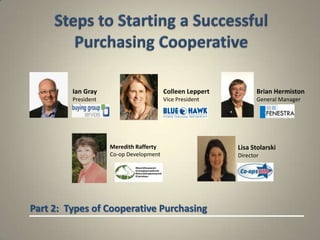
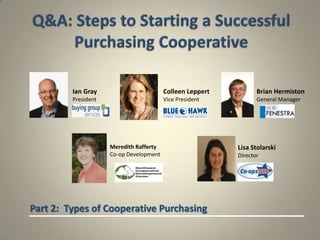
Ian Gray                        Colleen Leppert          Brian Hermiston
         President                       Vice President           General Manager


                     Meredith Rafferty                     Lisa Stolarski
                     Co-op Development                     Director


Part 2: Types of Cooperative Purchasing
• Defining and Differentiating
  – Purchasing Cooperatives
  – Group Buying
  – Governmental Cooperative Purchasing
• Purchasing Co-op Models
  – Direct Bill
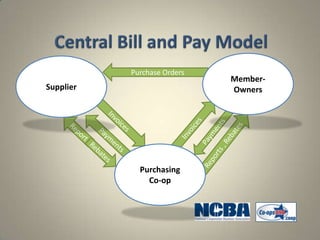
  – Central Bill and Pay
  – Central Pay
• Legal Structure, Bylaws and Governance
Legally incorporated business…
That provides value to its “members” by
leveraging their combined purchases to
achieve lower net prices and better terms on
the products they buy.
Operates using “Cooperative Principles”
Example: Carpet One
Legally incorporated business…
That provides value to its “customers” by
leveraging their combined purchases to
achieve lower net prices and better terms on
the products they buy.
Strategy & Profit distribution determined by
majority vote of Shareholders
Example: Affiliated Distributors
• Statutorily required “equitable and
  transparent” process
• Contract typically arranged by
  central department
• Accessed by other governmental &
  nonprofit entities as authorized
Other ways to seek better prices & terms:
  – Consumers submit one order
  – Consumer membership in a discount
    store
  – Business membership in a buying
    service
Primary business models :
   Direct Bill
   Central Bill and Pay
   Central Pay
Model drives the:
  •Legal requirements
  •Start-up capital / security
  •IT system requirements
  •Member interaction with co-op and
  suppliers
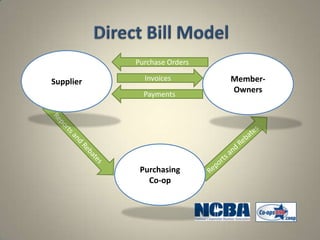
Purchase Orders

Supplier     Invoices        Member-
             Payments
                             Owners


            Purchasing
              Co-op
Pro’s
• No disruption to current supply
  relationships
• No credit risk taken on by Co-op
• Low cost operation
Con’s
• Co-op not seen as the “buyer”
• No real time information for rebate
  targets
• Reliance on suppliers for information
•Formed in 2005
• Independent HVACR wholesale distributors
 (heating, ventilation, air conditioning and refrigeration)
• 232 member-owners with 1,174 locations in
  all 50 states
• 117 vendor partners
Purchase Orders
                             Member-
Supplier                     Owners


             Purchasing
               Co-op
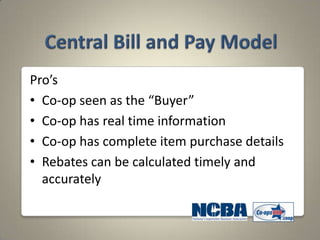
Pro’s
• Co-op seen as the “Buyer”
• Co-op has real time information
• Co-op has complete item purchase details
• Rebates can be calculated timely and
  accurately
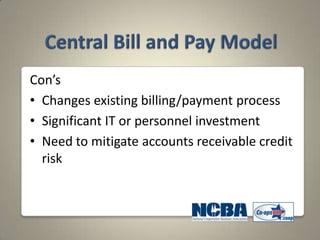
Con’s
• Changes existing billing/payment process
• Significant IT or personnel investment
• Need to mitigate accounts receivable credit
  risk
Tim-Br Marts Limited

• National Canadian lumber, hardware and
  building materials
• Over 700 retail locations
• Over $2 billion in purchases
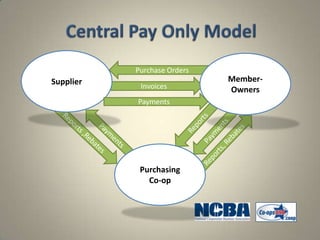
Purchase Orders
Supplier                     Member-
            Invoices         Owners
           Payments


            Purchasing
              Co-op
Pro’s
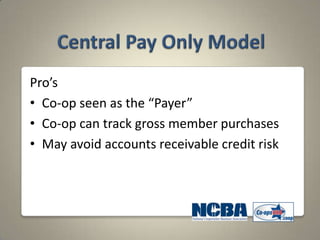
• Co-op seen as the “Payer”
• Co-op can track gross member purchases
• May avoid accounts receivable credit risk
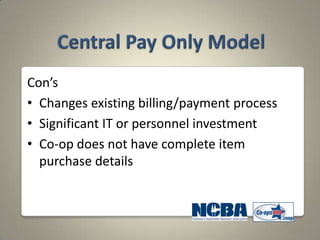
Con’s
• Changes existing billing/payment process
• Significant IT or personnel investment
• Co-op does not have complete item
  purchase details
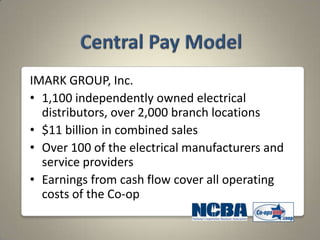
IMARK GROUP, Inc.
• 1,100 independently owned electrical
  distributors, over 2,000 branch locations
• $11 billion in combined sales
• Over 100 of the electrical manufacturers and
  service providers
• Earnings from cash flow cover all operating
  costs of the Co-op
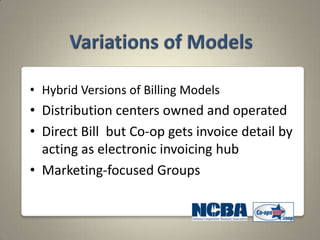
• Hybrid Versions of Billing Models
• Distribution centers owned and operated
• Direct Bill but Co-op gets invoice detail by
  acting as electronic invoicing hub
• Marketing-focused Groups
• USDA: “user-owned, user-controlled business
  that distributes benefits on the basis of use.”
• International Co-operative Alliance (ICA): “an
  autonomous association of persons united
  voluntarily to meet their common economic,
  social, and cultural needs and aspirations
  through a jointly owned and democratically
  controlled enterprise.”
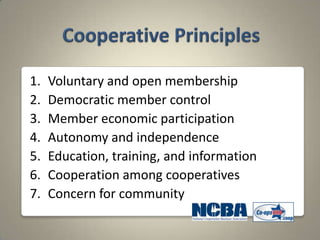
1.   Voluntary and open membership
2.   Democratic member control
3.   Member economic participation
4.   Autonomy and independence
5.   Education, training, and information
6.   Cooperation among cooperatives
7.   Concern for community
•   Members are businesses, not individuals
•   Members are financially successful
•   Membership often excludes competitors
•   Most know very little about co-ops
•   Most are profit and shareholder value-
    driven
• Co-op needs to be “incorporated”
  – Protect directors
  – Raise capital
  – Limit liabilities to shareholders
• Type of “corporation” will depend on
  jurisdiction and legal advice
• By-laws and share structure can make a
  corporation operate like a cooperative
• Security regulations: legal minefield
• Obtain legal advice
• Capital requirements: understand the
  costs of compliance
• By-laws need to support governance model
  –   Board member selection
  –   Term of Board members
  –   Board committees
  –   Operational vs governance board
  –   Membership conditions
  –   Rules for expulsion of members
• Resource information available
Feasibility of a Purchasing Cooperative
  – Economics of start-up
  – The chicken and the egg situation
  – 10 qualifying questions to ask
Ian Gray                        Colleen Leppert          Brian Hermiston
         President                       Vice President           General Manager


                     Meredith Rafferty                     Lisa Stolarski
                     Co-op Development                     Director


Part 2: Types of Cooperative Purchasing
Part 2
                                           Types of Cooperative Purchasing
Prepared by
Ian Gray, President & CEO                       Meredith Rafferty, Co-op Development
Buying Group Services, Inc.                     Northwest Cooperative Development Center

                                                Lisa Stolarski, Executive Director
Don Collyard, Principal
                                                Co-ops USA, NCBA
Main Street Cooperative Group
                                                Spring 2012
Diane Gasaway, Executive Director
Northwest Cooperative Development Center

4.25.12 Types of Cooperative Purchasing

  • 1.
    Part 2 Types ofCooperative Purchasing
  • 2.
    • Welcome! • Thewebinar will be recorded and available at www.ncba.coop • We welcome your questions! Submit them anytime by typing them into the chat box in the control box on your screen.
  • 3.
    Ian Gray Colleen Leppert Brian Hermiston President Vice President General Manager Meredith Rafferty Lisa Stolarski Co-op Development Director Part 2: Types of Cooperative Purchasing
  • 4.
    • Defining andDifferentiating – Purchasing Cooperatives – Group Buying – Governmental Cooperative Purchasing • Purchasing Co-op Models – Direct Bill – Central Bill and Pay – Central Pay • Legal Structure, Bylaws and Governance
  • 5.
    Legally incorporated business… Thatprovides value to its “members” by leveraging their combined purchases to achieve lower net prices and better terms on the products they buy. Operates using “Cooperative Principles” Example: Carpet One
  • 6.
    Legally incorporated business… Thatprovides value to its “customers” by leveraging their combined purchases to achieve lower net prices and better terms on the products they buy. Strategy & Profit distribution determined by majority vote of Shareholders Example: Affiliated Distributors
  • 7.
    • Statutorily required“equitable and transparent” process • Contract typically arranged by central department • Accessed by other governmental & nonprofit entities as authorized
  • 8.
    Other ways toseek better prices & terms: – Consumers submit one order – Consumer membership in a discount store – Business membership in a buying service
  • 9.
    Primary business models: Direct Bill Central Bill and Pay Central Pay
  • 10.
    Model drives the: •Legal requirements •Start-up capital / security •IT system requirements •Member interaction with co-op and suppliers
  • 11.
    Purchase Orders Supplier Invoices Member- Payments Owners Purchasing Co-op
  • 12.
    Pro’s • No disruptionto current supply relationships • No credit risk taken on by Co-op • Low cost operation
  • 13.
    Con’s • Co-op notseen as the “buyer” • No real time information for rebate targets • Reliance on suppliers for information
  • 14.
    •Formed in 2005 •Independent HVACR wholesale distributors (heating, ventilation, air conditioning and refrigeration) • 232 member-owners with 1,174 locations in all 50 states • 117 vendor partners
  • 15.
    Purchase Orders Member- Supplier Owners Purchasing Co-op
  • 16.
    Pro’s • Co-op seenas the “Buyer” • Co-op has real time information • Co-op has complete item purchase details • Rebates can be calculated timely and accurately
  • 17.
    Con’s • Changes existingbilling/payment process • Significant IT or personnel investment • Need to mitigate accounts receivable credit risk
  • 18.
    Tim-Br Marts Limited •National Canadian lumber, hardware and building materials • Over 700 retail locations • Over $2 billion in purchases
  • 19.
    Purchase Orders Supplier Member- Invoices Owners Payments Purchasing Co-op
  • 20.
    Pro’s • Co-op seenas the “Payer” • Co-op can track gross member purchases • May avoid accounts receivable credit risk
  • 21.
    Con’s • Changes existingbilling/payment process • Significant IT or personnel investment • Co-op does not have complete item purchase details
  • 22.
    IMARK GROUP, Inc. •1,100 independently owned electrical distributors, over 2,000 branch locations • $11 billion in combined sales • Over 100 of the electrical manufacturers and service providers • Earnings from cash flow cover all operating costs of the Co-op
  • 23.
    • Hybrid Versionsof Billing Models • Distribution centers owned and operated • Direct Bill but Co-op gets invoice detail by acting as electronic invoicing hub • Marketing-focused Groups
  • 24.
    • USDA: “user-owned,user-controlled business that distributes benefits on the basis of use.” • International Co-operative Alliance (ICA): “an autonomous association of persons united voluntarily to meet their common economic, social, and cultural needs and aspirations through a jointly owned and democratically controlled enterprise.”
  • 25.
    1. Voluntary and open membership 2. Democratic member control 3. Member economic participation 4. Autonomy and independence 5. Education, training, and information 6. Cooperation among cooperatives 7. Concern for community
  • 26.
    Members are businesses, not individuals • Members are financially successful • Membership often excludes competitors • Most know very little about co-ops • Most are profit and shareholder value- driven
  • 27.
    • Co-op needsto be “incorporated” – Protect directors – Raise capital – Limit liabilities to shareholders • Type of “corporation” will depend on jurisdiction and legal advice • By-laws and share structure can make a corporation operate like a cooperative
  • 28.
    • Security regulations:legal minefield • Obtain legal advice • Capital requirements: understand the costs of compliance
  • 29.
    • By-laws needto support governance model – Board member selection – Term of Board members – Board committees – Operational vs governance board – Membership conditions – Rules for expulsion of members • Resource information available
  • 30.
    Feasibility of aPurchasing Cooperative – Economics of start-up – The chicken and the egg situation – 10 qualifying questions to ask
  • 31.
    Ian Gray Colleen Leppert Brian Hermiston President Vice President General Manager Meredith Rafferty Lisa Stolarski Co-op Development Director Part 2: Types of Cooperative Purchasing
  • 32.
    Part 2 Types of Cooperative Purchasing Prepared by Ian Gray, President & CEO Meredith Rafferty, Co-op Development Buying Group Services, Inc. Northwest Cooperative Development Center Lisa Stolarski, Executive Director Don Collyard, Principal Co-ops USA, NCBA Main Street Cooperative Group Spring 2012 Diane Gasaway, Executive Director Northwest Cooperative Development Center

Editor's Notes

  • #4 Please continue to submit your questions using the question box.The panel will address as many of the questions as time permits and will address additional questions in a Q&A to be posted at (website).Thank you!
  • #6 Agreements negotiated with suppliers in confidence that provide overall best value, using a competitive selection process.
  • #7 Agreements negotiated with suppliers in confidence that provide overall best value, using a competitive selection process.
  • #8 Local and state governments often “purchase cooperatively” with each other.Member-Owners have vested interest in supporting the Purchasing Co-op“In Confidence” Supply Agreements often mean better net price to purchasersRebates can be structured to increase when purchases increase – Supplier’s like thisOrganization exists to deliver other benefitsBest Practice sharingAccess to other Members’ Purchasing ExpertiseStreamlined Billing and Payment processes
  • #9 Function similar to Purchasing Co-op except: Controlled by 1 Vote – 1 ShareProfits may be distributed based on shares owned not participation in programsMany Buying Groups are run on similar principles as Purchasing Co-ops – need to look at by-lawsEasier to incorporate as a LLC and find corporate advisors with LLC experienceDemocratic structure works to promote collaborative thinking and actionsRewards member-owners proportionally to their participation promotes the correct behaviour within the Co-opPurchasing Co-ops need to thought of as a philosophy rather than a legal structure.
  • #19 Services:business services for retail food co-opshelps unify food co-ops in order to optimize operational and marketing resourcesstrengthens purchasing power
  • #29 Selling any share, if not done correctly, can have serious consequences. Can demand money paid for share back, from Directors and those individuals who sold the sharesFines and penalties
  • #30 Governance: Anne Hoyt - University of Wisconsin Center for CooperativesOther legal resources: Dorsey & Whitney, other legal co-op
  • #32 Please continue to submit your questions using the question box.The panel will address as many of the questions as time permits and will address additional questions in a Q&A to be posted at (website).Thank you!