Intensifiers
LEVEL NUMBER
GRAMMAR
LANGUAGE
Intermediate B1_1045G_EN English
2
www.lingoda.com
Goals
■ Learn about intensifiers and
their purpose
■ Practise using intensifiers
and giving detailed
information
■ Review writing with
intensifiers
3
www.lingoda.com
Really, you are too kind.
The concert last night was quite
enjoyable.
You must be so eager to learn all about
intensifiers. They are very simple to
grasp, so let‘s get started.
4
www.lingoda.com 4
Preview and warm-up
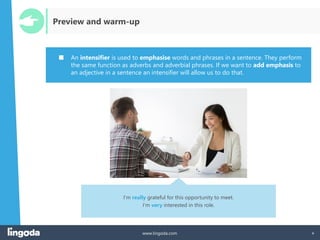
■ An intensifier is used to emphasise words and phrases in a sentence. They perform
the same function as adverbs and adverbial phrases. If we want to add emphasis to
an adjective in a sentence an intensifier will allow us to do that.
I‘m really grateful for this opportunity to meet.
I‘m very interested in this role.
5
www.lingoda.com
What are some intensifiers you know
already?
Talk to the teacher and try to use
them in a sentence.
Review
6
www.lingoda.com 6
Intensifiers: too
The intensifier too can be used to emphasise that there is a lot of something, often in a
negative context.
■ It is often placed in front of adjectives and adverbs.
■ We are getting too many complaints
about this product.
■ I‘m feeling too sick to go to work.
■ That trip sounds too expensive.
■ It is too cold today.
7
www.lingoda.com 7
Further emphasis: too
■ The intensifier too can be given further emphasis when preceded by the word much.
This task is much too complicated
We are going much too slowly to make it in time.
8
www.lingoda.com 8
Too many
You can use the intensifier too many to modify countable nouns.
■ You can place it in front of a noun that can be counted to signify an excessive
number of something.
The things in the examples below (croissants, applicants and people) can all be counted.
There are too many people in this conference.
I bought too many croissants today.
I have seen too many applicants today.
9
www.lingoda.com 9
Too much
■ In a similar way, too much can be used to modify uncountable nouns and verbs.
I’ve got too much work at the moment.
I’ve been missing out on too much sleep lately.
10
www.lingoda.com
Answer the questions
Answer the questions below using too.
Did you sleep well last night? Why is your company
relocating?
Did you have a good trip?
How was work today?
11
www.lingoda.com
______________________________________________________
__________________________________________________
______________________________________________________
__________________________________________________
______________________________________________________
__________________________________________________
______________________________________________________
__________________________________________________
Fix the mistakes with intensifiers in the sentences.
You are driving much too fast!
3. I have missed out on too many
sleep.
4. There is too many snow on the
road to take my bike.
5. I have had too much problems
with him already.
2. You have had too much
absences.
1. You are driving too much fast!
12
www.lingoda.com 12
Intensifiers: quite
The intensifier quite can be used in two separate ways.
■ The first is to emphasise something to a lesser degree. It adds a level of emphasis
similar to the words rather or fairly.
■ The second is to add total or complete emphasis, similar to the word completely.
■ Our revenue at the moment is quite good.
The revenue is good, but not amazing or
outstanding.
■ The shape of the island emerged on the
horizon quite clearly
In this example the island is completely clear
to the observer.
13
www.lingoda.com 13
Intensifiers: very
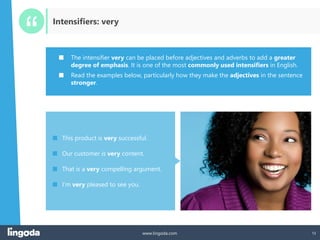
■ The intensifier very can be placed before adjectives and adverbs to add a greater
degree of emphasis. It is one of the most commonly used intensifiers in English.
■ Read the examples below, particularly how they make the adjectives in the sentence
stronger.
■ This product is very successful.
■ Our customer is very content.
■ That is a very compelling argument.
■ I‘m very pleased to see you.
14
www.lingoda.com 14
Intensifiers: pretty
The intensifier pretty can be used to add emphasis in a similar way to quite and very.
■ This intensifier is used in a more informal context.
■ It adds emphasis to a similar degree as quite.
■ Used as a modifier, it means almost.
■ I got to work pretty early this
morning.
■ It was a pretty interesting report.
■ James is a pretty funny guy.
■ I‘m pretty sure we have met before.
Remember to only use pretty in an
informal context.
15
www.lingoda.com
True or false?
1. Pretty is an intensifier that is only used for informal
situations.
2. It is quite hot means that it is extremely hot.
3. Intensifiers are generally placed after the adjective or
adverb they modify.
4. Very is one of the most common intensifiers in English.
5. Quite is a good intensifier to use in formal situations.
TRUE FALSE
6. Too much is only used with countable nouns.
16
www.lingoda.com
1. There are _______________ applicants for this job.
2. I’m sorry I can’t drive! I have had _______________ to drink!
3. You are talking to your employer about your weekend. You want to emphasise that it
was relaxing, but not overly so. What would be the best choice of the intensifiers below?
4. The intensifier too can be given even more emphasis by preceding it with the word…
Intensifiers quiz: pick the best answer
a. too b. too many c. very much d. too much
a. very much b. too many c. so many d. too much
a. quite relaxing b. too relaxing c. pretty relaxing d. very relaxing
a. much b. such c. many d. must
17
www.lingoda.com 17
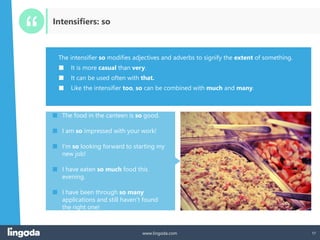
Intensifiers: so
The intensifier so modifies adjectives and adverbs to signify the extent of something.
■ It is more casual than very.
■ It can be used often with that.
■ Like the intensifier too, so can be combined with much and many.
■ The food in the canteen is so good.
■ I am so impressed with your work!
■ I‘m so looking forward to starting my
new job!
■ I have eaten so much food this
evening.
■ I have been through so many
applications and still haven‘t found
the right one!
18
www.lingoda.com 18
Intensifiers: at all
■ At all is a common intensifier used in English.
■ It is used in negative sentences and expressions.
■ You didn‘t make any notes at all?
■ I am not at all interested in your
offer.
■ Don‘t we have any carrots left at all?
19
www.lingoda.com
Respond to the questions in the negative using the intensifier at
all.
Negative sentences using at all
Do we have enough money for this
project?
Where have you been? We were waiting
for you!
Can you please accompany me on this
business trip?
20
www.lingoda.com
Writing about experiences
Write a paragraph
about an experience
you have had based
on each of the
pictures.
Use intensifiers when
writing about each
experience.
café lunch a flight
a great weekend
job interview
21
www.lingoda.com
Complete the sentences
2. It has been _______________ long.
3. You have a _______________
professional approach.
4. Yes sir, I am _______________ certain
the report is accurate.
6. That man has ________________
guitars.
7. I am _______________ tired of
putting in these extra hours.
8. I have a _______________ good
chance of getting that job.
5. There are no extra qualified
workers on shift _______________.
1. I have _______________ time on my
hands.
Complete the sentences below using intensifiers.
Use the best one for each sentence from what you have learned
during the lesson.
22
www.lingoda.com
Fill the gaps
Fill in the blanks with intensifiers.
I had an interview yesterday. We were supposed to meet
at Gloria’s café but it was _______________ busy so we went
to another café around the corner. I was ________________
nervous beforehand but I think it went _______________
well. My interviewer was ________________ friendly so that
made me feel more at ease. Therefore, I was able to
answer his questions relatively confidently without
_______________ blunders.
too many really quite too pretty
23
www.lingoda.com
Practise giving detailed information about
the last time you went to a restaurant.
Try to use some of the intensifiers you learnt
in the lesson to add emphasis to what you
enjoyed and did not enjoy at the restaurant.
Talk to the teacher
The grilled fish was very tasty.
There was too much salt on my fries.
The wine was quite delicious.
24
www.lingoda.com
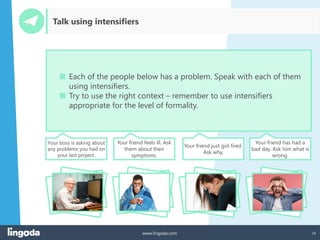
Talk using intensifiers
■ Each of the people below has a problem. Speak with each of them
using intensifiers.
■ Try to use the right context – remember to use intensifiers
appropriate for the level of formality.
Your boss is asking about
any problems you had on
your last project.
Your friend feels ill. Ask
them about their
symptoms.
Your friend just got fired.
Ask why.
Your friend has had a
bad day. Ask him what is
wrong.
25
www.lingoda.com
Why are intensifiers so useful when
expressing ourselves in English?
Tell the teacher
26
www.lingoda.com
Go back to the second slide of the lesson and check
if you have achieved all the goals of the lesson.
yes no
_______________________________
_______________________________
_______________________________
_______________________________
Reflect on the goals
27
www.lingoda.com
Think about everything you have seen in this lesson.
What were the most difficult activities or words? The easiest?
+
+
–
– If you have time, go over
the most difficult slides again
_______________________________
_______________________________
_______________________________
_______________________________
_______________________________
_______________________________
_______________________________
_______________________________
Reflect on this lesson
28
www.lingoda.com
Answer key
Exercise
p.
11
2.
too
many,
3.
too
much,
4.
too
much
4.
too
many
Exercise
p.
15
1T,
2F,
3F,
4T,
5T,
6F
Exercise
p.
16
1b,
2d,
3a,
4a
Exercise
p.
21
1.
too
much,
2.
too,
3.
very,
4.
quite,
5.
at
all,
6.
too
many,
7.
so,
8.
pretty
Exercise
p.
22
too,
quite,
pretty,
really,
too
many
29
www.lingoda.com
Homework
30
www.lingoda.com
– □ ×
Write an email to your friend talking about your recent holiday. Try
to use as many intensifiers as possible.
Evaluate the challenge
myfriend@lingoda.mail
My holiday was so good!
Dear Lisa,
31
www.lingoda.com
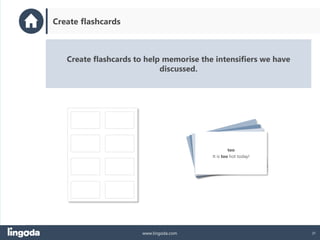
Create flashcards to help memorise the intensifiers we have
discussed.
Create flashcards
too
It is too hot today!
32
www.lingoda.com
Who are we?
Why learn English online?
What kinds of English classes do we offer?
Who are our English teachers?
How do our English certificates work?
We also have a language blog!
This material is proudly provided by
and can be used by anyone for free and
for any purpose.
About this material

424897226-B1-1045G-EN.pdf

  • 1.
  • 2.
    2 www.lingoda.com Goals ■ Learn aboutintensifiers and their purpose ■ Practise using intensifiers and giving detailed information ■ Review writing with intensifiers
  • 3.
    3 www.lingoda.com Really, you aretoo kind. The concert last night was quite enjoyable. You must be so eager to learn all about intensifiers. They are very simple to grasp, so let‘s get started.
  • 4.
    4 www.lingoda.com 4 Preview andwarm-up ■ An intensifier is used to emphasise words and phrases in a sentence. They perform the same function as adverbs and adverbial phrases. If we want to add emphasis to an adjective in a sentence an intensifier will allow us to do that. I‘m really grateful for this opportunity to meet. I‘m very interested in this role.
  • 5.
    5 www.lingoda.com What are someintensifiers you know already? Talk to the teacher and try to use them in a sentence. Review
  • 6.
    6 www.lingoda.com 6 Intensifiers: too Theintensifier too can be used to emphasise that there is a lot of something, often in a negative context. ■ It is often placed in front of adjectives and adverbs. ■ We are getting too many complaints about this product. ■ I‘m feeling too sick to go to work. ■ That trip sounds too expensive. ■ It is too cold today.
  • 7.
    7 www.lingoda.com 7 Further emphasis:too ■ The intensifier too can be given further emphasis when preceded by the word much. This task is much too complicated We are going much too slowly to make it in time.
  • 8.
    8 www.lingoda.com 8 Too many Youcan use the intensifier too many to modify countable nouns. ■ You can place it in front of a noun that can be counted to signify an excessive number of something. The things in the examples below (croissants, applicants and people) can all be counted. There are too many people in this conference. I bought too many croissants today. I have seen too many applicants today.
  • 9.
    9 www.lingoda.com 9 Too much ■In a similar way, too much can be used to modify uncountable nouns and verbs. I’ve got too much work at the moment. I’ve been missing out on too much sleep lately.
  • 10.
    10 www.lingoda.com Answer the questions Answerthe questions below using too. Did you sleep well last night? Why is your company relocating? Did you have a good trip? How was work today?
  • 11.
  • 12.
    12 www.lingoda.com 12 Intensifiers: quite Theintensifier quite can be used in two separate ways. ■ The first is to emphasise something to a lesser degree. It adds a level of emphasis similar to the words rather or fairly. ■ The second is to add total or complete emphasis, similar to the word completely. ■ Our revenue at the moment is quite good. The revenue is good, but not amazing or outstanding. ■ The shape of the island emerged on the horizon quite clearly In this example the island is completely clear to the observer.
  • 13.
    13 www.lingoda.com 13 Intensifiers: very ■The intensifier very can be placed before adjectives and adverbs to add a greater degree of emphasis. It is one of the most commonly used intensifiers in English. ■ Read the examples below, particularly how they make the adjectives in the sentence stronger. ■ This product is very successful. ■ Our customer is very content. ■ That is a very compelling argument. ■ I‘m very pleased to see you.
  • 14.
    14 www.lingoda.com 14 Intensifiers: pretty Theintensifier pretty can be used to add emphasis in a similar way to quite and very. ■ This intensifier is used in a more informal context. ■ It adds emphasis to a similar degree as quite. ■ Used as a modifier, it means almost. ■ I got to work pretty early this morning. ■ It was a pretty interesting report. ■ James is a pretty funny guy. ■ I‘m pretty sure we have met before. Remember to only use pretty in an informal context.
  • 15.
    15 www.lingoda.com True or false? 1.Pretty is an intensifier that is only used for informal situations. 2. It is quite hot means that it is extremely hot. 3. Intensifiers are generally placed after the adjective or adverb they modify. 4. Very is one of the most common intensifiers in English. 5. Quite is a good intensifier to use in formal situations. TRUE FALSE 6. Too much is only used with countable nouns.
  • 16.
    16 www.lingoda.com 1. There are_______________ applicants for this job. 2. I’m sorry I can’t drive! I have had _______________ to drink! 3. You are talking to your employer about your weekend. You want to emphasise that it was relaxing, but not overly so. What would be the best choice of the intensifiers below? 4. The intensifier too can be given even more emphasis by preceding it with the word… Intensifiers quiz: pick the best answer a. too b. too many c. very much d. too much a. very much b. too many c. so many d. too much a. quite relaxing b. too relaxing c. pretty relaxing d. very relaxing a. much b. such c. many d. must
  • 17.
    17 www.lingoda.com 17 Intensifiers: so Theintensifier so modifies adjectives and adverbs to signify the extent of something. ■ It is more casual than very. ■ It can be used often with that. ■ Like the intensifier too, so can be combined with much and many. ■ The food in the canteen is so good. ■ I am so impressed with your work! ■ I‘m so looking forward to starting my new job! ■ I have eaten so much food this evening. ■ I have been through so many applications and still haven‘t found the right one!
  • 18.
    18 www.lingoda.com 18 Intensifiers: atall ■ At all is a common intensifier used in English. ■ It is used in negative sentences and expressions. ■ You didn‘t make any notes at all? ■ I am not at all interested in your offer. ■ Don‘t we have any carrots left at all?
  • 19.
    19 www.lingoda.com Respond to thequestions in the negative using the intensifier at all. Negative sentences using at all Do we have enough money for this project? Where have you been? We were waiting for you! Can you please accompany me on this business trip?
  • 20.
    20 www.lingoda.com Writing about experiences Writea paragraph about an experience you have had based on each of the pictures. Use intensifiers when writing about each experience. café lunch a flight a great weekend job interview
  • 21.
    21 www.lingoda.com Complete the sentences 2.It has been _______________ long. 3. You have a _______________ professional approach. 4. Yes sir, I am _______________ certain the report is accurate. 6. That man has ________________ guitars. 7. I am _______________ tired of putting in these extra hours. 8. I have a _______________ good chance of getting that job. 5. There are no extra qualified workers on shift _______________. 1. I have _______________ time on my hands. Complete the sentences below using intensifiers. Use the best one for each sentence from what you have learned during the lesson.
  • 22.
    22 www.lingoda.com Fill the gaps Fillin the blanks with intensifiers. I had an interview yesterday. We were supposed to meet at Gloria’s café but it was _______________ busy so we went to another café around the corner. I was ________________ nervous beforehand but I think it went _______________ well. My interviewer was ________________ friendly so that made me feel more at ease. Therefore, I was able to answer his questions relatively confidently without _______________ blunders. too many really quite too pretty
  • 23.
    23 www.lingoda.com Practise giving detailedinformation about the last time you went to a restaurant. Try to use some of the intensifiers you learnt in the lesson to add emphasis to what you enjoyed and did not enjoy at the restaurant. Talk to the teacher The grilled fish was very tasty. There was too much salt on my fries. The wine was quite delicious.
  • 24.
    24 www.lingoda.com Talk using intensifiers ■Each of the people below has a problem. Speak with each of them using intensifiers. ■ Try to use the right context – remember to use intensifiers appropriate for the level of formality. Your boss is asking about any problems you had on your last project. Your friend feels ill. Ask them about their symptoms. Your friend just got fired. Ask why. Your friend has had a bad day. Ask him what is wrong.
  • 25.
    25 www.lingoda.com Why are intensifiersso useful when expressing ourselves in English? Tell the teacher
  • 26.
    26 www.lingoda.com Go back tothe second slide of the lesson and check if you have achieved all the goals of the lesson. yes no _______________________________ _______________________________ _______________________________ _______________________________ Reflect on the goals
  • 27.
    27 www.lingoda.com Think about everythingyou have seen in this lesson. What were the most difficult activities or words? The easiest? + + – – If you have time, go over the most difficult slides again _______________________________ _______________________________ _______________________________ _______________________________ _______________________________ _______________________________ _______________________________ _______________________________ Reflect on this lesson
  • 28.
  • 29.
  • 30.
    30 www.lingoda.com – □ × Writean email to your friend talking about your recent holiday. Try to use as many intensifiers as possible. Evaluate the challenge myfriend@lingoda.mail My holiday was so good! Dear Lisa,
  • 31.
    31 www.lingoda.com Create flashcards tohelp memorise the intensifiers we have discussed. Create flashcards too It is too hot today!
  • 32.
    32 www.lingoda.com Who are we? Whylearn English online? What kinds of English classes do we offer? Who are our English teachers? How do our English certificates work? We also have a language blog! This material is proudly provided by and can be used by anyone for free and for any purpose. About this material