Energy Efficiency Trend Analysis of the Tourism Sector


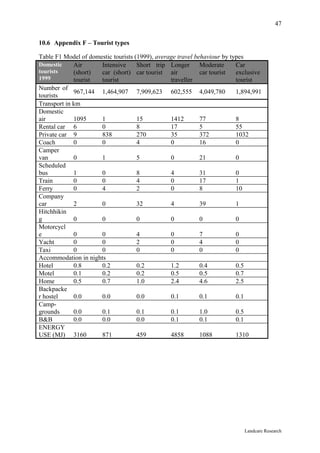
Susanne Becken and Jo-Anne Cavanagh

Landcare Research
PO Box 69, Lincoln 8152
New Zealand


Landcare Research Contract Report: LC0203/180


PREPARED FOR:
Energy Efficiency and Conservation Authority


DATE:    August 2003
Reviewed by:                                 Approved for release by:


Prof. David Simmons


Ian Turney                                   Richard Gordon
Scientist                                    Science Manager
Landcare Research                            Sustainable Business and Government


© Energy Efficiency and Conservation Authority


No part of this work covered by copyright may be reproduced or copied in any form or by
any means (graphic, electronic or mechanical, including photocopying, recording, taping,
information retrieval systems, or otherwise) without the written permission of EECA.
3


                                                              Contents


 Energy Efficiency Trend Analysis of the Tourism Sector.......................................................1
 Summary..................................................................................................................................5
 Summary..................................................................................................................................5
1. Introduction...........................................................................................................................9
2. Background...........................................................................................................................9
3. Objectives............................................................................................................................10
4. Methods...............................................................................................................................10
      4.1 Industry Analyses.....................................................................................................11
      4.2 Tourist data...............................................................................................................13
      4.3 Model development..................................................................................................15
5. Results.................................................................................................................................16
      5.1 Industry analyses.......................................................................................................16
      5.2 Integration of industry and tourist analyses..............................................................27
6. Discussion...........................................................................................................................28
7. Conclusions ........................................................................................................................30
8. Recommendation.................................................................................................................32
9. References...........................................................................................................................34
10. Appendices........................................................................................................................35
      10.1 Appendix A – Survey form.....................................................................................35
      10.2 Appendix B – Sources of transport data.................................................................38
      10.3 Appendix C – Transport data..................................................................................39
      10.4 Appendix D – Energy consumption by accommodation sub-sector.......................40
      10.5 Appendix E – Tourist behaviour.............................................................................46
      10.6 Appendix F – Tourist types....................................................................................47


                                                                                                                       Landcare Research
4


Landcare Research
5


Summary


Project and Client
The Energy Efficiency Conservation Authority (EECA) commissioned Landcare Research to
provide data and prepare a report on the New Zealand tourism sector’s energy use and trends
for two reference years, 1999 and 2001. For the purposes of this study tourism is defined
according to the World Tourism Organisation as ‘the activities of persons travelling to and
staying in places outside their usual environment for not more than one consecutive year for
leisure, business and other purposes’. As such, tourism is defined on the basis of
consumption, and energy consumed by tourists has to be theoretically aggregated for all
activities tourists do (i.e. transport, accommodation, restaurants) to arrive at a final estimate
for energy use associated with the sector. Previous analyses of the sector had shown that
tourism contributes 6% (27.5 PJ in 1997/98) of national energy use. Transport and
accommodation are the largest contributors to energy use (23.1 PJ of a total of 27.5 PJ
consumed by tourism in 1997/98, Patterson & McDonald, 2002), with transport being the key
driver (Becken, 2002). EECA’s intention was to conduct further analyses on these data to
determine any change in overall consumption in three factors (volume, structure, technology)
through the means of their ‘decomposition analysis’.

Objectives
The objectives of this study were:
• Changes in energy efficiencies of vehicles and accommodation providers.
• Energy use efficiency patterns, trends and key drivers, including the relative shares of
   electricity and other fuels used by the sector, and the end use activities (sub-sectors) to
   which this energy is put.
• Changes in the relative importance of the domestic and international tourist mix and their
   respective energy use demands.
• Structural changes within tourist types (e.g. modal shift, travel distances by transport
   mode, length of stay, accommodation usage).
• Overall effect of growing tourist activity (total visitor volumes) on energy use demands
• A qualitative assessment of the potential gains in energy efficiency for different end-uses
   and the strategic measures for capturing these gains.
• Benchmark the performance of the New Zealand tourist industry sector against individual
   best practice energy use data and overseas data where this is available.

Methods

The methods used in the current study are those used by Becken (2002a). Becken (2002a)
combined information gained in the analysis of the energy use by different sub-sectors of
tourism (e.g. transport, accommodation) with analysis of tourist behaviour to derive overall
energy use by tourism. The current study used data provided in Becken (2002a) for the 1999
reference year and collected new data for the 2001 reference year. 2001 is used as the second
reference year as it relates to the available tourist data. However, the industry data mostly
refers to that collected for 2002. The reason for this discrepancy is due to logistic reasons of
the data collection.


                                                                                  Landcare Research
6


For the industry analyses for the second reference year, operators in the hotel, motel and
backpacker accommodation categories were asked to provide information on their business
and the amount of electricity, fossil fuel and other solid fuel consumed in its running.
Similarly, transport providers were asked to supply data on fuel consumption and load
factors, where information was not able to be accessed from publications. Information gained
in these surveys was translated into energy efficiencies (energy use per unit of output, i.e.
MJ/passenger-kilometre [MJ/pkm] and MJ/visitor-night) and compared for the two reference
years. Analyses of tourist behaviour (i.e. travel choices in the transport and accommodation
sub-sectors) were based on data provided through the Domestic Travel Study and the
International Visitor Study (both undertaken by Tourism New Zealand), and were used to
identify distinct tourist types (by means of cluster analysis). The travel behaviour of each
tourist type was combined with energy efficiencies obtained in the industry analyses, which
then enabled calculation of energy use associated with each tourist type and for all tourists.

Results
• Overall, hotel and motel operators showed a decrease in energy efficiency, dropping from
   134.0 MJ/ visitor-night and 40.4 MJ/visitor-night respectively in the 1999 reference year
   to 145.3 MJ/ visitor-night and 48.5 MJ/ visitor-night respectively in the 2001 reference
   year. This equates to a decrease in efficiency of 8.4% and 20% for hotels and motels
   respectively. In contrast backpacker operators increased their energy efficiency from 38.6
   MJ/ visitor-night in the 1999 reference year to 36.7 MJ/ visitor-night in 2001.
• The energy efficiency of domestic air travel, rail, Cook Strait ferry and coach travel
   (backpacker bus, scheduled coach, shuttle bus) increased by 5-74% in the 2001 reference
   year, although the efficiency of campervans decreased (16 %). In 2001, energy use by the
   different transport modes varied from 0.32 MJ/pkm for scheduled coaches to 2.63
   MJ/pkm for the Cook Strait ferry. The energy efficiency of cars was unable to be
   updated, due to the difficulties in accounting for the large number of number of factors
   (e.g. model of car, year of manufacture, driving conditions) that influences energy
   efficiencies.
• The energy efficiency of domestic air travel improved (2.5 MJ/pkm in 2001 compared
   with 3.2 MJ/pkm in 1999), as a result of increases in both technological efficiency (lower
   fuel consumption per kilometre) and operational efficiency (increased load factors).
• Overall, transport and accommodation associated with tourism consumed 22.6 PJ in 1999
   and 21.0 PJ in 2001, which is equivalent to a decrease of 7.5%. Transport and
   accommodation contributed 81.7 % (18.5 PJ) and 18.3 % (4.2 PJ) respectively of the
   energy use in 1999 and 78.8% (16.5 PJ) and 21.2% (4.4 PJ) respectively in 2001.
• In 1999, fuel (diesel and petrol) contributed at 43.8% (9.9 PJ) of the total energy use,
   followed by aviation fuel (38.4%, 8.7 PJ) and electricity (13.2%, 3.0 PJ). The proportions
   were similar in 2001, where petroleum fuel made up 44.7% (9.4 PJ), aviation fuel 34.5%
   (7.2 PJ) and electricity 15.1% (3.2 PJ) of the total energy use.
• Including both international and domestic tourists, the most important drivers of this
   energy use are domestic air (34.5% of the total energy use in 2001), private cars (30.5%),
   and private homes (9.6%).
• Fewer tourists travelled by domestic air in 2001 compared with 1999 (3.8% less for
   domestic tourists and 7.5% less for international tourists). This may change with the
   introduction of Air New Zealand’s ‘Express Class’ that may lead to increased volumes
   and possibly more flights as a result of the associated cheaper fares.


Landcare Research
7

•   Domestic tourists contributed 17.8 PJ and 15.7 PJ of the total energy consumed in 1999
    and 2001, respectively. International tourists consumed 4.9 PJ in 1999 and 5.2 PJ in
    2001. There were 2.0% fewer domestic tourists in 2001 than in 1999, and 17.9% more
    international tourists.
•   The main drivers of energy use for domestic tourists were private cars (39.2% of the
    energy consumed domestic tourists in 2001), domestic air travel (36.1%), and energy use
    of private homes. (8.1%).
•   For international tourists, domestic air travel (29.6% of the energy consumed by
    international tourists in 2001), rental cars (13.8%), hotels (14.9%) and private homes
    (14.3%) are the main drivers of energy use.
•   Domestic tourists travelled for less time (2.9 days in 2001 compared with 3.2 days in
    1999), although similar distances in 2001 (614 km in 2001 compared with 623 km in
    1999).
•   International tourists stayed longer in 2001 (21.1 days compared with 17.7 days in 1999).
    The distance travelled per tourist remained remarkably constant (about 1500 km) – a
    slight increase in distance travelled by camping tourists was offset by the shorter
    distances travelled by all other tourist types in 2001 compared with 1999.

Conclusions
This study showed that the tourism sector has reduced its energy consumption in 2001
compared with 1999 by 7.5%. This is a result of decreasing domestic tourist volumes (-2%),
increases in technological and operational energy efficiencies and minor changes in tourist
behaviour (regarding transport modes, travel distances, accommodation choices). Because of
its size (about 8 times larger than international tourism in terms of tourist trips), domestic
tourism is the driver of overall energy use of tourism. Overall, transport was the major source
of energy consumption (81.7% and 78.8% in the reference years 1999 and 2001 respectively),
with domestic air travel and private cars being the primary contributors (34.5% and 30.5% in
2001 respectively). However, more information is needed to adequately reflect the influence
of changes in energy efficiency of cars on the energy demand of tourism.

Overall, accommodation businesses did not show improvements in energy efficiency.
Potential for energy savings exist in initially making operators aware of how their energy is
being used, and of cost-effective ways to reduce that energy use. Awareness of energy use
could be achieved through the promotion of consistent data reporting, such as that already
commenced by EECA with their auditing spreadsheet for hotels and by the Youth Hostel
Association who records energy consumption of its member hostels. However, it should also
be acknowledged that a number of operators already record energy consumption for their
own use and are working towards reducing energy use. Energy consumption of an individual
operator also depends on the number and type of facilities (e.g. spas, saunas, bars) offered
and cost-effective energy saving measures need to be tailored to individual businesses. As
such, case studies of cost-effective energy saving measures such as those provided by the
Environmental Accommodation Providers of Auckland could be promoted as examples of
ways different operators have already reduced energy use.

International tourism is growing continuously, and current improvements in energy efficiency
(e.g. air travel) do not offset the increased energy demand of international tourists resulting
from this growth. Possible pathways to decrease energy use are either related to industries
(technological or structural improvement, for example the type of transport networks) or
tourist behaviour (decreasing travel distance per tourist).


                                                                                Landcare Research
8

Recommendations
• The greatest energy saving potential exists by targeting the behaviour of domestic
   tourists, in particular that related to transport, primarily air travel and private cars.
• Within the transport sector, domestic air travel and cars (private and rental) are the
   primary contributors to energy use; as such EECA should focus their attention on
   strategies to reduce energy use associated with these transport modes. Conduct further
   research in the energy consumption of rental cars as important drivers of energy use by
   international tourists.
• Within the accommodation sector, private homes and hotels are the primary contributors
   to energy use. Energy saving measures need to be tailored toward individual operators.
   EECA could assist this by providing a service to identify opportunities for energy saving,
   possibly starting with a small pilot group of hotels who use EECA’s monitoring
   spreadsheet for energy efficiency. Consistent data collection is important for future trend
   analyses.
• Increase awareness of energy consumption issues among tourists.
• Develop strategies for each tourist type (especially domestic air travellers and
   international coach tourists) to reduce energy use.
• Repeat this analysis in about five years’ time to better depict trends.


Landcare Research
9


1.   Introduction


This project was carried out between March and July 2003 on behalf of the Energy Efficiency
Conservation Authority (EECA). The purpose was to provide a comprehensive report of the
tourism sector’s energy use patterns and trends, and to also provide the raw data in a
spreadsheet format. Data from an earlier study in 1999 were used, and new data were
collected for the second reference year, 2001. EECA intends to use both sets of data to
conduct further analyses to determine any change in overall consumption into three factors
(volume, structure, technology) through the means of their ‘decomposition analysis’.

This study employs the World Tourism Organisation definition of tourism as ‘the activities of
persons travelling to and staying in places outside their usual environment for not more than
one consecutive year for leisure, business and other purposes’. In other words, tourism is
consumer-defined, and energy consumed by tourists has to be summed up for everything a
tourist does to arrive at a final estimate for energy use associated with the sector. While
tourism comprises many industries, such as transport, accommodation, attractions, restaurants
etc., this study focuses on transport and accommodation as the largest contributors to energy
use (84% out of 27.5 PJ in 1997/98, Patterson & McDonald, draft).


2.   Background


Tourism is an increasingly important part of New Zealand’s economy with a 4.9%
contribution to GDP in 2000 (Statistics New Zealand, 2000). In New Zealand, both
international and domestic tourists are important to the industry. While the domestic market
is static, the international market is growing continuously and reached the 2 million visitors
mark in 2002. The tourism industry was long believed to be a green industry, but it turned out
that it is a comparatively resource-intensive sector of the economy (Patterson & McDonald
2002, draft report), in particular because of its high demand for energy.

Indeed, tourism contributes about 27.5 PJ or 6% of national energy consumption and
greenhouse gas emissions (Becken 2002a; Patterson & McDonald 2002, draft report). Given
forecasted growth rates of about 6% for international tourism and a static domestic market,
there is potential that energy demand by tourism is growing and that there is a need for action
to counteract this trend. Because energy costs are part of the running costs in tourism
businesses (e.g. hotels), there is some interest on the part of the industry to reduce energy
costs, or at least to increase energy efficiency. Energy efficiency means to reduce energy use
for a ‘given energy service or level of activity. This reduction in the energy consumption is
not necessarily associated to technical changes, since it can also result from a better
organisation and management’ World Energy Council (no date).

Against the background of New Zealand’s ratification of the Kyoto Protocol and the National
Energy Efficiency and Conservation Strategy (EECA 2001), the tourism industry will be
challenged to make its contribution to achieve national goals postulated in these policies.


                                                                                Landcare Research
10


3.     Objectives


Becken (2002a) identified that transport and accommodation comprised the major areas of
energy consumption by tourism; and as such are the focus of this study. The objective of this
project is to identify trends in energy use and efficiency of the tourism sector for two
reference years, 1999 and 2001 (Note: industry data refer to 2002, but for simplicity the
second reference year is referred to as 20011). These objectives are:

•    Changes in energy efficiencies of vehicles and accommodation providers.
•    Energy use efficiency patterns, trends and key drivers, including the relative shares of
     electricity and other fuels used by the sector, and the end use activities (sub-sectors) to
     which this energy is put.
•    Changes in the relative importance of the domestic and international tourist mix and their
     respective energy use demands.
•    Structural changes within tourist types (e.g. modal shift, travel distances by transport
     mode, length of stay, accommodation usage).
•    Overall effect of growing tourist activity (total visitor volumes) on energy use demands
•    A qualitative assessment of the potential for energy efficiency gains for different end-uses
     and the strategic measures for capturing these gains.
•    Benchmark the performance of the New Zealand tourist industry sector against individual
     best practice energy use data and overseas data where this is available.


4.     Methods


This study builds on earlier work (Becken 2002a) that integrated tourist analyses with
industry analyses (e.g. transport, accommodation) to determine the overall energy use of New
Zealand’s tourism sector and to identify the key drivers of this energy use. The methodology
entails separate analysis of energy consumption by typical tourism sub-sectors (e.g. transport,
accommodation) and tourist behaviour (e.g. length of stay, travel distance and typical
transport and accommodation choices), before integration of both analyses into a final model.
The final model enables the total energy consumed by tourism to be calculated and examines
the influence of the combined effects of energy efficiency of different sub-sectors and tourist
behaviour. The industry analyses, the tourist analyses based on the International Visitor
Survey (IVS) and the Domestic Travel Survey (1999), and the final model are described in
more detail below.

This study uses the scope provided by the World Tourism Organisation who defined tourism
as comprising ‘the activities of persons travelling to and staying in places outside their usual
environment for not more than one consecutive year for leisure, business and other purposes’
(www.world-tourism.org). This means that business travellers are included as long as they
stay overnight outside their usual environment. In this sense, this analysis of energy use
1
 No tourist data for 2002 were available, hence 2001 was chosen as the second reference year due to the availability of
databases for both domestic and international tourists for this year.


Landcare Research
11

follows similar analysis of economic impact as undertaken in the Tourism Satellite Account
by Statistics New Zealand. There all activity of tourists is reported in terms of expenditure,
there are so-called tourism characteristic sectors (e.g. accommodation) and tourism non-
characteristic sectors (e.g. retail, banks, insurances); both are included in the Satellite
Account. In terms of energy use, previous research by Patterson and MacDonald (2003, draft)
revealed that transport and accommodation: are the most significant contributors (84% of
tourism’s energy use), for this reason, this study focuses on these two sub-sectors.


4.1   Industry Analyses

      Accommodation sector
Within the accommodation sector, businesses in the hotel and motor inn (black), motel (red)
and budget accommodation (green) categories (as classified by the Automobile Association
(AA), see also www.nzaa.co.nz) were the major energy users (comprising 67%, 16% and 6%,
respectively, of the energy consumed by commercial tourist accommodation, Becken,
Simmons & Frampton, 2001). As such, collecting updated information from these industries
was the focus of the current study. The energy efficiencies and the fuel mixes for ‘camping
grounds’ (25 MJ/visitor-night), ‘Bed & Breakfast’ (110 MJ/visitor-night) and ‘private homes’
(41 MJ/visitor-night) are taken from Becken et al. (2001) and Becken (2000a) for both
reference years. These efficiencies were required in the final model.

The analysis of energy use by accommodation businesses for the reference year 1999 built on
three separate surveys; the first survey was undertaken on the West Coast of the South Island
(Johnson 1999, unpublished), the second survey was a subsequent nationwide survey
(1999/2000), while EECA supplied a third set of data on ‘top class’ hotels in Christchurch
and Queenstown, which EECA had collected in 1998. As such, the actual years surveyed for
energy use included in the 1999 reference year are: 96/97 for the hotel data supplied by
EECA, 98/99 for the West Coast data, and 99/00 for the national survey. For the West Coast
and the national survey, a stratified random sample of accommodation businesses was
surveyed. Businesses within all classifications used by the AA (2000) – black (hotel, motor
inn), blue (hosted accommodation), red (motel) and green (budget accommodation) – were
surveyed. The operators were first contacted either by telephone or by email and asked if
they would participate in the survey. If the operator agreed, the survey (see Appendix A) was
either mailed or faxed to the respondent; in some cases the researcher visited the business to
collect the survey. The Hotel Survey undertaken by EECA involved visitation of ‘top class’
hotels in Christchurch and Queenstown by EECA staff. These businesses were grouped in the
hotel (black) category.

The earlier study (Becken et al. 2001) on accommodation energy use revealed highly variable
energy use within each category. It was concluded that an independent random sample of
new businesses would absorb any differences in trend, simply because the individual business
characteristics would dominate consumption patterns. For this reason, it was decided that the
same businesses surveyed in the previous study were to be contacted for the current study.

For the analysis of energy use by accommodation businesses in the second reference year, all
operators in the black (N = 29), red (N = 20) and green (N = 35) categories who participated
in the 1999 study were initially contacted via phone and asked if they would participate in the
current survey. During the initial phone call stage nine operators were excluded due to one of
the following reasons: the current owners had only recently taken over the business, the


                                                                                Landcare Research
12

business was no longer listed, or direct refusal. The original survey forms were updated and
sent via post or email to those operators willing to participate in the study. Follow-up phone
calls were made to ensure receipt of the surveys, to answer any queries, and to check
progress. Due to the low participation rate (<50%) of operators previously surveyed,
additional hotels in the Auckland and Wellington region were randomly selected primarily
using the AA directory (2003). Information supplied by all operators covered either January –
December 2002, or April 2002 – March 2003, with one exception. One operator could only
supply information on energy use over the period April 2001- March 2002. For practical
reasons, this information was all grouped into the 2001 reference year.

For both reference years, data on the annual consumption of electricity, fossil fuel and other
solid fuel directly consumed in running the accommodation building (i.e. business vehicles
are excluded) were collected. Additionally, information on the business (i.e. number of
visitor-nights in the year corresponding to the energy figures, operating time period, capacity,
size, and amenities) was also collected. Information on electricity, fossil and other solid fuel
was requested in the most commonly used unit (e.g. kWh, litres) and expressed as energy
content (MJ) using the conversion figures provided in Baines (1993)1, and by EECA
(conversion of LPG in m3 to MJ only, (EECA 20032), this study only). In a few cases the cost
of energy consumption only was provided. In these cases, an average cost per unit obtained
from either the operator in question or from the Ministry for Economic Development’s
Energy Data File (January 2003) was used to convert the supplied cost into units of
consumption. The total annual energy consumption for each business was calculated by
summing the energy consumed annually for each fuel type by that business. Energy
consumption for each accommodation business was expressed on a per visitor-night basis to
facilitate comparison. Where data were only provided for a portion of the year, these data
were linearly extrapolated to estimate annual consumption. While this may over- or
underestimate the actual energy used by a business due to the seasonal nature of tourism, this
extrapolation will only affect the total amount of energy used and not energy consumption
(MJ/ visitor-night) as visitor numbers were similarly scaled. Extrapolation was used to
account for missing periods of data, as opposed to extrapolation of a business that only
operated in summer or winter, to a full year. Furthermore, it was considered that the errors
associated with such an extrapolation would be small due to the small number of businesses
(four) for which data was extrapolated. Geometric means (logarithmic transformation so that
means are not biased towards extreme values) were used to describe the average energy
efficiency for each accommodation category.

The proportion of energy attributed to each fuel source was determined by first calculating
the fuel mix (in percent) for each business, and second averaging the proportions for each
fuel source. This proportion was used in the final model to determine the contribution of each
fuel source to the total amount of energy consumed by tourism (see section 4.2).

      Transport sector
Tourists use a wide range of transport modes while in New Zealand; and the following modes
of transport were considered relevant to obtain data on energy use:
Road – Campervan, rental car, private car, hitchhiker, motorcycle, shuttle bus, coach (tour
bus), scheduled coach, backpacker bus
Rail – Rail
1
  Energy provided in form of kWh was multiplied by a factor of 3.6 to arrive at MJ; this conversion does not take into
account any losses associated with generation or transmission.
2
  EECA Hotel Benchmarking-beta.xls file. Provided by R. O’Brien, EECA.


Landcare Research
13

Sea – Cook Strait ferries, other ferries, recreational boat (yacht)
Air – Domestic air, helicopter (only in 1999)

For the 1999 reference year, data on the energy efficiency (expressed as MJ/passenger km)
were either obtained directly from EECA (1999), derived from data contained in New
Zealand Ministry of Transport (MoT) (1995, 1997, 1998) or was obtained from
representatives in each transport category. Energy efficiency was derived by converting fuel
consumption rates into energy use per vehicle kilometre (using factors from Baines 1993) and
taking into account typical load factors. Further detail on the derivation of average energy
efficiencies taking into account fuel consumption rates, fleet composition (e.g. diesel and
petrol) and average load factors is described in Becken (2002b).

For the current study representatives from TranzRail, Tranzlink, Air New Zealand, and the
remaining transport categories (except recreational boats and ferries other than Tranzlink)
were contacted to update information collected previously. The Ministry of Transport were
contacted to provide updated information of fuel consumption of private and rental cars (also
required for the hitchhiking category) but were unable to provide the required information.
For this reason, these energy efficiencies have not changed for the 2001 reference year. A list
of the sources for data on energy use by the transport sector is provided in Appendix B (see
also spreadsheet ‘transport’). Further information used to derive energy efficiency is provided
in Appendix C.

4.2       Tourist data

       Overview
When attempting to analyse tourists’ energy use, it is difficult to collect this information
directly from tourists, and it is therefore necessary to convert easily reportable information
(e.g. type of accommodation used) into new variables that can be translated into energy use
by multiplying them with the respective energy efficiencies. These new variables are called
travel choices, and the efficiency of a travel choice is measured as kilometres or number of
nights. To obtain travel distances in kilometres, ‘travel sectors’ were defined, i.e. travel
between two overnight stops. In the case of domestic tourists their place of residence
(‘home’) is the starting point for the first travel sector, and home is also the finishing place
for the last sector. The originally reported locations throughout New Zealand were condensed
to 142 ‘representative locations’ for which a distance matrix was established (i.e. distance in
km between A and B, etc.). In terms of transport and accommodation choices, the originally
reported modes or categories had to be condensed into the categories for which information
on energy use was available (e.g. a ‘school bus’ was recoded into ‘scheduled coach’, or a
‘private plane’ was recoded into ‘domestic air’; similarly, ‘maraes’, ‘convents’ or ‘army
camps’ were coded as ‘private homes’). More information on the data manipulation can be
found in Becken (2002a).

To reduce the large number of individual tourists to a manageable number of groups, cluster
analysis was undertaken, one each for domestic and international tourists as described below.

     Domestic tourists
The Domestic Travel Study (DTS)3 was first conducted in 1983 until 1989/90, and was taken
up again in 1999. Since then it has been undertaken continuously, although the sample size

3
    The data were provided through the Spatial Analysis Facility at the University of Auckland.


                                                                                                  Landcare Research
14

dropped significantly from about 17,000 in 1999 to 12,000 in 2001. These sample sizes
include respondents who undertook overnight trips (=tourists), day-trippers, and those who
reported no trip at all. Because of resource constraints not every trip is recorded in full detail
(i.e. the complete itinerary) in the DTS database, which means that the travel data for
domestic tourists are slightly less accurate than those for international tourists. The sampling
methodology can be found at the Tourism Research Council’s homepage
(http://www.trcnz.govt.nz/).

The 1999 sample of domestic tourists in this analysis included 5455 tourists and 7737
overnight trips. The 2001 sample included 3587 tourists and 5105 overnight trips.
Respondents who did not provide sufficient information on transport or accommodation were
excluded.

Because domestic tourists often undertake weekend trips as opposed to the longer holidays as
do international tourists, it was considered appropriate to a priori segment tourists into those
who stayed one or two nights and those who stayed at least three nights. Each of these two
subsamples of domestic tourists was cluster-analysed using a non-hierarchical cluster method
(K-means). This method gives more weight to the actual magnitude of travel choice
efficiencies (e.g. travel distance) and less weight to the combinations of travel choices (Hair
et al. 1998). This method required specification of the cluster number by the researcher
beforehand; for both points in time and both subsamples three clusters were used. The
variables used in the cluster analysis and measured in km/day (transport mode) or nights/day
(accommodation) were: domestic air, rental car, private car, company car, coach, camper van,
scheduled bus, train, ferry, hitchhiking, motorcycle, hotel, motel, backpacker hostel, camping
ground, Bed & Breakfast, and private home.

      International tourists
The International Visitor Survey (IVS) has formed the basis for over a decade of reports on
regional patterns of visitor behaviour and total expenditure in New Zealand. Information
collected includes data on transport modes, accommodation used, and attractions/activities
visited by tourists. The IVS is undertaken in the form of an exit survey at New Zealand’s
main international airports, Auckland, Christchurch and Wellington with approximately 5500
visitors each year (see www.trcnz.govt.nz). In order to restructure the data into itineraries the
data were extracted by the Spatial Analysis Facility at the University of Auckland (P. Forer)
from the existing survey analysis package, reformatted into a commonly readable form,
validated against known tables and then transformed into a structure suitable for allowing the
query and mapping of flows.

As for domestic tourists, the itineraries had to be condensed into those locations in the
distance matrix; and the originally reported transport modes and accommodation categories
had to be condensed into the categories for which information on energy was available.
Inaccuracies are inherent in the data, mainly as a result of false reporting on the part of the
tourists (see Becken, 2002a). For example, tourists confused different modes of transport
(e.g. Cook Strait ferry with a cruise ship) or obviously left out parts of their trip (i.e. the
number of nights reported did not match the arrival and departure dates).

International tourists (n= 5505) were separated into ‘touring tourists’, and so-called ‘gateway-
only tourists’, who are those who do not leave their city of arrival (Auckland, Wellington or
Christchurch). As there is no information on transport behaviour of ‘gateway tourists’,
although it is assumed they use transport while being at the gateway city, only ‘touring


Landcare Research
15

tourists’ were included in the cluster analysis. Gateway-only tourists were included in the
final spreadsheet model, with an arbitrarily estimated minimum travel distance of 60 km by
scheduled bus (return from and to the airport).

Again, the basis for the cluster analysis was tourists’ travel behaviour measured through their
travel choice efficiencies (i.e. km/day and nights/day). A hierarchical cluster analysis with a
correlational (Pearson) measure was used to segment tourists. This method identifies similar
patterns rather than the actual magnitude of the scores (e.g. distance travelled); however, it is
not suitable for large sample sizes (Hair et al. 1998), and the IVS samples of touring tourists
were split into four subsamples using the ‘sampling quarter’ variable. The tourist types
(coach tourist, visiting friends/ relatives tourist, auto, backpacker, camper and comfort
traveller) resulting from each of the four subsamples segmentations were compared for their
clustering process and the emerging clusters, and were then recombined to provide one final
tourist-type solution. The variables used in cluster analyses were: domestic air, rental car,
private car, campervan, scheduled bus, coach, backpacker bus, bicycle, ferry, train,
hitchhiking, hotel, motel, B&B, backpacker hostel, camping ground and private home.

4.3   Model development

The tourist types derived in the cluster analyses of domestic and international tourists
combine tourists with similar travel behaviour, while at the same time displaying a maximum
inter-group difference, i.e. the diversity of individual travel behaviours can be condensed into
the identified typical travel patterns. There are six domestic tourist types for each year of
reference (three short-staying and three long-staying), and six international tourist types plus
the ‘gateway-only tourist’. The information associated with each of these types was used to
build a model that incorporated average travel behaviour of each tourist type and average
energy efficiencies associated with different travel choices (see spreadsheet ‘final model’). To
this end, the average travel distance for each transport mode and the average number of
nights spent in each accommodation category were calculated (as arithmetic means) for each
tourist type and multiplied by the energy efficiency determined from the industry analyses for
the respective year (1999 or 2001). This procedure resulted in an average energy use in
megajoules associated with each tourist type. These energy consumption values were
extrapolated to the whole population of tourists. In the case of international tourists, the IVS
databases provided weights for each individual tourist so that the nationalities are represented
according to their mix in the arrival statistics by Statistics New Zealand. Having weights
associated with each tourist in the database allowed an extrapolation from the sample to the
tourist population within each tourist type, simply by summing up the weights for all tourists
within one tourist type. Adding up the numbers of tourists within each type provides a figure
for all international tourists in the respective year (note that the scope of the IVS includes
tourists aged over 15 years, which differs from Statistics New Zealand’s arrival statistics,
which include all arrivals). The DTS databases only contained quarterly weights (since
itineraries are collected on a quarterly basis), and the proportion of a particular tourist type in
the sample was extrapolated to the proportion of this type in the population. This was
possible because the total number of trips (16.9 million in 1999 and 16.6 million in 2001,
Tourism Research Council 2002) was known. Finally, the total energy used by tourism was
determined by summing the energy use of all domestic and international tourist types.

      Contributions to energy use
The spreadsheet model was also used to determine what travel choices (e.g. domestic air,
private car, hotel etc.) contributed most to energy use. Energy use associated with each travel


                                                                                    Landcare Research
16

choice was summed up within each tourist type (e.g. average energy use of a specific type for
a given travel choice, such as domestic air, multiplied by the total number of tourists of this
type) and aggregated for all types each within international and domestic tourists (e.g. energy
use for domestic air travel across all types), and in total. This procedure allowed
determination of the relative share of the total energy use by each travel choice, including by
the whole of the transport and accommodation sub-sectors. Additionally the contribution of
each fuel source to the total energy use in the two reference years was determined by
multiplying the energy use associated with each travel choice with the relative contribution of
the fuel source for that travel choice. For transport, petroleum fuel (petrol and diesel) was the
primary fuel source. Derivation of the relative contribution of different fuel sources in the
accommodation sector is discussed in section 4.1.


5.     Results


5.1    Industry analyses

      Accommodation
This section provides information gained from the accommodation surveys and identifies
energy efficiency trends and fuel mixes for operators in the hotel, motel and backpacker
categories. The total energy used by these accommodation categories within New Zealand is
estimated in section 5.2.

       Response rate: For the 1999 reference year, 332 businesses were contacted to
ultimately achieve a sample size of 120 (comprising all three subsamples). More information
on the sample composition and the response rate for the 1999 reference year is detailed in
Becken et al. (2001). In the current study, 89 operators were contacted and 9 operators were
excluded at the initial phone call stage due to one of the following reasons: the current
owners had only recently (<3 months) taken over the business, the businesses were no longer
listed, or direct refusal (1 only). Of those operators that indicated they were willing to
participate 53% (hotels and motels) and 75% (backpackers) returned surveys. The main
reasons cited for not returning the surveys were being too busy, and difficulties in obtaining
the required information.

      Data quality: Despite efforts to obtain reliable data, the data supplied are of variable
accuracy as it is dependent on what level of detail and what information was kept by
operators. For example, some motel operators kept records for the Statistics New Zealand
Accommodation Monitor and had reliable records of visitor-nights, while others provided
estimates based on number of rooms occupied. Reliable estimates of electricity consumption
were also surprisingly difficult to obtain in some cases as the operator had changed power
companies and difficulties had been experienced in the billing process, which then failed to
provide an accurate record of consumption. For some larger operators, the structure of their
financial system prevented ready provision of the required data, and in some other cases only
the cost of the associated energy consumption was recorded on a routine basis.

     Energy use: Energy efficiency (MJ/visitor-night) in the hotel and, especially motel,
accommodation categories decreased from the 1999 reference year, while a increase was
observed for backpacker accommodation (Table 1). However, it should be noted that while


Landcare Research
17

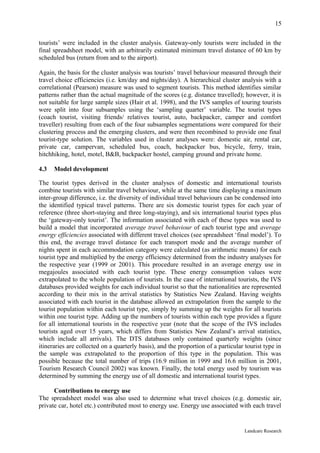
energy efficiency decreased proportionately more for motel operators (20.0%), the actual
decrease in energy efficiency was 8.1 MJ/visitor-night compared with 11.3 MJ/visitor-night
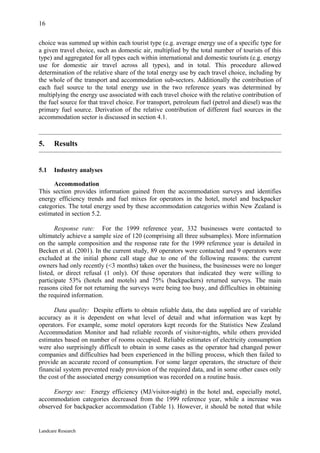
for hotel operators (Table 1). The decreased energy efficiency was less marked for the hotel
and motel categories when only operators surveyed in both years were included (Table 2).
Decreased energy efficiency occurred in the backpacker category when only operators
surveyed in both years were included (Table 2). However, this change is also likely to be
within the errors associated with reporting.

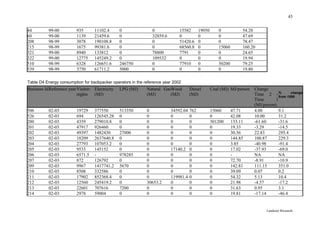
Table 1 Energy efficiency (MJ/visitor-night) for the accommodation categories in the
reference years1999 and 2001, all operators

Accommodation           1999 (MJ/visitor-
                                          2001 (MJ/visitor-night)   % change from 1999
category                     night)
Hotels                        134.0               145.3                     8.4
Motels                         40.4                48.5                    20.0
Backpacker                     38.8                36.7                    -5.3

Table 2 Energy efficiency (MJ/visitor-night) for the accommodation categories in the
reference years 1999 and 2001, only operators surveyed in both years

Accommodation           1999 (MJ/visitor-
                                          2001 (MJ/visitor-night)   % change from 1999
category                     night)
Hotels                        134.5               140.1                     4.1
Motels                         38.4                44.3                    13.9
Backpacker                     36.0                36.7                     2.1


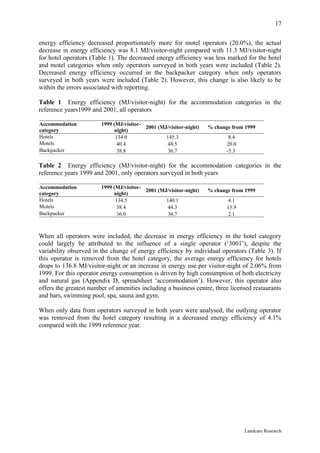
When all operators were included, the decrease in energy efficiency in the hotel category
could largely be attributed to the influence of a single operator (‘3001’), despite the
variability observed in the change of energy efficiency by individual operators (Table 3). If
this operator is removed from the hotel category, the average energy efficiency for hotels
drops to 136.8 MJ/visitor-night or an increase in energy use per visitor-night of 2.06% from
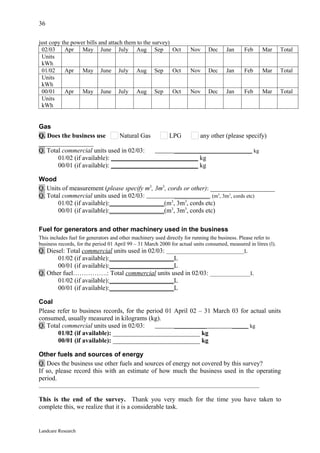
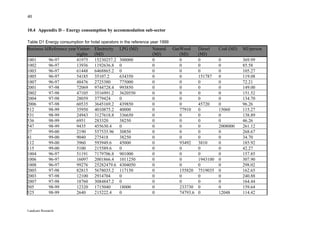
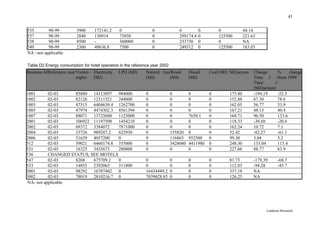
1999. For this operator energy consumption is driven by high consumption of both electricity
and natural gas (Appendix D, spreadsheet ‘accommodation’). However, this operator also
offers the greatest number of amenities including a business centre, three licensed restaurants
and bars, swimming pool, spa, sauna and gym.

When only data from operators surveyed in both years were analysed, the outlying operator
was removed from the hotel category resulting in a decreased energy efficiency of 4.1%
compared with the 1999 reference year.


                                                                                  Landcare Research
18

Table 3 Energy efficiency (MJ/visitor-night) of hotel operators surveyed in the reference
year 2001.

Operator id.          1999 MJ/visitor-night   2001 MJ/visitor-night    % change from 1999
1001                        369.99                  175.80                   -52.5
1002                         85.58                  152.88                    78.6
1003                        105.27                  162.05                    53.9
1005                         119.1                   167.2                    40.4
1007                          72.2                   168.7                   133.6
2001                         149.0                   118.3                   -20.6
2002                         151.5                   162.2                     7.1
2004                         134.7                    52.4                   -61.1
2006                          96.3                    99.3                     3.2
512                          115.3                   248.3                   115.4
531                          138.9                   227.7                    63.9
                                                        1
536                           46.2                                            NA
547                          261.1                    81.7                   -68.7
533                         206.32                   112.03                  -45.7
3001                          NA                     337.18                   NA
3002                          NA                     126.25                   NA
1
    Classified as motel in 2002
2
    Classified as a motel in 1999


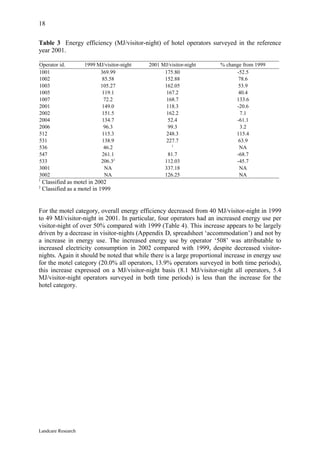
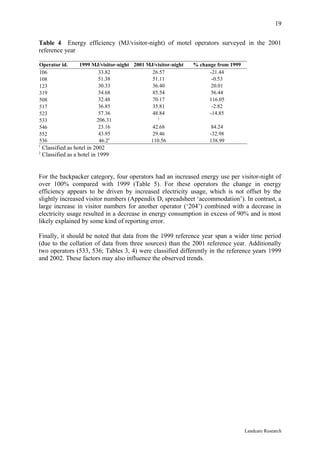
For the motel category, overall energy efficiency decreased from 40 MJ/visitor-night in 1999
to 49 MJ/visitor-night in 2001. In particular, four operators had an increased energy use per
visitor-night of over 50% compared with 1999 (Table 4). This increase appears to be largely
driven by a decrease in visitor-nights (Appendix D, spreadsheet ‘accommodation’) and not by
a increase in energy use. The increased energy use by operator ‘508’ was attributable to
increased electricity consumption in 2002 compared with 1999, despite decreased visitor-
nights. Again it should be noted that while there is a large proportional increase in energy use
for the motel category (20.0% all operators, 13.9% operators surveyed in both time periods),
this increase expressed on a MJ/visitor-night basis (8.1 MJ/visitor-night all operators, 5.4
MJ/visitor-night operators surveyed in both time periods) is less than the increase for the
hotel category.


Landcare Research
19

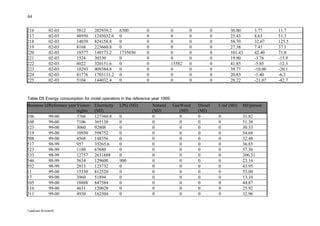
Table 4 Energy efficiency (MJ/visitor-night) of motel operators surveyed in the 2001
reference year

Operator id.        1999 MJ/visitor-night 2001 MJ/visitor-night   % change from 1999
106                        33.82                 26.57                  -21.44
108                        51.38                 51.11                   -0.53
123                        30.33                 36.40                   20.01
319                        54.68                 85.54                   56.44
508                        32.48                 70.17                  116.05
517                        36.85                 35.81                   -2.82
523                        57.36                 48.84                  -14.85
                                                   1
533                       206.31
546                        23.16                 42.68                   84.24
552                        43.95                 29.46                  -32.98
                                2
536                        46.2                 110.56                  138.99
1
    Classified as hotel in 2002
2
    Classified as a hotel in 1999


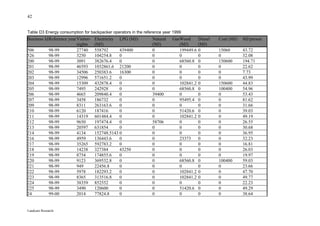
For the backpacker category, four operators had an increased energy use per visitor-night of
over 100% compared with 1999 (Table 5). For these operators the change in energy
efficiency appears to be driven by increased electricity usage, which is not offset by the
slightly increased visitor numbers (Appendix D, spreadsheet ‘accommodation’). In contrast, a
large increase in visitor numbers for another operator (‘204’) combined with a decrease in
electricity usage resulted in a decrease in energy consumption in excess of 90% and is most
likely explained by some kind of reporting error.

Finally, it should be noted that data from the 1999 reference year span a wider time period
(due to the collation of data from three sources) than the 2001 reference year. Additionally
two operators (533, 536; Tables 3, 4) were classified differently in the reference years 1999
and 2002. These factors may also influence the observed trends.


                                                                                       Landcare Research
20

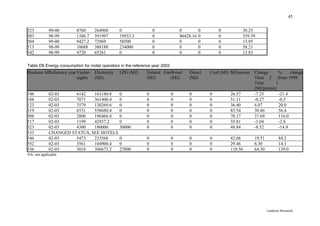
Table 5 Energy efficiency (MJ/visitor-night) of backpacker operators surveyed in the 2001
reference year

Operator id.         1999 MJ/visitor-   2001 MJ/visitor-night     % change from 1999
                           night
506                        43.72                47.71                     9.1
526                        32.08                42.08                    31.2
200                       194.71               133.11                   -31.6
201                        22.62                19.33                   -14.5
202                         7.73                30.56                   295.4
203                        43.99               144.85                   229.3
204                        44.83                 3.85                   -91.4
205                        54.96                17.02                   -69.0
                                                  1
206                        53.43                                         NA
207                        81.62                72.70                   -10.9
209                        31.66               142.81                   351.0
210                        39.03                39.09                     0.2
211                        49.19                54.32                    10.4
212                        26.55                21.98                   -17.2
213                        30.68                31.63                     3.1
214                        36.95                19.81                   -46.4
216                        32.23                36.00                    11.7
217                        16.81                25.43                    51.3
218                        26.03                58.70                   125.5
219                        19.97                27.38                    37.1
220                        59.03               101.43                    71.8
221                        23.66                19.90                   -15.9
222                        47.70                41.85                   -12.3
223                        49.77                39.77                   -20.1
224                        22.23                20.83                    -6.3
225                        49.29                28.22                   -42.8
1
  Unreliable estimates


       Contribution of fuel sources to total energy consumption
Electricity is the primary contributor to the total energy consumption in all accommodation
categories for both reference years (Tables 6 and 7). LPG is the next most common fuel type
for all, while the other sources, natural gas, wood, diesel and coal, only play a minor role.

Table 6 Relative contribution of different fuel sources to total energy use by operators
surveyed in the 1999 reference year

Fuel source                Hotel [%]                  Motel [%]             Backpacker [%]
Electricity                  74.4                       94.8                     76.3
LPG                           7.5                        4.4                      3.2
Natural gas                   0.0                        0.0                      5.1
Wood                          5.6                        0.9                      9.8
Diesel                        7.7                        0.0                      1.1
Coal                          4.8                        0.0                      4.5


Landcare Research
21


Table 7 Relative contribution of different fuel sources to total energy use by operators
surveyed in the 2001 reference year

Fuel source              Hotel [%]                Motel [%]                Backpacker [%]
Electricity                70.6                     97.8                        90.1
LPG                        15.8                      2.2                         6.1
Natural gas                 8.1                      0.0                         0.4
Wood                        2.3                      0.0                         1.2
Diesel                      3.2                      0.0                         0.0
Coal                         0                       0.0                         2.1


Potential for energy savings exist in initially making operators aware of how their energy is
being used and of cost-effective ways to reduce that energy use. This is especially relevant
for motel operators for which the greatest difficulties were experienced in obtaining energy
use data due to the lack of, or incomplete records. Awareness of energy use could be
achieved through the promotion of consistent data reporting such as that already commenced
by EECA with their auditing spreadsheet for hotels and by the Youth Hostel Association who
records energy consumption of its member hostels. However, it should also be acknowledged
that a number of operators (particularly hotels) already record energy consumption for their
own use and are working towards reducing energy use. Energy consumption of an individual
operator also depends on the number and type of facilities (e.g. spas, saunas, bars) offered,
which in turn is driven by consumer demand. As such cost-effective energy saving measures
need to be tailored to individual businesses and case studies of energy saving measures such
as those provided by the Environmental Accommodation Providers of Auckland could be
promoted as examples of ways different operators have already reduced energy use.


       Transport
This section provides the energy efficiency trends for the different transport modes. Energy
efficiency is measured as the amount of energy used per passenger-kilometre, hence this
measure takes into account both fuel efficiency of the vehicle and average load factors. These
data are used in section 5.2 to estimate the overall energy use by transport and the relative
importance of different transport modes.

Data quality: The quality of data for transport modes typically used by tourists varies, with
data on domestic air travel, the Cook Strait ferries and rail travel considered to be the most
accurate and reliable. Bus operations and campervan travel were also considered to be
reasonably reliable and accurate. The value for car transport constituted an average value
dating back to the mid-1990s. However, the variation in fuel consumption for cars is
considerable given different makes, years, driving conditions, etc., which is the reason why
the Ministry of Transport were unwilling to update the average consumption figure provided
in MoT (1995).

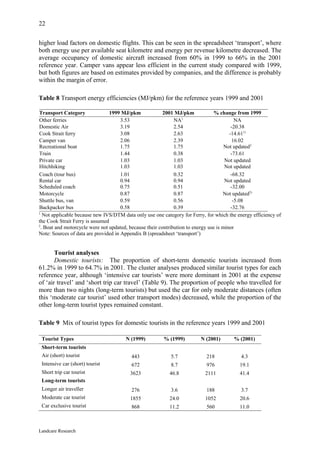
      Energy use: The greatest improvements in energy efficiency were made for rail travel,
coach tours, scheduled buses and domestic air travel (Table 8). In the case of coach and bus
travel, the determining factor was increased occupancy of buses in the 2001 reference year
compared with 1999. The energy efficiency for rail travel in 1999 has been taken from EECA
(1999), while the data for 2001 reference year have been provided directly by TranzRail.
Achievements in energy efficiency for air travel are due to a modernised fleet as well as


                                                                                 Landcare Research
22

higher load factors on domestic flights. This can be seen in the spreadsheet ‘transport’, where
both energy use per available seat kilometre and energy per revenue kilometre decreased. The
average occupancy of domestic aircraft increased from 60% in 1999 to 66% in the 2001
reference year. Camper vans appear less efficient in the current study compared with 1999,
but both figures are based on estimates provided by companies, and the difference is probably
within the margin of error.

Table 8 Transport energy efficiencies (MJ/pkm) for the reference years 1999 and 2001

Transport Category               1999 MJ/pkm              2001 MJ/pkm             % change from 1999
Other ferries                         3.53                     NA1                          NA
Domestic Air                          3.19                     2.54                       -20.38
Cook Strait ferry                     3.08                     2.63                      -14.611)
Camper van                            2.06                     2.39                        16.02
Recreational boat                     1.75                     1.75                    Not updated2
Train                                 1.44                     0.38                       -73.61
Private car                           1.03                     1.03                    Not updated
Hitchhiking                           1.03                     1.03                    Not updated
Coach (tour bus)                      1.01                     0.32                       -68.32
Rental car                            0.94                     0.94                    Not updated
Scheduled coach                       0.75                     0.51                       -32.00
Motorcycle                            0.87                     0.87                   Not updated2)
Shuttle bus, van                      0.59                     0.56                        -5.08
Backpacker bus                        0.58                     0.39                       -32.76
1
   Not applicable because new IVS/DTM data only use one category for Ferry, for which the energy efficiency of
the Cook Strait Ferry is assumed
2
  . Boat and motorcycle were not updated, because their contribution to energy use is minor
Note: Sources of data are provided in Appendix B (spreadsheet ‘transport’)


       Tourist analyses
       Domestic tourists: The proportion of short-term domestic tourists increased from
61.2% in 1999 to 64.7% in 2001. The cluster analyses produced similar tourist types for each
reference year, although ‘intensive car tourists’ were more dominant in 2001 at the expense
of ‘air travel’ and ‘short trip car travel’ (Table 9). The proportion of people who travelled for
more than two nights (long-term tourists) but used the car for only moderate distances (often
this ‘moderate car tourist’ used other transport modes) decreased, while the proportion of the
other long-term tourist types remained constant.

Table 9 Mix of tourist types for domestic tourists in the reference years 1999 and 2001

 Tourist Types                         N (1999)         % (1999)         N (2001)       % (2001)
 Short-term tourists
 Air (short) tourist                      443               5.7             218            4.3
 Intensive car (short) tourist            672               8.7             976            19.1
 Short trip car tourist                  3623              46.8            2111            41.4
 Long-term tourists
 Longer air traveller                     276               3.6             188            3.7
 Moderate car tourist                    1855              24.0            1052            20.6
 Car exclusive tourist                    868              11.2             560            11.0


Landcare Research
23

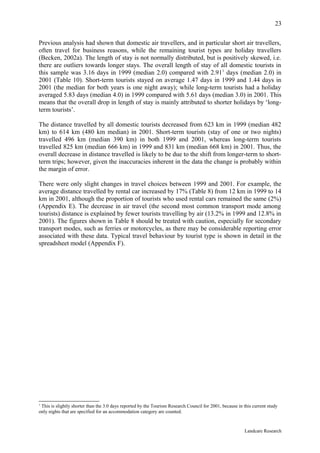
Previous analysis had shown that domestic air travellers, and in particular short air travellers,
often travel for business reasons, while the remaining tourist types are holiday travellers
(Becken, 2002a). The length of stay is not normally distributed, but is positively skewed, i.e.
there are outliers towards longer stays. The overall length of stay of all domestic tourists in
this sample was 3.16 days in 1999 (median 2.0) compared with 2.91 1 days (median 2.0) in
2001 (Table 10). Short-term tourists stayed on average 1.47 days in 1999 and 1.44 days in
2001 (the median for both years is one night away); while long-term tourists had a holiday
averaged 5.83 days (median 4.0) in 1999 compared with 5.61 days (median 3.0) in 2001. This
means that the overall drop in length of stay is mainly attributed to shorter holidays by ‘long-
term tourists’.

The distance travelled by all domestic tourists decreased from 623 km in 1999 (median 482
km) to 614 km (480 km median) in 2001. Short-term tourists (stay of one or two nights)
travelled 496 km (median 390 km) in both 1999 and 2001, whereas long-term tourists
travelled 825 km (median 666 km) in 1999 and 831 km (median 668 km) in 2001. Thus, the
overall decrease in distance travelled is likely to be due to the shift from longer-term to short-
term trips; however, given the inaccuracies inherent in the data the change is probably within
the margin of error.

There were only slight changes in travel choices between 1999 and 2001. For example, the
average distance travelled by rental car increased by 17% (Table 8) from 12 km in 1999 to 14
km in 2001, although the proportion of tourists who used rental cars remained the same (2%)
(Appendix E). The decrease in air travel (the second most common transport mode among
tourists) distance is explained by fewer tourists travelling by air (13.2% in 1999 and 12.8% in
2001). The figures shown in Table 8 should be treated with caution, especially for secondary
transport modes, such as ferries or motorcycles, as there may be considerable reporting error
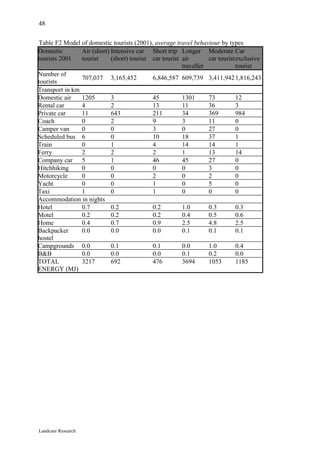
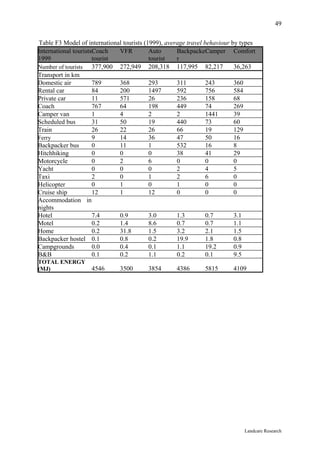
associated with these data. Typical travel behaviour by tourist type is shown in detail in the
spreadsheet model (Appendix F).


1
 This is slightly shorter than the 3.0 days reported by the Tourism Research Council for 2001, because in this current study
only nights that are specified for an accommodation category are counted.


                                                                                                          Landcare Research
24

Table 10 Travel choices of domestic tourists for both reference years and all tourist types

Travel choice                         1999              2001              Change [%]
Average distance travelled per tourist (km)
Domestic air                           140               135                   -3.6
Rental car                              12                14                  16.7
Private car                            406               395                   -2.7
Coach                                    6                 6                   0.0
Camper van                               7                 7                   0.0
Scheduled bus                           11                13                  18.2
Train                                    6                 5                  -16.7
Ferry                                    4                 5                  25.0
Company car                             25                28                  12.0
Hitchhiking                              -                 1
Motorcycle                               3                 1                  -66.7
Yacht                                    2                 1                  -50.0
Taxi                                     -                 1
TOTAL DISTANCE                         623               614                   -1.4
Accommodation (average nights per tourist)
Hotel                                  0.4                0.3                 -25.0
Motel                                  0.3                0.3                  0.0
Home                                   2.0                1.9                  -5.0
Backpacker hostel                      0.1                0.1                  0.0
Campgrounds                            0.4                0.3                 -25.0
B&B                                    0.1                0.1                  0.0
TOTAL STAY                            3.16               2.91                  -7.9
Note: the figures presented in this table are calculated as an average across all tourists, including those that did
not use a specific transport mode (distance = 0) or accommodation category (no nights).


       International tourists: In the IVS sample of 1999, data were analysed for 5505 tourists,
of which 1162 were gateway-only tourists (21.1%). Similarly in 2001, 5468 tourists, of which
1184 were gateway-only tourists (21.7%), were included in this analysis. The mix of tourist
types resulting from the cluster analyses is shown in Table 11. The mix of tourist types was
relatively stable over the two years, although both the proportion of tourists visiting
friends/relatives (VFR) and gateway-only tourist increased with a corresponding decrease in
other tourist types (Table 11).

Table 11 International tourist types in the reference years 1999 and 2001

 Tourist Types              N (1999)        % (1999)        N (2001)        % (2001)
 Coach tourist                1545            28.0            1488             27.2
 Auto tourist                 819             14.9             794             14.5
 Backpacker                   494              9.0             478              8.7
 Camper                       316              5.7             288              5.3
 Comfort traveller            157              2.8             145              2.7
 Visiting friends/            1012            18.4            1091             20.0
 relatives (VFR)
 Gateway only                 1162            21.1            1184             21.7


Landcare Research
25

 International tourists stayed longer in 2001 compared with 1999: the average calculated
 length of stay2 increased from 17.7 days (median 9.0) to 21.1 days (median 9.0). However, it
 has to be noted that this ‘calculated length of stay’ deviates considerably from the reported
 length of stay, particularly for 1999. The reported length of stay is based on what tourists
 reported when asked their length of stay in New Zealand; the average was 24.7 days in 1999
 and 20.5 days in 2001. This indicates the range of error associated with self-reporting;
 tourists either overestimated their length of stay (possibly because of a psychological bias
 associated with a successful holiday) or they forgot to report several nights in their itinerary.
 If touring tourists were separated from gateway-only tourists, the average length of stay
 increased from 19.2 days (median 11.0) to 21.4 days (median 11.0).


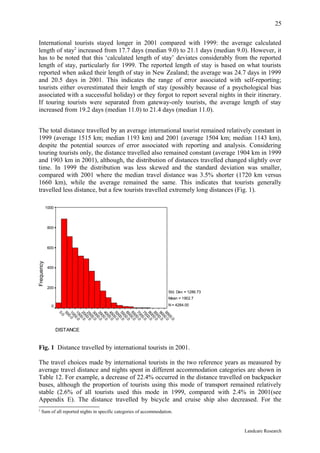
 The total distance travelled by an average international tourist remained relatively constant in
 1999 (average 1515 km; median 1193 km) and 2001 (average 1504 km; median 1143 km),
 despite the potential sources of error associated with reporting and analysis. Considering
 touring tourists only, the distance travelled also remained constant (average 1904 km in 1999
 and 1903 km in 2001), although, the distribution of distances travelled changed slightly over
 time. In 1999 the distribution was less skewed and the standard deviation was smaller,
 compared with 2001 where the median travel distance was 3.5% shorter (1720 km versus
 1660 km), while the average remained the same. This indicates that tourists generally
 travelled less distance, but a few tourists travelled extremely long distances (Fig. 1).

            1000


             800


             600
Frequency


             400


             200
                                                                     Std. Dev = 1286.73
                                                                     Mean = 1902.7

               0                                                     N = 4284.00
                   0.
                   50
                   10 .0
                   15 0.0
                   20 0.0
                   25 0.0
                   30 0.0
                   35 0.0
                   40 0.0
                   45 0.0
                   50 0.0
                   55 0.0
                   60 0.0
                   65 0.0
                   70 0.0
                   75 0.0
                   80 0.0
                   85 0.0
                   90 0.0
                   95 0.0
                     0
                      0
                      0
                      0
                      0
                      0
                      0
                      0
                      0
                      0
                      0
                      0
                      0
                      0
                      0
                      0
                      0
                      0
                      0
                      00
                        .0


                   DISTANCE


 Fig. 1 Distance travelled by international tourists in 2001.

 The travel choices made by international tourists in the two reference years as measured by
 average travel distance and nights spent in different accommodation categories are shown in
 Table 12. For example, a decrease of 22.4% occurred in the distance travelled on backpacker
 buses, although the proportion of tourists using this mode of transport remained relatively
 stable (2.6% of all tourists used this mode in 1999, compared with 2.4% in 2001(see
 Appendix E). The distance travelled by bicycle and cruise ship also decreased. For the
 2
     Sum of all reported nights in specific categories of accommodation.


                                                                                          Landcare Research
26

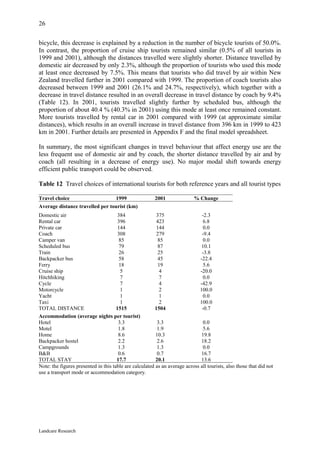
bicycle, this decrease is explained by a reduction in the number of bicycle tourists of 50.0%.
In contrast, the proportion of cruise ship tourists remained similar (0.5% of all tourists in
1999 and 2001), although the distances travelled were slightly shorter. Distance travelled by
domestic air decreased by only 2.3%, although the proportion of tourists who used this mode
at least once decreased by 7.5%. This means that tourists who did travel by air within New
Zealand travelled further in 2001 compared with 1999. The proportion of coach tourists also
decreased between 1999 and 2001 (26.1% and 24.7%, respectively), which together with a
decrease in travel distance resulted in an overall decrease in travel distance by coach by 9.4%
(Table 12). In 2001, tourists travelled slightly further by scheduled bus, although the
proportion of about 40.4 % (40.3% in 2001) using this mode at least once remained constant.
More tourists travelled by rental car in 2001 compared with 1999 (at approximate similar
distances), which results in an overall increase in travel distance from 396 km in 1999 to 423
km in 2001. Further details are presented in Appendix F and the final model spreadsheet.

In summary, the most significant changes in travel behaviour that affect energy use are the
less frequent use of domestic air and by coach, the shorter distance travelled by air and by
coach (all resulting in a decrease of energy use). No major modal shift towards energy
efficient public transport could be observed.

Table 12 Travel choices of international tourists for both reference years and all tourist types

Travel choice                    1999                   2001                % Change
Average distance travelled per tourist (km)
Domestic air                           384               375                   -2.3
Rental car                             396               423                    6.8
Private car                            144               144                    0.0
Coach                                  308               279                   -9.4
Camper van                              85                85                    0.0
Scheduled bus                           79                87                   10.1
Train                                   26                25                   -3.8
Backpacker bus                          58                45                  -22.4
Ferry                                   18                19                    5.6
Cruise ship                              5                 4                  -20.0
Hitchhiking                              7                 7                    0.0
Cycle                                    7                 4                  -42.9
Motorcycle                               1                 2                  100.0
Yacht                                    1                 1                    0.0
Taxi                                     1                 2                  100.0
TOTAL DISTANCE                        1515              1504                   -0.7
Accommodation (average nights per tourist)
Hotel                                  3.3                3.3                   0.0
Motel                                  1.8                1.9                   5.6
Home                                   8.6               10.3                  19.8
Backpacker hostel                      2.2                2.6                  18.2
Campgrounds                            1.3                1.3                   0.0
B&B                                    0.6                0.7                  16.7
TOTAL STAY                            17.7               20.1                  13.6
Note: the figures presented in this table are calculated as an average across all tourists, also those that did not
use a transport mode or accommodation category.


Landcare Research
27

5.2    Integration of industry and tourist analyses


International visitor numbers (expressed as arrivals) increased by 18% from 1.44 million in
1999 to 1.69 million in 2001, while domestic volumes decreased slightly by about 2% (Table
11). The spreadsheet model provides information on total energy use by international and
domestic tourists, the whole sector (and sub-sectors), and per average tourist. Energy use per
tourist decreased both for international (3385 MJ in 1999 and 3082 MJ in 2001) and domestic
(1053 MJ in 1999 and 950 MJ in 2001) tourists, mainly as a result of the increase in energy
efficiency for domestic air travel and other transport modes, for example coach travel. The
decrease in energy use per tourist is not attributed to a change in travel behaviour, as travel
distances – the main driver in terms of behaviour - decreased only marginally (Tables 10 and
12). The predominance of domestic tourist volumes combined with the decrease in energy
use per tourist results in a decrease in the overall energy consumption of the tourism sector
from 22.6 PJ in 1999 to 21.0 PJ in 2001 (-7.5%), despite the growth in the number of
international tourist trips (Table 13).

Table 13 Summary for energy use of the tourism sector (transport and accommodation sub-
sectors) for both reference years

Tourists        Trips 1999 Trips 2001 Change trips Energy use   Energy use Change energy
                                          (%)       1999 (PJ)    2001 (PJ)    use (%)
International   1,437,552 1,694,537      17.88         4.87         5.22        7.33
Domestic        16,889,000 16,557,000    -1.97        17.78        15.72       -11.56
Total           18,326,552 18,251,537    -0.41        22.64        20.95        -7.46


The contribution of each travel choice to total energy use for domestic and international
tourists, and for all tourists is shown in Table 14. For all tourists, domestic air was the key
driver of energy use, although its contribution decreased slightly in 2001 (34.5%, or 7.2PJ)
compared with 1999 (38.4% or 8.7PJ) due to the increase in energy efficiency. Private cars
and domestic air travel account for a similar proportion of energy use for domestic tourists,
while domestic air followed by rental cars are the most important contributors to energy use
by international tourists. Generally, international tourists use a wider range of transport
modes, which spreads energy use among a number of different transport modes, in contrast to
domestic tourists in which transport is dominated by two modes. As such, a variety of targets
for energy efficiency measures exist for the international market, whereas initiatives to
reduce transport energy use of domestic tourists should focus on the private car and air travel.
Two accommodation categories stand out as the most important contributors to energy use
for both domestic and international tourists: private homes (9.6% of total energy use or 2.0PJ
in 2001, 1.9 PJ in 1999) and hotels (6.9% or 1.5 PJ in 2001, 1.4 PJ in 1999). The other
categories contribute only to a small degree, which indicates hotels should be the main target
for energy efficiency initiatives within the commercial sector. Overall, the transport sector
contributed 18.5 PJ (81.7%) in 1999, compared with 16.5 PJ (78.8%) in 2001, indicating the
significance of this source to total energy use by tourism.


                                                                                 Landcare Research
28

Table 14 Most important drivers of energy use (relative share [%] of 22.6 PJ in 1999 and
21.0 PJ in 2001)

Key drivers of        Domestic      Domestic      International   International   Overall    Overall
energy use [%]      tourists 1999 tourists 2001   tourists 1999   tourists 2001 share 1999 share 2001
Domestic air            39.7          36.1             33.8            29.6        38.4       34.5
Private car             36.3          39.2              4.0             4.4        29.3       30.5
Coach                    0.6           0.2              8.7             2.7         2.3        0.8
Rental car               1.2           1.5             11.7            13.8         3.4        4.6
Camper van               1.5           1.7              5.2             6.3         2.3        2.9
“Home”                   7.9           8.1             10.9            14.3         8.5        9.6
Hotel                    4.5           4.3             12.7            14.9         6.2        6.9
Motel                    1.3           1.7              2.1             3.0         1.4        2.0
Backpacker               0.1           0.1              2.3             2.9         0.6        1.0

The most important fuel source is diesel and petrol, followed by aviation fuel and electricity
(Table 15); the other sources only play a minor role. The importance of electricity increased
slightly between 1999 and 2001.

Table 15 Fuel sources (relative share [%]) in 1999 and 2001

Key drivers of energy     Overall share    Overall share
use [%]                      1999             2001
Petrol/diesel fuel            43.8             44.7
Aviation fuel                 38.4             34.5
Electricity                   13.2             15.1
LPG                            1.0              1.7
Wood                           1.6              1.6
Natural gas                    0.8              1.5
Coal                           0.8              0.5
Geothermal                     0.4              0.4


6.     Discussion


The objective of this study was to analyse any trend in energy use by tourists and the tourism
sector that occurred between 1999 and 2001 resulting from changes in tourism activity
(volume), structure (e.g. tourist type mix) and technology, when considering transport and
accommodation as the major sources of energy demand. Due to the large volume of domestic
tourists, the slight decrease (2%) in the number of domestic trips by New Zealanders (in
combination with gains in efficiency) resulted in a larger decrease (11.6%) in the energy
demand for domestic tourism from 17.8 PJ in 1999 to 15.7 PJ in 2001. In contrast, the
growing international tourist volume (18% between the two reference years, and about 6%
per annum forecast each year until 2008, although this growth was slowed down in 2003 as a
result of external events such as SARS) led to a 7.3% increase in demand for energy by
international tourists during the two-year study period. This also indicates that the increased
volume of international tourists outweighs the efficiency gains (mainly in the transport sector,
e.g. domestic air travel). Due to the influence of domestic tourism, overall energy use by


Landcare Research
29

tourist transport and accommodation decreased by 7.5% between 2001 and 1999. Of the total
energy use transport contributed about 82% in 1999 and 79% in 2001. The main drivers of
energy use are domestic air travel (34.5%), cars (private [30.5%] and rental [4.6%]), private
homes (9.6%) and hotels (6.9%). The most significant modal change that could be observed
was a decrease in air travel.

Energy use per average trip, for both domestic and international tourists, decreased slightly
(international tourists: 3385 MJ in 1999 and 3082 MJ in 2001; domestic tourists: 1053 MJ in
1999 and 950 MJ in 2001) primarily as a result of improved energy efficiencies in the
transport sector. In particular, domestic air became more energy efficient on a per passenger
basis (3.19 MJ/pkm in 1999 and 2.54 MJ/pkm in 2002, Table 8). Furthermore, this result is
considered reliable because of the consistent reporting by Air New Zealand for both reference
years. Information on energy use by all other modes of transport was obtained from different
sources for each reference year (e.g. train and buses), or was unable to be updated (cars) and
may indicate that changes in energy use simply reflect different reporting. For the Cook Strait
ferry, energy use per passenger is highly dependent on the passenger-to-freight ratio, which
varies significantly, and makes improvements in efficiency difficult to detect. Energy use of
rental and private cars by tourists requires considerably more investigation than was possible
within the limits of this study. Principally, there are several competing trends that influence
energy use associated with these transport modes. These includes the introduction of more
modern and efficient cars (of particular importance for rental cars), the increasing number of
diesel cars, the increasing proportion of cars with larger engines, the popularity of four-wheel
drives, and the increasingly application of electronic equipment, such as air conditioning. At
this stage, there is no information on energy use associated with cars specifically used by
tourists, neither is there information whether specific types of tourists systematically use
different types of cars (e.g. there is some anecdotal evidence that backpackers tend to buy
older and smaller cars or rent them cheaply at companies such as ‘rent-a-dent’).

Energy efficiency associated with hotels and motels decreased slightly from 1999 to 2001
(134 MJ/visitor-night to 145 MJ/visitor-night, and 40.4 MJ/visitor-night to 48.5 MJ/visitor-
night for hotels and motels respectively). In contrast energy efficiency increased overall for
backpackers (from 38.6 MJ/visitor-night to 36.7 MJ/visitor-night in 1999 and 2001
respectively). In absolute numbers, hotels increased their energy use from 1.41 PJ in 1999 to
1.46 PJ in 2001, motels from 0.33PJ to 0.41 PJ and backpackers form 0.14 PJ to 0.17 PJ
(final spreadsheet model). For hotels and motels this change is likely to be attributed to both
increased stays and increase in energy efficiency for hotels and motels, for backpackers the
increase in consumption is due to increased international tourists to backpackers. However, it
is unclear as to how much of these trends are due to inconsistent or inaccurate reporting.
More detailed time-series would be needed to trace improvements in energy efficiency for
individual businesses, initially to primarily ensure consistent data collection. The results of
the accommodation survey show that the calculated average energy efficiency for a visitor-
night in a specific category depends on what businesses are included (outliers were shown to
affect the final result dramatically); and it is possibly inappropriate to try defining one single
estimate for energy use by category, given the very different nature of businesses even within
one category1. For the final spreadsheet model, however, it is pragmatic to assume a
representative energy efficiency for each category to allow calculation of energy use
associated with tourist types.


1
 The variation in consumption patterns would possibly be less in other tourist destinations where more uniform, resort-style
accommodation businesses dominate.


                                                                                                          Landcare Research
30

The method of segmenting tourists into types, as undertaken in the previous research (Becken
2002a), was validated in this current study, with similar types emerging in the second dataset
compared with the first one. The most important trend for the domestic market is that
domestic tourists undertake fewer trips in New Zealand 2 for shorter periods of time, while
travelling similar distances across all trips. For short trips (1 or 2 nights away), domestic
tourists tended to travel more often with their private car and slightly less by domestic air in
2001 compared with 1999. Those who did travel by domestic air travelled further (1205 km
in 2001 compared with 1095 km in 1999), while car travellers travelled shorter distances. Air
travellers on longer trips travelled shorter distances in 2001 compared with 1999 (1301 km
versus 1412 km).

International tourists stayed longer in New Zealand in 2001 than in 1999, although their
travel distance remained remarkably constant. In other words, travel distance per tourist and
per day decreased slightly. The mix of tourist types remained relatively constant, although the
proportion of VFR tourists and gateway-only tourists increased. The analysis showed that all
tourist types, except the camping tourist, travelled shorter distances on average, and as a
result (in combination with efficiency gains in the transport sector) their individuated energy
use decreased between 1999 and 2001. The camping tourists travelled 2881 km in 1999
compared with 2968 km in 2001, and in combination with a higher energy efficiency for
camper van travel in 2001 the camping tourist consumed 8.5% more energy in 2001
compared with 1999. More research is needed to identify transport behaviour of ‘gateway-
only’ travellers, who may comprise business and conference visitors, as well as visiting
friends/relatives tourists, in order to ascertain energy use by these tourists.


7.     Conclusions

     Energy consumption by the tourism sector decreased from 22.6 PJ in 1999 to 21.0 PJ in
     2001, or a decrease of 7.5% from 1999. The transport sector is the main contributor to
     this energy consumption, contributing 18.5 PJ (81.7%) and 16.5 PJ (78.8%) in 1999 and
     2001 respectively. Comparatively, the accommodation sector consumed 4.2 PJ (18.3%)
     in 1999 and 4.4 PJ (21.2%) in 2001. Overall, the most important drivers are domestic air
     (34.5%), the private car (30.5%), and private homes (9.6%). The dominant fuel source is
     petroleum fuel in the form of diesel and petrol with a contribution of 43.7% to energy use
     in 1999, followed by aviation fuel (38.4%) and electricity (13.2%). The proportions were
     similar in 2001, where fuel made up 44.7%, aviation fuel 34.5% and electricity 15.1%.

     Energy use associated with tourism appears to be mainly volume-driven, with domestic
     tourists as the primary driver. There were 2.0 % fewer domestic tourists in 2001 than in
     1999, which corresponded to a decrease in energy use of domestic tourists from 17.8 PJ
     in 1999 to 15.7 PJ in 2001. In contrast there was an increase of 17.9 % in international
     tourist number, which corresponded to a smaller increase in energy consumption from
     4.9 PJ in 1999 to 5.2 PJ in 2001. Technological and operational improvements of key
     transport modes (air travel in particular) also play an important role in reducing energy
     consumption.

2
 This is only partly compensated for by an increased outbound market (0.5% between 2001 and 2002), Statistics New
Zealand at www.stats.govt.nz)


Landcare Research
31

    The main change in travel behaviour is that domestic tourists travelled for less time (3.2
    days in 1999 and 2.9 days in 2001), although they travelled similar distances in 2001 (the
    average tourist travelled 623 km in 1999 and 614 km in 2001). In contrast, international
    tourists stayed longer in 2001 (21.1 days compared with 17.7 days in 1999). The distance
    travelled per tourist remained remarkably constant (about 1500 km) – a slight increase in
    distance travelled by camping tourists was offset by the shorter distances travelled by all
    other international tourist types in 2001 compared with 1999. The development of
    international tourist behaviour is desirable, because longer stays mean greater economic
    benefit, while the constant travel distance does not lead to an increase in energy use. An
    overall decrease of travel distance in the future would be beneficial to compensate for
    further growth. Tourists travelled less often by domestic air in 2001 compared with 1999
    (3.8% less for domestic tourists and 7.5% less for international tourists), and shorter
    distances. Because air travel is an energy intensive transport mode (despite recent
    improvements), this trend leads to a decrease in energy use. The trend may reverse with
    Air New Zealand’s ‘Express Class’ and associated cheaper fares that may lead to
    increased volumes and possibly more flights.

In terms of energy efficiency, further improvements in the efficiency of air travel, as well as
increases in the efficiency of private and rental cars would yield the greatest overall
improvement in energy use. Given the difficulties experienced in obtaining data on average
fuel consumption for private or rental cars, this study cannot provide information on trends
that may have occurred between the 1999 and 2001 reference years. According to
conversations with rental car companies, the fleets become younger (which implies more fuel
efficient vehicles), but the proportion of cars with larger engines increases (which potentially
leads to increased energy demand). Saving potentials exist by encouraging rental vehicle
companies to include predominantly small and energy efficient cars in their fleet; as well as –
in the long run – vehicles that run on alternative fuel sources. However, rental fleet
composition will also be driven by consumer demand, which may conflict with energy saving
strategies.

More accurate and reliable data across a range of accommodation businesses are required to
better estimate the energy consumption associated with tourist accommodation. Such data
could be collected by the introduction of compulsory monitoring of energy use (maybe in the
form of triple bottom line reporting), similar to visitor statistics already collected by Statistics
New Zealand in the form of the Commercial Accommodation Monitor. This is probably not
realistic in the short run, but could be a long-term goal in the context of both the Tourism
Strategy and the National Energy Efficiency and Conservation Strategy. EECA has initiated
the collection of energy use data for hotels through the provision of a spreadsheet model that
allows for easy recoding of energy use (EECA 2003). If hotels take up this form of reporting
it will reduce the errors associated with inconsistent reporting and provide a more accurate
reflection of energy use trends. Moreover, effects such as cold winters or power crises could
be picked up when consistent reporting is in place. To enhance uptake of this form of
reporting EECA could work with a small pilot group of businesses, and at the same time
energy saving measures could be discussed and introduced into those hotels. The current
study indicates that EECA’s focus on energy efficiency in hotels is warranted to effectively
reduce energy use in the accommodation sector. Because of the large variation of energy use
within hotels, EECA may consider the option of monitoring hotels of different star
categories, as for example available through Qualmark.

Segmentation into tourist types allows EECA or other stakeholders to address tourists more


                                                                                    Landcare Research
32

specifically when attempting to induce shifts in behaviour. For example, international
backpacker tourists could be encouraged to travel on public transport, while camping tourists
could be motivated to travel less distance. In terms of domestic tourists, more research is
required to study the trend of increasing numbers of short-term trips that cover relatively long
individual travel distances. Research is currently being undertaken by Landcare Research on
reducing the travel distance by international tourists, but it is too early to make any
statements about saving potentials. No information on potentials to modify domestic tourists’
travel behaviour is available.

To date, very little research has focussed on energy use by tourism, therefore a comparison of
New Zealand with other countries is not possible. A few studies have analysed energy use
associated with different types of accommodation (e.g. CADDET 1997; Deng & Burnett
2000; Warnken & Bradley 2002). In terms of transport behaviour, however, to the knowledge
of the authors there are only two researchers in France examining travel distance (and
associated fuel use and emissions) associated with different transport modes. Only drafts for
publications are available at this stage.


8.     Recommendation


•    The potential amount of energy that can be saved is unable to be quantified within this
     study, although a number of opportunities exist.
•    Greatest energy saving potential exists by targeting the behaviour of domestic tourists, in
     particular that related to transport, primarily air travel and private cars. Strategies to
     reduce energy use associated with air travel by reducing the amount (distance, frequency)
     of air travel will conflict with the promotion of air travel, such as through the introduction
     of Air New Zealand’s ‘Express class’. As such, reduced energy use in this sector is more
     likely to result from technological change and improvements in operational efficiency.
     Strategies to reduce energy use associated with cars exist in promoting the sale of smaller
     fuel efficient models, encouraging regular car maintenance, promoting alternative means
     of transport e.g. coach travel. However, the difficulties associated with providing an
     accurate assessment of the energy use of cars by tourism, due to the large number of
     factors associated with efficiency e.g. model of car, year, driving conditions, should also
     be recognised.
•    Within the transport sector, domestic air travel and cars (private and rental) are the
     primary contributors to energy use, as such EECA should focus their attention on
     strategies to reduce energy use associated with these transport modes.
•    Within the accommodation sector, private homes and hotels are the primary contributors
     to energy use. Strategies already in place to reduce energy use in private homes will also
     impact on consumption in the tourist sector. For hotels, energy consumption will in part
     be driven by the facilities offered by the hotels, which in turn is driven by consumer
     demand. Additionally, the age and structure of buildings will influence energy demand.
     As such, energy saving measures need to be tailored toward individual operators. EECA
     could assist this by providing a service to identify opportunities for energy saving for a
     hotel, or assisting/promoting organisations such as the Environmental Accommodation
     Providers of Auckland (EAPA) and Target Zero, who provide a forum for energy saving
     measures to be promoted and experiences to be discussed (EAPA). Target Zero, an


Landcare Research
33

    initiative of the Christchurch City Council, promotes resource efficiency and waste
    minimisation whilst maximising profits for businesses.
•   Consistent data collection is necessary to enable trends in energy use by tourism due to
    technological developments and behavioural changes to be accurately assessed. With
    regards to the accommodation industry, EECA could work with a small pilot group of
    businesses to enhance uptake of its monitoring form to provide consistent data collection
    for hotels, the primary energy users in the accommodation sector. Ultimately, it would be
    desirable if energy reporting was made compulsory for businesses.
•   Customer awareness is an important factor in improving the sustainability of tourism
    businesses. Little is known how aware tourists are of issues, such as energy consumption
    and greenhouse gases1, and it is recommended that consumer campaigns be initiated to
    increase the currently (probably) low level of knowledge among tourists.
•   This study should be repeated in about five year's time in order to take into account the
    influence of greater technological development and behavioural change on trends in
    energy consumption by tourism than the two years encompassed by this study. The
    methodology of analysing tourism industries and tourist behaviour in the form of tourist
    types as provided in this study is considered sufficiently robust to enhance the model in
    the future with new points in time.
•   Strategies to reduce the travel energy use for all tourist types are needed to reduce energy
    use by the tourist sector. For domestic tourists, passengers travelling short distance by air,
    which often includes business travellers, are the main target. For international tourists,
    coach tourists should be targeted, but also auto and camping tourists.


1
 Becken, S. (forthcoming). The perception of climate change and forest carbon sinks by tourists and tourism experts.
Submitted to Global Environmental Change.


                                                                                                         Landcare Research
34


9.     References

Baines, J.T. ed. 1993: New Zealand energy information handbook. Christchurch.
Becken, S. 2002a: Energy use in the New Zealand tourism sector. PhD thesis, Lincoln
     University, New Zealand.
Becken, S. 2002b: Tourism and transport in New Zealand – implications for energy use.
     TRREC Report No. 54. (http://www.lincoln.ac.nz/trrec/trrecpub.htm)
Beckens, S.; Frampton, C.; Simmons, D. 2001: Energy consumption patterns in the
     accommodation sector – the New Zealand case. Ecological Economics 39: 371–386.
CADDET (Centre for the Analysis and Dissemination of Demonstrated Energy
   Technologies) 1997: Saving energy with energy efficiency in hotels and motels. Maxi
   Brochure 07. The Netherlands, Sittard.
Deng, S.; Burnett, J. 2000: A study of energy performance of hotel buildings in Hong Kong.
     Energy and Buildings 31: 7–12.
EECA 1999: Energy-wise monitoring quarterly. New Zealand’s transport sector energy use:
    Highlights. Issue 14, December 1999. Wellington.
EECA 2000: Residential Sector Energy Use: Highlights. Energy wise monitoring quarterly.
    Issue 15, June 2000.
EECA 2001: National energy efficiency and conservation strategy. Wellington.
Hair, J.F.; Anderson, R.E.; Tatham, R.L.; Black, W.C. 1998: Multivariate data analysis. Fifth
      Edition. Upper Saddle River, NJ, USA, Prentice Hall.
Johnson, V. 1999: Tourism energy flows on the West Coast of the South Island, New
     Zealand. Unpublished report on data collection.
Lenzen, M. 1999: Total requirements of energy and greenhouse gases for Australian
     transport. Transportation Research Part D, 4D: 265–290.
Ministry of Transport 1995: Greenhouse gas emissions from New Zealand transport
     Wellington, MoT.
Ministry of Transport 1997: Carbon monoxide emissions from petrol vehicles. Vehicle fleet
     emissions control strategy – Stage 1. Wellington, MoT.
Ministry of Transport 1998: Local air quality management: impacts from the road transport
     sector. Vehicle fleet emissions control strategy – Final Report. Wellington, MoT.
Patterson, M.G.; McDonald, G. 2002: How green and clean is New Zealand tourism?
      Lifecycle and future environmental impacts. Draft 15 March 2002. Palmerston North,
      Massey University.
Statististic New Zealand 2000: Tourism Satellite Account. Available at: www.stats.govt.nz
Tourism Research Council 2002: New Zealand domestic travel survey 2001. Wellington.
Warnken, J.; Bradley, M. 2002: Energy auditing and estimating greenhouse gas emissions for
     Australia’s tourist accommodation sector. Research Report. Australia, CRC for
     Sustainable Tourism.
World Energy Council (no date). Available at http://www.worldenergy.org


Landcare Research
35


10. Appendices

10.1 Appendix A – Survey form


INFORMATION ON THE BUSINESS
Ideally, the following information should cover the last financial year. However, if this is not
convenient, please supply as much information as you can, stating the dates that the bills relate to.
Name of business_______________________________

Operating Time and Total number of visitor-nights
Q. Did the business operate for the whole financial year?
   Yes      No if no: what was your operating period?
_______________________________

Q. What is the total capacity of the business?
Number of beds/sites (a double bed counts as two beds):________________________
Number of bedrooms: __________________________

Q. What was the total number of visitor-nights from 01 April 02 – 31 March 03? (Note:
one visitor-night = one guest for one night. If you had two guests staying for three nights, you would
have (2 x 3) = 6 visitor-nights). Please write the total below, and any necessary comments:
Total number of visitor-nights
02/03______________________________________________
01/02 (if available)____________________________________________
00/01 (if available)____________________________________________

Total business area and amenities of your property
Q. What is the total business area (floor space) of your property?
Please include all buildings used for accommodation, restaurants and maintenance etc. If there are two
or more floors please include the total floor space for each level. Please use square metres:
Total business floor area of buildings =         ________________________________m2

Q. Please tick the box for the following amenities that belong to the business:
   Restaurant             Bar                   Lounge                  Swimming Pool
   Spa                     Sauna                            Laundry                   Other (please
specify) ____


ENERGY USED BY THE BUSINESS
Commercial use means use for business excluding private consumption.

Electricity
Please refer to the electricity bills for the period 01 April 02 – 31 March 2003 for actual units
consumed in kilowatt hours (kWh).
Q. Total commercial units used in 02/03:         ____________________________ kWh
       01/02 (if available): __________________________ kWh
       00/01 (if available):___________________________ kWh
(You could use this table to help calculate the total yearly consumption for electricity. You could also


                                                                                        Landcare Research
36

just copy the power bills and attach them to the survey)
 02/03     Apr May June July Aug Sep                     Oct           Nov     Dec     Jan      Feb     Mar       Total
 Units
 kWh
 01/02     Apr May June July Aug Sep                     Oct           Nov     Dec     Jan      Feb     Mar       Total
 Units
 kWh
 00/01     Apr May June July Aug Sep                     Oct           Nov     Dec     Jan      Feb     Mar       Total
 Units
 kWh


Gas
Q. Does the business use        Natural Gas    LPG         any other (please specify)
_________________
Q. Total commercial units used in 02/03:         _____________________________ kg
       01/02 (if available): ___________________________ kg
       00/01 (if available): ___________________________ kg

Wood
Q. Units of measurement (please specify m3, 3m3, cords or other): ____________________
Q. Total commercial units used in 02/03:           _____________ (m3, 3m3, cords etc)
       01/02 (if available):_________________(m3, 3m3, cords etc)
       00/01 (if available):_________________(m3, 3m3, cords etc)

Fuel for generators and other machinery used in the business
This includes fuel for generators and other machinery used directly for running the business. Please refer to
business records, for the period 01 April 99 – 31 March 2000 for actual units consumed, measured in litres (l).
Q. Diesel: Total commercial units used in 02/03: _____________________________L
       01/02 (if available):____________________L
       00/01 (if available):____________________L
Q. Other fuel…………….: Total commercial units used in 02/03: _______________L
       01/02 (if available):____________________L
       00/01 (if available):____________________L

Coal
Please refer to business records, for the period 01 April 02 – 31 March 03 for actual units
consumed, usually measured in kilograms (kg).
Q. Total commercial units used in 02/03:            ____________        ______ kg
       01/02 (if available): ___________________________ kg
       00/01 (if available): ___________________________ kg

Other fuels and sources of energy
Q. Does the business use other fuels and sources of energy not covered by this survey?
If so, please record this with an estimate of how much the business used in the operating
period.
__________________________________________________________________________________

This is the end of the survey. Thank you very much for the time you have taken to
complete this, we realize that it is a considerable task.


Landcare Research
37

Many thanks!


               Landcare Research
38

10.2 Appendix B – Sources of transport data

Table B1 Data sources for transport data
Transport mode      Source 1999                          This study (“2001” second point-
                                                         in-time)
Domestic Air        Information provided by Robert       Information provided by Robert
                    Fletcher Air NZ, data for 1999 to    Fletcher, Air NZ, data for 1999
                    2003                                 to 2003
Cook Strait Ferry   2000, information provided by Information provided by David
                    Ross Clark, Tranzrail                Shepherd, Tranzrail
Other Ferries       Lenzen (1999)                        Not updated because new
                                                         IVS/DTM data only use one
                                                         category for Ferry, for which the
                                                         energy efficiency of the Cook
                                                         Strait Ferry was assumed
Camper van          Information provided by Maui, Information provided by Maui,
                    Kea Campers, Kiwi Campers            Kea Campers
Recreational boat   Information provided by Jim O'Grady, Not updated
                    boat retailer
Train               EECA (1999)                       Information provided by Ken
                                                      James, Tranzrail
Private car         Ministry of Transport, 1995/1998 Not updated
                    plus data on load factors from
                    West Coast survey 2000, see
                    Becken (2002a)
Hitchhiking         (Ministry of Transport, 1995/1998 Not updated
                    plus data on load factors from West
                    Coast survey 2000, see Becken
                    (2002a)
Coach (tour bus)      EECA, 1999 plus data on load Clarks and Johnstons Coachlines
                      factors from West Coast survey
                      2000, see Becken (2002a)
Rental car            Ministry of Transport, 1995/1998 Not updated
                      plus data on load factors from
                      West Coast survey 2000, see
                      Becken (2002a)
Scheduled bus         EECA (1999), see Becken (2002b) Intercity Coachlines
Motorcycle            Information provided by New New Zealand motorbike rentals
                      Zealand motorbike rentals
Helicopter            Information provided by Westpac Not used
                      Trust Helicopters
Shuttle bus, van      Ministry of Transport, 1995/1998 Information provided by Super
                      plus data on load factors from shuttle1
                      West Coast survey 2000, see
                      Becken (2002a)
Backpacker bus        (EECA, 1999 plus data on Information provided by Kiwi
                      occupancy from West Coast survey Experience, Magic Network
                      2000)
1
  Additional shuttle companies were contacted but did not provide the requested information


Landcare Research
39

10.3 Appendix C – Transport data

Table C1 Transport data, road transport
Coach           Category          Average        Avg fuel cons.     MJ/pkm              Other comments
company                          occupancy         [l/100 km
Intercity       scheduled            30               40.00            0.51   Guesstimates, assumed 30 pax on 50-
                bus                                                           seater buses Volvo
Clarks          tour                 35               35.70            0.39   Refers to 48-seater bus
Coachlines      operator
Clarks          tour                 29               12.85            0.17   Refers to 38-seater bus
Coachlines      operator
Johnston's      tour                 35               36.50            0.40   Buses are 28 to 50 seaters, most in
Coachlines      operator                                                      the fleet of 88 are 48-50 seaters
Kiwi            backpacker bus                                                Lease buses from Johnston's
Experience                                                                    Coachlines
Magic           Back-                32               32.50            0.39   Reliable data based on logs; high-
travellers      packer                                                        season loads are 42 and off-peak
network         bus                                                           loads are smaller at about 20 pax, the
                                                                              32 are an estimated avg loading
Super Shuttle   shuttle              10               14.80            0.56   Capacity of vans is 11; the estimate
                                                                              for the fuel consumption refers to a
                                                                              new Mercedes van (probably less
                                                                              efficient for older vehicles)
Maui, Kea       Camper               2.2             12- 15            2.39   Estimates provided by Kea Campers
Campers         van                                                           and Maui

Table C2 Domestic air energy use

Air New Zealand data            FY99      FY00       FY01          FY02       FY03*
MJ/ask                           1.92     1.865      1.750         1.705      1.593
MJ/rpk                           3.19     2.798      2.576         2.544      2.192
Percent Reduction
(% since FY99)                           -12.3%     -19.2%        -20.2%      -31.3%
ask = available seat kilometre; rpk = revenue passenger kilometre


Table C3 Train energy use
Train data      Passengers Passengers per Distance Energy use per             Energy use per passenger
                 2002/3        trip *     (oneway) oneway trip [MJ]             kilometre [MJ/pkm]
Overlander        74,500        205          682        49117                           0.35
Northerner        51,300        141          682        49117                           0.51
Tranzcoastal      79,000        217          250        24765                           0.46
Tranzalpine      194,000        533          230        39986                           0.33


Table C4 Cook Strait Ferry energy use
Cook Strait           MJ/passenger 1999       MJ/passenger 2001
Ferries
Lynx                          9.19                    5.59
Aratere                       0.79                    1.10
Arahura                       1.25                    1.48


                                                                                           Landcare Research
40

10.4 Appendix D – Energy consumption by accommodation sub-sector

Table D1 Energy consumption for hotel operators in the reference year 1999
Business IdReference year Visitor-   Electricity   LPG (MJ)      Natural     GasWood      Diesel    Coal (MJ)   MJ/person
                          nights     (MJ)                        (MJ)           (MJ)      (MJ)
1001       96-97          41975      15230257.2    300000        0              0         0         0           369.99
1002       96-97          13936      1192636.8     0             0              0         0         0           85.58
1003       96-97          61448      6468865.2     0             0              0         0         0           105.27
1005       96-97          54185      35107.2       634350        0              0         151787    0           119.08
1007       96-97          48476      2725380       775000        0              0         0         0           72.21
2001       97-98          72069      9744728.4     993850        0              0         0         0           149.00
2002       97-98          47105      3516991.2     3620550       0              0         0         0           151.52
2004       97-98          28059      3779424       0             0              0         0         0           134.70
2006       97-98          60535      3645169.2     439850        0              0         45720     0           96.26
512        98-99          35950      4010875.2     40000         0              77910     0         15060       115.27
531        98-99          24943      3127618.8     336650        0              0         0         0           138.89
536        98-99          6951       283320        38250         0              0         0         0           46.26
547        98-99          9435       455630.4      0             0              0         0         2008000     261.12
37         99-00          2190       557535.96     30850         0              0         0         0           268.67
41         99-00          9040       275418        38250         0              0         0         0           34.70
112        99-00          3960       593949.6      45000         0              93492     3810      0           185.92
115        99-00          5100       215589.6      0             0              0         0         0           42.27
1004       96-97          51191      7179706.8     901000        0              0         0         0           157.85
1006       96-97          16097      2001866.4     1011250       0              0         1943100   0           307.90
1008       96-97          99276      25282479.6    4304050       0              0         0         0           298.02
2005       97-98          82815      5678035.2     117150        0              155820    7519035   0           162.65
2003       97-98          12100      2914704       0             0              0         0         0           240.88
2007       97-98          18760      3084847.2     0             0              0         0         0           164.44
505        98-99          12320      1715040       18000         0              233730    0         0           159.64
525        98-99          2640       215222.4      0             0              74793.6   0         12048       114.42


Landcare Research
41


535       98-99           3900      172141.2     0                0              0          0        0             44.14
537       98-99           2840      130914       73850            0              299174.4   0        125500        221.63
538       98-99           8500      -            360000           0              233730     0        0             NA
549       98-99           2360      49636.8      7500             0              249312     0        125500        183.03
NA –not applicable

Table D2 Energy consumption for hotel operators in the reference year 2002
Business IdReference year Visitor- Electricity   LPG (MJ)     Natural GasWood          Diesel    Coal (MJ) MJ/person    Change      %     change
                          nights   (MJ)                       (MJ)       (MJ)          (MJ)                             Time 2 -from 1999
                                                                                                                        Time       1
                                                                                                                        (MJ/person)
1001      02-03     85880 14113897 984000                     0              0         0         0        175.80        -194.19     -52.5
1002      02-03     82126 12311521 244000                     0              0         0         0        152.88        67.30       78.6
1003      02-03     47315 6404630.4 1262700                   0              0         0         0        162.05        56.77       53.9
1005      02-03     47974 4474302.3 8561394                   0              0         0         0        167.21        48.13       40.4
1007      02-03     88071 13725680 1125000                    0              0         7658.1    0        168.71        96.50       133.6
2001      02-03     106922 11197508 1454210                   0              0         0         0        118.33        -30.68      -20.6
2002      02-03     69372 3384072    7871000                  0              0         0         0        162.24        10.72       7.1
2004      02-03     33726 989287.2   622930                   0              155820    0         0        52.42         -82.27      -61.1
2006      02-03     51629 4057200    0                        0              116865    952500    0        99.30         3.04        3.2
512       02-03     59021 6460174.8 355000                    0              3428040   4411980   0        248.30        133.04      115.4
531       02-03     16325 3435673    280800                   0              0         0         0        227.66        88.77       63.9
536       CHANGED STATUS, SEE MOTELS
547       02-03     8268   675709.2  0                        0              0         0         0        81.73         -179.39      -68.7
533       02-03     14853 2392065    311800                   0              0         0         0        112.03        -94.28       -45.7
3001      02-03     98292 16707402 0                          16434449.2     0         0         0        337.18        NA
3002      02-03     78019 2810216.7 0                         7039628.85     0         0         0        126.25        NA
NA- not applicable


                                                                                                                              Landcare Research
42


Table D3 Energy consumption for backpacker operators in the reference year 1999
Business IdReference year Visitor-   Electricity LPG (MJ)       Natural   GasWood       Diesel   Coal (MJ)   MJ/person
                          nights     (MJ)                       (MJ)         (MJ)       (MJ)
506        98-99          27740      558792      439400         0            199449.6   0        15060       43.72
526        98-99          3250       104254.8    0              0            0          0        0           32.08
200        98-99          3091       382676.4    0              0            68560.8    0        150600      194.71
201        98-99          46593      1032861.6 21200            0            0          0        0           22.62
202        98-99          34506      250383.6    16300          0            0          0        0           7.73
203        98-99          12996      571651.2    0              0            0          0        0           43.99
204        98-99          15309      432878.4    0              0            102841.2   0        150600      44.83
205        98-99          7495       242928      0              0            68560.8    0        100400      54.96
206        98-99          4665       209840.4    0              39400        0          0        0           53.43
207        98-99          3458       186732      0              0            95495.4    0        0           81.62
209        98-99          8311       263163.6    0              0            0          0        0           31.66
210        98-99          6120       187416      0              0            51420.6    0        0           39.03
211        98-99          14319      601484.4    0              0            102841.2   0        0           49.19
212        98-99          9650       197474.4    0              58706        0          0        0           26.55
213        98-99          20597      631854      0              0            0          0        0           30.68
214        98-99          4134       152748.5143 0              0            0          0        0           36.95
216        98-99          4959       136443.6    0              0            23373      0        0           32.23
217        98-99          35265      592783.2    0              0            0          0        0           16.81
218        98-99          14238      327384      43250          0            0          0        0           26.03
219        98-99          8754       174855.6    0              0            0          0        0           19.97
220        98-99          9123       369532.8    0              0            68560.8    0        100400      59.03
221        98-99          949        22456.8     0              0            0          0        0           23.66
222        98-99          5978       182293.2    0              0            102841.2   0        0           47.70
223        98-99          8365       313516.8    0              0            102841.2   0        0           49.77
224        98-99          38359      852552      0              0            0          0        0           22.23
225        98-99          3490       120600      0              0            51420.6    0        0           49.29
24         99-00          2014       77824.8     0              0            0          0        0           38.64


Landcare Research
43


44         99-00          935      11102.4       0              0             15582        19050       0            54.28
60         99-00          1139     21459.6       0              32859.6       0            0           0            47.69
208        98-99          3078     190108.8      0              0             51420.6      0           0            78.47
215        98-99          1675     99381.6       0              0             68560.8      0           15060        160.20
321        99-00          8940     133812        0              78800         7791         0           0            24.65
322        99-00          12775    145249.2      0              109532        0            0           0            19.94
510        98-99          6328     126651.6      246750         0             77910        0           50200        79.25
539        98-99          3750     61711.2       5000           0             0            0           0            19.80

Table D4 Energy consumption for backpacker operators in the reference year 2002
Business IdReference year Visitor- Electricity   LPG (MJ)    Natural GasWood         Diesel        Coal (MJ) MJ/person   Change
                          nights (MJ)                        (MJ)       (MJ)         (MJ)                                Time 2 -% 1999
                                                                                                                                      from
                                                                                                                                            change

                                                                                                                         Time       1
                                                                                                                         (MJ/person)
506        02-03          19729    377550        513350      0            34592.04   762           15060       47.71     4.00         9.1
526        02-03          694      126545.28     0           0            0          0             0           42.08     10.00        31.2
200        02-03          4359     279010.8      0           0            0          0             301200      133.11    -61.60       -31.6
201        02-03          47917    926460        0           0            0          0             0           19.33     -3.29        -14.5
202        02-03          49397    1482430       27000       0            0          0             0           30.56     22.83        295.4
203        02-03          18209    2637640.8     0           0            0          0             0           144.85    100.87       229.3
204        02-03          27793    107053.2      0           0            0          0             0           3.85      -40.98       -91.4
205        02-03          9533     145152        0           0            17140.2    0             0           17.02     -37.93       -69.0
206        02-03          6571.5   -             978285      0            0          0             0           -         NA           NA
207        02-03          872      126792        0           0            0          0             0           72.70     -8.91        -10.9
209        02-03          9967     1417741.2     5670        0            0          0             0           142.81    111.15       351.0
210        02-03          8508     332586        0           0            0          0             0           39.09     0.07         0.2
211        02-03          17902    852368.4      0           0            119981.4   0             0           54.32     5.13         10.4
212        02-03          12560    245419.2      0           30653.2      0          0             0           21.98     -4.57        -17.2
213        02-03          22601    707616        7200        0            0          0             0           31.63     0.95         3.1
214        02-03          2978     59004         0           0            0          0             0           19.81     -17.14       -46.4


                                                                                                                               Landcare Research
44


216          02-03        5812       202939.2      6300       0              0       0            0        36.00       3.77     11.7
217          02-03        48950      1245032.6     0          0              0       0            0        25.43       8.63     51.3
218          02-03        14039      824158.8      0          0              0       0            0        58.70       32.67    125.5
219          02-03        8168       223660.8      0          0              0       0            0        27.38       7.41     37.1
220          02-03        18577      149173.2      1735030    0              0       0            0        101.43      42.40    71.8
221          02-03        1524       30330         0          0              0       0            0        19.90       -3.76    -15.9
222          02-03        8022       320151.6      0          0              15582   0            0        41.85       -5.85    -12.3
223          02-03        10293      409384.8      0          0              0       0            0        39.77       -10.00   -20.1
224          02-03        81776      1703131.2     0          0              0       0            0        20.83       -1.40    -6.3
225          02-03        5104       144032.4      0          0              0       0            0        28.22       -21.07   -42.7


Table D5 Energy consumption for motel operators in the reference year 1999
Business IdReference year Visitor-   Electricity   LPG (MJ)       Natural    GasWood     Diesel       Coal (MJ)   MJ/person
                          nights     (MJ)                         (MJ)          (MJ)     (MJ)
106        99-00          3766       127360.8      0              0             0        0            0           33.82
108        99-00          7106       365130        0              0             0        0            0           51.38
123        99-00          3060       92808         0              0             0        0            0           30.33
319        99-00          10950      598752        0              0             0        0            0           54.68
508        99-00          4568       148356        0              0             0        0            0           32.48
517        98-99          957        35265.6       0              0             0        0            0           36.85
523        98-99          1180       67680         0              0             0        0            0           57.36
533        98-99          12757      2631888       0              0             0        0            0           206.31
546        98-99          5634       129600        900            0             0        0            0           23.16
552        98-99          2815       123732        0              0             0        0            0           43.95
11         99-00          15330      812520        0              0             0        0            0           53.00
17         99-00          3960       51894         0              0             0        0            0           13.10
105        99-00          18888      847584        0              0             0        0            0           44.87
116        99-00          4631       120028        0              0             0        0            0           25.92
311        99-00          4930       162504        0              0             0        0            0           32.96


Landcare Research
45


323          99-00        8760     264960        0                0              0          0       0            30.25
503          98-99        1386.7   391997        19933.3          0              86428.16   0       0            359.39
504          99-00        9427.2   72969         58500            0              0          0       0            13.95
513          98-99        10688    388188        234000           0              0          0       0            58.21
542          98-99        4720     65261         0                0              0          0       0            13.83

Table D6 Energy consumption for motel operators in the reference year 2002
Business IdReference year Visitor- Electricity   LPG (MJ)     Natural GasWood        Diesel     Coal (MJ) MJ/person   Change       %     change
                          nights (MJ)                         (MJ)       (MJ)        (MJ)                             Time 2 -from 1999
                                                                                                                      Time       1
                                                                                                                      (MJ/person)
106          02-03     6142   163180.8  0                     0              0       0          0        26.57        -7.25        -21.4
108          02-03     7071   361400.4  0                     0              0       0          0        51.11        -0.27        -0.5
123          02-03     3579   130269.6  0                     0              0       0          0        36.40        6.07         20.0
319          02-03     6531   558680.4  0                     0              0       0          0        85.54        30.86        56.4
508          02-03     2800   196466.4  0                     0              0       0          0        70.17        37.69        116.0
517          02-03     1199   42937.2   0                     0              0       0          0        35.81        -1.04        -2.8
523          02-03     4300   180000    30000                 0              0       0          0        48.84        -8.52        -14.9
533          CHANGED STATUS, SEE HOTELS
546          02-03     5473   233568    0                     0              0       0          0        42.68        19.51          84.2
552          02-03     3561   104900.4  0                     0              0       0          0        29.46        6.30           14.3
536          02-03     3018   306673.2  27000                 0              0       0          0        110.56       64.30          139.0
NA- not applicable


                                                                                                                              Landcare Research
48


10.5 Appendix E – Tourist behaviour


Table E1 Information on proportion of tourist who used a specific transport mode or
accommodation category at least once.
                 Domestic         Domestic     International International
                 tourists 1999 tourists 2001 tourists 1999 tourists 2001
                 [%]              [%]          [%]           [%]
Domestic air     13.3             12.8         37.4          34.6
Rental car       2.0              2.0          24.5          26.1
Private car      76.6             77.6         14.2          14.2
Coach            0.9              1.0          26.1          24.7
Camper van       1.0              0.7          3.5           3.5
Scheduled bus    2.3              2.6          40.41         40.3
Train            0.9              0.9          5.2           4.7
Ferry            2.9              3.4          15.4          16.8
Backpacker bus   0                0            2.6           2.4
Hitchhiking      NA               0.1          0.8           0.5
Motorcycle       0.5              0.3          0.1           0.1
Yacht            0.7              0.6          0.3           0.3
Taxi             NA               0.3          0.4           0.5
Helicopter       NA               NA           0.1           0.1
Cruise ship      NA               NA           0.5           0.5
Company car      4.6              5.0                NA      NA
Bicycle          NA               NA           0.4           0.2

Hotel               17.0             16.8             55.2           54.0
Motel               13.2             13.6             23.5           22.7
Home                63.6             62.0             36.4           36.6
Backpacker          2.1              2.2              12.5           14.1
hostel
Campgrounds         10.1             9.2              9.5            9.2
B&B                 2.1              1.8              8.4            7.4
1)
   Note that gateway-only tourists were allocated 60 km by scheduled bus each.


Landcare Research
47

10.6 Appendix F – Tourist types

Table F1 Model of domestic tourists (1999), average travel behaviour by types
Domestic     Air      Intensive      Short trip Longer       Moderate     Car
tourists     (short)  car (short) car tourist air            car tourist  exclusive
1999         tourist  tourist                    traveller                tourist
Number of
             967,144 1,464,907 7,909,623 602,555 4,049,780                1,894,991
tourists
Transport in km
Domestic
air          1095     1              15          1412        77           8
Rental car 6          0              8           17          5            55
Private car 9         838            270         35          372          1032
Coach        0        0              4           0           16           0
Camper
van          0        1              5           0           21           0
Scheduled
bus          1        0              8           4           31           0
Train        0        0              4           0           17           1
Ferry        0        4              2           0           8            10
Company
car          2        0              32          4           39           1
Hitchhikin
g            0        0              0           0           0            0
Motorcycl
e            0        0              4           0           7            0
Yacht        0        0              2           0           4            0
Taxi         0        0              0           0           0            0
Accommodation in nights
Hotel        0.8      0.2            0.2         1.2         0.4          0.5
Motel        0.1      0.2            0.2         0.5         0.5          0.7
Home         0.5      0.7            1.0         2.4         4.6          2.5
Backpacke
r hostel     0.0      0.0            0.0         0.1         0.1          0.1
Camp-
grounds      0.0      0.1            0.1         0.1         1.0          0.5
B&B          0.0      0.0            0.0         0.1         0.1          0.1
ENERGY
USE (MJ) 3160         871            459         4858        1088         1310


                                                                            Landcare Research
48


Table F2 Model of domestic tourists (2001), average travel behaviour by types
Domestic        Air (short) Intensive car Short trip Longer Moderate Car
tourists 2001   tourist     (short) tourist car tourist air       car tourist exclusive
                                                        traveller             tourist
Number of
                707,037 3,165,452           6,846,587 609,739 3,411,942 1,816,243
tourists
Transport in km
Domestic air    1205        3               45          1301      73          12
Rental car      4           2               13          11        36          3
Private car     11          643             211         34        369         984
Coach           0           2               9           3         11          0
Camper van      0           0               3           0         27          0
Scheduled bus 6             0               10          18        37          1
Train           0           1               4           14        14          1
Ferry           2           2               2           1         13          14
Company car 5               1               46          45        27          0
Hitchhiking     0           0               0           0         3           0
Motorcycle      0           0               2           0         2           0
Yacht           0           0               1           0         5           0
Taxi            1           0               1           0         0           0
Accommodation in nights
Hotel           0.7         0.2             0.2         1.0       0.3         0.3
Motel           0.2         0.2             0.2         0.4       0.5         0.6
Home            0.4         0.7             0.9         2.5       4.8         2.5
Backpacker      0.0         0.0             0.0         0.1       0.1         0.1
hostel
Campgrounds 0.0             0.1             0.1         0.0       1.0         0.4
B&B             0.0         0.0             0.0         0.1       0.2         0.0
TOTAL           3217        692             476         3694      1053        1185
ENERGY (MJ)


Landcare Research
49

Table F3 Model of international tourists (1999), average travel behaviour by types
International touristsCoach   VFR          Auto      BackpackeCamper Comfort
1999                  tourist              tourist   r
Number of tourists    377,900 272,949 208,318 117,995 82,217               36,263
Transport in km
Domestic air          789     368          293       311         243       360
Rental car            84      200          1497      592         756       584
Private car           11      571          26        236         158       68
Coach                 767     64           198       449         74        269
Camper van            1       4            2         2           1441      39
Scheduled bus         31      50           19        440         73        60
Train                 26      22           26        66          19        129
Ferry                 9       14           36        47          50        16
Backpacker bus        0       11           1         532         16        8
Hitchhiking           0       0            0         38          41        29
Motorcycle            0       2            6         0           0         0
Yacht                 0       0            0         2           4         5
Taxi                  2       0            1         2           6         0
Helicopter            0       1            0         1           0         0
Cruise ship           12      1            12        0           0         0
Accommodation in
nights
Hotel                 7.4     0.9          3.0       1.3         0.7       3.1
Motel                 0.2     1.4          8.6       0.7         0.7       1.1
Home                  0.2     31.8         1.5       3.2         2.1       1.5
Backpacker hostel 0.1         0.8          0.2       19.9        1.8       0.8
Campgrounds           0.0     0.4          0.1       1.1         19.2      0.9
B&B                   0.1     0.2          1.1       0.2         0.1       9.5
TOTAL ENERGY
(MJ)                4546      3500       3854       4386       5815      4109


                                                                             Landcare Research

4226 final report2907_s13803

  • 1.
    Energy Efficiency TrendAnalysis of the Tourism Sector Susanne Becken and Jo-Anne Cavanagh Landcare Research PO Box 69, Lincoln 8152 New Zealand Landcare Research Contract Report: LC0203/180 PREPARED FOR: Energy Efficiency and Conservation Authority DATE: August 2003
  • 2.
    Reviewed by: Approved for release by: Prof. David Simmons Ian Turney Richard Gordon Scientist Science Manager Landcare Research Sustainable Business and Government © Energy Efficiency and Conservation Authority No part of this work covered by copyright may be reproduced or copied in any form or by any means (graphic, electronic or mechanical, including photocopying, recording, taping, information retrieval systems, or otherwise) without the written permission of EECA.
  • 3.
    3 Contents Energy Efficiency Trend Analysis of the Tourism Sector.......................................................1 Summary..................................................................................................................................5 Summary..................................................................................................................................5 1. Introduction...........................................................................................................................9 2. Background...........................................................................................................................9 3. Objectives............................................................................................................................10 4. Methods...............................................................................................................................10 4.1 Industry Analyses.....................................................................................................11 4.2 Tourist data...............................................................................................................13 4.3 Model development..................................................................................................15 5. Results.................................................................................................................................16 5.1 Industry analyses.......................................................................................................16 5.2 Integration of industry and tourist analyses..............................................................27 6. Discussion...........................................................................................................................28 7. Conclusions ........................................................................................................................30 8. Recommendation.................................................................................................................32 9. References...........................................................................................................................34 10. Appendices........................................................................................................................35 10.1 Appendix A – Survey form.....................................................................................35 10.2 Appendix B – Sources of transport data.................................................................38 10.3 Appendix C – Transport data..................................................................................39 10.4 Appendix D – Energy consumption by accommodation sub-sector.......................40 10.5 Appendix E – Tourist behaviour.............................................................................46 10.6 Appendix F – Tourist types....................................................................................47 Landcare Research
  • 4.
  • 5.
    5 Summary Project and Client TheEnergy Efficiency Conservation Authority (EECA) commissioned Landcare Research to provide data and prepare a report on the New Zealand tourism sector’s energy use and trends for two reference years, 1999 and 2001. For the purposes of this study tourism is defined according to the World Tourism Organisation as ‘the activities of persons travelling to and staying in places outside their usual environment for not more than one consecutive year for leisure, business and other purposes’. As such, tourism is defined on the basis of consumption, and energy consumed by tourists has to be theoretically aggregated for all activities tourists do (i.e. transport, accommodation, restaurants) to arrive at a final estimate for energy use associated with the sector. Previous analyses of the sector had shown that tourism contributes 6% (27.5 PJ in 1997/98) of national energy use. Transport and accommodation are the largest contributors to energy use (23.1 PJ of a total of 27.5 PJ consumed by tourism in 1997/98, Patterson & McDonald, 2002), with transport being the key driver (Becken, 2002). EECA’s intention was to conduct further analyses on these data to determine any change in overall consumption in three factors (volume, structure, technology) through the means of their ‘decomposition analysis’. Objectives The objectives of this study were: • Changes in energy efficiencies of vehicles and accommodation providers. • Energy use efficiency patterns, trends and key drivers, including the relative shares of electricity and other fuels used by the sector, and the end use activities (sub-sectors) to which this energy is put. • Changes in the relative importance of the domestic and international tourist mix and their respective energy use demands. • Structural changes within tourist types (e.g. modal shift, travel distances by transport mode, length of stay, accommodation usage). • Overall effect of growing tourist activity (total visitor volumes) on energy use demands • A qualitative assessment of the potential gains in energy efficiency for different end-uses and the strategic measures for capturing these gains. • Benchmark the performance of the New Zealand tourist industry sector against individual best practice energy use data and overseas data where this is available. Methods The methods used in the current study are those used by Becken (2002a). Becken (2002a) combined information gained in the analysis of the energy use by different sub-sectors of tourism (e.g. transport, accommodation) with analysis of tourist behaviour to derive overall energy use by tourism. The current study used data provided in Becken (2002a) for the 1999 reference year and collected new data for the 2001 reference year. 2001 is used as the second reference year as it relates to the available tourist data. However, the industry data mostly refers to that collected for 2002. The reason for this discrepancy is due to logistic reasons of the data collection. Landcare Research
  • 6.
    6 For the industryanalyses for the second reference year, operators in the hotel, motel and backpacker accommodation categories were asked to provide information on their business and the amount of electricity, fossil fuel and other solid fuel consumed in its running. Similarly, transport providers were asked to supply data on fuel consumption and load factors, where information was not able to be accessed from publications. Information gained in these surveys was translated into energy efficiencies (energy use per unit of output, i.e. MJ/passenger-kilometre [MJ/pkm] and MJ/visitor-night) and compared for the two reference years. Analyses of tourist behaviour (i.e. travel choices in the transport and accommodation sub-sectors) were based on data provided through the Domestic Travel Study and the International Visitor Study (both undertaken by Tourism New Zealand), and were used to identify distinct tourist types (by means of cluster analysis). The travel behaviour of each tourist type was combined with energy efficiencies obtained in the industry analyses, which then enabled calculation of energy use associated with each tourist type and for all tourists. Results • Overall, hotel and motel operators showed a decrease in energy efficiency, dropping from 134.0 MJ/ visitor-night and 40.4 MJ/visitor-night respectively in the 1999 reference year to 145.3 MJ/ visitor-night and 48.5 MJ/ visitor-night respectively in the 2001 reference year. This equates to a decrease in efficiency of 8.4% and 20% for hotels and motels respectively. In contrast backpacker operators increased their energy efficiency from 38.6 MJ/ visitor-night in the 1999 reference year to 36.7 MJ/ visitor-night in 2001. • The energy efficiency of domestic air travel, rail, Cook Strait ferry and coach travel (backpacker bus, scheduled coach, shuttle bus) increased by 5-74% in the 2001 reference year, although the efficiency of campervans decreased (16 %). In 2001, energy use by the different transport modes varied from 0.32 MJ/pkm for scheduled coaches to 2.63 MJ/pkm for the Cook Strait ferry. The energy efficiency of cars was unable to be updated, due to the difficulties in accounting for the large number of number of factors (e.g. model of car, year of manufacture, driving conditions) that influences energy efficiencies. • The energy efficiency of domestic air travel improved (2.5 MJ/pkm in 2001 compared with 3.2 MJ/pkm in 1999), as a result of increases in both technological efficiency (lower fuel consumption per kilometre) and operational efficiency (increased load factors). • Overall, transport and accommodation associated with tourism consumed 22.6 PJ in 1999 and 21.0 PJ in 2001, which is equivalent to a decrease of 7.5%. Transport and accommodation contributed 81.7 % (18.5 PJ) and 18.3 % (4.2 PJ) respectively of the energy use in 1999 and 78.8% (16.5 PJ) and 21.2% (4.4 PJ) respectively in 2001. • In 1999, fuel (diesel and petrol) contributed at 43.8% (9.9 PJ) of the total energy use, followed by aviation fuel (38.4%, 8.7 PJ) and electricity (13.2%, 3.0 PJ). The proportions were similar in 2001, where petroleum fuel made up 44.7% (9.4 PJ), aviation fuel 34.5% (7.2 PJ) and electricity 15.1% (3.2 PJ) of the total energy use. • Including both international and domestic tourists, the most important drivers of this energy use are domestic air (34.5% of the total energy use in 2001), private cars (30.5%), and private homes (9.6%). • Fewer tourists travelled by domestic air in 2001 compared with 1999 (3.8% less for domestic tourists and 7.5% less for international tourists). This may change with the introduction of Air New Zealand’s ‘Express Class’ that may lead to increased volumes and possibly more flights as a result of the associated cheaper fares. Landcare Research
  • 7.
    7 • Domestic tourists contributed 17.8 PJ and 15.7 PJ of the total energy consumed in 1999 and 2001, respectively. International tourists consumed 4.9 PJ in 1999 and 5.2 PJ in 2001. There were 2.0% fewer domestic tourists in 2001 than in 1999, and 17.9% more international tourists. • The main drivers of energy use for domestic tourists were private cars (39.2% of the energy consumed domestic tourists in 2001), domestic air travel (36.1%), and energy use of private homes. (8.1%). • For international tourists, domestic air travel (29.6% of the energy consumed by international tourists in 2001), rental cars (13.8%), hotels (14.9%) and private homes (14.3%) are the main drivers of energy use. • Domestic tourists travelled for less time (2.9 days in 2001 compared with 3.2 days in 1999), although similar distances in 2001 (614 km in 2001 compared with 623 km in 1999). • International tourists stayed longer in 2001 (21.1 days compared with 17.7 days in 1999). The distance travelled per tourist remained remarkably constant (about 1500 km) – a slight increase in distance travelled by camping tourists was offset by the shorter distances travelled by all other tourist types in 2001 compared with 1999. Conclusions This study showed that the tourism sector has reduced its energy consumption in 2001 compared with 1999 by 7.5%. This is a result of decreasing domestic tourist volumes (-2%), increases in technological and operational energy efficiencies and minor changes in tourist behaviour (regarding transport modes, travel distances, accommodation choices). Because of its size (about 8 times larger than international tourism in terms of tourist trips), domestic tourism is the driver of overall energy use of tourism. Overall, transport was the major source of energy consumption (81.7% and 78.8% in the reference years 1999 and 2001 respectively), with domestic air travel and private cars being the primary contributors (34.5% and 30.5% in 2001 respectively). However, more information is needed to adequately reflect the influence of changes in energy efficiency of cars on the energy demand of tourism. Overall, accommodation businesses did not show improvements in energy efficiency. Potential for energy savings exist in initially making operators aware of how their energy is being used, and of cost-effective ways to reduce that energy use. Awareness of energy use could be achieved through the promotion of consistent data reporting, such as that already commenced by EECA with their auditing spreadsheet for hotels and by the Youth Hostel Association who records energy consumption of its member hostels. However, it should also be acknowledged that a number of operators already record energy consumption for their own use and are working towards reducing energy use. Energy consumption of an individual operator also depends on the number and type of facilities (e.g. spas, saunas, bars) offered and cost-effective energy saving measures need to be tailored to individual businesses. As such, case studies of cost-effective energy saving measures such as those provided by the Environmental Accommodation Providers of Auckland could be promoted as examples of ways different operators have already reduced energy use. International tourism is growing continuously, and current improvements in energy efficiency (e.g. air travel) do not offset the increased energy demand of international tourists resulting from this growth. Possible pathways to decrease energy use are either related to industries (technological or structural improvement, for example the type of transport networks) or tourist behaviour (decreasing travel distance per tourist). Landcare Research
  • 8.
    8 Recommendations • The greatestenergy saving potential exists by targeting the behaviour of domestic tourists, in particular that related to transport, primarily air travel and private cars. • Within the transport sector, domestic air travel and cars (private and rental) are the primary contributors to energy use; as such EECA should focus their attention on strategies to reduce energy use associated with these transport modes. Conduct further research in the energy consumption of rental cars as important drivers of energy use by international tourists. • Within the accommodation sector, private homes and hotels are the primary contributors to energy use. Energy saving measures need to be tailored toward individual operators. EECA could assist this by providing a service to identify opportunities for energy saving, possibly starting with a small pilot group of hotels who use EECA’s monitoring spreadsheet for energy efficiency. Consistent data collection is important for future trend analyses. • Increase awareness of energy consumption issues among tourists. • Develop strategies for each tourist type (especially domestic air travellers and international coach tourists) to reduce energy use. • Repeat this analysis in about five years’ time to better depict trends. Landcare Research
  • 9.
    9 1. Introduction This project was carried out between March and July 2003 on behalf of the Energy Efficiency Conservation Authority (EECA). The purpose was to provide a comprehensive report of the tourism sector’s energy use patterns and trends, and to also provide the raw data in a spreadsheet format. Data from an earlier study in 1999 were used, and new data were collected for the second reference year, 2001. EECA intends to use both sets of data to conduct further analyses to determine any change in overall consumption into three factors (volume, structure, technology) through the means of their ‘decomposition analysis’. This study employs the World Tourism Organisation definition of tourism as ‘the activities of persons travelling to and staying in places outside their usual environment for not more than one consecutive year for leisure, business and other purposes’. In other words, tourism is consumer-defined, and energy consumed by tourists has to be summed up for everything a tourist does to arrive at a final estimate for energy use associated with the sector. While tourism comprises many industries, such as transport, accommodation, attractions, restaurants etc., this study focuses on transport and accommodation as the largest contributors to energy use (84% out of 27.5 PJ in 1997/98, Patterson & McDonald, draft). 2. Background Tourism is an increasingly important part of New Zealand’s economy with a 4.9% contribution to GDP in 2000 (Statistics New Zealand, 2000). In New Zealand, both international and domestic tourists are important to the industry. While the domestic market is static, the international market is growing continuously and reached the 2 million visitors mark in 2002. The tourism industry was long believed to be a green industry, but it turned out that it is a comparatively resource-intensive sector of the economy (Patterson & McDonald 2002, draft report), in particular because of its high demand for energy. Indeed, tourism contributes about 27.5 PJ or 6% of national energy consumption and greenhouse gas emissions (Becken 2002a; Patterson & McDonald 2002, draft report). Given forecasted growth rates of about 6% for international tourism and a static domestic market, there is potential that energy demand by tourism is growing and that there is a need for action to counteract this trend. Because energy costs are part of the running costs in tourism businesses (e.g. hotels), there is some interest on the part of the industry to reduce energy costs, or at least to increase energy efficiency. Energy efficiency means to reduce energy use for a ‘given energy service or level of activity. This reduction in the energy consumption is not necessarily associated to technical changes, since it can also result from a better organisation and management’ World Energy Council (no date). Against the background of New Zealand’s ratification of the Kyoto Protocol and the National Energy Efficiency and Conservation Strategy (EECA 2001), the tourism industry will be challenged to make its contribution to achieve national goals postulated in these policies. Landcare Research
  • 10.
    10 3. Objectives Becken (2002a) identified that transport and accommodation comprised the major areas of energy consumption by tourism; and as such are the focus of this study. The objective of this project is to identify trends in energy use and efficiency of the tourism sector for two reference years, 1999 and 2001 (Note: industry data refer to 2002, but for simplicity the second reference year is referred to as 20011). These objectives are: • Changes in energy efficiencies of vehicles and accommodation providers. • Energy use efficiency patterns, trends and key drivers, including the relative shares of electricity and other fuels used by the sector, and the end use activities (sub-sectors) to which this energy is put. • Changes in the relative importance of the domestic and international tourist mix and their respective energy use demands. • Structural changes within tourist types (e.g. modal shift, travel distances by transport mode, length of stay, accommodation usage). • Overall effect of growing tourist activity (total visitor volumes) on energy use demands • A qualitative assessment of the potential for energy efficiency gains for different end-uses and the strategic measures for capturing these gains. • Benchmark the performance of the New Zealand tourist industry sector against individual best practice energy use data and overseas data where this is available. 4. Methods This study builds on earlier work (Becken 2002a) that integrated tourist analyses with industry analyses (e.g. transport, accommodation) to determine the overall energy use of New Zealand’s tourism sector and to identify the key drivers of this energy use. The methodology entails separate analysis of energy consumption by typical tourism sub-sectors (e.g. transport, accommodation) and tourist behaviour (e.g. length of stay, travel distance and typical transport and accommodation choices), before integration of both analyses into a final model. The final model enables the total energy consumed by tourism to be calculated and examines the influence of the combined effects of energy efficiency of different sub-sectors and tourist behaviour. The industry analyses, the tourist analyses based on the International Visitor Survey (IVS) and the Domestic Travel Survey (1999), and the final model are described in more detail below. This study uses the scope provided by the World Tourism Organisation who defined tourism as comprising ‘the activities of persons travelling to and staying in places outside their usual environment for not more than one consecutive year for leisure, business and other purposes’ (www.world-tourism.org). This means that business travellers are included as long as they stay overnight outside their usual environment. In this sense, this analysis of energy use 1 No tourist data for 2002 were available, hence 2001 was chosen as the second reference year due to the availability of databases for both domestic and international tourists for this year. Landcare Research
  • 11.
    11 follows similar analysisof economic impact as undertaken in the Tourism Satellite Account by Statistics New Zealand. There all activity of tourists is reported in terms of expenditure, there are so-called tourism characteristic sectors (e.g. accommodation) and tourism non- characteristic sectors (e.g. retail, banks, insurances); both are included in the Satellite Account. In terms of energy use, previous research by Patterson and MacDonald (2003, draft) revealed that transport and accommodation: are the most significant contributors (84% of tourism’s energy use), for this reason, this study focuses on these two sub-sectors. 4.1 Industry Analyses Accommodation sector Within the accommodation sector, businesses in the hotel and motor inn (black), motel (red) and budget accommodation (green) categories (as classified by the Automobile Association (AA), see also www.nzaa.co.nz) were the major energy users (comprising 67%, 16% and 6%, respectively, of the energy consumed by commercial tourist accommodation, Becken, Simmons & Frampton, 2001). As such, collecting updated information from these industries was the focus of the current study. The energy efficiencies and the fuel mixes for ‘camping grounds’ (25 MJ/visitor-night), ‘Bed & Breakfast’ (110 MJ/visitor-night) and ‘private homes’ (41 MJ/visitor-night) are taken from Becken et al. (2001) and Becken (2000a) for both reference years. These efficiencies were required in the final model. The analysis of energy use by accommodation businesses for the reference year 1999 built on three separate surveys; the first survey was undertaken on the West Coast of the South Island (Johnson 1999, unpublished), the second survey was a subsequent nationwide survey (1999/2000), while EECA supplied a third set of data on ‘top class’ hotels in Christchurch and Queenstown, which EECA had collected in 1998. As such, the actual years surveyed for energy use included in the 1999 reference year are: 96/97 for the hotel data supplied by EECA, 98/99 for the West Coast data, and 99/00 for the national survey. For the West Coast and the national survey, a stratified random sample of accommodation businesses was surveyed. Businesses within all classifications used by the AA (2000) – black (hotel, motor inn), blue (hosted accommodation), red (motel) and green (budget accommodation) – were surveyed. The operators were first contacted either by telephone or by email and asked if they would participate in the survey. If the operator agreed, the survey (see Appendix A) was either mailed or faxed to the respondent; in some cases the researcher visited the business to collect the survey. The Hotel Survey undertaken by EECA involved visitation of ‘top class’ hotels in Christchurch and Queenstown by EECA staff. These businesses were grouped in the hotel (black) category. The earlier study (Becken et al. 2001) on accommodation energy use revealed highly variable energy use within each category. It was concluded that an independent random sample of new businesses would absorb any differences in trend, simply because the individual business characteristics would dominate consumption patterns. For this reason, it was decided that the same businesses surveyed in the previous study were to be contacted for the current study. For the analysis of energy use by accommodation businesses in the second reference year, all operators in the black (N = 29), red (N = 20) and green (N = 35) categories who participated in the 1999 study were initially contacted via phone and asked if they would participate in the current survey. During the initial phone call stage nine operators were excluded due to one of the following reasons: the current owners had only recently taken over the business, the Landcare Research
  • 12.
    12 business was nolonger listed, or direct refusal. The original survey forms were updated and sent via post or email to those operators willing to participate in the study. Follow-up phone calls were made to ensure receipt of the surveys, to answer any queries, and to check progress. Due to the low participation rate (<50%) of operators previously surveyed, additional hotels in the Auckland and Wellington region were randomly selected primarily using the AA directory (2003). Information supplied by all operators covered either January – December 2002, or April 2002 – March 2003, with one exception. One operator could only supply information on energy use over the period April 2001- March 2002. For practical reasons, this information was all grouped into the 2001 reference year. For both reference years, data on the annual consumption of electricity, fossil fuel and other solid fuel directly consumed in running the accommodation building (i.e. business vehicles are excluded) were collected. Additionally, information on the business (i.e. number of visitor-nights in the year corresponding to the energy figures, operating time period, capacity, size, and amenities) was also collected. Information on electricity, fossil and other solid fuel was requested in the most commonly used unit (e.g. kWh, litres) and expressed as energy content (MJ) using the conversion figures provided in Baines (1993)1, and by EECA (conversion of LPG in m3 to MJ only, (EECA 20032), this study only). In a few cases the cost of energy consumption only was provided. In these cases, an average cost per unit obtained from either the operator in question or from the Ministry for Economic Development’s Energy Data File (January 2003) was used to convert the supplied cost into units of consumption. The total annual energy consumption for each business was calculated by summing the energy consumed annually for each fuel type by that business. Energy consumption for each accommodation business was expressed on a per visitor-night basis to facilitate comparison. Where data were only provided for a portion of the year, these data were linearly extrapolated to estimate annual consumption. While this may over- or underestimate the actual energy used by a business due to the seasonal nature of tourism, this extrapolation will only affect the total amount of energy used and not energy consumption (MJ/ visitor-night) as visitor numbers were similarly scaled. Extrapolation was used to account for missing periods of data, as opposed to extrapolation of a business that only operated in summer or winter, to a full year. Furthermore, it was considered that the errors associated with such an extrapolation would be small due to the small number of businesses (four) for which data was extrapolated. Geometric means (logarithmic transformation so that means are not biased towards extreme values) were used to describe the average energy efficiency for each accommodation category. The proportion of energy attributed to each fuel source was determined by first calculating the fuel mix (in percent) for each business, and second averaging the proportions for each fuel source. This proportion was used in the final model to determine the contribution of each fuel source to the total amount of energy consumed by tourism (see section 4.2). Transport sector Tourists use a wide range of transport modes while in New Zealand; and the following modes of transport were considered relevant to obtain data on energy use: Road – Campervan, rental car, private car, hitchhiker, motorcycle, shuttle bus, coach (tour bus), scheduled coach, backpacker bus Rail – Rail 1 Energy provided in form of kWh was multiplied by a factor of 3.6 to arrive at MJ; this conversion does not take into account any losses associated with generation or transmission. 2 EECA Hotel Benchmarking-beta.xls file. Provided by R. O’Brien, EECA. Landcare Research
  • 13.
    13 Sea – CookStrait ferries, other ferries, recreational boat (yacht) Air – Domestic air, helicopter (only in 1999) For the 1999 reference year, data on the energy efficiency (expressed as MJ/passenger km) were either obtained directly from EECA (1999), derived from data contained in New Zealand Ministry of Transport (MoT) (1995, 1997, 1998) or was obtained from representatives in each transport category. Energy efficiency was derived by converting fuel consumption rates into energy use per vehicle kilometre (using factors from Baines 1993) and taking into account typical load factors. Further detail on the derivation of average energy efficiencies taking into account fuel consumption rates, fleet composition (e.g. diesel and petrol) and average load factors is described in Becken (2002b). For the current study representatives from TranzRail, Tranzlink, Air New Zealand, and the remaining transport categories (except recreational boats and ferries other than Tranzlink) were contacted to update information collected previously. The Ministry of Transport were contacted to provide updated information of fuel consumption of private and rental cars (also required for the hitchhiking category) but were unable to provide the required information. For this reason, these energy efficiencies have not changed for the 2001 reference year. A list of the sources for data on energy use by the transport sector is provided in Appendix B (see also spreadsheet ‘transport’). Further information used to derive energy efficiency is provided in Appendix C. 4.2 Tourist data Overview When attempting to analyse tourists’ energy use, it is difficult to collect this information directly from tourists, and it is therefore necessary to convert easily reportable information (e.g. type of accommodation used) into new variables that can be translated into energy use by multiplying them with the respective energy efficiencies. These new variables are called travel choices, and the efficiency of a travel choice is measured as kilometres or number of nights. To obtain travel distances in kilometres, ‘travel sectors’ were defined, i.e. travel between two overnight stops. In the case of domestic tourists their place of residence (‘home’) is the starting point for the first travel sector, and home is also the finishing place for the last sector. The originally reported locations throughout New Zealand were condensed to 142 ‘representative locations’ for which a distance matrix was established (i.e. distance in km between A and B, etc.). In terms of transport and accommodation choices, the originally reported modes or categories had to be condensed into the categories for which information on energy use was available (e.g. a ‘school bus’ was recoded into ‘scheduled coach’, or a ‘private plane’ was recoded into ‘domestic air’; similarly, ‘maraes’, ‘convents’ or ‘army camps’ were coded as ‘private homes’). More information on the data manipulation can be found in Becken (2002a). To reduce the large number of individual tourists to a manageable number of groups, cluster analysis was undertaken, one each for domestic and international tourists as described below. Domestic tourists The Domestic Travel Study (DTS)3 was first conducted in 1983 until 1989/90, and was taken up again in 1999. Since then it has been undertaken continuously, although the sample size 3 The data were provided through the Spatial Analysis Facility at the University of Auckland. Landcare Research
  • 14.
    14 dropped significantly fromabout 17,000 in 1999 to 12,000 in 2001. These sample sizes include respondents who undertook overnight trips (=tourists), day-trippers, and those who reported no trip at all. Because of resource constraints not every trip is recorded in full detail (i.e. the complete itinerary) in the DTS database, which means that the travel data for domestic tourists are slightly less accurate than those for international tourists. The sampling methodology can be found at the Tourism Research Council’s homepage (http://www.trcnz.govt.nz/). The 1999 sample of domestic tourists in this analysis included 5455 tourists and 7737 overnight trips. The 2001 sample included 3587 tourists and 5105 overnight trips. Respondents who did not provide sufficient information on transport or accommodation were excluded. Because domestic tourists often undertake weekend trips as opposed to the longer holidays as do international tourists, it was considered appropriate to a priori segment tourists into those who stayed one or two nights and those who stayed at least three nights. Each of these two subsamples of domestic tourists was cluster-analysed using a non-hierarchical cluster method (K-means). This method gives more weight to the actual magnitude of travel choice efficiencies (e.g. travel distance) and less weight to the combinations of travel choices (Hair et al. 1998). This method required specification of the cluster number by the researcher beforehand; for both points in time and both subsamples three clusters were used. The variables used in the cluster analysis and measured in km/day (transport mode) or nights/day (accommodation) were: domestic air, rental car, private car, company car, coach, camper van, scheduled bus, train, ferry, hitchhiking, motorcycle, hotel, motel, backpacker hostel, camping ground, Bed & Breakfast, and private home. International tourists The International Visitor Survey (IVS) has formed the basis for over a decade of reports on regional patterns of visitor behaviour and total expenditure in New Zealand. Information collected includes data on transport modes, accommodation used, and attractions/activities visited by tourists. The IVS is undertaken in the form of an exit survey at New Zealand’s main international airports, Auckland, Christchurch and Wellington with approximately 5500 visitors each year (see www.trcnz.govt.nz). In order to restructure the data into itineraries the data were extracted by the Spatial Analysis Facility at the University of Auckland (P. Forer) from the existing survey analysis package, reformatted into a commonly readable form, validated against known tables and then transformed into a structure suitable for allowing the query and mapping of flows. As for domestic tourists, the itineraries had to be condensed into those locations in the distance matrix; and the originally reported transport modes and accommodation categories had to be condensed into the categories for which information on energy was available. Inaccuracies are inherent in the data, mainly as a result of false reporting on the part of the tourists (see Becken, 2002a). For example, tourists confused different modes of transport (e.g. Cook Strait ferry with a cruise ship) or obviously left out parts of their trip (i.e. the number of nights reported did not match the arrival and departure dates). International tourists (n= 5505) were separated into ‘touring tourists’, and so-called ‘gateway- only tourists’, who are those who do not leave their city of arrival (Auckland, Wellington or Christchurch). As there is no information on transport behaviour of ‘gateway tourists’, although it is assumed they use transport while being at the gateway city, only ‘touring Landcare Research
  • 15.
    15 tourists’ were includedin the cluster analysis. Gateway-only tourists were included in the final spreadsheet model, with an arbitrarily estimated minimum travel distance of 60 km by scheduled bus (return from and to the airport). Again, the basis for the cluster analysis was tourists’ travel behaviour measured through their travel choice efficiencies (i.e. km/day and nights/day). A hierarchical cluster analysis with a correlational (Pearson) measure was used to segment tourists. This method identifies similar patterns rather than the actual magnitude of the scores (e.g. distance travelled); however, it is not suitable for large sample sizes (Hair et al. 1998), and the IVS samples of touring tourists were split into four subsamples using the ‘sampling quarter’ variable. The tourist types (coach tourist, visiting friends/ relatives tourist, auto, backpacker, camper and comfort traveller) resulting from each of the four subsamples segmentations were compared for their clustering process and the emerging clusters, and were then recombined to provide one final tourist-type solution. The variables used in cluster analyses were: domestic air, rental car, private car, campervan, scheduled bus, coach, backpacker bus, bicycle, ferry, train, hitchhiking, hotel, motel, B&B, backpacker hostel, camping ground and private home. 4.3 Model development The tourist types derived in the cluster analyses of domestic and international tourists combine tourists with similar travel behaviour, while at the same time displaying a maximum inter-group difference, i.e. the diversity of individual travel behaviours can be condensed into the identified typical travel patterns. There are six domestic tourist types for each year of reference (three short-staying and three long-staying), and six international tourist types plus the ‘gateway-only tourist’. The information associated with each of these types was used to build a model that incorporated average travel behaviour of each tourist type and average energy efficiencies associated with different travel choices (see spreadsheet ‘final model’). To this end, the average travel distance for each transport mode and the average number of nights spent in each accommodation category were calculated (as arithmetic means) for each tourist type and multiplied by the energy efficiency determined from the industry analyses for the respective year (1999 or 2001). This procedure resulted in an average energy use in megajoules associated with each tourist type. These energy consumption values were extrapolated to the whole population of tourists. In the case of international tourists, the IVS databases provided weights for each individual tourist so that the nationalities are represented according to their mix in the arrival statistics by Statistics New Zealand. Having weights associated with each tourist in the database allowed an extrapolation from the sample to the tourist population within each tourist type, simply by summing up the weights for all tourists within one tourist type. Adding up the numbers of tourists within each type provides a figure for all international tourists in the respective year (note that the scope of the IVS includes tourists aged over 15 years, which differs from Statistics New Zealand’s arrival statistics, which include all arrivals). The DTS databases only contained quarterly weights (since itineraries are collected on a quarterly basis), and the proportion of a particular tourist type in the sample was extrapolated to the proportion of this type in the population. This was possible because the total number of trips (16.9 million in 1999 and 16.6 million in 2001, Tourism Research Council 2002) was known. Finally, the total energy used by tourism was determined by summing the energy use of all domestic and international tourist types. Contributions to energy use The spreadsheet model was also used to determine what travel choices (e.g. domestic air, private car, hotel etc.) contributed most to energy use. Energy use associated with each travel Landcare Research
  • 16.
    16 choice was summedup within each tourist type (e.g. average energy use of a specific type for a given travel choice, such as domestic air, multiplied by the total number of tourists of this type) and aggregated for all types each within international and domestic tourists (e.g. energy use for domestic air travel across all types), and in total. This procedure allowed determination of the relative share of the total energy use by each travel choice, including by the whole of the transport and accommodation sub-sectors. Additionally the contribution of each fuel source to the total energy use in the two reference years was determined by multiplying the energy use associated with each travel choice with the relative contribution of the fuel source for that travel choice. For transport, petroleum fuel (petrol and diesel) was the primary fuel source. Derivation of the relative contribution of different fuel sources in the accommodation sector is discussed in section 4.1. 5. Results 5.1 Industry analyses Accommodation This section provides information gained from the accommodation surveys and identifies energy efficiency trends and fuel mixes for operators in the hotel, motel and backpacker categories. The total energy used by these accommodation categories within New Zealand is estimated in section 5.2. Response rate: For the 1999 reference year, 332 businesses were contacted to ultimately achieve a sample size of 120 (comprising all three subsamples). More information on the sample composition and the response rate for the 1999 reference year is detailed in Becken et al. (2001). In the current study, 89 operators were contacted and 9 operators were excluded at the initial phone call stage due to one of the following reasons: the current owners had only recently (<3 months) taken over the business, the businesses were no longer listed, or direct refusal (1 only). Of those operators that indicated they were willing to participate 53% (hotels and motels) and 75% (backpackers) returned surveys. The main reasons cited for not returning the surveys were being too busy, and difficulties in obtaining the required information. Data quality: Despite efforts to obtain reliable data, the data supplied are of variable accuracy as it is dependent on what level of detail and what information was kept by operators. For example, some motel operators kept records for the Statistics New Zealand Accommodation Monitor and had reliable records of visitor-nights, while others provided estimates based on number of rooms occupied. Reliable estimates of electricity consumption were also surprisingly difficult to obtain in some cases as the operator had changed power companies and difficulties had been experienced in the billing process, which then failed to provide an accurate record of consumption. For some larger operators, the structure of their financial system prevented ready provision of the required data, and in some other cases only the cost of the associated energy consumption was recorded on a routine basis. Energy use: Energy efficiency (MJ/visitor-night) in the hotel and, especially motel, accommodation categories decreased from the 1999 reference year, while a increase was observed for backpacker accommodation (Table 1). However, it should be noted that while Landcare Research
  • 17.
    17 energy efficiency decreasedproportionately more for motel operators (20.0%), the actual decrease in energy efficiency was 8.1 MJ/visitor-night compared with 11.3 MJ/visitor-night for hotel operators (Table 1). The decreased energy efficiency was less marked for the hotel and motel categories when only operators surveyed in both years were included (Table 2). Decreased energy efficiency occurred in the backpacker category when only operators surveyed in both years were included (Table 2). However, this change is also likely to be within the errors associated with reporting. Table 1 Energy efficiency (MJ/visitor-night) for the accommodation categories in the reference years1999 and 2001, all operators Accommodation 1999 (MJ/visitor- 2001 (MJ/visitor-night) % change from 1999 category night) Hotels 134.0 145.3 8.4 Motels 40.4 48.5 20.0 Backpacker 38.8 36.7 -5.3 Table 2 Energy efficiency (MJ/visitor-night) for the accommodation categories in the reference years 1999 and 2001, only operators surveyed in both years Accommodation 1999 (MJ/visitor- 2001 (MJ/visitor-night) % change from 1999 category night) Hotels 134.5 140.1 4.1 Motels 38.4 44.3 13.9 Backpacker 36.0 36.7 2.1 When all operators were included, the decrease in energy efficiency in the hotel category could largely be attributed to the influence of a single operator (‘3001’), despite the variability observed in the change of energy efficiency by individual operators (Table 3). If this operator is removed from the hotel category, the average energy efficiency for hotels drops to 136.8 MJ/visitor-night or an increase in energy use per visitor-night of 2.06% from 1999. For this operator energy consumption is driven by high consumption of both electricity and natural gas (Appendix D, spreadsheet ‘accommodation’). However, this operator also offers the greatest number of amenities including a business centre, three licensed restaurants and bars, swimming pool, spa, sauna and gym. When only data from operators surveyed in both years were analysed, the outlying operator was removed from the hotel category resulting in a decreased energy efficiency of 4.1% compared with the 1999 reference year. Landcare Research
  • 18.
    18 Table 3 Energyefficiency (MJ/visitor-night) of hotel operators surveyed in the reference year 2001. Operator id. 1999 MJ/visitor-night 2001 MJ/visitor-night % change from 1999 1001 369.99 175.80 -52.5 1002 85.58 152.88 78.6 1003 105.27 162.05 53.9 1005 119.1 167.2 40.4 1007 72.2 168.7 133.6 2001 149.0 118.3 -20.6 2002 151.5 162.2 7.1 2004 134.7 52.4 -61.1 2006 96.3 99.3 3.2 512 115.3 248.3 115.4 531 138.9 227.7 63.9 1 536 46.2 NA 547 261.1 81.7 -68.7 533 206.32 112.03 -45.7 3001 NA 337.18 NA 3002 NA 126.25 NA 1 Classified as motel in 2002 2 Classified as a motel in 1999 For the motel category, overall energy efficiency decreased from 40 MJ/visitor-night in 1999 to 49 MJ/visitor-night in 2001. In particular, four operators had an increased energy use per visitor-night of over 50% compared with 1999 (Table 4). This increase appears to be largely driven by a decrease in visitor-nights (Appendix D, spreadsheet ‘accommodation’) and not by a increase in energy use. The increased energy use by operator ‘508’ was attributable to increased electricity consumption in 2002 compared with 1999, despite decreased visitor- nights. Again it should be noted that while there is a large proportional increase in energy use for the motel category (20.0% all operators, 13.9% operators surveyed in both time periods), this increase expressed on a MJ/visitor-night basis (8.1 MJ/visitor-night all operators, 5.4 MJ/visitor-night operators surveyed in both time periods) is less than the increase for the hotel category. Landcare Research
  • 19.
    19 Table 4 Energyefficiency (MJ/visitor-night) of motel operators surveyed in the 2001 reference year Operator id. 1999 MJ/visitor-night 2001 MJ/visitor-night % change from 1999 106 33.82 26.57 -21.44 108 51.38 51.11 -0.53 123 30.33 36.40 20.01 319 54.68 85.54 56.44 508 32.48 70.17 116.05 517 36.85 35.81 -2.82 523 57.36 48.84 -14.85 1 533 206.31 546 23.16 42.68 84.24 552 43.95 29.46 -32.98 2 536 46.2 110.56 138.99 1 Classified as hotel in 2002 2 Classified as a hotel in 1999 For the backpacker category, four operators had an increased energy use per visitor-night of over 100% compared with 1999 (Table 5). For these operators the change in energy efficiency appears to be driven by increased electricity usage, which is not offset by the slightly increased visitor numbers (Appendix D, spreadsheet ‘accommodation’). In contrast, a large increase in visitor numbers for another operator (‘204’) combined with a decrease in electricity usage resulted in a decrease in energy consumption in excess of 90% and is most likely explained by some kind of reporting error. Finally, it should be noted that data from the 1999 reference year span a wider time period (due to the collation of data from three sources) than the 2001 reference year. Additionally two operators (533, 536; Tables 3, 4) were classified differently in the reference years 1999 and 2002. These factors may also influence the observed trends. Landcare Research
  • 20.
    20 Table 5 Energyefficiency (MJ/visitor-night) of backpacker operators surveyed in the 2001 reference year Operator id. 1999 MJ/visitor- 2001 MJ/visitor-night % change from 1999 night 506 43.72 47.71 9.1 526 32.08 42.08 31.2 200 194.71 133.11 -31.6 201 22.62 19.33 -14.5 202 7.73 30.56 295.4 203 43.99 144.85 229.3 204 44.83 3.85 -91.4 205 54.96 17.02 -69.0 1 206 53.43 NA 207 81.62 72.70 -10.9 209 31.66 142.81 351.0 210 39.03 39.09 0.2 211 49.19 54.32 10.4 212 26.55 21.98 -17.2 213 30.68 31.63 3.1 214 36.95 19.81 -46.4 216 32.23 36.00 11.7 217 16.81 25.43 51.3 218 26.03 58.70 125.5 219 19.97 27.38 37.1 220 59.03 101.43 71.8 221 23.66 19.90 -15.9 222 47.70 41.85 -12.3 223 49.77 39.77 -20.1 224 22.23 20.83 -6.3 225 49.29 28.22 -42.8 1 Unreliable estimates Contribution of fuel sources to total energy consumption Electricity is the primary contributor to the total energy consumption in all accommodation categories for both reference years (Tables 6 and 7). LPG is the next most common fuel type for all, while the other sources, natural gas, wood, diesel and coal, only play a minor role. Table 6 Relative contribution of different fuel sources to total energy use by operators surveyed in the 1999 reference year Fuel source Hotel [%] Motel [%] Backpacker [%] Electricity 74.4 94.8 76.3 LPG 7.5 4.4 3.2 Natural gas 0.0 0.0 5.1 Wood 5.6 0.9 9.8 Diesel 7.7 0.0 1.1 Coal 4.8 0.0 4.5 Landcare Research
  • 21.
    21 Table 7 Relativecontribution of different fuel sources to total energy use by operators surveyed in the 2001 reference year Fuel source Hotel [%] Motel [%] Backpacker [%] Electricity 70.6 97.8 90.1 LPG 15.8 2.2 6.1 Natural gas 8.1 0.0 0.4 Wood 2.3 0.0 1.2 Diesel 3.2 0.0 0.0 Coal 0 0.0 2.1 Potential for energy savings exist in initially making operators aware of how their energy is being used and of cost-effective ways to reduce that energy use. This is especially relevant for motel operators for which the greatest difficulties were experienced in obtaining energy use data due to the lack of, or incomplete records. Awareness of energy use could be achieved through the promotion of consistent data reporting such as that already commenced by EECA with their auditing spreadsheet for hotels and by the Youth Hostel Association who records energy consumption of its member hostels. However, it should also be acknowledged that a number of operators (particularly hotels) already record energy consumption for their own use and are working towards reducing energy use. Energy consumption of an individual operator also depends on the number and type of facilities (e.g. spas, saunas, bars) offered, which in turn is driven by consumer demand. As such cost-effective energy saving measures need to be tailored to individual businesses and case studies of energy saving measures such as those provided by the Environmental Accommodation Providers of Auckland could be promoted as examples of ways different operators have already reduced energy use. Transport This section provides the energy efficiency trends for the different transport modes. Energy efficiency is measured as the amount of energy used per passenger-kilometre, hence this measure takes into account both fuel efficiency of the vehicle and average load factors. These data are used in section 5.2 to estimate the overall energy use by transport and the relative importance of different transport modes. Data quality: The quality of data for transport modes typically used by tourists varies, with data on domestic air travel, the Cook Strait ferries and rail travel considered to be the most accurate and reliable. Bus operations and campervan travel were also considered to be reasonably reliable and accurate. The value for car transport constituted an average value dating back to the mid-1990s. However, the variation in fuel consumption for cars is considerable given different makes, years, driving conditions, etc., which is the reason why the Ministry of Transport were unwilling to update the average consumption figure provided in MoT (1995). Energy use: The greatest improvements in energy efficiency were made for rail travel, coach tours, scheduled buses and domestic air travel (Table 8). In the case of coach and bus travel, the determining factor was increased occupancy of buses in the 2001 reference year compared with 1999. The energy efficiency for rail travel in 1999 has been taken from EECA (1999), while the data for 2001 reference year have been provided directly by TranzRail. Achievements in energy efficiency for air travel are due to a modernised fleet as well as Landcare Research
  • 22.
    22 higher load factorson domestic flights. This can be seen in the spreadsheet ‘transport’, where both energy use per available seat kilometre and energy per revenue kilometre decreased. The average occupancy of domestic aircraft increased from 60% in 1999 to 66% in the 2001 reference year. Camper vans appear less efficient in the current study compared with 1999, but both figures are based on estimates provided by companies, and the difference is probably within the margin of error. Table 8 Transport energy efficiencies (MJ/pkm) for the reference years 1999 and 2001 Transport Category 1999 MJ/pkm 2001 MJ/pkm % change from 1999 Other ferries 3.53 NA1 NA Domestic Air 3.19 2.54 -20.38 Cook Strait ferry 3.08 2.63 -14.611) Camper van 2.06 2.39 16.02 Recreational boat 1.75 1.75 Not updated2 Train 1.44 0.38 -73.61 Private car 1.03 1.03 Not updated Hitchhiking 1.03 1.03 Not updated Coach (tour bus) 1.01 0.32 -68.32 Rental car 0.94 0.94 Not updated Scheduled coach 0.75 0.51 -32.00 Motorcycle 0.87 0.87 Not updated2) Shuttle bus, van 0.59 0.56 -5.08 Backpacker bus 0.58 0.39 -32.76 1 Not applicable because new IVS/DTM data only use one category for Ferry, for which the energy efficiency of the Cook Strait Ferry is assumed 2 . Boat and motorcycle were not updated, because their contribution to energy use is minor Note: Sources of data are provided in Appendix B (spreadsheet ‘transport’) Tourist analyses Domestic tourists: The proportion of short-term domestic tourists increased from 61.2% in 1999 to 64.7% in 2001. The cluster analyses produced similar tourist types for each reference year, although ‘intensive car tourists’ were more dominant in 2001 at the expense of ‘air travel’ and ‘short trip car travel’ (Table 9). The proportion of people who travelled for more than two nights (long-term tourists) but used the car for only moderate distances (often this ‘moderate car tourist’ used other transport modes) decreased, while the proportion of the other long-term tourist types remained constant. Table 9 Mix of tourist types for domestic tourists in the reference years 1999 and 2001 Tourist Types N (1999) % (1999) N (2001) % (2001) Short-term tourists Air (short) tourist 443 5.7 218 4.3 Intensive car (short) tourist 672 8.7 976 19.1 Short trip car tourist 3623 46.8 2111 41.4 Long-term tourists Longer air traveller 276 3.6 188 3.7 Moderate car tourist 1855 24.0 1052 20.6 Car exclusive tourist 868 11.2 560 11.0 Landcare Research
  • 23.
    23 Previous analysis hadshown that domestic air travellers, and in particular short air travellers, often travel for business reasons, while the remaining tourist types are holiday travellers (Becken, 2002a). The length of stay is not normally distributed, but is positively skewed, i.e. there are outliers towards longer stays. The overall length of stay of all domestic tourists in this sample was 3.16 days in 1999 (median 2.0) compared with 2.91 1 days (median 2.0) in 2001 (Table 10). Short-term tourists stayed on average 1.47 days in 1999 and 1.44 days in 2001 (the median for both years is one night away); while long-term tourists had a holiday averaged 5.83 days (median 4.0) in 1999 compared with 5.61 days (median 3.0) in 2001. This means that the overall drop in length of stay is mainly attributed to shorter holidays by ‘long- term tourists’. The distance travelled by all domestic tourists decreased from 623 km in 1999 (median 482 km) to 614 km (480 km median) in 2001. Short-term tourists (stay of one or two nights) travelled 496 km (median 390 km) in both 1999 and 2001, whereas long-term tourists travelled 825 km (median 666 km) in 1999 and 831 km (median 668 km) in 2001. Thus, the overall decrease in distance travelled is likely to be due to the shift from longer-term to short- term trips; however, given the inaccuracies inherent in the data the change is probably within the margin of error. There were only slight changes in travel choices between 1999 and 2001. For example, the average distance travelled by rental car increased by 17% (Table 8) from 12 km in 1999 to 14 km in 2001, although the proportion of tourists who used rental cars remained the same (2%) (Appendix E). The decrease in air travel (the second most common transport mode among tourists) distance is explained by fewer tourists travelling by air (13.2% in 1999 and 12.8% in 2001). The figures shown in Table 8 should be treated with caution, especially for secondary transport modes, such as ferries or motorcycles, as there may be considerable reporting error associated with these data. Typical travel behaviour by tourist type is shown in detail in the spreadsheet model (Appendix F). 1 This is slightly shorter than the 3.0 days reported by the Tourism Research Council for 2001, because in this current study only nights that are specified for an accommodation category are counted. Landcare Research
  • 24.
    24 Table 10 Travelchoices of domestic tourists for both reference years and all tourist types Travel choice 1999 2001 Change [%] Average distance travelled per tourist (km) Domestic air 140 135 -3.6 Rental car 12 14 16.7 Private car 406 395 -2.7 Coach 6 6 0.0 Camper van 7 7 0.0 Scheduled bus 11 13 18.2 Train 6 5 -16.7 Ferry 4 5 25.0 Company car 25 28 12.0 Hitchhiking - 1 Motorcycle 3 1 -66.7 Yacht 2 1 -50.0 Taxi - 1 TOTAL DISTANCE 623 614 -1.4 Accommodation (average nights per tourist) Hotel 0.4 0.3 -25.0 Motel 0.3 0.3 0.0 Home 2.0 1.9 -5.0 Backpacker hostel 0.1 0.1 0.0 Campgrounds 0.4 0.3 -25.0 B&B 0.1 0.1 0.0 TOTAL STAY 3.16 2.91 -7.9 Note: the figures presented in this table are calculated as an average across all tourists, including those that did not use a specific transport mode (distance = 0) or accommodation category (no nights). International tourists: In the IVS sample of 1999, data were analysed for 5505 tourists, of which 1162 were gateway-only tourists (21.1%). Similarly in 2001, 5468 tourists, of which 1184 were gateway-only tourists (21.7%), were included in this analysis. The mix of tourist types resulting from the cluster analyses is shown in Table 11. The mix of tourist types was relatively stable over the two years, although both the proportion of tourists visiting friends/relatives (VFR) and gateway-only tourist increased with a corresponding decrease in other tourist types (Table 11). Table 11 International tourist types in the reference years 1999 and 2001 Tourist Types N (1999) % (1999) N (2001) % (2001) Coach tourist 1545 28.0 1488 27.2 Auto tourist 819 14.9 794 14.5 Backpacker 494 9.0 478 8.7 Camper 316 5.7 288 5.3 Comfort traveller 157 2.8 145 2.7 Visiting friends/ 1012 18.4 1091 20.0 relatives (VFR) Gateway only 1162 21.1 1184 21.7 Landcare Research
  • 25.
    25 International touristsstayed longer in 2001 compared with 1999: the average calculated length of stay2 increased from 17.7 days (median 9.0) to 21.1 days (median 9.0). However, it has to be noted that this ‘calculated length of stay’ deviates considerably from the reported length of stay, particularly for 1999. The reported length of stay is based on what tourists reported when asked their length of stay in New Zealand; the average was 24.7 days in 1999 and 20.5 days in 2001. This indicates the range of error associated with self-reporting; tourists either overestimated their length of stay (possibly because of a psychological bias associated with a successful holiday) or they forgot to report several nights in their itinerary. If touring tourists were separated from gateway-only tourists, the average length of stay increased from 19.2 days (median 11.0) to 21.4 days (median 11.0). The total distance travelled by an average international tourist remained relatively constant in 1999 (average 1515 km; median 1193 km) and 2001 (average 1504 km; median 1143 km), despite the potential sources of error associated with reporting and analysis. Considering touring tourists only, the distance travelled also remained constant (average 1904 km in 1999 and 1903 km in 2001), although, the distribution of distances travelled changed slightly over time. In 1999 the distribution was less skewed and the standard deviation was smaller, compared with 2001 where the median travel distance was 3.5% shorter (1720 km versus 1660 km), while the average remained the same. This indicates that tourists generally travelled less distance, but a few tourists travelled extremely long distances (Fig. 1). 1000 800 600 Frequency 400 200 Std. Dev = 1286.73 Mean = 1902.7 0 N = 4284.00 0. 50 10 .0 15 0.0 20 0.0 25 0.0 30 0.0 35 0.0 40 0.0 45 0.0 50 0.0 55 0.0 60 0.0 65 0.0 70 0.0 75 0.0 80 0.0 85 0.0 90 0.0 95 0.0 0 0 0 0 0 0 0 0 0 0 0 0 0 0 0 0 0 0 0 00 .0 DISTANCE Fig. 1 Distance travelled by international tourists in 2001. The travel choices made by international tourists in the two reference years as measured by average travel distance and nights spent in different accommodation categories are shown in Table 12. For example, a decrease of 22.4% occurred in the distance travelled on backpacker buses, although the proportion of tourists using this mode of transport remained relatively stable (2.6% of all tourists used this mode in 1999, compared with 2.4% in 2001(see Appendix E). The distance travelled by bicycle and cruise ship also decreased. For the 2 Sum of all reported nights in specific categories of accommodation. Landcare Research
  • 26.
    26 bicycle, this decreaseis explained by a reduction in the number of bicycle tourists of 50.0%. In contrast, the proportion of cruise ship tourists remained similar (0.5% of all tourists in 1999 and 2001), although the distances travelled were slightly shorter. Distance travelled by domestic air decreased by only 2.3%, although the proportion of tourists who used this mode at least once decreased by 7.5%. This means that tourists who did travel by air within New Zealand travelled further in 2001 compared with 1999. The proportion of coach tourists also decreased between 1999 and 2001 (26.1% and 24.7%, respectively), which together with a decrease in travel distance resulted in an overall decrease in travel distance by coach by 9.4% (Table 12). In 2001, tourists travelled slightly further by scheduled bus, although the proportion of about 40.4 % (40.3% in 2001) using this mode at least once remained constant. More tourists travelled by rental car in 2001 compared with 1999 (at approximate similar distances), which results in an overall increase in travel distance from 396 km in 1999 to 423 km in 2001. Further details are presented in Appendix F and the final model spreadsheet. In summary, the most significant changes in travel behaviour that affect energy use are the less frequent use of domestic air and by coach, the shorter distance travelled by air and by coach (all resulting in a decrease of energy use). No major modal shift towards energy efficient public transport could be observed. Table 12 Travel choices of international tourists for both reference years and all tourist types Travel choice 1999 2001 % Change Average distance travelled per tourist (km) Domestic air 384 375 -2.3 Rental car 396 423 6.8 Private car 144 144 0.0 Coach 308 279 -9.4 Camper van 85 85 0.0 Scheduled bus 79 87 10.1 Train 26 25 -3.8 Backpacker bus 58 45 -22.4 Ferry 18 19 5.6 Cruise ship 5 4 -20.0 Hitchhiking 7 7 0.0 Cycle 7 4 -42.9 Motorcycle 1 2 100.0 Yacht 1 1 0.0 Taxi 1 2 100.0 TOTAL DISTANCE 1515 1504 -0.7 Accommodation (average nights per tourist) Hotel 3.3 3.3 0.0 Motel 1.8 1.9 5.6 Home 8.6 10.3 19.8 Backpacker hostel 2.2 2.6 18.2 Campgrounds 1.3 1.3 0.0 B&B 0.6 0.7 16.7 TOTAL STAY 17.7 20.1 13.6 Note: the figures presented in this table are calculated as an average across all tourists, also those that did not use a transport mode or accommodation category. Landcare Research
  • 27.
    27 5.2 Integration of industry and tourist analyses International visitor numbers (expressed as arrivals) increased by 18% from 1.44 million in 1999 to 1.69 million in 2001, while domestic volumes decreased slightly by about 2% (Table 11). The spreadsheet model provides information on total energy use by international and domestic tourists, the whole sector (and sub-sectors), and per average tourist. Energy use per tourist decreased both for international (3385 MJ in 1999 and 3082 MJ in 2001) and domestic (1053 MJ in 1999 and 950 MJ in 2001) tourists, mainly as a result of the increase in energy efficiency for domestic air travel and other transport modes, for example coach travel. The decrease in energy use per tourist is not attributed to a change in travel behaviour, as travel distances – the main driver in terms of behaviour - decreased only marginally (Tables 10 and 12). The predominance of domestic tourist volumes combined with the decrease in energy use per tourist results in a decrease in the overall energy consumption of the tourism sector from 22.6 PJ in 1999 to 21.0 PJ in 2001 (-7.5%), despite the growth in the number of international tourist trips (Table 13). Table 13 Summary for energy use of the tourism sector (transport and accommodation sub- sectors) for both reference years Tourists Trips 1999 Trips 2001 Change trips Energy use Energy use Change energy (%) 1999 (PJ) 2001 (PJ) use (%) International 1,437,552 1,694,537 17.88 4.87 5.22 7.33 Domestic 16,889,000 16,557,000 -1.97 17.78 15.72 -11.56 Total 18,326,552 18,251,537 -0.41 22.64 20.95 -7.46 The contribution of each travel choice to total energy use for domestic and international tourists, and for all tourists is shown in Table 14. For all tourists, domestic air was the key driver of energy use, although its contribution decreased slightly in 2001 (34.5%, or 7.2PJ) compared with 1999 (38.4% or 8.7PJ) due to the increase in energy efficiency. Private cars and domestic air travel account for a similar proportion of energy use for domestic tourists, while domestic air followed by rental cars are the most important contributors to energy use by international tourists. Generally, international tourists use a wider range of transport modes, which spreads energy use among a number of different transport modes, in contrast to domestic tourists in which transport is dominated by two modes. As such, a variety of targets for energy efficiency measures exist for the international market, whereas initiatives to reduce transport energy use of domestic tourists should focus on the private car and air travel. Two accommodation categories stand out as the most important contributors to energy use for both domestic and international tourists: private homes (9.6% of total energy use or 2.0PJ in 2001, 1.9 PJ in 1999) and hotels (6.9% or 1.5 PJ in 2001, 1.4 PJ in 1999). The other categories contribute only to a small degree, which indicates hotels should be the main target for energy efficiency initiatives within the commercial sector. Overall, the transport sector contributed 18.5 PJ (81.7%) in 1999, compared with 16.5 PJ (78.8%) in 2001, indicating the significance of this source to total energy use by tourism. Landcare Research
  • 28.
    28 Table 14 Mostimportant drivers of energy use (relative share [%] of 22.6 PJ in 1999 and 21.0 PJ in 2001) Key drivers of Domestic Domestic International International Overall Overall energy use [%] tourists 1999 tourists 2001 tourists 1999 tourists 2001 share 1999 share 2001 Domestic air 39.7 36.1 33.8 29.6 38.4 34.5 Private car 36.3 39.2 4.0 4.4 29.3 30.5 Coach 0.6 0.2 8.7 2.7 2.3 0.8 Rental car 1.2 1.5 11.7 13.8 3.4 4.6 Camper van 1.5 1.7 5.2 6.3 2.3 2.9 “Home” 7.9 8.1 10.9 14.3 8.5 9.6 Hotel 4.5 4.3 12.7 14.9 6.2 6.9 Motel 1.3 1.7 2.1 3.0 1.4 2.0 Backpacker 0.1 0.1 2.3 2.9 0.6 1.0 The most important fuel source is diesel and petrol, followed by aviation fuel and electricity (Table 15); the other sources only play a minor role. The importance of electricity increased slightly between 1999 and 2001. Table 15 Fuel sources (relative share [%]) in 1999 and 2001 Key drivers of energy Overall share Overall share use [%] 1999 2001 Petrol/diesel fuel 43.8 44.7 Aviation fuel 38.4 34.5 Electricity 13.2 15.1 LPG 1.0 1.7 Wood 1.6 1.6 Natural gas 0.8 1.5 Coal 0.8 0.5 Geothermal 0.4 0.4 6. Discussion The objective of this study was to analyse any trend in energy use by tourists and the tourism sector that occurred between 1999 and 2001 resulting from changes in tourism activity (volume), structure (e.g. tourist type mix) and technology, when considering transport and accommodation as the major sources of energy demand. Due to the large volume of domestic tourists, the slight decrease (2%) in the number of domestic trips by New Zealanders (in combination with gains in efficiency) resulted in a larger decrease (11.6%) in the energy demand for domestic tourism from 17.8 PJ in 1999 to 15.7 PJ in 2001. In contrast, the growing international tourist volume (18% between the two reference years, and about 6% per annum forecast each year until 2008, although this growth was slowed down in 2003 as a result of external events such as SARS) led to a 7.3% increase in demand for energy by international tourists during the two-year study period. This also indicates that the increased volume of international tourists outweighs the efficiency gains (mainly in the transport sector, e.g. domestic air travel). Due to the influence of domestic tourism, overall energy use by Landcare Research
  • 29.
    29 tourist transport andaccommodation decreased by 7.5% between 2001 and 1999. Of the total energy use transport contributed about 82% in 1999 and 79% in 2001. The main drivers of energy use are domestic air travel (34.5%), cars (private [30.5%] and rental [4.6%]), private homes (9.6%) and hotels (6.9%). The most significant modal change that could be observed was a decrease in air travel. Energy use per average trip, for both domestic and international tourists, decreased slightly (international tourists: 3385 MJ in 1999 and 3082 MJ in 2001; domestic tourists: 1053 MJ in 1999 and 950 MJ in 2001) primarily as a result of improved energy efficiencies in the transport sector. In particular, domestic air became more energy efficient on a per passenger basis (3.19 MJ/pkm in 1999 and 2.54 MJ/pkm in 2002, Table 8). Furthermore, this result is considered reliable because of the consistent reporting by Air New Zealand for both reference years. Information on energy use by all other modes of transport was obtained from different sources for each reference year (e.g. train and buses), or was unable to be updated (cars) and may indicate that changes in energy use simply reflect different reporting. For the Cook Strait ferry, energy use per passenger is highly dependent on the passenger-to-freight ratio, which varies significantly, and makes improvements in efficiency difficult to detect. Energy use of rental and private cars by tourists requires considerably more investigation than was possible within the limits of this study. Principally, there are several competing trends that influence energy use associated with these transport modes. These includes the introduction of more modern and efficient cars (of particular importance for rental cars), the increasing number of diesel cars, the increasing proportion of cars with larger engines, the popularity of four-wheel drives, and the increasingly application of electronic equipment, such as air conditioning. At this stage, there is no information on energy use associated with cars specifically used by tourists, neither is there information whether specific types of tourists systematically use different types of cars (e.g. there is some anecdotal evidence that backpackers tend to buy older and smaller cars or rent them cheaply at companies such as ‘rent-a-dent’). Energy efficiency associated with hotels and motels decreased slightly from 1999 to 2001 (134 MJ/visitor-night to 145 MJ/visitor-night, and 40.4 MJ/visitor-night to 48.5 MJ/visitor- night for hotels and motels respectively). In contrast energy efficiency increased overall for backpackers (from 38.6 MJ/visitor-night to 36.7 MJ/visitor-night in 1999 and 2001 respectively). In absolute numbers, hotels increased their energy use from 1.41 PJ in 1999 to 1.46 PJ in 2001, motels from 0.33PJ to 0.41 PJ and backpackers form 0.14 PJ to 0.17 PJ (final spreadsheet model). For hotels and motels this change is likely to be attributed to both increased stays and increase in energy efficiency for hotels and motels, for backpackers the increase in consumption is due to increased international tourists to backpackers. However, it is unclear as to how much of these trends are due to inconsistent or inaccurate reporting. More detailed time-series would be needed to trace improvements in energy efficiency for individual businesses, initially to primarily ensure consistent data collection. The results of the accommodation survey show that the calculated average energy efficiency for a visitor- night in a specific category depends on what businesses are included (outliers were shown to affect the final result dramatically); and it is possibly inappropriate to try defining one single estimate for energy use by category, given the very different nature of businesses even within one category1. For the final spreadsheet model, however, it is pragmatic to assume a representative energy efficiency for each category to allow calculation of energy use associated with tourist types. 1 The variation in consumption patterns would possibly be less in other tourist destinations where more uniform, resort-style accommodation businesses dominate. Landcare Research
  • 30.
    30 The method ofsegmenting tourists into types, as undertaken in the previous research (Becken 2002a), was validated in this current study, with similar types emerging in the second dataset compared with the first one. The most important trend for the domestic market is that domestic tourists undertake fewer trips in New Zealand 2 for shorter periods of time, while travelling similar distances across all trips. For short trips (1 or 2 nights away), domestic tourists tended to travel more often with their private car and slightly less by domestic air in 2001 compared with 1999. Those who did travel by domestic air travelled further (1205 km in 2001 compared with 1095 km in 1999), while car travellers travelled shorter distances. Air travellers on longer trips travelled shorter distances in 2001 compared with 1999 (1301 km versus 1412 km). International tourists stayed longer in New Zealand in 2001 than in 1999, although their travel distance remained remarkably constant. In other words, travel distance per tourist and per day decreased slightly. The mix of tourist types remained relatively constant, although the proportion of VFR tourists and gateway-only tourists increased. The analysis showed that all tourist types, except the camping tourist, travelled shorter distances on average, and as a result (in combination with efficiency gains in the transport sector) their individuated energy use decreased between 1999 and 2001. The camping tourists travelled 2881 km in 1999 compared with 2968 km in 2001, and in combination with a higher energy efficiency for camper van travel in 2001 the camping tourist consumed 8.5% more energy in 2001 compared with 1999. More research is needed to identify transport behaviour of ‘gateway- only’ travellers, who may comprise business and conference visitors, as well as visiting friends/relatives tourists, in order to ascertain energy use by these tourists. 7. Conclusions Energy consumption by the tourism sector decreased from 22.6 PJ in 1999 to 21.0 PJ in 2001, or a decrease of 7.5% from 1999. The transport sector is the main contributor to this energy consumption, contributing 18.5 PJ (81.7%) and 16.5 PJ (78.8%) in 1999 and 2001 respectively. Comparatively, the accommodation sector consumed 4.2 PJ (18.3%) in 1999 and 4.4 PJ (21.2%) in 2001. Overall, the most important drivers are domestic air (34.5%), the private car (30.5%), and private homes (9.6%). The dominant fuel source is petroleum fuel in the form of diesel and petrol with a contribution of 43.7% to energy use in 1999, followed by aviation fuel (38.4%) and electricity (13.2%). The proportions were similar in 2001, where fuel made up 44.7%, aviation fuel 34.5% and electricity 15.1%. Energy use associated with tourism appears to be mainly volume-driven, with domestic tourists as the primary driver. There were 2.0 % fewer domestic tourists in 2001 than in 1999, which corresponded to a decrease in energy use of domestic tourists from 17.8 PJ in 1999 to 15.7 PJ in 2001. In contrast there was an increase of 17.9 % in international tourist number, which corresponded to a smaller increase in energy consumption from 4.9 PJ in 1999 to 5.2 PJ in 2001. Technological and operational improvements of key transport modes (air travel in particular) also play an important role in reducing energy consumption. 2 This is only partly compensated for by an increased outbound market (0.5% between 2001 and 2002), Statistics New Zealand at www.stats.govt.nz) Landcare Research
  • 31.
    31 The main change in travel behaviour is that domestic tourists travelled for less time (3.2 days in 1999 and 2.9 days in 2001), although they travelled similar distances in 2001 (the average tourist travelled 623 km in 1999 and 614 km in 2001). In contrast, international tourists stayed longer in 2001 (21.1 days compared with 17.7 days in 1999). The distance travelled per tourist remained remarkably constant (about 1500 km) – a slight increase in distance travelled by camping tourists was offset by the shorter distances travelled by all other international tourist types in 2001 compared with 1999. The development of international tourist behaviour is desirable, because longer stays mean greater economic benefit, while the constant travel distance does not lead to an increase in energy use. An overall decrease of travel distance in the future would be beneficial to compensate for further growth. Tourists travelled less often by domestic air in 2001 compared with 1999 (3.8% less for domestic tourists and 7.5% less for international tourists), and shorter distances. Because air travel is an energy intensive transport mode (despite recent improvements), this trend leads to a decrease in energy use. The trend may reverse with Air New Zealand’s ‘Express Class’ and associated cheaper fares that may lead to increased volumes and possibly more flights. In terms of energy efficiency, further improvements in the efficiency of air travel, as well as increases in the efficiency of private and rental cars would yield the greatest overall improvement in energy use. Given the difficulties experienced in obtaining data on average fuel consumption for private or rental cars, this study cannot provide information on trends that may have occurred between the 1999 and 2001 reference years. According to conversations with rental car companies, the fleets become younger (which implies more fuel efficient vehicles), but the proportion of cars with larger engines increases (which potentially leads to increased energy demand). Saving potentials exist by encouraging rental vehicle companies to include predominantly small and energy efficient cars in their fleet; as well as – in the long run – vehicles that run on alternative fuel sources. However, rental fleet composition will also be driven by consumer demand, which may conflict with energy saving strategies. More accurate and reliable data across a range of accommodation businesses are required to better estimate the energy consumption associated with tourist accommodation. Such data could be collected by the introduction of compulsory monitoring of energy use (maybe in the form of triple bottom line reporting), similar to visitor statistics already collected by Statistics New Zealand in the form of the Commercial Accommodation Monitor. This is probably not realistic in the short run, but could be a long-term goal in the context of both the Tourism Strategy and the National Energy Efficiency and Conservation Strategy. EECA has initiated the collection of energy use data for hotels through the provision of a spreadsheet model that allows for easy recoding of energy use (EECA 2003). If hotels take up this form of reporting it will reduce the errors associated with inconsistent reporting and provide a more accurate reflection of energy use trends. Moreover, effects such as cold winters or power crises could be picked up when consistent reporting is in place. To enhance uptake of this form of reporting EECA could work with a small pilot group of businesses, and at the same time energy saving measures could be discussed and introduced into those hotels. The current study indicates that EECA’s focus on energy efficiency in hotels is warranted to effectively reduce energy use in the accommodation sector. Because of the large variation of energy use within hotels, EECA may consider the option of monitoring hotels of different star categories, as for example available through Qualmark. Segmentation into tourist types allows EECA or other stakeholders to address tourists more Landcare Research
  • 32.
    32 specifically when attemptingto induce shifts in behaviour. For example, international backpacker tourists could be encouraged to travel on public transport, while camping tourists could be motivated to travel less distance. In terms of domestic tourists, more research is required to study the trend of increasing numbers of short-term trips that cover relatively long individual travel distances. Research is currently being undertaken by Landcare Research on reducing the travel distance by international tourists, but it is too early to make any statements about saving potentials. No information on potentials to modify domestic tourists’ travel behaviour is available. To date, very little research has focussed on energy use by tourism, therefore a comparison of New Zealand with other countries is not possible. A few studies have analysed energy use associated with different types of accommodation (e.g. CADDET 1997; Deng & Burnett 2000; Warnken & Bradley 2002). In terms of transport behaviour, however, to the knowledge of the authors there are only two researchers in France examining travel distance (and associated fuel use and emissions) associated with different transport modes. Only drafts for publications are available at this stage. 8. Recommendation • The potential amount of energy that can be saved is unable to be quantified within this study, although a number of opportunities exist. • Greatest energy saving potential exists by targeting the behaviour of domestic tourists, in particular that related to transport, primarily air travel and private cars. Strategies to reduce energy use associated with air travel by reducing the amount (distance, frequency) of air travel will conflict with the promotion of air travel, such as through the introduction of Air New Zealand’s ‘Express class’. As such, reduced energy use in this sector is more likely to result from technological change and improvements in operational efficiency. Strategies to reduce energy use associated with cars exist in promoting the sale of smaller fuel efficient models, encouraging regular car maintenance, promoting alternative means of transport e.g. coach travel. However, the difficulties associated with providing an accurate assessment of the energy use of cars by tourism, due to the large number of factors associated with efficiency e.g. model of car, year, driving conditions, should also be recognised. • Within the transport sector, domestic air travel and cars (private and rental) are the primary contributors to energy use, as such EECA should focus their attention on strategies to reduce energy use associated with these transport modes. • Within the accommodation sector, private homes and hotels are the primary contributors to energy use. Strategies already in place to reduce energy use in private homes will also impact on consumption in the tourist sector. For hotels, energy consumption will in part be driven by the facilities offered by the hotels, which in turn is driven by consumer demand. Additionally, the age and structure of buildings will influence energy demand. As such, energy saving measures need to be tailored toward individual operators. EECA could assist this by providing a service to identify opportunities for energy saving for a hotel, or assisting/promoting organisations such as the Environmental Accommodation Providers of Auckland (EAPA) and Target Zero, who provide a forum for energy saving measures to be promoted and experiences to be discussed (EAPA). Target Zero, an Landcare Research
  • 33.
    33 initiative of the Christchurch City Council, promotes resource efficiency and waste minimisation whilst maximising profits for businesses. • Consistent data collection is necessary to enable trends in energy use by tourism due to technological developments and behavioural changes to be accurately assessed. With regards to the accommodation industry, EECA could work with a small pilot group of businesses to enhance uptake of its monitoring form to provide consistent data collection for hotels, the primary energy users in the accommodation sector. Ultimately, it would be desirable if energy reporting was made compulsory for businesses. • Customer awareness is an important factor in improving the sustainability of tourism businesses. Little is known how aware tourists are of issues, such as energy consumption and greenhouse gases1, and it is recommended that consumer campaigns be initiated to increase the currently (probably) low level of knowledge among tourists. • This study should be repeated in about five year's time in order to take into account the influence of greater technological development and behavioural change on trends in energy consumption by tourism than the two years encompassed by this study. The methodology of analysing tourism industries and tourist behaviour in the form of tourist types as provided in this study is considered sufficiently robust to enhance the model in the future with new points in time. • Strategies to reduce the travel energy use for all tourist types are needed to reduce energy use by the tourist sector. For domestic tourists, passengers travelling short distance by air, which often includes business travellers, are the main target. For international tourists, coach tourists should be targeted, but also auto and camping tourists. 1 Becken, S. (forthcoming). The perception of climate change and forest carbon sinks by tourists and tourism experts. Submitted to Global Environmental Change. Landcare Research
  • 34.
    34 9. References Baines, J.T. ed. 1993: New Zealand energy information handbook. Christchurch. Becken, S. 2002a: Energy use in the New Zealand tourism sector. PhD thesis, Lincoln University, New Zealand. Becken, S. 2002b: Tourism and transport in New Zealand – implications for energy use. TRREC Report No. 54. (http://www.lincoln.ac.nz/trrec/trrecpub.htm) Beckens, S.; Frampton, C.; Simmons, D. 2001: Energy consumption patterns in the accommodation sector – the New Zealand case. Ecological Economics 39: 371–386. CADDET (Centre for the Analysis and Dissemination of Demonstrated Energy Technologies) 1997: Saving energy with energy efficiency in hotels and motels. Maxi Brochure 07. The Netherlands, Sittard. Deng, S.; Burnett, J. 2000: A study of energy performance of hotel buildings in Hong Kong. Energy and Buildings 31: 7–12. EECA 1999: Energy-wise monitoring quarterly. New Zealand’s transport sector energy use: Highlights. Issue 14, December 1999. Wellington. EECA 2000: Residential Sector Energy Use: Highlights. Energy wise monitoring quarterly. Issue 15, June 2000. EECA 2001: National energy efficiency and conservation strategy. Wellington. Hair, J.F.; Anderson, R.E.; Tatham, R.L.; Black, W.C. 1998: Multivariate data analysis. Fifth Edition. Upper Saddle River, NJ, USA, Prentice Hall. Johnson, V. 1999: Tourism energy flows on the West Coast of the South Island, New Zealand. Unpublished report on data collection. Lenzen, M. 1999: Total requirements of energy and greenhouse gases for Australian transport. Transportation Research Part D, 4D: 265–290. Ministry of Transport 1995: Greenhouse gas emissions from New Zealand transport Wellington, MoT. Ministry of Transport 1997: Carbon monoxide emissions from petrol vehicles. Vehicle fleet emissions control strategy – Stage 1. Wellington, MoT. Ministry of Transport 1998: Local air quality management: impacts from the road transport sector. Vehicle fleet emissions control strategy – Final Report. Wellington, MoT. Patterson, M.G.; McDonald, G. 2002: How green and clean is New Zealand tourism? Lifecycle and future environmental impacts. Draft 15 March 2002. Palmerston North, Massey University. Statististic New Zealand 2000: Tourism Satellite Account. Available at: www.stats.govt.nz Tourism Research Council 2002: New Zealand domestic travel survey 2001. Wellington. Warnken, J.; Bradley, M. 2002: Energy auditing and estimating greenhouse gas emissions for Australia’s tourist accommodation sector. Research Report. Australia, CRC for Sustainable Tourism. World Energy Council (no date). Available at http://www.worldenergy.org Landcare Research
  • 35.
    35 10. Appendices 10.1 AppendixA – Survey form INFORMATION ON THE BUSINESS Ideally, the following information should cover the last financial year. However, if this is not convenient, please supply as much information as you can, stating the dates that the bills relate to. Name of business_______________________________ Operating Time and Total number of visitor-nights Q. Did the business operate for the whole financial year? Yes No if no: what was your operating period? _______________________________ Q. What is the total capacity of the business? Number of beds/sites (a double bed counts as two beds):________________________ Number of bedrooms: __________________________ Q. What was the total number of visitor-nights from 01 April 02 – 31 March 03? (Note: one visitor-night = one guest for one night. If you had two guests staying for three nights, you would have (2 x 3) = 6 visitor-nights). Please write the total below, and any necessary comments: Total number of visitor-nights 02/03______________________________________________ 01/02 (if available)____________________________________________ 00/01 (if available)____________________________________________ Total business area and amenities of your property Q. What is the total business area (floor space) of your property? Please include all buildings used for accommodation, restaurants and maintenance etc. If there are two or more floors please include the total floor space for each level. Please use square metres: Total business floor area of buildings = ________________________________m2 Q. Please tick the box for the following amenities that belong to the business: Restaurant Bar Lounge Swimming Pool Spa Sauna Laundry Other (please specify) ____ ENERGY USED BY THE BUSINESS Commercial use means use for business excluding private consumption. Electricity Please refer to the electricity bills for the period 01 April 02 – 31 March 2003 for actual units consumed in kilowatt hours (kWh). Q. Total commercial units used in 02/03: ____________________________ kWh 01/02 (if available): __________________________ kWh 00/01 (if available):___________________________ kWh (You could use this table to help calculate the total yearly consumption for electricity. You could also Landcare Research
  • 36.
    36 just copy thepower bills and attach them to the survey) 02/03 Apr May June July Aug Sep Oct Nov Dec Jan Feb Mar Total Units kWh 01/02 Apr May June July Aug Sep Oct Nov Dec Jan Feb Mar Total Units kWh 00/01 Apr May June July Aug Sep Oct Nov Dec Jan Feb Mar Total Units kWh Gas Q. Does the business use Natural Gas LPG any other (please specify) _________________ Q. Total commercial units used in 02/03: _____________________________ kg 01/02 (if available): ___________________________ kg 00/01 (if available): ___________________________ kg Wood Q. Units of measurement (please specify m3, 3m3, cords or other): ____________________ Q. Total commercial units used in 02/03: _____________ (m3, 3m3, cords etc) 01/02 (if available):_________________(m3, 3m3, cords etc) 00/01 (if available):_________________(m3, 3m3, cords etc) Fuel for generators and other machinery used in the business This includes fuel for generators and other machinery used directly for running the business. Please refer to business records, for the period 01 April 99 – 31 March 2000 for actual units consumed, measured in litres (l). Q. Diesel: Total commercial units used in 02/03: _____________________________L 01/02 (if available):____________________L 00/01 (if available):____________________L Q. Other fuel…………….: Total commercial units used in 02/03: _______________L 01/02 (if available):____________________L 00/01 (if available):____________________L Coal Please refer to business records, for the period 01 April 02 – 31 March 03 for actual units consumed, usually measured in kilograms (kg). Q. Total commercial units used in 02/03: ____________ ______ kg 01/02 (if available): ___________________________ kg 00/01 (if available): ___________________________ kg Other fuels and sources of energy Q. Does the business use other fuels and sources of energy not covered by this survey? If so, please record this with an estimate of how much the business used in the operating period. __________________________________________________________________________________ This is the end of the survey. Thank you very much for the time you have taken to complete this, we realize that it is a considerable task. Landcare Research
  • 37.
    37 Many thanks! Landcare Research
  • 38.
    38 10.2 Appendix B– Sources of transport data Table B1 Data sources for transport data Transport mode Source 1999 This study (“2001” second point- in-time) Domestic Air Information provided by Robert Information provided by Robert Fletcher Air NZ, data for 1999 to Fletcher, Air NZ, data for 1999 2003 to 2003 Cook Strait Ferry 2000, information provided by Information provided by David Ross Clark, Tranzrail Shepherd, Tranzrail Other Ferries Lenzen (1999) Not updated because new IVS/DTM data only use one category for Ferry, for which the energy efficiency of the Cook Strait Ferry was assumed Camper van Information provided by Maui, Information provided by Maui, Kea Campers, Kiwi Campers Kea Campers Recreational boat Information provided by Jim O'Grady, Not updated boat retailer Train EECA (1999) Information provided by Ken James, Tranzrail Private car Ministry of Transport, 1995/1998 Not updated plus data on load factors from West Coast survey 2000, see Becken (2002a) Hitchhiking (Ministry of Transport, 1995/1998 Not updated plus data on load factors from West Coast survey 2000, see Becken (2002a) Coach (tour bus) EECA, 1999 plus data on load Clarks and Johnstons Coachlines factors from West Coast survey 2000, see Becken (2002a) Rental car Ministry of Transport, 1995/1998 Not updated plus data on load factors from West Coast survey 2000, see Becken (2002a) Scheduled bus EECA (1999), see Becken (2002b) Intercity Coachlines Motorcycle Information provided by New New Zealand motorbike rentals Zealand motorbike rentals Helicopter Information provided by Westpac Not used Trust Helicopters Shuttle bus, van Ministry of Transport, 1995/1998 Information provided by Super plus data on load factors from shuttle1 West Coast survey 2000, see Becken (2002a) Backpacker bus (EECA, 1999 plus data on Information provided by Kiwi occupancy from West Coast survey Experience, Magic Network 2000) 1 Additional shuttle companies were contacted but did not provide the requested information Landcare Research
  • 39.
    39 10.3 Appendix C– Transport data Table C1 Transport data, road transport Coach Category Average Avg fuel cons. MJ/pkm Other comments company occupancy [l/100 km Intercity scheduled 30 40.00 0.51 Guesstimates, assumed 30 pax on 50- bus seater buses Volvo Clarks tour 35 35.70 0.39 Refers to 48-seater bus Coachlines operator Clarks tour 29 12.85 0.17 Refers to 38-seater bus Coachlines operator Johnston's tour 35 36.50 0.40 Buses are 28 to 50 seaters, most in Coachlines operator the fleet of 88 are 48-50 seaters Kiwi backpacker bus Lease buses from Johnston's Experience Coachlines Magic Back- 32 32.50 0.39 Reliable data based on logs; high- travellers packer season loads are 42 and off-peak network bus loads are smaller at about 20 pax, the 32 are an estimated avg loading Super Shuttle shuttle 10 14.80 0.56 Capacity of vans is 11; the estimate for the fuel consumption refers to a new Mercedes van (probably less efficient for older vehicles) Maui, Kea Camper 2.2 12- 15 2.39 Estimates provided by Kea Campers Campers van and Maui Table C2 Domestic air energy use Air New Zealand data FY99 FY00 FY01 FY02 FY03* MJ/ask 1.92 1.865 1.750 1.705 1.593 MJ/rpk 3.19 2.798 2.576 2.544 2.192 Percent Reduction (% since FY99) -12.3% -19.2% -20.2% -31.3% ask = available seat kilometre; rpk = revenue passenger kilometre Table C3 Train energy use Train data Passengers Passengers per Distance Energy use per Energy use per passenger 2002/3 trip * (oneway) oneway trip [MJ] kilometre [MJ/pkm] Overlander 74,500 205 682 49117 0.35 Northerner 51,300 141 682 49117 0.51 Tranzcoastal 79,000 217 250 24765 0.46 Tranzalpine 194,000 533 230 39986 0.33 Table C4 Cook Strait Ferry energy use Cook Strait MJ/passenger 1999 MJ/passenger 2001 Ferries Lynx 9.19 5.59 Aratere 0.79 1.10 Arahura 1.25 1.48 Landcare Research
  • 40.
    40 10.4 Appendix D– Energy consumption by accommodation sub-sector Table D1 Energy consumption for hotel operators in the reference year 1999 Business IdReference year Visitor- Electricity LPG (MJ) Natural GasWood Diesel Coal (MJ) MJ/person nights (MJ) (MJ) (MJ) (MJ) 1001 96-97 41975 15230257.2 300000 0 0 0 0 369.99 1002 96-97 13936 1192636.8 0 0 0 0 0 85.58 1003 96-97 61448 6468865.2 0 0 0 0 0 105.27 1005 96-97 54185 35107.2 634350 0 0 151787 0 119.08 1007 96-97 48476 2725380 775000 0 0 0 0 72.21 2001 97-98 72069 9744728.4 993850 0 0 0 0 149.00 2002 97-98 47105 3516991.2 3620550 0 0 0 0 151.52 2004 97-98 28059 3779424 0 0 0 0 0 134.70 2006 97-98 60535 3645169.2 439850 0 0 45720 0 96.26 512 98-99 35950 4010875.2 40000 0 77910 0 15060 115.27 531 98-99 24943 3127618.8 336650 0 0 0 0 138.89 536 98-99 6951 283320 38250 0 0 0 0 46.26 547 98-99 9435 455630.4 0 0 0 0 2008000 261.12 37 99-00 2190 557535.96 30850 0 0 0 0 268.67 41 99-00 9040 275418 38250 0 0 0 0 34.70 112 99-00 3960 593949.6 45000 0 93492 3810 0 185.92 115 99-00 5100 215589.6 0 0 0 0 0 42.27 1004 96-97 51191 7179706.8 901000 0 0 0 0 157.85 1006 96-97 16097 2001866.4 1011250 0 0 1943100 0 307.90 1008 96-97 99276 25282479.6 4304050 0 0 0 0 298.02 2005 97-98 82815 5678035.2 117150 0 155820 7519035 0 162.65 2003 97-98 12100 2914704 0 0 0 0 0 240.88 2007 97-98 18760 3084847.2 0 0 0 0 0 164.44 505 98-99 12320 1715040 18000 0 233730 0 0 159.64 525 98-99 2640 215222.4 0 0 74793.6 0 12048 114.42 Landcare Research
  • 41.
    41 535 98-99 3900 172141.2 0 0 0 0 0 44.14 537 98-99 2840 130914 73850 0 299174.4 0 125500 221.63 538 98-99 8500 - 360000 0 233730 0 0 NA 549 98-99 2360 49636.8 7500 0 249312 0 125500 183.03 NA –not applicable Table D2 Energy consumption for hotel operators in the reference year 2002 Business IdReference year Visitor- Electricity LPG (MJ) Natural GasWood Diesel Coal (MJ) MJ/person Change % change nights (MJ) (MJ) (MJ) (MJ) Time 2 -from 1999 Time 1 (MJ/person) 1001 02-03 85880 14113897 984000 0 0 0 0 175.80 -194.19 -52.5 1002 02-03 82126 12311521 244000 0 0 0 0 152.88 67.30 78.6 1003 02-03 47315 6404630.4 1262700 0 0 0 0 162.05 56.77 53.9 1005 02-03 47974 4474302.3 8561394 0 0 0 0 167.21 48.13 40.4 1007 02-03 88071 13725680 1125000 0 0 7658.1 0 168.71 96.50 133.6 2001 02-03 106922 11197508 1454210 0 0 0 0 118.33 -30.68 -20.6 2002 02-03 69372 3384072 7871000 0 0 0 0 162.24 10.72 7.1 2004 02-03 33726 989287.2 622930 0 155820 0 0 52.42 -82.27 -61.1 2006 02-03 51629 4057200 0 0 116865 952500 0 99.30 3.04 3.2 512 02-03 59021 6460174.8 355000 0 3428040 4411980 0 248.30 133.04 115.4 531 02-03 16325 3435673 280800 0 0 0 0 227.66 88.77 63.9 536 CHANGED STATUS, SEE MOTELS 547 02-03 8268 675709.2 0 0 0 0 0 81.73 -179.39 -68.7 533 02-03 14853 2392065 311800 0 0 0 0 112.03 -94.28 -45.7 3001 02-03 98292 16707402 0 16434449.2 0 0 0 337.18 NA 3002 02-03 78019 2810216.7 0 7039628.85 0 0 0 126.25 NA NA- not applicable Landcare Research
  • 42.
    42 Table D3 Energyconsumption for backpacker operators in the reference year 1999 Business IdReference year Visitor- Electricity LPG (MJ) Natural GasWood Diesel Coal (MJ) MJ/person nights (MJ) (MJ) (MJ) (MJ) 506 98-99 27740 558792 439400 0 199449.6 0 15060 43.72 526 98-99 3250 104254.8 0 0 0 0 0 32.08 200 98-99 3091 382676.4 0 0 68560.8 0 150600 194.71 201 98-99 46593 1032861.6 21200 0 0 0 0 22.62 202 98-99 34506 250383.6 16300 0 0 0 0 7.73 203 98-99 12996 571651.2 0 0 0 0 0 43.99 204 98-99 15309 432878.4 0 0 102841.2 0 150600 44.83 205 98-99 7495 242928 0 0 68560.8 0 100400 54.96 206 98-99 4665 209840.4 0 39400 0 0 0 53.43 207 98-99 3458 186732 0 0 95495.4 0 0 81.62 209 98-99 8311 263163.6 0 0 0 0 0 31.66 210 98-99 6120 187416 0 0 51420.6 0 0 39.03 211 98-99 14319 601484.4 0 0 102841.2 0 0 49.19 212 98-99 9650 197474.4 0 58706 0 0 0 26.55 213 98-99 20597 631854 0 0 0 0 0 30.68 214 98-99 4134 152748.5143 0 0 0 0 0 36.95 216 98-99 4959 136443.6 0 0 23373 0 0 32.23 217 98-99 35265 592783.2 0 0 0 0 0 16.81 218 98-99 14238 327384 43250 0 0 0 0 26.03 219 98-99 8754 174855.6 0 0 0 0 0 19.97 220 98-99 9123 369532.8 0 0 68560.8 0 100400 59.03 221 98-99 949 22456.8 0 0 0 0 0 23.66 222 98-99 5978 182293.2 0 0 102841.2 0 0 47.70 223 98-99 8365 313516.8 0 0 102841.2 0 0 49.77 224 98-99 38359 852552 0 0 0 0 0 22.23 225 98-99 3490 120600 0 0 51420.6 0 0 49.29 24 99-00 2014 77824.8 0 0 0 0 0 38.64 Landcare Research
  • 43.
    43 44 99-00 935 11102.4 0 0 15582 19050 0 54.28 60 99-00 1139 21459.6 0 32859.6 0 0 0 47.69 208 98-99 3078 190108.8 0 0 51420.6 0 0 78.47 215 98-99 1675 99381.6 0 0 68560.8 0 15060 160.20 321 99-00 8940 133812 0 78800 7791 0 0 24.65 322 99-00 12775 145249.2 0 109532 0 0 0 19.94 510 98-99 6328 126651.6 246750 0 77910 0 50200 79.25 539 98-99 3750 61711.2 5000 0 0 0 0 19.80 Table D4 Energy consumption for backpacker operators in the reference year 2002 Business IdReference year Visitor- Electricity LPG (MJ) Natural GasWood Diesel Coal (MJ) MJ/person Change nights (MJ) (MJ) (MJ) (MJ) Time 2 -% 1999 from change Time 1 (MJ/person) 506 02-03 19729 377550 513350 0 34592.04 762 15060 47.71 4.00 9.1 526 02-03 694 126545.28 0 0 0 0 0 42.08 10.00 31.2 200 02-03 4359 279010.8 0 0 0 0 301200 133.11 -61.60 -31.6 201 02-03 47917 926460 0 0 0 0 0 19.33 -3.29 -14.5 202 02-03 49397 1482430 27000 0 0 0 0 30.56 22.83 295.4 203 02-03 18209 2637640.8 0 0 0 0 0 144.85 100.87 229.3 204 02-03 27793 107053.2 0 0 0 0 0 3.85 -40.98 -91.4 205 02-03 9533 145152 0 0 17140.2 0 0 17.02 -37.93 -69.0 206 02-03 6571.5 - 978285 0 0 0 0 - NA NA 207 02-03 872 126792 0 0 0 0 0 72.70 -8.91 -10.9 209 02-03 9967 1417741.2 5670 0 0 0 0 142.81 111.15 351.0 210 02-03 8508 332586 0 0 0 0 0 39.09 0.07 0.2 211 02-03 17902 852368.4 0 0 119981.4 0 0 54.32 5.13 10.4 212 02-03 12560 245419.2 0 30653.2 0 0 0 21.98 -4.57 -17.2 213 02-03 22601 707616 7200 0 0 0 0 31.63 0.95 3.1 214 02-03 2978 59004 0 0 0 0 0 19.81 -17.14 -46.4 Landcare Research
  • 44.
    44 216 02-03 5812 202939.2 6300 0 0 0 0 36.00 3.77 11.7 217 02-03 48950 1245032.6 0 0 0 0 0 25.43 8.63 51.3 218 02-03 14039 824158.8 0 0 0 0 0 58.70 32.67 125.5 219 02-03 8168 223660.8 0 0 0 0 0 27.38 7.41 37.1 220 02-03 18577 149173.2 1735030 0 0 0 0 101.43 42.40 71.8 221 02-03 1524 30330 0 0 0 0 0 19.90 -3.76 -15.9 222 02-03 8022 320151.6 0 0 15582 0 0 41.85 -5.85 -12.3 223 02-03 10293 409384.8 0 0 0 0 0 39.77 -10.00 -20.1 224 02-03 81776 1703131.2 0 0 0 0 0 20.83 -1.40 -6.3 225 02-03 5104 144032.4 0 0 0 0 0 28.22 -21.07 -42.7 Table D5 Energy consumption for motel operators in the reference year 1999 Business IdReference year Visitor- Electricity LPG (MJ) Natural GasWood Diesel Coal (MJ) MJ/person nights (MJ) (MJ) (MJ) (MJ) 106 99-00 3766 127360.8 0 0 0 0 0 33.82 108 99-00 7106 365130 0 0 0 0 0 51.38 123 99-00 3060 92808 0 0 0 0 0 30.33 319 99-00 10950 598752 0 0 0 0 0 54.68 508 99-00 4568 148356 0 0 0 0 0 32.48 517 98-99 957 35265.6 0 0 0 0 0 36.85 523 98-99 1180 67680 0 0 0 0 0 57.36 533 98-99 12757 2631888 0 0 0 0 0 206.31 546 98-99 5634 129600 900 0 0 0 0 23.16 552 98-99 2815 123732 0 0 0 0 0 43.95 11 99-00 15330 812520 0 0 0 0 0 53.00 17 99-00 3960 51894 0 0 0 0 0 13.10 105 99-00 18888 847584 0 0 0 0 0 44.87 116 99-00 4631 120028 0 0 0 0 0 25.92 311 99-00 4930 162504 0 0 0 0 0 32.96 Landcare Research
  • 45.
    45 323 99-00 8760 264960 0 0 0 0 0 30.25 503 98-99 1386.7 391997 19933.3 0 86428.16 0 0 359.39 504 99-00 9427.2 72969 58500 0 0 0 0 13.95 513 98-99 10688 388188 234000 0 0 0 0 58.21 542 98-99 4720 65261 0 0 0 0 0 13.83 Table D6 Energy consumption for motel operators in the reference year 2002 Business IdReference year Visitor- Electricity LPG (MJ) Natural GasWood Diesel Coal (MJ) MJ/person Change % change nights (MJ) (MJ) (MJ) (MJ) Time 2 -from 1999 Time 1 (MJ/person) 106 02-03 6142 163180.8 0 0 0 0 0 26.57 -7.25 -21.4 108 02-03 7071 361400.4 0 0 0 0 0 51.11 -0.27 -0.5 123 02-03 3579 130269.6 0 0 0 0 0 36.40 6.07 20.0 319 02-03 6531 558680.4 0 0 0 0 0 85.54 30.86 56.4 508 02-03 2800 196466.4 0 0 0 0 0 70.17 37.69 116.0 517 02-03 1199 42937.2 0 0 0 0 0 35.81 -1.04 -2.8 523 02-03 4300 180000 30000 0 0 0 0 48.84 -8.52 -14.9 533 CHANGED STATUS, SEE HOTELS 546 02-03 5473 233568 0 0 0 0 0 42.68 19.51 84.2 552 02-03 3561 104900.4 0 0 0 0 0 29.46 6.30 14.3 536 02-03 3018 306673.2 27000 0 0 0 0 110.56 64.30 139.0 NA- not applicable Landcare Research
  • 46.
    48 10.5 Appendix E– Tourist behaviour Table E1 Information on proportion of tourist who used a specific transport mode or accommodation category at least once. Domestic Domestic International International tourists 1999 tourists 2001 tourists 1999 tourists 2001 [%] [%] [%] [%] Domestic air 13.3 12.8 37.4 34.6 Rental car 2.0 2.0 24.5 26.1 Private car 76.6 77.6 14.2 14.2 Coach 0.9 1.0 26.1 24.7 Camper van 1.0 0.7 3.5 3.5 Scheduled bus 2.3 2.6 40.41 40.3 Train 0.9 0.9 5.2 4.7 Ferry 2.9 3.4 15.4 16.8 Backpacker bus 0 0 2.6 2.4 Hitchhiking NA 0.1 0.8 0.5 Motorcycle 0.5 0.3 0.1 0.1 Yacht 0.7 0.6 0.3 0.3 Taxi NA 0.3 0.4 0.5 Helicopter NA NA 0.1 0.1 Cruise ship NA NA 0.5 0.5 Company car 4.6 5.0 NA NA Bicycle NA NA 0.4 0.2 Hotel 17.0 16.8 55.2 54.0 Motel 13.2 13.6 23.5 22.7 Home 63.6 62.0 36.4 36.6 Backpacker 2.1 2.2 12.5 14.1 hostel Campgrounds 10.1 9.2 9.5 9.2 B&B 2.1 1.8 8.4 7.4 1) Note that gateway-only tourists were allocated 60 km by scheduled bus each. Landcare Research
  • 47.
    47 10.6 Appendix F– Tourist types Table F1 Model of domestic tourists (1999), average travel behaviour by types Domestic Air Intensive Short trip Longer Moderate Car tourists (short) car (short) car tourist air car tourist exclusive 1999 tourist tourist traveller tourist Number of 967,144 1,464,907 7,909,623 602,555 4,049,780 1,894,991 tourists Transport in km Domestic air 1095 1 15 1412 77 8 Rental car 6 0 8 17 5 55 Private car 9 838 270 35 372 1032 Coach 0 0 4 0 16 0 Camper van 0 1 5 0 21 0 Scheduled bus 1 0 8 4 31 0 Train 0 0 4 0 17 1 Ferry 0 4 2 0 8 10 Company car 2 0 32 4 39 1 Hitchhikin g 0 0 0 0 0 0 Motorcycl e 0 0 4 0 7 0 Yacht 0 0 2 0 4 0 Taxi 0 0 0 0 0 0 Accommodation in nights Hotel 0.8 0.2 0.2 1.2 0.4 0.5 Motel 0.1 0.2 0.2 0.5 0.5 0.7 Home 0.5 0.7 1.0 2.4 4.6 2.5 Backpacke r hostel 0.0 0.0 0.0 0.1 0.1 0.1 Camp- grounds 0.0 0.1 0.1 0.1 1.0 0.5 B&B 0.0 0.0 0.0 0.1 0.1 0.1 ENERGY USE (MJ) 3160 871 459 4858 1088 1310 Landcare Research
  • 48.
    48 Table F2 Modelof domestic tourists (2001), average travel behaviour by types Domestic Air (short) Intensive car Short trip Longer Moderate Car tourists 2001 tourist (short) tourist car tourist air car tourist exclusive traveller tourist Number of 707,037 3,165,452 6,846,587 609,739 3,411,942 1,816,243 tourists Transport in km Domestic air 1205 3 45 1301 73 12 Rental car 4 2 13 11 36 3 Private car 11 643 211 34 369 984 Coach 0 2 9 3 11 0 Camper van 0 0 3 0 27 0 Scheduled bus 6 0 10 18 37 1 Train 0 1 4 14 14 1 Ferry 2 2 2 1 13 14 Company car 5 1 46 45 27 0 Hitchhiking 0 0 0 0 3 0 Motorcycle 0 0 2 0 2 0 Yacht 0 0 1 0 5 0 Taxi 1 0 1 0 0 0 Accommodation in nights Hotel 0.7 0.2 0.2 1.0 0.3 0.3 Motel 0.2 0.2 0.2 0.4 0.5 0.6 Home 0.4 0.7 0.9 2.5 4.8 2.5 Backpacker 0.0 0.0 0.0 0.1 0.1 0.1 hostel Campgrounds 0.0 0.1 0.1 0.0 1.0 0.4 B&B 0.0 0.0 0.0 0.1 0.2 0.0 TOTAL 3217 692 476 3694 1053 1185 ENERGY (MJ) Landcare Research
  • 49.
    49 Table F3 Modelof international tourists (1999), average travel behaviour by types International touristsCoach VFR Auto BackpackeCamper Comfort 1999 tourist tourist r Number of tourists 377,900 272,949 208,318 117,995 82,217 36,263 Transport in km Domestic air 789 368 293 311 243 360 Rental car 84 200 1497 592 756 584 Private car 11 571 26 236 158 68 Coach 767 64 198 449 74 269 Camper van 1 4 2 2 1441 39 Scheduled bus 31 50 19 440 73 60 Train 26 22 26 66 19 129 Ferry 9 14 36 47 50 16 Backpacker bus 0 11 1 532 16 8 Hitchhiking 0 0 0 38 41 29 Motorcycle 0 2 6 0 0 0 Yacht 0 0 0 2 4 5 Taxi 2 0 1 2 6 0 Helicopter 0 1 0 1 0 0 Cruise ship 12 1 12 0 0 0 Accommodation in nights Hotel 7.4 0.9 3.0 1.3 0.7 3.1 Motel 0.2 1.4 8.6 0.7 0.7 1.1 Home 0.2 31.8 1.5 3.2 2.1 1.5 Backpacker hostel 0.1 0.8 0.2 19.9 1.8 0.8 Campgrounds 0.0 0.4 0.1 1.1 19.2 0.9 B&B 0.1 0.2 1.1 0.2 0.1 9.5 TOTAL ENERGY (MJ) 4546 3500 3854 4386 5815 4109 Landcare Research