InternationalJournal on Natural Language Computing(IJNLC)Vol. 4, No.2,April 2015
DOI : 10.5121/ijnlc.2015.4201 1
CONSTRUCTION OF RESOURCES USING JAPANESE-
SPANISH MEDICAL DATA
Jessica C. Ramírez1,2
, Yuji Matsumoto2
and Darwin Muñoz1
1
Universidad Iberoamericana, UNIBE, Santo Domingo, Dominican Republic
2
Information Science, Nara Institute of Science and Technology, Nara, Japan
ABSTRACT
In recent years, Many NLP researches have focused in constructing medical ontologies. This paper
introduces a technique for extracting medical information from the Wikipedia page. Using a dictionary
and then we evaluate on a Japanese-Spanish SMT system. The study shows an increment in the BLEU score.
KEYWORDS
Comparable Corpora, Dictionary, Ontology, Machine Translation
1. INTRODUCTION
The quality, length and coverage of a parallel corpus are fundamental features in the performance
of any Statistical Machine Translation (SMT) System. For some pair of languages there are a lack
of aligned resources suitable for Natural Language Processing (NLP) tasks.
The use of automatic and semi-automatic methods for constructing resources along with manual
resources help to reduce both the cost and time of any NLP project. For this reason many
approaches have been published for constructing resources such as dictionaries, thesauri and
ontologies, in order to facilitate NLP tasks such as word sense disambiguation, machine
translation and other tasks [4]. [1] explore the multilingual features of Wikipedia for
automatically extract sentences across multiple languages and [2] use Wikipedia for extracting
Name Entities .
This study we use Wikipedia for extracting medical information from the health related articles in
Japanese and Spanish, to construct a Medical Ontological dictionary, aligned the sentences in
those articles and then we evaluate it impact on a Japanese-Spanish SMT system.
2. RESOURCES
Wikipedia is an online multilingual encyclopedia with articles on a wide range of topics, in which
the texts are aligned across different languages. Wikipedia have articles aligned in Spanish and
Japanese. Wikipedia has some features that make it suitable for research such as:
Each article has a title, with a unique ID. “Redirect pages” handle synonyms, and
“disambiguation pages” are used when a word has several senses. “Category pages” contain a list
of words that share the same semantic category. For example the category page for “Birds”
InternationalJournal on Natural Language Computing(IJNLC)Vol. 4, No.2,April 2015
2
contains links to articles like “parrot”, “penguin”, etc. Categories are assigned manually by users
and therefore not all pages have a category label.
The information in redirect pages, disambiguation pages and Category pages combines to form a
kind of Wikipedia taxonomy, where entries are identified by semantic category and word sense.
In this study, we will use the category pages for constructing the medical ontology.
Category pages
Category pages are pages without articles that list members of a particular category and its
subcategories. These pages have titles that start with “Category:” and is followed by the name of
the particular category.
Categorization is a project of Wikipedia that attempts to assign to each article a category. The
category is assigned manually by wikipedians and therefore not all pages have a category item.
Some articles belong to multiple categories. For example the article “Dominican Republic”
belongs to three categories such as: “Dominican Republic”, “Island countries” and “Spanish-
speaking countries”. Thus the article Dominican Republic appears in three different category
pages.
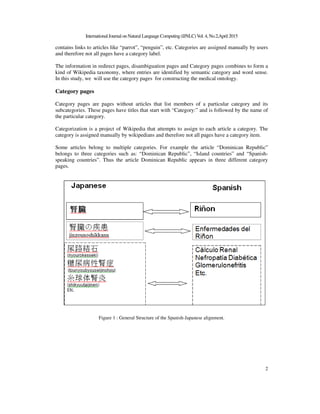
Figure 1 : General Structure of the Spanish-Japanese alignment.
InternationalJournal on Natural Language Computing(IJNLC)Vol. 4, No.2,April 2015
3
3. GENERAL DESCRIPTION
The general goal is to extract useful in domain data from Wikipedia to improve the performance
of a Japanese-Spanish SMT system. The study is divided 3 phases : The first one the
construction of the Japanese-Spanish ontological dictionary, then Japanese-Spanish parallel and
then evaluate the corpus in a SMT system.
Phase 1. Ontology Medical Dictionary
The goal is the creation of a Spanish-Japanese ontology, in which, we align each medical article
in Spanish and Japanese and then, we extract all the terms related to the article title. And then by
using Pattern Recogniton tecniques.We extract information associated to the given word, for
example : Kidney Stone, desease related to kidney, symptons, causes, etc.
Ex. In figure 1 [6] shows the structure of the system, for example, the word ‘Kidney’ , Spanish
is“Riñon”, is translated to japanese a 腎臓, ‘yinzo’, which is associated with all the deseases
related to kidney such as ‘Kidney desease and a list of the desease such as :’Kidney stone’,
‘Glomerulonephritis’ , etc.
Methodology
Extracting The Medical articles from Wikipedia
The goal is acquisition of Spanish-Japanese medical domain of Wikipedia’s article titles. Each
Wikipedia article provides links to corresponding articles in different languages.
Every article page in Wikipedia has on the left hand side some boxes labelled: ‘navigation’,
‘search’, ‘toolbox’ and finally ‘in other languages’. This has a list of all the languages available
for that article, although the articles in different languages do not all have exactly the same
contents.
Figure 2 :Wikipedia links.
InternationalJournal on Natural Language Computing(IJNLC)Vol. 4, No.2,April 2015
4
Pre-processing Procedure
We eliminated all irrelevant information of each article in Spanish such as tables, special
characters, menus, etc.
Dictionary Spanish-Japanese
Take all article titles that are nouns or named entities and look in the articles’ contents for the box
called ‘In other languages’. Verify that it has at least one link. If the box exists, it links to the
same article in other languages. Extract the titles in these other languages and align them with the
original article title.
For instance Figure 2 shows the Spanish article titled “Dengue” (Dengue fever), which is
translated into Japanese as “デング熱”(DenguNetsu). When we click Spanish or Japanese ‘in
other languages’ box we obtain an article about the same topic in the other language. This gives
us the translation and we proceed to extract it.
Ontological Relation between terms
The goal is extract all features related to a given disease such as: symptoms, causes, organs, etc.
By using Pattern Recognition we extract the sentences associated with the inner titles in
Wikipedia. Ex. The inner title symptom in Spanish and Japanese, and extract the phrases and
translated the nouns if there are hyperlinks and belong to the extracted Wikipedia dictionary. And
we proceed to aligned them in both languages.
The long term goal pursue when we type a symptom like “headache”, display all the diseases that
that contain headaches in the list of symptoms, in case there add another symptoms like “fatigue”
continue pruning the list with possible disease.
Using Wikipedia Category pages
1. For each word in the dictionary and their categories
2. Extract the category pages, containing all pages which belong to that category, subcategories,
other category pages that have a branch in the tree and categories to which it belongs.
3. If the page has a category:
4. Construct an n-dimensional vector containing the link and the categories
5. Construct an n-dimensional vector of the category pages, where every dimension represents a
link which belongs to that category
6. For each category that belongs to any link:
7. If there is a correspondence in to the target language:
8. Translate
9. Else:
10. Erase the entry
Phase 2. Constructing a Parallel Corpus
The goal is the creation of a parallel corpus by aligning the sentences of the medical articles.
We use a extended form of a ruled-based approach similar to [5]. We extended the amount of
rules and eliminate some rules that were redundant or cause ambiguity between rules.
InternationalJournal on Natural Language Computing(IJNLC)Vol. 4, No.2,April 2015
5
Methodology
We eliminate the irrelevant information from Wikipedia articles, to make processing easy and
faster.
The steps are as follows.
1. Remove from the pages all irrelevant information, such as images, menus, characters such
as: “()”, “&quot”, “*”, etc...
2. Verify if a link is a redirected article and extract the original article
3. Remove all stopwords -general words that do not give information about a specific topic
such as “the”, “between”, “on”, et
For splitting the sentences in the Spanish articles we used NLTK toolkit1
, which is a well-known
platform for building Python scripts.
For tag Spanish sentences, we used FreeLing2
, which an open source suit for language analizer,
specialized in Spanish language.
For Splitting into sentences, in to words and add a word category, we used MeCab3
, which is a
Part-of-Speech and Morphological Analyser for Japanese.
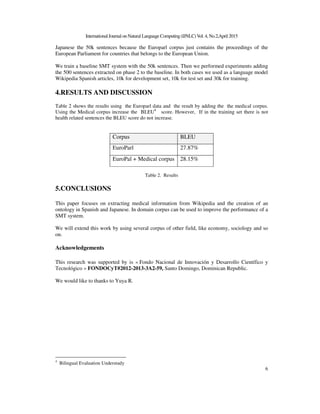
Rule Description
Rules Japanese=> Spanish
Noun Noun+desu => noun
Name Entity NE=>NE (Capital letter)
Adjective Adj (fe/male) =>Adj (NA/I)
Question (sentence+か)=>( ¿ + sentence +?)
Pronouns Pron =>Pron
Table 1. shows some of the rules applied to this work. Those rules are created taking in account
the morphological and syntactic characteristic of each language.
Phase 3. Using Medical Corpus in to SMT System
The main goal is to measure feasibility of using an in-domain corpus (in this case health related)
in a SMT system.
We used the aligned parallel sentences extracted in phase 2 to measure its impact in a Statistical
Japanese-Spanish MT system.
Experiments
We use a random sample of 500 parallel sentences extracted from Wikipedia and we add to 50k
Japanese-Spanish parallel corpus from Europarl. We used human translators to translate into
1
http://nltk.org/
2
http://nlp.lsi.upc.edu/freeling/
3
http://cl.naist.jp/~eric-n/ubuntu-nlp/dists/hardy/japanese/
InternationalJournal on Natural Language Computing(IJNLC)Vol. 4, No.2,April 2015
6
Japanese the 50k sentences because the Europarl corpus just contains the proceedings of the
European Parliament for countries that belongs to the European Union.
We train a baseline SMT system with the 50k sentences. Then we performed experiments adding
the 500 sentences extracted on phase 2 to the baseline. In both cases we used as a language model
Wikipedia Spanish articles, 10k for development set, 10k for test set and 30k for training.
4.RESULTS AND DISCUSSION
Table 2 shows the results using the Europarl data and the result by adding the the medical corpus.
Using the Medical corpus increase the BLEU4
score. However, If in the training set there is not
health related sentences the BLEU score do not increase.
Corpus BLEU
EuroParl 27.87%
EuroPal + Medical corpus 28.15%
Table 2. Results
5.CONCLUSIONS
This paper focuses on extracting medical information from Wikipedia and the creation of an
ontology in Spanish and Japanese. In domain corpus can be used to improve the performance of a
SMT system.
We will extend this work by using several corpus of other field, like economy, sociology and so
on.
Acknowledgements
This research was supported by is « Fondo Nacional de Innovación y Desarrollo Científico y
Tecnológico » FONDOCyT#2012-2013-3A2-59, Santo Domingo, Dominican Republic.
We would like to thanks to Yuya R.
4
Bilingual Evaluation Understudy
InternationalJournal on Natural Language Computing(IJNLC)Vol. 4, No.2,April 2015
7
REFERENCES
[1] Adafre, Sisay F. & De Rijke, Maarten, (2006) “Finding Similar Sentences across Multiple Languages
in Wikipedia”, In Proceeding of EACL-06, pages 62-69.
[2] Bunescu, Razvan & Pasca, Marius (2006) “Using Encyclopedic Knowledge for Named Entity
Disambiguation”, In Proceeding of EACL-06, pages 9-16.
[3] Fung, Pascale & Cheung Percy, (2004) “ Multi-level Bootstrapping for extracting Parallel Sentences
from a quasi-Comparable Corpus”, In Proceeding of the 20th International Conference on
Computational Linguistics. Pages 350
[4] Ramírez, Jessica, Asahara, Masayuki & Matsumoto, Yuji , (2008) “Japanese-Spanish Thesaurus
Construction Using English as a Pivot”, In Proceeding of The Third International Joint Conference
on Natural Language Processing (IJCNLP), Hyderabad, India. pages 473-480.
[5] Ramírez, Jessica & Matsumoto, Yuji (2012) “A Ruled-Based Approach for Aligning Japanese-
Spanish Sentences from a Comparable Corpora”, International Journal of Natural Language
Computing (IJNLC).
[6] Ramírez, Jessica & Matsumoto, Yuji (2013) “Extracción Automática de Diccionario Médico
Japonés-Español. Actualizaciones en Comunicación Social, Santiago, Cuba. Vol.II.
[7] Ramírez, Jessica,Matsumoto, Yuji, Muñoz, Darwin & Joyanes, Luís (2013) “Construcción
Automática de Corpus Paralelo Japonés-Español en el Área de la Salud. Memorias de VIII
Conferencia Internacional de Lingüística, Habana, Cuba.
Authors
Jessica C. Ramírez
She received his M.S. degree from Nara Institute of Science and Technology(NAIST) in
2007. She is currently pursuing a Ph.D. degree. Her research interestInclude machine
translation and word sense disambiguation.
Yuji Matsumoto
He received his M.S. and Ph.D. degrees in information science from Kyoto University in 1979 and in 1989.
He is currently a Professor at the Graduate School of Information Science, Nara Institute of Science and
Technology. His main research interests are natural language un derstanding and machine learning.
Darwin Munoz
He received his M.S. degree in Business from Quebec University, Canada in 2004 and Ph.D. degree in
information science from Universidad Pontificia de Salamanca, Spain in 2014. He is currently a Professor
at Universidad Iberoamericana.

C ONSTRUCTION O F R ESOURCES U SING J APANESE - S PANISH M EDICAL D ATA

  • 1.
    InternationalJournal on NaturalLanguage Computing(IJNLC)Vol. 4, No.2,April 2015 DOI : 10.5121/ijnlc.2015.4201 1 CONSTRUCTION OF RESOURCES USING JAPANESE- SPANISH MEDICAL DATA Jessica C. Ramírez1,2 , Yuji Matsumoto2 and Darwin Muñoz1 1 Universidad Iberoamericana, UNIBE, Santo Domingo, Dominican Republic 2 Information Science, Nara Institute of Science and Technology, Nara, Japan ABSTRACT In recent years, Many NLP researches have focused in constructing medical ontologies. This paper introduces a technique for extracting medical information from the Wikipedia page. Using a dictionary and then we evaluate on a Japanese-Spanish SMT system. The study shows an increment in the BLEU score. KEYWORDS Comparable Corpora, Dictionary, Ontology, Machine Translation 1. INTRODUCTION The quality, length and coverage of a parallel corpus are fundamental features in the performance of any Statistical Machine Translation (SMT) System. For some pair of languages there are a lack of aligned resources suitable for Natural Language Processing (NLP) tasks. The use of automatic and semi-automatic methods for constructing resources along with manual resources help to reduce both the cost and time of any NLP project. For this reason many approaches have been published for constructing resources such as dictionaries, thesauri and ontologies, in order to facilitate NLP tasks such as word sense disambiguation, machine translation and other tasks [4]. [1] explore the multilingual features of Wikipedia for automatically extract sentences across multiple languages and [2] use Wikipedia for extracting Name Entities . This study we use Wikipedia for extracting medical information from the health related articles in Japanese and Spanish, to construct a Medical Ontological dictionary, aligned the sentences in those articles and then we evaluate it impact on a Japanese-Spanish SMT system. 2. RESOURCES Wikipedia is an online multilingual encyclopedia with articles on a wide range of topics, in which the texts are aligned across different languages. Wikipedia have articles aligned in Spanish and Japanese. Wikipedia has some features that make it suitable for research such as: Each article has a title, with a unique ID. “Redirect pages” handle synonyms, and “disambiguation pages” are used when a word has several senses. “Category pages” contain a list of words that share the same semantic category. For example the category page for “Birds”
  • 2.
    InternationalJournal on NaturalLanguage Computing(IJNLC)Vol. 4, No.2,April 2015 2 contains links to articles like “parrot”, “penguin”, etc. Categories are assigned manually by users and therefore not all pages have a category label. The information in redirect pages, disambiguation pages and Category pages combines to form a kind of Wikipedia taxonomy, where entries are identified by semantic category and word sense. In this study, we will use the category pages for constructing the medical ontology. Category pages Category pages are pages without articles that list members of a particular category and its subcategories. These pages have titles that start with “Category:” and is followed by the name of the particular category. Categorization is a project of Wikipedia that attempts to assign to each article a category. The category is assigned manually by wikipedians and therefore not all pages have a category item. Some articles belong to multiple categories. For example the article “Dominican Republic” belongs to three categories such as: “Dominican Republic”, “Island countries” and “Spanish- speaking countries”. Thus the article Dominican Republic appears in three different category pages. Figure 1 : General Structure of the Spanish-Japanese alignment.
  • 3.
    InternationalJournal on NaturalLanguage Computing(IJNLC)Vol. 4, No.2,April 2015 3 3. GENERAL DESCRIPTION The general goal is to extract useful in domain data from Wikipedia to improve the performance of a Japanese-Spanish SMT system. The study is divided 3 phases : The first one the construction of the Japanese-Spanish ontological dictionary, then Japanese-Spanish parallel and then evaluate the corpus in a SMT system. Phase 1. Ontology Medical Dictionary The goal is the creation of a Spanish-Japanese ontology, in which, we align each medical article in Spanish and Japanese and then, we extract all the terms related to the article title. And then by using Pattern Recogniton tecniques.We extract information associated to the given word, for example : Kidney Stone, desease related to kidney, symptons, causes, etc. Ex. In figure 1 [6] shows the structure of the system, for example, the word ‘Kidney’ , Spanish is“Riñon”, is translated to japanese a 腎臓, ‘yinzo’, which is associated with all the deseases related to kidney such as ‘Kidney desease and a list of the desease such as :’Kidney stone’, ‘Glomerulonephritis’ , etc. Methodology Extracting The Medical articles from Wikipedia The goal is acquisition of Spanish-Japanese medical domain of Wikipedia’s article titles. Each Wikipedia article provides links to corresponding articles in different languages. Every article page in Wikipedia has on the left hand side some boxes labelled: ‘navigation’, ‘search’, ‘toolbox’ and finally ‘in other languages’. This has a list of all the languages available for that article, although the articles in different languages do not all have exactly the same contents. Figure 2 :Wikipedia links.
  • 4.
    InternationalJournal on NaturalLanguage Computing(IJNLC)Vol. 4, No.2,April 2015 4 Pre-processing Procedure We eliminated all irrelevant information of each article in Spanish such as tables, special characters, menus, etc. Dictionary Spanish-Japanese Take all article titles that are nouns or named entities and look in the articles’ contents for the box called ‘In other languages’. Verify that it has at least one link. If the box exists, it links to the same article in other languages. Extract the titles in these other languages and align them with the original article title. For instance Figure 2 shows the Spanish article titled “Dengue” (Dengue fever), which is translated into Japanese as “デング熱”(DenguNetsu). When we click Spanish or Japanese ‘in other languages’ box we obtain an article about the same topic in the other language. This gives us the translation and we proceed to extract it. Ontological Relation between terms The goal is extract all features related to a given disease such as: symptoms, causes, organs, etc. By using Pattern Recognition we extract the sentences associated with the inner titles in Wikipedia. Ex. The inner title symptom in Spanish and Japanese, and extract the phrases and translated the nouns if there are hyperlinks and belong to the extracted Wikipedia dictionary. And we proceed to aligned them in both languages. The long term goal pursue when we type a symptom like “headache”, display all the diseases that that contain headaches in the list of symptoms, in case there add another symptoms like “fatigue” continue pruning the list with possible disease. Using Wikipedia Category pages 1. For each word in the dictionary and their categories 2. Extract the category pages, containing all pages which belong to that category, subcategories, other category pages that have a branch in the tree and categories to which it belongs. 3. If the page has a category: 4. Construct an n-dimensional vector containing the link and the categories 5. Construct an n-dimensional vector of the category pages, where every dimension represents a link which belongs to that category 6. For each category that belongs to any link: 7. If there is a correspondence in to the target language: 8. Translate 9. Else: 10. Erase the entry Phase 2. Constructing a Parallel Corpus The goal is the creation of a parallel corpus by aligning the sentences of the medical articles. We use a extended form of a ruled-based approach similar to [5]. We extended the amount of rules and eliminate some rules that were redundant or cause ambiguity between rules.
  • 5.
    InternationalJournal on NaturalLanguage Computing(IJNLC)Vol. 4, No.2,April 2015 5 Methodology We eliminate the irrelevant information from Wikipedia articles, to make processing easy and faster. The steps are as follows. 1. Remove from the pages all irrelevant information, such as images, menus, characters such as: “()”, “&quot”, “*”, etc... 2. Verify if a link is a redirected article and extract the original article 3. Remove all stopwords -general words that do not give information about a specific topic such as “the”, “between”, “on”, et For splitting the sentences in the Spanish articles we used NLTK toolkit1 , which is a well-known platform for building Python scripts. For tag Spanish sentences, we used FreeLing2 , which an open source suit for language analizer, specialized in Spanish language. For Splitting into sentences, in to words and add a word category, we used MeCab3 , which is a Part-of-Speech and Morphological Analyser for Japanese. Rule Description Rules Japanese=> Spanish Noun Noun+desu => noun Name Entity NE=>NE (Capital letter) Adjective Adj (fe/male) =>Adj (NA/I) Question (sentence+か)=>( ¿ + sentence +?) Pronouns Pron =>Pron Table 1. shows some of the rules applied to this work. Those rules are created taking in account the morphological and syntactic characteristic of each language. Phase 3. Using Medical Corpus in to SMT System The main goal is to measure feasibility of using an in-domain corpus (in this case health related) in a SMT system. We used the aligned parallel sentences extracted in phase 2 to measure its impact in a Statistical Japanese-Spanish MT system. Experiments We use a random sample of 500 parallel sentences extracted from Wikipedia and we add to 50k Japanese-Spanish parallel corpus from Europarl. We used human translators to translate into 1 http://nltk.org/ 2 http://nlp.lsi.upc.edu/freeling/ 3 http://cl.naist.jp/~eric-n/ubuntu-nlp/dists/hardy/japanese/
  • 6.
    InternationalJournal on NaturalLanguage Computing(IJNLC)Vol. 4, No.2,April 2015 6 Japanese the 50k sentences because the Europarl corpus just contains the proceedings of the European Parliament for countries that belongs to the European Union. We train a baseline SMT system with the 50k sentences. Then we performed experiments adding the 500 sentences extracted on phase 2 to the baseline. In both cases we used as a language model Wikipedia Spanish articles, 10k for development set, 10k for test set and 30k for training. 4.RESULTS AND DISCUSSION Table 2 shows the results using the Europarl data and the result by adding the the medical corpus. Using the Medical corpus increase the BLEU4 score. However, If in the training set there is not health related sentences the BLEU score do not increase. Corpus BLEU EuroParl 27.87% EuroPal + Medical corpus 28.15% Table 2. Results 5.CONCLUSIONS This paper focuses on extracting medical information from Wikipedia and the creation of an ontology in Spanish and Japanese. In domain corpus can be used to improve the performance of a SMT system. We will extend this work by using several corpus of other field, like economy, sociology and so on. Acknowledgements This research was supported by is « Fondo Nacional de Innovación y Desarrollo Científico y Tecnológico » FONDOCyT#2012-2013-3A2-59, Santo Domingo, Dominican Republic. We would like to thanks to Yuya R. 4 Bilingual Evaluation Understudy
  • 7.
    InternationalJournal on NaturalLanguage Computing(IJNLC)Vol. 4, No.2,April 2015 7 REFERENCES [1] Adafre, Sisay F. & De Rijke, Maarten, (2006) “Finding Similar Sentences across Multiple Languages in Wikipedia”, In Proceeding of EACL-06, pages 62-69. [2] Bunescu, Razvan & Pasca, Marius (2006) “Using Encyclopedic Knowledge for Named Entity Disambiguation”, In Proceeding of EACL-06, pages 9-16. [3] Fung, Pascale & Cheung Percy, (2004) “ Multi-level Bootstrapping for extracting Parallel Sentences from a quasi-Comparable Corpus”, In Proceeding of the 20th International Conference on Computational Linguistics. Pages 350 [4] Ramírez, Jessica, Asahara, Masayuki & Matsumoto, Yuji , (2008) “Japanese-Spanish Thesaurus Construction Using English as a Pivot”, In Proceeding of The Third International Joint Conference on Natural Language Processing (IJCNLP), Hyderabad, India. pages 473-480. [5] Ramírez, Jessica & Matsumoto, Yuji (2012) “A Ruled-Based Approach for Aligning Japanese- Spanish Sentences from a Comparable Corpora”, International Journal of Natural Language Computing (IJNLC). [6] Ramírez, Jessica & Matsumoto, Yuji (2013) “Extracción Automática de Diccionario Médico Japonés-Español. Actualizaciones en Comunicación Social, Santiago, Cuba. Vol.II. [7] Ramírez, Jessica,Matsumoto, Yuji, Muñoz, Darwin & Joyanes, Luís (2013) “Construcción Automática de Corpus Paralelo Japonés-Español en el Área de la Salud. Memorias de VIII Conferencia Internacional de Lingüística, Habana, Cuba. Authors Jessica C. Ramírez She received his M.S. degree from Nara Institute of Science and Technology(NAIST) in 2007. She is currently pursuing a Ph.D. degree. Her research interestInclude machine translation and word sense disambiguation. Yuji Matsumoto He received his M.S. and Ph.D. degrees in information science from Kyoto University in 1979 and in 1989. He is currently a Professor at the Graduate School of Information Science, Nara Institute of Science and Technology. His main research interests are natural language un derstanding and machine learning. Darwin Munoz He received his M.S. degree in Business from Quebec University, Canada in 2004 and Ph.D. degree in information science from Universidad Pontificia de Salamanca, Spain in 2014. He is currently a Professor at Universidad Iberoamericana.