Exception Handling inJava
Exception handling is a crucial aspect of Java programming. It allows you to gracefully handle runtime errors
and prevent your program from crashing. This presentation will delve into the key concepts and keywords
involved in exception handling in Java.
SG
2.
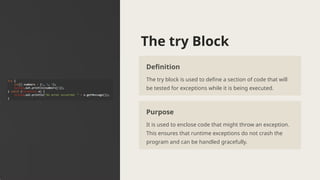
The try Block
Definition
Thetry block is used to define a section of code that will
be tested for exceptions while it is being executed.
Purpose
It is used to enclose code that might throw an exception.
This ensures that runtime exceptions do not crash the
program and can be handled gracefully.
3.
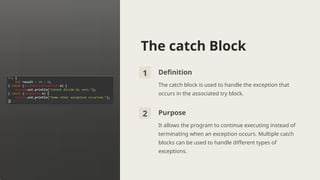
The catch Block
1Definition
The catch block is used to handle the exception that
occurs in the associated try block.
2 Purpose
It allows the program to continue executing instead of
terminating when an exception occurs. Multiple catch
blocks can be used to handle different types of
exceptions.
4.
The Exception Class
Definition
Exceptionis a class that is the base class for all
exceptions in Java. It represents errors that a
program can catch and handle.
Purpose
By catching Exception, a program can handle any
runtime error, making it more robust and fault-
tolerant.
5.
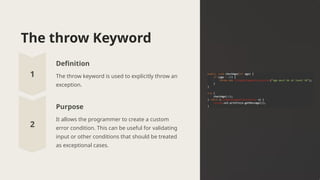
The throw Keyword
Definition
Thethrow keyword is used to explicitly throw an
exception.
Purpose
It allows the programmer to create a custom
error condition. This can be useful for validating
input or other conditions that should be treated
as exceptional cases.
6.
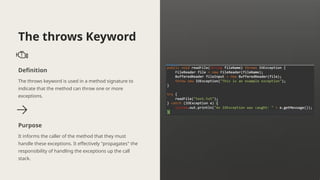
The throws Keyword
Definition
Thethrows keyword is used in a method signature to
indicate that the method can throw one or more
exceptions.
Purpose
It informs the caller of the method that they must
handle these exceptions. It effectively "propagates" the
responsibility of handling the exceptions up the call
stack.
7.
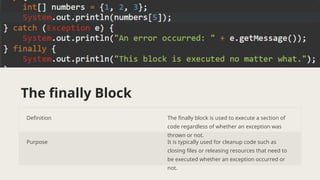
The finally Block
DefinitionThe finally block is used to execute a section of
code regardless of whether an exception was
thrown or not.
Purpose It is typically used for cleanup code such as
closing files or releasing resources that need to
be executed whether an exception occurred or
not.
8.
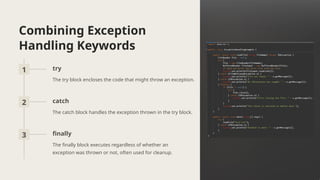
Combining Exception
Handling Keywords
1try
The try block encloses the code that might throw an exception.
2 catch
The catch block handles the exception thrown in the try block.
3 finally
The finally block executes regardless of whether an
exception was thrown or not, often used for cleanup.



![[Deck] What's New in Spark-Iceberg Integration via DSV2.pptx](https://cdn.slidesharecdn.com/ss_thumbnails/deckwhatsnewinspark-icebergintegrationviadsv2-260210005337-25955b12-thumbnail.jpg?width=640&height=640&fit=bounds)


