WORKSHEET
High jump Evolution

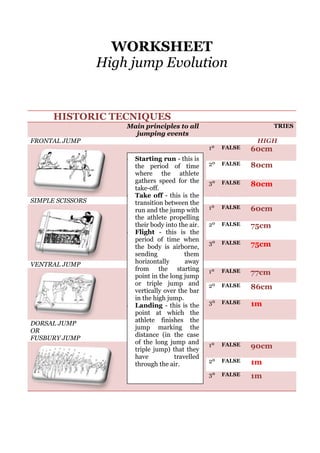
HISTORIC TECNIQUES
Main principles to all
jumping events

TRIES

FRONTAL JUMP

HIGH
1º

SIMPLE SCISSORS

VENTRAL JUMP

DORSAL JUMP
OR
FUSBURY JUMP

Starting run - this is
the period of time
where the athlete
gathers speed for the
take-off.
Take off - this is the
transition between the
run and the jump with
the athlete propelling
their body into the air.
Flight - this is the
period of time when
the body is airborne,
sending
them
horizontally
away
from the starting
point in the long jump
or triple jump and
vertically over the bar
in the high jump.
Landing - this is the
point at which the
athlete finishes the
jump marking the
distance (in the case
of the long jump and
triple jump) that they
have
travelled
through the air.

FALSE

60cm

2º

FALSE

80cm

3º

FALSE

80cm

1º

FALSE

60cm

2º

FALSE

75cm

3º

FALSE

75cm

1º

FALSE

77cm

2º

FALSE

86cm

3º

FALSE

1m

1º

FALSE

90cm

2º

FALSE

1m

3º

FALSE

1m

4 ws high jump evolution

  • 1.
    WORKSHEET High jump Evolution HISTORICTECNIQUES Main principles to all jumping events TRIES FRONTAL JUMP HIGH 1º SIMPLE SCISSORS VENTRAL JUMP DORSAL JUMP OR FUSBURY JUMP Starting run - this is the period of time where the athlete gathers speed for the take-off. Take off - this is the transition between the run and the jump with the athlete propelling their body into the air. Flight - this is the period of time when the body is airborne, sending them horizontally away from the starting point in the long jump or triple jump and vertically over the bar in the high jump. Landing - this is the point at which the athlete finishes the jump marking the distance (in the case of the long jump and triple jump) that they have travelled through the air. FALSE 60cm 2º FALSE 80cm 3º FALSE 80cm 1º FALSE 60cm 2º FALSE 75cm 3º FALSE 75cm 1º FALSE 77cm 2º FALSE 86cm 3º FALSE 1m 1º FALSE 90cm 2º FALSE 1m 3º FALSE 1m