Chapter 39
Cardiac Diseases
                                                                          Daniel G. Blanchard, MD, and Ralph Shabetai, MD


                                                                            pregnancy. The most important of these are increases in blood volume,
                                                                            cardiac output, and heart rate. These adaptations exacerbate the symp-
Diagnosis of Heart Disease                                                  toms and clinical signs of heart disease and may necessitate significant
in Pregnancy                                                                escalation in treatment.
                                                                                Cardiac risk varies among the specific forms of heart disease and
Pregnant women with heart disease are at higher risk for cardiovascu-       also with severity. During prepregnancy counseling, the physician
lar complications during pregnancy and also have a higher incidence         should describe the nature of the heart disease in terms comprehensi-
of neonatal complications.1 However, the significant hemodynamic             ble to the prospective parents. The risk to the woman, which can vary
changes that accompany pregnancy make the diagnosis of certain              from negligible to prohibitive, should be spelled out as clearly as pos-
forms of cardiovascular disease difficult. During normal pregnancies,        sible.7 On this basis, the patient may be advised either that the con-
women frequently experience dyspnea, orthopnea, easy fatigability,          templated pregnancy is safe, will be uncomfortable and will necessitate
dizzy spells, and, occasionally, even syncope. On physical examination,     treatment, carries a significantly increased risk, or would be extremely
dependent edema, rales in the lower lung fields, visible neck veins, and     dangerous and should not be undertaken.
cardiomegaly are commonly found. Systolic murmurs occur in more                 In the case of certain cardiac conditions, the patient should be
than 95% of pregnant women, and internal mammary flow murmurs                strongly advised to undergo the necessary treatment before pregnancy
and venous hums are common. A third heart sound (S3 gallop) is often        and to allow several months to elapse before becoming pregnant.
present.2 Nevertheless, certain findings indicate heart disease in preg-     Examples in this category include the following:
nancy and should suggest the presence of a significant cardiovascular
abnormality. These symptoms include severe dyspnea, syncope with              Large intracardiac shunt (atrial or ventricular septal defect) with
exertion, hemoptysis, paroxysmal nocturnal dyspnea, and chest pain            mild to moderate pulmonary hypertension
related to exertion. Physical signs of organic heart disease include a        Patent ductus arteriosus (PDA) with mild to moderate pulmonary
fourth heart sound (S4 gallop), cyanosis, clubbing, diastolic murmurs,        hypertension
sustained cardiac arrhythmias, and loud, harsh systolic murmurs.3             Severe coarctation of the aorta
    If there is a strong suspicion of heart disease during pregnancy,         Severe mitral stenosis or regurgitation
confirmatory diagnostic tests should be initiated. The changes of              Severe aortic stenosis or regurgitation
normal pregnancy must be recognized so that the findings are not               Tetralogy of Fallot
misinterpreted. For example, nonspecific ST segment and T-wave                 Various congenital malformations and acquired heart diseases
abnormalities and shifts in the electrical axis can occur.4 Pregnancy
also produces changes in the echocardiogram, including alterations in           Again, it is imperative that the palliative procedure be carried out
cardiac dimensions and performance. The internal dimensions of all          before pregnancy is undertaken and that a year or so elapse before
the cardiac chambers are increased, and slight regurgitation through        pregnancy occurs. Flexibility in clinical judgment is necessary, however.
the four valves is frequently observed. The ejection fraction (EF) and      A woman with moderately severe valvular disease may require a pros-
stroke volume are concomitantly larger, and the cardiac output is           thetic valve in the future. In such a case, the patient should be advised
increased.5 A small pericardial effusion can be a normal finding in          to have her family before valve replacement—with its associated anti-
pregnant women.6 Both radiographic and radionuclide diagnostic pro-         coagulant risk—is required8 (see Pregnancy in Patients with Artificial
cedures should be avoided during pregnancy unless the procedure is          Heart Valves, later). The valvular heart lesions associated with high and
deemed essential for the health and safety of the mother.                   low maternal and fetal risk during pregnancy are listed in Tables 39-1
                                                                            and 39-2.
                                                                                As previously noted, some cardiac disorders are so serious in nature
Pre-Conception Counseling                                                   that the physiologic changes of a superimposed pregnancy pose pro-
                                                                            hibitive risks to the mother; they carry such a high maternal mortality
If a woman plans to become pregnant but knows that she has heart            risk that pregnancy is contraindicated. In such circumstances, patients
disease, she and her physicians must be fully aware of several funda-       must be strongly cautioned against becoming pregnant. If such a
mental principles. The cardiovascular system undergoes specific adap-        patient is seen for the first time when she is already pregnant, termina-
tations to meet the increased demands of the mother and fetus during        tion of the pregnancy is recommended. The most serious of the cardiac
798      CHAPTER 39              Cardiac Diseases

  TABLE 39-1          VALVULAR HEART LESIONS                                   TABLE 39-3          HIGH-RISK MATERNAL
                      ASSOCIATED WITH HIGH                                                         CARDIOVASCULAR DISORDERS
                      MATERNAL AND/OR FETAL RISK
                                                                                                                               Estimated Maternal
                      DURING PREGNANCY
                                                                              Disorder                                          Mortality Rate (%)
 Severe AS with or without symptoms                                           Aortic valve stenosis                                    10-20
 AR with NYHA functional class III-IV symptoms                                Coarctation of the aorta                                   5
 MS with NYHA functional class II-IV symptoms                                 Marfan syndrome                                          10-20
 MR with NYHA functional class III-IV symptoms                                Peripartum cardiomyopathy                                15-60
 Aortic and/or mitral valve disease resulting in severe pulmonary             Severe pulmonary hypertension                             50
   hypertension (pulmonary pressure greater than 75% of                       Tetralogy of Fallot                                       10
   systemic pressures)
 Aortic and/or mitral valve disease with significant LV dysfunction
   (EF < 40%)
 Mechanical prosthetic valve requiring anticoagulation
 Marfan syndrome with or without AR                                          If a patient with one of these disorders presents when she is already
                                                                             pregnant, she should be strongly urged to consider early termina-
 AR, aortic regurgitation; AS, aortic stenosis; EF, ejection fraction; LV,   tion. A carefully planned suction curettage before 13 weeks’ gestation
 left ventricular; MR, mitral regurgitation; MS, mitral stenosis; NYHA,
                                                                             would place such a patient at minimal risk. Termination of pregnancy
 New York Heart Association.
 Reproduced with permission from Bonow RO, Carabello B, DeLeon AC,           beyond 13 weeks increases the risk to the mother, because many of
 et al: ACC/AHA 2006 guidelines for the management of patients with          the cardiovascular alterations that occur in pregnancy have taken
 valvular heart disease. Circulation 114:84, 2006.                           place.
                                                                                 Infective endocarditis often causes rapid and serious deterioration
                                                                             of the cardiac status, posing a major threat to the life and health of the
  TABLE 39-2          VALVULAR HEART LESIONS                                 mother and, therefore, of the fetus as well. Scrupulous attention to
                      ASSOCIATED WITH LOW                                    prophylaxis against endocarditis is critical during pregnancy. Pregnant
                      MATERNAL AND FETAL RISK                                women must pay meticulous attention to their dental health; if they
                                                                             have cardiac lesions susceptible to infective endocarditis, neglect of
                      DURING PREGNANCY
                                                                             antibacterial prophylaxis could have dire consequences. In general,
 Asymptomatic AS with low mean gradient (<25 mm Hg and aortic                women with valvular heart disease should have antibiotic prophylaxis
   valve area >1.5 cm2) in the presence of normal LV systolic                at the time of delivery.10,11
   function (EF > 50%)                                                           The prospective parents will want to know not only about the risk
 NYHA functional class I or II AR with normal LV systolic function           to the health and life of the future mother but also about the fetal risks.
 NYHA functional class I or II MR with normal LV systolic function
                                                                             One of the most important questions is whether the mother’s heart
 MVP with no MR or mild to moderate MR with normal LV systolic
                                                                             disease is hereditary and, if so, what is the risk that the infant will be
   function
 Mild MS (mitral valve area >1.5 cm2, gradient <5 mm Hg) without             born with the same defect. A detailed family cardiac history must be
   severe pulmonary hypertension                                             obtained before pregnancy, especially if the prospective mother has
 Mild to moderate pulmonary valve stenosis                                   heart disease.
                                                                                 Some of the cardiomyopathies, especially hypertrophic forms, may
 AR, aortic regurgitation; AS, aortic stenosis; EF, ejection fraction; LV,   be inherited in a mendelian manner.12 Familial dilated cardiomyopathy
 left ventricular; MR, mitral regurgitation; MS, mitral stenosis; MVP,
                                                                             has also been described. Approximately 20% of idiopathic dilated car-
 mitral valve prolapse; NYHA, New York Heart Association.
 Reproduced with permission from Bonow RO, Carabello B, DeLeon AC,           diomyopathy is inherited.13 There is a strong familial tendency in
 et al: ACC/AHA 2006 guidelines for the management of patients with          certain congenital malformations, such as PDA and arterial septal
 valvular heart disease. Circulation 114:84, 2006.                           defect (ASD). Additionally, mothers with congenital heart disease
                                                                             may have children with unrelated congenital malformations: this risk
                                                                             appears to be approximately 5%.3,14 Also, pregnant women with
disorders are those involving pulmonary hypertension, particularly           advanced heart disease, especially those with low cardiac output or
those associated with a right-to-left shunt in cardiac blood flow             severe hypoxia, experience a greatly increased incidence of spontane-
(Eisenmenger syndrome). Low cardiac output states and entities               ous abortion, stillbirths, and small or deformed children.9 For most
in which there is an increased risk of aortic dissection (Marfan             pregnant women with heart disease, vaginal delivery (with a low
syndrome) also represent an extraordinarily high risk of maternal            threshold for forceps or vacuum assistance) is recommended. Elective
mortality. These high-risk maternal cardiovascular disorders are             cesarean section is recommended in cases of Marfan syndrome or
listed in Table 39-3.                                                        aortic aneurysm of any cause.3
    In some women with specific dangerous cardiovascular diseases,                Today’s prospective mother wants to know about the risks to her
pregnancy is contraindicated because of the substantial risk of mater-       fetus of drugs, other therapies, and diagnostic tests that are used to
nal death.9 Examples include the following:                                  treat heart disease. Echocardiography poses no threat to the fetus, but
                                                                             radiation incurred with radionuclide angiography, cardiac catheteriza-
  Dilated cardiomyopathy or left ventricular dysfunction                     tion with contrast angiography, or computed tomography pose a
  (EF < 40%) of any cause                                                    potential hazard to the fetus. If these studies are required, they should
  Severe pulmonary hypertension of any cause                                 be performed before pregnancy occurs; they should be repeated there-
  Marfan syndrome, especially with aortic root dilation (diameter            after only if mandated for the safety of the mother, and pelvic shielding
  > 4 cm)                                                                    should be used.
CHAPTER 39             Cardiac Diseases        799
   Maternal infection with the virus that causes German measles               vena cava, accounting for lower cardiac output. This is one reason why
(rubella) is associated with a high risk of congenital malformation of        some obstetricians prefer to manage labor with the patient in the left
the fetal heart as well as PDA. If the patient has not had German             decubitus position.
measles as a child and has never been inoculated against it and her
antibody titer confirms the absence of immunity, she should be vacci-
nated some months before becoming pregnant.                                   Cardiac Performance
   Every pregnant woman who is known or thought to have heart                 Echocardiographic studies have shown increases in the left ventricular
disease should, at a minimum, be evaluated once by a cardiologist who         fiber shortening velocity and in EF. These changes do not necessarily
understands the cardiovascular adaptations to pregnancy. The cardi-           indicate increased myocardial contractility but may simply be the
ologist will prescribe necessary diagnostic studies and treatments and,       result of decreased peripheral vascular resistance and increased preload.
of equal importance, will not allow unnecessary ones. The effects of          In any case, stroke volume is increased, and cardiac output is further
heart disease can often be ameliorated by correcting coexisting medical       augmented by the 10% to 15% increase in heart rate that characterizes
problems, such as anemia, chronic infection, anxiety, thyroid dysfunc-        normal pregnancy.18
tion, hypertension, and arrhythmia.                                               Demands on the cardiovascular system increase significantly
                                                                              during labor and delivery. Pain increases sympathetic tone, and uterine
                                                                              contractions induce wide swings in the systemic venous return. With
                                                                              placental separation, autotransfusion of at least 500 mL takes place,
Cardiovascular Adaptations                                                    placing an acute load on the diseased heart, unless offset by blood loss.
                                                                              These large shifts in blood volume can precipitate, on the one hand,
to Pregnancy                                                                  shock, and on the other, pulmonary edema in women with severe heart
                                                                              disease.
Increased Blood Volume                                                            If a chest radiograph is obtained in a pregnant woman, the cardiac
The cardiovascular alterations observed in pregnancy are discussed in         silhouette often appears slightly enlarged owing to the combined
detail in Chapter 7 but are reviewed here briefly. It is worthwhile to         effects of volume overload and elevation of the diaphragm. Routine
reconsider and emphasize some of the most important cardiovascular            echocardiographic studies have demonstrated that a small, silent peri-
changes that occur during pregnancy, because they may significantly            cardial effusion is quite common.6
alter the course of cardiac disease or may themselves be influenced by
a specific disorder.
    Blood volume and cardiac output increase during pregnancy.15 The          Electrocardiographic Changes
uterus hypertrophies, endometrial vascularization is greatly increased,       The mean QRS axis may shift to the left19 as a result of the elevated
and the placenta becomes a highly vascular structure that functions to        diaphragm. In later pregnancy, the axis may shift to the right when the
some extent as an arteriovenous shunt. In addition, generalized arte-         fetus descends into the pelvis. Minor ST segment and T-wave changes
riolar dilation develops, mediated most probably by estrogen. These           may be observed, usually in lead III but sometimes aVF as well. Less
mechanisms combine to lower systemic vascular resistance and increase         often, T inversions may appear transiently in the left precordial leads.
the pulse pressure. The total blood volume rises steadily during the          Occasionally, small Q waves may accompany T-wave inversion in leads
first trimester and is increased by almost 50% by the 30th week,               III and aVF. These changes are seldom of sufficient magnitude to raise
remaining more or less constant thereafter.16 Several mechanisms are          the question of ischemic heart disease, which in any case is relatively
responsible for increasing blood volume in pregnancy, including               uncommon in pregnancy, especially if the mother is young and free
steroid hormones of pregnancy, elevated plasma renin activity, and            from symptoms. Extrasystoles and supraventricular tachycardia are
elevated plasma aldosterone levels. Human placental lactogen, atrial          more common during pregnancy. Symptoms of palpitations are
natriuretic factor, and other peptides may also play significant roles in      common during pregnancy but only rarely signify the presence of
governing changes of blood volume in pregnancy. Hypervolemia also             organic heart disease.
occurs with trophoblastic disease, indicating that a fetus is not essential
for its development. Heart rate increases by 10 to 20 beats/min. In a
normal pregnancy, blood pressure does not increase, because the
increased intravascular volume is balanced by decreased peripheral            General Guidelines
vascular resistance mediated by the placenta. Plasma volume tends to
increase more than the red blood cell mass, accounting for a “physio-
                                                                              for Management
logic anemia” that is common in pregnancy. Treatment with iron cor-           During treatment of all pregnant patients with heart disease, priority
rects the anemia which, if left untreated, may become significant              must be given to maternal health, but all possible therapeutic measures
(hematocrit as low as 33% and hemoglobin 11 g/dL).                            should also be taken to protect the developing fetus. The aspects of
                                                                              management are outlined in Table 39-4.
                                                                                 Because pregnancy increases the demands on the heart, physical
Cardiac Output                                                                exertion frequently must be restricted, especially if it causes symptoms.
Cardiac output rises during the first few weeks of pregnancy and is            Some women with certain forms of cardiac disease, such as significant
30% to 45% above the nonpregnant level by the 20th week, remaining            mitral stenosis and cardiomyopathy, tolerate pregnancy poorly and
there until term.15 The increase in cardiac output in the first trimester      cannot endure physical exertion. They may require strict bed rest for
begins rapidly and peaks between the 20th and 26th week. Early in             the duration of the pregnancy, particularly during the last trimester.
pregnancy, the dominant factor is elevated stroke volume; later,              Women with heart disease have a limited ability to increase cardiac
increased heart rate predominates.17 In late pregnancy, the enlarged          output to meet increased metabolic demands and should minimize the
uterus partially impedes venous return by compressing the inferior            demands placed on the heart from physical activity.
800      CHAPTER 39              Cardiac Diseases

  TABLE 39-4          CARDIAC DISEASE IN                                     inhibitors during pregnancy.25,26 These complications suggest a pro-
                      PREGNANCY: ASPECTS                                     found and deleterious effect on fetal renal function, leading to decreased
                                                                             renal function and oligohydramnios, as well as neonatal renal failure.
                      OF MANAGEMENT
                                                                             ACE inhibitors are absolutely contraindicated during pregnancy.
 Activity restriction                                                        Another class of antihypertensive drugs, the angiotensin receptor
 Diet modification                                                            blockers, also may affect fetal renal function and are likewise absolutely
 Team approach for medical care                                              contraindicated in pregnancy.
 Infection control                                                               The indications and possible adverse effects of commonly pre-
 Immunizations                                                               scribed cardioactive drugs during pregnancy are summarized in
 Prophylaxis against bacterial endocarditis
                                                                             Table 39-5.
 Prophylaxis against rheumatic fever
 Interruption of pregnancy
 Counseling
 Contraception or sterilization
                                                                             Team Approach to Medical Care
 Cardiovascular surgery                                                      Medical care for pregnant women with heart disease is best provided
 Cardiovascular drugs                                                        through the cooperative efforts of a cardiologist who is familiar with
                                                                             the hemodynamic changes of pregnancy and an obstetrician. Frequent
                                                                             visits to both specialists, along with open consultations, can provide
                                                                             the patient with consistent advice and reassurance and can circumvent
Cardiovascular Drugs                                                         the worry and anxiety created by confusing and conflicting informa-
Some of the drugs commonly used in the management of cardiovas-              tion. In addition, the anesthesiologist needs to be consulted during
cular disease have potentially harmful effects on the developing embryo      the antepartum period to outline the anticipated approach to intra-
and fetus. For example, there is no question that oral anticoagulants        partum management, a time of maximum risk for most of these
are potential teratogens when administered in the first trimester (see        women. The role of the anesthesiologist and the approach to women
Chapter 20 and later discussion in this chapter). The “warfarin embry-       with pregnancies complicated by cardiac disease are summarized in
opathy syndrome,” consisting of nasal hypoplasia, optic atrophy, digital     Chapter 56.
abnormalities, and mental impairment, occurs in a minority of cases.
The actual risk of warfarin embryopathy is difficult to estimate and
has ranged from 4% to 67% in various reports.20,21 A risk of 4% to 10%
seems more reasonable.22 There is some evidence that embryopathy is
                                                                             Congenital Heart Disease
less likely if the warfarin dose is 5 mg/day or less.23 The fetal risks      A number of simple congenital malformations are compatible with a
continue beyond the first trimester, because warfarin increases the           normal or nearly normal pregnancy. Congenital malformations previ-
possibility of both fetal and intrauterine bleeding.                         ously associated with high maternal morbidity and mortality and fetal
    Anticoagulation presents a significant practical problem in the           wastage now frequently end with a satisfactory outcome because of
management of atrial fibrillation, systemic or pulmonary embolism,            palliative or corrective surgery. Despite recent advances, however,
thrombophlebitis, and pulmonary hypertension in pregnancy. The most          women with congenital heart disease who become pregnant still have
vexing problem arises in the setting of prosthetic heart valves10,11 (dis-   a significant risk of miscarriage, cardiac complications, and premature
cussed later). In the case of mechanical valve prostheses, warfarin          delivery.27
appears to be superior to heparin in preventing valvular thrombosis.             The care of adults with congenital heart malformation is an impor-
Although heparin is safer for the fetus, there is probably an increased      tant and growing branch of cardiology7,28,29 that requires the coopera-
risk for the mother.20,24 This is a complex medical issue, and no random-    tive efforts of medical and pediatric cardiologists, cardiac surgeons,
ized trial to determine the optimal anticoagulant therapy for women          and, in the case of pregnancy, obstetricians and anesthesiologists.30,31
with a prosthetic valve has been conducted. Therefore, recommenda-
tions are based on smaller studies and on clinical judgment.10,11 No
single regimen is likely to be applicable to all such cases, because the     Left-to-Right Shunt
issue is complicated by the type and generation of the prosthetic valve,
the cardiac rhythm, and the size and contractility of the cardiac            Atrial Septal Defect
chambers.                                                                    ASD may be undiscovered before pregnancy, because symptoms are
    β-Adrenergic blocking agents, used for the treatment of hyper-           often absent and the physical findings are not blatant. Other causes of
tension and tachyarrhythmia, have been associated with neonatal              left-to-right shunt, such as PDA and ventricular septal defect (VSD),
respiratory depression, sustained bradycardia, and hypoglycemia when         are more likely to be discovered and treated in infancy or childhood.
administered late in pregnancy or just before delivery. However, if they     Physicians should be alert to the higher possibility of uncorrected
are used judiciously in selected cases (e.g., in women with cardiomy-        defects in women who have immigrated from an undeveloped
opathy and heart failure), β-blockers are usually well tolerated.            country.
    The thiazide diuretics are another class of drugs that can produce           Closure of uncomplicated large ostium secundum ASD is straight-
harmful effects on the fetus—especially if they are used in the third        forward and safe and usually is curative. Therefore, the procedure
trimester or for extended periods—and may impair normal expansion            should be done before pregnancy. Many ASDs can now be closed per-
of plasma volume. Rarely, severe neonatal electrolyte imbalance,             cutaneously, using a “clamshell” or “umbrella” device inserted via a
jaundice, thrombocytopenia, liver damage, and even death have been           transvenous catheter.32 If the patient is unwilling to undergo ASD
reported.                                                                    closure, she can be advised that the lesion is unlikely to complicate
    There have been numerous reports of fetal and neonatal renal             pregnancy and labor, provided that pulmonary hypertension is not
complications after the use of angiotensin-converting enzyme (ACE)           present.3
CHAPTER 39             Cardiac Diseases         801

TABLE 39-5          INDICATIONS FOR AND POSSIBLE ADVERSE EFFECTS OF COMMONLY PRESCRIBED
                    CARDIOACTIVE DRUGS ON MOTHER AND FETUS

Drug                        Use in Pregnancy                              Potential Side Effects                  Breastfeeding        Risk Category*
Adenosine         Maternal and fetal arrhythmias            No side effects reported; data on use during        Data NA                C
                                                              first trimester are limited
Amiodarone        Maternal arrhythmias                      IUGR, prematurity, congenital goiter,               Not                    C
                                                              hypothyroidism and hyperthyroidism,                 recommended
                                                              transient bradycardia, prolonged QT in the
                                                              newborn
ACEIs and         Hypertension                              Oligohydramnios, IUGR, prematurity, neonatal        Compatible             X
  angiotensin                                                 hypotension, renal failure, anemia, death,
  receptor                                                    skull ossification defect, limb contractures,
  blockers                                                    patent ductus arteriosus
β-Blockers        Hypertension, maternal arrhythmias,       Fetal bradycardia, low placental weight, possible Compatible;              Acebutolol: B
                    myocardial ischemia, mitral               IUGR, hypoglycemia; no information on               monitoring           Labetalol: C
                    stenosis, hypertrophic                    carvedilol                                          of infant’s          Metoprolol: C
                    cardiomyopathy, hyperthyroidism,                                                              heart rate           Propranolol: C
                    Marfan syndrome                                                                               recommended          Atenolol: D
Digoxin           Maternal and fetal arrhythmias,           No evidence for unfavorable side effects on the Compatible                 C
                    heart failure                             fetus
Diltiazem         Myocardial ischemia, tocolysis            Limited data; increased incidence of major birth Compatible                C
                                                              defects
Disopyramide      Maternal arrhythmias                      Limited data; may induce uterine contraction        Compatible             C
                                                              and premature delivery
Diuretics         Hypertension, congestive heart            Hypovolemia leads to reduced uteroplacental         Compatible             C
                    failure                                   perfusion, fetal hypoglycemia,
                                                              thrombocytopenia, hyponatremia,
                                                              hypokalemia; thiazide diuretics can inhibit
                                                              labor and suppress lactation
Flecainide        Maternal and fetal arrhythmias            Limited data; 2 cases of fetal death after          Compatible             C
                                                              successful treatment of fetal SVT reported,
                                                              but relation to flecainide uncertain
Heparin           Anticoagulation                           None reported                                       Compatible             C
Hydralazine       Hypertension                              None reported                                       Compatible             C
Lidocaine         Local anesthesia, maternal                No evidence for unfavorable fetal effects; high     Compatible             C
                    arrhythmias                               serum levels may cause CNS depression at
                                                              birth
Nifedipine        Hypertension, tocolysis                   Fetal distress related to maternal hypotension      Compatible             C
                                                              reported
Nitrates          Myocardial infarction and ischemia,       Limited data; use is generally safe; few cases      Data NA                C
                    hypertension, pulmonary edema,            of fetal heart rate deceleration and
                    tocolysis                                 bradycardia have been reported
Procainamide      Maternal and fetal arrhythmias            Limited data; no fetal side effects reported        Compatible             C
Propafenone       Fetal arrhythmias                         Limited data; fetal death reported after direct     Data NA                C
                                                              intrauterine administration in fetuses with
                                                              fetal hydrops
Quinidine         Maternal and fetal arrhythmias            Minimal oxytocic effect, high doses may cause       Compatible             C
                                                              premature labor or abortion; transient
                                                              neonatal thrombocytopenia and damage to
                                                              eighth nerve reported
Sodium            Hypertension, aortic dissection           Limited data; potential thiocyanate fetal toxicity, Data NA                C
  nitroprusside                                               fetal mortality reported in animals
Sotalol           Maternal arrhythmias, hypertension,       Limited data; 2 cases of fetal death and 2 cases Compatible;               B
                   fetal tachycardia                          of significant neurologic morbidity in               monitoring
                                                              newborns reported, as well as bradycardia in        of infant’s
                                                              newborns                                            heart rate
                                                                                                                  recommended
Verapamil         Maternal and fetal arrhythmias,           Limited data; other than 1 case of fetal death of Compatible               C
                   hypertension, tocolysis                    uncertain cause, no adverse fetal or newborn
                                                              effects reported
Warfarin          Anticoagulation                           Crosses placental barrier; fetal hemorrhage in      Compatible             X
                                                              utero, embryopathy, CNS abnormalities

ACE, angiotensin-converting enzyme inhibitor; CNS, central nervous system; IUGR, intrauterine growth retardation; NA, not available; SVT,
supraventricular tachycardia.
*U.S. Food and Drug Administration classification of drug risk. B: Either animal reproduction studies have not demonstrated a fetal risk but there are
no controlled studies in pregnant women, or animal reproduction studies have shown an adverse effect that was not confirmed in controlled studies
in women. C: Either studies in animals have revealed adverse effects on the fetus and there are no controlled studies in women, or studies in women
and animals are not available. Drug should be given only if the potential benefits justify the potential risks to the fetus. D: There is positive evidence
of human fetal risk, but the benefits from use in pregnant women may be acceptable despite the risk. X: Studies in animals or human beings have
demonstrated fetal abnormalities. The risk of the use of the drug in pregnant women clearly outweighs any possible benefit. The drug is
contraindicated in women who are or may become pregnant.
Source: Drug Information for the Health Care Professional (USDPI Vol 1). Micromedex, 23rd ed, January 1, 2003. (Adapted and modified from Elkayam
U. Pregnancy and cardiovascular disease. In Zipes DP, Libby P, Bonow RO, Braunwald E (eds): Braunwald’s Heart Disease: A Textbook of Cardiovascular
Medicine, 7th ed. Philadelphia: Elsevier, 2005, p 1965.)
802      CHAPTER 39              Cardiac Diseases

    Metcalfe and colleagues33 reported one maternal death among 219
pregnancies in 113 women with ASD. Peripheral vasodilation, if any-
thing, reduces the left-to-right shunt.17 Because ASD in young women
is not associated with heart failure, diuretics and extreme limitation of
                                                                                                                 LA
intravenous infusion are not warranted. A small percentage of patients
with ASD have atrial flutter or fibrillation, which usually is paroxysmal.
This arrhythmia can be managed along conventional lines, often
with digoxin if necessary. The prospective mother should be informed
that closure of the defect does not prevent atrial fibrillation once the
arrhythmia has occurred.
    ASD can be difficult to diagnose during pregnancy. The murmur                                                  RA
associated with ASD may be inconspicuous, being a pulmonary ejec-
                                                                                              RV
tion systolic murmur and therefore not unlike the physiologic murmur
of pregnancy. However, the second heart sound is widely split and may
be fixed throughout the respiratory cycle, a distinctly abnormal finding.
The electrocardiogram (ECG) shows incomplete right bundle branch
block and, in the case of the much more common ostium secundum
defect, right axis deviation. In the less common ostium primum defect,
marked left axis deviation accompanies incomplete right bundle
branch block. The chest radiograph shows right atrial and right ven-
tricular enlargement, prominent pulmonary arteries, and plethoric
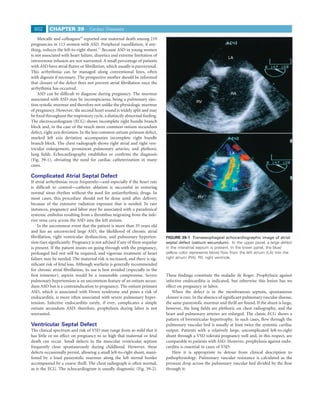
lung fields. Echocardiography establishes or confirms the diagnosis                                                LA
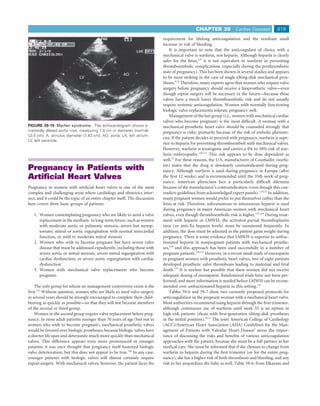
(Fig. 39-1), obviating the need for cardiac catheterization in many
cases.

Complicated Atrial Septal Defect
If atrial arrhythmias recur frequently—and especially if the heart rate
is difficult to control—catheter ablation is successful in restoring                                                RA
normal sinus rhythm without the need for antiarrhythmic drugs. In
most cases, this procedure should not be done until after delivery                             RV
because of the extensive radiation exposure that is needed. In rare
instances, pregnancy and labor may be associated with a paradoxical
systemic embolus resulting from a thrombus migrating from the infe-
rior vena cava across the ASD into the left atrium.
    In the uncommon event that the patient is more than 35 years old
and has an uncorrected large ASD, the likelihood of chronic atrial
fibrillation, right ventricular dysfunction, and pulmonary hyperten-          FIGURE 39-1 Transesophageal echocardiographic image of atrial
sion rises significantly. Pregnancy is not advised if any of these sequelae   septal defect (ostium secundum). In the upper panel, a large defect
is present. If the patient insists on going through with the pregnancy,      in the interatrial septum is present. In the lower panel, the blue/
prolonged bed rest will be required, and vigorous treatment of heart         yellow color represents blood flow from the left atrium (LA) into the
failure may be needed. The maternal risk is increased, and there is sig-     right atrium (RA). RV, right ventricle.
nificant risk of fetal loss. Although warfarin is generally recommended
for chronic atrial fibrillation, its use is best avoided (especially in the
first trimester); aspirin would be a reasonable compromise. Severe            These findings constitute the maladie de Roger. Prophylaxis against
pulmonary hypertension is an uncommon feature of an ostium secun-            infective endocarditis is indicated, but otherwise this lesion has no
dum ASD but is a contraindication to pregnancy. The ostium primum            effect on pregnancy or labor.
ASD, which is associated with Down syndrome and poses a risk of                  When the defect is in the membranous septum, spontaneous
endocarditis, is more often associated with severe pulmonary hyper-          closure is rare. In the absence of significant pulmonary vascular disease,
tension. Infective endocarditis rarely, if ever, complicates a simple        the same pansystolic murmur and thrill are found. If the shunt is large,
ostium secundum ASD; therefore, prophylaxis during labor is not              however, the lung fields are plethoric on chest radiography, and the
warranted.                                                                   heart and pulmonary arteries are enlarged. The classic ECG shows a
                                                                             pattern of biventricular hypertrophy. In such cases, flow through the
Ventricular Septal Defect                                                    pulmonary vascular bed is usually at least twice the systemic cardiac
The clinical spectrum and risk of VSD may range from so mild that it         output. Patients with a relatively large, uncomplicated left-to-right
has little or no effect on pregnancy to so high that maternal or fetal       shunt through a VSD tolerate pregnancy well and, in this respect, are
death can occur. Small defects in the muscular ventricular septum            comparable to patients with ASD. However, prophylaxis against endo-
frequently close spontaneously during childhood. However, these              carditis is essential in cases of VSD.
defects occasionally persist, allowing a small left-to-right shunt, mani-        Here it is appropriate to detour from clinical description to
fested by a loud pansystolic murmur along the left sternal border            pathophysiology. Pulmonary vascular resistance is calculated as the
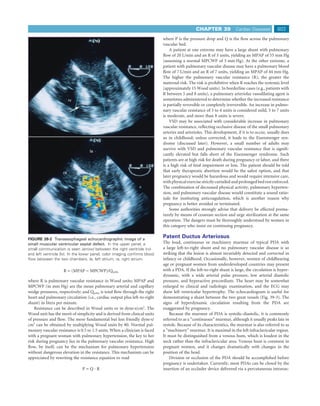
accompanied by a coarse thrill. The chest radiograph is often normal,        pressure drop across the pulmonary vascular bed divided by the flow
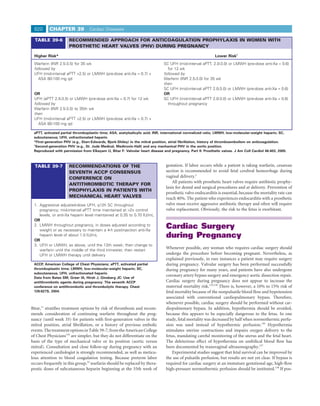
as is the ECG. The echocardiogram is usually diagnostic (Fig. 39-2).         through it:
CHAPTER 39             Cardiac Diseases         803
                                                                            where P is the pressure drop and Q is the flow across the pulmonary
                                                                            vascular bed.
                                                                                A patient at one extreme may have a large shunt with pulmonary
                                                                            flow of 20 L/min and an R of 3 units, yielding an MPAP of 55 mm Hg
                                                                            (assuming a normal MPCWP of 5 mm Hg). At the other extreme, a
                                                                            patient with pulmonary vascular disease may have a pulmonary blood
                                                                            flow of 7 L/min and an R of 7 units, yielding an MPAP of 44 mm Hg.
                                                                            The higher the pulmonary vascular resistance (R), the greater the
                                                                            maternal risk. The risk is prohibitive when R reaches the systemic level
                                                                            (approximately 15 Wood units). In borderline cases (e.g., patients with
                                                                            R between 5 and 8 units), a pulmonary arteriolar vasodilating agent is
                         rv                   lv                            sometimes administered to determine whether the increased resistance
                                                                            is partially reversible or completely irreversible. An increase in pulmo-
                                                                            nary vascular resistance of 3 to 4 units is considered mild, 5 to 7 units
                                                                            is moderate, and more than 8 units is severe.
                                                                                VSD may be associated with considerable increase in pulmonary
                                                                            vascular resistance, reflecting occlusive disease of the small pulmonary
                                                                            arteries and arterioles. This development, if it is to occur, usually does
                                                                            so in childhood; unless corrected, it leads to the Eisenmenger syn-
                                                                            drome (discussed later). However, a small number of adults may
                                                                            survive with VSD and pulmonary vascular resistance that is signifi-
                                   la
                                                                            cantly elevated but falls short of the Eisenmenger syndrome. Such
                                                                            patients are at high risk for death during pregnancy or labor, and there
                                                                            is a high risk of fetal impairment or loss. The patient should be told
                    ra                                                      that early therapeutic abortion would be the safest option, and that
                                                                            later pregnancy would be hazardous and would require intensive care,
                                                                            with physical exercise strictly curtailed and prolonged bed rest enforced.
                                                                            The combination of decreased physical activity, pulmonary hyperten-
                                            lv                              sion, and pulmonary vascular disease would constitute a sound ratio-
                          rv                                                nale for instituting anticoagulation, which is another reason why
                                                                            pregnancy is better avoided or terminated.
                                                                                Some authorities strongly advise that delivery be effected prema-
                                                                            turely by means of cesarean section and urge sterilization at the same
                                                                            operation. The dangers must be thoroughly understood by women in
                                                                            this category who insist on continuing pregnancy.

FIGURE 39-2 Transesophageal echocardiographic image of a
                                                                            Patent Ductus Arteriosus
small muscular ventricular septal defect. In the upper panel, a             The loud, continuous or machinery murmur of typical PDA with
small communication is seen (arrow) between the right ventricle (rv)        a large left-to-right shunt and no pulmonary vascular disease is so
and left ventricle (lv). In the lower panel, color imaging confirms blood    striking that the lesion is almost invariably detected and corrected in
flow between the two chambers. la, left atrium; ra, right atrium.            infancy or childhood. Occasionally, however, women of childbearing
                                                                            age or pregnant women from underdeveloped countries may present
                    R = (MPAP − MPCWP)/Qpulm                                with a PDA. If the left-to-right shunt is large, the circulation is hyper-
                                                                            dynamic, with a wide arterial pulse pressure, low arterial diastolic
where R is pulmonary vascular resistance in Wood units; MPAP and            pressure, and hyperactive precordium. The heart may be somewhat
MPCWP (in mm Hg) are the mean pulmonary arterial and capillary              enlarged to clinical and radiologic examination, and the ECG may
wedge pressures, respectively; and Qpulm is total flow through the right     show left ventricular hypertrophy. The echocardiogram is useful for
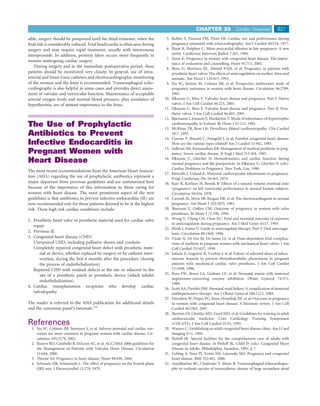
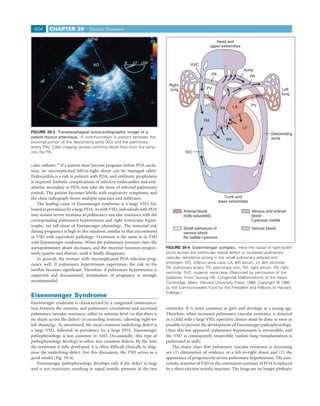
heart and pulmonary circulation (i.e., cardiac output plus left-to-right    demonstrating a shunt between the two great vessels (Fig. 39-3). The
shunt) in liters per minute.                                                signs of hyperdynamic circulation resulting from the PDA are
    Resistance can be described in Wood units or in dyne·s/cm5. The         exaggerated by pregnancy.
Wood unit has the merit of simplicity and is derived from clinical units        Because the murmur of PDA is systolic-diastolic, it is commonly
of pressure and flow. The more fundamental but less friendly dyne·s/         referred to as a “continuous” murmur, although it usually peaks late in
cm5 can be obtained by multiplying Wood units by 80. Normal pul-            systole. Because of its characteristics, the murmur is also referred to as
monary vascular resistance is 0.5 to 1.5 units. When a clinician is faced   a “machinery” murmur. It is maximal in the left infraclavicular region.
with a pregnant woman with pulmonary hypertension, the key to her           It must be distinguished from a venous hum, which is loudest in the
risk during pregnancy lies in the pulmonary vascular resistance. High       neck rather than the infraclavicular area. Venous hum is common in
flow, by itself, can be the mechanism for pulmonary hypertension             pregnant women, and it changes dramatically with changes in the
without dangerous elevation in the resistance. This mechanism can be        position of the head.
appreciated by rewriting the resistance equation to read                        Division or occlusion of the PDA should be accomplished before
                                                                            pregnancy is undertaken. Currently, most PDAs can be closed by the
                               P=Q·R                                        insertion of an occluder device delivered via a percutaneous intravas-
804      CHAPTER 39             Cardiac Diseases

                                                                                                          Head and
                                                                                                       upper extremities


                                    AO                                                    SVC
                                                                                                                               Aorta
                                                                                                          PA
                                                                                                                                    PA

                                                                             Right
                     PA                                                       lung                  PV                                              Left
                                                                                                                                                    lung


                                                                                                                          LA        PV
                                                                                                                PA


                                                                                                  RA
                                                                                                                               LV
FIGURE 39-3 Transesophageal echocardiographic image of a                                                                                      Descending
patent ductus arteriosus. A communication is present between the                                                                              aorta
                                                                                                                     RV
proximal portion of the descending aorta (AO) and the pulmonary
artery (PA). Color imaging (arrow) confirms blood flow from the aorta
into the PA.                                                                           IVC


cular catheter.34 If a patient does become pregnant before PDA occlu-
sion, an uncomplicated left-to-right shunt can be managed safely.
Endocarditis is a risk in patients with PDA, and antibiotic prophylaxis
is required. Embolic complications of infective endocarditis and end-
arteritis secondary to PDA may take the form of infected pulmonary
emboli. The patient becomes febrile with respiratory symptoms, and
the chest radiograph shows multiple opacities and infiltrates.                                                     Trunk and
                                                                                                               lower extremities
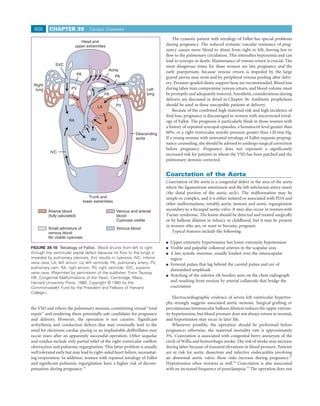
    The leading cause of Eisenmenger syndrome is a large VSD, fol-
lowed in prevalence by a large PDA. As with VSD, individuals with PDA                 Arterial blood                                Venous and arterial
may sustain severe increases in pulmonary vascular resistance with the                (fully saturated)                             blood
corresponding pulmonary hypertension and right ventricular hyper-                                                                   Cyanosis visible
trophy, yet fall short of Eisenmenger physiology. The maternal risk
                                                                                      Small admixture of                            Venous blood
during pregnancy is high in this situation, similar to that encountered               venous blood
in VSD with equivalent pathology. Treatment is the same as in VSD                     No visible cyanosis
with Eisenmenger syndrome. When the pulmonary pressure rises, the
aortopulmonary shunt decreases, and the murmur becomes progres-             FIGURE 39-4 Eisenmenger complex. Here the cause of right-to-left
sively quieter and shorter, until it finally disappears.                     shunt across the ventricular septal defect is increased pulmonary
    In general, the woman with uncomplicated PDA tolerates preg-            vascular resistance arising in the small pulmonary arteries and
nancy well. If pulmonary hypertension supervenes, the risk to the           arterioles. IVC, inferior vena cava; LA, left atrium; LV, left ventricle;
                                                                            PA, pulmonary artery; PV, pulmonary vein; RA, right atrium; RV, right
mother becomes significant. Therefore, if pulmonary hypertension is
                                                                            ventricle; SVC, superior vena cava. (Reprinted by permission of the
suspected and documented, termination of pregnancy is strongly              publisher. From Taussig HB: Congenital Malformations of the Heart.
recommended.                                                                Cambridge, Mass, Harvard University Press, 1960. Copyright © 1960
                                                                            by the Commonwealth Fund by the President and Fellows of Harvard
                                                                            College.)
Eisenmenger Syndrome
Eisenmenger syndrome is characterized by a congenital communica-
tion between the systemic and pulmonary circulations and increased          ventricles. It is more common in girls and develops at a young age.
pulmonary vascular resistance, either to systemic level (so that there is   Therefore, when increased pulmonary vascular resistance is detected
no shunt across the defect) or exceeding systemic (allowing right-to-       in a child with a large VSD, operative closure must be done as soon as
left shunting). As mentioned, the most common underlying defect is          possible to prevent the development of Eisenmenger pathophysiology.
a large VSD, followed in prevalence by a large PDA. Eisenmenger             Once this has appeared, pulmonary hypertension is irreversible, and
pathophysiology is less common in ASD. Occasionally, this type of           the VSD is consequently inoperable (unless lung transplantation is
pathophysiology develops in other, less common defects. By the time         performed as well).
the syndrome is fully developed, it is often difficult clinically to diag-       The major clues that pulmonary vascular resistance is increasing
nose the underlying defect. For this discussion, the VSD serves as a        are (1) diminution of evidence of a left-to-right shunt and (2) the
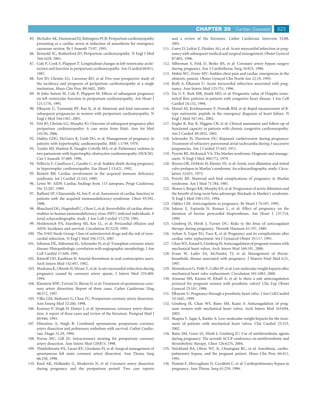
good model (Fig. 39-4).                                                     appearance of progressively severe pulmonary hypertension. The pan-
    Eisenmenger pathophysiology develops only if the defect is large        systolic murmur of VSD or the continuous murmur of PDA is replaced
and is not restrictive, resulting in equal systolic pressure in the two     by a short ejection systolic murmur. The lungs are no longer plethoric
CHAPTER 39             Cardiac Diseases        805
but show large central pulmonary arteries and small peripheral arteries       until term, treated with oxygen and heparin, and delivered by cesarean
characteristic of severe pulmonary hypertension. Because the shunt            section. One patient died a month after delivery. Most of the infants
has disappeared, the radiographic cardiothoracic ratio returns to             were small, and one died. Despite this better-than-average outcome,
normal but the main pulmonary segment is prominent. There is                  pregnancy should not be encouraged in women with Eisenmenger
usually a striking right ventricular heave, a loud and palpable pulmo-        syndrome or in those with a systemic level of pulmonary hypertension
nary valve closure sound, and an ejection sound in early systole. When        of any cause.
concentric ventricular hypertrophy gives way to dilatation and right-
sided heart failure, evidence of tricuspid regurgitation appears. Until
then, the mean venous pressure is normal but the amplitude of the a           Primary Pulmonary Hypertension
wave may be increased, reflecting decreased right ventricular diastolic        Severe idiopathic (“primary”) pulmonary hypertension, like the
compliance.                                                                   Eisenmenger syndrome, carries a high risk in pregnancy, and the
    If pulmonary vascular resistance is significantly higher than sys-         same principles apply to its management. Pregnancy is not advised in
temic levels, right-to-left shunting of blood occurs and causes cyanosis      women with this condition, because the mortality rate approaches
and clubbing of the fingers and toes. This shunting of deoxygenated            50%.40
blood into the systemic circulation leads to hypoxemia and triggers a            Severe pulmonary hypertension can result from taking appetite-
reactive erythrocytosis as the system attempts to increase peripheral         suppressing drugs. The fenfluramine-phentermine regimen (“fen-
oxygen delivery. This increases blood viscosity and can cause sludging        phen”) was a notorious culprit41 and was withdrawn from the market.
and decreased flow of blood, especially in small vessels. A high hemat-        Treatment strategies include vasodilators, sometimes by chronic intra-
ocrit value, however, is not an automatic indication for serial phle-         venous infusion, and nitric oxide inhalation. In some 25% of cases,
botomy, because this approach can lead to iron deficiency and                  pulmonary arterial pressure is lowered by prostacyclin infusion.42 This
microcytosis. Tissue hypoxia may then actually worsen, a particularly         response predicts a favorable response to chronic oral nifedipine
undesirable result in pregnancy. Phlebotomy is reserved for patients          administration and a good prognosis. Balloon atrial septostomy,43,44
without evidence of iron deficiency on laboratory testing who have             through the foramen ovale or via transseptal puncture, can be used, in
symptoms of hyperviscosity, including headache, dizziness, visual dis-        extreme cases of pulmonary hypertension, to relieve right heart pres-
turbance, myalgia, and bleeding diathesis. Quantitative volume replace-       sure, usually as a bridge to transplantation.
ment is necessary during phlebotomy.
    Attempted surgical correction of a congenital cardiac shunt after
Eisenmenger syndrome is present usually results in the death of the
patient.35 Many patients ultimately die of right-sided heart failure,         Congenital Obstructive
pulmonary hypertension, or pulmonary hemorrhage.36                            Lesions
    The woman with Eisenmenger syndrome must be informed that
pregnancy carries a mortality risk of about 50%.37 Even if the mother         Some congenital cardiac malformations are characterized by obstruc-
survives, the outcome for the fetus is likely to be poor, because the fetal   tion to left or right ventricular outflow. The more common examples
mortality rate exceeds 50% in cyanotic women with Eisenmenger syn-            include pulmonary stenosis, aortic stenosis, and coarctation of the
drome.36 Sudden death may occur at any time, but labor, delivery, and         aorta. The hypoplastic left heart syndrome seldom allows survival to
particularly the early puerperium seem to be the most dangerous               childbearing age, and those who do survive usually have undergone a
periods.38 Any significant fall in venous return, regardless of cause,         major palliative procedure, such as construction of a ventriculoaortic
impairs the ability of the right heart to pump blood through the high,        conduit with a prosthetic valve, that would constitute a strong contra-
fixed pulmonary vascular resistance. Hypotension and shock can occur           indication to pregnancy.
quickly and are often unresponsive to medical therapy.
    The major physiologic difficulty in pulmonary hypertension is
maintenance of adequate pulmonary blood flow. Any event or condi-              Mitral Stenosis
tion that decreases venous return, such as vasodilation on the systemic       Congenital mitral stenosis is a rare malformation. When it is associated
side of the circulation from epidural anesthesia or pooling of blood in       with an ASD, it constitutes the Lutembacher syndrome. Survival to
the lower extremities from vena caval compression, decreases preload          childbearing age is usual. Both lesions tend to promote atrial fibrilla-
to the right ventricle and pulmonary blood flow. Therefore, manage-            tion. Ideally, the mitral valve and the atrial defect should be repaired
ment during pregnancy centers on the maintenance of pulmonary                 before pregnancy.
blood flow. If the patient insists on continuing her pregnancy, limita-
tion of physical activity is essential, as is the use of pressure-graded
elastic support hose, low-flow home oxygen therapy, and monthly                Aortic Stenosis
monitoring of blood and platelet counts. Because of the precarious
                                                                              (see also the later section on aortic stenosis under
physiologic balance, a planned delivery should be performed with
                                                                              Aortic Valve Disease)
intensive care monitoring, including a Swan-Ganz catheter and provi-
sions for skilled obstetric anesthesia care. Anesthetic considerations for    Bicuspid aortic valve is one of the more common congenital malfor-
this entity are discussed in Chapter 56.                                      mations that may lead to aortic stenosis, regurgitation, or both (Fig.
    On a more optimistic note, a report published in 1995 described           39-5). Often, aortic stenosis is not present during early life but pro-
13 pregnancies in 12 women with Eisenmenger syndrome who elected              gresses over time because of valve calcification and gradual restriction
not to accept advice to terminate pregnancy.39 Mean systolic pulmo-           in leaflet motion. The bicuspid valve may occur as an isolated defect
nary arterial pressure was 113 mm Hg. Three spontaneous abortions,            or in combination with other congenital anomalies, most commonly
one premature labor, and two maternal deaths occurred. The seven              aortic coarctation. Congenital aortic stenosis, on the other hand, can
patients who reached the end of the second trimester were hospitalized        be severe at birth and may cause severe left ventricular hypertrophy
806       CHAPTER 39             Cardiac Diseases


                                 LA


                                      AV
                                                                                                                                  PA


                                             RVOT


                                                                                                                    RV


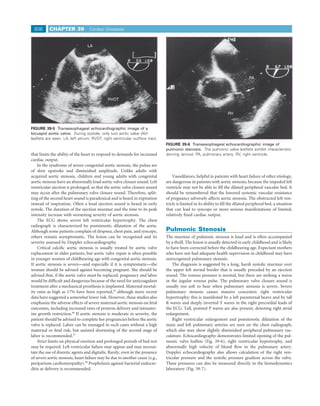
FIGURE 39-5 Transesophageal echocardiographic image of a
bicuspid aortic valve. During systole, only two aortic valve (AV)
leaflets are seen. LA, left atrium; RVOT, right ventricular outflow tract.
                                                                              FIGURE 39-6 Transesophageal echocardiographic image of
                                                                              pulmonic stenosis. The pulmonic valve leaflets exhibit characteristic
that limits the ability of the heart to respond to demands for increased      doming (arrow). PA, pulmonary artery; RV, right ventricle.
cardiac output.
    In the syndrome of severe congenital aortic stenosis, the pulses are
of slow upstroke and diminished amplitude. Unlike adults with
acquired aortic stenosis, children and young adults with congenital               Vasodilators, helpful in patients with heart failure of other etiology,
aortic stenosis have an abnormally loud aortic valve closure sound. Left      are dangerous in patients with aortic stenosis, because the impeded left
ventricular ejection is prolonged, so that the aortic valve closure sound     ventricle may not be able to fill the dilated peripheral vascular bed. It
may occur after the pulmonary valve closure sound. Therefore, split-          should be remembered that the lowered systemic vascular resistance
ting of the second heart sound is paradoxical and is heard in expiration      of pregnancy adversely affects aortic stenosis. The obstructed left ven-
instead of inspiration. Often a loud ejection sound is heard in early         tricle is limited in its ability to fill the dilated peripheral bed, a situation
systole. The duration of the ejection murmur and the time to its peak         that can lead to syncope or more serious manifestations of limited,
intensity increase with worsening severity of aortic stenosis.                relatively fixed cardiac output.
    The ECG shows severe left ventricular hypertrophy. The chest
radiograph is characterized by poststenotic dilatation of the aorta.
Although some patients complain of dyspnea, chest pain, and syncope,          Pulmonic Stenosis
others remain asymptomatic. The lesion can be recognized and its              The murmur of pulmonic stenosis is loud and is often accompanied
severity assessed by Doppler echocardiography.                                by a thrill. The lesion is usually detected in early childhood and is likely
    Critical calcific aortic stenosis is usually treated by aortic valve       to have been corrected before the childbearing age. Expectant mothers
replacement in older patients, but aortic valve repair is often possible      who have not had adequate health supervision in childhood may have
in younger women of childbearing age with congenital aortic stenosis.         unrecognized pulmonary stenosis.
If aortic stenosis is severe—and especially if it is symptomatic—the              The diagnosis is suggested by a long, harsh systolic murmur over
woman should be advised against becoming pregnant. She should be              the upper left sternal border that is usually preceded by an ejection
advised that, if the aortic valve must be replaced, pregnancy and labor       sound. The venous pressure is normal, but there are striking a waves
would be difficult and dangerous because of the need for anticoagulant         in the jugular venous pulse. The pulmonary valve closure sound is
treatment after a mechanical prosthesis is implanted. Maternal mortal-        usually too soft to hear when pulmonary stenosis is severe. Severe
ity rates as high as 17% have been reported,45 although more recent           pulmonary stenosis causes massive concentric right ventricular
data have suggested a somewhat lower risk. However, these studies also        hypertrophy; this is manifested by a left parasternal heave and by tall
emphasize the adverse effects of severe maternal aortic stenosis on fetal     R waves and deeply inverted T waves in the right precordial leads of
outcomes, including increased rates of preterm delivery and intrauter-        the ECG. Tall, pointed P waves are also present, denoting right atrial
ine growth restriction.46 If aortic stenosis is moderate in severity, the     enlargement.
patient should be advised to complete her pregnancies before the aortic           Right ventricular enlargement and poststenotic dilatation of the
valve is replaced. Labor can be managed in such cases without a high          main and left pulmonary arteries are seen on the chest radiograph,
maternal or fetal risk, but assisted shortening of the second stage of        which also may show slightly diminished peripheral pulmonary vas-
labor is recommended.47                                                       culature. Echocardiography demonstrates limited opening of the pul-
    Strict limits on physical exertion and prolonged periods of bed rest      monic valve leaflets (Fig. 39-6), right ventricular hypertrophy, and
may be required. Left ventricular failure may appear and may necessi-         abnormally high velocity of blood flow in the pulmonary artery.
tate the use of diuretic agents and digitalis. Rarely, even in the presence   Doppler echocardiography also allows calculation of the right ven-
of severe aortic stenosis, heart failure may be due to another cause (e.g.,   tricular pressure and the systolic pressure gradient across the valve.
peripartum cardiomyopathy).48 Prophylaxis against bacterial endocar-          These pressures can also be measured directly in the hemodynamics
ditis at delivery is recommended.                                             laboratory (Fig. 39-7).
CHAPTER 39              Cardiac Diseases         807


                                                                                                                 Aorta                       LV
                                                                                                 LV
                                                                                                              Septal
                                                                                      RV                      defect                 RV
                                                                                                               Pulmonary
                                                                                                                 artery
                                                                                   Tetralogy of Fallot                                  Normal

                                                                              FIGURE 39-8 Tetralogy of Fallot. The anatomic pathology (left)
                                                                              compared with normal (right). Note the ventricular septal defect, the
                                                                              aorta (which overrides the defect), the pulmonary stenosis, and the
                                                                              right ventricular hypertrophy. LV, left ventricle; RV, right ventricle.
                                                                              (Reprinted by permission of the publisher. From Taussig HB:
                                                                              Congenital Malformations of the Heart. Cambridge, Mass, Harvard
                                                                              University Press, 1960. Copyright © 1960 by the Commonwealth
                                                                              Fund of the President and Fellows of Harvard College.)
FIGURE 39-7 Pressure tracings in severe pulmonary stenosis.
Pulmonary pressure is extremely low and appears damped. Right
ventricular pressure is suprasystemic. (From Shabetai R, Adolph RJ:
Principles of cardiac catheterization. In Fowler NO [ed]: Cardiac
Diagnosis and Treatment. Hagerstown, MD: Harper & Row, 1980,
p 106.)
                                                                                                                    RV
    Pulmonic stenosis is generally well tolerated so that neither preg-
nancy nor labor poses a significant threat.49 Prophylaxis against infec-
tive endocarditis is necessary. More severe pulmonary stenosis requires                                     LV
                                                                                                                                   AO
treatment. Unlike aortic stenosis, however, critical pulmonary stenosis
does not require valve replacement or open repair. Most cases are
treated successfully with transvenous balloon valvuloplasty.50 Ideally,                                             MV
this should be carried out before pregnancy is undertaken; if a woman
does become pregnant and develops intractable right-sided heart
failure, the procedure can still be safely performed (but at some risk
to the fetus). Extreme pulmonary stenosis (right ventricular systolic
pressure > systemic systolic pressure) is a contraindication to preg-         FIGURE 39-9 Transthoracic echocardiographic image of tetralogy
nancy until the lesion is adequately treated.                                 of Fallot. A large ventricular septal defect is present, and the aorta
                                                                              (AO) overrides the interventricular septum. LV, left ventricle; MV,
                                                                              mitral valve; RV, right ventricle.
Right-to-Left Shunt without Pulmonary
Hypertension (Tetralogy of Fallot)                                            outflow obstruction that diverts blood flow through the VSD. In the
The congenital cyanotic heart diseases discussed so far have been asso-       typical case, right and left ventricular systolic pressures are equal but
ciated with a communication between the pulmonary and systemic                the pulmonary artery pressure is exceedingly low. A loud, long systolic
circulations and pulmonary vascular resistance sufficiently high to            murmur is audible along the left sternal border. The murmur is caused
cause a right-to-left shunt. However, cyanosis occurs in other congeni-       by an abnormal flow pattern through the obstructed right ventricular
tal malformations, in which there is a defect between the right and left      outflow tract. The pulmonary valve closure sound is usually inaudible.
sides of the heart but also right ventricular outflow obstruction (Figs.       Patients are usually cyanotic and often have significant clubbing of the
39-8 and 39-9). Examples include the tetralogy of Fallot and tricuspid        fingers and toes. The hematocrit value is greatly elevated because of
atresia.                                                                      the severe erythrocytosis. Phlebotomy is not indicated to treat the
    Tetralogy of Fallot is used to illustrate this class of congenital mal-   hematocrit level per se but is indicated if symptoms of hyperviscosity
formation of the heart, because it is by far the most common form of          occur. Ignoring this important therapeutic principle leads to a micro-
cyanotic congenital heart disease encountered in pregnancy. Moreover,         cytic anemia that further complicates pregnancy. The ECG shows
the offspring of a mother with tetralogy of Fallot has a 2% to 13%            severe right ventricular hypertrophy. The chest radiograph is charac-
chance of inheriting the condition.51 The syndrome includes (1) a large       terized by a normal-sized heart and a concavity in the region where
defect high in the ventricular septum; (2) pulmonary stenosis, which          the pulmonary artery should be (Fig. 39-11). As in all malformations
may be at the valve itself but more commonly is in the infundibulum           of this general type, the lung fields are oligemic, showing small vessels
of the right ventricle; (3) dextroposition of the aorta so that the aortic    throughout.
orifice sits astride the VSD and overrides, at least in part, the right            Most adults born with the tetralogy of Fallot and lesions with
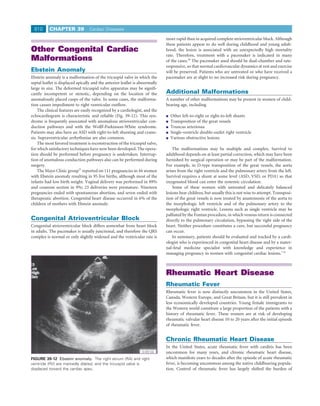
ventricle; and (4) right ventricular hypertrophy (Fig. 39-10).                similar pathophysiology have undergone surgical treatment before
    A wide spectrum of clinical presentations may be present, depend-         reaching young adulthood. Children raised in undeveloped countries
ing on the relative size of the VSD and the degree of right ventricular       are an important exception. Many patients have had surgery to close
808       CHAPTER 39                 Cardiac Diseases

                                                                                  The cyanotic patient with tetralogy of Fallot has special problems
                              Head and
                           upper extremities                                  during pregnancy. The reduced systemic vascular resistance of preg-
                                                                              nancy causes more blood to shunt from right to left, leaving less to
                                                                              flow to the pulmonary circulation. This intensifies hypoxemia and can
                                                                              lead to syncope or death. Maintenance of venous return is crucial. The
              SVC                                                             most dangerous times for these women are late pregnancy and the
                                                  Aorta                       early puerperium, because venous return is impeded by the large
                              PA
                                                       PA                     gravid uterus near term and by peripheral venous pooling after deliv-
                                                                              ery. Pressure-graded elastic support hose are recommended. Blood loss
 Right
  lung                  PV                                             Left   during labor may compromise venous return, and blood volume must
                                                 PA                    lung   be promptly and adequately restored. Anesthetic considerations during
                                                                              delivery are discussed in detail in Chapter 56. Antibiotic prophylaxis
                                            LA         PV                     should be used in these susceptible patients at delivery.
                                                                                  Because of the combined high maternal risk and high incidence of
                                                                              fetal loss, pregnancy is discouraged in women with uncorrected tetral-
                      RA                                                      ogy of Fallot. The prognosis is particularly bleak in those women with
                                                  LV                          a history of repeated syncopal episodes, a hematocrit level greater than
                                                                 Descending   60%, or a right ventricular systolic pressure greater than 120 mm Hg.
                                       RV                        aorta        If a young woman with untreated tetralogy of Fallot requests prepreg-
                                                                              nancy counseling, she should be advised to undergo surgical correction
                                                                              before pregnancy. Pregnancy does not represent a significantly
           IVC
                                                                              increased risk for patients in whom the VSD has been patched and the
                                                                              pulmonary stenosis corrected.


                                                                              Coarctation of the Aorta
                                                                              Coarctation of the aorta is a congenital defect in the area of the aorta
                                                                              where the ligamentum arteriosum and the left subclavian artery insert
                                                                              (the distal portion of the aortic arch). The malformation may be
                                      Trunk and                               simple or complex, and it is either isolated or associated with PDA and
                                   lower extremities
                                                                              other malformations, notably aortic stenosis and aortic regurgitation
          Arterial blood                               Venous and arterial    secondary to a bicuspid aortic valve. It may also occur in women with
          (fully saturated)                            blood                  Turner syndrome. The lesion should be detected and treated surgically
                                                       Cyanosis visible       or by balloon dilation in infancy or childhood, but it may be present
                                                                              in women who are, or want to become, pregnant.
          Small admixture of                           Venous blood
          venous blood                                                           Typical features include the following:
          No visible cyanosis
                                                                                Upper extremity hypertension but lower extremity hypotension
FIGURE 39-10 Tetralogy of Fallot. Blood shunts from left to right               Visible and palpable collateral arteries in the scapular area
through the ventricular septal defect because its flow to the lungs is           A late systolic murmur, usually loudest over the interscapular
impeded by pulmonary stenosis; this results in cyanosis. IVC, inferior          region
vena cava; LA, left atrium; LV, left ventricle; PA, pulmonary artery; PV,       Femoral pulses that lag behind the carotid pulses and are of
pulmonary vein; RA, right atrium; RV, right ventricle; SVC, superior
                                                                                diminished amplitude
vena cava. (Reprinted by permission of the publisher. From Taussig
                                                                                Notching of the inferior rib borders seen on the chest radiograph
HB: Congenital Malformations of the Heart. Cambridge, Mass,
Harvard University Press, 1960. Copyright © 1960 by the                         and resulting from erosion by arterial collaterals that bridge the
Commonwealth Fund by the President and Fellows of Harvard                       coarctation
College.)
                                                                                  Electrocardiographic evidence of severe left ventricular hypertro-
                                                                              phy strongly suggests associated aortic stenosis. Surgical grafting or
the VSD and relieve the pulmonary stenosis, constituting virtual “total       percutaneous intravascular balloon dilation reduces the upper extrem-
repair” and rendering them potentially safe candidates for pregnancy          ity hypertension, but blood pressure does not always return to normal,
and delivery. However, the operation is not curative. Significant              and hypertension may recur in later life.
arrhythmia and conduction defects that may eventually lead to the                 Whenever possible, the operation should be performed before
need for electronic cardiac pacing or an implantable defibrillator may         pregnancy; otherwise, the maternal mortality rate is approximately
occur years after an apparently successful operation. Other sequelae          3%. Coarctation is associated with congenital berry aneurysm of the
and residua include only partial relief of the right ventricular outflow       circle of Willis and hemorrhagic stroke. The risk of stroke may increase
obstruction and pulmonic regurgitation. This latter problem is usually        during labor because of transient elevations in blood pressure. Patients
well tolerated early but may lead to right-sided heart failure, necessitat-   are at risk for aortic dissection and infective endocarditis involving
ing reoperation. In addition, women with repaired tetralogy of Fallot         an abnormal aortic valve; these risks increase during pregnancy.53
and significant pulmonic regurgitation have a higher risk of decom-            Hypertension often worsens as well.54 Coarctation is also associated
pensation during pregnancy.52                                                 with an increased frequency of preeclampsia.31 The operation does not
CHAPTER 39            Cardiac Diseases        809


 A                                                                           B


 C                                                                           D
FIGURE 39-11 Tetralogy of Fallot. A, Chest radiograph. Note concavity in the area of the pulmonary artery, oligemic lungs, and right aortic
arch. B, Right ventriculogram. Note the narrow right ventricular outflow tract. C, Further clarification of the pulmonary arteries. The left ventricle
is slightly opacified via the ventricular septal defect. D, The associated right-sided aortic arch is now visible. (From Shabetai R, Adolph RJ:
Principles of cardiac catheterization. In Fowler NO [ed]: Cardiac Diagnosis and Treatment. Hagerstown, MD: Harper & Row, 1980, p 106.)


require cardiopulmonary bypass and can be carried out with safety for        dissection and rupture. A number of centers are now performing
the mother and with less fetal risk than accompanies open heart              balloon dilation with stent implantation for adults with unoperated
surgery with cardiopulmonary bypass. Although transvascular balloon          aortic coarctation, but large, multicenter studies are currently not
dilation of aortic coarctation is a viable option for children and infants   available.56
with coarctation, its use in adults is controversial.55 The procedure            If delivery must be undertaken in cases of unoperated coarctation,
is well accepted for treatment of postsurgical renarrowing of the            blood pressure can be titrated with β-adrenergic–blocking agents
coarctation, but de novo balloon angioplasty carries a risk of aortic        delivered by intravenous drip.
810      CHAPTER 39              Cardiac Diseases

                                                                             more rapid than in acquired complete atrioventricular block. Although
                                                                             these patients appear to do well during childhood and young adult-
Other Congenital Cardiac                                                     hood, the lesion is associated with an unexpectedly high mortality
                                                                             rate. Therefore, treatment with a pacemaker is indicated in many
Malformations                                                                of the cases.58 The pacemaker used should be dual-chamber and rate-
                                                                             responsive, so that normal cardiovascular dynamics at rest and exercise
Ebstein Anomaly                                                              will be preserved. Patients who are untreated or who have received a
Ebstein anomaly is a malformation of the tricuspid valve in which the        pacemaker are at slight to no increased risk during pregnancy.
septal leaflet is displaced apically and the anterior leaflet is abnormally
large in size. The deformed tricuspid valve apparatus may be signifi-
cantly incompetent or stenotic, depending on the location of the             Additional Malformations
anomalously placed cusps of the valve. In some cases, the malforma-          A number of other malformations may be present in women of child-
tion causes impediment to right ventricular outflow.                          bearing age, including
    The clinical features are easily recognized by a cardiologist, and the
echocardiogram is characteristic and reliable (Fig. 39-12). This syn-          Other left-to-right or right-to-left shunts
drome is frequently associated with anomalous atrioventricular con-            Transposition of the great vessels
duction pathways and with the Wolff-Parkinson-White syndrome.                  Truncus arteriosus
Patients may also have an ASD with right-to-left shunting and cyano-           Single-ventricle double-outlet right ventricle
sis. Supraventricular arrhythmias are also common.                             Various obstructive lesions
    The most favored treatment is reconstruction of the tricuspid valve,
for which satisfactory techniques have now been developed. The opera-            The malformations may be multiple and complex. Survival to
tion should be performed before pregnancy is undertaken. Interrup-           adulthood depends on at least partial correction, which may have been
tion of anomalous conduction pathways also can be performed during           furnished by surgical operation or may be part of the malformation.
surgery.                                                                     For example, in D-type transposition of the great vessels, the aorta
    The Mayo Clinic group57 reported on 111 pregnancies in 44 women          arises from the right ventricle and the pulmonary artery from the left.
with Ebstein anomaly resulting in 95 live births, although most of the       Survival requires a shunt at some level (ASD, VSD, or PDA) so that
infants had low birth weight. Vaginal delivery was performed in 89%          oxygenated blood can enter the systemic circulation.
and cesarean section in 9%; 23 deliveries were premature. Nineteen               Some of these women with untreated and delicately balanced
pregnancies ended with spontaneous abortion, and seven ended with            lesions bear children, but usually this is not wise to attempt. Transposi-
therapeutic abortion. Congenital heart disease occurred in 6% of the         tion of the great vessels is now treated by anastomosis of the aorta to
children of mothers with Ebstein anomaly.                                    the morphologic left ventricle and of the pulmonary artery to the
                                                                             morphologic right ventricle. Lesions such as single ventricle may be
                                                                             palliated by the Fontan procedure, in which venous return is connected
Congenital Atrioventricular Block                                            directly to the pulmonary circulation, bypassing the right side of the
Congenital atrioventricular block differs somewhat from heart block          heart. Neither procedure constitutes a cure, but successful pregnancy
in adults. The pacemaker is usually junctional, and therefore the QRS        can occur.
complex is normal or only slightly widened and the ventricular rate is           In summary, patients should be evaluated and tracked by a cardi-
                                                                             ologist who is experienced in congenital heart disease and by a mater-
                                                                             nal-fetal medicine specialist with knowledge and experience in
                                                                             managing pregnancy in women with congenital cardiac lesions.7,31


                                        RV
                                                                             Rheumatic Heart Disease
                                                                             Rheumatic Fever
                                                                             Rheumatic fever is now distinctly uncommon in the United States,
                                                                             Canada, Western Europe, and Great Britain, but it is still prevalent in
                                                                             less economically developed countries. Young female immigrants to
                                                                             the Western world constitute a large proportion of the patients with a
                                RA                                           history of rheumatic fever. These women are at risk of developing
                                                                             rheumatic valvular heart disease 10 to 20 years after the initial episode
                                                                             of rheumatic fever.


                                                                             Chronic Rheumatic Heart Disease
                                                                             In the United States, acute rheumatic fever with carditis has been
                                                                             uncommon for many years, and chronic rheumatic heart disease,
FIGURE 39-12 Ebstein anomaly. The right atrium (RA) and right                which manifests years to decades after the episode of acute rheumatic
ventricle (RV) are markedly dilated, and the tricuspid valve is              fever, is becoming uncommon among the native childbearing popula-
displaced toward the cardiac apex.                                           tion. Control of rheumatic fever has largely shifted the burden of
CHAPTER 39              Cardiac Diseases         811


 ECG

mm Hg                                                                                                              LA
  100
             LV
    75

    50
                  LA                                                                                                                 AO
    25
                                                                                               LV

     0
A                        1 sec.


                                                                               FIGURE 39-14 Transesophageal echocardiographic image of
 ECG                                                                           mitral stenosis. During diastole, opening of the mitral valve is
                                                                               restricted by scarring and fusion of the leaflet tips. Characteristic
                                                                               doming of the leaflet is also present. AO, aorta; LA, left atrium; LV,
mm Hg                                                                          left ventricle.
   40

                    LV
                                                                               eventually supervenes, causing a fall in cardiac output and escalation
                                                                               of left atrial hypertension, especially if the ventricular rate is not con-
                                                                               trolled. Atrial fibrillation substantially increases the probability of
    20                                                                         thrombus in the left atrial appendage and the threat of a subsequent
                                                                               embolic stroke.
                       Wedge

                                                                               Effect of Pregnancy
                                                                               Pregnancy drastically stresses the circulation in women with severe
B    0
                                                                               mitral stenosis. The increased blood volume, heart rate, and cardiac
FIGURE 39-13 Hemodynamics of mitral valve disease. A, Mitral                   output raise left atrial pressure to a level that causes severe pulmonary
stenosis. The diastolic pressure gradient (shaded area) between the            congestion, leading to progressive exertional dyspnea, orthopnea, par-
left atrium (LA) and left ventricle (LV) persists to end-diastole.             oxysmal nocturnal dyspnea, and pulmonary edema. Women who have
B, Mitral regurgitation. Note the large systolic pressure wave of the          not been receiving antenatal care often present initially with severe
pulmonary wedge pressure tracing. The diastolic pressure gradient is           pulmonary edema during pregnancy. In long-standing cases, severe
limited to early diastole. ECG, electrocardiogram.                             right-sided heart failure develops. Infective endocarditis, pulmonary
                                                                               embolism, and massive hemoptysis may also occur. The maternal risk
                                                                               for death is highest in the third trimester and in the puerperium.10,11
rheumatic heart disease from teenagers to women in the third and
fourth decades of life.                                                        Significant Mitral Stenosis without
    The characteristic lesion of rheumatic heart disease is mitral steno-      Heart Failure
sis, and the next most common manifestation is the combination of              Patients who have mitral stenosis without heart failure should be
mitral stenosis with aortic regurgitation. The mitral valve may become         advised to undergo percutaneous balloon mitral valvuloplasty and to
both stenotic and incompetent, and the valve may calcify. Pure mitral          postpone pregnancy until after full recovery from the procedure. If
regurgitation is almost always nonrheumatic, except in young people            they do not follow this advice and do become pregnant, one reasonable
with acute carditis. Similarly, aortic valve disease without mitral            course in the first trimester may be pregnancy termination, followed
involvement is seldom rheumatic. Tricuspid regurgitation is a late             by mitral valve operation and subsequent pregnancy planning. If this
secondary manifestation that occurs secondary to pulmonary hyper-              is not acceptable, the patient can be advised to remain under frequent
tension and right ventricular enlargement.                                     close supervision by the cardiologist and obstetrician and to accept
                                                                               long periods of rest, prohibition of strenuous activity, salt restriction,
                                                                               and diuretic treatment. If this type of regimen is followed closely and
Mitral Stenosis                                                                is expertly supervised, maternal mortality is low.10,11 Atrial fibrillation
The principal features are enlargement of the left atrium and right            signals the need for digitalis, a β-adrenergic blocking agent, or a
ventricle, a diastolic murmur at the cardiac apex, and pulmonary               calcium channel blocking agent to maintain a normal heart rate. More
hypertension. Inflow to the left ventricle is impeded by the narrowed           than one of these drugs may be needed to achieve the desired result
valve and can be accomplished only by an increased level of pressure           without side effects. For patients with atrial fibrillation and significant
in the left atrium (Figs. 39-13 and 39-14). The faster the heart rate, the     mitral stenosis, anticoagulant treatment is recommended.
less time in diastole, and the less time for ventricular filling. Left atrial       Depending on her course, the woman may have to spend many
pressure therefore is further elevated by tachycardia. Atrial fibrillation      weeks in bed and should be admitted to the hospital well in advance
812      CHAPTER 39              Cardiac Diseases

of labor. The supine posture should be avoided as much as possible,
and delivery in the left lateral decubitus position is desirable. The
lithotomy position, with the patient on her back and her feet elevated
in stirrups, is an invitation to pulmonary edema. The crisis of pulmo-
nary edema may appear despite good management. Sedation (to drop
the heart rate and promote cardiac filling and output) and diuretic
treatment must then be followed by prompt delivery if the fetus is
viable.
    Percutaneous balloon valvuloplasty is a nonsurgical means to dilate
                                                                                                                  LV
mitral stenosis and is the current treatment of choice for most patients                              RV
with symptomatic mitral stenosis.59,60 The procedure can be done
during pregnancy if heart failure is severe, and it appears to be safer
for the fetus than open mitral commissurotomy.61 Lead shielding
                                                                                                        RA
should be used, because fluoroscopy is required to guide the balloon
into the mitral orifice. Balloon valvuloplasty should be used with                                                      LA
caution during pregnancy, and it should be reserved for women who
are unresponsive to aggressive medical therapy.10,11 If possible, the
procedure should be put off at least until after the first trimester.
Patients with confirmed mitral stenosis and right-sided heart failure
with severe pulmonary congestion should avoid pregnancy until after
the valvular disease is corrected, because the risk of maternal mortality    FIGURE 39-15 Transthoracic echocardiographic image of severe
is high.                                                                     mitral regurgitation. During systole, the mitral valve does not coapt
                                                                             properly, and an eccentric jet of mitral regurgitation is present
                                                                             (arrows). LA, left atrium; LV, left ventricle; RA, right atrium; RV, right
Mitral Valve Prolapse                                                        ventricle.


In the past, a degree of prolapse of the mitral valve was considered so
prevalent in the general population,62 particularly among young              in a small proportion, and the treadmill exercise test may induce ST-
women, that authorities differed as to whether mitral valve prolapse         segment depression, indistinguishable from ischemia.68
(MVP) should be considered a normal variant or abnormal. More                    In most cases, the diagnosis of MVP is made by the physician pro-
exacting echocardiographic criteria have yielded more realistic and          viding pre-conception counseling and antenatal care. The examination
much lower estimates of the prevalence of MVP (perhaps 1% of the             reveals a systolic click occurring between the first and second heart
female population).63                                                        sounds. The click may or may not be followed by a midsystolic or late
    True MVP occurs because portions of the mitral valve apparatus           systolic murmur. The click and murmur vary with the patient’s posture
are redundant and, therefore, the leaflets balloon into the left atrium       and hydration status. In most patients, no other abnormality is found
during systole. The leaflets may remain coapted during systole, or they       on clinical examination. Unless significant mitral regurgitation is
may separate, causing a variable degree of mitral regurgitation. More        present, the patient should be told that pregnancy, labor, and delivery
severe prolapse may be caused by myxomatous degeneration of the              will be safe and unaffected by the prolapse.
mitral leaflets. These abnormalities of connective tissue may be isolated         Patients with MVP and significant mitral regurgitation are far fewer
to the mitral valve, or they may be a part of Marfan syndrome (see           in number than those with simple prolapse. The murmur is louder,
later discussion). MVP (and sometimes tricuspid valve prolapse) may          longer, and may become pansystolic. Clinical and laboratory evidence
be associated with congenital malformations, notably ASD.                    of enlargement of the left atrium and ventricle increases with increas-
    Mitral regurgitation may be absent, intermittent, or permanent and       ing severity and duration of regurgitation. Even modest impairment
may be of any degree of severity. Severe mitral regurgitation greatly        of left ventricular function, especially if it is progressive, indicates that
enlarges the left atrium (Fig. 39-15) and ventricle and eventually leads     pregnancy may well precipitate heart failure and cannot be lightly
to left ventricular failure and pulmonary hypertension, the latter less      undertaken. More obvious left ventricular dysfunction (e.g., EF < 40%)
severe than with mitral stenosis.                                            indicates that the woman should be strongly advised to avoid preg-
    Past reports have associated MVP with a number of disorders,             nancy. She should then be referred for complete cardiologic evalua-
including stroke, dysautonomia, panic attacks, anxiety, and transient        tion2 and surgery to address the mitral regurgitation. In most cases of
ischemic attacks,64,65 but more recent studies66,67 have discounted          MVP, the valve can be repaired rather than replaced. It is important to
almost all of these associations. The syndrome of myxomatous mitral          appreciate that left ventricular function deteriorates after mitral valve
valve degeneration with prolapse and mitral regurgitation is quite           replacement but may improve after mitral valve repair.69 Thereafter, if
uncommon, and many women who were diagnosed with MVP more                    the result is good and ventricular function is significantly improved,
than 10 years ago do not have any actual pathology. For this reason, it      pregnancy may be undertaken successfully.
may be prudent to order an echocardiogram for any woman who was                  Chest pain and arrhythmias are best managed with β-adrenergic
diagnosed with MVP a number of years ago if she has no symptoms              blockers such as atenolol or metoprolol. If symptoms are unusually
or signs of mitral regurgitation. This may prevent needless and repeated     pronounced, thyroid function tests should be checked as well. Because
exposure to antibiotics (e.g., before dental procedures).                    the gravid uterus and vasodilation may add to postural hypoten-
    Some women with MVP complain of chest pain, which can be sug-            sion, the patient should be informed that she may experience light-
gestive of angina pectoris. Although the coronary arteriogram is             headedness, dizziness, or fainting with prolonged standing during
normal, T-wave inversions, especially in leads II, III, and aVF, are found   pregnancy.
CHAPTER 39             Cardiac Diseases         813

Mitral Regurgitation Not Caused
by Prolapse
In younger women, mitral regurgitation may be a result of rheumatic
or congenital disease. In older women, mitral regurgitation is more
often a manifestation of hypertension, ischemia, idiopathic myocardial
disease, or infective endocarditis.
    Most of the information regarding mitral regurgitation in prolapse
also applies here. In older women, the valve is more likely to be calci-
fied; fewer of the valves are amenable to repair and must be replaced.
The problems posed by prosthetic valves in pregnant women are dis-
cussed later in this chapter; the hemodynamics are illustrated in Figure
39-13, and echocardiography is illustrated in Figure 39-15.
    In patients with far-advanced left ventricular dysfunction or failure
who have severe mitral regurgitation, it can be difficult to determine
which is the cause and which the result. In either case, the patient with
a greatly enlarged and hypokinetic ventricle must be advised against
becoming pregnant. Most of the pregnancy would be spent in bed, the
course would be punctuated by episodes of uncompensated congestive
heart failure (any of which could prove fatal or require therapeutic
abortion), and the risk to the fetus would exceed 50%.                         FIGURE 39-16 Hemodynamic data in aortic stenosis. Left
    Pregnancy in patients with mild or moderate mitral regurgitation           ventricular pressure is 250/40 mm Hg (normal, 120/10 mm Hg). Aortic
                                                                               systolic pressure is 130 mm Hg lower than the left ventricular
can be managed safely with a conservative regimen of reduced physical
                                                                               pressure and shows a slow upstroke and vibrations representing the
activity, salt restriction, and low doses of a diuretic agent. Low-dose
                                                                               systolic thrill. The record above the aortic pressure tracing is a
digoxin may be helpful if atrial fibrillation supervenes. As mentioned          phonocardiogram showing the systolic murmur. Also shown is the
previously, severe mitral regurgitation indicates a need for repair or         pulmonary wedge pressure (lowest pressure tracing), which is
replacement of the valve when symptoms and/or early evidence of                elevated to equal the left ventricular diastolic pressure. The bottom
declining ventricular function appear.2,70 Clearly, surgical treatment is      tracing is the electrocardiogram. (From Shabetai R, Adolph RJ:
best undertaken before pregnancy. If the woman is already pregnant,            Principles of cardiac catheterization. In Fowler NO [ed]: Cardiac
the physician should make every effort to help her to carry the preg-          Diagnosis and Treatment. Hagerstown, MD: Harper & Row, 1980,
nancy to term using strict medical measures. This course is particularly       p 106.)
important if clinical, radiologic, and echocardiographic criteria suggest
that the valve is irreparable and would require replacement.                   phy is more pronounced, the cavity is smaller, and systolic function is
                                                                               supranormal.
                                                                                   The left ventricle does not dilate until the ventricle fails, and so a
                                                                               dilated ventricle in aortic stenosis is an ominous sign that calls for
Aortic Valve Disease                                                           rapid intervention. In general, aortic valve replacement is preferred to
                                                                               percutaneous balloon aortic valvuloplasty, but open heart surgery
Aortic Stenosis                                                                presents a high risk to the fetus. For this reason, some have advised
                                                                               balloon aortic valvuloplasty for treatment of aortic stenosis during
(see also the earlier section on aortic stenosis under Congenital
                                                                               pregnancy,71 but valve replacement will almost certainly have to be
Obstructive Lesions)
                                                                               done soon after delivery.
The etiologic mechanism of aortic stenosis commonly is degeneration,               Hemodynamic monitoring is recommended during labor in
often of a congenitally bicuspid valve. The problem may be encoun-             patients with moderate to severe aortic stenosis. Vaginal delivery is
tered in women a decade or more older than those with rheumatic or             preferred, with assisted second stage of labor. If cesarean section is
congenital aortic valve disease. The combination of aortic and mitral          performed, some have suggested that general anesthesia is preferred.72
stenosis is usually caused by rheumatic heart disease. Critical aortic         See Chapter 56 for more details regarding anesthesia management.
stenosis leads to severe left ventricular hypertrophy and, eventually, to          Pregnancy in women with a mechanical aortic valve replacement
left ventricular failure. Before overt heart failure develops, syncope or      must be undertaken with great caution and meticulous management,
even sudden death may occur.                                                   because continuous anticoagulation is necessary (see Pregnancy in
    The characteristic findings include an ejection systolic murmur that        Patients with Artificial Heart Valves, later).
is harsher and longer and peaks later than the normal ejection murmur
of pregnancy. It is usually loudest at the second right intercostal space.
If aortic stenosis is severe, the pulse upstroke is slow, and left ventricu-   Aortic Regurgitation
lar hypertrophy is evident on the ECG. The echocardiogram is a more            The etiologic mechanism of aortic regurgitation is commonly rheu-
sensitive and more specific marker of left ventricular hypertrophy.             matic heart disease, in which case mitral stenosis often coexists. Other
Doppler echocardiographic measurement of blood flow velocity                    diseases, such as Marfan syndrome, bicuspid aortic valve, infective
through the aortic valve permits reliable estimation of the systolic           endocarditis, and systemic lupus erythematosus, also may cause severe
pressure drop across the valve, as well as calculation of the valve area.      aortic regurgitation. This valvular lesion imposes a volume rather than
The hemodynamics are illustrated in Figure 39-16. The left ventricle           a pressure overload on the heart and, as such, is usually well tolerated
in women remodels differently than in men. The concentric hypertro-            in pregnancy and labor.15
814      CHAPTER 39              Cardiac Diseases

    The diagnosis is usually based on the finding of a typical, high-           ditis that did not progress to cardiomyopathy. Dilated cardiomyopathy
pitched, blowing diastolic murmur and can be quantified by Doppler              may be the outcome of an autoimmune response to a myocardial
echocardiography. Both pregnancy and aortic regurgitation contribute           injury, most commonly viral myocarditis. The exact role of alcohol is
to hypervolemia and peripheral vasodilatation. A prolonged course              unclear, but it is at least a major aggravating factor in some cases.
without decompensation is characteristic of chronic aortic regurgita-              Patients may have symptoms and signs of heart failure for which
tion; once heart failure appears, however, the course may progress             no cause can be found on clinical and laboratory examination. Weight
rapidly downhill.                                                              is increased, the jugular venous pressure is elevated, and the heart is
    Traditionally, aortic valve replacement is not recommended until           enlarged. An S3 gallop is often present, frequently accompanied by the
symptoms of heart failure (most notably exertional dyspnea) occur or           murmurs of mitral and tricuspid regurgitation, which develop as a
left ventricular dysfunction/enlargement is seen on echocardiography.          consequence of cardiac dilatation. The ECG is usually abnormal, often
Repair of aortic regurgitation is much less successful than repair of          showing left ventricular hypertrophy or left bundle branch block.
mitral regurgitation. For a woman who is contemplating pregnancy,              Echocardiography shows enlargement and hypocontractility of the
the need for aortic valve replacement constitutes the grounds on which         ventricles. The patients are subject to mural thrombus in the cardiac
the medical advisor should caution against pregnancy and make the              chambers with a consequent risk of stroke or pulmonary embolism.
patient fully understand the consequences of choosing otherwise. If            Established dilated cardiomyopathy, even when heart failure is com-
left ventricular dysfunction and heart failure are absent, carefully           pensated, is a contraindication to pregnancy.
supervised pregnancy is in order, and the woman should be encour-                  It was formerly thought that dilated cardiomyopathy was sporadic
aged to complete her family before cardiac dysfunction and the need            and not familial, but inherited cases have now been observed. It is
for valve replacement arise.                                                   estimated that 20% of cases are genetic in origin.13 Therefore, if an
    In many cases, the cause of aortic regurgitation is unclear. Special       extensive family history of heart failure is present, the prospective
care must be taken to rule out aortic aneurysm or dissection, especially       mother and father should be informed of the potential risk of genetic
if aortic regurgitation is associated with Marfan syndrome or coarcta-         transmission.
tion of the aorta, because these conditions can result in aortic rupture           In a young woman with severe dilated cardiomyopathy, manifested
and constitute strong reasons to advise against pregnancy.                     by greatly impaired ventricular function and drastically reduced exer-
                                                                               cise capacity, cardiac transplantation should be considered. Successful
                                                                               pregnancy has been reported in women who have undergone heart or
                                                                               heart-lung tranplantation.76-78
Drug-Induced Valvular
Heart Disease                                                                  Peripartum Cardiomyopathy
A recently recognized cause of deformity and regurgitation of the              Peripartum cardiomyopathy is a form of dilated cardiomyopathy that
cardiac valves is ingestion of the drug combination, fenfluramine-              occurs in the last month of pregnancy or during the first 5 months
phentermine. The revelation of this side effect led to withdrawal of this      after delivery, in the absence of previous heart disease.79 The incidence
drug combination from the market in the late 1990s. The mechanism              in the United States is 1 case per 3000 to 4000 live births. Additional
of the effect of these drugs is unclear, and there is evidence that valvular   diagnostic criteria include a left ventricular EF of less than 45% and,
lesions may sometimes gradually improve after discontinuation of the           most importantly, the absence of other identifiable causes of heart
drugs.73 In some cases, however, valve surgery has been necessary.74           failure.80 Whether the peripartum or postpartum state somehow con-
                                                                               stitutes the original myocardial insult or is an aggravating factor in
                                                                               individuals susceptible to cardiomyopathy for other reasons is not
Cardiomyopathy                                                                 known.81 It has been suggested that some cases are caused by active
                                                                               myocarditis,82 but other investigators have reported that the incidence
Cardiomyopathy is a disorder of myocardial structure or function. A            of myocarditis is the same in idiopathic and peripartum cardiomyopa-
number of forms exist, and several types that are seen in pregnant             thy.83 It is also possible that the stress of pregnancy may “unmask” an
women are discussed here.                                                      underlying cardiomyopathic process that might otherwise have mani-
                                                                               fested later in life.84 This devastating disease can affect previously
                                                                               healthy young women and can cause unexpected sudden death.85
Dilated Cardiomyopathy                                                             The clinical course of peripartum cardiomyopathy is frustratingly
In dilated cardiomyopathy, the cardiac chambers are severely dilated           variable and difficult to predict.86 About 20% of patients have a dra-
and the left ventricle is diffusely hypokinetic. Left ventricular wall         matic and fulminant downhill course and can be saved only with
tension is increased, and systolic pump function progressively declines.       cardiac transplantation. Others, perhaps 30% to 50%, have partial
Consequently, cardiac output falls and filling pressures increase; both         recovery with persistence of some degree of cardiac dysfunction. The
of these changes cause progressive dyspnea, edema, and fatigue. Serious        rest show remarkable recovery.81 Apparently, the initial degree of left
ventricular arrhythmia develops in most cases.                                 ventricular dysfunction does not predict the long-term outcome.87 A
    Despite advances in treatment, the 5-year survival rate in patients        recent study showed that cardiac function improved gradually over a
with dilated cardiomyopathy and symptomatic heart failure approaches           5-year period.88
50%. In some cases, however, improvement or even return to normal                  Women who recover from peripartum cardiomyopathy must be
has been noted. Both ACE inhibitors and β-adrenergic blocking agents           informed that cardiomyopathy may recur with a subsequent preg-
(most notably carvedilol) have been shown to slow the deterioration            nancy. For some time, this risk has been believed to be 50%.87 However,
of left ventricular function in patients with congestive heart failure and     one report of four women who had peripartum cardiomyopathy with
occasionally to actually improve the left ventricular EF.75 In addition,       a previous pregnancy but whose hearts remained normal clinically and
some of the patients who recover may have had unrecognized myocar-             by echocardiography in a subsequent pregnancy indicated that the risk
CHAPTER 39             Cardiac Diseases        815
may be less.89 The largest study to date of patients with a history of
peripartum cardiomyopathy who subsequently became pregnant90
showed that heart failure recurred in 20% of those patients whose EF
had normalized after the previous pregnancy. None of these patients
died during the study period. However, heart failure recurred in 40%
                                                                                                         LA
of the patients who had persistent left ventricular dysfunction after
their previous pregnancy, and the maternal mortality in this group was
19%. A study from Haiti of 15 women with peripartum cardiomyopa-
thy showed a recurrence rate of almost 50% during a subsequent                                                            AO
pregnancy.91 Therefore, the risk of recurrent heart failure is high in
women with peripartum cardiomyopathy, especially in those who do
not have complete recovery of left ventricular function.
   Treatment is similar to that for other patients with heart failure.
Because ACE inhibitors are contraindicated during pregnancy hydrala-                                       LV
zine is the vasodilator of choice. If cardiac dysfunction is severe,
anticoagulation is usually recommended, given the prothrombotic
tendency of pregnancy. Low-molecular-weight heparin (LMWH)
is probably preferred to unfractionated heparin (warfarin is not
recommended).86
                                                                               A
Idiopathic Hypertrophic
Cardiomyopathy
Hypertrophic cardiomyopathy, which is usually inherited as an auto-
somal dominant trait with variable penetrance but sometimes is caused
by a spontaneous mutation, is being recognized with increasing fre-                                        LA
quency. The phenotypes vary greatly. Left ventricular outflow tract
obstruction may or may not be present, and the hypertrophy may be
either symmetrical or asymmetrical. The chief symptoms are angina,                                                           AO
dyspnea, arrhythmia, and syncope. Sudden death is a feature mostly
confined to patients in whom the diagnosis is established in childhood
or youth, patients with a history of syncope or ventricular arrhythmia,
and patients with a family history of hypertrophic cardiomyopathy and
sudden death. Recent research has shown that certain specific genetic                                          LV
defects place patients at great risk for sudden death.
    When the disease is first detected in older adults, the course is more
benign and sudden death is rare. Left ventricular hypertrophy is often
apparent on clinical examination and ECG and is invariably present
on the echocardiogram. The echocardiographic findings are often
diagnostic and include marked thickening of the ventricular septum,
usually with less thickness of the other walls of the left ventricle (asym-    B
metrical hypertrophy), and abnormal systolic anterior movement of             FIGURE 39-17 Transesophageal echocardiographic images of
the mitral valve (Fig. 39-17). The internal dimensions of the left            hypertrophic cardiomyopathy. A, During diastole the anterior
ventricle are normal to small, and its contractility is increased.            leaflet of the mitral valve (arrow) is in a normal position. B, During
    An important feature in many cases is obstruction of the space            systole the leaflet (arrow) is pulled by Venturi forces into the left
between the ventricular septum and the anterior leaflet of the mitral          ventricular outflow tract, causing obstruction to outflow. AO, aorta;
valve. This space constitutes the left ventricular outflow tract. Outflow       LA, left atrium; LV, left ventricle.
obstruction by the anterior mitral valve leaflet is worsened by increased
inotropy, decreased heart size, and diminished peripheral vascular
resistance. The normal fall in peripheral vascular resistance that               There is a complex interplay between the hemodynamics of the
accompanies pregnancy tends to increase outflow tract obstruction,             cardiomyopathy and those of pregnancy, neither of which is constant.
although this effect may be compensated for by the physiologic increase       Exacerbation of symptoms93 and even sudden death94 have been
in blood volume. In addition, vena caval obstruction in late pregnancy        reported during pregnancy in women with obstructive cardiomyopa-
and blood loss at delivery, both of which may result in hypotension,          thy. Treatment is aimed at avoiding hypovolemia, maintaining venous
can have a similar deleterious effect. Outflow tract obstruction may           return, and diminishing the force of myocardial contraction by avoid-
also be worsened by the increases in circulating catecholamine levels         ing anxiety, excitement, and strenuous activity.
frequently encountered during labor and delivery. The Valsalva maneu-            Because left ventricular diastolic compliance can be greatly reduced
ver during the second stage of labor may greatly diminish heart size          in this disease, excessive or too rapid volume repletion can induce
and increase outflow tract obstruction. Despite all these problems,            pulmonary edema. β-Adrenergic blockade is considered first-line
however, most pregnant women with hypertrophic cardiomyopathy do              pharmacologic therapy for symptomatic hypertrophic cardiomyopa-
tolerate labor and delivery.92                                                thy and can be continued or instituted during pregnancy. The dose
816      CHAPTER 39             Cardiac Diseases

should be the minimal effective dose needed to avoid excessive slowing      disorder and premature CAD. In women with CAD or severe dyslip-
of the fetal heart.                                                         idemia, oral contraceptives may be detrimental.102 In addition, spasm
    Esmolol can be given intravenously if the patient first presents with    of anatomically normal coronary arteries leading to myocardial
severe symptoms. Volume replacement and vasopressor therapy may             infarction has been reported.103 Finally, as mentioned earlier, women
be needed, along with β-adrenergic blockers. Calcium channel block-         with HIV infection may develop dyslipidemia on HAART, which can
ers, such as verapamil, have been shown to be effective in reducing         increase the risk of CAD.100
symptoms, but they must be used cautiously because they can cause               Spontaneous coronary artery dissection is quite rare and occurs
pulmonary edema in severe cases. Nifedipine, because of its vasodilator     chiefly in young women during or soon after pregnancy.104,105 Treat-
properties, is best avoided.                                                ment has included placement of a stent, emergency coronary bypass
    Vaginal delivery is almost always appropriate in the absence of an      operation, and thrombolysis.106-109 Although coronary artery dissection
obstetric indication for abdominal delivery. Impaired venous return is      is very uncommon, it is extremely important to consider this diagnosis
highly undesirable in hypertrophic cardiomyopathy and can be ame-           whenever a woman presents with severe chest pain in the peripartum
liorated by managing the second stage of labor with the patient in the      period. If the coronary artery dissection remains undetected, massive
left lateral decubitus position.                                            myocardial infarction and even death can occur. If the diagnosis is
                                                                            made expediently, however, outcome appears to be quite good, and
                                                                            long-term survival is expected.110
Acquired Immunodeficiency Syndrome
Myocarditis or cardiomyopathy is frequently discovered on postmor-
tem examination of patients with acquired immunodeficiency                   Management of Stable
syndrome (AIDS).95,96 Symptomatic myocardial disease, although              Angina Pectoris
considerably less common, also occurs. If patients with full-blown
AIDS are screened for cardiac involvement (e.g., by echocardiography),      Women with CAD who experience angina pectoris only at high levels
cardiac or pericardial involvement is found in almost 75% of the            of exertion should be treated with β-adrenergic blocking drugs, aspirin,
cases.97 In some cases, these abnormalities are transient.98 Myocarditis    and lipid-lowering agents. In this setting, the likelihood of significant
is usually caused by opportunistic infection, but in some cases hybrid-     complications during pregnancy, labor, or delivery is low. If there is
ization studies have proved direct AIDS infection. Clinical findings         any question regarding the severity of myocardial ischemia, however,
range from occult ventricular dysfunction to severe uncompensated           stress testing should be performed before pregnancy is attempted.
heart failure. Rarely, even Kaposi sarcoma has been detected in the         Similarly, a woman who previously sustained a myocardial infarction
heart or pericardium. Pericardial effusion, often occult, is one of the     but recovered without heart failure, significant left ventricular dysfunc-
more common cardiac manifestations and suggests a worse progno-             tion, or unstable angina pectoris can also be advised that her pregnancy
sis.99 Malignant lymphoma involving the myocardium and endocar-             and labor should be relatively uncomplicated.
dium has been reported as well. In the current era of highly-active             The major indications that pregnancy and labor would pose a sig-
antiretroviral therapy (HAART), myocardial involvement has become           nificant risk to a woman with ischemic heart disease are the presence
considerably less common in patients with human immunodeficiency             of overt heart failure, significant enlargement or dysfunction of the left
virus (HIV) infection. However, some classes of antiretroviral              ventricle, and ischemia at rest or provoked by mild exertion.
drugs appear to cause dyslipidemia, and this can lead to an increased
risk of coronary artery disease (CAD) and subsequent myocardial
infarction.100
                                                                            Severe Myocardial Ischemic
    Cardiac failure ranks low on the list of problems faced by the physi-   Syndromes: Unstable Angina
cian managing pregnancy complicated by AIDS. Nevertheless, physi-           The diagnosis of severe ischemia may be confirmed if angina occurs
cians need to be on guard lest severe dilated cardiomyopathy,               at rest or with mild exertion. This unstable angina frequently, but not
myocarditis, or cardiac tamponade develop, and the pregnant woman           necessarily, follows a period of classic stable angina pectoris. Unstable
must be treated appropriately to prevent transmission of HIV to her         angina is a clear warning of the imminence of a major ischemic event,
offspring (see Chapter 38.)                                                 such as acute myocardial infarction or a fatal ventricular arrhythmia.
                                                                            Starting a pregnancy under these circumstances is not advisable, and
                                                                            aggressive treatment (including coronary angiography followed by
Coronary Artery Disease                                                     percutaneous coronary intervention or coronary artery bypass surgery)
                                                                            is recommended. If the outcome is satisfactory, pregnancy can then be
Because premenopausal women enjoy substantial protection against            considered.
coronary atherosclerosis,15 ischemic heart disease is rarely relevant to        In some women with CAD, the clinical picture is less dramatic but
obstetric practice. However, CAD may be found in women of child-            a treadmill exercise test demonstrates that profound and dangerous
bearing age when other risk factors, such as insulin-dependent diabe-       ischemia can be precipitated by minimal exertion. If the treadmill test
tes, smoking, or severe dyslipidemia, overwhelm the natural protection      provokes an abnormal response at a low level of exercise, and particu-
they should normally enjoy. Lupus erythematosus, especially when            larly if this response is accompanied by either angina pectoris or a fall
treated with steroidal agents, may precipitate premature CAD. Coro-         in blood pressure, the woman is at high risk for a serious and possibly
nary atherosclerosis appears in a significant proportion of patients who     fatal myocardial ischemic event and must not undertake pregnancy
have received a cardiac transplant101 and may be observed in familial       unless the myocardium can be revascularized.
lipid disorders. In the latter instance, the exact nature of the lipid          Pregnant women who develop unstable ischemia require aggressive
disorder must be defined by detailed analysis of the patient’s lipid         treatment in an intensive care unit. If the ischemia proves intractable,
chemistry and lipoproteins to enable the physician to provide an            percutaneous coronary intervention (e.g., stenting) or bypass graft
accurate forecast of the risk that the infant would inherit the lipid       surgery will be necessary.111 If possible, the coronary bypass operation
CHAPTER 39              Cardiac Diseases         817
should be performed without cardiopulmonary bypass to help decrease         nary and systemic congestion, and reduced cardiac output (during
the risk to the fetus.112                                                   exercise or, in severe cases, at rest as well). The combined effects of
                                                                            inadequate cardiac output and congestion are dyspnea, fatigue, and
                                                                            edema. In the later stages of heart failure, these changes lead to progres-
Myocardial Infarction                                                       sive dysfunction of vital organs, principally the liver and kidneys. The
Acute myocardial infarction complicates about 1 in 10,000 pregnan-          prognosis of severe uncorrectable heart failure is quite poor, and preg-
cies.113 The highest incidence appears to occur in the third trimester      nancy is absolutely contraindicated.
and in older (>33 years) multigravidas. The maternal mortality rate is          The critical clinical features that enable physicians to diagnose and
high (about 20%), and death usually occurs at the time of infarction        monitor the course of heart failure are body weight, jugular venous
or during labor and delivery.114 Coronary angiography in this popula-       pressure, the S3, cardiac size, radiologic evidence of pulmonary conges-
tion demonstrated atherosclerosis in about 40% of cases, coronary           tion, pulmonary rales, and peripheral edema. Echocardiography is an
thrombosis without atherosclerosis in 20%, and coronary dissection in       extremely useful tool for evaluating left ventricular function and prog-
16%, but 30% had normal coronary arteries.114 Treatment of acute            nosis in heart failure115 and should be performed without delay if heart
myocardial infarction during pregnancy should include use of heparin        failure is suspected. Circulating B-type natriuretic peptide (BNP) is
and β-blockers (unless acute heart failure is present). The use of          increased in congestive heart failure. Serum BNP levels provide an
thrombolytics in pregnancy is controversial, because there is increased     effective, inexpensive, and quickly available test for heart failure. The
risk of maternal hemorrhage. Therefore, percutaneous coronary inter-        degree of BNP increase correlates with the severity of heart failure.116
vention (with stenting) is probably the procedure of choice. Obviously,         The presence of heart failure greatly limits physical activity and
this exposes the fetus to radiation, and so extensive lead shielding        warrants several or all of the following treatments:
should be used.
     A remote myocardial infarction, followed by recovery without             Continuous, usually escalating courses of diuretic drugs
angina, major left ventricular dysfunction, or heart failure, should have     β-Adrenergic receptor blockers
little influence on pregnancy or labor. Patients should wait a year after      ACE inhibitors (or, if these are not well tolerated, angiotensin
an infarction before undertaking pregnancy. In many cases, coronary           receptor blockers)—note that these agents are contraindicated
arteriography should be done first so that, if critical coronary stenoses      during pregnancy and should be replaced by hydralazine
are found, myocardial revascularization can be performed. Severe left         Salt restriction
ventricular damage and heart failure are contraindications to pregnancy.      Digoxin
     For remote myocardial infarction without evidence of ischemia,
heart failure, or severe left ventricular dysfunction, simple electrocar-       If heart failure is first discovered during pregnancy, episodes of
diographic monitoring suffices during labor. If a large myocardial           cardiac decompensation that do not respond to adjustment of orally
infarction has occurred during pregnancy, then arterial blood pressure,     administered medicine necessitate admission to an intensive care unit.
central venous pressure, pulmonary arterial and pulmonary wedge             There, the effects of treatment on cardiac output, pulmonary arterial
pressure, and cardiac output should be monitored invasively. Monitor-       pressure, systemic venous pressure, and pulmonary wedge pressure,
ing should be continued until after the completion of labor, because        along with the maternal and fetal ECGs, can be monitored. If the
maternal preload abruptly increases with the birth, after which sub-        hemodynamic parameters and clinical condition indicate continuing
stantial loss of blood can accompany delivery of the placenta.              deterioration despite maximal medical therapy, emergency abdominal
                                                                            delivery may be necessary.

Heart Failure                                                               Asymptomatic Left
Chronic heart failure is a syndrome that develops when the heart            Ventricular Dysfunction
cannot meet the metabolic requirements of the normally active indi-         There is a remarkable lack of correlation between symptoms of heart
vidual. It may be defined as ventricular dysfunction causing dyspnea,        failure and objective evidence of left ventricular dysfunction.117 For
fatigue, and sometimes arrhythmia. The lesion may be an intrinsic           example, patients with chronic heart disease after myocardial infarc-
myocardial abnormality. Examples include myocarditis, the various           tion may have a considerably enlarged and extremely hypokinetic ven-
cardiomyopathies, ischemic heart disease, other specific myocardial          tricle and yet be relatively free from symptoms. For this reason, any
disorders (e.g., amyloidosis), and metabolic abnormalities (e.g., myx-      woman who has sustained myocardial damage should have left ven-
edema). The myocardial response to chronic pressure overload is con-        tricular function assessed by echocardiography before deciding on
centric hypertrophy with increased thickness of the ventricular walls;      pregnancy.
the response to chronic volume overload is dilation (eccentric hyper-
trophy). Contractile power is eventually diminished with either type
of overload, resulting in decreased pump function of the heart. Causes      Cardiac Transplantation
include valvular disease, systemic and pulmonary hypertension, and          Some women with advanced heart failure become successful recipients
congenital malformations. The clinical manifestations result in part        of a cardiac transplant. Successful pregnancy and delivery in patients
from the abnormal loading conditions and in part from the damaged           with cardiac transplantation have been reported.78 Medical treatment
myocardium.                                                                 after transplantation is complex because of the immunosuppressive
                                                                            drug regimen, the frequent endomyocardial biopsies, and the uncer-
                                                                            tain long-term prognosis. Women should delay pregnancy for at least
Manifestations                                                              1 year after cardiac transplantation, by which time the risk of acute
The principal manifestations of heart failure are caused by increased       rejection and the intensity of immunosuppression and biopsy surveys
left and right ventricular diastolic pressure, which engenders pulmo-       are considerably less.
818       CHAPTER 39             Cardiac Diseases


Disturbances of
Cardiac Rhythm
Isolated supraventricular and ventricular extrasystoles are very
common, and no treatment is necessary. Pre-conception counseling is
simplified by a clear appreciation of several general principles.
    Arrhythmia that occurs in the absence of organic heart disease is
almost always benign and is therefore not an indication for pharma-
cologic treatment unless the woman finds the symptoms intolerable.
Reassuring her of the benign nature of this symptom is often all that
is required. Sustained symptomatic arrhythmia, however, requires
treatment, which can be pharmacologic or procedural (e.g., transcath-
eter ablation of an anomalous conduction pathway, insertion of an
implantable cardiac defibrillator).
    Pregnancy and labor should be safe except in the group with
sustained ventricular arrhythmia, with its attendant risk of cardiac
arrest and need for vigorous treatment. Pharmacologic treatment for
serious arrhythmia is likely to include newly introduced agents, such
as amiodarone or sotalol, for which there is at best limited knowledge
of potentially unfavorable effects on the fetus. Ideally, pregnancy
should be postponed until the arrhythmia has been eliminated or at
least controlled, preferably by nonpharmacologic means. If antiar-
rhythmic drugs must be used, whenever possible they should be those
that have been used for several decades, allowing prediction of the fetal
risk.
    High-grade atrioventricular conduction disturbance, especially if it
is symptomatic, is treated by artificial pacing, which should not influ-
ence pregnancy, labor, or the fetus. Electrical cardioversion or defibril-
lation of the mother’s heart does not disturb or damage the fetal
heart.118
    It is clearly desirable to evaluate disturbances of cardiac rhythm and    FIGURE 39-18 Aortic aneurysm. Aortogram showing an aneurysm
conduction before pregnancy, proceeding to full electrophysiologic            of the ascending aorta (AO) with regurgitation of contrast through an
testing if indicated. This plan avoids exposing a fetus to potentially        incompetent aortic valve (arrows) into the left ventricle (LV). (From
                                                                              Shabetai R, Adolph RJ: Principles of cardiac catheterization. In Fowler
toxic antiarrhythmic agents and the radiation associated with electro-
                                                                              NO [ed]: Cardiac Diagnosis and Treatment. Hagerstown, MD: Harper
physiologic investigation.
                                                                              & Row, 1980, p 106.)


Marfan Syndrome
Marfan syndrome is variably expressed and inherited as an autosomal              Deficiency of elastic tissue is the cause of myxomatous degenera-
dominant trait. If it is left untreated, life expectancy is reduced by half   tion of the aortic and mitral valves and cystic medial necrosis of the
in those who exhibit the classic syndrome. The basic defect is one of         aorta (Figs. 39-18 and 39-19). This abnormality translates to large
connective tissue, particularly fibrillin, and connective tissue weakness      aneurysms of the aortic root, multiple aneurysms elsewhere along the
in the aorta causes the dangerous complications, most notably aortic          course of the aorta and great vessels, and severe aortic and mitral
dissection.119                                                                regurgitation with resulting heart failure. Surgery is indicated for
    Symptoms and signs may include dyspnea and chest pain, an aortic          rapidly expanding aneurysm or if dissection is evident. Pregnancy is
diastolic murmur, and a midsystolic click. The best diagnostic test, and      poorly tolerated under these conditions, and labor may precipitate
apparently the most critical one for determining the outcome of preg-         rupture of an aneurysm or aortic dissection.
nancy, is the echocardiogram. More than 90% of patients have evi-                If a woman with Marfan syndrome chooses to become pregnant,
dence of MVP, and 60% have echocardiographic evidence of aortic               therapy is directed at markedly limiting physical activity, preventing
root dilatation.120                                                           hypertensive complications, and decreasing the pulsatile forces on the
    Pregnancy is particularly dangerous for patients with this syn-           aortic wall with the use of a β-blocker. Long-acting β-blockers
drome, because there appears to be a high risk of aortic rupture and          are indicated before, during, and after pregnancy in women with
dissection, especially if dilatation of the aortic root is present.47 Women   Marfan syndrome.122 Once the aortic root diameter reaches 50 to
with an aortic diameter exceeding 40 mm are at greatest risk of death         55 mm, most authorities recommend prophylactic aortic valve and
during pregnancy.121 The physician should also make sure the woman            root replacement because of the high risk of aortic dissection. Abdomi-
understands the 50% risk of genetic transmission of Marfan syndrome           nal delivery is recommended to avoid the hemodynamic stress of
to her children.                                                              labor.
CHAPTER 39             Cardiac Diseases        819
                                                                              requirement for lifelong anticoagulation and the resultant small
                                                                              increase in risk of bleeding.
                                                                                  It is important to note that the anticoagulant of choice with a
                                                                              mechanical valve is warfarin, not heparin. Although heparin is clearly
                                                X                             safer for the fetus,125 it is not equivalent to warfarin in preventing
                                                    A
                                                                              thromboembolic complications (especially during the prothrombotic
                                                                              state of pregnancy). This has been shown in several studies and appears
                                                        AO
                              LV                                              to be most striking in the case of single tilting-disk mechanical pros-
                                                                              theses.8,24 Therefore, many experts agree that women who require valve
                                                                              surgery before pregnancy should receive a bioprosthetic valve—even
                                                                              though repeat surgery will be necessary in the future—because these
                                           LA                                 valves have a much lower thromboembolic risk and do not usually
                                                                              require systemic anticoagulation. Women with normally functioning
                                                                              biologic valve replacements tolerate pregnancy well.
                                                                                  Management of the last group (i.e., women with mechanical cardiac
                                                                              valves who become pregnant) is the most difficult. A woman with a
FIGURE 39-19 Marfan syndrome. The echocardiogram shows a                      mechanical prosthetic heart valve should be counseled strongly that
markedly dilated aortic root, measuring 7.4 cm in diameter (normal,           pregnancy is risky, primarily because of the risk of embolic phenom-
≤3.5 cm). A, annulus diameter (7.43 cm); AO, aorta; LA, left atrium;
                                                                              ena. If the patient decides to proceed with pregnancy, warfarin is supe-
LV, left ventricle.
                                                                              rior to heparin for preventing thromboemboli with mechanical valves.
                                                                              However, warfarin is teratogenic and carries a 4% to 10% risk of war-
                                                                              farin embryopathy.126,127 This risk appears to be dose dependent as
                                                                              well.23 For these reasons, the U.S. manufacturer of Coumadin (warfa-
                                                                              rin) states that the drug is absolutely contraindicated during preg-
Pregnancy in Patients with                                                    nancy. Although warfarin is used during pregnancy in Europe (after
Artificial Heart Valves                                                        the first 12 weeks) and is recommended until the 35th week of preg-
                                                                              nancy, American physicians face a particularly difficult dilemma
Pregnancy in women with artificial heart valves is one of the most             because of the manufacturer’s contraindication (even though this con-
complex and challenging areas where cardiology and obstetrics inter-          tradicts guidelines from acknowledged expert panels).2,10,11 In addition,
sect, and it could be the topic of an entire chapter itself. The discussion   many pregnant women would prefer to put themselves rather than the
here covers three basic groups of patients:                                   fetus at risk. Therefore, subcutaneous or intravenous heparin is used
                                                                              during pregnancy in many American women with mechanical heart
   1. Women contemplating pregnancy who are likely to need a valve            valves, even though thromboembolic risk is higher.127,128 During treat-
      replacement in the medium- to long-term future, such as women           ment with heparin or LMWH, the activated partial thromboplastin
      with moderate aortic or pulmonic stenosis, severe but asymp-            time (or anti-Xa heparin levels) must be monitored frequently. In
      tomatic mitral or aortic regurgitation with normal myocardial           addition, the dose must be adjusted as the patient gains weight during
      function, or mild to moderate mitral stenosis                           pregnancy. There is some evidence that LMWH is superior to unfrac-
   2. Women who wish to become pregnant but have severe valve                 tionated heparin in nonpregnant patients with mechanical prosthe-
      disease that must be addressed expediently, including those with        ses,129 and this approach has been used successfully in a number of
      severe aortic or mitral stenosis, severe mitral regurgitation with      pregnant patients.130,131 However, in a recent small study of enoxaparin
      cardiac dysfunction, or severe aortic regurgitation with cardiac        in pregnant women with prosthetic heart valves, two of eight patients
      dysfunction                                                             developed prosthetic valve thrombosis leading to maternal and fetal
   3. Women with mechanical valve replacements who become                     death.132 It is unclear but possible that these women did not receive
      pregnant.                                                               adequate dosing of enoxaparin. Randomized trials have not been per-
                                                                              formed, and more information is needed before LMWH can be recom-
    The only group for whom no management controversy exists is the           mended over unfractionated heparin in this setting.133
first.123 Without question, women who are likely to need valve surgery             Tables 39-6 and 39-7 show two currently proposed protocols for
in several years should be strongly encouraged to complete their child-       anticoagulation in the pregnant woman with a mechanical heart valve.
bearing as quickly as possible—so that they will not become members           Most authorities recommend using heparin through the first trimester,
of the second or third group.                                                 although continuous use of warfarin until week 35 is an option in
    Women in the second group require valve replacement before preg-          high-risk patients (those with first-generation tilting-disk prostheses
nancy. In most adult patients younger than 70 years of age (but not in        in the mitral position).10,11 The joint American College of Cardiology
women who wish to become pregnant), mechanical prosthetic valves              (ACC)/American Heart Association (AHA) Guidelines for the Man-
would be favored over biologic prostheses, because biologic valves have       agement of Patients with Valvular Heart Disease2 stress the impor-
a shorter life span and deteriorate much more quickly than mechanical         tance of discussing the risks and benefits of various anticoagulation
valves. This difference appears even more pronounced in younger               approaches with the patient, because she must be a full partner in her
patients; it was once thought that pregnancy itself hastened biologic         medical care. She must be informed that if she chooses to change from
valve deterioration, but this does not appear to be true.124 In any case,     warfarin to heparin during the first trimester (or for the entire preg-
younger patients with biologic valves will almost certainly require           nancy), she has a higher risk of both thrombosis and bleeding, and any
repeat surgery. With mechanical valves, however, the patient faces the        risk to her jeopardizes the baby as well. Table 39-6, from Elkayam and
820      CHAPTER 39             Cardiac Diseases

  TABLE 39-6         RECOMMENDED APPROACH FOR ANTICOAGULATION PROPHYLAXIS IN WOMEN WITH
                     PROSTHETIC HEART VALVES (PHV) DURING PREGNANCY

 Higher Risk*                                                                                              Lower Risk†
 Warfarin (INR 2.5-3.5) for 35 wk                                            SC UFH (mid-interval aPTT, 2.0-3.0) or LMWH (pre-dose anti-Xa ≈ 0.6)
 followed by                                                                    for 12 wk
 UFH (mid-interval aPTT >2.5) or LMWH (pre-dose anti-Xa ≈ 0.7) +             followed by
    ASA 80-100 mg qd                                                         Warfarin (INR 2.5-3.0) for 35 wk
                                                                             then
                                                                             SC UFH (mid-interval aPTT 2.0-3.0) or LMWH (pre-dose anti-Xa ≈ 0.6)
 OR                                                                          OR
 UFH (aPTT 2.5-3.5) or LMWH (pre-dose anti-Xa ≈ 0.7) for 12 wk               SC UFH (mid-interval aPTT 2.0-3.0) or LMWH (pre-dose anti-Xa ≈ 0.6)
 followed by                                                                    throughout pregnancy
 Warfarin (INR 2.5-3.5) to 35th wk
 then
 UFH (mid-interval aPTT >2.5) or LMWH (pre-dose anti-Xa ≈ 0.7) +
    ASA 80-100 mg qd

 aPTT, activated partial thromboplastin time; ASA, acetylsalicylic acid; INR, international normalized ratio; LMWH, low-molecular-weight heparin; SC,
 subcutaneous; UFH, unfractionated heparin.
 *First-generation PHV (e.g., Starr-Edwards, Bjork-Shiley) in the mitral position, atrial fibrillation, history of thromboembolism on anticoagulation.
 †
  Second-generation PHV (e.g., St. Jude Medical, Medtronic-Hall) and any mechanical PHV in the aortic position.
 Reproduced with permission from Elkayam U, Bitar F: Valvular heart disease and pregnancy. Part II: Prosthetic valves. J Am Coll Cardiol 46:403, 2005.


  TABLE 39-7         RECOMMENDATIONS OF THE                                   gestation. If labor occurs while a patient is taking warfarin, cesarean
                     SEVENTH ACCP CONSENSUS                                   section is recommended to avoid fetal cerebral hemorrhage during
                     CONFERENCE ON                                            vaginal delivery.2
                                                                                  All patients with prosthetic heart valves require antibiotic prophy-
                     ANTITHROMBOTIC THERAPY FOR
                                                                              laxis for dental and surgical procedures and at delivery. Prevention of
                     PROPHYLAXIS IN PATIENTS WITH
                                                                              prosthetic valve endocarditis is essential, because the mortality rate can
                     MECHANICAL HEART VALVES                                  reach 40%. The patient who experiences endocarditis with a prosthetic
 1. Aggressive adjusted-dose UFH, q12h SC throughout                          valve must receive aggressive antibiotic therapy and often will require
    pregnancy; mid-interval aPTT time maintained at >2× control               valve replacement. Obviously, the risk to the fetus is exorbitant.
    levels, or anti-Xa heparin level maintained at 0.35 to 0.70 IU/mL
 OR
 2. LMWH throughout pregnancy, in doses adjusted according to
    weight or as necessary to maintain a 4-h postinjection anti-Xa
                                                                              Cardiac Surgery
 OR
    heparin level of about 1.0 IU/mL                                          during Pregnancy
 3. UFH or LMWH, as above, until the 13th week; then change to
    warfarin until the middle of the third trimester, then restart
                                                                              Whenever possible, any woman who requires cardiac surgery should
    UFH or LMWH therapy until delivery                                        undergo the procedure before becoming pregnant. Nevertheless, as
                                                                              explained previously, in rare instances a patient may require surgery
 ACCP, American College of Chest Physicians; aPTT, activated partial          during pregnancy. Valvular surgery has been performed successfully
 thromboplastin time; LMWH, low-molecular-weight heparin; SC,                 during pregnancy for many years, and patients have also undergone
 subcutaneous; UFH, unfractionated heparin.
                                                                              coronary artery bypass surgery and emergency aortic dissection repair.
 Data from Bates SM, Greer IA, Hirsh J, Ginsberg JC: Use of
 antithrombotic agents during pregnancy: The seventh ACCP                     Cardiac surgery during pregnancy does not appear to increase the
 conference on antithrombotic and thrombolytic therapy. Chest                 maternal mortality risk.135,136 There is, however, a 10% to 15% risk of
 126:627S, 2004.                                                              fetal mortality because of the nonpulsatile blood flow and hypotension
                                                                              associated with conventional cardiopulmonary bypass. Therefore,
                                                                              whenever possible, cardiac surgery should be performed without car-
Bitar,11 stratifies treatment options by risk of thrombosis and recom-         diopulmonary bypass. In addition, hypothermia should be avoided,
mends consideration of continuing warfarin throughout the preg-               because this appears to be especially dangerous to the fetus. In one
nancy (until week 35) for patients with first-generation valves in the         study, fetal mortality was decreased by half when normothermic perfu-
mitral position, atrial fibrillation, or a history of previous embolic         sion was used instead of hypothermic perfusion.136 Hypothermia
events. The treatment options in Table 39-7, from the American College        stimulates uterine contractions and impairs oxygen delivery to the
of Chest Physicians134 are simpler, but they do not differentiate on the      fetus, mandating careful monitoring of the uterus and the fetal heart.
basis of the type of mechanical valve or its position (aortic versus          The deleterious effect of hypothermia on umbilical blood flow has
mitral). Consultation and close follow-up during pregnancy with an            been documented by transvaginal ultrasonography.137
experienced cardiologist is strongly recommended, as well as meticu-              Experimental studies suggest that fetal survival can be improved by
lous attention to blood coagulation testing. Because preterm labor            the use of pulsatile perfusion, but results are not yet clear. If bypass is
occurs frequently in this group,24 warfarin should be replaced by thera-      required for cardiac surgery at an immature gestational age, high-flow
peutic doses of subcutaneous heparin beginning at the 35th week of            high-pressure normothermic perfusion should be instituted.138 If pos-
CHAPTER 39                Cardiac Diseases           821
sible, surgery should be postponed until the third trimester, when the          5. Rubler S, Damani PM, Pinto ER: Cardiac size and performance during
fetal risk is considerably reduced. Fetal bradycardia is often seen during         pregnancy estimated with echocardiography. Am J Cardiol 40:534, 1977.
surgery and may require rapid treatment, usually with intravenous               6. Haiat R, Halphen C: Silent pericardial effusion in late pregnancy: A new
nitroprusside. In addition, preterm labor occurs more frequently in                entity. Cardiovasc Intervent Radiol 7:267, 1984.
                                                                                7. Stout K: Pregnancy in women with congenital heart disease: The impor-
women undergoing cardiac surgery.
                                                                                   tance of evaluation and counselling. Heart 91:713, 2005.
    During surgery and in the immediate postoperative period, these             8. Born D, Martinez EE, Almeid PAM, et al: Pregnancy in patients with
patients should be monitored very closely. In general, use of intra-               prosthetic heart valves: The effects of anticoagulation on mother, fetus and
arterial and Swan-Ganz catheters and electrocardiographic monitoring               neonate. Am Heart J 124:413, 1992.
of the woman and the fetus is recommended. Transesophageal echo-                9. Siu SC, Sermer M, Colman JM, et al: Prospective multicenter study of
cardiography is also helpful in some cases and provides direct assess-             pregnancy outcomes in women with heart disease. Circulation 96:2789,
ment of valvular and ventricular function. Maintenance of acceptable               2001.
arterial oxygen levels and normal blood pressure, plus avoidance of            10. Elkayam U, Bitar F: Valvular heart disease and pregnancy. Part I: Native
hypothermia, are of utmost importance to the fetus.                                valves. J Am Coll Cardiol 46:223, 2005.
                                                                               11. Elkayam U, Bitar F: Valvular heart disease and pregnancy. Part II: Pros-
                                                                                   thetic valves. J Am Coll Cardiol 46:403, 2005.
                                                                               12. Bjarnason I, Jonsson S, Hardarson T: Mode of inheritance of hypertrophic
The Use of Prophylactic                                                            cardiomyopathy in Iceland. Br Heart J 47:122, 1982.
                                                                               13. McMinn TR, Ross J Jr: Hereditary dilated cardiomyopathy. Clin Cardiol
Antibiotics to Prevent                                                             18:7, 1995.
                                                                               14. Corone P, Bonaiti C, Feingold J, et al: Familial congenital heart disease:
Infective Endocarditis in                                                          How are the various types related? Am J Cardiol 51:942, 1983.
                                                                               15. Sullivan JM, Ramanathan KB: Management of medical problems in preg-
Pregnant Women with                                                                nancy: Severe cardiac disease. N Engl J Med 313:304, 1985.
Heart Disease                                                                  16. Elkayam U, Gleicher N: Hemodynamics and cardiac function during
                                                                                   normal pregnancy and the puerperium. In Elkayam U, Gleicher N (eds):
                                                                                   Cardiac Problems in Pregnancy. New York, Liss, 1990.
The most recent recommendations from the American Heart Associa-
                                                                               17. Metcalfe J, Ueland K: Maternal cardiovascular adjustments to pregnancy.
tion (AHA) regarding the use of prophylactic antibiotics represent a               Progr Cardiovasc Dis 16:363, 1974.
major departure from previous guidelines and are summarized here               18. Katz R, Karliner JS, Resnik R: Effects of a natural volume overload state
because of the importance of this information to those caring for                  (pregnancy) on left ventricular performance in normal human subjects.
women with heart disease. The most prominent aspect of the new                     Circulation 58:434, 1978.
guidelines is that antibiotics to prevent infective endocarditis (IE) are      19. Carruth JE, Mivis SB, Brogan DR, et al: The electrocardiogram in normal
now recommended only for those patients deemed to be at the highest                pregnancy. Am Heart J 102:1075, 1981.
risk. These high risk cardiac conditions include:                              20. Sbarouni E, Oakley CM: Outcome of pregnancy in women with valve
                                                                                   prostheses. Br Heart J 71:196, 1994.
1. Prosthetic heart valve or prosthetic material used for cardiac valve        21. Wong V, Cheng CH, Chan KC: Fetal and neonatal outcome of exposure
                                                                                   to anticoagulants during pregnancy. Am J Med Genet 45:17, 1993.
   repair
                                                                               22. Hirsh J, Fuster V: Guide to anticoagulant therapy. Part 2: Oral anticoagu-
2. Previous IE                                                                     lants. Circulation 89:1469, 1994.
3. Congenital heart disease (CHD)                                              23. Vitale N, De Feo M, De Santo LS, et al: Dose-dependent fetal complica-
   Unrepaired CHD, including palliative shunts and conduits                        tions of warfarin in pregnant women with mechanical heart valves. J Am
   Completely repaired congenital heart defect with prosthetic mate-               Coll Cardiol 33:1637, 1999.
      rial or device, whether replaced by surgery or by catheter inter-        24. Salazar E, Izaguirre R, Verdejo J, et al: Failure of adjusted doses of subcu-
      vention, during the first 6 months after the procedure (during                taneous heparin to prevent thromboembolic phenomena in pregnant
      the process of endothelialization)                                           patients with mechanical cardiac valve prostheses. J Am Coll Cardiol
   Repaired CHD with residual defects at the site or adjacent to the               27:1698, 1996.
      site of a prosthetic patch or prosthetic device (which inhibit           25. Rosa FW, Bosco LA, Graham CF, et al: Neonatal anuria with maternal
                                                                                   angiotensin-converting enzyme inhibition. Obstet Gynecol 74:371,
      endothelialization)
                                                                                   1989.
4. Cardiac transplantation recipients who develop cardiac                      26. Scott AA, Purohit DM: Neonatal renal failure: A complication of maternal
   valvulopathy                                                                    antihypertensive therapy. Am J Obstet Gynecol 160:1223, 1989.
                                                                               27. Drenthen W, Pieper PG, Roos-Hesselink JW, et al: Outcome in pregnancy
The reader is referred to the AHA publication for additional details               in women with congenital heart disease: A literature review. J Am Coll
and the consensus panel’s rationale.139                                            Cardiol 49:2303, 2007.
                                                                               28. Skorton DJ, Cheitlin MD, Freed MD, et al: Guidelines for training in adult
                                                                                   cardiovascular medicine: Core Cardiology Training Symposium
References                                                                         (COCATS). J Am Coll Cardiol 25:31, 1995.
  1. Siu SC, Colman JM, Sorensen S, et al: Adverse neonatal and cardiac out-   29. Warnes C: Establishing an adult congenital heart disease clinic. Am J Card
     comes are more common in pregnant women with cardiac disease. Cir-            Imaging 9:11, 1995.
     culation 105:2179, 2002.                                                  30. Perloff JK: Special facilities for the comprehensive care of adults with
  2. Bonow RO, Carabello B, DeLeon AC, et al: ACC/AHA 2006 guidelines for          congenital heart disease. In Perloff JK, Child JS (eds): Congenital Heart
     the Management of Patients with Valvular Heart Disease. Circulation           Disease in Adults. Philadelphia, Saunders, 1991, p 7.
     114:84, 2006.                                                             31. Uebing A, Steer PJ, Yentis SM, Gatzoulis MA: Pregnancy and congenital
  3. Thorne SA: Pregnancy in heart disease. Heart 90:450, 2004.                    heart disease. BMJ 332:401, 2006.
  4. Schwartz DB, Schamroth L: The effect of pregnancy on the frontal plane    32. Aeschbacher BC, Chatterjee T, Meier B: Transesophageal echocardiogra-
     QRS axis. J Electrocardiol 12:279, 1979.                                      phy to evaluate success of transcatheter closure of large secundum atrial
822        CHAPTER 39               Cardiac Diseases

      septal defects in adults using the buttoned device. Mayo Clin Proc 75:913,    59. Kalra GS, Arora R, Khan JA, et al: Percutaneous mitral commissurotomy
      2000.                                                                             for severe mitral stenosis during pregnancy. Cathet Cardiovasc Diagn
33.   Metcalfe J, McAnulty JH, Ueland K: Cardiac Disease and Pregnancy:                 33:28, 1994.
      Physiology and Management. Boston, Little, Brown, 1986, p 223.                60. Lefevre T, Bonan R, Serra A, et al: Percutaneous mitral valvuloplasty in
34.   Rashkind WJ, Mullins CE, Hellenbrand WE, et al: Nonsurgical closure of            surgical high risk patients. J Am Coll Cardiol 17:348, 1991.
      patent ductus arteriosus: Clinical application of the Rashkind PDA            61. de Souza JAM, Martinez EE, Ambrose JA, et al: Percutaneous balloon
      Occluder System. Circulation 75:583, 1987.                                        mitral valvuloplasty in comparison with open mitral valve commissurot-
35.   Wood P: The Eisenmenger syndrome or pulmonary hypertension with                   omy for mitral stenosis during pregnancy. J Am Coll Cardiol 37:900,
      reversed central shunt. BMJ 701:755, 1958.                                        2001.
36.   Yentis SM, Steer PJ, Plaat F. Eisenmenger’s syndrome in pregnancy: Mater-     62. Devereux RB, Perloff JK, Reichek N, et al: Mitral valve prolapse. Circula-
      nal and fetal mortality in the 1990s. BJOG 105:921, 1998.                         tion 54:3, 1976.
37.   Gleicher N, Midwall J, Hochberger D, et al: Eisenmenger’s syndrome and        63. Levine RA, Handschumacher MD, Sanfilippo AJ, et al: Three-dimensional
      pregnancy. Obstet Gynecol Surv 34:721, 1979.                                      echocardiographic reconstruction of the mitral valve, with implications
38.   Spinnato JA, Kraynack BJ, Cooper MW: Eisenmenger’s syndrome in preg-              for the diagnosis of mitral valve prolapse. Circulation 80:589, 1989.
      nancy: Epidural anesthesia for elective cesarean section. N Engl J Med        64. Hartman N, Kramer R, Brown T, et al: Panic disorder in patients with
      304:1215, 1981.                                                                   mitral valve prolapse. Am J Psychiatry 139:669, 1982.
39.   Avila WS, Grinberg M, Snitcowsky R, et al: Maternal and fetal outcome in      65. Perloff JK, Child JS, Edwards JE: New guidelines for the clinical diagnosis
      pregnant women with Eisenmenger’s syndrome. Eur Heart J 16:460,                   of mitral valve prolapse. Am J Cardiol 57:1124, 1986.
      1995.                                                                         66. Freed LA, Levy D, Levine RA, et al: Prevalence and clinical outcome of
40.   McCaffrey RM, Dunn LJ: Primary pulmonary hypertension in pregnancy.               mitral-valve prolapse. N Engl J Med 341:1, 1999.
      Obstet Gynecol Surv 19:567, 1964.                                             67. Gilon D, Buananno FS, Leavitt M, et al: Lack of evidence of an association
41.   Abenhaim L, Moride Y, Brenot F, et al: Appetite suppressant drugs and             between mitral-valve prolapse and stroke in young patients. N Engl J Med
      the risk of primary pulmonary hypertension. N Engl J Med 335:609,                 341:8, 1999.
      1996.                                                                         68. Butman S, Chandraratna PA, Milne N, et al: Stress myocardial imaging in
42.   Barst RJ, Rubin LJ, Long WA, et al: A comparison of continuous intrave-           patients with mitral valve prolapse: Evidence of a perfusion abnormality.
      nous epoprostenol (prostacyclin) with conventional therapy for primary            Cathet Cardiovasc Diagn 8:243, 1982.
      pulmonary hypertension: The Primary Pulmonary Hypertension Study              69. Bach DS, Bolling SF: Early improvement in congestive heart failure after
      Group [see comments]. N Engl J Med 334:296, 1996.                                 correction of secondary mitral regurgitation in end-stage cardiomyopa-
43.   Rothman A, Beltran D, Kriett JM, et al: Graded balloon dilation atrial            thy. Am Heart J 129:1165, 1995.
      septostomy as a bridge to lung transplantation in pulmonary hyperten-         70. Otto CM: Evaluation and management of chronic mitral regurgitation. N
      sion. Am Heart J 125:1763, 1993.                                                  Engl J Med 345:740, 2001.
44.   Thanopoulos BD, Georgakopoulos D, Tsaousis GS, et al: Percutaneous            71. Banning AP, Pearson JF, Hall RJ: Role of balloon dilatation of the aortic
      balloon dilatation of the atrial septum: Immediate and midterm results.           valve in pregnant patients with severe aortic stenosis. Br Heart J 70:544,
      Heart 76:502, 1996.                                                               1993.
45.   Arias F, Pineda J: Aortic stenosis in pregnancy. J Reprod Med 20:229,         72. Silversides CK, Colman JM, Sermer M, et al: Early and intermediate-term
      1978.                                                                             outcomes of pregnancy with congenital aortic stenosis. Am J Cardiol
46.   Hameed A, Karaalp IS, Tummala PP, et al: The effect of valvular                   91:1386, 2003.
      heart disease on maternal and fetal outcome. J Am Coll Cardiol 37:893,        73. Mast ST, Jollis JG, Ryan T, et al: The progression of fenfluramine-
      2001.                                                                             associated valvular heart disease assessed by echocardiography. Ann Intern
47.   Elkayam U, Ostrzega E, Shotan A, et al: Cardiovascular problems in                Med 134:261, 2001.
      pregnant women with the Marfan syndrome. Ann Intern Med 123:117,              74. Connolly HM, Crary JL, McGoon MD, et al: Valvular heart disease associ-
      1995.                                                                             ated with fenfluramine-phentermine. N Engl J Med 337:581, 1997.
48.   Purcell IF, Williams DO: Peripartum cardiomyopathy complicating severe        75. Hunt SA, Abraham WT, Chin MH, et al: ACC/AHA guideline update for
      aortic stenosis. Int J Cardiol 52:163, 1995.                                      the diagnosis and management of chronic heart failure in the adult. J Am
49.   Hameed A, Yuodim K, Mahboob A, et al: Effect of the severity of pulmo-            Coll Cardiol 46:1116-43, 2005.
      nary stenosis on pregnancy outcome: A case-control study. Am J Obstet         76. Baron O, Hubaut J, Galetta D, et al: Pregnancy and heart-lung transplanta-
      Gynecol 191:93, 2004.                                                             tion. Heart Lung Transplant 21:914, 2002.
50.   Stanger P, Cassidy SC, Girod DA, et al: Balloon pulmonary valvuloplasty:      77. Troche V, Ville Y, Fernandez H: Pregnancy after heart or heart-lung trans-
      Results of the valvuloplasty and angioplasty register. Am J Cardiol 65:775,       plantation: A series of 10 pregnancies. BJOG 105:454, 1998.
      1990.                                                                         78. Morini A, Spina V, Aleandri V, et al: Pregnancy after heart transplant:
51.   Morris CD, Menashe VD: Recurrence of congenital heart disease in off-             Update and case report. Hum Reprod 13:749, 1998.
      spring of parents with surgical correction. Clin Res 33:68A, 1985.            79. Pearson GD, Veille JC, Rahimtoola S, et al: Peripartum cardiomyopathy:
52.   Meijer JM, Pieper PG, Drenthen W, et al: Pregnancy, fertility, and recur-         NHLBI/NIH workshop recommendations and review. JAMA 283:1183,
      rence risk in corrected tetralogy of Fallot. Heart 91:801, 2005.                  2000.
53.   Barash PG, Hobbins JC, Hook R, et al: Management of coarctation of the        80. Hibbard JU, Lindheimer M, Lang RM: A modified definition for peripar-
      aorta during pregnancy. J Thorac Cardiovasc Surg 69:781, 1975.                    tum cardiomyopathy and prognosis based on echocardiography. Obstet
54.   Beauchesne LM, Connolly HM, Ammash NM, et al: Coarctation of the                  Gynecol 94:311, 1999.
      aorta: Outcome of pregnancy. J Am Coll Cardiol 38:1728, 2001.                 81. Sliwa K, Fett J, Elkayam U. Peripartum cardiomyopathy. Lancet 368:687,
55.   Ovaert C, McCrindle BW, Nykanen D, et al: Balloon angioplasty of native           2006.
      coarctation: Clinical outcomes and predictors for success. J Am Coll          82. Van Hoeven KH, Kitsis RN, Katz SD, et al: Peripartum versus idiopathic
      Cardiol 35:988, 2000.                                                             dilated cardiomyopathy in young women: A comparison of clinical,
56.   Inglessis I, Landzberg MJ: Interventional catheterization in adult congeni-       pathologic and prognostic features. Int J Cardiol 40:57, 1993.
      tal heart disease. Circulation 115:1622, 2007.                                83. Rezeq MN, Rickenbacher PR, Fowler MB, et al: Incidence of myocarditis
57.   Connolly HM, Warnes CR: Ebstein’s anomaly: Outcome of pregnancy. J                in peripartum cardiomyopathy. Am J Cardiol 74:474, 1994.
      Am Coll Cardiol 23:1194, 1994.                                                84. Lampert MB, Weinert L, Hibbard J, et al: Contractile reserve in patients
58.   Reid JM, Coleman EN, Doig W: Complete congenital heart block: Report              with peripartum cardiomyopathy and recovered left ventricular function.
      of 35 cases. Br Heart J 48:236, 1982.                                             Am J Obstet Gynecol 176:189, 1997.
CHAPTER 39                Cardiac Diseases           823
 85. McIndor AK, Hammond EJ, Babington PCB: Peripartum cardiomyopathy                     and a review of the literature. Cathet Cardiovasc Intervent 52:88,
     presenting as a cardiac arrest at induction of anaesthesia for emergency             2001.
     caesarean section. Br J Anaesth 75:97, 1995.                                  111.   Garry D, Leikin E, Fleisher AG, et al: Acute myocardial infarction in preg-
 86. Reimold SC, Rutherford JD: Peripartum cardiomyopathy. N Engl J Med                   nancy with subsequent medical and surgical management. Obstet Gynecol
     344:1629, 2001.                                                                      87:802, 1996.
 87. Cole P, Cook F, Plappert T: Longitudinal changes in left ventricular archi-   112.   Silberman S, Fink D, Berko RS, et al: Coronary artery bypass surgery
     tecture and function in peripartum cardiomyopathy. Am J Cardiol 60:811,              during pregnancy. Eur J Cardiothorac Surg 10:925, 1996.
     1987.                                                                         113.   Mabie WC, Freire MV: Sudden chest pain and cardiac emergencies in the
 88. Fett JD, Christie LG, Carraway RD, et al: Five-year prospective study of             obstetric patient. Obstet Gynecol Clin North Am 22:19, 1995.
     the incidence and prognosis of peripartum cardiomyopathy at a single          114.   Roth A, Elkayam U: Acute myocardial infarction associated with preg-
     institution. Mayo Clin Proc 80:1602, 2005.                                           nancy. Ann Intern Med 125:751, 1996.
 89. St John Sutton M, Cole P, Plappert M: Effects of subsequent pregnancy         115.   Xie G-Y, Berk MR, Smith MD, et al: Prognostic value of Doppler trans-
     on left ventricular function in peripartum cardiomyopathy. Am Heart J                mitral flow patterns in patients with congestive heart disease. J Am Coll
     121:1776, 1991.                                                                      Cardiol 24:132, 1994.
 90. Elkayam U, Tummala PP, Rao K, et al: Maternal and fetal outcomes of           116.   Maisel AS, Krishnaswany P, Nowalk RM, et al: Rapid measurement of B-
     subsequent pregnancies in women with peripartum cardiomyopathy. N                    type natriuretic peptide in the emergency diagnosis of heart failure. N
     Engl J Med 344:1567, 2001.                                                           Engl J Med 347:161, 2002.
 91. Fett JD, Christie LG, Murphy JG: Outcome of subsequent pregnancy after        117.   Engler R, Ray R, Higgins CB, et al: Clinical assessment and follow-up of
     peripartum cardiomyopathy: A case series from Haiti. Ann Int Med                     functional capacity in patients with chronic congestive cardiomyopathy.
     145:30, 2006.                                                                        Am J Cardiol 49:1832, 1982.
 92. Oakley GDG, McGarry K, Limb DG, et al: Management of pregnancy in             118.   Schroeder JS, Harrison DC: Repeated cardioversion during pregnancy:
     patients with hypertrophic cardiomyopathy. BMJ 1:1749, 1979.                         Treatment of refractory paroxysmal atrial tachycardia during 3 successive
 93. Tessler MJ, Hudson R, Naugler-Colville MA, et al: Pulmonary oedema in                pregnancies. Am J Cardiol 27:445, 1971.
     two parturients with hypertrophic obstructive cardiomyopathy (HOCM).          119.   Pyeritz RE, McKusick VA: The Marfan syndrome: Diagnosis and manage-
     Can J Anaesth 37:469, 1990.                                                          ment. N Engl J Med 300:772, 1979.
 94. Pelliccia F, Cianfroca C, Gaudio C, et al: Sudden death during pregnancy      120.   Brown OR, DeMots H, Kloster FE, et al: Aortic root dilatation and mitral
     in hypertrophic cardiomyopathy. Eur Heart J 13:421, 1992.                            valve prolapse in Marfan’s syndrome: An echocardiographic study. Circu-
 95. Bestetti RB: Cardiac involvement in the acquired immune deficiency                    lation 52:651, 1975.
     syndrome. Int J Cardiol 22:143, 1989.                                         121.   Pyeritz RE: Maternal and fetal complications of pregnancy in Marfan
 96. Lewis W: AIDS: Cardiac findings from 115 autopsies. Progr Cardiovasc                  syndrome. Am J Med 71:784, 1981.
     Dis 32:207, 1989.                                                             122.   Shores J, Berger KR, Murphy EA, et al: Progression of aortic dilatation and
 97. Raffanti SP, Chiaramida AJ, Sen P, et al: Assessment of cardiac function in          the benefit of long-term beta-adrenergic blockade in Marfan’s syndrome.
     patients with the acquired immunodeficiency syndrome. Chest 93:592,                   N Engl J Med 330:1335, 1994.
     1988.                                                                         123.   Oakley CM: Anticoagulants in pregnancy. Br Heart J 74:107, 1995.
 98. Blanchard DG, Hagenhoff C, Chow L, et al: Reversibility of cardiac abnor-     124.   Salazar E, Espinola N, Roman L, et al: Effect of pregnancy on the
     malities in human immunodeficiency virus (HIV)-infected individuals: A                duration of bovine pericardial bioprostheses. Am Heart J 137:714,
     serial echocardiographic study. J Am Coll Cardiol 17:270, 1991.                      1999.
 99. Heidenreich PA, Eisenberg MJ, Kee LL, et al: Pericardial effusion and         125.   Ginsberg JS, Hirsh J, Turner DC: Risks to the fetus of anticoagulant
     AIDS: Incidence and survival. Circulation 92:3229, 1995.                             therapy during pregnancy. Thromb Haemost 61:197, 1989.
100. The DAD Study Group: Class of antiretroviral drugs and the risk of myo-       126.   Ayhan A, Yapar EG, Yuce K, et al: Pregnancy and its complications after
     cardial infarction. N Engl J Med 356:1723, 2007.                                     cardiac valve replacement. Int J Gynaecol Obstet 35:117, 1991.
101. Johnson DE, Alderman EL, Schroeder JS, et al: Transplant coronary artery      127.   Chan WS, Anand S, Ginsberg JS: Anticoagulation of pregnant women with
     disease: Histopathologic correlation with angiographic morphology. J Am              mechanical heart valves. Arch Intern Med 160:191, 2000.
     Coll Cardiol 17:449, 1991.                                                    128.   Evans W, Laifer SA, McNanley TJ, et al: Management of throm-
102. Ratnoff OD, Kaufman R: Arterial thrombosis in oral contraceptive users.              boembolic disease associated with pregnancy. J Matern Fetal Med 6:21,
     Arch Intern Med 142:447, 1982.                                                       1997.
103. Maekawa K, Ohnish H, Hirase T, et al: Acute myocardial infarction during      129.   Montalescot G, Polle V, Collet JP, et al: Low molecular weight heparin after
     pregnancy caused by coronary artery spasm. J Intern Med 235:489,                     mechanical heart valve replacement. Circulation 101:1083, 2000.
     1994.                                                                         130.   Arnaout MS, Kazma H, Khalil A, et al: Is there a safe anticoagulation
104. Klutstein MW, Tzivoni D, Bitran D, et al: Treatment of spontaneous coro-             protocol for pregnant women with prosthetic valves? Clin Exp Obstet
     nary artery dissection: Report of three cases. Cathet Cardiovasc Diag                Gynecol 25:101, 1998.
     40:372, 1997.                                                                 131.   Elkayam U: Pregnancy through a prosthetic heart valve. J Am Coll Cardiol
105. Vilke GM, Mahoney G, Chan TC: Postpartum coronary artery dissection.                 33:1642, 1999.
     Ann Emerg Med 32:260, 1998.                                                   132.   Ginsberg JS, Chan WS, Bates SM, Kaatz S: Anticoagulation of preg-
106. Kearney P, Singh H, Hutter J, et al: Spontaneous coronary artery dissec-             nant women with mechanical heart valves. Arch Intern Med 163:694,
     tion: A report of three cases and review of the literature. Postgrad Med J           2003.
     69:940, 1993.                                                                 133.   Shapira Y, Sagie A, Battler A: Low-molecular-weight heparin for the treat-
107. Efstratiou A, Singh B: Combined spontaneous postpartum coronary                      ment of patients with mechanical heart valves. Clin Cardiol 25:323,
     artery dissection and pulmonary embolism with survival. Cathet Cardio-               2002.
     vasc Diagn 31:29, 1994.                                                       134.   Bates SM, Greer IA, Hirsh J, Ginsberg JC: Use of antithrombotic agents
108. Porras MC, Gill JZ: Intracoronary stenting for postpartum coronary                   during pregnancy: The seventh ACCP conference on antithrombotic and
     artery dissection. Ann Intern Med 128:873, 1998.                                     thrombolytic therapy. Chest 126:627S, 2004.
109. Thistlethwaite PA, Tarazi RY, Giordano FJ, et al: Surgical management of      135.   Strickland RA, Oliver WC Jr, Chantigian RC, et al: Anesthesia, cardio-
     spontaneous left main coronary artery dissection. Ann Thorac Surg                    pulmonary bypass, and the pregnant patient. Mayo Clin Proc 66:411,
     66:258, 1998.                                                                        1991.
110. Koul AK, Hollander G, Moskovits N, et al: Coronary artery dissection          136.   Pomini F, Mercogliano D, Cavalletti C, et al: Cardiopulmonary bypass in
     during pregnancy and the postpartum period: Two case reports                         pregnancy. Ann Thorac Surg 61:259, 1996.
824      CHAPTER 39              Cardiac Diseases

137. Goldstein I, Jacobi P, Gutterman E, et al: Umbilical artery flow velocity   the American Heart Association Rheumatic Fever, Endocarditis, and
     during maternal cardiopulmonary bypass. Ann Thorac Surg 60:1116,           Kawasaki Disease Committee, Council on Cardiovascular Disease in the
     1995.                                                                      Young, and the Council on Clinical Cardiology, Council on Cardiovascu-
138. Parry AJ, Westaby S: Cardiopulmonary bypass during pregnancy. Ann          lar Surgery and Anesthesia, and the Quality of Care and Outcomes
     Thorac Surg 61:1865, 1996.                                                 Research Interdisciplinary Working Group. Circulation 116:1736-1754,
139. Wilson W, Taubert KA, Gewitz M, et al: Prevention of infective endocar-    2007.
     ditis: Guidelines from the American Heart Association: A guideline from

4 u1.0-b978-1-4160-4224-2..50042-9..docpdf

  • 1.
    Chapter 39 Cardiac Diseases Daniel G. Blanchard, MD, and Ralph Shabetai, MD pregnancy. The most important of these are increases in blood volume, cardiac output, and heart rate. These adaptations exacerbate the symp- Diagnosis of Heart Disease toms and clinical signs of heart disease and may necessitate significant in Pregnancy escalation in treatment. Cardiac risk varies among the specific forms of heart disease and Pregnant women with heart disease are at higher risk for cardiovascu- also with severity. During prepregnancy counseling, the physician lar complications during pregnancy and also have a higher incidence should describe the nature of the heart disease in terms comprehensi- of neonatal complications.1 However, the significant hemodynamic ble to the prospective parents. The risk to the woman, which can vary changes that accompany pregnancy make the diagnosis of certain from negligible to prohibitive, should be spelled out as clearly as pos- forms of cardiovascular disease difficult. During normal pregnancies, sible.7 On this basis, the patient may be advised either that the con- women frequently experience dyspnea, orthopnea, easy fatigability, templated pregnancy is safe, will be uncomfortable and will necessitate dizzy spells, and, occasionally, even syncope. On physical examination, treatment, carries a significantly increased risk, or would be extremely dependent edema, rales in the lower lung fields, visible neck veins, and dangerous and should not be undertaken. cardiomegaly are commonly found. Systolic murmurs occur in more In the case of certain cardiac conditions, the patient should be than 95% of pregnant women, and internal mammary flow murmurs strongly advised to undergo the necessary treatment before pregnancy and venous hums are common. A third heart sound (S3 gallop) is often and to allow several months to elapse before becoming pregnant. present.2 Nevertheless, certain findings indicate heart disease in preg- Examples in this category include the following: nancy and should suggest the presence of a significant cardiovascular abnormality. These symptoms include severe dyspnea, syncope with Large intracardiac shunt (atrial or ventricular septal defect) with exertion, hemoptysis, paroxysmal nocturnal dyspnea, and chest pain mild to moderate pulmonary hypertension related to exertion. Physical signs of organic heart disease include a Patent ductus arteriosus (PDA) with mild to moderate pulmonary fourth heart sound (S4 gallop), cyanosis, clubbing, diastolic murmurs, hypertension sustained cardiac arrhythmias, and loud, harsh systolic murmurs.3 Severe coarctation of the aorta If there is a strong suspicion of heart disease during pregnancy, Severe mitral stenosis or regurgitation confirmatory diagnostic tests should be initiated. The changes of Severe aortic stenosis or regurgitation normal pregnancy must be recognized so that the findings are not Tetralogy of Fallot misinterpreted. For example, nonspecific ST segment and T-wave Various congenital malformations and acquired heart diseases abnormalities and shifts in the electrical axis can occur.4 Pregnancy also produces changes in the echocardiogram, including alterations in Again, it is imperative that the palliative procedure be carried out cardiac dimensions and performance. The internal dimensions of all before pregnancy is undertaken and that a year or so elapse before the cardiac chambers are increased, and slight regurgitation through pregnancy occurs. Flexibility in clinical judgment is necessary, however. the four valves is frequently observed. The ejection fraction (EF) and A woman with moderately severe valvular disease may require a pros- stroke volume are concomitantly larger, and the cardiac output is thetic valve in the future. In such a case, the patient should be advised increased.5 A small pericardial effusion can be a normal finding in to have her family before valve replacement—with its associated anti- pregnant women.6 Both radiographic and radionuclide diagnostic pro- coagulant risk—is required8 (see Pregnancy in Patients with Artificial cedures should be avoided during pregnancy unless the procedure is Heart Valves, later). The valvular heart lesions associated with high and deemed essential for the health and safety of the mother. low maternal and fetal risk during pregnancy are listed in Tables 39-1 and 39-2. As previously noted, some cardiac disorders are so serious in nature Pre-Conception Counseling that the physiologic changes of a superimposed pregnancy pose pro- hibitive risks to the mother; they carry such a high maternal mortality If a woman plans to become pregnant but knows that she has heart risk that pregnancy is contraindicated. In such circumstances, patients disease, she and her physicians must be fully aware of several funda- must be strongly cautioned against becoming pregnant. If such a mental principles. The cardiovascular system undergoes specific adap- patient is seen for the first time when she is already pregnant, termina- tations to meet the increased demands of the mother and fetus during tion of the pregnancy is recommended. The most serious of the cardiac
  • 2.
    798 CHAPTER 39 Cardiac Diseases TABLE 39-1 VALVULAR HEART LESIONS TABLE 39-3 HIGH-RISK MATERNAL ASSOCIATED WITH HIGH CARDIOVASCULAR DISORDERS MATERNAL AND/OR FETAL RISK Estimated Maternal DURING PREGNANCY Disorder Mortality Rate (%) Severe AS with or without symptoms Aortic valve stenosis 10-20 AR with NYHA functional class III-IV symptoms Coarctation of the aorta 5 MS with NYHA functional class II-IV symptoms Marfan syndrome 10-20 MR with NYHA functional class III-IV symptoms Peripartum cardiomyopathy 15-60 Aortic and/or mitral valve disease resulting in severe pulmonary Severe pulmonary hypertension 50 hypertension (pulmonary pressure greater than 75% of Tetralogy of Fallot 10 systemic pressures) Aortic and/or mitral valve disease with significant LV dysfunction (EF < 40%) Mechanical prosthetic valve requiring anticoagulation Marfan syndrome with or without AR If a patient with one of these disorders presents when she is already pregnant, she should be strongly urged to consider early termina- AR, aortic regurgitation; AS, aortic stenosis; EF, ejection fraction; LV, tion. A carefully planned suction curettage before 13 weeks’ gestation left ventricular; MR, mitral regurgitation; MS, mitral stenosis; NYHA, would place such a patient at minimal risk. Termination of pregnancy New York Heart Association. Reproduced with permission from Bonow RO, Carabello B, DeLeon AC, beyond 13 weeks increases the risk to the mother, because many of et al: ACC/AHA 2006 guidelines for the management of patients with the cardiovascular alterations that occur in pregnancy have taken valvular heart disease. Circulation 114:84, 2006. place. Infective endocarditis often causes rapid and serious deterioration of the cardiac status, posing a major threat to the life and health of the TABLE 39-2 VALVULAR HEART LESIONS mother and, therefore, of the fetus as well. Scrupulous attention to ASSOCIATED WITH LOW prophylaxis against endocarditis is critical during pregnancy. Pregnant MATERNAL AND FETAL RISK women must pay meticulous attention to their dental health; if they have cardiac lesions susceptible to infective endocarditis, neglect of DURING PREGNANCY antibacterial prophylaxis could have dire consequences. In general, Asymptomatic AS with low mean gradient (<25 mm Hg and aortic women with valvular heart disease should have antibiotic prophylaxis valve area >1.5 cm2) in the presence of normal LV systolic at the time of delivery.10,11 function (EF > 50%) The prospective parents will want to know not only about the risk NYHA functional class I or II AR with normal LV systolic function to the health and life of the future mother but also about the fetal risks. NYHA functional class I or II MR with normal LV systolic function One of the most important questions is whether the mother’s heart MVP with no MR or mild to moderate MR with normal LV systolic disease is hereditary and, if so, what is the risk that the infant will be function Mild MS (mitral valve area >1.5 cm2, gradient <5 mm Hg) without born with the same defect. A detailed family cardiac history must be severe pulmonary hypertension obtained before pregnancy, especially if the prospective mother has Mild to moderate pulmonary valve stenosis heart disease. Some of the cardiomyopathies, especially hypertrophic forms, may AR, aortic regurgitation; AS, aortic stenosis; EF, ejection fraction; LV, be inherited in a mendelian manner.12 Familial dilated cardiomyopathy left ventricular; MR, mitral regurgitation; MS, mitral stenosis; MVP, has also been described. Approximately 20% of idiopathic dilated car- mitral valve prolapse; NYHA, New York Heart Association. Reproduced with permission from Bonow RO, Carabello B, DeLeon AC, diomyopathy is inherited.13 There is a strong familial tendency in et al: ACC/AHA 2006 guidelines for the management of patients with certain congenital malformations, such as PDA and arterial septal valvular heart disease. Circulation 114:84, 2006. defect (ASD). Additionally, mothers with congenital heart disease may have children with unrelated congenital malformations: this risk appears to be approximately 5%.3,14 Also, pregnant women with disorders are those involving pulmonary hypertension, particularly advanced heart disease, especially those with low cardiac output or those associated with a right-to-left shunt in cardiac blood flow severe hypoxia, experience a greatly increased incidence of spontane- (Eisenmenger syndrome). Low cardiac output states and entities ous abortion, stillbirths, and small or deformed children.9 For most in which there is an increased risk of aortic dissection (Marfan pregnant women with heart disease, vaginal delivery (with a low syndrome) also represent an extraordinarily high risk of maternal threshold for forceps or vacuum assistance) is recommended. Elective mortality. These high-risk maternal cardiovascular disorders are cesarean section is recommended in cases of Marfan syndrome or listed in Table 39-3. aortic aneurysm of any cause.3 In some women with specific dangerous cardiovascular diseases, Today’s prospective mother wants to know about the risks to her pregnancy is contraindicated because of the substantial risk of mater- fetus of drugs, other therapies, and diagnostic tests that are used to nal death.9 Examples include the following: treat heart disease. Echocardiography poses no threat to the fetus, but radiation incurred with radionuclide angiography, cardiac catheteriza- Dilated cardiomyopathy or left ventricular dysfunction tion with contrast angiography, or computed tomography pose a (EF < 40%) of any cause potential hazard to the fetus. If these studies are required, they should Severe pulmonary hypertension of any cause be performed before pregnancy occurs; they should be repeated there- Marfan syndrome, especially with aortic root dilation (diameter after only if mandated for the safety of the mother, and pelvic shielding > 4 cm) should be used.
  • 3.
    CHAPTER 39 Cardiac Diseases 799 Maternal infection with the virus that causes German measles vena cava, accounting for lower cardiac output. This is one reason why (rubella) is associated with a high risk of congenital malformation of some obstetricians prefer to manage labor with the patient in the left the fetal heart as well as PDA. If the patient has not had German decubitus position. measles as a child and has never been inoculated against it and her antibody titer confirms the absence of immunity, she should be vacci- nated some months before becoming pregnant. Cardiac Performance Every pregnant woman who is known or thought to have heart Echocardiographic studies have shown increases in the left ventricular disease should, at a minimum, be evaluated once by a cardiologist who fiber shortening velocity and in EF. These changes do not necessarily understands the cardiovascular adaptations to pregnancy. The cardi- indicate increased myocardial contractility but may simply be the ologist will prescribe necessary diagnostic studies and treatments and, result of decreased peripheral vascular resistance and increased preload. of equal importance, will not allow unnecessary ones. The effects of In any case, stroke volume is increased, and cardiac output is further heart disease can often be ameliorated by correcting coexisting medical augmented by the 10% to 15% increase in heart rate that characterizes problems, such as anemia, chronic infection, anxiety, thyroid dysfunc- normal pregnancy.18 tion, hypertension, and arrhythmia. Demands on the cardiovascular system increase significantly during labor and delivery. Pain increases sympathetic tone, and uterine contractions induce wide swings in the systemic venous return. With placental separation, autotransfusion of at least 500 mL takes place, Cardiovascular Adaptations placing an acute load on the diseased heart, unless offset by blood loss. These large shifts in blood volume can precipitate, on the one hand, to Pregnancy shock, and on the other, pulmonary edema in women with severe heart disease. Increased Blood Volume If a chest radiograph is obtained in a pregnant woman, the cardiac The cardiovascular alterations observed in pregnancy are discussed in silhouette often appears slightly enlarged owing to the combined detail in Chapter 7 but are reviewed here briefly. It is worthwhile to effects of volume overload and elevation of the diaphragm. Routine reconsider and emphasize some of the most important cardiovascular echocardiographic studies have demonstrated that a small, silent peri- changes that occur during pregnancy, because they may significantly cardial effusion is quite common.6 alter the course of cardiac disease or may themselves be influenced by a specific disorder. Blood volume and cardiac output increase during pregnancy.15 The Electrocardiographic Changes uterus hypertrophies, endometrial vascularization is greatly increased, The mean QRS axis may shift to the left19 as a result of the elevated and the placenta becomes a highly vascular structure that functions to diaphragm. In later pregnancy, the axis may shift to the right when the some extent as an arteriovenous shunt. In addition, generalized arte- fetus descends into the pelvis. Minor ST segment and T-wave changes riolar dilation develops, mediated most probably by estrogen. These may be observed, usually in lead III but sometimes aVF as well. Less mechanisms combine to lower systemic vascular resistance and increase often, T inversions may appear transiently in the left precordial leads. the pulse pressure. The total blood volume rises steadily during the Occasionally, small Q waves may accompany T-wave inversion in leads first trimester and is increased by almost 50% by the 30th week, III and aVF. These changes are seldom of sufficient magnitude to raise remaining more or less constant thereafter.16 Several mechanisms are the question of ischemic heart disease, which in any case is relatively responsible for increasing blood volume in pregnancy, including uncommon in pregnancy, especially if the mother is young and free steroid hormones of pregnancy, elevated plasma renin activity, and from symptoms. Extrasystoles and supraventricular tachycardia are elevated plasma aldosterone levels. Human placental lactogen, atrial more common during pregnancy. Symptoms of palpitations are natriuretic factor, and other peptides may also play significant roles in common during pregnancy but only rarely signify the presence of governing changes of blood volume in pregnancy. Hypervolemia also organic heart disease. occurs with trophoblastic disease, indicating that a fetus is not essential for its development. Heart rate increases by 10 to 20 beats/min. In a normal pregnancy, blood pressure does not increase, because the increased intravascular volume is balanced by decreased peripheral General Guidelines vascular resistance mediated by the placenta. Plasma volume tends to increase more than the red blood cell mass, accounting for a “physio- for Management logic anemia” that is common in pregnancy. Treatment with iron cor- During treatment of all pregnant patients with heart disease, priority rects the anemia which, if left untreated, may become significant must be given to maternal health, but all possible therapeutic measures (hematocrit as low as 33% and hemoglobin 11 g/dL). should also be taken to protect the developing fetus. The aspects of management are outlined in Table 39-4. Because pregnancy increases the demands on the heart, physical Cardiac Output exertion frequently must be restricted, especially if it causes symptoms. Cardiac output rises during the first few weeks of pregnancy and is Some women with certain forms of cardiac disease, such as significant 30% to 45% above the nonpregnant level by the 20th week, remaining mitral stenosis and cardiomyopathy, tolerate pregnancy poorly and there until term.15 The increase in cardiac output in the first trimester cannot endure physical exertion. They may require strict bed rest for begins rapidly and peaks between the 20th and 26th week. Early in the duration of the pregnancy, particularly during the last trimester. pregnancy, the dominant factor is elevated stroke volume; later, Women with heart disease have a limited ability to increase cardiac increased heart rate predominates.17 In late pregnancy, the enlarged output to meet increased metabolic demands and should minimize the uterus partially impedes venous return by compressing the inferior demands placed on the heart from physical activity.
  • 4.
    800 CHAPTER 39 Cardiac Diseases TABLE 39-4 CARDIAC DISEASE IN inhibitors during pregnancy.25,26 These complications suggest a pro- PREGNANCY: ASPECTS found and deleterious effect on fetal renal function, leading to decreased renal function and oligohydramnios, as well as neonatal renal failure. OF MANAGEMENT ACE inhibitors are absolutely contraindicated during pregnancy. Activity restriction Another class of antihypertensive drugs, the angiotensin receptor Diet modification blockers, also may affect fetal renal function and are likewise absolutely Team approach for medical care contraindicated in pregnancy. Infection control The indications and possible adverse effects of commonly pre- Immunizations scribed cardioactive drugs during pregnancy are summarized in Prophylaxis against bacterial endocarditis Table 39-5. Prophylaxis against rheumatic fever Interruption of pregnancy Counseling Contraception or sterilization Team Approach to Medical Care Cardiovascular surgery Medical care for pregnant women with heart disease is best provided Cardiovascular drugs through the cooperative efforts of a cardiologist who is familiar with the hemodynamic changes of pregnancy and an obstetrician. Frequent visits to both specialists, along with open consultations, can provide the patient with consistent advice and reassurance and can circumvent Cardiovascular Drugs the worry and anxiety created by confusing and conflicting informa- Some of the drugs commonly used in the management of cardiovas- tion. In addition, the anesthesiologist needs to be consulted during cular disease have potentially harmful effects on the developing embryo the antepartum period to outline the anticipated approach to intra- and fetus. For example, there is no question that oral anticoagulants partum management, a time of maximum risk for most of these are potential teratogens when administered in the first trimester (see women. The role of the anesthesiologist and the approach to women Chapter 20 and later discussion in this chapter). The “warfarin embry- with pregnancies complicated by cardiac disease are summarized in opathy syndrome,” consisting of nasal hypoplasia, optic atrophy, digital Chapter 56. abnormalities, and mental impairment, occurs in a minority of cases. The actual risk of warfarin embryopathy is difficult to estimate and has ranged from 4% to 67% in various reports.20,21 A risk of 4% to 10% seems more reasonable.22 There is some evidence that embryopathy is Congenital Heart Disease less likely if the warfarin dose is 5 mg/day or less.23 The fetal risks A number of simple congenital malformations are compatible with a continue beyond the first trimester, because warfarin increases the normal or nearly normal pregnancy. Congenital malformations previ- possibility of both fetal and intrauterine bleeding. ously associated with high maternal morbidity and mortality and fetal Anticoagulation presents a significant practical problem in the wastage now frequently end with a satisfactory outcome because of management of atrial fibrillation, systemic or pulmonary embolism, palliative or corrective surgery. Despite recent advances, however, thrombophlebitis, and pulmonary hypertension in pregnancy. The most women with congenital heart disease who become pregnant still have vexing problem arises in the setting of prosthetic heart valves10,11 (dis- a significant risk of miscarriage, cardiac complications, and premature cussed later). In the case of mechanical valve prostheses, warfarin delivery.27 appears to be superior to heparin in preventing valvular thrombosis. The care of adults with congenital heart malformation is an impor- Although heparin is safer for the fetus, there is probably an increased tant and growing branch of cardiology7,28,29 that requires the coopera- risk for the mother.20,24 This is a complex medical issue, and no random- tive efforts of medical and pediatric cardiologists, cardiac surgeons, ized trial to determine the optimal anticoagulant therapy for women and, in the case of pregnancy, obstetricians and anesthesiologists.30,31 with a prosthetic valve has been conducted. Therefore, recommenda- tions are based on smaller studies and on clinical judgment.10,11 No single regimen is likely to be applicable to all such cases, because the Left-to-Right Shunt issue is complicated by the type and generation of the prosthetic valve, the cardiac rhythm, and the size and contractility of the cardiac Atrial Septal Defect chambers. ASD may be undiscovered before pregnancy, because symptoms are β-Adrenergic blocking agents, used for the treatment of hyper- often absent and the physical findings are not blatant. Other causes of tension and tachyarrhythmia, have been associated with neonatal left-to-right shunt, such as PDA and ventricular septal defect (VSD), respiratory depression, sustained bradycardia, and hypoglycemia when are more likely to be discovered and treated in infancy or childhood. administered late in pregnancy or just before delivery. However, if they Physicians should be alert to the higher possibility of uncorrected are used judiciously in selected cases (e.g., in women with cardiomy- defects in women who have immigrated from an undeveloped opathy and heart failure), β-blockers are usually well tolerated. country. The thiazide diuretics are another class of drugs that can produce Closure of uncomplicated large ostium secundum ASD is straight- harmful effects on the fetus—especially if they are used in the third forward and safe and usually is curative. Therefore, the procedure trimester or for extended periods—and may impair normal expansion should be done before pregnancy. Many ASDs can now be closed per- of plasma volume. Rarely, severe neonatal electrolyte imbalance, cutaneously, using a “clamshell” or “umbrella” device inserted via a jaundice, thrombocytopenia, liver damage, and even death have been transvenous catheter.32 If the patient is unwilling to undergo ASD reported. closure, she can be advised that the lesion is unlikely to complicate There have been numerous reports of fetal and neonatal renal pregnancy and labor, provided that pulmonary hypertension is not complications after the use of angiotensin-converting enzyme (ACE) present.3
  • 5.
    CHAPTER 39 Cardiac Diseases 801 TABLE 39-5 INDICATIONS FOR AND POSSIBLE ADVERSE EFFECTS OF COMMONLY PRESCRIBED CARDIOACTIVE DRUGS ON MOTHER AND FETUS Drug Use in Pregnancy Potential Side Effects Breastfeeding Risk Category* Adenosine Maternal and fetal arrhythmias No side effects reported; data on use during Data NA C first trimester are limited Amiodarone Maternal arrhythmias IUGR, prematurity, congenital goiter, Not C hypothyroidism and hyperthyroidism, recommended transient bradycardia, prolonged QT in the newborn ACEIs and Hypertension Oligohydramnios, IUGR, prematurity, neonatal Compatible X angiotensin hypotension, renal failure, anemia, death, receptor skull ossification defect, limb contractures, blockers patent ductus arteriosus β-Blockers Hypertension, maternal arrhythmias, Fetal bradycardia, low placental weight, possible Compatible; Acebutolol: B myocardial ischemia, mitral IUGR, hypoglycemia; no information on monitoring Labetalol: C stenosis, hypertrophic carvedilol of infant’s Metoprolol: C cardiomyopathy, hyperthyroidism, heart rate Propranolol: C Marfan syndrome recommended Atenolol: D Digoxin Maternal and fetal arrhythmias, No evidence for unfavorable side effects on the Compatible C heart failure fetus Diltiazem Myocardial ischemia, tocolysis Limited data; increased incidence of major birth Compatible C defects Disopyramide Maternal arrhythmias Limited data; may induce uterine contraction Compatible C and premature delivery Diuretics Hypertension, congestive heart Hypovolemia leads to reduced uteroplacental Compatible C failure perfusion, fetal hypoglycemia, thrombocytopenia, hyponatremia, hypokalemia; thiazide diuretics can inhibit labor and suppress lactation Flecainide Maternal and fetal arrhythmias Limited data; 2 cases of fetal death after Compatible C successful treatment of fetal SVT reported, but relation to flecainide uncertain Heparin Anticoagulation None reported Compatible C Hydralazine Hypertension None reported Compatible C Lidocaine Local anesthesia, maternal No evidence for unfavorable fetal effects; high Compatible C arrhythmias serum levels may cause CNS depression at birth Nifedipine Hypertension, tocolysis Fetal distress related to maternal hypotension Compatible C reported Nitrates Myocardial infarction and ischemia, Limited data; use is generally safe; few cases Data NA C hypertension, pulmonary edema, of fetal heart rate deceleration and tocolysis bradycardia have been reported Procainamide Maternal and fetal arrhythmias Limited data; no fetal side effects reported Compatible C Propafenone Fetal arrhythmias Limited data; fetal death reported after direct Data NA C intrauterine administration in fetuses with fetal hydrops Quinidine Maternal and fetal arrhythmias Minimal oxytocic effect, high doses may cause Compatible C premature labor or abortion; transient neonatal thrombocytopenia and damage to eighth nerve reported Sodium Hypertension, aortic dissection Limited data; potential thiocyanate fetal toxicity, Data NA C nitroprusside fetal mortality reported in animals Sotalol Maternal arrhythmias, hypertension, Limited data; 2 cases of fetal death and 2 cases Compatible; B fetal tachycardia of significant neurologic morbidity in monitoring newborns reported, as well as bradycardia in of infant’s newborns heart rate recommended Verapamil Maternal and fetal arrhythmias, Limited data; other than 1 case of fetal death of Compatible C hypertension, tocolysis uncertain cause, no adverse fetal or newborn effects reported Warfarin Anticoagulation Crosses placental barrier; fetal hemorrhage in Compatible X utero, embryopathy, CNS abnormalities ACE, angiotensin-converting enzyme inhibitor; CNS, central nervous system; IUGR, intrauterine growth retardation; NA, not available; SVT, supraventricular tachycardia. *U.S. Food and Drug Administration classification of drug risk. B: Either animal reproduction studies have not demonstrated a fetal risk but there are no controlled studies in pregnant women, or animal reproduction studies have shown an adverse effect that was not confirmed in controlled studies in women. C: Either studies in animals have revealed adverse effects on the fetus and there are no controlled studies in women, or studies in women and animals are not available. Drug should be given only if the potential benefits justify the potential risks to the fetus. D: There is positive evidence of human fetal risk, but the benefits from use in pregnant women may be acceptable despite the risk. X: Studies in animals or human beings have demonstrated fetal abnormalities. The risk of the use of the drug in pregnant women clearly outweighs any possible benefit. The drug is contraindicated in women who are or may become pregnant. Source: Drug Information for the Health Care Professional (USDPI Vol 1). Micromedex, 23rd ed, January 1, 2003. (Adapted and modified from Elkayam U. Pregnancy and cardiovascular disease. In Zipes DP, Libby P, Bonow RO, Braunwald E (eds): Braunwald’s Heart Disease: A Textbook of Cardiovascular Medicine, 7th ed. Philadelphia: Elsevier, 2005, p 1965.)
  • 6.
    802 CHAPTER 39 Cardiac Diseases Metcalfe and colleagues33 reported one maternal death among 219 pregnancies in 113 women with ASD. Peripheral vasodilation, if any- thing, reduces the left-to-right shunt.17 Because ASD in young women is not associated with heart failure, diuretics and extreme limitation of LA intravenous infusion are not warranted. A small percentage of patients with ASD have atrial flutter or fibrillation, which usually is paroxysmal. This arrhythmia can be managed along conventional lines, often with digoxin if necessary. The prospective mother should be informed that closure of the defect does not prevent atrial fibrillation once the arrhythmia has occurred. ASD can be difficult to diagnose during pregnancy. The murmur RA associated with ASD may be inconspicuous, being a pulmonary ejec- RV tion systolic murmur and therefore not unlike the physiologic murmur of pregnancy. However, the second heart sound is widely split and may be fixed throughout the respiratory cycle, a distinctly abnormal finding. The electrocardiogram (ECG) shows incomplete right bundle branch block and, in the case of the much more common ostium secundum defect, right axis deviation. In the less common ostium primum defect, marked left axis deviation accompanies incomplete right bundle branch block. The chest radiograph shows right atrial and right ven- tricular enlargement, prominent pulmonary arteries, and plethoric lung fields. Echocardiography establishes or confirms the diagnosis LA (Fig. 39-1), obviating the need for cardiac catheterization in many cases. Complicated Atrial Septal Defect If atrial arrhythmias recur frequently—and especially if the heart rate is difficult to control—catheter ablation is successful in restoring RA normal sinus rhythm without the need for antiarrhythmic drugs. In most cases, this procedure should not be done until after delivery RV because of the extensive radiation exposure that is needed. In rare instances, pregnancy and labor may be associated with a paradoxical systemic embolus resulting from a thrombus migrating from the infe- rior vena cava across the ASD into the left atrium. In the uncommon event that the patient is more than 35 years old and has an uncorrected large ASD, the likelihood of chronic atrial fibrillation, right ventricular dysfunction, and pulmonary hyperten- FIGURE 39-1 Transesophageal echocardiographic image of atrial sion rises significantly. Pregnancy is not advised if any of these sequelae septal defect (ostium secundum). In the upper panel, a large defect is present. If the patient insists on going through with the pregnancy, in the interatrial septum is present. In the lower panel, the blue/ prolonged bed rest will be required, and vigorous treatment of heart yellow color represents blood flow from the left atrium (LA) into the failure may be needed. The maternal risk is increased, and there is sig- right atrium (RA). RV, right ventricle. nificant risk of fetal loss. Although warfarin is generally recommended for chronic atrial fibrillation, its use is best avoided (especially in the first trimester); aspirin would be a reasonable compromise. Severe These findings constitute the maladie de Roger. Prophylaxis against pulmonary hypertension is an uncommon feature of an ostium secun- infective endocarditis is indicated, but otherwise this lesion has no dum ASD but is a contraindication to pregnancy. The ostium primum effect on pregnancy or labor. ASD, which is associated with Down syndrome and poses a risk of When the defect is in the membranous septum, spontaneous endocarditis, is more often associated with severe pulmonary hyper- closure is rare. In the absence of significant pulmonary vascular disease, tension. Infective endocarditis rarely, if ever, complicates a simple the same pansystolic murmur and thrill are found. If the shunt is large, ostium secundum ASD; therefore, prophylaxis during labor is not however, the lung fields are plethoric on chest radiography, and the warranted. heart and pulmonary arteries are enlarged. The classic ECG shows a pattern of biventricular hypertrophy. In such cases, flow through the Ventricular Septal Defect pulmonary vascular bed is usually at least twice the systemic cardiac The clinical spectrum and risk of VSD may range from so mild that it output. Patients with a relatively large, uncomplicated left-to-right has little or no effect on pregnancy to so high that maternal or fetal shunt through a VSD tolerate pregnancy well and, in this respect, are death can occur. Small defects in the muscular ventricular septum comparable to patients with ASD. However, prophylaxis against endo- frequently close spontaneously during childhood. However, these carditis is essential in cases of VSD. defects occasionally persist, allowing a small left-to-right shunt, mani- Here it is appropriate to detour from clinical description to fested by a loud pansystolic murmur along the left sternal border pathophysiology. Pulmonary vascular resistance is calculated as the accompanied by a coarse thrill. The chest radiograph is often normal, pressure drop across the pulmonary vascular bed divided by the flow as is the ECG. The echocardiogram is usually diagnostic (Fig. 39-2). through it:
  • 7.
    CHAPTER 39 Cardiac Diseases 803 where P is the pressure drop and Q is the flow across the pulmonary vascular bed. A patient at one extreme may have a large shunt with pulmonary flow of 20 L/min and an R of 3 units, yielding an MPAP of 55 mm Hg (assuming a normal MPCWP of 5 mm Hg). At the other extreme, a patient with pulmonary vascular disease may have a pulmonary blood flow of 7 L/min and an R of 7 units, yielding an MPAP of 44 mm Hg. The higher the pulmonary vascular resistance (R), the greater the maternal risk. The risk is prohibitive when R reaches the systemic level (approximately 15 Wood units). In borderline cases (e.g., patients with R between 5 and 8 units), a pulmonary arteriolar vasodilating agent is rv lv sometimes administered to determine whether the increased resistance is partially reversible or completely irreversible. An increase in pulmo- nary vascular resistance of 3 to 4 units is considered mild, 5 to 7 units is moderate, and more than 8 units is severe. VSD may be associated with considerable increase in pulmonary vascular resistance, reflecting occlusive disease of the small pulmonary arteries and arterioles. This development, if it is to occur, usually does so in childhood; unless corrected, it leads to the Eisenmenger syn- drome (discussed later). However, a small number of adults may survive with VSD and pulmonary vascular resistance that is signifi- la cantly elevated but falls short of the Eisenmenger syndrome. Such patients are at high risk for death during pregnancy or labor, and there is a high risk of fetal impairment or loss. The patient should be told ra that early therapeutic abortion would be the safest option, and that later pregnancy would be hazardous and would require intensive care, with physical exercise strictly curtailed and prolonged bed rest enforced. The combination of decreased physical activity, pulmonary hyperten- lv sion, and pulmonary vascular disease would constitute a sound ratio- rv nale for instituting anticoagulation, which is another reason why pregnancy is better avoided or terminated. Some authorities strongly advise that delivery be effected prema- turely by means of cesarean section and urge sterilization at the same operation. The dangers must be thoroughly understood by women in this category who insist on continuing pregnancy. FIGURE 39-2 Transesophageal echocardiographic image of a Patent Ductus Arteriosus small muscular ventricular septal defect. In the upper panel, a The loud, continuous or machinery murmur of typical PDA with small communication is seen (arrow) between the right ventricle (rv) a large left-to-right shunt and no pulmonary vascular disease is so and left ventricle (lv). In the lower panel, color imaging confirms blood striking that the lesion is almost invariably detected and corrected in flow between the two chambers. la, left atrium; ra, right atrium. infancy or childhood. Occasionally, however, women of childbearing age or pregnant women from underdeveloped countries may present R = (MPAP − MPCWP)/Qpulm with a PDA. If the left-to-right shunt is large, the circulation is hyper- dynamic, with a wide arterial pulse pressure, low arterial diastolic where R is pulmonary vascular resistance in Wood units; MPAP and pressure, and hyperactive precordium. The heart may be somewhat MPCWP (in mm Hg) are the mean pulmonary arterial and capillary enlarged to clinical and radiologic examination, and the ECG may wedge pressures, respectively; and Qpulm is total flow through the right show left ventricular hypertrophy. The echocardiogram is useful for heart and pulmonary circulation (i.e., cardiac output plus left-to-right demonstrating a shunt between the two great vessels (Fig. 39-3). The shunt) in liters per minute. signs of hyperdynamic circulation resulting from the PDA are Resistance can be described in Wood units or in dyne·s/cm5. The exaggerated by pregnancy. Wood unit has the merit of simplicity and is derived from clinical units Because the murmur of PDA is systolic-diastolic, it is commonly of pressure and flow. The more fundamental but less friendly dyne·s/ referred to as a “continuous” murmur, although it usually peaks late in cm5 can be obtained by multiplying Wood units by 80. Normal pul- systole. Because of its characteristics, the murmur is also referred to as monary vascular resistance is 0.5 to 1.5 units. When a clinician is faced a “machinery” murmur. It is maximal in the left infraclavicular region. with a pregnant woman with pulmonary hypertension, the key to her It must be distinguished from a venous hum, which is loudest in the risk during pregnancy lies in the pulmonary vascular resistance. High neck rather than the infraclavicular area. Venous hum is common in flow, by itself, can be the mechanism for pulmonary hypertension pregnant women, and it changes dramatically with changes in the without dangerous elevation in the resistance. This mechanism can be position of the head. appreciated by rewriting the resistance equation to read Division or occlusion of the PDA should be accomplished before pregnancy is undertaken. Currently, most PDAs can be closed by the P=Q·R insertion of an occluder device delivered via a percutaneous intravas-
  • 8.
    804 CHAPTER 39 Cardiac Diseases Head and upper extremities AO SVC Aorta PA PA Right PA lung PV Left lung LA PV PA RA LV FIGURE 39-3 Transesophageal echocardiographic image of a Descending patent ductus arteriosus. A communication is present between the aorta RV proximal portion of the descending aorta (AO) and the pulmonary artery (PA). Color imaging (arrow) confirms blood flow from the aorta into the PA. IVC cular catheter.34 If a patient does become pregnant before PDA occlu- sion, an uncomplicated left-to-right shunt can be managed safely. Endocarditis is a risk in patients with PDA, and antibiotic prophylaxis is required. Embolic complications of infective endocarditis and end- arteritis secondary to PDA may take the form of infected pulmonary emboli. The patient becomes febrile with respiratory symptoms, and the chest radiograph shows multiple opacities and infiltrates. Trunk and lower extremities The leading cause of Eisenmenger syndrome is a large VSD, fol- lowed in prevalence by a large PDA. As with VSD, individuals with PDA Arterial blood Venous and arterial may sustain severe increases in pulmonary vascular resistance with the (fully saturated) blood corresponding pulmonary hypertension and right ventricular hyper- Cyanosis visible trophy, yet fall short of Eisenmenger physiology. The maternal risk Small admixture of Venous blood during pregnancy is high in this situation, similar to that encountered venous blood in VSD with equivalent pathology. Treatment is the same as in VSD No visible cyanosis with Eisenmenger syndrome. When the pulmonary pressure rises, the aortopulmonary shunt decreases, and the murmur becomes progres- FIGURE 39-4 Eisenmenger complex. Here the cause of right-to-left sively quieter and shorter, until it finally disappears. shunt across the ventricular septal defect is increased pulmonary In general, the woman with uncomplicated PDA tolerates preg- vascular resistance arising in the small pulmonary arteries and nancy well. If pulmonary hypertension supervenes, the risk to the arterioles. IVC, inferior vena cava; LA, left atrium; LV, left ventricle; PA, pulmonary artery; PV, pulmonary vein; RA, right atrium; RV, right mother becomes significant. Therefore, if pulmonary hypertension is ventricle; SVC, superior vena cava. (Reprinted by permission of the suspected and documented, termination of pregnancy is strongly publisher. From Taussig HB: Congenital Malformations of the Heart. recommended. Cambridge, Mass, Harvard University Press, 1960. Copyright © 1960 by the Commonwealth Fund by the President and Fellows of Harvard College.) Eisenmenger Syndrome Eisenmenger syndrome is characterized by a congenital communica- tion between the systemic and pulmonary circulations and increased ventricles. It is more common in girls and develops at a young age. pulmonary vascular resistance, either to systemic level (so that there is Therefore, when increased pulmonary vascular resistance is detected no shunt across the defect) or exceeding systemic (allowing right-to- in a child with a large VSD, operative closure must be done as soon as left shunting). As mentioned, the most common underlying defect is possible to prevent the development of Eisenmenger pathophysiology. a large VSD, followed in prevalence by a large PDA. Eisenmenger Once this has appeared, pulmonary hypertension is irreversible, and pathophysiology is less common in ASD. Occasionally, this type of the VSD is consequently inoperable (unless lung transplantation is pathophysiology develops in other, less common defects. By the time performed as well). the syndrome is fully developed, it is often difficult clinically to diag- The major clues that pulmonary vascular resistance is increasing nose the underlying defect. For this discussion, the VSD serves as a are (1) diminution of evidence of a left-to-right shunt and (2) the good model (Fig. 39-4). appearance of progressively severe pulmonary hypertension. The pan- Eisenmenger pathophysiology develops only if the defect is large systolic murmur of VSD or the continuous murmur of PDA is replaced and is not restrictive, resulting in equal systolic pressure in the two by a short ejection systolic murmur. The lungs are no longer plethoric
  • 9.
    CHAPTER 39 Cardiac Diseases 805 but show large central pulmonary arteries and small peripheral arteries until term, treated with oxygen and heparin, and delivered by cesarean characteristic of severe pulmonary hypertension. Because the shunt section. One patient died a month after delivery. Most of the infants has disappeared, the radiographic cardiothoracic ratio returns to were small, and one died. Despite this better-than-average outcome, normal but the main pulmonary segment is prominent. There is pregnancy should not be encouraged in women with Eisenmenger usually a striking right ventricular heave, a loud and palpable pulmo- syndrome or in those with a systemic level of pulmonary hypertension nary valve closure sound, and an ejection sound in early systole. When of any cause. concentric ventricular hypertrophy gives way to dilatation and right- sided heart failure, evidence of tricuspid regurgitation appears. Until then, the mean venous pressure is normal but the amplitude of the a Primary Pulmonary Hypertension wave may be increased, reflecting decreased right ventricular diastolic Severe idiopathic (“primary”) pulmonary hypertension, like the compliance. Eisenmenger syndrome, carries a high risk in pregnancy, and the If pulmonary vascular resistance is significantly higher than sys- same principles apply to its management. Pregnancy is not advised in temic levels, right-to-left shunting of blood occurs and causes cyanosis women with this condition, because the mortality rate approaches and clubbing of the fingers and toes. This shunting of deoxygenated 50%.40 blood into the systemic circulation leads to hypoxemia and triggers a Severe pulmonary hypertension can result from taking appetite- reactive erythrocytosis as the system attempts to increase peripheral suppressing drugs. The fenfluramine-phentermine regimen (“fen- oxygen delivery. This increases blood viscosity and can cause sludging phen”) was a notorious culprit41 and was withdrawn from the market. and decreased flow of blood, especially in small vessels. A high hemat- Treatment strategies include vasodilators, sometimes by chronic intra- ocrit value, however, is not an automatic indication for serial phle- venous infusion, and nitric oxide inhalation. In some 25% of cases, botomy, because this approach can lead to iron deficiency and pulmonary arterial pressure is lowered by prostacyclin infusion.42 This microcytosis. Tissue hypoxia may then actually worsen, a particularly response predicts a favorable response to chronic oral nifedipine undesirable result in pregnancy. Phlebotomy is reserved for patients administration and a good prognosis. Balloon atrial septostomy,43,44 without evidence of iron deficiency on laboratory testing who have through the foramen ovale or via transseptal puncture, can be used, in symptoms of hyperviscosity, including headache, dizziness, visual dis- extreme cases of pulmonary hypertension, to relieve right heart pres- turbance, myalgia, and bleeding diathesis. Quantitative volume replace- sure, usually as a bridge to transplantation. ment is necessary during phlebotomy. Attempted surgical correction of a congenital cardiac shunt after Eisenmenger syndrome is present usually results in the death of the patient.35 Many patients ultimately die of right-sided heart failure, Congenital Obstructive pulmonary hypertension, or pulmonary hemorrhage.36 Lesions The woman with Eisenmenger syndrome must be informed that pregnancy carries a mortality risk of about 50%.37 Even if the mother Some congenital cardiac malformations are characterized by obstruc- survives, the outcome for the fetus is likely to be poor, because the fetal tion to left or right ventricular outflow. The more common examples mortality rate exceeds 50% in cyanotic women with Eisenmenger syn- include pulmonary stenosis, aortic stenosis, and coarctation of the drome.36 Sudden death may occur at any time, but labor, delivery, and aorta. The hypoplastic left heart syndrome seldom allows survival to particularly the early puerperium seem to be the most dangerous childbearing age, and those who do survive usually have undergone a periods.38 Any significant fall in venous return, regardless of cause, major palliative procedure, such as construction of a ventriculoaortic impairs the ability of the right heart to pump blood through the high, conduit with a prosthetic valve, that would constitute a strong contra- fixed pulmonary vascular resistance. Hypotension and shock can occur indication to pregnancy. quickly and are often unresponsive to medical therapy. The major physiologic difficulty in pulmonary hypertension is maintenance of adequate pulmonary blood flow. Any event or condi- Mitral Stenosis tion that decreases venous return, such as vasodilation on the systemic Congenital mitral stenosis is a rare malformation. When it is associated side of the circulation from epidural anesthesia or pooling of blood in with an ASD, it constitutes the Lutembacher syndrome. Survival to the lower extremities from vena caval compression, decreases preload childbearing age is usual. Both lesions tend to promote atrial fibrilla- to the right ventricle and pulmonary blood flow. Therefore, manage- tion. Ideally, the mitral valve and the atrial defect should be repaired ment during pregnancy centers on the maintenance of pulmonary before pregnancy. blood flow. If the patient insists on continuing her pregnancy, limita- tion of physical activity is essential, as is the use of pressure-graded elastic support hose, low-flow home oxygen therapy, and monthly Aortic Stenosis monitoring of blood and platelet counts. Because of the precarious (see also the later section on aortic stenosis under physiologic balance, a planned delivery should be performed with Aortic Valve Disease) intensive care monitoring, including a Swan-Ganz catheter and provi- sions for skilled obstetric anesthesia care. Anesthetic considerations for Bicuspid aortic valve is one of the more common congenital malfor- this entity are discussed in Chapter 56. mations that may lead to aortic stenosis, regurgitation, or both (Fig. On a more optimistic note, a report published in 1995 described 39-5). Often, aortic stenosis is not present during early life but pro- 13 pregnancies in 12 women with Eisenmenger syndrome who elected gresses over time because of valve calcification and gradual restriction not to accept advice to terminate pregnancy.39 Mean systolic pulmo- in leaflet motion. The bicuspid valve may occur as an isolated defect nary arterial pressure was 113 mm Hg. Three spontaneous abortions, or in combination with other congenital anomalies, most commonly one premature labor, and two maternal deaths occurred. The seven aortic coarctation. Congenital aortic stenosis, on the other hand, can patients who reached the end of the second trimester were hospitalized be severe at birth and may cause severe left ventricular hypertrophy
  • 10.
    806 CHAPTER 39 Cardiac Diseases LA AV PA RVOT RV FIGURE 39-5 Transesophageal echocardiographic image of a bicuspid aortic valve. During systole, only two aortic valve (AV) leaflets are seen. LA, left atrium; RVOT, right ventricular outflow tract. FIGURE 39-6 Transesophageal echocardiographic image of pulmonic stenosis. The pulmonic valve leaflets exhibit characteristic that limits the ability of the heart to respond to demands for increased doming (arrow). PA, pulmonary artery; RV, right ventricle. cardiac output. In the syndrome of severe congenital aortic stenosis, the pulses are of slow upstroke and diminished amplitude. Unlike adults with acquired aortic stenosis, children and young adults with congenital Vasodilators, helpful in patients with heart failure of other etiology, aortic stenosis have an abnormally loud aortic valve closure sound. Left are dangerous in patients with aortic stenosis, because the impeded left ventricular ejection is prolonged, so that the aortic valve closure sound ventricle may not be able to fill the dilated peripheral vascular bed. It may occur after the pulmonary valve closure sound. Therefore, split- should be remembered that the lowered systemic vascular resistance ting of the second heart sound is paradoxical and is heard in expiration of pregnancy adversely affects aortic stenosis. The obstructed left ven- instead of inspiration. Often a loud ejection sound is heard in early tricle is limited in its ability to fill the dilated peripheral bed, a situation systole. The duration of the ejection murmur and the time to its peak that can lead to syncope or more serious manifestations of limited, intensity increase with worsening severity of aortic stenosis. relatively fixed cardiac output. The ECG shows severe left ventricular hypertrophy. The chest radiograph is characterized by poststenotic dilatation of the aorta. Although some patients complain of dyspnea, chest pain, and syncope, Pulmonic Stenosis others remain asymptomatic. The lesion can be recognized and its The murmur of pulmonic stenosis is loud and is often accompanied severity assessed by Doppler echocardiography. by a thrill. The lesion is usually detected in early childhood and is likely Critical calcific aortic stenosis is usually treated by aortic valve to have been corrected before the childbearing age. Expectant mothers replacement in older patients, but aortic valve repair is often possible who have not had adequate health supervision in childhood may have in younger women of childbearing age with congenital aortic stenosis. unrecognized pulmonary stenosis. If aortic stenosis is severe—and especially if it is symptomatic—the The diagnosis is suggested by a long, harsh systolic murmur over woman should be advised against becoming pregnant. She should be the upper left sternal border that is usually preceded by an ejection advised that, if the aortic valve must be replaced, pregnancy and labor sound. The venous pressure is normal, but there are striking a waves would be difficult and dangerous because of the need for anticoagulant in the jugular venous pulse. The pulmonary valve closure sound is treatment after a mechanical prosthesis is implanted. Maternal mortal- usually too soft to hear when pulmonary stenosis is severe. Severe ity rates as high as 17% have been reported,45 although more recent pulmonary stenosis causes massive concentric right ventricular data have suggested a somewhat lower risk. However, these studies also hypertrophy; this is manifested by a left parasternal heave and by tall emphasize the adverse effects of severe maternal aortic stenosis on fetal R waves and deeply inverted T waves in the right precordial leads of outcomes, including increased rates of preterm delivery and intrauter- the ECG. Tall, pointed P waves are also present, denoting right atrial ine growth restriction.46 If aortic stenosis is moderate in severity, the enlargement. patient should be advised to complete her pregnancies before the aortic Right ventricular enlargement and poststenotic dilatation of the valve is replaced. Labor can be managed in such cases without a high main and left pulmonary arteries are seen on the chest radiograph, maternal or fetal risk, but assisted shortening of the second stage of which also may show slightly diminished peripheral pulmonary vas- labor is recommended.47 culature. Echocardiography demonstrates limited opening of the pul- Strict limits on physical exertion and prolonged periods of bed rest monic valve leaflets (Fig. 39-6), right ventricular hypertrophy, and may be required. Left ventricular failure may appear and may necessi- abnormally high velocity of blood flow in the pulmonary artery. tate the use of diuretic agents and digitalis. Rarely, even in the presence Doppler echocardiography also allows calculation of the right ven- of severe aortic stenosis, heart failure may be due to another cause (e.g., tricular pressure and the systolic pressure gradient across the valve. peripartum cardiomyopathy).48 Prophylaxis against bacterial endocar- These pressures can also be measured directly in the hemodynamics ditis at delivery is recommended. laboratory (Fig. 39-7).
  • 11.
    CHAPTER 39 Cardiac Diseases 807 Aorta LV LV Septal RV defect RV Pulmonary artery Tetralogy of Fallot Normal FIGURE 39-8 Tetralogy of Fallot. The anatomic pathology (left) compared with normal (right). Note the ventricular septal defect, the aorta (which overrides the defect), the pulmonary stenosis, and the right ventricular hypertrophy. LV, left ventricle; RV, right ventricle. (Reprinted by permission of the publisher. From Taussig HB: Congenital Malformations of the Heart. Cambridge, Mass, Harvard University Press, 1960. Copyright © 1960 by the Commonwealth Fund of the President and Fellows of Harvard College.) FIGURE 39-7 Pressure tracings in severe pulmonary stenosis. Pulmonary pressure is extremely low and appears damped. Right ventricular pressure is suprasystemic. (From Shabetai R, Adolph RJ: Principles of cardiac catheterization. In Fowler NO [ed]: Cardiac Diagnosis and Treatment. Hagerstown, MD: Harper & Row, 1980, p 106.) RV Pulmonic stenosis is generally well tolerated so that neither preg- nancy nor labor poses a significant threat.49 Prophylaxis against infec- tive endocarditis is necessary. More severe pulmonary stenosis requires LV AO treatment. Unlike aortic stenosis, however, critical pulmonary stenosis does not require valve replacement or open repair. Most cases are treated successfully with transvenous balloon valvuloplasty.50 Ideally, MV this should be carried out before pregnancy is undertaken; if a woman does become pregnant and develops intractable right-sided heart failure, the procedure can still be safely performed (but at some risk to the fetus). Extreme pulmonary stenosis (right ventricular systolic pressure > systemic systolic pressure) is a contraindication to preg- FIGURE 39-9 Transthoracic echocardiographic image of tetralogy nancy until the lesion is adequately treated. of Fallot. A large ventricular septal defect is present, and the aorta (AO) overrides the interventricular septum. LV, left ventricle; MV, mitral valve; RV, right ventricle. Right-to-Left Shunt without Pulmonary Hypertension (Tetralogy of Fallot) outflow obstruction that diverts blood flow through the VSD. In the The congenital cyanotic heart diseases discussed so far have been asso- typical case, right and left ventricular systolic pressures are equal but ciated with a communication between the pulmonary and systemic the pulmonary artery pressure is exceedingly low. A loud, long systolic circulations and pulmonary vascular resistance sufficiently high to murmur is audible along the left sternal border. The murmur is caused cause a right-to-left shunt. However, cyanosis occurs in other congeni- by an abnormal flow pattern through the obstructed right ventricular tal malformations, in which there is a defect between the right and left outflow tract. The pulmonary valve closure sound is usually inaudible. sides of the heart but also right ventricular outflow obstruction (Figs. Patients are usually cyanotic and often have significant clubbing of the 39-8 and 39-9). Examples include the tetralogy of Fallot and tricuspid fingers and toes. The hematocrit value is greatly elevated because of atresia. the severe erythrocytosis. Phlebotomy is not indicated to treat the Tetralogy of Fallot is used to illustrate this class of congenital mal- hematocrit level per se but is indicated if symptoms of hyperviscosity formation of the heart, because it is by far the most common form of occur. Ignoring this important therapeutic principle leads to a micro- cyanotic congenital heart disease encountered in pregnancy. Moreover, cytic anemia that further complicates pregnancy. The ECG shows the offspring of a mother with tetralogy of Fallot has a 2% to 13% severe right ventricular hypertrophy. The chest radiograph is charac- chance of inheriting the condition.51 The syndrome includes (1) a large terized by a normal-sized heart and a concavity in the region where defect high in the ventricular septum; (2) pulmonary stenosis, which the pulmonary artery should be (Fig. 39-11). As in all malformations may be at the valve itself but more commonly is in the infundibulum of this general type, the lung fields are oligemic, showing small vessels of the right ventricle; (3) dextroposition of the aorta so that the aortic throughout. orifice sits astride the VSD and overrides, at least in part, the right Most adults born with the tetralogy of Fallot and lesions with ventricle; and (4) right ventricular hypertrophy (Fig. 39-10). similar pathophysiology have undergone surgical treatment before A wide spectrum of clinical presentations may be present, depend- reaching young adulthood. Children raised in undeveloped countries ing on the relative size of the VSD and the degree of right ventricular are an important exception. Many patients have had surgery to close
  • 12.
    808 CHAPTER 39 Cardiac Diseases The cyanotic patient with tetralogy of Fallot has special problems Head and upper extremities during pregnancy. The reduced systemic vascular resistance of preg- nancy causes more blood to shunt from right to left, leaving less to flow to the pulmonary circulation. This intensifies hypoxemia and can lead to syncope or death. Maintenance of venous return is crucial. The SVC most dangerous times for these women are late pregnancy and the Aorta early puerperium, because venous return is impeded by the large PA PA gravid uterus near term and by peripheral venous pooling after deliv- ery. Pressure-graded elastic support hose are recommended. Blood loss Right lung PV Left during labor may compromise venous return, and blood volume must PA lung be promptly and adequately restored. Anesthetic considerations during delivery are discussed in detail in Chapter 56. Antibiotic prophylaxis LA PV should be used in these susceptible patients at delivery. Because of the combined high maternal risk and high incidence of fetal loss, pregnancy is discouraged in women with uncorrected tetral- RA ogy of Fallot. The prognosis is particularly bleak in those women with LV a history of repeated syncopal episodes, a hematocrit level greater than Descending 60%, or a right ventricular systolic pressure greater than 120 mm Hg. RV aorta If a young woman with untreated tetralogy of Fallot requests prepreg- nancy counseling, she should be advised to undergo surgical correction before pregnancy. Pregnancy does not represent a significantly IVC increased risk for patients in whom the VSD has been patched and the pulmonary stenosis corrected. Coarctation of the Aorta Coarctation of the aorta is a congenital defect in the area of the aorta where the ligamentum arteriosum and the left subclavian artery insert (the distal portion of the aortic arch). The malformation may be Trunk and simple or complex, and it is either isolated or associated with PDA and lower extremities other malformations, notably aortic stenosis and aortic regurgitation Arterial blood Venous and arterial secondary to a bicuspid aortic valve. It may also occur in women with (fully saturated) blood Turner syndrome. The lesion should be detected and treated surgically Cyanosis visible or by balloon dilation in infancy or childhood, but it may be present in women who are, or want to become, pregnant. Small admixture of Venous blood venous blood Typical features include the following: No visible cyanosis Upper extremity hypertension but lower extremity hypotension FIGURE 39-10 Tetralogy of Fallot. Blood shunts from left to right Visible and palpable collateral arteries in the scapular area through the ventricular septal defect because its flow to the lungs is A late systolic murmur, usually loudest over the interscapular impeded by pulmonary stenosis; this results in cyanosis. IVC, inferior region vena cava; LA, left atrium; LV, left ventricle; PA, pulmonary artery; PV, Femoral pulses that lag behind the carotid pulses and are of pulmonary vein; RA, right atrium; RV, right ventricle; SVC, superior diminished amplitude vena cava. (Reprinted by permission of the publisher. From Taussig Notching of the inferior rib borders seen on the chest radiograph HB: Congenital Malformations of the Heart. Cambridge, Mass, Harvard University Press, 1960. Copyright © 1960 by the and resulting from erosion by arterial collaterals that bridge the Commonwealth Fund by the President and Fellows of Harvard coarctation College.) Electrocardiographic evidence of severe left ventricular hypertro- phy strongly suggests associated aortic stenosis. Surgical grafting or the VSD and relieve the pulmonary stenosis, constituting virtual “total percutaneous intravascular balloon dilation reduces the upper extrem- repair” and rendering them potentially safe candidates for pregnancy ity hypertension, but blood pressure does not always return to normal, and delivery. However, the operation is not curative. Significant and hypertension may recur in later life. arrhythmia and conduction defects that may eventually lead to the Whenever possible, the operation should be performed before need for electronic cardiac pacing or an implantable defibrillator may pregnancy; otherwise, the maternal mortality rate is approximately occur years after an apparently successful operation. Other sequelae 3%. Coarctation is associated with congenital berry aneurysm of the and residua include only partial relief of the right ventricular outflow circle of Willis and hemorrhagic stroke. The risk of stroke may increase obstruction and pulmonic regurgitation. This latter problem is usually during labor because of transient elevations in blood pressure. Patients well tolerated early but may lead to right-sided heart failure, necessitat- are at risk for aortic dissection and infective endocarditis involving ing reoperation. In addition, women with repaired tetralogy of Fallot an abnormal aortic valve; these risks increase during pregnancy.53 and significant pulmonic regurgitation have a higher risk of decom- Hypertension often worsens as well.54 Coarctation is also associated pensation during pregnancy.52 with an increased frequency of preeclampsia.31 The operation does not
  • 13.
    CHAPTER 39 Cardiac Diseases 809 A B C D FIGURE 39-11 Tetralogy of Fallot. A, Chest radiograph. Note concavity in the area of the pulmonary artery, oligemic lungs, and right aortic arch. B, Right ventriculogram. Note the narrow right ventricular outflow tract. C, Further clarification of the pulmonary arteries. The left ventricle is slightly opacified via the ventricular septal defect. D, The associated right-sided aortic arch is now visible. (From Shabetai R, Adolph RJ: Principles of cardiac catheterization. In Fowler NO [ed]: Cardiac Diagnosis and Treatment. Hagerstown, MD: Harper & Row, 1980, p 106.) require cardiopulmonary bypass and can be carried out with safety for dissection and rupture. A number of centers are now performing the mother and with less fetal risk than accompanies open heart balloon dilation with stent implantation for adults with unoperated surgery with cardiopulmonary bypass. Although transvascular balloon aortic coarctation, but large, multicenter studies are currently not dilation of aortic coarctation is a viable option for children and infants available.56 with coarctation, its use in adults is controversial.55 The procedure If delivery must be undertaken in cases of unoperated coarctation, is well accepted for treatment of postsurgical renarrowing of the blood pressure can be titrated with β-adrenergic–blocking agents coarctation, but de novo balloon angioplasty carries a risk of aortic delivered by intravenous drip.
  • 14.
    810 CHAPTER 39 Cardiac Diseases more rapid than in acquired complete atrioventricular block. Although these patients appear to do well during childhood and young adult- Other Congenital Cardiac hood, the lesion is associated with an unexpectedly high mortality rate. Therefore, treatment with a pacemaker is indicated in many Malformations of the cases.58 The pacemaker used should be dual-chamber and rate- responsive, so that normal cardiovascular dynamics at rest and exercise Ebstein Anomaly will be preserved. Patients who are untreated or who have received a Ebstein anomaly is a malformation of the tricuspid valve in which the pacemaker are at slight to no increased risk during pregnancy. septal leaflet is displaced apically and the anterior leaflet is abnormally large in size. The deformed tricuspid valve apparatus may be signifi- cantly incompetent or stenotic, depending on the location of the Additional Malformations anomalously placed cusps of the valve. In some cases, the malforma- A number of other malformations may be present in women of child- tion causes impediment to right ventricular outflow. bearing age, including The clinical features are easily recognized by a cardiologist, and the echocardiogram is characteristic and reliable (Fig. 39-12). This syn- Other left-to-right or right-to-left shunts drome is frequently associated with anomalous atrioventricular con- Transposition of the great vessels duction pathways and with the Wolff-Parkinson-White syndrome. Truncus arteriosus Patients may also have an ASD with right-to-left shunting and cyano- Single-ventricle double-outlet right ventricle sis. Supraventricular arrhythmias are also common. Various obstructive lesions The most favored treatment is reconstruction of the tricuspid valve, for which satisfactory techniques have now been developed. The opera- The malformations may be multiple and complex. Survival to tion should be performed before pregnancy is undertaken. Interrup- adulthood depends on at least partial correction, which may have been tion of anomalous conduction pathways also can be performed during furnished by surgical operation or may be part of the malformation. surgery. For example, in D-type transposition of the great vessels, the aorta The Mayo Clinic group57 reported on 111 pregnancies in 44 women arises from the right ventricle and the pulmonary artery from the left. with Ebstein anomaly resulting in 95 live births, although most of the Survival requires a shunt at some level (ASD, VSD, or PDA) so that infants had low birth weight. Vaginal delivery was performed in 89% oxygenated blood can enter the systemic circulation. and cesarean section in 9%; 23 deliveries were premature. Nineteen Some of these women with untreated and delicately balanced pregnancies ended with spontaneous abortion, and seven ended with lesions bear children, but usually this is not wise to attempt. Transposi- therapeutic abortion. Congenital heart disease occurred in 6% of the tion of the great vessels is now treated by anastomosis of the aorta to children of mothers with Ebstein anomaly. the morphologic left ventricle and of the pulmonary artery to the morphologic right ventricle. Lesions such as single ventricle may be palliated by the Fontan procedure, in which venous return is connected Congenital Atrioventricular Block directly to the pulmonary circulation, bypassing the right side of the Congenital atrioventricular block differs somewhat from heart block heart. Neither procedure constitutes a cure, but successful pregnancy in adults. The pacemaker is usually junctional, and therefore the QRS can occur. complex is normal or only slightly widened and the ventricular rate is In summary, patients should be evaluated and tracked by a cardi- ologist who is experienced in congenital heart disease and by a mater- nal-fetal medicine specialist with knowledge and experience in managing pregnancy in women with congenital cardiac lesions.7,31 RV Rheumatic Heart Disease Rheumatic Fever Rheumatic fever is now distinctly uncommon in the United States, Canada, Western Europe, and Great Britain, but it is still prevalent in less economically developed countries. Young female immigrants to the Western world constitute a large proportion of the patients with a RA history of rheumatic fever. These women are at risk of developing rheumatic valvular heart disease 10 to 20 years after the initial episode of rheumatic fever. Chronic Rheumatic Heart Disease In the United States, acute rheumatic fever with carditis has been uncommon for many years, and chronic rheumatic heart disease, FIGURE 39-12 Ebstein anomaly. The right atrium (RA) and right which manifests years to decades after the episode of acute rheumatic ventricle (RV) are markedly dilated, and the tricuspid valve is fever, is becoming uncommon among the native childbearing popula- displaced toward the cardiac apex. tion. Control of rheumatic fever has largely shifted the burden of
  • 15.
    CHAPTER 39 Cardiac Diseases 811 ECG mm Hg LA 100 LV 75 50 LA AO 25 LV 0 A 1 sec. FIGURE 39-14 Transesophageal echocardiographic image of ECG mitral stenosis. During diastole, opening of the mitral valve is restricted by scarring and fusion of the leaflet tips. Characteristic doming of the leaflet is also present. AO, aorta; LA, left atrium; LV, mm Hg left ventricle. 40 LV eventually supervenes, causing a fall in cardiac output and escalation of left atrial hypertension, especially if the ventricular rate is not con- trolled. Atrial fibrillation substantially increases the probability of 20 thrombus in the left atrial appendage and the threat of a subsequent embolic stroke. Wedge Effect of Pregnancy Pregnancy drastically stresses the circulation in women with severe B 0 mitral stenosis. The increased blood volume, heart rate, and cardiac FIGURE 39-13 Hemodynamics of mitral valve disease. A, Mitral output raise left atrial pressure to a level that causes severe pulmonary stenosis. The diastolic pressure gradient (shaded area) between the congestion, leading to progressive exertional dyspnea, orthopnea, par- left atrium (LA) and left ventricle (LV) persists to end-diastole. oxysmal nocturnal dyspnea, and pulmonary edema. Women who have B, Mitral regurgitation. Note the large systolic pressure wave of the not been receiving antenatal care often present initially with severe pulmonary wedge pressure tracing. The diastolic pressure gradient is pulmonary edema during pregnancy. In long-standing cases, severe limited to early diastole. ECG, electrocardiogram. right-sided heart failure develops. Infective endocarditis, pulmonary embolism, and massive hemoptysis may also occur. The maternal risk for death is highest in the third trimester and in the puerperium.10,11 rheumatic heart disease from teenagers to women in the third and fourth decades of life. Significant Mitral Stenosis without The characteristic lesion of rheumatic heart disease is mitral steno- Heart Failure sis, and the next most common manifestation is the combination of Patients who have mitral stenosis without heart failure should be mitral stenosis with aortic regurgitation. The mitral valve may become advised to undergo percutaneous balloon mitral valvuloplasty and to both stenotic and incompetent, and the valve may calcify. Pure mitral postpone pregnancy until after full recovery from the procedure. If regurgitation is almost always nonrheumatic, except in young people they do not follow this advice and do become pregnant, one reasonable with acute carditis. Similarly, aortic valve disease without mitral course in the first trimester may be pregnancy termination, followed involvement is seldom rheumatic. Tricuspid regurgitation is a late by mitral valve operation and subsequent pregnancy planning. If this secondary manifestation that occurs secondary to pulmonary hyper- is not acceptable, the patient can be advised to remain under frequent tension and right ventricular enlargement. close supervision by the cardiologist and obstetrician and to accept long periods of rest, prohibition of strenuous activity, salt restriction, and diuretic treatment. If this type of regimen is followed closely and Mitral Stenosis is expertly supervised, maternal mortality is low.10,11 Atrial fibrillation The principal features are enlargement of the left atrium and right signals the need for digitalis, a β-adrenergic blocking agent, or a ventricle, a diastolic murmur at the cardiac apex, and pulmonary calcium channel blocking agent to maintain a normal heart rate. More hypertension. Inflow to the left ventricle is impeded by the narrowed than one of these drugs may be needed to achieve the desired result valve and can be accomplished only by an increased level of pressure without side effects. For patients with atrial fibrillation and significant in the left atrium (Figs. 39-13 and 39-14). The faster the heart rate, the mitral stenosis, anticoagulant treatment is recommended. less time in diastole, and the less time for ventricular filling. Left atrial Depending on her course, the woman may have to spend many pressure therefore is further elevated by tachycardia. Atrial fibrillation weeks in bed and should be admitted to the hospital well in advance
  • 16.
    812 CHAPTER 39 Cardiac Diseases of labor. The supine posture should be avoided as much as possible, and delivery in the left lateral decubitus position is desirable. The lithotomy position, with the patient on her back and her feet elevated in stirrups, is an invitation to pulmonary edema. The crisis of pulmo- nary edema may appear despite good management. Sedation (to drop the heart rate and promote cardiac filling and output) and diuretic treatment must then be followed by prompt delivery if the fetus is viable. Percutaneous balloon valvuloplasty is a nonsurgical means to dilate LV mitral stenosis and is the current treatment of choice for most patients RV with symptomatic mitral stenosis.59,60 The procedure can be done during pregnancy if heart failure is severe, and it appears to be safer for the fetus than open mitral commissurotomy.61 Lead shielding RA should be used, because fluoroscopy is required to guide the balloon into the mitral orifice. Balloon valvuloplasty should be used with LA caution during pregnancy, and it should be reserved for women who are unresponsive to aggressive medical therapy.10,11 If possible, the procedure should be put off at least until after the first trimester. Patients with confirmed mitral stenosis and right-sided heart failure with severe pulmonary congestion should avoid pregnancy until after the valvular disease is corrected, because the risk of maternal mortality FIGURE 39-15 Transthoracic echocardiographic image of severe is high. mitral regurgitation. During systole, the mitral valve does not coapt properly, and an eccentric jet of mitral regurgitation is present (arrows). LA, left atrium; LV, left ventricle; RA, right atrium; RV, right Mitral Valve Prolapse ventricle. In the past, a degree of prolapse of the mitral valve was considered so prevalent in the general population,62 particularly among young in a small proportion, and the treadmill exercise test may induce ST- women, that authorities differed as to whether mitral valve prolapse segment depression, indistinguishable from ischemia.68 (MVP) should be considered a normal variant or abnormal. More In most cases, the diagnosis of MVP is made by the physician pro- exacting echocardiographic criteria have yielded more realistic and viding pre-conception counseling and antenatal care. The examination much lower estimates of the prevalence of MVP (perhaps 1% of the reveals a systolic click occurring between the first and second heart female population).63 sounds. The click may or may not be followed by a midsystolic or late True MVP occurs because portions of the mitral valve apparatus systolic murmur. The click and murmur vary with the patient’s posture are redundant and, therefore, the leaflets balloon into the left atrium and hydration status. In most patients, no other abnormality is found during systole. The leaflets may remain coapted during systole, or they on clinical examination. Unless significant mitral regurgitation is may separate, causing a variable degree of mitral regurgitation. More present, the patient should be told that pregnancy, labor, and delivery severe prolapse may be caused by myxomatous degeneration of the will be safe and unaffected by the prolapse. mitral leaflets. These abnormalities of connective tissue may be isolated Patients with MVP and significant mitral regurgitation are far fewer to the mitral valve, or they may be a part of Marfan syndrome (see in number than those with simple prolapse. The murmur is louder, later discussion). MVP (and sometimes tricuspid valve prolapse) may longer, and may become pansystolic. Clinical and laboratory evidence be associated with congenital malformations, notably ASD. of enlargement of the left atrium and ventricle increases with increas- Mitral regurgitation may be absent, intermittent, or permanent and ing severity and duration of regurgitation. Even modest impairment may be of any degree of severity. Severe mitral regurgitation greatly of left ventricular function, especially if it is progressive, indicates that enlarges the left atrium (Fig. 39-15) and ventricle and eventually leads pregnancy may well precipitate heart failure and cannot be lightly to left ventricular failure and pulmonary hypertension, the latter less undertaken. More obvious left ventricular dysfunction (e.g., EF < 40%) severe than with mitral stenosis. indicates that the woman should be strongly advised to avoid preg- Past reports have associated MVP with a number of disorders, nancy. She should then be referred for complete cardiologic evalua- including stroke, dysautonomia, panic attacks, anxiety, and transient tion2 and surgery to address the mitral regurgitation. In most cases of ischemic attacks,64,65 but more recent studies66,67 have discounted MVP, the valve can be repaired rather than replaced. It is important to almost all of these associations. The syndrome of myxomatous mitral appreciate that left ventricular function deteriorates after mitral valve valve degeneration with prolapse and mitral regurgitation is quite replacement but may improve after mitral valve repair.69 Thereafter, if uncommon, and many women who were diagnosed with MVP more the result is good and ventricular function is significantly improved, than 10 years ago do not have any actual pathology. For this reason, it pregnancy may be undertaken successfully. may be prudent to order an echocardiogram for any woman who was Chest pain and arrhythmias are best managed with β-adrenergic diagnosed with MVP a number of years ago if she has no symptoms blockers such as atenolol or metoprolol. If symptoms are unusually or signs of mitral regurgitation. This may prevent needless and repeated pronounced, thyroid function tests should be checked as well. Because exposure to antibiotics (e.g., before dental procedures). the gravid uterus and vasodilation may add to postural hypoten- Some women with MVP complain of chest pain, which can be sug- sion, the patient should be informed that she may experience light- gestive of angina pectoris. Although the coronary arteriogram is headedness, dizziness, or fainting with prolonged standing during normal, T-wave inversions, especially in leads II, III, and aVF, are found pregnancy.
  • 17.
    CHAPTER 39 Cardiac Diseases 813 Mitral Regurgitation Not Caused by Prolapse In younger women, mitral regurgitation may be a result of rheumatic or congenital disease. In older women, mitral regurgitation is more often a manifestation of hypertension, ischemia, idiopathic myocardial disease, or infective endocarditis. Most of the information regarding mitral regurgitation in prolapse also applies here. In older women, the valve is more likely to be calci- fied; fewer of the valves are amenable to repair and must be replaced. The problems posed by prosthetic valves in pregnant women are dis- cussed later in this chapter; the hemodynamics are illustrated in Figure 39-13, and echocardiography is illustrated in Figure 39-15. In patients with far-advanced left ventricular dysfunction or failure who have severe mitral regurgitation, it can be difficult to determine which is the cause and which the result. In either case, the patient with a greatly enlarged and hypokinetic ventricle must be advised against becoming pregnant. Most of the pregnancy would be spent in bed, the course would be punctuated by episodes of uncompensated congestive heart failure (any of which could prove fatal or require therapeutic abortion), and the risk to the fetus would exceed 50%. FIGURE 39-16 Hemodynamic data in aortic stenosis. Left Pregnancy in patients with mild or moderate mitral regurgitation ventricular pressure is 250/40 mm Hg (normal, 120/10 mm Hg). Aortic systolic pressure is 130 mm Hg lower than the left ventricular can be managed safely with a conservative regimen of reduced physical pressure and shows a slow upstroke and vibrations representing the activity, salt restriction, and low doses of a diuretic agent. Low-dose systolic thrill. The record above the aortic pressure tracing is a digoxin may be helpful if atrial fibrillation supervenes. As mentioned phonocardiogram showing the systolic murmur. Also shown is the previously, severe mitral regurgitation indicates a need for repair or pulmonary wedge pressure (lowest pressure tracing), which is replacement of the valve when symptoms and/or early evidence of elevated to equal the left ventricular diastolic pressure. The bottom declining ventricular function appear.2,70 Clearly, surgical treatment is tracing is the electrocardiogram. (From Shabetai R, Adolph RJ: best undertaken before pregnancy. If the woman is already pregnant, Principles of cardiac catheterization. In Fowler NO [ed]: Cardiac the physician should make every effort to help her to carry the preg- Diagnosis and Treatment. Hagerstown, MD: Harper & Row, 1980, nancy to term using strict medical measures. This course is particularly p 106.) important if clinical, radiologic, and echocardiographic criteria suggest that the valve is irreparable and would require replacement. phy is more pronounced, the cavity is smaller, and systolic function is supranormal. The left ventricle does not dilate until the ventricle fails, and so a dilated ventricle in aortic stenosis is an ominous sign that calls for Aortic Valve Disease rapid intervention. In general, aortic valve replacement is preferred to percutaneous balloon aortic valvuloplasty, but open heart surgery Aortic Stenosis presents a high risk to the fetus. For this reason, some have advised balloon aortic valvuloplasty for treatment of aortic stenosis during (see also the earlier section on aortic stenosis under Congenital pregnancy,71 but valve replacement will almost certainly have to be Obstructive Lesions) done soon after delivery. The etiologic mechanism of aortic stenosis commonly is degeneration, Hemodynamic monitoring is recommended during labor in often of a congenitally bicuspid valve. The problem may be encoun- patients with moderate to severe aortic stenosis. Vaginal delivery is tered in women a decade or more older than those with rheumatic or preferred, with assisted second stage of labor. If cesarean section is congenital aortic valve disease. The combination of aortic and mitral performed, some have suggested that general anesthesia is preferred.72 stenosis is usually caused by rheumatic heart disease. Critical aortic See Chapter 56 for more details regarding anesthesia management. stenosis leads to severe left ventricular hypertrophy and, eventually, to Pregnancy in women with a mechanical aortic valve replacement left ventricular failure. Before overt heart failure develops, syncope or must be undertaken with great caution and meticulous management, even sudden death may occur. because continuous anticoagulation is necessary (see Pregnancy in The characteristic findings include an ejection systolic murmur that Patients with Artificial Heart Valves, later). is harsher and longer and peaks later than the normal ejection murmur of pregnancy. It is usually loudest at the second right intercostal space. If aortic stenosis is severe, the pulse upstroke is slow, and left ventricu- Aortic Regurgitation lar hypertrophy is evident on the ECG. The echocardiogram is a more The etiologic mechanism of aortic regurgitation is commonly rheu- sensitive and more specific marker of left ventricular hypertrophy. matic heart disease, in which case mitral stenosis often coexists. Other Doppler echocardiographic measurement of blood flow velocity diseases, such as Marfan syndrome, bicuspid aortic valve, infective through the aortic valve permits reliable estimation of the systolic endocarditis, and systemic lupus erythematosus, also may cause severe pressure drop across the valve, as well as calculation of the valve area. aortic regurgitation. This valvular lesion imposes a volume rather than The hemodynamics are illustrated in Figure 39-16. The left ventricle a pressure overload on the heart and, as such, is usually well tolerated in women remodels differently than in men. The concentric hypertro- in pregnancy and labor.15
  • 18.
    814 CHAPTER 39 Cardiac Diseases The diagnosis is usually based on the finding of a typical, high- ditis that did not progress to cardiomyopathy. Dilated cardiomyopathy pitched, blowing diastolic murmur and can be quantified by Doppler may be the outcome of an autoimmune response to a myocardial echocardiography. Both pregnancy and aortic regurgitation contribute injury, most commonly viral myocarditis. The exact role of alcohol is to hypervolemia and peripheral vasodilatation. A prolonged course unclear, but it is at least a major aggravating factor in some cases. without decompensation is characteristic of chronic aortic regurgita- Patients may have symptoms and signs of heart failure for which tion; once heart failure appears, however, the course may progress no cause can be found on clinical and laboratory examination. Weight rapidly downhill. is increased, the jugular venous pressure is elevated, and the heart is Traditionally, aortic valve replacement is not recommended until enlarged. An S3 gallop is often present, frequently accompanied by the symptoms of heart failure (most notably exertional dyspnea) occur or murmurs of mitral and tricuspid regurgitation, which develop as a left ventricular dysfunction/enlargement is seen on echocardiography. consequence of cardiac dilatation. The ECG is usually abnormal, often Repair of aortic regurgitation is much less successful than repair of showing left ventricular hypertrophy or left bundle branch block. mitral regurgitation. For a woman who is contemplating pregnancy, Echocardiography shows enlargement and hypocontractility of the the need for aortic valve replacement constitutes the grounds on which ventricles. The patients are subject to mural thrombus in the cardiac the medical advisor should caution against pregnancy and make the chambers with a consequent risk of stroke or pulmonary embolism. patient fully understand the consequences of choosing otherwise. If Established dilated cardiomyopathy, even when heart failure is com- left ventricular dysfunction and heart failure are absent, carefully pensated, is a contraindication to pregnancy. supervised pregnancy is in order, and the woman should be encour- It was formerly thought that dilated cardiomyopathy was sporadic aged to complete her family before cardiac dysfunction and the need and not familial, but inherited cases have now been observed. It is for valve replacement arise. estimated that 20% of cases are genetic in origin.13 Therefore, if an In many cases, the cause of aortic regurgitation is unclear. Special extensive family history of heart failure is present, the prospective care must be taken to rule out aortic aneurysm or dissection, especially mother and father should be informed of the potential risk of genetic if aortic regurgitation is associated with Marfan syndrome or coarcta- transmission. tion of the aorta, because these conditions can result in aortic rupture In a young woman with severe dilated cardiomyopathy, manifested and constitute strong reasons to advise against pregnancy. by greatly impaired ventricular function and drastically reduced exer- cise capacity, cardiac transplantation should be considered. Successful pregnancy has been reported in women who have undergone heart or heart-lung tranplantation.76-78 Drug-Induced Valvular Heart Disease Peripartum Cardiomyopathy A recently recognized cause of deformity and regurgitation of the Peripartum cardiomyopathy is a form of dilated cardiomyopathy that cardiac valves is ingestion of the drug combination, fenfluramine- occurs in the last month of pregnancy or during the first 5 months phentermine. The revelation of this side effect led to withdrawal of this after delivery, in the absence of previous heart disease.79 The incidence drug combination from the market in the late 1990s. The mechanism in the United States is 1 case per 3000 to 4000 live births. Additional of the effect of these drugs is unclear, and there is evidence that valvular diagnostic criteria include a left ventricular EF of less than 45% and, lesions may sometimes gradually improve after discontinuation of the most importantly, the absence of other identifiable causes of heart drugs.73 In some cases, however, valve surgery has been necessary.74 failure.80 Whether the peripartum or postpartum state somehow con- stitutes the original myocardial insult or is an aggravating factor in individuals susceptible to cardiomyopathy for other reasons is not Cardiomyopathy known.81 It has been suggested that some cases are caused by active myocarditis,82 but other investigators have reported that the incidence Cardiomyopathy is a disorder of myocardial structure or function. A of myocarditis is the same in idiopathic and peripartum cardiomyopa- number of forms exist, and several types that are seen in pregnant thy.83 It is also possible that the stress of pregnancy may “unmask” an women are discussed here. underlying cardiomyopathic process that might otherwise have mani- fested later in life.84 This devastating disease can affect previously healthy young women and can cause unexpected sudden death.85 Dilated Cardiomyopathy The clinical course of peripartum cardiomyopathy is frustratingly In dilated cardiomyopathy, the cardiac chambers are severely dilated variable and difficult to predict.86 About 20% of patients have a dra- and the left ventricle is diffusely hypokinetic. Left ventricular wall matic and fulminant downhill course and can be saved only with tension is increased, and systolic pump function progressively declines. cardiac transplantation. Others, perhaps 30% to 50%, have partial Consequently, cardiac output falls and filling pressures increase; both recovery with persistence of some degree of cardiac dysfunction. The of these changes cause progressive dyspnea, edema, and fatigue. Serious rest show remarkable recovery.81 Apparently, the initial degree of left ventricular arrhythmia develops in most cases. ventricular dysfunction does not predict the long-term outcome.87 A Despite advances in treatment, the 5-year survival rate in patients recent study showed that cardiac function improved gradually over a with dilated cardiomyopathy and symptomatic heart failure approaches 5-year period.88 50%. In some cases, however, improvement or even return to normal Women who recover from peripartum cardiomyopathy must be has been noted. Both ACE inhibitors and β-adrenergic blocking agents informed that cardiomyopathy may recur with a subsequent preg- (most notably carvedilol) have been shown to slow the deterioration nancy. For some time, this risk has been believed to be 50%.87 However, of left ventricular function in patients with congestive heart failure and one report of four women who had peripartum cardiomyopathy with occasionally to actually improve the left ventricular EF.75 In addition, a previous pregnancy but whose hearts remained normal clinically and some of the patients who recover may have had unrecognized myocar- by echocardiography in a subsequent pregnancy indicated that the risk
  • 19.
    CHAPTER 39 Cardiac Diseases 815 may be less.89 The largest study to date of patients with a history of peripartum cardiomyopathy who subsequently became pregnant90 showed that heart failure recurred in 20% of those patients whose EF had normalized after the previous pregnancy. None of these patients died during the study period. However, heart failure recurred in 40% LA of the patients who had persistent left ventricular dysfunction after their previous pregnancy, and the maternal mortality in this group was 19%. A study from Haiti of 15 women with peripartum cardiomyopa- thy showed a recurrence rate of almost 50% during a subsequent AO pregnancy.91 Therefore, the risk of recurrent heart failure is high in women with peripartum cardiomyopathy, especially in those who do not have complete recovery of left ventricular function. Treatment is similar to that for other patients with heart failure. Because ACE inhibitors are contraindicated during pregnancy hydrala- LV zine is the vasodilator of choice. If cardiac dysfunction is severe, anticoagulation is usually recommended, given the prothrombotic tendency of pregnancy. Low-molecular-weight heparin (LMWH) is probably preferred to unfractionated heparin (warfarin is not recommended).86 A Idiopathic Hypertrophic Cardiomyopathy Hypertrophic cardiomyopathy, which is usually inherited as an auto- somal dominant trait with variable penetrance but sometimes is caused by a spontaneous mutation, is being recognized with increasing fre- LA quency. The phenotypes vary greatly. Left ventricular outflow tract obstruction may or may not be present, and the hypertrophy may be either symmetrical or asymmetrical. The chief symptoms are angina, AO dyspnea, arrhythmia, and syncope. Sudden death is a feature mostly confined to patients in whom the diagnosis is established in childhood or youth, patients with a history of syncope or ventricular arrhythmia, and patients with a family history of hypertrophic cardiomyopathy and sudden death. Recent research has shown that certain specific genetic LV defects place patients at great risk for sudden death. When the disease is first detected in older adults, the course is more benign and sudden death is rare. Left ventricular hypertrophy is often apparent on clinical examination and ECG and is invariably present on the echocardiogram. The echocardiographic findings are often diagnostic and include marked thickening of the ventricular septum, usually with less thickness of the other walls of the left ventricle (asym- B metrical hypertrophy), and abnormal systolic anterior movement of FIGURE 39-17 Transesophageal echocardiographic images of the mitral valve (Fig. 39-17). The internal dimensions of the left hypertrophic cardiomyopathy. A, During diastole the anterior ventricle are normal to small, and its contractility is increased. leaflet of the mitral valve (arrow) is in a normal position. B, During An important feature in many cases is obstruction of the space systole the leaflet (arrow) is pulled by Venturi forces into the left between the ventricular septum and the anterior leaflet of the mitral ventricular outflow tract, causing obstruction to outflow. AO, aorta; valve. This space constitutes the left ventricular outflow tract. Outflow LA, left atrium; LV, left ventricle. obstruction by the anterior mitral valve leaflet is worsened by increased inotropy, decreased heart size, and diminished peripheral vascular resistance. The normal fall in peripheral vascular resistance that There is a complex interplay between the hemodynamics of the accompanies pregnancy tends to increase outflow tract obstruction, cardiomyopathy and those of pregnancy, neither of which is constant. although this effect may be compensated for by the physiologic increase Exacerbation of symptoms93 and even sudden death94 have been in blood volume. In addition, vena caval obstruction in late pregnancy reported during pregnancy in women with obstructive cardiomyopa- and blood loss at delivery, both of which may result in hypotension, thy. Treatment is aimed at avoiding hypovolemia, maintaining venous can have a similar deleterious effect. Outflow tract obstruction may return, and diminishing the force of myocardial contraction by avoid- also be worsened by the increases in circulating catecholamine levels ing anxiety, excitement, and strenuous activity. frequently encountered during labor and delivery. The Valsalva maneu- Because left ventricular diastolic compliance can be greatly reduced ver during the second stage of labor may greatly diminish heart size in this disease, excessive or too rapid volume repletion can induce and increase outflow tract obstruction. Despite all these problems, pulmonary edema. β-Adrenergic blockade is considered first-line however, most pregnant women with hypertrophic cardiomyopathy do pharmacologic therapy for symptomatic hypertrophic cardiomyopa- tolerate labor and delivery.92 thy and can be continued or instituted during pregnancy. The dose
  • 20.
    816 CHAPTER 39 Cardiac Diseases should be the minimal effective dose needed to avoid excessive slowing disorder and premature CAD. In women with CAD or severe dyslip- of the fetal heart. idemia, oral contraceptives may be detrimental.102 In addition, spasm Esmolol can be given intravenously if the patient first presents with of anatomically normal coronary arteries leading to myocardial severe symptoms. Volume replacement and vasopressor therapy may infarction has been reported.103 Finally, as mentioned earlier, women be needed, along with β-adrenergic blockers. Calcium channel block- with HIV infection may develop dyslipidemia on HAART, which can ers, such as verapamil, have been shown to be effective in reducing increase the risk of CAD.100 symptoms, but they must be used cautiously because they can cause Spontaneous coronary artery dissection is quite rare and occurs pulmonary edema in severe cases. Nifedipine, because of its vasodilator chiefly in young women during or soon after pregnancy.104,105 Treat- properties, is best avoided. ment has included placement of a stent, emergency coronary bypass Vaginal delivery is almost always appropriate in the absence of an operation, and thrombolysis.106-109 Although coronary artery dissection obstetric indication for abdominal delivery. Impaired venous return is is very uncommon, it is extremely important to consider this diagnosis highly undesirable in hypertrophic cardiomyopathy and can be ame- whenever a woman presents with severe chest pain in the peripartum liorated by managing the second stage of labor with the patient in the period. If the coronary artery dissection remains undetected, massive left lateral decubitus position. myocardial infarction and even death can occur. If the diagnosis is made expediently, however, outcome appears to be quite good, and long-term survival is expected.110 Acquired Immunodeficiency Syndrome Myocarditis or cardiomyopathy is frequently discovered on postmor- tem examination of patients with acquired immunodeficiency Management of Stable syndrome (AIDS).95,96 Symptomatic myocardial disease, although Angina Pectoris considerably less common, also occurs. If patients with full-blown AIDS are screened for cardiac involvement (e.g., by echocardiography), Women with CAD who experience angina pectoris only at high levels cardiac or pericardial involvement is found in almost 75% of the of exertion should be treated with β-adrenergic blocking drugs, aspirin, cases.97 In some cases, these abnormalities are transient.98 Myocarditis and lipid-lowering agents. In this setting, the likelihood of significant is usually caused by opportunistic infection, but in some cases hybrid- complications during pregnancy, labor, or delivery is low. If there is ization studies have proved direct AIDS infection. Clinical findings any question regarding the severity of myocardial ischemia, however, range from occult ventricular dysfunction to severe uncompensated stress testing should be performed before pregnancy is attempted. heart failure. Rarely, even Kaposi sarcoma has been detected in the Similarly, a woman who previously sustained a myocardial infarction heart or pericardium. Pericardial effusion, often occult, is one of the but recovered without heart failure, significant left ventricular dysfunc- more common cardiac manifestations and suggests a worse progno- tion, or unstable angina pectoris can also be advised that her pregnancy sis.99 Malignant lymphoma involving the myocardium and endocar- and labor should be relatively uncomplicated. dium has been reported as well. In the current era of highly-active The major indications that pregnancy and labor would pose a sig- antiretroviral therapy (HAART), myocardial involvement has become nificant risk to a woman with ischemic heart disease are the presence considerably less common in patients with human immunodeficiency of overt heart failure, significant enlargement or dysfunction of the left virus (HIV) infection. However, some classes of antiretroviral ventricle, and ischemia at rest or provoked by mild exertion. drugs appear to cause dyslipidemia, and this can lead to an increased risk of coronary artery disease (CAD) and subsequent myocardial infarction.100 Severe Myocardial Ischemic Cardiac failure ranks low on the list of problems faced by the physi- Syndromes: Unstable Angina cian managing pregnancy complicated by AIDS. Nevertheless, physi- The diagnosis of severe ischemia may be confirmed if angina occurs cians need to be on guard lest severe dilated cardiomyopathy, at rest or with mild exertion. This unstable angina frequently, but not myocarditis, or cardiac tamponade develop, and the pregnant woman necessarily, follows a period of classic stable angina pectoris. Unstable must be treated appropriately to prevent transmission of HIV to her angina is a clear warning of the imminence of a major ischemic event, offspring (see Chapter 38.) such as acute myocardial infarction or a fatal ventricular arrhythmia. Starting a pregnancy under these circumstances is not advisable, and aggressive treatment (including coronary angiography followed by Coronary Artery Disease percutaneous coronary intervention or coronary artery bypass surgery) is recommended. If the outcome is satisfactory, pregnancy can then be Because premenopausal women enjoy substantial protection against considered. coronary atherosclerosis,15 ischemic heart disease is rarely relevant to In some women with CAD, the clinical picture is less dramatic but obstetric practice. However, CAD may be found in women of child- a treadmill exercise test demonstrates that profound and dangerous bearing age when other risk factors, such as insulin-dependent diabe- ischemia can be precipitated by minimal exertion. If the treadmill test tes, smoking, or severe dyslipidemia, overwhelm the natural protection provokes an abnormal response at a low level of exercise, and particu- they should normally enjoy. Lupus erythematosus, especially when larly if this response is accompanied by either angina pectoris or a fall treated with steroidal agents, may precipitate premature CAD. Coro- in blood pressure, the woman is at high risk for a serious and possibly nary atherosclerosis appears in a significant proportion of patients who fatal myocardial ischemic event and must not undertake pregnancy have received a cardiac transplant101 and may be observed in familial unless the myocardium can be revascularized. lipid disorders. In the latter instance, the exact nature of the lipid Pregnant women who develop unstable ischemia require aggressive disorder must be defined by detailed analysis of the patient’s lipid treatment in an intensive care unit. If the ischemia proves intractable, chemistry and lipoproteins to enable the physician to provide an percutaneous coronary intervention (e.g., stenting) or bypass graft accurate forecast of the risk that the infant would inherit the lipid surgery will be necessary.111 If possible, the coronary bypass operation
  • 21.
    CHAPTER 39 Cardiac Diseases 817 should be performed without cardiopulmonary bypass to help decrease nary and systemic congestion, and reduced cardiac output (during the risk to the fetus.112 exercise or, in severe cases, at rest as well). The combined effects of inadequate cardiac output and congestion are dyspnea, fatigue, and edema. In the later stages of heart failure, these changes lead to progres- Myocardial Infarction sive dysfunction of vital organs, principally the liver and kidneys. The Acute myocardial infarction complicates about 1 in 10,000 pregnan- prognosis of severe uncorrectable heart failure is quite poor, and preg- cies.113 The highest incidence appears to occur in the third trimester nancy is absolutely contraindicated. and in older (>33 years) multigravidas. The maternal mortality rate is The critical clinical features that enable physicians to diagnose and high (about 20%), and death usually occurs at the time of infarction monitor the course of heart failure are body weight, jugular venous or during labor and delivery.114 Coronary angiography in this popula- pressure, the S3, cardiac size, radiologic evidence of pulmonary conges- tion demonstrated atherosclerosis in about 40% of cases, coronary tion, pulmonary rales, and peripheral edema. Echocardiography is an thrombosis without atherosclerosis in 20%, and coronary dissection in extremely useful tool for evaluating left ventricular function and prog- 16%, but 30% had normal coronary arteries.114 Treatment of acute nosis in heart failure115 and should be performed without delay if heart myocardial infarction during pregnancy should include use of heparin failure is suspected. Circulating B-type natriuretic peptide (BNP) is and β-blockers (unless acute heart failure is present). The use of increased in congestive heart failure. Serum BNP levels provide an thrombolytics in pregnancy is controversial, because there is increased effective, inexpensive, and quickly available test for heart failure. The risk of maternal hemorrhage. Therefore, percutaneous coronary inter- degree of BNP increase correlates with the severity of heart failure.116 vention (with stenting) is probably the procedure of choice. Obviously, The presence of heart failure greatly limits physical activity and this exposes the fetus to radiation, and so extensive lead shielding warrants several or all of the following treatments: should be used. A remote myocardial infarction, followed by recovery without Continuous, usually escalating courses of diuretic drugs angina, major left ventricular dysfunction, or heart failure, should have β-Adrenergic receptor blockers little influence on pregnancy or labor. Patients should wait a year after ACE inhibitors (or, if these are not well tolerated, angiotensin an infarction before undertaking pregnancy. In many cases, coronary receptor blockers)—note that these agents are contraindicated arteriography should be done first so that, if critical coronary stenoses during pregnancy and should be replaced by hydralazine are found, myocardial revascularization can be performed. Severe left Salt restriction ventricular damage and heart failure are contraindications to pregnancy. Digoxin For remote myocardial infarction without evidence of ischemia, heart failure, or severe left ventricular dysfunction, simple electrocar- If heart failure is first discovered during pregnancy, episodes of diographic monitoring suffices during labor. If a large myocardial cardiac decompensation that do not respond to adjustment of orally infarction has occurred during pregnancy, then arterial blood pressure, administered medicine necessitate admission to an intensive care unit. central venous pressure, pulmonary arterial and pulmonary wedge There, the effects of treatment on cardiac output, pulmonary arterial pressure, and cardiac output should be monitored invasively. Monitor- pressure, systemic venous pressure, and pulmonary wedge pressure, ing should be continued until after the completion of labor, because along with the maternal and fetal ECGs, can be monitored. If the maternal preload abruptly increases with the birth, after which sub- hemodynamic parameters and clinical condition indicate continuing stantial loss of blood can accompany delivery of the placenta. deterioration despite maximal medical therapy, emergency abdominal delivery may be necessary. Heart Failure Asymptomatic Left Chronic heart failure is a syndrome that develops when the heart Ventricular Dysfunction cannot meet the metabolic requirements of the normally active indi- There is a remarkable lack of correlation between symptoms of heart vidual. It may be defined as ventricular dysfunction causing dyspnea, failure and objective evidence of left ventricular dysfunction.117 For fatigue, and sometimes arrhythmia. The lesion may be an intrinsic example, patients with chronic heart disease after myocardial infarc- myocardial abnormality. Examples include myocarditis, the various tion may have a considerably enlarged and extremely hypokinetic ven- cardiomyopathies, ischemic heart disease, other specific myocardial tricle and yet be relatively free from symptoms. For this reason, any disorders (e.g., amyloidosis), and metabolic abnormalities (e.g., myx- woman who has sustained myocardial damage should have left ven- edema). The myocardial response to chronic pressure overload is con- tricular function assessed by echocardiography before deciding on centric hypertrophy with increased thickness of the ventricular walls; pregnancy. the response to chronic volume overload is dilation (eccentric hyper- trophy). Contractile power is eventually diminished with either type of overload, resulting in decreased pump function of the heart. Causes Cardiac Transplantation include valvular disease, systemic and pulmonary hypertension, and Some women with advanced heart failure become successful recipients congenital malformations. The clinical manifestations result in part of a cardiac transplant. Successful pregnancy and delivery in patients from the abnormal loading conditions and in part from the damaged with cardiac transplantation have been reported.78 Medical treatment myocardium. after transplantation is complex because of the immunosuppressive drug regimen, the frequent endomyocardial biopsies, and the uncer- tain long-term prognosis. Women should delay pregnancy for at least Manifestations 1 year after cardiac transplantation, by which time the risk of acute The principal manifestations of heart failure are caused by increased rejection and the intensity of immunosuppression and biopsy surveys left and right ventricular diastolic pressure, which engenders pulmo- are considerably less.
  • 22.
    818 CHAPTER 39 Cardiac Diseases Disturbances of Cardiac Rhythm Isolated supraventricular and ventricular extrasystoles are very common, and no treatment is necessary. Pre-conception counseling is simplified by a clear appreciation of several general principles. Arrhythmia that occurs in the absence of organic heart disease is almost always benign and is therefore not an indication for pharma- cologic treatment unless the woman finds the symptoms intolerable. Reassuring her of the benign nature of this symptom is often all that is required. Sustained symptomatic arrhythmia, however, requires treatment, which can be pharmacologic or procedural (e.g., transcath- eter ablation of an anomalous conduction pathway, insertion of an implantable cardiac defibrillator). Pregnancy and labor should be safe except in the group with sustained ventricular arrhythmia, with its attendant risk of cardiac arrest and need for vigorous treatment. Pharmacologic treatment for serious arrhythmia is likely to include newly introduced agents, such as amiodarone or sotalol, for which there is at best limited knowledge of potentially unfavorable effects on the fetus. Ideally, pregnancy should be postponed until the arrhythmia has been eliminated or at least controlled, preferably by nonpharmacologic means. If antiar- rhythmic drugs must be used, whenever possible they should be those that have been used for several decades, allowing prediction of the fetal risk. High-grade atrioventricular conduction disturbance, especially if it is symptomatic, is treated by artificial pacing, which should not influ- ence pregnancy, labor, or the fetus. Electrical cardioversion or defibril- lation of the mother’s heart does not disturb or damage the fetal heart.118 It is clearly desirable to evaluate disturbances of cardiac rhythm and FIGURE 39-18 Aortic aneurysm. Aortogram showing an aneurysm conduction before pregnancy, proceeding to full electrophysiologic of the ascending aorta (AO) with regurgitation of contrast through an testing if indicated. This plan avoids exposing a fetus to potentially incompetent aortic valve (arrows) into the left ventricle (LV). (From Shabetai R, Adolph RJ: Principles of cardiac catheterization. In Fowler toxic antiarrhythmic agents and the radiation associated with electro- NO [ed]: Cardiac Diagnosis and Treatment. Hagerstown, MD: Harper physiologic investigation. & Row, 1980, p 106.) Marfan Syndrome Marfan syndrome is variably expressed and inherited as an autosomal Deficiency of elastic tissue is the cause of myxomatous degenera- dominant trait. If it is left untreated, life expectancy is reduced by half tion of the aortic and mitral valves and cystic medial necrosis of the in those who exhibit the classic syndrome. The basic defect is one of aorta (Figs. 39-18 and 39-19). This abnormality translates to large connective tissue, particularly fibrillin, and connective tissue weakness aneurysms of the aortic root, multiple aneurysms elsewhere along the in the aorta causes the dangerous complications, most notably aortic course of the aorta and great vessels, and severe aortic and mitral dissection.119 regurgitation with resulting heart failure. Surgery is indicated for Symptoms and signs may include dyspnea and chest pain, an aortic rapidly expanding aneurysm or if dissection is evident. Pregnancy is diastolic murmur, and a midsystolic click. The best diagnostic test, and poorly tolerated under these conditions, and labor may precipitate apparently the most critical one for determining the outcome of preg- rupture of an aneurysm or aortic dissection. nancy, is the echocardiogram. More than 90% of patients have evi- If a woman with Marfan syndrome chooses to become pregnant, dence of MVP, and 60% have echocardiographic evidence of aortic therapy is directed at markedly limiting physical activity, preventing root dilatation.120 hypertensive complications, and decreasing the pulsatile forces on the Pregnancy is particularly dangerous for patients with this syn- aortic wall with the use of a β-blocker. Long-acting β-blockers drome, because there appears to be a high risk of aortic rupture and are indicated before, during, and after pregnancy in women with dissection, especially if dilatation of the aortic root is present.47 Women Marfan syndrome.122 Once the aortic root diameter reaches 50 to with an aortic diameter exceeding 40 mm are at greatest risk of death 55 mm, most authorities recommend prophylactic aortic valve and during pregnancy.121 The physician should also make sure the woman root replacement because of the high risk of aortic dissection. Abdomi- understands the 50% risk of genetic transmission of Marfan syndrome nal delivery is recommended to avoid the hemodynamic stress of to her children. labor.
  • 23.
    CHAPTER 39 Cardiac Diseases 819 requirement for lifelong anticoagulation and the resultant small increase in risk of bleeding. It is important to note that the anticoagulant of choice with a mechanical valve is warfarin, not heparin. Although heparin is clearly X safer for the fetus,125 it is not equivalent to warfarin in preventing A thromboembolic complications (especially during the prothrombotic state of pregnancy). This has been shown in several studies and appears AO LV to be most striking in the case of single tilting-disk mechanical pros- theses.8,24 Therefore, many experts agree that women who require valve surgery before pregnancy should receive a bioprosthetic valve—even though repeat surgery will be necessary in the future—because these LA valves have a much lower thromboembolic risk and do not usually require systemic anticoagulation. Women with normally functioning biologic valve replacements tolerate pregnancy well. Management of the last group (i.e., women with mechanical cardiac valves who become pregnant) is the most difficult. A woman with a FIGURE 39-19 Marfan syndrome. The echocardiogram shows a mechanical prosthetic heart valve should be counseled strongly that markedly dilated aortic root, measuring 7.4 cm in diameter (normal, pregnancy is risky, primarily because of the risk of embolic phenom- ≤3.5 cm). A, annulus diameter (7.43 cm); AO, aorta; LA, left atrium; ena. If the patient decides to proceed with pregnancy, warfarin is supe- LV, left ventricle. rior to heparin for preventing thromboemboli with mechanical valves. However, warfarin is teratogenic and carries a 4% to 10% risk of war- farin embryopathy.126,127 This risk appears to be dose dependent as well.23 For these reasons, the U.S. manufacturer of Coumadin (warfa- rin) states that the drug is absolutely contraindicated during preg- Pregnancy in Patients with nancy. Although warfarin is used during pregnancy in Europe (after Artificial Heart Valves the first 12 weeks) and is recommended until the 35th week of preg- nancy, American physicians face a particularly difficult dilemma Pregnancy in women with artificial heart valves is one of the most because of the manufacturer’s contraindication (even though this con- complex and challenging areas where cardiology and obstetrics inter- tradicts guidelines from acknowledged expert panels).2,10,11 In addition, sect, and it could be the topic of an entire chapter itself. The discussion many pregnant women would prefer to put themselves rather than the here covers three basic groups of patients: fetus at risk. Therefore, subcutaneous or intravenous heparin is used during pregnancy in many American women with mechanical heart 1. Women contemplating pregnancy who are likely to need a valve valves, even though thromboembolic risk is higher.127,128 During treat- replacement in the medium- to long-term future, such as women ment with heparin or LMWH, the activated partial thromboplastin with moderate aortic or pulmonic stenosis, severe but asymp- time (or anti-Xa heparin levels) must be monitored frequently. In tomatic mitral or aortic regurgitation with normal myocardial addition, the dose must be adjusted as the patient gains weight during function, or mild to moderate mitral stenosis pregnancy. There is some evidence that LMWH is superior to unfrac- 2. Women who wish to become pregnant but have severe valve tionated heparin in nonpregnant patients with mechanical prosthe- disease that must be addressed expediently, including those with ses,129 and this approach has been used successfully in a number of severe aortic or mitral stenosis, severe mitral regurgitation with pregnant patients.130,131 However, in a recent small study of enoxaparin cardiac dysfunction, or severe aortic regurgitation with cardiac in pregnant women with prosthetic heart valves, two of eight patients dysfunction developed prosthetic valve thrombosis leading to maternal and fetal 3. Women with mechanical valve replacements who become death.132 It is unclear but possible that these women did not receive pregnant. adequate dosing of enoxaparin. Randomized trials have not been per- formed, and more information is needed before LMWH can be recom- The only group for whom no management controversy exists is the mended over unfractionated heparin in this setting.133 first.123 Without question, women who are likely to need valve surgery Tables 39-6 and 39-7 show two currently proposed protocols for in several years should be strongly encouraged to complete their child- anticoagulation in the pregnant woman with a mechanical heart valve. bearing as quickly as possible—so that they will not become members Most authorities recommend using heparin through the first trimester, of the second or third group. although continuous use of warfarin until week 35 is an option in Women in the second group require valve replacement before preg- high-risk patients (those with first-generation tilting-disk prostheses nancy. In most adult patients younger than 70 years of age (but not in in the mitral position).10,11 The joint American College of Cardiology women who wish to become pregnant), mechanical prosthetic valves (ACC)/American Heart Association (AHA) Guidelines for the Man- would be favored over biologic prostheses, because biologic valves have agement of Patients with Valvular Heart Disease2 stress the impor- a shorter life span and deteriorate much more quickly than mechanical tance of discussing the risks and benefits of various anticoagulation valves. This difference appears even more pronounced in younger approaches with the patient, because she must be a full partner in her patients; it was once thought that pregnancy itself hastened biologic medical care. She must be informed that if she chooses to change from valve deterioration, but this does not appear to be true.124 In any case, warfarin to heparin during the first trimester (or for the entire preg- younger patients with biologic valves will almost certainly require nancy), she has a higher risk of both thrombosis and bleeding, and any repeat surgery. With mechanical valves, however, the patient faces the risk to her jeopardizes the baby as well. Table 39-6, from Elkayam and
  • 24.
    820 CHAPTER 39 Cardiac Diseases TABLE 39-6 RECOMMENDED APPROACH FOR ANTICOAGULATION PROPHYLAXIS IN WOMEN WITH PROSTHETIC HEART VALVES (PHV) DURING PREGNANCY Higher Risk* Lower Risk† Warfarin (INR 2.5-3.5) for 35 wk SC UFH (mid-interval aPTT, 2.0-3.0) or LMWH (pre-dose anti-Xa ≈ 0.6) followed by for 12 wk UFH (mid-interval aPTT >2.5) or LMWH (pre-dose anti-Xa ≈ 0.7) + followed by ASA 80-100 mg qd Warfarin (INR 2.5-3.0) for 35 wk then SC UFH (mid-interval aPTT 2.0-3.0) or LMWH (pre-dose anti-Xa ≈ 0.6) OR OR UFH (aPTT 2.5-3.5) or LMWH (pre-dose anti-Xa ≈ 0.7) for 12 wk SC UFH (mid-interval aPTT 2.0-3.0) or LMWH (pre-dose anti-Xa ≈ 0.6) followed by throughout pregnancy Warfarin (INR 2.5-3.5) to 35th wk then UFH (mid-interval aPTT >2.5) or LMWH (pre-dose anti-Xa ≈ 0.7) + ASA 80-100 mg qd aPTT, activated partial thromboplastin time; ASA, acetylsalicylic acid; INR, international normalized ratio; LMWH, low-molecular-weight heparin; SC, subcutaneous; UFH, unfractionated heparin. *First-generation PHV (e.g., Starr-Edwards, Bjork-Shiley) in the mitral position, atrial fibrillation, history of thromboembolism on anticoagulation. † Second-generation PHV (e.g., St. Jude Medical, Medtronic-Hall) and any mechanical PHV in the aortic position. Reproduced with permission from Elkayam U, Bitar F: Valvular heart disease and pregnancy. Part II: Prosthetic valves. J Am Coll Cardiol 46:403, 2005. TABLE 39-7 RECOMMENDATIONS OF THE gestation. If labor occurs while a patient is taking warfarin, cesarean SEVENTH ACCP CONSENSUS section is recommended to avoid fetal cerebral hemorrhage during CONFERENCE ON vaginal delivery.2 All patients with prosthetic heart valves require antibiotic prophy- ANTITHROMBOTIC THERAPY FOR laxis for dental and surgical procedures and at delivery. Prevention of PROPHYLAXIS IN PATIENTS WITH prosthetic valve endocarditis is essential, because the mortality rate can MECHANICAL HEART VALVES reach 40%. The patient who experiences endocarditis with a prosthetic 1. Aggressive adjusted-dose UFH, q12h SC throughout valve must receive aggressive antibiotic therapy and often will require pregnancy; mid-interval aPTT time maintained at >2× control valve replacement. Obviously, the risk to the fetus is exorbitant. levels, or anti-Xa heparin level maintained at 0.35 to 0.70 IU/mL OR 2. LMWH throughout pregnancy, in doses adjusted according to weight or as necessary to maintain a 4-h postinjection anti-Xa Cardiac Surgery OR heparin level of about 1.0 IU/mL during Pregnancy 3. UFH or LMWH, as above, until the 13th week; then change to warfarin until the middle of the third trimester, then restart Whenever possible, any woman who requires cardiac surgery should UFH or LMWH therapy until delivery undergo the procedure before becoming pregnant. Nevertheless, as explained previously, in rare instances a patient may require surgery ACCP, American College of Chest Physicians; aPTT, activated partial during pregnancy. Valvular surgery has been performed successfully thromboplastin time; LMWH, low-molecular-weight heparin; SC, during pregnancy for many years, and patients have also undergone subcutaneous; UFH, unfractionated heparin. coronary artery bypass surgery and emergency aortic dissection repair. Data from Bates SM, Greer IA, Hirsh J, Ginsberg JC: Use of antithrombotic agents during pregnancy: The seventh ACCP Cardiac surgery during pregnancy does not appear to increase the conference on antithrombotic and thrombolytic therapy. Chest maternal mortality risk.135,136 There is, however, a 10% to 15% risk of 126:627S, 2004. fetal mortality because of the nonpulsatile blood flow and hypotension associated with conventional cardiopulmonary bypass. Therefore, whenever possible, cardiac surgery should be performed without car- Bitar,11 stratifies treatment options by risk of thrombosis and recom- diopulmonary bypass. In addition, hypothermia should be avoided, mends consideration of continuing warfarin throughout the preg- because this appears to be especially dangerous to the fetus. In one nancy (until week 35) for patients with first-generation valves in the study, fetal mortality was decreased by half when normothermic perfu- mitral position, atrial fibrillation, or a history of previous embolic sion was used instead of hypothermic perfusion.136 Hypothermia events. The treatment options in Table 39-7, from the American College stimulates uterine contractions and impairs oxygen delivery to the of Chest Physicians134 are simpler, but they do not differentiate on the fetus, mandating careful monitoring of the uterus and the fetal heart. basis of the type of mechanical valve or its position (aortic versus The deleterious effect of hypothermia on umbilical blood flow has mitral). Consultation and close follow-up during pregnancy with an been documented by transvaginal ultrasonography.137 experienced cardiologist is strongly recommended, as well as meticu- Experimental studies suggest that fetal survival can be improved by lous attention to blood coagulation testing. Because preterm labor the use of pulsatile perfusion, but results are not yet clear. If bypass is occurs frequently in this group,24 warfarin should be replaced by thera- required for cardiac surgery at an immature gestational age, high-flow peutic doses of subcutaneous heparin beginning at the 35th week of high-pressure normothermic perfusion should be instituted.138 If pos-
  • 25.
    CHAPTER 39 Cardiac Diseases 821 sible, surgery should be postponed until the third trimester, when the 5. Rubler S, Damani PM, Pinto ER: Cardiac size and performance during fetal risk is considerably reduced. Fetal bradycardia is often seen during pregnancy estimated with echocardiography. Am J Cardiol 40:534, 1977. surgery and may require rapid treatment, usually with intravenous 6. Haiat R, Halphen C: Silent pericardial effusion in late pregnancy: A new nitroprusside. In addition, preterm labor occurs more frequently in entity. Cardiovasc Intervent Radiol 7:267, 1984. 7. Stout K: Pregnancy in women with congenital heart disease: The impor- women undergoing cardiac surgery. tance of evaluation and counselling. Heart 91:713, 2005. During surgery and in the immediate postoperative period, these 8. Born D, Martinez EE, Almeid PAM, et al: Pregnancy in patients with patients should be monitored very closely. In general, use of intra- prosthetic heart valves: The effects of anticoagulation on mother, fetus and arterial and Swan-Ganz catheters and electrocardiographic monitoring neonate. Am Heart J 124:413, 1992. of the woman and the fetus is recommended. Transesophageal echo- 9. Siu SC, Sermer M, Colman JM, et al: Prospective multicenter study of cardiography is also helpful in some cases and provides direct assess- pregnancy outcomes in women with heart disease. Circulation 96:2789, ment of valvular and ventricular function. Maintenance of acceptable 2001. arterial oxygen levels and normal blood pressure, plus avoidance of 10. Elkayam U, Bitar F: Valvular heart disease and pregnancy. Part I: Native hypothermia, are of utmost importance to the fetus. valves. J Am Coll Cardiol 46:223, 2005. 11. Elkayam U, Bitar F: Valvular heart disease and pregnancy. Part II: Pros- thetic valves. J Am Coll Cardiol 46:403, 2005. 12. Bjarnason I, Jonsson S, Hardarson T: Mode of inheritance of hypertrophic The Use of Prophylactic cardiomyopathy in Iceland. Br Heart J 47:122, 1982. 13. McMinn TR, Ross J Jr: Hereditary dilated cardiomyopathy. Clin Cardiol Antibiotics to Prevent 18:7, 1995. 14. Corone P, Bonaiti C, Feingold J, et al: Familial congenital heart disease: Infective Endocarditis in How are the various types related? Am J Cardiol 51:942, 1983. 15. Sullivan JM, Ramanathan KB: Management of medical problems in preg- Pregnant Women with nancy: Severe cardiac disease. N Engl J Med 313:304, 1985. Heart Disease 16. Elkayam U, Gleicher N: Hemodynamics and cardiac function during normal pregnancy and the puerperium. In Elkayam U, Gleicher N (eds): Cardiac Problems in Pregnancy. New York, Liss, 1990. The most recent recommendations from the American Heart Associa- 17. Metcalfe J, Ueland K: Maternal cardiovascular adjustments to pregnancy. tion (AHA) regarding the use of prophylactic antibiotics represent a Progr Cardiovasc Dis 16:363, 1974. major departure from previous guidelines and are summarized here 18. Katz R, Karliner JS, Resnik R: Effects of a natural volume overload state because of the importance of this information to those caring for (pregnancy) on left ventricular performance in normal human subjects. women with heart disease. The most prominent aspect of the new Circulation 58:434, 1978. guidelines is that antibiotics to prevent infective endocarditis (IE) are 19. Carruth JE, Mivis SB, Brogan DR, et al: The electrocardiogram in normal now recommended only for those patients deemed to be at the highest pregnancy. Am Heart J 102:1075, 1981. risk. These high risk cardiac conditions include: 20. Sbarouni E, Oakley CM: Outcome of pregnancy in women with valve prostheses. Br Heart J 71:196, 1994. 1. Prosthetic heart valve or prosthetic material used for cardiac valve 21. Wong V, Cheng CH, Chan KC: Fetal and neonatal outcome of exposure to anticoagulants during pregnancy. Am J Med Genet 45:17, 1993. repair 22. Hirsh J, Fuster V: Guide to anticoagulant therapy. Part 2: Oral anticoagu- 2. Previous IE lants. Circulation 89:1469, 1994. 3. Congenital heart disease (CHD) 23. Vitale N, De Feo M, De Santo LS, et al: Dose-dependent fetal complica- Unrepaired CHD, including palliative shunts and conduits tions of warfarin in pregnant women with mechanical heart valves. J Am Completely repaired congenital heart defect with prosthetic mate- Coll Cardiol 33:1637, 1999. rial or device, whether replaced by surgery or by catheter inter- 24. Salazar E, Izaguirre R, Verdejo J, et al: Failure of adjusted doses of subcu- vention, during the first 6 months after the procedure (during taneous heparin to prevent thromboembolic phenomena in pregnant the process of endothelialization) patients with mechanical cardiac valve prostheses. J Am Coll Cardiol Repaired CHD with residual defects at the site or adjacent to the 27:1698, 1996. site of a prosthetic patch or prosthetic device (which inhibit 25. Rosa FW, Bosco LA, Graham CF, et al: Neonatal anuria with maternal angiotensin-converting enzyme inhibition. Obstet Gynecol 74:371, endothelialization) 1989. 4. Cardiac transplantation recipients who develop cardiac 26. Scott AA, Purohit DM: Neonatal renal failure: A complication of maternal valvulopathy antihypertensive therapy. Am J Obstet Gynecol 160:1223, 1989. 27. Drenthen W, Pieper PG, Roos-Hesselink JW, et al: Outcome in pregnancy The reader is referred to the AHA publication for additional details in women with congenital heart disease: A literature review. J Am Coll and the consensus panel’s rationale.139 Cardiol 49:2303, 2007. 28. Skorton DJ, Cheitlin MD, Freed MD, et al: Guidelines for training in adult cardiovascular medicine: Core Cardiology Training Symposium References (COCATS). J Am Coll Cardiol 25:31, 1995. 1. Siu SC, Colman JM, Sorensen S, et al: Adverse neonatal and cardiac out- 29. Warnes C: Establishing an adult congenital heart disease clinic. Am J Card comes are more common in pregnant women with cardiac disease. Cir- Imaging 9:11, 1995. culation 105:2179, 2002. 30. Perloff JK: Special facilities for the comprehensive care of adults with 2. Bonow RO, Carabello B, DeLeon AC, et al: ACC/AHA 2006 guidelines for congenital heart disease. In Perloff JK, Child JS (eds): Congenital Heart the Management of Patients with Valvular Heart Disease. Circulation Disease in Adults. Philadelphia, Saunders, 1991, p 7. 114:84, 2006. 31. Uebing A, Steer PJ, Yentis SM, Gatzoulis MA: Pregnancy and congenital 3. Thorne SA: Pregnancy in heart disease. Heart 90:450, 2004. heart disease. BMJ 332:401, 2006. 4. Schwartz DB, Schamroth L: The effect of pregnancy on the frontal plane 32. Aeschbacher BC, Chatterjee T, Meier B: Transesophageal echocardiogra- QRS axis. J Electrocardiol 12:279, 1979. phy to evaluate success of transcatheter closure of large secundum atrial
  • 26.
    822 CHAPTER 39 Cardiac Diseases septal defects in adults using the buttoned device. Mayo Clin Proc 75:913, 59. Kalra GS, Arora R, Khan JA, et al: Percutaneous mitral commissurotomy 2000. for severe mitral stenosis during pregnancy. Cathet Cardiovasc Diagn 33. Metcalfe J, McAnulty JH, Ueland K: Cardiac Disease and Pregnancy: 33:28, 1994. Physiology and Management. Boston, Little, Brown, 1986, p 223. 60. Lefevre T, Bonan R, Serra A, et al: Percutaneous mitral valvuloplasty in 34. Rashkind WJ, Mullins CE, Hellenbrand WE, et al: Nonsurgical closure of surgical high risk patients. J Am Coll Cardiol 17:348, 1991. patent ductus arteriosus: Clinical application of the Rashkind PDA 61. de Souza JAM, Martinez EE, Ambrose JA, et al: Percutaneous balloon Occluder System. Circulation 75:583, 1987. mitral valvuloplasty in comparison with open mitral valve commissurot- 35. Wood P: The Eisenmenger syndrome or pulmonary hypertension with omy for mitral stenosis during pregnancy. J Am Coll Cardiol 37:900, reversed central shunt. BMJ 701:755, 1958. 2001. 36. Yentis SM, Steer PJ, Plaat F. Eisenmenger’s syndrome in pregnancy: Mater- 62. Devereux RB, Perloff JK, Reichek N, et al: Mitral valve prolapse. Circula- nal and fetal mortality in the 1990s. BJOG 105:921, 1998. tion 54:3, 1976. 37. Gleicher N, Midwall J, Hochberger D, et al: Eisenmenger’s syndrome and 63. Levine RA, Handschumacher MD, Sanfilippo AJ, et al: Three-dimensional pregnancy. Obstet Gynecol Surv 34:721, 1979. echocardiographic reconstruction of the mitral valve, with implications 38. Spinnato JA, Kraynack BJ, Cooper MW: Eisenmenger’s syndrome in preg- for the diagnosis of mitral valve prolapse. Circulation 80:589, 1989. nancy: Epidural anesthesia for elective cesarean section. N Engl J Med 64. Hartman N, Kramer R, Brown T, et al: Panic disorder in patients with 304:1215, 1981. mitral valve prolapse. Am J Psychiatry 139:669, 1982. 39. Avila WS, Grinberg M, Snitcowsky R, et al: Maternal and fetal outcome in 65. Perloff JK, Child JS, Edwards JE: New guidelines for the clinical diagnosis pregnant women with Eisenmenger’s syndrome. Eur Heart J 16:460, of mitral valve prolapse. Am J Cardiol 57:1124, 1986. 1995. 66. Freed LA, Levy D, Levine RA, et al: Prevalence and clinical outcome of 40. McCaffrey RM, Dunn LJ: Primary pulmonary hypertension in pregnancy. mitral-valve prolapse. N Engl J Med 341:1, 1999. Obstet Gynecol Surv 19:567, 1964. 67. Gilon D, Buananno FS, Leavitt M, et al: Lack of evidence of an association 41. Abenhaim L, Moride Y, Brenot F, et al: Appetite suppressant drugs and between mitral-valve prolapse and stroke in young patients. N Engl J Med the risk of primary pulmonary hypertension. N Engl J Med 335:609, 341:8, 1999. 1996. 68. Butman S, Chandraratna PA, Milne N, et al: Stress myocardial imaging in 42. Barst RJ, Rubin LJ, Long WA, et al: A comparison of continuous intrave- patients with mitral valve prolapse: Evidence of a perfusion abnormality. nous epoprostenol (prostacyclin) with conventional therapy for primary Cathet Cardiovasc Diagn 8:243, 1982. pulmonary hypertension: The Primary Pulmonary Hypertension Study 69. Bach DS, Bolling SF: Early improvement in congestive heart failure after Group [see comments]. N Engl J Med 334:296, 1996. correction of secondary mitral regurgitation in end-stage cardiomyopa- 43. Rothman A, Beltran D, Kriett JM, et al: Graded balloon dilation atrial thy. Am Heart J 129:1165, 1995. septostomy as a bridge to lung transplantation in pulmonary hyperten- 70. Otto CM: Evaluation and management of chronic mitral regurgitation. N sion. Am Heart J 125:1763, 1993. Engl J Med 345:740, 2001. 44. Thanopoulos BD, Georgakopoulos D, Tsaousis GS, et al: Percutaneous 71. Banning AP, Pearson JF, Hall RJ: Role of balloon dilatation of the aortic balloon dilatation of the atrial septum: Immediate and midterm results. valve in pregnant patients with severe aortic stenosis. Br Heart J 70:544, Heart 76:502, 1996. 1993. 45. Arias F, Pineda J: Aortic stenosis in pregnancy. J Reprod Med 20:229, 72. Silversides CK, Colman JM, Sermer M, et al: Early and intermediate-term 1978. outcomes of pregnancy with congenital aortic stenosis. Am J Cardiol 46. Hameed A, Karaalp IS, Tummala PP, et al: The effect of valvular 91:1386, 2003. heart disease on maternal and fetal outcome. J Am Coll Cardiol 37:893, 73. Mast ST, Jollis JG, Ryan T, et al: The progression of fenfluramine- 2001. associated valvular heart disease assessed by echocardiography. Ann Intern 47. Elkayam U, Ostrzega E, Shotan A, et al: Cardiovascular problems in Med 134:261, 2001. pregnant women with the Marfan syndrome. Ann Intern Med 123:117, 74. Connolly HM, Crary JL, McGoon MD, et al: Valvular heart disease associ- 1995. ated with fenfluramine-phentermine. N Engl J Med 337:581, 1997. 48. Purcell IF, Williams DO: Peripartum cardiomyopathy complicating severe 75. Hunt SA, Abraham WT, Chin MH, et al: ACC/AHA guideline update for aortic stenosis. Int J Cardiol 52:163, 1995. the diagnosis and management of chronic heart failure in the adult. J Am 49. Hameed A, Yuodim K, Mahboob A, et al: Effect of the severity of pulmo- Coll Cardiol 46:1116-43, 2005. nary stenosis on pregnancy outcome: A case-control study. Am J Obstet 76. Baron O, Hubaut J, Galetta D, et al: Pregnancy and heart-lung transplanta- Gynecol 191:93, 2004. tion. Heart Lung Transplant 21:914, 2002. 50. Stanger P, Cassidy SC, Girod DA, et al: Balloon pulmonary valvuloplasty: 77. Troche V, Ville Y, Fernandez H: Pregnancy after heart or heart-lung trans- Results of the valvuloplasty and angioplasty register. Am J Cardiol 65:775, plantation: A series of 10 pregnancies. BJOG 105:454, 1998. 1990. 78. Morini A, Spina V, Aleandri V, et al: Pregnancy after heart transplant: 51. Morris CD, Menashe VD: Recurrence of congenital heart disease in off- Update and case report. Hum Reprod 13:749, 1998. spring of parents with surgical correction. Clin Res 33:68A, 1985. 79. Pearson GD, Veille JC, Rahimtoola S, et al: Peripartum cardiomyopathy: 52. Meijer JM, Pieper PG, Drenthen W, et al: Pregnancy, fertility, and recur- NHLBI/NIH workshop recommendations and review. JAMA 283:1183, rence risk in corrected tetralogy of Fallot. Heart 91:801, 2005. 2000. 53. Barash PG, Hobbins JC, Hook R, et al: Management of coarctation of the 80. Hibbard JU, Lindheimer M, Lang RM: A modified definition for peripar- aorta during pregnancy. J Thorac Cardiovasc Surg 69:781, 1975. tum cardiomyopathy and prognosis based on echocardiography. Obstet 54. Beauchesne LM, Connolly HM, Ammash NM, et al: Coarctation of the Gynecol 94:311, 1999. aorta: Outcome of pregnancy. J Am Coll Cardiol 38:1728, 2001. 81. Sliwa K, Fett J, Elkayam U. Peripartum cardiomyopathy. Lancet 368:687, 55. Ovaert C, McCrindle BW, Nykanen D, et al: Balloon angioplasty of native 2006. coarctation: Clinical outcomes and predictors for success. J Am Coll 82. Van Hoeven KH, Kitsis RN, Katz SD, et al: Peripartum versus idiopathic Cardiol 35:988, 2000. dilated cardiomyopathy in young women: A comparison of clinical, 56. Inglessis I, Landzberg MJ: Interventional catheterization in adult congeni- pathologic and prognostic features. Int J Cardiol 40:57, 1993. tal heart disease. Circulation 115:1622, 2007. 83. Rezeq MN, Rickenbacher PR, Fowler MB, et al: Incidence of myocarditis 57. Connolly HM, Warnes CR: Ebstein’s anomaly: Outcome of pregnancy. J in peripartum cardiomyopathy. Am J Cardiol 74:474, 1994. Am Coll Cardiol 23:1194, 1994. 84. Lampert MB, Weinert L, Hibbard J, et al: Contractile reserve in patients 58. Reid JM, Coleman EN, Doig W: Complete congenital heart block: Report with peripartum cardiomyopathy and recovered left ventricular function. of 35 cases. Br Heart J 48:236, 1982. Am J Obstet Gynecol 176:189, 1997.
  • 27.
    CHAPTER 39 Cardiac Diseases 823 85. McIndor AK, Hammond EJ, Babington PCB: Peripartum cardiomyopathy and a review of the literature. Cathet Cardiovasc Intervent 52:88, presenting as a cardiac arrest at induction of anaesthesia for emergency 2001. caesarean section. Br J Anaesth 75:97, 1995. 111. Garry D, Leikin E, Fleisher AG, et al: Acute myocardial infarction in preg- 86. Reimold SC, Rutherford JD: Peripartum cardiomyopathy. N Engl J Med nancy with subsequent medical and surgical management. Obstet Gynecol 344:1629, 2001. 87:802, 1996. 87. Cole P, Cook F, Plappert T: Longitudinal changes in left ventricular archi- 112. Silberman S, Fink D, Berko RS, et al: Coronary artery bypass surgery tecture and function in peripartum cardiomyopathy. Am J Cardiol 60:811, during pregnancy. Eur J Cardiothorac Surg 10:925, 1996. 1987. 113. Mabie WC, Freire MV: Sudden chest pain and cardiac emergencies in the 88. Fett JD, Christie LG, Carraway RD, et al: Five-year prospective study of obstetric patient. Obstet Gynecol Clin North Am 22:19, 1995. the incidence and prognosis of peripartum cardiomyopathy at a single 114. Roth A, Elkayam U: Acute myocardial infarction associated with preg- institution. Mayo Clin Proc 80:1602, 2005. nancy. Ann Intern Med 125:751, 1996. 89. St John Sutton M, Cole P, Plappert M: Effects of subsequent pregnancy 115. Xie G-Y, Berk MR, Smith MD, et al: Prognostic value of Doppler trans- on left ventricular function in peripartum cardiomyopathy. Am Heart J mitral flow patterns in patients with congestive heart disease. J Am Coll 121:1776, 1991. Cardiol 24:132, 1994. 90. Elkayam U, Tummala PP, Rao K, et al: Maternal and fetal outcomes of 116. Maisel AS, Krishnaswany P, Nowalk RM, et al: Rapid measurement of B- subsequent pregnancies in women with peripartum cardiomyopathy. N type natriuretic peptide in the emergency diagnosis of heart failure. N Engl J Med 344:1567, 2001. Engl J Med 347:161, 2002. 91. Fett JD, Christie LG, Murphy JG: Outcome of subsequent pregnancy after 117. Engler R, Ray R, Higgins CB, et al: Clinical assessment and follow-up of peripartum cardiomyopathy: A case series from Haiti. Ann Int Med functional capacity in patients with chronic congestive cardiomyopathy. 145:30, 2006. Am J Cardiol 49:1832, 1982. 92. Oakley GDG, McGarry K, Limb DG, et al: Management of pregnancy in 118. Schroeder JS, Harrison DC: Repeated cardioversion during pregnancy: patients with hypertrophic cardiomyopathy. BMJ 1:1749, 1979. Treatment of refractory paroxysmal atrial tachycardia during 3 successive 93. Tessler MJ, Hudson R, Naugler-Colville MA, et al: Pulmonary oedema in pregnancies. Am J Cardiol 27:445, 1971. two parturients with hypertrophic obstructive cardiomyopathy (HOCM). 119. Pyeritz RE, McKusick VA: The Marfan syndrome: Diagnosis and manage- Can J Anaesth 37:469, 1990. ment. N Engl J Med 300:772, 1979. 94. Pelliccia F, Cianfroca C, Gaudio C, et al: Sudden death during pregnancy 120. Brown OR, DeMots H, Kloster FE, et al: Aortic root dilatation and mitral in hypertrophic cardiomyopathy. Eur Heart J 13:421, 1992. valve prolapse in Marfan’s syndrome: An echocardiographic study. Circu- 95. Bestetti RB: Cardiac involvement in the acquired immune deficiency lation 52:651, 1975. syndrome. Int J Cardiol 22:143, 1989. 121. Pyeritz RE: Maternal and fetal complications of pregnancy in Marfan 96. Lewis W: AIDS: Cardiac findings from 115 autopsies. Progr Cardiovasc syndrome. Am J Med 71:784, 1981. Dis 32:207, 1989. 122. Shores J, Berger KR, Murphy EA, et al: Progression of aortic dilatation and 97. Raffanti SP, Chiaramida AJ, Sen P, et al: Assessment of cardiac function in the benefit of long-term beta-adrenergic blockade in Marfan’s syndrome. patients with the acquired immunodeficiency syndrome. Chest 93:592, N Engl J Med 330:1335, 1994. 1988. 123. Oakley CM: Anticoagulants in pregnancy. Br Heart J 74:107, 1995. 98. Blanchard DG, Hagenhoff C, Chow L, et al: Reversibility of cardiac abnor- 124. Salazar E, Espinola N, Roman L, et al: Effect of pregnancy on the malities in human immunodeficiency virus (HIV)-infected individuals: A duration of bovine pericardial bioprostheses. Am Heart J 137:714, serial echocardiographic study. J Am Coll Cardiol 17:270, 1991. 1999. 99. Heidenreich PA, Eisenberg MJ, Kee LL, et al: Pericardial effusion and 125. Ginsberg JS, Hirsh J, Turner DC: Risks to the fetus of anticoagulant AIDS: Incidence and survival. Circulation 92:3229, 1995. therapy during pregnancy. Thromb Haemost 61:197, 1989. 100. The DAD Study Group: Class of antiretroviral drugs and the risk of myo- 126. Ayhan A, Yapar EG, Yuce K, et al: Pregnancy and its complications after cardial infarction. N Engl J Med 356:1723, 2007. cardiac valve replacement. Int J Gynaecol Obstet 35:117, 1991. 101. Johnson DE, Alderman EL, Schroeder JS, et al: Transplant coronary artery 127. Chan WS, Anand S, Ginsberg JS: Anticoagulation of pregnant women with disease: Histopathologic correlation with angiographic morphology. J Am mechanical heart valves. Arch Intern Med 160:191, 2000. Coll Cardiol 17:449, 1991. 128. Evans W, Laifer SA, McNanley TJ, et al: Management of throm- 102. Ratnoff OD, Kaufman R: Arterial thrombosis in oral contraceptive users. boembolic disease associated with pregnancy. J Matern Fetal Med 6:21, Arch Intern Med 142:447, 1982. 1997. 103. Maekawa K, Ohnish H, Hirase T, et al: Acute myocardial infarction during 129. Montalescot G, Polle V, Collet JP, et al: Low molecular weight heparin after pregnancy caused by coronary artery spasm. J Intern Med 235:489, mechanical heart valve replacement. Circulation 101:1083, 2000. 1994. 130. Arnaout MS, Kazma H, Khalil A, et al: Is there a safe anticoagulation 104. Klutstein MW, Tzivoni D, Bitran D, et al: Treatment of spontaneous coro- protocol for pregnant women with prosthetic valves? Clin Exp Obstet nary artery dissection: Report of three cases. Cathet Cardiovasc Diag Gynecol 25:101, 1998. 40:372, 1997. 131. Elkayam U: Pregnancy through a prosthetic heart valve. J Am Coll Cardiol 105. Vilke GM, Mahoney G, Chan TC: Postpartum coronary artery dissection. 33:1642, 1999. Ann Emerg Med 32:260, 1998. 132. Ginsberg JS, Chan WS, Bates SM, Kaatz S: Anticoagulation of preg- 106. Kearney P, Singh H, Hutter J, et al: Spontaneous coronary artery dissec- nant women with mechanical heart valves. Arch Intern Med 163:694, tion: A report of three cases and review of the literature. Postgrad Med J 2003. 69:940, 1993. 133. Shapira Y, Sagie A, Battler A: Low-molecular-weight heparin for the treat- 107. Efstratiou A, Singh B: Combined spontaneous postpartum coronary ment of patients with mechanical heart valves. Clin Cardiol 25:323, artery dissection and pulmonary embolism with survival. Cathet Cardio- 2002. vasc Diagn 31:29, 1994. 134. Bates SM, Greer IA, Hirsh J, Ginsberg JC: Use of antithrombotic agents 108. Porras MC, Gill JZ: Intracoronary stenting for postpartum coronary during pregnancy: The seventh ACCP conference on antithrombotic and artery dissection. Ann Intern Med 128:873, 1998. thrombolytic therapy. Chest 126:627S, 2004. 109. Thistlethwaite PA, Tarazi RY, Giordano FJ, et al: Surgical management of 135. Strickland RA, Oliver WC Jr, Chantigian RC, et al: Anesthesia, cardio- spontaneous left main coronary artery dissection. Ann Thorac Surg pulmonary bypass, and the pregnant patient. Mayo Clin Proc 66:411, 66:258, 1998. 1991. 110. Koul AK, Hollander G, Moskovits N, et al: Coronary artery dissection 136. Pomini F, Mercogliano D, Cavalletti C, et al: Cardiopulmonary bypass in during pregnancy and the postpartum period: Two case reports pregnancy. Ann Thorac Surg 61:259, 1996.
  • 28.
    824 CHAPTER 39 Cardiac Diseases 137. Goldstein I, Jacobi P, Gutterman E, et al: Umbilical artery flow velocity the American Heart Association Rheumatic Fever, Endocarditis, and during maternal cardiopulmonary bypass. Ann Thorac Surg 60:1116, Kawasaki Disease Committee, Council on Cardiovascular Disease in the 1995. Young, and the Council on Clinical Cardiology, Council on Cardiovascu- 138. Parry AJ, Westaby S: Cardiopulmonary bypass during pregnancy. Ann lar Surgery and Anesthesia, and the Quality of Care and Outcomes Thorac Surg 61:1865, 1996. Research Interdisciplinary Working Group. Circulation 116:1736-1754, 139. Wilson W, Taubert KA, Gewitz M, et al: Prevention of infective endocar- 2007. ditis: Guidelines from the American Heart Association: A guideline from