Semantics-Interoperability-Integration
Ioannis Kotsiopoulos
Athens, March 2014
Semantics – Interoperability – Integration
A multi-faceted problem
Semantics-Interoperability-Integration
Who are we?
Client base:
 The Council of the European Union
 The European Commission
 The European Parliament
 The European Court of Auditors
 The United Nations
 Eurocontrol
 Interpol
 The Office for the Harmonisation of the
Internal Market (OHIM)
 The European Police Office (EUROPOL)
 The European Chemicals Agency (ECHA)
 The European Centre for Disease Prevention
and Control (ECDC)
 The European Patents Office (EPO)
 National governments
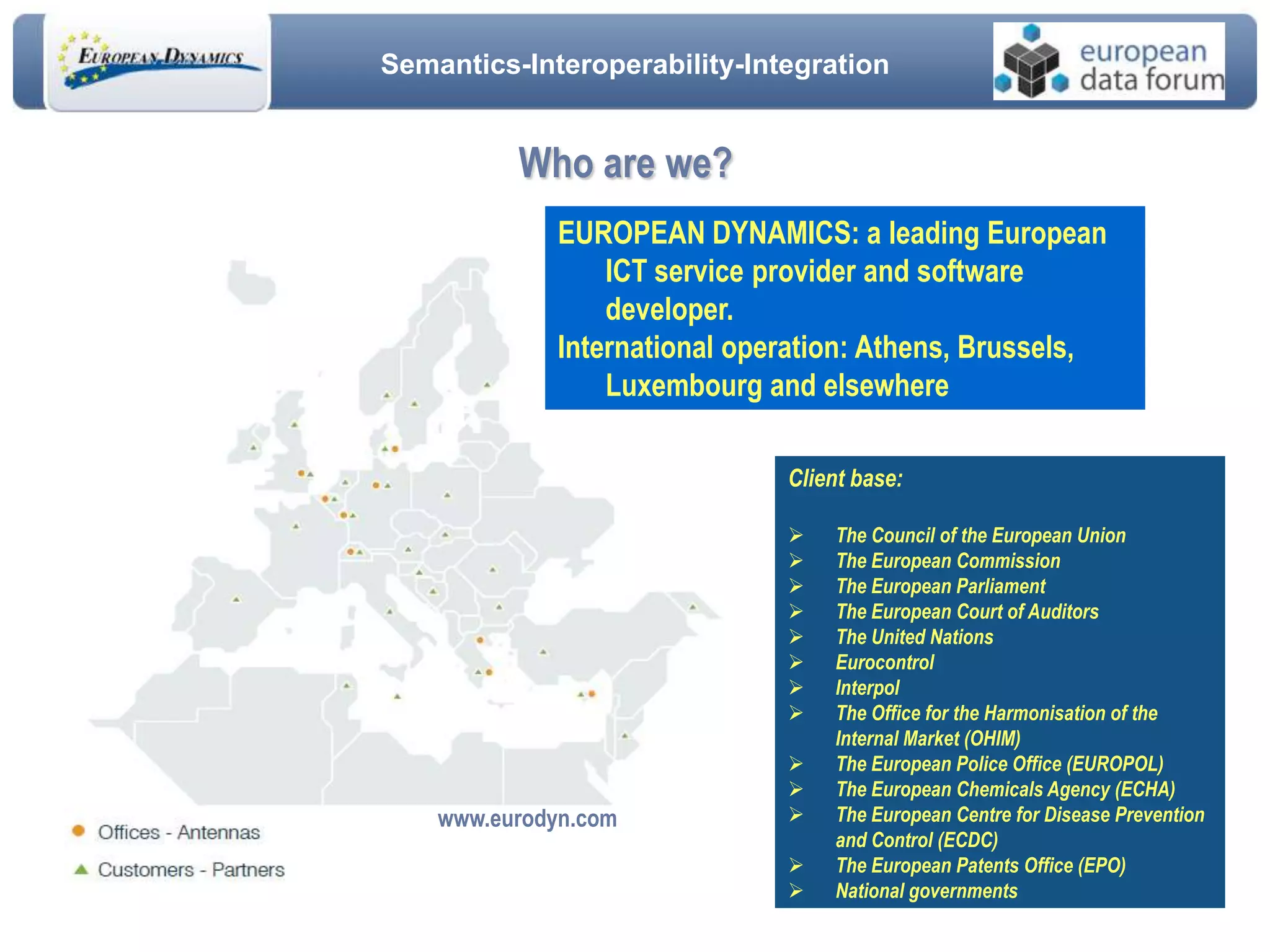
EUROPEAN DYNAMICS: a leading European
ICT service provider and software
developer.
International operation: Athens, Brussels,
Luxembourg and elsewhere
www.eurodyn.com
Semantics-Interoperability-Integration
• Interoperability started early 2000 by TAXUD
• Implemented though the exchange of structured messages between Member
States applications via the private CCN/CSI network
• Semantics are defined as part of complex functional and technical
specifications
• Currently at least four major functional areas are covered (e.g.
transit, export, import etc)
• Important areas such as risk analysis are not covered.
Customs & Excise
Semantics-Interoperability-Integration
• XML & EDIFACT messages defined by TAXUD
• Although message formats are well-defined, semantics are only indirectly
defined via separate documents
• e.g. same entities appear under different names and information structures
• Semantics today are incorporated in individual application logics developed
by the Member States
• Despite those problems CCN/CSI does perform its basic function
Common Communication Network (CCN/CSI)
Interoperability
Semantics-Interoperability-Integration
Risk analysis and fraud detection
Interchange of risk-related information is critical for customs processes as it is
related to public safety and health
So far there have been no structured standard messages for the exchange of
risk-related information at semantic level:
 What is a “suspicious trader”, “a suspicious route”, etc?
 Risk entities: financial and statistical information
 No behavioral models
Only abstract common risk criteria have been defined
The need:
 Definition of risk-related entities
 Semantic identification by machines
Semantics-Interoperability-Integration
Is semantic interoperability and integration difficult?
• YES!
• Database interoperability, cross-database search and integration of web
services: Ontologies: formally logical axioms that relate predicates of
interest
 a higher level of abstraction for data modelling
 data export, translation, queries, unification across independently developed
database designs (logical or physical)
• However: when data integration is sought limitations emerge*:
• Datasets with semantics given by different ontologies require integration of
ontologies (ontology mapping, merging, top-level vocabularies, etc)
• Integration of ontologies: integration of logics in which they are expressed
and of schemas describing structure in different languages and different
underlying data models (relational, object-oriented, etc)
• Need for rigorous foundations not tied to any specific representational (e.g.
category theory) or logical formalism (e.g. theory of institutions)
* http://epractice.eu/en/library/292976
Semantics-Interoperability-Integration
Then what?

EDF2014: Talk of Ioannis Kotsiopoulos, European Dynamics: Semantics – Interoperability – Integration: A multi-faceted problem

  • 1.
    Semantics-Interoperability-Integration Ioannis Kotsiopoulos Athens, March2014 Semantics – Interoperability – Integration A multi-faceted problem
  • 2.
    Semantics-Interoperability-Integration Who are we? Clientbase:  The Council of the European Union  The European Commission  The European Parliament  The European Court of Auditors  The United Nations  Eurocontrol  Interpol  The Office for the Harmonisation of the Internal Market (OHIM)  The European Police Office (EUROPOL)  The European Chemicals Agency (ECHA)  The European Centre for Disease Prevention and Control (ECDC)  The European Patents Office (EPO)  National governments EUROPEAN DYNAMICS: a leading European ICT service provider and software developer. International operation: Athens, Brussels, Luxembourg and elsewhere www.eurodyn.com
  • 3.
    Semantics-Interoperability-Integration • Interoperability startedearly 2000 by TAXUD • Implemented though the exchange of structured messages between Member States applications via the private CCN/CSI network • Semantics are defined as part of complex functional and technical specifications • Currently at least four major functional areas are covered (e.g. transit, export, import etc) • Important areas such as risk analysis are not covered. Customs & Excise
  • 4.
    Semantics-Interoperability-Integration • XML &EDIFACT messages defined by TAXUD • Although message formats are well-defined, semantics are only indirectly defined via separate documents • e.g. same entities appear under different names and information structures • Semantics today are incorporated in individual application logics developed by the Member States • Despite those problems CCN/CSI does perform its basic function Common Communication Network (CCN/CSI) Interoperability
  • 5.
    Semantics-Interoperability-Integration Risk analysis andfraud detection Interchange of risk-related information is critical for customs processes as it is related to public safety and health So far there have been no structured standard messages for the exchange of risk-related information at semantic level:  What is a “suspicious trader”, “a suspicious route”, etc?  Risk entities: financial and statistical information  No behavioral models Only abstract common risk criteria have been defined The need:  Definition of risk-related entities  Semantic identification by machines
  • 6.
    Semantics-Interoperability-Integration Is semantic interoperabilityand integration difficult? • YES! • Database interoperability, cross-database search and integration of web services: Ontologies: formally logical axioms that relate predicates of interest  a higher level of abstraction for data modelling  data export, translation, queries, unification across independently developed database designs (logical or physical) • However: when data integration is sought limitations emerge*: • Datasets with semantics given by different ontologies require integration of ontologies (ontology mapping, merging, top-level vocabularies, etc) • Integration of ontologies: integration of logics in which they are expressed and of schemas describing structure in different languages and different underlying data models (relational, object-oriented, etc) • Need for rigorous foundations not tied to any specific representational (e.g. category theory) or logical formalism (e.g. theory of institutions) * http://epractice.eu/en/library/292976
  • 7.