Open Data in Transport and
Communications
Taru Rastas
Communication policy department, Internet Services
26.03.14www.lvm.fi 2
Data guide
 What is open data?
 How to get started?
 Steps and examples
26.03.14www.lvm.fi 3
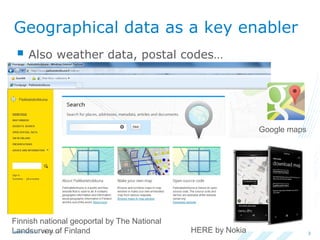
Geographical data as a key enabler
 Also weather data, postal codes…
HERE by Nokia
Google maps
Finnish national geoportal by The National
Landsurvey of Finland
26.03.14www.lvm.fi 4
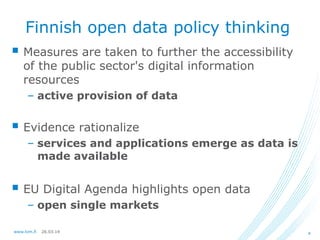
Finnish open data policy thinking
 Measures are taken to further the accessibility
of the public sector's digital information
resources
– active provision of data
 Evidence rationalize
– services and applications emerge as data is
made available
 EU Digital Agenda highlights open data
– open single markets
26.03.14www.lvm.fi 5
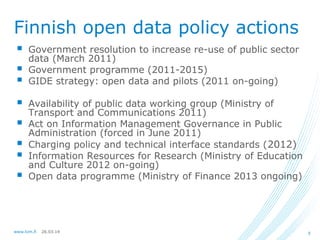
Finnish open data policy actions
 Government resolution to increase re-use of public sector
data (March 2011)
 Government programme (2011-2015)
 GIDE strategy: open data and pilots (2011 on-going)
 Availability of public data working group (Ministry of
Transport and Communications 2011)
 Act on Information Management Governance in Public
Administration (forced in June 2011)
 Charging policy and technical interface standards (2012)
 Information Resources for Research (Ministry of Education
and Culture 2012 on-going)
 Open data programme (Ministry of Finance 2013 ongoing)
26.03.14www.lvm.fi 6
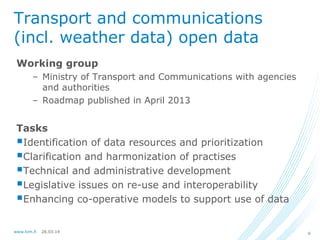
Transport and communications
(incl. weather data) open data
Working group
– Ministry of Transport and Communications with agencies
and authorities
– Roadmap published in April 2013
Tasks
Identification of data resources and prioritization
Clarification and harmonization of practises
Technical and administrative development
Legislative issues on re-use and interoperability
Enhancing co-operative models to support use of data
26.03.14www.lvm.fi 7
7
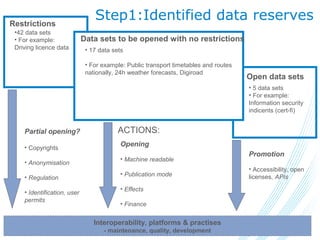
Interoperability, platforms & practises
- maintenance, quality, development
Data sets to be opened with no restrictions
Restrictions
Open data sets
• 17 data sets
• For example: Public transport timetables and routes
nationally, 24h weather forecasts, Digiroad
• 5 data sets
• For example:
Information security
indicents (cert-fi)
•42 data sets
• For example:
Driving licence data
Opening
• Machine readable
• Publication mode
• Effects
• Finance
Partial opening?
• Copyrights
• Anonymisation
• Regulation
• Identification, user
permits
Promotion
• Accessibility, open
licenses, APIs
ACTIONS:
Step1:Identified data reserves
26.03.14www.lvm.fi 8
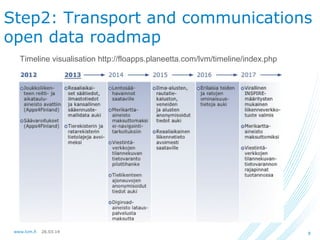
Step2: Transport and communications
open data roadmap
Timeline visualisation http://floapps.planeetta.com/lvm/timeline/index.php
26.03.14www.lvm.fi
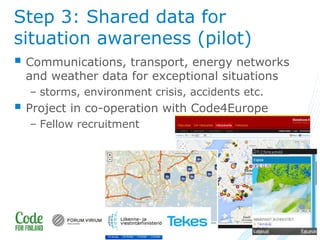
Step 3: Shared data for
situation awareness (pilot)
 Communications, transport, energy networks
and weather data for exceptional situations
– storms, environment crisis, accidents etc.
 Project in co-operation with Code4Europe
– Fellow recruitment
9
26.03.14www.lvm.fi 10
Open infrastructure challenges
 VISIBILITY
– portals, websites, service directories, multi-channels etc.
 CONSISTENCY
– described in a coherent manner – information architecture,
metadata repository
 EFFICIENCY
– support services to facilitate the use - clearing house function,
help desk, competence building
– long-term funding – first-step cost sharing between
stakeholders e.g. income from selling data and interface
services
 SCALABILITY
– maintenance and distribution e.g. cloud, open interfaces
 DEMAND DRIVEN
– prioritization of datasets, engagement with developers,
monitoring use
26.03.14www.lvm.fi 11
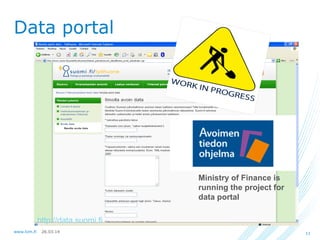
Data portal
http://data.suomi.fi
Ministry of Finance is
running the project for
data portal
26.03.14www.lvm.fi 12
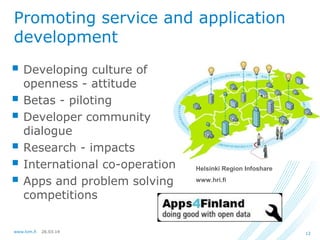
Promoting service and application
development
 Developing culture of
openness - attitude
 Betas - piloting
 Developer community
dialogue
 Research - impacts
 International co-operation
 Apps and problem solving
competitions
Helsinki Region Infoshare
www.hri.fi
26.03.14www.lvm.fi 13
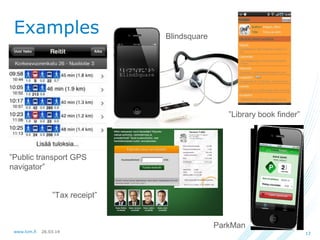
Examples
”Public transport GPS
navigator”
”Tax receipt”
ParkMan
”Library book finder”
Blindsquare
26.03.14www.lvm.fi 14
Background materials
Further information
contact:
taru.rastas@lvm.fi
26.03.14www.lvm.fi 15
What is open data
 Data which is made available for re-use
– machine readable (technical)
– common licences (legal)
– free of charge (economical)
 Public data: handling not subject to statutory
limitations
 Governments, companies, citizens all collect and use
data
 From data to reuse: services, applications, algorithms,
visualisations…
 Accessibility: requires action in a society – political and
collective issue
26.03.14www.lvm.fi 1616
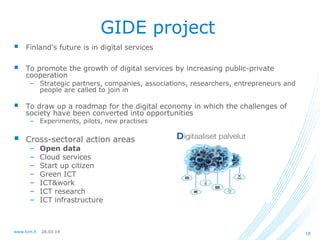
GIDE project
 Finland's future is in digital services
 To promote the growth of digital services by increasing public-private
cooperation
– Strategic partners, companies, associations, researchers, entrepreneurs and
people are called to join in
 To draw up a roadmap for the digital economy in which the challenges of
society have been converted into opportunities
– Experiments, pilots, new practises
 Cross-sectoral action areas
– Open data
– Cloud services
– Start up citizen
– Green ICT
– ICT&work
– ICT research
– ICT infrastructure
26.03.14www.lvm.fi 17
Government resolution 3/2011
http://www.lvm.fi/web/fi/tiedote/view/1234053
Policy lines and measures needed for
improving the accessibility and increasing
the reuse of digitalised public sector
information resources in all areas of
society
 Lines and actions
1. Data policies and legislation (1)
2. Open infrastructure (2)
3. Development of services and applications (3)

EDF2014: Taru Rastas, Senior Advisor, Ministry of Communications of Finland: Open data for transport and communications

  • 1.
    Open Data inTransport and Communications Taru Rastas Communication policy department, Internet Services
  • 2.
    26.03.14www.lvm.fi 2 Data guide What is open data?  How to get started?  Steps and examples
  • 3.
    26.03.14www.lvm.fi 3 Geographical dataas a key enabler  Also weather data, postal codes… HERE by Nokia Google maps Finnish national geoportal by The National Landsurvey of Finland
  • 4.
    26.03.14www.lvm.fi 4 Finnish opendata policy thinking  Measures are taken to further the accessibility of the public sector's digital information resources – active provision of data  Evidence rationalize – services and applications emerge as data is made available  EU Digital Agenda highlights open data – open single markets
  • 5.
    26.03.14www.lvm.fi 5 Finnish opendata policy actions  Government resolution to increase re-use of public sector data (March 2011)  Government programme (2011-2015)  GIDE strategy: open data and pilots (2011 on-going)  Availability of public data working group (Ministry of Transport and Communications 2011)  Act on Information Management Governance in Public Administration (forced in June 2011)  Charging policy and technical interface standards (2012)  Information Resources for Research (Ministry of Education and Culture 2012 on-going)  Open data programme (Ministry of Finance 2013 ongoing)
  • 6.
    26.03.14www.lvm.fi 6 Transport andcommunications (incl. weather data) open data Working group – Ministry of Transport and Communications with agencies and authorities – Roadmap published in April 2013 Tasks Identification of data resources and prioritization Clarification and harmonization of practises Technical and administrative development Legislative issues on re-use and interoperability Enhancing co-operative models to support use of data
  • 7.
    26.03.14www.lvm.fi 7 7 Interoperability, platforms& practises - maintenance, quality, development Data sets to be opened with no restrictions Restrictions Open data sets • 17 data sets • For example: Public transport timetables and routes nationally, 24h weather forecasts, Digiroad • 5 data sets • For example: Information security indicents (cert-fi) •42 data sets • For example: Driving licence data Opening • Machine readable • Publication mode • Effects • Finance Partial opening? • Copyrights • Anonymisation • Regulation • Identification, user permits Promotion • Accessibility, open licenses, APIs ACTIONS: Step1:Identified data reserves
  • 8.
    26.03.14www.lvm.fi 8 Step2: Transportand communications open data roadmap Timeline visualisation http://floapps.planeetta.com/lvm/timeline/index.php
  • 9.
    26.03.14www.lvm.fi Step 3: Shareddata for situation awareness (pilot)  Communications, transport, energy networks and weather data for exceptional situations – storms, environment crisis, accidents etc.  Project in co-operation with Code4Europe – Fellow recruitment 9
  • 10.
    26.03.14www.lvm.fi 10 Open infrastructurechallenges  VISIBILITY – portals, websites, service directories, multi-channels etc.  CONSISTENCY – described in a coherent manner – information architecture, metadata repository  EFFICIENCY – support services to facilitate the use - clearing house function, help desk, competence building – long-term funding – first-step cost sharing between stakeholders e.g. income from selling data and interface services  SCALABILITY – maintenance and distribution e.g. cloud, open interfaces  DEMAND DRIVEN – prioritization of datasets, engagement with developers, monitoring use
  • 11.
    26.03.14www.lvm.fi 11 Data portal http://data.suomi.fi Ministryof Finance is running the project for data portal
  • 12.
    26.03.14www.lvm.fi 12 Promoting serviceand application development  Developing culture of openness - attitude  Betas - piloting  Developer community dialogue  Research - impacts  International co-operation  Apps and problem solving competitions Helsinki Region Infoshare www.hri.fi
  • 13.
    26.03.14www.lvm.fi 13 Examples ”Public transportGPS navigator” ”Tax receipt” ParkMan ”Library book finder” Blindsquare
  • 14.
    26.03.14www.lvm.fi 14 Background materials Furtherinformation contact: taru.rastas@lvm.fi
  • 15.
    26.03.14www.lvm.fi 15 What isopen data  Data which is made available for re-use – machine readable (technical) – common licences (legal) – free of charge (economical)  Public data: handling not subject to statutory limitations  Governments, companies, citizens all collect and use data  From data to reuse: services, applications, algorithms, visualisations…  Accessibility: requires action in a society – political and collective issue
  • 16.
    26.03.14www.lvm.fi 1616 GIDE project Finland's future is in digital services  To promote the growth of digital services by increasing public-private cooperation – Strategic partners, companies, associations, researchers, entrepreneurs and people are called to join in  To draw up a roadmap for the digital economy in which the challenges of society have been converted into opportunities – Experiments, pilots, new practises  Cross-sectoral action areas – Open data – Cloud services – Start up citizen – Green ICT – ICT&work – ICT research – ICT infrastructure
  • 17.
    26.03.14www.lvm.fi 17 Government resolution3/2011 http://www.lvm.fi/web/fi/tiedote/view/1234053 Policy lines and measures needed for improving the accessibility and increasing the reuse of digitalised public sector information resources in all areas of society  Lines and actions 1. Data policies and legislation (1) 2. Open infrastructure (2) 3. Development of services and applications (3)

Editor's Notes

  • #4 Maastodata (koordinaatit, topografia) + Ominaisuustietorekisterit = Paikkatieto Maastotietojärjestelmä (koordinaatit, maaperätiedot yms.) on koko paikkatietojärjestelmän varsinainen ydin
  • #17 G-I-D-E stands for Growth, Innovation, Digital Services and Evolution The idea is to find new openings and projects to enhance the growth of digital services and open infrastructures. We have discussed with the key players in the field in business, academia, associations and administration to find relevant themes and roadmap. Early on we understood that we need no more paper form –strategies -> this is an on-going process of concrete actions. This means that we need to tighten co-operation in different fields and to gather relevant stakeholders to form projects together. As we believe in doing, we courage to try pilots and to build collaborative environment for private and public stakeholders to work together in societal challenges We have identified now 6 key themes: 1. Open data. Public information resources are available to everyone on equal terms and free of charge (Goverment resolution) EU Digital Agenda - creation of the internal market Development programmes across government -> Later practical example of actions 2. Cloud here means more of an approach and operational model of it than actual technical infrastrucure. We have launched the idea of FORGE – test bed and developing laboratory for cloud services. It is a virtual place and contact point for businessess and administration to test and develop cloud based services. Infrastructure is based on the site of CSC (Center for Scientific Computing). We are also building up a project that promotes use of cloud services for businesses (sme). We will look forward to see EUs cloud strategy and planning to be active party in this too. 3. Start up citizen represents activities that we want to get started bottom up of young entrepreneurs. Goal is to facilitate digital innovations among young people. We co-organise Hackathon -road show across Finland 2012 where students and young businessess come together for a weekend hackaton to develop and code solutions. Another activity in this theme is EUs call for Digital Champions. In Finland we selected programme called Rails Girls as a champion. This programme is training girls to code by showing example how fun and useful skill coding is. 4. Green ICT includes two action lines – green services and green communication network -> later example 5. ICT&work refers to the notion that the ways that we work today are changing due to technical and social possibilities. We are not restricted to time or place anymore to work, but our practises and regulation are outdated. One practical project that we are dealing with is so called distanceworking catalogue, which is basically a ”next version of a phone book” to find contact details for telepresence systems of your partners etc. 6. We have also noticed that ICT research in Finland is scattered or some part disconnected, and we need a forum to gather research as actors and substance to share competence, finding partners and financing possibilities, facilitate commercialisation and building up national techological insights. We call this initiative a virtual research center, finICT.