David Chaves-Fraga, Ontology Engineering Group
Universidad Politécnica de Madrid, Spain
Marco Comerio, CEF

Oscar Corcho, OEG-UPM

Semantic Interoperability in
Transport Domain

9th IT Combined Meeting
dchaves@fi.upm.es

dchavesf
19/09/17

Cologne, Germany
Semantic Interoperability in Transport Domain - 9th IT Combined Meeting
Agenda
2
• What is Semantic Interoperability?
• From Interoperability to Semantic Interoperability
• European Interoperability Framework
• Principles and types of interoperability
• Semantic Interoperability in Market
• Multimodal Travel Information Services
• Barriers, key enablers, regulations and challenges
Semantic Interoperability in Transport Domain - 9th IT Combined Meeting
Agenda
3
• What is Semantic Interoperability?
• From Interoperability to Semantic Interoperability
• European Interoperability Framework
• Principles and types of interoperability
• Semantic Interoperability in Market
• Multimodal Travel Information Services
• Barriers, key enablers, regulations and challenges
Semantic Interoperability in Transport Domain - 9th IT Combined Meeting
What is Semantic Interoperability?
4
• Two systems are syntactic interoperable if they are able to
communicate to each other.
• Syntactic Interoperability is usually solved by creating ad hoc "adapters" that
convert/translate the exchanged information between different formats.
• Two systems are semantically interoperable if they are
interoperable and if their information exchange is based on
the meaning of the exchanged information.
• Semantic Interoperability is usually solved by
• creating a common and shared model of the "meaning" of the exchanged information
• creating "interpreters" that transform the exchanged information from each of the
non-interoperable format to the shared model.
Semantic Interoperability in Transport Domain - 9th IT Combined Meeting
What is Semantic Interoperability?
5
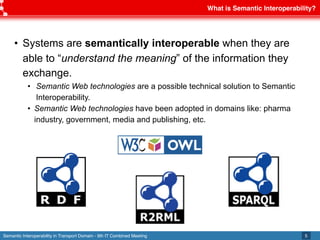
• Systems are semantically interoperable when they are
able to “understand the meaning” of the information they
exchange.
• Semantic Web technologies are a possible technical solution to Semantic
Interoperability.
• Semantic Web technologies have been adopted in domains like: pharma
industry, government, media and publishing, etc.
Semantic Interoperability in Transport Domain - 9th IT Combined Meeting
What is Semantic Interoperability? Example
6
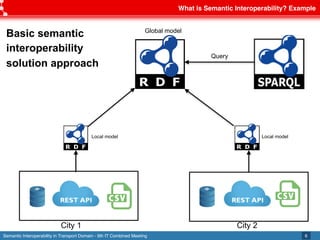
Query
City 2City 1
Local model Local model
Global model
Basic semantic
interoperability
solution approach
Semantic Interoperability in Transport Domain - 9th IT Combined Meeting
Agenda
7
• What is Semantic Interoperability?
• From Interoperability to Semantic Interoperability
• European Interoperability Framework
• Principles and types of interoperability
• Semantic Interoperability in Market
• Multimodal Travel Information Services
• Barriers, key enablers, regulations and challenges
Semantic Interoperability in Transport Domain - 9th IT Combined Meeting
EU Interoperability Framework
8
• The EIF defines a set of recommendations and guidelines for
eGovernment services so that public administrations,
enterprises and citizens can interact across borders, in a pan-
European context. The main goals of the framework are:
• Support the European Union's strategy of providing user-centred eServices by
facilitating the interoperability of services and systems between public
administrations, as well as between administrations and the public (citizens and
enterprises), at a pan-European level.
• To supplement national interoperability frameworks in areas that cannot be
adequately addressed by a purely national approach.
• To help achieve interoperability both within and across different policy areas,
notably in the context of the IDABC programme and any other relevant Community
programmes and initiatives.
Semantic Interoperability in Transport Domain - 9th IT Combined Meeting
EU Interoperability Framework: Principles
9
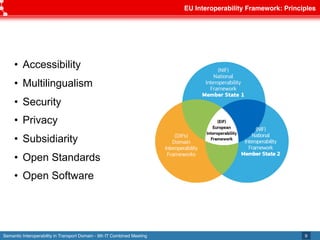
• Accessibility
• Multilingualism
• Security
• Privacy
• Subsidiarity
• Open Standards
• Open Software
Semantic Interoperability in Transport Domain - 9th IT Combined Meeting
EU Interoperability Framework: Types of interoperability
10
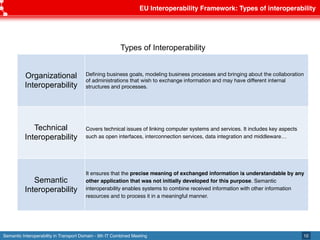
Types of Interoperability
Organizational
Interoperability
Defining business goals, modeling business processes and bringing about the collaboration
of administrations that wish to exchange information and may have different internal
structures and processes.
Technical
Interoperability
Covers technical issues of linking computer systems and services. It includes key aspects
such as open interfaces, interconnection services, data integration and middleware…
Semantic
Interoperability
It ensures that the precise meaning of exchanged information is understandable by any
other application that was not initially developed for this purpose. Semantic
interoperability enables systems to combine received information with other information
resources and to process it in a meaningful manner.
Semantic Interoperability in Transport Domain - 9th IT Combined Meeting
Agenda
11
• What is Semantic Interoperability?
• From Interoperability to Semantic Interoperability
• European Interoperability Framework
• Principles and types of interoperability
• Semantic Interoperability in Market
• Multimodal Travel Information Services
• Barriers, key enablers, regulations and challenges
Semantic Interoperability in Transport Domain - 9th IT Combined Meeting
Semantic Interoperability in the Market
12
• Industry solutions: Denodo, SOFIA2, TopBraid, Stardog
• Research solutions: Ultrawap - Capsenta, GraphDB
• Open Source: Camel
• Transport Domain: Linked Connections, Railway core
ontology, Public transportation ontology or Transit ontology
and Linked GTFS
Semantic Interoperability in Transport Domain - 9th IT Combined Meeting
Semantic Interoperability in the Market: Industry solutions
13
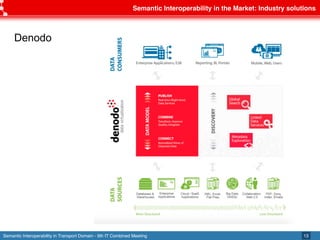
Denodo
Semantic Interoperability in Transport Domain - 9th IT Combined Meeting
Semantic Interoperability in the Market: Research solutions
14
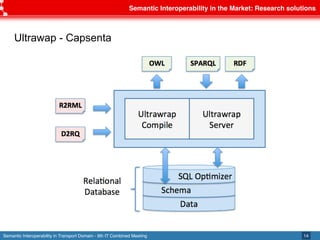
Ultrawap - Capsenta
Semantic Interoperability in Transport Domain - 9th IT Combined Meeting
Semantic Interoperability in the Market: Transport solutions
15
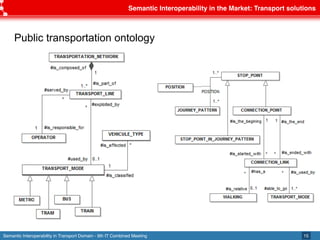
Public transportation ontology
Semantic Interoperability in Transport Domain - 9th IT Combined Meeting
Semantic Interoperability in the Market: Transport solutions
16
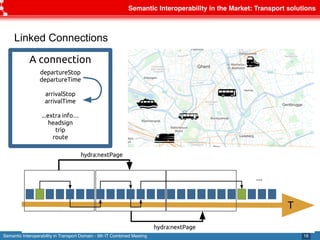
Linked Connections
Semantic Interoperability in Transport Domain - 9th IT Combined Meeting
Agenda
17
• What is Semantic Interoperability?
• From Interoperability to Semantic Interoperability
• European Interoperability Framework
• Principles and types of interoperability
• Semantic Interoperability in Market
• Multimodal Travel Information Services
• Barriers, key enablers, regulations and challenges
Semantic Interoperability in Transport Domain - 9th IT Combined Meeting
Multimodal travel information services: Barriers
18
The EU-report on The Provision of EU-wide Multimodal
Travel Information Services highlighted the following barriers
of comprehensive travel information services in the EU:
• insufficient accessibility of travel and traffic data
• the lack of travel and traffic data interoperability
• lack of travel information service interoperability
• insufficient travel and traffic data quality
Semantic Interoperability in Transport Domain - 9th IT Combined Meeting
Multimodal travel information services: Key enablers
19
The EU-report reveals that the key enablers to address these
barriers are:
• ensuring that users have access to the right scope of data and information with
the appropriate data sharing mechanism
• making travel and traffic data interoperable with a common set of data
exchange standards
• improving the interoperability of travel information services and
supporting distributed journey planning
• improving the quality of multimodal travel information services with a basic data
quality framework
Semantic Interoperability in Transport Domain - 9th IT Combined Meeting
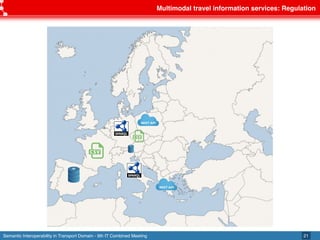
Multimodal travel information services: Regulation
20
• On 31 May 2017, the EU delivered a new EU regulation with
regard to the provision of EU-wide multimodal travel information
services.
• The regulation establishes the specifications necessary to ensure
the accessibility, exchange and update of static and dynamic
transportation data for the provision of multimodal information
services in the European Union.
“In order to facilitate the easy exchange and re-use of these data for the provision of
comprehensive travel information services, corresponding metadata and information on
the quality of the data will be accessible to users through a national or common access
point.”
Semantic Interoperability in Transport Domain - 9th IT Combined Meeting
Multimodal travel information services: Regulation
21
Semantic Interoperability in Transport Domain - 9th IT Combined Meeting
Multimodal travel information services: Challenges
22
• Member States may choose to continue using national public
transport data standards at the Member State level.
• To ensure EU-wide interoperability and the continuity of
services, the specified EU standards must be used at the
national access point level.
• Member States may use translation and conversion
methods to adhere to the European standardization
requirements.
David Chaves-Fraga, Ontology Engineering Group
Universidad Politécnica de Madrid, Spain
Marco Comerio, CEF

Oscar Corcho, OEG-UPM

Semantic Interoperability in
Transport Domain

9th IT Combined Meeting
dchaves@fi.upm.es

dchavesf
19/09/17

Cologne, Germany

Semantic interoperability in Transport Domain

  • 1.
    David Chaves-Fraga, OntologyEngineering Group Universidad Politécnica de Madrid, Spain Marco Comerio, CEF Oscar Corcho, OEG-UPM Semantic Interoperability in Transport Domain
 9th IT Combined Meeting dchaves@fi.upm.es dchavesf 19/09/17 Cologne, Germany
  • 2.
    Semantic Interoperability inTransport Domain - 9th IT Combined Meeting Agenda 2 • What is Semantic Interoperability? • From Interoperability to Semantic Interoperability • European Interoperability Framework • Principles and types of interoperability • Semantic Interoperability in Market • Multimodal Travel Information Services • Barriers, key enablers, regulations and challenges
  • 3.
    Semantic Interoperability inTransport Domain - 9th IT Combined Meeting Agenda 3 • What is Semantic Interoperability? • From Interoperability to Semantic Interoperability • European Interoperability Framework • Principles and types of interoperability • Semantic Interoperability in Market • Multimodal Travel Information Services • Barriers, key enablers, regulations and challenges
  • 4.
    Semantic Interoperability inTransport Domain - 9th IT Combined Meeting What is Semantic Interoperability? 4 • Two systems are syntactic interoperable if they are able to communicate to each other. • Syntactic Interoperability is usually solved by creating ad hoc "adapters" that convert/translate the exchanged information between different formats. • Two systems are semantically interoperable if they are interoperable and if their information exchange is based on the meaning of the exchanged information. • Semantic Interoperability is usually solved by • creating a common and shared model of the "meaning" of the exchanged information • creating "interpreters" that transform the exchanged information from each of the non-interoperable format to the shared model.
  • 5.
    Semantic Interoperability inTransport Domain - 9th IT Combined Meeting What is Semantic Interoperability? 5 • Systems are semantically interoperable when they are able to “understand the meaning” of the information they exchange. • Semantic Web technologies are a possible technical solution to Semantic Interoperability. • Semantic Web technologies have been adopted in domains like: pharma industry, government, media and publishing, etc.
  • 6.
    Semantic Interoperability inTransport Domain - 9th IT Combined Meeting What is Semantic Interoperability? Example 6 Query City 2City 1 Local model Local model Global model Basic semantic interoperability solution approach
  • 7.
    Semantic Interoperability inTransport Domain - 9th IT Combined Meeting Agenda 7 • What is Semantic Interoperability? • From Interoperability to Semantic Interoperability • European Interoperability Framework • Principles and types of interoperability • Semantic Interoperability in Market • Multimodal Travel Information Services • Barriers, key enablers, regulations and challenges
  • 8.
    Semantic Interoperability inTransport Domain - 9th IT Combined Meeting EU Interoperability Framework 8 • The EIF defines a set of recommendations and guidelines for eGovernment services so that public administrations, enterprises and citizens can interact across borders, in a pan- European context. The main goals of the framework are: • Support the European Union's strategy of providing user-centred eServices by facilitating the interoperability of services and systems between public administrations, as well as between administrations and the public (citizens and enterprises), at a pan-European level. • To supplement national interoperability frameworks in areas that cannot be adequately addressed by a purely national approach. • To help achieve interoperability both within and across different policy areas, notably in the context of the IDABC programme and any other relevant Community programmes and initiatives.
  • 9.
    Semantic Interoperability inTransport Domain - 9th IT Combined Meeting EU Interoperability Framework: Principles 9 • Accessibility • Multilingualism • Security • Privacy • Subsidiarity • Open Standards • Open Software
  • 10.
    Semantic Interoperability inTransport Domain - 9th IT Combined Meeting EU Interoperability Framework: Types of interoperability 10 Types of Interoperability Organizational Interoperability Defining business goals, modeling business processes and bringing about the collaboration of administrations that wish to exchange information and may have different internal structures and processes. Technical Interoperability Covers technical issues of linking computer systems and services. It includes key aspects such as open interfaces, interconnection services, data integration and middleware… Semantic Interoperability It ensures that the precise meaning of exchanged information is understandable by any other application that was not initially developed for this purpose. Semantic interoperability enables systems to combine received information with other information resources and to process it in a meaningful manner.
  • 11.
    Semantic Interoperability inTransport Domain - 9th IT Combined Meeting Agenda 11 • What is Semantic Interoperability? • From Interoperability to Semantic Interoperability • European Interoperability Framework • Principles and types of interoperability • Semantic Interoperability in Market • Multimodal Travel Information Services • Barriers, key enablers, regulations and challenges
  • 12.
    Semantic Interoperability inTransport Domain - 9th IT Combined Meeting Semantic Interoperability in the Market 12 • Industry solutions: Denodo, SOFIA2, TopBraid, Stardog • Research solutions: Ultrawap - Capsenta, GraphDB • Open Source: Camel • Transport Domain: Linked Connections, Railway core ontology, Public transportation ontology or Transit ontology and Linked GTFS
  • 13.
    Semantic Interoperability inTransport Domain - 9th IT Combined Meeting Semantic Interoperability in the Market: Industry solutions 13 Denodo
  • 14.
    Semantic Interoperability inTransport Domain - 9th IT Combined Meeting Semantic Interoperability in the Market: Research solutions 14 Ultrawap - Capsenta
  • 15.
    Semantic Interoperability inTransport Domain - 9th IT Combined Meeting Semantic Interoperability in the Market: Transport solutions 15 Public transportation ontology
  • 16.
    Semantic Interoperability inTransport Domain - 9th IT Combined Meeting Semantic Interoperability in the Market: Transport solutions 16 Linked Connections
  • 17.
    Semantic Interoperability inTransport Domain - 9th IT Combined Meeting Agenda 17 • What is Semantic Interoperability? • From Interoperability to Semantic Interoperability • European Interoperability Framework • Principles and types of interoperability • Semantic Interoperability in Market • Multimodal Travel Information Services • Barriers, key enablers, regulations and challenges
  • 18.
    Semantic Interoperability inTransport Domain - 9th IT Combined Meeting Multimodal travel information services: Barriers 18 The EU-report on The Provision of EU-wide Multimodal Travel Information Services highlighted the following barriers of comprehensive travel information services in the EU: • insufficient accessibility of travel and traffic data • the lack of travel and traffic data interoperability • lack of travel information service interoperability • insufficient travel and traffic data quality
  • 19.
    Semantic Interoperability inTransport Domain - 9th IT Combined Meeting Multimodal travel information services: Key enablers 19 The EU-report reveals that the key enablers to address these barriers are: • ensuring that users have access to the right scope of data and information with the appropriate data sharing mechanism • making travel and traffic data interoperable with a common set of data exchange standards • improving the interoperability of travel information services and supporting distributed journey planning • improving the quality of multimodal travel information services with a basic data quality framework
  • 20.
    Semantic Interoperability inTransport Domain - 9th IT Combined Meeting Multimodal travel information services: Regulation 20 • On 31 May 2017, the EU delivered a new EU regulation with regard to the provision of EU-wide multimodal travel information services. • The regulation establishes the specifications necessary to ensure the accessibility, exchange and update of static and dynamic transportation data for the provision of multimodal information services in the European Union. “In order to facilitate the easy exchange and re-use of these data for the provision of comprehensive travel information services, corresponding metadata and information on the quality of the data will be accessible to users through a national or common access point.”
  • 21.
    Semantic Interoperability inTransport Domain - 9th IT Combined Meeting Multimodal travel information services: Regulation 21
  • 22.
    Semantic Interoperability inTransport Domain - 9th IT Combined Meeting Multimodal travel information services: Challenges 22 • Member States may choose to continue using national public transport data standards at the Member State level. • To ensure EU-wide interoperability and the continuity of services, the specified EU standards must be used at the national access point level. • Member States may use translation and conversion methods to adhere to the European standardization requirements.
  • 23.
    David Chaves-Fraga, OntologyEngineering Group Universidad Politécnica de Madrid, Spain Marco Comerio, CEF Oscar Corcho, OEG-UPM Semantic Interoperability in Transport Domain
 9th IT Combined Meeting dchaves@fi.upm.es dchavesf 19/09/17 Cologne, Germany