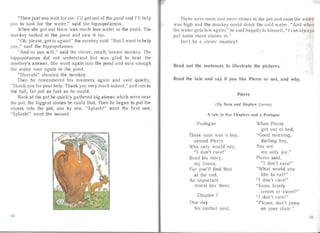
LESSON

Read the tale and say who Satchkin Patchkin is.
SATCHK I N PATCH K I N
(After Helen Morgan)
Part 1
New words:
untidy [xn'tai di] - neorrparnsni, HeyxO)l{eHHbIH

lean [l i.n] - XYAOH

mean [m i.n] - )l{aAllb1l1

a latch [l<etSJ (Iatchkin) - 3aABI1)1{Ka

Bump! [bxrnp] - 5yx! 5yx! (38yKU npu yoape a oeep«)

to cry [kr ai] - Kpl14aTb

silver ['silva] - cepeopauua

a bell [bel] - 3BOH04eK

a voice [e-vors] - rOJIOC

whoever [hu( :)'eva] - KTO 6bI HI1

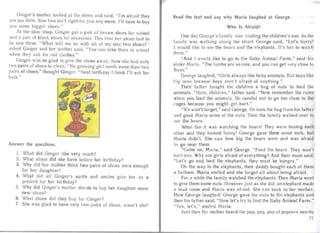
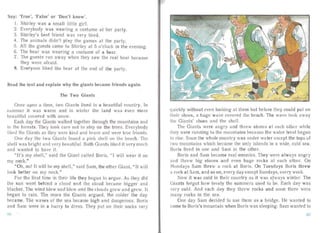
Once upon a time there was a little green magic man. His name
was Satehkin Patchkin and he lived, like a leaf, in an apple tree.
, / The apple tree was in a long, unt idy
. garden, and in the long untidy garden there
was a little, untidy house.
A poor woman called Mother Farthing
lived in the house, but it was not her house. It
was the farmer's house. The farmer lived in
another house on the hill. He was a lean man,
a mean man, a mall without a smile.
One spring night Mother Farthing was coming back to her
house after a day in town. She was not happy as she didn't have her
cow with her. She had some money but very little. She was very
unhappy as she slowly walked home alone.
"1 no longer have a cow," she said. "And the money is to pay my
rent to the farmer."
Mother Farthing looked up at the dark sky and saw the
beautiful white moon. She put her hand on the latch of her cottage
door and watched the moon.
"Oh, the moon looks like milk tonight," she said.
The little green magic man in the apple tree heard her. He came
out from under a new green leaf and watched the moon too.
"Milk," he thought and looked at the white moon again. "When
did I last drin k milk? I don't remembe r what it tastes like."
The more he thought about it the more he wanted some milk.
He said, "1 must have milk or I won't slee p."
And the little green magic man went to the farmer's house
which stood high on the hill. The farmer was a lean man, a mean
5
man, a man without a sm ile, but he had a lot of cows an d a lot of
milk. The farmer's fine house was cla rk and the farmer himself was
sleeping in his warm bed.
He was dreaming about money as usual, when suddenly he
hea rd this noise - "Bump! Bump! Bump!" The fa rmer opened his
eyes and sat up. "Wh at' s that loud noise down in the yard?" he
thought, gett ing out of his warm bed. He wanted to fi nd out who
was at the door. but couldn't see anyone.
"Who's there? And what do you want at this time of night?" he
cried. Back came the answer, thin an d clear as the sound of a silver
bell:
"Satchkin Patchkin!
Who will lift the la tchkin?
Satchkin Patchkin!
Who will lift the lat ch?"
The farme r looked out of his window but could see no one at the
door.
"What do you want?" cried the farmer. He was cold an d angry
in the da rk nigh t.
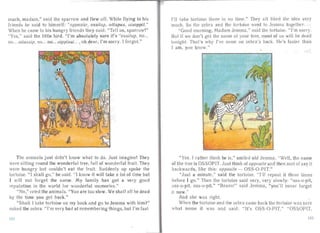
"Only a little milk, that's all," said the clear, thin voice from
below.
"Milk" roared the farmer. "Milk! At this time of night? Go
away, whoever you are, and let me go back to my bed!" The farmer
closed the window and returned to his warm bed.
Choose and read aloud the sentences which are true to the text.
I. Once upon a time there was a big magic man.
2. Once upon a time there was a little green magic man .
3. Satchkin Patchkin lived in a big house.
4. Satchkin Patchkin lived in an ap ple tree.
5. A poor woman lived in a little, untidy house.
6. A poor woman lived in a nice, little house.
7. The farmer lived in the same house.
8. The far mer lived in a different house on the hill.
9. The farmer was ver y kind.
10. The farmer was a mean man.
I I. After a day in town the woman was happy.
12. She was not ha ppy because she didn 't have her cow with her.
13. The woman had a lot of money.
14. The woman had very little money.
15. The little green magic ma n didn't want to dr ink an y milk.
16. The little green magic man wanted to drink some milk.
17. The farmer gave some milk to the little green magic man.
18. The farmer didn't give any milk to the little green magic
man.
LESSON

Read the second part of the tale and say what its main idea is.
SATC H KI N PATC H KI N
Part II
Ne w word s:
a t once [atwxn s] - cpaa y Me
a drop [ad rop] - KaITJlH

a jug [d'd3A9] - KyBW I1H

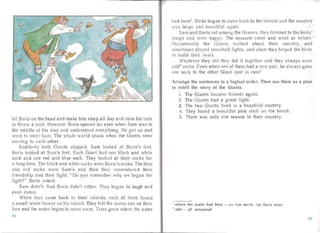
The little green magic man turned away fro m the farmer's
house wi th its close d door s and wi ndows. "Seventeen cows and no
milk for me?" he said .
Slowl y he went back .
When he came to M oth er Farthing's smal l, untidy cottage he
stopped .
" I mu st have some milk," he said. " I mus t remember its taste or
I won't sleep all night." He began to knock at the old woman's
c1oor.
M other Far thing was not sleeping. She was thinking about her
cow . She got up at once and went to the window. "Who's there?"
she cried. "Wh at can I do for you ?"
The answe r came thin and clear, li ke the sound of a silver bell:
" Satchkin Patchkin!
Wi ll you lift the latchkin?
Satchkin Patchkin!
Will you li ft the latch?"
" Of course I will!" cr ied the old woman . " I am coming! "
She went to the door , lifted the lat ch and saw a little green man.
"Come in! " she said. "What is it you want? "
"Just a little milk, nothing more, " said a clear , thin voice
behind her.
Poo r M oth er Farthing sat down and cried, " I have no cow any
more. I drank the last of her milk for my supper. There is no mil k in
the house!"
" No mi lk? Is it all gone>' Every drop of it ?" aske d the little
green magic man .
The old woman stood up and looked into the jug on the table.
" Only a drop . One little drop," she said.
" Oh, it's enough for me," said the little man.
So, Mother Farthi ng gave him the drop of mil k. He dr ank it
slowly. When he finished he drop ped a sma ll rin g into the jug . At
once the j ug was fu ll of sweet, new mil k.
"You will always have milk now," said Satchkin Patchkin. "Put
this ring into the j ug, open the door and say :
'Satchkin Patchkin!
Hear me li ft the latchkin!
Satchkin Patchkin!

Hear me lift the latch!' "

I Is it all gone? - 4TO, s e e KOH4I1JlOCb?
q
And then there will be a lot of milk in the jug.
"Thank you," said Mother Farthing.
The littl e green magic man looked at Mother Farthing and said:
" If you need me, just come and call. My name is Satchkin Patchkin
and I live, like a leaf, in the apple tree."
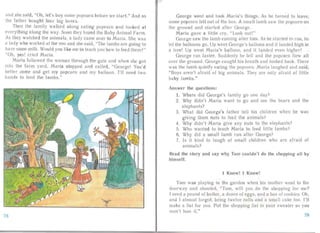
my name is
SatchKin ­
Patchin
and J liVE likE
a J£af in the
applE tru .
Agree or disagree.
I , The littl e green magic man thanked the farmer for the milk.
2. Sa tehkin Patehkin began to knock at Mother Farthing's
door because he was hungry.
3. Mother Farthing was not .sleeping, as she was thinking
about her cow.
4. Satchkin Patehkin asked Mother Farthing for a glass of
water.
5. Mother Farthing drank the las! of her milk for her supper.
6. Satehkin Patehkin dropped a small ring into the jug.
7. Satchkin Patchkin gave Mother Fa rt hing a lot of money.
8. Satchkin Patchkin lived, like a leaf, in the apple tree.
LESSON

-
Read the text and say what you think of the boy.
TH E BOY WH O CR IED "WOLf !"
New words:
to fall asleep ­ 3a CblnaTb
to tell lies - nrars, rosopar s uenpasny
an end lend] - KOHeu
tast jfo.st] - 6bICTpO
to save [seiv ] - cnacaTb
silly ['sill] - rJlynblli
a lie [lai ] - JlO>Kb
suddenly l'sAdnlt ] - B.llpy r
to grab [qrrebI - CXBaTliTb
to believe [brl i.v] - aepnr s
loudly [Taudlr] - rpoMKo
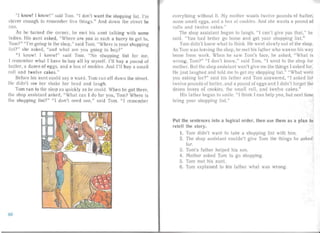
Once upon a time there lived a little boy. His name was Bill.
Bill didn't live in town. He lived in the country, and looked after
sheep. He wa s not a very good boy. He often f II asleep watching
the sheep, and he also told lies. The people who lived there often
said, "Tha t boy will come to a bad end."
One day Bill wanted to play a practical ['pr<ektlkl] joke on the
people. He ra n down the hill and cried, "Wolf! Wolf! Help! Come
quickly! Wolf!"
All the people ran very fast to him as they wanted to save him.
But when the people ran up to the boy they saw no wolf.
" It heard you and ran away," the boy said. The people went
away. Bill bega n to laugh. "How funny the people are! How silly
they are! They are not clever at all."
11
Three weeks later he wanted to play the sa me tr ick [tr ik ] again.
"Wolf! Wolf!" he cried. "Help! Corne quickly! Wolf!" Ma ny people
ran to the hill as fast as they could, but again there was no wolf.
This time the boy laughed a t them. "Ha, ha. There was no wolf," he
said. "What a good joke! Don't you think so?"
The people becam e ver y angry. " Lies are not jokes," they said ,
and went back horne.
Two da ys later the weather was s unny and warm. The boy was
sleeping in the afternoon sun. Suddenly he woke up. He saw a big
da rk animal. The animal ran to the sheep and grabbed one.
"Wolf!" cried the boy. "Wolf! Help! Corne quickly! Wolf!"
But nobody came to save the boy this time. Nobody wanted to
help him. Nobody believed him. He cried out again. He cried loudly.
The wolf heard and said: "I like sheep, but a little boy will taste
better. I'll have a real dinner toni ght! "
When the boy didn't return home that night the people went to
look for him. But they never fou nd him and nobod y saw him again.
1.	 Answer the questions :
I.	 Did the boy work well? Prove your answer.
2.	 What joke did he play on the people? Why did he do it?
3.	 Why do you think all the people came to help him the first
time?
4.	 Did they all come the second time?
5. Wh y did nobody come when the boy reall y saw a wolf?
6.	 What ha ppened to the boy?
7. What do you think the peopl e said when they couldn't find
Bill?
8.	 Do you sometimes tell lies? What is the result?
2. Which is the	 best moral of the story?
a) It's not good to sleep at work.
b) If you play tri cks on peopl e, they won't help you later.
c) If you tell too many lies, peopl e won't believe you.
3
12
ESSON

Read the story and say why parents like Ham urger Harry's
parties.
HAMBURGE HAR Y
New words :
everywhere ['evrI WEd] - nOBCIO.uy

a carpet ['ka;pIt] - KOBep

litter ['Iltd j - MYCOP

to throw [Brou] (threw [Bru.] ) -6pocaTb

to pick up ['plk'ip] - nonoupan,

a bin [bin] - HLUHK .uJlH Mycopa

to choose [tju.z] - Bbl6HpaTb

to arrange [a' remdy] - ycr pauears

a badge [bred3] - 3Ha40K

to pa y [pel ] (p aid [perd] ) - OJl aTHTb

a bill [btl] - C4eT

Today fast food restaurants ['restrJ:lJz] are very popular. One
famo us name is Harry's Hamburgers. Harry's Hamburgers come
from America and have been in business for thirty years. There are
abou t 5,000 Ha rry's Hamburgers in different countries. The food is
the same everywhere. In London, New York or Paris people eat the
same hamburgers and drink the same drinks.
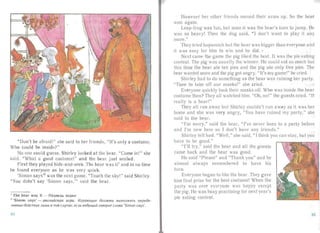
This is Ha mburger Harry. He works for Ha rry's Hamburgers,
an d he is a special ['speSdl] friend of children everyw here. He goes
to schools and talks to pupils. He goes into different classrooms,
sits down on the carpet or at the desk and asks the pupils to relax.
Then he begins his ta lk.
Harry teaches children about litter, "Don't throw your boxes on
the floor in my restaurants," he says. "And don't throw my bags
away in the street. If you see boxes and bags
in the st reet , pick them up and throw them into
the bin."
Ham burger Har ry visits children in
hospitals ['hJspltdlz] and tells them funny
stories. His restaurants give wonderful
birthday parties. Pa rents telephone lteh,
loun] the restaurant or go there. They choose
a good day for the party , arrange the food and
drink and send invitations to friends. Ham ­
burge r Harr.y sometimes comes to the party
with a bag of presents and a big birthday
cake. The boys and girls sit round the tab les
an d eat all their favourite food. They all wear
paper hats and party badges. Hamburger
Harry's uniform is green, red an d yellow and
he wears two big badges. He works hard at
the party. He tells jokes, sings son gs and
gives everyone a present. The children get
coloured pencils, balloons and books to dr aw
on. They always have a good time.
Their parents enjoy the party too because
they don't prepare the tables an d they don't cook the food. They
don't have to clean the restaurant after the party. All they do is pay
the bill.
1. Put the sentences in a logical order. Use them as a plan to tell the
story.
I. Par ents like Harry's parties.
2. Ha rry visits children in hospitals.
3. He often goes to schools to talk to pupils.
4. Ham burge r Harry is a special friend of children.
5. Harry gives everyone a present.
6. Harry's res tau rants give wonderful birthday parties.
2. Prove that Hamburger Harry helps to keep the streets clean.
14 15
LESSON

Read Alan's letter and say if he likes his new school and why.
ALAN'S NEW SCHOOL
New words :
Headma te r Lhed'ma.:st~ ] - AHpeKTOp WKOJlbl
private ['p ral vl t ] - 4 a cTHblH
term [ta.rn] - 4eTBepTb, ceM eCTp
navy blue l'n e l Yl 'blu.] - TeMHo -oIlIHH user
a tie [ta I] - ranc ryx
rule [r u.l] - np aBHJlO
to smoke [sm ou k] - Ky pHTb
a bicycle [' ba l sl kl] - BeJlOCHneA
to be su re I'jua 1- 6bI Tb y Be peHHblM
prima ry ['pralm ~r l ] - Ha 4 aJlbH blH
Dear Da vid,
I'm wr iting to you to tell you how much I like my new school.
I iike everything: the teachers, my new friends and the food there.
Everybody is very nice and I feel quite at home now. I like our
classrooms too. They are nice with large windows, comforta ble
desks and carpets on the floors.
I think our school has got a wonderful nam e. It's called
Ha lliford School. Our Headmaster's name is John Crook. He is
a very nice man and he is also our maths teac her. Ha lliford School
is a private school. Classes begin at 8.50. School is over at 3.55. My
friends an d I usually meet at ha lf past eight. I join them in the
school ya rd befor e classes and we talk, play, sing and la ugh a lot.
Our lunch time is fro m 12.40 till 1.50. We stud y on Monday,
Tuesday, Wednesday, Thursday and Fr iday. We never have
classes on Saturday and Sunday.
16
Ther e are many subjects on our timeta ble.

They are: English, Maths, History, Geog­

rap hy, Ha nd icrafts, P. E., Music, Arts,

Computing. I think they all are very

inter st ing and 'N y important. We hav e three

term : . utu mn term, Sp ring term and

Sum mer term. -,

We usu all y wea r uniforms at our school. It
. is a navy b ue blazer ['b l IZ8] with the schoo l
c r.,,,",," I I ·t t/ )ac ge on I , grey ro user s, a grey or
' It' a white sh irt, gre ' socks, black shoes and a tie. When it is cold w
~ ; wea r pullover l'pul,JUV8Z! and coa ts. I have a special
-, unilor in for my footb all and P. E. classes. 1'111 sending my school
.') rules to you. We don't have many, bu t those which we have I think
:: are very important.
.~ We must wear un iform s ancl not be late for school and classes.-,
We rnu t have pens, p neils, ru lers, rubbers, exercise-books, our
.. diaries and all the necessary book, for our cla ss , We mus t han d
.:"' in' our homework on time. We mus tn' t moke a t school, and if.we
~.; have bicycle , we rnust ke"p them in a good tate of repair " and we
~ must behave at al l times wit h courtesy. can, ideralion an d com­
r.- man sense." which is not a lways easy you under ta nd.
But I'm sure my life here will be more interesti ng than it was in
my primary school. I am older loa. I am twelve now. We spend
ITlU .h time ouldoor . Sometimes ou r teach er take us to famous
museu ms an d other inte rest ing places in Lon on. Our tea hers
often say that pupils at school are not onl y to lea rn the lessons and
work (usuall y in the class rooms, pract i .al rooms or laborator ies
1 hand in - CJWfl ClTb
2 to keep smth in ( good) repair Irr pca] - co e p}f<aTb 4TO -TO B nOp 5lJJ.Ke
a we must behave at all times with courtesy l' k d:l l sl]. consideration
Ikan.sida-rct j n ] and common sense - Mbl ncern a AO.rl }f< Hbl 6 blTb 06 XOAHTCJlbllbl­
Mil , npen yn p JlHT<.'.1(,lI hIMIl , '06J110 JUlTb n panun a 1(' }f< JIIl OOCTII II sn paao r o CMblCJla
17
[Ia'boratarrz] , on the sports ground s) but to learn how to get on
with other pupils an d other members of the school who look after
u an d the school. We lea rn how to live together with people of
different ages.
Tha t's all for the moment. Write to me as soon you can.
Hope to see you at Christmas.
Love, Alan
l.	 Find in the text and read the answers to the questions.
1.	 What does Alan like about his school?
2.	 Why does he like the classrooms in Hal lifor d School?
3. Who is the Headmaster? What subject does he teach? What
kind of person ['pCl:sn] is he?
4. When do the classes begin and when are they over?
5. When do pupils have lunch?
6. Pupils have classes every day, don't they?
7.	 What subjects do they have on the timetab le?
8. What's their uniform?
9.	 What are the school rules?
10.	 What places do teachers and pupils visit when they go to
London?
2. Discuss the school rules. Do you like them?
I.	 Pupils must wear uniform s.
2.	 Pupil ' must not be late for school-and for lessons.
3.	 Pupils must aluiaqs ha ve with them a pen, pencil, ruler,
diary and all the necessary books.
4.	 Homewo rk must be done and handed in on tim e.
5.	 Smoking is forbidden.
6.	 Pupils who go to school by bicycles must keep them in a
good state of repair.
7.	 Pupils must beha ve at all times with courtesy, consideration
and common sense .
I Smoking is forbidden [' SI1IOUkl lJ IZ Ia'b rdn] . - K YPHTb aanpeuie uo,
LESSON~' -e • : . ,
Read the text and prove that Judy is a real friend.
AT	 THE ROYAL BALL ET SCHOOL
New words:
royal [' r :>j;)l] - KOp OJIeBCKHH
ballet [ 'bre lel] - 1) 6aJIeT; 2) 6aJIeTHblH
French [Trent]'] - <PpaHUY3CKHH
a quarter ['kw:>:t d 1 - 4e TBepTb
'prep' - 30. BpeMH Jl.JI H 1I0 11rOTOBKH K 3a HHTll HM
either l ' a I6 CJ] - TO}f{e
a c a n [h en] - KOHcepB HaH 6 aHKa
a ca r [ko.] ­ Ma WHHa (Jler KOBOH aB TOM0 6 HJlb)
to continue [kantmju.] - npononacar s
real [r ial] - HaCTOHw,HH, Jl.e HCTBII TCJlbHbIH
Judy is a pupil at the Royal Ballet School. She is in the second
yea r class where all the pupils are twelve years old. There an '
about 120 boys an d girls at the Ballet School. Their ages are fron:
eleven to sixteen. Judy's school life is not easy at al l. She has many
subjects on her timetable. She learns the English la ng ua zc
and Litera ture, French. History, Geography, Mathematics
[,mce81'mcetlks], Biology [bar'ol ady r] , Music and Art. Judy and h
friends also have a spe ial ['speSClI] su bject the History of ba let. It
is very important. Every day the pupils learn to dance and have
a one hour bal let class on Monday, Tuesday, Wednesday, Thursday
and Fr iday. After the second year , dance classes are longer. The
pupils da nce for one hou r and a quarter every da y. In the fourth
and fi fth years they have an hour and a half of ba llet lessons.
J udy spends a lot of time with h r schoolmates and gets on we!l
2'
with all of them . But her best friend is called Penny. They sit at the
same desk, meet each other before and aft er classes and often do
lessons toget her.
Penn y and J udy Iike dancing ver y much. They arc never Iate for
j ill' ballet class which begins at half past ten in the morn ing an d
finishes at 11.30, bu t the girls get up ea rly in the morning ­
usually at 7 o'clock, as school st arts at half past eight. The girls
learn a lot, fast a nd easily in their ballet classes and they often
remain at school after classes to lea rn the different positions
[poz.i jnz] for arms an d feet. There a re fi ve basic ['belsl kj
positions. These arc three hundred years old. The girls have 'prep'
aiter supper and have only ha lf an hour free before bedt ime.
Sometimes J udy and Penny feel tired after their busy day, but they
are happy too. Ballet is certainly hard work, but they love it. They
also like to sing song s.
Judy doesn't have any problems with the other subjects either,
hut Penny is poor at readijig. When she joined the school last year.
she thought she coul d re ad very wel l. She was su re that fast
rea ding was the best kind of rea ding, so she alwa ys tried to read as
fast as she could. Some times Pe nny read so quickly that one letter
looked jus t like another. Sometimes she even left out letters. One
clay Penny's teacher said, "Today we'll read a st ory. It' s about
2fl
eight cats. Who wou ld like to read firs t?" "I would!" cried Penny.
" I ca n rea d fast." "All right, Penny," said her teacher. "Read the
story , please, but remember fas t reading is not al ways the best
readi ng." Pe nny started all right, but soon she began to read
faster. This is wha t she suddenly sa id:
"One da y eiglu cats saw a lad y jump out of a can."
The children began to la ugh, beca use the story read:
"One da y eight cats saw a lady jump out of a car."
Penny looked at the text again and reread it: "I ow I have it
right," she said smiling and then continued to rea d.
There were many funny things like that in Penny's life. One day
she ran home from school and looked in the shop window. This is
wha t she saw:
" Child ren's Clothes. Best Buy of the Year."
BLIt tha t was what she read:
r, Chicken's Clothes. Be st Buy of the Year."
She la ugh ecl, "I never hea I'd of clothes for chickens before!"
On the door of the pet shop she rea d:
" Buy a pet monkey toda y."
But Penn y said:
" Buy a pig m oney today."
Pe nny laugh ed, "Who woul d wa nt to buy a pig some money and
why?"
Judy was a real frien d so she al ways helped Penny with her
read ing, now Penny's reading is becoming a bit slower, but it is
still difficult for her to read slowly.
t. Divide the story into logical parts and give a name to each of
them.
2. Give a short summa ry of the story.
LESSON
,
Why didn't the country mouse stay in town with his cousin?
THE TOWN MOU SE AN D TH E COU NTR Y MO USE
New words :
town [taun ] - I) ropon; 2) rOpO.ll.CKOH

cottage ['kJtId3J - KOTTe.ll./K

even ['i:va n] - .lI.a/Ke

fresh IfreS] - CBe/KHI1

smart [smc.t] - urcr onesar uji, llap5l.ll.IlblH, MO.ll.HbIH

quiet ['kwal at] - THXHH, cnOKOHHblH

to wh isper [wispa] - lIIenTaTb

to feel (be) afraid [a'Irerd] - 605lTbC5I

hole [houl] - n sipa, 30. ao pxa

safe [self] - 6e30nacHblH

Once upon a ti me there was a li tt le brown mouse. He lived in
a sma ll cottage in the count ry. He vas very happy ther . His
cottage was very warm and comfor table, with lot s of flowe rs in
front of it and a few apple tr ees behind . He even had a bathroom
an d a toilet in the cott age, and there was a fire downstairs. In his
living room the brown coun try mouse ate good fresh food.
One day his cousin from to vn came to vi sit him. He was
a smart, grey mouse, w ho liv ed in a ra ther large town house. The
cou ntry mouse was very glad to see his cous in. " It is so ni ce to s e
you," he said . "Come in. Sit down. Let's have suppe r." The grey
town mouse went int the l iving room and the br ow n country
mouse to the kitchen to cook supper. Soon he brought in s me
bread, bacon and corn for supper and they dran k fresh clean wa ter.
A fter supper they sat an d talked.
.. M y friend, " said the tow n mo use. " How can you live here? The
country is so qu iet. Your life is not interesting at all. And I'm sorry
but I don't like the food ver y much either. Come and stay w ith me!"
So the next morn ing the mice went to town , by car. The tOWIJ
22
mouse's house was beau tiful. But he didn't use the key to open the
front door. They got into the house by ca refully going under the
back door. They were very hungr y, so the town mouse took his
cousin to the dining-room. There was a lot of food on the table.
"Look at that !" said the town mouse. Th mice jumped onto the
armcha ir and then onto the table. They began to eat some fine
French cheese, some very tasty cakes and cookies. They drank
lemonade [Tern aneid] and milk.
S uddenly they heard something in the ha ll of the fl at. The door
opened an d a man walked in. He came to the table to get some fruit.
"Be quiet!" whispered the town mouse.
The man took an apple and went out of the room. The town
mouse bega n to eat again, but the country mouse could not at
a thing , because he felt so afraid. Suddenly he saw a big cat nea r
the sofa in the corner of the room. The cat was large. It was
sleeping, but then it hea rd something. It opened its eyes and saw
the mice. The country mouse began to cr : "Help! Help! A cat!"
The cat looked up and jumped onto the table. It tried to catch the
mice. The rnice. ran into a hole in the floor: The cat couldn't get in.
"Oh dear," said the country mouse. "Your food is good, but
your life is not. I feel afraid in this bea utiful house; I feel afra id
upstairs and downstairs. I feel afraid in the sitting-room and in the
bedroom. I feel afr aid on the sofa and on the iloor ."
The coun try mouse did not like the town at all. The next
mornin g he said to his cousin: "Goodbye. I'm going back to the
country. Life is qu ieter there, but it's safe."
Correct the statements if they are wron g.
1.	 The count ry mouse lived in a beautifu l big house.
2.	 The country mouse was brown.
3.	 His cott age was cold and not very comfortable.
4. The country mouse didn't eat in the dining- room.
5.	 Nobody visited the count ry mouse.
6. The grey town mouse lived alone in the house,
7. The mice drank fresh clean water in town.
8.	 The mi e got into the town house by opening the door with
the key.
9. The country mouse couldn't eat in town because he wa sn't
hungry.
10. The country mouse liked life in town very much.
21
Do you want to know what happened to Frank and Caroline?
Then read the story.
ONE DARK NIGHT
New word s:
to stay [ ste i ] - 1) OCT3B3Tb C5I; 2) OCT3H3BJII1B 3 TbC5I (8 cOCTU/iWie, orenei
place [pleis] - MeCTO
petrol [ 'petr dl] - 6 eH 3 HH
to find [ f 3 Ind J( found [Ia und ]] - H3 XO,ll,I1Tb

to go round the corner - 33BepH yTb 3 3 yro .n

double ['dAb Il - KOMHaT3 B r OCTI1Hl1 u e C ,ll,BY M5I KpOBaT 5IMI1
however [ha u'eva] - TeM He Me Hee
noise [noiz] - WYM
horribly ['hJflbl1] - /KYTKO, OTBp a TI1Te JIbH O
a ghost [gous t] - npI1BI1,ll,eHHC
a fancy dress [d' fcens l 'dres ] - K 3 p ll aB a JIbHbI(1 KOCTIOM
It was a cold Thursd ay night. Fra nk and Caroline Brown were
dr iving in their car. They were going to Brighton to spend two
weeks at the sea in Mrs Harris's small house. Frank an d Caroline
usua lly stayed the re dur ing their summer holidays.
The house was small but very comforta ble, with a lovely garden
behind it. Mrs Harris liked her quiet place but when the Browns
came she often left for London and visited her friends who lived
there. Mrs Harris alwa ys left the house keys with Frank an d
Caroline and they looked after all the rooms in the house and all the
flowers in the garden .
The largest place in the house was the kitchen. It was the most
comfortable room too. There was not much furn iture in it: a cooker,
a fridge, a cupboard, a table, some chairs and Mrs Ha rris's
armchai r. The furn iture was old, but very nice. It made the kitchen
look ver y special.
So that autumn night, the 31st of October, Fr ank and Caro line
left for Brighton in their car and were thinking about their quiet,
aut umn holiday in Mrs Ha rr is's house. All was well, when
su ddenly the car stopped. Something was wrong with it. Frank
wa s sure there was a lot of petrol in the ca r. "What are we going to
do?" Caroline asked. "I'm going to find a telephone," said Frank.
"Frank, I would like to join you. You know, I'm afraid. It is so dark.
It is so late." But Frank answered: "No, dear, you stay in the car. It
is ver y cold outdoors. I'll lock the car. Here are the keys. No one
will come to you. But if something happens, just shout!"
Half an hour later Ca roline was sleeping in the car. Frank
opened the door.
"Caroline! It's me. Wake up. It's time to go. You won't believe
me. There is a hote l near here. I went round that corner and saw
it. They've got a room for us tonight. It's on the second floor and it
is not too expensive."
"Did you find a telephone?"
"No , I didn't. But we can find one a nd phone the garage
['grera:3] in the morning."
(In the hotel, in their doub le room.)
"H ow do you like the room, Caroline? I think I like it a lot."
" I'm not su re, Frank. There is too much furniture here: a wardr obe,
a standa rd-lamp, a sofa, a cupboard. Look, there is even a fridge in
the room next to the bookcase. However the room isn't that
comfortab le. There is no carpet on the floo r, there aren't an y
curtains on the windows, there is no fireplace in the room and it's
rather cold too."
"OK, OK. I'll go downst airs and tell the m. I'll also as k them to
set the table and bring us something to eat. There is a fridge and
a cupboa rd in the room, but there isn't any food in them."
Frank went downstairs an d su ddenly he heard some terrible
noise. Somebody was laughing, he turned an d the n he cou ldn't
26 27
believe his own eyes. He saw a ma ll in a long da rk coat. The man
was sm iling horribly. He had very big Irout teet h. Frank was very
much a fra id of the mall. He couldn't tell if it was a rea l man or
a ghost. Fra nk ran upstairs lo his room and said . "Ca roline, we are
leaving the hotel now. I saw a man and he was hor rible an d he
made some horr ible noises 00. Come on! I 'rn not staying here."
Caroline an d Frank ra n downstairs very quickly, but they
stopped in the haII.
I. And now think and explain:
Why did they stop in the hal l?

- What did they see there?

- What do you think tI e end of the story is?

2. Tell your version to the class. Now read the rea l end of the story
"One dark Night ".
Caroline an d Fran k ran downsta irs very quickly but they
sto pped in the hall. There were very many peopl e wearing fancy
dresses there. They were wearing hats and special cos tumes for
a pa rty. They all were sm iling and laugh ing. It was the 3 1st of
October, Ha llowe'en an d the people in the hotel were celebra ting
that famous English holiday.
3. Find an d read the sentences to illustrate the picture.
Read the text to find out what the man was an d why he came to the
house next door only at night.
"
TH E SPY NEXT DOOR
Ne w words:
a spy [spar] - urrmon

next door lnekst 'd:»] - 3a. co ceJJ.HHH (aOM )

light [Iait] - cseT

a burgla r ['ba:gldI - rpaourem,

maybe ['melblj - MO:>KeT 6bITb

to catch [ka-t]'] (caught [ko.t}, caught ) - cxaar ar s, nOHMaTb

to seem [s i.m I - Ka3 aThC5I

a log [b g) - 6pe sHo

a neighbour ['n elbd) - cocen

Ron Lake lived in a rathe r sma ll house in a wide street, leading
to the river. It was their cit y's main street and Ron's house wasn 't
far fro m the bridge. If the windows were open at night, when
ever ything was da rk an d quiet, he could hear many different
sounds from the river.
One da rk night Ron couldn't sic p and he couldn't und erst and
why. He hea rd noises but they were not usu al. He woke up his two
brothers, Sid an d Alan, because he was af raid. "What ha s
happened?" as ked Sid. "I t's nig ht and every body is in bed. " "Look
over there," said Ron. The boys came to the windows. "Look at the
house near the church," sa id Ron. The boys looked at the house and
couldn't bel ieve their eyes. There was light in it. "Oh, dea r!" said
Sid. "Nobody has lived in this house for a long time!" "I ha ve never
seen an yone there either," said Alan. "Who could it be?" asked Sid.
"There is a burglar th ere!" said Ron.
:2928
Su ddenly the house became dark. "W atch the doors!" sa id Sid.
A man carne out the back door. "Look! Her e he is. He must be
a burglar or maybe a spy!" said Alan. The man carne to the traffic
lights, turned left an d then the boys couldn 't see him any more.
"We can' t catch him now," said Ron."Let's go to the house
tam arrow."
The next day the boys wen t to the house. Both the front door and
the back door were locked. Everything seemed all right. They
couldn't hear a thing. They looked through the window. There was no­
body in. The boys watched the house for some time and then went home.
At night when it got da rk the boys saw <:I tall ma n in the st reet.
I1<: wa lked up to the house and went in. "I don't think he is
a bu rgla r," Sid said. "He has got a key to the house." "Maybe he is
a spy ," said Ron. "Let' s go an d see what he is doing ." The boys
walked up to the house. They could see tha t the fire was a lrea dy
bu rning in one of the roo ms, an d that there was a big box on the
squa re table. But the boys couldn't see the ma n. "W hat shall we
do?" asked Alan .
Sudden ly they sa w a log next to the roa d.
The boys put it up against the wa ll, below the
window, but when Alan began to climb
he fell dow n a nd there was a loud noise. The
door opened and they saw the man, and the
man saw the boys. " Who a re you?" he as ked.
"Do you live nea r here?" "Yes, we QO,"
a nswered Sid. "And what about you?" The
man smiled . " I think th at I'm your neighbour.
My name is Mr Collins . I am a n architect.
J have bough t this house. My family is going to live here after their
trip to Scotlan d. But J wan t to finish some things in the house and
build some things in the garden, so I come here after work."
"That sounds g reat," said the boys. "We hope we'll see a lot of
you. Well, good bye."
" I'm sure you will. Goodbye, boys," said Mr Collins and he shut
the door.
The children sta rted laugh ing as they wa lked back to their
house. "A burgla r!" sa id Ron. "A spy!" smiled Sid. " I wonder if he
has a son of my ag e," sa id Ron. "We could become friends."
1.	 Say: 'True', 'false' or 'Don't know'.
1. Ron Lake and his three brothers lived in a small house.
2. The boys lived in London.
3.	 Ron's house was not far from the br idge.
4.	 One da rk night everything was qu iet, but Ron couldn't
sleep.
5.	 Ron could hear the noise of ca rs in the st reet and could n't
s leep.
6.	 The boys sa w light in the house next door.
7.	 When it became dark in the house, a tal l young woman carne
out into the street.
8.	 The ma n was a burglar.
2, Give a short summary of the story.
30
LESSON
Do you want to kno w something about two little ousins - Heidi
and Clara. two litt le girls who lived in Switzerland? Then read the
firs t pa rt of the story "Heidi" and say why Heidi loved moun tains
so much.
HEIDI
(Af ter Johanna Spy ri )
Part I
New words :
Switzerl and ['s wilsa land ] - lllnefiua pa a
the Swiss Alps [, V IS 'zelps] - Ilf eeiiuapcxae Ani. nu
lea d IIi.d] (led) - uecru
to be hom esick - CHJJb!l O cxy-ran , no Jl OMY
Once upon a time there lived a sweet little girl - Heidi was her
name. She lived in the Swiss Alps with her grandfa ther. Heidi led
a quiet life in the mountains. She loved to hear the sound of the
winds, which almost spo ke to her and helped her to get home. She
loved to spea k with the, weet flowers which grew in her garden.
Every day in summer she w nt up the mountains to se her friend
Peter. Peter looked after' lot of goats and Heidi helped him. Sip
was friends with a ll Peter's goa ts and neve r forgot their names,
They played differen t games, Heidi danced in the fields an d
sang beautifu l songs . In winter she st ayed at home with her
gran dfa ther. Sometimes Peter visited her an d they went on foot
down the mount ains to see Peter's granny who was nearl y 80, and
Heidi read to her.
One day Heidi's aunt from Fr ankfurt 'frcelJkfatj carne to see
them. She explai ned to Heidi tha t it was time for her to go to school.
Heidi became sad. She didn't want to make the
long journey, nor did she want to live in a big
city but she had to go. So off wen t Heidi
to Fran kfurt, far away..
It was really a very long journey. They
travelled by bus and by car, they flew by pla ne
and soon they arrived at the railway st at ion
where they bought tickets to Fr ankfurt. Over
the plains, over the rivers, the train carried
them to the city.
When they arrived in Fran kfurt they went
straight to Heidi's aunt's horne. Heidi's aunt
had a daughter. Her name was Clara.
Clara was very ill. She al ways spoke with
a kind weak voice. Clara couldn't walk or
stand. She ate from a silver pla te and drank
from a silver cup. Heidi loved Clar a very
much and often told her auout the mou ntains,
about her grandfather, about Peter, and
about the goats. She often looked at Cla ra
and said: "I wan t to take you to the moun ­
tains. Our journ ey won't be very difficult.
We']l take a through train, we won't have to change, we will tak
little luggage with us an d you won' t be tired. You' ll love it
in the moun tains and I'm sure you'll feel st rong very soon ."
"Perhaps we'll go some day," answered Clara. The days went
by. The doctor who came to see Cla ra every week spoke to
Heidi's aunt. "Heidi is becoming ill. She hasn't sung songs for
a long time. She hasn't danced any dances. She is always very sad.
I think she has to go back to her mountains . She is very homesick.
You must send her home. She has to go home, or else she will be
very ill." .
The next day Heidi was ready to go back to the mountains she
loved . Heidi and Clara cried when they had to leave each other. But
3 -H . H . Il cpetnuruua, 4 1<11. 3332
LESSON

Heidi said: "You'll com to isit us s on, an d then you'll see how
bea utiful it is in the mountains . You will get well an d st rong there.
Don' t go to [he seaside, come and see me. I can't live without the
mountains. You'll find them fantastic too. I'll take some pictures of
them and I will send them to you. Bye-bye, Clara, clea r. Don't
forget me!"
Arrange the sentences in a logical order according to the tex t Then
use them as a plan to retell Part I.
1. Clara's doctor decided to send Heidi to the mountains.
2. Heidi became friends with Clara.
3. Heidi lived in the Sw iss Alps.
4. Heidi had a long journey to Frankfur t.
5. Heidi became homesick.
6. Heidi's aunt took her niece to Frankfurt.
7. Heidi often ta lked with Clara abou t the mountains.
8. Heidi spent much time in the mountains in summer.
Do you want to know what happened to ·Clara after Heidi left for
the mountains? Then read the second part of the text and say what
cured Clara.
HEIDI
(After Johanna Spyri)
Part II
New words:
lon ely I'lounlt] - O,Ll.I1HOKI1H
the stalls [sto.lz] - n apTep
an actor ['a"kta] - aKTl'p
scenery lsin o r r] - .n.eKo p a UHI1
pale [pertI - 6 J1C,Ll.llbl fl
at least [atIist] - no Kpa H ll l' ~i Me p e
young [jAO] - MOJIOJl.OH
to carry ['kccn] - HeCTI1
whole [houl] - ue.nu fl, lll'Jl a H
heart [ho.t1- cepn ue
healthy [' heI81] - 3.n.OPOflbIH
air [f a] - B0 3.n.yx
intead [mstcd] - BMC CT O
possible l'pJslbl] - B0 3MO)l{ Hbl H
to cure [kjua ] - BblJIC411 B8 Tb
So. Heidi left for the mountains she loved so much and Clara
stayed at hallie in Fran kfurt. Clara's mother saw that her daughter
was lonely. She bought her beau tiful collections of st a mps an d
3* 3534
coins. The coins were in silver boxes and the stamps were in a large
album [ 're l b ~m ] . But Clara didn't think much of her collections.
Col lecting things was not her hobby at all.
Then Clara's mother decided to take her to the theatre. Clara
wasn't a theatre-goer but she liked theatre very much. From her
seats which were always in the st a lls she could see the sta ge very
well. She liked it when it beca me dark in the hall and when the
curtains rose. Then Clara could see the actors on the stage and the
scenery which was always fant astic. She liked the performances
she saw in the theatre and often said she would like to take pa rt in
them. Whenever Clara's mothe r could she always bought tickets
for this or that famous play.
But usually Cla ra stayed at home. She read a lot. She had very
many books. Her parents were proud of the books they had.
Sometimes Clara's doctor brought her interesting fairy-t ales from
the library. And yet Clara was weak and pale and it was difficult
for her to walk. Life in the city didn't do her any good.'
But what about Heidi? She was already in the mountains and
very glad she was there. She could run with the goats, she could
play, jump, sing songs, and dance with Peter. She could hear the
voice of the wind in the tr ees. She couId go to Peter's gra ndrnoth er
and read books to her, an d tell her stories about the city of
Frankfurt though sometimes it wa s difficu lt to explain some thin gs
to the old woman. "I have never been to the theatre! I have never
seen a film in my life," she said. "What are theatres and cinemas
like?" Heidi tried to expla in all this to her , though it was not easy at
all and, besides, sometimes she didn't know what to sa y.
And every day at least six times a cl ay she said to her
grandfather: "We must bri ng Clara up here. Here Clara will get
well and strong." Heidi had her way at last." One day a littl e
procession [pra'sej ri] came to Heidi's house. It was Clara 's father
and two strong young men who carried Clara in a chair.
"I'm going to st ay with you," Clara told Heidi, her big blue eyes
shining. "I'm going to stay with you and grandfather and Peter
and the goats for four who le weeks. Then father will come back for
me!" Heidi wa s very glad to hear this news. She listened to it and
anted to dan ce.
Every day after tha t grandfather took Clara up to the
mountains where Peter kept his goats. He put her down on the
warm sweet grass and then Heidi sat near her an d gave Clara
beautiful fl owers an d told her the names of all the goats. That
place became a special land for them . Clara cared for al l the goats
and the flowers and the plants. She used her imagination to create
specia l na mes for her favou rite ones. The girl's heart was full of
love and she always meant wel l.
I Life in the city didn't do her any good, - f OpOL!.CKaH IK K3 Hb He ur n a eii H;J
nOJlb3 Y·
2 Heidi had her way at last. - H B KOHue KOHUOB ace norryv an oc s TaK, Ka K XOTeJla
X 3HL!.I1.
36 37
Every day Clara drank sweet goat milk. There was always
a silver Clip full of milk for her on the kitchen ta ble. "This is good,"
Clara said. "And [ feel so hungry. At home [ never eat like this."
"Perhaps it is the healthy mountain air," sm iled grandfather.
"Besides the milk is ver y ta sty."
Very soon Cla ra began to run fast and dance with Heidi and
Peter. Wherever Heidi wen t Clara went too. She sang songs. She
had a beau tiful voice and her au dience thought she coul d have
great succes s. So when Clara's fathe r cam e to ta ke his little girl
back to Fra nkfurt instead of a poor inva lid ['Illvdlid j he found
a lall, healthy, smiling Clara. " I was born to live in the moun ­
tains,"she sa id. And indeed she was. Her cheeks were rosy and her
eyes were shining. "How is it possible?!" cried Clara's fathe r.
"How is this possible?! "
And Heidi laughed and danced around them. She was happy.
"The mountains have made her well. The mountains have ma de
Clara well!" she sang. "The moun ta ins have cured Clara."
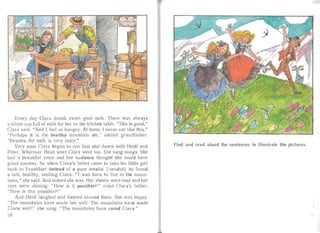
3~
Find and read aloud the sentences to illustrate the pictures.
LESSON
You already know some holidays which people celebrate in Eng land.
Would you like to know what holidays American people celebrate?
Then read the text about some winter and spring holidays in
America.
THE AME RICAN YEAR
(After Terry Tomsha)
Part I
New words:
common holidays ['kJm~ln 'halrderz.] - oounre npa3,L1.HI1KI1

a state [steit] - WTaT

Independence Day [mdrpendansdei] - 1J.eHb He3aBl1Cl1MOCTl1

Labour Day [leib» 'del] - 1J.eHb TpY,LI.a

thus [i'iis] - TaKI1M o6pa30M

to make promises ['pfJmlslz] - ,LI.aBaTb o6ew.aHI1H

equal rights ['i:kwdl 'r ai ts] - pastrue np aaa

to kill [krl ] - y611BaTb

publ ic ['pibllk] - o6w.ecTBeHHbIH, rocynapcrseauun

a saint (st., snt.) [seint ] - CBHTOH

honest ['Jnlst] - 4eCTHblH

to go to the movies (aMep.) = to go to the cinema

Irish ['aldflS] - I1pJlaH,LI.CKI1H
Ireland ['aldldnd] - YIpJlaH,LI.I1H

to pinch [p: ntj] - uinnars

If you compare the English year with the American yea r you'l l
find that both the count ries ha ve so me common holidays. But
people celebrate some hol idays only in England, and others only in
o
America. In the USA there are five nationa l holidays that peop le
celebrate in every American state. These are:
I) New Year's Day,
2) Independence Day,
3) Labour Day,
4) Thanksgi ving Day,
5) Christmas Day.
On these days offices and banks do not work. But oth e:
holi days are not national in the USA and not all the stales
celebrate them.
Thus in America people celebrate:
January 1st - New Year's Day.
On this day, fam ilies and friends meet for a meal. People
us ua lly make promises for the New Year. People say: "I will work
harder" or "I won 't tell lies this year." But they often forget these
promises by Janua ry 2nd!
On New Yea r's Day there are big football games and parades.
Not everyone can go to see them, so many people watch them on
television. There is usually a parade in the morning and the
football game is in the afternoon.
Third Monday of January - Martin ['m0;1In] Luther ['lu:8a]
King's Birth day .
Martin Luther King was an important black leader [Ti.d»] who
wa nted equal rights for black people. His work was, very
important. He was killed in 1968 and his birthday has becom e
a public hoiiday since 1968.
February 14th - St. Valentine's Day.
Nobody knows much about S1. Valentine. People call him the
saint of love. On this da y children write their names on cards
[ko.dz.] with hea rts [ho.ts] on them and give them to their
classmates. Schoolchildren and older people give cards, presents
a nd flowers to their boyfriends, girlfriends, husbands and wives.
Sorne people do not put their names at the end of their cards
beca use they want the ir name to be a secret.
41
Third Monday of February - President's ['prezldan ts] Day.
On this day studen ts and pupils read about George [c13J:c13 1
Was hington ['W:>SllJ t;m], Abrah am ['elbrahrem] Lincoln [Tujkaln]
an d other American presidents. George Washing ton was the first
President of the USA. He was also a good soldier l'soulcl3a] and
a very honest man.
February 29th.
Every four yea rs February has an ex .ra day. Trad ition
[t rad ij n] says that on this day gir ls can ask boys to go to the
movies or out to dinner. A girl can even ask a boy to ma rry her!
March 17th - S t. Pa trick 's Day.
S1. Patrick was an Irish sa int, and St. Patrick's Day is very
popula r in cities where there are many people from Ireland. They
are Irish Americans and they always cele bra te this da y. Green is
the Irish colour and people often wear gre n on this day. If you
don't wear green, someone ma y pinch you.
April 1st - April Fools' Day.
As you know people make jokes on this day and have a lot of
fun. People celebrate this day in America in the same way they
celeb rate it in Engl and. When you've made a joke on your friend
you usually say: "April fool." Nobody is sure when or wh ' this
tradition bega n. Some people believe it began in France [fra.:ns] in
the 16th century. In 1564, the king of France decided to change the
first da y of the new yea r from April Ist to Ja nuary 151. Some peopIe
did not like it and celebrated the New Yea r on the first of April.
They w re "April's Fools", and other people made fun of them and
played tricks on them. So it has been a tradition to celebrate this
holiday for long.
1. Look, read and remember what holidays the Americans celebrate
in winter and in spring.
Holiday
I.	 New Year's Day
2.	 Martin Luther King's
Birthday
3. St. Valentine's Day
4. President's Day
5.	 February 29th
6.	 St. Pa tr ick's Day
7.	 April Fools' Day
Date
January 1st
Ja nuary, third Monday
Februar.y 14th
February, thi rd M onday
February 29th
March 17th
A pril Jst
2. Look at the table of Exercise 1 and say what holidays in winte r
and in spring people celebrate in England and in America.
( Lesson 6, Exercise 1 in the textbook can help you .)
3.	 Could you answer the questions?
1.	 What is special about New Year' s Day in Americ a?
2.	 Why do people in Ameri ca celebrate Martin Luther King's
Birth day?
3. What do children usuall y do on President's Day?
4. What can American	 girls ask American boys to do on the
29th of February? Do we have this tradition in Russia?
5. Why do people wear something green on Sl. Patrick's Day?
6.	 When and where did the tradition to celebrate April Fools'
Day begin ?
42
LESSON
Read the second part of the text "The America n Year" and say what
holidays only Americans celebrate.
THE AM ERICAN YEAR
(After Terry Tomsha)
Part II
New words :
Easter ['i:sta] - Il acxa
from the dead - 113 MCpTB blX
Memorial Day [ms'rnorr al 'del ] - ,UeHb nalv15lTl1
to die [d aI] - yMHpaTb
a grave [qrerv] - MOrH.n a
a wa r [WJ:] - BOHHa
a stripe [straip] - no.noca
rest [rest] - OT.nbIX
to honour ['J:na] - nOtITHTb
a candle [' krendl ] - CBe4 a
job [dj ob] - pa oor a
eve [i:v ] - KaHyH
carols ['kreral z] - xopa.nbl
" Auld Lang Syne" ['auld 'lzerj'sam] - «TIecHH cra pux .npy3eH»
Eas ter.
The Easter weekend is in late March or early Apr il, but th date
changes each year. Easter is a Chr istian holiday which celebrates
the day when Jes us came back from the dead . On Eas ter Sunda y
people g ive coloured or chocolate ['tSJkdllt] eggs to eac h ot her and
send cards.
Some cities have Easter parades [pa' ret dz] with games and
sports and a big Easter egg hunt.
Last M on day of May - M emorial Day.
This is a special day for people to remember those who died in
wars. Ma ny people remember their dead friends or relatives on this
da y too. Many peop le pa y specia1 visits, to the graves of their
rel atives an d friends and leave flowers there.
M other's Day and Father 's Day.
One Sunday in May is Mother's Day and one Sunday in June is
Father's Day. Chil dren us ua lly spend the day with their parents.
They give them cards , flowers and presents .
June 14th - Flag Day.
The American fl ag is often ca lled the "Sta rs and Stripes". It has
thirteen stripes (one for each first colony) and fifty stars, one for
each state. In ] 777 the "Stars and Stripes" became the official
[d'fISdl ] flag of the USA.
And when it was the flag's hundredth birthd ay Americans first
celebrated Flag Day in 1877. You can see the Ameri can flag in
man y pla ces on this day, but as it is not a main holid ay offices
['JflSIZ ] stay open.
Ju ly 4th - l ndependence Day.
On July 4th 1776 the United Sta tes became independent from
Eng land. It was the begi nning of a new life. Families and friends
celebrate this da y. Every town and ever y city has parades, games
and sports with prizes ['pralzl z]. There are often picnics ['plkmks]
too.
Firs t Monday of September - Labour Day.
This is a day of rest for the workers. There are also parades on
this day. This day is the end of the summer and the beginning of
the school year.
44 45
econd Monday of Octobe r - Columbus Day.
From your school textbook you know how America ns celebrate
Ibis day. Don't forget that you can see the American flag
ever ywhere on Columbus Day to honour the man who was the
el i' coverer of their country.
October 31st - Hallowe'en.
This is one of the most favourite holidays in America. You know
how people celebrate it in Eng land . In America they celebrate it in
the same way. Children dress up, shout "Trick or treat", get
sweet: , fruit, cakes and people have pumpkins with candles in their
windows.
November JItil - Veterans' Day.
This is a special day to remember all the people who fought in
the wars - the living people an d the dea d. People have special
dinners on this day.
Fourth Thursday of November - Thanksgiving.
As you remember Thanksgiving is a specia l day for families to
get together and give thanks for different things. They usually do it
in this way: "I give thanks for being here with my family an d for
being well," or "I give thanks for a h althy yea r, a good job and for
meeting my new friends."
December 25th - Christmas Day.
This is the biggest holiday of the year. Ma ny people enjoy it
most of all a nd say that this is the ma in holiday of the year. Soon
aiter Thanksgi ving people start sen ding Christmas cards and
decorate their houses. Almost every home has a Christmas tree.
The evening before Christ mas Day is called Chris tmas Eve. On
Christmas Eve many people go to church and sing Christmas
ca rols. The President gives his speech on TV. Parents tell their
children that Santa Claus will come to thei r house at night and
leave presents for them.
On Christmas Day people open their presents and then they
prepare a tr adi tional dinner of turkey with vege tab les, sala ds,
cookies, nuts, sweets and fru it. People eat Christmas dinner late in
the afternoon. Duri ng the day man y families watch special
Christmas TV and children pla y with their new toys.
Decem ber 31sf - New Year' s Eve. -,
On New Year's Eve people celebr ate the end of the old year an d
the beg inning of the new one. At midnight everyone sings the old
Scottish song" Auld Lang Syne".
t. Look, read and remember what other holidays the Americans
celebrate during the year.
Holiday
8. Easter
9. Memorial Day
10. Mother's Day
11. Fa ther 's Day
12. Flag Day
13. Indepen dence Day
14. Labour Day
15. Columbu s Day
16. Ha llowe'en
17. Veteran s' Day
18. Thanksgiving
19. Christmas Day
20. New Yea r's Eve
Date
late March or early April
May, las t Monday
May, one Sunday
June, one Sunday
June, 14th
July 4th
September, first Monday
October, second Monday
October 31st
November IJin
November, [ourlli Thursday
December 25th
December 31st
2. Look at the table of Exercise I and say what holidays in the
second half of the year people celebrate in England and in America.
4746
3.	 Could you answer the questions?
1.	 What is Easter?
2. What is special about cele brating Easter in the USA? Is it
the same in England? In Russia?
3.	 Where do people usually go on Memoria l Day in Ame rica?
4.	 What is the name of the American flag? Why has it got such
a na me?
5.	 What do the Americans celebrate on the 4th of J uly?
6. What do you remember about Columbus Day?
7.	 Is American Ha llowe'en different from Eng lish Ha 1_
lowe'en?
8.	 What holiday clo the Americans cele brate on the I Ith of
November?
9. How	 do the America ns us ually give thanks on Thanks­
giving?
10.	 What is the main holiday of the year for many people?
11. What	 song do the Americans usually s ing on the New
Year's Eve?
LESSON
Read the text and say why New York is a city of islands and whaI
people who live in it call their city.
"
A LETTER FROM NEW YORK
New words :
to be surprised [sa'prarz d] - YJ!.H BJ1HTbCH

meanwhile [jni.n'wail] - TeM BpeMeHeM

a factory ['frekt drI] - epa 6pHKa, 3aBO)J,

a skyscraper [' skal,skrelpd] - He6ocKpe6 (sky - «etio, to scrape ­

ckpecr u; sky-l-s crape-l- er-e- skysc raper)

to remain [r rmein] - OCTaBaTbCH

46	 Linden Street
Ri	 erdale
New York
23rd April
Dea r Mario,
Thank you for your card. I'm glad you're having a good time,
but I'm not surprised. Washing ton DC. is wonde rful at this time of
year.
I would like you to come to my place and meet my people at thr
end of your journey. You can't leave America without visiting New
York. My brother's hobby, as you know, is taking pictu res. He has
a big album I'relbdm] of pictu res of the United States and of New
York, or the "Big Apple" as we call it. It is certainly better to see
New York with your own eyes. I do hope you'l l come. Meanwhile
I'm sending some of my brother's photos [Toutouz1to you. When
you look at them you'll understand why New York is a city of
islands. In fact it lies on the three big islan ds: Manhattan
[rruen'hsetn] , Staten Island and Long Isla nd. There are also man y
sma ll islands in the city.
4-11. H. Bepcuraru uu, 4 k n.
New York is a great port [po.t] city. It is a very hard working
city too as there ar e many banks, off ices and factories.
The most expensive pa rt of New York is Manha ttan . This island
is famo us for its skyscrapers. Broa dway lbro.dw ei] is a famous
street in New York. It is f rnous for its theatres and you can ee
wonderful shows there.
In the 20th century New York beca me a city whose monu­
ments are skyscr ape rs, a city tha t never stops and never sleeps.
The streets a re always busy as there is much traffic there.
There are many museums and art ga lleries in ew York. The
Metropolitan [jnetra'poh t n] Mu eum or the "MET" is the mos t
famo us museum in New York. There are bea utiful collections of
pictu res, furniture and other things there. Pupils often visit
museums and have their art classes there. Schoolchildren often
visit the Bronx [bronks] Zoo. It is the largest of New York city
zoos. It opened in 1899 an d since then has always been a favo urite
place for anima l lover and children.
In 1789, New Yo rk became the first apital of the United States
of America but it remained the apital for only one yea r. Now, as
I'm sur you know, Washington DC. is the capital of the country.
I hope tha t af ter my letter you have become interested in New
York an d I' ll meet you in my city in Aug ust.
Love , Sue
1. Find an d read the sentences to illus trate the pictu re.
2.	 Put the sentences in a logical order to make a plan.
l ) New York is a hard working city.
2) The "MET" is the most famous museum in New York.
3) Broa dway is famous for its theatres.
4) New York is ca lied the "Big Apple" .
5) New York was the American cap ital in 1789.
6) Manha ttan is an island of skyscrape rs .
7) New York is a city of islands.
8) The Bronx Zoo has been a favou rite place for anima l
lovers since 1899.
3. Tell your classmates about New York using the plan of Exer­
cise 2.
51
LESSON

Read the fairy-tale and say how big the tailor's son was.
TOM THUMB
(After Sarah and Stephen Corrin )
New words:
a thumb [Oxrn ] - 60JIbWOH nan eu pyxn
a knight [ri ait] - pbluapb
a palace ['prells] - ABopeu
a magician [rna'dyijn] - BOJIwe6HHK
to notice ['noutls] - 3aMe4aTb
even ['i:van] - Aa)l(e
to smile [srn ail] - YJIbI6aTbcS1
a couple ['k Apl] - napa
windy ['wlndl] - BeTpeHbIH
to tie [tal] - npHBS13 aTb
a yard [ja:d] - ABOp
to struggle ['strAgl] - 60POTbCS1

a market [mcckrt] - PbIHOK

Have you ever heard of King Arthur and the I(nights of the
Round Table? Well, in the palace where they lived there was the
famous magician Merlin. He used to go around the country and
help the poor people. He was a lways wearing old clothes and he
tried to make people happy.
One da y Merlin stopped at a tailor's cottage which was situated
not far from the forest. The tailor and his wife inv ited Mer lin in and
gave him Iood to eat. They were so kind that Merlin decided to do
som ething special for his host and hostess.
"What would you like to have most of all?" he as ked the tailor.
The tailor an d his wife could hard ly believe thei r ea rs. What could
this old man wearing old, dirty clothes give them? Then the tai lor
said, "Have you noticed how sad my wife is? We have lived here for
ten long yea rs and we have no children."
"Oh, yes," said the tai lor's wife sadly. "I would love to hav e
a son of my own, even if he was not bigger than my husband's
thumb." Mer lin smiled, thanked them and left.
A few days later the good tailor's wife had a son. He was ver y
clever and very strong. He was even good-looking but he was very
sma ll. A couple of days passed but little Tom could not reach the
table thou gh he tr ied very hard . He never grew bigger than his
father 's thum b. So, Tom's mother and father called him Tom
Thumb. Tom Thumb was full of tricks.
One day Tom's mother was in the kitchen . She was making
a cake. Tom wanted to see what was happening. He climbed up to the
52 53
edge of the plate and he fell in. Tom was in da nger because Tom's
mother wante d to put the cake on the fire. Luckily she sa w that
ornebody was moving in the cake an d helped Tom to get back out.
The next day Tom's mother went to the field to milk the cow. As
it was rather windy she tied Tom to a lea f. But the cow liked the leaf
and put it in its mou th along with Tom.
"Mother! Mother!" cried Tom. "I 'm inside the cow's mou th.
Ge t me out." The cow opened its mouth and Toni's mother
ca ught him. Then she took him home, gave him supper and put him
into bed.
The next cl ay Tom ran out into the yard but a big bird caught
him. It flew into the sky. Tom wa af raid and began to struggle and
reme mber he was st rong though little and so the bird let him go.
Tom fell right down into a river. A big fish ate him up. The fishermen
caught the fish and took it to the market where the Ki ng's cook
bought the fish . When he began to prepa re it for supper he found
a litt le boy in the fish an d took the boy to the Ki ng himself. King
Arthur, his knights and ladies were sitting at the King 's Roun d
Table. Tom was on the table. He relaxed and showed the King
many funny tricks that he knew. The King laughed a lot. But
Merlin, the magician, smiled as he knew who the boy was.
King Arthur asked Tom, "Te ll me, Tom, how big are your
mother and fath er? Where do they live? Wha t do they do?"
Tom answered the King's questions . He also said that his
parents were poor and worked ha rd all day long.
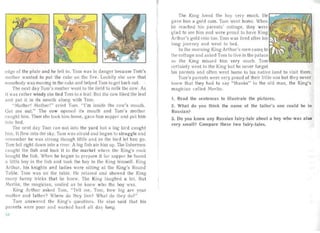
The King loved the boy very much. He
gave him a gold coin. Tom went home. When
he reached his parents' cottage, they were
glad to see him an d were proud to have Ki ng
Art hur's gold coin too. Tom was tired afte r his t-....:.••~:!N.~'"I<
long journey and went to bed.
In the morning King Arthur 's men carne to
the cott age and asked Tom to live in the palace
as the King missed him very much. Tom lill1CJ~~...!-~-.J~
certa inly went to the King but he never forgot
his parents and often wen t home to his native land to visit them.
Tom's pa rents were very proud of their little so n but they never
knew that they had to say "thanks" to the old man, the King's
magician ca lled Merl in.
1. Read the sentences to illustrate the pictures.
2. What do you think the name of the tailor's son could be in
Russian?
3. Do you know any Russian fairy-tale about a boy who was also
very small? Compare these two fairy-tales.
-4
LESSON

Read the text and say why Bea trix didn 't have many friends when
' he was a little girl.
BEA TRIX POTT ER
(By Eli zabeth Levy )
New words:
Bea trix ['bI8trlks] - Bcar puca

elder ['eld81 - - CTapwHH

Noel [no ruj a l] - Hoysn

Bea tr ix Potter has written a very interesting book called "Peter
Rabbit". This book has become the most favou rite children's book
of a ll time. Would you like to know how she wrote it? Then listen to
me, please.
When Beatr ix Potter was a littl e girl, most little girls did not go
to schoo!. Beatrix didn' t and that was why she had no friends. Her
elder brother went away to school but Beatrix stayed at horne. Most
of the time she was alone in her room . Beatrix lea rned to read and
to cia many other thing s but she never had anyone to play with.
She had a lot of free time and began to make up stories.
Sometimes she drew pictures for her stories.
Beatr ix loved the summer most of all. June was among her
favourite month s. Her brother came home from school an d the
Potter family went out to the cou ntry. "How fresh the air is! How
high the sky! How deep the water in the lake!" cried Beatrix happily
when they arrived.
Beat rix and her brother loved the out­
I doors. They cou ld watch frogs in the la ke for
hours. Sometimes they stopped to have a look
1 at a mouse or other an imals.
They decided to make a collection of plants
and animals but they couldn't show their
collect ion to their mother in order to keep
it. Their moth r didn't like to have frogs and
sn akes at horne.
Over the summer Beatrix an d her brother
made pictures of their collection. They drew
pict ures of ra bbits, birds and fl owers.
Most of the time Bea trix tried to paint the
animals and plants the way they really
looked. However sometimes she drew a mouse
with a little hat on or a rabbit wearing clothes.
She became a real specialist at this.
One da; she found a rabbit. She called him
Peter and became friends with him. Beatr ixs
mother didn't want Peter Rabbit in the
house but Beatrix found ways to keep him in
her room . When the summer was over and her
brother wa s bac k at school, she was not alone any more. She
had a friend.
Beatrix grew up an d became a very quiet woman who knew ancl
thought a lot about plants and animals. She a lso became someone
who knew how to draw and was always happy when she could go
away to the countr y. She liked the quiet life in the cou ntry and
different colours - red, yellow, blue and white flowers, green
l grass, green trees and friendly people living there.
r One su mmer at the nd of August when she was leaving the)
place where she lived, one of her young friends became ill. It was
a boy named Noel. Beatrix came home and started to write letters
to him. Most of the time she wrote about Peter Rabbit and his tr icks
but Noel was ill for a long time however. So sometimes Beatri x
56 57
made up stories hersel f. Noel loved her letters. He showe d them to
a ll his friends . Everyone loved the story abou Peter Rabbi t and so
Beatrix thought it was a good idea to make these lette rs into a book.
t. Answer the que stions:
1. What is the name of Beatrix Pottcrs famous book?
2. Beatrix didn't go to school, did she?
3. What did Beatrix do in her free lime?
4. Why did the gi rl love the summe r best of a ll?
5. Wha t did Bea trix an d her brother like to do in the country?
6. What did the girl dra w?
7. Who was the girl's pet?
8. Why did Bea tr ix begin to wr ite letters to Noel?
9. How did Beatrix wr ite her famous book?
2. Give a short summary of the story.
LESSON

Read the text and say where the birds go t the colours they now
have.
WH Y DO THE BIRDS HAVE SO M A NY COLOU RS?
Ne w words :
a vill age ['vdl d3J - AepcB HH
a raven [rervn] - BOpOH
a grizzly ['gn zII J bear - rHM aJlallcKHH MeABeA b
beforehand [brio.ham d] - npe/K,Uc
to paint [peint] - PHCOB8Tb xp acx a a u. p acxpaumaar i,
to change one's mind - H3MeHHTb MHeHHe (TOlIKy 3peHH5I, peureuue)
Ma ny, many yea rs ago a ll the birds lived together in one village
that was situated in a forest. It was very nice to live in the countr y
in those days. Spring was the most beautiful sea son in the villa ge
as all the trees were gree n. You could see a lot of red and yellow
flowers, you could drink wa ter from the rivers and lakes .
But in those days bird s and anima ls lived in different countries.
It was difficult for the birds to go to the an ima ls' country because
there was a wa r between Raven a nd Grizzly Bear.
One day Raven ca lled a ll the other birds an d said, "Tomorrow
we will fight Grizzly Bear. W 'II have to protect our country. I knov
that Gr izzly Bear is preparing for the ba ttle. But before he is read y
we shall have a great dinner a nd we sha ll have a Wa r Danc .
However beforehand I will paint you all." And so he paint d them.
He painted them black, green, biue, yellow and red. He painted the
dlicks brown and grey and he painted the geese grey and white and
the chicken dark yellow.
Soon the birds were hung ry. They could see nice things ir: the
kitchen and wanted to eat some dinner. But the Raven was Hoi
going to feed them. " I have cha nged my mind. I'll ea t dinner
myse lf," he sai d. " I'll fight Grizzly Bea r myself. Go away!"
The birds went away and left the village. The water birds went
away to the lakes an d the sea . Many birds went to the mountains
and bega n to live there and some birds wen t to the forest of the
animals' country but they never took off the paint that was on them.
I.	 Say 'True', 'False' or 'Don't Know'.
1.	 All the birds lived in a big city man y years ago.
2.	 Sp ring was the worst season of all.
3.	 The ocean wa s nea r the bird s and anima Is' coun tries.
4.	 There were no mountains in the bird s and animal s'
countries.
5.	 The Grizz ly Bear wa nted to fight the Raven.
6.	 The Grizzly Bear was grey.
7.	 The Raven painted all the birds.
8.	 The birds left the Raven and took off the paint that was on
them.
2. Think of six que stions on the text for your classmates to answer.
6f
LESSON

Hans Christian Andersen is famou s for
"
his stories and fairy-
tales. You have certainly read some of them. Maybe you have read
"The Emperor's New Clothes", "The Steadfast Soldier" or "The
Ugly Duckling". This is a short biography of Hans Christian
Andersen. Read it and say wh y Doris Ga tes gave this biography the
name it has "The Real Ugl y Duck ling'''?I
THE REAL " UGLY DUCKLI NG"
( After D oris Gates )
New words:
Odense ['ouodnsd] - e. Onence
Denmark ['d enma:k] - IlaHHH
Copenhagen [jcoupnhetqen] - e. Konea raren
unfortunately [An' [;:rtSndt l l] - K HeC4 aCTblO
ta lented ['ta:ldnttd] - TaJ1a HTJIHBbIH
clumsy ['kIAmzl] - HeyKJIIO)KHH
recite [r rsai t ] - neKJIaMHpOBaTb
adventure [adventja] - npHKJII04eHH e
charm [t j o.rn] - o4apoBaHHe
gentleness ['d3entlnls] - "v1HrKOCTb, noopora
wisdon ['wl zddm] - Mynp OCTb
mermaid ['md:meld] - pyca JI 04Ka
Once upon a time, more than a hund red yea rs ago, the re was
a boy called Hans Chr istian Andersen. He was the onl y child of
a poor fa mily. Hans and his parents lived in one room of a house in
Odense in Denmark,
Their room was always clean and nice to be in. It was
61
a bed room and a kitchen too. There were always flowers on the
tab le.
Hans Christian was a happy boy. Both his pa rents loved him
very much and did a ll they could for him. Hans Christian's fath er
once made him a toy thea tre . Hi mother made clothes for his toy
actors an d actresses. Ha ns wanted to become an acto r one day. He
wanted to go to the great city of Copenhagen an d to become a great
acto r there.
But unfortunately he wa s not talented nor was he good-looking.
He was big for his age and clumsy. His legs were too long for his
body. When he danced everybody laughed. He hac! a long, sad lace.
Hans Christian recited poems though not very well. But he
. uld sing. He had a fine voice and people liked to listen to his
ongs.
By the time Ha ns Christian was fourteen he decided to leave
Odense and went to Copenhagen. It was situated ra ther iar from
Hans's native city and it took the boy a long time to get the re. Hall
Christian left f r Copenhagen with a fe coins in his coa t.
However he could not become a dancer as he had no talent for
dancing. People in Copenhagen were kind to him but they told hill!
he couldn't do well in the theatre. They tried to sound nice but Hans
was very sad and didn't know wha t to do. He often didn't ha l'
anything to ea t. He used to wea r old lethes. Then a fter his fifte .ntl:
birthday, his voice changed. He couldn't sing very well any long r.
He decided that, since he cou ldn't sing or act, he would wr ite pia
for other actors instead. He was sure tha t one day he cou ld hl
grea1.
At first his plays were not a suc cess but then a very importa nt
p r on in Copenhagen Jonas Collin read them and became
interested.
The firs t thing to do was to send Hans Christia n to school and
so the years of ha rd work began. At sixteen, this boy had to sit ill
the classroom with the sma llest children. Although he was able tu
read, he knew nothing about grammar or ari thmetic or spelling.
Only Collin friend ly helped Hans Chri tian to get through th sv
long, difficult years and he was sure that one day he could b
a famous writer.
He finished school and bega n to spend all his time writing. His
first book was a collection of poems and then he wrote a novel.
While he waited for his books to appear, he was writing iai ry-ta les.
He remembered his granny's stories and began to write his OWll .
They were full of magic and adventure and we e full of charm tor .
Very soon his first book of fairy-tales appeared. It was a uccess .
Andersen wrote ith gentleness, wisdom and humour rhju.ma], II .
had a lot of readers not only in Denmark, but in other countries t o.
Suddenly Andersen found himself Iarnous. Everyone W,JS
reading his fairy-tale s.
The King of Denmark in ilcd him to dinne r. As time went b ,
Andersen became a friend of that good man .
lnde d he became the friend of all the famous writers in Euro p '.
tl.l62
v
Wherever he went, people said, "There goes the author of 'The
Little Mermaid'. There goes Hans Christian Andersen."
He 'returned to Odense, his home city, several times to see his
mothe r before she died and one day he went there as someone
special.
The people wanted to honour this famous son of their city, There
were bea utiful, bright lamps in all the streets and squa res the nigh t
he arrived, As Hans Christian looked at the light he felt very ha ppy.
He remembered the years of his childhood, "I was a poor boy then.
People laughed at me in the same streets. But now I'm' hap py."
Later when he came to write the story of his life, he said: "That
night was like a fairy-tale." Indeed it was, Ha ns Christian was
born in a very poor family but he became the friend of Kings.
1.	 Answer the questions:
1.	 Where was Ha ns Christ ian Andersen born?
2.	 Why couldn't Ha ns Christian become a grea t actor or a great
da ncer?
3.	 Who sent Hans Christian to school?
4.	 Why were his school years difiicult for the boy?
5.	 Why did he begin to write fairy-tales?
6. Wha t broug ht him success?
7.	 He became friends with the King of Denma rk, didn 't he?
8.	 Why did Hans Christian come to his nat ive city as someone
special one day?
2. Could you give the Russian equivalents for Hans Andersen's
fair y-tales mentioned in the text?
LESSON

It is a well-known fact that Prince Yuri Oolgoruki founded
Moscow. Would you like to know how it happened? Then read the
Russian legend.
HOW MO SCOW BEGAN
New words:
wise [watz] - Mynp blH
deep [di.pI - rJIy60KHH. 30. LlpeMycl HH
to cross [k rJS] - nepecetcan.
a cloud [kl aud ] - 06JIaKO
to	 point [pomt] - YKa3b1BaTb. noxaastaar s
huge [hj u:d3] - or poMHblH
skin [skin] - wKyp a
in amazement [arnetzmant] - B YLlI1BJIeHl111
forward [' b :W8d] - Bnepen
to	 disappear [,d lS8' pl8] - l1ct{e3aTb
fortress ['b :trls] - Kp errocTb
Prince Yuri Dolgoruki wa s Prince of Vladimir and Suzdal and
was a clever man. He was st rong an d brave and he fought a lot.
Some yea rs passed and he became Kiev Prince too . Vladirnirwas in
the North of the country and Kiev wa s in the South. Kiev was the
main city of the country then. It was the capita l of Kievskaya Russ.
It was certain ly difficult to live and rul e in Kiev and in Vladimir at
the same time. The cities were very far from ea ch other. So Yuri
Dolgoruki was ru ling in Kiev an d his favourite son Andrei
(Andrew) was ruling in Vladimir'.
Once Prince Yur i Dolgoruki asked the old wise man, his
adviser, to come and talk to him. This is what the Pri nce said: "My
old man, I'm getting old. Before I die I wo uld like to visit my native
65
lands. ) would like to speak to my son Andrew. ) wo uld like to wa lk
~he s~:ee t~ of Vladimir. Let's travel to the North." "That' a great
Idea, said the old man. " When sha ll we st art? When are we
leaving for Suzd al and Vladimir?"
Soon they started out. Prince Yuri Dolgor uki always tr avelled
with a lot of people. They travel led on their h rses through w ide
field s and deep fore ts. On the way they passed ma ny settlements.
They went up smal l hills and big mountai ns and crossed large and
sma l l river s too.
One day whe n they were in the da rk forest Prince Yu ri suddenl
saw a large white cloud in front of them. " W h t's that?" he a ked.
"S low down. You n ver know what can happen. Wh at's that?" he
asked aga in and pointed t the cloud .
Suddenly the clou d b came a huge animal with three heads. Its
skin was of many col ours. The prince's men stood stil l in
amazement. " We have been to many countri es. We have seen a lot
of wo nders . We have heard of many things but we have never s en
anything like thai, we have never heard of anything like that," th
tho ught. Nobody could speak or move. But one you ng brave ma n
moved hi horse and forward he went. At once the wo nderful
anima l became pale and then disappeared altogether.
Only af.ter (l Iew minutes could th P incc's men speak. They
bega n to diSCUSS tile wond erlu : anima l. Prince Yuri turne d to the
old wise man and said, " Could you explain to us what i t means ?"
The old man looked into the cla rk forest. There wa s sam tiling
deep and bright in hi - eyes when he said, "All right. )'11 try to
explain. Th is w nderful animal showed that this is tile plac e for
a great ity."
"Do you mean to say that there will be a great ci ty in th is empty
place, in the middle of this deep for st?" asked Prince Yuri in
amazement. " What are you talking about, old man? What g reat
.t :>"CI y.
" I know w hat I'm sayin g," the old man answered. "There w ill
be a great and strong city here, becau se the anima l is big and
IH
stron g. The ci ty will have th ree sides because the anim al has got
three heads. An d the colours on the anima l's kin mean that peopl
from different pl aces wi ll come to live here."
After these wo rds the Pri nce' men moved on. The men wer
di scussing the an imal and the adviser's words. And Prince Yur i
was thinking of the fu ture city . "I ha 'e founded many cities," Yuri
thought, " because if I have str ng cities my countr y is st rong. The
greatest citi es I've founded are Peresl avl -Zales ki (it is behind
the fore st), Yu riev-Polski and Dmitrov. Dmitrov is in the place
where my on Dmi tri was born . I have alw ays tried to ma ke these
cities beautiful. My men built churches, made towers and wa lls.
Wha t will the new city be like?"
A few hours later the Prince and his men reached a small
settl ement on the bank of the Moskva Rive r. The host of the place
wa s boyarin Stepan Kuchko. He lived there vith his fami ly and hi s
men. However the doors didn 't open and nobody asked the Prince
and his men to come in. Prince Do lgoru ki understood th t this
mean t that bovarin Kuchko w as not his friend any more but w as hisJ •
enemy.
67
Prince Yuri began a fight with Kuchko's men and killed many of
them. After the fight he went up to the top of the hill where
Kuchkos fort ress wa s situated. He looked at the forests and fields
in front of him as if he saw them for the first time. He looked at the
Moskva River with its beautiful banks an d clean waters and at the
rich settlement near by, "Well, this is the place for a new city," Yuri
sa id, "the city with three sides will be situated on this hill. I will
found a beautiful city in this most beautiful place an d I'll give it the
same name as the river. Let the city be call ed MOSCOW."
1. Read the sentences to illustrate the pictures.
2.	 Choose and read the sentences which are true.
I) Prince Yuri Dolgoruki was a clever, strong man.
2)	 Prince Yuri Dolgoruki was a young, weak man.
3)	 Vladimir was in the North.
4)	 Vladimir was in the South.
5)	 Pr ince Yuri Dolgoruki wanted to visit the lands of Vla­
dimir and SuzdaI.
6)	 Prince Yuri Dolgoruki wanted to visit the small settle­
ment on the Moskva River.
7) Prince Yuri Dolgoruki alwa ys travelled alone.
8) Prince Yuri Dolgoruki always travelled with his brave
men.
9) In the forest they saw a huge animal with three heads.
10) In the street they saw a huge anima l with three heads.
The colours of the an imal's ski n meant that people fromII )
different Russian cities will come to live in Moscow.
The colours of the anima l's skin meant tha t people from12)
different places will come to live in Moscow.
Yuri Dolgoruki founded Pereslavl-Zalesski, S1. Peters­13)
burg , Dmitrov and Moscow.

Yuri Dolgo ruki founded Pereslav l-Za lesski, Yuriev-Polski,
14)
Dmitrov, and Moscow.

Yuri Dolgoruki gave the new city the name of the river.
IS)
Yuri Dolgoru ki gave the river the name of the city.16)
68
LESSON
Have you ever been to St. Petersburg? If yes, we invite you to read
the text and remember some places you have seen. If not, would
you like to? Then read the text and say what the most famo us
symbol of the city is.
ST, PETERSBURG
New words:
to separate ['separcItJ - OT.lI.CJlHTh , paazie 51Tb

high Iha I ] - BblCOKIfH

to raise [rerz] - n O.ll.HHM3 Tb
to raise bridges - p a3BO.ll.Il Tb MO CTbl
a painter ['pe mla] - XY.lI.OJKIHIl{
a masterpiece [rncestopts] - ruenes p
clima te ['k la lmIl] - KJlIlMa
mild [rna lid J - MH I"K.Hii
light [la d ] - CBCTJl hrii
you can't help admiring - IlCl103 MO JKHO He 130 CXHmaTb CH
In 1703 the Russian King, Tsa r [zo.] Peter the Great founded
St. Petersburg, a city on the hanks of the Neva River. S1. Pe­
tersburg, the first Russ ian city where many houses were made of
stone, became the Russia n capita l in 171 2. Peter the Great wan ted
to make lhe new capit al, the youn g city of st. Pete rsb urg, very
beau tifuI.
Now more than two centu ries laler, we can say tha t
S1. Petersb urg with its straight wide streets, wonderful bridges,
green parks and squa res and old houses made of stone, is one of the
most beautiful cities of Russia , Europe and the whole wor ld. If you
look at the map you'll see that S1. Peter sburg is situated on many
islands, A lot of small rivers an d cana ls [ka'na-Iz] separate
different parts of the city from each other ,
There are man y beautiful bridges over the Neva River. Some of
them are not very high, That's why at night special ists raise the
bridges and then ships can move on the Neva River between the
parts of the bridges.
There are ma ny famous monuments 'i n S1. Peterburg. Many
people a llover the world know its theatres, museum s and beautiful
churches. Tourists go to S1. Petersb urg to have a look at the Winter
Palace and the Hermitage ['ha:m1tld3], the Summer Garden and
ma ny other places of interest. Many of them visit St Isaak's Cathedral
so tha t they can look at the city from its top.
One of the most inte resting museums in St. Peterburg is the
Russian Museum where you can see wonderful collections of
beautiful w rks by famous Russian painters. The Russia n Museum
is situated in the Square of Arts. The famous monument
lo A. S. Pushkin is there.
The main street in St. Petersbu rg is Nevskyi Prospect. It is not
a rery wide street, but it has lots of monuments, bridges, beautiful
buildings, shops, res taurants a nd metro stations in it.
S1. Petersburg has a lot of symbol s ['slInbalz] . Perhaps the
most famou s symbol of the city is the monument to Peter the Great
in Dekab ris ts Squ are. Great architects of the 18th and 19th centu­
ries worked in St. Petersburg: V. Rastrelli, A. Voronihin and
K. Rossi. Tha t's why many buildings in St. Petersburg and even
whole streets are rea I masterpieces.
The climate in S1. Petersburg is not very mild. Winters are
usually cold there, but summers are not hot. It is usually warm in
the city during summer.
The best period ['prarrad] of the year in St. Petersburg is the
period of the "wh ite nights", This is the time in June when it is light
even a t night. People usu ally walk a lot a t the time of the "white
nights" .
There are many beautiful places around St. Petersburg. You
70
71
Monument to Peter I The Summer Garden
St. Isaac's Cathedral
can find them in Pavlovsk, Pushkino and Lomonosov . However till'
most bea utiful place is Petergoff with its fountai ns [Tauntmz ],
beautiful palaces an d wonderful parks. When you arrive <I I
Petergo ff from the sea an d see all those bea utiful fountains C1 (
work, you can't help admiring this fantastic corner of Russ ia,
f ind in the text and read aloud all the information about:
"
I) the founder of 51. Petersburg;

2) bridges of the city;

3) places of inte rest in 51. Petersburg;

4) the main street of the city;

5) the famous symbol of 51. Petersburg;
6) the climate of the city;
7) the "white nights";
8) beautiful places around 51. Petersburg.
72
SUPPLEMENTARY MATERIAL
Rea d the text and say why Ginger wrote a letter to her granny.
Shoes for Ginger
Ginge r likes shoes. But she only had two pairs. She had a brown
pair for school and a black pair for occasions' but didn't think that
two pairs were enough.
So one day Ginger said to her mother, " I have only two pairs of
shoes. I need more." "You are st ill growing," said her mother.
"Two pairs of shoes are enough."
Then Ginger got an idea. "Maybe gra ndmother will help me,"
she tho ught. So Ginger sa t down and sta rted this letter:
Dear Grandmothe r,
You asked what f wanted for my birthday this year. f would
like some ne w shoes , I take a size two. Please tell all my aunts and
uncles. I can use any kind of shoes . f lik e all colours.
Plea se come for a visit soon,
Ginger
Ginger had many, many aunts and many uncles too. When they
got the news, al l her aunts and uncles ran out to buy shoes for
Ginger an d her grandmother bough t h r a pair of shoes too.
On Ginger 's birthday many boxes arrived at her house. Ginger
smiled as she opened the first box. But as she opened the other
box s, she laughed. In everyone of the boxes was a pair of new
hoes!
I for occasions [a' kel3 11ZI - si) . na BbIXOJl,
74
Ginger had shoes to match al l her clothes. She had red shoes,
green shoes, blue shoes and black shoe . She had pa rty shoes,
school shoes, work shoes and play shoes. h even had boots for
rain and snow. Ginger had a lot of shoes and all of them were a size
two.
Now Ginger had so rnany shoes she had to look for places to
keep the m. Soon she began leaving shoes and shoe boxes all ov .r
the house. She left shoes on the TV and und er the chairs and she
even left a pair of shoes out in the rain.
Ginger liked her shoes, but they needed a lot of work. She had so
many shoes to put on and take off and she had to clean every pair.
Some days Ginger didn't even have time to play.
Then one morn ing Ginger put on her blue shoes. "Oh-h!" she
cried. "I can't keep these shoes on because they hurt!" She put 011
her red shoes. "Oh! Oh!" cried Ginger, "this pair hurts, tool"
75
Ginger's molher looked .a l the shoes and said, "I'm af raid they
a re too little. Size two isn't righ t for you an y more . I'll have to buy
you some bigger shoes."
At the shoe shop, Ginge r got a pair of brow n shoes for school
and a pair of black shoes for occasions. This time her shoes had to
be size three. "What will we do with all of my size two shoes?"
asked Ginge r and her mother said. "You can tak e them to school
when they ask for old clothes."
Ginge r wa s so glad to give the shoes away. Now she had only
tw pairs of shoes to clean. "No growing girl needs more than two
pa irs of shoes," thou ght Gin ger. "Next birthday I think I'll ask for
hats."
Answer the questio ns.
1. What did Ginger like very much?
2. What shoes did she have before her birthday?
3.	 Why did her mother think two pa irs of shoes were enough
for her daughter?
4.	 What did a ll Ginger's au nts and uncles give her as a
present for her birthday?
5.	 Why did Ginger's mother decide to buy her da ughter some
new shoes?
6. What shoes did they buy for Ginger?
7. She was gla d to have only two pairs of shoes, wasn't she?
Read the text and say why Maria laughed at George.
Who Is Afraid?
One day Geor ge's Iarnily was visiting the children's zoo. As the
family was wal king along the st reet Geo rge sa id, "Let's hurry!
I would like to see the bears and the elephants. It's fun to wat ch
them." "
"And I would like to go to the Baby Animal Farm," sai d his
sister Mari a. "The lambs are so nice, and you can get very close to
them."
George la ughed, "Girls always like baby animals. But boys like
big ones because boys aren 't afraid of anything."
Their father boug ht the children a bag of nuts to feed the'
animals. "Here, children," father said . "Now remember the rul es
when you feed the anima Is. Be ca reful not to go too close to the
cages because you might get hurt."
"We won't forget, " sa id George. He took the bag from his father
and ga ve Maria some of the nuts. Then the family walked over to
see the bea rs.
What fun it wa s watching the bears! They were boxing each
other an d they looked funn y! George gave them some nuts, but
Ma ria didn't. She saw how big the bears were and wa s afraid
to go nea r them. ,
"Come on, Maria," said George. "Feed the bears. They wall t
hurt you. Why are girls afraid of everything? And their mum said,
"Let's go and feed the elephants, they must be hun gry."
On the way to the elepha nts , their daddy bought each of them
a ba lloon. Maria smiled and she forgot a ll about being afraid.
For a while the famil y watched the elephants. Then Maria went
to give them some nuts . However just as she did, an e lepha nt made
a loud noise and Maria was afraid . She ran back to her mother.
How George lau ghed! George gave his nuts to the elephants an d
then his father said , "Now let's tr y to find the Baby Animal Farm."
"Yes, let's," smiled Ma ria.
Ju st then the mother heard the pop, pop, pop of popco rn nea rby
77
and she sa id, "Oh, let's buy some popcorn before we sta rt." And so
the fath er bought four big boxes.
Then the family wa lked along eati ng popcorn and looked at
everyt hing a long the way. Soon they found the Baby Anima l Farm.
As they watched the anima Is, a lady carne over to Ma ria. She was
a lady who worked at the zoo and she said, "The lambs are going to
have some mille Would you like me to teach you how to feed them? "
"Oh, yes! cried Maria.
Maria followed the woma n through the gate a nd when she got
into the fa rm yard, Maria sto pped an d cal led, "Geor ge! You'd
bette r come an d get my popcorn a nd my balloon. I'll need two
hands to feed the lambs."
George went and took Maria's things. As he turned to leave,
some popcorn fell out of the box. A sma ll lamb saw the popcorn on
the ground and sta rted after Geor ge.
Maria ga ve a Iitt! cry, ,. Look all l!"
George sa w the lamb coming after him. As he star ted to run, he
let the balloons go. Up went Geor ge's balloon and it landed high in
a tree! Up went Maria's balloon. and it landed even higher!
George ran faster. Suddenly he fell and the popcorn flew all
over the ground. George caught hi' breath a nd looked back. There
was the lamb quietly eating the popcorn . Mar ia laughed and said,
"Boys a r n't afra id of big an imals. They are only afraid of little
baby lambs."
Answer the questions:
1. Where did George'
2. Why didn't Maria
elephants?
s fam
want
ily go
to go
one
and
day?
see the bea rs and the
3. What	 did George's father tell his children when he was
giving them nuts to feed the animals?
4.	 Why didn't Maria give an y nuts to the elephan ts?
5.	 Who wanted to teach Maria t feed little lambs?
6.	 Why did a smal l lamb ru n after George?
7.	 Is it kind to laugh at smal l childr en who are afraid of
anim als?
Read the story and say why Tom couldn't do the shoppi ng a ll by
himself.
I Know! I Know!
T OI11 was playing in the garden when his mother went to the
doorw ay and shouted, "Tom, will you do the shopping for me?
I need a pound of butter , a dozen of eggs, and a box of cookies. Oh,
and I almost fo rgot, bring twelve rolls a nd a sma ll a kc too. I' ll
make a list for you. Put the shopping list in your swe ater so you
won' t lose it."
78 79
"I know! I know ! " said Tom. " I don't want the shopping list. I'm
clever enough to remem ber five thin gs." An d down the street he
ran.
As he turn ed the corner, he met his aunt ta lking with some
ladies. H is aunt asked, "Where are you in such a hurry to get to,
Tom? " " I'm going to the shop," sai d Tom. " Where is your shopping
list?" she asked, "and wh at are you going to buy?"
" I know! I know!" said Tom. "No shopping list for me,
I remembe r wh at I have to buy all by myself. I'll buy a pound of
butter, a dozen of eggs, and a box of cook ies. A nd I'l l buy a srna II
roll and twel ve cake s."
Before his aun t cou l d say a wo r d, Tom rail off down the street.
He di dn 't see her shake her head and laugh.
Tom ran to the shop as quickly as he could . When he got there,
the shop assista nt asked, "What can I do for you, Tom? W here is
the shopping li st?" " I don't need one," said Tom. " I remember
everything wi thout it. My mother wa n ts twel ve pounds of butter ,
some sma ll eggs, and a box of cookies. And she wants a pound of
rolls and twe lve cakes."
The shop assistant began to laugh, "I can't give you that," he
said . "You had better go horne and get your shopping list. "
Torn didn't kn ow what to th ink. He went slowly out of the shop.
As Torn was leavin g the shop , he met his lather w ho wa s on his way
home from work. When he saw Torn 's face, h " asked, " W hat is
wrong, Torn? " " I don't know," said Tom, "I went to the shop for
mother. But the shop assistant won 't give me the things I aske d for.
He just laughed and to ld me to get my shopp ing li st." " Wha t were
you asking for? " said his fa ther and Tom answered , "I aske d for
twelve poun ds of butter. and a pou nd of eggs an d I didn't for get the
dozen boxes of cookies, the sma ll ro ll. and twel ve cakes."
His Iather began to smi le. "I think I can help you, but next time
bring you r shopping Iist."
Put the sentences into a logical order, then use them as a plan to
retell the story.
I.	 Torn didn' t want to take a shopping list with him.
2.	 The shop assistant cou ldn 't give Torn the thi ngs he asked
for.
3.	 Torn's father helped hi s son.
4.	 Mother asked Torn to go shopping.
5.	 Torn met his aunt.
6.	 Tom exp lai ned to his father wha t wa s wrong.
80
Read the story and say why little Jacoble told old Jacob the truth
about the hare.
Jacoble Tells the Truth
(After S ara and S tephen Corrin)
Old Jacob and little Ja coble had seven little sheep to take care
of. One day they were walking home and the sun still shon e
brightly. The seve n little sheep though t of the wonderful green
grass, old Jacob was thinking of his house a nd little Jacoble ... he
didn't know ... what to think. Then he thought a wonderful idea ,
an d he cried, "Jacob, oh, Ja cob! Do you know wha t I saw
yesterday? I saw a g reen rabbit. It was flying
in the air and it was so big, even bigger than
an elephan t!"
"O f course you saw tha t with your own
eyes," said old Ja cob. "Of course I did," said
Jacoble who was very proud. "It's a good
thing that you rea lly saw that big, flying,
green rabbit, because if you didn't," said old
Jacob, "that old bridge we are going to wa lk
over is a very strange one. As soon as anyone
who hasn't told the tr uth comes on it, the
bridge breaks in two un derneath him." They
continued wa Iking.
"Ja-cob," sa id little Jacoble a little later,
"you know that big, g reen, flying ra bbit I saw
yester day... Well, it wasn' t really flying,
and ... it wasn't quite as big as n elephant...
but it was very big, about the size of a horse,
well of a youn g horse!" "Big as a horse?"
asked Jacob, as they got closer to the bridge
and littl e J acoble began not to feel so well.
"Jacob, oh Ja cob," said Jacoble. "That big, green rabbit I saw
yesterda y, well I had something in my eye and so I couldn't see that
well. It wasn't a very big rabbit but it was green . Yes, that 's wha t i1
was - all green!"
Old Jacob didn't sa y a word. He just wa lked over the bridge.
But Jacoble didn't go after him because he was afraid and he knew
why he was afraid. He stood at the bridge and sa id, "Oh, Ja cob!
You know that rabbit I saw yesterda y. It wasn't green. No, no. It
was jus t a little, brown ra bbit."
Then he wa s not afraid of a nything a ny more and he ran hap pily
over the bridge .
Read out all the sentences which are not true to life.
Do you like parties? Have you ever been to any parties? If you want
to know some facts about Shirley's party read the text and say why
Shirley was angry.
The Costume Party
(After W. B. Park)
It was the night of the pa rty. Shirley, the ca t, wanted to see al l
her friends at the pa rty. "They are all going 10 have costumes on,"
she thought. "What will they be like?"
Soon the ducks ca me wea ring pirates' ['paldr8ts] costumes.
The sheep came dressed like a ma gician, and the pig was wearing
the costume of a chef. Shirley's best friend the fox was dre ssed like
a ballet dancer and the dogs were wearing clown costumes. Shir­
ley was happy. "Let's pla y some games!" she cried.
Just then the doorbell rang. Shirley opened the door and saw
a huge bear. "Ohhh!" said al l the guests, but Shirley saw that the
bear had a big zip down his fron t.
83
"Don't be afraid!" she said to her friends, "It's only a costume.
Who could be inside?"
No one couId guess. Shirl y looked a t the bea r. "Come in!" she
said. "What a good costume!" and the bear just smiled.
First they played hide-and-seek. The bea r was it ' an d in no time
he found everyone as he was very quick.
'S imon sa ys" was the next ga me. "Touch the sky!" said Shirley.
"You didn't say 'Simon says," sai d the bear.
1 The bear w as it - M e,ll.Be,ll.b BO,ll.HJI

2 'Simon says' - anenuucsasi uepa . Heptuotuue oosoaiu eunos nstro onp eoe­

nennue iieucreu« nuiuo 8 TOM cnq-uie, ecnu 8eoY Ulru U2080P UT CJtOBa 'Simon says'.

84
However her other friends moved the ir arms up. So th bea r
won aga in.
Leap-frog was fun, but soon it was the bear's turn to jump. He
was so heavy! Then the dog said, "1 don't want to play it any
more ."
They tried hopscotch but the bear was bigger than everyone a nd
it was easy for him to win and he did. .,
Next came the ga me the pig liked the best. It was the pie ea ting
oritest . The pig was usually the winner. He could ea t so much bitt
this time the bear a te ten pies and the pig ate only five pies. The
bear va nted more and the pig got angr y. "It's my game!" he cried.
Shirley had to do something as the bea r was ruining her pa rt)'.
"Time to take off our masks!" she cried.
Everyone quick ly took their rna ks off. Who was inside the b a r
costume then? They all wa tched him. "Oh, no!" the gues ts cried. " It
really is a bear!"
They a ll ra n away but Shirley couldn't run away as it was her
home and she w as very angry, "You have ruined my party," sh
sa id to the bea r.
"I'm sorry," said the bear, "I've never been to a pa rty before
an d I'm new here so I don't have an friends."
Shirley felt bad. "Well," she said, " I think you can stay, but you
have to be good ."
"I' ll try," said the hear and all the guests
came back and the bea r was good.
He said "Please" and "Thank you" and he
almost always remembered to have his
turn.
Everyone began to Iii e the bear. They gave
him firs t prize for the best costume! When the
pa rt y wa s over every one was happy except
the pig. He was busy pract ising for next yea r's
pie eating contest.
85
Say: 'True', 'Fa lse' or 'Don 't know'.
1.	 Shirley was a sma ll little girl.
2.	 Everybody wa s wea ring a costume at her party.
3. Shirley's best friend was very tired.
4.	 The ani mal s didn't play the games at the party.
5.	 All the guests came to Shirley at 5 o'clock in the even ing.
6.	 The bear was wea ring a costume of a bear.
7.	 The gu est s ran away when they sa w the real bear because
they were afraid.
8.	 Everyone liked the bea r at the end of the party.
Read the text and explain why the giants became friends again.
The Two Giants
Once upon a time, t vo Giants lived in a beautiful country. In
summer it was wa rm and in winter the land wa s even more
bea uti ful covered with snow.
Each day the Giants walked together through the mountains and
in the fares ts. They took care not to step on the trees. Ever ybody
liked the Giants as they were kind and brave and were true friends.
One day the two Gian ts found a pink shell on the beach. The
shell was bright and very beau tiful. Both Gia nts liked it very much
and wante d to have it.
"It's my shell," said the Giant called Boris, "I will wear it on
my neck."
"Oh, no! It will be my shell," said Sam, the other Giant, " It will
look better on my neck."
Fo r the first time in their life they began to argue. As they did
the su n went behind a cloud and the cloud became bigger and
blacker. The wind blew an d blew and the clouds grew an d grew. It
bega n to rai n. The more the Giants argued, the colder the day
became. The waves of the sea became high a nd da ngero us. Boris
and Sam were in a hur ry to dress. They put on their socks very
quickly without e 'en looki ng at them but befo re they could put on
their shoes, a huge wave covered the beach. The wave took awa y
the Giants' shoes and the shell.
The Giants were angry and threw stones at each other while
they were run ning to the mountains beca use the water level bega n
to rise. Soon the whole country was unde r wa ter except the tops of
two mou ntai ns which became the only islands in a wide, cold sea.
Boris lived in one and Sam in the other.
Boris an d Sam became real enemies. They were always an gry
and threw big stones and even huge rocks at each other. On
Mondays Sa m threw a rock at Boris. On Tuesda ys Boris threw
a rock at Sam, and so on, every day except Sundays, every week.
Now it was cold in their country as it was always winter. The
Giants forgot how lovely the su mmers used to be. Each day was
very cold. And each day they threw rocks and soon there were
many rocks in the sea .
One day Sam decided to use them as a bridge. He wa nted to
c me to Boris's mounta in when Boris wa s sleeping. Sam wanted to
7
-- - - - - - - - - - - - -- - -
l
hit Boris on the head an d make him sleep all day and miss his turn
to throw a rock. However Boris opened his eyes when Sam was in
the middle of his way an d understood everything. He got up and
went to meet Sam . The whole world shook when the Giants were
moving to each other.
Suddenly both Giants sto pped. Sa m looked at Boris's feet.
Boris looked at Sam's feet. Each Giant had one black and white
sock an d one red an d blue sock. They looked at their socks for
a long time. The black and white socks were Boris's socks. The blue
and red socks were Sam's and then they remembered their
friendship and their fi ght. "Do you remember why we began the
fight?" Boris asked.
Sam didn't. And Boris didn't either. They began to laugh and
even dance.
When they came back to their islan ds, each of them found
a small white flower on his islan d. They felt the warm sun on their
face and the water began to move away. Trees grew where the water
had beenI . Birds began to come back to the forests and the coun try
was la rge and beau tiful again.
Sam and Boris sat among the flo vel'S, they listene d to the birds'
songs and were happy. The seasons came and went as before.
Occasiona lly the Giants wa lked abo ut their cou ntry, and
sometimes played snowball fights . and often they helped the birds
t build their nests.
Whatever they did they did it together and they always war
odd2
socks. Even when one of the m had a new pair, he alwa s ga ve
one sock to the other Gia nt just in case!
Arrange the sentences in a logical order. Then use them as a plan
to retell the story of the Giants.
1. The Giants became friends again.
2. The Giants had a great fight.
3. The two Giants lived in a bea utiful country.
4. They found a bea utiful pink shell on the beach.
5. There was only one season in their country.
I where the water had been - n a TOM MeCTe, rne 6blJ1a sona
2 odd - 30. HenapHblH
88
Read the text and say why people called Johnny Chapman Johnny
Appleseed.
Johnny Appleseed
(After Sara and Stephen Corrin)
Ma ny years ago, when your grandfather's great-grandfather
was still a child, there lived a boy in Boston in America ca lled John
Chapman. He loved the countryside, the flowe rs and the tree s. He
knew all about the animals and birds who lived in the forests. His
favourite tree was the apple tree. He loved to climb a pple trees an d
ea t appl s as he rested th reo
Once while he was eating an apple he looked thoughtfully at the
little brown seeds in it. " I shall plant these seeds ," he said. "Soon
the whole countrys ide will be full of apple trees."
So, when John Chapma n grew up, he started to travel about the
ountry with a la rge sack full of a pple see ds on his back. He
sto pped every now and then and planted a seed. He often gave the
seeds to the people he met and askcd them to plant the seeds. He
was so happy an d friend ly that he became famous. People gave him
food, asked him to stay an d rest in their houses and they ca iled him
Johnny Appleseed.
Soon he went far awa y from his horne town, and he planted
ap ple seeds wherever he went. He pla nted his seeds up an d down
the country in the brown earth in the autumn.
After the winter the spring came an d Johnny Appleseed went
back to each place to see the little gr een plan ts coming up through
the ea rt h. Everywhere baby ap ple trees grew. In time they gave
fruit a nd Johnny's eyes were full of happiness. He saw that the
children in all these place. enjoyed his wonderful apples.
Johnny Appleseed travelled a lot. While he was travell ing he
always slept in the open air and cooked his own meal s. He met
man y wolves , faxes, bea rs and made friends with them all. He wa s
never afraid of anima ls and even when it snowed he slept out in th
open.
Buf one day he became very ill. He was in the forest as usu al
but couldn't get up as he was very ill. A mother bear and her cub
looked at him sadly and went to the Indians. The Indians came after
the bears and saw Johnny Appleseed under the tree and knew right
away tha t he wa s their frien d. They took him to their village and
ga ve him their medicines and good food and they looked after him.
Then one sunny morning Johnny Appleseecl opened his eyes and
smiled at his Indian friends. "You have saved me!" he said.
And then he left the village an d wen t away to plant brown seeds
wherever he could.
The yea rs passed and Johnny Appleseed was now an old ma n.
He had long white hair but his cheeks were rosy lrorn the fresh air
an d wind an d his black eyes were always kind.
Children often came to him to hea r the stories of his different
trips. Wherever he went the people of this new land knew him as
llO
91
the ma n who made their 'coun try ide rich w ith beau tiful tree
whe re once there was noth ing but the brow n ea rth.
Say what you've learnt about Johnny Appleseed. The following
ma y help you:
Ii red in Boston in America;
loved the cc un tryside:
decided to plant ap le seeds everywhere;
lravelled abo ut the coun try;
peop le ca lled him Johnny Appleseed:
51 pt in the ope n air:
ma de friend with ani mal s;
got ill:
ma de the countryside rich with beauliful trees.
Read the text and say how the monkey got water on a hot summer
da y.
A Drink of Water
It was a very hal day in the forest. All the birds and anima ls
were tired of the hot S Ull and were all sleeping. Howeve r a sma ll
brown monkey could not sleep because he was very thirst y indeed.
He looked for some water to dr ink but could n't find it anywhere,
as it had been hal and dry summer.I
At lasl the mon key saw a big pot. Was there va ter in il? He
couldn't see any water, but then, it wa -ery da rk in there. The
monkey put his han d into the pot and his long Iinvers felt cold
water. What should he do? Imagine. the water wa s so ncar. and yet
so ha rd to reach.
The smal l brown monkey sal down on the slone near the pot
I as it had been a very hot and dry summer - T a K Ka K JleTO 6 blJl O Oll e Hb xc a p x o e
II cv .oe
92
and felt thirstier than ever. He knew there was the hippopotamus's
pond nea r by. However he knew that the wa ter in it was very dirty,
but then he was very thirsty! He decided to go to the pond and when
he got there he discovered that he couldn't drink the water. It was
very dirty . "I ca n't drink that," he said as he sat down on the bank
of the pond crying.
Now the hippopotamus was in th rniddleof the pond . She sa w
the monkey and heard him crying. She heard the n onkey's ords
and understood that he didn't like her bea utiful water. She couldn't
believe her ea rs and thought she didn't like this pro ud monkey.
Nevertheless the hippopotamus had a kind heart and when she
saw tha t the mon key was cr ying he swam to the bank an d sa id,
"There, there, do you want a drink, then?"
~=--- <'2
The monkey looked up quickly and sa v a large, smiling face
which greeted him. In fa ,t he rath er forgot his ma nners an d just
looked an d looked at the hippopota mus. Then he quickly
remembered himself and said, "Good afternoon. Yes, I would very
much like a drink because I'm so hot and thirsty." .
93
"Then just you wa it for me. I'll get out of the pond and I'll h Ip
you to look for the water," said the hippopotamus.
When she got out there was much less water in the pond. The
monkey looked at the pond and saw it too.
"Oh, please, get in aga in!" the monkey said. "But I want to help
you," said the hippopotamus.
"And so you will," said the clever, sma ll, brow n monkey. The
hippopotamus did not understand but was glad to hea r the
monkey's answer. She went again into the pond an d su re enough
the water rose again in the pond .
"Hur ra h!" shouted the monkey.
Then he remembered his ma nners again and said quietl y,
"Tha nk you for your help. Thank you very much indeed," and ran to
the tall , fat pot as fast as he could .
Bac k at the pot he quickly gat hered big stones which were near
the pot, the biggest stones he could find. Then he began to put the
stones into the pot, one by one. "S plash!" went the first one,
"Splash!" went the secon d.
There were more and more stones in the potand soon the wa lor
was high and the monkey could drink the cold wa ter. "And when
the wa ter ge ts low again." he sa id happ ily to himself , " I can a lwa ys
put some more stones in."
Isn 't he a clever monkey?
Read out the sentences to illu strate the pictures.
Read the tale and say if you like Pierre or not, and why.
Pierre
(By Sara and S teph en Corrin)
A tale in five Chapters and a Prologue
Pro logue When Pierre
got aut of bed,
There once was a boy, "Good morni ng.
named Pierre darlin g boy,
Who only would say, You a re
"I don't care!" my on ly joy. "
Read his story, Pierre sai d,
my friend, "I don 't care!"
For you'll find that "What would YO~l
at the end, like to eat?"
An important " I don't care!"
moral lies there. "Some loveIy
crea m or sweet ?"
Chapter I " I don't ca re!"
One day "P lease, don't jump
his mother said. on your chai r."
9.94
" J don't car !"
"Or pour syrup
on your hai r."
" I don 't care!"
"You are acting
like a clow n."
" I don' t car !"
" And we have
to go to tow n. "
" I don 't ca re!"
"Don't you want
t COllie, my dear?"
"I don't care!"
"Would you ra lher
sta y r ight her ?"
" I don' t car!"
So his mother
left him the re.
Cliapter /1
H is father said :
"Get off you r bead
or I' ll III arch you
up to bed!"
Pier re said,
"I don't care!"
" Your head is where
your feet should be."
" I don't care!"
" I f you keep sta nd ing
upside do wn ­
"I don't care!"
"We'll ne .er eve r
get to town."
" I don't care!"
So his paren Is
lelt hi m til reo
They didn't take him
anywhere.
Chapter IfI
No w, as the night
bega n to faII.
A hungry lion
paid a cal l.
He looker Pierre
r ight in the eye
And asked him :
" Would you like to die?"
Pierre said,
" I don 't care!'
" I an eat you,
do n't you see?"
"I don't care!"
" And you wil l b
in me."
carE!
"I don't care!"
"Is that al l
you have to say ?"
" I don't care!"
"Then )'11 eat you,
I don't
if I may."
"I don' t care!"
So the lion
ate Pierre.
Chapter IV
Arr iving home
at six o'clock
His pa rents had
a dreadf ul shock!
They found the lion
sick in bed
An d cried,
" Pierre is surely dead ."
They looked a1 the Iion
and asked,
" Where is Pierre?"
The lion answer d.
"I don' t care!"
His fathe r said,
Pierre is in there."
Chapte r V
They took the lion
into to-wn.
The doctor shook him
up and down.
And when the lion
gave a roar ­
Pier re fel l out
upon the foor.
He ru bbed his eyes.
And shook his head
An d laughed
because he wasn't dead .
Hi s mother crie d
and held him tight.
His fa ther asked,
" Are you all right?"
Pie rre said.
" I'm feeling fine,
please take me home,
it' s ha lf past nine."
The lion said :
" Oh, if you care
To get on me
I' ll take you there."
Then everyone
looked at Pier re
who said ,
"Yes, indeed I care!!"
The lion took them
96 97
IcarE! home to rest
And sta yed on
as a weekend guest.
The mora I of Pierre
is: CARE!
1. Find and read the sentences to illustrate the pictures.
2. Learn the part of the tale you Iike best by heart.
3. Act out the tale with your classmates.
Read the text and say why the animals wanted to know the name of
M rs Jemma' s tree.
The Ossopit Tree
One terribly hot su mmer in the forests of Afr ica there was very
little food for the an ima ls to eat. There were very few plants and
there was very litt le fruit. The anima ls were roam ing the woods,
but could find only few things to eat. They were very hungry
indeed .
Suddenly they saw a wonderful, looking tree. There was a lot of
brigh t fruit on it. "My! What's tha t?" said the elep hant. "Can we
ea t this fruit? I have never seen such a tree. I don't know its name.
Is its fruit safe?" Nobody could help him. Nobody knew the name of
the tree. They reali zed that they simply had to know its na me.
Luckily, they knew whose tree it was. It was Jernrna's tree.
Jernma was an old lady who lived rathe r far away. So the anima ls
decided to send the hare to Jemma as he was the fastest of all the
ani ma ls.
"
"You are the fastest runner," they said to the hare. "G o to
Jemma and ask her what the na me of the tree is."
The ha re ra n as fast as he cou ld and soon he was in front of the
lady's house. "Oh, Mrs Je mma," he sai d.' "We ani ma ls are dying
of hun ger. If you could only tell us the name of that wonderful
tree - your tree in the middle of the forest! Then you will be able to
save us from sta rva tion."
"Gladly I will do tha t," said Jemma. "It's absolutely safe to ea t
this fruit. Its name is OSSOPIT."
"Oh," said the hare, "that's a very difficult name. r sh all forge t
it by the time I get bac k." "No, it's rea lly quite easy," said Jem ma .
~
"J ust think of opposite and then sort of say it backwards, like this: opposite. Whe n you try to keep it In your me mo ry: opposite -­
opposite - OSSOPIT." OS SOP IT."
"Oh, thanks very much," said the hare, and ran away.
While he was running he was saying: "opposite, ottipis,
ossipii." So when he got back to the other a nima Is a II he cou ld say
was, "We ll, Jemma did tell me the name, but I can't remember it
now. It could be ossipit, or ottipis. Maybe it is ossupit. I only know
it has something to do with opposite.
"Oh dear, oh dear,"all the animals said. "Let's send to Jemma
so meone with a better memory."
"I'll go," said the goat, " I never forget anything."
When he came up to Jem ma's house he said: "Excuse me, Mrs
Jem ma . I ha ve to ask you the sa me question. What is the name of
your tree in the middle of the forest? That stupid hare couldn't
remember it at all. Will you tell me the name of the tree again? "
"Gladly I will," sa id the old woman. " It 's O S SOP IT. Just think of
"Right," said the goat. "And thank you very much , I' m s u re."
And he went to the a nima ls as fast as he could . An d al l the way
he kept saying: ((ottopis, opposii, possitto, otto ...)) ti ll he got back.
"I know the name of the tree," said the goat. "It's ottipis, no, no ...
it's ossipit. Oh, dear, I just can't get it right."
" Who ca n we send this time? " the animals asked . They didn't
want to bother old J emma aga in.
" I sha ll go! " sa id a young sparrow. ''I'll be back in no time."
"Good mo rni ng , gentle Jernrna," he said . "Could you plea se tell
me the na me of that tree on ce more. Ha re and goa t just co uld not
get it rig ht. " "G la dl y I will," said old Jcrnrna. " It' s OSS OP IT,
OSS -O -PIT. It's a little difficult but just think of opposite and then
sort of say it backwa rds : opposite - OSS OPIT. " "Thank you very
100 101
"If
much, madam," said the sparrow and flew off . While flying to his
friends he sa id to himself: "opposite, ossitup. ottupus, oisoppit."
When he c' m to his hungry friends they said: "Tell us, sparrow!"
"Yes," said the little bird. "I'm absolutely sure it's "ossitu p, no...
no... oitussip, no... no... oippisui... ,oh dear, I'm sorry. r forgot."
The an ima ls ju st didn't know what to do. Just imagine! They
were itling round the wonderful tree, full of wonderful fru it. They
were hungry but couldn't eat the fruit. Suddenly up spoke the
tortoise. " I sha ll go," he sa id. "I know it will take a lot of time but
I will not forget the name. My family has got a very good
reputation in the world for wonderfuI memories."
"No," cried the an imals. "You are too slow. We shall all be dead
by the time you get back."
"Shall I take tortoise on my back and go to Jemma with him?"
asked the zeb ra. "I'm very bad at remembering things, but I'm fast
Ill:.?
I'll take tortois e there in no time." They a ll liked the idea ver
much. So the zebra and the tortoi e went to Jernrna togethe r.
"Good morning, Mad ' m Jernma ." sa id the tortoise. "I'm orry.
But if we don't get the name of your tree, most of us 'ill be dea j
tonight. That's why I've come on zebra 's back . He's faster than
I am, you know." '.
"Yes. I rather think he is," smiled old Jernma. "Well, the name
of the tree is OSSOPIT. Just thin k of oppo ite and then sort of say it
backwa rds, like this: opposite - OSS-O-PIT."
"J ust a minute," said the tortoise. "I'll repeat it three times
before I go." Then the tortoise said very, very slow ly: "ass-a-pit,
ass-a-pit, ass-a-pit." "Bravo!" said Jemma , "you'll never forget
it now."
And she was right.
When the tortoise a nd the zebra c, me back the tortoise was su re
what name it was and said : "It's OSS-O-PIT." "OSSOPIT,
I 'J
OS S OP IT, OSSOP IT," they all cried. "It's an OS S OP IT tree. It's	 VOCABULARY
safe to eat."
They all began eating the fr uit. They were not hungry any more.
They decided to make the tortoise their Chief Adviser. An d he still is
Chief Adviser to this very day.
Say who the se words belong to:
1. I have never seen such a tree. I don't know its name.
2.	 We a nima ls are dying of hunger.
3.	 Just think of "opposite" and then sort of say it backwards.
4.	 I'll go. I never forget anything.
5.	 I'Il be bac k in no time.
6.	 My family has got a very good reputation in the wor ld for
memories.
7.	 I' ll take tortoise there in no time.
A a
ad venture 18 [dd'ventSd] npn­
KJlI04eHHe
adviser [ad'vaiza] COBeTHHK
afraid 7 [a'Ireid] HcnyraHHbIH
t o be (feel ) afraid 6051TbC51
air II [ea] B03lLYX
alone [o-Ioun] OlLHH
all alone COBceM OlLHH
altho ugh [;):1 '60u] HeCMOTp51 na
am azem ent [ameizrnant] ylLHB­
JleHHe
in amazement B H3YMJleHHH
anthem 12 ['een 8dm] rHMH
anyw ay ['enlwel] BO BC51KOM
CJlY4ae
appear [apia] n051BJl51TbC51
argue ['a:gju:] cnopnrs
arrange [aretndj] ycrpauaart,
at [a-t, .at] y, OKOJlO
at last II [dt'la:st] HaKOHeu
at once 2 [atwxns] cpaay Me
attack [atzek] aacrynars. ara­
KOBaTb
attacked 12 [d'teekt] aTaKO­
BaHHbIH
as [zez] B TO BpeM51 KaK
as usual [dZ'jU:3Ud1] KaK
06bI4HO
B b
badge 4 [beed3] 3Ha40K
backw ar ds ['beekwddz] Ha060­
pOT, 3alLOM HanepelL
ball et 6 [rbzeler] oaner

ban nerc jz [rbzena] 3HaM51

battle 12 ['beetl] 6HTBa, cpaMeHHe

believe 3 [brli.v] aepars
bell I [bel] 3BOH04eK; KOJlOKOJl

bicycl e 5 [rbaisrkl] BeJlOCHnelL

bi l l 4 [bll] C4eT

bi n 4 [bin] 5lIUHK lLJl51 Mycopa

blew CM. blow

blow [blou] (blew [blu.], blown

[b loun]) lLYTb

bother ['b;)5d] oecnoxoan,

box [boks ] 6HTb KyJlaKOM, 60K­

cHpoBaTb

brav e [breiv] xp aop sra

the brav e xpaopue (/llOiJU)
bravo [vbrnrvou] op aao
bump I [bxrnp] 6yx! (3BYK
npu yiJape)
bur g lar 9 ['bd:gld] B3J10MIUHK,
rpatiarem,
burst [bo.st] B3pbIB
bush [buj] KyCT
Cc
cage [keld3] KJleTKa
call [ko.l ] 3BaTb
can 6 [keen] KOHCepBHa51 6aHKa
cand le 13 ['keendl] CBe4a
car 6 [ka:] MaWHHa
car ol 13 ['keerdl] xopan
carpet 4 [rko.pit] KOBep
105
carry II ['k CCrl] HeCTH
catch [kretj ] (caught [ko.t},
caught [b:t] ) JlOBHTb
cathedral [ka' i.dr Ia ) I] c060p
caught eM. catch
chance [tjc.ns] I1IaHC
cha nge 17 [tSeInd3] MeHHTb
to change one 's mind H3Me­
HHTb TO'IKY apeuas
chapter l'tSrepta] rn ana
charm 18 [tjcern] oxa pouauae
chief [Ud ] BO)f{Jl.b
choose [tju.z] (chose [tjou z] ,
chosen [' tSoll m ] ) 4 BbI6HpaTb
climate [rklairrut] KJIHMaT
climb [klairn] B3611 paTbcH
cloud [kl aud] 06JIaKO, r yxa
clown [kl aun] M OyH
clumsy 18 l'k IAmzl ] HeyKJI IO)f{I1H
COmmon 12 [rkornan] 06b14HblH,
0611(HH
common holidays 12 06LUHe
npa3JUIHKH
company [rkxrnporu] KOMnaHHH
conti nue [kantmju.] npon on­
)f{aTb
cook [kuk] rOTOBI1Tb (eoy)
cott age 7 ['kJtld3] KOTTe.Ll)f{
corner 8 ['k:):t];)] yron
to go round the COrner nOHTH
3a yrOJi
countryside ['kAntrt Sald] CCJ1b­
CI(851 MCCTHOCTb
couple ['kApl] napa
cover I'kAV;)] nox pu aars
crea m [kr i.rn ] CJlHBKH
cross [kros] nepeceka'rs
cr y I Ikr at] nn axar s, KpH4aTb
cub [kxb] nerenu ur )f{HBOTHOr o
cut [kAtl pe3aTb
darling I'dccl nj] .LlOpOrOH
dawn [do.n] paCCBeT
dead 13 [d cdl MepTBbIH
from the dead H3 MepTBblX
decide [dtsard] peurar s
deep [di.pI rJIy60KHH
die 13 [d ai ] yMHpaTb
discover [dtskxva] 06I1apY)f{H-
BaTb
double ['dAbI] .LlBOHHOH
dozen ['dAm ] .Ll1O)f{HHa
dreadful ['dredful] y)f{aCHblH
drop 2 [drop] ypOIlI1Tb. 6POCHTb
Ee
Easter 13 [ri.sta] Il acxa
edge ['ed3] KpaH
either 16 ['al()al roac e
elder 16 [relda] CTapWHH.
end 3 [end] KOHeu
enough [i-nxf] .LlOCTaT04HO
equal 12 [ri.kwal ] paBHblH.
equal rights pannsie npaaa
especially [is-pejah I ocooe uuo
eve 13 [i.vI KaHyH
even 7 ['i:vn ] na xce
everywhere 4 [revn wea] nOBCIO.LlY
except [Iksept] xpoxe
explain [rks'plein] 06bHCHHTb
factory [Taikta n ] epa6pHKa
fall [£::>:1] (fell [ fel], fallen
['£::>:1(aj n] ) nanan ­
fall asleep aac smars
fall out astnacr i,
fancy dress 8 ['.frensl 'dres] xap-
HaBaJlbHblH KOCTIOM
fast 3 [fa:st] 6blCTpO
feather [Teoo] nepo
feed [Ii.d] (fed [fed] , fed [fe d] )
KOpMHTb
fight [f ait] 60pb6a, cpaxceuue,
'upaKa
find [Iain d] (found [Iaund].
found [faund ] ) 8 HaXO.LlHTb
for [Io.] r a x kax, H60
fort 12 [b:tI oopr
fortress 19 [' btrt s] xpenocn,
forward 19 [,Io.wad] anepen
free [Iri.] CB060.LlHbIH
the free cB060.LlHble (JIIOOU)
f rench 6 [fr entS] eppaHUY3CKHH
fresh 7 [Ir ej] CBe)f{I1H
G g
gallantly ['grelantl l] xpa 6po
gentleness 18 ['d3entlnls] Ml1r­
KOCTb, .Ll06pOTa
get [get] nOJI Y4aTb
get off CJIe3aTb
ge t on with smb JIa.LlI1Tb C
KeM -TO
ghost 8 [goust] npHBH.LleHHe
glad ly ['glredI!] pa.LlOCTHO
glare [glea] B3rJIH.Ll. nOJI HblH He­
HaBI1CTH
gl eaming ['gli:mllJ] MepualoLUHH
giant ['d3al ,mt ] rnratrr, BeJIHl<aH
goat 10 [gou1] 1<03JIHI<
grab [grreb] CXBaTHTb
grave 13 [qreiv] MOrHJla
great-grandfather [,gr el tqreend­
,fa:5a] npanenyuixa
grlzaly bear ['grtzll'bea] ra­
MaJI aHCI<HH MellBe.Llb, rpH3JIH
guard [qu.d] oxpauan,
guest [gest ] rOCTb
Hh
hail [hell] rpan
harbour 12 [rhccboI 6YXTCl
have [haiv] (had [hsed], had
[heed] ) HMeTb
have something to do with
HMeTb OTHoweHHe I<

headmaster 5 Lhed'm a:sta] ,UH­
pexr op WI<OJI bl
healthy 11 ['hele l ] 3.LlOPOBblH
high [hal] BblCOKHH
hippopotamus [.hlpa'pJtarnas]
oerevor
hit [hi t] (hit [hit], hit [hi t] )
y.LlapHTb
hole 7 [houl] .Llb1pa
hold [hould] (held [held]. held
[held] ) nep xcars
homesick 10 [rhournsrk] cxyxa io­
LUHH no .ll.OMy
to be homesick CKY4aTb no
.LlOM y
honest [rorust ] 4ecTHblH
honour 13 [rona] 4eCTb
horrible 8 [rhor:blJ y)f{aCHblH
how ever [vhau-eva] TeM He Me-
Hee, O.LlHaI<O
huge 19 [hjudy] orpoMHblH
106 107
....

hunger [' hAlJgd ] rOJlOA
hurry ['hMI ] cneunca
in a hurry S cneunce
hurt [hat ] (hurt [he.t] , hurt
[ho.t] ) npH4HH HTb 60Jlb
I i
imagine [rmsedj .n] sooopascan,
independence 12 [,In d l ' pen ddn s]
He3aS HCHMOCTb
instead I I [irrsted ] SMeCTO
J j
job [d3Jb] pa60Ta
joy [d3JI ] panocri,
jug [d3A9] KySW HH
just in case ['d3Ast l n 'k eI S] Ha
SCHKHH cJlY4aH
K k
kill 12 [k Il l y6~lBaTb
knight 15 [nait] pu uaps
knock [ nJ k] cTY4aTb
L I
lad y [rleidr] JleAH
labour 12 [rleiba] rpya
lamb [lzem] HrHeHOK
latch (I atchkin ) I [Izetj] 3aA­
SH)I{xa
lean I [Ii.n] XYAOH
legend 19 ['led3dnd] .nereuna
level [rlevl] ypoaens
lie 3 [lai] JlO)l{b ; JlraTb
to tell a lie rosopurs s enpa eny
tight [lart] cser
list [li st ] cnHCOK
titte r 4 [rhta] MYCOP
log 9 [bg] opeaso
lonely 11 [rlounh ] OAHHOKHH
loud 3 [ la u d ] rpoM KHH
loudly 3 [' Ia ud l l] rpOMKO
low [I ou] HH3KHH
luckil y [' IAk Il I] K C4aCTbIO
M m
magician 15 [ma'dyrj n ] SOJl­
w e6HHK
manners [rmzenaz] npaaan a xo ­
power o TOHa
make [rnetk] (made. [ m eld ],
made [rnerd] ) 3a CT aSJlHTb
marc h [rno.t]] Map wHposaTb
market [rrno.krt] PblHOK
match [rneetj] nOAxOAHTb no
u seTy
maybe 9 [rmeibi ] S03MO)l{HO
mean I [rn i.n] )I{aA HblH
meanwhile 14 [,m i:n'wa il ] TeM
sp eMeHeM
medicine [rnedsm ] .nexa pcr s o
memory 13 [rmernar t] naMH Tb
mermaid 18 [rmarneid] pyca­
Jl04Ka
mil d [matldI MHr KHH
movies 12 [rrnuv iz] KHHO
N n
need [ni.d] HY)l{AaTbcH
neighb our 9 [rneiba] cocen
necessary [nesasan ] He06xoAH­
MblH
nest [nest ] rHe 3AO
noise 8 [norz ] WYM
now and then TO H AeJlO
nor [nJ:] Ta K)I{e He, HH, He
0 0
occasionally [d' k el 3dn (d) II] H3­
pen xa , speMH OT spe MeHH
P p
paint 17 [pem t] PHCOS3Tb
pale II [peil] 6J1eAHbIH
palace ['prelJs] ASOpeU
pay 4 [ pe l ] (paid [peid], paid
[perd] ) nnarjm,
to pay a call HaHOCHTb SH3HT
pheasant [fezn t ] epa33H
pick up ['plk xp ] nOA6HpaTb
pinch 12 [pint]'] uranar s
pink [pink] P030SbIH
place 8 [pleis] MeCTO
point 19 [pomt] yxasuaars, noxa­
3bl saTb
pond [p Jn d] npyA
possible II [rposibl] S03MO)l{HblH
pot [pot] ropuiox
pour [pJ:] JlHTb
prince [ pr rns] npH HU, KHH3b
private 5 [' pr al v lt] 4a cTHb1H,
npH saTHblH
promise 12 [rprarrus] ooeuianuc
to mak e promises AaS3Tb 06e·
w.aHHH
pro logue [rprouloq] nponor
proof 12 [prul] AOKa3aT eJlbCTBO
publ ic 'I ' pAb l l k ] 06w.eCTseHHbIH ,
r ocy.aapcraeaHblH
Qq
quarter 6 [,kwo.ta] 4eTsepTb
quiet 7 [' k w a ldt] THXHH, cnoxoa ­
HbIH
quite [kwait] SnOJlHe
Rr
rabb it [rrzebrt] KPOJlHK
raven 17 [' rel v (d) n ] SOPOH
real 6 [rral] peaJlbHblH, HaCTOH ­
W.HH
realize ['rtdlal z]oc03HasaTb
recite 18 [ r I' S3I t] AeKJlaM HpOSaTb
remain 14 [r rm ern ] OCTasaTbCH
remember [ r r rnernba] nOMHHTb
respect [n spekt] ysaacan,
rest 13 [rest] OTAbIX; ornuxa n,
retu rn [rl'td:n 1 S03Spa urari.ca
reputation [,repju' t eISn] perry-
TaUHH
revenge [r rvendy] MeCTb
rise [raiz] (rose [rous] , risen
['rl zn]) nOAHHMaTbCH, SCTa­
saTb
roam [roum ] 6 POAHTb
roar [r :»] pstx, pbl4 a HHe
rock [rok] CK3J13
109108
roll [rou l ] 6YJ104Ka
royal 6 ['rJldl] KOpOJle BCKIl H
rub [rxb] TepeTb
rule 5 [ru.l] npaBHJ10
r uin ['ru:1I1 ] paap yiuar s, nop­
TilTh
[is_I

sack [szek] MeWOK
ale 7 [sel f] oeaonacuu a
saint 12 [seint] C!HITOH
save 3 [sel ] cnacaTb
secre t [rsi.kr it] TaHHa
seed [si.d] ceMH
seem 9 [si.rn] Ka3aTbC 51
shell [S I] paxyunca
sho ck [jok] WOK
shop ass istant ['SJpaslstdll l ]
np o.uaBeu
sick [sik] 60J1bHOH
silly 3 [-sih ] rJlynblH
sil ver I ['s li va] cepe6pHHblH
sk yscr aper 14 [rskat.skretpa] ue­
6ocKpe6
mart 7 [srno.t] ureroneaar u a,
Hap51.ullbIH
sm ile 15 [sm all ] YJ1bI68ThCH
smoke 5 [srnouk] xypirrs
sparrow [rspzerou ] so pooea
spelling [rsp eluj ] oprpor parpaa
spy 9 [spar] um uou
st ate 12 [steit] WTaT
starvation [s tor v erjn ] ron on a­
Hlle
starve [sto.v 1 yMHpaTb OT ronona
st ay 8 [stet] 1) OCT8B8TbC51;
2) OCT8H8BJIH BaTbC51

st r eam [st ri.m ] JlltTbCH, Te'l b

stripe 13 [st r aip] non oca
struggle l's!r. gl ] oopsca
suddenly 3 ['sAdn lt) snpyr
sure 5 [Sua] yBepeHHblH
to be sure 6bITb yBepeHHblM
surprised 14 [so-prarzd ] y.uHB­
J1eHHbII1
to be surprised 6b1Tb ynnnnea­
HbiM
sy ru p ['sl rap] capon
[ T t
talented 18 ['lrelantld ] TaJ1aHT­
J1 HBblH
term 5 [Ia.rn] seraepre, cevecr p
thankful ['erefJ kful] 6Jl aro.uap­
IIbII1
thought [Bo.t] MbICJ1 b
thoughtfully [' e:):tfult] 3a.uyM4H­
BO
throw [Grou] (threw [em] ,
thrown [Orown] ) 4 opocar s
thumb 15 [eArn ] 60J1bW0I1 naneu
py KIl
tie 5 [t al ] r aJ1CTy K; npu unau aars
tight [tar t ] xpenx o
till [tiII JJ.O rex 110 p noxa
town 7 [t aun] ropon
turn [to.n] o4epe.ub
twilight ['twall art] cyMepKH
U u
underneath [.Anda'n i:8] I ) BIIH3;
2) 1I0.u
unfortunatel y 18 [An' h tSnatl l]
K HeC48CTbIO
untidy I [xrrLatdt] Heonp HTHblH
until [orr trl ] no rex nop noxa
upside down ['Apsald -daun]
saepx Hor aMII
v v I
voice [V::>IsI ronoc
wait [wert] )f(.uaTb
w ar 13 [wJ:] BOHHa
wave [werv] BOJlHa
w hisper 7 [wispa] urerrrarr,
whoever [ [hu:'eva] KTO 6bl lUI
w hole [hou l I ueJlblH
w in [win ] (w on [wxn ], WOn
[wtll]) BbllI rpbIBaTb
w ind [w ind] ser e p
w inner [rwma] nocenarem,
wisdom [rw rzdam] MyJJ.pOCTb
wise 19 [wa iz] MYJJ.pblH
WOn C..4f. win
woodcutter [rw ud.kxt a] Jl[)()o
socex
Yy I
yard 15 [jo.d] .uBOp
young 11 fjAfJ ] MOJlO.uOH
Z z I
zip [ZIp] MOJ1HHH
zebr a [rzi.braI seopa
1I I110
CONTENTS

Lesson I . Satchkin Patchkin. Part I . 4

Lesson 2. Satchkin Patchkin. P art II . 8

Lesson 3. The Boy Who Cried "Wolf!" II

Lesson 4. Hamburger Harry . 14

Lesso n 5. Alan's New School . 15

Lesson 6. At the Hoyal Ballet School 19

Lesson 7. The Town Mouse an d the Country Mouse . 22

Lesson 8. One Dark Night . 26

Lesson 9. The Spy Next Door 29

Lesson 10. Heidi. Part I . 32

Lesson I I. Heidi. Part II .. 35

Lesson 12. The American Year. Part I 40

Lesson 13. The American Year. Pa rt II 44

Lesson 14. A Letter fro m New York . 49

Lesson 15. Tom Thumb 52

Lesson 16. Beatrix Potte r . 56

Lesson 17. Why Do the Birds Have So Ma ny Colours? 59

Lesson 18. The Real "Ug ly Duck ling" 61

Lesson 19. How Moscow Beg an 65

Lesson 20. S1. Petersbu rg 70

Supplementary Material
Shoes for Ginger . 74

Who Is Afraid? . 77

I Know! I Know! . 79

Jacoble Tells the Tr uth 82

The Costume P arty 83

The Two Gian ts . 86

Johnny Appleseed 90

A Drink of Water 92

Pierre 95

The Ossopit Tree . 98

Vocabulary . 105

11 2

4 aykch v

  • 1.
    LESSON Read the taleand say who Satchkin Patchkin is. SATCHK I N PATCH K I N (After Helen Morgan) Part 1 New words: untidy [xn'tai di] - neorrparnsni, HeyxO)l{eHHbIH lean [l i.n] - XYAOH mean [m i.n] - )l{aAllb1l1 a latch [l<etSJ (Iatchkin) - 3aABI1)1{Ka Bump! [bxrnp] - 5yx! 5yx! (38yKU npu yoape a oeep«) to cry [kr ai] - Kpl14aTb silver ['silva] - cepeopauua a bell [bel] - 3BOH04eK a voice [e-vors] - rOJIOC whoever [hu( :)'eva] - KTO 6bI HI1 Once upon a time there was a little green magic man. His name was Satehkin Patchkin and he lived, like a leaf, in an apple tree. , / The apple tree was in a long, unt idy . garden, and in the long untidy garden there was a little, untidy house. A poor woman called Mother Farthing lived in the house, but it was not her house. It was the farmer's house. The farmer lived in another house on the hill. He was a lean man, a mean man, a mall without a smile. One spring night Mother Farthing was coming back to her house after a day in town. She was not happy as she didn't have her cow with her. She had some money but very little. She was very unhappy as she slowly walked home alone. "1 no longer have a cow," she said. "And the money is to pay my rent to the farmer." Mother Farthing looked up at the dark sky and saw the beautiful white moon. She put her hand on the latch of her cottage door and watched the moon. "Oh, the moon looks like milk tonight," she said. The little green magic man in the apple tree heard her. He came out from under a new green leaf and watched the moon too. "Milk," he thought and looked at the white moon again. "When did I last drin k milk? I don't remembe r what it tastes like." The more he thought about it the more he wanted some milk. He said, "1 must have milk or I won't slee p." And the little green magic man went to the farmer's house which stood high on the hill. The farmer was a lean man, a mean 5
  • 2.
    man, a manwithout a sm ile, but he had a lot of cows an d a lot of milk. The farmer's fine house was cla rk and the farmer himself was sleeping in his warm bed. He was dreaming about money as usual, when suddenly he hea rd this noise - "Bump! Bump! Bump!" The fa rmer opened his eyes and sat up. "Wh at' s that loud noise down in the yard?" he thought, gett ing out of his warm bed. He wanted to fi nd out who was at the door. but couldn't see anyone. "Who's there? And what do you want at this time of night?" he cried. Back came the answer, thin an d clear as the sound of a silver bell: "Satchkin Patchkin! Who will lift the la tchkin? Satchkin Patchkin! Who will lift the lat ch?" The farme r looked out of his window but could see no one at the door. "What do you want?" cried the farmer. He was cold an d angry in the da rk nigh t. "Only a little milk, that's all," said the clear, thin voice from below. "Milk" roared the farmer. "Milk! At this time of night? Go away, whoever you are, and let me go back to my bed!" The farmer closed the window and returned to his warm bed. Choose and read aloud the sentences which are true to the text. I. Once upon a time there was a big magic man. 2. Once upon a time there was a little green magic man . 3. Satchkin Patchkin lived in a big house. 4. Satchkin Patchkin lived in an ap ple tree. 5. A poor woman lived in a little, untidy house. 6. A poor woman lived in a nice, little house. 7. The farmer lived in the same house. 8. The far mer lived in a different house on the hill. 9. The farmer was ver y kind. 10. The farmer was a mean man. I I. After a day in town the woman was happy. 12. She was not ha ppy because she didn 't have her cow with her. 13. The woman had a lot of money. 14. The woman had very little money. 15. The little green magic ma n didn't want to dr ink an y milk. 16. The little green magic man wanted to drink some milk. 17. The farmer gave some milk to the little green magic man. 18. The farmer didn't give any milk to the little green magic man.
  • 3.
    LESSON Read the secondpart of the tale and say what its main idea is. SATC H KI N PATC H KI N Part II Ne w word s: a t once [atwxn s] - cpaa y Me a drop [ad rop] - KaITJlH a jug [d'd3A9] - KyBW I1H The little green magic man turned away fro m the farmer's house wi th its close d door s and wi ndows. "Seventeen cows and no milk for me?" he said . Slowl y he went back . When he came to M oth er Farthing's smal l, untidy cottage he stopped . " I mu st have some milk," he said. " I mus t remember its taste or I won't sleep all night." He began to knock at the old woman's c1oor. M other Far thing was not sleeping. She was thinking about her cow . She got up at once and went to the window. "Who's there?" she cried. "Wh at can I do for you ?" The answe r came thin and clear, li ke the sound of a silver bell: " Satchkin Patchkin! Wi ll you lift the latchkin? Satchkin Patchkin! Will you li ft the latch?" " Of course I will!" cr ied the old woman . " I am coming! " She went to the door , lifted the lat ch and saw a little green man. "Come in! " she said. "What is it you want? " "Just a little milk, nothing more, " said a clear , thin voice behind her. Poo r M oth er Farthing sat down and cried, " I have no cow any more. I drank the last of her milk for my supper. There is no mil k in the house!" " No mi lk? Is it all gone>' Every drop of it ?" aske d the little green magic man . The old woman stood up and looked into the jug on the table. " Only a drop . One little drop," she said. " Oh, it's enough for me," said the little man. So, Mother Farthi ng gave him the drop of mil k. He dr ank it slowly. When he finished he drop ped a sma ll rin g into the jug . At once the j ug was fu ll of sweet, new mil k. "You will always have milk now," said Satchkin Patchkin. "Put this ring into the j ug, open the door and say : 'Satchkin Patchkin! Hear me li ft the latchkin! Satchkin Patchkin! Hear me lift the latch!' " I Is it all gone? - 4TO, s e e KOH4I1JlOCb? q
  • 4.
    And then therewill be a lot of milk in the jug. "Thank you," said Mother Farthing. The littl e green magic man looked at Mother Farthing and said: " If you need me, just come and call. My name is Satchkin Patchkin and I live, like a leaf, in the apple tree." my name is SatchKin ­ Patchin and J liVE likE a J£af in the applE tru . Agree or disagree. I , The littl e green magic man thanked the farmer for the milk. 2. Sa tehkin Patehkin began to knock at Mother Farthing's door because he was hungry. 3. Mother Farthing was not .sleeping, as she was thinking about her cow. 4. Satchkin Patehkin asked Mother Farthing for a glass of water. 5. Mother Farthing drank the las! of her milk for her supper. 6. Satehkin Patehkin dropped a small ring into the jug. 7. Satchkin Patchkin gave Mother Fa rt hing a lot of money. 8. Satchkin Patchkin lived, like a leaf, in the apple tree. LESSON - Read the text and say what you think of the boy. TH E BOY WH O CR IED "WOLf !" New words: to fall asleep ­ 3a CblnaTb to tell lies - nrars, rosopar s uenpasny an end lend] - KOHeu tast jfo.st] - 6bICTpO to save [seiv ] - cnacaTb silly ['sill] - rJlynblli a lie [lai ] - JlO>Kb suddenly l'sAdnlt ] - B.llpy r to grab [qrrebI - CXBaTliTb to believe [brl i.v] - aepnr s loudly [Taudlr] - rpoMKo Once upon a time there lived a little boy. His name was Bill. Bill didn't live in town. He lived in the country, and looked after sheep. He wa s not a very good boy. He often f II asleep watching the sheep, and he also told lies. The people who lived there often said, "Tha t boy will come to a bad end." One day Bill wanted to play a practical ['pr<ektlkl] joke on the people. He ra n down the hill and cried, "Wolf! Wolf! Help! Come quickly! Wolf!" All the people ran very fast to him as they wanted to save him. But when the people ran up to the boy they saw no wolf. " It heard you and ran away," the boy said. The people went away. Bill bega n to laugh. "How funny the people are! How silly they are! They are not clever at all." 11
  • 5.
    Three weeks laterhe wanted to play the sa me tr ick [tr ik ] again. "Wolf! Wolf!" he cried. "Help! Corne quickly! Wolf!" Ma ny people ran to the hill as fast as they could, but again there was no wolf. This time the boy laughed a t them. "Ha, ha. There was no wolf," he said. "What a good joke! Don't you think so?" The people becam e ver y angry. " Lies are not jokes," they said , and went back horne. Two da ys later the weather was s unny and warm. The boy was sleeping in the afternoon sun. Suddenly he woke up. He saw a big da rk animal. The animal ran to the sheep and grabbed one. "Wolf!" cried the boy. "Wolf! Help! Corne quickly! Wolf!" But nobody came to save the boy this time. Nobody wanted to help him. Nobody believed him. He cried out again. He cried loudly. The wolf heard and said: "I like sheep, but a little boy will taste better. I'll have a real dinner toni ght! " When the boy didn't return home that night the people went to look for him. But they never fou nd him and nobod y saw him again. 1. Answer the questions : I. Did the boy work well? Prove your answer. 2. What joke did he play on the people? Why did he do it? 3. Why do you think all the people came to help him the first time? 4. Did they all come the second time? 5. Wh y did nobody come when the boy reall y saw a wolf? 6. What ha ppened to the boy? 7. What do you think the peopl e said when they couldn't find Bill? 8. Do you sometimes tell lies? What is the result? 2. Which is the best moral of the story? a) It's not good to sleep at work. b) If you play tri cks on peopl e, they won't help you later. c) If you tell too many lies, peopl e won't believe you. 3 12
  • 6.
    ESSON Read the storyand say why parents like Ham urger Harry's parties. HAMBURGE HAR Y New words : everywhere ['evrI WEd] - nOBCIO.uy a carpet ['ka;pIt] - KOBep litter ['Iltd j - MYCOP to throw [Brou] (threw [Bru.] ) -6pocaTb to pick up ['plk'ip] - nonoupan, a bin [bin] - HLUHK .uJlH Mycopa to choose [tju.z] - Bbl6HpaTb to arrange [a' remdy] - ycr pauears a badge [bred3] - 3Ha40K to pa y [pel ] (p aid [perd] ) - OJl aTHTb a bill [btl] - C4eT Today fast food restaurants ['restrJ:lJz] are very popular. One famo us name is Harry's Hamburgers. Harry's Hamburgers come from America and have been in business for thirty years. There are abou t 5,000 Ha rry's Hamburgers in different countries. The food is the same everywhere. In London, New York or Paris people eat the same hamburgers and drink the same drinks. This is Ha mburger Harry. He works for Ha rry's Hamburgers, an d he is a special ['speSdl] friend of children everyw here. He goes to schools and talks to pupils. He goes into different classrooms, sits down on the carpet or at the desk and asks the pupils to relax. Then he begins his ta lk. Harry teaches children about litter, "Don't throw your boxes on the floor in my restaurants," he says. "And don't throw my bags away in the street. If you see boxes and bags in the st reet , pick them up and throw them into the bin." Ham burger Har ry visits children in hospitals ['hJspltdlz] and tells them funny stories. His restaurants give wonderful birthday parties. Pa rents telephone lteh, loun] the restaurant or go there. They choose a good day for the party , arrange the food and drink and send invitations to friends. Ham ­ burge r Harr.y sometimes comes to the party with a bag of presents and a big birthday cake. The boys and girls sit round the tab les an d eat all their favourite food. They all wear paper hats and party badges. Hamburger Harry's uniform is green, red an d yellow and he wears two big badges. He works hard at the party. He tells jokes, sings son gs and gives everyone a present. The children get coloured pencils, balloons and books to dr aw on. They always have a good time. Their parents enjoy the party too because they don't prepare the tables an d they don't cook the food. They don't have to clean the restaurant after the party. All they do is pay the bill. 1. Put the sentences in a logical order. Use them as a plan to tell the story. I. Par ents like Harry's parties. 2. Ha rry visits children in hospitals. 3. He often goes to schools to talk to pupils. 4. Ham burge r Harry is a special friend of children. 5. Harry gives everyone a present. 6. Harry's res tau rants give wonderful birthday parties. 2. Prove that Hamburger Harry helps to keep the streets clean. 14 15
  • 7.
    LESSON Read Alan's letterand say if he likes his new school and why. ALAN'S NEW SCHOOL New words : Headma te r Lhed'ma.:st~ ] - AHpeKTOp WKOJlbl private ['p ral vl t ] - 4 a cTHblH term [ta.rn] - 4eTBepTb, ceM eCTp navy blue l'n e l Yl 'blu.] - TeMHo -oIlIHH user a tie [ta I] - ranc ryx rule [r u.l] - np aBHJlO to smoke [sm ou k] - Ky pHTb a bicycle [' ba l sl kl] - BeJlOCHneA to be su re I'jua 1- 6bI Tb y Be peHHblM prima ry ['pralm ~r l ] - Ha 4 aJlbH blH Dear Da vid, I'm wr iting to you to tell you how much I like my new school. I iike everything: the teachers, my new friends and the food there. Everybody is very nice and I feel quite at home now. I like our classrooms too. They are nice with large windows, comforta ble desks and carpets on the floors. I think our school has got a wonderful nam e. It's called Ha lliford School. Our Headmaster's name is John Crook. He is a very nice man and he is also our maths teac her. Ha lliford School is a private school. Classes begin at 8.50. School is over at 3.55. My friends an d I usually meet at ha lf past eight. I join them in the school ya rd befor e classes and we talk, play, sing and la ugh a lot. Our lunch time is fro m 12.40 till 1.50. We stud y on Monday, Tuesday, Wednesday, Thursday and Fr iday. We never have classes on Saturday and Sunday. 16 Ther e are many subjects on our timeta ble. They are: English, Maths, History, Geog­ rap hy, Ha nd icrafts, P. E., Music, Arts, Computing. I think they all are very inter st ing and 'N y important. We hav e three term : . utu mn term, Sp ring term and Sum mer term. -, We usu all y wea r uniforms at our school. It . is a navy b ue blazer ['b l IZ8] with the schoo l c r.,,,",," I I ·t t/ )ac ge on I , grey ro user s, a grey or ' It' a white sh irt, gre ' socks, black shoes and a tie. When it is cold w ~ ; wea r pullover l'pul,JUV8Z! and coa ts. I have a special -, unilor in for my footb all and P. E. classes. 1'111 sending my school .') rules to you. We don't have many, bu t those which we have I think :: are very important. .~ We must wear un iform s ancl not be late for school and classes.-, We rnu t have pens, p neils, ru lers, rubbers, exercise-books, our .. diaries and all the necessary book, for our cla ss , We mus t han d .:"' in' our homework on time. We mus tn' t moke a t school, and if.we ~.; have bicycle , we rnust ke"p them in a good tate of repair " and we ~ must behave at al l times wit h courtesy. can, ideralion an d com­ r.- man sense." which is not a lways easy you under ta nd. But I'm sure my life here will be more interesti ng than it was in my primary school. I am older loa. I am twelve now. We spend ITlU .h time ouldoor . Sometimes ou r teach er take us to famous museu ms an d other inte rest ing places in Lon on. Our tea hers often say that pupils at school are not onl y to lea rn the lessons and work (usuall y in the class rooms, pract i .al rooms or laborator ies 1 hand in - CJWfl ClTb 2 to keep smth in ( good) repair Irr pca] - co e p}f<aTb 4TO -TO B nOp 5lJJ.Ke a we must behave at all times with courtesy l' k d:l l sl]. consideration Ikan.sida-rct j n ] and common sense - Mbl ncern a AO.rl }f< Hbl 6 blTb 06 XOAHTCJlbllbl­ Mil , npen yn p JlHT<.'.1(,lI hIMIl , '06J110 JUlTb n panun a 1(' }f< JIIl OOCTII II sn paao r o CMblCJla 17
  • 8.
    [Ia'boratarrz] , onthe sports ground s) but to learn how to get on with other pupils an d other members of the school who look after u an d the school. We lea rn how to live together with people of different ages. Tha t's all for the moment. Write to me as soon you can. Hope to see you at Christmas. Love, Alan l. Find in the text and read the answers to the questions. 1. What does Alan like about his school? 2. Why does he like the classrooms in Hal lifor d School? 3. Who is the Headmaster? What subject does he teach? What kind of person ['pCl:sn] is he? 4. When do the classes begin and when are they over? 5. When do pupils have lunch? 6. Pupils have classes every day, don't they? 7. What subjects do they have on the timetab le? 8. What's their uniform? 9. What are the school rules? 10. What places do teachers and pupils visit when they go to London? 2. Discuss the school rules. Do you like them? I. Pupils must wear uniform s. 2. Pupil ' must not be late for school-and for lessons. 3. Pupils must aluiaqs ha ve with them a pen, pencil, ruler, diary and all the necessary books. 4. Homewo rk must be done and handed in on tim e. 5. Smoking is forbidden. 6. Pupils who go to school by bicycles must keep them in a good state of repair. 7. Pupils must beha ve at all times with courtesy, consideration and common sense . I Smoking is forbidden [' SI1IOUkl lJ IZ Ia'b rdn] . - K YPHTb aanpeuie uo, LESSON~' -e • : . , Read the text and prove that Judy is a real friend. AT THE ROYAL BALL ET SCHOOL New words: royal [' r :>j;)l] - KOp OJIeBCKHH ballet [ 'bre lel] - 1) 6aJIeT; 2) 6aJIeTHblH French [Trent]'] - <PpaHUY3CKHH a quarter ['kw:>:t d 1 - 4e TBepTb 'prep' - 30. BpeMH Jl.JI H 1I0 11rOTOBKH K 3a HHTll HM either l ' a I6 CJ] - TO}f{e a c a n [h en] - KOHcepB HaH 6 aHKa a ca r [ko.] ­ Ma WHHa (Jler KOBOH aB TOM0 6 HJlb) to continue [kantmju.] - npononacar s real [r ial] - HaCTOHw,HH, Jl.e HCTBII TCJlbHbIH Judy is a pupil at the Royal Ballet School. She is in the second yea r class where all the pupils are twelve years old. There an ' about 120 boys an d girls at the Ballet School. Their ages are fron: eleven to sixteen. Judy's school life is not easy at al l. She has many subjects on her timetable. She learns the English la ng ua zc and Litera ture, French. History, Geography, Mathematics [,mce81'mcetlks], Biology [bar'ol ady r] , Music and Art. Judy and h friends also have a spe ial ['speSClI] su bject the History of ba let. It is very important. Every day the pupils learn to dance and have a one hour bal let class on Monday, Tuesday, Wednesday, Thursday and Fr iday. After the second year , dance classes are longer. The pupils da nce for one hou r and a quarter every da y. In the fourth and fi fth years they have an hour and a half of ba llet lessons. J udy spends a lot of time with h r schoolmates and gets on we!l 2'
  • 9.
    with all ofthem . But her best friend is called Penny. They sit at the same desk, meet each other before and aft er classes and often do lessons toget her. Penn y and J udy Iike dancing ver y much. They arc never Iate for j ill' ballet class which begins at half past ten in the morn ing an d finishes at 11.30, bu t the girls get up ea rly in the morning ­ usually at 7 o'clock, as school st arts at half past eight. The girls learn a lot, fast a nd easily in their ballet classes and they often remain at school after classes to lea rn the different positions [poz.i jnz] for arms an d feet. There a re fi ve basic ['belsl kj positions. These arc three hundred years old. The girls have 'prep' aiter supper and have only ha lf an hour free before bedt ime. Sometimes J udy and Penny feel tired after their busy day, but they are happy too. Ballet is certainly hard work, but they love it. They also like to sing song s. Judy doesn't have any problems with the other subjects either, hut Penny is poor at readijig. When she joined the school last year. she thought she coul d re ad very wel l. She was su re that fast rea ding was the best kind of rea ding, so she alwa ys tried to read as fast as she could. Some times Pe nny read so quickly that one letter looked jus t like another. Sometimes she even left out letters. One clay Penny's teacher said, "Today we'll read a st ory. It' s about 2fl eight cats. Who wou ld like to read firs t?" "I would!" cried Penny. " I ca n rea d fast." "All right, Penny," said her teacher. "Read the story , please, but remember fas t reading is not al ways the best readi ng." Pe nny started all right, but soon she began to read faster. This is wha t she suddenly sa id: "One da y eiglu cats saw a lad y jump out of a can." The children began to la ugh, beca use the story read: "One da y eight cats saw a lady jump out of a car." Penny looked at the text again and reread it: "I ow I have it right," she said smiling and then continued to rea d. There were many funny things like that in Penny's life. One day she ran home from school and looked in the shop window. This is wha t she saw: " Child ren's Clothes. Best Buy of the Year." BLIt tha t was what she read: r, Chicken's Clothes. Be st Buy of the Year." She la ugh ecl, "I never hea I'd of clothes for chickens before!" On the door of the pet shop she rea d: " Buy a pet monkey toda y." But Penn y said: " Buy a pig m oney today." Pe nny laugh ed, "Who woul d wa nt to buy a pig some money and why?" Judy was a real frien d so she al ways helped Penny with her read ing, now Penny's reading is becoming a bit slower, but it is still difficult for her to read slowly. t. Divide the story into logical parts and give a name to each of them. 2. Give a short summa ry of the story.
  • 10.
    LESSON , Why didn't thecountry mouse stay in town with his cousin? THE TOWN MOU SE AN D TH E COU NTR Y MO USE New words : town [taun ] - I) ropon; 2) rOpO.ll.CKOH cottage ['kJtId3J - KOTTe.ll./K even ['i:va n] - .lI.a/Ke fresh IfreS] - CBe/KHI1 smart [smc.t] - urcr onesar uji, llap5l.ll.IlblH, MO.ll.HbIH quiet ['kwal at] - THXHH, cnOKOHHblH to wh isper [wispa] - lIIenTaTb to feel (be) afraid [a'Irerd] - 605lTbC5I hole [houl] - n sipa, 30. ao pxa safe [self] - 6e30nacHblH Once upon a ti me there was a li tt le brown mouse. He lived in a sma ll cottage in the count ry. He vas very happy ther . His cottage was very warm and comfor table, with lot s of flowe rs in front of it and a few apple tr ees behind . He even had a bathroom an d a toilet in the cott age, and there was a fire downstairs. In his living room the brown coun try mouse ate good fresh food. One day his cousin from to vn came to vi sit him. He was a smart, grey mouse, w ho liv ed in a ra ther large town house. The cou ntry mouse was very glad to see his cous in. " It is so ni ce to s e you," he said . "Come in. Sit down. Let's have suppe r." The grey town mouse went int the l iving room and the br ow n country mouse to the kitchen to cook supper. Soon he brought in s me bread, bacon and corn for supper and they dran k fresh clean wa ter. A fter supper they sat an d talked. .. M y friend, " said the tow n mo use. " How can you live here? The country is so qu iet. Your life is not interesting at all. And I'm sorry but I don't like the food ver y much either. Come and stay w ith me!" So the next morn ing the mice went to town , by car. The tOWIJ 22
  • 11.
    mouse's house wasbeau tiful. But he didn't use the key to open the front door. They got into the house by ca refully going under the back door. They were very hungr y, so the town mouse took his cousin to the dining-room. There was a lot of food on the table. "Look at that !" said the town mouse. Th mice jumped onto the armcha ir and then onto the table. They began to eat some fine French cheese, some very tasty cakes and cookies. They drank lemonade [Tern aneid] and milk. S uddenly they heard something in the ha ll of the fl at. The door opened an d a man walked in. He came to the table to get some fruit. "Be quiet!" whispered the town mouse. The man took an apple and went out of the room. The town mouse bega n to eat again, but the country mouse could not at a thing , because he felt so afraid. Suddenly he saw a big cat nea r the sofa in the corner of the room. The cat was large. It was sleeping, but then it hea rd something. It opened its eyes and saw the mice. The country mouse began to cr : "Help! Help! A cat!" The cat looked up and jumped onto the table. It tried to catch the mice. The rnice. ran into a hole in the floor: The cat couldn't get in. "Oh dear," said the country mouse. "Your food is good, but your life is not. I feel afraid in this bea utiful house; I feel afra id upstairs and downstairs. I feel afraid in the sitting-room and in the bedroom. I feel afr aid on the sofa and on the iloor ." The coun try mouse did not like the town at all. The next mornin g he said to his cousin: "Goodbye. I'm going back to the country. Life is qu ieter there, but it's safe." Correct the statements if they are wron g. 1. The count ry mouse lived in a beautifu l big house. 2. The country mouse was brown. 3. His cott age was cold and not very comfortable. 4. The country mouse didn't eat in the dining- room. 5. Nobody visited the count ry mouse. 6. The grey town mouse lived alone in the house, 7. The mice drank fresh clean water in town. 8. The mi e got into the town house by opening the door with the key. 9. The country mouse couldn't eat in town because he wa sn't hungry. 10. The country mouse liked life in town very much. 21
  • 12.
    Do you wantto know what happened to Frank and Caroline? Then read the story. ONE DARK NIGHT New word s: to stay [ ste i ] - 1) OCT3B3Tb C5I; 2) OCT3H3BJII1B 3 TbC5I (8 cOCTU/iWie, orenei place [pleis] - MeCTO petrol [ 'petr dl] - 6 eH 3 HH to find [ f 3 Ind J( found [Ia und ]] - H3 XO,ll,I1Tb to go round the corner - 33BepH yTb 3 3 yro .n double ['dAb Il - KOMHaT3 B r OCTI1Hl1 u e C ,ll,BY M5I KpOBaT 5IMI1 however [ha u'eva] - TeM He Me Hee noise [noiz] - WYM horribly ['hJflbl1] - /KYTKO, OTBp a TI1Te JIbH O a ghost [gous t] - npI1BI1,ll,eHHC a fancy dress [d' fcens l 'dres ] - K 3 p ll aB a JIbHbI(1 KOCTIOM It was a cold Thursd ay night. Fra nk and Caroline Brown were dr iving in their car. They were going to Brighton to spend two weeks at the sea in Mrs Harris's small house. Frank an d Caroline usua lly stayed the re dur ing their summer holidays. The house was small but very comforta ble, with a lovely garden behind it. Mrs Harris liked her quiet place but when the Browns came she often left for London and visited her friends who lived there. Mrs Harris alwa ys left the house keys with Frank an d Caroline and they looked after all the rooms in the house and all the flowers in the garden . The largest place in the house was the kitchen. It was the most comfortable room too. There was not much furn iture in it: a cooker, a fridge, a cupboard, a table, some chairs and Mrs Ha rris's armchai r. The furn iture was old, but very nice. It made the kitchen look ver y special. So that autumn night, the 31st of October, Fr ank and Caro line left for Brighton in their car and were thinking about their quiet, aut umn holiday in Mrs Ha rr is's house. All was well, when su ddenly the car stopped. Something was wrong with it. Frank wa s sure there was a lot of petrol in the ca r. "What are we going to do?" Caroline asked. "I'm going to find a telephone," said Frank. "Frank, I would like to join you. You know, I'm afraid. It is so dark. It is so late." But Frank answered: "No, dear, you stay in the car. It is ver y cold outdoors. I'll lock the car. Here are the keys. No one will come to you. But if something happens, just shout!" Half an hour later Ca roline was sleeping in the car. Frank opened the door. "Caroline! It's me. Wake up. It's time to go. You won't believe me. There is a hote l near here. I went round that corner and saw it. They've got a room for us tonight. It's on the second floor and it is not too expensive." "Did you find a telephone?" "No , I didn't. But we can find one a nd phone the garage ['grera:3] in the morning." (In the hotel, in their doub le room.) "H ow do you like the room, Caroline? I think I like it a lot." " I'm not su re, Frank. There is too much furniture here: a wardr obe, a standa rd-lamp, a sofa, a cupboard. Look, there is even a fridge in the room next to the bookcase. However the room isn't that comfortab le. There is no carpet on the floo r, there aren't an y curtains on the windows, there is no fireplace in the room and it's rather cold too." "OK, OK. I'll go downst airs and tell the m. I'll also as k them to set the table and bring us something to eat. There is a fridge and a cupboa rd in the room, but there isn't any food in them." Frank went downstairs an d su ddenly he heard some terrible noise. Somebody was laughing, he turned an d the n he cou ldn't 26 27
  • 13.
    believe his owneyes. He saw a ma ll in a long da rk coat. The man was sm iling horribly. He had very big Irout teet h. Frank was very much a fra id of the mall. He couldn't tell if it was a rea l man or a ghost. Fra nk ran upstairs lo his room and said . "Ca roline, we are leaving the hotel now. I saw a man and he was hor rible an d he made some horr ible noises 00. Come on! I 'rn not staying here." Caroline an d Frank ra n downstairs very quickly, but they stopped in the haII. I. And now think and explain: Why did they stop in the hal l? - What did they see there? - What do you think tI e end of the story is? 2. Tell your version to the class. Now read the rea l end of the story "One dark Night ". Caroline an d Fran k ran downsta irs very quickly but they sto pped in the hall. There were very many peopl e wearing fancy dresses there. They were wearing hats and special cos tumes for a pa rty. They all were sm iling and laugh ing. It was the 3 1st of October, Ha llowe'en an d the people in the hotel were celebra ting that famous English holiday. 3. Find an d read the sentences to illustrate the picture. Read the text to find out what the man was an d why he came to the house next door only at night. " TH E SPY NEXT DOOR Ne w words: a spy [spar] - urrmon next door lnekst 'd:»] - 3a. co ceJJ.HHH (aOM ) light [Iait] - cseT a burgla r ['ba:gldI - rpaourem, maybe ['melblj - MO:>KeT 6bITb to catch [ka-t]'] (caught [ko.t}, caught ) - cxaar ar s, nOHMaTb to seem [s i.m I - Ka3 aThC5I a log [b g) - 6pe sHo a neighbour ['n elbd) - cocen Ron Lake lived in a rathe r sma ll house in a wide street, leading to the river. It was their cit y's main street and Ron's house wasn 't far fro m the bridge. If the windows were open at night, when ever ything was da rk an d quiet, he could hear many different sounds from the river. One da rk night Ron couldn't sic p and he couldn't und erst and why. He hea rd noises but they were not usu al. He woke up his two brothers, Sid an d Alan, because he was af raid. "What ha s happened?" as ked Sid. "I t's nig ht and every body is in bed. " "Look over there," said Ron. The boys came to the windows. "Look at the house near the church," sa id Ron. The boys looked at the house and couldn't bel ieve their eyes. There was light in it. "Oh, dea r!" said Sid. "Nobody has lived in this house for a long time!" "I ha ve never seen an yone there either," said Alan. "Who could it be?" asked Sid. "There is a burglar th ere!" said Ron. :2928
  • 14.
    Su ddenly thehouse became dark. "W atch the doors!" sa id Sid. A man carne out the back door. "Look! Her e he is. He must be a burglar or maybe a spy!" said Alan. The man carne to the traffic lights, turned left an d then the boys couldn 't see him any more. "We can' t catch him now," said Ron."Let's go to the house tam arrow." The next day the boys wen t to the house. Both the front door and the back door were locked. Everything seemed all right. They couldn't hear a thing. They looked through the window. There was no­ body in. The boys watched the house for some time and then went home. At night when it got da rk the boys saw <:I tall ma n in the st reet. I1<: wa lked up to the house and went in. "I don't think he is a bu rgla r," Sid said. "He has got a key to the house." "Maybe he is a spy ," said Ron. "Let' s go an d see what he is doing ." The boys walked up to the house. They could see tha t the fire was a lrea dy bu rning in one of the roo ms, an d that there was a big box on the squa re table. But the boys couldn't see the ma n. "W hat shall we do?" asked Alan . Sudden ly they sa w a log next to the roa d. The boys put it up against the wa ll, below the window, but when Alan began to climb he fell dow n a nd there was a loud noise. The door opened and they saw the man, and the man saw the boys. " Who a re you?" he as ked. "Do you live nea r here?" "Yes, we QO," a nswered Sid. "And what about you?" The man smiled . " I think th at I'm your neighbour. My name is Mr Collins . I am a n architect. J have bough t this house. My family is going to live here after their trip to Scotlan d. But J wan t to finish some things in the house and build some things in the garden, so I come here after work." "That sounds g reat," said the boys. "We hope we'll see a lot of you. Well, good bye." " I'm sure you will. Goodbye, boys," said Mr Collins and he shut the door. The children sta rted laugh ing as they wa lked back to their house. "A burgla r!" sa id Ron. "A spy!" smiled Sid. " I wonder if he has a son of my ag e," sa id Ron. "We could become friends." 1. Say: 'True', 'false' or 'Don't know'. 1. Ron Lake and his three brothers lived in a small house. 2. The boys lived in London. 3. Ron's house was not far from the br idge. 4. One da rk night everything was qu iet, but Ron couldn't sleep. 5. Ron could hear the noise of ca rs in the st reet and could n't s leep. 6. The boys sa w light in the house next door. 7. When it became dark in the house, a tal l young woman carne out into the street. 8. The ma n was a burglar. 2, Give a short summary of the story. 30
  • 15.
    LESSON Do you wantto kno w something about two little ousins - Heidi and Clara. two litt le girls who lived in Switzerland? Then read the firs t pa rt of the story "Heidi" and say why Heidi loved moun tains so much. HEIDI (Af ter Johanna Spy ri ) Part I New words : Switzerl and ['s wilsa land ] - lllnefiua pa a the Swiss Alps [, V IS 'zelps] - Ilf eeiiuapcxae Ani. nu lea d IIi.d] (led) - uecru to be hom esick - CHJJb!l O cxy-ran , no Jl OMY Once upon a time there lived a sweet little girl - Heidi was her name. She lived in the Swiss Alps with her grandfa ther. Heidi led a quiet life in the mountains. She loved to hear the sound of the winds, which almost spo ke to her and helped her to get home. She loved to spea k with the, weet flowers which grew in her garden. Every day in summer she w nt up the mountains to se her friend Peter. Peter looked after' lot of goats and Heidi helped him. Sip was friends with a ll Peter's goa ts and neve r forgot their names, They played differen t games, Heidi danced in the fields an d sang beautifu l songs . In winter she st ayed at home with her gran dfa ther. Sometimes Peter visited her an d they went on foot down the mount ains to see Peter's granny who was nearl y 80, and Heidi read to her. One day Heidi's aunt from Fr ankfurt 'frcelJkfatj carne to see them. She explai ned to Heidi tha t it was time for her to go to school. Heidi became sad. She didn't want to make the long journey, nor did she want to live in a big city but she had to go. So off wen t Heidi to Fran kfurt, far away.. It was really a very long journey. They travelled by bus and by car, they flew by pla ne and soon they arrived at the railway st at ion where they bought tickets to Fr ankfurt. Over the plains, over the rivers, the train carried them to the city. When they arrived in Fran kfurt they went straight to Heidi's aunt's horne. Heidi's aunt had a daughter. Her name was Clara. Clara was very ill. She al ways spoke with a kind weak voice. Clara couldn't walk or stand. She ate from a silver pla te and drank from a silver cup. Heidi loved Clar a very much and often told her auout the mou ntains, about her grandfather, about Peter, and about the goats. She often looked at Cla ra and said: "I wan t to take you to the moun ­ tains. Our journ ey won't be very difficult. We']l take a through train, we won't have to change, we will tak little luggage with us an d you won' t be tired. You' ll love it in the moun tains and I'm sure you'll feel st rong very soon ." "Perhaps we'll go some day," answered Clara. The days went by. The doctor who came to see Cla ra every week spoke to Heidi's aunt. "Heidi is becoming ill. She hasn't sung songs for a long time. She hasn't danced any dances. She is always very sad. I think she has to go back to her mountains . She is very homesick. You must send her home. She has to go home, or else she will be very ill." . The next day Heidi was ready to go back to the mountains she loved . Heidi and Clara cried when they had to leave each other. But 3 -H . H . Il cpetnuruua, 4 1<11. 3332
  • 16.
    LESSON Heidi said: "You'llcom to isit us s on, an d then you'll see how bea utiful it is in the mountains . You will get well an d st rong there. Don' t go to [he seaside, come and see me. I can't live without the mountains. You'll find them fantastic too. I'll take some pictures of them and I will send them to you. Bye-bye, Clara, clea r. Don't forget me!" Arrange the sentences in a logical order according to the tex t Then use them as a plan to retell Part I. 1. Clara's doctor decided to send Heidi to the mountains. 2. Heidi became friends with Clara. 3. Heidi lived in the Sw iss Alps. 4. Heidi had a long journey to Frankfur t. 5. Heidi became homesick. 6. Heidi's aunt took her niece to Frankfurt. 7. Heidi often ta lked with Clara abou t the mountains. 8. Heidi spent much time in the mountains in summer. Do you want to know what happened to ·Clara after Heidi left for the mountains? Then read the second part of the text and say what cured Clara. HEIDI (After Johanna Spyri) Part II New words: lon ely I'lounlt] - O,Ll.I1HOKI1H the stalls [sto.lz] - n apTep an actor ['a"kta] - aKTl'p scenery lsin o r r] - .n.eKo p a UHI1 pale [pertI - 6 J1C,Ll.llbl fl at least [atIist] - no Kpa H ll l' ~i Me p e young [jAO] - MOJIOJl.OH to carry ['kccn] - HeCTI1 whole [houl] - ue.nu fl, lll'Jl a H heart [ho.t1- cepn ue healthy [' heI81] - 3.n.OPOflbIH air [f a] - B0 3.n.yx intead [mstcd] - BMC CT O possible l'pJslbl] - B0 3MO)l{ Hbl H to cure [kjua ] - BblJIC411 B8 Tb So. Heidi left for the mountains she loved so much and Clara stayed at hallie in Fran kfurt. Clara's mother saw that her daughter was lonely. She bought her beau tiful collections of st a mps an d 3* 3534
  • 17.
    coins. The coinswere in silver boxes and the stamps were in a large album [ 're l b ~m ] . But Clara didn't think much of her collections. Col lecting things was not her hobby at all. Then Clara's mother decided to take her to the theatre. Clara wasn't a theatre-goer but she liked theatre very much. From her seats which were always in the st a lls she could see the sta ge very well. She liked it when it beca me dark in the hall and when the curtains rose. Then Clara could see the actors on the stage and the scenery which was always fant astic. She liked the performances she saw in the theatre and often said she would like to take pa rt in them. Whenever Clara's mothe r could she always bought tickets for this or that famous play. But usually Cla ra stayed at home. She read a lot. She had very many books. Her parents were proud of the books they had. Sometimes Clara's doctor brought her interesting fairy-t ales from the library. And yet Clara was weak and pale and it was difficult for her to walk. Life in the city didn't do her any good.' But what about Heidi? She was already in the mountains and very glad she was there. She could run with the goats, she could play, jump, sing songs, and dance with Peter. She could hear the voice of the wind in the tr ees. She couId go to Peter's gra ndrnoth er and read books to her, an d tell her stories about the city of Frankfurt though sometimes it wa s difficu lt to explain some thin gs to the old woman. "I have never been to the theatre! I have never seen a film in my life," she said. "What are theatres and cinemas like?" Heidi tried to expla in all this to her , though it was not easy at all and, besides, sometimes she didn't know what to sa y. And every day at least six times a cl ay she said to her grandfather: "We must bri ng Clara up here. Here Clara will get well and strong." Heidi had her way at last." One day a littl e procession [pra'sej ri] came to Heidi's house. It was Clara 's father and two strong young men who carried Clara in a chair. "I'm going to st ay with you," Clara told Heidi, her big blue eyes shining. "I'm going to stay with you and grandfather and Peter and the goats for four who le weeks. Then father will come back for me!" Heidi wa s very glad to hear this news. She listened to it and anted to dan ce. Every day after tha t grandfather took Clara up to the mountains where Peter kept his goats. He put her down on the warm sweet grass and then Heidi sat near her an d gave Clara beautiful fl owers an d told her the names of all the goats. That place became a special land for them . Clara cared for al l the goats and the flowers and the plants. She used her imagination to create specia l na mes for her favou rite ones. The girl's heart was full of love and she always meant wel l. I Life in the city didn't do her any good, - f OpOL!.CKaH IK K3 Hb He ur n a eii H;J nOJlb3 Y· 2 Heidi had her way at last. - H B KOHue KOHUOB ace norryv an oc s TaK, Ka K XOTeJla X 3HL!.I1. 36 37
  • 18.
    Every day Claradrank sweet goat milk. There was always a silver Clip full of milk for her on the kitchen ta ble. "This is good," Clara said. "And [ feel so hungry. At home [ never eat like this." "Perhaps it is the healthy mountain air," sm iled grandfather. "Besides the milk is ver y ta sty." Very soon Cla ra began to run fast and dance with Heidi and Peter. Wherever Heidi wen t Clara went too. She sang songs. She had a beau tiful voice and her au dience thought she coul d have great succes s. So when Clara's fathe r cam e to ta ke his little girl back to Fra nkfurt instead of a poor inva lid ['Illvdlid j he found a lall, healthy, smiling Clara. " I was born to live in the moun ­ tains,"she sa id. And indeed she was. Her cheeks were rosy and her eyes were shining. "How is it possible?!" cried Clara's fathe r. "How is this possible?! " And Heidi laughed and danced around them. She was happy. "The mountains have made her well. The mountains have ma de Clara well!" she sang. "The moun ta ins have cured Clara." 3~ Find and read aloud the sentences to illustrate the pictures.
  • 19.
    LESSON You already knowsome holidays which people celebrate in Eng land. Would you like to know what holidays American people celebrate? Then read the text about some winter and spring holidays in America. THE AME RICAN YEAR (After Terry Tomsha) Part I New words: common holidays ['kJm~ln 'halrderz.] - oounre npa3,L1.HI1KI1 a state [steit] - WTaT Independence Day [mdrpendansdei] - 1J.eHb He3aBl1Cl1MOCTl1 Labour Day [leib» 'del] - 1J.eHb TpY,LI.a thus [i'iis] - TaKI1M o6pa30M to make promises ['pfJmlslz] - ,LI.aBaTb o6ew.aHI1H equal rights ['i:kwdl 'r ai ts] - pastrue np aaa to kill [krl ] - y611BaTb publ ic ['pibllk] - o6w.ecTBeHHbIH, rocynapcrseauun a saint (st., snt.) [seint ] - CBHTOH honest ['Jnlst] - 4eCTHblH to go to the movies (aMep.) = to go to the cinema Irish ['aldflS] - I1pJlaH,LI.CKI1H Ireland ['aldldnd] - YIpJlaH,LI.I1H to pinch [p: ntj] - uinnars If you compare the English year with the American yea r you'l l find that both the count ries ha ve so me common holidays. But people celebrate some hol idays only in England, and others only in o America. In the USA there are five nationa l holidays that peop le celebrate in every American state. These are: I) New Year's Day, 2) Independence Day, 3) Labour Day, 4) Thanksgi ving Day, 5) Christmas Day. On these days offices and banks do not work. But oth e: holi days are not national in the USA and not all the stales celebrate them. Thus in America people celebrate: January 1st - New Year's Day. On this day, fam ilies and friends meet for a meal. People us ua lly make promises for the New Year. People say: "I will work harder" or "I won 't tell lies this year." But they often forget these promises by Janua ry 2nd! On New Yea r's Day there are big football games and parades. Not everyone can go to see them, so many people watch them on television. There is usually a parade in the morning and the football game is in the afternoon. Third Monday of January - Martin ['m0;1In] Luther ['lu:8a] King's Birth day . Martin Luther King was an important black leader [Ti.d»] who wa nted equal rights for black people. His work was, very important. He was killed in 1968 and his birthday has becom e a public hoiiday since 1968. February 14th - St. Valentine's Day. Nobody knows much about S1. Valentine. People call him the saint of love. On this da y children write their names on cards [ko.dz.] with hea rts [ho.ts] on them and give them to their classmates. Schoolchildren and older people give cards, presents a nd flowers to their boyfriends, girlfriends, husbands and wives. Sorne people do not put their names at the end of their cards beca use they want the ir name to be a secret. 41
  • 20.
    Third Monday ofFebruary - President's ['prezldan ts] Day. On this day studen ts and pupils read about George [c13J:c13 1 Was hington ['W:>SllJ t;m], Abrah am ['elbrahrem] Lincoln [Tujkaln] an d other American presidents. George Washing ton was the first President of the USA. He was also a good soldier l'soulcl3a] and a very honest man. February 29th. Every four yea rs February has an ex .ra day. Trad ition [t rad ij n] says that on this day gir ls can ask boys to go to the movies or out to dinner. A girl can even ask a boy to ma rry her! March 17th - S t. Pa trick 's Day. S1. Patrick was an Irish sa int, and St. Patrick's Day is very popula r in cities where there are many people from Ireland. They are Irish Americans and they always cele bra te this da y. Green is the Irish colour and people often wear gre n on this day. If you don't wear green, someone ma y pinch you. April 1st - April Fools' Day. As you know people make jokes on this day and have a lot of fun. People celebrate this day in America in the same way they celeb rate it in Engl and. When you've made a joke on your friend you usually say: "April fool." Nobody is sure when or wh ' this tradition bega n. Some people believe it began in France [fra.:ns] in the 16th century. In 1564, the king of France decided to change the first da y of the new yea r from April Ist to Ja nuary 151. Some peopIe did not like it and celebrated the New Yea r on the first of April. They w re "April's Fools", and other people made fun of them and played tricks on them. So it has been a tradition to celebrate this holiday for long. 1. Look, read and remember what holidays the Americans celebrate in winter and in spring. Holiday I. New Year's Day 2. Martin Luther King's Birthday 3. St. Valentine's Day 4. President's Day 5. February 29th 6. St. Pa tr ick's Day 7. April Fools' Day Date January 1st Ja nuary, third Monday Februar.y 14th February, thi rd M onday February 29th March 17th A pril Jst 2. Look at the table of Exercise 1 and say what holidays in winte r and in spring people celebrate in England and in America. ( Lesson 6, Exercise 1 in the textbook can help you .) 3. Could you answer the questions? 1. What is special about New Year' s Day in Americ a? 2. Why do people in Ameri ca celebrate Martin Luther King's Birth day? 3. What do children usuall y do on President's Day? 4. What can American girls ask American boys to do on the 29th of February? Do we have this tradition in Russia? 5. Why do people wear something green on Sl. Patrick's Day? 6. When and where did the tradition to celebrate April Fools' Day begin ? 42
  • 21.
    LESSON Read the secondpart of the text "The America n Year" and say what holidays only Americans celebrate. THE AM ERICAN YEAR (After Terry Tomsha) Part II New words : Easter ['i:sta] - Il acxa from the dead - 113 MCpTB blX Memorial Day [ms'rnorr al 'del ] - ,UeHb nalv15lTl1 to die [d aI] - yMHpaTb a grave [qrerv] - MOrH.n a a wa r [WJ:] - BOHHa a stripe [straip] - no.noca rest [rest] - OT.nbIX to honour ['J:na] - nOtITHTb a candle [' krendl ] - CBe4 a job [dj ob] - pa oor a eve [i:v ] - KaHyH carols ['kreral z] - xopa.nbl " Auld Lang Syne" ['auld 'lzerj'sam] - «TIecHH cra pux .npy3eH» Eas ter. The Easter weekend is in late March or early Apr il, but th date changes each year. Easter is a Chr istian holiday which celebrates the day when Jes us came back from the dead . On Eas ter Sunda y people g ive coloured or chocolate ['tSJkdllt] eggs to eac h ot her and send cards. Some cities have Easter parades [pa' ret dz] with games and sports and a big Easter egg hunt. Last M on day of May - M emorial Day. This is a special day for people to remember those who died in wars. Ma ny people remember their dead friends or relatives on this da y too. Many peop le pa y specia1 visits, to the graves of their rel atives an d friends and leave flowers there. M other's Day and Father 's Day. One Sunday in May is Mother's Day and one Sunday in June is Father's Day. Chil dren us ua lly spend the day with their parents. They give them cards , flowers and presents . June 14th - Flag Day. The American fl ag is often ca lled the "Sta rs and Stripes". It has thirteen stripes (one for each first colony) and fifty stars, one for each state. In ] 777 the "Stars and Stripes" became the official [d'fISdl ] flag of the USA. And when it was the flag's hundredth birthd ay Americans first celebrated Flag Day in 1877. You can see the Ameri can flag in man y pla ces on this day, but as it is not a main holid ay offices ['JflSIZ ] stay open. Ju ly 4th - l ndependence Day. On July 4th 1776 the United Sta tes became independent from Eng land. It was the begi nning of a new life. Families and friends celebrate this da y. Every town and ever y city has parades, games and sports with prizes ['pralzl z]. There are often picnics ['plkmks] too. Firs t Monday of September - Labour Day. This is a day of rest for the workers. There are also parades on this day. This day is the end of the summer and the beginning of the school year. 44 45
  • 22.
    econd Monday ofOctobe r - Columbus Day. From your school textbook you know how America ns celebrate Ibis day. Don't forget that you can see the American flag ever ywhere on Columbus Day to honour the man who was the el i' coverer of their country. October 31st - Hallowe'en. This is one of the most favourite holidays in America. You know how people celebrate it in Eng land . In America they celebrate it in the same way. Children dress up, shout "Trick or treat", get sweet: , fruit, cakes and people have pumpkins with candles in their windows. November JItil - Veterans' Day. This is a special day to remember all the people who fought in the wars - the living people an d the dea d. People have special dinners on this day. Fourth Thursday of November - Thanksgiving. As you remember Thanksgiving is a specia l day for families to get together and give thanks for different things. They usually do it in this way: "I give thanks for being here with my family an d for being well," or "I give thanks for a h althy yea r, a good job and for meeting my new friends." December 25th - Christmas Day. This is the biggest holiday of the year. Ma ny people enjoy it most of all a nd say that this is the ma in holiday of the year. Soon aiter Thanksgi ving people start sen ding Christmas cards and decorate their houses. Almost every home has a Christmas tree. The evening before Christ mas Day is called Chris tmas Eve. On Christmas Eve many people go to church and sing Christmas ca rols. The President gives his speech on TV. Parents tell their children that Santa Claus will come to thei r house at night and leave presents for them. On Christmas Day people open their presents and then they prepare a tr adi tional dinner of turkey with vege tab les, sala ds, cookies, nuts, sweets and fru it. People eat Christmas dinner late in the afternoon. Duri ng the day man y families watch special Christmas TV and children pla y with their new toys. Decem ber 31sf - New Year' s Eve. -, On New Year's Eve people celebr ate the end of the old year an d the beg inning of the new one. At midnight everyone sings the old Scottish song" Auld Lang Syne". t. Look, read and remember what other holidays the Americans celebrate during the year. Holiday 8. Easter 9. Memorial Day 10. Mother's Day 11. Fa ther 's Day 12. Flag Day 13. Indepen dence Day 14. Labour Day 15. Columbu s Day 16. Ha llowe'en 17. Veteran s' Day 18. Thanksgiving 19. Christmas Day 20. New Yea r's Eve Date late March or early April May, las t Monday May, one Sunday June, one Sunday June, 14th July 4th September, first Monday October, second Monday October 31st November IJin November, [ourlli Thursday December 25th December 31st 2. Look at the table of Exercise I and say what holidays in the second half of the year people celebrate in England and in America. 4746
  • 23.
    3. Could youanswer the questions? 1. What is Easter? 2. What is special about cele brating Easter in the USA? Is it the same in England? In Russia? 3. Where do people usually go on Memoria l Day in Ame rica? 4. What is the name of the American flag? Why has it got such a na me? 5. What do the Americans celebrate on the 4th of J uly? 6. What do you remember about Columbus Day? 7. Is American Ha llowe'en different from Eng lish Ha 1_ lowe'en? 8. What holiday clo the Americans cele brate on the I Ith of November? 9. How do the America ns us ually give thanks on Thanks­ giving? 10. What is the main holiday of the year for many people? 11. What song do the Americans usually s ing on the New Year's Eve? LESSON Read the text and say why New York is a city of islands and whaI people who live in it call their city. " A LETTER FROM NEW YORK New words : to be surprised [sa'prarz d] - YJ!.H BJ1HTbCH meanwhile [jni.n'wail] - TeM BpeMeHeM a factory ['frekt drI] - epa 6pHKa, 3aBO)J, a skyscraper [' skal,skrelpd] - He6ocKpe6 (sky - «etio, to scrape ­ ckpecr u; sky-l-s crape-l- er-e- skysc raper) to remain [r rmein] - OCTaBaTbCH 46 Linden Street Ri erdale New York 23rd April Dea r Mario, Thank you for your card. I'm glad you're having a good time, but I'm not surprised. Washing ton DC. is wonde rful at this time of year. I would like you to come to my place and meet my people at thr end of your journey. You can't leave America without visiting New York. My brother's hobby, as you know, is taking pictu res. He has a big album I'relbdm] of pictu res of the United States and of New York, or the "Big Apple" as we call it. It is certainly better to see New York with your own eyes. I do hope you'l l come. Meanwhile I'm sending some of my brother's photos [Toutouz1to you. When you look at them you'll understand why New York is a city of islands. In fact it lies on the three big islan ds: Manhattan [rruen'hsetn] , Staten Island and Long Isla nd. There are also man y sma ll islands in the city. 4-11. H. Bepcuraru uu, 4 k n.
  • 24.
    New York isa great port [po.t] city. It is a very hard working city too as there ar e many banks, off ices and factories. The most expensive pa rt of New York is Manha ttan . This island is famo us for its skyscrapers. Broa dway lbro.dw ei] is a famous street in New York. It is f rnous for its theatres and you can ee wonderful shows there. In the 20th century New York beca me a city whose monu­ ments are skyscr ape rs, a city tha t never stops and never sleeps. The streets a re always busy as there is much traffic there. There are many museums and art ga lleries in ew York. The Metropolitan [jnetra'poh t n] Mu eum or the "MET" is the mos t famo us museum in New York. There are bea utiful collections of pictu res, furniture and other things there. Pupils often visit museums and have their art classes there. Schoolchildren often visit the Bronx [bronks] Zoo. It is the largest of New York city zoos. It opened in 1899 an d since then has always been a favo urite place for anima l lover and children. In 1789, New Yo rk became the first apital of the United States of America but it remained the apital for only one yea r. Now, as I'm sur you know, Washington DC. is the capital of the country. I hope tha t af ter my letter you have become interested in New York an d I' ll meet you in my city in Aug ust. Love , Sue 1. Find an d read the sentences to illus trate the pictu re. 2. Put the sentences in a logical order to make a plan. l ) New York is a hard working city. 2) The "MET" is the most famous museum in New York. 3) Broa dway is famous for its theatres. 4) New York is ca lied the "Big Apple" . 5) New York was the American cap ital in 1789. 6) Manha ttan is an island of skyscrape rs . 7) New York is a city of islands. 8) The Bronx Zoo has been a favou rite place for anima l lovers since 1899. 3. Tell your classmates about New York using the plan of Exer­ cise 2. 51
  • 25.
    LESSON Read the fairy-taleand say how big the tailor's son was. TOM THUMB (After Sarah and Stephen Corrin ) New words: a thumb [Oxrn ] - 60JIbWOH nan eu pyxn a knight [ri ait] - pbluapb a palace ['prells] - ABopeu a magician [rna'dyijn] - BOJIwe6HHK to notice ['noutls] - 3aMe4aTb even ['i:van] - Aa)l(e to smile [srn ail] - YJIbI6aTbcS1 a couple ['k Apl] - napa windy ['wlndl] - BeTpeHbIH to tie [tal] - npHBS13 aTb a yard [ja:d] - ABOp to struggle ['strAgl] - 60POTbCS1 a market [mcckrt] - PbIHOK Have you ever heard of King Arthur and the I(nights of the Round Table? Well, in the palace where they lived there was the famous magician Merlin. He used to go around the country and help the poor people. He was a lways wearing old clothes and he tried to make people happy. One da y Merlin stopped at a tailor's cottage which was situated not far from the forest. The tailor and his wife inv ited Mer lin in and gave him Iood to eat. They were so kind that Merlin decided to do som ething special for his host and hostess. "What would you like to have most of all?" he as ked the tailor. The tailor an d his wife could hard ly believe thei r ea rs. What could this old man wearing old, dirty clothes give them? Then the tai lor said, "Have you noticed how sad my wife is? We have lived here for ten long yea rs and we have no children." "Oh, yes," said the tai lor's wife sadly. "I would love to hav e a son of my own, even if he was not bigger than my husband's thumb." Mer lin smiled, thanked them and left. A few days later the good tailor's wife had a son. He was ver y clever and very strong. He was even good-looking but he was very sma ll. A couple of days passed but little Tom could not reach the table thou gh he tr ied very hard . He never grew bigger than his father 's thum b. So, Tom's mother and father called him Tom Thumb. Tom Thumb was full of tricks. One day Tom's mother was in the kitchen . She was making a cake. Tom wanted to see what was happening. He climbed up to the 52 53
  • 26.
    edge of theplate and he fell in. Tom was in da nger because Tom's mother wante d to put the cake on the fire. Luckily she sa w that ornebody was moving in the cake an d helped Tom to get back out. The next day Tom's mother went to the field to milk the cow. As it was rather windy she tied Tom to a lea f. But the cow liked the leaf and put it in its mou th along with Tom. "Mother! Mother!" cried Tom. "I 'm inside the cow's mou th. Ge t me out." The cow opened its mouth and Toni's mother ca ught him. Then she took him home, gave him supper and put him into bed. The next cl ay Tom ran out into the yard but a big bird caught him. It flew into the sky. Tom wa af raid and began to struggle and reme mber he was st rong though little and so the bird let him go. Tom fell right down into a river. A big fish ate him up. The fishermen caught the fish and took it to the market where the Ki ng's cook bought the fish . When he began to prepa re it for supper he found a litt le boy in the fish an d took the boy to the Ki ng himself. King Arthur, his knights and ladies were sitting at the King 's Roun d Table. Tom was on the table. He relaxed and showed the King many funny tricks that he knew. The King laughed a lot. But Merlin, the magician, smiled as he knew who the boy was. King Arthur asked Tom, "Te ll me, Tom, how big are your mother and fath er? Where do they live? Wha t do they do?" Tom answered the King's questions . He also said that his parents were poor and worked ha rd all day long. The King loved the boy very much. He gave him a gold coin. Tom went home. When he reached his parents' cottage, they were glad to see him an d were proud to have Ki ng Art hur's gold coin too. Tom was tired afte r his t-....:.••~:!N.~'"I< long journey and went to bed. In the morning King Arthur 's men carne to the cott age and asked Tom to live in the palace as the King missed him very much. Tom lill1CJ~~...!-~-.J~ certa inly went to the King but he never forgot his parents and often wen t home to his native land to visit them. Tom's pa rents were very proud of their little so n but they never knew that they had to say "thanks" to the old man, the King's magician ca lled Merl in. 1. Read the sentences to illustrate the pictures. 2. What do you think the name of the tailor's son could be in Russian? 3. Do you know any Russian fairy-tale about a boy who was also very small? Compare these two fairy-tales. -4
  • 27.
    LESSON Read the textand say why Bea trix didn 't have many friends when ' he was a little girl. BEA TRIX POTT ER (By Eli zabeth Levy ) New words: Bea trix ['bI8trlks] - Bcar puca elder ['eld81 - - CTapwHH Noel [no ruj a l] - Hoysn Bea tr ix Potter has written a very interesting book called "Peter Rabbit". This book has become the most favou rite children's book of a ll time. Would you like to know how she wrote it? Then listen to me, please. When Beatr ix Potter was a littl e girl, most little girls did not go to schoo!. Beatrix didn' t and that was why she had no friends. Her elder brother went away to school but Beatrix stayed at horne. Most of the time she was alone in her room . Beatrix lea rned to read and to cia many other thing s but she never had anyone to play with. She had a lot of free time and began to make up stories. Sometimes she drew pictures for her stories. Beatr ix loved the summer most of all. June was among her favourite month s. Her brother came home from school an d the Potter family went out to the cou ntry. "How fresh the air is! How high the sky! How deep the water in the lake!" cried Beatrix happily when they arrived. Beat rix and her brother loved the out­ I doors. They cou ld watch frogs in the la ke for hours. Sometimes they stopped to have a look 1 at a mouse or other an imals. They decided to make a collection of plants and animals but they couldn't show their collect ion to their mother in order to keep it. Their moth r didn't like to have frogs and sn akes at horne. Over the summer Beatrix an d her brother made pictures of their collection. They drew pict ures of ra bbits, birds and fl owers. Most of the time Bea trix tried to paint the animals and plants the way they really looked. However sometimes she drew a mouse with a little hat on or a rabbit wearing clothes. She became a real specialist at this. One da; she found a rabbit. She called him Peter and became friends with him. Beatr ixs mother didn't want Peter Rabbit in the house but Beatrix found ways to keep him in her room . When the summer was over and her brother wa s bac k at school, she was not alone any more. She had a friend. Beatrix grew up an d became a very quiet woman who knew ancl thought a lot about plants and animals. She a lso became someone who knew how to draw and was always happy when she could go away to the countr y. She liked the quiet life in the cou ntry and different colours - red, yellow, blue and white flowers, green l grass, green trees and friendly people living there. r One su mmer at the nd of August when she was leaving the) place where she lived, one of her young friends became ill. It was a boy named Noel. Beatrix came home and started to write letters to him. Most of the time she wrote about Peter Rabbit and his tr icks but Noel was ill for a long time however. So sometimes Beatri x 56 57
  • 28.
    made up storieshersel f. Noel loved her letters. He showe d them to a ll his friends . Everyone loved the story abou Peter Rabbi t and so Beatrix thought it was a good idea to make these lette rs into a book. t. Answer the que stions: 1. What is the name of Beatrix Pottcrs famous book? 2. Beatrix didn't go to school, did she? 3. What did Beatrix do in her free lime? 4. Why did the gi rl love the summe r best of a ll? 5. Wha t did Bea trix an d her brother like to do in the country? 6. What did the girl dra w? 7. Who was the girl's pet? 8. Why did Bea tr ix begin to wr ite letters to Noel? 9. How did Beatrix wr ite her famous book? 2. Give a short summary of the story. LESSON Read the text and say where the birds go t the colours they now have. WH Y DO THE BIRDS HAVE SO M A NY COLOU RS? Ne w words : a vill age ['vdl d3J - AepcB HH a raven [rervn] - BOpOH a grizzly ['gn zII J bear - rHM aJlallcKHH MeABeA b beforehand [brio.ham d] - npe/K,Uc to paint [peint] - PHCOB8Tb xp acx a a u. p acxpaumaar i, to change one's mind - H3MeHHTb MHeHHe (TOlIKy 3peHH5I, peureuue) Ma ny, many yea rs ago a ll the birds lived together in one village that was situated in a forest. It was very nice to live in the countr y in those days. Spring was the most beautiful sea son in the villa ge as all the trees were gree n. You could see a lot of red and yellow flowers, you could drink wa ter from the rivers and lakes . But in those days bird s and anima ls lived in different countries. It was difficult for the birds to go to the an ima ls' country because there was a wa r between Raven a nd Grizzly Bear. One day Raven ca lled a ll the other birds an d said, "Tomorrow we will fight Grizzly Bear. W 'II have to protect our country. I knov that Gr izzly Bear is preparing for the ba ttle. But before he is read y we shall have a great dinner a nd we sha ll have a Wa r Danc . However beforehand I will paint you all." And so he paint d them. He painted them black, green, biue, yellow and red. He painted the dlicks brown and grey and he painted the geese grey and white and the chicken dark yellow. Soon the birds were hung ry. They could see nice things ir: the kitchen and wanted to eat some dinner. But the Raven was Hoi going to feed them. " I have cha nged my mind. I'll ea t dinner
  • 29.
    myse lf," hesai d. " I'll fight Grizzly Bea r myself. Go away!" The birds went away and left the village. The water birds went away to the lakes an d the sea . Many birds went to the mountains and bega n to live there and some birds wen t to the forest of the animals' country but they never took off the paint that was on them. I. Say 'True', 'False' or 'Don't Know'. 1. All the birds lived in a big city man y years ago. 2. Sp ring was the worst season of all. 3. The ocean wa s nea r the bird s and anima Is' coun tries. 4. There were no mountains in the bird s and animal s' countries. 5. The Grizz ly Bear wa nted to fight the Raven. 6. The Grizzly Bear was grey. 7. The Raven painted all the birds. 8. The birds left the Raven and took off the paint that was on them. 2. Think of six que stions on the text for your classmates to answer. 6f LESSON Hans Christian Andersen is famou s for " his stories and fairy- tales. You have certainly read some of them. Maybe you have read "The Emperor's New Clothes", "The Steadfast Soldier" or "The Ugly Duckling". This is a short biography of Hans Christian Andersen. Read it and say wh y Doris Ga tes gave this biography the name it has "The Real Ugl y Duck ling'''?I THE REAL " UGLY DUCKLI NG" ( After D oris Gates ) New words: Odense ['ouodnsd] - e. Onence Denmark ['d enma:k] - IlaHHH Copenhagen [jcoupnhetqen] - e. Konea raren unfortunately [An' [;:rtSndt l l] - K HeC4 aCTblO ta lented ['ta:ldnttd] - TaJ1a HTJIHBbIH clumsy ['kIAmzl] - HeyKJIIO)KHH recite [r rsai t ] - neKJIaMHpOBaTb adventure [adventja] - npHKJII04eHH e charm [t j o.rn] - o4apoBaHHe gentleness ['d3entlnls] - "v1HrKOCTb, noopora wisdon ['wl zddm] - Mynp OCTb mermaid ['md:meld] - pyca JI 04Ka Once upon a time, more than a hund red yea rs ago, the re was a boy called Hans Chr istian Andersen. He was the onl y child of a poor fa mily. Hans and his parents lived in one room of a house in Odense in Denmark, Their room was always clean and nice to be in. It was 61
  • 30.
    a bed roomand a kitchen too. There were always flowers on the tab le. Hans Christian was a happy boy. Both his pa rents loved him very much and did a ll they could for him. Hans Christian's fath er once made him a toy thea tre . Hi mother made clothes for his toy actors an d actresses. Ha ns wanted to become an acto r one day. He wanted to go to the great city of Copenhagen an d to become a great acto r there. But unfortunately he wa s not talented nor was he good-looking. He was big for his age and clumsy. His legs were too long for his body. When he danced everybody laughed. He hac! a long, sad lace. Hans Christian recited poems though not very well. But he . uld sing. He had a fine voice and people liked to listen to his ongs. By the time Ha ns Christian was fourteen he decided to leave Odense and went to Copenhagen. It was situated ra ther iar from Hans's native city and it took the boy a long time to get the re. Hall Christian left f r Copenhagen with a fe coins in his coa t. However he could not become a dancer as he had no talent for dancing. People in Copenhagen were kind to him but they told hill! he couldn't do well in the theatre. They tried to sound nice but Hans was very sad and didn't know wha t to do. He often didn't ha l' anything to ea t. He used to wea r old lethes. Then a fter his fifte .ntl: birthday, his voice changed. He couldn't sing very well any long r. He decided that, since he cou ldn't sing or act, he would wr ite pia for other actors instead. He was sure tha t one day he cou ld hl grea1. At first his plays were not a suc cess but then a very importa nt p r on in Copenhagen Jonas Collin read them and became interested. The firs t thing to do was to send Hans Christia n to school and so the years of ha rd work began. At sixteen, this boy had to sit ill the classroom with the sma llest children. Although he was able tu read, he knew nothing about grammar or ari thmetic or spelling. Only Collin friend ly helped Hans Chri tian to get through th sv long, difficult years and he was sure that one day he could b a famous writer. He finished school and bega n to spend all his time writing. His first book was a collection of poems and then he wrote a novel. While he waited for his books to appear, he was writing iai ry-ta les. He remembered his granny's stories and began to write his OWll . They were full of magic and adventure and we e full of charm tor . Very soon his first book of fairy-tales appeared. It was a uccess . Andersen wrote ith gentleness, wisdom and humour rhju.ma], II . had a lot of readers not only in Denmark, but in other countries t o. Suddenly Andersen found himself Iarnous. Everyone W,JS reading his fairy-tale s. The King of Denmark in ilcd him to dinne r. As time went b , Andersen became a friend of that good man . lnde d he became the friend of all the famous writers in Euro p '. tl.l62
  • 31.
    v Wherever he went,people said, "There goes the author of 'The Little Mermaid'. There goes Hans Christian Andersen." He 'returned to Odense, his home city, several times to see his mothe r before she died and one day he went there as someone special. The people wanted to honour this famous son of their city, There were bea utiful, bright lamps in all the streets and squa res the nigh t he arrived, As Hans Christian looked at the light he felt very ha ppy. He remembered the years of his childhood, "I was a poor boy then. People laughed at me in the same streets. But now I'm' hap py." Later when he came to write the story of his life, he said: "That night was like a fairy-tale." Indeed it was, Ha ns Christian was born in a very poor family but he became the friend of Kings. 1. Answer the questions: 1. Where was Ha ns Christ ian Andersen born? 2. Why couldn't Ha ns Christian become a grea t actor or a great da ncer? 3. Who sent Hans Christian to school? 4. Why were his school years difiicult for the boy? 5. Why did he begin to write fairy-tales? 6. Wha t broug ht him success? 7. He became friends with the King of Denma rk, didn 't he? 8. Why did Hans Christian come to his nat ive city as someone special one day? 2. Could you give the Russian equivalents for Hans Andersen's fair y-tales mentioned in the text? LESSON It is a well-known fact that Prince Yuri Oolgoruki founded Moscow. Would you like to know how it happened? Then read the Russian legend. HOW MO SCOW BEGAN New words: wise [watz] - Mynp blH deep [di.pI - rJIy60KHH. 30. LlpeMycl HH to cross [k rJS] - nepecetcan. a cloud [kl aud ] - 06JIaKO to point [pomt] - YKa3b1BaTb. noxaastaar s huge [hj u:d3] - or poMHblH skin [skin] - wKyp a in amazement [arnetzmant] - B YLlI1BJIeHl111 forward [' b :W8d] - Bnepen to disappear [,d lS8' pl8] - l1ct{e3aTb fortress ['b :trls] - Kp errocTb Prince Yuri Dolgoruki wa s Prince of Vladimir and Suzdal and was a clever man. He was st rong an d brave and he fought a lot. Some yea rs passed and he became Kiev Prince too . Vladirnirwas in the North of the country and Kiev wa s in the South. Kiev was the main city of the country then. It was the capita l of Kievskaya Russ. It was certain ly difficult to live and rul e in Kiev and in Vladimir at the same time. The cities were very far from ea ch other. So Yuri Dolgoruki was ru ling in Kiev an d his favourite son Andrei (Andrew) was ruling in Vladimir'. Once Prince Yur i Dolgoruki asked the old wise man, his adviser, to come and talk to him. This is what the Pri nce said: "My old man, I'm getting old. Before I die I wo uld like to visit my native 65
  • 32.
    lands. ) wouldlike to speak to my son Andrew. ) wo uld like to wa lk ~he s~:ee t~ of Vladimir. Let's travel to the North." "That' a great Idea, said the old man. " When sha ll we st art? When are we leaving for Suzd al and Vladimir?" Soon they started out. Prince Yuri Dolgor uki always tr avelled with a lot of people. They travel led on their h rses through w ide field s and deep fore ts. On the way they passed ma ny settlements. They went up smal l hills and big mountai ns and crossed large and sma l l river s too. One day whe n they were in the da rk forest Prince Yu ri suddenl saw a large white cloud in front of them. " W h t's that?" he a ked. "S low down. You n ver know what can happen. Wh at's that?" he asked aga in and pointed t the cloud . Suddenly the clou d b came a huge animal with three heads. Its skin was of many col ours. The prince's men stood stil l in amazement. " We have been to many countri es. We have seen a lot of wo nders . We have heard of many things but we have never s en anything like thai, we have never heard of anything like that," th tho ught. Nobody could speak or move. But one you ng brave ma n moved hi horse and forward he went. At once the wo nderful anima l became pale and then disappeared altogether. Only af.ter (l Iew minutes could th P incc's men speak. They bega n to diSCUSS tile wond erlu : anima l. Prince Yuri turne d to the old wise man and said, " Could you explain to us what i t means ?" The old man looked into the cla rk forest. There wa s sam tiling deep and bright in hi - eyes when he said, "All right. )'11 try to explain. Th is w nderful animal showed that this is tile plac e for a great ity." "Do you mean to say that there will be a great ci ty in th is empty place, in the middle of this deep for st?" asked Prince Yuri in amazement. " What are you talking about, old man? What g reat .t :>"CI y. " I know w hat I'm sayin g," the old man answered. "There w ill be a great and strong city here, becau se the anima l is big and IH stron g. The ci ty will have th ree sides because the anim al has got three heads. An d the colours on the anima l's kin mean that peopl from different pl aces wi ll come to live here." After these wo rds the Pri nce' men moved on. The men wer di scussing the an imal and the adviser's words. And Prince Yur i was thinking of the fu ture city . "I ha 'e founded many cities," Yuri thought, " because if I have str ng cities my countr y is st rong. The greatest citi es I've founded are Peresl avl -Zales ki (it is behind the fore st), Yu riev-Polski and Dmitrov. Dmitrov is in the place where my on Dmi tri was born . I have alw ays tried to ma ke these cities beautiful. My men built churches, made towers and wa lls. Wha t will the new city be like?" A few hours later the Prince and his men reached a small settl ement on the bank of the Moskva Rive r. The host of the place wa s boyarin Stepan Kuchko. He lived there vith his fami ly and hi s men. However the doors didn 't open and nobody asked the Prince and his men to come in. Prince Do lgoru ki understood th t this mean t that bovarin Kuchko w as not his friend any more but w as hisJ • enemy. 67
  • 33.
    Prince Yuri begana fight with Kuchko's men and killed many of them. After the fight he went up to the top of the hill where Kuchkos fort ress wa s situated. He looked at the forests and fields in front of him as if he saw them for the first time. He looked at the Moskva River with its beautiful banks an d clean waters and at the rich settlement near by, "Well, this is the place for a new city," Yuri sa id, "the city with three sides will be situated on this hill. I will found a beautiful city in this most beautiful place an d I'll give it the same name as the river. Let the city be call ed MOSCOW." 1. Read the sentences to illustrate the pictures. 2. Choose and read the sentences which are true. I) Prince Yuri Dolgoruki was a clever, strong man. 2) Prince Yuri Dolgoruki was a young, weak man. 3) Vladimir was in the North. 4) Vladimir was in the South. 5) Pr ince Yuri Dolgoruki wanted to visit the lands of Vla­ dimir and SuzdaI. 6) Prince Yuri Dolgoruki wanted to visit the small settle­ ment on the Moskva River. 7) Prince Yuri Dolgoruki alwa ys travelled alone. 8) Prince Yuri Dolgoruki always travelled with his brave men. 9) In the forest they saw a huge animal with three heads. 10) In the street they saw a huge anima l with three heads. The colours of the an imal's ski n meant that people fromII ) different Russian cities will come to live in Moscow. The colours of the anima l's skin meant tha t people from12) different places will come to live in Moscow. Yuri Dolgoruki founded Pereslavl-Zalesski, S1. Peters­13) burg , Dmitrov and Moscow. Yuri Dolgo ruki founded Pereslav l-Za lesski, Yuriev-Polski, 14) Dmitrov, and Moscow. Yuri Dolgoruki gave the new city the name of the river. IS) Yuri Dolgoru ki gave the river the name of the city.16) 68
  • 34.
    LESSON Have you everbeen to St. Petersburg? If yes, we invite you to read the text and remember some places you have seen. If not, would you like to? Then read the text and say what the most famo us symbol of the city is. ST, PETERSBURG New words: to separate ['separcItJ - OT.lI.CJlHTh , paazie 51Tb high Iha I ] - BblCOKIfH to raise [rerz] - n O.ll.HHM3 Tb to raise bridges - p a3BO.ll.Il Tb MO CTbl a painter ['pe mla] - XY.lI.OJKIHIl{ a masterpiece [rncestopts] - ruenes p clima te ['k la lmIl] - KJlIlMa mild [rna lid J - MH I"K.Hii light [la d ] - CBCTJl hrii you can't help admiring - IlCl103 MO JKHO He 130 CXHmaTb CH In 1703 the Russian King, Tsa r [zo.] Peter the Great founded St. Petersburg, a city on the hanks of the Neva River. S1. Pe­ tersburg, the first Russ ian city where many houses were made of stone, became the Russia n capita l in 171 2. Peter the Great wan ted to make lhe new capit al, the youn g city of st. Pete rsb urg, very beau tifuI. Now more than two centu ries laler, we can say tha t S1. Petersb urg with its straight wide streets, wonderful bridges, green parks and squa res and old houses made of stone, is one of the most beautiful cities of Russia , Europe and the whole wor ld. If you look at the map you'll see that S1. Peter sburg is situated on many islands, A lot of small rivers an d cana ls [ka'na-Iz] separate different parts of the city from each other , There are man y beautiful bridges over the Neva River. Some of them are not very high, That's why at night special ists raise the bridges and then ships can move on the Neva River between the parts of the bridges. There are ma ny famous monuments 'i n S1. Peterburg. Many people a llover the world know its theatres, museum s and beautiful churches. Tourists go to S1. Petersb urg to have a look at the Winter Palace and the Hermitage ['ha:m1tld3], the Summer Garden and ma ny other places of interest. Many of them visit St Isaak's Cathedral so tha t they can look at the city from its top. One of the most inte resting museums in St. Peterburg is the Russian Museum where you can see wonderful collections of beautiful w rks by famous Russian painters. The Russia n Museum is situated in the Square of Arts. The famous monument lo A. S. Pushkin is there. The main street in St. Petersbu rg is Nevskyi Prospect. It is not a rery wide street, but it has lots of monuments, bridges, beautiful buildings, shops, res taurants a nd metro stations in it. S1. Petersburg has a lot of symbol s ['slInbalz] . Perhaps the most famou s symbol of the city is the monument to Peter the Great in Dekab ris ts Squ are. Great architects of the 18th and 19th centu­ ries worked in St. Petersburg: V. Rastrelli, A. Voronihin and K. Rossi. Tha t's why many buildings in St. Petersburg and even whole streets are rea I masterpieces. The climate in S1. Petersburg is not very mild. Winters are usually cold there, but summers are not hot. It is usually warm in the city during summer. The best period ['prarrad] of the year in St. Petersburg is the period of the "wh ite nights", This is the time in June when it is light even a t night. People usu ally walk a lot a t the time of the "white nights" . There are many beautiful places around St. Petersburg. You 70 71
  • 35.
    Monument to PeterI The Summer Garden St. Isaac's Cathedral can find them in Pavlovsk, Pushkino and Lomonosov . However till' most bea utiful place is Petergoff with its fountai ns [Tauntmz ], beautiful palaces an d wonderful parks. When you arrive <I I Petergo ff from the sea an d see all those bea utiful fountains C1 ( work, you can't help admiring this fantastic corner of Russ ia, f ind in the text and read aloud all the information about: " I) the founder of 51. Petersburg; 2) bridges of the city; 3) places of inte rest in 51. Petersburg; 4) the main street of the city; 5) the famous symbol of 51. Petersburg; 6) the climate of the city; 7) the "white nights"; 8) beautiful places around 51. Petersburg. 72
  • 36.
    SUPPLEMENTARY MATERIAL Rea dthe text and say why Ginger wrote a letter to her granny. Shoes for Ginger Ginge r likes shoes. But she only had two pairs. She had a brown pair for school and a black pair for occasions' but didn't think that two pairs were enough. So one day Ginger said to her mother, " I have only two pairs of shoes. I need more." "You are st ill growing," said her mother. "Two pairs of shoes are enough." Then Ginger got an idea. "Maybe gra ndmother will help me," she tho ught. So Ginger sa t down and sta rted this letter: Dear Grandmothe r, You asked what f wanted for my birthday this year. f would like some ne w shoes , I take a size two. Please tell all my aunts and uncles. I can use any kind of shoes . f lik e all colours. Plea se come for a visit soon, Ginger Ginger had many, many aunts and many uncles too. When they got the news, al l her aunts and uncles ran out to buy shoes for Ginger an d her grandmother bough t h r a pair of shoes too. On Ginger 's birthday many boxes arrived at her house. Ginger smiled as she opened the first box. But as she opened the other box s, she laughed. In everyone of the boxes was a pair of new hoes! I for occasions [a' kel3 11ZI - si) . na BbIXOJl, 74 Ginger had shoes to match al l her clothes. She had red shoes, green shoes, blue shoes and black shoe . She had pa rty shoes, school shoes, work shoes and play shoes. h even had boots for rain and snow. Ginger had a lot of shoes and all of them were a size two. Now Ginger had so rnany shoes she had to look for places to keep the m. Soon she began leaving shoes and shoe boxes all ov .r the house. She left shoes on the TV and und er the chairs and she even left a pair of shoes out in the rain. Ginger liked her shoes, but they needed a lot of work. She had so many shoes to put on and take off and she had to clean every pair. Some days Ginger didn't even have time to play. Then one morn ing Ginger put on her blue shoes. "Oh-h!" she cried. "I can't keep these shoes on because they hurt!" She put 011 her red shoes. "Oh! Oh!" cried Ginger, "this pair hurts, tool" 75
  • 37.
    Ginger's molher looked.a l the shoes and said, "I'm af raid they a re too little. Size two isn't righ t for you an y more . I'll have to buy you some bigger shoes." At the shoe shop, Ginge r got a pair of brow n shoes for school and a pair of black shoes for occasions. This time her shoes had to be size three. "What will we do with all of my size two shoes?" asked Ginge r and her mother said. "You can tak e them to school when they ask for old clothes." Ginge r wa s so glad to give the shoes away. Now she had only tw pairs of shoes to clean. "No growing girl needs more than two pa irs of shoes," thou ght Gin ger. "Next birthday I think I'll ask for hats." Answer the questio ns. 1. What did Ginger like very much? 2. What shoes did she have before her birthday? 3. Why did her mother think two pa irs of shoes were enough for her daughter? 4. What did a ll Ginger's au nts and uncles give her as a present for her birthday? 5. Why did Ginger's mother decide to buy her da ughter some new shoes? 6. What shoes did they buy for Ginger? 7. She was gla d to have only two pairs of shoes, wasn't she? Read the text and say why Maria laughed at George. Who Is Afraid? One day Geor ge's Iarnily was visiting the children's zoo. As the family was wal king along the st reet Geo rge sa id, "Let's hurry! I would like to see the bears and the elephants. It's fun to wat ch them." " "And I would like to go to the Baby Animal Farm," sai d his sister Mari a. "The lambs are so nice, and you can get very close to them." George la ughed, "Girls always like baby animals. But boys like big ones because boys aren 't afraid of anything." Their father boug ht the children a bag of nuts to feed the' animals. "Here, children," father said . "Now remember the rul es when you feed the anima Is. Be ca reful not to go too close to the cages because you might get hurt." "We won't forget, " sa id George. He took the bag from his father and ga ve Maria some of the nuts. Then the family walked over to see the bea rs. What fun it wa s watching the bears! They were boxing each other an d they looked funn y! George gave them some nuts, but Ma ria didn't. She saw how big the bears were and wa s afraid to go nea r them. , "Come on, Maria," said George. "Feed the bears. They wall t hurt you. Why are girls afraid of everything? And their mum said, "Let's go and feed the elephants, they must be hun gry." On the way to the elepha nts , their daddy bought each of them a ba lloon. Maria smiled and she forgot a ll about being afraid. For a while the famil y watched the elephants. Then Maria went to give them some nuts . However just as she did, an e lepha nt made a loud noise and Maria was afraid . She ran back to her mother. How George lau ghed! George gave his nuts to the elephants an d then his father said , "Now let's tr y to find the Baby Animal Farm." "Yes, let's," smiled Ma ria. Ju st then the mother heard the pop, pop, pop of popco rn nea rby 77
  • 38.
    and she said, "Oh, let's buy some popcorn before we sta rt." And so the fath er bought four big boxes. Then the family wa lked along eati ng popcorn and looked at everyt hing a long the way. Soon they found the Baby Anima l Farm. As they watched the anima Is, a lady carne over to Ma ria. She was a lady who worked at the zoo and she said, "The lambs are going to have some mille Would you like me to teach you how to feed them? " "Oh, yes! cried Maria. Maria followed the woma n through the gate a nd when she got into the fa rm yard, Maria sto pped an d cal led, "Geor ge! You'd bette r come an d get my popcorn a nd my balloon. I'll need two hands to feed the lambs." George went and took Maria's things. As he turned to leave, some popcorn fell out of the box. A sma ll lamb saw the popcorn on the ground and sta rted after Geor ge. Maria ga ve a Iitt! cry, ,. Look all l!" George sa w the lamb coming after him. As he star ted to run, he let the balloons go. Up went Geor ge's balloon and it landed high in a tree! Up went Maria's balloon. and it landed even higher! George ran faster. Suddenly he fell and the popcorn flew all over the ground. George caught hi' breath a nd looked back. There was the lamb quietly eating the popcorn . Mar ia laughed and said, "Boys a r n't afra id of big an imals. They are only afraid of little baby lambs." Answer the questions: 1. Where did George' 2. Why didn't Maria elephants? s fam want ily go to go one and day? see the bea rs and the 3. What did George's father tell his children when he was giving them nuts to feed the animals? 4. Why didn't Maria give an y nuts to the elephan ts? 5. Who wanted to teach Maria t feed little lambs? 6. Why did a smal l lamb ru n after George? 7. Is it kind to laugh at smal l childr en who are afraid of anim als? Read the story and say why Tom couldn't do the shoppi ng a ll by himself. I Know! I Know! T OI11 was playing in the garden when his mother went to the doorw ay and shouted, "Tom, will you do the shopping for me? I need a pound of butter , a dozen of eggs, and a box of cookies. Oh, and I almost fo rgot, bring twelve rolls a nd a sma ll a kc too. I' ll make a list for you. Put the shopping list in your swe ater so you won' t lose it." 78 79
  • 39.
    "I know! Iknow ! " said Tom. " I don't want the shopping list. I'm clever enough to remem ber five thin gs." An d down the street he ran. As he turn ed the corner, he met his aunt ta lking with some ladies. H is aunt asked, "Where are you in such a hurry to get to, Tom? " " I'm going to the shop," sai d Tom. " Where is your shopping list?" she asked, "and wh at are you going to buy?" " I know! I know!" said Tom. "No shopping list for me, I remembe r wh at I have to buy all by myself. I'll buy a pound of butter, a dozen of eggs, and a box of cook ies. A nd I'l l buy a srna II roll and twel ve cake s." Before his aun t cou l d say a wo r d, Tom rail off down the street. He di dn 't see her shake her head and laugh. Tom ran to the shop as quickly as he could . When he got there, the shop assista nt asked, "What can I do for you, Tom? W here is the shopping li st?" " I don't need one," said Tom. " I remember everything wi thout it. My mother wa n ts twel ve pounds of butter , some sma ll eggs, and a box of cookies. And she wants a pound of rolls and twe lve cakes." The shop assistant began to laugh, "I can't give you that," he said . "You had better go horne and get your shopping list. " Torn didn't kn ow what to th ink. He went slowly out of the shop. As Torn was leavin g the shop , he met his lather w ho wa s on his way home from work. When he saw Torn 's face, h " asked, " W hat is wrong, Torn? " " I don't know," said Tom, "I went to the shop for mother. But the shop assistant won 't give me the things I aske d for. He just laughed and to ld me to get my shopp ing li st." " Wha t were you asking for? " said his fa ther and Tom answered , "I aske d for twelve poun ds of butter. and a pou nd of eggs an d I didn't for get the dozen boxes of cookies, the sma ll ro ll. and twel ve cakes." His Iather began to smi le. "I think I can help you, but next time bring you r shopping Iist." Put the sentences into a logical order, then use them as a plan to retell the story. I. Torn didn' t want to take a shopping list with him. 2. The shop assistant cou ldn 't give Torn the thi ngs he asked for. 3. Torn's father helped hi s son. 4. Mother asked Torn to go shopping. 5. Torn met his aunt. 6. Tom exp lai ned to his father wha t wa s wrong. 80
  • 40.
    Read the storyand say why little Jacoble told old Jacob the truth about the hare. Jacoble Tells the Truth (After S ara and S tephen Corrin) Old Jacob and little Ja coble had seven little sheep to take care of. One day they were walking home and the sun still shon e brightly. The seve n little sheep though t of the wonderful green grass, old Jacob was thinking of his house a nd little Jacoble ... he didn't know ... what to think. Then he thought a wonderful idea , an d he cried, "Jacob, oh, Ja cob! Do you know wha t I saw yesterday? I saw a g reen rabbit. It was flying in the air and it was so big, even bigger than an elephan t!" "O f course you saw tha t with your own eyes," said old Ja cob. "Of course I did," said Jacoble who was very proud. "It's a good thing that you rea lly saw that big, flying, green rabbit, because if you didn't," said old Jacob, "that old bridge we are going to wa lk over is a very strange one. As soon as anyone who hasn't told the tr uth comes on it, the bridge breaks in two un derneath him." They continued wa Iking. "Ja-cob," sa id little Jacoble a little later, "you know that big, g reen, flying ra bbit I saw yester day... Well, it wasn' t really flying, and ... it wasn't quite as big as n elephant... but it was very big, about the size of a horse, well of a youn g horse!" "Big as a horse?" asked Jacob, as they got closer to the bridge and littl e J acoble began not to feel so well. "Jacob, oh Ja cob," said Jacoble. "That big, green rabbit I saw yesterda y, well I had something in my eye and so I couldn't see that well. It wasn't a very big rabbit but it was green . Yes, that 's wha t i1 was - all green!" Old Jacob didn't sa y a word. He just wa lked over the bridge. But Jacoble didn't go after him because he was afraid and he knew why he was afraid. He stood at the bridge and sa id, "Oh, Ja cob! You know that rabbit I saw yesterda y. It wasn't green. No, no. It was jus t a little, brown ra bbit." Then he wa s not afraid of a nything a ny more and he ran hap pily over the bridge . Read out all the sentences which are not true to life. Do you like parties? Have you ever been to any parties? If you want to know some facts about Shirley's party read the text and say why Shirley was angry. The Costume Party (After W. B. Park) It was the night of the pa rty. Shirley, the ca t, wanted to see al l her friends at the pa rty. "They are all going 10 have costumes on," she thought. "What will they be like?" Soon the ducks ca me wea ring pirates' ['paldr8ts] costumes. The sheep came dressed like a ma gician, and the pig was wearing the costume of a chef. Shirley's best friend the fox was dre ssed like a ballet dancer and the dogs were wearing clown costumes. Shir­ ley was happy. "Let's pla y some games!" she cried. Just then the doorbell rang. Shirley opened the door and saw a huge bear. "Ohhh!" said al l the guests, but Shirley saw that the bear had a big zip down his fron t. 83
  • 41.
    "Don't be afraid!"she said to her friends, "It's only a costume. Who could be inside?" No one couId guess. Shirl y looked a t the bea r. "Come in!" she said. "What a good costume!" and the bear just smiled. First they played hide-and-seek. The bea r was it ' an d in no time he found everyone as he was very quick. 'S imon sa ys" was the next ga me. "Touch the sky!" said Shirley. "You didn't say 'Simon says," sai d the bear. 1 The bear w as it - M e,ll.Be,ll.b BO,ll.HJI 2 'Simon says' - anenuucsasi uepa . Heptuotuue oosoaiu eunos nstro onp eoe­ nennue iieucreu« nuiuo 8 TOM cnq-uie, ecnu 8eoY Ulru U2080P UT CJtOBa 'Simon says'. 84 However her other friends moved the ir arms up. So th bea r won aga in. Leap-frog was fun, but soon it was the bear's turn to jump. He was so heavy! Then the dog said, "1 don't want to play it any more ." They tried hopscotch but the bear was bigger than everyone a nd it was easy for him to win and he did. ., Next came the ga me the pig liked the best. It was the pie ea ting oritest . The pig was usually the winner. He could ea t so much bitt this time the bear a te ten pies and the pig ate only five pies. The bear va nted more and the pig got angr y. "It's my game!" he cried. Shirley had to do something as the bea r was ruining her pa rt)'. "Time to take off our masks!" she cried. Everyone quick ly took their rna ks off. Who was inside the b a r costume then? They all wa tched him. "Oh, no!" the gues ts cried. " It really is a bear!" They a ll ra n away but Shirley couldn't run away as it was her home and she w as very angry, "You have ruined my party," sh sa id to the bea r. "I'm sorry," said the bear, "I've never been to a pa rty before an d I'm new here so I don't have an friends." Shirley felt bad. "Well," she said, " I think you can stay, but you have to be good ." "I' ll try," said the hear and all the guests came back and the bea r was good. He said "Please" and "Thank you" and he almost always remembered to have his turn. Everyone began to Iii e the bear. They gave him firs t prize for the best costume! When the pa rt y wa s over every one was happy except the pig. He was busy pract ising for next yea r's pie eating contest. 85
  • 42.
    Say: 'True', 'False' or 'Don 't know'. 1. Shirley was a sma ll little girl. 2. Everybody wa s wea ring a costume at her party. 3. Shirley's best friend was very tired. 4. The ani mal s didn't play the games at the party. 5. All the guests came to Shirley at 5 o'clock in the even ing. 6. The bear was wea ring a costume of a bear. 7. The gu est s ran away when they sa w the real bear because they were afraid. 8. Everyone liked the bea r at the end of the party. Read the text and explain why the giants became friends again. The Two Giants Once upon a time, t vo Giants lived in a beautiful country. In summer it was wa rm and in winter the land wa s even more bea uti ful covered with snow. Each day the Giants walked together through the mountains and in the fares ts. They took care not to step on the trees. Ever ybody liked the Giants as they were kind and brave and were true friends. One day the two Gian ts found a pink shell on the beach. The shell was bright and very beau tiful. Both Gia nts liked it very much and wante d to have it. "It's my shell," said the Giant called Boris, "I will wear it on my neck." "Oh, no! It will be my shell," said Sam, the other Giant, " It will look better on my neck." Fo r the first time in their life they began to argue. As they did the su n went behind a cloud and the cloud became bigger and blacker. The wind blew an d blew and the clouds grew an d grew. It bega n to rai n. The more the Giants argued, the colder the day became. The waves of the sea became high a nd da ngero us. Boris and Sam were in a hur ry to dress. They put on their socks very quickly without e 'en looki ng at them but befo re they could put on their shoes, a huge wave covered the beach. The wave took awa y the Giants' shoes and the shell. The Giants were angry and threw stones at each other while they were run ning to the mountains beca use the water level bega n to rise. Soon the whole country was unde r wa ter except the tops of two mou ntai ns which became the only islands in a wide, cold sea. Boris lived in one and Sam in the other. Boris an d Sam became real enemies. They were always an gry and threw big stones and even huge rocks at each other. On Mondays Sa m threw a rock at Boris. On Tuesda ys Boris threw a rock at Sam, and so on, every day except Sundays, every week. Now it was cold in their country as it was always winter. The Giants forgot how lovely the su mmers used to be. Each day was very cold. And each day they threw rocks and soon there were many rocks in the sea . One day Sam decided to use them as a bridge. He wa nted to c me to Boris's mounta in when Boris wa s sleeping. Sam wanted to 7
  • 43.
    -- - -- - - - - - - - - -- - - l hit Boris on the head an d make him sleep all day and miss his turn to throw a rock. However Boris opened his eyes when Sam was in the middle of his way an d understood everything. He got up and went to meet Sam . The whole world shook when the Giants were moving to each other. Suddenly both Giants sto pped. Sa m looked at Boris's feet. Boris looked at Sam's feet. Each Giant had one black and white sock an d one red an d blue sock. They looked at their socks for a long time. The black and white socks were Boris's socks. The blue and red socks were Sam's and then they remembered their friendship and their fi ght. "Do you remember why we began the fight?" Boris asked. Sam didn't. And Boris didn't either. They began to laugh and even dance. When they came back to their islan ds, each of them found a small white flower on his islan d. They felt the warm sun on their face and the water began to move away. Trees grew where the water had beenI . Birds began to come back to the forests and the coun try was la rge and beau tiful again. Sam and Boris sat among the flo vel'S, they listene d to the birds' songs and were happy. The seasons came and went as before. Occasiona lly the Giants wa lked abo ut their cou ntry, and sometimes played snowball fights . and often they helped the birds t build their nests. Whatever they did they did it together and they always war odd2 socks. Even when one of the m had a new pair, he alwa s ga ve one sock to the other Gia nt just in case! Arrange the sentences in a logical order. Then use them as a plan to retell the story of the Giants. 1. The Giants became friends again. 2. The Giants had a great fight. 3. The two Giants lived in a bea utiful country. 4. They found a bea utiful pink shell on the beach. 5. There was only one season in their country. I where the water had been - n a TOM MeCTe, rne 6blJ1a sona 2 odd - 30. HenapHblH 88
  • 44.
    Read the textand say why people called Johnny Chapman Johnny Appleseed. Johnny Appleseed (After Sara and Stephen Corrin) Ma ny years ago, when your grandfather's great-grandfather was still a child, there lived a boy in Boston in America ca lled John Chapman. He loved the countryside, the flowe rs and the tree s. He knew all about the animals and birds who lived in the forests. His favourite tree was the apple tree. He loved to climb a pple trees an d ea t appl s as he rested th reo Once while he was eating an apple he looked thoughtfully at the little brown seeds in it. " I shall plant these seeds ," he said. "Soon the whole countrys ide will be full of apple trees." So, when John Chapma n grew up, he started to travel about the ountry with a la rge sack full of a pple see ds on his back. He sto pped every now and then and planted a seed. He often gave the seeds to the people he met and askcd them to plant the seeds. He was so happy an d friend ly that he became famous. People gave him food, asked him to stay an d rest in their houses and they ca iled him Johnny Appleseed. Soon he went far awa y from his horne town, and he planted ap ple seeds wherever he went. He pla nted his seeds up an d down the country in the brown earth in the autumn. After the winter the spring came an d Johnny Appleseed went back to each place to see the little gr een plan ts coming up through the ea rt h. Everywhere baby ap ple trees grew. In time they gave fruit a nd Johnny's eyes were full of happiness. He saw that the children in all these place. enjoyed his wonderful apples. Johnny Appleseed travelled a lot. While he was travell ing he always slept in the open air and cooked his own meal s. He met man y wolves , faxes, bea rs and made friends with them all. He wa s never afraid of anima ls and even when it snowed he slept out in th open. Buf one day he became very ill. He was in the forest as usu al but couldn't get up as he was very ill. A mother bear and her cub looked at him sadly and went to the Indians. The Indians came after the bears and saw Johnny Appleseed under the tree and knew right away tha t he wa s their frien d. They took him to their village and ga ve him their medicines and good food and they looked after him. Then one sunny morning Johnny Appleseecl opened his eyes and smiled at his Indian friends. "You have saved me!" he said. And then he left the village an d wen t away to plant brown seeds wherever he could. The yea rs passed and Johnny Appleseed was now an old ma n. He had long white hair but his cheeks were rosy lrorn the fresh air an d wind an d his black eyes were always kind. Children often came to him to hea r the stories of his different trips. Wherever he went the people of this new land knew him as llO 91
  • 45.
    the ma nwho made their 'coun try ide rich w ith beau tiful tree whe re once there was noth ing but the brow n ea rth. Say what you've learnt about Johnny Appleseed. The following ma y help you: Ii red in Boston in America; loved the cc un tryside: decided to plant ap le seeds everywhere; lravelled abo ut the coun try; peop le ca lled him Johnny Appleseed: 51 pt in the ope n air: ma de friend with ani mal s; got ill: ma de the countryside rich with beauliful trees. Read the text and say how the monkey got water on a hot summer da y. A Drink of Water It was a very hal day in the forest. All the birds and anima ls were tired of the hot S Ull and were all sleeping. Howeve r a sma ll brown monkey could not sleep because he was very thirst y indeed. He looked for some water to dr ink but could n't find it anywhere, as it had been hal and dry summer.I At lasl the mon key saw a big pot. Was there va ter in il? He couldn't see any water, but then, it wa -ery da rk in there. The monkey put his han d into the pot and his long Iinvers felt cold water. What should he do? Imagine. the water wa s so ncar. and yet so ha rd to reach. The smal l brown monkey sal down on the slone near the pot I as it had been a very hot and dry summer - T a K Ka K JleTO 6 blJl O Oll e Hb xc a p x o e II cv .oe 92 and felt thirstier than ever. He knew there was the hippopotamus's pond nea r by. However he knew that the wa ter in it was very dirty, but then he was very thirsty! He decided to go to the pond and when he got there he discovered that he couldn't drink the water. It was very dirty . "I ca n't drink that," he said as he sat down on the bank of the pond crying. Now the hippopotamus was in th rniddleof the pond . She sa w the monkey and heard him crying. She heard the n onkey's ords and understood that he didn't like her bea utiful water. She couldn't believe her ea rs and thought she didn't like this pro ud monkey. Nevertheless the hippopotamus had a kind heart and when she saw tha t the mon key was cr ying he swam to the bank an d sa id, "There, there, do you want a drink, then?" ~=--- <'2 The monkey looked up quickly and sa v a large, smiling face which greeted him. In fa ,t he rath er forgot his ma nners an d just looked an d looked at the hippopota mus. Then he quickly remembered himself and said, "Good afternoon. Yes, I would very much like a drink because I'm so hot and thirsty." . 93
  • 46.
    "Then just youwa it for me. I'll get out of the pond and I'll h Ip you to look for the water," said the hippopotamus. When she got out there was much less water in the pond. The monkey looked at the pond and saw it too. "Oh, please, get in aga in!" the monkey said. "But I want to help you," said the hippopotamus. "And so you will," said the clever, sma ll, brow n monkey. The hippopotamus did not understand but was glad to hea r the monkey's answer. She went again into the pond an d su re enough the water rose again in the pond . "Hur ra h!" shouted the monkey. Then he remembered his ma nners again and said quietl y, "Tha nk you for your help. Thank you very much indeed," and ran to the tall , fat pot as fast as he could . Bac k at the pot he quickly gat hered big stones which were near the pot, the biggest stones he could find. Then he began to put the stones into the pot, one by one. "S plash!" went the first one, "Splash!" went the secon d. There were more and more stones in the potand soon the wa lor was high and the monkey could drink the cold wa ter. "And when the wa ter ge ts low again." he sa id happ ily to himself , " I can a lwa ys put some more stones in." Isn 't he a clever monkey? Read out the sentences to illu strate the pictures. Read the tale and say if you like Pierre or not, and why. Pierre (By Sara and S teph en Corrin) A tale in five Chapters and a Prologue Pro logue When Pierre got aut of bed, There once was a boy, "Good morni ng. named Pierre darlin g boy, Who only would say, You a re "I don't care!" my on ly joy. " Read his story, Pierre sai d, my friend, "I don 't care!" For you'll find that "What would YO~l at the end, like to eat?" An important " I don't care!" moral lies there. "Some loveIy crea m or sweet ?" Chapter I " I don't ca re!" One day "P lease, don't jump his mother said. on your chai r." 9.94
  • 47.
    " J don'tcar !" "Or pour syrup on your hai r." " I don 't care!" "You are acting like a clow n." " I don' t car !" " And we have to go to tow n. " " I don 't ca re!" "Don't you want t COllie, my dear?" "I don't care!" "Would you ra lher sta y r ight her ?" " I don' t car!" So his mother left him the re. Cliapter /1 H is father said : "Get off you r bead or I' ll III arch you up to bed!" Pier re said, "I don't care!" " Your head is where your feet should be." " I don't care!" " I f you keep sta nd ing upside do wn ­ "I don't care!" "We'll ne .er eve r get to town." " I don't care!" So his paren Is lelt hi m til reo They didn't take him anywhere. Chapter IfI No w, as the night bega n to faII. A hungry lion paid a cal l. He looker Pierre r ight in the eye And asked him : " Would you like to die?" Pierre said, " I don 't care!' " I an eat you, do n't you see?" "I don't care!" " And you wil l b in me." carE! "I don't care!" "Is that al l you have to say ?" " I don't care!" "Then )'11 eat you, I don't if I may." "I don' t care!" So the lion ate Pierre. Chapter IV Arr iving home at six o'clock His pa rents had a dreadf ul shock! They found the lion sick in bed An d cried, " Pierre is surely dead ." They looked a1 the Iion and asked, " Where is Pierre?" The lion answer d. "I don' t care!" His fathe r said, Pierre is in there." Chapte r V They took the lion into to-wn. The doctor shook him up and down. And when the lion gave a roar ­ Pier re fel l out upon the foor. He ru bbed his eyes. And shook his head An d laughed because he wasn't dead . Hi s mother crie d and held him tight. His fa ther asked, " Are you all right?" Pie rre said. " I'm feeling fine, please take me home, it' s ha lf past nine." The lion said : " Oh, if you care To get on me I' ll take you there." Then everyone looked at Pier re who said , "Yes, indeed I care!!" The lion took them 96 97
  • 48.
    IcarE! home torest And sta yed on as a weekend guest. The mora I of Pierre is: CARE! 1. Find and read the sentences to illustrate the pictures. 2. Learn the part of the tale you Iike best by heart. 3. Act out the tale with your classmates. Read the text and say why the animals wanted to know the name of M rs Jemma' s tree. The Ossopit Tree One terribly hot su mmer in the forests of Afr ica there was very little food for the an ima ls to eat. There were very few plants and there was very litt le fruit. The anima ls were roam ing the woods, but could find only few things to eat. They were very hungry indeed . Suddenly they saw a wonderful, looking tree. There was a lot of brigh t fruit on it. "My! What's tha t?" said the elep hant. "Can we ea t this fruit? I have never seen such a tree. I don't know its name. Is its fruit safe?" Nobody could help him. Nobody knew the name of the tree. They reali zed that they simply had to know its na me. Luckily, they knew whose tree it was. It was Jernrna's tree. Jernma was an old lady who lived rathe r far away. So the anima ls decided to send the hare to Jemma as he was the fastest of all the ani ma ls. " "You are the fastest runner," they said to the hare. "G o to Jemma and ask her what the na me of the tree is." The ha re ra n as fast as he cou ld and soon he was in front of the lady's house. "Oh, Mrs Je mma," he sai d.' "We ani ma ls are dying of hun ger. If you could only tell us the name of that wonderful tree - your tree in the middle of the forest! Then you will be able to save us from sta rva tion." "Gladly I will do tha t," said Jemma. "It's absolutely safe to ea t this fruit. Its name is OSSOPIT." "Oh," said the hare, "that's a very difficult name. r sh all forge t it by the time I get bac k." "No, it's rea lly quite easy," said Jem ma . ~
  • 49.
    "J ust thinkof opposite and then sort of say it backwards, like this: opposite. Whe n you try to keep it In your me mo ry: opposite -­ opposite - OSSOPIT." OS SOP IT." "Oh, thanks very much," said the hare, and ran away. While he was running he was saying: "opposite, ottipis, ossipii." So when he got back to the other a nima Is a II he cou ld say was, "We ll, Jemma did tell me the name, but I can't remember it now. It could be ossipit, or ottipis. Maybe it is ossupit. I only know it has something to do with opposite. "Oh dear, oh dear,"all the animals said. "Let's send to Jemma so meone with a better memory." "I'll go," said the goat, " I never forget anything." When he came up to Jem ma's house he said: "Excuse me, Mrs Jem ma . I ha ve to ask you the sa me question. What is the name of your tree in the middle of the forest? That stupid hare couldn't remember it at all. Will you tell me the name of the tree again? " "Gladly I will," sa id the old woman. " It 's O S SOP IT. Just think of "Right," said the goat. "And thank you very much , I' m s u re." And he went to the a nima ls as fast as he could . An d al l the way he kept saying: ((ottopis, opposii, possitto, otto ...)) ti ll he got back. "I know the name of the tree," said the goat. "It's ottipis, no, no ... it's ossipit. Oh, dear, I just can't get it right." " Who ca n we send this time? " the animals asked . They didn't want to bother old J emma aga in. " I sha ll go! " sa id a young sparrow. ''I'll be back in no time." "Good mo rni ng , gentle Jernrna," he said . "Could you plea se tell me the na me of that tree on ce more. Ha re and goa t just co uld not get it rig ht. " "G la dl y I will," said old Jcrnrna. " It' s OSS OP IT, OSS -O -PIT. It's a little difficult but just think of opposite and then sort of say it backwa rds : opposite - OSS OPIT. " "Thank you very 100 101
  • 50.
    "If much, madam," saidthe sparrow and flew off . While flying to his friends he sa id to himself: "opposite, ossitup. ottupus, oisoppit." When he c' m to his hungry friends they said: "Tell us, sparrow!" "Yes," said the little bird. "I'm absolutely sure it's "ossitu p, no... no... oitussip, no... no... oippisui... ,oh dear, I'm sorry. r forgot." The an ima ls ju st didn't know what to do. Just imagine! They were itling round the wonderful tree, full of wonderful fru it. They were hungry but couldn't eat the fruit. Suddenly up spoke the tortoise. " I sha ll go," he sa id. "I know it will take a lot of time but I will not forget the name. My family has got a very good reputation in the world for wonderfuI memories." "No," cried the an imals. "You are too slow. We shall all be dead by the time you get back." "Shall I take tortoise on my back and go to Jemma with him?" asked the zeb ra. "I'm very bad at remembering things, but I'm fast Ill:.? I'll take tortois e there in no time." They a ll liked the idea ver much. So the zebra and the tortoi e went to Jernrna togethe r. "Good morning, Mad ' m Jernma ." sa id the tortoise. "I'm orry. But if we don't get the name of your tree, most of us 'ill be dea j tonight. That's why I've come on zebra 's back . He's faster than I am, you know." '. "Yes. I rather think he is," smiled old Jernma. "Well, the name of the tree is OSSOPIT. Just thin k of oppo ite and then sort of say it backwa rds, like this: opposite - OSS-O-PIT." "J ust a minute," said the tortoise. "I'll repeat it three times before I go." Then the tortoise said very, very slow ly: "ass-a-pit, ass-a-pit, ass-a-pit." "Bravo!" said Jemma , "you'll never forget it now." And she was right. When the tortoise a nd the zebra c, me back the tortoise was su re what name it was and said : "It's OSS-O-PIT." "OSSOPIT, I 'J
  • 51.
    OS S OPIT, OSSOP IT," they all cried. "It's an OS S OP IT tree. It's VOCABULARY safe to eat." They all began eating the fr uit. They were not hungry any more. They decided to make the tortoise their Chief Adviser. An d he still is Chief Adviser to this very day. Say who the se words belong to: 1. I have never seen such a tree. I don't know its name. 2. We a nima ls are dying of hunger. 3. Just think of "opposite" and then sort of say it backwards. 4. I'll go. I never forget anything. 5. I'Il be bac k in no time. 6. My family has got a very good reputation in the wor ld for memories. 7. I' ll take tortoise there in no time. A a ad venture 18 [dd'ventSd] npn­ KJlI04eHHe adviser [ad'vaiza] COBeTHHK afraid 7 [a'Ireid] HcnyraHHbIH t o be (feel ) afraid 6051TbC51 air II [ea] B03lLYX alone [o-Ioun] OlLHH all alone COBceM OlLHH altho ugh [;):1 '60u] HeCMOTp51 na am azem ent [ameizrnant] ylLHB­ JleHHe in amazement B H3YMJleHHH anthem 12 ['een 8dm] rHMH anyw ay ['enlwel] BO BC51KOM CJlY4ae appear [apia] n051BJl51TbC51 argue ['a:gju:] cnopnrs arrange [aretndj] ycrpauaart, at [a-t, .at] y, OKOJlO at last II [dt'la:st] HaKOHeu at once 2 [atwxns] cpaay Me attack [atzek] aacrynars. ara­ KOBaTb attacked 12 [d'teekt] aTaKO­ BaHHbIH as [zez] B TO BpeM51 KaK as usual [dZ'jU:3Ud1] KaK 06bI4HO B b badge 4 [beed3] 3Ha40K backw ar ds ['beekwddz] Ha060­ pOT, 3alLOM HanepelL ball et 6 [rbzeler] oaner ban nerc jz [rbzena] 3HaM51 battle 12 ['beetl] 6HTBa, cpaMeHHe believe 3 [brli.v] aepars bell I [bel] 3BOH04eK; KOJlOKOJl bicycl e 5 [rbaisrkl] BeJlOCHnelL bi l l 4 [bll] C4eT bi n 4 [bin] 5lIUHK lLJl51 Mycopa blew CM. blow blow [blou] (blew [blu.], blown [b loun]) lLYTb bother ['b;)5d] oecnoxoan, box [boks ] 6HTb KyJlaKOM, 60K­ cHpoBaTb brav e [breiv] xp aop sra the brav e xpaopue (/llOiJU) bravo [vbrnrvou] op aao bump I [bxrnp] 6yx! (3BYK npu yiJape) bur g lar 9 ['bd:gld] B3J10MIUHK, rpatiarem, burst [bo.st] B3pbIB bush [buj] KyCT Cc cage [keld3] KJleTKa call [ko.l ] 3BaTb can 6 [keen] KOHCepBHa51 6aHKa cand le 13 ['keendl] CBe4a car 6 [ka:] MaWHHa car ol 13 ['keerdl] xopan carpet 4 [rko.pit] KOBep 105
  • 52.
    carry II ['kCCrl] HeCTH catch [kretj ] (caught [ko.t}, caught [b:t] ) JlOBHTb cathedral [ka' i.dr Ia ) I] c060p caught eM. catch chance [tjc.ns] I1IaHC cha nge 17 [tSeInd3] MeHHTb to change one 's mind H3Me­ HHTb TO'IKY apeuas chapter l'tSrepta] rn ana charm 18 [tjcern] oxa pouauae chief [Ud ] BO)f{Jl.b choose [tju.z] (chose [tjou z] , chosen [' tSoll m ] ) 4 BbI6HpaTb climate [rklairrut] KJIHMaT climb [klairn] B3611 paTbcH cloud [kl aud] 06JIaKO, r yxa clown [kl aun] M OyH clumsy 18 l'k IAmzl ] HeyKJI IO)f{I1H COmmon 12 [rkornan] 06b14HblH, 0611(HH common holidays 12 06LUHe npa3JUIHKH company [rkxrnporu] KOMnaHHH conti nue [kantmju.] npon on­ )f{aTb cook [kuk] rOTOBI1Tb (eoy) cott age 7 ['kJtld3] KOTTe.Ll)f{ corner 8 ['k:):t];)] yron to go round the COrner nOHTH 3a yrOJi countryside ['kAntrt Sald] CCJ1b­ CI(851 MCCTHOCTb couple ['kApl] napa cover I'kAV;)] nox pu aars crea m [kr i.rn ] CJlHBKH cross [kros] nepeceka'rs cr y I Ikr at] nn axar s, KpH4aTb cub [kxb] nerenu ur )f{HBOTHOr o cut [kAtl pe3aTb darling I'dccl nj] .LlOpOrOH dawn [do.n] paCCBeT dead 13 [d cdl MepTBbIH from the dead H3 MepTBblX decide [dtsard] peurar s deep [di.pI rJIy60KHH die 13 [d ai ] yMHpaTb discover [dtskxva] 06I1apY)f{H- BaTb double ['dAbI] .LlBOHHOH dozen ['dAm ] .Ll1O)f{HHa dreadful ['dredful] y)f{aCHblH drop 2 [drop] ypOIlI1Tb. 6POCHTb Ee Easter 13 [ri.sta] Il acxa edge ['ed3] KpaH either 16 ['al()al roac e elder 16 [relda] CTapWHH. end 3 [end] KOHeu enough [i-nxf] .LlOCTaT04HO equal 12 [ri.kwal ] paBHblH. equal rights pannsie npaaa especially [is-pejah I ocooe uuo eve 13 [i.vI KaHyH even 7 ['i:vn ] na xce everywhere 4 [revn wea] nOBCIO.LlY except [Iksept] xpoxe explain [rks'plein] 06bHCHHTb factory [Taikta n ] epa6pHKa fall [£::>:1] (fell [ fel], fallen ['£::>:1(aj n] ) nanan ­ fall asleep aac smars fall out astnacr i, fancy dress 8 ['.frensl 'dres] xap- HaBaJlbHblH KOCTIOM fast 3 [fa:st] 6blCTpO feather [Teoo] nepo feed [Ii.d] (fed [fed] , fed [fe d] ) KOpMHTb fight [f ait] 60pb6a, cpaxceuue, 'upaKa find [Iain d] (found [Iaund]. found [faund ] ) 8 HaXO.LlHTb for [Io.] r a x kax, H60 fort 12 [b:tI oopr fortress 19 [' btrt s] xpenocn, forward 19 [,Io.wad] anepen free [Iri.] CB060.LlHbIH the free cB060.LlHble (JIIOOU) f rench 6 [fr entS] eppaHUY3CKHH fresh 7 [Ir ej] CBe)f{I1H G g gallantly ['grelantl l] xpa 6po gentleness 18 ['d3entlnls] Ml1r­ KOCTb, .Ll06pOTa get [get] nOJI Y4aTb get off CJIe3aTb ge t on with smb JIa.LlI1Tb C KeM -TO ghost 8 [goust] npHBH.LleHHe glad ly ['glredI!] pa.LlOCTHO glare [glea] B3rJIH.Ll. nOJI HblH He­ HaBI1CTH gl eaming ['gli:mllJ] MepualoLUHH giant ['d3al ,mt ] rnratrr, BeJIHl<aH goat 10 [gou1] 1<03JIHI< grab [grreb] CXBaTHTb grave 13 [qreiv] MOrHJla great-grandfather [,gr el tqreend­ ,fa:5a] npanenyuixa grlzaly bear ['grtzll'bea] ra­ MaJI aHCI<HH MellBe.Llb, rpH3JIH guard [qu.d] oxpauan, guest [gest ] rOCTb Hh hail [hell] rpan harbour 12 [rhccboI 6YXTCl have [haiv] (had [hsed], had [heed] ) HMeTb have something to do with HMeTb OTHoweHHe I< headmaster 5 Lhed'm a:sta] ,UH­ pexr op WI<OJI bl healthy 11 ['hele l ] 3.LlOPOBblH high [hal] BblCOKHH hippopotamus [.hlpa'pJtarnas] oerevor hit [hi t] (hit [hit], hit [hi t] ) y.LlapHTb hole 7 [houl] .Llb1pa hold [hould] (held [held]. held [held] ) nep xcars homesick 10 [rhournsrk] cxyxa io­ LUHH no .ll.OMy to be homesick CKY4aTb no .LlOM y honest [rorust ] 4ecTHblH honour 13 [rona] 4eCTb horrible 8 [rhor:blJ y)f{aCHblH how ever [vhau-eva] TeM He Me- Hee, O.LlHaI<O huge 19 [hjudy] orpoMHblH 106 107
  • 53.
    .... hunger [' hAlJgd] rOJlOA hurry ['hMI ] cneunca in a hurry S cneunce hurt [hat ] (hurt [he.t] , hurt [ho.t] ) npH4HH HTb 60Jlb I i imagine [rmsedj .n] sooopascan, independence 12 [,In d l ' pen ddn s] He3aS HCHMOCTb instead I I [irrsted ] SMeCTO J j job [d3Jb] pa60Ta joy [d3JI ] panocri, jug [d3A9] KySW HH just in case ['d3Ast l n 'k eI S] Ha SCHKHH cJlY4aH K k kill 12 [k Il l y6~lBaTb knight 15 [nait] pu uaps knock [ nJ k] cTY4aTb L I lad y [rleidr] JleAH labour 12 [rleiba] rpya lamb [lzem] HrHeHOK latch (I atchkin ) I [Izetj] 3aA­ SH)I{xa lean I [Ii.n] XYAOH legend 19 ['led3dnd] .nereuna level [rlevl] ypoaens lie 3 [lai] JlO)l{b ; JlraTb to tell a lie rosopurs s enpa eny tight [lart] cser list [li st ] cnHCOK titte r 4 [rhta] MYCOP log 9 [bg] opeaso lonely 11 [rlounh ] OAHHOKHH loud 3 [ la u d ] rpoM KHH loudly 3 [' Ia ud l l] rpOMKO low [I ou] HH3KHH luckil y [' IAk Il I] K C4aCTbIO M m magician 15 [ma'dyrj n ] SOJl­ w e6HHK manners [rmzenaz] npaaan a xo ­ power o TOHa make [rnetk] (made. [ m eld ], made [rnerd] ) 3a CT aSJlHTb marc h [rno.t]] Map wHposaTb market [rrno.krt] PblHOK match [rneetj] nOAxOAHTb no u seTy maybe 9 [rmeibi ] S03MO)l{HO mean I [rn i.n] )I{aA HblH meanwhile 14 [,m i:n'wa il ] TeM sp eMeHeM medicine [rnedsm ] .nexa pcr s o memory 13 [rmernar t] naMH Tb mermaid 18 [rmarneid] pyca­ Jl04Ka mil d [matldI MHr KHH movies 12 [rrnuv iz] KHHO N n need [ni.d] HY)l{AaTbcH neighb our 9 [rneiba] cocen necessary [nesasan ] He06xoAH­ MblH nest [nest ] rHe 3AO noise 8 [norz ] WYM now and then TO H AeJlO nor [nJ:] Ta K)I{e He, HH, He 0 0 occasionally [d' k el 3dn (d) II] H3­ pen xa , speMH OT spe MeHH P p paint 17 [pem t] PHCOS3Tb pale II [peil] 6J1eAHbIH palace ['prelJs] ASOpeU pay 4 [ pe l ] (paid [peid], paid [perd] ) nnarjm, to pay a call HaHOCHTb SH3HT pheasant [fezn t ] epa33H pick up ['plk xp ] nOA6HpaTb pinch 12 [pint]'] uranar s pink [pink] P030SbIH place 8 [pleis] MeCTO point 19 [pomt] yxasuaars, noxa­ 3bl saTb pond [p Jn d] npyA possible II [rposibl] S03MO)l{HblH pot [pot] ropuiox pour [pJ:] JlHTb prince [ pr rns] npH HU, KHH3b private 5 [' pr al v lt] 4a cTHb1H, npH saTHblH promise 12 [rprarrus] ooeuianuc to mak e promises AaS3Tb 06e· w.aHHH pro logue [rprouloq] nponor proof 12 [prul] AOKa3aT eJlbCTBO publ ic 'I ' pAb l l k ] 06w.eCTseHHbIH , r ocy.aapcraeaHblH Qq quarter 6 [,kwo.ta] 4eTsepTb quiet 7 [' k w a ldt] THXHH, cnoxoa ­ HbIH quite [kwait] SnOJlHe Rr rabb it [rrzebrt] KPOJlHK raven 17 [' rel v (d) n ] SOPOH real 6 [rral] peaJlbHblH, HaCTOH ­ W.HH realize ['rtdlal z]oc03HasaTb recite 18 [ r I' S3I t] AeKJlaM HpOSaTb remain 14 [r rm ern ] OCTasaTbCH remember [ r r rnernba] nOMHHTb respect [n spekt] ysaacan, rest 13 [rest] OTAbIX; ornuxa n, retu rn [rl'td:n 1 S03Spa urari.ca reputation [,repju' t eISn] perry- TaUHH revenge [r rvendy] MeCTb rise [raiz] (rose [rous] , risen ['rl zn]) nOAHHMaTbCH, SCTa­ saTb roam [roum ] 6 POAHTb roar [r :»] pstx, pbl4 a HHe rock [rok] CK3J13 109108
  • 54.
    roll [rou l] 6YJ104Ka royal 6 ['rJldl] KOpOJle BCKIl H rub [rxb] TepeTb rule 5 [ru.l] npaBHJ10 r uin ['ru:1I1 ] paap yiuar s, nop­ TilTh [is_I sack [szek] MeWOK ale 7 [sel f] oeaonacuu a saint 12 [seint] C!HITOH save 3 [sel ] cnacaTb secre t [rsi.kr it] TaHHa seed [si.d] ceMH seem 9 [si.rn] Ka3aTbC 51 shell [S I] paxyunca sho ck [jok] WOK shop ass istant ['SJpaslstdll l ] np o.uaBeu sick [sik] 60J1bHOH silly 3 [-sih ] rJlynblH sil ver I ['s li va] cepe6pHHblH sk yscr aper 14 [rskat.skretpa] ue­ 6ocKpe6 mart 7 [srno.t] ureroneaar u a, Hap51.ullbIH sm ile 15 [sm all ] YJ1bI68ThCH smoke 5 [srnouk] xypirrs sparrow [rspzerou ] so pooea spelling [rsp eluj ] oprpor parpaa spy 9 [spar] um uou st ate 12 [steit] WTaT starvation [s tor v erjn ] ron on a­ Hlle starve [sto.v 1 yMHpaTb OT ronona st ay 8 [stet] 1) OCT8B8TbC51; 2) OCT8H8BJIH BaTbC51 st r eam [st ri.m ] JlltTbCH, Te'l b stripe 13 [st r aip] non oca struggle l's!r. gl ] oopsca suddenly 3 ['sAdn lt) snpyr sure 5 [Sua] yBepeHHblH to be sure 6bITb yBepeHHblM surprised 14 [so-prarzd ] y.uHB­ J1eHHbII1 to be surprised 6b1Tb ynnnnea­ HbiM sy ru p ['sl rap] capon [ T t talented 18 ['lrelantld ] TaJ1aHT­ J1 HBblH term 5 [Ia.rn] seraepre, cevecr p thankful ['erefJ kful] 6Jl aro.uap­ IIbII1 thought [Bo.t] MbICJ1 b thoughtfully [' e:):tfult] 3a.uyM4H­ BO throw [Grou] (threw [em] , thrown [Orown] ) 4 opocar s thumb 15 [eArn ] 60J1bW0I1 naneu py KIl tie 5 [t al ] r aJ1CTy K; npu unau aars tight [tar t ] xpenx o till [tiII JJ.O rex 110 p noxa town 7 [t aun] ropon turn [to.n] o4epe.ub twilight ['twall art] cyMepKH U u underneath [.Anda'n i:8] I ) BIIH3; 2) 1I0.u unfortunatel y 18 [An' h tSnatl l] K HeC48CTbIO untidy I [xrrLatdt] Heonp HTHblH until [orr trl ] no rex nop noxa upside down ['Apsald -daun] saepx Hor aMII v v I voice [V::>IsI ronoc wait [wert] )f(.uaTb w ar 13 [wJ:] BOHHa wave [werv] BOJlHa w hisper 7 [wispa] urerrrarr, whoever [ [hu:'eva] KTO 6bl lUI w hole [hou l I ueJlblH w in [win ] (w on [wxn ], WOn [wtll]) BbllI rpbIBaTb w ind [w ind] ser e p w inner [rwma] nocenarem, wisdom [rw rzdam] MyJJ.pOCTb wise 19 [wa iz] MYJJ.pblH WOn C..4f. win woodcutter [rw ud.kxt a] Jl[)()o socex Yy I yard 15 [jo.d] .uBOp young 11 fjAfJ ] MOJlO.uOH Z z I zip [ZIp] MOJ1HHH zebr a [rzi.braI seopa 1I I110
  • 55.
    CONTENTS Lesson I .Satchkin Patchkin. Part I . 4 Lesson 2. Satchkin Patchkin. P art II . 8 Lesson 3. The Boy Who Cried "Wolf!" II Lesson 4. Hamburger Harry . 14 Lesso n 5. Alan's New School . 15 Lesson 6. At the Hoyal Ballet School 19 Lesson 7. The Town Mouse an d the Country Mouse . 22 Lesson 8. One Dark Night . 26 Lesson 9. The Spy Next Door 29 Lesson 10. Heidi. Part I . 32 Lesson I I. Heidi. Part II .. 35 Lesson 12. The American Year. Part I 40 Lesson 13. The American Year. Pa rt II 44 Lesson 14. A Letter fro m New York . 49 Lesson 15. Tom Thumb 52 Lesson 16. Beatrix Potte r . 56 Lesson 17. Why Do the Birds Have So Ma ny Colours? 59 Lesson 18. The Real "Ug ly Duck ling" 61 Lesson 19. How Moscow Beg an 65 Lesson 20. S1. Petersbu rg 70 Supplementary Material Shoes for Ginger . 74 Who Is Afraid? . 77 I Know! I Know! . 79 Jacoble Tells the Tr uth 82 The Costume P arty 83 The Two Gian ts . 86 Johnny Appleseed 90 A Drink of Water 92 Pierre 95 The Ossopit Tree . 98 Vocabulary . 105 11 2