i it I' Syllab
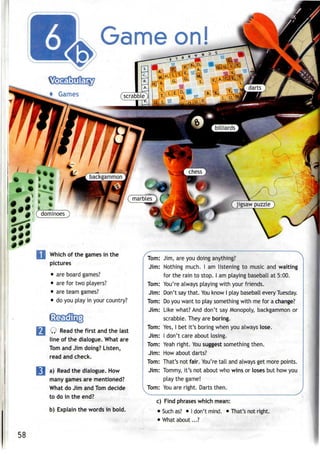
based on
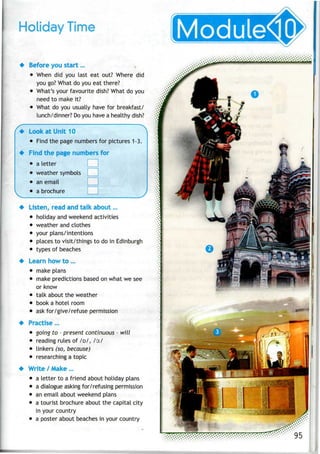
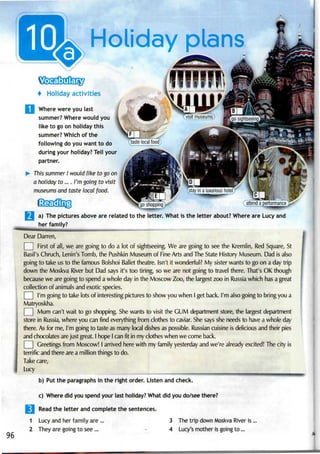
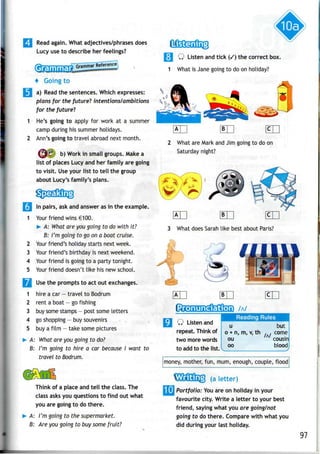
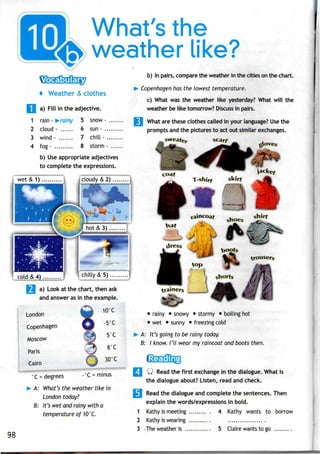
Common
European
Stud
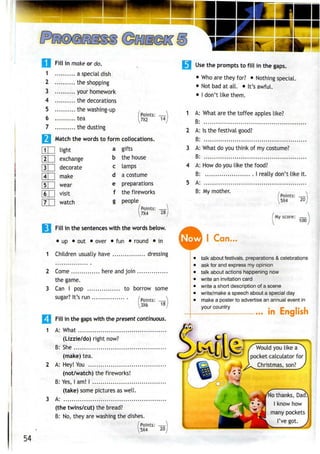
Virginia Evans
Jenny Dooley
Olga Podolyako
Julia Vaulina
Express Publishing PROSVESHCHENIYE
P U B L I S H E R S
B cboKyce
AHMMMCKMM H3blK
6 Knacc
MuHucmepcmeoM oGpasoeaHUfi u HayKU
POCCUUCKOU 0edepau,uu
2-e uadaHue
MOCKBQ
Express Publishing
«f1pocBeuj1eHMe»
2008
VflK
5EK
373.167.1:811.111
81.2AHm-922
A64
«AHrnMMCKi/iti B <poKyce» ocnoBana B 2006 ropy.
Ha yne6HMK no^yneHbi nojioxme/ibHbie
n PoccukicKOM aKafleMnn o6pa30BaHna.
POCCMMCKOM HayK
ABiopbi: (O.E. Bayjinna, flx. fly/in, O.E. (IOAOJIHKO, B. 3saHC
Virginia Evans, Jenny Dooley, Olga Podolyako, Julia Vaulina
Acknowledgements
Authors' Acknowledgements
We would like to thank all the staff at Express Publishing who have contributed their skills to producing this book. Thanks for
their support and patience are due in particular to: Megan Lawton (Editor in Chief); Mary Swanand Sean Todd (senior editors);
Michael Sadler and Steve Miller (editorial assistants); Richard White (senior production controller); the Express Publishing
design team; Warehouse(recording producers);and Kevin Harris, Kimberly Baker, Steven Gibbs and Christine Little. We would
also like to thank those institutions and teachers who piloted the manuscript, and whose comments and feedback were
invaluable in the production of the book.
Colour Illustrations:Stone, Chris. Music Compositions & Arrangement by Ted andTaz.
•
While every effort hasbeen made to trace all the copyright holders, if any have been inadvertently overlooked
the publishers will be pleased to make the necessary arrangements at the first opportunity.
AHI-JIMMCKMM nsbiK. 6 K/iacc : yne6. ana o6ineo6pa30BaT. yHpexfleHMi/i
A64 /[KD.E. BayjiMHa, flx. fly/in, O.E. noflo.nflKO, B. 3saHc]. - 2-eM3fl. - M. : Express Publishing :
, 2008. -136 c. : w. - (AHrnnMCKMM B dxxyce). - ISBN 978-5-09-019886-8.
yflK 373.167.1:811.111
EBK 81.2AHH1-922
cpoKyce»Cepua
BayjiMHa KDJIMH
EereHbeBHa
3B3HC
6 K/iacc
o6iMeo6pa3OBaTe/ibHbix
Uemp repMaHCKnx
PyKOBOAMiejib Uenrpa B.B. Konbifioea
3aM. pyKOBOAMTenn H.I/I.
PeAaKiop E.P. MuxafibvyK
eepciKa M.A.
Hajioroeaa ^broia - O6mepocci/ii/icKMM icnaccuc^MKaiop npoAyKUMM OK005-93 - 953000. Mafl. JIMU.. Cepi/ia Mfl N° 05824 OT
12.09.01. FloAnncaHO B nenaib c Anano3i/itMBOB 18.04.08. cpopMai 60x90/8. ByMara ocftceTHaa. TapHMiypa DparMaiMKa.
ocpceTHan. YH.-M3A. n. 17',22. Twpax 50 000 30. 3a<a3 N2 3210.
OTKpbiroe aKUMOHepHoe o6iiiecrBO «M3AaTe/ibCTBO «npocBemeHne». 127521, MocKBa, 3-i/i npoe3A MapbMHOi/i pomn, 41.
Express Publishing. Liberty House, New GreenhamPark, Newbury, Berkshire RG196HW. Tel.: (0044)1635817363. Fax: (0044)
1635 817463. e-mail: inquiries@expresspublishing.co.uk http://www.expresspublishing.co.uk
OAO TeepcKOM opAena TpyAosoro Kpacnoro 3HaM6HM no^nrpacf)KOM6MHaT ASTCKOM Jimepaiypbi MM. 50-Jieina CCCP.
170040, r. Tsepb, npocneKT 50 nei OKTq6pq, 46. K
ISBN 978-5-09-019886-8
© Express Publishing, 2006
© MsAaienbCTBO «npocBemeHi/ie», 2006
Bee npasa
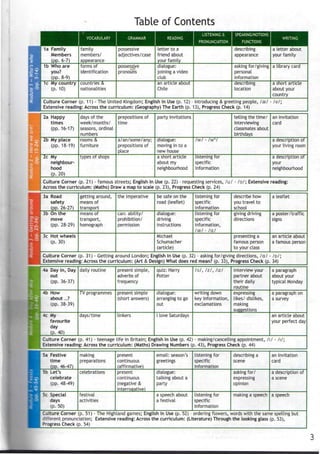
Table of Contents
3RAMMAR
LISTENING &
PRONUNCIATION
SPEAKING/NOTIONS
FUNCTIONS
1a Family
Members
(PP. 6-7)
1b Who are
you?
(pp. 8-9)
1c My country
(P- 10)
family
members/
appearance
forms of
identification
countries &
nationalities
possessive
adjectives/case
possessive
pronouns
letter to a
friend about
your family
dialogue:
joining a video
club
an article about
Chile
describing
appearance
asking for/giving
personal
information
describing
location
a letter about
your family
a library card
a short article
about your
country
Culture Corner (p. 11) - The United Kingdom; English in Use (p. 12) - introducing & greeting people, /asI
Extensive reading: Across the curriculum: (Geography)The Earth (p. 13), Progress Check (p. 14)
lei;
2a Happy
times
(PP. 16-17)
2b My place
(PP. 18-19)
2c My
neighbour-
hood
(p. 20)
days of the
week/ months/
seasons, ordinal
numbers
rooms &
furniture
types of shops
prepositions of
time
a/an/some/any;
prepositions of
place
party invitations
dialogue:
moving in to a
new house
a short article
about my
neighbourhood
/w/ - /wn
/
listening for
specific
information
telling the time/
interviewing
classmates about
birthdays
an invitation
card
a description of
your living room
a description of
your
neighbourhood
Culture Corner (p. 21) - famous streets; English in Use (p. 22) - requestingservices, /u:/ - /u/; Extensive reading:
Across the curriculum: (Maths) Draw a map to scale (p. 23), Progress Check (p. 24)
3a Road
safety
(pp. 26-27)
3b On the
move
(pp. 28-29)
3c Hot wheels
(p. 30)
getting around,
means of
transport
means of
transport,
homograph
the imperative
can: ability/
prohibition/
permission
be safe on the
road (leaflet)
dialogue:
driving
instructions
Michael
Schumacher
(article)
listening for
specific
information
listening for
specific
information,
/ae/ - /a:/
describe how
you travel to
school
giving driving
directions
presenting a
famous person
to your class
a leaflet
a poster/traffic
signs
an article about
a famous person
Culture Corner (p. 31) - Getting around London; English in Use (p. 32) - asking for/giving directions, /a:/ - /D/;
Extensive reading: Across the curriculum: (Art & Design)What does red mean? (p. 33), Progress Check (p. 34)
4a Day in, Day
out
(PP- 36-37)
4b How
about ...?
(pp. 38-39)
4c My
favourite
day
(p. 40)
daily routine
TV programmes
days/time
present simple,
adverbs of
frequency
present simple
(short answers)
linkers
quiz: Harry
Potter
dialogue:
arranging to go
out
I love Saturdays
/S/, /Z/, /IZ/
writing down
key information,
exclamations
interview your
partner about
their daily
routine
expressing
likes/ dislikes,
making
suggestions
a paragraph
about your
typical Monday
a paragraph on
a survey
an article about
your perfect day
Culture Corner (p. 41) - teenage life in Britain; English in Use(p. 42) - making/cancelling appointment, l'.l - ll;
Extensive reading: Across the curriculum: (Maths) Drawing Numbers (p. 43), Progress Check (p. 44)
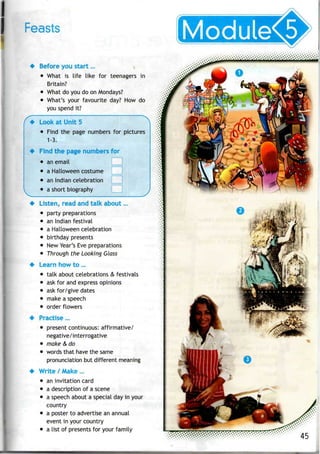
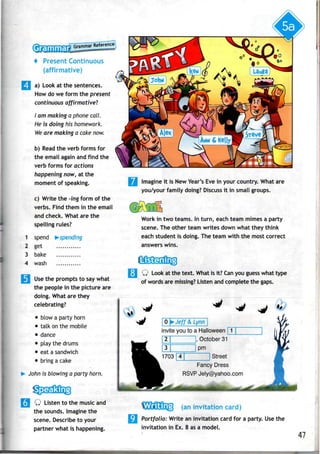
5a Festive
time
(pp. 46-47)
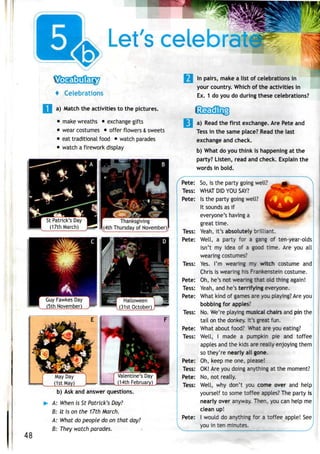
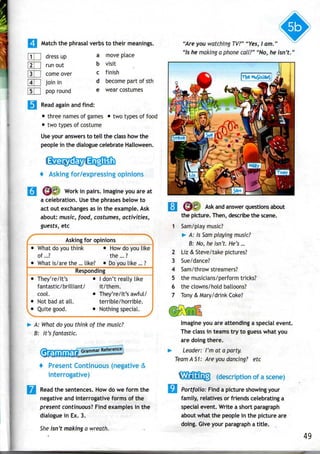
5b Let's
celebrate
(pp. 48-49)
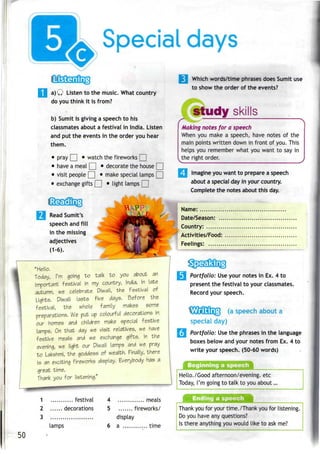
:: Special
days
(p. 50)
making
preparations
celebrations
festival
activities
present
continuous
(affirmative)
present
continuous
(negative &
interrogative)
email: season's
greetings
dialogue:
talking about a
party
a speech about
a festival
listening for
specific
information
listening for
specific
information
describing a
scene
asking for/
expressing
opinion
making a speech
an invitation
card
a description of
a scene
a speech
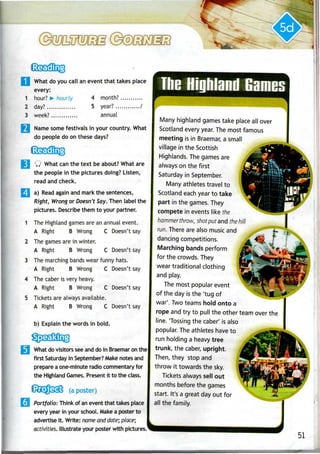
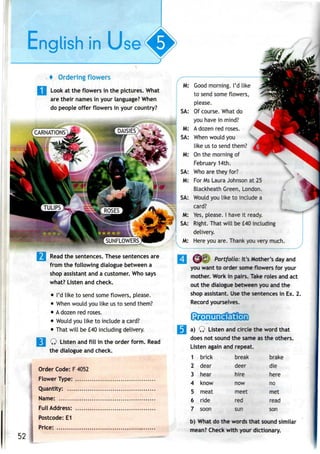
Culture Corner (p. 51) - The Highland games; English in Use (p. 52) - ordering flowers, words with the same spelling but
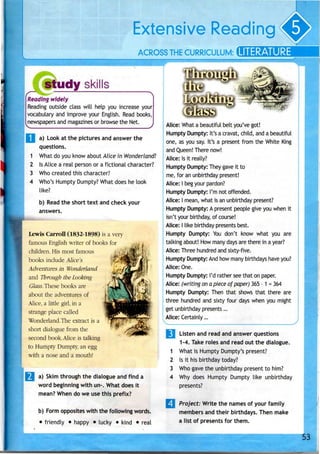
efferent pronunciation; Extensive reading: Across the curriculum: (Literature) Through the looking glass (p.53),
Progress Check (p. 54)
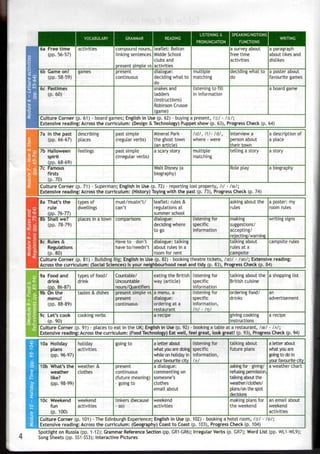
VOCABULARY GRAMMAR READING
LISTENING &
PRONUNCIATION
SPEAKING/NOTIONS
FUNCTIONS
WRITING
1
II§•
I
1
ffl
6a Free time
(pp. 56-57)
6b Game on!
(pp. 58-59)
6c Pastimes
(p. 60)
activities
games
compound nouns,
linkingsentences
present simple vs
present
continuous
leaflet: Bolton
Midde School
clubs and
activities
dialogue:
deciding what to
do
snakes and
ladders
(instructions)
Robinson Crusoe
(game)
multiple
matching
listening to fill
in information
a survey about
free time
activities
deciding what to
do
aparagraph
about likes and
dislikes
a poster about
favourite games
a boardgame
Culture Corner (p. 61) - board games; English in Use (p. 62) - buying a present, /o:/ - /a:/;
Extensive reading: Across the curriculum: (Design & Technology) Puppet show (p. 63), Progress Check (p. 64)
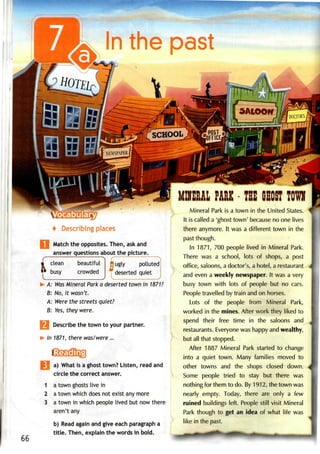
7a In the past
(pp. 66-67)
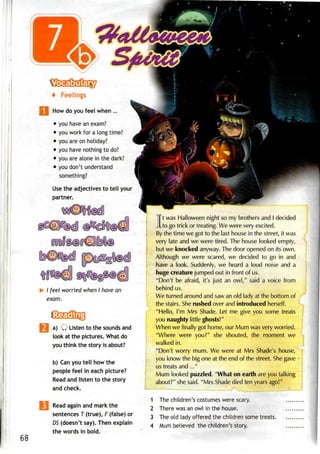
7b Halloween
spirit
(pp. 68-69)
7c Famous
firsts
(P- 70)
describing
places
feelings
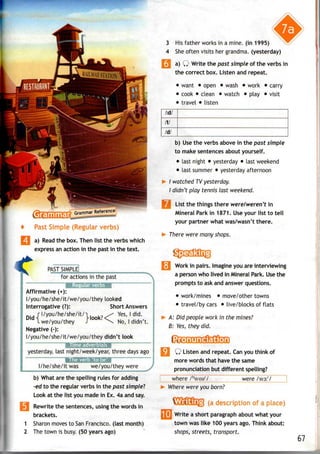
past simple
(regular verbs)
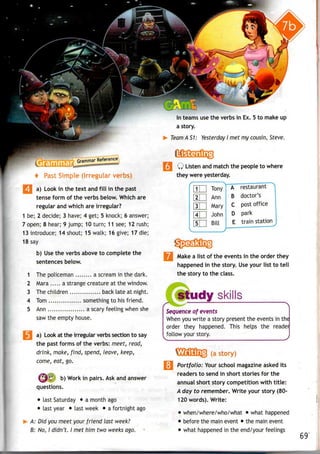
past simple
(irregular verbs)
Mineral Park -
the ghost town
(an article)
a scary story
Walt Disney (a
biography)
/id/, HI- /d/,
where - were
multiple
matching
interview a
person about
their town
telling a story
Role play
a description of
a place
a story
a biography
Culture Corner (p. 71) - Superman; English in Use (p. 72) - reporting lost property, ll - /ie/;
Extensive reading: Acrossthe curriculum: (History) Toying with the past (p. 73), Progress Check (p. 74)
8a That's the
rule
(pp. 76-77)
8b Shall we?
(pp. 78-79)
8c Rules &
Regulations
(p. 80)
types of
dwellings
places in a town
must/mustn't/
can't
comparisons
Have to - don't
have to/needn't
leaflet: rules &
regulations at
summer school
dialogue:
deciding where
to go
dialogue: talking
about rules in a
room for rent
listening for
specific
information
asking about the
rules
making
suggestions/
accepting/
rejecting/warning
talking about
rules at a
campsite
a poster: my
room rules
writing signs
campsite rules
Culture Corner (p. 81) - Building Big; English in Use (p. 82) - booking theatre tickets, /ao/ - /eu/; Extensive reading:
Across the curriculum: (Social Sciences) Is your neighbourhood neat and tidy (p. 83), Progress Check (p. 84)
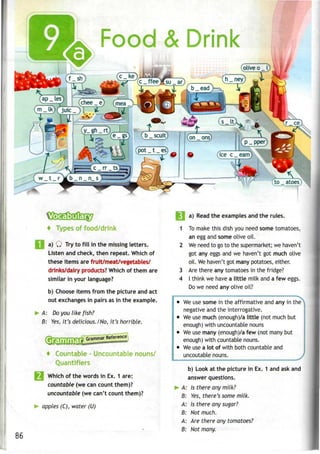
9a Food and
drink
(pp. 86-87)
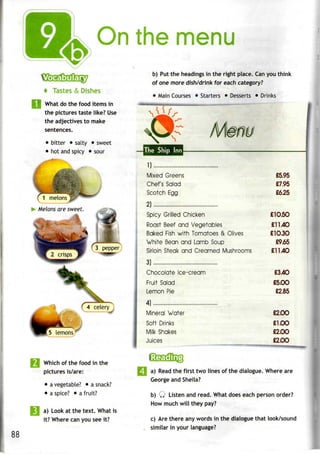
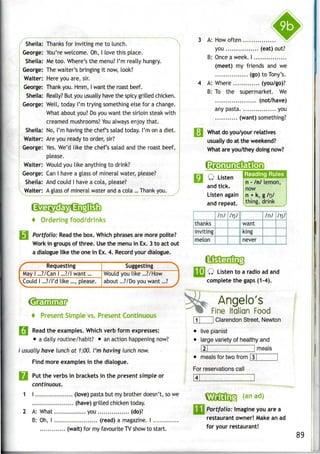
9b On the
menu!
(pp. 88-89)
9c Let's cook
(p. 90)
types of food/
drink
tastes & dishes
cooking verbs
Countable/
Uncountable
nouns/Quantifiers
present simple vs
present
continuous
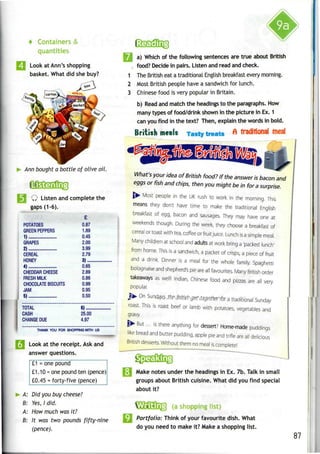
eating the British
way (article)
a menu, a
dialogue:
ordering at a
restaurant
a recipe
listening for
specific
information
listening for
specific
information,
/n/ -/n/
talking about the
British cuisine
ordering food/
drinks
giving cooking
instructions
a shopping list
an
advertisement
a recipe
Culture Corner (p. 91) - places to eat in the UK; English in Use (p. 92) - booking a table at a restaurant, fee/ - /A/;
Extensive reading: Across the curriculum: (Food Technology) Eatwell, feel great, look great! (p. 93), ProgressCheck (p. 94)
10a Holiday
plans
(PP. 96-97)
10b What's the
weather
like?
(pp. 98-99)
10c Weekend
fun
(p. 100)
holiday
activities
weather &
clothes
weekend
activities
going to
present
continuous
(future meaning)
- going to
linkers (because
-so)
a letter about
what you are doing
while on holiday in
your favourite city
a dialogue:
commenting on
someone's
clothes
email about
weekend
activities
listening for
specific
information,
/A/
talking about
future plans
asking for - giving/
refusing permission,
talking about the
weather/clothes/
plans/on the spot
decisions
making plans for
the weekend
a letter about
what you are
going to do in
your favourite city
a weather chart
an email about
weekend
activities
Culture Corner (p. 101) - The Edinburgh Experience; English in Use (p. 102) - booking a hotel room, /o:/ - lot;
Extensive reading: Acrossthe curriculum: (Geography) Coast to Coast (p. 103), Progress Check (p. 104)
Spotlight on Russia (pp. 1-12); Grammar ReferenceSection (pp. GR1-GR6); Irregular Verbs (p. GR7);Word List (pp. WL1-WL9);
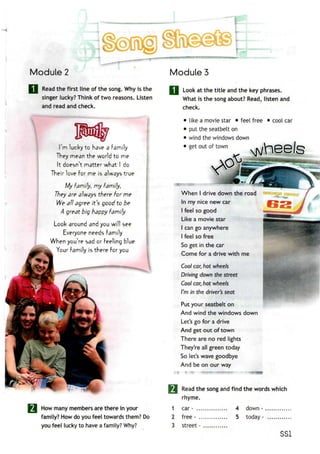
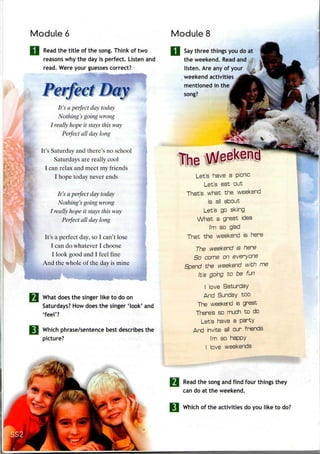
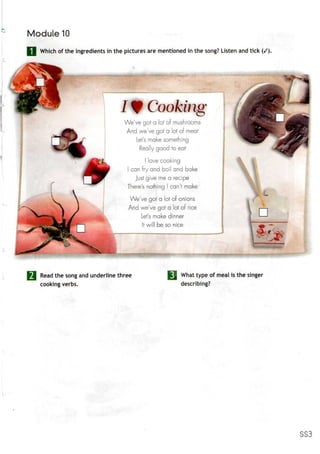
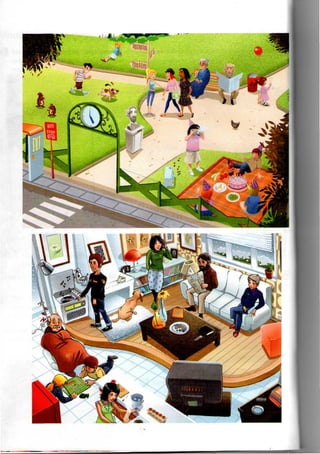
Song Sheets (pp. SS1-SS3); Interactive Pictures
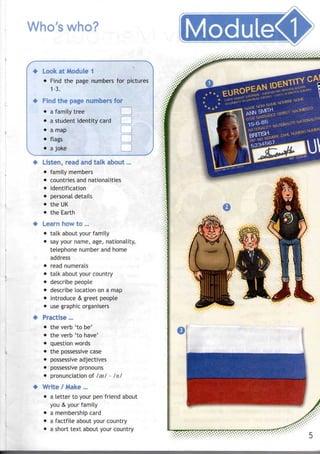
Who's who? ModuleCl
Look at Module 1
• Find the page numbers for pictures
1-3.
Find the page numbers for
• afamily tree
• a student identity card
• a map
• flags
• a joke
Listen, read and talk about...
• family members
• countries and nationalities
• identification
• personal details
• the UK
• the Earth
Learn how to ...
• talk about your family
• say your name, age, nationality,
telephone number and home
address
• read numerals
• talk about your country
• describe people
• describe location on a map
• introduce & greet people
• use graphic organisers
Practise...
• theverb 'to be'
• theverb 'to have'
• question words
• the possessive case
• possessive adjectives
• possessive pronouns
• pronunciation of /eel - lei
Write / Make...
• a letter to your penfriend about
you & your family
• a membership card
• a factfile about your country
• a short text about your country
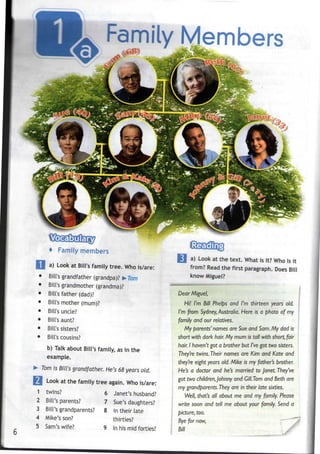
Family Members
Family members
a) Look at Bill's family tree. Whois/are:
Bill's grandfather (grandpa)? >Tom
Bill's grandmother (grandma)?
Bill's father (dad)?
Bill's mother (mum)?
Bill's uncle?
Bill's aunt?
Bill's sisters?
Bill's cousins?
b) Talk about Bill's family, asin the
example.
Tom is Bill's grandfather. He's68 years old.
Look at the family tree again. Whois/are:
a) Look at the text. What is it? Who is it
from? Read the first paragraph. Does Bill
know Miguel?
1 twins? 6
2 Bill's parents? 7
3 Bill's grandparents? 8
4 Mike's son?
5 Sam's wife? 9
Janet's husband?
Sue's daughters?
in their late
thirties?
in his mid forties?
Dear Miguel,
Hi! I'm Bill Phelps and I'm thirteen years old.
I'm from Sydney,Australia. Here is a photo of my
family and our relatives.
My parents'names are Sue and Sam.My dad is
short with dark hair. My mum is tall with short, fair
hair. I haven't got a brother but I've got two sisters.
They're twins. Their names are Kim and Kate and
they're eight years old. Mike is my father's brother.
He's a doctor and he's married to Janet. They've
got two children,Johnny and Gill.Tom and Beth are
my grandparents.They are in their late sixties.
Well, that's all about me and my family. Please
write soon and tell me about your family. Send a
picture, too.
Bye for now,
Bill
b) Q Listen and read the letter and mark
the sentences 1-4 T (true) or F (false).
Read the letter out loud.
1 Janet is Bill's mum.
2 Bill's got two brothers.
3 Tom and Beth have got two sons.
4 Johnny and Gill are Bill's cousins
*• Askand answer questions about Bill's
family.
S1: How many sisters has Bill got?
S2: He has got two sisters. How many...
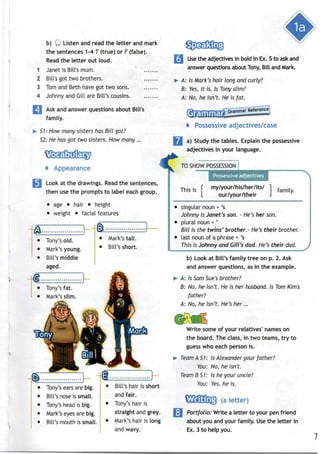
t Appearance
Look at the drawings. Read the sentences,
then use the prompts to label each group.
• age• hair • height
• weight • facial features
• Tony's old.
• Mark's young.
• Bill's middle
aged.
3
Mark's tall.
Bill's short.
Tony's fat.
Mark's slim.
Tony's ears are big.
Bill's nose is small.
Tony's head is big.
Mark's eyes are big.
Bill's mouth is small.
Bill's hair is short
and fair.
Tony's hair is
straight and grey.
Mark's hair is long
and wavy.
I Use the adjectives in bold in Ex. 5 to ask and
answer questions about Tony, Bill and Mark.
> A: Is Mark's hair long and curly?
B: Yes,it is. Is Tony slim?
A: No, he isn't. He is fat.
4 Possessive adjectives/case
a) Study the tables. Explain the possessive
adjectives in your language.
TO SHOW POSSESSION
This
Possessive adjectives
isis f my/your/his/her/its/ 1 famll
[ our/your/their J
• singular noun + 's
Johnny is Janet's son. - He's her son.
• plural noun +'
Bill ;s the twins' brother.- He's their brother.
• last noun of a phrase + 's
This is Johnny and Gill's dad. He's their dad.
b) Look at Bill's family tree on p. 2.Ask
and answer questions, as in the example.
A: Is Sam Sue's brother?
B: No, he isn't. He is her husband. Is Tom Kim's
father?
A: No, he isn't. He's her...
Write some of your relatives' names on
the board. The class, in two teams, try to
guess who each person is.
Team AS1: Is Alexander your father?
You: No, he isn't.
Team BS1: Is he your uncle?
You: Yes,he is.
(a letter)
Portfolio: Write a letter to your pen friend
about you and your family. Usethe letter in
Ex. 3 to help you.
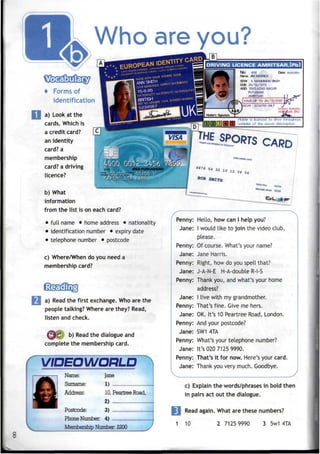
Who are you?
No: 406
Name: JM MARRKK
SOW : a MANMMON SMGH
DOB: 26/12/1973
ADD: 3582.AZAD NAGAR
PUTUGHAR
AMWTSAR
VALD UPTO 26/12/2020
Holder is licenced to drive
vehicles of the above descreption
BOB
4 Forms of
identification
a) Look at the
cards. Which is
a credit card?
an identity
card? a
membership
card? a driving
licence?
b) What
information
from the list is on each card?
• full name • home address • nationality
• identification number • expiry date
• telephone number • postcode
c) Where/When do you need a
membership card?
E
| a) Read thefirst exchange. Who are the
people talking? Where are they? Read,
listen and check.
@6 b) Read the dialogueand
complete the membership card.
VIDEOWORLD ^
Name: Jane
Surname: 1)
Address: 10,Peartree Road,
2)
Postcode: 3)
Phone Number: 4)
Membership Number: 2200
Penny: Hello, how can I help you?
Jane: I would like to join the video club,
please.
Penny: Of course. What's your name?
Jane: Jane Harris.
Penny: Right, how do you spell that?
Jane: J-A-N-E H-A-double R-I-S
Penny: Thank you, and what's your home
address?
Jane: I live with my grandmother.
Penny: That's fine. Give me hers.
Jane: OK. It's 10 Peartree Road, London.
Penny: And your postcode?
Jane: SW1 4TA
Penny: What's your telephone number?
Jane: It's 020 7125 9990.
Penny: That's it for now. Here's your card.
Jane: Thank you very much. Goodbye.
V ^
c) Explain the words/phrases in bold then
in pairs act out the dialogue.
Read again. What are these numbers?
1 10 2 71259990 3 5w14TA
Grammar
"Grammar Reference^
p—«>——-wr
'
Possessive pronouns
Read the examples. What is the
difference between the possessive
adjectives and the possessive pronouns'?
Say them in your language.
This ismy card. - It's mine.
my ->
your -»
his -»
her ->
it -»
mine our ->
yours your ->
his their -»
hers
—
ours
yours
theirs
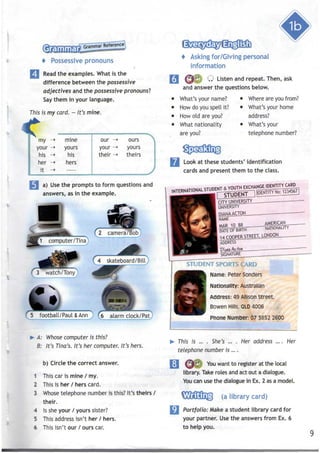
a) Usethe prompts to form questions and
answers, asin the example.
5 football/Paul & Ann ) (5 alarm clock/Pat)
> A: Whose computer is this?
B: It's Tina's. It's her computer. It's hers.
b) Circle the correct answer.
1 This car is mine / my.
2 This is her / hers card.
3 Whose telephone number is this? It's theirs /
their.
4 Issheyour / yours sister?
5 This address isn't her / hers.
6 This isn't our / ourscar.
Asking for/Giving personal
information
Q Listen and repeat. Then,ask
and answer the questions below.
What's your name?
How do you spell it?
How old are you?
What nationality
are you?
Where are you from?
What's your home
address?
What's your
telephone number?
Look at these students' identification
cards and present them to the class.
^^^m^S^^^^^^
SIGNATURE
^^~~~- """
STUDENT SPORTS;|ARD
Name: Peter Senders
Nationality: Australian
Address: 49 AllisonStreet,
Bowen Hills, OLD 4006
Phone Number: 07 3852 2600
This is ... . She's ... . Her address
telephone number is ... .
Her
O^ You want to register at the local
library. Take roles and act out a dialogue.
You can use the dialogue in Ex. 2 asa model.
(a library card)
Portfolio: Make a student library card for
your partner. Usethe answers from Ex. 6
to help you.
My country
f Countries & Nationalities
a) Q Match the countries to
the nationalities. Listen and
check. What nationality are you?
(^6 b) Choose a flag and
describe it to your partner.
Your partner guesses which
one it is.
+ Describing Location
a) What do the letters on the
compass mean? Use the box
to say.
(compass)
N
NW NE
SW SE
' • ...the south/north/east/west...
• ...in the northeast/ southwest/
etc of...
tLAS
b) Ask and answer as
in the example.
A: Where exactly is Africa?
B: It's in the north of Chile.
Read the title of the text.
What do you expect the text
to be about? Listen, read
and check. Then answer the
questions (1-3). Explain the
words in bold.
1 Where's Maria from?
2 What's the capital city of Chile?
3 What can a tourist see in Chile?
- - . . . . . . . .
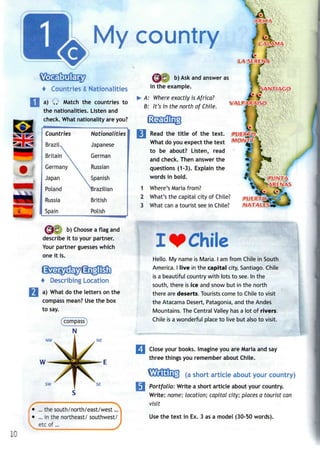
Chile
Hello. My name is Maria. I am from Chile in South
America. I live in the capital city, Santiago. Chile
is a beautiful country with lots to see. In the
south, there is ice and snow but in the north
there are deserts. Tourists come to Chile to visit
the Atacama Desert, Patagonia, and the Andes
Mountains. The Central Valley has a lot of rivers.
Chile is a wonderful place to live but also to visit.
Close your books. Imagine you are Maria and say
three things you remember about Chile.
(a short article about your country)
Portfolio: Write a short article about your country.
Write: name; location; capital city; places a tourist can
visit
Use the text in Ex. 3 as a model (30-50 words).
10
Shetland i /
Islands . S I
North Atlantic
Ocean
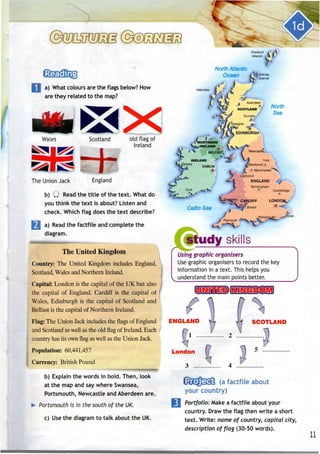
a) What colours are the flags below? How
are they related to the map?
A/ort/7
Sea
Wales Scotland
The Union Jack England
old flag of3
Ireland
xt. What do
i% /•*
ifr
zg
^Ckl*e
caa '?«'NORTHERN .(
v , IRELAND ^ XN*1
BELFAST|
, * Isle/f
^^IRELAND -* ^
'<i"ay
DUBLIN
• ' ,%
$'•
t
Cork ^feji ^
*• * 4*
•hfitvBwrivin
^»
* "/ «/ Newcastle
Vj York
{•Blackpool *
/ • Manchester
Liverpool
ENGLAND
Birmingham
Cambridge
you think the text is about? Listen and
check. Which flag does the text describe?
a) Read the factfile and complete the
diagram.
CARD|FF
Celtic Sea
tmt
Plymouth
X"
B- Dover
udy skills
The United Kingdom
Country: The United Kingdom includes England,
Scotland, Wales and Northern Ireland.
Capital: London is the capital of the UK but also
the capital of England. Cardiff is the capital of
Wales, Edinburgh is the capital of Scotland and
Belfast is the capital of Northern Ireland.
Flag: The Union Jack includes the flags of England
and Scotland as well as the old flag of Ireland. Each
country has its own flag as well as the Union Jack.
Population: 60,441,457
Currency: British Pound
Using graphic organisers
Use graphic organisers to record the key
information in a text. This helps you
understand the main points better.
SCOTLAND
b) Explain the words in bold. Then, look
at the map and say where Swansea,
Portsmouth, Newcastleand Aberdeen are.
Portsmouth is in the south of the UK.
c) Usethe diagram to talk about the UK.
(a factfile about
your country)
Portfolio: Make a factfile about your
country. Draw the flag then write a short
text. Write: name of country, capital city,
description of flag (30-50 words).
11
i i
* Introducing &greeting people
Read the sentences. Which do we use to
introduce people? to greet people?
• Hi! How areyou?
• I'mfine, thanks.
• I'd like to introduce youto...
• Pleased to meet you.
• This is myfriend ...
• Notbad, thanks.
Q Listen andread. Whomeets for the first
time?
Cathy: Tony! Come in!
Tony: Hi Cathy. How are you?
Cathy: I'm fine, thanks. Howabout you?
Tony: Fine.
Cathy: I'd like to introduce youto Jim.
Tony: Hello Jim. Pleasedto meet you.
Jim: Pleasedto meet you too.
v
B / Mary: Good morning Bill. How are you?
Bill: Fine, thanks. Andyou?
Mary: Fine thanks.
Ann: Hi there, Steve.
Steve: Oh hi! How are you?
Ann: Not bad, thanks.
Portfolio: In pairs or groups use phrases
from Ex. 1 to act out similar dialogues.
Record yourselves.
a) Q Listenand
repeat. Add two
words to each
category.
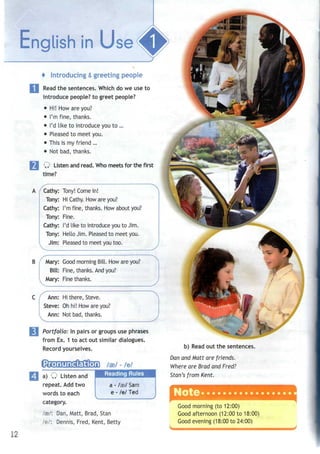
/»/: Dan, Matt, Brad, Stan
lei: Dennis, Fred, Kent, Betty
/ae/ - /el
a - /as/Sam
e - lei Ted
-i
b) Read out the sentences.
Dan and Matt are friends.
Where are Brad and Fred?
Stan's from Kent.
Good morning (to 12:00)
Good afternoon (12:00 to 18:00)
Good evening (18:00 to 24:00)
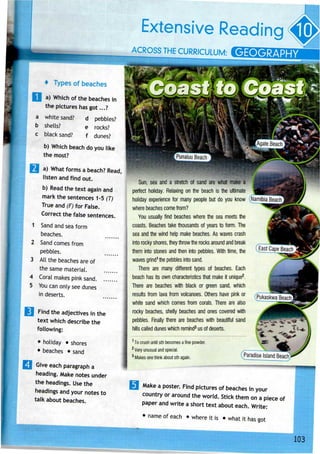
Extensive Reading
ACROSS THE CURRICULUM: GEOGRAPHY
GREENLAND
IC A N A D A
UNITED STATES
of AMERICA
XV,ME»CO fig*
JSELIZEJAMAICA RICO {USA;
BARBADOS
PANAMA
COLOMBIA

iBRAZIL
PERU
X BOLIVIA
PARACUAY
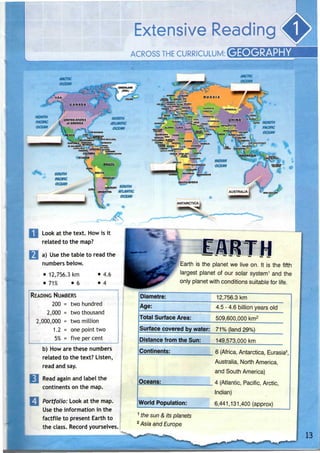
Look at the text. How is it
related to the map?
a) Usethe table to read the
numbers below.
• 12,756.3 km • 4.6
• 71% • 6 • 4
READING NUMBERS
200 = two hundred
2,000 = two thousand
2,000,000 = two million
1.2 = one point two
5% = five per cent
b) How are these numbers
related to the text? Listen,
read and say.
Read again and label the
continents on the map.
Portfolio: Look at the map.
Use the information in the
factfile to present Earth to
the class. Record yourselves.
AMSTTtC
NORWAY .FINLAND
«vffiss> *• f«w"f|r-ADBI.AKX, »i!**5_.
R U S S IIA
mw^iMONGOLIA
) -SPAIN " f^rt™?^^,
MOROCCO WIIBIA^ .1SH^ IRAQ
ALGERIA LIBYi
NIGER
PAKISTAN !
N. KOREA ^
CHINA S
-KOR
^A
<
BANGLADESH
m^" ,unlr?1
^ESHwi
™^(
R SWPJ* BURMA :LAO3 (
*HAD VU.B, 1-VrHAILANB V
SUDAM I 1 SCAMBODIA
"A / SOMALIA  | I T THINIGERIA
LIBEBIA "'CAMEROON'"' "«««»
COTE o-rvoise |
GABON tDEM,REP. (KENYA
Y c«K ^TANZANIA
ANGELA L ||
"MOZAMBIQUE
[SfAMBOCHA ,
[ > THE'-PHIUPPINES
'JSRA
1|KIDPNESIA-V
1-
ZIMHABWE
^^ BOTSWANA
MADAGASCAR
SOUTH AFRICA
ANTARCTICA t
AUSTRALIA HEW ZEALAND
'
ETOTHr Earth is the planet we live on. It is the fifth
largest planet of our solar system1
and the
only planet with conditions suitable for life.
Diametre: 12,756.3 km
Age: 4.5 - 4.6 billion years old
Total Surface Area: 509,600,000 km2
Surface covered by water: 71 % (land 29%)^
Distance from the Sun: 149,573,000 km
Continents:
Oceans:
World Population:
6 (Africa, Antarctica, Eurasia2
,
Australia, North America,
and South America)
4 (Atlantic, Pacific, Arctic,
Indian)
6,441,131,400 (approx)
1
the sun & its planets
2
Asia and Europe
13
__^•1 T J | ^ I
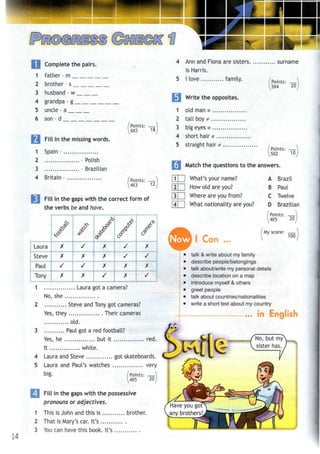
I Complete the pairs.
1 father - m
2 brother - s
3 husband - w
4 grandpa - g
5 uncle - a
6 son - d
Fill in the missing words.
Spain -
Points: —
6X3 18
1
2
3
4 Britain
- Polish
- Brazilian
(Points: —
4X3 12
Fill in the gaps with the correct form of
the verbs be and have.
Laura
Steve
Paul
Tony
,/
X
X
/
>
/
/
X
/
X
1 Laura !
No
2
she
/X
X
X
s
^^Q
<5^
/
/
X
y
<^
X
/
X
'jot a camera?
, . Steve and Tonv sot cameras?
Yes, they Their cameras
old.
3 Paul got a red football?
Yes, he but it red.
It white.
4 Laura and Steve got skateboards.
5 Laura and Paul's watches very
big. /Points: —
^4X5 20
14
Fill in the gaps with the possessive
pronouns or adjectives.
1 This is John and this is brother.
2 That is Mary's car. It's
3 Youcan have this book. It's..
4
5
Ann and Fiona are sisters surname
is Harris.
I love family. [Points: —)
5X4 20
Write the opposites.
old man *
tall boy *
big eyes *
short hair *
straight hair*
/Points: —
5X2 10
Match the questions to the answers.
LU What's your name?
How old are you?
Where are you from?
What nationality are you?
A Brazil
B Paul
C Twelve
D Brazilian
Points:
4X5 20,
Now I Can
My score: —
100
talk & write about my family
describe people/belongings
talk about/write my personal details
describe location on a map
introduce myself & others
greet people
talk about countries/nationalities
write a short text about my country
... in English
No, but my
sister has.
Have you got
any brothers?
I
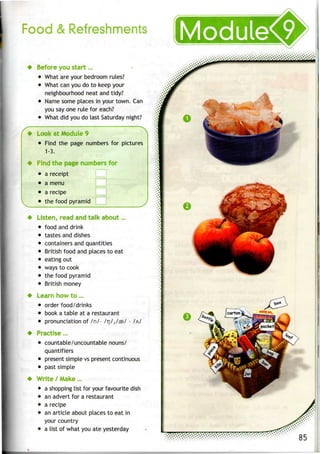
I Herewe are! Module2
Before you start ...
• Present yourself to the class. Talk
about: name, city, age, address,
telephone number, nationality
• How many members are there in your
family? Describe them.
• Where's your country? Which isthe
capital city? What can a tourist see in
your country?
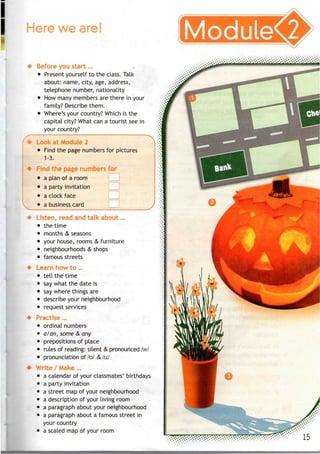
Look at Module 2
• Find the page numbers for pictures
1-3.
Find the page numbers for
• a plan of a room
• aparty invitation
• a clock face
• a businesscard
Listen, read andtalk about ...
the time
months & seasons
your house, rooms & furniture
neighbourhoods & shops
famous streets
Learn how to ...
• tell thetime
say what the date is
say where things are
describe your neighbourhood
request services
Practise ...
• ordinal numbers
• a/an, some & any
• prepositions of place
• rules of reading: silent & pronounced /w/
• pronunciation of /o/ &/u:/
Write / Make ...
• a calendar of your classmates' birthdays
• a party invitation
a street map of your neighbourhood
a description of your living room
a paragraph about your neighbourhood
a paragraph about a famous street in
your country
a scaled map of your room
Happy Times
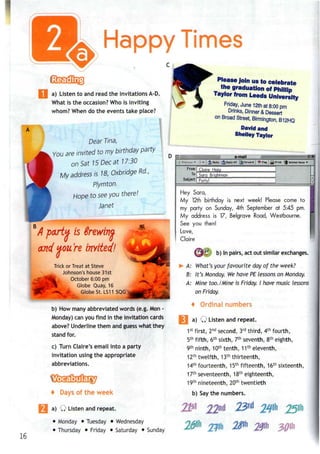
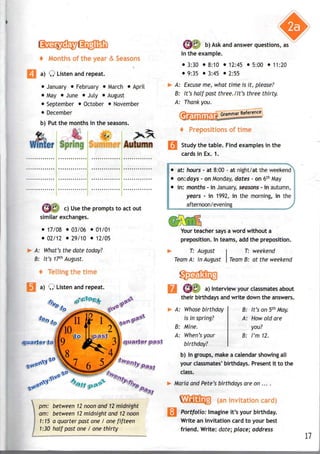
a) Listen to and read the invitationsA-D.
What is the occasion? Who is inviting
whom? When do the events take place?
Dear Tina,
You are invited to my birthday party
on Sat 15 Dec at 17:30
My address is 18, Oxbridge Rd.,
Plymton.
Hope to seeyou there!
Janet
D o:
Please Join us to celebrate
me graduation of Phillip
Taylor from Leeds University
Friday, June 12th at 8:00 pm
Drinks, Dinner & Dessert
on Broad Street, Birmington, B12HQ
David and
Shelley Taylor
e-mail
M
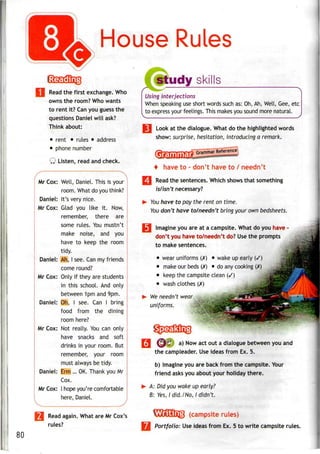
16
A party is Srewim
and you're invited!
Trick or Treat at Steve
Johnson's house31st
October 6:00 pm
Globe Quay, 16
Globe St. LS11 5QG
b) How many abbreviated words (e.g. Mon -
Monday) canyou find in the invitation cards
above? Underline them and guess what they
stand for.
c) Turn Claire's email into a party
invitation using the appropriate
abbreviations.
+ Days of the week
a) Q Listen and repeat.
• Monday • Tuesday • Wednesday
• Thursday • Friday • Saturday • Sunday
-» t ^| Reply !^Forvard [ *§* Flag ;g^ Print *|J Deleted Items •»
From:
To:
Subject:
Claire Haia
Sara Brightman
Party!
Hey Sara,
My 12thbirthday is next week! Please come to
my party on Sunday, 4th September at 5:45 pm.
My address is 17, Belgrave Road, Westbourne.
See you then!
Love,
Claire
(jPfl b) Inpairs, actout similar exchanges.
A: What's your favourite day of the week?
B: It's Monday. We have PE lessons on Monday.
A: Mine too./Mine is Friday. I have music lessons
on Friday.
4 Ordinal numbers
a) Q Listen and repeat.
1st
first, 2nd
second, 3rd
third, 4th
fourth,
5th
fifth, 6th
sixth, 7th
seventh, 8th
eighth,
9th
ninth, 10th
tenth, 11th
eleventh,
12th
twelfth, 13th
thirteenth,
14th
fourteenth, 15th
fifteenth, 16th
sixteenth,
17th
seventeenth, 18th
eighteenth,
19th
nineteenth, 20th
twentieth
b) Saythe numbers.
f Months of the &
*
| a) Q Listen and repeat.
• January • February • March • April
• May • June • July • August
• September • October • November
• December
b) Put the months in the seasons.
i • .,".•"'.: SiOii [fir LI
S$& c
) Use tne
prompts to act out
similar exchanges.
• 17/08 • 03/06 • 01/01
• 02/12 • 29/10 • 12/05
A: What's the date today?
B: It's 17th
August.
t Tellingthe
a) Q Listen and repeat.
quarter to
pm: between 12 noon and 12 midnight
am: between 12 midnight and 12noon
1:15 a quarter past one / one fifteen
1:30 half past one I one thirty
b) Ask and answer questions, as
in the example.
• 3:30 • 8:10 • 12:45 • 5:00 • 11:20
• 9:35 • 3:45 • 2:55
>• A: Excuse me, what time is it, please?
B: It's half past three./It's three thirty.
A: Thank you.
-^Grammar References
i of
I Study the table. Find examples in the
cards in Ex. 1.
• at: hours - at 8:00 - at night/at the weekend
• on:days - on Monday, dates - on 6th
May
i • in: months - in January, seasons - in autumn,
years - in 1992, in the morning, in the
afternoon/evening >
Your teacher says a word without a
preposition. In teams, add the preposition.
T: August
Team A: in August
T: weekend
Team B: at the weekend
a) Interview your classmates about
their birthdays and write down the answers.
6: It's on 5th
May.
A: How old are
you?
B: I'm 12.
A: Whose birthday
is in spring?
B: Mine.
A: When'syour
birthday?
b) In groups, make a calendar showing all
your classmates' birthdays. Present it to the
class.
Maria and Pete's birthdays are on ... .
(an invitation
; Portfolio: Imagine it's your birthday.
Write an invitation card to your best
friend. Write: date; place; address
11
18
My plac
+ Rooms & Furniture
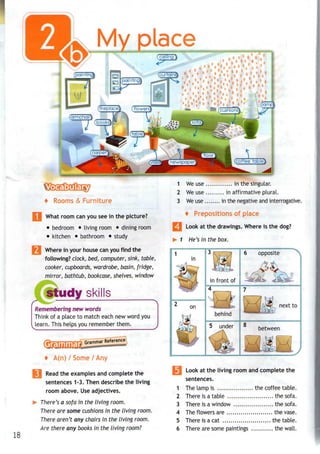
What room can you see in the picture?
• bedroom • living room • dining room
• kitchen • bathroom • study
Where in your house canyou find the
following? dock, bed, computer, sink, table,
cooker, cupboards, wardrobe, basin, fridge,
mirror, bathtub, bookcase, shelves, window
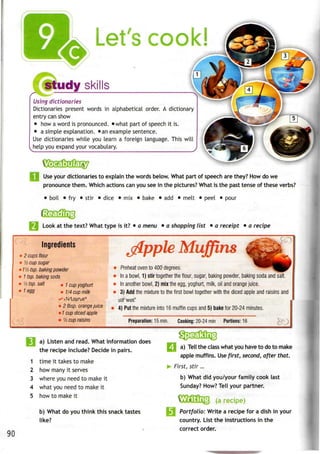
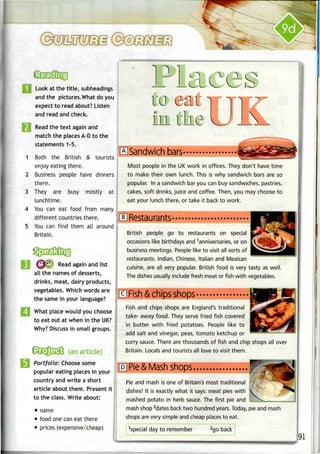
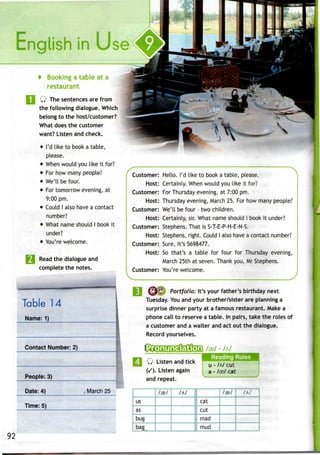
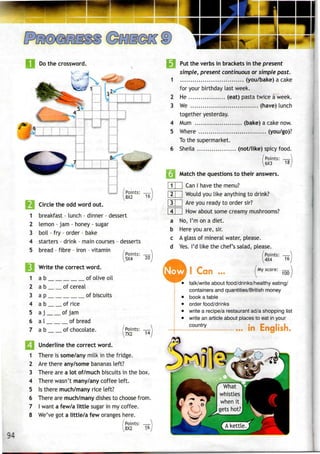
1 We use in the singular.
2 We use in affirmative plural.
3 We use in the negative and interrogative.
+ Prepositions of place
Look at the drawings.Where is the dog?
1 He's in thebox.
in
opposite
in front of
study skills
Remembering new words
Think of a place to match each new word you
learn. This helps you remember them.
on
behind
next to
....
5 u d e r 8
between
Gramm
Grammar Reference
4 / /
Read the examples and complete the
sentences 1-3. Then describe the living
room above. Useadjectives.
There's a sofa in the living room.
There are some cushions in the living room.
There aren't any chairs in the living room.
Are there any books in the living room?
Look at the living room and complete the
sentences.
1 The lamp is the coffee table.
2 There is a table the sofa.
3 There is a window the sofa.
4 The flowers are the vase.
5 There is a cat the table.
6 There are some paintings the wall.
I a) Read the first three exchanges. Where
are Laura, Steve and John? What are they
about to do? What's their relationship?
b) Think of six words you expect to hear.
Listen and read and check.
' N
Laura: Oh, I love our new house! What a big
living room!
Steve: It's really great! Now, let's put the
furniture in place. Can you give me a
hand, John?
John: Sure. Dad. Let's start.
Steve: Wheredo you want the sofa, Laura?
Laura: Put it in front of the window.
Steve: All right... What about this armchair?
John: Quick, Dad, it's really heavy!
Laura: Can you put it next to the fireplace?
John: Agh! Dad, watch out! Is it OK, right
here?
Laura: No, not there! It looks better on the
other side, between the fireplace and
the door. That's great!
Steve: Right... Whereshall we put this clock?
Laura: Oh, put it on the wall, opposite the
sofa. Becareful! It's very expensive!
John: Phew ... Mum, calm down! We're doing
our best,OK?
Laura: OK, I'm sorry. Hmm ... What else ...?
What about this table? Let's place it
between the sofa and the armchair.
Steve: Err... What about the carpet, Laura?
Laura: Oh dear! I want that to go under all
the furniture!
yj ^^11. a) Ingroups of three, read out
the dialogue. Then, replace the pronouns
in bold in sentences 1-5 with words from
the dialogue.
* He asks for help.
2 Putit in front of the window.
3 It's between the fireplace and the door.
- It costs lots of money.
5 This is to go under all the furniture.
b) Read again and find phrases which
mean:
1 Can you help me?
2 Hurry!
3 That's fantastic.
4 Take it easy!
5 What's next?
b) Draw a scene from the dialogue.
rasa
( ^ f Imagine youaremoving house.
In pairs look at the plan of the bedroom.
Make a list of the things you want to put
in it. Then in groups decide what to put in
it and where. Usedialogue in Ex. 6 asa
model.
L7,' balcony window
" door
/w/
%iijijS%S&3iiJi!K Reading Rules
Q Listen and
repeat. In which
word is "w"
silent? Use the
w - /w/we, win,
when, why
silent w - /h
w/ whom,
whose
words to complete the first speaker in the
questions below.
where who what which when
1 A:
B: It's on 5th
November.
2 A:
B: The cushionsare on the sofa.
3 A:
B: It's an armchair.
4 A:
B: Mary's bag is the red one.
5 A:
B: He's my father.
(a description of
my living room)
[I] Portfolio: Draw aplan of your living
room. Write a description of it based on
the plan. Present it to the class.
19
My neighbourhood
4 Shops
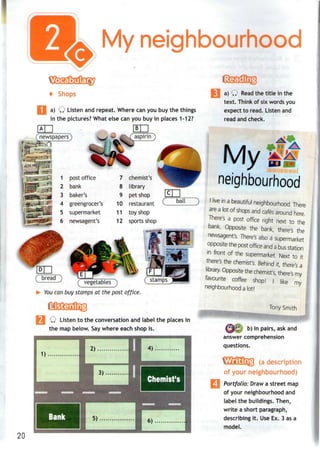
a) Q Listen and repeat. Where can you buy the things
in the pictures? What else can you buy in places 1-12?
i«ai-r-jl
.Jbafcl
bank
3 baker's
4 greengrocer's
5 supermarket
6 newsagent's
chemist's
8 library
9 pet shop
10 restaurant
11 toy shop
12 sports shop
ball
( bread )
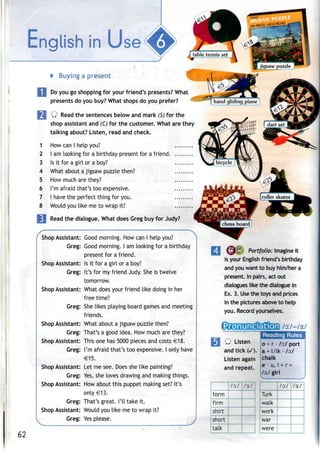
You can buy stamps at the post office.
Q Listen to the conversation and label the places in
the map below. Saywhere each shop is.
20
a) Q Read the title inthe
text. Think of six wordsyou
expect to read. Listen and
read and check.
My
neighbourhood
I live in a beautiful neighbourhood There
are a lot of shops and cafes around here
There's a post office right next to the
bank. Opposite the bank, there's the
newsagent's. There's also a supermarket
opposite the post office and a busstation
m front of the supermarket. Next to it
there's the chemist's. Behind it, there's a
library. Opposite the chemist's, there's my
favourite coffee shop! I like my
neighbourhood a lot!
Tony Smith
b) In pairs, ask and
answer comprehension
questions.
(a description
of your neighbourhood)
Portfolio: Draw a street map
of your neighbourhood and
label the buildings. Then,
write a short paragraph,
describing it. Use Ex. 3 as a
model.
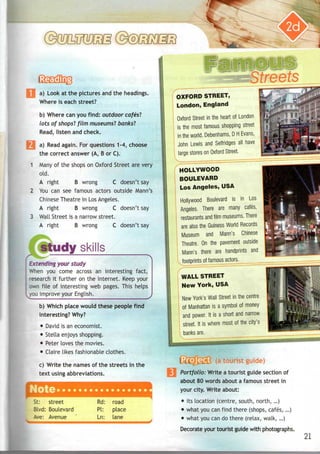
a) Look at the pictures and the headings.
Where is each street?
b) Where can you find: outdoor cafes'?
lots of shops'? film museums'? banks'?
Read, listen and check.
a) Read again. For questions 1-4, choose
the correct answer (A, B or C).
Many of the shops on Oxford Street are very
old.
A right B wrong C doesn't say
You can see famous actors outside Mann's
Chinese Theatre in Los Angeles.
A right B wrong C doesn't say
Wall Street is a narrow street.
A right B wrong C doesn't say
udy skills
Extending your study
When you come across an interesting fact,
research it further on the Internet. Keep your
own file of interesting web pages. This helps
you improve your English.
b) Which place would these people find
interesting? Why?
• David is aneconomist.
• Stella enjoysshopping.
• Peter loves the movies.
• Claire likes fashionable clothes.
c) Write the names of the streets in the
text using abbreviations.
Note
St: street
Blvd: Boulevard
Ave: Avenue
Rd:
PI:
Ln:
road
place
lane
1
J
OXFORD STREET,
London, England
Oxford Street in the heart of London
is the most famous shopping street
I in the world. Debenhams, D HEvans,
| John Lewis and Selfridges all have
I large stores on OxfordStreet.
HOLLYWOOD
BOULEVARD
Los Angeles, USA
Hollywood Boulevard is in Los
Angeles. There are many cafes,
restaurants andfilm museums. There
I are also the Guiness World Records
 Museum and Mann's Chinese
Theatre. On the pavement outside
| Mann's there are handprints and
WALL STREET
New York, USA
New York's Wall Street in the centre
of Manhattan is a symbol of money
and power. It is a short and narrow
street. It is where most of the city's
banks are.
t 11 JJiSs (atourist
Portfolio: Write a tourist guide section of
about 80 words about a famous street in
your city. Write about:
• its location (centre, south, north,...)
• what youcanfind there (shops, cafes,...)
• what youcando there (relax, walk,...)
Decorate your tourist guide with photographs.
21
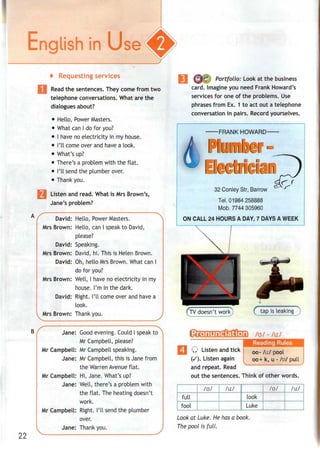
t Requestingservices
Read the sentences. They come from two
telephone conversations. What are the
dialogues about?
• Hello, Power Masters.
• What canI dofor you?
• I have noelectricity in my house.
• I'll come over andhave a look.
• What's up?
• There's a problem with the flat.
• I'll send the plumber over.
• Thank you.
Listen and read. What is Mrs Brown's,
Jane's problem?
David: Hello, Power Masters.
Mrs Brown: Hello, can I speak to David,
please?
David: Speaking.
Mrs Brown: David, hi. This is Helen Brown.
David: Oh, hello Mrs Brown. What can I
do for you?
Mrs Brown: Well, I have no electricity in my
house. I'm in the dark.
David: Right. I'll come over and have a
look.
Mrs Brown: Thank you. j
s-——— ——— — • - —— ^
Jane: Good evening. Could I speak to >
Mr Campbell, please?
Mr Campbell: Mr Campbellspeaking.
Jane: Mr Campbell, this is Jane from
the Warren Avenue flat.
Mr Campbell: Hi, Jane. What's up?
Jane: Well, there's a problem with
the flat. The heatingdoesn't
work.
Mr Campbell: Right. I'll send the plumber
over.
Jane: Thank you. ;
22
Portfolio: Look at the business
card. Imagine you need Frank Howard's
services for one of the problems. Use
phrases from Ex. 1 to act out a telephone
conversation in pairs. Record yourselves.
FRANK HOWARD
32 Conley Str,Barrow
Tel. 01984258888
Mob. 7744 305960
ON CALL 24 HOURS A DAY, 7 DAYS A WEEK
tap isleaking)
/u/ - /u:/
Q Listen and tick
(/). Listen again
and repeat. Read
oo- /u:/ pool
00+ k, u - /o/ pull
out the sentences. Think of other words.
full
fool
/u/ /u:/
izfr 1
look
Luke
/u/ J^L.
Look at Luke. He has a book.
The pool /s full.
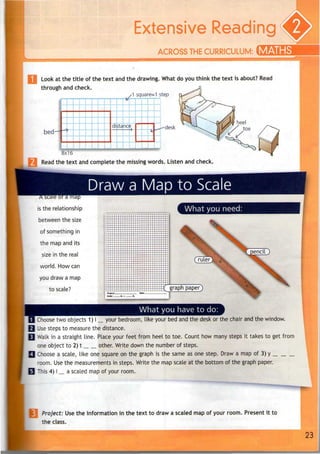
Look at the title of the text and the drawing. What do you think the text is about?Read
through and check.
A square=1 step
bed-
8x16
distano -desk
Read the text and complete the missing words. Listen and check.
Draw a Map to Scale
A scaie or a map
is the relationship
between the size
of something in
the map and its
size in the real
world. How can
you draw a map
to scale?
What you need:
graph paper}
What you have to do:
Ihoose two objects 1)i_ your bedroom, like your bedandthe desk or the chair andthe window.
Use steps to measure the distance.
Walk in a straight line. Place your feet from heel to toe. Count how many steps it takes to get from
one object to 2) t other. Write down the number of steps.
Choose a scale, like one square on the graph is the same as one step. Draw a map of 3) y
room. Usethe measurements in steps. Write the map scale at the bottom of the graph paper.
This 4) i _ a scaled map of your room.
Project: Use the information in the text to draw a scaled mapof your room. Present it to
the class.
What time is it?
1
3
4
•i
8
1
1
1
7
:25
1:15
:45
2:00
:30
/Points: — ]
^5X4 20J
Circle the odd word out.
bank - baker's - vase - library
fireplace - sofa - armchair - bathtub
newsagent's - toy shop - supermarket - aspirin
4 spring - May - autumn - winter
5 first - two - ninth - sixth
(Points: ^}
5X4
Look at the picture and complete the
sentences with prepositions of place.
20
1 The window is the sofa.
2 The coffee table is the armchair.
3 The lamp is the coffee table.
4 There's a fireplace the room.
5 There's a small table ., ..the sofa.
Choose the correct word.
24
Points: —
5X4 20
1 Is there a/some baker's?
2 There are any/some shops in that street.
3 There aren't some/any supermarkets here.
4
5
1
2
3
My birthday is on/in 5th November.
Meet me on/at 8.30!
'Points:
5X2 10,
Fill in: at, in or on.
1st May
1991
,. the
weekend
4 8:30pm
5 the
morning
Points: —
5X2 10
Match the questions in column Awith the
correct answers in column B.
What's the date
today?
How old are you?
When is your
birthday?
What time is it?
Where do you want
the vase?
Now I Can
tell the time
write a tourist guide
say where things are
write an invitation card
describe my house,
its rooms & furniture
B
a Place it over
there.
b It's on 5th May.
c It's half past
three.
d I'm 12.
e It's 17th
August.
/Points: —}
5X4 201
My score: —
100
describe my
neighbourhood
request services
draw a scaled map
in English
hat room has no
ceiling, floor,
oors or windows?
Getting around
Before you start...
• When's your birthday?
• What's your house like? Describe
your room.
• Name some shops. Are anyof them
in your neighbourhood?
Look at Module 3
• Find the page numbers for pictures
1-3.
Find the page numbers for
• astreet map
• a road safety leaflet
• traffic signs
• a famous person
Listen, read and talk about...
• means of transport
• road safety
• traffic signs
• famous racing drivers
• driving in the UK/your country
• symbolisms of red
Learn how to ...
• give instructions
• give directions
Practise ...
• the imperative
• can & can't/cannot (ability,
permission & prohibition)
• pronunciation of fee/ - /a./, /a:/ -/D/
• homographs
Write / Make ...
• a safety leaflet for children playing
outside
• a poster of traffic signs in your
country
• a short article about afamous
person
• a poster for tourists about driving in
your country
Road safety
4 Getting
Which of these things can you see on the road outside: your school? your home?
fzebracrossirigj
(trafficwardeni
(sjl^ Match the words in columnsAand B
to make phrases. In pairs discusswhat is
dangerous/safe to do in your country.
B
the window
B the pavement
the driver
the road
both ways
across the road
a seat belt
> It'ssafe to wear a seat belt.
m
in
si]
4]71
in
6"n
7TH
A
wear
walk straight
look
run onto
talk to
walk on
lean out of
A
B
C
D
E
F
G
b) Usethe phrases in Ex. 2 to give
instructions on road safety.
1 When on the street, > look both ways
before crossing. Don't
2 When in the car,
3 When on the bus,
f The imperative (Giving instructions)
H| a) Read the examples. Howdowe form
the imperative?
Wear your seat belt! Don't talk to the driver!
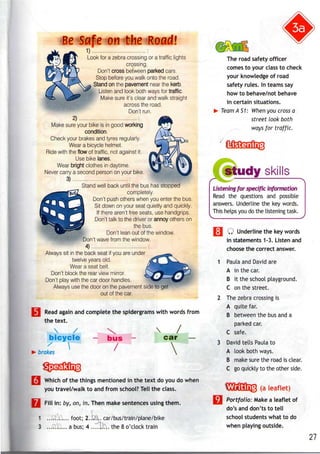
I a) Q Look at the text andits titleon
p. 23. What do you expect to read in it?
Listen, read and check.
b) Read the text and match the titles
(A-D) to the sections (1-4). Then, explain
the words in bold.
&>
H, When you travelin a car
& Wjigft ypgi
D. When you travel on a bus
26
1)Look for a zebra crossing or a traffic lights
crossing.
Don't cross between parked cars.
Stop before you walk onto the road.
Stand on the pavement near the kerb.
Listen and look both ways for traffic.
Make sure it's clear and walk straight
across the road.
Don't run.
2)
Make sure your bike is in good working
condition.
Check your brakes and tyres regularly.
Wear a bicycle helmet.
Ride with the flow of traffic, not against it.
Use bike lanes.
Wear bright clothes in daytime.
Never carry a second person on your bike.
3) :
Stand well back until the bus has stopped
completely.
Don't push others when you enter the bus.
Sit down on your seat quietly and quickly.
If there aren't free seats, use handgrips.
Don't talk to the driver or annoy others on
the bus.
Don't lean out of the window.
Don't wave from the window.
4) :
Always sit in the back seat if you are under
twelve years old.
Wear a seat belt,
Don't block the rear viewmirror.
Don't play with the car door handles.
Always use the door on the pavement side to get
out of the car.
Read again and complete the spidergrams with words from
the text.
> 7
N
bicycle - bus-
The road safety officer
comes to your class to check
your knowledge of road
safety rules. In teams say
how to behave/not behave
in certain situations.
>• Team AS1: When you cross a
street look both
ways for traffic.
car
brakes


Which of the things mentioned in the text do you do when
you travel/walk to and from school? Tell the class.
Fill in: by, on, in. Then make sentences using them.
1
study skills
Listening for specific information
Read the questions and possible
answers. Underline the key words.
This helpsyou do the listening task.
Q Underline the key words
in statements 1-3. Listen and
choose the correct answer.
Paula and David are
A in the car.
B it the school playground.
C on the street.
The zebra crossing is
A quite far.
B between the bus and a
parked car.
C safe.
David tells Paula to
A look bothways.
B make sure the road is clear.
C go quickly to the other side.
(a leaflet)
foot; 2..V;-.. car/bus/train/plane/bike
3 a bus; 4 ....;,...".. the 8 o'clock train
Portfolio: Make a leaflet of
do's and don'ts to tell
school students what to do
when playing outside.
27
On the move
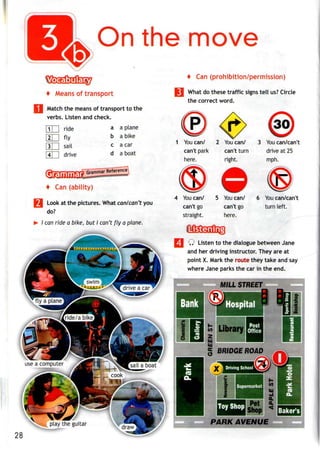
+ Means of transport
Match the meansof transport to the
verbs. Listen and check.
4 Can (prohibition/permission)
What do these traffic signs tell us?Circle
the correct word.
111 ride
[zTH fly
|3| | sail
4 I drive
Grammar
a a plane
b a bike
c a car
d a boat
1 Youcan/ 2 Youcan/ 3 You can/can't
can't park can't turn drive at 25
here. right. mph.
Grammar Reference
+ Can (ability)
j Look at the pictures. What can/can't you
do?
I can ride a bike, but I can't fly a plane.
4 Youcan/ 5 Youcan/
can't go can't go
straight. here.
You can/can't
turn left.
Q Listen to the dialogue between Jane
and her driving instructor. They are at
point X. Mark the route they take andsay
where Jane parks the car in theend.
g BRIDGE ROAD
PARK AVENUE
M a) Read the first andthe last exchangeof
the dialogue. Where is Jane? What is she
doing? Listen, read and check.
b) Read the dialogue and answer the
questions.
1 Where's the driving school?
2 CanJane turn right into Apple Street?
3 CanJane park in front of the hospital?
Instructor: Are you ready Jane?
Jane: Yes! Let's do this.
Instructor: OK, remember now, you have to
be careful on the road all the
time. OK, go down Bridge Road
towards the Park hotel.
Jane: OK! Should I go straight or do you
want me to turn right into Apple
Street?
Instructor: No, you can't turn right into Apple
Street and you can't go straight.
Look at the sign!
Jane: Ohyeah! I canonly turn left here.
Instructor: Very good! So, turn left into
Apple Street.
Jane: Here we go ...
Instructor: Perfect! Now, stop at the traffic
lights because the light is red.
When the light turns green, turn
left into Mill Street.
Jane: I see.
Instructor: Now,park in front of the hospital.
Jane: But I can't park there! Look
at the sign.
Instructor: Excellent! Turn left into Green
Street and go towards the park.
Jane: Fine.
Instructor: Watch out! There's a car coming.
^ S
3 Read again. Explain thewords in bold.
Find sentenceswhich expressexamples
of: permission, prohibition and giving
directions.
udy skills
Homographs
A homograph is a word that has the same spellingas
another. Homographs differ from each other in
meaning and sometimespronunciation.
Look at the highlighted words. Howdo
they differ? Match the words to their
definitions: bank; sheet; right; Light
bed cover/a single piece of paper
we keep money in/sides of a river
opposite of left/correct
not heavy/not dark
1
2
3
4
^^ Portfolio: Imagine you are learning
to drive. Act out the dialogue between you
and the instructor. Usethe map on p. 24 and
the table below. Youcan start from any
point you want to. Recordyourselves.
r Giving driving directions ^
• turn left/ right
into ...
• go down ...
L • gostraight ...
• go towards ...
• stop at the traffic
lights
• park in front of ...j
a) Q Listen and
repeat.
can /kaen/
can't /kant/
/as/ - /a:/
Reading Rules
a - /a:/ car, grass
a -/ffi/ dance, cat
^*|c b) Q Listen and read the
exchanges. In pairs use the map to act out
similarexchanges.
A: Can I turn left here?
B: Yes, you can turn left, but you can't turn
right.
(a poster)
[I] Portfolio: Make a poster. Draw traffic signs
you can see in your country. Then explain
them to the class. Usecan or can't.
29
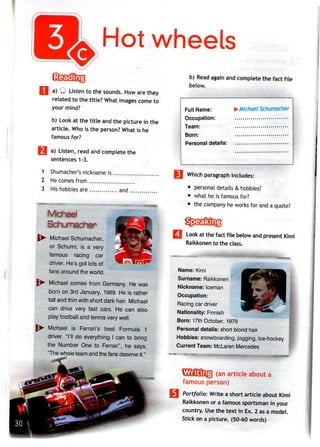
Hot wheels
a) Q Listen to the sounds. Howare they
related to the title? What images come to
your mind?
b) Look at the title andthe picture in the
article. Who is the person? What is he
famous for?
a) Listen, read and complete the
sentences1-3.
1 Shumacher's nickname is
2 He comes from
3 His hobbies are ... and
Michael Schumacher,
or Schumi, is a very
famous racing car
driver. He's got lots of
fans around the world.
Michael comes from Germany. He was
born on 3rd January, 1969. He is rather
tall and thin with short dark hair. Michael
can drive very fast cars. He can also
play football and tennis verywell.
Michael is Ferrari's best Formula 1
driver. "I'll do everything I can to bring
the Number One to Ferrari", he says.
"The whole team and the fans deserveit."
b) Read again and complete the fact file
below.
Full Name:
Of*f*nnation"
TASHYV
Rnrn"
pprQnnal ripfails"
>Michael Schumacher
Which paragraphincludes:
• personal details & hobbies?
• what heis famous for?
• the company heworks for anda quote?
Look at the fact file below and present Kimi
Raikkonen to the class.
Name: Kimi
Surname: Raikkonen
Nickname: Iceman
Occupation:
Racing car driver
Nationality: Finnish
Born: 17th October, 1979
Personal details: short blond hair
Hobbies: snowboarding, jogging, ice-hockey
Current Team: McLaren Mercedes
(an article about a
famous person)
Portfolio: Write a short article about Kimi
Raikkonen or a famoussportsmanin your
country. Usethe text in Ex. 2 asa model.
Stick on a picture. (50-60 words)
JQ5JW
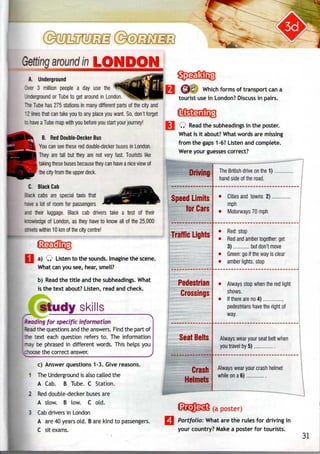
around in LONDON
A. Underground
Over 3 million people a day use the
.nderground or Tube to get around in London.
Hie Tube has 275 stations in many different parts of the city and
* 2 lines that can take you to any place you want. So, don't forget
:o have a Tube map with you before you start your journey!
B. Red Double-DeckerBus
You can see these red double-decker buses in London.
They are tall but they are not very fast. Tourists like
taking these buses becausethey can have a nice view of
the city from the upper deck.
C. Black Cab
ack cabs are special taxis that
ave a lot of room for passengers
nd their luggage. Black cab drivers take a test of their
~owledge of London, as they have to know all of the 25,000
reets within 10 km of the city centre!
a) Q Listen to the sounds. Imagine the scene.
What can you see, hear, smell?
b) Read the title and the subheadings. What
is the text about? Listen, read and check.
study skills
for specific information
ead the questions and the answers. Find the part of
ie text each question refers to. The information
ay be phrased in different words. This helps you
roose the correct answer.
c) Answer questions 1-3. Give reasons.
1 The Underground is also called the
A Cab. B Tube. C Station.
2 Red double-decker buses are
A slow. B low. C old.
3 Cab drivers in London
A are 40 years old. B are kind to passengers.
C sit exams.
Which forms of transport can a
tourist use in London? Discuss in pairs.
Q Read the subheadings in the poster.
What is it about?What words are missing
from the gaps 1-6? Listen and complete.
Were your guesses correct?
id Limits
for Cars
The British drive on the 1)
hand side of the road.
Cities and towns 2)
mph
Motorways 70 mph
Traffic Lights
Pedestrian
Crossings
Seat Belts
Crash
Helmets
•
•
Red: stop
Red and amber together: get
3) but don't move
Green: go if the way is clear
amber lights: stop
• Always stop when thered light
shows.
• Ifthere areno4)
pedestrians have the right of
way.
Always wear your seat belt when
you travel by 5)
Always wear your crash helmet
while on a 6)
(a poster)
Portfolio: What are the rules for driving in
your country? Make a poster for tourists.
31
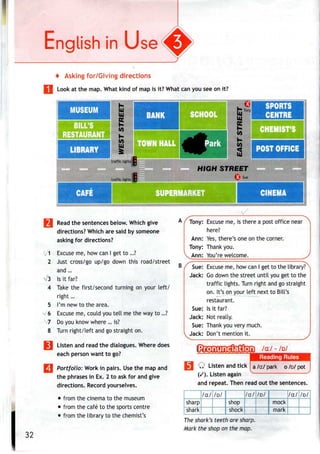
+ Asking for/Giving directions
Look at the map. What kind of map is it? What can you see on it?
MUSEUM
BILL'S
RESTAURAN
LIBRARY
SPORTS
CENTRE
HEMIST'S
POST OFFICE
traffic lights!
traffic tights
HIGH STREET
CAFE UPERMARKET CINEMA
1
2
Read the sentences below. Which give
directions? Which are said by someone
asking for directions?
Excuse me, how can I get to ...?
Just cross/go up/go down this road/street
and ...
Is it far?
Take the first/second turning on your left/
right...
I'm new to the area.
Excuse me, could you tell me the way to...?
Do you know where ...is?
8 Turn right/left and go straight on.
Listen and read the dialogues. Where does
each person want to go?
Portfolio: Work in pairs. Usethe map and
the phrases in Ex. 2 to ask for and give
directions. Record yourselves.
• from the cinema to themuseum
• from the cafe to the sports centre
• from the library to thechemist's
B
5
s 6
7
Tony: Excuse me, is there a post office near
here?
Ann: Yes,there's one on the corner.
Tony: Thank you.
yAnn: You'rewelcome.
Sue: Excuse me, how can I get to the library?^
Jack: Godown the street until you get to the
traffic lights. Turn right and go straight
on. It's on your left next to Bill's
restaurant.
Sue: Isit far?
Jack: Not really.
Sue: Thank you very much.
Jack: Don't mention it. /
/a:/ - /D/
Reading Rules
Q Listen andtick Ia /a:/ park o/D/ pot I
(/). Listen again
and repeat. Then read out the sentences.
sharp
"sRIrF
/a:/ /D/
shop
"sfiock"
/a/'/o/
mock
"mark"
/a:/ /D/
32
The shark's teeth are sharp.
Mark the shop on the map.
Extensive Reading
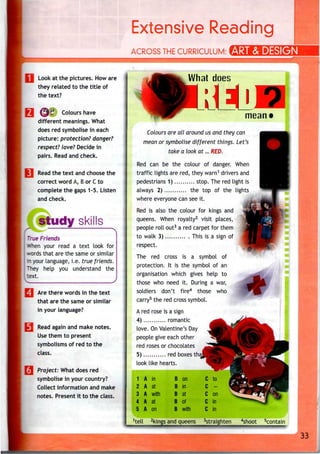
ACROSS THE CURRICULUM: ART & DESIGN
I Look at the pictures. Howare
they related to the title of
the text?
WM ^'& Colours have
different meanings. What
does red symbolise in each
picture: protection? danger?
respect? love? Decide in
pairs. Read and check.
| Read the text andchoose the
correct word A, Bor C to
complete the gaps 1-5. Listen
and check.
&
study skills
True Friends
•Vhen your read a text look for
•vords that are the same or similar
in your language, i.e. true friends.
They help you understand the
| Are there words in thetext
that are the same or similar
in your language?
| Read again andmake notes.
Use them to present
symbolisms of red to the
class.
| Project: What does red
symbolise in your country?
Collect information and make
notes. Present it to the class.
What does
mean
Colours are all around us and they can
mean or symbolise different things. Let's
take a look at... RED.
Red can be the colour of danger. When
traffic lights are red, they warn1
drivers and
pedestrians 1) stop. The red light is
always 2) the top of the lights
where everyone can see it.
Red is also the colour for kings and
queens. When royalty2
visit places,
people roll out3
a red carpet for them
to walk 3) This is a sign of
respect.
The red cross is a symbol of
protection. It is the symbol of an
organisation which gives help to
those who need it. During a war,
soldiers don't fire4
those who
carry5
the red cross symbol.
A red rose is a sign
4) romantic
love. On Valentine's Day
people give each other
red roses or chocolates
5) red boxes th
look like hearts.
1 A in
2 A at
3 A with
4 A at
5 A on
B on
B in
B at
B of
B with
C to
C -
C on
C in
C in
1
tell 2
kings and queens 3
straighten 4
shoot 5
contain
Fill in the gaps with canor can't.
Jfe
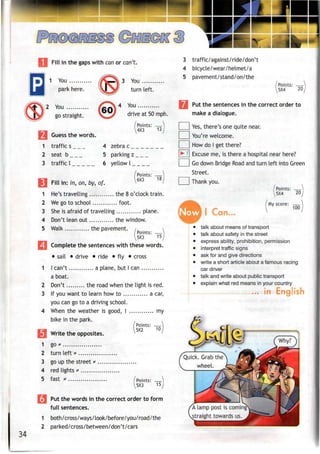
^
9
1
2
3
K?
1 You
park here.
2 You
go straight.
I Guess thewords.
traffic s
seat b
traffic I
Fill in: in. on. bv.
f/^—& 3
/£3N4
too)
4 zebra
5 parkin
6 yellow
of.
You
turn left.
You
drive at 50 mph.
/Points: —
4X3 12*uu i
r»
l7
-

/Points: —}
6X3 18;
^r
1
2
3
4
5
1 He's travelling the 8 o'clock train.
2 We go to school foot.
3 Sheis afraid of travelling plane.
4 Don't lean out the window.
5 Walk the pavement. /
/Points: —
^5X3 15
j Complete the sentences with these words.
• sail • drive • ride • fly • cross
1 I can't a plane, but I can
a boat.
2 Don't the road when the light is red.
3 If you want to learn how to a car,
you can go to a drivingschool.
4 When the weather is good, I my
bike in the park.
/Points: —
^5X2
Write the opposites.
go*
turn left *
go up the street
red lights *
fast * .. Points: —
5X3 15
34
| Putthe words in the correct order to form
full sentences.
1 both/cross/ways/look/before/you/road/the
2 parked/cross/between/don't/cars
3 traffic/against/ride/don't
4 bicycle/wear/helmet/a
5 pavement/stand/on/the
/Points: —|
I5X4 20J
Put the sentences in the correct order to
make a dialogue.
Yes, there's one quite near.
You're welcome.
How do I get there?
Excuse me, is there a hospital near here?
Go down Bridge Road and turn left into Green
Street.
Thank you.
/Points: .
20,
Points:
5X4
Now I Can..
My score: —
100
talk about means oftransport
talk about safety in the street
express ability, prohibition, permission
interpret traffic signs
ask for and give directions
write a short article about a famous racing
car driver
talk and write about publictransport
explain what red means in your country
kncjlisnin
Quick. Grab the
wheel.
A lamp post iscoming
straight towards us.
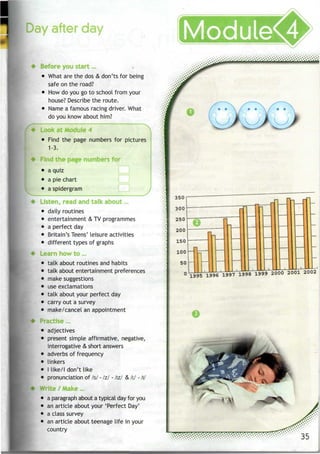
[Day after day Module4
Before you start... •»
• What are the dos& don'ts for being
safe on the road?
• How do you goto school from your
house? Describe the route.
• Name a famous racing driver. What
do you know about him?
• Find the page numbers for pictures
1-3.
Find the page numbers for
• a quiz
• a pie chart
• aspidergram
Listen, read and talk about...
• daily routines
• entertainment &TV programmes
• a perfect day
• Britain's Teens' leisure activities
• different types ofgraphs
Learn how to ...
• talk about routines and habits
• talk about entertainment preferences
• makesuggestions
use exclamations
talk about your perfect day
carry out asurvey
make/cancel an appointment
Practise...
• adjectives
• present simple affirmative, negative,
interrogative & short answers
adverbs of frequency
linkers
I like/I don't like
pronunciation of /s/ - /z/ - /iz/ & l:l - ll
Write / Make...
• a paragraph about a typical day for you
• anarticle about your 'Perfect Day'
• a class survey
• anarticle about teenage life in your
country
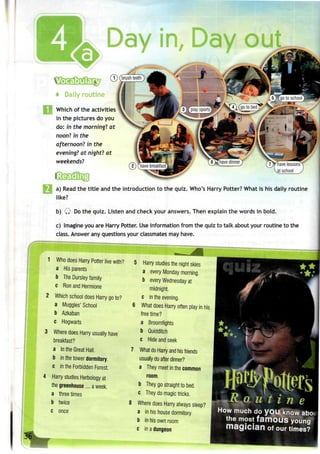
Day in, Day o
(T) (brushteeth)
Daily routine
Which of the activities
in the pictures do you
do: in the morning? at
noon? in the
afternoon! in the
evening? at night? at
weekends'!
a) Read the title and the introduction to the quiz. Who's Harry Potter? What is his daily routine
like?
b) Q Dothe quiz. Listen and check your answers. Then explain the words in bold.
c) Imagine you are Harry Potter. Useinformation from the quiz to talk about your routine to the
class. Answer any questions your classmatesmay have.
1 Who does Harry Potter live with?
a His parents
b The Dursley family
c Ron and Hermione
Which school does Harry go to?
a Muggles' School
b Azkaban
c Hogwarts
Where does Harry usually have
breakfast?
a In the Great Hall.
b in the tower dormitory.
c in the Forbidden Forest.
Harry studies Herbology at
the greenhouse.... a week.
a three times
b twice
c once
5 Harry studies the night skies
a every Monday morning.
b every Wednesdayat
midnight.
c in the evening.
What does Harry often play in his
free time?
a Broomfights
b Quidditch
c Hide and seek
What do Harry and his friends
usually do after dinner?
a They meet in the common
room.
b They go straight to bed.
c They do magic tricks.
Where does Harry always sleep?
a in his house dormitory
b in his own room
c in adungeon
***
•M ii t i n e
How much do you know abc
the most famous young
magician of our times?
,
Grammar Reference
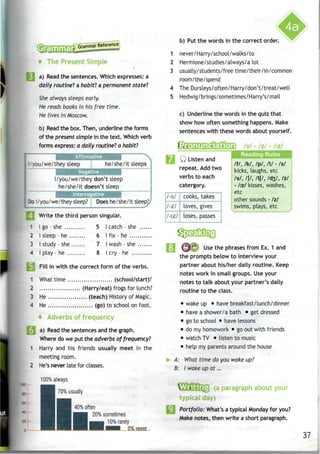
The Pres imple
a) Read the sentences. Which expresses: a
daily routine! a habitl a permanent state!
She always sleeps early.
He reads books in his free time.
He lives in Moscow.
b) Readthe box. Then, underline the forms
of the present simple in the text. Which verb
forms express: a daily routine"? a habit?
you/we/they sleep he/she/it sleeps
I/you/we/they don't sleep
he/she/it doesn't sleep
Do I/you/we/they sleep? Does he/she/it sleep?/
Write the third person singular.
1 I go - she 5 I catch - she
2 I sleep - he 6 Ifix-he....
3 I study - she 7 I wash - she
4 I play - he 8 I cry-he...
1
2
3
4
Fill in with the correct form of the verbs.
What time (school/start)?
(Harry/eat) frogs for lunch?
He (teach) History of Magic.
He (go) to school on foot.
* Adverbs of frequency
I a) Read the sentences andthe graph.
Where do we put the adverbs of frequency!
1 Harry and his friends usually meet in the
meeting room.
2 He's never late for classes.
100% always
70% usually
40% often
20% sometimes
10% rarely
_Q%. never
1
2
3
4
5
b) Put the words in the correct order.
never/Harry/school/walks/to
Hermione/studies/always/a lot
usually/students/free time/their/in/common
room/the/spend
The Dursleys/often/Harry/don't/treat/well
Hedwig/brings/sometimes/Harry's/mail
c) Underline the words in the quiz that
show how often something happens. Make
sentences with these words about yourself.
/s/ - /zf - Iizl
O Listen and
repeat. Add two
verbs to each
catergory.
/-s/
1-7.1
1-17.1
cooks, takes
loves, gives
loses, passes
IV, /k/, /p/, ll - /s/
kicks, laughs, etc
/s/, ll, /tf/, /dj/, Izl
- lzl kisses, washes,
etc
other sounds - Izl
swims, plays, etc
Use the phrases from Ex. 1 and
the prompts below to interview your
partner about his/her daily routine. Keep
notes work in small groups. Use your
notes to talk about your partner's daily
routine to the class.
• wake up • have breakfast/lunch/dinner
• have ashower/a bath • getdressed
• go to school • have lessons
• domyhomework • go outwith friends
• watch TV • listen tomusic
• help myparents around the house
A: What time do you wakeup?
B: I wake up at ...
(a paragraph about your
typical day)
Portfolio: What's a typical Monday for you?
Make notes, then write a short paragraph.
37
How about...?
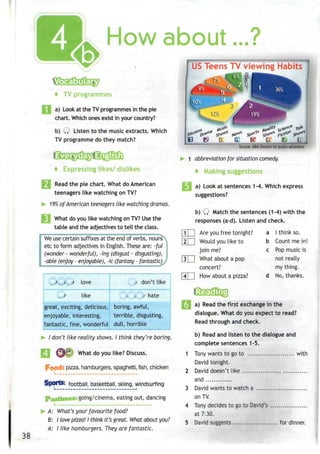
+ TV programmes
a) Look at the TV programmes in the pie
chart. Which ones exist in your country?
b) Q Listen to the music extracts. Which
TV programme do they match?
4 Expressing likes/ dislikes
Read the pie chart. What do American
teenagers like watching on TV?
19% of American teenagers like watching dramas.
What do you like watching on TV?Use the
table andthe adjectives to tell the class.
We usecertain suffixes at the end of verbs, nouns
etc to form adjectives in English. These are: -fui J
(wonder - wonderful), -ing (disgust - disgusting), |
-able (enjoy - enjoyable), -ic (fantasy - fantastic).
love
J like
don't like
hate
great, exciting, delicious, boring, awful,
enjoyable, interesting, terrible, disgusting,
fantastic, fine, wonderful dull, horrible
/ don't like reality shows. I think they're boring.
What do you like? Discuss.
Foods pizza, hamburgers,spaghetti, fish,chicken
SpOltS: football, basketball, skiing,windsurfing
going/cinema, eating out, dancing
38
A: What's your favourite food?
B: I love pizza! I think it's great. What about you?
A: I like hamburgers. They are fantastic.
US Teens TV viewing Habits
•1 Source: ABADivision forpublic education
> 1 abbreviation for situation comedy.
+ Making suggestions
a) Look at sentences 1-4. Which express
suggestions?
b) Q Match the sentences (1-4) with the
responses (a-d). Listen and check.
Are you free tonight?
Would you like to
joinme?
What about a pop
concert?
How about a pizza?
a
b
c
I think so.
Count me in!
Pop music is
not really
my thing.
No, thanks.
a) Read the first exchangein the
dialogue. What do you expect to read?
Read through and check.
b) Read and listen to the dialogue and
complete sentences 1-5.
1 Tony wants to go to with
David tonight.
2 David doesn't like ,
and
3 David wants to watch a
on TV.
4 Tony decides to go to David's
at 7:30.
5 David suggests for dinner.
Tony: Hi David. Are you free tonight?
David: I think so. Why?
Tony: Because there's a new thriller on at
the Rex.Would you like to joinme?
David: No,thanks. I don't like thrillers.
Tony: Oh ... What about a comedy then?
There's one starring Jim Carrey.
David: I don't know ... I don't really like him.
Tony: What about a pop concert then?
David: Well, pop music is not really my thing...
Tony: Oh. I've got it! It's Thursday today and
your favourite sitcom is on TV!
David: Yes, that's true ... Do you want to
watch it with me?
Tony: That's a great idea! Let's meet at your
place at 7:30 then!
David: Cool! How about some pizza for dinner?
Tony: Count me in!
Portfolio: It'sSaturday afternoon.
Invite your friend to watch TVtogether.
Use the sentences in Ex. 4 aswell asyour
own ideas. Record yourselves.
Grammar Grammar i
«—«-—'
+ Present Simple (short answers)
a) Read the box. Which verb do we use to
form short answers?
Short Answ
_ ... r Yes,I do.
Do you play tennis? ,.
I No, Idon't.
., f Yes,he does.
Does he like skiing? .^
( No, he doesn t. t
b) Fill in do/does, then answer the
questions.
1 > A: Doyou play tennis?
8: Yes, I do./No, I don't.
2 your dad like thrillers?
3 you like pizza?
4 your parents go to the cinema?
5 your friend like sitcoms?
a) Q Look at the poster. What words are
missing? Listen and complete the gaps.
New Film Starts Today.,
Name: 1) of Rock
Type of film: 2)
Rating: 3)
Time: 12pm/3pm4)
Price: 5) £
b) In pairs ask and answer questions about
the film in the poster. Decide whether
you'd like to seeit.
Pronunciation (exclamations)
y a) Q Listen and repeat. Which of these
are positive/negative?
1 Yuck! 2 Wow! 3 Super! 4 Ugh!
^^B b) Ask and answer asin the
examples. Use the prompts in Ex. 3 and the
expressions in Ex. 9a.
• A: How about spaghetti tonight?
B: Yuck! I hate it./Wow! That's great.
study skills
Carrying out a survey
To carry out a survey you need to prepare
simple Yes/No questions. This way you can get
accurate answers.
(a paragraph on a survey)
Portfolio: Carry out a class survey. Ask your
classmates about their favouriteTV
programmes. Keep notes, then write a
paragraph. Usemost/some/very few/none of.
Most of my classmates like.... Some of them don't
like.... Afew hate...
39
My favourite day
Work in pairs. What is a perfect day like for you?
Brainstorm to complete the spidergram.
^*> morning
have a big breakfast
evening — iHJ^fiffifj
afternoon
a) Look at the title. Which is Ann's favourite day? Why?
Read and listen to find out.
,, ,*,.. ail
by Ann Smith
Saturday is a perfect day for me. It starts at 9 o'
40
b) Now, answer the following questions.
1 Which is Ann's perfect day?
2 What does she do in the morning?
3 What does she do in the afternoon?
4 What does shedo in theevening?
Gram,
Grammar Reference
study skills
Using linkers
While narrating an event use
appropriate linkers to show the
order events happen. This makes
your writing moreorganised.
a) Underline the words in the
text which show the order
things happen.
b) Link the sentences. Use:and,
then, after that, when, before.
On Saturdays I meet my friends
for coffee. We go to the cinema.
She has breakfast. She leaves
for school.
On Sundays we have a family
dinner. Wewatch a movie.
I get up. The alarm clock rings.
She has a bath. She gets dressed.
n^mt In pairs discuss your
perfect day. Usethe questions
in Ex. 2b to help you.
A: Which is a perfect day for you?
B: Tuesday.
(an article)
Portfolio: Write a short article
about your perfect day of the
week for the school magazine.
Write why you like it andwhat
you do in the morning,
afternoon, evening, (50-80
words).
Name: James Johnson
Lives: In a semi-detatched
house with his dad Tony,
mum Carol and brothers
Chris (11) and Julian (9)
TtENAGE LIFE
IN BRITAIN
When does school start/finish?
It starts at 8:30 1) finishes at 3:15.
It's quite a short day, but we get lots of
homework as well!
Do you get any pocket money?
Oh yes, I get £10 a week. I spend it
2) my mobile phone, CDs and the
cinema. My Mum gives me extra money if I
help her out around the house though.
How do you spend you free time?
I love computers! I surf the net 3)
night or I play on my Playstation. I listen to
music a lot. My favourites are, McFly, Avril
-avigne, Beyonce and Mis-teeq. I also
watch a lot of television. Eastenders is the
best soap opera. It's on four times 4)
week.
Do you get along1
with your family?
Most of the time, but I often argue2
with my
brothers. It'susually about the Playstation.
They say I don't let them use it often
enough. I disagree of course.
What do you like/dislike about being a
teenager?
I like my life at the moment. I work hard
5) school, but I have a good time as
well. It is nice being ateenager.
1
2
3
4
5
A
A
A
A
A
also
on
on
the
at
B
B
B
B
B
and
for
in
on
on
C
C
C
c
c
small
with
every
a
under
1
have a good relationship quarrel
FOR 4TEENAGERS
IN THEUK?
TEEN ARENA
TALKS TO
7ms,
15 FROM
HAMPSHIRE.
a) Look at the text. Isit from a
website? magazine?newspaper?
b) How do you think British
teenagers spend their free
time? Read the text to check.
Fill in the gaps 1-5 with the
correct word (A-C). Listen
and check.
*••»
Make notes about teenagers' leisure activities in Britain.
Then useyour notes to tell the class about them. How
similar/different are your leisure activities?
OftlftSfO (an article)
Portfolio: What is life like for teenagers in your country?
Write a short article for an English teenage magazine. Use
pictures to illustrate your article.
f Making/Cancelling anappointment
Read the sentences below. Which can we
use to make an appointment! cancel an
appointment7
.
• Areyou free tomorrow?
• When would youlike to meet?
• I'm afraid I can't make it to the cinema
tonight.
• We'll doit some other time.
• Shall we say12:30 at the train station?
• Sounds great!
• How about Friday night then?
Q Listen to two dialogues. Whomakes/
cancels an appointment?
• Anna • John • Dave • Mark
Read the dialogues and replace the
phrases in bold with the sentences below.
• Definitely • I'mOK • I'm sorry
• That's a great idea • Getbetter soon
Anna: Hello?
John: Hi Anna, it's John. How are you?
Anna: Fine and you?
John: Fine. Are you free tomorrow to
help me choose Tina's birthday
present?
Anna: Yeah, I'd love to. When would you
like to meet?
John: How about 10 o'clock in the
morning?
Anna: I have an Italian class until 12, so
we can meet after that.
John: Sounds great. Shall we say 12.30
at the train station?
Anna: Sure. Seeyou there.
John: Thanks, Anna. Bye.
Dave:
Mark:
Dave:
Mark:
Dave:
Mark:
Dave:
Mark:
Dave:
Mark:
Hello?
Hi Dave, it's Mark.
Mark, hi. How are you?
Not that well, actually. I've got a
terrible cold.
Oh, no!
I'm afraid I can't make it to the
cinema tonight.
Don't worry about it, we'll do it
some other time.
How about Friday night then?
That would be great. Hope you
feel better soon.
Thanks.
(vfp^ Portfolio: Use the prompts to act
out similar dialogues in pairs. Youcan use
your own ideas aswell. Record
yourselves.
• help buya new bag
• school meeting until 11:00
• 12:00 at the shopping centre
• toothache
• cancel daytrip to the lake tomorrow
• next weekend
CftEGOQQOQ t/
Q Listen and
tick. Listen again
and repeat.
Readina Rules
ee, ea - fJ beef, beat
i -/i/ kit, bit
heat
hit
seek
sick
/i:/ /i/
leave
live
*'ee:
fit
/i/ /i/
He leaves for work early because he lives
far.
Fit those shoes on to your feet.
Read the title. How is it
related to the pictures? What
do you think the text is
about? Read and check.
Q Use the words to fill in
the missing words. Listen and
check.
which • we
a • is • be
are
Which type of graph is best
for comparing things? Why do
you think the third chartis
called a pie chart? What can
you read in these graphs?
Which type of chart would
you use to present the
following information:
Things teenagersspend
their money on
• food: 50%
• clothes: 20%
• entertainment: 30%
Close your books and tell the
class why we use graphs and
what the most important
types are.
In pairs carry out a survey
about an important aspect of
your school life (sports,
clubs, school meals). Make a
graph to show the results.
Present it to the class.
Project: Find various types of
graphs. Bring them to the
class and explain them.
.
,
nc
-••
It is not always easy to pass along1
information
about numbers using just words. One of
0) the best ways to do that is to use a graph
or 1) chart. Some of them 2) : the
line graph, the bar graph and the pie chart.
In this type of graph,
3) use a line to
present information.
The line graph
shows information,
which changes over
time.
Graduates
YEAR
Bar graphs can
4) horizontal
or vertical. This
type of graph
5) very useful
for comparing2
two
or more similar
things.
Internet use at Redwood School by sex
• Boys
D Girls
fl-
„„__, ._ r^Krf ._..»._i i_ .tiujtj-f— ' LJ-J ! LJ
1995 1996 1997 1998 1999 2000 2001 2002
In pie charts you can see
6) section3
is large
and what sections are
small. In many pie charts,
the most important
section is separated from4
the rest of thepie.
1
give 2
discoverdifferencesand similarities between two things 3
part " is apartfrom
Music Preferences in young adults 14 to 19
10%
2% • Rap
• Alternative
D Rock androll
D Country
El Classical
25%
:
43
Use the prompts to complete the
sentences.
• on • off • up • about • out
1 Stop worrying your exams!
2 What time shall we meet ?
3 Iwant to find the truth!
4 Put your jacket! It's cold!
1
2
3
4
5
What time do you usually set
for the Scouts Club?
Write the opposite.
interesting*
delicious *
nice* ,
love *
wonderful*..
| Points: —
15X2 10
Points: —
5X2 10
--
Circle the odd one out.
1 pizza - hamburgers- tennis - fish
2 boring - dull - great - awful
3 sitcom - reading - news - drama
4 football - quidditch - skiing - homework
5 weekend - always - never - sometimes
/Points: _
5X4 20
Put the words in the correct order and
write full sentences.
1 Sundays/he/goes/on/often/to the park
2 she/late/is/never
3 how/you/go/do/often/to/cinema/the?
4 he/bed/always/to/late/goes
5 we/go/sometimes/camping
[ Points: -
5X4 20
1
2
3
4
5
A:
B:
A:
B:
A:
B:
Form questions. Then, answer them.
you/go/school?
your father/work/in anoffice?
your mother/help/you/with/your homework?
your teacher/shout/in class?
your friends/watch/TV/after school?
Points: —
5X4 20j
,
Use the sentences to complete the dialogue.
• What about a popconcert, then?
• Would youlike to join me?
• I think so, why? • Count me in!
Are you free tonight?
1)
There's a new thriller on at AMC. 2)
No, thanks. I hate thrillers.
3)
That's a great idea! 4)
Now I Can..
• talk about daily
routines/(dis)likes
• talk and write
about my perfect
day
• talk about leisure
activities in Britain
/Points: —)
4K5 20J
My score: —
100
make suggestions
use exclamations
explain graphs
make/cancel an
appointment
carry out a survey
in English
How do you know
that carrots are
good for eyesight?
Well, have you ever seen
a rabbit wearing glasses?
Feasts
• Before you start...
• What is life like for teenagers in
Britain?
• What do youdo on Mondays?
• What's your favourite day? Howdo
you spend it?
• Look atUnit 5
• Find the page numbers for pictures
1-3.
• Find thepage numbers for
• an email
• a Halloween costume
• anIndian celebration
• ashort biography
Listen, read and talk about...
• party preparations
• anIndian festival
• a Halloween celebration
• birthday presents
• New Year's Eve preparations
• Through the Looking Glass
Learn howto...
• talk about celebrations & festivals
• ask for andexpress opinions
• ask for/give dates
• make a speech
• order flowers
Practise...
• present continuous: affirmative/
negative/interrogative
• make & do
• words that have the same
pronunciation but different meaning
Write / Make...
• an invitation card
• a description of a scene
• a speech about a special dayin your
country
• a poster to advertise anannual
event in your country
• a list of presents for your family
Festive time
5
6
7
8
9
10
4 Making preparations
a) Q Fill in make ordo.
Listen and check.
1 the decorations
2 the dusting
3 your homework
4 a phone call
the gardening
tea
a special dish
the washing-up
the shopping
acake
b) What are the people in the
picture doing?
The woman in picture 1 is making
tea.
46
a) Look at the heading of the
email. Who's sending it to
whom? What is the email
about?
b) Read the email and put the
paragraphs in the right order.
a) Read again. Who are the
people in the pictures (1-6)?
Explain the words in
bold.
b) Find a New
Year's greeting in
the email. What
do you say in
your language?
Get~Msg New Msg Replay Replay Ail Forward
From: Rosa
To: Lizzie
Subject: Season's greetings
Dear Lizzie,
|A| ] What about you? How are you spending New Year's Eve?
Whatever you are doing, have a wonderful time. I wish you and your
family a Happy New Year.
|B| | We are very busy at the moment. Dad is doing the last minute
shopping. Mum is making a special dish, fried baby eels. They're
delicious, honest! Aunt Betsie is making tea for everyone and Grandma is
doing the gardening. Clara and Steve are doing the washing-up. Steve's
also washing the grapes for tonight. In Spain, it's good luck to eat twelve
grapes at midnight on New Year's Eve! As for the twins, they are making
the decorations. They are excited. Spanish people call New Year's Eve
Nochevieja, which means the old night. This is because the 31st of
December isthe last night of the old year.
|C| | How's everything back in NY? I hope the weather isn't too cold.
Here in Madrid, everyone is getting ready to celebrate New Year's Eve.
The shops are full of people. They are buying presents and food. Council
workers are decorating the streets and making preparations for tonight's
celebrations in the Plaza del Sol.
All the best!
Rosa
+ Present Continuous
(affirmative)
a) Look at the sentences.
How do we form the present
continuous affirmative"?
I am making a phone call.
He is doing his homework.
We are making a cake now.
b) Read the verb forms for
the email again andfind the
verb forms for actions
happening now, at the
moment of speaking.
c) Write the -ing form of the
verbs. Find them in the email
and check. What are the
spelling rules?
1 spend ^-spending
2 get
3 bake
4 wash
Use the prompts to say what
the people in the picture are
doing. What are they
celebrating?
• blow a party horn
• talk onthe mobile
• dance
• play the drums
• eatasandwich
• bring acake
John is blowing a party horn.
Q Listen to the music and
the sounds. Imagine the
scene. Describe to your
partner what is happening.
Imagine it is NewYear's Evein your country. What are
you/your family doing? Discussit in small groups.
Work in two teams. In turn, each team mimes a party
scene. The other team writes down what they think
each student is doing. The team with the most correct
answers wins.
Q Look at the text. What is it? Can you guesswhat type
of words are missing? Listen and complete the gaps.
0 ^Jeff & Lynn
invite you to a Halloween '
, October 31
pm
" Street
Fancy Dress
RSVP Jely@yahoo.com
(an invitation card)
•*• Portfolio: Write an invitation card for a party. Usethe
invitation in Ex. 8 asa model.
47
Let's celebratir
4 Celebrations
a) Match the activities to the pictures.
• make wreaths • exchange gifts
• wear costumes • offer flowers & sweets
• eat traditional food • watch parades
• watch a firework display
In pairs, make a list of celebrations in
your country. Which of the activities in
Ex. 1 do you do during these celebrations?
St Patrick's Day
(17th March)
Thanksgiving
(4th Thursday of November)
Guy FawkesDay
(5th November)
Halloween
(31st October)
Valentine's Day
(14th February)
48
b) Ask and answerquestions.
A: When is St Patrick's Day?
B: U is on the 17th March.
A: What do people do on that day?
B: They watch parades.
a) Read the first exchange.Are Pete and
Tess in the same place? Read the last
exchange and check.
b) What do you think is happening at the
party? Listen, read and check. Explain the
words in bold.
' -N
Pete: So, is the party going well?
Tess: WHAT DIDYOU SAY? ^
Pete: Is the party going well?
It sounds as if
everyone's having a
great time.
Tess: Yeah, it's absolutely brilliant.
Pete: Well, a party for a gang of ten-year-olds
isn't my idea of a good time. Are you all
wearing costumes?
Tess: Yes. I'm wearing my witch costume and
Chris is wearing his Frankenstein costume.
Pete: Oh, he's not wearing that old thing again!
Tess: Yeah, and he's terrifying everyone.
Pete: What kind of games are you playing? Are you
bobbing for apples:
Tess: No. We're playing musical chairs and pin the
tail on the donkey. It's great fun.
Pete: What about food? What are you eating?
Tess: Well, I made a pumpkin pie and toffee
apples and the kids are really enjoying them
so they're nearly all gone.
Pete: Oh, keep me one, please!
Tess: OK!Are you doing anything at the moment?
Pete: No, not really.
Tess: Well, why don't you come over and help
yourself to some toffee apples? The party is
nearly over anyway. Then, you can help me
clean up!
Pete: I would do anything for a toffee apple! See
you in ten minutes.
Match the phrasalverbsto their meanings.
LU dress up
run out
come over
join in
pop round
a move place
b visit
c finish
d become part of sth
e wearcostumes
Read again and find:
• three names of games • two types of food
• two types of costume
Use your answers to tell the class how the
people in the dialogue celebrate Halloween.
4 Asking for/expressing opinions
j^'€^ Work in pairs. Imagine you are at
a celebration. Usethe phrases below to
act out exchangesas in the example. Ask
about: music, food, costumes, activities,
guests, etc
A: What do you think of the music?
B: It's fantastic.
Grammar Reference
+ Present Continuous (negative &
interrogative)
Read the sentences. How do we form the
negative and interrogative forms of the
present continuous! Find examples in the
dialogue in Ex. 3.
She isn't making a wreath.
"Are you watching TV?" "Yes, I am."
"Is he making a phone call?" "No, he isn't."
f Asking for opinions
• What doyouthink • How doyoulike
of ...? the ...?
• What is/are the ... like? • Do youlike ... ?
Responding
• They're/It's • I don't really like
fantastic/brilliant/ it/them,
cool. • They're/It's awful/
• Notbad at all. terrible/horrible.
• Quite good. • Nothing special. ,
2
3
4
5
6
7
C
Ask and answer questions about
the picture. Then, describethe scene.
Sam/play music?
>• A: Is Sam playing music?
B: No, he isn't. He's...
Liz & Steve/take pictures?
Sue/dance?
Sam/throwstreamers?
the musicians/perform tricks?
the clowns/hold balloons?
Tony & Mary/drink Coke?
Imagine you are attending a special event.
The class in teams try to guess what you
are doing there.
Leader: I'm at a party.
Team AS1: Are you dancing? etc
(description of a scene)
Portfolio: Find a picture showing your
family, relatives or friends celebrating a
special event. Write a shortparagraph
about what the people in the picture are
doing. Give your paragrapha title.
49
Special days
a) Q Listen to the music. What country
do you think it is from?
b) Sumit is giving a speech to his
classmates about a festival in India. Listen
and put the events in the order you hear
them.
• pray | | • watch the fireworks [ |
• have a meal | | • decorate the house | |
• visit people | | • make special lamps [ [
• exchange gifts | [ • light lamps | [
Read Sumit's
speech and fill
in the missing
adjectives
(1-6).
"Hello.
Today, I'm going to talk to you about an
important festival in my country, India. In late
autumn, we celebrate Diwali, the Festival of
Lights. Diwali lasts five days. Before the
festival, the whole family makes some
preparations. We put up colourful decorations in
our homes and children make special festive
lamps. On that day we visit relatives, we have
festive meals and we exchange gifts. In the
evening, we light our Diwali lamps and we pray
to Lakshmi, the goddess of wealth. Finally, there
is an exciting fireworks display. Everybody has a
great time.
Thank you for listening."
1 festival
2 decorations
3
lamps
4 meals
5 fireworks/
display
6 a . .. time

Which words/timephrases does Sumit use
to show the order of the events?
Ist
/^±.^~
study skills
Making notes for a speech
When you make a speech, have notes of the
main points written down in front of you. This
helps you remember what you want to say in
the right order.
Imagine you want to prepare a speech
about a special day in your country.
Complete the notes about this day.
Name:
Date/Season: ...
Country:
Activities/Food:
Feelings:
~HJ" —«^
Portfolio: Useyour notes in Ex. 4 to
present the festival to your classmates.
Record your speech.
(a speech about a
specialday)
Portfolio: Usethe phrases in the language
boxes below and your notes from Ex. 4 to
write your speech. (50-60 words)
Beginning a speech
Hello./Good afternoon/evening, etc
Today, I'm going to talk to you about...
Thank you for your time./Thank you for listening.
Do you have any questions?
Is there anything you would like to askme?
50
1
2
3
What do you call an event that takes place
every:
hour? *- hourly 4 month?
day? 5 year? /
week? annual
Name some festivals in your country. What
do people do on these days?
Q What can the text be about? What are
the people in the pictures doing? Listen,
read and check.
a) Read again and mark the sentences,
R/ght, Wrong or Doesn't Say. Then label the
pictures. Describe them to your partner.
The Highland games are an annual event.
A Right B Wrong C Doesn't say
The games are in winter.
A Right B Wrong C Doesn't say
The marching bands wear funny hats.
2
3
4
5 Tickets are always available.
A Right B Wrong
The caber is very heavy.
A Right B Wrong
C Doesn't say
C Doesn't say
A Right B Wrong C Doesn't say
b) Explain the words in bold.
j What do visitors see and do in Braemar on the
first Saturday in September? Make notes and
prepare aone-minute radio commentary for
the Highland Games. Present it to the class.
(a poster)
Portfolio: Think of an event that takes place
every year in your school. Make a poster to
advertise it. Write: name anddate; place;
activities. Illustrate your poster with pictures.
i
,
Tine Highland Games
Many highland gamestake place all over
Scotland every year. The most famous
meeting is in Braemar,a small
village in the Scottish
Highlands. The gamesare
always on the first
Saturday in September.
Many athletes travel to
Scotland each year to take
part in the games. They
compete in events like the
hammer throw, shot put and the hill
run. There are also music and
dancing competitions.
Marching bands perform
for the crowds. They
wear traditional clothing
and play.
The most popular event
of the day is the 'tug of
war'. Two teams hold onto a
rope and try to pull the other team over the
line. Tossing the caber' is also
popular. The athletes have to
run holding a heavy tree
trunk, the caber, upright.
Then, they stop and
throw it towards the sky.
Tickets always sell out
months before the games
start. It's a great day out for
all the family.
51
English In Use(
«p>
4 Ordering flowers
Look at the flowers in the pictures. What
are their names in your language? When
do people offer flowers in yourcountry?
M:
M:
Good morning. I'd like
to send some flowers,
please.
Of course. What do
you have in mind?
A dozen red roses.
When would you
like us to send them?
On the morning of
February 14th.
Who are they for?
For Ms Laura Johnson at 25
Blackheath Green, London.
Would you like to include a
card?
Yes, please. I have it ready.
Right. That will be £40 including
delivery.
Here you are. Thank you very much.
Read the sentences. These sentences are
from the following dialogue between a
shop assistant and a customer. Who says
what? Listen and check.
• I'd like to send some flowers, please.
• When would you like usto send them?
• Adozen red roses.
• Would youlike to include acard?
• That will be£40 including delivery.
Q Listen andfill in the order form. Read
the dialogue and check.
Order Code: F4052
Flower Type:
Quantity:
Name:
Full Address:
Postcode: E1
Price: .
JJJ3J Portfolio: It's Mother's day and
you want to order some flowers for your
mother. Work in pairs. Take roles and act
out the dialogue between you and the
shop assistant. Usethe sentences in Ex. 2.
Record yourselves.
a) Q Listen andcircle the word that
does not sound the same as the others.
Listen again and repeat.
1
2
3
4
5
6
7
brick
dear
hear
know
meat
ride
soon
break
deer
hire
now
meet
red
sun
brake
die
here
no
met
read
son
52
b) What do the words that sound similar
mean? Check with your dictionary.
Extensive Reading
ACROSS THECURRICULUM: LITERATURE
study skills
Reading widely
Reading outside class will help you increase your
vocabulary and improve your English. Read books,
newspapers and magazines or browse the Net.
a) Look at the pictures and answer the
questions.
What do you know about Alice in Wonderland?
Is Alice a real person or a fictional character?
Who created this character?
Who's Humpty Dumpty? What does he look
like?
b) Read the short text and check your
answers.
Lewis Carroll (1832-1898) is a very
famous Englishwriter of books for
children. His most famous •,.;
books include Alice's
Adventures in Wonderland
and Through theLooking
Glass.These books are
about the adventures of
Alice, a little girl, in a
strange place called
Wonderland.The extract is a
short dialogue from the
second book. Alice istalking
to Humpty Dumpty,an egg
with a nose and a mouth!
a) Skim through the dialogue and find a
word beginning with un-. What does it
mean? When do we use this prefix?
b) Form opposites with the following words.
• friendly • happy • lucky • kind • real
Alice: What a beautiful belt you've got!
Humpty Dumpty: It's a cravat, child, anda beautiful
one, as you say. It's a present from the White King
and Queen! There now!
Alice: Isit really?
Humpty Dumpty: They gave it to
me, for an unbirthday present!
Alice: I begyour pardon?
Humpty Dumpty: I'm not offended.
Alice: I mean, what is an unbirthdaypresent?
Humpty Dumpty: A present people give you when it
isn't your birthday, of course!
Alice: I like birthday presents best.
Humpty Dumpty: You don't know what you are
talking about! How many days are there in a year?
Alice: Three hundred and sixty-five.
Humpty Dumpty: And how many birthdays have you?
Alice: One.
Humpty Dumpty: I'd rather seethat on paper.
Alice: (writing on a piece of paper) 365- 1 =364
Humpty Dumpty: Then that shows that there are
three hundred and sixty four days when you might
get unbirthday presents...
Alice: Certainly...
1
2
3
4
Listen and read and answer questions
1-4. Take roles and read out the dialogue.
What is Humpty Dumpty's present?
Is it his birthday today?
Who gave the unbirthday present to him?
Why does Humpty Dumpty like unbirthday
presents?
Project: Write the names of your family
members and their birthdays. Then make
a list of presents for them.
I f••
Fill in make or do.•
1 a special dish
2 the shopping
3 your homework
4 the decorations
5 the washing-up
6 tea
7 the dusting
j Match the words to form
a
b
c
d
e
f
[U
H
light
exchange
decorate
make
wear
visit
watch
[Points:
[7X1 14
collocations.
gifts
the house
lamps
a costume
preparations
the fireworks
people
(Points:
7X4 28
| Fill in the sentences with the words below.
• up • out • over • fun • round • in
1 Children usually have dressing
2 Come here and join
the game.
3 Can I pop to borrow some
sugar? It's run Points: —
3X6 18
Fill in the gaps with the present continuous.
1 A: What
(Lizzie/do) right now?
B: She
(make) tea.
2 A: Hey! You
(not/watch) the fireworks!
B: Yes,lam! I
(take) some pictures aswell.
3 A:
(the twins/cut) the bread?
B: No, they are washing the dishes.
Points: —
5X4 20
Use the prompts to fill in the gaps.
• Who arethey for? • Nothing special.
• Not bad at all. • It's awful.
• I don't like them.
1 A: What are the toffee apples like?
B:
2 A: Is the festival good?
B:
3 A: What do you think of mycostume?
B:
4 A: How do you like the food?
B: I really don't like it.
5 A:
B: My mother.
'Points: 
5X4 20
My score: —
100
Now I Can..
talk about festivals, preparations & celebrations
ask for and express my opinion
talk about actions happening now
write an invitation card
write a short description of a scene
write/make a speech about a special day
make a poster to advertise an annual event in
your country
... In English
Would you like a
pocket calculator for
^ ?--~4 2^ Christmas,son?
( .-is H-; ,(,W * *-)
o thanks,
know how
many pockets
54
Leisure activities
Before you start...
• Name some festivals in your country.
Imagine you are attending one now.
What is happening?
• Think of a special dayin your
country. How do you celebrate it?
~N
Look at Module 6
• Find the page numbers for pictures
1-3.
Find the page numbers for
• aposter
• aboard game
• abook cover
Listen, read and talk about...
• hobbies & interests
• school clubs
• games & free-time activities
• board games
• puppets
Learn how to ...
• express your likes anddislikes
• justify your choices
• carry out asurvey
• shop for a present
Practise ...
present simple vs present continuous
prepositions of time and place
compound nouns
linking sentences:because
pronunciation of /o:/ - ls.1
Write / Make ...
• a short paragraph about your
classmates' favourite free-time
activities
• a poster about your classmates
favourite games
• a board game
• a short article about a popular
board game in your country
• a puppet
Free time
4 Activities
Look at the pictures. Which of these
do/don't you do ...
1 every day?
2 every week?
3 every weekend?
4 on holiday?
4 Expressing likes/dislikes
Read the table, then askand
answer questions as in the example. Use
the pictures on p. 52. You can use your
own ideas too.
Do you like/
enjoy...?
Yes, I do.
Yes, I'm very keen on/
fond of/interested in ...
No, Idon't.
Not really/at all.
A: Do you like windsurfing?
B: Yes, I'm very keen on windsurfing. What
about you?
study skills
the renson
The format of the text tells you what sort of a
text you will read (e.g. letter, brochure,
leaflet). This helps you understand why the
text waswritten.
56
1
2
a) Look at the leaflet on p. 53. What is it
about? Where could you see it? How many
clubs are there?
b) Q Listen, read andfind the correct
clubs.
meet(s) once a week.
meet(s) twice a week.
play computer games
3 meet(s) three times a week.
4 meet(s) daily.
c) Explain the highlighted words. Use
your dictionary to help you. Choose any
five words and make sentences.
Bolton Middle
SCHOOL
Clubs meet at 4:30, right after school.
Art Club:
Drama Club:
Computer Club:
Book Club:
Music Club:
Photography Club:
Are you keen on painting? Then, join us!
We work in groups and learn how to draw
and paint. We also go on trips to art
museums!
Meetings: Wednesdays & Fridays
Are you good at acting? Our drama club is
the club for you. Wewrite and present our
own plays! Wealso go to the theatre a lot!
Meetings: Mondays
Do you want to have fun? Go cycling,
swimming and windsurfing with us, or play
football, basketball or baseball in one of
our teams!
Meetings: Tuesdays
Are you interested in computers? Learn
new programmes, use our PCsto do your
homework and play the best computer
games ever!
Meetings: every day
Are you fond of literature? Read exciting
novels, talk about them and exchange
books.
Meetings: Mondays, Thursdays & Fridays
Are you mad about music? Then join one
of the bands in our club and ... let the
good times rock!
Meetings: Fridays
Are you interested in photography?Come to
our club, print your own pictures and meet
people who love photography!
Meetings: Tuesdays & Thursdays
m
*w
Grammar Reference 
i Compound nouns
I Read the box. Howmany compound nouns canyou
^^ find in the text? Can you think of more?
m English we can put two words together to make a new
word. e.g. home + work = homework
These words are compoundnouns.
|il Use -er, -1st, -or to make
nouns.
1 act > actor, 2 direct ;
3 art ; 4 football ;
5 play ; 6 write ; 7 paint
; 8 cycle ; 9 present
4 Linking sentences
Q Which of theclubs in Bolton
Middle School do/don't you
want to join? Tell your partner.
dull
•tiring
X
X X
X X X
O fun
O O interesting
OOO brilliant
I want to join the Art Club because
it's fun. I don't want to join the
Sports Club because it's tiring.
Carry out a survey about your
classmates' favourite free
time activities. Make a graph.
A: What do you most like doing
in your free time?
B: I love going cycling.
(a paragraph
about likes and dislikes)
| Portfolio: Write a paragraph
about your classmates' likes/
dislikes Use your graph in Ex. 7.
Most of my classmates enjoy ...
because ... . Some like...
57
Game on!
Which of the games in the
pictures
• areboard games?
• arefor two players?
• areteam games?
• doyou play in your country?
Q Read the first andthe last
line of the dialogue. What are
Tom and Jim doing? Listen,
read and check.
a) Read the dialogue. How
many games are mentioned?
What do Jim and Tom decide
to do in the end?
b) Explain the words in bold.
Tom:
Jim:
Tom:
Jim:
Tom:
Jim:
Tom:
Jim:
Tom:
Jim:
Tom:
Jim:
1 Tom:
Jim, are you doing anything?
Nothing much. I am listening to music and waiting
for the rain to stop. I am playing baseball at 5:00.
You're always playing with your friends.
Don't saythat. Youknow I play baseball every Tuesday.
Do you want to play something with me for achange?
Like what? And don't say Monopoly, backgammon or
scrabble. They are boring.
Yes, I bet it's boring when you always lose.
I don't care about losing.
Yeah right. Yousuggest something then.
How about darts?
That's not fair. You'retall and always get more points.
Tommy, it's not about who wins or loses but how you
play the game!
You are right. Darts then.
c) Find phrases which mean:
• Such as? • Idon't mind. • That's not right.
• What about...?
58
study skills
Acting out a dialogue
Before you act out a dialogue think of the
place, who you are and how you feel. When
you act out your part use gestures. This helps
you use Englishin a natural way.
a) In pairs continue the dialogue.
b) Portfolio: Work in pairs. Youare at
home on Saturday evening. Act out a
similar dialogue to the one in Ex. 2.You
can use the gamesin Ex. 1, as well as your
own ideas. Recordyourselves.
4 Present simple vs
present continuous
3 Find verb forms in thedialogue which
show:
• a permanent state.
• daily routine or habit.
• anaction happening now.
• a fixed arrangementin the near future.
• annoyance.
Identify the tenses.
3 Put theverbs in brackets into the present
simple or present continuous.
1 Jason (not/come) with
us tonight.
2 What (you/do) in your free time?
3 We (usually/meet) in the
library at three o'clock.
4 Greg (learn) to play
chess today.
5 (Mary/speak) French
well?
6 I (not/often/go) skiing.
7 It (rain) at the moment.
8 You (always/lose) your keys!
9 My father (play) chess every
afternoon.
10 I (have) dinner
with my grandparentstonight.
m Choose thecorrect word/phrase.
1 Alice isn't/doesn't like playing
backgammon.
2 Do/Are you doing your homework?
3 We usually eat/eating out on Sundays.
4 Do/Are they playing chess now?
5 My friend and I play/are playing scrabble on
Wednesday afternoons.
6 I don't/isn't like jigsaw puzzles.
Complete the text with the correct form of
these verbs: like, argue, play, prefer, live,
love, win, enjoy, (not always) agree, not be
Hi, I'm Sarah and I 1) in London. I
2) playing games, especially board
games like monopoly and scrabble. My sister
also 3) games. We 4)
scrabble at the moment but we 5)
We often 6) because I 7)
scrabble but she 8) monopoly.
Today my sister 9) very happy
because I 10) again!
Q Listen and match the speakersto the
activities they like.
Speaker Q
Speaker[2
Speaker[3
Speaker[4
Speaker [5
(a poster)
A
B
C
D
E
F
G
billiards
marbles
darts
dominoes
scrabble
chess
jigsaw ^
Portfolio: Askyour classmatesabout their
favourite games. Make a poster with the
most popular games. Stick pictures and
label them. Think of a title for the poster.
59
Pastimes
Where is the
man in the
picture? What
do you think he
does there?
Complete the
verbs on the board game to
find out.
Ill Q Listen toand read theinstructions. Then, playthe
Robinson Crusoe game in groups of four.
Both children and adults around the world love playing
Snakes and Ladders. Snakes and Ladders is not a modern game. It
comes from an old Indian game. It is a game about good and evil.
Snakes and Ladders is a game for two to sixplayers. To play
it, you need the board, a dice and some counters. You start on
square number ONE and you move your counter the number of
squares shown on the dice. When you land on a square at the
bottom of a ladder you go UP to the top of the ladder, but when
you land on a snake you go DOWN to the tail of the snake.
Whoever gets to the last square first wins!
P ... and he
(cook) on fire.
wnoever gets to tne last square tirst wins;
Robinson Crusoe
^^ ~
y ' the birds'singi^ ^%s^ (miss) his family... ••••^••^
)
Sometimes, he
(sit)
under the trees...
He
(grow) rice and
corn...
Heoften
{§) ... and he
.. .. ...and he ...........
££ (not/feel) happy.
(explore) the
island - -'
He
(play) with his
He
(not/have) warm
clothes...
... andhe
(eat) fruit
and coconuts,
SM
Iny- -3S
V=
nr2
Jr ...andhe - ^r
"! (be) cold!; He :
— ;- ',
'- at night. !
(wake) up early... ^ "
He often
(go) foij
long walks...
... and he
(wash)
Inthe river. ^SB
60
(a board game)
Project. Work in groups. Make your own board game (Snakes & Ladders) about free-time
activities. Then, play it with your partner.
Which of the games in the
pictures: is about solving a
crime? is about buying and
selling property? uses letters
to make words? Listen, read
and check.
1 a) Read again and mark the
statements V (yes) or N (no).
Explain the words in bold.
I Cluedo is a game to play
at home.
i In Scrabble, the players
answer questions.
I You can buyMonopoly™in
200 countries.
I Scrabble is like a
crossword puzzle.
b) What do these numbers
mean? Make sentences.
• 80 • 1943 • 1949 • 1933
• 1934 • 5000 • 200 million
You can buy Monopoly™ in 80
different countries.
What is the most popular
board game in your country?
Make notes under the
headings, then talk about it.
• name
• aim
• how to play it
• number of players
CLUEDO
England 1943. Anthon Pratt invents Cluedo and his
wife designs the board. Waddington Games buys the
idea releases the game in 1949 and it becomes a great
success. The aim of the game is to find out the identity
of the killer of Dr Black, the murder weapon and the
scene of the crime. In order to do that, players move
around the house and ask the other players questions.
The first player to solve the crimewins.
SCRABBLE
New York, 1933. Alfred Butts notices how popular
crossword puzzles are and comes up with the idea of
Scrabble.
In Scrabble players pick seven letter tiles at random
and then try to make words using their letters. Players
get bonus points for using certain squares on the
board and using letters like Q and Z. The player with
the most points at the end of the game wins.
MONOPOLX
CIIJED01
fwnselfl
much money as
(MONOPOLY!
SCRABBLE
Portfolio: Write a paragraph about a popular board game
in your country. Write: name, number of players, aim.
61
English in Use'MjP
* Buying a present
Do you go shopping for your friend's presents? What
presents do you buy? What shops do you prefer?
Q Read the sentences below and mark (S)for the
shop assistant and (C)for the customer. What are they
talking about? Listen, read and check.
How can I help you?
I am looking for a birthday present for a friend
Is it for a girl or a boy?
What about a jigsaw puzzle then?
How much are they?
I'm afraid that's too expensive.
I have the perfect thing for you.
Would you like me to wrap it?
1
2
3
4
5
6
7
8
Read the dialogue. What does Greg buy for Judy?
Shop Assistant:
Greg:
Shop Assistant:
Greg:
Shop Assistant:
Greg:
Shop Assistant:
Greg:
Shop Assistant:
Greg:
Shop Assistant:
Greg:
Shop Assistant:
Greg:
Shop Assistant:
Greg:
Good morning. How can I help you?
Good morning. I am looking for a birthday
present for a friend.
Is it for a girl or a boy?
It's for my friend Judy. Sheis twelve
tomorrow.
What does your friend like doing in her
free time?
She likes playing board games and meeting
friends.
What about a jigsaw puzzle then?
That's a good idea. How much are they?
This one has 5000 pieces and costs €18.
I'm afraid that's too expensive. I only have
€15.
Let me see. Does she like painting?
Yes, she loves drawing and making things.
How about this puppet making set? It's
only €13.
That's great. I'll take it.
Would you like me to wrap it?
Yes please.
I
fy'C Portfolio: Imagine it
is your English friend's birthday
and you want to buy him/her a
present. In pairs, act out
dialogues like the dialogue in
Ex. 3. Usethe toys and prices
in the pictures aboveto help
you. Recordyourselves.
Reading Rules
Q Listen 0 + r ./o;/ port
and tick (/). a - l/lk - /o:/
Listen again
and repeat.
chalk
e - u, i + r=
/3/girl
62
form
firm
shirt
short
talk
/o:/ ls.1
Turk
walk
work
war
were
/o:/ 13.1
Extensive Reading
ACROSS THECURRICULUM: DESIGN & 1ECHNOLOGY
Everyone loves puppets! They are fun,
sometimes crazy, and even when they
are sad they still make us laugh.
There are many different types of puppets. Some are very easy to make but others
can be more difficult. Glove puppets are one of the easiest types of puppets to
make. You just take a piece of cloth, attach a wooden or rubber head and put it
over your hand. You use your fingers to move the puppet's head and the arms.
The marionette is a more difficult puppet to make and to use, but it's
more fun to play than the glove puppet. Marionettes have whole
bodies and legs and can move in many ways. The puppeteer uses
strings to move it.
We can use puppets to educate or to tell stories, but with
puppets we always have fun. When we see puppets move
and talk we forget that they are just plastic, wood or
cloth and we enter a world of adventure and fun.
Which pictures show:
What materials are these
puppets madeof?
• cloth • wood • string
• leather • rubber • plastic
Read, listen and check.
Read again. List all words
related to parts of the body.
| Project: Follow the instructions
to makeyour own puppet.
Use your puppetsto act out a
story.
Form compound nouns.
|1| | house
|2| | wind
[3 | basket
4 | news
[STI birth
a day
b paper
surfing
work
ball
c
d
e Points: —^
5X3
M Complete the gaps with the words below.
• interested • keen • mad • fond • good
1 Tony is about football. He never
misses a match on TV!
2 Are you in history as well?
3 Jane's little daughter is very
at dancing!
4 I'm quite of comedies. What
about you?
5 Anthony is not on classical music.
/Points: —
I5X2 tO)
cv
Circle the odd word out.
1 dull - tiring - awful - fun
2 dominoes - painting - backgammon - billiards
3 good - fond - keen - bad
4 rarely - quick - never - always
' Points:
4X5 20
Write sentencesusingthe present simple
and presentcontinuous.
1 walk to work / takebus
> I walk to work every day but today I'm
taking the bus.
2 eat vegetables / eat meat
3 play volleyball / play basketball
4 go windsurfing / go skiing
5 play darts / play chess
6 read a book / meet friends /Points:
5X4 20
64
Complete the sentenceswith the correct
form of the verb in brackets.
I can't go out tonight because I
(study) for my maths exam.
I (not/want) to leave yet.
I (have) such a good time.
3 Christine (not/watch)
much TV because she
(prefer) to read.
Points: —
3X5 15
•I Use the promptsto complete thedialogues.
• I don't mind • That's not right! • Like
what? • Howabout a board game?
1 A: We never do anything fun at the weekends!
B:
2 A: Can I close the window?
B:
3 A: Let's do something for your birthday!
B:
4 A:
B: That's a great idea!
Now I Can
Points: —}
4X5 20
My score: —
100
talk about what I like to do in my free time
recognise different board games
make my own board game
use the present simple and present
continuous
form and use compound nouns
shop for a present
make a puppet
J^°utasurve
L..... in English
Where do
geologists go for
entertainment?
Now & Modulev
Before you start ...
• What do you like doing in your free
time?
• Name some popular games. Which is
your favourite? What is the aim of the
game?
Look at Unit 7
• Find the page numbersfor pictures
1-3.
Find the page numbers for
• aghost town
• a ghost story
• a quiz
Listen, read and talk about...
• a ghost town
• aghost story
• Walt Disney
Superman
lost property
toys of the past
Learn how to ...
• describe places in the past
• narrate events in thepast
• describe feelings
• ask for and give biographical
information
• report lost property
Practise...
• there was/were
• past simple - regular/irregular verbs
• pronunciation of -ed: /t/ - 161 - /id/
• pronunciation: where - were
Write / Make...
• a paragraph about your town 100
years ago
• aghost story
• abiography
• a poster about popular toys in the past
• an article about a superhero in your
country
n the past
HOTEL
irf' . SALOOff I DOCTOR'S,
SCHOOL
:
NEWSPAPER^
'POST a
JFFICF J
4 Describing places
Match the opposites. Then, askand
answer questions about the picture.
clean
1
busy

beautiful
crowded
^
/" ""•
J3 ugly polluted
deserted quiet
A: WasMineral Park a deserted town in 1871?
B: No, it wasn't.
A: Were the streetsquiet?
B: Yes, they were.
 Describe the town to your partner.
In 1871, there was/were...
1
2
3
66
a) What is a ghost town? Listen, read and
circle the correct answer.
a town ghosts live in
a town which does not exist any more
a town in which people lived but now there
aren't any
b) Read again and give each paragraph a
title. Then, explain the words in bold.
MIIEAL PARK - TEE GHOST TOW
Mineral Park is a town in the United States.
It is called a 'ghost town' because no one lives
there anymore. It was a different town in the
past though.
In 1871, 700 people lived in Mineral Park.
There was a school, lots of shops, a post
office, saloons, a doctor's, a hotel, arestaurant
and even a weekly newspaper. It was a very
busy town with lots of people but no cars.
People travelled by train and on horses.
Lots of the people from Mineral Park,
worked in the mines. After work they liked to
spend their free time in the saloons and
restaurants. Everyonewas happy and wealthy,
but all that stopped.
After 1887 Mineral Park started to change
into a quiet town. Many families moved to
other towns and the shops closed down.
Some people tried to stay but there was
nothing for them to do. By1912, the townwas
nearly empty. Today, there are only a few
ruined buildings left. People still visit Mineral
Park though to get an idea of what life was
like in the past.
a) Read the box. Then list the verbs which
express an action in the past in the text.
PAST SIMPLE
for actions in the past
i'cr^:.: i §i
Affirmative (+):
l/you/he/she/it/we/you/they looked
Interrogative (?): Short Answers
^.j r I/you/he/she/it/1. , ^ Yes,I did.
DidH , ... Hook?<T . '*,
I we/you/they J  No, Ididn t.
Negative (-):
l/you/he/she/it/we/you/they didn't look
yesterday, last night/week/year, three days ago
I/he/she/it was we/you/they were J. . .
b) What are the spelling rules for adding
-ed to the regular verbs in the past simple'?
Look at the list you made in Ex. 4a and say.
Rewrite the sentences, using the words in
brackets.
1 Sharon moves to SanFrancisco, (last month)
2 The town is busy. (50 years ago)
3 Hisfather works in a mine, (in 1995)
4 Sheoften visits her grandma, (yesterday)
I a) Q Write the past simple of the verbs in
the correct box. Listen and repeat.
• want • open • wash • work • carry
• cook • clean • watch • play • visit
• travel • listen
/id/
fit
Id/
b) Usethe verbs above in the past simple
to make sentences about yourself.
• last night • yesterday • last weekend
• last summer • yesterday afternoon
>- I watched TV yesterday.
I didn't play tennis last weekend.
List the things there were/weren't in
Mineral Park in 1871. Use your list to tell
your partner what was/wasn't there.
There were many shops.
! Work in pairs. Imagine you are interviewing
a person who lived in Mineral Park. Usethe
prompts to ask and answer questions.
• work/mines • move/other towns
• travel/by cars • live/blocks of flats
A: Did people work in the mines?
B: Yes, they did.
Q Listen and repeat. Can you think of
more words that have the same
pronunciation but different spelling?
where /h
weer
/ were /ws:r
/
Where were you born?
(a of a
f Write a short paragraph about what your
town was like 1 00 years ago. Think about:
shops, streets, transport.
67
'
f • j
'&<*& **' '£8
4 Feelings
How do you feel when ...
• youhave anexam?
• youwork for a longtime?
• youareon holiday?
• youhave nothing to do?
• youare alone in the dark?
• you don't understand
something?
Use the adjectives to tell your
partner.
/ feel worried when I have an
exam.
68
a) Q Listen to the soundsand
look at the pictures. What do
you think the story isabout?
b) Canyou tell how the
people feel in each picture?
Read and listen to the story
and check.
Read again and mark the
sentences T (true), F (false) or
OS (doesn't say). Then explain
the words in bold.
It was Halloween night so my brothers and I decided
to go trick or treating. We were very excited.
By the time we got to the last house in the street, it was
very late and we were tired. The house looked empty,
but we knocked anyway. The door opened on its own.
Although we were scared, we decided to go in and
have a look. Suddenly, we heard a loud noise and a
huge creature jumped out in front of us.
"Don't be afraid, it'sjust an owl," said a voice from
behind us.
We turned around and saw an old lady at the bottom of
the stairs. She rushed over and introduced herself.
"Hello, I'm Mrs Shade. Let me give you some treats
you naughty little ghosts!"
When we finally got home, our Mum was very worried.
"Where were you?" she shouted, the moment we
walked in.
"Don't worry mum. We were at Mrs Shade's house,
you know the big one at the end of the street. She gave
us treats and ..."
Mum looked puzzled. "What on earth are you talking
about?" she said. "Mrs Shade died ten years ago!"
1 The children's costumes were scary.
2 There was an owl in the house.
3 The old lady offered the children some treats.
4 Mum believed the children's story.
Grammar Reference
t (Irregular verbs)
I a) Look in the text and fill in the past
tense form of the verbs below. Which are
regular and which are irregular?
1 be; 2 decide; 3 have; 4 get; 5 knock; 6 answer;
7 open; 8 hear; 9 jump; 10 turn; 11 see; 12 rush;
13 introduce; 14 shout; 15 walk; 16 give; 17 die;
18 say
b) Usethe verbsabove to complete the
sentences below.
1 The policeman a scream in the dark.
2 Mara a strange creature at the window.
3 The children back late at night.
4 Tom something to his friend.
5 Ann a scary feeling when she
saw the empty house.
a) Look at the irregular verbs section to say
the past forms of the verbs: meet, read,
drink, make, find, spend, leave, keep,
come, eat, go.
b) Work in pairs. Ask andanswer
questions.
• last Saturday • a month ago
• last year • last week • afortnight ago
A: Did you meet your friend last week?
B: No, I didn't. I met him two weeks ago.
p
In teams use the verbs in Ex. 5 to make up
a story.
Team AS1: Yesterday I met my cousin, Steve.
~ ' !
' .,' •
Q Listen andmatch the people to where
they were yesterday.
Tony
Ann
Mary
John
Bill
A
B
C
D
E
restaurant '
doctor's
post office
park
train station
Make a list of the events in the order they
happened in the story. Useyour list to tell
the story to the class.
udy skills
Sequence of events
When you write a story present the events in the
order they happened. This helps the reader
follow your story.
^
(a story)
Portfolio: Your school magazine asked its
readers to send in short storiesfor the
annual short story competition with title:
A day to remember. Write your story (80-
120 words). Write:
• when/where/who/what • what happened
• before themain event • themain event
• what happened in the end/your feelings
Famous firsts
How much do you know
about Walt Disney? Try to
complete the sentences.
Listen, read and check.
1 Walt Disney was born in
A the US B the UK
C Australia
2 He sold his first drawing at the
age of
A 10 B 7 C 20
3 He received Academy
Awards in his lifetime.
A 2 B 32 C 12
4 He made films while he
was alive.
A 91 B 41 C 81
| Read and label the paragraphs
with the headings. Explain
the words in bold.
• early years • later years
• name/famous for
• date of death
jj Underline all past forms in
the text. In pairs use them to
ask and answer questions.
- A: When was Walt Disney born?
B: On December 5th 1901.
70
Role play in pairs.
One of you is Walt Disney's
great grandson/daughter, the
other is a journalist. Use
information from the text to
talk about him.
1
Most people know all about Mickey Mouse. Mickey is
the most famous cartoon character of all times, but
what about his father, Walt Disney?
|2| 1
Walt Elias Disney was born on December 5th 1901in
Chicago Illinois. He liked drawing from an early age
and he sold his first sketches to his neighbours when
he was only seven years old. In August 1923 he left
for Hollywood, He had only $40 with him, His brother
Roy lived in California and together they started the
now famous Disney Brothers studio in their uncle's
garage,
3 |
Walt created his most famous character Mickey
Mouse in 1928. Mickey appeared in the first sound
cartoon, Steamboat Willie the same year, Walt won
the first of his 32 Academy awards in 1932 for the
film Flowers and Trees. Over the next five years
Walt Disney made some of his most popular films
such as, Snow White and the Seven Dwarfs,
Pinocchio, Fantasia, Dumbo and Bambi, He made 81
films in total while he was alive,
Walt Disney died in 1966, His work lives on today
with each new generation enjoying his films and
cartoons,
Think of a famous person of the past and makenotes
under the headings:
• name • date of birth • place of birth • early years
• later years • famous for • date of death
Portfolio: Write a short biographyabout thisperson.
(60-80 words) Use the text in Ex. 2 as an example.
4 Superheroes/Special powers
Who are the people in the pictures? What
do they have in common? Who's your
favourite?
Match the verbs to the
nouns. What can these
people do?
[TT
[IT
[IT
HI
UL.
El
] fly
] do
] see
] fire
] lift
] move
A
B
C
D
E
F
through walls
wonders
buildings
fast
in the sky
heat vision
1
2
3
4
a) Skim through the text. Which of the
superheroes above is it about? Listen,
read, and check.
b) Read the text again and complete the
sentences in your own words. Then
explain the words in bold.
Superman's creators
Superman's planet
Superman's parents
Superman is able to
Superman can fire heat vision.
The Man of Steel
A blue uniform, redtrunks1
, red boots, and a
long, flowing red cape. Tall, strong, invisible.
Kind, smart,just! Faster than a speeding bullet!
More powerful than a train! Able to leap from
building to building at a single bound! That's
Superman, our mostfavourite superhero!
Superman was created in 1933. His real
'parents' were high school students Jerry
Siegel and Joe Shuster from Cleveland, Ohio.
Jerry and Joe were rather shy and unpopular.
at school,sothey made up a superhero to live
a life of fantasy through him!
As the story goes, Superman came from
dying planet Krypton.His parents sent him to
Earth in a rocket in order to save him. The
rocket landed in Kansas near a town called
Smallville. A couple of farmers found the boy,
adopted2
him and named him Clark. As Clark
grew older, he gained3
strengthfrom the Sun.
By the time he was an adult he was able to fly,
fire heat vision from his eyes and see through
walls. From that point, he wasSuperman.
Superman is a symbol of the American
dream. He is a man who tries hard and
succeeds. He isalso a classical hero who fights
criminals and rescues the helpless. He is the
superhero we all know and love!
'shorts 2
took into their family 3
got
Highlight the most important information
in the article and make notes. Use your
notes to give a summary to the class.
Portfolio: Isthere a superhero in your country?
Write a short article about him/her. Write:
• what he/she looks like • his/her origins
• his/her superpowers • your feelings
71
English in
+ Reporting lost property
Look at the sign. Where can you see it? In an airport? In a train station? In a park? What can
you do there?
LOST PROPERTY
Read the sentences. They are from a dialogue at the lost property desk. Which did the office
clerk say?
• Excuse me. Isthis the lost property office? • What can I do for you?
• Where didyouleave it? • What does it look like? • What wasinit?
• Let's have a look inside to check. • Thank youvery much. • You are welcome.
Listen and read the dialogue. Which is MrSanders'
suitcase?
Mr Sanders:
Office Clerk:
Mr Sanders:
Office Clerk:
Mr Sanders:
Office Clerk:
Mr Sanders:
Office Clerk:
Mr Sanders:
Office Clerk:
Mr Sanders:
Office Clerk:
Mr Sanders:
Office Clerk:
MrSanders:
Office Clerk:
MrSanders:
Office Clerk:
Excuse me. Is this the lost property
office?
Yes. What can I do for you?
I lost my bagand I would like to report
it.
Where did you leave it?
I think I left it on the 9 o'clock train
from Leeds.
What does it look like?
It is a big leather bag.
What colour is it?
It's brown.
Does it have a handle?
Yes, it does.
What was in it?
Some clothes and my camera, a Nikon
325.
OK ... I have some bags over here. Do
any of these look familiar?
Yes, mine is the one in the corner.
Let's have a look inside to check ... A
couple of T-shirts and your camera.
Here you are.
Thank you very much!
You'rewelcome.
Work in pairs. Imagine you lost
your bag with the items below
while travelling to Londonby
train. Report the incident at
the lost property office.
^bkieumbrella
/ digital camera
Gunglasses) V Nikon COOLPIX 775 J
Reading Rules
Q Listen i e, ee - /i:/see
and tick ea, ee+ r -
beer
(/). Listen V
again and repeat.
cheese
cheers
deer
dear
/i:/ /B/
he
hear
knee
near
lil /IB/
THE U
Look atthepictures and the |
title. What do you think the
text will be about? Listen,
read and check.
Read the text and mark the
statements as R (right), W
(wrong) or DS (doesn't say).
All the toys of today are
mechanical.
Children learn
through play.
Girls never played with
rocking horses.
Boys wanted to become
engineers when
they grew up.
Children from poor families
didn't have any toys.
Read again and find five
words related to material.
@6 Use the pictures to
talk to your friendabout
what toys children had in the
past. Express your likes and
dislikes.
Portfolio: Ask your
grandparents and your
parents and make a poster
about popular toys of the
past in your country. Draw or
stick pictures. Label them.
With
Dolls that sing anddance, cars that move |
at the touch of a button and aeroplanes that j
fly are the toys that make children happy |
today. Now, let's take a journey into the past. j
What toys were there in a child's playground i
in the 18th century or the Victorian times? j
In those times, building bricks with letters i
of the alphabet on them were very common, j
Toys of this kind helped children learn while j
playing. Other toys such as model kitchens, j
j doll's houses, toy stoves and tea sets taught j
I girls how to run a home. Dolls of wood, clay j
I and wax were also very popular with girls j
I and prepared them to become mothers. As |
I for boys, tool kits, trains, cars, trucks and 
I garages gave them an interest in j
j engineering. Both boys and girls, though, j
I loved their rocking horses, and teddy bears. j
I Things for children from poor families
I were different. They played mostly on the
I street and they didn't have money to buy
I new dolls or toy cars. They used mud, tin
I caps, old clothes and their imagination to
I make their own toys.
I No matter how old or new, expensive or
I cheap toys are, they always have a special
! place in children's hearts, throughout the
I ages.
doll's house
building bricks
delivery truck
rocking horse
Write the opposites.
1 ugly- 3 crowded-
2 busy- 4 polluted-
V4X5 20
Match the words to form collocations.
| 1 1 | weekly
2 | ghost
|3| | ruined
[4T~ run
a buildings
b newspaper
c an idea
d town
get e a home
Points: —
5X4 20
1
2
3
4
5
74
Fill in the gaps with the right word.
I felt p when the man spoke to me
in Chinese.
He never smiles. He's such am
man.
She's leaving for Paris tomorrow. She's so
e .
Karen hasn't come back from work yet. I'm
getting w .
After working all day in the garden, Tim felt
very t .
Points: -
5X4 20
Rewrite the sentences in the past. Use the
words in brackets.
We go to the cinema on Sundays, (last
Sunday)
2 She has a cold, (a week ago)
3 It's a beautiful day today, (yesterday)
4 I see Carol on the bus every day. (last
Tuesday)
5 They often travel to London, (a month ago)
Points: -
5X4 20
Write five sentences about what you did
yesterday.
1
2
3
4
5
Points: —
5X4 20
3 Match the questions tothe answers.
| 1 1 |When was Einstein born?
|2| |When did Einstein die?
|3| |What was Einstein
famous for?
4 |Where was Einstein
from?
a Germany.
b In 1955.
c In 1879.
d He was a
famous
scientist.
/Points: —
4X5 20
Now I
talk about places
in the past
narrate events in
the past
write a short story
talk about feelings
write a biography
My score:
100
ask for and give
biographical
information
describe a superhero
report lost property
talk about toys of the
past
... In
/fiow was your firstN ^ JL^^
I day atschool? ) fFirst day? Do you
V I/ me
" '
Ifl  b.
mean I have to go 1
back tomorrow?,,
• y
Rules & Regulations
Before you start...
• What wasyour town like 100 years
ago?
• What doyou know about Walt
Disney?
• What toys did children play with in
the 18th century?
-v,
Look at Module 8
• Find the page numbers for pictures
1-3.
Find the page numbers for
• acottage
• a gym
• signs
• a questionnaire
Listen, read and talk about...
• types of dwellings & rules/
regulations
• places in town
• house rules
• signs & what they mean
• the Empire State Building
• your neighbourhood
Learn how to ...
• make/accept/refuse suggestions
• express obligation
• show absenceof necessity
• book theatre tickets
Practise ...
• must/mustn't/can't/fdon't) haveto
• comparisons
• past simple
• pronunciation of /eu/ - /au/
Write / Make ...
• a poster about your bedroom rules
• warning signs for various places
• campsite rules
• a short text about a famous building
in the country
• a leaflet for your neighbourhood
That's the rule
1
2
3
4
**yi
+ Types of dwellings
Which of the types of dwelling in the
pictures can you see in your country?
In my country you can see ...
Q Look at the leaflet. Whois it for? Read
the headings and subheadings. Listen and
read and check.
a) Read the leaflet and mark the sentences
1-8 T (true) or F (false). Correct the false
sentences. Then, explain the words in bold.
Students can only have parties in their rooms.
Students can have dogs in their bedrooms.
Students can use the kitchen appliances.
Students can put posters on the common
room walls.
Students mustn't wear shoes in the dining
room.
Students must drive slowly on campus.
Students can give food to the animals in the
outdoor areas.
Guests can stay for a week.
b) In pairs think for an extra rule
for each heading.
76
university halls
of residence
-
STUDENTSMUSTKEEPTHE
PREMISES CLEANondT/DW
BEDROOMS
I You mustn't make noise.
I You mustn't put posters on the walls.
I You can't keep pets in therooms.
I You can't have parties inyour room at any
time.
COMMON ROOM
I You can use the common room but you
must get permission to invite friends or
have parties.
) Youcandecorate the common room but
you mustn't move the furniture.
I You can't use the common room after
21:00 on weekdays.
DINING HALL
I You mustn't come tothe dining room
barefoot.
I You mustn't remove food from thedining
room.
OUTDOOR AREAS
I You mustn't park your bike in the garden.
I You must cyclecarefully.
) Youcan't take your bike inside the School
buildings.
I You mustn't feed the squirrels orthe birds.
VISITORS
I You must always register your overnight
guests at the Accommodation Office.
I Guests can't stay foraperiod longer than
four nights.
I You can't have overnight guests during the
exam period or the study week.
Grammar
^aWar Reference
pBBBWs*""*1
''1
"*B
""*s
"'
must - mustn't - can't
*• Read the theory box. Find examples in
the leaflet. Explain what they mean.
can't: refusing permission You can't play
loud music at night. (You aren't allowed to)
• must: obligation Vou must keep the room
clean and tidy. (That's the rule)
• mustn't: prohibition You mustn't eat in
class. (It's forbidden)
ill in: must, mustn't or can't.
1 Please don't make so much noise.
We wake the children.
2 There isn't much time. We hurry.
3 You cook your meals in the
room. It isn't allowed.
4 You wear a seatbelt when
you are in a car.That's the rule.
5 You put posters in the room.
It's forbidden.
^U<& Imagine you are a new student at
the summer school. Find out what the rules
are. Use the information in the leaflet.
A: CanI listen to loud music in my room?
B: I'm afraid you can't. You mustn't make
noise in your room!
You are a guest in a British house. In
teams think of the rules there. Make your
rules as funny as possible.
(a poster)
Portfolio: My room rules. Make a poster.
Write what people must, mustn't or can't
do when they are in your room.
77
Shall we?
Places in town
swimming pool
aquarium
restaurant
theatre
park
6 department
store
stadium
8 zoo
9 library
10 gallery
11 fast food
(restaurant)
12 gym
13 cinema
14 sports centre
I a) Which of the places 1-10 can you see in
the pictures (A-F)? Describe the pictures.
b) In which of these places can you:
• relax? • exercise? • meet friends?
• see animals? • buy things youneed?
• have a picnic? • read? • eata snack?
• see works of art? • watch a film?
You can relax in the park.
Which ones did you visit last week/month/
year? What did you do there?
78
a) Read the first exchange in each
dialogue. What is the dialogue going to be
about? Listen, read and check.
b) Read again. Where do they decide to
go? When? Explain the words in bold.
Bob: What do you feel like doing tonight?
David: How about eating out?
Bob: Brilliant idea! I'm very hungry!
David: Shall we go to Marcel's?
Bob: Marcel's? Are you joking? It's the
most expensive restaurant in town!
David: No, it isn't. There are manyrestaurants
that are more expensive than Marcel's.
Bob: Well, how about Castella?
David: It's nice, but it's always socrowded! I
want to go somewhere more relaxing.
Bob: How about Antonio's? It's cheaper than
Marcel's and quieter than Castella.
David: That sounds good! I hope they still
serve the smokedsalmon.
Bob: Eew! How can you eat that?
David: Are you serious? It's the tastiest
thing in the world! Come on, let's go.
Grammar Grammar Reference^
«r
* Comparisons
^
Read the box and the sentences. Which form
do we useto compare: two people/things?
two or more people/things? Find examples in
the text.
Jbig
long
pretty
glamorous
good
bad
much/many
little
bigger
longer
prettier
more glamorous
better
worse
more
less
biggest
longest
prettiest
:
most glamorous
best
worst
most
least
J
1 Jim is taller thanTom.
2 Gold is more expensive than silver.
3 Andrew is the tallest boy in our class.
4 Stella is the most beautiful girl in our class.
Fill in the gaps with the right comparative.
Paul is five years younger (young) than
Nick. He is the ................. (young) child
in our family.
People in the countryside are .................
(friendly) than they are in the city.
These suitcases are heavy, but this one is
the ...................... (heavy) of all.
Ann is the ..................... (beautiful) girl
I know.
study skills
Learning outside the classroom
Look at signs, notices, labels etc in English. Use
your backgroundknowledge to understand them.
It's a good way of using English in real life.
^ _ ^/
4 Warnings
q Look at the signs. Inwhich of the places
in Ex. 1 can you see them? What do they
mean?
7 park - You mustn't step on the grass.
DONOT BRING
FOODOR DRINK
IN THISAREA
DO NOT FEEfo
THE ANIMALS'
Q Peter andSharon are at the zoo. Listen
and put a tick (/) in the correct box.
pay for an entrance ticket
eat in there
take pictures
feed animals
keep the groundsclean
speak quietly
must | mustn't
4 Making suggestions/Accepting/
Rejecting
] @6 Portfolio: It's Saturday afternoon.
Use the expressions in the table to decide
where to go. Record your dialogue.
Suggestions
• How about...? • Shall we...? • Why don't ...?
Accepting
• OK. Let's ...
• Brilliant idea!
U That sounds good!
Rejecting
• I don't really like...
• No, I'mafraid I can't.
• Well, I'd rather not.y
A: How about going to the zoo?
B: Brilliant idea!/Well, I'd rather not. Why
don't... etc
(signs)
| Portfolio: Choose some of the places in
Ex. 1 and prepare some signs for them.
House Rules
Read the first exchange. Who
owns the room? Who wants
to rent it? Canyou guess the
questions Daniel will ask?
Think about:
• rent • rules • address
• phone number
Q Listen, read and check.
Mr Cox: Well, Daniel. This is your
room. What do you think?
Daniel: It's very nice.
Mr Cox: Glad you like it. Now,
remember, there are
some rules. You mustn't
make noise, and you
have to keep the room
tidy.
Daniel: Ah, I see. Can my friends
come round?
Mr Cox: Only if they are students
in this school. And only
between 1pm and 9pm.
Daniel: Oh, I see. Can I bring
food from the dining
room here?
Mr Cox: Not really. You can only
have snacks and soft
drinks in your room. But
remember, your room
must always be tidy.
Daniel: Erm ... OK. Thank you Mr
Cox.
Mr Cox: I hope you're comfortable
here, Daniel.
^
Read again. What are Mr Cox's
rules?
study skills
/"*
Using interjections
When speaking use short words such as: Oh, Ah, Well, Gee, etc
to express your feelings. This makes you sound more natural.
M Look at the dialogue. What do the highlighted words
show: surprise, hesitation, introducing a remark.
+ have to -don't have to/ needn't
Read the sentences. Which shows that something
is/isn't necessary?
You have to pay the rent on time.
You don't have to/needn't bring your own bedsheets.
I Imagine you are at a campsite. What do you have•
don't you have to/needn't do? Usethe prompts
to make sentences.
• wear uniforms (X) • wake upearly (/)
• make our beds (X) • doanycooking (X)
• keep thecampsite clean (/)
• wash clothes(X)
We needn't wear 5
uniforms.
80
^/ a) Now act out a dialogue between you and
the campleader. Useideas from Ex. 5.
b) Imagine you are back from the campsite. Your
friend asks you about your holiday there.
A: Did you wake up early?
B: Yes, I did./No,! didn't.
(campsite rules)
Portfolio: Useideas from Ex. 5 to write campsiterules.
Match the buildings to the countries. What
is so special about these buildings?
1
2
3
a) Look at the title of the text. What do
you expect to read? Listen, read and
check.
b) Read the statements and mark them (R)
for Right, (W) for wrong and (DS) for
Doesn't Say.
The Empire State Building is the tallest
building inAmerica.
Lots of people work inside the Empire State
Building.
You can get to the top of the Empire State
Building in 45 seconds.
The lights on the top floors of the Empire
State Building change colours many times a
day.
Read again and find five adjectives in the
superlative. What does each describe?
Close your books and tell the class three
things about the Empire State Building.
The Empire State Building is the
tallest buildingin New York. It is 443
metres high and has 103 floors. It
was built in 1930, and took one year
and forty-five days to complete.
The ESB is one of the largest office
spaces in the world, but it also has
many shops and restaurants inside.
The Empire State Building has 73
super fast lifts. The fastest of these
travel from the ground to the 80th
floor in only 45 seconds! If you choose to walk to the
top, you need to climb 1860 steps.
At the Empire State Building most visitors go straight
to the Observatory on the 86th floor. The view is
amazing. On a clear day you can see for miles around.
Looking at the Empire State Building from a distance
is also great. The top floors are decorated with
beautiful lights. These change colours every day.
Depending on the occasion, the building can be white,
green, blue, purple, red or orange!
If you are ever in New York, don't forget to visit the
Empire State Building. It offers the best view of New
York, and it is one of the city's most historic buildings.
Portfolio: Collect information,then write a
short text about a famous buildingin your
country. Write:
• name • town/city •recommendation
• number offloors • when built • height
• what avisitor can do/see there • type
81
English in
1
+ Booking theatre tickets
a) Q Listen and read the sentences
below. Which belong to the
receptionist/to the customer? What are
they talking about? Listen and check.
• How canI help you?
• I'd like to book some theatre tickets,
please.
• Which play would you like to see?
• How many seats would you like?
• CanI payby credit card?
• How would you like to pay?
• Theones near the centre, I think.
b) Close your books and try to remember
as many sentences as possible.
Read the dialogue. How much are Mr
Darcey's tickets? How does he pay?
Portfolio: Work in pairs. Look at the
poster. Youwant to book some tickets for
the performance. Take roles and act out
the dialogue. Record yourselves.
The Royal Shakespeare Company presents i
William Shakespeare's
omeoand uli@rFriday, Sept. 27 and
Saturday, Sept. 28 (8 pm)
at the
Theatre Royal Haymarket
Tickets: £15,£20
Special 10%discount for students
82
*
;; #*
in
: Hello, Theatre Royal Haymarket. How can
help you?
C: Hello. I'd like to book some theatre tickets,
please.
R: Certainly. Which play would you like to see?
C: 'Hamlet', on Friday the 21st.
R: OK. How many seats would you like?
C: Two seats, please.
R: Fine ... There are available seats in the fourth
row, near the front, which cost £30 each, and
some nearer the centre ... £25 each. Which
would you like?
C: Mmmm ... The ones near the centre, I think.
R: So, two seats in row 11 ... Friday the 21st...
That comes to a total of £50. How would you
like to pay?
C: Can I pay by credit card?
R: Certainly. Just give me the number and the
expiry date.
C: 3959 3854 1104 9455. Expires this March.
R: And your name?
C: Mark Darcy.
R: Thank you,Mr Darcy. You can collect your
tickets at the theatre on Wednesday at 7pm.
The performance starts at 8 pm. Enjoy the
show.
C: Thank you very much.
IIMRS HHBSliC
n__
J20D /so/ - /au/
SSMMMRPPIIII Reading RulesIjjl W 1"I»M.II allU IN.IV
(/). Listen again
and repeat. Then
read out the
sentences.
j/eu/j/au/l I/9C
know coach
now | couch
oa road
ow - /au/ know
on + e bone
ou house
v ow cow j
/[/aq/j J/9O/
jtone [
town
/au/:
•
Do you know when the coach reaches the town?
Can you please sit on the couch now?
Extensive Reading
ACROSS THE CURRICULUM: SOCIAL SCIENCE
Match the adjectives 1 -4 to their
opposites. Which of these adjectives
describe the buildings, parks, benches,
playgrounds, bus stops, roads and shops
in your neighbourhood?
LU
LU
clean
new
safe
quiet
a
b
c
d
old
dirty
dangerous
noisy
In my neighbourhood, the buildings are clean/
dirty.
a) Is your neighbourhood neat and tidy?
b) Read the questionnaire and circle the right answer for you. What is your score?
A neighbourhood is aplacewhere peoplelive together. Every neighbourhood is
special to the peoplewho live there, so itis important to keepitneatandtidy.
m EFm? R]R{ga3g^^ 03333 B
1 Can you see graffiti on the buildings?
2 Are the streets and roads full oflitter?
3 Arethere parked cars on the pavements?
4 Doyou usually find chewing gum on the benches in the parks?
5 Can you see any broken swings in the playgrounds?
6 Are the rubbish bins full?
7 Arethe road and street signs damaged?
8 Arethe bus stops old and their benches broken?
9 Are the traffic lights out of order?
10 Is there a bad smell in the area?
My __ ___________________^^
0-3 No Start looking after your neighbourhood! After all, it is your home!
f3r"r1rnl •!
Yes
Yes
Yes
Yes
Yes
Yes
Yes
Yes
Yes
Yes
7^
No
No
No
No
No
No
No
No
No
No
4-5 No Youare on the right track. With a bit more work, your neighbourhood is going to look much better! j
6-7 No You have a very neat and tidy neighbourhood! Well done!
Describe your neighbourhood to the class.
You can use pictures or slides if you like.
J|| Project: Make a leaflet for your
neighbourhood, telling people what they
must/mustn't do to keep it neat and tidy.
83
Fill in the right word.
^
1 Students usually stay in University halls of
r .
2 I love staying in a t when I go camping.
3 John lives in a block of f in the city
centre.
4 The king was inac by the lake.
(Points: ——
4X3
7M Match the words to formphrases.
1
2
3
2
3
4
12
3L
IE
IE
4E
"sT
"6T
] swimming
] electrical
] department
] rubbish
] overnight
] entrance
a
b
c
d
e
f
guests
pool
tickets
bin
store
appliances
/Points:
6X3 18
Write the opposltes.
clean * 4
new * 5
neat * .
quiet
safe #
I Points:
5X2 10
Write the correct comparative.
A: This top is too big for me. I need a
(small) one.
B: I'm sorry, this is the (small)
size we have.
Tom is always smiling. He is the
(friendly) person I know.
This book is (difficult) than
the one we did last year.
When the traffic is heavy, it is
(easy) to walk to work than drive my car.
(Points: —
5X4 20
Circle the correct word.
You must / mustn't / can't eat in the
classroom. It's not allowed!
Students can't / have to / don't have to
take the rubbish out. Thecleaners will do it.
You mustn't / must /can't enter the building
after 10 o'clock. The entrance is closed.
4 You can't / must / mustn't get permission to
invite friends in your room.
5 You can / must / can't sit on the grass!You
will destroy the flowers.
6 I rent / rented / rents a flat yesterday.
7 Howmuch did / do / are you payper month?
8 Wego/ are going / went out last night.
9 You can't / couldn't / don't have parties in
your rooms! It's not allowed.
10 Look! They are dancing / dance / danced.
/Points: —
^10X2 20
|*| Complete the exchanges.
1 A: How going to the cinema on
Tuesday evening?
B: I'm I can't. I have a French class.
2 A: don't we visit Ann tomorrow?
B: Sure! Brilliant !
3 A: I'm going out. Would you like to come?
B: I'd .. .. not.
Now I Can..
(Points: —)
I5X4 20 I
/My score: _
V
100
talk and write about rules &regulations
interpret signs • book theatre tickets
express permission,obligation, prohibition
make, acceptand reject suggestions
compare things, buildings and people
in English
84
There isn t a park
around here.
But that sign says
'Park Here'!
Food &Refreshments
* Before youstart .„
• What areyour bedroom rules?
• What canyoudo to keep your
neighbourhood neat and tidy?
• Name some places in your town. Can
you say one rule for each?
• What did youdo last Saturday night?
——• ~ ~~ ~~ —— • x
• Look atModule 9
• Find the page numbers for pictures
1-3.
^ Find the page numbers for
• a receipt
• amenu
• arecipe
• thefood pyramid
Listen, read andtalk about...
• food anddrink
• tastes and dishes
containers and quantities
British food and places to eat
eating out
• ways tocook
• thefood pyramid
• British money
Learn howto...
• order food/drinks
• book a table at a restaurant
• pronunciation of /n/- /rj/,/33/ - /A/
Practise...
• countable/uncountable nouns/
quantifiers
• present simple vspresent continuous
• past simple
Write / Make...
• a shopping list for your favourite dish
• anadvert for a restaurant
• a recipe
• anarticle about places to eat in
your country
• a list of what youate yesterday
Food & Drink
(olive o l) j
h _ ney) e. v-
t Types of food/drink
a) Q Tryto fill in the missing letters.
Listen and check, then repeat. Which of
these items are fruit/meat/vegetables/
drinks/dairy products? Which of them are
similar in your language?
b) Choose items from the picture and act
out exchanges in pairs as in the example.
A: Do you like fish?
B: Yes, it's delicious./No, it's horrible.
Grammar Reference
^ Countable - Uncountable nouns/
Quantifiers
| Which of the words in Ex. 1 are:
countable (we can count them)?
uncountable (we can't count them)?
apples (C), water (U)
a) Read the examples and the rules.
1 To make this dish you need some tomatoes,
an egg and some olive oil.
2 Weneed to goto the supermarket; we haven't
got any eggs and we haven't got much olive
oil. Wehaven't got many potatoes, either.
3 Are there any tomatoes in the fridge?
4 I think we have a little milk and a few eggs.
Do we need any olive oil?
We use some in the affirmative and any in
negative and the interrogative.
We use much (enough)/a little (not much but
enough) with uncountable nouns
We use many (enough)/a few (not many but
enough) with countable nouns.
We usea lot of with both countable and
uncoutable nouns.
86
b) Look at the picture in Ex. 1 and ask and
answer questions.
t>* A: Is there any milk?
B: Yes, there's some milk.
A: Is there any sugar?
B: Not much.
A: Are there anytomatoes?
B: Not many.
4 Containers &
quantities
Look at Ann's shopping
basket. What did she buy?
Ann bought a bottle of olive oil.
Q Listen andcomplete the
gaps (1-6).
POTATOES
GREEN PEPPERS
1)
GRAPES
2)
CEREAL
HONEY
4)
CHEDDAR CHEESE
FRESH MILK
CHOCOLATE BISCUITS
JAM
I 5)...
TOTAL
CASH
CHANGE DUE
0.87
1.89
0.45
2.00
399
2.79
3)
0.65
2.89
0.86
0.99
0.95
0.50
6)
25.00
4.97
Look at the receipt. Askand
answer questions.
________
£1.10 = one pound ten (pence)
£0.45 = forty-five (pence)
A: Did you buy cheese?
B: Yes,I did.
A: How much was it?
B: It was two pounds fifty-nine
(pence).
a) Which of the following sentences are true about British
food? Decide in pairs. Listen and read and check.
The British eat a traditional English breakfast every morning.
Most British people have a sandwich for lunch.
Chinese food is very popular in Britain.
b) Read and match the headings to the paragraphs. How
many types of food/drink shown in the picture in Ex.1
can you find in the text? Then, explain the words in bold.
British meals Ta«t«tMat« A traditional mealTasty treats
What's your idea of British food? If the answer is bacon and
eggs or fish and chips, then you might be in for a surprise.
Most people in the UK rush to work in the morning. This
means they don't have time to make the traditional English
breakfast of egg, bacon and sausages. They may have one at
weekends though. During the week, they choose a breakfast of
cereal or toast with tea, coffee or fruit juice. Lunch isa simple meal.
Many children at school and adults at work bring a 'packed lunch'
from home. This is a sandwich, a packet of crisps, a piece of fruit
and a drink. Dinner is a meal for the whole family. Spaghetti
bolognaise and shepherd's pie are all favourites. Many British order
takeaways as well! Indian, Chinese food and pizzas are all very
popular.
^ On Sun.d_§vjs.jhpJr[Ti^^flt
it3yelfter'toTa traditional Sunday
roast. This is roast beef or lamb with potatoes, vegetables and
gravy.
|>- But ... is there anything for dessert? Home-made puddings
like bread and butter pudding, apple pie and trifle are all delicious
British desserts. Without them no meal is complete!
[•I Make notes under the headings in Ex.7b. Talk in small
groups about British cuisine. What did you find special
about it?
VamU[j (a
shopping list)
Portfolio: Think of your favourite dish. What
do you need to make it? Make a shopping list.
87
On the menu
t Tastes & Dishes
What do the food items in
the pictures taste like? Use
the adjectives to make
sentences.
• bitter • salty • sweet
• hotand spicy • sour
Melons are sweet.
'^4ceteryj
5 lemons/
Which of the food in the
pictures is/are:
• avegetable? • a snack?
• a spice? • a fruit?
a) Look at the text. What is
it? Where can you see it?
b) Put the headings in the right place. Can you think
of one more dish/drink for each category?
• Main Courses • Starters • Desserts • Drinks_
/•*
The Ship Inn
Mixed Greens £5.95
Chef's Salad £7.95
Scotch Egg £655
2)
Spicy Grilled Chicken £1050
Roast Beef and Vegetables £1140
Baked Fish with Tomatoes & Olives £10.30
White Bean and Lamb Soup £9:65
Sirloin Steak and Creamed Mushrooms £1140
3)
Chocolate Ice-cream £340
Fruit Salad £5.00
Lemon Pie £2.85
4)
Mineral Water £2.00
Soft Drinks £1.00
Milk Shakes £2.00
Juices £2.00
w*m a) Read the first two lines of the dialogue. Where are
George and Sheila?
b) Q Listen and read. What does each person order?
How much will they pay?
c) Are there any words in the dialogue that look/sound
similar in your language?
Sheila: Thanks for inviting me to lunch.
George: You're welcome. Oh, I love this place.
Sheila: Me too. Where'sthe menu? I'm really hungry.
George: Thewaiter's bringing it now, look!
Waiter: Here you are, sir.
George: Thankyou. Hmm, Iwant the roast beef.
Sheila: Really? But you usually have the spicy grilled chicken.
George: Well, today I'm trying something else for achange.
What about you? Doyou want the sirloin steak with
creamed mushrooms? Youalways enjoy that.
Sheila: No, I'm having the chef's salad today. I'm on a diet.
Waiter: Are you ready to order, sir?
George: Yes.We'd like the chef's salad and the roast beef,
please.
Waiter: Would you like anything to drink?
George: Can I have a glass of mineral water, please?
Sheila: And could I have a cola, please?
Waiter: A glass of mineral water and a cola ...Thankyou.
* Ordering food/drinks
Portfolio: Read the box. Which phrasesare more polite?
Work in groups of three. Use the menu in Ex. 3 to act out
a dialogue like the one in Ex. 4. Record your dialogue.
Requesting
May I ...?/Can I ...?/l want
.Could I ...?/l'd like ..., please.
Suggesting
Would you like ...?/How
about ...?/Do you want...?
* Present Simple vs. Present Continuous
I Read the examples. Which verb form expresses:
• adaily routine/habit? • an action happening now?
/ usually have lunch at 1:00. I'm having lunch now.
Find more examples in the dialogue.
Q Putthe verbs in brackets in the present simple or
continuous.
1 I (love) pasta but my brother doesn't, so we
(have) grilled chicken today.
2 A: What you (do)?
B: Oh, I (read) a magazine. I
(wait) for my favourite TVshow to start.
3 A: How often
you (eat) out?
B: Onceaweek.I
(meet) my friends and we
(go) to Tony's.
4 A: Where (you/go)?
B: To the supermarket. We
(not/have)
any pasta you
(want) something?
i What do you/your relatives
usually do at the weekend?
What are you/they doing now?
CteGDOGD
Q Listen
n - /n/ lemon,
and tick. now
Listen again j n + k, g /rj/
and repeat, thing, drink
thanks
inviting
melon
/n/ 7rj/
want
king
never
/n/ /n/
I Q Listen to a radio ad and
complete the gaps (1-4).
Angelo's
Fine Italian Food
Clarendon Street, Newton
live pianist
large variety of healthy and
|2| 1meals
meals for two from 3
For reservationscall
Wntini (an ad)
Portfolio: Imagine you are a
restaurant owner! Make an ad
for your restaurant!
89
Let's cook!
study skills
Using dictionaries
Dictionaries present words in alphabetical order. A dictionary
entry can show
• howa word is pronounced. »what part of speech it is.
• a simple explanation. •anexample sentence.
Use dictionaries while you learn a foreign language. This will
help you expand your vocabulary.
Use your dictionaries to explain the words below. What part of speech are they? How do we
pronounce them. Which actions can you see in the pictures? What is the past tense of these verbs?
• boil • fry • stir • dice • mix • bake • add • melt • peel • pour
Look at the text? What type isit? • a menu • a shopping list • a receipt • a recipe
Ingredients
»2 cups flour
• '/2 cup sugar
> 1Vz tsp. baking powder
• 1 tsp. bakingsoda
• Yztsp. salt , i cup yoghurt
' 1 egg . 1/4cup m^
Muffins
• Preheat oven to400degrees.
• Ina bowl, 1) stir together theflour, sugar, baking powder, baking soda and salt.
• Inanother bowl, 2) mixthe egg, yoghurt, milk, oil andorange juice.
• 3) Add the mixture to the first bowl together with the diced apple and raisins and
• 2tbsp. orange juice
• 1cup diced apple
• 1
Acup raisins
4) Put the mixture into 16 muffin cups and 5) bake for 20-24 minutes.
Preparation:!5 min. Cooking: 20-24 min Portions: 16
a) Listen and read. What information does
the recipe include? Decide in pairs.
1 time it takes to make
2 how many it serves
3 where you need to make it
4 what you need to make it
5 how to make it
b) What do you think this snack tastes
like?
90
a) Tell the class what you have to do to make
apple muffins. Use first, second, after that.
First, stir...
b) What did you/your family cook last
Sunday? How? Tell your partner.
^AjtffillQ (a recipe)
Portfolio: Write a recipe for a dish in your
country. List the instructions in the
correct order.
1
2
3
4
5
I
Look at the title, subheadings
and the pictures.What do you
expect to read about? Listen
and read and check.
Read the text again and
match the places A-Dto the
statements 1-5.
Both the British & tourists
enjoy eating there.
Business people have dinners J
there.
They are busy mostly at 
lunchtime.
You can eat food from many
different countries there.
You can find them all around
Britain.
Read again and list
all the names of desserts,
drinks, meat, dairy products,
vegetables. Which words are
the same in your language?
What place would you choose
to eat out at when in theUK?
Why? Discuss in small groups.
! • i. ; . ."• : •..>'.r;
Portfolio: Choose some
popular eating places in your
country and write a short
article about them. Present it
to the class. Write about:
• name
• food onecaneat there
• prices (expensive/cheap)
Sandwich bars
Most people in the UK work in offices. They don't have time
to make their own lunch. This is why sandwich bars are so
popular. In a sandwich bar you can buy sandwiches, pastries,
cakes, soft drinks, juice and coffee. Then, you may choose to
eat your lunch there, or take it back to work.
Restaurants-
British people go to restaurants on special
occasions like birthdays and Anniversaries, or on
business meetings. People like to visit all sorts of
restaurants. Indian, Chinese, Italian and Mexican
cuisine, are all very popular. British food is very tasty as well.
The dishes usually include fresh meat or fish with vegetables.
Fish &chips shops
Fish and chips shops are England's traditional
take- away food. They serve fried fish covered
in butter with fried potatoes. People like to
add salt and vinegar, peas, tomato ketchup or
curry sauce.There are thousands of fish and chip shops all over
Britain. Locals and tourists all love to visit them.
Pie &Mash shops,
Pie and mash is one of Britain's most traditional
dishes! It is exactly what it says: meat pies with 
mashed potato in herb sauce. The first pie and __^_..__ „
mash shop 2
dates back two hundred years.Today,pie and mash
shops are very simple and cheap places to eat.
1
special day to remember 2
go back
91
English in
+ Booking a table at a
restaurant
Q Thesentences are from
the following dialogue. Which
belong to the host/customer?
What does the customer
want? Listen and check.
• I'd like to book a table,
please.
• When would youlike it for?
• Forhowmany people?
• We'll befour.
• For tomorrow evening, at
9:00 pm.
• Could I also have a contact
number?
• What name should I book it
under?
• You're welcome.
Read the dialogue and
complete the notes.
= :
Table 14
Name: 1)
Contact Number: 2)
People: 3)
Date: 4) , March 25
Time: 5)
Customer: Hello. I'd like to book a table, please.
Host: Certainly. When would you like it for?
Customer: For Thursdayevening, at 7:00 pm.
Host: Thursday evening, March 25. For how many people?
Customer: We'll be four - two children.
Host: Certainly, sir. What name should I book it under?
Customer: Stephens. That is S-T-E-P-H-E-N-S.
Host: Stephens, right. Could I also have a contact number?
Customer: Sure, it's 5698477.
Host: So that's a table for four for Thursday evening,
March 25th at seven. Thank you, Mr Stephens.
Customer: You're welcome.
@U Portfolio: It's your father's birthday next
Tuesday. You and your brother/sister are planning a
surprise dinner party at a famous restaurant. Make a
phone call to reserve a table. In pairs, take the roles of
a customer and a waiter and act out the dialogue.
Record yourselves.
/SB/ - /A/
Q Listen and tick
(/). Listen again
and repeat.
Reading Rules
u • /A/ cut
a - /as/ cat
92
us
as
bug
bag.
/SB/ /A/
cat
cut
mad
mud
fee/ /A/
fats & oils
milk & dairy {meat, fish*
products t & beans
vegetables fruit
bread & grains
study skills
Using what you know
Before you read ask yourself what you know
about the topic. This helps you guess the
meaning of the text.
Look at the food pyramid. What do you
know about these foods? Which help us
keep healthy?
|H a) Read the title of the text. How isit
related to the food pyramid? Listen, read
to find out.
b) Read the article. Which food type
contains the following:
• fibre • iron • vitamin
• potassium • calcium • protein
i Present the food pyramid in Ex. 1 to the
class. Say what each food group gives us.
'
CHNOLO
Eat well
eel great,
look great!
We all want to be healthy.
What foods can help us with that?
Bread and Grains A balanced diet is basedon
bread and grains (foods like rice and cereal). Thesefoods
give you fibre, iron and vitamin B. At least 40% of what
you eat every day should betypes of food in this category.
JFruffan¥vegetables] YOU should eat plenty of
vegetables and fruit every day to make sure you get
enough potassium and vitamins A, C and E.
[Dairy products] Types of food in this category,
like milk and cheese, have lots of calcium and vitamin D.
These two elements protect your bones. You should
consume milk, cheeseor yoghurt everyday.
Meat, fish and beans This category also
includes eggs and nuts. Thesetypes of food give you iron,
magnesium and protein. While meat, such as chicken, is
better for you than fatty, red meat.
Fats and oils A little oil every day (about five or six
spoonfuls) is useful against heartdisease.
Eat wisely. If you eat a balanced diet,
you will feel great, look great,
and always be healthy!
i Prq/ect:Work in pairs. Make a list of what
you ate yesterday. Wasit all healthy?
Compare with your partner.
Do the crossword.
1
2
3
4
5
1
2
3
4
5
6
7
El
1
2
3
4
5
6
7
8
.'*•••
Points: —
8X2 16
Circle the odd word out.
breakfast - lunch - dinner - dessert
lemon - jam - honey - sugar
boil - fry - order - bake
starters - drink - main courses - desserts
bread - fibre - iron - vitamin
Points: —
5X4 20
Write the correct word.
ab of olive oil
a b of cereal
ap of biscuits
a b of rice
a j of jam
a I of bread
a b of chocolate. / Points: —
^7X2 14
Underline the correct word.
There is some/any milk in the fridge.
Are there any/some bananas left?
There are a lot of/much biscuits in the box.
There wasn't many/any coffee left.
Is there much/many rice left?
There are much/many dishesto choose from.
I want a few/a little sugar in my coffee.
We've got a little/a few oranges here.
Points: —
8X2 16
94
2
3
4
5
Put the verbs in brackets in the present
simple, present continuous or simple past,
(you/bake)a cake
for your birthday last week.
He (eat) pasta twice a week.
We (have) lunch
together yesterday.
Mum (bake) a cake now.
Where (you/go)?
To the supermarket.
Sheila (not/like) spicy food.
/Points:
6X3
Match the questions to their answers.
11 | | Can I have the menu?
| 2 | | Would you like anything to drink?
| 3 | | Are you ready to order sir?
|4| | How about some creamy mushrooms?
a No, I'm on a diet.
b Here you are, sir.
c A glass of mineral water, please.
d Yes.I'd like the chef's salad, please.
/Points:
4X4
18
16
Now I Can My score: _
talk/write about food/drinks/healthy eating/
containers and quantities/British money
book a table
order food/drinks
write a recipe/a restaurant ad/a shopping list
write an article about places to eat in your
country
in English.
Holiday Time
• Before you start ...
• When did you last eat out? Where did
you go?What do you eat there?
• What's your favourite dish? What doyou
need to make it?
• What do you usually have for breakfast/
lunch/dinner? Doyou have a healthy dish?
• Look atUnit10
• Find the page numbers for pictures 1-3.
• Find the page numbers for
• a letter
• weather symbols
• an email
a brochure
Listen, read and talk about...
• holiday and weekend activities
• weather andclothes
• your plans/intentions
• places to visit/things to doin Edinburgh
• types ofbeaches
Learn howto...
• make plans
• make predictions based on what we see
or know
• talk about the weather
• book a hotel room
• ask for/give/refuse permission
Practise...
• gains to - present continuous - will
• reading rules of /D/, /o:/
• linkers (so, because)
• researching atopic
Write / Make...
• a letter to a friend about holiday plans
• a dialogue asking for/refusing permission
• anemail about weekend plans
• a tourist brochure about the capital city
in your country
• a poster about beaches in your country
Holiday plans
4 Holiday activities
| Where were youlast
summer? Where would you
like to go on holiday this
summer? Which of the
following do you want to do
during your holiday? Tellyour
partner.
This summer I would like to go on
a holiday to.... I'm go/ng to visit
museums and taste local food.
nrnro
a) The pictures above are related to the letter. What is the letter about? Where are Lucy and
her family?
Dear Darren,
First of all, we are going to do a lot of sightseeing. We are going to see the Kremlin, Red Square, St
Basil's Chruch, Lenin's Tomb, the Pushkin Museum of Fine Arts and The State History Museum. Dad isalso
going to take us to the famous Bolshoi Ballet theatre. Isn't it wonderful? My sister wants to go on a day trip
down the Moskva River but Dad says it's too tiring, so we are not going to travel there. That's OK though
because we are going to spend a whole day in the Moscow Zoo,the largest zoo in Russia which hasa great
collection of animals and exotic species.
I'm going to take lots of interesting pictures to show you when I get back. I'm also going to bring you a
Matryoskha.
Mum can't wait to go shopping. Shewants to visit the GUM department store, the largest department
store in Russia, where you can find everything from clothes to caviar. She says she needs to have a whole day
there. As for me, I'm going to taste as many local dishes as possible. Russian cuisine is delicious and their pies
and chocolates are just great. I hope I canfit in my clothes when we come back.
Greetings from Moscow! I arrived here with my family yesterday andwe're already excited! Thecity is
terrific and there are a million things to do.
Take care,
Lucy
b) Put the paragraphs in the right order. Listen and check.
c) Where did you spend your last holiday? What did you do/see there?
Read the letter and complete the sentences.
1 Lucy and her family are ... 3 The trip down Moskva River is
96
2 They are going to see... 4 Lucy's mother is going to...
2
3
4
5
Read again. What adjectives/phrases does
Lucy use to describe her feelings?
+ Going to
a) Read the sentences. Whichexpresses:
plans for the future! intentions/ambitions
for the future!
He's going to apply for work at a summer
camp during his summer holidays.
Ann's going to travel abroad next month.
^^ b)Work in small groups. Make a
list of places Lucy and her family are going
to visit. Use your list to tell the group
about Lucy's family's plans.
In pairs, ask and answer asin the example.
Your friend wins €100.
^ A: What are yougoing to do with it?
B: I'm going to go on a boat cruise.
Your friend's holiday starts nextweek.
Your friend's birthday is nextweekend.
Your friend is going to a party tonight.
Your friend doesn't like his new school.
Wm Usethe prompts to act out exchanges.
1 hire acar- travel to Bodrum
2 rent a boat —go fishing
3 buy some stamps - post some letters
4 go shopping- buy souvenirs
5 buy afilm - take some pictures
»• A: What are you going to do?
B: I'm going to hire a car because I want to
travel to Bodrum.
Think of a place and tell the class. The
class asks you questions to find out what
you are going to do there.
A: I'm going to the supermarket.
B: Are you going to buy some fruit?
Q Listen and tick (/) the correct box.
1 What is Jane going to do on holiday?
2 What are Mark and Jim going to do on
Saturday night?
3 What does Sarah like best about Paris?
1 Pron unciationWilB99 • ~*
Q Listenand
repeat. Think of
two morewords
to addto the list.
u
o + n, m, v,
ou
oo
V
money, mother, fun, mum,enough,
but
th , , come
/A/
cousin
bloodj
couple, flood
(a letter)
[Ij Portfolio: You areonholiday in your
favourite city. Write a letter to your best
friend, saying what you are going/not
going to do there. Comparewith what you
did during your last holiday.
97
What's the
weather like?
+ Weather & clothes
a) Fill in the adjective.
1 rain - >rainy 5 snow -
2 cloud - 6 sun -
3 wind - 7 chill -
4 fog - 8 storm -
b) Useappropriate adjectives
to complete the expressions.
b) In pairs, compare the weather in the cities on the chart.
Copenhagen has the lowest temperature.
c) What was the weather like yesterday? What will the
weather be like tomorrow? Discuss in pairs.
What are these clothes called in your language? Usethe
prompts and the pictures to act out similar exchanges.
scarf
— gove«
|coudy&2)...
W
...i
—r
cold&4)...,..r.l Vchilly &
a) Look at the chart, thenask
and answer asin the example.
London
Copenhagen
Moscow
Paris
Cairo
•
• rainy • snowy • stormy • boiling hot
• wet • sunny • freezing cold
A: It's going to be rainy today.
B: I know. I'll wear my raincoat and boots then.
-°C = minus°C = degrees
A: What's the weather like in
London today?
B: It's wet and rainy with a
temperature of 10°C.
98
Q Read the first exchange in the dialogue. What is
the dialogue about? Listen, read and check.
3 Read the dialogue and complete the sentences. Then
explain the words/expressions in bold.
1 Kathy is meeting .......... 4 Kathy wants to borrow
2 Kathy is wearing ........... ..................
3 Theweatheris ............. 5 Claire wants to go .........
Claire: Where are you going, Kathy?
Kathy: Downtown. I'm meeting Helen in half an
hour.
Claire: But look at you. You'rewearing a thin dress
and sandals. You'regoing to get soaked!
Kathy: What are you talking about?
Claire: Look at those big black clouds. It's
definitely going to rain!
Kathy: Hmm, perhaps you're right. Er ... so
could I borrow your coat?
Claire: No way! It's brand new! Why don't you
take my raincoat?
Kathy: You mean that horrible yellow thing? No
thanks!
Claire: OK,OK,just trying to help ...
Kathy: Hey ... CanI borrow your umbrellainstead?
Claire: Yes,sure ... oh, hang on a minute!
Kathy: What?
Claire: I need it too. I'm going shopping in awhile.
Kathy: Noproblem. I can call a taxi.
Claire: OKbut hurry. The shops are closing in an
hour.
4 Asking for - Giving/refusing
permission
a) Read the box. Which phrases would you
use when you talk to: your best friend?
your teacher!
i Asking for Permission 
• Can 1 ...? • Could 1 ...? • May 1 ...?
Giving/Refusing Permission
• Yes,sure./
Of course.
• OK. No problem.
i» Yes,that's fine.
• Noway!
• I'm afraid you
can't because ...
• I'm sorry you mayn0t
>/
b) Usethe phrases to act out exchanges:
borrow/jacket, drive/car, wear/red T-shirt,
borrow/umbrella, take day off/tomorrow
A: CanI borrow your jacket?
B: Yes, sure./I'm sorry, you can't.
mm
<
Present continuous (future
meaning) - Going to - Will
Read the sentences and the rules.
i We use the present continuous for actions we
have already arranged to do in the near future.
! I'm flying to Rome tomorrow.
I We use going to to express our plans/intentions
| or to make predictions based on what we see.
She is going to study Law.
Look out! You're going to fail.
 We use will for on-the-spot decisions.
The phone isringing.I'll answer it. j
a) In pairs, interview each other about
your plans in the next few days.
A: What are you doing on Tuesday?
B: I'm ... What about you?
b) Complete the second speaker.
^ A: It's too hot.
2 A: It's raining.
3 A: It's too cold.
j Look at pictures -4. What is each person
going to do?buy, fly, eat, post
Ti
(a weather chart)
ffl Portfolio: Look in the newspapers /on the Net/
on TV and make a chart showing the weather
in various cities in your country for tomorrow.
99
Weekend fun
100
+ Weekend Activities
a) What are you going to do
this weekend? Use the pictures
to tell your partner.
I'm going to have a party thisweekend.
b) What did you do last weekend?
Listen and read the email below. How many of the activities
in the pictures are mentioned? What is Jane going to do on
Saturday/Sunday morning? afternoon? evening?
Next Print
m looking
Dear Sue,
Thanks for your email! How are you? As tor me,
forward to a fabulous family weekend.
My brothers are going to be here on Saturday morning. Mum and
Dad have some errands to run in the morning, so they are going to
come sometime before noon. We are going to have lunch together at
a restaurant. In the afternoon, we are going to visit the art gallery
because mum wants to see the paintings there. In the evening, we are
going to enjoy a performance at the local theatre. On Sunday
morning we are going to go shopping, then have a picmc ,n
Sherwood Forest before everyone heads back home in the afternoon.
Well, I think that's about it. How are you going to spend your
weekend? Write soon.
Love,
Jane
2
3
4
+ Linkers
Rewrite sentences 2-4 using because and so.
I live quite far. I'm going to be late.
I'm going to be late because I live quite far. (reason)
I live quite far, so I'm going to be late, (result)
I have some errands to run. I'm going to seeyou later.
She is ill. She is not going to come to the party.
He's got a broken leg. He's not going to play basketball.
study skills
Brainstorming for ideas
Before writing, brainstorm for ideas.
Write your ideas down, then choose
the most important ones. This helps
you organise your writing.
(an email about
weekend activities)
Brainstorm for ideas to complete
the spidergram with the
activities you and your family
are goingto do this weekend.
I ix
evening^ evening
ofternoon
morningmorning
I
3 a) Which sentencesare opening
(0) I closing(C) remarks?
1 I must go now.
2 It was nice to hear from you.
3 Well, I think that's about it.
4 How are you?
5 Thanks for your email.
6 I haven't heard from you for ages.
7 Write soon.
8 Well, that's all for now.
b) Portfolio: Use youranswers
in Exs4 & 5a to write a short
email to your friend about
what you are going to do this
weekend (50-60 words).
I
Q Listen to the music. What
country does it remind you
of: Italy, Scotland,or France?
Q Look at the text. Whatis
it about? What canyou
see/do in this place. Listen,
read and check.
Read the brochure. Where
can someone see:
• the Crown Jewels • toys
• fish • dancers &musicians
• Edinburgh from the air
What is each person going to do
while in Scotland? Why? Use the
verbs: go on, attend, visit.
• John - enjoys flying
• Catherine- keen on folk music
• Jeremy - fond of architecture
• Sharon - interested insea life
• Tamara - collects dolls
John is going to go on the Scotland
Ballooning Tour because he enjoys /tying.
study skills
Researching a topic
Get information from Internet sites
or magazines in English. Highlight
the most important points. Look for
facts that support them (e.g. names
of places). This helps you select the
points to include in your writing.
{SjCfDSsS (atourist brochure)
Portfolio: Do research. Makea
tourist brochure for tourists about
the capital city of your country.
Write: places to visit; things to
see. (60-80 words)
What are you going to do?
EDINBURGH CASTLE
The place to go if you like castles! Go on an interesting tour
of the castle and admire spectacular views of the city as well
as the Crown Jewels. Edinburgh Castle is also the home of
the One O'clock Gun. This is fired every day except Sunday
at precisely 1:00 pm to provide everyone with an accurate1
check for their clocks and watches!
THE MILITARY TATTOO EXPERIENCE
Don't miss the Military Tattoo Experience- the largest outdoor
event in Scotland right in front of beautiful Edinburgh Castle!
Enjoy a wonderful show of music and dance, pipers playing
their bagpipes, bands parading, and men in kilts dancing to folk
tunes!
THE MUSEUM OF CHILDHOOD
Described as 'the noisiest museum in the world', the Museum
of Childhood is a favourite with adults and children. It is a
treasure house full of objects, telling of childhood, past and
present. There are toys and games of all kinds from many parts
of the world, ranging2
from dolls and teddy bears to train sets
and tricycles. Listen to the children chanting3
multiplication
tables in the 1930s classroom and watch the street games
Edinburgh children played in the 1950s.
DEEP SEAWORLD
Experience4
the 'underwater safari' of a lifetime! Go under
the sea in a 71 metre transparent5
tunnel and get ready to see
exiting sealife close enough to touch it!
SCOTLAND BALLOONING TOUR
Your chance to get a terrific view of Edinburgh. Fly in a hot air
balloon and you will enjoy what you see!
102
English in Use
4 Booking a hotel room
Look at the picture. Where are
the people? What are they
doing?
Read the sentences. Who can
say them: a hotel receptionist?
a customer? Read, listen and
check.
• How canI help you?
• I'd like to book a room, please.
• Would youlike a single room or
a double?
• How much is it per night?
• Could I have your name,
please?
• You cancheck in anytime after
12 noon.
| Read the dialogue and answer
the questions.
1 How many days is the reservation
for?
2 What type of room does shewant?
3 How much does the room cost?
4 What does the price include?
Portfolio: Youwant to book a
room. Take the roles of a
receptionist and a customer. Use
the prompts to act out your
telephone conversation. Youcan
use the dialogue in Ex. 3 asa
model. Record yourselves.
• single room with TV and
shower/£30 per night
(breakfast included)
• double room with ensuite
bathroom/£50 per night (no
breakfast)
'
Strand Hotel. Good morning - how can I
help you?
Good morning. I'd like to book a room,
please - from Friday to Monday.
Certainly, madam. Would you like a
single room or a double?
Mrs Scott: A double, please, with a bathroom.
Receptionist: One moment, please ... yes, we have a
room available.
Mrs Scott: Oh, good. And how much is it per night?
Receptionist: £70, with breakfast.
Mrs Scott: Excellent. Yes,that's fine.
Receptionist: Could I have your name, please, madam?
Mrs Scott: Oh, yes, of course! It's Scott - MrsF
Scott.
Receptionist: Thank you, Mrs Scott. That's a double
room from Friday 16th to Monday 19th.
You can check in any time after 12 noon
on Friday.
Mrs Scott: Thank you very much. Goodbye.
Receptionist: Goodbye, Mrs Scott.
Q Listen and tick
(/). Listen again
and repeat.
Reading Rules
o, a - /D/ dog, want
or, aw, ough,au, ore, - /o:/ horse,
law, ought
dog
born
sort
of
/o:/ /D/
war
from
on
course
/o:/ /D/
She was born during the war.
4
5
+ Types of beaches
a) Which of the beaches in
the pictures hasgot...?
a white sand? d pebbles?
b shells? e rocks?
c black sand? f dunes?
b) Which beach do you like
the most?
a) What forms a beach? Read,
listen and find out.
b) Read the text again and
mark the sentences 1-5 (T)
True and (F) for False.
Correct the false sentences.
Sand and sea form
beaches.
Sand comes from
pebbles.
All the beaches are of
the same material.
Coral makes pink sand
You can only see dunes
in deserts.
Find the adjectives in the
text which describe the
following:
• holiday
• beaches
shores
• sand
Give each paragraph a
heading. Make notes under
the headings. Use the
headings and your notes to
talk about beaches.
Extensive Reading
ACROSS THECURRICULUM: GEOGRAPHY
Sun, sea and a stretch of sand are what make a
perfect holiday. Relaxing on the beach is the ultimate
holiday experience for many people but do you know
where beaches come from?
You usually find beaches where the sea meets the
coasts. Beaches take thousands of years to form. The
sea and the wind help make beaches. As waves crash
into rocky shores, they throw the rocks around and break
them into stones and then into pebbles. With time, the
waves grind1
the pebbles into sand.
There are many different types of beaches. Each
beach has its own characteristics that make it unique2
.
There are beaches with black or green sand, which
results from lava from volcanoes. Others have pink or
white sand which comes from corals. There are also
rocky beaches, shelly beaches and ones covered with
pebbles. Finally there are beaches with beautiful sand
hills called dunes which remind3
us of deserts.
1
Tocrush until sth becomes afinepowder.
2
Very unusual and special.
3
Makes onethink about sth again.
.—^
(Paradise Island Beach^-- J
Make a poster. Find pictures of beaches in your
country or around the world. Stick them on a piece of
paper and write a short text about each. Write:
• name of each • where it is • what it has got
Do the crossword.
1
1
2
[Points: —}
4X2
A a performance
B souvenirs
C a party
D local food
E art galleries
/Points: —
Write the adjective.
sun -
rain -
Match the words.
11 I I taste
|2| I buy
|3| I visit
l4l I attend
5 I Ihave
Circle the odd wordout.i
1 boots - trainers - shorts - shoes
2 cloudy - shabby - hot - windy
3 go: skiing - diving - camping - swimming
/Points: —
n 3X3 9
tol Circle the correct answer.
1 She's tired. She will / is going to sleep early
tonight.
2 The doorbell is ringing. I will / am going to
answer it.
3 Dr Brown is travelling / will travel to Paris
tomorrow morning.
4 I am seeing / will see my dentist on
Wednesday. /Points:
104
4X4 16
Look at the pictures. What is/isn't Pete
going to do while on holiday?
1
2
3 „.„„..,
4 IMM* - . *Picnic
)
5
camping
/eaTouF~]
Complete the exchanges.
Can I borrow your hat? Yes,
May I use your camera? No, I'm
Can I useyour pen? Yes,that's .
Could I borrow your coat? No, ..
/Points: —
^5X4 20,
[ Points:
4X4 16
My score: —
100
talk and write about my holiday activities
describe the weather & my clothes
talk about my plans
make predictions
ask for-give/refuse permission
write an email about my weekend activities
book a hotel room
write a tourist brochure
talk about types of beaches^
in
^
TTfi
••r i
(l90B|BdpunojBjapun,,s^moosoi/y
jSSTUl
.;:VJ
II
°<^£^^>
>|OB|g8L|}uo
££dJSBOOB9g
opqo|B8p|UB
01dP]JOMaq)uioozjsaSje]aq)
Vv>
Editor's Letter
A very big hello from the 'Spotlight on Russia' team.
We are very excited about our magazine and hope that you all like it.
In this issue there are some great articles about the White Nights
of St Petersburg, Moscow Zoo, daily life in Russia,the great poet
Alexander Pushkin and many, many more.
We hope you find the magazine interesting as well as useful. Also,
there are plenty of great competitions for you to enter, so have fun.
Lastly, if you have a good idea for an article or any other comments
please send us an email on: www.spotiightonrussia.ru.
Children from all over the world may read your articles and discover
your country.
Goodbye, until the next time,
The 'Spotlight on Russia' team.
Contents
Life in Moscow
Anna's lifestyle in Moscow
Russian Dachas
Russians' favourite way to relax.
Moscow's metro
An underground palace
My Daily Routine
What is a student's daily routine like? Meet Marina,
a 12-year-old girl from St Petersburg.
White Nights in St Petersburg
A fantastic experience
Leisure Activities
How do the Russians spend their freetime?
Alexander Pushkin
Russia's greatest poet
Moscow Zoo
The largest zoo in the world offers the perfect day out.
Mushrooms
An old Russian tradition and a delicious recipe
Sochi
The resort capital of Russia. Have fun on the
Black Sea coast!
3
4
5
6
7
8
9
10
11
12
What is your home life like? How big is
your family? Do your parents work?Do
you live in a house or an apartment?
This week, Spotlight on
Russia talks to Anna,
(13) about her life in
Moscow.
Anna, can you tell me a little aboutyour family?
Well, my family is quite small. I haven't got any
brothers or sisters. My grandmother lives with
us, so all together there are four people in my
family.
Do you live in a house or an apartment?
We live in a big apartment near the city centre.
I love it here.
Doyour parents work?
Yes, they both work. They are teachers. I am
lucky because my grandmother looks after1
me
when they are at work. I often help her around
the house and we go shopping together in the
afternoons.
What is it like being a child in Russia?
We have a lot of fun, like most children, but
winter makes our life a bit different. It gets very
cold so we can't play outside. When it snows I
go skiing and ice-skating. Little children also
build snowmen and have snowball fights.
Do you spend much timeoutside?
When the weather in warm2
, we spend plenty
of3
time outside. At the weekends I love going
on bike rides with my friends. I also enjoy trips
to the countryside with my parents.
So, how do you like life in Moscow? Is your
life the same asAnna's or different? Write
in and tell us about yourself.
Work in pairs. Use
th
* questions in bold
to interviewyour
Partner. Record your
dialogue.
1
takes care of
2
not cold 3
as much as possible
Anton (12)-Astrakhan
Andrey (11) - Voronezh
Olga (11) -Murmansk!
Are you a country lover or a city slicker1
? Many Russians
love the countryside. Soevery weekend they escape to
their "dachas".
But what's a "dacha"? Spotlight ©ti
Russia finds out more .
imagine
explain
English pen
information
xt to tell
Talk about
Many Russian people have a plot2
of land out in the country called a
"dacha". They often have a small
house there where they can relax or
grow fruit and vegetables in the
garden.
Dachas are usually a few
kilometers outside the city. So Friday
evening and Saturday morning
thousands of cars, buses and local
trains carry3
millions of peopleto their
dachas outside the city. People carry4
bags, backpacks and small carts with
what they need for a relaxing
weekend at the dacha. You can often
see cats and dogs in the cars as
people usually take their pets with
them.
People spend their weekends at their
dachas during the spring, summer and
autumn. During the spring people clear
the garden. Many people plants
vegetables such as cucumbers,
tomatoes, onions and potatoes while
others prefer to grow flowers. In the
summer, families swim and fish in
nearby lakes and rivers. They also
pick5
fruit and berries which they useto
make jam.Autumn is the most
beautiful season on the dacha. All of
the trees, grass and plants are green,
red and yellow and there are a lot of
colourful flowers.
During the long, cold Russian
winters, people can't wait to return to
their dachas. There they can relax and
get away from6
and the busy city life.
Look at the pictures, then vote for your favourite dacha.
1
someone who lives and works in the city and is used to city life.
2
small area, transport, 4
have with them, 5
collect, 6
escape from
When you visit Moscow be sure to
travel in style on one of the most
amazing metro systems in the world.
Read on to find out more.
Spotlight on Russia
visits Moscow's
underground palace.
Moscow is the capital city of Russia. It is
one of the largest cities in Europe. Around
eleven million people live there. Many
tourists visit Moscow every year to see its
famous sights and fantastic architecture.
The most popular means of transport for
locals and visitors is the metro. The Moscow
metro is very fast. It has 164 stations around
the city and it is always very busy. Seven
million passengers use it every day from
6am to 1am. Passengers can tell where a
train goes from the voice of the announcers.
All trains that go to the centre have a male
voice and trains that go away from the
centre have a female voice.
The metro goes to all major1
sights. The
Station Ploshcad Revolutsii takes you to the
Kremlin and Red Square. The metro station
Teatralnaya is near the Bolshoi and Maly
Theatres. But the metro is also an attraction
in itself. People call it "The Underground
Palace", because many stations are really
beautiful with mosaic ceilings, wonderful
chandeliers2
, beautiful sculptures and
brilliant paintings.
For a real life adventure, every visitor to
this beautiful city should take a ride on the
underground metro. It is one of Moscow's
major tourist attractions.
Do you enjoy travelling on the metro?
What's your favourite station? Write in and
tell usto win free metro tickets for a
week.
Important 2
lights hanging from the ceiling
^Sr-^:r^--OKw
What do kids in Russia do every day? Is their life exciting?
Spotlight on Russia talks to Marina
Smirnova - a 12-year-old studentfrom
St Petersburg.
Hi, my name is Marina Smirnova. I'm 12years old and I live in the beautiful town of St Petersburg. My
daily routine is typical of most students my age.
I get up at 7:00 am and after a quick breakfast I walk to school. School starts at 8:00 am and finishes at
2:00pm from Monday to Friday. There are 30 students in my class and every day we have 6-7 lessons. Each
lesson lasts 45 minutes with a 10-minute break in between. Myfavourite lessons are historyand maths. They
are both very interesting. We have lunch in the school canteen during the longer break in the afternoon. We
have many exciting things to do at school after classes. On Tuesday and Thursday I have guitar lessons.
After school I go home and eat a snack before I start on my homework. We always have lots of
homework to do and it usually takes me 2-3 hours to finish it. Around 6 o'clock in the evening, I have
dinner with my family. I enjoy this time because on weekdays it's the only chance we have to relax and be
together as a family.
After dinner, I usuallywatch TV. I like watching Sports and Music shows. Sometimes I play a game of
chess with my father. Most nights I go to bed at 10:30pm and read for a while before I go to sleep.
What kind of life do you lead? Write in and tell us.
Marina's?
^^^^^HP*
1
1
I % -K . ,
*§a
ifc1
Summer time in St Petersburg is very special but why?
0n Russia visits
"Venice of the North".
People often say that St Petersburg is the
'Venice of the North'. This is because it is a
beautiful city with 90 waterways, 42 islands
and 300 bridges. Every summer from June
until July something wonderful happens in
St. Petersburg. It is a wonder of nature that
Russians call the 'White Nights'.
Visitors from all over the world travel to
the city to seethis. During the White Nights
the sun does not set completely and a silver
glow1
fills the sky. This sight attracts
tourists and locals who take to the streets
to enjoy it andcelebrate.
At night, crowds2
of people sing and
dance by the Neva River. They watch the
bridges open as boats pass by and fireworks
fill the sky. A visit to St Petersburg during
that time is a fantastic experience.
The White Nights are certainly a beautiful
sight. Write to usabout any other interesting
event you know about. The best articles get to
appear in the next two issues of "Welcome to
Russia".
1
light 2
a large number of
• What is special about St ^xf^
Petersburg? What happens at that
time? Discuss in class.
• Look at the picture and discuss it
with your partner. Imagine you
are tourist over there. What are
you doing?
V
S&; ••
How do people in Russia spend their free time?
It's not all work and no play.
Spotlight on Russia finds out what
leisure means to Russian people.
Russian people spend their
spare1
time in many different
ways. One thing they all love is
reading. Russians also love going
to the cinema and the theatre.
When it comes to more active
pastimes, skiing and ice-skating
are very popular with people of all
ages. In the winter, many people
skate on frozen ponds and
skating rinks. Ice-skating is one of
Russia's most important sports.
Russians are also famous for their
ice hockey teams. Many of the
top players in Canada and the
United States are from Russia.
Other free time activities
include: hiking, mountain
climbing, backpacking and
canoeing. Many Russians take
part in organised sport. Football is
the favourite, but many people
also do gymnastics, or play
volleyball and basketball.
In the summer, chess games
take place2
in parks,
hobby is stamp collecting and
there are thousands of stamp
clubs.
People from different nationalities
in Russia have their own traditional
types of exercise. For example, the
Yakuts of central Siberia are very
good reindeer-sled racers and the
Buryats in eastern Siberia love
archery.
We are trying to find out what our readers like to do in their spare
time. Be part of our big survey today. Write a short article/letter
about what you do in your free time and send it to us.
8
1
free 2
happen
Discuss in class:
• Which are the
Russians'
favourite leisure
activities?
What are the
favourite leisure
activities of the
people where
you live?
• What do you do
in your free
Britain has Shakespeare, Germany
has Goethe and Russia has Alexander
Pushkin. He was a brilliant poet and
writer, and a favourite with all
Russian literature fans.
Spotlight on Russia
finds out more about this
famous Russian writer.
Alexander Pushkin was born in Moscow on 6th
June 1799. From a young age his nurse taught him
all about Russian folktales and traditions.
Alexander wasn't a good student, but he loved to
read and spent many hours in his father's library.
He wrote his first poem at the age of 8 and
published his first poem at 15.
His work was very different from the other
writers at the time and this often got him into
trouble with the tsar and the government. For
example, one of his most famous plays, Boris
Godunov was only published years after he wrote
it for political reasons.
After marrying a beautiful young girl called
Natalya Goncharova in 1831 he continued to write.
Millions of people consider his novel, Eugeny
Onegin, his poem, The Bronze Horseman and his
drama, The Stone Guest, to be masterpieces1
.
Alexander Pushkin was only 37 when he died.
He played a great part in The Golden Age of
Russian Literature'. He's Russia's greatest2
poet
and national pride.
"Spotlight on Russia" is having a poetry
competition for all the young writers out
there. Send us a poem about your life and
win the chance to see it in next month's
issue!!
1
the best ones 2
most important
Tigers, monkeys, emus and fish
in the very centre of the Russian
capital! These creatures all live in
the Moscow Zoo, one of the
largest in the world! Moscow Zoo
covers an area of 20 1
hectares
which is home to over 7000
different 2
species.The zoo has also
got many exotic animals and birds.
Getting around the Zoo is easy
but get a map to make sure you
see everything.
First, visit the Animal Island.
There you can see the Amur
tigers, the white snow leopard, the
Himalaya bears, the Asian lions and
even an Australian emu, which is
almost two metres tall! It is on the
second floor of'Animal Island' and
it is full of colourful fish in large
aquariums. Don't miss the Night
World exhibition too. This is a
great chance for you to see the
night animals since they sleep
during the day! For all young
Who would believe you can find tigers, monkeys,
snakes and fish in the centre of the Russiancapital?
Spotlight nn Russia visits the
MoscowZoo.
What's your favourite
animal? Send us pictures and
a short description and win
tickets for Moscow zoo.
visitors, the Children's Zoo is a must!
Children can see the heroes of their
favourite fairy tales:the three piglets,
the wolf and seven young goats and
many other animals well known to all
the kids.
Kids of all ages can also visit
playgrounds and buy gifts from the
souvenir shops. There are also cafes
and picnic areas. All of these things
make visiting the zoo a perfect day
out!
1
1 hectare equals to 10,000 square metres
2
kinds of animals
10
You find them in every kitchen in Russia.
What are they?... Mushrooms of course.
Spotlight on Russia
finds out about this old
Russian tradition.
MushroomsEvery year from July to October many Russian people go
hunting1
for mushrooms. It is a very old Russian tradition. Some
people collect mushrooms to sell in shops and restaurants in the
cities but most of them end up in the Russian kitchen. Housewives
bake the mushrooms with sour cream in the oven, fry them in
butter, or boil them in soups. Sometimes they cook them as a main
dish, or mix them with cheese, yoghurt, beef or chicken. Let's look
at the recipe Olga sent us.
Ingredients:
10-12 large fresh mushrooms
1/4 cup grated cheese
1
/2 cup soft cheese
1 tablespoon oil
1
/2 tablespoon parsley
1 onion
salt / pepper
Directions
Clean mushrooms properly2
.
Remove3
stems. Chop them in smallpieces.
Fry the stems in oil with onion.
Mix cheese, parsley and fried stems and onions.
Fill4
mushroomswith the mixture.
Cook under hot grill for 3 minutes.
Did you like them? Weare looking for more tasty
recipes. Send your favourite one to us. Any
recipe that appears in "Welcome to Russia" wins
a cookery book.
1
playing 2
the right way 3
get rid of
4
make full
*
partner
mushrooms i
traditions.
artjcle anc
related
products
Try making your
own tasty
Stuffed
Mushrooms
with the
recipe Olga
sent us.
If you think Russia is all about snow and cold weather,
you can be wrong. You can enjoy a warm sunny beach
holiday at Sochi.
Spotlight on Russia visits Sochi
the resort capital of Russia.
^
Discuss in class:
What impressed you
most about Sochrt
, collect information
on another holiday
resort in your
country and write
an aricle about it.
Write about:
. home • ^cation
• what famous for
• activities one
can do
. recommendation
T
he city of Sochi is a popular Russian holiday
resort on the Black Sea coast. It is about 1,500
miles south of Moscow. The city is famous for its
warm weather, beautiful landscapes, golden beaches
and health spas.
Every summer, more than 1.5 million visitors from
Russia and abroad1
spend their holidays there.
People travel to Sochi by both air and sea. It has got
an international airport with flights to most major
Russian cities, aswell as Europe. Its port has a direct2
sea link with Turkey, Greece, Georgia and Ukraine.
Most tourists visit the city in the summer, but the
winter season attracts skiers to the Krasnaya Polyana
resort. As well as skiing, visitors can enjoy hunting,
fishing and mountain climbing. There are also lots of
festivals in Sochi and every year in June there is the
international film festival. In the evening, Sochi is
alive3
with colourful street cafes and restaurants
where you can eat delicious food at reasonable4
prices.
Sochi is a city that has got something to offer
everyone. Whether you want to spend time on the ski
slopes or at the beach, Sochi is the ideal choice for
you.
What wasyour best holiday? Write in and tell
us about and win a weekend at Sochi.
'foreign Straight 3
active "not extreme
12
CnpaeoHHHK no
1
Subject Personal Pronouns
BHBBBBB
MH. 4MCJ10 we
you
you
he she it
they
/lM4Hbie MecroHMeHMfl B MMeHMie/ibHOM naflexe ynorpe-
6-naioTCfl nepefl r/iaroyioM Bwecro cymeciBMre/ibHoro/MMeHM
Co6cTB6HHOrO.
1:00
You: (ibi, E
He: (OH)
She: (ona)
lt:(oH, ona
They: (OHM
Bcerfla nMiuercj) c nponncHOM 6yKBbi;
oflMHaKOBO flyia efl. M MH. 4Mcna;
roBOpMM 06
MM6H3X
roBOpMM o npeflMerax M/IM XMBOTHbix;
roBopMM 06 oflyujes/ieHbix M Heoflyiue-
B/ieHHblX MM6H3X CymeCTBMTe/lbHblX BO
MHOXeCTB6HHOM
r/iaro/i to be (6biib, , sBnmbct)
to be — eflMHCTBenHbiM aHr/iMMCKMM r/iaro/i, M3MeHfl-
no 4McnaM Mmu.aM. Ero cpopMbi naflo aanoMHMTb.
VTBEPflHT. OTPHUAT. YTBEPflMT. OTPMUAT.
EflMHCTBEHHOE HMC/10 MHOWECTBEHHOE HMC/10
1 am/I'm
You are/
You're
He is/He's
She is/She's
It is/It's
I'm not
You aren't
He isn't
She isn't
It isn't
We are/
We're
You are/
You're
They are/
They're
We aren't
You aren't
They aren't
BOnPOCHTEflbHAfl | KPATKME OTBETbl
Am 1 ...?
Are you ...?
Is •
Are «
1
he ...?
she ...?
t it ...?
' we ...?
you ...?
they ...?
Yes, 1 am.
Yes, you are.
Yes, he is.
Yes, she is.
Yes, it is.
Yes, we are.
Yes, you are.
Yes, they are.
No, I'm not.
No, you aren't.
No, he isn't.
No, she isn't.
No, it isn't.
No, we aren't.
No, you aren't.
No, they aren't.
I'm thirteen years old. Mne mpuHadu,amb /iem. He is in his
bedroom. OH 6 cBoeu cna/ibne. They are friends. OHU
ripn nepesofle Ha pyccKMM jtswx maro;i to be B
43CTO onycKaercfl.
Plurals — cDopMbi MHox<ecTBeHHoro
Eo/lbUJMHCTBO CymeCTBMTe^bHblX o6p33yK)T
MHOxeciBeHHoro 4Mcna nyreMflo6as.neHMH
a car - two cars.
K CymeCTBMTe^bHblM, OKaH4MBaiOmMMCfl H3 -S, -SS,
-sh, -ch, -x, -o, BO MHoxecTBeHHOM MMc/ie flo6aB;weTCfl -es:
buses, dresses, brushes, benches, boxes, tomatoes etc.
CpOpMy
-s:
• K HeKOTOpbIM CyUJ,eCTBMTe^bHblM, OKaHMMBaiOmMMCfl H3 -0,
flo6aB/iflercji ro/ibKo -s: videos, photos.
• K cymecTBMie^bHbiM, oKaH4MBaiomMMCfl na r^acnyio + y,
flo6aB.nfleTCH -s: a boy —two boys.
• y CymeCTBMT&nbHblX, OKaHHMBaKDLUMXCfl H3 COMaCHyKD + y,
BO MHOXeCTB6HHOM MMC^6 -y 3aM6HJieTCfl H3 -j M
flo6aB^;ieTCfl -es: aberry - twoberries.
• V cymecTBMie^bHbix, oKaH4MBaHDiMMxcfl na -f M/IM -fe, BO
MHOXeCTB6HHOM HMO/IB -f M^M -fe 3aM6HfllOTCfl H3 -V M
Ao6aB^jieTCfl -es: leaf - leaves, knife - knives.
• McK/noieHHii: a man - men; a woman - women; a
child - children; a foot - feet; a tooth - teeth; a
mouse - mice.
Possessive Case — ripMTfl>KaTe/ibHbiH naflex<
naflex ynoTpe6/ifleTai fl/ia roro, 4io6bi:
a) noKaaatb npHHafl/iexnocTb 4ero-^M6o KOMy-/iM6o:
Mary's bog - cyMKa Mapu;
b) noKasaib oiHoiueHMji wexfly flByMfl M^M 6o/iee ^KDAbMM:
Tom's uncle - dada TOMO;
c) B HaasaHMflx HeKOTOpwx MarasMHOB, y^pexfleHMM:
at the baker's — 6 6y/icHHou, at the florist's —
8 uBemowoM Maeasune, at Bob's —y Bo6a doMa.
ripMT»KaTe/ibHbiM naflex o6pa3yeicfl c noMomwo OKOHLOHMJI 's
(pf* iiofleM MXMBOTHbix). Jim's flat. KBapmupa ffxujvia. My
cat's toy. HzpywKa MOBU KOUIKU.
• K CymeCTBMTe^bHblM BeflMHCTB6HHOM MMC/ie flo6aB^fl6TCfl
's: the girl's doll - Kyu/ia de&om<u; Rosa's car -
MdUIUHd Pd3bl.
• EC^M MMJI co6ciBeHHoe oKaHMMBaercfl na -s, flo6aB^aeTC5i
's M;IM To^bKO anocrpocJD ('): Doris's hat or Doris' hat -
uuimKa fiopuc.
9 K cymecTBMie^bHbiM MHOxecraeHHoro MMC^a, OKBH-
4MBaKDinMMC5i Ha -s, flo6aB.nfleTCfl To^bKO anociopoc|3 ('):
The sir Is' room —KOMHama de6owu.
• K CymeCTBMTe^bHblM-MCK^KD4eHMJ)M BO MHOXeCTB6HHOM
4MC/te flo6aB^jieTcsi 's: the children's books — KHUZU
demeu.
Possessive adjectives. Possessive pronouns —
dpopMa
Efl. HHC/10 MH. HMC/10
I you he she it I we you they
my
mine
your
yours
his
his
her
hers
its
its
our
ours
your
yours
their
theirs
A6co^K)THafl cfsopMa npMTflxare/ibHbix MecTOMMeHMM ynorpe-
6nae-rca 6es cymeciBMTe^bHbix. npMTflxare^bHbie MecTOMMenMH
M a6co^K)THasi cfjopMa npMTflxare^bHbix MecTOMMeHMM ynorpe-
a) onpefle/iMTb npMHafl^exnocTb Mero-/iM6o KOMy-^n6o:
This is my bike. 3mo MOUBejiocuned. This bike is mine.
3mom Qe/iocuned MOU.
b) noKasaib oTHOweHMa Mexfly flsyMn M^M 6o^ee /iioflbMM: Derek
is her brother, fiepex ee 6pam.
GR1
no rpawwaiMKe
f/iaro/i have (got) —
B paaroBopHOM pe4M maro.n 'have got'
npenMymecTBeHHo B coKpainenHOM
VTBEPAMTE/lbHAfl 00PMA
I've got
You've got
He's got
She's got
It's got
We've got
You've got
They've got
OTPMUATE/lbHAfl OOPMA
1 haven't got
You haven't got
He hasn't got
She hasn't got
It hasn't got
We haven't got
You haven't got
They haven't got
BOnPOCMTBlbHAfl OOPMA | KPATKME OTBETbl
Yes, I/you/we/they have.
Have I/you/we/they got?
No, I/you/we/they haven't.
Has he/she/it got? Yes
' he/she/it has.
No, he/she/it hasn't.
f.naro.n 'have got' ynoipe6/isieTCfl, 4io6bi:
a) noKasaib npnHaftne>KHOCTb Hero-/in6o KOMy-/in6o:
He has got a ball. V nezo ecmb
b) onucbiBaib jnofleM, >KMBOTHbix M.HM
She has got blue eyes. V nee zojiy6bie z/iasa.
c) noKasaib OTHOweHMfl Me>Kfly ^raflbMM:
/ have got two sisters. V MSHH (ecmb) dBe cecmpu.
Macro npefl/iroxeHMfl c 'have got' nepeBOflflTCfl Ha pyccKufi
6es flocnoBHoro nepesofla caMoro maro/ia
Ordinal numbers — HopflflKOBbie
1 - first; 2 —second; 3 —third; 4 —fourth.
HopflflKOBbie MMCflHTe.nbHbie OTB64aK>T H3 BOflpOC 'KOTOpblti' M
o6pa3yioTCfl or Ko;iM4ecTBeHHbix ripn ROMOIUM -th: seven-
seventh, ten-tenth, 56-fifty-sixth.
C^eflyer aanoMHMTb cjjopMbi HMC/ime^bHbix: 1 — first;
2 — second; 3 — third. OHM Mcno/ibsyioTCfl p,nx o6pa30BanMfl
cocraBHbix nopfiflKOBbix HMC^MTe/ibHbix: 51st, 101st, 22nd,
382nd, 63rd, 6503rd.
flpaemia npaeonncaHMfl
• C^eflyer aanowHMTb: five-fifth, nine-ninth, twelve-twelfth,
twenty/thirty/forty —twentieth/thirtieth/ fortieth.
• B npefl.no>KeHMflx nopflflKOBbie 4nannTe;ibHbie scerfla
ynoipe6^siiOTC5i c apTMoeM the:
He took the first prize at the Olympic Games.
OH no/iymi/i nepBbiu npua HO 0/iuMnuucKUX uzpax.
It's my thirteenth birthday today. Ceaodnn denb woeao
mpuHadu,amu/iemux.
• B flaiax nmuercji: September 1 , July 4, a HMTaeicfl the
first of September - nepBoe ceHma6pa; the fourth of
July - vem&epmoe
Some/Any
GR2
some Many ynojpe6naoica c
(sugar, bread) M MCHMcnaeMbiMM cyiueciBM-
BO MHo>KecTBeHHOM HMc^e (pens, cars M T. fl.): some
bread — HBMHOZO x/ie6a; some apples — necKo/ibKo *6/io/<.
• Some BbicrynaeT B sHaneHMM H&MHOZO, HecKo/ibKo. Some
ynoTpe6^seTCfl B yTBepflme/ibHbix BbicKaabiBanmix:
I've sot some money. V MBHX ecmb HBMHOIO denea.
I've got some books. Y wenx ecmb necKo/ibKo KHUB.
• Any ynorpe6^jieTCfl B sonpocax H oTpMuare/ibHbix
BbicKaabisaHMflx: Hove you got any money/books?
Y Bac ecmb deHbeu / 'KHUZU? No, I haven't got any
money/ books. Hem, y wenx Hem denee/KHua.
• Some ynoTpe6;ifleTCfl Bsonpocax, Korfla Mbi npefl^araew
HTo-^n6o M.HM npocuM o H6M-^n6o:
Would you like some coffee? He xejiaeme /iu Kocpe?
Can I have some coffee, please? MOXHO MHe Kocpe,
noxajiyucma?
Prepositions of place — Flpefl/iorM Mecra
wecia noworator onpefle^MTb MecioHaxo>KfleHMe
a: on, under, in front of, behind, beside/next
to, near, at, in, between, and opposite.
• at ynoTpe6/ifleTCfl:
B Bbipaxennflx: at school/university/college, at
work, at home;
B aflpecax, Korfla penb Mfler o nowepe flOMa:
at 20, Oxford Street;
• in ynoTpe6;ifleTCfl:
B BbipaxeHMflx: in the middle, in the air, in the sky, in
bed, in hospital, in prison, in a newspaper/magazine,
in a picture;
C HaSBaHMflMM TOpOflOB, CTpaH M KOHTMH6HTOB:
in Athens, in England, in Europe, in Australia;
• on ynorpe6;iJieTCfl:
B Bbipa>«eHMflx: on the left, on the right, on the first
floor.
Prepositions of time — PIpeA/iorn
: at 7 o'clock
t Christmas,
at Easter, at the weekend
B BbipaweHMflx:
at the moment, at present,
at dawn, at noon, at night,
at midnight
: on Monday, on
New Year's Day
i: on May 6th
on Tuesday evening
npM/iaraie/ibHoe +
day: on a hot day
Meoiu,bi: in September
BpeMena rofla: in (the)
winter/spring/autumn
roflbi: in1996
: in the 20th century
B BbipaweHMflx: in the
morning/afternoon/
evening, in an hour,
in a minute/in a week/ in
a few days/month/year
faepes)
CnpaBOHHHK no
The Imperative — HaKTOHeHMe r/iaro/iOB Present Simple — Hacroflmee npocroe spewa
HaioioneHMe r/iaro/ioB coBnaflaei c MH<})M-
HMTHBOM 6es 4acTMLjbi to: S/'t down.' CaflMCb/Caflmecb.
OrpMuaTe/ibHafl dpopMa noBe/ime^bHoro HaK/ioneHMsi
o6pa3yeicfl npn HOMOIHH Do not/Don't M MHdpMHMTMBa: Do
not/Don't talk to him! He paszoBapu&aufme) c HUM!
FloBe^MTe/tbHoe HaioiOHeHMe scerfla o6pameno KO
BiopOMy nuny eflUHCTBeHHoro M.HM MHO>KecTBeHHoro
4ncna: Take your books. Bo3bMu(me) c&ou KHUZU.
FloBe^MTe^bHoe naiuioHeHMe ynorpe6;ifleTCfl, 4To6bi:
a) OTflasarb npMKasaHMa: Stop that noise! FlpeKpamume
3/770/77 tuyjn;
b) flasaib yKasaHMfl/MHcrpyKUHM: Cut the paper in two
pieces. Paspexcbfme) 6yMaay HO d&e wcmu;
npefl/iaraTb 4TO-^n6o: Have some cake.
Bo3bMume neMHOzo mopma;
npocMTb o 4eM-^n6o. Mbi o6bi4HO flo6aB/ijieM C^OBO
please B H34a/ie M/IM B KOHue npeA/ioKeHMji:
Be quiet, please! u/iu Please be quiet! Tuwe,
noxa/iyucma!
c)
d)
Can/Can't , ywerb)
yTBEPflMTE/lbHAJl 00PMA
l/you/he/she/it/we/you/they can walk.
OTPMUATEflbHAfl cpOPMA
l/you/he/she/it/we/you/they can't walk.
BOHPOCMTE/lbHAfl OOPMA
Can l/you/he/she/it/we/you/they walk?
KPATKHE OTBETbl
Yes, l/you/he/she/it/we/you/they can.
No, l/you/he/she/it/we/you/they can't.
r/iaro/i can OTHOCMTCH K oco6on rpynne MOfla/ibHbix
OH He MSMeHfleTCJi no /imjaM M 4Mc/iaM M 33 HUM scerfla
cMbic/iosoM maro/i 6es 4acTMi4bi to. Can
n joro, 4io6bi:
a) noKasaib cnoco6HOcib/yMeHMe: / can sins', fl yjne/o
nemb.
b) nonpocMib Koro-/in6o 4TO-^n6o RJW nac cfle^aib: Can
you open the door, please? Omnpoume d&epb,
nojica/iyucma!
c) nonpocMib 4To-^n6o: Can I have a piece of cake, please?
MCOKHO MHe Kycovex mopma?
d) nonpocMTb paspeiueHMfl cfle^aib 4TO-/in6o:
Can we play on the computer, please?
Mbi MOxeM nouapamb na KOMribiomepe?
e) BbipasMib sanpei: Youcan't turn left here!
3decb ne/thsa noBepnymb na/ie6o!
l/you/we/you/they work. He/she/it works.
OTPMUATE/lbHAfl 00PMA
l/you/we/they don't work He/she/it doesn't work
BOnPOCHTEJlbHAfl 00PMA | KPATKME OTBETbl
Do l/you/we/they work?
Does he/she/it work?
 Yes, l/you/we/theydo.
No, l/you/we/they don't.
Yes, he/she/it does.
J No, he/she/it doesn't.
Present Simple o6pa3yercfl npn noMiomn OCHOBHOM cpopMbi
(MHCpMHMTMBa). B yiBep>KfleHMflx B ipetbeM iwup
4nc/ia K r/iaro/iy flo6ae^iieTCiR -s. B sonpocaxM
Mbi Mcno/ibsyeTCH BcnoMoraie^bHbiM rnaron
do/don't c I, you, we M they M does/doesn't c he, she M it.
-s He p,o6aBnaeiCR K CMbicnosoMy rnarcxny, Korfla npMcyTCTByer
does/doesn't.
-y
y,
• K 6o/ibmnHCTBy rnaronos B ipeibeM /iMije eflMHCTBeHHoro
4Mc^a flo6aB^5teTcn -s: work — works.
• K r/iaro/iaM, OKaH4MBaiomMMCfl na -ss, -sh, -ch, -x M -o,
flo6aB^jieTCfl -es: miss —misses, go —goes.
• V maro/iOB, OKaH4MBaK>mnxcfl Ha comacnyio + y,
aaMeHflercfl na -i M flc^ae/werca -es: stivoV — studies.
• K maro/iaM, OKaH4MBaK)mMMCJi na r/iacHyio +
flo6aB^neTcn -s: ploy - plays.
ynorpe6/ieHMe
Present Simple ynoTpe6/ifleTCfl, Korfla pe4b MABT o:
• pery/iflpHO noBiopyiKDiUMXcj), nosceflHesHbix flencTBMJix:
She usually plays tennis at the weekend.
OHO o6bmHO uepaem 8 mennuc no BbixodHbiM;
• nOCTOflHHblX COCTOflHMflX:
She likes sweets. OHO /m6um KOHcpemu;
• Henpe/io>KHbix HCTMHax M saKonax npnpoflbi:
The sun sets in the west. Co/inue cadumca HO sanade.
YKaaaTe^M BpeMeHH (cMma/ibi), ynoipe6^fleMbie c
Present Simple: every day/week/month/ year, at
night, in the morning/afternoon/evening, onMon-
day(s), Tuesday(s), Hapenmi MacroTHoc™ (never,
seldom, rarely, sometimes, often, usually, always).
v^ ^
Time words — c/icma-CBJiaKM
Pflfl COKD3OB M nape4MM BpeMeHM o6ecne4MBaioT /iorn-
4ecKyK)/BpeMeHHyio cssisb Mexfly npefl^oxenmiMM M 4acTHMM
npefl^o>KeHMPi. K HUM OTHOCHTCH: and, then, after that,
when, before, later MT. A.
Think before you start working.
Flodyjuau npexde VSM Hcmneujb pa6omamb.
GR3
CnpaeoHHHK no rpaMMartme
Adverbs of frequency — HapeHMfl 4acroTHOCTH
never HMKoraa seldom/rarely Macro sometimes
often Macro usually o6bi4Ho always scerfla
C Present Simple ynoTpe6/ifl(OTCfl Hape4na 4acrorHocrM.
OHM noKaswsaioT, KBK Macro 4ro-;iM6o nponcxoflMr. B
npefl^TOKCHHflX OHM SaHMMaiOT M6CTO nepefl CMblC/lOBbIM
r/iaro/ioM, HO nocne rrtarona to be, a ratoxe scno-
Morare^bHbix MMOfla^bHbix maro/ios (can, do, Mr. fl.).
/ usually work on Sundays, ft o6bNno pa6omato no
BocKpeceHbnM. He is always late for school. OHBceada
onaadbiBaem B uiKo/iy. He can never wake up before 10
o'clock. OH Hi/Koeda He Moxem npocnymbca panbuue 10
ympa.
MOflY/lb 5
Present Continuous —
Hacioamee npoflo/i>KeHHoe
Present Continuous o6pa3yerca npM HOMOIMM acnoMora-
Te/ibHoro nnaro;ia to be McMbicnoBoro rnarona c oKOHManMeM
-ing.
B CBH3HOM pew Present Continuous ynorpe6/iflercfl B
coKpameHHOM cpopMe.
OTPMUATE/lbHAfl 00PMA
I'm %
You're
He's
She's
It's
We're
You're
They're t
i playing
I'm not playing
You aren't playing
He •»
She V isn't playing
It J
We -|
You > aren't playing
They J
BOriPOCMTE/lbHAfl tDOPMA KPATKMEOTBETbl
Am 1 playing?
Are you playing?
{
he ^
she >playing?
it J
f ^ 1Are < you Vplaying?
L they J
Yes, 1 am.
Yes, you are.
Yes, he/she/it is.
Yes, we/you/they are.
No, I'm not.
No, you're not.
No, he/she/it isn't.
Yes, we/you/they aren't.
DpaBH/ia npaeorwcaHMfl
• B maro/iax, oKanHMsaiomMxcfl Ha-e, onycKaercfl -eM
Ao6aB/ifieTCfl -ing: write —writing.
• B OAHOOio>KHbix maro/iax c KPBTKMM macHbiw Mex<fly
flsyMfl CQMacHbiMM yflsaMBaercfl noc/ieflHjqa coMacnasi M
flo6aB^jieTCfl -ing: sit- sitting, swim - swimming.
• B rnaro.nax, oKanHMBaramnxca na -I, yflsaMBaercfl -IM
flo6aB/ifleTCfl -ing: trove/ - travelling.
• B rnaro/iax, Ha
-'6, -ie saMeHJiercji na -y
GR4
Mflo6aB/ifleTCfl-ing: lie —lying, die - dying.
ynoTpe6/ieHne
Present Continuous ynoTpe6^fleTCfi, Korfla pe^b MABT o:
•flBMCTBHJlX,npOMCXOflfllMMX C6M4aC, B MOM6HT p64M:
He's reading a book now. OH mimaem KHuzy ceimac;
• fleMCTBMflx, npOMCxoflflmMX B HacTOflinMM nepMOfl
BP6M6HM, HO H6 o6fl3aTe/lbHO B MOM6HT p64M:
I'm working for my exam, fl eomoB/i/ocb x cBoejuy
fleMCTBMM B 6yflymeM:
I'm playing tennis on Saturday. B cy66omy a 6ydy
uzpamb B meHHuc (COZ/IOCHO n/iany).
(cnrHa^bi), ynorpe6^jieMbie c
Present Continuous: now,at the moment, these
days, at present, always, tonight, still.
MOflY/lb 6
Present Simple B cpaBHeHMM c Present Continuous
• Present Simple ynorpe6^flercji A/IH onMcaHMfl pery/iapHbix
M nOBCeflH6BHblX fleMCTBMM, npMBbWeK M nOCTOHHHblX
COCTOHHMM: Sarah starts school at 8 o'clock
(noBceflHeBHoe fleMCTBMe). Capa HanMHaer yMMTbcn B 8
yrpa. He likes coffee in the morning (npMBbNKa). OH
;no6MT Kodpe no yipaM. He lives near the hospital
(nocroHHHoe cocTOflHMe). OH XMBBT OKO^O
• Present Continuous ynorpe6.nfleTCfl p,m
fleMCTBMM, npOMCXOflflLMMX B MOM6HT p6MM M^M flBMCTBMM,
MMCKDIMMX BpeMeHHbiM xapaKTep: Peter is watching TV at
the moment (MOMBHT pe4M>. Flumep ceuwc CMompum
me/ie8u3op. He's studying Law at University (speMeHnoe
OH usywem npaBo B ynuBepcumeme.
State verbs — r/iaro/ibi
HeKoiopbie Maro^bi He o6pa3yioT 4)opMbi Present Continuous,
noci<o;ibKy OHM onMCbiBarar cocroflHMe, a He
(hanpMMep, like, want, know, love):
/ want a car. (NOT: I'm wanting a car.)
Pete loves basketball. (NOT: Roto is loving basketball.)
Jenny likes cats. (NOT: Jenny is liking cats.)
I know the answer. (NOT: I am knowing the answer.)
MOAWlb 7
CDopMbi r/iaro/ia to be B Past Simple
vTBEPflMTE/lbHAfl OTPMUATE/lbHAfl BOflPOCMTE/lbHAfl
1 was
You were
He ,
She V was
It J
We -^
You V were
TheyJ
1 wasn't
You weren't
He i
She > wasn't
It J
We i
You i- weren't
TheyJ
Was 1 ...?
Were you ...?
f he ...?
Was J she ...?
I it ...?
/•we ...?
Wer« you ...?
I they...?
CnpasoHHMK no
KPATKME OTBETbl
Yes, l/he/she/it was. Yes, we/you/they were.
No, l/he/she/it wasn't. No,we/you/they weren't.
Past Simple — flpoiuefliuee npocroe
Past Simple npaBH/ibHbix rnaronoB o6pa3yeTCfl nyreM
Ao6aB.neHMii -ed K
l/you/he/she/it/we/you/they worked.
OTPHUATBlbHAfl 00PMA
l/you/he/she/it/we/you/they didn't work.
BOHPOCMTE/lbHAfl *OPMA
Did l/you/he/she/it/we/you/they work?
KPATKME OTBETbl
Yes, I/you/he etc did. No, I/you/he etc didn't.
DpaBMJia
Ha -e, flo6aBflfleTCflB maro/iax,
To/ibKo -d: like — liked.
B rnaronax, OKahWMBaiomMxcfl Ha comacnyio + y, -y
saMeHaeTCfl Ha -i Mfo6aBjnercR -ed: study —studied.
B oflHOOio>KHbix maro/iax c KPBTKMM macHbiM Mex<fly flBVMH
yflBaMBaercfl noc/ieflHsw cornacHaa M flo6aa-
-ed: stop - stopped.
• B maro/iax, OKammammytxcn na -I, -I yflBaMBaercfl M
flo6aB/isieTCJi -ed: travel - travelled.
B anr/iMMCKOM flSbiKe ecib 6o/ibujafl rpynna HenpaBM/ibHbix
r/iaro/ioe, Koropbie o6pa3yK3i cpopMy Past Simple He nyteM
flo6aB^eHMfl -ed (CM. concern GR7): go — went, see — saw,
drink — drank, etc. Hx cneflyer sanoMHmb. OHM o6pa3yK)T
sonpocbi M oTpni4aHMfl TaK>Ke npM noMoiuM did/did not
(didn't) MOCHOBHOM (JiopMbi cMbicnoBoro r/iaro^a.
He went out. - Didhe goout? - He didn't go out.
OH Bbiuie/i. — Bb/uie/i Jiu OH? — OH He Buxoduji.
YTBEPflMTE/lbHAfl OOPMA
l/you/he/she/it/we/you/they went.
OTPHLJATE/lbHAfl OOPMA
l/you/he/she/it/we/you/they didn't go.
BOHPOCMTE/lbHAfl 00PMA
Did l/you/he/she/it/we/you/they go?
KPATKME OTBETbl
Yes, I/you/he etc did. No, I/you/he etc didn't,
ynoTpe6/iemie
Past Simple ynoTpe6^flercji, Korfla pe^b Mfler o
KOTOpbie npOMCXOflkt^H B npOUJHOM. To eCTb Mbl 3H3CM, KOffla
flencTBMe 6bi/io coBepujeno:
He left yesterday. OHyexa/i Svepa.
BpeweHM (cMTHa/ibi), ynoipe6^jieMbie c
Past Simple: yesterday, last Monday/month/week/
etc, two days/weeks ago.
>^ t _ _ t T |_______[ [ [ [ [_______iLnn-T--iriiini I .iiiiimi __IL ^^
MOflY/lb 8
, o6fl33H)/Maro/ibi — Must
Mustn't/Can't
• Must ynorpe6.nfleTCH, 4io6bi
Heo6xoflMMocTb: You must listen to your teacher.
Tbi do/ixeH c/iyuiamb i/mime/in.
9 Mustn't Mcan't ynoTpe6.nflioTCfl, Hio6bi Bbipasmb sanper:
You mustn't drive over 35 mph. Tu ne dojjxen /me6e
ne/ibsa esdumb co cKopocmbio Bbiuue 35 Mu/ib 6 we. You
can't enter the building after 8.00 pm. Bu ne
do/ixHbi /Bow He/ib3ft Bxodumb 6 sdanue noc/ie 8 Qenepa.
Have to/Don't have to (MOfla/ibHoe 3HaMeHHe)
• Have to ynoTpe6;ifleTCfl, 4io6bi BbipasMTb Heo6xoflMMOCTb,
BblHyHCfleHHOCTb fleMCTBMfl COM3CHO o6cTOflTe^bCTBaM:
We have to be at the airport at 9.00 o'clock.
Mbi dojiJKHU (BbinyxdeHbi) 6bimb B asponopmy B 9
• Don't have to/needn't ynoTpe6/iaioTCfl, mo6bi
You don't have to wash the dishes. I'll do it.
Te6e we nyxno Mbimb mapejiKu. H BbiMoio.
You needn't worry. Te6e ne cmoum 6ecnoKoumbcn.
Comparisons — CreneHM cpasHeHMfl npn^arare/ibMbix
MMerar flse creneHM cpaBneHMji: cpas-
M npesocxoflHyio.
CPABHMTE/lbHAfl HPEBOCXOflHAfl
young
interesting
-er
younger
more
more interesting
the -est
the youngest
the most
most young
crenenb + than Mcno/ibayercfl nn*
flsyx /iK3fleM/npeflMeTOB/o6beKTOB:
She is older than her brother. OHO cmapwe cBoeao 6pama.
It's colder today, than it was yesterday.
Ceaodna xo/iodnee, VBM Qyepa.
crenenb + of/in Mcno/ibsyercH npn
ipex n 6o^ee ^KDfleM/npeflMeTOB/o6l
beKTOB:
Tom is the tallest boy in his basketball team.
TOM ca/nb/u 6bicoKuu MOJJMUK 8 6acKem6o/ibHou KOMande.
GR5
CnpaeoHHMK no
OflHoc;io>KHbie M flByc/io>KHbie npn/iaraTe.nbHbie Ha
-y, -er o6pa3yioT cpasHMie/ibHyio cienenb nyreM
flo6aB.neHMfl -er, a npesocxoflHyio est:
tall - taller - (the) tallest;
pretty —prettier —(the) prettiest.
MHorooio>KHbie npM/iarare/ibHbie o6pa3yiOT cpasHM-
creneHb c noMombio more, a npeBocxoflHyio c
c/iosa most MapTMioifl the: beautiful — more
beautiful - (the) most beautiful.
DpaBMJia npaBonncaHiifl
• K OflHOCnO>KHblM npHflaraie^bMblM, OKaHUMBaiOmMMCH H3 -
e, flo6aB^neTCji: B cpaBHHTe/ibHon cieneHM -r, B
npeBocxoflHoii -st: safe - safer - (the) safest.
• BflByano>KHbixnpM^arare^bHbix, oKaHUMBaiomMxcfl na-y,
y aaMeHflercfl na -i M flo6aB/isieTCfl -er M;IM -est: early —
earlier —(the) earliest.
• BflByc/io>KHbixnpM/iaraTe/ibHbix c KpatXHM macHbiM
M6>Kfly flByMfl COmaCHblMM, KOHe^Hafl COMaCHafl
yflBaMBaerca MAo6aB/ifleTCfl -er M/IM -est:
bis - bigger - (the) biggest.
• HcK/noHCHMfl: good - better - (the) best; bad- worse -
(the) worst; many/much - more - (the) most; little - less
- (the) least.
Uncountable nouns (quantity) —
cymecTBMTe/ibHbie: o6o3HaHeHne
cyw,ecTBMTe;ibHbie He MMCKDT cpopMbi
MHOKecTseHHoro 4Hc^a. K HUM OTHOCJITCJI: cheese,
sugar, butter, salt, rain, snow, water, coffee, tea,
milk, orangejuice, lemonade, etc.
oiOBa ncno.nb3yK>TCJi c
a: jar, bottle, piece, loaf, cup, bar, glass,
kilo, carton, bowl, can, jug,slice, tin, packet,etc:
a jar of marmalade, a bottle of water.
Much/Many/A lot of (MHOFC) A few/A little
(HeCKO/lbKO/HeMHOro)
cyutecTBMrenbHbie
VTBEP)KAEHME
BODPOC
OTPMUAHME
BCE THHbl
A lot (of)
(how) many
many
McMCHMCn/iGMblG
A lot (of)
(how) much
much
A few A little
• A lot of ynoTpe6/wercj) ByiBep>KAeHMj)x c
GR6
She's got a lot of /lots of books. V nee MHOBO KHUB.
There's a lot of milk in the fridge. 5
MHOZO MO/lOKd.
Much ynoTpe6/iHeTCfl B sonpocax M orpML(aHMiix c
Henc4nc.nfleMbiMM cymecTBMTe^bHbiMM, nanpMMep:
How much money have you got? CKOMKO y me6x denee?
There isn't much sugar in the bowl, fi MUCKS neMHoeo
caxapa.
Many ynoTpe6;uieTC!R c MC4nc^jieMbiMM cymecTBM-
BO MHOKBCTBeHHOM HMC/16 B BOFlpOCaX M
Are there many books on the shelf? Ha no/ine MHOBO
KHUZ? There aren't many books on the shelf. Ha no/iKe
neMHoeo KHUB.
B BOflpOCaX C H6MC4MC^JieMblMM CymeCTBMTe^bHblMM
ynorpe6^jieTCsi how much, a c MC4nc/ifleMbiMM how
many:
How much sugar do we need? Cxo/ibKo caxapa HOM
nyxHo? How many boys are there in your class?
CKO/lbKO MO/1WUK06 6 QOLUSM K/IOCCe?
A few ynoipe6;ifleTC5) c MC4Mc^fleMbiMM cymecrBM-
a a little c HencHnc;ifleMbiMM B snaMeHMM
B yiBep>KAeHMflx, aonpocax M
There is a little water in the glass. 5 cmaKane HGMHOBO
i. There are a few flowers in the vase. B Base
u,6emo&.
MOfly/lb10
Be going to (co6npaTbCfl,
yTBEPflMTE/lbHAfl 00PMA OTPMUATEnbHAfl OOPMA
I'm going to leave
you're going to leave
he -
she V 's going to leave
it J
we •>
you > 're going to leave
theyJ
I'm not going to leave
you aren't going to leave
he •>
she V isn't going to leave
it J
we -^
you > aren't goingto leave
theyJ
BOnPOCKIHlbHAflOOPMAJ KPATKME OTBETbl
Am 1 <
Are you
{ h e
she
it t
{
we •<
you
they-
, going to
* leave?
going to
leave?
Yes, 1 am./No, 1 amnot.
Yes, you are./No, you aren't.
Yes, he/she/it is.
No, he/she/it isn't.
Yes, we/you/they are.
No, we/you/they aren't.
'Be going to' ynojpe6mejca, Korfla peMb Mflei o:
a) n/iaHax M HaMepeHkinx Ha 6^n>KaMUjee 6yflymee:
I'm going to play football this afternoon.
Anew H co6upaiocb nouzpamb 6 <pym6o/i;
b) Korfla ecib flOKaaaie/ibciBo, HTO Hro-^n6o npoMaofifleT B
There are dark clouds in the sky. It is going to rain.
Ha ne6e meMHbie myyu. Co6upaemca doxdb.
The bike breaks don't work. He is going to fall down.
Topwosa Qe/iocuneda ne pa6oma/om. OHceuwc ynadem.
2
Irregular Verbs
(HenpaBM/ibHbie r/iaro/iw)
Infinitive
be
beat
become
begin
bite
blow
break
bring
build
burn
buy
can
catch
choose
come
cost
cut
do
dravy
dream
drink
drive
eat
fall
feed
feel
fight
find
fly
forbid
forget
forgive
freeze
get
give
go
grow
hang
have
hear
hide
hit
Past
was/were
beat
became
began
bit
blew
broke
brought
built
burnt (burned)*
bought
could
caught
chose
came
cost
cut
did
drew
dreamt (dreamed)*
drank
drove
ate
fell
fed
felt
fought
found
flew
forbade
forgot
forgave
froze
got
gave
went
grew
hung
had
heard
hid
hit
flepeeofl
6blTb
6klTb
CTaHOBMTbCfl
HaHMHaib
Kycatb
AVTb
/lOMaib
npklHOCMTb
CTpOMTb
roperb
noKynaib
MOMb, yM6Tb
/lOBMTb
Bbl6klpaTb
npMXOAMTb
CTOMTb
pesarb
Ae/iaTb
pMCOBaib
Memaib
FlMTb
BOflMTb
eCTb
naflarb
KOpMMTb
MyBCTBOBatb
cpaxaibCfl
MCKaTb
.neiaTb
sanpemaib
3a6blB3Tb
npomaib
saMepsaib
no/iVHarb
flasarb
MflTM
paciM
Beiuaib
MM6Tb
c/iyujarb
npaiaTb
yAapaib
Infinitive
hold
keep
know
learn
leave
let
lose
make
mean
meet
pay
put
read Aid/
ride
run
say
see
sell
send
set
show
sing
sit
sleep
smell
speak
spell
spend
stand
swim
take
teach
tell
think
throw
understand
wake
wear
win
write
Past
held
kept
knew
learnt (learned)*
left
let
lost
made
meant
met
paid
put
read /red/
rode
ran
said
saw
sold
sent
set
showed
sang
sat
slept
smelt (smelled)*
spoke
spelt (spelled)*
spent
stood
swam
took
taught
told
thought
threw
understood
woke
wore
won
wrote
FlepeBOfl
Aep>K3Tb
XpaHMTb
3H3Tb
y<HMTb(cfl)
noKMflatb
nO3BO/lflTb
repflib
Ae^aib
noflpasyMesaTb
BcrpeMaTb(cfl)
rmaiMTb
K/iacrb
HMTaTb
exaib
6erarb
TOBOpHTb
BMfleib
npoflasarb
ornpaB/iflib
yciaHaB^MBaTb
noKasbiBaib
nerb
CMflBTb
cnatb
naxnyib
TOBOpMTb
HasbiBaib no
6yKB3M
npOBOflMTb
CTOflTb
n/iasaib
6paib
yMMTb
rOBOpMTb
flyMaib
6pocaib
nOHMMaib
npo6y>KAaTbcyi
HOCMTb (ofl6>Kfly)
BbiMrpbiBaib
nkicarb
* BO3MO>KHO o6pa3OBaHM6
r<J
-ed. . j-r?HS*ij - SO
GR7
Word List JMODULE 1
1a Family Members
age /eids/ (n) Boapacr
aunt /o:nt/(n) Te™
big /big/ (adj) 6o/ibmoM
brother /br/vSsV (n) 6pai
child /tfaild/ (n) pe6eHOK
children /tfildrsn/ (n pi) ABTM
cousin /kAz'n/ (n) ABOK>pOAHbifi 6paT/cecrpa
curly /ksili/ (adj)
daughter /datsV (n)
dad /d»d/ (n) nana
fair /fesV (adj)
fat/fet/(adj)
grey /grei/ (adj)
hair /hesV (n) BO^OCW
height /hait/ (n) poor
husband /h/vzhand/ (n) MV>K
long /tog/ (adj) A/iMHHbifi
middle aged /mid3
! eidjd/ (adj) cpeflnero
Boapacra
mum /mAm/ (n) Mana
old /ould/ (adj) crapbiii
parents /pegrsnts/ (n pi) poflHTe/iM
short /Jo:r
t/ (adj) KOPOTKMM
sister /sistsV (n) cecipa
slim /shm/ (adj) crpoMHbifi
son /SAO/ (n) CWH
straight /streit/ (adj) npaMbie (o so^ocax)
twins /twinz/ (n) 6/in3HeL(bi
uncle /Arjk3
!/ (n) AHAH
wavy /wervi/ (adj) BO^HMCTbie (o scxnocax)
weight /weit/ (n) sec
wife /waif? (n) >Kena
young /JAD/ (adj)
be in one's early sixties 6biib
ciapiue 60
be in late thirties 6biTb
M^aAine 40
be in mid twenties 6biib BBospacre 25
be married to smb. 6biib
33My>KeM 33 K6M-^n6o
facial features qepibi nuu,a
1b Who are you?
address /adres/ (n) aApec
camera /kasmra/ (n) c^oToannapar
computer /kampjuita1
/ (n)
nationality /nijejsnseliti/ (n)
postcode /poustkoud/ (n) ncwroBbifi
skateboard /skeitbD:r
d/ (n) cKeMi6opA
surname /S3ir
neim/ (n)
watch /wet|7 (n) 4acbi
alarm
credit card
date of birth fara
Kapra
WL1
driving licence
yflociOBepeHne
expiry date* naia MCTeneHMfl cpoKa
full name no/iHoe MMH
home addressflOMaujHufiaflpec
identity card yflocToeepeHne /IMMHOCTM
identification number
MAeHTMC))MKai4MOHHbM HOM6P
join a club Bciynaib BK/iy6
membership card M/ieHCKMM 6n^ei (Kapra)
telephone number re/iectxDHHbiti nowep
register a library 3anncbiBaTbca B
1c My Country
Brazil /brezil/ (n)
Brazilian /brezilian/ (adj/n)
Britain /brrt'n/ (n)
British /britij/ (adj/n)
Chile /tfili/ (n)
Chilean /tfilian/ (adj/n)
compass /kAmpss/ (n) KOMnac
desert /dizsit/ (n) nycrwHfl
east /i:st/ (n) BOCTOK
exactly /igzagkth/ (adv)TOMHO
German /d33ir
man/ (adj/n)
Germany /djai'msni/ (n)
include /inkluid/ (v)
Japan A&spasn/ (n)
Japanese /d^aspanirz/ (adj/n)
location /bukeipn/ (n)
mountains /mauntins/ (n pi) ropbi
north /no:r
0/(n) ceeep
north-east /no:r
0 i:st/(n) cesepo-BocTOK
north-west /no:r
0 west/(n) cesepo-aanafl
Poland /pouland/ (n) rio^biua
Polish /pool:// (adj/n) no^bCKnfi/no/ifiK
Russia /rAfs/ (n) POCCMH
Russian /rApn/ (adj/n)
south /saoQ/(n) or
Spain /spein/ (n)
Spanish /spsemj/ (adj/n)
valley /vasli/ (n)
west /west/ (n)
1d Culture Corner
Belfast /belfa:st/ (n)
Cardiff /ko;r
dif/ (n) Kapflnc()ct)
country /kAntri/ (n) crpana
currency IkAisnsil (n)
"
Edinburgh /edmb3
ra/ (n) 3flHH6ypr
England /mgbnd/ (n)
Ireland /aiabnd/ (n)
London /kndan/ (n)
map /maep/ (n) Kapra
population /pspjuleipn/ (n)
Scotland /skutbnd/ (n)
Wales /wei'lz/ (n)
as well as a raioxe, TBK xe
British pound 6pmaHCKMM
crep^MHroB (£)
the Union Jack cjD/iar
the United Kingdom
Kopo^escTBO
English in Use/Extensive
Reading 1
diameter /daiasmita/ (n) flMawerp
distance /distans/ (n) paccioaHne
Earth /3i9/ (n) 3eM.nfl
greet /gri:t / (v)
per cent /pa sent/ (n)
total /tsut3
!/ (adj) o6mnM,
conditions suitable for life ycnoem,
npnroAHbie fim XHSHH
introduce smb to smb npeflcias^jiTb
Koro-/in6o KOMy-^n6o
solar system ccwiHeMHafl cuciewa
surface area n/iomaflb nosepxHocTM
MODULE 2
2a Happy Times
April /ejpnl/ (n)
at midnight (n) 1st rmdnait/ Bno/inoMb
at midday (n) /at rrnddei/ Bno^flenb
August /oigast/ (n) asrycr
birthday /b3ir
6dei/ (n) fleHb po>KfleHMfl
celebrate /selibreit/ (v) npasflHosaTb
December /disembaV (n) fleKa6pb
eighteenth /eitiine/ (num) BoceMHa,nua™M
eighth /eitQ/ (num) socbMOM
eleventh /ilev'nG/(num)
event /rvent/ (n) co6bi™e
February /febjusri/ (n)
first /f3ir
st/(num)
fifteenth /frfti:n6/ (num)
fifth /fifB/ (num) nsiTbiM
fortieth /foftuG/ (num) COPOKOBOM
forty-fourth /fo:r
ti fo:r
0/ (num) copoK
fourteenth /fb:r
ti:n0/ (num)
fourth /fo:r
0/ (num)
Friday /fraidei/ (n)
graduation /gracljueipn/ (n)
invitation /mviteipn/ (n) npmviaLueHMe
January /djffinjsri/ (n)
Word List
July Afeulai/ (n)
June /d5u:n/ (n)
March /mQLr
t|7 (n) Mapr
May /mei/ (n) wan
Monday /mAndei/ (n)
nineteenth /naintm9/ (num)
ninth /nainG/ (num)
noon /nu:n/ (n)
November /nouvembsV (n) H0fl6pb
occasion /akeifnl (n) cnyHafi
o'clock /gklok/ (adv) na nacax, POBHO
October /nktoubsV (n) oK™6pb
Saturday /sast3r
dei/ (n) cy66ora
second /seksnd/ (num) BTOPOM
sixteenth /siksti:n6/ (num) uuecTHaflua
sixth /siks9/ (num) LuecroPi
September /septembaV (n) ceHT«6pb
seventeenth /sev3
nti:n9/ (num)
seventh /sevs
n9/ (num)
Sunday /sAndei/ (n) socKpeceHbe
take place /teik pleis/ (v)
tenth /ten9/ (num)
third /93ir
d/ (num)
thirteenth /9sir
ti:n9/ (num)
thirtieth /63ir
ti9/ (num)
thirty-second /9air
ti seksnd/ (num)
Thursday /93:r
zdei/ (n) Mersepr
Tuesday /tjuzdei/ (n) BTOPHMK
twelfth /twelf9/ (num)
twentieth /twentia9/ (num)
twenty-first /twenti far/st/ (num)
Wednesday /wenzdei/ (n)
a quarter past MeraepTb naca
a quarter to 6ea
half past no^oB
Halloween holiday npaaAHMK
invite smb. to a party npniviawaTb xoro-
nu6o Ha BenepHHKy
trick or treat yrocTM, a HC TO
2b My place
armchair /oir
mtfe37 (n)
basin /beis3
n/ (n) TBS
bathroom /boi9ru:m/ (n) aaHHasi KOMHara
bathtub /boi9tAb/ (n) Banna
bedroom /bedru:m/ (n) cna^bHfl
bookcase /bokkeis/ (n) KHM>KHbiM
carpet /koir
pit/ (n) Kosep
ceiling /silirj/ (n) HOTO^OK
cooker /kukgV (n) KyxoHHaa n^m
cupboard /kAbar
d/ (n) mx.adp nns
cushion /kufnl (n)
curtain /k3ir
t9
n/ (n) luropa
expensive /ikspensrv/ (adj) Aoporofi
fireplace /faisr
pleis/ (n)
floor /flo:7(n) no^
flower /flausV (n)
fridge /fndj/ (n)
kitchen /kitfin/ (n)
mirror /mirsV (n)
newspaper /njuispeipaV (n) raaera
painting /pemtirj/ (n) KapiMHa
shelf /Jelf/(n) no/ma
sink /sir)k/ (n) paKOBMHa
study /stAdi/ (n) Ka6nHeT
vase /vo:z/ (n) saaa
wardrobe /wo:r
droub/ (n) rapAepo6
coffee table >KypHajibHbiM CTO./IMK
dining room cro^oBasi
do one's best nenaib see or ce6a
living room
move a house nepeesxaib
give smb. a hand noMorarb KOMy-/iM6o
Watch out!OcTopo>KHo!
Calm down!
2c My neighbourhood
aspirin /aspirin/ (n) acrmpMH
baker's /beiksr
z/ (n) 6ynoHHafl
bank /bserjk/ (n) 6am<
cafe /kgfei/ (n) Kacjje
chemist's /kemists/ (n) anreKa
greengrocer's /giingros9r
z/ (n) OBOIUHOM
library /laibrari/ (n)
neighbourhood /neibar
hud/ (n)
OKpeCTHOCTM
newsagent's /nju:zeid33
nts/ (n)
KHOCK
stamp /stamp/ (n) wapKa
supermarket /su:p3r
ma:r
kit/ (n)
cynepMapKer
vegetables /ved3t3b3
lz/ (n pi)
bus station aBTo6ycHa$i ocraHOBKa
coffee shop
pet shop
post office no4ia
sports shop cnopTMBHbiM
teddy bear n^KDiueBbifi MBAseAb (nrpyiuKa)
toy shop MarasMH MrpyweK
2d Culture Corner
avenue /ajvmju:/ (n) npocneKT
boulevard /bu:bva:r
d/ (n) 6y/ibBap
lane /lein/ (n) nepeynoK
place /pleis/ (n) n^oiuaAb
road /rood/(n) mocce
street /strtt/ (n) y/inua
pavement /peivmant/ (n) rporyap
narrow /nsrgu/ (adj) ysKMfi
power /paugV (n) B^acib,
store /stcx1
'/ (n)
fashionable clothes
outdoor cafe y;ikmHoe Kacpe
English inUse/Extensive
Reading 2
come over /kAm ouvaV (phr v)
choose /tfu:z/ (v) Bbi6npaTb
heating /hiitin/ (n)
measurements (n pi)
plumber /pUmsV (n)
a scale of a map Macuna6 Kapiw
at the bottom BHMsy
heel and toe or FIHTKH AOMbicKa (ciona)
measure the distance
pacciosHne
requiring services cny>K6bi no
the tap is leaking xpan len
What's up? HTO c^yMM^ocb?
MODULE 3
3a Road safety
annoy /snoi/ (v) Aoca>KAaTb,
block /blnk/ (v) 3aropa>KMBaTb
brakes /breiks/ (n) ropMoaa
check /tfek/ (v) npOBepsrrb
clear /klisr
/ (adj) CBo6oAHbin
cross /kros/ (v) nepeceKaib
dangerous /deincfcgrss/ (adj)
driver /drarvgV (n)
enter /entsV (v)
flow of /flau ov/ (n) HOTOK 4ero-^n6o
handgrip /handgrip/ (n) nopyneHb
kerb /ksib/ (n) o6onnHa
park /po^Tc/ (v) napKoeaibfcfl)
pedestrian /pidestrian/ (n) neiuexoA
push /pu|7 (v) ro^Kaib
ride /raid/ (v) exaib
safe /serf/ (adj) 6e3onacHbm, B
6e3onacHociH
traffic /trajftk/ (n)
use /ju:z/ (v)
tyre/tajrar
/(n)
back seat saAHee
bike lane Be^ocnneAHafl Aopo>KKa
bicycle helmet Be/iocnneAHbifi
lean out of the window BbicoBbiBatbca MS
oKHa
look both ways cMorpeib Bo6e cropoHbi
on foot neaiKOM
parking zone napxoBKa
seat belt peMeHb 6e3onacHocrM
traffic lights cBerocpop
traffic sign AopoKHbiii SHBK
traffic warden Aopo>KHbiM MHcneKTop,
zebra crossing neiuexoAHbiM nepexoA,
«se6pa»
WL2
Word List
3b On the move
careful /keafol/ (adj) ocropo>KHbiM
excellent /eksabnt/ (adj)
gallery /gsebri/ (n)
perfect /psifikt/(adj)
plane /plein/ (n) caMo/ier
remember /nmembaV (v)
train /trem/ (n)
be careful 6yflb ociopo>KeH
draw a map pncoBarb Kapry
driving school aBTOLUKO/ia
go straight on MATH npjwo
go towards MATH no HanpaB^enmo K
turn green cMeHMTbca Hase^enbiti
turn right/left noBepHyib HanpaBO/Ha/ieso
3c Hot wheels
bring (brought) /brirj/ (v irr.) npMHocnib
deserve /dizsrv/ (v)
fan /fen/ (n) dpanar,
fast /fa:st/ (adj) 6bicrpbiki
hobby /hobi/ (n) xo66n
jogging /djogirj/ (n)
6er
nickname /mkneim/ (n)
occupation /nkjopeifn/ (n)
team /ti:m/ (n)
be born
famous for sHaMeHMibiM 6;iaroAapfl 46My-.nn6o
personal details yin4Hbie
racing car driver
3d Culture Corner
amber /asmba1
/ (adj)
CBeio4>opa)
city centre uenrp ropofla
forget (forgot) /faget/(v irr.) 3a6biaaTb
get around (phr v)
journey Afeim/ (n)
luggage /Ugid;/ (n) 6ara>x
room /ru:m/ (n) MBCTO, npocrpatHCTBO
tourist /tuanst/ (n) Typwci
underground /Andar
graund/ (n) werpo
a nice view npeKpacHbifi BHA
black cab nepHbifi 106 (raKCM B
double-decker bus (n) AByx3ia>KHbiM
aBTo6yc
English in Use/Extensive
Reading 3
protection /pretekfn/ (n)
respect /nspekt/ (n) yea>KeHMe
soldier /sauldsaV (n)
townhall /taunho:!/ (n)
war /wo:V (n) sonna
warn /wo:n/ (v)
MODULE 4
4a Day in, Day out
always /cxlweiz/ (adv)
catch (caught) /k<etJ7 (v irr.)
cook /kuk/ (v)
cry /krai/ (v)
dormitory /do:r
initri/ (n) o6iu,e>KMTHe,
o6masi cna^bHfl (A/IS ynamMxcjiS
dungeon /dAndj'n/ (n) rewMHua,
frog /frog/ (n)
fix /fiks/ (v)
greenhouse /grmhaus/ (n)
habit IhxbitJ (n) npHBwm<a
kick /kik/ (v) yAapaib, nnHaib
kiss /kis/ (v) i4e;ioBaTb
laugh /lo:f/ (v) cnejiTbcji
lose (lost) /taz/ (v irr.)
never /nevsV (adv)
often /yPn/ (adv) 4acro
rarely /reali/ (adv) peAK
sometimes /sAmtaimz/ (adv)
spend (spent) /spend/ (v irr.)
teach (taught) /ti:t|7 (v irr.) o6y4aib
treat (well) /tri:t/ (v) o6pamaTbOi (xopooio)
usually /juizuali/ (adv) o6biMHo
brush my teeth 4MCTMTb sy6bi
common room KOMHaia
do my homework
WL3
get dressed
go out with friends
npory^Ky) c
have a shower npMHMMaib
hide and seek nrpaB
listen to music anyiuaTb
magic tricks
once a month pas a
play sports nrpaib BcnopinBHbie nrpbi
twice a week Asa>KAbi B neAe^io
4b How about...?
awful /o:ful/ (adj) y>KacHbifi
be on (phr v) MATH (na cuene, na
boring /boinr)/ (adj)
chicken /tfikin/ (n)
comedy /kvmadil (n)
dancing /doinsir)/ (n)
decide /disaid/ (v) pewaib
delicious /dilifas/ (adj)
disgusting /disgAstin/ (adj)
drama /drams/ (n)
dull /dAl/ (adj)
enjoyable /md32i3b3
l/ (adj)
exciting /iksaitin/ (adj)
fine /fain/ (adj) xopoiuMM, npeKpacHbifi
fish /fi|7 (n) pbi6a
great /grert/ (adj)
hamburger /hffimb3:r
ggr
/ (n) raM6yprep
horrible /hnnb3
!/ (adj) >KyTKMM,
interesting /intrestin/ (adj)
news /nju:z/ (n) HOBOCTM
pizza /pi:ts3/ (n) nMLma
science fiction /saians fikf n/ (n)
sitcom /sitkDnV(n)
skiing /skbn/ (n) /ibi>KM
spaghetti /spsgeti/ (n) cnarerrM
star /sto:r
/ (v) CHHwaTbca B maBHOM
sports /spo:r
ts/ (n) cnopiHBHwe nporpaMMbi
talk show /toik/ou/ (n) TOK-iuoy
teenager /tiinsidjsV (n) FIOAPOCTOK
terrible /tenb3
'/ (adj)
thriller /9nb7(n)
windsurfing /wmdssrTin/ (n)
wonderful /wAndar
ful/ (adj)
eat out nMTaiboi BHB AOMB (B Kacpe M T. n.)
music shows MyabiKa/ibHbie moy
pop concert KOHuepr n
pop music nony^flpnaji
reality shows peajiHTH-iuoy
4c My favourite day
camp /kcEmp/ (v) /larepb
climb/go climbing /klaim/ (v)
meet (met) /mi:t/ (v irr.)
movie /mu:vi/ (n) d3n/ibM
put on (a dress) (phr v) /put on/
HaAesarb (nyiaibe)
put up (a tent) (phr v) /pot /p/ craBmb
(na/iaTKy)
set off /set nf/ (phr v) oinpaB^flTbcs (Bnyib)
arrive in Moscow/at the airport
npn6biBaTb B MocKBy/asponopr
build a fire cno>KMTb Kociep
leisure activities aaHflTna BCBo6oAHoe
scout club K.ny6 CKayios
scout leader mnep, BO>KaTbiki cKayios
the rest of ocia^bHbie
tell a story paccKaabisaib MCTOPMIO
tie knots saasiabiBaTb ys/iw
4d Culture Corner
disagree /djssgrc/ (v) ne
get along with (phr v)
playstation /pleisteipn/ (n)
npMciaBKa
teenage /tiineidj/ (adj)
mobile phone Mo6n^bHbiM re^ecpon
pocket money KapnaHNbie
semi-detached house AOM,
o6iuyio creny c ApyrMM
surf the net 6pOAMTb no MHiepHery
soup opera Mbmbnaa onepa
Word List
English in Use/Extensive
Reading 4
appointment /gpomtmant/ (n) Bcrpena,
cancel /keens3
!/ (v)
chart /tfo;r
t/ (n)
compare /ksmpeaV (v)
definitely /defmitli/ (adv) onpeAe/ieHHO,
T04HO
graph /graf/ (n) rpacpMK
hope /hsup/ (v) Haflenibcji
worry /WAIT/ (v) 6ecnoKOMTbca
feel better HyecTBOBaib ce6s
have got a cold 6biib npocryweHHbiM
pass along Aasaib, nepeflasaib
MODULE 5
5a Festive time
bake /beik/ (v)
dance /dans/ (v)
grapes /greips/ (n)
wish /wif/ (v) >xe.naTb
as for mo Kacaercfl
be busy 6wTb saHsibiM
be excited 6biTb B3Bo/iHOBaHHbiM
blow a horn flyib B PTOKOK
council workers pa6oTHHKu
c/iy>K6
do the dusting BbiTMpaib
do the gardening
CaflOBOflCTBOM
do the shopping
do the washing up Mbitb nocyAy
Good luck! Yfla4n!
make preparations roTOBmbcsi
make a cake ne^b Top?, nnpo>KHoe
make a phone call SBOHMib no
make tea sasapMBaTb vau
play the drums Mrpaib na 6apa6aHax
5b Let's celebrate
be over (phr v)
celebration /selibrmPn/ (n)
clean up /klm Ap/ (phr v) npM6npaTb(csO
cool /ku:!/ (adj) K/iaccHbifi
costume /kr>stju:m/(n) KOCTIOM
dress up /dres Ap/ (phr v) HapaxoTbCfl
exchange /ikstjeinds/ (v) o6MeHMBarb
gang /gsn/ (n) 6anfla
guest /gest/(n) roctb
join in /dsoinin/ (phr v) npncoeflHHflTbCfl
offer /DfaV (v) npea/iaraTb
pumpkin /pAmpkm/ (n) ibiKaa
run out of ITM aut ov/ (phr v)
terrify /terifai/ (v) nyraib, y>Kacarb
Thanksgiving /Gasnksgivin/ (n)
witch /wit// (n)
wreath /ri:9/ (n) BBHOK, rnp/ifiHfla
bobbing for apples OTKycbisaHMe a6nox.a
6e3 noMOiUM pyK (nrpa)
Guy Fawkes Day flenb Has OoKca
May Day /mei dei/ (n) 1 Man
perform tricks noKasbmarb cj)OKycbi
pin the tail on the donkey
ooiy XBOCT (wrpa)
St. Patrick's Day fleHb CBsioro
throw streamers 6pocaib cepnaHTMH
toffee apple n6noKo B
r^aaypw
Valentine's Day flenb CsjiToro
5c Special days
activities tektrvitis/ (n)
colourful /k/JsTul/ (adj) KpaccwHbm,
display /displei/ (n) ncwas
festive /festiv/ (adj)
paflOCTHbIM
finally /fainsli/ (adv) B
OKOHMaie^bHO
goddess /godes/ (n) 6orMHfl
last AoiSt/ (v) A/lMTbCH
pray /prei/ (v) MonuibCH
important /impo:r
t3
nt/ (adj)
whole /houl/ (adj) secb, u,ent>u
wealth /we!9/ (n) 6orarcTBo
decorate the house yKpatuaib
exchange gifts o6M6HMBaTbcji
have a great time npexpacHo
have a meal Kywaib, npHHMMatb
light lamps aaxuratb c}30HapM
make a speech Bbicrynaib c
put in order paccraBMTb no
put up decorations
watch the fireworks cMorpeib
5d Culture Corner
advertisement /aedvaj/tismsnt/ (n)
peK/iaMa
annual /ffinjual/ (adj) exeroAHbifi
athlete /<e91i:t/ (n) cnoprcMeH
available /aveibb3
!/ (adj)
before /bifo:7 (prep) nepeA
upright /Aprait/ (adj)
compete /ksmpiit/ (v) copeBHOBaibcs
competition /knmpitifn/ (n) copeBHosaHkie
crowd /kraud/ (n) jo^na
hill run /hil rnj (n) 6er no XO/IMBM
hold onto /hoyld tmtu/ (phr v) Aep>KarbCfl aa
popular /pnpjubV (adj)
pull over /pul ouvaV (phr v) nepe™rnBaTb
rope /roop/ (n) Kanai
sell out /sel aut/ (v) pacnpOAaeaib
traditional /trgdifsn3
!/ (adj)
Tp3AHL(MOHHblM
try /tra^ (v) npo6oaaTb
towards /tswo:r
dz/ (prep) K,no
hammer throw weraHMe
marching band MapmnpyiomMM opKecip
shot put To/iKaHne nppa
take part in the game y^acTBOBaibB
Mrpe
take place cocrosiTbCJi, nponcxoflMib
tossing the caber nofl6pacbiBaHne cro/i6a
tree trunk CTBO/Iflepesa
tug of war neperarnBaHMe Kanara
English in Use/Extensive
Reading 5
adventure /advent/a1
/ (n)
belt /belt/ (n)
carnation /ka:r
neipn/ (n)
cravat /krsvaet/ (n) rancryK
create /kri:eit/ (v) cosAaBatb
daisy /deizi/ (n) MaprapniKa
extract /ekstrsekt/ (n) OTPWBOK, cjjparMeHT
lucky /Uki/ (adj) yAaMHbin
quantity /kwuntiti/ (n)
rose/rouz/(n) poaa
strange /streind^/ (adj)
sunflower /sAnflausV (n)
tulip /tju;lip/ (n)
a/two dozen (roses/tulips/daisies)
AK»KMHa/ABe (po3, Tio^bnaHOB, M T. n.)
a fictional character
be offended 6biib o6n>KeHHbiM
have in mind MMerb B BMAy
I begyou pardon! ripowy
include a card npnno>KMTb
including delivery
send flowers
through a looking glass cKsosb 3epx.ano
MODULE 6
6a Free time
acting /aektin/ (n) Bbicryn^eHMe
at the weekend /wiikend/ (n) B
brilliant /bnlisnt/ (adj)
brochure /brsufaV (n) 6powK>pa, npocneKi
leaflet /luflit/ (n) /iMCTOBKa, 6yK^er
learn /l3ir
n/ (v) y^mbcsi
novel /nnv3
!/ (n) powaH
PC (personal computer) /pi: SK/ (n)
nepcoHayibHbiM KOMnbiorep
WL4
Word List
paint /pemt/ (v) pkiccmaTb
photography /fstngrafi/ (n) cpoTorpa<t>MH
present /prizent/ (v)flapmb
present /prez3
nt/(n) noflapoK
print /print/ (v) nenaiaTb
tiring /taianrj/ (adj)
art museum xyAowecTBeHHbm
be good at npeycnesaib BMeM-;in6o
be fond of ;no6nTb mo-.nn6o
be keen on 6biib yB/ieneHHbiM neM-/in6o
be mad about cxoflMTb c yna no neMy-ro
6eayMHO HpaBMTbCfl
be interested in MHTepecoBaibCJi MBM-
go cycling KaraibcflHa
go on trips cosepwaTb
go windsurfing
BMHflCepCJDMHrOM
have fun Bece^HTbca
join a club Bcrynaib BK.ny6
let the good times rock flasati xopoino
present plays ciaBMTb nocraHOBKn
6b Game on!
annoyance /snoians/ (n)
agree /agit/ (v)
argue /ar
gju:/ (v) cnopntb
arrangement /sremqjmant/ (n)
AOfOBOpeHHOCTb
backgammon /bskgasmgn/ (n)
billiards /bilisr
dz/ (n) 6unnuapn
chess /tfes/ (n) maxima™
darts /doir
ts/ (n) Aapic
dominoes /dnmmouz/ (n) AOMMHO
enjoy /inctjoj/ (v) /no6mb, o6o>KaTb
fair /fesr
/ (adj) necTHbin
lose (lost) /lu:z/ (v irr.)
npoMrpbisaib
marbles /moiVlz/ (n)
monopoly /mgnspsli/ (n)
permanent /ps/mgnsnt/ (adj)
nOCTOHHHblM
points /points/ (n) OMKM (B Mrpax)
prefer /pnfaiV (v) npeflno4MTaib
scrabble /skrab'l/ (n) cKp36^ (nrpa Boiosa)
state /steit/ (n)
suggest /sadjest/ (v)
win (won) /win/ (v irr.
no6e>KflaTb
board game Hacio^bHasi nrpa
for a change RIW pa3Hoo6pa3mi
in the end B KOHue KOHLJOB
I bet Aep>Ky napn
I don't care (about) MHB see
jigsaw puzzle nas^, MosaMKa
wait for smb. >KAarb Koro-^n6o
6c Pastimes
about /sbaut/ (prep) o
coconut /kouksnAt/ (n) KOKOC
corn /ko:r
n/ (n) KyKypysa
dice /dais/ (n) Ky6nK
explore /iksplo:7 (n)
go down /QOU daun/ (phr v)
go up Igou /vp/ (phr v)
grow (grew) /grou/ (v irr.) paciM
hear (heard) /hrar
/ (v irr.)
in /in/ (prep) B
island /ailsnd/ (n) ocrpoB
lonely /loonli/ (adj)
miss /mis/ (v) cKynarb
parrot /pasrat/ (n) nonayrafi
pawn Ipznl (n) nenwa
rice /rais/(n) PMC
sing (sang) /sir)/ (v irr.) neib
square /skwear
/ (n) K^eiOHKa
think (thought) /Gink/ (v irr.)
under /AndsV (prep) nop,
warm /wo:r
m/ (adj)
snakes and ladders «3Men M /iecTHnubi»
(kirpa)
6d Culture Corner
WL5
aim /einV (n)
at random fet rsendsm/ (adv) nayrafl
customer /kAstsmaV (n)
cost (cost) /tost/ (v irr.)
discover /diskavaV (v) o6Hapy>KMBaTb
design /dizajn/ (v) pa3pa6aTbiBaib
invent /invent/ (v) n3o6peiaTb
property /prgpeti/ (n) MMymecrBo
release /nliz/ (v) BbinycKatb (B CBBT)
weapon /wepsn/ (n) opy>Kne
as much as possible KBK MO>KHO 6o^biue
be/become a great success
no/ibSOBarbCfl orpoMHbiM ycnexow
bonus points npnaoBwe OMKM (6oHyc)
come up with (phr v) npefl/iaraib
letter tiles H^MTKH (C^MUJKH) c 6yKsaMn
solve a crime pacKpbiib npecryn^eHMe
the scene of crime KapiMHa npecryn/ieHHa
Use of English/Extensive
Reading 6
attach /ataetf/ (v)
drawing /dro:in/ (n)
educate /edjukeit/ (v) o6ynaTb
glove /gkv/ (n) nepnatKa
glue /glu:/ (n) K^ePi
look for /lukfsV (phr v)
marionette /msnanet/ (n)
only /ounli/ (adv) ranbKO
puppet /pApit/ (n) KyK^a (B
Tearpe)
puppeteer /pApitisr
/(n)
rubber /r/vba7 (n)
scissors /sjzaz/ (n)
string /stnns/ (n) sepeBKa
wooden /wuds
n/ (adj)
wrap /rsgp/ (v)
chess board waxMaTHafl
dart set Ha6op pjn nrpbi B
hang gliding plane woAe^b n^anepa
make us laugh aacraB^sieT Mac
roller skates po/iMKosbie KOHbKM
table tennis set Ha6op p,nn nrpbi B
HaCTO^bHblkl T6HHMC
What about..? KaK Hac4ei..?
MODULE 7
7a In the past
ago /sgsu/ (adv) Tony naaafl
busy /bizi/ (adj) cyer^MBbifi,
crowded /kraudid/(adj)
deserted /diz3ir
tid/ (adj) 6es;iioAHbiM,
nyCTblHHblfi
different /difrsnt/ (adj) Apyroti,
H6nOXO>KMk1
empty /empti/ (adj) nycrofi
even /fcv'n/ (adv) flax<e
horse /ho:r
s/ (n) ^omaflb
mine /main/ (n) PVAHMK, ujaxra
modern /medsW (adj)
quiet /kwaist/ (adj) TMXMM
ruined /ru:md/ (adj)
saloon /salu:n/ (n) ca/iyH
wealthy /welGi/ (adj) 6oraibiM
ugly /Agli/ (adj) 6e3o6pa3Hbifi
yesterday /jestsdei/ (adv) snepa
be called HasbisatbCfl
ghost town ropofl-npnapaK
last night BHepa senepoM
last week na npom/ion neAe^e
7b Halloween Spirit
anyway /emwei/ (adv) B;iK>6oM
see pasHo
bored /bo:r
d/ (adj) cKy^aramMM
creature /kittfaV (n) cosAanMe,
fortnight /fo:tnait/ (n) ABB
huge /hju:d3/ (adj) orpoMHbifi
introduce /mtrsdjuis/ (v)
knock /nok/ (v) cryMarb
miserable /mizarab3
!/ (adj)
naughty /noiti/ (adj)
owl /aul/ (n) cosa
puzzled /pAz3
ld/ (adj)
rush /rAf/ (v) MMaibca,
scared /skesr
d/ (adj)
scream /skri:m/ (n)
shout /Jaut/ (v)
stairs /stear
z/ (n)
Word List
stressed /strest/ (adj)
suddenly /sAd'nli/ (adv) Bflpyr
tired /taiar
d/ (adj) ycTaeiuMM
treat /trrt/ (n) yromeHkie
worried /wArid/ (adj) o3a6o46HHbiM
by the time K TOMy speneHM
7c Famous firsts
alive /alaiv/ (adj) >KMBOM
biography /barografi/ (n) 6norpacj3Mfl
cartoon /ko:r
tu:n/ (n)
death /de0/ (n)
die /dai/ (v)
garage Igsem:^/ (n) rapa>K
generation Afeenareifn/ (n)
live on Aiv ml (phr v) npoflcwixaTb >Kntb
receive /nsi:v/ (v) no/iynaTb
sketch /sketf/ (n) SCKHS, Ha6pocoK
studio (n) /stju:diou/ cryAMfl
academy award npevuw
(«OcKap»)
in his lifetime npw
in total Bcero, Bcywwe
sound film SBVKOBOM
7d Culture Corner
able /eib3
!/ (adj) cnoco6Hbifi
adopt /sdtjpt/ (v)
adult /sedAlt/ (n)
Batman /bagtmEen/ (n) ESTMBH
bullet /bulit/ (n) ny/w
cape /keip/ (n) HaKMAKa c KarnomoHOM
fantasy /fentazi/ (n) dpaHiasMH
farmer /foi'msV (n) dpepMep
helpless /helplss/ (adj) 6ecnoMomHbift
just /d^Ast/ (adj)
invisible /mvizib3
!/ (adj)
leap /li:p/ (v) nepenpbirMBarb
make up /meik Ap/ (phr v)
powerful /pau3r
ful/ (adj)
rescue /reskju:/ (v) cnacaib
rocket /rokit/ (n) paKera
shy /Jar/ (adj)
smart /smo:r
t/ (adj)
Spiderman /spaid3r
maeiV (n) He/ioseK-nayK
Superman /su:p3r
maen/ (n) CynepweH
superhero /suiparhirsu/ (n) cyneprepofi
Zorro /ZOTOU/ (n) 3oppo
trunks /trArjks/ (n) n/iaBKM
unpopular /AnpopjobV (adj)
American dream aMepHKancKasi
fight criminals 6opoTboi c
fire heat vision
gain strength
in order to c Ljeyibio, mo6bi
Use of English/Extensive
Reading 7
century /sentfun/ (n) BSK
common /kom3
n/ (adj) pacnpocrpaHeHHbiPi
familiar /familia1
/ (adj) xopowo
SHaKOMbIM
handle /hsend3
!/ (n) pyqxa
imagination /im^Edjineifn/ (n)
soo6pa>KeHMe
item /ajtsm/ (n)
leather /leSaV (n)
poor /pus/ (adj) 6eAHbifi
report /npo:r
t/ (v) coo6maTb
at the touch of
build bricks crpomb us Ky6nKOB
clay and wax r/iMHa n BOCK
lost property office 6iopo
rocking horse KOHb-Kana;iKa
run a home sec™ xoasflcTBo
the Victorian times BnKTopHaHCKaa
anoxa
throughout the ages Mepea roflbi
tool kit Ha6op MHCTpyweHTOB
MODULE 8
8a That's the rule
accommodation /skmnadeifn/ (n)
barefoot /beafut/ (adv) 6ocnKOM
campus /kigmpas/ (n) leppHtopufl
n T. n.)
cottage /kstKfe/ (n) KOTiefl>K
hotel /houtel/ (n)
palace /paelis/ (n)
poster /pausts/ (n) n/iaKai
premise /premis/ (n)
squirrel /skwir3
!/ (n)
student /stjuxPnt/ (n)
tidy /taidi/ (adj) onpflTHbifi,
get permission no/iyHaTb paapeiueHMe
it's forbidden STO aanpemeHo
it's (not) allowed 370 (ne) paapeujeno
kitchen appliances KyxoHHoe
make noise
outdoor area npn.neraiomafl ieppMTOpM«
register overnight guests
perMCTpuposatb rocieM, ocraiomMxcfl na
HOHb
remove food from BbiHocmb e^y MS
school building sflankie wKo;ibi
types of dwelling innbi >KM^MIM
university halls of residence
block of flats MHoroKBaprnpHbiM A
feed animals KopMmb x<MBOTHbix
8b Shall we?
aquarium /skwegrigm/ (n) 3KBapnyM
colleague /koli:g/ (n) KO^/iera
experienced Akspisrranst/ (adj)
friendly /frendli/ (adj) flpy>Ke^K)6HbiM
glamorous /gtemsrss/ (adj) o6a«Te/ibHbiM
gym /dam/ (n) cnopTMSHbifi san
intelligent /intelKfeant/ (adj)
pretty /pnti/ (adj) npmiTHbiM,
relax /nlseks/ (v) orflbixarb
serve /SKV/ (v) noAasaib (na cro/i)
stadium /steidism/ (n)
Are you joking? Bbi tuyTme?
Are you serious? Bbi cepbeano?
come on AaBafi(Te)
department store yHMBepnar
fast food (restaurant) peciopaH
6biciporo o6c^y>KMBaHMJi
have a snack nepeKycbisaib
smoked salmon KonMeHbiS
sports centre cnoprMBHbiti
swimming pool 6accetiH
What do you feel like doing? HBM 6bi TW
8c Rules & Regulations
bedsheet /bedJit/ (n)
comfortable /kAmftab3
!/ (adj)
own /aun/ (adj) co6cTBeHHbifi
rent /rent/ (v)
8d Culture Corner
amazing /smeizin/ (adj)
complete /ksmpliit/ (v)
sasepiuaTb
floor /flo:Y(n) sra>K
ground /graund/ (n)
historic /histcnk/ (adj)
metre /mitsV (n) Merp
observatory /9bz3ir
vatri/ (n)
occasion /skejs'n/ (n)
step /step/ (n) mar
visitor tvxiite'l (n)
depending on the occasion
B SaBMCMMOCTM OT CMTyai4MH
office space odjHcnoe npocrpaHCTBo
Use of English/Extensive
Reading 8
broken /brauken/ (adj)
collect /kslekt/ (v) co6npaTb,
damaged /darned/ (adj) noBpex<AeHHbiM
front /frAnt/ (n) nepeAnsw cTopona
graffiti /grafrti:/ (n) rpac|Dd3MTM
expire /ikspajaV (v)
WL6
Word List
litter /IrtaV (n) Mycop
look after /tok aftsV (phr v) yxaxwBaib sa
messy /mesi/ (adj) 3anam<aHHbiM,
pay (paid) /pei/ (v irr.)n/iaiHTb
performance /psr
fo:r
m3ns/ (n)
npeflciaB/ieHne, nocraHOBKa
questionnaire /kwestjbnes1
/ (n) anKera
receptionist /nsepjsnist/ (n)
row/rou/(n) paA
seat /si:t/ (n) MCCTO
show /Joo/ (n) cneKiaK/ib, nioy
swing /swin/ (n) «aMe;in
book tickets aaKaabiBaib 6n.neTbi
out of order B Hepa6oneM COCTOHHMM
rubbish bins ypnw
ticket counter 6n/ieiHafl Kacca
you're on the right track sbiHa
npasH/ibHOM nyiH
MODULE 9
9a Food & Drink
biscuit /biskit/ (n)
bitter /bils''/ (adj)
carrot /kasret/ (n)
cereal /srarral/ (n) Kpyna
chocolate /tfaklit/ (n)
cuisine /kwizrn/ (n) KVXHH
dairy /desri/ (adj) Mo/icwHbi
dessert /dizsit/ (n)flecepi
either laids'l (pron) io>Ke(B
gravy /greivi/ (n)
home-made /houm meid/ (adj)
honey /hAni/(n)
hot /hDt/(adj)
lamb /laem/ (n)
meat /mit/ (n) MHCO
onion /Anjan/ (n) .nyK
pepper /peps1
/ (n) nepeu
potato /pateitou/ (n)
poultry /poultri/ (n)
pound /paond/ (n) cpyHT (o sece, 453 rpaMwa)
pudding /pudir)/ (n)
salty /soilti/ (adj)
sausage /sssictj/ (n) cocncKa, Ko.n6aca
sour /sau9r
/ (adj) Knc/ibifi
spicy /spaisi/ (adj)
starter /starts1
/ (n)
sweet /swiit/ (adj)
takeaway /teikswei/ (n)
flOCTaBKOM H3 A°M
toast /taust/ (n) TOCT (noA>KapeHHbiM x;ie6)
tomato /tsmo^too/ (n)
trifle /trajPl/ (n) 6ncKBHT co
bacon and eggs snHHHL(a c 6eKonoM
chilli con carne MM.™ KOH Kapne (Biopoe
6^iOAO, nony/iftpno B Be^HKo6pHTaHMM)
fish and chips pbi6a c >KapenbiM
Kaprocfje/ieM
main course ocnoBHoe (ropanee) 6/noflo
olive oil o^MBKOBoe uacno
packed lunch ;iaH4 c co6ofi
roast beef pocT6ncf)
rush to work cneuwrb na pa6ory
shepherd's pie KapTocjje^bHafl aaneKaHKa
C MflCOM
spaghetti bolognaise cnarer™ c coycow
Bo^onea
9b On the menu
bean /biin/ (n) 606,
beef /bif/ (n)
celery /sebri/ (n)
crisps /krisps/ (n)
diet /daiat/ (n) Aneia
greens /griinz/ (n)
melon /mebn/ (n)
mushroom /mAfru:m/ (n) rpn6
pie /pai/ (n) nnpor
steak /st&rk/ (n) MJICO (cTeik)
waiter AveitaV (n) oc|DML(MaHT
add /fed/ (v) Ao6as^flTb
boil /bOll/ (V) KkinflTMTb
dice /dais/ (v) napeaaib Ky6nKaMH
fry /frai/ (v) >Kapmb
mix /miks/ (v) nepeMewaib
peel /pi:!/ (v)
pour /po:r
/ (v)
preheat /pri:hi:t/ (v) paaorpesaTb
stir /sts:1
/ (v) paaweiuMBaTb
taste /twst/ (v) npo6oBaib
pasta (n) /pssts/ nacia,
spice (n) /spais/ cnennn,
WL7
vegetables /vedstab'lz/ (n pi) OBOUJM
yoghurt /jng3r
t/ (n) fiorypi
be on a diet 6biib na
chef's salad ca^ar or weqb-noBapa
grilled chicken >KapeHafl
milk shake wo/
sirloin steak crew us
9c Let's cook!
bowl /boul/ (n) MMCKB
carton /koi^'n/ (n) natcer
degree /digit/ (n) rpaAyc
flour /flaua/ (n) nyKa
jar /djgiV (n) 6aHKa
kilo /kiilou/ (n) KM/iorpawM
loaf /louf/(n) 6aioH
melt /melt/ (n) pacTan/iMBaTb
mixture /mikstfaV (n)
muffin /mAfin/ (n)
packet /pgikit/ (n) naKer
portion /porfn/ (n)
raisin /reizg
n/ (n)
receipt /ristt/ (n) HBK,
recipe /resipi/ (n) pei^enr
tablespoon (tbsp) /teib3
lspu:n/ (n)
teaspoon (tsp) /fepum/ (n)
baking powder paapbix/iMie/ib recta
baking soda nHmesaji COAB
shopping list CHUCOK noKynoK
9d Culture Corner
anniversary /aemvaissn/ (n)
/io>KKa
pastries /peistns/ (n)
vinegar /vmigs/ (n) yKcyc
herb sauce coyc MS rpas
English in Use/Extensive
Reading 9
fibre /faibs/ (n) MbiweMHaa TKaHb
grains /greinz/ (n) snam, aepno
healthy /helGi/ (adj) 3AopOBbiPl
iron /aisn/ (n) >Ke.ne30
protein /prsutiin/ (n) 6e;toK
potassium /pstajsjsm/ (n)
protect /prstekt/ (v)
vitamin /vitamin/ (n)
wisely /waizli/ (adv) paayMno,
be based on 6birb ocHOBaHHbiM na
reserve a table sapesepBHposaib CTO^HK
MODULE 10
10a Holiday plans
caviar /kagvia:1
/ (n) MKpa
collection /kalekpn/ (n) KonneKum,
co6paHne
couple /k/p3
l/ (n) napa
exotic /igzutik/ (adj) 3K3oikmecKHki
flood /fLvd/ (n)
species /spi^lz/ (n) BM
terrific /tsnfik/ (adj)
OT^MHHblM
tomb /tu:m/ (n)
attend a performance nocemaib
buy souvenirs noKynaib
go on a boat cruise exaib B Kpyws (na
go/do sightseeing
AOCTOnpMMeHaTe/lbHOCTM
hire a car 6parb aBTOMo6n^b HanpoKar
holiday activities 3amnm na
next month Bcn
post some letters oinpaB^^Tb nwcbMa no
nonre
rent a boat 6paib ^OAKy HanpoKai
stay in a luxurious hotel
OCTaHaB/lUBaTbCfl B pOCKOLUOM 076^6
Word List
taste local food npo6osaTb MecTHyra
travel abroad nyTewecTBOBaib 3a
kilt /kilt/ (n) KH/IT My>KCKas
10b What's the weather like?
borrow /bnrou/ (v) Bssib na spews
chilly /tfili/ (adj) npox/iaflHbiK
cloud /klaud/ (n) o6;iaKo
cloudy /klaudi/ (adj) o6.na4Hbm
fog /fog/ (n) TyMaH
foggy /fbgi/ (adj) TyMaHHbiM
hang on /haen on/ (phr v) noflo>KflaTb
hurry /hAri/ (v) ToponmbCH, cneiuuTt
jacket Afeekit/ (n) KypiKa
rainy /reini/ (adj) flowfl/iMBbiR
raincoat /remkout/ (n) n/iam,
sandal /sand3
!/ (n) can/jawa
scarf /skar
f/ (n) ujapcf)
shirt //3ir
t/ (n) py6atuKa
shorts /Jb:r
ts/ (n pi) wop™
skirt /sk3ir
t/ (n) ra6Ka
snowy /snoui/ (adj) cne>KHbiM
storm /sto:r
m/ (n) yparan, 6ypa, rpoaa
stormy /sto:r
mi/ (adj) UJTOPMOBOH, 6ypHbin
sunny /SAniV (adj) co/iHe4Hbiii
sweater /swetsV (n) CBMTBP
top /tap/ (n) ion
trainers /treiri9r
z/ (n pi) KPOCCOBKM
trousers /trauzsr
z/ (n pi) 6pioKM
T-shirt /ti:/3ir
t/ (n) <$yT6o.nKa,
wet /wet/ (adj) MOKPWM,
windy /wmdi/ (adj)
boiling hot cmeHb >KapKo
brand new cosepiueHHo
day off
freezing cold
get soaked
10c Weekend fun
fabulous /faebjubs/ (adj)
head back home Hanpas^nTbcji
look forward to smth./doing smth.
o>KMflaTb Mero-/in6o c
run errands Bbino/iHsiTb
10d Culture Corner
accurate /askjurat/ (adj)
admire /admaiaV (v)
architecture /oir
kitektfer
/ (n) apxmeKTypa
bagpipes /bagpaips/ (n) so^biHKa
band /bxnd/ (n) opKecrp
castle /kflisl/ (n) SBMOK
chant /tfgyit/ (v) nerb, BOcnesaTb
childhood /tfaildhud/ (n)
except /iksept/ (prep) aa
experience /ikspiarians/ (v)
fire /faiaV (v)
lifetime /laiftaim/ (n) ue^aj) >KM3Hb
military /militri/ (adj)
musician /mjuizifn/ (n)
object /nbdjikt/ (n) npeflMer,
piper /paipaV (n) Bo^biHmMK
provide /prsvaid/ (v) o6ecneMMBaib
tour /tusV (v) ryp
transparent /trsenspaersnt/ (adj)
npospaHHbiM
treasure /treissV (n) coKpoBniu,e
tricycle /traisik3
!/ (n) rpexKO/iecHbin
tunnel /tAti3
!/ (n)
crown jewelsflparoi4eHHocTnKopoHbi
folk music HapoflHaa MyabiKa
hot air balloon BosAywHbiki map
multiplication table ta6nuu,a ywHoxeHMH
range from BbicrpaMBaibfcji)
remind smb. of smth. HanoMMHaib KOMy-
.nn6o o 46M-^n6o
sea life MopcKas >KM3Hb
underwater safari noflsoflHoe ca4>apn
English in Use/Extensive
Reading 10
check in/out /tfek m/, /tfek aut/ (phr v)
3aperncTpnpoBaTbCfl/BbinncaTbCfl us
rOCTHHMUbl
crash /krsf/ (v) pa36nBaTbcfl
dunes /dju:ns/ (n pi) flionbi
grind /graind/ (v) crnpaTb s nopouioK
pebbles /peb'ls/ (n) ra/ibKa
stretch /stretj'/ (n) yMactOK, no/ioca
reservation /rez9r
veipn/ (n)
ultimate /Altimit/ (adj)
HaMBblCUJMM
volcano /volkeinsu/ (n)
double room Howep na
en suite bathroom coBwemeHHaH
per night sa HOHb
single room HOMBP na OAHOTO
WL8
Word List
The Language of Grammar
abbreviated words—
actions happening now —
nponcxoflam.ne cefinac
adjectives — npH/iaraie/ibHwe
adverbs offrequency -
MaCTOTHOCTM
affirmative —
comparative (degree) -
creneHb
comparisons — creneHM
compound nouns—
cymecTBMre/ibHbie
countable nouns—
cymecrBMTe/ibHbie
express ability/permission/prohibition
— Bbipaxaib cnoco6HOCTb, paapeiueHMe,
sanpei
express obligation — Bbipaxaib
give instructions — flasaib MHCTpyi<u,MM,
imperative — noBe/ime/ibHoe
intentions/ambitions forthe future -
HaMepeHMfl/n/ianbi Ha 6yflymee
interrogative - BonpocnTe/ibHbm
irregular verbs -
maro/ibi
linkers —
linking sentences — csjiab npefl.no>KeHMM
make plans for the future —ciponTb
n^anbi na 6yflymee
make predictions — npeflCKasbiBaib
narrate events in the past—
paCCKaSblBBTb O Co6blTMflX B npOLU.nOM
negative — OTpnu.aTe;ibHbiM
noun — MMH cymecTBMTe/ibHoe
numerals — HMcnnTe;ibHbie
opposites —
ordinal numbers -
MMCnMTe/lbHbie
Past Simple — npoiuefliuee npocroe
permanent state - nocroHHHoe
COCTOHHMe
plural — MHo>xecTBeHHoe HUG/ID
possessive case —
naflex
possessive adjectives —
possessive pronouns — a6co.nioTHa;i
prepositions of place — ripen/lorn wecia
prepositions of time—
Present Simple - Hac-roamee npocroe
speMfl
Present Continuous - HacTOHm.ee
Present Simple vs Present Continuous
— Hacroflmee npocroe spewji B
CpaBH6HMM C HaCTOflLUMM npOflO^>KeHHblM
refuse permission - oTKaabmaib B
regular verbs — npasn^bHbie
repeated action —
singular —
short answers — KpaiKne
show absence of necessity —
nOKaSblBaib OTCyTCTBMe Heo6xOflMMOCTM
spelling rules — npasn^a npasonMcaHMji
superlative (degree) — npesocxoflHaa
cienenb
the third person singular - 3nuno,
eflMHCTBenHoe HMOIO
time adverbials — o6cToaTe/ibCTBa
uncountable nouns—
cymecTB
verb —
Study SkillsVocabulary
appropriate linkers - nonxowmu
CnOBa-CBH3KM
background knowledge - 6a30Bwe
brainstorming for ideas — '
Luiypw' (Bbipa6oTKa Mflen)
browse the Net — 6poflMTb B MHiepHere
carry out a survey — npoBOflmb onpoc
expand vocabulary —
MOBapHbiM aanac
graphic organizers —
homograph — OMorpacfc (c^osa,
no HankicaHMKD, HO pasHbie no 3Ha46Hmo)
increase vocabulary —
cnoBapHbiti sanac
interjections -
research further - ncc;ieAOBaTb My6>Ke
listening/ reading for specific
information — ayAnpoBaHne/HTeHne c
u,enbo
making notes—
narrating anevent - paccKaawBarb o
Co6blTMM
part of speech - 4acrb penn
read widely —Mmaib 6o^biue
rephrasing — nepecfjpasMpoBaHMe
research a topic —ncoieflOBaib ieMy
sequence of events—
nOC/ieflOBaTe/IbHOCTb Co6blTMM
synonyms — cnHOHMMbi
'true friends' —'nacroau^e flpysbs' (c^osa
pOflHOrO S3blKa, CXO>KMe C MHOCTpaHHbIMM)
use English in a natural way -
na aHr/iMMCKOM ecieciBeHHo
use gestures — Mcno/ibsoBatb
adj — adjective — HMH
adv - adverb - napenkie
cj — conjunction — coioa
int — interjection — Me>KflOMeTne
CnMcoK
n — noun — MMJI
num — numeral—
pi — plural — MHO>KecTBeHHoe
prep — preposition — npefl/ior
pron — pronoun
sing — singular — eflMHCTBenHoe
v - verb - r/iaro/i
v irr. - irregular verb - HenpasM^bHbiM maro.n
* expiry date — MBBTOM c^oea M cppaabi, ne aKTMBHOM
WL9
Module 2
Read the first line of the song. Why is the
singer lucky? Think of two reasons. Listen
and read and check.
I'm lucky to have a Family
They mean the world to me
It doesn't matter what I do
Their love For me is always true
My family, my family,
They are always there for me
We all agree it's good to be
A great big happy Family
Look around and you will see
Everyone needs Family
When you're sad or Feeling blue
Your Family is there For you
How many members are there in your
family? How do you feel towards them? Do
you feel lucky to have a family? Why?
Modules
Look at the title and the key phrases.
What is the song about? Read, listen and
check.
• like a movie star • feel free
• put the seatbelton
• wind thewindows down
• getout of town
cool car
When I drive down the road
In my nice new car
I feel so good
Like a movie star
I can go anywhere
I feel so free
So get in the car
Come for a drive with me
Cool car, hot wheels
Driving down the street
Cool car, hot wheels
I'm in the driver's seat
Put your seatbelt on
And wind the windows down
Let's go for a drive
And get out of town
There are no red lights
They're all green today
So let's wave goodbye
And be on our way
Read the song and find the words which
rhyme.
1 car -
2 free -
3 street - .
4 down -
5 today -
SSI
Module 6 Module 8
Read the title of the song. Think of two
reasons why the day is perfect. Listen and
read. Were your guesses correct?
rfect Day
It's a perfect day today
Nothing's going wrong
I really hope it stays this way
Perfect all day long
It's Saturday and there's no school
Saturdays are really cool
I can relax and meet my friends
I hope today never ends
It's a perfect day today
Nothing's goingwrong
I really hope it stays this way
Perfect all day long
It's a perfect day, so I can't lose
I can do whatever I choose
I look good and I feel fine
And the whole of the day is mine
What does the singer like to do on
Saturdays? How does the singer 'look' and
'feel'?
Which phrase/sentence best describes the
picture?
Say three things you do at
the weekend. Read and
listen. Are anyof your /:t
weekend activities
mentioned in the
song?
he
Let's have a picnic
Let's eat out
That's what the weekend
Is ali about
Let's go skiing
What a great idea
I'm so glad
That the weekend is here
The weekend is here
So come on everyone
Spend the weekend with me
It's going to be fun
I love Saturday
And Sunday too
The weekend is great
There's so much to do
Let's have a party
And invite all our friends
I'm so happy
I love weekends
Read the song and find four things they
can do at the weekend.
Which of the activities do you like todo?
Module 10
Which of the ingredients in the pictures are mentioned in the song? Listen and tick (/).
Cooking
We've got a lot of mushrooms
And we've got a lot of meat
Let's make something
Really good to eat
I love cooking
I can fry and boil and bake
Just give me a recipe
There's nothing I can't make
We've got a lot of onions
And we've got a lot of rice
Let's make dinner
It will be so nice
...
Read the song and underline three
cooking verbs.
What type of meal is the singer
describing?
SS3
ISBN 978-5-09-019886-8
9"785090"198868">

6 ays v

  • 1.
    i it I'Syllab based on Common European Stud Virginia Evans Jenny Dooley Olga Podolyako Julia Vaulina Express Publishing PROSVESHCHENIYE P U B L I S H E R S
  • 2.
    B cboKyce AHMMMCKMM H3blK 6Knacc MuHucmepcmeoM oGpasoeaHUfi u HayKU POCCUUCKOU 0edepau,uu 2-e uadaHue MOCKBQ Express Publishing «f1pocBeuj1eHMe» 2008
  • 3.
    VflK 5EK 373.167.1:811.111 81.2AHm-922 A64 «AHrnMMCKi/iti B <poKyce»ocnoBana B 2006 ropy. Ha yne6HMK no^yneHbi nojioxme/ibHbie n PoccukicKOM aKafleMnn o6pa30BaHna. POCCMMCKOM HayK ABiopbi: (O.E. Bayjinna, flx. fly/in, O.E. (IOAOJIHKO, B. 3saHC Virginia Evans, Jenny Dooley, Olga Podolyako, Julia Vaulina Acknowledgements Authors' Acknowledgements We would like to thank all the staff at Express Publishing who have contributed their skills to producing this book. Thanks for their support and patience are due in particular to: Megan Lawton (Editor in Chief); Mary Swanand Sean Todd (senior editors); Michael Sadler and Steve Miller (editorial assistants); Richard White (senior production controller); the Express Publishing design team; Warehouse(recording producers);and Kevin Harris, Kimberly Baker, Steven Gibbs and Christine Little. We would also like to thank those institutions and teachers who piloted the manuscript, and whose comments and feedback were invaluable in the production of the book. Colour Illustrations:Stone, Chris. Music Compositions & Arrangement by Ted andTaz. • While every effort hasbeen made to trace all the copyright holders, if any have been inadvertently overlooked the publishers will be pleased to make the necessary arrangements at the first opportunity. AHI-JIMMCKMM nsbiK. 6 K/iacc : yne6. ana o6ineo6pa30BaT. yHpexfleHMi/i A64 /[KD.E. BayjiMHa, flx. fly/in, O.E. noflo.nflKO, B. 3saHc]. - 2-eM3fl. - M. : Express Publishing : , 2008. -136 c. : w. - (AHrnnMCKMM B dxxyce). - ISBN 978-5-09-019886-8. yflK 373.167.1:811.111 EBK 81.2AHH1-922 cpoKyce»Cepua BayjiMHa KDJIMH EereHbeBHa 3B3HC 6 K/iacc o6iMeo6pa3OBaTe/ibHbix Uemp repMaHCKnx PyKOBOAMiejib Uenrpa B.B. Konbifioea 3aM. pyKOBOAMTenn H.I/I. PeAaKiop E.P. MuxafibvyK eepciKa M.A. Hajioroeaa ^broia - O6mepocci/ii/icKMM icnaccuc^MKaiop npoAyKUMM OK005-93 - 953000. Mafl. JIMU.. Cepi/ia Mfl N° 05824 OT 12.09.01. FloAnncaHO B nenaib c Anano3i/itMBOB 18.04.08. cpopMai 60x90/8. ByMara ocftceTHaa. TapHMiypa DparMaiMKa. ocpceTHan. YH.-M3A. n. 17',22. Twpax 50 000 30. 3a<a3 N2 3210. OTKpbiroe aKUMOHepHoe o6iiiecrBO «M3AaTe/ibCTBO «npocBemeHne». 127521, MocKBa, 3-i/i npoe3A MapbMHOi/i pomn, 41. Express Publishing. Liberty House, New GreenhamPark, Newbury, Berkshire RG196HW. Tel.: (0044)1635817363. Fax: (0044) 1635 817463. e-mail: inquiries@expresspublishing.co.uk http://www.expresspublishing.co.uk OAO TeepcKOM opAena TpyAosoro Kpacnoro 3HaM6HM no^nrpacf)KOM6MHaT ASTCKOM Jimepaiypbi MM. 50-Jieina CCCP. 170040, r. Tsepb, npocneKT 50 nei OKTq6pq, 46. K ISBN 978-5-09-019886-8 © Express Publishing, 2006 © MsAaienbCTBO «npocBemeHi/ie», 2006 Bee npasa
  • 4.
    Table of Contents 3RAMMAR LISTENING& PRONUNCIATION SPEAKING/NOTIONS FUNCTIONS 1a Family Members (PP. 6-7) 1b Who are you? (pp. 8-9) 1c My country (P- 10) family members/ appearance forms of identification countries & nationalities possessive adjectives/case possessive pronouns letter to a friend about your family dialogue: joining a video club an article about Chile describing appearance asking for/giving personal information describing location a letter about your family a library card a short article about your country Culture Corner (p. 11) - The United Kingdom; English in Use (p. 12) - introducing & greeting people, /asI Extensive reading: Across the curriculum: (Geography)The Earth (p. 13), Progress Check (p. 14) lei; 2a Happy times (PP. 16-17) 2b My place (PP. 18-19) 2c My neighbour- hood (p. 20) days of the week/ months/ seasons, ordinal numbers rooms & furniture types of shops prepositions of time a/an/some/any; prepositions of place party invitations dialogue: moving in to a new house a short article about my neighbourhood /w/ - /wn / listening for specific information telling the time/ interviewing classmates about birthdays an invitation card a description of your living room a description of your neighbourhood Culture Corner (p. 21) - famous streets; English in Use (p. 22) - requestingservices, /u:/ - /u/; Extensive reading: Across the curriculum: (Maths) Draw a map to scale (p. 23), Progress Check (p. 24) 3a Road safety (pp. 26-27) 3b On the move (pp. 28-29) 3c Hot wheels (p. 30) getting around, means of transport means of transport, homograph the imperative can: ability/ prohibition/ permission be safe on the road (leaflet) dialogue: driving instructions Michael Schumacher (article) listening for specific information listening for specific information, /ae/ - /a:/ describe how you travel to school giving driving directions presenting a famous person to your class a leaflet a poster/traffic signs an article about a famous person Culture Corner (p. 31) - Getting around London; English in Use (p. 32) - asking for/giving directions, /a:/ - /D/; Extensive reading: Across the curriculum: (Art & Design)What does red mean? (p. 33), Progress Check (p. 34) 4a Day in, Day out (PP- 36-37) 4b How about ...? (pp. 38-39) 4c My favourite day (p. 40) daily routine TV programmes days/time present simple, adverbs of frequency present simple (short answers) linkers quiz: Harry Potter dialogue: arranging to go out I love Saturdays /S/, /Z/, /IZ/ writing down key information, exclamations interview your partner about their daily routine expressing likes/ dislikes, making suggestions a paragraph about your typical Monday a paragraph on a survey an article about your perfect day Culture Corner (p. 41) - teenage life in Britain; English in Use(p. 42) - making/cancelling appointment, l'.l - ll; Extensive reading: Across the curriculum: (Maths) Drawing Numbers (p. 43), Progress Check (p. 44) 5a Festive time (pp. 46-47) 5b Let's celebrate (pp. 48-49) :: Special days (p. 50) making preparations celebrations festival activities present continuous (affirmative) present continuous (negative & interrogative) email: season's greetings dialogue: talking about a party a speech about a festival listening for specific information listening for specific information describing a scene asking for/ expressing opinion making a speech an invitation card a description of a scene a speech Culture Corner (p. 51) - The Highland games; English in Use (p. 52) - ordering flowers, words with the same spelling but efferent pronunciation; Extensive reading: Across the curriculum: (Literature) Through the looking glass (p.53), Progress Check (p. 54)
  • 5.
    VOCABULARY GRAMMAR READING LISTENING& PRONUNCIATION SPEAKING/NOTIONS FUNCTIONS WRITING 1 II§• I 1 ffl 6a Free time (pp. 56-57) 6b Game on! (pp. 58-59) 6c Pastimes (p. 60) activities games compound nouns, linkingsentences present simple vs present continuous leaflet: Bolton Midde School clubs and activities dialogue: deciding what to do snakes and ladders (instructions) Robinson Crusoe (game) multiple matching listening to fill in information a survey about free time activities deciding what to do aparagraph about likes and dislikes a poster about favourite games a boardgame Culture Corner (p. 61) - board games; English in Use (p. 62) - buying a present, /o:/ - /a:/; Extensive reading: Across the curriculum: (Design & Technology) Puppet show (p. 63), Progress Check (p. 64) 7a In the past (pp. 66-67) 7b Halloween spirit (pp. 68-69) 7c Famous firsts (P- 70) describing places feelings past simple (regular verbs) past simple (irregular verbs) Mineral Park - the ghost town (an article) a scary story Walt Disney (a biography) /id/, HI- /d/, where - were multiple matching interview a person about their town telling a story Role play a description of a place a story a biography Culture Corner (p. 71) - Superman; English in Use (p. 72) - reporting lost property, ll - /ie/; Extensive reading: Acrossthe curriculum: (History) Toying with the past (p. 73), Progress Check (p. 74) 8a That's the rule (pp. 76-77) 8b Shall we? (pp. 78-79) 8c Rules & Regulations (p. 80) types of dwellings places in a town must/mustn't/ can't comparisons Have to - don't have to/needn't leaflet: rules & regulations at summer school dialogue: deciding where to go dialogue: talking about rules in a room for rent listening for specific information asking about the rules making suggestions/ accepting/ rejecting/warning talking about rules at a campsite a poster: my room rules writing signs campsite rules Culture Corner (p. 81) - Building Big; English in Use (p. 82) - booking theatre tickets, /ao/ - /eu/; Extensive reading: Across the curriculum: (Social Sciences) Is your neighbourhood neat and tidy (p. 83), Progress Check (p. 84) 9a Food and drink (pp. 86-87) 9b On the menu! (pp. 88-89) 9c Let's cook (p. 90) types of food/ drink tastes & dishes cooking verbs Countable/ Uncountable nouns/Quantifiers present simple vs present continuous eating the British way (article) a menu, a dialogue: ordering at a restaurant a recipe listening for specific information listening for specific information, /n/ -/n/ talking about the British cuisine ordering food/ drinks giving cooking instructions a shopping list an advertisement a recipe Culture Corner (p. 91) - places to eat in the UK; English in Use (p. 92) - booking a table at a restaurant, fee/ - /A/; Extensive reading: Across the curriculum: (Food Technology) Eatwell, feel great, look great! (p. 93), ProgressCheck (p. 94) 10a Holiday plans (PP. 96-97) 10b What's the weather like? (pp. 98-99) 10c Weekend fun (p. 100) holiday activities weather & clothes weekend activities going to present continuous (future meaning) - going to linkers (because -so) a letter about what you are doing while on holiday in your favourite city a dialogue: commenting on someone's clothes email about weekend activities listening for specific information, /A/ talking about future plans asking for - giving/ refusing permission, talking about the weather/clothes/ plans/on the spot decisions making plans for the weekend a letter about what you are going to do in your favourite city a weather chart an email about weekend activities Culture Corner (p. 101) - The Edinburgh Experience; English in Use (p. 102) - booking a hotel room, /o:/ - lot; Extensive reading: Acrossthe curriculum: (Geography) Coast to Coast (p. 103), Progress Check (p. 104) Spotlight on Russia (pp. 1-12); Grammar ReferenceSection (pp. GR1-GR6); Irregular Verbs (p. GR7);Word List (pp. WL1-WL9); Song Sheets (pp. SS1-SS3); Interactive Pictures
  • 6.
    Who's who? ModuleCl Lookat Module 1 • Find the page numbers for pictures 1-3. Find the page numbers for • afamily tree • a student identity card • a map • flags • a joke Listen, read and talk about... • family members • countries and nationalities • identification • personal details • the UK • the Earth Learn how to ... • talk about your family • say your name, age, nationality, telephone number and home address • read numerals • talk about your country • describe people • describe location on a map • introduce & greet people • use graphic organisers Practise... • theverb 'to be' • theverb 'to have' • question words • the possessive case • possessive adjectives • possessive pronouns • pronunciation of /eel - lei Write / Make... • a letter to your penfriend about you & your family • a membership card • a factfile about your country • a short text about your country
  • 7.
    Family Members Family members a)Look at Bill's family tree. Whois/are: Bill's grandfather (grandpa)? >Tom Bill's grandmother (grandma)? Bill's father (dad)? Bill's mother (mum)? Bill's uncle? Bill's aunt? Bill's sisters? Bill's cousins? b) Talk about Bill's family, asin the example. Tom is Bill's grandfather. He's68 years old. Look at the family tree again. Whois/are: a) Look at the text. What is it? Who is it from? Read the first paragraph. Does Bill know Miguel? 1 twins? 6 2 Bill's parents? 7 3 Bill's grandparents? 8 4 Mike's son? 5 Sam's wife? 9 Janet's husband? Sue's daughters? in their late thirties? in his mid forties? Dear Miguel, Hi! I'm Bill Phelps and I'm thirteen years old. I'm from Sydney,Australia. Here is a photo of my family and our relatives. My parents'names are Sue and Sam.My dad is short with dark hair. My mum is tall with short, fair hair. I haven't got a brother but I've got two sisters. They're twins. Their names are Kim and Kate and they're eight years old. Mike is my father's brother. He's a doctor and he's married to Janet. They've got two children,Johnny and Gill.Tom and Beth are my grandparents.They are in their late sixties. Well, that's all about me and my family. Please write soon and tell me about your family. Send a picture, too. Bye for now, Bill
  • 8.
    b) Q Listenand read the letter and mark the sentences 1-4 T (true) or F (false). Read the letter out loud. 1 Janet is Bill's mum. 2 Bill's got two brothers. 3 Tom and Beth have got two sons. 4 Johnny and Gill are Bill's cousins *• Askand answer questions about Bill's family. S1: How many sisters has Bill got? S2: He has got two sisters. How many... t Appearance Look at the drawings. Read the sentences, then use the prompts to label each group. • age• hair • height • weight • facial features • Tony's old. • Mark's young. • Bill's middle aged. 3 Mark's tall. Bill's short. Tony's fat. Mark's slim. Tony's ears are big. Bill's nose is small. Tony's head is big. Mark's eyes are big. Bill's mouth is small. Bill's hair is short and fair. Tony's hair is straight and grey. Mark's hair is long and wavy. I Use the adjectives in bold in Ex. 5 to ask and answer questions about Tony, Bill and Mark. > A: Is Mark's hair long and curly? B: Yes,it is. Is Tony slim? A: No, he isn't. He is fat. 4 Possessive adjectives/case a) Study the tables. Explain the possessive adjectives in your language. TO SHOW POSSESSION This Possessive adjectives isis f my/your/his/her/its/ 1 famll [ our/your/their J • singular noun + 's Johnny is Janet's son. - He's her son. • plural noun +' Bill ;s the twins' brother.- He's their brother. • last noun of a phrase + 's This is Johnny and Gill's dad. He's their dad. b) Look at Bill's family tree on p. 2.Ask and answer questions, as in the example. A: Is Sam Sue's brother? B: No, he isn't. He is her husband. Is Tom Kim's father? A: No, he isn't. He's her... Write some of your relatives' names on the board. The class, in two teams, try to guess who each person is. Team AS1: Is Alexander your father? You: No, he isn't. Team BS1: Is he your uncle? You: Yes,he is. (a letter) Portfolio: Write a letter to your pen friend about you and your family. Usethe letter in Ex. 3 to help you.
  • 9.
    Who are you? No:406 Name: JM MARRKK SOW : a MANMMON SMGH DOB: 26/12/1973 ADD: 3582.AZAD NAGAR PUTUGHAR AMWTSAR VALD UPTO 26/12/2020 Holder is licenced to drive vehicles of the above descreption BOB 4 Forms of identification a) Look at the cards. Which is a credit card? an identity card? a membership card? a driving licence? b) What information from the list is on each card? • full name • home address • nationality • identification number • expiry date • telephone number • postcode c) Where/When do you need a membership card? E | a) Read thefirst exchange. Who are the people talking? Where are they? Read, listen and check. @6 b) Read the dialogueand complete the membership card. VIDEOWORLD ^ Name: Jane Surname: 1) Address: 10,Peartree Road, 2) Postcode: 3) Phone Number: 4) Membership Number: 2200 Penny: Hello, how can I help you? Jane: I would like to join the video club, please. Penny: Of course. What's your name? Jane: Jane Harris. Penny: Right, how do you spell that? Jane: J-A-N-E H-A-double R-I-S Penny: Thank you, and what's your home address? Jane: I live with my grandmother. Penny: That's fine. Give me hers. Jane: OK. It's 10 Peartree Road, London. Penny: And your postcode? Jane: SW1 4TA Penny: What's your telephone number? Jane: It's 020 7125 9990. Penny: That's it for now. Here's your card. Jane: Thank you very much. Goodbye. V ^ c) Explain the words/phrases in bold then in pairs act out the dialogue. Read again. What are these numbers? 1 10 2 71259990 3 5w14TA
  • 10.
    Grammar "Grammar Reference^ p—«>——-wr ' Possessive pronouns Readthe examples. What is the difference between the possessive adjectives and the possessive pronouns'? Say them in your language. This ismy card. - It's mine. my -> your -» his -» her -> it -» mine our -> yours your -> his their -» hers — ours yours theirs a) Usethe prompts to form questions and answers, asin the example. 5 football/Paul & Ann ) (5 alarm clock/Pat) > A: Whose computer is this? B: It's Tina's. It's her computer. It's hers. b) Circle the correct answer. 1 This car is mine / my. 2 This is her / hers card. 3 Whose telephone number is this? It's theirs / their. 4 Issheyour / yours sister? 5 This address isn't her / hers. 6 This isn't our / ourscar. Asking for/Giving personal information Q Listen and repeat. Then,ask and answer the questions below. What's your name? How do you spell it? How old are you? What nationality are you? Where are you from? What's your home address? What's your telephone number? Look at these students' identification cards and present them to the class. ^^^m^S^^^^^^ SIGNATURE ^^~~~- """ STUDENT SPORTS;|ARD Name: Peter Senders Nationality: Australian Address: 49 AllisonStreet, Bowen Hills, OLD 4006 Phone Number: 07 3852 2600 This is ... . She's ... . Her address telephone number is ... . Her O^ You want to register at the local library. Take roles and act out a dialogue. You can use the dialogue in Ex. 2 asa model. (a library card) Portfolio: Make a student library card for your partner. Usethe answers from Ex. 6 to help you.
  • 11.
    My country f Countries& Nationalities a) Q Match the countries to the nationalities. Listen and check. What nationality are you? (^6 b) Choose a flag and describe it to your partner. Your partner guesses which one it is. + Describing Location a) What do the letters on the compass mean? Use the box to say. (compass) N NW NE SW SE ' • ...the south/north/east/west... • ...in the northeast/ southwest/ etc of... tLAS b) Ask and answer as in the example. A: Where exactly is Africa? B: It's in the north of Chile. Read the title of the text. What do you expect the text to be about? Listen, read and check. Then answer the questions (1-3). Explain the words in bold. 1 Where's Maria from? 2 What's the capital city of Chile? 3 What can a tourist see in Chile? - - . . . . . . . . Chile Hello. My name is Maria. I am from Chile in South America. I live in the capital city, Santiago. Chile is a beautiful country with lots to see. In the south, there is ice and snow but in the north there are deserts. Tourists come to Chile to visit the Atacama Desert, Patagonia, and the Andes Mountains. The Central Valley has a lot of rivers. Chile is a wonderful place to live but also to visit. Close your books. Imagine you are Maria and say three things you remember about Chile. (a short article about your country) Portfolio: Write a short article about your country. Write: name; location; capital city; places a tourist can visit Use the text in Ex. 3 as a model (30-50 words). 10
  • 12.
    Shetland i / Islands. S I North Atlantic Ocean a) What colours are the flags below? How are they related to the map? A/ort/7 Sea Wales Scotland The Union Jack England old flag of3 Ireland xt. What do i% /•* ifr zg ^Ckl*e caa '?«'NORTHERN .( v , IRELAND ^ XN*1 BELFAST| , * Isle/f ^^IRELAND -* ^ '<i"ay DUBLIN • ' ,% $'• t Cork ^feji ^ *• * 4* •hfitvBwrivin ^» * "/ «/ Newcastle Vj York {•Blackpool * / • Manchester Liverpool ENGLAND Birmingham Cambridge you think the text is about? Listen and check. Which flag does the text describe? a) Read the factfile and complete the diagram. CARD|FF Celtic Sea tmt Plymouth X" B- Dover udy skills The United Kingdom Country: The United Kingdom includes England, Scotland, Wales and Northern Ireland. Capital: London is the capital of the UK but also the capital of England. Cardiff is the capital of Wales, Edinburgh is the capital of Scotland and Belfast is the capital of Northern Ireland. Flag: The Union Jack includes the flags of England and Scotland as well as the old flag of Ireland. Each country has its own flag as well as the Union Jack. Population: 60,441,457 Currency: British Pound Using graphic organisers Use graphic organisers to record the key information in a text. This helps you understand the main points better. SCOTLAND b) Explain the words in bold. Then, look at the map and say where Swansea, Portsmouth, Newcastleand Aberdeen are. Portsmouth is in the south of the UK. c) Usethe diagram to talk about the UK. (a factfile about your country) Portfolio: Make a factfile about your country. Draw the flag then write a short text. Write: name of country, capital city, description of flag (30-50 words). 11
  • 13.
    i i * Introducing&greeting people Read the sentences. Which do we use to introduce people? to greet people? • Hi! How areyou? • I'mfine, thanks. • I'd like to introduce youto... • Pleased to meet you. • This is myfriend ... • Notbad, thanks. Q Listen andread. Whomeets for the first time? Cathy: Tony! Come in! Tony: Hi Cathy. How are you? Cathy: I'm fine, thanks. Howabout you? Tony: Fine. Cathy: I'd like to introduce youto Jim. Tony: Hello Jim. Pleasedto meet you. Jim: Pleasedto meet you too. v B / Mary: Good morning Bill. How are you? Bill: Fine, thanks. Andyou? Mary: Fine thanks. Ann: Hi there, Steve. Steve: Oh hi! How are you? Ann: Not bad, thanks. Portfolio: In pairs or groups use phrases from Ex. 1 to act out similar dialogues. Record yourselves. a) Q Listenand repeat. Add two words to each category. /»/: Dan, Matt, Brad, Stan lei: Dennis, Fred, Kent, Betty /ae/ - /el a - /as/Sam e - lei Ted -i b) Read out the sentences. Dan and Matt are friends. Where are Brad and Fred? Stan's from Kent. Good morning (to 12:00) Good afternoon (12:00 to 18:00) Good evening (18:00 to 24:00)
  • 14.
    Extensive Reading ACROSS THECURRICULUM: GEOGRAPHY GREENLAND IC A N A D A UNITED STATES of AMERICA XV,ME»CO fig* JSELIZEJAMAICA RICO {USA; BARBADOS PANAMA COLOMBIA iBRAZIL PERU X BOLIVIA PARACUAY Look at the text. How is it related to the map? a) Usethe table to read the numbers below. • 12,756.3 km • 4.6 • 71% • 6 • 4 READING NUMBERS 200 = two hundred 2,000 = two thousand 2,000,000 = two million 1.2 = one point two 5% = five per cent b) How are these numbers related to the text? Listen, read and say. Read again and label the continents on the map. Portfolio: Look at the map. Use the information in the factfile to present Earth to the class. Record yourselves. AMSTTtC NORWAY .FINLAND «vffiss> *• f«w"f|r-ADBI.AKX, »i!**5_. R U S S IIA mw^iMONGOLIA ) -SPAIN " f^rt™?^^, MOROCCO WIIBIA^ .1SH^ IRAQ ALGERIA LIBYi NIGER PAKISTAN ! N. KOREA ^ CHINA S -KOR ^A < BANGLADESH m^" ,unlr?1 ^ESHwi ™^( R SWPJ* BURMA :LAO3 ( *HAD VU.B, 1-VrHAILANB V SUDAM I 1 SCAMBODIA "A / SOMALIA | I T THINIGERIA LIBEBIA "'CAMEROON'"' "«««» COTE o-rvoise | GABON tDEM,REP. (KENYA Y c«K ^TANZANIA ANGELA L || "MOZAMBIQUE [SfAMBOCHA , [ > THE'-PHIUPPINES 'JSRA 1|KIDPNESIA-V 1- ZIMHABWE ^^ BOTSWANA MADAGASCAR SOUTH AFRICA ANTARCTICA t AUSTRALIA HEW ZEALAND ' ETOTHr Earth is the planet we live on. It is the fifth largest planet of our solar system1 and the only planet with conditions suitable for life. Diametre: 12,756.3 km Age: 4.5 - 4.6 billion years old Total Surface Area: 509,600,000 km2 Surface covered by water: 71 % (land 29%)^ Distance from the Sun: 149,573,000 km Continents: Oceans: World Population: 6 (Africa, Antarctica, Eurasia2 , Australia, North America, and South America) 4 (Atlantic, Pacific, Arctic, Indian) 6,441,131,400 (approx) 1 the sun & its planets 2 Asia and Europe 13
  • 15.
    __^•1 T J| ^ I I Complete the pairs. 1 father - m 2 brother - s 3 husband - w 4 grandpa - g 5 uncle - a 6 son - d Fill in the missing words. Spain - Points: — 6X3 18 1 2 3 4 Britain - Polish - Brazilian (Points: — 4X3 12 Fill in the gaps with the correct form of the verbs be and have. Laura Steve Paul Tony ,/ X X / > / / X / X 1 Laura ! No 2 she /X X X s ^^Q <5^ / / X y <^ X / X 'jot a camera? , . Steve and Tonv sot cameras? Yes, they Their cameras old. 3 Paul got a red football? Yes, he but it red. It white. 4 Laura and Steve got skateboards. 5 Laura and Paul's watches very big. /Points: — ^4X5 20 14 Fill in the gaps with the possessive pronouns or adjectives. 1 This is John and this is brother. 2 That is Mary's car. It's 3 Youcan have this book. It's.. 4 5 Ann and Fiona are sisters surname is Harris. I love family. [Points: —) 5X4 20 Write the opposites. old man * tall boy * big eyes * short hair * straight hair* /Points: — 5X2 10 Match the questions to the answers. LU What's your name? How old are you? Where are you from? What nationality are you? A Brazil B Paul C Twelve D Brazilian Points: 4X5 20, Now I Can My score: — 100 talk & write about my family describe people/belongings talk about/write my personal details describe location on a map introduce myself & others greet people talk about countries/nationalities write a short text about my country ... in English No, but my sister has. Have you got any brothers?
  • 16.
    I I Herewe are!Module2 Before you start ... • Present yourself to the class. Talk about: name, city, age, address, telephone number, nationality • How many members are there in your family? Describe them. • Where's your country? Which isthe capital city? What can a tourist see in your country? Look at Module 2 • Find the page numbers for pictures 1-3. Find the page numbers for • a plan of a room • aparty invitation • a clock face • a businesscard Listen, read andtalk about ... the time months & seasons your house, rooms & furniture neighbourhoods & shops famous streets Learn how to ... • tell thetime say what the date is say where things are describe your neighbourhood request services Practise ... • ordinal numbers • a/an, some & any • prepositions of place • rules of reading: silent & pronounced /w/ • pronunciation of /o/ &/u:/ Write / Make ... • a calendar of your classmates' birthdays • a party invitation a street map of your neighbourhood a description of your living room a paragraph about your neighbourhood a paragraph about a famous street in your country a scaled map of your room
  • 17.
    Happy Times a) Listento and read the invitationsA-D. What is the occasion? Who is inviting whom? When do the events take place? Dear Tina, You are invited to my birthday party on Sat 15 Dec at 17:30 My address is 18, Oxbridge Rd., Plymton. Hope to seeyou there! Janet D o: Please Join us to celebrate me graduation of Phillip Taylor from Leeds University Friday, June 12th at 8:00 pm Drinks, Dinner & Dessert on Broad Street, Birmington, B12HQ David and Shelley Taylor e-mail M 16 A party is Srewim and you're invited! Trick or Treat at Steve Johnson's house31st October 6:00 pm Globe Quay, 16 Globe St. LS11 5QG b) How many abbreviated words (e.g. Mon - Monday) canyou find in the invitation cards above? Underline them and guess what they stand for. c) Turn Claire's email into a party invitation using the appropriate abbreviations. + Days of the week a) Q Listen and repeat. • Monday • Tuesday • Wednesday • Thursday • Friday • Saturday • Sunday -» t ^| Reply !^Forvard [ *§* Flag ;g^ Print *|J Deleted Items •» From: To: Subject: Claire Haia Sara Brightman Party! Hey Sara, My 12thbirthday is next week! Please come to my party on Sunday, 4th September at 5:45 pm. My address is 17, Belgrave Road, Westbourne. See you then! Love, Claire (jPfl b) Inpairs, actout similar exchanges. A: What's your favourite day of the week? B: It's Monday. We have PE lessons on Monday. A: Mine too./Mine is Friday. I have music lessons on Friday. 4 Ordinal numbers a) Q Listen and repeat. 1st first, 2nd second, 3rd third, 4th fourth, 5th fifth, 6th sixth, 7th seventh, 8th eighth, 9th ninth, 10th tenth, 11th eleventh, 12th twelfth, 13th thirteenth, 14th fourteenth, 15th fifteenth, 16th sixteenth, 17th seventeenth, 18th eighteenth, 19th nineteenth, 20th twentieth b) Saythe numbers.
  • 18.
    f Months ofthe & * | a) Q Listen and repeat. • January • February • March • April • May • June • July • August • September • October • November • December b) Put the months in the seasons. i • .,".•"'.: SiOii [fir LI S$& c ) Use tne prompts to act out similar exchanges. • 17/08 • 03/06 • 01/01 • 02/12 • 29/10 • 12/05 A: What's the date today? B: It's 17th August. t Tellingthe a) Q Listen and repeat. quarter to pm: between 12 noon and 12 midnight am: between 12 midnight and 12noon 1:15 a quarter past one / one fifteen 1:30 half past one I one thirty b) Ask and answer questions, as in the example. • 3:30 • 8:10 • 12:45 • 5:00 • 11:20 • 9:35 • 3:45 • 2:55 >• A: Excuse me, what time is it, please? B: It's half past three./It's three thirty. A: Thank you. -^Grammar References i of I Study the table. Find examples in the cards in Ex. 1. • at: hours - at 8:00 - at night/at the weekend • on:days - on Monday, dates - on 6th May i • in: months - in January, seasons - in autumn, years - in 1992, in the morning, in the afternoon/evening > Your teacher says a word without a preposition. In teams, add the preposition. T: August Team A: in August T: weekend Team B: at the weekend a) Interview your classmates about their birthdays and write down the answers. 6: It's on 5th May. A: How old are you? B: I'm 12. A: Whose birthday is in spring? B: Mine. A: When'syour birthday? b) In groups, make a calendar showing all your classmates' birthdays. Present it to the class. Maria and Pete's birthdays are on ... . (an invitation ; Portfolio: Imagine it's your birthday. Write an invitation card to your best friend. Write: date; place; address 11
  • 19.
    18 My plac + Rooms& Furniture What room can you see in the picture? • bedroom • living room • dining room • kitchen • bathroom • study Where in your house canyou find the following? dock, bed, computer, sink, table, cooker, cupboards, wardrobe, basin, fridge, mirror, bathtub, bookcase, shelves, window 1 We use in the singular. 2 We use in affirmative plural. 3 We use in the negative and interrogative. + Prepositions of place Look at the drawings.Where is the dog? 1 He's in thebox. in opposite in front of study skills Remembering new words Think of a place to match each new word you learn. This helps you remember them. on behind next to .... 5 u d e r 8 between Gramm Grammar Reference 4 / / Read the examples and complete the sentences 1-3. Then describe the living room above. Useadjectives. There's a sofa in the living room. There are some cushions in the living room. There aren't any chairs in the living room. Are there any books in the living room? Look at the living room and complete the sentences. 1 The lamp is the coffee table. 2 There is a table the sofa. 3 There is a window the sofa. 4 The flowers are the vase. 5 There is a cat the table. 6 There are some paintings the wall.
  • 20.
    I a) Readthe first three exchanges. Where are Laura, Steve and John? What are they about to do? What's their relationship? b) Think of six words you expect to hear. Listen and read and check. ' N Laura: Oh, I love our new house! What a big living room! Steve: It's really great! Now, let's put the furniture in place. Can you give me a hand, John? John: Sure. Dad. Let's start. Steve: Wheredo you want the sofa, Laura? Laura: Put it in front of the window. Steve: All right... What about this armchair? John: Quick, Dad, it's really heavy! Laura: Can you put it next to the fireplace? John: Agh! Dad, watch out! Is it OK, right here? Laura: No, not there! It looks better on the other side, between the fireplace and the door. That's great! Steve: Right... Whereshall we put this clock? Laura: Oh, put it on the wall, opposite the sofa. Becareful! It's very expensive! John: Phew ... Mum, calm down! We're doing our best,OK? Laura: OK, I'm sorry. Hmm ... What else ...? What about this table? Let's place it between the sofa and the armchair. Steve: Err... What about the carpet, Laura? Laura: Oh dear! I want that to go under all the furniture! yj ^^11. a) Ingroups of three, read out the dialogue. Then, replace the pronouns in bold in sentences 1-5 with words from the dialogue. * He asks for help. 2 Putit in front of the window. 3 It's between the fireplace and the door. - It costs lots of money. 5 This is to go under all the furniture. b) Read again and find phrases which mean: 1 Can you help me? 2 Hurry! 3 That's fantastic. 4 Take it easy! 5 What's next? b) Draw a scene from the dialogue. rasa ( ^ f Imagine youaremoving house. In pairs look at the plan of the bedroom. Make a list of the things you want to put in it. Then in groups decide what to put in it and where. Usedialogue in Ex. 6 asa model. L7,' balcony window " door /w/ %iijijS%S&3iiJi!K Reading Rules Q Listen and repeat. In which word is "w" silent? Use the w - /w/we, win, when, why silent w - /h w/ whom, whose words to complete the first speaker in the questions below. where who what which when 1 A: B: It's on 5th November. 2 A: B: The cushionsare on the sofa. 3 A: B: It's an armchair. 4 A: B: Mary's bag is the red one. 5 A: B: He's my father. (a description of my living room) [I] Portfolio: Draw aplan of your living room. Write a description of it based on the plan. Present it to the class. 19
  • 21.
    My neighbourhood 4 Shops a)Q Listen and repeat. Where can you buy the things in the pictures? What else can you buy in places 1-12? i«ai-r-jl .Jbafcl bank 3 baker's 4 greengrocer's 5 supermarket 6 newsagent's chemist's 8 library 9 pet shop 10 restaurant 11 toy shop 12 sports shop ball ( bread ) You can buy stamps at the post office. Q Listen to the conversation and label the places in the map below. Saywhere each shop is. 20 a) Q Read the title inthe text. Think of six wordsyou expect to read. Listen and read and check. My neighbourhood I live in a beautiful neighbourhood There are a lot of shops and cafes around here There's a post office right next to the bank. Opposite the bank, there's the newsagent's. There's also a supermarket opposite the post office and a busstation m front of the supermarket. Next to it there's the chemist's. Behind it, there's a library. Opposite the chemist's, there's my favourite coffee shop! I like my neighbourhood a lot! Tony Smith b) In pairs, ask and answer comprehension questions. (a description of your neighbourhood) Portfolio: Draw a street map of your neighbourhood and label the buildings. Then, write a short paragraph, describing it. Use Ex. 3 as a model.
  • 22.
    a) Look atthe pictures and the headings. Where is each street? b) Where can you find: outdoor cafes'? lots of shops'? film museums'? banks'? Read, listen and check. a) Read again. For questions 1-4, choose the correct answer (A, B or C). Many of the shops on Oxford Street are very old. A right B wrong C doesn't say You can see famous actors outside Mann's Chinese Theatre in Los Angeles. A right B wrong C doesn't say Wall Street is a narrow street. A right B wrong C doesn't say udy skills Extending your study When you come across an interesting fact, research it further on the Internet. Keep your own file of interesting web pages. This helps you improve your English. b) Which place would these people find interesting? Why? • David is aneconomist. • Stella enjoysshopping. • Peter loves the movies. • Claire likes fashionable clothes. c) Write the names of the streets in the text using abbreviations. Note St: street Blvd: Boulevard Ave: Avenue Rd: PI: Ln: road place lane 1 J OXFORD STREET, London, England Oxford Street in the heart of London is the most famous shopping street I in the world. Debenhams, D HEvans, | John Lewis and Selfridges all have I large stores on OxfordStreet. HOLLYWOOD BOULEVARD Los Angeles, USA Hollywood Boulevard is in Los Angeles. There are many cafes, restaurants andfilm museums. There I are also the Guiness World Records Museum and Mann's Chinese Theatre. On the pavement outside | Mann's there are handprints and WALL STREET New York, USA New York's Wall Street in the centre of Manhattan is a symbol of money and power. It is a short and narrow street. It is where most of the city's banks are. t 11 JJiSs (atourist Portfolio: Write a tourist guide section of about 80 words about a famous street in your city. Write about: • its location (centre, south, north,...) • what youcanfind there (shops, cafes,...) • what youcando there (relax, walk,...) Decorate your tourist guide with photographs. 21
  • 23.
    t Requestingservices Read thesentences. They come from two telephone conversations. What are the dialogues about? • Hello, Power Masters. • What canI dofor you? • I have noelectricity in my house. • I'll come over andhave a look. • What's up? • There's a problem with the flat. • I'll send the plumber over. • Thank you. Listen and read. What is Mrs Brown's, Jane's problem? David: Hello, Power Masters. Mrs Brown: Hello, can I speak to David, please? David: Speaking. Mrs Brown: David, hi. This is Helen Brown. David: Oh, hello Mrs Brown. What can I do for you? Mrs Brown: Well, I have no electricity in my house. I'm in the dark. David: Right. I'll come over and have a look. Mrs Brown: Thank you. j s-——— ——— — • - —— ^ Jane: Good evening. Could I speak to > Mr Campbell, please? Mr Campbell: Mr Campbellspeaking. Jane: Mr Campbell, this is Jane from the Warren Avenue flat. Mr Campbell: Hi, Jane. What's up? Jane: Well, there's a problem with the flat. The heatingdoesn't work. Mr Campbell: Right. I'll send the plumber over. Jane: Thank you. ; 22 Portfolio: Look at the business card. Imagine you need Frank Howard's services for one of the problems. Use phrases from Ex. 1 to act out a telephone conversation in pairs. Record yourselves. FRANK HOWARD 32 Conley Str,Barrow Tel. 01984258888 Mob. 7744 305960 ON CALL 24 HOURS A DAY, 7 DAYS A WEEK tap isleaking) /u/ - /u:/ Q Listen and tick (/). Listen again and repeat. Read oo- /u:/ pool 00+ k, u - /o/ pull out the sentences. Think of other words. full fool /u/ /u:/ izfr 1 look Luke /u/ J^L. Look at Luke. He has a book. The pool /s full.
  • 24.
    Look at thetitle of the text and the drawing. What do you think the text is about?Read through and check. A square=1 step bed- 8x16 distano -desk Read the text and complete the missing words. Listen and check. Draw a Map to Scale A scaie or a map is the relationship between the size of something in the map and its size in the real world. How can you draw a map to scale? What you need: graph paper} What you have to do: Ihoose two objects 1)i_ your bedroom, like your bedandthe desk or the chair andthe window. Use steps to measure the distance. Walk in a straight line. Place your feet from heel to toe. Count how many steps it takes to get from one object to 2) t other. Write down the number of steps. Choose a scale, like one square on the graph is the same as one step. Draw a map of 3) y room. Usethe measurements in steps. Write the map scale at the bottom of the graph paper. This 4) i _ a scaled map of your room. Project: Use the information in the text to draw a scaled mapof your room. Present it to the class.
  • 25.
    What time isit? 1 3 4 •i 8 1 1 1 7 :25 1:15 :45 2:00 :30 /Points: — ] ^5X4 20J Circle the odd word out. bank - baker's - vase - library fireplace - sofa - armchair - bathtub newsagent's - toy shop - supermarket - aspirin 4 spring - May - autumn - winter 5 first - two - ninth - sixth (Points: ^} 5X4 Look at the picture and complete the sentences with prepositions of place. 20 1 The window is the sofa. 2 The coffee table is the armchair. 3 The lamp is the coffee table. 4 There's a fireplace the room. 5 There's a small table ., ..the sofa. Choose the correct word. 24 Points: — 5X4 20 1 Is there a/some baker's? 2 There are any/some shops in that street. 3 There aren't some/any supermarkets here. 4 5 1 2 3 My birthday is on/in 5th November. Meet me on/at 8.30! 'Points: 5X2 10, Fill in: at, in or on. 1st May 1991 ,. the weekend 4 8:30pm 5 the morning Points: — 5X2 10 Match the questions in column Awith the correct answers in column B. What's the date today? How old are you? When is your birthday? What time is it? Where do you want the vase? Now I Can tell the time write a tourist guide say where things are write an invitation card describe my house, its rooms & furniture B a Place it over there. b It's on 5th May. c It's half past three. d I'm 12. e It's 17th August. /Points: —} 5X4 201 My score: — 100 describe my neighbourhood request services draw a scaled map in English hat room has no ceiling, floor, oors or windows?
  • 26.
    Getting around Before youstart... • When's your birthday? • What's your house like? Describe your room. • Name some shops. Are anyof them in your neighbourhood? Look at Module 3 • Find the page numbers for pictures 1-3. Find the page numbers for • astreet map • a road safety leaflet • traffic signs • a famous person Listen, read and talk about... • means of transport • road safety • traffic signs • famous racing drivers • driving in the UK/your country • symbolisms of red Learn how to ... • give instructions • give directions Practise ... • the imperative • can & can't/cannot (ability, permission & prohibition) • pronunciation of fee/ - /a./, /a:/ -/D/ • homographs Write / Make ... • a safety leaflet for children playing outside • a poster of traffic signs in your country • a short article about afamous person • a poster for tourists about driving in your country
  • 27.
    Road safety 4 Getting Whichof these things can you see on the road outside: your school? your home? fzebracrossirigj (trafficwardeni (sjl^ Match the words in columnsAand B to make phrases. In pairs discusswhat is dangerous/safe to do in your country. B the window B the pavement the driver the road both ways across the road a seat belt > It'ssafe to wear a seat belt. m in si] 4]71 in 6"n 7TH A wear walk straight look run onto talk to walk on lean out of A B C D E F G b) Usethe phrases in Ex. 2 to give instructions on road safety. 1 When on the street, > look both ways before crossing. Don't 2 When in the car, 3 When on the bus, f The imperative (Giving instructions) H| a) Read the examples. Howdowe form the imperative? Wear your seat belt! Don't talk to the driver! I a) Q Look at the text andits titleon p. 23. What do you expect to read in it? Listen, read and check. b) Read the text and match the titles (A-D) to the sections (1-4). Then, explain the words in bold. &> H, When you travelin a car & Wjigft ypgi D. When you travel on a bus 26
  • 28.
    1)Look for azebra crossing or a traffic lights crossing. Don't cross between parked cars. Stop before you walk onto the road. Stand on the pavement near the kerb. Listen and look both ways for traffic. Make sure it's clear and walk straight across the road. Don't run. 2) Make sure your bike is in good working condition. Check your brakes and tyres regularly. Wear a bicycle helmet. Ride with the flow of traffic, not against it. Use bike lanes. Wear bright clothes in daytime. Never carry a second person on your bike. 3) : Stand well back until the bus has stopped completely. Don't push others when you enter the bus. Sit down on your seat quietly and quickly. If there aren't free seats, use handgrips. Don't talk to the driver or annoy others on the bus. Don't lean out of the window. Don't wave from the window. 4) : Always sit in the back seat if you are under twelve years old. Wear a seat belt, Don't block the rear viewmirror. Don't play with the car door handles. Always use the door on the pavement side to get out of the car. Read again and complete the spidergrams with words from the text. > 7 N bicycle - bus- The road safety officer comes to your class to check your knowledge of road safety rules. In teams say how to behave/not behave in certain situations. >• Team AS1: When you cross a street look both ways for traffic. car brakes Which of the things mentioned in the text do you do when you travel/walk to and from school? Tell the class. Fill in: by, on, in. Then make sentences using them. 1 study skills Listening for specific information Read the questions and possible answers. Underline the key words. This helpsyou do the listening task. Q Underline the key words in statements 1-3. Listen and choose the correct answer. Paula and David are A in the car. B it the school playground. C on the street. The zebra crossing is A quite far. B between the bus and a parked car. C safe. David tells Paula to A look bothways. B make sure the road is clear. C go quickly to the other side. (a leaflet) foot; 2..V;-.. car/bus/train/plane/bike 3 a bus; 4 ....;,...".. the 8 o'clock train Portfolio: Make a leaflet of do's and don'ts to tell school students what to do when playing outside. 27
  • 29.
    On the move +Means of transport Match the meansof transport to the verbs. Listen and check. 4 Can (prohibition/permission) What do these traffic signs tell us?Circle the correct word. 111 ride [zTH fly |3| | sail 4 I drive Grammar a a plane b a bike c a car d a boat 1 Youcan/ 2 Youcan/ 3 You can/can't can't park can't turn drive at 25 here. right. mph. Grammar Reference + Can (ability) j Look at the pictures. What can/can't you do? I can ride a bike, but I can't fly a plane. 4 Youcan/ 5 Youcan/ can't go can't go straight. here. You can/can't turn left. Q Listen to the dialogue between Jane and her driving instructor. They are at point X. Mark the route they take andsay where Jane parks the car in theend. g BRIDGE ROAD PARK AVENUE
  • 30.
    M a) Readthe first andthe last exchangeof the dialogue. Where is Jane? What is she doing? Listen, read and check. b) Read the dialogue and answer the questions. 1 Where's the driving school? 2 CanJane turn right into Apple Street? 3 CanJane park in front of the hospital? Instructor: Are you ready Jane? Jane: Yes! Let's do this. Instructor: OK, remember now, you have to be careful on the road all the time. OK, go down Bridge Road towards the Park hotel. Jane: OK! Should I go straight or do you want me to turn right into Apple Street? Instructor: No, you can't turn right into Apple Street and you can't go straight. Look at the sign! Jane: Ohyeah! I canonly turn left here. Instructor: Very good! So, turn left into Apple Street. Jane: Here we go ... Instructor: Perfect! Now, stop at the traffic lights because the light is red. When the light turns green, turn left into Mill Street. Jane: I see. Instructor: Now,park in front of the hospital. Jane: But I can't park there! Look at the sign. Instructor: Excellent! Turn left into Green Street and go towards the park. Jane: Fine. Instructor: Watch out! There's a car coming. ^ S 3 Read again. Explain thewords in bold. Find sentenceswhich expressexamples of: permission, prohibition and giving directions. udy skills Homographs A homograph is a word that has the same spellingas another. Homographs differ from each other in meaning and sometimespronunciation. Look at the highlighted words. Howdo they differ? Match the words to their definitions: bank; sheet; right; Light bed cover/a single piece of paper we keep money in/sides of a river opposite of left/correct not heavy/not dark 1 2 3 4 ^^ Portfolio: Imagine you are learning to drive. Act out the dialogue between you and the instructor. Usethe map on p. 24 and the table below. Youcan start from any point you want to. Recordyourselves. r Giving driving directions ^ • turn left/ right into ... • go down ... L • gostraight ... • go towards ... • stop at the traffic lights • park in front of ...j a) Q Listen and repeat. can /kaen/ can't /kant/ /as/ - /a:/ Reading Rules a - /a:/ car, grass a -/ffi/ dance, cat ^*|c b) Q Listen and read the exchanges. In pairs use the map to act out similarexchanges. A: Can I turn left here? B: Yes, you can turn left, but you can't turn right. (a poster) [I] Portfolio: Make a poster. Draw traffic signs you can see in your country. Then explain them to the class. Usecan or can't. 29
  • 31.
    Hot wheels a) QListen to the sounds. Howare they related to the title? What images come to your mind? b) Look at the title andthe picture in the article. Who is the person? What is he famous for? a) Listen, read and complete the sentences1-3. 1 Shumacher's nickname is 2 He comes from 3 His hobbies are ... and Michael Schumacher, or Schumi, is a very famous racing car driver. He's got lots of fans around the world. Michael comes from Germany. He was born on 3rd January, 1969. He is rather tall and thin with short dark hair. Michael can drive very fast cars. He can also play football and tennis verywell. Michael is Ferrari's best Formula 1 driver. "I'll do everything I can to bring the Number One to Ferrari", he says. "The whole team and the fans deserveit." b) Read again and complete the fact file below. Full Name: Of*f*nnation" TASHYV Rnrn" pprQnnal ripfails" >Michael Schumacher Which paragraphincludes: • personal details & hobbies? • what heis famous for? • the company heworks for anda quote? Look at the fact file below and present Kimi Raikkonen to the class. Name: Kimi Surname: Raikkonen Nickname: Iceman Occupation: Racing car driver Nationality: Finnish Born: 17th October, 1979 Personal details: short blond hair Hobbies: snowboarding, jogging, ice-hockey Current Team: McLaren Mercedes (an article about a famous person) Portfolio: Write a short article about Kimi Raikkonen or a famoussportsmanin your country. Usethe text in Ex. 2 asa model. Stick on a picture. (50-60 words)
  • 32.
    JQ5JW around in LONDON A.Underground Over 3 million people a day use the .nderground or Tube to get around in London. Hie Tube has 275 stations in many different parts of the city and * 2 lines that can take you to any place you want. So, don't forget :o have a Tube map with you before you start your journey! B. Red Double-DeckerBus You can see these red double-decker buses in London. They are tall but they are not very fast. Tourists like taking these buses becausethey can have a nice view of the city from the upper deck. C. Black Cab ack cabs are special taxis that ave a lot of room for passengers nd their luggage. Black cab drivers take a test of their ~owledge of London, as they have to know all of the 25,000 reets within 10 km of the city centre! a) Q Listen to the sounds. Imagine the scene. What can you see, hear, smell? b) Read the title and the subheadings. What is the text about? Listen, read and check. study skills for specific information ead the questions and the answers. Find the part of ie text each question refers to. The information ay be phrased in different words. This helps you roose the correct answer. c) Answer questions 1-3. Give reasons. 1 The Underground is also called the A Cab. B Tube. C Station. 2 Red double-decker buses are A slow. B low. C old. 3 Cab drivers in London A are 40 years old. B are kind to passengers. C sit exams. Which forms of transport can a tourist use in London? Discuss in pairs. Q Read the subheadings in the poster. What is it about?What words are missing from the gaps 1-6? Listen and complete. Were your guesses correct? id Limits for Cars The British drive on the 1) hand side of the road. Cities and towns 2) mph Motorways 70 mph Traffic Lights Pedestrian Crossings Seat Belts Crash Helmets • • Red: stop Red and amber together: get 3) but don't move Green: go if the way is clear amber lights: stop • Always stop when thered light shows. • Ifthere areno4) pedestrians have the right of way. Always wear your seat belt when you travel by 5) Always wear your crash helmet while on a 6) (a poster) Portfolio: What are the rules for driving in your country? Make a poster for tourists. 31
  • 33.
    + Asking for/Givingdirections Look at the map. What kind of map is it? What can you see on it? MUSEUM BILL'S RESTAURAN LIBRARY SPORTS CENTRE HEMIST'S POST OFFICE traffic lights! traffic tights HIGH STREET CAFE UPERMARKET CINEMA 1 2 Read the sentences below. Which give directions? Which are said by someone asking for directions? Excuse me, how can I get to ...? Just cross/go up/go down this road/street and ... Is it far? Take the first/second turning on your left/ right... I'm new to the area. Excuse me, could you tell me the way to...? Do you know where ...is? 8 Turn right/left and go straight on. Listen and read the dialogues. Where does each person want to go? Portfolio: Work in pairs. Usethe map and the phrases in Ex. 2 to ask for and give directions. Record yourselves. • from the cinema to themuseum • from the cafe to the sports centre • from the library to thechemist's B 5 s 6 7 Tony: Excuse me, is there a post office near here? Ann: Yes,there's one on the corner. Tony: Thank you. yAnn: You'rewelcome. Sue: Excuse me, how can I get to the library?^ Jack: Godown the street until you get to the traffic lights. Turn right and go straight on. It's on your left next to Bill's restaurant. Sue: Isit far? Jack: Not really. Sue: Thank you very much. Jack: Don't mention it. / /a:/ - /D/ Reading Rules Q Listen andtick Ia /a:/ park o/D/ pot I (/). Listen again and repeat. Then read out the sentences. sharp "sRIrF /a:/ /D/ shop "sfiock" /a/'/o/ mock "mark" /a:/ /D/ 32 The shark's teeth are sharp. Mark the shop on the map.
  • 34.
    Extensive Reading ACROSS THECURRICULUM: ART & DESIGN I Look at the pictures. Howare they related to the title of the text? WM ^'& Colours have different meanings. What does red symbolise in each picture: protection? danger? respect? love? Decide in pairs. Read and check. | Read the text andchoose the correct word A, Bor C to complete the gaps 1-5. Listen and check. & study skills True Friends •Vhen your read a text look for •vords that are the same or similar in your language, i.e. true friends. They help you understand the | Are there words in thetext that are the same or similar in your language? | Read again andmake notes. Use them to present symbolisms of red to the class. | Project: What does red symbolise in your country? Collect information and make notes. Present it to the class. What does mean Colours are all around us and they can mean or symbolise different things. Let's take a look at... RED. Red can be the colour of danger. When traffic lights are red, they warn1 drivers and pedestrians 1) stop. The red light is always 2) the top of the lights where everyone can see it. Red is also the colour for kings and queens. When royalty2 visit places, people roll out3 a red carpet for them to walk 3) This is a sign of respect. The red cross is a symbol of protection. It is the symbol of an organisation which gives help to those who need it. During a war, soldiers don't fire4 those who carry5 the red cross symbol. A red rose is a sign 4) romantic love. On Valentine's Day people give each other red roses or chocolates 5) red boxes th look like hearts. 1 A in 2 A at 3 A with 4 A at 5 A on B on B in B at B of B with C to C - C on C in C in 1 tell 2 kings and queens 3 straighten 4 shoot 5 contain
  • 35.
    Fill in thegaps with canor can't. Jfe ^ 9 1 2 3 K? 1 You park here. 2 You go straight. I Guess thewords. traffic s seat b traffic I Fill in: in. on. bv. f/^—& 3 /£3N4 too) 4 zebra 5 parkin 6 yellow of. You turn left. You drive at 50 mph. /Points: — 4X3 12*uu i r» l7 - /Points: —} 6X3 18; ^r 1 2 3 4 5 1 He's travelling the 8 o'clock train. 2 We go to school foot. 3 Sheis afraid of travelling plane. 4 Don't lean out the window. 5 Walk the pavement. / /Points: — ^5X3 15 j Complete the sentences with these words. • sail • drive • ride • fly • cross 1 I can't a plane, but I can a boat. 2 Don't the road when the light is red. 3 If you want to learn how to a car, you can go to a drivingschool. 4 When the weather is good, I my bike in the park. /Points: — ^5X2 Write the opposites. go* turn left * go up the street red lights * fast * .. Points: — 5X3 15 34 | Putthe words in the correct order to form full sentences. 1 both/cross/ways/look/before/you/road/the 2 parked/cross/between/don't/cars 3 traffic/against/ride/don't 4 bicycle/wear/helmet/a 5 pavement/stand/on/the /Points: —| I5X4 20J Put the sentences in the correct order to make a dialogue. Yes, there's one quite near. You're welcome. How do I get there? Excuse me, is there a hospital near here? Go down Bridge Road and turn left into Green Street. Thank you. /Points: . 20, Points: 5X4 Now I Can.. My score: — 100 talk about means oftransport talk about safety in the street express ability, prohibition, permission interpret traffic signs ask for and give directions write a short article about a famous racing car driver talk and write about publictransport explain what red means in your country kncjlisnin Quick. Grab the wheel. A lamp post iscoming straight towards us.
  • 36.
    [Day after dayModule4 Before you start... •» • What are the dos& don'ts for being safe on the road? • How do you goto school from your house? Describe the route. • Name a famous racing driver. What do you know about him? • Find the page numbers for pictures 1-3. Find the page numbers for • a quiz • a pie chart • aspidergram Listen, read and talk about... • daily routines • entertainment &TV programmes • a perfect day • Britain's Teens' leisure activities • different types ofgraphs Learn how to ... • talk about routines and habits • talk about entertainment preferences • makesuggestions use exclamations talk about your perfect day carry out asurvey make/cancel an appointment Practise... • adjectives • present simple affirmative, negative, interrogative & short answers adverbs of frequency linkers I like/I don't like pronunciation of /s/ - /z/ - /iz/ & l:l - ll Write / Make... • a paragraph about a typical day for you • anarticle about your 'Perfect Day' • a class survey • anarticle about teenage life in your country
  • 37.
    Day in, Dayo (T) (brushteeth) Daily routine Which of the activities in the pictures do you do: in the morning? at noon? in the afternoon! in the evening? at night? at weekends'! a) Read the title and the introduction to the quiz. Who's Harry Potter? What is his daily routine like? b) Q Dothe quiz. Listen and check your answers. Then explain the words in bold. c) Imagine you are Harry Potter. Useinformation from the quiz to talk about your routine to the class. Answer any questions your classmatesmay have. 1 Who does Harry Potter live with? a His parents b The Dursley family c Ron and Hermione Which school does Harry go to? a Muggles' School b Azkaban c Hogwarts Where does Harry usually have breakfast? a In the Great Hall. b in the tower dormitory. c in the Forbidden Forest. Harry studies Herbology at the greenhouse.... a week. a three times b twice c once 5 Harry studies the night skies a every Monday morning. b every Wednesdayat midnight. c in the evening. What does Harry often play in his free time? a Broomfights b Quidditch c Hide and seek What do Harry and his friends usually do after dinner? a They meet in the common room. b They go straight to bed. c They do magic tricks. Where does Harry always sleep? a in his house dormitory b in his own room c in adungeon *** •M ii t i n e How much do you know abc the most famous young magician of our times?
  • 38.
    , Grammar Reference The Presimple a) Read the sentences. Which expresses: a daily routine! a habitl a permanent state! She always sleeps early. He reads books in his free time. He lives in Moscow. b) Readthe box. Then, underline the forms of the present simple in the text. Which verb forms express: a daily routine"? a habit? you/we/they sleep he/she/it sleeps I/you/we/they don't sleep he/she/it doesn't sleep Do I/you/we/they sleep? Does he/she/it sleep?/ Write the third person singular. 1 I go - she 5 I catch - she 2 I sleep - he 6 Ifix-he.... 3 I study - she 7 I wash - she 4 I play - he 8 I cry-he... 1 2 3 4 Fill in with the correct form of the verbs. What time (school/start)? (Harry/eat) frogs for lunch? He (teach) History of Magic. He (go) to school on foot. * Adverbs of frequency I a) Read the sentences andthe graph. Where do we put the adverbs of frequency! 1 Harry and his friends usually meet in the meeting room. 2 He's never late for classes. 100% always 70% usually 40% often 20% sometimes 10% rarely _Q%. never 1 2 3 4 5 b) Put the words in the correct order. never/Harry/school/walks/to Hermione/studies/always/a lot usually/students/free time/their/in/common room/the/spend The Dursleys/often/Harry/don't/treat/well Hedwig/brings/sometimes/Harry's/mail c) Underline the words in the quiz that show how often something happens. Make sentences with these words about yourself. /s/ - /zf - Iizl O Listen and repeat. Add two verbs to each catergory. /-s/ 1-7.1 1-17.1 cooks, takes loves, gives loses, passes IV, /k/, /p/, ll - /s/ kicks, laughs, etc /s/, ll, /tf/, /dj/, Izl - lzl kisses, washes, etc other sounds - Izl swims, plays, etc Use the phrases from Ex. 1 and the prompts below to interview your partner about his/her daily routine. Keep notes work in small groups. Use your notes to talk about your partner's daily routine to the class. • wake up • have breakfast/lunch/dinner • have ashower/a bath • getdressed • go to school • have lessons • domyhomework • go outwith friends • watch TV • listen tomusic • help myparents around the house A: What time do you wakeup? B: I wake up at ... (a paragraph about your typical day) Portfolio: What's a typical Monday for you? Make notes, then write a short paragraph. 37
  • 39.
    How about...? + TVprogrammes a) Look at the TV programmes in the pie chart. Which ones exist in your country? b) Q Listen to the music extracts. Which TV programme do they match? 4 Expressing likes/ dislikes Read the pie chart. What do American teenagers like watching on TV? 19% of American teenagers like watching dramas. What do you like watching on TV?Use the table andthe adjectives to tell the class. We usecertain suffixes at the end of verbs, nouns etc to form adjectives in English. These are: -fui J (wonder - wonderful), -ing (disgust - disgusting), | -able (enjoy - enjoyable), -ic (fantasy - fantastic). love J like don't like hate great, exciting, delicious, boring, awful, enjoyable, interesting, terrible, disgusting, fantastic, fine, wonderful dull, horrible / don't like reality shows. I think they're boring. What do you like? Discuss. Foods pizza, hamburgers,spaghetti, fish,chicken SpOltS: football, basketball, skiing,windsurfing going/cinema, eating out, dancing 38 A: What's your favourite food? B: I love pizza! I think it's great. What about you? A: I like hamburgers. They are fantastic. US Teens TV viewing Habits •1 Source: ABADivision forpublic education > 1 abbreviation for situation comedy. + Making suggestions a) Look at sentences 1-4. Which express suggestions? b) Q Match the sentences (1-4) with the responses (a-d). Listen and check. Are you free tonight? Would you like to joinme? What about a pop concert? How about a pizza? a b c I think so. Count me in! Pop music is not really my thing. No, thanks. a) Read the first exchangein the dialogue. What do you expect to read? Read through and check. b) Read and listen to the dialogue and complete sentences 1-5. 1 Tony wants to go to with David tonight. 2 David doesn't like , and 3 David wants to watch a on TV. 4 Tony decides to go to David's at 7:30. 5 David suggests for dinner.
  • 40.
    Tony: Hi David.Are you free tonight? David: I think so. Why? Tony: Because there's a new thriller on at the Rex.Would you like to joinme? David: No,thanks. I don't like thrillers. Tony: Oh ... What about a comedy then? There's one starring Jim Carrey. David: I don't know ... I don't really like him. Tony: What about a pop concert then? David: Well, pop music is not really my thing... Tony: Oh. I've got it! It's Thursday today and your favourite sitcom is on TV! David: Yes, that's true ... Do you want to watch it with me? Tony: That's a great idea! Let's meet at your place at 7:30 then! David: Cool! How about some pizza for dinner? Tony: Count me in! Portfolio: It'sSaturday afternoon. Invite your friend to watch TVtogether. Use the sentences in Ex. 4 aswell asyour own ideas. Record yourselves. Grammar Grammar i «—«-—' + Present Simple (short answers) a) Read the box. Which verb do we use to form short answers? Short Answ _ ... r Yes,I do. Do you play tennis? ,. I No, Idon't. ., f Yes,he does. Does he like skiing? .^ ( No, he doesn t. t b) Fill in do/does, then answer the questions. 1 > A: Doyou play tennis? 8: Yes, I do./No, I don't. 2 your dad like thrillers? 3 you like pizza? 4 your parents go to the cinema? 5 your friend like sitcoms? a) Q Look at the poster. What words are missing? Listen and complete the gaps. New Film Starts Today., Name: 1) of Rock Type of film: 2) Rating: 3) Time: 12pm/3pm4) Price: 5) £ b) In pairs ask and answer questions about the film in the poster. Decide whether you'd like to seeit. Pronunciation (exclamations) y a) Q Listen and repeat. Which of these are positive/negative? 1 Yuck! 2 Wow! 3 Super! 4 Ugh! ^^B b) Ask and answer asin the examples. Use the prompts in Ex. 3 and the expressions in Ex. 9a. • A: How about spaghetti tonight? B: Yuck! I hate it./Wow! That's great. study skills Carrying out a survey To carry out a survey you need to prepare simple Yes/No questions. This way you can get accurate answers. (a paragraph on a survey) Portfolio: Carry out a class survey. Ask your classmates about their favouriteTV programmes. Keep notes, then write a paragraph. Usemost/some/very few/none of. Most of my classmates like.... Some of them don't like.... Afew hate... 39
  • 41.
    My favourite day Workin pairs. What is a perfect day like for you? Brainstorm to complete the spidergram. ^*> morning have a big breakfast evening — iHJ^fiffifj afternoon a) Look at the title. Which is Ann's favourite day? Why? Read and listen to find out. ,, ,*,.. ail by Ann Smith Saturday is a perfect day for me. It starts at 9 o' 40 b) Now, answer the following questions. 1 Which is Ann's perfect day? 2 What does she do in the morning? 3 What does she do in the afternoon? 4 What does shedo in theevening? Gram, Grammar Reference study skills Using linkers While narrating an event use appropriate linkers to show the order events happen. This makes your writing moreorganised. a) Underline the words in the text which show the order things happen. b) Link the sentences. Use:and, then, after that, when, before. On Saturdays I meet my friends for coffee. We go to the cinema. She has breakfast. She leaves for school. On Sundays we have a family dinner. Wewatch a movie. I get up. The alarm clock rings. She has a bath. She gets dressed. n^mt In pairs discuss your perfect day. Usethe questions in Ex. 2b to help you. A: Which is a perfect day for you? B: Tuesday. (an article) Portfolio: Write a short article about your perfect day of the week for the school magazine. Write why you like it andwhat you do in the morning, afternoon, evening, (50-80 words).
  • 42.
    Name: James Johnson Lives:In a semi-detatched house with his dad Tony, mum Carol and brothers Chris (11) and Julian (9) TtENAGE LIFE IN BRITAIN When does school start/finish? It starts at 8:30 1) finishes at 3:15. It's quite a short day, but we get lots of homework as well! Do you get any pocket money? Oh yes, I get £10 a week. I spend it 2) my mobile phone, CDs and the cinema. My Mum gives me extra money if I help her out around the house though. How do you spend you free time? I love computers! I surf the net 3) night or I play on my Playstation. I listen to music a lot. My favourites are, McFly, Avril -avigne, Beyonce and Mis-teeq. I also watch a lot of television. Eastenders is the best soap opera. It's on four times 4) week. Do you get along1 with your family? Most of the time, but I often argue2 with my brothers. It'susually about the Playstation. They say I don't let them use it often enough. I disagree of course. What do you like/dislike about being a teenager? I like my life at the moment. I work hard 5) school, but I have a good time as well. It is nice being ateenager. 1 2 3 4 5 A A A A A also on on the at B B B B B and for in on on C C C c c small with every a under 1 have a good relationship quarrel FOR 4TEENAGERS IN THEUK? TEEN ARENA TALKS TO 7ms, 15 FROM HAMPSHIRE. a) Look at the text. Isit from a website? magazine?newspaper? b) How do you think British teenagers spend their free time? Read the text to check. Fill in the gaps 1-5 with the correct word (A-C). Listen and check. *••» Make notes about teenagers' leisure activities in Britain. Then useyour notes to tell the class about them. How similar/different are your leisure activities? OftlftSfO (an article) Portfolio: What is life like for teenagers in your country? Write a short article for an English teenage magazine. Use pictures to illustrate your article.
  • 43.
    f Making/Cancelling anappointment Readthe sentences below. Which can we use to make an appointment! cancel an appointment7 . • Areyou free tomorrow? • When would youlike to meet? • I'm afraid I can't make it to the cinema tonight. • We'll doit some other time. • Shall we say12:30 at the train station? • Sounds great! • How about Friday night then? Q Listen to two dialogues. Whomakes/ cancels an appointment? • Anna • John • Dave • Mark Read the dialogues and replace the phrases in bold with the sentences below. • Definitely • I'mOK • I'm sorry • That's a great idea • Getbetter soon Anna: Hello? John: Hi Anna, it's John. How are you? Anna: Fine and you? John: Fine. Are you free tomorrow to help me choose Tina's birthday present? Anna: Yeah, I'd love to. When would you like to meet? John: How about 10 o'clock in the morning? Anna: I have an Italian class until 12, so we can meet after that. John: Sounds great. Shall we say 12.30 at the train station? Anna: Sure. Seeyou there. John: Thanks, Anna. Bye. Dave: Mark: Dave: Mark: Dave: Mark: Dave: Mark: Dave: Mark: Hello? Hi Dave, it's Mark. Mark, hi. How are you? Not that well, actually. I've got a terrible cold. Oh, no! I'm afraid I can't make it to the cinema tonight. Don't worry about it, we'll do it some other time. How about Friday night then? That would be great. Hope you feel better soon. Thanks. (vfp^ Portfolio: Use the prompts to act out similar dialogues in pairs. Youcan use your own ideas aswell. Record yourselves. • help buya new bag • school meeting until 11:00 • 12:00 at the shopping centre • toothache • cancel daytrip to the lake tomorrow • next weekend CftEGOQQOQ t/ Q Listen and tick. Listen again and repeat. Readina Rules ee, ea - fJ beef, beat i -/i/ kit, bit heat hit seek sick /i:/ /i/ leave live *'ee: fit /i/ /i/ He leaves for work early because he lives far. Fit those shoes on to your feet.
  • 44.
    Read the title.How is it related to the pictures? What do you think the text is about? Read and check. Q Use the words to fill in the missing words. Listen and check. which • we a • is • be are Which type of graph is best for comparing things? Why do you think the third chartis called a pie chart? What can you read in these graphs? Which type of chart would you use to present the following information: Things teenagersspend their money on • food: 50% • clothes: 20% • entertainment: 30% Close your books and tell the class why we use graphs and what the most important types are. In pairs carry out a survey about an important aspect of your school life (sports, clubs, school meals). Make a graph to show the results. Present it to the class. Project: Find various types of graphs. Bring them to the class and explain them. . , nc -•• It is not always easy to pass along1 information about numbers using just words. One of 0) the best ways to do that is to use a graph or 1) chart. Some of them 2) : the line graph, the bar graph and the pie chart. In this type of graph, 3) use a line to present information. The line graph shows information, which changes over time. Graduates YEAR Bar graphs can 4) horizontal or vertical. This type of graph 5) very useful for comparing2 two or more similar things. Internet use at Redwood School by sex • Boys D Girls fl- „„__, ._ r^Krf ._..»._i i_ .tiujtj-f— ' LJ-J ! LJ 1995 1996 1997 1998 1999 2000 2001 2002 In pie charts you can see 6) section3 is large and what sections are small. In many pie charts, the most important section is separated from4 the rest of thepie. 1 give 2 discoverdifferencesand similarities between two things 3 part " is apartfrom Music Preferences in young adults 14 to 19 10% 2% • Rap • Alternative D Rock androll D Country El Classical 25% : 43
  • 45.
    Use the promptsto complete the sentences. • on • off • up • about • out 1 Stop worrying your exams! 2 What time shall we meet ? 3 Iwant to find the truth! 4 Put your jacket! It's cold! 1 2 3 4 5 What time do you usually set for the Scouts Club? Write the opposite. interesting* delicious * nice* , love * wonderful*.. | Points: — 15X2 10 Points: — 5X2 10 -- Circle the odd one out. 1 pizza - hamburgers- tennis - fish 2 boring - dull - great - awful 3 sitcom - reading - news - drama 4 football - quidditch - skiing - homework 5 weekend - always - never - sometimes /Points: _ 5X4 20 Put the words in the correct order and write full sentences. 1 Sundays/he/goes/on/often/to the park 2 she/late/is/never 3 how/you/go/do/often/to/cinema/the? 4 he/bed/always/to/late/goes 5 we/go/sometimes/camping [ Points: - 5X4 20 1 2 3 4 5 A: B: A: B: A: B: Form questions. Then, answer them. you/go/school? your father/work/in anoffice? your mother/help/you/with/your homework? your teacher/shout/in class? your friends/watch/TV/after school? Points: — 5X4 20j , Use the sentences to complete the dialogue. • What about a popconcert, then? • Would youlike to join me? • I think so, why? • Count me in! Are you free tonight? 1) There's a new thriller on at AMC. 2) No, thanks. I hate thrillers. 3) That's a great idea! 4) Now I Can.. • talk about daily routines/(dis)likes • talk and write about my perfect day • talk about leisure activities in Britain /Points: —) 4K5 20J My score: — 100 make suggestions use exclamations explain graphs make/cancel an appointment carry out a survey in English How do you know that carrots are good for eyesight? Well, have you ever seen a rabbit wearing glasses?
  • 46.
    Feasts • Before youstart... • What is life like for teenagers in Britain? • What do youdo on Mondays? • What's your favourite day? Howdo you spend it? • Look atUnit 5 • Find the page numbers for pictures 1-3. • Find thepage numbers for • an email • a Halloween costume • anIndian celebration • ashort biography Listen, read and talk about... • party preparations • anIndian festival • a Halloween celebration • birthday presents • New Year's Eve preparations • Through the Looking Glass Learn howto... • talk about celebrations & festivals • ask for andexpress opinions • ask for/give dates • make a speech • order flowers Practise... • present continuous: affirmative/ negative/interrogative • make & do • words that have the same pronunciation but different meaning Write / Make... • an invitation card • a description of a scene • a speech about a special dayin your country • a poster to advertise anannual event in your country • a list of presents for your family
  • 47.
    Festive time 5 6 7 8 9 10 4 Makingpreparations a) Q Fill in make ordo. Listen and check. 1 the decorations 2 the dusting 3 your homework 4 a phone call the gardening tea a special dish the washing-up the shopping acake b) What are the people in the picture doing? The woman in picture 1 is making tea. 46 a) Look at the heading of the email. Who's sending it to whom? What is the email about? b) Read the email and put the paragraphs in the right order. a) Read again. Who are the people in the pictures (1-6)? Explain the words in bold. b) Find a New Year's greeting in the email. What do you say in your language? Get~Msg New Msg Replay Replay Ail Forward From: Rosa To: Lizzie Subject: Season's greetings Dear Lizzie, |A| ] What about you? How are you spending New Year's Eve? Whatever you are doing, have a wonderful time. I wish you and your family a Happy New Year. |B| | We are very busy at the moment. Dad is doing the last minute shopping. Mum is making a special dish, fried baby eels. They're delicious, honest! Aunt Betsie is making tea for everyone and Grandma is doing the gardening. Clara and Steve are doing the washing-up. Steve's also washing the grapes for tonight. In Spain, it's good luck to eat twelve grapes at midnight on New Year's Eve! As for the twins, they are making the decorations. They are excited. Spanish people call New Year's Eve Nochevieja, which means the old night. This is because the 31st of December isthe last night of the old year. |C| | How's everything back in NY? I hope the weather isn't too cold. Here in Madrid, everyone is getting ready to celebrate New Year's Eve. The shops are full of people. They are buying presents and food. Council workers are decorating the streets and making preparations for tonight's celebrations in the Plaza del Sol. All the best! Rosa
  • 48.
    + Present Continuous (affirmative) a)Look at the sentences. How do we form the present continuous affirmative"? I am making a phone call. He is doing his homework. We are making a cake now. b) Read the verb forms for the email again andfind the verb forms for actions happening now, at the moment of speaking. c) Write the -ing form of the verbs. Find them in the email and check. What are the spelling rules? 1 spend ^-spending 2 get 3 bake 4 wash Use the prompts to say what the people in the picture are doing. What are they celebrating? • blow a party horn • talk onthe mobile • dance • play the drums • eatasandwich • bring acake John is blowing a party horn. Q Listen to the music and the sounds. Imagine the scene. Describe to your partner what is happening. Imagine it is NewYear's Evein your country. What are you/your family doing? Discussit in small groups. Work in two teams. In turn, each team mimes a party scene. The other team writes down what they think each student is doing. The team with the most correct answers wins. Q Look at the text. What is it? Can you guesswhat type of words are missing? Listen and complete the gaps. 0 ^Jeff & Lynn invite you to a Halloween ' , October 31 pm " Street Fancy Dress RSVP Jely@yahoo.com (an invitation card) •*• Portfolio: Write an invitation card for a party. Usethe invitation in Ex. 8 asa model. 47
  • 49.
    Let's celebratir 4 Celebrations a)Match the activities to the pictures. • make wreaths • exchange gifts • wear costumes • offer flowers & sweets • eat traditional food • watch parades • watch a firework display In pairs, make a list of celebrations in your country. Which of the activities in Ex. 1 do you do during these celebrations? St Patrick's Day (17th March) Thanksgiving (4th Thursday of November) Guy FawkesDay (5th November) Halloween (31st October) Valentine's Day (14th February) 48 b) Ask and answerquestions. A: When is St Patrick's Day? B: U is on the 17th March. A: What do people do on that day? B: They watch parades. a) Read the first exchange.Are Pete and Tess in the same place? Read the last exchange and check. b) What do you think is happening at the party? Listen, read and check. Explain the words in bold. ' -N Pete: So, is the party going well? Tess: WHAT DIDYOU SAY? ^ Pete: Is the party going well? It sounds as if everyone's having a great time. Tess: Yeah, it's absolutely brilliant. Pete: Well, a party for a gang of ten-year-olds isn't my idea of a good time. Are you all wearing costumes? Tess: Yes. I'm wearing my witch costume and Chris is wearing his Frankenstein costume. Pete: Oh, he's not wearing that old thing again! Tess: Yeah, and he's terrifying everyone. Pete: What kind of games are you playing? Are you bobbing for apples: Tess: No. We're playing musical chairs and pin the tail on the donkey. It's great fun. Pete: What about food? What are you eating? Tess: Well, I made a pumpkin pie and toffee apples and the kids are really enjoying them so they're nearly all gone. Pete: Oh, keep me one, please! Tess: OK!Are you doing anything at the moment? Pete: No, not really. Tess: Well, why don't you come over and help yourself to some toffee apples? The party is nearly over anyway. Then, you can help me clean up! Pete: I would do anything for a toffee apple! See you in ten minutes.
  • 50.
    Match the phrasalverbstotheir meanings. LU dress up run out come over join in pop round a move place b visit c finish d become part of sth e wearcostumes Read again and find: • three names of games • two types of food • two types of costume Use your answers to tell the class how the people in the dialogue celebrate Halloween. 4 Asking for/expressing opinions j^'€^ Work in pairs. Imagine you are at a celebration. Usethe phrases below to act out exchangesas in the example. Ask about: music, food, costumes, activities, guests, etc A: What do you think of the music? B: It's fantastic. Grammar Reference + Present Continuous (negative & interrogative) Read the sentences. How do we form the negative and interrogative forms of the present continuous! Find examples in the dialogue in Ex. 3. She isn't making a wreath. "Are you watching TV?" "Yes, I am." "Is he making a phone call?" "No, he isn't." f Asking for opinions • What doyouthink • How doyoulike of ...? the ...? • What is/are the ... like? • Do youlike ... ? Responding • They're/It's • I don't really like fantastic/brilliant/ it/them, cool. • They're/It's awful/ • Notbad at all. terrible/horrible. • Quite good. • Nothing special. , 2 3 4 5 6 7 C Ask and answer questions about the picture. Then, describethe scene. Sam/play music? >• A: Is Sam playing music? B: No, he isn't. He's... Liz & Steve/take pictures? Sue/dance? Sam/throwstreamers? the musicians/perform tricks? the clowns/hold balloons? Tony & Mary/drink Coke? Imagine you are attending a special event. The class in teams try to guess what you are doing there. Leader: I'm at a party. Team AS1: Are you dancing? etc (description of a scene) Portfolio: Find a picture showing your family, relatives or friends celebrating a special event. Write a shortparagraph about what the people in the picture are doing. Give your paragrapha title. 49
  • 51.
    Special days a) QListen to the music. What country do you think it is from? b) Sumit is giving a speech to his classmates about a festival in India. Listen and put the events in the order you hear them. • pray | | • watch the fireworks [ | • have a meal | | • decorate the house | | • visit people | | • make special lamps [ [ • exchange gifts | [ • light lamps | [ Read Sumit's speech and fill in the missing adjectives (1-6). "Hello. Today, I'm going to talk to you about an important festival in my country, India. In late autumn, we celebrate Diwali, the Festival of Lights. Diwali lasts five days. Before the festival, the whole family makes some preparations. We put up colourful decorations in our homes and children make special festive lamps. On that day we visit relatives, we have festive meals and we exchange gifts. In the evening, we light our Diwali lamps and we pray to Lakshmi, the goddess of wealth. Finally, there is an exciting fireworks display. Everybody has a great time. Thank you for listening." 1 festival 2 decorations 3 lamps 4 meals 5 fireworks/ display 6 a . .. time Which words/timephrases does Sumit use to show the order of the events? Ist /^±.^~ study skills Making notes for a speech When you make a speech, have notes of the main points written down in front of you. This helps you remember what you want to say in the right order. Imagine you want to prepare a speech about a special day in your country. Complete the notes about this day. Name: Date/Season: ... Country: Activities/Food: Feelings: ~HJ" —«^ Portfolio: Useyour notes in Ex. 4 to present the festival to your classmates. Record your speech. (a speech about a specialday) Portfolio: Usethe phrases in the language boxes below and your notes from Ex. 4 to write your speech. (50-60 words) Beginning a speech Hello./Good afternoon/evening, etc Today, I'm going to talk to you about... Thank you for your time./Thank you for listening. Do you have any questions? Is there anything you would like to askme? 50
  • 52.
    1 2 3 What do youcall an event that takes place every: hour? *- hourly 4 month? day? 5 year? / week? annual Name some festivals in your country. What do people do on these days? Q What can the text be about? What are the people in the pictures doing? Listen, read and check. a) Read again and mark the sentences, R/ght, Wrong or Doesn't Say. Then label the pictures. Describe them to your partner. The Highland games are an annual event. A Right B Wrong C Doesn't say The games are in winter. A Right B Wrong C Doesn't say The marching bands wear funny hats. 2 3 4 5 Tickets are always available. A Right B Wrong The caber is very heavy. A Right B Wrong C Doesn't say C Doesn't say A Right B Wrong C Doesn't say b) Explain the words in bold. j What do visitors see and do in Braemar on the first Saturday in September? Make notes and prepare aone-minute radio commentary for the Highland Games. Present it to the class. (a poster) Portfolio: Think of an event that takes place every year in your school. Make a poster to advertise it. Write: name anddate; place; activities. Illustrate your poster with pictures. i , Tine Highland Games Many highland gamestake place all over Scotland every year. The most famous meeting is in Braemar,a small village in the Scottish Highlands. The gamesare always on the first Saturday in September. Many athletes travel to Scotland each year to take part in the games. They compete in events like the hammer throw, shot put and the hill run. There are also music and dancing competitions. Marching bands perform for the crowds. They wear traditional clothing and play. The most popular event of the day is the 'tug of war'. Two teams hold onto a rope and try to pull the other team over the line. Tossing the caber' is also popular. The athletes have to run holding a heavy tree trunk, the caber, upright. Then, they stop and throw it towards the sky. Tickets always sell out months before the games start. It's a great day out for all the family. 51
  • 53.
    English In Use( «p> 4Ordering flowers Look at the flowers in the pictures. What are their names in your language? When do people offer flowers in yourcountry? M: M: Good morning. I'd like to send some flowers, please. Of course. What do you have in mind? A dozen red roses. When would you like us to send them? On the morning of February 14th. Who are they for? For Ms Laura Johnson at 25 Blackheath Green, London. Would you like to include a card? Yes, please. I have it ready. Right. That will be £40 including delivery. Here you are. Thank you very much. Read the sentences. These sentences are from the following dialogue between a shop assistant and a customer. Who says what? Listen and check. • I'd like to send some flowers, please. • When would you like usto send them? • Adozen red roses. • Would youlike to include acard? • That will be£40 including delivery. Q Listen andfill in the order form. Read the dialogue and check. Order Code: F4052 Flower Type: Quantity: Name: Full Address: Postcode: E1 Price: . JJJ3J Portfolio: It's Mother's day and you want to order some flowers for your mother. Work in pairs. Take roles and act out the dialogue between you and the shop assistant. Usethe sentences in Ex. 2. Record yourselves. a) Q Listen andcircle the word that does not sound the same as the others. Listen again and repeat. 1 2 3 4 5 6 7 brick dear hear know meat ride soon break deer hire now meet red sun brake die here no met read son 52 b) What do the words that sound similar mean? Check with your dictionary.
  • 54.
    Extensive Reading ACROSS THECURRICULUM:LITERATURE study skills Reading widely Reading outside class will help you increase your vocabulary and improve your English. Read books, newspapers and magazines or browse the Net. a) Look at the pictures and answer the questions. What do you know about Alice in Wonderland? Is Alice a real person or a fictional character? Who created this character? Who's Humpty Dumpty? What does he look like? b) Read the short text and check your answers. Lewis Carroll (1832-1898) is a very famous Englishwriter of books for children. His most famous •,.; books include Alice's Adventures in Wonderland and Through theLooking Glass.These books are about the adventures of Alice, a little girl, in a strange place called Wonderland.The extract is a short dialogue from the second book. Alice istalking to Humpty Dumpty,an egg with a nose and a mouth! a) Skim through the dialogue and find a word beginning with un-. What does it mean? When do we use this prefix? b) Form opposites with the following words. • friendly • happy • lucky • kind • real Alice: What a beautiful belt you've got! Humpty Dumpty: It's a cravat, child, anda beautiful one, as you say. It's a present from the White King and Queen! There now! Alice: Isit really? Humpty Dumpty: They gave it to me, for an unbirthday present! Alice: I begyour pardon? Humpty Dumpty: I'm not offended. Alice: I mean, what is an unbirthdaypresent? Humpty Dumpty: A present people give you when it isn't your birthday, of course! Alice: I like birthday presents best. Humpty Dumpty: You don't know what you are talking about! How many days are there in a year? Alice: Three hundred and sixty-five. Humpty Dumpty: And how many birthdays have you? Alice: One. Humpty Dumpty: I'd rather seethat on paper. Alice: (writing on a piece of paper) 365- 1 =364 Humpty Dumpty: Then that shows that there are three hundred and sixty four days when you might get unbirthday presents... Alice: Certainly... 1 2 3 4 Listen and read and answer questions 1-4. Take roles and read out the dialogue. What is Humpty Dumpty's present? Is it his birthday today? Who gave the unbirthday present to him? Why does Humpty Dumpty like unbirthday presents? Project: Write the names of your family members and their birthdays. Then make a list of presents for them.
  • 55.
    I f•• Fill inmake or do.• 1 a special dish 2 the shopping 3 your homework 4 the decorations 5 the washing-up 6 tea 7 the dusting j Match the words to form a b c d e f [U H light exchange decorate make wear visit watch [Points: [7X1 14 collocations. gifts the house lamps a costume preparations the fireworks people (Points: 7X4 28 | Fill in the sentences with the words below. • up • out • over • fun • round • in 1 Children usually have dressing 2 Come here and join the game. 3 Can I pop to borrow some sugar? It's run Points: — 3X6 18 Fill in the gaps with the present continuous. 1 A: What (Lizzie/do) right now? B: She (make) tea. 2 A: Hey! You (not/watch) the fireworks! B: Yes,lam! I (take) some pictures aswell. 3 A: (the twins/cut) the bread? B: No, they are washing the dishes. Points: — 5X4 20 Use the prompts to fill in the gaps. • Who arethey for? • Nothing special. • Not bad at all. • It's awful. • I don't like them. 1 A: What are the toffee apples like? B: 2 A: Is the festival good? B: 3 A: What do you think of mycostume? B: 4 A: How do you like the food? B: I really don't like it. 5 A: B: My mother. 'Points: 5X4 20 My score: — 100 Now I Can.. talk about festivals, preparations & celebrations ask for and express my opinion talk about actions happening now write an invitation card write a short description of a scene write/make a speech about a special day make a poster to advertise an annual event in your country ... In English Would you like a pocket calculator for ^ ?--~4 2^ Christmas,son? ( .-is H-; ,(,W * *-) o thanks, know how many pockets 54
  • 56.
    Leisure activities Before youstart... • Name some festivals in your country. Imagine you are attending one now. What is happening? • Think of a special dayin your country. How do you celebrate it? ~N Look at Module 6 • Find the page numbers for pictures 1-3. Find the page numbers for • aposter • aboard game • abook cover Listen, read and talk about... • hobbies & interests • school clubs • games & free-time activities • board games • puppets Learn how to ... • express your likes anddislikes • justify your choices • carry out asurvey • shop for a present Practise ... present simple vs present continuous prepositions of time and place compound nouns linking sentences:because pronunciation of /o:/ - ls.1 Write / Make ... • a short paragraph about your classmates' favourite free-time activities • a poster about your classmates favourite games • a board game • a short article about a popular board game in your country • a puppet
  • 57.
    Free time 4 Activities Lookat the pictures. Which of these do/don't you do ... 1 every day? 2 every week? 3 every weekend? 4 on holiday? 4 Expressing likes/dislikes Read the table, then askand answer questions as in the example. Use the pictures on p. 52. You can use your own ideas too. Do you like/ enjoy...? Yes, I do. Yes, I'm very keen on/ fond of/interested in ... No, Idon't. Not really/at all. A: Do you like windsurfing? B: Yes, I'm very keen on windsurfing. What about you? study skills the renson The format of the text tells you what sort of a text you will read (e.g. letter, brochure, leaflet). This helps you understand why the text waswritten. 56 1 2 a) Look at the leaflet on p. 53. What is it about? Where could you see it? How many clubs are there? b) Q Listen, read andfind the correct clubs. meet(s) once a week. meet(s) twice a week. play computer games 3 meet(s) three times a week. 4 meet(s) daily. c) Explain the highlighted words. Use your dictionary to help you. Choose any five words and make sentences.
  • 58.
    Bolton Middle SCHOOL Clubs meetat 4:30, right after school. Art Club: Drama Club: Computer Club: Book Club: Music Club: Photography Club: Are you keen on painting? Then, join us! We work in groups and learn how to draw and paint. We also go on trips to art museums! Meetings: Wednesdays & Fridays Are you good at acting? Our drama club is the club for you. Wewrite and present our own plays! Wealso go to the theatre a lot! Meetings: Mondays Do you want to have fun? Go cycling, swimming and windsurfing with us, or play football, basketball or baseball in one of our teams! Meetings: Tuesdays Are you interested in computers? Learn new programmes, use our PCsto do your homework and play the best computer games ever! Meetings: every day Are you fond of literature? Read exciting novels, talk about them and exchange books. Meetings: Mondays, Thursdays & Fridays Are you mad about music? Then join one of the bands in our club and ... let the good times rock! Meetings: Fridays Are you interested in photography?Come to our club, print your own pictures and meet people who love photography! Meetings: Tuesdays & Thursdays m *w Grammar Reference i Compound nouns I Read the box. Howmany compound nouns canyou ^^ find in the text? Can you think of more? m English we can put two words together to make a new word. e.g. home + work = homework These words are compoundnouns. |il Use -er, -1st, -or to make nouns. 1 act > actor, 2 direct ; 3 art ; 4 football ; 5 play ; 6 write ; 7 paint ; 8 cycle ; 9 present 4 Linking sentences Q Which of theclubs in Bolton Middle School do/don't you want to join? Tell your partner. dull •tiring X X X X X X O fun O O interesting OOO brilliant I want to join the Art Club because it's fun. I don't want to join the Sports Club because it's tiring. Carry out a survey about your classmates' favourite free time activities. Make a graph. A: What do you most like doing in your free time? B: I love going cycling. (a paragraph about likes and dislikes) | Portfolio: Write a paragraph about your classmates' likes/ dislikes Use your graph in Ex. 7. Most of my classmates enjoy ... because ... . Some like... 57
  • 59.
    Game on! Which ofthe games in the pictures • areboard games? • arefor two players? • areteam games? • doyou play in your country? Q Read the first andthe last line of the dialogue. What are Tom and Jim doing? Listen, read and check. a) Read the dialogue. How many games are mentioned? What do Jim and Tom decide to do in the end? b) Explain the words in bold. Tom: Jim: Tom: Jim: Tom: Jim: Tom: Jim: Tom: Jim: Tom: Jim: 1 Tom: Jim, are you doing anything? Nothing much. I am listening to music and waiting for the rain to stop. I am playing baseball at 5:00. You're always playing with your friends. Don't saythat. Youknow I play baseball every Tuesday. Do you want to play something with me for achange? Like what? And don't say Monopoly, backgammon or scrabble. They are boring. Yes, I bet it's boring when you always lose. I don't care about losing. Yeah right. Yousuggest something then. How about darts? That's not fair. You'retall and always get more points. Tommy, it's not about who wins or loses but how you play the game! You are right. Darts then. c) Find phrases which mean: • Such as? • Idon't mind. • That's not right. • What about...? 58
  • 60.
    study skills Acting outa dialogue Before you act out a dialogue think of the place, who you are and how you feel. When you act out your part use gestures. This helps you use Englishin a natural way. a) In pairs continue the dialogue. b) Portfolio: Work in pairs. Youare at home on Saturday evening. Act out a similar dialogue to the one in Ex. 2.You can use the gamesin Ex. 1, as well as your own ideas. Recordyourselves. 4 Present simple vs present continuous 3 Find verb forms in thedialogue which show: • a permanent state. • daily routine or habit. • anaction happening now. • a fixed arrangementin the near future. • annoyance. Identify the tenses. 3 Put theverbs in brackets into the present simple or present continuous. 1 Jason (not/come) with us tonight. 2 What (you/do) in your free time? 3 We (usually/meet) in the library at three o'clock. 4 Greg (learn) to play chess today. 5 (Mary/speak) French well? 6 I (not/often/go) skiing. 7 It (rain) at the moment. 8 You (always/lose) your keys! 9 My father (play) chess every afternoon. 10 I (have) dinner with my grandparentstonight. m Choose thecorrect word/phrase. 1 Alice isn't/doesn't like playing backgammon. 2 Do/Are you doing your homework? 3 We usually eat/eating out on Sundays. 4 Do/Are they playing chess now? 5 My friend and I play/are playing scrabble on Wednesday afternoons. 6 I don't/isn't like jigsaw puzzles. Complete the text with the correct form of these verbs: like, argue, play, prefer, live, love, win, enjoy, (not always) agree, not be Hi, I'm Sarah and I 1) in London. I 2) playing games, especially board games like monopoly and scrabble. My sister also 3) games. We 4) scrabble at the moment but we 5) We often 6) because I 7) scrabble but she 8) monopoly. Today my sister 9) very happy because I 10) again! Q Listen and match the speakersto the activities they like. Speaker Q Speaker[2 Speaker[3 Speaker[4 Speaker [5 (a poster) A B C D E F G billiards marbles darts dominoes scrabble chess jigsaw ^ Portfolio: Askyour classmatesabout their favourite games. Make a poster with the most popular games. Stick pictures and label them. Think of a title for the poster. 59
  • 61.
    Pastimes Where is the manin the picture? What do you think he does there? Complete the verbs on the board game to find out. Ill Q Listen toand read theinstructions. Then, playthe Robinson Crusoe game in groups of four. Both children and adults around the world love playing Snakes and Ladders. Snakes and Ladders is not a modern game. It comes from an old Indian game. It is a game about good and evil. Snakes and Ladders is a game for two to sixplayers. To play it, you need the board, a dice and some counters. You start on square number ONE and you move your counter the number of squares shown on the dice. When you land on a square at the bottom of a ladder you go UP to the top of the ladder, but when you land on a snake you go DOWN to the tail of the snake. Whoever gets to the last square first wins! P ... and he (cook) on fire. wnoever gets to tne last square tirst wins; Robinson Crusoe ^^ ~ y ' the birds'singi^ ^%s^ (miss) his family... ••••^••^ ) Sometimes, he (sit) under the trees... He (grow) rice and corn... Heoften {§) ... and he .. .. ...and he ........... ££ (not/feel) happy. (explore) the island - -' He (play) with his He (not/have) warm clothes... ... andhe (eat) fruit and coconuts, SM Iny- -3S V= nr2 Jr ...andhe - ^r "! (be) cold!; He : — ;- ', '- at night. ! (wake) up early... ^ " He often (go) foij long walks... ... and he (wash) Inthe river. ^SB 60 (a board game) Project. Work in groups. Make your own board game (Snakes & Ladders) about free-time activities. Then, play it with your partner.
  • 62.
    Which of thegames in the pictures: is about solving a crime? is about buying and selling property? uses letters to make words? Listen, read and check. 1 a) Read again and mark the statements V (yes) or N (no). Explain the words in bold. I Cluedo is a game to play at home. i In Scrabble, the players answer questions. I You can buyMonopoly™in 200 countries. I Scrabble is like a crossword puzzle. b) What do these numbers mean? Make sentences. • 80 • 1943 • 1949 • 1933 • 1934 • 5000 • 200 million You can buy Monopoly™ in 80 different countries. What is the most popular board game in your country? Make notes under the headings, then talk about it. • name • aim • how to play it • number of players CLUEDO England 1943. Anthon Pratt invents Cluedo and his wife designs the board. Waddington Games buys the idea releases the game in 1949 and it becomes a great success. The aim of the game is to find out the identity of the killer of Dr Black, the murder weapon and the scene of the crime. In order to do that, players move around the house and ask the other players questions. The first player to solve the crimewins. SCRABBLE New York, 1933. Alfred Butts notices how popular crossword puzzles are and comes up with the idea of Scrabble. In Scrabble players pick seven letter tiles at random and then try to make words using their letters. Players get bonus points for using certain squares on the board and using letters like Q and Z. The player with the most points at the end of the game wins. MONOPOLX CIIJED01 fwnselfl much money as (MONOPOLY! SCRABBLE Portfolio: Write a paragraph about a popular board game in your country. Write: name, number of players, aim. 61
  • 63.
    English in Use'MjP *Buying a present Do you go shopping for your friend's presents? What presents do you buy? What shops do you prefer? Q Read the sentences below and mark (S)for the shop assistant and (C)for the customer. What are they talking about? Listen, read and check. How can I help you? I am looking for a birthday present for a friend Is it for a girl or a boy? What about a jigsaw puzzle then? How much are they? I'm afraid that's too expensive. I have the perfect thing for you. Would you like me to wrap it? 1 2 3 4 5 6 7 8 Read the dialogue. What does Greg buy for Judy? Shop Assistant: Greg: Shop Assistant: Greg: Shop Assistant: Greg: Shop Assistant: Greg: Shop Assistant: Greg: Shop Assistant: Greg: Shop Assistant: Greg: Shop Assistant: Greg: Good morning. How can I help you? Good morning. I am looking for a birthday present for a friend. Is it for a girl or a boy? It's for my friend Judy. Sheis twelve tomorrow. What does your friend like doing in her free time? She likes playing board games and meeting friends. What about a jigsaw puzzle then? That's a good idea. How much are they? This one has 5000 pieces and costs €18. I'm afraid that's too expensive. I only have €15. Let me see. Does she like painting? Yes, she loves drawing and making things. How about this puppet making set? It's only €13. That's great. I'll take it. Would you like me to wrap it? Yes please. I fy'C Portfolio: Imagine it is your English friend's birthday and you want to buy him/her a present. In pairs, act out dialogues like the dialogue in Ex. 3. Usethe toys and prices in the pictures aboveto help you. Recordyourselves. Reading Rules Q Listen 0 + r ./o;/ port and tick (/). a - l/lk - /o:/ Listen again and repeat. chalk e - u, i + r= /3/girl 62 form firm shirt short talk /o:/ ls.1 Turk walk work war were /o:/ 13.1
  • 64.
    Extensive Reading ACROSS THECURRICULUM:DESIGN & 1ECHNOLOGY Everyone loves puppets! They are fun, sometimes crazy, and even when they are sad they still make us laugh. There are many different types of puppets. Some are very easy to make but others can be more difficult. Glove puppets are one of the easiest types of puppets to make. You just take a piece of cloth, attach a wooden or rubber head and put it over your hand. You use your fingers to move the puppet's head and the arms. The marionette is a more difficult puppet to make and to use, but it's more fun to play than the glove puppet. Marionettes have whole bodies and legs and can move in many ways. The puppeteer uses strings to move it. We can use puppets to educate or to tell stories, but with puppets we always have fun. When we see puppets move and talk we forget that they are just plastic, wood or cloth and we enter a world of adventure and fun. Which pictures show: What materials are these puppets madeof? • cloth • wood • string • leather • rubber • plastic Read, listen and check. Read again. List all words related to parts of the body. | Project: Follow the instructions to makeyour own puppet. Use your puppetsto act out a story.
  • 65.
    Form compound nouns. |1|| house |2| | wind [3 | basket 4 | news [STI birth a day b paper surfing work ball c d e Points: —^ 5X3 M Complete the gaps with the words below. • interested • keen • mad • fond • good 1 Tony is about football. He never misses a match on TV! 2 Are you in history as well? 3 Jane's little daughter is very at dancing! 4 I'm quite of comedies. What about you? 5 Anthony is not on classical music. /Points: — I5X2 tO) cv Circle the odd word out. 1 dull - tiring - awful - fun 2 dominoes - painting - backgammon - billiards 3 good - fond - keen - bad 4 rarely - quick - never - always ' Points: 4X5 20 Write sentencesusingthe present simple and presentcontinuous. 1 walk to work / takebus > I walk to work every day but today I'm taking the bus. 2 eat vegetables / eat meat 3 play volleyball / play basketball 4 go windsurfing / go skiing 5 play darts / play chess 6 read a book / meet friends /Points: 5X4 20 64 Complete the sentenceswith the correct form of the verb in brackets. I can't go out tonight because I (study) for my maths exam. I (not/want) to leave yet. I (have) such a good time. 3 Christine (not/watch) much TV because she (prefer) to read. Points: — 3X5 15 •I Use the promptsto complete thedialogues. • I don't mind • That's not right! • Like what? • Howabout a board game? 1 A: We never do anything fun at the weekends! B: 2 A: Can I close the window? B: 3 A: Let's do something for your birthday! B: 4 A: B: That's a great idea! Now I Can Points: —} 4X5 20 My score: — 100 talk about what I like to do in my free time recognise different board games make my own board game use the present simple and present continuous form and use compound nouns shop for a present make a puppet J^°utasurve L..... in English Where do geologists go for entertainment?
  • 66.
    Now & Modulev Beforeyou start ... • What do you like doing in your free time? • Name some popular games. Which is your favourite? What is the aim of the game? Look at Unit 7 • Find the page numbersfor pictures 1-3. Find the page numbers for • aghost town • a ghost story • a quiz Listen, read and talk about... • a ghost town • aghost story • Walt Disney Superman lost property toys of the past Learn how to ... • describe places in the past • narrate events in thepast • describe feelings • ask for and give biographical information • report lost property Practise... • there was/were • past simple - regular/irregular verbs • pronunciation of -ed: /t/ - 161 - /id/ • pronunciation: where - were Write / Make... • a paragraph about your town 100 years ago • aghost story • abiography • a poster about popular toys in the past • an article about a superhero in your country
  • 67.
    n the past HOTEL irf'. SALOOff I DOCTOR'S, SCHOOL : NEWSPAPER^ 'POST a JFFICF J 4 Describing places Match the opposites. Then, askand answer questions about the picture. clean 1 busy beautiful crowded ^ /" ""• J3 ugly polluted deserted quiet A: WasMineral Park a deserted town in 1871? B: No, it wasn't. A: Were the streetsquiet? B: Yes, they were. Describe the town to your partner. In 1871, there was/were... 1 2 3 66 a) What is a ghost town? Listen, read and circle the correct answer. a town ghosts live in a town which does not exist any more a town in which people lived but now there aren't any b) Read again and give each paragraph a title. Then, explain the words in bold. MIIEAL PARK - TEE GHOST TOW Mineral Park is a town in the United States. It is called a 'ghost town' because no one lives there anymore. It was a different town in the past though. In 1871, 700 people lived in Mineral Park. There was a school, lots of shops, a post office, saloons, a doctor's, a hotel, arestaurant and even a weekly newspaper. It was a very busy town with lots of people but no cars. People travelled by train and on horses. Lots of the people from Mineral Park, worked in the mines. After work they liked to spend their free time in the saloons and restaurants. Everyonewas happy and wealthy, but all that stopped. After 1887 Mineral Park started to change into a quiet town. Many families moved to other towns and the shops closed down. Some people tried to stay but there was nothing for them to do. By1912, the townwas nearly empty. Today, there are only a few ruined buildings left. People still visit Mineral Park though to get an idea of what life was like in the past.
  • 68.
    a) Read thebox. Then list the verbs which express an action in the past in the text. PAST SIMPLE for actions in the past i'cr^:.: i §i Affirmative (+): l/you/he/she/it/we/you/they looked Interrogative (?): Short Answers ^.j r I/you/he/she/it/1. , ^ Yes,I did. DidH , ... Hook?<T . '*, I we/you/they J No, Ididn t. Negative (-): l/you/he/she/it/we/you/they didn't look yesterday, last night/week/year, three days ago I/he/she/it was we/you/they were J. . . b) What are the spelling rules for adding -ed to the regular verbs in the past simple'? Look at the list you made in Ex. 4a and say. Rewrite the sentences, using the words in brackets. 1 Sharon moves to SanFrancisco, (last month) 2 The town is busy. (50 years ago) 3 Hisfather works in a mine, (in 1995) 4 Sheoften visits her grandma, (yesterday) I a) Q Write the past simple of the verbs in the correct box. Listen and repeat. • want • open • wash • work • carry • cook • clean • watch • play • visit • travel • listen /id/ fit Id/ b) Usethe verbs above in the past simple to make sentences about yourself. • last night • yesterday • last weekend • last summer • yesterday afternoon >- I watched TV yesterday. I didn't play tennis last weekend. List the things there were/weren't in Mineral Park in 1871. Use your list to tell your partner what was/wasn't there. There were many shops. ! Work in pairs. Imagine you are interviewing a person who lived in Mineral Park. Usethe prompts to ask and answer questions. • work/mines • move/other towns • travel/by cars • live/blocks of flats A: Did people work in the mines? B: Yes, they did. Q Listen and repeat. Can you think of more words that have the same pronunciation but different spelling? where /h weer / were /ws:r / Where were you born? (a of a f Write a short paragraph about what your town was like 1 00 years ago. Think about: shops, streets, transport. 67
  • 69.
    ' f • j '&<*&**' '£8 4 Feelings How do you feel when ... • youhave anexam? • youwork for a longtime? • youareon holiday? • youhave nothing to do? • youare alone in the dark? • you don't understand something? Use the adjectives to tell your partner. / feel worried when I have an exam. 68 a) Q Listen to the soundsand look at the pictures. What do you think the story isabout? b) Canyou tell how the people feel in each picture? Read and listen to the story and check. Read again and mark the sentences T (true), F (false) or OS (doesn't say). Then explain the words in bold. It was Halloween night so my brothers and I decided to go trick or treating. We were very excited. By the time we got to the last house in the street, it was very late and we were tired. The house looked empty, but we knocked anyway. The door opened on its own. Although we were scared, we decided to go in and have a look. Suddenly, we heard a loud noise and a huge creature jumped out in front of us. "Don't be afraid, it'sjust an owl," said a voice from behind us. We turned around and saw an old lady at the bottom of the stairs. She rushed over and introduced herself. "Hello, I'm Mrs Shade. Let me give you some treats you naughty little ghosts!" When we finally got home, our Mum was very worried. "Where were you?" she shouted, the moment we walked in. "Don't worry mum. We were at Mrs Shade's house, you know the big one at the end of the street. She gave us treats and ..." Mum looked puzzled. "What on earth are you talking about?" she said. "Mrs Shade died ten years ago!" 1 The children's costumes were scary. 2 There was an owl in the house. 3 The old lady offered the children some treats. 4 Mum believed the children's story.
  • 70.
    Grammar Reference t (Irregularverbs) I a) Look in the text and fill in the past tense form of the verbs below. Which are regular and which are irregular? 1 be; 2 decide; 3 have; 4 get; 5 knock; 6 answer; 7 open; 8 hear; 9 jump; 10 turn; 11 see; 12 rush; 13 introduce; 14 shout; 15 walk; 16 give; 17 die; 18 say b) Usethe verbsabove to complete the sentences below. 1 The policeman a scream in the dark. 2 Mara a strange creature at the window. 3 The children back late at night. 4 Tom something to his friend. 5 Ann a scary feeling when she saw the empty house. a) Look at the irregular verbs section to say the past forms of the verbs: meet, read, drink, make, find, spend, leave, keep, come, eat, go. b) Work in pairs. Ask andanswer questions. • last Saturday • a month ago • last year • last week • afortnight ago A: Did you meet your friend last week? B: No, I didn't. I met him two weeks ago. p In teams use the verbs in Ex. 5 to make up a story. Team AS1: Yesterday I met my cousin, Steve. ~ ' ! ' .,' • Q Listen andmatch the people to where they were yesterday. Tony Ann Mary John Bill A B C D E restaurant ' doctor's post office park train station Make a list of the events in the order they happened in the story. Useyour list to tell the story to the class. udy skills Sequence of events When you write a story present the events in the order they happened. This helps the reader follow your story. ^ (a story) Portfolio: Your school magazine asked its readers to send in short storiesfor the annual short story competition with title: A day to remember. Write your story (80- 120 words). Write: • when/where/who/what • what happened • before themain event • themain event • what happened in the end/your feelings
  • 71.
    Famous firsts How muchdo you know about Walt Disney? Try to complete the sentences. Listen, read and check. 1 Walt Disney was born in A the US B the UK C Australia 2 He sold his first drawing at the age of A 10 B 7 C 20 3 He received Academy Awards in his lifetime. A 2 B 32 C 12 4 He made films while he was alive. A 91 B 41 C 81 | Read and label the paragraphs with the headings. Explain the words in bold. • early years • later years • name/famous for • date of death jj Underline all past forms in the text. In pairs use them to ask and answer questions. - A: When was Walt Disney born? B: On December 5th 1901. 70 Role play in pairs. One of you is Walt Disney's great grandson/daughter, the other is a journalist. Use information from the text to talk about him. 1 Most people know all about Mickey Mouse. Mickey is the most famous cartoon character of all times, but what about his father, Walt Disney? |2| 1 Walt Elias Disney was born on December 5th 1901in Chicago Illinois. He liked drawing from an early age and he sold his first sketches to his neighbours when he was only seven years old. In August 1923 he left for Hollywood, He had only $40 with him, His brother Roy lived in California and together they started the now famous Disney Brothers studio in their uncle's garage, 3 | Walt created his most famous character Mickey Mouse in 1928. Mickey appeared in the first sound cartoon, Steamboat Willie the same year, Walt won the first of his 32 Academy awards in 1932 for the film Flowers and Trees. Over the next five years Walt Disney made some of his most popular films such as, Snow White and the Seven Dwarfs, Pinocchio, Fantasia, Dumbo and Bambi, He made 81 films in total while he was alive, Walt Disney died in 1966, His work lives on today with each new generation enjoying his films and cartoons, Think of a famous person of the past and makenotes under the headings: • name • date of birth • place of birth • early years • later years • famous for • date of death Portfolio: Write a short biographyabout thisperson. (60-80 words) Use the text in Ex. 2 as an example.
  • 72.
    4 Superheroes/Special powers Whoare the people in the pictures? What do they have in common? Who's your favourite? Match the verbs to the nouns. What can these people do? [TT [IT [IT HI UL. El ] fly ] do ] see ] fire ] lift ] move A B C D E F through walls wonders buildings fast in the sky heat vision 1 2 3 4 a) Skim through the text. Which of the superheroes above is it about? Listen, read, and check. b) Read the text again and complete the sentences in your own words. Then explain the words in bold. Superman's creators Superman's planet Superman's parents Superman is able to Superman can fire heat vision. The Man of Steel A blue uniform, redtrunks1 , red boots, and a long, flowing red cape. Tall, strong, invisible. Kind, smart,just! Faster than a speeding bullet! More powerful than a train! Able to leap from building to building at a single bound! That's Superman, our mostfavourite superhero! Superman was created in 1933. His real 'parents' were high school students Jerry Siegel and Joe Shuster from Cleveland, Ohio. Jerry and Joe were rather shy and unpopular. at school,sothey made up a superhero to live a life of fantasy through him! As the story goes, Superman came from dying planet Krypton.His parents sent him to Earth in a rocket in order to save him. The rocket landed in Kansas near a town called Smallville. A couple of farmers found the boy, adopted2 him and named him Clark. As Clark grew older, he gained3 strengthfrom the Sun. By the time he was an adult he was able to fly, fire heat vision from his eyes and see through walls. From that point, he wasSuperman. Superman is a symbol of the American dream. He is a man who tries hard and succeeds. He isalso a classical hero who fights criminals and rescues the helpless. He is the superhero we all know and love! 'shorts 2 took into their family 3 got Highlight the most important information in the article and make notes. Use your notes to give a summary to the class. Portfolio: Isthere a superhero in your country? Write a short article about him/her. Write: • what he/she looks like • his/her origins • his/her superpowers • your feelings 71
  • 73.
    English in + Reportinglost property Look at the sign. Where can you see it? In an airport? In a train station? In a park? What can you do there? LOST PROPERTY Read the sentences. They are from a dialogue at the lost property desk. Which did the office clerk say? • Excuse me. Isthis the lost property office? • What can I do for you? • Where didyouleave it? • What does it look like? • What wasinit? • Let's have a look inside to check. • Thank youvery much. • You are welcome. Listen and read the dialogue. Which is MrSanders' suitcase? Mr Sanders: Office Clerk: Mr Sanders: Office Clerk: Mr Sanders: Office Clerk: Mr Sanders: Office Clerk: Mr Sanders: Office Clerk: Mr Sanders: Office Clerk: Mr Sanders: Office Clerk: MrSanders: Office Clerk: MrSanders: Office Clerk: Excuse me. Is this the lost property office? Yes. What can I do for you? I lost my bagand I would like to report it. Where did you leave it? I think I left it on the 9 o'clock train from Leeds. What does it look like? It is a big leather bag. What colour is it? It's brown. Does it have a handle? Yes, it does. What was in it? Some clothes and my camera, a Nikon 325. OK ... I have some bags over here. Do any of these look familiar? Yes, mine is the one in the corner. Let's have a look inside to check ... A couple of T-shirts and your camera. Here you are. Thank you very much! You'rewelcome. Work in pairs. Imagine you lost your bag with the items below while travelling to Londonby train. Report the incident at the lost property office. ^bkieumbrella / digital camera Gunglasses) V Nikon COOLPIX 775 J Reading Rules Q Listen i e, ee - /i:/see and tick ea, ee+ r - beer (/). Listen V again and repeat. cheese cheers deer dear /i:/ /B/ he hear knee near lil /IB/
  • 74.
    THE U Look atthepicturesand the | title. What do you think the text will be about? Listen, read and check. Read the text and mark the statements as R (right), W (wrong) or DS (doesn't say). All the toys of today are mechanical. Children learn through play. Girls never played with rocking horses. Boys wanted to become engineers when they grew up. Children from poor families didn't have any toys. Read again and find five words related to material. @6 Use the pictures to talk to your friendabout what toys children had in the past. Express your likes and dislikes. Portfolio: Ask your grandparents and your parents and make a poster about popular toys of the past in your country. Draw or stick pictures. Label them. With Dolls that sing anddance, cars that move | at the touch of a button and aeroplanes that j fly are the toys that make children happy | today. Now, let's take a journey into the past. j What toys were there in a child's playground i in the 18th century or the Victorian times? j In those times, building bricks with letters i of the alphabet on them were very common, j Toys of this kind helped children learn while j playing. Other toys such as model kitchens, j j doll's houses, toy stoves and tea sets taught j I girls how to run a home. Dolls of wood, clay j I and wax were also very popular with girls j I and prepared them to become mothers. As | I for boys, tool kits, trains, cars, trucks and I garages gave them an interest in j j engineering. Both boys and girls, though, j I loved their rocking horses, and teddy bears. j I Things for children from poor families I were different. They played mostly on the I street and they didn't have money to buy I new dolls or toy cars. They used mud, tin I caps, old clothes and their imagination to I make their own toys. I No matter how old or new, expensive or I cheap toys are, they always have a special ! place in children's hearts, throughout the I ages. doll's house building bricks delivery truck rocking horse
  • 75.
    Write the opposites. 1ugly- 3 crowded- 2 busy- 4 polluted- V4X5 20 Match the words to form collocations. | 1 1 | weekly 2 | ghost |3| | ruined [4T~ run a buildings b newspaper c an idea d town get e a home Points: — 5X4 20 1 2 3 4 5 74 Fill in the gaps with the right word. I felt p when the man spoke to me in Chinese. He never smiles. He's such am man. She's leaving for Paris tomorrow. She's so e . Karen hasn't come back from work yet. I'm getting w . After working all day in the garden, Tim felt very t . Points: - 5X4 20 Rewrite the sentences in the past. Use the words in brackets. We go to the cinema on Sundays, (last Sunday) 2 She has a cold, (a week ago) 3 It's a beautiful day today, (yesterday) 4 I see Carol on the bus every day. (last Tuesday) 5 They often travel to London, (a month ago) Points: - 5X4 20 Write five sentences about what you did yesterday. 1 2 3 4 5 Points: — 5X4 20 3 Match the questions tothe answers. | 1 1 |When was Einstein born? |2| |When did Einstein die? |3| |What was Einstein famous for? 4 |Where was Einstein from? a Germany. b In 1955. c In 1879. d He was a famous scientist. /Points: — 4X5 20 Now I talk about places in the past narrate events in the past write a short story talk about feelings write a biography My score: 100 ask for and give biographical information describe a superhero report lost property talk about toys of the past ... In /fiow was your firstN ^ JL^^ I day atschool? ) fFirst day? Do you V I/ me " ' Ifl b. mean I have to go 1 back tomorrow?,, • y
  • 76.
    Rules & Regulations Beforeyou start... • What wasyour town like 100 years ago? • What doyou know about Walt Disney? • What toys did children play with in the 18th century? -v, Look at Module 8 • Find the page numbers for pictures 1-3. Find the page numbers for • acottage • a gym • signs • a questionnaire Listen, read and talk about... • types of dwellings & rules/ regulations • places in town • house rules • signs & what they mean • the Empire State Building • your neighbourhood Learn how to ... • make/accept/refuse suggestions • express obligation • show absenceof necessity • book theatre tickets Practise ... • must/mustn't/can't/fdon't) haveto • comparisons • past simple • pronunciation of /eu/ - /au/ Write / Make ... • a poster about your bedroom rules • warning signs for various places • campsite rules • a short text about a famous building in the country • a leaflet for your neighbourhood
  • 77.
    That's the rule 1 2 3 4 **yi +Types of dwellings Which of the types of dwelling in the pictures can you see in your country? In my country you can see ... Q Look at the leaflet. Whois it for? Read the headings and subheadings. Listen and read and check. a) Read the leaflet and mark the sentences 1-8 T (true) or F (false). Correct the false sentences. Then, explain the words in bold. Students can only have parties in their rooms. Students can have dogs in their bedrooms. Students can use the kitchen appliances. Students can put posters on the common room walls. Students mustn't wear shoes in the dining room. Students must drive slowly on campus. Students can give food to the animals in the outdoor areas. Guests can stay for a week. b) In pairs think for an extra rule for each heading. 76 university halls of residence -
  • 78.
    STUDENTSMUSTKEEPTHE PREMISES CLEANondT/DW BEDROOMS I Youmustn't make noise. I You mustn't put posters on the walls. I You can't keep pets in therooms. I You can't have parties inyour room at any time. COMMON ROOM I You can use the common room but you must get permission to invite friends or have parties. ) Youcandecorate the common room but you mustn't move the furniture. I You can't use the common room after 21:00 on weekdays. DINING HALL I You mustn't come tothe dining room barefoot. I You mustn't remove food from thedining room. OUTDOOR AREAS I You mustn't park your bike in the garden. I You must cyclecarefully. ) Youcan't take your bike inside the School buildings. I You mustn't feed the squirrels orthe birds. VISITORS I You must always register your overnight guests at the Accommodation Office. I Guests can't stay foraperiod longer than four nights. I You can't have overnight guests during the exam period or the study week. Grammar ^aWar Reference pBBBWs*""*1 ''1 "*B ""*s "' must - mustn't - can't *• Read the theory box. Find examples in the leaflet. Explain what they mean. can't: refusing permission You can't play loud music at night. (You aren't allowed to) • must: obligation Vou must keep the room clean and tidy. (That's the rule) • mustn't: prohibition You mustn't eat in class. (It's forbidden) ill in: must, mustn't or can't. 1 Please don't make so much noise. We wake the children. 2 There isn't much time. We hurry. 3 You cook your meals in the room. It isn't allowed. 4 You wear a seatbelt when you are in a car.That's the rule. 5 You put posters in the room. It's forbidden. ^U<& Imagine you are a new student at the summer school. Find out what the rules are. Use the information in the leaflet. A: CanI listen to loud music in my room? B: I'm afraid you can't. You mustn't make noise in your room! You are a guest in a British house. In teams think of the rules there. Make your rules as funny as possible. (a poster) Portfolio: My room rules. Make a poster. Write what people must, mustn't or can't do when they are in your room. 77
  • 79.
    Shall we? Places intown swimming pool aquarium restaurant theatre park 6 department store stadium 8 zoo 9 library 10 gallery 11 fast food (restaurant) 12 gym 13 cinema 14 sports centre I a) Which of the places 1-10 can you see in the pictures (A-F)? Describe the pictures. b) In which of these places can you: • relax? • exercise? • meet friends? • see animals? • buy things youneed? • have a picnic? • read? • eata snack? • see works of art? • watch a film? You can relax in the park. Which ones did you visit last week/month/ year? What did you do there? 78 a) Read the first exchange in each dialogue. What is the dialogue going to be about? Listen, read and check. b) Read again. Where do they decide to go? When? Explain the words in bold. Bob: What do you feel like doing tonight? David: How about eating out? Bob: Brilliant idea! I'm very hungry! David: Shall we go to Marcel's? Bob: Marcel's? Are you joking? It's the most expensive restaurant in town! David: No, it isn't. There are manyrestaurants that are more expensive than Marcel's. Bob: Well, how about Castella? David: It's nice, but it's always socrowded! I want to go somewhere more relaxing. Bob: How about Antonio's? It's cheaper than Marcel's and quieter than Castella. David: That sounds good! I hope they still serve the smokedsalmon. Bob: Eew! How can you eat that? David: Are you serious? It's the tastiest thing in the world! Come on, let's go.
  • 80.
    Grammar Grammar Reference^ «r *Comparisons ^ Read the box and the sentences. Which form do we useto compare: two people/things? two or more people/things? Find examples in the text. Jbig long pretty glamorous good bad much/many little bigger longer prettier more glamorous better worse more less biggest longest prettiest : most glamorous best worst most least J 1 Jim is taller thanTom. 2 Gold is more expensive than silver. 3 Andrew is the tallest boy in our class. 4 Stella is the most beautiful girl in our class. Fill in the gaps with the right comparative. Paul is five years younger (young) than Nick. He is the ................. (young) child in our family. People in the countryside are ................. (friendly) than they are in the city. These suitcases are heavy, but this one is the ...................... (heavy) of all. Ann is the ..................... (beautiful) girl I know. study skills Learning outside the classroom Look at signs, notices, labels etc in English. Use your backgroundknowledge to understand them. It's a good way of using English in real life. ^ _ ^/ 4 Warnings q Look at the signs. Inwhich of the places in Ex. 1 can you see them? What do they mean? 7 park - You mustn't step on the grass. DONOT BRING FOODOR DRINK IN THISAREA DO NOT FEEfo THE ANIMALS' Q Peter andSharon are at the zoo. Listen and put a tick (/) in the correct box. pay for an entrance ticket eat in there take pictures feed animals keep the groundsclean speak quietly must | mustn't 4 Making suggestions/Accepting/ Rejecting ] @6 Portfolio: It's Saturday afternoon. Use the expressions in the table to decide where to go. Record your dialogue. Suggestions • How about...? • Shall we...? • Why don't ...? Accepting • OK. Let's ... • Brilliant idea! U That sounds good! Rejecting • I don't really like... • No, I'mafraid I can't. • Well, I'd rather not.y A: How about going to the zoo? B: Brilliant idea!/Well, I'd rather not. Why don't... etc (signs) | Portfolio: Choose some of the places in Ex. 1 and prepare some signs for them.
  • 81.
    House Rules Read thefirst exchange. Who owns the room? Who wants to rent it? Canyou guess the questions Daniel will ask? Think about: • rent • rules • address • phone number Q Listen, read and check. Mr Cox: Well, Daniel. This is your room. What do you think? Daniel: It's very nice. Mr Cox: Glad you like it. Now, remember, there are some rules. You mustn't make noise, and you have to keep the room tidy. Daniel: Ah, I see. Can my friends come round? Mr Cox: Only if they are students in this school. And only between 1pm and 9pm. Daniel: Oh, I see. Can I bring food from the dining room here? Mr Cox: Not really. You can only have snacks and soft drinks in your room. But remember, your room must always be tidy. Daniel: Erm ... OK. Thank you Mr Cox. Mr Cox: I hope you're comfortable here, Daniel. ^ Read again. What are Mr Cox's rules? study skills /"* Using interjections When speaking use short words such as: Oh, Ah, Well, Gee, etc to express your feelings. This makes you sound more natural. M Look at the dialogue. What do the highlighted words show: surprise, hesitation, introducing a remark. + have to -don't have to/ needn't Read the sentences. Which shows that something is/isn't necessary? You have to pay the rent on time. You don't have to/needn't bring your own bedsheets. I Imagine you are at a campsite. What do you have• don't you have to/needn't do? Usethe prompts to make sentences. • wear uniforms (X) • wake upearly (/) • make our beds (X) • doanycooking (X) • keep thecampsite clean (/) • wash clothes(X) We needn't wear 5 uniforms. 80 ^/ a) Now act out a dialogue between you and the campleader. Useideas from Ex. 5. b) Imagine you are back from the campsite. Your friend asks you about your holiday there. A: Did you wake up early? B: Yes, I did./No,! didn't. (campsite rules) Portfolio: Useideas from Ex. 5 to write campsiterules.
  • 82.
    Match the buildingsto the countries. What is so special about these buildings? 1 2 3 a) Look at the title of the text. What do you expect to read? Listen, read and check. b) Read the statements and mark them (R) for Right, (W) for wrong and (DS) for Doesn't Say. The Empire State Building is the tallest building inAmerica. Lots of people work inside the Empire State Building. You can get to the top of the Empire State Building in 45 seconds. The lights on the top floors of the Empire State Building change colours many times a day. Read again and find five adjectives in the superlative. What does each describe? Close your books and tell the class three things about the Empire State Building. The Empire State Building is the tallest buildingin New York. It is 443 metres high and has 103 floors. It was built in 1930, and took one year and forty-five days to complete. The ESB is one of the largest office spaces in the world, but it also has many shops and restaurants inside. The Empire State Building has 73 super fast lifts. The fastest of these travel from the ground to the 80th floor in only 45 seconds! If you choose to walk to the top, you need to climb 1860 steps. At the Empire State Building most visitors go straight to the Observatory on the 86th floor. The view is amazing. On a clear day you can see for miles around. Looking at the Empire State Building from a distance is also great. The top floors are decorated with beautiful lights. These change colours every day. Depending on the occasion, the building can be white, green, blue, purple, red or orange! If you are ever in New York, don't forget to visit the Empire State Building. It offers the best view of New York, and it is one of the city's most historic buildings. Portfolio: Collect information,then write a short text about a famous buildingin your country. Write: • name • town/city •recommendation • number offloors • when built • height • what avisitor can do/see there • type 81
  • 83.
    English in 1 + Bookingtheatre tickets a) Q Listen and read the sentences below. Which belong to the receptionist/to the customer? What are they talking about? Listen and check. • How canI help you? • I'd like to book some theatre tickets, please. • Which play would you like to see? • How many seats would you like? • CanI payby credit card? • How would you like to pay? • Theones near the centre, I think. b) Close your books and try to remember as many sentences as possible. Read the dialogue. How much are Mr Darcey's tickets? How does he pay? Portfolio: Work in pairs. Look at the poster. Youwant to book some tickets for the performance. Take roles and act out the dialogue. Record yourselves. The Royal Shakespeare Company presents i William Shakespeare's omeoand uli@rFriday, Sept. 27 and Saturday, Sept. 28 (8 pm) at the Theatre Royal Haymarket Tickets: £15,£20 Special 10%discount for students 82 * ;; #* in : Hello, Theatre Royal Haymarket. How can help you? C: Hello. I'd like to book some theatre tickets, please. R: Certainly. Which play would you like to see? C: 'Hamlet', on Friday the 21st. R: OK. How many seats would you like? C: Two seats, please. R: Fine ... There are available seats in the fourth row, near the front, which cost £30 each, and some nearer the centre ... £25 each. Which would you like? C: Mmmm ... The ones near the centre, I think. R: So, two seats in row 11 ... Friday the 21st... That comes to a total of £50. How would you like to pay? C: Can I pay by credit card? R: Certainly. Just give me the number and the expiry date. C: 3959 3854 1104 9455. Expires this March. R: And your name? C: Mark Darcy. R: Thank you,Mr Darcy. You can collect your tickets at the theatre on Wednesday at 7pm. The performance starts at 8 pm. Enjoy the show. C: Thank you very much. IIMRS HHBSliC n__ J20D /so/ - /au/ SSMMMRPPIIII Reading RulesIjjl W 1"I»M.II allU IN.IV (/). Listen again and repeat. Then read out the sentences. j/eu/j/au/l I/9C know coach now | couch oa road ow - /au/ know on + e bone ou house v ow cow j /[/aq/j J/9O/ jtone [ town /au/: • Do you know when the coach reaches the town? Can you please sit on the couch now?
  • 84.
    Extensive Reading ACROSS THECURRICULUM: SOCIAL SCIENCE Match the adjectives 1 -4 to their opposites. Which of these adjectives describe the buildings, parks, benches, playgrounds, bus stops, roads and shops in your neighbourhood? LU LU clean new safe quiet a b c d old dirty dangerous noisy In my neighbourhood, the buildings are clean/ dirty. a) Is your neighbourhood neat and tidy? b) Read the questionnaire and circle the right answer for you. What is your score? A neighbourhood is aplacewhere peoplelive together. Every neighbourhood is special to the peoplewho live there, so itis important to keepitneatandtidy. m EFm? R]R{ga3g^^ 03333 B 1 Can you see graffiti on the buildings? 2 Are the streets and roads full oflitter? 3 Arethere parked cars on the pavements? 4 Doyou usually find chewing gum on the benches in the parks? 5 Can you see any broken swings in the playgrounds? 6 Are the rubbish bins full? 7 Arethe road and street signs damaged? 8 Arethe bus stops old and their benches broken? 9 Are the traffic lights out of order? 10 Is there a bad smell in the area? My __ ___________________^^ 0-3 No Start looking after your neighbourhood! After all, it is your home! f3r"r1rnl •! Yes Yes Yes Yes Yes Yes Yes Yes Yes Yes 7^ No No No No No No No No No No 4-5 No Youare on the right track. With a bit more work, your neighbourhood is going to look much better! j 6-7 No You have a very neat and tidy neighbourhood! Well done! Describe your neighbourhood to the class. You can use pictures or slides if you like. J|| Project: Make a leaflet for your neighbourhood, telling people what they must/mustn't do to keep it neat and tidy. 83
  • 85.
    Fill in theright word. ^ 1 Students usually stay in University halls of r . 2 I love staying in a t when I go camping. 3 John lives in a block of f in the city centre. 4 The king was inac by the lake. (Points: —— 4X3 7M Match the words to formphrases. 1 2 3 2 3 4 12 3L IE IE 4E "sT "6T ] swimming ] electrical ] department ] rubbish ] overnight ] entrance a b c d e f guests pool tickets bin store appliances /Points: 6X3 18 Write the opposltes. clean * 4 new * 5 neat * . quiet safe # I Points: 5X2 10 Write the correct comparative. A: This top is too big for me. I need a (small) one. B: I'm sorry, this is the (small) size we have. Tom is always smiling. He is the (friendly) person I know. This book is (difficult) than the one we did last year. When the traffic is heavy, it is (easy) to walk to work than drive my car. (Points: — 5X4 20 Circle the correct word. You must / mustn't / can't eat in the classroom. It's not allowed! Students can't / have to / don't have to take the rubbish out. Thecleaners will do it. You mustn't / must /can't enter the building after 10 o'clock. The entrance is closed. 4 You can't / must / mustn't get permission to invite friends in your room. 5 You can / must / can't sit on the grass!You will destroy the flowers. 6 I rent / rented / rents a flat yesterday. 7 Howmuch did / do / are you payper month? 8 Wego/ are going / went out last night. 9 You can't / couldn't / don't have parties in your rooms! It's not allowed. 10 Look! They are dancing / dance / danced. /Points: — ^10X2 20 |*| Complete the exchanges. 1 A: How going to the cinema on Tuesday evening? B: I'm I can't. I have a French class. 2 A: don't we visit Ann tomorrow? B: Sure! Brilliant ! 3 A: I'm going out. Would you like to come? B: I'd .. .. not. Now I Can.. (Points: —) I5X4 20 I /My score: _ V 100 talk and write about rules &regulations interpret signs • book theatre tickets express permission,obligation, prohibition make, acceptand reject suggestions compare things, buildings and people in English 84 There isn t a park around here. But that sign says 'Park Here'!
  • 86.
    Food &Refreshments * Beforeyoustart .„ • What areyour bedroom rules? • What canyoudo to keep your neighbourhood neat and tidy? • Name some places in your town. Can you say one rule for each? • What did youdo last Saturday night? ——• ~ ~~ ~~ —— • x • Look atModule 9 • Find the page numbers for pictures 1-3. ^ Find the page numbers for • a receipt • amenu • arecipe • thefood pyramid Listen, read andtalk about... • food anddrink • tastes and dishes containers and quantities British food and places to eat eating out • ways tocook • thefood pyramid • British money Learn howto... • order food/drinks • book a table at a restaurant • pronunciation of /n/- /rj/,/33/ - /A/ Practise... • countable/uncountable nouns/ quantifiers • present simple vspresent continuous • past simple Write / Make... • a shopping list for your favourite dish • anadvert for a restaurant • a recipe • anarticle about places to eat in your country • a list of what youate yesterday
  • 87.
    Food & Drink (oliveo l) j h _ ney) e. v- t Types of food/drink a) Q Tryto fill in the missing letters. Listen and check, then repeat. Which of these items are fruit/meat/vegetables/ drinks/dairy products? Which of them are similar in your language? b) Choose items from the picture and act out exchanges in pairs as in the example. A: Do you like fish? B: Yes, it's delicious./No, it's horrible. Grammar Reference ^ Countable - Uncountable nouns/ Quantifiers | Which of the words in Ex. 1 are: countable (we can count them)? uncountable (we can't count them)? apples (C), water (U) a) Read the examples and the rules. 1 To make this dish you need some tomatoes, an egg and some olive oil. 2 Weneed to goto the supermarket; we haven't got any eggs and we haven't got much olive oil. Wehaven't got many potatoes, either. 3 Are there any tomatoes in the fridge? 4 I think we have a little milk and a few eggs. Do we need any olive oil? We use some in the affirmative and any in negative and the interrogative. We use much (enough)/a little (not much but enough) with uncountable nouns We use many (enough)/a few (not many but enough) with countable nouns. We usea lot of with both countable and uncoutable nouns. 86 b) Look at the picture in Ex. 1 and ask and answer questions. t>* A: Is there any milk? B: Yes, there's some milk. A: Is there any sugar? B: Not much. A: Are there anytomatoes? B: Not many.
  • 88.
    4 Containers & quantities Lookat Ann's shopping basket. What did she buy? Ann bought a bottle of olive oil. Q Listen andcomplete the gaps (1-6). POTATOES GREEN PEPPERS 1) GRAPES 2) CEREAL HONEY 4) CHEDDAR CHEESE FRESH MILK CHOCOLATE BISCUITS JAM I 5)... TOTAL CASH CHANGE DUE 0.87 1.89 0.45 2.00 399 2.79 3) 0.65 2.89 0.86 0.99 0.95 0.50 6) 25.00 4.97 Look at the receipt. Askand answer questions. ________ £1.10 = one pound ten (pence) £0.45 = forty-five (pence) A: Did you buy cheese? B: Yes,I did. A: How much was it? B: It was two pounds fifty-nine (pence). a) Which of the following sentences are true about British food? Decide in pairs. Listen and read and check. The British eat a traditional English breakfast every morning. Most British people have a sandwich for lunch. Chinese food is very popular in Britain. b) Read and match the headings to the paragraphs. How many types of food/drink shown in the picture in Ex.1 can you find in the text? Then, explain the words in bold. British meals Ta«t«tMat« A traditional mealTasty treats What's your idea of British food? If the answer is bacon and eggs or fish and chips, then you might be in for a surprise. Most people in the UK rush to work in the morning. This means they don't have time to make the traditional English breakfast of egg, bacon and sausages. They may have one at weekends though. During the week, they choose a breakfast of cereal or toast with tea, coffee or fruit juice. Lunch isa simple meal. Many children at school and adults at work bring a 'packed lunch' from home. This is a sandwich, a packet of crisps, a piece of fruit and a drink. Dinner is a meal for the whole family. Spaghetti bolognaise and shepherd's pie are all favourites. Many British order takeaways as well! Indian, Chinese food and pizzas are all very popular. ^ On Sun.d_§vjs.jhpJr[Ti^^flt it3yelfter'toTa traditional Sunday roast. This is roast beef or lamb with potatoes, vegetables and gravy. |>- But ... is there anything for dessert? Home-made puddings like bread and butter pudding, apple pie and trifle are all delicious British desserts. Without them no meal is complete! [•I Make notes under the headings in Ex.7b. Talk in small groups about British cuisine. What did you find special about it? VamU[j (a shopping list) Portfolio: Think of your favourite dish. What do you need to make it? Make a shopping list. 87
  • 89.
    On the menu tTastes & Dishes What do the food items in the pictures taste like? Use the adjectives to make sentences. • bitter • salty • sweet • hotand spicy • sour Melons are sweet. '^4ceteryj 5 lemons/ Which of the food in the pictures is/are: • avegetable? • a snack? • a spice? • a fruit? a) Look at the text. What is it? Where can you see it? b) Put the headings in the right place. Can you think of one more dish/drink for each category? • Main Courses • Starters • Desserts • Drinks_ /•* The Ship Inn Mixed Greens £5.95 Chef's Salad £7.95 Scotch Egg £655 2) Spicy Grilled Chicken £1050 Roast Beef and Vegetables £1140 Baked Fish with Tomatoes & Olives £10.30 White Bean and Lamb Soup £9:65 Sirloin Steak and Creamed Mushrooms £1140 3) Chocolate Ice-cream £340 Fruit Salad £5.00 Lemon Pie £2.85 4) Mineral Water £2.00 Soft Drinks £1.00 Milk Shakes £2.00 Juices £2.00 w*m a) Read the first two lines of the dialogue. Where are George and Sheila? b) Q Listen and read. What does each person order? How much will they pay? c) Are there any words in the dialogue that look/sound similar in your language?
  • 90.
    Sheila: Thanks forinviting me to lunch. George: You're welcome. Oh, I love this place. Sheila: Me too. Where'sthe menu? I'm really hungry. George: Thewaiter's bringing it now, look! Waiter: Here you are, sir. George: Thankyou. Hmm, Iwant the roast beef. Sheila: Really? But you usually have the spicy grilled chicken. George: Well, today I'm trying something else for achange. What about you? Doyou want the sirloin steak with creamed mushrooms? Youalways enjoy that. Sheila: No, I'm having the chef's salad today. I'm on a diet. Waiter: Are you ready to order, sir? George: Yes.We'd like the chef's salad and the roast beef, please. Waiter: Would you like anything to drink? George: Can I have a glass of mineral water, please? Sheila: And could I have a cola, please? Waiter: A glass of mineral water and a cola ...Thankyou. * Ordering food/drinks Portfolio: Read the box. Which phrasesare more polite? Work in groups of three. Use the menu in Ex. 3 to act out a dialogue like the one in Ex. 4. Record your dialogue. Requesting May I ...?/Can I ...?/l want .Could I ...?/l'd like ..., please. Suggesting Would you like ...?/How about ...?/Do you want...? * Present Simple vs. Present Continuous I Read the examples. Which verb form expresses: • adaily routine/habit? • an action happening now? / usually have lunch at 1:00. I'm having lunch now. Find more examples in the dialogue. Q Putthe verbs in brackets in the present simple or continuous. 1 I (love) pasta but my brother doesn't, so we (have) grilled chicken today. 2 A: What you (do)? B: Oh, I (read) a magazine. I (wait) for my favourite TVshow to start. 3 A: How often you (eat) out? B: Onceaweek.I (meet) my friends and we (go) to Tony's. 4 A: Where (you/go)? B: To the supermarket. We (not/have) any pasta you (want) something? i What do you/your relatives usually do at the weekend? What are you/they doing now? CteGDOGD Q Listen n - /n/ lemon, and tick. now Listen again j n + k, g /rj/ and repeat, thing, drink thanks inviting melon /n/ 7rj/ want king never /n/ /n/ I Q Listen to a radio ad and complete the gaps (1-4). Angelo's Fine Italian Food Clarendon Street, Newton live pianist large variety of healthy and |2| 1meals meals for two from 3 For reservationscall Wntini (an ad) Portfolio: Imagine you are a restaurant owner! Make an ad for your restaurant! 89
  • 91.
    Let's cook! study skills Usingdictionaries Dictionaries present words in alphabetical order. A dictionary entry can show • howa word is pronounced. »what part of speech it is. • a simple explanation. •anexample sentence. Use dictionaries while you learn a foreign language. This will help you expand your vocabulary. Use your dictionaries to explain the words below. What part of speech are they? How do we pronounce them. Which actions can you see in the pictures? What is the past tense of these verbs? • boil • fry • stir • dice • mix • bake • add • melt • peel • pour Look at the text? What type isit? • a menu • a shopping list • a receipt • a recipe Ingredients »2 cups flour • '/2 cup sugar > 1Vz tsp. baking powder • 1 tsp. bakingsoda • Yztsp. salt , i cup yoghurt ' 1 egg . 1/4cup m^ Muffins • Preheat oven to400degrees. • Ina bowl, 1) stir together theflour, sugar, baking powder, baking soda and salt. • Inanother bowl, 2) mixthe egg, yoghurt, milk, oil andorange juice. • 3) Add the mixture to the first bowl together with the diced apple and raisins and • 2tbsp. orange juice • 1cup diced apple • 1 Acup raisins 4) Put the mixture into 16 muffin cups and 5) bake for 20-24 minutes. Preparation:!5 min. Cooking: 20-24 min Portions: 16 a) Listen and read. What information does the recipe include? Decide in pairs. 1 time it takes to make 2 how many it serves 3 where you need to make it 4 what you need to make it 5 how to make it b) What do you think this snack tastes like? 90 a) Tell the class what you have to do to make apple muffins. Use first, second, after that. First, stir... b) What did you/your family cook last Sunday? How? Tell your partner. ^AjtffillQ (a recipe) Portfolio: Write a recipe for a dish in your country. List the instructions in the correct order.
  • 92.
    1 2 3 4 5 I Look at thetitle, subheadings and the pictures.What do you expect to read about? Listen and read and check. Read the text again and match the places A-Dto the statements 1-5. Both the British & tourists enjoy eating there. Business people have dinners J there. They are busy mostly at lunchtime. You can eat food from many different countries there. You can find them all around Britain. Read again and list all the names of desserts, drinks, meat, dairy products, vegetables. Which words are the same in your language? What place would you choose to eat out at when in theUK? Why? Discuss in small groups. ! • i. ; . ."• : •..>'.r; Portfolio: Choose some popular eating places in your country and write a short article about them. Present it to the class. Write about: • name • food onecaneat there • prices (expensive/cheap) Sandwich bars Most people in the UK work in offices. They don't have time to make their own lunch. This is why sandwich bars are so popular. In a sandwich bar you can buy sandwiches, pastries, cakes, soft drinks, juice and coffee. Then, you may choose to eat your lunch there, or take it back to work. Restaurants- British people go to restaurants on special occasions like birthdays and Anniversaries, or on business meetings. People like to visit all sorts of restaurants. Indian, Chinese, Italian and Mexican cuisine, are all very popular. British food is very tasty as well. The dishes usually include fresh meat or fish with vegetables. Fish &chips shops Fish and chips shops are England's traditional take- away food. They serve fried fish covered in butter with fried potatoes. People like to add salt and vinegar, peas, tomato ketchup or curry sauce.There are thousands of fish and chip shops all over Britain. Locals and tourists all love to visit them. Pie &Mash shops, Pie and mash is one of Britain's most traditional dishes! It is exactly what it says: meat pies with mashed potato in herb sauce. The first pie and __^_..__ „ mash shop 2 dates back two hundred years.Today,pie and mash shops are very simple and cheap places to eat. 1 special day to remember 2 go back 91
  • 93.
    English in + Bookinga table at a restaurant Q Thesentences are from the following dialogue. Which belong to the host/customer? What does the customer want? Listen and check. • I'd like to book a table, please. • When would youlike it for? • Forhowmany people? • We'll befour. • For tomorrow evening, at 9:00 pm. • Could I also have a contact number? • What name should I book it under? • You're welcome. Read the dialogue and complete the notes. = : Table 14 Name: 1) Contact Number: 2) People: 3) Date: 4) , March 25 Time: 5) Customer: Hello. I'd like to book a table, please. Host: Certainly. When would you like it for? Customer: For Thursdayevening, at 7:00 pm. Host: Thursday evening, March 25. For how many people? Customer: We'll be four - two children. Host: Certainly, sir. What name should I book it under? Customer: Stephens. That is S-T-E-P-H-E-N-S. Host: Stephens, right. Could I also have a contact number? Customer: Sure, it's 5698477. Host: So that's a table for four for Thursday evening, March 25th at seven. Thank you, Mr Stephens. Customer: You're welcome. @U Portfolio: It's your father's birthday next Tuesday. You and your brother/sister are planning a surprise dinner party at a famous restaurant. Make a phone call to reserve a table. In pairs, take the roles of a customer and a waiter and act out the dialogue. Record yourselves. /SB/ - /A/ Q Listen and tick (/). Listen again and repeat. Reading Rules u • /A/ cut a - /as/ cat 92 us as bug bag. /SB/ /A/ cat cut mad mud fee/ /A/
  • 94.
    fats & oils milk& dairy {meat, fish* products t & beans vegetables fruit bread & grains study skills Using what you know Before you read ask yourself what you know about the topic. This helps you guess the meaning of the text. Look at the food pyramid. What do you know about these foods? Which help us keep healthy? |H a) Read the title of the text. How isit related to the food pyramid? Listen, read to find out. b) Read the article. Which food type contains the following: • fibre • iron • vitamin • potassium • calcium • protein i Present the food pyramid in Ex. 1 to the class. Say what each food group gives us. ' CHNOLO Eat well eel great, look great! We all want to be healthy. What foods can help us with that? Bread and Grains A balanced diet is basedon bread and grains (foods like rice and cereal). Thesefoods give you fibre, iron and vitamin B. At least 40% of what you eat every day should betypes of food in this category. JFruffan¥vegetables] YOU should eat plenty of vegetables and fruit every day to make sure you get enough potassium and vitamins A, C and E. [Dairy products] Types of food in this category, like milk and cheese, have lots of calcium and vitamin D. These two elements protect your bones. You should consume milk, cheeseor yoghurt everyday. Meat, fish and beans This category also includes eggs and nuts. Thesetypes of food give you iron, magnesium and protein. While meat, such as chicken, is better for you than fatty, red meat. Fats and oils A little oil every day (about five or six spoonfuls) is useful against heartdisease. Eat wisely. If you eat a balanced diet, you will feel great, look great, and always be healthy! i Prq/ect:Work in pairs. Make a list of what you ate yesterday. Wasit all healthy? Compare with your partner.
  • 95.
    Do the crossword. 1 2 3 4 5 1 2 3 4 5 6 7 El 1 2 3 4 5 6 7 8 .'*••• Points:— 8X2 16 Circle the odd word out. breakfast - lunch - dinner - dessert lemon - jam - honey - sugar boil - fry - order - bake starters - drink - main courses - desserts bread - fibre - iron - vitamin Points: — 5X4 20 Write the correct word. ab of olive oil a b of cereal ap of biscuits a b of rice a j of jam a I of bread a b of chocolate. / Points: — ^7X2 14 Underline the correct word. There is some/any milk in the fridge. Are there any/some bananas left? There are a lot of/much biscuits in the box. There wasn't many/any coffee left. Is there much/many rice left? There are much/many dishesto choose from. I want a few/a little sugar in my coffee. We've got a little/a few oranges here. Points: — 8X2 16 94 2 3 4 5 Put the verbs in brackets in the present simple, present continuous or simple past, (you/bake)a cake for your birthday last week. He (eat) pasta twice a week. We (have) lunch together yesterday. Mum (bake) a cake now. Where (you/go)? To the supermarket. Sheila (not/like) spicy food. /Points: 6X3 Match the questions to their answers. 11 | | Can I have the menu? | 2 | | Would you like anything to drink? | 3 | | Are you ready to order sir? |4| | How about some creamy mushrooms? a No, I'm on a diet. b Here you are, sir. c A glass of mineral water, please. d Yes.I'd like the chef's salad, please. /Points: 4X4 18 16 Now I Can My score: _ talk/write about food/drinks/healthy eating/ containers and quantities/British money book a table order food/drinks write a recipe/a restaurant ad/a shopping list write an article about places to eat in your country in English.
  • 96.
    Holiday Time • Beforeyou start ... • When did you last eat out? Where did you go?What do you eat there? • What's your favourite dish? What doyou need to make it? • What do you usually have for breakfast/ lunch/dinner? Doyou have a healthy dish? • Look atUnit10 • Find the page numbers for pictures 1-3. • Find the page numbers for • a letter • weather symbols • an email a brochure Listen, read and talk about... • holiday and weekend activities • weather andclothes • your plans/intentions • places to visit/things to doin Edinburgh • types ofbeaches Learn howto... • make plans • make predictions based on what we see or know • talk about the weather • book a hotel room • ask for/give/refuse permission Practise... • gains to - present continuous - will • reading rules of /D/, /o:/ • linkers (so, because) • researching atopic Write / Make... • a letter to a friend about holiday plans • a dialogue asking for/refusing permission • anemail about weekend plans • a tourist brochure about the capital city in your country • a poster about beaches in your country
  • 97.
    Holiday plans 4 Holidayactivities | Where were youlast summer? Where would you like to go on holiday this summer? Which of the following do you want to do during your holiday? Tellyour partner. This summer I would like to go on a holiday to.... I'm go/ng to visit museums and taste local food. nrnro a) The pictures above are related to the letter. What is the letter about? Where are Lucy and her family? Dear Darren, First of all, we are going to do a lot of sightseeing. We are going to see the Kremlin, Red Square, St Basil's Chruch, Lenin's Tomb, the Pushkin Museum of Fine Arts and The State History Museum. Dad isalso going to take us to the famous Bolshoi Ballet theatre. Isn't it wonderful? My sister wants to go on a day trip down the Moskva River but Dad says it's too tiring, so we are not going to travel there. That's OK though because we are going to spend a whole day in the Moscow Zoo,the largest zoo in Russia which hasa great collection of animals and exotic species. I'm going to take lots of interesting pictures to show you when I get back. I'm also going to bring you a Matryoskha. Mum can't wait to go shopping. Shewants to visit the GUM department store, the largest department store in Russia, where you can find everything from clothes to caviar. She says she needs to have a whole day there. As for me, I'm going to taste as many local dishes as possible. Russian cuisine is delicious and their pies and chocolates are just great. I hope I canfit in my clothes when we come back. Greetings from Moscow! I arrived here with my family yesterday andwe're already excited! Thecity is terrific and there are a million things to do. Take care, Lucy b) Put the paragraphs in the right order. Listen and check. c) Where did you spend your last holiday? What did you do/see there? Read the letter and complete the sentences. 1 Lucy and her family are ... 3 The trip down Moskva River is 96 2 They are going to see... 4 Lucy's mother is going to...
  • 98.
    2 3 4 5 Read again. Whatadjectives/phrases does Lucy use to describe her feelings? + Going to a) Read the sentences. Whichexpresses: plans for the future! intentions/ambitions for the future! He's going to apply for work at a summer camp during his summer holidays. Ann's going to travel abroad next month. ^^ b)Work in small groups. Make a list of places Lucy and her family are going to visit. Use your list to tell the group about Lucy's family's plans. In pairs, ask and answer asin the example. Your friend wins €100. ^ A: What are yougoing to do with it? B: I'm going to go on a boat cruise. Your friend's holiday starts nextweek. Your friend's birthday is nextweekend. Your friend is going to a party tonight. Your friend doesn't like his new school. Wm Usethe prompts to act out exchanges. 1 hire acar- travel to Bodrum 2 rent a boat —go fishing 3 buy some stamps - post some letters 4 go shopping- buy souvenirs 5 buy afilm - take some pictures »• A: What are you going to do? B: I'm going to hire a car because I want to travel to Bodrum. Think of a place and tell the class. The class asks you questions to find out what you are going to do there. A: I'm going to the supermarket. B: Are you going to buy some fruit? Q Listen and tick (/) the correct box. 1 What is Jane going to do on holiday? 2 What are Mark and Jim going to do on Saturday night? 3 What does Sarah like best about Paris? 1 Pron unciationWilB99 • ~* Q Listenand repeat. Think of two morewords to addto the list. u o + n, m, v, ou oo V money, mother, fun, mum,enough, but th , , come /A/ cousin bloodj couple, flood (a letter) [Ij Portfolio: You areonholiday in your favourite city. Write a letter to your best friend, saying what you are going/not going to do there. Comparewith what you did during your last holiday. 97
  • 99.
    What's the weather like? +Weather & clothes a) Fill in the adjective. 1 rain - >rainy 5 snow - 2 cloud - 6 sun - 3 wind - 7 chill - 4 fog - 8 storm - b) Useappropriate adjectives to complete the expressions. b) In pairs, compare the weather in the cities on the chart. Copenhagen has the lowest temperature. c) What was the weather like yesterday? What will the weather be like tomorrow? Discuss in pairs. What are these clothes called in your language? Usethe prompts and the pictures to act out similar exchanges. scarf — gove« |coudy&2)... W ...i —r cold&4)...,..r.l Vchilly & a) Look at the chart, thenask and answer asin the example. London Copenhagen Moscow Paris Cairo • • rainy • snowy • stormy • boiling hot • wet • sunny • freezing cold A: It's going to be rainy today. B: I know. I'll wear my raincoat and boots then. -°C = minus°C = degrees A: What's the weather like in London today? B: It's wet and rainy with a temperature of 10°C. 98 Q Read the first exchange in the dialogue. What is the dialogue about? Listen, read and check. 3 Read the dialogue and complete the sentences. Then explain the words/expressions in bold. 1 Kathy is meeting .......... 4 Kathy wants to borrow 2 Kathy is wearing ........... .................. 3 Theweatheris ............. 5 Claire wants to go .........
  • 100.
    Claire: Where areyou going, Kathy? Kathy: Downtown. I'm meeting Helen in half an hour. Claire: But look at you. You'rewearing a thin dress and sandals. You'regoing to get soaked! Kathy: What are you talking about? Claire: Look at those big black clouds. It's definitely going to rain! Kathy: Hmm, perhaps you're right. Er ... so could I borrow your coat? Claire: No way! It's brand new! Why don't you take my raincoat? Kathy: You mean that horrible yellow thing? No thanks! Claire: OK,OK,just trying to help ... Kathy: Hey ... CanI borrow your umbrellainstead? Claire: Yes,sure ... oh, hang on a minute! Kathy: What? Claire: I need it too. I'm going shopping in awhile. Kathy: Noproblem. I can call a taxi. Claire: OKbut hurry. The shops are closing in an hour. 4 Asking for - Giving/refusing permission a) Read the box. Which phrases would you use when you talk to: your best friend? your teacher! i Asking for Permission • Can 1 ...? • Could 1 ...? • May 1 ...? Giving/Refusing Permission • Yes,sure./ Of course. • OK. No problem. i» Yes,that's fine. • Noway! • I'm afraid you can't because ... • I'm sorry you mayn0t >/ b) Usethe phrases to act out exchanges: borrow/jacket, drive/car, wear/red T-shirt, borrow/umbrella, take day off/tomorrow A: CanI borrow your jacket? B: Yes, sure./I'm sorry, you can't. mm < Present continuous (future meaning) - Going to - Will Read the sentences and the rules. i We use the present continuous for actions we have already arranged to do in the near future. ! I'm flying to Rome tomorrow. I We use going to to express our plans/intentions | or to make predictions based on what we see. She is going to study Law. Look out! You're going to fail. We use will for on-the-spot decisions. The phone isringing.I'll answer it. j a) In pairs, interview each other about your plans in the next few days. A: What are you doing on Tuesday? B: I'm ... What about you? b) Complete the second speaker. ^ A: It's too hot. 2 A: It's raining. 3 A: It's too cold. j Look at pictures -4. What is each person going to do?buy, fly, eat, post Ti (a weather chart) ffl Portfolio: Look in the newspapers /on the Net/ on TV and make a chart showing the weather in various cities in your country for tomorrow. 99
  • 101.
    Weekend fun 100 + WeekendActivities a) What are you going to do this weekend? Use the pictures to tell your partner. I'm going to have a party thisweekend. b) What did you do last weekend? Listen and read the email below. How many of the activities in the pictures are mentioned? What is Jane going to do on Saturday/Sunday morning? afternoon? evening? Next Print m looking Dear Sue, Thanks for your email! How are you? As tor me, forward to a fabulous family weekend. My brothers are going to be here on Saturday morning. Mum and Dad have some errands to run in the morning, so they are going to come sometime before noon. We are going to have lunch together at a restaurant. In the afternoon, we are going to visit the art gallery because mum wants to see the paintings there. In the evening, we are going to enjoy a performance at the local theatre. On Sunday morning we are going to go shopping, then have a picmc ,n Sherwood Forest before everyone heads back home in the afternoon. Well, I think that's about it. How are you going to spend your weekend? Write soon. Love, Jane 2 3 4 + Linkers Rewrite sentences 2-4 using because and so. I live quite far. I'm going to be late. I'm going to be late because I live quite far. (reason) I live quite far, so I'm going to be late, (result) I have some errands to run. I'm going to seeyou later. She is ill. She is not going to come to the party. He's got a broken leg. He's not going to play basketball. study skills Brainstorming for ideas Before writing, brainstorm for ideas. Write your ideas down, then choose the most important ones. This helps you organise your writing. (an email about weekend activities) Brainstorm for ideas to complete the spidergram with the activities you and your family are goingto do this weekend. I ix evening^ evening ofternoon morningmorning I 3 a) Which sentencesare opening (0) I closing(C) remarks? 1 I must go now. 2 It was nice to hear from you. 3 Well, I think that's about it. 4 How are you? 5 Thanks for your email. 6 I haven't heard from you for ages. 7 Write soon. 8 Well, that's all for now. b) Portfolio: Use youranswers in Exs4 & 5a to write a short email to your friend about what you are going to do this weekend (50-60 words). I
  • 102.
    Q Listen tothe music. What country does it remind you of: Italy, Scotland,or France? Q Look at the text. Whatis it about? What canyou see/do in this place. Listen, read and check. Read the brochure. Where can someone see: • the Crown Jewels • toys • fish • dancers &musicians • Edinburgh from the air What is each person going to do while in Scotland? Why? Use the verbs: go on, attend, visit. • John - enjoys flying • Catherine- keen on folk music • Jeremy - fond of architecture • Sharon - interested insea life • Tamara - collects dolls John is going to go on the Scotland Ballooning Tour because he enjoys /tying. study skills Researching a topic Get information from Internet sites or magazines in English. Highlight the most important points. Look for facts that support them (e.g. names of places). This helps you select the points to include in your writing. {SjCfDSsS (atourist brochure) Portfolio: Do research. Makea tourist brochure for tourists about the capital city of your country. Write: places to visit; things to see. (60-80 words) What are you going to do? EDINBURGH CASTLE The place to go if you like castles! Go on an interesting tour of the castle and admire spectacular views of the city as well as the Crown Jewels. Edinburgh Castle is also the home of the One O'clock Gun. This is fired every day except Sunday at precisely 1:00 pm to provide everyone with an accurate1 check for their clocks and watches! THE MILITARY TATTOO EXPERIENCE Don't miss the Military Tattoo Experience- the largest outdoor event in Scotland right in front of beautiful Edinburgh Castle! Enjoy a wonderful show of music and dance, pipers playing their bagpipes, bands parading, and men in kilts dancing to folk tunes! THE MUSEUM OF CHILDHOOD Described as 'the noisiest museum in the world', the Museum of Childhood is a favourite with adults and children. It is a treasure house full of objects, telling of childhood, past and present. There are toys and games of all kinds from many parts of the world, ranging2 from dolls and teddy bears to train sets and tricycles. Listen to the children chanting3 multiplication tables in the 1930s classroom and watch the street games Edinburgh children played in the 1950s. DEEP SEAWORLD Experience4 the 'underwater safari' of a lifetime! Go under the sea in a 71 metre transparent5 tunnel and get ready to see exiting sealife close enough to touch it! SCOTLAND BALLOONING TOUR Your chance to get a terrific view of Edinburgh. Fly in a hot air balloon and you will enjoy what you see!
  • 103.
    102 English in Use 4Booking a hotel room Look at the picture. Where are the people? What are they doing? Read the sentences. Who can say them: a hotel receptionist? a customer? Read, listen and check. • How canI help you? • I'd like to book a room, please. • Would youlike a single room or a double? • How much is it per night? • Could I have your name, please? • You cancheck in anytime after 12 noon. | Read the dialogue and answer the questions. 1 How many days is the reservation for? 2 What type of room does shewant? 3 How much does the room cost? 4 What does the price include? Portfolio: Youwant to book a room. Take the roles of a receptionist and a customer. Use the prompts to act out your telephone conversation. Youcan use the dialogue in Ex. 3 asa model. Record yourselves. • single room with TV and shower/£30 per night (breakfast included) • double room with ensuite bathroom/£50 per night (no breakfast) ' Strand Hotel. Good morning - how can I help you? Good morning. I'd like to book a room, please - from Friday to Monday. Certainly, madam. Would you like a single room or a double? Mrs Scott: A double, please, with a bathroom. Receptionist: One moment, please ... yes, we have a room available. Mrs Scott: Oh, good. And how much is it per night? Receptionist: £70, with breakfast. Mrs Scott: Excellent. Yes,that's fine. Receptionist: Could I have your name, please, madam? Mrs Scott: Oh, yes, of course! It's Scott - MrsF Scott. Receptionist: Thank you, Mrs Scott. That's a double room from Friday 16th to Monday 19th. You can check in any time after 12 noon on Friday. Mrs Scott: Thank you very much. Goodbye. Receptionist: Goodbye, Mrs Scott. Q Listen and tick (/). Listen again and repeat. Reading Rules o, a - /D/ dog, want or, aw, ough,au, ore, - /o:/ horse, law, ought dog born sort of /o:/ /D/ war from on course /o:/ /D/ She was born during the war.
  • 104.
    4 5 + Types ofbeaches a) Which of the beaches in the pictures hasgot...? a white sand? d pebbles? b shells? e rocks? c black sand? f dunes? b) Which beach do you like the most? a) What forms a beach? Read, listen and find out. b) Read the text again and mark the sentences 1-5 (T) True and (F) for False. Correct the false sentences. Sand and sea form beaches. Sand comes from pebbles. All the beaches are of the same material. Coral makes pink sand You can only see dunes in deserts. Find the adjectives in the text which describe the following: • holiday • beaches shores • sand Give each paragraph a heading. Make notes under the headings. Use the headings and your notes to talk about beaches. Extensive Reading ACROSS THECURRICULUM: GEOGRAPHY Sun, sea and a stretch of sand are what make a perfect holiday. Relaxing on the beach is the ultimate holiday experience for many people but do you know where beaches come from? You usually find beaches where the sea meets the coasts. Beaches take thousands of years to form. The sea and the wind help make beaches. As waves crash into rocky shores, they throw the rocks around and break them into stones and then into pebbles. With time, the waves grind1 the pebbles into sand. There are many different types of beaches. Each beach has its own characteristics that make it unique2 . There are beaches with black or green sand, which results from lava from volcanoes. Others have pink or white sand which comes from corals. There are also rocky beaches, shelly beaches and ones covered with pebbles. Finally there are beaches with beautiful sand hills called dunes which remind3 us of deserts. 1 Tocrush until sth becomes afinepowder. 2 Very unusual and special. 3 Makes onethink about sth again. .—^ (Paradise Island Beach^-- J Make a poster. Find pictures of beaches in your country or around the world. Stick them on a piece of paper and write a short text about each. Write: • name of each • where it is • what it has got
  • 105.
    Do the crossword. 1 1 2 [Points:—} 4X2 A a performance B souvenirs C a party D local food E art galleries /Points: — Write the adjective. sun - rain - Match the words. 11 I I taste |2| I buy |3| I visit l4l I attend 5 I Ihave Circle the odd wordout.i 1 boots - trainers - shorts - shoes 2 cloudy - shabby - hot - windy 3 go: skiing - diving - camping - swimming /Points: — n 3X3 9 tol Circle the correct answer. 1 She's tired. She will / is going to sleep early tonight. 2 The doorbell is ringing. I will / am going to answer it. 3 Dr Brown is travelling / will travel to Paris tomorrow morning. 4 I am seeing / will see my dentist on Wednesday. /Points: 104 4X4 16 Look at the pictures. What is/isn't Pete going to do while on holiday? 1 2 3 „.„„.., 4 IMM* - . *Picnic ) 5 camping /eaTouF~] Complete the exchanges. Can I borrow your hat? Yes, May I use your camera? No, I'm Can I useyour pen? Yes,that's . Could I borrow your coat? No, .. /Points: — ^5X4 20, [ Points: 4X4 16 My score: — 100 talk and write about my holiday activities describe the weather & my clothes talk about my plans make predictions ask for-give/refuse permission write an email about my weekend activities book a hotel room write a tourist brochure talk about types of beaches^ in ^
  • 106.
  • 107.
    Editor's Letter A verybig hello from the 'Spotlight on Russia' team. We are very excited about our magazine and hope that you all like it. In this issue there are some great articles about the White Nights of St Petersburg, Moscow Zoo, daily life in Russia,the great poet Alexander Pushkin and many, many more. We hope you find the magazine interesting as well as useful. Also, there are plenty of great competitions for you to enter, so have fun. Lastly, if you have a good idea for an article or any other comments please send us an email on: www.spotiightonrussia.ru. Children from all over the world may read your articles and discover your country. Goodbye, until the next time, The 'Spotlight on Russia' team. Contents Life in Moscow Anna's lifestyle in Moscow Russian Dachas Russians' favourite way to relax. Moscow's metro An underground palace My Daily Routine What is a student's daily routine like? Meet Marina, a 12-year-old girl from St Petersburg. White Nights in St Petersburg A fantastic experience Leisure Activities How do the Russians spend their freetime? Alexander Pushkin Russia's greatest poet Moscow Zoo The largest zoo in the world offers the perfect day out. Mushrooms An old Russian tradition and a delicious recipe Sochi The resort capital of Russia. Have fun on the Black Sea coast! 3 4 5 6 7 8 9 10 11 12
  • 108.
    What is yourhome life like? How big is your family? Do your parents work?Do you live in a house or an apartment? This week, Spotlight on Russia talks to Anna, (13) about her life in Moscow. Anna, can you tell me a little aboutyour family? Well, my family is quite small. I haven't got any brothers or sisters. My grandmother lives with us, so all together there are four people in my family. Do you live in a house or an apartment? We live in a big apartment near the city centre. I love it here. Doyour parents work? Yes, they both work. They are teachers. I am lucky because my grandmother looks after1 me when they are at work. I often help her around the house and we go shopping together in the afternoons. What is it like being a child in Russia? We have a lot of fun, like most children, but winter makes our life a bit different. It gets very cold so we can't play outside. When it snows I go skiing and ice-skating. Little children also build snowmen and have snowball fights. Do you spend much timeoutside? When the weather in warm2 , we spend plenty of3 time outside. At the weekends I love going on bike rides with my friends. I also enjoy trips to the countryside with my parents. So, how do you like life in Moscow? Is your life the same asAnna's or different? Write in and tell us about yourself. Work in pairs. Use th * questions in bold to interviewyour Partner. Record your dialogue. 1 takes care of 2 not cold 3 as much as possible
  • 109.
    Anton (12)-Astrakhan Andrey (11)- Voronezh Olga (11) -Murmansk! Are you a country lover or a city slicker1 ? Many Russians love the countryside. Soevery weekend they escape to their "dachas". But what's a "dacha"? Spotlight ©ti Russia finds out more . imagine explain English pen information xt to tell Talk about Many Russian people have a plot2 of land out in the country called a "dacha". They often have a small house there where they can relax or grow fruit and vegetables in the garden. Dachas are usually a few kilometers outside the city. So Friday evening and Saturday morning thousands of cars, buses and local trains carry3 millions of peopleto their dachas outside the city. People carry4 bags, backpacks and small carts with what they need for a relaxing weekend at the dacha. You can often see cats and dogs in the cars as people usually take their pets with them. People spend their weekends at their dachas during the spring, summer and autumn. During the spring people clear the garden. Many people plants vegetables such as cucumbers, tomatoes, onions and potatoes while others prefer to grow flowers. In the summer, families swim and fish in nearby lakes and rivers. They also pick5 fruit and berries which they useto make jam.Autumn is the most beautiful season on the dacha. All of the trees, grass and plants are green, red and yellow and there are a lot of colourful flowers. During the long, cold Russian winters, people can't wait to return to their dachas. There they can relax and get away from6 and the busy city life. Look at the pictures, then vote for your favourite dacha. 1 someone who lives and works in the city and is used to city life. 2 small area, transport, 4 have with them, 5 collect, 6 escape from
  • 110.
    When you visitMoscow be sure to travel in style on one of the most amazing metro systems in the world. Read on to find out more. Spotlight on Russia visits Moscow's underground palace. Moscow is the capital city of Russia. It is one of the largest cities in Europe. Around eleven million people live there. Many tourists visit Moscow every year to see its famous sights and fantastic architecture. The most popular means of transport for locals and visitors is the metro. The Moscow metro is very fast. It has 164 stations around the city and it is always very busy. Seven million passengers use it every day from 6am to 1am. Passengers can tell where a train goes from the voice of the announcers. All trains that go to the centre have a male voice and trains that go away from the centre have a female voice. The metro goes to all major1 sights. The Station Ploshcad Revolutsii takes you to the Kremlin and Red Square. The metro station Teatralnaya is near the Bolshoi and Maly Theatres. But the metro is also an attraction in itself. People call it "The Underground Palace", because many stations are really beautiful with mosaic ceilings, wonderful chandeliers2 , beautiful sculptures and brilliant paintings. For a real life adventure, every visitor to this beautiful city should take a ride on the underground metro. It is one of Moscow's major tourist attractions. Do you enjoy travelling on the metro? What's your favourite station? Write in and tell usto win free metro tickets for a week. Important 2 lights hanging from the ceiling ^Sr-^:r^--OKw
  • 111.
    What do kidsin Russia do every day? Is their life exciting? Spotlight on Russia talks to Marina Smirnova - a 12-year-old studentfrom St Petersburg. Hi, my name is Marina Smirnova. I'm 12years old and I live in the beautiful town of St Petersburg. My daily routine is typical of most students my age. I get up at 7:00 am and after a quick breakfast I walk to school. School starts at 8:00 am and finishes at 2:00pm from Monday to Friday. There are 30 students in my class and every day we have 6-7 lessons. Each lesson lasts 45 minutes with a 10-minute break in between. Myfavourite lessons are historyand maths. They are both very interesting. We have lunch in the school canteen during the longer break in the afternoon. We have many exciting things to do at school after classes. On Tuesday and Thursday I have guitar lessons. After school I go home and eat a snack before I start on my homework. We always have lots of homework to do and it usually takes me 2-3 hours to finish it. Around 6 o'clock in the evening, I have dinner with my family. I enjoy this time because on weekdays it's the only chance we have to relax and be together as a family. After dinner, I usuallywatch TV. I like watching Sports and Music shows. Sometimes I play a game of chess with my father. Most nights I go to bed at 10:30pm and read for a while before I go to sleep. What kind of life do you lead? Write in and tell us. Marina's? ^^^^^HP* 1 1 I % -K . , *§a ifc1
  • 112.
    Summer time inSt Petersburg is very special but why? 0n Russia visits "Venice of the North". People often say that St Petersburg is the 'Venice of the North'. This is because it is a beautiful city with 90 waterways, 42 islands and 300 bridges. Every summer from June until July something wonderful happens in St. Petersburg. It is a wonder of nature that Russians call the 'White Nights'. Visitors from all over the world travel to the city to seethis. During the White Nights the sun does not set completely and a silver glow1 fills the sky. This sight attracts tourists and locals who take to the streets to enjoy it andcelebrate. At night, crowds2 of people sing and dance by the Neva River. They watch the bridges open as boats pass by and fireworks fill the sky. A visit to St Petersburg during that time is a fantastic experience. The White Nights are certainly a beautiful sight. Write to usabout any other interesting event you know about. The best articles get to appear in the next two issues of "Welcome to Russia". 1 light 2 a large number of • What is special about St ^xf^ Petersburg? What happens at that time? Discuss in class. • Look at the picture and discuss it with your partner. Imagine you are tourist over there. What are you doing?
  • 113.
    V S&; •• How dopeople in Russia spend their free time? It's not all work and no play. Spotlight on Russia finds out what leisure means to Russian people. Russian people spend their spare1 time in many different ways. One thing they all love is reading. Russians also love going to the cinema and the theatre. When it comes to more active pastimes, skiing and ice-skating are very popular with people of all ages. In the winter, many people skate on frozen ponds and skating rinks. Ice-skating is one of Russia's most important sports. Russians are also famous for their ice hockey teams. Many of the top players in Canada and the United States are from Russia. Other free time activities include: hiking, mountain climbing, backpacking and canoeing. Many Russians take part in organised sport. Football is the favourite, but many people also do gymnastics, or play volleyball and basketball. In the summer, chess games take place2 in parks, hobby is stamp collecting and there are thousands of stamp clubs. People from different nationalities in Russia have their own traditional types of exercise. For example, the Yakuts of central Siberia are very good reindeer-sled racers and the Buryats in eastern Siberia love archery. We are trying to find out what our readers like to do in their spare time. Be part of our big survey today. Write a short article/letter about what you do in your free time and send it to us. 8 1 free 2 happen Discuss in class: • Which are the Russians' favourite leisure activities? What are the favourite leisure activities of the people where you live? • What do you do in your free
  • 114.
    Britain has Shakespeare,Germany has Goethe and Russia has Alexander Pushkin. He was a brilliant poet and writer, and a favourite with all Russian literature fans. Spotlight on Russia finds out more about this famous Russian writer. Alexander Pushkin was born in Moscow on 6th June 1799. From a young age his nurse taught him all about Russian folktales and traditions. Alexander wasn't a good student, but he loved to read and spent many hours in his father's library. He wrote his first poem at the age of 8 and published his first poem at 15. His work was very different from the other writers at the time and this often got him into trouble with the tsar and the government. For example, one of his most famous plays, Boris Godunov was only published years after he wrote it for political reasons. After marrying a beautiful young girl called Natalya Goncharova in 1831 he continued to write. Millions of people consider his novel, Eugeny Onegin, his poem, The Bronze Horseman and his drama, The Stone Guest, to be masterpieces1 . Alexander Pushkin was only 37 when he died. He played a great part in The Golden Age of Russian Literature'. He's Russia's greatest2 poet and national pride. "Spotlight on Russia" is having a poetry competition for all the young writers out there. Send us a poem about your life and win the chance to see it in next month's issue!! 1 the best ones 2 most important
  • 115.
    Tigers, monkeys, emusand fish in the very centre of the Russian capital! These creatures all live in the Moscow Zoo, one of the largest in the world! Moscow Zoo covers an area of 20 1 hectares which is home to over 7000 different 2 species.The zoo has also got many exotic animals and birds. Getting around the Zoo is easy but get a map to make sure you see everything. First, visit the Animal Island. There you can see the Amur tigers, the white snow leopard, the Himalaya bears, the Asian lions and even an Australian emu, which is almost two metres tall! It is on the second floor of'Animal Island' and it is full of colourful fish in large aquariums. Don't miss the Night World exhibition too. This is a great chance for you to see the night animals since they sleep during the day! For all young Who would believe you can find tigers, monkeys, snakes and fish in the centre of the Russiancapital? Spotlight nn Russia visits the MoscowZoo. What's your favourite animal? Send us pictures and a short description and win tickets for Moscow zoo. visitors, the Children's Zoo is a must! Children can see the heroes of their favourite fairy tales:the three piglets, the wolf and seven young goats and many other animals well known to all the kids. Kids of all ages can also visit playgrounds and buy gifts from the souvenir shops. There are also cafes and picnic areas. All of these things make visiting the zoo a perfect day out! 1 1 hectare equals to 10,000 square metres 2 kinds of animals 10
  • 116.
    You find themin every kitchen in Russia. What are they?... Mushrooms of course. Spotlight on Russia finds out about this old Russian tradition. MushroomsEvery year from July to October many Russian people go hunting1 for mushrooms. It is a very old Russian tradition. Some people collect mushrooms to sell in shops and restaurants in the cities but most of them end up in the Russian kitchen. Housewives bake the mushrooms with sour cream in the oven, fry them in butter, or boil them in soups. Sometimes they cook them as a main dish, or mix them with cheese, yoghurt, beef or chicken. Let's look at the recipe Olga sent us. Ingredients: 10-12 large fresh mushrooms 1/4 cup grated cheese 1 /2 cup soft cheese 1 tablespoon oil 1 /2 tablespoon parsley 1 onion salt / pepper Directions Clean mushrooms properly2 . Remove3 stems. Chop them in smallpieces. Fry the stems in oil with onion. Mix cheese, parsley and fried stems and onions. Fill4 mushroomswith the mixture. Cook under hot grill for 3 minutes. Did you like them? Weare looking for more tasty recipes. Send your favourite one to us. Any recipe that appears in "Welcome to Russia" wins a cookery book. 1 playing 2 the right way 3 get rid of 4 make full * partner mushrooms i traditions. artjcle anc related products Try making your own tasty Stuffed Mushrooms with the recipe Olga sent us.
  • 117.
    If you thinkRussia is all about snow and cold weather, you can be wrong. You can enjoy a warm sunny beach holiday at Sochi. Spotlight on Russia visits Sochi the resort capital of Russia. ^ Discuss in class: What impressed you most about Sochrt , collect information on another holiday resort in your country and write an aricle about it. Write about: . home • ^cation • what famous for • activities one can do . recommendation T he city of Sochi is a popular Russian holiday resort on the Black Sea coast. It is about 1,500 miles south of Moscow. The city is famous for its warm weather, beautiful landscapes, golden beaches and health spas. Every summer, more than 1.5 million visitors from Russia and abroad1 spend their holidays there. People travel to Sochi by both air and sea. It has got an international airport with flights to most major Russian cities, aswell as Europe. Its port has a direct2 sea link with Turkey, Greece, Georgia and Ukraine. Most tourists visit the city in the summer, but the winter season attracts skiers to the Krasnaya Polyana resort. As well as skiing, visitors can enjoy hunting, fishing and mountain climbing. There are also lots of festivals in Sochi and every year in June there is the international film festival. In the evening, Sochi is alive3 with colourful street cafes and restaurants where you can eat delicious food at reasonable4 prices. Sochi is a city that has got something to offer everyone. Whether you want to spend time on the ski slopes or at the beach, Sochi is the ideal choice for you. What wasyour best holiday? Write in and tell us about and win a weekend at Sochi. 'foreign Straight 3 active "not extreme 12
  • 118.
    CnpaeoHHHK no 1 Subject PersonalPronouns BHBBBBB MH. 4MCJ10 we you you he she it they /lM4Hbie MecroHMeHMfl B MMeHMie/ibHOM naflexe ynorpe- 6-naioTCfl nepefl r/iaroyioM Bwecro cymeciBMre/ibHoro/MMeHM Co6cTB6HHOrO. 1:00 You: (ibi, E He: (OH) She: (ona) lt:(oH, ona They: (OHM Bcerfla nMiuercj) c nponncHOM 6yKBbi; oflMHaKOBO flyia efl. M MH. 4Mcna; roBOpMM 06 MM6H3X roBOpMM o npeflMerax M/IM XMBOTHbix; roBopMM 06 oflyujes/ieHbix M Heoflyiue- B/ieHHblX MM6H3X CymeCTBMTe/lbHblX BO MHOXeCTB6HHOM r/iaro/i to be (6biib, , sBnmbct) to be — eflMHCTBenHbiM aHr/iMMCKMM r/iaro/i, M3MeHfl- no 4McnaM Mmu.aM. Ero cpopMbi naflo aanoMHMTb. VTBEPflHT. OTPHUAT. YTBEPflMT. OTPMUAT. EflMHCTBEHHOE HMC/10 MHOWECTBEHHOE HMC/10 1 am/I'm You are/ You're He is/He's She is/She's It is/It's I'm not You aren't He isn't She isn't It isn't We are/ We're You are/ You're They are/ They're We aren't You aren't They aren't BOnPOCHTEflbHAfl | KPATKME OTBETbl Am 1 ...? Are you ...? Is • Are « 1 he ...? she ...? t it ...? ' we ...? you ...? they ...? Yes, 1 am. Yes, you are. Yes, he is. Yes, she is. Yes, it is. Yes, we are. Yes, you are. Yes, they are. No, I'm not. No, you aren't. No, he isn't. No, she isn't. No, it isn't. No, we aren't. No, you aren't. No, they aren't. I'm thirteen years old. Mne mpuHadu,amb /iem. He is in his bedroom. OH 6 cBoeu cna/ibne. They are friends. OHU ripn nepesofle Ha pyccKMM jtswx maro;i to be B 43CTO onycKaercfl. Plurals — cDopMbi MHox<ecTBeHHoro Eo/lbUJMHCTBO CymeCTBMTe^bHblX o6p33yK)T MHOxeciBeHHoro 4Mcna nyreMflo6as.neHMH a car - two cars. K CymeCTBMTe^bHblM, OKaH4MBaiOmMMCfl H3 -S, -SS, -sh, -ch, -x, -o, BO MHoxecTBeHHOM MMc/ie flo6aB;weTCfl -es: buses, dresses, brushes, benches, boxes, tomatoes etc. CpOpMy -s: • K HeKOTOpbIM CyUJ,eCTBMTe^bHblM, OKaHMMBaiOmMMCfl H3 -0, flo6aB/iflercji ro/ibKo -s: videos, photos. • K cymecTBMie^bHbiM, oKaH4MBaiomMMCfl na r^acnyio + y, flo6aB.nfleTCH -s: a boy —two boys. • y CymeCTBMT&nbHblX, OKaHHMBaKDLUMXCfl H3 COMaCHyKD + y, BO MHOXeCTB6HHOM MMC^6 -y 3aM6HJieTCfl H3 -j M flo6aB^;ieTCfl -es: aberry - twoberries. • V cymecTBMie^bHbix, oKaH4MBaHDiMMxcfl na -f M/IM -fe, BO MHOXeCTB6HHOM HMO/IB -f M^M -fe 3aM6HfllOTCfl H3 -V M Ao6aB^jieTCfl -es: leaf - leaves, knife - knives. • McK/noieHHii: a man - men; a woman - women; a child - children; a foot - feet; a tooth - teeth; a mouse - mice. Possessive Case — ripMTfl>KaTe/ibHbiH naflex< naflex ynoTpe6/ifleTai fl/ia roro, 4io6bi: a) noKaaatb npHHafl/iexnocTb 4ero-^M6o KOMy-/iM6o: Mary's bog - cyMKa Mapu; b) noKasaib oiHoiueHMji wexfly flByMfl M^M 6o/iee ^KDAbMM: Tom's uncle - dada TOMO; c) B HaasaHMflx HeKOTOpwx MarasMHOB, y^pexfleHMM: at the baker's — 6 6y/icHHou, at the florist's — 8 uBemowoM Maeasune, at Bob's —y Bo6a doMa. ripMT»KaTe/ibHbiM naflex o6pa3yeicfl c noMomwo OKOHLOHMJI 's (pf* iiofleM MXMBOTHbix). Jim's flat. KBapmupa ffxujvia. My cat's toy. HzpywKa MOBU KOUIKU. • K CymeCTBMTe^bHblM BeflMHCTB6HHOM MMC/ie flo6aB^fl6TCfl 's: the girl's doll - Kyu/ia de&om<u; Rosa's car - MdUIUHd Pd3bl. • EC^M MMJI co6ciBeHHoe oKaHMMBaercfl na -s, flo6aB^aeTC5i 's M;IM To^bKO anocrpocJD ('): Doris's hat or Doris' hat - uuimKa fiopuc. 9 K cymecTBMie^bHbiM MHOxecraeHHoro MMC^a, OKBH- 4MBaKDinMMC5i Ha -s, flo6aB.nfleTCfl To^bKO anociopoc|3 ('): The sir Is' room —KOMHama de6owu. • K CymeCTBMTe^bHblM-MCK^KD4eHMJ)M BO MHOXeCTB6HHOM 4MC/te flo6aB^jieTcsi 's: the children's books — KHUZU demeu. Possessive adjectives. Possessive pronouns — dpopMa Efl. HHC/10 MH. HMC/10 I you he she it I we you they my mine your yours his his her hers its its our ours your yours their theirs A6co^K)THafl cfsopMa npMTflxare/ibHbix MecTOMMeHMM ynorpe- 6nae-rca 6es cymeciBMTe^bHbix. npMTflxare^bHbie MecTOMMenMH M a6co^K)THasi cfjopMa npMTflxare^bHbix MecTOMMeHMM ynorpe- a) onpefle/iMTb npMHafl^exnocTb Mero-/iM6o KOMy-^n6o: This is my bike. 3mo MOUBejiocuned. This bike is mine. 3mom Qe/iocuned MOU. b) noKasaib oTHOweHMa Mexfly flsyMn M^M 6o^ee /iioflbMM: Derek is her brother, fiepex ee 6pam. GR1
  • 119.
    no rpawwaiMKe f/iaro/i have(got) — B paaroBopHOM pe4M maro.n 'have got' npenMymecTBeHHo B coKpainenHOM VTBEPAMTE/lbHAfl 00PMA I've got You've got He's got She's got It's got We've got You've got They've got OTPMUATE/lbHAfl OOPMA 1 haven't got You haven't got He hasn't got She hasn't got It hasn't got We haven't got You haven't got They haven't got BOnPOCMTBlbHAfl OOPMA | KPATKME OTBETbl Yes, I/you/we/they have. Have I/you/we/they got? No, I/you/we/they haven't. Has he/she/it got? Yes ' he/she/it has. No, he/she/it hasn't. f.naro.n 'have got' ynoipe6/isieTCfl, 4io6bi: a) noKasaib npnHaftne>KHOCTb Hero-/in6o KOMy-/in6o: He has got a ball. V nezo ecmb b) onucbiBaib jnofleM, >KMBOTHbix M.HM She has got blue eyes. V nee zojiy6bie z/iasa. c) noKasaib OTHOweHMfl Me>Kfly ^raflbMM: / have got two sisters. V MSHH (ecmb) dBe cecmpu. Macro npefl/iroxeHMfl c 'have got' nepeBOflflTCfl Ha pyccKufi 6es flocnoBHoro nepesofla caMoro maro/ia Ordinal numbers — HopflflKOBbie 1 - first; 2 —second; 3 —third; 4 —fourth. HopflflKOBbie MMCflHTe.nbHbie OTB64aK>T H3 BOflpOC 'KOTOpblti' M o6pa3yioTCfl or Ko;iM4ecTBeHHbix ripn ROMOIUM -th: seven- seventh, ten-tenth, 56-fifty-sixth. C^eflyer aanoMHMTb cjjopMbi HMC/ime^bHbix: 1 — first; 2 — second; 3 — third. OHM Mcno/ibsyioTCfl p,nx o6pa30BanMfl cocraBHbix nopfiflKOBbix HMC^MTe/ibHbix: 51st, 101st, 22nd, 382nd, 63rd, 6503rd. flpaemia npaeonncaHMfl • C^eflyer aanowHMTb: five-fifth, nine-ninth, twelve-twelfth, twenty/thirty/forty —twentieth/thirtieth/ fortieth. • B npefl.no>KeHMflx nopflflKOBbie 4nannTe;ibHbie scerfla ynoipe6^siiOTC5i c apTMoeM the: He took the first prize at the Olympic Games. OH no/iymi/i nepBbiu npua HO 0/iuMnuucKUX uzpax. It's my thirteenth birthday today. Ceaodnn denb woeao mpuHadu,amu/iemux. • B flaiax nmuercji: September 1 , July 4, a HMTaeicfl the first of September - nepBoe ceHma6pa; the fourth of July - vem&epmoe Some/Any GR2 some Many ynojpe6naoica c (sugar, bread) M MCHMcnaeMbiMM cyiueciBM- BO MHo>KecTBeHHOM HMc^e (pens, cars M T. fl.): some bread — HBMHOZO x/ie6a; some apples — necKo/ibKo *6/io/<. • Some BbicrynaeT B sHaneHMM H&MHOZO, HecKo/ibKo. Some ynoTpe6^seTCfl B yTBepflme/ibHbix BbicKaabiBanmix: I've sot some money. V MBHX ecmb HBMHOIO denea. I've got some books. Y wenx ecmb necKo/ibKo KHUB. • Any ynorpe6^jieTCfl B sonpocax H oTpMuare/ibHbix BbicKaabisaHMflx: Hove you got any money/books? Y Bac ecmb deHbeu / 'KHUZU? No, I haven't got any money/ books. Hem, y wenx Hem denee/KHua. • Some ynoTpe6;ifleTCfl Bsonpocax, Korfla Mbi npefl^araew HTo-^n6o M.HM npocuM o H6M-^n6o: Would you like some coffee? He xejiaeme /iu Kocpe? Can I have some coffee, please? MOXHO MHe Kocpe, noxajiyucma? Prepositions of place — Flpefl/iorM Mecra wecia noworator onpefle^MTb MecioHaxo>KfleHMe a: on, under, in front of, behind, beside/next to, near, at, in, between, and opposite. • at ynoTpe6/ifleTCfl: B Bbipaxennflx: at school/university/college, at work, at home; B aflpecax, Korfla penb Mfler o nowepe flOMa: at 20, Oxford Street; • in ynoTpe6;ifleTCfl: B BbipaxeHMflx: in the middle, in the air, in the sky, in bed, in hospital, in prison, in a newspaper/magazine, in a picture; C HaSBaHMflMM TOpOflOB, CTpaH M KOHTMH6HTOB: in Athens, in England, in Europe, in Australia; • on ynorpe6;iJieTCfl: B Bbipa>«eHMflx: on the left, on the right, on the first floor. Prepositions of time — PIpeA/iorn : at 7 o'clock t Christmas, at Easter, at the weekend B BbipaweHMflx: at the moment, at present, at dawn, at noon, at night, at midnight : on Monday, on New Year's Day i: on May 6th on Tuesday evening npM/iaraie/ibHoe + day: on a hot day Meoiu,bi: in September BpeMena rofla: in (the) winter/spring/autumn roflbi: in1996 : in the 20th century B BbipaweHMflx: in the morning/afternoon/ evening, in an hour, in a minute/in a week/ in a few days/month/year faepes)
  • 120.
    CnpaBOHHHK no The Imperative— HaKTOHeHMe r/iaro/iOB Present Simple — Hacroflmee npocroe spewa HaioioneHMe r/iaro/ioB coBnaflaei c MH<})M- HMTHBOM 6es 4acTMLjbi to: S/'t down.' CaflMCb/Caflmecb. OrpMuaTe/ibHafl dpopMa noBe/ime^bHoro HaK/ioneHMsi o6pa3yeicfl npn HOMOIHH Do not/Don't M MHdpMHMTMBa: Do not/Don't talk to him! He paszoBapu&aufme) c HUM! FloBe^MTe/tbHoe HaioiOHeHMe scerfla o6pameno KO BiopOMy nuny eflUHCTBeHHoro M.HM MHO>KecTBeHHoro 4ncna: Take your books. Bo3bMu(me) c&ou KHUZU. FloBe^MTe^bHoe naiuioHeHMe ynorpe6;ifleTCfl, 4To6bi: a) OTflasarb npMKasaHMa: Stop that noise! FlpeKpamume 3/770/77 tuyjn; b) flasaib yKasaHMfl/MHcrpyKUHM: Cut the paper in two pieces. Paspexcbfme) 6yMaay HO d&e wcmu; npefl/iaraTb 4TO-^n6o: Have some cake. Bo3bMume neMHOzo mopma; npocMTb o 4eM-^n6o. Mbi o6bi4HO flo6aB/ijieM C^OBO please B H34a/ie M/IM B KOHue npeA/ioKeHMji: Be quiet, please! u/iu Please be quiet! Tuwe, noxa/iyucma! c) d) Can/Can't , ywerb) yTBEPflMTE/lbHAJl 00PMA l/you/he/she/it/we/you/they can walk. OTPMUATEflbHAfl cpOPMA l/you/he/she/it/we/you/they can't walk. BOHPOCMTE/lbHAfl OOPMA Can l/you/he/she/it/we/you/they walk? KPATKHE OTBETbl Yes, l/you/he/she/it/we/you/they can. No, l/you/he/she/it/we/you/they can't. r/iaro/i can OTHOCMTCH K oco6on rpynne MOfla/ibHbix OH He MSMeHfleTCJi no /imjaM M 4Mc/iaM M 33 HUM scerfla cMbic/iosoM maro/i 6es 4acTMi4bi to. Can n joro, 4io6bi: a) noKasaib cnoco6HOcib/yMeHMe: / can sins', fl yjne/o nemb. b) nonpocMib Koro-/in6o 4TO-^n6o RJW nac cfle^aib: Can you open the door, please? Omnpoume d&epb, nojica/iyucma! c) nonpocMib 4To-^n6o: Can I have a piece of cake, please? MCOKHO MHe Kycovex mopma? d) nonpocMTb paspeiueHMfl cfle^aib 4TO-/in6o: Can we play on the computer, please? Mbi MOxeM nouapamb na KOMribiomepe? e) BbipasMib sanpei: Youcan't turn left here! 3decb ne/thsa noBepnymb na/ie6o! l/you/we/you/they work. He/she/it works. OTPMUATE/lbHAfl 00PMA l/you/we/they don't work He/she/it doesn't work BOnPOCHTEJlbHAfl 00PMA | KPATKME OTBETbl Do l/you/we/they work? Does he/she/it work? Yes, l/you/we/theydo. No, l/you/we/they don't. Yes, he/she/it does. J No, he/she/it doesn't. Present Simple o6pa3yercfl npn noMiomn OCHOBHOM cpopMbi (MHCpMHMTMBa). B yiBep>KfleHMflx B ipetbeM iwup 4nc/ia K r/iaro/iy flo6ae^iieTCiR -s. B sonpocaxM Mbi Mcno/ibsyeTCH BcnoMoraie^bHbiM rnaron do/don't c I, you, we M they M does/doesn't c he, she M it. -s He p,o6aBnaeiCR K CMbicnosoMy rnarcxny, Korfla npMcyTCTByer does/doesn't. -y y, • K 6o/ibmnHCTBy rnaronos B ipeibeM /iMije eflMHCTBeHHoro 4Mc^a flo6aB^5teTcn -s: work — works. • K r/iaro/iaM, OKaH4MBaiomMMCfl na -ss, -sh, -ch, -x M -o, flo6aB^jieTCfl -es: miss —misses, go —goes. • V maro/iOB, OKaH4MBaK>mnxcfl Ha comacnyio + y, aaMeHflercfl na -i M flc^ae/werca -es: stivoV — studies. • K maro/iaM, OKaH4MBaK)mMMCJi na r/iacHyio + flo6aB^neTcn -s: ploy - plays. ynorpe6/ieHMe Present Simple ynoTpe6/ifleTCfl, Korfla pe4b MABT o: • pery/iflpHO noBiopyiKDiUMXcj), nosceflHesHbix flencTBMJix: She usually plays tennis at the weekend. OHO o6bmHO uepaem 8 mennuc no BbixodHbiM; • nOCTOflHHblX COCTOflHMflX: She likes sweets. OHO /m6um KOHcpemu; • Henpe/io>KHbix HCTMHax M saKonax npnpoflbi: The sun sets in the west. Co/inue cadumca HO sanade. YKaaaTe^M BpeMeHH (cMma/ibi), ynoipe6^fleMbie c Present Simple: every day/week/month/ year, at night, in the morning/afternoon/evening, onMon- day(s), Tuesday(s), Hapenmi MacroTHoc™ (never, seldom, rarely, sometimes, often, usually, always). v^ ^ Time words — c/icma-CBJiaKM Pflfl COKD3OB M nape4MM BpeMeHM o6ecne4MBaioT /iorn- 4ecKyK)/BpeMeHHyio cssisb Mexfly npefl^oxenmiMM M 4acTHMM npefl^o>KeHMPi. K HUM OTHOCHTCH: and, then, after that, when, before, later MT. A. Think before you start working. Flodyjuau npexde VSM Hcmneujb pa6omamb. GR3
  • 121.
    CnpaeoHHHK no rpaMMartme Adverbsof frequency — HapeHMfl 4acroTHOCTH never HMKoraa seldom/rarely Macro sometimes often Macro usually o6bi4Ho always scerfla C Present Simple ynoTpe6/ifl(OTCfl Hape4na 4acrorHocrM. OHM noKaswsaioT, KBK Macro 4ro-;iM6o nponcxoflMr. B npefl^TOKCHHflX OHM SaHMMaiOT M6CTO nepefl CMblC/lOBbIM r/iaro/ioM, HO nocne rrtarona to be, a ratoxe scno- Morare^bHbix MMOfla^bHbix maro/ios (can, do, Mr. fl.). / usually work on Sundays, ft o6bNno pa6omato no BocKpeceHbnM. He is always late for school. OHBceada onaadbiBaem B uiKo/iy. He can never wake up before 10 o'clock. OH Hi/Koeda He Moxem npocnymbca panbuue 10 ympa. MOflY/lb 5 Present Continuous — Hacioamee npoflo/i>KeHHoe Present Continuous o6pa3yerca npM HOMOIMM acnoMora- Te/ibHoro nnaro;ia to be McMbicnoBoro rnarona c oKOHManMeM -ing. B CBH3HOM pew Present Continuous ynorpe6/iflercfl B coKpameHHOM cpopMe. OTPMUATE/lbHAfl 00PMA I'm % You're He's She's It's We're You're They're t i playing I'm not playing You aren't playing He •» She V isn't playing It J We -| You > aren't playing They J BOriPOCMTE/lbHAfl tDOPMA KPATKMEOTBETbl Am 1 playing? Are you playing? { he ^ she >playing? it J f ^ 1Are < you Vplaying? L they J Yes, 1 am. Yes, you are. Yes, he/she/it is. Yes, we/you/they are. No, I'm not. No, you're not. No, he/she/it isn't. Yes, we/you/they aren't. DpaBH/ia npaeorwcaHMfl • B maro/iax, oKanHMsaiomMxcfl Ha-e, onycKaercfl -eM Ao6aB/ifieTCfl -ing: write —writing. • B OAHOOio>KHbix maro/iax c KPBTKMM macHbiw Mex<fly flsyMfl CQMacHbiMM yflsaMBaercfl noc/ieflHjqa coMacnasi M flo6aB^jieTCfl -ing: sit- sitting, swim - swimming. • B rnaro.nax, oKanHMBaramnxca na -I, yflsaMBaercfl -IM flo6aB/ifleTCfl -ing: trove/ - travelling. • B rnaro/iax, Ha -'6, -ie saMeHJiercji na -y GR4 Mflo6aB/ifleTCfl-ing: lie —lying, die - dying. ynoTpe6/ieHne Present Continuous ynoTpe6^fleTCfi, Korfla pe^b MABT o: •flBMCTBHJlX,npOMCXOflfllMMX C6M4aC, B MOM6HT p64M: He's reading a book now. OH mimaem KHuzy ceimac; • fleMCTBMflx, npOMCxoflflmMX B HacTOflinMM nepMOfl BP6M6HM, HO H6 o6fl3aTe/lbHO B MOM6HT p64M: I'm working for my exam, fl eomoB/i/ocb x cBoejuy fleMCTBMM B 6yflymeM: I'm playing tennis on Saturday. B cy66omy a 6ydy uzpamb B meHHuc (COZ/IOCHO n/iany). (cnrHa^bi), ynorpe6^jieMbie c Present Continuous: now,at the moment, these days, at present, always, tonight, still. MOflY/lb 6 Present Simple B cpaBHeHMM c Present Continuous • Present Simple ynorpe6^flercji A/IH onMcaHMfl pery/iapHbix M nOBCeflH6BHblX fleMCTBMM, npMBbWeK M nOCTOHHHblX COCTOHHMM: Sarah starts school at 8 o'clock (noBceflHeBHoe fleMCTBMe). Capa HanMHaer yMMTbcn B 8 yrpa. He likes coffee in the morning (npMBbNKa). OH ;no6MT Kodpe no yipaM. He lives near the hospital (nocroHHHoe cocTOflHMe). OH XMBBT OKO^O • Present Continuous ynorpe6.nfleTCfl p,m fleMCTBMM, npOMCXOflflLMMX B MOM6HT p6MM M^M flBMCTBMM, MMCKDIMMX BpeMeHHbiM xapaKTep: Peter is watching TV at the moment (MOMBHT pe4M>. Flumep ceuwc CMompum me/ie8u3op. He's studying Law at University (speMeHnoe OH usywem npaBo B ynuBepcumeme. State verbs — r/iaro/ibi HeKoiopbie Maro^bi He o6pa3yioT 4)opMbi Present Continuous, noci<o;ibKy OHM onMCbiBarar cocroflHMe, a He (hanpMMep, like, want, know, love): / want a car. (NOT: I'm wanting a car.) Pete loves basketball. (NOT: Roto is loving basketball.) Jenny likes cats. (NOT: Jenny is liking cats.) I know the answer. (NOT: I am knowing the answer.) MOAWlb 7 CDopMbi r/iaro/ia to be B Past Simple vTBEPflMTE/lbHAfl OTPMUATE/lbHAfl BOflPOCMTE/lbHAfl 1 was You were He , She V was It J We -^ You V were TheyJ 1 wasn't You weren't He i She > wasn't It J We i You i- weren't TheyJ Was 1 ...? Were you ...? f he ...? Was J she ...? I it ...? /•we ...? Wer« you ...? I they...?
  • 122.
    CnpasoHHMK no KPATKME OTBETbl Yes,l/he/she/it was. Yes, we/you/they were. No, l/he/she/it wasn't. No,we/you/they weren't. Past Simple — flpoiuefliuee npocroe Past Simple npaBH/ibHbix rnaronoB o6pa3yeTCfl nyreM Ao6aB.neHMii -ed K l/you/he/she/it/we/you/they worked. OTPHUATBlbHAfl 00PMA l/you/he/she/it/we/you/they didn't work. BOHPOCMTE/lbHAfl *OPMA Did l/you/he/she/it/we/you/they work? KPATKME OTBETbl Yes, I/you/he etc did. No, I/you/he etc didn't. DpaBMJia Ha -e, flo6aBflfleTCflB maro/iax, To/ibKo -d: like — liked. B rnaronax, OKahWMBaiomMxcfl Ha comacnyio + y, -y saMeHaeTCfl Ha -i Mfo6aBjnercR -ed: study —studied. B oflHOOio>KHbix maro/iax c KPBTKMM macHbiM Mex<fly flBVMH yflBaMBaercfl noc/ieflHsw cornacHaa M flo6aa- -ed: stop - stopped. • B maro/iax, OKammammytxcn na -I, -I yflBaMBaercfl M flo6aB/isieTCJi -ed: travel - travelled. B anr/iMMCKOM flSbiKe ecib 6o/ibujafl rpynna HenpaBM/ibHbix r/iaro/ioe, Koropbie o6pa3yK3i cpopMy Past Simple He nyteM flo6aB^eHMfl -ed (CM. concern GR7): go — went, see — saw, drink — drank, etc. Hx cneflyer sanoMHmb. OHM o6pa3yK)T sonpocbi M oTpni4aHMfl TaK>Ke npM noMoiuM did/did not (didn't) MOCHOBHOM (JiopMbi cMbicnoBoro r/iaro^a. He went out. - Didhe goout? - He didn't go out. OH Bbiuie/i. — Bb/uie/i Jiu OH? — OH He Buxoduji. YTBEPflMTE/lbHAfl OOPMA l/you/he/she/it/we/you/they went. OTPHLJATE/lbHAfl OOPMA l/you/he/she/it/we/you/they didn't go. BOHPOCMTE/lbHAfl 00PMA Did l/you/he/she/it/we/you/they go? KPATKME OTBETbl Yes, I/you/he etc did. No, I/you/he etc didn't, ynoTpe6/iemie Past Simple ynoTpe6^flercji, Korfla pe^b Mfler o KOTOpbie npOMCXOflkt^H B npOUJHOM. To eCTb Mbl 3H3CM, KOffla flencTBMe 6bi/io coBepujeno: He left yesterday. OHyexa/i Svepa. BpeweHM (cMTHa/ibi), ynoipe6^jieMbie c Past Simple: yesterday, last Monday/month/week/ etc, two days/weeks ago. >^ t _ _ t T |_______[ [ [ [ [_______iLnn-T--iriiini I .iiiiimi __IL ^^ MOflY/lb 8 , o6fl33H)/Maro/ibi — Must Mustn't/Can't • Must ynorpe6.nfleTCH, 4io6bi Heo6xoflMMocTb: You must listen to your teacher. Tbi do/ixeH c/iyuiamb i/mime/in. 9 Mustn't Mcan't ynoTpe6.nflioTCfl, Hio6bi Bbipasmb sanper: You mustn't drive over 35 mph. Tu ne dojjxen /me6e ne/ibsa esdumb co cKopocmbio Bbiuue 35 Mu/ib 6 we. You can't enter the building after 8.00 pm. Bu ne do/ixHbi /Bow He/ib3ft Bxodumb 6 sdanue noc/ie 8 Qenepa. Have to/Don't have to (MOfla/ibHoe 3HaMeHHe) • Have to ynoTpe6;ifleTCfl, 4io6bi BbipasMTb Heo6xoflMMOCTb, BblHyHCfleHHOCTb fleMCTBMfl COM3CHO o6cTOflTe^bCTBaM: We have to be at the airport at 9.00 o'clock. Mbi dojiJKHU (BbinyxdeHbi) 6bimb B asponopmy B 9 • Don't have to/needn't ynoTpe6/iaioTCfl, mo6bi You don't have to wash the dishes. I'll do it. Te6e we nyxno Mbimb mapejiKu. H BbiMoio. You needn't worry. Te6e ne cmoum 6ecnoKoumbcn. Comparisons — CreneHM cpasHeHMfl npn^arare/ibMbix MMerar flse creneHM cpaBneHMji: cpas- M npesocxoflHyio. CPABHMTE/lbHAfl HPEBOCXOflHAfl young interesting -er younger more more interesting the -est the youngest the most most young crenenb + than Mcno/ibayercfl nn* flsyx /iK3fleM/npeflMeTOB/o6beKTOB: She is older than her brother. OHO cmapwe cBoeao 6pama. It's colder today, than it was yesterday. Ceaodna xo/iodnee, VBM Qyepa. crenenb + of/in Mcno/ibsyercH npn ipex n 6o^ee ^KDfleM/npeflMeTOB/o6l beKTOB: Tom is the tallest boy in his basketball team. TOM ca/nb/u 6bicoKuu MOJJMUK 8 6acKem6o/ibHou KOMande. GR5
  • 123.
    CnpaeoHHMK no OflHoc;io>KHbie MflByc/io>KHbie npn/iaraTe.nbHbie Ha -y, -er o6pa3yioT cpasHMie/ibHyio cienenb nyreM flo6aB.neHMfl -er, a npesocxoflHyio est: tall - taller - (the) tallest; pretty —prettier —(the) prettiest. MHorooio>KHbie npM/iarare/ibHbie o6pa3yiOT cpasHM- creneHb c noMombio more, a npeBocxoflHyio c c/iosa most MapTMioifl the: beautiful — more beautiful - (the) most beautiful. DpaBMJia npaBonncaHiifl • K OflHOCnO>KHblM npHflaraie^bMblM, OKaHUMBaiOmMMCH H3 - e, flo6aB^neTCji: B cpaBHHTe/ibHon cieneHM -r, B npeBocxoflHoii -st: safe - safer - (the) safest. • BflByano>KHbixnpM^arare^bHbix, oKaHUMBaiomMxcfl na-y, y aaMeHflercfl na -i M flo6aB/isieTCfl -er M;IM -est: early — earlier —(the) earliest. • BflByc/io>KHbixnpM/iaraTe/ibHbix c KpatXHM macHbiM M6>Kfly flByMfl COmaCHblMM, KOHe^Hafl COMaCHafl yflBaMBaerca MAo6aB/ifleTCfl -er M/IM -est: bis - bigger - (the) biggest. • HcK/noHCHMfl: good - better - (the) best; bad- worse - (the) worst; many/much - more - (the) most; little - less - (the) least. Uncountable nouns (quantity) — cymecTBMTe/ibHbie: o6o3HaHeHne cyw,ecTBMTe;ibHbie He MMCKDT cpopMbi MHOKecTseHHoro 4Hc^a. K HUM OTHOCJITCJI: cheese, sugar, butter, salt, rain, snow, water, coffee, tea, milk, orangejuice, lemonade, etc. oiOBa ncno.nb3yK>TCJi c a: jar, bottle, piece, loaf, cup, bar, glass, kilo, carton, bowl, can, jug,slice, tin, packet,etc: a jar of marmalade, a bottle of water. Much/Many/A lot of (MHOFC) A few/A little (HeCKO/lbKO/HeMHOro) cyutecTBMrenbHbie VTBEP)KAEHME BODPOC OTPMUAHME BCE THHbl A lot (of) (how) many many McMCHMCn/iGMblG A lot (of) (how) much much A few A little • A lot of ynoTpe6/wercj) ByiBep>KAeHMj)x c GR6 She's got a lot of /lots of books. V nee MHOBO KHUB. There's a lot of milk in the fridge. 5 MHOZO MO/lOKd. Much ynoTpe6/iHeTCfl B sonpocax M orpML(aHMiix c Henc4nc.nfleMbiMM cymecTBMTe^bHbiMM, nanpMMep: How much money have you got? CKOMKO y me6x denee? There isn't much sugar in the bowl, fi MUCKS neMHoeo caxapa. Many ynoTpe6;uieTC!R c MC4nc^jieMbiMM cymecTBM- BO MHOKBCTBeHHOM HMC/16 B BOFlpOCaX M Are there many books on the shelf? Ha no/ine MHOBO KHUZ? There aren't many books on the shelf. Ha no/iKe neMHoeo KHUB. B BOflpOCaX C H6MC4MC^JieMblMM CymeCTBMTe^bHblMM ynorpe6^jieTCsi how much, a c MC4nc/ifleMbiMM how many: How much sugar do we need? Cxo/ibKo caxapa HOM nyxHo? How many boys are there in your class? CKO/lbKO MO/1WUK06 6 QOLUSM K/IOCCe? A few ynoipe6;ifleTC5) c MC4Mc^fleMbiMM cymecrBM- a a little c HencHnc;ifleMbiMM B snaMeHMM B yiBep>KAeHMflx, aonpocax M There is a little water in the glass. 5 cmaKane HGMHOBO i. There are a few flowers in the vase. B Base u,6emo&. MOfly/lb10 Be going to (co6npaTbCfl, yTBEPflMTE/lbHAfl 00PMA OTPMUATEnbHAfl OOPMA I'm going to leave you're going to leave he - she V 's going to leave it J we •> you > 're going to leave theyJ I'm not going to leave you aren't going to leave he •> she V isn't going to leave it J we -^ you > aren't goingto leave theyJ BOnPOCKIHlbHAflOOPMAJ KPATKME OTBETbl Am 1 < Are you { h e she it t { we •< you they- , going to * leave? going to leave? Yes, 1 am./No, 1 amnot. Yes, you are./No, you aren't. Yes, he/she/it is. No, he/she/it isn't. Yes, we/you/they are. No, we/you/they aren't. 'Be going to' ynojpe6mejca, Korfla peMb Mflei o: a) n/iaHax M HaMepeHkinx Ha 6^n>KaMUjee 6yflymee: I'm going to play football this afternoon. Anew H co6upaiocb nouzpamb 6 <pym6o/i; b) Korfla ecib flOKaaaie/ibciBo, HTO Hro-^n6o npoMaofifleT B There are dark clouds in the sky. It is going to rain. Ha ne6e meMHbie myyu. Co6upaemca doxdb. The bike breaks don't work. He is going to fall down. Topwosa Qe/iocuneda ne pa6oma/om. OHceuwc ynadem.
  • 124.
    2 Irregular Verbs (HenpaBM/ibHbie r/iaro/iw) Infinitive be beat become begin bite blow break bring build burn buy can catch choose come cost cut do dravy dream drink drive eat fall feed feel fight find fly forbid forget forgive freeze get give go grow hang have hear hide hit Past was/were beat became began bit blew broke brought built burnt(burned)* bought could caught chose came cost cut did drew dreamt (dreamed)* drank drove ate fell fed felt fought found flew forbade forgot forgave froze got gave went grew hung had heard hid hit flepeeofl 6blTb 6klTb CTaHOBMTbCfl HaHMHaib Kycatb AVTb /lOMaib npklHOCMTb CTpOMTb roperb noKynaib MOMb, yM6Tb /lOBMTb Bbl6klpaTb npMXOAMTb CTOMTb pesarb Ae/iaTb pMCOBaib Memaib FlMTb BOflMTb eCTb naflarb KOpMMTb MyBCTBOBatb cpaxaibCfl MCKaTb .neiaTb sanpemaib 3a6blB3Tb npomaib saMepsaib no/iVHarb flasarb MflTM paciM Beiuaib MM6Tb c/iyujarb npaiaTb yAapaib Infinitive hold keep know learn leave let lose make mean meet pay put read Aid/ ride run say see sell send set show sing sit sleep smell speak spell spend stand swim take teach tell think throw understand wake wear win write Past held kept knew learnt (learned)* left let lost made meant met paid put read /red/ rode ran said saw sold sent set showed sang sat slept smelt (smelled)* spoke spelt (spelled)* spent stood swam took taught told thought threw understood woke wore won wrote FlepeBOfl Aep>K3Tb XpaHMTb 3H3Tb y<HMTb(cfl) noKMflatb nO3BO/lflTb repflib Ae^aib noflpasyMesaTb BcrpeMaTb(cfl) rmaiMTb K/iacrb HMTaTb exaib 6erarb TOBOpHTb BMfleib npoflasarb ornpaB/iflib yciaHaB^MBaTb noKasbiBaib nerb CMflBTb cnatb naxnyib TOBOpMTb HasbiBaib no 6yKB3M npOBOflMTb CTOflTb n/iasaib 6paib yMMTb rOBOpMTb flyMaib 6pocaib nOHMMaib npo6y>KAaTbcyi HOCMTb (ofl6>Kfly) BbiMrpbiBaib nkicarb * BO3MO>KHO o6pa3OBaHM6 r<J -ed. . j-r?HS*ij - SO GR7
  • 125.
    Word List JMODULE1 1a Family Members age /eids/ (n) Boapacr aunt /o:nt/(n) Te™ big /big/ (adj) 6o/ibmoM brother /br/vSsV (n) 6pai child /tfaild/ (n) pe6eHOK children /tfildrsn/ (n pi) ABTM cousin /kAz'n/ (n) ABOK>pOAHbifi 6paT/cecrpa curly /ksili/ (adj) daughter /datsV (n) dad /d»d/ (n) nana fair /fesV (adj) fat/fet/(adj) grey /grei/ (adj) hair /hesV (n) BO^OCW height /hait/ (n) poor husband /h/vzhand/ (n) MV>K long /tog/ (adj) A/iMHHbifi middle aged /mid3 ! eidjd/ (adj) cpeflnero Boapacra mum /mAm/ (n) Mana old /ould/ (adj) crapbiii parents /pegrsnts/ (n pi) poflHTe/iM short /Jo:r t/ (adj) KOPOTKMM sister /sistsV (n) cecipa slim /shm/ (adj) crpoMHbifi son /SAO/ (n) CWH straight /streit/ (adj) npaMbie (o so^ocax) twins /twinz/ (n) 6/in3HeL(bi uncle /Arjk3 !/ (n) AHAH wavy /wervi/ (adj) BO^HMCTbie (o scxnocax) weight /weit/ (n) sec wife /waif? (n) >Kena young /JAD/ (adj) be in one's early sixties 6biib ciapiue 60 be in late thirties 6biTb M^aAine 40 be in mid twenties 6biib BBospacre 25 be married to smb. 6biib 33My>KeM 33 K6M-^n6o facial features qepibi nuu,a 1b Who are you? address /adres/ (n) aApec camera /kasmra/ (n) c^oToannapar computer /kampjuita1 / (n) nationality /nijejsnseliti/ (n) postcode /poustkoud/ (n) ncwroBbifi skateboard /skeitbD:r d/ (n) cKeMi6opA surname /S3ir neim/ (n) watch /wet|7 (n) 4acbi alarm credit card date of birth fara Kapra WL1 driving licence yflociOBepeHne expiry date* naia MCTeneHMfl cpoKa full name no/iHoe MMH home addressflOMaujHufiaflpec identity card yflocToeepeHne /IMMHOCTM identification number MAeHTMC))MKai4MOHHbM HOM6P join a club Bciynaib BK/iy6 membership card M/ieHCKMM 6n^ei (Kapra) telephone number re/iectxDHHbiti nowep register a library 3anncbiBaTbca B 1c My Country Brazil /brezil/ (n) Brazilian /brezilian/ (adj/n) Britain /brrt'n/ (n) British /britij/ (adj/n) Chile /tfili/ (n) Chilean /tfilian/ (adj/n) compass /kAmpss/ (n) KOMnac desert /dizsit/ (n) nycrwHfl east /i:st/ (n) BOCTOK exactly /igzagkth/ (adv)TOMHO German /d33ir man/ (adj/n) Germany /djai'msni/ (n) include /inkluid/ (v) Japan A&spasn/ (n) Japanese /d^aspanirz/ (adj/n) location /bukeipn/ (n) mountains /mauntins/ (n pi) ropbi north /no:r 0/(n) ceeep north-east /no:r 0 i:st/(n) cesepo-BocTOK north-west /no:r 0 west/(n) cesepo-aanafl Poland /pouland/ (n) rio^biua Polish /pool:// (adj/n) no^bCKnfi/no/ifiK Russia /rAfs/ (n) POCCMH Russian /rApn/ (adj/n) south /saoQ/(n) or Spain /spein/ (n) Spanish /spsemj/ (adj/n) valley /vasli/ (n) west /west/ (n) 1d Culture Corner Belfast /belfa:st/ (n) Cardiff /ko;r dif/ (n) Kapflnc()ct) country /kAntri/ (n) crpana currency IkAisnsil (n) " Edinburgh /edmb3 ra/ (n) 3flHH6ypr England /mgbnd/ (n) Ireland /aiabnd/ (n) London /kndan/ (n) map /maep/ (n) Kapra population /pspjuleipn/ (n) Scotland /skutbnd/ (n) Wales /wei'lz/ (n) as well as a raioxe, TBK xe British pound 6pmaHCKMM crep^MHroB (£) the Union Jack cjD/iar the United Kingdom Kopo^escTBO English in Use/Extensive Reading 1 diameter /daiasmita/ (n) flMawerp distance /distans/ (n) paccioaHne Earth /3i9/ (n) 3eM.nfl greet /gri:t / (v) per cent /pa sent/ (n) total /tsut3 !/ (adj) o6mnM, conditions suitable for life ycnoem, npnroAHbie fim XHSHH introduce smb to smb npeflcias^jiTb Koro-/in6o KOMy-^n6o solar system ccwiHeMHafl cuciewa surface area n/iomaflb nosepxHocTM MODULE 2 2a Happy Times April /ejpnl/ (n) at midnight (n) 1st rmdnait/ Bno/inoMb at midday (n) /at rrnddei/ Bno^flenb August /oigast/ (n) asrycr birthday /b3ir 6dei/ (n) fleHb po>KfleHMfl celebrate /selibreit/ (v) npasflHosaTb December /disembaV (n) fleKa6pb eighteenth /eitiine/ (num) BoceMHa,nua™M eighth /eitQ/ (num) socbMOM eleventh /ilev'nG/(num) event /rvent/ (n) co6bi™e February /febjusri/ (n) first /f3ir st/(num) fifteenth /frfti:n6/ (num) fifth /fifB/ (num) nsiTbiM fortieth /foftuG/ (num) COPOKOBOM forty-fourth /fo:r ti fo:r 0/ (num) copoK fourteenth /fb:r ti:n0/ (num) fourth /fo:r 0/ (num) Friday /fraidei/ (n) graduation /gracljueipn/ (n) invitation /mviteipn/ (n) npmviaLueHMe January /djffinjsri/ (n)
  • 126.
    Word List July Afeulai/(n) June /d5u:n/ (n) March /mQLr t|7 (n) Mapr May /mei/ (n) wan Monday /mAndei/ (n) nineteenth /naintm9/ (num) ninth /nainG/ (num) noon /nu:n/ (n) November /nouvembsV (n) H0fl6pb occasion /akeifnl (n) cnyHafi o'clock /gklok/ (adv) na nacax, POBHO October /nktoubsV (n) oK™6pb Saturday /sast3r dei/ (n) cy66ora second /seksnd/ (num) BTOPOM sixteenth /siksti:n6/ (num) uuecTHaflua sixth /siks9/ (num) LuecroPi September /septembaV (n) ceHT«6pb seventeenth /sev3 nti:n9/ (num) seventh /sevs n9/ (num) Sunday /sAndei/ (n) socKpeceHbe take place /teik pleis/ (v) tenth /ten9/ (num) third /93ir d/ (num) thirteenth /9sir ti:n9/ (num) thirtieth /63ir ti9/ (num) thirty-second /9air ti seksnd/ (num) Thursday /93:r zdei/ (n) Mersepr Tuesday /tjuzdei/ (n) BTOPHMK twelfth /twelf9/ (num) twentieth /twentia9/ (num) twenty-first /twenti far/st/ (num) Wednesday /wenzdei/ (n) a quarter past MeraepTb naca a quarter to 6ea half past no^oB Halloween holiday npaaAHMK invite smb. to a party npniviawaTb xoro- nu6o Ha BenepHHKy trick or treat yrocTM, a HC TO 2b My place armchair /oir mtfe37 (n) basin /beis3 n/ (n) TBS bathroom /boi9ru:m/ (n) aaHHasi KOMHara bathtub /boi9tAb/ (n) Banna bedroom /bedru:m/ (n) cna^bHfl bookcase /bokkeis/ (n) KHM>KHbiM carpet /koir pit/ (n) Kosep ceiling /silirj/ (n) HOTO^OK cooker /kukgV (n) KyxoHHaa n^m cupboard /kAbar d/ (n) mx.adp nns cushion /kufnl (n) curtain /k3ir t9 n/ (n) luropa expensive /ikspensrv/ (adj) Aoporofi fireplace /faisr pleis/ (n) floor /flo:7(n) no^ flower /flausV (n) fridge /fndj/ (n) kitchen /kitfin/ (n) mirror /mirsV (n) newspaper /njuispeipaV (n) raaera painting /pemtirj/ (n) KapiMHa shelf /Jelf/(n) no/ma sink /sir)k/ (n) paKOBMHa study /stAdi/ (n) Ka6nHeT vase /vo:z/ (n) saaa wardrobe /wo:r droub/ (n) rapAepo6 coffee table >KypHajibHbiM CTO./IMK dining room cro^oBasi do one's best nenaib see or ce6a living room move a house nepeesxaib give smb. a hand noMorarb KOMy-/iM6o Watch out!OcTopo>KHo! Calm down! 2c My neighbourhood aspirin /aspirin/ (n) acrmpMH baker's /beiksr z/ (n) 6ynoHHafl bank /bserjk/ (n) 6am< cafe /kgfei/ (n) Kacjje chemist's /kemists/ (n) anreKa greengrocer's /giingros9r z/ (n) OBOIUHOM library /laibrari/ (n) neighbourhood /neibar hud/ (n) OKpeCTHOCTM newsagent's /nju:zeid33 nts/ (n) KHOCK stamp /stamp/ (n) wapKa supermarket /su:p3r ma:r kit/ (n) cynepMapKer vegetables /ved3t3b3 lz/ (n pi) bus station aBTo6ycHa$i ocraHOBKa coffee shop pet shop post office no4ia sports shop cnopTMBHbiM teddy bear n^KDiueBbifi MBAseAb (nrpyiuKa) toy shop MarasMH MrpyweK 2d Culture Corner avenue /ajvmju:/ (n) npocneKT boulevard /bu:bva:r d/ (n) 6y/ibBap lane /lein/ (n) nepeynoK place /pleis/ (n) n^oiuaAb road /rood/(n) mocce street /strtt/ (n) y/inua pavement /peivmant/ (n) rporyap narrow /nsrgu/ (adj) ysKMfi power /paugV (n) B^acib, store /stcx1 '/ (n) fashionable clothes outdoor cafe y;ikmHoe Kacpe English inUse/Extensive Reading 2 come over /kAm ouvaV (phr v) choose /tfu:z/ (v) Bbi6npaTb heating /hiitin/ (n) measurements (n pi) plumber /pUmsV (n) a scale of a map Macuna6 Kapiw at the bottom BHMsy heel and toe or FIHTKH AOMbicKa (ciona) measure the distance pacciosHne requiring services cny>K6bi no the tap is leaking xpan len What's up? HTO c^yMM^ocb? MODULE 3 3a Road safety annoy /snoi/ (v) Aoca>KAaTb, block /blnk/ (v) 3aropa>KMBaTb brakes /breiks/ (n) ropMoaa check /tfek/ (v) npOBepsrrb clear /klisr / (adj) CBo6oAHbin cross /kros/ (v) nepeceKaib dangerous /deincfcgrss/ (adj) driver /drarvgV (n) enter /entsV (v) flow of /flau ov/ (n) HOTOK 4ero-^n6o handgrip /handgrip/ (n) nopyneHb kerb /ksib/ (n) o6onnHa park /po^Tc/ (v) napKoeaibfcfl) pedestrian /pidestrian/ (n) neiuexoA push /pu|7 (v) ro^Kaib ride /raid/ (v) exaib safe /serf/ (adj) 6e3onacHbm, B 6e3onacHociH traffic /trajftk/ (n) use /ju:z/ (v) tyre/tajrar /(n) back seat saAHee bike lane Be^ocnneAHafl Aopo>KKa bicycle helmet Be/iocnneAHbifi lean out of the window BbicoBbiBatbca MS oKHa look both ways cMorpeib Bo6e cropoHbi on foot neaiKOM parking zone napxoBKa seat belt peMeHb 6e3onacHocrM traffic lights cBerocpop traffic sign AopoKHbiii SHBK traffic warden Aopo>KHbiM MHcneKTop, zebra crossing neiuexoAHbiM nepexoA, «se6pa» WL2
  • 127.
    Word List 3b Onthe move careful /keafol/ (adj) ocropo>KHbiM excellent /eksabnt/ (adj) gallery /gsebri/ (n) perfect /psifikt/(adj) plane /plein/ (n) caMo/ier remember /nmembaV (v) train /trem/ (n) be careful 6yflb ociopo>KeH draw a map pncoBarb Kapry driving school aBTOLUKO/ia go straight on MATH npjwo go towards MATH no HanpaB^enmo K turn green cMeHMTbca Hase^enbiti turn right/left noBepHyib HanpaBO/Ha/ieso 3c Hot wheels bring (brought) /brirj/ (v irr.) npMHocnib deserve /dizsrv/ (v) fan /fen/ (n) dpanar, fast /fa:st/ (adj) 6bicrpbiki hobby /hobi/ (n) xo66n jogging /djogirj/ (n) 6er nickname /mkneim/ (n) occupation /nkjopeifn/ (n) team /ti:m/ (n) be born famous for sHaMeHMibiM 6;iaroAapfl 46My-.nn6o personal details yin4Hbie racing car driver 3d Culture Corner amber /asmba1 / (adj) CBeio4>opa) city centre uenrp ropofla forget (forgot) /faget/(v irr.) 3a6biaaTb get around (phr v) journey Afeim/ (n) luggage /Ugid;/ (n) 6ara>x room /ru:m/ (n) MBCTO, npocrpatHCTBO tourist /tuanst/ (n) Typwci underground /Andar graund/ (n) werpo a nice view npeKpacHbifi BHA black cab nepHbifi 106 (raKCM B double-decker bus (n) AByx3ia>KHbiM aBTo6yc English in Use/Extensive Reading 3 protection /pretekfn/ (n) respect /nspekt/ (n) yea>KeHMe soldier /sauldsaV (n) townhall /taunho:!/ (n) war /wo:V (n) sonna warn /wo:n/ (v) MODULE 4 4a Day in, Day out always /cxlweiz/ (adv) catch (caught) /k<etJ7 (v irr.) cook /kuk/ (v) cry /krai/ (v) dormitory /do:r initri/ (n) o6iu,e>KMTHe, o6masi cna^bHfl (A/IS ynamMxcjiS dungeon /dAndj'n/ (n) rewMHua, frog /frog/ (n) fix /fiks/ (v) greenhouse /grmhaus/ (n) habit IhxbitJ (n) npHBwm<a kick /kik/ (v) yAapaib, nnHaib kiss /kis/ (v) i4e;ioBaTb laugh /lo:f/ (v) cnejiTbcji lose (lost) /taz/ (v irr.) never /nevsV (adv) often /yPn/ (adv) 4acro rarely /reali/ (adv) peAK sometimes /sAmtaimz/ (adv) spend (spent) /spend/ (v irr.) teach (taught) /ti:t|7 (v irr.) o6y4aib treat (well) /tri:t/ (v) o6pamaTbOi (xopooio) usually /juizuali/ (adv) o6biMHo brush my teeth 4MCTMTb sy6bi common room KOMHaia do my homework WL3 get dressed go out with friends npory^Ky) c have a shower npMHMMaib hide and seek nrpaB listen to music anyiuaTb magic tricks once a month pas a play sports nrpaib BcnopinBHbie nrpbi twice a week Asa>KAbi B neAe^io 4b How about...? awful /o:ful/ (adj) y>KacHbifi be on (phr v) MATH (na cuene, na boring /boinr)/ (adj) chicken /tfikin/ (n) comedy /kvmadil (n) dancing /doinsir)/ (n) decide /disaid/ (v) pewaib delicious /dilifas/ (adj) disgusting /disgAstin/ (adj) drama /drams/ (n) dull /dAl/ (adj) enjoyable /md32i3b3 l/ (adj) exciting /iksaitin/ (adj) fine /fain/ (adj) xopoiuMM, npeKpacHbifi fish /fi|7 (n) pbi6a great /grert/ (adj) hamburger /hffimb3:r ggr / (n) raM6yprep horrible /hnnb3 !/ (adj) >KyTKMM, interesting /intrestin/ (adj) news /nju:z/ (n) HOBOCTM pizza /pi:ts3/ (n) nMLma science fiction /saians fikf n/ (n) sitcom /sitkDnV(n) skiing /skbn/ (n) /ibi>KM spaghetti /spsgeti/ (n) cnarerrM star /sto:r / (v) CHHwaTbca B maBHOM sports /spo:r ts/ (n) cnopiHBHwe nporpaMMbi talk show /toik/ou/ (n) TOK-iuoy teenager /tiinsidjsV (n) FIOAPOCTOK terrible /tenb3 '/ (adj) thriller /9nb7(n) windsurfing /wmdssrTin/ (n) wonderful /wAndar ful/ (adj) eat out nMTaiboi BHB AOMB (B Kacpe M T. n.) music shows MyabiKa/ibHbie moy pop concert KOHuepr n pop music nony^flpnaji reality shows peajiHTH-iuoy 4c My favourite day camp /kcEmp/ (v) /larepb climb/go climbing /klaim/ (v) meet (met) /mi:t/ (v irr.) movie /mu:vi/ (n) d3n/ibM put on (a dress) (phr v) /put on/ HaAesarb (nyiaibe) put up (a tent) (phr v) /pot /p/ craBmb (na/iaTKy) set off /set nf/ (phr v) oinpaB^flTbcs (Bnyib) arrive in Moscow/at the airport npn6biBaTb B MocKBy/asponopr build a fire cno>KMTb Kociep leisure activities aaHflTna BCBo6oAHoe scout club K.ny6 CKayios scout leader mnep, BO>KaTbiki cKayios the rest of ocia^bHbie tell a story paccKaabisaib MCTOPMIO tie knots saasiabiBaTb ys/iw 4d Culture Corner disagree /djssgrc/ (v) ne get along with (phr v) playstation /pleisteipn/ (n) npMciaBKa teenage /tiineidj/ (adj) mobile phone Mo6n^bHbiM re^ecpon pocket money KapnaHNbie semi-detached house AOM, o6iuyio creny c ApyrMM surf the net 6pOAMTb no MHiepHery soup opera Mbmbnaa onepa
  • 128.
    Word List English inUse/Extensive Reading 4 appointment /gpomtmant/ (n) Bcrpena, cancel /keens3 !/ (v) chart /tfo;r t/ (n) compare /ksmpeaV (v) definitely /defmitli/ (adv) onpeAe/ieHHO, T04HO graph /graf/ (n) rpacpMK hope /hsup/ (v) Haflenibcji worry /WAIT/ (v) 6ecnoKOMTbca feel better HyecTBOBaib ce6s have got a cold 6biib npocryweHHbiM pass along Aasaib, nepeflasaib MODULE 5 5a Festive time bake /beik/ (v) dance /dans/ (v) grapes /greips/ (n) wish /wif/ (v) >xe.naTb as for mo Kacaercfl be busy 6wTb saHsibiM be excited 6biTb B3Bo/iHOBaHHbiM blow a horn flyib B PTOKOK council workers pa6oTHHKu c/iy>K6 do the dusting BbiTMpaib do the gardening CaflOBOflCTBOM do the shopping do the washing up Mbitb nocyAy Good luck! Yfla4n! make preparations roTOBmbcsi make a cake ne^b Top?, nnpo>KHoe make a phone call SBOHMib no make tea sasapMBaTb vau play the drums Mrpaib na 6apa6aHax 5b Let's celebrate be over (phr v) celebration /selibrmPn/ (n) clean up /klm Ap/ (phr v) npM6npaTb(csO cool /ku:!/ (adj) K/iaccHbifi costume /kr>stju:m/(n) KOCTIOM dress up /dres Ap/ (phr v) HapaxoTbCfl exchange /ikstjeinds/ (v) o6MeHMBarb gang /gsn/ (n) 6anfla guest /gest/(n) roctb join in /dsoinin/ (phr v) npncoeflHHflTbCfl offer /DfaV (v) npea/iaraTb pumpkin /pAmpkm/ (n) ibiKaa run out of ITM aut ov/ (phr v) terrify /terifai/ (v) nyraib, y>Kacarb Thanksgiving /Gasnksgivin/ (n) witch /wit// (n) wreath /ri:9/ (n) BBHOK, rnp/ifiHfla bobbing for apples OTKycbisaHMe a6nox.a 6e3 noMOiUM pyK (nrpa) Guy Fawkes Day flenb Has OoKca May Day /mei dei/ (n) 1 Man perform tricks noKasbmarb cj)OKycbi pin the tail on the donkey ooiy XBOCT (wrpa) St. Patrick's Day fleHb CBsioro throw streamers 6pocaib cepnaHTMH toffee apple n6noKo B r^aaypw Valentine's Day flenb CsjiToro 5c Special days activities tektrvitis/ (n) colourful /k/JsTul/ (adj) KpaccwHbm, display /displei/ (n) ncwas festive /festiv/ (adj) paflOCTHbIM finally /fainsli/ (adv) B OKOHMaie^bHO goddess /godes/ (n) 6orMHfl last AoiSt/ (v) A/lMTbCH pray /prei/ (v) MonuibCH important /impo:r t3 nt/ (adj) whole /houl/ (adj) secb, u,ent>u wealth /we!9/ (n) 6orarcTBo decorate the house yKpatuaib exchange gifts o6M6HMBaTbcji have a great time npexpacHo have a meal Kywaib, npHHMMatb light lamps aaxuratb c}30HapM make a speech Bbicrynaib c put in order paccraBMTb no put up decorations watch the fireworks cMorpeib 5d Culture Corner advertisement /aedvaj/tismsnt/ (n) peK/iaMa annual /ffinjual/ (adj) exeroAHbifi athlete /<e91i:t/ (n) cnoprcMeH available /aveibb3 !/ (adj) before /bifo:7 (prep) nepeA upright /Aprait/ (adj) compete /ksmpiit/ (v) copeBHOBaibcs competition /knmpitifn/ (n) copeBHosaHkie crowd /kraud/ (n) jo^na hill run /hil rnj (n) 6er no XO/IMBM hold onto /hoyld tmtu/ (phr v) Aep>KarbCfl aa popular /pnpjubV (adj) pull over /pul ouvaV (phr v) nepe™rnBaTb rope /roop/ (n) Kanai sell out /sel aut/ (v) pacnpOAaeaib traditional /trgdifsn3 !/ (adj) Tp3AHL(MOHHblM try /tra^ (v) npo6oaaTb towards /tswo:r dz/ (prep) K,no hammer throw weraHMe marching band MapmnpyiomMM opKecip shot put To/iKaHne nppa take part in the game y^acTBOBaibB Mrpe take place cocrosiTbCJi, nponcxoflMib tossing the caber nofl6pacbiBaHne cro/i6a tree trunk CTBO/Iflepesa tug of war neperarnBaHMe Kanara English in Use/Extensive Reading 5 adventure /advent/a1 / (n) belt /belt/ (n) carnation /ka:r neipn/ (n) cravat /krsvaet/ (n) rancryK create /kri:eit/ (v) cosAaBatb daisy /deizi/ (n) MaprapniKa extract /ekstrsekt/ (n) OTPWBOK, cjjparMeHT lucky /Uki/ (adj) yAaMHbin quantity /kwuntiti/ (n) rose/rouz/(n) poaa strange /streind^/ (adj) sunflower /sAnflausV (n) tulip /tju;lip/ (n) a/two dozen (roses/tulips/daisies) AK»KMHa/ABe (po3, Tio^bnaHOB, M T. n.) a fictional character be offended 6biib o6n>KeHHbiM have in mind MMerb B BMAy I begyou pardon! ripowy include a card npnno>KMTb including delivery send flowers through a looking glass cKsosb 3epx.ano MODULE 6 6a Free time acting /aektin/ (n) Bbicryn^eHMe at the weekend /wiikend/ (n) B brilliant /bnlisnt/ (adj) brochure /brsufaV (n) 6powK>pa, npocneKi leaflet /luflit/ (n) /iMCTOBKa, 6yK^er learn /l3ir n/ (v) y^mbcsi novel /nnv3 !/ (n) powaH PC (personal computer) /pi: SK/ (n) nepcoHayibHbiM KOMnbiorep WL4
  • 129.
    Word List paint /pemt/(v) pkiccmaTb photography /fstngrafi/ (n) cpoTorpa<t>MH present /prizent/ (v)flapmb present /prez3 nt/(n) noflapoK print /print/ (v) nenaiaTb tiring /taianrj/ (adj) art museum xyAowecTBeHHbm be good at npeycnesaib BMeM-;in6o be fond of ;no6nTb mo-.nn6o be keen on 6biib yB/ieneHHbiM neM-/in6o be mad about cxoflMTb c yna no neMy-ro 6eayMHO HpaBMTbCfl be interested in MHTepecoBaibCJi MBM- go cycling KaraibcflHa go on trips cosepwaTb go windsurfing BMHflCepCJDMHrOM have fun Bece^HTbca join a club Bcrynaib BK.ny6 let the good times rock flasati xopoino present plays ciaBMTb nocraHOBKn 6b Game on! annoyance /snoians/ (n) agree /agit/ (v) argue /ar gju:/ (v) cnopntb arrangement /sremqjmant/ (n) AOfOBOpeHHOCTb backgammon /bskgasmgn/ (n) billiards /bilisr dz/ (n) 6unnuapn chess /tfes/ (n) maxima™ darts /doir ts/ (n) Aapic dominoes /dnmmouz/ (n) AOMMHO enjoy /inctjoj/ (v) /no6mb, o6o>KaTb fair /fesr / (adj) necTHbin lose (lost) /lu:z/ (v irr.) npoMrpbisaib marbles /moiVlz/ (n) monopoly /mgnspsli/ (n) permanent /ps/mgnsnt/ (adj) nOCTOHHHblM points /points/ (n) OMKM (B Mrpax) prefer /pnfaiV (v) npeflno4MTaib scrabble /skrab'l/ (n) cKp36^ (nrpa Boiosa) state /steit/ (n) suggest /sadjest/ (v) win (won) /win/ (v irr. no6e>KflaTb board game Hacio^bHasi nrpa for a change RIW pa3Hoo6pa3mi in the end B KOHue KOHLJOB I bet Aep>Ky napn I don't care (about) MHB see jigsaw puzzle nas^, MosaMKa wait for smb. >KAarb Koro-^n6o 6c Pastimes about /sbaut/ (prep) o coconut /kouksnAt/ (n) KOKOC corn /ko:r n/ (n) KyKypysa dice /dais/ (n) Ky6nK explore /iksplo:7 (n) go down /QOU daun/ (phr v) go up Igou /vp/ (phr v) grow (grew) /grou/ (v irr.) paciM hear (heard) /hrar / (v irr.) in /in/ (prep) B island /ailsnd/ (n) ocrpoB lonely /loonli/ (adj) miss /mis/ (v) cKynarb parrot /pasrat/ (n) nonayrafi pawn Ipznl (n) nenwa rice /rais/(n) PMC sing (sang) /sir)/ (v irr.) neib square /skwear / (n) K^eiOHKa think (thought) /Gink/ (v irr.) under /AndsV (prep) nop, warm /wo:r m/ (adj) snakes and ladders «3Men M /iecTHnubi» (kirpa) 6d Culture Corner WL5 aim /einV (n) at random fet rsendsm/ (adv) nayrafl customer /kAstsmaV (n) cost (cost) /tost/ (v irr.) discover /diskavaV (v) o6Hapy>KMBaTb design /dizajn/ (v) pa3pa6aTbiBaib invent /invent/ (v) n3o6peiaTb property /prgpeti/ (n) MMymecrBo release /nliz/ (v) BbinycKatb (B CBBT) weapon /wepsn/ (n) opy>Kne as much as possible KBK MO>KHO 6o^biue be/become a great success no/ibSOBarbCfl orpoMHbiM ycnexow bonus points npnaoBwe OMKM (6oHyc) come up with (phr v) npefl/iaraib letter tiles H^MTKH (C^MUJKH) c 6yKsaMn solve a crime pacKpbiib npecryn^eHMe the scene of crime KapiMHa npecryn/ieHHa Use of English/Extensive Reading 6 attach /ataetf/ (v) drawing /dro:in/ (n) educate /edjukeit/ (v) o6ynaTb glove /gkv/ (n) nepnatKa glue /glu:/ (n) K^ePi look for /lukfsV (phr v) marionette /msnanet/ (n) only /ounli/ (adv) ranbKO puppet /pApit/ (n) KyK^a (B Tearpe) puppeteer /pApitisr /(n) rubber /r/vba7 (n) scissors /sjzaz/ (n) string /stnns/ (n) sepeBKa wooden /wuds n/ (adj) wrap /rsgp/ (v) chess board waxMaTHafl dart set Ha6op pjn nrpbi B hang gliding plane woAe^b n^anepa make us laugh aacraB^sieT Mac roller skates po/iMKosbie KOHbKM table tennis set Ha6op p,nn nrpbi B HaCTO^bHblkl T6HHMC What about..? KaK Hac4ei..? MODULE 7 7a In the past ago /sgsu/ (adv) Tony naaafl busy /bizi/ (adj) cyer^MBbifi, crowded /kraudid/(adj) deserted /diz3ir tid/ (adj) 6es;iioAHbiM, nyCTblHHblfi different /difrsnt/ (adj) Apyroti, H6nOXO>KMk1 empty /empti/ (adj) nycrofi even /fcv'n/ (adv) flax<e horse /ho:r s/ (n) ^omaflb mine /main/ (n) PVAHMK, ujaxra modern /medsW (adj) quiet /kwaist/ (adj) TMXMM ruined /ru:md/ (adj) saloon /salu:n/ (n) ca/iyH wealthy /welGi/ (adj) 6oraibiM ugly /Agli/ (adj) 6e3o6pa3Hbifi yesterday /jestsdei/ (adv) snepa be called HasbisatbCfl ghost town ropofl-npnapaK last night BHepa senepoM last week na npom/ion neAe^e 7b Halloween Spirit anyway /emwei/ (adv) B;iK>6oM see pasHo bored /bo:r d/ (adj) cKy^aramMM creature /kittfaV (n) cosAanMe, fortnight /fo:tnait/ (n) ABB huge /hju:d3/ (adj) orpoMHbifi introduce /mtrsdjuis/ (v) knock /nok/ (v) cryMarb miserable /mizarab3 !/ (adj) naughty /noiti/ (adj) owl /aul/ (n) cosa puzzled /pAz3 ld/ (adj) rush /rAf/ (v) MMaibca, scared /skesr d/ (adj) scream /skri:m/ (n) shout /Jaut/ (v) stairs /stear z/ (n)
  • 130.
    Word List stressed /strest/(adj) suddenly /sAd'nli/ (adv) Bflpyr tired /taiar d/ (adj) ycTaeiuMM treat /trrt/ (n) yromeHkie worried /wArid/ (adj) o3a6o46HHbiM by the time K TOMy speneHM 7c Famous firsts alive /alaiv/ (adj) >KMBOM biography /barografi/ (n) 6norpacj3Mfl cartoon /ko:r tu:n/ (n) death /de0/ (n) die /dai/ (v) garage Igsem:^/ (n) rapa>K generation Afeenareifn/ (n) live on Aiv ml (phr v) npoflcwixaTb >Kntb receive /nsi:v/ (v) no/iynaTb sketch /sketf/ (n) SCKHS, Ha6pocoK studio (n) /stju:diou/ cryAMfl academy award npevuw («OcKap») in his lifetime npw in total Bcero, Bcywwe sound film SBVKOBOM 7d Culture Corner able /eib3 !/ (adj) cnoco6Hbifi adopt /sdtjpt/ (v) adult /sedAlt/ (n) Batman /bagtmEen/ (n) ESTMBH bullet /bulit/ (n) ny/w cape /keip/ (n) HaKMAKa c KarnomoHOM fantasy /fentazi/ (n) dpaHiasMH farmer /foi'msV (n) dpepMep helpless /helplss/ (adj) 6ecnoMomHbift just /d^Ast/ (adj) invisible /mvizib3 !/ (adj) leap /li:p/ (v) nepenpbirMBarb make up /meik Ap/ (phr v) powerful /pau3r ful/ (adj) rescue /reskju:/ (v) cnacaib rocket /rokit/ (n) paKera shy /Jar/ (adj) smart /smo:r t/ (adj) Spiderman /spaid3r maeiV (n) He/ioseK-nayK Superman /su:p3r maen/ (n) CynepweH superhero /suiparhirsu/ (n) cyneprepofi Zorro /ZOTOU/ (n) 3oppo trunks /trArjks/ (n) n/iaBKM unpopular /AnpopjobV (adj) American dream aMepHKancKasi fight criminals 6opoTboi c fire heat vision gain strength in order to c Ljeyibio, mo6bi Use of English/Extensive Reading 7 century /sentfun/ (n) BSK common /kom3 n/ (adj) pacnpocrpaHeHHbiPi familiar /familia1 / (adj) xopowo SHaKOMbIM handle /hsend3 !/ (n) pyqxa imagination /im^Edjineifn/ (n) soo6pa>KeHMe item /ajtsm/ (n) leather /leSaV (n) poor /pus/ (adj) 6eAHbifi report /npo:r t/ (v) coo6maTb at the touch of build bricks crpomb us Ky6nKOB clay and wax r/iMHa n BOCK lost property office 6iopo rocking horse KOHb-Kana;iKa run a home sec™ xoasflcTBo the Victorian times BnKTopHaHCKaa anoxa throughout the ages Mepea roflbi tool kit Ha6op MHCTpyweHTOB MODULE 8 8a That's the rule accommodation /skmnadeifn/ (n) barefoot /beafut/ (adv) 6ocnKOM campus /kigmpas/ (n) leppHtopufl n T. n.) cottage /kstKfe/ (n) KOTiefl>K hotel /houtel/ (n) palace /paelis/ (n) poster /pausts/ (n) n/iaKai premise /premis/ (n) squirrel /skwir3 !/ (n) student /stjuxPnt/ (n) tidy /taidi/ (adj) onpflTHbifi, get permission no/iyHaTb paapeiueHMe it's forbidden STO aanpemeHo it's (not) allowed 370 (ne) paapeujeno kitchen appliances KyxoHHoe make noise outdoor area npn.neraiomafl ieppMTOpM« register overnight guests perMCTpuposatb rocieM, ocraiomMxcfl na HOHb remove food from BbiHocmb e^y MS school building sflankie wKo;ibi types of dwelling innbi >KM^MIM university halls of residence block of flats MHoroKBaprnpHbiM A feed animals KopMmb x<MBOTHbix 8b Shall we? aquarium /skwegrigm/ (n) 3KBapnyM colleague /koli:g/ (n) KO^/iera experienced Akspisrranst/ (adj) friendly /frendli/ (adj) flpy>Ke^K)6HbiM glamorous /gtemsrss/ (adj) o6a«Te/ibHbiM gym /dam/ (n) cnopTMSHbifi san intelligent /intelKfeant/ (adj) pretty /pnti/ (adj) npmiTHbiM, relax /nlseks/ (v) orflbixarb serve /SKV/ (v) noAasaib (na cro/i) stadium /steidism/ (n) Are you joking? Bbi tuyTme? Are you serious? Bbi cepbeano? come on AaBafi(Te) department store yHMBepnar fast food (restaurant) peciopaH 6biciporo o6c^y>KMBaHMJi have a snack nepeKycbisaib smoked salmon KonMeHbiS sports centre cnoprMBHbiti swimming pool 6accetiH What do you feel like doing? HBM 6bi TW 8c Rules & Regulations bedsheet /bedJit/ (n) comfortable /kAmftab3 !/ (adj) own /aun/ (adj) co6cTBeHHbifi rent /rent/ (v) 8d Culture Corner amazing /smeizin/ (adj) complete /ksmpliit/ (v) sasepiuaTb floor /flo:Y(n) sra>K ground /graund/ (n) historic /histcnk/ (adj) metre /mitsV (n) Merp observatory /9bz3ir vatri/ (n) occasion /skejs'n/ (n) step /step/ (n) mar visitor tvxiite'l (n) depending on the occasion B SaBMCMMOCTM OT CMTyai4MH office space odjHcnoe npocrpaHCTBo Use of English/Extensive Reading 8 broken /brauken/ (adj) collect /kslekt/ (v) co6npaTb, damaged /darned/ (adj) noBpex<AeHHbiM front /frAnt/ (n) nepeAnsw cTopona graffiti /grafrti:/ (n) rpac|Dd3MTM expire /ikspajaV (v) WL6
  • 131.
    Word List litter /IrtaV(n) Mycop look after /tok aftsV (phr v) yxaxwBaib sa messy /mesi/ (adj) 3anam<aHHbiM, pay (paid) /pei/ (v irr.)n/iaiHTb performance /psr fo:r m3ns/ (n) npeflciaB/ieHne, nocraHOBKa questionnaire /kwestjbnes1 / (n) anKera receptionist /nsepjsnist/ (n) row/rou/(n) paA seat /si:t/ (n) MCCTO show /Joo/ (n) cneKiaK/ib, nioy swing /swin/ (n) «aMe;in book tickets aaKaabiBaib 6n.neTbi out of order B Hepa6oneM COCTOHHMM rubbish bins ypnw ticket counter 6n/ieiHafl Kacca you're on the right track sbiHa npasH/ibHOM nyiH MODULE 9 9a Food & Drink biscuit /biskit/ (n) bitter /bils''/ (adj) carrot /kasret/ (n) cereal /srarral/ (n) Kpyna chocolate /tfaklit/ (n) cuisine /kwizrn/ (n) KVXHH dairy /desri/ (adj) Mo/icwHbi dessert /dizsit/ (n)flecepi either laids'l (pron) io>Ke(B gravy /greivi/ (n) home-made /houm meid/ (adj) honey /hAni/(n) hot /hDt/(adj) lamb /laem/ (n) meat /mit/ (n) MHCO onion /Anjan/ (n) .nyK pepper /peps1 / (n) nepeu potato /pateitou/ (n) poultry /poultri/ (n) pound /paond/ (n) cpyHT (o sece, 453 rpaMwa) pudding /pudir)/ (n) salty /soilti/ (adj) sausage /sssictj/ (n) cocncKa, Ko.n6aca sour /sau9r / (adj) Knc/ibifi spicy /spaisi/ (adj) starter /starts1 / (n) sweet /swiit/ (adj) takeaway /teikswei/ (n) flOCTaBKOM H3 A°M toast /taust/ (n) TOCT (noA>KapeHHbiM x;ie6) tomato /tsmo^too/ (n) trifle /trajPl/ (n) 6ncKBHT co bacon and eggs snHHHL(a c 6eKonoM chilli con carne MM.™ KOH Kapne (Biopoe 6^iOAO, nony/iftpno B Be^HKo6pHTaHMM) fish and chips pbi6a c >KapenbiM Kaprocfje/ieM main course ocnoBHoe (ropanee) 6/noflo olive oil o^MBKOBoe uacno packed lunch ;iaH4 c co6ofi roast beef pocT6ncf) rush to work cneuwrb na pa6ory shepherd's pie KapTocjje^bHafl aaneKaHKa C MflCOM spaghetti bolognaise cnarer™ c coycow Bo^onea 9b On the menu bean /biin/ (n) 606, beef /bif/ (n) celery /sebri/ (n) crisps /krisps/ (n) diet /daiat/ (n) Aneia greens /griinz/ (n) melon /mebn/ (n) mushroom /mAfru:m/ (n) rpn6 pie /pai/ (n) nnpor steak /st&rk/ (n) MJICO (cTeik) waiter AveitaV (n) oc|DML(MaHT add /fed/ (v) Ao6as^flTb boil /bOll/ (V) KkinflTMTb dice /dais/ (v) napeaaib Ky6nKaMH fry /frai/ (v) >Kapmb mix /miks/ (v) nepeMewaib peel /pi:!/ (v) pour /po:r / (v) preheat /pri:hi:t/ (v) paaorpesaTb stir /sts:1 / (v) paaweiuMBaTb taste /twst/ (v) npo6oBaib pasta (n) /pssts/ nacia, spice (n) /spais/ cnennn, WL7 vegetables /vedstab'lz/ (n pi) OBOUJM yoghurt /jng3r t/ (n) fiorypi be on a diet 6biib na chef's salad ca^ar or weqb-noBapa grilled chicken >KapeHafl milk shake wo/ sirloin steak crew us 9c Let's cook! bowl /boul/ (n) MMCKB carton /koi^'n/ (n) natcer degree /digit/ (n) rpaAyc flour /flaua/ (n) nyKa jar /djgiV (n) 6aHKa kilo /kiilou/ (n) KM/iorpawM loaf /louf/(n) 6aioH melt /melt/ (n) pacTan/iMBaTb mixture /mikstfaV (n) muffin /mAfin/ (n) packet /pgikit/ (n) naKer portion /porfn/ (n) raisin /reizg n/ (n) receipt /ristt/ (n) HBK, recipe /resipi/ (n) pei^enr tablespoon (tbsp) /teib3 lspu:n/ (n) teaspoon (tsp) /fepum/ (n) baking powder paapbix/iMie/ib recta baking soda nHmesaji COAB shopping list CHUCOK noKynoK 9d Culture Corner anniversary /aemvaissn/ (n) /io>KKa pastries /peistns/ (n) vinegar /vmigs/ (n) yKcyc herb sauce coyc MS rpas English in Use/Extensive Reading 9 fibre /faibs/ (n) MbiweMHaa TKaHb grains /greinz/ (n) snam, aepno healthy /helGi/ (adj) 3AopOBbiPl iron /aisn/ (n) >Ke.ne30 protein /prsutiin/ (n) 6e;toK potassium /pstajsjsm/ (n) protect /prstekt/ (v) vitamin /vitamin/ (n) wisely /waizli/ (adv) paayMno, be based on 6birb ocHOBaHHbiM na reserve a table sapesepBHposaib CTO^HK MODULE 10 10a Holiday plans caviar /kagvia:1 / (n) MKpa collection /kalekpn/ (n) KonneKum, co6paHne couple /k/p3 l/ (n) napa exotic /igzutik/ (adj) 3K3oikmecKHki flood /fLvd/ (n) species /spi^lz/ (n) BM terrific /tsnfik/ (adj) OT^MHHblM tomb /tu:m/ (n) attend a performance nocemaib buy souvenirs noKynaib go on a boat cruise exaib B Kpyws (na go/do sightseeing AOCTOnpMMeHaTe/lbHOCTM hire a car 6parb aBTOMo6n^b HanpoKar holiday activities 3amnm na next month Bcn post some letters oinpaB^^Tb nwcbMa no nonre rent a boat 6paib ^OAKy HanpoKai stay in a luxurious hotel OCTaHaB/lUBaTbCfl B pOCKOLUOM 076^6
  • 132.
    Word List taste localfood npo6osaTb MecTHyra travel abroad nyTewecTBOBaib 3a kilt /kilt/ (n) KH/IT My>KCKas 10b What's the weather like? borrow /bnrou/ (v) Bssib na spews chilly /tfili/ (adj) npox/iaflHbiK cloud /klaud/ (n) o6;iaKo cloudy /klaudi/ (adj) o6.na4Hbm fog /fog/ (n) TyMaH foggy /fbgi/ (adj) TyMaHHbiM hang on /haen on/ (phr v) noflo>KflaTb hurry /hAri/ (v) ToponmbCH, cneiuuTt jacket Afeekit/ (n) KypiKa rainy /reini/ (adj) flowfl/iMBbiR raincoat /remkout/ (n) n/iam, sandal /sand3 !/ (n) can/jawa scarf /skar f/ (n) ujapcf) shirt //3ir t/ (n) py6atuKa shorts /Jb:r ts/ (n pi) wop™ skirt /sk3ir t/ (n) ra6Ka snowy /snoui/ (adj) cne>KHbiM storm /sto:r m/ (n) yparan, 6ypa, rpoaa stormy /sto:r mi/ (adj) UJTOPMOBOH, 6ypHbin sunny /SAniV (adj) co/iHe4Hbiii sweater /swetsV (n) CBMTBP top /tap/ (n) ion trainers /treiri9r z/ (n pi) KPOCCOBKM trousers /trauzsr z/ (n pi) 6pioKM T-shirt /ti:/3ir t/ (n) <$yT6o.nKa, wet /wet/ (adj) MOKPWM, windy /wmdi/ (adj) boiling hot cmeHb >KapKo brand new cosepiueHHo day off freezing cold get soaked 10c Weekend fun fabulous /faebjubs/ (adj) head back home Hanpas^nTbcji look forward to smth./doing smth. o>KMflaTb Mero-/in6o c run errands Bbino/iHsiTb 10d Culture Corner accurate /askjurat/ (adj) admire /admaiaV (v) architecture /oir kitektfer / (n) apxmeKTypa bagpipes /bagpaips/ (n) so^biHKa band /bxnd/ (n) opKecrp castle /kflisl/ (n) SBMOK chant /tfgyit/ (v) nerb, BOcnesaTb childhood /tfaildhud/ (n) except /iksept/ (prep) aa experience /ikspiarians/ (v) fire /faiaV (v) lifetime /laiftaim/ (n) ue^aj) >KM3Hb military /militri/ (adj) musician /mjuizifn/ (n) object /nbdjikt/ (n) npeflMer, piper /paipaV (n) Bo^biHmMK provide /prsvaid/ (v) o6ecneMMBaib tour /tusV (v) ryp transparent /trsenspaersnt/ (adj) npospaHHbiM treasure /treissV (n) coKpoBniu,e tricycle /traisik3 !/ (n) rpexKO/iecHbin tunnel /tAti3 !/ (n) crown jewelsflparoi4eHHocTnKopoHbi folk music HapoflHaa MyabiKa hot air balloon BosAywHbiki map multiplication table ta6nuu,a ywHoxeHMH range from BbicrpaMBaibfcji) remind smb. of smth. HanoMMHaib KOMy- .nn6o o 46M-^n6o sea life MopcKas >KM3Hb underwater safari noflsoflHoe ca4>apn English in Use/Extensive Reading 10 check in/out /tfek m/, /tfek aut/ (phr v) 3aperncTpnpoBaTbCfl/BbinncaTbCfl us rOCTHHMUbl crash /krsf/ (v) pa36nBaTbcfl dunes /dju:ns/ (n pi) flionbi grind /graind/ (v) crnpaTb s nopouioK pebbles /peb'ls/ (n) ra/ibKa stretch /stretj'/ (n) yMactOK, no/ioca reservation /rez9r veipn/ (n) ultimate /Altimit/ (adj) HaMBblCUJMM volcano /volkeinsu/ (n) double room Howep na en suite bathroom coBwemeHHaH per night sa HOHb single room HOMBP na OAHOTO WL8
  • 133.
    Word List The Languageof Grammar abbreviated words— actions happening now — nponcxoflam.ne cefinac adjectives — npH/iaraie/ibHwe adverbs offrequency - MaCTOTHOCTM affirmative — comparative (degree) - creneHb comparisons — creneHM compound nouns— cymecTBMre/ibHbie countable nouns— cymecrBMTe/ibHbie express ability/permission/prohibition — Bbipaxaib cnoco6HOCTb, paapeiueHMe, sanpei express obligation — Bbipaxaib give instructions — flasaib MHCTpyi<u,MM, imperative — noBe/ime/ibHoe intentions/ambitions forthe future - HaMepeHMfl/n/ianbi Ha 6yflymee interrogative - BonpocnTe/ibHbm irregular verbs - maro/ibi linkers — linking sentences — csjiab npefl.no>KeHMM make plans for the future —ciponTb n^anbi na 6yflymee make predictions — npeflCKasbiBaib narrate events in the past— paCCKaSblBBTb O Co6blTMflX B npOLU.nOM negative — OTpnu.aTe;ibHbiM noun — MMH cymecTBMTe/ibHoe numerals — HMcnnTe;ibHbie opposites — ordinal numbers - MMCnMTe/lbHbie Past Simple — npoiuefliuee npocroe permanent state - nocroHHHoe COCTOHHMe plural — MHo>xecTBeHHoe HUG/ID possessive case — naflex possessive adjectives — possessive pronouns — a6co.nioTHa;i prepositions of place — ripen/lorn wecia prepositions of time— Present Simple - Hac-roamee npocroe speMfl Present Continuous - HacTOHm.ee Present Simple vs Present Continuous — Hacroflmee npocroe spewji B CpaBH6HMM C HaCTOflLUMM npOflO^>KeHHblM refuse permission - oTKaabmaib B regular verbs — npasn^bHbie repeated action — singular — short answers — KpaiKne show absence of necessity — nOKaSblBaib OTCyTCTBMe Heo6xOflMMOCTM spelling rules — npasn^a npasonMcaHMji superlative (degree) — npesocxoflHaa cienenb the third person singular - 3nuno, eflMHCTBenHoe HMOIO time adverbials — o6cToaTe/ibCTBa uncountable nouns— cymecTB verb — Study SkillsVocabulary appropriate linkers - nonxowmu CnOBa-CBH3KM background knowledge - 6a30Bwe brainstorming for ideas — ' Luiypw' (Bbipa6oTKa Mflen) browse the Net — 6poflMTb B MHiepHere carry out a survey — npoBOflmb onpoc expand vocabulary — MOBapHbiM aanac graphic organizers — homograph — OMorpacfc (c^osa, no HankicaHMKD, HO pasHbie no 3Ha46Hmo) increase vocabulary — cnoBapHbiti sanac interjections - research further - ncc;ieAOBaTb My6>Ke listening/ reading for specific information — ayAnpoBaHne/HTeHne c u,enbo making notes— narrating anevent - paccKaawBarb o Co6blTMM part of speech - 4acrb penn read widely —Mmaib 6o^biue rephrasing — nepecfjpasMpoBaHMe research a topic —ncoieflOBaib ieMy sequence of events— nOC/ieflOBaTe/IbHOCTb Co6blTMM synonyms — cnHOHMMbi 'true friends' —'nacroau^e flpysbs' (c^osa pOflHOrO S3blKa, CXO>KMe C MHOCTpaHHbIMM) use English in a natural way - na aHr/iMMCKOM ecieciBeHHo use gestures — Mcno/ibsoBatb adj — adjective — HMH adv - adverb - napenkie cj — conjunction — coioa int — interjection — Me>KflOMeTne CnMcoK n — noun — MMJI num — numeral— pi — plural — MHO>KecTBeHHoe prep — preposition — npefl/ior pron — pronoun sing — singular — eflMHCTBenHoe v - verb - r/iaro/i v irr. - irregular verb - HenpasM^bHbiM maro.n * expiry date — MBBTOM c^oea M cppaabi, ne aKTMBHOM WL9
  • 134.
    Module 2 Read thefirst line of the song. Why is the singer lucky? Think of two reasons. Listen and read and check. I'm lucky to have a Family They mean the world to me It doesn't matter what I do Their love For me is always true My family, my family, They are always there for me We all agree it's good to be A great big happy Family Look around and you will see Everyone needs Family When you're sad or Feeling blue Your Family is there For you How many members are there in your family? How do you feel towards them? Do you feel lucky to have a family? Why? Modules Look at the title and the key phrases. What is the song about? Read, listen and check. • like a movie star • feel free • put the seatbelton • wind thewindows down • getout of town cool car When I drive down the road In my nice new car I feel so good Like a movie star I can go anywhere I feel so free So get in the car Come for a drive with me Cool car, hot wheels Driving down the street Cool car, hot wheels I'm in the driver's seat Put your seatbelt on And wind the windows down Let's go for a drive And get out of town There are no red lights They're all green today So let's wave goodbye And be on our way Read the song and find the words which rhyme. 1 car - 2 free - 3 street - . 4 down - 5 today - SSI
  • 135.
    Module 6 Module8 Read the title of the song. Think of two reasons why the day is perfect. Listen and read. Were your guesses correct? rfect Day It's a perfect day today Nothing's going wrong I really hope it stays this way Perfect all day long It's Saturday and there's no school Saturdays are really cool I can relax and meet my friends I hope today never ends It's a perfect day today Nothing's goingwrong I really hope it stays this way Perfect all day long It's a perfect day, so I can't lose I can do whatever I choose I look good and I feel fine And the whole of the day is mine What does the singer like to do on Saturdays? How does the singer 'look' and 'feel'? Which phrase/sentence best describes the picture? Say three things you do at the weekend. Read and listen. Are anyof your /:t weekend activities mentioned in the song? he Let's have a picnic Let's eat out That's what the weekend Is ali about Let's go skiing What a great idea I'm so glad That the weekend is here The weekend is here So come on everyone Spend the weekend with me It's going to be fun I love Saturday And Sunday too The weekend is great There's so much to do Let's have a party And invite all our friends I'm so happy I love weekends Read the song and find four things they can do at the weekend. Which of the activities do you like todo?
  • 136.
    Module 10 Which ofthe ingredients in the pictures are mentioned in the song? Listen and tick (/). Cooking We've got a lot of mushrooms And we've got a lot of meat Let's make something Really good to eat I love cooking I can fry and boil and bake Just give me a recipe There's nothing I can't make We've got a lot of onions And we've got a lot of rice Let's make dinner It will be so nice ... Read the song and underline three cooking verbs. What type of meal is the singer describing? SS3
  • 138.