P a g e | 1
Amanda White
Teaching Portfolio for Composition I
Fall 2017
P a g e | 2
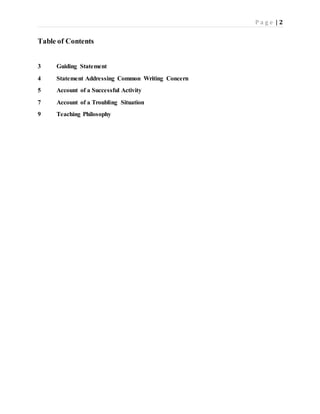
Table of Contents
3 Guiding Statement
4 Statement Addressing Common Writing Concern
5 Account of a Successful Activity
7 Account of a Troubling Situation
9 Teaching Philosophy
P a g e | 3
The content I have chosen to place within this teaching portfolio is shaped by certain instances
and growth that took place throughout my first semester of teaching Composition I. As I have
become more comfortable with my role as a teacher, I have constantly encouraged my students
to give me constant feedback, whether that be regarding a certain assignment, a grade, or any
concepts that we have all explored in the classroom. I believe that the four types of evidence I
have chosen, a common writing concern (“Organization”, or “Process”), an account of a
particularly successful activity (“Choosing and Narrowing”), a troubling situation I faced in the
classroom (“Grade Discrepancy”), and a statement of my Teaching Philosophy, demonstrate my
own unique approach to teaching Composition I, as well as the educational environment I wish
to foster in my classroom.
I begin this portfolio with a statement regarding a Common Writing Concern my composition
students shared, because the feedback my students gave in class prompted me to reevaluate the
types of activities we conducted within the classroom. By addressing the Common Writing
Concern with my students, and based on their feedback, I was also prompted to reevaluate my
teaching praxis within the classroom.
Next, I include an account of a particularly successful activity; and its relevance in this portfolio
lies in the fact that this activity was a direct product of the Common Writing Concern and
subsequent feedback my students gave me. After reevaluating how I wanted to conduct activities
within the classroom, I developed this activity to introduce new skills to my students, and give
them an immediate chance to practice implementing them within a group setting so that they
were able to bounce ideas off one another and explore these new concepts within a collaborative
setting.
The third item I include in this portfolio is an account of a specific, troubling situation I was
faced with inside the classroom. One of my students had a discrepancy regarding the grade he
received on his second essay, the Explanatory Synthesis. My reason for including this item, in
addition to the antagonist nature of the encounter, is because it was an instance where
communication between student and instructor was crucial. Additionally, and this is in regards to
my teaching philosophy as well, I have consistently told my students I am a constant resource for
them; and I constantly reaffirm that they are welcome to bring any questions or issues regarding
this class to my attention.
The last thing I include in this portfolio is a statement of my Teaching Philosophy. Initially, I did
not have a strong, concrete statement regarding my style of teaching, as well as what my goals
were within the classroom. But, my inclusion of these types of evidence purposefully speaks to
my growth as a teacher and how I consciously move forward when planning and teaching my
class. My Teaching Philosophy is a direct result of my experiences within the classroom, how
those experiences have fostered my intellectual growth as a teacher, and how they have shaped
the goals I pursue while designing, and subsequently teaching my Composition I course.
P a g e | 4
Statement of Common Writing Concern
In the course of working on their third essays, the Critique, my students confessed they were
experiencing a great deal of apprehension and confusion. This was understandable, due to the
time frame for generating this essay being significantly shorter than the previous essay.
However, my students admitted they were not having trouble coming up with content; but rather,
they were very confused with the process of structuring and organizing their essays. While we
had done plenty of in-class, critical readings in the past and the students were fairly proficient at
finding rhetorical strategies and elements that they believed warranted critiquing, they were
much less confident with going in and structuring their content within a logical organization
pattern.
While we were in the midst of an in-class writing activity that placed the students in groups so
they could workshop some of their content, I asked if the students had any questions regarding
their own individual critiques. One of my students raised his hand and stated that he was not
having any problems generating content for the essay; instead, he did not know how to structure
any of his assessment or response components within the paper. After he had finished outlining
some of the problems he was facing, I turned to the rest of the class and asked if anyone else was
experiencing a similar situation. In response to my question, the majority of my class raised their
hands to confirm what I assumed was a similar writing concern. Keeping this in mind with my
second class, I promptly asked if anyone was having trouble with outlining their content so that
there was a logical pattern of organization. Like my first class, they too had been experiencing
some difficulty with writing their own individual essays.
Upon learning about this common writing concern among my students, I used the feedback they
gave me to create all future in-class activities in relation to the specific concept we were working
on; but I made sure that it would correlate directly into the essay that they would be currently
working on. All future activities regarding the Critique essay focused on practicing
organizational patterns, as well as how to logically outline their points of assessment and
response. Additionally, I acquired a much better idea of how to construct in-class activities for
them, especially as we moved into our final project for the semester, the Argumentative
Synthesis.
In the past, all my activities have been collaboratively based, encouraging group work and
communication with everything from writing prompts to in-class, critical readings. However, the
specific feedback I was given in light of my students working on their Critique essays influenced
me to not only change how I created in-class activities for them, it also encouraged me to adjust
my teaching philosophy. Moving forward, I had a better idea of myself as a teacher, in that I
wanted to adopt a very practical approach that allowed them to practice implementing the skills
we discussed specifically in the classroom. It is my philosophy that this pragmatic approach
within the classroom, and allowing them to practice these new skills within their collaborative
groups, allows my students to become more comfortable with the concepts introduced in
Composition I, as well as fostering a better form of communication between student and
instructor that allows for very productive feedback.
P a g e | 5
Account of a SuccessfulActivity
The reason that I include this particular activity, which I conducted in both of my Composition
classes, stems from the Common Writing Concern that I outlined above. While many of my
students have engaged in varying degrees of writing in high school, some of the specific
concepts we introduce to them are foreign in nature. As I began introducing the concept of the
Argumentative Synthesis to my students and the type of research they would be conducting on
their own, I contemplated how to them learn some of these new concepts within the classroom in
order to prepare them for the work they would do individually.
The activity I discuss here has to do with generating topics in pairs, creating an argumentative
claim for those topics, and subsequently finding potential sources to support their claims. I had
long debated on possibly bringing in a representative from Mullins Library, here at the
University of Arkansas, but I decided against that. Instead of having a representative speak to my
students for the entirety of class that day, I designed a brief lecture and correlating activity to
help them get comfortable with the idea of scholarly research.
The lecture began with a brief video that I had viewed during my Composition Pedagogy class.
The content of this video focused on introducing students to the idea of finding and
implementing sources into their own arguments. Immediately following the video, I gave a short
lecture on how one should thoroughly read and integrate sources into their own work in order to
serve a specific purpose. Taking this lecture material a step further, I walked my students
through the University of Arkansas’s online database system, which can be accessed through
Mullins Library. I familiarized them with a number of databases that are at their disposal, as well
as a brief run down of “Quicksearch”, the library catalog, and the LibGuide that is tailored
specifically to our Composition I class.
After checking with my students to make sure there were no questions, I paired them up
according to who had brought a laptop or tablet, that way everyone would be able to take part in
the activity. I projected a list of instructions onto the board, detailing exactly what my
expectations were for this activity. My students were tasked with picking one or two topics from
a list I had generated specifically for this activity; and once they had chosen one or two topics,
they would create an argumentative claim or thesis. By having them choose from a list of topics,
my students were given the chance to practice choosing and subsequently narrowing a topic, just
as we had discussed in our lecture that day. Once they had chosen and narrowed their topics,
they were required to practice using “Quicksearch”, the library catalog, and any appropriate
databases in order to find potential sources to back up their claims.
My students were given roughly 20 to 25 minutes to complete this activity; and as they were
busy working in their groups, I walked around the room to ask each pair what their
argumentative claim was, whether it was too broad or too narrow, and helped them navigate any
online databases or catalogs they were using. At one point a pair of students asked for my
assistance while they were searching for online, scholarly sources. The trouble they were having
stemmed from trying to filter out sources that did not meet their needs. I used their dilemma to
address the class as a whole, and explained to all of my students how you can avoid filtering
P a g e | 6
through useless sources by being more specific with your search material, as well as filtering out
types of sources you do not need. Another common problem amongst my students during this
activity was developing an argumentative claim that was actually debatable. Initially, a good
number of them had generated statements specific to their topic, but there was no argument or
underlying debate to the claim. By going around to each table, I was able to help the students
practice generating their own argumentative claims, create topics specific enough so as not to be
too broad or too narrow within the context of the research paper they would be required to write,
as well as help them workshop how to conduct scholarly research.
I include this activity in my portfolio because it demonstrates how I want to actively improve as
a teacher, based off the previous item regarding a Common Writing Concern amongst my
students. Not only do I want to present practical tools to my students so they can become
extremely familiar with the process of writing a research paper on their own, I want my
classroom to be a space where they can actively practice those skills in a collaborative
environment. I believe a pragmatic approach in my classroom affords them the most opportunity
to learn these composition skills, as well as work together with their peers in order to practice
putting these skills to use.
P a g e | 7
Account of a Particularly Troubling Situation
Roughly halfway through the Fall 2017 semester, I was met with a troubling experience in the
classroom. The focus of that day’s class was to return both their midterms and their second
essays, the Explanatory Synthesis. We used the class to discuss common problems and concerns
that seemed to apply to most, if not all, of my students. While there were several things to point
out in order for their writing to improve, I was very pleased with how far my students had
progressed since the first Summary Essay. Minor mechanical and style issues were no longer a
concern; it was overarching problems such as elaborating on their individual analyses, or
improving organization and structure within the paper that I believed should be the primary focus
with regards to helping my students grow as writers. As always with my students, I tell them to
always feel free to email me, talk to me after class, or stop by office hours if they have any
questions regarding their grades or the feedback I left on their final drafts.
Up until this point, I had not encountered a student who was deeply dissatisfied with the grade
they had received on any of their papers. That is not to say that I hand out A’s to all my students;
however, one student in particular approached me as soon as I dismissed the rest of the class for
the day, and very avidly, and almost antagonistically, began questioning the grade I had given
him on his Explanatory Synthesis. I had felt confident in my grading up until this point purely
because I use a very in depth rubric that I always make available to my students on Blackboard,
our University’s website that allows students to access class material online. In addition to
writing down their grade on the back of their essay, I also map out the rubric breakdown, the
amount of points I have given them after evaluating their work, and an explanation of how I
reached that number should it be lower than full credit.
However, this situation was challenging for me because my student referred back to our
Individual Conference that had taken place a week or so prior to the essay being due. During that
conference, I had examined his rough draft and discussed any problems he had been running
into. After we had taken a look at his work and made a few corrections, I told him this was a
well-written paper and to contact me if he had any more questions.
When it came time to hand back papers, the student I had worked with felt he had been misled in
our conferences and that he deserved a better grade. He and I took 5 or 10 minutes after class to
examine his final paper together. While I felt bad that he was disappointed with his grade, I
noticed he had added a good bit of material to his final draft, material I had not seen during
conferences. While the content showed a good grasp with the concepts of synthesis and analysis,
he had completely skewed the author’s stance on the issue being discussed. My student had
analyzed one of the two sources as taking an overwhelming positive stance on a controversial
issue; and while I could see he had done a good job of synthesizing his material, he had
completely misrepresented the author’s argument. Not only that, but the new material was highly
redundant with regards to other portions of his paper.
Looking back, yes the situation that occurred was troubling for me in a number of ways;
however, I include it in this portfolio for several reasons. For one, it was an instance where I had
to defend my own evaluation of a student’s work, in addition to other students being present in
P a g e | 8
the classroom. I wanted to be fair and thoroughly listen to my student’s concerns; but at the same
time, I wanted him to know exactly why I had arrived at this particular grade and where he
needed to improve for the next essay. Another reason I include it in this portfolio is to
demonstrate one of my goals as a teacher, which is to encourage and receive subsequent
feedback as much as possible, even if it is negative in nature. Not only do I want to encourage
feedback during our class meetings with regards to common writing concerns and problems with
learning a new concept, I want all of my students to feel they can comfortably discuss with me
why they received a certain grade and how they can go about improving their skills for any
future writing assignments.
P a g e | 9
Statement of Teaching Philosophy
My teaching philosophy has been shaped by a number of components throughout this first
semester of instructing Composition I, with the first being the experiences I gained in the
classroom. Throughout the first half of the semester, I did not have a strong sense of what my
teaching philosophy was purely because I felt so inexperienced as an educator. Initially, I relied
mostly on lecture to fill up class time, with the logic being that I knew the material and I knew I
could thoroughly teach it to my students in that manner. However, I noticed my students were
obviously not engaged; there was little participation or interaction among them. As I became
more comfortable in the classroom setting, I transitioned to relying more on in-class, critical
readings that were intended to help them get comfortable with analyzing source material. So in
addition to using lectures to facilitate what information my students needed to learn, I mostly
emphasized analytical reading in order to get them comfortable with the essays from They Say/I
Say, one of our course’s textbooks, that they would either be summarizing, synthesizing or
critiquing.
The more experiences I gathered in the classroom though, the more I realized that my students
would benefit from a more practical, pragmatic approach when it came to learning these new
skills and integrating them into their actual assignments. This was born not only of acquiring
more experience as a composition teacher, but also from encouraging and finally receiving
feedback from my students.
My experiences in the classroom determined two things for me as I moved into the second half
of the Fall semester. First, I wanted to provide my students with both the tools that would be
useful for this class and any future writing they might be expected to do throughout their college
careers, as well as practice within the actual classroom to become comfortable with those very
same tools. Second, my experiences also fostered my own intellectual growth as a teacher,
prompting me to actively shape my classroom and the correlating activities to meet my own
goals. Not only did I want the activities my students participated in to reflect on lecture material
and foster a collaborative nature in the classroom, I wanted my students to have the opportunity
to put their skills to use with me present in the classroom to guide them, as well as being able to
collaborate with their peers and workshop through these new concepts together.
My intellectual growth as a new composition teacher was not only influenced by the experiences
I had in the classroom, but also by the theories I was introduced to during my Composition
Pedagogy class. With regards to my own philosophy, I was strongly influenced by scholars such
as Chris Anson, Mike Rose, and Hephzibah Roskelly, who, respectively, emphasized
pedagogical practices that focused on process rather than product, a wide variety of heuristics
and strategies that allow for fluidity within the writing process, as well as pushing for a
classroom that is student-centered rather than teacher-centered. Upon reading Anson’s “Process
Pedagogy and its Legacy”, I was pulled in by, and I believe this also plays into Roskelly’s work,
his analysis of the process movement within Composition studies and how the shift resulted in
teacher’s no longer being the giver of knowledge, but with the student serving as an active player
in regards to creating the knowledge they use in the classroom. That being said, I believe
students can actively generate and practice the knowledge that is produced in the classroom
P a g e | 10
when they are given a variety of methods and strategies to attack any potential task within a
writing course. Mike Rose’s “Rigid Rules, Inflexible Plans, and the Stifling of Language”, which
analyzed what causes student writers to be plagued by “writer’s block”, emphasizes that students
need to be taught that there is no single correct method for carrying out the writing process. In
addition to working towards a student-centered classroom that puts the process of writing and
learning in the students’ hands, I also believe that one of the most important concepts that my
students can take away from this writing course is that there are a variety of tools at their
disposal when faced with any challenge in a writing class; and with that being said, each writer
will employ their own method, or methods, to complete a project. Lastly, Hephzibah Roskelly’s
essay “The Risky Business of Group Work”, addresses the age-old fear of implementing actual
group work in the classroom. While there is a risk of the students’ own experiences and goals
being subordinated beneath those of the Institution’s, there is an even greater risk that the goals
of the Institution will be pushed to the wayside. While I do believe there are some potential
conflicts when implementing group work in the classroom, I personally prize the benefits of
creating a classroom that is student-centered rather than teacher-centered. Roskelly addresses a
general fear that many teachers have, in that they fear being pushed to the periphery within the
class; but I do not share that fear in my own classroom. I prefer to have my students generate and
channel the classroom discussion with regards to what we are learning at that time. Not only do I
believe it encourages participation and interaction among them, but my students feel a greater
investment in the learning process if the content is geared towards them, by them.
My goals as a composition teacher are prompted by the experiences I have gained from the
classroom and the intellectual growth that developed accordingly. Prior to writing this portfolio,
I did not have a strong sense of what my teaching philosophy was, let alone what my own goals
were within the classroom. But as experience fed into intellectual growth, my own philosophy
developed, as did my own teaching style. I prefer to guide group collaboration as much as
possible; additionally, I want the nature of my classroom to be student-centered, not instructor-
centered. My goal is to provide them with the tools they need to accomplish the work
themselves. My emphasis on collaboration and feedback is designed to put classroom procedures
into my students’ own hands, so that they can play an active role in engaging with course
material. I believe that not only is class participation and student interaction vastly improved
when they have a say in how we carry out the learning process, but that they also better engage
with the concepts at hand. The skills and tools I want to give my students are designed to help
them excel within a writing course; but ideally, they will be able to apply these skills into other
areas of their lives. It does not escape my notice that I am being quite optimistic for a first year
composition teacher; and do my newfound goals always come about? Of course not, but being
aware of my teaching philosophy has already and will continue to benefit me in the future when
designing course content as well as interacting with my students.
P a g e | 11
Works Cited
Anson, Chris M. “Process Pedagogy and Its Legacy”. A Guide to Composition Pedagogy, ed. by
Tate, Gary, Amy Rupiper Taggart, Kurt Schick, H. Brooke Hessler, Oxford University
Press, 2014, pp. 212-226.
Rose, Mike. “Rigid Rules, Inflexible Plans, and the Stifling of Language: A Cognitivist Analysis
of Writer’s Block.” College Composition and Communication 31.4 (1980): 389-401.
Print.
Roskelly, Hephzibah, “The Risky Business of Group Work.” The Writing Teacher’s Sourcebook.
Eds. Edward P. J. Corbett, Nancy Meyers, and Gary Tate. 4th ed. New York: Oxford,
2000. Pp. 123-128

3rd Draft - Portfolio #2

  • 1.
    P a ge | 1 Amanda White Teaching Portfolio for Composition I Fall 2017
  • 2.
    P a ge | 2 Table of Contents 3 Guiding Statement 4 Statement Addressing Common Writing Concern 5 Account of a Successful Activity 7 Account of a Troubling Situation 9 Teaching Philosophy
  • 3.
    P a ge | 3 The content I have chosen to place within this teaching portfolio is shaped by certain instances and growth that took place throughout my first semester of teaching Composition I. As I have become more comfortable with my role as a teacher, I have constantly encouraged my students to give me constant feedback, whether that be regarding a certain assignment, a grade, or any concepts that we have all explored in the classroom. I believe that the four types of evidence I have chosen, a common writing concern (“Organization”, or “Process”), an account of a particularly successful activity (“Choosing and Narrowing”), a troubling situation I faced in the classroom (“Grade Discrepancy”), and a statement of my Teaching Philosophy, demonstrate my own unique approach to teaching Composition I, as well as the educational environment I wish to foster in my classroom. I begin this portfolio with a statement regarding a Common Writing Concern my composition students shared, because the feedback my students gave in class prompted me to reevaluate the types of activities we conducted within the classroom. By addressing the Common Writing Concern with my students, and based on their feedback, I was also prompted to reevaluate my teaching praxis within the classroom. Next, I include an account of a particularly successful activity; and its relevance in this portfolio lies in the fact that this activity was a direct product of the Common Writing Concern and subsequent feedback my students gave me. After reevaluating how I wanted to conduct activities within the classroom, I developed this activity to introduce new skills to my students, and give them an immediate chance to practice implementing them within a group setting so that they were able to bounce ideas off one another and explore these new concepts within a collaborative setting. The third item I include in this portfolio is an account of a specific, troubling situation I was faced with inside the classroom. One of my students had a discrepancy regarding the grade he received on his second essay, the Explanatory Synthesis. My reason for including this item, in addition to the antagonist nature of the encounter, is because it was an instance where communication between student and instructor was crucial. Additionally, and this is in regards to my teaching philosophy as well, I have consistently told my students I am a constant resource for them; and I constantly reaffirm that they are welcome to bring any questions or issues regarding this class to my attention. The last thing I include in this portfolio is a statement of my Teaching Philosophy. Initially, I did not have a strong, concrete statement regarding my style of teaching, as well as what my goals were within the classroom. But, my inclusion of these types of evidence purposefully speaks to my growth as a teacher and how I consciously move forward when planning and teaching my class. My Teaching Philosophy is a direct result of my experiences within the classroom, how those experiences have fostered my intellectual growth as a teacher, and how they have shaped the goals I pursue while designing, and subsequently teaching my Composition I course.
  • 4.
    P a ge | 4 Statement of Common Writing Concern In the course of working on their third essays, the Critique, my students confessed they were experiencing a great deal of apprehension and confusion. This was understandable, due to the time frame for generating this essay being significantly shorter than the previous essay. However, my students admitted they were not having trouble coming up with content; but rather, they were very confused with the process of structuring and organizing their essays. While we had done plenty of in-class, critical readings in the past and the students were fairly proficient at finding rhetorical strategies and elements that they believed warranted critiquing, they were much less confident with going in and structuring their content within a logical organization pattern. While we were in the midst of an in-class writing activity that placed the students in groups so they could workshop some of their content, I asked if the students had any questions regarding their own individual critiques. One of my students raised his hand and stated that he was not having any problems generating content for the essay; instead, he did not know how to structure any of his assessment or response components within the paper. After he had finished outlining some of the problems he was facing, I turned to the rest of the class and asked if anyone else was experiencing a similar situation. In response to my question, the majority of my class raised their hands to confirm what I assumed was a similar writing concern. Keeping this in mind with my second class, I promptly asked if anyone was having trouble with outlining their content so that there was a logical pattern of organization. Like my first class, they too had been experiencing some difficulty with writing their own individual essays. Upon learning about this common writing concern among my students, I used the feedback they gave me to create all future in-class activities in relation to the specific concept we were working on; but I made sure that it would correlate directly into the essay that they would be currently working on. All future activities regarding the Critique essay focused on practicing organizational patterns, as well as how to logically outline their points of assessment and response. Additionally, I acquired a much better idea of how to construct in-class activities for them, especially as we moved into our final project for the semester, the Argumentative Synthesis. In the past, all my activities have been collaboratively based, encouraging group work and communication with everything from writing prompts to in-class, critical readings. However, the specific feedback I was given in light of my students working on their Critique essays influenced me to not only change how I created in-class activities for them, it also encouraged me to adjust my teaching philosophy. Moving forward, I had a better idea of myself as a teacher, in that I wanted to adopt a very practical approach that allowed them to practice implementing the skills we discussed specifically in the classroom. It is my philosophy that this pragmatic approach within the classroom, and allowing them to practice these new skills within their collaborative groups, allows my students to become more comfortable with the concepts introduced in Composition I, as well as fostering a better form of communication between student and instructor that allows for very productive feedback.
  • 5.
    P a ge | 5 Account of a SuccessfulActivity The reason that I include this particular activity, which I conducted in both of my Composition classes, stems from the Common Writing Concern that I outlined above. While many of my students have engaged in varying degrees of writing in high school, some of the specific concepts we introduce to them are foreign in nature. As I began introducing the concept of the Argumentative Synthesis to my students and the type of research they would be conducting on their own, I contemplated how to them learn some of these new concepts within the classroom in order to prepare them for the work they would do individually. The activity I discuss here has to do with generating topics in pairs, creating an argumentative claim for those topics, and subsequently finding potential sources to support their claims. I had long debated on possibly bringing in a representative from Mullins Library, here at the University of Arkansas, but I decided against that. Instead of having a representative speak to my students for the entirety of class that day, I designed a brief lecture and correlating activity to help them get comfortable with the idea of scholarly research. The lecture began with a brief video that I had viewed during my Composition Pedagogy class. The content of this video focused on introducing students to the idea of finding and implementing sources into their own arguments. Immediately following the video, I gave a short lecture on how one should thoroughly read and integrate sources into their own work in order to serve a specific purpose. Taking this lecture material a step further, I walked my students through the University of Arkansas’s online database system, which can be accessed through Mullins Library. I familiarized them with a number of databases that are at their disposal, as well as a brief run down of “Quicksearch”, the library catalog, and the LibGuide that is tailored specifically to our Composition I class. After checking with my students to make sure there were no questions, I paired them up according to who had brought a laptop or tablet, that way everyone would be able to take part in the activity. I projected a list of instructions onto the board, detailing exactly what my expectations were for this activity. My students were tasked with picking one or two topics from a list I had generated specifically for this activity; and once they had chosen one or two topics, they would create an argumentative claim or thesis. By having them choose from a list of topics, my students were given the chance to practice choosing and subsequently narrowing a topic, just as we had discussed in our lecture that day. Once they had chosen and narrowed their topics, they were required to practice using “Quicksearch”, the library catalog, and any appropriate databases in order to find potential sources to back up their claims. My students were given roughly 20 to 25 minutes to complete this activity; and as they were busy working in their groups, I walked around the room to ask each pair what their argumentative claim was, whether it was too broad or too narrow, and helped them navigate any online databases or catalogs they were using. At one point a pair of students asked for my assistance while they were searching for online, scholarly sources. The trouble they were having stemmed from trying to filter out sources that did not meet their needs. I used their dilemma to address the class as a whole, and explained to all of my students how you can avoid filtering
  • 6.
    P a ge | 6 through useless sources by being more specific with your search material, as well as filtering out types of sources you do not need. Another common problem amongst my students during this activity was developing an argumentative claim that was actually debatable. Initially, a good number of them had generated statements specific to their topic, but there was no argument or underlying debate to the claim. By going around to each table, I was able to help the students practice generating their own argumentative claims, create topics specific enough so as not to be too broad or too narrow within the context of the research paper they would be required to write, as well as help them workshop how to conduct scholarly research. I include this activity in my portfolio because it demonstrates how I want to actively improve as a teacher, based off the previous item regarding a Common Writing Concern amongst my students. Not only do I want to present practical tools to my students so they can become extremely familiar with the process of writing a research paper on their own, I want my classroom to be a space where they can actively practice those skills in a collaborative environment. I believe a pragmatic approach in my classroom affords them the most opportunity to learn these composition skills, as well as work together with their peers in order to practice putting these skills to use.
  • 7.
    P a ge | 7 Account of a Particularly Troubling Situation Roughly halfway through the Fall 2017 semester, I was met with a troubling experience in the classroom. The focus of that day’s class was to return both their midterms and their second essays, the Explanatory Synthesis. We used the class to discuss common problems and concerns that seemed to apply to most, if not all, of my students. While there were several things to point out in order for their writing to improve, I was very pleased with how far my students had progressed since the first Summary Essay. Minor mechanical and style issues were no longer a concern; it was overarching problems such as elaborating on their individual analyses, or improving organization and structure within the paper that I believed should be the primary focus with regards to helping my students grow as writers. As always with my students, I tell them to always feel free to email me, talk to me after class, or stop by office hours if they have any questions regarding their grades or the feedback I left on their final drafts. Up until this point, I had not encountered a student who was deeply dissatisfied with the grade they had received on any of their papers. That is not to say that I hand out A’s to all my students; however, one student in particular approached me as soon as I dismissed the rest of the class for the day, and very avidly, and almost antagonistically, began questioning the grade I had given him on his Explanatory Synthesis. I had felt confident in my grading up until this point purely because I use a very in depth rubric that I always make available to my students on Blackboard, our University’s website that allows students to access class material online. In addition to writing down their grade on the back of their essay, I also map out the rubric breakdown, the amount of points I have given them after evaluating their work, and an explanation of how I reached that number should it be lower than full credit. However, this situation was challenging for me because my student referred back to our Individual Conference that had taken place a week or so prior to the essay being due. During that conference, I had examined his rough draft and discussed any problems he had been running into. After we had taken a look at his work and made a few corrections, I told him this was a well-written paper and to contact me if he had any more questions. When it came time to hand back papers, the student I had worked with felt he had been misled in our conferences and that he deserved a better grade. He and I took 5 or 10 minutes after class to examine his final paper together. While I felt bad that he was disappointed with his grade, I noticed he had added a good bit of material to his final draft, material I had not seen during conferences. While the content showed a good grasp with the concepts of synthesis and analysis, he had completely skewed the author’s stance on the issue being discussed. My student had analyzed one of the two sources as taking an overwhelming positive stance on a controversial issue; and while I could see he had done a good job of synthesizing his material, he had completely misrepresented the author’s argument. Not only that, but the new material was highly redundant with regards to other portions of his paper. Looking back, yes the situation that occurred was troubling for me in a number of ways; however, I include it in this portfolio for several reasons. For one, it was an instance where I had to defend my own evaluation of a student’s work, in addition to other students being present in
  • 8.
    P a ge | 8 the classroom. I wanted to be fair and thoroughly listen to my student’s concerns; but at the same time, I wanted him to know exactly why I had arrived at this particular grade and where he needed to improve for the next essay. Another reason I include it in this portfolio is to demonstrate one of my goals as a teacher, which is to encourage and receive subsequent feedback as much as possible, even if it is negative in nature. Not only do I want to encourage feedback during our class meetings with regards to common writing concerns and problems with learning a new concept, I want all of my students to feel they can comfortably discuss with me why they received a certain grade and how they can go about improving their skills for any future writing assignments.
  • 9.
    P a ge | 9 Statement of Teaching Philosophy My teaching philosophy has been shaped by a number of components throughout this first semester of instructing Composition I, with the first being the experiences I gained in the classroom. Throughout the first half of the semester, I did not have a strong sense of what my teaching philosophy was purely because I felt so inexperienced as an educator. Initially, I relied mostly on lecture to fill up class time, with the logic being that I knew the material and I knew I could thoroughly teach it to my students in that manner. However, I noticed my students were obviously not engaged; there was little participation or interaction among them. As I became more comfortable in the classroom setting, I transitioned to relying more on in-class, critical readings that were intended to help them get comfortable with analyzing source material. So in addition to using lectures to facilitate what information my students needed to learn, I mostly emphasized analytical reading in order to get them comfortable with the essays from They Say/I Say, one of our course’s textbooks, that they would either be summarizing, synthesizing or critiquing. The more experiences I gathered in the classroom though, the more I realized that my students would benefit from a more practical, pragmatic approach when it came to learning these new skills and integrating them into their actual assignments. This was born not only of acquiring more experience as a composition teacher, but also from encouraging and finally receiving feedback from my students. My experiences in the classroom determined two things for me as I moved into the second half of the Fall semester. First, I wanted to provide my students with both the tools that would be useful for this class and any future writing they might be expected to do throughout their college careers, as well as practice within the actual classroom to become comfortable with those very same tools. Second, my experiences also fostered my own intellectual growth as a teacher, prompting me to actively shape my classroom and the correlating activities to meet my own goals. Not only did I want the activities my students participated in to reflect on lecture material and foster a collaborative nature in the classroom, I wanted my students to have the opportunity to put their skills to use with me present in the classroom to guide them, as well as being able to collaborate with their peers and workshop through these new concepts together. My intellectual growth as a new composition teacher was not only influenced by the experiences I had in the classroom, but also by the theories I was introduced to during my Composition Pedagogy class. With regards to my own philosophy, I was strongly influenced by scholars such as Chris Anson, Mike Rose, and Hephzibah Roskelly, who, respectively, emphasized pedagogical practices that focused on process rather than product, a wide variety of heuristics and strategies that allow for fluidity within the writing process, as well as pushing for a classroom that is student-centered rather than teacher-centered. Upon reading Anson’s “Process Pedagogy and its Legacy”, I was pulled in by, and I believe this also plays into Roskelly’s work, his analysis of the process movement within Composition studies and how the shift resulted in teacher’s no longer being the giver of knowledge, but with the student serving as an active player in regards to creating the knowledge they use in the classroom. That being said, I believe students can actively generate and practice the knowledge that is produced in the classroom
  • 10.
    P a ge | 10 when they are given a variety of methods and strategies to attack any potential task within a writing course. Mike Rose’s “Rigid Rules, Inflexible Plans, and the Stifling of Language”, which analyzed what causes student writers to be plagued by “writer’s block”, emphasizes that students need to be taught that there is no single correct method for carrying out the writing process. In addition to working towards a student-centered classroom that puts the process of writing and learning in the students’ hands, I also believe that one of the most important concepts that my students can take away from this writing course is that there are a variety of tools at their disposal when faced with any challenge in a writing class; and with that being said, each writer will employ their own method, or methods, to complete a project. Lastly, Hephzibah Roskelly’s essay “The Risky Business of Group Work”, addresses the age-old fear of implementing actual group work in the classroom. While there is a risk of the students’ own experiences and goals being subordinated beneath those of the Institution’s, there is an even greater risk that the goals of the Institution will be pushed to the wayside. While I do believe there are some potential conflicts when implementing group work in the classroom, I personally prize the benefits of creating a classroom that is student-centered rather than teacher-centered. Roskelly addresses a general fear that many teachers have, in that they fear being pushed to the periphery within the class; but I do not share that fear in my own classroom. I prefer to have my students generate and channel the classroom discussion with regards to what we are learning at that time. Not only do I believe it encourages participation and interaction among them, but my students feel a greater investment in the learning process if the content is geared towards them, by them. My goals as a composition teacher are prompted by the experiences I have gained from the classroom and the intellectual growth that developed accordingly. Prior to writing this portfolio, I did not have a strong sense of what my teaching philosophy was, let alone what my own goals were within the classroom. But as experience fed into intellectual growth, my own philosophy developed, as did my own teaching style. I prefer to guide group collaboration as much as possible; additionally, I want the nature of my classroom to be student-centered, not instructor- centered. My goal is to provide them with the tools they need to accomplish the work themselves. My emphasis on collaboration and feedback is designed to put classroom procedures into my students’ own hands, so that they can play an active role in engaging with course material. I believe that not only is class participation and student interaction vastly improved when they have a say in how we carry out the learning process, but that they also better engage with the concepts at hand. The skills and tools I want to give my students are designed to help them excel within a writing course; but ideally, they will be able to apply these skills into other areas of their lives. It does not escape my notice that I am being quite optimistic for a first year composition teacher; and do my newfound goals always come about? Of course not, but being aware of my teaching philosophy has already and will continue to benefit me in the future when designing course content as well as interacting with my students.
  • 11.
    P a ge | 11 Works Cited Anson, Chris M. “Process Pedagogy and Its Legacy”. A Guide to Composition Pedagogy, ed. by Tate, Gary, Amy Rupiper Taggart, Kurt Schick, H. Brooke Hessler, Oxford University Press, 2014, pp. 212-226. Rose, Mike. “Rigid Rules, Inflexible Plans, and the Stifling of Language: A Cognitivist Analysis of Writer’s Block.” College Composition and Communication 31.4 (1980): 389-401. Print. Roskelly, Hephzibah, “The Risky Business of Group Work.” The Writing Teacher’s Sourcebook. Eds. Edward P. J. Corbett, Nancy Meyers, and Gary Tate. 4th ed. New York: Oxford, 2000. Pp. 123-128