In today’s session…
• Performance enhancing drugs (20 minutes)
• Ethical matrix (10 minutes)
• Debate (30 minutes)
• Summary (5 minutes)
• Feedback (5 minutes)
• Next week… (5 minutes)
Definition of Performance Enhancement
“The use of any support or practice that
improves athletic performance or physical work
capacity. It can be achieved through physical,
pharmacological, psychological, nutritional or
mechanical means” (Katch et al 2007).
Can anyone name one high profile doper?
Prohibited Substances…
https://wada-main-prod.s3.amazonaws.com/resources/files/wada-2016-prohibited-list-en.pdf
The World Anti-Doping Agency (WADA) publishes a list of prohibited
substances and methods known as the WADA code:
• Androgenic Anabolic Steroids
• Human Growth Hormone (HGH)
• Blood Doping
 Erythropoietin (EPO)
• Stimulants
• Diuretics
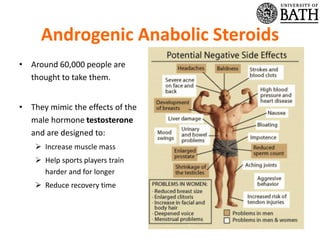
Androgenic Anabolic Steroids
• Around 60,000 people are
thought to take them.
• They mimic the effects of the
male hormone testosterone
and are designed to:
 Increase muscle mass
 Help sports players train
harder and for longer
 Reduce recovery time
Human Growth Hormone (HGH)
• HGH is produced normally by the
pituitary gland and stimulates growth
in children and adolescents.
• But, synthetic HGH is also available
and some sportspeople abuse it.
• Speeds muscle development,
reduces body fat and strengthens
muscles.
Side Effects:
 Diabetes
 Muscle/joint pain
 Hypertension
 Cardiovascular disease
 Decreased life expectancy
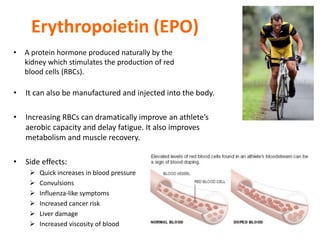
Erythropoietin (EPO)
• It can also be manufactured and injected into the body.
• Increasing RBCs can dramatically improve an athlete’s
aerobic capacity and delay fatigue. It also improves
metabolism and muscle recovery.
• Side effects:
 Quick increases in blood pressure
 Convulsions
 Influenza-like symptoms
 Increased cancer risk
 Liver damage
 Increased viscosity of blood
• A protein hormone produced naturally by the
kidney which stimulates the production of red
blood cells (RBCs).
Side effects:
 Anxiety
 Headaches
 Hypertension
 Nerve Damage
 Physical collapsing
 Irregular heartbeat
 Increased blood pressure
Stimulants
• Substances that elevate the level of physiological or nervous action in the body.
• Athletes use various stimulants to increase alertness and boost general
performance.
• Examples: adrenaline, amphetamines and cocaine.
Diuretics
• Pills that help to rid the body of sodium, taking water with it when it is
excreted in the urine.
• It can result in rapid weight loss as your water stores are depleted.
• Most commonly used by sportspeople needing to reach a certain weight
class e.g. jockeys and boxers.
Side Effects:
 Headaches
 Muscle cramps
 Dizziness
 High blood sugar levels
 Abnormal heart rhythm
 Fatigue
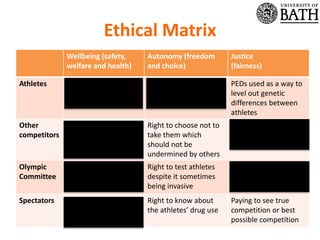
Ethical Matrix
Wellbeing (safety,
welfare and health)
Autonomy (freedom
and choice)
Justice
(fairness)
Athletes Harmful side effects
and repercussions
Freedom to choose
whether or not to use
PEDs
PEDs used as a way to
level out genetic
differences between
athletes
Other
competitors
Psychological damage
– feeling inferior.
Health maintained by
not taking PEDs
Right to choose not to
take them which
should not be
undermined by others
The right to compete
on a level playing field
Olympic
Committee
Looking out for
welfare of all athletes
Right to test athletes
despite it sometimes
being invasive
Eliminate cheating
from the World’s
largest sports event
Spectators Bad role models for
children who aspire to
their idols
Right to know about
the athletes’ drug use
Paying to see true
competition or best
possible competition
Debate and Discussion
Should the use of performance enhancing
drugs be legalised in the Olympics?
FOR
Assign yourselves the following roles:
• 1 athlete on PEDs
• 1 head coach
• 1 spectator
• 1 Olympic committee member
You are all debating for the legalisation
of PEDs in professional sport.
AGAINST
Assign yourselves the following roles:
• 1 athlete not on PEDs
• 1 head coach
• 1 spectator
• 1 Olympic committee member
You are all debating against the
legalisation of PEDs in professional sport.
Both groups have 5 minutes to plan your arguments and your reasons behind them.
Then we will have the debate and open the floor to questions.
Summary
• One major challenge concerning the Olympic Games is preventing the use
of PEDs.
• PEDs are becoming harder to detect – Lance Armstrong continued for
several years before being found out.
• There are a wide variety of prohibited substances, the most common of
which we have covered in this lesson.
• Though they can improve sporting performance, many of these drugs go
hand in hand with severe side effects e.g. cardiac problems, infertility and
cancer risk.
• WADA continues to fight against the use of PEDs in sport – their motto
‘play true’ reflects this.
References
• World Anti-Doping Agency. (2016). Prohibited List. Available: https://wada-main-
prod.s3.amazonaws.com/resources/files/wada-2016-prohibited-list-en.pdf. Last
accessed 28th Feb 2016.
• Fong, J. Drugs in Sport. Available: https://www.tes.com/lessons/Q-
R1f__LbjD2wA/drugs-in-sport. Last accessed 28th Feb 2016.
• Ratini, M. (2014). Human Growth Hormone (HGH). Available:
http://www.webmd.com/fitness-exercise/human-growth-hormone-hgh. Last
accessed 28th Feb 2016.
• Stimulants - World of Sports Science 2013. Stimulants - World of Sports Science.
Available at: http://www.faqs.org/sports-science/Sp-Tw/Stimulants.html. Last
accessed 28th Feb 2016.

3_Performance_Enhancing_Drugs.pptx

  • 2.
    In today’s session… •Performance enhancing drugs (20 minutes) • Ethical matrix (10 minutes) • Debate (30 minutes) • Summary (5 minutes) • Feedback (5 minutes) • Next week… (5 minutes)
  • 4.
    Definition of PerformanceEnhancement “The use of any support or practice that improves athletic performance or physical work capacity. It can be achieved through physical, pharmacological, psychological, nutritional or mechanical means” (Katch et al 2007).
  • 5.
    Can anyone nameone high profile doper?
  • 6.
    Prohibited Substances… https://wada-main-prod.s3.amazonaws.com/resources/files/wada-2016-prohibited-list-en.pdf The WorldAnti-Doping Agency (WADA) publishes a list of prohibited substances and methods known as the WADA code: • Androgenic Anabolic Steroids • Human Growth Hormone (HGH) • Blood Doping  Erythropoietin (EPO) • Stimulants • Diuretics
  • 7.
    Androgenic Anabolic Steroids •Around 60,000 people are thought to take them. • They mimic the effects of the male hormone testosterone and are designed to:  Increase muscle mass  Help sports players train harder and for longer  Reduce recovery time
  • 8.
    Human Growth Hormone(HGH) • HGH is produced normally by the pituitary gland and stimulates growth in children and adolescents. • But, synthetic HGH is also available and some sportspeople abuse it. • Speeds muscle development, reduces body fat and strengthens muscles. Side Effects:  Diabetes  Muscle/joint pain  Hypertension  Cardiovascular disease  Decreased life expectancy
  • 9.
    Erythropoietin (EPO) • Itcan also be manufactured and injected into the body. • Increasing RBCs can dramatically improve an athlete’s aerobic capacity and delay fatigue. It also improves metabolism and muscle recovery. • Side effects:  Quick increases in blood pressure  Convulsions  Influenza-like symptoms  Increased cancer risk  Liver damage  Increased viscosity of blood • A protein hormone produced naturally by the kidney which stimulates the production of red blood cells (RBCs).
  • 10.
    Side effects:  Anxiety Headaches  Hypertension  Nerve Damage  Physical collapsing  Irregular heartbeat  Increased blood pressure Stimulants • Substances that elevate the level of physiological or nervous action in the body. • Athletes use various stimulants to increase alertness and boost general performance. • Examples: adrenaline, amphetamines and cocaine.
  • 11.
    Diuretics • Pills thathelp to rid the body of sodium, taking water with it when it is excreted in the urine. • It can result in rapid weight loss as your water stores are depleted. • Most commonly used by sportspeople needing to reach a certain weight class e.g. jockeys and boxers. Side Effects:  Headaches  Muscle cramps  Dizziness  High blood sugar levels  Abnormal heart rhythm  Fatigue
  • 12.
    Ethical Matrix Wellbeing (safety, welfareand health) Autonomy (freedom and choice) Justice (fairness) Athletes Harmful side effects and repercussions Freedom to choose whether or not to use PEDs PEDs used as a way to level out genetic differences between athletes Other competitors Psychological damage – feeling inferior. Health maintained by not taking PEDs Right to choose not to take them which should not be undermined by others The right to compete on a level playing field Olympic Committee Looking out for welfare of all athletes Right to test athletes despite it sometimes being invasive Eliminate cheating from the World’s largest sports event Spectators Bad role models for children who aspire to their idols Right to know about the athletes’ drug use Paying to see true competition or best possible competition
  • 13.
    Debate and Discussion Shouldthe use of performance enhancing drugs be legalised in the Olympics? FOR Assign yourselves the following roles: • 1 athlete on PEDs • 1 head coach • 1 spectator • 1 Olympic committee member You are all debating for the legalisation of PEDs in professional sport. AGAINST Assign yourselves the following roles: • 1 athlete not on PEDs • 1 head coach • 1 spectator • 1 Olympic committee member You are all debating against the legalisation of PEDs in professional sport. Both groups have 5 minutes to plan your arguments and your reasons behind them. Then we will have the debate and open the floor to questions.
  • 14.
    Summary • One majorchallenge concerning the Olympic Games is preventing the use of PEDs. • PEDs are becoming harder to detect – Lance Armstrong continued for several years before being found out. • There are a wide variety of prohibited substances, the most common of which we have covered in this lesson. • Though they can improve sporting performance, many of these drugs go hand in hand with severe side effects e.g. cardiac problems, infertility and cancer risk. • WADA continues to fight against the use of PEDs in sport – their motto ‘play true’ reflects this.
  • 15.
    References • World Anti-DopingAgency. (2016). Prohibited List. Available: https://wada-main- prod.s3.amazonaws.com/resources/files/wada-2016-prohibited-list-en.pdf. Last accessed 28th Feb 2016. • Fong, J. Drugs in Sport. Available: https://www.tes.com/lessons/Q- R1f__LbjD2wA/drugs-in-sport. Last accessed 28th Feb 2016. • Ratini, M. (2014). Human Growth Hormone (HGH). Available: http://www.webmd.com/fitness-exercise/human-growth-hormone-hgh. Last accessed 28th Feb 2016. • Stimulants - World of Sports Science 2013. Stimulants - World of Sports Science. Available at: http://www.faqs.org/sports-science/Sp-Tw/Stimulants.html. Last accessed 28th Feb 2016.

Editor's Notes

  • #11 Nicotine and caffeine are two legal stimulants (legal in terms of olympics).
  • #14 In the first 5 mins we get the audience to think of questions.
  • #15 Email abby for debate ideas and pre reading