3D printing workshop
Introduction to 3D printing
Instructor: ChungTsz Him (thchung@cse.cuhk.edu.hk)
What is 3D printing?
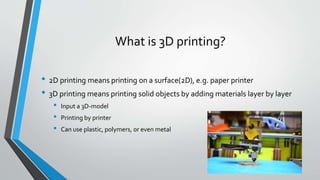
• 2D printing means printing on a surface(2D), e.g. paper printer
• 3D printing means printing solid objects by adding materials layer by layer
• Input a 3D-model
• Printing by printer
• Can use plastic, polymers, or even metal
History
• Actually not a new technology
• Charles Hull invented in 1984
• Become popular in recent years
• Due to advanced technology and lower cost
Pros & Cons
• Pros:
• Fast prototyping
• Lower costs
• Less setup and wasted materials comparing to
Molding(注塑成型), forging(鍛造) and
casting(鑄造)
• Cons
• Small size
• Few choices of materials
• Slow printing
Technology
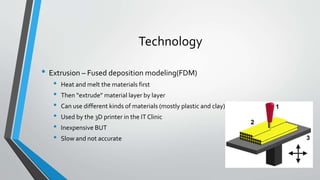
• Extrusion – Fused deposition modeling(FDM)
• Heat and melt the materials first
• Then “extrude” material layer by layer
• Can use different kinds of materials (mostly plastic and clay)
• Used by the 3D printer in the IT Clinic
• Inexpensive BUT
• Slow and not accurate
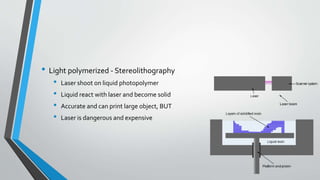
• Light polymerized - Stereolithography
• Laser shoot on liquid photopolymer
• Liquid react with laser and become solid
• Accurate and can print large object, BUT
• Laser is dangerous and expensive
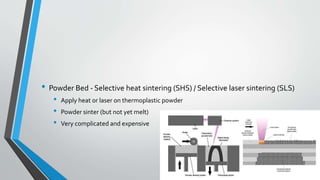
• Powder Bed - Selective heat sintering (SHS) / Selective laser sintering (SLS)
• Apply heat or laser on thermoplastic powder
• Powder sinter (but not yet melt)
• Very complicated and expensive
• Powder Bed - Direct metal laser sintering (DMLS)
• Similar to SLS
• BUT used on metal
• Powder Bed - Selective laser melting (SLM)
• Similar to SLS
• BUT will melt the metal powder
• Can print very hard materials, e.g.Titanium alloys, stainless steel
• Powder Bed - Powder bed and inkjet head 3D printing (3DP)
• Similar to SLS
• BUT use liquid binding material to combine the powder instead of laser
• Faster than laser
• BUT the powder may stick on the object
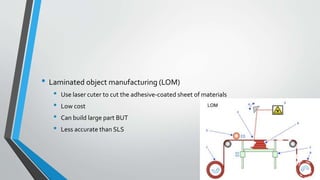
• Laminated object manufacturing (LOM)
• Use laser cuter to cut the adhesive-coated sheet of materials
• Low cost
• Can build large part BUT
• Less accurate than SLS
• Other technologies
• Robocasting or Direct InkWriting (DIW)
• Digital Light Processing (DLP)
• Electron-beam melting (EBM)
• Electron Beam Freeform Fabrication (EBF3)
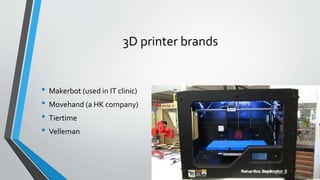
3D printer brands
• Makerbot (used in IT clinic)
• Movehand (a HK company)
• Tiertime
• Velleman
3D modeling
• A 3d model file is STL file, e.g. ABC.stl
• Can use Computer-aided design (CAD) or 3D modeling software to build
• OR simply download from the internet!
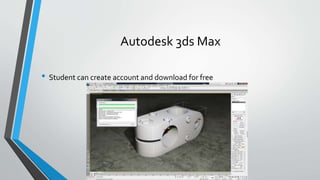
Autodesk 3ds Max
• Student can create account and download for free
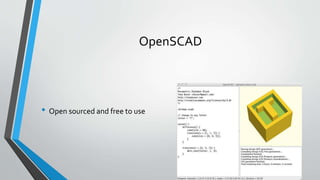
OpenSCAD
• Open sourced and free to use
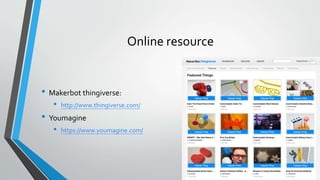
Online resource
• Makerbot thingiverse:
• http://www.thingiverse.com/
• Youmagine
• https://www.youmagine.com/

3D_printing.pptx

  • 1.
    3D printing workshop Introductionto 3D printing Instructor: ChungTsz Him (thchung@cse.cuhk.edu.hk)
  • 2.
    What is 3Dprinting? • 2D printing means printing on a surface(2D), e.g. paper printer • 3D printing means printing solid objects by adding materials layer by layer • Input a 3D-model • Printing by printer • Can use plastic, polymers, or even metal
  • 3.
    History • Actually nota new technology • Charles Hull invented in 1984 • Become popular in recent years • Due to advanced technology and lower cost
  • 4.
    Pros & Cons •Pros: • Fast prototyping • Lower costs • Less setup and wasted materials comparing to Molding(注塑成型), forging(鍛造) and casting(鑄造) • Cons • Small size • Few choices of materials • Slow printing
  • 5.
    Technology • Extrusion –Fused deposition modeling(FDM) • Heat and melt the materials first • Then “extrude” material layer by layer • Can use different kinds of materials (mostly plastic and clay) • Used by the 3D printer in the IT Clinic • Inexpensive BUT • Slow and not accurate
  • 6.
    • Light polymerized- Stereolithography • Laser shoot on liquid photopolymer • Liquid react with laser and become solid • Accurate and can print large object, BUT • Laser is dangerous and expensive
  • 7.
    • Powder Bed- Selective heat sintering (SHS) / Selective laser sintering (SLS) • Apply heat or laser on thermoplastic powder • Powder sinter (but not yet melt) • Very complicated and expensive
  • 8.
    • Powder Bed- Direct metal laser sintering (DMLS) • Similar to SLS • BUT used on metal • Powder Bed - Selective laser melting (SLM) • Similar to SLS • BUT will melt the metal powder • Can print very hard materials, e.g.Titanium alloys, stainless steel
  • 9.
    • Powder Bed- Powder bed and inkjet head 3D printing (3DP) • Similar to SLS • BUT use liquid binding material to combine the powder instead of laser • Faster than laser • BUT the powder may stick on the object
  • 10.
    • Laminated objectmanufacturing (LOM) • Use laser cuter to cut the adhesive-coated sheet of materials • Low cost • Can build large part BUT • Less accurate than SLS
  • 11.
    • Other technologies •Robocasting or Direct InkWriting (DIW) • Digital Light Processing (DLP) • Electron-beam melting (EBM) • Electron Beam Freeform Fabrication (EBF3)
  • 12.
    3D printer brands •Makerbot (used in IT clinic) • Movehand (a HK company) • Tiertime • Velleman
  • 13.
    3D modeling • A3d model file is STL file, e.g. ABC.stl • Can use Computer-aided design (CAD) or 3D modeling software to build • OR simply download from the internet!
  • 14.
    Autodesk 3ds Max •Student can create account and download for free
  • 15.
  • 16.
    Online resource • Makerbotthingiverse: • http://www.thingiverse.com/ • Youmagine • https://www.youmagine.com/